Contents · 40 sections
- What Is an Affidavit of Support?
- Who Must File an Affidavit of Support?
- Who Is Exempt From Form I-864?
- What Is a Sponsor for a Visa?
- Visa Sponsorship: Family Sponsors vs Employer Sponsors
- The I-864 Family: I-864, I-864A, I-864EZ and I-864W
- Sponsor Eligibility Basics
- Sponsor Income Requirements
- Where Do You Find the Current Income Figures?
- How Do You Count Household Size?
- What Income Counts on Form I-864?
- Should Sponsors Report Current Income or Tax Return Income?
- Using Assets When Income Falls Short
- Joint Sponsor Requirements
- How Many Joint Sponsors Can One Case Use?
- Who Can Serve as a Joint Sponsor?
- Joint Sponsor vs Household Member: Which Do You Need?
- Form I-864A (Household Member)
- Who Can Sign Form I-864A?
- Documents to Include With Form I-864
- Tax Transcripts vs Tax Returns: Which Should You Send?
- What If the Sponsor Was Not Required to File Taxes?
- Proof of Status and Domicile for the Sponsor
- Affidavit of Support Sample: A Filled-In Walkthrough
- How Do You Fill Out Form I-864?
- Where Do You Submit the Affidavit of Support?
- Affidavit of Support in Adjustment of Status
- Affidavit of Support in Consular Processing and NVC
- Form I-864 Edition and Fee: What to Check
- What Happens After You Submit Form I-864?
- How Long Does the Affidavit Review Take?
- What Are a Sponsor's Legal Obligations?
- When Does the Sponsor's Obligation End?
- Affidavit of Support for a Tourist Visa vs Immigrant Visa
- Affidavit of Support for Family Members: Common Cases
- Common Affidavit of Support Mistakes
- What If the Affidavit Is Found Insufficient?
- Self-Employed, Retired or Unemployed Sponsors
- When to Get Legal Help With Form I-864
- Frequently Asked Questions
The short answer
An affidavit of support is Form I-864, a signed promise by a U.S. citizen or green card holder to financially support a relative who is immigrating. Most family-based green card applicants need one. The sponsor must show income at or above a federal minimum, or add a joint sponsor or household member.
At a glance
| Official name | Form I-864, Affidavit of Support Under Section 213A of the INA |
| Current edition | 08/24/26 (as of October 2026) |
| USCIS fee | $0 at USCIS |
| Income figures | Form I-864P, based on HHS poverty guidelines (check uscis.gov/i-864p) |
| Legal effect | A binding contract with the U.S. government |
What Is an Affidavit of Support?
An affidavit of support is a legal contract in which a sponsor promises the U.S. government to support an immigrant financially. The form is Form I-864, sometimes typed as "form 1 864." USCIS calls it "a legally binding contract with the U.S. government to financially support the sponsored alien."
This guide is part of our uscis forms hub. It covers only the affidavit; the petitions and applications around it have their own pages.
Why the government asks for it
U.S. immigration law bars people who are likely to become a public charge, meaning mainly dependent on government support. The affidavit shifts that risk to a sponsor. If the sponsor's finances are strong enough, the immigrant usually clears this part of the review.
An affidavit, not a letter
People sometimes search for an "affidavit letter" from a relative. For a green card, a letter is not enough. The official affidavit of support form has fixed questions, a contract section and signature rules, and USCIS and the State Department accept only that form for family green cards.
Who Must File an Affidavit of Support?
The petitioner who filed the family petition must file Form I-864 for most family-based immigrants. Some employment-based immigrants also need one, when a relative filed the work petition or owns a large share of the hiring company. The immigrant never signs as sponsor for themselves.
Family-based cases
If you filed an I-130 family petition for a spouse, parent, child or sibling, you are the main sponsor. You must sign Form I-864 even if your income is low. A joint sponsor can be added, but it never replaces the petitioner's own affidavit.
Employment-based cases
Most workers sponsored by an employer do not need an I-864. The exception applies when a U.S. citizen or green card relative filed the petition, or has a significant ownership interest in the employer. Our perm case status guide explains the usual work-based path.
Who Is Exempt From Form I-864?
Some immigrants do not need an affidavit. Exemptions include immigrants who have already earned enough U.S. work credits, children who will become citizens automatically on entry, and some widows, widowers and self-petitioners. The exact list is in the current instructions.
Common exemption categories
- Immigrants credited with enough Social Security work quarters.
- Children who acquire citizenship automatically when they enter as permanent residents.
- Widows and widowers filing their own petition.
- VAWA self-petitioners and certain other humanitarian categories.
How to claim an exemption
USCIS used to accept Form I-864W for exemption claims. Check the current I-864 and I-485 instructions for how to claim it today. Do not skip the affidavit on your own; explain the exemption in writing and include proof, such as a Social Security earnings record.
What Is a Sponsor for a Visa?
A sponsor for a visa is the person or company that formally asks the U.S. government to let a foreign national immigrate or work, and accepts legal duties in return. In family cases, the sponsor files the petition and signs the affidavit. In work cases, the sponsor is usually the employer.
What a family sponsor promises
A family sponsor promises to keep the immigrant's income above a minimum level and to repay certain public benefits if the immigrant uses them. The promise is a binding contract, not a formality, and it can be enforced in court.
Sponsor vs petitioner vs beneficiary
The petitioner files the petition. The beneficiary is the immigrant. The sponsor signs the affidavit. In most family cases, the petitioner and the main sponsor are the same person. A joint sponsor is an extra sponsor, not a second petitioner.
Visa Sponsorship: Family Sponsors vs Employer Sponsors
"Visa sponsorship" means different things in family and work cases. A family sponsor signs Form I-864 and takes on a support duty. An employer sponsor files labor and work petitions and pays wages, but usually signs no affidavit of support.
How the two kinds compare
The table sets the two sponsorship types next to each other. The key point: only family sponsorship creates a personal, enforceable money promise to the government.
| Point | Family sponsor | Employer sponsor |
|---|---|---|
| Main forms | I-130 and I-864 | PERM, I-140 or I-129 |
| Financial promise | Support the immigrant | Pay the offered wage |
| Who checks it | USCIS or the State Department | DOL and USCIS |
| Duty after green card | Yes, under the contract | No support duty |
A note on other countries' terms
Some searches use terms from other countries, such as a "certificate of sponsorship." That is a United Kingdom work-visa document. The United States has no such certificate; family cases use Form I-864 and work cases use the employer's petitions.
The I-864 Family: I-864, I-864A, I-864EZ and I-864W
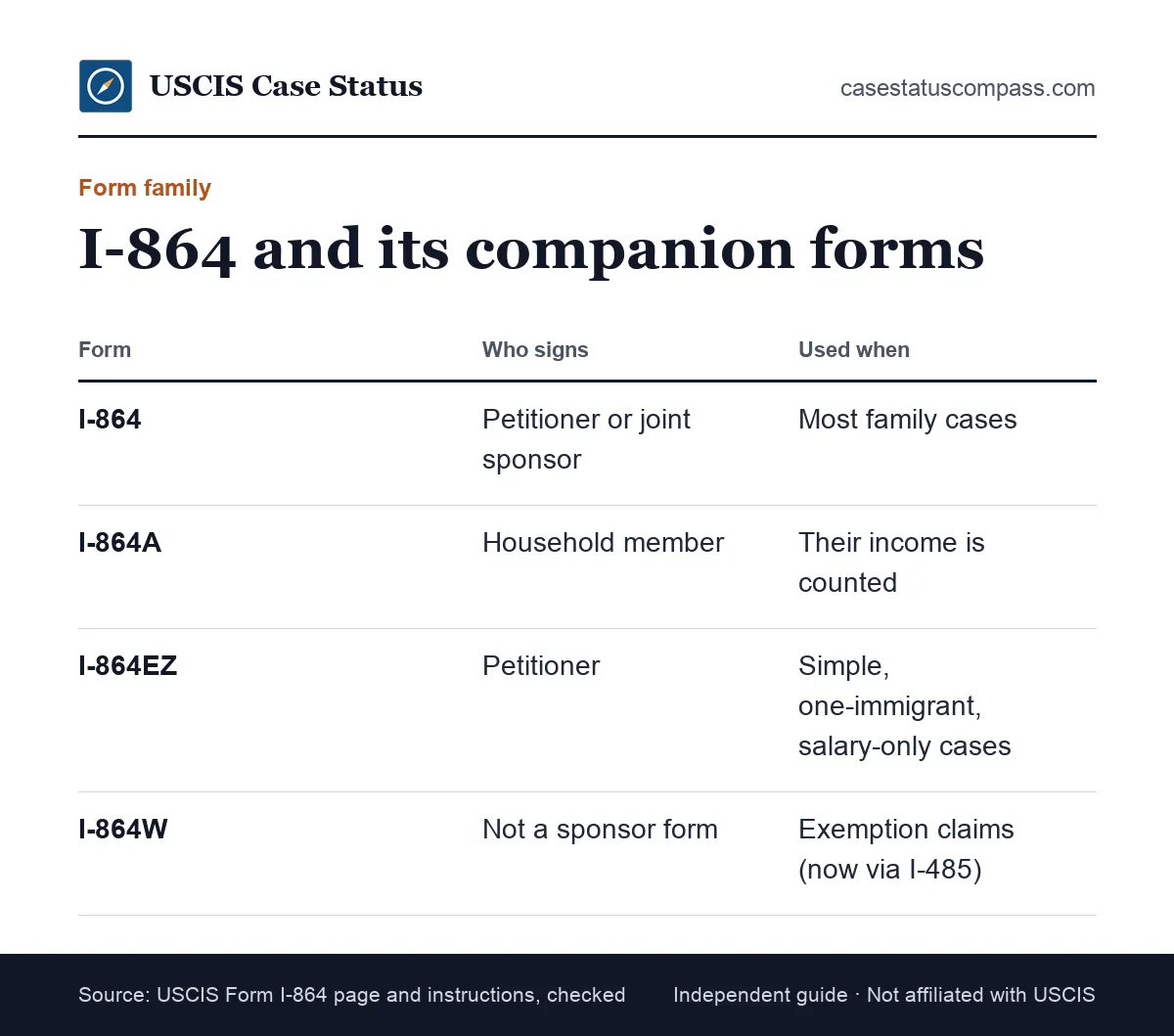
Form I-864 has companion forms. Form I-864A adds a household member's income. Form I-864EZ is a short version for simple cases. Form I-864W was used to claim an exemption. Picking the right one saves a rejection. Check the instructions first.
When Form I-864EZ fits
The EZ version is for a petitioner sponsoring one immigrant, using only their own salary or pension income, with no assets or household members needed. If any of those do not fit, use the full Form I-864.
Sponsor Eligibility Basics
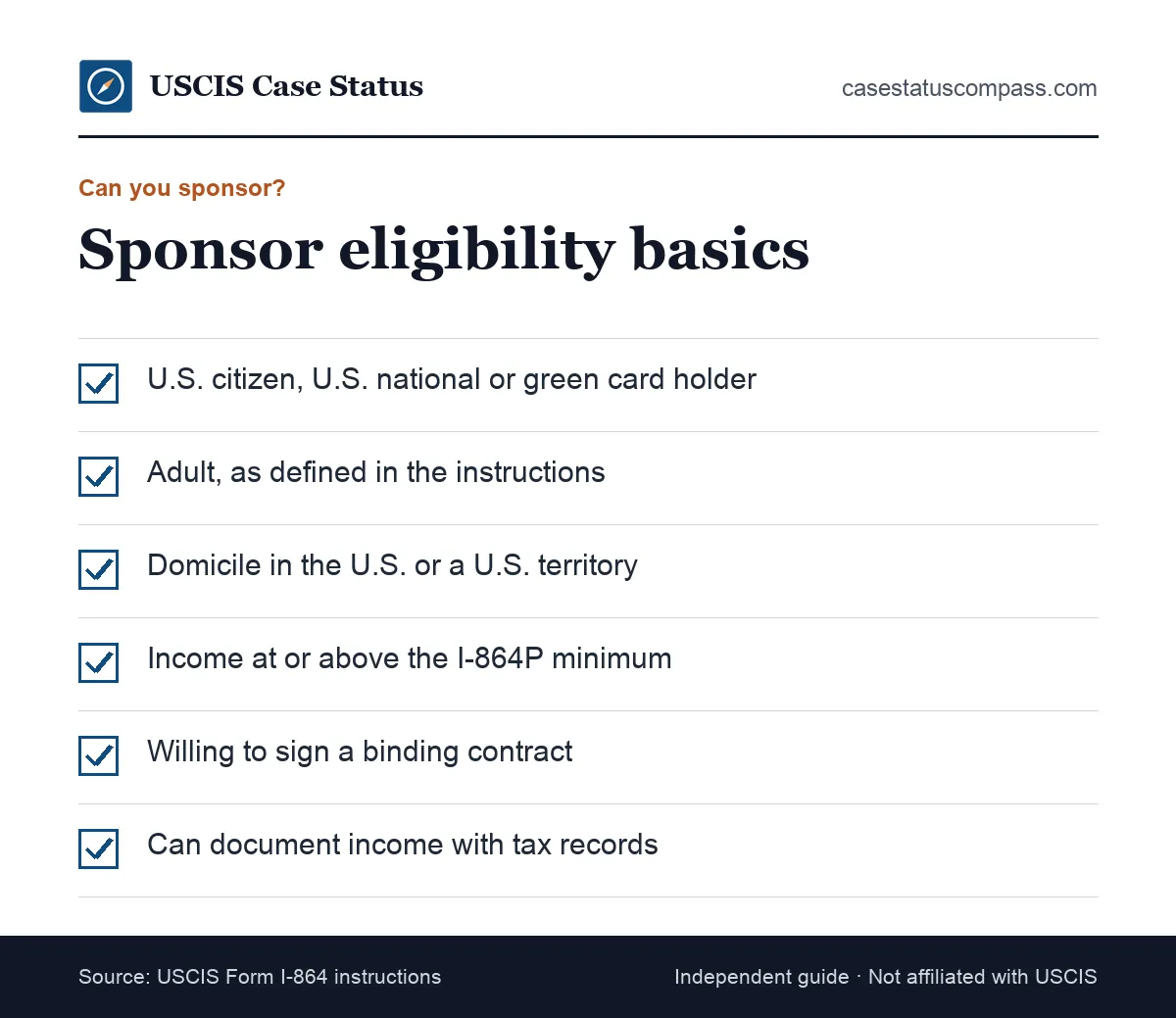
Every sponsor must be a U.S. citizen, U.S. national or lawful permanent resident, be an adult under the instructions' age rule, and have a domicile in the United States or a U.S. territory. Only after these tests does income matter.
What "domicile" means
Domicile is your main, lasting home. A citizen living abroad can still qualify by showing a real plan to move back before or with the immigrant, or that the stay abroad is temporary.
Sponsors who cannot qualify
People who are not citizens or permanent residents cannot sponsor, even if they are wealthy. A company or organization also cannot be a sponsor or joint sponsor. If the petitioner dies, a substitute sponsor may be possible in some cases; ask an attorney.
Sponsor Income Requirements
The sponsor's household income must reach a federal minimum based on the HHS poverty guidelines and the sponsor's household size. The required dollar amount changes every year and is published on Form I-864P. Active-duty military sponsoring a spouse or child have a lower threshold.
How officers test income
Officers look first at your current yearly income, then at your most recent tax return. If you are close to the line, they look at job stability and recent pay.
When income alone is not enough
If your income falls short, you have three tools: add the income of a household member with Form I-864A, use assets, or add a joint sponsor. You can also combine a household member and assets, but a joint sponsor must qualify alone.
Where Do You Find the Current Income Figures?
The official income figures for an affidavit are on Form I-864P at uscis.gov/i-864p, built from the poverty guidelines that HHS publishes each year. We do not reprint the dollar amounts here, because they change each year and an old table could cause a denial.
Reading the I-864P chart
Find the row for your household size. Use the column for your situation, such as the standard sponsor column or the military column. Use the chart for the state where you live, because Alaska and Hawaii have their own rows.
When the figures change
HHS releases new guidelines early each year, and USCIS then updates Form I-864P. The amount in force on the day you file is the one that matters, and the State Department applies the version in force on its review date.
How Do You Count Household Size?
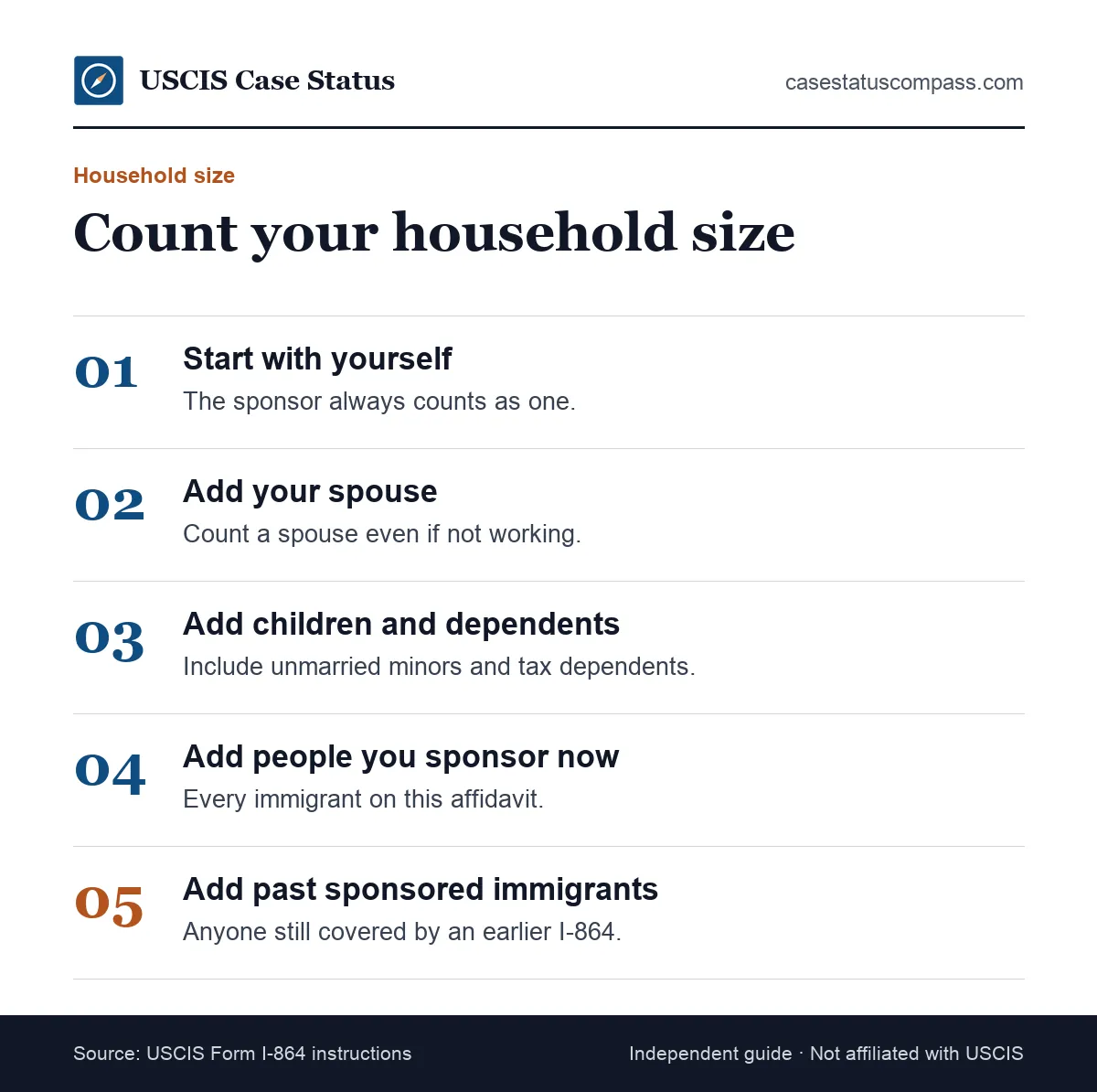
Household size on an affidavit counts the sponsor, the sponsor's spouse, the sponsor's unmarried minor children, tax dependents, every immigrant on this affidavit, and anyone still covered by an earlier I-864. Each person adds one. Count once, carefully.
Worked household-size examples
Each row adds up one sample household. Count your own the same way, then compare the total with the 125% figure for that household size.
| Sponsor's situation | Who counts | Household size |
|---|---|---|
| Single petitioner sponsoring a spouse | Sponsor + spouse | 2 |
| Married petitioner with 2 children sponsoring a parent | Sponsor + spouse + 2 children + parent | 5 |
| Single petitioner sponsoring a sibling, sibling's spouse and child | Sponsor + 3 immigrants | 4 |
| Petitioner who sponsored a spouse before, now sponsoring a parent | Sponsor + spouse + parent | 3 |
| Joint sponsor, married, no children, sponsoring one immigrant | Joint sponsor + spouse + immigrant | 3 |
People who do not count
Adult children who are not tax dependents, roommates, and parents you do not claim on taxes do not count. The exception: an adult relative who signs Form I-864A is added to your household size.
What Income Counts on Form I-864?
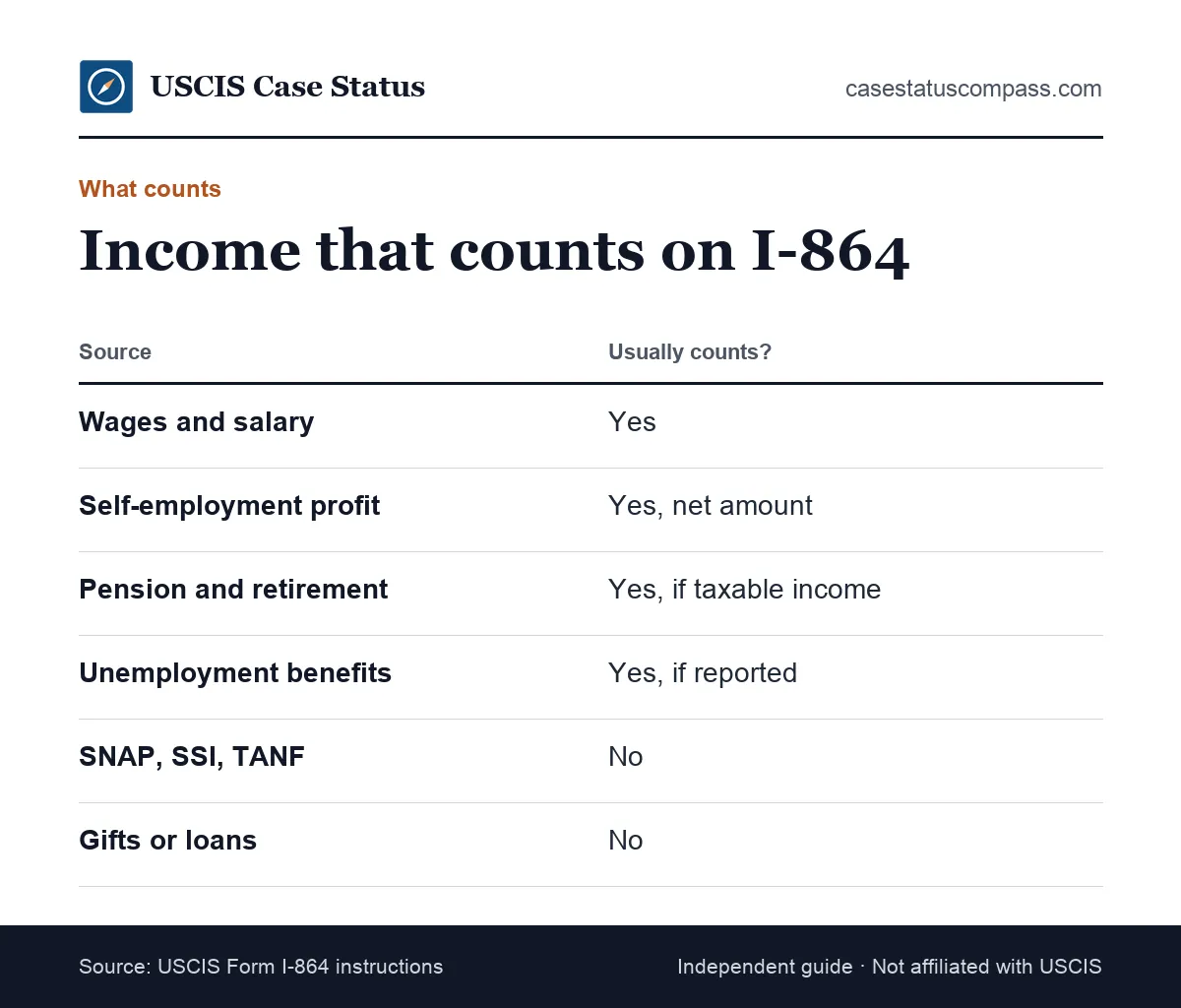
Income that counts on an affidavit is mostly taxable income reported to the IRS: wages, net self-employment profit, pensions, interest, rental income and reported unemployment benefits. Means-tested public benefits such as SNAP or SSI do not count toward the minimum.
Income of the intending immigrant
The immigrant's own income can sometimes count, but only if it will continue after they get the green card from the same source. A spouse already working lawfully in the United States is the common example. The instructions explain when that spouse must also sign Form I-864A.
Should Sponsors Report Current Income or Tax Return Income?
You list your current yearly income and the total income from your latest tax return. If you just got a raise, current income may help. If you just lost a job, officers may focus on the gap and ask for an explanation.
Using Assets When Income Falls Short
If your income is below the minimum, you can make up the gap with assets that can be turned into cash within a year. The instructions apply a multiple to the shortfall, and that multiple is smaller when sponsoring a spouse or child of a U.S. citizen.
Assets that usually count
- Savings and checking accounts.
- Stocks, bonds and certificates of deposit.
- Real estate equity, other than your main home.
- Retirement accounts you can access, minus penalties.
Subtract any debts secured by the asset, and attach statements or appraisals that show its current value.
Assets that usually do not count
Your primary home, your car (unless you own more than one and prove its value), and assets you cannot sell within a year usually do not count. Show ownership, value and any loans against each asset with recent statements.
Joint Sponsor Requirements
A joint sponsor is a second person who signs a separate Form I-864 when the petitioner's income is too low. The joint sponsor must meet every sponsor eligibility rule and must, on their own, reach the I-864P minimum for their own household size, which includes the immigrant.
What the joint sponsor promises
The joint sponsor takes on the same legal duty as the petitioner. The government or the immigrant can enforce the contract against either sponsor, for the full amount. Choose someone who understands this legal duty.
How Many Joint Sponsors Can One Case Use?
The instructions set a limit on how many joint sponsors a case can use, and each one may cover only the immigrants listed on their own affidavit. Check the current instructions before you plan this. Up to two joint sponsors; each must qualify alone at 125%.
Who Can Serve as a Joint Sponsor?
Anyone who meets the sponsor eligibility rules can serve as a joint sponsor: a U.S. citizen, U.S. national or permanent resident who is an adult, lives in the United States, and earns enough alone. The joint sponsor does not need to be related to the petitioner or the immigrant.
Joint sponsor requirements in one list
- U.S. citizen, U.S. national or green card holder.
- Adult under the instructions' age rule.
- Domicile in the United States.
- Income or assets above the I-864P line for their own household.
- Willing to sign a binding contract.
Choosing the right person
Pick someone with stable, well-documented income and a clear tax history. A friend with high income but messy tax filings can cause more delays than a modest earner with clean records.
Joint Sponsor vs Household Member: Which Do You Need?
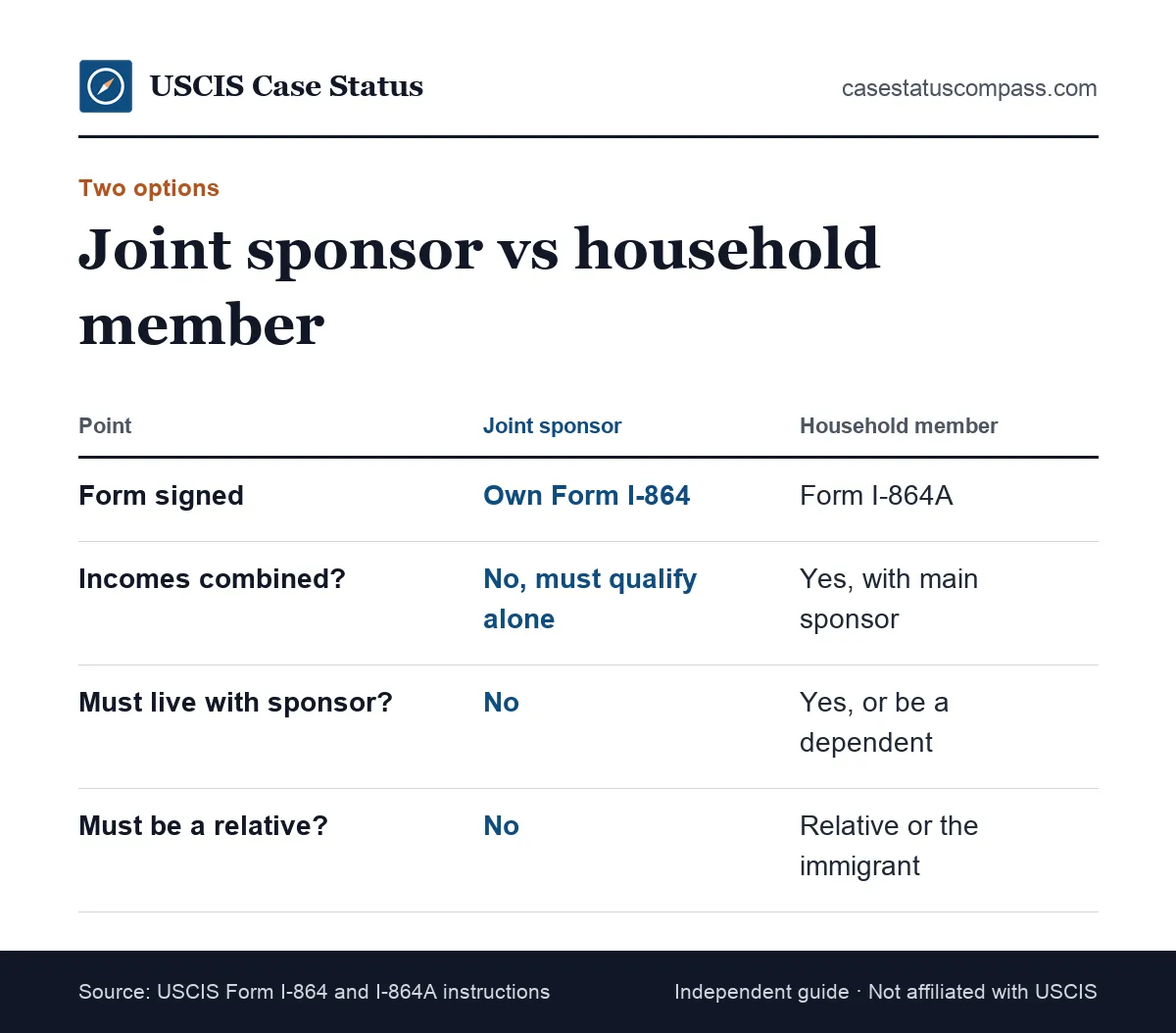
A household member adds income to the main sponsor through Form I-864A. A joint sponsor files their own full Form I-864 and must qualify alone. Use a household member when someone in your home can close a small gap; use a joint sponsor when no one in the home can.
Choosing between the two
The table weighs a household member against a joint sponsor for closing an income gap. If the helper lives with you and is related, Form I-864A is usually simpler.
| If this is true | Better option |
|---|---|
| Your spouse or adult child at home has income | Household member (I-864A) |
| No one at home earns, but a friend earns well | Joint sponsor (I-864) |
| Your income is close and you have savings | Assets on your own I-864 |
| You and a relative living elsewhere both earn some | Joint sponsor, if they qualify alone |
Mixing the options
A petitioner can use a household member and assets together. A joint sponsor may also use their own household members on their own I-864A. What you cannot do is add the joint sponsor's income to the petitioner's to reach one line.
Form I-864A (Household Member)
Form I-864A, the Contract Between Sponsor and Household Member, lets a relative living with the sponsor add their income to the sponsor's. The household member signs it together with the sponsor, and both become responsible for supporting the immigrant.
What the 864 a form asks for
The "864 a form," as people often search for it, asks for the household member's details, relationship to the sponsor, income and assets, and contains a contract signed by both. A separate Form I-864A is needed for each person whose income you use.
Proof to attach
Attach proof that the person lives with you, such as a shared lease or address on tax returns, plus proof of relationship and the member's tax records. Without proof of the relationship, the I-864A may be disregarded.
Who Can Sign Form I-864A?
A household member who signs Form I-864A must be a relative living in the sponsor's home, or a dependent listed on the sponsor's latest tax return. Qualifying relatives include a spouse, adult child, parent or sibling. The intending immigrant can sign one in limited cases.
When the immigrant signs Form I-864A
The immigrant's own income can be used if it will continue after the green card from the same source. In that case, the immigrant generally signs Form I-864A only if they are sponsoring accompanying family members, not just themselves. The instructions explain the details.
Documents to Include With Form I-864
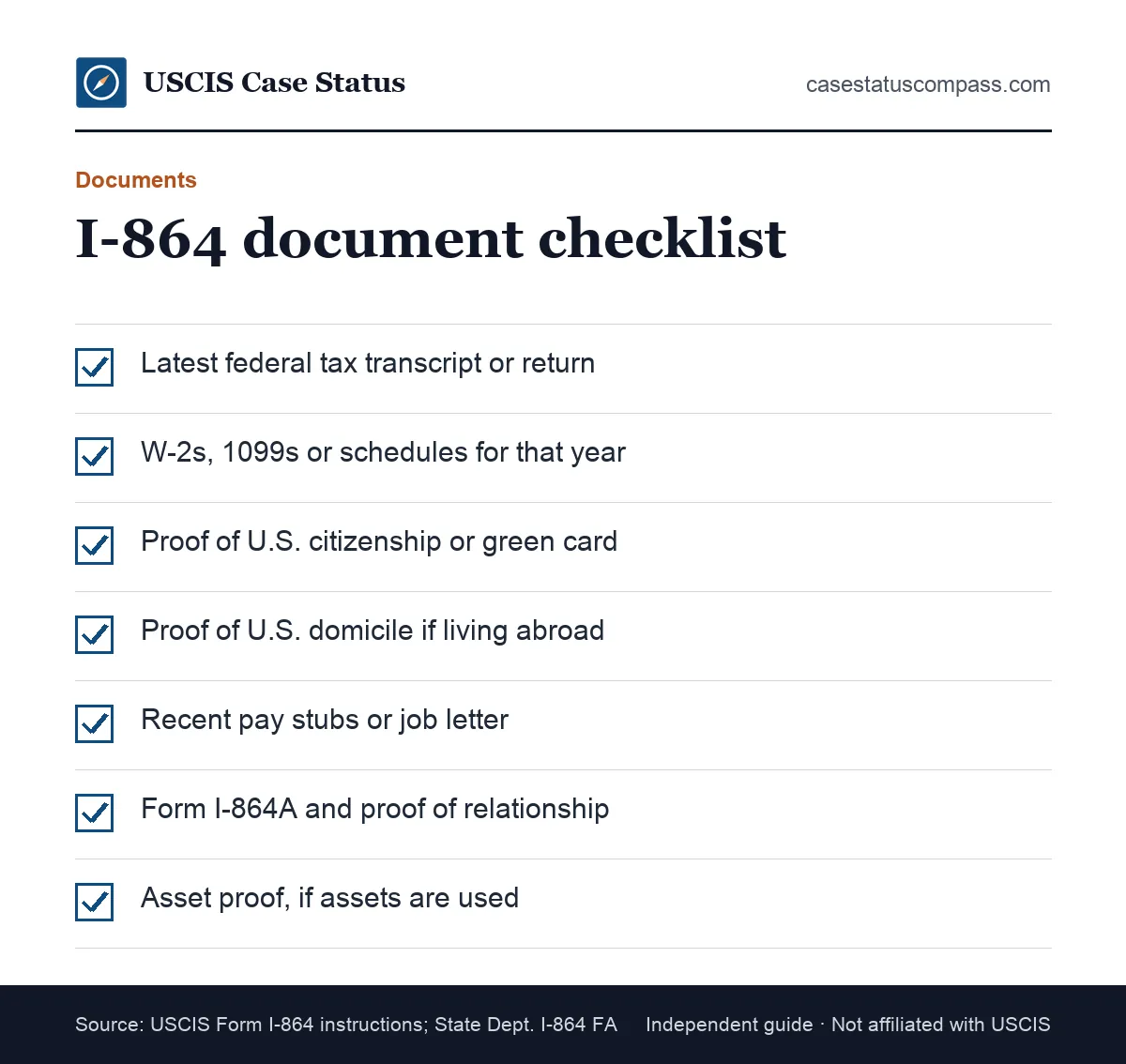
The main affidavit of support necessary documents are the sponsor's latest federal tax transcript or return, W-2s or 1099s, proof of U.S. status, and proof of domicile if living abroad. Add Form I-864A and proof of relationship for household members, and asset proof if used.
Proof of current employment
Recent pay stubs or a signed letter from your employer showing your job, pay and start date help support your current income. Self-employed sponsors can add business records. Use documents from the last six months.
Copies, translations and edition
USCIS says not to send originals unless asked. Any foreign-language document needs a full English translation and a translator's certification. Make sure the edition date and page numbers are visible at the bottom of all pages, as USCIS instructs.
Tax Transcripts vs Tax Returns: Which Should You Send?
An IRS tax transcript for the most recent tax year is the strongest proof for an affidavit, and USCIS and the State Department both accept it. A full copy of the return with all schedules also works. Older years can help if your income has changed.
How to get a transcript
Request it free from the IRS online, by phone or by mail. The "tax return transcript" type lists your total income clearly. Order one for each tax year the form asks about, and attach W-2s or 1099s as well.
What If the Sponsor Was Not Required to File Taxes?
If your income was too low to file, write a short signed statement saying so and showing the IRS rule that applied. You will usually still need a joint sponsor or household member to meet the minimum. Keep the explanation short.
Proof of Status and Domicile for the Sponsor
Every sponsor must prove U.S. status with a copy of a U.S. passport, birth certificate, naturalization certificate or green card. Sponsors living abroad must also prove domicile, such as a job offer in the United States, a lease, or proof of a temporary assignment.
Showing domicile from abroad
Useful proof includes a signed U.S. lease, a U.S. job offer, voting records, U.S. bank accounts, and evidence that you keep a home in the United States. Sponsors abroad must show U.S. domicile by the time the immigrant is admitted.
Status for green card holder sponsors
A permanent resident sponsor sends a copy of both sides of their green card. If the card has expired, include the renewal receipt. Our green card renewal guide explains how to keep proof current while sponsoring.
Affidavit of Support Sample: A Filled-In Walkthrough
This affidavit of support sample walks through a fictional case, section by section, so you can see what goes where. Use it as a guide only, and always fill in the current official edition with your own real details. No dollar thresholds appear here; check Form I-864P.
The fictional case
Maria, a U.S. citizen in Texas, filed an I-130 for her husband Ahmed. She lives with her adult daughter Sofia, who works full time. Maria's income is just under the I-864P line for a household of three, so Sofia adds her income with Form I-864A.
How Maria fills the people sections
This fictional sample shows how the people sections fit together. Use it only as a guide to layout; your own answers must match your records.
| Section | What Maria writes |
|---|---|
| Basis for filing | She is the petitioner who filed Form I-130 |
| Principal immigrant | Ahmed's name, A-Number if any, birth date and address |
| Family members | None; Ahmed has no children immigrating |
| Sponsor information | Maria's address, Social Security number and citizenship |
How Maria fills the money and signature sections
The second half of the sample covers income, assets and signatures. Amounts are left out because they depend on the current I-864P chart.
| Section | What Maria writes |
|---|---|
| Household size | Maria + Sofia + Ahmed = 3 |
| Employment and income | Her current salary and last year's total income |
| Household member income | Sofia's income, backed by her signed I-864A |
| Assets | Left blank, not needed |
| Contract and signature | Maria signs and dates in ink or electronically as allowed |
What Maria attaches
Maria attaches her tax transcript and W-2, a copy of her U.S. passport, Sofia's I-864A with Sofia's transcript, Sofia's birth certificate to prove the mother-daughter link, and a lease showing both live at the same address.
How Do You Fill Out Form I-864?
You fill out Form I-864 by choosing your basis for filing, listing the immigrants, giving your details, counting household size, entering current and tax-year income, adding assets if needed, then signing the contract. Answer every question; write "None" or "N/A" where it does not apply.
Step-by-step order
- Download the current edition from uscis.gov/i-864.
- Choose why you are filing (petitioner, joint sponsor, substitute sponsor).
- List the principal immigrant and any family members.
- Enter your personal and status details.
- Count household size.
- Enter your income and employment.
- Add assets, if used.
- Read the contract and sign.
Where Do You Submit the Affidavit of Support?
Where you submit an affidavit depends on where the immigrant applies. Inside the United States, it goes to USCIS with the immigrant's I-485 adjustment of status application. For immigrants abroad, it is uploaded to the National Visa Center (NVC) for consular processing.
Both routes compared
The table contrasts adjustment and consular cases. In both, the same form and income rules apply; only the office that receives it changes.
| Route | Where the I-864 goes | Who reviews it |
|---|---|---|
| Adjustment of status (in the U.S.) | With Form I-485, to USCIS | A USCIS officer |
| Consular processing (abroad) | Uploaded to NVC through the State Department portal | NVC staff, then a consular officer |
Affidavit of Support in Adjustment of Status
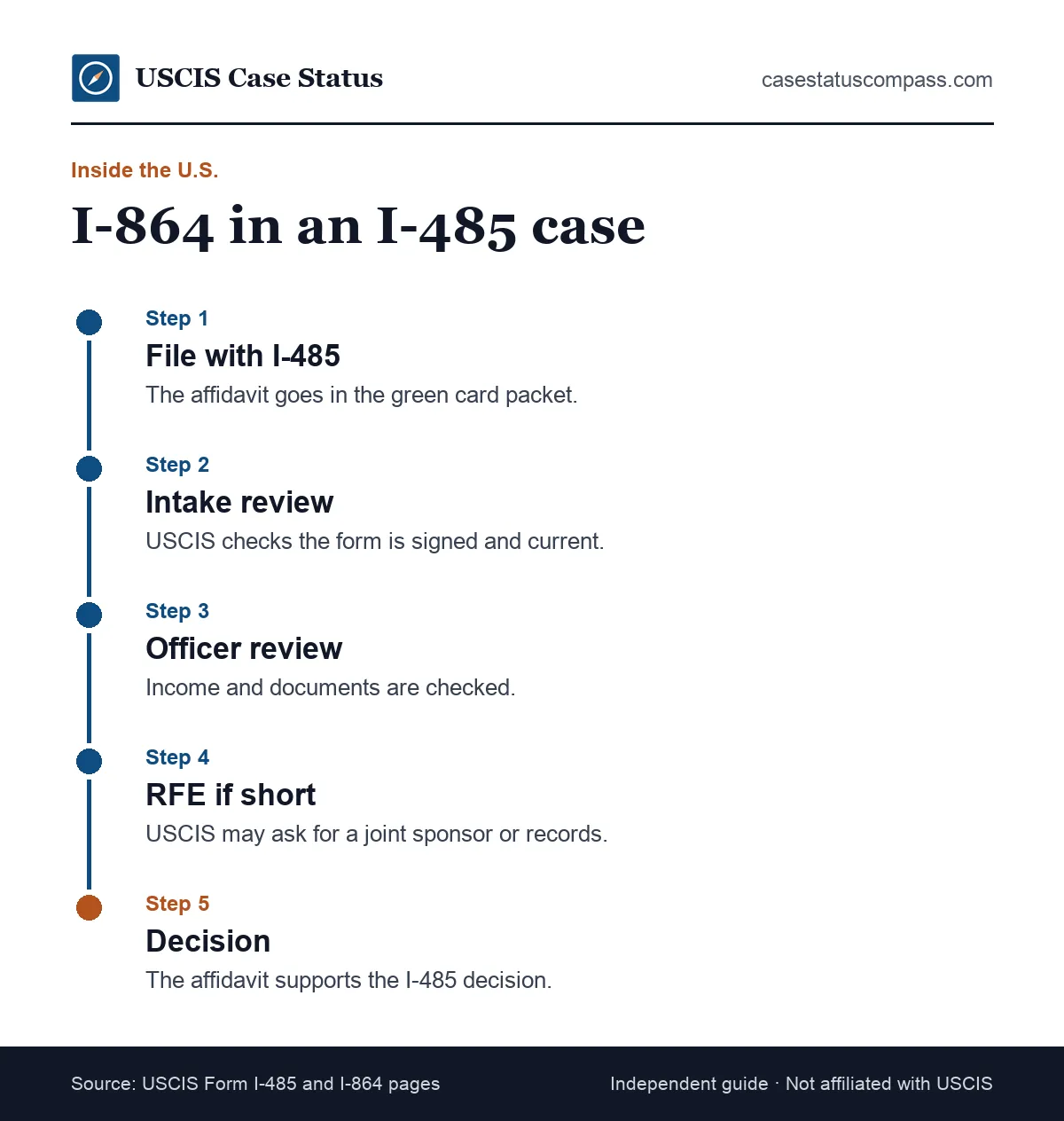
In an adjustment of status case, the affidavit is filed with Form I-485 and judged as part of the green card decision. USCIS checks the form at intake, reviews income later, and may send a request for evidence if something is missing.
What USCIS checks first
At intake, USCIS checks that the form is signed and on the right edition. As of October 2026, USCIS requires I-485 edition 09/18/26 (01/20/25 and 09/04/26 editions rejected on/after Sept. 18, 2026; no grace period), so check both forms' editions together.
Bring updates to the interview
If your income changed after filing, bring your newest tax transcript, pay stubs and a job letter to the green card interview. The officer decides on current income, not just the figure from filing.
Affidavit of Support in Consular Processing and NVC
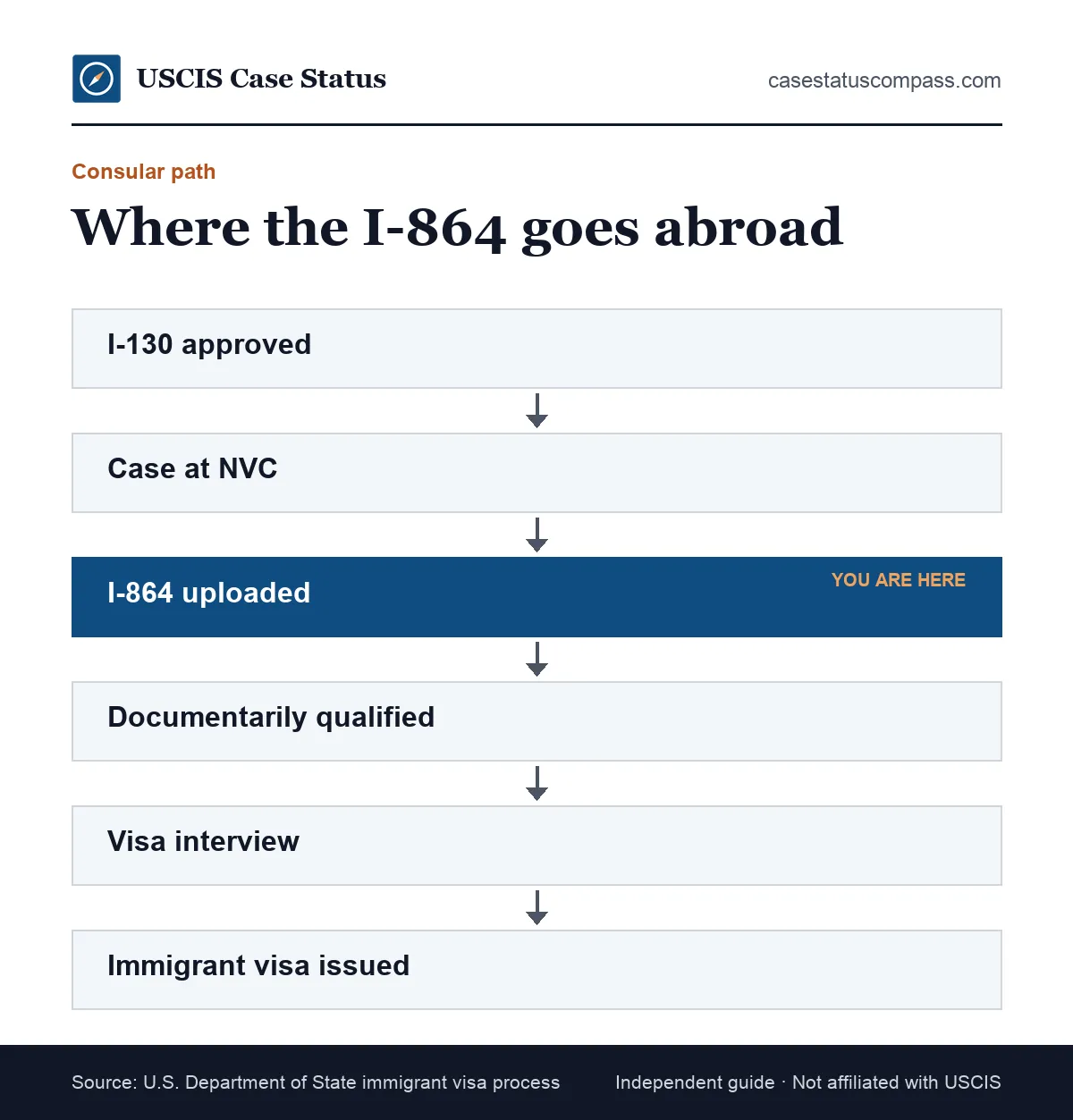
In a consular case, the sponsor uploads Form I-864 and supporting documents to the National Visa Center. NVC reviews them for completeness. Once everything is accepted, the case is "documentarily qualified" and waits for a visa interview. NVC reviews a case only after all fees are paid and the required documents are in: the petitioner's Affidavit of Support, financial evidence, the applicant's DS-260 and civil documents.
Tracking it at NVC
You follow progress in the State Department's online portal. Our nvc case status guide explains each NVC message and what "documentarily qualified" means. Log in with your case number to see any items NVC still wants.
The State Department fee
For consular cases, the State Department charges a separate Affidavit of Support review fee. As of October 2026, it is $120 when the affidavit is reviewed domestically. NVC, which collects visa fees, tells you when and how to pay it.
Form I-864 Edition and Fee: What to Check
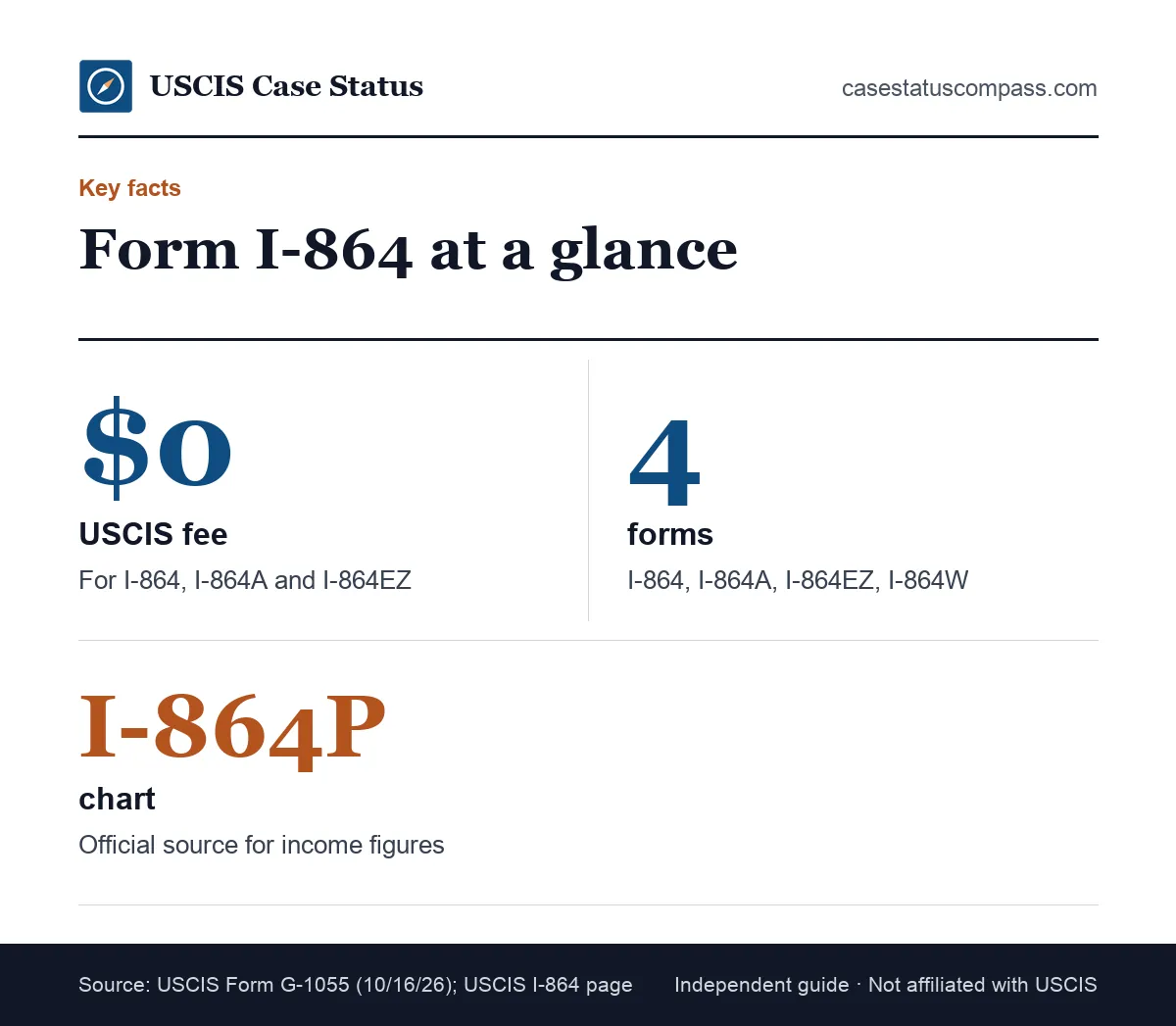
As of October 2026, USCIS lists Form I-864 edition 08/24/26 and a USCIS filing fee of $0 at USCIS. Always download the form fresh from uscis.gov/i-864, because older editions may be rejected after a grace period ends. Check the edition date at the bottom of every page before signing.
Checking the edition
The edition date is printed at the bottom of each page. If NVC or USCIS has rejected your form for an old edition, download it again and refile all pages.
Other related fees
The affidavit itself is free at USCIS, but other forms in the case are not. For example, as of October 2026 Form I-130 costs $675 (paper) / $625 (online) and Form I-485 costs $1,440 (paper) / $1,390 (online); $950 / $900 if under 14 and filing with a parent. Our uscis fees hub covers every amount.
What Happens After You Submit Form I-864?
After you submit the affidavit, it is checked for completeness, then reviewed with the full case. Inside the United States, USCIS reviews it with Form I-485. Abroad, NVC reviews it first and a consular officer makes the final call at the interview.
Stage-by-stage view
The table follows the affidavit from preparation to the end of the duty. Most problems appear at the review step, when missing tax years surface.
| Stage | What happens | What to watch for |
|---|---|---|
| Intake | Form and signature checked | Rejection for missing pages |
| Document review | Tax and status proof checked | NVC "checklist" or USCIS RFE |
| Officer review | Income tested against I-864P | Request for joint sponsor |
| Interview | Officer may ask about finances | Bring updated records |
| Decision | Affidavit accepted with the case | Green card or visa approved |
After the green card is granted
Once the immigrant becomes a permanent resident, the sponsor's legal duty begins. Keep a copy of the full affidavit package; you may need it if the immigrant later applies for benefits or the government asks for reimbursement.
How Long Does the Affidavit Review Take?
There is no separate processing time for Form I-864. The affidavit is reviewed as part of the I-485 case or the NVC and consular case. USCIS posts current I-485 times at egov.uscis.gov/processing-times; our green card processing time page explains how to read them.
What affects speed
A complete, well-documented affidavit avoids requests for more evidence, which is the main delay you can control. A joint sponsor added at the start is faster than one added after an RFE.
What Are a Sponsor's Legal Obligations?
A sponsor who signs an affidavit promises to keep the immigrant's income at or above a set minimum and to repay certain means-tested public benefits the immigrant receives. The immigrant or the government can sue to enforce it. It lasts for years.
What "means-tested benefits" include
Federal means-tested benefits include programs such as SNAP, SSI, TANF and Medicaid, with some exceptions such as emergency care. If the immigrant uses them, the agency can seek repayment from the sponsor.
Reporting a move
Sponsors must report a change of address to USCIS while the obligation lasts, using Form I-865. Failing to do so can bring a fine. File it within 30 days of moving.
When Does the Sponsor's Obligation End?
The sponsor's obligation ends when the immigrant becomes a U.S. citizen, earns enough Social Security work credits, leaves the United States permanently and gives up residence, or dies. Divorce does not end the duty, and neither does the sponsor's own death for past debts.
Divorce and the affidavit
Many sponsors are surprised that divorce does not cancel the promise. A divorced spouse may still enforce the support duty. It ends only on set events, such as citizenship or 40 quarters of work.
Citizenship as an end point
When the immigrant naturalizes, the obligation ends. Our citizenship application guide explains how a permanent resident applies, which is one way the sponsor's duty ends. Keep proof of the naturalization date.
Affidavit of Support for a Tourist Visa vs Immigrant Visa
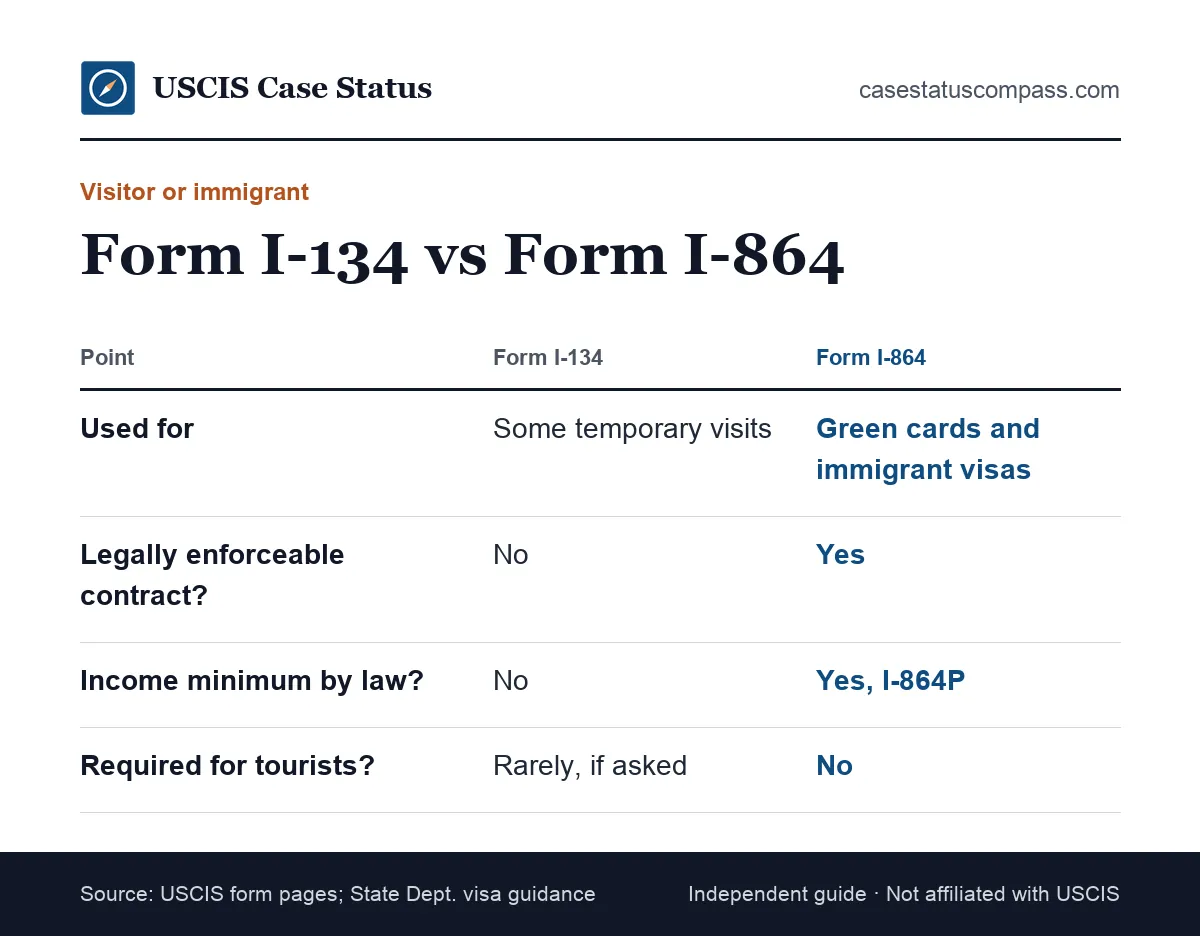
An affidavit of support for a tourist visa is not Form I-864. Tourists apply for a visitor visa and show their own ties and funds. Some posts may accept a Form I-134 declaration from a U.S. host, but it carries no binding contract.
When Form I-134 comes up
Form I-134 is a declaration of financial support used in some temporary cases. A consular officer may accept it as extra evidence. It does not create the contract that Form I-864 does, and it does not replace the visitor's own evidence.
Affidavit of Support for Family Members: Common Cases
The affidavit works the same way for every relative, but household size and supporting documents change. Spouses, parents, siblings and children each create different counting and document questions. Read the case closest to yours below, then check the household-size and document sections above before you sign the form.
Spouse cases
For a spouse, the household includes the sponsor and the spouse. Marriage-based cases often use a household member, such as an adult child, to close a gap. See our cr1 visa guide for the full spouse route.
Parent and sibling cases
Parents sponsored by an adult citizen child add to the child's household. Sibling cases often include the sibling's spouse and children, which raises household size fast. Many sibling sponsors need a joint sponsor.
Common Affidavit of Support Mistakes
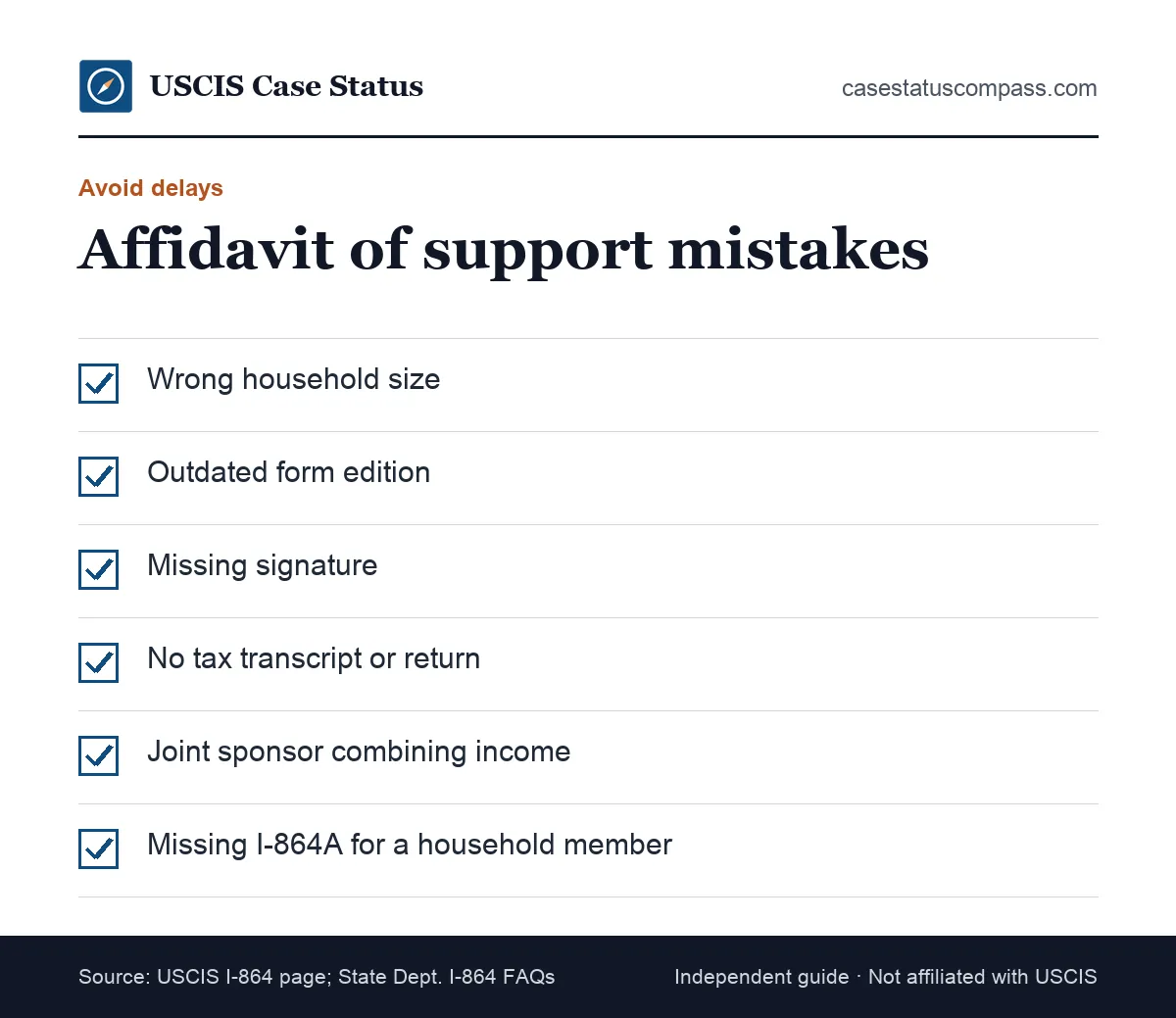
The most common affidavit of support mistakes are a wrong household size, an outdated edition, a missing signature, missing tax records, a joint sponsor who tries to combine income, and a missing I-864A. Each one can cause a rejection or request for more evidence.
Mistakes in the numbers
Writing monthly income in a yearly field, forgetting to count a past sponsored immigrant, or using last year's I-864P figures are common. Double-check each figure against your IRS transcript.
Mistakes in the paperwork
Sending originals, sending pages from different editions, or skipping proof of relationship for an I-864A household member all slow the case. Send clear photocopies and one edition only, unless an original is requested.
Mistakes in the signatures
An unsigned affidavit, or one signed by someone other than the sponsor, is a common reason USCIS or NVC sends it back. Each sponsor, joint sponsor and household member signs their own form.
What If the Affidavit Is Found Insufficient?
If USCIS or NVC finds the affidavit insufficient, they send a request for evidence or a document checklist. Common fixes are a newer tax transcript, proof of current job, a household member's I-864A, or a joint sponsor. Reply fully and on time.
When a consular officer refuses
A consular officer may refuse the visa under the public charge ground if the affidavit falls short. You can usually overcome it later by sending new evidence or a joint sponsor.
Self-Employed, Retired or Unemployed Sponsors
Self-employed, retired or unemployed sponsors can still file an affidavit. Self-employed sponsors use net profit from their tax return. Retired sponsors count taxable pensions. Unemployed sponsors usually need assets, a household member or a joint sponsor. Assets can close the gap.
Self-employed sponsors
Attach your full tax return with business schedules, not just the transcript. Officers use the net figure after expenses. Add a profit and loss statement for the current year if business income has changed since your last return.
Retired and unemployed sponsors
Retired sponsors can count pensions and taxable retirement payments. Unemployed sponsors must still sign as the petitioner, but they nearly always need help from assets or another sponsor to meet the minimum.
When to Get Legal Help With Form I-864
Most sponsors can file an affidavit without a lawyer. Get help from an immigration attorney or a DOJ-accredited representative if you are self-employed with complex income, live abroad, have had a denial, or face a public charge refusal. Ask early, before signing.
Signs your case needs extra help
- Income close to or below the minimum with complex sources.
- A prior visa refusal on public charge grounds.
- A substitute sponsor situation after the petitioner's death.
- Questions about domicile from abroad.
Frequently Asked Questions
Can a non-family member be a joint sponsor?
Yes. A joint sponsor does not need to be related to anyone in the case. A friend or coworker can serve if they meet every sponsor eligibility rule and earn enough alone to meet the I-864P minimum for their own household size.
Is an affidavit of support needed for a tourist visa?
No. Form I-864 is only for green cards and immigrant visas. A tourist shows their own ties and funds at the visa interview; a U.S. host's optional Form I-134 is not a binding contract.
Is the affidavit of support the same as Form I-134?
No. Form I-864 is a binding contract used for green cards and immigrant visas, with a legal minimum income based on Form I-864P. Form I-134 is a declaration of financial support used in some temporary cases. It does not create the same legal duties and is never a substitute for Form I-864.
Does the immigrant's income count on the affidavit of support?
Sometimes. The immigrant's income can count if it will continue from the same source after they get the green card, such as a lawful U.S. job. In that case, the immigrant may need to sign Form I-864A. Income earned abroad that will stop after immigration usually does not count.
Can the petitioner skip Form I-864 if a joint sponsor files?
No. The petitioner must always file their own Form I-864, even with very low or no income. A joint sponsor adds a second affidavit, but it never replaces the petitioner's. Skipping the petitioner's affidavit leads to a rejection or a request for evidence.
Do I need a new affidavit of support for each immigrant?
One Form I-864 can cover the principal immigrant and family members who immigrate at the same time. Family members who follow later need their own copy or a new affidavit. A joint sponsor covers only the people listed on their own form.
Does divorce end the affidavit of support?
No. Divorce does not end the sponsor's obligation. The duty continues until the immigrant becomes a citizen, earns enough Social Security work credits, permanently leaves the United States, or dies.
Is there a fee to file Form I-864?
USCIS charges no filing fee for Form I-864, Form I-864A or Form I-864EZ, based on the fee schedule in force as of October 2026. For consular cases, the State Department charges a separate $120 Affidavit of Support review fee (State Department, when reviewed domestically).
Can a green card holder sign an affidavit of support?
Yes. A lawful permanent resident who lives in the United States can sponsor relatives they petitioned for and can act as a joint sponsor or household member. The same income test applies as for a U.S. citizen sponsor.
Sources
- USCIS: Form I-864, Affidavit of Support Under Section 213A of the INA. www.uscis.gov/i-864. Accessed Oct 27, 2026.
- USCIS: Affidavit of Support. www.uscis.gov/green-card/green-card-processes-and-procedures/affidavit-of-support. Accessed Oct 27, 2026.
- USCIS: Form I-864P, HHS Poverty Guidelines for Affidavit of Support. www.uscis.gov/i-864p. Accessed Oct 27, 2026.
- HHS ASPE: Poverty Guidelines. aspe.hhs.gov/topics/poverty-economic-mobility/poverty-guidelines. Accessed Oct 27, 2026.
- U.S. Department of State: I-864 Affidavit of Support FAQs. travel.state.gov/content/travel/en/us-visas/immigrate/the-immigrant-visa-process/step-1-submit-a-petition/i-864-affidavit-faqs.html. Accessed Oct 27, 2026.
- USCIS: Form G-1055, Fee Schedule. www.uscis.gov/g-1055. Accessed Oct 27, 2026.
- U.S. Department of State: Fees for Visa Services. travel.state.gov/content/travel/en/us-visas/visa-information-resources/fees/fees-visa-services.html. Accessed Oct 27, 2026.
- USCIS Form G-1055 Fee Schedule, Edition 10/16/26. www.uscis.gov/sites/default/files/document/forms/g-1055.pdf. Accessed Oct 27, 2026.
- Form I-864 Instructions, Edition 08/24/26. www.uscis.gov/sites/default/files/document/forms/i-864instr.pdf. Accessed Oct 27, 2026.
- USCIS: Form I-485 page (updated 10/07/2026). www.uscis.gov/i-485. Accessed Oct 27, 2026.
- State Department: NVC Timeframes (as of 26-Oct-26). travel.state.gov/content/travel/en/us-visas/immigrate/nvc-timeframes.html. Accessed Oct 27, 2026.
- 22 CFR 22.1 Schedule of Fees for Consular Services (govinfo, CFR 2025 edition). www.govinfo.gov/content/pkg/CFR-2025-title22-vol1/xml/CFR-2025-title22-vol1-sec22-1.xml. Accessed Oct 27, 2026.
- USCIS Check Case Processing Times. egov.uscis.gov/processing-times/. Accessed Oct 27, 2026.
- 22 CFR 22.1 Schedule of Fees for Consular Services (LII). www.law.cornell.edu/cfr/text/22/22.1. Accessed Oct 27, 2026.
casestatuscompass.com is an independent publication and is not affiliated with USCIS or any government agency. This page is general information, not legal advice. For denials, court or asylum matters, consult an immigration attorney or a DOJ-accredited representative.