Contents · 44 sections
- What Is a CR1 Visa?
- What Is an IR1 Visa?
- CR1 vs IR1: The Difference
- Which Date Decides Whether You Get CR1 or IR1?
- Is a CR1 Visa a Green Card?
- Which Is Better, CR1 or IR1?
- Who Can Get a Marriage Visa to the USA?
- Do Same-Sex Spouses Qualify for a Marriage Visa?
- What Makes a Marriage Valid for Immigration?
- Are Proxy or Online Marriages Accepted for a Spouse Visa?
- Marriage Visa Process Step by Step
- Step 1: Filing Form I-130 for Your Spouse
- Step 2: The NVC Stage
- What Does the Affidavit of Support Require?
- Can a U.S. Citizen Living Abroad Sponsor a Spouse Visa?
- Step 3: The Immigrant Medical Exam
- Step 4: The Consular Interview
- What Is a 221(g) Refusal in a Spouse Case?
- Step 5: Entering the United States
- When Do You Pay the USCIS Immigrant Fee?
- When Does the Marriage Green Card Arrive?
- What If the Marriage Green Card Does Not Arrive?
- Spouse Visa from Inside vs Outside the US
- Can a Spouse in the U.S. Adjust Status Instead?
- What If the Spouse Entered on a Visitor Visa?
- CR1 Visa vs K-1 Fiancé Visa
- What About the K-3 Spouse Visa?
- Bringing Children: CR2 and IR2 Visas
- What If a Child Is About to Turn 21?
- Spouse of a Green Card Holder: The F2A Route
- Copyable Marriage Visa Document Checklist
- CR1 Visa Case Status: What Each Stage Looks Like
- How Long Does a CR1 Visa Take?
- How Much Does a Marriage Visa Cost?
- After Arrival: Conditional Green Card and I-751
- Can CR1 Holders Work and Travel?
- When Can a Spouse Apply for Citizenship?
- Can You Renew a Conditional Green Card?
- Why Are Spouse Visas Refused?
- What Marriage Fraud Signs Do Consular Officers Notice?
- Common Mistakes in Marriage Visa Cases
- Real-World Spouse Visa Scenarios
- When Does a Spouse Visa Case Need a Lawyer?
- Frequently Asked Questions
The short answer
A CR1 visa is the immigrant visa for the foreign spouse of a U.S. citizen when the marriage is less than two years old on the day the spouse becomes a resident. It leads to a two-year conditional green card. Couples married two years or longer get the IR1 visa and a ten-year card instead.
At a glance
| Who sponsors | A U.S. citizen husband or wife |
| First form | Form I-130 plus Form I-130A |
| CR1 result | Most green cards are valid for 10 years; conditional green cards for 2 years |
| Agencies | USCIS, then the State Department, then USCIS again for the card |
| Later step for CR1 | Form I-751 to remove conditions |
What Is a CR1 Visa?
The CR1 visa is a conditional resident immigrant visa for the husband or wife of a U.S. citizen. "CR" means conditional resident and "1" marks the spouse category. The spouse enters as a permanent resident, but the green card lasts two years until the couple proves the marriage is still genuine.
Who qualifies for CR1
The sponsor must be a U.S. citizen, and the couple must be legally married. The spouse usually lives abroad and goes through a U.S. embassy. If the marriage is under two years old when the spouse is admitted, the visa and card are conditional.
Why the condition exists
Congress created conditional residence to test new marriages. USCIS gives a two-year card, then asks the couple to show they still share a life. The condition is a check on timing, not a sign that anyone doubts your marriage.
What Is an IR1 Visa?
The IR1 visa is the immediate relative visa for a U.S. citizen's spouse when the marriage is at least two years old at the moment of residence. It leads straight to a ten-year green card. No condition applies, so the couple never files Form I-751 to remove conditions.
What the code IR1 means
"IR" stands for immediate relative, and "1" again marks a spouse. The IR1 green card category code is printed on the card. A spouse who adjusts inside the U.S. instead receives code IR6 or CR6, which mean the same thing for a different path.
Is IR1 better for the couple?
IR1 saves one filing, one fee and the stress of a second review. Rights in the U.S. are the same: both categories let the spouse live and work anywhere in the country, and both count toward citizenship.
CR1 vs IR1: The Difference
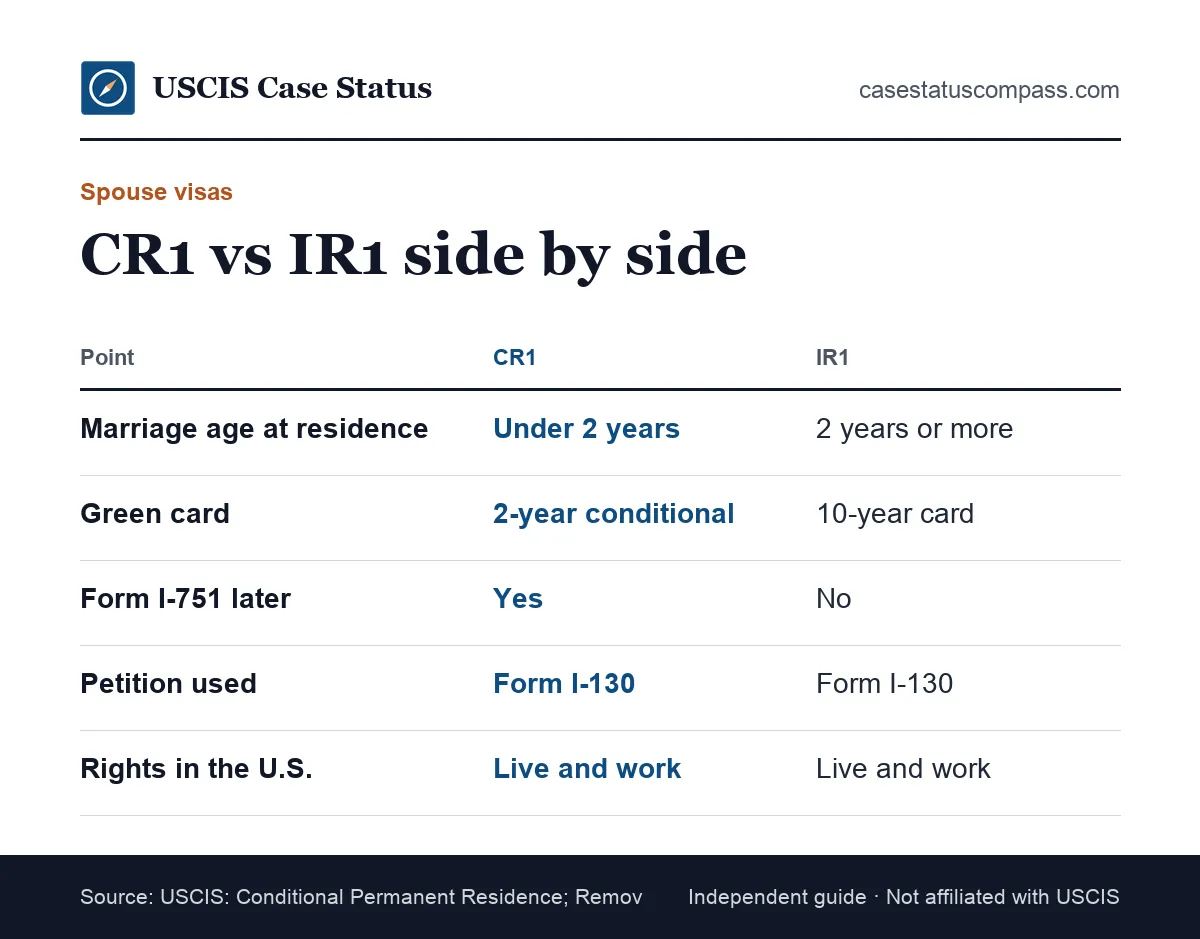
The only difference between CR1 and IR1 is the age of the marriage when the spouse becomes a resident. Under two years means CR1 and a conditional card; two years or more means IR1 and a ten-year card. The petition, fees, interview and process are the same.
Comparison table
Read the table row by row: the petition, interview and citizenship path match, and only the marriage's age on the day of residence changes the card and the follow-up filing.
| Feature | CR1 visa | IR1 visa |
|---|---|---|
| Marriage age on day of residence | Less than 2 years | 2 years or more |
| Green card length | 2 years (conditional) | 10 years |
| Form I-751 required | Yes, in the 90 days before expiry | No |
| Card can be renewed with Form I-90 | No | Yes |
| Petition and interview | Form I-130, consular interview | Form I-130, consular interview |
| Path to citizenship | 3-year rule if still married to the citizen | 3-year rule if still married to the citizen |
The two-year line in numbers
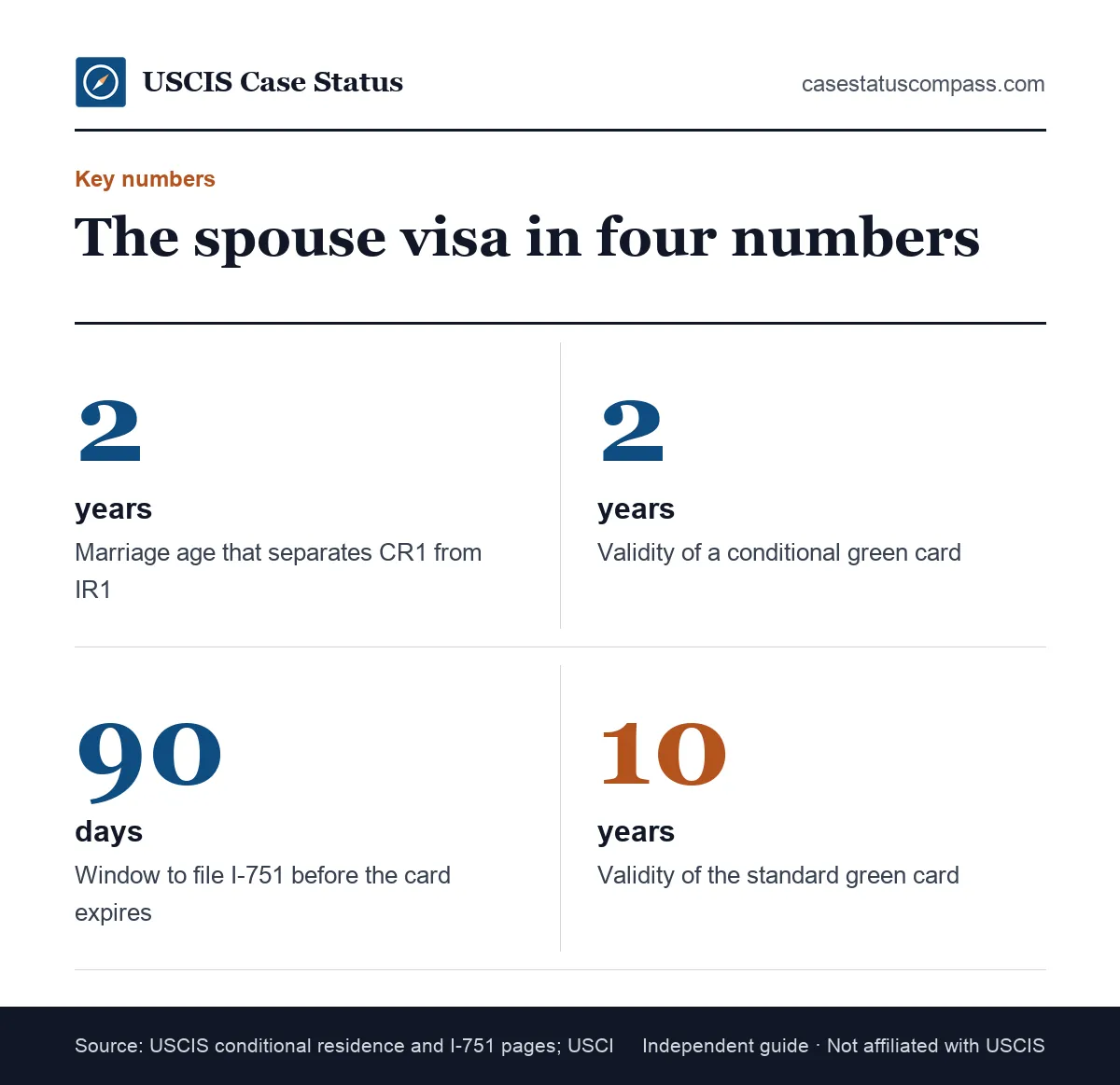
Two numbers matter most: the two-year marriage line and the two-year card. A couple married 23 months when the spouse lands gets a CR1 outcome; at 25 months it is IR1.
Which Date Decides Whether You Get CR1 or IR1?
For a CR1 visa case, the deciding date is the day the spouse obtains permanent residence. USCIS uses the phrase "married less than 2 years on the day you obtained permanent resident status." For a consular case, that is the day of admission at the U.S. border, not the day the visa is printed.
Consular cases
The visa foil may show CR1 because the marriage was young at issuance. Under the USCIS wording, the status granted on the day of entry is what counts. Border practice can vary, so carry your marriage certificate and ask an attorney before timing an entry around the anniversary.
Adjustment cases
For a spouse in the U.S., the deciding day is the Form I-485 approval date. If USCIS approves after the second anniversary, the card is a ten-year IR6 card. If before, it is a conditional CR6 card.
Is a CR1 Visa a Green Card?
Not quite. A CR1 visa is a stamp in the passport that lets the spouse enter as a resident. The physical green card is made by USCIS after entry and arrives by mail. Once admitted, the spouse is a conditional permanent resident, even before the card arrives.
The stamped visa after entry
The immigrant visa, once stamped by Customs and Border Protection, serves as temporary proof of residence for a limited period printed on the visa. Use it for work and travel until the card comes. Our guide to the I-551 stamp explains other temporary proof.
Visa expiration vs card expiration
The visa in the passport has its own short validity for travel. Enter before it expires. The card that follows has the two-year date, and that is the date that starts your I-751 countdown.
Which Is Better, CR1 or IR1?
IR1 is more convenient because it skips the removal-of-conditions step. But you cannot pick a category; the marriage date decides. Delaying travel to reach the second anniversary can make sense for some couples, but most choose to reunite sooner and handle Form I-751 later.
When waiting may make sense
If the marriage is a few weeks short of two years when the CR1 visa is issued, waiting to enter after the anniversary may avoid the conditional card. Ask an attorney first, and never let the visa expire while you wait.
When it does not
If the second anniversary is months away, waiting rarely pays off. The visa will likely expire first, and the couple loses time together. The I-751 process is predictable for genuine marriages.
Who Can Get a Marriage Visa to the USA?
A marriage visa in the CR1 or IR1 categories is available only to the spouse of a U.S. citizen. Spouses of green card holders immigrate through the separate F2A family category. Fiancé(e)s who are not yet married use a K-1 visa. Same-sex spouses qualify on equal terms.
Spouse of a U.S. citizen
The citizen files the petition. The citizen can live in the U.S. or abroad, but will need U.S. domicile or a plan to return when signing the Affidavit of Support.
Spouse of a green card holder
Spouses of permanent residents are in the F2A category and must wait for a visa number in the Visa Bulletin. If the resident spouse becomes a citizen, the case can convert to the immediate-relative spouse category. See our visa bulletin guide for priority dates.
Do Same-Sex Spouses Qualify for a Marriage Visa?
Yes. A same-sex marriage that is legal where it took place counts the same as any other marriage for U.S. immigration. The process, forms and CR1 or IR1 categories are identical, and the same two-year rule decides the card. Bring the civil certificate from the country or state where you married, even if the spouse's home country does not recognize the marriage.
What Makes a Marriage Valid for Immigration?
A marriage must be legally valid where it took place and entered into in good faith, not only to obtain a green card. Both partners must have been free to marry, so any earlier marriage needs a divorce, annulment or death certificate. Some kinds of marriage face extra rules.
Legal in the place of marriage
Get a civil marriage certificate from the official registry. A religious certificate alone may not be enough in countries that require civil registration. If either of you was married before, include the final divorce decree or death certificate; a divorce still pending on the wedding day means you were not free to marry.
A genuine relationship
Officers look for a bona fide marriage: shared plans, communication, visits and family ties. Couples living apart can still qualify; show calls, trips, money transfers and future plans. Label each item with dates so the officer can follow your story.
Are Proxy or Online Marriages Accepted for a Spouse Visa?
Sometimes, but with extra rules. Marriages where one partner was not physically present at the ceremony face added requirements before they count for immigration, and polygamous marriages are not recognized at all. If your wedding was online, by proxy, or in a country where neither of you lived, get legal advice before filing the I-130.
Marriage Visa Process Step by Step
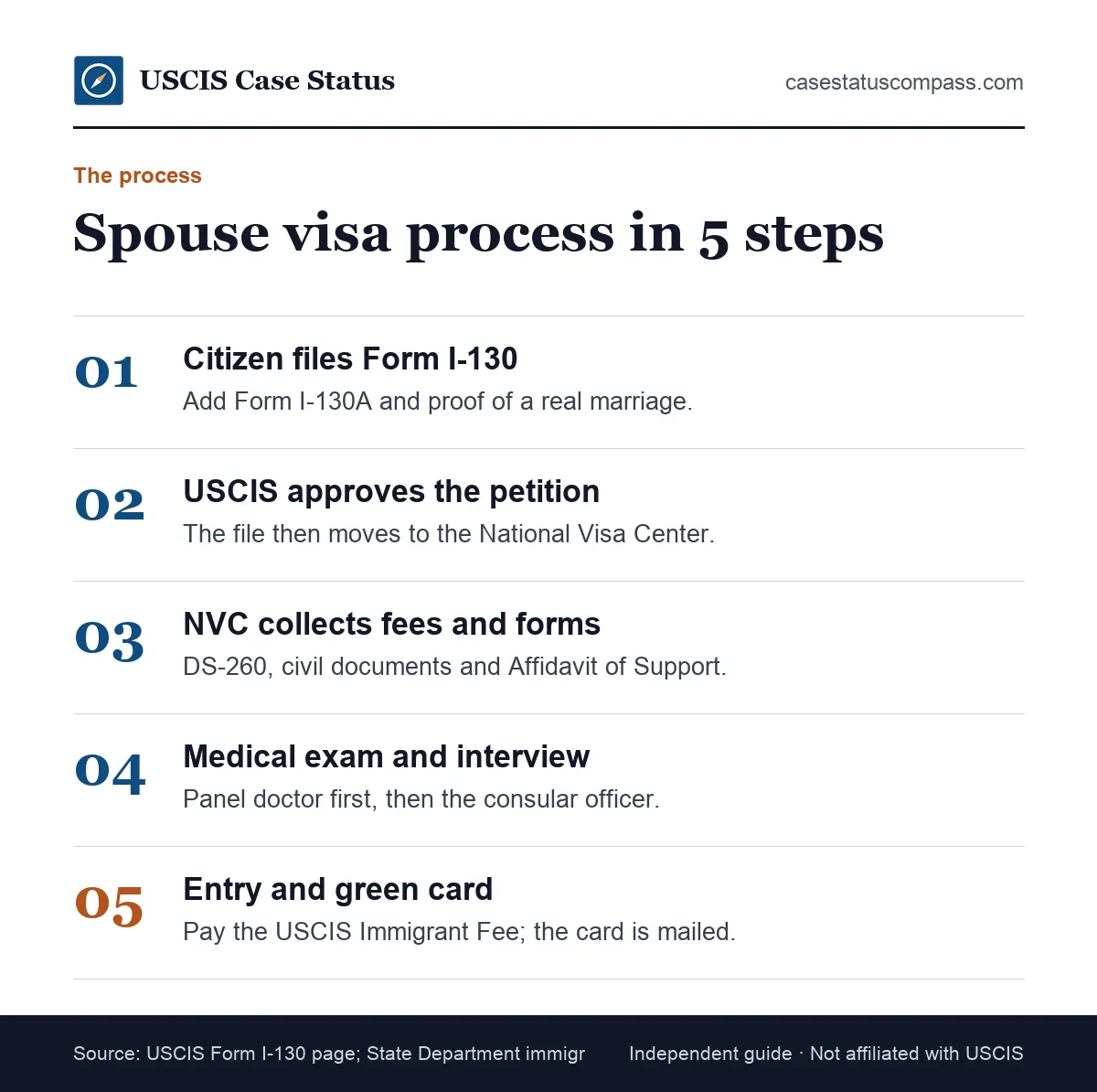
The marriage visa process has five main steps: the citizen files Form I-130, USCIS approves it, the National Visa Center (NVC) collects documents, the spouse attends a medical exam and consular interview, and the spouse enters the U.S. as a resident.
The order of agencies
USCIS handles the petition. The State Department handles the visa through NVC and the embassy. Customs and Border Protection admits the spouse. USCIS then produces the green card. Each agency uses its own case number.
Step 1: Filing Form I-130 for Your Spouse
The citizen starts by filing Form I-130, the family petition, with Form I-130A for the spouse. The petition proves the marriage and the citizen's status. It is the same petition used for parents, children and siblings, with spouse-specific evidence. Our I 130 petition guide covers how to complete and file it.
Spouse-specific evidence
- Civil marriage certificate
- Proof every earlier marriage of either spouse ended
- Proof of the citizen's status, such as a passport bio page
- Joint-life evidence: photos, travel, messages, money transfers
- Form I-130A with the spouse's history
Filing Form I-130A for the foreign spouse
Form I-130A collects the spouse's own biographic details: addresses and employment for the last five years and parents' names. Answers must match the DS-260 later, so keep a copy of what you submitted.
Choose consular processing on the form
The petition asks whether the spouse will adjust in the U.S. or apply at a consulate. For a CR1 or IR1 case, choose the consular option and name the embassy city.
Step 2: The NVC Stage
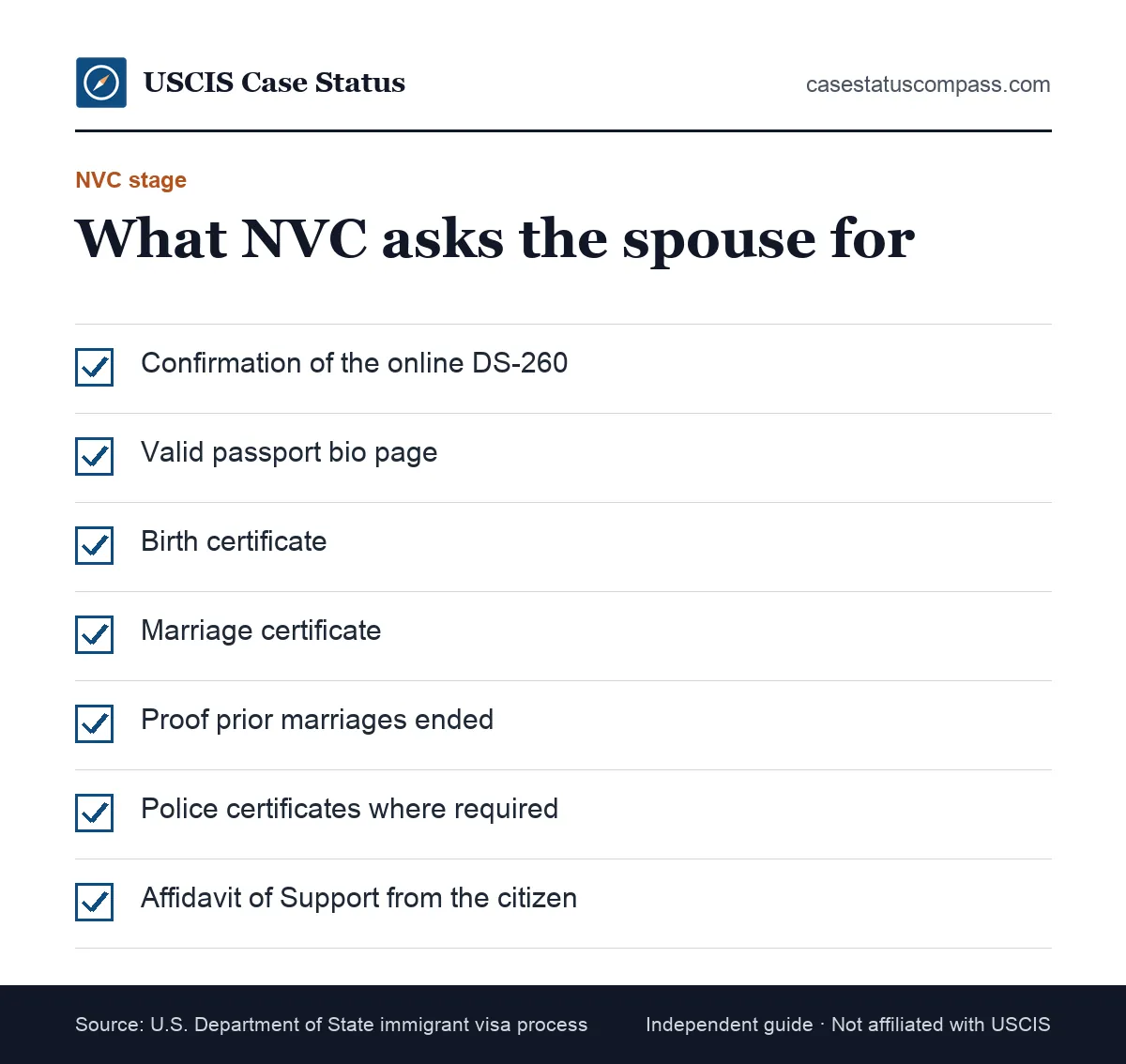
After USCIS approves the petition, it sends the file to the National Visa Center. NVC creates a State Department case number, asks for fees, the DS-260 visa application and civil documents, and reviews the Affidavit of Support. When everything is complete, NVC hands the case to the embassy for scheduling.
DS-260 and fees
The spouse completes the DS-260 online in the Consular Electronic Application Center. Fees are paid through NVC too: as of October 2026, the immigrant visa fee for a spouse is $325 per person.
Civil documents NVC expects
NVC reviews scans of the spouse's birth certificate, passport bio page, police certificates, the marriage certificate and proof that earlier marriages ended. The State Department reciprocity page lists which version each country issues.
Tracking the NVC case
NVC sends a welcome message with the case number. Use our NVC case status guide to read each update, and respond quickly to any document rejection notice. Log in to the Consular Electronic Application Center with the NVC case number and invoice ID from that message; the USCIS receipt number does not work there.
What Does the Affidavit of Support Require?
The U.S. citizen must sign Form I-864, promising to support the spouse financially. The citizen's household income must meet a federal guideline for its size, or a joint sponsor must add income. USCIS charges $0 at USCIS for the form; the State Department charges a $120 review fee.
The income test
The sponsor uses the latest tax return, W-2s or other income proof. Assets can sometimes fill a gap. The guideline changes yearly; our affidavit of support guide explains how to check it.
Can a U.S. Citizen Living Abroad Sponsor a Spouse Visa?
Yes, but the citizen must show domicile in the U.S. or concrete plans to move back, such as a job offer, a lease or proof of a home search. Domicile is a separate test from income. Without it, a joint sponsor alone does not fix the problem.
Step 3: The Immigrant Medical Exam
Before the interview, the spouse sees a panel physician approved by the embassy. The doctor checks health conditions and vaccination records and sends results to the consulate or gives them in a sealed envelope. USCIS civil surgeons and Form I-693 apply only to spouses adjusting inside the U.S.; consular cases use the embassy's own panel physician list.
Booking the exam
Book soon after the interview date arrives, since some panel doctors fill up fast. Bring your passport, appointment letter and vaccination records. The embassy's interview instructions list the approved doctors, and each doctor, not USCIS, sets the exam price.
Vaccinations
The doctor checks required vaccines and can give missing ones. Bring old records to avoid repeat shots. Medical rules come from the CDC and are applied by the panel physician.
Step 4: The Consular Interview
The consular interview is the decision point. A State Department officer reviews the documents, asks about the marriage and decides whether to issue the visa. The outcome is approval, a 221(g) request for more information, or a refusal on a legal ground.
Typical interview topics
Expect questions on how you met, the wedding, your spouse's job and family, and your plans in the U.S. Our list of green card interview questions shows the themes officers cover.
Documents to bring to the consular interview
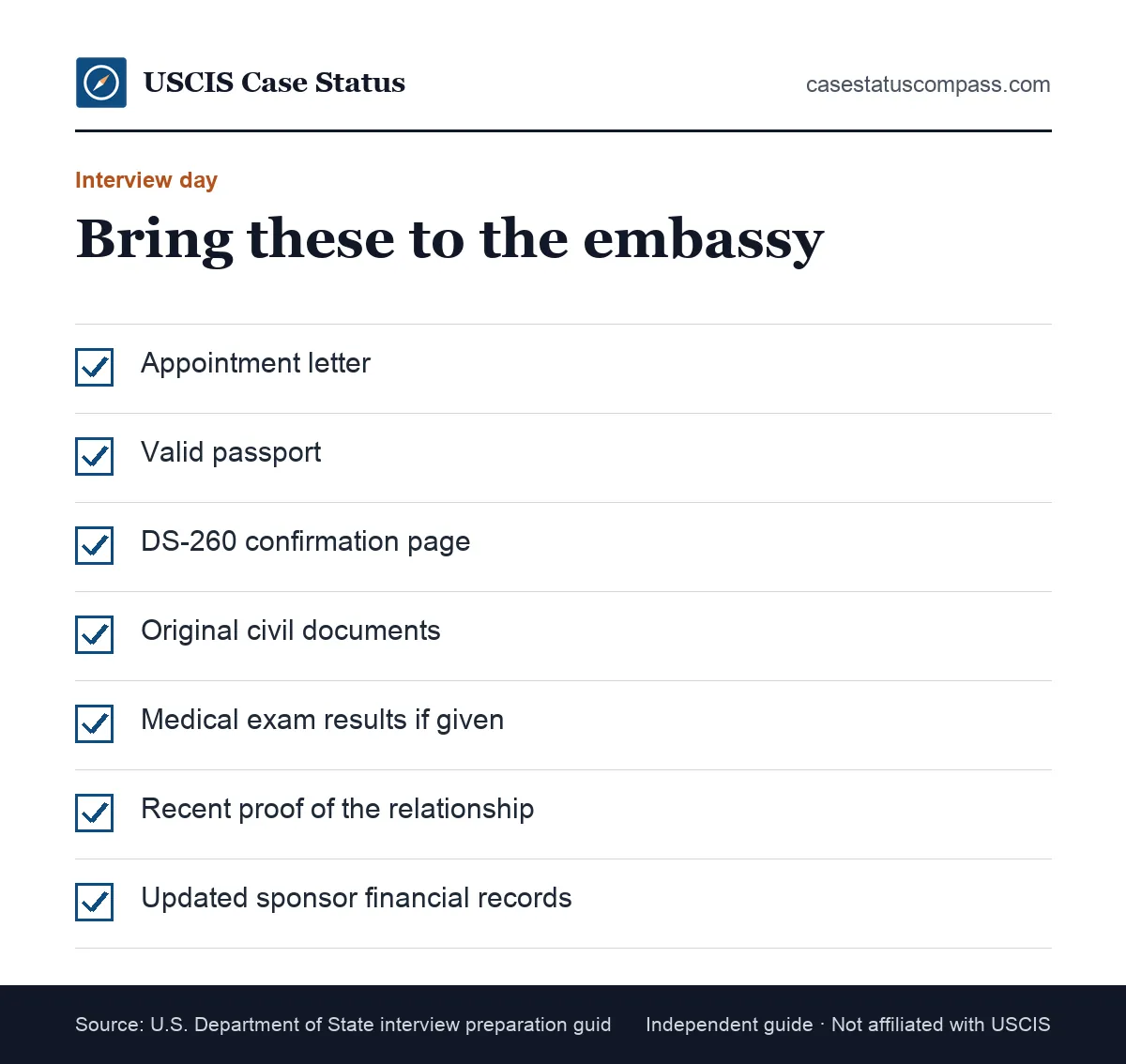
Bring the appointment letter, passport, original civil documents, medical results if not sent directly, and fresh relationship evidence. Updated sponsor tax and pay records help if the case has waited months since NVC review.
What happens on the day
The spouse goes alone in most consulates. Fingerprints are taken, documents reviewed and the officer gives a decision or a refusal sheet. If approved, the passport is kept for the visa foil and returned by courier.
What Is a 221(g) Refusal in a Spouse Case?
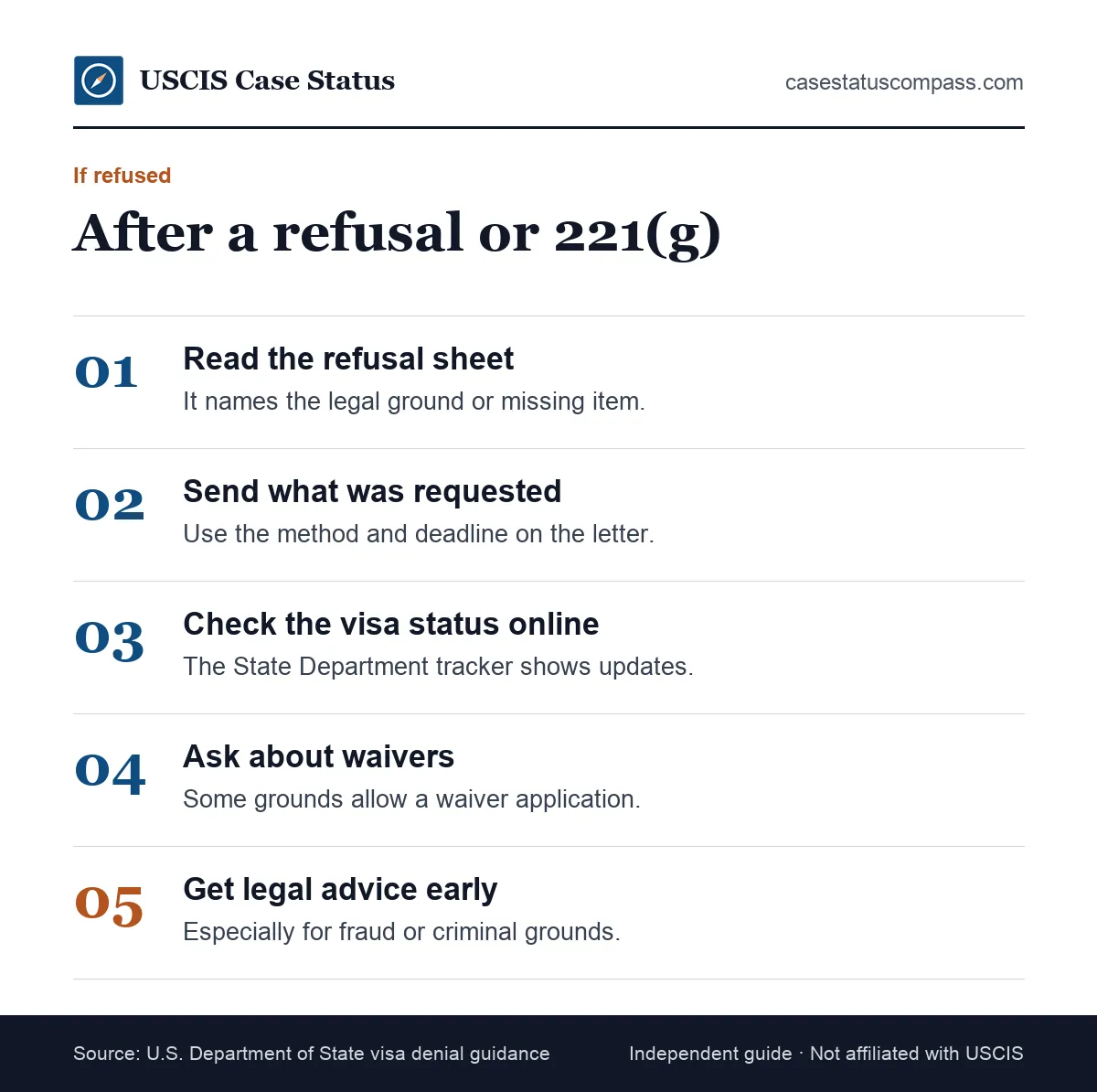
A 221(g) refusal means the officer cannot decide yet because something is missing or more review is needed. It is technically a refusal, but it often ends in a visa once the item arrives. The letter says what to send and how.
Common 221(g) requests
The letter usually names one of these items:
- An updated financial document from the sponsor
- A missing civil or police record
- More evidence of the relationship
- Administrative processing, with nothing for you to send
Responding well
Send exactly what the letter asks for, using the method it names. Track the case on the State Department site; our us visa status guide explains the tracker messages. Extra, unrequested papers can slow the review rather than help it.
Step 5: Entering the United States
After the visa is issued, the spouse travels before the visa's expiration date. Before travel, pay the USCIS Immigrant Fee of $235 online so USCIS can produce the card. At the port of entry, an officer admits the spouse as a permanent resident.
When Do You Pay the USCIS Immigrant Fee?
Pay it online after the visa is issued and before travel, using the A-Number and DOS case ID printed on the visa packet. Unpaid fees delay the physical green card, not the entry itself. A few groups are exempt from the fee, but CR1 and IR1 spouses are not.
At the port of entry
Carry the sealed packet if the embassy gave you one, and do not open it. The officer stamps the visa. From that moment the spouse is a resident and can work.
When Does the Marriage Green Card Arrive?
USCIS mails the green card to the U.S. address the spouse listed, usually within weeks after entry once the Immigrant Fee is paid. It shows the CR1 or IR1 category code and, for CR1, a two-year expiration date. If the fee was never paid, pay it now; card production waits for it.
Checking card production
USCIS creates a case for the card. Track it on Case Status Online with the number from the fee receipt. Our page on the card was mailed message explains the final step.
What If the Marriage Green Card Does Not Arrive?
First confirm that the mailing address you gave in the DS-260 and on the fee payment is correct, then contact USCIS with the fee receipt number. Keep the stamped passport as proof of residence in the meantime. Our USCIS forms hub links to the card-related forms if a replacement is needed.
Spouse Visa from Inside vs Outside the US
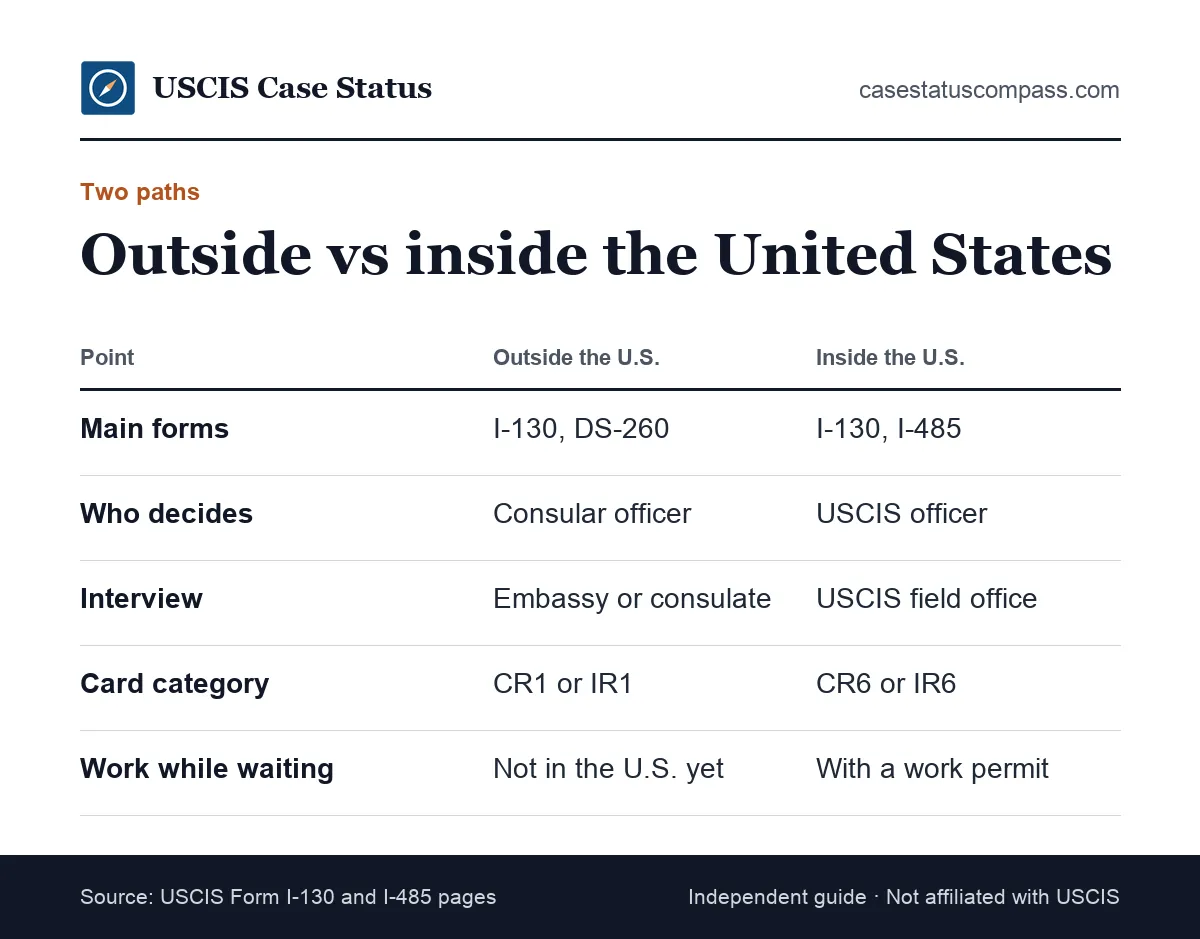
A spouse abroad uses consular processing and gets a CR1 or IR1 visa. A spouse already in the U.S. lawfully may instead adjust status with Form I-485 and get a CR6 or IR6 card. The rules for conditional cards are the same; the agency and forms differ.
Inside vs outside comparison
The table lines up the two routes after the I-130, showing which agency decides, where the interview happens and which card code follows.
| Point | Outside the U.S. (consular) | Inside the U.S. (adjustment) |
|---|---|---|
| Forms after I-130 | DS-260 through NVC | Form I-485, often filed with the petition |
| Decision maker | Consular officer abroad | USCIS officer |
| Interview location | U.S. embassy or consulate | USCIS field office |
| Card code | CR1 or IR1 | CR6 or IR6 |
| Work while waiting | Not applicable | With a work permit |
| Travel while waiting | Spouse stays abroad | Needs advance parole |
The biggest practical gap is work and travel: only the adjustment route needs a work permit and advance parole while the case is pending.
Choosing between them
A spouse in the U.S. after a lawful entry can usually adjust. A spouse who entered without inspection or has some status violations may need consular processing and a waiver. Get advice before choosing.
Can a Spouse in the U.S. Adjust Status Instead?
Yes, if the spouse entered lawfully and meets the adjustment rules. The couple can file Form I-130 and Form I-485 together. The spouse can ask for a work permit and travel document while waiting. The card category is CR6 or IR6 rather than CR1 or IR1.
Concurrent filing for spouses
Concurrent filing saves time and lets the spouse stay together with the citizen. As of October 2026, the paper I-485 costs $1,440, only the edition dated 09/18/26 is accepted, and the sealed medical exam (Form I-693) must be included. Our Form I-485 adjustment guide explains the green card application.
What If the Spouse Entered on a Visitor Visa?
Adjustment may still be possible, but a spouse who entered on a visitor visa while already planning to marry and stay may face questions about misrepresentation. Officers look at the timing of the entry, the wedding and the filing. Talk to an attorney before filing if you married soon after a visitor entry.
CR1 Visa vs K-1 Fiancé Visa
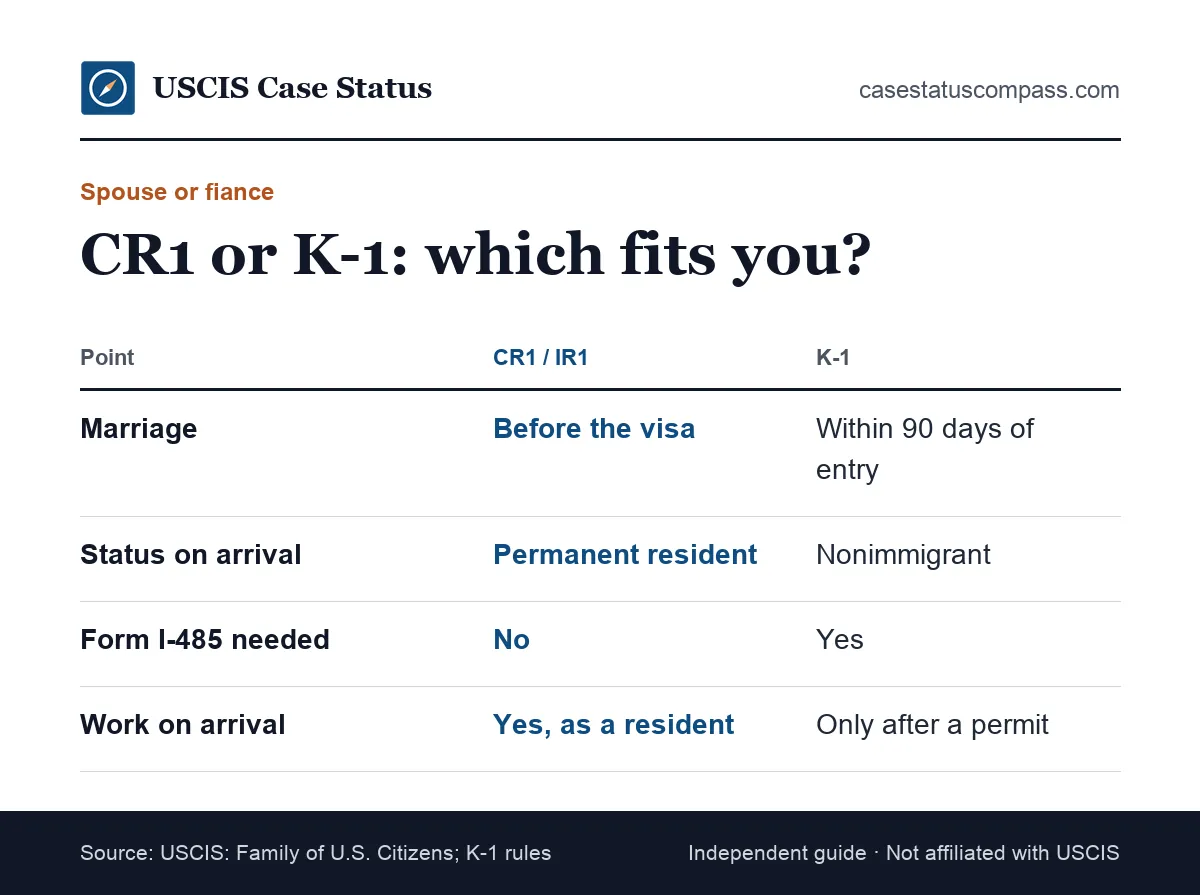
A CR1 visa is for couples already married. A K-1 is for engaged couples who will marry in the U.S. The K-1 spouse must marry within 90 days of entering and then file Form I-485. CR1 holders arrive as residents with nothing more to file except, later, Form I-751.
Which is faster
Speed varies over time for a CR1 visa and a K-1. Compare current times before choosing; the K-1 adds a second USCIS filing after arrival. Our K-1 fiancé visa guide covers that route.
The K-1 deadline
K-1: marry within 90 days of entering the U.S.. Missing the 90-day window ends K-1 eligibility, and the couple generally has to start again with Form I-130 after marrying. The CR1 visa has no such deadline because the wedding is already done.
What About the K-3 Spouse Visa?
The K-3 was a temporary visa for spouses waiting on Form I-130. Today it is rarely used, because the State Department generally processes the spouse's immigrant visa once the petition is approved. If older forums recommend a K-3, check the State Department's spouse visa page for current practice before paying for Form I-129F.
Why K-3 faded
When the I-130 is approved before a K-3 petition, the State Department closes the K-3 and goes straight to the immigrant visa. Filing both often adds cost without saving time.
Bringing Children: CR2 and IR2 Visas
Children do not ride along on a spouse visa. The citizen files a separate petition for each stepchild or child. The child's category is CR2 if the parent's marriage is under two years old, or IR2 otherwise. A stepchild qualifies if the marriage took place before the child turned 18.
Timing children's cases
File the child's petition at the same time as the spouse's so the cases move together. The embassy often interviews the family on one day. Upload each child's civil documents to NVC at the same time as the spouse's so no file lags behind.
What If a Child Is About to Turn 21?
A child must be under 21 and unmarried to count as an immediate relative with a CR2 or IR2 visa. Turning 21 before the visa is issued can move the child into a family preference category with a longer wait. If a child is close to 21, file early and ask about the Child Status Protection Act.
Spouse of a Green Card Holder: The F2A Route
A permanent resident sponsoring a spouse uses the same petition, but the spouse gets an F2A visa, not CR1 or IR1. F2A spouses wait for a visa number. If the marriage is under two years at entry, the card is still conditional.
When the sponsor naturalizes
If the resident spouse becomes a citizen, the petition converts to the immediate-relative category. Send the naturalization certificate to NVC. This can remove the wait. Our citizenship application guide covers that step.
Where to check the wait
F2A dates move monthly in the Visa Bulletin. Check the Visa Bulletin before predicting a timeline. Compare your priority date, the day USCIS received the I-130, with the F2A row for the spouse's country of birth.
Copyable Marriage Visa Document Checklist
This checklist covers what the couple gathers across the whole spouse visa case, from the petition to the interview. Keep originals together and upload clear scans. Missing documents are the most common reason for NVC rejections and 221(g) letters. Tick each item as you upload it.
For the U.S. citizen sponsor
The citizen supplies status, marriage and income records. A joint sponsor sends the same income papers for themselves.
- Proof of citizenship
- Marriage certificate and divorce records
- Most recent federal tax return or transcript
- W-2s and recent pay stubs
- Signed Form I-864
For the foreign spouse
- Passport valid for travel
- Birth certificate
- Police certificates as required by the country
- Photos as the DS-260 instructions require
- Relationship evidence and DS-260 confirmation
The spouse gathers identity, police and relationship records. The State Department reciprocity page says which countries require a police certificate based on how long the spouse lived there.
Translations and copies
Any document not in English needs a full certified English translation with the translator's statement. Keep a photocopy of every original you bring, since some consulates keep copies. Bring each translation stapled to its original.
CR1 Visa Case Status: What Each Stage Looks Like
A spouse case shows different status messages at each agency. USCIS messages track the petition; NVC and consular messages track the visa. The table below shows which tracker applies at each stage and what to do next. Bookmark both CEAC and Case Status Online before you file.
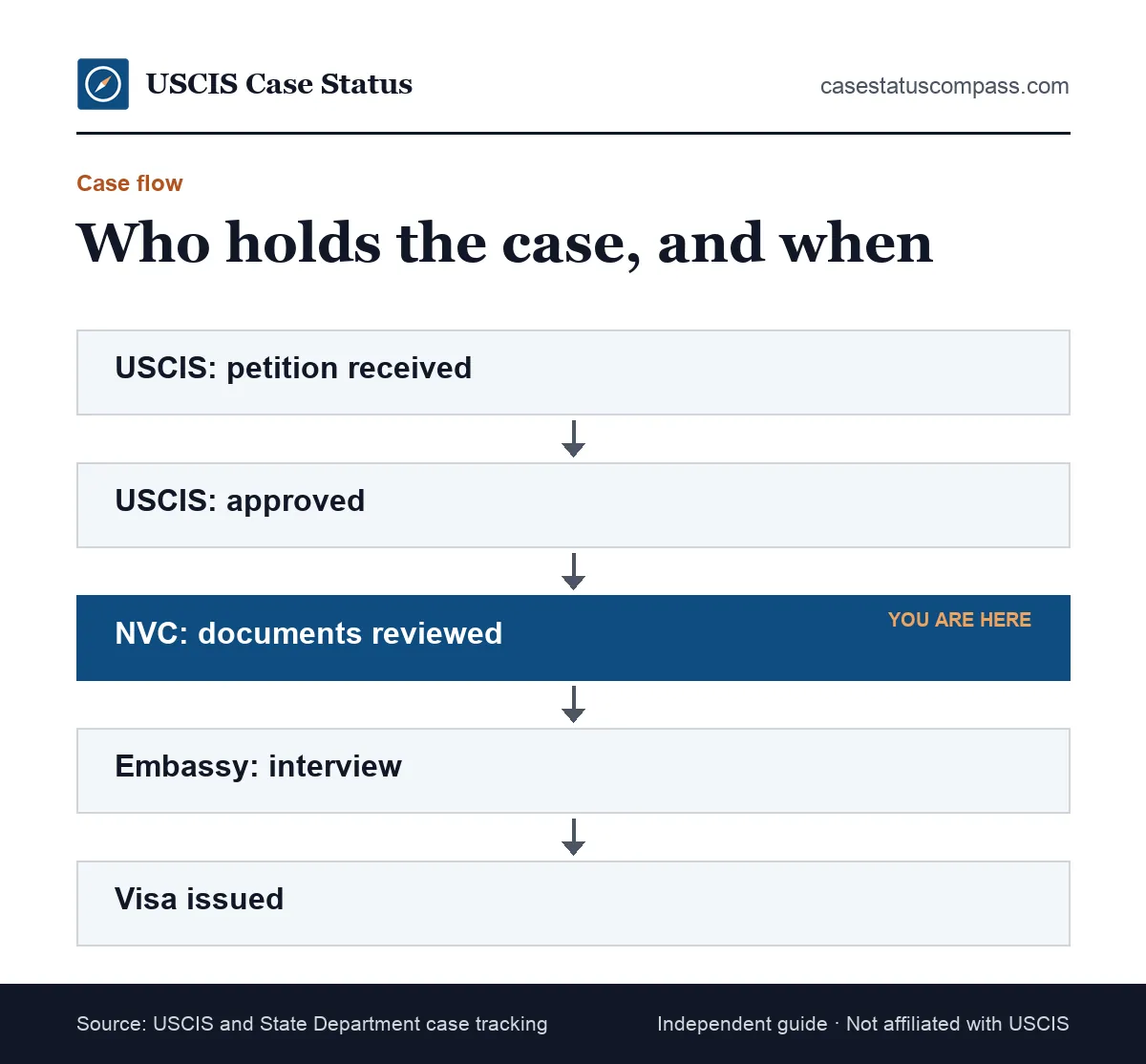
Status sequence across agencies
Each row pairs a stage with the tracker that shows it, the wording you will most often see, and the action it calls for.
| Stage | Where you check | Typical message | What to do |
|---|---|---|---|
| Petition filed | USCIS Case Status Online | Case Was Received | Save the receipt notice |
| Petition approved | USCIS | Case Was Approved | Wait for NVC contact |
| Sent to State | USCIS | Case Was Sent To The Department of State | Watch for NVC welcome message |
| NVC review | CEAC | Documentarily qualified | Wait for interview date |
| Interview | Embassy | Issued, or Refused under 221(g) | Send any missing item |
| Card | USCIS | Card Was Mailed To Me | Watch the mail |
USCIS shows no movement during the NVC and interview rows; that is normal, because the State Department owns those stages.
Reading the transition points
The two hand-offs cause the most worry: USCIS to NVC, and NVC to the embassy. Each can take time with no visible change. Track both systems during these gaps. For a silent NVC case, note this rule: NVC asks you to use its Public Inquiry Form only if you have not heard back within its published timeframe, because duplicate inquiries slow responses.
How Long Does a CR1 Visa Take?
The CR1 timeline is the petition time at USCIS plus the NVC and embassy stages, and it varies widely by office and country. USCIS publishes its part at egov.uscis.gov/processing-times. Our I 130 processing time page breaks down each stage and how to read the tools.
Where the time goes
The USCIS petition is usually the longest stage. NVC speed depends on how fast you submit complete documents. Embassy wait times vary by post and season. For scale, USCIS reported this figure: I-130 (immediate relative): median 13.0 months (USCIS data, Apr.-June 2026).
Saving time
Gather civil documents early, upload readable scans, and answer every NVC message within days. These are the parts of the timeline you control. Sponsors can request the latest IRS tax transcript before NVC asks, since a missing return is a frequent hold-up.
How Much Does a Marriage Visa Cost?
As of October 2026, the I-130 filing fee is $675 (paper) / $625 (online) and the USCIS Immigrant Fee is $235. The State Department adds $325 for the immigrant visa and $120 for the Affidavit of Support review. Our marriage green card cost page gathers the full budget.
Costs outside government fees
Add the medical exam, police certificates, translations and travel to the interview. These vary by country and are often larger than people expect. Ask the panel physician and translator for quotes early.
After Arrival: Conditional Green Card and I-751
A CR1 spouse holds a conditional green card for two years. To keep residence, the couple files Form I-751 together. File in the 90 days before your 2-year card expires. Missing the window can end the conditional status automatically. IR1 spouses skip this step.
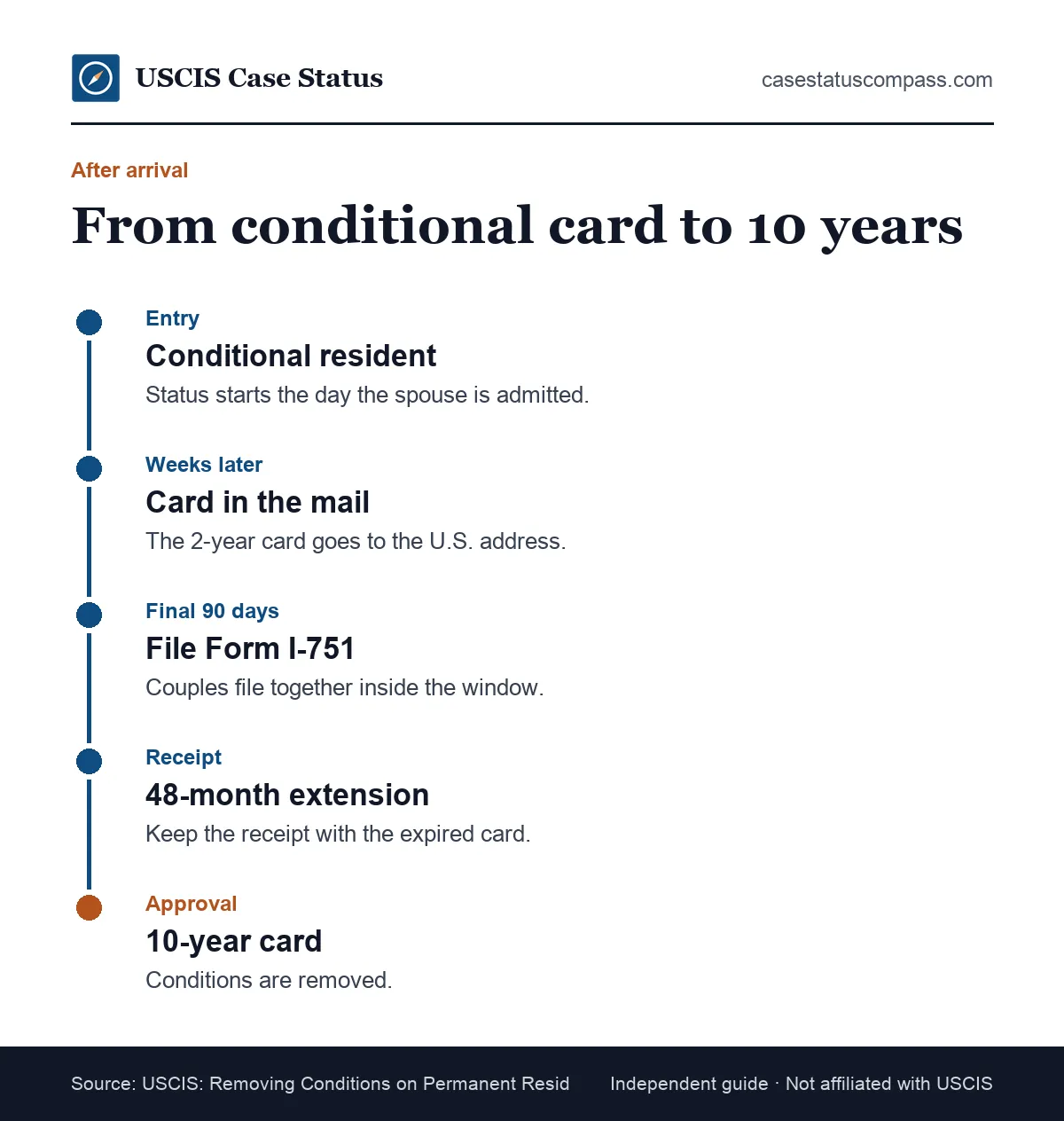
Filing Form I-751 on time
USCIS offers a date calculator for the window. Filing too early may be rejected. The I-751 fee is $750 (paper) / $700 (online). Our I 751 petition to remove conditions guide covers the filing in detail.
The receipt extension
I-751 receipt notice extends conditional status and work authorization for 48 months. Carry the receipt with the expired card for work, travel and re-entry. Check that the name and A-Number on the notice match the card.
Evidence and waivers in brief
A strong I-751 shows the couple has shared a life since arrival, such as joint finances and a shared home. USCIS also allows waivers of the joint filing rule after divorce, a spouse's death, abuse or extreme hardship. The I-751 guide linked above covers evidence, waivers and divorce cases in full; get legal help if the marriage has ended.
Can CR1 Holders Work and Travel?
Yes. A conditional resident has the same right to work as any permanent resident and needs no separate work permit. Travel abroad is allowed, but long trips can raise questions about residence. Carry the green card and, after filing I-751, the receipt notice.
Working
Show the green card or stamped visa to employers for Form I-9. No extra document is needed. Once the plastic card arrives, it replaces the stamp. Employers may not demand one specific document from the I-9 lists; the spouse chooses which valid proof to show.
Long trips abroad
Long absences can create problems for residence and future citizenship. Plan long trips carefully and ask about a re-entry permit before leaving. A trip over six months can break the continuous residence needed for citizenship, and a year abroad without a permit can put the card at risk. Reentry permit: generally valid 2 years (1 year if abroad more than 4 of the last 5 years).
When Can a Spouse Apply for Citizenship?
A spouse living in marital union with a U.S. citizen can usually apply for citizenship after three years of residence instead of five. You can file the N-400 up to 90 days before you reach 5 years (or 3 years if married to a U.S. citizen) as a permanent resident. Time as a conditional resident counts. Our citizenship application guide covers the requirements.
Conditions and citizenship
A CR1 spouse with a pending I-751 can still apply when eligible. USCIS decides the I-751 before or at the same time as the N-400. Bring fresh joint-life evidence to the citizenship interview in case the officer reviews both files.
Staying married to the citizen
The three-year rule needs the couple to remain married and living together. Divorce or separation usually means waiting for the five-year path. The citizen spouse must also have held citizenship for the full three years, and the marriage must last until the oath ceremony.
Can You Renew a Conditional Green Card?
No. A conditional card cannot be renewed with Form I-90. The only way forward is Form I-751. A ten-year card from IR1 or a removed condition is renewed with Form I-90 before it expires. If a conditional card is about to expire, the I-751 receipt notice is the extension.
When Form I-90 applies
Use Form I-90 to replace a lost ten-year card or renew it near expiration. File I-90 if your card is lost, damaged, wrong, expiring within 6 months, or you turned 14. As of October 2026 the fee is $465 (paper) / $415 (online). Our green card renewal guide explains when to file.
Why Are Spouse Visas Refused?
Spouse visas are refused when the officer doubts the marriage is genuine, documents are missing, the sponsor's income is too low, or the spouse is inadmissible because of past immigration violations, fraud or crime. Many refusals are temporary 221(g) holds.
Common grounds
Refusal letters cite a section of the immigration law. The reasons seen most often in spouse cases are:
- Not enough evidence of a real relationship
- Insufficient Affidavit of Support
- Prior overstay or unlawful presence
- Misrepresentation in earlier applications
- Criminal history
What Marriage Fraud Signs Do Consular Officers Notice?
Officers watch for inconsistent answers between spouses, very short visits, no shared language, or a large payment linked to the marriage. None of these alone decides a case, and many genuine couples have one of them. Honest answers and consistent records across every form matter most.
Common Mistakes in Marriage Visa Cases
Most delays come from small, preventable errors. They include choosing adjustment instead of consular processing on the petition, uploading blurry scans, using a religious certificate where a civil one is required, and forgetting the Immigrant Fee. Rereading each form against the last one before you submit catches most of them.
Mistakes before the interview
These errors cause the most NVC rejections and 221(g) holds:
- Missing proof of earlier divorces
- DS-260 answers that differ from Form I-130A
- Not signing Form I-864
- Ignoring NVC messages for months
- Letting the passport expire
Mistakes after arrival
Once the spouse is a resident, the risks shift to deadlines and records:
- Missing the I-751 window
- Not updating the address with USCIS
- Long trips without planning
- Assuming the conditional card renews
- Filing jointly after a divorce instead of requesting a waiver
Real-World Spouse Visa Scenarios
These short examples show how the rules play out. They are general information, not legal advice for your case. Each turns on three facts: the marriage date, the sponsor's status and where the spouse lives. Find the example closest to yours, then reread the matching section above.
Married 18 months at interview
The embassy issues a CR1 visa. The spouse enters within weeks and gets a two-year card. The couple sets a calendar reminder for the I-751 window, which opens 90 days before the card's printed expiration date.
Married 3 years when the petition is filed
The spouse receives an IR1 visa and a ten-year card. No I-751 is needed. Because the marriage passed two years before the spouse became a resident, the condition never attaches. Near expiry, the spouse renews with Form I-90 or applies for citizenship.
Green card holder sponsor who naturalizes
The F2A case converts to the immediate-relative spouse category after the sponsor sends proof of citizenship to NVC. The spouse stops waiting for an F2A visa number and moves to the CR1 visa or IR1 line, depending on the marriage date.
Spouse already in the U.S. on a work visa
The couple files the petition and Form I-485 together. The spouse receives a CR6 or IR6 card after the USCIS interview. A spouse who keeps valid H-1B or L-1 status can travel and return in that status without abandoning the pending I-485.
When Does a Spouse Visa Case Need a Lawyer?
Get help from an immigration attorney or a DOJ-accredited representative if the spouse has a past visa refusal, overstay, removal order, criminal record, or a prior marriage-fraud finding. Help is also wise for proxy marriages, divorce during the case, or abuse.
Red flags
If any of these apply, book a consultation before filing anything:
- A previous visa refusal or removal
- A marriage soon after a visitor entry
- Prior petitions for another spouse
- Unclear divorce records
Finding low-cost legal help
The Justice Department keeps a list of recognized organizations with accredited representatives, many charging low fees. Check that any helper is a licensed attorney or appears on that list before paying.
Frequently Asked Questions
Is a CR1 visa a green card?
A CR1 visa is the immigrant visa that lets the spouse enter as a conditional permanent resident. The physical green card is mailed by USCIS after entry. Once admitted, the spouse is a resident even before the card arrives, and the stamped visa serves as temporary proof.
Can a CR1 visa holder work immediately?
Yes. A CR1 spouse is a permanent resident from the moment of admission and can work for any employer. The stamped visa in the passport works as proof for Form I-9 until the green card arrives. No separate work permit is needed.
Can I change from CR1 to IR1?
You cannot switch categories once residence is granted. A CR1 spouse removes conditions by filing Form I-751, which leads to a ten-year card. Some couples who are close to the two-year anniversary time their entry so the marriage reaches two years first.
Do we need to live together to get a spouse visa?
No. Many couples live apart until the visa is issued. You do need to show a genuine relationship through visits, communication and plans to live together. After arrival, living together supports the I-751 and citizenship cases.
Does the U.S. citizen need to attend the consular interview?
Usually not. Most embassies interview only the foreign spouse. The citizen can attend if the embassy allows it.
Can a spouse visa be approved without an interview?
Spouse immigrant visas almost always require an in-person interview at the embassy or consulate. Interview waivers apply mostly to nonimmigrant visas.
Is a marriage visa the same as a spouse visa?
Yes. "Marriage visa" and "spouse visa" are everyday names for the CR1 and IR1 immigrant visas for a U.S. citizen's spouse. Both are immediate relative immigrant visas; the marriage's age on the day of residence picks the code.
Does an IR1 visa holder ever file Form I-751?
No. An IR1 spouse receives a ten-year green card with no conditions, so Form I-751 never applies. When that card nears expiration, the spouse renews it with Form I-90 or applies for citizenship if eligible.
Can one I-130 cover the spouse's children too?
No. Each child or stepchild needs a separate Form I-130 from the citizen. File them with the spouse's petition so NVC and the embassy can move the family's cases together, often with a single interview day.
What if I lose my green card on a CR1?
For a ten-year card, file Form I-90 to replace it. For a conditional card, read the Form I-90 instructions on replacement by conditional residents. If you are already inside the I-751 window, file the I-751 instead, because its receipt notice works as proof of status.
Sources
- USCIS: Removing Conditions on Permanent Residence Based on Marriage. www.uscis.gov/green-card/after-we-grant-your-green-card/conditional-permanent-residence/removing-conditions-on-permanent-residence-based-on-marriage. Accessed Oct 27, 2026.
- USCIS: Conditional Permanent Residence. www.uscis.gov/green-card/after-we-grant-your-green-card/conditional-permanent-residence. Accessed Oct 27, 2026.
- USCIS: I-130, Petition for Alien Relative. www.uscis.gov/i-130. Accessed Oct 27, 2026.
- USCIS: Family of U.S. Citizens. www.uscis.gov/family/family-of-us-citizens. Accessed Oct 27, 2026.
- USCIS: USCIS Immigrant Fee. www.uscis.gov/forms/filing-fees/uscis-immigrant-fee. Accessed Oct 27, 2026.
- USCIS Form G-1055 Fee Schedule. www.uscis.gov/g-1055. Accessed Oct 27, 2026.
- USCIS Check Case Processing Times. egov.uscis.gov/processing-times/. Accessed Oct 27, 2026.
- U.S. Department of State: Immigrant Visa for a Spouse of a U.S. Citizen. travel.state.gov/content/travel/en/us-visas/immigrate/family-immigration/immigrant-visa-for-a-spouse-of-a-us-citizen.html. Accessed Oct 27, 2026.
- U.S. Department of State: Fees for Visa Services. travel.state.gov/content/travel/en/us-visas/visa-information-resources/fees/fees-visa-services.html. Accessed Oct 27, 2026.
- USCIS Glossary: Green Card. www.uscis.gov/tools/glossary. Accessed Oct 27, 2026.
- 22 CFR 22.1 Schedule of Fees for Consular Services (govinfo, CFR 2025 edition). www.govinfo.gov/content/pkg/CFR-2025-title22-vol1/xml/CFR-2025-title22-vol1-sec22-1.xml. Accessed Oct 27, 2026.
- USCIS Form G-1055 Fee Schedule, Edition 10/16/26. www.uscis.gov/sites/default/files/document/forms/g-1055.pdf. Accessed Oct 27, 2026.
- USCIS: Form I-129F page. www.uscis.gov/i-129f. Accessed Oct 27, 2026.
- State Department: NVC Timeframes (as of 26-Oct-26). travel.state.gov/content/travel/en/us-visas/immigrate/nvc-timeframes.html. Accessed Oct 27, 2026.
- USCIS Data Library: All USCIS Application and Petition Form Types, FY2026 Q3 (Apr. 1-June 30, 2026; queried 7/2026). www.uscis.gov/sites/default/files/document/data/quarterly_all_forms_fy2026_q3_v1.xlsx. Accessed Oct 27, 2026.
- Form I-131 Instructions, Edition 01/20/25; 8 CFR 223.3(a)(1). www.uscis.gov/sites/default/files/document/forms/i-131instr.pdf. Accessed Oct 27, 2026.
- USCIS: Form N-400 page. www.uscis.gov/n-400. Accessed Oct 27, 2026.
- Form I-90 Instructions, Edition 01/20/25. www.uscis.gov/sites/default/files/document/forms/i-90instr.pdf. Accessed Oct 27, 2026.
casestatuscompass.com is an independent publication and is not affiliated with USCIS or any government agency. This page is general information, not legal advice. For denials, court or asylum matters, consult an immigration attorney or a DOJ-accredited representative.