Contents · 38 sections
- What Are USCIS Forms and Who Files Them?
- How Do the USCIS Forms Fit Together?
- USCIS Forms at a Glance: Purpose, Filer and Fee
- Family and Green Card Forms
- Form I-130: Petition for Alien Relative
- Form I-485: Application to Adjust Status
- Form I-864: Affidavit of Support
- Marriage Green Card: CR1, IR1 and Spouse Forms
- K-1 Fiancé(e) Visa and Form I-129F
- Form I-551: The Green Card and the I-551 Stamp
- Form I-751: Removing Conditions on Residence
- Form I-90: Renewing or Replacing a Green Card
- Citizenship Forms
- Form N-400: Application for Naturalization
- Form N-600: Certificate of Citizenship
- Naturalization Certificate and Form N-565
- Work and Travel Forms
- Form I-765: Employment Authorization
- Form I-131: Advance Parole and Travel Documents
- Form I-129 and H-1B Specialty Workers
- PERM Labor Certification
- Form I-140: Immigrant Petition for Alien Workers
- Humanitarian Forms
- Asylum: Form I-589
- Which Green Card Path Fits Your Situation?
- Which Form Do I Need to Become a Citizen?
- Which Forms Let You Work or Travel While a Case Is Pending?
- Is Online Filing Available for Most USCIS Forms?
- How Do You Make Sure You Have the Right Form Edition?
- Where Do You Get Official USCIS Forms Safely?
- What Happens After You File a USCIS Form?
- How Do You Check Case Status for Each Form?
- How Long Do USCIS Forms Take to Process?
- How Much Do USCIS Forms Cost in 2026?
- What Are the Most Common Mistakes on USCIS Forms?
- A USCIS Filing Checklist You Can Copy
- When Should You Get Legal Help With a Form?
- Frequently Asked Questions
The short answer
USCIS forms are the official petitions and applications you file with U.S. Citizenship and Immigration Services to sponsor a relative, get a green card, work, travel, or become a citizen. Each form has a number, such as I-130 or N-400, a fee set by Form G-1055, and its own status path. All forms are free to download on uscis.gov.
At a glance
| Official source | uscis.gov/forms (free downloads, no account needed) |
| Fee schedule in force | Form G-1055, Edition 10/16/26 |
| Online filing | Available for many forms, usually at a lower fee than paper |
| Forms covered here | 19 guides: family, green card, citizenship, work, travel and humanitarian |
| Who runs this site | An independent guide. We are not USCIS and cannot file for you. |
What Are USCIS Forms and Who Files Them?
USCIS forms are the standard documents U.S. Citizenship and Immigration Services uses to decide immigration benefits. Anyone asking USCIS for something files one: a citizen sponsoring a spouse, an employer hiring a foreign worker, a green card holder renewing a card, or a person seeking protection.
Petitions versus applications
A petition is filed by someone else on your behalf, such as a U.S. citizen relative or an employer. An application is filed by you, for yourself. Form I-130 and Form I-140 are petitions. Form I-485, Form I-765 and Form N-400 are applications.
What the letters in a form number mean
Most forms start with I (immigration benefits) or N (naturalization and citizenship). Department of State forms, such as the DS-260 visa application, are not USCIS forms, and the Department of Labor runs PERM separately.
How Do the USCIS Forms Fit Together?
USCIS forms work as a chain. A petition first proves a qualifying family tie or job offer. An application then asks for status, either inside the U.S. or through a visa abroad. Later forms keep or upgrade what you received.
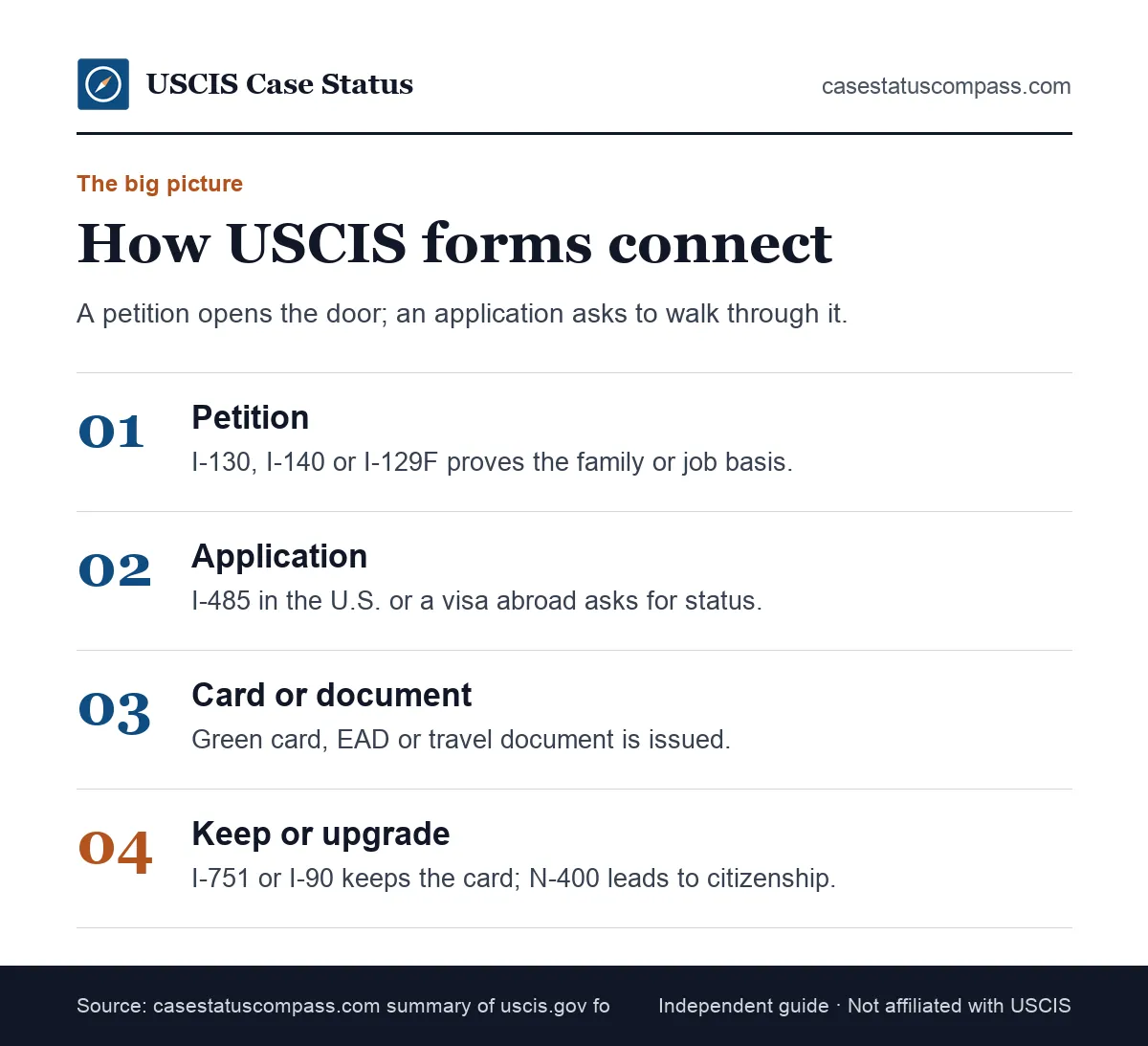
The petition-then-application pattern
A family green card usually starts with Form I-130 and ends with Form I-485 or an immigrant visa. A job-based green card starts with labor certification and Form I-140. The second form cannot be approved until the first one is.
Forms that ride along with the main filing
Some forms are never filed alone. Form I-864 travels with a family green card case. Form I-765 and Form I-131 are often filed with Form I-485, so you can work and travel while you wait.
USCIS Forms at a Glance: Purpose, Filer and Fee
The table below lists all 19 form guides on this site, with each form's purpose, who usually files it and the fee from the October 16, 2026 fee schedule. Where a row says "see section," the fee depends on paper versus online filing, age or add-ons, so read that form's section before you pay.
All 19 form guides and their fees
Find your goal in the middle column, then open the matching guide for the full fee and filing details.
| Guide | Main purpose | Fee (G-1055, 10/16/26) |
|---|---|---|
| I-130 | Sponsor a relative | $675 (paper) / $625 (online) |
| I-485 | Green card inside the U.S. | Paper or online; see section |
| I-864 | Promise of financial support | $0 at USCIS |
| Marriage (CR1/IR1) | Spouse green card | I-130 fee plus visa or I-485 costs |
| K-1 (I-129F) | Fiancé(e) visa | $675 |
| I-551 | The green card itself | No filing; see the guide |
| I-751 | Remove conditions | $750 (paper) / $700 (online) |
| I-90 | Renew or replace a card | $465 (paper) / $415 (online) |
| N-400 | Naturalization | Paper, online or reduced |
| N-600 | Certificate of citizenship | $1,385 (paper) / $1,335 (online) |
| Naturalization certificate (N-565) | Replace a certificate | $555 (paper) / $505 (online) |
| I-765 | Work permit (EAD) | Base fee plus add-ons; see section |
| I-131 | Advance parole and travel | See section (parole fee may apply) |
| H-1B (I-129) | Specialty worker status | See H-1B guide (fee stack) |
| PERM | Labor certification at DOL | Not confirmed; see guide |
| I-140 | Employment immigrant petition | Base fee plus Asylum Program Fee |
| DACA (I-821D) | Deferred action | I-821D plus I-765 fees |
| TPS (I-821) | Temporary protection | Form fee plus biometrics |
| Asylum (I-589) | Asylum protection | H.R. 1 asylum fees |
How to read the fee column
The paper fee comes first, then the online fee where USCIS offers one. An entry like the I-864's $0 at USCIS means USCIS charges nothing, though other agencies may.
Why some rows have no fee
PERM is a Department of Labor filing, and we could not confirm an official DOL statement on fees. The green card (Form I-551) is a document USCIS issues, not one you file.
Family and Green Card Forms
Family and green card forms let U.S. citizens and residents bring relatives to the United States and help those relatives become and stay permanent residents. The core set is Form I-130, I-485, I-864, I-751 and I-90, plus separate guides for spouse and fiancé cases.
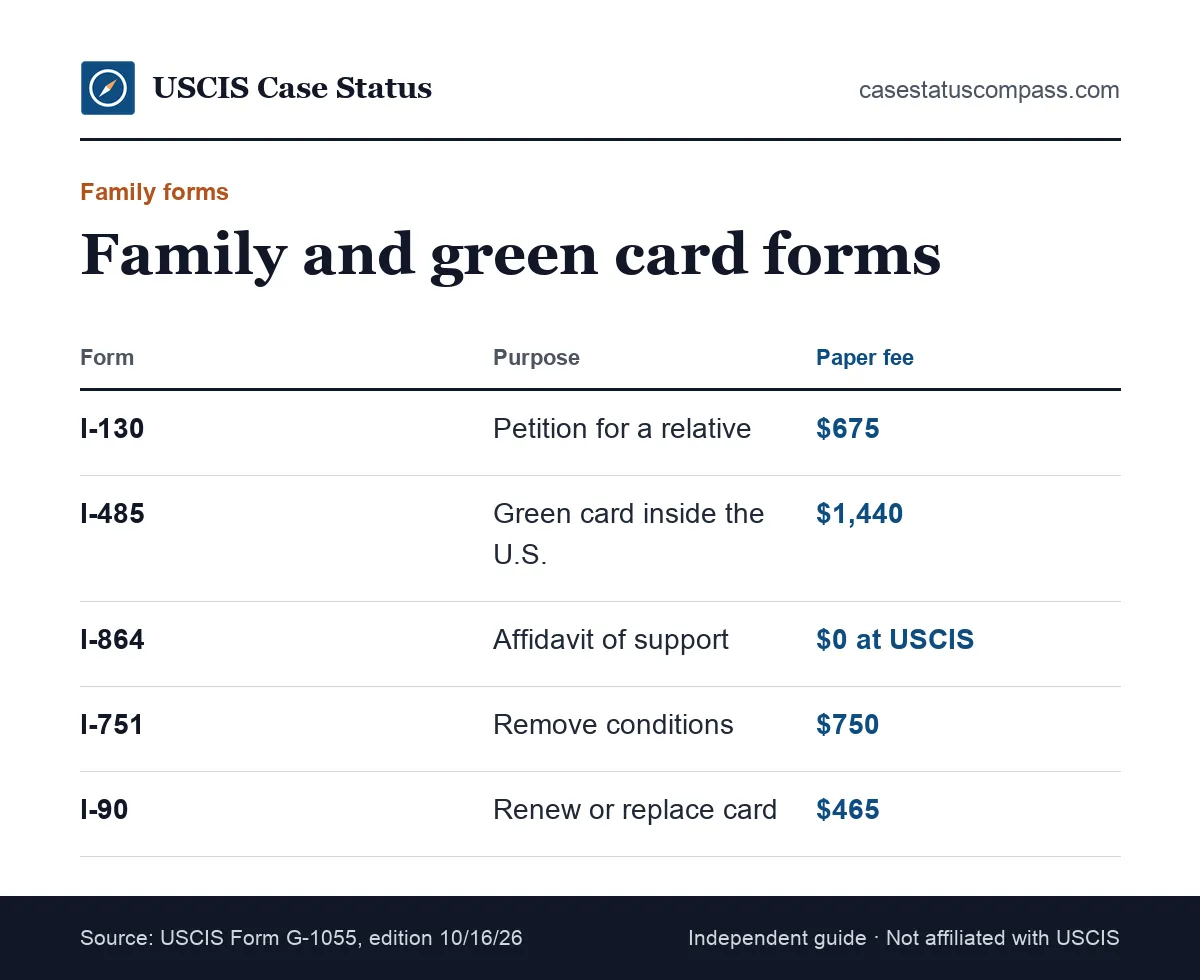
Which family form comes first
The petition always comes first. A citizen or resident files Form I-130 to prove the relationship. Immediate relatives of citizens can often file Form I-485 at the same time, while other relatives wait for a visa number.
Form I-130: Petition for Alien Relative
Form I-130 is the petition a U.S. citizen or green card holder files to prove a qualifying family relationship. Approval does not give the relative status. It reserves a place in line so the relative can later apply for a green card. As of October 2026, the fee is $675 (paper) / $625 (online).
Who files Form I-130
The sponsoring relative files it, not the immigrant. Citizens can petition for spouses, children, parents and siblings. Green card holders can petition for spouses and unmarried children. Our i 130 petition guide explains evidence, status steps and the most common delays.
Edition and filing options
USCIS requires Form I-130 edition 04/01/24. You can file it online or on paper. Filing online gives you an instant receipt in your USCIS account and costs $625 instead of $675.
Form I-485: Application to Adjust Status
Form I-485 is the application to become a permanent resident without leaving the United States, called adjustment of status. It is filed by the immigrant, usually after or with an approved petition. As of October 2026, the fee is $1,440 (paper) / $1,390 (online); $950 / $900 if under 14 and filing with a parent.
The new I-485 edition and online filing
USCIS now requires edition 09/18/26 (01/20/25 and 09/04/26 editions rejected on/after Sept. 18, 2026; no grace period). Form I-485 can also be filed online, a recent change. An older edition gets rejected.
Where to learn the full process
Form I-485 has more steps than most forms: biometrics, a possible interview and a medical exam. Our i 485 adjustment of status guide walks through each step, while the uscis processing times hub covers waits.
Form I-864: Affidavit of Support
Form I-864, the Affidavit of Support, is a sponsor's legal promise to support the immigrant financially. Most family-based green card cases need it. USCIS charges $0 at USCIS for the form, though the State Department may charge for review in visa cases abroad.
Who signs Form I-864
The petitioner signs it in almost every family case. If the petitioner's income falls short, a joint sponsor can add a separate I-864. Our affidavit of support guide covers income rules and how long the promise lasts.
Marriage Green Card: CR1, IR1 and Spouse Forms
A marriage green card is permanent residence based on marriage to a U.S. citizen or resident. Spouses abroad get a CR1 or IR1 immigrant visa; spouses in the U.S. use Form I-485. Every path starts with Form I-130, filed by the citizen or resident spouse.
CR1 versus IR1
A CR1 visa is for couples married less than two years when the visa is issued; it leads to a conditional card. An IR1 visa is for longer marriages and leads to a 10-year card. Our cr1 visa guide compares both.
Forms in a typical spouse case
- Form I-130 with proof of a real marriage
- Form I-864 from the sponsoring spouse
- Form I-485, or the State Department visa application if abroad
- Form I-751 later, for conditional residents
K-1 Fiancé(e) Visa and Form I-129F
The K-1 visa lets the foreign fiancé(e) of a U.S. citizen enter the United States to marry. The citizen files Form I-129F with USCIS first. As of October 2026, the USCIS fee is $675, and the State Department visa fee is separate.
Who files and what happens next
Only U.S. citizens can file Form I-129F. After approval, the case moves to a U.S. consulate for the visa interview. Our k1 visa guide explains each stage and the documents to prepare.
The 90-day marriage rule
K-1: marry within 90 days of entering the U.S.. After the wedding, the foreign spouse files Form I-485 to become a permanent resident. Keep your marriage certificate for the filing.
Form I-551: The Green Card and the I-551 Stamp
Form I-551 is the official name of the Permanent Resident Card, better known as the green card. You do not file it; USCIS issues it when permanent residence is granted. A temporary I-551 stamp in a passport can stand in for the card for a limited time.
Card versus stamp
The plastic card is long-term proof of status. The stamp is a short-term substitute for people whose card is lost, delayed or expired. Our i 551 stamp guide explains when you need one and how to ask for it.
How long the card is valid
Most green cards are valid for 10 years; conditional green cards for 2 years. A conditional card cannot simply be renewed with Form I-90. Conditional residents must file Form I-751 instead.
Form I-751: Removing Conditions on Residence
Form I-751 is the petition a conditional resident files to turn a 2-year green card into a 10-year card. It is for people who got residence through a marriage less than two years old. As of October 2026, the fee is $750 (paper) / $700 (online).
The 90-day filing window
File in the 90 days before your 2-year card expires. Couples usually file together. Some people can file alone with a waiver, such as after a divorce. Our i 751 removal of conditions guide explains joint filings, waivers and interviews.
Proof of status while you wait
Your old card expires while the case is pending, so the receipt notice does the work:
- I-751 receipt notice extends conditional status and work authorization for 48 months.
- Keep the receipt notice with your expired card.
- Show both together to employers and at the border.
Form I-90: Renewing or Replacing a Green Card
Form I-90 is the application to renew or replace a Permanent Resident Card. Residents use it when a 10-year card is expiring, or when a card is lost, stolen, damaged or has wrong information. As of October 2026, the fee is $465 (paper) / $415 (online).
Who files Form I-90
Permanent residents with 10-year cards file it themselves. Conditional residents use Form I-751, not Form I-90. Our green card renewal guide lists every filing reason and the evidence each needs.
The 36-month receipt extension
I-90 receipt notice + expired card = proof of status for 36 months from the card's expiration date. Carry both documents together when you travel or start a job.
Citizenship Forms
Citizenship forms either make a green card holder a U.S. citizen or document citizenship a person already has. The three main forms are Form N-400 for naturalization, Form N-600 for citizenship through a parent, and Form N-565 to replace a lost or wrong certificate.
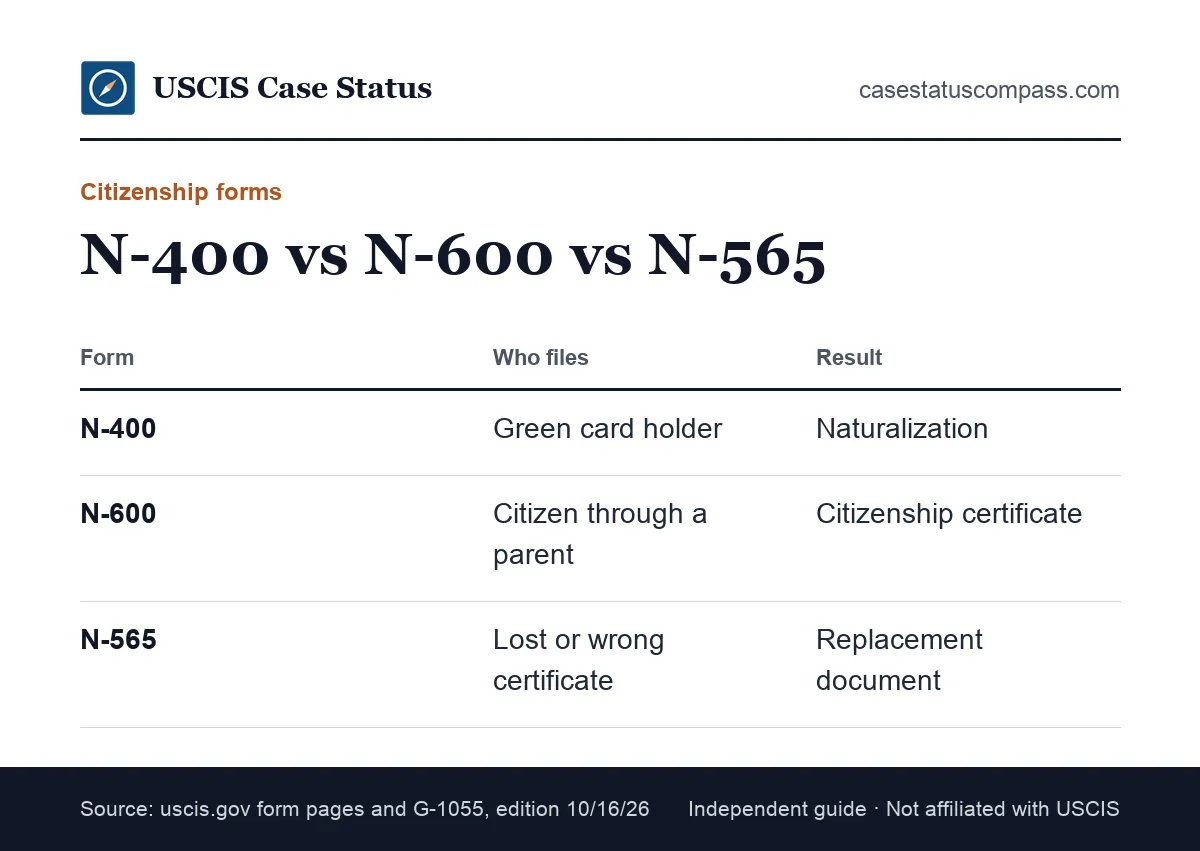
Naturalization or acquired citizenship?
Naturalization is a process you go through as an adult resident: application, interview, test and oath. Acquired or derived citizenship happens automatically through a citizen parent. N-600 does not grant citizenship; it proves it with a certificate.
Form N-400: Application for Naturalization
Form N-400 is the application a permanent resident files to become a U.S. citizen. Most applicants need 5 years as a resident, or 3 years if married to a citizen. As of October 2026, the fee is $760 (paper) / $710 (online); reduced fee $380 (paper only) if household income is at or below 400% of the Federal Poverty Guidelines.
When you can file
You can file the N-400 up to 90 days before you reach 5 years (or 3 years if married to a U.S. citizen) as a permanent resident. Filing too early leads to a denial and a lost fee. Our citizenship application guide covers eligibility, the interview and the oath.
Reduced fee and edition
Form N-400 edition 01/20/25 is the one to use. Applicants who want the reduced fee or a fee waiver must file on paper, with proof of household income. Everyone else can file online, which costs less and shows notices in the online account.
Form N-600: Certificate of Citizenship
Form N-600 asks USCIS for a Certificate of Citizenship. It is for people who became citizens through a U.S. citizen parent, at birth abroad or after getting a green card as a child. As of October 2026, the fee is $1,385 (paper) / $1,335 (online).
Who files Form N-600
Adults who acquired citizenship as children file for themselves. Parents file for children under 18 who live in the United States. The form asks for proof of the parent's citizenship and the child's lawful permanent residence, when that applies.
Form N-600K for children abroad
A child living abroad uses a related form, N-600K. Our n600 form guide helps you decide whether you need a certificate or a passport. A U.S. passport also proves citizenship, so some families apply for one first.
Naturalization Certificate and Form N-565
A naturalization certificate is the document you receive at the oath ceremony after Form N-400 is approved. It is your main proof that you became a citizen. If it is lost or has an error, you file Form N-565 for a replacement, which costs $555 (paper) / $505 (online).
When you get the certificate
You hand back your green card and receive the certificate after taking the oath. Check every detail before you leave. Our guide on how to get naturalization certificate copies and corrections explains what to do next.
Work and Travel Forms
Work and travel forms let people work legally or leave and return to the United States while a case is pending, and they let employers sponsor workers. The main ones are Form I-765, Form I-131, Form I-129 for H-1B workers, PERM labor certification, and Form I-140.
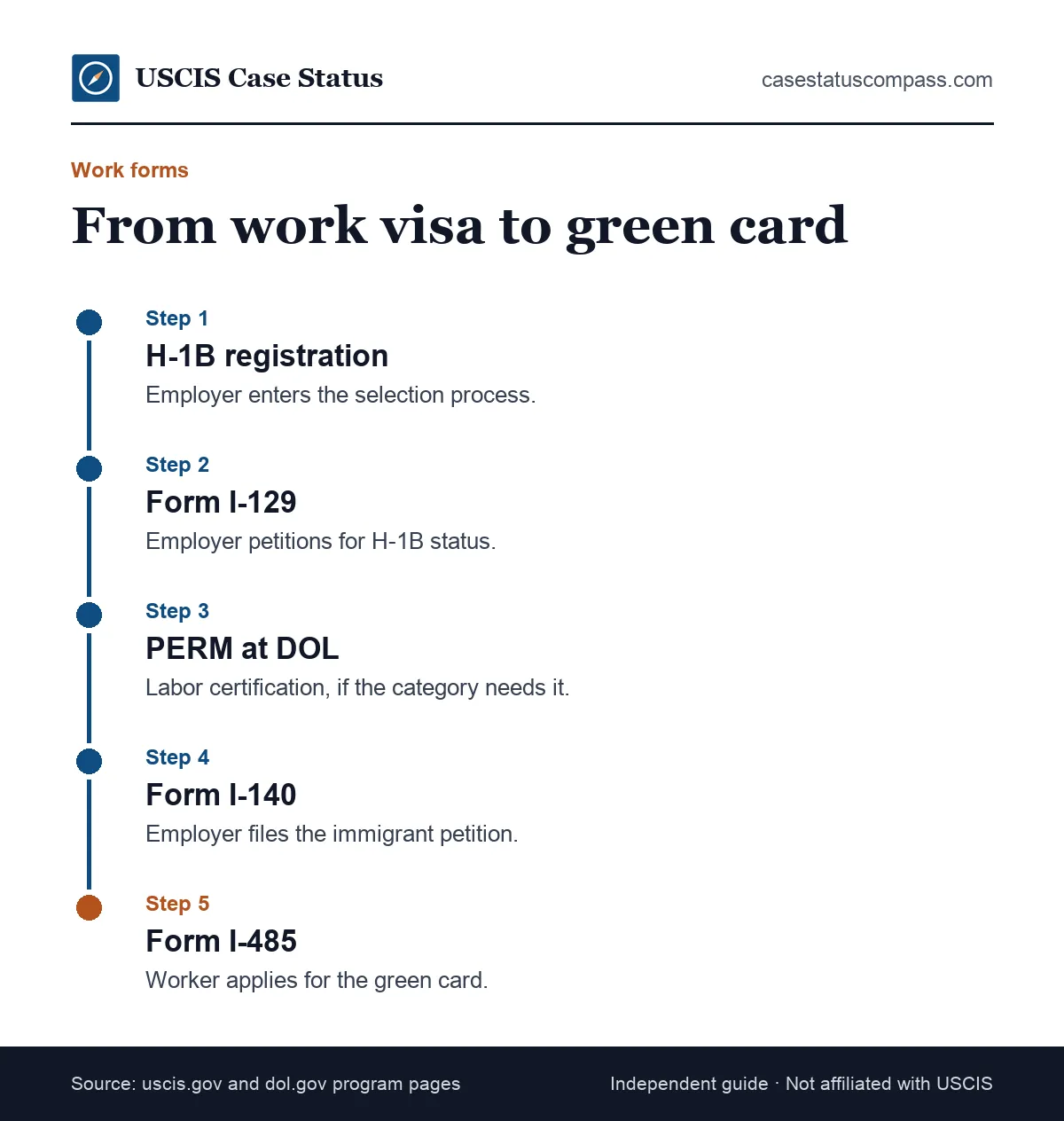
Temporary versus permanent work forms
Form I-765 and Form I-129 cover temporary permission to work. PERM and Form I-140 lead toward a green card. Many H-1B workers file forms from both groups. A green card case does not replace the temporary status, so keep both current.
Form I-765: Employment Authorization
Form I-765 is the application for an Employment Authorization Document (EAD), often called a work permit. Green card applicants, asylum seekers, students and many others use it. As of October 2026, the fee is $520 (paper) / $470 (online); $260 with a pending I-485 filed on or after Apr. 1, 2024. H.R. 1 add-ons: initial asylum-applicant (c)(8) EAD $0 + $570; initial TPS/parolee EAD base fee + $570; renewal TPS/parolee base fee + $280; renewal (c)(8) base fee + $275.
Only one edition is accepted
USCIS accepts edition 08/21/25 (the 09/15/26 edition is NOT accepted because of a Sept. 14, 2026 court order). Using the newer edition will get your filing rejected. Our work permit guide tracks this and explains eligibility categories.
Automatic extensions have changed
Ended: renewals filed on or after Oct. 30, 2025 no longer get the up-to-540-day automatic extension (exceptions: TPS by law/Federal Register notice; STEM OPT 180 days). If you renew, file early and plan for a possible gap in work authorization.
Form I-131: Advance Parole and Travel Documents
Form I-131 is the application for travel documents, including advance parole, re-entry permits and refugee travel documents. Advance parole lets many pending green card applicants leave and return without abandoning the case. As of October 2026, the fee is $630 (paper) / $580 (online); $0 if your I-485 was filed before Apr. 1, 2024 with the fee. H.R. 1 Immigration Parole Fee $1,050 when parole is granted (some exceptions).
Who files Form I-131
Applicants with a pending Form I-485, DACA recipients in some cases, and green card holders planning long trips abroad file it. Our advance parole guide explains which one fits your trip.
The parole fee needs a careful look
The H.R. 1 Immigration Parole Fee is new and has exceptions, and USCIS lists it as collected when parole is granted. Talk to an immigration attorney before you plan a trip around it.
Form I-129 and H-1B Specialty Workers
H-1B is a temporary work status for specialty jobs that usually need a degree. The employer files Form I-129 after winning the registration selection. As of October 2026, the fee stack is Base $780 (paper) / $730 (online) ($460 small employer/nonprofit) + Asylum Program Fee $600/$300/$0 + Fraud fee $500 + ACWIA $1,500 or $750 (+ $4,000 Pub. L. 114-113 fee for some large H-1B-dependent employers).
Registration comes first
$215 per registration (per beneficiary). Only selected registrations can move on to a full petition. Our h1b visa status guide explains each status message from selection to approval. The employer, not the worker, files the registration and the petition.
The $100,000 payment
$100,000 H-1B payment: blocked by court order (vacated June 8, 2026; stay denied July 24, 2026). The fee schedule still lists the payment, and DHS says it would collect it if the court order changes.
PERM Labor Certification
PERM is the Department of Labor (DOL) process that tests the U.S. job market before many employers can sponsor a worker for a green card. It is not a USCIS form. The employer files Form ETA-9089 with DOL, and approval lets it file Form I-140.
Why PERM sits with this group
PERM is part of many employment green card cases, so people track it alongside USCIS forms. Our perm case status guide explains each DOL stage, from wage determination to certification.
PERM fees and DOL waits
We could not confirm an official DOL statement about PERM fees, but DOL does publish its waits: DOL analyst review is working on PERM cases filed in January 2026 (as of Oct. 5, 2026).
Form I-140: Immigrant Petition for Alien Workers
Form I-140 is the employment-based immigrant petition. An employer files it for a worker, or some workers file for themselves in categories like extraordinary ability. As of October 2026, the fee is $715 (paper) / $665 (online) + Asylum Program Fee $600 ($300 small employer or self-petitioner; $0 nonprofit).
Who files Form I-140
Most petitions are filed by employers after PERM is certified. Self-petitioners skip the employer requirement in certain categories. Our form i 140 guide explains each category and how the priority date works.
I-140 edition and what comes after
Form I-140 edition 06/07/24 is current. Approval does not give status; the worker still needs Form I-485 or an immigrant visa once a visa number is available. The monthly visa bulletin shows when that number opens.
Humanitarian Forms
Humanitarian forms protect people who cannot safely return home or who came to the U.S. as children. The main ones are Form I-821D for DACA, Form I-821 for Temporary Protected Status (TPS), and Form I-589 for asylum. Several programs are in court.
Why these forms need extra care
Deadlines, eligibility and fees here can change with court orders. If you are in removal proceedings or unsure about eligibility, speak with an immigration attorney or DOJ-accredited representative before filing.
DACA: Forms I-821D and I-765
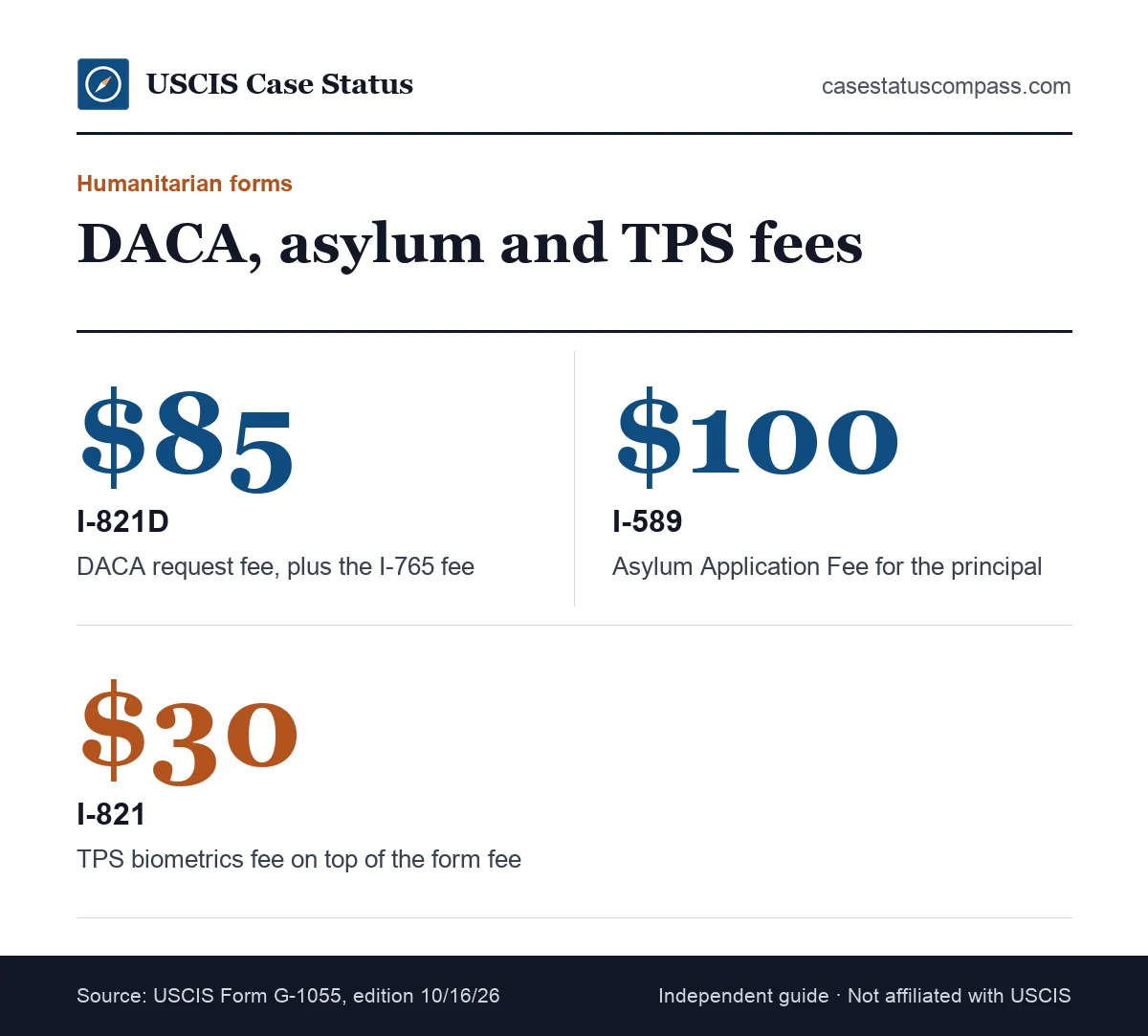
Deferred Action for Childhood Arrivals (DACA) protects some people brought to the U.S. as children from removal and lets them work. Requests use Form I-821D with Form I-765. As of October 2026, the renewal total is I-821D $85 + I-765 $520 (paper) / $470 (online) = $605 paper / $555 online.
Current DACA program status
DACA: renewals processed; initial requests accepted but not processed. Court rulings drive these rules, so check the latest before you file. Our daca status guide follows what each status update means for renewals.
TPS: Form I-821
Temporary Protected Status (TPS) lets nationals of designated countries stay and work in the U.S. while conditions at home are unsafe. Applicants file Form I-821, often with Form I-765. As of October 2026, the fee is Initial: $520 + $30 biometrics; re-registration: $0 + $30 biometrics (the TPS EAD is a separate fee).
Which countries are designated for TPS
As of October 20, 2026, USCIS lists these countries: El Salvador, Lebanon, Sudan, Ukraine. The list changes often. Our tps status guide tracks designations and re-registration periods. Check the official page at uscis.gov/humanitarian/temporary-protected-status before you file.
Asylum: Form I-589
Asylum protects people who fear persecution in their home country. You apply with Form I-589. As of October 2026, the fees are $0 filing fee + $100 Asylum Application Fee (principal applicant); Annual Asylum Fee $105 (online, when USCIS sends a notice). These fees cannot be waived.
The one-year filing deadline
File for asylum within 1 year of your last arrival in the U.S. (limited exceptions). Our asylum status guide explains affirmative and defensive cases and what each update means. Exceptions to the deadline are narrow, so see an attorney if you are close to it.
Work while asylum is pending
Asylum applicants can ask for a work permit after a waiting period, with Form I-765 in the (c)(8) category. H.R. 1 add-on fees apply to these EADs, and they cannot be waived.
Which Green Card Path Fits Your Situation?
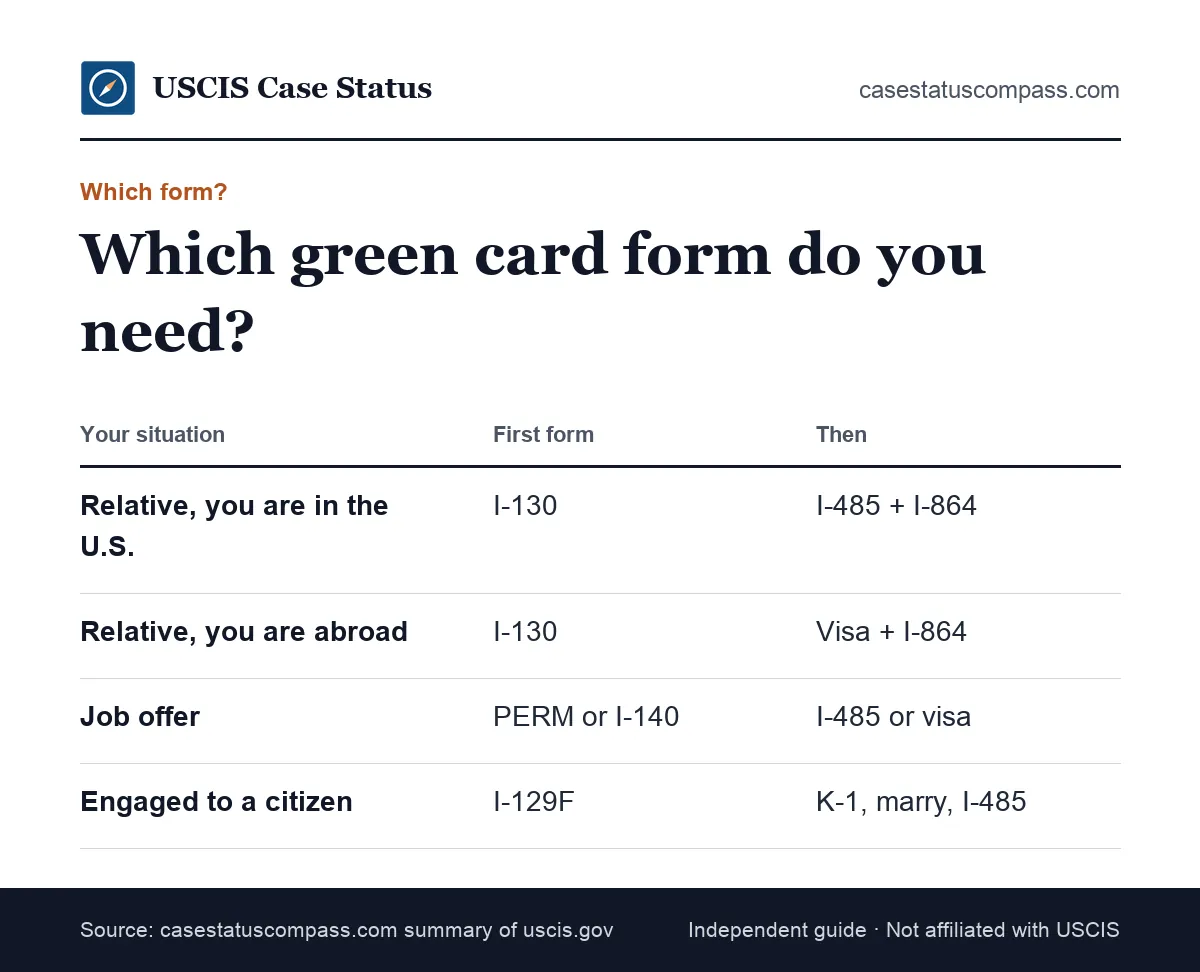
The green card form you need depends on your sponsor and location. Family cases start with Form I-130, job cases with PERM or Form I-140, and fiancé cases with Form I-129F. If you are inside the U.S. and eligible, you then file Form I-485; if abroad, you apply for an immigrant visa.
If you are already in the United States
You may be able to adjust status with Form I-485, usually with Form I-864, Form I-765 and Form I-131. A past overstay or unlawful entry can block adjustment. Check eligibility with an attorney before you file these USCIS forms together.
If you live outside the United States
Your petition goes to the State Department after USCIS approval. You complete the visa application and interview abroad. You then pay the $235 USCIS Immigrant Fee so your card can be made after you arrive.
Which Form Do I Need to Become a Citizen?
Most green card holders need Form N-400 to become citizens. If you already became a citizen through a U.S. citizen parent, you file Form N-600 for proof, not N-400. If you naturalized and lost your certificate, you file Form N-565.
A quick way to decide
Start from how you became, or want to become, a citizen; each path points to one form.
| Your situation | Form to use |
|---|---|
| Green card for 5 years (3 if married to a citizen) | N-400 |
| Born abroad to a citizen parent | N-600 or passport |
| Got a green card as a child of a citizen | N-600 |
| Already naturalized; certificate lost or wrong | N-565 |
Which Forms Let You Work or Travel While a Case Is Pending?
While a green card case is pending, Form I-765 gives permission to work and Form I-131 gives permission to travel. Asylum applicants, TPS applicants and DACA recipients also use Form I-765. Green card holders with a long trip planned may file Form I-131 for a re-entry permit.
Working while you wait
File Form I-765 with or after your main application. For I-485 applicants, the I-765 fee is reduced while the I-485 is still pending. Your employer checks the EAD for Form I-9.
Traveling while you wait
Leaving the U.S. without advance parole while Form I-485 is pending can cancel your application. A few visa holders, such as some H and L workers, are exempt. Confirm with an attorney before any trip.
Is Online Filing Available for Most USCIS Forms?
Yes. Many USCIS forms can be filed online through a free USCIS online account, including Form I-90, I-130, I-765, I-131, N-400, N-600 and, now, I-485. Online filing gives you an instant receipt, a lower fee for most forms and digital copies of your notices.
How online filing works
You create an account at myaccount.uscis.gov/create-account, fill out the form, upload evidence and pay the fee by card or bank account. Your receipt notice appears in the account right away. Online receipts start with the IOE prefix.
When you must file on paper
Some requests still require paper. For example, the reduced N-400 fee and most fee waivers need a paper filing. Reentry permits and refugee travel documents on Form I-131 also go by mail. Send paper filings to the address on the form page.
How Do You Make Sure You Have the Right Form Edition?
Every form has an edition date printed at the bottom of each page. USCIS lists the editions it accepts on each form's page. An old edition is a common reason for rejection, and some changes have no grace period.
Current editions for key forms
Compare the date at the bottom of your form with this list; an older edition is rejected.
| Form | Accepted edition |
|---|---|
| I-485 | 09/18/26 (01/20/25 and 09/04/26 editions rejected on/after Sept. 18, 2026; no grace period) |
| I-765 | 08/21/25 (the 09/15/26 edition is NOT accepted because of a Sept. 14, 2026 court order) |
| I-130 | 04/01/24 |
| N-400 | 01/20/25 |
| I-751 | 04/01/24 |
| I-90 | 01/20/25 |
Recent edition changes to watch
Form I-485 moved to a new edition with no grace period. Form I-765 is unusual: the newest edition is blocked by a court order, so USCIS still requires the older one.
Where Do You Get Official USCIS Forms Safely?
You get official forms free at uscis.gov/forms. USCIS never charges to download a form. Websites that sell blank forms or "form packages" are not USCIS. They can also hand you an old edition. Bookmark the official page and download a fresh copy each time you file.
Signs of an unofficial form seller
- Charges a fee to download or "unlock" a form
- Uses a .com or .org address that looks official
- Shows government seals or claims to be USCIS
- Asks for your USCIS account password
Free help from USCIS itself
USCIS has instructions for every form and a Contact Center at 800-375-5283. Both are free, and agents can point you to the right form page. Emma, the virtual assistant on uscis.gov, answers basic form questions in English and Spanish.
Attorneys versus notarios
For legal advice, use a licensed immigration attorney or a DOJ-accredited representative. Notarios and "immigration consultants" cannot give legal advice. Paying one can cost you money and, if a form is filed wrongly, your case. Our USCIS scams guide shows the warning signs.
What Happens After You File a USCIS Form?
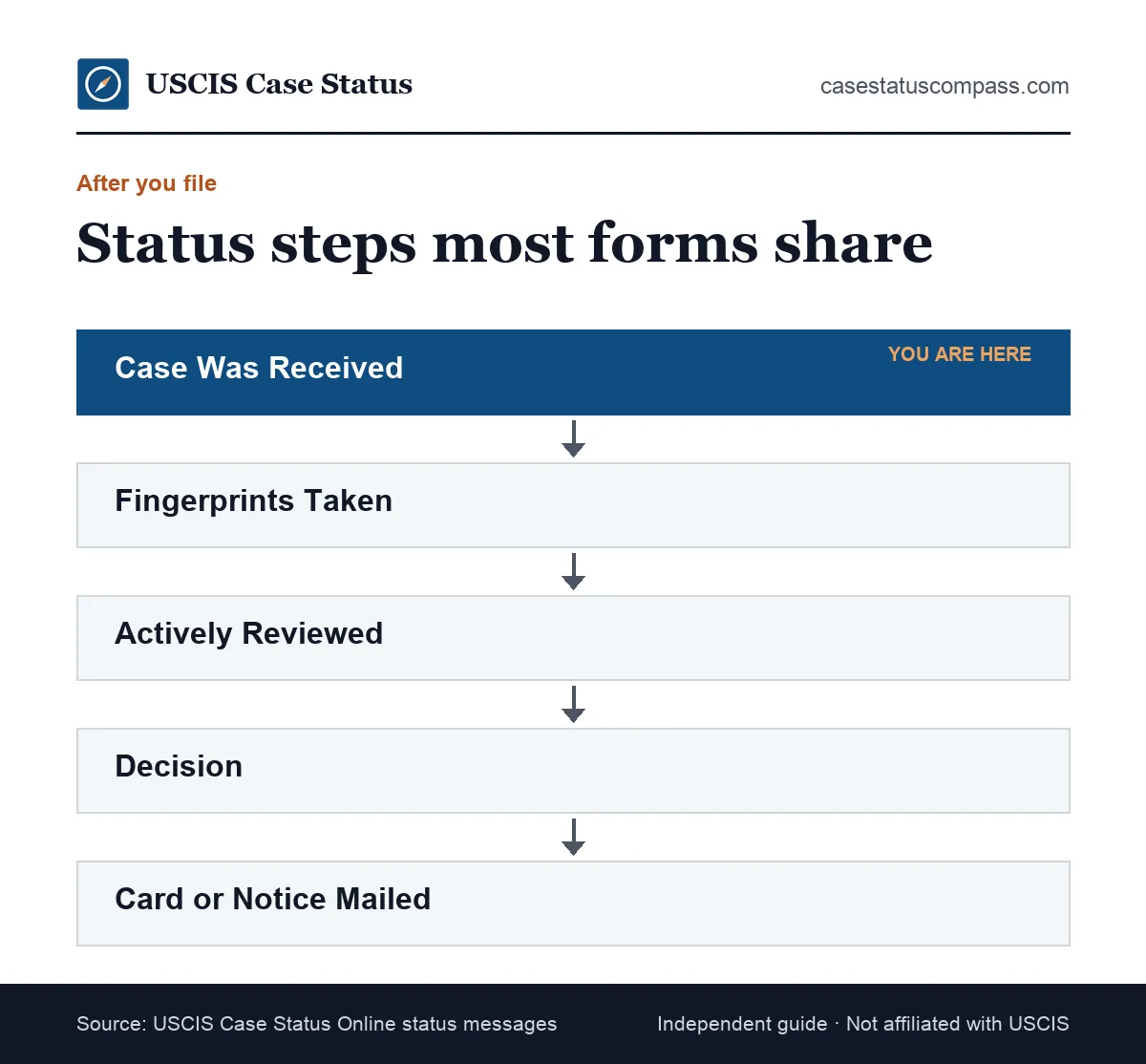
After you file, USCIS sends a receipt notice (Form I-797C) with your receipt number. Many forms then need a biometrics appointment. An officer reviews the case, may send a request for evidence or schedule an interview, and then approves or denies it.
The receipt notice
I-797C = Notice of Action (receipt, rejection, transfer, appointment, re-open); not proof of status by itself. The receipt number on it lets you track the case. Check names, dates and the form number on it right away.
Status sequence by form type
Most USCIS forms move through a similar pattern; the main difference is what comes at the end.
| Form type | Typical status steps | Final result |
|---|---|---|
| Petitions (I-130, I-140, I-129F) | Received, actively reviewed, approved | Approval notice |
| Card cases (I-485, I-90, I-751) | Received, fingerprints, reviewed, approved | Card produced and mailed |
| Work permit (I-765) | Received, reviewed, approved | EAD card mailed |
| Citizenship (N-400) | Received, fingerprints, interview, oath | Naturalization certificate |
How Do You Check Case Status for Each Form?
You check any form's status with its receipt number on Case Status Online, the free official tool. Each form you file has its own number, so a green card package can have three numbers at once. A USCIS online account shows full history for linked cases.
One receipt number per form
If you filed Form I-485, Form I-765 and Form I-131 together, you get three notices. Our uscis case status checker explains the tool, and our receipt number guide shows where each notice prints it.
What the status messages mean
Status messages, like "Case Was Received" or "Card Was Mailed To Me," are shared across forms. Our case status meanings hub decodes each one, with what to do next. Read the paragraph under the title too.
How Long Do USCIS Forms Take to Process?
Processing time depends on the form, the category and the office. USCIS publishes current estimates in its official processing times tool. We do not repeat live numbers, because they change monthly. The tool shows how long USCIS took to finish most cases in the past six months, so a newer filing can move faster or slower.
Older historical medians
USCIS's factsheet, with data as of March 5, 2024, reported: Historical medians (USCIS factsheet, data as of Mar. 5, 2024): FY2023 N-400 6.1 mo; I-130 IR 11.8 mo; I-485 family 11.4 / employment 8.6 mo; I-765 (pending I-485) 5.5 mo; I-131 AP 5.8 mo; I-90 9.16 mo. These numbers are outdated. For current times, open egov.uscis.gov/processing-times and pick your form and office.
How Much Do USCIS Forms Cost in 2026?
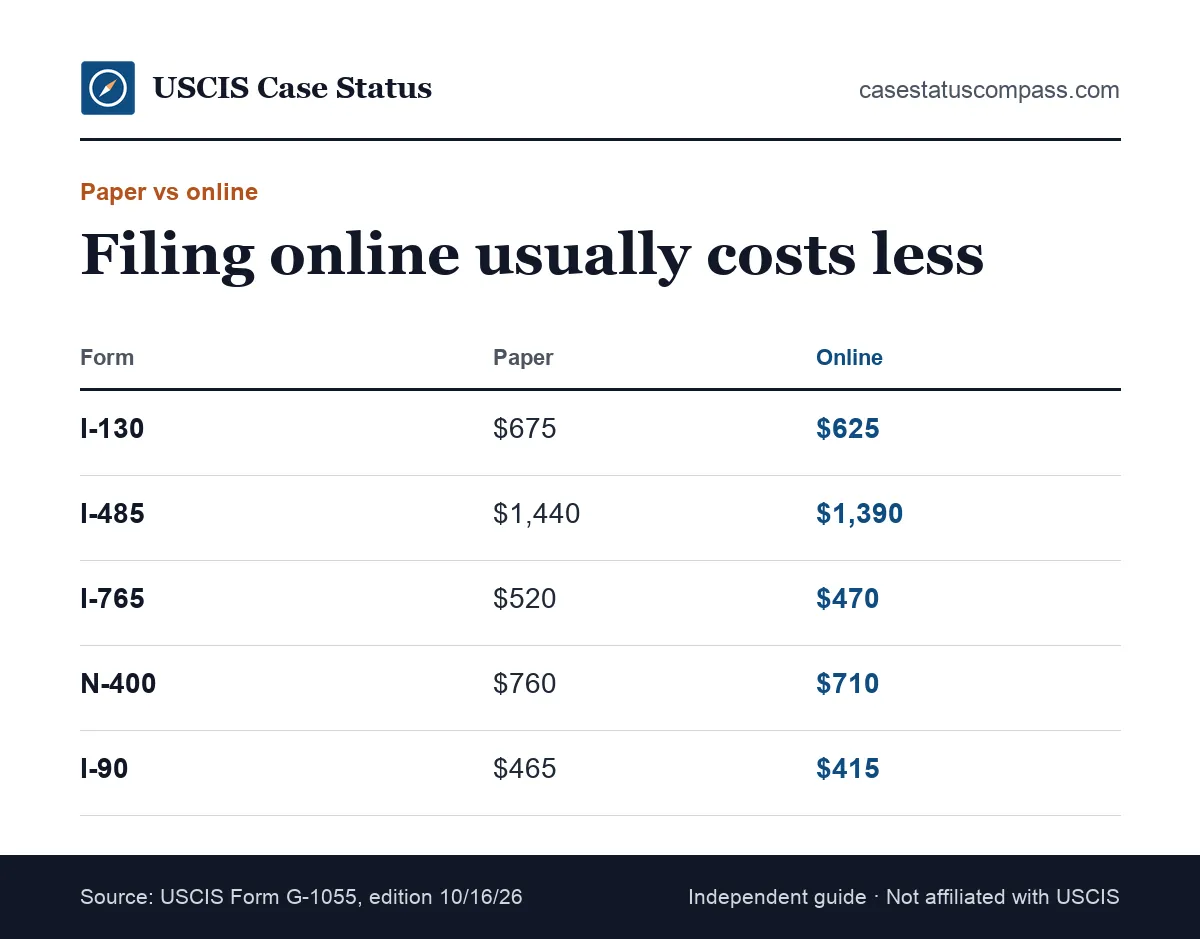
USCIS fees come from Form G-1055, the fee schedule. The edition in force is Form G-1055, Edition 10/16/26. Some forms cost nothing at USCIS. Online filing usually costs less than paper for the same form. Fees are nonrefundable, even when a case is denied.
H.R. 1 fees
Since 2025, H.R. 1 added fees for asylum, parole, TPS and some work permits. These fees adjust each year, cannot be waived and must be paid separately. Our uscis fees hub explains each one.
Fee waivers and reduced fees
Some forms allow a fee waiver with Form I-912 or a reduced fee for low income. N-400 has a reduced fee on paper. Our fee waiver guide explains which forms qualify and what proof you need.
What Are the Most Common Mistakes on USCIS Forms?
The most common mistakes are using an old edition, paying the wrong fee, leaving a signature or required field blank, and skipping evidence the instructions ask for. Each one can lead to a rejection, a request for evidence or months of delay.
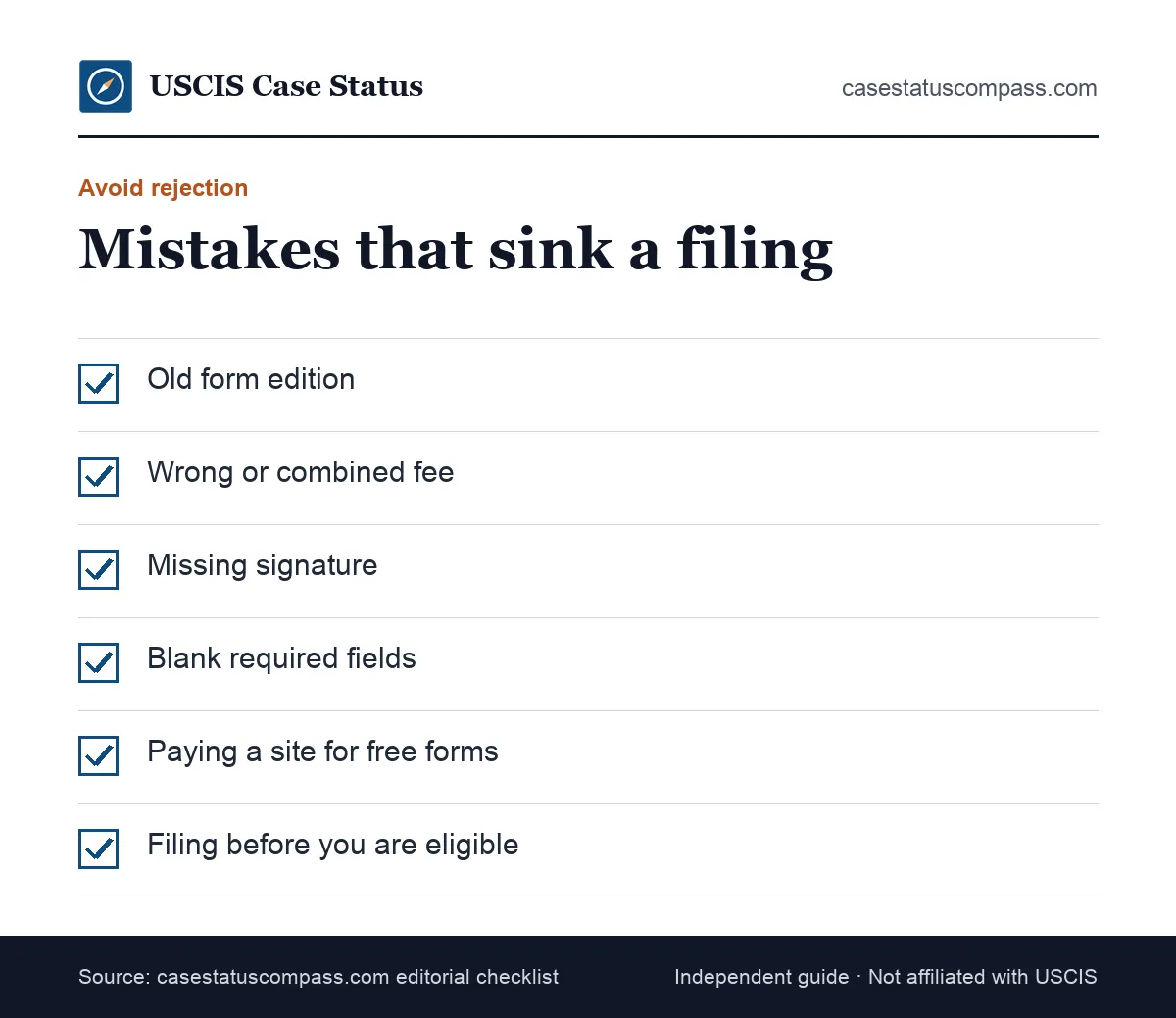
Mistakes that cause a rejection
A rejected filing comes back with no decision, and your place in line is lost. Missing signatures, wrong fees and old editions cause most rejections. Fix the problem and file again.
Mistakes that cause a delay
Missing evidence usually leads to a request for evidence (RFE) rather than a rejection. Answer an RFE completely and on time; there are no extensions. Our request for evidence guide explains how.
A USCIS Filing Checklist You Can Copy
Use this checklist for any of the forms on this page. Copy it and check each line before you file. The first list prevents rejections; the second protects the case after USCIS has it. Both apply whether you file on paper or online.
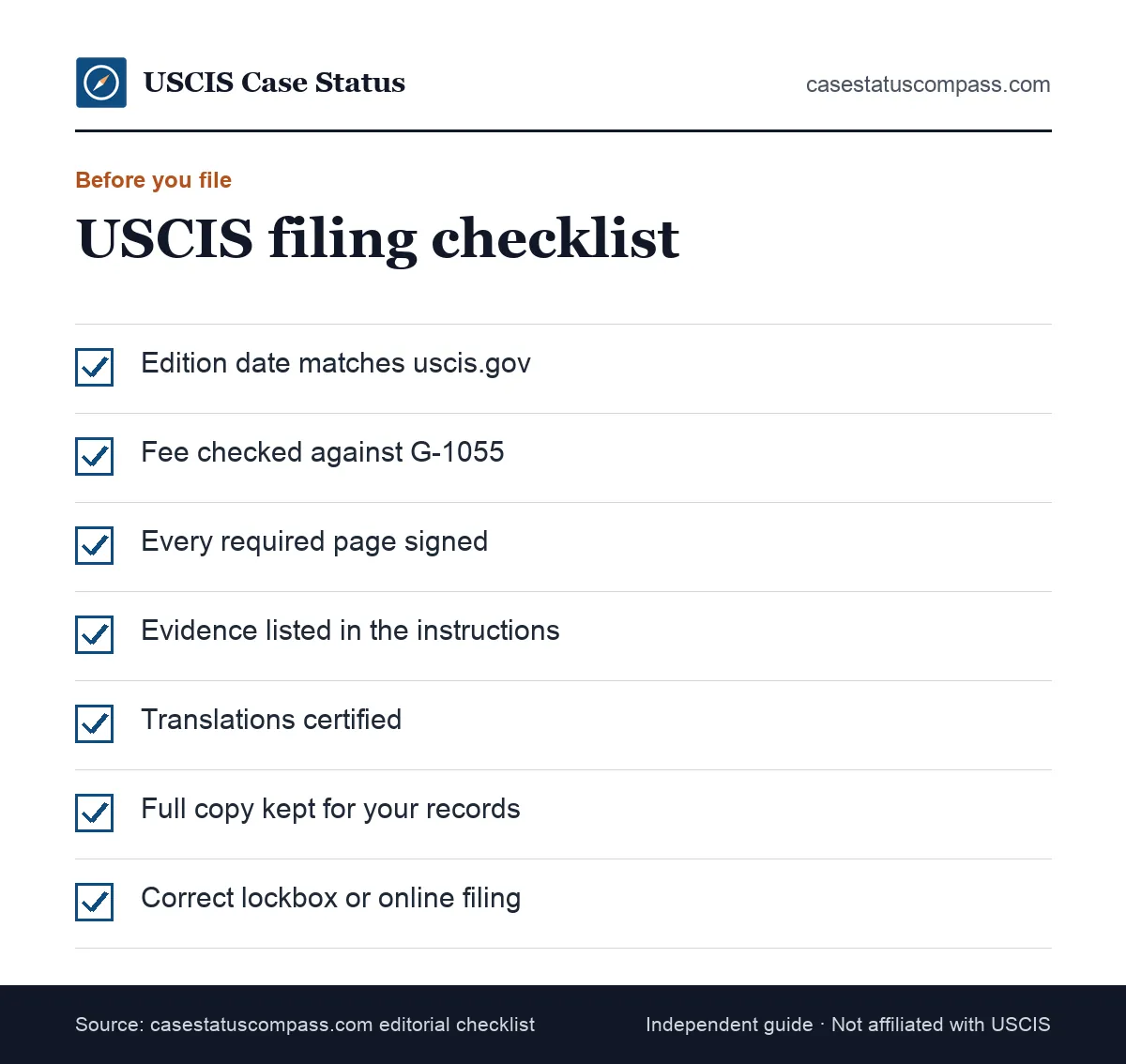
Before you file
- Confirm you are eligible today, not next month.
- Download a fresh copy of the form and instructions.
- Match the edition date with uscis.gov.
- Check the fee on G-1055 for your category.
- Gather every piece of evidence in the instructions.
- Translate foreign documents with a certified translation.
After you file
- Save the receipt notice and write down the receipt number.
- Create or link your USCIS online account.
- Keep your address up to date with USCIS.
- Go to every biometrics or interview appointment.
When Should You Get Legal Help With a Form?
Get legal help if you have a past immigration violation, an arrest or conviction, a prior denial, a pending court case, or an asylum claim. Use a licensed attorney or a DOJ-accredited representative. A short consultation before filing costs far less than a denial.
Help if your form was denied
A denial is not always the end. Some cases can be appealed, reopened or refiled, but deadlines are short. Our case denied guide explains your options.
Frequently Asked Questions
Which USCIS form do I need for a green card?
Most people need a petition and an application. Family cases start with Form I-130, job cases with Form I-140 (often after PERM), and fiancé cases with Form I-129F. People in the U.S. then usually file Form I-485, while people abroad apply for an immigrant visa. Form I-864 is needed in most family cases.
Can I file USCIS forms online?
Yes, many forms can be filed online through a free USCIS online account, including I-90, I-130, I-765, I-131, N-400, N-600 and I-485. Online filing is usually cheaper than paper. Some requests, like fee waivers and the reduced N-400 fee, still need a paper filing.
Are USCIS forms free?
Downloading forms is free on uscis.gov. Filing most forms costs money under the G-1055 fee schedule, though some, like Form I-864, cost nothing at USCIS. Any site that charges you just to download a blank form is not USCIS.
What happens if I use an old form edition?
USCIS may reject the filing and return it with your fee. You start over and lose your filing date. Always check the accepted edition on the form's page on uscis.gov right before filing.
Can I file more than one form at the same time?
Yes, in many cases. A common package is Form I-485 with Form I-765 and Form I-131. Each form needs its own fee unless the instructions say otherwise, and each gets its own receipt number.
How do I know USCIS received my form?
USCIS sends Form I-797C, a receipt notice, by mail, and online filers see it in their account right away. The receipt number on the notice lets you check status online.
Sources
- USCIS: All Forms. www.uscis.gov/forms/all-forms. Accessed Oct 27, 2026.
- USCIS Form G-1055, Fee Schedule (Edition 10/16/26). www.uscis.gov/sites/default/files/document/forms/g-1055.pdf. Accessed Oct 27, 2026.
- USCIS: Forms Available to File Online. www.uscis.gov/file-online/forms-available-to-file-online. Accessed Oct 27, 2026.
- USCIS: Check Case Processing Times. egov.uscis.gov/processing-times/. Accessed Oct 27, 2026.
- USCIS: Temporary Protected Status. www.uscis.gov/humanitarian/temporary-protected-status. Accessed Oct 27, 2026.
- USCIS Glossary. www.uscis.gov/tools/glossary. Accessed Oct 27, 2026.
- U.S. Department of Labor: PERM Program. www.dol.gov/agencies/eta/foreign-labor/programs/permanent. Accessed Oct 27, 2026.
- USCIS Fee Schedule (Form G-1055). www.uscis.gov/g-1055. Accessed Oct 27, 2026.
- USCIS: Form I-130 page (updated 10/07/2026). www.uscis.gov/i-130. Accessed Oct 27, 2026.
- USCIS: Form I-485 page (updated 10/07/2026). www.uscis.gov/i-485. Accessed Oct 27, 2026.
- USCIS: Form I-129F page. www.uscis.gov/i-129f. Accessed Oct 27, 2026.
- USCIS: Removing Conditions on Permanent Residence Based on Marriage. www.uscis.gov/green-card/after-we-grant-your-green-card/conditional-permanent-residence/removing-conditions-on-permanent-residence-based-on-marriage. Accessed Oct 27, 2026.
- USCIS: Replace Your Green Card (updated 09/12/2025). www.uscis.gov/green-card/after-we-grant-your-green-card/replace-your-green-card. Accessed Oct 27, 2026.
- USCIS: Form N-400 page. www.uscis.gov/n-400. Accessed Oct 27, 2026.
- USCIS: Form I-765 page (updated 10/07/2026). www.uscis.gov/i-765. Accessed Oct 27, 2026.
- USCIS: Automatic EAD Extension (updated 10/29/2025). www.uscis.gov/working-in-the-united-states/information-for-employers-and-employees/automatic-employment-authorization-document-ead-extension. Accessed Oct 27, 2026.
- USCIS: H-1B Electronic Registration Process. www.uscis.gov/working-in-the-united-states/temporary-workers/h-1b-specialty-occupations-and-fashion-models/h-1b-electronic-registration-process. Accessed Oct 27, 2026.
- USCIS: H-1B Specialty Occupations (updated 09/21/2026). www.uscis.gov/working-in-the-united-states/h-1b-specialty-occupations. Accessed Oct 27, 2026.
- DOL FLAG Processing Times (PERM as of 10/05/2026). flag.dol.gov/processingtimes. Accessed Oct 27, 2026.
- USCIS: Form I-140 page (updated 07/24/2026). www.uscis.gov/i-140. Accessed Oct 27, 2026.
- USCIS: Form I-821D page (updated 06/01/2026) and uscis.gov/DACA (updated 01/24/2025). www.uscis.gov/i-821d. Accessed Oct 27, 2026.
- USCIS: Form I-589 page. www.uscis.gov/i-589. Accessed Oct 27, 2026.
- USCIS: Online Account and Technical Support. www.uscis.gov/tools/uscis-tools-and-resources/online-account-and-technical-support. Accessed Oct 27, 2026.
- USCIS: Form I-751 page (updated 06/16/2026). www.uscis.gov/i-751. Accessed Oct 27, 2026.
- USCIS: Form I-90 page (updated 10/07/2026). www.uscis.gov/i-90. Accessed Oct 27, 2026.
- USCIS Contact Center (uscis.gov). www.uscis.gov/contactcenter. Accessed Oct 27, 2026.
- USCIS: Form I-797 Types and Functions (updated 01/24/2025). www.uscis.gov/forms/filing-guidance/form-i-797-types-and-functions. Accessed Oct 27, 2026.
- USCIS Historical Processing Times Trends FY2016-2024 factsheet. www.uscis.gov/sites/default/files/document/fact-sheets/historical_pt_factsheet_fy16_to_fy24.pdf. Accessed Oct 27, 2026.
casestatuscompass.com is an independent publication and is not affiliated with USCIS or any government agency. This page is general information, not legal advice. For denials, court or asylum matters, consult an immigration attorney or a DOJ-accredited representative.