Contents · 42 sections
- What Is Form I-130 Used For?
- What Is an Immigrant Petition?
- Is Form I-140 an Immigrant Petition Too?
- Who Can File Form I-130?
- Which Relatives Can a U.S. Citizen Sponsor?
- Which Relatives Can a Green Card Holder Sponsor?
- What Happens to an I-130 When the Petitioner Naturalizes?
- Immediate Relatives vs Preference Categories: Why the Label Matters
- How Do You Sponsor an Immigrant Relative?
- What Is Needed to Sponsor an Immigrant?
- Can a Non-Family Member Sponsor an Immigrant?
- Form I-130A Explained
- Can You File Form I-130A Online?
- I-130 vs I-130A: Which Form Does What?
- Where Do You Get the I-130 Form PDF?
- How Do You Fill Out Form I-130?
- Has Anyone Ever Filed an Immigrant Petition on Your Behalf?
- I-130 Instructions: The Rules People Miss
- What Documents Do You Need to Submit with I-130?
- How Do You Show a Real Marriage in a Spouse Petition?
- What Is I-130 Package Assembly?
- A Filing Checklist You Can Copy
- Where Do You File I-130?
- Where Do You Mail I-130 If Your Relative Also Files I-485?
- Can You File I-130 Online?
- How Much Does Form I-130 Cost?
- How Long Does an I-130 Take to Process?
- What Happens After You File Form I-130?
- I-130 Case Status: What Each Update Means
- Why Is My I-130 Taking So Long?
- What Does I-130 Approval Mean?
- What Happens After I-130 Is Approved?
- What Happens at the NVC Stage?
- Does an Approved I-130 Expire?
- Filing Green Card for Siblings
- How Do You Petition for a Parent or a Child?
- Is There an Interview for an I-130?
- Common Mistakes That Delay a Petition
- What If Your Petition Gets an RFE or Is Denied?
- Spouse Petitions, the CR1 Visa and the IR1 Visa
- When Should You Get Legal Help With an I-130?
- Frequently Asked Questions
The short answer
Form I-130, the Petition for Alien Relative, is how a U.S. citizen or green card holder proves a qualifying family relationship to USCIS. The I 130 starts most family green card cases. Approval does not give your relative status; it lets them apply for a green card through Form I-485 or an immigrant visa abroad.
At a glance
| Who files | A U.S. citizen, lawful permanent resident or U.S. national (the petitioner) |
| Current edition | 04/01/24 |
| Filing fee | $675 (paper) / $625 (online) |
| Spouse cases | Add Form I-130A for the spouse beneficiary |
| Result | An approval notice, not a green card or visa |
What Is Form I-130 Used For?
Form I-130 is used to ask USCIS to recognize that you and a foreign relative share a qualifying family tie. Once approved, the petition gives that relative a place in line for permanent residence. It is the first filing in most family cases, and later forms refer back to its receipt number and category.
What the petition proves
The petition answers two questions. First, are you a citizen, permanent resident or U.S. national? Second, is the person you name your spouse, child, parent or sibling in the legal sense? It does not judge admissibility yet.
What the petition does not do
USCIS states that filing or approval "does not give your relative any immigration status or benefit." Your relative cannot work, travel or stay longer because the petition is pending. Those come later, from a green card application or an immigrant visa.
What Is an Immigrant Petition?
An immigrant petition is a request, filed by a sponsor, asking the U.S. government to classify a foreign person for permanent immigration. Families use the I-130 immigration petition; employers use other forms, all listed in our USCIS forms explained hub. Each sets the category and priority date.
Family petitions and employer petitions
Family sponsors file the Petition for Alien Relative. Employers file for workers through a separate petition, often after a Department of Labor step. The two routes never mix: a relative cannot be sponsored on a work form, and a job offer adds nothing to a family petition.
Is Form I-140 an Immigrant Petition Too?
Yes. Form I-140, the Immigrant Petition for Alien Worker, is the employment-based counterpart. A U.S. employer, or in some categories the worker, files it. Our guide to Form I-140 for alien workers covers that process, and the PERM case status guide explains the labor certification that often comes first.
Who Can File Form I-130?
Three groups can file: U.S. citizens, lawful permanent residents (green card holders) and U.S. nationals who are not citizens. You are the petitioner; your relative is the beneficiary. Which group you belong to decides which relatives you can sponsor and how long they will wait, so confirm your own status first.
U.S. citizens
Citizens by birth or naturalization can petition. If you are still waiting on your citizenship application, you file as a green card holder for now. After you take the oath, send USCIS a copy of your certificate so the case moves to the faster category.
Lawful permanent residents
A green card holder can petition for a spouse and unmarried children of any age. If your card has expired, renew it before or alongside filing; our green card renewal guide explains the replacement process.
Which Relatives Can a U.S. Citizen Sponsor?
A U.S. citizen can sponsor a spouse, children of any age and marital status, parents and brothers and sisters. You must be 21 or older to petition for a parent or a sibling. Spouses, minor unmarried children and parents are immediate relatives.
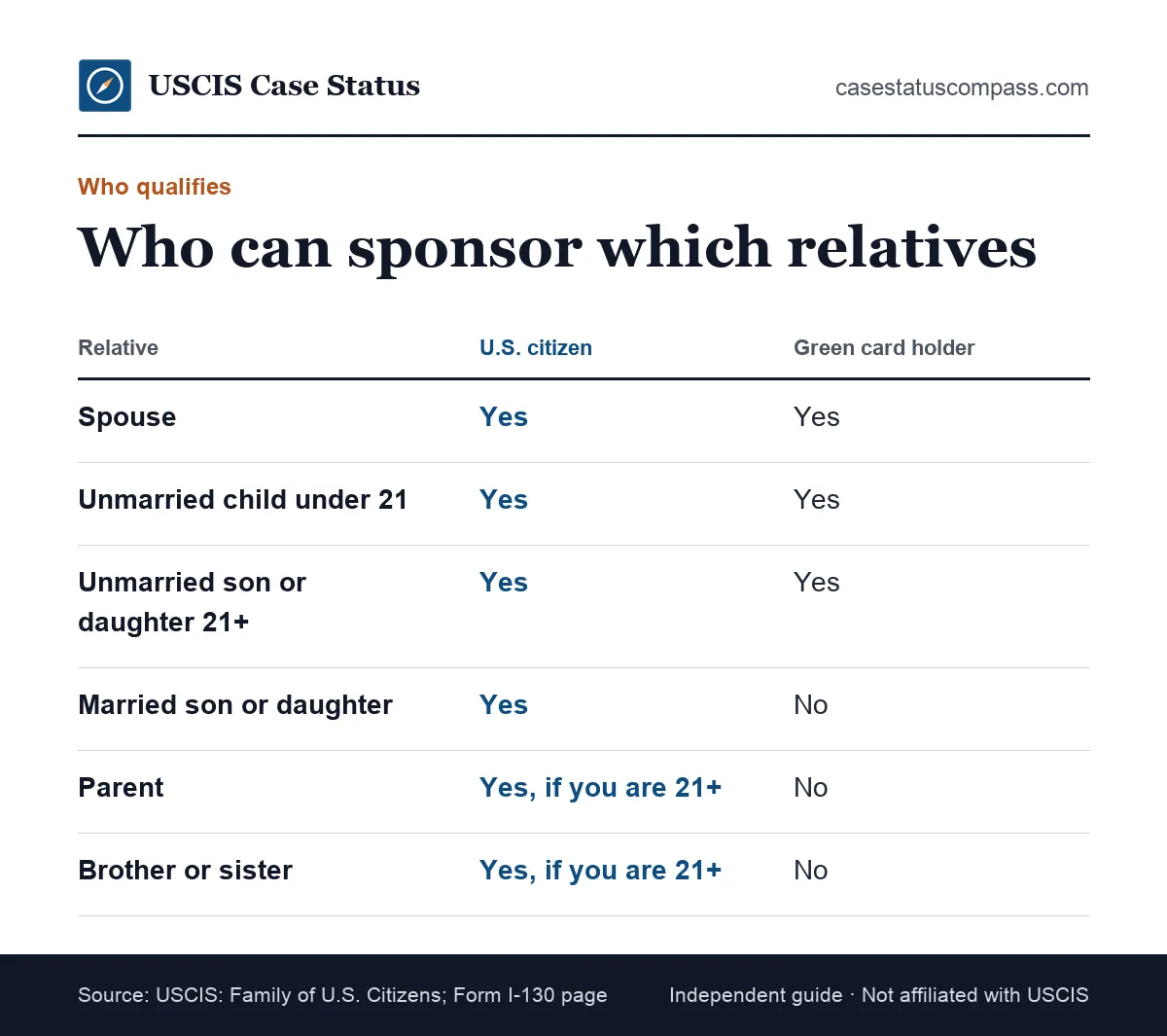
Spouses, parents, children
These are the fastest family cases because visas are always available. A spouse petition adds Form I-130A. A parent petition needs your birth certificate naming that parent. A child petition needs the child's birth certificate naming you.
Siblings
A brother or sister petition is filed in the F4 category. You must be 21 or older and show at least one shared parent. Each sibling needs a separate petition and fee.
Married and adult sons and daughters
Unmarried sons and daughters 21 or older fall in F1. Married sons and daughters of any age fall in F3. Both categories wait for a visa number, and the wait depends on the country of birth.
Which Relatives Can a Green Card Holder Sponsor?
A lawful permanent resident can sponsor only a spouse and unmarried children. Spouses and children under 21 go into F2A; unmarried sons and daughters 21 or older go into F2B. Green card holders cannot sponsor parents, siblings or married children.
The F2A and F2B categories
If your child marries while you are still a permanent resident, the petition for that child cannot continue, because no category exists for married children of green card holders. A child who turns 21 moves from F2A to F2B instead of losing the case.
What Happens to an I-130 When the Petitioner Naturalizes?
When a green card holder becomes a citizen, a pending F2A petition for a spouse or minor child generally converts to the immediate relative category. This is called automatic conversion. An F2B petition becomes F1. Tell USCIS or the National Visa Center (NVC) with a copy of your naturalization certificate.
Immediate Relatives vs Preference Categories: Why the Label Matters
Your relative's category decides whether they wait for a visa number. Immediate relatives of citizens never wait; visas are always available. Preference categories (F1, F2A, F2B, F3 and F4) share a yearly cap, so beneficiaries wait in line by priority date.
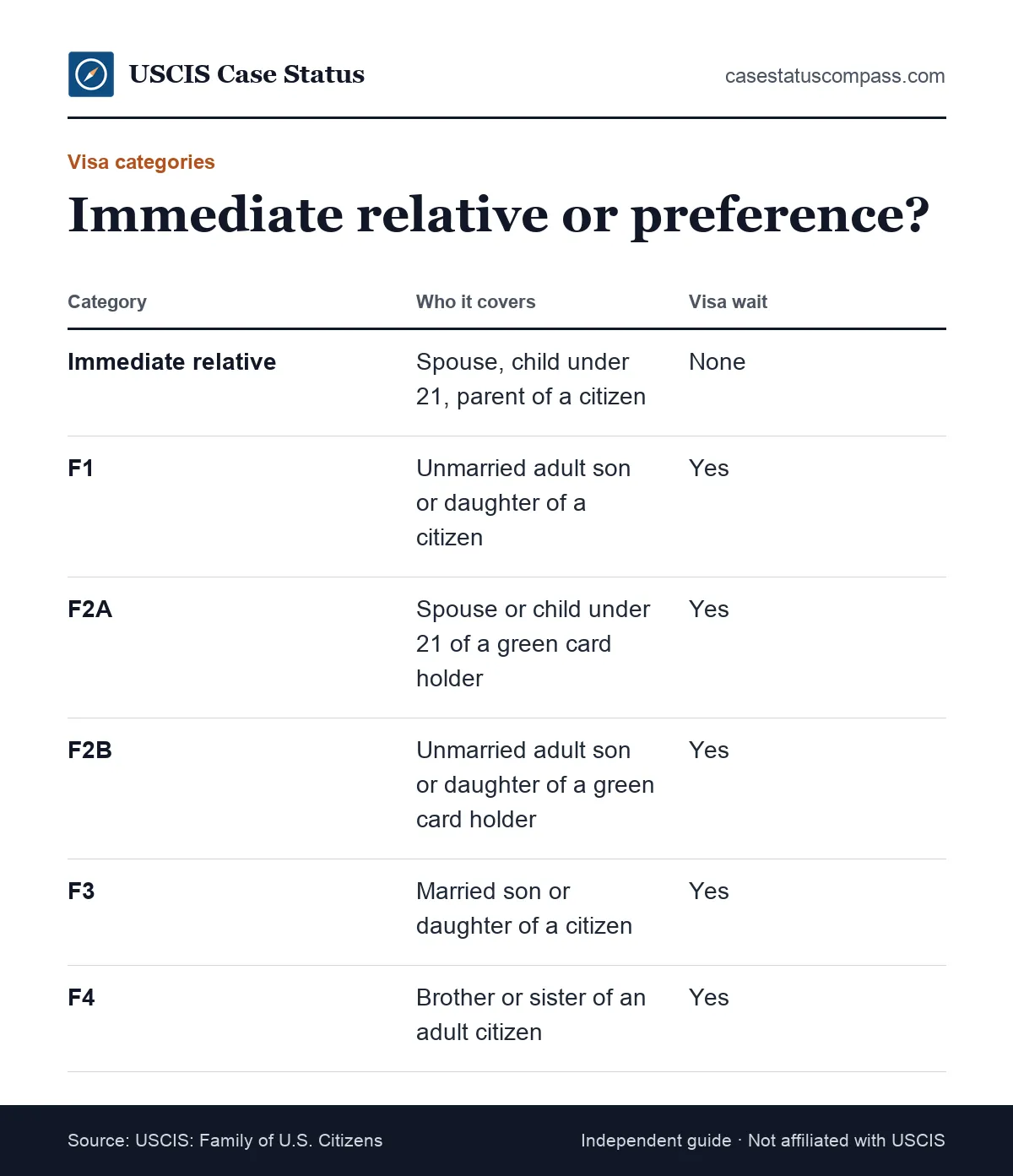
How the categories compare
Find your relative's row to see whether a visa wait applies.
| Category | Petitioner | Beneficiary | Waits for a visa number? |
|---|---|---|---|
| Immediate relative | U.S. citizen | Spouse, unmarried child under 21, parent (citizen 21+) | No |
| F1 | U.S. citizen | Unmarried son or daughter 21+ | Yes |
| F2A | Green card holder | Spouse or unmarried child under 21 | Yes |
| F2B | Green card holder | Unmarried son or daughter 21+ | Yes |
| F3 | U.S. citizen | Married son or daughter | Yes |
| F4 | U.S. citizen 21+ | Brother or sister | Yes |
Only the first row skips the line; every F category depends on the monthly Visa Bulletin.
Priority date basics
The priority date is usually the day USCIS received your petition. Preference beneficiaries can move ahead only when their date is current in the State Department chart, which our visa bulletin guide explains.
How Do You Sponsor an Immigrant Relative?
You sponsor a relative by filing Form I-130 with proof of your status and of the relationship, then supporting the relative's green card or visa application. The petition is only the first of several steps, and your role as sponsor continues after approval, through the financial forms and often the interview.
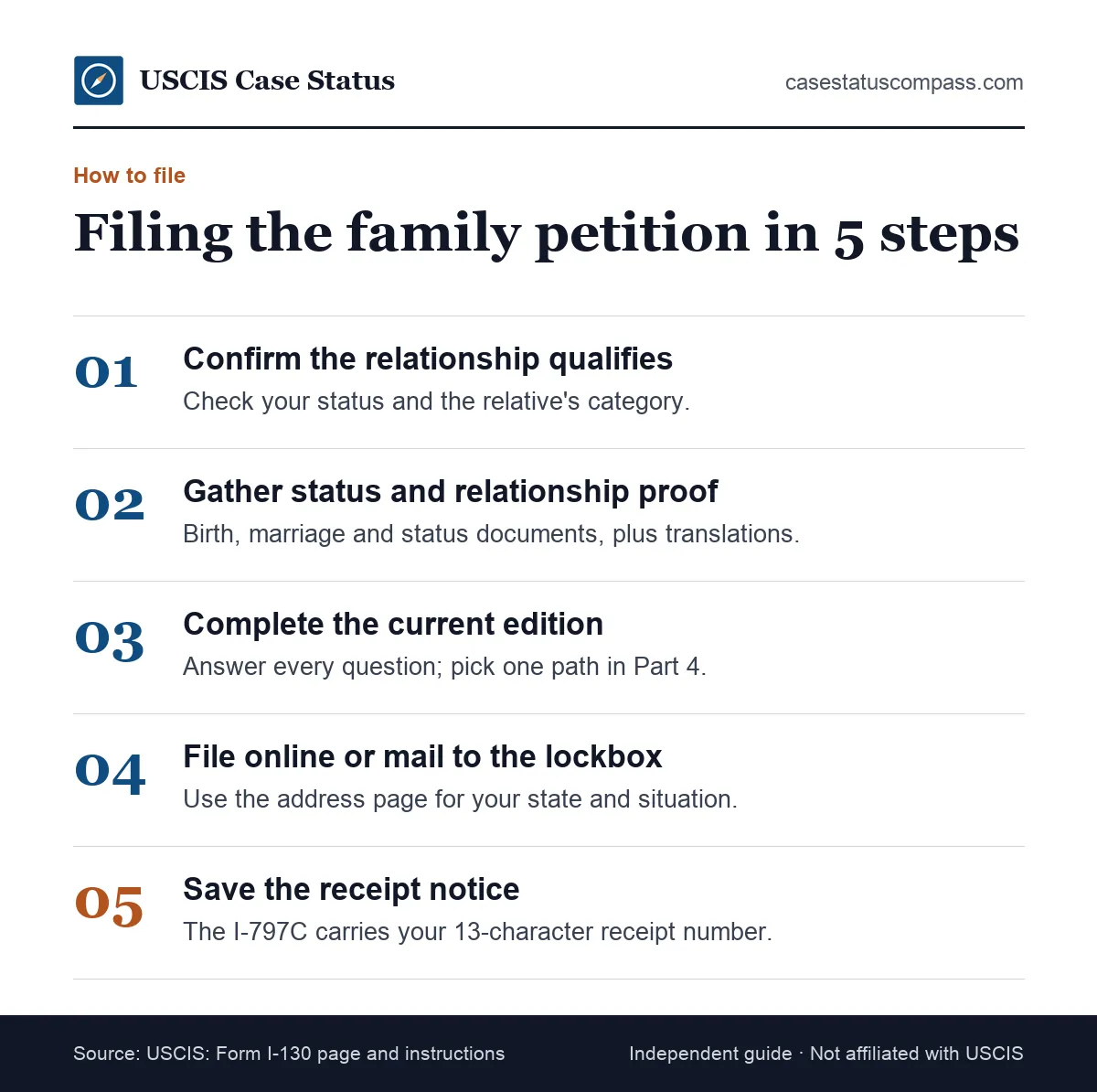
The sponsorship path in brief
- File the petition and get a receipt notice.
- Wait for approval and, for preference cases, a current priority date.
- Your relative applies for a green card in the U.S. or an immigrant visa abroad.
- You file an Affidavit of Support with tax records.
- Your relative attends an interview and, if approved, becomes a resident.
What Is Needed to Sponsor an Immigrant?
You need qualifying status, a qualifying relationship and documents for both. Later you need income at or above the federal guideline for your household, or a joint sponsor. You must generally live in the U.S., or show you will return, to be a sponsor.
Your long-term duties as a sponsor
Signing Form I-864 makes you financially responsible for the relative, generally until they become a citizen or are credited with 40 quarters of work. Divorce does not end that duty. The relative or the government can enforce it in court.
Can a Non-Family Member Sponsor an Immigrant?
A non-family member cannot file Form I-130 for someone, because the form only covers qualifying relatives. A non-relative can still help in two ways: as an employer filing a worker petition, or as a joint sponsor who adds income to a relative's Affidavit of Support.
Joint sponsors
If your income is too low, another person can sign a separate Form I-864 as a joint sponsor. That person can be a friend and need not be related. They must be a citizen or permanent resident living in the U.S. Our affidavit of support guide explains the income test.
Employers and other routes
An employer can sponsor through a labor certification and worker petition. Fiancé(e)s use a separate K-1 process covered in our K-1 fiancé visa guide. Friends and partners who are not married have no family route.
Form I-130A Explained
Form I-130A, Supplemental Information for Spouse Beneficiary, collects background about the foreign spouse. USCIS says that when you file for a spouse you "must also submit" it. Officers compare its address and job history with the main petition and later forms, so dates should match across every filing.
Who completes Form I-130A
The petitioner fills in the main form, and the spouse beneficiary's details go on the supplement. If the spouse is in the U.S., they sign it. Check the current instructions for the signature rule when the spouse lives abroad.
What the supplement asks
- Five years of address history for the spouse
- Five years of employment history
- The spouse's parents' names, birth dates and places of birth
- Where the spouse last lived outside the U.S. for at least a year
Can You File Form I-130A Online?
The I-130A instructions sit inside the main petition instructions. When you file online, the account guides you through the spouse supplement as part of the same filing. You do not need a separate PDF, and there is no separate fee for the supplement.
I-130 vs I-130A: Which Form Does What?
The I-130 is the petition itself and is filed for every relative. The I-130A is a supplement filed only for a spouse beneficiary. One proves the relationship and carries the fee; the other gives USCIS background on the foreign spouse.
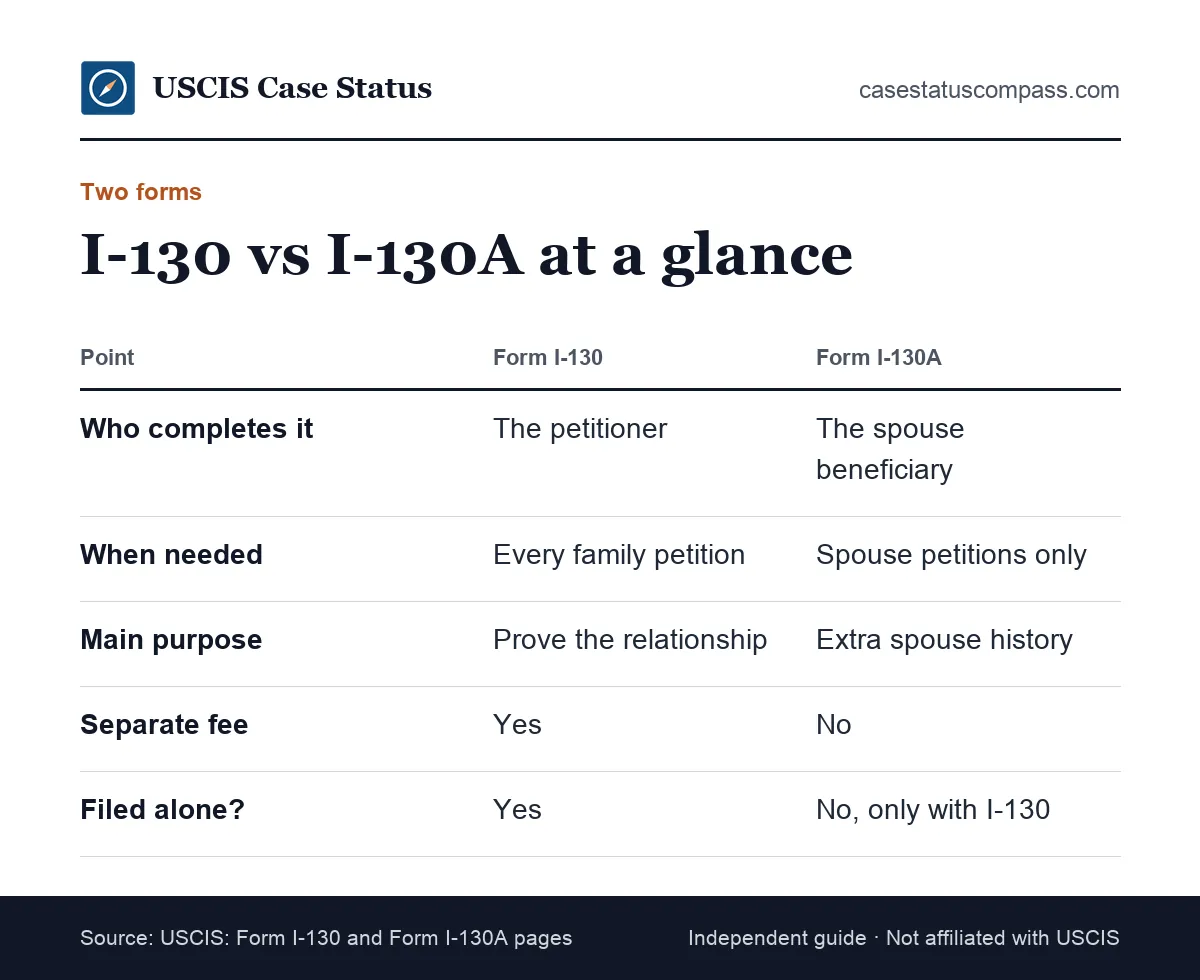
When you need both forms
You need both only for a husband or wife. A parent, child or sibling petition uses the main form alone. Each stepchild gets their own petition but no supplement. So does each adopted child.
Where Do You Get the I-130 Form PDF?
Download the I 130 form PDF only from uscis.gov/i-130, where it is free. As of October 2026, the current edition is 04/01/24. Sites that charge to download the form are not official. The same page links the instructions and the Form I-130A PDF.
Checking the edition date
The edition date sits at the bottom of every page. USCIS says each page must show the same edition and page number, or the form may be rejected. Mixing pages from two editions is a common cause.
How Do You Fill Out Form I-130?
Fill out Form I-130 by answering every question in each part, using "N/A" or "None" where nothing applies. Your answers are later compared with the green card or visa forms. Gaps or mismatches can bring an RFE. Keep a copy so you can repeat the same dates on later forms.
Relationship and petitioner sections
Start by naming the relationship and, for parent or sibling cases, how it arose (for example, born in or out of wedlock). Then give your own names, A-Number if any, addresses for five years, marriages and employment.
Beneficiary information and Part 4
List the relative's names, birth data, prior marriages and any past U.S. entries. In Part 4, USCIS asks you to answer one question about processing: adjustment in the U.S. or a consulate abroad. "Do not complete both questions and do not leave this section blank," the I-130 page warns.
Has Anyone Ever Filed an Immigrant Petition on Your Behalf?
The form asks about earlier petitions. You must list any petition you filed for anyone before, and any petition anyone filed for the beneficiary. Leaving out a past petition can look like concealment and lead to an evidence request.
I-130 Instructions: The Rules People Miss
The official I-130 instructions set rules beyond the form's questions: who signs, how to copy documents, what to translate and how to pay. Most rejections come from instruction rules, such as a missing signature or untranslated document, rather than from eligibility.
Signatures, copies and translations
- Sign in ink; a typed name is not a signature on paper filings.
- Send copies of documents unless USCIS asks for originals.
- Attach a full English translation for any foreign document, with the translator's certification of competence and accuracy.
Paying the fee
Choose an allowed payment method: pay online through Pay.gov, or on paper with Form G-1450 (card) or Form G-1650 (bank account). Paper checks need an exception: checks, money orders and cashier's checks are accepted only with an approved Form G-1651 exemption. Pay each petition separately, so one rejected payment does not sink them all. A form without the correct fee is rejected, not held.
What Documents Do You Need to Submit with I-130?
You must submit proof of your status and proof of the relationship. Depending on the case, you also add proof that earlier marriages ended, name-change records, and for spouses, evidence of a real marriage. Send copies, not originals, and translate anything that is not in English.
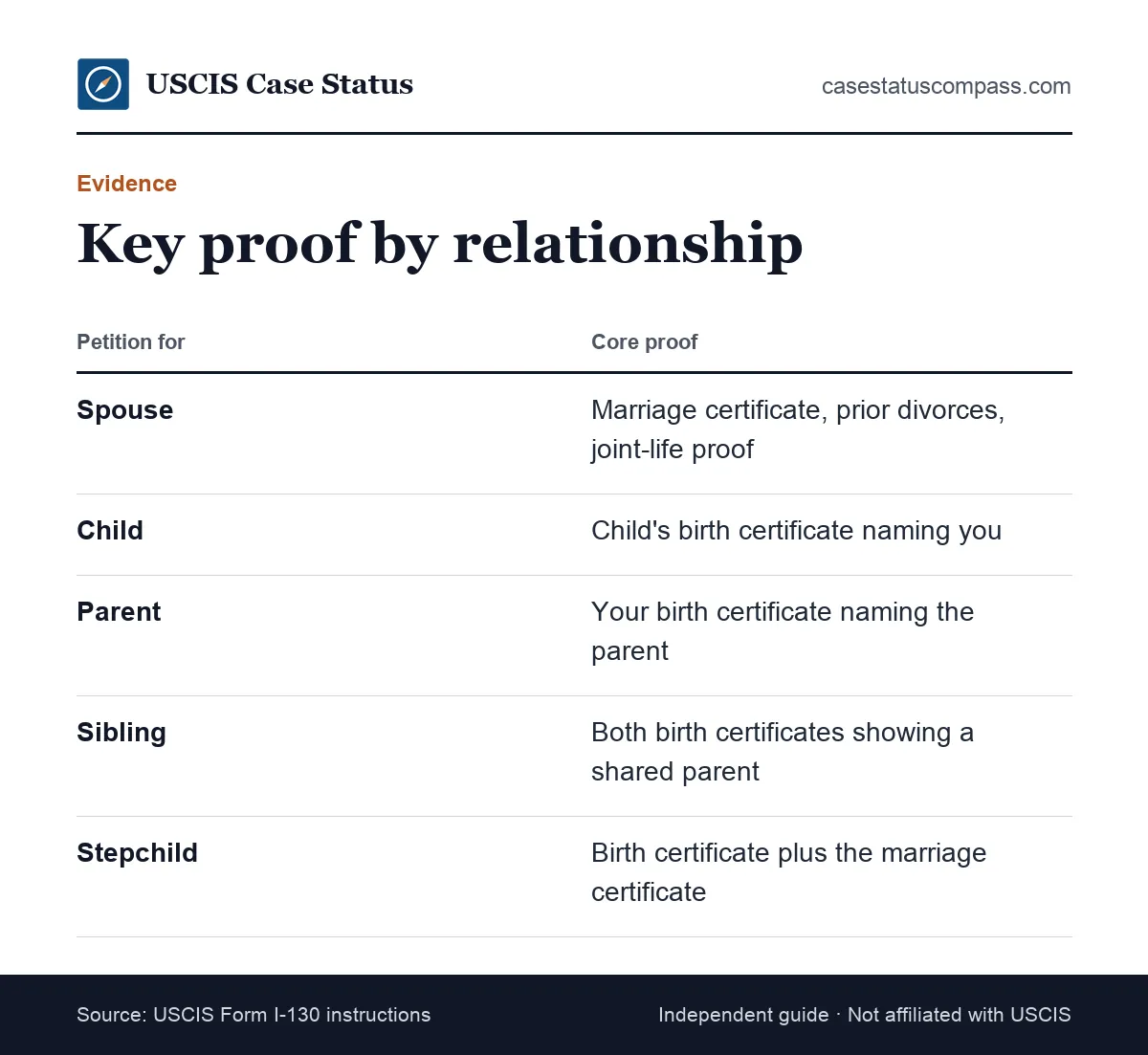
Evidence by relationship
Find the row for your relative, then gather both columns of proof.
| You are petitioning for | Proof of relationship | Often also needed |
|---|---|---|
| Spouse | Marriage certificate | Divorce or death records for prior marriages; joint-life evidence; Form I-130A |
| Child (born in wedlock) | Child's birth certificate naming both parents | Your marriage certificate if you are the father |
| Parent | Your birth certificate naming the parent | Parents' marriage certificate if the parent is your father |
| Brother or sister | Both birth certificates showing a shared parent | Marriage records if you share only a father |
| Stepchild | Child's birth certificate | Marriage certificate of the parent and stepparent |
The right-hand column is where most RFEs start, so do not skip it.
Proof of your status
Citizens send a passport bio page, U.S. birth certificate, or naturalization or citizenship certificate. Permanent residents send both sides of the green card. If your name differs from the one on the document, add the marriage, divorce or court order that explains the change.
How Do You Show a Real Marriage in a Spouse Petition?
A spouse petition must show the marriage is bona fide, meaning you married to build a life together, not for immigration. You show this with documents from your shared life: joint finances, a shared home, children, travel and communication.
Evidence that carries weight
- Joint lease, mortgage or utility bills
- Joint bank, credit card or tax records
- Insurance listing each other as beneficiaries
- Birth certificates of children you share
- Dated photos across time and with family
I-130 affidavit samples from friends
Some couples add sworn affidavits from friends or relatives who know the marriage. A useful affidavit names the writer, explains how they know you, describes specific events and is signed. These letters support but do not replace documents.
Evidence for couples living apart
If you live in different countries, show boarding passes, photos from visits and regular calls or messages over time. Explain why you live apart in a short signed statement. Work, study or visa rules are common reasons.
What Is I-130 Package Assembly?
I 130 package assembly means putting the paper petition together in a clear order before mailing. Never staple; use clips, and label each document set. A tidy package is easier to scan and less likely to lose a page or arrive out of order.
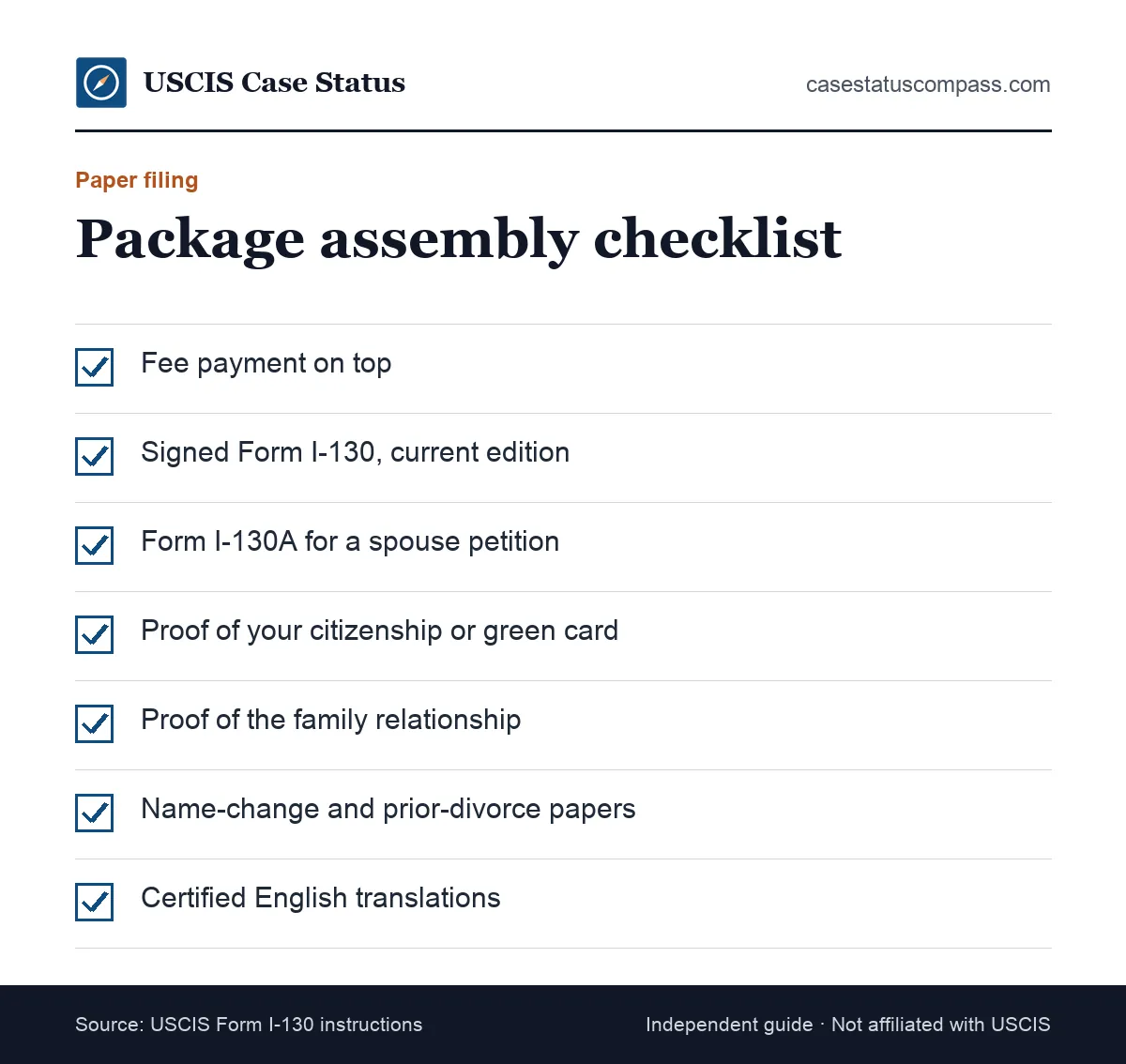
A sensible order
- Payment form (card or bank debit)
- Optional cover letter listing the contents
- Signed petition, then the spouse supplement if needed
- Proof of your status
- Proof of the relationship and of ended marriages
- Translations next to each foreign document
Cover letters and tabs
A cover letter is optional, but it gives the officer a one-page map of your evidence. Our I-130 cover letter sample shows a simple layout. Colored tab sheets between sections also help.
A Filing Checklist You Can Copy
This checklist turns the instructions into a final review. Each line maps to a common reason for rejection or a Request for Evidence (RFE). Go through it twice: once before you sign and once just before you seal the envelope or press submit. Online filers can skip the lines about ink and paper.
Before you sign
- Edition at the bottom of every page matches the current one
- Every question answered or marked "N/A"
- Only one processing question answered in Part 4
- Names match passports and status documents
- Past petitions listed
Before you send
- Signed in ink (paper) or electronically (online)
- Correct fee for each petition
- Status proof, relationship proof, translations
- Spouse supplement included for a husband or wife
- Copy of the whole packet saved
Where Do You File I-130?
Where you file the petition depends on where you live and whether your relative files Form I-485 at the same time. USCIS lists the exact lockbox on its Direct Filing Addresses for Form I-130 page. Filing locations changed recently, so check that page the day you mail.
Why we do not print the address
Lockbox addresses change, and an old address can delay or bounce a petition. Open uscis.gov/i-130-addresses, pick your situation, and use the courier address if you send by FedEx, UPS or DHL instead of the U.S. Postal Service.
Filing from outside the U.S.
Citizens living abroad generally file online or with the domestic lockbox for their situation. In limited cases a U.S. embassy may accept a petition locally. Check the embassy's own website before you travel there.
Where Do You Mail I-130 If Your Relative Also Files I-485?
If your relative is in the U.S. and eligible to adjust, you can usually mail the petition and Form I-485 together. This is called concurrent filing. Concurrent packets go to the address listed for adjustment cases, not the stand-alone address.
When concurrent filing works
Concurrent filing works for immediate relatives and for preference relatives whose priority date is already current. If the relative must wait for a visa, file the petition alone and the green card application later. Our Form I-485 green card application guide covers that second form.
When to file separately
File the petition alone if the relative lives abroad, entered without inspection, or has a status problem that blocks adjustment. Ask an attorney before filing an I-485 that may be denied.
Can You File I-130 Online?
Yes. You can file the petition online through a free USCIS account, and USCIS says this works "even if your alien relative is in the United States." Online filing costs less and gives instant receipts. It is not available in every case, so check the Forms Available to File Online page first.
How online filing works
Create a USCIS account at myaccount.uscis.gov/create-account, choose the petition, answer the guided questions and upload PDFs or photos of your evidence. The receipt appears in the account right away, with an IOE receipt number.
Uploading evidence online
Scan each document as a clear color PDF, name files by topic and upload each translation beside its original. A blurry scan can trigger an RFE. Check that every page is upright and readable.
When paper is better
Paper may still be required for some special cases, depending on what USCIS allows at the time. Either way, USCIS reviews the same information. The account tells you if online filing is not open to you.
How Much Does Form I-130 Cost?
As of October 2026, the I-130 fee is $675 (paper) / $625 (online) under Form G-1055, Edition 10/16/26. There is no separate biometrics fee, and Form I-130A has no extra charge. Fees can change, so check G-1055 the day you file.
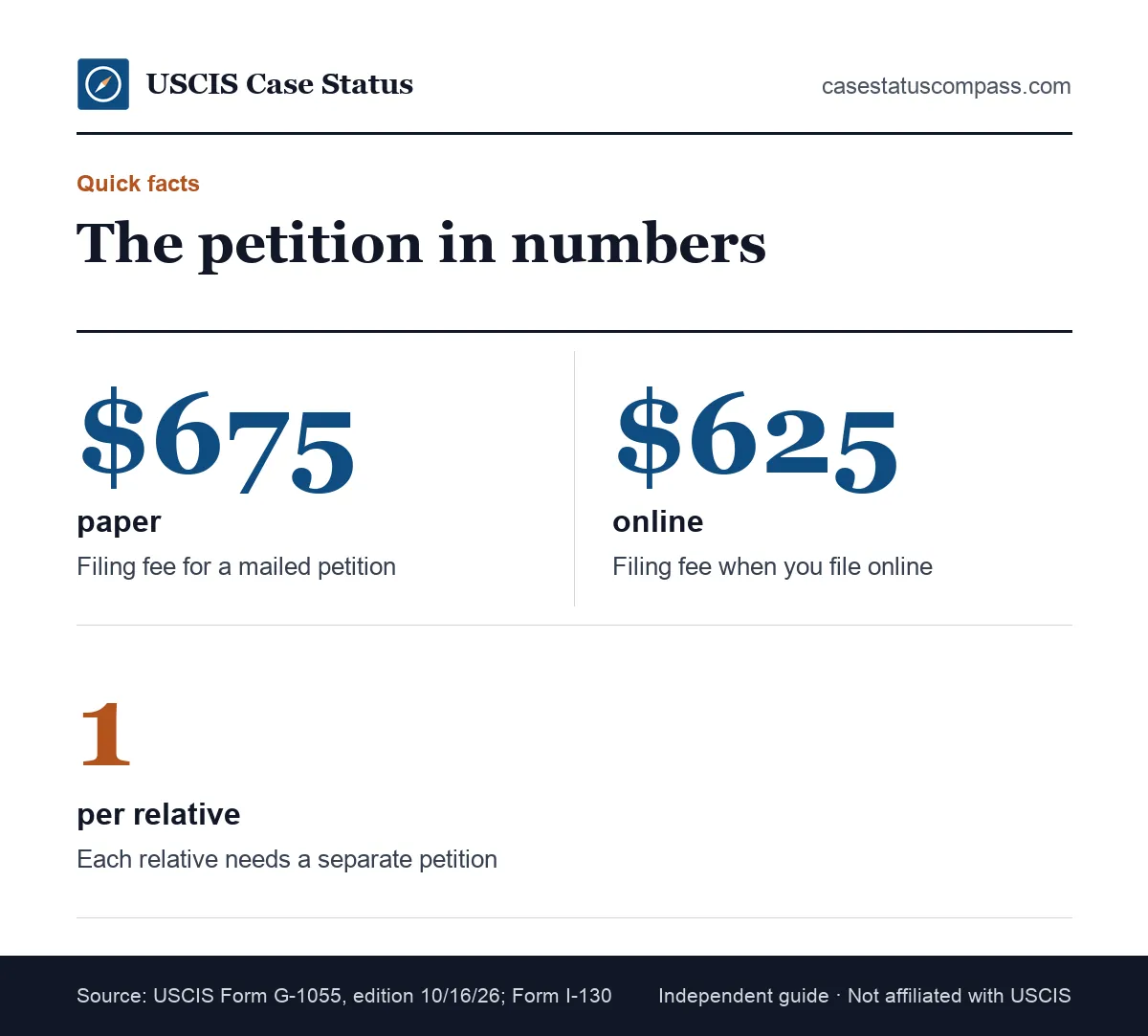
Fee summary
The petition fee is paid once per relative. Green card, visa and Affidavit of Support costs are separate and come later. See how much a green card costs for the full family-case budget.
Paper vs online petition fee
Filing online costs less than paper. Each relative needs a separate petition and fee, so a citizen sponsoring both parents pays twice. As of October 2026, that is $625 online or $675 on paper.
How Long Does an I-130 Take to Process?
Check the official processing times tool at egov.uscis.gov/processing-times for the current estimate for your office and category. For context only, a USCIS factsheet with data as of March 5, 2024 put the FY2023 median for immediate-relative petitions at 11.8 months. Our I 130 processing time page explains how to read the tool.
Reading the official tool for an I-130
Choose Form I-130, your category, such as a citizen's spouse or a sibling, and the office on your receipt. The USCIS tool shows how long it took to finish 80% of cases in the past 6 months.
What Happens After You File Form I-130?
After you file, USCIS sends a receipt notice and assigns a receipt number. An officer then reviews the evidence and decides, sends a Request for Evidence, or schedules an interview. Track each step on Case Status Online or in your USCIS online account.
The receipt notice
USCIS mails Form I-797C, Notice of Action, with your 13-character receipt number and the received date, which is usually your priority date. I-797C = Notice of Action (receipt, rejection, transfer, appointment, re-open); not proof of status by itself. Check every name, then see our Form I-797C notice of action guide and uscis receipt number hub.
If USCIS needs more proof
An RFE lists missing items and a deadline. Answer every item at once, in one package, with the RFE notice on top. Our request for evidence guide explains how to respond.
I-130 Case Status: What Each Update Means
Most cases show a received message, a review message and an approval, with a transfer to the State Department for relatives abroad. The table shows each message and your next step. Not every case shows every message, and a long gap between two messages is common.
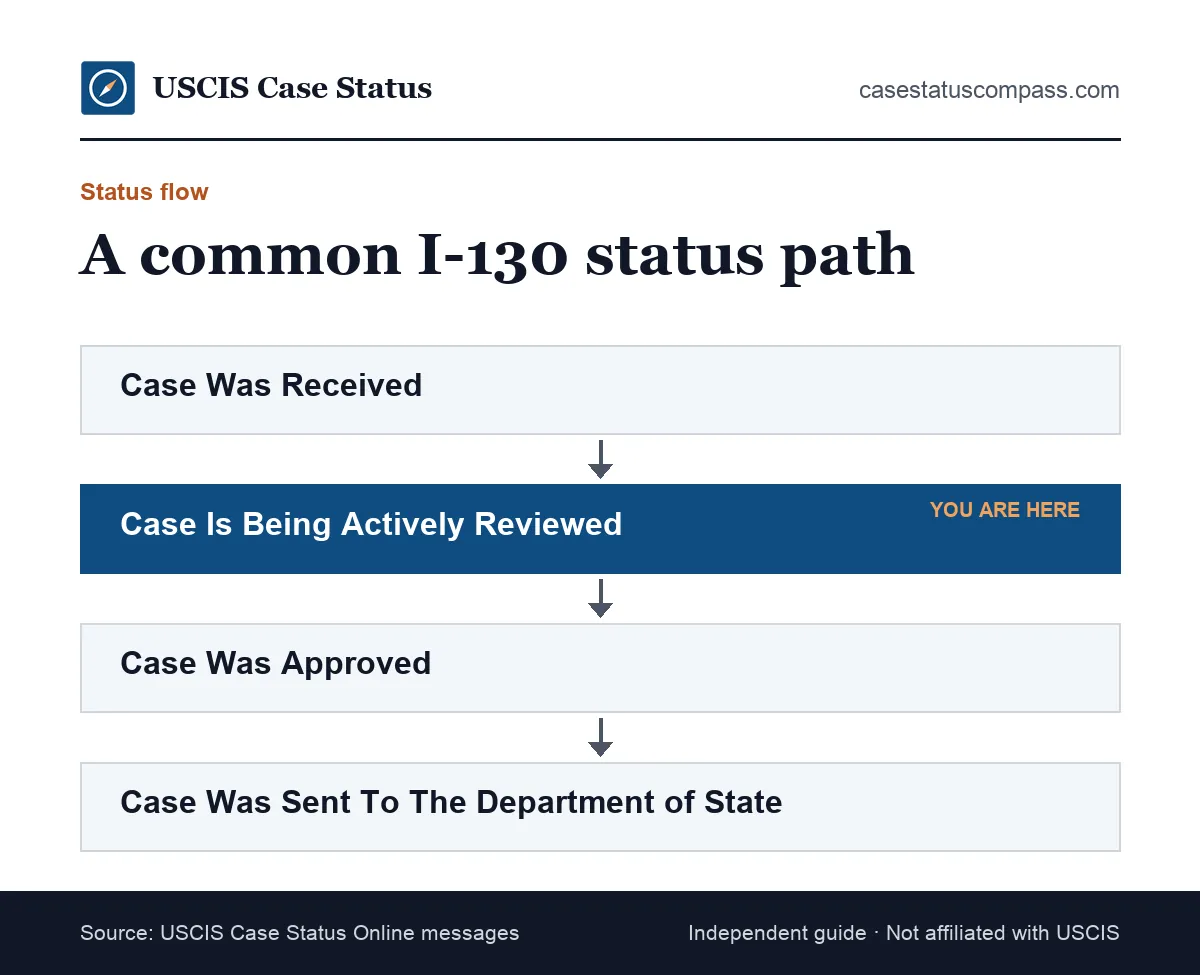
Status sequence for this form
Read the rows in order from receipt to approval.
| Status you see | What it means for the petition | Your next step |
|---|---|---|
| Case Was Received | USCIS accepted the petition and fee | Save the I-797C; check names |
| Case Was Transferred | File moved to another office for workload | Nothing; track as usual |
| Request for Evidence Was Sent | The officer needs more proof | Answer by the deadline |
| Case Is Being Actively Reviewed | An officer has the file | Wait; keep your address current |
| Interview Was Scheduled | USCIS wants to meet you | Bring originals and both spouses |
| Case Was Approved | The relationship is recognized | Watch for the approval notice |
| Case Was Sent To The Department of State | Petition sent to NVC | Wait for NVC contact |
Only the RFE and interview rows ask you to act.
Statuses that worry people
"Case Was Transferred" usually reflects workload balancing, not a problem. A review message can stay for months. See what actively reviewed means for that message, and the case was transferred page for moves between offices.
Why Is My I-130 Taking So Long?
Petitions take longer when the category waits for visas, the office has a backlog, the file needs an interview, or USCIS sent an evidence request. USCIS data show the gap: I-130 (immediate relative): median 13.0 months (USCIS data, Apr.-June 2026), while I-130 (all other relatives): median 43.3 months (USCIS data, Apr.-June 2026).
Common reasons for delay
- High volume at the office handling your case
- A preference category, which USCIS may handle after urgent work
- Background or security checks
- An RFE, transfer or address mismatch
- A missing or mismatched name between documents
What you can do
First compare your wait with the official estimate. If you are outside it, submit an "outside normal processing time" inquiry. Serious hardship may justify an I-130 expedite request. A pending case with no updates is covered in case status not updating.
What Does I-130 Approval Mean?
I-130 approval means USCIS accepted that the family relationship is real and qualifies. Your relative now holds an approved petition in a specific category with a priority date. It does not mean they have a green card, a visa, permission to work, or the right to enter the U.S.
The approval notice
USCIS mails an approval notice, Form I-797, and updates the online status. The notice shows the category and says where the petition went next: to NVC for consular cases or kept on file for adjustment. Our page on the approval case decision rendered message explains that status.
What approval does not decide
Approval does not cover admissibility, public charge, criminal history or past immigration violations. A relative with a problem in their past can still be refused even after the petition was approved.
What Happens After I-130 Is Approved?
After approval, the next step depends on where your relative is. A relative inside the U.S. who can adjust files Form I-485 or keeps a concurrent case moving. A relative abroad moves to the National Visa Center for consular processing.
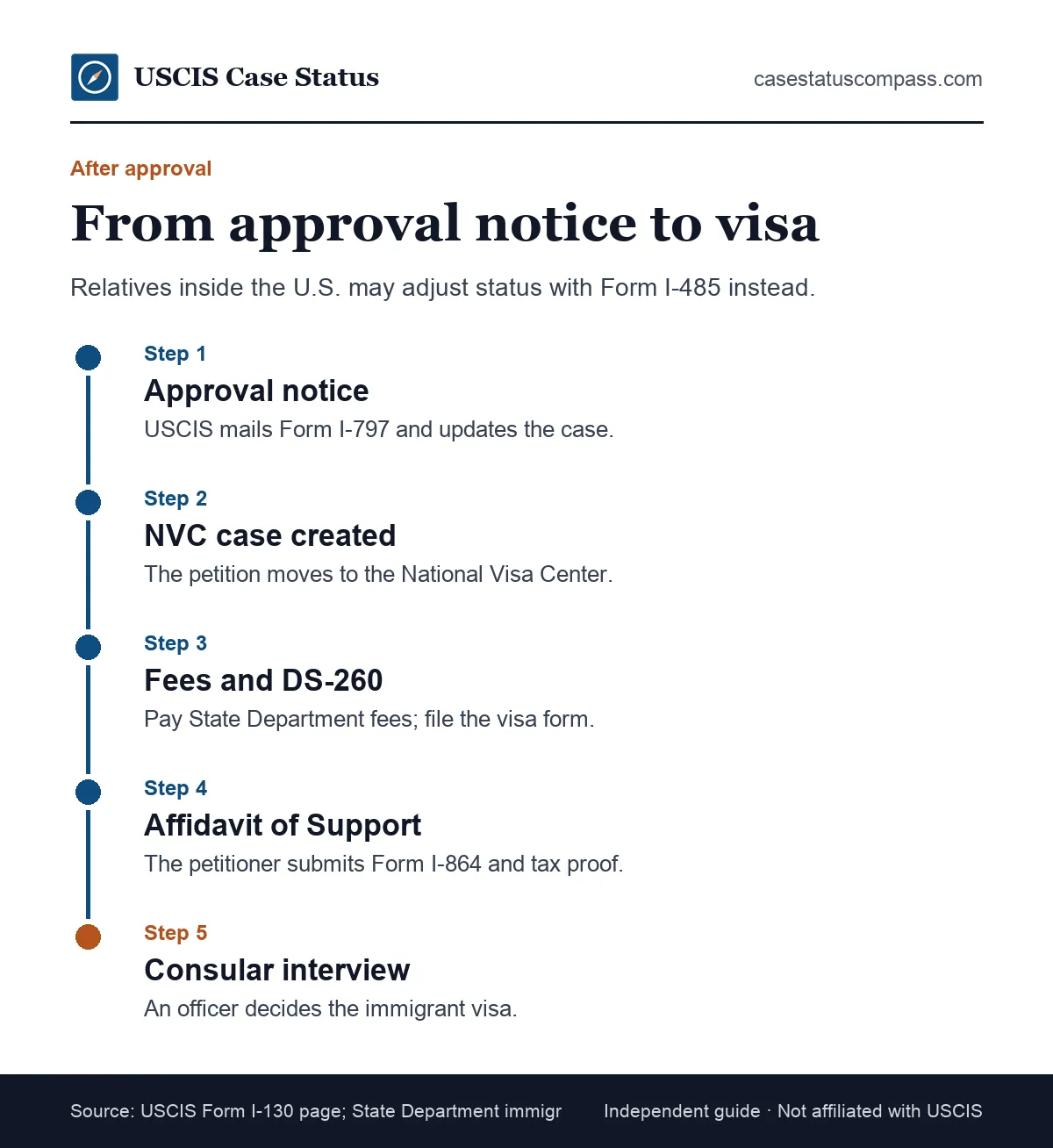
Relative inside the U.S.
If the green card application was filed with the petition, USCIS continues to the I-485 decision, often with an interview. If not, the relative files the I-485 once eligible. Immediate relatives can usually file at any time.
Relative abroad
USCIS sends the approved file to NVC. NVC creates a case number and asks for fees, the DS-260 visa application, civil documents and the Affidavit of Support. Track this stage with our NVC case status guide.
Preference relatives waiting for a visa
For F1, F2A, F2B, F3 and F4 cases, the approved petition sits until the priority date is current. Keep your address and email current with NVC during the wait. Check the Visa Bulletin monthly.
What Happens at the NVC Stage?
At the NVC stage, the State Department prepares the case for a consular interview. When everything is complete and a visa is available, NVC schedules the interview at the embassy or consulate. The relative then gets medical exam and interview instructions. NVC (State Department) collects visa fees and documents after USCIS approves the petition.
Fees and forms at NVC
State Department fees are separate from USCIS fees. As of October 2026, the immigrant visa fee is $325 family / $345 employment per person. The Affidavit of Support costs $0 at USCIS at USCIS, but NVC charges a $120 review fee in consular cases.
Documents NVC reviews
NVC checks civil documents such as birth and marriage certificates, police certificates where required, and the Affidavit of Support with tax records. Answer any missing-document notice quickly. Upload clear scans in the account.
Does an Approved I-130 Expire?
An approved petition has no printed expiration date and generally stays valid until it is used or ended. It can still end early, for example through divorce, withdrawal, revocation or long inactivity at NVC. Report any change to USCIS or NVC.
Events that end a petition
- Divorce or annulment in a spouse case
- Marriage of a child in F2A or F2B
- Withdrawal by the petitioner
- Death of the petitioner (with limited relief)
- Revocation by USCIS for fraud or error
Staying in touch with NVC
The State Department can end a case if the applicant does not act for a long time after NVC says the case is ready. Ask NVC in writing if you need more time.
Filing Green Card for Siblings
Filing green card for siblings means a U.S. citizen age 21 or older files an F4 petition for a brother or sister. You must prove a shared parent through both birth certificates. It is the slowest family route, so file early.
Proving the sibling link
Half-siblings qualify if they share one parent. If you share only a father, add your parents' marriage certificates and proof any prior marriages ended. Step-siblings qualify only if the marriage that created the step relationship took place before each of you turned 18.
Derivative family members
The sibling's spouse and unmarried children under 21 usually come as derivatives once the sibling's visa is available. If a child may turn 21 first, ask an attorney about the Child Status Protection Act.
Setting expectations
F4 is the slowest family category, and waits vary by country of birth. Our I-130 processing time page and the Visa Bulletin give the latest view. Some sibling cases take many years.
How Do You Petition for a Parent or a Child?
To petition for a parent, you must be a U.S. citizen age 21 or older and show your birth certificate naming that parent. To petition for a child, show the child's birth certificate naming you. Each relative needs a separate petition.
Parent petitions
A mother sends your birth certificate with her name. A father may also need his marriage certificate to your mother, or legitimation proof if you were born out of wedlock. Each parent needs a separate petition, even when they are married to each other.
Stepchildren and adopted children
A stepchild qualifies if the marriage creating the step relationship happened before the child turned 18. Adopted children qualify only if adoption, custody and residence rules are met. Send the adoption decree and custody proof.
Is There an Interview for an I-130?
Many petitions are approved on paper. USCIS may call an interview when evidence is thin, records conflict, or the case looks unusual. Spouse cases are interviewed most often, usually as part of the I-485 interview. Consular cases get their main interview at the embassy.
Typical questions
Officers ask how you met, how the relationship developed, daily routines and family details. Our list of green card interview questions shows the topics officers cover. Answer honestly and do not guess.
Who attends the interview
In a spouse case, both spouses usually attend. Bring the notice, photo IDs, the original marriage certificate and fresh proof of your shared life. If you need an interpreter, check the notice for the current rule.
Common Mistakes That Delay a Petition
Most delays come from preventable errors: old editions, missing signatures, mixed answers in Part 4, missing status proof and untranslated records. Each one can send a petition back or add months, and each takes only minutes to prevent with a careful final check before filing.
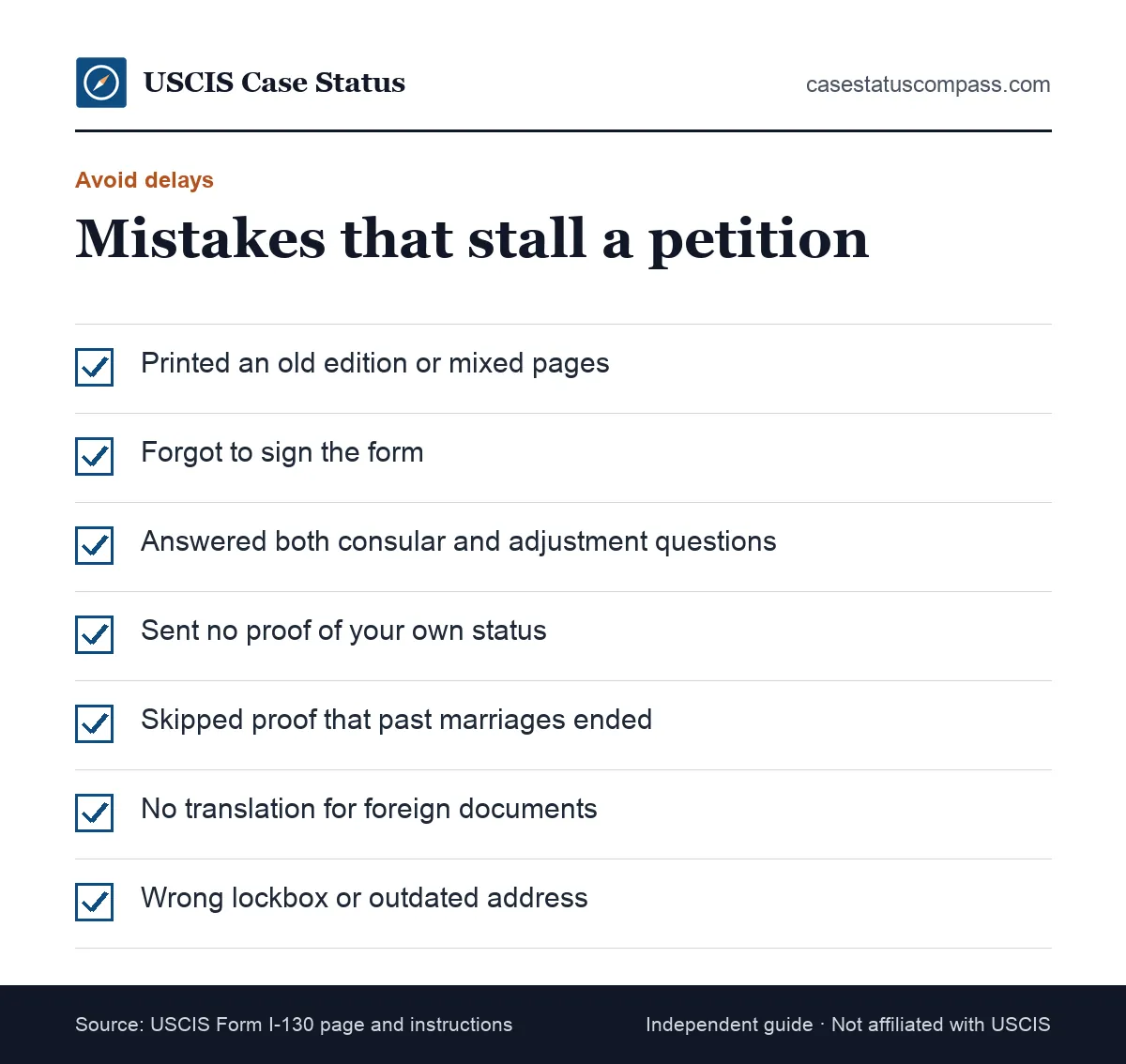
Paperwork mistakes
- Printing an outdated edition
- Leaving questions blank instead of writing "N/A"
- Forgetting to list prior marriages or past petitions
- Sending originals you need later
- Using an old filing address- Using an old filing address or a wrong fee
Evidence mistakes
- Photos with no dates or names
- Translations without the translator's certification
- No proof that a prior marriage ended
- Blurry scans in an online filing
- Name differences with no document explaining them
What If Your Petition Gets an RFE or Is Denied?
An RFE gives you a chance to fill gaps; respond fully by the deadline. A denial explains why and whether you can appeal to the Board of Immigration Appeals or refile. The notice gives the deadline, which is short, so read it the day it arrives.
Responding to an RFE
Read each item, gather the exact proof requested, and send it with the RFE notice on top. Use tracked delivery for paper responses or the upload button online. Keep a full copy.
After a denial
You may be able to file a new petition with stronger evidence, appeal, or file a motion. Our case denied help guide lays out the options. Speak to an attorney before acting.
Spouse Petitions, the CR1 Visa and the IR1 Visa
When a citizen sponsors a spouse abroad, the approved petition leads to a CR1 visa or IR1 visa. CR1 is for marriages under two years old when the spouse becomes a resident, and leads to a two-year conditional card. IR1 is for longer marriages and leads to a ten-year card.
Where to read more
Our guide to the cr1 visa for spouses covers the marriage-specific steps, conditional residence and how inside-U.S. and outside-U.S. paths differ. It also covers spouse interview topics and the documents couples bring.
Removing conditions later
Most green cards are valid for 10 years; conditional green cards for 2 years. A conditional resident files Form I-751 before the two-year card expires to get the ten-year card. Our I-751 petition to remove conditions guide explains the filing window.
When Should You Get Legal Help With an I-130?
Get help from an immigration attorney or a DOJ-accredited representative if your relative has a criminal record, past removal, unlawful entry or overstay, a prior marriage-fraud finding, or a previous denial. Help is also wise for adoptions, deceased petitioners and age-out cases. This page is general information, not legal advice.
Warning signs
- Your relative used a false name or document
- A previous petition was denied or revoked
- The beneficiary was in removal proceedings
- The relationship began through a paid arrangement- The relationship began through a paid arrangement
- An earlier marriage was never legally ended
Finding qualified help
Use a licensed attorney or a DOJ-accredited representative at a recognized organization. Avoid notarios and anyone who promises approval; they cannot represent you. Check the bar license first.
Frequently Asked Questions
What is the difference between Form I-130 and Form I-485?
Form I-130 is filed by the U.S. citizen or permanent resident to prove a family relationship. Form I-485 is filed by the relative to become a permanent resident while inside the U.S. The first creates eligibility; the second uses it.
How long is an I-130 valid after approval?
An approved petition has no printed expiration date. It generally stays valid until the relative uses it to immigrate, or until something ends it, such as divorce, the petitioner's withdrawal, revocation or long inactivity at NVC. Respond to every NVC message to keep a consular case active.
Can I file one I-130 for my whole family?
No. You must file a separate petition for each relative you sponsor. In preference categories, the beneficiary's spouse and minor children can sometimes come as derivatives on one petition. Immediate relatives have no derivatives, so a citizen sponsoring a spouse and stepchild files two petitions.
Can I travel to the U.S. while my I-130 is pending?
A pending petition does not give your relative any right to enter. A visitor visa may be refused if the officer believes the relative intends to stay. Ask an attorney before planning a visit.
Does the petitioner need to live in the U.S.?
You can file while living abroad. To sign the Affidavit of Support later, you generally must live in the U.S. or show you will return to live here. A joint sponsor cannot replace you as the petitioner.
Is the I-130 the same as a "petición familiar"?
Yes. Spanish-speaking families often call this form "la petición familiar." The official form and instructions are in English, and answers must be in English. Foreign-language documents need a certified English translation attached.
What does "alien relative" mean on Form I-130?
"Alien relative" is the legal term for the foreign family member you sponsor, the beneficiary. It means a relative who is not a U.S. citizen and says nothing about their character.
Can I withdraw an I-130 after filing?
Yes. A petitioner can ask USCIS in writing to withdraw a petition before the relative immigrates. Withdrawal ends the petition and its place in line, so talk to an attorney first.
What happens if I move while the petition is pending?
Update your address with USCIS within the time the law requires, using the online change-of-address tool. Notices go to the address on file. See our change of address guide.
Sources
- USCIS: I-130, Petition for Alien Relative. www.uscis.gov/i-130. Accessed Oct 27, 2026.
- USCIS: Form I-130 instructions (PDF). www.uscis.gov/sites/default/files/document/forms/i-130instr.pdf. Accessed Oct 27, 2026.
- USCIS: I-130A, Supplemental Information for Spouse Beneficiary. www.uscis.gov/i-130a. Accessed Oct 27, 2026.
- USCIS: Direct Filing Addresses for Form I-130. www.uscis.gov/i-130-addresses. Accessed Oct 27, 2026.
- USCIS: Family of U.S. Citizens. www.uscis.gov/family/family-of-us-citizens. Accessed Oct 27, 2026.
- USCIS Form G-1055 Fee Schedule. www.uscis.gov/g-1055. Accessed Oct 27, 2026.
- USCIS Check Case Processing Times. egov.uscis.gov/processing-times/. Accessed Oct 27, 2026.
- USCIS Historical Processing Times factsheet FY2016-2024 (PDF). www.uscis.gov/sites/default/files/document/fact-sheets/historical_pt_factsheet_fy16_to_fy24.pdf. Accessed Oct 27, 2026.
- USCIS: Form I-797 Types and Functions. www.uscis.gov/forms/filing-guidance/form-i-797-types-and-functions. Accessed Oct 27, 2026.
- U.S. Department of State: Immigrant Visa Process. travel.state.gov/content/travel/en/us-visas/immigrate/the-immigrant-visa-process.html. Accessed Oct 27, 2026.
- USCIS Form G-1055 Fee Schedule, Edition 10/16/26. www.uscis.gov/sites/default/files/document/forms/g-1055.pdf. Accessed Oct 27, 2026.
- USCIS: Filing Fees (updated 02/12/2026). www.uscis.gov/forms/filing-fees. Accessed Oct 27, 2026.
- USCIS: Online Account and Technical Support. www.uscis.gov/tools/uscis-tools-and-resources/online-account-and-technical-support. Accessed Oct 27, 2026.
- CIS Ombudsman tip sheet: Check Your USCIS Case Inquiry Date (Aug. 2024). dhs.gov/sites/default/files/2024-11/24_0823_cisomb_case-inquiry-date-tip-sheet.pdf. Accessed Oct 27, 2026.
- USCIS Data Library: All USCIS Application and Petition Form Types, FY2026 Q3 (Apr. 1-June 30, 2026; queried 7/2026). www.uscis.gov/sites/default/files/document/data/quarterly_all_forms_fy2026_q3_v1.xlsx. Accessed Oct 27, 2026.
- USCIS: Consular Processing (updated 07/20/2023). www.uscis.gov/green-card/green-card-processes-and-procedures/consular-processing. Accessed Oct 27, 2026.
- 22 CFR 22.1 Schedule of Fees for Consular Services (LII). www.law.cornell.edu/cfr/text/22/22.1. Accessed Oct 27, 2026.
- 22 CFR 22.1 Schedule of Fees for Consular Services (govinfo, CFR 2025 edition). www.govinfo.gov/content/pkg/CFR-2025-title22-vol1/xml/CFR-2025-title22-vol1-sec22-1.xml. Accessed Oct 27, 2026.
- USCIS Glossary: Green Card. www.uscis.gov/tools/glossary. Accessed Oct 27, 2026.
casestatuscompass.com is an independent publication and is not affiliated with USCIS or any government agency. This page is general information, not legal advice. For denials, court or asylum matters, consult an immigration attorney or a DOJ-accredited representative.