Contents · 43 sections
- What Is Form I-751?
- Who Needs to File Form I-751?
- Conditional vs 10-Year Green Card: What Removal Changes
- When Can You Apply to Remove Conditions?
- Removal of Conditions in Four Numbers
- What If You File the I-751 Too Early or Too Late?
- Who Is the Petitioner on Form I-751?
- What If Your Spouse Will Not Sign the I-751?
- Joint Petition vs Waiver: Which Filing Basis Fits?
- Can You File the I-751 After a Divorce?
- I-751 Waivers for Death, Abuse and Extreme Hardship
- What Counts as Extreme Hardship for an I-751 Waiver?
- How Do You Remove Conditions on Permanent Residence?
- Should You File Online or by Mail?
- Where Do You Get Form I-751 and Which Edition Applies?
- Is There an Example Form I-751 You Can Follow?
- Form I-751 Part by Part
- What Goes in the Place of Marriage on Form I-751?
- What Evidence Proves a Good-Faith Marriage?
- Evidence, Affidavits and Cover Letter (Summary)
- I-751 Checklist You Can Copy
- Including Children on Your Petition
- Filing From Overseas on Military or Government Orders
- Removal of Conditions Requirements With a Criminal Record
- I-751 Fee (Summary)
- What Happens After You File to Remove Conditions?
- Do You Need Biometrics for Removal of Conditions?
- How Does the 48-Month I-751 Extension Work?
- I-751 Status Sequence: What Each Update Means
- Is There an Interview for the I-751?
- Can You Travel While Your I-751 Is Pending?
- Moving While Your Petition Is Pending
- I-751 Processing Time (Summary)
- What Happens After I-751 Is Approved?
- Can You Apply for Citizenship While Your I-751 Is Pending?
- What If USCIS Sends an RFE or NOID on Your I-751?
- What Happens If the I-751 Is Denied?
- Real-World I-751 Scenarios
- If X, Do Y: I-751 Decision Table
- How Is the I-751 Different From the I-130 and I-90?
- Common Removal of Conditions Mistakes
- When Should You Get Legal Help With Form I-751?
- Frequently Asked Questions
The short answer
Form I-751, the Petition to Remove Conditions on Residence, turns a 2-year conditional green card from marriage into a 10-year card. Couples file it together in the 90 days before the card expires. If the marriage ended or there was abuse, the conditional resident can file the I 751 alone with a waiver.
At a glance
| Official name | Form I-751, Petition to Remove Conditions on Residence |
| Current edition | 04/01/24 |
| When to file | File in the 90 days before your 2-year card expires (joint filers) |
| Receipt notice | I-751 receipt notice extends conditional status and work authorization for 48 months |
| Fee (summary) | $750 (paper) / $700 (online) |
What Is Form I-751?
Form I-751 is how a conditional permanent resident who married a U.S. citizen or green card holder asks U.S. Citizenship and Immigration Services (USCIS) to remove the conditions on residence. If USCIS approves, the 2-year card is replaced with a 10-year card.
Conditional residence in plain terms
When a marriage is less than two years old at the time a green card is approved, USCIS issues a conditional green card. USCIS rules state: Most green cards are valid for 10 years; conditional green cards for 2 years. The conditions exist so USCIS can check, two years later, that the marriage was genuine.
What an approved petition gives you
An approved petition makes you a permanent resident without conditions. You later renew the card through green card renewal on Form I-90, not another petition to remove conditions.
Who Needs to File Form I-751?
You need to file if your green card came through marriage and is valid for only two years. This covers people who entered on a CR1 visa and people who adjusted status inside the United States within two years of marrying. Some children file too.
Spouses who got a 2-year card
If you came through consular processing, our CR1 visa guide explains how the conditional card started. Check your card: a 2-year gap between "Resident Since" and "Card Expires" means you must file.
Investors use a different form
Conditional residents who got status through an EB-5 investment do not use this petition. They file Form I-829 instead. This page covers only marriage-based removal of conditions. If you hold an investor card, follow the I-829 instructions instead.
Conditional vs 10-Year Green Card: What Removal Changes
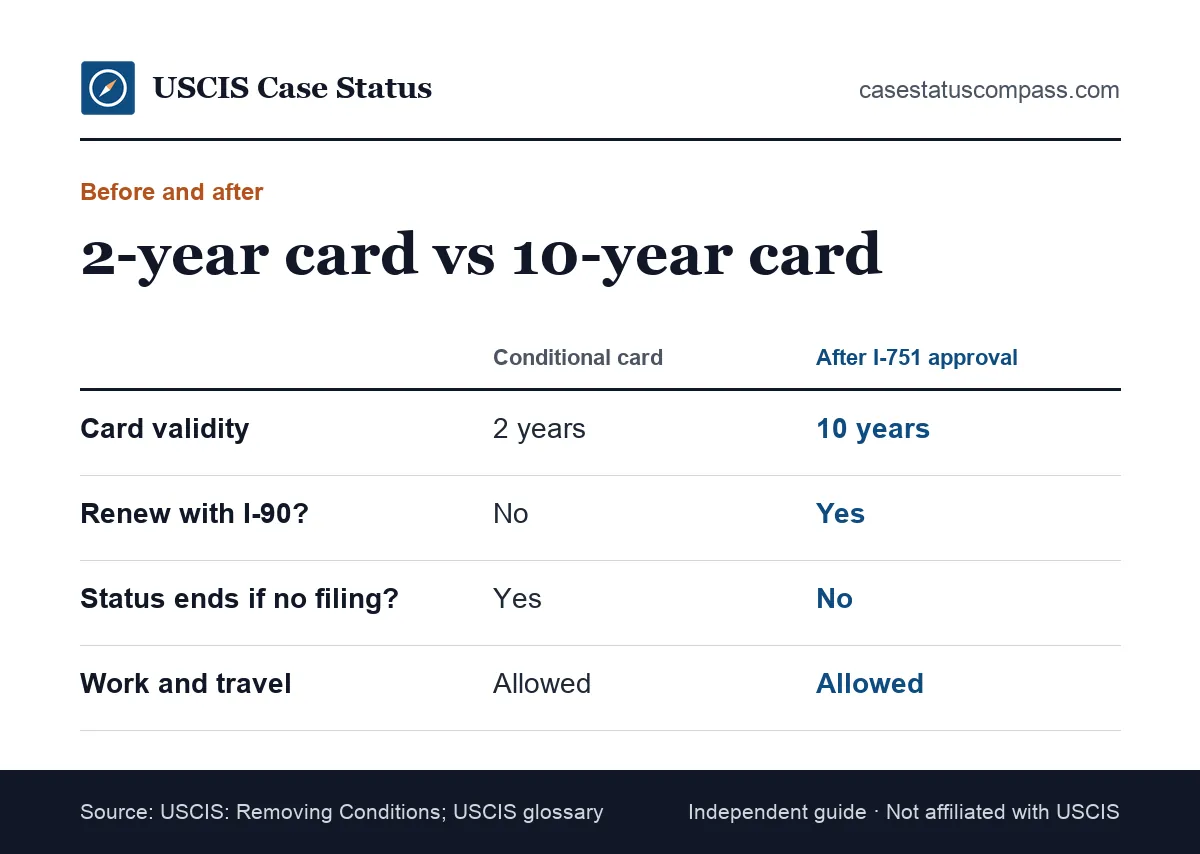
Removing conditions changes how long your card lasts and whether your status can lapse. It does not change your daily rights. Conditional residents can already live, work and travel like other permanent residents. The real change is security: a removed condition means your status no longer ends on a fixed date.
2-year card vs 10-year card table
The table compares the two cards point by point. The main takeaway: the conditional card carries an end date for your status itself, not just for the plastic.
| Point | 2-year conditional card | 10-year card after approval |
|---|---|---|
| What happens at expiry | Status ends unless you file | Card needs renewal; status continues |
| Renewal form | None; remove conditions instead | Form I-90 |
| Work and travel | Allowed | Allowed |
| Time toward citizenship | Counts | Counts |
Rights you already have
As a conditional permanent resident, you can work for any employer, travel with your card and count your time toward naturalization. Our permanent resident basics page covers those rights.
What does not carry over
The 2-year card cannot be renewed or replaced as a way to extend status. If it is lost, the receipt notice and expired card together serve as proof once you file.
When Can You Apply to Remove Conditions?
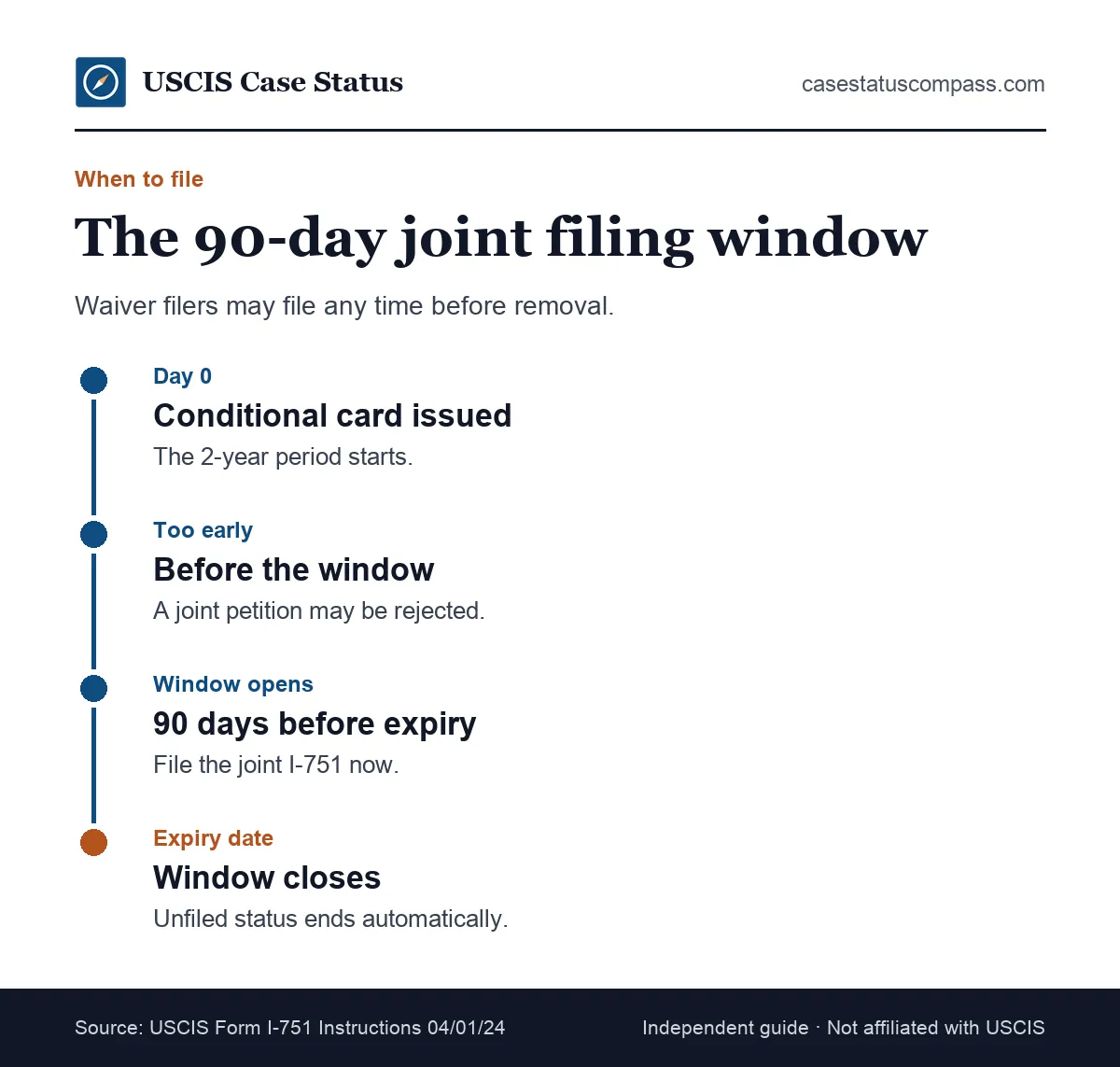
Joint filers apply in a fixed window. As of October 2026, USCIS says: File in the 90 days before your 2-year card expires. USCIS offers an official date calculator for the joint window. Waiver filers are not tied to this window and can file as soon as their basis exists.
The waiver filer's timeline
Waiver filers can file any time after getting conditional status and before removal. They do not wait for the 90-day window, which helps when a marriage ends early in the two-year period.
A worked example
Say your card expires on June 30, 2027. Count back 90 days and the window opens on April 1, 2027. A joint petition mailed on March 15 is early; one filed on April 10 is on time.
Using the official calculator
USCIS's "When to File" calculator at uscis.gov/forms/when-to-file-your-petition-to-remove-conditions takes your card's expiration date and returns the first day you can file. Enter the date exactly as printed on the front of your card, then mark the result on your calendar.
Removal of Conditions in Four Numbers
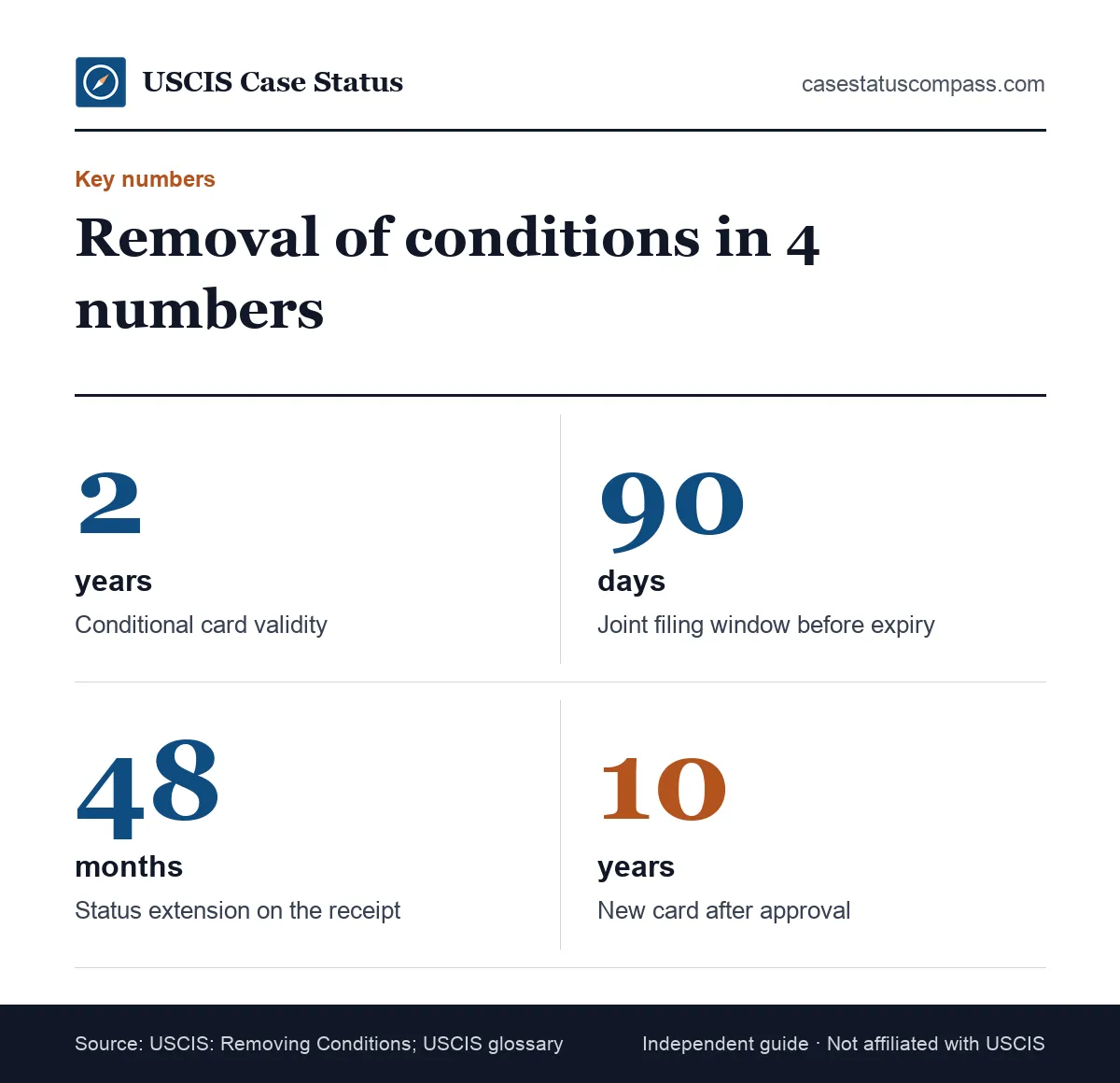
Four numbers drive every marriage-based removal of conditions case: a 2-year card, a 90-day joint filing window, a 48-month receipt extension, and a 10-year card after approval. Learn these first. They tell you how long your card lasts, when to act, how long the receipt protects you, and what you get at the end of the case.
Dates to put in your calendar
- Card expiry date, printed on the front of the card
- Window opening date, 90 days before expiry
- Your planned filing date, a week or two into the window
- The date 48 months after expiry, when the receipt extension ends
What If You File the I-751 Too Early or Too Late?
A joint petition filed before the window may be rejected and returned. Filing after the card expires is riskier: USCIS says conditional status ends automatically, and removal proceedings can follow. The safest plan is to file within the first weeks of the window, never after it closes.
Filing too early
An early joint petition usually comes back with the fee. You then refile in the correct window. Waiting a few days beats guessing. Count the 90 days back from the card's expiration date.
Filing late with good cause
The instructions say USCIS may excuse lateness if the delay came from extraordinary circumstances beyond your control and the delay length was reasonable. Explain the reason in writing and attach proof.
What to attach to a late petition
Attach a signed explanation of why you missed the date, with proof such as hospital records. See an attorney before filing late, since removal proceedings may already be possible. A brief, honest letter works best.
Who Is the Petitioner on Form I-751?
The petitioner on Form I-751 is the conditional resident, the person whose green card has conditions. In a joint filing, the U.S. citizen or green card holder spouse also signs, but the petition belongs to the conditional resident. Use your own name.
Why the petitioner question confuses people
On Form I-130, the citizen spouse was the petitioner and you were the beneficiary. The removal petition reverses that: you are the petitioner. Some sample cover letters wrongly name the citizen spouse as petitioner.
Signatures in a joint petition
The instructions put the petitioner's signature in Part 7 and the spouse's signature in Part 8. Both are required for a joint filing, and each spouse signs for their own statements.
Signature errors that cause rejection
A stamped or typed name is not accepted, and an unsigned petition is rejected. Check both signature parts before mailing; a missing spouse signature sends back the whole joint package, fee included.
What If Your Spouse Will Not Sign the I-751?
A joint petition is impossible without the spouse's signature. If your spouse refuses, you usually switch to a waiver basis, such as divorce or extreme hardship, and file alone. Get legal advice before choosing. The waiver choice affects what evidence you must send.
Joint Petition vs Waiver: Which Filing Basis Fits?
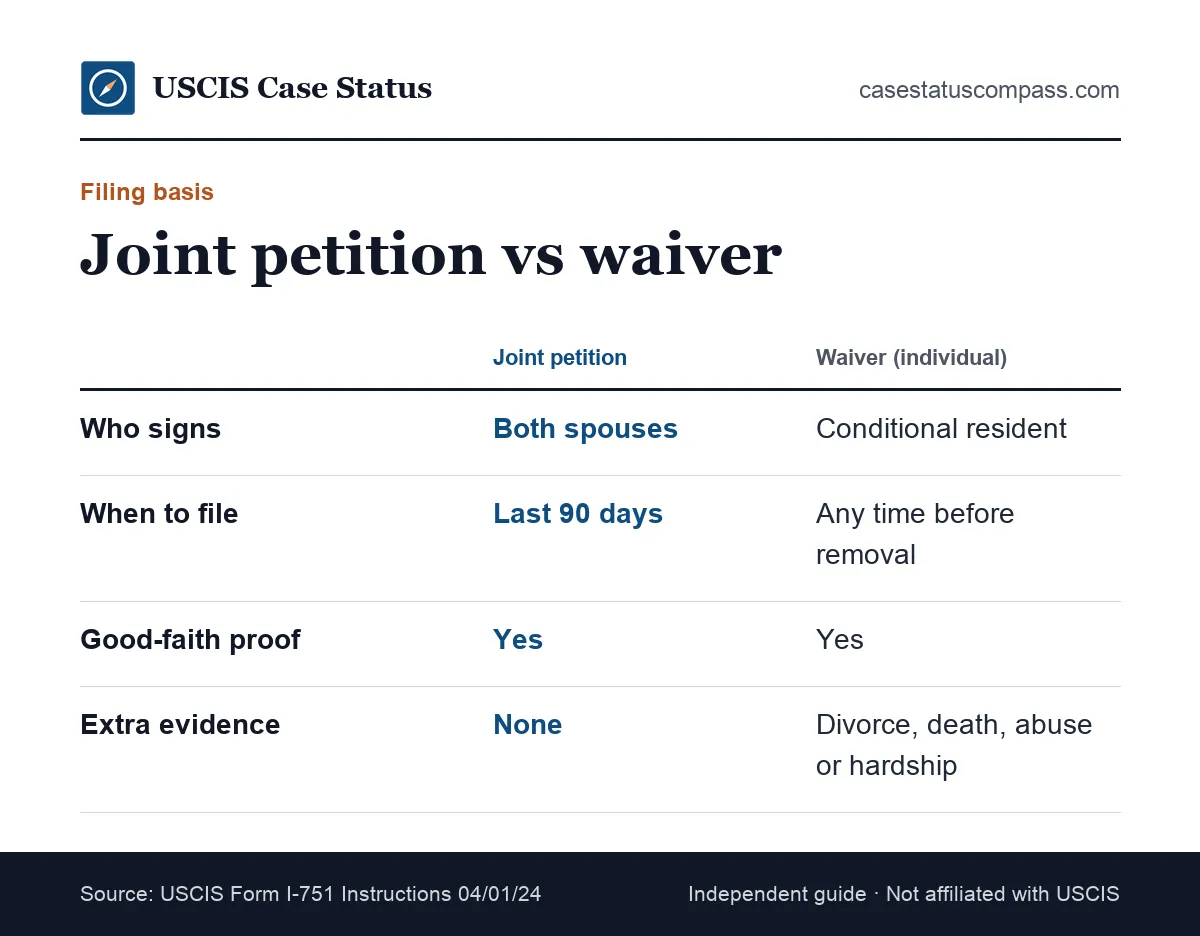
A joint petition fits couples who are still married. Otherwise, you can file I-751 alone if your spouse died, you divorced, you were abused, or removal would cause extreme hardship. A divorce must end a good-faith marriage, and each waiver needs extra evidence.
Filing bases and evidence table
Find your filing basis in the left column to see the proof it needs. Every basis still requires evidence that the marriage was entered in good faith.
| Basis | When to file | Extra evidence |
|---|---|---|
| Joint petition | 90 days before expiry | None beyond good-faith proof |
| Spouse died | Any time before removal | Death certificate |
| Divorce or annulment | Any time before removal | Final divorce decree |
| Battery or extreme cruelty | Any time before removal | Police, court, medical or shelter records |
| Extreme hardship | Any time before removal | Hardship evidence from the 2-year period |
Choosing joint filing
If you are still married and living together, file jointly. A couple who is separated but not divorced can still file jointly if both will sign, though separation may draw questions at an interview.
Choosing a waiver
A waiver filer signs alone and checks the matching basis in Part 3. You can check more than one basis if more than one applies. You still prove the marriage was genuine when you entered it.
Can You File the I-751 After a Divorce?
Yes. If your marriage ended in divorce or annulment, you can file alone with a waiver of the joint filing requirement. You must still show that you married in good faith. Include the final divorce decree, plus evidence of your shared life while married.
Divorce final vs divorce pending
The divorce waiver is based on a marriage that has ended. If your divorce is still pending when you must file, USCIS may send a request for evidence asking for the final decree. Ask an attorney whether to file jointly or wait.
Proving good faith after a split
Focus on the start and middle of the marriage: joint leases, shared bills, trips, and statements from people who knew you as a couple. A short marriage is not fatal if the evidence shows a real shared life.
I-751 Waivers for Death, Abuse and Extreme Hardship
The other waiver grounds are a spouse's death, battery or extreme cruelty, and extreme hardship. Each lets you file alone at any time before removal. Each needs its own proof plus good-faith evidence. you can file I-751 alone if your spouse died, you divorced, you were abused, or removal would cause extreme hardship.
When your spouse died
Include a copy of the death certificate with proof of your good-faith marriage. Conditional children of a deceased conditional resident file their own petitions. Add records showing your life together before the death.
Battery or extreme cruelty
Evidence can include police, court, medical, school or clergy records, protection orders and shelter records. USCIS considers any credible evidence, so send what you have. Your own detailed statement also counts as evidence.
Address changes after choosing the abuse basis
If you select the abuse basis, the instructions say you cannot change your address online or by phone; you contact the service center where you filed. This protects your safety and location.
What Counts as Extreme Hardship for an I-751 Waiver?
The hardship must be significantly greater than what others face when removed after a long stay. Only factors that arose during the two-year conditional period count. This waiver is hard to win without legal help. Common factors include serious medical needs, U.S. citizen children's welfare and conditions in your home country. Document each factor with records, not just a statement.
How Do You Remove Conditions on Permanent Residence?
To remove conditions on permanent residence, find your filing date, choose a joint or waiver basis, gather good-faith marriage evidence, complete the current edition of the petition, and file online or by mail. Then attend biometrics and any interview USCIS schedules.
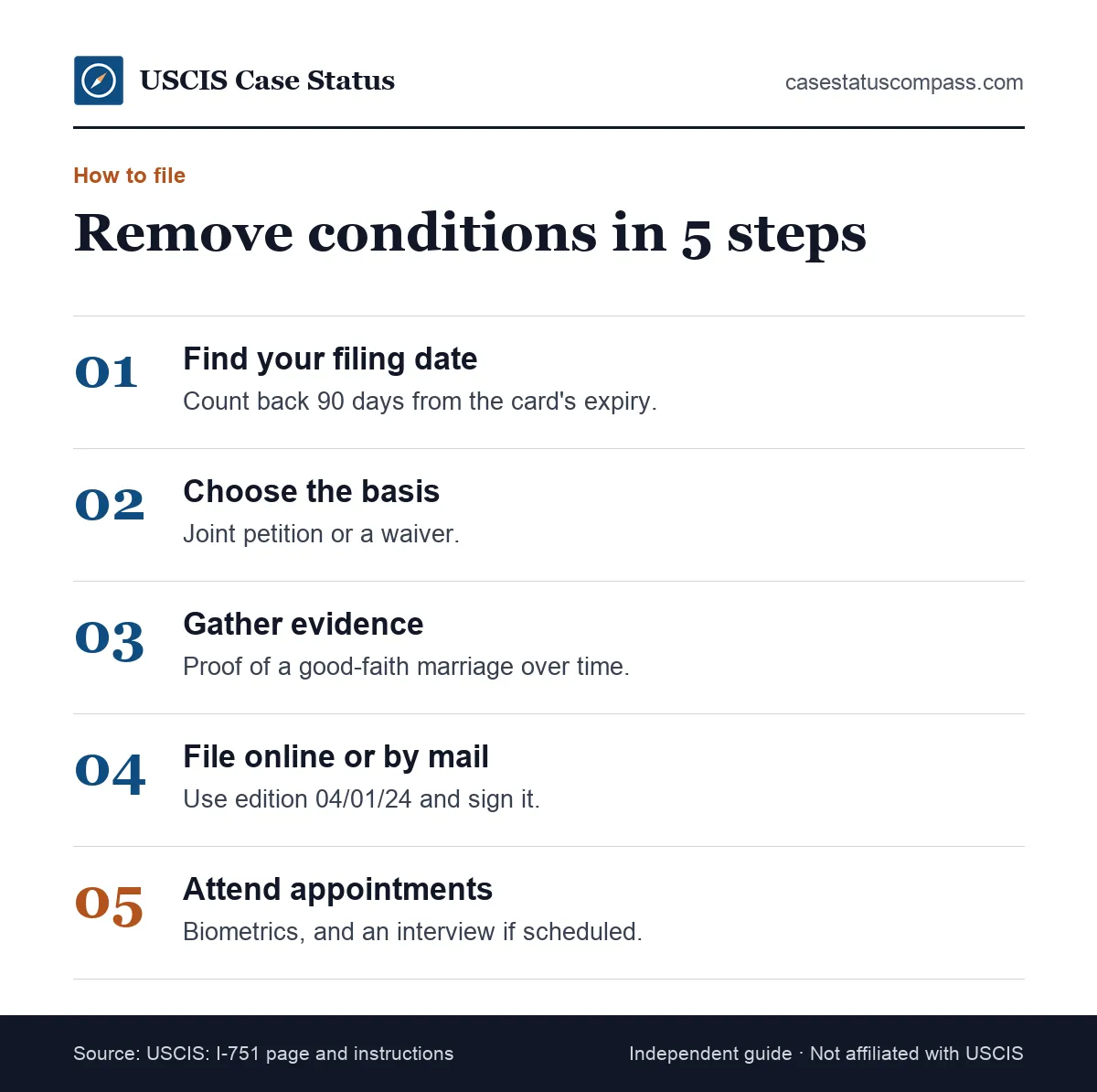
The five steps
- Find your date with the USCIS calculator.
- Choose the basis in Part 3.
- Gather evidence from the checklist below.
- Complete edition 04/01/24, sign it, add a copy of both sides of your card.
- File and follow up with every appointment.
Should You File Online or by Mail?
You can file the petition online through a free USCIS online account or mail a paper petition to the address on the uscis.gov direct filing addresses page. As of October 2026, the fee is $750 (paper) / $700 (online), so online filing costs less. Both channels lead to the same review, the same biometrics step and the same 48-month receipt extension.
Filing online
Sign up at myaccount.uscis.gov/create-account and select the removal of conditions petition. Label files clearly, such as "2026 joint tax return," so the officer can find them fast. Upload clear scans.
Filing by mail
Mail the package to the lockbox listed for your state on the uscis.gov form page. Keep a full copy and the tracking number. Optional Form G-1145 asks USCIS to text or email you when the lockbox accepts it.
Where Do You Get Form I-751 and Which Edition Applies?
Download the petition and its instructions free from uscis.gov. As of October 2026, USCIS lists edition 04/01/24. Each page shows the edition date at the bottom; use one edition throughout. Check the edition again right before you file, because USCIS can release a new one with little notice.
Is There an Example Form I-751 You Can Follow?
People searching for an example form I 751 usually want to see a filled-in petition. USCIS does not publish one, but our I-751 cover letter and affidavit examples show sample wording for the supporting letters. Adapt any sample to your facts.
Avoid paid form sites
USCIS never charges for blank forms. A site asking for payment to download the petition is not USCIS. Use only the official uscis.gov link. Bookmark uscis.gov/i-751 and download from there.
Form I-751 Part by Part
The petition has eleven parts. The ones that matter most are Part 1 about you and your marriage, Part 3 on the filing basis, Part 4 about your spouse, Part 5 on your children, and the signature parts. Answer every question, writing "N/A" or "None" where it applies.
Part 3: Basis for petition
Part 3 is where you choose joint filing or one or more waiver bases. Choosing the wrong one is a common reason for a request for evidence or denial. Pick every basis that applies.
Part 4: Your spouse
Part 4 covers the spouse through whom you got conditional status. List their name, birth date and A-Number or Social Security number. Waiver filers still complete it. Copy the details carefully.
Part 5: Your children
Children who got conditional status with you are listed in Part 5, with their A-Numbers. Each child also needs a copy of their card. Children included here need no separate petition fee.
What Goes in the Place of Marriage on Form I-751?
Part 1 asks for your name, A-Number and marital details, including the date and place of marriage. Enter the city and country exactly as your marriage certificate shows. A mismatch with your earlier filings can trigger questions. Use the same spelling throughout.
What Evidence Proves a Good-Faith Marriage?
Good-faith marriage evidence shows you married to build a life together, not to get a green card. The instructions list joint leases or mortgages, joint financial records, tax returns, insurance, children's birth certificates and affidavits. Evidence that covers the whole period since your card was issued is strongest.
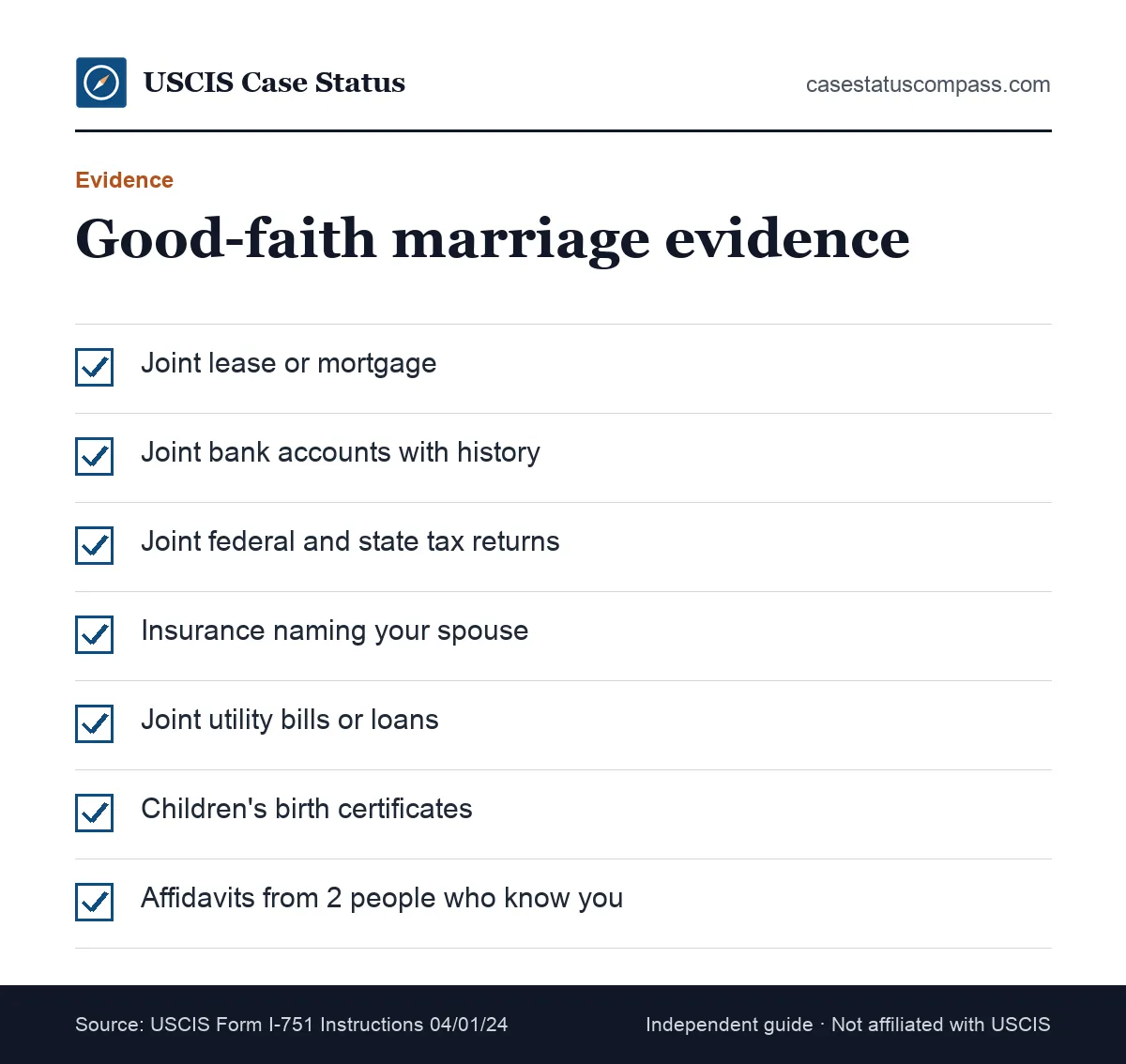
Financial evidence
Send joint bank statements with real transactions, joint federal and state tax returns, insurance policies naming your spouse, joint utility bills and shared loans. Statements from several months across the period are stronger than a single page.
Home and family evidence
A joint lease or mortgage, mail to both of you at the same address, and birth certificates of children born in the marriage show a shared home. Military families can send leave and earnings statements showing family allowances.
Shared life evidence
Photos over time, travel bookings in both names and proof of joint gym or phone plans add context. They support, but do not replace, financial and housing records. Label each photo with dates.
Evidence, Affidavits and Cover Letter (Summary)
Affidavits and a cover letter are optional extras that support your core evidence. As USCIS puts it, affidavits from at least two people who have known you both since conditional residence began can support the I-751. A short cover letter lists what you sent.
Affidavits from people who know you
Each affidavit must be original and give the writer's full name, address, date and place of birth, relationship to you, and how they know about your marriage. The instructions say affidavits must be backed by other evidence.
The cover letter
A cover letter is not required, but it helps the officer. See our I-751 cover letter examples for a sample layout and an affidavit template. List your enclosures and filing basis.
I-751 Checklist You Can Copy
The core package is the signed petition, the correct fee, copies of both sides of your card, and good-faith marriage evidence. Waiver filers add the document that proves their basis. Tick each box only after the copy is in the envelope. If you file online, use the same list to confirm every upload before you pay and submit.
Core items for every filer
- Form I-751, edition 04/01/24, signed
- Fee or online payment
- Copy of your green card, front and back
- Copies of your children's cards, if included
- Good-faith marriage evidence covering the whole period
- Certified English translations
Extra items for waiver filers
- Final divorce decree or annulment order
- Spouse's death certificate
- Abuse records or protection orders
- Hardship evidence from the 2-year period
- Criminal court records, if any
Include only the items for the basis you chose in Part 3.
Including Children on Your Petition
Children who got conditional status on the same day as you, or within 90 days after, can be listed in Part 5 of your petition. Children who got status later, or whose conditional parent died, must each file their own petition.
Children who got status with you
A child listed in Part 5 shares your petition, your receipt and usually your decision. Include a copy of each child's card, front and back, and their A-Numbers exactly as printed.
When a child must file alone
A child who became a conditional resident more than 90 days after you files separately, with an explanation of why. A child filing separately may do so any time, according to USCIS.
Filing From Overseas on Military or Government Orders
You generally need a U.S. address to file, but conditional residents abroad on U.S. military or government orders are an exception. The instructions ask them to mark the top of the petition and send extra items, because they cannot attend a U.S. biometrics appointment.
What to add to the package
- Write "ACTIVE MILITARY" or "GOVERNMENT ORDERS" at the top of the form
- A copy of the current military or government orders
- Two passport-style photos for each petitioner and dependent
- Two FD-258 fingerprint cards for each person aged 14 to 79
Removal of Conditions Requirements With a Criminal Record
If you were ever arrested, cited or charged, the instructions ask for the arrest record and final court disposition for each incident. Convictions need sentencing records and proof you completed the sentence. Certified copies are best. Get legal advice before filing.
What to send
- Arrest record and disposition for each incident
- Sentencing records and proof of completion
- Court orders that sealed or expunged a record
- Probation or parole records, if any
Send these even if the case was dismissed.
Traffic tickets and minor incidents
The instructions excuse paperwork for traffic incidents that did not involve an arrest and ended only in a small fine or points, unless alcohol or drugs were involved. When in doubt, include it.
When to send court records anyway
When in doubt, send the record, since an officer who finds an undisclosed incident may question your honesty. Any criminal history is a reason to see an immigration attorney before filing.
I-751 Fee (Summary)
As of October 2026, the I-751 fee on Form G-1055 is $750 (paper) / $700 (online). Battery or extreme cruelty waiver filers pay nothing, according to the same schedule. Full details sit on our green card fee page. Pay once.
Before you pay
Check Form G-1055, Edition 10/16/26 before you pay; a wrong fee means rejection. Our USCIS fee waiver guide explains who may request a waiver. Filing online costs less than paper, and the system calculates the amount for you.
What Happens After You File to Remove Conditions?
After you file, USCIS sends a receipt notice that extends your status, schedules biometrics, and reviews your evidence. Some cases get an interview or a request for evidence. If approved, USCIS mails a new 10-year green card. Watch your mail and account.
Receipt notice extension
Your Form I-797C receipt notice is the most important paper you get. I-797C = Notice of Action (receipt, rejection, transfer, appointment, re-open); not proof of status by itself. For this petition, though, the receipt does more: I-751 receipt notice extends conditional status and work authorization for 48 months. Our I-797C notice guide explains how to read it.
Do You Need Biometrics for Removal of Conditions?
USCIS may schedule a visit to an Application Support Center for fingerprints, photo and signature, used for background checks. Our biometrics appointment guide covers what to bring. Bring the appointment notice and photo ID. If USCIS reuses earlier fingerprints, you may not get an appointment at all; that is normal and does not mean your petition stalled.
How Does the 48-Month I-751 Extension Work?
USCIS states: I-751 receipt notice extends conditional status and work authorization for 48 months. You carry the expired conditional card together with the receipt notice as proof of status for work, travel and ID. The extension applies only to a properly filed petition.
Using the card and notice together
Show both documents at the border, to employers completing Form I-9, and at the DMV. Keep the original notice safe and carry a copy for daily use. Neither paper proves status on its own once the card expires.
If you need proof beyond 48 months
USCIS says to call the Contact Center at 800-375-5283. One option is an I-551 stamp: I-551/ADIT stamp: temporary proof of green card status; request through the USCIS Contact Center (800-375-5283). Our I-551 stamp guide explains how it works.
I-751 Status Sequence: What Each Update Means
A typical removal of conditions case runs from Case Was Received to fingerprints, review, approval, card production and mailing. Interviews and evidence requests add steps. Use the receipt number from your I-797 notice to follow each step online. Long quiet periods between updates are common for this form.
Removal of conditions status table
Match the latest status in your account to a row. Most petitions spend the longest time in the review step between biometrics and a decision.
| Status | Meaning | Your move |
|---|---|---|
| Case Was Received | Petition accepted | Save the receipt |
| Fingerprints Were Taken | Biometrics done | Keep your address current |
| Case Is Being Actively Reviewed | An officer has the file | Watch for notices |
| Request for Evidence Was Sent | More proof needed | Respond by the deadline |
| Interview Was Scheduled | Officer wants to meet you | Bring originals and your spouse |
| Case Was Approved | Conditions removed | Wait for the card |
| New Card Is Being Produced | 10-year card in production | Check your mailing address |
| Card Was Mailed To Me | Card sent | Track delivery |
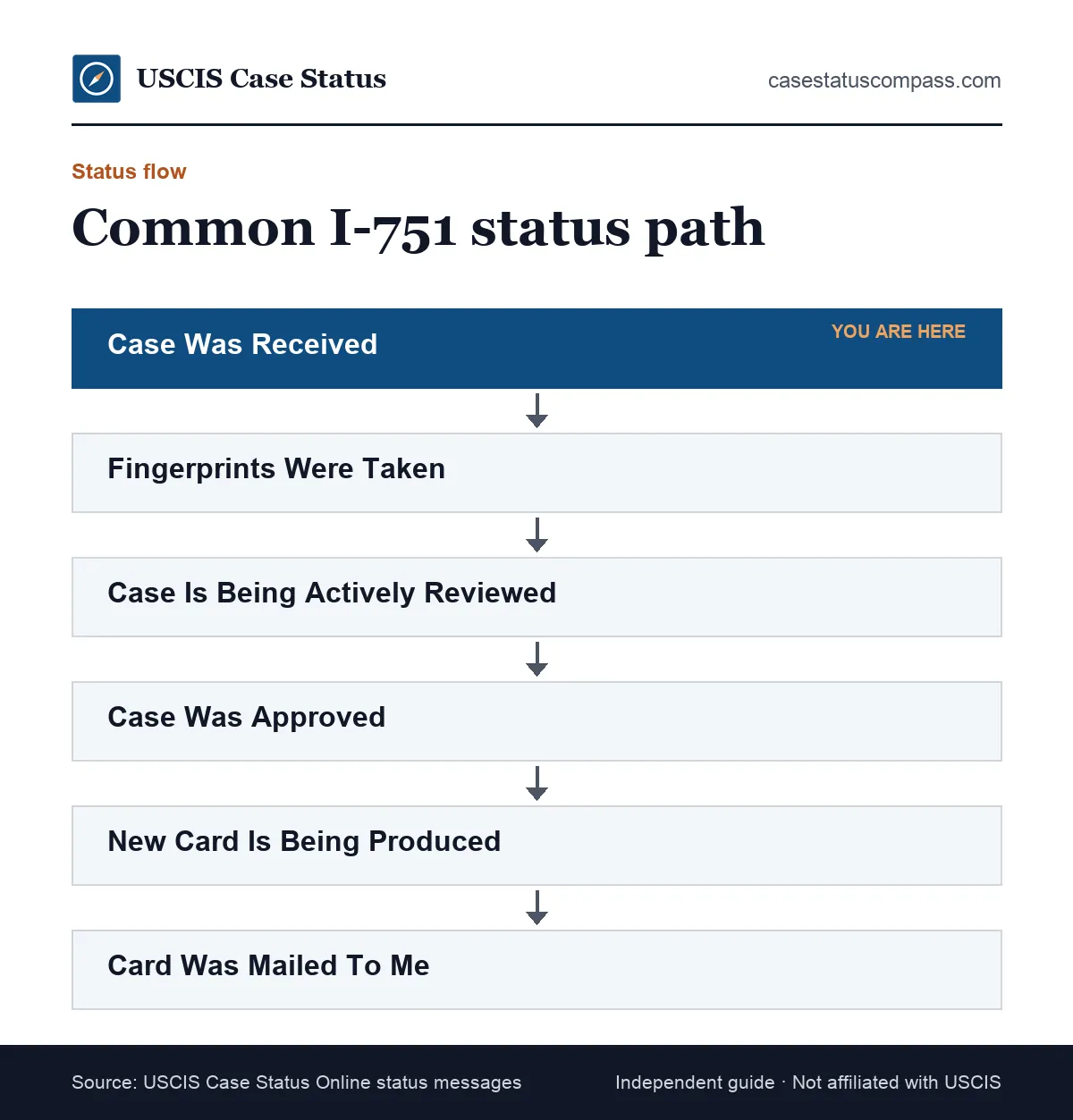
Statuses off the usual path
Case Was Transferred often means a field office will interview you; see our Case Was Transferred status guide. Once approved, follow the New Card Is Being Produced update to delivery.
Is There an Interview for the I-751?
Sometimes. USCIS can approve a petition without an interview when the evidence is strong, but it may call you in if evidence is thin, you filed a waiver, or something conflicts. If you get an interview notice, both spouses usually attend in a joint case.
Who attends
In a joint case, both spouses usually attend. In a waiver case, the conditional resident attends alone. If a spouse cannot come, tell USCIS before the date rather than skipping it.
What to bring to the I-751 interview
Bring the notice, IDs, originals of everything you copied, and newer evidence since filing, such as recent joint statements or a new lease. Organize the newer evidence by date in a folder.
How to prepare
Review the petition you filed and your marriage timeline together. Officers ask about daily life, the home, finances and plans. Our green card interview questions guide lists common topics. Answer honestly and briefly.
Can You Travel While Your I-751 Is Pending?
Yes. You can travel abroad while the petition is pending if you carry your expired conditional card and the receipt notice extending it. Plan trips around your appointments. Avoid long trips, since an officer may question whether you still live here and a missed biometrics or interview notice can delay the case.
Documents to carry
- Expired conditional green card
- Original receipt notice for the petition
- Your passport
- Any interview or biometrics notice
Keep copies of all four at home too, in case the originals are lost while you are abroad.
Long trips while conditions are pending
A long stay abroad can make an officer ask whether you still live in the U.S. Our green card holder travel rules guide covers long absences. Keep trips short, and keep proof of your U.S. home and job while you are away.
Moving While Your Petition Is Pending
If you move, you must notify USCIS within 10 days of moving while your I-751 is pending. Update the address online unless you selected an abuse basis in Part 3. A missed address change can mean missed notices, including interview or RFE letters. Keep proof of every update.
How to update your address
Use the online change of address tool or the Contact Center. Our USCIS change of address guide walks through each method. Do not send an address change to the lockbox.
Why a missed letter is so costly
USCIS mails interview and evidence notices to the address on file. Miss one and the petition can be denied for abandonment, which can lead to court. Forward your mail and check your online account weekly.
I-751 Processing Time (Summary)
Processing time for removal of conditions varies by office and changes often, so check the current figure at egov.uscis.gov/processing-times. Your 48-month receipt extension usually covers the wait. Our I-751 processing time page explains how to read the estimate. For reference, I-751: median 22.6 months (USCIS data, Apr.-June 2026).
What Happens After I-751 Is Approved?
After approval, USCIS mails an approval notice and then a 10-year green card. You are a permanent resident without conditions. You will later renew the card with Form I-90, and you may apply for citizenship once eligible. Check the new card at once.
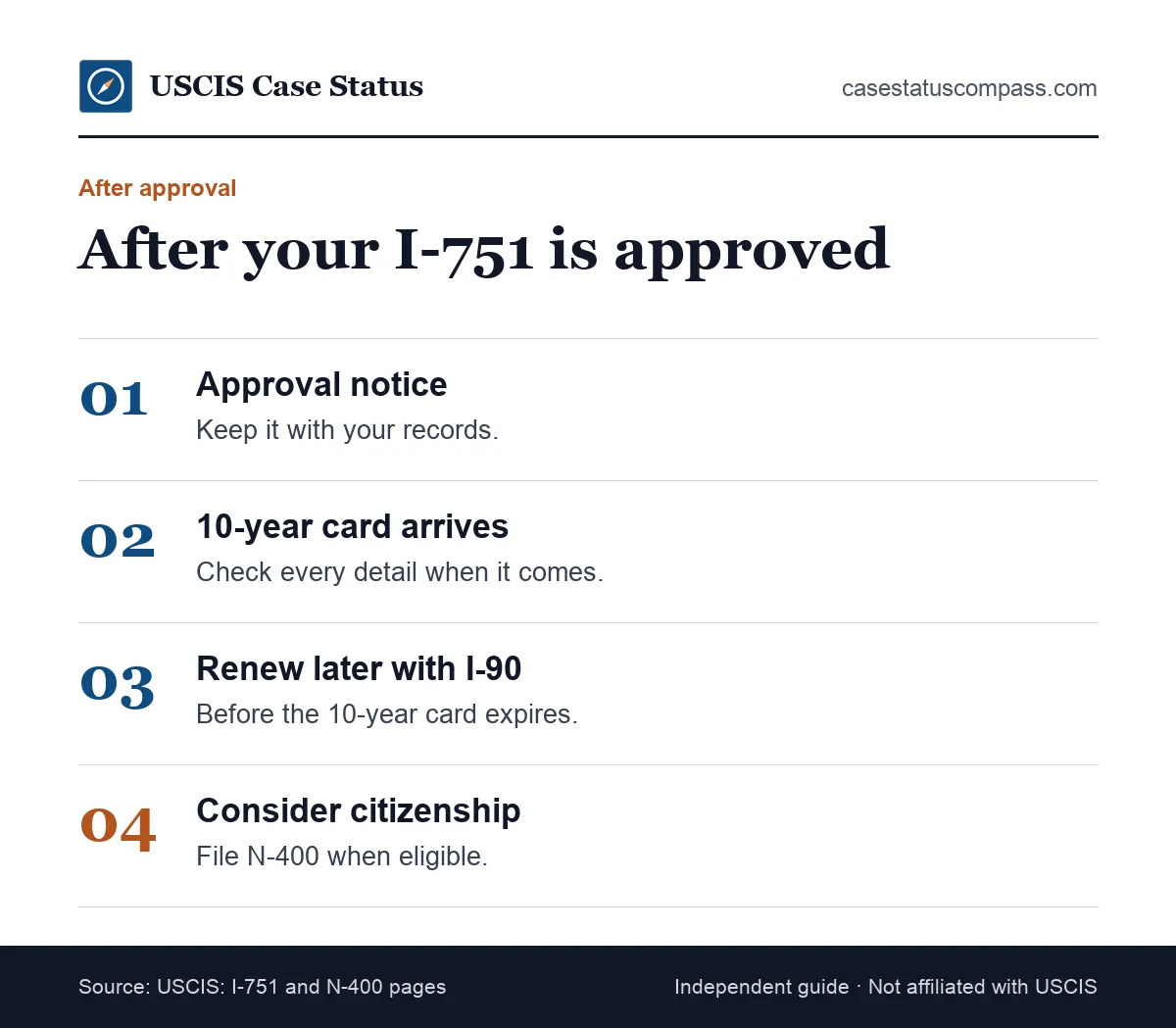
Your new 10-year card
When the card arrives, check your name, birth date and category. Errors caused by USCIS can be fixed through Form I-90. The Card Was Mailed status page explains what to do if it does not arrive.
Can You Apply for Citizenship While Your I-751 Is Pending?
USCIS states: You can file the N-400 up to 90 days before you reach 5 years (or 3 years if married to a U.S. citizen) as a permanent resident. Your time as a conditional resident counts. If you file a citizenship application while conditions are still pending, USCIS decides the I-751 before or at the same time as the N-400.
What If USCIS Sends an RFE or NOID on Your I-751?
A request for evidence (RFE) means USCIS needs more proof before deciding your petition. A notice of intent to deny (NOID) means USCIS plans to deny unless you answer convincingly. Both have firm deadlines, and both are your chance to fix the record.
Answering an RFE
Send exactly what the notice asks for, with the RFE on top. Add recent joint evidence if the request concerns good faith. Our request for evidence guide covers deadlines. Respond on time.
Answering a NOID
A NOID explains the problem USCIS sees. Answer every point with proof, and talk to a lawyer. Our notice of intent to deny guide explains the process. Do not miss the deadline.
What Happens If the I-751 Is Denied?
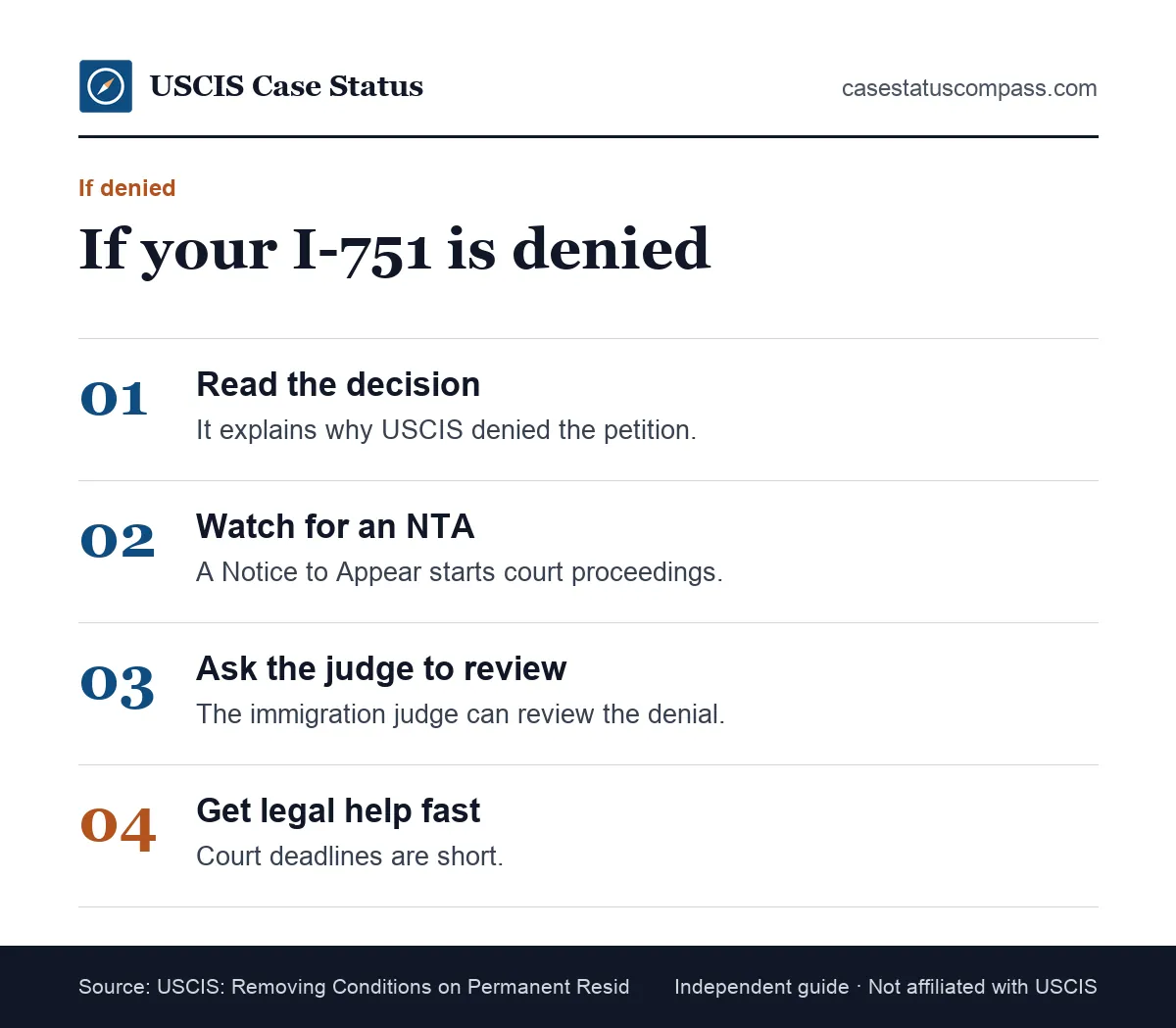
If USCIS denies the petition, it mails a decision explaining why and may issue a Notice to Appear (NTA) in immigration court. You can ask the immigration judge to review the denial. If the judge orders removal, you must file a BIA appeal (Form EOIR-26) so it arrives within 30 calendar days of the judge's decision.
Review in immigration court
The judge reviews your petition again. You can bring new evidence, and some people file a new petition with a different basis. You can follow court dates on our immigration court case status page.
Why speed matters
Court deadlines are short and the stakes are high. Contact an immigration attorney or DOJ-accredited representative as soon as the denial arrives. A denial can lead to a Notice to Appear.
Real-World I-751 Scenarios
These four scenarios show how filing choices differ in practice. They are examples, not legal advice. If your facts look different, a short legal consultation can prevent an expensive mistake. Names are invented, but each case follows the filing basis rules described above, from joint filing to a divorce waiver.
Maria and James: a joint petition
Maria's card expires on September 1, 2027. The couple uses the calculator, files online in early June, and uploads tax returns, a lease and bank records. Their receipt extends Maria's status while they wait.
Omar: divorced before the window
Omar divorced after 18 months of marriage. He files alone right away with a divorce waiver, the final decree, the old joint lease and affidavits from two friends. He does not wait for the 90-day window.
Lin: abuse and a confidential address
Lin left an abusive spouse. She files a waiver with a protection order and shelter records and pays no fee under the schedule. Because she chose the abuse basis, she updates her address only through the service center.
Ana: a card that expired unfiled
Ana missed her expiry date while caring for a sick parent. She files a joint petition at once with a signed explanation and hospital records, then meets an attorney in case USCIS questions the delay.
If X, Do Y: I-751 Decision Table
Use this decision table to match your situation to a next step. When two rows seem to apply, follow the more cautious one and get advice. Rows follow the official instructions, so they are a good first check before you speak with an attorney or plan a filing.
Next-step table for conditional residents
Read across each row from situation to action. In nearly every row, the safest move is to file on time and keep your receipt notice.
| If this is your situation | Then do this |
|---|---|
| Still married and inside the 90-day window | File a joint petition |
| Divorce is final | File alone with a divorce waiver |
| Divorce is pending | Talk to an attorney before choosing a basis |
| Spouse died | File alone with the death certificate |
| Abused by your spouse | File a waiver; no fee under the schedule |
| Card already expired, nothing filed | File late with an explanation; get legal help |
| Lost card while pending | Use the receipt notice; ask about an I-551 stamp |
When the table does not fit
Mixed situations, such as reconciling after a separation or a spouse who refuses to sign, need advice before you choose a filing basis. A lawyer can review both options.
How Is the I-751 Different From the I-130 and I-90?
The I-130 starts a marriage-based case, the I-751 ends the conditional period, and the I-90 renews or replaces a 10-year card later. They come at different stages and cannot stand in for one another. Filing the wrong form leaves your status unprotected.
Reusing I-130 evidence
Evidence from the I-130 stage helps, but USCIS wants proof of life together since the conditional card was issued, so add newer records rather than resending only old ones. Recent records matter most.
I-90 and I-751: renewal vs removal
The I-90 cannot extend a 2-year card. Only removing conditions does that. Once you hold the 10-year card, the I-90 becomes your renewal and replacement form for every future card.
Common Removal of Conditions Mistakes
The most common mistakes are filing a joint petition too early, missing the expiry date, leaving out a signature, forgetting the copy of the card, and sending thin evidence. The first four cause rejection; thin evidence leads to interviews and evidence requests.
Mistakes that get packages rejected
- Joint petition filed before the window
- Missing petitioner or spouse signature
- No copy of both sides of the card
- Wrong or missing fee
- Mixed edition pages
A rejected package does not extend your status, so check each point before mailing.
Mistakes that slow a case
Sending only photos, using a joint account with no activity, and skipping evidence from the most recent year all invite questions. Send varied, recent proof from several sources to avoid an RFE.
Mismatched details across filings
Officers compare the petition with your earlier file. A marriage place on Part 1 that does not match your I-130 petition or your sponsor's affidavit of support leads to questions, so copy names and places from your old forms.
When Should You Get Legal Help With Form I-751?
Get help from an immigration attorney or DOJ-accredited representative if you are filing late, separating or divorcing, claiming abuse or extreme hardship, have any criminal record, or received a NOID or denial. A short consultation costs less than a denial.
Red flags
- Card expired without a filing
- Pending divorce at filing time
- Abuse or extreme hardship waiver
- Any arrest or conviction
- NOID, denial or Notice to Appear
If any of these apply to you, speak to a lawyer before filing.
Finding low-cost I-751 help
Nonprofits with DOJ-accredited representatives offer low-cost help. See our Forms hub for related petitions, or contact USCIS for case-specific questions.
Frequently Asked Questions
What happens after the I-751 is approved?
USCIS mails an approval notice and then a 10-year green card, and the conditions are gone. You renew that card later on Form I-90, and your conditional years count toward naturalization.
Can I file I-751 after divorce?
Yes. File alone with a divorce waiver once the marriage has legally ended, with the final decree and evidence of your shared life. You do not wait for the 90-day window; get advice if the divorce is still pending.
Who is the petitioner in Form I-751?
The conditional resident, whose green card has conditions, signs in Part 7 as petitioner. In a joint petition the citizen or permanent resident spouse also signs, in Part 8. This reverses the roles from Form I-130.
Can I work while my I-751 is pending?
Yes. Your expired conditional card and the receipt notice together prove work authorization during the extension period. Employers completing Form I-9 can accept the combination.
What if I lost my conditional green card?
If you already filed, the receipt notice extends your status, and you can ask the Contact Center about temporary proof such as an I-551 stamp. Do not file Form I-90 for a conditional card.
Is Form I-751 the same as Form I-829?
No. Form I-751 removes conditions for residents whose status came through marriage. Form I-829 removes conditions for EB-5 investors and their families. The forms have different evidence rules, fees and filing addresses.
What if my I-751 receipt notice never arrived?
Online filers see the receipt in their account right away. Paper filers usually get it by mail, plus a text or email if they attached Form G-1145. If nothing arrives after several weeks, check the account and then contact USCIS.
Do I need a lawyer to file Form I-751?
No. Many couples file a joint petition on their own using the free form and instructions. Legal help is wise for a late filing, a waiver, a criminal record or a pending divorce.
Can I check my I-751 case status online?
Yes. Enter the receipt number from your I-797C in the official tool (Case Status Online: egov.uscis.gov), or sign in to your USCIS online account, which also shows notices. The status table above explains what each message means.
Can I renew my driver's license with a pending I-751?
Usually, but each state sets its own document list. Many DMVs accept the expired conditional card together with the receipt notice. Check your state's list before you go.
Sources
- USCIS: I-751, Petition to Remove Conditions on Residence. www.uscis.gov/i-751. Accessed Oct 27, 2026.
- USCIS: Form I-751 Instructions (PDF). www.uscis.gov/sites/default/files/document/forms/i-751instr.pdf. Accessed Oct 27, 2026.
- USCIS: Removing Conditions on Permanent Residence Based on Marriage. www.uscis.gov/green-card/after-we-grant-your-green-card/conditional-permanent-residence/removing-conditions-on-permanent-residence-based-on-marriage. Accessed Oct 27, 2026.
- USCIS: When to File Your Petition to Remove Conditions (calculator). www.uscis.gov/forms/when-to-file-your-petition-to-remove-conditions. Accessed Oct 27, 2026.
- USCIS Fee Schedule (Form G-1055). www.uscis.gov/g-1055. Accessed Oct 27, 2026.
- USCIS Check Case Processing Times. egov.uscis.gov/processing-times/. Accessed Oct 27, 2026.
- USCIS Form G-1055 Fee Schedule, Edition 10/16/26. www.uscis.gov/sites/default/files/document/forms/g-1055.pdf. Accessed Oct 27, 2026.
- USCIS Glossary: Green Card. www.uscis.gov/tools/glossary. Accessed Oct 27, 2026.
- USCIS: Online Account and Technical Support. www.uscis.gov/tools/uscis-tools-and-resources/online-account-and-technical-support. Accessed Oct 27, 2026.
- USCIS: Form I-797 Types and Functions (updated 01/24/2025). www.uscis.gov/forms/filing-guidance/form-i-797-types-and-functions. Accessed Oct 27, 2026.
- USCIS Contact Center (uscis.gov). www.uscis.gov/contactcenter. Accessed Oct 27, 2026.
- USCIS alert: Additional Mail Delivery Process for Receiving ADIT Stamp (Mar. 16, 2023; archived). www.uscis.gov/newsroom/alerts/uscis-announces-additional-mail-delivery-process-for-receiving-adit-stamp. Accessed Oct 27, 2026.
- USCIS Data Library: All USCIS Application and Petition Form Types, FY2026 Q3 (Apr. 1-June 30, 2026; queried 7/2026). www.uscis.gov/sites/default/files/document/data/quarterly_all_forms_fy2026_q3_v1.xlsx. Accessed Oct 27, 2026.
- USCIS: Form N-400 page. www.uscis.gov/n-400. Accessed Oct 27, 2026.
- EOIR Policy Manual Part III, Ch. 3.5; 8 CFR 1003.38(b). www.justice.gov/eoir/policy-manual-eoir/part-III/bia/chapter-3-5. Accessed Oct 27, 2026.
- USCIS: Checking Your Case Status Online. www.uscis.gov/tools/checking-your-case-status-online. Accessed Oct 27, 2026.
casestatuscompass.com is an independent publication and is not affiliated with USCIS or any government agency. This page is general information, not legal advice. For denials, court or asylum matters, consult an immigration attorney or a DOJ-accredited representative.