Contents · 37 sections
- What Are USCIS Processing Times?
- How Do USCIS Processing Times Work?
- How Do You Read the Official Processing Times Tool?
- What Does the 80% Figure Mean?
- How Accurate Are USCIS Processing Times?
- Median vs 80%: Which Measure Should You Trust?
- USCIS Processing Times by Form: Medians for April–June 2026
- Have USCIS Processing Times Gotten Longer in 2026?
- How Long Does the Immigration Process Take Overall?
- How Long Does a Green Card Take?
- How Long Does Form I-130 Take?
- How Long Does Naturalization Take?
- How Long Does Removing Conditions Take?
- Work Permit (EAD) Wait Times at a Glance
- How Long Does It Take to Get Papers to Work?
- How Long Does a Travel Document Take?
- How Long Does Green Card Renewal Take?
- How Long Does Form I-140 Take?
- How Long Does PERM Labor Certification Take?
- How Long Does H-1B Processing Take?
- How Long Does the K-1 Fiancé Visa Take?
- How Do the Processing-Time Pages Fit Together?
- Processing Times by Service Center and Field Office
- California Service Center Processing Times
- Why Do Field Offices Have Different Processing Times?
- Does a Transfer Reset Your USCIS Processing Time?
- What Is a Case Inquiry Date?
- How Do You Know If Your Case Is Outside Normal Processing Time?
- What Should You Do When Your Case Is Outside Normal Processing Time?
- Who Can Help After USCIS Fails to Respond?
- What Slows a USCIS Case Down?
- Can You Speed Up Your USCIS Case?
- When Does a USCIS Expedite Request Make Sense?
- Which Forms Qualify for Premium Processing?
- How Do You Estimate Your Own Case Timeline?
- Why Is My Case Taking Longer Than the Posted Time?
- Frequently Asked Questions
At a glance
| Official tool | egov.uscis.gov/processing-times |
| What the number means | The USCIS tool shows how long it took to finish 80% of cases in the past 6 months |
| When you can ask | Case inquiry date: the earliest date USCIS will accept a question about your pending case; it can change |
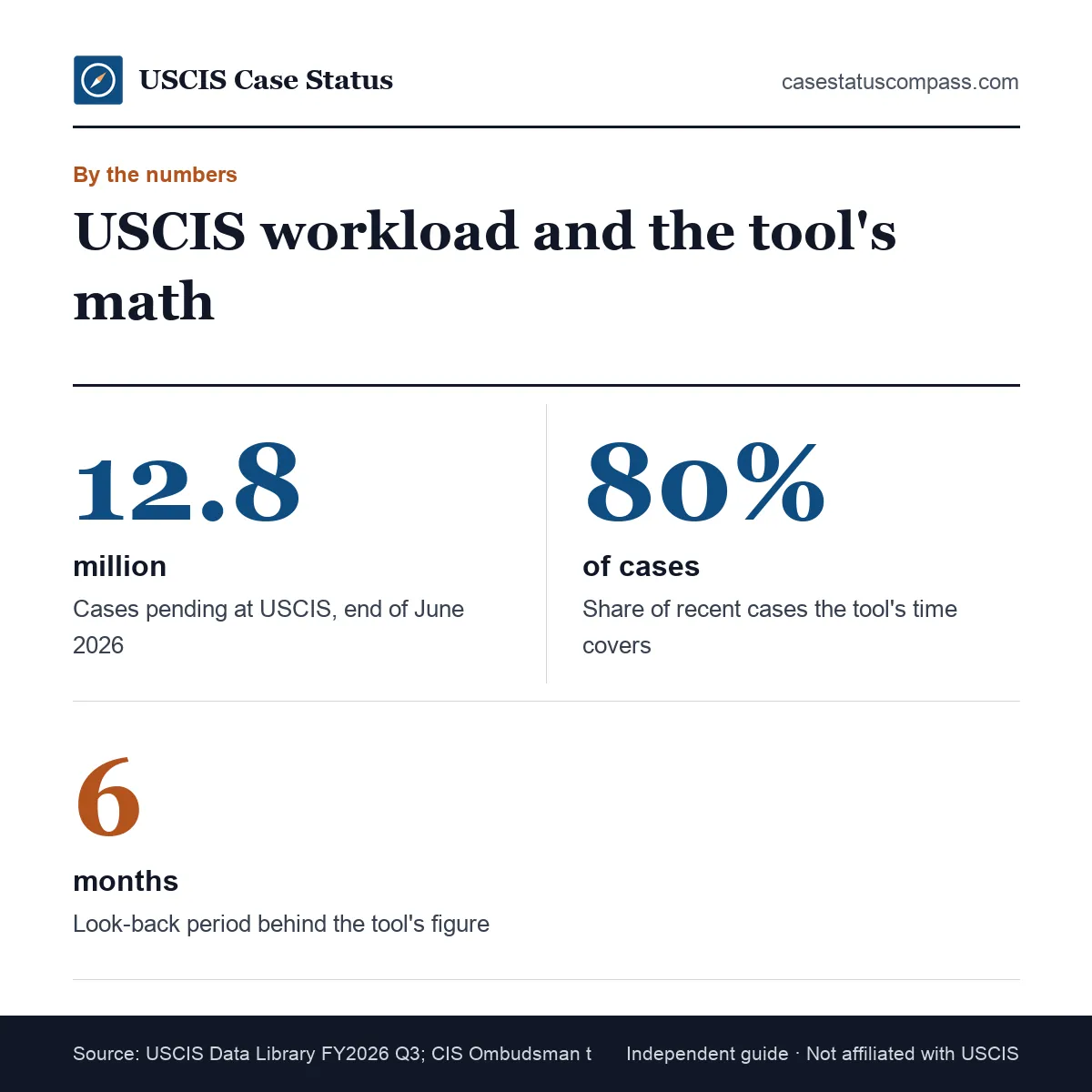
| Cases waiting | 12.8 million cases pending at USCIS (end of June 2026) |
| Who runs this site | An independent guide, not USCIS. We cannot see your case. |
What Are USCIS Processing Times?
USCIS processing times are official estimates of how long U.S. Citizenship and Immigration Services takes to decide a form. They are published per form, category and office, so two similar cases can show different numbers. They describe finished cases, not a promise for yours.
Two official sources
USCIS publishes two sets of numbers. The live processing times tool shows an 80% figure for each office. The USCIS Data Library posts quarterly medians for every form. We label each figure, because the two measures answer different questions.
How Do USCIS Processing Times Work?
USCIS processing times work by measuring cases already finished. The USCIS tool shows how long it took to finish 80% of cases in the past 6 months. That makes the figure a benchmark, built from completed files. It does not reserve a slot or count down for any single file.
Form, category and office
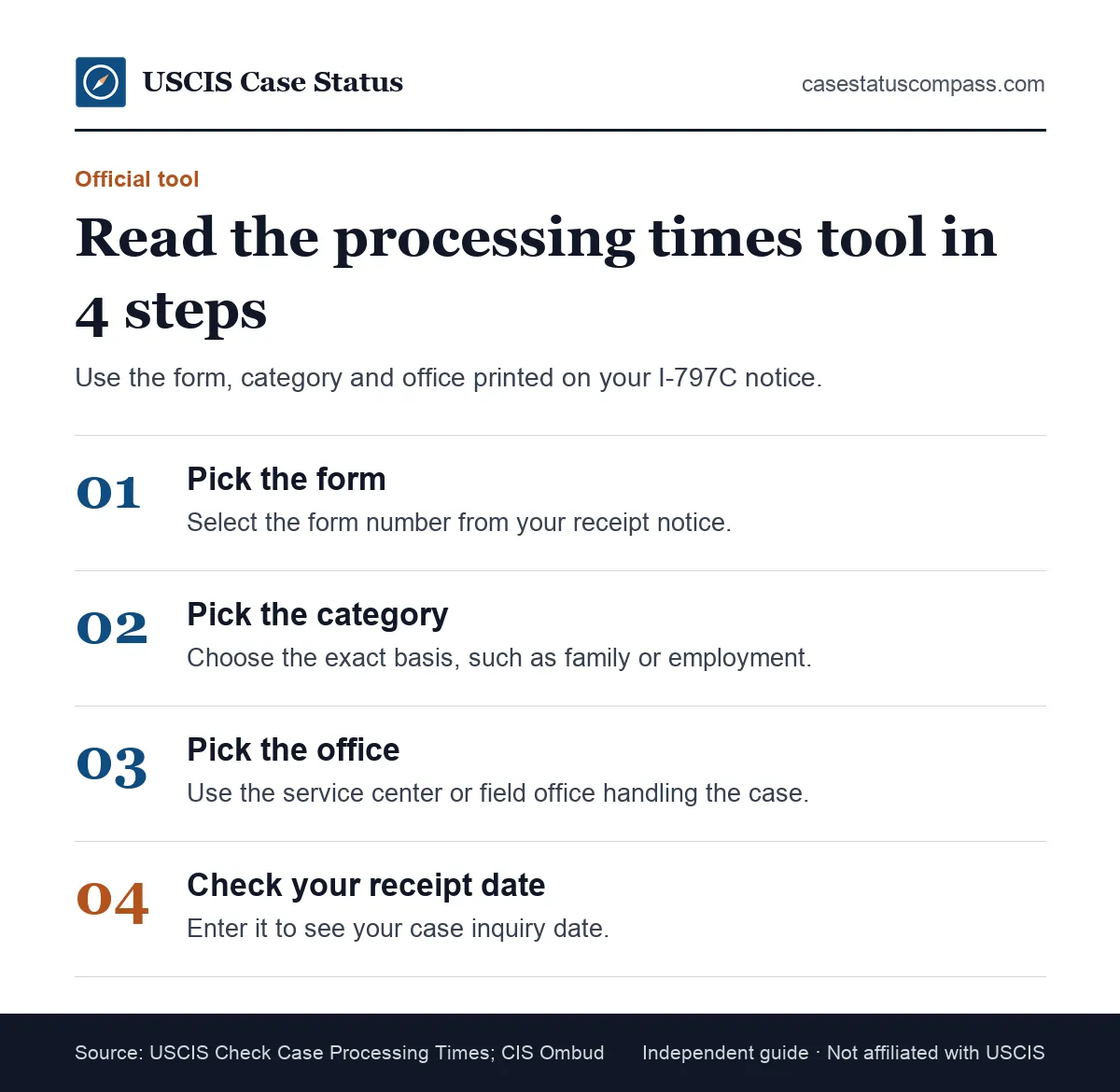
The form is the number on your notice, such as I-485. The category is the legal basis, such as family-based or employment-based. The office is the service center or field office holding the file. Change any one of the three and the result can shift by months.
How often the numbers change
USCIS processing times move as cases are completed, so the figures can change every month. Data Library medians arrive quarterly, months later. Note the date beside any number you save.
How Do You Read the Official Processing Times Tool?
Read the tool by choosing your form, then your category, then the office on your receipt notice. Enter your receipt date there to get your case inquiry date. The tool is free and needs no USCIS account. If any of the three choices is wrong, the figure belongs to a different queue, so match each one to the exact wording on your notice.
Where the inputs come from
Your Form I-797C receipt notice lists the form, the receipt date and usually the office. The three-letter receipt prefix hints at the office too, such as WAC for California. Our guide to the I-797C notice of action shows where each item sits.
Reading the result calmly
The result is not a deadline for you or for USCIS. If it is past the window but before your inquiry date, USCIS still treats it as normal. Only the inquiry date opens a formal question.
What Does the 80% Figure Mean?
The 80% figure means four out of five recent cases for that form, category and office finished within the time shown. One in five took longer. Treat it as a speed check for the queue, not a forecast: the figure moves whenever the mix of finished cases changes, so look again before you plan travel or a job start.
A worked example
Say the tool shows 10 months. Out of 100 recent cases, about 80 finished within 10 months; 20 took longer. If your case is at month 11, you are in the slower fifth.
What the figure cannot see
The tool's figure, in the words the CIS Ombudsman quotes, "does not indicate how soon USCIS will take action on your case." It cannot see your RFE, background check or interview slot.
How Accurate Are USCIS Processing Times?
USCIS processing times are accurate about the past and rough about the future. They report how long recently finished cases took, but cannot weigh your own file or a sudden backlog. Use the figure for rough planning, and rely on your inquiry date for any formal step.
Why a case beats or misses the number
Simple, complete files often finish early. Files with an RFE, a missed appointment or a transfer often finish late. An interview requirement also adds time that a mail-only form never has.
Why a growing backlog can look shorter
Because only finished cases count, very old pending cases do not raise the figure until they close, so a growing backlog can look shorter than it is. Add a buffer to your plans.
Median vs 80%: Which Measure Should You Trust?
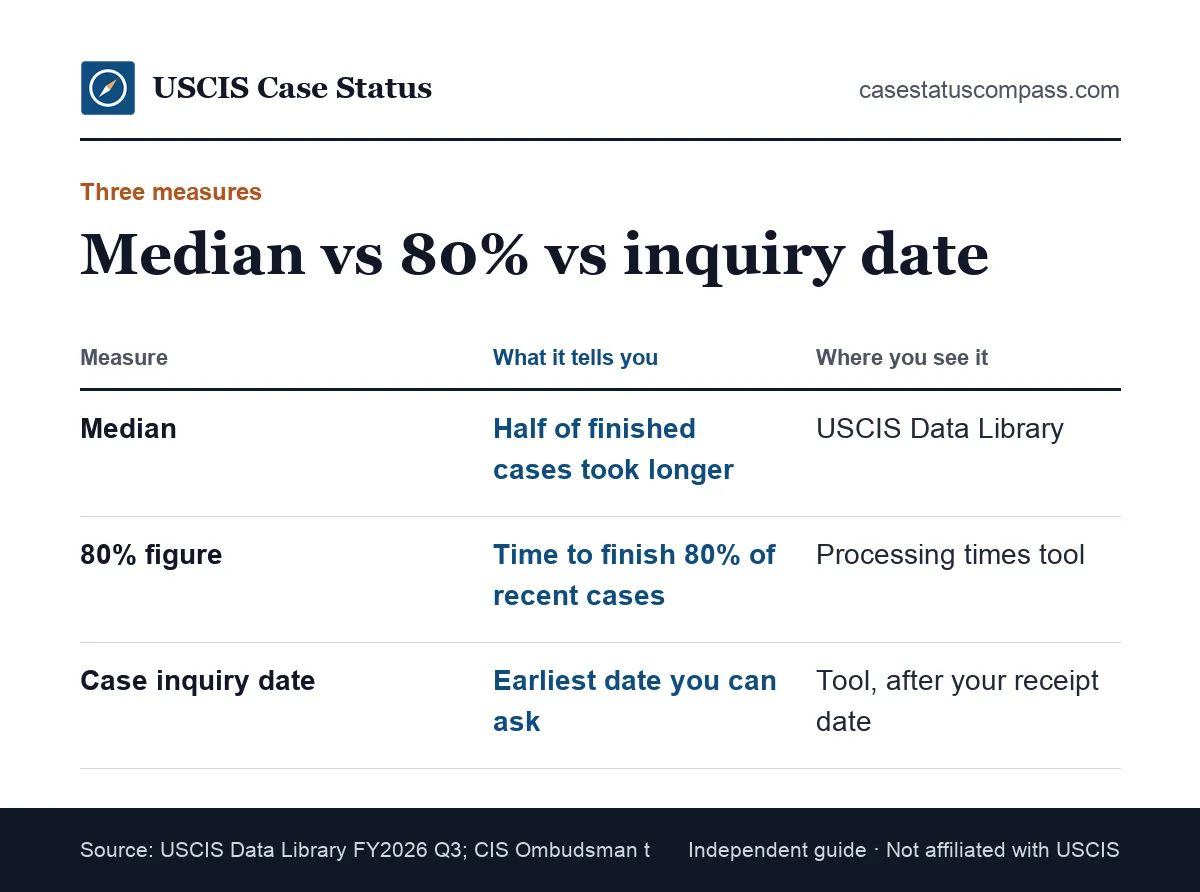
Both are official and useful for different jobs. The median shows the middle case: half took longer. The 80% figure is slower: one in five took longer. The case inquiry date is the strictest mark, because it decides when USCIS will accept your question.
Compare like with like
USCIS quarterly data reports the median: half of the cases completed that quarter took longer. A median is almost always shorter than an 80% figure for the same form. Never set a median from one source against an 80% figure from the other.
USCIS Processing Times by Form: Medians for April–June 2026
The table lists official USCIS medians for cases completed April 1 to June 30, 2026 (fiscal year 2026, quarter three). The linked pages break each form down by category and office. Values are in months, exactly as USCIS published them, and sorted from fastest to slowest.
Median months for 14 form categories
Find your form in the first column, then open its detail page for the category and office split.
| Form | Category | Median months | Detail page |
|---|---|---|---|
| I-765 | All other work permit categories | 3.3 | Work permit |
| I-140 | Immigrant petition for alien workers | 3.9 | I-140 |
| I-90 | Green card renewal or replacement | 5.5 | Renewal |
| I-131 | Advance parole (inside the U.S.) | 5.8 | I-131 |
| I-485 | Employment-based | 6.0 | Green card |
| I-765 | Based on a pending I-485 | 6.4 | Work permit |
| I-485 | Family-based | 7.0 | Green card |
| I-129F | Fiancé(e) petition (K-1) | 9.0 | K-1 |
| N-400 | Naturalization | 9.5 | N-400 |
| I-129 | All classifications combined | 9.5 | H-1B |
| I-130 | Immediate relative | 13.0 | I-130 |
| I-131 | Reentry permit / refugee travel document line | 14.4 | I-131 |
| I-751 | Removal of conditions | 22.6 | I-751 |
| I-130 | All other relatives | 43.3 | I-130 |
Takeaway: the slowest line, other-relative I-130s, took more than 13 times as long as most work permits.
How we built the table
Every value comes unchanged from the USCIS Data Library report for FY2026 Q3. The live tool splits by office and uses the 80% measure, so it usually shows longer times. PERM is missing because the Department of Labor runs it.
Have USCIS Processing Times Gotten Longer in 2026?
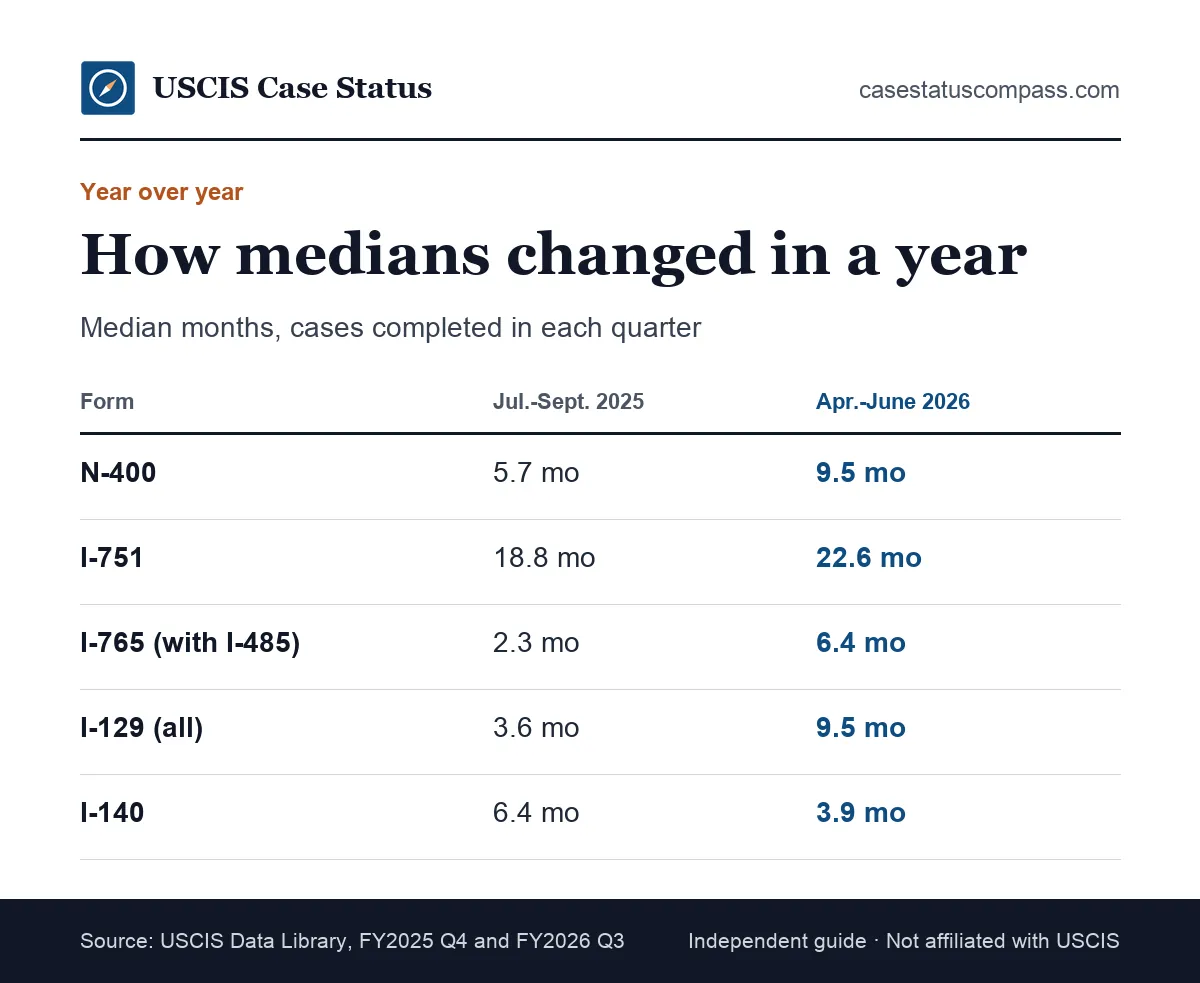
Yes, for most forms. Comparing USCIS medians for July–September 2025 with April–June 2026, naturalization rose from 5.7 to 9.5 months, removal of conditions from 18.8 to 22.6, and I-129 worker petitions from 3.6 to 9.5. Form I-140 fell from 6.4 to 3.9 months.
What changed in the backlog
At the end of June 2026, USCIS reported 12.8 million cases pending at USCIS (end of June 2026). Work permits for adjustment applicants changed most, from 2.3 to 6.4 months.
Forms that held steady
Work permits in "all other" categories stayed at 3.3 months in both quarters. Family I-485 medians moved from 6.0 to 7.0 months, while employment I-485 medians fell from 7.5 to 6.0.
How Long Does the Immigration Process Take Overall?
The immigration process takes from a few months to many years, because it chains several forms together. A sibling's green card can take years because of visa limits. Add up the forms on your path and check which steps can run at the same time, because that decides the total.
Family and employment paths
A U.S. citizen's spouse living in the U.S. often files the I-130 and I-485 together, so the clocks overlap. An employment case usually runs Department of Labor steps first, then the I-140, then the I-485, and those steps cannot overlap.
Humanitarian paths
Humanitarian cases often run longest. The USCIS median for asylum-based green cards was 25.6 months in April–June 2026; refugee-based cases were at 17.6 months. Our asylum case status guide covers that process.
How Long Does a Green Card Take?
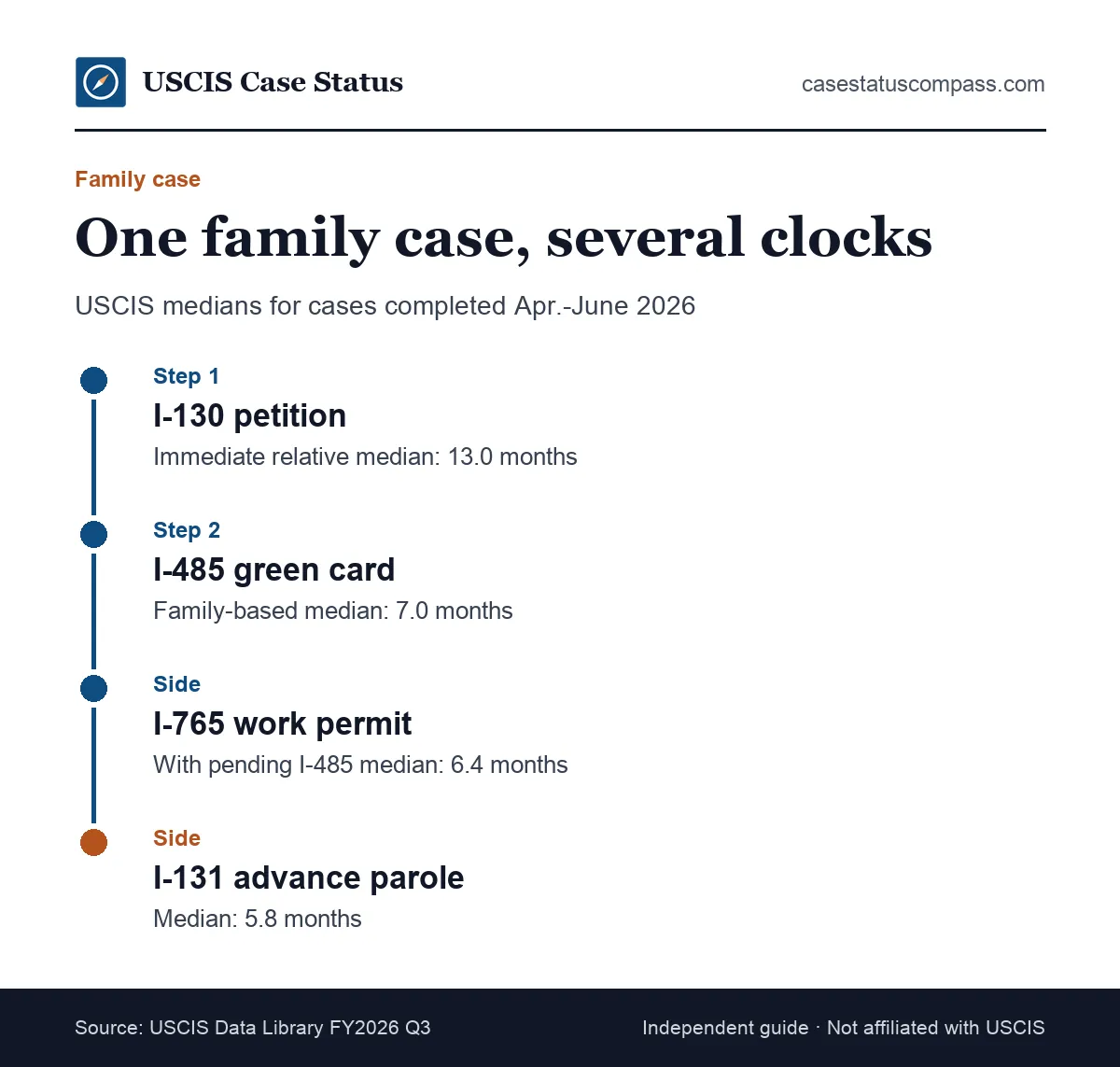
A green card through adjustment of status had a USCIS median of 7.0 months for family cases and 6.0 months for employment cases completed in April–June 2026. That covers the I-485 only. Right now, family and employment adjustment cases take 8.5 to 42.5 months, depending on category and office (USCIS data retrieved Oct 27, 2026).
How long does it take to adjust status?
Adjusting status means getting a green card from inside the U.S. on Form I-485. Our green card processing time page breaks it down by category and office. Check the category line that matches your notice, not the overall figure.
Who files the I-485
Relatives of U.S. citizens, workers with approved I-140s, and asylees and refugees all file the I-485. Employment and preference cases also need a current priority date, which the visa bulletin sets each month.
How Long Does Form I-130 Take?
Form I-130, the Petition for Alien Relative, had a USCIS median of 13.0 months for immediate relatives and 43.3 months for all other relatives in April–June 2026. Immediate relatives are spouses, unmarried children under 21 and parents of adult U.S. citizens.
How long does the petition for alien relative take for a spouse?
A U.S. citizen's spouse is an immediate relative, so the 13.0-month median applies; current petitions in that category take 53 to 83.5 months, depending on category and office (USCIS data retrieved Oct 27, 2026). The i 130 processing time guide compares each relationship.
Why other relatives wait longer
Siblings, married children and spouses of permanent residents fall into preference categories with yearly caps. USCIS may approve the petition, but the relative still waits for a visa number. For filing steps, see Form I-130 petition steps.
How Long Does Naturalization Take?
Naturalization on Form N-400 had a USCIS median of 9.5 months for cases completed in April–June 2026, up from 5.7 months a year earlier. The wait covers biometrics, the interview and civics test, and the oath. Today, most N-400 cases take 10 to 15 months, depending on category and office (USCIS data retrieved Oct 27, 2026).
Who files and when
Permanent residents usually apply after five years, or three if married to a U.S. citizen. You can file the N-400 up to 90 days before you reach 5 years (or 3 years if married to a U.S. citizen) as a permanent resident. See how long does naturalization take for office detail.
Where the N-400 time goes
Most of the wait sits between biometrics and the interview, which local field offices schedule. Our citizenship interview guide explains the day itself. City offices with heavy demand often run behind smaller ones.
How Long Does Removing Conditions Take?
Removing conditions with Form I-751 had a USCIS median of 22.6 months in April–June 2026, up from 18.8 months a year earlier. Most cases now take 36 months (USCIS data retrieved Oct 27, 2026). That makes it the second-slowest line in our April–June 2026 table.
How long does conditional residency status last?
Conditional residency lasts two years. Most green cards are valid for 10 years; conditional green cards for 2 years. File in the 90 days before your 2-year card expires. After filing, the I-751 receipt notice extends conditional status and work authorization for 48 months, which covers most of the wait.
The removal of conditions timeline in short
The removal of conditions timeline runs from filing to biometrics, sometimes an interview, then a 10-year card. USCIS must decide a pending I-751 before or at the same time as the N-400. The i 751 processing time page shows each stage and its delays.
Work Permit (EAD) Wait Times at a Glance
A work permit on Form I-765 had a USCIS median of 6.4 months for applicants with a pending I-485 and 3.3 months for all other categories in April–June 2026. Asylum applicants had a 0.8-month median. Today, most requests take 1 to 18.5 months, depending on category and office (USCIS data retrieved Oct 27, 2026).
How Long Does It Take to Get Papers to Work?
"Getting papers" usually means the Employment Authorization Document (EAD). For most applicants, that wait is the Form I-765 line in the official tool. The wait depends on your category code; DACA work permits had a 4.1-month median. See how long does it take to get a work permit for every major category.
Renewals need extra lead time
Ended: renewals filed on or after Oct. 30, 2025 no longer get the up-to-540-day automatic extension (exceptions: TPS by law/Federal Register notice; STEM OPT 180 days). File as early as USCIS allows. The Form I-765 guide covers editions and filing rules.
How Long Does a Travel Document Take?
A travel document on Form I-131 had a USCIS median of 5.8 months for advance parole and 14.4 months on the reentry permit and refugee travel document line in April–June 2026. Today, reentry permits and refugee travel documents take 16.5 months (USCIS data retrieved Oct 27, 2026).
How long does the travel document take for green card applicants?
People with a pending I-485 usually request advance parole, the 5.8-month line. A 2026 ruling raised the stakes: Since Aug. 13, 2026, travel on advance parole counts as a departure: over 180 days of unlawful presence can trigger the 3/10-year bar. Read the i 131 processing time page before booking.
Reentry permits
A reentry permit protects a green card holder on long trips. Reentry permit: generally valid 2 years (1 year if abroad more than 4 of the last 5 years). You must file and give biometrics in the U.S. The Form I-131 guide explains which document fits your trip.
How Long Does Green Card Renewal Take?
Green card renewal or replacement on Form I-90 had a USCIS median of 5.5 months in April–June 2026, up from 4.6 months a year earlier. Most renewals now take 10.5 months (USCIS data retrieved Oct 27, 2026). File early if you need travel or job proof soon.
Proof of status during the wait
I-90 receipt notice + expired card = proof of status for 36 months from the card's expiration date. See how long does green card renewal take for timing detail and stamp options.
When to file
File I-90 if your card is lost, damaged, wrong, expiring within 6 months, or you turned 14. Filing soon after you become eligible keeps any gap in proof small. The Form I-90 guide covers steps and fees.
How Long Does Form I-140 Take?
Form I-140, the immigrant petition for alien workers, had a USCIS median of 3.9 months in April–June 2026, down from 6.4 months a year earlier. Most I-140s now take 3 to 32.5 months, depending on category and office (USCIS data retrieved Oct 27, 2026). Many categories can also buy premium processing.
Who files the I-140
Employers file most I-140s for EB-2 and EB-3 workers after a certified PERM. A PERM labor certification expires 180 days after DOL certifies it. See the i 140 processing time page for each category.
Premium processing for the I-140
For eligible categories, the premium clock is set: 15 business days (I-129, most I-140); 30 (I-765 OPT, I-539 F/M/J); 45 (I-140 E13 managers and NIW). The Form I-140 guide explains who signs and pays.
How Long Does PERM Labor Certification Take?
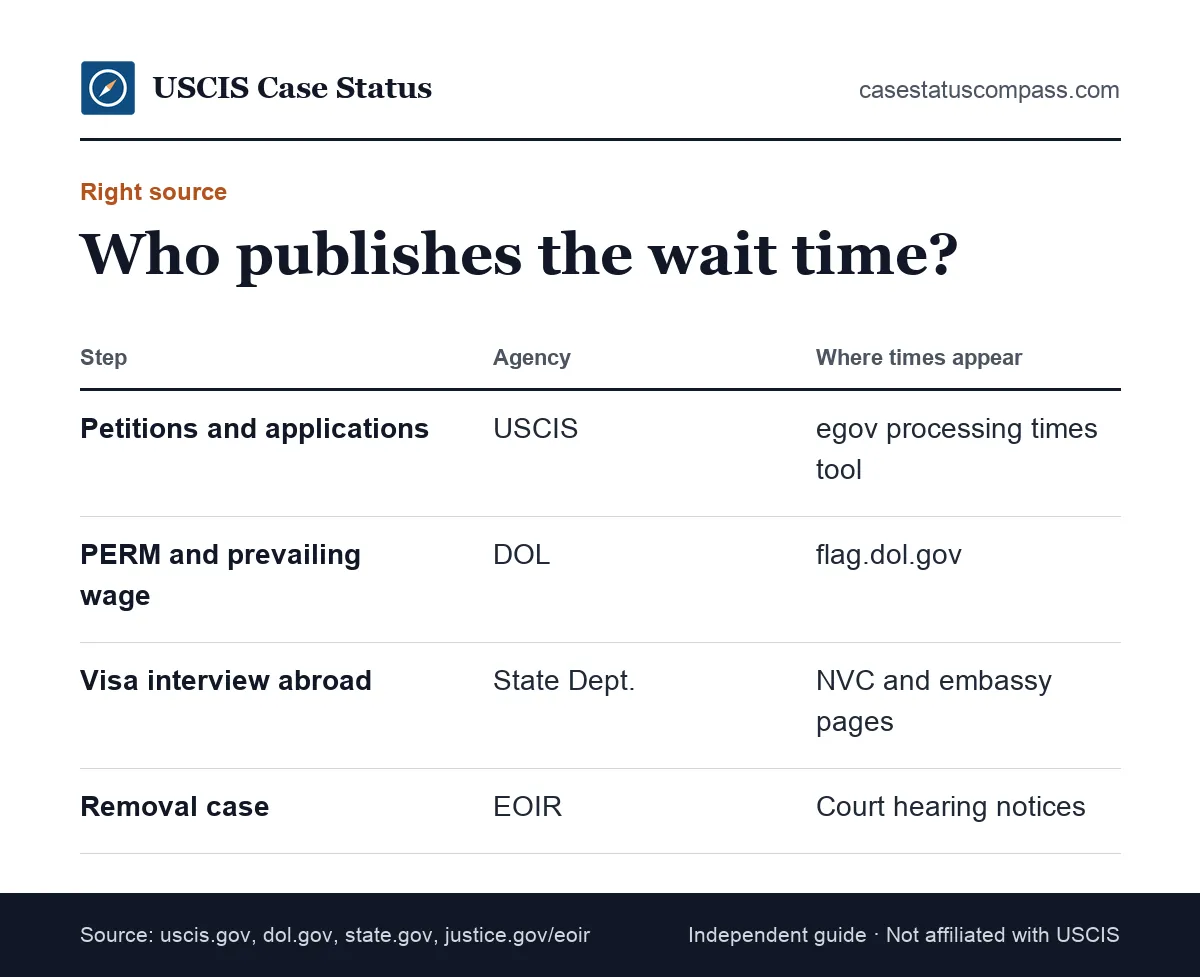
PERM labor certification belongs to the Department of Labor (DOL), not USCIS, so it is not in the USCIS tool. DOL posts its own labor processing time on flag.dol.gov. Right now, DOL analyst review is working on PERM cases filed in January 2026 (as of Oct. 5, 2026).
What PERM covers
PERM is the first step for most EB-2 and EB-3 green cards. The employer gets a prevailing wage, recruits, then files Form ETA-9089. DOL reported 147,884 PERM applications pending at DOL (Mar. 31, 2026). The perm processing time page explains each DOL stage.
Where the labor processing time is posted
DOL lists the months it is working on for prevailing wage requests, analyst review and audits. Compare your filing month with the month DOL shows. Employers track the case; see our PERM case status guide.
How Long Does H-1B Processing Take?
H-1B petitions use Form I-129. The USCIS median for all I-129 classifications combined was 9.5 months in April–June 2026, but USCIS publishes no H-1B-only median. Many H-1B employers use premium processing for a decision within 15 business days. Cap cases also depend on selection in the annual registration.
Who depends on the H-1B petition
H-1B workers, their employers and H-4 family members depend on this petition. H-1B cap: 65,000 a year + 20,000 for U.S. master's degree or higher. The h1b processing time page covers cap, transfer and extension timing.
Why the H-1B number is hard to pin down
The median mixes every I-129 class, so an H-1B transfer and an L-1 extension share one figure. The tool splits by class and office; today, I-129 cases take 15 days to 20 months, depending on category and office (USCIS data retrieved Oct 27, 2026). See the H-1B visa status guide for filing.
How Long Does the K-1 Fiancé Visa Take?
The K-1 fiancé(e) visa starts with Form I-129F, which had a USCIS median of 9.0 months in April–June 2026, up from 7.9 months a year earlier. The State Department visa stage adds its own wait. Plan on both agencies' waits, not just the USCIS line.
Who files the I-129F
U.S. citizens engaged to a partner abroad file the I-129F. K-1: you must have met in person within the 2 years before filing (waivers possible). K-1: marry within 90 days of entering the U.S. The k1 visa processing time page covers each agency stage.
The two-agency handoff
USCIS approval is half the trip. An approved K-1 petition is valid for 4 months (can be revalidated). Today, the I-129F step takes 13 months (USCIS data retrieved Oct 27, 2026). The K-1 visa guide explains documents and fees.
How Do the Processing-Time Pages Fit Together?
The processing-time pages work like a journey map. Each form has its own clock, and most goals need several forms. Some forms run in parallel. Read them in the order shown, since a later form often waits on an earlier approval.
Forms and pages by immigration goal
Find your goal in the first column, then read the pages in the order listed.
| Your goal | Forms, in order | Pages to read |
|---|---|---|
| Green card through a U.S. citizen spouse | I-130 + I-485, with I-765 and I-131 | I-130, green card |
| Green card through a job | PERM, then I-140, then I-485 | PERM, I-140 |
| 10-year card after marriage | I-751 | I-751 |
| Citizenship | N-400 | N-400 |
| Work or travel while a case is pending | I-765, I-131 | Work permit, I-131 |
| Fiancé(e) to the U.S. | I-129F, then State Dept. visa | K-1 |
Most goals need more than one form, so the total wait is rarely the figure for any single form.
Parallel and sequential steps
A family I-485 filed with an I-765 and I-131 starts three clocks on one day; the work permit and travel document usually come first. Sequential steps, like PERM then I-140, cannot overlap, so you add those waits together.
Where other agencies come in
USCIS times stop at USCIS. Consular visas belong to the State Department and removal cases to immigration court. Our NVC case status and immigration court case status guides explain those systems.
Processing Times by Service Center and Field Office
USCIS processing times differ by office because each has its own staff and caseload. Mail-in forms go to service centers; interviews happen at field offices. Five USCIS service centers: California, Nebraska, Potomac, Texas and Vermont. The tool asks for your office so it shows the right queue, separate from your uscis case status result.
Service center vs field office
Service centers decide paper files such as I-130s, I-765s and many I-129s without meeting you. Field offices interview green card and citizenship applicants, so their times depend on local interview slots and staffing.
Finding your office
Your receipt notice and receipt prefix show where the case started. If USCIS moves it, a transfer notice follows and the new office's time applies. Our uscis service centers guide lists what each center handles.
California Service Center Processing Times
California processing times usually mean the California Service Center, one of the five USCIS service centers. Its receipt numbers start with WAC. Select it in the tool only if your notice shows it, because USCIS assigns work nationally, not by where you live.
Reading California times correctly
Choose your form and category, then "California Service Center" from the office list. If it does not appear for your form, another office handles that form. Recheck the office after any transfer notice arrives.
California field offices are separate
California also has field offices for interviews, such as those serving Los Angeles and San Francisco. Their times sit under each field office in the tool, not under the service center. For an N-400 or interview-based I-485, check the field office line.
Why Do Field Offices Have Different Processing Times?
Field offices differ because local staffing, interview space and case mix vary. Your office generally follows your address. That is why two N-400 applicants who filed the same week in different cities can see very different figures. You cannot choose a faster office by filing elsewhere, so compare only your own office's line.
Moving during a pending case
Report a new address to USCIS within 10 days of moving (INA 265). A move can transfer your file to a new office with a different queue. Read our change of address guide before moving while a case is open.
Does a Transfer Reset Your USCIS Processing Time?
After a transfer, the new office's time applies, but your receipt date does not reset. Transfers follow a move or USCIS workload balancing, and the notice names the new office. Recalculate your inquiry date in the tool. The case was transferred guide explains the status message.
What Is a Case Inquiry Date?
The case inquiry date is the earliest date USCIS will accept a question about why your pending case is slow. The tool calculates it from your receipt date. Before it, your case counts as normal. It is personal to your receipt date.
How to find yours
After you pick form, category and office, enter your receipt date in the "When can I ask about my case?" box. The tool shows your inquiry date or says you may ask now.
Why it moves
The inquiry date follows the current processing time, so it can shift later when the queue slows. If your form is not in the tool's menu, you can ask once it has been pending more than six months.
Inquiry date vs posted time
The inquiry date usually falls later than the 80% figure suggests. "Past the posted time" is not the same as "past the inquiry date." Only the second lets you file a formal outside-normal request.
How Do You Know If Your Case Is Outside Normal Processing Time?
Your case is outside normal processing time when today is after the case inquiry date for your form, category, office and receipt date. Being past the 80% figure alone is not enough. Enter the received date from your notice, not the notice date, when you check.
Normal, late or eligible to ask: five situations
Match your situation to a row; the middle column shows how USCIS will treat your case if you ask.
| Your situation | What USCIS sees | What to do |
|---|---|---|
| Within the posted time | Normal | Wait and watch your mail |
| Past the posted time, before the inquiry date | Still normal | Recheck monthly; answer any RFE |
| Past the inquiry date | Outside normal processing time | Submit an outside-normal service request |
| Form not listed, pending over 6 months | Eligible to ask | Contact USCIS with your receipt number |
| Status unchanged for months | Often normal | Read the status-not-updating guide |
Only the third and fourth rows open a formal service request.
A quiet status is not a late case
Many cases sit on one message for months. Our guide on a uscis case status not updating explains why that is often normal. Judge delay by your inquiry date, not by how long one message has stayed the same.
Rule out fixable problems
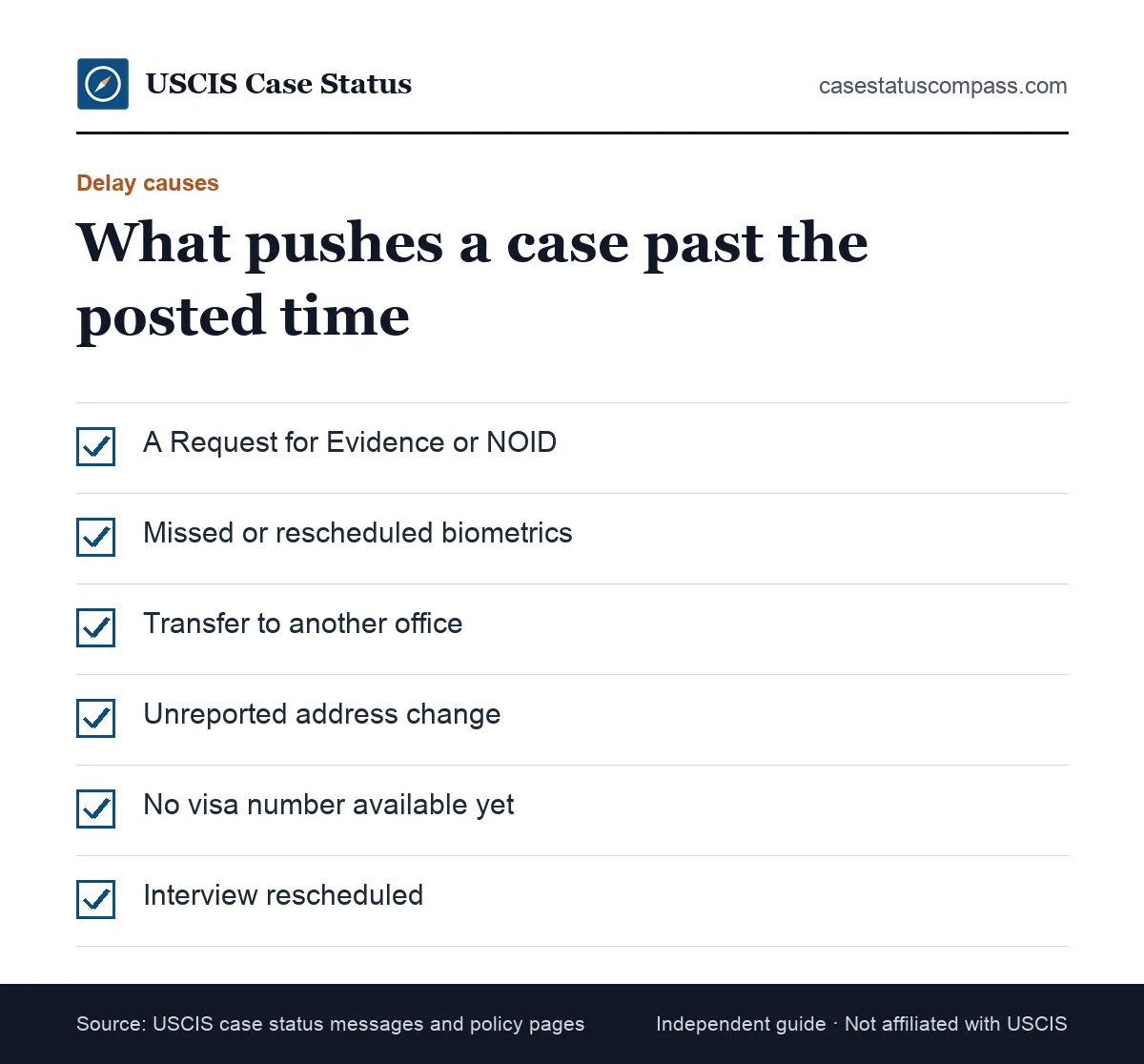
Before calling it a delay, look for an unanswered Request for Evidence, a missed biometrics letter or an old address. Each of these can stall a file even when USCIS is on schedule.
What Should You Do When Your Case Is Outside Normal Processing Time?
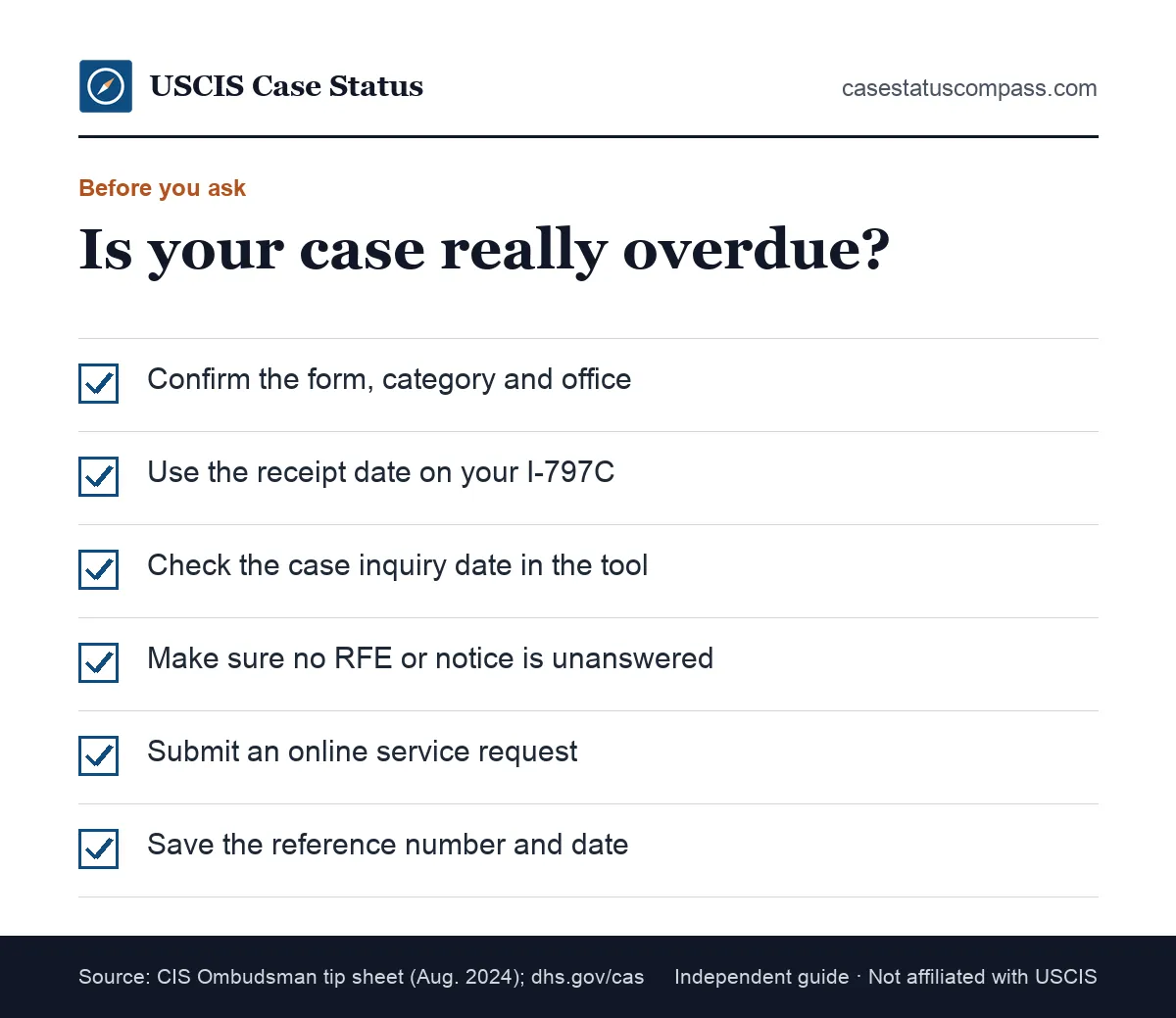
Submit an outside normal processing time service request online or through the USCIS Contact Center. You can submit an 'outside normal processing time' request only after your case inquiry date. Keep the reference number. If USCIS does not resolve it, escalate to the CIS Ombudsman or a congressional office.
Step 1: Send the service request
Use the inquiry link the tool shows once your date passes, or call 800-375-5283. Give your receipt number, form, category and office. H-2A, DACA renewal and Rosario class cases have their own outside-normal process.
Step 2: Keep records
Note the date, the reference number and what USCIS said. If USCIS asks for anything, answer by the deadline printed on the notice. Sending duplicate requests too soon rarely helps.
Step 3: Escalate if nothing moves
If the reply does not resolve the delay, move to the Ombudsman or Congress. Our contact USCIS guide lists every official channel, including e-Request, which covers typos and missing notices rather than delays.
Who Can Help After USCIS Fails to Respond?
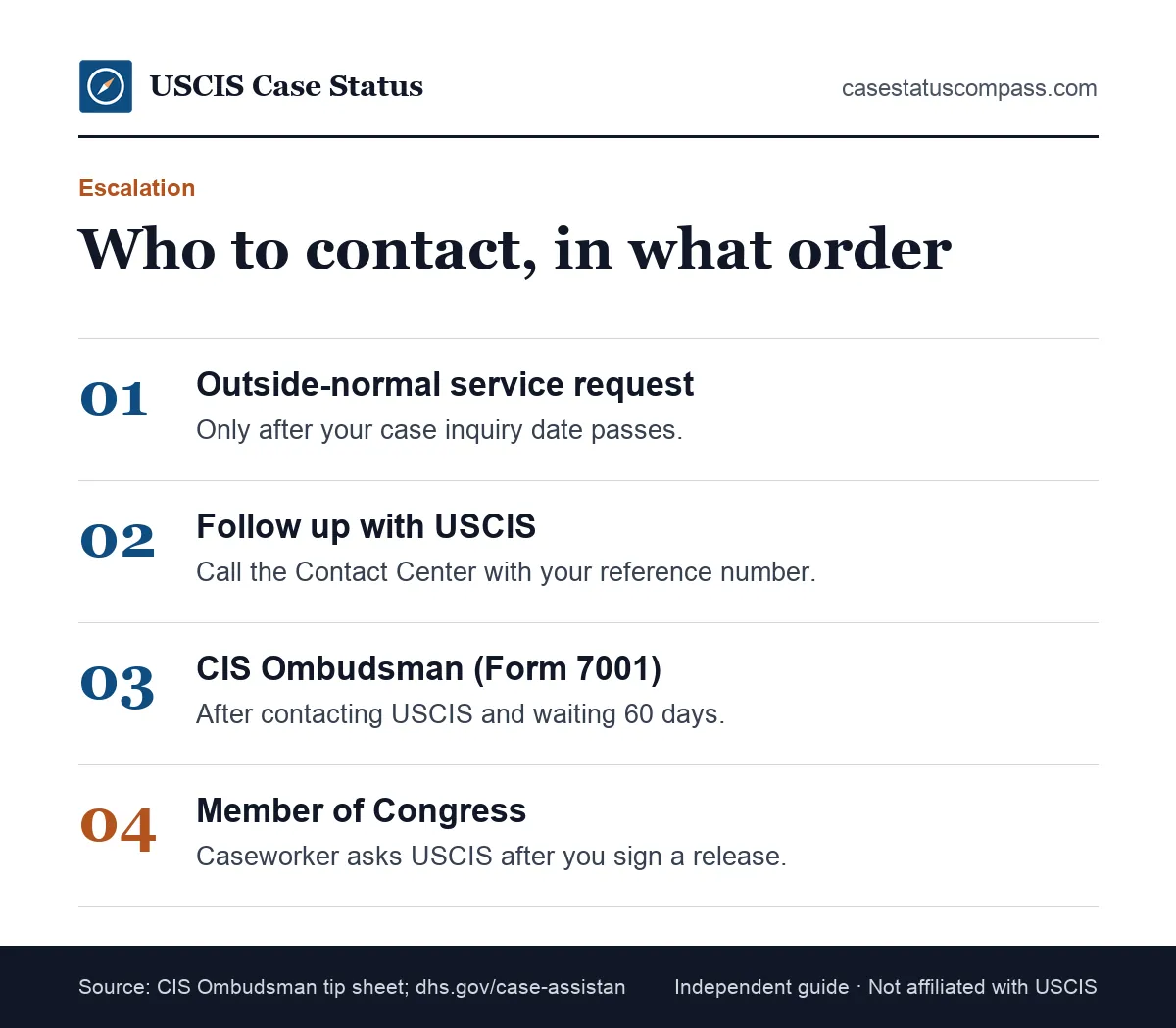
The CIS Ombudsman and your member of Congress can both ask USCIS about a stalled case, for free. Use the Ombudsman only after contacting USCIS within 90 days and waiting at least 60 days. Neither can force an approval or override a USCIS decision.
The CIS Ombudsman
The Ombudsman is part of the Department of Homeland Security, separate from USCIS. The request form is CIS Ombudsman: DHS Form 7001, Request for Case Assistance (online). See the ombudsman and congressional inquiry guide for the limits.
Your member of Congress
Your member of Congress can ask USCIS about your case after you sign a privacy release. The Ombudsman will not take a case with a congressional inquiry under 45 days old, so use one route at a time.
What Slows a USCIS Case Down?
A USCIS case slows when the file needs extra work or the queue grows. File-level causes include RFEs, missed appointments, transfers, address problems and visa limits. Queue-level causes include rising filings, staffing shortfalls and policy changes that add review steps. You can fix many file-level causes; queue causes you can only plan around.
Delays you can prevent
Answer every RFE fully: RFE deadline: up to 12 weeks (the exact date is on your RFE); no extensions. Two forms are stricter: RFEs for Form I-539 and Form I-601A allow at most 30 days (all other forms up to 84 days), plus 3 days if mailed. Security checks, interview backlogs and visa limits are outside your control. Attend biometrics. Missing biometrics can lead to denial for abandonment. Our request for evidence guide explains how to reply.
Can You Speed Up Your USCIS Case?
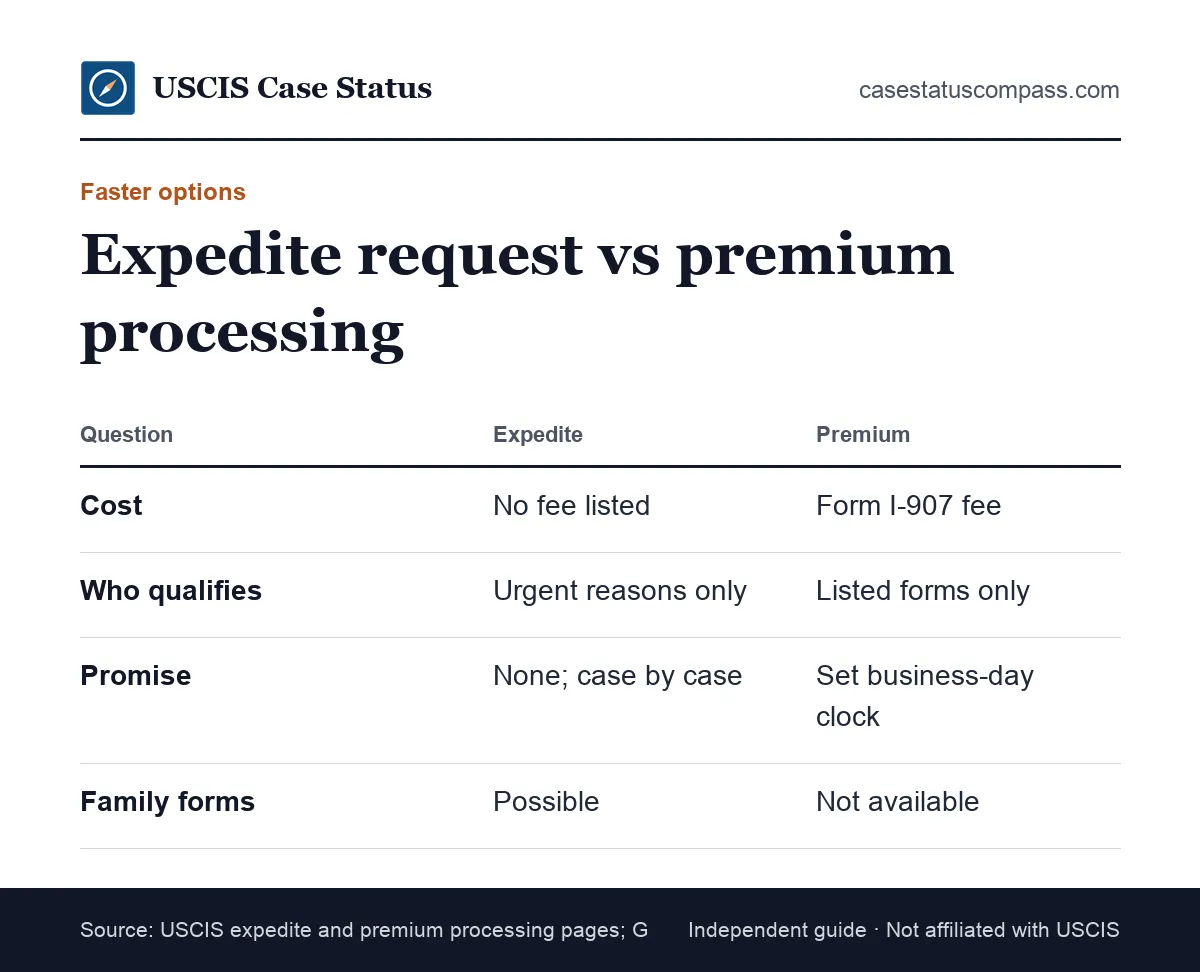
You can sometimes speed up a case in two official ways: an expedite request, which USCIS may grant for urgent reasons, or premium processing, a paid service for certain forms. Neither is open to every form, and neither guarantees an approval.
What does not help
Repeated calls, duplicate filings and paid "speed-up" services do not move you ahead. The fastest lawful step is a complete, correct filing. Be wary of anyone who charges to "push" a case; no outside service can move your place in the queue.
Picking the right route
If your form qualifies for premium processing, use it. USCIS generally will not consider an expedite for a premium-eligible form, except for IRS-designated nonprofits. For family and citizenship forms, the expedite route is the only option.
When Does a USCIS Expedite Request Make Sense?
An expedite makes sense when you have an urgent, documented reason USCIS recognizes. Expedite criteria: severe financial loss, emergency/humanitarian, nonprofit, government interest, clear USCIS error. Meeting one does not guarantee approval. USCIS decides each request case by case and can ask for more proof.
How to ask
Ask for an expedite through the USCIS Contact Center or your online account. Our uscis expedite request guide shows evidence that works. Attach proof such as a medical letter, a job-loss notice or a travel need.
When an expedite is a poor fit
Vacations, general frustration and delays you caused, such as filing late, rarely qualify. If you are simply past the posted time, use the inquiry route once your date arrives instead.
Which Forms Qualify for Premium Processing?
Premium processing covers only certain work and student forms. Premium processing covers I-129 work visas, I-140 (EB-1/2/3), I-765 OPT/STEM OPT and I-539 to F/M/J. You file Form I-907 with an extra fee, and USCIS commits to act within set business days. Family and citizenship forms do not qualify.
Premium processing clocks by form
The clock counts business days, so weekends and federal holidays do not count.
| Form | USCIS clock |
|---|---|
| I-129 (most classes, incl. H-1B) | 15 business days |
| I-140 (most EB-1, EB-2, EB-3) | 15 business days |
| I-140 (managers, national interest waiver) | 45 business days |
| I-765 (OPT, STEM OPT) and I-539 (to F, M or J) | 30 business days |
Check the form instructions for category limits before you file Form I-907.
Fees and what is promised
As of the G-1055 edition dated 10/16/26, the fee is $2,965 (I-129 most classes, I-140); $1,780 (H-2B/R, I-765 OPT); $2,075 (I-539 to F/J/M). Premium promises action, not approval. An RFE stops the premium clock; a new period starts when USCIS gets your response. The premium processing guide explains filing.
Premium does not reach every step
Premium covers only the petition it joins; it does not speed the PERM before an I-140 or the I-485 after it. You can't get a fee waiver for premium processing. Check the USCIS fee schedule before paying.
How Do You Estimate Your Own Case Timeline?
Start from your receipt date, add the current posted time for your form, category and office, then add a buffer for biometrics, interviews and any RFE. Compare the result with your case inquiry date. If the two differ, plan around the later date.
A worked N-400 example
Say your N-400 receipt date is March 1, 2026. The April–June 2026 median was 9.5 months, so a middle case would finish around mid-December 2026. Your local 80% figure will likely be later.
Keep a tracking log
Write down your receipt date, form, category, office, the posted figure and your inquiry date, then add each notice. Bring it if you call USCIS or meet an immigration attorney.
Why Is My Case Taking Longer Than the Posted Time?
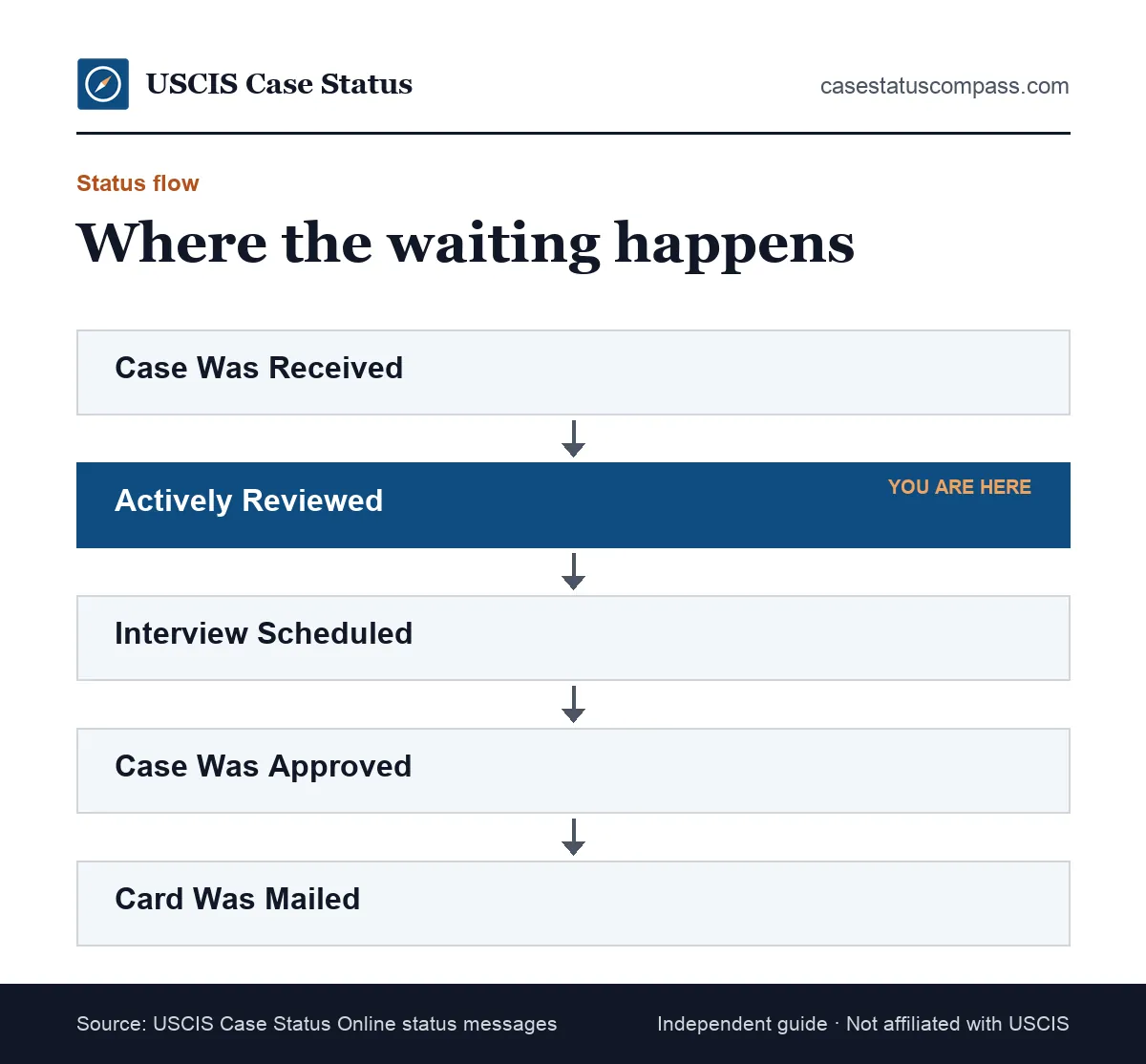
Your case can run past the posted time because the figure covers only 80% of recent cases; one in five takes longer. Until your inquiry date passes, USCIS treats it as normal. A single RFE or transfer can push a file into that slower group.
While you wait
Keep your address current, answer every notice and check your online account. Recheck USCIS processing times and your inquiry date monthly. Do not leave the U.S. during a pending I-485 without advance parole.
When to get legal help
Talk to an immigration attorney or DOJ-accredited representative if your case is far past the inquiry date with no answer, a notice confuses you, or your status is at risk. We do not give legal advice.
Frequently Asked Questions
How long does immigration take?
It takes as little as a few months for one form, such as a work permit, and many years for some family categories. USCIS medians for April–June 2026 ran from 3.3 months for most work permits to 43.3 months for some relative petitions.
How long does it take USCIS to process a case?
It depends on the form, category and office. The official tool shows how long USCIS took to finish 80% of similar cases in the past six months. For example, the April–June 2026 median was 9.5 months for naturalization and 22.6 months for removing conditions.
Are USCIS processing times the same in every state?
No. Times depend on the office holding your case. Field offices serve local areas, so interview-based forms like the N-400 vary by city. Service centers take files from many states, so where you live often does not matter for mail-only forms.
Does calling USCIS make my case faster?
No. Before your case inquiry date, the Contact Center will usually say the case is within normal processing. After that date, a call or online request creates a formal record USCIS must answer.
Why did the processing time for my form go up?
Times rise when USCIS receives more cases than it finishes, or when staffing and policies change. Between July–September 2025 and April–June 2026, USCIS medians rose for most forms, including naturalization and removal of conditions.
Can I check other agencies' times in the USCIS tool?
No. The USCIS tool covers only USCIS forms. Labor certification times are on the Department of Labor's flag.dol.gov. Visa interviews abroad depend on the State Department, and immigration court cases follow court schedules. Check each agency's own source.
How long does it take to get the travel document?
It depends on the type. USCIS's April–June 2026 median was 5.8 months for advance parole and 14.4 months on the reentry permit and refugee travel document line. Check the tool before booking travel.
How long is the immigration process for a spouse of a U.S. citizen?
A spouse inside the U.S. usually files Form I-130 and Form I-485 together, so the clocks overlap. USCIS's April–June 2026 medians were 13.0 months for immediate-relative I-130s and 7.0 months for family I-485s.
Sources
- USCIS: Check Case Processing Times. egov.uscis.gov/processing-times/. Accessed Oct 27, 2026.
- USCIS Data Library: All Application and Petition Form Types, FY2026 Q3. www.uscis.gov/sites/default/files/document/data/quarterly_all_forms_fy2026_q3_v1.xlsx. Accessed Oct 27, 2026.
- USCIS Data Library: All Application and Petition Form Types, FY2025 Q4. www.uscis.gov/sites/default/files/document/data/quarterly_all_forms_fy2025_q4_v1.xlsx. Accessed Oct 27, 2026.
- CIS Ombudsman: Check Your USCIS Case Inquiry Date (tip sheet, Aug. 2024). dhs.gov/sites/default/files/2024-11/24_0823_cisomb_case-inquiry-date-tip-sheet.pdf. Accessed Oct 27, 2026.
- USCIS: How to Make an Expedite Request. www.uscis.gov/forms/filing-guidance/how-to-make-an-expedite-request. Accessed Oct 27, 2026.
- USCIS: How Do I Request Premium Processing?. www.uscis.gov/forms/all-forms/how-do-i-request-premium-processing. Accessed Oct 27, 2026.
- DHS CIS Ombudsman: How to Submit a Case Assistance Request. www.dhs.gov/case-assistance. Accessed Oct 27, 2026.
- USCIS Service Center Operations Directorate. www.uscis.gov/about-us/organization/directorates-and-program-offices/service-center-operations-directorate. Accessed Oct 27, 2026.
- DOL FLAG: Processing Times. flag.dol.gov/processingtimes. Accessed Oct 27, 2026.
- USCIS: Form N-400 page. www.uscis.gov/n-400. Accessed Oct 27, 2026.
- USCIS Glossary: Green Card. www.uscis.gov/tools/glossary. Accessed Oct 27, 2026.
- USCIS: Removing Conditions on Permanent Residence Based on Marriage. www.uscis.gov/green-card/after-we-grant-your-green-card/conditional-permanent-residence/removing-conditions-on-permanent-residence-based-on-marriage. Accessed Oct 27, 2026.
- USCIS Policy Manual Vol. 12, Part G, Ch. 5. www.uscis.gov/policy-manual/volume-12-part-g-chapter-5. Accessed Oct 27, 2026.
- USCIS: Automatic EAD Extension (updated 10/29/2025). www.uscis.gov/working-in-the-united-states/information-for-employers-and-employees/automatic-employment-authorization-document-ead-extension. Accessed Oct 27, 2026.
- USCIS: Form I-131 page alert (updated 10/07/2026). www.uscis.gov/i-131. Accessed Oct 27, 2026.
- Form I-131 Instructions, Edition 01/20/25; 8 CFR 223.3(a)(1). www.uscis.gov/sites/default/files/document/forms/i-131instr.pdf. Accessed Oct 27, 2026.
- USCIS: Replace Your Green Card (updated 09/12/2025). www.uscis.gov/green-card/after-we-grant-your-green-card/replace-your-green-card. Accessed Oct 27, 2026.
- Form I-90 Instructions, Edition 01/20/25. www.uscis.gov/sites/default/files/document/forms/i-90instr.pdf. Accessed Oct 27, 2026.
- USCIS: Form I-140 page (updated 07/24/2026). www.uscis.gov/i-140. Accessed Oct 27, 2026.
- DOL OFLC PERM Selected Statistics, FY2026 Q2. www.dol.gov/sites/dolgov/files/ETA/oflc/pdfs/PERM_Selected_Statistics_FY2026_Q2.pdf. Accessed Oct 27, 2026.
- USCIS: H-1B Specialty Occupations (updated 09/21/2026). www.uscis.gov/working-in-the-united-states/h-1b-specialty-occupations. Accessed Oct 27, 2026.
- Form I-129F Instructions, Edition 01/20/25. www.uscis.gov/sites/default/files/document/forms/i-129finstr.pdf. Accessed Oct 27, 2026.
- USCIS: Form I-129F page. www.uscis.gov/i-129f. Accessed Oct 27, 2026.
- 8 CFR 214.2(k)(5) (LII). www.law.cornell.edu/cfr/text/8/214.2. Accessed Oct 27, 2026.
- USCIS: How to Change Your Address (updated 08/04/2026); 8 U.S.C. 1305(a) (LII). www.uscis.gov/addresschange. Accessed Oct 27, 2026.
- USCIS Contact Center (uscis.gov). www.uscis.gov/contactcenter. Accessed Oct 27, 2026.
- USCIS OLA New Member Outreach FAQs (Jan. 2021). www.uscis.gov/sites/default/files/document/questions-and-answers/5%20117%20-%20New%20Member%20Outreach%20FAQs%2001042021.pdf. Accessed Oct 27, 2026.
- 8 CFR 103.2(b)(8)(iv) (LII). www.law.cornell.edu/cfr/text/8/103.2. Accessed Oct 27, 2026.
- USCIS Policy Manual Vol. 1, Part E, Ch. 6 (current as of Oct. 23, 2026). www.uscis.gov/policy-manual/volume-1-part-e-chapter-6. Accessed Oct 27, 2026.
- USCIS: Preparing for Your Biometric Services Appointment (updated 04/30/2026). www.uscis.gov/forms/filing-guidance/preparing-for-your-biometric-services-appointment. Accessed Oct 27, 2026.
- USCIS Form G-1055 Fee Schedule, Edition 10/16/26. www.uscis.gov/sites/default/files/document/forms/g-1055.pdf. Accessed Oct 27, 2026.
casestatuscompass.com is an independent publication and is not affiliated with USCIS or any government agency. This page is general information, not legal advice. For denials, court or asylum matters, consult an immigration attorney or a DOJ-accredited representative.