Contents · 41 sections
- Why Is Your USCIS Case Status Not Updating?
- Why Case Statuses Stop Updating
- Is It a Website Problem or a Case Problem?
- Why Does Your Online Account Show Something Different?
- What Does the "Last Updated" Date Tell You?
- Is Your Case Outside Normal Processing Time?
- What Is the Case Inquiry Date in the Processing Times Tool?
- How Do You Look Up the Inquiry Date for Your Case?
- How Long Can a USCIS Case Stay Pending?
- Why Are USCIS Cases Staying Pending Longer?
- Where Do Cases Usually Stall?
- Status Not Updating After an RFE Response
- Status Not Updating After a Transfer
- Status Not Updating After Approval
- I-485 Case Pending With No Updates
- I-130 Petition Not Updating
- I-765 Work Permit Status Stuck
- N-400 Not Updating After the Interview
- I-751 and I-90 Cases That Sit for Long Periods
- How Do You Prove Status While an I-751 or I-90 Is Pending?
- Asylum Case Pending: Why Updates Are Rare
- Step 1: Submit a Case Inquiry
- Can You Ask About a Stuck Case by Phone or Chat?
- What Should Your Case Inquiry Say?
- What Happens After You Submit an Inquiry?
- When Should You Escalate After a Case Inquiry?
- Step 2: Request an Expedite (if Eligible)
- Step 3: Ombudsman or Congressional Help
- Can You Sue USCIS Over a Delayed Case?
- Administrative Processing Explained
- How Long Does Administrative Processing Take?
- Visa Refused After Administrative Processing: What It Means
- "If X, Do Y": Stuck Status Decision Table
- A 6-Step Plan for a USCIS Case Status Not Updating
- What Should You Not Do While You Wait?
- Could a Missed Notice Be the Real Problem?
- How to Keep a Delay Log
- Does Contacting USCIS Hurt Your Case?
- When Should You Get Legal Help for a Stalled Case?
- Status Not Updating vs Other Status Problems
- Frequently Asked Questions
The short answer
A USCIS case status not updating usually means your file is waiting in a queue, not that it is lost. The status text changes only when an officer or system logs an action. Do something only when your receipt date is earlier than the case inquiry date in the official processing times tool, or when a notice you expected never arrived.
At a glance
| Is a frozen status bad news? | Usually not. Most cases sit unchanged for long stretches. |
| When can you ask about it? | You can submit an 'outside normal processing time' request only after your case inquiry date |
| Where to check the inquiry date | egov.uscis.gov/processing-times |
| First escalation | A case inquiry, then an expedite only if you qualify |
| Outside help | CIS Ombudsman or your member of Congress, after USCIS had time to answer |
Why Is Your USCIS Case Status Not Updating?
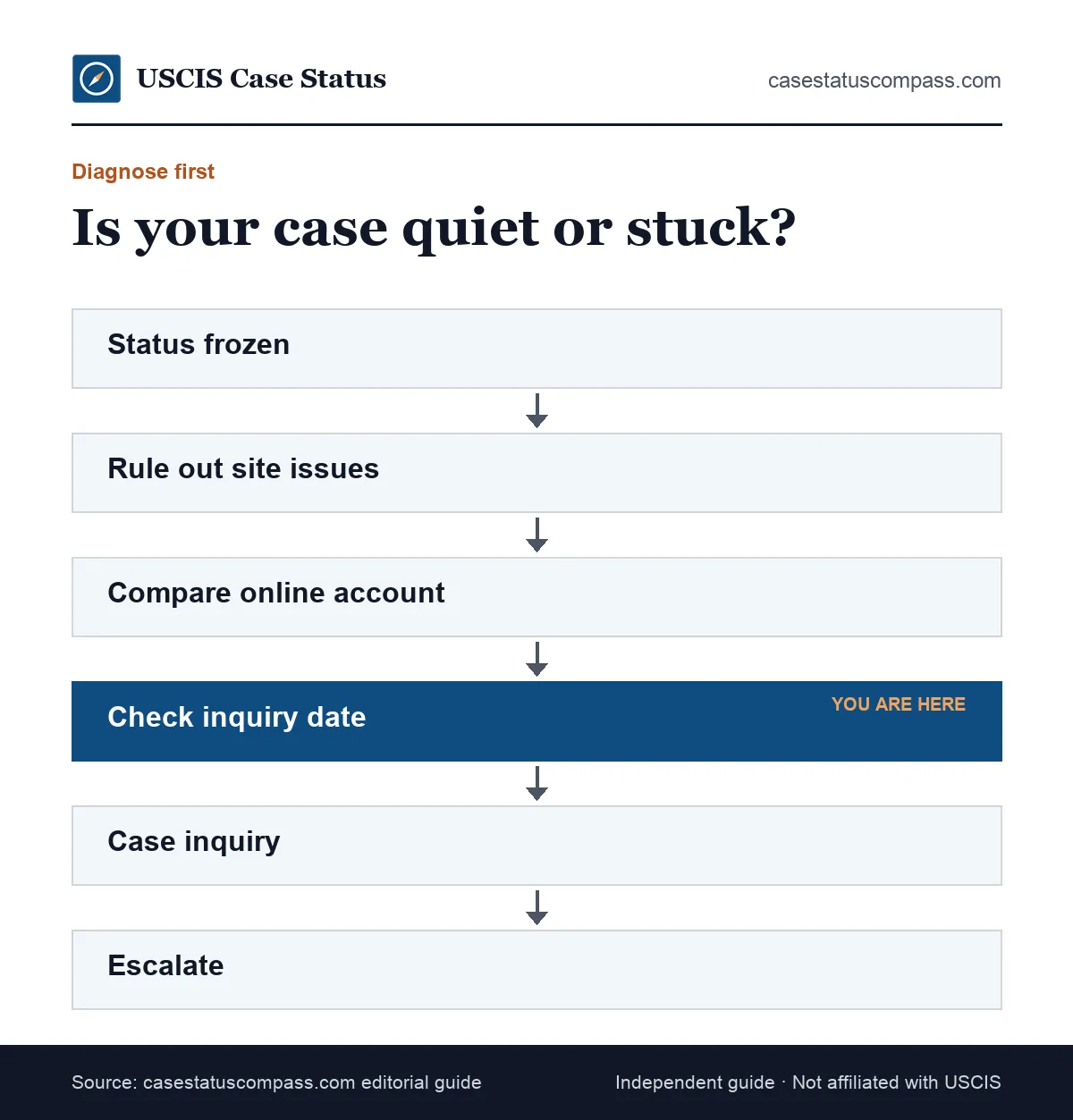
Your USCIS case status stays the same until a logged action changes it: a notice, a transfer, an interview or a decision. Between those events, officers may still be working, but nothing new is published. Before worrying, check your account and mail for anything newer.
How the status text is produced
The online message is a short label tied to the latest recorded event. Reading a file or running a check does not always create one, so the label can sit for months while work happens out of sight.
Quiet versus stuck
A quiet case is inside the normal window and simply waiting. A stuck case is past its case inquiry date or missing a step it should have reached. Only the second needs action.
Why Case Statuses Stop Updating
Case statuses stop updating for three ordinary reasons: the file is waiting for an officer, background checks are running, or the file is moving between offices. Unusual causes, such as a lost notice or a wrong address, are rarer but need fast action.
Queues and officer assignment
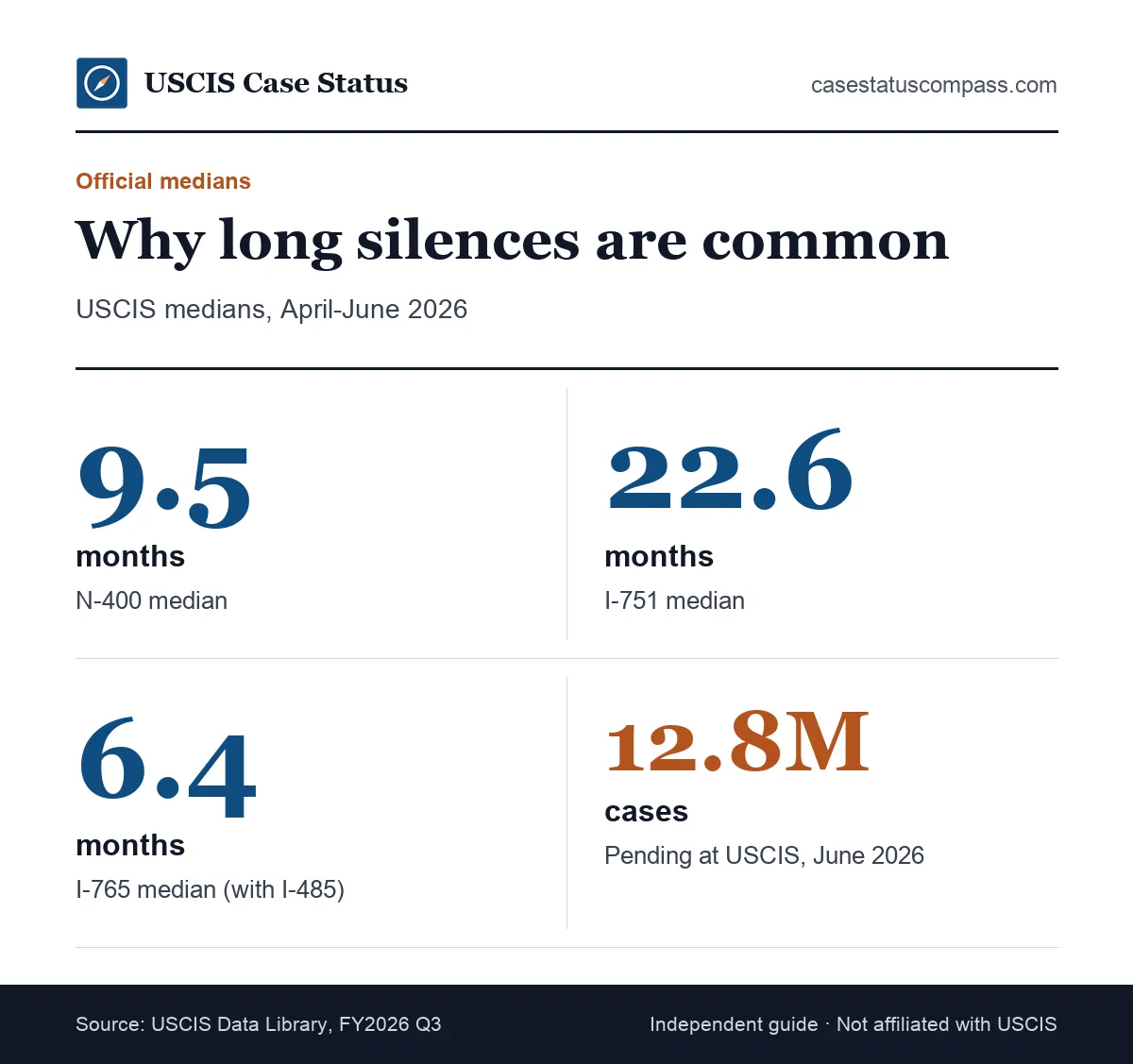
Most of a case's life is spent waiting for an officer. Offices work broadly in receipt-date order within each form and category. With 12.8 million cases pending at USCIS (end of June 2026), that can mean months without a visible change.
Checks that run in the background
Security and background checks run after biometrics and often again before a decision. USCIS posts no status for each check, so a pending check is a normal reason for silence.
Workload shifts and file moves
USCIS moves files between offices to balance workloads, sometimes with no visible step. Your case then joins the new office's queue and its own processing time. Watch your mail for a transfer notice.
Is It a Website Problem or a Case Problem?
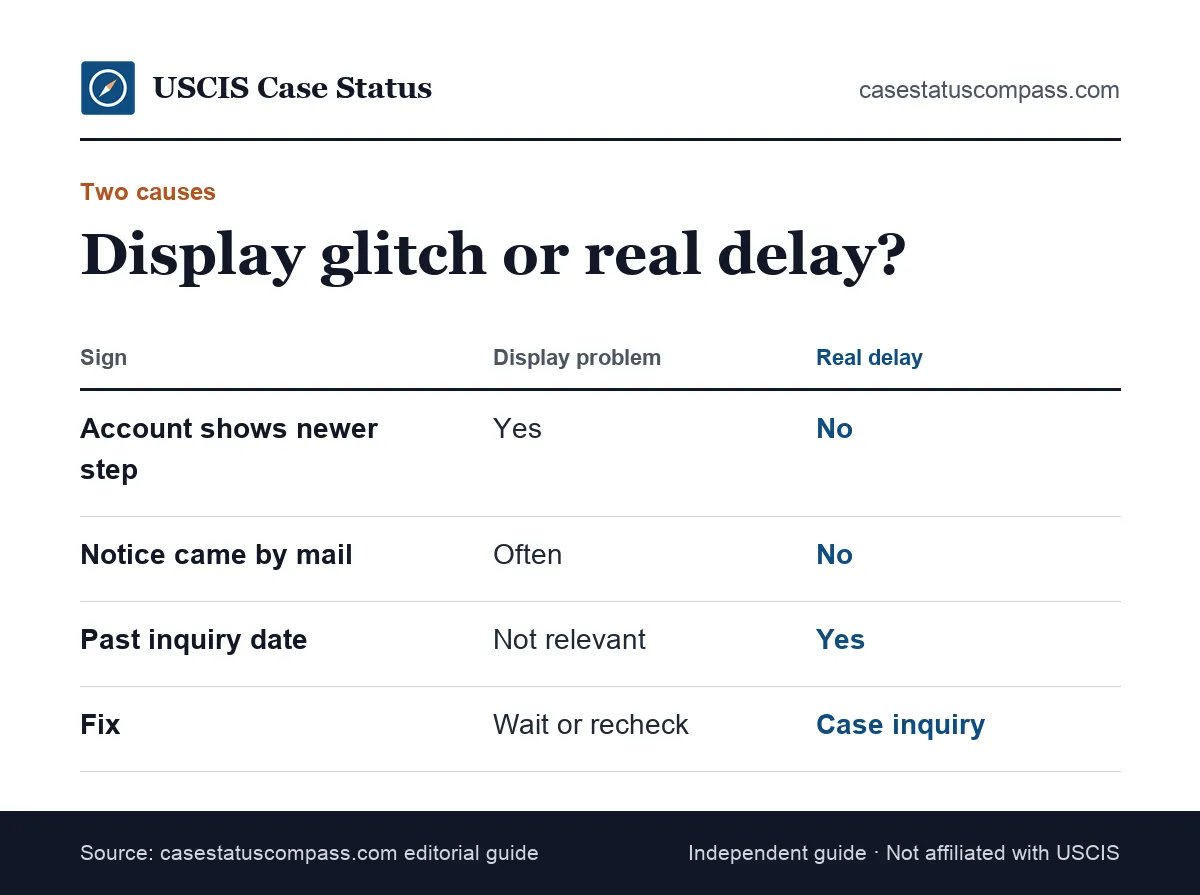
Rule out a display problem first. If your online account, your mail or a different device shows newer information than the public status page, the delay is in the display, not the case. If every source agrees nothing has happened, check whether the case is actually overdue.
Signs it is a display problem
- A notice arrived by mail, but the status still shows the step before it.
- Your online account lists a newer action than Case Status Online.
- The page shows an error or will not load at all.
- A private browser window shows a different result.
Signs it is a case problem
Every channel shows the same old step, no mail has arrived, and today is past your case inquiry date. That combination points to a real delay. Your next move is a case inquiry, covered in Step 1 below.
Why Does Your Online Account Show Something Different?
The free USCIS online account and the public Case Status Online page draw on related but separate views of your case. The account may show uploaded notices and a fuller history, while the public page shows a single latest message. A mismatch is common and usually harmless.
Two views of one case
USCIS describes the account this way: Free USCIS online account: case status updates, notices, link paper-filed cases. Uploaded notices often appear there before the paper copy reaches you. Our guide to the USCIS online account explains how to link a paper-filed case.
Which one to trust
Trust the notice itself over either screen, and follow its deadline. If neither screen shows a step you believe happened, a mailed notice may be missing. Call the Contact Center to ask whether one was sent.
What Does the "Last Updated" Date Tell You?
The date on the status page shows when the latest message was posted, not when anyone last touched your file. A new date with the same wording usually reflects a system refresh or a minor update. Read the message text, not the date, to learn what changed.
Dates that change without news
Some users see the date jump while the text stays identical, after an internal update or a reissued notice. It signals neither approval nor trouble, but watch for a notice in the mail.
Using the date in your records
Write the posted date and wording in a case log each time you check. The log shows exactly how long the case has been quiet when you later write an inquiry.
Is Your Case Outside Normal Processing Time?
Your case is outside normal processing time only when today is past the case inquiry date that the official tool gives for your form, category, office and receipt date. The CIS Ombudsman's tip sheet states the rule: You can submit an 'outside normal processing time' request only after your case inquiry date.
What Is the Case Inquiry Date in the Processing Times Tool?
The Ombudsman defines it this way: Case inquiry date: the earliest date USCIS will accept a question about your pending case; it can change. Check it again each month, since it moves. Our hub on uscis processing times explains each part of the tool.
What the tool's main figure means
The tool's headline number answers a different question. According to the same tip sheet, The USCIS tool shows how long it took to finish 80% of cases in the past 6 months. That means one case in five took longer, and yours may be one of them while still counting as normal.
How Do You Look Up the Inquiry Date for Your Case?
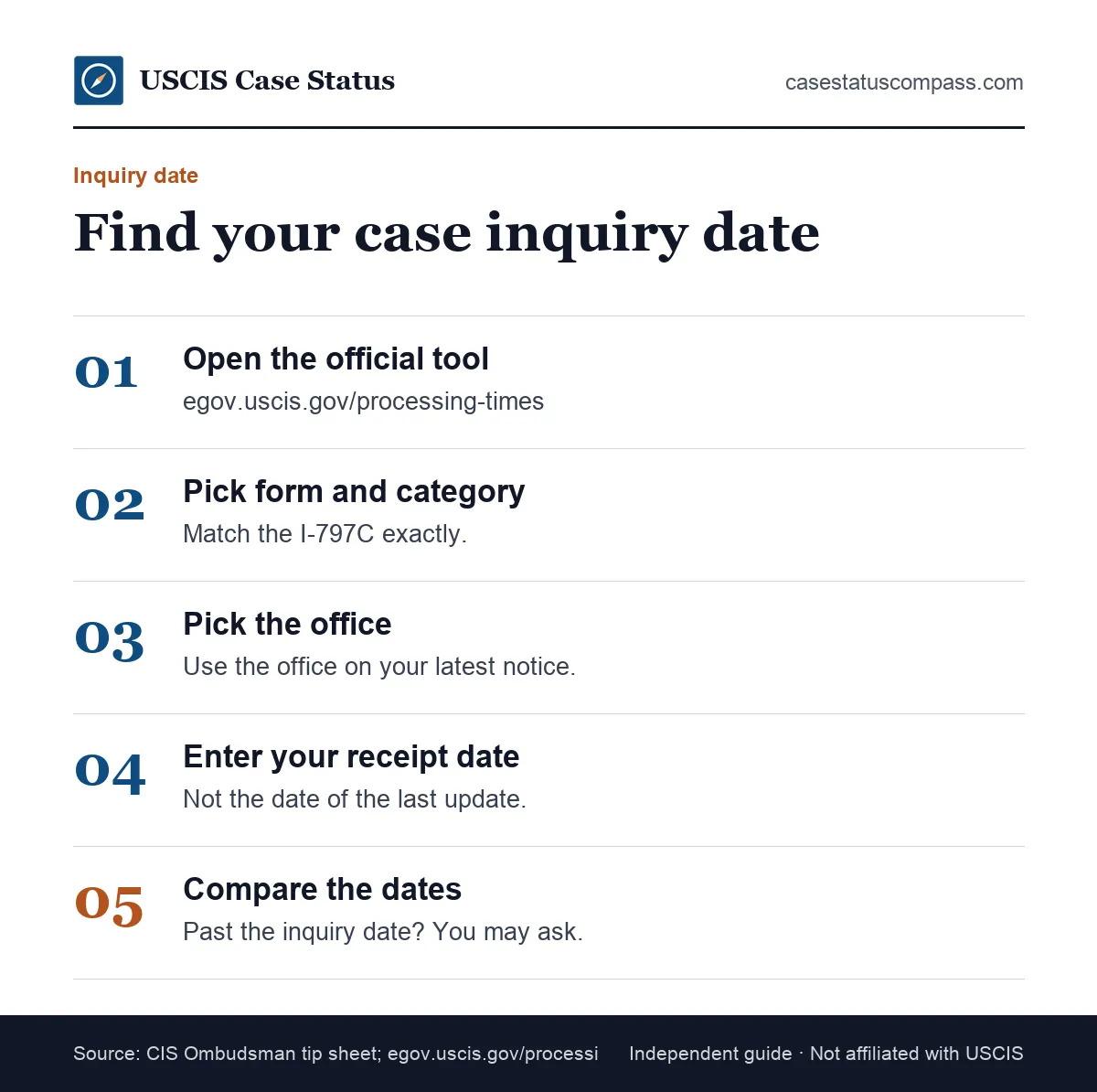
You can find your case inquiry date in about five minutes with your Form I-797C receipt notice. The tool needs the form, the category, the office handling the case and your receipt date. A wrong office or category gives a wrong answer, so match the notice exactly.
The inputs that matter
Use the receipt date, not the date of your last status change, and the office on your latest notice, which may differ if the case moved. Our uscis service centers page explains office names.
Forms the tool does not list
For forms missing from the tool's menu, the Ombudsman tip sheet says you can ask once the case has been pending more than 6 months. Keep proof of the filing date.
How Long Can a USCIS Case Stay Pending?
A USCIS case can stay pending for many months, and for some forms years, without being outside normal processing. USCIS's own medians show the middle case only: USCIS quarterly data reports the median: half of the cases completed that quarter took longer.
Recent official medians
These official medians show how long the middle case took for common forms in April to June 2026.
| Form | USCIS median, April to June 2026 |
|---|---|
| N-400 | N-400: median 9.5 months (USCIS data, Apr.-June 2026) |
| I-485 (family) | I-485 (family): median 7.0 months (USCIS data, Apr.-June 2026) |
| I-130 (immediate relative) | I-130 (immediate relative): median 13.0 months (USCIS data, Apr.-June 2026) |
| I-751 | I-751: median 22.6 months (USCIS data, Apr.-June 2026) |
| I-90 | I-90: median 5.5 months (USCIS data, Apr.-June 2026) |
A wait shorter than the median for your form is not a reason to worry; the inquiry date is still the test.
Why Are USCIS Cases Staying Pending Longer?
A year earlier the picture was different: A year earlier (July-Sept. 2025): N-400 5.7 mo; I-751 18.8 mo; I-130 IR 13.7 mo; I-485 family 6.0 mo. Rising medians mean a case filed in 2026 may stay quiet longer than one filed before. The green card processing time page covers I-485 waits in detail.
Where Do Cases Usually Stall?
Cases most often go quiet at five points: after biometrics, after an evidence response, after a transfer, after an interview and after approval. Each point has an ordinary reason for the silence and one quick thing you can check before contacting USCIS. A quiet stretch at any of them is normal while you are still before your inquiry date.
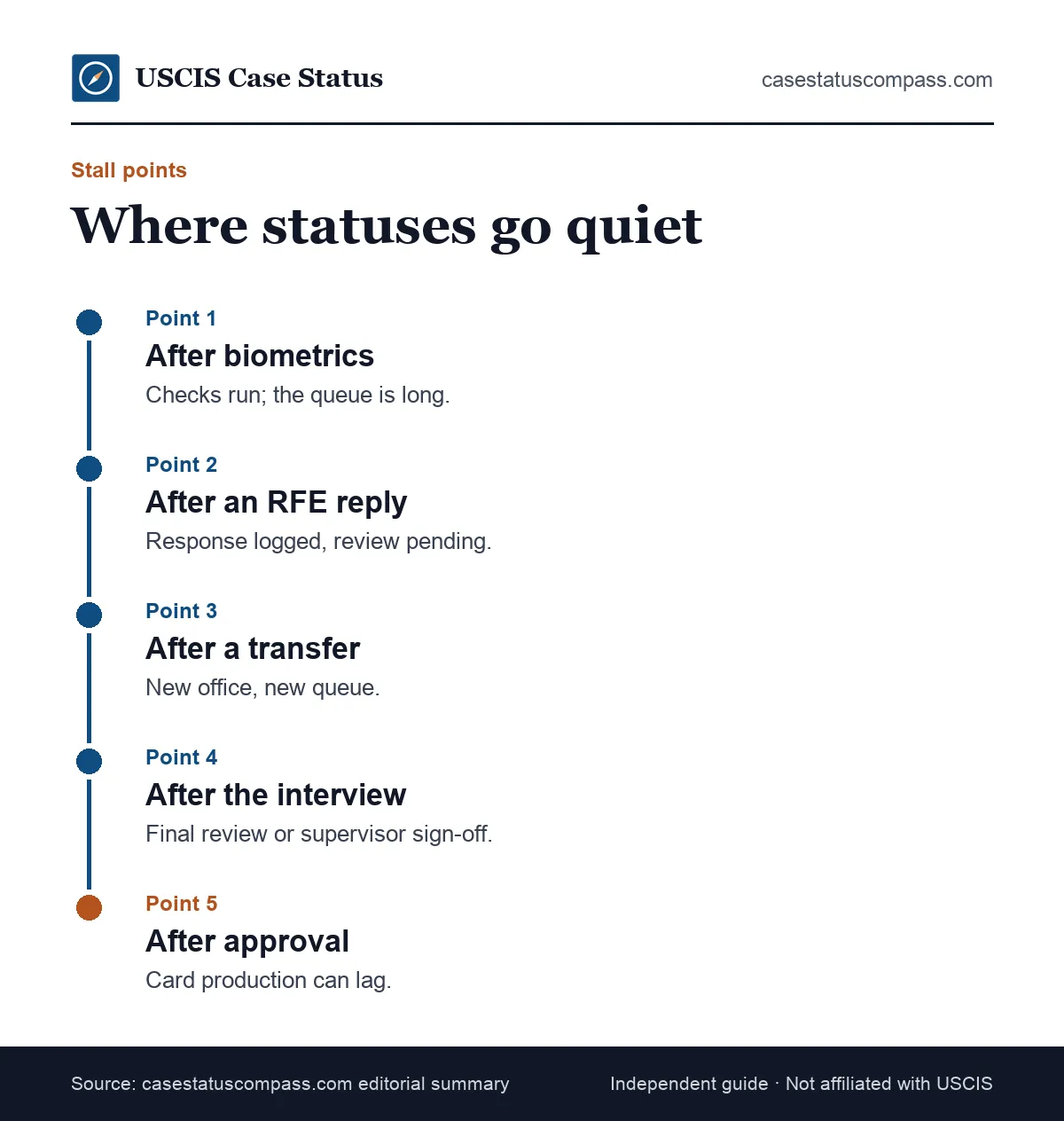
Stall points and what to check
Each row names a stall point, its usual cause and the one thing to check.
| Stall point | Likely reason | What to check |
|---|---|---|
| After biometrics | Background checks and officer queue | Inquiry date for your office |
| After an RFE reply | Response waiting for review | Delivery proof of your reply |
| After a transfer | New office's own queue | Inquiry date for the new office |
| After an interview | Final review or supervisor sign-off | Interview results paper |
| After approval | Card production or mailing | Address on file |
Most rows point to a check you can do yourself in minutes.
After biometrics
The gap after the fingerprint appointment is often the longest. Our guide to the biometrics appointment explains what the appointment collects and what usually follows. Checks and the officer queue both run during this stretch.
After an interview
After an interview, the file may wait for supervisor review or for checks to finish. Keep any results sheet the officer gave you. If the officer asked for documents, send them by the date given; the case cannot move until they arrive.
Status Not Updating After an RFE Response
After you answer a request for evidence (RFE), the status may change to show the response was received, or it may not change at all. The officer reviews your reply in turn, and that review is not tied to a set public timeframe.
Received but unchanged
If delivery proof shows the reply arrived but the status still shows the RFE, give it a few weeks; logging can lag. Our guide to rfe meaning and next steps explains how responses are handled.
When to ask about it
If many weeks pass with no sign your reply was logged, contact USCIS with your tracking details. A NOID that follows a reply is a different matter; see our guide to the USCIS notice of intent to deny.
Status Not Updating After a Transfer
A transfer moves your case to another office, often to balance workloads or to schedule an interview. After the move, the status may sit unchanged for a long time while the file waits in the new queue. Your original receipt date still counts.
The transfer notice
You may receive a transfer notice naming the new office. Our page on the case was transferred status explains the message and what usually comes next. Use that office name in the processing times tool.
Recalculating your inquiry date
Re-enter your form, category and the new office in the official tool with your original receipt date. A transfer does not reset your place, but the new office's time may differ.
Status Not Updating After Approval
After an approval, the next status for card-based cases is usually card production, then mailing. A gap of a few weeks between them is normal. If the approval status stays for a long time with no card step, check your address and your mail first.
Card steps that may lag
Card production and mailing are separate events, each with its own status. Our page on the new card is being produced status covers that stage. The two steps may appear days or weeks apart.
If the card went back to USCIS
Undeliverable cards return to USCIS. Returned green cards are held 60 business days (about 12 weeks), then re-mailed or destroyed. Update your address quickly so the card can be re-mailed within that window.
I-485 Case Pending With No Updates
An I-485 can stay quiet for a long time after biometrics while background checks finish and the file waits for review or an interview. Employment and some family cases may also wait for a visa number to become available. Keep work permit and travel document renewals on track meanwhile.
When the I-485 waits for a visa number
Preference-category cases cannot be approved until a visa is available for your priority date, so the officer may hold a finished file. Our Form I-485 guide explains how adjustment cases move.
Interview or no interview
Green card interviews are required unless waived; the family petitioner usually attends too. If an interview is needed, the next visible step may be the interview notice, which can arrive after a long quiet stretch.
I-130 Petition Not Updating
I-130 petitions for many relatives move slowly, and some categories wait far longer than immediate relatives. The latest official median for immediate relatives was I-130 (immediate relative): median 13.0 months (USCIS data, Apr.-June 2026), while other relatives had I-130 (all other relatives): median 43.3 months (USCIS data, Apr.-June 2026).
Categories that wait longest
Siblings and adult children often wait years because visa demand in those categories is high. Our Form I-130 guide explains each category. Check the State Department's Visa Bulletin each month to see when your priority date may become current.
After the I-130 is approved
For relatives abroad, the case moves to the State Department's National Visa Center (NVC). Updates then appear in State Department systems, not on the USCIS page. Our NVC case status guide explains where to look.
I-765 Work Permit Status Stuck
A stuck I-765 is urgent when your current work permit is about to expire. Ended: renewals filed on or after Oct. 30, 2025 no longer get the up-to-540-day automatic extension (exceptions: TPS by law/Federal Register notice; STEM OPT 180 days). That makes a long silence more costly for many renewal filers than it was before October 2025.
Renewals filed after October 30, 2025
If your renewal is pending when your card expires, you may face a gap in work authorization. See our work permit processing time page and plan with your employer early.
When job loss justifies an expedite
Losing a job or income can count as severe financial loss under USCIS expedite criteria, but proof is essential. See the expedite step below before asking. Gather a termination letter and pay records first.
N-400 Not Updating After the Interview
Many naturalization applicants see no update for weeks after the interview. The officer may have recommended approval but still needs final checks or supervisor review, or may be waiting on documents requested at the interview. The next step is usually an oath ceremony notice.
Reading the interview results paper
The officer usually hands you a results notice showing whether the case was recommended for approval, continued or needs evidence. Our Form N-400 guide explains each outcome. Keep it with your case log.
Waiting for the oath
Oath scheduling depends on ceremony capacity at your office. Our oath ceremony guide explains the notice. Some offices hold a same-day ceremony, while others mail a notice later. If none arrives, check your address and online account before calling.
I-751 and I-90 Cases That Sit for Long Periods
Card-based cases such as Form I-751 and Form I-90 often sit for long periods with no update. The latest median for the I-751 was I-751: median 22.6 months (USCIS data, Apr.-June 2026). Your receipt notice usually protects your status while you wait.
How Do You Prove Status While an I-751 or I-90 Is Pending?
For conditional residents: I-751 receipt notice extends conditional status and work authorization for 48 months. For renewals: I-90 receipt notice + expired card = proof of status for 36 months from the card's expiration date. Our Form I-751 and Form I-90 guides explain how to use these notices.
When to ask about a long wait
Use the same rule as every other form: ask only after your case inquiry date. A receipt notice that is near its own extension end date is a stronger reason to call.
Asylum Case Pending: Why Updates Are Rare
An asylum case pending with USCIS often shows little or no online change for long periods. Affirmative asylum applications are handled by asylum offices that schedule interviews by their own priorities. For many applicants the first visible step is an interview notice.
Why the online status says so little
The public page shows limited detail for asylum filings, so watch your mail and account. Our asylum guide explains the process, including the filing rule: File for asylum within 1 year of your last arrival in the U.S. (limited exceptions).
Asylum-based green cards
After a grant, the related I-485 also waits: I-485 (asylum-based): median 25.6 months (USCIS data, Apr.-June 2026). If your asylum form is not listed in the processing times tool, the Ombudsman's 6-month rule for unlisted forms may apply.
Step 1: Submit a Case Inquiry
A case inquiry is the first formal step once you are past the inquiry date. You submit an outside normal processing time request online through USCIS, or ask a Contact Center agent to open one. It puts your case in front of staff who can check why it has not moved.
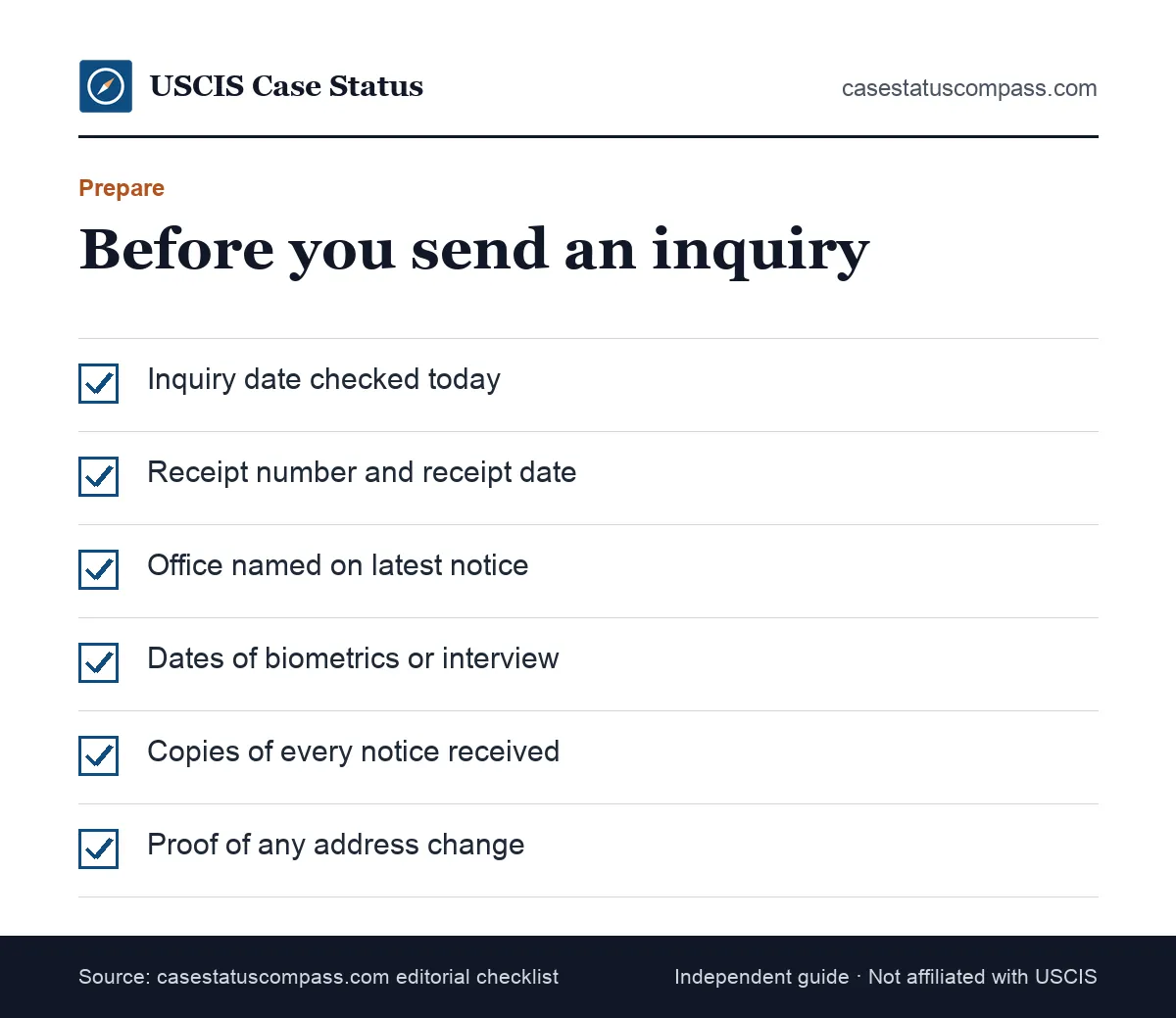
Online request
The online request asks for your receipt number, form, filing date and contact details, and is accepted only after your inquiry date. Keep the confirmation screenshot and note the date you submitted it.
Can You Ask About a Stuck Case by Phone or Chat?
The Contact Center number is 800-375-5283 (TTY: 800-767-1833). Live calls and chat: Monday to Friday, 8 a.m. to 8 p.m. Eastern. Automated phone line: 24 hours a day (live agents Mon-Fri 8am-8pm ET). You can also start with Emma, USCIS's online virtual assistant (English and Spanish), on uscis.gov. Our guide on how to contact USCIS covers phone menu choices.
What Should Your Case Inquiry Say?
A good inquiry is short and factual. State your receipt number, form, receipt date, office, last action and its date, and that you are past the inquiry date. Mention urgency only if it is real and documented. One clear page is enough.
Copyable inquiry text
I am writing about receipt number [3 letters + 10 digits], Form [form number], received on [receipt date] and now at [office]. The last action was [status wording] on [date]. According to the USCIS processing times tool, the case inquiry date for this form, category and office is [date], which has passed. Please review the case and let me know if anything is needed from me. My current mailing address is [address].
Adapting the inquiry template
This is an example only. Replace each bracket. The current request form may ask for details in its own fields, so paste only the parts each field asks for.
What to leave out
Skip long stories and copies of documents USCIS already has. A serious, urgent reason belongs in an expedite request, not a delay inquiry. Repeating the same request in several channels adds nothing.
What Happens After You Submit an Inquiry?
USCIS usually confirms your request with a reference number and later replies by mail, email or a status note. Even a reply that only says the case is pending creates a record that you asked, which the Ombudsman and congressional offices look for.
Keeping track of the reply
Log the reference number, date sent and any reply, word for word. A vague reply is not a reason to send another inquiry the next day. Wait the full period before escalating.
When Should You Escalate After a Case Inquiry?
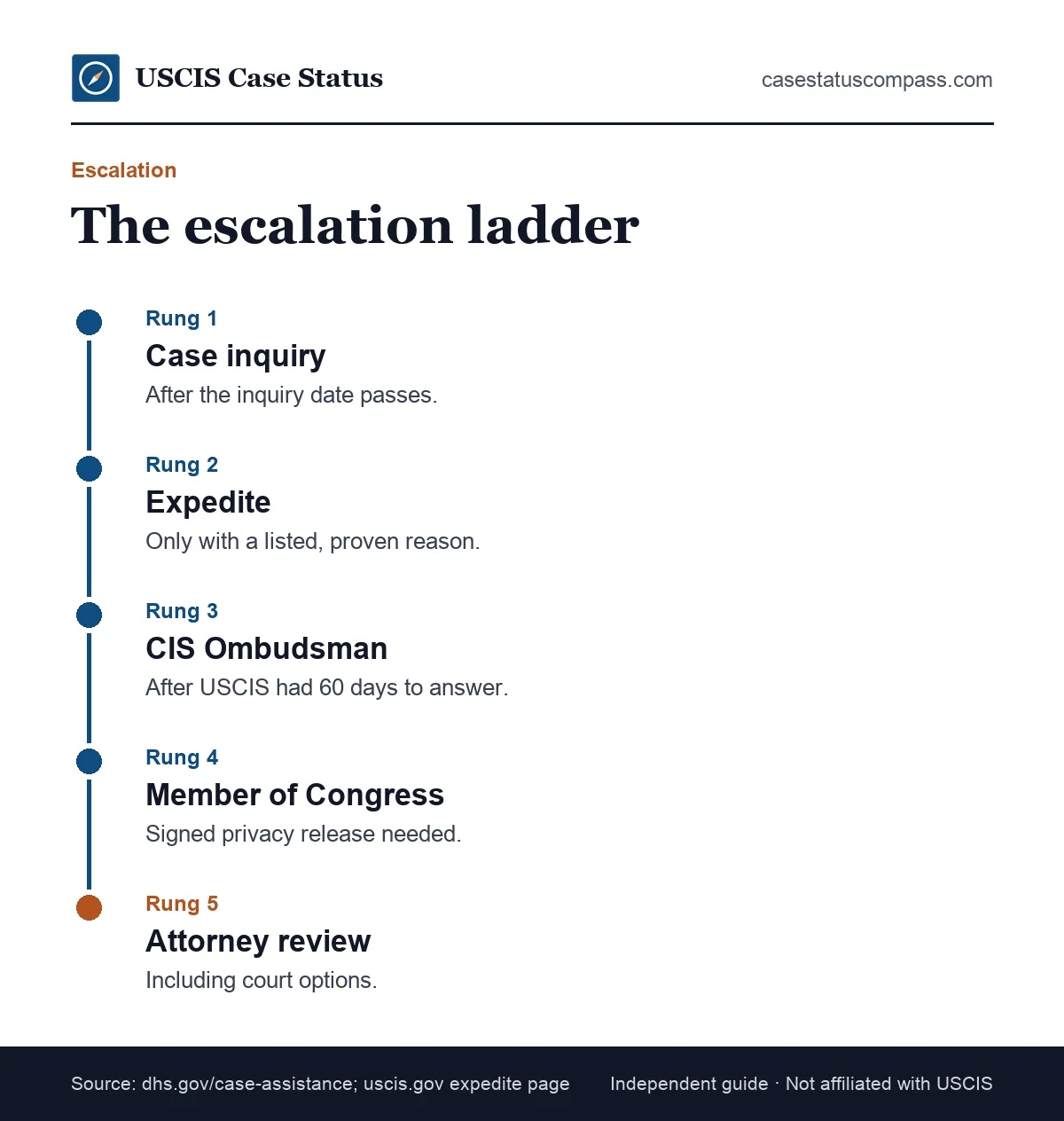
The CIS Ombudsman sets a clear marker: Use the Ombudsman only after contacting USCIS within 90 days and waiting at least 60 days. That gives you a reasonable waiting period before you treat the inquiry as unanswered and climb the escalation ladder.
Step 2: Request an Expedite (if Eligible)
An expedite asks USCIS to move a case ahead of others because of an urgent, documented reason. Delay alone does not qualify. USCIS lists the grounds: Expedite criteria: severe financial loss, emergency/humanitarian, nonprofit, government interest, clear USCIS error. Meeting one ground does not guarantee approval of the request.
How to ask
USCIS explains: Ask for an expedite through the USCIS Contact Center or your online account. Attach proof such as a doctor's letter or an employer notice. Our uscis expedite request guide covers evidence and wording.
Premium processing instead
For eligible employment forms, paid premium processing is an option: Premium processing covers I-129 work visas, I-140 (EB-1/2/3), I-765 OPT/STEM OPT and I-539 to F/M/J. Our premium processing page covers fees and clocks.
Step 3: Ombudsman or Congressional Help
If USCIS does not resolve a stuck case after a proper inquiry, two outside routes exist. The CIS Ombudsman uses CIS Ombudsman: DHS Form 7001, Request for Case Assistance (online). Your representative or senator can also contact USCIS for you: Your member of Congress can ask USCIS about your case after you sign a privacy release.
Choosing between them
The table compares the two outside routes on what each suits best and what it requires.
| Route | Best for | Key requirement |
|---|---|---|
| CIS Ombudsman | A case USCIS failed to fix after an inquiry | Prior USCIS contact and a waiting period |
| Congressional office | A case with real hardship or no USCIS reply | Signed privacy release |
| Both at once | Not recommended | The Ombudsman may decline recent congressional cases |
Use one route at a time, and only after USCIS had a fair chance to answer.
Where to learn more
Our guide to the uscis ombudsman and congressional inquiries explains each route, including forms and templates. It also covers the 90-day and 60-day contact rules, what each office cannot do, and how to sign a congressional privacy release correctly.
Can You Sue USCIS Over a Delayed Case?
In some cases, yes. A federal lawsuit asking a court to order an agency to act, often called a mandamus action, is sometimes used for long, unexplained delays. It is a serious legal step with costs and risks, and it does not guarantee approval.
What a lawsuit can and cannot do
A court can order USCIS to make a decision, but not to approve. Lawsuits usually come only after inquiries and outside help have failed. A faster decision is not always a better one.
Talk to an attorney first
Only a licensed immigration attorney can judge whether a delay is long enough to sue over. Ask about fees and what happens if USCIS then denies. Bring your delay log to the first meeting.
Administrative Processing Explained
Administrative processing means extra review outside the normal steps. At USCIS, it usually describes background or security checks that hold a case without a status change. At a U.S. consulate, it describes extra review after a visa interview under section 221(g).
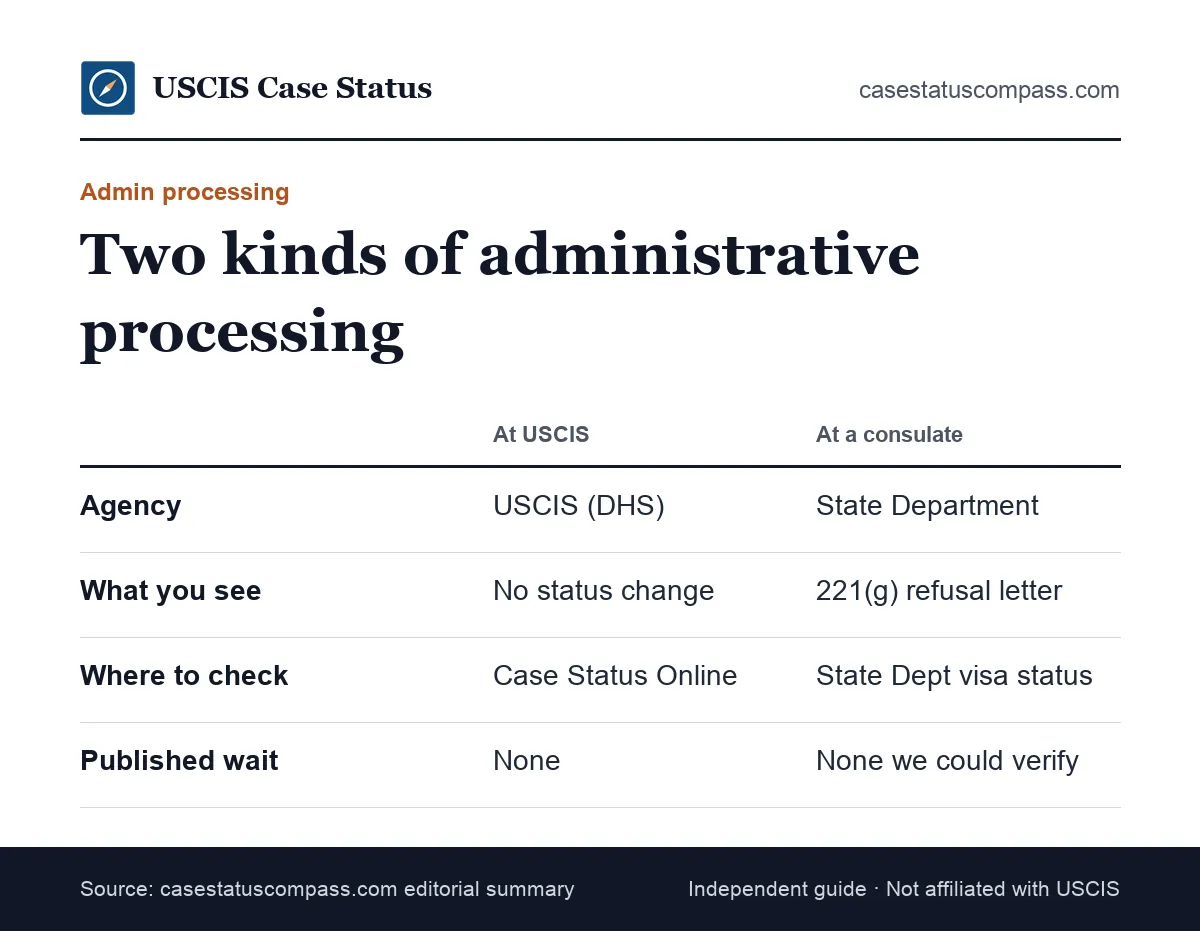
At USCIS
USCIS rarely uses the phrase on the status page; pending checks simply keep your status unchanged. Past your inquiry date, a case inquiry asks whether checks are holding the file.
At a consulate
Consular administrative processing is run by the State Department, not USCIS. The applicant usually leaves the interview with a refusal letter. Our U.S. visa status guide explains how to check consular cases.
How Long Does Administrative Processing Take?
There is no fixed published timeframe that we could verify for administrative processing at USCIS or at consulates. Some reviews finish quickly; security checks can take much longer. Treat any number you see online as anecdotal unless it comes from an official page.
Benchmark for checks at USCIS
Use the case inquiry date as your benchmark; once you pass it, an inquiry is appropriate whatever the reason. No published timeframe exists for these checks, so the inquiry date is the only official yardstick.
Timing at U.S. consulates
The State Department sets its own procedures. It publishes no timeframe for administrative processing, so follow your 221(g) letter and check the consulate's instructions. Watch your email and the consulate's website for requests.
Visa Refused After Administrative Processing: What It Means
A visa refused after administrative processing usually means the consular officer finished the extra review and decided not to issue the visa. A 221(g) letter at the interview is a temporary refusal; a later final refusal ends that application. The State Department, not USCIS, makes this decision.
Temporary refusal versus final refusal
A 221(g) refusal at the interview holds the case while documents or checks are pending. A refusal after that review is the outcome, and the letter should explain why. Ask the consulate, not USCIS, about next steps, since a visa refusal is a State Department decision.
What to do next
Keep the letter. The related USCIS petition's status may not change at all, even when your USCIS case status not updating worries you. Ask an immigration attorney about reapplying or other options.
"If X, Do Y": Stuck Status Decision Table
Match your symptom to a row and take that first step. If two rows fit, deal with any deadline first, then the delay. The table covers the most common symptoms of a frozen status, from a simple wait to a lapse in work authorization, and assumes you already checked your account and mail.
Symptoms and first steps
Each row pairs a symptom with the cheapest useful first step.
| If you see this | Do this first |
|---|---|
| Same status for months, still before the inquiry date | Wait; recheck the inquiry date monthly |
| Same status, past the inquiry date | Send one outside normal processing time inquiry |
| Account shows a newer step than the public page | Trust the account and read the notice |
| Status mentions a notice that never arrived | Check your address; ask USCIS to resend |
| RFE reply delivered, status unchanged for weeks | Keep tracking proof; ask after several weeks |
| Interview done, no update | Check the results sheet; wait for oath or decision |
| Approved, no card step for weeks | Confirm your address and watch your mail |
| Inquiry made, no fix after 60 days | Consider the CIS Ombudsman or Congress |
| Work permit expiring with a pending renewal | Check expedite criteria; plan with your employer |
Notice how many rows begin with waiting or checking, not contacting USCIS.
Using the table well
Pick one row and act on it. An inquiry, an expedite and a congressional request in the same week create duplicate work and slow every reply. Give each step time to work.
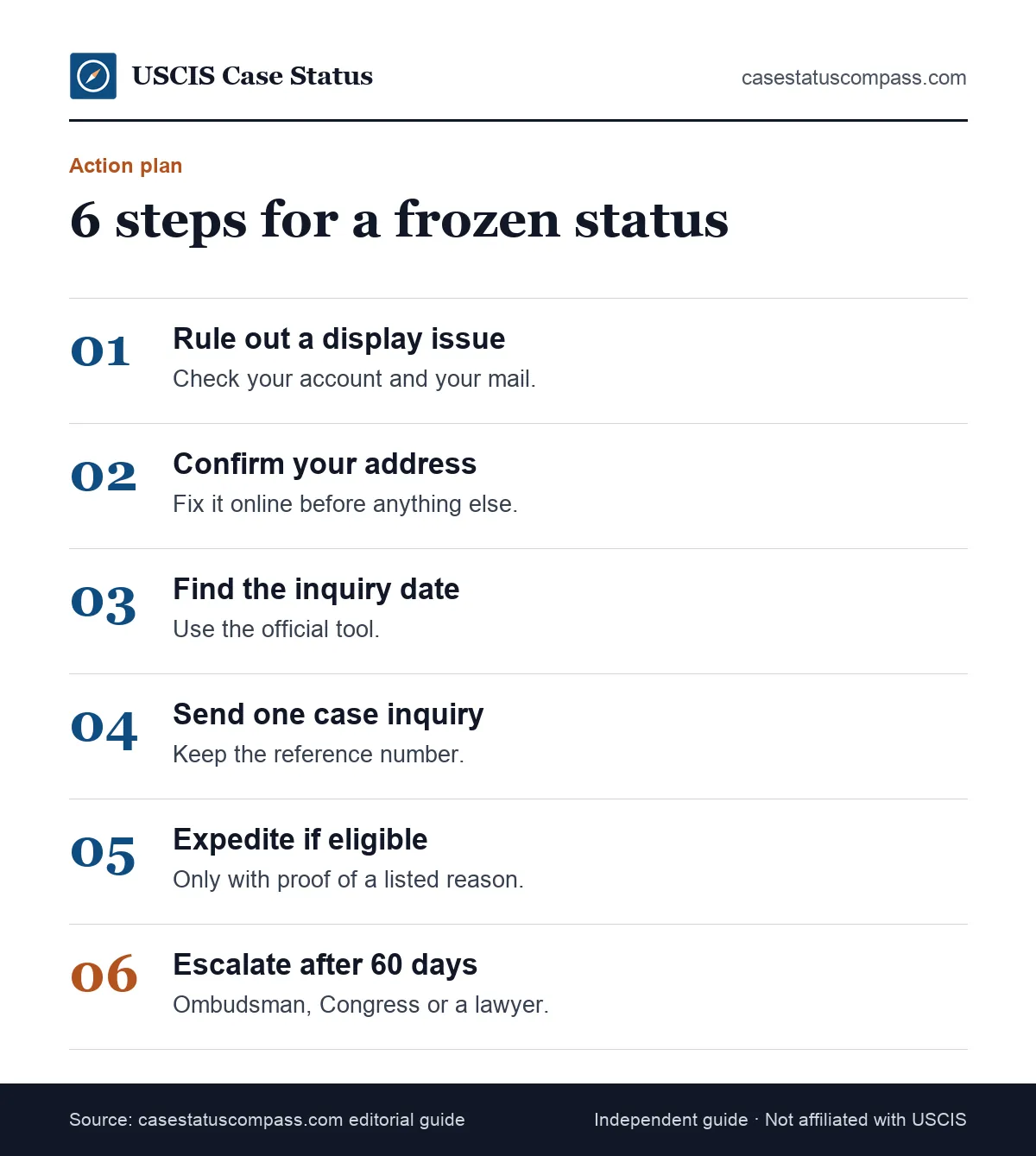
A 6-Step Plan for a USCIS Case Status Not Updating
This plan puts the steps in the order that wastes the least time. Each one rules out a simple cause or builds the record for the next. Most cases never need step six. Skip a step only when it clearly does not apply to you.
The steps
- Rule out a display problem: check your account, mail and another device.
- Confirm USCIS has your current address.
- Find your case inquiry date in the official tool.
- Send one case inquiry once you pass that date.
- Ask for an expedite only with a listed, documented reason.
- Escalate after the waiting period, with your records.
After each step
Write down the date, the action and any reference number. A clean record turns a later escalation from a story into evidence. Note the next date you plan to act, too.
What Should You Not Do While You Wait?
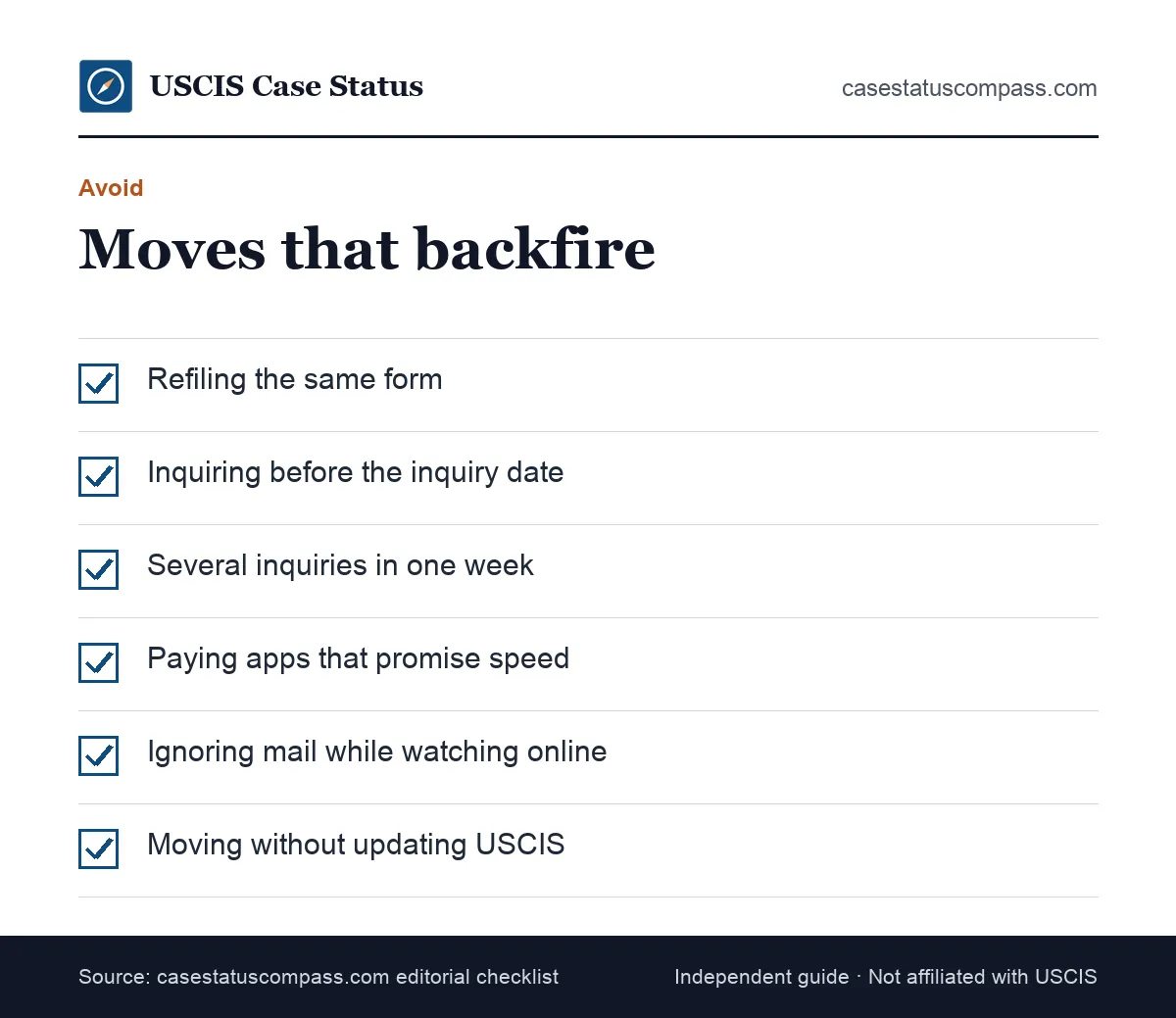
Do not refile the same form, send repeated inquiries, or pay outside services that promise faster updates. None of these moves a case, and some cost money or confuse your file. The safest habit is to check monthly, keep your address current and wait for your inquiry date.
Refiling or sending extra evidence
A second filing usually creates a duplicate case and a second fee. Send documents only when a notice asks for them. If you have important new evidence, ask an attorney whether and how to send it.
Paying for "status boosters"
No app or service can make USCIS update a case. Third-party trackers show the same public information you can see for free on Case Status Online: egov.uscis.gov. Never pay a fee for a faster update.
Could a Missed Notice Be the Real Problem?
Sometimes a USCIS case status not updating hides a missed notice. An RFE, interview notice or biometrics appointment may have gone to an old address. If a notice was issued and you did not respond, the case may be waiting on you. Check this before you escalate.
Check your address
Report a new address to USCIS within 10 days of moving (INA 265). Update your address online in your USCIS account (E-COA); a mailed AR-11 also counts. Our uscis change of address guide shows how to update every pending case.
Ask USCIS to resend
If you suspect a missing notice, use the Contact Center or an online request. USCIS lists: e-Request: report USCIS typos, missing notices or accommodation needs online. Act quickly, because notice deadlines keep running.
How to Keep a Delay Log
A delay log is a simple record of every check, contact and notice for your case. It takes minutes to keep and saves hours when you write an inquiry or ask for outside help. A paper notebook or a simple spreadsheet both work.
Columns to include
Three columns are enough: the date, what you did and what happened.
| Date | What you checked or did | Result or reference |
|---|---|---|
| [date] | Checked Case Status Online | Same status as last month |
| [date] | Checked inquiry date in tool | Still before inquiry date |
| [date] | Sent case inquiry | Reference number recorded |
Add a row every time you check, even when nothing changed.
What else to keep
Save every notice, delivery receipt and screenshot in one folder, named by date, and bring the log to any attorney meeting. Back up the folder to a second place, such as cloud storage.
Does Contacting USCIS Hurt Your Case?
No. A legitimate inquiry about a delayed case does not count against you. What wastes time is asking too early or too often, because inquiries before the inquiry date are generally not accepted. Accurate, well-timed questions are the right way to ask.
Premature inquiries
Ask before the inquiry date and you will usually hear the case is within normal processing. Wait for the date, mark it on your calendar and set a reminder for that day.
Being accurate when you ask
Give the same facts each time; your delay log keeps your answers consistent. If a fact changed, such as your address or job, say so plainly and update it through the proper channel.
When Should You Get Legal Help for a Stalled Case?
Get legal help when a delay threatens your status, job or family, when USCIS replies suggest a problem beyond the queue, or when you are weighing a lawsuit. An immigration attorney or DOJ-accredited representative can review the file and choose the right route.
Red flags
Any one of these signs means a quick legal review is worth the cost:
- A notice mentions fraud, criminal records or inadmissibility.
- Your status or work permit is about to lapse.
- Inquiries and outside help have produced no answer.
Who to contact
Look for a licensed attorney or a DOJ-recognized organization. Avoid anyone who promises a guaranteed outcome. Check the Justice Department's list of recognized organizations and accredited representatives, and ask about fees before the first meeting.
Status Not Updating vs Other Status Problems
A USCIS case status not updating differs from an error message, a missing progress tab or an outage, and each has its own fix. Use the table so you do not treat a website problem as a case problem. Each row links to the guide that owns that problem.
Frozen status vs errors and routine messages
The rows separate a frozen status from three problems that often look similar.
| Problem | What it usually means | Where to go |
|---|---|---|
| Status not updating | Case waiting in a queue | This page |
| Error retrieving status | Wrong number or system issue | Case status homepage |
| Status looks routine | Normal processing message | Still being processed |
| Receipt number questions | Format or prefix confusion | Receipt number guide |
If your problem is not in the first row, the linked guide will help faster than this one.
Where this fits
Our uscis case help hub links every delay, notice and escalation guide in one place, so you can move on to the next guide when a USCIS case status not updating turns out to be a different problem.
Frequently Asked Questions
How often does USCIS update case status?
USCIS updates a case status only when an action is logged, such as a notice, transfer, interview or decision. There is no schedule. A case can change several times in a month, then stay unchanged for months.
Can USCIS approve my case without a status update first?
Yes. A case can move from a waiting message straight to approval, because officers do much of their work without a visible status step. Watch your mail and online account; the notice may arrive before the website changes.
Does a long wait mean my case will be denied?
No. Most long waits come from backlogs and background checks. Denials usually follow a notice of intent to deny, a request for evidence or an interview problem. Without those, a quiet case is most likely waiting.
What if my receipt number shows no status at all?
A brand-new receipt may take time to appear online. If several days pass, check the number for typos, and try your online account. If it still fails, contact USCIS with the receipt notice in hand.
Can I ask USCIS about my case before the inquiry date?
You can call with general questions, but USCIS generally will not accept an outside normal processing time request before the case inquiry date. The exception is a documented urgent need, which belongs in an expedite request. Forms not listed in the tool can be asked about after six months pending.
Will a congressional inquiry make USCIS decide faster?
A congressional inquiry can prompt USCIS to review a stuck case and reply, but it cannot force an approval or a decision date. It works best after a case inquiry, and you must sign a privacy release first.
What does case pending mean on the USCIS website?
Case pending means USCIS has your filing and has not yet made a final decision. It covers every stage from receipt to the last review, so it says nothing about how close the case is to a decision.
Does checking my status often slow down my case?
No. Checking Case Status Online or your account only reads the record and has no effect on your place in line. Checking more often than weekly simply shows the same message.
Can my case be transferred without a status change?
Yes. USCIS sometimes moves files between offices with no visible step. If you later get a transfer notice, use the new office when you check your case inquiry date.
Should I file a new application if my case is stuck?
Usually not. Refiling the same form often creates a duplicate case and a new, nonrefundable fee without improving your place in line. Use the inquiry and escalation steps instead, and see an immigration attorney if your situation is urgent.
Sources
- CIS Ombudsman: Case Inquiry Date Tip Sheet (DHS, 2024). dhs.gov/sites/default/files/2024-11/24_0823_cisomb_case-inquiry-date-tip-sheet.pdf. Accessed Oct 27, 2026.
- CIS Ombudsman: Submit a Case Assistance Request. www.dhs.gov/case-assistance. Accessed Oct 27, 2026.
- USCIS Check Case Processing Times. egov.uscis.gov/processing-times/. Accessed Oct 27, 2026.
- USCIS Data Library: All Forms, FY2026 Q3. www.uscis.gov/sites/default/files/document/data/quarterly_all_forms_fy2026_q3_v1.xlsx. Accessed Oct 27, 2026.
- USCIS: How to Make an Expedite Request. www.uscis.gov/forms/filing-guidance/how-to-make-an-expedite-request. Accessed Oct 27, 2026.
- USCIS Contact Center. www.uscis.gov/contactcenter. Accessed Oct 27, 2026.
- USCIS: Change of Address. www.uscis.gov/addresschange. Accessed Oct 27, 2026.
- USCIS: How Do I Request Premium Processing?. www.uscis.gov/forms/all-forms/how-do-i-request-premium-processing. Accessed Oct 27, 2026.
- USCIS: Benefits of a USCIS Online Account. www.uscis.gov/file-online/benefits-of-a-uscis-online-account. Accessed Oct 27, 2026.
- USCIS Data Library: All USCIS Application and Petition Form Types, FY2025 Q4 (July 1-Sept. 30, 2025). www.uscis.gov/sites/default/files/document/data/quarterly_all_forms_fy2025_q4_v1.xlsx. Accessed Oct 27, 2026.
- USCIS Policy Manual Vol. 11, Part A, Ch. 3. www.uscis.gov/policy-manual/volume-11-part-a-chapter-3. Accessed Oct 27, 2026.
- USCIS Policy Manual Vol. 7, Part A, Ch. 5 (Interview Guidelines). www.uscis.gov/policy-manual/volume-7-part-a-chapter-5. Accessed Oct 27, 2026.
- USCIS: Automatic EAD Extension (updated 10/29/2025). www.uscis.gov/working-in-the-united-states/information-for-employers-and-employees/automatic-employment-authorization-document-ead-extension. Accessed Oct 27, 2026.
- USCIS: Removing Conditions on Permanent Residence Based on Marriage (updated 12/12/2023). www.uscis.gov/green-card/after-we-grant-your-green-card/conditional-permanent-residence/removing-conditions-on-permanent-residence-based-on-marriage. Accessed Oct 27, 2026.
- USCIS: Replace Your Green Card (updated 09/12/2025). www.uscis.gov/green-card/after-we-grant-your-green-card/replace-your-green-card. Accessed Oct 27, 2026.
- USCIS: Form I-589 page. www.uscis.gov/i-589. Accessed Oct 27, 2026.
- USCIS OLA New Member Outreach FAQs (Jan. 2021). www.uscis.gov/sites/default/files/document/questions-and-answers/5%20117%20-%20New%20Member%20Outreach%20FAQs%2001042021.pdf. Accessed Oct 27, 2026.
- USCIS: Checking Your Case Status Online. www.uscis.gov/tools/checking-your-case-status-online. Accessed Oct 27, 2026.
casestatuscompass.com is an independent publication and is not affiliated with USCIS or any government agency. This page is general information, not legal advice. For denials, court or asylum matters, consult an immigration attorney or a DOJ-accredited representative.