Contents · 40 sections
- What Is Asylum Status?
- Affirmative vs Defensive Asylum
- How Does the Asylum Process in the USA Work?
- How Do You Check Your Asylum Case Status?
- Checking Asylum Status in a USCIS Online Account
- Can You Check an Asylum Case by Phone?
- What Is Your Asylum Number?
- Form I-589 at a Glance
- Who Can File Form I-589 With USCIS?
- What Is the One-Year Filing Deadline?
- Where Do You File an Asylum Application?
- What Is the Typical Asylum Status Sequence?
- What Does Pending Asylum Status Mean?
- What Is the Asylum Clock?
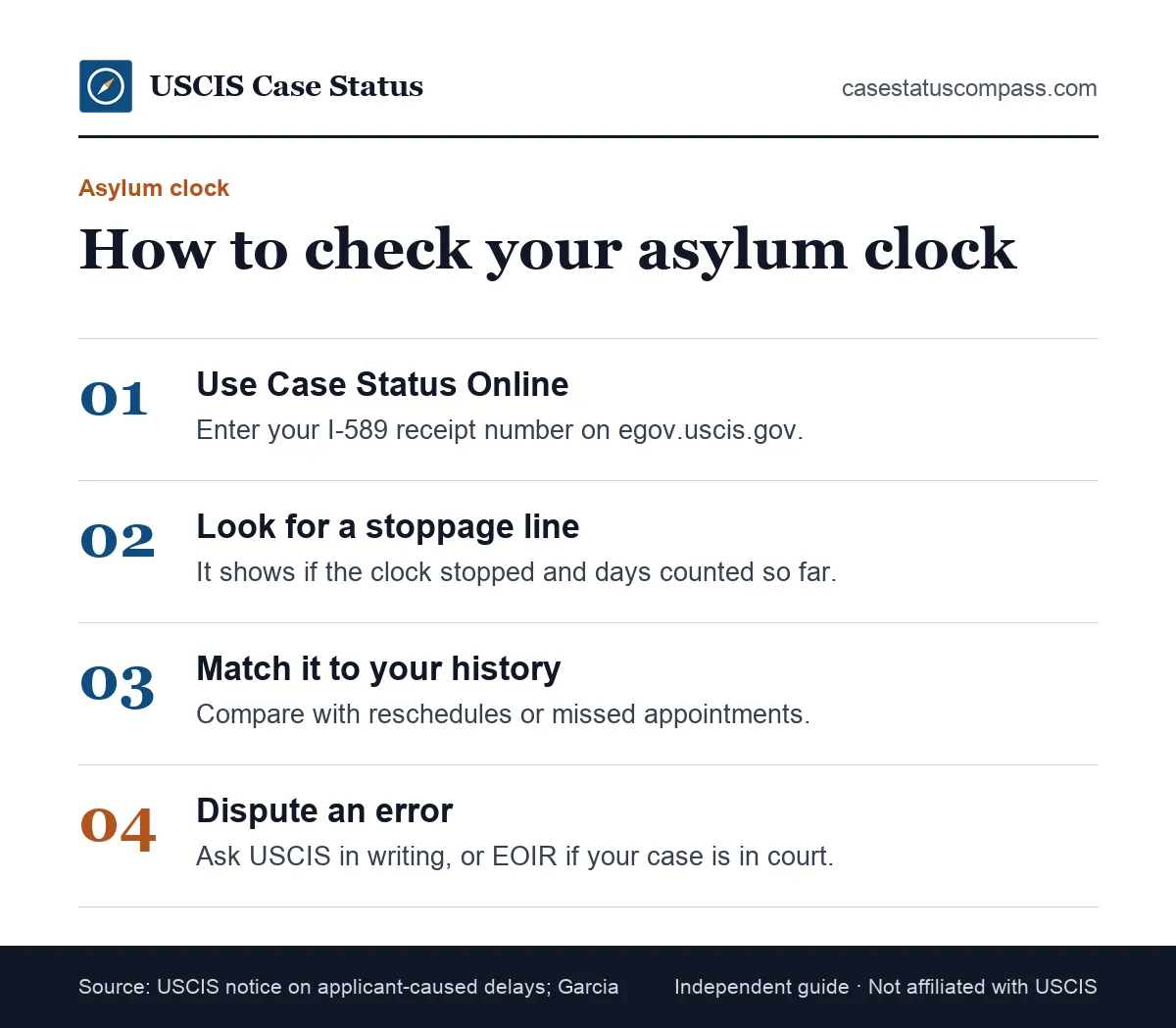
- How Do You Check the Asylum Clock Online?
- What Stops the Asylum Clock?
- Asylum Biometrics Appointment
- How Are Asylum Interviews Scheduled?
- How Do You Find the Asylum Office Near You?
- Asylum Interview: What to Expect
- What Asylum Interview Questions Are Asked?
- How Should You Prepare for an Asylum Appointment?
- Bringing an Interpreter, Lawyer and Family
- Can You Reschedule an Asylum Interview?
- What Happens After the Asylum Interview?
- What Are the Possible Asylum Decisions?
- Pending Asylum Status and Work Permit
- Asylum Fees After H.R. 1
- What Is the Annual Asylum Fee Notice?
- How Long Does an Asylum Case Take?
- Can You Travel With a Pending Asylum Case?
- Adding Family Members to an Asylum Case
- What Happens If Your Asylum Case Is Referred to Court?
- What If Your Asylum Case Seems Stuck?
- Updating Your Address During an Asylum Case
- Life After an Asylum Grant
- Where Can You Get Asylum Application Help?
- Asylum Filing Checklist You Can Copy
- Mistakes That Can Hurt an Asylum Case
- Frequently Asked Questions
The short answer
To check your asylum status, enter the receipt number from your Form I-589 notice in Case Status Online: egov.uscis.gov. That works for affirmative cases filed with USCIS. If your case is in immigration court, use the Justice Department's EOIR tools instead. The same USCIS page can also show whether your asylum clock has stopped.
At a glance
| Main form | Form I-589 (edition 07/28/26) |
| Filing deadline | File for asylum within 1 year of your last arrival in the U.S. (limited exceptions) |
| USCIS case check | Case Status Online: egov.uscis.gov, with your receipt number |
| Court case check | EOIR automated case information |
| Fees (Oct. 2026) | $0 filing fee + $100 Asylum Application Fee (principal applicant); Annual Asylum Fee $105 (online, when USCIS sends a notice) |
What Is Asylum Status?
Asylum is protection for people in the United States who fear persecution in their home country because of race, religion, nationality, political opinion or membership in a particular social group. Your asylum status is either "applicant," while the claim is pending, or "asylee," after a grant.
Asylum applicant status
While Form I-589 is pending, you are an asylum applicant. You may stay in the country while USCIS or the court decides, and you may later qualify for a work permit. This is not a lawful status like a visa, so travel and other plans carry risks.
Asylee status after a grant
An asylee has been granted asylum by USCIS or a judge. Asylees can work, can petition for a spouse and children, and can later apply for a green card. The grant protects you from return to the country you fled.
Affirmative vs Defensive Asylum
You file affirmative asylum yourself with USCIS while you are not in removal proceedings. Defensive asylum is a request made to an immigration judge as a defense against removal. The two paths use different decision makers, settings and status tools.
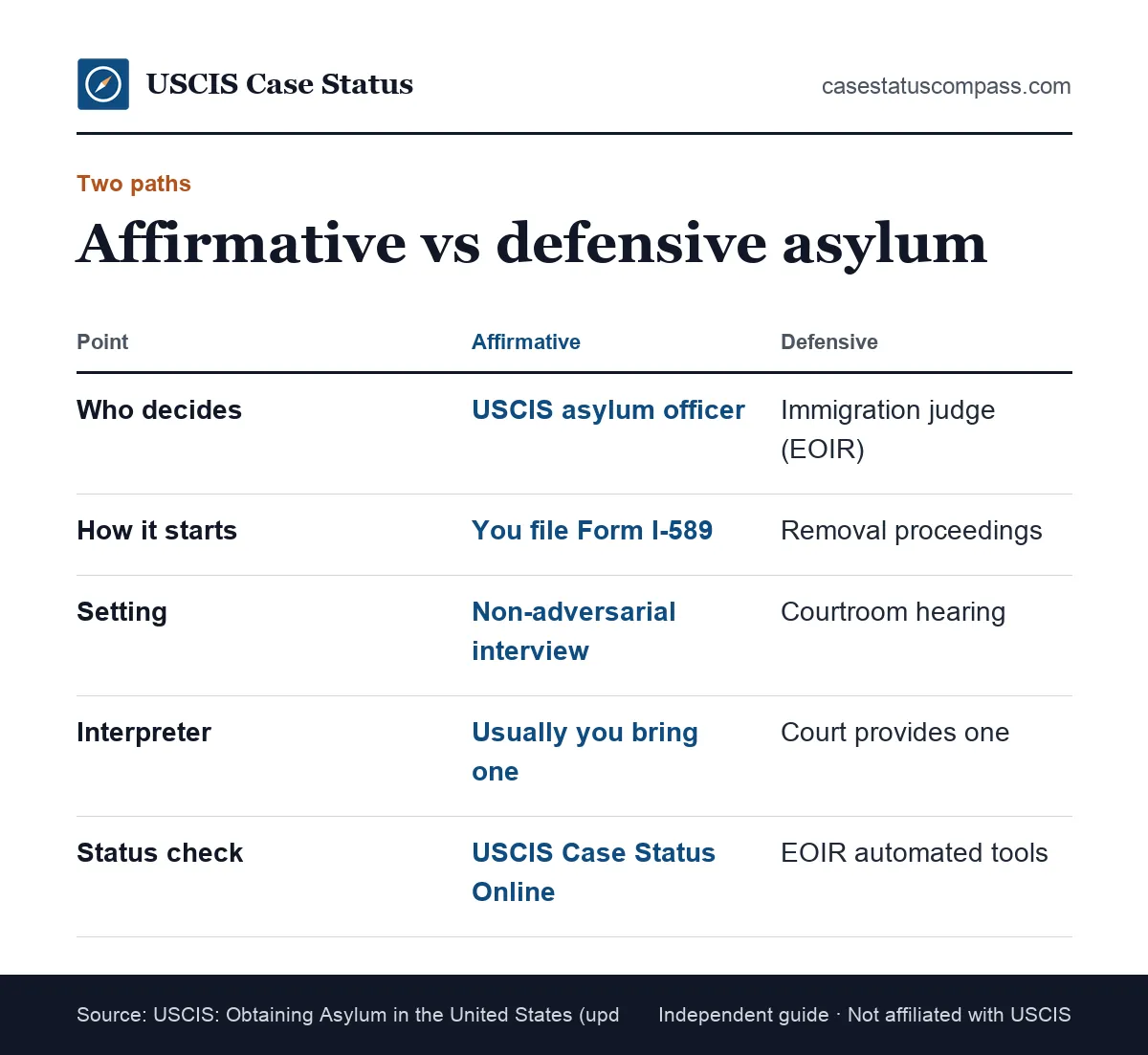
| Point | Affirmative asylum | Defensive asylum |
|---|---|---|
| Decided by | USCIS asylum officer | Immigration judge at EOIR |
| Setting | Non-adversarial interview | Courtroom hearing; ICE attorney present |
| Interpreter | Usually you bring one | The court provides one |
| If not approved | Often referred to court | Appeal to the Board of Immigration Appeals |
| Where to check status | USCIS Case Status Online | EOIR automated tools |
How a case moves from one path to the other
If USCIS does not approve an affirmative case and you lack lawful status, it issues a Notice to Appear and refers you to court. The judge then hears the claim fresh. From that point, your asylum status lives in the court system, not on USCIS tools.
The Asylum Merits Interview
After a positive credible fear finding at the border, USCIS may hold an Asylum Merits Interview. USCIS provides the interpreter. If asylum is not granted there, the case goes to streamlined court proceedings before a judge.
How Does the Asylum Process in the USA Work?
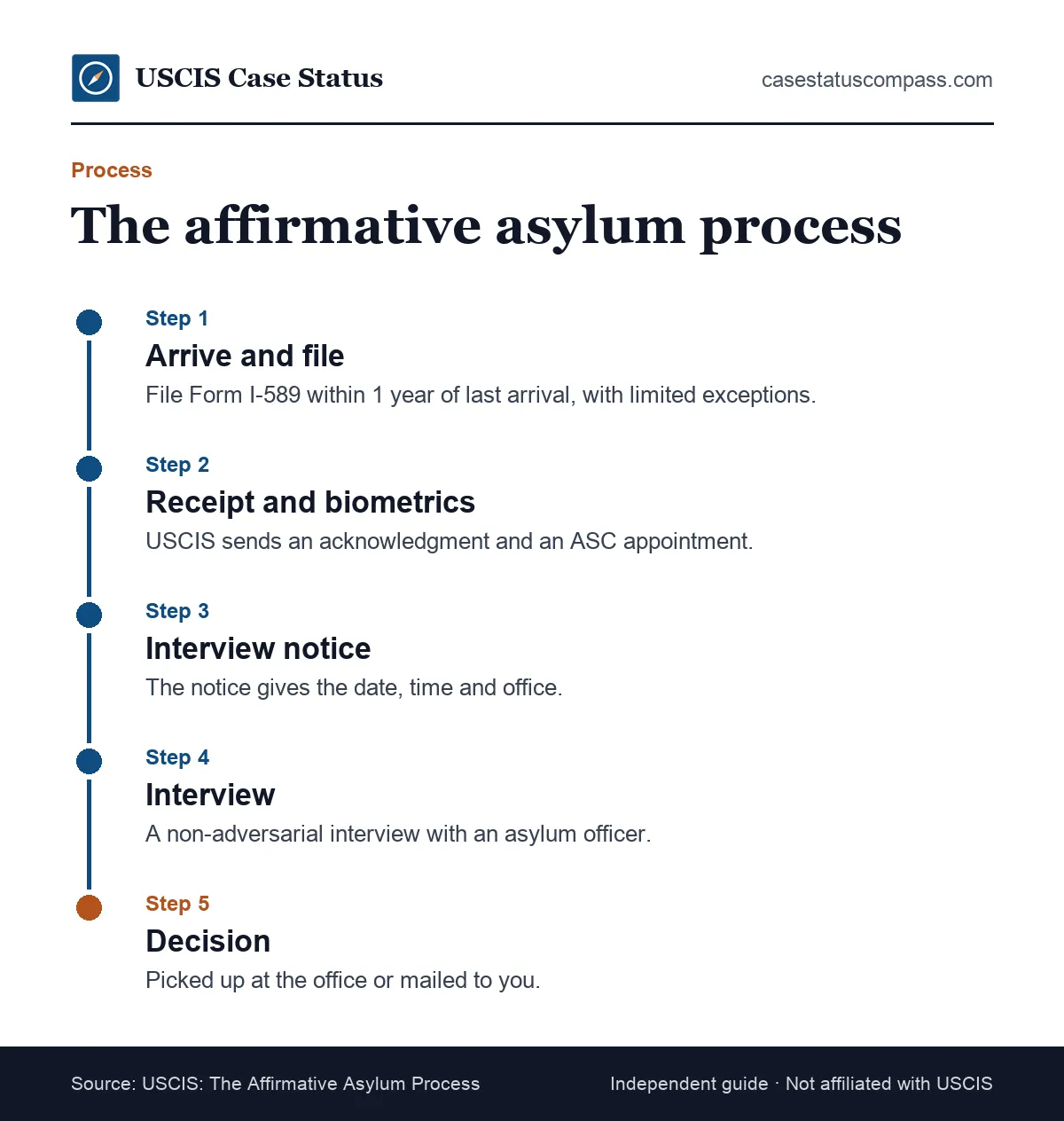
For affirmative applicants, the asylum process in the USA runs in order: arrive, file Form I-589, receive an acknowledgment, attend biometrics, attend an interview, then receive a decision. Each step produces a notice, so file every one in date order. Defensive cases follow a different route through immigration court hearings, covered further down this page.
What happens at USCIS behind the scenes
After biometrics, USCIS runs security and background checks. After the interview, the officer drafts a decision and a supervisory asylum officer reviews it. Some cases go to USCIS headquarters for extra review, which can add time with no visible update.
Where the process differs for children
USCIS handles cases for unaccompanied children who are in removal proceedings, under special rules. Online filing is not available for them. Such a child should always have legal help. A child who is listed as a derivative on a parent's form follows the parent's case instead of filing separately.
How Do You Check Your Asylum Case Status?
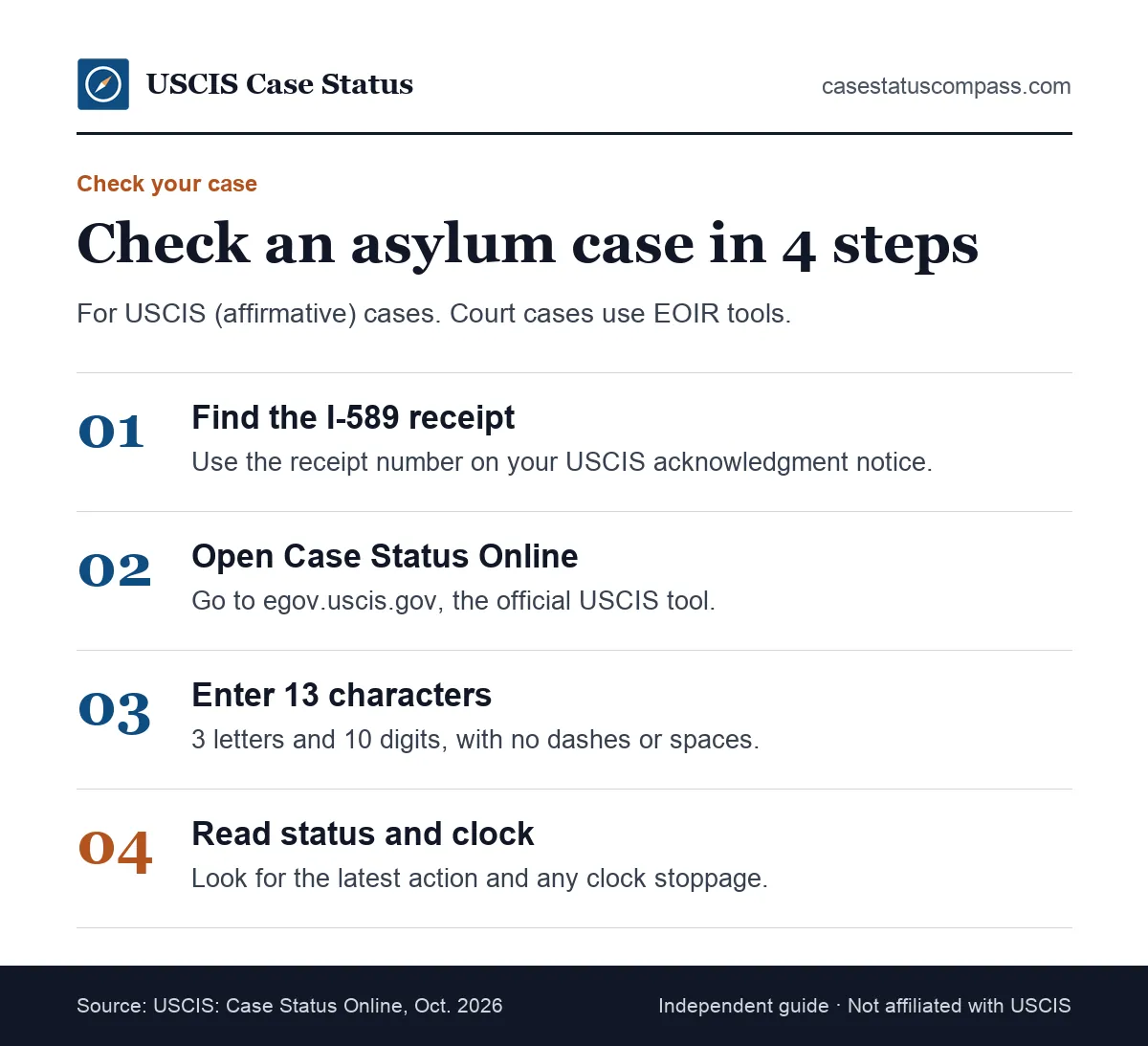
For an affirmative case, type the receipt number from your I-589 acknowledgment into Case Status Online. The result shows the latest action on your asylum case. For a case in immigration court, see our immigration court case status guide.
Step by step for an I-589 receipt
- Find your I-589 receipt number on the acknowledgment notice.
- Open Case Status Online: egov.uscis.gov.
- Enter it as 3 letters + 10 digits (13 characters), e.g. EAC2512345678; leave out dashes.
- Read the asylum status and the text beneath it.
- Scroll for any line about the asylum clock.
When the tool says it cannot find your case
Retype the number with no dashes. If the case moved to court or was filed long ago, the tool may show little. Our guide to the USCIS receipt number explains the prefixes.
Checking Asylum Status in a USCIS Online Account
A free USCIS online account stores your notices and case history in one place. Online I-589 filers get one automatically, and paper filers can link a case with the access code on the notice. Sign up at myaccount.uscis.gov/create-account. Use the same email for every family member's case only if you manage them all.
What the account adds
The account lets you read notices as PDFs, send secure messages and update your address. It also hosts the Annual Asylum Fee payment page. Notices posted there often appear before the paper copy arrives, so check it weekly and download each PDF to your own records.
Online filing of Form I-589
USCIS lets most applicants file Form I-589 online. It is not allowed for unaccompanied children, people whose removal case was dismissed or terminated, people whose Notice to Appear was never filed with the court, or nunc pro tunc cases.
Can You Check an Asylum Case by Phone?
Yes. The USCIS Contact Center at 800-375-5283 (TTY: 800-767-1833) can read your case record. Live agents are available Live calls and chat: Monday to Friday, 8 a.m. to 8 p.m. Eastern. For a court case, call EOIR's automated line instead.
What to have ready before you call
Have your receipt number, A-Number, full name and date of birth in front of you. Keep the I-589 acknowledgment notice nearby so you can read each number exactly as it is printed.
Questions to ask the Contact Center agent
Ask about the latest action, any clock stoppage and whether an interview or fee notice was issued. Write down the date, the agent's name and any reference number so you can cite the call in a later written inquiry.
What Is Your Asylum Number?
People say "asylum number" for two different numbers. The receipt number tracks the I-589 at USCIS. The A-Number (Alien Registration Number) is your permanent file number, used by USCIS and the court. Your notices list both. Writing one in a box meant for the other is a common reason a search or a form fails.
Which number goes where
Use the receipt number on Case Status Online and for USCIS calls. Use the A-Number for court tools, most USCIS forms and fee notices. Our alien number guide shows where to find it on each document.
Form I-589 at a Glance
Form I-589, Application for Asylum and for Withholding of Removal, is the single form for asylum, withholding of removal and Convention Against Torture protection. USCIS accepts the 07/28/26 edition, and every page must come from the same edition. Download it fresh from uscis.gov the week you file.
English version only
USCIS posts translations of the form in many languages for reference only. You must submit the English version. Any document in another language needs a full English translation. Attach the translator's signed statement that they are competent in both languages and that the translation is accurate.
One form for the whole family
You list your spouse and unmarried children under 21 who are in the United States on your I-589. They become derivatives if you win. Include each person's photo, identity papers and proof of the relationship, such as a marriage or birth certificate, and give a copy of the full package to each adult family member.
Who Can File Form I-589 With USCIS?
You file with USCIS if you are in the United States and not in immigration court proceedings, or if you are an unaccompanied child in proceedings. Anyone already in proceedings generally files with the immigration judge instead. If you are unsure, check your EOIR record before you file.
People who file with the court
If you received a Notice to Appear that was filed with the court, your claim usually belongs before the judge. USCIS lists exceptions on its I-589 page, and EOIR records confirm whether a court case exists.
Bars that may apply
USCIS lists bars such as a missed filing deadline, a prior denial by a judge or the Board, and safe third country rules. Some bars have narrow exceptions that only a careful review can find, so get legal help before you file.
What Is the One-Year Filing Deadline?
The law says you should File for asylum within 1 year of your last arrival in the U.S. (limited exceptions). USCIS warns that missing the deadline may make you ineligible under INA 208(a)(2)(B). Changed or extraordinary circumstances can excuse a late filing in some cases.
When an exception may help
Exceptions can cover new dangers in your country, serious illness or holding another status, such as TPS, for part of the time. You must explain the reason on the form and file within a reasonable period.
Where Do You File an Asylum Application?
Most applicants can file Form I-589 online. Paper filers use a USCIS lockbox based on where they live, as listed under "Where to File" on the I-589 page. USCIS also has a Filing Instructions Tool that shows the right address.
September 2026 filing change
On Sept. 15, 2026, USCIS announced that applicants with a prior final USCIS action on an I-589 must file with a lockbox, not the Asylum Intake Unit. USCIS said forms postmarked to that unit on or after Oct. 15, 2026 will be rejected.
Adding a dependent later
Do not file a second I-589 to add a spouse or child. USCIS says to mail the request to the asylum office that has your case. Keep proof of mailing.
What Is the Typical Asylum Status Sequence?
An affirmative asylum case usually moves from received, to biometrics, to a long wait, to the interview, to a decision. The table below describes each stage and your action. USCIS publishes no fixed timing per stage.
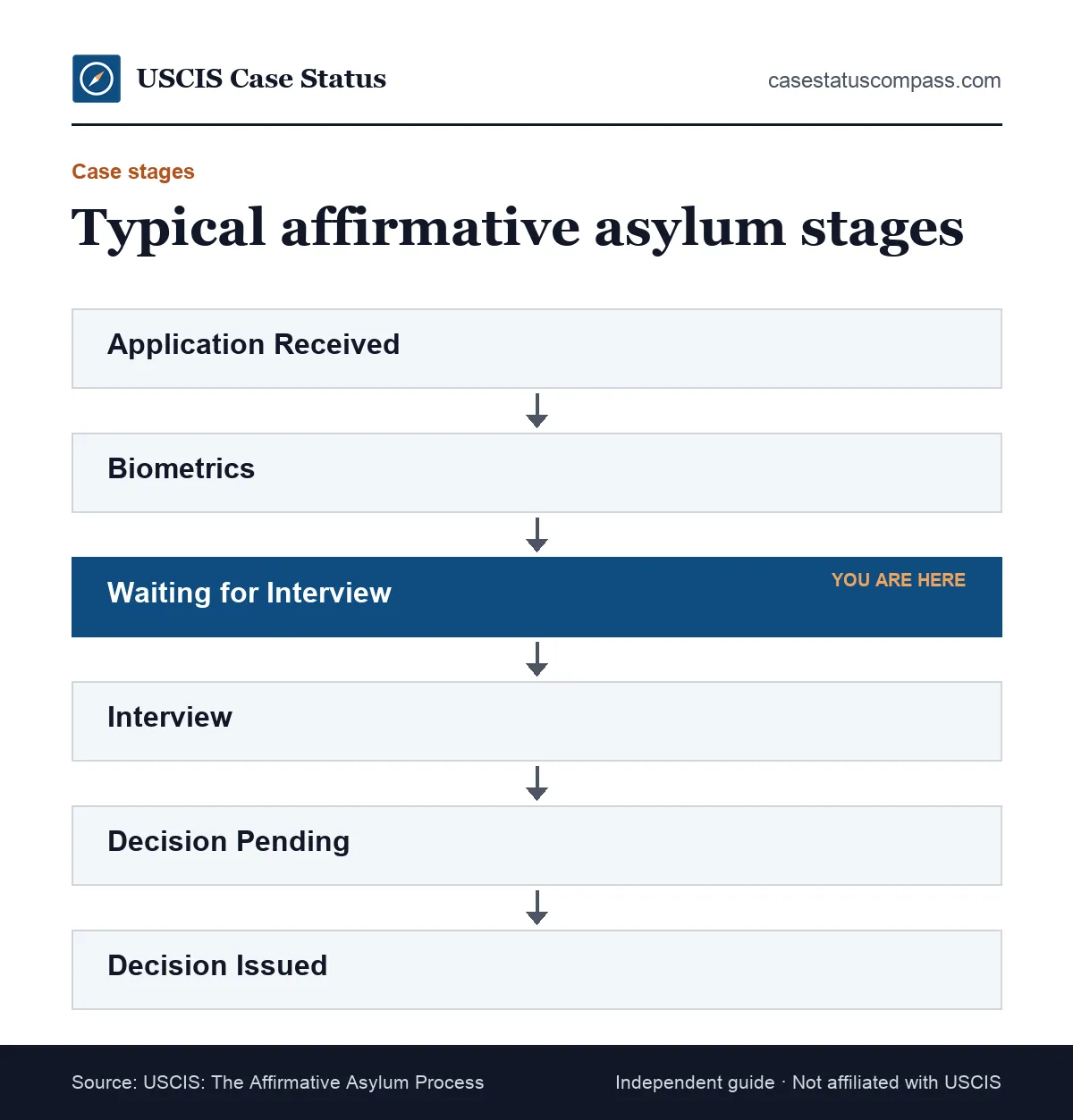
| Stage | What it means | Typical timing | Your action |
|---|---|---|---|
| Application received | USCIS accepted Form I-589 | First update | Save the acknowledgment |
| Biometrics scheduled | ASC visit for fingerprints | Early in the case | Attend; do not reschedule lightly |
| Waiting for interview | Case is in the scheduling queue | Can be long | Keep address current |
| Interview scheduled | An officer will hear your claim | Notice comes by mail | Prepare and bring documents |
| Decision pending | Review and checks after interview | Varies | Answer any request quickly |
| Decision issued | Grant, referral, intent to deny or denial | Pick up or by mail | Read it; get legal help |
Why the wait is uneven
USCIS schedules some new cases quickly and works older ones in a second track. Your place depends on when you filed and office workload. Two people who filed the same month can therefore wait very different lengths of time, and a long wait alone is not a sign of a problem.
Status updates that rarely appear
Background checks and supervisor review usually produce no new online message. A case can show the same asylum status for a long time and still be moving. If nothing changes far past the estimate, see our page on a case status that is not updating.
What Does Pending Asylum Status Mean?
Pending asylum status means USCIS or the court has your Form I-589 but has not decided it. You may stay in the country while it is pending. It is not a visa or lawful status, but it can make you eligible for a work permit later.
What you can do while pending
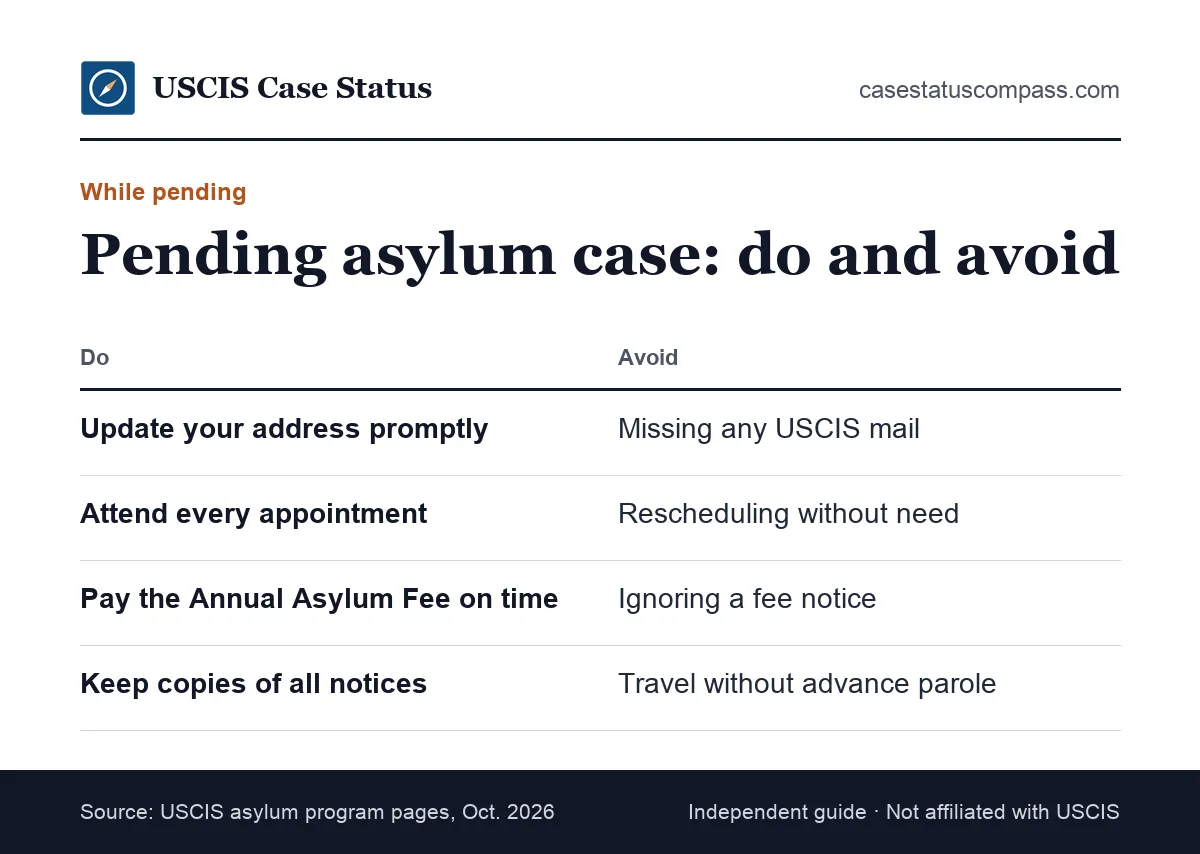
You can live in the United States, seek a work permit once eligible, apply for a Social Security number with an EAD and attend school. You must keep your address current, attend every appointment and pay any Annual Asylum Fee on time.
What pending status does not allow
Pending asylum status does not let you travel abroad safely without advance parole, and travel to the country you fled may harm the claim. It also does not count as lawful status for some other benefits.
When pending status ends
It ends with a grant, a referral to court, a denial or a dismissal. A case referred to court stays alive there, so your asylum status as an applicant continues before the judge.
What Is the Asylum Clock?
The asylum clock, or asylum EAD clock, counts the days your I-589 has been pending for work permit purposes. Days you cause delays do not count. The clock decides when you can apply for an asylum-based work permit on Form I-765.
Why the count matters
You cannot file the (c)(8) work permit request until enough days have built up under the regulations. USCIS has published the rules in a notice on applicant-caused delays. We have not stated the day count here; check the current USCIS notice and the I-765 instructions.
USCIS and court clocks are linked
If USCIS refers your case to court, the clock may keep running in the court system. A 2024 class settlement, Garcia Perez, changed how both agencies track and report the clock.
How Do You Check the Asylum Clock Online?
For an affirmative case, check asylum status on Case Status Online with your I-589 receipt number. According to the Garcia Perez settlement FAQ, the tool shows whether the clock has stopped for an applicant-caused delay and the days counted at that point. For a court case, use EOIR's tools.
If the count looks wrong
Write down the date of each appointment, reschedule request and notice. Compare it with what the tool shows. The settlement lets class members contest a stoppage they believe is wrong, in writing to USCIS or EOIR.
Checking the clock for a court case
EOIR offers automated case information by phone and online, including clock details for many cases. Do not rely on USCIS tools once your case is with a judge. Call EOIR case hotline: 1-800-898-7180 (24/7, automated) with your A-Number.
What Stops the Asylum Clock?
Delays you cause usually stop the clock. USCIS lists missing an interview, missing the decision pickup, asking to reschedule an interview and missing biometrics. Government-caused delays should not stop it. The clock may restart when the delay ends. Check the tool after any reschedule.
Common clock stoppers to avoid
- Asking to move your interview without strong reason
- Missing a fingerprint appointment
- Coming to the interview without a qualified interpreter
- Not picking up your decision on time
- Leaving a USCIS notice unopened until after its date
Rescheduling for a real emergency
Sometimes rescheduling cannot be avoided, such as during a hospital stay. Ask in writing before the appointment date and attach proof, such as a hospital letter or a death certificate. You may still lose clock days, so keep a copy of the request to show later.
Asylum Biometrics Appointment
After filing, you get a notice to visit an Application Support Center (ASC) for fingerprints and a photo. Each family member on the I-589 gets a separate appointment, regardless of age. On fees, USCIS notes: Biometrics included in most fees (separate $30 for TPS I-821 and some EOIR forms).
If you miss the appointment
USCIS says you should request a new appointment quickly and show exceptional circumstances. Otherwise USCIS may dismiss your case or refer it to a judge. Missing biometrics also stops the asylum clock. Our biometrics appointment guide covers the visit.
How Are Asylum Interviews Scheduled?
USCIS uses two tracks. One schedules rescheduled interviews first, then recently filed cases, then other cases from newest to oldest. A second track has officers work through the oldest pending cases. The policy page was last updated in March 2024.
What this means for your wait
A case that misses the early window can wait a long time while newer filings move ahead. Asylum office directors may consider urgent interview requests case by case. Send the request in writing to the office with jurisdiction.
Asylum Merits Interviews are separate
Cases from the credible fear process follow their own scheduling rules. If your case began with a border screening, ask your representative which rules apply. Our expedite request page explains general USCIS expedite standards.
How Do You Find the Asylum Office Near You?
Your interview notice names the asylum office or alternate site where you must appear. To find contact details for the office with jurisdiction over your home, use the USCIS Service and Office Locator on uscis.gov. Do not use an address from a friend's notice; offices are assigned by where you live.
Circuit ride locations
If you live far from an asylum office, USCIS may interview you at a circuit ride site, often a USCIS field office. Contact the asylum office with jurisdiction to ask about one.
Why searching "asylum office near me" can mislead
Search results often show law firms or nonprofits with "asylum" in their names. Only USCIS asylum offices hold affirmative interviews. Check the address on your notice against uscis.gov before you travel.
Asylum Interview: What to Expect
The asylum interview is a non-adversarial meeting with a trained asylum officer. The officer places you under oath, confirms your identity and asks about your claim. Length varies with the claim, the interpreter and the number of family members. Plan for most of a day.
How the officer runs the interview
The officer reviews your I-589 line by line, asks about your fear of return and checks for bars. A supervisor later reviews the decision. You can add corrections at the start of the interview, so note any errors beforehand.
What Asylum Interview Questions Are Asked?
Officers ask about your identity, your family, your journey to the United States, what happened to you, who harmed you and why, and what you fear on return. They also ask the bar questions printed on Form I-589. If you do not know or cannot remember a detail, say so instead of guessing.
Asylum interview questions
Common asylum interview questions include:
- What is your full name and where were you born?
- Why did you leave your country?
- Who harmed or threatened you, and why?
- Did you report it to the police?
- What do you fear will happen if you return?
- Have you ever been arrested or harmed others?
Why consistency matters
The officer compares your answers with your I-589, your documents and any earlier statements. Small differences are normal, but major gaps can affect credibility. If you remember something differently from what the form says, tell the officer at the start and explain why.
Questions about your travel
Expect questions about every country you passed through, how long you stayed, and whether you applied for protection there. Bring passports, tickets or other records that show the route and dates, since these answers can matter for safe third country issues.
How Should You Prepare for an Asylum Appointment?
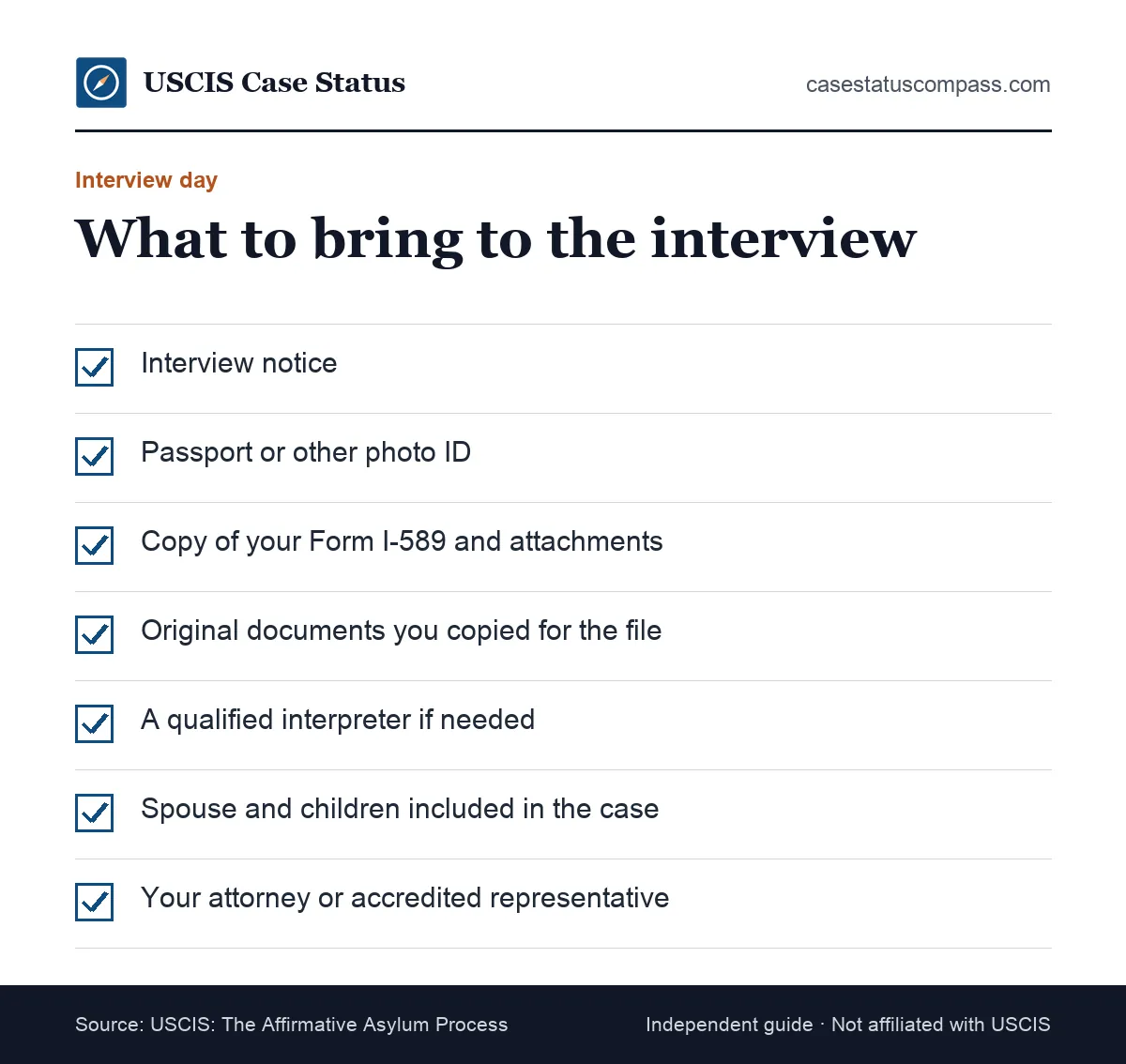
Prepare by rereading your Form I-589, gathering original documents, booking a qualified interpreter and planning your route. An asylum appointment with USCIS is the most important day of the case, so prepare with your representative well ahead. Book the trip a day early if you live far away.
Practice without memorizing
Talk through your story in your own words. Do not memorize a script; officers notice. Focus on dates, places and names you can confirm with documents. Saying "I don't remember" is better than guessing.
Bringing an Interpreter, Lawyer and Family
If you cannot proceed in English, USCIS says you must bring your own interpreter to an affirmative interview. You may bring an attorney or DOJ-accredited representative. Your spouse and children seeking derivative status must attend. Bring identity documents for each of them.
Who can serve as interpreter
The interpreter must be fluent in English and your language and must be an adult. Your attorney, a witness or someone with a stake in the case usually cannot interpret. USCIS may use a monitor on the phone to check the translation.
Can You Reschedule an Asylum Interview?
Only in narrow cases: since Aug. 21, 2026, USCIS reschedules an asylum interview only for exceptional circumstances, and requests after a missed interview are due within 10 calendar days. A request usually stops the asylum clock too. Without exceptional circumstances, USCIS dismisses the case if you have another lawful basis to stay, or refers it to immigration court.
Good reasons to ask
Serious illness or the death of a close family member are the kinds of reasons USCIS accepts. USCIS no longer sends a warning notice after a missed interview, so act fast and attach documents.
What Happens After the Asylum Interview?
USCIS says you usually return to the asylum office to pick up your decision on a date the office gives you. Decisions may come by mail instead if you hold lawful status, were interviewed at a field office, need security checks or face headquarters review.
If you hear nothing for a long time
Long gaps after an interview are common when security checks are pending. Ask the asylum office for an update in writing after a reasonable wait. Include your name, A-Number, receipt number and interview date so staff can find the file quickly.
Keep the clock in mind
Missing the decision pickup stops the asylum clock. If you cannot attend, contact the office before the date. Ask in writing for a new pickup date and keep proof of the request, because an unexplained absence counts against you.
What Are the Possible Asylum Decisions?
An affirmative asylum case can end in a grant, a recommended approval, a referral to immigration court, a notice of intent to deny or a denial. Which one you get depends on the facts and on whether you hold another lawful status.
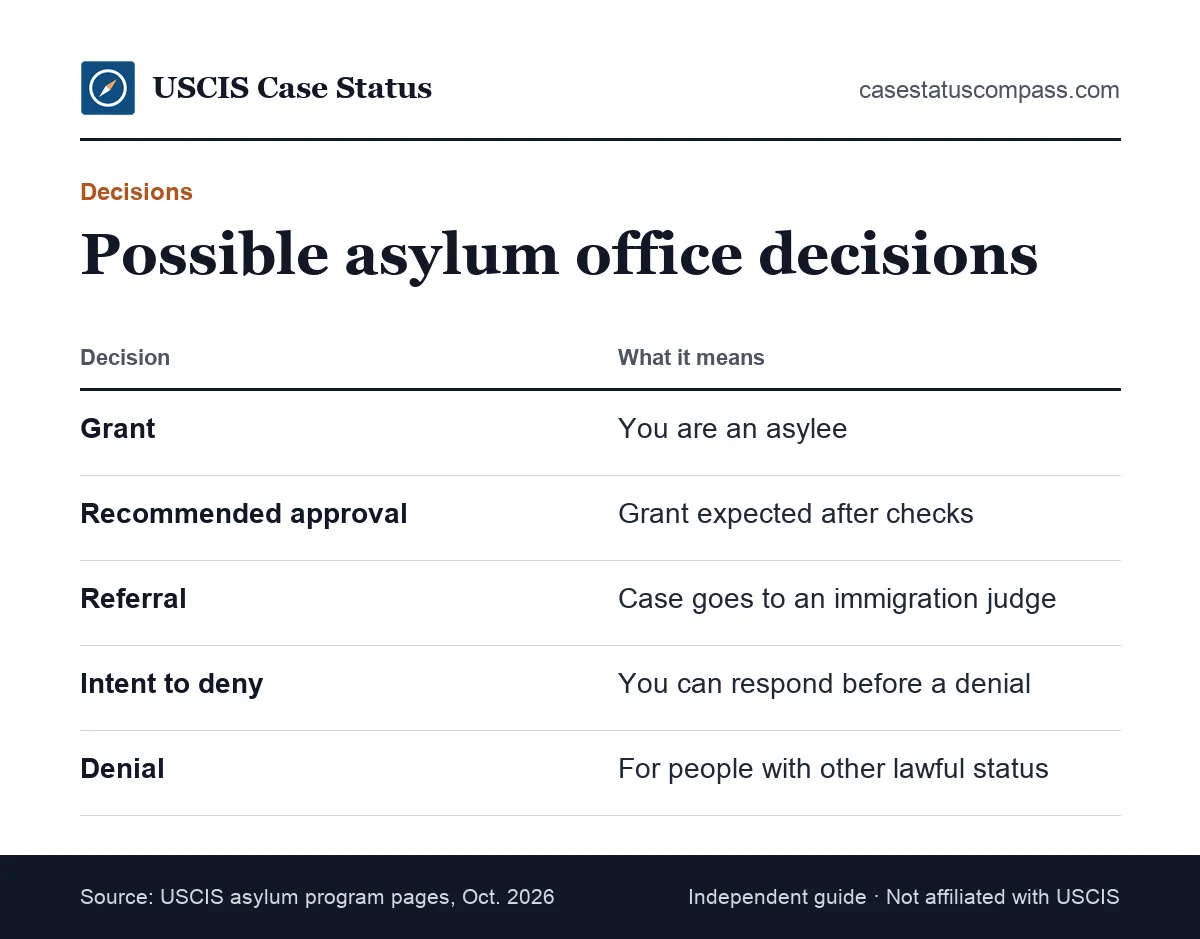
| Decision | Who usually gets it | What to do next |
|---|---|---|
| Grant | Eligible applicants who pass checks | Keep the approval; plan family petitions |
| Recommended approval | Eligible, checks still pending | Wait for the final grant |
| Referral to court | Not approved, no lawful status | Prepare for court with a lawyer |
| Notice of intent to deny | Not approved, has lawful status | Respond by the deadline |
| Denial | Has lawful status after the intent notice | Discuss options with a lawyer |
Reading a referral notice
A referral comes with a Notice to Appear. It lists your first court date. Your case continues before the judge, and you can still win asylum there. Our case was denied page covers what that status means generally.
Pending Asylum Status and Work Permit
An asylum applicant can request a work permit on Form I-765 under category (c)(8) after the asylum clock reaches the required count. USCIS accepts only the 08/21/25 (the 09/15/26 edition is NOT accepted because of a Sept. 14, 2026 court order) edition. Our work permit guide covers the form.
Initial (c)(8) fees in October 2026
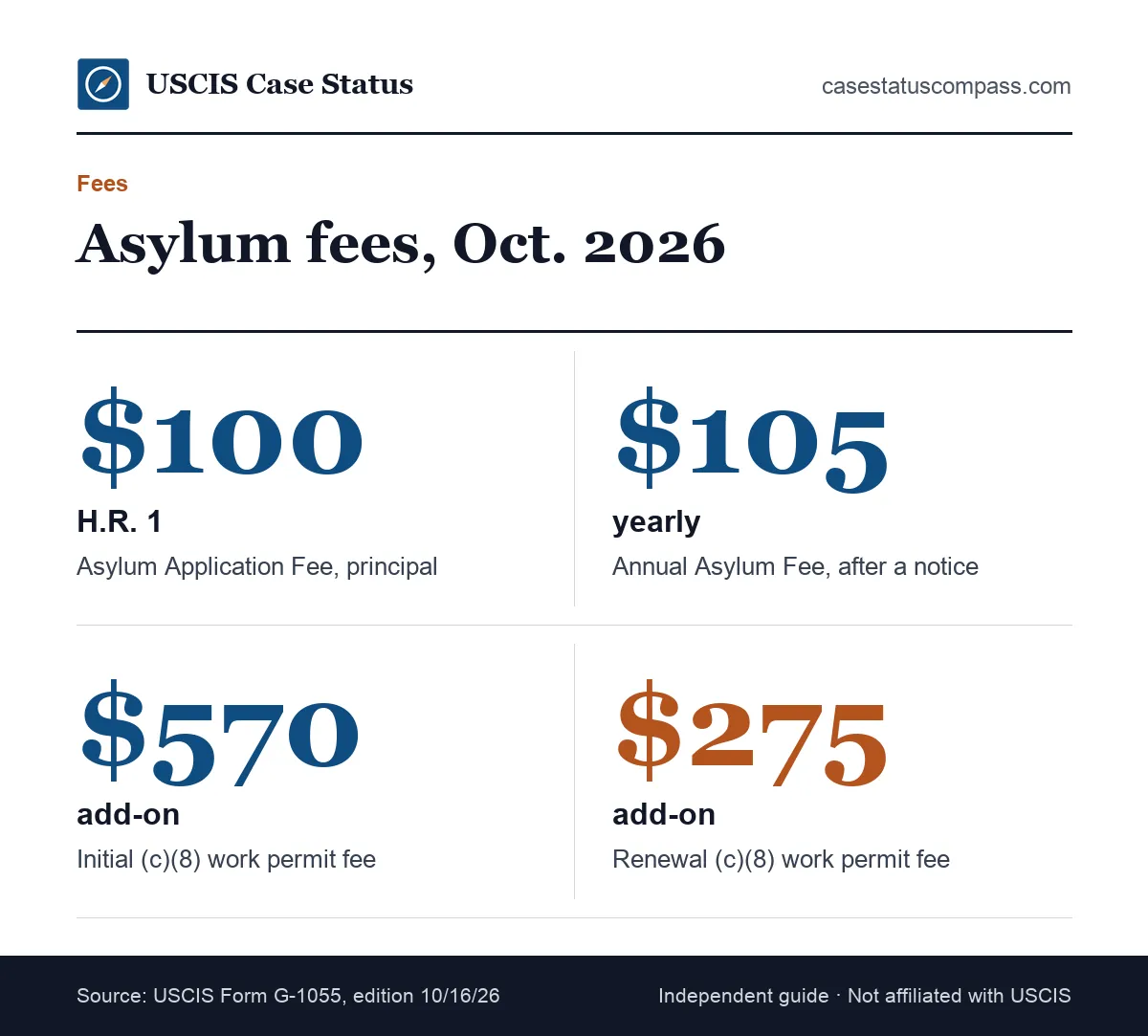
Under the Oct. 16, 2026 fee schedule, an initial (c)(8) EAD has no base fee, only a $570 H.R. 1 add-on. A renewal costs the base fee ($520 paper / $470 online) plus a $275 add-on. These amounts cannot be waived and change each year.
Renewal and the end of automatic extensions
USCIS says: Ended: renewals filed on or after Oct. 30, 2025 no longer get the up-to-540-day automatic extension (exceptions: TPS by law/Federal Register notice; STEM OPT 180 days). For (c)(8) holders, this means filing a renewal early. A card that expires before a new one arrives usually ends your permission to work.
Proposed changes to asylum work permits
DHS proposed a rule on asylum-based work permits in February 2026. As of October 2026, we could not confirm a final rule on an official page. Check the I-765 page before you file, and ask an attorney how any change applies.
Asylum Fees After H.R. 1
As of the Oct. 16, 2026 fee schedule, Form I-589 has this structure: $0 filing fee + $100 Asylum Application Fee (principal applicant); Annual Asylum Fee $105 (online, when USCIS sends a notice). These H.R. 1 fees cannot be waived. Our USCIS fees page lists every fee in one table.
Who does not pay
USCIS lists an exemption: Ms. L. settlement class: exempt from H.R. 1 parole, parolee-EAD and asylum fees since Feb. 5, 2026. Their qualifying family members are covered too. If you think you belong to this group, ask an attorney before you pay.
What Is the Annual Asylum Fee Notice?
USCIS sends a notice when the Annual Asylum Fee is due for each year your I-589 stays pending. The principal applicant pays online within 30 days of the notice. USCIS says it cannot approve an asylum case while the fee is unpaid.
How to pay safely
Pay only through your USCIS online account at my.uscis.gov. Never pay a caller or a texted link. As of October 2026, the fee is $105. USCIS does not ask for payment by gift card, wire transfer or cryptocurrency.
How Long Does an Asylum Case Take?
There is no fixed answer. Waits depend on the scheduling track, the office and your case. Check the official tool at egov.uscis.gov/processing-times. We could not confirm a current official asylum processing time, so this page does not give one.
Why some cases take years
Backlogs, security checks and referrals to court can each add long periods. A case referred to court restarts the wait there. Our USCIS processing times hub explains how to read the official tool.
Can You Travel With a Pending Asylum Case?
Leaving the United States while your I-589 is pending without advance parole may be treated as abandoning your claim. Even with advance parole, return to the country you fled can destroy the claim. Get legal advice before any trip. That includes short trips to a third country.
Advance parole basics
You request advance parole on Form I-131 before you leave. Approval is not a promise of re-entry. CBP decides at the border whether to let you back in. Never travel to the country you fear, even with an approved document. Our advance parole guide explains the form and its fees.
Adding Family Members to an Asylum Case
Your spouse and unmarried children under 21 who are in the United States can be derivatives on your I-589. Each person attends biometrics. To add someone to a pending case, mail a request to the asylum office instead of filing a new form.
Family outside the United States
Relatives abroad cannot be added before a grant. After a grant, an asylee can file Form I-730 for a spouse or child. Our I-130 petition guide covers family petitions that may apply later, after permanent residence.
What Happens If Your Asylum Case Is Referred to Court?
A referral moves your claim to an immigration judge at EOIR. Your asylum status on USCIS tools will no longer update. Track the court case and attend every hearing; missing one can lead to a removal order. Your USCIS receipt number stops being useful at this point.
Where to track the court case
Our EOIR case status guide covers hearings and court tools. If you need more time, our guide on postponing an asylum hearing explains the request process. The EOIR online portal at acis.eoir.justice.gov also shows hearing dates when you enter your A-Number.
What If Your Asylum Case Seems Stuck?
A long wait is normal in many asylum offices, but some steps can help. Check your address, confirm biometrics were taken and ask whether a notice was missed. Then send a written inquiry to the asylum office with jurisdiction. Keep a copy of the inquiry, and check your asylum status online again once the office replies.
Escalation options
If the office does not respond, the CIS Ombudsman or your member of Congress may make an inquiry. Some applicants file a federal lawsuit, called a mandamus action, after very long waits. That step needs a lawyer. See our USCIS ombudsman page.
Updating Your Address During an Asylum Case
Report a move to USCIS within 10 days. A lost interview notice can stop the asylum clock or lead to a referral. If you are in court, also tell the immigration court or BIA within five working days on Form EOIR-33, or online through Respondent Access. Our USCIS change of address guide gives the steps.
Why address mistakes are costly
USCIS mails interview notices and fee notices. If one goes to an old address, you may miss the date. Ask someone at the old address to watch for mail, and set up postal forwarding as a backup.
Life After an Asylum Grant
Once you are an asylee, you can work without restriction, apply for a Social Security card and petition for your spouse and children. After the waiting period set by law, you can apply for a green card on Form I-485.
Green card and beyond
Asylees adjust status on Form I-485. As a permanent resident, you will later file a green card renewal and, in time, a citizenship application. USCIS states: Refugees and asylees need 1 year of physical presence in the U.S. before filing I-485. USCIS data put the median for asylum-based I-485s at I-485 (asylum-based): median 25.6 months (USCIS data, Apr.-June 2026).
Travel after a grant
An asylee who travels should get a refugee travel document on Form I-131 first. Returning to the country you fled can raise questions about your claim. As of October 2026, the fee is $165 for applicants 16 or older.
Where Can You Get Asylum Application Help?
Get asylum application help from an immigration attorney or a DOJ-accredited representative at a recognized organization. Many nonprofits offer free or low-cost help. USCIS and the Justice Department publish lists of legal service providers. Start with those official lists, and ask each provider whether it handles affirmative cases, court cases or both.
Choosing a representative
Check that a lawyer is licensed with a state bar or that a representative is listed on the Justice Department roster. Ask about fees in writing. Avoid "notarios" and anyone who promises a sure win.
What a representative can do
A representative can prepare your I-589, gather evidence, attend your interview, track the asylum clock and argue your case in court. They file Form G-28 so USCIS copies them on notices.
Asylum Filing Checklist You Can Copy
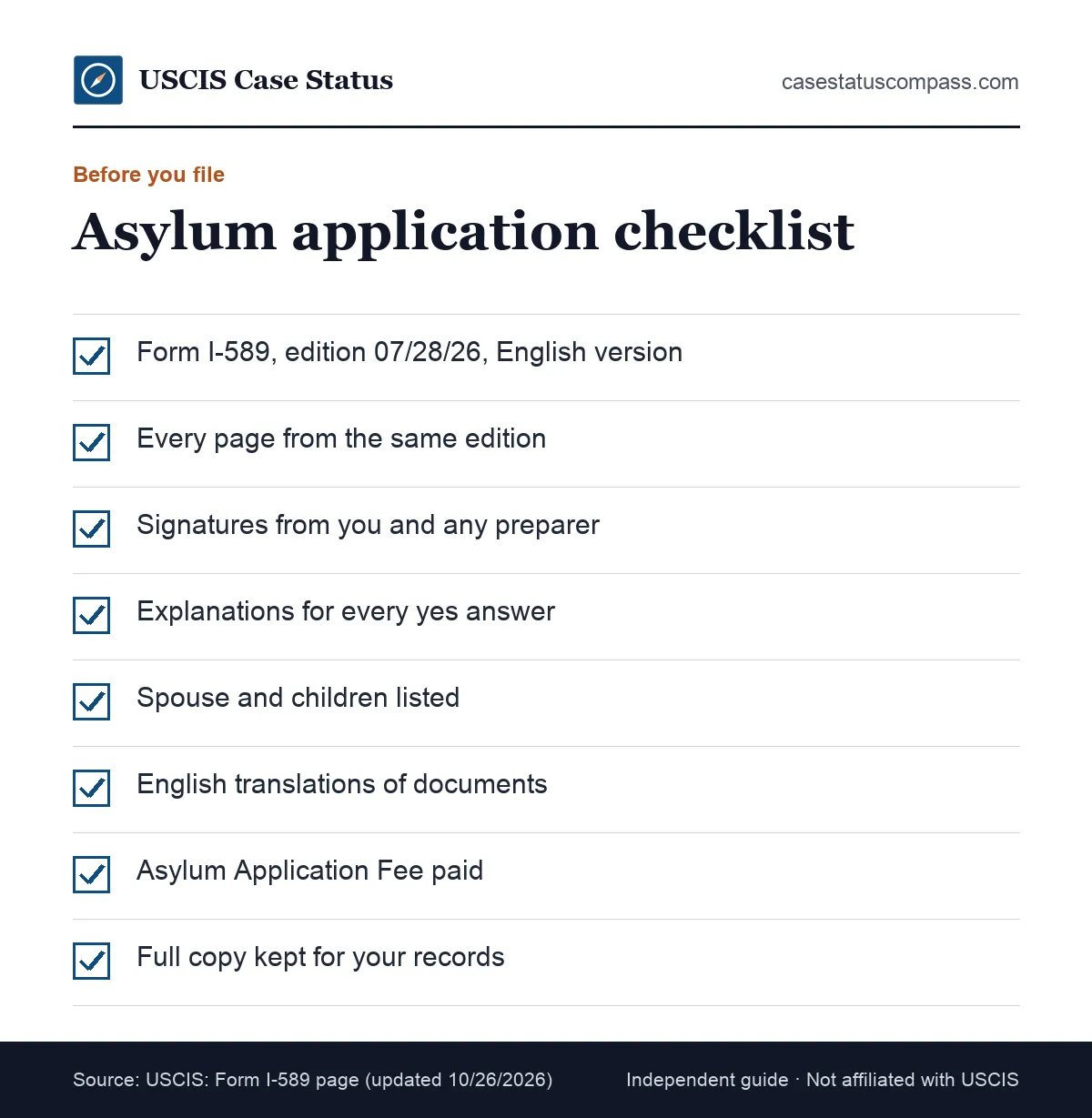
Use this asylum application checklist before you submit Form I-589. It follows the USCIS rules on editions, signatures, translations and fees. Tick each box only after you have checked the item against the form instructions, and keep the finished list with your copy of the package so you can answer any later question about what you sent.
The copyable list
- Form I-589, edition 07/28/26, English version
- All pages from the same edition, with page numbers visible
- Your signature and any preparer's signature
- Explanations for every "yes" answer
- Spouse and children listed with details
- English translations of foreign documents
- Asylum Application Fee paid or exemption noted
- Full copy of everything you submit
Mistakes That Can Hurt an Asylum Case
The most harmful mistakes are filing after the one-year deadline, giving answers that conflict with your documents, missing appointments, letting an address go stale and ignoring a fee notice. Each can stop the clock or end the case. Most are avoidable with a calendar.
Small errors with large effects
- Leaving questions blank instead of writing "none"
- Using an old form edition
- Bringing an interpreter who is not fluent
- Paying a fee through an unofficial link
- Signing a form you have not read in full, or that someone else filled in without asking you
Why a lawyer matters most here
A small inconsistency can affect credibility. Strongly consider an immigration attorney or DOJ-accredited representative from the start, not after a problem.
Frequently Asked Questions
Can I check my asylum status with my A-Number?
To check asylum status on USCIS Case Status Online, you need a receipt number, not an A-Number. For a USCIS case, use the I-589 receipt number or call the Contact Center with your A-Number. For a court case, EOIR's automated tools use the A-Number to show hearing dates and decisions.
Does my asylum case show on Case Status Online if it is in court?
Usually not in a useful way. Once a case is referred to an immigration judge, USCIS updates stop and the court record becomes the source. Use EOIR's automated phone line or online case information for hearings, decisions and clock details in court cases.
What happens if I miss my asylum interview?
Missing the interview stops the asylum clock. Without a good reason shown quickly, USCIS may refer your case to court or dismiss it. Contact the asylum office in writing at once, explain what happened and attach proof such as medical records.
Can I work while my asylum case is pending?
Not right away. You can apply for a (c)(8) work permit only after the asylum clock reaches the required count, and only if you have not caused delays. The H.R. 1 fees apply. Check the current I-765 instructions before you file.
Can I apply for asylum after one year in the United States?
Sometimes. The law requires filing within one year of your last arrival, with limited exceptions for changed or extraordinary circumstances. Late filers may still qualify for withholding of removal or Convention Against Torture protection, which use the same I-589. Talk to a lawyer first.
Can I change my address while my asylum case is pending?
Yes. Report a new address to USCIS within 10 days of moving (INA 265). Update it online through your account or the change-of-address tool. If your case is in court, you must also tell the immigration court or BIA within five working days on Form EOIR-33, or online through Respondent Access, because the two systems do not share updates.
What does "recommended approval" mean for asylum?
A recommended approval means the officer found you eligible, but security checks are not finished. It is not a final grant. Ask your representative what the recommended approval means for work permit timing and travel.
Is asylum applicant status the same as asylee status?
No. An asylum applicant has a pending Form I-589 and may stay while it is decided, but holds no lawful status like a visa. An asylee has been granted asylum and can work, petition for a spouse and children and later apply for a green card.
Can I file Form I-589 online?
Most applicants can. USCIS does not allow online filing for unaccompanied children, people whose removal case was dismissed or terminated, people whose Notice to Appear was never filed with the court, or nunc pro tunc cases.
Can I withdraw my asylum application?
Yes. You can ask USCIS or the court to withdraw it. If you have no other lawful status, withdrawal may lead to removal proceedings. Because withdrawal can be hard to undo, speak with an immigration attorney or DOJ-accredited representative first.
Sources
- USCIS: Form I-589, Application for Asylum and for Withholding of Removal. www.uscis.gov/i-589. Accessed Oct 27, 2026.
- USCIS: Obtaining Asylum in the United States. www.uscis.gov/humanitarian/refugees-and-asylum/asylum/obtaining-asylum-in-the-united-states. Accessed Oct 27, 2026.
- USCIS: The Affirmative Asylum Process. www.uscis.gov/humanitarian/refugees-and-asylum/asylum/the-affirmative-asylum-process. Accessed Oct 27, 2026.
- USCIS: Affirmative Asylum Interview Scheduling. www.uscis.gov/humanitarian/refugees-and-asylum/asylum/affirmative-asylum-interview-scheduling. Accessed Oct 27, 2026.
- USCIS: Applicant-Caused Delays in Adjudications of Asylum Applications and Impact on Employment Authorization. www.uscis.gov/sites/default/files/document/notices/Applicant-Caused-Delays-in-Adjudications-of-Asylum-Applications-and-Impact-on-Employment-Authorization.pdf. Accessed Oct 27, 2026.
- USCIS Form G-1055 Fee Schedule (Edition 10/16/26). www.uscis.gov/sites/default/files/document/forms/g-1055.pdf. Accessed Oct 27, 2026.
- USCIS: Case Status Online. egov.uscis.gov/. Accessed Oct 27, 2026.
- EOIR: Automated Case Information. acis.eoir.justice.gov/. Accessed Oct 27, 2026.
- USCIS: Checking Your Case Status Online. www.uscis.gov/tools/checking-your-case-status-online. Accessed Oct 27, 2026.
- USCIS: Online Account and Technical Support. www.uscis.gov/tools/uscis-tools-and-resources/online-account-and-technical-support. Accessed Oct 27, 2026.
- USCIS Contact Center (uscis.gov). www.uscis.gov/contactcenter. Accessed Oct 27, 2026.
- DOJ EOIR: Customer Service Initiatives (updated May 29, 2025). www.justice.gov/eoir/customer-service-initiatives. Accessed Oct 27, 2026.
- USCIS: Establishing Exceptional Circumstances for Rescheduling Affirmative Asylum Interviews (updated 09/04/2026); USCIS Asylum page (updated 08/26/2026). www.uscis.gov/humanitarian/refugees-and-asylum/asylum/establishing-exceptional-circumstances-for-rescheduling-affirmative-asylum-interviews. Accessed Oct 27, 2026.
- USCIS: Form I-765 page (updated 10/07/2026). www.uscis.gov/i-765. Accessed Oct 27, 2026.
- USCIS: Automatic EAD Extension (updated 10/29/2025). www.uscis.gov/working-in-the-united-states/information-for-employers-and-employees/automatic-employment-authorization-document-ead-extension. Accessed Oct 27, 2026.
- USCIS Fee Schedule page. www.uscis.gov/g-1055. Accessed Oct 27, 2026.
- USCIS Check Case Processing Times. egov.uscis.gov/processing-times/. Accessed Oct 27, 2026.
- DOJ EOIR: Update Respondent or Alien Information (updated May 18, 2026). www.justice.gov/eoir/update-respondent-or-alien-information. Accessed Oct 27, 2026.
- Form I-485 Instructions, Edition 09/18/26. www.uscis.gov/sites/default/files/document/forms/i-485instr.pdf. Accessed Oct 27, 2026.
- USCIS Data Library: All USCIS Application and Petition Form Types, FY2026 Q3 (Apr. 1-June 30, 2026; queried 7/2026). www.uscis.gov/sites/default/files/document/data/quarterly_all_forms_fy2026_q3_v1.xlsx. Accessed Oct 27, 2026.
- USCIS: How to Change Your Address (updated 08/04/2026); 8 U.S.C. 1305(a) (LII). www.uscis.gov/addresschange. Accessed Oct 27, 2026.
casestatuscompass.com is an independent publication and is not affiliated with USCIS or any government agency. This page is general information, not legal advice. For denials, court or asylum matters, consult an immigration attorney or a DOJ-accredited representative.