Contents · 44 sections
- What Does Case Was Denied Mean on Your USCIS Status?
- Denied vs Rejected: The Difference That Changes Everything
- Can an Outdated Form Edition Cause a Rejection?
- Is Case Was Denied the Same as a Final Answer?
- Where Does a Denial Fit in the Usual Status Flow?
- What Should You Do the Day You See the Denial?
- How Do You Read a USCIS Denial Notice?
- Why Should You Talk to a Lawyer Before Acting?
- Who Can Advise You After a Case Was Denied?
- What Are the Common Reasons USCIS Denies a Case?
- How Does a Denial Differ from an RFE or NOID?
- What Does a Denial Mean for Form I-485?
- Can You Still Work or Travel After an I-485 Denial?
- What Does a Denial Mean for Form I-130?
- What Does a Denial Mean for Form I-765?
- What Does a Denial Mean for Form N-400?
- What Does a Denial Mean for Form I-751?
- What Happens If a Notice to Appear Follows the Denial?
- What Does a Denial Mean for Form I-90 and Other Card Cases?
- What Does a Denial Mean for Employer-Sponsored Petitions?
- What Should an Employer Do After a Petition Denial?
- What Does a Denial Mean for Humanitarian Cases?
- Case Was Denied After an Interview: What It Usually Signals
- How Does a Denial Affect Spouses and Children?
- What If You Never Received the Denial Notice?
- Can a Case Was Denied Status Be a Mistake?
- How Do You Make Sure a Denial Letter Is Real?
- How Do Scammers Target People With a Denied Case?
- What Records Should You Keep After a Denial?
- What Mistakes Should You Avoid After a Denial?
- Decision Table: If This Happened, Do This
- How Do Motions and Appeals Work, in Brief?
- What Happens If You Miss a Motion or Appeal Deadline?
- Can You Reapply After a USCIS Denial?
- How Much Does It Cost to Refile After a Denial?
- Can USCIS Reopen a Denied Case on Its Own?
- What Do Related Denial Status Messages Mean?
- How Is a Denial Different from an Approval Update?
- Does a Denied Case Stay on Your Immigration Record?
- How Long Does It Take for the Denial Notice to Arrive?
- What Can an Accredited Representative Do for You?
- What Should You Not Do After Seeing Case Was Denied?
- Key Facts About a USCIS Denial
- Frequently Asked Questions
The short answer
Case was denied means a USCIS officer reviewed your application or petition and decided not to approve it. The online status is only a headline. Your written decision notice explains the reasons, any appeal or motion you may file and any deadline. Read it with an immigration attorney or DOJ-accredited representative before you act.
At a glance
| Is it final? | For that filing, yes. Some denials can be challenged. |
| Was the case reviewed? | Yes. A rejected filing was never reviewed. |
| What arrives next | A written decision notice, by mail and often online. |
| What to do today | Save the screen, confirm your address, book a legal consult. |
| Who runs this site | An independent guide, not USCIS. |
What Does Case Was Denied Mean on Your USCIS Status?
The Case Was Denied update means USCIS decided one filing and the answer is no. The status names the form, receipt number and decision date and says a decision notice was sent. That letter sets out the reasons and your options.
What the status message says
Read the paragraph under the headline. It usually confirms the form type, such as Form I-485 or Form I-130, your receipt number and the decision date, then points you to the mailed notice.
What the status leaves out
The online message never lists the reasons for the denial, which evidence fell short, whether a motion or appeal is open, or how long you have. Only the written decision says that.
Denied vs Rejected: The Difference That Changes Everything
A rejected case was stopped at intake and never reviewed, usually over a fee, form edition or signature problem. A denied case was reviewed by an officer and refused on the merits. A rejection is often easy to fix; a denial needs legal review.
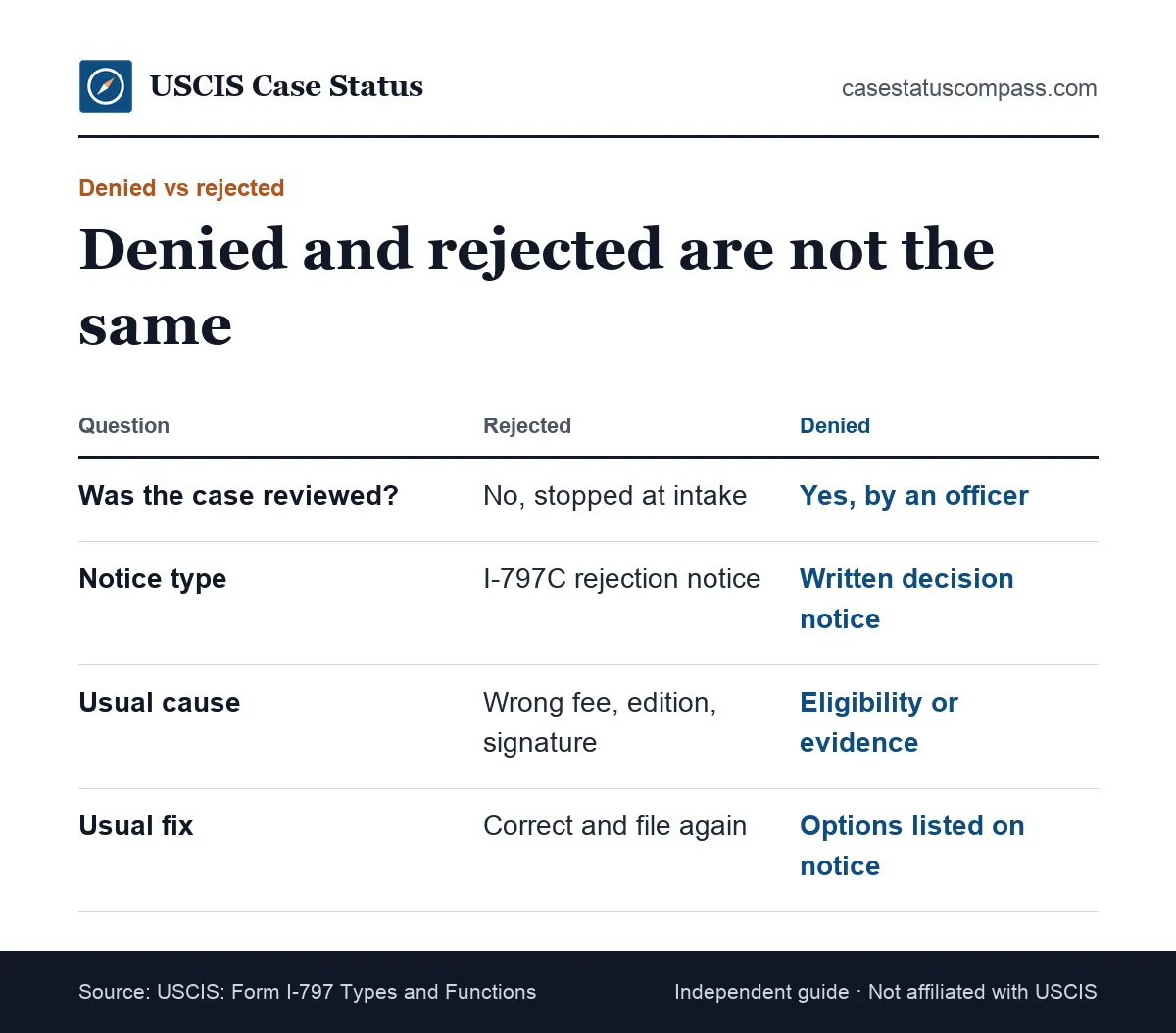
Side-by-side comparison
The table lines up the two outcomes stage by stage, so you can match the notice in your hands to the right column before deciding what to do.
| Point | Rejected filing | Denied case |
|---|---|---|
| Stage reached | Intake (lockbox) | Officer decision after review |
| Typical notice | Form I-797C rejection notice | Written decision notice |
| Common causes | Wrong fee, old edition, no signature | Eligibility not shown, missed interview |
| Usual next step | Fix the error and refile | Read the reasons; get advice |
The takeaway: if your letter is a Form I-797C rejection, you usually fix one error and refile; if it is a decision notice, the reasons need careful legal review first.
Can an Outdated Form Edition Cause a Rejection?
Yes. As of October 2026, USCIS requires the Form I-485 edition 09/18/26 (01/20/25 and 09/04/26 editions rejected on/after Sept. 18, 2026; no grace period). For Form I-765 it accepts only 08/21/25 (the 09/15/26 edition is NOT accepted because of a Sept. 14, 2026 court order). An outdated edition causes a rejection, not a denial. USCIS uses Form I-797C for these notices: I-797C = Notice of Action (receipt, rejection, transfer, appointment, re-open); not proof of status by itself.
Is Case Was Denied the Same as a Final Answer?
A denial is final for that filing, but not always the end of the road. Depending on the form, you may file a motion, an appeal or a new application. The denial notice says which path applies, and many applicants later succeed.
When a denial can be challenged
USCIS uses Form I-290B, Notice of Appeal or Motion, for many decisions, but not all, and some decisions cannot be appealed. Our guide to motion to reopen or appeal options explains the routes; your notice is the final word.
When starting over makes more sense
Sometimes a new filing that fixes the problem beats a challenge. Our I-485 denied options guide looks at refiling in more depth.
A fresh filing often fits when the officer said evidence was missing that you now have, or when a challenge deadline has already passed. It costs a new fee, so compare both routes first.
Where Does a Denial Fit in the Usual Status Flow?
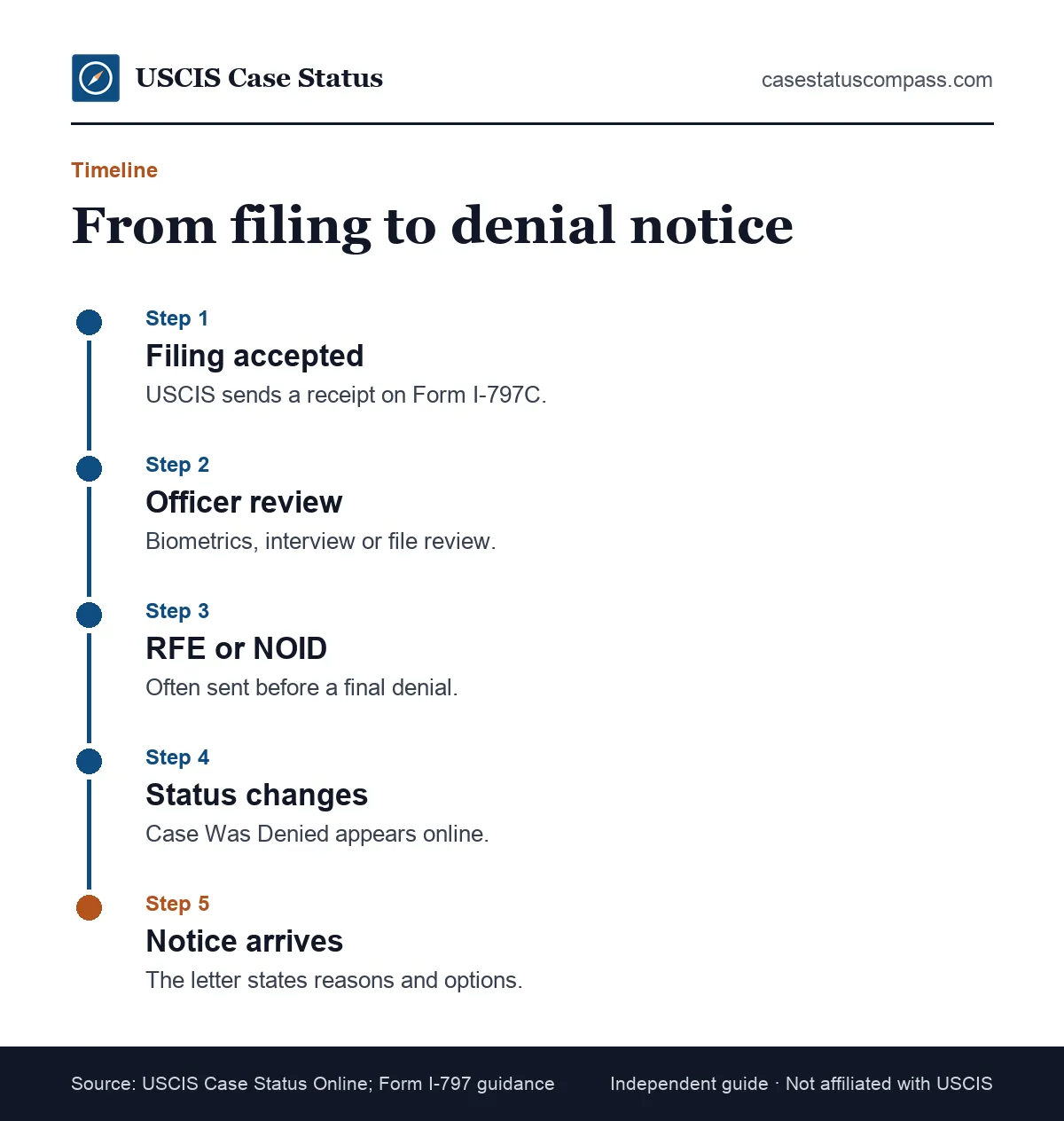
A denial is usually the last of several updates. Most cases move from Case Was Received through review, and many get a request for evidence (RFE) or a notice of intent to deny (NOID) first, which often previews the decision.
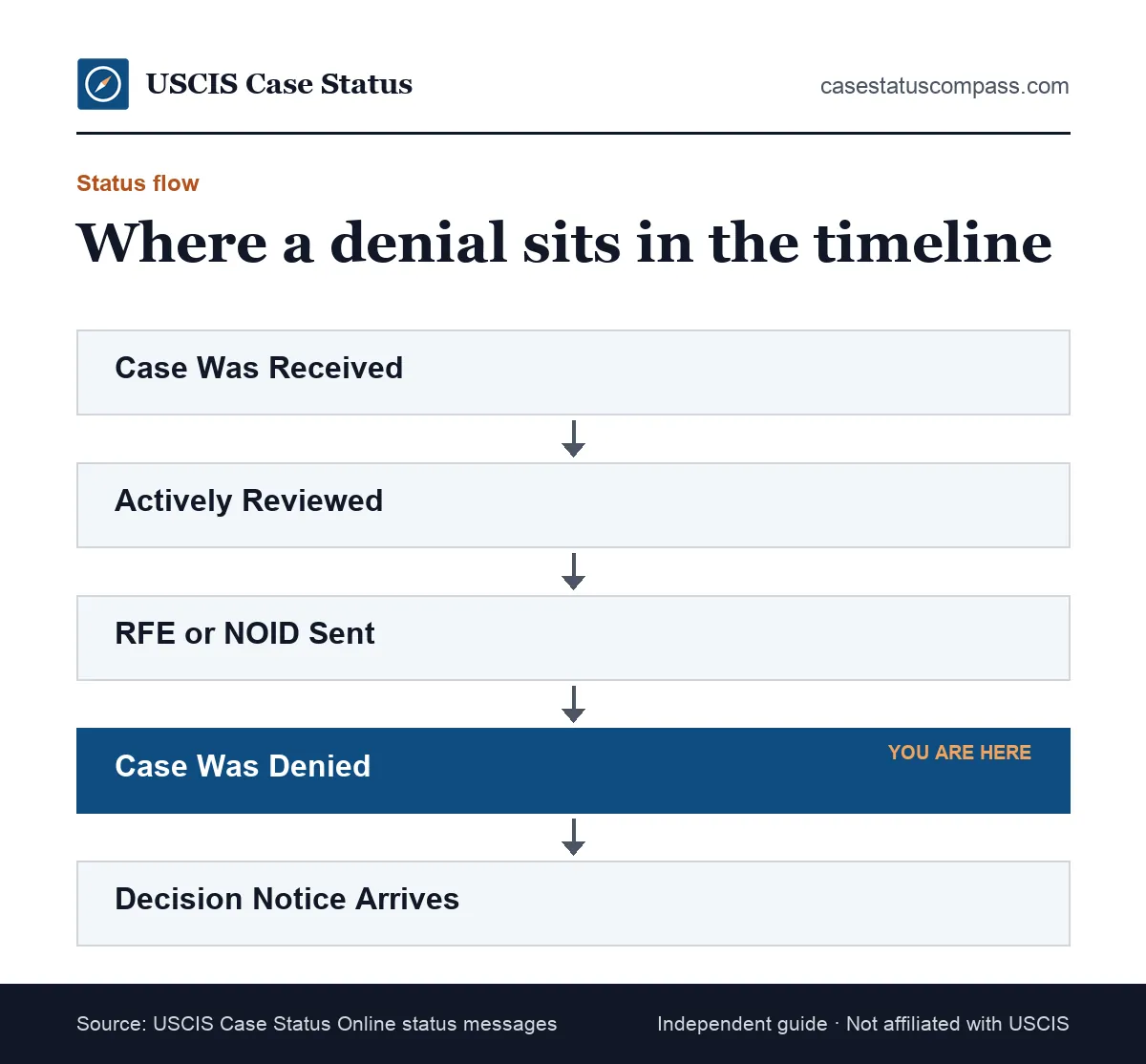
Status flow table
Use this table to see which update usually came before your denial and what controls when the next change appears online.
| Earlier status | Next update | What controls the timing |
|---|---|---|
| Case Is Being Actively Reviewed | Decision notice mailed | Mail and online posting |
| RFE response received | Decision notice mailed | Officer review of your reply |
| NOID issued | Decision notice mailed | Whether your rebuttal helped |
| Interview completed | Decision notice mailed | Office workload |
| Case Was Denied | Case Was Reopened (sometimes) | A granted motion or USCIS reopening |
Notice the pattern: almost every path ends in a mailed decision notice, and only a granted motion or a USCIS reopening moves a denied case forward again.
Why your path may differ
An officer can deny without an RFE when the record clearly shows ineligibility, and a case can move from the case is being actively reviewed by USCIS stage straight to a decision. Missing steps are normal.
What Should You Do the Day You See the Denial?
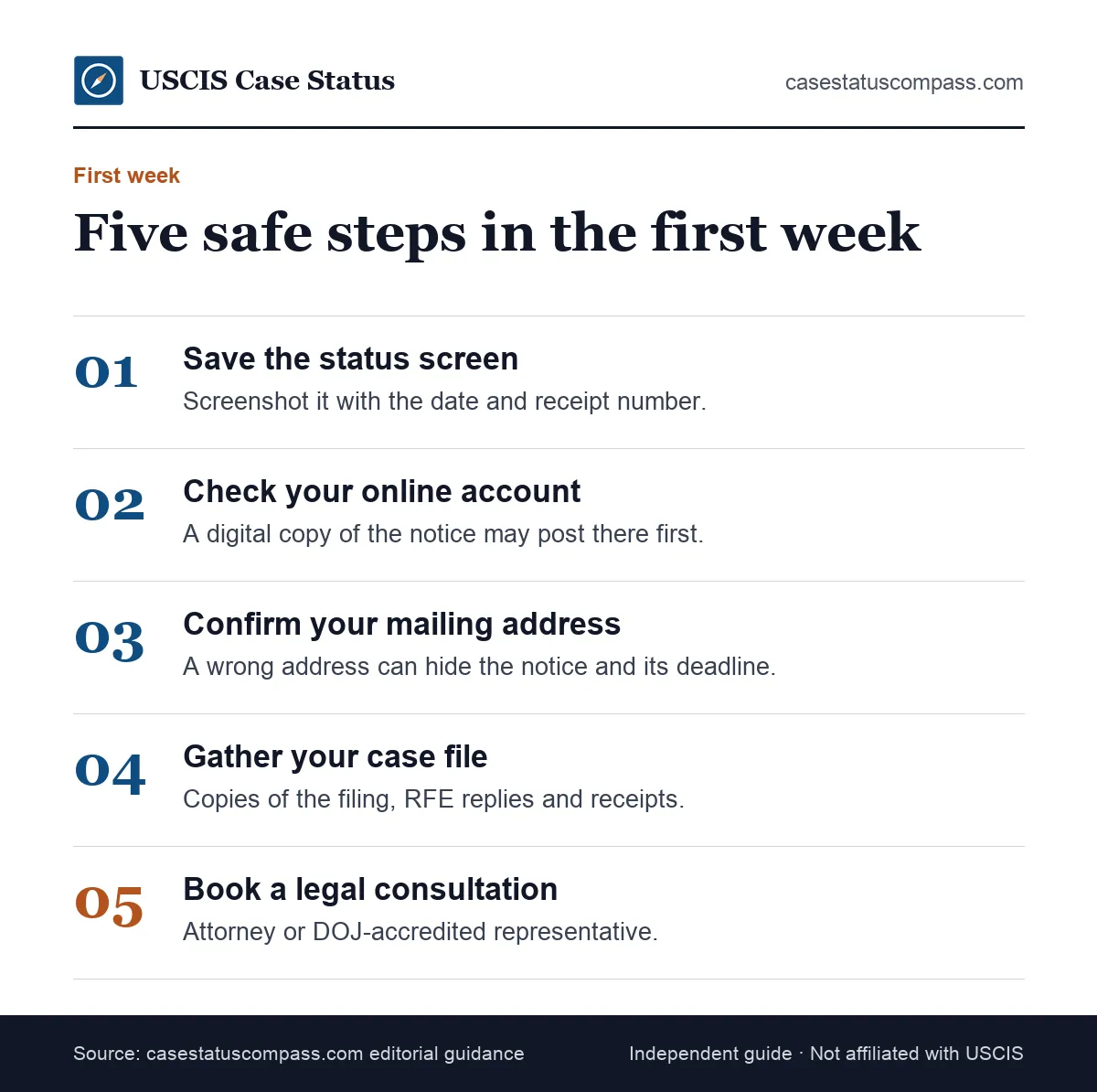
On day one, save proof of the status, check your online account for the notice and confirm USCIS has your address. Then contact an immigration attorney or DOJ-accredited representative. Do not refile, travel or sign anything until they read the decision.
Save evidence of the update
Take a dated screenshot of the status page, including the receipt number, and save it as a PDF. If the notice is late or lost, it shows when USCIS acted.
Look in your USCIS online account
If you filed online or linked a paper case, the notice may post in your online account first. As of October 2026, USCIS describes the account as: Free USCIS online account: case status updates, notices, link paper-filed cases. Download the PDF when it appears.
How Do You Read a USCIS Denial Notice?
Read the notice in order: header, reasons, evidence discussion, then the options paragraph. Note every legal reason given, every document called missing and any deadline. Those details decide whether a motion, appeal or new filing fits.
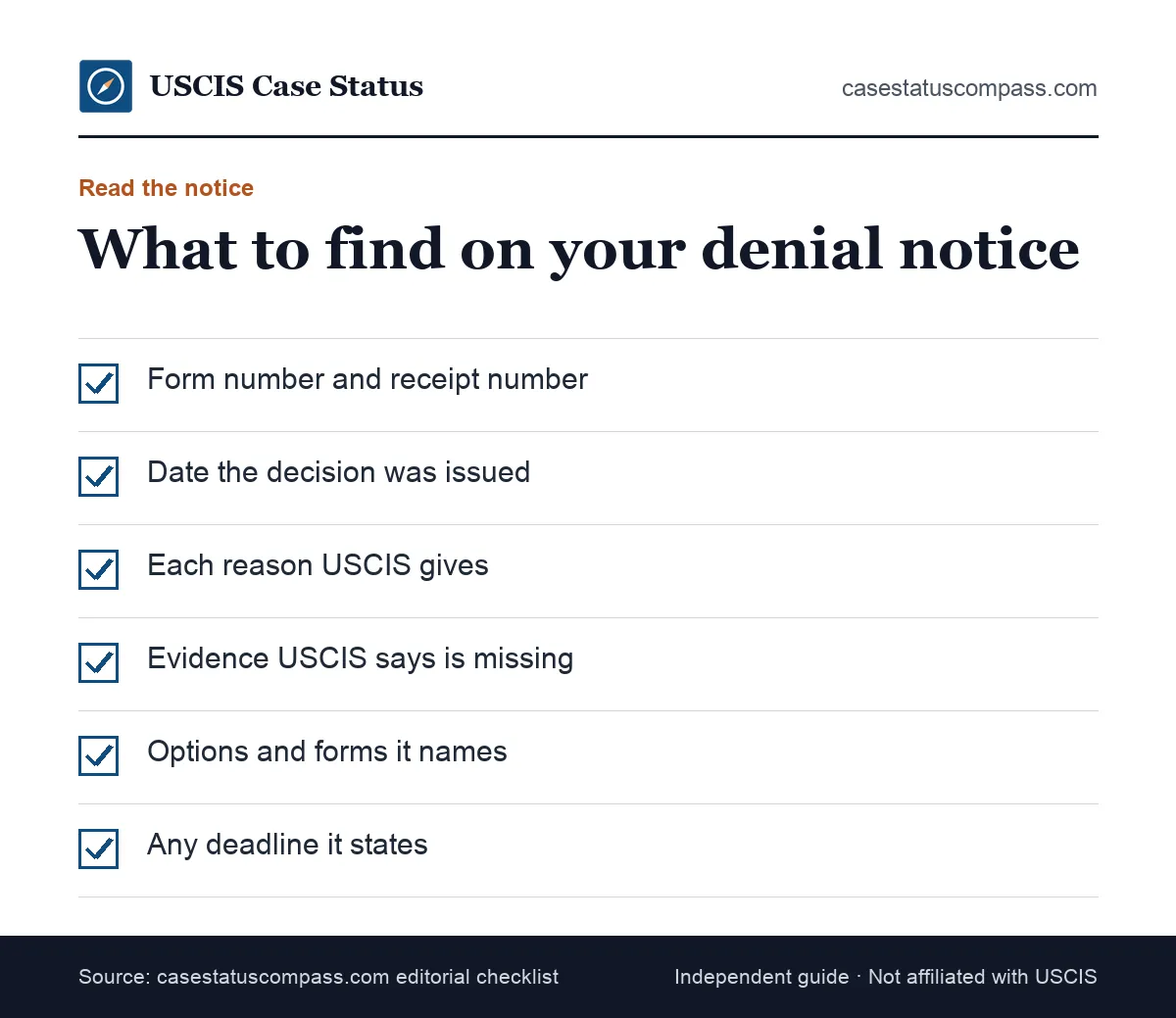
Keep a pen and a copy of your original filing beside you, so you can mark each point the officer raised against the page where you addressed it.
The header and case details
Check that the name, A-Number, form and receipt number are yours. Note the date printed on the decision, because a deadline usually counts from it, not from the day the letter arrived.
The reasons for the denial
The middle of the notice explains why USCIS denied the case, often citing a law or regulation. Copy each reason word for word; your advisor will test each against your record.
The evidence and options paragraphs
Officers usually review the evidence they weighed, then say whether you may file a motion or appeal and on which form. List each document they mention as your checklist.
If the options paragraph says no appeal is available, that limits your routes, so flag it for your advisor.
Why Should You Talk to a Lawyer Before Acting?
A denial can affect your lawful status, job, family and, sometimes, whether you end up in immigration court. An immigration attorney or DOJ-accredited representative can read the decision, spot errors and protect deadlines.
Even a short paid consultation can show whether a motion is worth its fee or whether a new filing is safer.
What a qualified advisor checks
- Whether the officer applied the right law
- Which challenge, if any, is open
- How it affects your status and work permit
- Risks for a spouse or children
- Whether a new filing would hit the same problem
Who Can Advise You After a Case Was Denied?
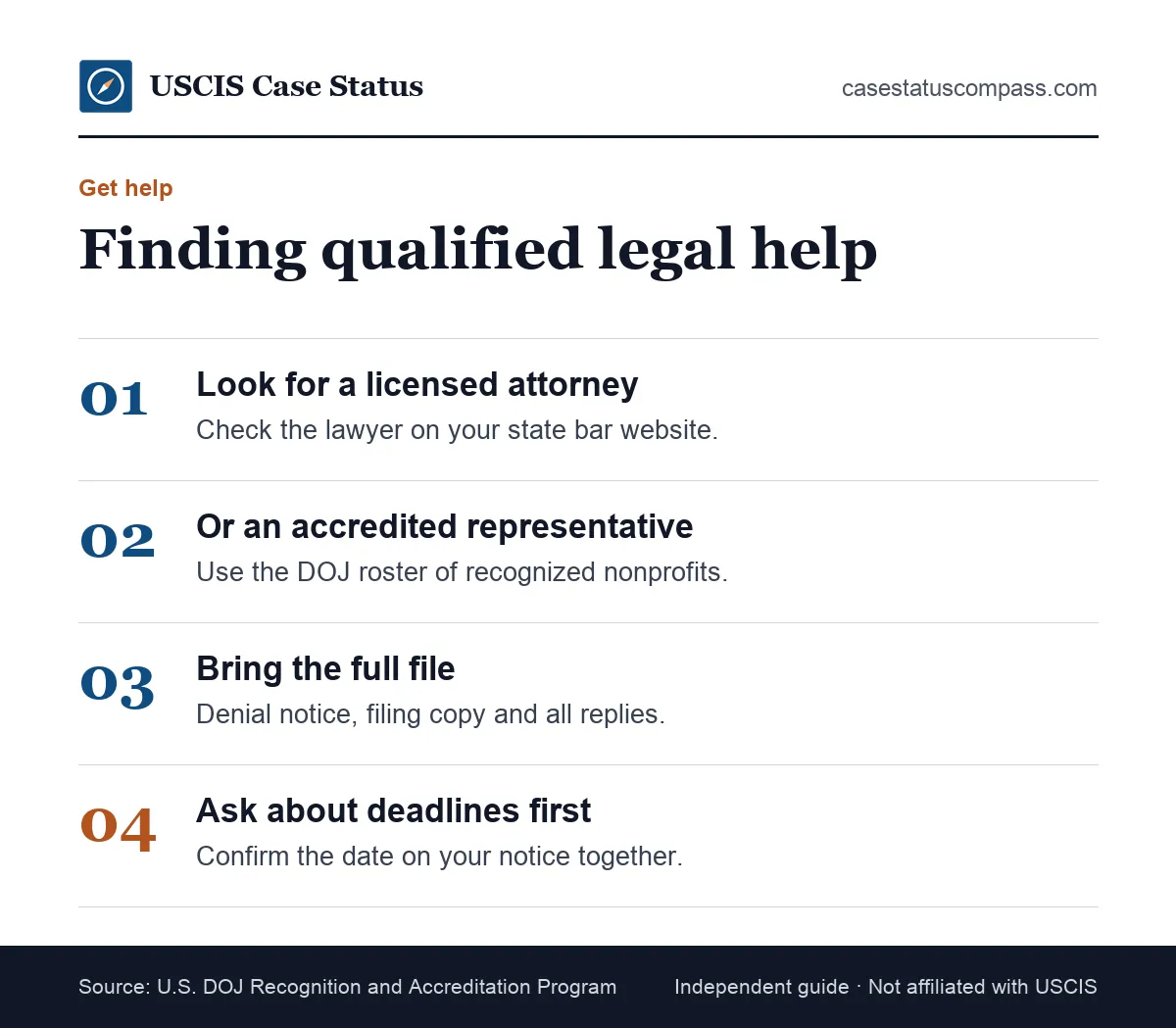
Only a licensed immigration attorney or a DOJ-accredited representative may give immigration legal advice. Our immigration lawyer cost guide explains fee models; nonprofits with accredited staff often charge less.
Before you hire anyone, ask for their bar number or accreditation and check it yourself. A state bar website lists licensed attorneys, and an advisor who refuses to say is a warning sign.
Why notarios cannot help
Notarios, travel agents and form preparers may not give legal advice, however confident they sound. After a denial, a wrong step from an unqualified helper can cost a deadline or a second fee.
What Are the Common Reasons USCIS Denies a Case?
USCIS most often denies a case because the evidence did not prove eligibility, the applicant missed an interview or biometrics, an RFE reply was late or weak, or a background issue came up. The notice states the exact reason.
Evidence that fell short
Most denials come down to insufficient evidence: the officer was not convinced you met a requirement, such as a genuine marriage, enough sponsor income or continuous residence.
The notice usually names the requirement in question, which tells you exactly what proof a motion or new filing must add.
Affidavit of support gaps
Family cases can fail when the Form I-864 affidavit of support does not show enough income or assets, or a joint sponsor's documents are incomplete. The notice says which evidence fell short.
Missed appointments and late replies
Missing a biometrics appointment or interview without rescheduling can lead to a denial for abandonment, as can a late RFE reply. Proof that a notice reached you late may support a motion.
Criminal history and fraud findings
Some denials rest on inadmissibility, such as certain criminal records, past immigration violations or a misrepresentation finding. These are the most serious; never answer one alone.
Bring court records and any prior USCIS letters to your attorney so the full picture is reviewed at once.
How Does a Denial Differ from an RFE or NOID?
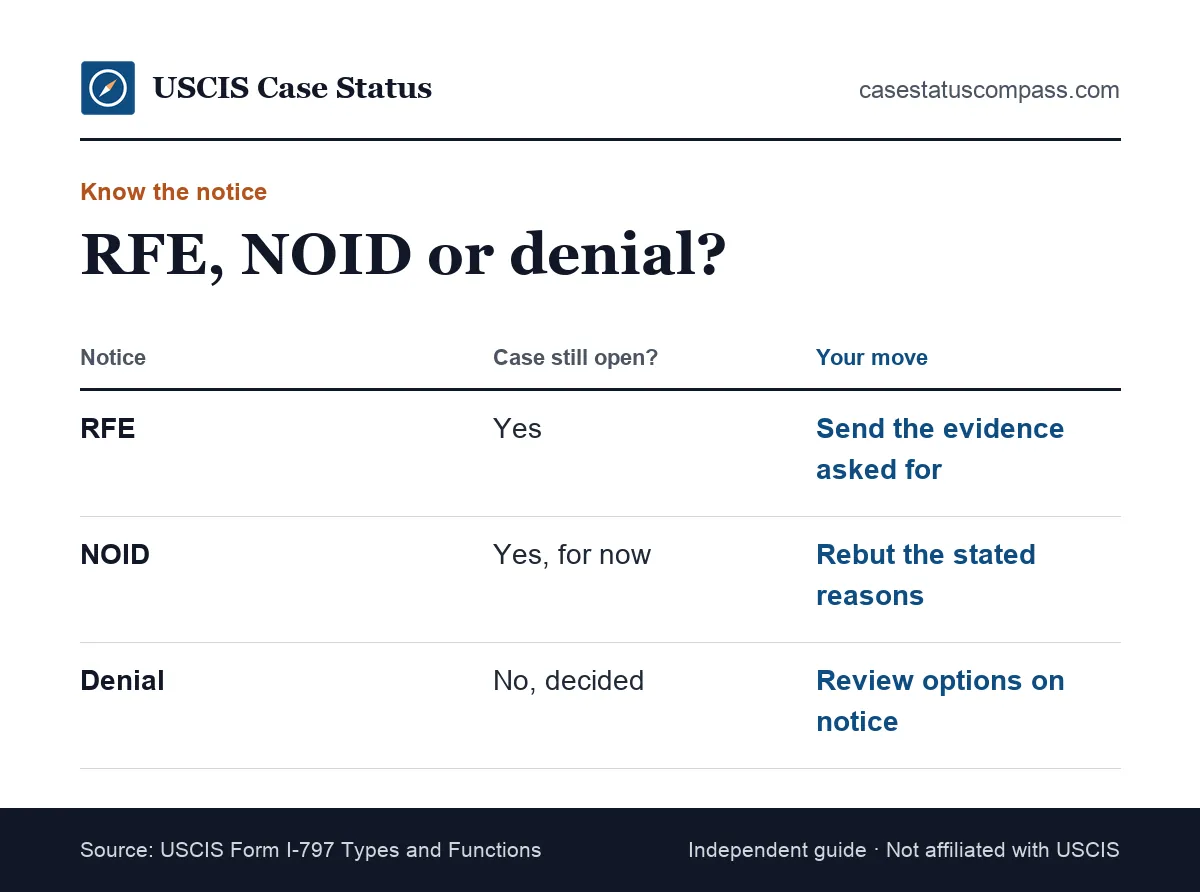
An RFE asks for more proof while the case stays open. A NOID warns that USCIS plans to deny and lets you respond. A denial ends review of that filing. If you got only an RFE or NOID, you have not been denied.
If you received a NOID first
A NOID lists the officer's concerns, and the denial usually says why your reply fell short. Our guide to the notice of intent to deny explains strong rebuttals, which hints at what a motion may need.
If you received an RFE first
Compare your RFE reply with the denial reasons. If USCIS says it never got your reply, keep your mailing proof for a motion. Our request for evidence page covers the RFE step itself.
What Does a Denial Mean for Form I-485?
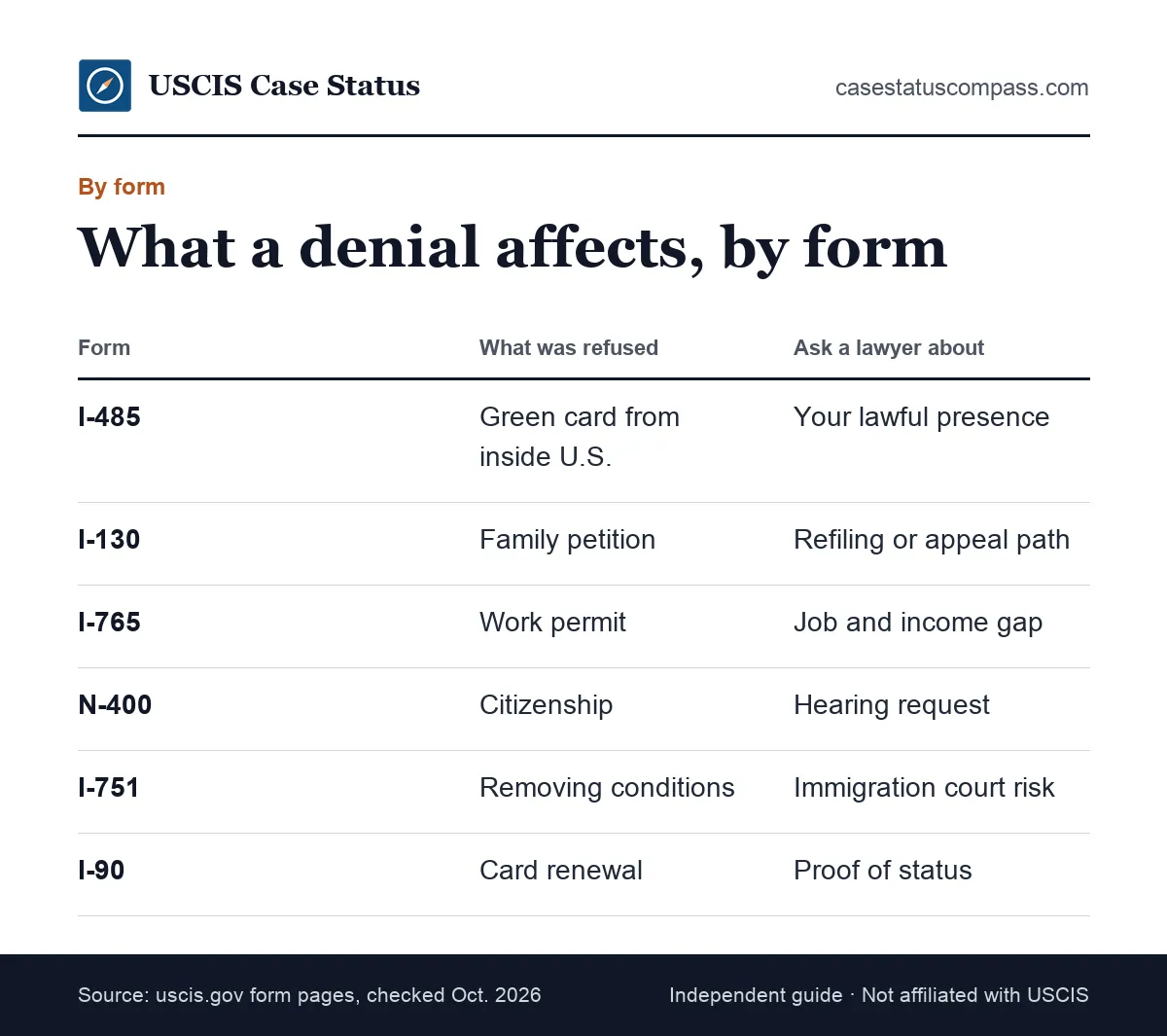
A denied Form I-485 means USCIS refused to adjust your status to permanent resident from inside the United States. It is often the most urgent denial, because your permission to stay may have rested on it. See an attorney quickly.
Refiling an I-485 later
A new I-485 needs a new fee and the current edition. As of October 2026, the fee is $1,440 (paper) / $1,390 (online); $950 / $900 if under 14 and filing with a parent under Form G-1055, Edition 10/16/26. Refile only after the cause of the first denial is fixed.
Can You Still Work or Travel After an I-485 Denial?
Often not on the old documents. A pending I-485 can support a work permit and advance parole, and a denial can end that support. The effect depends on any other status you hold. Our Form I-485 guide explains the application.
What Does a Denial Mean for Form I-130?
A denied Form I-130 means USCIS did not accept the family petition, so the relative does not move toward a green card on it. Most I-130 denials turn on proof of the relationship, such as a bona fide marriage, or the petitioner's eligibility.
Typical I-130 denial themes
- Weak proof that a marriage is genuine
- Missing birth or marriage certificates
- Doubts about a prior divorce
- Petitioner not eligible for that relative
Each theme points to a fix: more joint records for a marriage, certified civil documents, final divorce decrees, or proof of the petitioner's citizenship or permanent residence. Your notice says which applies.
Linked I-485 filings
If the relative filed Form I-485 at the same time, a denied I-130 usually brings a denied I-485, because the adjustment depended on it. Our Form I-130 petition guide explains what the petition needs.
What Does a Denial Mean for Form I-765?
A denied Form I-765 means USCIS refused the Employment Authorization Document (EAD), so you cannot work on that card. If you work on an older EAD, check its end date: renewals filed after the cutoff lost the automatic extension.
The automatic extension change
As of October 2026, USCIS says: Ended: renewals filed on or after Oct. 30, 2025 no longer get the up-to-540-day automatic extension (exceptions: TPS by law/Federal Register notice; STEM OPT 180 days). Your employer may ask for new proof. Our work permit guide explains EAD categories and reapplying.
EAD denials tied to another case
Many EADs depend on another pending filing, such as asylum or adjustment. If that case is denied, the EAD often follows. Check whether the notice names the I-765 alone or both filings.
What Does a Denial Mean for Form N-400?
A denied Form N-400 means USCIS did not grant naturalization. You usually stay a permanent resident, but some reasons, such as certain criminal issues, can raise questions about the green card itself. The notice names the hearing process.
Keep carrying your green card and follow its usual rules.
Common N-400 denial reasons
Typical reasons include not passing the English or civics test, missing continuous residence or physical presence rules, or good moral character problems. Our citizenship application guide explains each requirement.
N-400 challenges use their own process
Naturalization denials follow their own path. The notice says which form to file and where; confirm it with an attorney instead of assuming Form I-290B applies.
The deadline for that request is set out in the notice, so mark it on your calendar the day it arrives.
What Does a Denial Mean for Form I-751?
A denied Form I-751 means USCIS did not remove the conditions on your two-year green card. Get legal help fast: the case may move to an immigration judge, who can review the petition again. Never ignore a later notice.
Conditional status and the receipt extension
While the I-751 was pending, the receipt notice extended your status. As of October 2026, USCIS says: I-751 receipt notice extends conditional status and work authorization for 48 months. A denial changes that. Our Form I-751 guide covers the filing rules.
What Happens If a Notice to Appear Follows the Denial?
A Notice to Appear means your case is now in immigration court, run by the Executive Office for Immigration Review (EOIR), not USCIS. Track it with our immigration court case status guide and bring an attorney to every hearing.
Keeping track of court dates
Court notices come from EOIR, and hearing dates can move. Check the court's official case status often, keep your address current with the court and USCIS, and never miss a hearing.
What Does a Denial Mean for Form I-90 and Other Card Cases?
A denied Form I-90 means USCIS will not issue a replacement or renewed green card on that application. It does not by itself end permanent resident status, but you may need proof of status for work or travel.
You can usually refile with the current fee.
Proof of status while you sort it out
As of October 2026, USCIS describes temporary proof this way: I-551/ADIT stamp: temporary proof of green card status; request through the USCIS Contact Center (800-375-5283). Our I-551 stamp guide explains when the stamp helps. Bring the denial notice and passport.
Travel documents and fiancé petitions
Denials of Form I-131 travel documents and Form I-129F fiancé petitions work the same way: the status is only a headline, and the notice explains the reasons and options.
For a fiancé(e) petition, the U.S. citizen petitioner gets the notice and decides next steps.
What Does a Denial Mean for Employer-Sponsored Petitions?
For employment petitions such as Form I-140 or an H-1B petition on Form I-129, the employer is the petitioner. It receives the decision and chooses whether to challenge it or refile.
The worker is the beneficiary, not the party who decides. If your work status rests on the petition, ask the employer and its attorney for a copy of the notice right away.
What the worker should ask the employer
- Was it denied or rejected?
- What reasons does the notice give?
- Will you file a motion, appeal or new petition?
- How does it affect my work status?
Get the answers in writing, and ask a separate immigration attorney about your own status if you are unsure the employer's plan protects you.
What Should an Employer Do After a Petition Denial?
Share the decision with the worker promptly and say whether you plan a motion, appeal or new petition. The worker's status may depend on your choice, so a quick, clear answer helps them plan. Have your attorney check any deadline.
What Does a Denial Mean for Humanitarian Cases?
Humanitarian filings, such as asylum, TPS and DACA requests, carry special risks. Some affirmative asylum cases are referred to an immigration judge instead of denied. Removal proceedings can follow, so get help at once.
Keep copies of every notice and receipt in a safe place.
Asylum referral vs denial
A referred asylum case goes to immigration court, where a judge hears the claim again. Treat a referral notice as urgent, never miss the hearing and bring every document you filed to your attorney.
Where to read about each program
Our guides to asylum status, TPS status and DACA status explain each program. All three changed in 2025 and 2026, so check the date on any advice you read.
Case Was Denied After an Interview: What It Usually Signals
A denial after an interview usually means your answers or documents did not resolve the officer's concerns. Officers often issue an RFE at the interview instead; if none came, the notice should explain which answers or gaps led to the denial.
Compare your notes with the notice
Write down the questions, your answers and any papers the officer kept, then compare them with the notice. Gaps between the two may be grounds for a motion.
Do this within a day or two, while the interview is fresh in your mind.
Marriage interviews and mismatched answers
In marriage cases, a denial after the interview often turns on mismatched answers between spouses or thin proof of a shared life. The notice usually names the doubts.
Explanations for honest mistakes, plus new joint records, often matter in a motion or new filing.
How Does a Denial Affect Spouses and Children?
When a principal applicant is denied, derivative family members who depended on that case are usually affected too. Each person normally gets a separate decision and receipt number, so check every family member's status.
A spouse or child with their own separate basis may still keep a pending case open.
Check each receipt number
Look up each receipt number on Case Status Online: egov.uscis.gov. A child's status may update a few days later. Keep a chart of names, forms, numbers and statuses.
Note any notice that differs from the principal's.
Children close to age 21
If a child is near 21, tell your attorney at once. Timing choices after a denial can affect whether that child stays eligible in a new filing.
Bring each child's birth certificate and receipt notice to the meeting so the attorney can check the dates.
What If You Never Received the Denial Notice?
If the status says Case Was Denied but no letter came, check your online account, confirm your address and ask the Contact Center for a copy. Act fast: a deadline usually runs from the decision date, not the date the letter arrives.
Confirm your address on file
A wrong address is the most common reason a notice goes missing. If you moved, update it officially; our change of address guide explains how.
Also check that your apartment or unit number appears on past notices, since a missing unit often sends mail back.
Ask USCIS for a copy
Call 800-375-5283 (TTY: 800-767-1833). Live calls and chat: Monday to Friday, 8 a.m. to 8 p.m. Eastern. Our contact USCIS guide lists every official channel. Log the date, time and agent name for each contact.
Can a Case Was Denied Status Be a Mistake?
Errors are rare but possible. A status can update on the wrong case, show an old decision after a reopening, or reflect a clerical slip. The written notice settles it; if it does not match or never arrives, contact USCIS.
Signs it may be an error
- The receipt number is not yours
- The form named is one you never filed
- You already got an approval on that receipt
- The status flips back within days
If any of these apply, save screenshots right away; they help show what changed and when.
How to raise a suspected error
Start with the Contact Center or an online case inquiry. If that fails, see our Ombudsman and congressional inquiry guide. An attorney can also contact USCIS for you.
Keep a contact log with notes from every call.
How Do You Make Sure a Denial Letter Is Real?
A real denial names your receipt number and matches what Case Status Online shows. Check it on the official site, and never call a number printed only on a suspicious letter; scammers use fake notices.
If your case is linked to an online account, compare the letter with any PDF notice posted there.
Quick verification checks
The form, date and decision online should match the letter. USCIS never asks for gift cards, wires or crypto to fix a denial. Our guide on how to verify a USCIS notice walks through each check.
How Do Scammers Target People With a Denied Case?
People who just got bad news are common fraud targets. Anyone promising a guaranteed reversal is lying, and real help never starts with a demand for urgent payment. Read our USCIS scam warning signs before paying for help.
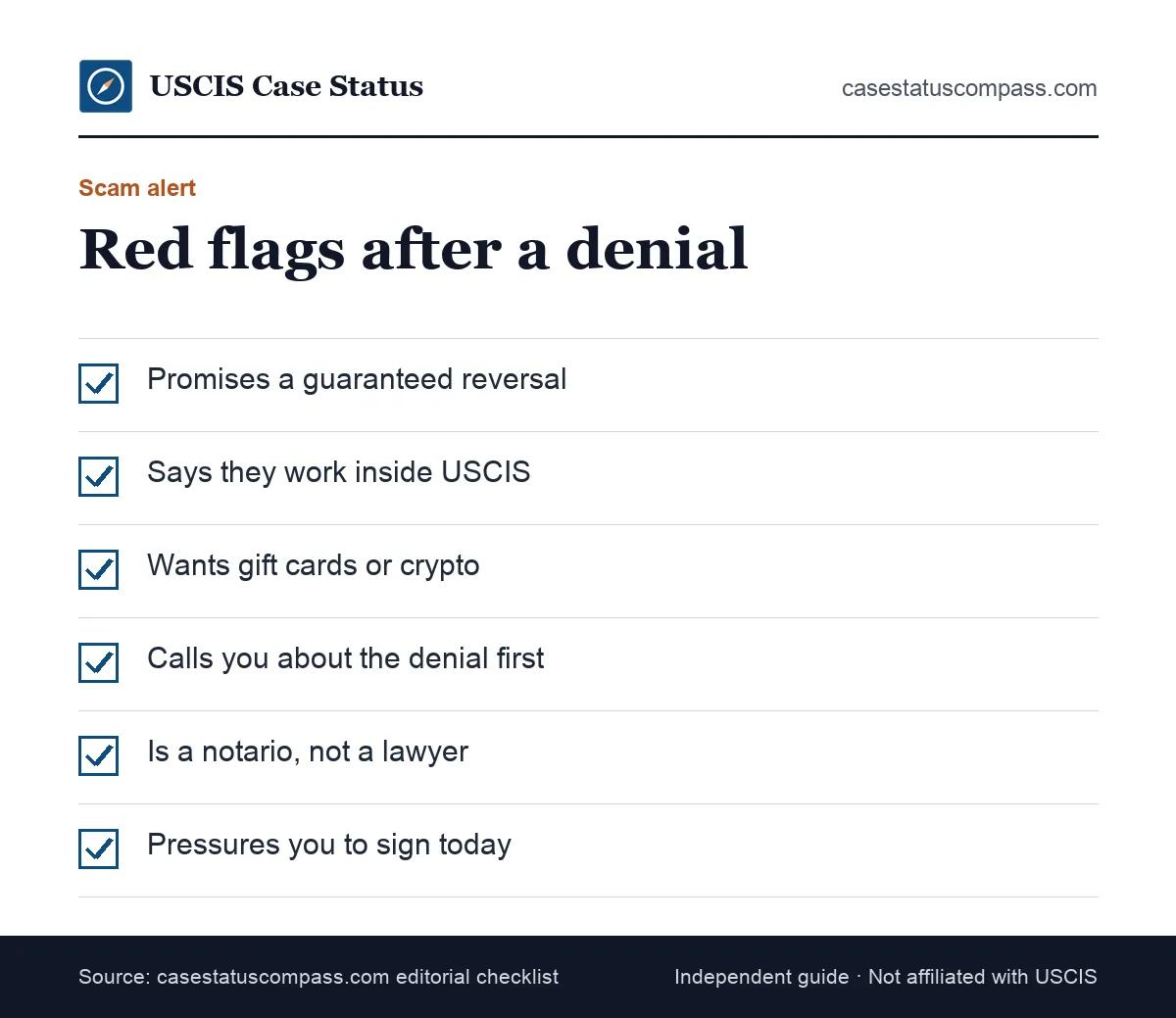
Report a scam call at ReportFraud.ftc.gov, the FTC's scam reporting site.
Red flags in a denial-fix offer
Be wary of callers who already know your case, want payment by gift card or wire, or threaten removal unless you pay today. Hang up and check your case on the official site.
What Records Should You Keep After a Denial?
Keep a full copy of what you filed, every USCIS notice, your RFE or NOID replies with mailing proof, and dated status screenshots. A complete file speeds an attorney's review and helps a new filing avoid the same gap.
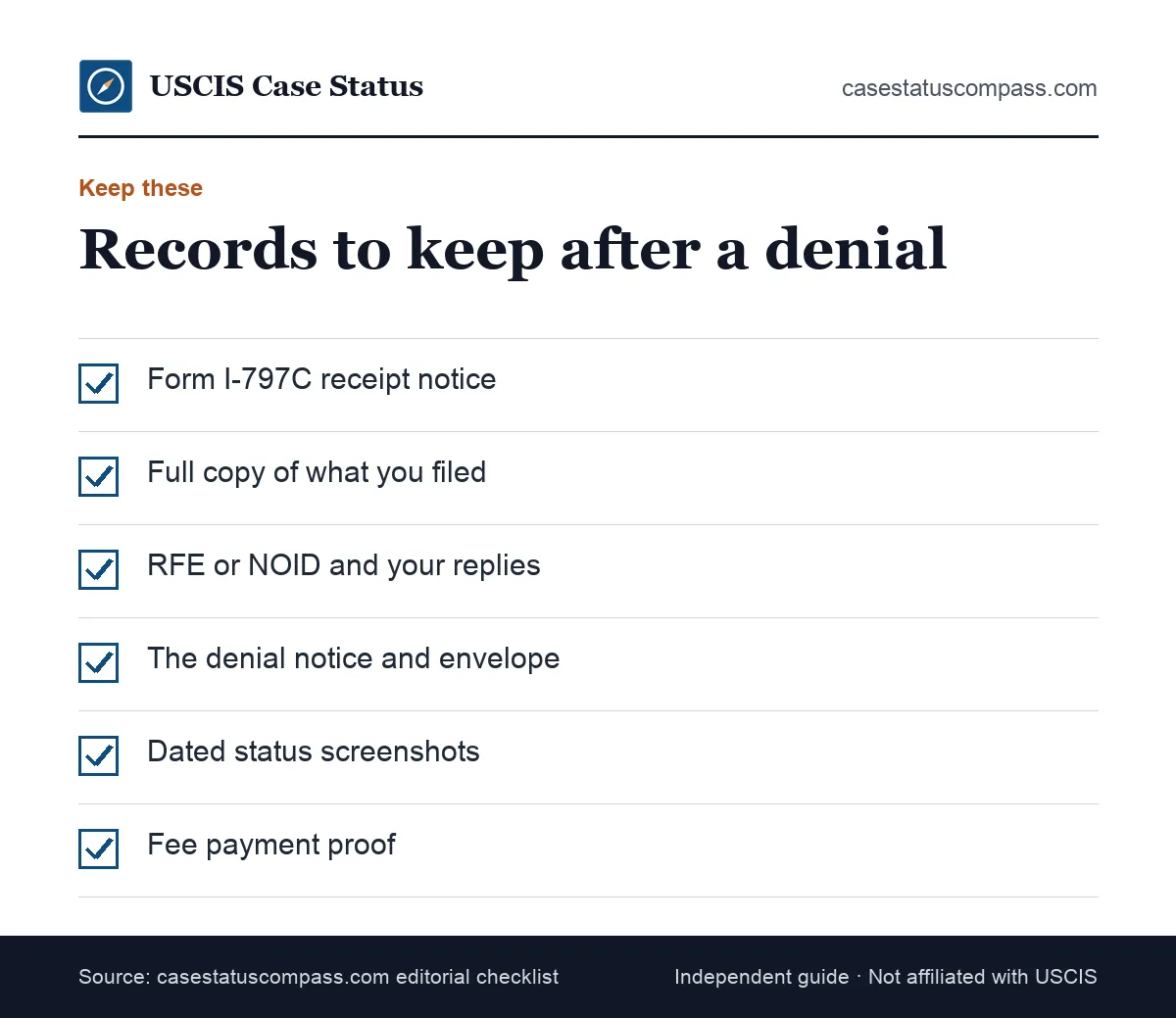
Request your full file if needed
If you lost your copies, or a past preparer kept them, request your records through a Freedom of Information Act (FOIA) request. Our USCIS FOIA request guide explains the process.
What Mistakes Should You Avoid After a Denial?
The most common mistakes are refiling the same packet unchanged, missing a deadline while waiting for the letter, traveling without advice and paying a notario. Each can cost money or options.
A short pause to read the notice with an advisor prevents most of them, so make that your first step before any filing or trip.
Refiling without fixing the cause
Sending the same packet again rarely works. A new filing must answer the officer's reasons with new evidence or changed facts; otherwise you pay a second fee for the same result.
Traveling or changing jobs too soon
If your status depended on the denied case, leaving the country can create new problems, and working without a valid EAD can harm future cases. Ask your advisor first.
Wait for written advice first.
Decision Table: If This Happened, Do This
Match your situation to a safe first step. This is a planning aid, not legal advice. In every case, show your denial notice to an immigration attorney or DOJ-accredited representative before choosing a path.
Find the row that matches your notice, not just the online status.
What to do now
Each row pairs a common post-denial situation with the safest immediate step and the follow-up that usually comes next.
| Your situation | First step | Then |
|---|---|---|
| Denied, no letter yet | Check online account; confirm address | Ask for a copy |
| Letter names a motion or appeal | Note the decision date and deadline | Book a consult this week |
| Missed interview or biometrics | Collect proof of why | Ask about a motion to reopen |
| Denied for weak evidence | List what is missing | Compare motion vs new filing |
| Criminal or fraud issue | Do not contact USCIS yourself | See an attorney urgently |
| I-751 denied or court notice | Never miss a hearing | Retain an attorney |
| Rejected, not denied | Read the rejection reason | Refile the current edition |
Read across the rows and one theme repeats: confirm the deadline and get advice before you file anything new.
How Do Motions and Appeals Work, in Brief?
A motion to reopen asks the same office to look again because of new facts. A motion to reconsider argues the decision misapplied law or policy. An appeal asks a higher office to review it. Your notice says which fits.
Which office decides a motion or appeal
A motion normally goes back to the office that denied the case. An appeal, where allowed, goes to a higher body such as the Administrative Appeals Office. Your notice names the right office and form.
Where to get the full explanation
Our motion to reopen and appeal guide covers forms and timing. For Form I-290B: Appeal or motion: file within 30 days (33 if the decision was mailed). Other processes differ, so confirm with your attorney.
What Happens If You Miss a Motion or Appeal Deadline?
USCIS can refuse a late motion or appeal, which is why finding the notice fast matters. A missed deadline usually leaves a new filing as the main option, so get legal advice the week the status changes.
In rare cases late filings are excused, but never count on it.
Proving the notice arrived late
If the letter came late, give your advisor proof of when the status changed and when the letter arrived: dated screenshots, the envelope and your USCIS contact log.
Keep each item together in one folder.
Can You Reapply After a USCIS Denial?
In many cases you can file a new application after a denial if you are still eligible and fix what caused it. Some situations, such as certain fraud findings, block or limit a new filing, so ask an attorney first.
More about starting over
For refiling choices by form, see what happens if a green card is denied. Any new filing should include new evidence that answers the reasons in your notice.
Write a short list of those reasons first.
How Much Does It Cost to Refile After a Denial?
A new filing needs a new fee. Current fees come from Form G-1055, Edition 10/16/26; our Form G-1055 fee schedule guide explains how to read it. Download the current form edition from uscis.gov, since older ones are rejected.
Budget for the filing fee of the form you will refile.
Can USCIS Reopen a Denied Case on Its Own?
Yes. USCIS can sometimes reopen or reconsider a decision on its own, usually after finding its own error. The status may then change to Case Was Reopened, and USCIS may ask for evidence before deciding again.
You will receive a notice if this happens.
Why you should not wait for a reopening
A reopening on USCIS's own motion is uncommon and never guaranteed. Keep working toward any motion or appeal deadline and treat a reopened status as a bonus, not a plan.
What Do Related Denial Status Messages Mean?
USCIS uses several status titles near a denial, and each means something slightly different. Your exact wording shows whether the case was decided, returned or simply updated; the notice tells the full story.
Read your title word for word before you react, because one word changes the meaning.
Status titles you may see
The table sorts the titles that appear around a decision by what actually happened to the filing.
| Status title | What it means |
|---|---|
| Case Was Denied | Officer refused the filing after review |
| Decision Notice Mailed | A letter was sent; read it for the outcome |
| Case Rejected (with a reason) | Returned at intake; not reviewed |
| Case Was Reopened | A past decision is under review again |
| Withdrawal Acknowledgement Notice Was Sent | You withdrew; no decision |
The key split is between titles that follow an officer's review, such as Case Was Denied, and titles that mean no decision was made at all.
When the status is vague
A general update such as we have taken an action on your case can come before a denial, an RFE or something routine. Wait for the letter before assuming the worst.
How Is a Denial Different from an Approval Update?
An approval grants the request; a denial refuses it. Both arrive as a short status plus a written notice. After an approval, card cases move to card production; after a denial no card is made, and later updates concern challenges.
What an approval path looks like
On the approval side, updates such as approval case decision rendered and new card is being produced follow. Seeing none after a denial is expected.
After a denial, your timeline stops at the decision unless a motion, appeal or reopening restarts it.
Mixed results in one family
Families often get mixed results, such as an approved I-765 and a denied I-485. Ask your advisor how the denial affects the approval before you rely on it.
An EAD approved on a pending I-485 may lose its basis.
Does a Denied Case Stay on Your Immigration Record?
Yes. A denial becomes part of your immigration file, which officers see in future filings. Forms often ask about past denials, so disclose them as required. Consistent, honest answers matter more than the old denial.
Keep the notice for life.
Prior-denial questions on new forms
Many forms ask whether you were ever denied a benefit. Answer yes when it applies, give the form and date from your notice, and attach a copy if the instructions ask. Hiding a denial is far riskier.
Future applications and visas
A past denial does not automatically block a future approval; officers look at whether the problem was fixed. Our US visa status guide explains how consular cases are tracked apart from USCIS.
How Long Does It Take for the Denial Notice to Arrive?
USCIS does not publish a fixed delivery time for denial notices, and we could not confirm one on an official page. Check your online account first, then your mail. If nothing arrives in a reasonable time, ask USCIS for a copy.
Why online copies matter
Online notices can post before paper mail. Our USCIS online account number guide explains how accounts link to paper cases, so you may find the decision PDF days sooner.
Save each PDF notice in two places.
If nothing changes for weeks
Status pages often freeze after a decision. Our page on a USCIS case status not updating explains when a frozen status is a real problem.
After a denial, a still screen usually means the case is closed, not stuck.
What Can an Accredited Representative Do for You?
A DOJ-accredited representative works for a nonprofit recognized by the Department of Justice and may give legal advice and represent you before USCIS, often for lower fees than firms. They can review your notice and file motions or new applications.
Questions to ask at your first meeting
- Which options does my notice allow?
- What deadline applies, from which date?
- Is my current status at risk?
- Would a motion or new filing be stronger?
Bring the notice, your full filing copy and any RFE reply, so the advisor can answer these questions in one visit.
How to find one
Search the Department of Justice roster of recognized organizations and accredited representatives. Confirm the person is listed before sharing documents, and ask what they charge.
Many nonprofits offer free or low-cost first consultations.
What Should You Not Do After Seeing Case Was Denied?
Do not panic-file a new application, ignore mail, miss an immigration court date or pay anyone who guarantees results. Avoid posting your receipt number or notice publicly. Each costs time, money or privacy.
Pause first, then follow your advisor's plan.
Keep your receipt number private
Your receipt number and notice contain personal data. Share them only with your attorney or accredited representative, and blur details before posting any image online.
Scammers use posted numbers to sound official.
Do not rely on the online status alone
Statuses are short system messages that can lag or change. Base decisions on the written decision notice and qualified advice. Our hub of USCIS case status meanings explains the other messages.
Key Facts About a USCIS Denial
These facts come from official USCIS pages checked in October 2026. We could not confirm notice delivery times on an official page, and your notice, not this page, sets your options.
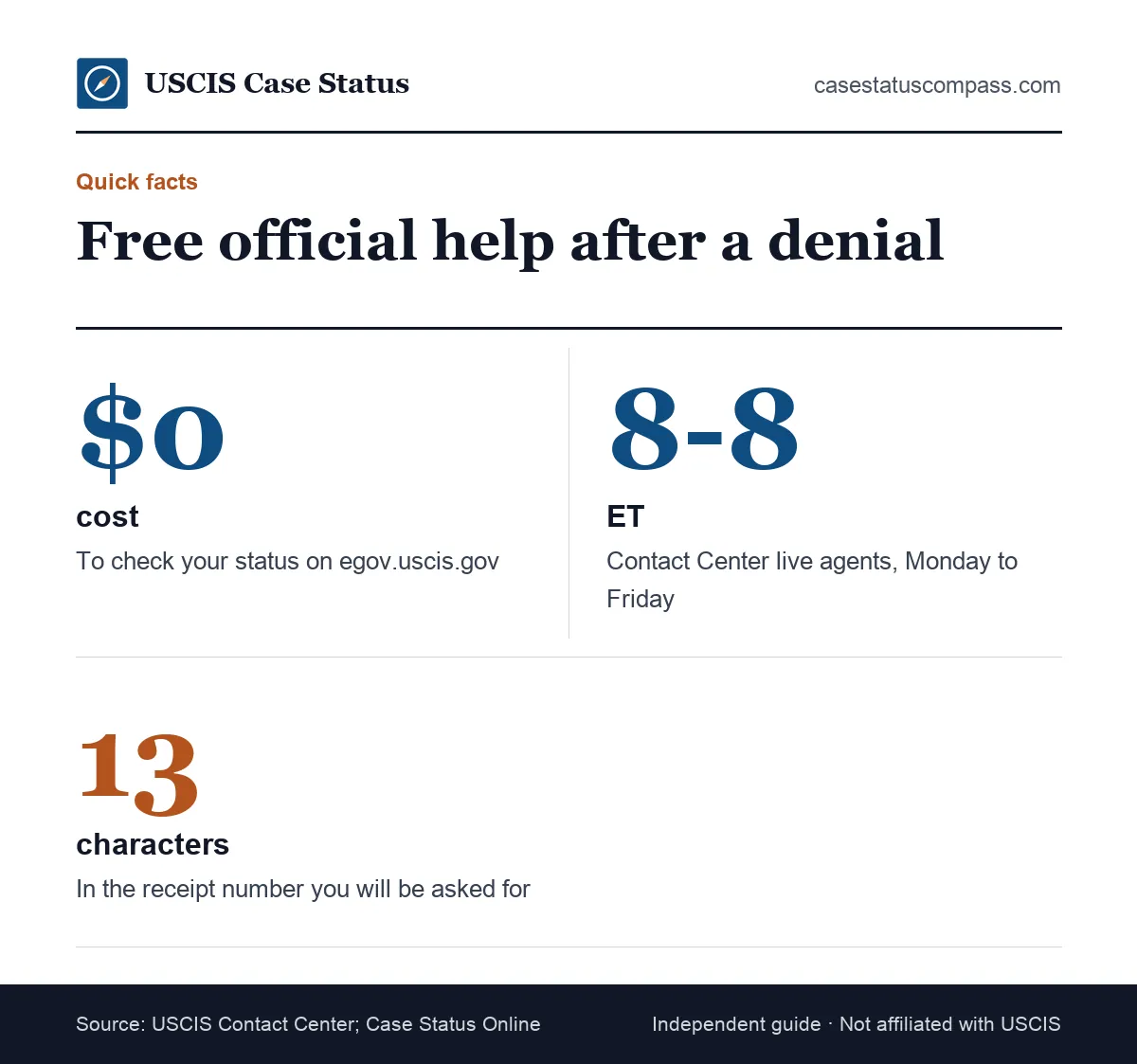
Use the table below as a quick reference, and confirm any fee on the current fee schedule before you pay.
Facts you may need
| Item | What USCIS says (Oct. 2026) |
|---|---|
| Official status tool | Case Status Online: egov.uscis.gov |
| Contact Center | 800-375-5283; 212-620-3418 (callers outside the U.S.) |
| In-person appointment | Request an in-person appointment online at my.uscis.gov/en/appointment/v2 or call 800-375-5283 |
| Fee schedule in force | Form G-1055, Edition 10/16/26 |
| Form I-290B fee | $800 |
| Refunds | USCIS fees are nonrefundable, even if your case is denied or withdrawn |
Frequently Asked Questions
Does case was denied mean I have to leave the United States?
Not always. It depends on your status apart from the denied filing. Someone with another valid status may stay on it; someone whose stay depended on the denied case may be at risk. Ask an immigration attorney.
Can I get my filing fee back after a denial?
Usually not. USCIS fees are nonrefundable, even if your case is denied or withdrawn. Budget for a possible new filing or challenge instead.
How long do I have to respond to a USCIS denial?
The limit depends on the form and the type of challenge, and it usually counts from the date on the decision. Your notice states the rule; we do not list a number because it varies. Confirm it with an attorney.
Does Decision Notice Mailed mean my case was denied?
Not necessarily. Decision Notice Mailed only says a decision letter was sent; it can be an approval or a denial. Read the notice, or check your online account, to learn the outcome.
Will a denial show up when I apply for a visa later?
Yes. It becomes part of your immigration history, and future USCIS and consular forms often ask about it. Answer honestly; a false answer is far more serious than the denial.
Can I still check my case status after a denial?
Yes. The receipt number keeps working on Case Status Online, and later updates, such as a reopening, appear there. A motion or appeal on Form I-290B gets its own new receipt number.
Can a denied case be approved later?
Not on the same filing unless USCIS reopens it or a motion or appeal succeeds. Otherwise, a new filing that fixes the reasons in the notice is the usual route to an approval.
My status says denied but my lawyer has heard nothing. Why?
Attorneys of record usually get a copy, but mail arrives on different days. Send your lawyer a dated screenshot. If neither of you gets the notice, ask USCIS for a copy.
Is a USCIS denial the same as being deported?
No. USCIS decides benefits such as green cards and work permits; removal is decided in immigration court by a judge. A denial can sometimes lead to court proceedings, but it is not a removal order.
Should I call USCIS to argue about the denial?
No. Contact Center agents cannot change a decision. Call only to request a missing notice or fix an address. Challenges go through the formal process named in your notice.
Sources
- USCIS: Form I-797 Types and Functions. www.uscis.gov/forms/filing-guidance/form-i-797-types-and-functions. Accessed Oct 27, 2026.
- USCIS: I-290B, Notice of Appeal or Motion. www.uscis.gov/i-290b. Accessed Oct 27, 2026.
- USCIS: When to Use Form I-290B. www.uscis.gov/i-290b/eligibility. Accessed Oct 27, 2026.
- USCIS: Filing Fees. www.uscis.gov/forms/filing-fees. Accessed Oct 27, 2026.
- USCIS Contact Center. www.uscis.gov/contactcenter. Accessed Oct 27, 2026.
- USCIS: Form I-485 page (edition information). www.uscis.gov/i-485. Accessed Oct 27, 2026.
- USCIS: Form I-765 page (edition information). www.uscis.gov/i-765. Accessed Oct 27, 2026.
- U.S. Department of Justice: Recognition and Accreditation Program. www.justice.gov/eoir/recognition-and-accreditation-program. Accessed Oct 27, 2026.
- USCIS: Benefits of a USCIS Online Account. www.uscis.gov/file-online/benefits-of-a-uscis-online-account. Accessed Oct 27, 2026.
- USCIS Form G-1055 Fee Schedule, Edition 10/16/26. www.uscis.gov/sites/default/files/document/forms/g-1055.pdf. Accessed Oct 27, 2026.
- USCIS Fee Schedule (Form G-1055). www.uscis.gov/g-1055. Accessed Oct 27, 2026.
- USCIS: Automatic EAD Extension (updated 10/29/2025). www.uscis.gov/working-in-the-united-states/information-for-employers-and-employees/automatic-employment-authorization-document-ead-extension. Accessed Oct 27, 2026.
- USCIS: Removing Conditions on Permanent Residence Based on Marriage (updated 12/12/2023). www.uscis.gov/green-card/after-we-grant-your-green-card/conditional-permanent-residence/removing-conditions-on-permanent-residence-based-on-marriage. Accessed Oct 27, 2026.
- USCIS alert: Additional Mail Delivery Process for Receiving ADIT Stamp (Mar. 16, 2023; archived). www.uscis.gov/newsroom/alerts/uscis-announces-additional-mail-delivery-process-for-receiving-adit-stamp. Accessed Oct 27, 2026.
- USCIS: Checking Your Case Status Online. www.uscis.gov/tools/checking-your-case-status-online. Accessed Oct 27, 2026.
- FTC: How To Avoid Immigration Scams and Get Real Help (Nov. 2023); USCIS Report Immigration Scams page. consumer.ftc.gov/articles/how-avoid-immigration-scams-and-get-real-help. Accessed Oct 27, 2026.
casestatuscompass.com is an independent publication and is not affiliated with USCIS or any government agency. This page is general information, not legal advice. For denials, court or asylum matters, consult an immigration attorney or a DOJ-accredited representative.