Contents · 39 sections
- RFE Meaning: What Is a Request for Evidence?
- Request for Initial Evidence vs Request for Additional Evidence
- What Does "Request for Initial Evidence Was Sent" Mean?
- Which Documents Does an I-130 Initial Evidence Request Ask For?
- What Does "Request for Additional Evidence Was Sent" Mean?
- Why Does USCIS Send an RFE?
- What Is an Adverse Information RFE?
- What Does an RFE Notice Contain?
- RFE Meaning for Your Case: Is It a Bad Sign?
- Common RFEs by Form
- What Do H-1B Visa RFEs Usually Ask For?
- What Is a Common I-485 RFE?
- I-140 RFEs: Ability to Pay and Experience
- I-130 and Marriage-Based RFEs
- RFEs on OPT and Work Permit Applications
- N-400, I-751 and K-1 RFEs
- When Is the Deadline for an RFE?
- How Many Days Do You Have to Respond to an I-140 RFE?
- How to Calculate Your RFE Deadline
- How Do You Respond to an RFE?
- How to Organize an RFE Response Package
- RFE Response Cover Letter
- Sample Request for Initial Evidence Cover Letter
- RFE Response Checklist
- Can You Submit an RFE Response Online?
- What If You Cannot Get a Requested Document?
- Partial Response, No Response or Withdrawal
- What Happens If You Do Not Respond to an RFE?
- What Is Unsolicited Evidence?
- RFEs and Premium Processing
- Biometrics, Interviews and RFEs
- What Happens After You Respond to an RFE?
- How Long Does USCIS Take to Respond After an RFE?
- What Happens After RFE Approval?
- RFE vs NOID and Other USCIS Notices
- Can You Get a Second RFE?
- Mistakes That Hurt RFE Responses
- When Should You Get Legal Help With an RFE?
- Frequently Asked Questions
The short answer
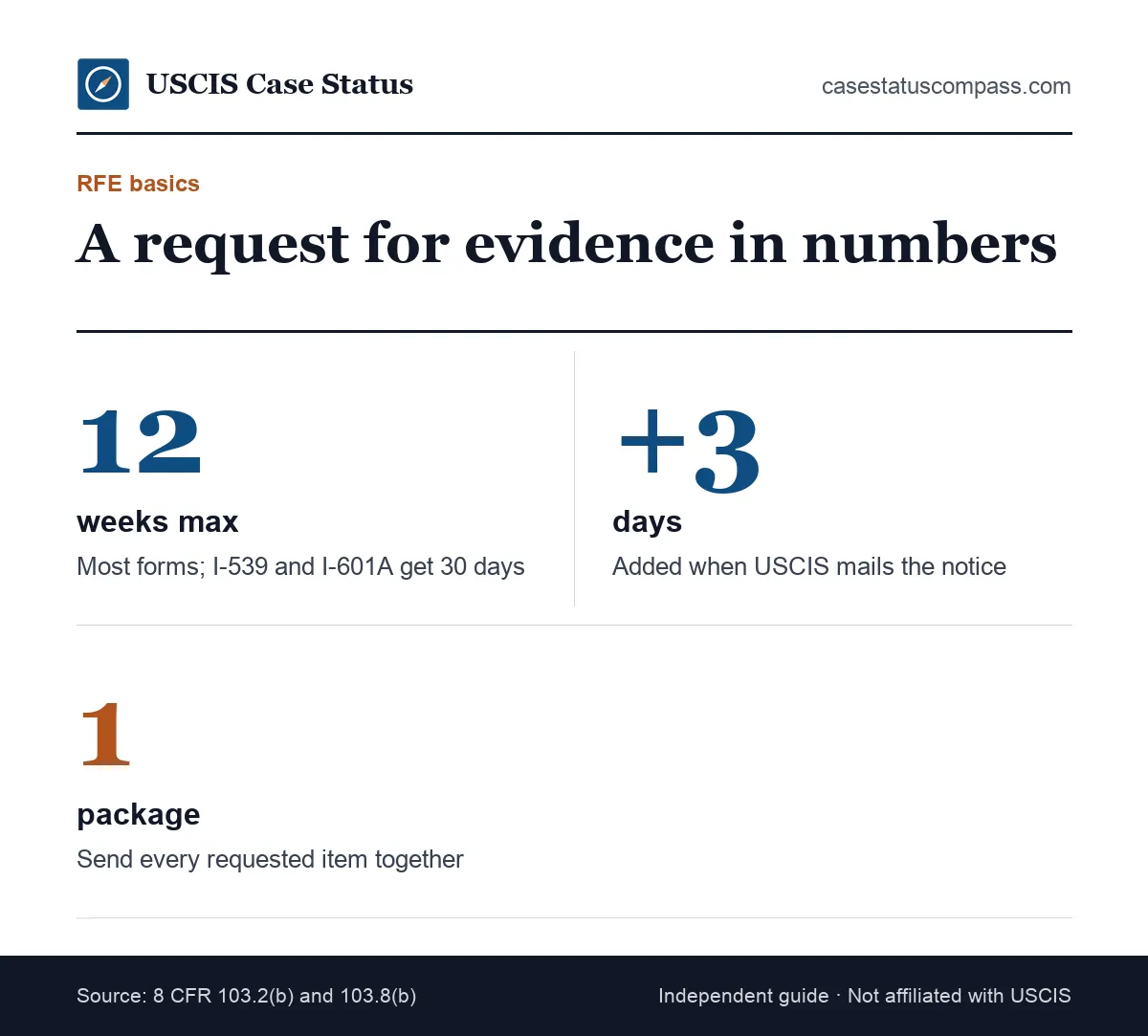
The RFE meaning is simple: RFE stands for Request for Evidence, a USCIS notice saying the officer needs more documents before deciding your case. It is not a denial. The notice lists what is missing and gives a deadline of up to 12 weeks (30 days for I-539 and I-601A). A complete, on-time reply keeps the case moving.
At a glance
| RFE full form | Request for Evidence |
| Is it a denial? | No. The case is still open and under review |
| Deadline | RFE deadline: up to 12 weeks (the exact date is on your RFE); no extensions |
| Mailed notice | If USCIS mailed the notice, add 3 days to the deadline |
| How to reply | One complete package with the RFE notice on top |
RFE Meaning: What Is a Request for Evidence?
A request for evidence (RFE) is a written USCIS notice asking for documents or information the officer needs to decide a case. It names the eligibility point at issue, explains why your evidence fell short and sets a deadline. The case stays open while you respond. This guide is part of our uscis case help section.
RFE full form and other names
The RFE full form is "Request for Evidence." You may also see "request for initial evidence," "request for additional evidence" or "evidence request." In case status, it appears as "Request for Evidence Was Sent."
What an RFE is not
An RFE is not a denial, a rejection or a sign of fraud, nor an approval; the officer simply cannot decide yet. Your current status does not change because an RFE was issued.
Why an RFE is a chance, not a setback
The Policy Manual says USCIS can deny without an RFE or NOID if there is no legal basis for approval or initial evidence is missing, so getting one means USCIS gave you a chance to fix the record before deciding.
Request for Initial Evidence vs Request for Additional Evidence
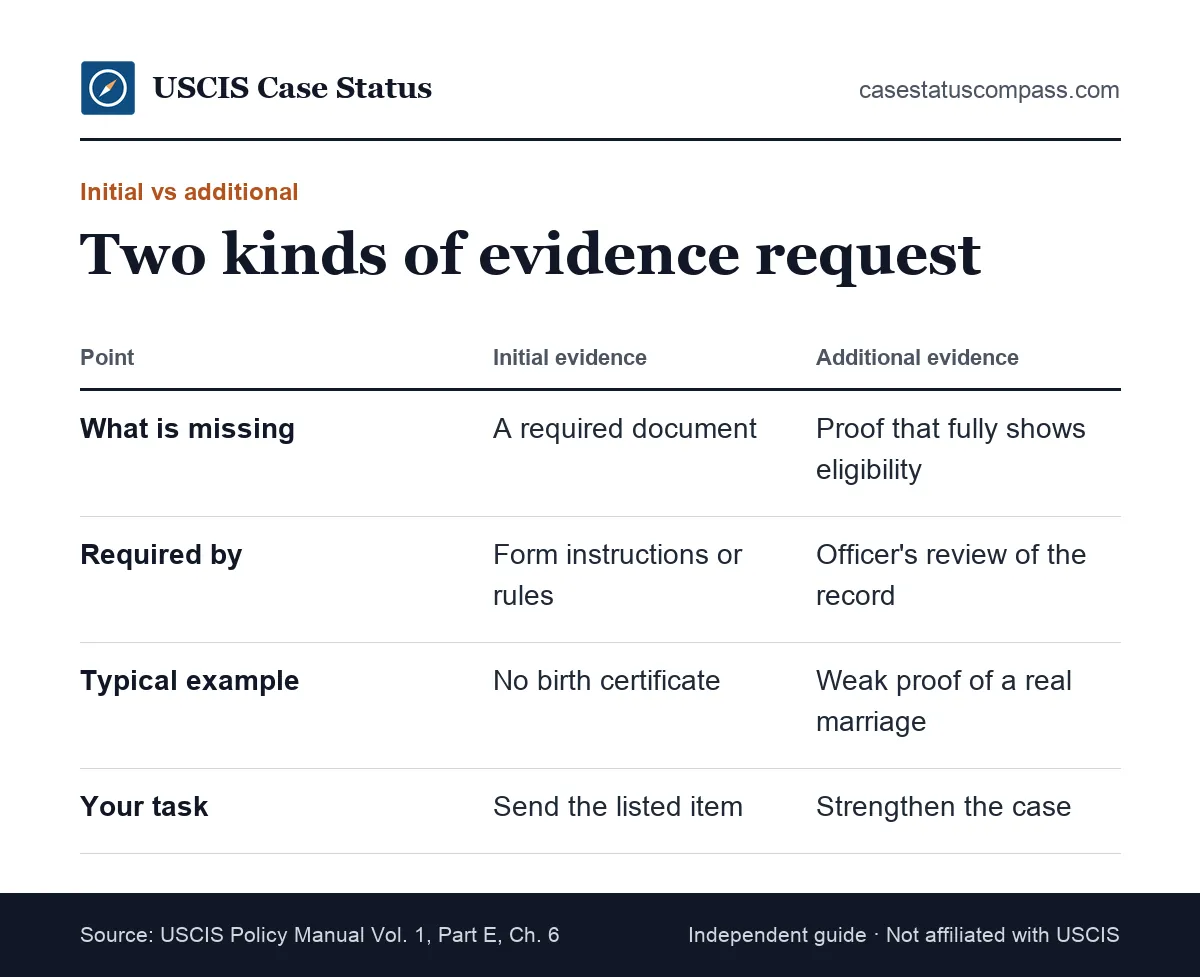
A request for initial evidence asks for a document the form instructions or rules require at filing, such as a birth certificate. A request for additional evidence asks for more proof after the required documents were filed but did not fully show eligibility.
Initial evidence defined
Initial evidence is the threshold proof listed in the form instructions, statute or regulations. USCIS policy says it should generally be primary evidence, such as an official certificate, when available. Leaving it out is the most common trigger for an initial evidence request.
Additional evidence defined
Additional evidence fills gaps the officer found after reading what you sent. The documents may be there but raise questions, conflict with each other, or fall short of the legal standard. The difference between request for evidence and request for additional evidence is one of wording, not seriousness.
What Does "Request for Initial Evidence Was Sent" Mean?
"Request for Initial Evidence Was Sent" is a case status message meaning USCIS mailed or posted a notice asking for a required document that was missing from your filing. Your case is paused until USCIS receives your reply or the deadline passes.
What usually triggers it
Common triggers are a missing civil document, no passport photos, a missing signature page, an absent medical exam, or no proof of the petitioner's status. Compare the notice with your original filing to see which item went missing.
Which Documents Does an I-130 Initial Evidence Request Ask For?
A request for initial evidence was sent on an I-130 often asks for proof of the petitioner's citizenship or permanent residence, or a marriage certificate. Our i 130 guide lists what the petition should include from the start, so you can see which item was missing.
What Does "Request for Additional Evidence Was Sent" Mean?
"Request for Additional Evidence Was Sent" means the officer read your file and needs stronger or clearer proof of a specific eligibility point. The notice should explain which requirement is not yet met and suggest kinds of evidence that could meet it.
Common triggers for additional evidence
Typical triggers include thin relationship evidence, unclear job duties, income below the required level, gaps in work history or conflicting dates across forms. The notice names the concern that applies to you, so start there.
Is an additional evidence request a bad sign?
Not by itself. Many approved cases had one. A request for additional evidence shows the officer is actively working on your file. Our uscis case status meanings guide explains where this message fits among other updates.
Why Does USCIS Send an RFE?
USCIS sends an RFE when the record does not yet prove eligibility but more evidence could prove it. The common reasons are missing documents, weak or unclear proof, inconsistent information, expired documents and adverse information the officer wants you to address.
Missing, weak or inconsistent evidence
Most RFEs trace back to gaps or conflicts: a missing page, an unsigned letter, a name spelled two ways, or dates that do not match between forms. Fix the conflict and explain it in one sentence.
Expired or outdated documents
A long wait can leave a document out of date, such as a medical exam, an I-20 or a passport. When the RFE asks for a current version, send the newest one and point out the change in your cover letter.
What Is an Adverse Information RFE?
An adverse information RFE asks you to respond to information USCIS found that could count against you, such as a past arrest record or a conflicting prior filing. Treat these seriously, answer every point, and talk to an attorney before you reply.
What Does an RFE Notice Contain?
An RFE notice names the eligibility requirement not yet met, explains why the evidence fell short, lists examples of acceptable evidence and states the deadline and response address. It usually arrives as a Form I-797 notice and appears in your online account if the case is linked.
The parts to read first
- Response deadline and whether the notice was mailed
- The legal requirement at issue
- Each specific item requested
- Examples of other acceptable evidence
- The address or upload instructions for the reply
Keep the original notice
USCIS asks you to send the RFE notice (or its cover page) back with your response so the reply is matched to your file. Our what is an i 797c guide explains how USCIS notices are numbered.
RFE Meaning for Your Case: Is It a Bad Sign?
The RFE meaning for your case is "not yet," not "no." It signals the officer sees a possible path to approval but needs proof first. Outcomes depend on how well your reply answers the stated concern. Treat the notice as a checklist, not a verdict.
What an RFE says about your odds
In practical terms, the RFE meaning is a second chance to prove a point. USCIS does not publish approval rates after an RFE for individual forms, so we cannot give odds, but a complete reply that answers each point directly gives the officer the best chance to approve.
When it is more serious
A request is more serious when it raises inadmissibility, fraud concerns, criminal history or a lack of legal eligibility. In those cases, get legal advice before responding, because the wrong reply can create new problems.
Common RFEs by Form
Common RFEs by form follow patterns, because each form has a few eligibility points officers check most. The table below matches popular forms with the evidence USCIS usually asks for. Knowing the pattern for your form helps you check a reply before you send it.
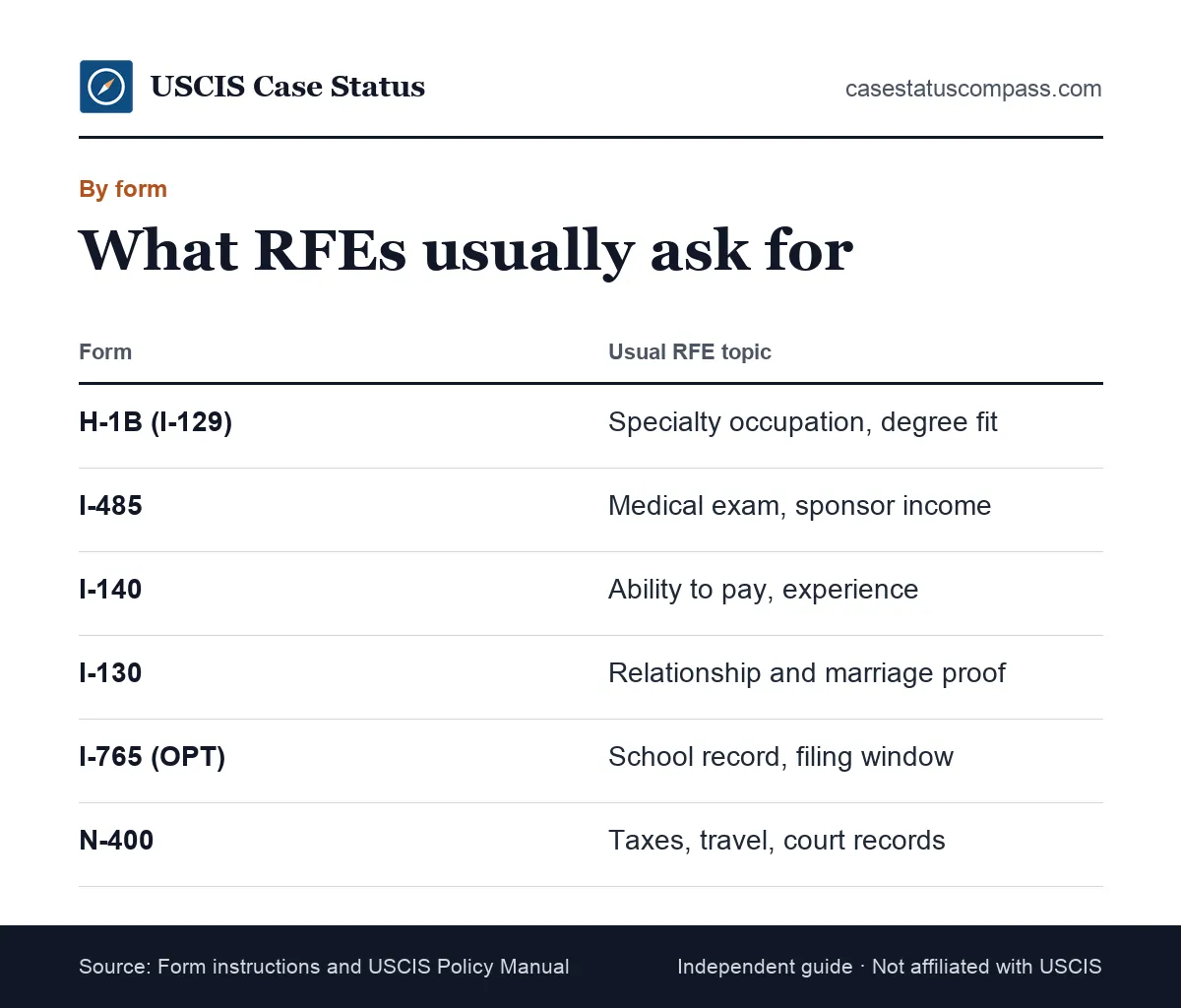
Table of common RFEs by form
Each row pairs a form with the topic officers raise most and the documents that tend to answer it.
| Form | Common RFE topic | Evidence that often answers it |
|---|---|---|
| I-129 H-1B | Specialty occupation | Detailed duties, degree requirement proof, expert letters |
| I-485 | Medical exam or sponsor income | Sealed I-693, I-864 with tax transcripts |
| I-140 | Ability to pay | Annual reports, tax returns or audited financials |
| I-130 | Relationship proof | Civil certificates, joint records, photos over time |
| I-765 OPT | School recommendation | Updated I-20 with the school's endorsement |
| I-751 | Ongoing real marriage | Joint lease, bank, insurance and tax records |
| N-400 | Taxes, trips or arrests | Tax transcripts, travel records, certified court dispositions |
| I-129F | In-person meeting | Travel records, photos, tickets |
Records from third parties, such as tax transcripts and court dispositions, answer most rows better than personal statements.
How to use this table
Use the table to anticipate a request or check your reply. Always answer the notice you actually received, item by item. If it raises a topic the table does not list, the notice still controls.
What Do H-1B Visa RFEs Usually Ask For?
H-1B visa RFEs usually ask the employer to prove the job is a specialty occupation, that the worker's degree fits the role, and that the worksite and employment terms match the petition. The employer, not the worker, answers the RFE, often with an attorney.
Specialty occupation and job duties
The most common request for evidence H1B cases get is about the job: USCIS wants proof the role normally requires a specific bachelor's degree. Detailed duty breakdowns, industry norms and organizational charts help. Our h1b visa status guide explains the petition stages.
Worker qualifications and worksite
Other H1B request for additional evidence items cover the worker's degree equivalency, credential evaluations, the worksite address, client letters for third-party placements and proof of status for extensions. The employer's attorney usually gathers these.
H1B request for initial evidence
An H1B request for initial evidence usually means a required item was left out, such as the certified labor condition application, the degree copy or a fee. Sending the missing item quickly usually resolves it.
What Is a Common I-485 RFE?
The most common I-485 RFE asks for the medical exam, a stronger affidavit of support, or a missing civil or entry document. A green card RFE can also ask about past status violations or criminal records. Answer every item in one package before the deadline.
Medical exam (Form I-693)
Send the sealed I-693 with your I-485 (required since Dec. 2, 2024). If the exam was missing or flawed, the RFE asks for a new sealed form. An I-693 is generally valid only for the application it was filed with. See our immigration medical exam guide.
Affidavit of support and civil documents
Sponsor RFEs often ask for tax transcripts, proof of income or a joint sponsor. Sponsors need income of at least 125% of the poverty guidelines (100% for active-duty military sponsoring spouse/child). Other items include birth certificates, the I-94 entry record and certified court records. Our i 485 guide covers the full filing.
Status violations and criminal records
Green card RFEs about past status violations, unauthorized work or arrests call for certified court dispositions and status records. Get legal advice before replying, because these answers can affect admissibility.
I-140 RFEs: Ability to Pay and Experience
An I-140 RFE most often asks the employer to prove it can pay the offered wage from the priority date onward, or that the worker had the required experience and education before that date. NIW and EB-1 petitions also draw requests about their special criteria.
Ability to pay the offered wage
USCIS asks for annual reports, federal tax returns or audited financial statements, and sometimes payroll records showing the worker is already paid the wage. Gaps between years are a frequent trigger.
Experience letters, degrees and special criteria
Experience letters must come from past employers and describe duties, dates and hours. EB-1 and national interest waiver RFEs ask for more proof of acclaim or impact. Our form i 140 guide explains each category.
I-130 and Marriage-Based RFEs
Marriage and family petitions draw RFEs about proof of the relationship and, for spouses, proof that the marriage is real. The fix is usually layered evidence from different sources over time, not more of the same document. Spread the proof across several years and sources.
Relationship documents
Family petitions need civil documents that link petitioner and beneficiary, such as birth and marriage certificates, plus proof that earlier marriages ended. Missing divorce decrees are a classic trigger. Send the final decree, not a court filing receipt.
Bona fide marriage proof
Bona fide marriage evidence includes joint leases, shared bank accounts, insurance, tax returns filed jointly and photos across time. Sworn statements help but work best alongside records. Our cr1 visa guide covers spouse cases.
RFEs on OPT and Work Permit Applications
An RFE on OPT usually concerns the student's Form I-20 recommendation, the filing window or the photos and signatures. Other Form I-765 requests focus on proof of the underlying category, such as a pending I-485 or asylum filing. For OPT filers the RFE meaning is usually narrow: fix the listed item rather than rebuild the whole application.
OPT RFEs
Students most often need an updated I-20 showing the school's OPT recommendation, or proof the application was filed within the allowed window. Contact your school's designated official as soon as the notice arrives.
Other work permit RFEs
For other categories, USCIS may ask for the receipt notice of the underlying case, a missing photo or a clearer copy of identity documents. Our work permit guide explains eligibility categories.
N-400, I-751 and K-1 RFEs
Naturalization, removal of conditions and fiancé petitions each have their own RFE patterns. N-400 requests focus on taxes, trips and records. I-751 requests focus on the ongoing marriage. I-129F requests focus on the in-person meeting rule. Each pattern is covered below with its typical evidence.
N-400 requests
Naturalization requests often follow the interview, sometimes on a separate form handed to you. They ask for tax transcripts, certified court dispositions or travel records. See our citizenship application guide.
I-751 requests
I-751 requests ask for recent joint evidence that the marriage continued, such as joint tax returns, a shared lease and bank statements. Records dated after the green card was issued matter most. See our i 751 guide.
I-129F (K-1) requests
Fiancé petitions must meet this rule: K-1: you must have met in person within the 2 years before filing (waivers possible). Requests usually ask for travel records, photos and tickets proving the meeting. Our k1 visa guide explains it.
When Is the Deadline for an RFE?
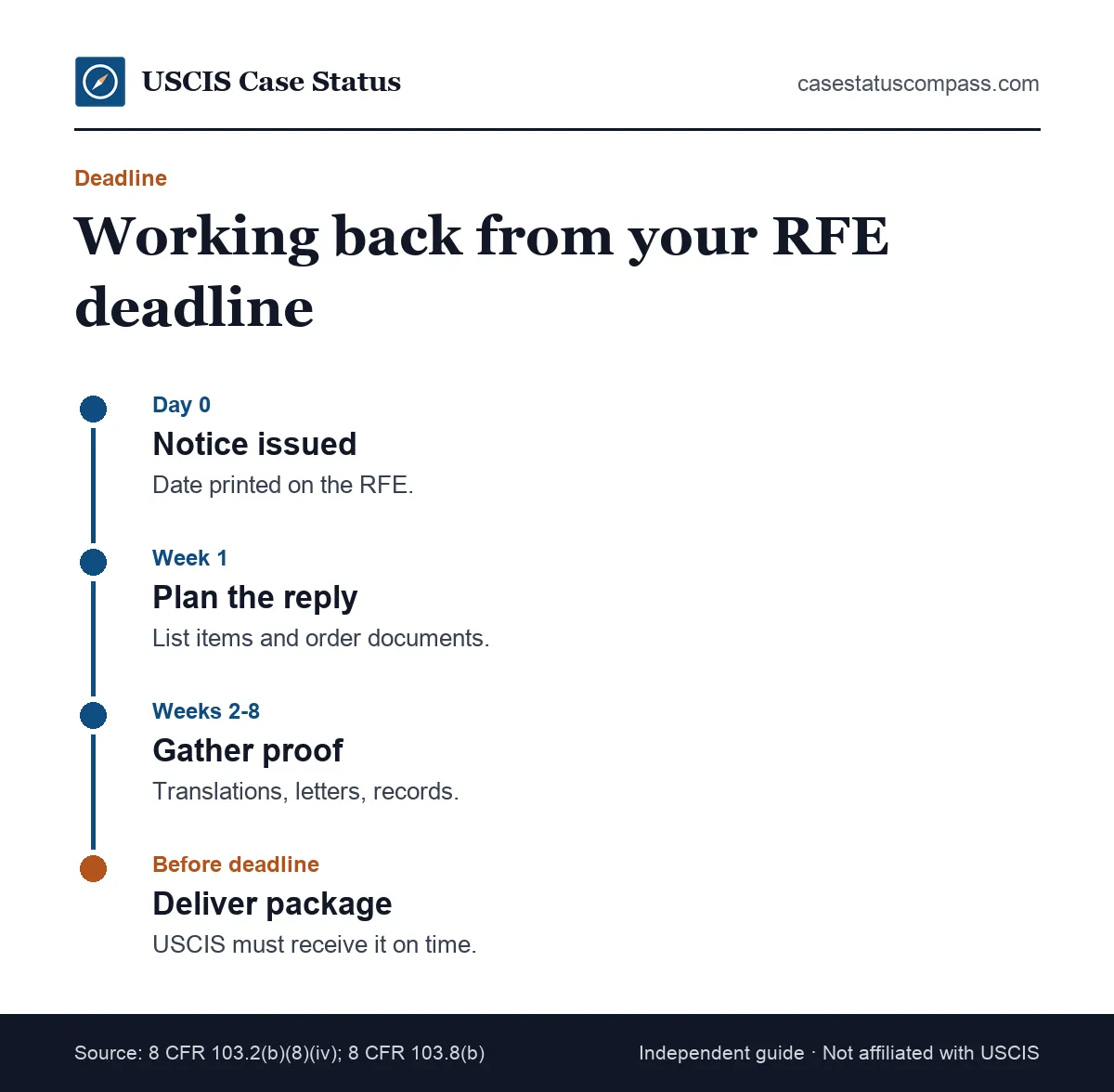
The deadline for an RFE is the date printed on the notice. By regulation, USCIS can give at most 12 weeks (30 days for I-539 and I-601A), and it cannot extend the time. USCIS must receive your full reply by that date.
The 12-week maximum
The rule in 8 CFR 103.2(b)(8)(iv): RFE deadline: up to 12 weeks (the exact date is on your RFE); no extensions. Twelve weeks is 84 days, the longest window allowed. Some forms get less: RFEs for Form I-539 and Form I-601A allow at most 30 days (all other forms up to 84 days), plus 3 days if mailed. Always check your own notice.
Extra days for mailed notices
If USCIS mailed the notice, add 3 days to the deadline. Service by mail is complete on the mailing date, not the day you open the envelope. A notice posted only to your online account does not get the mail days.
No extensions
USCIS cannot extend an RFE deadline. If a document will be late, send everything else on time with an explanation of what is missing, why, and what you did to get it.
RFE deadline rules at a glance
The table sums up the four deadline rules from the regulations in one place.
| Deadline rule | What it means for you |
|---|---|
| Maximum window | 12 weeks; 30 days for I-539 and I-601A |
| Mailed notice | Add 3 days |
| Extensions | Not allowed |
| What counts | USCIS must receive the full reply in time |
Your printed date still controls; use these rules only to double-check it.
How Many Days Do You Have to Respond to an I-140 RFE?
For an I-140 RFE, you have the number of days printed on the notice, which can be at most 12 weeks (84 days), plus 3 days if the notice was mailed. Premium processing does not shorten your response window; it only changes how fast USCIS decides afterward.
Standard I-140 petitions
For regular I-140 petitions, USCIS's median processing time for April–June 2026 was I-140: median 3.9 months (USCIS data, Apr.-June 2026). An RFE adds your response time plus a new review. See our i 140 processing time guide for the official tool.
Premium I-140 petitions
An RFE stops the premium clock; a new period starts when USCIS gets your response. For premium I-140s: 15 business days (I-129, most I-140); 30 (I-765 OPT, I-539 F/M/J); 45 (I-140 E13 managers and NIW). A faster reply means a faster restart of the premium clock.
How to Calculate Your RFE Deadline
To calculate your RFE deadline, start from the date on the notice, use the response period it states, and add 3 days only if USCIS mailed it. Then set your own target date at least two weeks earlier to allow for delivery problems.
Worked example
Suppose an RFE dated March 2 allows 84 days and was mailed. The window runs 84 days from March 2, plus 3 mail days. The printed deadline is the one that counts, so compare your math with it.
Build in a buffer
Aim to have the package delivered at least one to two weeks early. Courier delays, holiday closures and a missing signature found at the last minute all eat into the window, so set your own deadline first and work back from it.
How Do You Respond to an RFE?
To respond to an RFE, read the notice, list each requested item, gather the evidence, put it all in one package with the notice on top and send it to the address shown before the deadline. The steps below break that down.
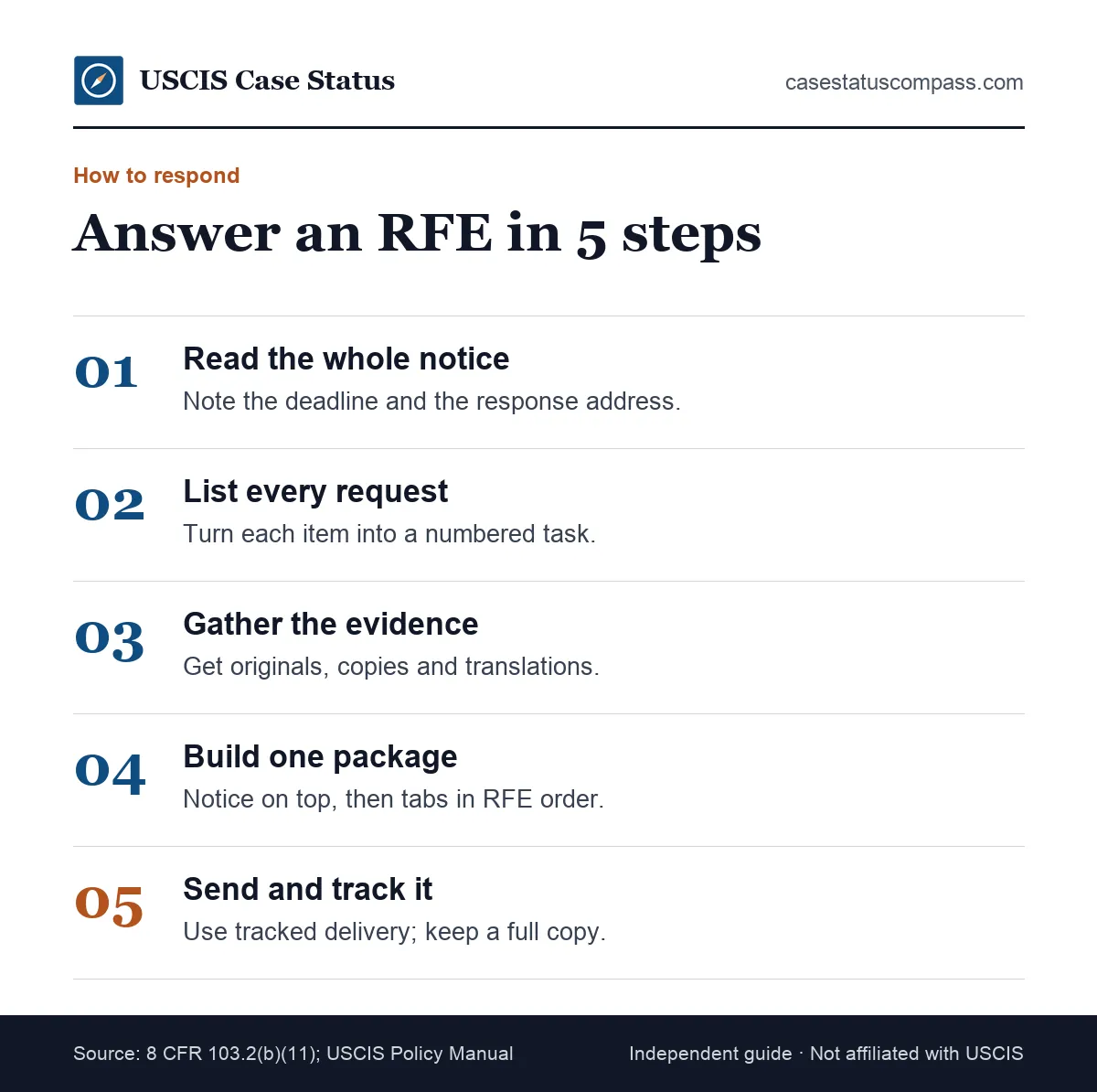
Read the notice and list each item
Turn the notice into a numbered task list. Copy the exact wording of each request. If the officer cites a requirement, note it next to the item so your evidence speaks to that standard.
Gather strong evidence
Prefer primary documents from official sources. Add context where needed: an expert letter for job duties, an accountant's letter for financials, or sworn statements alongside records. Translate every foreign-language page.
Send one complete response
Regulations require that all requested materials be submitted together. Do not split the reply into several mailings. USCIS does not wait for a second envelope. If one item will be late, explain why in the cover letter.
How to Organize an RFE Response Package
Organize an RFE response with the RFE notice on top, then a cover letter, then an index and tabbed exhibits in the same order as the requests. A clear package helps the officer find each answer quickly and reduces the chance of a second request.
Order and labeling
Stack the package in this order, so the officer reads the notice first and finds each exhibit by number:
- RFE notice or cover page
- Cover letter with an item-by-item summary
- Exhibit index
- Tabbed exhibits, numbered to match the requests
Copies, originals and translations
Send copies unless the notice asks for originals. Every foreign document needs a full English translation with the translator's certification. Keep the originals safe in case an officer asks to see them later, for example at an interview.
RFE Response Cover Letter
An RFE response cover letter is a short summary that tells the officer what each exhibit answers. It names the applicant, receipt number and notice date, then lists each request with the exhibit that responds to it. Keep it factual and brief.
What the cover letter should include
- Applicant name, A-Number and receipt number
- Date of the RFE and the deadline
- Each request, quoted briefly, with the exhibit number
- A short note on anything you could not obtain and why
Sample Request for Initial Evidence Cover Letter
Example with fictional names; adapt it to your notice and check the current form instructions.
Re: Response to Request for Evidence dated March 2, Receipt No. IOE0000000000, Applicant: Jane Example. Item 1 (birth certificate): see Exhibit A, with certified translation. Item 2 (passport photos): see Exhibit B. All requested items are enclosed in this single response.
RFE Response Checklist
Use this RFE response checklist before you seal the envelope or click submit. It covers the content, format and proof of delivery, the three areas where most avoidable problems happen. Tick each box against your own notice rather than a generic list, and ask a second person to check.
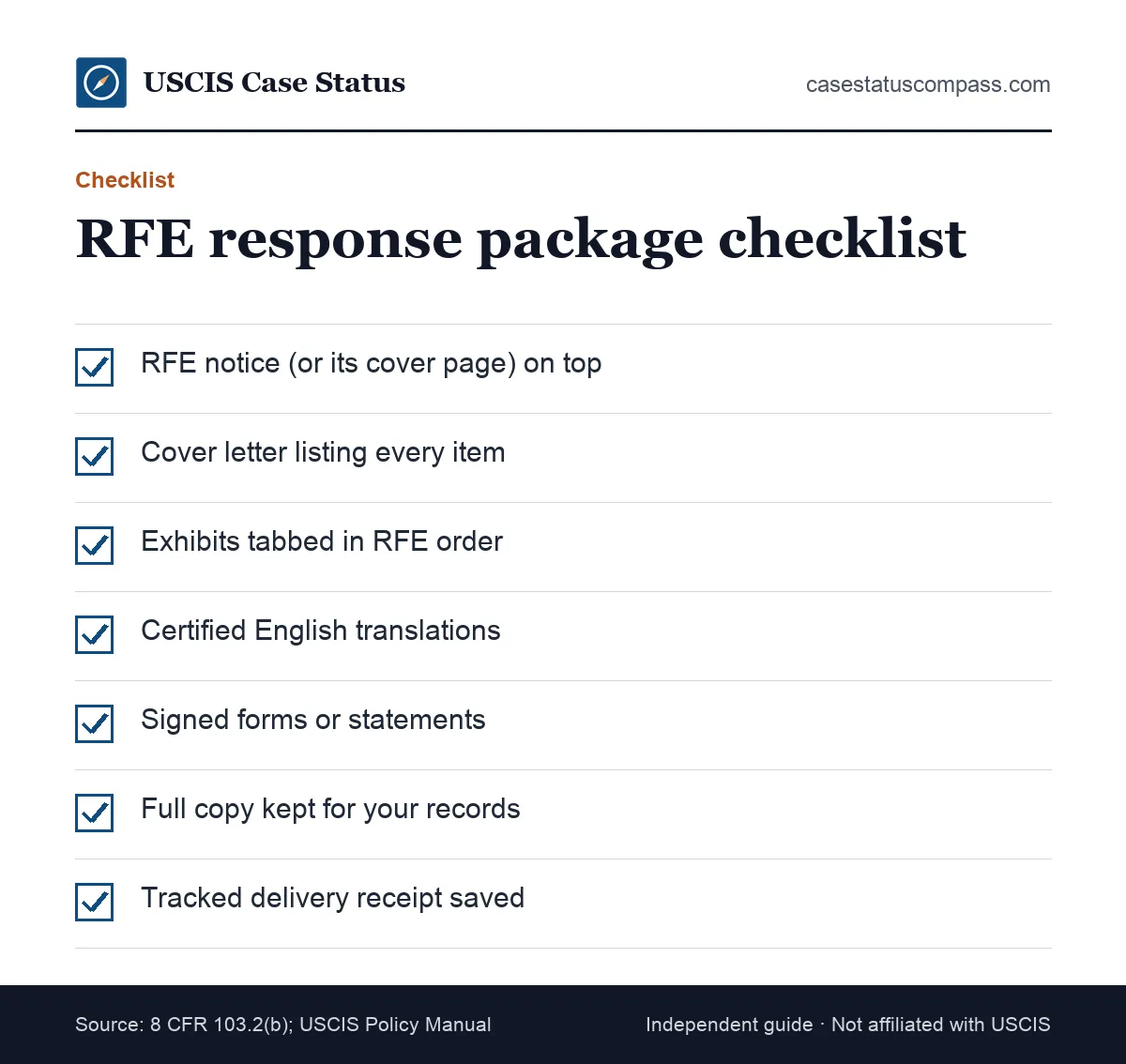
Content checks
Start with substance: the officer decides on what the evidence proves, so these come first.
- Every requested item answered, in order
- Each exhibit matches the officer's stated concern
- Explanations for anything unavailable
Format checks
Next, make sure the officer can match the package to your file and read every page:
- RFE notice or cover page on top
- Cover letter and exhibit index
- Certified translations and signatures
Delivery checks
Last, prove when and where the reply arrived; a tracking record is your best evidence if USCIS later says nothing came:
- Correct address from the notice
- Tracked delivery and saved receipt
- Full copy kept
Can You Submit an RFE Response Online?
Yes, if your case is in your USCIS online account and the notice offers online upload. Paper-filed cases generally need a mailed response to the address on the notice. The instructions in your own notice control. If they are unclear, follow its mailing address.
Online responses
For online cases, upload each document in the response section of your account. Online submissions are dated when you submit them, which helps near a deadline. Save the confirmation screen.
Mailed responses
Mail the package to the exact address printed on the RFE, not a general filing address. Using a different address can delay matching the reply to your file. Our uscis service centers guide explains which offices handle which cases.
What If You Cannot Get a Requested Document?
If a document does not exist or cannot be obtained in time, send secondary evidence and an explanation. USCIS rules allow secondary evidence when primary documents are unavailable, often with proof from the issuing authority that the record does not exist.
Secondary evidence
Secondary evidence might include school or religious records, census records or medical records in place of a missing birth certificate. Explain why the primary document is unavailable and what each substitute proves.
Sworn statements
Affidavits from people with direct knowledge can support secondary evidence. They should give the writer's name, relationship, how they know the facts and specific details. Affidavits alone are usually weaker than records.
Partial Response, No Response or Withdrawal
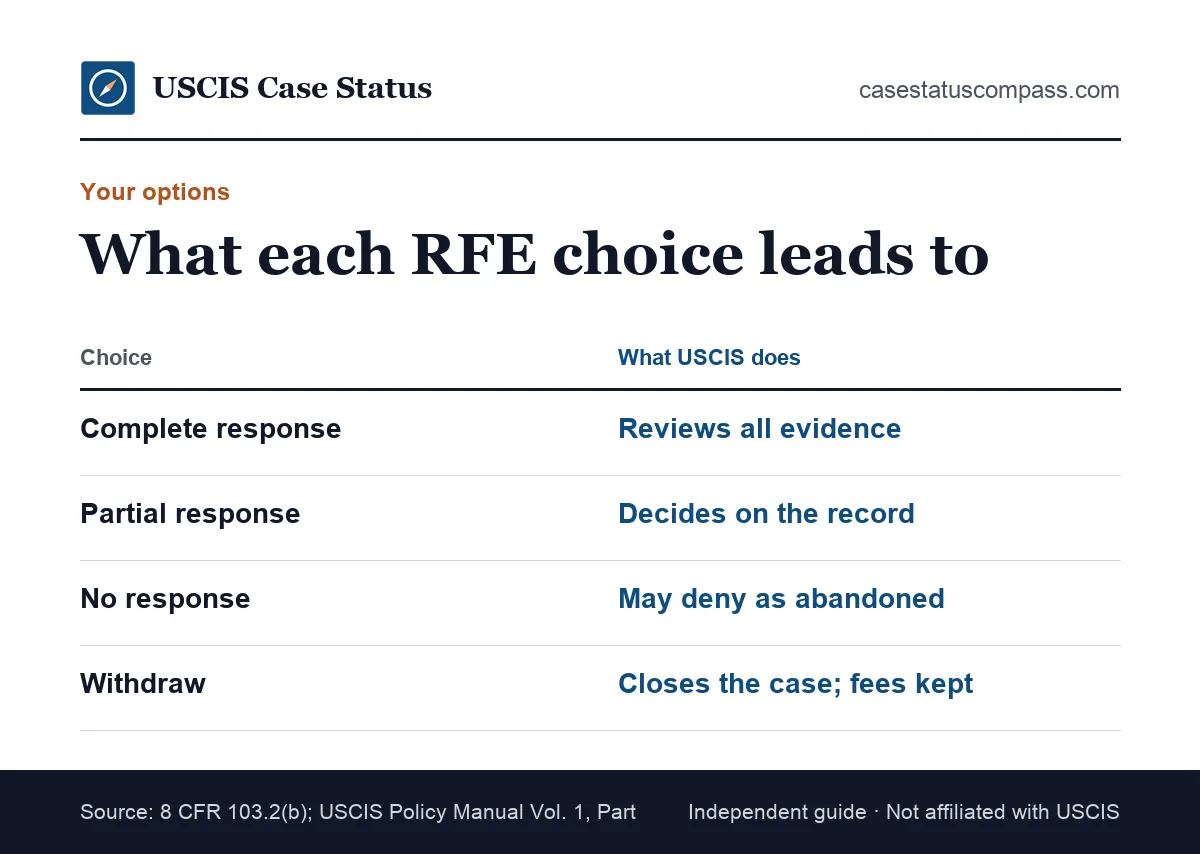
You have three other choices besides a full reply: a partial response, no response, or withdrawing the case. A partial reply invites a decision on the record, and silence can lead to denial. Each choice carries real risk, so read the rules below first.
Partial response
The rule: send every requested item in one response; a partial reply is treated as a request for a decision on the record. USCIS will not wait for the rest or issue another RFE just because pieces are missing. Send a partial reply only if you truly cannot get the other items.
Withdrawing the application
Withdrawal closes the case. USCIS fees are nonrefundable, even if your case is denied or withdrawn. Withdrawing can affect status and future filings, so get advice first. An attorney can tell you whether waiting is safer.
What Happens If You Do Not Respond to an RFE?
The Policy Manual is direct: if you don't respond, USCIS can deny the case as abandoned, on the record, or both. Silence invites an abandonment denial. Missing an RFE because of an old address is a common, avoidable cause; our uscis change of address guide explains how to keep notices reaching you.
What Is Unsolicited Evidence?
Unsolicited evidence is any document you send USCIS without being asked, such as new proof mailed after filing. USCIS adds evidence you submit to your file, but sending it outside an RFE can slow matching and may not be reviewed before a decision.
Unsolicited evidence before an RFE
You may send new, important evidence after filing, such as a new marriage certificate or a corrected document. Include a cover letter with your receipt number. Do not flood the file with minor extras.
Unsolicited evidence with your RFE reply
Add only relevant extra evidence to an RFE reply, such as proof that answers a concern the officer is likely to raise next. Unrelated documents make the package harder to review.
RFEs and Premium Processing
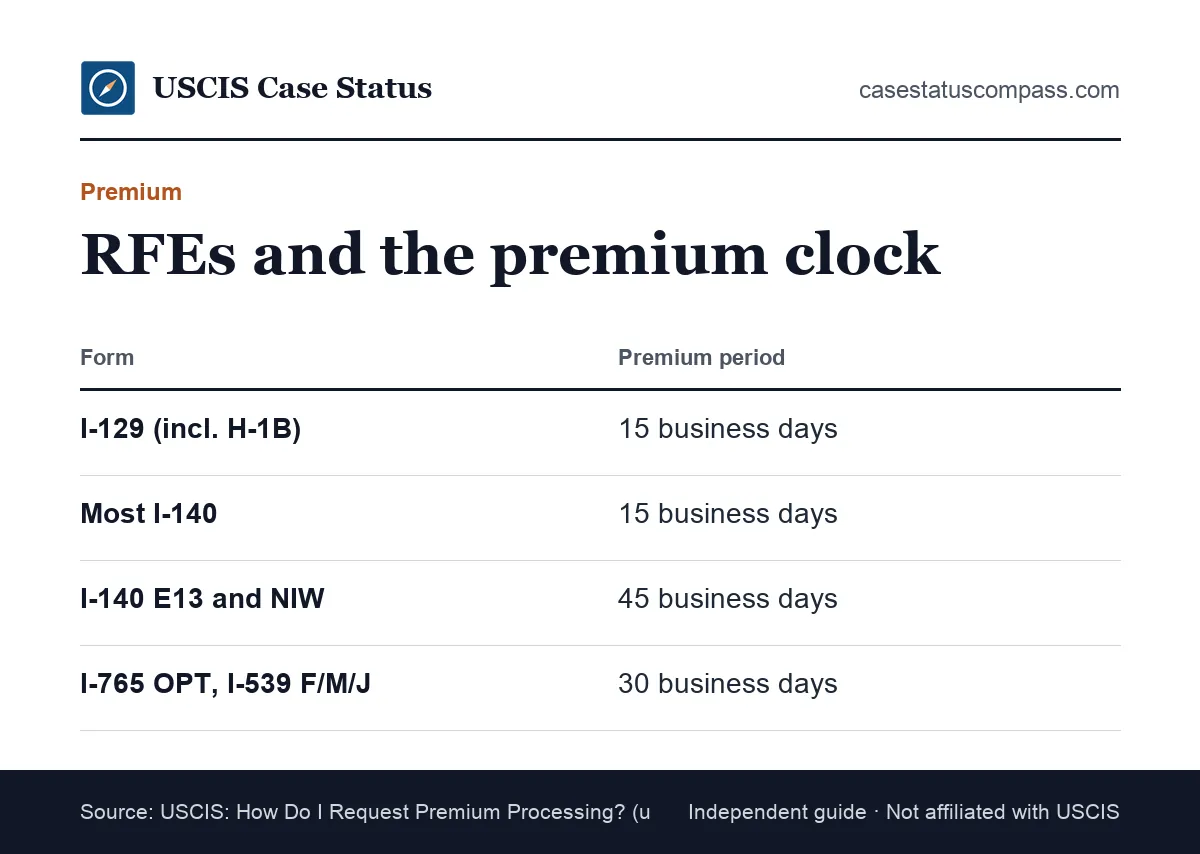
An RFE stops the premium processing clock. When USCIS receives your response, a new full premium period begins. The RFE premium processing response time on your side is still the window printed on the notice; only the decision speed afterward changes.
How the clock works
An RFE stops the premium clock; a new period starts when USCIS gets your response. Current periods: 15 business days (I-129, most I-140); 30 (I-765 OPT, I-539 F/M/J); 45 (I-140 E13 managers and NIW). Our premium processing guide explains eligibility and fees.
Biometrics, Interviews and RFEs
A biometrics appointment is not an RFE. It arrives on its own Form I-797C appointment notice. People searching for H1B RFE biometrics usually have a dependent or related filing that needs fingerprints, which is a separate step from the employer's evidence request.
Biometrics notices
If you get an appointment notice, attend it as scheduled. Our biometrics appointment guide explains what to bring and how to reschedule. Missing it can stall the case even while your RFE reply is pending.
Requests after an interview
Officers may hand you a request at the interview for documents they did not see. Treat it like any RFE: note the deadline and send everything together. Our green card interview questions guide helps you prepare.
What Happens After You Respond to an RFE?
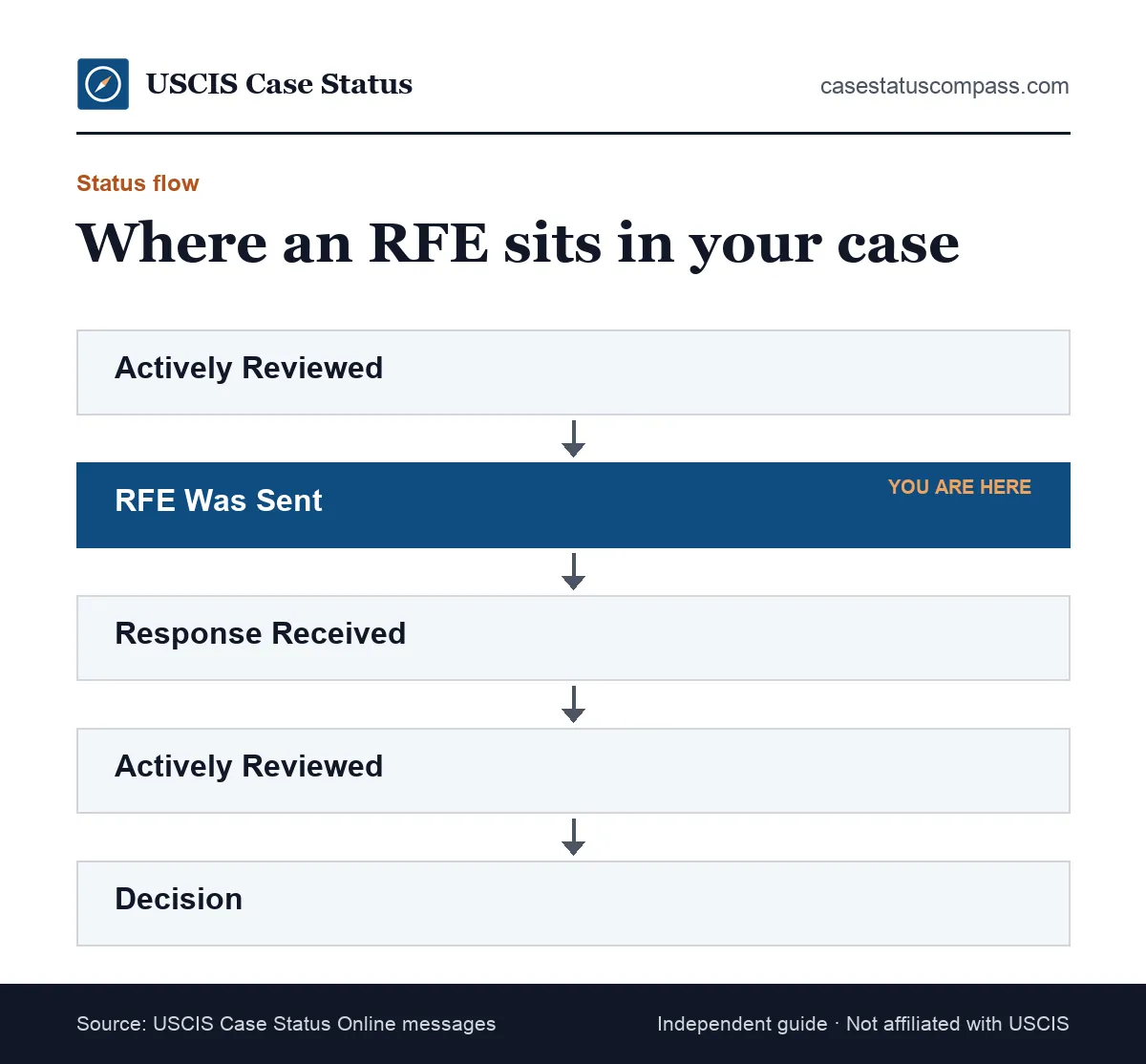
After you respond, your case status usually changes to show the response was received, then returns to review. The officer evaluates the new evidence and then approves, denies, issues another request or, if concerns remain serious, sends a notice of intent to deny.
Status updates to expect
Expect "Response To USCIS' Request For Evidence Was Received," then often "Case Is Being Actively Reviewed." See our case is being actively reviewed by uscis guide for what that stage means.
Possible outcomes
The officer can approve, deny, issue a narrow follow-up request, or move toward a notice of intent to deny. A denial notice explains options such as appeals or motions.
How Long Does USCIS Take to Respond After an RFE?
USCIS does not publish a fixed time for deciding after an RFE response. The case goes back into the officer's queue. Premium cases get a new premium period on receipt. For others, use the official processing times tool to judge whether your case is overdue.
No fixed RFE processing time
There is no official RFE processing time. Totals vary by form, office and workload. Our uscis processing times guide explains the tool. The USCIS tool shows how long it took to finish 80% of cases in the past 6 months.
When you can ask about a delay
Case inquiry date: the earliest date USCIS will accept a question about your pending case; it can change. You can submit an 'outside normal processing time' request only after your case inquiry date. If your status stops moving, see our guide to a uscis case status not updating.
What Happens After RFE Approval?
After an RFE leads to approval, USCIS issues an approval notice and the case moves to its next stage. For green cards, that means card production. For petitions, the next stage might be consular processing, an extension of stay, or a later green card filing.
The approval notice
The approval arrives as a Form I-797 notice in the mail and in your online account if linked. Check names, dates and classification right away, and report any USCIS typos.
Next steps by form
The next stage depends on which form was approved:
- I-485: card production, then mailing
- I-130 or I-140: visa processing or a green card filing
- H-1B: start or continue work on the approved terms
RFE vs NOID and Other USCIS Notices
An RFE asks for proof; a notice of intent to deny (NOID) warns that USCIS plans to deny unless you overcome specific reasons, with a shorter window. A rejection returns an incomplete filing, and a denial is a final decision on that filing.
Quick comparison
These four notices are often confused, but each calls for a different reply.
| Notice | What it means | Typical next step |
|---|---|---|
| Request for Evidence | More proof needed | Reply within the stated window |
| Notice of Intent to Deny | Denial planned unless rebutted | Reply quickly with legal help |
| Rejection | Filing not accepted at intake | Fix and refile |
| Denial | Final decision on the filing | Review appeal or motion options |
Only the first two give you a chance to answer before a decision.
Where to read about NOIDs
A NOID has its own deadline: NOID deadline: up to 30 days; no extensions. Our notice of intent to deny guide explains how to respond to one. Treat a NOID as more urgent than an RFE.
Can You Get a Second RFE?
Yes, but it is less common. USCIS policy tells officers to request all expected evidence in one RFE. A second request usually comes only when your reply raises new questions, such as a document that conflicts with earlier filings. A clean, consistent first reply is the best prevention.
Why second requests happen
Second requests often follow new information in the reply: a new employer, a different address history or a document that contradicts the form. Check your reply for consistency before sending.
How to reduce the risk
Answer the officer's stated reason, not just the listed documents. If the concern is the job's degree requirement, show why the duties require it rather than only resending the job posting.
Mistakes That Hurt RFE Responses
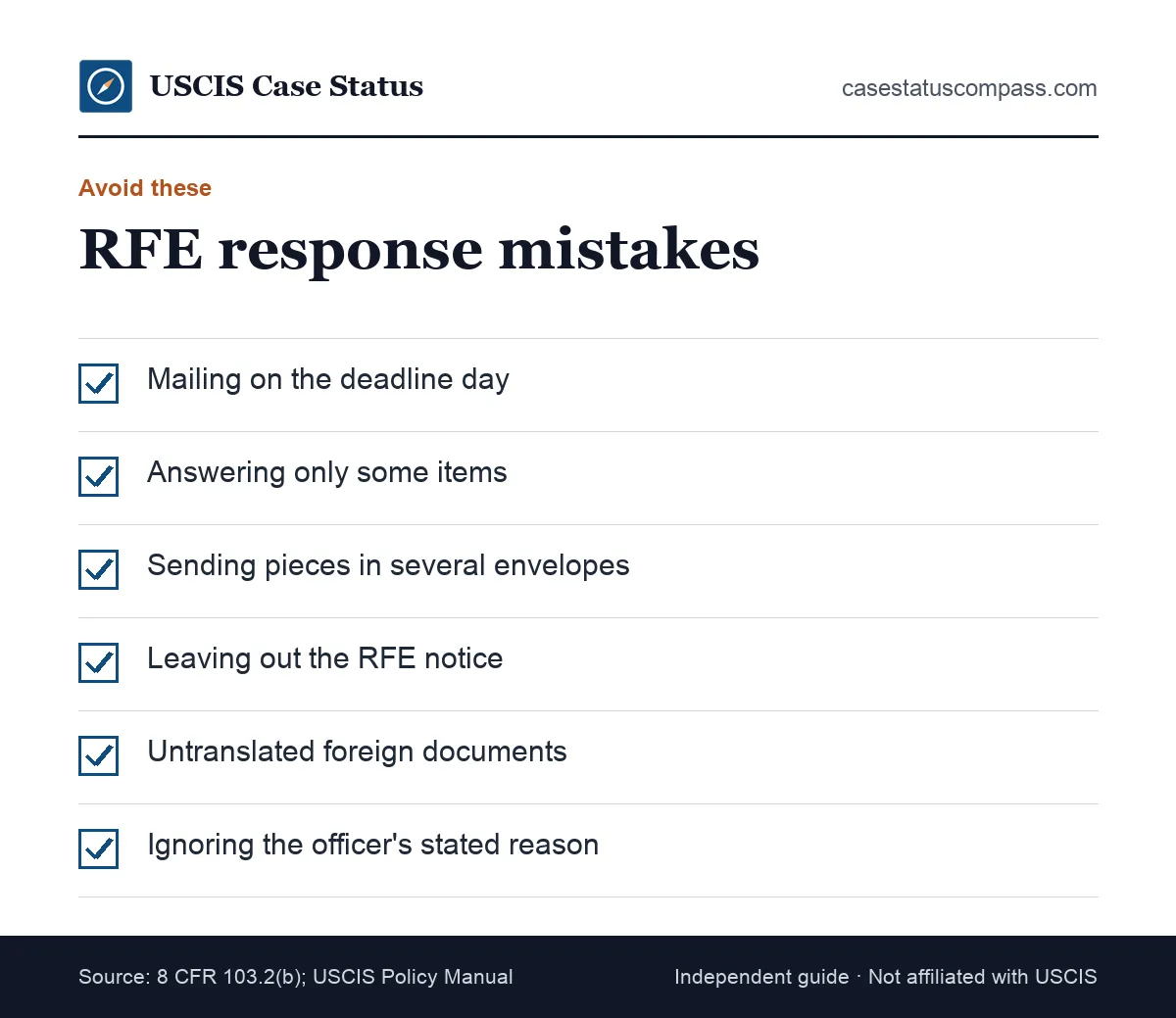
The mistakes that most often hurt an RFE response are late delivery, partial answers, missing translations and evidence that does not address the officer's stated reason. Each one can turn a winnable case into a denial on the record.
Timing mistakes
Mailing on the last day, using untracked mail or sending to the wrong address are avoidable. Plan to deliver early with tracking. Arriving one day late counts the same as missing it by a month.
Content mistakes
Resending the same weak evidence, ignoring one item, or sending unrelated documents all weaken the reply. Match each exhibit to a specific request. The RFE meaning is always tied to a stated concern, so answer that concern.
Format mistakes
Missing certified translations, unsigned pages, untabbed exhibits or a reply without the RFE notice on top make the package harder to match and review. Run the format checks above before sealing it.
When Should You Get Legal Help With an RFE?
Get legal help when the RFE raises inadmissibility, criminal records, fraud, status violations or complex employment questions, or when you do not understand what the officer wants. An immigration attorney or DOJ-accredited representative can shape the reply and spot risks.
Complex or high-stakes RFEs
Employment RFEs, adverse information RFEs and requests that could affect removal risk benefit most from legal review. For general questions, our uscis contact number guide explains reaching USCIS, and our immigration lawyer cost guide explains common fee models.
Frequently Asked Questions
What is an RFE in USCIS?
An RFE in USCIS is a Request for Evidence: a notice asking for more documents or information before an officer can decide your case. It names the requirement at issue, sets a deadline and is not a denial.
Does an RFE mean my case will be denied?
No. An RFE means the officer could not approve with the evidence in the file but believes more proof might establish eligibility. Many cases are approved after an RFE when the reply answers each stated concern on time.
Can I ask USCIS for more time to answer an RFE?
No. Federal regulations do not allow USCIS to extend an RFE deadline. If you cannot get a document in time, send everything else before the deadline with an explanation and any secondary evidence.
Is a request for initial evidence worse than a request for additional evidence?
Not necessarily. Initial evidence requests usually mean a required document was missing, often an easy fix. Additional evidence requests mean the documents did not fully prove eligibility, which can take more work.
What happens if my RFE response arrives late?
USCIS may deny the case as abandoned or decide it on the existing record. Because there are no extensions, deliver early with tracking. If a late response led to a denial, ask an attorney about motions or refiling.
Will my case status change after I send the RFE response?
Usually yes. Most cases show that USCIS received the response to its request for evidence, then return to review. If nothing changes for weeks, check your online account.
Should I hire a lawyer for an RFE?
Not always. Simple requests, such as a missing photo or certificate, are often handled by applicants. Job-duty, ability-to-pay, criminal, status or fraud issues are better handled with an immigration attorney or DOJ-accredited representative.
How many days do you have to respond to an RFE?
You have the period printed on your notice, which can be at most 12 weeks, or 30 days for Forms I-539 and I-601A. Add 3 days if USCIS mailed the notice. USCIS must receive the reply by that date.
Can I upload my RFE response online?
Only if the notice says so. Some RFEs for cases linked to a USCIS online account allow an upload; others must be mailed to the address printed on the notice. Keep the upload confirmation or delivery proof.
What is the RFE response time after USCIS gets my reply?
There is no fixed time. The case returns to the officer's queue; premium cases get a new premium period on receipt. Use the official processing times tool to judge whether your case is outside normal processing.
Sources
- 8 CFR 103.2(b): Evidence and processing (LII). www.law.cornell.edu/cfr/text/8/103.2. Accessed Oct 27, 2026.
- 8 CFR 103.8(b): Effect of service by mail (LII). www.law.cornell.edu/cfr/text/8/103.8. Accessed Oct 27, 2026.
- USCIS Policy Manual Vol. 1, Part E, Ch. 6: Evidence. www.uscis.gov/policy-manual/volume-1-part-e-chapter-6. Accessed Oct 27, 2026.
- USCIS: How Do I Request Premium Processing?. www.uscis.gov/forms/all-forms/how-do-i-request-premium-processing. Accessed Oct 27, 2026.
- USCIS: Filing Fees. www.uscis.gov/forms/filing-fees. Accessed Oct 27, 2026.
- CIS Ombudsman tip sheet: Check Your USCIS Case Inquiry Date (Aug. 2024). dhs.gov/sites/default/files/2024-11/24_0823_cisomb_case-inquiry-date-tip-sheet.pdf. Accessed Oct 27, 2026.
- USCIS Contact Center. www.uscis.gov/contactcenter. Accessed Oct 27, 2026.
- USCIS: Form I-693 page (updated 07/24/2026); I-485 Instructions 09/18/26. www.uscis.gov/i-693. Accessed Oct 27, 2026.
- USCIS Policy Manual Vol. 8, Part B, Ch. 4. www.uscis.gov/policy-manual/volume-8-part-b-chapter-4. Accessed Oct 27, 2026.
- Form I-864 Instructions, Edition 08/24/26. www.uscis.gov/sites/default/files/document/forms/i-864instr.pdf. Accessed Oct 27, 2026.
- Form I-129F Instructions, Edition 01/20/25. www.uscis.gov/sites/default/files/document/forms/i-129finstr.pdf. Accessed Oct 27, 2026.
- USCIS Data Library: All USCIS Application and Petition Form Types, FY2026 Q3 (Apr. 1-June 30, 2026; queried 7/2026). www.uscis.gov/sites/default/files/document/data/quarterly_all_forms_fy2026_q3_v1.xlsx. Accessed Oct 27, 2026.
casestatuscompass.com is an independent publication and is not affiliated with USCIS or any government agency. This page is general information, not legal advice. For denials, court or asylum matters, consult an immigration attorney or a DOJ-accredited representative.