Contents · 37 sections
- What Happens If Your I-485 Is Denied?
- I-485 Denied: How Long Can You Stay?
- I-485 Denied: What Are Your Options?
- Can You Appeal an I-485 Denial?
- Should You File a Motion or Refile the I-485?
- Can You Renew an I-485 in Immigration Court?
- What Happens to Your EAD and Advance Parole After a Denial?
- What Are the Common Reasons for Green Card Denial?
- I-485 Denied for Missing Evidence: What Now?
- What If Your I-485 Was Denied for Abandonment?
- What If the Petition Behind Your I-485 Failed?
- What If You Were Found Inadmissible?
- What Should You Look for in an I-485 Denial Notice?
- I-485 Rejection Notice vs Denial: What Is the Difference?
- What Are the Common I-485 Rejection Reasons?
- If Your Green Card Is Denied, Can You Apply Again?
- What Should You Do in the First Week After a Denial?
- How Do Family and Employment I-485 Denials Differ?
- What Happens to Spouses and Children on the Case?
- I-130 Denied: What Next?
- What Happens If an I-130 Is Denied While an I-485 Is Pending?
- What Are the Common Reasons an I-130 Is Denied?
- What Happens If a Citizenship Application Is Denied?
- How Do You Challenge a Citizenship Denial?
- What Are the Common Reasons for a Citizenship Denial?
- H-1B Denied: What Are Your Options?
- What If Other Forms Are Denied?
- Appeal, Motion or Refile? Decision Table by Denial Type
- How Do Deadlines Work After a Denial?
- How Much Does It Cost to Challenge or Refile?
- Does a Pending Motion Let You Stay or Work?
- Why Should You Talk to an Immigration Attorney After a Denial?
- What Should You Ask an Attorney After a Green Card Denial?
- What Mistakes Should You Avoid After a Green Card Denial?
- How Can You Prevent a Second Denial?
- Can the Ombudsman or Congress Help After a Denial?
- Frequently Asked Questions
The short answer
If your notice says I-485 denied, USCIS has refused your green card application, and with rare exceptions you cannot appeal. You can usually file a motion to reopen or reconsider within 30 days, refile once eligible, or renew the application before an immigration judge. If you have no other status, act quickly and see an attorney.
At a glance
| Can you appeal? | Rarely. Most I-485 denials allow only a motion. |
| Motion deadline | Appeal or motion: file within 30 days (33 if the decision was mailed) |
| Motion fee | $800 (some humanitarian categories $0; fee waiver possible) |
| Who to call | An immigration attorney or DOJ-accredited representative |
What Happens If Your I-485 Is Denied?
When your I-485 is denied, USCIS has decided you do not qualify to adjust status to permanent resident from inside the United States. You receive a written notice with the reasons. The protection the pending case gave you ends, and your next steps depend on any other status you hold.
The denial notice arrives
USCIS must issue a written notice of denial; the systems never deny automatically. The USCIS Policy Manual (current as of October 23, 2026) says the notice must explain the reasons, cite the law and describe your motion options.
What changes right away
A pending I-485 supported your stay, work permit and travel document. A denial removes that support. A separate status, such as H-1B, may remain; if you had none, treat the situation as urgent.
I-485 Denied: How Long Can You Stay?
How long you can stay with your I-485 denied depends on whether you hold another lawful status. If you do, you may usually stay until that status ends. If you relied only on the pending application, your permission to remain generally ends with the denial, so get legal advice within days.
If you hold another status
Workers in valid H-1B, L-1 or O-1 status, F-1 students and TPS holders keep that status if they maintained it while the I-485 was pending. Check your I-94 end date.
If you relied only on the I-485
A pending I-485 is generally treated as a period of authorized stay. With an I-485 denied, someone with no other status can begin building unlawful presence, which can lead to future reentry bars.
I-485 Denied: What Are Your Options?
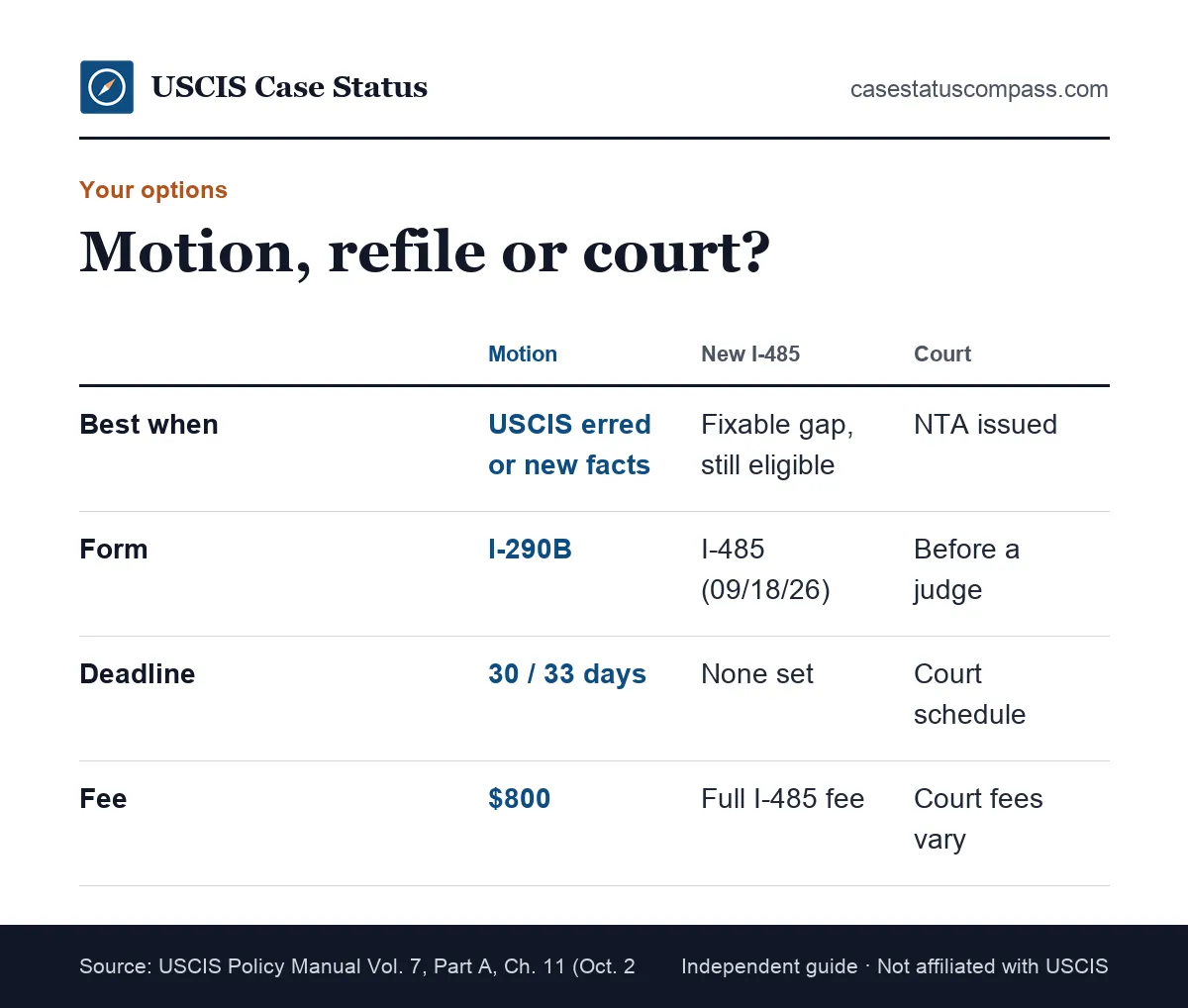
Your main options after an I-485 denial are a motion to reopen or reconsider on Form I-290B, a new I-485 once you fix the problem, renewing the application in immigration court if removal proceedings start, or leaving to pursue a visa abroad. The denial reason decides which one fits.
Four paths at a glance
- Motion to the same USCIS office (new facts or a legal error).
- New I-485, if you remain eligible and can fix the gap.
- Renewal before an immigration judge in removal proceedings.
- Consular processing abroad, which can trigger bars; never leave without advice.
Why one path does not fit everyone
A missed RFE favors a motion with proof; an unavailable visa favors waiting and refiling; an inadmissibility finding may need a waiver. Our Form I-485 guide explains the eligibility rules.
Can You Appeal an I-485 Denial?
With rare exceptions, you cannot appeal an I-485 denial. The USCIS Policy Manual states that "there is no appeal from the denial of adjustment of status." Instead, the notice tells you that you may file a motion to reopen or reconsider with the same office.
The narrow exceptions
The Policy Manual names a few categories with appeal rights, such as adjustment based on T nonimmigrant status. USCIS may also certify an unusual case to the Administrative Appeals Office (AAO) on its own.
Motion to reopen vs reconsider
Reopen = new facts and evidence; reconsider = the decision got the law or policy wrong. Both use Form I-290B. Our guide to a motion to reopen explains the form, the brief and where to file.
Should You File a Motion or Refile the I-485?
File a motion when USCIS misread the record, ignored evidence or you have new facts that existed at decision time. Refile when you can now meet a requirement you did not meet before. A motion keeps the original case; a new filing starts fresh with a new fee.
When a motion makes sense
- USCIS says you never answered an RFE, but you did.
- The officer applied the wrong rule or policy.
- A missing document now exists, such as a corrected birth record.
- The motion fee of $800 is less than a new filing.
When refiling makes sense
Refiling fits a fixable gap, such as a sponsor who now meets the income rule or a priority date that is current again. As of October 2026, a new I-485 costs $1,440 (paper) / $1,390 (online); $950 / $900 if under 14 and filing with a parent and must use edition 09/18/26 (01/20/25 and 09/04/26 editions rejected on/after Sept. 18, 2026; no grace period).
Can You Renew an I-485 in Immigration Court?
Yes. The USCIS Policy Manual says an applicant "may renew the adjustment application in any subsequent removal proceedings." If USCIS issues a Notice to Appear (NTA), an immigration judge can review your adjustment request again, often with new evidence.
How a Notice to Appear starts the case
An NTA files a removal case with the immigration court, part of the Justice Department's EOIR. Never ignore one. Our immigration court case status guide explains how to find hearing dates: Check immigration court cases online at acis.eoir.justice.gov with your A-number.
Why court review can help
A judge looks at the case fresh and hears testimony in person, so some applicants win in court what they lost at USCIS. Removal proceedings carry real risk; bring an immigration attorney to every hearing.
What Happens to Your EAD and Advance Parole After a Denial?
A work permit and advance parole document based on a pending I-485 depend on that case. With the I-485 denied, those documents generally lose their basis, and USCIS may end them. Do not keep working or travel on them until an attorney confirms your position.
Your work permit
A category C9 EAD rests on the pending I-485. After denial, ask your attorney what work authorization remains. As of October 2026: Ended: renewals filed on or after Oct. 30, 2025 no longer get the up-to-540-day automatic extension (exceptions: TPS by law/Federal Register notice; STEM OPT 180 days). Our work permit guide explains EAD categories.
Advance parole and travel
Travel after a denial is risky. Since August 2026: Since Aug. 13, 2026, travel on advance parole counts as a departure: over 180 days of unlawful presence can trigger the 3/10-year bar. See our advance parole guide and get legal advice before any trip.
What Are the Common Reasons for Green Card Denial?
The common reasons for a green card denial are ineligibility for the category, inadmissibility grounds such as unlawful presence or criminal history, missing or weak evidence, unanswered RFEs or NOIDs, missed biometrics or interviews, a failed underlying petition, and discretionary factors the officer weighed against you.
Eligibility and evidence reasons
The table matches each common reason to how it usually appears in the notice, so you can find yours quickly.
| Reason | What it usually looks like |
|---|---|
| Not eligible for the category | Wrong basis, status violation, no current visa |
| Weak or missing evidence | No birth record, thin marriage proof |
| Affidavit of support gaps | Sponsor below the income rule |
| Medical exam problems | I-693 missing or not sealed |
| Unanswered requests | RFE or NOID response missed |
| Abandonment | Missed biometrics or interview, travel without advance parole |
Discretionary denials
For a discretionary denial, the Policy Manual says the notice must list the positive and negative factors and explain why the negatives won. Answering those negatives directly is the core of any motion.
I-485 Denied for Missing Evidence: What Now?
If your I-485 was denied for missing evidence, the notice usually cites an RFE or NOID you did not answer fully or on time. If you did answer, a motion with proof of delivery is often the fastest fix. If you did not, compare a motion with refiling.
Unanswered RFEs and NOIDs
USCIS gives a set time to answer: RFE deadline: up to 12 weeks (the exact date is on your RFE); no extensions, and NOID deadline: up to 30 days; no extensions. I-539 and I-601A RFEs allow only 30 days. Our rfe meaning guide and our notice of intent to deny guide explain both notices.
Partial responses count against you
USCIS expects all requested evidence at once. A partial response is treated as a request for a decision on the record. Send everything together and keep a delivery confirmation.
What If Your I-485 Was Denied for Abandonment?
An abandonment denial means USCIS treated the case as given up, usually because you missed biometrics or an interview, or left the country without advance parole. If USCIS made a mistake, such as sending the notice to an old address, a motion to reopen with proof may help.
Missed appointments
Missing biometrics can lead to denial for abandonment. Check whether the notice reached you. If you moved, prove when you reported the new address. Report a new address to USCIS within 10 days of moving (INA 265). Our uscis change of address guide shows how to update it.
Travel without advance parole
Traveling while your I-485 is pending abandons it unless you have advance parole (with H/L/V/K exceptions). A trip without the right document usually cannot be undone by motion; ask an attorney whether consular processing is now better.
What If the Petition Behind Your I-485 Failed?
Most I-485 applications depend on a petition, such as Form I-130 or I-140. If that petition is denied or revoked, or the visa category stops being available, the I-485 usually fails with it, so fix the petition first. An I-485 denied for this reason usually cannot be revived by an I-485 motion alone.
Family and employment petitions
A denied I-130 or I-140 removes the basis for adjustment. The petitioner must act: appeal, file a motion or file a new petition. Our Form I-130 guide covers what a family petition must prove.
When the visa is no longer current
Preference categories need a current priority date. If the date retrogresses, USCIS may hold or deny the case. Track the monthly chart in our visa bulletin guide before refiling.
What If You Were Found Inadmissible?
An inadmissibility denial means USCIS found a legal ground that bars your green card, such as unlawful presence, a status violation, certain crimes, misrepresentation or public charge concerns. Some grounds can be waived; others cannot. The notice should name the exact section of law.
Status violations and unlawful presence
Many applicants must show they kept lawful status. Some can use older protections; for example, 245(i): petition or labor certification filed by Apr. 30, 2001 (and in the U.S. Dec. 21, 2000 if filed after Jan. 14, 1998). Our INA 245(i) explained guide covers who qualifies.
Criminal and fraud findings
An arrest, conviction or alleged misrepresentation can lead to denial and court referral. Never refile or contact USCIS about these grounds alone. Ask an attorney whether a waiver exists and whether court is likely.
What Should You Look for in an I-485 Denial Notice?
Look for four things in an I-485 denial notice: the decision date, the exact legal reasons, the evidence USCIS says is missing or weighed against you, and the paragraph describing your options. Anyone with an I-485 denied should read it twice, then list each item on one page for an attorney.
The reasons section
Underline every reason; a motion must answer each one. Note any regulation or precedent case cited, and compare surprising reasons with your filing copy. Missing even one weakens the reply.
Which office issued the decision
The letterhead and signature block name the deciding office. A motion is decided by that same office, so note it next to your deadline. The receipt number prefix also points to the office that took in the case.
The decision date and options paragraph
Deadlines usually run from the decision date. If USCIS mailed the notice, add 3 days to the deadline. For what the status update itself means, see our page on what the case was denied status means.
I-485 Rejection Notice vs Denial: What Is the Difference?
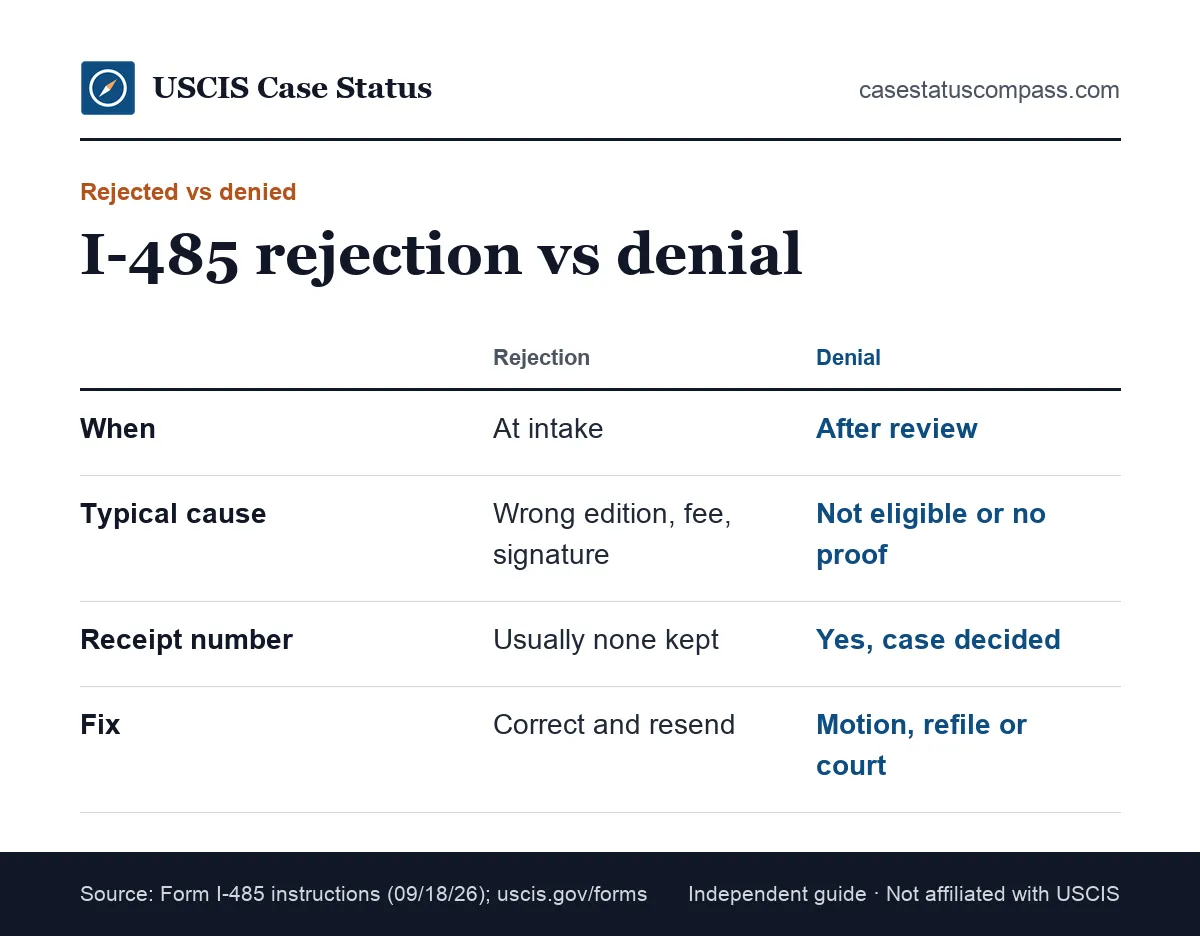
An I-485 rejection notice means USCIS did not accept the filing at intake, usually for a wrong edition, missing fee or signature. A denial means USCIS reviewed the case and refused it. A rejection is usually fixed by correcting and resending; a denial needs a motion, refile or court.
Fixing a rejection
Fix the stated problem and file again with the current form and fee. A rejection is not a decision on eligibility, but resend quickly if an age-out date matters. Check the rejection letter for the exact reason.
What Are the Common I-485 Rejection Reasons?
As of October 2026, USCIS accepts only one edition: 09/18/26 (01/20/25 and 09/04/26 editions rejected on/after Sept. 18, 2026; no grace period). Other common rejection reasons are a missing signature, the wrong fee or a blank required field. Check each before mailing.
If Your Green Card Is Denied, Can You Apply Again?
Yes, if you still qualify. If your green card is denied, you can usually apply again with a new I-485, a new fee and evidence that fixes the problem. You cannot reapply if a permanent bar applies or you lost the basis for adjustment. Get advice first.
What a second application needs
A new filing is a new case. Include a cover letter explaining what changed, the missing evidence and a copy of the denial notice. Update every answer that has changed since the first filing.
The cost of trying again
Fees are not returned: USCIS fees are nonrefundable, even if your case is denied or withdrawn. A new I-485 costs $1,440 (paper) / $1,390 (online); $950 / $900 if under 14 and filing with a parent. Some forms qualify for a fee waiver; our uscis fee waiver guide explains eligibility.
What Should You Do in the First Week After a Denial?
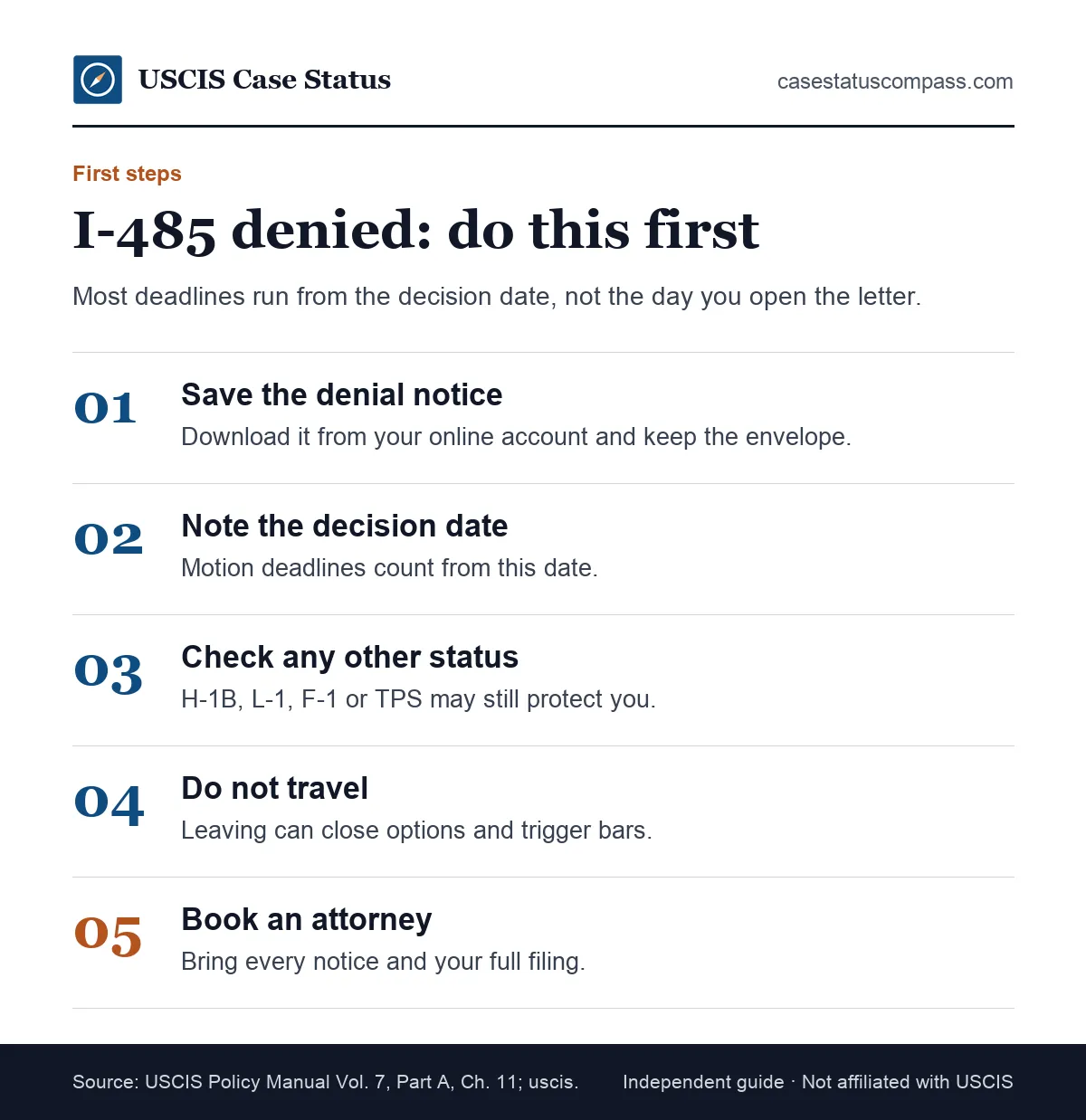
In the first week after a denial, save the notice, calculate your deadline, confirm your current status, stop any travel, gather your full file and meet an immigration attorney. With an I-485 denied, each step protects the deadline or your status, and none requires filing anything yet. The list below spreads the work across seven days.
Day-by-day checklist
- Day 1: Download the notice and photograph the envelope.
- Day 2: Mark the deadline on a calendar.
- Day 3: Check your I-94 and other status.
- Days 4-7: Meet an attorney with your full file.
Keep the envelope and postmark
If the decision came by mail, keep the envelope. The mailing date matters because If USCIS mailed the notice, add 3 days to the deadline, and the postmark helps prove when service happened.
Request your file if records are missing
If copies are missing, request your A-file; our uscis foia request guide explains how. Do not wait for it before meeting a lawyer. FOIA requests can take months, so start early.
How Do Family and Employment I-485 Denials Differ?
Family-based and employment-based I-485 denials share the same motion rules, but the fixes differ. Family cases often turn on the relationship or the sponsor's income. Employment cases often turn on the job offer, the I-140 or a status gap.
Comparison by category
The table sets family and employment denials side by side on the weak point, who acts, the fix and priority dates.
| Issue | Family-based | Employment-based |
|---|---|---|
| Usual weak point | Relationship proof, I-864 | I-140, job offer, status |
| Who must act | Petitioner and applicant | Employer and worker |
| Typical fix | New evidence, joint sponsor | New I-140, status repair |
| Priority date | Immediate relatives exempt | Usually required |
Sponsor income fixes
For a family case denied on finances, Sponsors need income of at least 125% of the poverty guidelines (100% for active-duty military sponsoring spouse/child). Up to two joint sponsors; each must qualify alone at 125%. Our affidavit of support guide explains the documents.
What Happens to Spouses and Children on the Case?
Derivative family members usually depend on the principal applicant. With the principal's I-485 denied, the spouse's and children's applications typically fail too. Sometimes a derivative has a separate basis, such as another petition or status, so each person's options should be reviewed. Keep every family member's notice together.
Separate notices, shared fate
Each family member has a separate receipt number and decision. A motion for the principal does not cover derivatives automatically, so file for each person. Each notice carries its own decision date, so count every deadline separately.
Children near age 21
A child close to 21 can lose eligibility while the family regroups. Tell your attorney the birthdays of all children right away, because the age-out risk changes how fast you should act.
I-130 Denied: What Next?
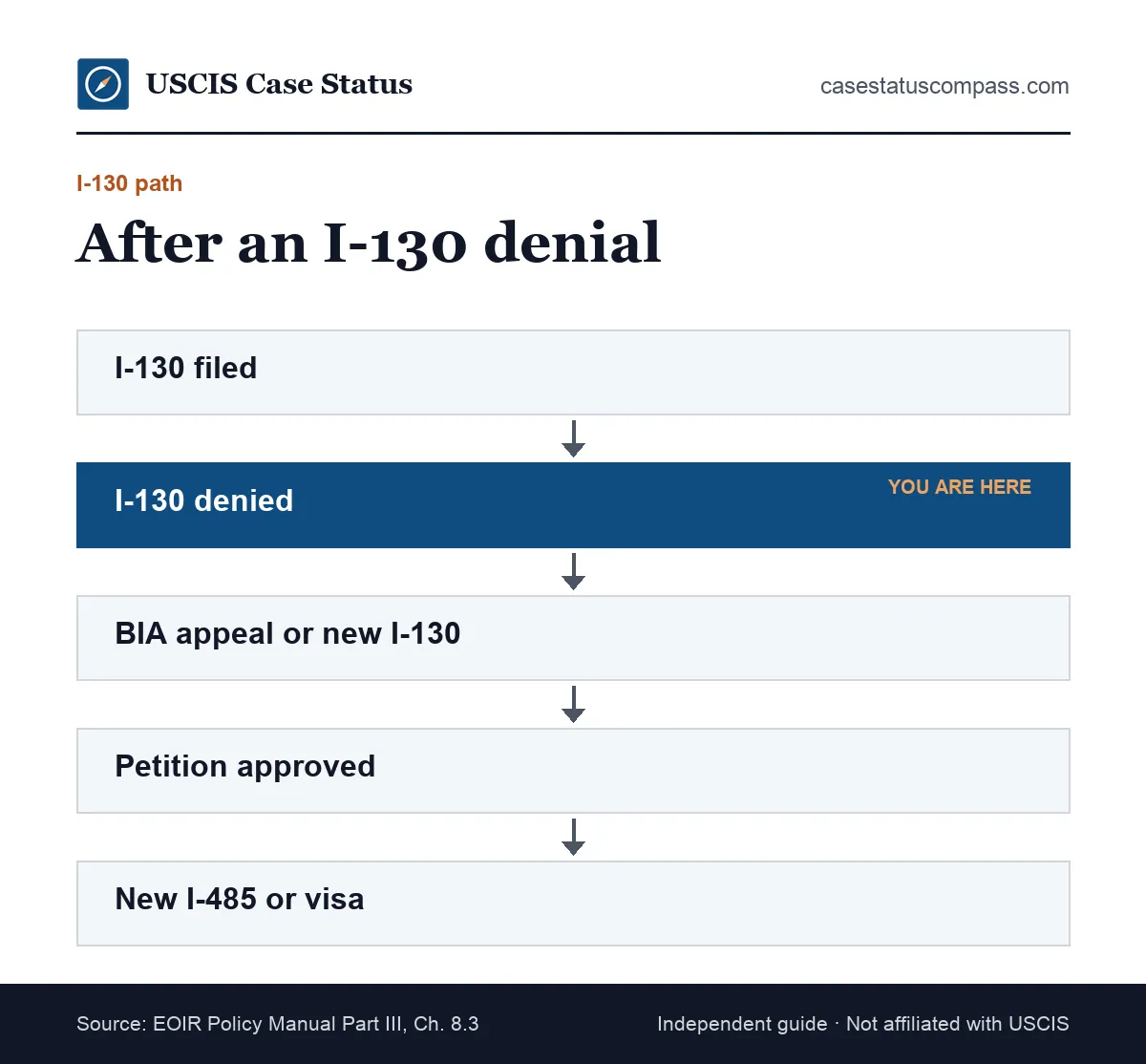
If your I-130 is denied, the petitioner can usually appeal to the Board of Immigration Appeals (BIA) on Form EOIR-29, not Form I-290B, or file a new petition with stronger evidence. The denial notice gives the exact deadline and where to file.
Appeal to the BIA
The EOIR Policy Manual says the BIA hears appeals of USCIS family petition denials. The petitioner signs Form EOIR-29 and files it with the USCIS office named in the notice, not with the BIA. Check the current form version and fee on justice.gov/eoir.
Filing a new I-130
A new petition can be faster when the problem was missing documents. As of October 2026, the fee is $675 (paper) / $625 (online). Include what the first one lacked. Our i 130 processing time page explains current waits.
What Happens If an I-130 Is Denied While an I-485 Is Pending?
If you filed the I-130 and I-485 together and the I-130 is denied, USCIS usually denies the I-485 too, because adjustment depended on the petition. Fix the petition first, through an appeal or a new I-130, then file a new I-485 when the petition is approved.
Order of fixes
Work in sequence: petition, then adjustment. Filing a new I-485 while no petition supports it will likely end in another denial and another lost fee. Your attorney can tell you whether to wait or refile together.
Staying in the U.S. meanwhile
Without another status, a beneficiary may face removal proceedings while the petition is fixed. Ask your attorney how a judge could consider the case if an NTA issues. Keep your address current with both agencies.
What Are the Common Reasons an I-130 Is Denied?
The common reasons an I-130 is denied are weak proof of a genuine marriage, missing civil documents, doubts about a prior divorce, a petitioner who is not eligible for that relative, and abandonment for missed responses. Most can be fixed with better evidence.
Marriage-based petitions
USCIS looks for proof of a bona fide marriage: joint leases, bank accounts, photos over time and affidavits. Thin evidence is the top cause of spouse petition denials. Records spread across the whole marriage, such as a first-year lease and recent bank statements, carry more weight than papers gathered just before filing.
Documents and eligibility
Missing birth or marriage certificates, untranslated records or an earlier marriage that was never legally ended can sink a petition. Green card holders also cannot petition every relative a citizen can, so confirm eligibility.
What Happens If a Citizenship Application Is Denied?
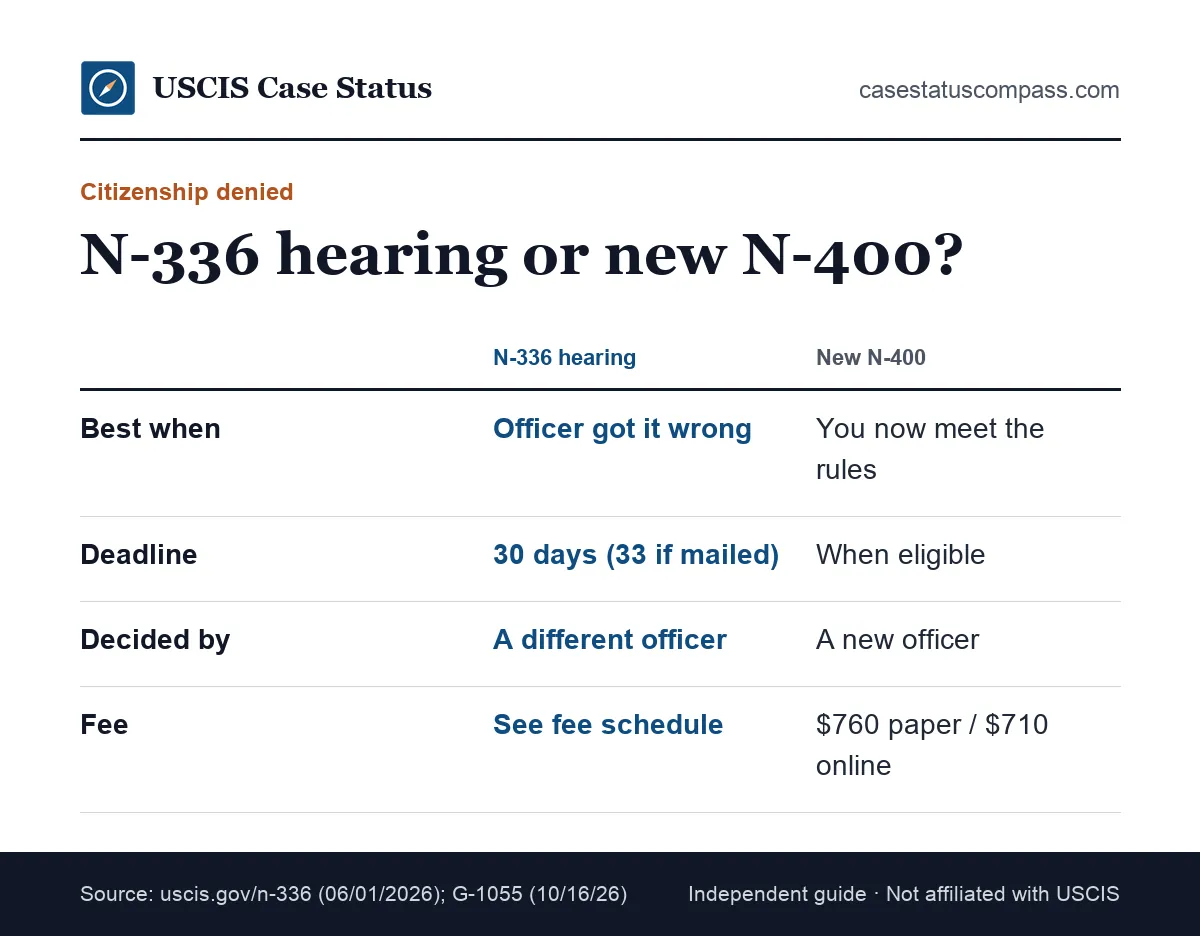
If your citizenship application is denied, you usually remain a lawful permanent resident with your green card. You can ask for a hearing with Form N-336 or file a new N-400 once eligible. Some denial reasons, such as certain crimes, can also threaten the green card itself.
You keep your green card in most cases
A denial of citizenship is not a loss of permanent residence. Keep your green card valid. You can usually keep living and working here as before, and file a new N-400 once you meet the requirement that caused the denial, unless the risks below apply.
When a denial creates risk
If the denial cites fraud, a criminal record or false claims, USCIS may refer the case for removal. See an attorney before refiling. Our citizenship application guide explains each eligibility rule.
How Do You Challenge a Citizenship Denial?
You challenge a citizenship denial by filing Form N-336 to request a hearing before a different immigration officer. The USCIS N-336 page (updated June 1, 2026) says to file within 30 calendar days of the denial, or 33 days if it was mailed. Late requests are generally rejected.
Form N-336 hearing
The N-336 hearing lets you give new evidence and arguments to another officer. File online or by mail; check the fee on the current fee schedule. Keep the denial notice with your request.
Filing a new N-400 instead
If you simply did not meet a requirement yet, waiting and refiling may be easier. As of October 2026, the N-400 fee is $760 (paper) / $710 (online); reduced fee $380 (paper only) if household income is at or below 400% of the Federal Poverty Guidelines.
What Are the Common Reasons for a Citizenship Denial?
The common reasons for a citizenship denial are failing the English or civics test twice, breaking continuous residence through long trips, not meeting physical presence, good moral character problems such as unpaid taxes or crimes, and false testimony. Many can be fixed by waiting and reapplying.
Failing the tests
Two chances to pass; retest of the failed part 60-90 days after the interview. Failing the retest leads to denial. Our citizenship test guide covers practice strategies for a second application.
Residence and trips abroad
Naturalization: a trip over 6 months is presumed to break residence; 1 year or more breaks it. If long trips caused the denial, count forward to the date you will meet the residence rule again before filing.
H-1B Denied: What Are Your Options?
If an H-1B is denied, the employer, as petitioner, decides the response: a motion or appeal on Form I-290B, a new petition, or another strategy. The worker's options depend on current status. A denied H-1B extension or transfer can affect your right to keep working.
Who can act on an H-1B denial
Only the employer or its attorney can file a motion, appeal or new petition. Ask HR for a copy of the denial and the plan. Our h1b visa status guide explains how petitions are tracked.
What the worker should check
Check your I-94 date and whether a prior approval still covers you. H-1B: 3 years at first, up to 6 years in total. Get your own legal advice if your interests and the employer's differ.
What If Other Forms Are Denied?
Other common denials involve work permits, conditional residence and travel documents. Each has its own options. Start by checking what the denied form depended on, because many denials follow from another case. A motion on Form I-290B is often available, but each form's notice says which routes apply and by when.
Form I-765 work permit
A denied EAD means you cannot work on that card. Many EADs depend on another case, so check that case first, then consider a new I-765. Read the notice to learn whether the reason was the I-765 itself or the case it depended on.
Form I-751 conditions removal
An I-751 denial usually sends the case to an immigration judge, who can review the petition again. Our Form I-751 guide explains evidence and waivers. Conditional status ends, so get legal help quickly.
Form I-131 travel documents
A denied advance parole request is often refiled with stronger proof of need. Never leave without valid parole; our traveling with a pending I-485 guide explains why. A new request needs a new fee.
Appeal, Motion or Refile? Decision Table by Denial Type
Match your denial type to the usual route, deadline and fee below. It summarizes official rules as of October 2026 and is not legal advice. Your denial notice controls; if it differs, follow the notice and confirm with an attorney.
Route, deadline and fee by denial
Each row pairs a denial type with its usual route, the deadline to file and the government fee as of October 2026.
| Denial type | Usual route | Deadline | Fee |
|---|---|---|---|
| I-485 (most categories) | Motion on I-290B, refile or court | 30 days (33 mailed) for motion | $800 (some humanitarian categories $0; fee waiver possible) |
| I-130 family petition | BIA appeal (EOIR-29) or new I-130 | On the notice | EOIR fee or $675 (paper) / $625 (online) |
| N-400 citizenship | N-336 hearing or new N-400 | 30 days (33 mailed) | Fee schedule / $760 (paper) / $710 (online); reduced fee $380 (paper only) if household income is at or below 400% of the Federal Poverty Guidelines |
| H-1B petition | Employer motion, AAO appeal or new petition | 30 days (33 mailed) | I-290B fee or new filing |
| I-751 | Review before an immigration judge | Court schedule | Court-dependent |
| Rejected I-485 | Correct and resend | None set | $1,440 (paper) / $1,390 (online); $950 / $900 if under 14 and filing with a parent |
How to use this table
If two routes seem possible, your attorney weighs cost, speed and risk. Choosing the wrong form, such as I-290B for an I-130, can waste the deadline. Your uscis case help hub lists other problems.
How Do Deadlines Work After a Denial?
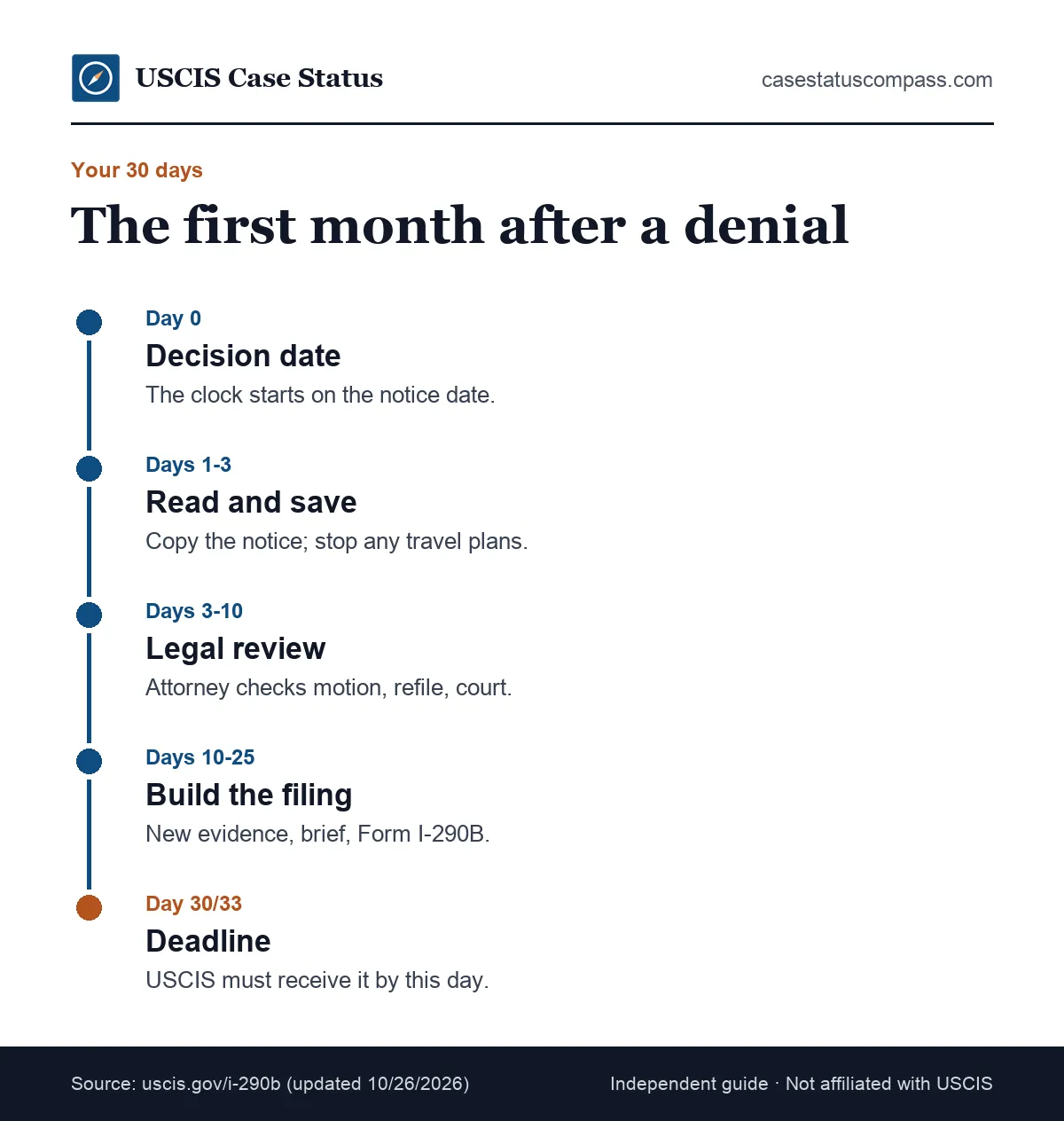
Most motions and USCIS appeals must be filed within 30 days of the decision, or 33 days if it was mailed. USCIS must receive the filing by that day. A late appeal is usually rejected, though a late motion to reopen may be excused when the delay was reasonable and beyond your control.
Counting the days
Start from the notice date, not the day you read it, and count calendar days. File online or mail early with tracking, because USCIS counts the day it receives the package.
What does not stop the clock
Calling the Contact Center, requesting your file, or contacting the uscis ombudsman does not extend the deadline. Our uscis contact number guide explains when a call helps. Neither does a congressional inquiry.
How Much Does It Cost to Challenge or Refile?
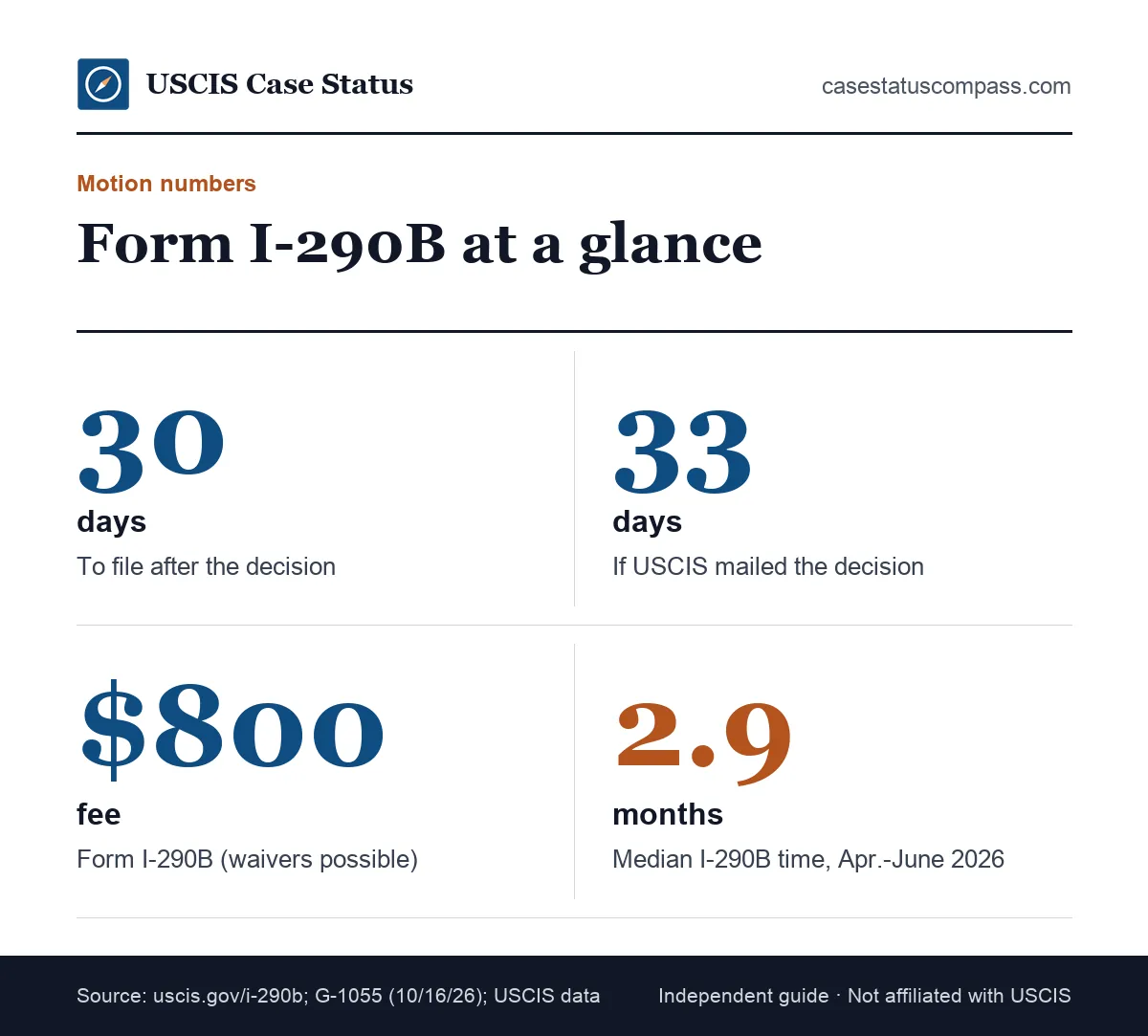
Every challenge or refile costs a new government fee, plus legal fees. As of October 2026, Form I-290B costs $800 and a paper I-485 $1,440. Fees are nonrefundable, so fix the cause first. Add any new medical exam or translation costs.
Government fees after a denial
The table lists the current government fee for each filing you might make after a denial.
| Filing | Fee (G-1055, 10/16/26) |
|---|---|
| Form I-290B motion or appeal | $800 (some humanitarian categories $0; fee waiver possible) |
| New Form I-485 | $1,440 (paper) / $1,390 (online); $950 / $900 if under 14 and filing with a parent |
| New Form I-130 | $675 (paper) / $625 (online) |
| New Form N-400 | $760 (paper) / $710 (online); reduced fee $380 (paper only) if household income is at or below 400% of the Federal Poverty Guidelines |
Legal fees and fee waivers
Attorney fees vary widely; our immigration lawyer cost guide explains typical structures. Fee waivers are possible for forms like I-90, I-751, I-765 (not DACA), N-400, N-565 and N-600. Ask whether yours qualifies.
Does a Pending Motion Let You Stay or Work?
Filing a motion does not by itself restore your status, renew your work permit or stop USCIS from issuing a Notice to Appear. If you have no other status, ask your attorney what protection, if any, you have while the motion is pending.
What a motion does and does not do
A motion keeps your case alive for review. If USCIS grants it, the case is reopened and decided again. As of April-June 2026, I-290B: median 2.9 months (USCIS data, Apr.-June 2026).
Planning for a long wait
Use the time to collect evidence and keep your address current. If an NTA arrives, attend every hearing and tell the judge the motion is pending. Keep copies of everything you file.
Why Should You Talk to an Immigration Attorney After a Denial?
An immigration attorney or DOJ-accredited representative can read the notice, check your status, spot waivers and choose between a motion, refile and court. A wrong choice can waste your only deadline or expose you to removal. With an I-485 denied, book that meeting early enough to leave time to prepare a motion before the deadline.
What an attorney checks
- Whether the denial has a legal error
- Your status and unlawful presence dates
- Whether a waiver is available
- Court risk and how to prepare
- The best timing for a new filing
Finding affordable help
DOJ-accredited representatives at recognized nonprofits often charge less. Avoid "notarios," who cannot legally give immigration advice. Search the EOIR list of recognized organizations and accredited representatives, or ask a local legal aid office or law school clinic for a referral.
What Should You Ask an Attorney After a Green Card Denial?
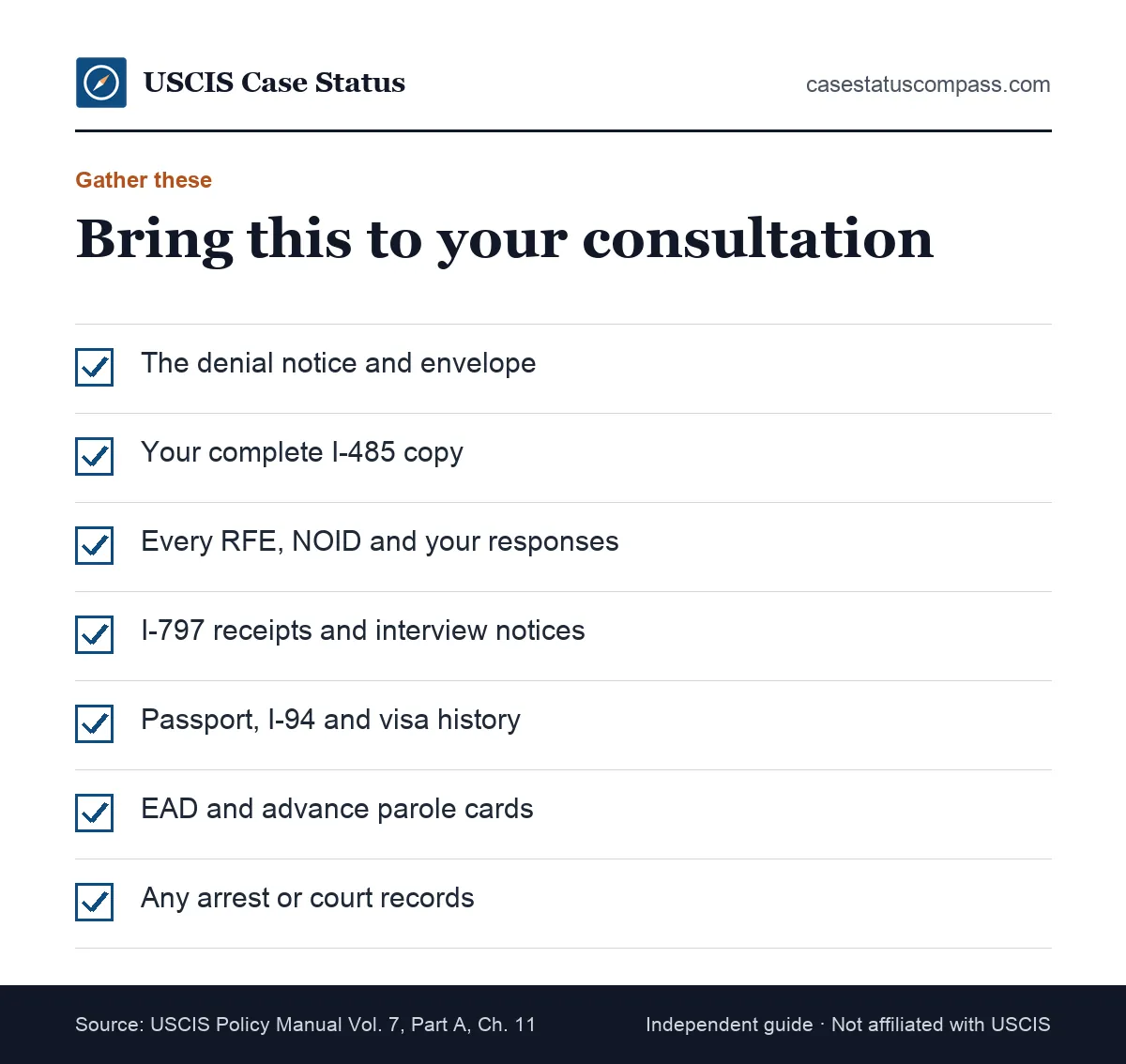
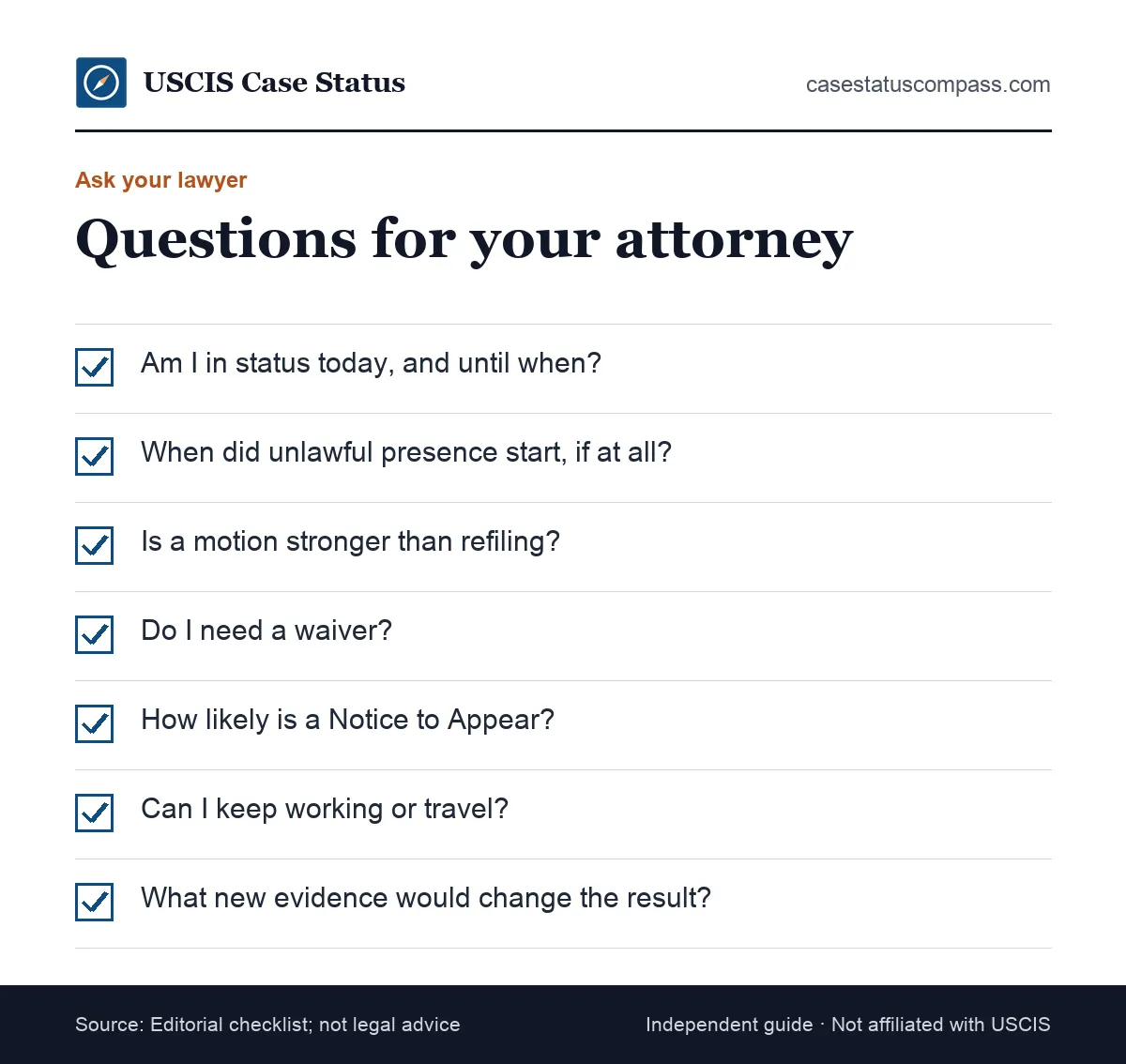
Ask about your status today, when unlawful presence started, whether a motion beats refiling, whether you need a waiver, how likely court is, and whether you can work or travel. Bring the notice and your complete filing. Write the questions down beforehand.
Bring your full record
Bring the denial, your full I-485 copy, every RFE and NOID with responses, and travel records. Our uscis service centers guide shows which office decided the case. Bring copies, not originals.
Questions about cost and timing
Ask for a written estimate covering the motion or refile, court hearings and fees. Ask who will handle the case day to day, how fast they can file before the deadline, and what happens to the fee if the strategy changes partway.
What Mistakes Should You Avoid After a Green Card Denial?
Avoid traveling abroad, refiling without fixing the cause, filing the wrong form, missing the 30-day window, ignoring a Notice to Appear and paying anyone who promises approval. Each of these can turn an I-485 denied for a fixable reason into a lasting problem, and most happen in the first weeks, when people act before getting advice.
Leaving the country too soon
A departure after a denial can start unlawful-presence bars and usually ends options such as a motion or renewal in court. Ask an attorney before booking any trip. An attorney can count your days of unlawful presence, since more than 180 days can trigger the 3- or 10-year bar when you leave.
Rushing a second filing
A quick refile with the same evidence usually produces the same result and another lost fee. Wait until the gap is fixed and the new evidence is in hand.
Ignoring court notices
Missing a court hearing can lead to a removal order in your absence. Keep your address current with USCIS and the court. Check the EOIR portal regularly for new dates.
How Can You Prevent a Second Denial?
Prevent a second denial by fixing every reason in the first notice, answering requests fully and on time, keeping your address current, attending every appointment and filing the current edition with a cover letter that points to new evidence. Before refiling after an I-485 denied for any reason, have someone check the new package against the old notice line by line.
Turn the notice into a checklist
List each reason on the left and the new evidence on the right. If a reason has no answer, the case is not ready. Include a medical exam if needed: Send the sealed I-693 with your I-485 (required since Dec. 2, 2024).
Keep the case on track after filing
Watch for RFEs, interview notices and biometrics letters. If a NOID arrives, answer before the deadline with your attorney. Respond to each one fully, keep delivery proof, and report any move within 10 days so no notice goes astray.
Can the Ombudsman or Congress Help After a Denial?
The CIS Ombudsman and congressional offices cannot reverse a denial or replace a motion or appeal. They can help with service problems around it, such as a denial notice that never arrived or a motion that seems lost. They do not stop deadlines.
When outside help fits
If USCIS denied the case for no response but you never got the RFE, or a filed motion seems lost, an outside inquiry can ask USCIS to check. File your motion first, then escalate the service problem.
Frequently Asked Questions
Can I stay in the U.S. while I refile my I-485?
It depends on your status. A new I-485 can again give a period of authorized stay once filed, but it does not erase time spent without status after the denial. Ask an attorney before refiling if you have no other status.
Will USCIS send me to immigration court after a denial?
USCIS can issue a Notice to Appear after a denial if you have no lawful status, which starts removal proceedings. If you receive an NTA, attend every hearing; a judge may review your adjustment application again.
Can I get my I-485 fee back if it is denied?
No. USCIS filing fees are final and nonrefundable, even if the case is denied or withdrawn. A motion or new I-485 needs a new fee, though some humanitarian categories pay no I-290B fee.
How long does a motion to reopen take?
USCIS reported a median of 2.9 months for Form I-290B cases completed from April to June 2026. It is not a forecast for yours.
Does an I-485 denial affect a future visa application?
A denial stays in your immigration record, and consular officers can see it. It does not automatically block a future visa, but fraud findings or unlawful presence bars can. Disclose the denial truthfully on every later form.
Can I work after my I-485 is denied?
Only if you have another basis to work, such as valid H-1B status or a separate EAD category. A work permit based on the pending I-485 generally loses its basis when the case is denied, so ask your attorney first.
Can I file a motion and a new I-485 at the same time?
Sometimes. Nothing in a denial notice forces you to pick only one, but each filing needs its own fee and evidence, and the two strategies can conflict. Ask an attorney before paying twice.
How do I check if my I-485 was denied?
The online status shows a Case Was Denied message, and the denial letter appears in your USCIS online account or arrives by mail. Read the letter itself, because only it lists the reasons and your options.
Can I get a copy of a lost denial notice?
Check your USCIS online account first, since most notices post there. Otherwise, ask the Contact Center about a copy or request your file through FOIA.
Does an I-130 denial mean my relative can never immigrate?
No. The petitioner can usually appeal or file a new I-130 with stronger evidence. A finding of marriage fraud is different and can block future petitions, so get legal advice if the notice mentions it.
Sources
- USCIS Policy Manual Vol. 7, Part A, Ch. 11: Decision Procedures (adjustment of status). www.uscis.gov/policy-manual/volume-7-part-a-chapter-11. Accessed Oct 27, 2026.
- USCIS: Form I-290B, Notice of Appeal or Motion. www.uscis.gov/i-290b. Accessed Oct 27, 2026.
- USCIS: Form N-336, Request for a Hearing on a Decision in Naturalization Proceedings. www.uscis.gov/n-336. Accessed Oct 27, 2026.
- USCIS: Form I-485 Instructions (edition 09/18/26). www.uscis.gov/i-485. Accessed Oct 27, 2026.
- USCIS Form G-1055 Fee Schedule (edition 10/16/26). www.uscis.gov/sites/default/files/document/forms/g-1055.pdf. Accessed Oct 27, 2026.
- USCIS: Filing Fees. www.uscis.gov/forms/filing-fees. Accessed Oct 27, 2026.
- EOIR Policy Manual, Part III, Ch. 8.3: Appeals of DHS decisions. www.justice.gov/eoir/policy-manual-eoir/part-III/bia/chapter-8-3. Accessed Oct 27, 2026.
- 8 CFR 103.5: Reopening or reconsideration (LII). www.law.cornell.edu/cfr/text/8/103.5. Accessed Oct 27, 2026.
- USCIS: Form I-131 page (advance parole alert). www.uscis.gov/i-131. Accessed Oct 27, 2026.
- DOJ EOIR: Immigration Court Information. www.justice.gov/eoir/immigration-court-information. Accessed Oct 27, 2026.
- USCIS: Automatic EAD Extension (updated 10/29/2025). www.uscis.gov/working-in-the-united-states/information-for-employers-and-employees/automatic-employment-authorization-document-ead-extension. Accessed Oct 27, 2026.
- 8 CFR 103.2(b)(8)(iv) (LII). www.law.cornell.edu/cfr/text/8/103.2. Accessed Oct 27, 2026.
- USCIS: Preparing for Your Biometric Services Appointment (updated 04/30/2026). www.uscis.gov/forms/filing-guidance/preparing-for-your-biometric-services-appointment. Accessed Oct 27, 2026.
- USCIS: How to Change Your Address (updated 08/04/2026); 8 U.S.C. 1305(a) (LII). www.uscis.gov/addresschange. Accessed Oct 27, 2026.
- Form I-485 Instructions, Edition 09/18/26. www.uscis.gov/sites/default/files/document/forms/i-485instr.pdf. Accessed Oct 27, 2026.
- Form I-485 Supplement A Instructions, Edition 09/18/26. www.uscis.gov/sites/default/files/document/forms/i-485supainstr.pdf. Accessed Oct 27, 2026.
- 8 CFR 103.8(b) (LII). www.law.cornell.edu/cfr/text/8/103.8. Accessed Oct 27, 2026.
- Form I-864 Instructions, Edition 08/24/26. www.uscis.gov/sites/default/files/document/forms/i-864instr.pdf. Accessed Oct 27, 2026.
- USCIS: The Naturalization Interview and Test (updated 10/31/2025). www.uscis.gov/citizenship/learn-about-citizenship/the-naturalization-interview-and-test. Accessed Oct 27, 2026.
- USCIS Policy Manual Vol. 12, Part D, Ch. 3. www.uscis.gov/policy-manual/volume-12-part-d-chapter-3. Accessed Oct 27, 2026.
- USCIS: H-1B Specialty Occupations (updated 09/21/2026). www.uscis.gov/working-in-the-united-states/h-1b-specialty-occupations. Accessed Oct 27, 2026.
- USCIS: Form I-912 page (updated 06/05/2026). www.uscis.gov/i-912. Accessed Oct 27, 2026.
- USCIS Data Library: All USCIS Application and Petition Form Types, FY2026 Q3 (Apr. 1-June 30, 2026; queried 7/2026). www.uscis.gov/sites/default/files/document/data/quarterly_all_forms_fy2026_q3_v1.xlsx. Accessed Oct 27, 2026.
- USCIS: Form I-693 page (updated 07/24/2026); I-485 Instructions 09/18/26. www.uscis.gov/i-693. Accessed Oct 27, 2026.
casestatuscompass.com is an independent publication and is not affiliated with USCIS or any government agency. This page is general information, not legal advice. For denials, court or asylum matters, consult an immigration attorney or a DOJ-accredited representative.