Contents · 38 sections
- What Is Form I-131?
- What Is Advance Parole?
- Who Needs Advance Parole?
- Which I-131 Travel Document Do You Need?
- What Is Form I-512 (Advance Parole Document)?
- What Is the I-512L?
- What Is the EAD Combo Card?
- Traveling With a Pending I-485
- Can You Leave the U.S. With a Pending Green Card Application?
- Does an Approved Travel Document Guarantee Reentry?
- How Do You Check Your I-94 After Returning on Parole?
- What Are the Risks of Traveling on a Parole Document?
- Who Should Get Legal Advice Before Traveling?
- What Is a Reentry Permit?
- Advance Parole vs Reentry Permit: What Is the Difference?
- What Is a Refugee Travel Document?
- How Do You Apply for Advance Parole?
- I-131 Filing Checklist You Can Copy
- Can You File Form I-131 Online?
- Which I-131 Edition Must You Use?
- Where Do You Send Form I-131?
- What Happens After You File Form I-131?
- I-131 Case Status Steps in Order
- How Much Does Advance Parole Cost?
- I-131 Processing Time: A Short Summary
- Can You Speed Up a Travel Document Request?
- What Is Emergency Advance Parole?
- How Long Is a Parole Document Valid?
- What If Your Travel Document Expires While You Are Abroad?
- Does Traveling Affect Your Green Card Case?
- How Does Travel Permission Work for TPS, Asylum and Parolees?
- What Are the Most Common I-131 Mistakes?
- Why Are I-131 Travel Requests Denied?
- Travel Document Scenarios
- If X, Do Y: Travel Decision Table
- What Should You Carry on a Parole Trip?
- How Does Form I-131 Fit With Other USCIS Forms?
- Frequently Asked Questions
The short answer
Advance parole is a travel document, requested on Form I-131, that lets certain people leave the U.S. and ask to return without a visa. Most applicants with a pending green card case need it before any trip. It does not guarantee reentry: a CBP officer still decides at the border.
At a glance
| Form | I-131, Application for Travel Documents (edition 01/20/25) |
| Main documents | Advance parole, reentry permit, refugee travel document |
| Advance parole document | Usually Form I-512L or an EAD combo card |
| Who decides entry | U.S. Customs and Border Protection (CBP) at the port of entry |
| Biggest risk | Leaving a pending I-485 without approved travel permission |
What Is Form I-131?
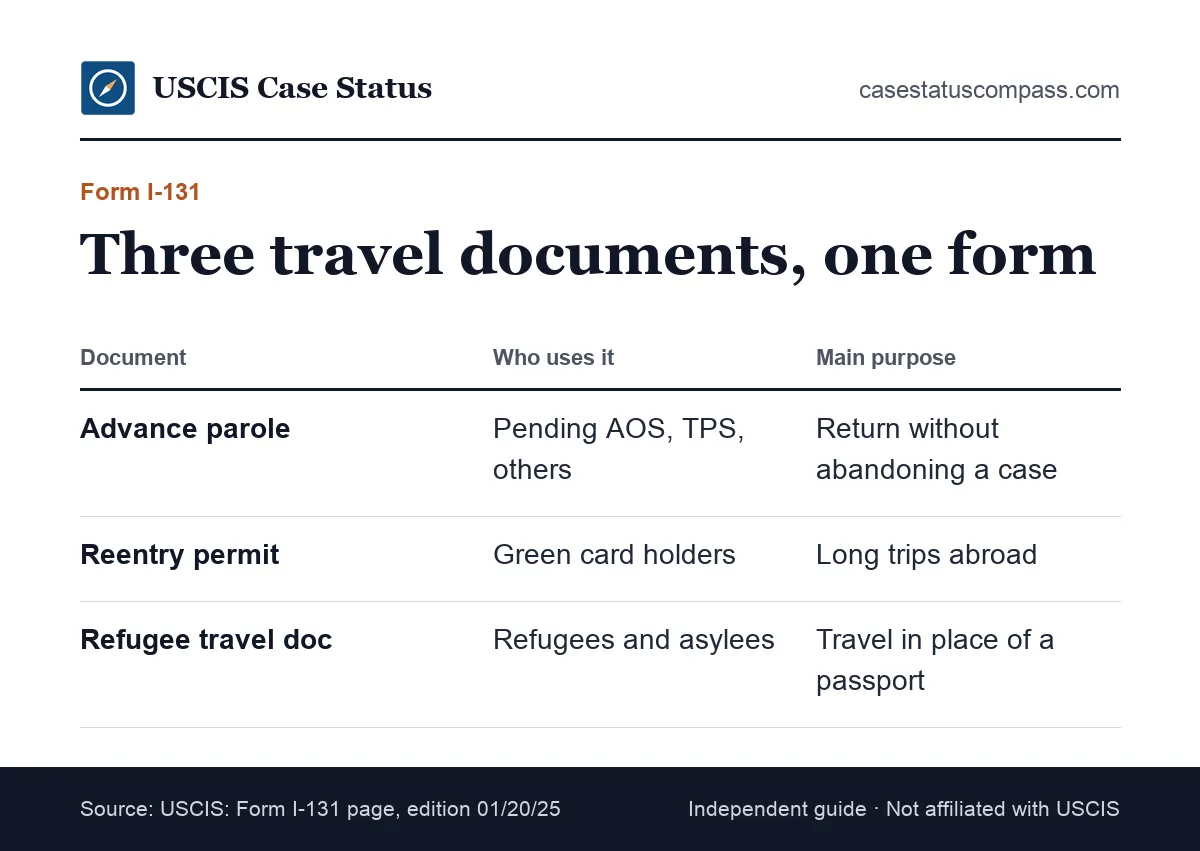
Form I-131 is the USCIS application for travel documents, parole documents and certain arrival records. One form covers several different benefits: advance parole, the reentry permit, the refugee travel document and some parole requests. Each has its own eligibility rules, fee line and evidence list in the instructions.
Advance parole
Advance parole lets someone without a current visa or green card travel abroad and seek parole back into the U.S. It mainly serves people with a pending adjustment of status, TPS holders and certain parolees. It protects the pending case from being treated as abandoned.
Reentry permit
A reentry permit is for permanent residents planning a long stay abroad. It helps show you did not intend to give up your residence, and it can act as a travel document. It does not replace the green card itself.
Refugee travel document
A refugee travel document is for people with refugee or asylee status, or green card holders who got residence through that status. It works in place of a national passport. Travel to the country you fled can raise serious questions about your protection claim.
What Is Advance Parole?
Advance parole is advance permission to seek parole at a U.S. port of entry after a trip abroad. "Parole" lets a person into the U.S. without a formal admission. The "advance" part means USCIS approved the request before you left, not at the border.
Parole is not an admission
Parole is a legal term. A parolee is allowed in, but technically not "admitted" on a visa. That distinction matters for some green card categories and bars. After a parole trip, your I-94 should say "parole," not a visa class.
What a parole document does not do
- It does not give you a visa or a new status.
- It does not approve your green card case.
- It does not by itself let you work; that needs an EAD.
- It does not guarantee that CBP will let you back in.
Who Needs Advance Parole?
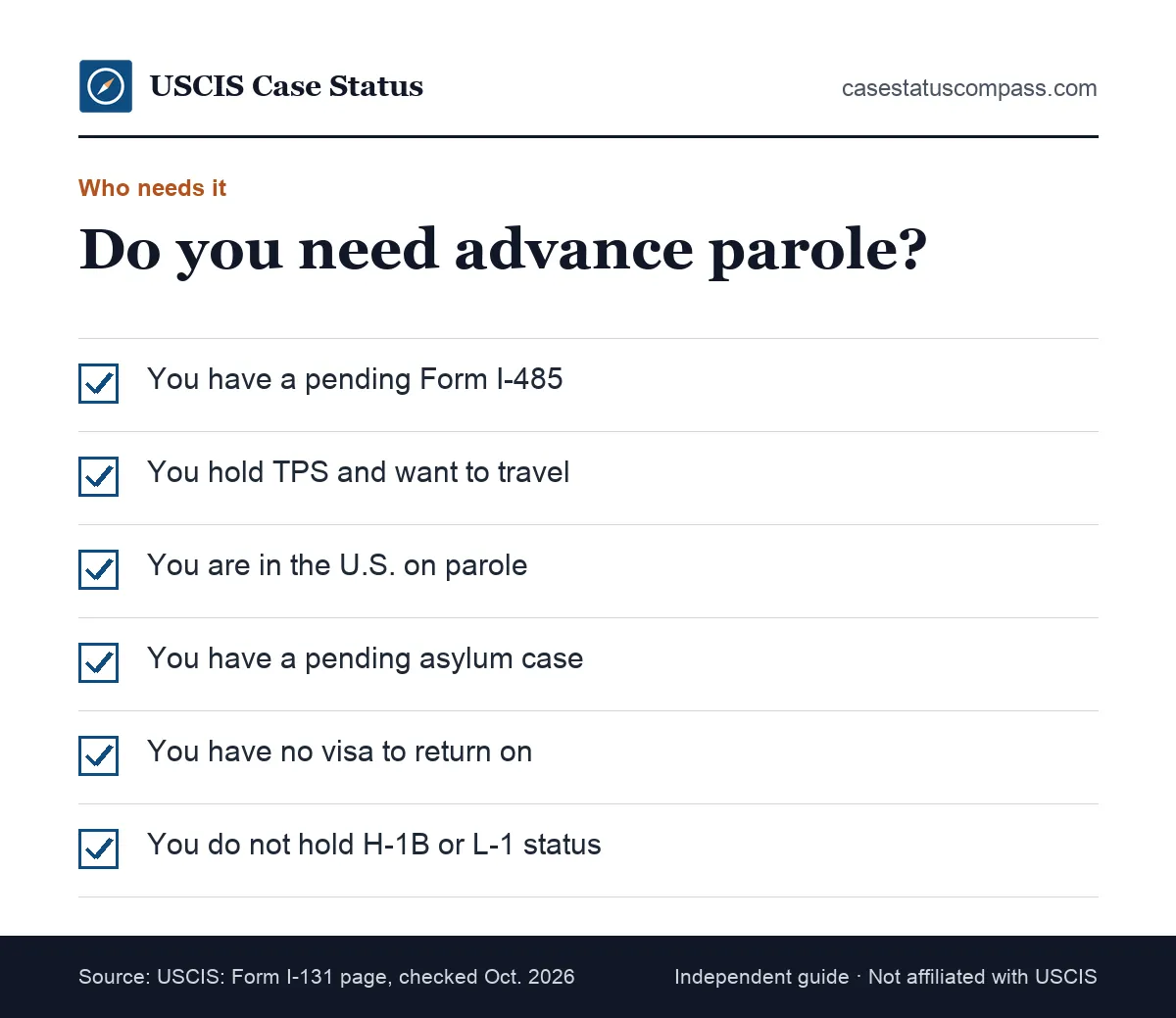
You usually need advance parole if you have a pending application that would be treated as abandoned if you left, or if you have no visa to return on. The biggest groups are adjustment applicants, TPS beneficiaries and parolees. Most people in valid H-1B or L-1 status are treated differently.
Adjustment applicants and abandonment
If you filed Form I-485 and leave without approved travel permission, USCIS generally treats the application as abandoned. A parole document keeps the case alive. Our guide to the form i-485 application explains the green card process itself.
Who may not need it
Workers maintaining H-1B or L-1 status, and their H-4 or L-2 family, can often return on a valid visa while their I-485 is pending. Green card holders use their card or a reentry permit instead.
Which I-131 Travel Document Do You Need?
The right Form I-131 document depends on your current status. Pending applicants and most parolees need a parole document. Green card holders planning long trips need a reentry permit. Refugees and asylees use a refugee travel document. Picking the wrong one wastes the fee.
Status-to-document matching table
Find your current status in the left column, then read across.
| Your situation | Document to request | Main point |
|---|---|---|
| Pending Form I-485 | Advance parole | Keeps the AOS case alive |
| TPS holder | TPS travel authorization | Return to resume TPS |
| Parolee inside the U.S. | Parole document | Seek parole again on return |
| Green card holder, long trip | Reentry permit | Shows you kept your residence |
| Refugee or asylee | Refugee travel document | Replaces a national passport |
| Person outside the U.S. | Parole request (humanitarian) | Different evidence rules |
If no row fits, or two seem to, read the next subsection before you file.
When two documents seem to fit
An asylee with a pending I-485 could use a refugee travel document or a parole document. The choice affects which passport you carry and the risks if you travel to your home country. Ask an accredited representative which one fits your plans.
What Is Form I-512 (Advance Parole Document)?
Form I-512 is the advance parole document itself, the paper USCIS issues after approving an I-131 request. Searches for "form i 512" usually mean this approved document, not an application. You never file an I-512; you receive one, and you show it to the airline and CBP.
What the parole document shows
The document shows your photo, name, date of birth, A-Number and the dates it is valid. It may allow one entry or multiple entries. Read every field when it arrives, and report any error to USCIS before you plan a trip.
Validity and entries
The document is valid only between the dates printed on it. If it allows a single entry, using it once ends it. Plan your return well before the end date, since delays abroad can leave you with an expired document.
What Is the I-512L?
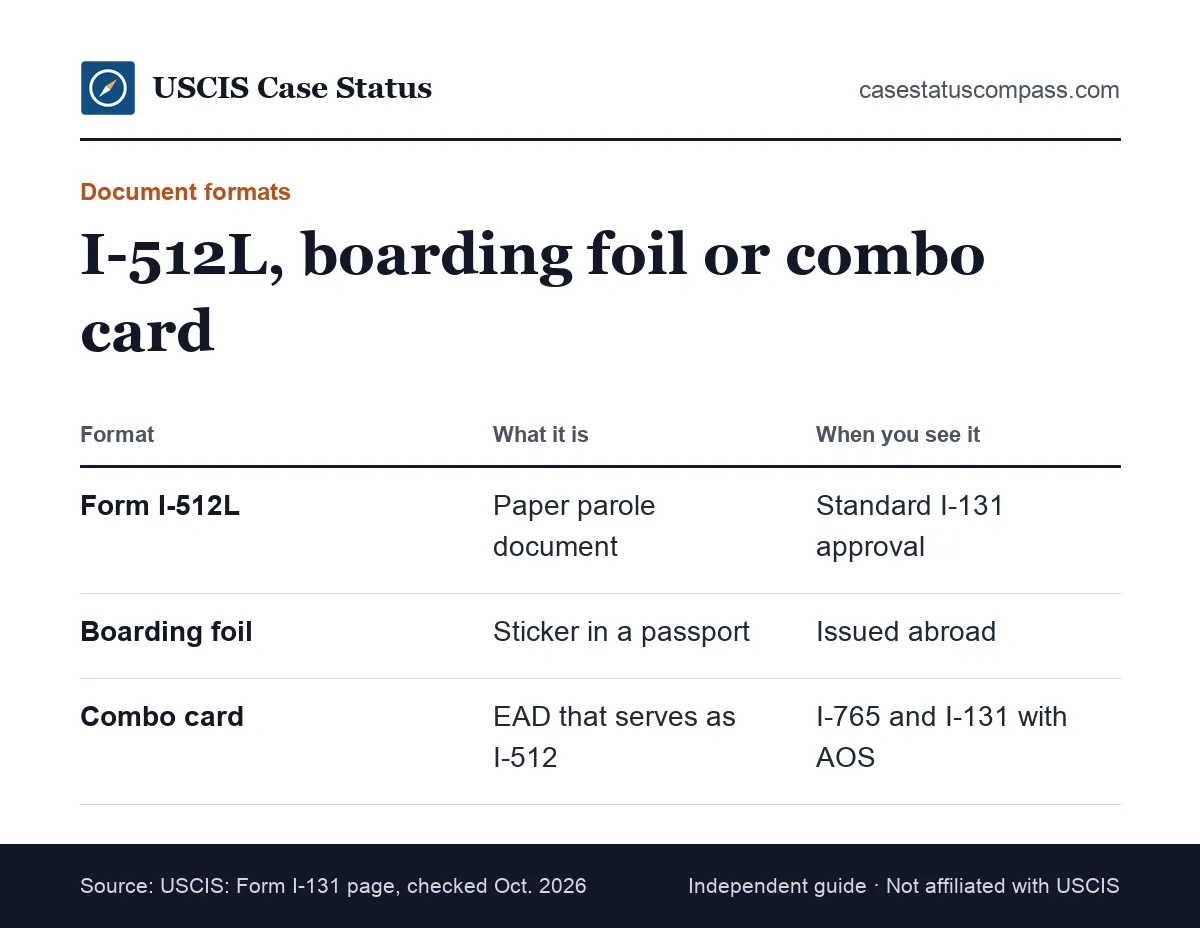
The I-512L is the current version of the paper advance parole document, formally the Authorization for Parole of an Alien into the United States. USCIS says advance parole can be issued as Form I-512L or as a boarding foil.
I-512L vs a boarding foil
The I-512L is a separate paper document that you carry with your passport. A boarding foil is a sticker placed in a passport, usually when parole is approved for someone outside the U.S. Both let you board a flight and request parole on arrival.
Keeping the I-512L safe
Carry the original on the trip and keep color copies at home and in cloud storage. Do not laminate, staple or write on it. If it is lost abroad, contact the nearest U.S. embassy and speak with an attorney quickly.
What Is the EAD Combo Card?
The combo card is an Employment Authorization Document (EAD) that also serves as advance parole. It is issued when you file Form I-765 and Form I-131 together based on a pending I-485. The front reads that the card serves as an I-512 advance parole document.
How to tell if your EAD is a combo card
Look at the front of the card for wording that it "serves as I-512 Advance Parole." If that line is missing, it is a work permit only and does not allow travel. Our work permit guide explains the EAD categories.
Combo card vs I-512L
Both permit return travel. The combo card also proves work authorization, so it is handy for employers. Its travel validity ends with the card. If you only have a stand-alone EAD, you would need a separate I-512L for travel.
Traveling With a Pending I-485
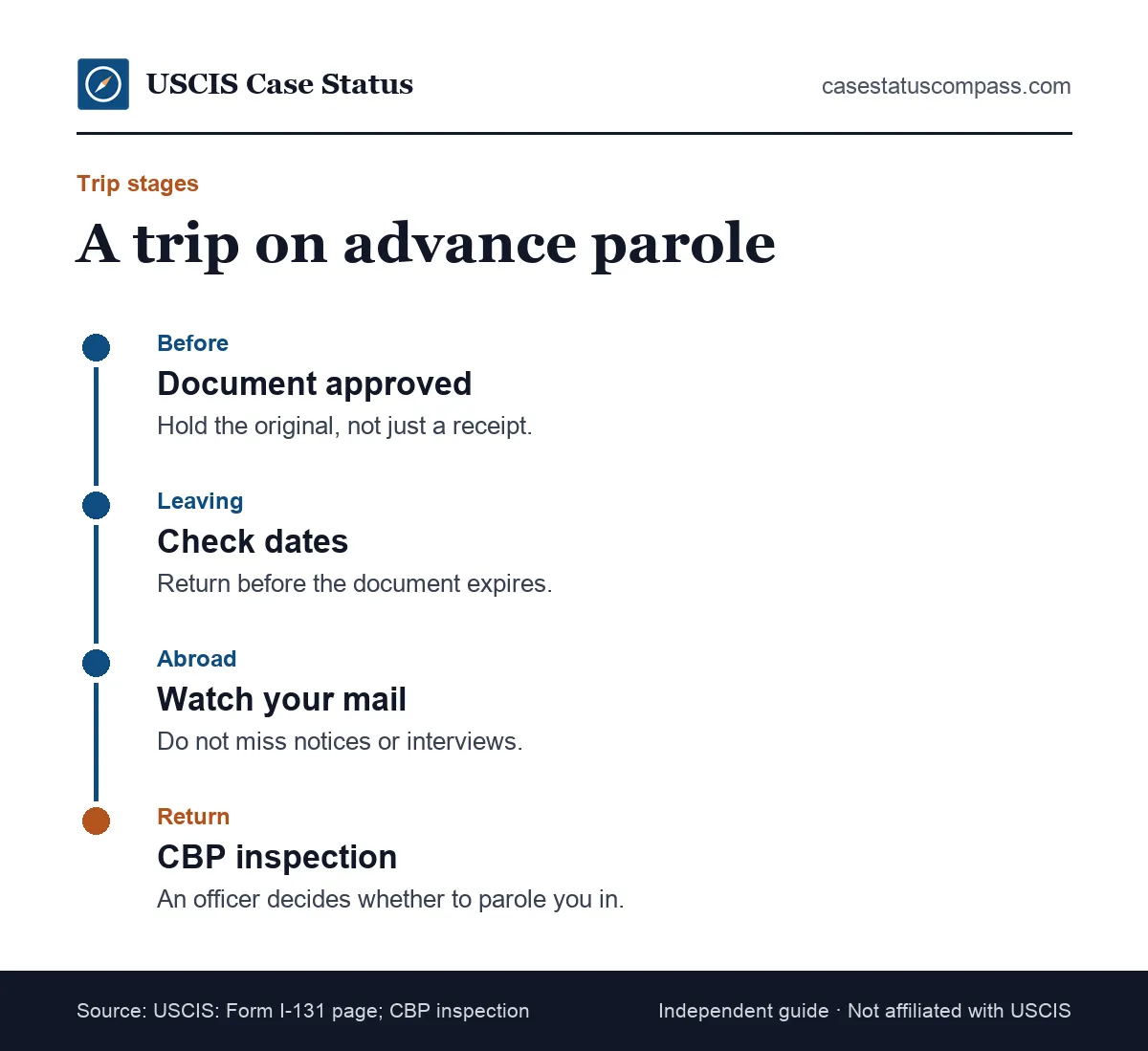
Leaving the U.S. while Form I-485 is pending, without approved advance parole, generally makes USCIS treat the application as abandoned. With an approved document, you can travel and ask CBP to parole you back in. The trip still carries risks, so plan carefully and keep your case moving.
The abandonment rule
The rule protects the integrity of the process: you asked for residence from inside the U.S., so leaving signals you dropped it. A receipt notice for Form I-131 is not enough; you need the approved document before departure.
Before you leave
- Hold the original approved document.
- Confirm no biometrics or interview falls during the trip.
- Set up mail forwarding or online notices.
- Bring proof of your pending case.
Our longer guide to travel with a pending i-485 covers trip planning in more depth.
Can You Leave the U.S. With a Pending Green Card Application?
Yes, but usually only with an approved parole document in hand. Without one, most adjustment applicants lose the pending case by leaving. Some people in valid H-1B or L-1 status can return on their visas instead. Anyone with past immigration problems should get legal advice first.
What happens if you leave without it
USCIS generally treats the green card application as abandoned and may deny it. You may then need to restart through consular processing abroad. Depending on your history, leaving can also trigger bars that keep you out for years.
Short trips are not exempt
There is no short-trip exception for most pending applicants. A weekend in Canada or Mexico counts as a departure just like a long flight. Check before any border crossing, including land trips.
Does an Approved Travel Document Guarantee Reentry?
No. An approved parole document lets you ask for parole at the border, but CBP officers decide whether to parole you in. They may still find you inadmissible because of crimes, misrepresentation, unlawful presence or other grounds. Approval by USCIS is one step, not a promise.
What CBP looks at
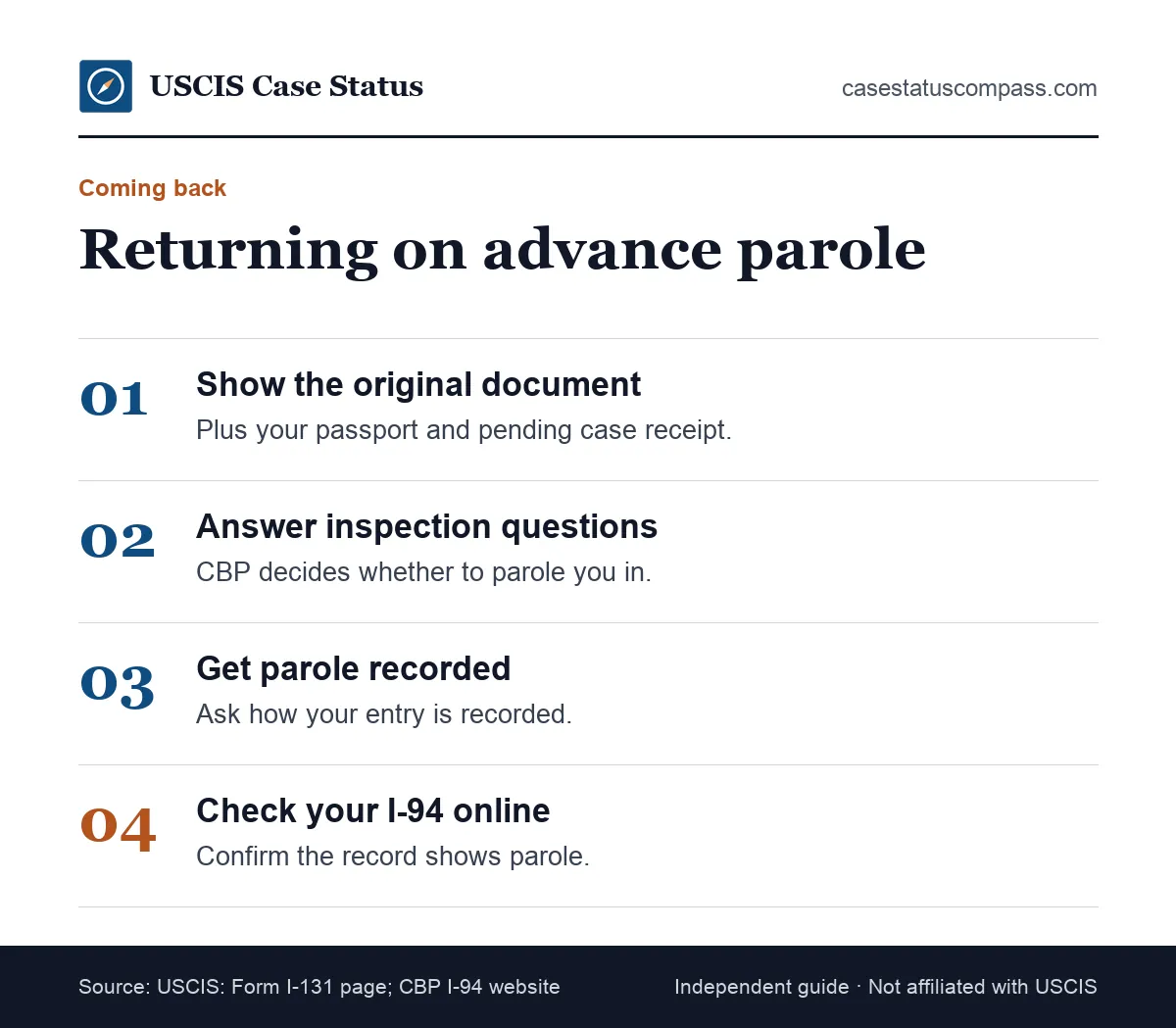
CBP inspects your parole document, passport and identity. Officers can ask about your trip, your pending case and your history. Answer honestly and keep documents easy to reach. Carry them in your hand luggage, never in a checked bag.
How Do You Check Your I-94 After Returning on Parole?
After entry, look up your arrival record on the CBP I-94 website. It should show parole. If it shows something unexpected, contact CBP's deferred inspection office or an attorney before it causes problems later. A wrong I-94 can affect your green card case, so fix it early.
What Are the Risks of Traveling on a Parole Document?
The main risks are being found inadmissible at the border, missing notices or interviews while abroad, and triggering penalties tied to past unlawful presence. Policy and court decisions in this area change, so read the alerts at the top of the official Form I-131 page before every trip.
Past unlawful presence
If you have ever been in the U.S. without status, or stayed past your authorized date, travel can affect your admissibility. This area is complex and has changed recently. Speak with an immigration attorney or DOJ-accredited representative before you book a ticket.
Missed appointments and notices
USCIS keeps working on your case while you travel. A biometrics notice, Request for Evidence or interview letter can arrive while you are away. Missing it can delay or end the case, so keep trips short and monitor your online account.
Changes in your own case
A pending case can be denied while you are abroad. If that happens, your travel document may no longer protect you. Check your case status before you fly back and carry proof that it is still pending.
Who Should Get Legal Advice Before Traveling?
Get legal advice before using a travel document if you have any arrest or conviction, a prior removal order, time in the U.S. without status, a past visa denial or fraud finding, or a pending asylum claim. These situations can turn a routine trip into a lost case.
Red flags to discuss with an attorney
- You ever entered without inspection
- You overstayed a visa or I-94 date
- You were ever in removal proceedings
- You have an asylum or withholding claim
- You plan to visit the country you fled
Choosing a lawyer before a parole trip
Use a licensed immigration attorney or a DOJ-accredited representative at a recognized organization. Avoid "notarios" or consultants who promise guaranteed results. Bring every notice, your passport and any court records to the first meeting, and ask in writing what the fee covers.
What Is a Reentry Permit?
A reentry permit is a Form I-131 travel document for green card holders who plan to stay abroad for a long period. It helps show that you did not abandon your permanent residence, and it can be used in place of a passport for return.
Who uses a reentry permit
Residents taking overseas jobs, caring for relatives abroad or studying outside the U.S. often apply. Short trips do not need one; your green card is enough. Our green card holder travel rules guide covers routine trips.
Filing from inside the U.S.
Read the current instructions about filing while physically in the U.S. and attending biometrics before you leave. Plan the application around your departure date so you do not miss the appointment.
Advance Parole vs Reentry Permit: What Is the Difference?
Advance parole protects people who are not yet residents and have a pending case or need parole. A reentry permit protects people who already have a green card and plan a long absence. They solve different problems, and you can never use one in place of the other.
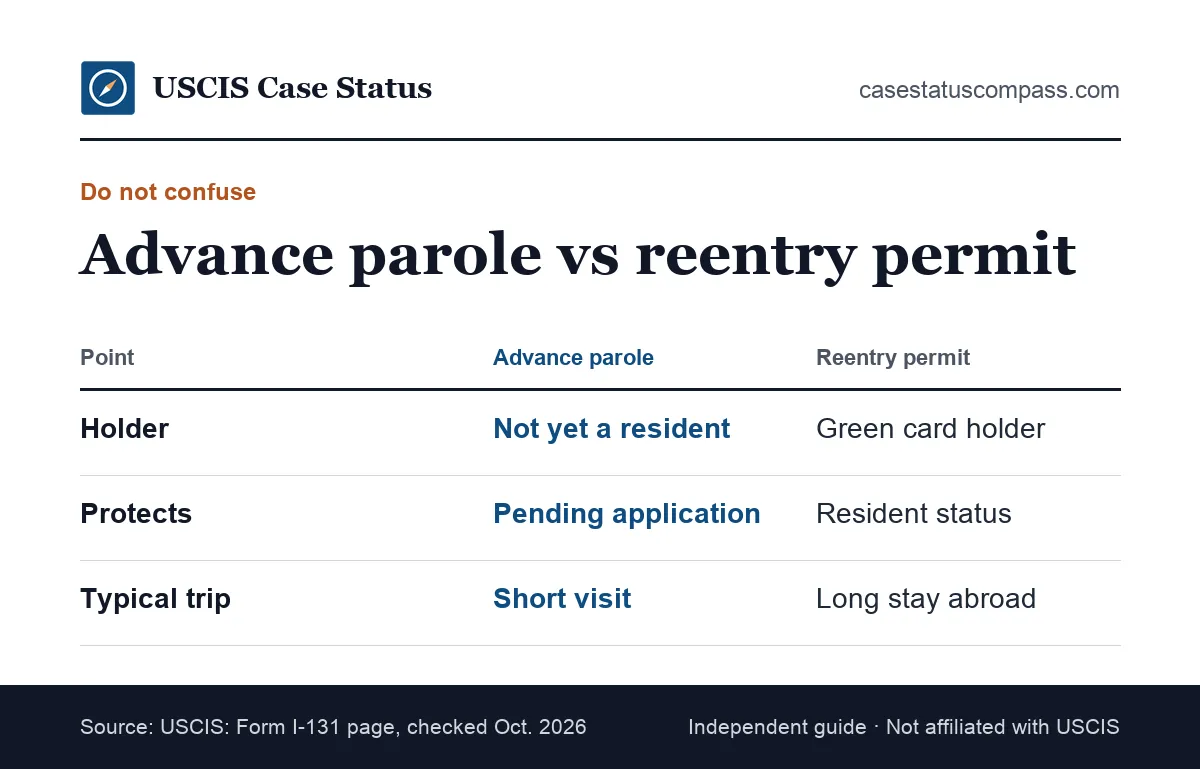
Parole document vs reentry permit table
This table compares the two documents people confuse most often.
| Point | Advance parole | Reentry permit |
|---|---|---|
| Who applies | Pending AOS, TPS, parolees | Permanent residents |
| What it protects | A pending case or parole | Your existing green card |
| How you return | Ask CBP for parole | Admitted as a resident |
| Replaces a passport? | No | Can be used as a travel document |
The key line is the first one: your status today decides which document you can get.
If your status changes
If your green card is approved while you hold a parole document, you become a resident and use your green card to travel. Keep the old document as part of your records.
What Is a Refugee Travel Document?
A refugee travel document is issued to refugees and asylees, and to residents who got their green card through refugee or asylee status. It replaces a national passport for travel. It is filed on Form I-131 with proof of your status.
Who can get a refugee travel document
You must hold refugee or asylee status, or be a permanent resident who obtained residence as a refugee or asylee. Our asylum status guide explains how asylum cases move through USCIS.
Travel to the country you fled
Returning to the country you said you feared, or using its passport, can make officers question your protection claim. Get advice before any trip there. Even a short visit, or renewing your home country's passport, can be treated as a sign that you no longer fear harm there.
How Do You Apply for Advance Parole?
To apply for advance parole, file Form I-131 with USCIS, choose the correct category, attach evidence of your eligibility and pay the fee unless an exemption applies. Then attend biometrics if scheduled. File well before your trip and travel only after the approved document arrives.
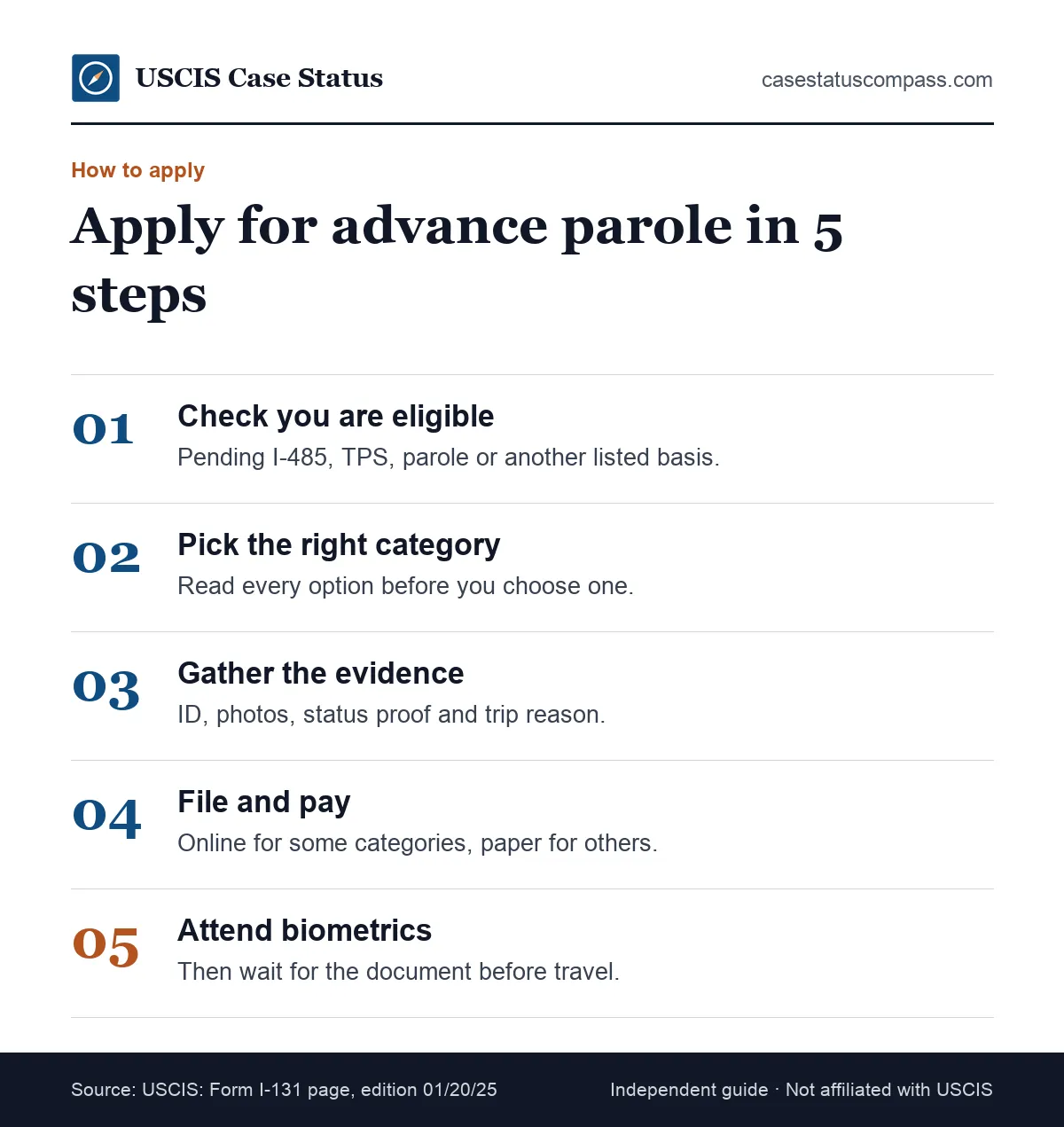
Step-by-step
- Confirm your basis, such as a pending I-485 or TPS.
- Download the current edition from uscis.gov/i-131.
- Answer every question and pick the right category.
- Attach evidence and the fee, or file online if allowed.
- Attend biometrics and watch your mail for the decision.
Evidence that strengthens the request
Include proof of your pending case or status, a copy of photo ID, and two passport-style photos. A short statement of your trip purpose helps, especially for humanitarian reasons. Add medical letters or death certificates for emergencies.
I-131 Filing Checklist You Can Copy
This checklist covers a typical I-131 request based on a pending adjustment application. Compare it with the current Form I-131 instructions, because humanitarian, TPS and parolee requests need different evidence. Tick each line only after checking it, and keep the finished list with your copy of the packet, so you can show later exactly what you sent.
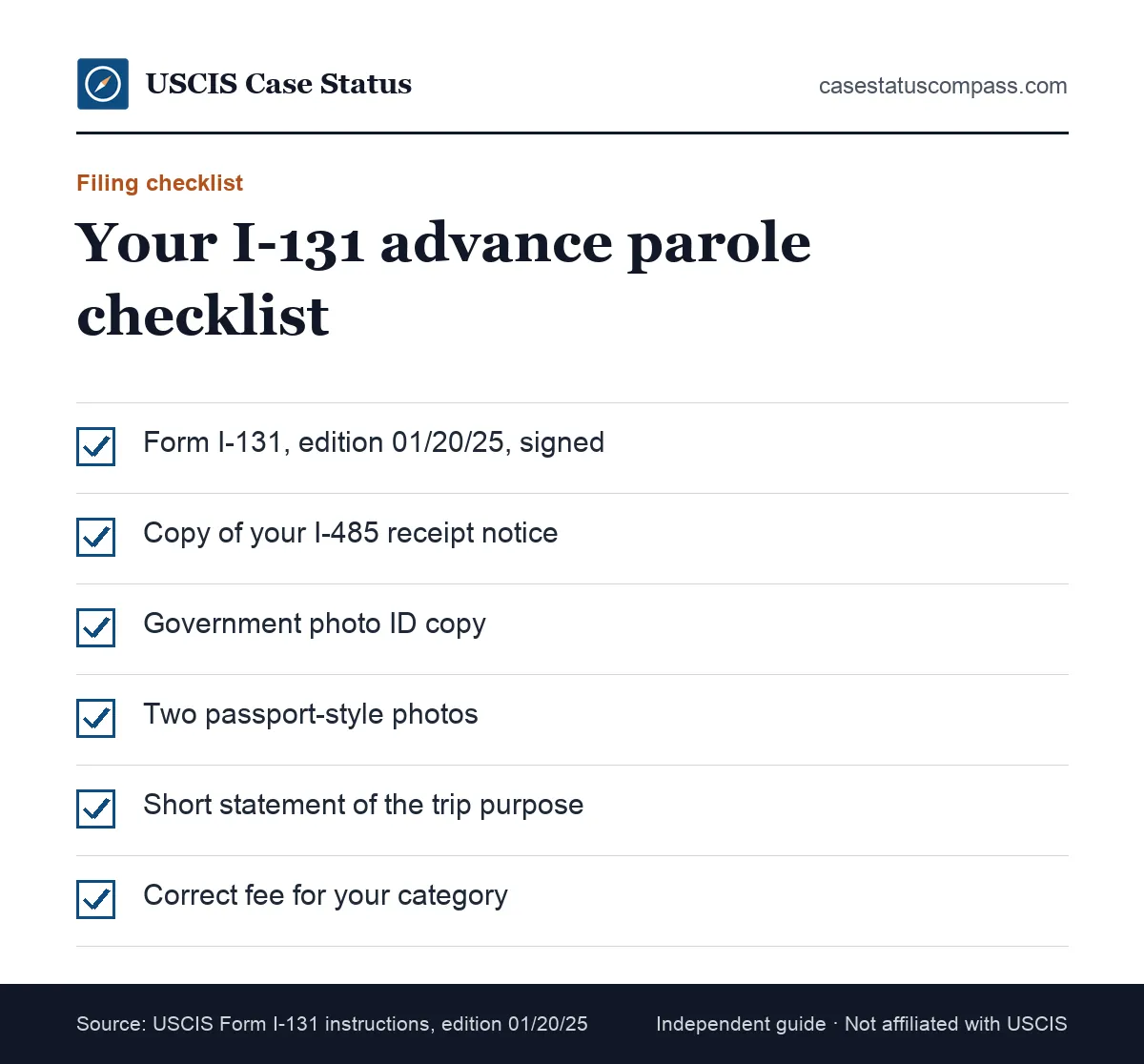
For pending I-485 applicants
- Form I-131 signed, on edition 01/20/25
- Copy of the I-485 receipt notice (Form I-797C)
- Copy of passport bio page or other photo ID
- Two identical passport-style photos
- Short trip statement with dates and reason
- Fee, or proof you qualify for no fee
For TPS and parolee applicants
- Proof of TPS approval or a pending TPS application
- Copy of your current parole record or I-94
- Photo ID and photos
- Trip purpose and supporting documents
- The fee for your category
Can You File Form I-131 Online?
Yes, for some categories. Per USCIS, advance parole and TPS travel can often be filed online, but reentry permits and refugee travel documents are paper-only. Form G-1055 lists a lower online fee for advance parole. Check the official Form I-131 page before you start, since the online menu can change.
Choosing the right online category
Read each option slowly before you start, because a wrong category can lead to a denial and a lost fee. If no option fits your situation exactly, file on paper instead and explain your basis clearly.
Paper filing tips
Use the current edition, sign in ink, and send it to the address on the official Direct Filing Addresses page. Keep a full scanned copy and the mailing receipt. Write your A-Number on any loose page.
Which I-131 Edition Must You Use?
As of October 2026, the USCIS Form I-131 page lists the 01/20/25 edition. Every page of your form must show the same edition date, or USCIS may reject the package. Download the form directly from uscis.gov on the day you prepare it.
Edition mistakes to avoid
Do not mix pages from different downloads, and do not reuse an old copy from a past filing. Check the footer of each page before you sign. A rejected form must be refiled from scratch.
Where Do You Send Form I-131?
Paper Form I-131 filings go to the address listed for your category on the USCIS Direct Filing Addresses page for Form I-131. Concurrent filings with Form I-485 go with that package. USCIS has changed filing locations before, so check the official page on the day you mail.
Filing with or after the I-485
If you file the travel request together with the I-485, it goes to the I-485 address. If you file later, use the stand-alone I-131 address for your category. Never split one package across two addresses.
Courier vs postal deliveries
The filing address page lists a separate address for FedEx, UPS and DHL deliveries. Use the one that matches your carrier, and keep the tracking number with your copy of the packet.
What Happens After You File Form I-131?
After filing, USCIS sends a Form I-797C receipt notice and, for many applicants, a biometrics appointment. An officer reviews the request and approves it, sends a Request for Evidence or denies it. If approved, the parole document or combo card is mailed to your address.
The I-131 receipt is not a travel pass
The receipt notice shows your 13-character receipt number, used to track the case online. It does not allow travel. Leaving on a receipt alone usually ends the request. Our uscis receipt number guide explains the format.
Biometrics for travel requests
Many I-131 applicants attend a biometrics appointment for fingerprints and a photo. Reuse may apply if you recently gave biometrics. Our biometrics appointment guide covers what to expect. Bring the notice and photo ID.
I-131 Case Status Steps in Order
An I-131 case usually moves from Case Was Received to biometrics, review, approval and document production, then mailing. Not every case shows each message. The status-sequence table below shows what each update means for a travel document request. Combo card cases may show card messages instead of document ones.
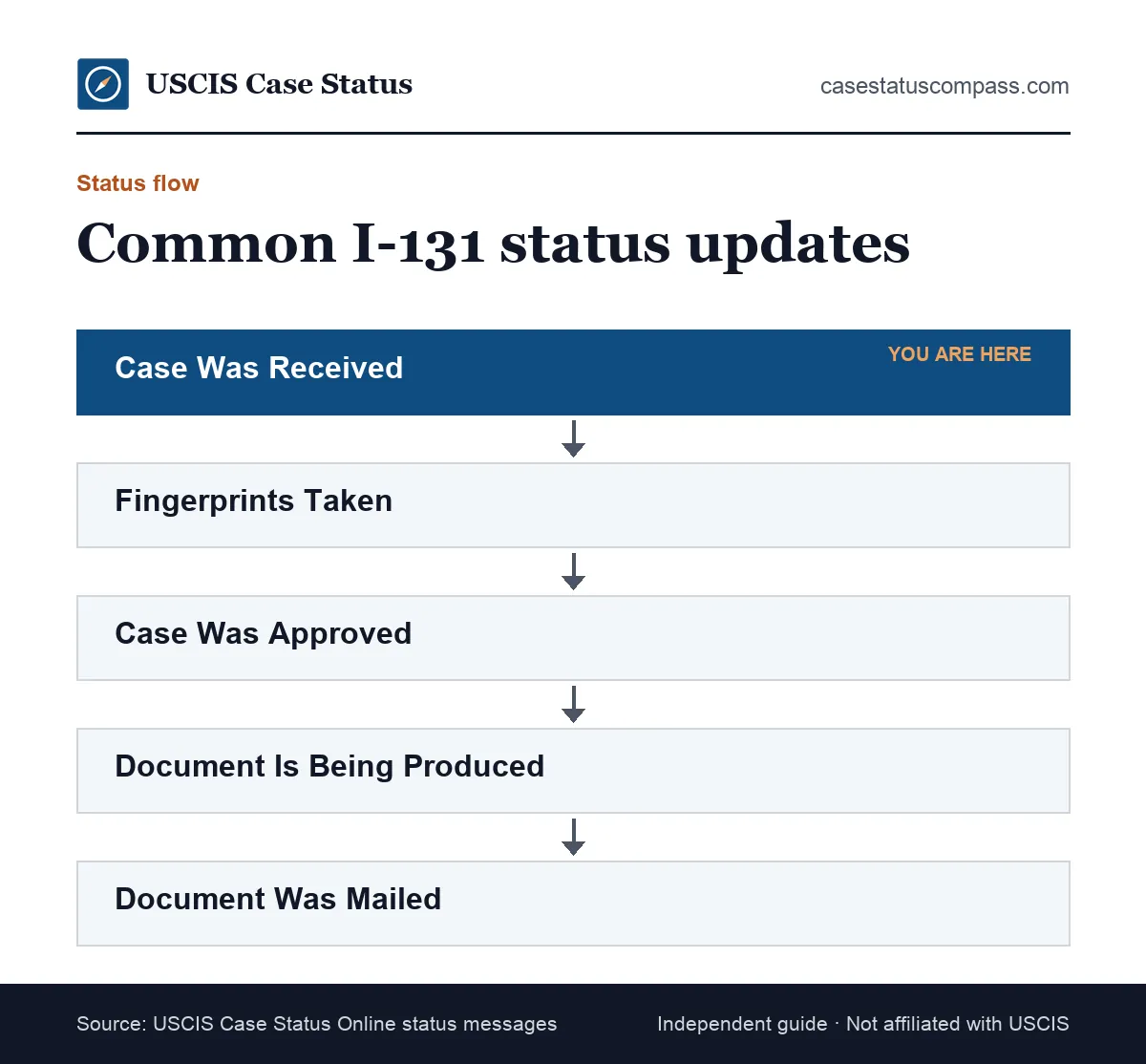
Travel document status-sequence table
Each row pairs a status with the action it calls for.
| Status message | What it means | What to do |
|---|---|---|
| Case Was Received | Request accepted | Save the receipt |
| Fingerprints Taken | Biometrics recorded | Wait for review |
| Request for Evidence Was Sent | Officer needs more proof | Reply before the deadline |
| Case Was Approved | Travel document granted | Do not travel yet |
| Document Is Being Produced | Card or I-512L printing | Watch for mail |
| Document Was Mailed | Document is on its way | Track delivery, then plan travel |
The last row is the only one that means you can start firm travel plans.
Approved is not the same as ready to travel
An approval notice alone is not a travel document. Wait for the physical I-512L or combo card. If the mail is delayed, see our page on a card was mailed status.
How Much Does Advance Parole Cost?
As of October 2026, Form G-1055 (edition 10/16/26) lists the advance parole request at $630 (paper) / $580 (online); $0 if your I-485 was filed before Apr. 1, 2024 with the fee. H.R. 1 Immigration Parole Fee $1,050 when parole is granted (some exceptions). A reentry permit costs $630, and other Form I-131 documents have their own fees. Our uscis fees page has the full breakdown.
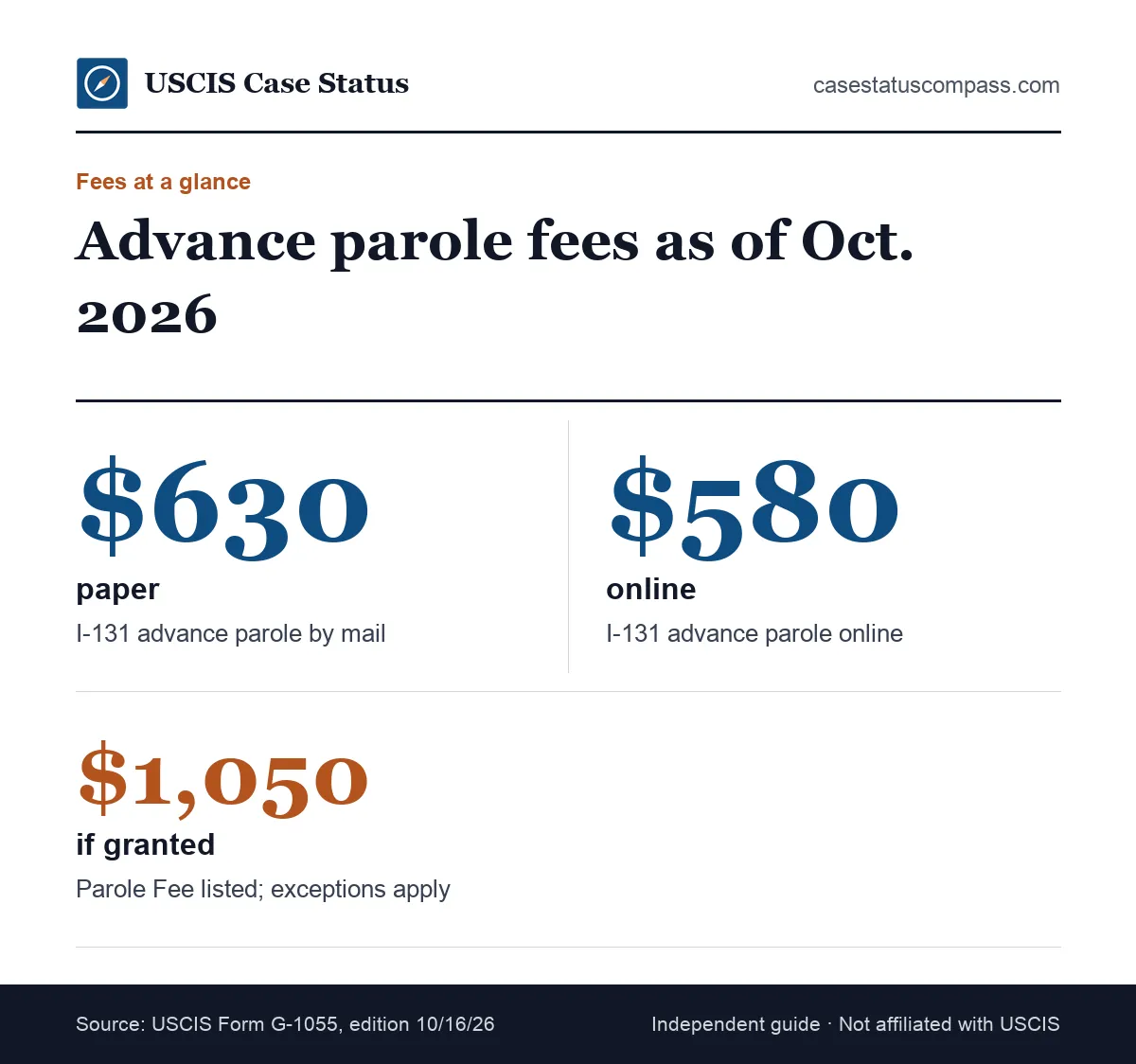
The Immigration Parole Fee: what is verified
G-1055 lists the Immigration Parole Fee as an extra fee charged "if approved." For advance parole documents used by people inside the U.S., it is marked as collected by CBP. It is triggered when parole is actually granted, not when you file, and statutory exceptions apply.
The parole fee and returning I-485 applicants
Under the federal fee notice and G-1055 Appendix B, the parole fee does not apply to an INA 245 adjustment applicant returning from temporary travel abroad, if CBP agrees at the port of entry. That decision rests with CBP, so ask an attorney before you travel if your situation is unusual. Ms. L. settlement class members are exempt: Ms. L. settlement class: exempt from H.R. 1 parole, parolee-EAD and asylum fees since Feb. 5, 2026.
I-131 Processing Time: A Short Summary
Current times are posted on the official tool at egov.uscis.gov/processing-times. The USCIS historical factsheet (data as of March 5, 2024) listed a fiscal year 2023 median of 5.8 months for advance parole, which is now dated. See our i 131 processing time page for current detail.
Why plan for longer
Times vary by office and category, and an RFE adds weeks. Apply as early as your plans allow. Your online account may show a myProgress estimate for Form I-131. For context, I-131 advance parole (inside the U.S.): median 5.8 months (USCIS data, Apr.-June 2026).
Can You Speed Up a Travel Document Request?
USCIS may expedite a request when you show an urgent need, such as a family medical emergency, a death, or severe financial loss. Expedites are discretionary and need proof. Our uscis expedite request guide covers how to ask and what evidence helps.
Evidence that supports an expedite
- A doctor's letter about a relative's condition
- A death certificate or funeral notice
- An employer letter about urgent business travel
- Proof of the travel date and its reason
What Is Emergency Advance Parole?
Emergency advance parole is a same-day or short-notice travel document that a USCIS field office may issue in a true emergency. You request an appointment and bring proof of the emergency, your pending case and photos. Approval is discretionary and not guaranteed.
Booking an emergency field office visit
Request an in-person appointment online at my.uscis.gov/en/appointment/v2 or call 800-375-5283. Explain the emergency clearly and bring originals. Callers can reach live agents during these hours: Live calls and chat: Monday to Friday, 8 a.m. to 8 p.m. Eastern.
What to bring to the field office
- Completed Form I-131 and the fee
- Two passport-style photos and ID
- Proof of the emergency
- Your travel itinerary
- Your pending case receipt
- Proof of the travel date, such as a ticket
How Long Is a Parole Document Valid?
A parole document is valid only for the dates printed on it. USCIS sets the validity when it approves the request. Always return before the end date, because an expired document gives you no protection. Check the dates the day it arrives.
Single entry vs multiple entry
A single-entry document ends after one return. A multiple-entry document lets you travel more than once during its validity. Check the "number of entries" field before planning a second trip.
Renewing before it expires
If your case is still pending and you need to keep traveling, file a new Form I-131 well before the old document expires. Do not rely on a pending renewal receipt for travel.
What If Your Travel Document Expires While You Are Abroad?
If your parole document expires before you return, you have no permission to seek parole on it. Your pending case may be treated as abandoned. Contact a U.S. embassy or consulate and an immigration attorney at once to discuss any options.
Prevent it before you leave
Leave a buffer of several weeks between your planned return and the expiration date. A short margin is the most common cause of this problem. Flight cancellations, illness and visa delays in third countries can all push a return date back, so book a refundable ticket if you can.
Does Traveling Affect Your Green Card Case?
Using an approved parole document does not by itself hurt a pending green card case, and the case keeps moving while you travel. The risks come from missed notices, an interview while you are away, or admissibility issues found at the border.
If an interview is scheduled while you are abroad
Return in time if you can. If you cannot, follow the notice's rescheduling instructions immediately. A missed interview without rescheduling can lead to denial. Keep proof of the date you asked to reschedule, and watch your online account for the new notice.
After green card approval
Once your I-485 is approved, you travel as a permanent resident with your green card. Long absences then raise residence questions; the reentry permit is the tool for those. Lost cards are replaced through our green card renewal guide.
How Does Travel Permission Work for TPS, Asylum and Parolees?
Travel rules differ by group. TPS holders request travel authorization on Form I-131. Asylum applicants risk their claim if they visit the country they fled. Parolees use Form I-131 to request a new period of parole or travel permission. Each group has extra evidence rules.
TPS travel authorization
TPS beneficiaries file Form I-131 for travel. Travel can bring risks, such as missed notices. The TPS country list changes often; see our tps status guide for current designations. As of October 2026, USCIS lists: El Salvador, Lebanon, Sudan, Ukraine.
Pending asylum applicants
Leaving with a pending asylum application, especially to your home country, can lead officers to treat the claim as abandoned or weaken it. Speak with an attorney first. Travel to third countries also carries risk.
Parolees and re-parole
People paroled into the U.S. may need a new I-131 for travel or a fresh period of parole. Read the category-specific instructions and file on time. File well before your current parole period ends, since a lapse can leave you without status.
What Are the Most Common I-131 Mistakes?
The most common mistakes are traveling before approval, picking the wrong category, using an outdated edition and letting the document expire abroad. Others include missing photos or proof of the underlying case. Most of them are avoidable with a final check of dates, pages and photos.
Filing errors
- Wrong category selected online
- Missing or mismatched edition pages
- No copy of the pending case receipt
- Photos that do not meet specifications
- Unsigned forms or a wrong fee- Unsigned forms or a wrong fee amount
Travel errors
- Leaving on a receipt notice alone
- Missing an interview while abroad
- Returning after the document expires
- Using an EAD that is not a combo card
- Not checking the I-94 after the trip
Why Are I-131 Travel Requests Denied?
USCIS can deny a travel request if you are not eligible, if the underlying case has ended, if evidence is missing, or if the officer decides travel is not warranted. A denial does not always affect the main green card case, but you must not travel without approval.
Why officers refuse travel requests
- The I-485 or TPS case was already denied
- No response to a Request for Evidence
- Departure before the decision
- Wrong category selected online
- Missing proof of the trip's purpose in a humanitarian request
- Past immigration problems found in the background check
After a refused I-131
You may be able to file a new Form I-131 with better evidence. For denials linked to the main case, see our case denied options page and get legal advice.
Travel Document Scenarios
These simplified scenarios show how Form I-131 works in practice. They are examples, not legal advice. Compare them with your own situation, then confirm the details in the official instructions or with an attorney. The names and details are fictional.
Scenario 1: A family wedding abroad
Maria has a pending marriage-based I-485 and a combo card. She checks the card's dates, confirms no interview is scheduled, and returns two weeks before expiration. CBP paroles her in, and she checks her I-94 online.
Scenario 2: A parent's sudden illness
Daniel's father is hospitalized abroad, and his I-131 is still pending. He requests an emergency appointment at a field office with a doctor's letter and photos. The office considers an emergency document; he does not leave until he has it.
Scenario 3: A resident taking a two-year job abroad
Grace has a 10-year green card and a long overseas assignment. She files a reentry permit on paper and attends biometrics before departure. She keeps U.S. tax filings and a home address to show she kept her residence.
If X, Do Y: Travel Decision Table
This decision table gives one next step for common travel situations. If more than one row fits, act on the most urgent first. The table is short. When your history includes any immigration violation, get legal advice before you follow any row.
Next step for each travel situation
Each row gives one first step.
| If this happens | Do this next |
|---|---|
| You need to travel, I-485 pending | File Form I-131 and wait for approval |
| Emergency trip, no document yet | Request an emergency field office appointment |
| Document expires soon | File a new I-131 before it lapses |
| Interview notice arrives while abroad | Return or reschedule at once |
| EAD lacks the I-512 wording | Do not travel on it |
| Request was denied | Read the notice; do not leave |
In every row, the safe default is the same: do not leave the U.S. until the approved document is in your hands.
When to contact USCIS
Call 800-375-5283 or use your online account when a document never arrives or shows an error. Our contact uscis guide lists every channel. Have your receipt number ready, along with the date the document was mailed.
What Should You Carry on a Parole Trip?
Carry the original parole document or combo card, your valid passport, a copy of your pending case receipt, and proof of the trip reason. Keep copies at home and in secure cloud storage. Do not pack originals in checked luggage.
Travel document kit
- Original I-512L or combo card
- Valid passport from your country
- I-797C receipt for the pending case
- Copies of key filings and notices
- Proof of the trip reason, such as an invitation
Handling USCIS mail while you travel
Update your address before you leave if needed, and ask someone you trust to open USCIS mail. Our uscis change of address guide lists the steps. Check your online account each week while abroad.
How Does Form I-131 Fit With Other USCIS Forms?
Form I-131 often travels with other filings. Pending green card applicants file it with or after Form I-485. Family cases begin with a petition such as the form i 130. Later, a resident may file for naturalization on the citizenship application form.
All forms in one place
Our uscis forms hub explains each common form and how they connect, from petitions to adjustment, work permits, travel documents, renewals and citizenship.
Frequently Asked Questions
Can I leave the US with a pending green card application?
Usually only with an approved parole document or combo card in hand. Without one, USCIS generally treats a pending Form I-485 as abandoned. Some H-1B and L-1 workers can return on valid visas instead. If you have any past immigration violation, speak with an attorney before you travel.
Can I travel while my I-131 is pending?
No, not if you rely on it. Leaving before approval usually leads USCIS to deny the I-131 and can also end a pending I-485. Wait until the original document arrives. In a real emergency, ask for a field office appointment instead.
Does a parole document allow multiple trips?
Sometimes. The document states whether it allows one entry or multiple entries during its validity. A single-entry document ends after one return. Check the entries field and the end date before booking another trip, and file a new request early if you need more travel.
Is the combo card the same as advance parole?
A combo card is an EAD that also allows travel. It works for travel only if the front says it serves as an I-512 advance parole document. A regular EAD without that wording is a work permit only and does not allow travel.
Can I file Form I-131 from outside the U.S.?
Generally, people with a pending I-485 must be in the U.S. when they file and should not leave before approval. Humanitarian parole requests for people abroad use different Form I-131 categories and evidence. Read the current instructions or ask an attorney about your situation.
Can a green card holder use advance parole?
No. Advance parole is for people who are not yet residents. A green card holder travels on the card, or files for a reentry permit before a long stay abroad.
Is there a fee when CBP grants parole?
G-1055 lists an Immigration Parole Fee that CBP collects only if parole is granted, not when you file. Statutory exceptions apply, including some returning I-485 applicants, so check your case before you travel.
Do children need their own travel document?
Yes. Each person traveling needs their own approved document, including children with a pending adjustment case. File a separate Form I-131 for each family member, with their own photos, evidence and fee unless an exemption applies.
Sources
- USCIS: Form I-131, Application for Travel Documents, Parole Documents, and Arrival/Departure Records. www.uscis.gov/i-131. Accessed Oct 27, 2026.
- USCIS: Form G-1055 Fee Schedule. www.uscis.gov/g-1055. Accessed Oct 27, 2026.
- USCIS: Form I-485. www.uscis.gov/i-485. Accessed Oct 27, 2026.
- USCIS: Check Case Processing Times. egov.uscis.gov/processing-times/. Accessed Oct 27, 2026.
- USCIS: Historical Processing Times factsheet (data as of March 5, 2024). www.uscis.gov/sites/default/files/document/fact-sheets/historical_pt_factsheet_fy16_to_fy24.pdf. Accessed Oct 27, 2026.
- USCIS Contact Center. www.uscis.gov/contactcenter. Accessed Oct 27, 2026.
- USCIS: Temporary Protected Status. www.uscis.gov/humanitarian/temporary-protected-status. Accessed Oct 27, 2026.
- USCIS Form G-1055 Fee Schedule, Edition 10/16/26 (Appendix B). www.uscis.gov/sites/default/files/document/forms/g-1055.pdf. Accessed Oct 27, 2026.
- DHS notice 'Immigration Parole Fee Required by HR-1 Reconciliation Bill', FR Doc. 2025-19564, 90 FR (Oct. 16, 2025); also G-1055 10/16/26 Appendix B. www.govinfo.gov/content/pkg/FR-2025-10-16/pdf/2025-19564.pdf. Accessed Oct 27, 2026.
- USCIS Data Library: All USCIS Application and Petition Form Types, FY2026 Q3 (Apr. 1-June 30, 2026; queried 7/2026). www.uscis.gov/sites/default/files/document/data/quarterly_all_forms_fy2026_q3_v1.xlsx. Accessed Oct 27, 2026.
casestatuscompass.com is an independent publication and is not affiliated with USCIS or any government agency. This page is general information, not legal advice. For denials, court or asylum matters, consult an immigration attorney or a DOJ-accredited representative.