Contents · 38 sections
- What Is TPS Status?
- Which Countries Have TPS in October 2026?
- Which TPS Designations Ended in 2025 and 2026?
- How Do You Check Your TPS Status Online?
- Can You Track a TPS Case in a USCIS Online Account?
- Can You Check TPS Status by Phone?
- Where Is the Receipt Number on a TPS Notice?
- Form I-821 Explained: The Core TPS Application
- Who Can File for Temporary Protected Status?
- Initial Registration vs Late Initial Filing
- What Is the Typical TPS Status Sequence?
- What Does "Case Was Received" Mean for a TPS Filing?
- TPS Biometrics Appointment
- What If USCIS Sends a TPS Request for Evidence?
- What Does a TPS Approval Look Like?
- TPS Re-registration
- Do You Have to Re-register for TPS Every Period?
- Late Re-registration and Good Cause
- TPS and Work Permits
- How Long Is a TPS Work Permit Valid?
- Are TPS Work Permits Automatically Extended?
- TPS Fees in the October 2026 Fee Schedule
- How Long Does TPS Processing Take?
- Can You Travel While on TPS?
- Does TPS Lead to a Green Card?
- TPS vs Asylum vs DACA: What Is the Difference?
- What Happens to Your TPS Status When a Designation Ends?
- What If a Court Case Affects Your Country?
- TPS Granted by an Immigration Judge
- What Happens If Your TPS Application Is Denied?
- Common TPS Status Problems and Fixes
- How Do You Update Your Address for a TPS Case?
- TPS Filing Checklist You Can Copy
- Mistakes That Put TPS at Risk
- When Should You Talk to an Immigration Attorney About TPS?
- How Can You Avoid TPS Scams?
- Documents to Keep After a TPS Decision
- Frequently Asked Questions
The short answer
To check your TPS status, enter the receipt number from your Form I-821 notice in Case Status Online: egov.uscis.gov. Then confirm your country is still designated on the USCIS Temporary Protected Status page. As of Oct. 20, 2026, USCIS listed El Salvador, Lebanon, Sudan, Ukraine.
At a glance
| Main form | Form I-821 (edition 01/20/25) |
| Work permit form | Form I-765, filed with the I-821 or later |
| Where to check a case | Case Status Online: egov.uscis.gov, with your receipt number |
| Designated countries (Oct. 20, 2026) | El Salvador, Lebanon, Sudan, Ukraine |
| Leads to a green card? | No, not by itself |
What Is TPS Status?
Temporary Protected Status (TPS) is a humanitarian program for nationals of countries that the Secretary of Homeland Security designates because of armed conflict, disaster or other extraordinary conditions. Your TPS status shields you from removal and lets you request a work permit while the designation lasts.
What TPS gives you
A person with TPS cannot be removed during the designation period. You can apply for an Employment Authorization Document (EAD) and may ask for travel authorization. These benefits last only while your country stays designated and your registration stays current.
What TPS does not give you
USCIS states plainly that TPS does not lead to lawful permanent resident status and grants no other immigration status. You can still apply for other benefits, such as a family petition or asylum, but each one has its own rules.
Which Countries Have TPS in October 2026?
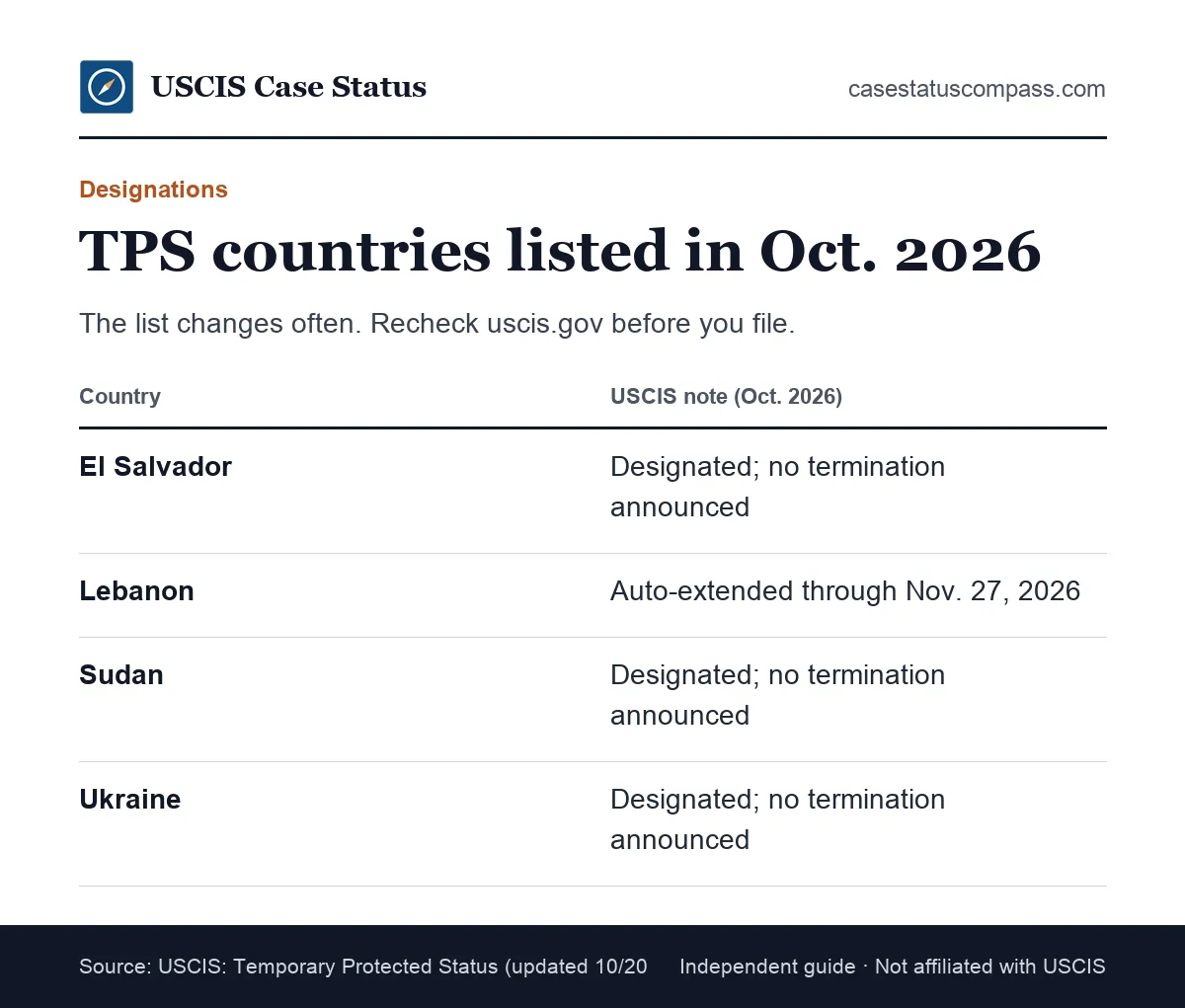
On its TPS page, updated Oct. 20, 2026, USCIS listed four designated countries: El Salvador, Lebanon, Sudan, Ukraine. Lebanon's designation was automatically extended through Nov. 27, 2026. The list shrank sharply in 2025 and 2026, so recheck uscis.gov/humanitarian/temporary-protected-status before you file.
How to read a country page
Each designated country has its own USCIS page. It lists the re-registration period, the residence and presence dates, and any EAD extension. It also links to the Federal Register notice, which is the legal source for every date.
Which TPS Designations Ended in 2025 and 2026?
USCIS lists many terminated designations from 2025 and 2026, including Venezuela, Honduras, Nicaragua, Nepal, Haiti, Syria, Yemen, Somalia, South Sudan, Burma and Ethiopia. Some end on future dates and some are in litigation, so check your own country page. If your country appears there, your TPS status ends on the notice's date unless a court order or a newer notice changes it.
Where to find your country's end date
Open "Countries Previously Designated for TPS" on the USCIS page. Each entry links to the termination notice, which gives the effective date and any work permit transition period. Save a PDF of that notice with your records.
How Do You Check Your TPS Status Online?
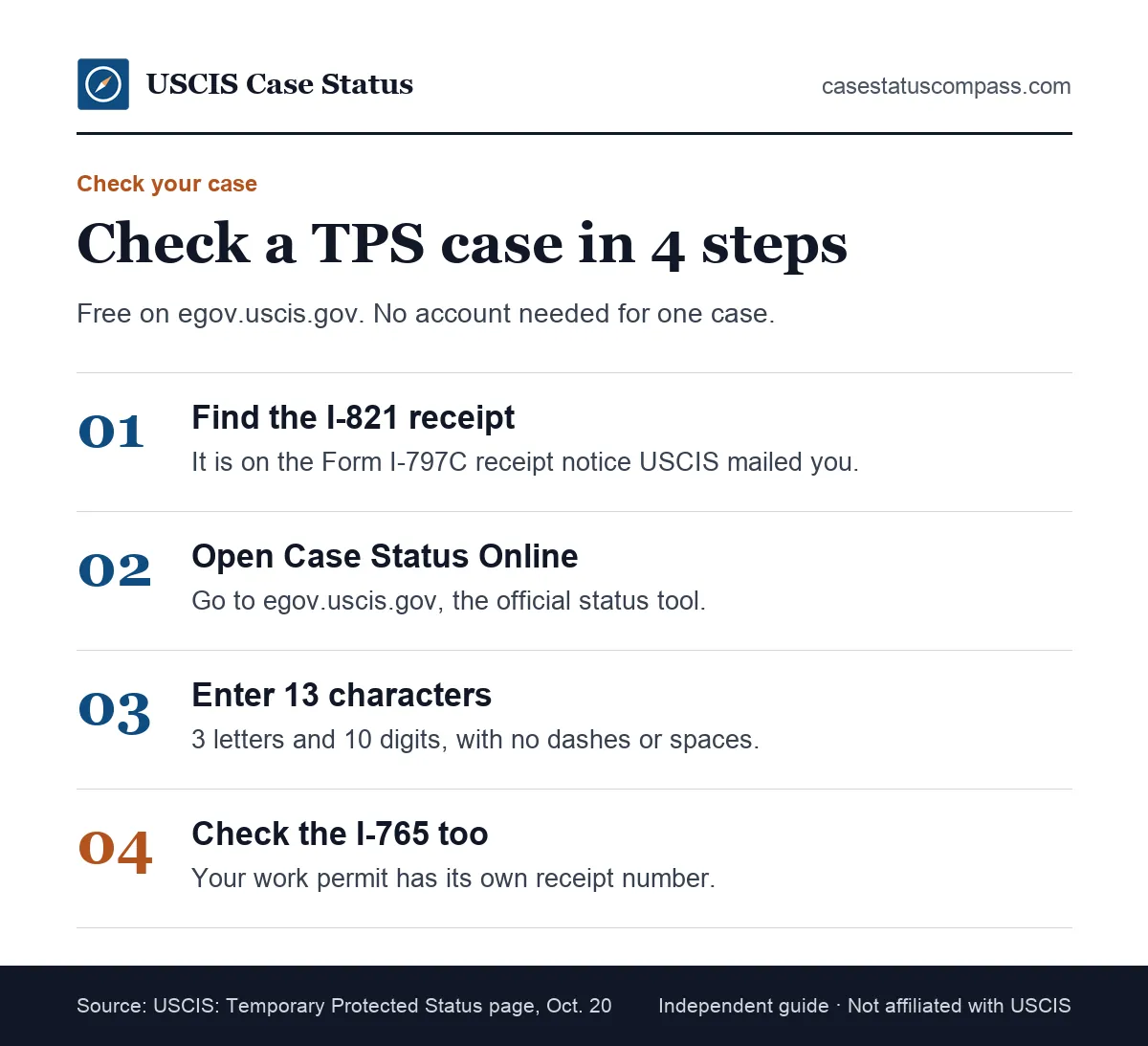
Type the 13-character receipt number from your Form I-821 notice into Case Status Online. The page shows the latest action, such as received, fingerprints taken or approved. No account or login is needed for this lookup. If you filed Form I-821 and Form I-765 together, check each receipt, because each form keeps its own TPS status history.
Step by step on Case Status Online
- Find the Form I-797C receipt notice for your I-821.
- Open Case Status Online: egov.uscis.gov.
- Enter the number as 3 letters + 10 digits (13 characters), e.g. EAC2512345678; leave out dashes.
- Read the status title and the paragraph under it.
- Repeat with the receipt number for your Form I-765.
Why your I-821 and I-765 show different updates
Your TPS application and work permit request are two separate cases. One can be approved while the other waits. It is common to see "Case Was Approved" on the I-821 while the work permit still shows review, or the reverse. Check both receipts before you call USCIS.
Can You Track a TPS Case in a USCIS Online Account?
Yes. A free USCIS online account shows your case history, notices and messages, and you can link a paper-filed TPS case to it. Create one at myaccount.uscis.gov/create-account. USCIS also lists Form I-821 among the forms with myProgress estimates. Each linked receipt then appears on one dashboard.
What myProgress shows for Form I-821
USCIS describes the feature as myProgress: personalized estimates in your USCIS online account (I-130, I-485, I-765, I-131, I-821, N-400, I-90). The estimate is personal but not a promise. It appears only if you filed online or linked a paper case with the online access code on your receipt notice.
Filing Form I-821 online
USCIS says Form I-821 can be filed online for eligible countries. You get an IOE receipt number at once, and every notice lands in your account. Our guide to the USCIS receipt number explains that format.
Can You Check TPS Status by Phone?
Yes. Call the USCIS Contact Center at 800-375-5283 (TTY: 800-767-1833). Live agents work Live calls and chat: Monday to Friday, 8 a.m. to 8 p.m. Eastern. Have your receipt number, A-Number and date of birth ready. Write down the date, time and what the agent told you.
When a phone call helps
Call if your receipt notice never came, if the status page shows an error, or if you missed biometrics. USCIS asks TPS filers to call when a receipt is late. Note any referral number you get.
When a call will not help
An agent cannot speed up a normal case or predict the decision. If you face an urgent humanitarian problem, ask about an expedite. Our page on the USCIS expedite request explains which reasons qualify.
Where Is the Receipt Number on a TPS Notice?
The receipt number sits in the top-left box of your Form I-797C, Notice of Action. Your I-821 and I-765 each get their own number, even when they arrive in one envelope. It starts with three letters, such as IOE for online filings, followed by ten digits. Enter it without dashes or spaces when you check your TPS status.
What the I-797C proves and does not prove
USCIS explains the notice this way: I-797C = Notice of Action (receipt, rejection, transfer, appointment, re-open); not proof of status by itself. For TPS, some notices extend an EAD, so read the text closely. A plain receipt does not, on its own, prove that you hold TPS.
Form I-821 Explained: The Core TPS Application
Form I-821, Application for Temporary Protected Status, is the form for a first TPS registration and for every later re-registration. USCIS requires the current edition (01/20/25 as of October 2026). Because one form serves both purposes, an early section asks whether this is an initial filing, a late initial filing or a re-registration. Ticking the wrong box can send the case down the wrong track.
What the form asks
The I-821 asks for your identity, nationality, entry date, past addresses and any arrests. It also asks about grounds of inadmissibility and asylum bars. Answer every question, because blank items can lead to a rejected package.
Using the current I-821 edition
An old edition is a common reason for rejection. Download Form I-821 from uscis.gov when you file, not from a saved copy, and check that every page shows the same edition date.
Who signs and who files
Each person files a separate I-821, including each child. TPS is not a derivative benefit, so a child cannot ride on a parent's form. A parent or legal guardian may sign for a child under 14, and each applicant's form carries its own fees.
Who Can File for Temporary Protected Status?
You can file if you are a national of a designated country, or a stateless person who last lived there, and you meet its continuous physical presence and continuous residence dates. You must file in an open period and avoid the criminal and security bars.
Nationality and identity
USCIS prefers a passport or national ID as primary evidence. Without one, it accepts secondary evidence, such as a birth certificate with photo ID, and sometimes affidavits. Every foreign-language document needs a certified translation into English.
Presence and residence dates
Both dates come from your country's Federal Register notice. Continuous residence looks back to an earlier date, while physical presence starts later. Brief, casual and innocent trips may not break them, but leaving without permission can.
Bars that stop eligibility
USCIS lists certain felony or multiple misdemeanor convictions, some inadmissibility grounds and the mandatory asylum bars. Some grounds can be waived with Form I-601. If any of these may apply to you, see an attorney before you file.
Initial Registration vs Late Initial Filing
An initial registration is a first I-821 filed in the country's initial period. A late initial filing is a first application made during a later extension, allowed only under listed conditions. Re-registration is a third path, used only by current TPS holders.
Initial, late initial and re-registration filings compared
Use this table to find which of the three filing types fits you before you fill in Form I-821.
| Filing type | Who uses it | Key condition |
|---|---|---|
| Initial registration | First-time applicant | Filed in the initial registration period |
| Late initial filing | First-time applicant during an extension | Fits a listed late-filing condition |
| Re-registration | Current TPS holder | Filed in the re-registration window |
Late filing conditions USCIS lists
Conditions include having been a nonimmigrant, having a pending benefit application, being a parolee, or being the spouse or child of an eligible person. The condition must exist when you register or have ended only recently. The TPS page gives the exact window.
A rule for children
A child of a currently eligible TPS holder may file late with no time limit if the child was unmarried and under 21 during a registration period. Include proof of the relationship, such as a birth certificate, and a copy of the parent's TPS approval.
What Is the Typical TPS Status Sequence?
A Form I-821 case usually moves from received, to biometrics, to review, and then to a decision. An evidence request can add a step. USCIS publishes no per-step timing, so the table shows the order and meaning, not promised dates.
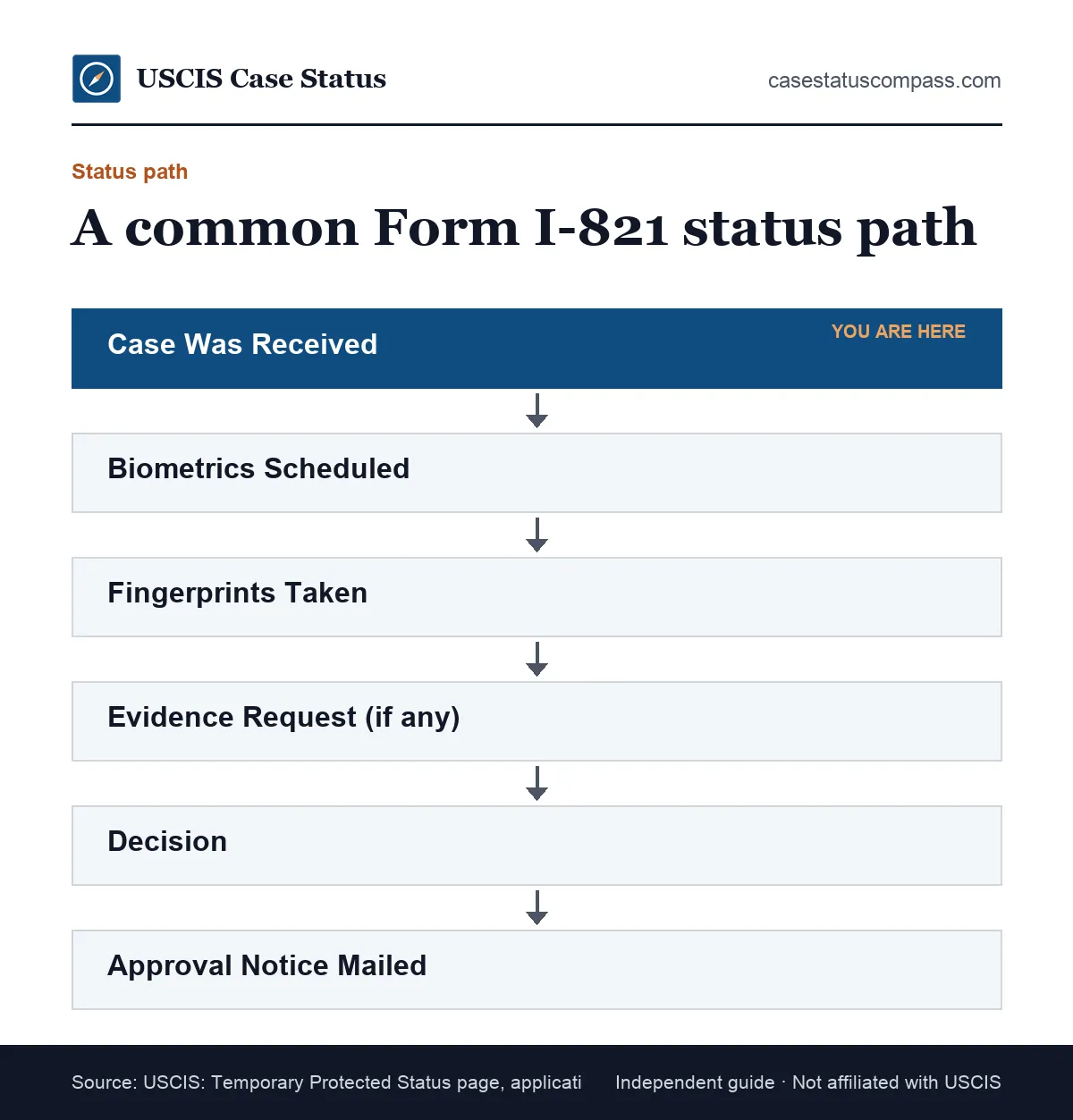
Form I-821 status updates table
Read across each row to see what an update means for your TPS status and the one action it calls for.
| Status you may see | What it means for TPS | Typical timing | What to do |
|---|---|---|---|
| Case Was Received | USCIS accepted your I-821 and fee | Usually the first update | Save the I-797C |
| Biometrics appointment notice | An ASC visit is coming | Early in the case | Watch your mail |
| Fingerprints Were Taken | Background checks are underway | After your ASC visit | Keep the appointment notice |
| Request for Evidence Was Sent | The officer needs more proof | Any time during review | Answer by the deadline |
| Case Was Approved | You have TPS for this period | Varies; check myProgress | Keep the approval notice |
| Case Was Denied | Your I-821 was not approved | Varies | Read the notice; get legal help |
Why some steps show no update
Background checks and officer review often happen with no new message online. If your case seems stuck far past the estimate, see our page on a case status that is not updating.
What Does "Case Was Received" Mean for a TPS Filing?
"Case Was Received" means USCIS accepted your Form I-821, gave it a receipt number and mailed a Form I-797C. It does not mean you have TPS yet. Protection and work authorization depend on the later decision. Keep the notice, because it is your proof of a timely filing.
If the received update never appears
A rejected package comes back with a rejection notice instead of a receipt. Common causes are an old edition, a missing signature or the wrong fee. If neither a receipt nor a rejection arrives, call the Contact Center with your mailing date and tracking number.
Refiling a rejected TPS package
A rejected filing counts as never filed, so refile fast while the window is open, fixing the exact cause named on the rejection notice. Our case was received page covers the general meaning.
TPS Biometrics Appointment
Most TPS filers get a notice to visit an Application Support Center (ASC) for fingerprints, a photo and a signature. TPS is unusual here: Biometrics included in most fees (separate $30 for TPS I-821 and some EOIR forms). Bring the notice and a photo ID.
Rescheduling the appointment
You can ask to reschedule before the appointment, online or by phone. The TPS page warns that missing biometrics without rescheduling can lead to a denial for abandonment. The appointment notice explains how to request a new date.
What happens after fingerprints
Your status may change to "Fingerprints Were Taken" while USCIS runs background checks. For re-registration, USCIS may reuse earlier biometrics. An arrest found in this check can lead to an RFE asking for court records. Our biometrics appointment guide explains the visit itself.
What If USCIS Sends a TPS Request for Evidence?
A Request for Evidence (RFE) means the officer needs more proof, most often about nationality, entry date or residence. Answer by the deadline printed on the notice. A missed deadline usually means USCIS decides with only what is already in the file.
Common TPS evidence requests
- Proof of nationality when a passport was missing
- Proof of residence since the required date
- Court records for any arrest, even if dismissed
- Certified translations of documents already sent
- Proof of your entry date, such as an I-94 record or dated records
How to answer well
Put the RFE cover page on top. Send copies unless USCIS asks for originals. Label each document by the item it answers. If the request concerns a criminal record, talk to a lawyer first.
What Does a TPS Approval Look Like?
A TPS approval arrives as a Form I-797 approval notice for the I-821 and, if requested, a separate EAD card. Your online status changes to "Case Was Approved." The approval covers only the current designation period. Your TPS status online then stays on that approval until your next re-registration.
Reading the approval notice
Check your name, date of birth, A-Number and country. The notice states the validity period of your TPS. Mistakes cause trouble at work and at re-registration, so ask USCIS to fix any typo quickly.
What an approval does not change
Approval does not move your country's end date. If DHS later ends the designation, your TPS ends on the date in that notice. It also does not grant a green card, count as an admission for adjustment or allow travel without separate permission.
TPS Re-registration
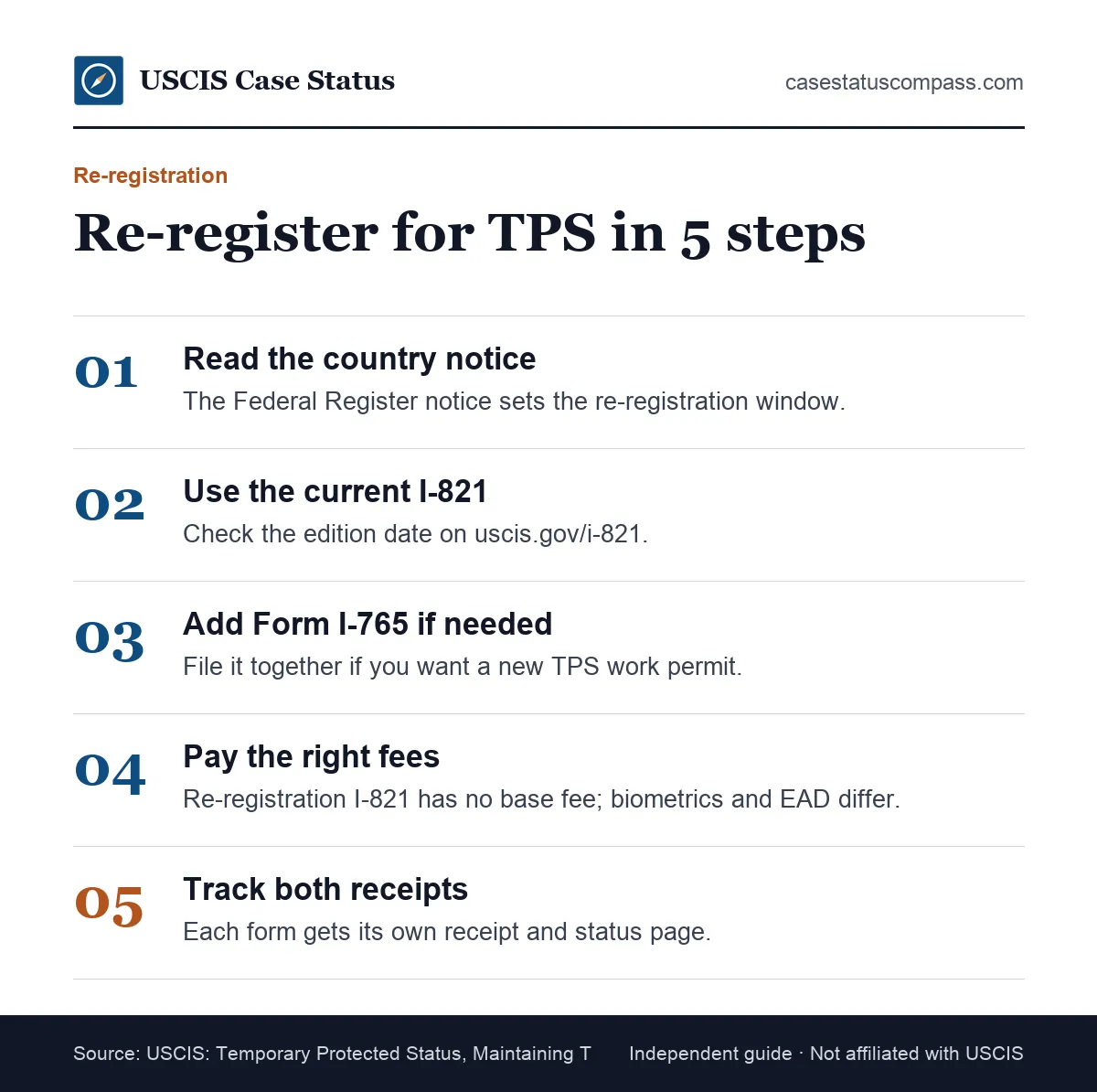
TPS re-registration keeps your protection when DHS extends a designation. You file a new Form I-821 during the window set in the Federal Register notice. USCIS says every beneficiary must re-register each period, even people granted TPS by a judge.
When the window opens
The window opens on the date the Federal Register notice sets, often soon after an extension. Mark the start and end dates on your calendar. Filing early in the window leaves time to fix a rejection before it closes.
What to file at re-registration
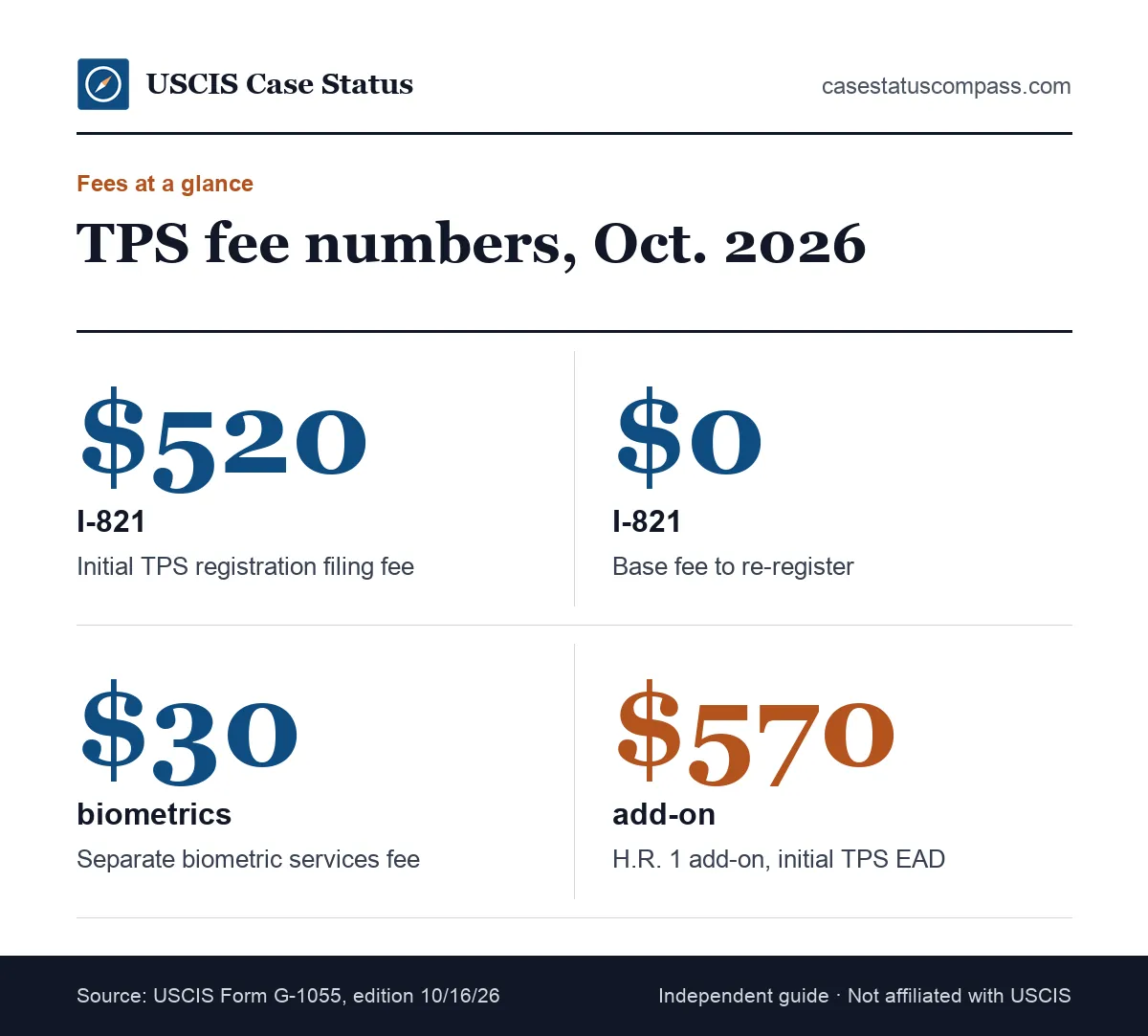
File Form I-821 with the biometrics fee, and Form I-765 if you want a new work permit. As of the Oct. 16, 2026 fee schedule, the TPS amounts are: Initial: $520 + $30 biometrics; re-registration: $0 + $30 biometrics (the TPS EAD is a separate fee).
Online or by mail
USCIS allows online filing of Form I-821 for eligible countries. If you mail it, use the address on your country page, since TPS addresses differ from most forms. Check that page each period, because filing locations can change.
Do You Have to Re-register for TPS Every Period?
Yes. A TPS holder must re-register in every re-registration period. Skipping one can cost both TPS and work authorization. Each window comes from a new Federal Register notice, so your TPS status lasts only as long as your latest approved filing. Even if a court order or an EAD extension covers you, file in the open window unless your country page says otherwise.
What happens if you do nothing
If you miss the window, USCIS may withdraw your TPS. Your work permit then expires on its printed date with no link to the new period. You may also lose the protection from removal that TPS gives.
If your country is not extended
When DHS terminates a designation instead of extending it, there is no re-registration. Your TPS ends on the date in the termination notice. There is no new I-821 to file, so use the time before that date to plan your next step with an attorney.
Late Re-registration and Good Cause
USCIS may accept a late re-registration if you show good cause for missing the window. File Form I-821 as usual and add a letter explaining the delay, with proof. Acceptance is not automatic, and work authorization may lapse meanwhile. File as soon as the cause ends.
What counts as good cause
USCIS decides case by case. Reasons people cite include serious illness, hospitalization or a lost package. Attach medical letters or tracking records. Vague reasons, such as being busy, rarely persuade an officer.
Writing the good-cause letter
State the window dates, why you missed them and when the problem ended. Sign it and attach the proof, such as hospital records or a carrier's tracking history. Keep it to one page.
TPS and Work Permits
A TPS work permit is an EAD approved on Form I-765, usually under category (a)(12) after a grant or (c)(19) while an initial case is pending. USCIS accepts only the 08/21/25 (the 09/15/26 edition is NOT accepted because of a Sept. 14, 2026 court order) edition. Our work permit guide covers the form itself.
Which category goes on the form
Use (a)(12) if you already hold TPS, or (c)(19) if your first I-821 is pending and USCIS found you prima facie eligible. The wrong category can delay the card, so read the current instructions first.
EAD fees under H.R. 1
Since the Oct. 16, 2026 fee schedule, a TPS EAD costs the Form I-765 base fee plus an H.R. 1 add-on of $570 for an initial card or $280 for a renewal. These add-ons cannot be waived and change yearly.
Filing together vs separately
Filing the I-765 with the I-821 starts both cases at once. Filing later is allowed but never makes the card come sooner. If you file the I-765 on its own, attach a copy of your I-821 receipt or approval notice so USCIS can link the two cases.
How Long Is a TPS Work Permit Valid?
Under H.R. 1, a TPS work permit lasts no more than one year or your TPS period, whichever is shorter. Check the "Card Expires" date on the front of your EAD. Older cards may show a longer date. Your TPS status and your EAD can therefore end on different dates.
Why a shorter card matters
A one-year limit means more renewals and more chances for a gap. Put the expiration date in your phone and file the I-765 early in each window. Late filing is the top cause of lost work time.
When the designation ends first
If your country's TPS ends before the date on your card, work authorization generally ends with it. Termination notices explain what happens to EADs, so read yours instead of trusting the date printed on the card.
Are TPS Work Permits Automatically Extended?
Sometimes. The general rule changed: Ended: renewals filed on or after Oct. 30, 2025 no longer get the up-to-540-day automatic extension (exceptions: TPS by law/Federal Register notice; STEM OPT 180 days). TPS is an exception, because a country's Federal Register notice can extend TPS EADs. Our EAD automatic extension guide explains the wider rule.
How to tell if your card is extended
Look for a Federal Register notice for your country that names your category and card date, or a Form I-797 notice that states an extension. Otherwise, the printed date controls.
Showing an extended TPS EAD to an employer
For Form I-9, an expired TPS card plus the extension notice can prove work authorization. Print the notice for HR and point them to your country page if they question it.
When to get help
If your card is about to expire and the notice is unclear, ask an attorney or a DOJ-accredited representative. Guessing wrong can mean working without authorization, which can hurt later applications and your record.
TPS Fees in the October 2026 Fee Schedule
Under Form G-1055, Edition 10/16/26, effective Oct. 16, 2026, an initial Form I-821 costs $520 plus a $30 biometrics fee, and re-registration costs $0 plus that biometrics fee. The TPS work permit is billed separately. See our USCIS fees page for the full tables.
Fee waivers for TPS
USCIS accepts Form I-912 fee waiver requests for some TPS fees, such as the biometric services fee. The H.R. 1 add-ons on the work permit cannot be waived. File Form I-912 with your package and attach proof, such as a benefits letter or income records.
How Long Does TPS Processing Take?
USCIS publishes no single fixed time for Form I-821. Check the official tool at egov.uscis.gov/processing-times and your myProgress estimate. The tool lists times by country and filing type; right now, TPS cases take 7 to 25 months, depending on category and office (USCIS data retrieved Oct 27, 2026).
What tends to slow a TPS case
Missing evidence, unanswered RFEs, missed biometrics and name mismatches cause most delays. Answering every RFE in full and keeping your address current avoids adding weeks. Our USCIS processing times hub explains how to read the official tool.
Can You Travel While on TPS?
Only with travel authorization obtained before you leave. USCIS issues it through Form I-131, and TPS holders receive Form I-512T. Leaving without it may cost you TPS and your way back in. Pending applicants need advance parole instead. Apply well before any planned trip.
Risks before you book
Travel authorization does not guarantee re-entry, because CBP still inspects you. Talk to an attorney before any trip. Our advance parole page covers the Form I-131 process. Carry the original document with you.
Travel while a first I-821 is pending
A pending initial applicant does not yet hold TPS, so the I-512T route does not apply. Advance parole on Form I-131 is the pending-case option. It carries the same re-entry risks, so get legal advice before you leave.
Does TPS Lead to a Green Card?
No. USCIS says TPS does not lead to permanent residence. Some TPS holders get green cards through a separate basis, such as a family or job petition. TPS does not block those filings. Your TPS status can keep you protected while that separate case is pending.
Family petitions
A U.S. citizen or permanent resident relative may file for you. Our guide to the I-130 petition covers that first step. Whether you can adjust inside the country depends on how you entered, so get legal advice.
Why entry history matters
In 2021 the Supreme Court held that a TPS grant alone is not an "admission" for adjustment of status. People who entered without inspection may need another basis or consular processing.
Later steps for green card holders
If you later become a permanent resident, new forms follow: a green card renewal every ten years and, later, a citizenship application. TPS time does not count as permanent residence.
TPS vs Asylum vs DACA: What Is the Difference?
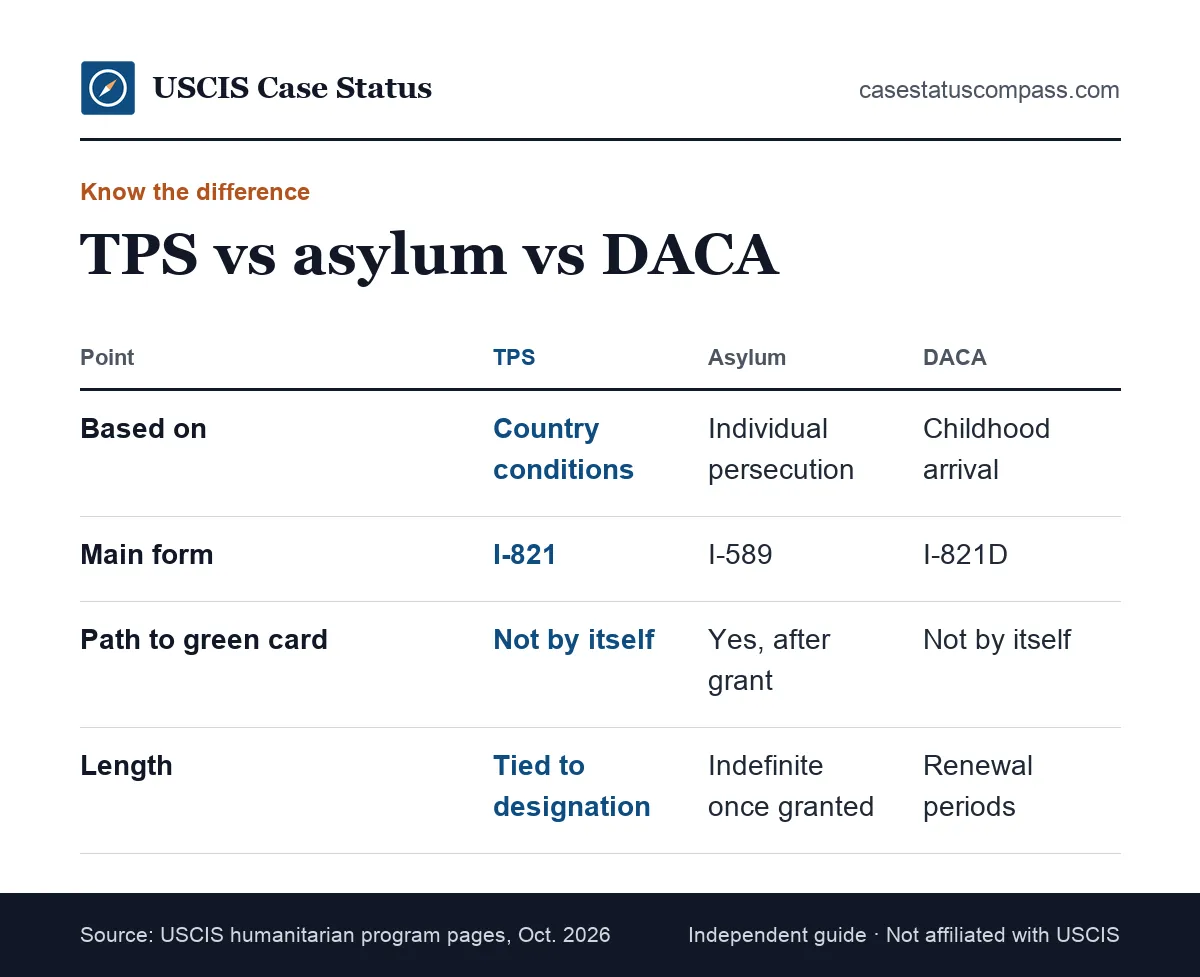
TPS rests on conditions in your country, asylum on persecution you personally face, and DACA on arriving as a child. Each uses a different form and gives different protection. TPS can even pause the one-year asylum filing clock. Some people qualify for more than one.
TPS, asylum and DACA side by side
Each row compares one feature across the three programs, so you can see which forms and protections apply to you.
| Question | TPS | Asylum | DACA |
|---|---|---|---|
| What is it based on? | Country designation | Fear of persecution | Arrival as a child |
| Main USCIS form | I-821 | I-589 | I-821D |
| Work permit | Yes, on I-765 | Possible while pending | Yes, on I-765 |
| Green card path | Not by itself | Yes, after a grant | Not by itself |
| Can it end? | When the designation ends | Rarely, after a grant | If renewals stop |
Where to learn more about each
For a protection claim, our asylum status guide explains the I-589 process. For DACA, see the DACA status page. Many people hold TPS while an asylum claim is pending; each case keeps its own receipt number and updates, so track both separately.
What Happens to Your TPS Status When a Designation Ends?
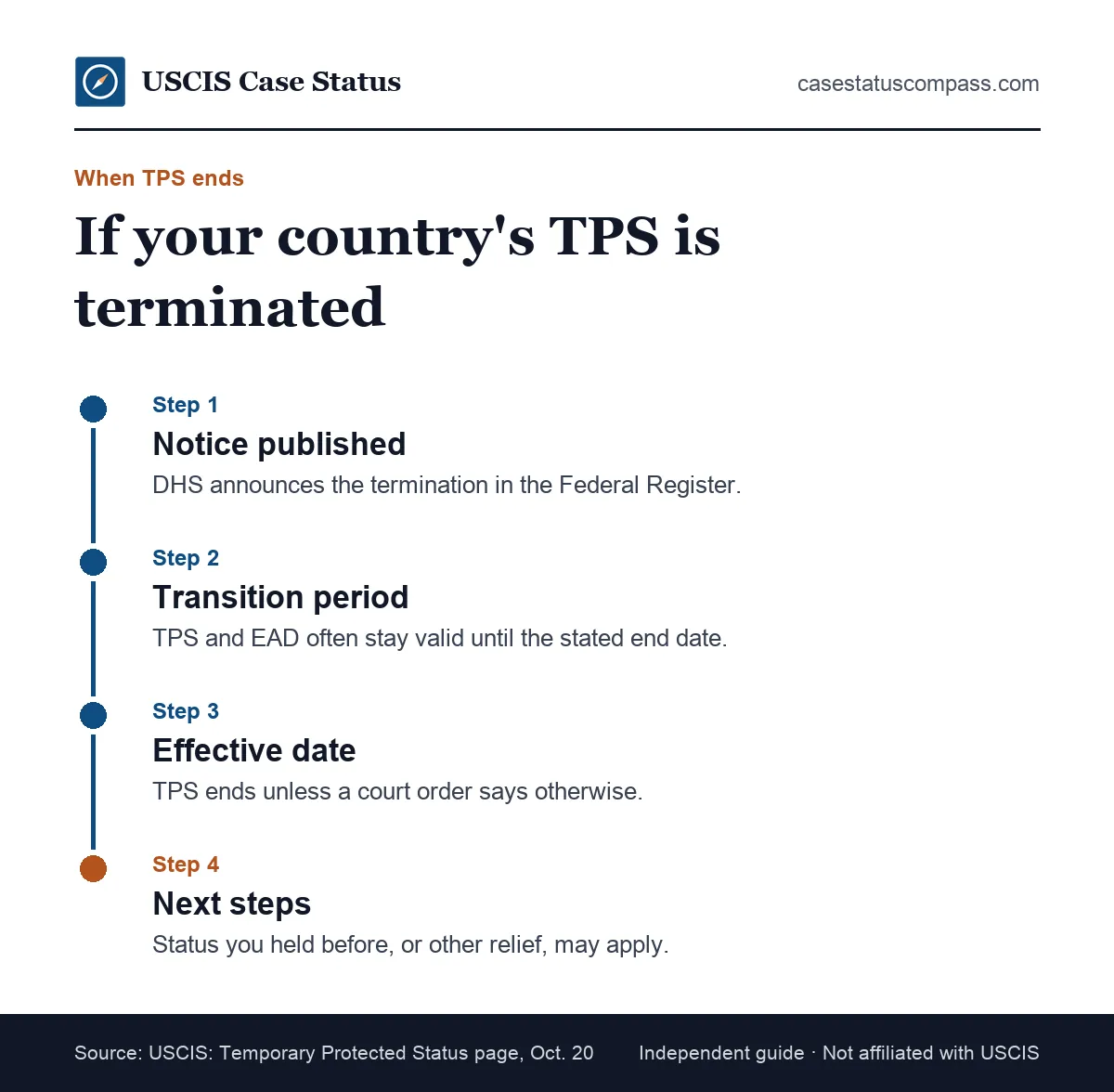
When DHS terminates a designation, your TPS status ends on the effective date in the Federal Register notice, unless a court order says otherwise. TPS work permits generally end then too. Check the notice for any transition period for EADs and for how pending re-registrations will be handled.
What you may fall back on
If you held another status before TPS and it is still valid, you may return to it. A pending application, such as asylum or adjustment, continues. People with no other basis may face removal proceedings.
Planning before the end date
Gather records, ask an attorney about other options and list any pending cases. Our immigration court case status page explains how to see whether a court case exists. Start as soon as a Federal Register notice names an end date for your country.
What If a Court Case Affects Your Country?
Several 2025 and 2026 terminations were challenged in federal court, and some were paused and later allowed to proceed. When an order affects a country, USCIS posts an alert on its page. Trust that page and the Federal Register over headlines.
How to follow a court-affected case
Check your country page weekly while litigation is active. Read the full alert, including any Form I-9 notes for employers. Ignore "extension" rumors on social media. Save a copy of each alert you rely on.
TPS Granted by an Immigration Judge
An immigration judge or the Board of Immigration Appeals can grant TPS in court. That person must still re-register with USCIS in every later period. Keep certified copies of the order, since you attach it to USCIS filings, and use the same A-Number on every form so both records match.
How to file after a court grant
The USCIS TPS page has instructions for people granted by a judge. Usually you file a re-registration I-821 with USCIS, not the court, and attach the judge's order so USCIS can link your history.
Checking the court side
Your court record and USCIS record are separate systems. Use your I-821 receipt number online for the USCIS side. For the court side, the Justice Department's EOIR runs its own automated tools, linked from our court status page.
What Happens If Your TPS Application Is Denied?
A denial notice says whether you can appeal to the Administrative Appeals Office (AAO) and by what deadline. You may also file a motion on Form I-290B. If you are in removal proceedings, you may ask a judge to review TPS.
First steps after a denial
Read the reason and note the deadline at once. Do not refile without advice, since a new I-821 may not fix the problem. Our case was denied page explains the general meaning of that status.
Get help fast
Denials often involve criminal history, missed biometrics or evidence gaps. A lawyer or accredited representative can say whether an appeal, a motion or a new filing fits. Meeting the appeal deadline matters most.
Common TPS Status Problems and Fixes
Most TPS problems trace to a late filing, a missing receipt, an expiring work permit or two receipts that disagree. The table matches each problem to a first fix. Check both your I-821 and I-765 receipts first, since many issues affect only one case.
TPS problem-and-fix table
Find the row that matches what you see, then try the first fix before calling USCIS.
| Problem | Likely cause | First fix |
|---|---|---|
| No receipt notice | Mail delay or rejection | Call 800-375-5283 |
| I-821 approved, no EAD | I-765 still pending | Check the I-765 receipt |
| EAD about to expire | Late renewal | File I-765; read country notice |
| "Case not found" online | Typo in receipt number | Retype without dashes |
| Missed biometrics | Notice lost in mail | Ask to reschedule at once |
When to send an e-Request
USCIS offers online e-Requests for set issues, such as a notice that never arrived or a typo on a card. Use one only after you confirm that your problem fits a listed category, and save the confirmation number.
When to escalate further
If your case is far past the posted estimate and USCIS cannot help, the CIS Ombudsman or your member of Congress may step in. Our USCIS ombudsman page explains how those requests work.
How Do You Update Your Address for a TPS Case?
Report a move to USCIS within 10 days with the online change-of-address tool. A wrong address can mean a lost biometrics notice, a lost EAD or a missed RFE. USCIS treats address updates as part of maintaining TPS. Your receipt numbers stay the same.
What to update and where
Update every pending case, including the I-821 and the I-765. Our USCIS change of address guide walks through the steps, and mail forwarding is a sensible backup. Without updates, USCIS mails notices to the old address.
A separate update for immigration court
For a court case, you must also tell the immigration court or BIA within five working days on Form EOIR-33, or online through Respondent Access. USCIS and the court keep separate records, so one change of address does not update the other.
TPS Filing Checklist You Can Copy
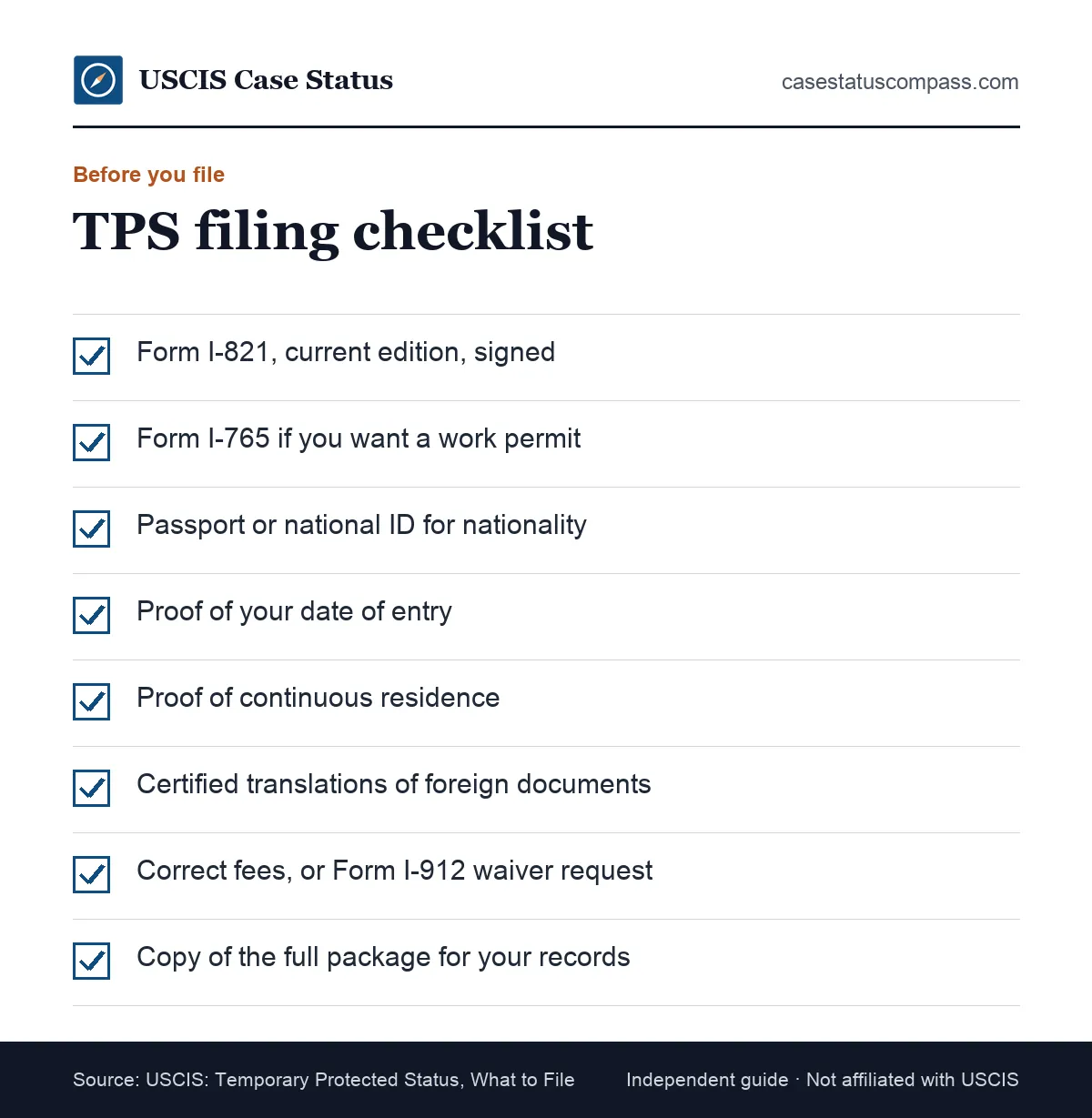
Use this TPS filing checklist before an initial filing or re-registration. Copy it into a notes app and tick each line. It covers the form, evidence, fee and copy steps where packages commonly go wrong. Add your own items, such as a child's separate I-821 or court papers, and keep the list with your copy of the filing.
The copyable list
- Current Form I-821, signed, every page from the same edition
- Form I-765 with the right category, if you want a work permit
- Passport or national ID copy
- Proof of entry date and continuous residence
- Certified English translations
- Correct fees or a Form I-912 request
- Federal Register notice dates written down
- Full photocopy of the package
Mistakes That Put TPS at Risk
The costliest TPS mistakes are filing after the window, skipping a re-registration, using an old form edition, traveling without permission and glossing over a criminal record question. Each can cost your protection or your job. Most are easy to prevent with a last check.
Small errors with big costs
- Signing in the wrong box, or not at all
- Choosing the wrong EAD category
- Combining fees that must be paid separately
- Forgetting a child's own I-821
- Listing an address you no longer use
Check before you trust a preparer
Only an attorney or a DOJ-accredited representative can give legal advice. "Notarios" and unlicensed preparers often make these errors. If someone fills out your form, read every answer before you sign.
When Should You Talk to an Immigration Attorney About TPS?
See an immigration attorney or a DOJ-accredited representative before filing if you have any arrest, a past removal order, trips abroad or a possible other status. Get help too when your country's designation is ending or in litigation. A short consultation before filing is cheaper than fixing a denial.
Where to find low-cost help
USCIS links to free and low-cost legal providers on its TPS page. The Justice Department keeps a roster of recognized organizations and accredited representatives, and many hold TPS clinics around each window.
Questions to ask at a consultation
Ask whether you qualify for another benefit, how your entry affects future options, and what to do if TPS ends. Bring every notice. A good adviser puts fees in writing.
How Can You Avoid TPS Scams?
Use only official USCIS sites, pay fees only to USCIS, and walk away from anyone promising a guaranteed result. TPS scams spike after each Federal Register notice. USCIS never asks for gift cards, wire transfers or payment over social media.
Red flags to watch for
- Fake "registration" sites that charge a fee
- Calls or texts claiming to be USCIS
- Promises of a green card through TPS
- Requests to sign a blank form
- Pressure to file before you have read your country's notice
What to do if targeted
Stop contact and keep the messages. Report the scam through the channels USCIS lists. Our USCIS scams guide and our page on how to verify a USCIS notice show what genuine contact looks like.
Documents to Keep After a TPS Decision
Keep every approval notice, every Form I-797C, each TPS EAD, your country's Federal Register notice and any travel authorization. These TPS records prove your history at the next re-registration, at work and for any later benefit. Your TPS status history is only as strong as these papers.
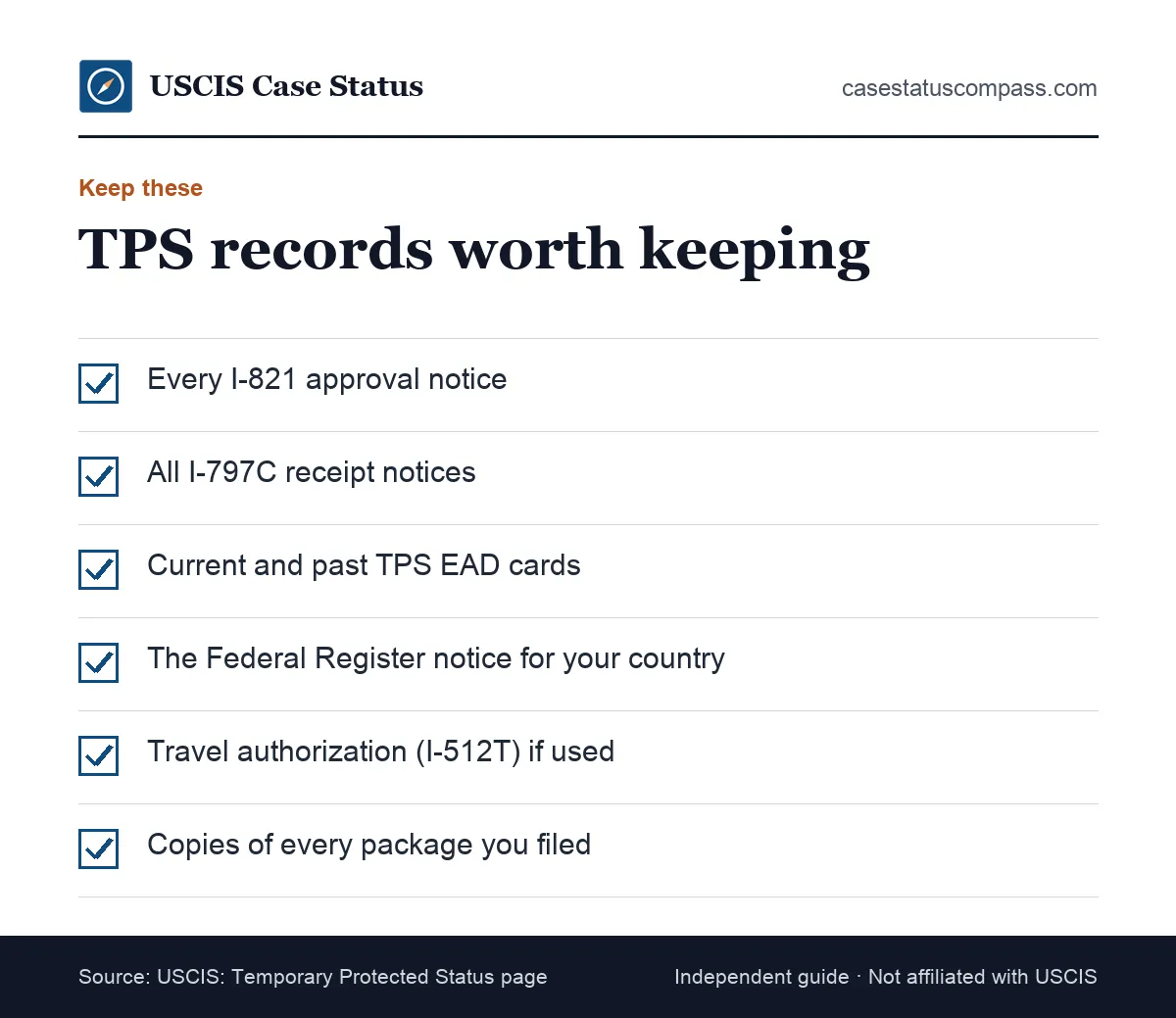
How to store them
Keep originals in a waterproof folder and scans in a secure cloud folder. Replacing lost notices takes months and fees, so take the folder with you when you move. Never mail originals unless USCIS asks.
Records employers and officers ask for
Employers checking Form I-9 need the EAD and any extension notice. At re-registration and for any later green card case, your earlier approval notices show the TPS history officers review.
Frequently Asked Questions
What does my TPS status show on Case Status Online?
Case Status Online shows the latest action on your Form I-821, such as received, fingerprints taken, approved or denied. It does not show whether your country is still designated; the USCIS TPS page does. Your work permit request has its own receipt number and its own update.
Can I apply for TPS if my country is not on the list?
No. You can apply only if your country is currently designated and a registration period is open, or you meet the late-filing rules. As of Oct. 20, 2026, USCIS listed El Salvador, Lebanon, Sudan and Ukraine.
Can I get TPS if I am already in removal proceedings?
Often, yes. People in proceedings may still file Form I-821 with USCIS, and an immigration judge can also consider TPS. Speak with an immigration attorney or DOJ-accredited representative before you file.
Do I need a new receipt number for each re-registration?
Yes. Each re-registration Form I-821 is a new filing with a new receipt number, and so is each new Form I-765. Keep the old notices as proof of your TPS history.
Can TPS holders apply for asylum?
Yes. USCIS says TPS holders may still apply for asylum, and TPS can stop the one-year asylum filing clock. Asylum is a separate Form I-589 claim with its own bars.
What happens to my TPS if I move to another state?
Your TPS stays valid after a move within the United States. Update your address with USCIS for every pending case so notices and cards reach you. For a later paper re-registration, use the filing address listed for your country.
Can my child get TPS through me?
No. TPS has no derivative status, so a child files a separate Form I-821 and must qualify alone. USCIS lets some children of TPS-eligible parents file late with no time limit if they were unmarried and under 21 during a registration period.
Can I file for TPS late?
Only in limited cases. A first-time applicant may make a late initial filing during an extension if a listed condition applies, such as a pending benefit application. A current holder who missed re-registration must show good cause.
Does TPS status let me travel abroad?
Only with travel authorization approved before you leave, issued through Form I-131. Leaving without it can end your TPS. Even with it, CBP still inspects you on return, so see an attorney first.
Is my TPS work permit valid if my I-821 is still pending?
It depends on the card and any notice covering it. A pending initial applicant may get a (c)(19) EAD if USCIS finds prima facie eligibility. For renewals, check whether a Federal Register notice or your Form I-797 extends the card.
Sources
- USCIS: Temporary Protected Status. www.uscis.gov/humanitarian/temporary-protected-status. Accessed Oct 27, 2026.
- USCIS: Form I-821, Application for Temporary Protected Status. www.uscis.gov/i-821. Accessed Oct 27, 2026.
- USCIS: Form I-765, Application for Employment Authorization. www.uscis.gov/i-765. Accessed Oct 27, 2026.
- USCIS: Automatic Employment Authorization Document (EAD) Extension. www.uscis.gov/working-in-the-united-states/information-for-employers-and-employees/automatic-employment-authorization-document-ead-extension. Accessed Oct 27, 2026.
- USCIS Form G-1055 Fee Schedule (Edition 10/16/26). www.uscis.gov/sites/default/files/document/forms/g-1055.pdf. Accessed Oct 27, 2026.
- USCIS: Case Status Online. egov.uscis.gov/. Accessed Oct 27, 2026.
- Federal Register: TPS notices. www.federalregister.gov/. Accessed Oct 27, 2026.
- USCIS processing times. egov.uscis.gov/processing-times/. Accessed Oct 27, 2026.
- USCIS: Checking Your Case Status Online. www.uscis.gov/tools/checking-your-case-status-online. Accessed Oct 27, 2026.
- USCIS: Online Account and Technical Support. www.uscis.gov/tools/uscis-tools-and-resources/online-account-and-technical-support. Accessed Oct 27, 2026.
- USCIS alert: USCIS Expands myProgress to Form I-485 and Form I-821 (Nov. 21, 2023). www.uscis.gov/newsroom/alerts/uscis-expands-myprogress-to-form-i-485-and-form-i-821. Accessed Oct 27, 2026.
- USCIS Contact Center (uscis.gov). www.uscis.gov/contactcenter. Accessed Oct 27, 2026.
- USCIS: Form I-797 Types and Functions (updated 01/24/2025). www.uscis.gov/forms/filing-guidance/form-i-797-types-and-functions. Accessed Oct 27, 2026.
- USCIS Fee Schedule (Form G-1055). www.uscis.gov/g-1055. Accessed Oct 27, 2026.
- DOJ EOIR: Update Respondent or Alien Information (updated May 18, 2026). www.justice.gov/eoir/update-respondent-or-alien-information. Accessed Oct 27, 2026.
casestatuscompass.com is an independent publication and is not affiliated with USCIS or any government agency. This page is general information, not legal advice. For denials, court or asylum matters, consult an immigration attorney or a DOJ-accredited representative.