Contents · 38 sections
- What Is Form I-485?
- Who Can File an AOS Application?
- What AOS Requirements Must You Meet?
- Change of Status vs Adjustment of Status: What Is the Difference?
- Can You Go From a Visitor Visa to a Green Card?
- What Is the Difference Between I-130 and I-485?
- Which Forms Go in an AOS Packet?
- AOS Packet Checklist You Can Copy
- How Do You Assemble the AOS Package?
- Which I-485 Edition Must You Use?
- Can You File Form I-485 Online?
- Where to File AOS: Finding the Filing Address
- When Can You File Form I-485?
- Concurrent I-130 and I-485 Filing
- Can an I-485 Be Approved Before the I-130?
- What Happens After You File Form I-485?
- I-485 Case Status Steps in Order
- What Happens at the Biometrics Appointment?
- What Does an RFE on an AOS Application Mean?
- AOS Interview: What to Expect
- What If There Is No Decision After the I-485 Interview?
- What Does I-485 Approved Mean?
- What Happens After Your I-485 Is Approved?
- Can You Work While Your I-485 Is Pending?
- Can You Travel While Your I-485 Is Pending?
- I-485 Processing Time and Fee: Summary
- What Are the Most Common I-485 Mistakes?
- Why Do I-485 Applications Get Rejected or Denied?
- What Does "AOS Applicant" Mean?
- Can Family Members Be Included in Your I-485?
- How Do PERM and I-140 Fit Into Employment-Based AOS?
- How Is a Marriage-Based AOS Different?
- What Is INA 245(i) and Who Needs Supplement A?
- What Is the Medical Exam for Form I-485?
- Who Needs the Affidavit of Support?
- Real-World AOS Scenarios
- If X, Do Y: I-485 Decision Table
- Frequently Asked Questions
The short answer
Form I-485 is the USCIS application you file to become a permanent resident without leaving the United States. The process is called adjustment of status (AOS). You can file an I 485 only if an immigrant category, such as family or employment, makes you eligible and a visa number is available.
At a glance
| Official name | Application to Register Permanent Residence or Adjust Status |
| Edition required | 09/18/26 (01/20/25 and 09/04/26 editions rejected on/after Sept. 18, 2026; no grace period) |
| Filing fee | $1,440 (paper) / $1,390 (online); $950 / $900 if under 14 and filing with a parent |
| Who decides | USCIS, after biometrics and often an interview |
| End result | A green card (Form I-551) mailed to you |
What Is Form I-485?
Form I-485 is the application a person already in the U.S. uses to ask USCIS for a green card. It records your history and your answers to the admissibility questions, and it opens the adjustment of status case. It does not create eligibility by itself: you need a basis such as an approved or pending petition, asylum or refugee status, and an approval ends with permanent residence.
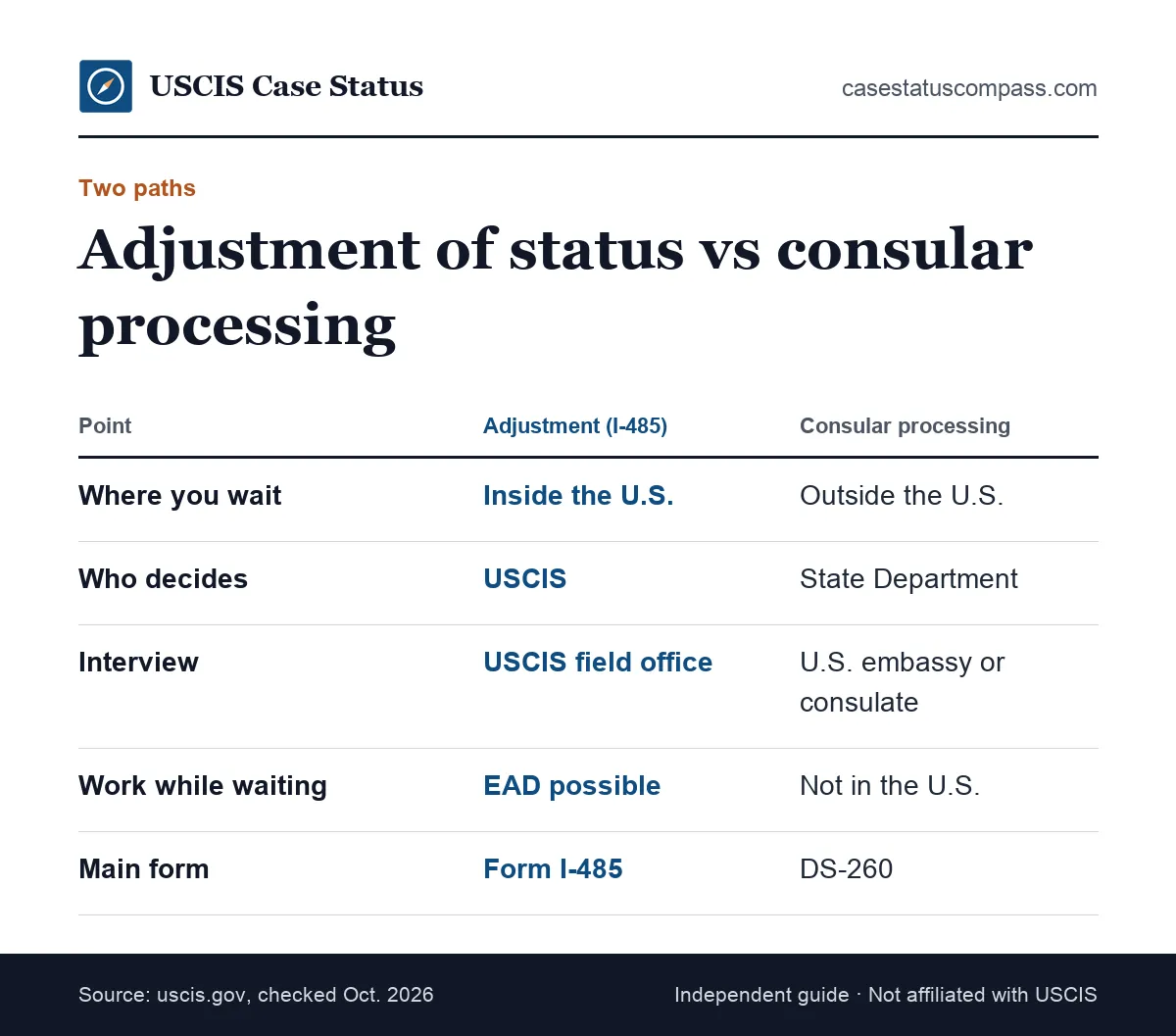
Adjustment of status vs consular processing
A green card case ends in one of two ways. Adjustment of status happens inside the U.S., and USCIS decides it. Consular processing happens abroad, where the immigrant interviews at a U.S. embassy and becomes a resident on arrival.
What "AOS" means in immigration
AOS immigration is shorthand for adjustment of status. Forums and attorneys say "AOS application," "AOS package" or "AOS case." Each one means the same thing: the adjustment form plus its supporting forms and evidence, filed with USCIS for a green card AOS decision.
Who Can File an AOS Application?
You can file an AOS application if you are physically in the U.S. and fit an immigrant category that allows adjustment. The main groups are family-based, employment-based, humanitarian and special immigrants. Most also need a lawful entry and a visa number available on the filing date.
Family-based adjusters
Spouses, unmarried children under 21 and parents of adult U.S. citizens are immediate relatives, and they never wait for a visa number. Married children, siblings and spouses of green card holders are in preference categories and must wait until their priority date is current.
Employment-based adjusters
Workers usually reach adjustment after an employer petition. Many categories begin with a labor certification, covered in our perm case status guide, and then a Form I-140 approval. When the priority date is current, the worker and family file their own applications.
Humanitarian and special categories
Refugees and asylees adjust after the waiting period set by law. Other routes cover Special Immigrant Juveniles, certain Afghan and Iraqi special immigrants, U and T visa holders, VAWA self-petitioners and Cuban Adjustment Act cases. Several pay no filing fee under Form G-1055.
What AOS Requirements Must You Meet?
The core AOS requirements are a qualifying category, presence in the U.S., an available visa number and admissibility. Many family and job applicants must also show they were inspected and admitted or paroled and kept lawful status. Exceptions exist, so read the bars and waivers carefully.
Lawful entry and inspection
Your Form I-94 record usually proves how you entered. Most categories cannot adjust after an entry without inspection. Immediate relatives of citizens are often forgiven for overstaying or unauthorized work, but not for an uninspected entry. Old petitions may help through INA 245(i).
Admissibility and bars to adjustment
The form asks many yes/no questions about crimes, immigration violations, security and public charge. A "yes" does not always mean denial, but it may need a waiver. With any arrest, removal order or past visa problem, see an immigration attorney or DOJ-accredited representative first.
Change of Status vs Adjustment of Status: What Is the Difference?
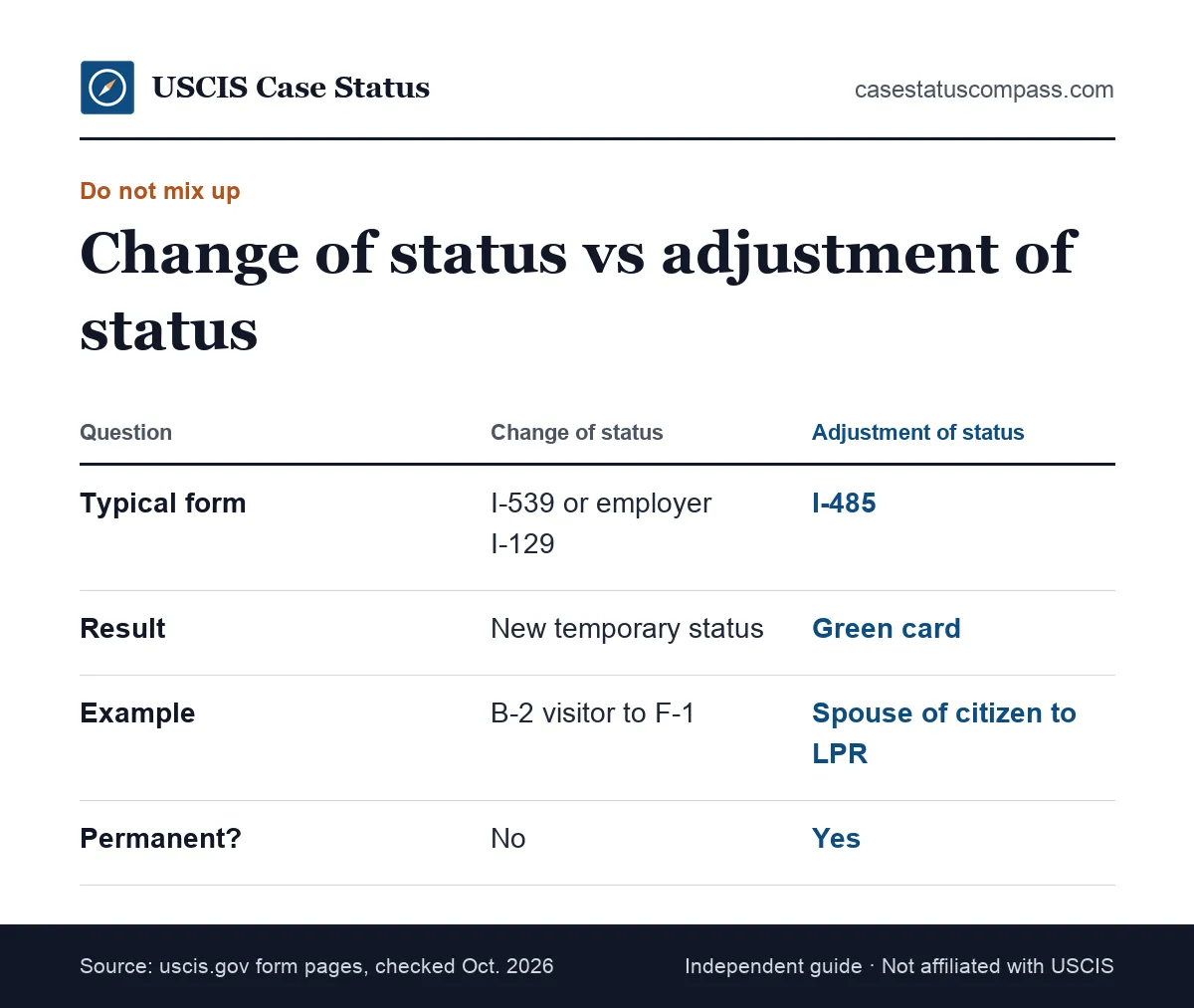
A change of status moves you from one temporary (nonimmigrant) status to another, such as visitor to student. Adjustment of status moves you to permanent residence. People search for a "change of status form" when they mean either one, so confirm the result you need first.
When the change of status form is right
For most individuals the change of status application is Form I-539; employers use Form I-129 for workers. It keeps you temporary, for example a tourist who wants to study. An immigration change of status never produces a green card by itself.
When adjustment is right
Choose AOS when a permanent path already exists: a family petition, an approved employer petition, an asylum grant or another listed category. A visa change of status USA search often hides a green card goal, and then adjustment is the correct route.
Can You Go From a Visitor Visa to a Green Card?
Yes. A change of status from visitor visa to green card is possible through adjustment if you have an eligible category, most often marriage to a U.S. citizen. The risk is intent: entering as a visitor while already planning to immigrate can look like misrepresentation to the officer.
The intent question
A visitor visa requires a plan to leave. If you marry and file soon after arrival, the officer may ask when you decided to stay. Honest, consistent answers matter most, and dated records showing that plans changed after arrival help explain the timeline.
What Is the Difference Between I-130 and I-485?
The difference between I-130 and I-485 is who asks for what. A U.S. citizen or green card holder files Form I-130 to prove a family relationship. The immigrant files Form I-485 to ask for the green card. Family cases need both, together or in sequence.
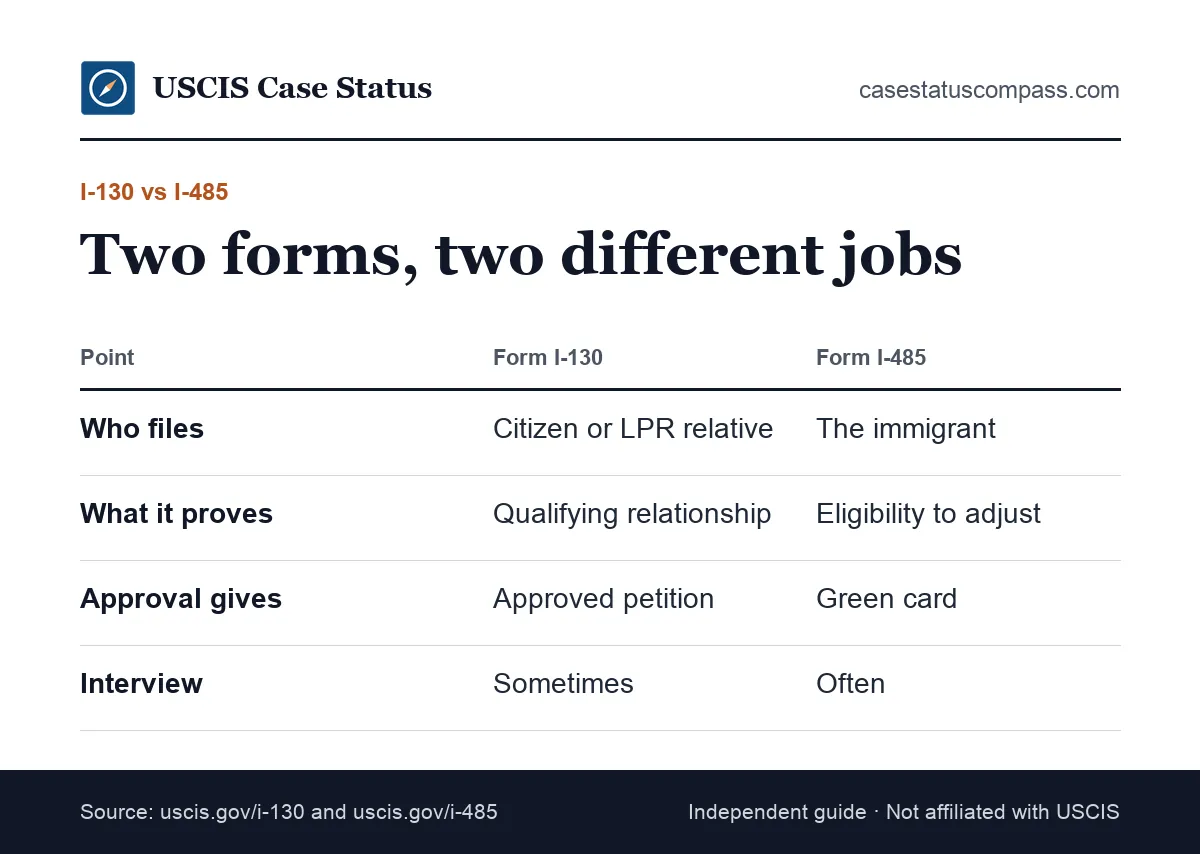
I-485 vs I-130 side by side
Read this table row by row when deciding who signs what. The takeaway: an approved I-130 alone never makes the immigrant a resident; only the adjustment decision does.
| Point | Form I-130 | Form I-485 |
|---|---|---|
| Filed by | Petitioner (citizen or LPR) | The immigrant |
| Proves | The family relationship | Eligibility and admissibility |
| Current edition | 04/01/24 | 09/18/26 |
| Approval means | Petition approved, not a green card | Permanent residence |
| Works alone? | Yes, for consular cases | No; needs a basis |
Which form comes first
The petition is always the legal basis. Immediate relatives may send both at once. Preference relatives usually file the petition first and adjust when the date is current. Our form I-130 petition guide covers relationship evidence.
Which Forms Go in an AOS Packet?
An AOS packet always holds the adjustment form and proof of your basis to adjust. Most family packets add Form I-864 and the Form I-693 medical exam. Many people also add Form I-765 for work and Form I-131 for travel, each with its own fee.
Core and add-on forms
The table lists what usually travels together in one envelope or online filing. Only the first two rows apply to everyone; the rest depend on your category and plans.
| Form | Purpose | Who needs it |
|---|---|---|
| I-485 | Asks for permanent residence | Every applicant |
| I-130 or I-140 (or notice) | Legal basis | Family and job cases |
| I-864 | Sponsor's financial promise | Most family cases |
| I-693 | Civil surgeon's medical exam | Nearly everyone |
| Supplement A | INA 245(i) adjustment | Only some |
| I-765 / I-131 | Work permit / travel document | Optional |
The optional work and travel forms
A work permit request on Form I-765 lets you work while you wait (see EAD rules below). A travel document on Form I-131 lets you leave and return without abandoning the case. Both are optional and may be filed with the package or later.
AOS Packet Checklist You Can Copy
This AOS documents checklist is a starting point for a family case. Compare it with the current instructions before mailing. Employment and humanitarian cases swap the family items for their own petition or status evidence. Put each form on top of its own evidence, and keep a full copy of everything you send.
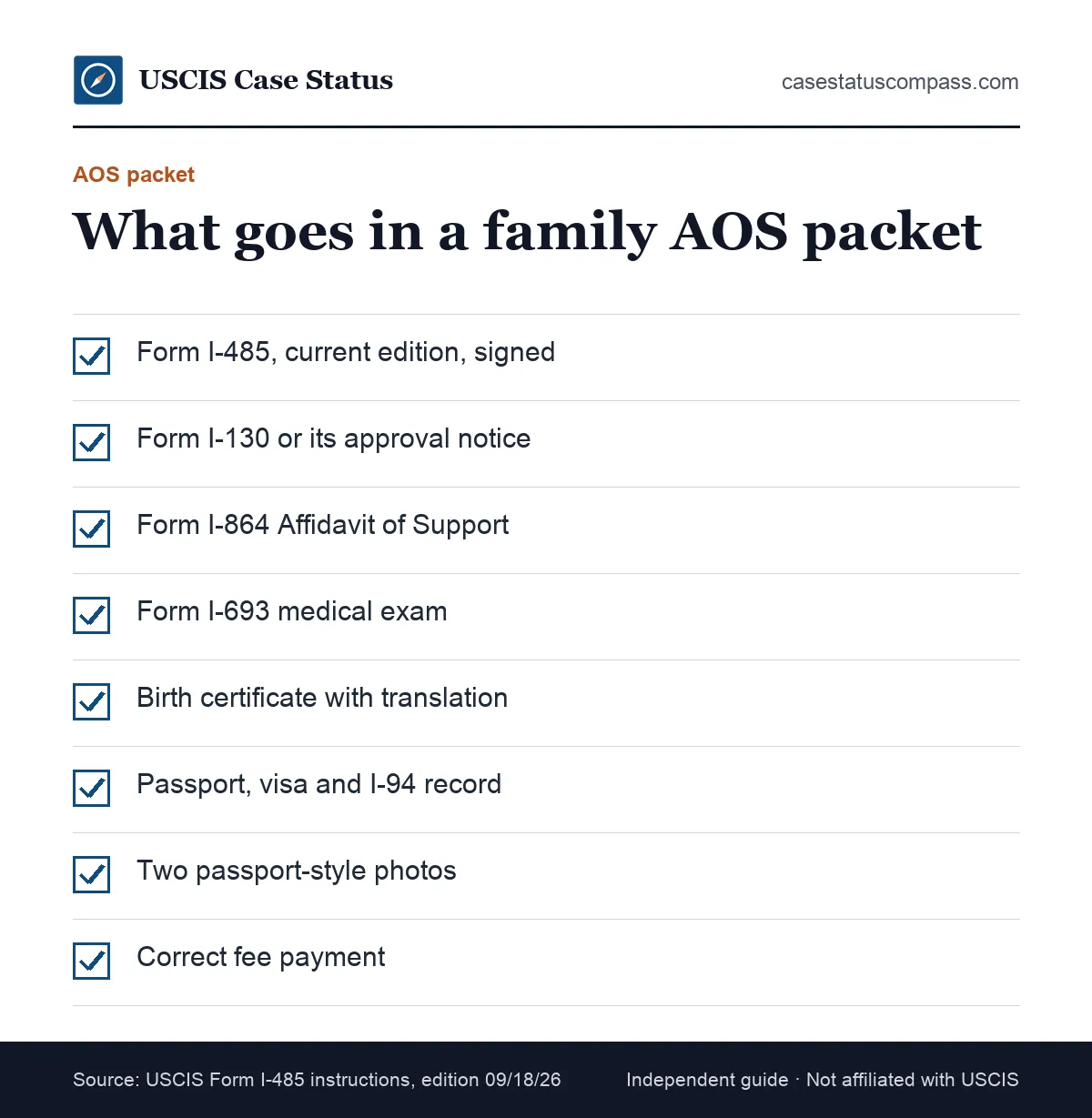
Identity and status documents
- Passport pages with photo, visa and entry stamps
- Form I-94 arrival record
- Birth certificate with a certified translation
- Two passport-style photos
- Prior EADs, approval notices and I-797s
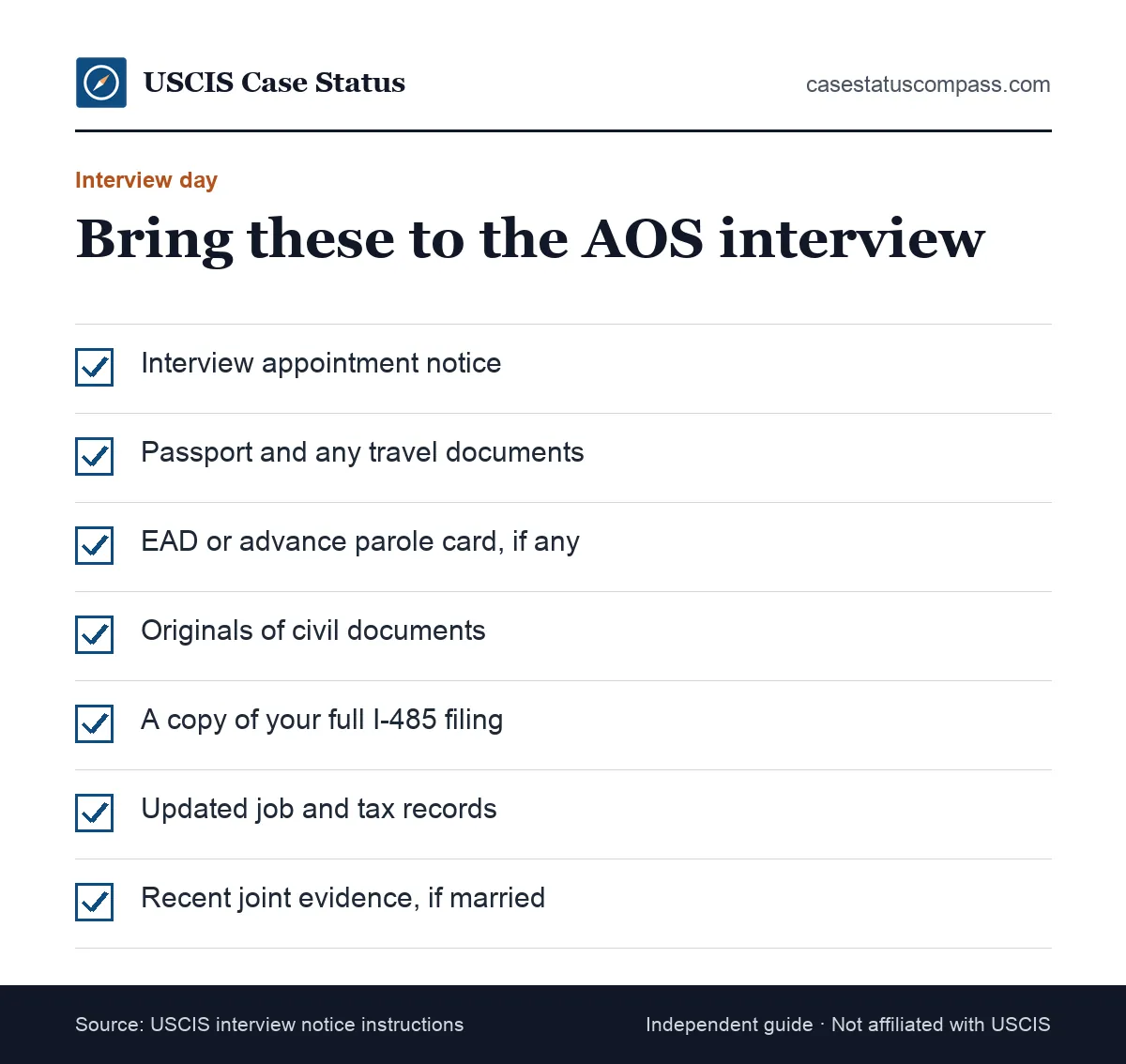
Bring the originals of these documents to the interview. If a record is unavailable, the State Department reciprocity tables show what substitute your country issues.
Sponsor and medical documents
- Form I-864 signed by the petitioner (edition 08/24/26)
- Sponsor's latest tax return or transcript and proof of status
- Joint sponsor's I-864, if needed
- Form I-693 sealed by the civil surgeon
- Marriage certificate and proof prior marriages ended
- Court records for any arrest
How Do You Assemble the AOS Package?
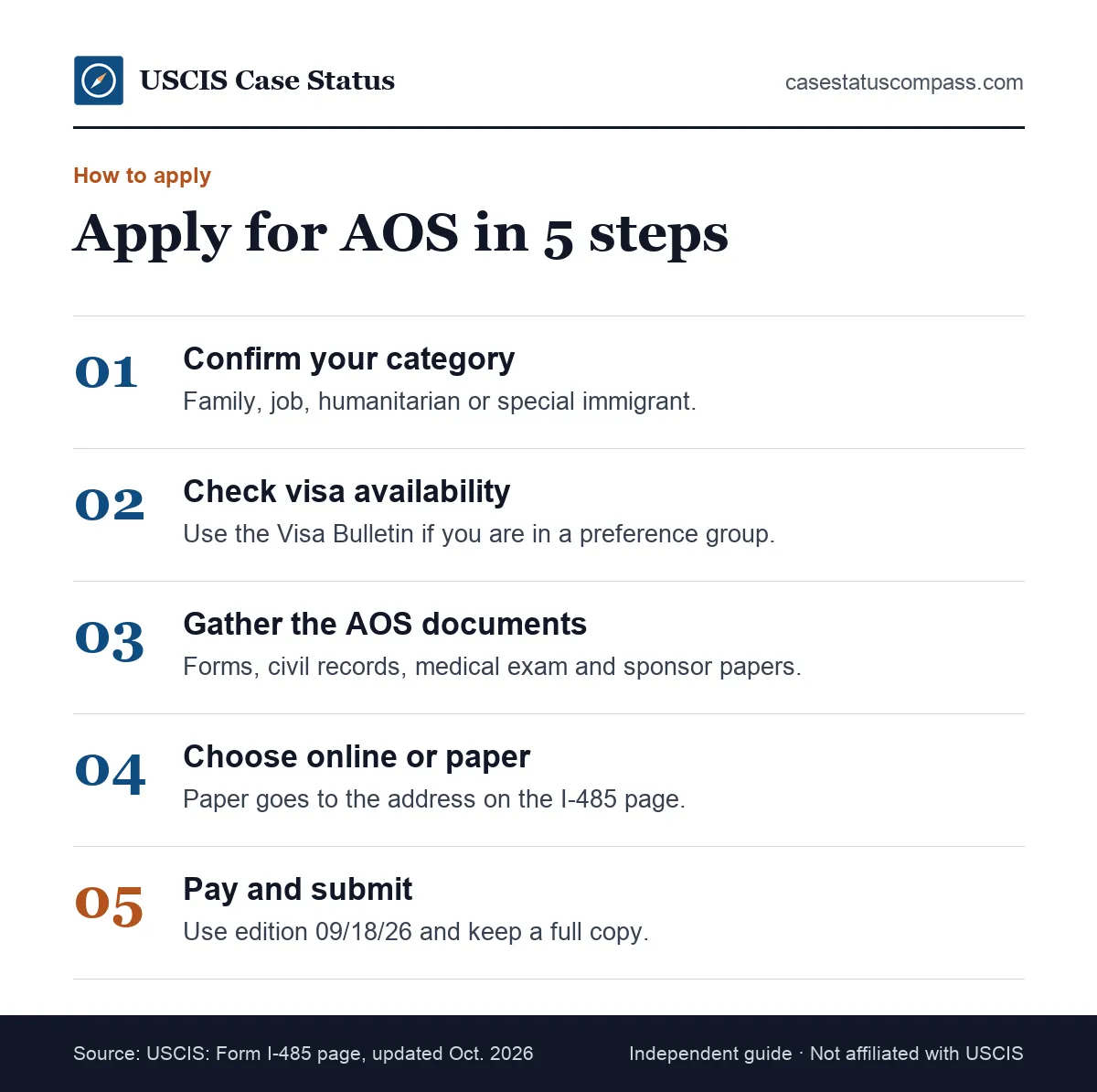
A tidy AOS package puts the payment and the adjustment form on top, then each supporting form with its evidence. Many filers add a cover letter listing every item. Order does not change the legal result, but it helps officers find documents quickly.
Order, clips and copies
Put each form directly in front of its evidence. Use clips, not staples, unless the instructions say otherwise. Copies are fine for most records; bring originals to the interview. Scan everything before mailing.
Writing an AOS cover letter
A cover letter is optional, but it lists your forms, category and enclosures and flags anything unusual, such as a name change. Our i-485 cover letter guide has a sample layout you can adapt.
Which I-485 Edition Must You Use?
As of October 2026, USCIS requires the 09/18/26 edition of Form I-485. The official page states: 09/18/26 (01/20/25 and 09/04/26 editions rejected on/after Sept. 18, 2026; no grace period). Packages on older editions are rejected and returned, costing weeks. There is no grace period for older forms.
Spotting the 09/18/26 footer
The edition date prints at the bottom of each page, and every page must match. Download a fresh copy from uscis.gov/i-485 when you print. Mixing pages from two downloads is a common reason for a returned package.
Can You File Form I-485 Online?
Yes. Many applicants can now file Form I-485 online through a USCIS online account, and online filing is cheaper. Paper filing is still open to every eligible category. The current fee is $1,440 (paper) / $1,390 (online); $950 / $900 if under 14 and filing with a parent. Check the USCIS online filing page for the list of eligible categories before you start, because not every basis is offered online yet.
Who benefits from filing online
Online filing suits people whose category is offered and who can upload clear scans. You get an instant receipt and a digital history. It also avoids mail delays and lets you answer an RFE by upload.
myProgress estimates in the online account
The account also offers myProgress estimates: myProgress: personalized estimates in your USCIS online account (I-130, I-485, I-765, I-131, I-821, N-400, I-90). Treat them as a guide, not a promised decision date.
Paper vs online at a glance
- Paper: all eligible categories; one mailed package
- Online: lower fee, instant receipt, uploads instead of copies
- Both: same eligibility, same interview, same officer review
Pick one channel per application: if you file online, do not mail a duplicate paper copy, or USCIS may reject one of them.
Where to File AOS: Finding the Filing Address
The AOS filing address depends on your category and delivery method. USCIS lists it on the "Direct Filing Addresses for Form I-485" page linked from uscis.gov/i-485. Online filers do not mail anything. Paper filers must use the exact lockbox address or face rejection.
Where to file AOS by category
Family, employment, humanitarian and special immigrant categories may use different lockboxes, and some groups, such as asylees or VAWA filers, have dedicated ones. Find your category line on the official chart and copy the address exactly.
Address mistakes that cause rejections
- Copying an address from an old blog or forum post
- Using the USPS address for a courier delivery
- Mailing to a field office instead of a lockbox
- Splitting a concurrent package across addresses
When Can You File Form I-485?
You can file when your category's visa number is available. Immediate relatives may file at any time, even with the I-130. Preference applicants must wait until the Visa Bulletin shows their priority date as current. Filing too early leads to rejection.
Dates for filing vs final action dates
Each Visa Bulletin has two charts. "Dates for Filing" may allow early submission, but only in months when USCIS says it will use that chart. "Final Action Dates" show when approval can happen, so a case filed early can still wait for a number.
The chart USCIS accepts for November 2026
November 2026: USCIS accepts I-485s using the Dates for Filing chart (family and employment); on that chart, F2A is Current and EB-2 for most countries is Mar. 15, 2026. Our visa bulletin page shows all four November 2026 charts.
Finding your AOS priority date
The priority date is usually the date the petition or labor certification was filed. It appears on that petition's receipt or approval notice. Compare it with the chart for your category and country of birth every month.
Concurrent I-130 and I-485 Filing
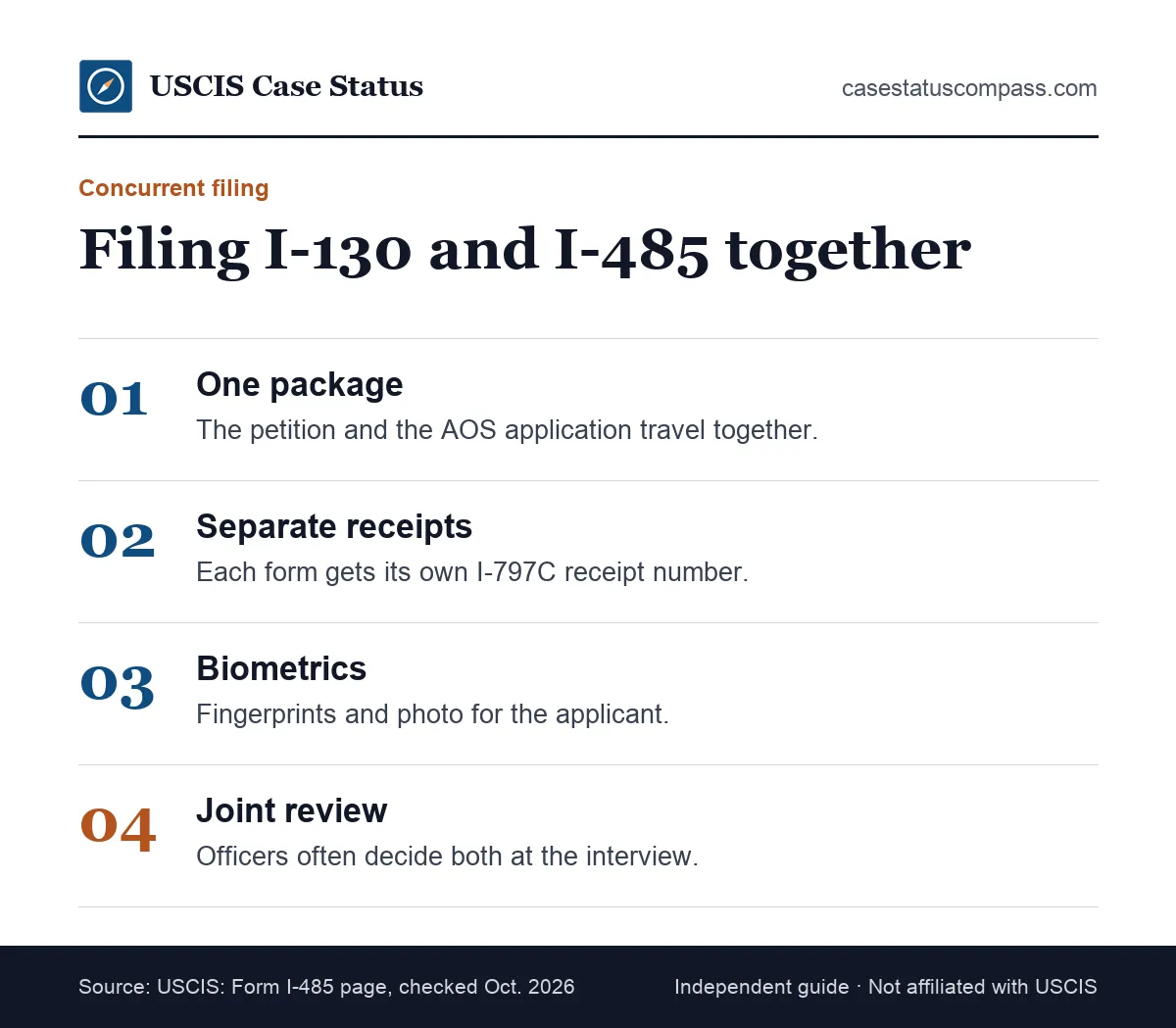
Concurrent filing means sending Form I-130 and Form I-485 in one package. It works when a visa number is available at once, mainly for immediate relatives of U.S. citizens. It saves months, because USCIS can decide both forms together, often at one interview.
I-130 approved but I-485 pending
An I-130 approved but not I-485 is common. The petition proves only the relationship, so an officer may approve it first while biometrics, security checks or an interview remain for the adjustment. Keep the approval notice; the green card case continues separately.
Can an I-485 Be Approved Before the I-130?
No, not in a family case. USCIS cannot approve adjustment without an approved basis. If your account shows I-485 approved but I-130 pending, the display has usually lagged, since both are often approved the same day. Contact USCIS if the mismatch lasts for weeks.
What Happens After You File Form I-485?
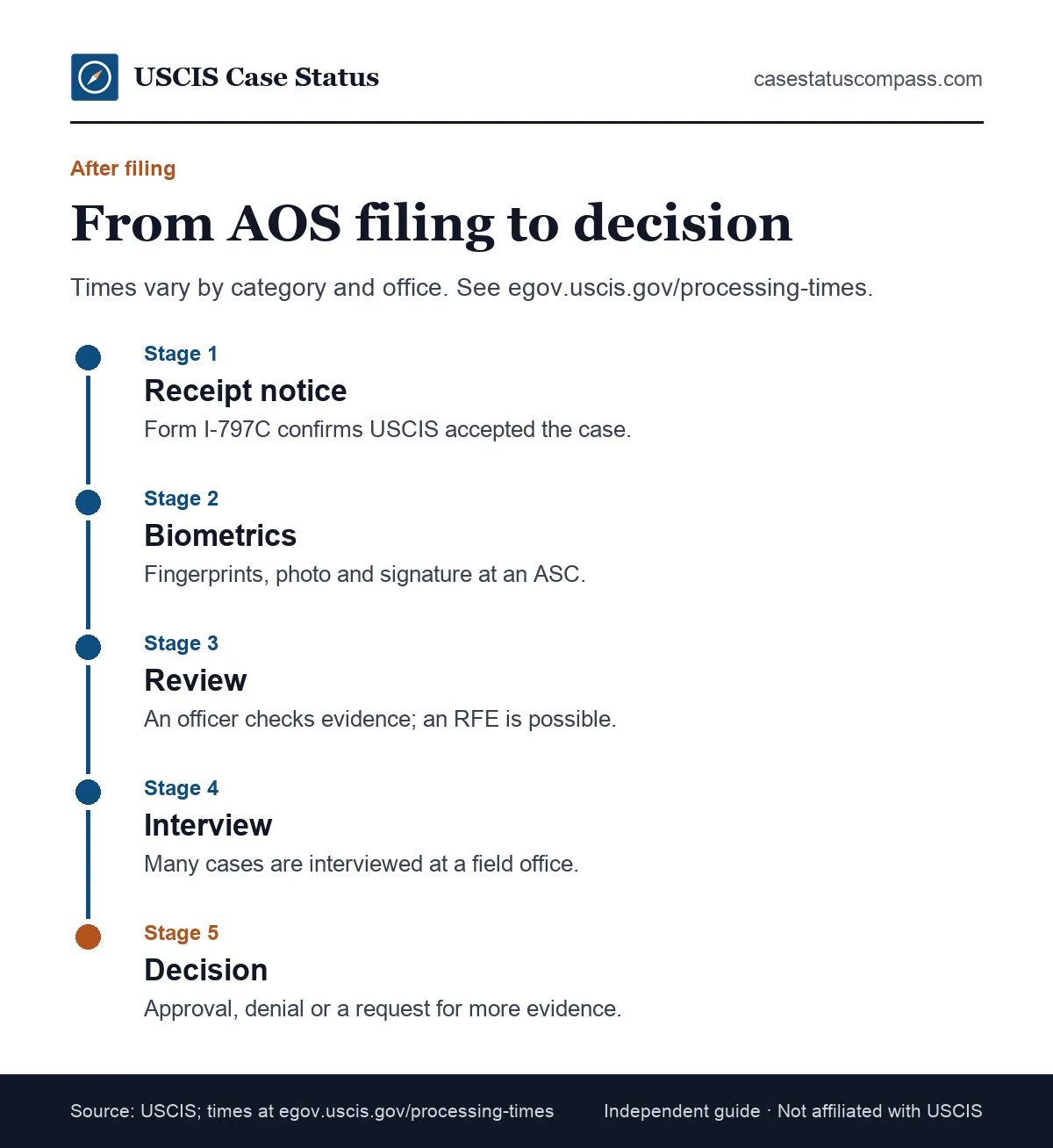
After you file, USCIS reviews the package, takes the fee and issues Form I-797C, the receipt notice. Biometrics, background checks, evidence review and often an interview follow. Your receipt number lets you track each step on the official status tool or in your account.
The I-797C receipt notice
I-797C = Notice of Action (receipt, rejection, transfer, appointment, re-open); not proof of status by itself. It shows your 13-character receipt number and the received date, which many applicants treat as day one. Our receipt number guide decodes each part of the number.
Rejection is not denial
A rejection means USCIS never accepted the case; you fix the defect and refile. Acceptance means the case is open, even if an officer later asks for evidence. A rejected package usually comes back with a notice naming the defect.
I-485 Case Status Steps in Order
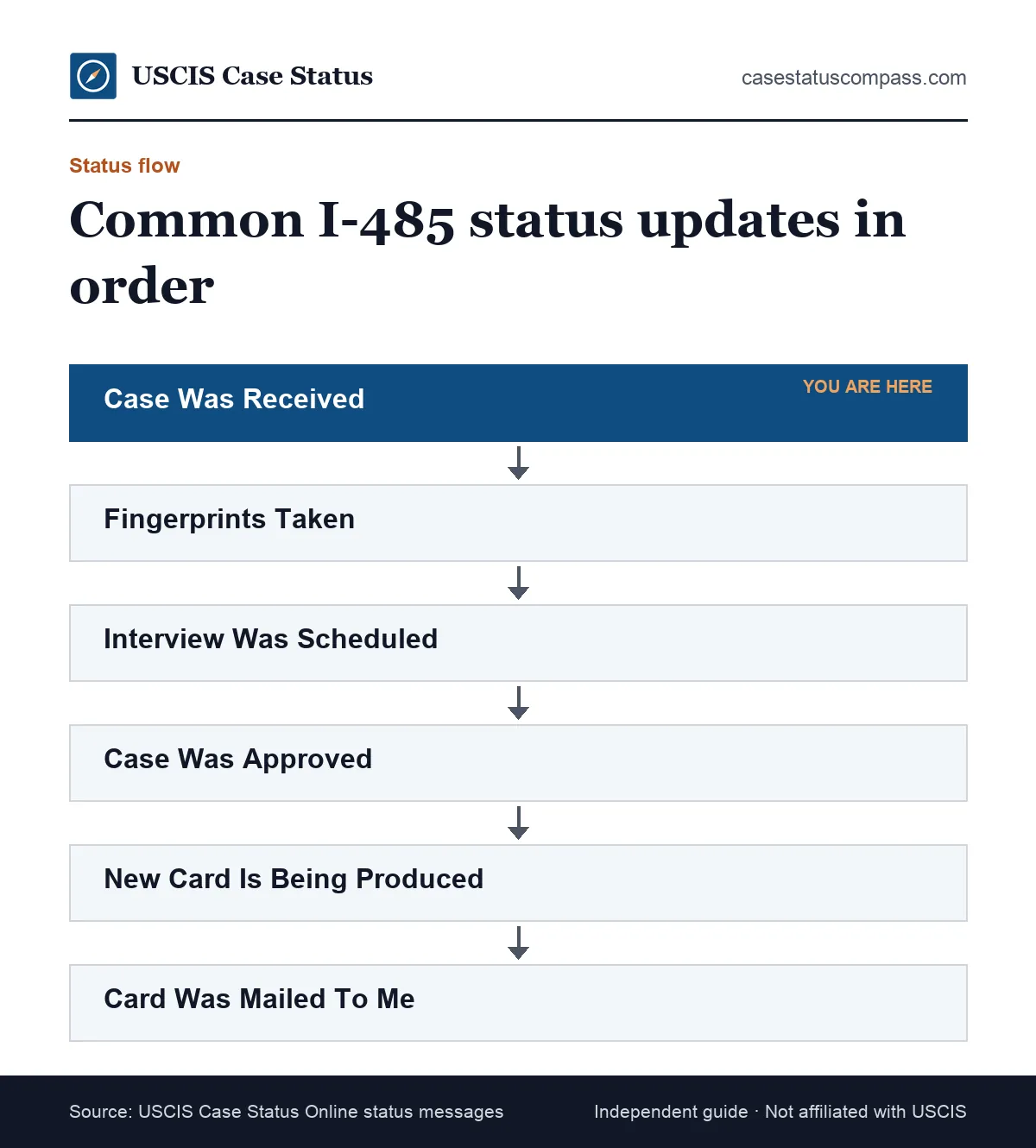
The I-485 case status usually moves from Case Was Received to biometrics, interview, approval, card production and mailing. Some cases skip or repeat a message. Track it with the receipt number from your I-797C, either in your online account or on Case Status Online. A long pause between two steps is normal and does not mean anything has gone wrong.
Adjustment status-sequence table
Use this table to see where your case sits and what to expect next. Messages vary by office, so treat the order as typical rather than guaranteed.
| Status message | What it means for AOS | What usually comes next |
|---|---|---|
| Case Was Received | Package accepted | Biometrics notice |
| Fingerprints Taken | Biometrics recorded | Background checks |
| Case Is Being Actively Reviewed | An officer has the file | RFE, interview or decision |
| Request for Evidence Was Sent | Something is missing | Your reply by the deadline |
| Interview Was Scheduled | Field office set a date | The AOS interview |
| Case Was Approved | You are a permanent resident | Card production |
| New Card Is Being Produced | Card is printing | Card mailed |
| Card Was Mailed To Me | Card is in the mail | Delivery |
The online account progress bar
The online account adds a stage tracker, which is where "step 3 of 4 completed" searches come from. It is a rough stage, not a decision. Our page on we have taken an action on your case explains these generic updates.
What Happens at the Biometrics Appointment?
At the biometrics appointment, an Application Support Center (ASC) takes your fingerprints, photo and signature for background checks and your future card. The notice arrives by mail some weeks after filing and lists the place, date and time. Bring your I-797C appointment notice and a valid photo ID to the ASC.
What to bring and how to reschedule
Bring the appointment notice and a government photo ID, plus your EAD if you have one. To reschedule, follow the notice or call 800-375-5283 before the date. Our biometrics appointment guide has more detail.
What Does an RFE on an AOS Application Mean?
A Request for Evidence (RFE) means the officer needs more information before deciding. It is not a denial. The notice lists what is missing and the deadline. Common AOS requests cover the medical exam, sponsor income and missing civil documents.
Common RFE topics in adjustment cases
- A Form I-693 that is incomplete or missing
- Sponsor income below the required level
- Missing certificates or translations
- Proof of lawful entry or status
Answer by the date on the notice (RFE deadline: up to 12 weeks (the exact date is on your RFE); no extensions) and send everything at once, with the RFE cover page on top.
Building a complete AOS reply
Answer every item in one package with the RFE notice on top, and send it before the deadline. Our request for evidence guide covers structure and timing. Without a response, USCIS decides on the existing record.
AOS Interview: What to Expect
The AOS interview is a meeting at a USCIS field office where an officer reviews your application under oath. Most family cases and many job cases are interviewed, and the officer checks originals against your answers. USCIS can waive the green card interview case by case.
Who gets an adjustment of status interview
Marriage-based cases almost always have an adjustment of status interview. Employment cases are interviewed in some offices and waived in others. The interview was scheduled status and a mailed notice confirm yours.
What officers usually cover
The officer goes through your form: names, addresses, jobs, travel and the yes/no questions. Spouses may face questions about daily life. The full question list lives on our green card interview questions page.
What If There Is No Decision After the I-485 Interview?
No decision after the I-485 interview is common. The officer may need a supervisor's review, a security check result, a visa number or a missing document. You may get a list of items to send, or a note that the decision will come by mail.
Why the case can pause
- A name or security check is still open
- The officer asked for a document
- A preference visa number must be requested
- The file is moving between offices
A pause after the interview usually means the officer is waiting on one of these, not that a denial is coming.
When to follow up
Wait until the case falls outside the posted range. Then ask USCIS through your account or the Contact Center. Our case status not updating page lists escalation steps. Keep your receipt number ready when you call.
What Does I-485 Approved Mean?
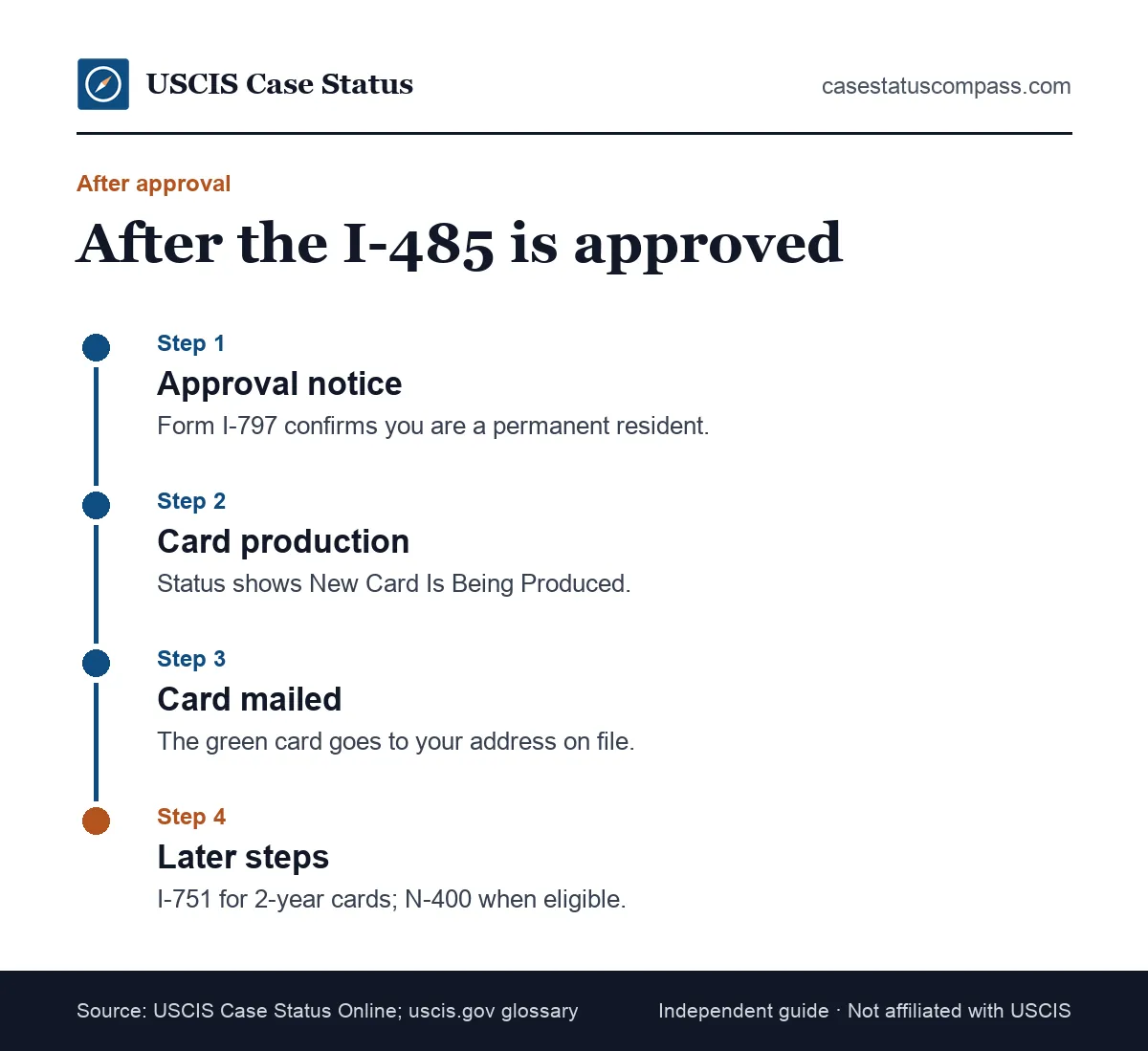
I-485 approved means USCIS granted you lawful permanent residence. Residence starts on the approval date printed on the notice, not when the card arrives. From then you may live and work here permanently. The plastic card follows by mail after production; if you need proof sooner, ask for a temporary I-551 stamp.
Your residence start date on the notice
USCIS mails a Form I-797 approval notice. Keep it, because it proves when your residence began. The case was approved page explains how this status reads for different forms. Store it with your passport.
Card production
A few days later the status usually changes to card production. Our page on what new card is being produced means covers delays and address problems at this stage. Update your address first if you have moved.
What Happens After Your I-485 Is Approved?
After the I-485 is approved, you receive your green card, can work for any employer and can travel as a resident. Green card validity depends on your category: Most green cards are valid for 10 years; conditional green cards for 2 years. Your next steps depend on which card arrives.
Conditional 2-year cards
If your marriage was still recent when USCIS approved the case, you receive a conditional green card. You must file to remove conditions before it expires. The form I-751 guide explains the window and evidence.
Renewing a 10-year card on Form I-90
A 10-year card is renewed, or replaced if lost or damaged, on Form I-90. Employers and border officers check the expiration date, so do not let it lapse; see the green card renewal guide.
Applying for citizenship later
After enough years as a resident, you may apply to naturalize on Form N-400. Time outside the U.S. and your record as a resident both matter; the citizenship application page explains eligibility.
Can You Work While Your I-485 Is Pending?
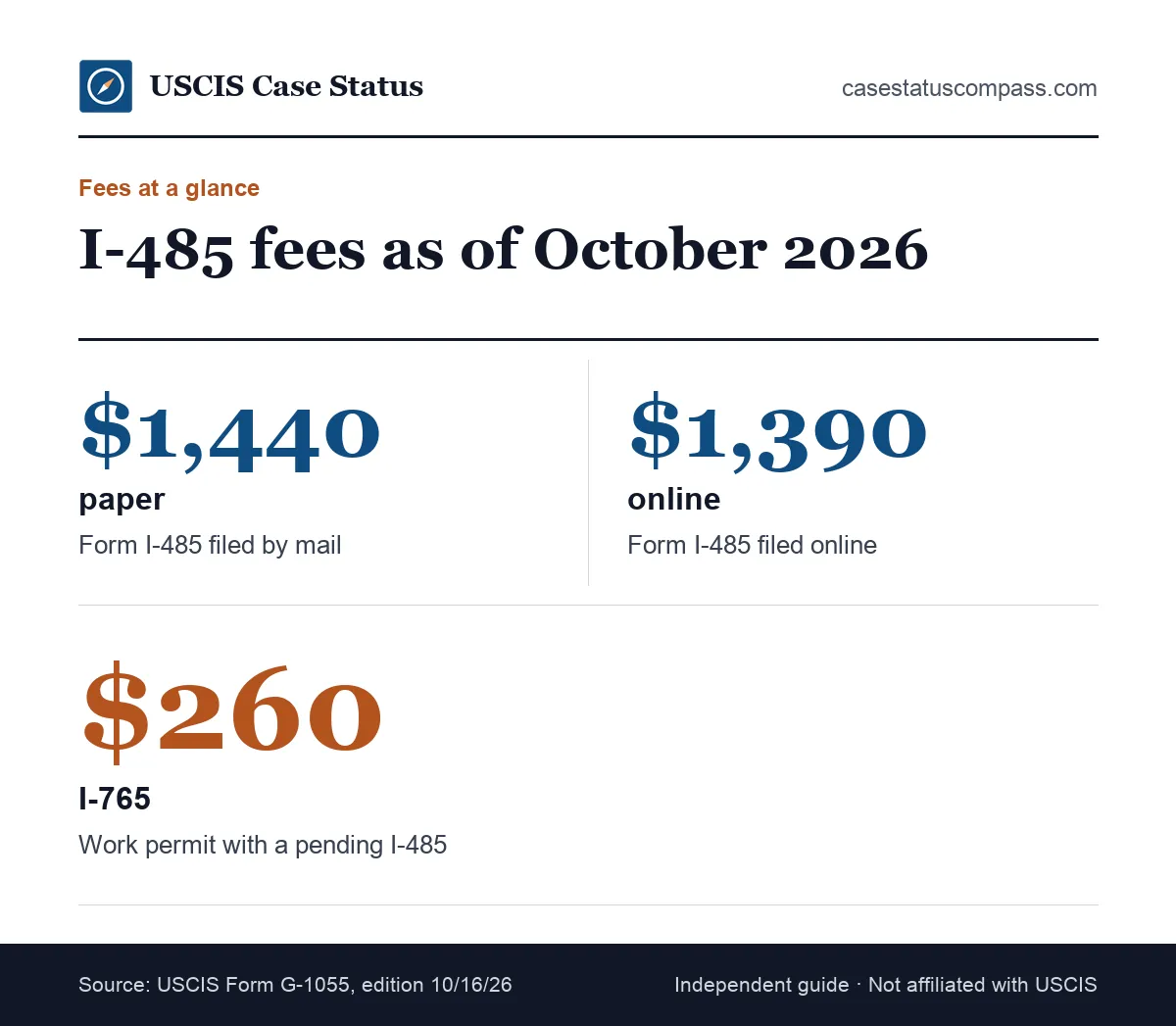
Yes, once you receive an Employment Authorization Document (EAD) from a Form I-765 based on the pending case. As of October 2026, Form G-1055 sets that I-765 at $260 for an adjustment filed on or after April 1, 2024, that is still pending.
Pending-AOS work permits and the 2025 renewal rule
An EAD is not automatic; you wait for approval. Renewals also changed in 2025: Ended: renewals filed on or after Oct. 30, 2025 no longer get the up-to-540-day automatic extension (exceptions: TPS by law/Federal Register notice; STEM OPT 180 days). File renewals early and keep each receipt notice.
Keeping your current visa status
H-1B and L-1 workers may keep working on their visa status while adjustment is pending, as long as they maintain it. Many keep it as a fallback in case of denial.
Can You Travel While Your I-485 Is Pending?
Most applicants need advance parole before leaving the U.S. with a pending adjustment. Without it, USCIS generally treats the trip as abandoning the application. Advance parole is requested on Form I-131, which has its own fee and risks; our advance parole guide covers them.
Pre-departure checks for AOS applicants
- Have the approved travel document in hand, not just a receipt.
- Check that it is valid through your return date.
- Do not miss biometrics or an interview while away.
- With any past immigration violation, see an attorney first.
I-485 Processing Time and Fee: Summary
USCIS posts current times on its official tool, and fees come from Form G-1055, edition 10/16/26. Check both before filing, since each can change and add-on forms cost extra. For context, USCIS's latest published median for family cases is I-485 (family): median 7.0 months (USCIS data, Apr.-June 2026); right now the tool shows 8.5 to 43.5 months, depending on category and office (USCIS data retrieved Oct 27, 2026). The two short sections below summarize each, with links to the full pages.
Adjustment wait times in brief
USCIS posts current times at egov.uscis.gov/processing-times. Its historical factsheet (data as of March 5, 2024) showed fiscal year 2023 medians of 11.4 months for family and 8.6 months for employment cases. See our green card processing time page for current stage-by-stage waits.
Adjustment filing cost in brief
As of October 2026, Form G-1055 lists the adjustment fee at $1,440 paper / $1,390 online. Biometrics is included. Our how much is a green card page totals the full cost with Supplement A, the EAD and travel forms.
What Are the Most Common I-485 Mistakes?
The most frequent mistakes are an old edition, missing signatures, the wrong fee, blank answers and filing before a visa number is available. Each can cause a rejection or a Request for Evidence. A slow, line-by-line review before mailing prevents most of them.
Form-filling errors
- Blank fields instead of "None" or "N/A"
- Different name spellings across forms
- Gaps in the address or job history
- Yes/no answers given without reading the full question
Before signing, read every answer aloud against your passport and prior filings; most of these slips are caught that way.
Packet errors
- A missing or opened medical exam envelope
- Sponsor tax records for the wrong year
- No translations for foreign records
- No copy of the petition receipt or approval
Each of these usually triggers an RFE rather than a denial, but answering one adds months.
Why Do I-485 Applications Get Rejected or Denied?
Rejections happen at intake because of fixable defects, such as the wrong edition or fee. Denials come after review, when the officer finds you ineligible or inadmissible, or you missed an RFE. A denied applicant with no other status may face removal, so act quickly.
Rejection: fix and refile
The package returns with a notice listing the defect. Your filing date becomes the new receipt date, so check whether that affects a child's age or a Visa Bulletin cutoff.
Denial: read the notice and get advice
Denials often cite missing evidence, a bar to adjustment or credibility. Our page on an i-485 denial covers motions and options. Talk to an attorney promptly if you have no other lawful status.
What Does "AOS Applicant" Mean?
An AOS applicant is a person with a pending adjustment application. While it is pending, you are generally in a "period of authorized stay," even if your visa expires. That is not the same as holding a visa, and leaving without permission can end the case.
Proof you can show employers and agencies
- The Form I-797C receipt notice
- Your EAD card, if approved
- After approval, an urgent temporary proof stamp; see our I-551 stamp guide
For a new job, the EAD or the stamp works on Form I-9; a receipt notice alone does not prove work authorization.
Updating your address
Notices go to the address on file, so report every move online. Missed mail is a top cause of missed interviews and RFE deadlines. Our uscis change of address guide lists the steps.
Can Family Members Be Included in Your I-485?
Each family member files their own adjustment form and fee. Derivative spouses and unmarried children under 21 can usually adjust with the principal in employment and preference family cases. Immediate relatives each need their own I-130 from the citizen relative.
Derivative spouses and children
A derivative files a separate application based on the principal's case, with proof of the relationship. If the principal's case is denied, derivative cases usually fall with it, so keep both files consistent.
How Do PERM and I-140 Fit Into Employment-Based AOS?
In most job cases the order is PERM labor certification at the Department of Labor (DOL), then the employer's Form I-140, then adjustment once the priority date is current. Extraordinary ability and National Interest Waiver applicants skip PERM entirely.
The PERM stage
PERM shows that no qualified U.S. worker is available for the job, and its filing date is often your priority date. Follow that stage on our perm labor certification page.
The I-140 stage
The employer files Form I-140, and you may file your adjustment alongside it if your date is current. Our form I-140 guide covers petition rules and premium processing. Without a current date you wait for the bulletin.
How Is a Marriage-Based AOS Different?
A marriage-based AOS needs proof that the marriage is real (bona fide), not just legal. Spouses of citizens are immediate relatives and can file concurrently. Spouses of green card holders wait in the F2A category. Officers usually interview both spouses together.
Evidence of a real marriage
- Joint lease, mortgage or deed
- Joint bank accounts and shared bills
- Photos over time with family and friends
- Children's birth certificates
- Affidavits from people who know you both
Mix document types and dates across the whole relationship; a stack of photos from one week proves little.
K-1 fiancé(e)s who married in the U.S.
K-1 entrants adjust after marrying the petitioner. K-1: marry within 90 days of entering the U.S.. The k-1 visa guide explains the fiancé(e) side. They file the adjustment with the marriage certificate and the K-1 approval, without a new I-130.
What Is INA 245(i) and Who Needs Supplement A?
INA 245(i) lets certain people who entered without inspection or fell out of status adjust anyway, if a qualifying petition or labor certification was filed for them before a cutoff set in the law. These applicants file an extra supplement with the adjustment form.
Supplement A fee and exemptions
The supplement is Supplement A, which costs $1,000 on top of the I-485 fee (none for unmarried children under 17 and certain Family Unity applicants); see our INA 245(i) guide.
Who might qualify
You must be the beneficiary, or a derivative, of a qualifying filing made by the statutory deadline, and some cases need proof of presence on a set date. Our ina section 245(i) explainer covers the evidence. These cases carry removal risk, so get legal advice first.
What Is the Medical Exam for Form I-485?
Nearly every applicant needs a Form I-693 medical exam from a USCIS-designated civil surgeon. The doctor checks vaccinations, tuberculosis and other health grounds, then seals the form in an envelope. Do not open it, or USCIS may refuse it. The sealed envelope goes in the same package as your I-485, as the submission section below explains.
Finding a USCIS civil surgeon
Only a designated civil surgeon can complete the exam. Use the "Find a Doctor" tool on uscis.gov to search near you; doctors set their own prices. Compare prices and ask which vaccines cost extra.
When to submit the sealed I-693
The old 60-day I-693 signature rule no longer applies (removed Mar. 31, 2023). Send the sealed I-693 with your I-485 (required since Dec. 2, 2024). Our immigration medical exam guide covers the visit.
Who Needs the Affidavit of Support?
Most family-based applicants need Form I-864, the Affidavit of Support, signed by the petitioner. It is a binding promise of financial support. Some job cases need it when a relative owns the employer. USCIS charges nothing for it: $0 at USCIS.
Adding a joint sponsor
If the petitioner's income falls short, a joint sponsor who meets the income level on their own can sign a separate I-864. The petitioner still signs one as well.
Combining household income on Form I-864A
Household members can combine income with the sponsor on Form I-864A. Our affidavit of support guide explains the income rules and the documents sponsors need. Each member who signs it becomes jointly liable for the support promise.
Real-World AOS Scenarios
These two simplified scenarios show how adjustment fits different lives, from a worker in status to a waiting relative. They are examples, not legal advice. Names are invented, but the steps follow the rules described above. Use them to compare your own timing and paperwork before talking to a lawyer.
Scenario 1: A spouse on a work visa
Priya entered on an H-1B and married a U.S. citizen. She files the I-130 and her adjustment together, with an I-765 and an I-131. She keeps her H-1B status during the case, so she can keep working and has a fallback.
Scenario 2: An adult child of a green card holder
Luis is 24 and his mother is a permanent resident, which places him in F2B. His petition is approved long before he can adjust. He checks the Visa Bulletin monthly, keeps his student status and files only when his date is current.
If X, Do Y: I-485 Decision Table
This decision table turns common situations into one next step each. If several rows apply, deal with the nearest deadline first, such as an RFE or interview date. Anything involving crimes or past violations calls for legal advice before you act.
AOS next-step table
Find the row that matches your situation and act on it. If no row fits, read the matching section above or ask a lawyer.
| If this happens | Do this next |
|---|---|
| Package came back rejected | Fix the listed defect and refile |
| No biometrics notice after several weeks | Check your account, then call USCIS |
| RFE arrived | Reply fully before the deadline |
| You moved | Update your address with USCIS |
| Interview done, no decision | Wait, then follow up once outside posted times |
| You need to travel | Get advance parole approved first |
| Case was denied | Read the notice and see an attorney |
When an AOS applicant should contact USCIS
Use your account or the Contact Center when a notice never arrived, an appointment clashes with an emergency, or the case passes posted times. Have your receipt number and A-Number ready.
When to see an attorney
See an attorney or accredited representative if you have an arrest, a removal order, an uninspected entry or a past visa denial. Get advice before travel if you ever stayed past an authorized date.
Frequently Asked Questions
What is the difference between change of status and adjustment of status?
A change of status moves you between temporary visa statuses, usually on Form I-539 or an employer's Form I-129. Adjustment of status, on Form I-485, makes you a lawful permanent resident, so only adjustment leads to a green card.
Can I travel while my I-485 is pending?
Usually only with advance parole approved on Form I-131 before you leave; otherwise USCIS generally treats the application as abandoned. Some H-1B and L-1 workers may travel on their visas, but the rules are technical, so ask an attorney first.
Can I work while my I-485 is pending?
Yes, after you receive a work permit (EAD) from a Form I-765 based on your pending adjustment. Under Form G-1055, edition 10/16/26, that work permit costs $260 if your adjustment was filed on or after April 1, 2024, and is still pending.
Is an interview required for Form I-485?
Not always. USCIS interviews most marriage and family cases and some employment cases, and it can waive the interview when the file is clear. If one is needed, you get a mailed notice and the status changes to Interview Was Scheduled.
What is an "AOS petition"?
People say "AOS petition" loosely, but Form I-485 is an application, not a petition. The petition is Form I-130 or Form I-140, filed by a relative or employer. Both phrases usually describe the same green card case.
How do I check my I-485 case status?
Enter the receipt number from your I-797C on Case Status Online at egov.uscis.gov, or sign in to your USCIS online account for full history and notices. You never need to pay anyone to see your status.
What does "AOS status" mean?
"AOS status" usually means where your pending adjustment case stands, such as received, interview scheduled or approved. It is not a separate immigration status. While the case is pending, you are generally in a period of authorized stay.
Can I apply for AOS without a lawyer?
Yes. USCIS does not require an attorney, and the forms and instructions are free on uscis.gov. Get legal help from an attorney or DOJ-accredited representative if you have an arrest, a removal order, an uninspected entry or a past visa denial.
Sources
- USCIS: Form I-485, Application to Register Permanent Residence or Adjust Status. www.uscis.gov/i-485. Accessed Oct 27, 2026.
- USCIS: Form G-1055 Fee Schedule. www.uscis.gov/g-1055. Accessed Oct 27, 2026.
- USCIS: Form I-797 Types and Functions. www.uscis.gov/forms/filing-guidance/form-i-797-types-and-functions. Accessed Oct 27, 2026.
- USCIS: Check Case Processing Times. egov.uscis.gov/processing-times/. Accessed Oct 27, 2026.
- USCIS: Historical Processing Times factsheet (data as of March 5, 2024). www.uscis.gov/sites/default/files/document/fact-sheets/historical_pt_factsheet_fy16_to_fy24.pdf. Accessed Oct 27, 2026.
- USCIS: myProgress expands to Form I-485 (Nov. 2023). www.uscis.gov/newsroom/alerts/uscis-expands-myprogress-to-form-i-485-and-form-i-821. Accessed Oct 27, 2026.
- USCIS: Form I-864, Affidavit of Support. www.uscis.gov/i-864. Accessed Oct 27, 2026.
- USCIS Glossary. www.uscis.gov/tools/glossary. Accessed Oct 27, 2026.
- State Department Visa Bulletin for November 2026. travel.state.gov/content/travel/en/legal/visa-law0/visa-bulletin.html. Accessed Oct 27, 2026.
- USCIS Form G-1055 Fee Schedule, Edition 10/16/26. www.uscis.gov/sites/default/files/document/forms/g-1055.pdf. Accessed Oct 27, 2026.
- USCIS: Form I-130 page (updated 10/07/2026). www.uscis.gov/i-130. Accessed Oct 27, 2026.
- USCIS: Adjustment of Status Filing Charts from the Visa Bulletin (updated 10/05/2026). www.uscis.gov/green-card/green-card-processes-and-procedures/visa-availability-priority-dates/adjustment-of-status-filing-charts-from-the-visa-bulletin. Accessed Oct 27, 2026.
- USCIS: Preparing for Your Biometric Services Appointment (updated 04/30/2026). www.uscis.gov/forms/filing-guidance/preparing-for-your-biometric-services-appointment. Accessed Oct 27, 2026.
- USCIS Contact Center (uscis.gov). www.uscis.gov/contactcenter. Accessed Oct 27, 2026.
- 8 CFR 103.2(b)(8)(iv) (LII). www.law.cornell.edu/cfr/text/8/103.2. Accessed Oct 27, 2026.
- USCIS Policy Manual Vol. 7, Part A, Ch. 5 (Interview Guidelines). www.uscis.gov/policy-manual/volume-7-part-a-chapter-5. Accessed Oct 27, 2026.
- USCIS: Automatic EAD Extension (updated 10/29/2025). www.uscis.gov/working-in-the-united-states/information-for-employers-and-employees/automatic-employment-authorization-document-ead-extension. Accessed Oct 27, 2026.
- USCIS Data Library: All USCIS Application and Petition Form Types, FY2026 Q3 (Apr. 1-June 30, 2026; queried 7/2026). www.uscis.gov/sites/default/files/document/data/quarterly_all_forms_fy2026_q3_v1.xlsx. Accessed Oct 27, 2026.
- USCIS: Form I-129F page. www.uscis.gov/i-129f. Accessed Oct 27, 2026.
- USCIS Policy Manual Vol. 8, Part B, Ch. 4. www.uscis.gov/policy-manual/volume-8-part-b-chapter-4. Accessed Oct 27, 2026.
- USCIS: Form I-693 page (updated 07/24/2026); I-485 Instructions 09/18/26. www.uscis.gov/i-693. Accessed Oct 27, 2026.
casestatuscompass.com is an independent publication and is not affiliated with USCIS or any government agency. This page is general information, not legal advice. For denials, court or asylum matters, consult an immigration attorney or a DOJ-accredited representative.