Contents · 38 sections
- How Much Is a Green Card in 2026?
- What Does the I-485 Filing Fee Cover?
- Who Pays No Fee for Form I-485?
- Is the I-485 Fee Cheaper Online?
- How Much Is the I-130 Fee?
- Is There a Separate I-130A Fee?
- How Much Does It Cost to Sponsor a Green Card?
- What Is the Total Green Card Cost? (Table)
- How Much Does a Marriage Green Card Cost?
- What Is the Spouse Visa USA Cost From Abroad?
- How Much Does It Cost to Bring a Relative From Abroad?
- Adjustment of Status vs Consular Processing: Which Costs Less?
- How Much Is the USCIS Immigrant Fee?
- How Much Is the Immigration Medical Exam?
- How Much Do the Work Permit and Travel Permit Add?
- Is Advance Parole Worth Paying For?
- What Does an Employment-Based Green Card Cost?
- Is There a PERM Filing Fee for an Employer Green Card?
- How Much Is an EB-1 Green Card?
- Does Premium Processing Speed Up a Green Card?
- Which Green Card Fees Can Be Waived?
- Can You Get a Refund on a Green Card Fee?
- How Do You Pay Green Card Fees Online?
- Where Do You Pay the Green Card Fee?
- How Do You Pay Green Card Fees on a Paper Filing?
- Can You Pay Green Card Fees in Installments?
- How Much Does a Green Card for Parents Cost?
- How Much Does It Cost to Sponsor a Child or Sibling?
- How Do Asylees and Refugees Pay for a Green Card?
- Is a K-1 Fiancé Visa Cheaper Than a Spouse Green Card?
- What Other Costs Should You Budget For?
- How Much Is a Green Card Compared With Citizenship?
- What Does It Cost to Remove Conditions on a Green Card?
- How Do Green Card Fees Compare Form by Form?
- What Happens After You Pay the Green Card Fee?
- What Are the Most Common Green Card Fee Mistakes?
- How Much Is a Green Card for America if You Have a Complex Case?
- Frequently Asked Questions
The short answer
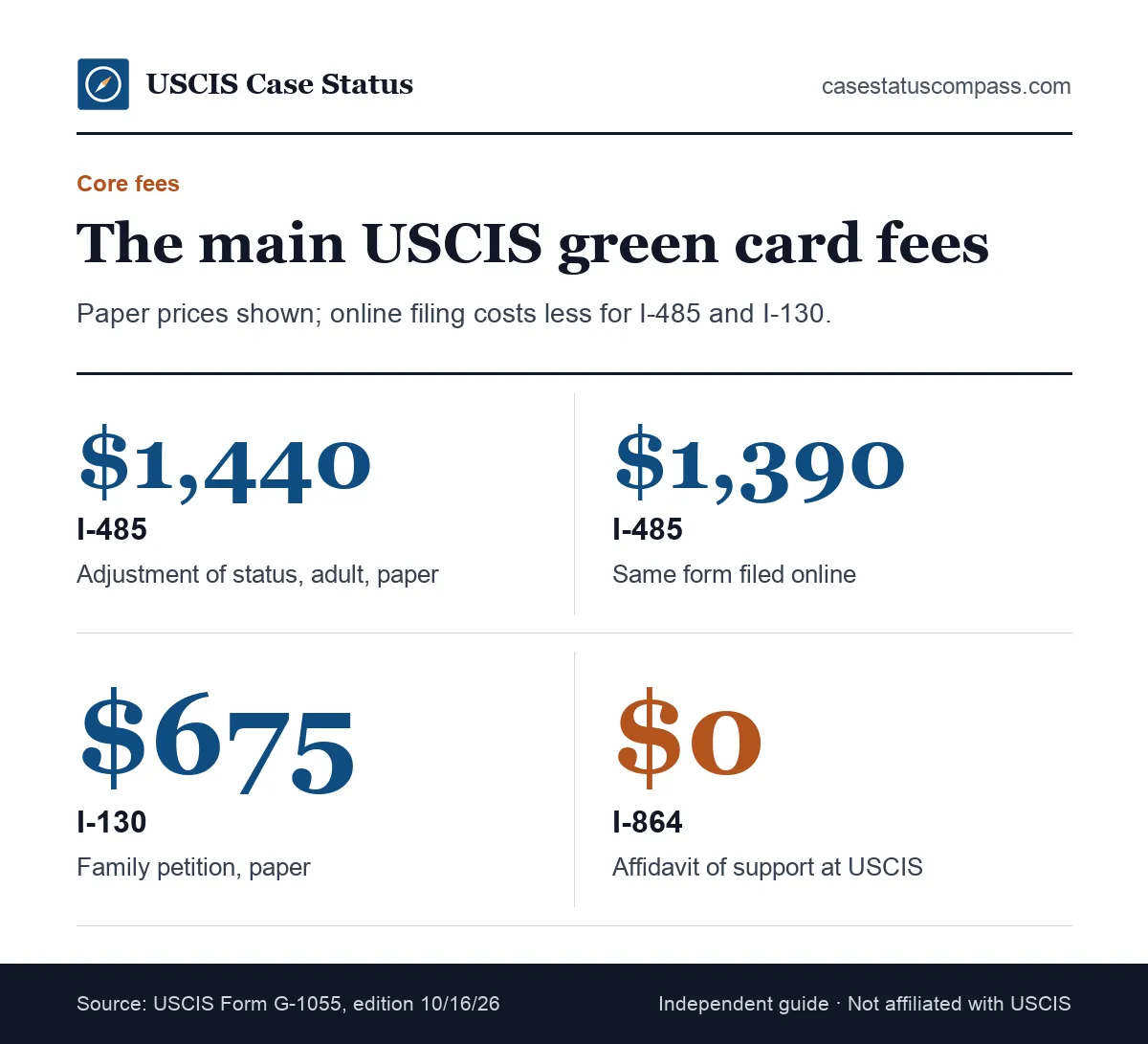
How much is a green card? Since Oct. 16, 2026, Form I-485 costs $1,440 (paper) / $1,390 (online); $950 / $900 if under 14 and filing with a parent, and the family petition (Form I-130) costs $675 (paper) / $625 (online). A U.S. citizen's spouse filing both on paper pays $2,115 in USCIS fees (our sum).
At a glance
| Fee schedule used | Form G-1055, Edition 10/16/26 |
| Family petition | Form I-130: $675 (paper) / $625 (online) |
| Affidavit of support | Form I-864: $0 at USCIS |
| Spouse in the U.S., paper | $2,115 in USCIS fees (our sum) |
| Refunds | USCIS fees are nonrefundable, even if your case is denied or withdrawn |
How Much Is a Green Card in 2026?
The green card cost depends on your route. USCIS charges $1,440 for a paper Form I-485 and $675 for a paper Form I-130. Immigrants abroad pay State Department visa fees instead, per G-1055 (10/16/26). So how much is a green card for you? Add up the petition, the application and any permits to get your real total.
Why there is no single green card fee
A relative or employer files a petition, then the immigrant applies through adjustment of status (AOS) inside the U.S. or consular processing abroad. Each step has its own fee. Our USCIS filing fees guide lists every other form.
What changed on Oct. 16, 2026
USCIS published Form G-1055, Edition 10/16/26. It updated the H.R. 1 add-on fees. Mailed packages postmarked on or after Oct. 16, 2026 without the correct fee are rejected. Check the edition date on any fee chart you use.
What Does the I-485 Filing Fee Cover?
The I-485 filing fee pays for USCIS to process your application to adjust status inside the United States, including the biometrics appointment. The work permit (Form I-765) and travel permit (Form I-131) cost extra. See our Form I-485 adjustment of status guide for eligibility.
Is biometrics included in the I-485 fee?
Yes. The official wording is: Biometrics included in most fees (separate $30 for TPS I-821 and some EOIR forms). Do not send a separate biometrics payment; it can delay your receipt notice.
The I-485 fee for children under 14
A child under 14 who files together with a parent pays a lower child rate: $950 on paper or $900 online. A child filing alone pays the adult fee. Age is counted on the filing date.
Who Pays No Fee for Form I-485?
Some humanitarian applicants pay no I-485 fee. G-1055 lists no fee for refugees, Special Immigrant Juveniles, certain T and U adjusters, VAWA self-petitioners and certain Afghan and Iraqi special immigrants. No waiver request is needed. These groups simply file with no payment form attached.
Check your exact category line
Exemptions are tied to your category, not your income. Our Form G-1055 fee schedule guide shows how to find your line. If your category is not listed as exempt, you pay the standard fee. Asylees, for example, should read their line instead of assuming the refugee exemption covers them.
I-485 Supplement A adds another fee
Applicants who rely on INA 245(i) file Supplement A, which adds $1,000 on top of the I-485 fee (none for unmarried children under 17 and certain Family Unity applicants). It covers only old petitions: 245(i): petition or labor certification filed by Apr. 30, 2001 (and in the U.S. Dec. 21, 2000 if filed after Jan. 14, 1998).
Is the I-485 Fee Cheaper Online?
Yes. The I-485 costs $1,440 paper / $1,390 online. The evidence is the same; only the handling cost is lower. By our sums, filing online saves $50 on the adult I-485 and the same on the child rate. You file through a free USCIS online account and pay at the end through Pay.gov, so there is no envelope to lose and no payment form to sign.
Which I-485 edition must you use?
USCIS accepts only one edition: 09/18/26 (01/20/25 and 09/04/26 editions rejected on/after Sept. 18, 2026; no grace period). A paper package on an old edition is rejected and returned. Online filing always uses the current edition.
When paper filing still makes sense
Paper is still needed when you request a fee waiver or file a package type the online system does not support. Some families also choose paper when a lawyer or clinic prepares a combined package for several relatives at once.
How Much Is the I-130 Fee?
The I-130 fee is $675 (paper) / $625 (online). Our Form I-130 petition guide explains filing. The petitioner, the U.S. citizen or permanent resident relative, pays it when filing, and it is one fee per relative. It does not cover the later I-485 or visa fees, which the immigrant usually pays when the case moves forward. For an immediate relative, USCIS's median for April–June 2026 was: I-130 (immediate relative): median 13.0 months (USCIS data, Apr.-June 2026).
I-130 paper vs online
You can file Form I-130 online even when your relative lives in the United States. The online I-130 costs $625, versus $675 on paper. Edition 04/01/24 is the one to use on paper.
One I-130 fee per relative
Each relative needs a separate petition and a separate I-130 fee; there is no family discount. A citizen sponsoring a spouse and a parent files two I-130s, and each immigrant later pays their own I-485 or visa fees.
Is There a Separate I-130A Fee?
Form I-130A, the supplement for a spouse beneficiary, is filed with the spouse's I-130. We found no separate I-130A form fee on the USCIS I-130 page. Budget for one I-130 fee and include the I-130A in the same package.
How Much Does It Cost to Sponsor a Green Card?
Sponsoring a relative costs the petitioner the I-130 fee. Signing the affidavit of support is $0 at USCIS. The real cost of green card sponsorship is the legal promise to support the immigrant: Sponsors need income of at least 125% of the poverty guidelines (100% for active-duty military sponsoring spouse/child). See our Form I-864 affidavit of support guide.
Income needed to sponsor in 2026
The 2026 poverty guidelines set the minimum: 2026 I-864P (from Mar. 1, 2026): 125% = $27,050 (household of 2), $34,150 (3), $41,250 (4). Count the immigrant in the household size. A sponsor who falls short can add household income or a joint sponsor.
Joint sponsors add no fee
A joint sponsor files a separate I-864 at no USCIS fee. The rule is: Up to two joint sponsors; each must qualify alone at 125%. A joint sponsor takes on the same legal duty as the main sponsor.
What Is the Total Green Card Cost? (Table)
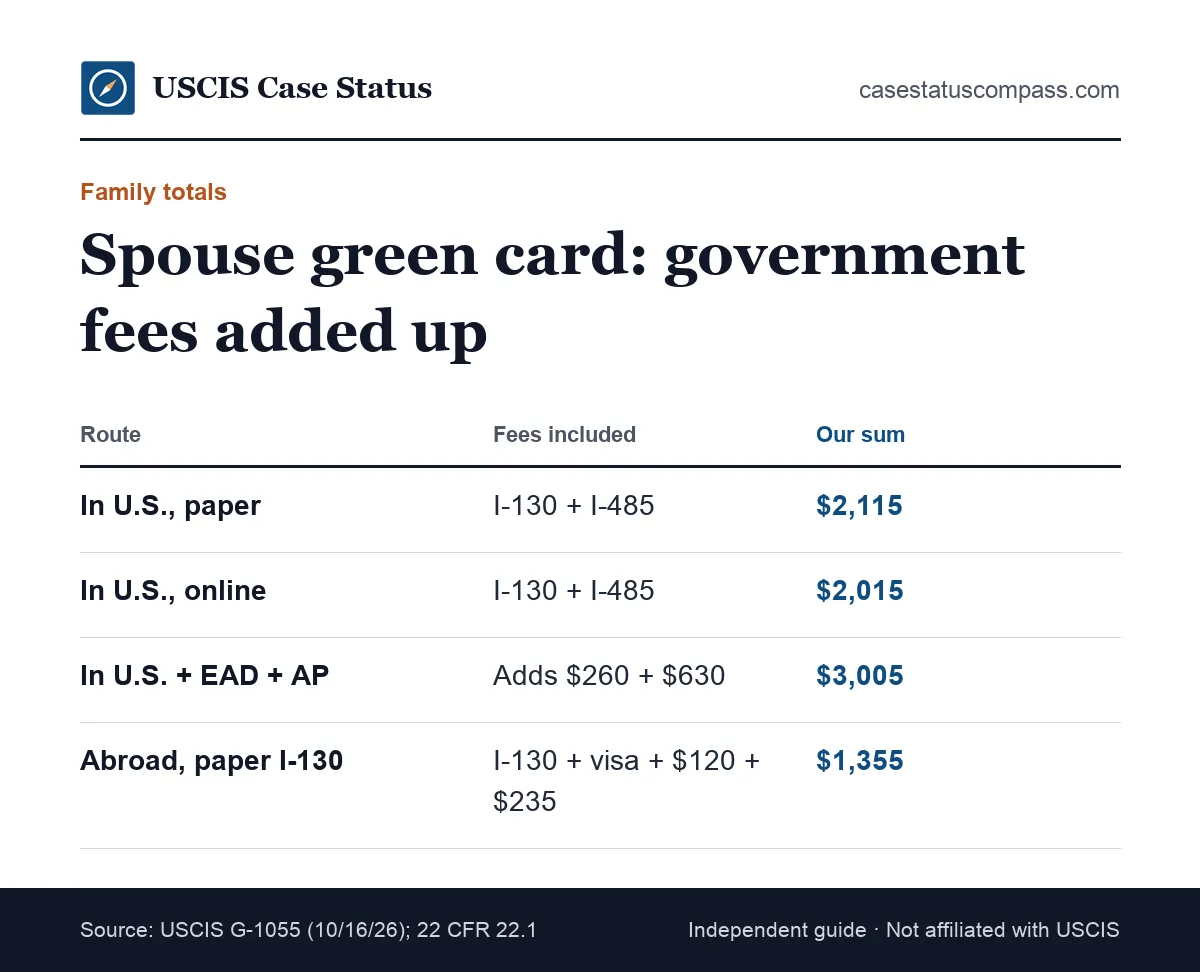
The total green card cost for a U.S. citizen's spouse living in the U.S. is $2,115 in USCIS fees on paper, or $2,015 online, by our sums. Abroad, the same spouse pays $1,355 in government fees. The table below gives totals by situation.
Green card cost table by scenario
Find the row closest to your case. Each total adds only the government fee lines named in the middle column.
| Scenario | Fees that apply | Government total |
|---|---|---|
| Spouse in the U.S. | I-130 + I-485 | $2,115 paper / $2,015 online |
| Spouse in the U.S., with permits | Above + I-765 ($260) + I-131 ($630 paper) | $3,005 paper |
| Spouse abroad | I-130 (paper) + family visa fee + I-864 review + Immigrant Fee | $1,355 |
| Child under 14 with parent | Child I-485 rate only | $950 paper / $900 online |
| Worker in the U.S., large employer | I-140 + Asylum Program Fee + I-485 | $2,755 paper |
| Worker abroad, large employer | I-140 + Asylum Program Fee + employment visa fee + Immigrant Fee | $1,895 |
How we added up these totals
Each total is a plain sum of official lines. We left out the medical exam, which doctors price, and the H.R. 1 parole fee, which applies only if parole is granted.
Why your own total may differ
Your total changes if you mix online and paper forms, add a child, are fee-exempt or skip the optional permits. A spouse who files the I-130 online but the I-485 on paper, for example, pays a mixed total. To work out how much a green card costs in your case, start from the closest row and swap in the lines that apply.
How Much Does a Marriage Green Card Cost?
A marriage green card for a spouse inside the U.S. costs $2,115 in USCIS fees on paper (our sum of the I-130 and I-485). A spouse abroad pays $1,355 in government fees through consular processing. See our CR1 and IR1 marriage visa guide.
Marriage-based green card cost inside the U.S.
A spouse who entered lawfully usually files the I-130 and I-485 together, and most add the reduced-rate I-765 and an I-131 for travel. That brings the marriage-based green card cost to $3,005 on paper, by our sum.
Couples married less than two years
A recent marriage leads to a two-year card: Most green cards are valid for 10 years; conditional green cards for 2 years. Plan for the I-751 fee about two years later.
What Is the Spouse Visa USA Cost From Abroad?
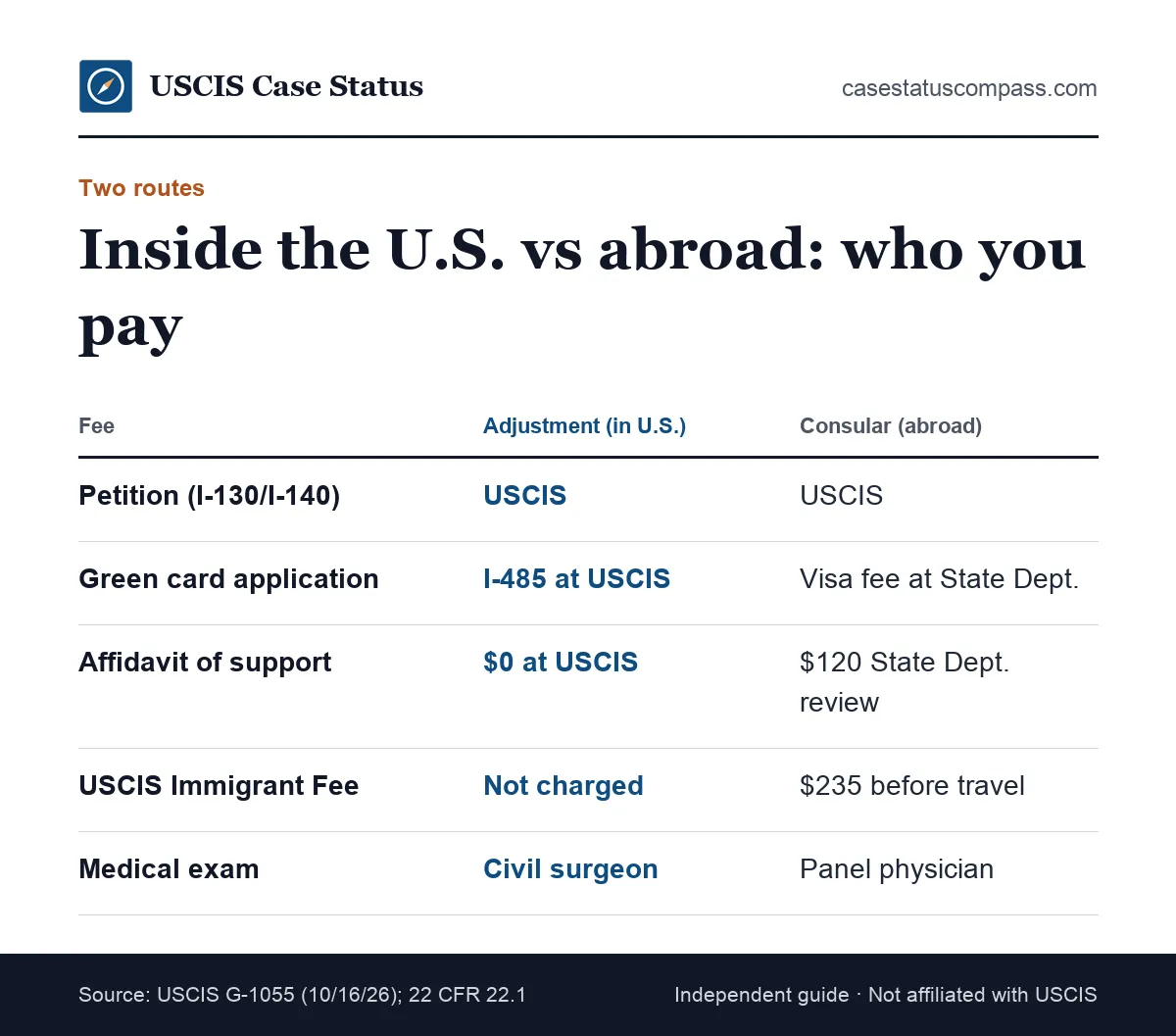
The US spouse visa cost abroad is the I-130 fee, then State Department fees: Immigrant visa fee: $325 family; $345 employment; $205 other (per person), plus the $120 Affidavit of Support review fee (State Department, when reviewed domestically). After the visa is issued, the spouse pays the USCIS Immigrant Fee of $235.
Where spouse visa fees are paid
The National Visa Center (NVC) handles the visa fees. Officially, NVC (State Department) collects visa fees and documents after USCIS approves the petition. Pay them through the State Department, not USCIS.
Costs at the embassy stage
Spouses abroad also pay a panel physician and may pay for police certificates, translations and travel to the embassy. Ask the embassy and clinic for local prices. Budget for these before the interview date.
How Much Does It Cost to Bring a Relative From Abroad?
Bringing a relative from abroad costs the I-130 fee, the immigrant visa fee, the affidavit of support review fee and the USCIS Immigrant Fee. For one family immigrant with a paper I-130, our sum is $1,355. The table shows who collects each fee.
Consular processing fees per family immigrant
These are the fees for one family immigrant processed abroad. Each row names the agency that collects it.
| Fee | Paid to | Amount |
|---|---|---|
| Form I-130 petition | USCIS | $675 (paper) / $625 (online) |
| Immigrant visa application | State Department | $325 family / $345 employment |
| Affidavit of support review | State Department | $120 |
| USCIS Immigrant Fee | USCIS (online) | $235 |
| Medical exam | Panel physician | Set by the doctor |
Every family member pays a visa fee
The immigrant visa fee is per person. A parent immigrating with two children in a preference category pays three visa fees and three Immigrant Fees. Only one I-130 is filed in that case, because the children are derivatives.
Adjustment of Status vs Consular Processing: Which Costs Less?
Consular processing costs less in government fees. By our sums, a spouse abroad pays about $760 less than one filing a paper I-485 inside the U.S. But adjustment applicants can stay and work while they wait. That freedom often outweighs the fee gap.
What the higher adjustment fee buys
Adjustment of status lets you remain in the United States while USCIS decides. You can request a reduced-rate work permit and advance parole, and you skip the embassy trip. You also attend your interview locally.
You cannot simply pick the cheaper route
Eligibility decides your route, not price. An immigrant outside the U.S. must use consular processing. One inside the U.S. can adjust only if they meet the I-485 requirements. A wrong choice can mean a lost, nonrefundable fee.
How Much Is the USCIS Immigrant Fee?
The USCIS Immigrant Fee is $235. Consular immigrants pay it online after the State Department issues the immigrant visa. It pays for USCIS to produce your green card. It is a USCIS fee, separate from the State Department visa fees. The State Department does not collect it, so paying the NVC invoice does not cover it.
When and how to pay it
USCIS strongly encourages paying after you collect the visa and before you travel. Payment is online only, by card or U.S. bank account. Anyone can pay for you with your A-Number and State Department case ID.
What if you don't pay the Immigrant Fee?
Your status is not affected, but USCIS will not mail the card until you pay. Your proof of status is the passport stamp: Temporary I-551 stamp: valid until its expiration date, or 1 year if no date is printed.
Who is exempt from the Immigrant Fee?
USCIS exempts orphan and Hague adoptees, Iraqi and Afghan special immigrants, returning residents (SB-1) and K nonimmigrants. K-1 fiancés are covered by that last group, because they enter as nonimmigrants and pay for the card later through the I-485. If you fit one of these groups, do not pay the fee: USCIS fees are nonrefundable, even if your case is denied or withdrawn.
How Much Is the Immigration Medical Exam?
USCIS charges no fee for Form I-693: $0 USCIS fee; the civil surgeon sets the exam price. Prices differ by civil surgeon and region. Our immigration medical exam cost guide explains how to compare clinics. Vaccines and lab tests are usually billed on top.
The I-693 must go in with the I-485
The sealed medical report is part of the first filing: Send the sealed I-693 with your I-485 (required since Dec. 2, 2024). Book early so the sealed envelope is ready.
Can you reuse an old medical exam?
Usually not: An I-693 is generally valid only for the application it was filed with. If an earlier I-485 was denied or withdrawn, budget for a new exam. Keep a copy of every exam you submit.
How Much Do the Work Permit and Travel Permit Add?
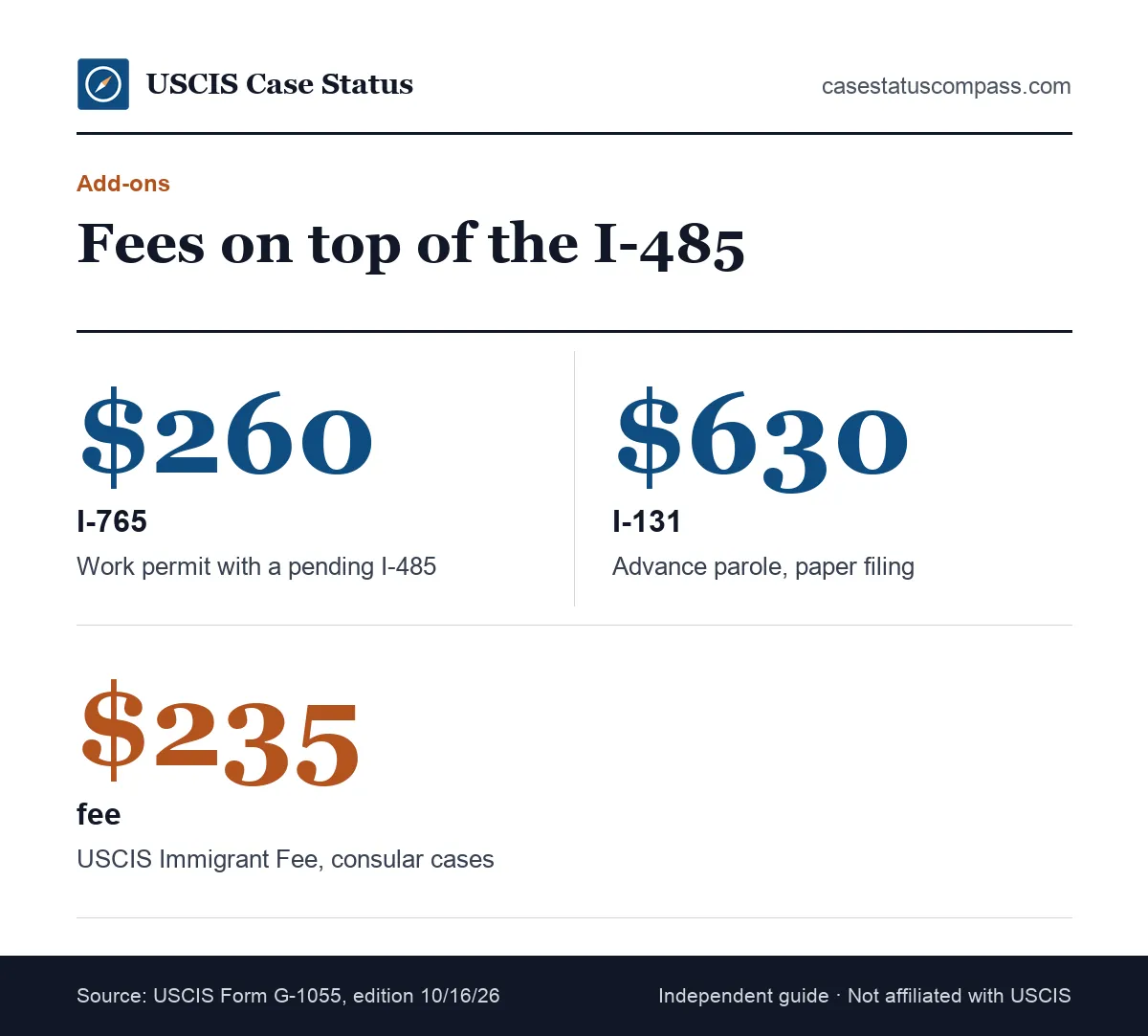
The work permit and travel permit are optional add-ons. With a pending I-485 filed on or after April 1, 2024, Form I-765 costs $260. Form I-131 for advance parole costs $630 paper / $580 online. Both are paid only if you file them.
The full I-765 fee line
The I-765 line covers many categories; green card applicants use the pending-I-485 rate of $260. The H.R. 1 add-ons apply to asylum, TPS and parolee categories, not to adjustment applicants.
The H.R. 1 Immigration Parole Fee
The I-131 line reads: $630 (paper) / $580 (online); $0 if your I-485 was filed before Apr. 1, 2024 with the fee. H.R. 1 Immigration Parole Fee $1,050 when parole is granted (some exceptions). The parole fee is tied to a parole grant, and one exception fits most adjustment applicants: the parole fee does not apply to an INA 245 adjustment applicant returning from temporary travel abroad, if CBP agrees at the port of entry. Ask an attorney how it applies to you.
Is Advance Parole Worth Paying For?
Advance parole protects a pending I-485 when you travel. Traveling while your I-485 is pending abandons it unless you have advance parole (with H/L/V/K exceptions). Since August 2026, parole travel also carries new risks: Since Aug. 13, 2026, travel on advance parole counts as a departure: over 180 days of unlawful presence can trigger the 3/10-year bar. Get legal advice if you had unlawful presence.
When to skip the travel permit
If you will not leave the U.S. while the case is pending, skip the I-131 and save the fee. You can file later, but a travel document takes time. Plan ahead if a trip is likely.
Filing both permits with the I-485
You can mail the I-765 and I-131 in the same package as the I-485, each with its own fee. This usually means one biometrics visit for all three. Each form gets its own receipt notice.
What Does an Employment-Based Green Card Cost?
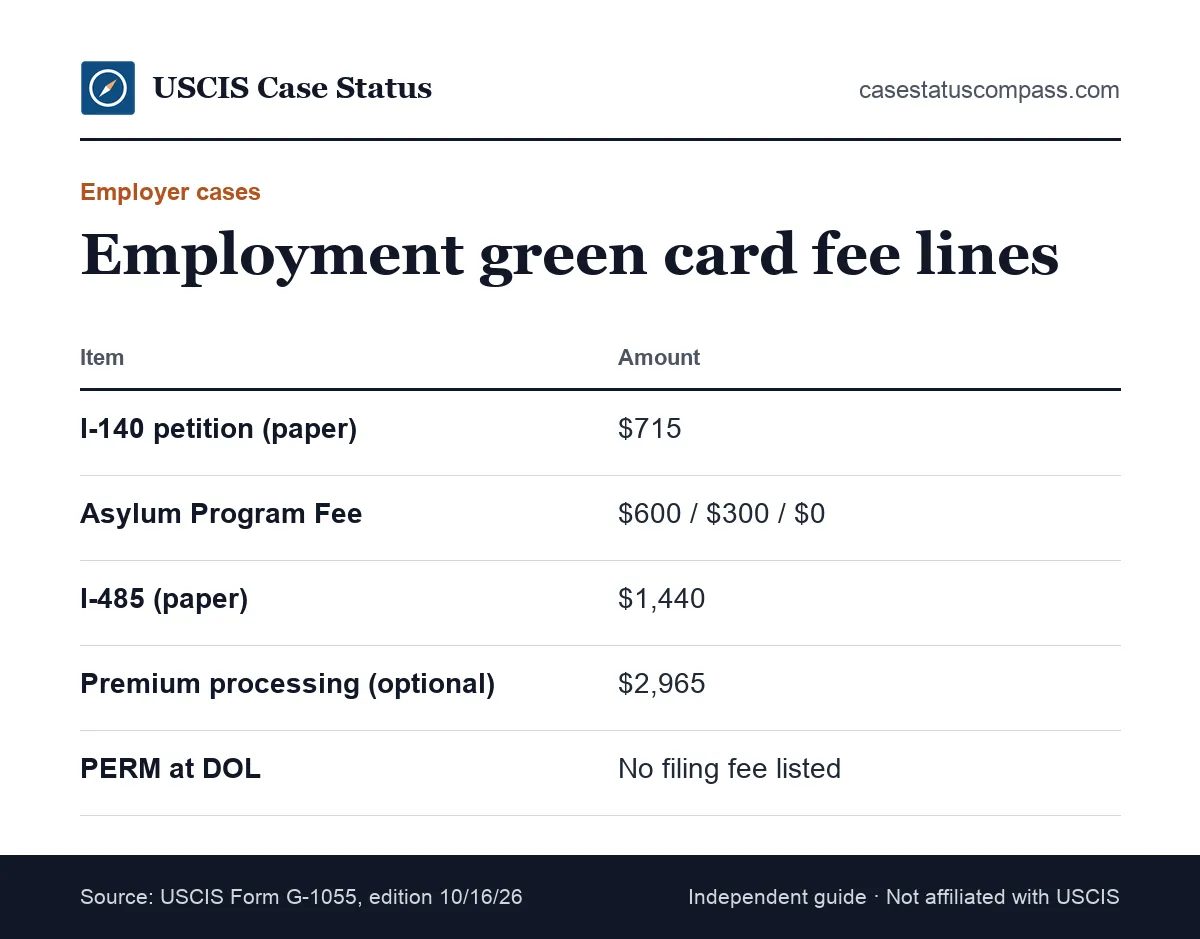
An employment-based green card starts with Form I-140: $715 (paper) / $665 (online) + Asylum Program Fee $600 ($300 small employer or self-petitioner; $0 nonprofit). The worker's I-485 then costs $1,440 on paper. Many cases first need PERM, and some employers add optional premium processing.
Who pays for employer green card sponsorship?
The employer pays PERM costs. Under 20 CFR 656.12, the employer, not the worker, must pay PERM labor certification costs, including its own attorney fees. Wage deductions and kickbacks count as payment. The I-485 is usually the worker's cost.
The Asylum Program Fee on I-140 petitions
Every I-140 carries an extra line: Asylum Program Fee (I-129, I-140): $600; $300 small employer (or I-140 self-petitioner); $0 nonprofit. The Asylum Program Fee is paid on top of the base fee.
Is There a PERM Filing Fee for an Employer Green Card?
No. The Department of Labor does not list a filing fee for Form ETA-9089. Employers still pay for recruitment ads and attorney time, often the largest part of an employer green card sponsorship cost. See our PERM labor certification guide.
How Much Is an EB-1 Green Card?
The EB-1 green card cost is the I-140 fee plus the Asylum Program Fee, then the I-485 or the employment visa fees. EB-1A self-petitioners pay the reduced Asylum Program Fee. Employer-filed EB-1B and EB-1C petitions pay the rate for the employer's size. No PERM step is needed, so there are no recruitment costs.
EB-1A vs EB-1B and EB-1C fee lines
This table splits the EB-1 fee lines by who files the petition. Only the Asylum Program Fee row differs.
| Line | EB-1A (self-petition) | EB-1B / EB-1C (employer) |
|---|---|---|
| Form I-140 base fee | $715 paper / $665 online | Same |
| Asylum Program Fee | $300 self-petitioner rate | $600 / $300 / $0 by employer type |
| Form I-485 (in the U.S.) | $1,440 paper / $1,390 online | Same |
| Premium processing | Optional, $2,965 | Optional, $2,965 |
| PERM | Not required | Not required |
EB-1 totals in practice
An EB-1A applicant in the U.S. filing on paper pays $715 + $300 + $1,440 = $2,455 (our sum) before premium processing. An EB-1C manager with a large employer pays $2,755 by our sum. Each family member adds an I-485 fee.
Does Premium Processing Speed Up a Green Card?
Only the petition stage. Premium processing speeds up the I-140, not the I-485. The fee is $2,965 (I-129 most classes, I-140); $1,780 (H-2B/R, I-765 OPT); $2,075 (I-539 to F/J/M). It is paid on Form I-907 on top of every other fee, and You can't get a fee waiver for premium processing. See our premium processing guide.
Which Green Card Fees Can Be Waived?
Most green card fees cannot be waived. Waivers are limited to specific forms: Fee waivers are possible for forms like I-90, I-751, I-765 (not DACA), N-400, N-565 and N-600. Asking costs $0 (no fee to request a fee waiver). Our USCIS fee waiver guide explains eligibility.
Fee waiver vs fee exemption
A fee waiver is a request on Form I-912 that USCIS decides. A fee exemption is written into the fee schedule, so a qualifying applicant files with no fee. Neither covers most green card forms.
H.R. 1 fees cannot be waived
The H.R. 1 add-ons apply to some work permits, parole and asylum. The rule: H.R. 1 fees can't be waived and must be paid separately. Even an approved I-912 leaves those add-ons due in full.
Can You Get a Refund on a Green Card Fee?
No. The official rule: USCIS fees are nonrefundable, even if your case is denied or withdrawn. If USCIS denies your I-485, the full fee is gone. A rejected package is different, because USCIS returns it unprocessed. Read the eligibility rules for your category on uscis.gov before you send the I-485 fee.
Rejection vs denial
A rejection means USCIS never accepted the package, often for a wrong fee, missing signature or old edition. You fix it and refile. A denial means USCIS reviewed the case and said no, and the fee is kept. See our I-485 denied guide.
Sending the wrong amount
If you send the wrong amount on paper, USCIS rejects the package rather than keeping the difference. Online filing calculates the fee for you. Check every amount against the current G-1055 before you seal the envelope, and remember that each form needs its own correct fee.
Withdrawing an I-485 after you pay
Withdrawing a pending application does not return the fee either. If you switch from adjustment to consular processing midway, the I-485 fee already paid is lost, so confirm eligibility first.
How Do You Pay Green Card Fees Online?
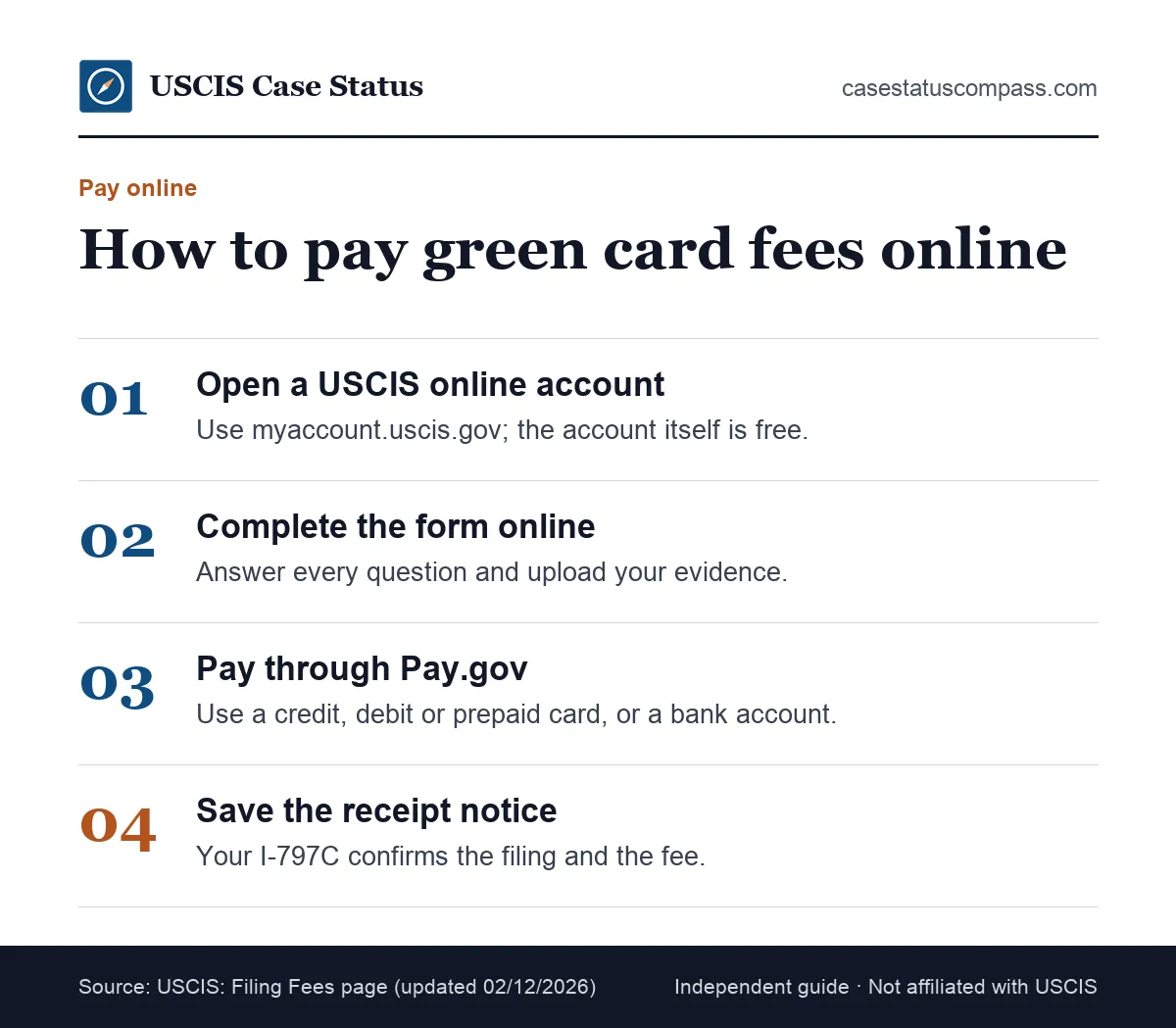
To pay a green card fee online, file the form in your USCIS online account. At the end, the system sends you to Pay.gov, the Treasury payment site. Pay with a credit, debit or prepaid card, or by bank account withdrawal.
Green card fee payment online: what to have ready
Have your card or bank details, the exact form you are filing, and enough credit limit for the full fee. The payment confirmation appears in your account. Save it until the receipt notice arrives.
Paying the Immigrant Fee online
The USCIS Immigrant Fee page takes card or U.S. bank account payments. Have each A-Number and State Department case ID ready. Each immigrant needs a separate payment, so a parent and two children pay three times. Pay it before you travel so the card is mailed without delay.
Where Do You Pay the Green Card Fee?
Where you pay depends on the fee. USCIS fees are paid with the form. State Department fees are paid through the NVC process. The Immigrant Fee is paid on its own USCIS page, and the civil surgeon is paid at the clinic.
USCIS, State Department and doctor payments
Green card fees go to three different places. Use this table to send each payment to the right one.
| Fee | Where you pay | How |
|---|---|---|
| I-130, I-485, I-140, I-765, I-131 | USCIS, with the form | Pay.gov online, or G-1450 / G-1650 on paper |
| Immigrant visa and I-864 review fees | State Department (NVC) | Per your NVC instructions |
| USCIS Immigrant Fee | USCIS Immigrant Fee page | Online only, card or bank account |
| Medical exam | Civil surgeon or panel physician | The doctor's own terms |
Paying State Department fees
State Department fees for the immigrant visa and the affidavit of support review are billed after USCIS approves the petition and sends the case to the NVC. Pay only through the channel named in your NVC notice.
How Do You Pay Green Card Fees on a Paper Filing?
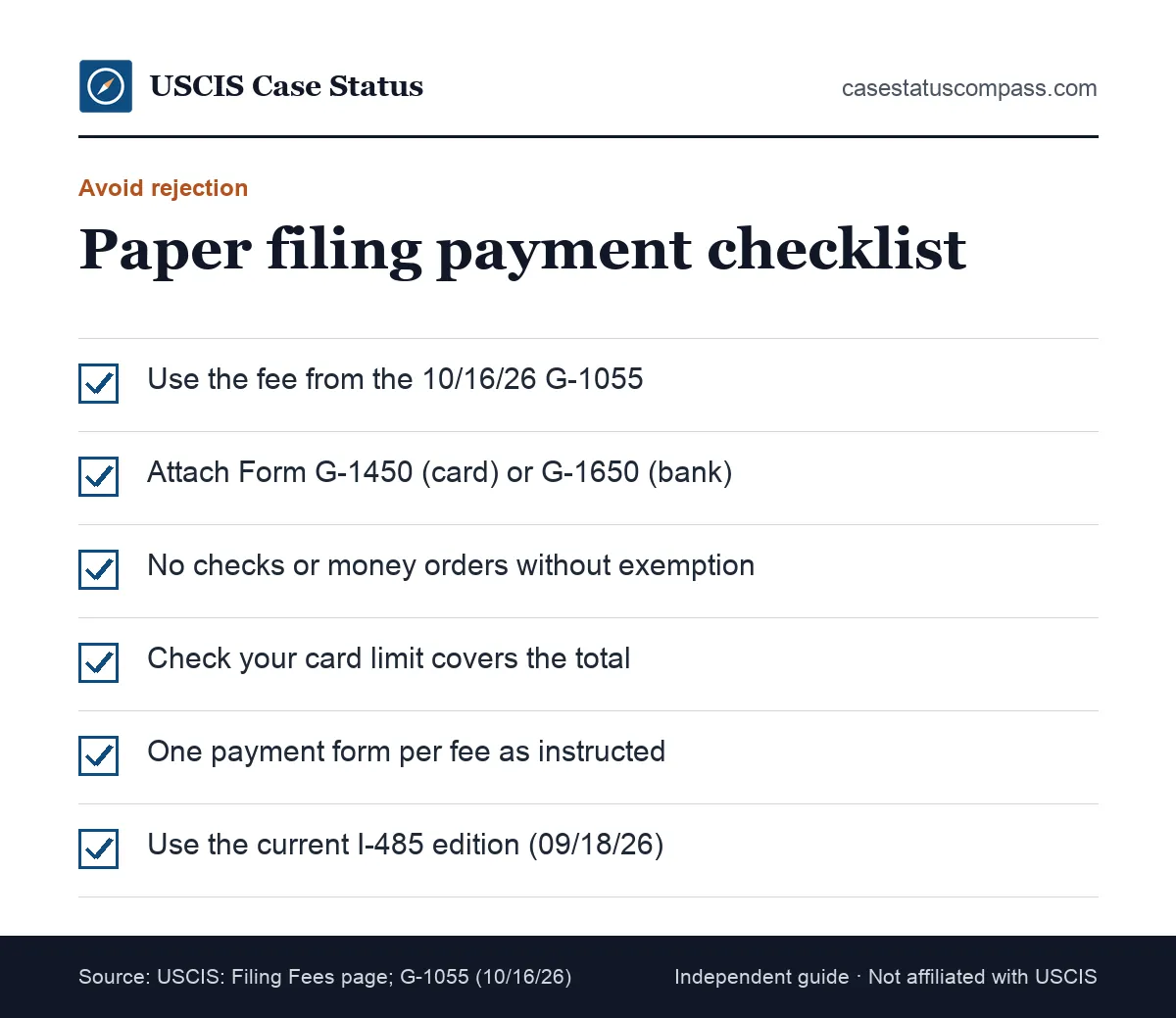
Paper green card filings must be paid electronically. Under USCIS rules, checks, money orders and cashier's checks are accepted only with an approved Form G-1651 exemption. Use Form G-1450 for a card or Form G-1650 for a U.S. bank account (ACH) payment.
When paper checks are still allowed
Paper payment needs an approved exemption on Form G-1651. Reasons include no access to banking or undue hardship. An exempt payment must be in U.S. funds and drawn on a U.S. bank. Also, make paper payments payable to the U.S. Department of Homeland Security (not 'DHS' or 'USDHS').
Avoiding a declined card
A declined card gets the package rejected. Warn your bank about the charge. Make sure the limit covers every fee in the envelope. If several forms share one envelope, confirm the card can cover their combined total.
Can You Pay Green Card Fees in Installments?
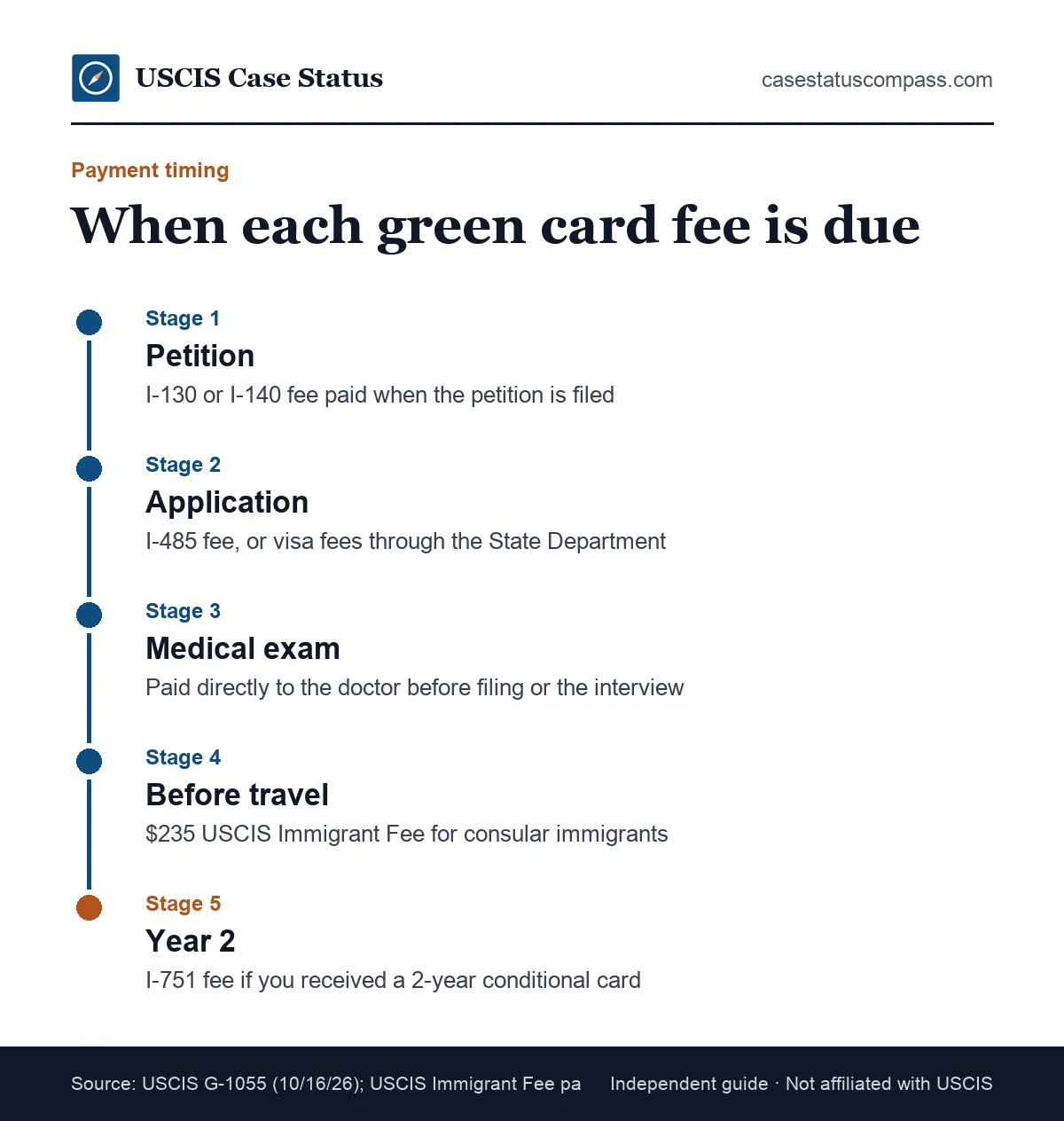
No installment plan exists for USCIS fees on any official page we checked. You can spread costs only by timing, since the I-130 is often paid months or years before the I-485 or visa fees. Saving ahead for each stage works best.
Using a credit card to spread the cost
Paying through Form G-1450 or Pay.gov lets you carry a balance with your card issuer. That is a private loan, not a USCIS plan, and interest adds up. Compare the interest rate first.
Different people can pay different fees
The petitioner, the immigrant, an employer or another relative can pay. Families often split the cost: the sponsor pays the I-130 and the immigrant pays the I-485 or visa fees.
How Much Does a Green Card for Parents Cost?
A green card for a parent of an adult U.S. citizen costs the I-130 fee, then the I-485 or consular fees. By our sums, a parent abroad pays $1,355 in government fees with a paper I-130. In the U.S., paper filing costs $2,115.
Parents inside the U.S.
A parent who entered lawfully can usually adjust status. Older parents often skip the work permit. Advance parole matters if they plan to visit home. The sponsoring child must be a U.S. citizen aged 21 or older, and must also sign Form I-864.
Two parents, two petitions
Each parent needs a separate I-130 and a separate I-485 or visa fee. By our sums, two parents abroad cost $2,710 in government fees with paper petitions. Two parents filing in the U.S. on paper cost $4,230 before medical exams.
How Much Does It Cost to Sponsor a Child or Sibling?
Sponsoring a child or sibling costs the same I-130 fee. Married children and siblings fall into preference categories with long waits, and the later visa or I-485 fees are due only when a visa number is available. Only citizens can sponsor siblings.
A family filing together
Two parents and one child under 14 filing I-485s together on paper pay two adult fees and one child fee: $1,440 + $1,440 + $950 = $3,830 (our sum). Each person also needs a separate medical exam.
Siblings and the long wait
A sibling petition may wait years before the second fee is due. Budget for the I-130 now and the later fees at future rates. USCIS's median for other relatives in April–June 2026 was: I-130 (all other relatives): median 43.3 months (USCIS data, Apr.-June 2026).
How Do Asylees and Refugees Pay for a Green Card?
Refugees pay no fee for Form I-485 under G-1055, and several other humanitarian groups are exempt too. Asylees should check the exact line for their category. Both groups face a waiting period: Refugees and asylees need 1 year of physical presence in the U.S. before filing I-485.
Do not assume a fee exemption
Exemptions are category by category. If your line shows a fee, you pay it or request a fee waiver where the form allows one. Read the line for your exact category in G-1055 before mailing anything, because a package without a required fee is rejected.
Getting help with a humanitarian case
Humanitarian green card cases often involve past travel, prior filings or court history. A DOJ-accredited representative at a nonprofit can confirm the right fee line and whether a waiver applies.
Is a K-1 Fiancé Visa Cheaper Than a Spouse Green Card?
A K-1 visa is usually not cheaper. The fiancé petition costs $675, plus the State Department $265 K (fiancé) visa application fee. After the wedding, the fiancé still files an I-485 at the full fee. See our K-1 visa cost guide.
Why the K-1 path adds a layer
You pay a petition fee and a visa fee, then the full I-485 in the U.S. The K-1's advantage is speed to arrive, not price. The visa fee is paid abroad, and the I-485 fee is paid here.
When the K-1 route still makes sense
Couples who want to marry in the U.S., or cannot marry abroad, may still choose the K-1 visa despite the higher total. Compare both paths before filing: the K-1 brings the fiancé here sooner, while a spouse visa takes longer but costs less overall.
What Other Costs Should You Budget For?
Beyond government fees, applicants usually pay for the medical exam, passport photos, certified translations, civil documents, postage and sometimes a lawyer. Keep a buffer of several hundred dollars on top of the fee table. The amounts depend on your country and the provider.
Translations and civil documents
Every foreign-language document needs a full certified translation. Birth and marriage certificates may need fresh copies from the issuing country. Consular cases also need police certificates. Order these early, because some countries take months.
Passport photos and postage
Paper filings need passport-style photos for Form I-485 and each permit request, and tracked mail lets you prove the package arrived. These costs are small but add up for a whole family.
Lawyer fees
A lawyer is optional but common, and legal fees often exceed the government fees. See our immigration lawyer cost guide. Confirm anyone you pay is a licensed attorney or a DOJ-accredited representative.
How Much Is a Green Card Compared With Citizenship?
A green card costs more than naturalization later. A paper I-485 is $1,440, while Form N-400 costs $760 paper / $710 online. See how much it costs to become a US citizen. Naturalization usually comes three or five years after the green card.
Renewing a green card later
A 10-year card is renewed with Form I-90 at $465 (paper) / $415 (online). The green card renewal fee guide covers who pays and who is exempt. Online filing lowers that cost.
Planning for the full path
A realistic budget covers the green card fees now, the I-751 if your card is conditional, and the N-400 later. Recheck the fee schedule before each stage. Any new G-1055 edition can change those amounts, so treat later stages as estimates.
What Does It Cost to Remove Conditions on a Green Card?
The remove conditions on green card fee is $750 (paper) / $700 (online) for Form I-751. Conditional residents file it, usually jointly with their spouse, in the 90 days before the two-year card expires. Filing online lowers the fee. Edition 04/01/24 is used on paper.
What the I-751 receipt does for you
Filing on time keeps you in status: I-751 receipt notice extends conditional status and work authorization for 48 months. Missing the window can end your status. Our Form I-751 guide lists the joint evidence you need.
I-751 fee exemptions
Filers who request a waiver of joint filing because of battery or extreme cruelty pay no fee under G-1055. Some other filers may qualify for a fee waiver, since the I-751 is on the waiver list.
How Do Green Card Fees Compare Form by Form?
This summary table lists every fee that can appear on a green card path, with the official line and when it applies. Tick each line that fits to get your personal total. Online rates are lower on most lines.
Green card fee checklist by form
Each row is one form or fee that may apply to you. Skip the rows that do not match your route.
| Form or fee | Official amount | When it applies |
|---|---|---|
| I-130 family petition | $675 (paper) / $625 (online) | Every family case |
| I-140 worker petition | $715 paper / $665 online + Asylum Program Fee | Employment cases |
| I-485 adjustment | $1,440 (paper) / $1,390 (online); $950 / $900 if under 14 and filing with a parent | Applying inside the U.S. |
| I-864 affidavit | $0 at USCIS | Most family cases |
| I-693 medical | $0 USCIS fee; the civil surgeon sets the exam price | Every I-485 |
| I-751 conditions | $750 (paper) / $700 (online) | Two-year cards |
| USCIS Immigrant Fee | $235 | Consular immigrants |
What Happens After You Pay the Green Card Fee?
After USCIS accepts your fee, it sends Form I-797C, a receipt notice, for each form. The receipt proves the fee was taken and gives you a receipt number to track the case. Online filers see each notice in their account. Paper filers get it by mail.
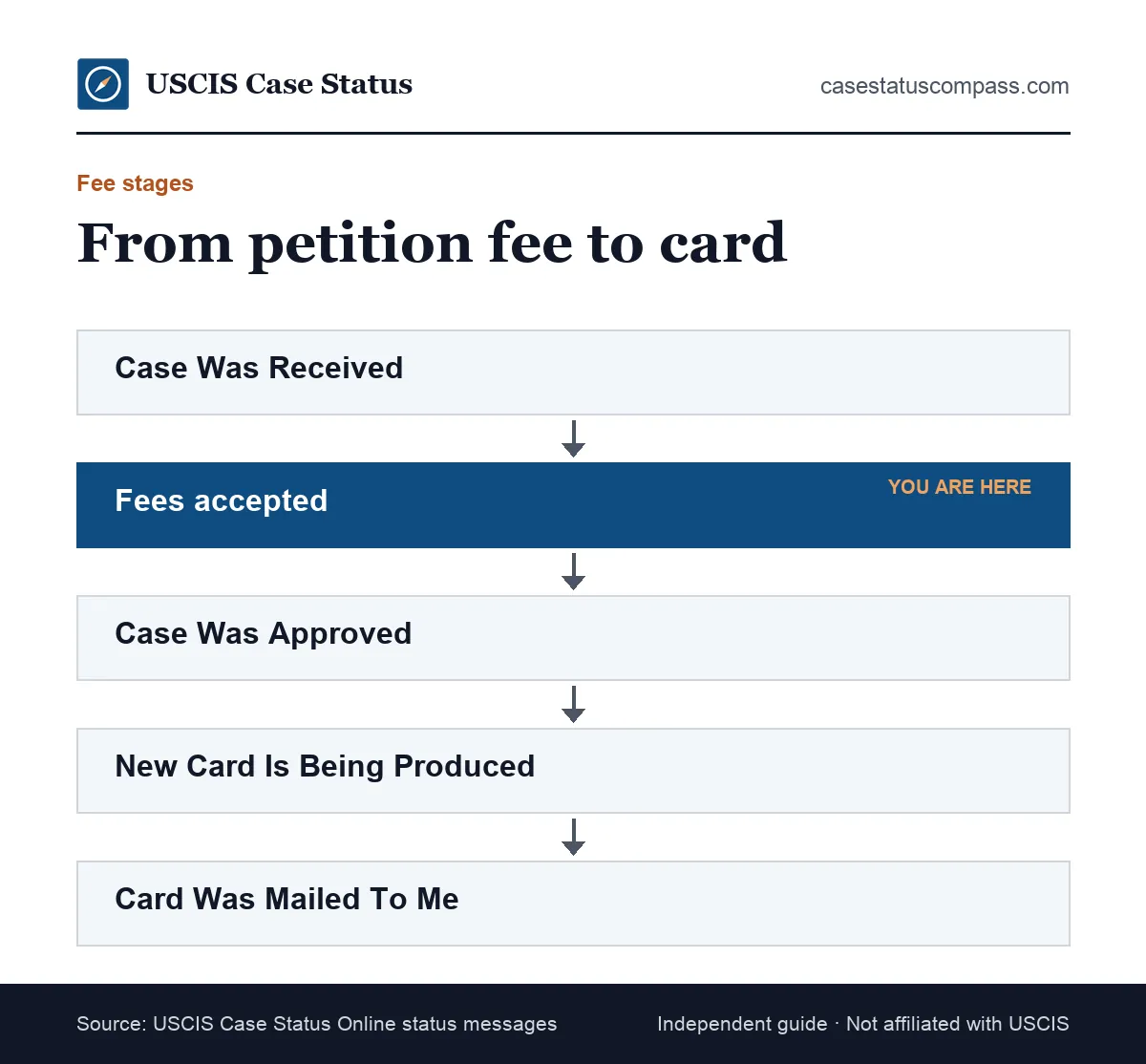
Matching the fee to your receipt notice
Check that each I-797C shows the right form and a matching bank charge. Our I-797C notice guide explains each notice field. If a charge appears without a receipt, wait a few weeks before contacting USCIS, and never pay a second time for the same form.
Tracking the case after payment
With the receipt number, follow the case on the official tool. Our USCIS case status guide explains the messages from "Case Was Received" to "Card Was Mailed To Me," so you know which next fee is coming.
What Are the Most Common Green Card Fee Mistakes?
The most common fee mistakes are using an old amount, mailing a check after electronic payment became required, forgetting the I-765 or I-131 payment, and filing an old I-485 edition. Whatever the answer to how much is a green card in your case, most are caught by checking each form against the current G-1055 before mailing.
Mistakes that cost time
A wrong fee, declined card or old edition gets the package returned. You refile, but you lose weeks. For a family, one wrong fee can hold up everyone filing together. Online filing removes most of these errors, because the system sets the fee and the edition for you.
Mistakes that cost money
Filing an I-485 you are not eligible for loses the full fee. So does traveling without advance parole and abandoning the application. Missing the I-751 window can cost your status.
Forgetting a family member's fee
Each person files their own I-485 with their own fee, and a child under 14 gets the child rate only when filing with a parent. Leaving one payment out gets that person's application returned.
How Much Is a Green Card for America if You Have a Complex Case?
Complex cases cost more because of legal help, waivers and extra forms, not higher base fees. Anyone with a past immigration violation, denial, criminal record or unlawful presence should talk to a lawyer or DOJ-accredited representative before paying any fee.
Free and low-cost help
Nonprofit legal services and accredited representatives often charge less than private firms. Notarios and "immigration consultants" cannot give legal advice.
Waivers add their own fees
Applicants who need a waiver of inadmissibility, such as Form I-601 or I-601A, pay a separate fee listed in G-1055. Ask a lawyer whether you need one before filing the I-485.
Frequently Asked Questions
How much does it cost to get a green card?
For a spouse or parent of a U.S. citizen living in the U.S., USCIS fees are $2,115 on paper by our sum: the I-130 at $675 and the I-485 at $1,440. A relative abroad pays about $1,355 in government fees (our sum).
How much is the green card fee for one person?
The main fee for one adult applying inside the U.S. is the I-485: $1,440 on paper or $1,390 online. The sponsor usually pays the separate I-130 fee.
How much does it cost to sponsor a green card?
The sponsor pays the I-130 fee of $675 (paper) / $625 (online) and files Form I-864 at $0 at USCIS. The bigger commitment is financial: the sponsor must meet the income rule and accept a legal duty of support.
How much is the I-130 fee for a spouse?
The I-130 for a spouse costs $675 on paper or $625 online, the same as for other relatives. The spouse's Form I-130A goes in the same package with no separate fee listed.
How much is the fee for a green card application filed online?
Filing Form I-485 online costs $1,390, versus $1,440 on paper. You pay through Pay.gov. The I-130 is also cheaper online, at $625.
Can I pay the green card fee with a check or money order?
Usually not. USCIS says it no longer accepts personal or business checks, money orders or cashier's checks for paper filings unless you have an approved exemption on Form G-1651. Pay by card with Form G-1450 or by bank account with Form G-1650.
Are green card fees refundable if the case is denied?
No. USCIS keeps the fee even if the case is denied or withdrawn. A rejected package is returned unprocessed, so you can fix it and refile.
How much does it cost to get a green card through an employer?
For a worker in the U.S. with a large employer, the I-140 ($715), Asylum Program Fee ($600) and paper I-485 ($1,440) total $2,755 by our sum. PERM has no DOL filing fee, but employers pay recruitment and legal costs.
Where do I pay the green card fee?
USCIS fees such as the I-130 and I-485 are paid with the form, through Pay.gov online or Form G-1450 or G-1650 on paper. Visa fees go to the State Department through the NVC, and the Immigrant Fee has its own USCIS page.
Sources
- USCIS Fee Schedule (Form G-1055). www.uscis.gov/g-1055. Accessed Oct 27, 2026.
- USCIS: Filing Fees (payment methods). www.uscis.gov/forms/filing-fees. Accessed Oct 27, 2026.
- USCIS: USCIS Immigrant Fee. www.uscis.gov/forms/filing-fees/uscis-immigrant-fee. Accessed Oct 27, 2026.
- USCIS: Form I-485. www.uscis.gov/i-485. Accessed Oct 27, 2026.
- USCIS: Form I-130. www.uscis.gov/i-130. Accessed Oct 27, 2026.
- USCIS: Form I-693. www.uscis.gov/i-693. Accessed Oct 27, 2026.
- 22 CFR 22.1 Schedule of Fees for Consular Services. www.law.cornell.edu/cfr/text/22/22.1. Accessed Oct 27, 2026.
- USCIS Form G-1055 Fee Schedule, Edition 10/16/26. www.uscis.gov/sites/default/files/document/forms/g-1055.pdf. Accessed Oct 27, 2026.
- Form I-485 Supplement A Instructions, Edition 09/18/26. www.uscis.gov/sites/default/files/document/forms/i-485supainstr.pdf. Accessed Oct 27, 2026.
- USCIS Data Library: All USCIS Application and Petition Form Types, FY2026 Q3 (Apr. 1-June 30, 2026; queried 7/2026). www.uscis.gov/sites/default/files/document/data/quarterly_all_forms_fy2026_q3_v1.xlsx. Accessed Oct 27, 2026.
- Form I-864 Instructions, Edition 08/24/26. www.uscis.gov/sites/default/files/document/forms/i-864instr.pdf. Accessed Oct 27, 2026.
- USCIS: Form I-864P, 2026 HHS Poverty Guidelines (updated 02/27/2026). www.uscis.gov/i-864p. Accessed Oct 27, 2026.
- USCIS Glossary: Green Card. www.uscis.gov/tools/glossary. Accessed Oct 27, 2026.
- USCIS: Consular Processing (updated 07/20/2023). www.uscis.gov/green-card/green-card-processes-and-procedures/consular-processing. Accessed Oct 27, 2026.
- 22 CFR 22.1 Schedule of Fees for Consular Services (govinfo, CFR 2025 edition). www.govinfo.gov/content/pkg/CFR-2025-title22-vol1/xml/CFR-2025-title22-vol1-sec22-1.xml. Accessed Oct 27, 2026.
- USCIS M-274 Handbook for Employers, 7.1 (updated 10/17/2023). www.uscis.gov/i-9-central/form-i-9-resources/handbook-for-employers-m-274/70-evidence-of-employment-authorization-for-certain-categories/71-lawful-permanent-residents-lpr. Accessed Oct 27, 2026.
- USCIS Policy Manual Vol. 8, Part B, Ch. 4. www.uscis.gov/policy-manual/volume-8-part-b-chapter-4. Accessed Oct 27, 2026.
- DHS notice 'Immigration Parole Fee Required by HR-1 Reconciliation Bill', FR Doc. 2025-19564, 90 FR (Oct. 16, 2025); also G-1055 10/16/26 Appendix B. www.govinfo.gov/content/pkg/FR-2025-10-16/pdf/2025-19564.pdf. Accessed Oct 27, 2026.
- Form I-485 Instructions, Edition 09/18/26. www.uscis.gov/sites/default/files/document/forms/i-485instr.pdf. Accessed Oct 27, 2026.
- USCIS: Form I-131 page alert (updated 10/07/2026). www.uscis.gov/i-131. Accessed Oct 27, 2026.
- 20 CFR 656.12(b) (govinfo, CFR 2025 edition). www.govinfo.gov/content/pkg/CFR-2025-title20-vol3/xml/CFR-2025-title20-vol3-sec656-12.xml. Accessed Oct 27, 2026.
- USCIS: How Do I Request Premium Processing? (updated 03/23/2026). www.uscis.gov/forms/all-forms/how-do-i-request-premium-processing. Accessed Oct 27, 2026.
- USCIS: Form I-912 page (updated 06/05/2026). www.uscis.gov/i-912. Accessed Oct 27, 2026.
- USCIS: Form I-751 page (updated 06/16/2026). www.uscis.gov/i-751. Accessed Oct 27, 2026.
- USCIS: Removing Conditions on Permanent Residence Based on Marriage (updated 12/12/2023). www.uscis.gov/green-card/after-we-grant-your-green-card/conditional-permanent-residence/removing-conditions-on-permanent-residence-based-on-marriage. Accessed Oct 27, 2026.
casestatuscompass.com is an independent publication and is not affiliated with USCIS or any government agency. This page is general information, not legal advice. For denials, court or asylum matters, consult an immigration attorney or a DOJ-accredited representative.