Contents · 41 sections
- What Is a USCIS Interview?
- Which USCIS Applications Require an In-Person Appointment?
- Can USCIS Waive the Interview?
- Biometrics Appointment: The First In-Person Step
- Green Card Interview: What It Covers
- Citizenship Interview and Test: What It Covers
- Oath Ceremony: The Final Step for Citizenship
- Can You Take the Oath the Same Day as the Interview?
- How Do the In-Person Steps Fit in Your Case Timeline?
- Biometrics vs Interview: What Is the Difference?
- Green Card or Citizenship Interview: Which Rules Apply?
- How Does USCIS Schedule Your Interview?
- Where Do USCIS Interviews Take Place?
- Who Must Attend a USCIS Interview?
- Are Spouses Interviewed Together in Marriage Cases?
- Can You Bring a Lawyer or Interpreter?
- What Are the Interpreter Rules at a USCIS Interview?
- What Should You Bring to a USCIS Interview?
- Printable USCIS Interview Checklist
- What Happens on USCIS Interview Day, Step by Step?
- What Questions Does a USCIS Officer Ask?
- How Long Does a USCIS Interview Take?
- What Happens After a USCIS Interview?
- What Paperwork Do You Get at the End of the Interview?
- What Does Form N-652 Show?
- Can You Reschedule a USCIS Interview or Biometrics Appointment?
- What If You Miss a USCIS Appointment?
- How Do You Ask for Disability Accommodations?
- Can a Medical Exception Excuse the Citizenship Test?
- Which Other USCIS Cases Include an Interview?
- What Happens at an Affirmative Asylum Interview?
- How Should You Prepare for a USCIS Interview?
- What Mistakes Cause Problems at a USCIS Interview?
- How Can You Spot a Fake Interview Notice?
- How Long Do You Wait for a USCIS Interview?
- Is It Safe to Travel While Waiting for an Appointment?
- Interviews for Military Applicants and Their Families
- How Do Interviews Fit With Your USCIS Case Status?
- When Is Legal Help Worth It Before an Interview?
- How Do You Get the Most From This Interviews Hub?
- Frequently Asked Questions
The short answer
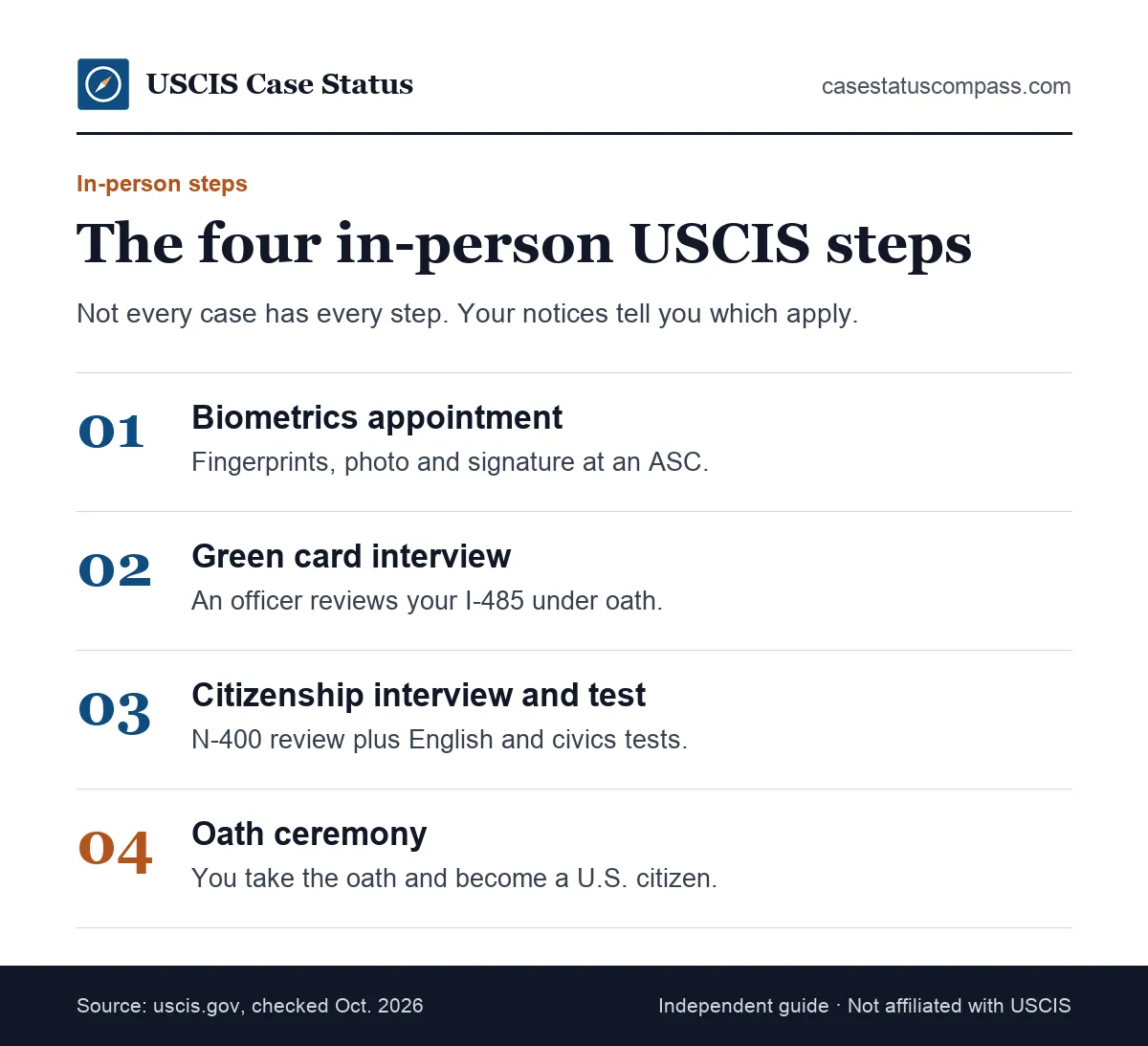
A USCIS interview is an in-person meeting where an officer reviews your application under oath and decides whether you qualify. Green card (Form I-485) and citizenship (Form N-400) cases usually include one. Most cases also have a separate biometrics appointment, and citizenship cases end with an oath ceremony.
At a glance
| Main in-person steps | Biometrics, green card interview, citizenship interview and test, oath ceremony |
| How you are told | An appointment notice on Form I-797C, also posted in your online account |
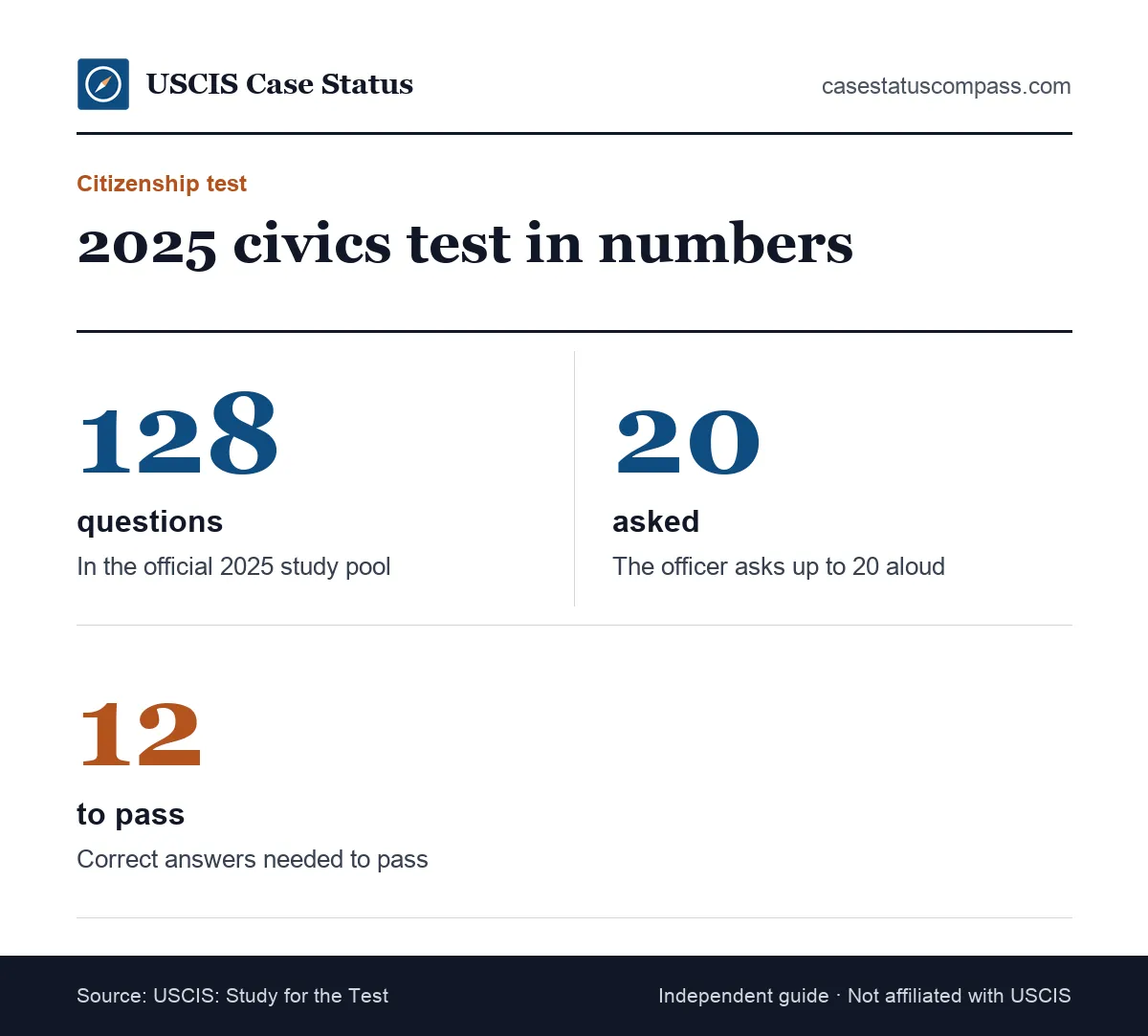
| Citizenship test (2025 version) | 2025 civics test: 20 questions from 128; pass with 12 correct |
| Missed appointments | Missing biometrics can lead to denial for abandonment |
| Who runs this site | An independent guide. We are not USCIS and cannot book or move appointments. |
What Is a USCIS Interview?
A USCIS interview is a sworn meeting with a U.S. Citizenship and Immigration Services officer at a local field office. The officer checks that what you filed is true, asks follow-up questions and confirms your eligibility. For green card and citizenship applications it is the main decision point of the case.
Why USCIS meets applicants in person
Paper and online filings show what you claimed. An interview lets the officer confirm identity, test the details against your documents and clear up gaps in the record. Everything you say is under oath.
Your chance to explain
It also gives you a chance to explain anything unusual, such as a long trip abroad or a name change. Many interviews are short and routine. Bring a document that supports each explanation, because an officer can only rely on what is in the file.
The other in-person appointments
Not every visit is an interview. A biometrics appointment is a quick identity visit at an Application Support Center (ASC). An oath ceremony is the final event for new citizens.
Which USCIS Applications Require an In-Person Appointment?
Most Form I-485 green card applications and nearly all Form N-400 citizenship applications lead to an interview. Many more forms need only biometrics. Work permits and green card renewals are usually decided on paper after biometrics. Your notices, not your form type alone, tell you what to expect.
Appointments by form
Check your form's row to see which in-person visits to expect after filing and whether a ceremony comes last.
| Form | Biometrics | Interview | Final in-person step |
|---|---|---|---|
| I-485 (adjustment of status) | Yes | Usually | None (card is mailed) |
| N-400 (naturalization) | Usually | Yes, with tests | Oath ceremony |
| I-751 (remove conditions) | Yes | Sometimes | None |
| I-589 (affirmative asylum) | Yes | Yes, at an asylum office | None |
| I-765 (work permit) | Often | Rarely | None |
| I-90 (replace green card) | Often | Rarely | None |
Linked applications share appointments
If you filed an I-485 together with an I-765 and I-131, one biometrics visit usually covers all three. In family cases, the I-130 petition is often decided at the same interview as the I-485. Our Form I-485 guide explains how those bundled filings move together.
Can USCIS Waive the Interview?
Yes. USCIS can waive an interview case by case. As of October 2026, the Policy Manual says: USCIS can waive the green card interview case by case. You cannot simply request a waiver. If no interview notice comes, USCIS may decide the case on the record it already has.
What a waiver looks like in practice
Your status may move from review straight to approval with no interview notice in between. The green card interview guide covers waiver patterns in more detail, including marriage cases where a waiver is less common.
Citizenship interviews are rarely skipped
Naturalization is different. The N-400 interview is where the English test and civics test happen, so USCIS almost always meets citizenship applicants in person. Applicants with a medical exception still attend; only the test portions change.
Biometrics Appointment: The First In-Person Step
The biometrics appointment is a short visit to an Application Support Center where staff take your fingerprints, photo and signature. USCIS uses them for background checks and to print cards. It is not an interview, and staff will not discuss your case.
What to bring and what happens
As of October 2026, USCIS says: Bring your I-797C appointment notice and a valid photo ID to the ASC. At the ASC you also sign digitally to confirm that your filing is true and correct. Our full biometrics appointment guide walks through the visit.
Fees and repeat visits
Biometrics included in most fees (separate $30 for TPS I-821 and some EOIR forms). USCIS sometimes reuses earlier fingerprints, so you may not get a new appointment for every form. If a second notice arrives, attend it; reuse is decided by USCIS, not the applicant.
Green Card Interview: What It Covers
The green card interview is where a USCIS officer reviews your Form I-485 adjustment of status application, and often the linked I-130 petition, under oath. The officer checks identity, eligibility, admissibility and, in marriage cases, whether the relationship is genuine. Approval leads to a mailed green card.
Who must attend
Per the Policy Manual: Green card interviews are required unless waived; the family petitioner usually attends too. That means a U.S. citizen or permanent resident spouse or parent who filed the I-130 should plan to come. Derivative family members on the notice must also appear.
Where to go for the questions
Officers ask about your form answers, travel, work history and, for couples, daily life together. We keep the detailed lists of green card interview questions on one page, including marriage, parent and K-1 adjustment questions.
Citizenship Interview and Test: What It Covers
The citizenship interview is the Form N-400 naturalization interview. A USCIS officer reviews your application under oath and gives the English and civics tests in the same meeting. Unless you qualify for an exemption, you must pass both to be approved for the oath.
The interview half
The officer goes through your N-400: residence, trips abroad, marital history, taxes and the yes/no "good moral character" questions. Expect to confirm or correct answers. Our citizenship interview guide covers the process, documents, dress code and results.
The test half
The test has an English part (speaking, reading and writing) and a civics part. As of October 2026: Filed N-400 on or after Oct. 20, 2025: 2025 test; before that: 2008 test. The full rules, sample questions and a practice set live on our citizenship test page.
Oath Ceremony: The Final Step for Citizenship
The oath ceremony is where approved N-400 applicants take the Oath of Allegiance and become U.S. citizens. You check in, return your green card, take the oath and receive your Certificate of Naturalization. Citizenship begins when you take the oath, not when the interview ends.
Returning your green card
Hand in your green card when you check in for the oath ceremony. The certificate replaces it as your proof of status. Bring the card to check-in even if it has expired, and keep a photocopy for your records first.
Rescheduling the oath ceremony
If you cannot attend: Can't attend? Return the N-445 with a letter asking for a new date. Our oath ceremony guide covers the oath text, guests and what to do after you become a citizen.
Can You Take the Oath the Same Day as the Interview?
Sometimes. USCIS says: You may be able to take the oath the same day as your interview. If not, you get a ceremony notice, Form N-445, by mail with the date and place. Bring your green card to the interview anyway in case the officer offers a same-day oath.
Completing Form N-445
Fill in the Form N-445 questionnaire before the ceremony; an officer reviews it at check-in. Answer it for the time since your interview, not since you filed. If something changed, such as a trip abroad or an arrest, answer yes and be ready to explain.
How Do the In-Person Steps Fit in Your Case Timeline?
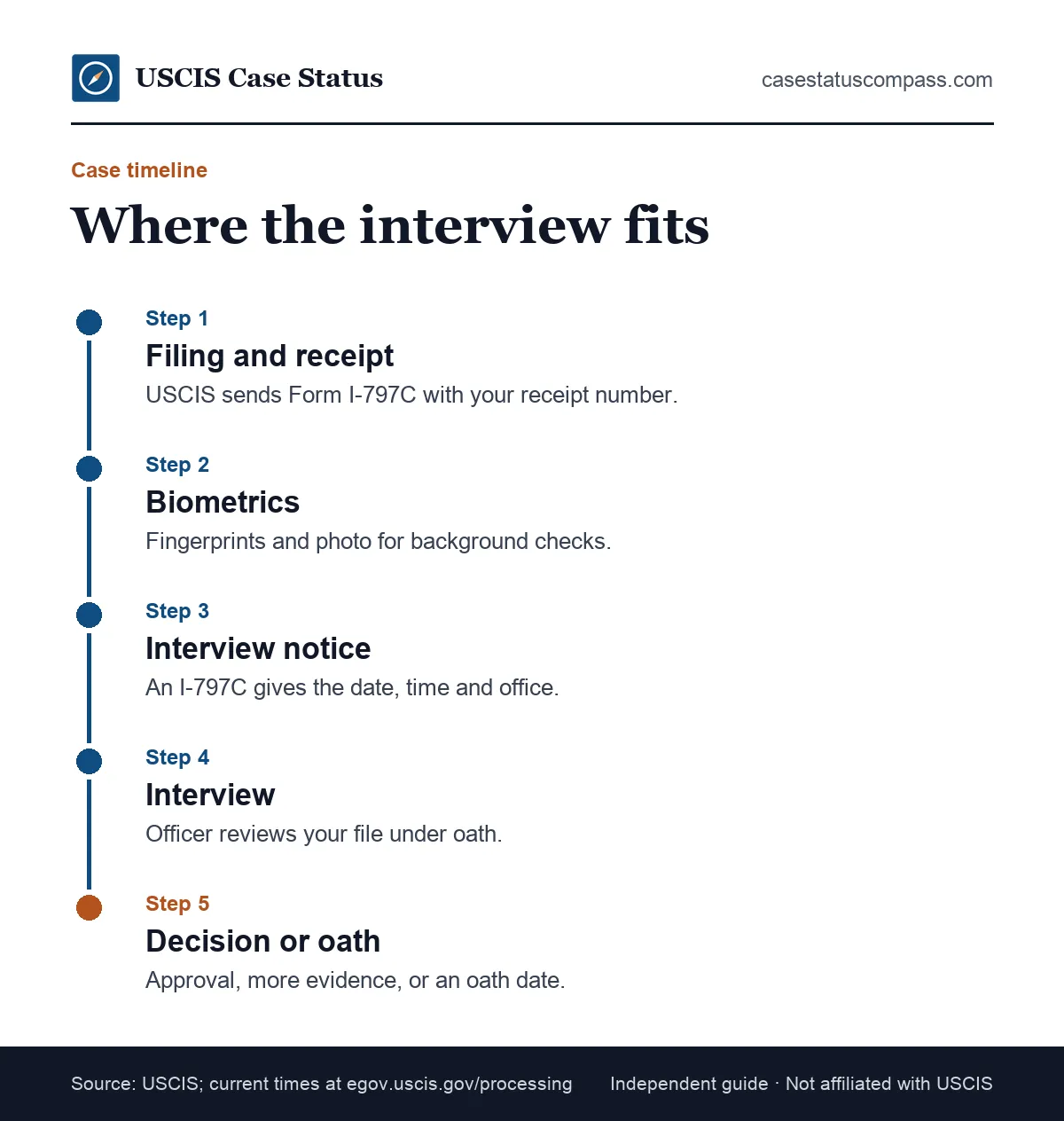
The in-person steps happen in a fixed order: biometrics first, then the interview, then a decision. Citizenship cases add the oath ceremony at the end. Waits between steps vary by form and office, so use the official processing times tool rather than a fixed calendar.
Step order for green card and citizenship cases
The two most common cases share their first three stages and split only at the end.
| Stage | Green card (I-485) | Citizenship (N-400) | What you receive |
|---|---|---|---|
| 1. Filing | Receipt notice | Receipt notice | Form I-797C |
| 2. Biometrics | ASC visit | ASC visit or reuse | Appointment notice |
| 3. Interview | Field office, under oath | Field office, with tests | Interview notice |
| 4. Decision | Approval or more evidence | Approval, retest or denial | Decision notice or N-652 |
| 5. Final step | Card mailed | Oath ceremony | Green card or certificate |
How long the whole process takes
USCIS publishes medians for completed cases. For April to June 2026: N-400: median 9.5 months (USCIS data, Apr.-June 2026) and I-485 (family): median 7.0 months (USCIS data, Apr.-June 2026). Check our uscis processing times hub for how to read the live tool.
Biometrics vs Interview: What Is the Difference?
A biometrics appointment collects fingerprints, a photo and a signature at an Application Support Center. A USCIS interview is a sworn review of your eligibility by an officer at a field office. Biometrics never decides your case; an interview can.
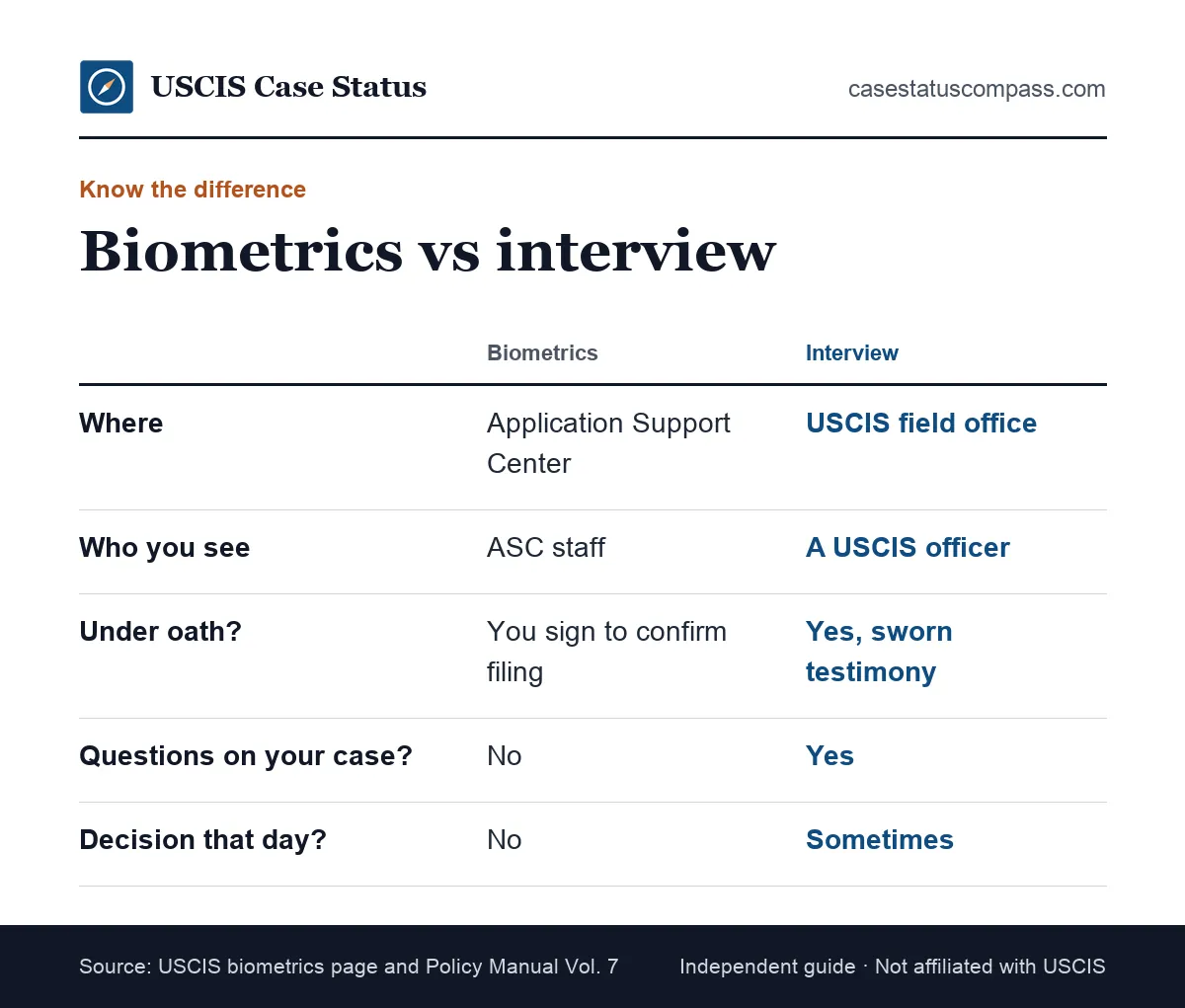
Why people confuse them
Both arrive on the same type of notice, Form I-797C, and both say "appointment." A biometrics visit takes minutes and has no questions about your case; an interview is a sworn review of your file.
Reading the notice heading
Read the heading: biometrics notices name an ASC and say "biometrics," while interview notices name a field office and list documents to bring. The address line is often the fastest clue.
What each one means for your status
After biometrics, the case usually returns to review. After an interview, the next update is often a decision. Our guide on how long after biometrics for an interview explains the gap between the two.
Green Card or Citizenship Interview: Which Rules Apply?
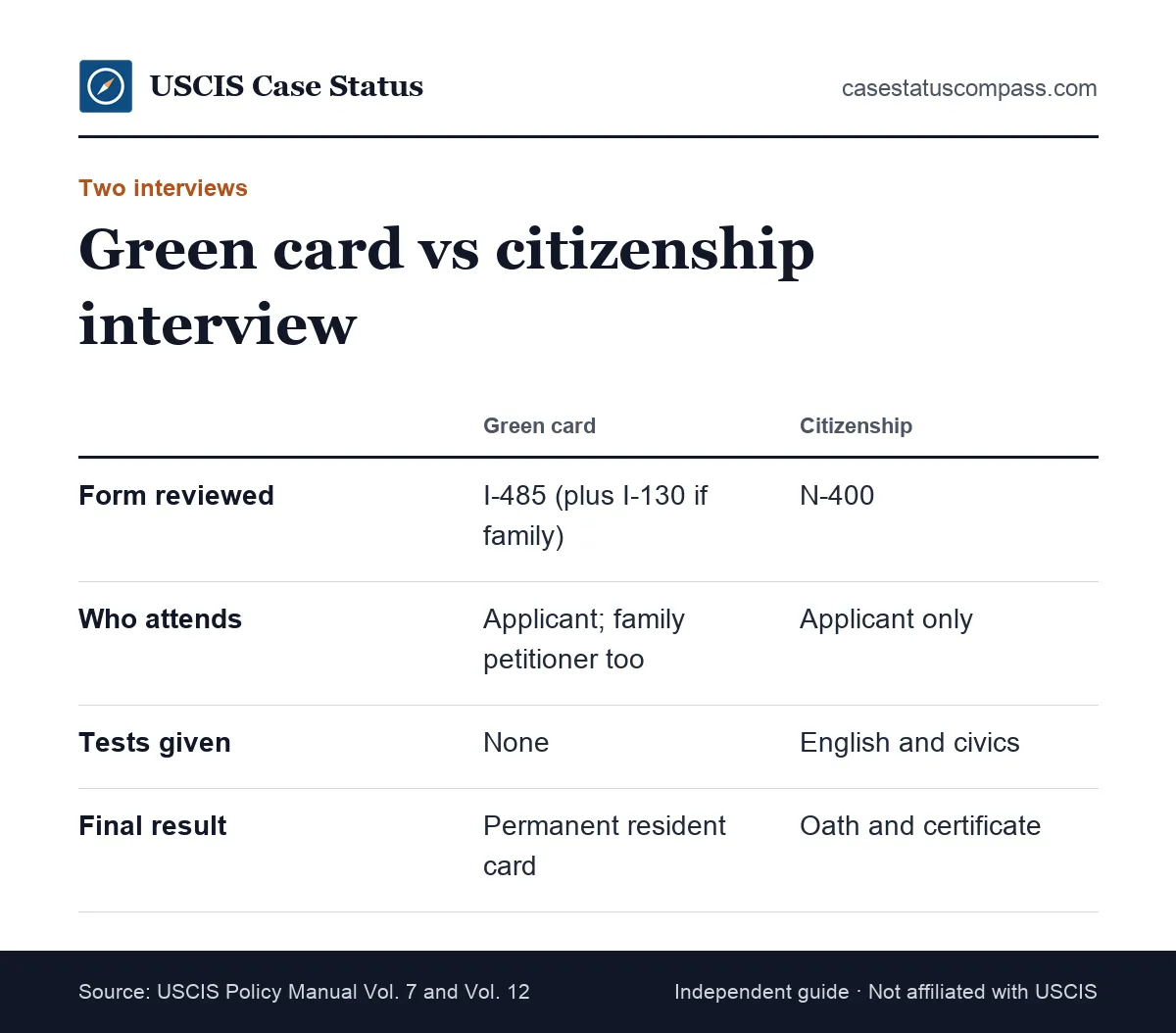
The green card interview decides whether you can become a permanent resident, and family petitioners often attend. The citizenship interview decides whether a permanent resident can naturalize and includes English and civics tests. Both are under oath at a field office, but the questions and outcomes differ.
What the I-485 officer checks
At an I-485 interview, the focus is eligibility for the category, admissibility and, for spouses, the bona fide marriage. Expect questions on every answer in the form, plus any arrests, trips or status gaps since filing.
What the N-400 officer checks
At an N-400 interview, the focus is continuous residence, physical presence, good moral character and the tests. The officer goes through your N-400 answers one by one and asks you to confirm or update each.
What happens at the end
A green card approval ends with a card in the mail. A citizenship approval ends with the oath ceremony and a Certificate of Naturalization. Our naturalization certificate page explains that document and how to replace it.
How Does USCIS Schedule Your Interview?
USCIS schedules interviews at your local field office once your file is ready, including background checks. You get an appointment notice on Form I-797C by mail and in your online account. Your case status may change to "Interview Was Scheduled." You do not book the first interview yourself.
The status update and the notice
The public status page often updates first. Our page on interview was scheduled explains that message and what to do if the paper notice is late. You can check the update anytime with a uscis case status search.
Reading the I-797C notice
The notice lists the date, time, office address, who must attend and what to bring. I-797C = Notice of Action (receipt, rejection, transfer, appointment, re-open); not proof of status by itself. Our guide to the I-797C notice of action explains each box.
Where Do USCIS Interviews Take Place?
Most USCIS interviews take place at the local field office that serves your home address. Biometrics happen at an Application Support Center, which is a different building. Affirmative asylum interviews take place at a USCIS asylum office. The exact address is always on your notice.
Field offices, ASCs and asylum offices
Your notice names one of these locations; the type tells you what kind of visit it is.
| Location | What happens there | Typical forms |
|---|---|---|
| Application Support Center | Fingerprints, photo, signature | Most forms |
| Field office | Interviews, tests, some oath ceremonies | I-485, N-400, I-751 |
| Asylum office | Asylum interviews | I-589 |
| Ceremony venue | Larger oath ceremonies | N-400 |
If you moved before the interview
Report a new address to USCIS within 10 days of moving (INA 265). Update your address online in your USCIS account (E-COA); a mailed AR-11 also counts. A move to a new area may transfer your file and reset the interview. See our change of address guide before you move.
Who Must Attend a USCIS Interview?
The applicant named on the notice must always attend. In family-based green card cases, the I-130 petitioner usually attends too, and listed derivative family members must appear. Citizenship interviews are for the applicant alone, plus any interpreter or attorney you bring.
Children and family members
Children listed on the notice must come. If a child is a derivative in a green card case, bring their birth certificate and other documents as well. A child's passport and I-94 record help if they were filed.
Children who are not applicants
Children who are not applicants can sometimes come along if you have no childcare, but they may have to wait outside the interview room. Bring another adult to watch them if you can.
Are Spouses Interviewed Together in Marriage Cases?
Usually, yes. For marriage-based adjustment, both spouses normally sit in the same interview. The officer may ask each of you about shared life. Our marriage green card guide explains the evidence that supports that interview. If the officer has concerns, the couple may be interviewed separately.
Can You Bring a Lawyer or Interpreter?
Yes. You may bring an immigration attorney or accredited representative who has filed Form G-28. You may also bring an interpreter if you need one. Your lawyer can advise and object but cannot answer for you. Tell the lawyer about any arrest or past problem before the day, not at the interview.
When an attorney helps most
An attorney is worth considering if you have a past arrest, a prior denial, immigration court history, long trips abroad or a marriage that ended. They can prepare you and speak up if a question is unclear.
What Are the Interpreter Rules at a USCIS Interview?
USCIS sets rules for interpreters, and officers can disqualify one who is not neutral or not fluent. For green card interviews, the Policy Manual says: Need an interpreter? Bring one with government ID; they sign an oath (Form G-1256). Choose someone who is not a party to the case.
Interpreters at the citizenship interview
For citizenship interviews, the interview itself must generally be in English unless you qualify for an English exemption, in which case you bring an interpreter for the civics test. The interpreter must also be fluent in English.
What Should You Bring to a USCIS Interview?
Bring exactly what your interview notice lists, plus your appointment notice, a government photo ID and originals of the documents you filed. When in doubt, bring originals and copies. Add proof of anything that changed since filing, such as a new job, a move, a birth or court records. USCIS has not published one list for every interview, so your own notice comes first.
Why we do not print a fixed list
We could not find an official uscis.gov page listing what every green card applicant must bring. The list printed on your notice controls. Follow it item by item and check it off the night before.
Items that are almost always useful
- The appointment notice itself
- Passport, green card or employment authorization document (EAD)
- Originals of birth, marriage and divorce certificates
- Updated evidence, such as recent tax returns or pay stubs
- A copy of the application you filed
Printable USCIS Interview Checklist
This printable checklist covers the items and plans that matter on any USCIS interview day. Print it, add the items listed on your own notice, and tick each line the night before. Keep the folder in the order the notice lists.
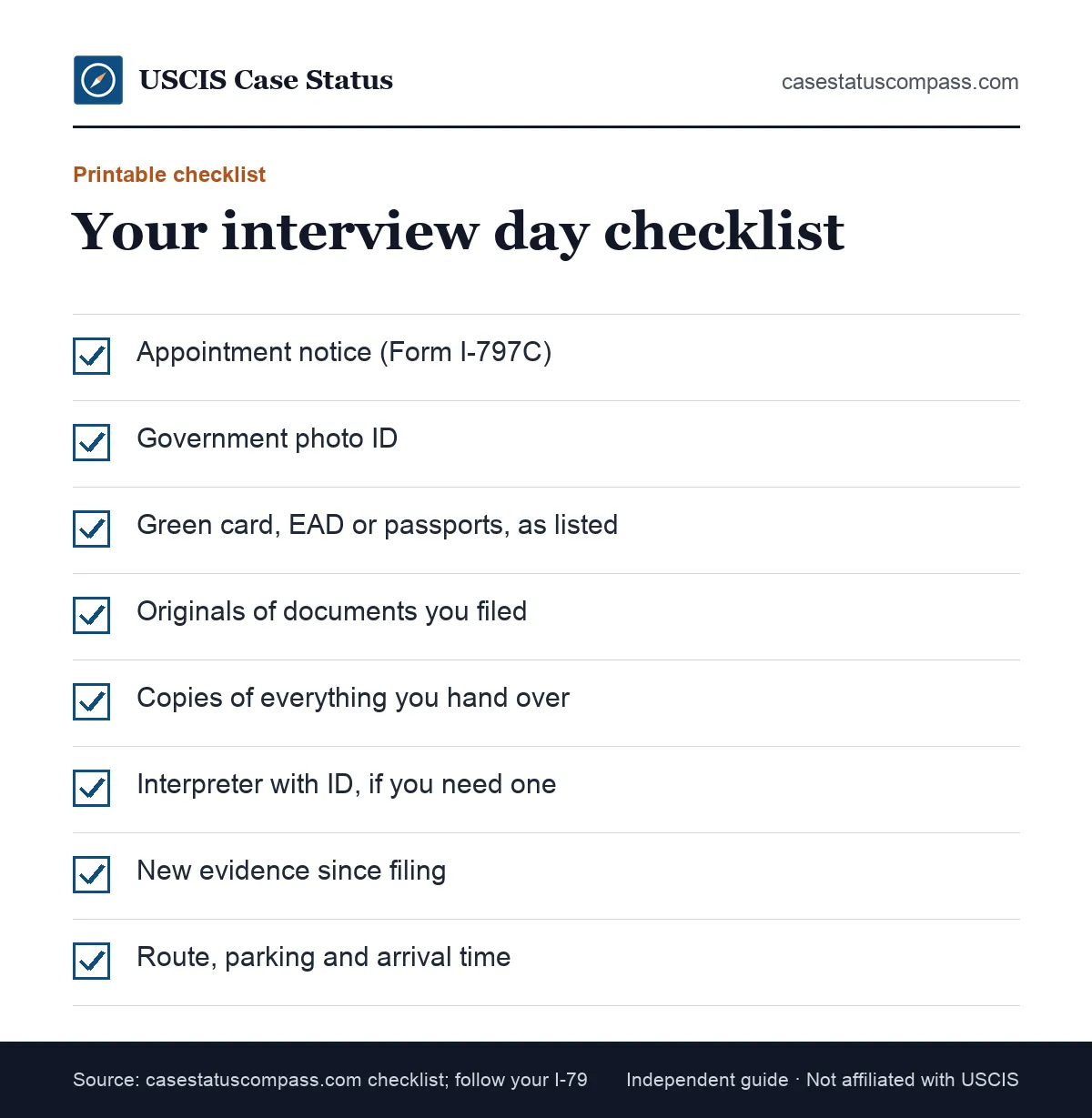
Night-before checks
- Read your notice again for the date, time and address.
- Put originals in one folder and copies in another.
- Charge your phone, but expect to silence it inside.
- Confirm your interpreter, attorney or petitioner is coming.
- Plan to arrive early enough to clear security screening.
Morning-of checks
- Bring your ID and the notice in your hand, not packed away.
- Leave sharp objects and liquids at home.
- Carry snacks or water only if the building allows them.
- Bring a pen and a list of questions for your attorney.
What Happens on USCIS Interview Day, Step by Step?
On interview day, you pass security, check in with your notice, wait to be called, and then raise your right hand to swear to tell the truth. The officer reviews your file, asks questions and gives any tests. At the end, you may get a result or a notice.
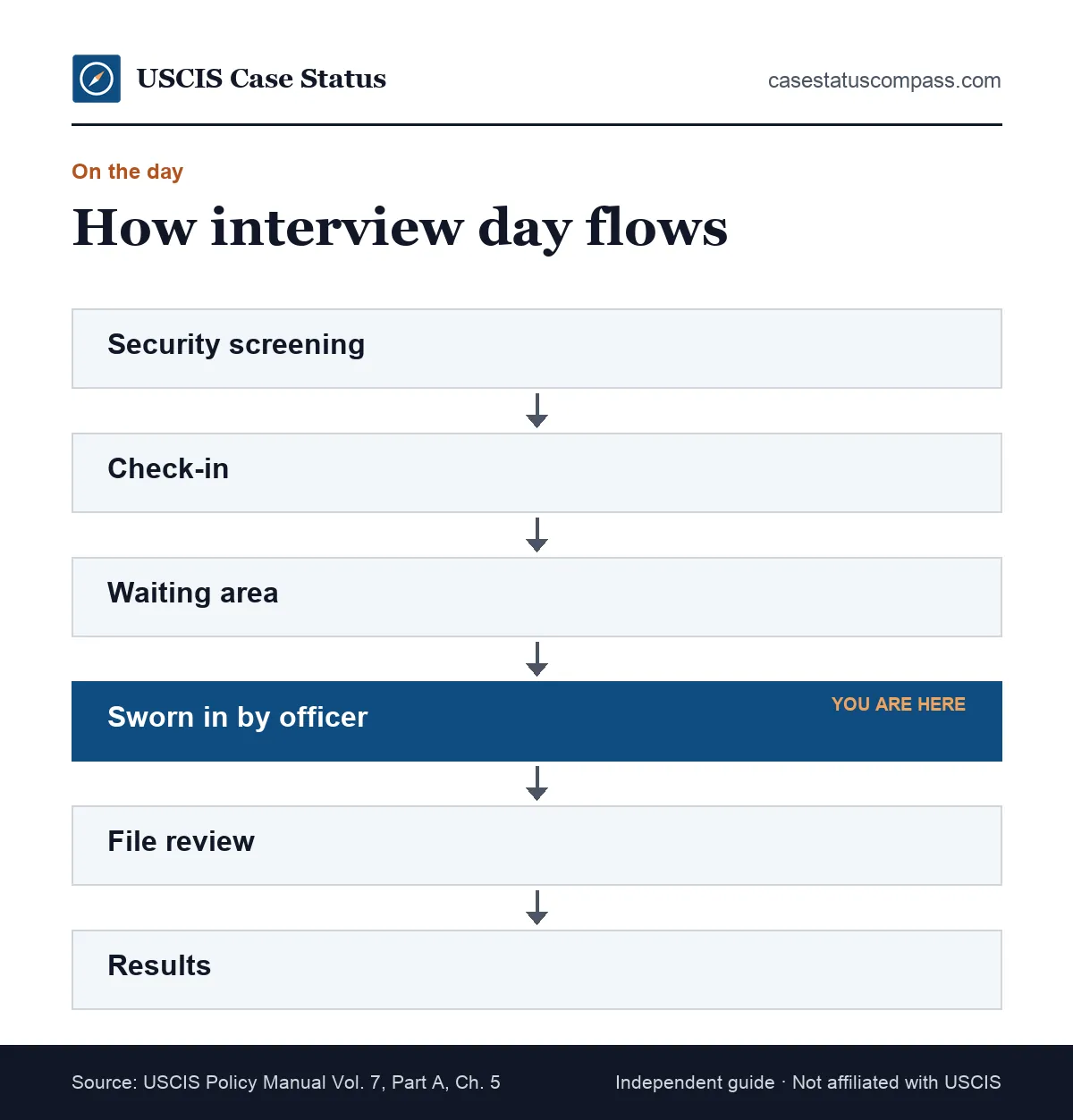
Inside the interview room
The officer confirms your identity, then goes through your form. You may be asked to sign changes to your answers. In citizenship cases, the English and civics tests happen during this same meeting.
Before you leave
Ask what happens next if the officer does not say. Keep any paper you receive, such as a results form or a request for evidence. Write down the officer's instructions while they are fresh.
What Questions Does a USCIS Officer Ask?
A USCIS officer mostly asks questions drawn from your own application: identity, address history, jobs, travel, family and the eligibility questions. Marriage cases add questions about your relationship. Citizenship cases add the civics test questions. Officers can also ask about anything in your file.
Questions by interview type
Each interview type has its own focus, and the detailed guide lists sample questions to practice.
| Interview | Main question areas | Detailed guide |
|---|---|---|
| Green card (family) | Relationship, household, petitioner status | Green card interview questions |
| Green card (employment) | Job offer, qualifications, status history | Green card interview questions |
| Citizenship | N-400 answers, moral character, tests | Citizenship interview and test guides |
| Asylum | Fear of harm, events, identity | Asylum guide |
Answering well
Listen to the whole question. Answer only what is asked, truthfully and briefly. If you do not understand, ask the officer to repeat it. Saying "I don't remember" is better than guessing.
How Long Does a USCIS Interview Take?
A USCIS interview length depends on the form, the complexity of the file and whether tests are given. Simple cases can be quick, while cases with questions about travel, records or relationships take longer. Plan to spend part of a day at the office, including security and waiting.
What makes interviews longer
- An interpreter translating each answer
- Two spouses interviewed together or separately
- A long or unusual travel or address history
- Past arrests, citations or immigration problems
- Missing documents the officer must note
Time off and planning
Ask for the whole morning or afternoon off. Interviews sometimes start later than the time on the notice. Arrange childcare and parking ahead so time pressure does not affect your answers.
What Happens After a USCIS Interview?
After a USCIS interview, the officer may approve the case, ask for more evidence, hold it for more review, schedule a retest or, less often, deny it. Many people leave without a final answer. Watch your status and mail for the written decision.
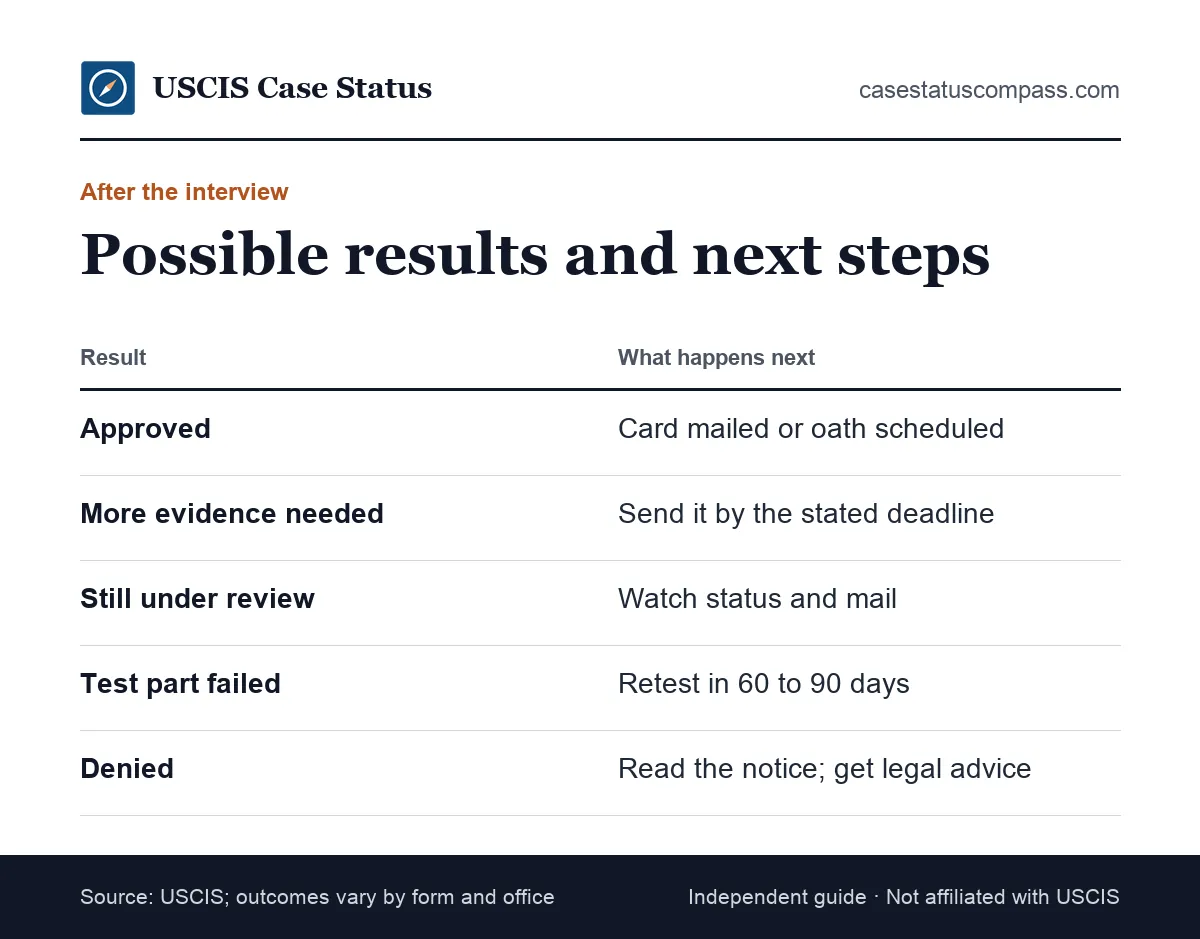
Statuses you may see next
Common updates include "Case Is Being Actively Reviewed," "Case Was Approved" and, for citizenship, an oath ceremony notice. Our page on case is being actively reviewed explains why a case can stay there after an interview.
If the officer asks for more
You may receive a request for evidence. RFE deadline: up to 12 weeks (the exact date is on your RFE); no extensions. One exception: RFEs for Form I-539 and Form I-601A allow at most 30 days (all other forms up to 84 days), plus 3 days if mailed. Our request for evidence guide explains how to answer it completely.
What Paperwork Do You Get at the End of the Interview?
At the end of a citizenship interview, you usually receive Form N-652, Naturalization Interview Results. At a green card interview, you may get a written request for evidence or a short note on what happens next, or nothing at all if the decision follows by mail.
Green card paperwork at the interview
Some officers hand over a checklist of missing documents. Others approve on the spot and say the card will be mailed. Either way, the official decision arrives as a USCIS notice, and the status page updates.
What Does Form N-652 Show?
Form N-652 shows whether you passed the English and civics tests and whether USCIS approved, continued or denied the case. Keep it with your notices. If you failed a test part, it shows which part you will retake. A continued case may also come with a request for documents.
Can You Reschedule a USCIS Interview or Biometrics Appointment?
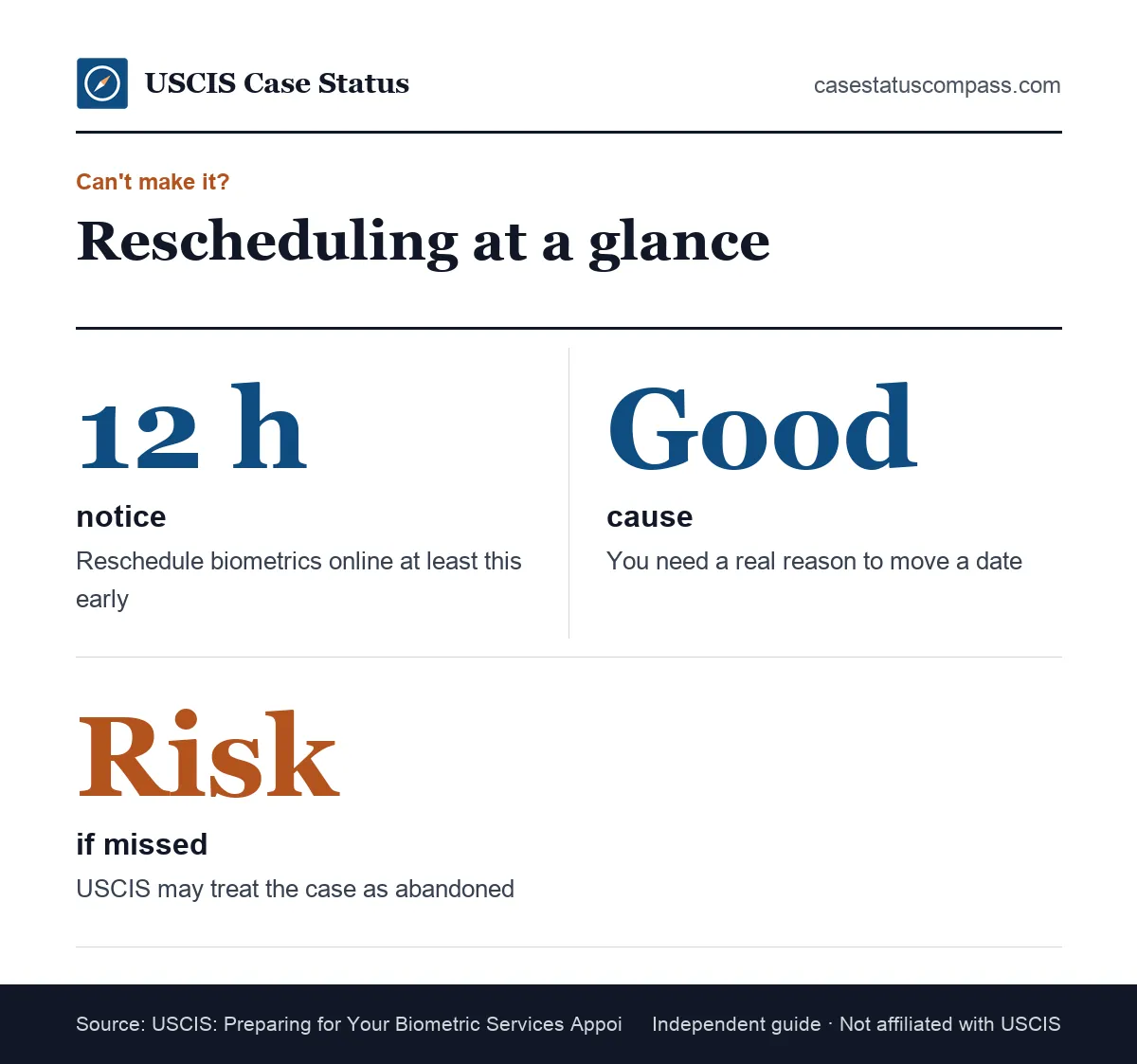
You can ask to reschedule a USCIS appointment if you have good cause, such as illness or a family emergency. Biometrics can often be moved online. Interviews are usually moved through the Contact Center or by following the notice. Ask before the date, never after.
Rescheduling biometrics
Reschedule biometrics online at least 12 hours before, with good cause, or call the Contact Center. Do not mail a request; use the online tool or the phone line. A missed appointment can lead to denial for abandonment.
Switching to a different ASC
Also, you can switch ASCs only by rescheduling in advance; walk-ins at a different ASC are not processed. Pick the new center when you reschedule. Bring the new notice, not the old one.
Rescheduling an interview
Follow the instructions on your notice. If it gives none, contact USCIS at 800-375-5283. Rescheduling may add months, so move a date only when you truly must. Keep proof of your request.
What If You Miss a USCIS Appointment?
Missing an appointment without rescheduling can seriously harm your case. As of October 2026, USCIS says: Missing biometrics can lead to denial for abandonment. For interviews, USCIS may also treat a no-show as abandonment. Act quickly if you missed a date, and keep evidence of why.
What to do right away
- Contact USCIS the same day through the Contact Center.
- Explain the reason and ask how to request a new date.
- Save proof: a doctor's note, travel record or proof the notice came late.
- Watch your mail for a new notice or a decision.
If the case was already denied
Read the denial notice for your options. Our case denied guide explains motions and refiling. Talk to an attorney or DOJ-accredited representative before deciding. Deadlines for appeals are short and strict.
How Do You Ask for Disability Accommodations?
USCIS offers accommodations for people with disabilities at biometrics, interviews and oath ceremonies. Request them as soon as you get your appointment notice, online at uscis.gov/accommodations or through the Contact Center. Examples include wheelchair access, sign language interpreters and extra time.
How to make the request
Use the accommodations request online or call 800-375-5283 (TTY: 800-767-1833). e-Request: report USCIS typos, missing notices or accommodation needs online. Describe the need plainly and give your receipt number. Note the date you asked and keep any confirmation, so you can point to the request if the accommodation is missing on the day.
Can a Medical Exception Excuse the Citizenship Test?
Yes, with a doctor's certification. Accommodations change how a test is given. A medical exception removes the test. Form N-648: a doctor certifies a disability that exempts you from the English and/or civics test. The N-648 is covered in detail on our citizenship test page.
Which Other USCIS Cases Include an Interview?
Beyond green card and citizenship cases, USCIS interviews applicants in affirmative asylum cases, some I-751 cases to remove conditions on residence, and some family petitions. An I-751 interview often focuses on the marriage since the conditional card. Asylum interviews happen at an asylum office, not a field office, and USCIS now reschedules them only for exceptional circumstances.
I-751 interviews
USCIS may interview couples who filed Form I-751 to check that the marriage is real. Many are decided without one. Our Form I-751 guide explains when an interview is more likely and what evidence helps.
What Happens at an Affirmative Asylum Interview?
An asylum officer reviews your claim in person. Affirmative asylum interviews take place at an asylum office and focus on your claim of fear of harm. Legal help is strongly advised. Our asylum application page explains the process and deadlines.
How Should You Prepare for a USCIS Interview?
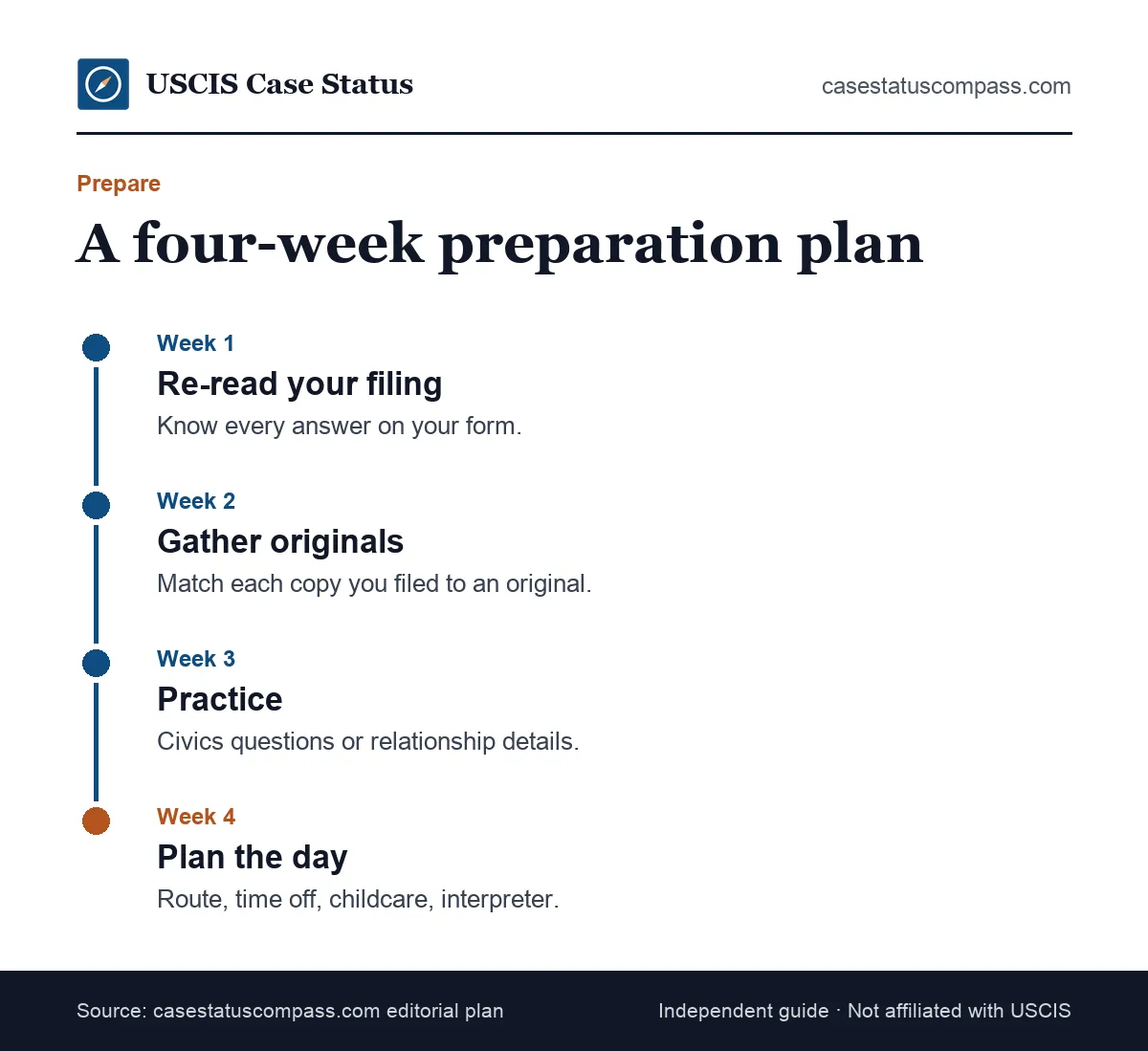
Prepare for a USCIS interview by re-reading everything you filed, gathering originals, practicing likely questions and planning the trip. Citizenship applicants should also study for the civics test. Start weeks ahead, and plan to arrive early at the field office.
Know your own application
Most questions come straight from your form. Read every answer and note anything that has changed, such as a new job, address or trip. Bring proof of the change and tell the officer.
Practice out loud
Ask a friend to read questions to you. For couples, review dates, routines and family names together, but do not memorize scripts. If you do not know an answer, say so rather than guessing.
Practicing for the oral civics test
For citizenship applicants, practice the civics questions aloud, because the officer reads each question and you answer out loud. Which civics test you take depends on your N-400 filing date, as the citizenship test section above explains.
What Mistakes Cause Problems at a USCIS Interview?
The most common interview mistakes are guessing instead of saying you do not know, bringing no originals, hiding past arrests or trips, and arriving late. Inconsistent answers between spouses also cause trouble. Most problems come from poor preparation, not bad faith.
Paperwork mistakes
These gaps lead to a continued case or a follow-up request more often than any wrong answer:
- Bringing copies but no originals
- Forgetting proof of changes since filing
- Leaving out court records for any arrest, even if dismissed
- Missing translations for foreign-language documents
Behavior mistakes
- Guessing at dates instead of saying you are not sure
- Answering a different question than the one asked
- Arguing with the officer instead of asking to clarify
- Bringing a relative as interpreter without checking the rules
How Can You Spot a Fake Interview Notice?
A real USCIS appointment notice comes from USCIS by mail or appears in your online account, and it never asks for payment to keep the date. Check that the receipt number matches your case. Scammers send fake notices and calls, often demanding fees or personal data.
Quick checks
- Look up the receipt number on Case Status Online.
- Confirm the notice appears in your USCIS online account.
- Check the office address against uscis.gov.
- Never pay anyone to "confirm" or "speed up" an interview.
Where to read more
Our guide on how to verify a USCIS notice shows what genuine notices look like. Our list of common immigration scams explains how to report one. Never pay anyone who promises a faster interview.
How Long Do You Wait for a USCIS Interview?
The wait for a USCIS interview depends on your form, category and local field office. USCIS does not publish a separate "time to interview" figure. Use the official processing times tool for your form and office, and remember that the interview sits near the end of that range.
Official medians you can compare
For cases completed April to June 2026: I-485 (employment): median 6.0 months (USCIS data, Apr.-June 2026) and I-751: median 22.6 months (USCIS data, Apr.-June 2026). The USCIS tool shows how long it took to finish 80% of cases in the past 6 months, which is a different measure from these medians.
When the wait looks too long
If your case is outside normal processing time, you can submit a case inquiry. Our guides to n-400 processing times and green card processing times explain how to check.
Is It Safe to Travel While Waiting for an Appointment?
You can travel, but timing and status matter. A pending Form I-485 applicant who leaves the U.S. without advance parole may abandon the application. A citizenship applicant must protect continuous residence and attend every appointment. Never schedule a trip over a known date.
Green card applicants
Traveling while your I-485 is pending abandons it unless you have advance parole (with H/L/V/K exceptions). Read our guide to travel with a pending I-485 before booking anything. Missing an interview because you are abroad can stop the case.
Citizenship applicants
Naturalization: a trip over 6 months is presumed to break residence; 1 year or more breaks it. Long trips also raise questions at the interview. Keep a list of every trip with exact dates.
Interviews for Military Applicants and Their Families
Members of the U.S. armed forces and veterans follow the same interview and test steps, with special filing rules. Current service members need a certified Form N-426 with the N-400. USCIS also runs interviews and ceremonies on some military bases and overseas installations.
Military forms
Military applicants: Form N-426 (certified for current service members); veterans use a DD-214. The USCIS fee for Form N-426 is $0. Veterans use their discharge papers instead of a certified form.
What stays the same
Military applicants still take the English and civics tests unless an exception applies. The same rules for retests, oath ceremonies and returning the green card apply. So does the oath that every answer is true.
How Do Interviews Fit With Your USCIS Case Status?
Every in-person step leaves a trace in your USCIS case status: biometrics notices, interview scheduling, post-interview review and decisions. Checking the status after each step shows whether the case moved on. A status that stays the same for a long time may need an inquiry.
A typical status path around an interview
The online labels around an interview follow a rough order, shown here in three columns.
| Before | During | After |
|---|---|---|
| Case Was Received | Interview Was Scheduled | Case Is Being Actively Reviewed |
| Fingerprint fee or biometrics notice | Interview Was Rescheduled | Case Was Approved |
| Case Is Being Actively Reviewed | Interview completed | Oath ceremony notice (N-400) |
When status does not update
Updates can lag behind real events. If nothing changes long after your interview, our guide to a case status not updating explains when and how to follow up. Keep your N-652.
When Is Legal Help Worth It Before an Interview?
Get help from an immigration attorney or DOJ-accredited representative before a USCIS interview if you have any criminal record, past immigration violations, a previous denial, a removal case, a marriage that ended, or long trips abroad. These issues can turn a routine interview into a denial.
Red flags that need advice
See a lawyer or accredited representative before the interview if any of these apply:
- Any arrest, even without a conviction
- Past overstay, unlawful entry or removal order
- A false claim to U.S. citizenship
- Unpaid taxes or child support
- Inconsistent answers on earlier forms
Other help channels
For delays rather than legal questions, our page on the ombudsman and congressional inquiries explains outside help. For general questions, see how to contact USCIS. Both are free to use.
How Do You Get the Most From This Interviews Hub?
Use this hub to see which in-person steps apply to your case, then open the detailed guide for the step coming up next. Each child page covers one appointment in depth. Start with the table below, then bookmark the guide for your next date.
Pick your next step
Match the appointment on your newest notice to a row, then open that guide to prepare.
| If your next step is | Open this guide | Key fact to know |
|---|---|---|
| Fingerprints and photo | Biometrics appointment | Bring notice and photo ID |
| I-485 interview | Green card interview | Petitioner usually attends |
| N-400 interview | Citizenship interview | Under oath, with tests |
| English and civics tests | Citizenship test | 20 of 128; 12 to pass |
| Taking the oath | Oath ceremony | Return your green card |
Keep your notices together
Store every I-797C, N-652 and N-445 in one folder, in date order. When you call USCIS or meet an attorney, that folder answers most questions in seconds.
Frequently Asked Questions
Does every case need an interview?
No. Many USCIS forms, such as work permits and green card renewals, are decided on paper after biometrics. Green card applications usually include an interview unless USCIS waives it case by case, and citizenship applications almost always do, because the English and civics tests are given there.
Is a USCIS interview a good sign?
An interview means your file has reached the decision stage, which is progress. It does not guarantee approval. The officer still checks eligibility and may ask for more evidence.
Can I bring my phone into a USCIS interview?
Field offices usually let you bring a phone through security, but you should silence it and keep it away during the interview. Do not record the interview unless the officer permits it. Check your notice and the office's security rules, because local practice differs between buildings.
Is the USCIS interview under oath?
Yes. At the start of a green card or citizenship interview, the officer asks you to swear or affirm that you will tell the truth. Everything you say becomes sworn testimony. False statements can lead to denial and other serious consequences, so answer truthfully and say when you do not know something.
What happens if I fail part of the citizenship test?
You get a second chance. Two chances to pass; retest of the failed part 60-90 days after the interview. Only the part you failed is retested, such as civics or English writing. If you fail the same part again, USCIS can deny the N-400, and you would generally need to file a new application to try again.
Do I need to attend biometrics if I gave fingerprints before?
Attend any biometrics appointment USCIS schedules for you. USCIS sometimes reuses earlier biometrics and sends no notice, but if a notice arrives, the earlier visit was not enough for this case. Missing it can lead to denial for abandonment.
Can my interview be done online or by video?
The appointment notice states the format. Plan for an in-person meeting at the field office listed. If your notice says something else, follow it exactly, and confirm through your online account that the notice is genuine.
Sources
- USCIS: Preparing for Your Biometric Services Appointment. www.uscis.gov/forms/filing-guidance/preparing-for-your-biometric-services-appointment. Accessed Oct 27, 2026.
- USCIS Policy Manual Vol. 7, Part A, Ch. 5: Interview Guidelines. www.uscis.gov/policy-manual/volume-7-part-a-chapter-5. Accessed Oct 27, 2026.
- USCIS: The Naturalization Interview and Test. www.uscis.gov/citizenship/learn-about-citizenship/the-naturalization-interview-and-test. Accessed Oct 27, 2026.
- USCIS: Study for the Test. www.uscis.gov/citizenship/find-study-materials-and-resources/study-for-the-test. Accessed Oct 27, 2026.
- USCIS: Naturalization Ceremonies. www.uscis.gov/citizenship/learn-about-citizenship/naturalization-ceremonies. Accessed Oct 27, 2026.
- USCIS: Exceptions and Accommodations. www.uscis.gov/citizenship/exceptions-and-accommodations. Accessed Oct 27, 2026.
- USCIS Contact Center. www.uscis.gov/contactcenter. Accessed Oct 27, 2026.
- USCIS Data Library: All Forms, FY2026 Q3. www.uscis.gov/sites/default/files/document/data/quarterly_all_forms_fy2026_q3_v1.xlsx. Accessed Oct 27, 2026.
- USCIS Form G-1055 Fee Schedule, Edition 10/16/26. www.uscis.gov/sites/default/files/document/forms/g-1055.pdf. Accessed Oct 27, 2026.
- USCIS: Form I-797 Types and Functions (updated 01/24/2025). www.uscis.gov/forms/filing-guidance/form-i-797-types-and-functions. Accessed Oct 27, 2026.
- USCIS: How to Change Your Address (updated 08/04/2026); 8 U.S.C. 1305(a) (LII). www.uscis.gov/addresschange. Accessed Oct 27, 2026.
- 8 CFR 103.2(b)(8)(iv) (LII). www.law.cornell.edu/cfr/text/8/103.2. Accessed Oct 27, 2026.
- USCIS Policy Manual Vol. 1, Part E, Ch. 6 (current as of Oct. 23, 2026). www.uscis.gov/policy-manual/volume-1-part-e-chapter-6. Accessed Oct 27, 2026.
- USCIS: Form N-648 page (updated 06/05/2026). www.uscis.gov/n-648. Accessed Oct 27, 2026.
- CIS Ombudsman tip sheet: Check Your USCIS Case Inquiry Date (Aug. 2024). dhs.gov/sites/default/files/2024-11/24_0823_cisomb_case-inquiry-date-tip-sheet.pdf. Accessed Oct 27, 2026.
- Form I-485 Instructions, Edition 09/18/26. www.uscis.gov/sites/default/files/document/forms/i-485instr.pdf. Accessed Oct 27, 2026.
- USCIS Policy Manual Vol. 12, Part D, Ch. 3. www.uscis.gov/policy-manual/volume-12-part-d-chapter-3. Accessed Oct 27, 2026.
- USCIS: Form N-426 page (updated 06/05/2026). www.uscis.gov/n-426. Accessed Oct 27, 2026.
casestatuscompass.com is an independent publication and is not affiliated with USCIS or any government agency. This page is general information, not legal advice. For denials, court or asylum matters, consult an immigration attorney or a DOJ-accredited representative.