Contents · 40 sections
- What Is a Naturalization Oath Ceremony?
- What Happens at the Oath Ceremony?
- Judicial vs Administrative Oath Ceremonies
- What Is the Oath of Allegiance to the United States?
- Where Does the Oath of Allegiance Wording Come From?
- What Does the Allegiance Oath Mean, Line by Line?
- What Is One Promise You Make When You Become a Citizen?
- Can You Change the Words of the Oath of Citizenship in the US?
- Can You Object to Bearing Arms in the Oath of Allegiance?
- Can the Oath Requirement Be Waived?
- What Is Form N-445?
- How Do You Answer the N-445 Questionnaire?
- How Do You Explain a "Yes" Answer on Form N-445?
- What If Something Changed Since Your Interview?
- How Long After the Interview Is the Oath?
- After the Citizenship Interview, How Long for the Oath in Practice?
- What Can Delay Your Oath Ceremony Date?
- Can You Take the Oath on the Same Day as the Interview?
- Can You Reschedule an Oath Ceremony?
- What Happens If You Miss the Oath Ceremony?
- How Long Does the Naturalization Ceremony Take?
- How Many Guests Can You Bring to a Naturalization Ceremony?
- What Should You Bring to the Oath Ceremony?
- Printable Oath Ceremony Checklist
- What Should You Wear to a Citizenship Swearing-In Ceremony?
- Why Do You Return Your Green Card at the Oath?
- What If Your Green Card Is Lost Before the Oath?
- Your Certificate of Naturalization at the Ceremony
- Can You Change Your Name at the Oath Ceremony?
- What Happens After the Ceremony?
- How Do You Get a US Passport After the Oath?
- Registering to Vote as a New Citizen
- How Do You Update Social Security After Naturalization?
- Can You Sponsor Family After Taking the Oath?
- Oath Ceremonies for Military Members and Children
- Common Oath Ceremony Mistakes to Avoid
- Oath Ceremony Scenarios
- If X, Do Y: Oath Ceremony Decision Table
- When Should You Talk to an Immigration Attorney Before the Oath?
- Frequently Asked Questions
The short answer
An oath ceremony is the event where you take the Oath of Allegiance and become a U.S. citizen. After USCIS approves your Form N-400, you check in, answer the Form N-445 questionnaire, hand in your green card, take the oath and receive your Certificate of Naturalization. You are not a citizen until you take the oath.
At a glance
| What it is | The final step of naturalization, run by a court or by USCIS |
| Your notice | Fill in the Form N-445 questionnaire before the ceremony; an officer reviews it at check-in |
| Same-day option | You may be able to take the oath the same day as your interview |
| Your green card | Hand in your green card when you check in for the oath ceremony |
| Can't attend? | Can't attend? Return the N-445 with a letter asking for a new date |
What Is a Naturalization Oath Ceremony?
A naturalization oath ceremony (a "naturalisation oath ceremony" in British spelling) is a formal event where approved applicants publicly take the Oath of Allegiance to the United States. It is the last legal step of Form N-400. A judge or a USCIS official leads it, and you leave as a U.S. citizen holding your Certificate of Naturalization.
Where the ceremony fits in the naturalization process
Naturalization moves from filing to biometrics, the interview, a decision and the ceremony. Our interviews and appointments hub shows how each meeting connects. The oath comes only after approval, so it always means good news.
Why the oath, not the approval, makes you a citizen
USCIS states that you are not a U.S. citizen until you take the Oath of Allegiance. An approval only means you qualify. Until the oath you remain a permanent resident, and life changes still matter.
What Happens at the Oath Ceremony?
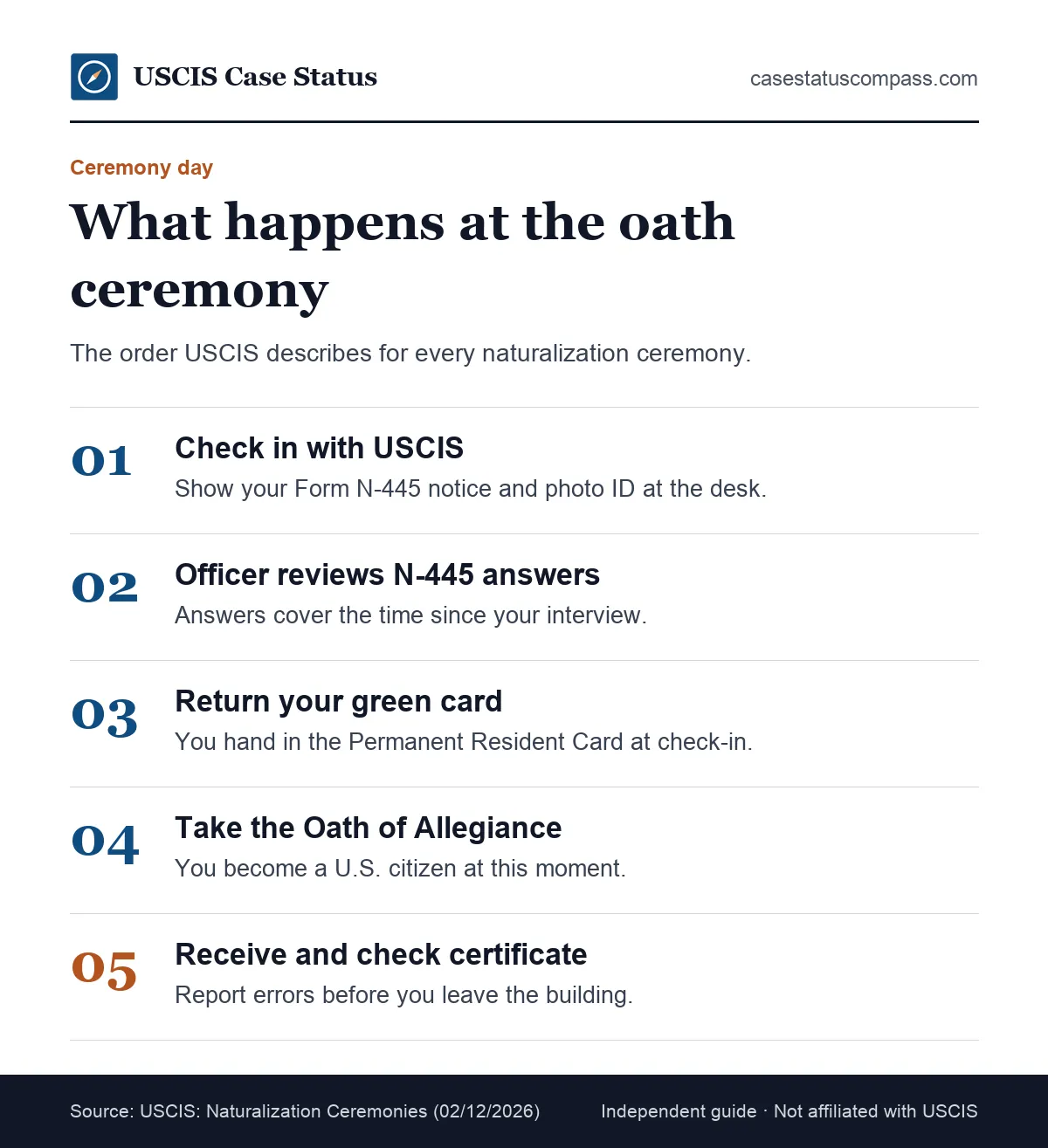
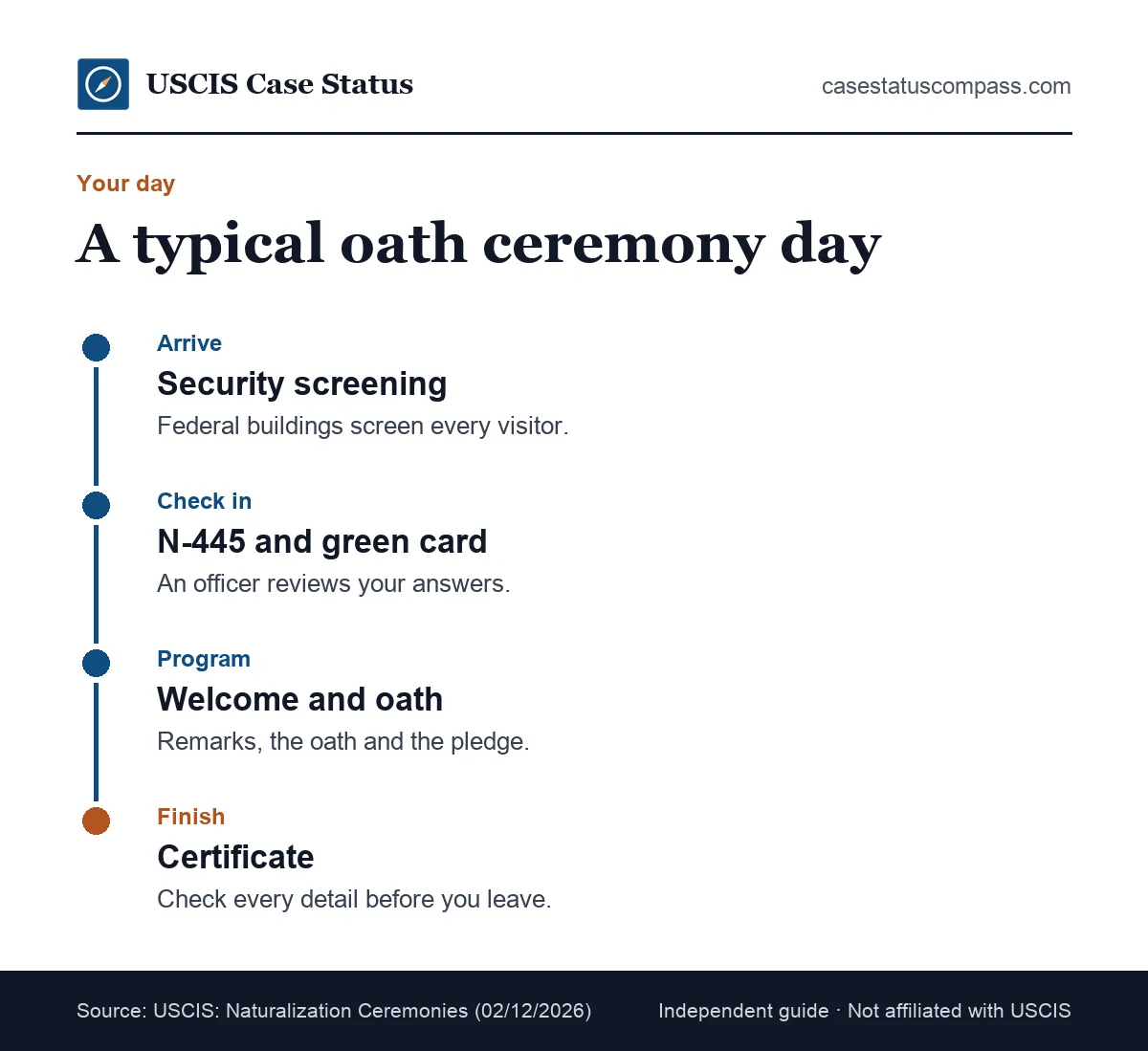
At the oath ceremony you check in with USCIS, an officer reviews your N-445 questionnaire, you return your green card, and you join the group for the program. You then repeat the oath aloud, become a citizen, and receive your certificate before you leave.
Before the program: arrival and check-in
- Arrival and security screening at the building entrance.
- Check-in with a USCIS officer, who reviews your N-445 answers.
- Green card surrender, unless USCIS already excused it.
Courthouse and federal building security lines can be slow, so plan to clear screening well before the check-in hour printed on your notice.
During the program: the oath and certificates
- The program: welcome remarks, often a short video and speeches.
- The oath, read in parts by the official, with you repeating it.
- Certificates handed out, often by name.
When asked, you stand, raise your right hand and repeat each phrase after the official.
Who leads the program
A USCIS official leads an administrative ceremony; a judge leads a judicial ceremony. Many programs add the Pledge of Allegiance and the national anthem.
The venue on your Form N-445 is a good clue to which kind you will attend: a courthouse address usually means a judge presides.
Judicial vs Administrative Oath Ceremonies
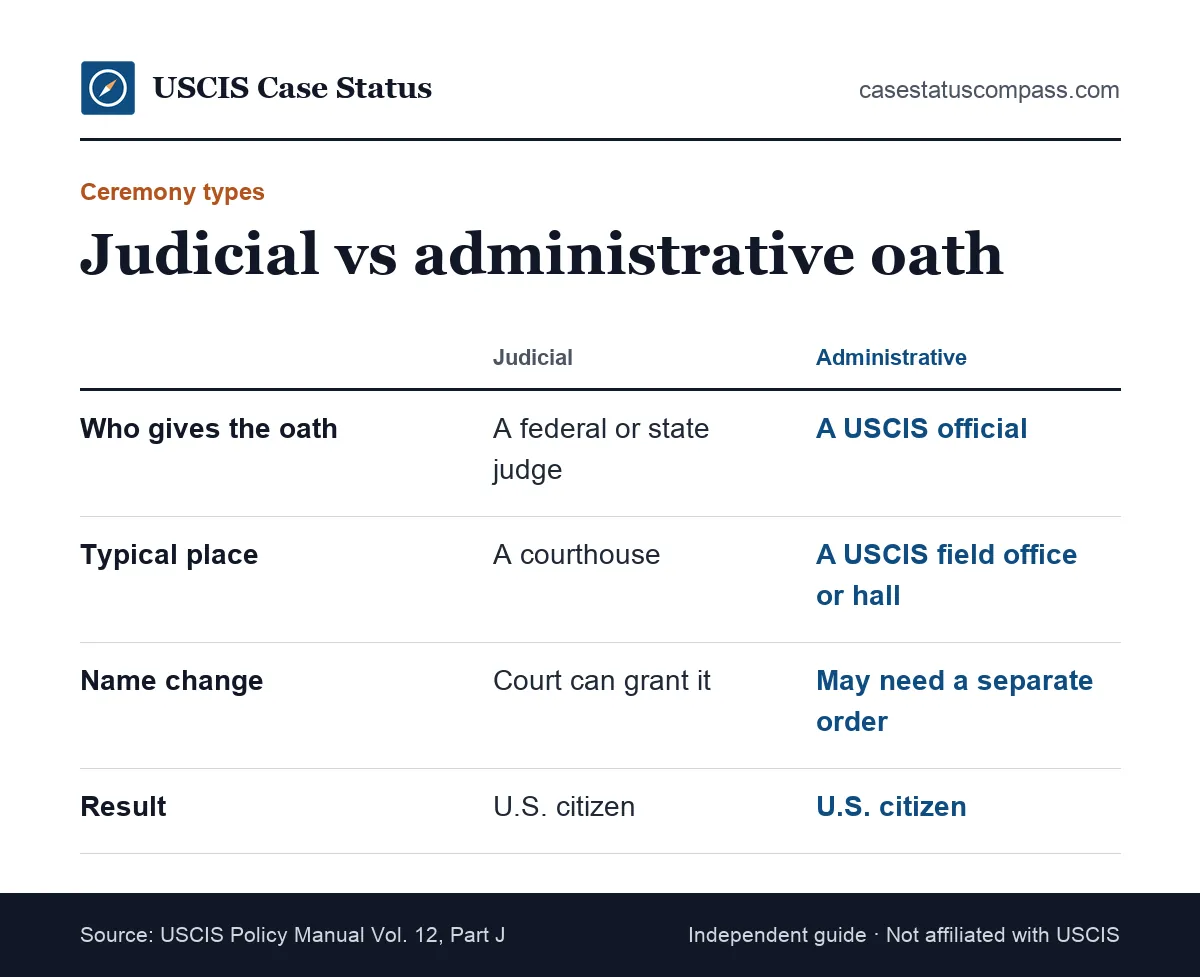
USCIS lists two ceremony types. A judicial oath ceremony is held by a court, and a judge gives the oath. An administrative oath ceremony is held by USCIS, and an authorized USCIS official gives it. Both have the same legal effect: you become a citizen once you take the oath.
How the two types compare
The practical differences come down to who presides, where you go and whether a name change can be granted on the spot.
| Feature | Judicial ceremony | Administrative ceremony |
|---|---|---|
| Who gives the oath | A judge with jurisdiction over your district | A USCIS official with delegated authority |
| Usual venue | Federal or state courthouse | USCIS field office or rented hall |
| Same-day with interview | Not usually | Possible at some offices |
| Legal name change | A court can grant it at the ceremony | Usually needs a separate court order |
| Result | U.S. citizenship | U.S. citizenship |
Whichever one you attend, the certificate you receive and your rights as a citizen are identical.
Which type you will get
You do not choose the type. USCIS assigns it based on where you live and whether local courts hold ceremonies. Your Form N-445 says where to go. A requested name change can affect which ceremony you get.
What Is the Oath of Allegiance to the United States?
The Oath of Allegiance to the United States, the official oath for citizenship in the USA, is the promise every new citizen makes at the ceremony. You give up loyalty to any foreign country, promise to support and defend the Constitution, and agree to serve the nation when the law requires it. The wording is set in federal regulations at 8 CFR 337.1.
Full text of the American oath of allegiance
"I hereby declare, on oath, that I absolutely and entirely renounce and abjure all allegiance and fidelity to any foreign prince, potentate, state, or sovereignty, of whom or which I have heretofore been a subject or citizen;
that I will support and defend the Constitution and laws of the United States of America against all enemies, foreign and domestic;
that I will bear true faith and allegiance to the same;
that I will bear arms on behalf of the United States when required by the law;
that I will perform noncombatant service in the Armed Forces of the United States when required by the law;
that I will perform work of national importance under civilian direction when required by the law;
and that I take this obligation freely, without any mental reservation or purpose of evasion;
so help me God."
Where Does the Oath of Allegiance Wording Come From?
The required elements come from Section 337(a) of the Immigration and Nationality Act (INA). The oath is given in English, even to applicants exempt from the English test, though you may bring an interpreter. Congress set the required promises, and the regulation turns them into the fixed text quoted above.
What Does the Allegiance Oath Mean, Line by Line?
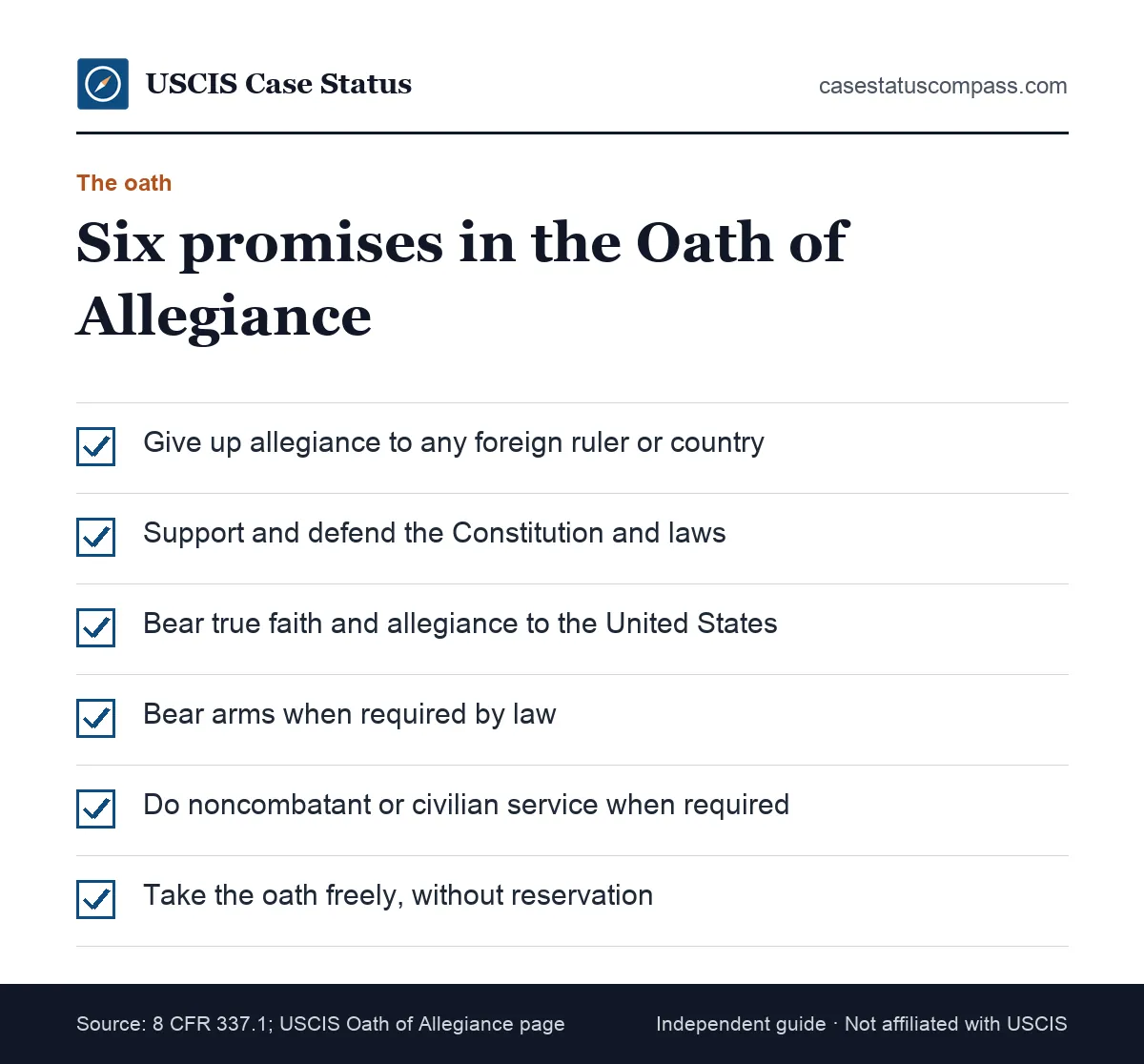
The allegiance oath has three parts: you give up loyalty to other countries, promise to support the Constitution and stay loyal to the United States, and agree to serve when the law requires, with arms, in noncombatant roles or in civilian work.
"Renounce and abjure all allegiance"
You give up loyalty to any foreign ruler or government. This concerns allegiance, not your heritage or family ties. Whether you keep your old nationality depends on that country's law, so ask its consulate.
"Support and defend the Constitution"
You promise to uphold the Constitution and its laws. This matches the N-400 requirement called attachment to the Constitution, which officers check through the oath-related yes/no questions.
A sincere promise is what counts; you do not need to know constitutional law.
"Bear arms … when required by the law"
The service clauses apply only when required by law, such as a draft. The oath does not enlist you.
If your beliefs conflict with these clauses, the section on objecting to bearing arms below explains the modified oath and how to request it.
What Is One Promise You Make When You Become a Citizen?
One promise you make when you become a U.S. citizen is to give up loyalty to other countries. Other correct answers include defending the Constitution and laws, obeying U.S. laws, serving in the military or doing important work for the nation if needed, and being loyal to the United States.
Promises taken straight from the oath
Any of the promises below is an accepted answer to this civics question, so pick the one you find easiest to remember.
| Promise | Where it appears in the oath |
|---|---|
| Give up loyalty to other countries | "renounce and abjure all allegiance" |
| Defend the Constitution and laws | "support and defend the Constitution and laws" |
| Be loyal to the United States | "bear true faith and allegiance" |
| Serve in the military if needed | "bear arms … when required by the law" |
| Do important work for the nation if needed | "work of national importance under civilian direction" |
How this question shows up on the civics test
This is a well-known civics question, so knowing the oath helps twice. The question lists and practice tools are on our citizenship test page.
Your N-400 filing date decides which version you take: Filed N-400 on or after Oct. 20, 2025: 2025 test; before that: 2008 test.
Can You Change the Words of the Oath of Citizenship in the US?
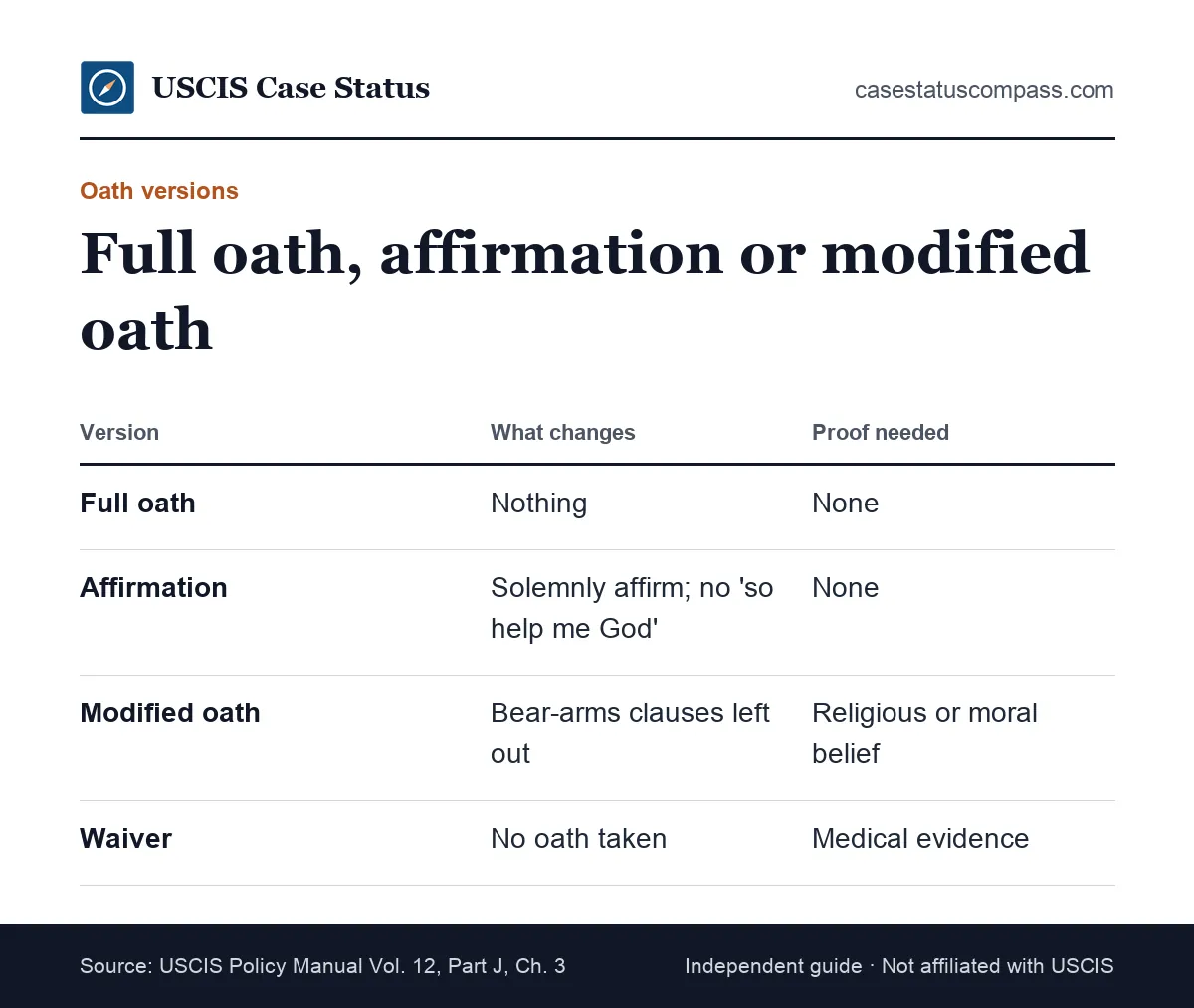
Yes, in two limited ways. You may say "solemnly affirm" instead of "on oath" and leave out "so help me God" for any reason, with no proof. You may also ask to drop the bear-arms and noncombatant clauses if a sincere religious or moral belief requires it.
Affirming instead of swearing
The N-400 instructions allow the affirmation for any reason without documents. The officer must tell you which words you need not say.
In the affirmation, "on oath" becomes "and solemnly affirm," and "so help me God" is left out.
Can You Object to Bearing Arms in the Oath of Allegiance?
Yes, in limited cases. You must show the objection comes from religious training and belief, which can include a deeply held moral code. Objections to one war or to policy do not qualify, and the civilian-work clause always stays. Raise it at your interview.
Can the Oath Requirement Be Waived?
USCIS can waive the oath for an applicant who cannot understand or communicate its meaning because of a physical or developmental disability or mental impairment. The request uses Form N-648 or a written medical evaluation. Approved applicants are treated as meeting the oath requirement and do not attend a public ceremony.
Requesting a disability waiver
You can ask for a waiver any time until the ceremony, ideally before the interview. A medical professional authorized under the N-648 rules must describe the condition, and USCIS may ask for more records.
Who can act for the applicant
The Policy Manual ranks a court-appointed legal guardian first, then a U.S. citizen spouse, parent, adult child and adult sibling. The person must prove the relationship and caregiving role, and must be a citizen.
What Is Form N-445?
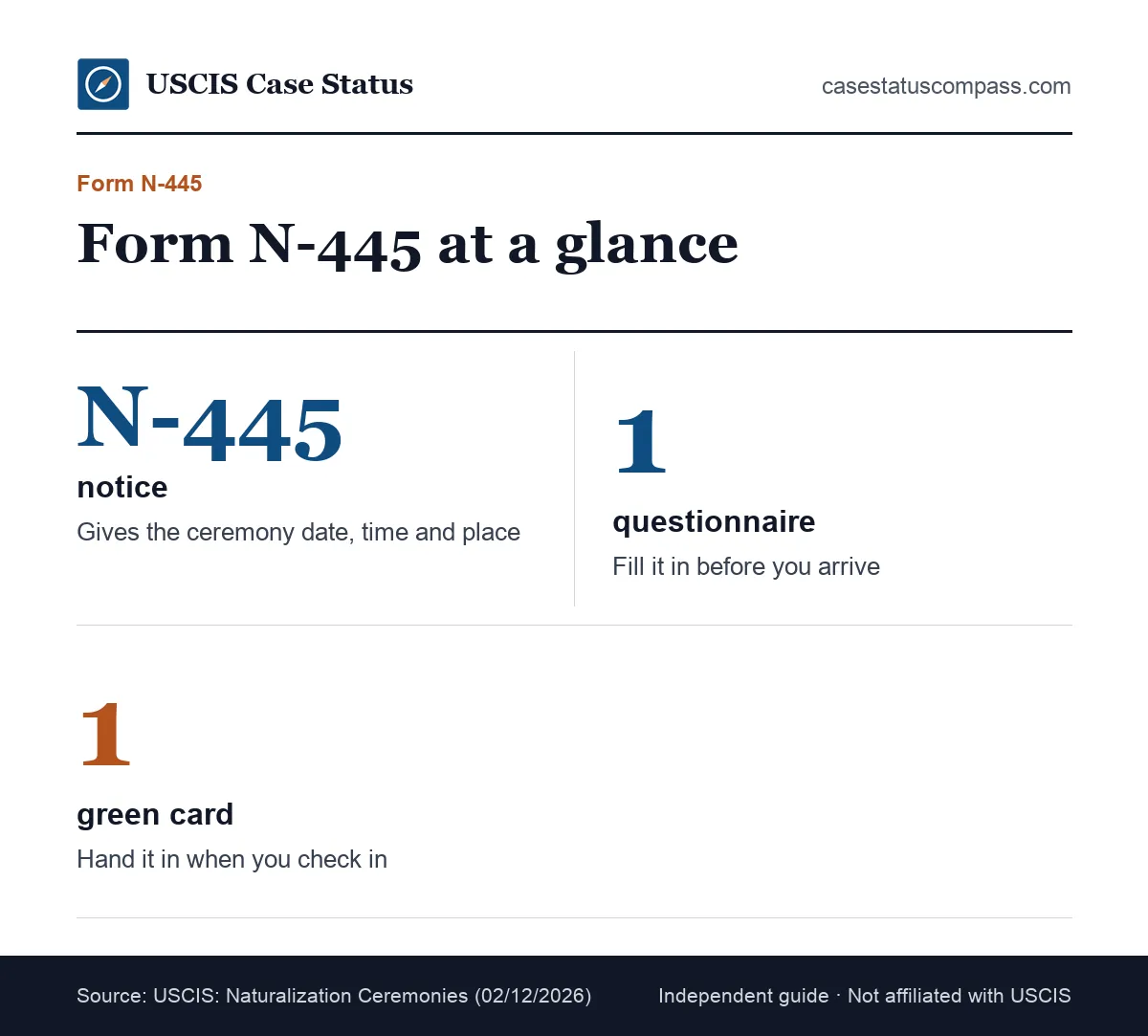
Form N-445, Notice of Naturalization Oath Ceremony, is the letter USCIS sends with your ceremony date, time and place. It also contains a short questionnaire about the period since your interview. You bring the completed notice to the ceremony, where an officer reviews it at check-in.
What the notice tells you
The N-445 gives the date, arrival time and address of your ceremony and may list items to bring. Read it the day it arrives, because the arrival time is often well before the program starts.
Is Form N-445 something you file?
No. You do not file the form N-445 or pay a fee. It is a notice you bring with you. You send it back only when you cannot attend, together with a letter asking for a new date.
How Do You Answer the N-445 Questionnaire?
Answer every N-445 question about the time since your interview honestly, sign where told and bring it to the ceremony. Fill in the Form N-445 questionnaire before the ceremony; an officer reviews it at check-in. A "yes" answer is not an automatic problem, but it needs an explanation and records.
What the questions cover
The questions ask what changed after your interview: travel outside the United States, marriages or divorces, arrests or citations, new memberships, claims to be a citizen, and your willingness to take the oath. Answer as carefully as you did on the N-400.
How Do You Explain a "Yes" Answer on Form N-445?
A "yes" does not end your case, but it needs proof. Give a short factual explanation and bring papers: the ticket and payment proof for a citation, or dates and your passport for a trip. For any arrest, talk to an immigration attorney before the ceremony.
What If Something Changed Since Your Interview?
If something important changed after your interview, USCIS may pause the oath. Under the Policy Manual, disqualifying information found after approval means USCIS reopens the case, notifies you in writing and holds the oath until it is resolved.
Disclose the change on the N-445 rather than hoping it goes unnoticed.
Changes that need disclosure
- A new arrest, charge or citation, even if dropped
- A long trip outside the United States
- A divorce, especially if you applied on the 3-year spouse basis
- A change in beliefs about the oath or the form of government
- Registering to vote or claiming U.S. citizenship before the oath
What USCIS may do next
USCIS may ask questions at check-in or move you to a later ceremony. If it reopens the case, a written notice explains the problem and gives a short deadline. Respond fully and on time, ideally with an attorney.
How Long After the Interview Is the Oath?
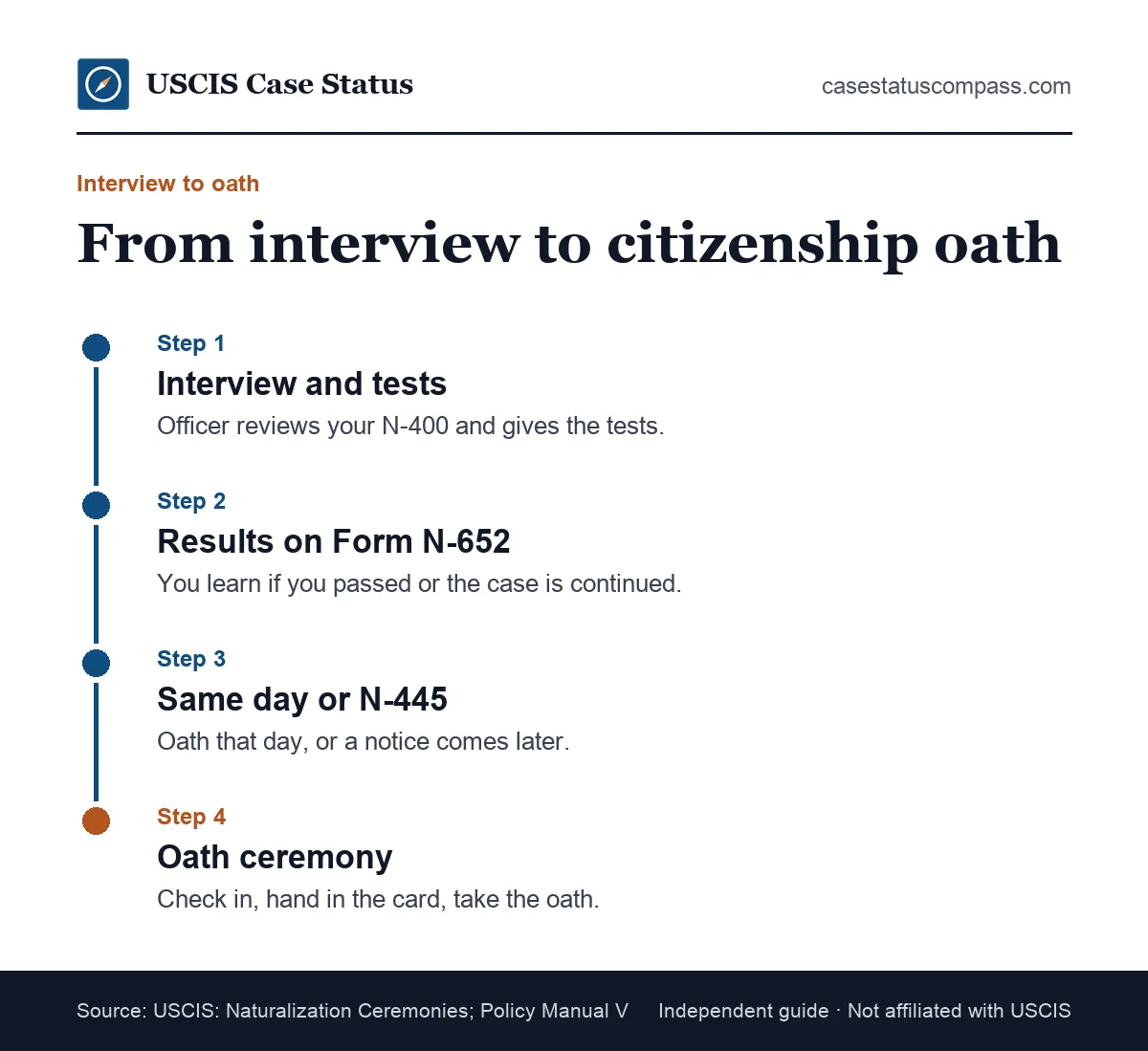
It depends on your field office. You may be able to take the oath the same day as your interview if a ceremony has space that day. Otherwise USCIS mails Form N-445 with a future date. USCIS does not publish a standard wait between approval and the oath.
When the oath can happen the same day
Some offices hold daily ceremonies and finish the interview, decision and oath in one visit. If approved on the spot, you may wait for a later ceremony that day.
Bring your green card to the interview for this reason.
When the N-445 comes by mail
Otherwise USCIS mails the N-445, and many applicants also see it in their online account. Keep your address current; our change of address guide explains how.
If weeks pass after approval and no notice arrives, contact USCIS rather than waiting.
After the Citizenship Interview, How Long for the Oath in Practice?
The wait after the citizenship interview depends on your office, ceremony seats and whether you were approved on the spot. USCIS publishes no official number for this gap, so use the overall N-400 timeline as context.
The ceremony date printed on your own N-445 is the only reliable answer for your case.
What the overall N-400 numbers show
USCIS reported this for the whole Form N-400 process: N-400: median 9.5 months (USCIS data, Apr.-June 2026). That median covers filing to completion, not the gap before the oath. Right now, the official tool shows 10 to 15 months, depending on category and office (USCIS data retrieved Oct 27, 2026). Our guide on how long naturalization takes explains how to read both figures.
What Can Delay Your Oath Ceremony Date?
Most delays come from an open issue in the case or from ceremony capacity, not from anything you did wrong. The common causes are:
- A continued result on Form N-652 that asks for documents
- A retest of the English or civics part
- Background or name checks that are still open
- A limited number of ceremony seats in your area
- A move to a new address handled by a different office
Can You Take the Oath on the Same Day as the Interview?
Sometimes. USCIS says you may be able to take the oath the day of your interview if a ceremony is available, mostly at offices with frequent administrative ceremonies. It is not possible when the case is continued or a judicial ceremony is required.
Signs a same-day oath may happen
The officer may approve you, keep your green card and ask you to wait, or hand you an N-445 to complete. If you asked for a court name change, expect a later judicial ceremony.
Preparing in case it happens
Leave the whole day free, arrange childcare and park where you can stay for hours. Bring water and a snack if the building allows them.
Have your green card with you, since it must be handed in before the oath.
Can You Reschedule an Oath Ceremony?
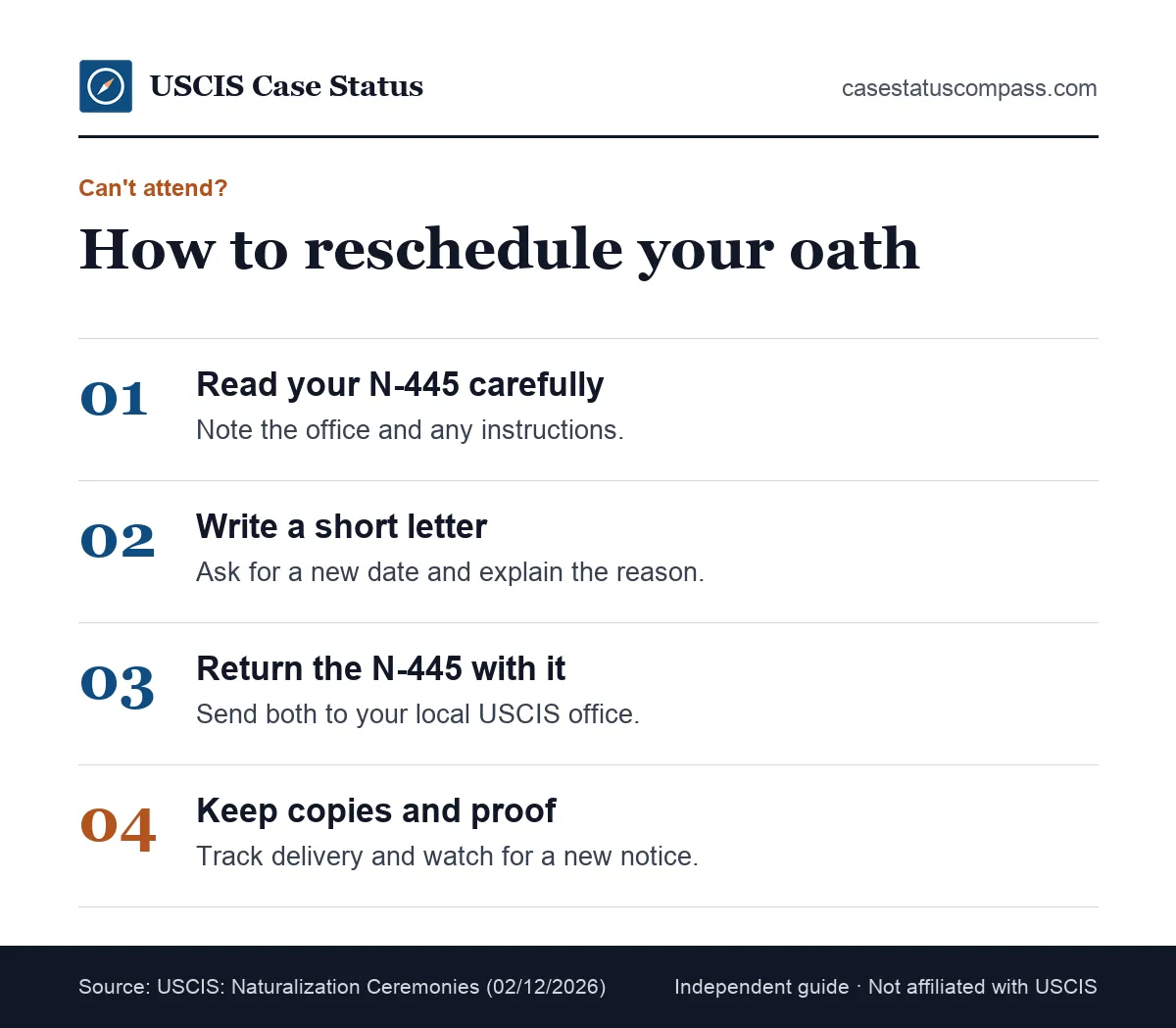
Yes. Can't attend? Return the N-445 with a letter asking for a new date. Ask as soon as you learn about the conflict. A new date is not guaranteed for any specific week, and repeated absences can put your case at risk, so reschedule only for real reasons.
How to ask for a new date
- Sign and keep a copy of your N-445.
- Write a short, dated letter with your name, A-Number and reason.
- Attach proof if you have it, such as a medical note or travel record.
- Send the letter and the N-445 to the office named on the notice.
- Use tracked delivery and save the receipt.
Reasons that usually make sense
Illness, surgery, a family death or a work emergency are typical reasons. Avoid travel abroad near the oath, because residence rules apply until then: Naturalization: a trip over 6 months is presumed to break residence; 1 year or more breaks it.
What Happens If You Miss the Oath Ceremony?
USCIS warns that failing to appear for the oath more than once may lead to denial of your naturalization application. Missing one ceremony usually means USCIS sends another notice. Missing a second without good reason can lead USCIS to treat the case as abandoned.
After one missed ceremony
Call 800-375-5283 right away, then write to the office on your notice. Keep proof of why you missed it and watch for a new N-445.
Explain what happened right away instead of waiting for a second notice.
After repeated absences
The Policy Manual says USCIS presumes abandonment after more than one missed ceremony and sends a notice before denying. Answer it quickly. After a denial, see our case denied guide.
How Long Does the Naturalization Ceremony Take?
USCIS does not publish a standard length for a naturalization ceremony. The program is usually the short part; security, check-in lines and N-445 reviews take most of the time. Plan for several hours at the venue.
A large courthouse event can run longer than a small field office ceremony.
Check-in and waiting
Large ceremonies can include many applicants, and each one clears security and meets an officer. Arrive at the check-in time on your notice, not the program start.
Lines move faster when your N-445 is complete and signed.
The program itself
The program covers a welcome, the oath and often a video and the Pledge. Court ceremonies can be more formal, with a judge's remarks and a clerk calling names.
Photos are often allowed after the oath; follow staff directions.
How Many Guests Can You Bring to a Naturalization Ceremony?
USCIS sets no single national limit on ceremony guests; each venue sets its own based on space. Check your N-445 for a guest rule and ask the field office if it is unclear. Some venues seat guests in a separate area.
Why the limit differs by venue
A small field office room seats far fewer people than a courthouse or civic hall. If your notice is silent, call 800-375-5283 for help reaching the office.
Guests also pass security screening, so they should bring photo ID.
Children and guests who need help
Children are often welcome; bring quiet activities. If you need a disability accommodation, ask in advance: e-Request: report USCIS typos, missing notices or accommodation needs online.
Strollers and bags go through screening too.
What Should You Bring to the Oath Ceremony?
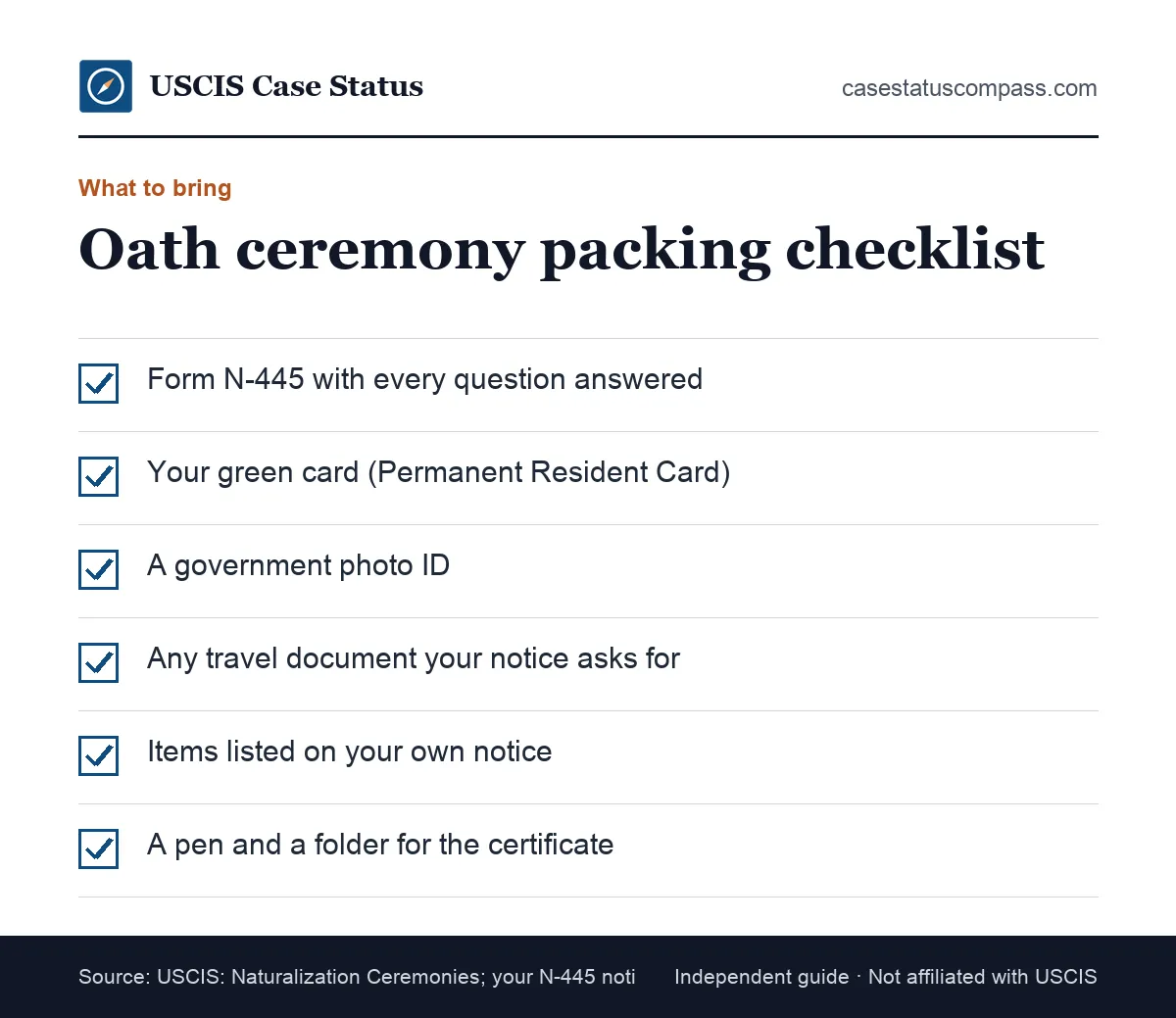
Bring your Form N-445 with every question answered, your green card, and a valid photo ID. Also bring any extra item your notice lists, such as a travel document USCIS issued you. Missing the green card or notice can delay your oath.
Required items
Pack these four items the night before; a missing green card or a blank N-445 is a frequent cause of delays at check-in.
| Item | Why it matters |
|---|---|
| Completed Form N-445 | Officer reviews it at check-in |
| Permanent Resident Card | You must return it before the oath |
| Government photo ID | Confirms your identity at security and check-in |
| Anything your notice lists | Notices can add local requirements |
Helpful extras
Bring a pen, a stiff folder for the certificate and papers that explain any "yes" answer. Leave items on the Federal Protective Service prohibited list at home.
A small bag also speeds up screening.
Printable Oath Ceremony Checklist
This printable oath ceremony checklist turns the USCIS instructions and your N-445 into a simple list. Print it or save it on your phone.
Tick off each item as you go, and keep the list clipped to your notice so the paperwork and the plan stay together the night before.
The week before
- Read the full N-445 and note the arrival time
- Answer every questionnaire item; sign only where told
- Gather papers that explain any "yes" answer
- Plan the route, parking and transit time
- Confirm the guest rule and arrange childcare
- Avoid travel abroad until after the oath
The morning of the ceremony
- N-445, green card and photo ID in your bag
- Any extra document your N-445 lists
- Phone silenced; no prohibited items
- Leave early enough to clear security
- Folder ready to protect the certificate
What Should You Wear to a Citizenship Swearing-In Ceremony?
USCIS does not publish a dress code for the citizenship swearing-in ceremony. Most people wear clean, respectful clothes they would wear to a court hearing or a family celebration. Comfortable shoes help, because lines and standing can take a while.
Simple dress guidelines
Business casual works almost everywhere. Many new citizens dress up for photos. Skip clothing with political slogans, because the event is formal and non-partisan.
Comfortable shoes help, since you may stand in line for a long time.
Cultural and religious dress
Traditional and religious clothing is welcome, including head coverings worn for faith.
National dress from your country of origin is also fine. The oath asks you to give up foreign allegiance, not your culture or faith, so there is no need to change how you dress for the day.
Why Do You Return Your Green Card at the Oath?
You return your green card because it proves permanent resident status, which ends once you become a citizen. Hand in your green card when you check in for the oath ceremony. USCIS cancels the card and replaces it with your Certificate of Naturalization as proof of status.
Card surrender at check-in
The officer collects the card while reviewing your N-445, or at the interview if you take a same-day oath. Never leave it at home; after the oath it has no use.
What If Your Green Card Is Lost Before the Oath?
USCIS waives the return if you proved at the interview that the card was lost and you tried to recover it. If it vanished later, tell USCIS before the ceremony and bring any police report. Do not file Form I-90 without asking, since the card is about to be cancelled anyway.
Your Certificate of Naturalization at the Ceremony
You receive your Certificate of Naturalization right after the oath. USCIS tells new citizens to review it and report errors before leaving. It is official proof of citizenship, so fixing a mistake on the spot is far easier than by mail.
What to check before you leave
Check your name spelling, birth date, former nationality, sex and photo against your ID. If anything is wrong, tell the officer before you leave.
Fixing it there is far easier than a later correction, which is free only when the mistake was USCIS's.
Replacing or correcting it later
A lost certificate is replaced with Form N-565 ($555 (paper) / $505 (online)). Our guide on how to get naturalization certificate copies covers the details.
Filing online costs less than filing on paper.
Can You Change Your Name at the Oath Ceremony?
You can request a legal name change on Form N-400, but whether it happens at the ceremony depends on the type. A court ceremony can grant the change as part of the proceeding. An administrative ceremony usually cannot, so you may need a separate court order.
Name changes at judicial ceremonies
If your area has court ceremonies, USCIS usually books name-change applicants there. The judge grants the change and the certificate shows the new name, so confirm the exact spelling at your interview.
Name changes at administrative ceremonies
Without a court ceremony, USCIS may naturalize you under your current name. You can later get a state court order and update the certificate with Form N-565.
Budget for that extra fee and processing time.
What Happens After the Ceremony?
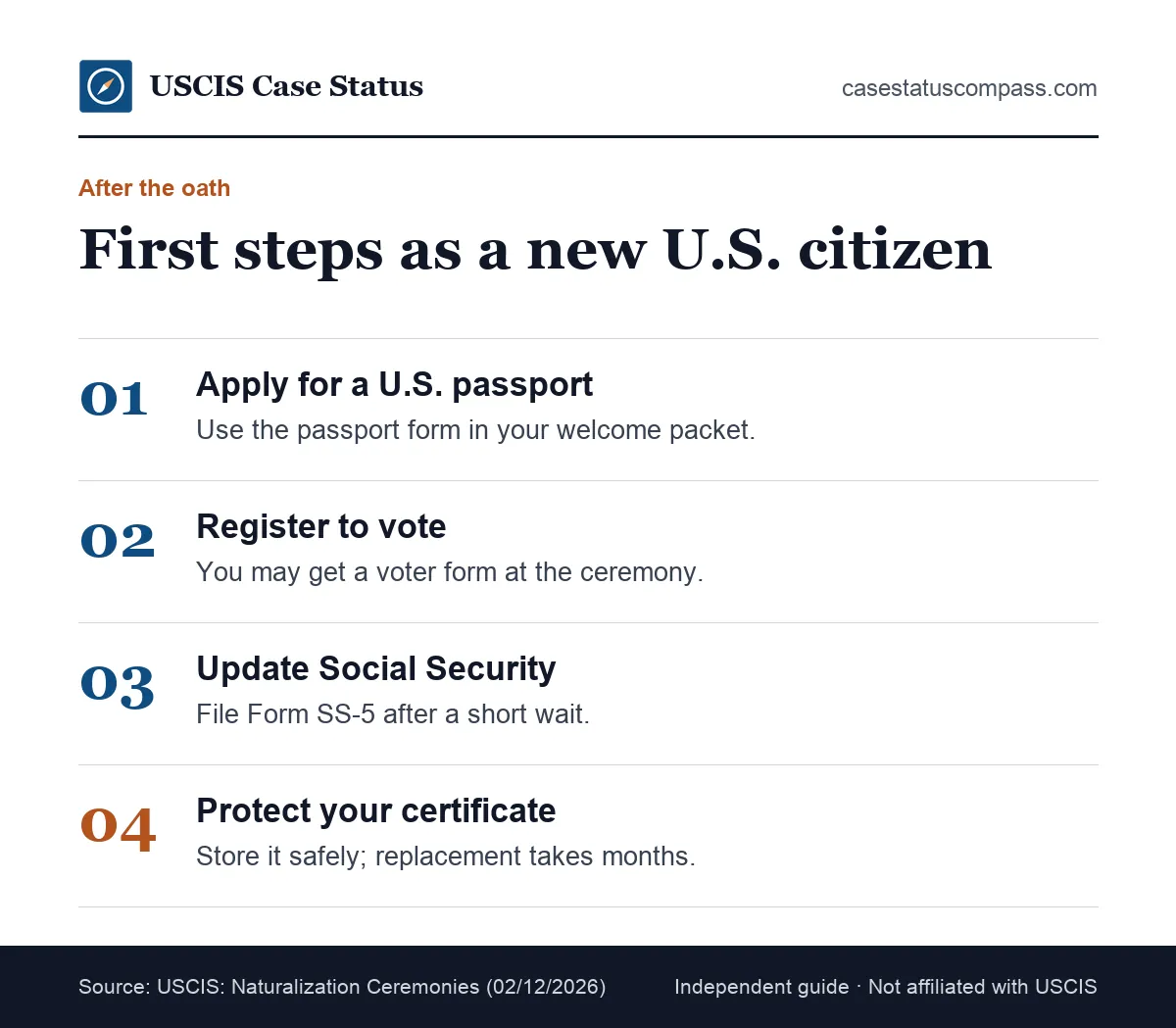
After the oath of citizenship, America counts you as a U.S. citizen with nearly all the rights of citizens by birth. USCIS gives you a welcome packet with a passport application. Next, get a passport and update government records.
Store the original somewhere safe and fireproof.
Your status changes the moment you finish the oath
From that moment you can register to vote, hold a U.S. passport and sponsor more relatives. If you consented on the N-400, USCIS may also share your new status to update certain records.
What you may receive at the ceremony
Exactly what is handed out varies by venue, but most new citizens leave with:
- The Certificate of Naturalization
- A U.S. Citizenship Welcome Packet with a passport application
- A voter registration application
- Information from other services present that day
How Do You Get a US Passport After the Oath?
Apply for a U.S. passport or passport card with the form in your welcome packet, at most post offices or on travel.state.gov. The U.S. Department of State, not USCIS, issues passports, and it reviews your certificate as proof.
Your first passport is a new application, not a renewal.
Submitting your certificate
Your certificate is the proof of citizenship the application asks for. Photocopy it for your records and send it by a trackable method.
The State Department returns the original certificate, sometimes in a separate mailing from the passport.
Plan travel carefully
USCIS reminds new citizens to allow enough time before booking trips. Check current State Department processing information before you buy tickets.
Remember that U.S. citizens must use a U.S. passport to leave and re-enter the country, and your green card is already gone.
Registering to Vote as a New Citizen
You may receive a voter registration application right after the oath. At administrative ceremonies, a state or local election official or a USCIS official may hand them out. You can also register later at post offices, motor vehicle offices, county election boards and Secretary of State offices.
Where and how to register
Your state sets the rules and deadlines. Register only after the oath; registering early is a false claim risk that can harm your case.
Most states let you register online, by mail or at a motor vehicle office, and some ceremonies have election officials on site.
Keep your proof handy
Keep a copy of your certificate handy, and register under your new name if it changed at the ceremony.
Election offices sometimes ask new citizens to confirm their status, and having the certificate ready makes that quick.
How Do You Update Social Security After Naturalization?
Update your Social Security record by filing Form SS-5 with the Social Security Administration (SSA), by mail or in person at an SSA office. USCIS advises waiting several days after the ceremony so your new status can reach SSA's systems. Bring your certificate or U.S. passport as proof.
Why the update matters
SSA records your citizenship status. Updating it avoids work-verification and benefit mismatches and records any new name.
If you work, an outdated record can trigger a mismatch in an employer's E-Verify check.
What to bring to SSA
Bring your original certificate or U.S. passport plus identity proof, and check SSA's site for current document rules.
SSA does not charge for updating your record or issuing a corrected card.
Can You Sponsor Family After Taking the Oath?
Yes. As a U.S. citizen you can file Form I-130 for immediate relatives, meaning your spouse, unmarried children under 21 and parents if you are at least 21. You can also petition for married children and siblings. Petitions you filed as a resident may convert to a citizen category.
Upgrading a pending petition
A spouse or child petition filed while you were a resident can move into an immediate relative category. Send USCIS or the National Visa Center (NVC) a copy of your certificate.
Where to learn the details
Our Form I-130 guide explains who qualifies and how to file. Petitions follow their own timeline, separate from your oath.
Immediate relatives do not wait for a visa number, while other family categories follow the monthly Visa Bulletin.
Oath Ceremonies for Military Members and Children
Military applicants and young children follow different rules. Service members certify their service on Form N-426, which is free. Children under 14 are generally excused from the oath and receive a different certificate.
USCIS can also hold ceremonies abroad for eligible service members.
Service members and veterans
Military applicants: Form N-426 (certified for current service members); veterans use a DD-214. Applicants who never became permanent residents because of military service have no green card to return.
Ask your unit's legal office for help with the certification.
Children and the oath
USCIS generally considers children under 14 unable to understand the oath and waives it. After approval, USCIS issues a Certificate of Citizenship instead. Children who became citizens through a parent use Form N-600; see our Form N-600 guide.
Common Oath Ceremony Mistakes to Avoid
Most oath problems come from paperwork and planning, not the oath itself. Blank N-445 answers, a forgotten green card, late arrival and travel near the ceremony cause most delays.
Nearly all of them can be prevented with a checklist and a careful read of your notice the week before.
Paperwork mistakes
- Leaving N-445 questions blank or guessing at answers
- Forgetting the green card or reentry permit
- Not disclosing a citation or arrest after the interview
- Accepting a certificate with an error and fixing it later
Planning mistakes
- Arriving at the program time instead of the check-in time
- Booking international travel before the oath
- Bringing items not allowed in federal buildings
- Ignoring a notice that arrived at an old address
Oath Ceremony Scenarios
These fictional examples show how the oath rules work in practice. They are planning examples, not legal advice for your own case.
Each one names the problem, the first step taken and why that step works, so you can compare it with your own situation and spot when you need professional help.
Scenario 1: A business trip clashes with the date
Maria's N-445 falls during a required work trip to another state. She returns the notice with a letter and her employer's memo asking for a new date, and attends the rescheduled ceremony.
Scenario 2: A traffic ticket after the interview
Daniel got a speeding ticket after his interview. He answers "yes" on the N-445, explains it and brings proof he paid. The officer reviews it and he takes the oath.
If X, Do Y: Oath Ceremony Decision Table
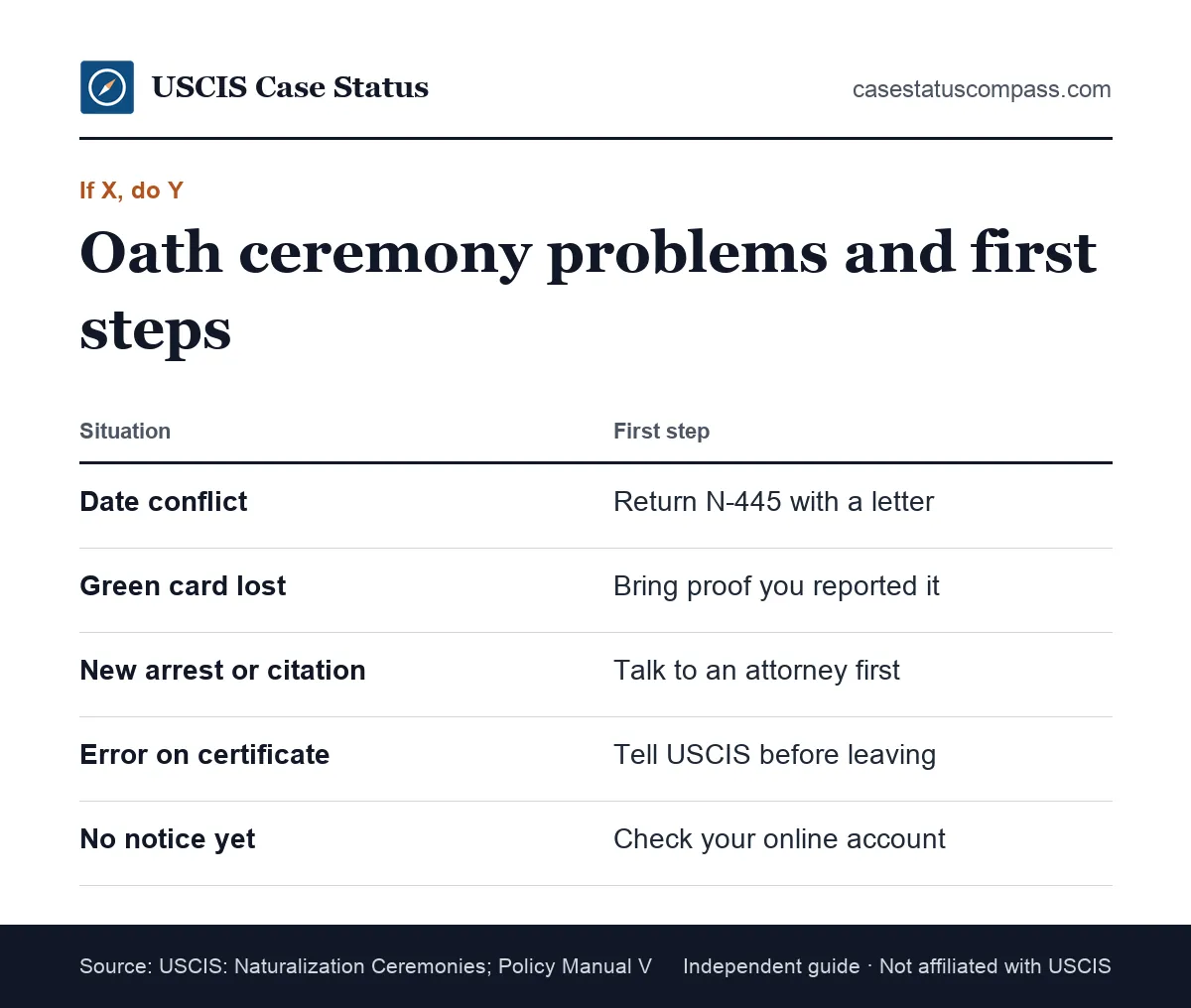
Use this table to find the first action for common oath ceremony problems. For an arrest, a long trip or a marriage change, talk to an immigration attorney or DOJ-accredited representative before ceremony day.
Start with the row that matches your situation.
Problems before ceremony day
These rows cover issues that come up between your approval and the date printed on your N-445.
| If this happens | Do this first |
|---|---|
| You cannot attend the date | Return the N-445 with a letter asking for a new date |
| You were arrested or cited after the interview | Answer "yes" on the N-445 and get legal advice |
| You moved before getting a notice | Update your address and check your online account |
| The case was approved but no N-445 came | Check your account, then contact USCIS |
Problems at the ceremony
On ceremony day, raise any problem with the officer at check-in or before you leave the venue.
| If this happens | Do this first |
|---|---|
| Your green card is lost | Report it, bring proof, tell USCIS at check-in |
| The certificate has an error | Tell the officer before you leave the venue |
Checking your status while you wait
Your case status may show "Case Was Approved" before the notice arrives. Our page on what case was approved means explains what that update does and does not tell you for an N-400.
When Should You Talk to an Immigration Attorney Before the Oath?
Talk to an immigration attorney or DOJ-accredited representative if anything on the N-445 could disqualify you. Arrests, unpaid taxes, long trips, a claim of citizenship, a divorce on the spouse basis or a USCIS notice reopening your case all need professional advice before the ceremony.
Red flags that need advice
- Any arrest, charge or conviction after the interview
- A trip abroad longer than six months
- A notice that USCIS reopened your case
- Questions about your willingness to take the full oath
Finding trustworthy help
Look for a licensed attorney or a representative at a DOJ-recognized organization. Never pay a "notario" or consultant who promises a faster oath date. Our biometrics appointment and green card interview questions guides cover other appointments in the process.
Frequently Asked Questions
How long does it take to get a citizenship oath ceremony date?
USCIS publishes no standard wait for an oath ceremony date. Some applicants take the oath the same day as their interview; others get Form N-445 by mail with a later date, depending on the field office and ceremony seats. Watch your mail and online account.
Is the oath ceremony mandatory?
Yes, for most adults. You do not become a U.S. citizen until you take the Oath of Allegiance at a ceremony. The only exception is a disability waiver approved by USCIS for someone who cannot understand or communicate the oath's meaning. Children under 14 are generally excused and receive a Certificate of Citizenship.
Can I travel abroad before my oath ceremony?
You can, but it is risky. Residence rules apply until the oath, the N-445 asks about trips, and travel can make you miss the ceremony. Keep any trip short and talk to an attorney about long ones.
Do I need to say "so help me God"?
No. You can ask to "solemnly affirm" instead of swearing and leave out "so help me God" for any reason, with no documents needed. Tell the officer at your interview or at check-in. The officer must let you know which words you do not need to repeat.
What if I fail to check in on time?
Late arrival can mean you are moved to another ceremony. Contact the office on your notice right away. One missed ceremony usually leads to a new notice, but missing more than one can lead to denial.
When do I receive my Certificate of Naturalization?
Right after the oath, usually before you leave the venue. Check every detail against your ID on the spot. A lost certificate is replaced later with Form N-565.
Do I need my passport at the oath ceremony?
Not unless your notice asks for it. Bring a valid government photo ID, which can be your foreign passport, along with your N-445 and green card. Also bring any reentry permit or refugee travel document USCIS issued you.
Can my naturalization be canceled after the oath?
Once you take the oath, you are a citizen. Revoking naturalization, called denaturalization, requires a federal court case and usually involves serious fraud or concealment. If you worry about something you did not disclose, talk to an immigration attorney.
Sources
- USCIS: Naturalization Ceremonies (updated 02/12/2026). www.uscis.gov/citizenship/learn-about-citizenship/naturalization-ceremonies. Accessed Oct 27, 2026.
- USCIS: Naturalization Oath of Allegiance to the United States of America. www.uscis.gov/citizenship/learn-about-citizenship/the-naturalization-interview-and-test/naturalization-oath-of-allegiance-to-the-united-states-of-america. Accessed Oct 27, 2026.
- USCIS Policy Manual Vol. 12, Part J, Ch. 3: Oath of Allegiance Modifications and Waivers. www.uscis.gov/policy-manual/volume-12-part-j-chapter-3. Accessed Oct 27, 2026.
- USCIS Policy Manual Vol. 12, Part J, Ch. 4: General Considerations for All Oath Ceremonies. www.uscis.gov/policy-manual/volume-12-part-j-chapter-4. Accessed Oct 27, 2026.
- USCIS Policy Manual Vol. 12, Part J, Ch. 2: The Oath of Allegiance. www.uscis.gov/policy-manual/volume-12-part-j-chapter-2. Accessed Oct 27, 2026.
- USCIS: Form N-400 Instructions (edition 01/20/25). www.uscis.gov/sites/default/files/document/forms/n-400instr.pdf. Accessed Oct 27, 2026.
- USCIS: Form N-426, Request for Certification of Military or Naval Service. www.uscis.gov/n-426. Accessed Oct 27, 2026.
- USCIS Data Library: All Application and Petition Form Types, FY2026 Q3. www.uscis.gov/tools/reports-and-studies/immigration-and-citizenship-data. Accessed Oct 27, 2026.
- USCIS processing times. egov.uscis.gov/processing-times/. Accessed Oct 27, 2026.
- USCIS: Study for the Test. www.uscis.gov/citizenship/find-study-materials-and-resources/study-for-the-test. Accessed Oct 27, 2026.
- USCIS Data Library: All USCIS Application and Petition Form Types, FY2026 Q3 (Apr. 1-June 30, 2026; queried 7/2026). www.uscis.gov/sites/default/files/document/data/quarterly_all_forms_fy2026_q3_v1.xlsx. Accessed Oct 27, 2026.
- USCIS Policy Manual Vol. 12, Part D, Ch. 3. www.uscis.gov/policy-manual/volume-12-part-d-chapter-3. Accessed Oct 27, 2026.
- USCIS Contact Center (uscis.gov). www.uscis.gov/contactcenter. Accessed Oct 27, 2026.
- USCIS Form G-1055 Fee Schedule, Edition 10/16/26. www.uscis.gov/sites/default/files/document/forms/g-1055.pdf. Accessed Oct 27, 2026.
casestatuscompass.com is an independent publication and is not affiliated with USCIS or any government agency. This page is general information, not legal advice. For denials, court or asylum matters, consult an immigration attorney or a DOJ-accredited representative.