Contents · 42 sections
- What Does "Approval: Case Decision Rendered" Mean?
- What Does "Rendered" Mean in a USCIS Decision?
- "Case Was Approved" vs "Approval: Case Decision Rendered": Is There a Difference?
- Where Do You See Each Approval Message?
- Is a Case Decision Rendered Always an Approval?
- What Does a Denial Message Look Like Instead?
- What Comes Right Before an Approval Status?
- Your Form I-797 Approval Notice
- How Do You Read an I-797 Approval Notice Line by Line?
- I-130 Approval Notice: What It Shows
- I-140 Approval Notice: What It Shows
- Who Keeps the Original I-140 Approval Notice?
- I-485 Green Card Approval Notice and the Welcome Notice
- Is the I-797C the Same as an Approval Notice?
- What Happens After an I-797 Approval Notice?
- I-130 Approved: What Happens Next?
- I-130 Approved for a Relative Abroad
- What Fees Does the State Department Charge After I-130 Approval?
- I-485 Approved: What Happens Next?
- Conditional vs 10-Year Green Card After Approval
- I-765 Approved: Work Permit and STEM OPT Next Steps
- What Does Approval Mean for STEM OPT and H-4 EADs?
- I-140 Approved: What Happens Next?
- I-130 and I-485 Both Approved: What Now?
- Other Forms That Show an Approval Status
- Approval Timeline: From Decision to Card in Hand
- How Long Until You Receive Your Card After Approval?
- What Should You Do the Day You See the Approval?
- "If This, Do That": Approval Case Decision Rendered Decision Table
- Approval Without a Card Step: Why Some Cases Stop Here
- Why Did My Status Say Approved and Then Change?
- Can You Work or Travel Right After Approval?
- Proof of Status While You Wait for the Card
- What If the Approval Notice Never Arrives?
- Errors on Your Approval Notice or Card
- Address Changes After Approval
- Approval Scams and Fake Notices
- Can an Approval Be Revoked or Reopened?
- Mistakes People Make After Approval
- Why Should You Keep the Approval Notice for Good?
- When to Contact USCIS or an Attorney After Approval
- Frequently Asked Questions
The short answer
Approval case decision rendered means USCIS has finished reviewing your case and approved it. The official tracker usually shows this as "Case Was Approved." A Form I-797 approval notice follows by mail. What happens next depends on the form: a green card or work permit is printed, while a petition moves to its next stage.
At a glance
| Is it an approval? | Yes. The officer decided in your favor. |
| What arrives next | A Form I-797 approval notice by mail |
| Card cases (I-485, I-765, I-90) | Next status is usually "New Card Is Being Produced" |
| Petition cases (I-130, I-140) | No card; the case moves to NVC or Form I-485 |
| Action now | Confirm your mailing address and watch for the notice |
What Does "Approval: Case Decision Rendered" Mean?
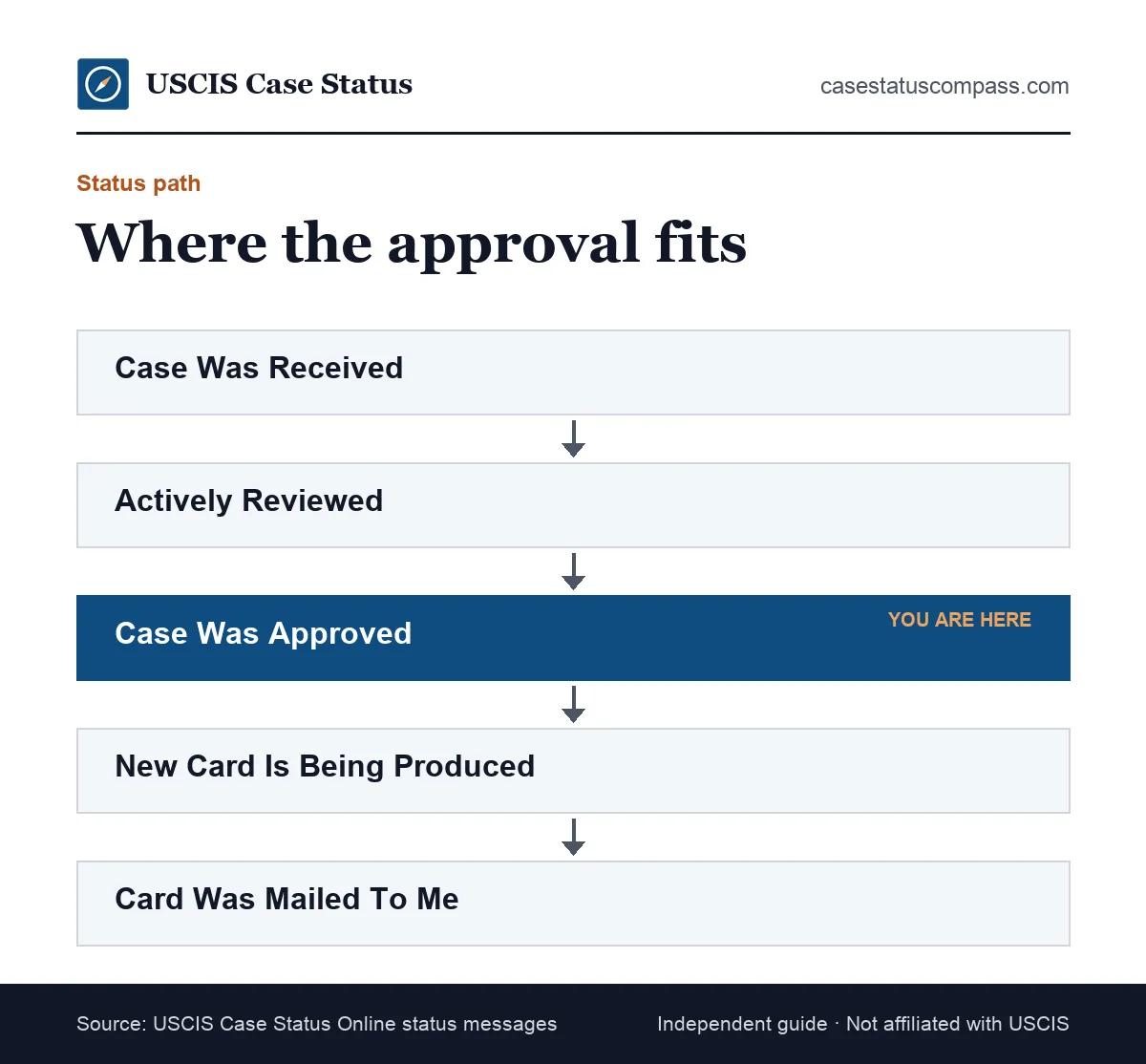
"Approval: Case Decision Rendered" means a USCIS officer made a final decision on your filing, and that decision was an approval. Nothing else is pending on that receipt number. You now wait for the I-797 approval notice and, for card-based forms, the physical card.
Breaking down the phrase word by word
"Approval" is the outcome. "Case decision" is the officer's ruling on that one receipt number. "Rendered" is a legal word for "issued."
None of the three words points to a pending step or a second review.
Reading the full line together
Put together, the line reads: a final ruling was issued, and it went your way. It is not a draft, a recommendation or a review step.
You do not need to accept it, sign anything or reply to USCIS.
What Does "Rendered" Mean in a USCIS Decision?
People search rendered meaning in USCIS because the word sounds unusual. Courts and agencies "render" a decision when they formally issue it. It does not mean the file is still being weighed or sent elsewhere.
Once rendered, the ruling stands unless USCIS later reopens it, which is rare.
"Case Was Approved" vs "Approval: Case Decision Rendered": Is There a Difference?
There is no practical difference. "Case Was Approved" is the headline in Case Status Online. The longer case decision rendered wording is what many applicants report in case history views and third-party tracker apps.
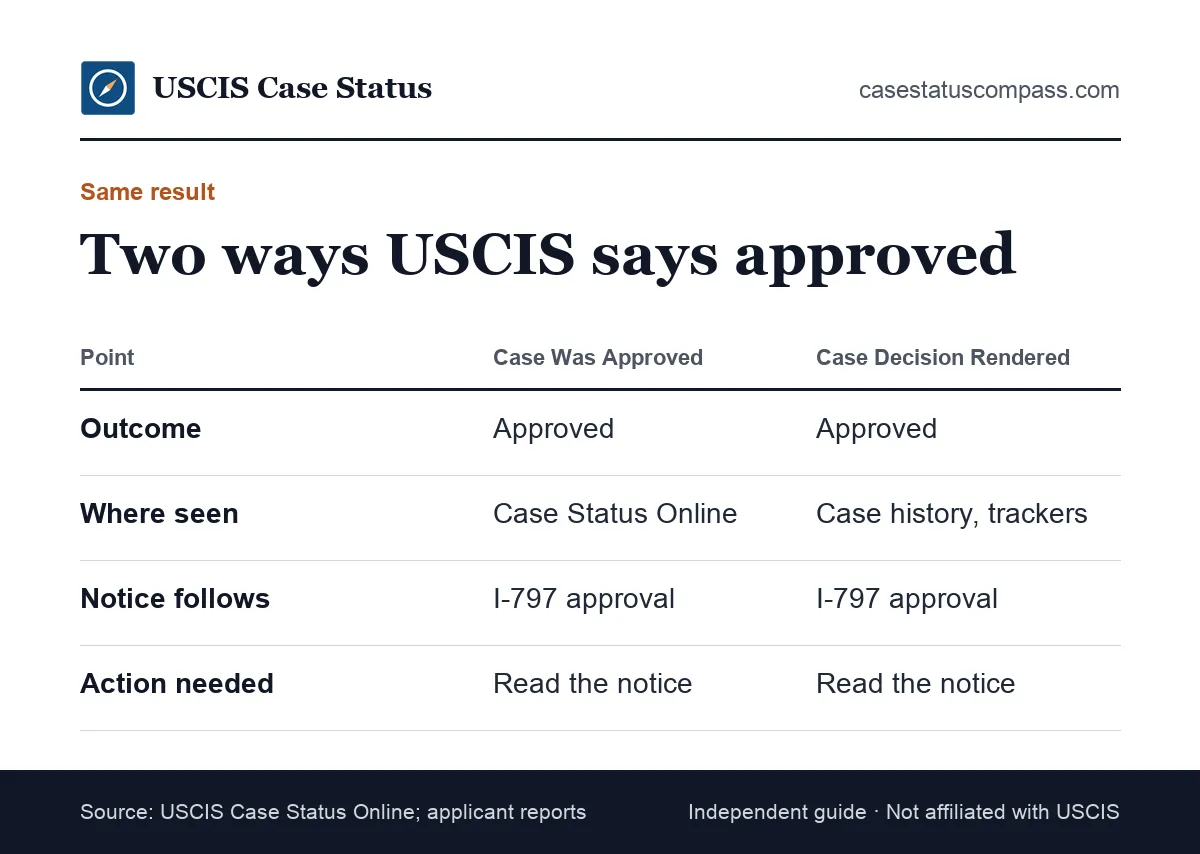
Both point to the same decision and the same mailed notice.
Why two wordings exist
USCIS data appears in the public search box, the online account and outside apps, and each labels events a little differently. We found no official page listing both labels, so trust the meaning.
Approval case decision rendered vs case approved: side by side
This comparison shows that the two wordings differ only in where they appear, not in what they mean for you.
| Question | "Case Was Approved" | "Approval: Case Decision Rendered" |
|---|---|---|
| Is the case approved? | Yes | Yes |
| Typical place you see it | Case Status Online headline | Case history, account events, tracker apps |
| Is a notice mailed? | Yes, Form I-797 | Yes, Form I-797 |
| Anything to appeal? | No, it is a win | No, it is a win |
| Does a card follow? | Only for card-based forms | Only for card-based forms |
Where Do You See Each Approval Message?
"Case Was Approved" is the headline on the official Case Status Online page at Case Status Online: egov.uscis.gov. The longer decision rendered wording usually shows in a case history list, your USCIS online account events, or an outside app that re-labels USCIS data.
Case Status Online
The public tool shows one headline and a short paragraph naming your form, the approval date and the mailed notice. Enter the receipt number without dashes and avoid look-alike sites that charge for lookups.
Your USCIS online account
As of October 2026, USCIS describes the account this way: Free USCIS online account: case status updates, notices, link paper-filed cases. Some applicants see a digital approval notice there before the paper copy arrives.
Linking a paper-filed case to see the approval
Paper filings do not appear in the account until you add them with the access code USCIS mails. Our USCIS online account number guide explains linking a paper case.
Once linked, the case history shows each step.
Is a Case Decision Rendered Always an Approval?
No. "Case decision rendered" alone only says a decision was issued. "Approval: Case Decision Rendered" is good news. A denial uses different words and comes with a written denial notice.
Read the first word of the line: it names the outcome. If that word is missing, open the official tool before you celebrate or worry.
What Does a Denial Message Look Like Instead?
A denial never uses the word "approval." Case Status Online shows "Case Was Denied," and the letter explains the reasons and any appeal or motion rights. If you see that wording, read our case was denied meaning guide before acting.
Other final actions that are not approvals
A case can be rejected for a wrong fee or form edition, withdrawn by the filer, or administratively closed. Each has its own status text and its own letter.
None of them grants the benefit you asked for.
When a tracker shows no outcome word
If a tracker shows only "decision rendered" with no outcome word, check Case Status Online directly. Outside apps sometimes shorten USCIS labels.
The official headline and the mailed notice both name the outcome clearly, so rely on those rather than on an app's summary.
What Comes Right Before an Approval Status?
Most cases reach approval after a review step, an interview or a response to a request for evidence. Some simple filings jump from "Case Was Received" straight to approval. Either path is normal.
The step before approval does not change what you do next.
Common statuses just before approval
Many applicants see case is being actively reviewed by USCIS shortly before the decision. That message means an officer has the file open and a decision is near.
Not every case shows it, though.
When a generic action update comes first
Others see the generic update we have taken an action on your case, which can hide a decision not yet posted in plain words.
The plain approval headline often follows within days, so give the tool a little time before you call.
When the status sat still for months first
A long run of case is still being processed by USCIS is common before approval. A quiet period is not a warning sign. Once approval appears, the length of the earlier wait does not change your next steps.
Your Form I-797 Approval Notice
The Form I-797 approval notice is the official record that USCIS approved your form. It lists the receipt number, form type, approval date and, for some forms, validity dates.
It is the document employers, consulates and later USCIS filings ask to see, so treat the original as an important record and store it with your passport and civil documents.
What makes an approval notice different
USCIS uses the I-797 family for many letters. The approval version says "Approval Notice" near the top and states the action taken. Originals are printed on security paper. If a notice looks off, learn how to verify a USCIS notice before relying on it.
How Do You Read an I-797 Approval Notice Line by Line?
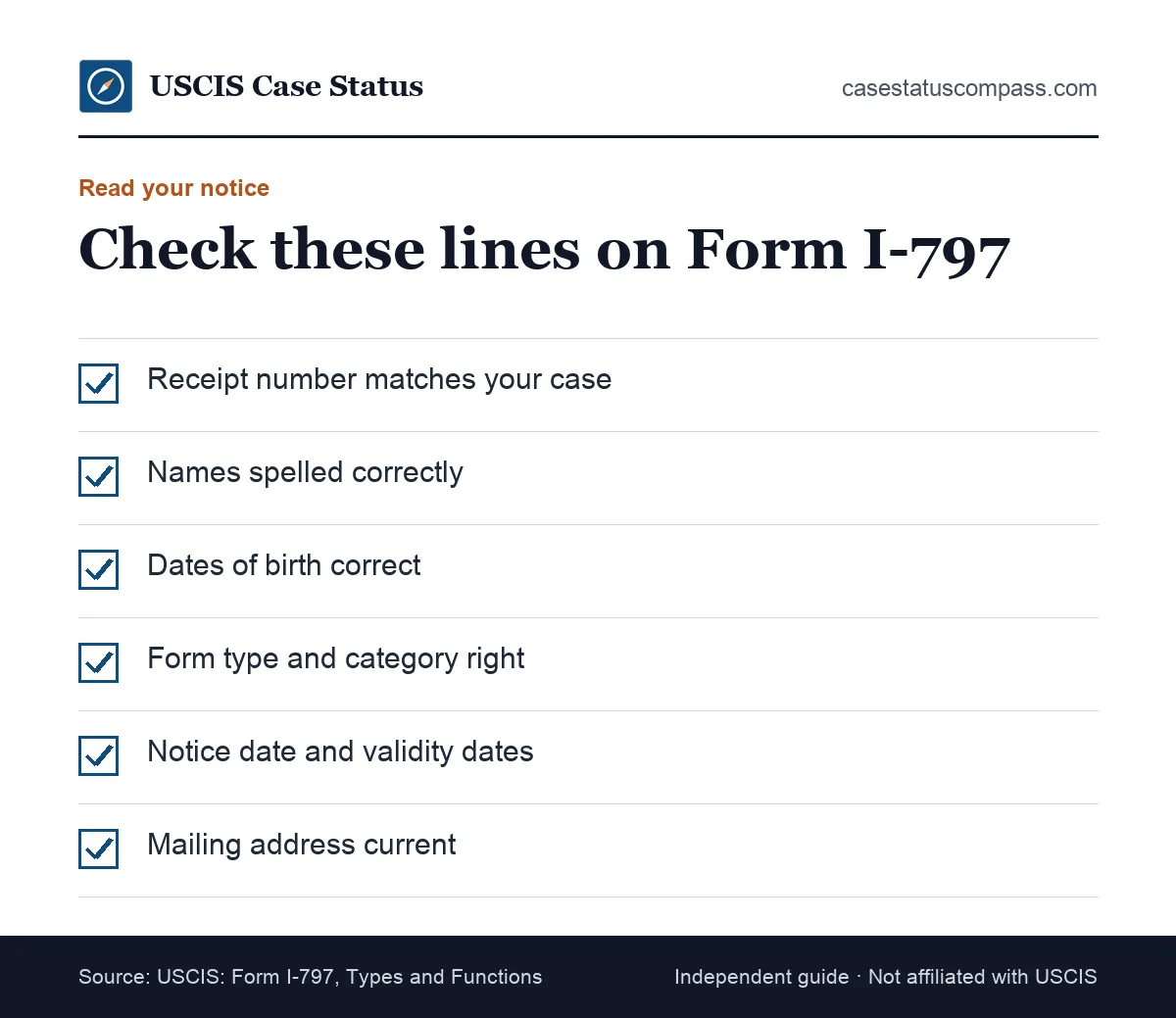
Read the form I-797 approval notice top to bottom: title, receipt number, case type, dates, names and the message box. Check every name and date against your passport. The message box explains what the approval does and any next step USCIS expects.
The top block: receipt number and dates
The top block shows the receipt number, case type (such as I-130 or I-485), received date and notice date. The notice date is usually the approval date. Write it down.
Names, A-Number and category
The middle lists the petitioner, beneficiary or applicant, often with an A-Number and class code. A wrong letter in a name can carry over to your card, so flag errors right away.
The message box at the bottom
The bottom box is plain language. A family petition may say the file went to the National Visa Center. An I-485 notice says you are a permanent resident and the card will be mailed.
I-130 Approval Notice: What It Shows
An I-130 approval notice confirms that USCIS accepts the family relationship. It shows the petitioner, beneficiary, category and the priority date, which sets the relative's place in line.
It does not grant the relative any status, but it is the record NVC and later filings rely on.
The priority date and category code
The priority date is usually the date USCIS received the petition. The category code shows whether the relative is an immediate relative or in a preference category.
Check both against what you filed.
Preference relatives and the visa bulletin
Preference relatives wait for a current date in the visa bulletin. The priority date on the I-130 approval notice is the date you compare against each month's chart.
Where the notice says the file went
Many I-130 notices name the next office, often the National Visa Center for a relative abroad. Our Form I-130 guide covers each family category.
If the office named there looks wrong for your relative's location, contact USCIS before NVC opens a case.
I-130 notices for relatives already in the U.S.
If the relative filed Form I-485 in the U.S., the notice may not mention NVC at all. The file stays with USCIS for the green card decision, and the I-130 approval supports that pending application.
I-140 Approval Notice: What It Shows
An I-140 approval notice confirms that USCIS approved an employer's immigrant petition for a worker. Like the I-130, it is a petition approval, not a green card. It shows the employer, the worker, the classification (such as EB-2 or EB-3) and the priority date.
What the classification line tells you
The line shows which employment-based category USCIS approved. That category, your country of birth and your priority date decide when you can file or finish Form I-485. See our Form I-140 guide and our PERM case status page for the labor certification before it.
Who Keeps the Original I-140 Approval Notice?
The original I-140 approval notice usually goes to the employer or its attorney, because the employer filed. Ask the employer's lawyer for one early if you will need it for Form I-485 or a later job change.
A copy is usually enough for most later uses.
I-485 Green Card Approval Notice and the Welcome Notice
The green card approval notice for Form I-485 says USCIS granted permanent residence. Many applicants call it the "welcome notice" because of its wording. It arrives separately from the green card, usually first.
Keep it safe; it can help if the card is delayed or lost in the mail.
I-485 approval notice vs welcome notice
In everyday talk, the I-485 approval notice and the green card welcome notice are the same I-797 document. Either version confirms permanent residence.
The notice is not a travel document, so do not rely on it alone at a border. The card, or temporary proof of status, serves that purpose.
Your resident-since date
The notice shows the date you became a permanent resident, which also prints on the card. It matters later: You can file the N-400 up to 90 days before you reach 5 years (or 3 years if married to a U.S. citizen) as a permanent resident. Our Form I-485 green card guide covers the full adjustment process.
Is the I-797C the Same as an Approval Notice?
No. Form I-797C is a "Notice of Action" used for receipts, appointments, transfers and similar updates. An approval notice is a different I-797 version. In USCIS's words: I-797C = Notice of Action (receipt, rejection, transfer, appointment, re-open); not proof of status by itself. An I-797C cannot prove your case was approved.
Quick way to tell them apart
Look at the title line. People who search for an I-797C approval notice usually mean the I-797 approval. The I-797C says "Receipt Notice" or "Appointment Notice." See what is an I-797C for each field.
Which notice to keep for which purpose
Applicants often hold four similar-looking USCIS documents. This table shows what each one proves and when to use it.
| Notice | What it proves | Keep it for |
|---|---|---|
| I-797C receipt notice | USCIS received your filing | Tracking and some extensions |
| I-797C appointment notice | You have a biometrics or interview date | Attending the appointment |
| I-797 approval notice | USCIS approved your form | Travel, jobs, NVC, later filings |
| Green card or EAD card | Your status or work permission | Daily proof of status |
What Happens After an I-797 Approval Notice?
It depends on the form. A card-based form moves to card production and mailing. A petition moves to the next agency or form. Nothing more is needed on that receipt number, though a new case may follow.
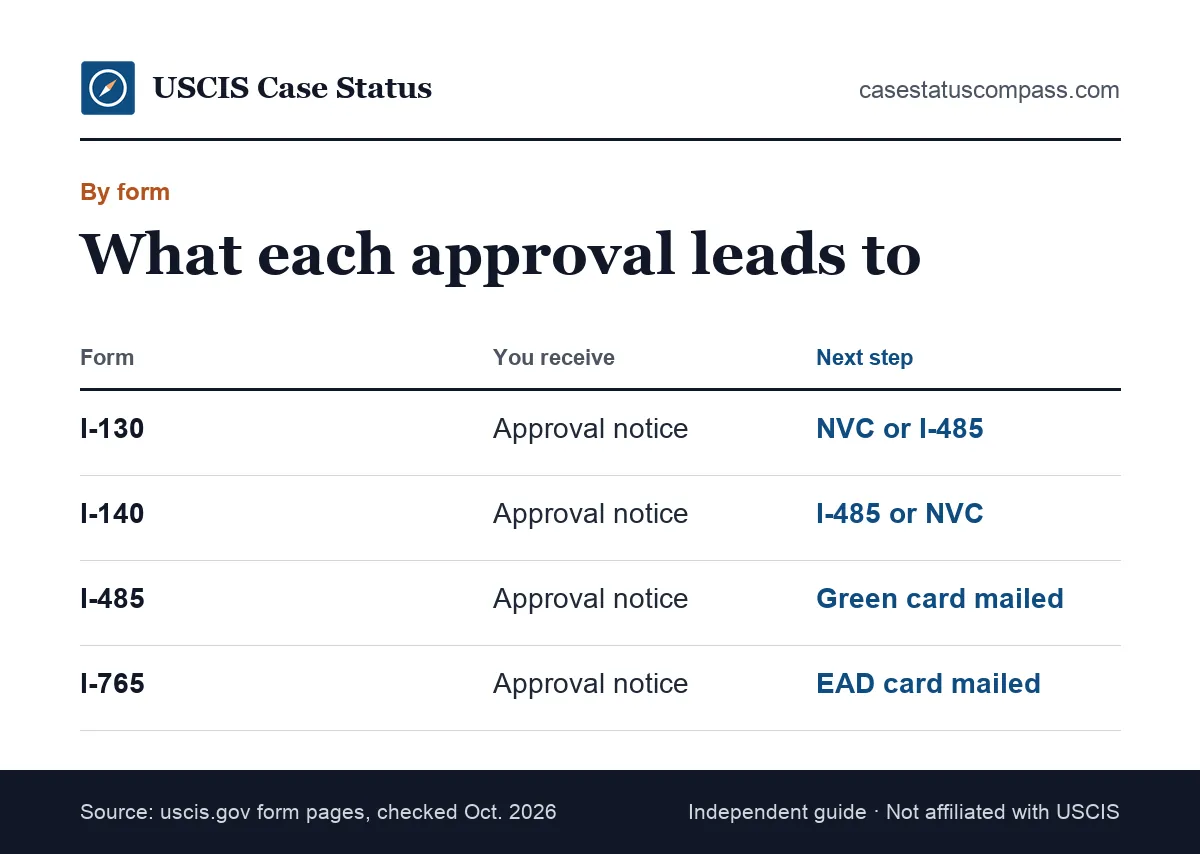
Read the message box to see which applies.
Card-based forms keep moving
For Forms I-485, I-765, I-90 and I-751, the next status is usually new card is being produced, then mailing. You file nothing to trigger the card; you only need a correct mailing address.
Petition forms hand off
For Forms I-130 and I-140, approval ends USCIS's work on the petition. The file moves to NVC for a beneficiary abroad, or the beneficiary uses Form I-485 inside the U.S.
I-130 Approved: What Happens Next?
When an I-130 is approved, the next step depends on where the relative lives and their category. A relative abroad goes through the National Visa Center and a consular interview. A qualifying relative in the U.S. uses Form I-485.
I-130 approved what next step for immediate relatives
Spouses, parents and unmarried children under 21 of U.S. citizens do not wait for a visa number. After the I-130 petition is approved, an immediate relative abroad moves to NVC and then a consular interview.
Immediate relatives already in the U.S.
An immediate relative in the U.S. who entered lawfully can usually file or continue Form I-485. That green card decision comes on its own I-797.
If the I-485 is still pending, keep following that case under its own receipt number.
Form I-130 approved what next for preference relatives
Siblings, married children and relatives of green card holders are in preference categories. They wait until the priority date is current. The approved petition stays valid while they wait.
What I-130 approval does not do
The approval does not let the relative travel, live or work in the U.S., and it does not stop removal proceedings. The green card or immigrant visa comes from the next application.
I-130 Approved for a Relative Abroad
For a relative abroad, after I-130 approved what next means a hand-off to the State Department. USCIS sends the file to the National Visa Center. NVC opens a new case, collects fees and documents, then the embassy schedules the immigrant visa interview.
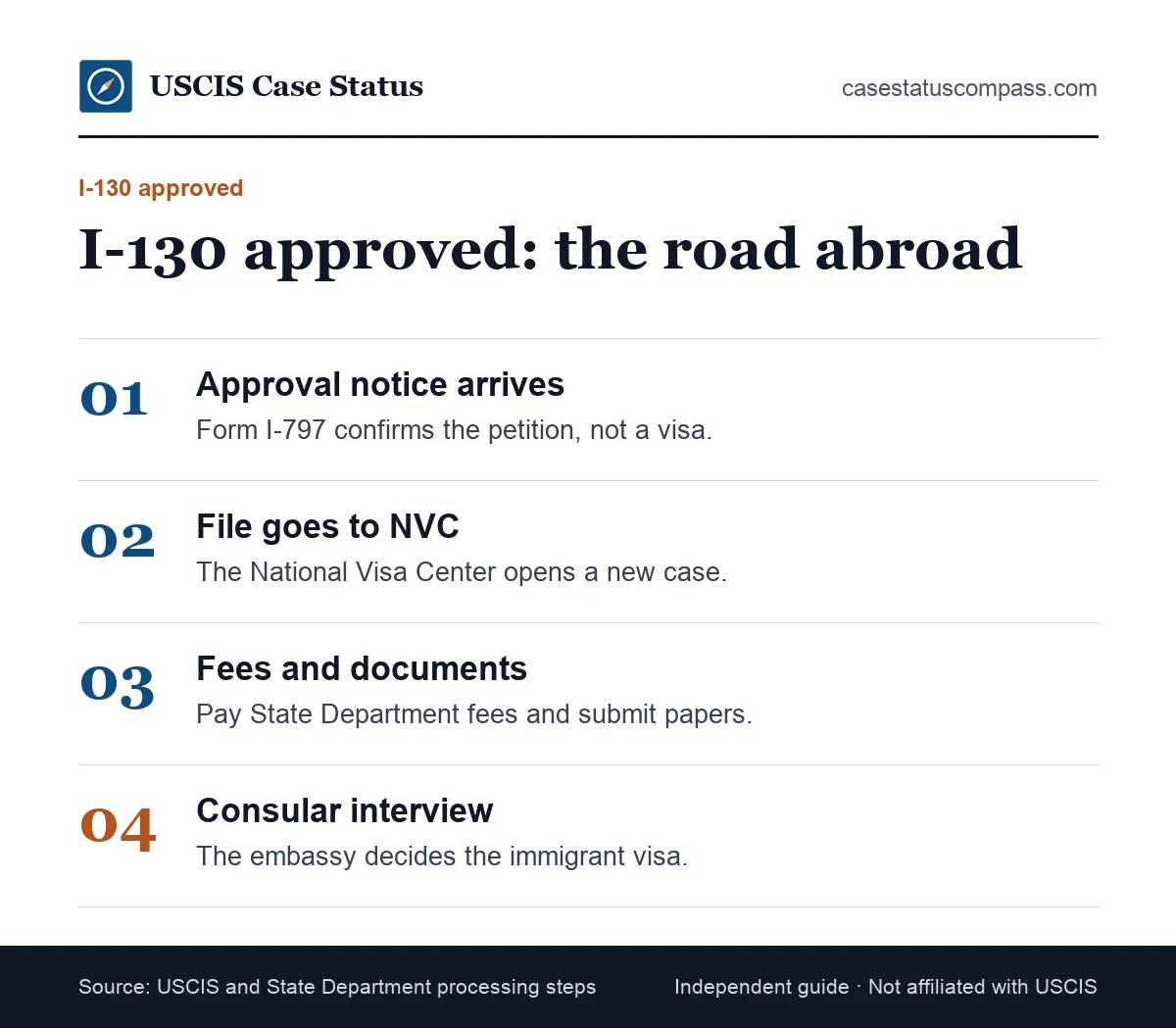
Tracking the case once it leaves USCIS
Once the file leaves USCIS, Case Status Online stops being useful for that case. Our NVC case status guide explains the NVC case number, the welcome letter and document review.
What Fees Does the State Department Charge After I-130 Approval?
The State Department charges its own fees: $325 per person for a family immigrant visa, $345 for an employment one, and $120 when the Affidavit of Support is reviewed domestically. At USCIS, Form I-864 costs $0 at USCIS.
NVC sends payment instructions.
I-485 Approved: What Happens Next?
After Form I-485 is approved, you are a lawful permanent resident from the approval date. USCIS mails the approval notice, then produces and mails the green card. No further filing is needed.
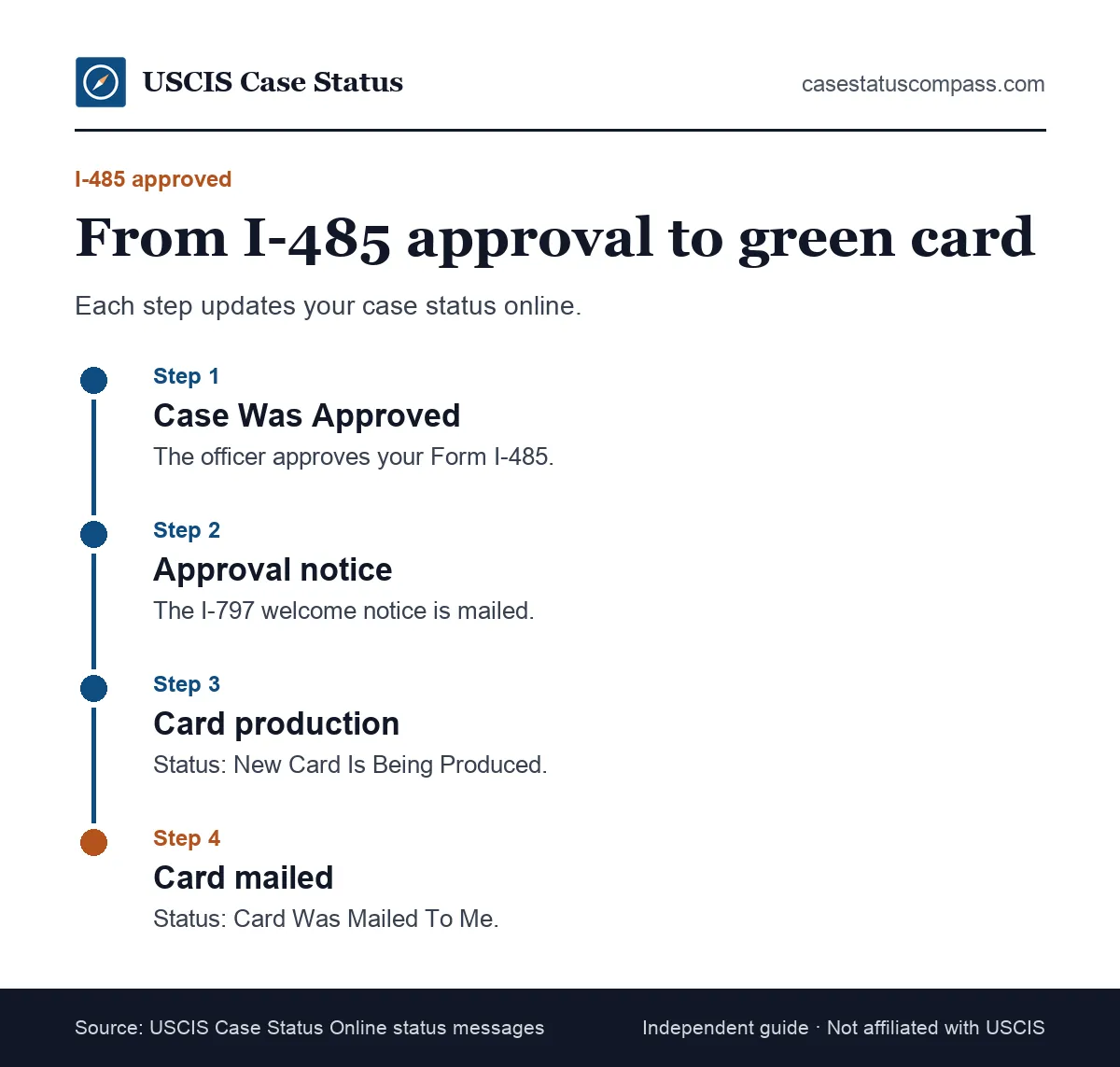
Keep your approval notice and passport together until the card is in hand.
I485 approved what next: the card steps
The status usually moves from "Case Was Approved" to "New Card Is Being Produced," then card was mailed to me. Try not to move or switch mailboxes during this period.
I-485 case was approved but the card step is skipped
Some applicants never see the production status and go straight to a mailing update. What counts is the card in your hands.
Skipped status messages are common and do not mean a problem with the card.
Conditional vs 10-Year Green Card After Approval
Your category decides which card you get. Most green cards are valid for 10 years; conditional green cards for 2 years. A marriage under two years old at approval usually leads to the conditional card. Check the "Card Expires" date the day your card arrives.
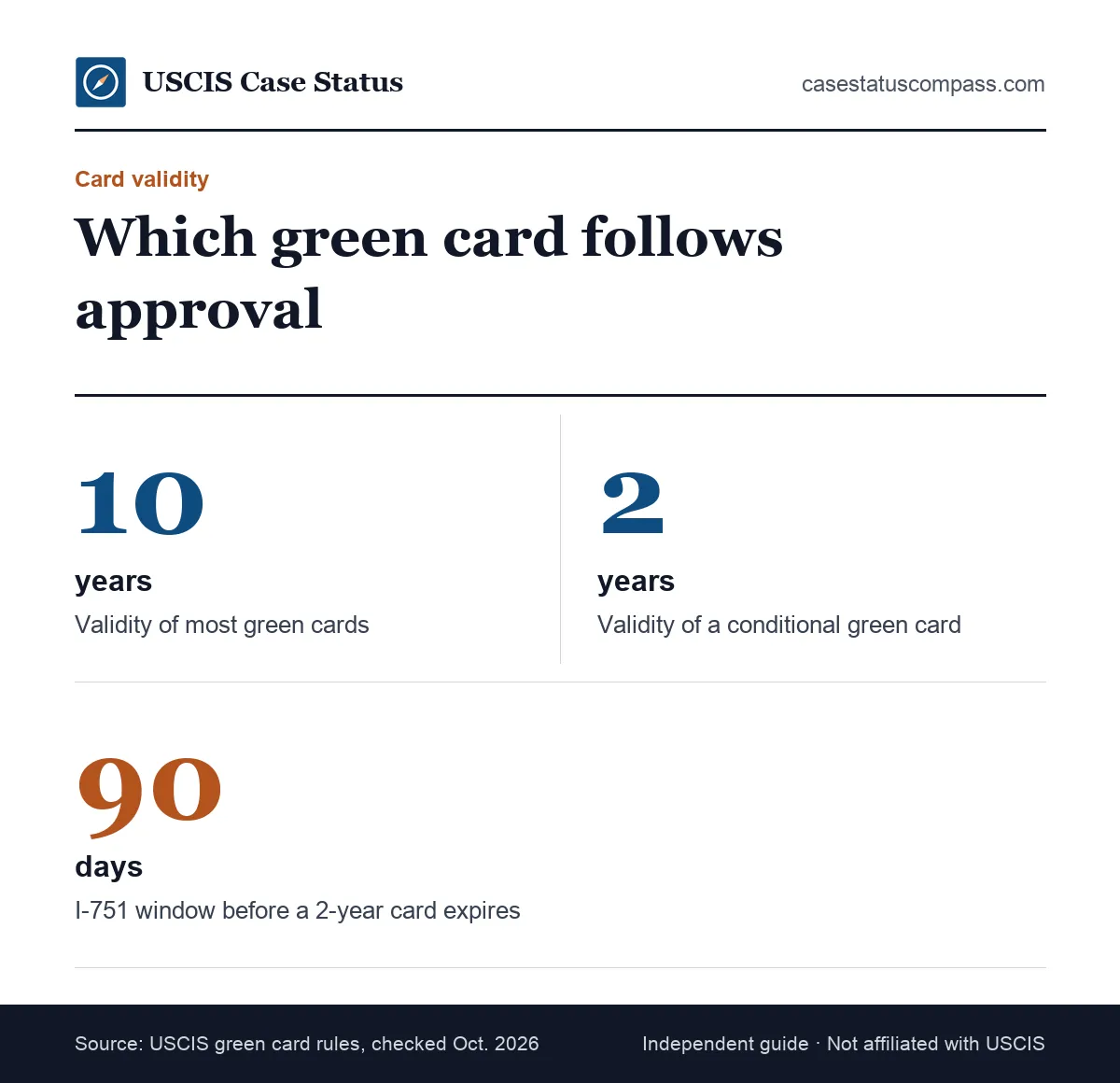
If you received a conditional card
A two-year card cannot be renewed with Form I-90. You file to remove conditions instead. File in the 90 days before your 2-year card expires. Our Form I-751 guide lists evidence to collect.
If you received a 10-year card
A 10-year card is renewed with Form I-90 near expiration. Your permanent resident status does not expire with the card.
Many holders later use the card's resident-since date to plan a naturalization filing.
I-765 Approved: Work Permit and STEM OPT Next Steps
When Form I-765 is approved, USCIS produces an Employment Authorization Document (EAD), the work permit card. Approval case decision rendered I-765 means the decision is made; the card proving work permission is still in production.
Your employer needs the card itself.
Approval case decision rendered I-765 meaning for most applicants
You show the EAD card to your employer for Form I-9. A status screenshot does not replace the card.
Until the card arrives, ask your employer what they can accept, and check whether an automatic extension rule covers your category before your old card expires.
EAD validity dates and extension rules
Read the card's validity dates the day it arrives. Extension rules changed: Ended: renewals filed on or after Oct. 30, 2025 no longer get the up-to-540-day automatic extension (exceptions: TPS by law/Federal Register notice; STEM OPT 180 days). See our work permit guide and the EAD automatic extension explainer.
What Does Approval Mean for STEM OPT and H-4 EADs?
For STEM OPT, an approval case decision rendered means USCIS granted your STEM OPT extension. The same approval wording appears for H-4 spouses and other EAD categories; the card's category code shows the basis.
Check that category code before showing the card.
I-140 Approved: What Happens Next?
After an I-140 is approved, the worker's next step is Form I-485 inside the U.S. or consular processing abroad. Both need a current priority date. The approval itself gives no status, card or work permission, but in most cases it secures the worker's place in line.
I140 approved what next if you are in the U.S.
If your priority date is current and you hold lawful status, you can file Form I-485, often with Forms I-765 and I-131. Plan the timing with the employer's attorney.
If you will process through a consulate
Workers abroad have the approved I-140 sent to the National Visa Center, then follow State Department steps. For waits, see our I-140 processing time page.
NVC then asks for fees and civil documents before scheduling the interview.
I-130 and I-485 Both Approved: What Now?
If I-130 and I-485 are both approved, you are a permanent resident and only the card remains. You usually get two approval notices, one per receipt number, then the card.
The two may arrive on different days. Watch for the card status next.
Why you get two approval notices
Each form has its own receipt number and its own I-797. The I-130 notice confirms the relationship; the I-485 notice confirms permanent residence. Keep both for later filings such as Form I-751 or Form N-400.
Other Forms That Show an Approval Status
Forms I-90, I-751, N-400, I-129 and I-131 also show "Case Was Approved" when decided in your favor. The next step differs for each.
The two tables below split them into forms that lead to a card or travel document and forms that end without one, so you can see what to watch for after the headline changes.
Card and document approvals: I-90, I-751 and I-131
These three forms end with a physical document. The table shows what approval grants and what arrives next.
| Form | What approval means | What usually comes next |
|---|---|---|
| I-90 | Replacement or renewal card granted | New card produced and mailed |
| I-751 | Conditions on residence removed | 10-year green card produced |
| I-131 | Travel document approved | Document produced and mailed |
Approvals with no card: N-400 and I-129
These approvals do not produce a card from USCIS; the next step happens at a ceremony or abroad.
| Form | What approval means | What usually comes next |
|---|---|---|
| N-400 | Naturalization approved | Oath ceremony scheduling |
| I-129 (H-1B and others) | Worker petition approved | Change of status or visa stamping |
H-1B petition approvals
An I-129 approval has no card; the notice may carry an I-94 for a change of status. Workers abroad take the approval to a consulate for visa stamping. See our H-1B visa status guide.
N-400 approvals and the oath
An approved N-400 makes you a citizen only at the oath, not on the approval date. Keep your green card until the ceremony. Our citizenship application guide explains the ceremony.
Approval Timeline: From Decision to Card in Hand
A card-based approval has four parts: the approval status, the mailed notice, card production and delivery. USCIS publishes no set number of days between them, so your online status and mail tracking are your best guides.
The table below shows how each stage appears.
What each stage looks like online
Each row is one stage, with the message you see and the event that moves the case to the next row.
| Stage | What you see online | What triggers the next stage |
|---|---|---|
| Decision | "Case Was Approved" | Notice printing and card order |
| Notice | Approval notice mailed | Card enters production |
| Production | "New Card Is Being Produced" | Card finished and packed |
| Mailing | "Card Was Mailed To Me" | USPS delivery |
| Delivery | Tracking shows delivered | You check the card for errors |
How Long Until You Receive Your Card After Approval?
USCIS publishes no official delivery time. Watch for the "Card Was Mailed To Me" status and its tracking number. For overall waits, use the official tool at egov.uscis.gov/processing-times and our green card processing time page.
Delivery depends on the mail too.
How long to receive green card after approval notice
The notice and the card are separate mailings, and the notice usually comes first. Do not worry if a few days pass between them.
If the card status has not changed for several weeks, confirm your address before calling USCIS.
When no card status appears
If no card status appears for a long time, check your address and call USCIS. Do not file Form I-90 for a card never received until USCIS confirms what happened.
What Should You Do the Day You See the Approval?
Save proof of the status, confirm USCIS has your current address, and watch your mail. Do not book international travel or a job start that depends on the card until the card or notice is in your hands.
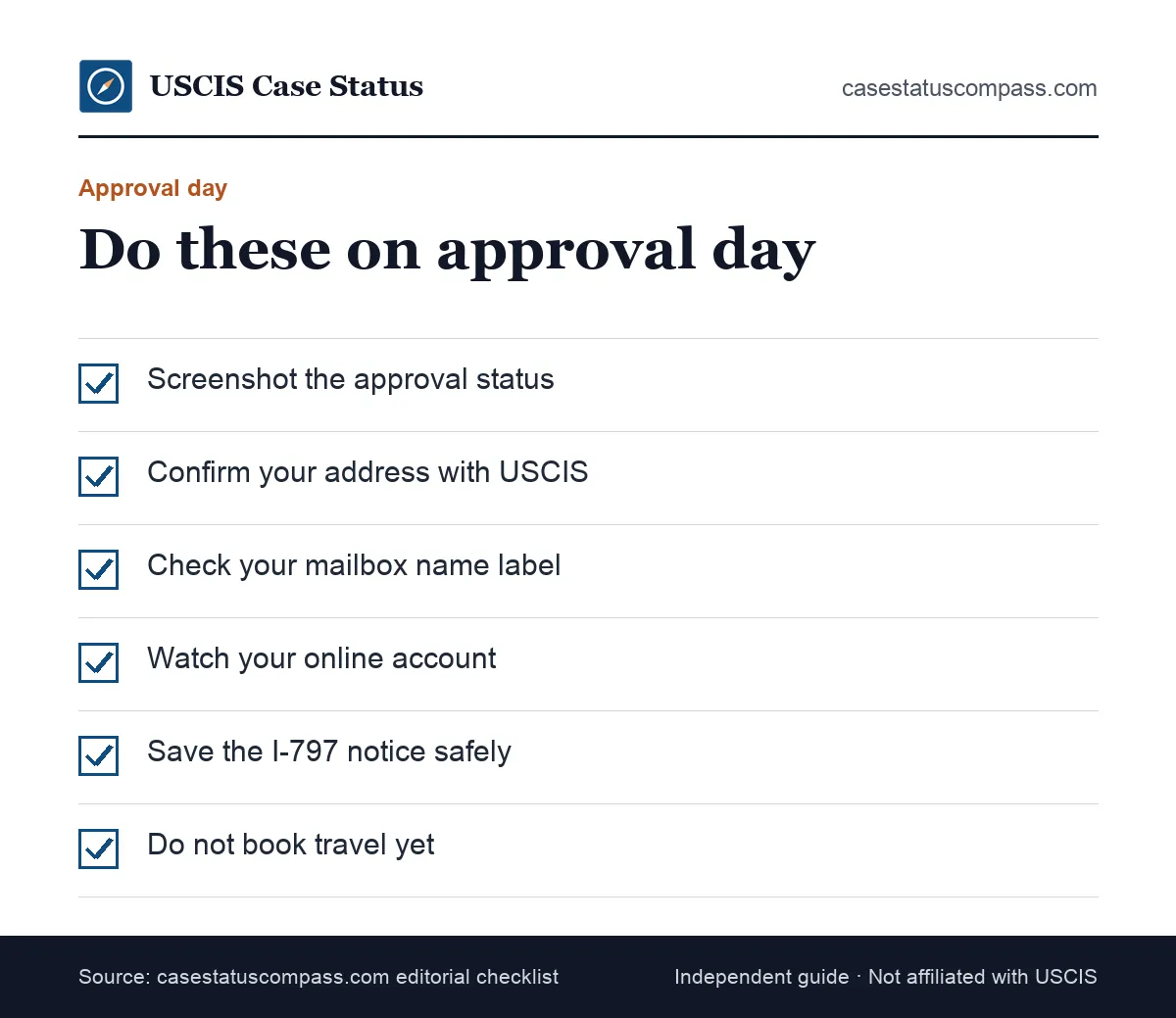
Start with the screenshot and the address check, since both take minutes and protect you if the card goes astray.
The approval-day checklist
Screenshot the approval status with the date showing.
Confirm your mailing address in your USCIS account.
Make sure your name is on your mailbox.
Save a copy of the status page in your files.
Note the approval date on your calendar.
People to tell on approval day
Ask anyone who collects your mail to watch for USCIS envelopes.
Tell your attorney or employer about the approval.
Tell a family member who shares the case, such as a petitioner.
Tell your school's official if your status depends on the approval.
"If This, Do That": Approval Case Decision Rendered Decision Table
Match what you see in the left column to the action on the right. If your case is not listed, read the message box on your approval notice first; it often states the next step USCIS expects.
The two tables split mail problems from next steps.
Decision table for notice and mail problems
Use these rows when the decision is posted but the paperwork or card has not arrived as expected.
| If this happens | Do this |
|---|---|
| Status says approved, no notice yet | Wait for mail; check your online account for a digital copy |
| Notice arrived, no card-production status | Confirm your address; call USCIS if nothing changes for a long time |
| Notice has a spelling or date error | Ask USCIS for a correction before the card is printed |
Decision table for petitions and urgent travel
Use these rows for approved petitions and for trips that cannot wait for the card.
| If this happens | Do this |
|---|---|
| I-130 approved, relative abroad | Watch for the NVC welcome letter |
| I-140 approved, priority date current | Plan Form I-485 or consular processing with the employer's attorney |
| You need to travel urgently | Ask about temporary proof of status first |
When the table does not fit your case
Approvals after a waiver, a past denial or removal proceedings can carry extra steps. Talk to an immigration attorney or DOJ-accredited representative before you travel or file again.
Bring the approval notice to that meeting.
Approval Without a Card Step: Why Some Cases Stop Here
Petitions such as Forms I-130, I-140 and I-129 end at approval because the benefit comes from a later step. For a petition, a status that stays on "Case Was Approved" for good is normal and expected.
No card will be mailed.
Petitions vs applications
A petition asks USCIS to recognize a relationship or job offer. An application asks for a benefit for you, such as a card. Only card applications lead to card production.
When a case is moved after approval
An approved petition may go to NVC or a consulate, and you might see a transfer message. That does not undo the approval. Our case was transferred guide explains transfers.
Why Did My Status Say Approved and Then Change?
Most later changes are the next normal step, such as card production. Less often, USCIS reopens a case to fix an error or reconsider it. A move from approval to card production is good news, not a warning.
Read any new notice in full.
Normal changes after approval
"New Card Is Being Produced" and "Card Was Mailed To Me" are expected. A generic "We Have Taken an Action" update can also mean USCIS issued a corrected notice. Compare it with your approval notice.
Rare changes that need attention
A request for evidence, reopening or denial after approval is rare but urgent. A request for evidence has a firm due date, so get legal help if the reason is unclear.
Can You Work or Travel Right After Approval?
It depends on what was approved. An I-485 approval makes you a permanent resident, but you need the card or other proof to return from abroad. An I-765 approval lets you work once you hold the EAD card. A petition approval gives no work or travel rights.
Work after approval
Employers verify work permission with Form I-9 documents, and a status screenshot is not one. Wait for your card unless your employer's counsel confirms another valid document applies.
An I-765 approval notice does not replace the EAD card for Form I-9.
Travel after approval
With an approved I-485 and no card yet, avoid trips abroad if you can, or ask about temporary proof first. Our green card holder travel rules cover trips once you hold the card.
Proof of Status While You Wait for the Card
If your I-485 was approved and you urgently need proof before the card arrives, ask for temporary proof. As of October 2026, USCIS describes it this way: I-551/ADIT stamp: temporary proof of green card status; request through the USCIS Contact Center (800-375-5283).
How to request an appointment
Request an in-person appointment online at my.uscis.gov/en/appointment/v2 or call 800-375-5283. Bring your passport, approval notice and papers showing the urgency. Our I-551 stamp guide explains what the stamp looks like.
What If the Approval Notice Never Arrives?
Check your online account, confirm your address and ask the post office about held mail. The approval stays valid even if the paper is lost; what is missing is the document, not the decision.
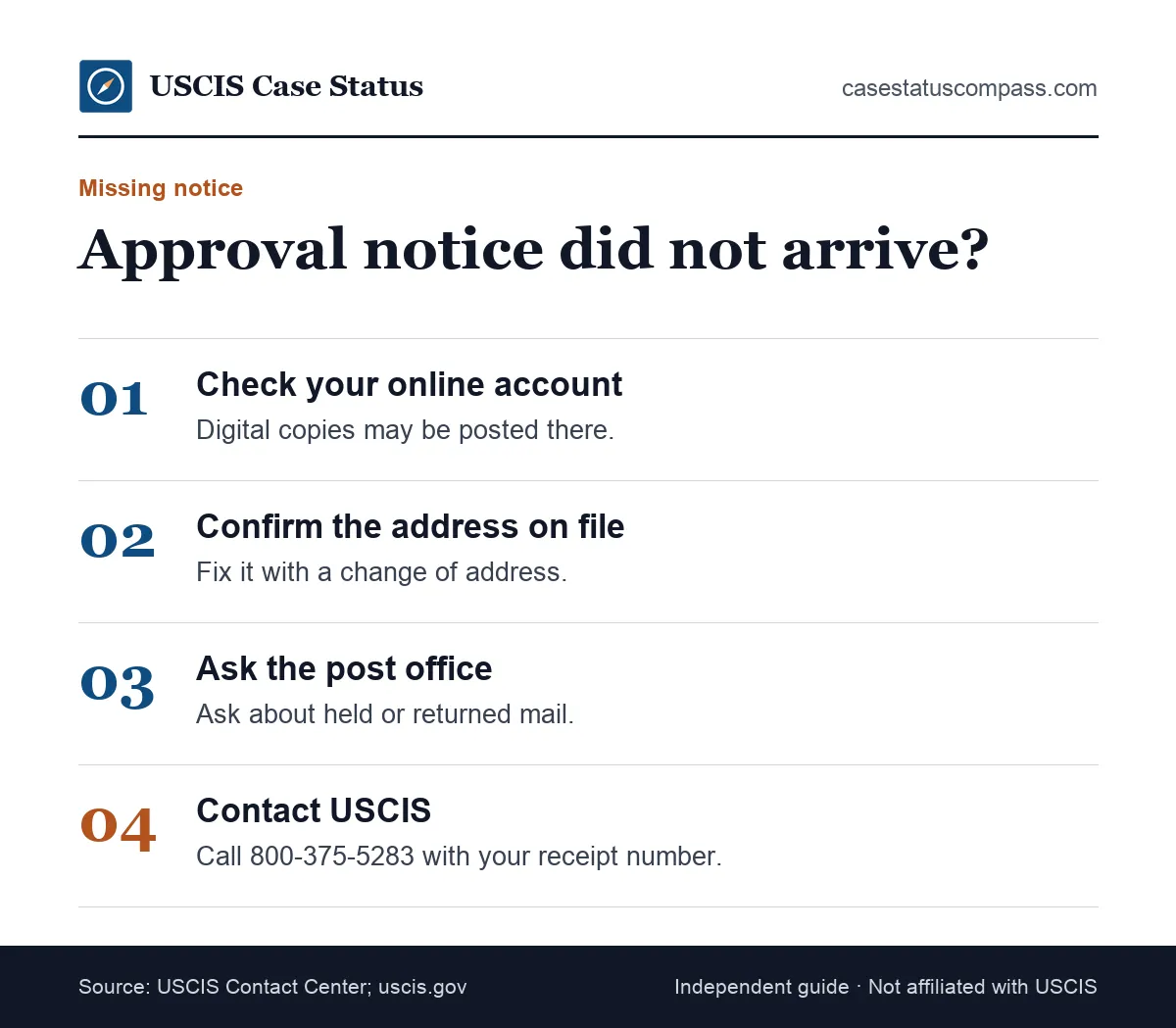
Keep a record of each step you take.
Asking USCIS about a missing notice
Call the USCIS Contact Center at 800-375-5283 with your receipt number and date of birth ready. Live calls and chat: Monday to Friday, 8 a.m. to 8 p.m. Eastern. Our contact USCIS guide shows how to reach a live agent.
Getting a copy of the approval notice
USCIS can issue a duplicate notice in some cases through a separate request with a fee. Ask the Contact Center first.
Your online account may already hold a digital copy, which is often enough for most uses, so check there before paying for a duplicate.
Errors on Your Approval Notice or Card
Contact USCIS quickly if your approval notice has an error. A wrong name, date of birth or category can carry over to your card. USCIS errors can often be fixed without a fee, while errors from your own form may need a new filing.
Fixing errors before the card is printed
If you spot an error while the status still says approved, call USCIS right away; the card may not be printed yet.
Have the notice and your passport ready, and explain the error clearly. Ask the agent to note the request on the case.
Fixing errors after the card arrives
A wrong card is usually fixed with Form I-90. As of October 2026 the fee is $465 (paper) / $415 (online). See our green card renewal and replacement guide.
Errors USCIS made may be corrected without a fee.
Address Changes After Approval
If you moved, update your address with USCIS immediately. Cards and notices go to the address on file, and a wrong address is a leading reason approved applicants never get their card. Post office forwarding does not update USCIS records.
How to update your address
Most people update it online through their USCIS account. Our USCIS change of address guide explains the timing rules for each pending case.
Update the address for each pending case, and keep the confirmation USCIS shows when you submit the change.
Address changes for NVC cases
If your approved I-130 is with NVC, update the State Department record too. USCIS and NVC keep separate files.
Use NVC's own online tools to change the address there, and keep a copy of the update for your records.
Approval Scams and Fake Notices
Scammers may demand fees to "release" a card. USCIS does not do this; a real approval needs no extra payment. Check your status yourself on the official site, and never pay by gift card, wire or crypto.
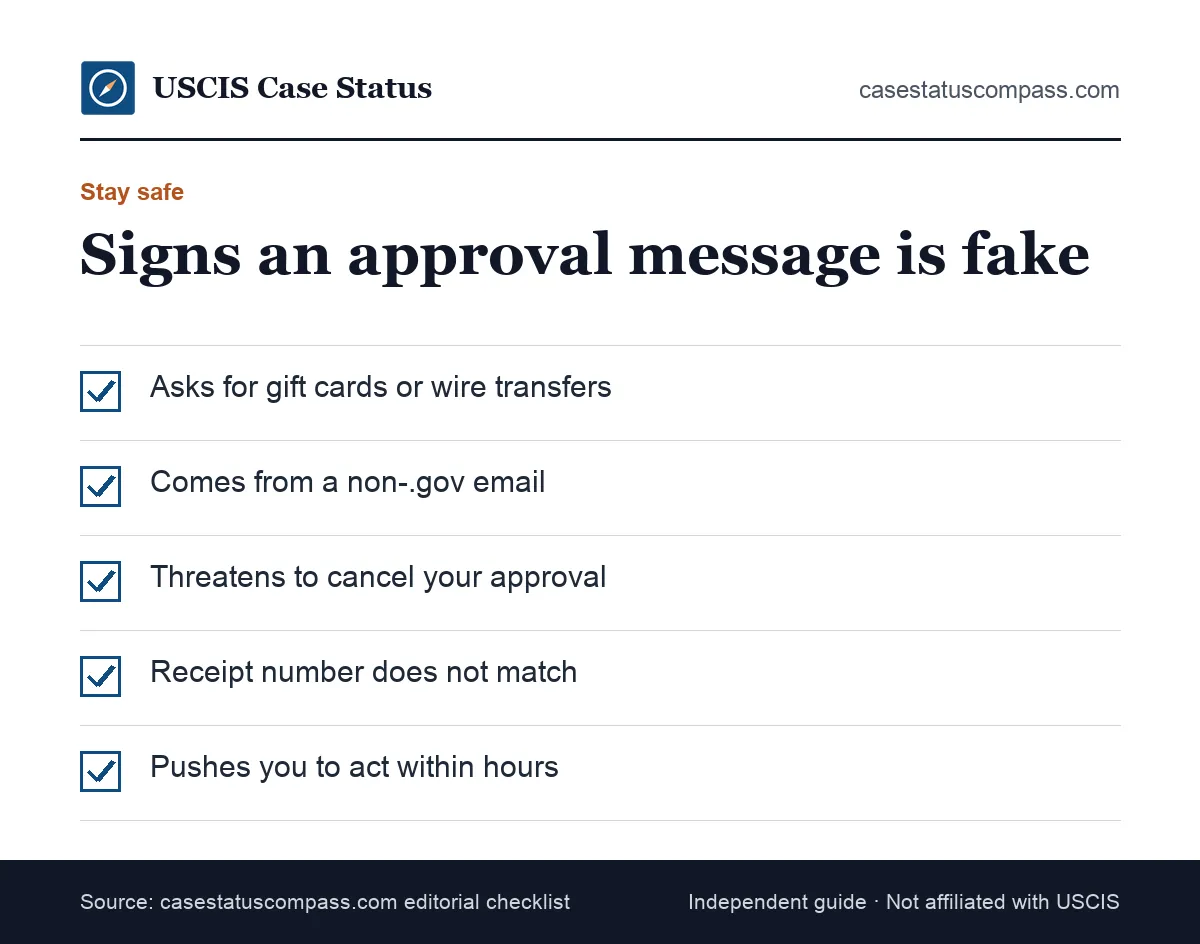
Report impostors right away.
How to check whether an approval message is real
Enter your receipt number on the official tool. If it does not show an approval, the message is fake. Our USCIS scams guide lists common tricks.
Never call a number given in the message itself.
Reporting a fake approval message
Report impostors to the Federal Trade Commission, and keep the email, text or call details. Never reply with your receipt number, A-Number or payment details to a message you did not expect.
Can an Approval Be Revoked or Reopened?
Yes, in limited cases. USCIS can reopen or revoke an approval for fraud, a serious error or new eligibility information. This is rare. If you get a notice of intent to revoke, read it closely and get legal advice before the deadline.
Petitions can be withdrawn or revoked
Forms I-130 and I-140 can be revoked in some situations, such as a petitioner's death or a withdrawn job offer. Ask an attorney about your facts.
You will get a written notice first.
What to do if USCIS reopens your case
Read the reason and deadline, gather evidence that answers the concern and get legal help. Missing the deadline can cost you the approval.
Keep copies of everything you send in reply, and send it by a trackable method.
Mistakes People Make After Approval
The usual mistakes are moving without updating the address, traveling without proof, discarding the notice and missing the I-751 window.
Each one can delay a card or cost a benefit. The lists below group them by type so you can check yourself before you move, travel or start a job.
Mistakes to avoid
Moving without a USCIS change of address.
Booking trips abroad before the card arrives.
Starting a job with only an approval screenshot.
Throwing away the approval notice once the card arrives.
Deadline and scam mistakes
Missing the I-751 window on a two-year card.
Paying a stranger who promises to "speed up" the card.
Ignoring a notice of intent to revoke.
Sharing your receipt number with an unknown caller.
Why Should You Keep the Approval Notice for Good?
Do not throw the notice away once the card arrives. It shows your category, start date and receipt number, which help with lost-card replacements and naturalization. Our lost green card guide covers replacements. Store a scan in a safe place too.
When to Contact USCIS or an Attorney After Approval
Contact USCIS when the card or notice does not arrive, your address changed or the notice has an error. See an attorney or DOJ-accredited representative if USCIS reopens the case or you have a past removal order. Our case status meanings hub explains every other update.
Good reasons to call USCIS
Your notice or card has not arrived after a long wait.
The card was returned or sent to a wrong address.
The card was printed with an error.
Your status has not moved past approval for months.
Notice errors and urgent travel
The notice has a spelling or date error.
You need temporary proof for urgent travel.
The notice or card shows the wrong category.
A trip abroad cannot wait and you need proof of status first.
Have your receipt number ready.
Good reasons to get legal help
Get help when there is a court case, a prior denial, a criminal record or a notice of intent to revoke, or before a job change right after an employment approval.
Frequently Asked Questions
What does approval case decision rendered mean?
It means a USCIS officer finished reviewing your case and approved it. A Form I-797 approval notice will be mailed. Card-based forms, such as a green card or work permit, move next to card production; petitions move to their next stage.
Does a USCIS approval mean my green card is coming?
Only if the approved form produces a green card, such as Form I-485, Form I-90 or Form I-751. Petitions like Form I-130 and Form I-140 produce no card; they lead to a later application or to the National Visa Center.
Will USCIS email me when my case is approved?
We could not confirm on an official USCIS page whether email or text alerts are available today. The reliable ways to see an approval are the official Case Status Online tool and your USCIS online account.
Is approval case decision rendered the same for H-1B petitions?
Yes. For an H-1B petition on Form I-129, approval means USCIS approved the employer's petition, and no card follows. The notice may include an I-94 record for a worker changing status inside the U.S..
Can I check my approval in a USCIS online account?
Yes, if your case is linked to the account. Online filings link automatically, and paper filings can be added with the account access code from your notice. The account shows case updates and may hold digital copies of notices.
Do I need to do anything to receive my green card after I-485 approval?
No filing is needed. Keep your mailing address current with USCIS, watch for the production and mailing updates. If the card never arrives, contact USCIS with your receipt number before filing any replacement form.
Why does my approved petition still say approved months later?
For petitions such as Forms I-130, I-140 and I-129, the status often stays on "Case Was Approved" for good, because the next step happens at NVC, a consulate or in another filing. Card cases should move on to production and mailing.
Is the I-797 approval notice the same as a green card?
No. The approval notice is a letter confirming USCIS approved a form. A green card is a separate card mailed later, and only for card-based forms such as Form I-485, I-90 or I-751. Keep both documents.
Does an approved I-130 let my relative live in the U.S.?
No. An approved I-130 only confirms the family relationship. Your relative still needs an immigrant visa through the National Visa Center and a consulate, or an approved Form I-485 inside the U.S.
Sources
- USCIS: Checking Your Case Status Online. www.uscis.gov/tools/checking-your-case-status-online. Accessed Oct 27, 2026.
- USCIS: Form I-797, Types and Functions. www.uscis.gov/forms/all-forms/form-i-797-types-and-functions. Accessed Oct 27, 2026.
- USCIS: After a Green Card Is Granted. www.uscis.gov/green-card/after-we-grant-your-green-card. Accessed Oct 27, 2026.
- USCIS: Benefits of a USCIS Online Account. www.uscis.gov/file-online/benefits-of-a-uscis-online-account. Accessed Oct 27, 2026.
- USCIS Check Case Processing Times. egov.uscis.gov/processing-times/. Accessed Oct 27, 2026.
- USCIS: Change of Address. www.uscis.gov/addresschange. Accessed Oct 27, 2026.
- USCIS: Form N-400 page. www.uscis.gov/n-400. Accessed Oct 27, 2026.
- USCIS: Form I-797 Types and Functions (updated 01/24/2025). www.uscis.gov/forms/filing-guidance/form-i-797-types-and-functions. Accessed Oct 27, 2026.
- 22 CFR 22.1 Schedule of Fees for Consular Services (govinfo, CFR 2025 edition). www.govinfo.gov/content/pkg/CFR-2025-title22-vol1/xml/CFR-2025-title22-vol1-sec22-1.xml. Accessed Oct 27, 2026.
- USCIS Form G-1055 Fee Schedule, Edition 10/16/26. www.uscis.gov/sites/default/files/document/forms/g-1055.pdf. Accessed Oct 27, 2026.
- USCIS Glossary: Green Card. www.uscis.gov/tools/glossary. Accessed Oct 27, 2026.
- USCIS: Removing Conditions on Permanent Residence Based on Marriage. www.uscis.gov/green-card/after-we-grant-your-green-card/conditional-permanent-residence/removing-conditions-on-permanent-residence-based-on-marriage. Accessed Oct 27, 2026.
- USCIS: Automatic EAD Extension (updated 10/29/2025). www.uscis.gov/working-in-the-united-states/information-for-employers-and-employees/automatic-employment-authorization-document-ead-extension. Accessed Oct 27, 2026.
- USCIS alert: Additional Mail Delivery Process for Receiving ADIT Stamp (Mar. 16, 2023; archived). www.uscis.gov/newsroom/alerts/uscis-announces-additional-mail-delivery-process-for-receiving-adit-stamp. Accessed Oct 27, 2026.
- USCIS Contact Center (uscis.gov). www.uscis.gov/contactcenter. Accessed Oct 27, 2026.
casestatuscompass.com is an independent publication and is not affiliated with USCIS or any government agency. This page is general information, not legal advice. For denials, court or asylum matters, consult an immigration attorney or a DOJ-accredited representative.