Contents · 37 sections
- What Are the Basic Green Card Holder Travel Rules?
- Which Documents Do You Need to Return to the U.S.?
- Green Card Holder Travel Rules by Trip Length
- What Happens After Six Months Abroad?
- What Happens After One Year Abroad Without a Reentry Permit?
- How Do Officers Decide If You Abandoned Residence?
- Can Short Trips Still Cause Problems?
- How Does Travel Affect Your Path to Citizenship?
- What Is Form N-470?
- What Is a Reentry Permit and Who Needs One?
- How Long Is a Reentry Permit Valid?
- How Do You Apply for a Reentry Permit?
- What Is the Reentry Permit Fee for Form I-131?
- How Long Does a Reentry Permit Take?
- Can You Leave Before the Reentry Permit Is Approved?
- Reentry Permit vs SB-1 Visa vs Boarding Foil
- What If You Stayed Abroad Too Long?
- What Happens at the Port of Entry?
- What Is Form I-407 and Do You Have to Sign It?
- Traveling With an Expired or Expiring Green Card
- What Are the Travel Rules for Conditional Residents?
- Can You Travel While Your N-400 Is Pending?
- Can You Travel Before Your Green Card Arrives?
- What If Your Green Card Is Lost or Stolen Abroad?
- Do Canada, Mexico and Cruises Count as Travel Abroad?
- Do Children With Green Cards Follow the Same Rules?
- Working or Studying Abroad as a Permanent Resident
- Caring for a Sick Relative Abroad
- How Do Taxes Affect Your Residence?
- How Do You Count Your Days Abroad?
- Pre-Trip Checklist for Permanent Residents
- Keeping Your Address and Mail Current While Away
- Which Trips Need an Attorney First?
- Worked Examples: Two Permanent Residents Abroad
- Permanent Resident Trip Planner: If X, Do Y
- Common Travel Mistakes Permanent Residents Make
- Frequently Asked Questions
The short answer
Green card holder travel rules let permanent residents travel abroad freely for temporary trips with an unexpired green card and a passport. The risks grow with time: trips over 6 months are presumed to break residence for citizenship, and absences of a year or more can lead to abandonment without a reentry permit.
At a glance
| What you need to return | Unexpired green card plus passport |
| Over 6 months abroad | Citizenship residence presumed broken |
| 1 year or more | Abandonment risk; get a reentry permit first |
| Reentry permit validity | Generally 2 years |
| Over 2 years | Permit expired; SB-1 visa may be needed |
These green card holder travel rules apply after you already have permanent residence. If you are new to residence, our green card basics guide explains your rights and duties first. Green card holders can leave and return freely, but each trip is checked against two separate standards: whether you still live in the U.S., and whether your time away affects naturalization.
What Are the Basic Green Card Holder Travel Rules?
You may travel abroad as often as you like for temporary trips. You need an unexpired green card to return, and the U.S. must remain your permanent home. The longer and more frequent your trips, the harder it becomes to prove that.
Two separate clocks
The first clock asks whether you have abandoned permanent residence. The second asks whether you kept continuous residence for citizenship. A trip can be safe for your green card yet still delay your N-400.
What "temporary" really means
A temporary trip has a clear purpose and an end date, such as a vacation, a family visit or a set work assignment. Officers look at your intent, not only the calendar. A return ticket, a U.S. job and a home here all support a temporary purpose.
Which Documents Do You Need to Return to the U.S.?
To return from a trip, you generally present a valid, unexpired Permanent Resident Card (Form I-551) to a CBP officer. You also need a passport to travel, usually from your country of citizenship. Carry the original card; a photocopy or a photo on your phone will not get you onto a flight home.
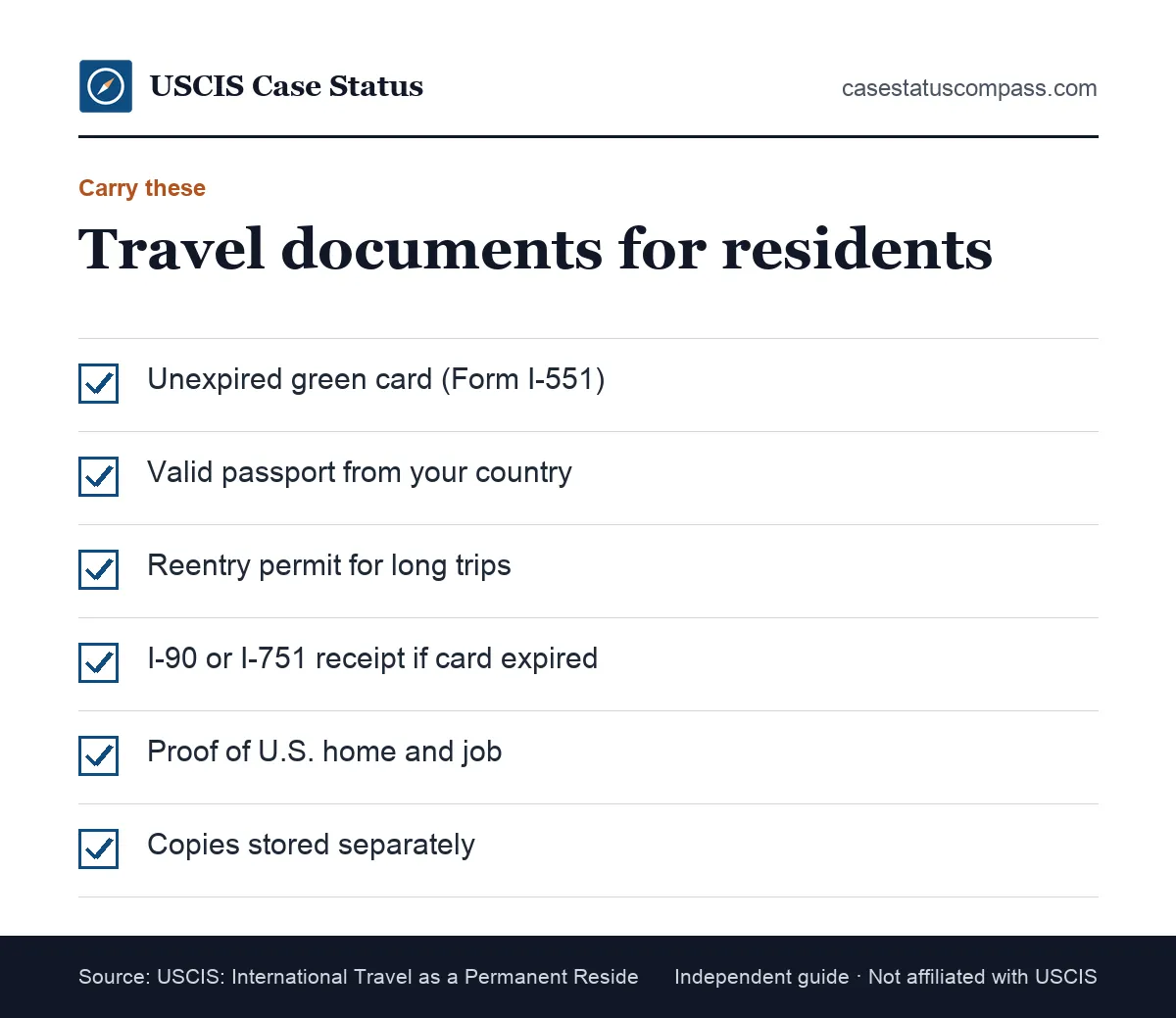
The core travel kit
- Your original green card, unexpired
- A valid passport for the airline and other countries
- A reentry permit for planned long absences
- Receipt notices if your card is expired or conditional
- Copies stored apart from the originals
Know your card's dates
Most green cards are valid for 10 years; conditional green cards for 2 years. Check the expiration date before booking, not at the airport. Our guide to your green card number and card details shows where the dates and numbers appear on the card.
Green Card Holder Travel Rules by Trip Length
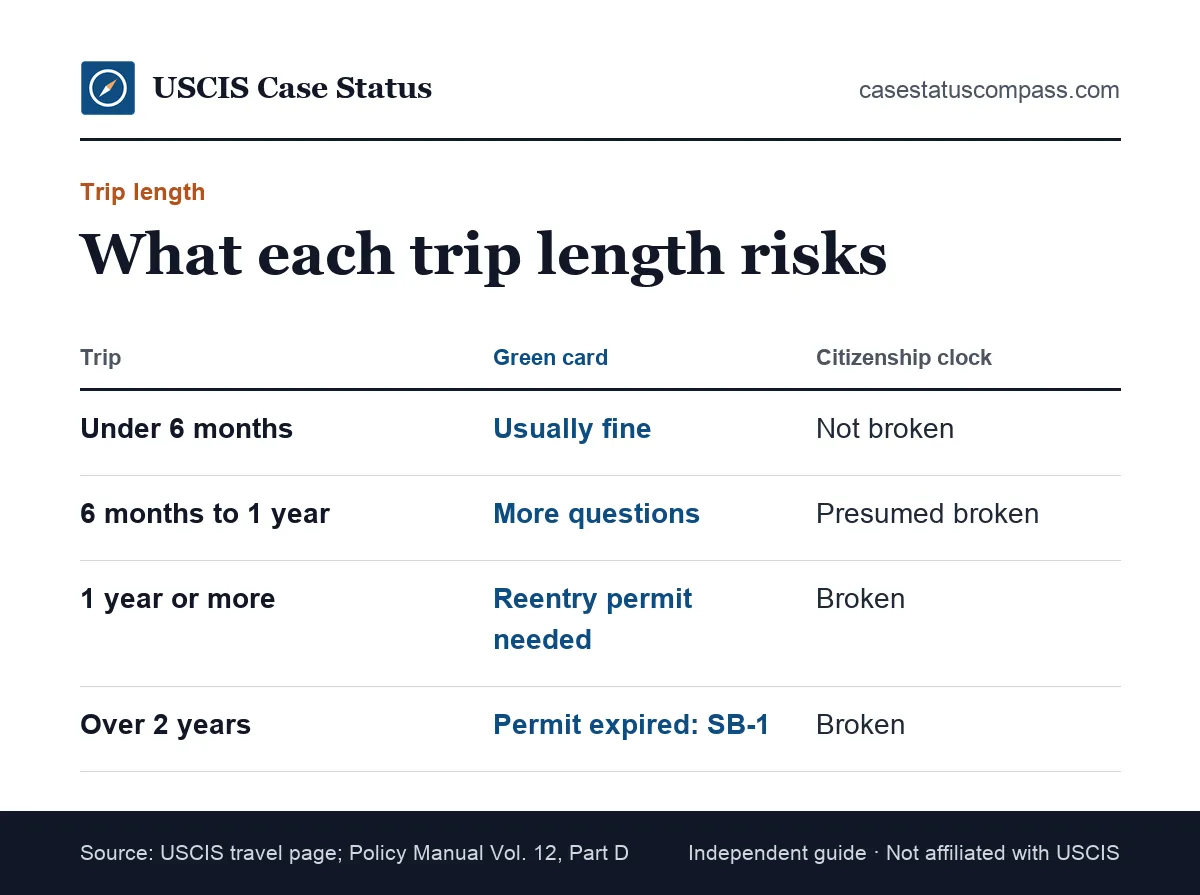
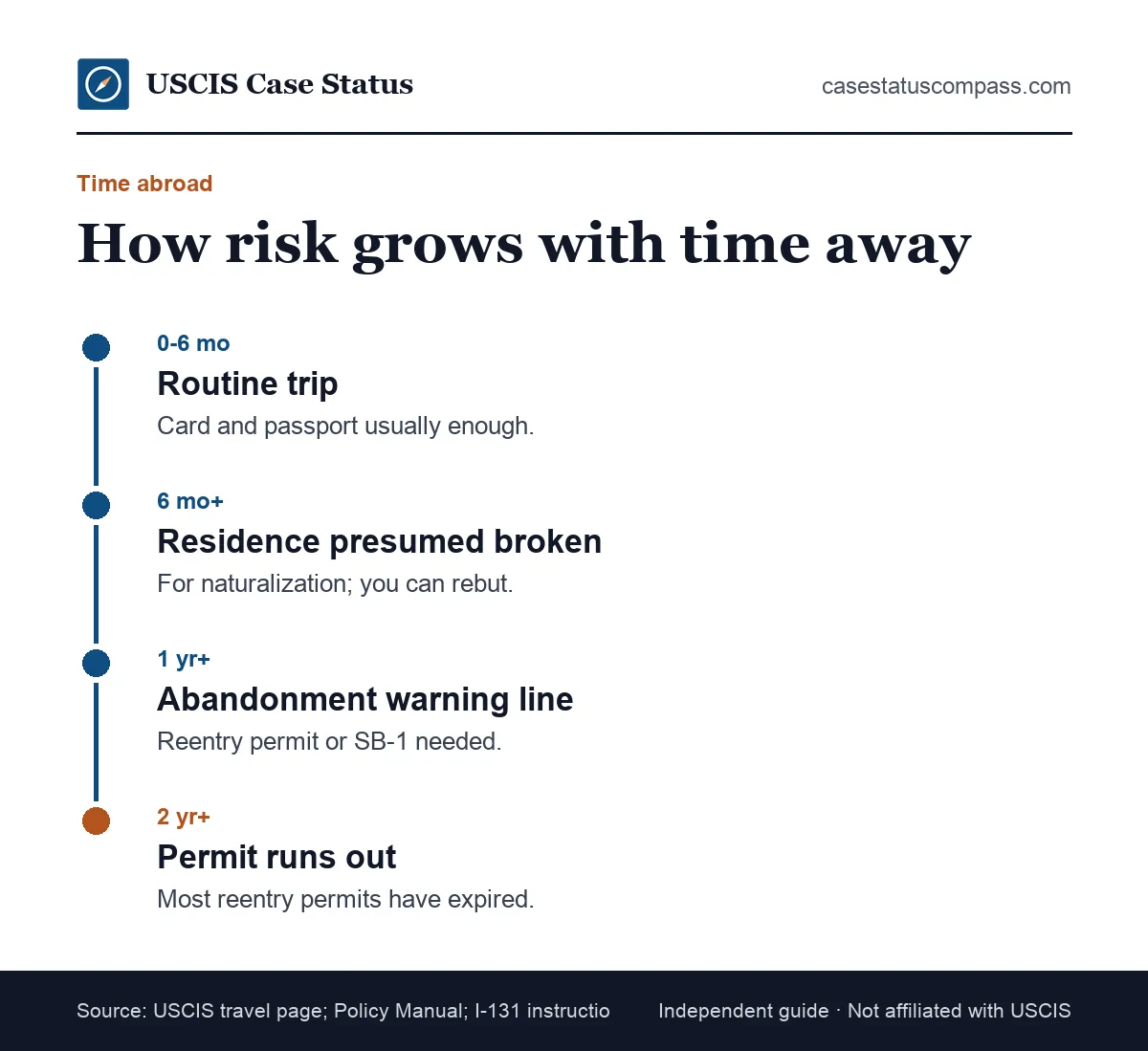
Time abroad is the biggest factor. Trips over six months bring a presumption against continuous residence for citizenship. Absences of a year or more put your green card itself at risk unless you planned ahead with a reentry permit. Each band is measured per single absence, from the day you leave to the day you return.
Trip-length table: card vs citizenship effects
Read across a row to see how one absence of that length affects your card, your N-400 timeline and what to pack.
| Time abroad | Green card status | Citizenship (N-400) | What to carry |
|---|---|---|---|
| Under 6 months | Usually no issue | Residence not broken | Card and passport |
| 6 months to under 1 year | More questions possible | Presumed broken; can be rebutted | Card, passport, proof of ties |
| 1 year or more | Abandonment risk without a permit | Broken unless N-470 approved | Reentry permit |
| More than 2 years | Most permits expired | Broken | SB-1 visa or legal advice |
Trips under six months
Short trips are the routine case. Your card and passport are usually enough, and continuous residence for citizenship is not broken. Still, many short trips that fill most of your year can raise questions about where you live.
The six-month to one-year band
Your card can still be used to return, but an officer may ask more questions. For naturalization, Naturalization: a trip over 6 months is presumed to break residence; 1 year or more breaks it. Keep proof of your U.S. job, home and taxes on hand.
What Happens After Six Months Abroad?
Crossing six months does not cancel your green card. It mainly affects citizenship timing, because USCIS presumes a break in continuous residence. At the border, a longer absence may also lead to closer questions about your intent to live in the U.S.
Questions at the border
Expect questions about the reason for the trip, your job, your home and when you planned to return. Answer truthfully and briefly. Carry evidence such as a pay stub, lease or mortgage statement, which helps an officer see the trip as temporary.
Rebutting the citizenship presumption
The presumption can be overcome with evidence. Useful records include:
- Continued U.S. employment during the trip
- Your immediate family stayed in the U.S.
- You kept your home and did not take a job abroad
- You filed U.S. taxes as a resident
What Happens After One Year Abroad Without a Reentry Permit?
Long trips abroad can risk your green card; over 1 year is the general warning line. After a year away without a reentry permit, your card generally no longer works as a travel document on its own, and USCIS says you may need an SB-1 returning resident visa. Abandonment is then a serious risk.
Why the green card stops working
A green card is meant for returning from temporary travel. A year-long absence makes it hard to call the trip temporary. Airlines may refuse boarding, and CBP may question whether you are still a resident.
The SB-1 returning resident path
The SB-1 is a visa you apply for at a U.S. embassy or consulate. You must show that the long stay was beyond your control and that you meant to return. Our lost green card guide covers SB-1 basics.
How Do Officers Decide If You Abandoned Residence?
Abandonment turns on intent, measured through your actions. USCIS says a general guide is whether you were away for more than a year, but shorter trips can also count if your life appears centered abroad. Your U.S. ties are the main evidence.
Ties USCIS lists
USCIS names factors such as family and community ties, U.S. employment, filing U.S. taxes as a resident, a U.S. mailing address, bank accounts, a valid driver's license, and property or a business here.

Intent shown by actions
Saying you meant to return helps little if your actions point elsewhere. Selling your home, quitting your job, moving all savings abroad or enrolling children in foreign schools long-term can suggest a new permanent home. Keep records that show the opposite.
Can Short Trips Still Cause Problems?
Yes. A pattern of short trips can suggest you live abroad and only visit the U.S. Someone who spends most of each year overseas, returning briefly before six months, may face the same abandonment questions as a long absence. Officers weigh the whole travel history, not just the latest trip.
The "visitor resident" pattern
Officers tend to notice this combination of facts:
- Most of each year spent abroad
- Brief U.S. visits timed to stay under six months
- Job, home or spouse located overseas
- No U.S. tax filing as a resident
Keeping a healthy balance
If your work requires frequent travel, keep your home base clearly in the U.S. Maintain a lease or home, a U.S. employer, resident tax filings and active accounts. A travel log showing time in the U.S. helps if questions come up later.
How Does Travel Affect Your Path to Citizenship?
Naturalization needs continuous residence and physical presence. Long trips can break residence and push your earliest N-400 date back. You can file the N-400 up to 90 days before you reach 5 years (or 3 years if married to a U.S. citizen) as a permanent resident. A broken period means counting again from your return.
Continuous residence vs physical presence
These are separate tests. Continuous residence looks at single long absences. Physical presence counts total days in the U.S. across the whole period. Many trips of a few months each can leave you short on physical presence, even without one long absence.
Planning trips before you file
If citizenship is a near-term goal, avoid trips over six months in the years that count. Our Form N-400 guide explains the full eligibility rules and timing for filing. If a long trip cannot wait, budget for a later filing date.
What Is Form N-470?
Form N-470, the Application to Preserve Residence for Naturalization Purposes, can protect continuous residence during certain long jobs abroad. USCIS notes it for absences of a year or more. It does not protect your green card itself; that still needs a reentry permit.
Who may qualify
N-470 is limited to certain people, such as those working abroad for the U.S. government, certain American companies or international organizations, and some religious workers. Check the form instructions for exact categories.
Pairing N-470 with a reentry permit
An approved N-470 helps only your citizenship timing. If you will be abroad for a year or longer, you still need a reentry permit to protect your residence. They are separate applications with separate fees.
What Is a Reentry Permit and Who Needs One?
A reentry permit is a travel document issued through Form I-131 that lets a permanent resident return after a long absence without an SB-1 visa. USCIS advises applying before leaving for a trip of more than one year. It is a booklet you carry along with your passport.
What it does
The permit shows you planned a temporary absence and lets you seek admission during its validity without a returning resident visa, even after a long stay that would otherwise look like abandonment.
Using it in place of a passport
A reentry permit can also serve as a travel document in place of a passport in some cases, for example if you cannot get one from your country of citizenship. Our Form I-131 guide compares it with other travel documents.
What it does not do
USCIS says a reentry permit does not guarantee entry. You must still be admissible when you return. It also does not preserve continuous residence for citizenship, and it does not stop abandonment questions if your actions show you moved abroad permanently.
How Long Is a Reentry Permit Valid?
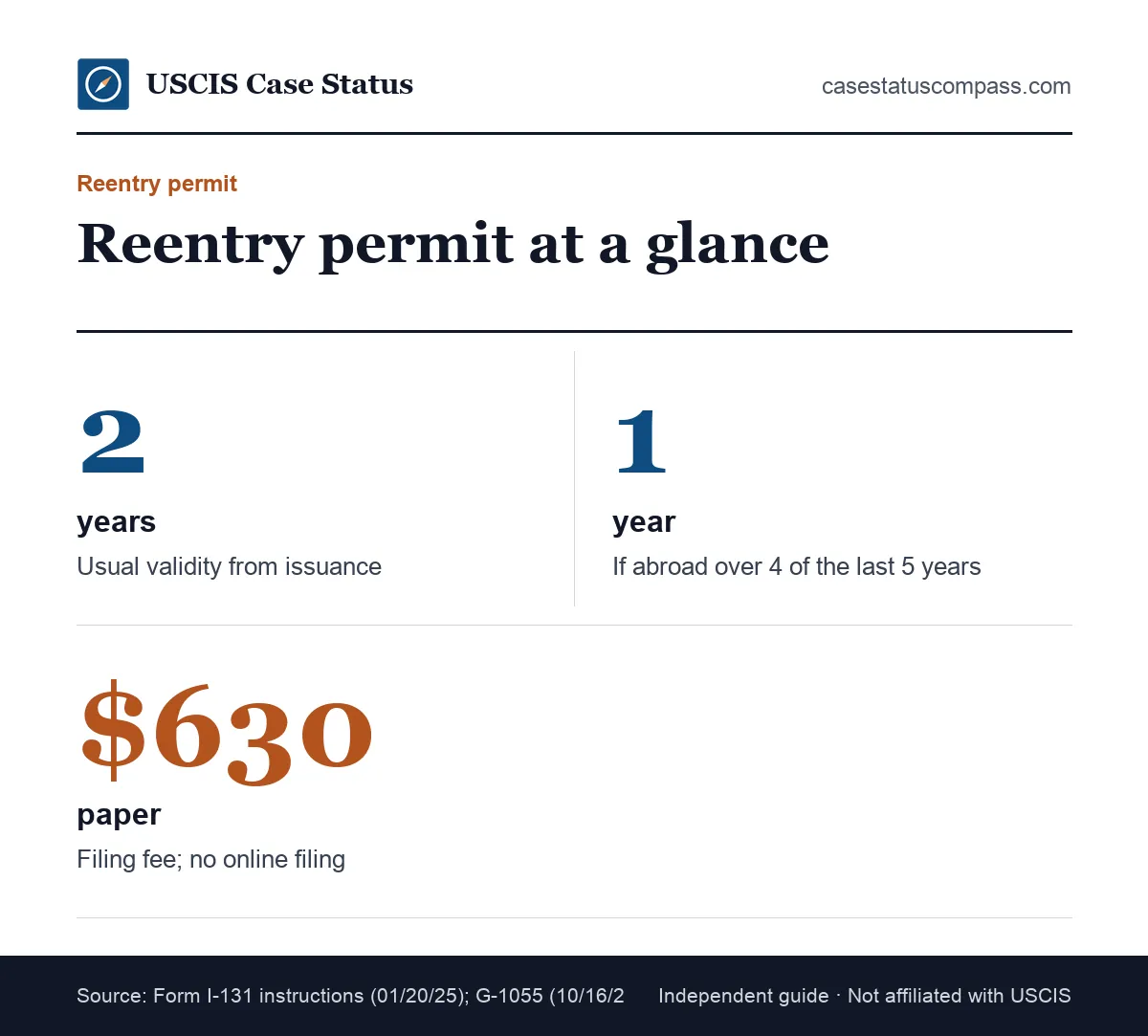
Reentry permit: generally valid 2 years (1 year if abroad more than 4 of the last 5 years). A reentry permit generally cannot be extended, so the validity period sets the outer limit of your planned trip. Check the expiration date printed inside the permit.
When the validity clock starts
The validity runs from the date of issuance, not from your departure. If USCIS approves the permit two months before you leave, those two months count against its life, so time the filing around your travel dates.
The standard two-year permit
Most first-time applicants receive a two-year permit. Plan your return before it expires. If you need more time abroad, you will usually need to come back, apply again and attend new biometrics.
The shorter one-year limit
People who spent more than four of the last five years abroad generally receive a permit limited to one year, with exceptions. The count is total time outside the U.S. across that window, so several long trips can trigger the shorter permit even without one very long absence.
How Do You Apply for a Reentry Permit?
You file Form I-131 on paper while physically in the U.S., then attend a biometrics appointment. The form lets you choose where the permit is delivered. File well before departure. Expect a receipt notice first, then a separate biometrics notice with your appointment date and center.
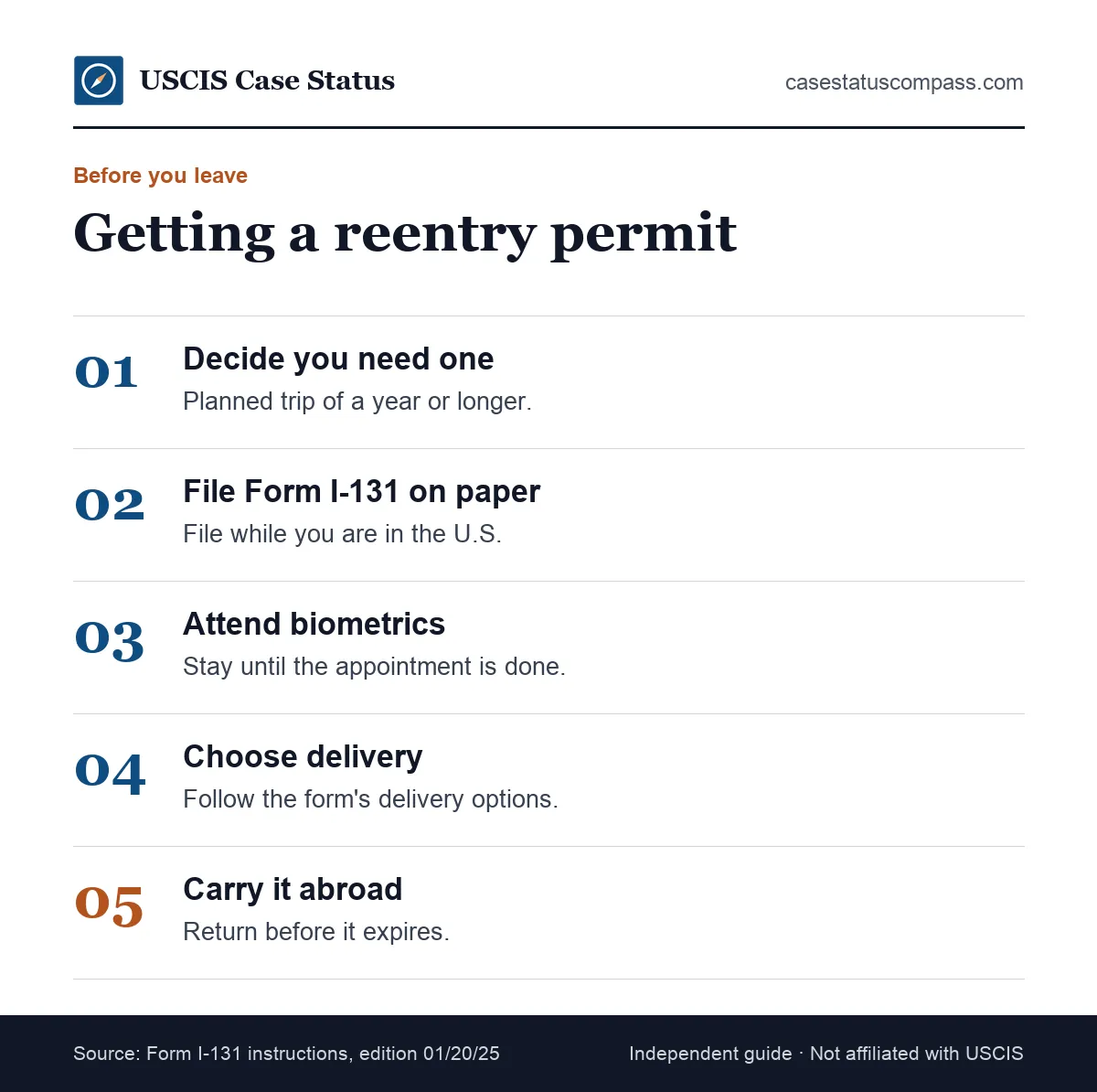
Filing steps
- Confirm the current I-131 edition on uscis.gov
- Complete the reentry permit section and sign
- Include the fee and a copy of your green card
- Mail it to the address USCIS lists for reentry permits
- Watch for the receipt and biometrics notice
Biometrics before you leave
You must give fingerprints and a photo at a USCIS center. If you leave before biometrics, the application may be denied. See our biometrics appointment guide for what to bring and how rescheduling works.
What Is the Reentry Permit Fee for Form I-131?
Form G-1055 (edition 10/16/26) lists a $630 fee for a paper reentry permit application, and reentry permits cannot be filed online. That means mailing a paper Form I-131 with payment from a U.S. address. Pay with Form G-1450 or G-1650 attached to the filing.
The fee
The $630 fee covers the reentry permit filing, with biometrics included in most USCIS fees today. Our USCIS fees guide lists other travel document fees. Like other USCIS fees, it is not refunded if the permit is denied.
How Long Does a Reentry Permit Take?
Processing is slow, so plan months ahead and check the official processing time tool before setting a departure date. USCIS's own data shows the travel document category is slow: I-131 travel documents (reentry permit/refugee travel document line): median 14.4 months (USCIS data, Apr.-June 2026). That median covers several document types.
Checking the live reentry permit time
The live tool currently shows 16.5 months (USCIS data retrieved Oct 27, 2026) for reentry permits and refugee travel documents. Our I-131 processing time guide explains how to read both measures.
Can You Leave Before the Reentry Permit Is Approved?
Generally, yes, once biometrics are done. Leaving before biometrics risks denial. If the permit is approved while you are abroad, it can be delivered according to the option you chose on the form. Choosing overseas pickup when you file avoids relying on someone to forward the permit.
Leaving after biometrics
Many residents file, complete biometrics and then travel while the case is pending. Track the case online and keep your U.S. address current so notices are not lost. If USCIS sends a request for evidence, someone must be able to respond on time.
Choosing delivery
The I-131 lets you request delivery to your U.S. address or pickup abroad at a U.S. embassy, consulate or DHS office. Pick a location you can reach during the trip.
Reentry Permit vs SB-1 Visa vs Boarding Foil
These three are easy to confuse. A reentry permit is planned before leaving. An SB-1 visa repairs an absence that ran too long. A boarding foil replaces a lost or stolen card for the trip home. Each one comes from a different office.
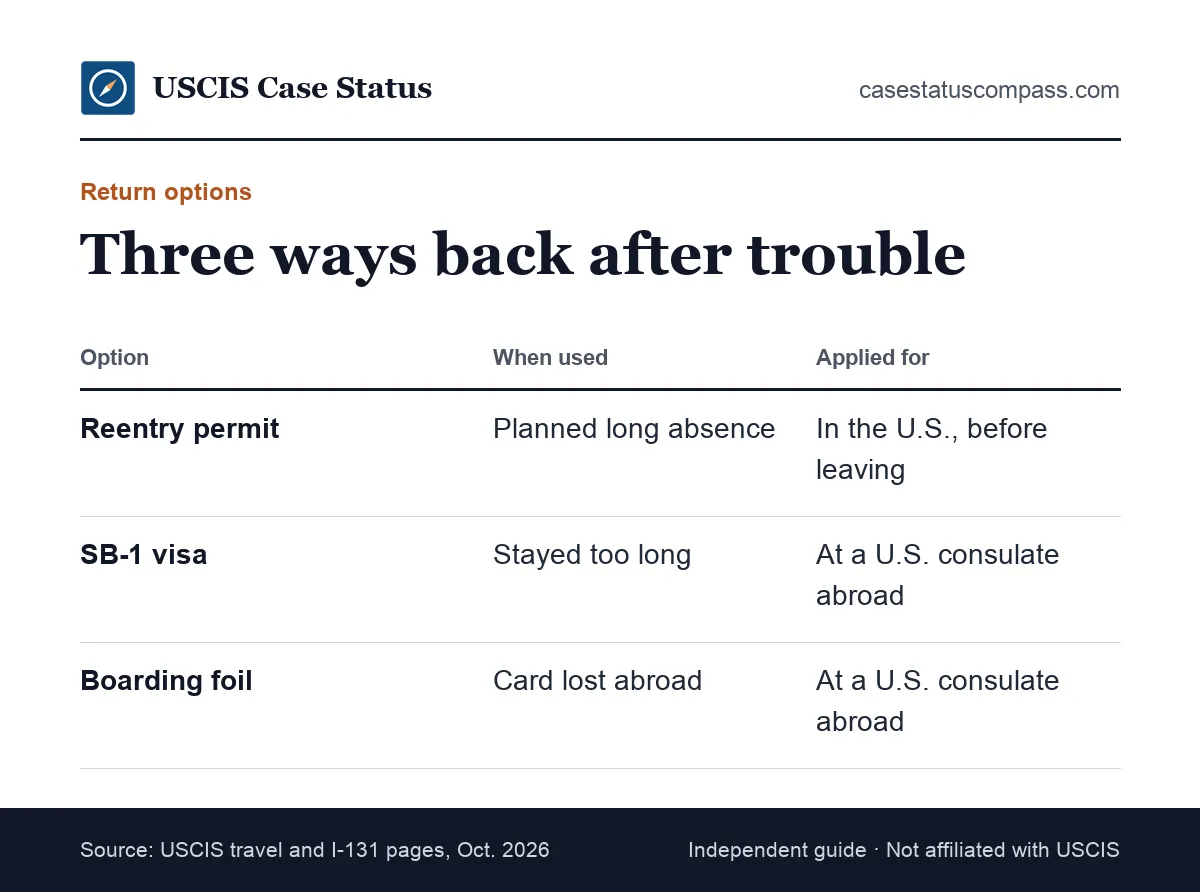
Matching the option to the problem
Find the row that matches your situation abroad to see the usual document and the office that issues it.
| Your situation | Likely option | Where to apply |
|---|---|---|
| Planning a 1 to 2 year stay | Reentry permit | USCIS, from inside the U.S. |
| Stayed abroad beyond the permit or a year | SB-1 returning resident visa | U.S. embassy or consulate |
| Card lost or stolen abroad | Boarding foil (Form I-131A) | U.S. embassy or consulate |
Why the SB-1 is harder
An SB-1 applicant must show the stay was beyond their control and must generally qualify for an immigrant visa again, including a medical exam. The G-1055 notes that returning residents (SB-1) are exempt from the USCIS Immigrant Fee.
What If You Stayed Abroad Too Long?
Do not simply book a flight and hope. A long, unplanned absence is a legal problem with several possible paths, and the right one depends on why you stayed, how long you were gone and your ties to the U.S. Speak with an immigration attorney first.
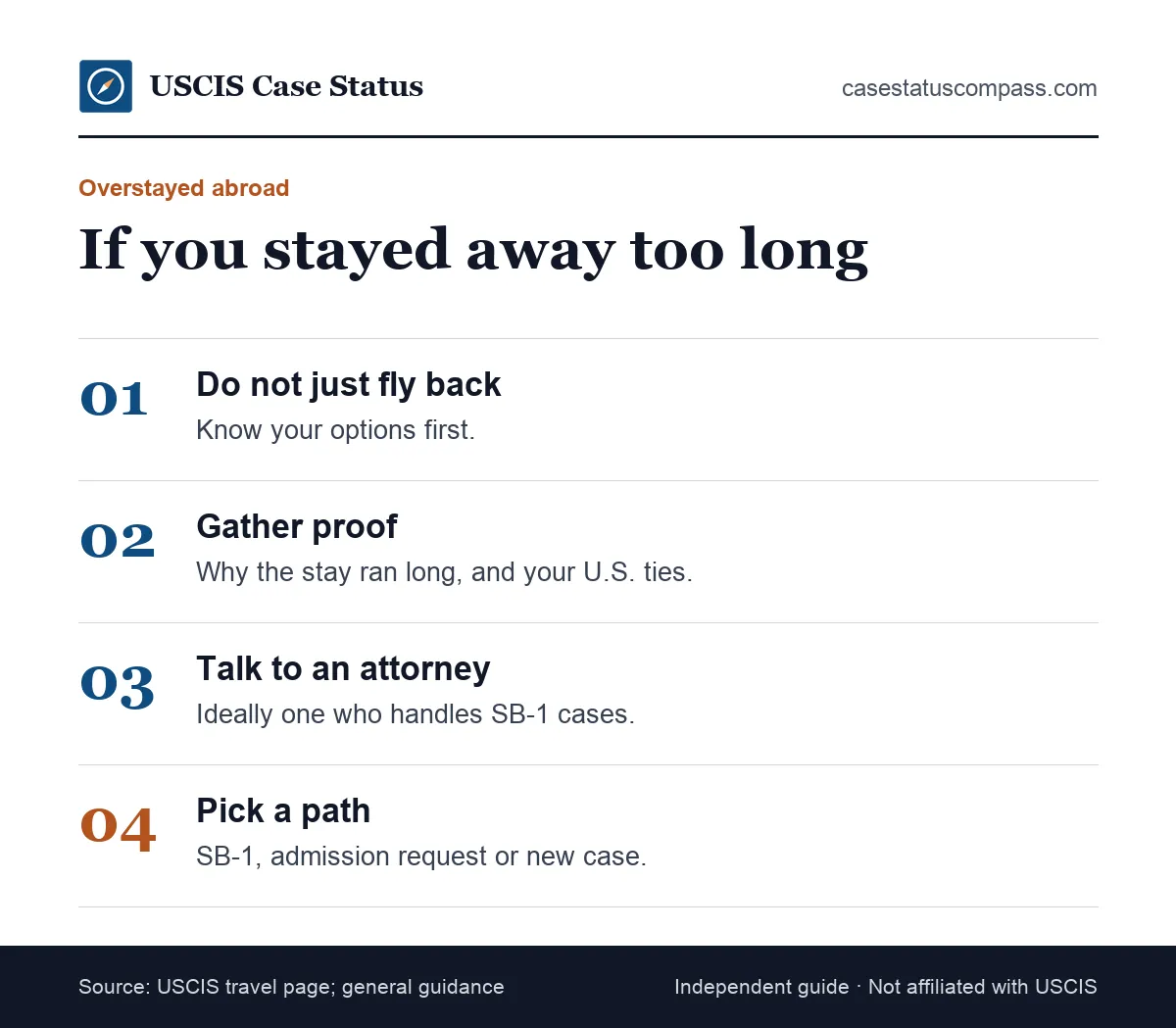
Evidence to gather now
- Medical records if illness kept you abroad
- Proof of travel bans, war or emergencies
- Your original return ticket
- U.S. lease, job letter, bank and tax records
- Letters from your employer or school about your planned return
Options an attorney may discuss
An attorney may weigh an SB-1 application, seeking admission and contesting abandonment before an immigration judge, or starting a new immigration case. Which route fits depends on the reason for the delay and your ties, which is why advice comes before booking.
What Happens at the Port of Entry?
A CBP officer reviews your card and passport and may ask about your trip. Most residents are admitted after brief primary inspection. If questions remain, you may be sent to secondary inspection for a longer review of your documents and travel history.
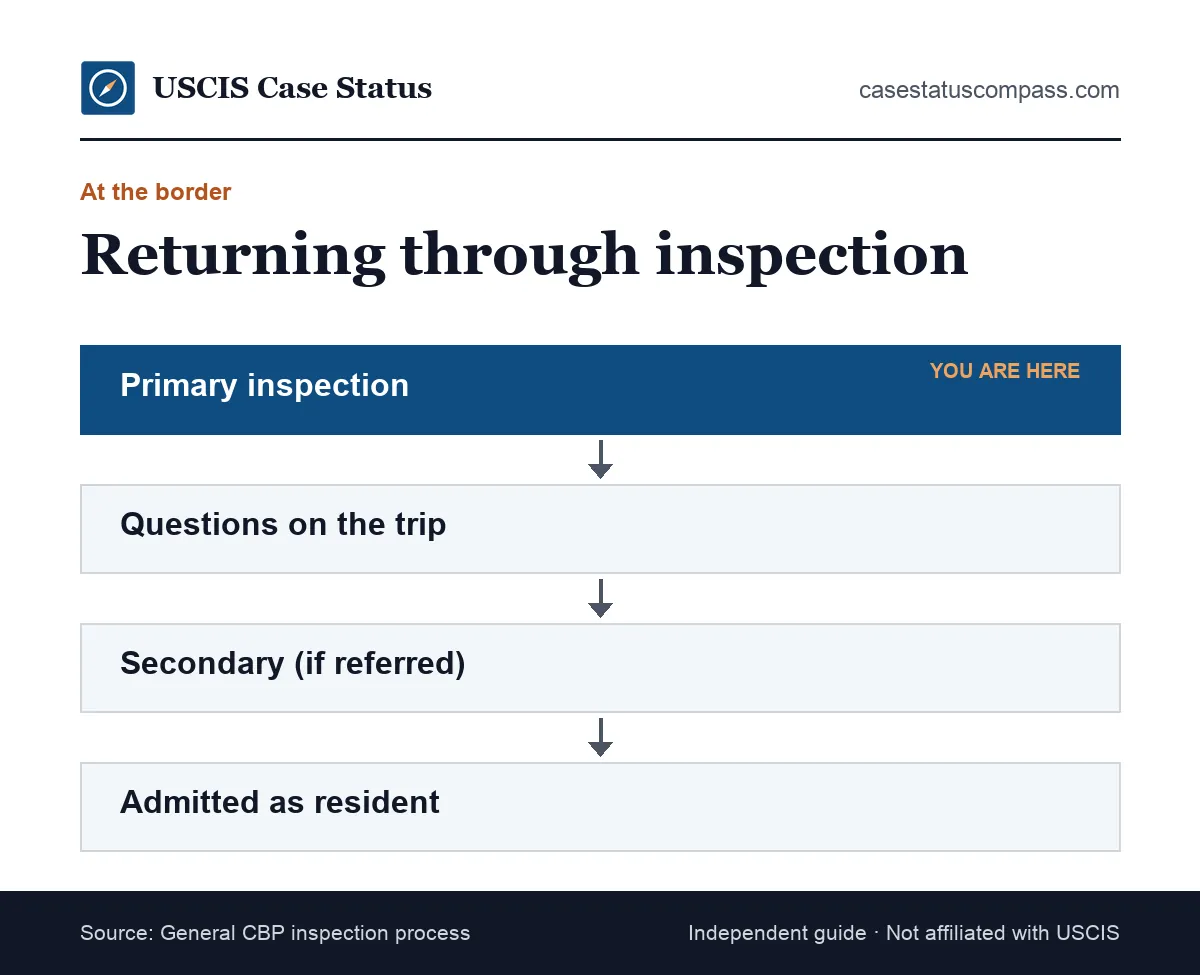
Common questions
Officers may ask how long you were gone, why you traveled, where you work and live, and whether you have a U.S. address. Never guess at dates; check your travel log.
In secondary inspection
Secondary is a longer check, not a penalty by itself. Stay calm, answer honestly and ask for an interpreter if needed. If abandonment comes up, the I-407 rules below apply.
What Is Form I-407 and Do You Have to Sign It?
Form I-407 records that a permanent resident is giving up status. The form's instructions say U.S. law does not require you to complete or sign it, and that you may request a hearing before an immigration judge if DHS claims you abandoned status.
Signing is voluntary
Officers sometimes offer the I-407 to residents returning after long absences. Signing waives your right to have a judge decide whether you abandoned residence. Do not sign anything you do not understand, and ask to speak with a lawyer if possible.
What not signing means
Declining to sign does not guarantee you keep status. USCIS policy notes that abandonment can be found without an I-407. If you dispute it, the question may go to an immigration judge, where you can present evidence of your ties.
Traveling With an Expired or Expiring Green Card
An expired card can create problems with airlines and at the border. If you filed to renew, your receipt notice may extend proof of status. Renew early: File I-90 if your card is lost, damaged, wrong, expiring within 6 months, or you turned 14. The current fee is $465 (paper) / $415 (online).
The I-90 receipt extension
I-90 receipt notice + expired card = proof of status for 36 months from the card's expiration date. Carry the original receipt with the expired card. Our green card renewal guide covers filing and what to expect.
When to avoid travel
If your card has already expired and you have no receipt, avoid travel until you have proof of status. An airline may refuse boarding. You can ask about a temporary I-551 stamp: I-551/ADIT stamp: temporary proof of green card status; request through the USCIS Contact Center (800-375-5283).
What Are the Travel Rules for Conditional Residents?
Conditional residents with a two-year card follow the same green card holder travel rules, plus the I-751 timing. If your card expires while your petition is pending, the I-751 receipt notice extends your status. Carry the receipt with the card on every trip until the I-751 is decided.
The two-year card
You must file Form I-751 in the window before the card expires: File in the 90 days before your 2-year card expires. Missing it can end your status. Do not plan a long trip that overlaps this window. Our Form I-751 guide explains joint and waiver filings.
Traveling on the receipt notice
I-751 receipt notice extends conditional status and work authorization for 48 months. Carry the original receipt with your expired card. If USCIS schedules biometrics or an interview, you must be in the U.S. to attend, so time trips around expected notices.
Can You Travel While Your N-400 Is Pending?
Yes, you can travel with a pending naturalization case, but you must attend biometrics, the interview and the oath. Long trips during this period can also affect eligibility, because continuous residence must generally continue until you are sworn in.
Appointments you cannot miss
Missing a USCIS appointment can delay or derail your case. Keep your address current and have someone check your mail. If a notice arrives while you are away, contact USCIS quickly to ask about rescheduling, and keep proof of the request.
Around the oath ceremony
At the ceremony you return your green card and receive a naturalization certificate. After that, you travel on a U.S. passport. Plan passport timing before booking trips after the oath.
Can You Travel Before Your Green Card Arrives?
If your I-485 was approved but the card has not arrived, travel is risky without proof of status. A temporary I-551 stamp can serve as proof. While the I-485 is still pending, different rules apply: Traveling while your I-485 is pending abandons it unless you have advance parole (with H/L/V/K exceptions).
Approved, card not yet received
Wait for the card if possible. If you must travel, ask about an I-551 stamp. Temporary I-551 stamp: valid until its expiration date, or 1 year if no date is printed. Our I-551 stamp guide explains how to request one.
Still waiting on the I-485
If you do not yet have a green card, green card holder travel rules do not apply to you yet. Read our guide on travel with a pending I-485 for advance parole and recent changes before you plan any trip.
What If Your Green Card Is Lost or Stolen Abroad?
Contact the nearest U.S. embassy or consulate. Permanent residents abroad less than a year whose card was lost, stolen or destroyed can usually apply for a boarding foil with Form I-131A. You will then replace the card after returning.
First steps abroad
- File a police report if the card was stolen
- Gather your passport and any card copy
- Contact the U.S. embassy or consulate
- Ask about Form I-131A and its fee
- Keep the police report number for your records
After you return
File Form I-90 to replace the card once you are back in the U.S. Our lost green card guide covers the boarding foil, identity protection and replacement in detail. Do this soon, because the boarding foil only covers the trip home.
Do Canada, Mexico and Cruises Count as Travel Abroad?
Yes. Any departure from the U.S. counts as time abroad for travel and naturalization purposes, whether by air, land or sea. A long stay in Canada or Mexico counts the same as a long stay overseas. Carry your green card on every crossing.
Land border trips
Day trips are routine, but carry your card and passport each time. For naturalization, the N-400 asks you to list your trips outside the U.S., so record border crossings in your travel log with exact dates.
Cruises
A cruise that stops in foreign ports still involves leaving and returning to the U.S. Bring your green card and passport. Cruise lines may set their own document rules. Log the sailing and return dates like any other trip.
Do Children With Green Cards Follow the Same Rules?
Yes. Children who are permanent residents need their own unexpired green card and passport, and the same abandonment and residence rules apply. Long stays abroad with relatives or at school can put a child's status at risk as well.
Children's documents
- The child's own green card
- A valid passport for the child
- A reentry permit for long stays
- Consent letters if traveling with one parent
- A copy of the birth certificate naming the parents
Children studying abroad
A year of school abroad can raise the same abandonment questions as an adult's long trip. Get a reentry permit before the child leaves. Note that cards issued before age 14 generally must be replaced, a common item to check before trips.
Working or Studying Abroad as a Permanent Resident
A temporary job or study program abroad is allowed, but it must stay temporary. Keep strong U.S. ties, get a reentry permit for absences of a year or more, and consider Form N-470 if you qualify and care about citizenship timing.
A temporary job assignment
Keep a letter from your employer stating the assignment's length and your expected return. Keep your U.S. home and accounts, and file taxes as a resident. Plan visits home during the assignment if you can.
Study programs
A semester abroad is usually manageable. A multi-year degree abroad is harder, because it looks like a new home. Get a reentry permit, keep U.S. ties and come back during breaks when you can.
Caring for a Sick Relative Abroad
Family emergencies are a common cause of long, unplanned stays. If a trip may stretch past six months or a year, plan for the worst case before leaving: file for a reentry permit if you can, and keep records showing the trip's temporary purpose.
Plan for a long stay
If time allows, file Form I-131 and complete biometrics before you go, even if you hope to return sooner. A reentry permit you do not need costs much less than an abandonment problem.
Documenting the reason
- Hospital or doctor's letters about your relative's care
- Records of your U.S. job leave or remote work
- Proof you kept your home and bills in the U.S.
- Updated plans whenever your return date changes
How Do Taxes Affect Your Residence?
USCIS lists filing U.S. taxes as a resident as a sign you still live here. Permanent residents must file income tax returns: Obey the law, file taxes, don't vote, and register for Selective Service (men 18-25). Choosing to file as a nonresident can be read as evidence that you gave up U.S. residence.
Filing as a resident
Keep filing resident tax returns while abroad. Save copies and IRS transcripts, because they are strong evidence of ties. If you have income abroad, ask a tax professional how to report it as a resident.
The nonresident filing risk
Some residents abroad consider filing as nonresidents for tax reasons. That choice may be used as evidence of abandonment. Talk to both a tax professional and an immigration attorney before filing that way.
How Do You Count Your Days Abroad?
Count from the day you leave the U.S. to the day you return. Keep a travel log with exact dates and keep passport stamps, boarding passes and I-94 records. Accurate counts matter for both abandonment questions and the N-400 travel section.
Build a travel log
Use a simple spreadsheet with departure date, return date, destination and purpose. Update it after every trip. Keep boarding passes or e-tickets as backup. Flag any trip over six months so you can explain it on the N-400.
A worked count
"Lena," a fictional resident, leaves on March 3 and returns on October 12. That is more than six months but under a year. Her green card is usable, but USCIS will presume a break in continuous residence unless she rebuts it with evidence.
Pre-Trip Checklist for Permanent Residents
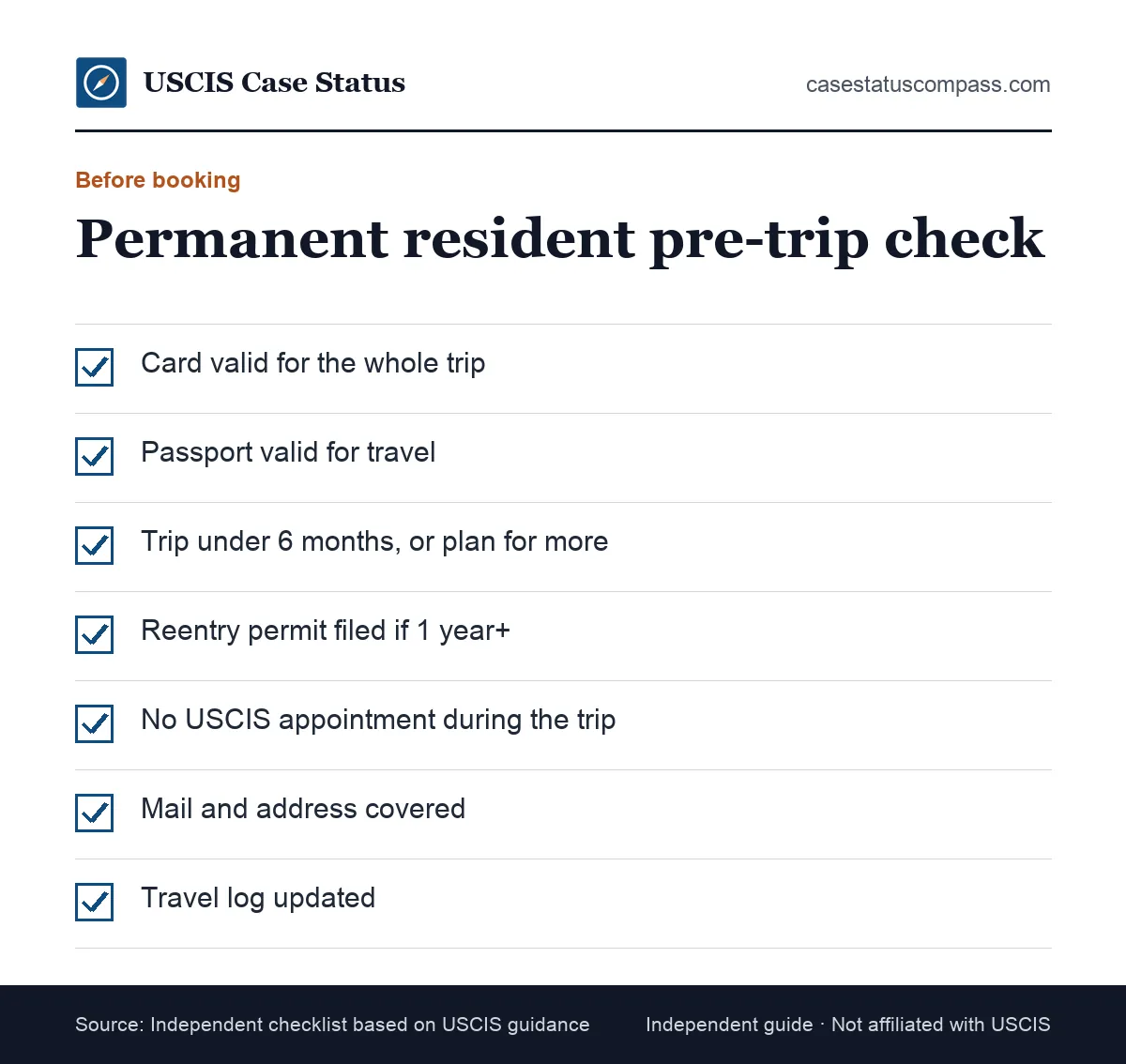
Run through this list before booking. Most travel problems come from expired cards, forgotten appointments or trips that quietly stretch beyond six months. Do it about a month before departure, and again if the return date moves. If two or more items are unclear, fix them before paying for tickets.
Documents and timing
- Green card valid past your return date
- Passport valid for the whole trip
- Reentry permit filed for a year or longer
- No biometrics or interview scheduled
- Receipt notices for any pending I-90 or I-751
Home ties while away
- Lease or home kept in the U.S.
- Bills and bank accounts active
- Someone collecting your mail
- Tax filing plan as a resident
- U.S. employer or leave letter on file
- Driver's license renewed if it expires
Keeping Your Address and Mail Current While Away
USCIS sends important notices by mail. Report a new address to USCIS within 10 days of moving (INA 265). If you keep your U.S. address while traveling, arrange for someone you trust to check mail and tell you about any USCIS letters right away.
Mail and notices
A missed USCIS letter can mean a missed appointment or deadline. Ask a trusted person to open and photograph immigration mail. Our change of address guide explains how to update USCIS online.
Reaching USCIS from abroad
If you need USCIS while overseas, the Contact Center has a number for international callers: 212-620-3418 (callers outside the U.S.). Have your A-Number and receipt numbers ready before you call.
Which Trips Need an Attorney First?
Talk to an immigration attorney before trips longer than six months, before any absence of a year or more, and before travel if you have a criminal record, a past immigration violation, or a pending case with USCIS or the court.
Red flags
- Any arrest or conviction, even if old
- A past long absence or abandonment question
- A conditional card with an I-751 pending
- Plans to live abroad for years
- A pending removal case in immigration court
Finding help
An immigration attorney or DOJ-accredited representative can review your history and travel plan. Our guide to immigration lawyer costs explains typical fees and how to compare options. Bring your travel log to the first meeting.
Worked Examples: Two Permanent Residents Abroad
These fictional examples show how the same rules play out differently. One resident takes a seven-month family trip; another accepts a two-year job abroad. Both keep their green cards, but only one keeps a clean citizenship timeline. The names and details are invented.
A seven-month family visit
"Omar" spends seven months abroad helping a parent recover from surgery. He keeps his U.S. job on leave, his apartment and his tax filings. He returns with his card. For citizenship, he must rebut the six-month presumption with evidence.
A two-year job assignment
"Mei" accepts a two-year posting with a U.S. company. Before leaving she files for a reentry permit and completes biometrics. If she qualifies, she also files Form N-470. She returns before the permit expires and keeps strong ties.
Permanent Resident Trip Planner: If X, Do Y
Use this table to choose a first step. It is general information, not legal advice. If any row matches a complicated history, speak with an immigration attorney before traveling. Start with the row that matches the longest absence you expect, since a trip that might run long should be planned as the longer trip.
If-then table for common trips
Each row pairs a common travel situation with a sensible first step to take before or during the trip.
| If this applies | Do this |
|---|---|
| Trip under 6 months | Carry card and passport; keep a travel log |
| Trip 6 months to 1 year | Carry proof of ties; plan for N-400 delay |
| Trip 1 year or more | File for a reentry permit before leaving |
| Already abroad over a year | Talk to an attorney about SB-1 or other options |
| Card expired, I-90 pending | Carry the receipt notice with the card |
| Card lost abroad | Contact the embassy about Form I-131A |
Common Travel Mistakes Permanent Residents Make
Most problems are avoidable. The common ones are traveling on an expired card, letting a trip stretch past a year without a permit, missing USCIS appointments, and signing papers at the border without understanding them. The lists below split them by when they happen.
Before you leave
- Letting the card expire mid-trip
- Leaving before reentry permit biometrics
- Forgetting a pending I-751 or N-400 appointment
- Selling your U.S. home without legal advice
- Booking flights before checking the card's expiration date
At the border
Do not guess dates or give vague answers. Do not sign Form I-407 without understanding that it gives up your status. Bring evidence of your U.S. life, and stay calm if referred to secondary inspection.
After you get home
Update your travel log with the exact return date, open any USCIS mail that arrived while you were away, and replace a card that expired during the trip with Form I-90.
Frequently Asked Questions
How long can a green card holder stay outside the U.S.?
There is no exact safe number of days. Trips under six months are routine. Over six months, citizenship residence is presumed broken. A year or more risks abandonment unless you got a reentry permit before leaving.
Do I need a reentry permit for a trip of eight months?
Not usually. USCIS advises a reentry permit for trips of more than one year. For eight months, carry your card, passport and proof of U.S. ties. The trip will still affect continuous residence for naturalization.
Can my green card be taken away at the airport?
A CBP officer cannot simply cancel your status at the counter. They may question abandonment and offer Form I-407, which you do not have to sign. If DHS disputes your status, you can ask an immigration judge to decide.
Does a reentry permit protect my citizenship timeline?
No. A reentry permit protects your green card, not continuous residence for naturalization. For that, certain people working abroad may file Form N-470. Many long-term workers abroad need both.
Can I travel if my green card expires in two months?
Possibly, but it is risky. Renew early with Form I-90 and carry the receipt notice. An airline may question a card that expires during the trip, and the card must be valid when you return.
Can I apply for a reentry permit from abroad?
No. You must be physically in the U.S. when you file Form I-131 for a reentry permit and when you give biometrics. You can leave after biometrics, and the permit can be delivered abroad if you choose that option.
What if I was stuck abroad because of an emergency?
Gather proof of the emergency and your U.S. ties, then talk to an immigration attorney. Options may include an SB-1 returning resident visa or asking for admission and contesting abandonment.
Can I travel while my I-751 is pending?
Yes. I-751 receipt notice extends conditional status and work authorization for 48 months, so carry that receipt with your expired card and passport. Be back in time for any biometrics or interview notice, because you must attend in person.
Do I need a reentry permit if I visit the U.S. every few months?
No. Short temporary trips do not need one. But if most of each year is spent abroad, officers may still question abandonment, so keep U.S. ties and a travel log rather than relying on short returns.
Sources
- USCIS: International Travel as a Permanent Resident (updated 09/12/2025). www.uscis.gov/green-card/after-we-grant-your-green-card/international-travel-as-a-permanent-resident. Accessed Oct 27, 2026.
- USCIS Policy Manual Vol. 12, Part D, Ch. 3: Continuous Residence. www.uscis.gov/policy-manual/volume-12-part-d-chapter-3. Accessed Oct 27, 2026.
- USCIS: Form I-131 Instructions (reentry permit). www.uscis.gov/sites/default/files/document/forms/i-131instr.pdf. Accessed Oct 27, 2026.
- USCIS: Form I-131, Application for Travel Documents. www.uscis.gov/i-131. Accessed Oct 27, 2026.
- USCIS: Form I-407, Record of Abandonment of Lawful Permanent Resident Status. www.uscis.gov/i-407. Accessed Oct 27, 2026.
- USCIS: Form I-407 Instructions. www.uscis.gov/sites/default/files/document/forms/i-407instr.pdf. Accessed Oct 27, 2026.
- USCIS: Replace Your Green Card. www.uscis.gov/green-card/after-we-grant-your-green-card/replace-your-green-card. Accessed Oct 27, 2026.
- USCIS: Rights and Responsibilities of a Green Card Holder. www.uscis.gov/green-card/after-we-grant-your-green-card/rights-and-responsibilities-of-a-green-card-holder-permanent-resident. Accessed Oct 27, 2026.
- USCIS Form G-1055 Fee Schedule. www.uscis.gov/g-1055. Accessed Oct 27, 2026.
- USCIS Data Library: Quarterly All Forms, FY2026 Q3. www.uscis.gov/sites/default/files/document/data/quarterly_all_forms_fy2026_q3_v1.xlsx. Accessed Oct 27, 2026.
- USCIS processing times. egov.uscis.gov/processing-times/. Accessed Oct 27, 2026.
- USCIS Glossary: Green Card. www.uscis.gov/tools/glossary. Accessed Oct 27, 2026.
- USCIS: Form N-400 page. www.uscis.gov/n-400. Accessed Oct 27, 2026.
- USCIS Form G-1055 Fee Schedule, Edition 10/16/26. www.uscis.gov/sites/default/files/document/forms/g-1055.pdf. Accessed Oct 27, 2026.
- Form I-90 Instructions, Edition 01/20/25. www.uscis.gov/sites/default/files/document/forms/i-90instr.pdf. Accessed Oct 27, 2026.
- USCIS alert: Additional Mail Delivery Process for Receiving ADIT Stamp (Mar. 16, 2023; archived). www.uscis.gov/newsroom/alerts/uscis-announces-additional-mail-delivery-process-for-receiving-adit-stamp. Accessed Oct 27, 2026.
- USCIS: Removing Conditions on Permanent Residence Based on Marriage. www.uscis.gov/green-card/after-we-grant-your-green-card/conditional-permanent-residence/removing-conditions-on-permanent-residence-based-on-marriage. Accessed Oct 27, 2026.
- Form I-485 Instructions, Edition 09/18/26. www.uscis.gov/sites/default/files/document/forms/i-485instr.pdf. Accessed Oct 27, 2026.
- USCIS M-274 Handbook for Employers, 7.1 (updated 10/17/2023). www.uscis.gov/i-9-central/form-i-9-resources/handbook-for-employers-m-274/70-evidence-of-employment-authorization-for-certain-categories/71-lawful-permanent-residents-lpr. Accessed Oct 27, 2026.
- USCIS: How to Change Your Address (updated 08/04/2026); 8 U.S.C. 1305(a) (LII). www.uscis.gov/addresschange. Accessed Oct 27, 2026.
- USCIS Contact Center (uscis.gov). www.uscis.gov/contactcenter. Accessed Oct 27, 2026.
casestatuscompass.com is an independent publication and is not affiliated with USCIS or any government agency. This page is general information, not legal advice. For denials, court or asylum matters, consult an immigration attorney or a DOJ-accredited representative.