Contents · 37 sections
- Current I-131 Processing Time
- How Long Does Advance Parole Take in 2026?
- Why Do Reentry Permits Take Longer Than Advance Parole?
- Median vs 80% Figure: Two Ways to Read I-131 Processing Time
- How Do You Check I-131 Processing Time in the USCIS Tool?
- Advance Parole Timeline
- How Long Does Advance Parole Take When Filed With an I-485?
- How Long Does a Standalone Advance Parole Request Take?
- How Long Does a Reentry Permit Take for Green Card Holders?
- Does a Pending Reentry Permit Protect a Long Absence?
- How Long Does a Refugee Travel Document Take?
- Advance Parole Wait Estimator: Map Your Travel Dates
- How Long After Biometrics Is Advance Parole Approved?
- What Slows Down an I-131?
- Does a Request for Evidence Delay Travel Permission?
- Is There Premium Processing for Form I-131?
- Urgent Travel: Expedite Options
- Which Urgent Travel Option Fits Your Deadline?
- How Fast Is Emergency Advance Parole?
- What Happens If You Travel Before Advance Parole Is Approved?
- What Changed for Advance Parole Travel in August 2026?
- How Do You Know If Your I-131 Is Overdue?
- What to Do When Your I-131 Is Outside Normal Processing Time
- When Can You Take an I-131 Delay to the Ombudsman or Congress?
- How Do You Track an I-131 Case?
- How Long Does Each I-131 Status Stage Last?
- How Long After Approval Does the Travel Document Arrive?
- Does Filing Online Change the I-131 Wait?
- Did the October 2026 Address Change Affect I-131 Timing?
- How Does the I-131 Wait Compare With Other USCIS Forms?
- How Has the Advance Parole Wait Changed Since 2023?
- How Far Ahead Should You Apply for Advance Parole?
- Travel Planning Scenarios
- If X, Do Y: I-131 Wait Decision Table
- What Mistakes Make the I-131 Take Longer?
- When Should You Get Legal Help Before Travel?
- Frequently Asked Questions
At a glance
| Advance parole median | I-131 advance parole (inside the U.S.): median 5.8 months (USCIS data, Apr.-June 2026) |
| Reentry permit / refugee travel | I-131 travel documents (reentry permit/refugee travel document line): median 14.4 months (USCIS data, Apr.-June 2026) |
| Your office in the live tool | 16.5 to 26.5 months, depending on category and office (USCIS data retrieved Oct 27, 2026) |
| Premium processing | Not available for Form I-131 |
| About this guide | Independent and unofficial; we have no access to your USCIS file. |
This page covers timing alone; who needs which document is in our advance parole guide. To compare waits for other forms, browse our hub of USCIS processing times.
Current I-131 Processing Time
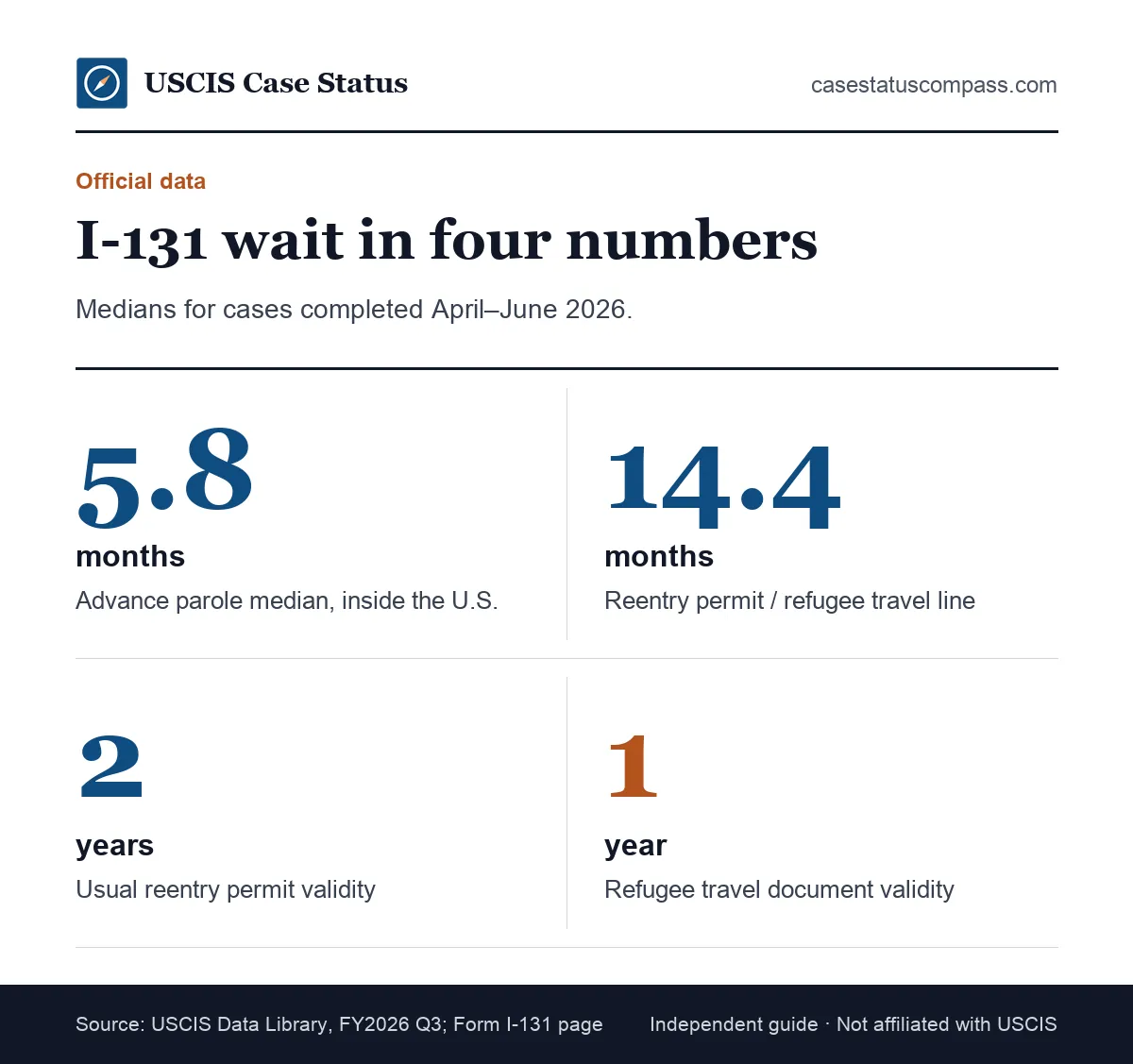
The current I-131 processing time depends on the document. USCIS's median for advance parole was 5.8 months for cases completed April–June 2026. The combined reentry permit and refugee travel document line had a 14.4-month median. The live tool posts separate office figures.
Which line your request falls in
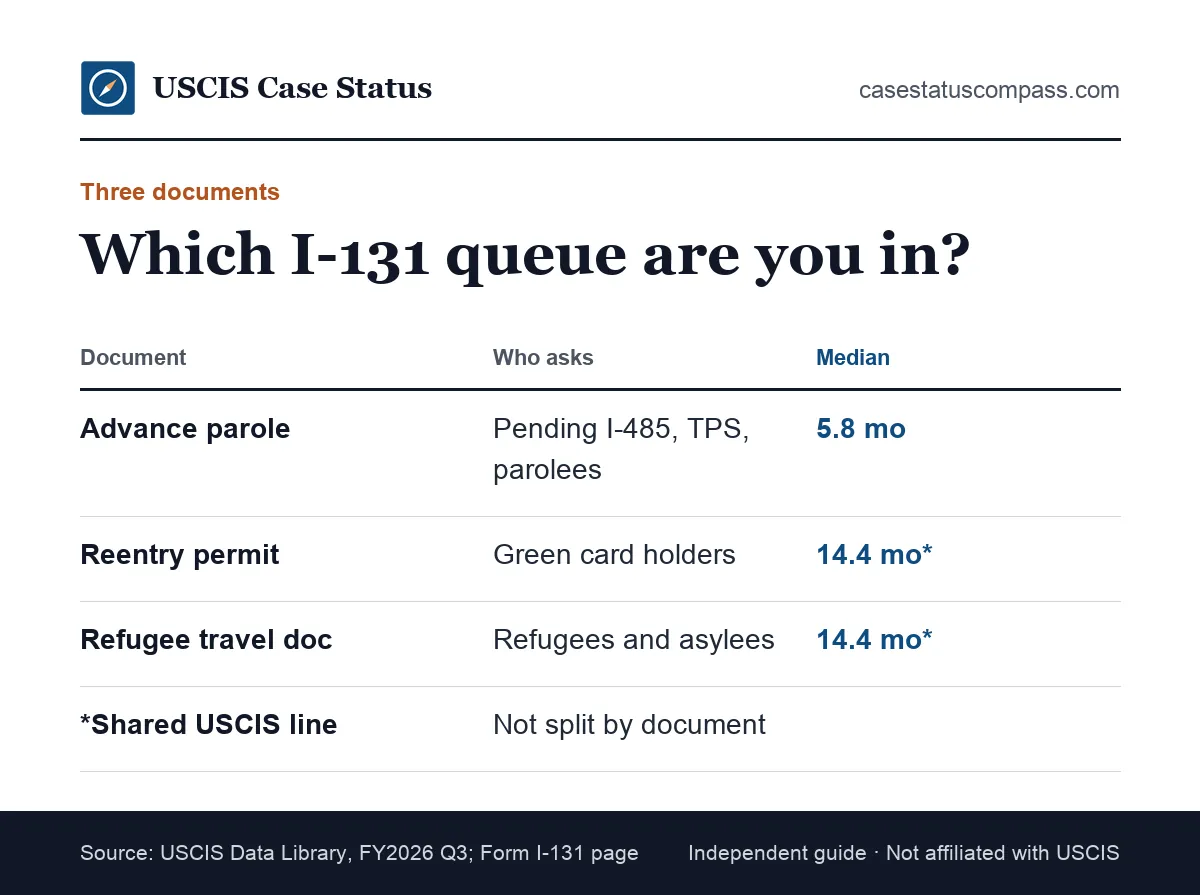
Advance parole for adjustment applicants uses the 5.8-month line. Reentry permits and refugee travel documents share the 14.4-month line. TPS and other parole requests may sit under other tool categories.
Advance parole median
The latest USCIS Data Library line reads: I-131 advance parole (inside the U.S.): median 5.8 months (USCIS data, Apr.-June 2026). The figure measures receipt-to-decision months for advance parole requests decided in that quarter by people applying from inside the United States.
Reentry permit and refugee travel document median
USCIS reports these together: I-131 travel documents (reentry permit/refugee travel document line): median 14.4 months (USCIS data, Apr.-June 2026). The line is not split by document, so a reentry permit and a refugee travel document share one figure.
| Category | Office | 80% of cases completed within |
|---|---|---|
| Advance parole | Service Center Operations (SCOPS) | 26.5 months |
| Re-entry permit or refugee travel document | Service Center Operations (SCOPS) | 16.5 months |
What the live tool says right now
The online tool refreshes monthly and breaks results down by category and office. For Form I-131 it currently gives 16.5 to 26.5 months, depending on category and office (USCIS data retrieved Oct 27, 2026).
How Long Does Advance Parole Take in 2026?
In 2026, advance parole usually takes about six months. USCIS's median for April–June 2026 was 5.8 months for cases completed in that quarter. Some offices are faster and some slower, so apply as early as your case allows and do not book firm travel before approval.
Typical case versus yours
The median splits completed requests into a faster half and a slower half. USCIS quarterly data reports the median: half of the cases completed that quarter took longer. A clean request filed with an I-485 often sits near the middle. An evidence request or missed biometrics pushes it later.
Why "six months" is not a booking date
The median looks back at completed cases, not at your document. Treat it as a planning range, then add a buffer of a few months for mailing and any RFE.
Why Do Reentry Permits Take Longer Than Advance Parole?
Reentry permits share a slower USCIS line with refugee travel documents, which had a 14.4-month median for April–June 2026. Advance parole is usually reviewed with a pending green card case, while reentry permits are separate requests with their own queue.
Separate queues, separate staff
Advance parole often moves with the I-485 file. A reentry permit is a standalone request by a green card holder. Different queues produce very different waits, so never use an advance parole figure for a reentry permit.
Rules that affect reentry permit timing
Reentry permit: generally valid 2 years (1 year if abroad more than 4 of the last 5 years). Also, a reentry permit cannot be extended. Because you must be present for biometrics, plan the filing well before a long stay abroad. Form I-131 lets you ask for delivery to a U.S. embassy or consulate.
Median vs 80% Figure: Two Ways to Read I-131 Processing Time
Two official numbers describe the same form. The quarterly Data Library figure is a national midpoint. The online tool reports the time within which four out of five recent requests were finished, per office and category, so its number usually runs higher.
Which number to use
Each row pairs a common travel question with the USCIS measure that answers it best.
| Your question | Use this | Why |
|---|---|---|
| "Is six months normal for advance parole?" | Quarterly median | It reflects the national midpoint |
| "Is my office slow?" | Online tool | It is broken out per office and category |
| "May I contact USCIS now?" | Case inquiry date | It is the threshold USCIS applies |
| "Can I book a flight?" | Approval in hand | Estimates never guarantee a date |
For trip planning, the office figure beats the national median.
Where the tool's number comes from
The USCIS tool shows how long it took to finish 80% of cases in the past 6 months. That makes it a realistic window for planning, while the inquiry date tells you when an inquiry is allowed.
When the two numbers disagree
If your office's tool figure sits far above the 5.8-month median, your office is slower than the national midpoint. Plan around the office figure, not the median. Recheck it monthly.
How Do You Check I-131 Processing Time in the USCIS Tool?
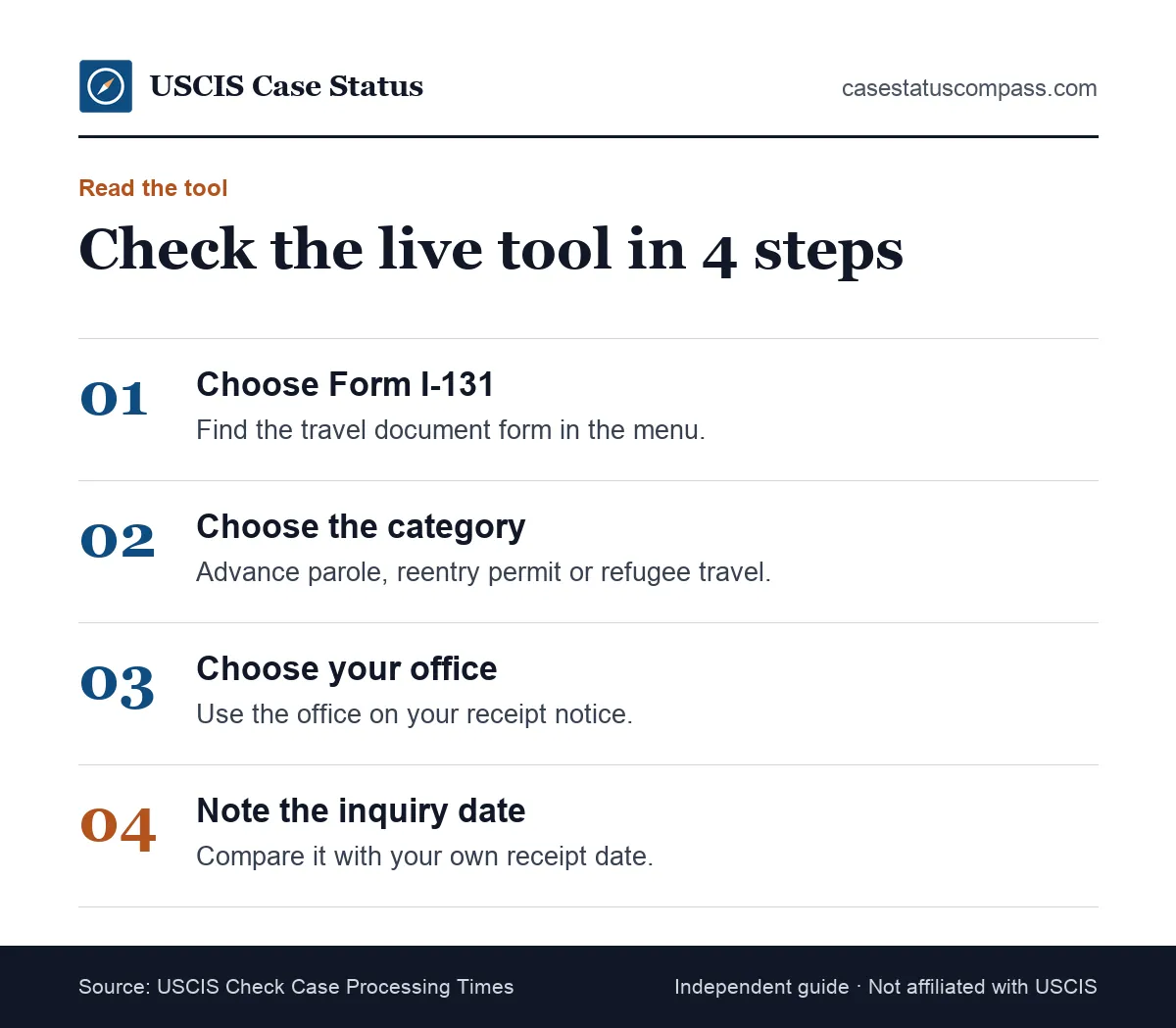
Go to egov.uscis.gov/processing-times, select Form I-131, pick the category matching your request, and pick the office named on your receipt notice. The result lists a processing figure plus an inquiry date, which you hold up against your own receipt date.
Choosing the right category
The tool lists advance parole, reentry permits, refugee travel documents and other parole requests separately. Pick the one on your receipt notice. A wrong category can show an I-131 processing time that is months off.
Entering your receipt date
Type the receipt date from your I-797C into the tool's inquiry box. If the inquiry date it returns is still ahead, your request is within normal processing, however close your trip is.
Choosing the right office
Use the office on your newest notice. If your I-131 was filed with an I-485, it may sit with the same office as the green card file. Transfers change this.
Advance Parole Timeline
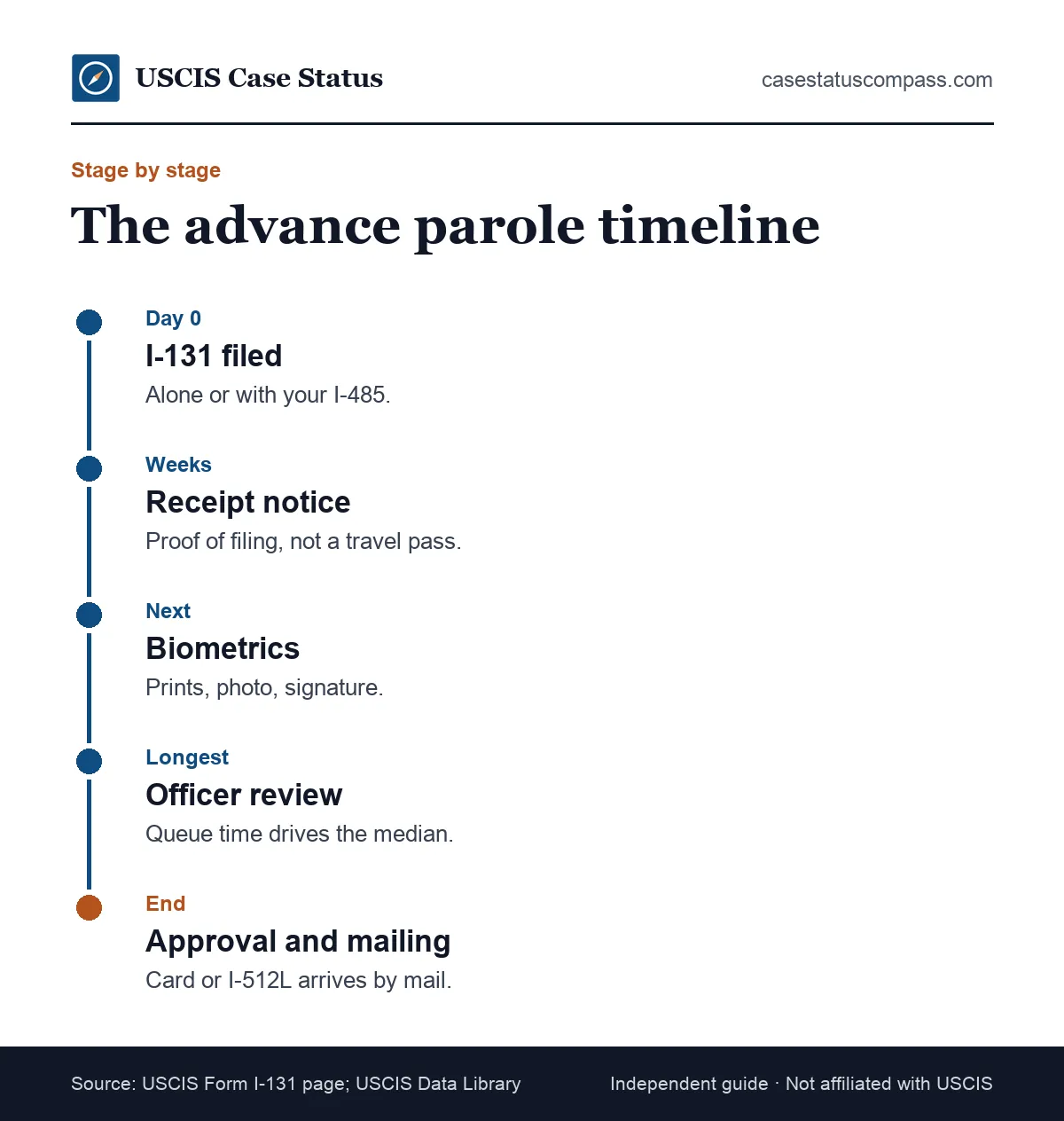
An advance parole request moves through intake, a receipt, a fingerprint visit, an officer's decision and delivery. Waiting for the officer's decision eats up most of the months. Filing with an I-485 and filing alone follow the same stages, but sometimes at different speeds.
Stages and what drives each
Read the rows in order; the last column names what usually sets the pace at each stage.
| Step | Action | Main time driver |
|---|---|---|
| Intake | Package accepted at the lockbox | Right address, fee and edition |
| Receipt | USCIS issues an I-797C | Mail volume at intake |
| Fingerprints | ASC visit or reuse | Local appointment supply |
| Decision | Officer approves or asks for more | Backlog at your office |
| Extra proof | You answer an RFE | How fast you respond |
| Delivery | Card or I-512L sent | Production and postal time |
Officer review is the longest stage, and it is the one you cannot speed up.
Filed alone or with an I-485
Filing together means one biometrics visit and one file. A standalone request filed later joins the queue on its own receipt date, and its I-131 processing time counts from that day. Our green card processing time page covers the I-485 wait.
How Long Does Advance Parole Take When Filed With an I-485?
When filed with an I-485, advance parole is often decided with the work permit, and the approval may arrive as a combo card. The advance parole median was 5.8 months for April–June 2026, close to the 6.4-month median for adjustment-based work permits.
The combo card connection
Many applicants file Forms I-485, I-765 and I-131 together. USCIS can approve the I-765 and I-131 together on one combo card. That line's median: I-765 (based on pending I-485): median 6.4 months (USCIS data, Apr.-June 2026). See our work permit processing time page.
When the two arrive separately
Sometimes one is approved first. If the work permit arrives without travel permission, the I-131 is still pending. Check both receipt numbers. A plain EAD card does not allow travel, so wait for the separate parole decision.
How Long Does a Standalone Advance Parole Request Take?
A standalone advance parole request uses the same advance parole line in the tool, with a 5.8-month median for April–June 2026. Your receipt date sets your place in line, so a request filed a year after the I-485 waits behind earlier filings.
Renewals before your document expires
If your current parole document will expire before your green card is decided, file a renewal early. USCIS does not extend an old document because a new request is pending. Plan for at least the median.
TPS holders and parolees
Other groups also use Form I-131 for travel or re-parole. Their category in the tool may differ from adjustment-based advance parole. Pick the category on your receipt notice. Ask USCIS if unsure.
How Long Does a Reentry Permit Take for Green Card Holders?
A reentry permit sits on the USCIS travel document line, which had a 14.4-month median for April–June 2026. Because you must be in the U.S. to file and attend biometrics, start the request months before a long stay abroad and plan for delivery overseas.
Leaving after biometrics
Once biometrics are done, many applicants leave and ask for the permit to be sent to a U.S. embassy or consulate. Confirm the delivery choice on your form, because changing it later is hard.
Filing before a long posting abroad
Count back at least 14.4 months from the day you must be abroad, then add time for biometrics. If that date has passed, file anyway and choose delivery to a U.S. embassy or consulate.
Does a Pending Reentry Permit Protect a Long Absence?
Not by itself. Long trips abroad can risk your green card; over 1 year is the general warning line. For naturalization: Naturalization: a trip over 6 months is presumed to break residence; 1 year or more breaks it. A pending reentry permit does not fix either issue, so time the trip around filing and biometrics, not the decision date.
How Long Does a Refugee Travel Document Take?
A refugee travel document shares the 14.4-month USCIS median for April–June 2026 with reentry permits. Refugees and asylees should file well before any trip. The document is generally valid for one year, so renewals need the same lead time.
Who uses this queue
Refugees, asylees and green card holders who got status through asylum or refugee admission use this line. A refugee travel document replaces a national passport for travel. Keep your status proof.
Travel to the country you fled
Travel to your home country can raise serious questions about your protection status. Get legal advice first. Our asylum guide explains the basics. A short visit can still put your protection status at risk.
Renewing a refugee travel document
Because the document is generally valid for one year, file the renewal months ahead. It joins the same 14.4-month line, so a late filing can leave you without a valid travel document.
Advance Parole Wait Estimator: Map Your Travel Dates
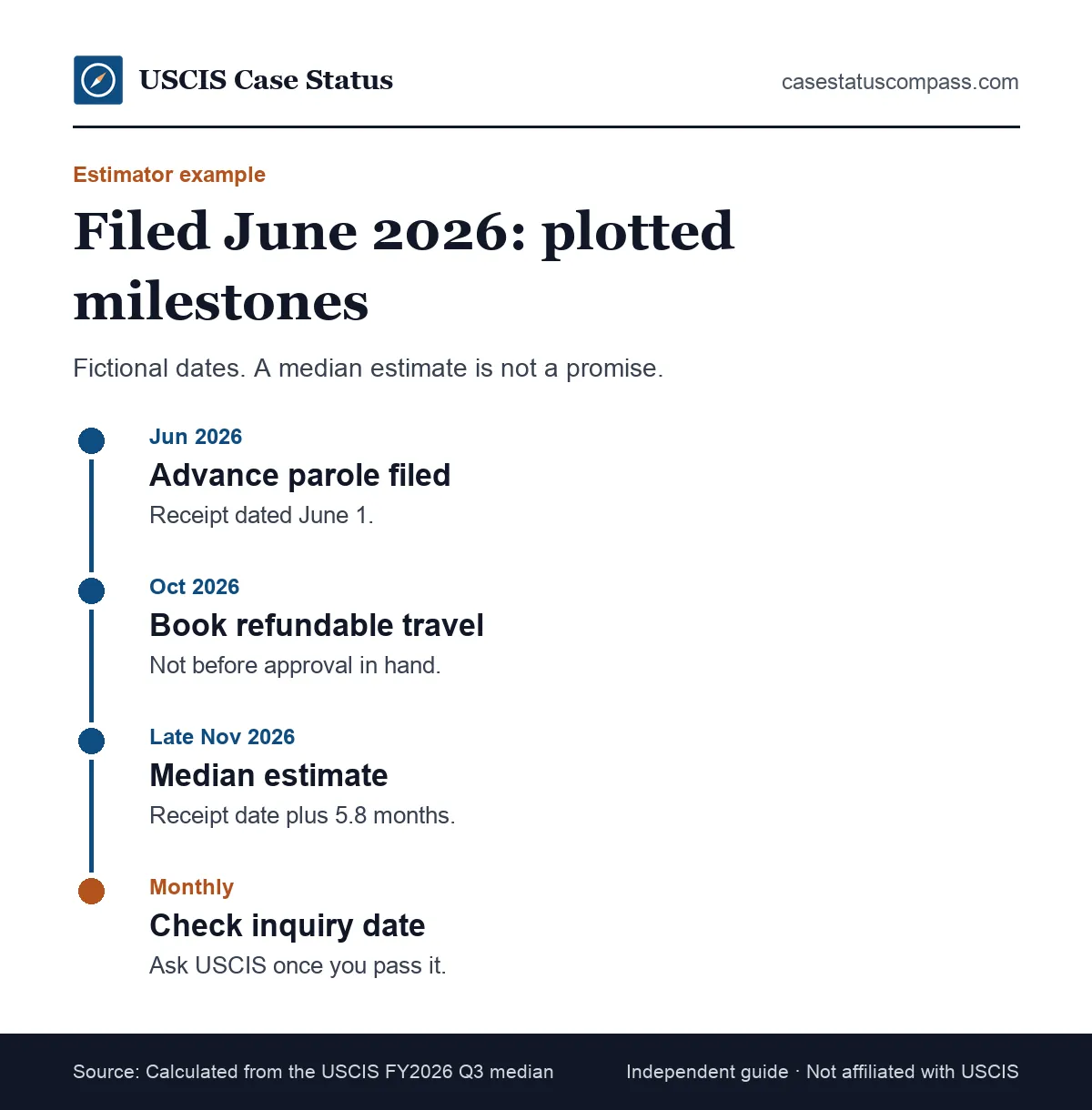
You can map an I-131 plan with just your receipt date and your category's median. Add 5.8 months for advance parole or 14.4 months for a reentry permit or refugee travel document. Then add a buffer for mailing, and recheck the tool's inquiry date monthly.
Using the estimator
- Copy the receipt date printed on your I-797C.
- Pick your category's median: 5.8 or 14.4 months.
- Add it to the receipt date.
- Add about a month of buffer for delivery.
- Check the inquiry date in the tool monthly.
Sample calculation for a made-up applicant
The table walks one invented applicant, Sam, through each date from receipt to a safe booking month.
| Date to find | Formula | Sam's sample (advance parole) |
|---|---|---|
| Receipt date | From your I-797C | June 1, 2026 |
| Median-based estimate | Receipt date + 5.8 months | Late November 2026 |
| Buffered plan date | Estimate + about 1 month | Late December 2026 |
| Earliest firm booking | After approval is in hand | When document arrives |
Swap in your own receipt date; the formula stays the same.
The same math for a reentry permit
For a reentry permit, add 14.4 months instead. A June 1, 2026 receipt date gives a median-based estimate of about mid-August 2027, before any buffer for delivery abroad. Add consular pickup time.
How Long After Biometrics Is Advance Parole Approved?
USCIS sets no standard interval between the fingerprint visit and an advance parole decision. The ASC visit tends to come in the first weeks, and the bulk of the months pass afterward. Several quiet months after fingerprints are common. That gap is normal.
Biometrics reuse
USCIS may reuse prints from an earlier filing. A reuse notice means USCIS will rely on earlier prints; your queue position stays the same. Our biometrics appointment guide describes the ASC visit.
Missing the appointment
Missing biometrics can lead to denial for abandonment. Reschedule biometrics online at least 12 hours before, with good cause, or call the Contact Center. A rescheduled date pushes the whole timeline back.
What Slows Down an I-131?
The main things that slow a Form I-131 are office backlog, wrong category or address, missing photos or fee, requests for evidence, missed biometrics and background checks. Getting the package right on the first try prevents most self-inflicted delays. Check each item.
What is in your hands
- Right category and correct form edition (01/20/25)
- Correct fee: $630 (paper) / $580 (online); $0 if your I-485 was filed before Apr. 1, 2024 with the fee. H.R. 1 Immigration Parole Fee $1,050 when parole is granted (some exceptions)
- Required photos and ID copies
- A current mailing address
Factors you cannot control
Officer staffing, new policies and the overall backlog are not yours to fix. Security checks may pause a request silently. In those cases, refiling only wastes a fee; track the inquiry date.
Does a Request for Evidence Delay Travel Permission?
Yes. An RFE on Form I-131 stops progress until USCIS has your answer, so a planned trip can slip. Reply fully and early to keep the delay short. The RFE names exactly what is missing and the date by which USCIS must receive it. If your trip date is fixed, mention it in a cover letter, but do not expect the deadline to change.
Common I-131 RFE topics
Common requests ask for missing photos, ID, proof of the pending case or reasons for travel. Sending all of these with the first filing is the simplest way to avoid an RFE.
Your response window
RFE deadline: up to 12 weeks (the exact date is on your RFE); no extensions. Exceptions: RFEs for Form I-539 and Form I-601A allow at most 30 days (all other forms up to 84 days), plus 3 days if mailed. Our Request for Evidence guide explains how to build one complete reply.
Once USCIS has your reply
A decision can follow within weeks, or the request may queue again. Ship with tracking and save the delivery confirmation. Watch your account for a "response received" update, and recheck the inquiry date before you contact USCIS.
Is There Premium Processing for Form I-131?
No. Travel documents cannot be upgraded with the paid 15-business-day style service. That option is limited to a short list of work and student filings. For speed, rely on an expedite request or, in a real crisis, emergency advance parole.
Forms that do qualify
Premium processing covers I-129 work visas, I-140 (EB-1/2/3), I-765 OPT/STEM OPT and I-539 to F/M/J. Our premium processing guide covers those filings. Form I-131 is not among them, so no I-907 can be paired with it.
Beware of "fast track" offers
No fee or service moves an I-131 ahead in line. Anyone selling guaranteed speed for a travel document is not telling the truth. Report such offers to the FTC right away.
Urgent Travel: Expedite Options
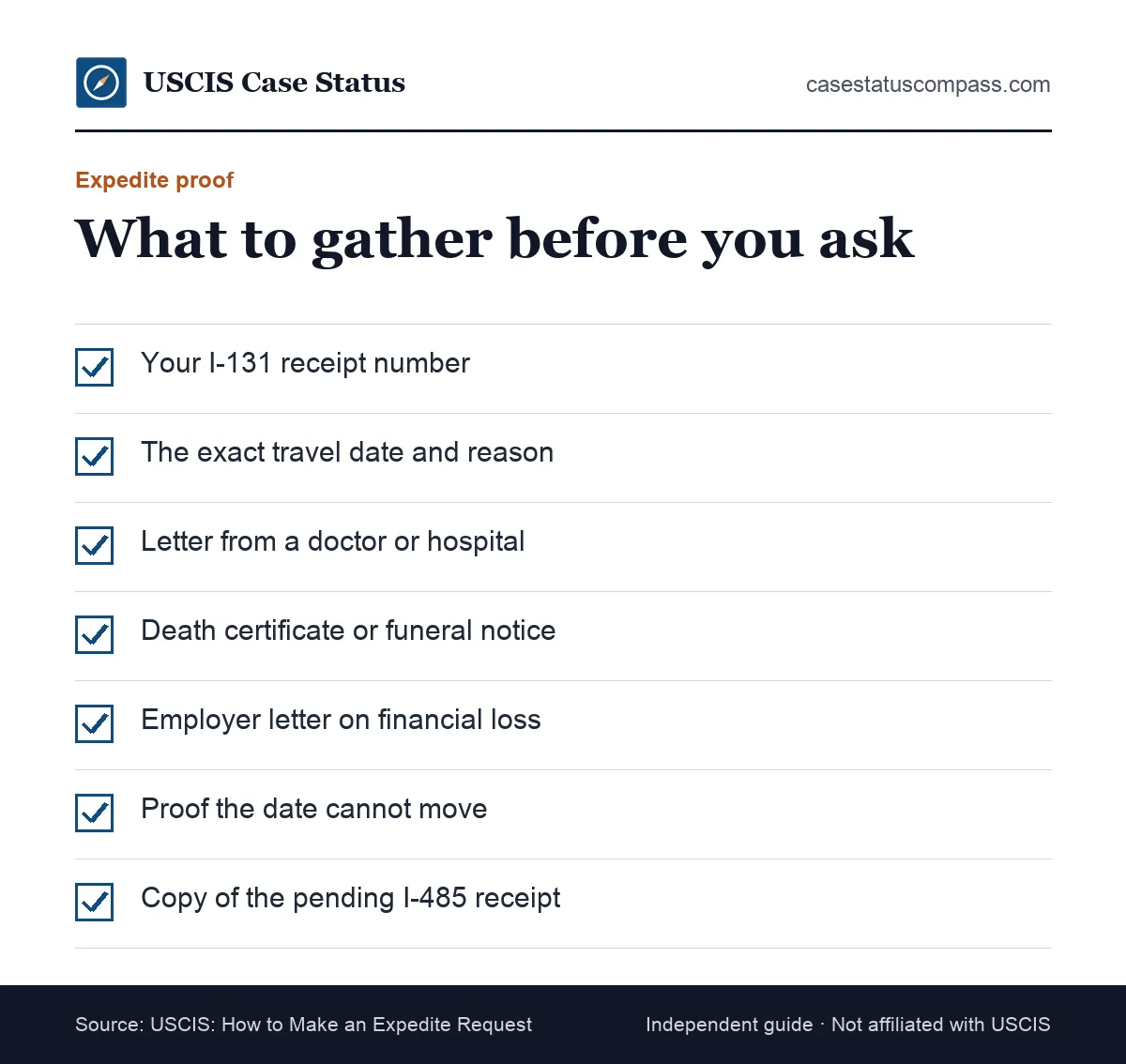
If you must travel before your I-131 is decided, you can ask USCIS to expedite it. USCIS considers urgent reasons such as a medical emergency, a death, severe financial loss or a clear USCIS error. Approval is discretionary and depends on the proof you send.
What USCIS counts as urgent
Expedite criteria: severe financial loss, emergency/humanitarian, nonprofit, government interest, clear USCIS error. Strong requests tie the reason to a specific date that cannot move. On timing, for a travel document, request an expedite at least 45 days before leaving; for travel within 15 days, use USCIS emergency travel.
Making the request
Ask for an expedite through the USCIS Contact Center or your online account. Include your receipt number, the travel date and proof. Our uscis expedite request guide walks through each step.
Which Urgent Travel Option Fits Your Deadline?
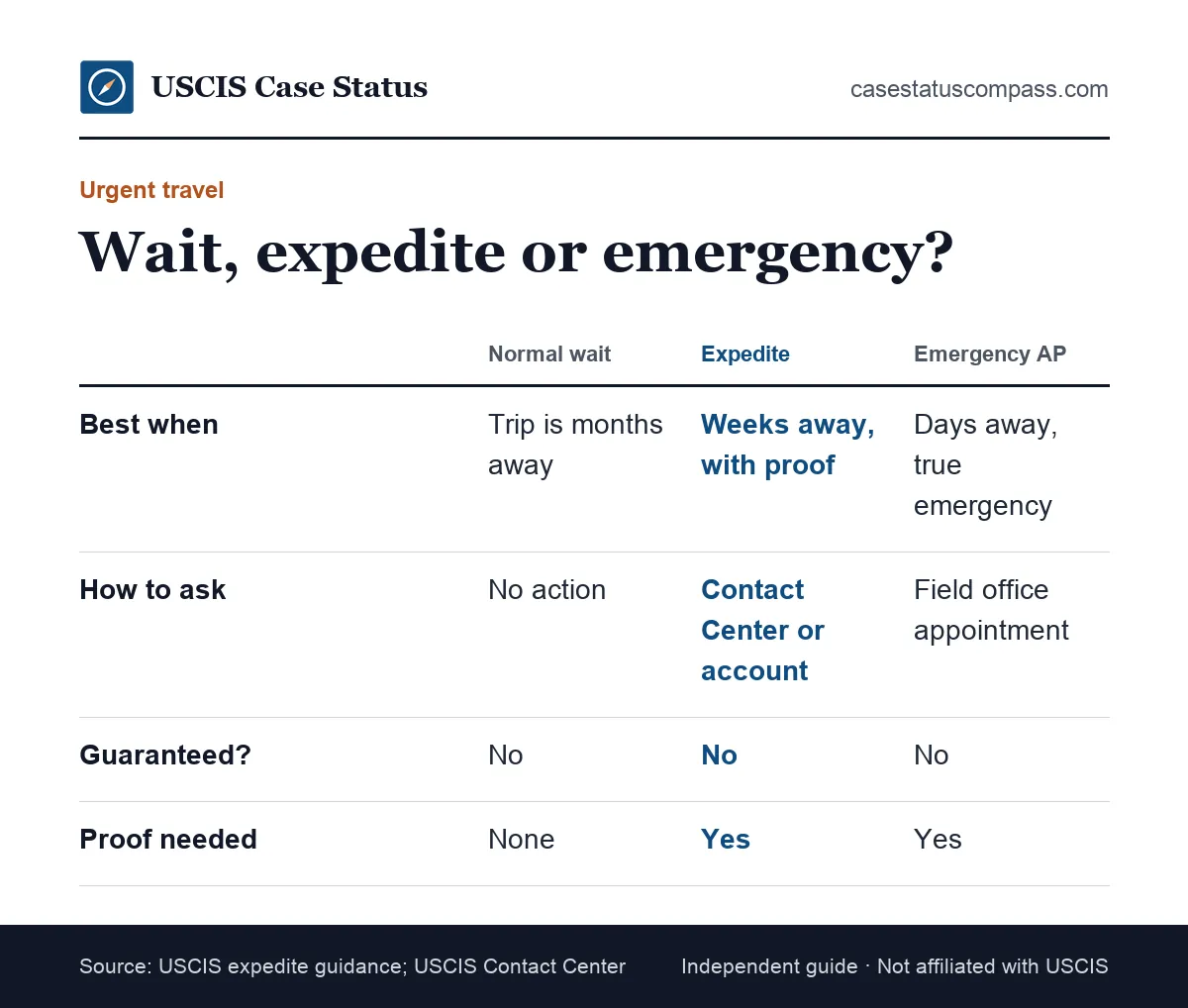
Your best option depends on how soon you must leave and how strong your proof is. If the trip is months away, wait. If it is weeks away with proof, request an expedite. If it is days away and a true emergency, ask for emergency advance parole.
Options compared
The rows run from the slowest to the fastest route, with the proof each one needs.
| Option | Best when | How to ask | Speed |
|---|---|---|---|
| Normal processing | Trip is months away | No action needed | Median 5.8 months (AP) |
| Expedite request | Weeks away, strong proof | Contact Center or online account | Faster if granted; not guaranteed |
| Emergency advance parole | Days away, true emergency | Field office appointment | Can be very fast if granted |
The faster the route, the stronger the proof of urgency USCIS expects.
How Fast Is Emergency Advance Parole?
Emergency advance parole has no published processing time. Request an in-person appointment online at my.uscis.gov/en/appointment/v2 or call 800-375-5283. A field office may issue a document quickly in a true emergency, but it is discretionary and depends on your proof. Our advance parole guide explains what to bring.
What Happens If You Travel Before Advance Parole Is Approved?
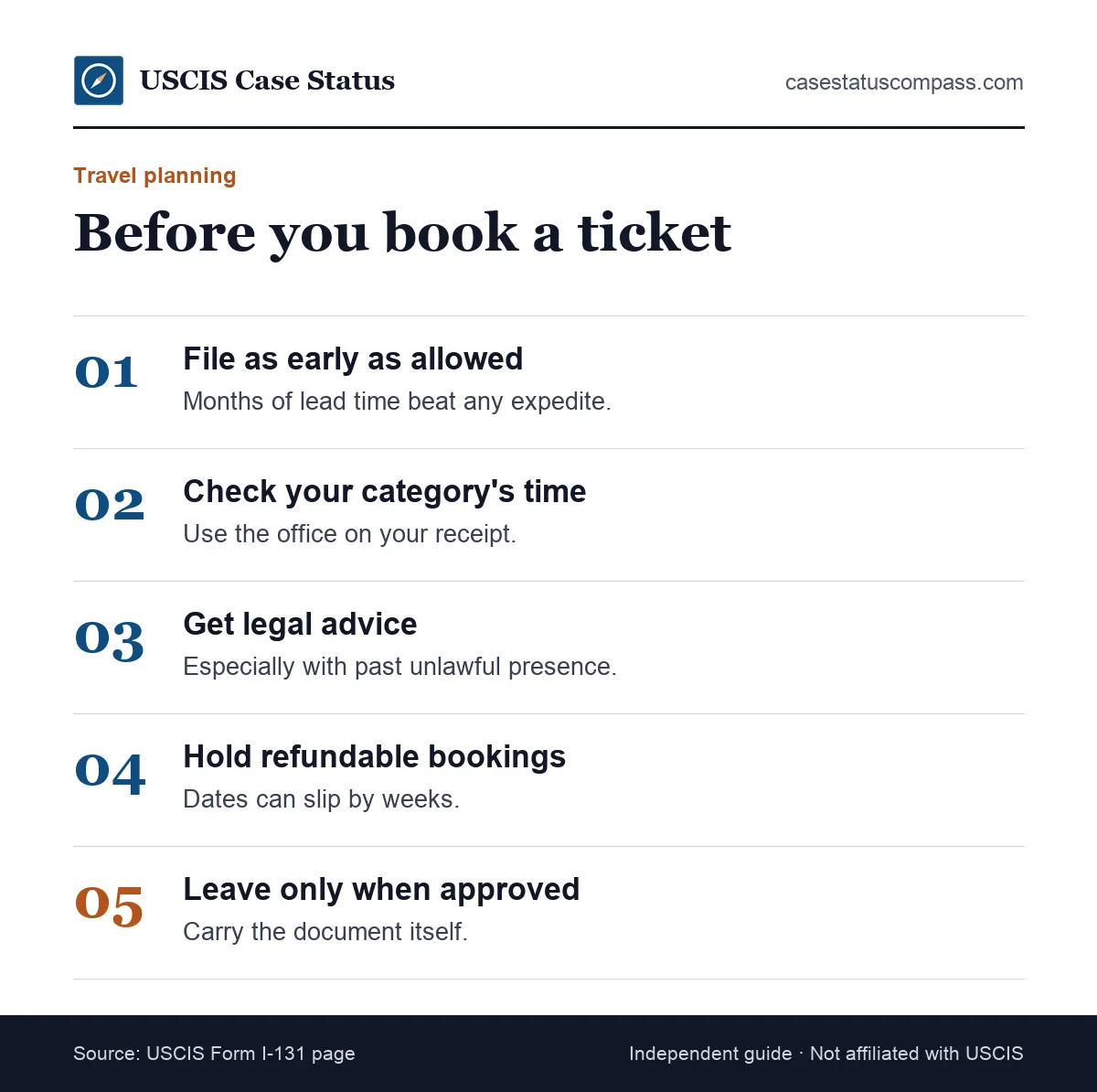
If you leave the U.S. before advance parole is approved, you usually abandon your pending green card application. A pending I-131 does not let you travel. Wait for the approved document, then carry it with you when you leave and return.
The abandonment rule
Traveling while your I-485 is pending abandons it unless you have advance parole (with H/L/V/K exceptions). Leaving also typically abandons the pending I-131 itself. You would then have to file again and pay again.
Carrying the approved document
Take the original advance parole document or combo card on the trip and show it when you return. A pending receipt notice is not a substitute for the approved document.
Read the travel guide first
Our guide on travel with a pending I-485 explains the risks in full. It covers what to carry, what a border officer may ask and when an approved parole document still is not enough. Read it before you book.
What Changed for Advance Parole Travel in August 2026?
A Board of Immigration Appeals decision, Matter of Delcarmen-Lara, changed how advance parole travel is treated. Since August 13, 2026, travel on advance parole counts as a departure, which can matter for people with past unlawful presence. Get legal advice before you travel.
The rule in USCIS's terms
Since Aug. 13, 2026, travel on advance parole counts as a departure: over 180 days of unlawful presence can trigger the 3/10-year bar. This applies even with a valid parole document in hand. The Form I-131 travel document guide covers the details.
Why it matters for timing
A faster approval does not make travel safe if this rule applies to you. Have an immigration attorney review your history before you book, not after the document arrives. Timing alone cannot fix it.
How Do You Know If Your I-131 Is Overdue?
A travel document request counts as late only once the tool's inquiry date for your category and office is later than your receipt date. Until then, USCIS considers your I-131 processing time ordinary, however close your trip is. A trip date does not change this.
Reading the inquiry date for Form I-131
USCIS explains the date this way: Case inquiry date: the earliest date USCIS will accept a question about your pending case; it can change. Hold it against the I-797C receipt date, and look again each month.
Before your case qualifies
USCIS usually closes an early delay inquiry without action. If your trip cannot wait, use an expedite request instead. Until then, keep your address current and answer any notice quickly.
What to Do When Your I-131 Is Outside Normal Processing Time
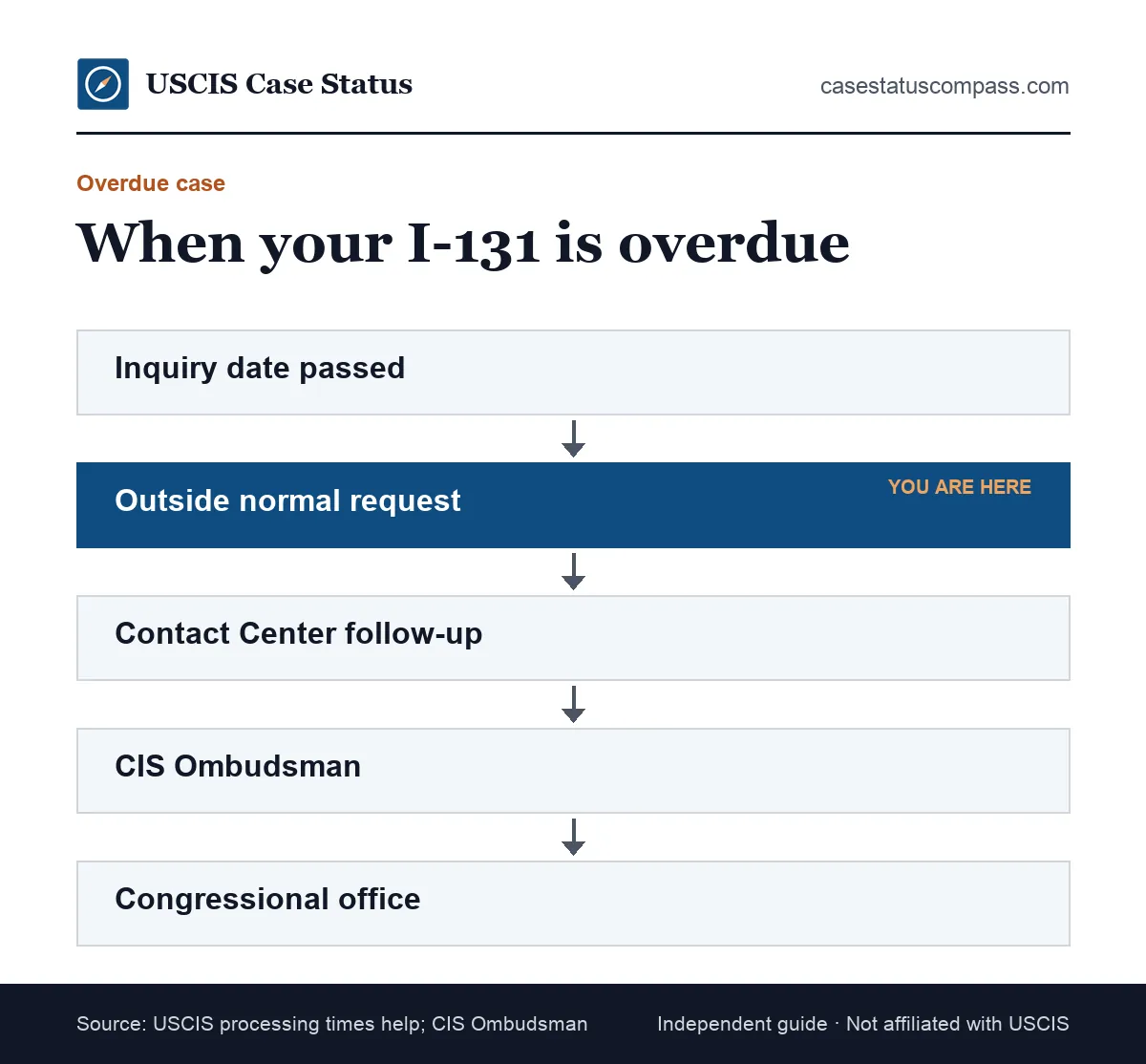
Once the inquiry date passes your receipt date, file a single delay inquiry with USCIS, wait for its answer, and phone the Contact Center if weeks pass in silence. Keep a written log. Outside help comes later. Send only one inquiry at a time.
Order of actions
- Double-check both dates.
- Send one delay inquiry online.
- Keep the confirmation page.
- No answer? Phone 800-375-5283.
- Write down each agent's name and reference number.
- Wait for the reply before escalating.
Limits of an inquiry
A delay inquiry can push a forgotten file back onto a desk. It never guarantees approval. Our case status not updating guide covers frozen statuses. Save each reply in your log.
When Can You Take an I-131 Delay to the Ombudsman or Congress?
Outside help makes sense after USCIS itself has had a fair chance. The DHS case-assistance office expects proof of earlier contact. A House or Senate caseworker can step in once you sign their release form. Use one route at a time.
The CIS Ombudsman for travel documents
Requests go through DHS Form 7001. Use the Ombudsman only after contacting USCIS within 90 days and waiting at least 60 days. The Ombudsman reviews the file and asks USCIS to act, but it cannot approve or issue a travel document itself.
What to include in the request
Give your receipt number, the dates you contacted USCIS, any reference numbers and your travel deadline. Proof of a fixed trip date shows why the delay matters. Attach copies, not originals.
Help from a congressional caseworker
Your representative's or senator's office can write to USCIS for you after you sign a privacy release. This often helps when a trip date is fixed. See our Ombudsman and congressional inquiry guide.
How Do You Track an I-131 Case?
Use the public status page or your USCIS account to follow a travel document request. Accounts can show a myProgress estimate for Form I-131. Looking once every few weeks is enough, because review often shows no change. Daily checks add nothing.
Public lookup and account view
Type your receipt number into Case Status Online: egov.uscis.gov. Your free account also stores digital notices, which can reach you before paper mail does. Link a paper case with its account access code.
myProgress estimates
myProgress: personalized estimates in your USCIS online account (I-130, I-485, I-765, I-131, I-821, N-400, I-90). A myProgress estimate is a guide, not a promise. Compare it with the tool's office figure.
How Long Does Each I-131 Status Stage Last?
Most I-131 cases spend weeks in intake and biometrics, then most of their time in review with no status change. Approval is followed by production and mailing. A long, quiet middle stage is normal and does not mean the file is lost.
Intake and biometrics weeks
The first weeks bring the receipt notice and usually a biometrics appointment or reuse notice. Those early updates come quickly; the long wait begins after fingerprints. Save every notice in one folder.
The quiet middle
After biometrics, statuses often stay the same for months. Confirm your address and compare dates before you worry. A frozen status is not a sign of trouble; officers simply have not reached the file yet.
Updates that signal movement
An RFE, approval or production update means an officer acted. For the meaning of each message, see our guide to Case Is Being Actively Reviewed. Note the date of each update.
How Long After Approval Does the Travel Document Arrive?
After approval, USCIS produces the document and mails it, usually a short step compared with review. Advance parole may come as an I-512L paper document or a combo card. A reentry permit can be sent to your U.S. address or to a U.S. embassy or consulate.
Watching for delivery
Watch your account for the mailing update. If you move, tell USCIS within 10 days so the document follows you. Update your address online in your USCIS account (E-COA); a mailed AR-11 also counts. Mail tracking may appear once the document ships.
If the document is returned to USCIS
Contact USCIS quickly. Our Card Was Returned to USCIS guide explains next steps. For green cards, USCIS says: Returned green cards are held 60 business days (about 12 weeks), then re-mailed or destroyed. Confirm your address first, because a returned document usually means the mailing address was wrong or incomplete.
Does Filing Online Change the I-131 Wait?
USCIS has published nothing showing that e-filing a travel document request speeds the decision. Where e-filing is open, it brings a same-day receipt and a cheaper fee, but officers work the same line. Reentry permits stay paper-only, so their I-131 processing time includes mail transit.
Benefits of e-filing
An IOE receipt comes at once, uploads replace photocopies, and notices appear in your account. Fees: $630 (paper) / $580 (online); $0 if your I-485 was filed before Apr. 1, 2024 with the fee. H.R. 1 Immigration Parole Fee $1,050 when parole is granted (some exceptions). Note that advance parole and TPS travel can often be filed online, but reentry permits and refugee travel documents are paper-only.
What it does not change
Officers pull e-filed and paper requests from one backlog. The real gain is avoiding a rejection for a paperwork slip. Online forms flag missing answers before you submit, and there is no mail transit time.
Did the October 2026 Address Change Affect I-131 Timing?
USCIS changed mailing addresses for Form I-131 and other forms on October 7, 2026. Old addresses are accepted for packages postmarked by November 9, 2026. A package sent to a wrong address after that can be rejected, which restarts the I-131 processing time from a new receipt date.
The address rule
New USCIS mailing addresses from Oct. 7, 2026; old addresses accepted if postmarked by Nov. 9, 2026. Check the current address on the official form page the day you mail.
Why a rejection costs months
A rejected package gets no receipt date. Your place in line starts only when a correct package arrives. Fix the error, use the current address and refile right away.
How Does the I-131 Wait Compare With Other USCIS Forms?
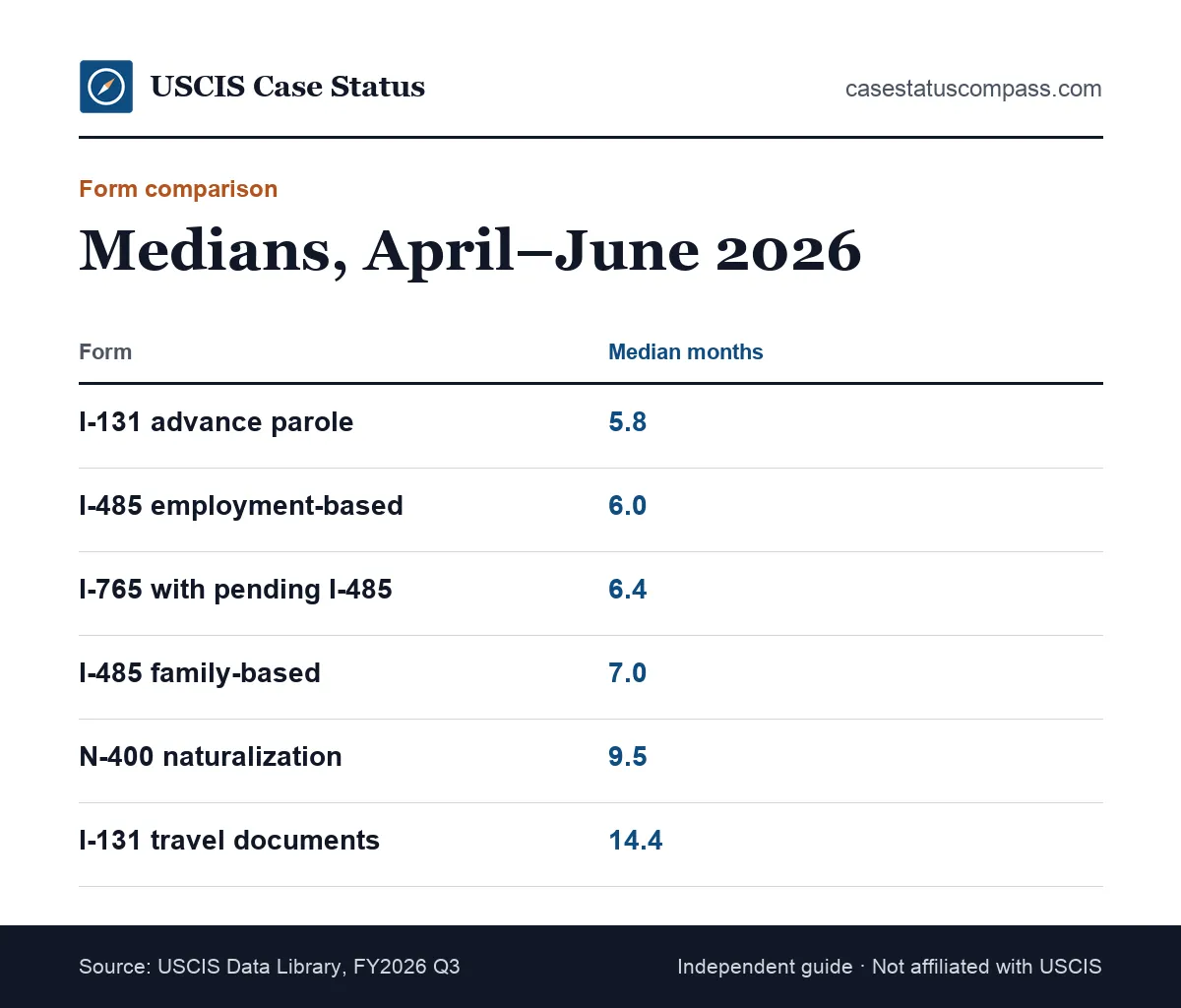
Advance parole is one of the shorter waits in a pending green card case. Its 5.8-month median for April–June 2026 was close to the I-485 and I-765 medians. Reentry permits and refugee travel documents, at 14.4 months, take much longer.
Travel-related medians
These are the national medians for the forms that usually travel together in a green card case.
| Form | Median, Apr.–June 2026 |
|---|---|
| I-131 advance parole | I-131 advance parole (inside the U.S.): median 5.8 months (USCIS data, Apr.-June 2026) |
| I-131 travel documents | I-131 travel documents (reentry permit/refugee travel document line): median 14.4 months (USCIS data, Apr.-June 2026) |
| I-765 with pending I-485 | I-765 (based on pending I-485): median 6.4 months (USCIS data, Apr.-June 2026) |
| I-485 employment-based | I-485 (employment): median 6.0 months (USCIS data, Apr.-June 2026) |
Advance parole sits near the middle, so it rarely holds up the rest.
Related waits
For the citizenship step later, see how long does naturalization take. For employer-based cases, our PERM processing time page covers the labor certification wait. Each form keeps its own clock.
How Has the Advance Parole Wait Changed Since 2023?
The advance parole median looks stable. A USCIS factsheet with data as of March 5, 2024 listed a fiscal year 2023 median of 5.8 months. The April–June 2026 median was also 5.8 months. Office-level times can still swing. Check yours.
The 2023 figure
Historical medians (USCIS factsheet, data as of Mar. 5, 2024): FY2023 N-400 6.1 mo; I-130 IR 11.8 mo; I-485 family 11.4 / employment 8.6 mo; I-765 (pending I-485) 5.5 mo; I-131 AP 5.8 mo; I-90 9.16 mo. That factsheet is dated; use it only for trend.
What stayed and what changed
Other forms slowed sharply in the same period. Advance parole held steady at the median, but your office can still be slower. A steady national figure is no promise that your own I-131 processing time will match it.
How Far Ahead Should You Apply for Advance Parole?
Apply as early as your case allows, ideally with your I-485 or at least six months before any planned trip. The 5.8-month median means half of cases took longer, so a longer lead time protects you. Book only refundable travel until the document arrives.
A practical lead time
For advance parole, plan six to nine months ahead. For a reentry permit, plan well over a year, given the 14.4-month median. Earlier is always safer than a rushed, late filing.
Avoid gaps between documents
File a renewal well before your current parole document expires. A pending renewal does not let you travel on an expired document. Mark the expiry date and count back at least six months.
Travel Planning Scenarios
The people below are invented, but their choices are typical. Each one shows a different document and a different way to handle the wait: filing early with an I-485, timing a reentry permit around biometrics, using an emergency route, and renewing a refugee travel document. Compare your own dates before borrowing any plan.
Lena: filed with her I-485
Lena filed her I-485, I-765 and I-131 together. Her combo card arrived about six months later. She booked a trip only after it arrived. She also checked her history with an attorney.
Marco: a reentry permit for a work posting
Marco, a green card holder, accepted a two-year posting abroad. He filed his reentry permit, attended biometrics, and asked for delivery to a U.S. consulate. He then left on schedule.
Aisha: a parent's sudden illness
Aisha's I-131 was pending when her father became ill. She booked an emergency field office appointment with a doctor's letter. She also asked an attorney about her travel history first.
Daniel: a refugee travel document renewal
Daniel, an asylee, filed his renewal five months before his document expired. With a 14.4-month median, he cancelled a planned trip rather than risk traveling without valid papers. He now files earlier.
If X, Do Y: I-131 Wait Decision Table
Find your row and act on it. Three things drive the choice: how soon you must leave, where your receipt date sits against the inquiry date, and whether you can prove urgency. If two rows fit, follow the one with the earlier deadline.
Travel-wait choices
Find the row that matches your situation today and take the move beside it.
| Situation | Next move |
|---|---|
| Trip is months away | File now; check the tool monthly |
| Trip in weeks, strong proof | Request an expedite |
| True emergency, days away | Request emergency advance parole |
| Inquiry date has passed your receipt date | Send one delay inquiry |
| A month of silence after that | Phone the Contact Center |
| Still stuck two months after contacting USCIS | Open a DHS Form 7001 case |
| Past unlawful presence | Get legal advice before any travel |
| Document expiring soon | File a renewal now |
When in doubt, do not travel until the document is in hand.
When the table does not fit
If a NOID, denial or arrest enters the picture, stop planning trips and talk to an attorney or DOJ-accredited representative. Each of these can change whether travel is safe at all.
What Mistakes Make the I-131 Take Longer?
The costliest errors are picking the wrong category, mailing to an old address, sending the wrong fee, missing biometrics and filing too close to a trip. Each creates a new step or a rejection. Most are easy to avoid with a checklist.
Filing mistakes
- Wrong category or old edition
- Wrong fee or missing photos
- Old mailing address after November 9, 2026
- Photos that do not meet USCIS specifications
- Missing copy of the notice for the pending case
Planning mistakes
Booking nonrefundable flights before approval and filing renewals late are common. Leaving the country while the request is pending can end both the I-131 and the I-485. Plan renewals early.
When Should You Get Legal Help Before Travel?
Get legal help before travel if you have past unlawful presence, a removal history, a criminal record, or a pending case with problems. A qualified lawyer or accredited representative can weigh both risk and timing before any ticket is bought.
Red flags
- Any time in the U.S. without status
- Past removal or deportation orders
- Arrests or charges
- A pending NOID or denial
- Past fraud or misrepresentation findings
- Plans to visit the country you fled
Choosing an adviser
Use a licensed immigration attorney or accredited representative. Avoid anyone promising faster processing.
Frequently Asked Questions
How long should I plan for advance parole?
Advance parole requests completed April–June 2026 had a 5.8-month median, which means planning for six months or longer is sensible. Offices vary. Look up your category and office in the official tool, and hold off on firm bookings until the document arrives.
Can I expedite advance parole?
Yes, you can ask, but USCIS decides each request at its discretion. Reasons such as a medical emergency, a death, or severe financial loss help when you include proof. Phone the Contact Center or use your online account, giving your receipt number and travel date.
How long does a reentry permit take?
Reentry permits share a USCIS line with refugee travel documents. Its median for April–June 2026 was 14.4 months. You must be in the U.S. to file and attend biometrics, so start well over a year before a long stay abroad if you can.
Can I travel while my I-131 is pending?
Usually not if you have a pending I-485. Leaving before advance parole is approved generally abandons the green card application. Wait for the approved document and carry it. Get legal advice first if you have past unlawful presence.
Why is my I-131 taking longer than the median?
By definition, one in two requests runs past the median. Evidence requests, missed fingerprint visits, security checks, address problems and local backlogs all add months. Once the tool's inquiry date passes your receipt date, you may send a delay inquiry.
Does a combo card take longer than an I-512L?
There is no separate official median for each format. Both come from the advance parole request, and a combo card depends on the work permit decision too. Check the tool for both your I-765 and I-131 categories.
Can I check my I-131 processing time with my receipt number?
Yes. Case Status Online shows the latest status for the receipt number. To check your I-131 processing time, enter the receipt date in the official tool under your category and office to see your inquiry date.
What is the advance parole timeline from filing to travel?
Plan on the receipt in a few weeks, biometrics soon after, then most of the 5.8-month median in review. Delivery follows approval. Book firm travel only once the document is in hand.
Sources
- USCIS Check Case Processing Times. egov.uscis.gov/processing-times/. Accessed Oct 27, 2026.
- USCIS Immigration and Citizenship Data (Data Library). www.uscis.gov/tools/reports-and-studies/immigration-and-citizenship-data. Accessed Oct 27, 2026.
- USCIS: I-131, Application for Travel Documents, Parole Documents, and Arrival/Departure Records. www.uscis.gov/i-131. Accessed Oct 27, 2026.
- USCIS Historical Processing Times Factsheet (data as of Mar. 5, 2024). www.uscis.gov/sites/default/files/document/fact-sheets/historical_pt_factsheet_fy16_to_fy24.pdf. Accessed Oct 27, 2026.
- USCIS: How to Make an Expedite Request. www.uscis.gov/forms/filing-guidance/how-to-make-an-expedite-request. Accessed Oct 27, 2026.
- CIS Ombudsman: Request for Case Assistance. www.dhs.gov/cisombudsman. Accessed Oct 27, 2026.
- USCIS Contact Center. www.uscis.gov/contactcenter. Accessed Oct 27, 2026.
- USCIS Data Library: All USCIS Application and Petition Form Types, FY2026 Q3 (Apr. 1-June 30, 2026; queried 7/2026). www.uscis.gov/sites/default/files/document/data/quarterly_all_forms_fy2026_q3_v1.xlsx. Accessed Oct 27, 2026.
- Form I-131 Instructions, Edition 01/20/25; 8 CFR 223.3(a)(1). www.uscis.gov/sites/default/files/document/forms/i-131instr.pdf. Accessed Oct 27, 2026.
- 8 CFR 223.3(c) (govinfo, CFR 2025 edition). www.govinfo.gov/content/pkg/CFR-2025-title8-vol1/xml/CFR-2025-title8-vol1-sec223-3.xml. Accessed Oct 27, 2026.
- CIS Ombudsman tip sheet: Check Your USCIS Case Inquiry Date (Aug. 2024). dhs.gov/sites/default/files/2024-11/24_0823_cisomb_case-inquiry-date-tip-sheet.pdf. Accessed Oct 27, 2026.
- USCIS: International Travel as a Permanent Resident (updated 09/12/2025). www.uscis.gov/green-card/after-we-grant-your-green-card/international-travel-as-a-permanent-resident. Accessed Oct 27, 2026.
- USCIS Policy Manual Vol. 12, Part D, Ch. 3. www.uscis.gov/policy-manual/volume-12-part-d-chapter-3. Accessed Oct 27, 2026.
- USCIS: Preparing for Your Biometric Services Appointment (updated 04/30/2026). www.uscis.gov/forms/filing-guidance/preparing-for-your-biometric-services-appointment. Accessed Oct 27, 2026.
- USCIS Form G-1055 Fee Schedule, Edition 10/16/26 (Appendix B). www.uscis.gov/sites/default/files/document/forms/g-1055.pdf. Accessed Oct 27, 2026.
- 8 CFR 103.2(b)(8)(iv) (LII). www.law.cornell.edu/cfr/text/8/103.2. Accessed Oct 27, 2026.
- USCIS Policy Manual Vol. 1, Part E, Ch. 6 (current as of Oct. 23, 2026). www.uscis.gov/policy-manual/volume-1-part-e-chapter-6. Accessed Oct 27, 2026.
- USCIS: How Do I Request Premium Processing? (updated 03/23/2026). www.uscis.gov/forms/all-forms/how-do-i-request-premium-processing. Accessed Oct 27, 2026.
- Form I-485 Instructions, Edition 09/18/26. www.uscis.gov/sites/default/files/document/forms/i-485instr.pdf. Accessed Oct 27, 2026.
- DHS CIS Ombudsman: How to Submit a Case Assistance Request (updated 04/13/2026). www.dhs.gov/case-assistance. Accessed Oct 27, 2026.
- USCIS: Checking Your Case Status Online. www.uscis.gov/tools/checking-your-case-status-online. Accessed Oct 27, 2026.
- USCIS alert: USCIS Expands myProgress to Form I-485 and Form I-821 (Nov. 21, 2023). www.uscis.gov/newsroom/alerts/uscis-expands-myprogress-to-form-i-485-and-form-i-821. Accessed Oct 27, 2026.
- USCIS: How to Change Your Address (updated 08/04/2026). www.uscis.gov/addresschange. Accessed Oct 27, 2026.
- USCIS Policy Manual Vol. 11, Part A, Ch. 3. www.uscis.gov/policy-manual/volume-11-part-a-chapter-3. Accessed Oct 27, 2026.
- USCIS: Filing Locations and Online Filing Options Updates. www.uscis.gov/forms/us-citizenship-and-immigration-services-filing-locations-and-online-filing-options-updates. Accessed Oct 27, 2026.
casestatuscompass.com is an independent publication and is not affiliated with USCIS or any government agency. This page is general information, not legal advice. For denials, court or asylum matters, consult an immigration attorney or a DOJ-accredited representative.