Contents · 38 sections
- What Is the Current PERM Processing Time?
- Current PERM Processing Times Table
- What Is PERM Labor Certification, and Why Does It Take Months?
- How Long Does PERM Processing Take From Start to Finish?
- What Are the Stages of the PERM Process?
- Prevailing Wage Determination (PWD) Processing Time
- How Do You Read the PWD Queue on FLAG?
- What Slows a Prevailing Wage Request?
- How Long Does PERM Recruitment Take?
- Why Recruitment Timing Can Reset the Clock
- Filing Form ETA-9089: When the DOL Clock Starts
- What Is Analyst Review and How Long Does It Take?
- How Does a PERM Audit Change the Timeline?
- What Triggers a PERM Audit?
- What Is Supervised Recruitment?
- What If DOL Denies the PERM?
- How Do You Read DOL Processing Times on FLAG?
- What Does "PERM Timeline Is Under Maintenance" Mean?
- Does FLAG Maintenance Delay a PERM Case?
- How Many PERM Cases Are Pending at DOL?
- PERM Timeline Estimator: Plot Your Own Milestones
- LCA Processing Time for H-1B Workers
- Does LCA Approval Time Affect Your PERM Wait?
- PERM vs LCA vs PWD: Which Clock Are You Watching?
- Is There Premium Processing for PERM?
- What Happens After PERM Is Certified?
- How Long Does the I-140 Take After PERM?
- How Does PERM Affect Your Green Card Timeline?
- PERM Timing for H-1B Workers
- Why Do PERM Timelines Change?
- Does USCIS Publish PERM Processing Times?
- What Can You Do If Your PERM Is Taking Too Long?
- Can Changing Jobs Restart Your PERM Timeline?
- What Mistakes Add Months to a PERM Case?
- Where Do You Find PERM Processing Times News Today?
- Worked Examples: Three PERM Timelines
- When Should You Ask an Immigration Attorney About PERM Timing?
- Frequently Asked Questions
The short answer
PERM processing time is the time the U.S. Department of Labor (DOL) takes to review a labor certification after the employer files Form ETA-9089. DOL posts the filing month each queue has reached at flag.dol.gov. The whole PERM process also includes the prevailing wage and recruitment stages before filing.
At a glance
| Who decides PERM | U.S. Department of Labor, not USCIS |
| Official times page | flag.dol.gov/processingtimes |
| Pending at DOL | 147,884 PERM applications pending at DOL (Mar. 31, 2026) |
| After certification | A PERM labor certification expires 180 days after DOL certifies it |
| Premium processing | Not offered by DOL for PERM |
What Is the Current PERM Processing Time?
The current PERM processing time is whatever DOL shows this month on its FLAG processing times page, split into prevailing wage, analyst review and audit queues. Right now, DOL analyst review is working on PERM cases filed in January 2026 (as of Oct. 5, 2026), and PERM analyst review took an average of 336 calendar days in August 2026.
Source: DOL FLAG, retrieved October 27, 2026
FLAG, the Foreign Labor Application Gateway, is DOL's filing and status system. Its processing times page is the only official source for PERM queues. The figures on this page come from that page as retrieved on October 27, 2026. DOL refreshes them after the first work week of each month.
Why we print only DOL's numbers
Law firm blogs and trackers quote PERM wait time day counts that differ from one another and change monthly. A wrong number can push an employer to miss a deadline or a worker to give up a job. We print only DOL's own figures, with their date, and explain how to read them.
Current PERM Processing Times Table
The table below shows DOL's PERM average imported from flag.dol.gov, with the retrieval date. Queue months: analyst review is on January 2026 filings, audit review on December 2025 filings, and reconsideration on May 2026 requests.
| Category | Office | Processing time |
|---|---|---|
| Analyst review (average, August 2026) | — | 336 days |
What each DOL queue on FLAG means
Each row names one DOL queue on FLAG and tells you which PERM stage it tracks, so you can pick the right line.
| DOL queue | What DOL shows | What it tells you |
|---|---|---|
| Prevailing wage (PWD) | Month of requests now being processed | How long before recruitment can begin |
| PERM analyst review | Month of ETA-9089 filings now being reviewed | The main current PERM processing time |
| PERM audit review | Month of audited cases now being reviewed | Extra time if DOL audited the case |
| Reconsideration | Month of reconsideration requests being reviewed | Time to hear back after a denial |
How to read the DOL figures
DOL usually shows a receipt month plus, for some queues, an average number of days. A month means DOL is working on cases filed that month. If your filing month is earlier than the one shown, your case should already be in review.
What Is PERM Labor Certification, and Why Does It Take Months?
PERM labor certification is DOL's approval that no qualified U.S. worker was available for a permanent job and that hiring a foreign worker will not hurt U.S. wages.
It takes months because DOL reviews the wage, the recruitment and the form in separate steps, and each step has its own queue of employers ahead of yours.
Who files and who waits
The employer files PERM, not the worker. The worker is the beneficiary and usually cannot see the FLAG account. Our perm case status guide explains how employers check progress.
Ask HR or the employer's attorney for updates on the case.
Where PERM fits in the bigger picture
PERM is a Department of Labor process. USCIS steps in only after certification, when the employer files Form I-140. Our USCIS processing times hub shows how the DOL step joins the USCIS forms.
How Long Does PERM Processing Take From Start to Finish?
PERM processing takes the sum of three stages: the prevailing wage request, recruitment, and DOL's review of Form ETA-9089. Two of those stages depend on DOL queues shown on FLAG.
The recruitment stage in the middle is set by your employer's pace, which is why no official total exists.
Adding up the stages
To estimate the total PERM processing time, add the current PWD queue, the employer's recruitment period, and the current analyst review queue. Add the audit queue only if DOL audits your case.
Why totals vary by employer
Two workers filed in the same month can finish months apart, so the perm processing time for one case never predicts another. One employer starts recruitment the day the PWD arrives; another waits. The perm application processing time depends on DOL and on how fast your employer moves.
What Are the Stages of the PERM Process?
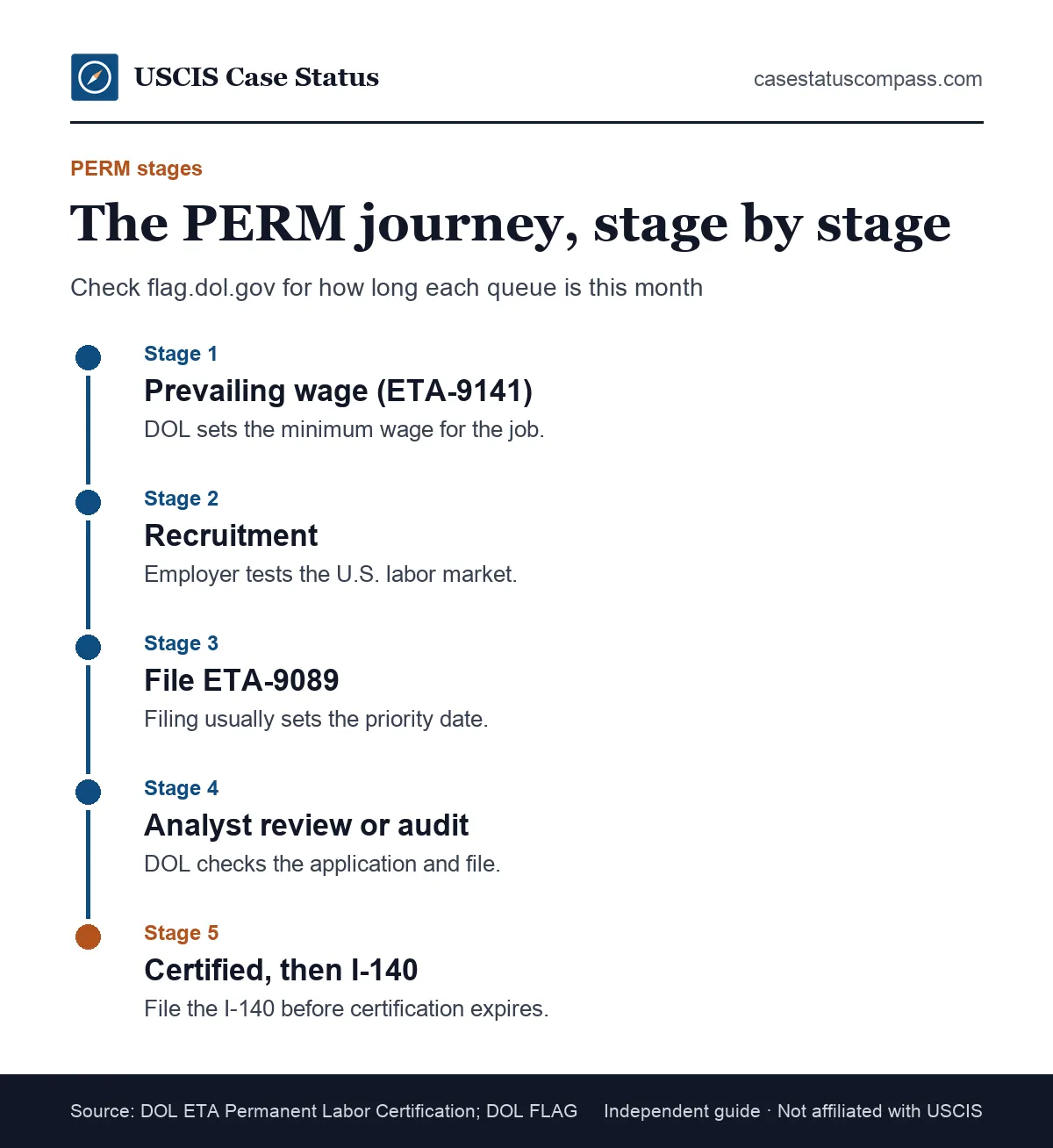
The PERM process has five stages: prevailing wage, recruitment, filing Form ETA-9089, DOL review, and the decision. Knowing the current stage tells you which DOL queue on FLAG applies to your case.
Ask your employer which stage applies today, then watch only that queue.
Stages DOL controls
DOL controls the prevailing wage decision and the review after filing. Those are the two queues you can track on FLAG.
Neither can be sped up by the employer or worker, but a clear request avoids questions that add time.
Stages your employer controls
The employer controls when it files the PWD request, how quickly it runs recruitment and when it files the ETA-9089. Ask HR for the date of each step so you can track the parts DOL never posts.
Prevailing Wage Determination (PWD) Processing Time
The prevailing wage determination processing time is how long DOL takes to issue the minimum wage for the job on Form ETA-9141. DOL shows the PWD queue on FLAG as the month of requests it is now processing. Currently, DOL is issuing PERM prevailing wage determinations for requests filed in June 2026, OEWS and non-OEWS (as of Sept. 30, 2026).
What the PWD does
The PWD sets the lowest wage the employer may offer for the job in its location. The PERM offer must meet or beat it.
It also fixes the start of recruitment timing, since ads follow the issued wage.
PWD time vs PERM time
The pwd processing time and the PERM review time are separate queues, and both count toward your overall perm processing time. A long PWD queue delays everything after it, but it does not appear in the analyst review figure.
How Do You Read the PWD Queue on FLAG?
You read the PWD queue on FLAG by finding the prevailing wage line and noting the month shown. That month is when the requests DOL is now working on were filed. Compare it with the date your employer filed Form ETA-9141.
If your request is older than the month shown
If your employer filed Form ETA-9141 before the month DOL shows, your request should be issued or close to it. Ask your employer to check the FLAG account for an issued determination or a DOL question.
Current PWD processing time vs past months
The current pwd processing time only describes this month. To spot a trend, write down the month DOL shows each time you check. If it stalls, expect a longer wait.
What Slows a Prevailing Wage Request?
A prevailing wage request slows when the DOL queue is long, when the job description is unclear, or when the employer asks DOL to review the wage again.
Only the queue is outside the employer's control; a precise, single-occupation job description avoids the other two.
Job descriptions that cause trouble
DOL matches the job to an occupation to set the wage. A job that blends duties from two occupations, or asks for unusual skills, can lead to questions or a higher wage.
Asking DOL to reconsider the wage
If the employer disagrees with the wage, it can ask DOL to look again. That redetermination request goes into its own queue on FLAG. It can lower the wage but adds time.
How Long Does PERM Recruitment Take?
PERM recruitment takes as long as DOL's rules require plus the time the employer needs to place ads and review applicants. DOL sets minimum ad periods and a waiting period before filing. FLAG does not show this stage.
Ask HR for the planned dates.
What recruitment involves
Recruitment usually includes a state job order, newspaper ads, posting a notice of filing at the worksite, and additional recruitment steps for professional jobs.
Each step leaves records the employer must keep.
The recruitment report
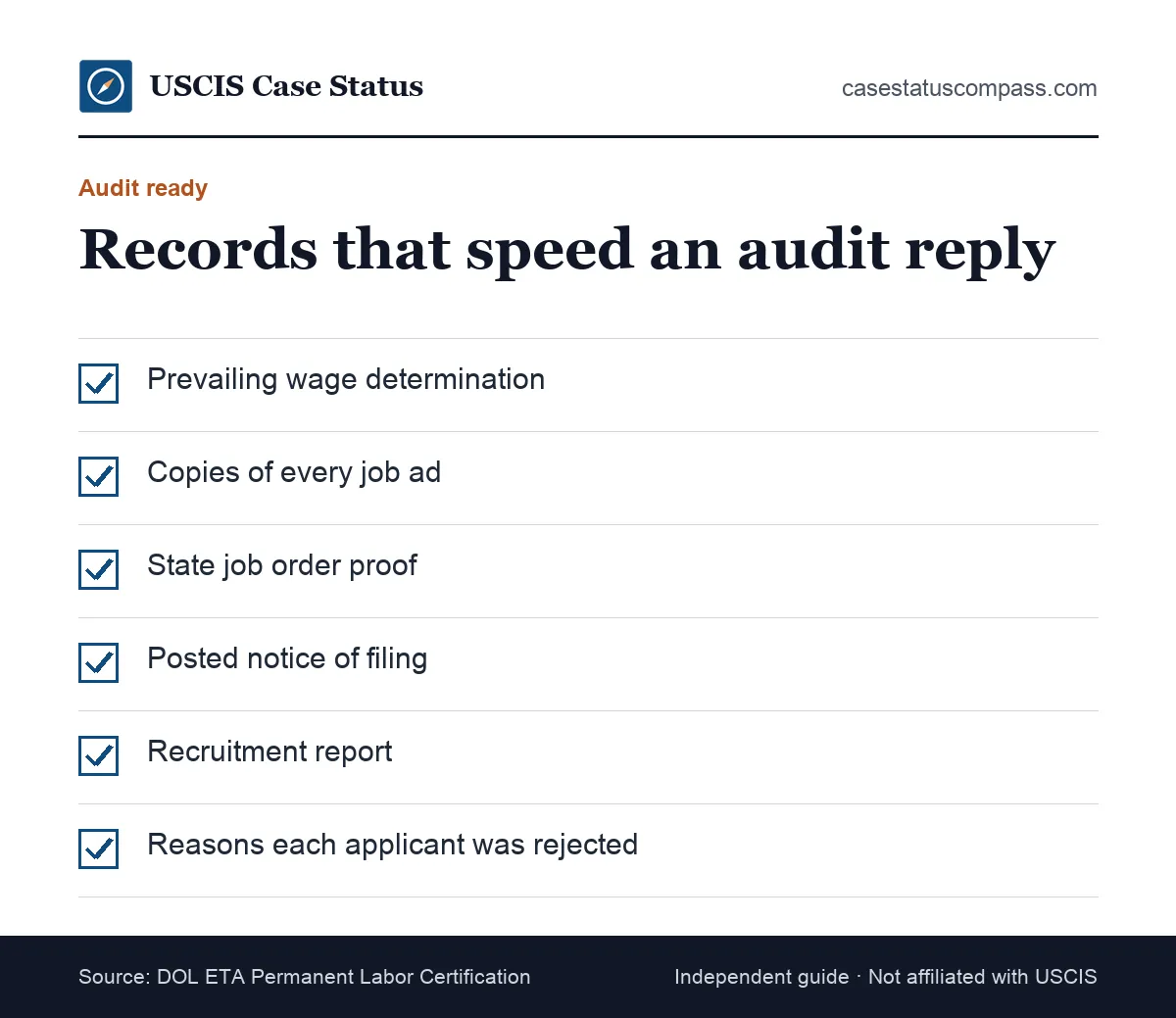
The employer then reviews every U.S. applicant and records the result in a recruitment report. DOL can ask for that report in an audit, so it must be complete before filing.
Why the dates matter
DOL rules set timing windows for recruitment and filing. Missing a window can force the employer to start recruitment again. Your employer's attorney tracks these dates, so ask them for the planned filing date rather than guessing.
Why Recruitment Timing Can Reset the Clock
Recruitment timing can reset the PERM clock because DOL rules require ads and filing to fall within set windows. If a qualified U.S. worker applies, or the employer misses a window, recruitment may have to start over, adding months before the ETA-9089 is filed.
When a U.S. applicant qualifies
If a qualified U.S. worker applies and is available, the employer cannot certify that no qualified worker exists. The case may stop or wait for a fresh recruitment round.
Ask the attorney whether that happened.
Expired wage determinations
Each PWD has a validity period printed on it. If recruitment or filing falls outside that period, the employer may need a new PWD, which sends the case back into the wage queue.
Filing Form ETA-9089: When the DOL Clock Starts
The DOL review clock starts when the employer files Form ETA-9089 in FLAG. From then on, your case is in the analyst review queue that FLAG tracks.
Ask your employer for the filing confirmation and keep a copy, because the filing date also becomes your priority date for the green card queue.
Your filing date and priority date
For PERM cases, the priority date is generally the date DOL received the ETA-9089. That date decides your place in the green card line later.
Write it down and keep the proof.
What to ask your employer after filing
Ask for the filing date, the PERM case number and the name of the attorney handling it. With those, you can match your case to DOL's queue each month.
What Is Analyst Review and How Long Does It Take?
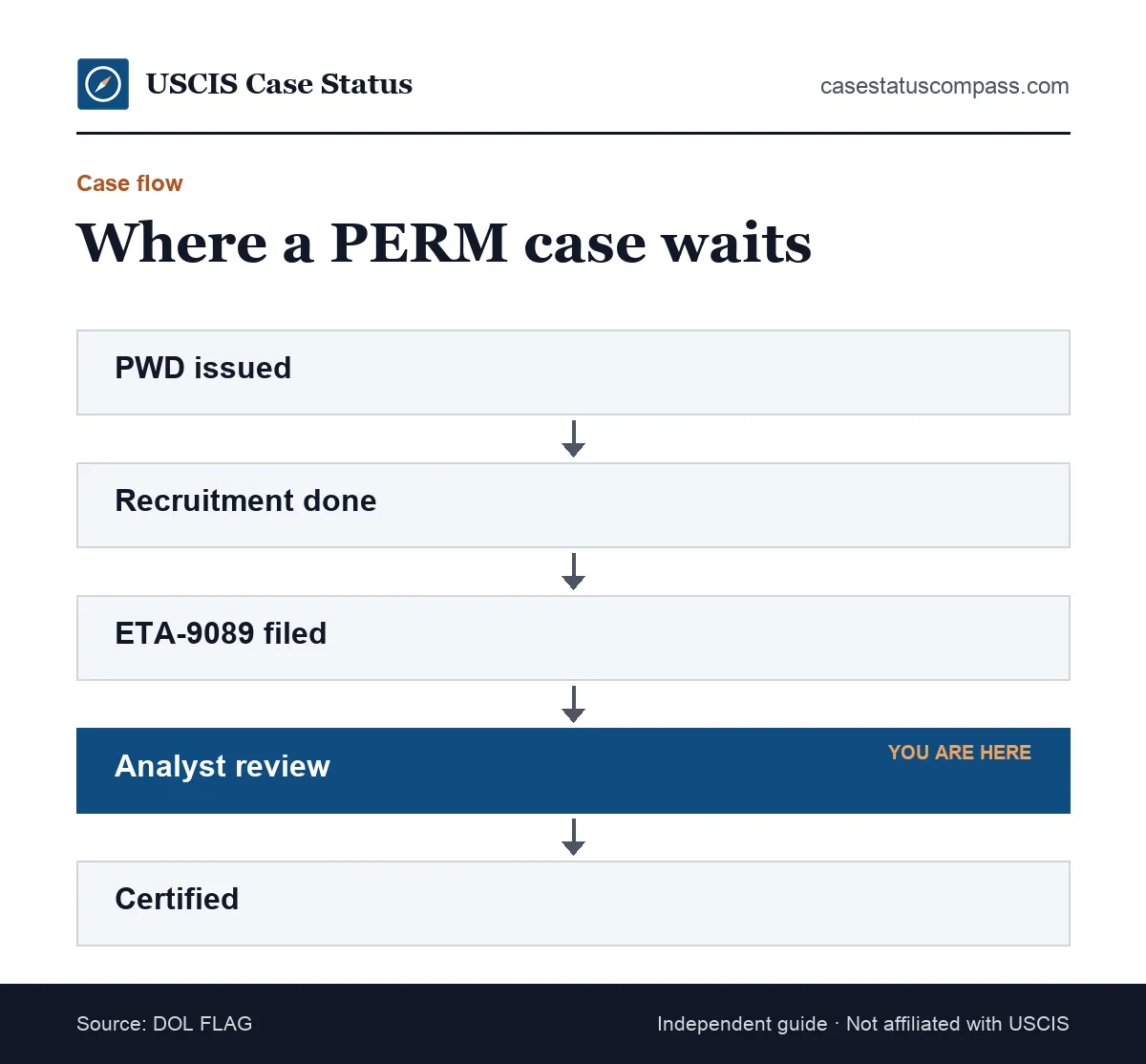
Analyst review is DOL's standard review of a filed ETA-9089. It is the longest wait for most clean cases. DOL shows the month of filings it is now reviewing on FLAG, and that month is the core of the perm labor processing time. PERM analyst review took an average of 336 calendar days in August 2026.
What happens in analyst review
A DOL analyst checks the form for completeness and compares it with DOL's rules for wages, job requirements and recruitment. A case with doubts may be sent to audit.
Reading "analyst review" on FLAG
If the employer's FLAG account shows analyst review, the case is in line or with an analyst. That label is normal. It does not predict approval or denial, and it can stay the same for many months.
How Does a PERM Audit Change the Timeline?
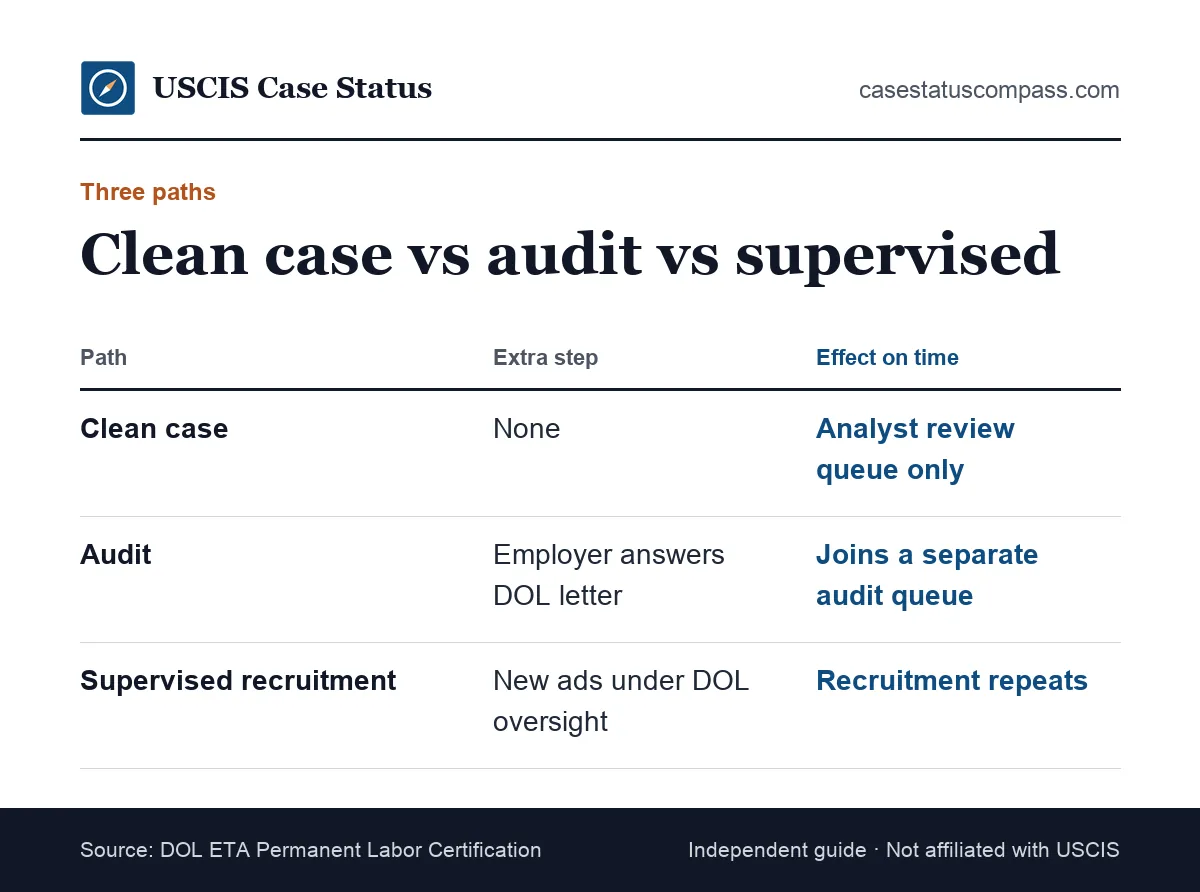
A PERM audit adds time because the case leaves the analyst review queue and joins a separate audit queue. DOL sends the employer a letter asking for records, the employer replies by the deadline, and DOL reviews the reply. DOL posts the audit queue separately on FLAG: DOL audit review is working on PERM cases filed in December 2025 (as of Oct. 5, 2026).
How to keep an audit short
The fastest reply comes from a complete file. Employers who keep every ad, the wage determination and the recruitment report ready can answer quickly and fully.
Missing the reply deadline can end the case.
What Triggers a PERM Audit?
DOL audits some cases because something on Form ETA-9089 raises a question, and some at random. Common triggers include unusual job requirements, wage issues and recruitment gaps. Job details that differ between the PWD request, the ads and the ETA-9089 are another frequent cause.
What Is Supervised Recruitment?
Supervised recruitment is when DOL orders the employer to run a new round of recruitment under DOL's direction. It is less common than an audit but adds far more time, because recruitment effectively repeats before DOL decides the case.
When DOL orders it
DOL can order supervised recruitment after reviewing an audit reply or when it has concerns about how recruitment was done.
The employer gets a written notice with instructions, and the case waits until the new recruitment is done.
What it means for your plans
Expect the case to take much longer than the posted queues suggest. Talk with your employer and its attorney about your visa status and any deadlines. Our green card processing time guide shows how the later stages add up.
Would a new PERM filing be faster?
Ask whether filing a new PERM would be faster than finishing supervised recruitment. A new filing brings a new priority date, so weigh that loss against the months saved.
What If DOL Denies the PERM?
If DOL denies the PERM, the employer can ask DOL to reconsider or seek further review. Each route adds its own wait. DOL posts the reconsideration queue on FLAG. Currently, DOL is reviewing PERM reconsideration requests filed in May 2026 (as of Oct. 5, 2026).
Reconsideration vs a fresh filing
Reconsideration asks DOL to look again at the same case. A fresh PERM starts the process over with a new wage request and recruitment. A new filing gets a new priority date, which can matter.
Protecting your timeline after a denial
Ask your employer how long reconsideration is taking on FLAG. If you hold a temporary visa, check its end date at once. A denial can affect plans for extensions, so speak with an immigration attorney quickly.
How Do You Read DOL Processing Times on FLAG?
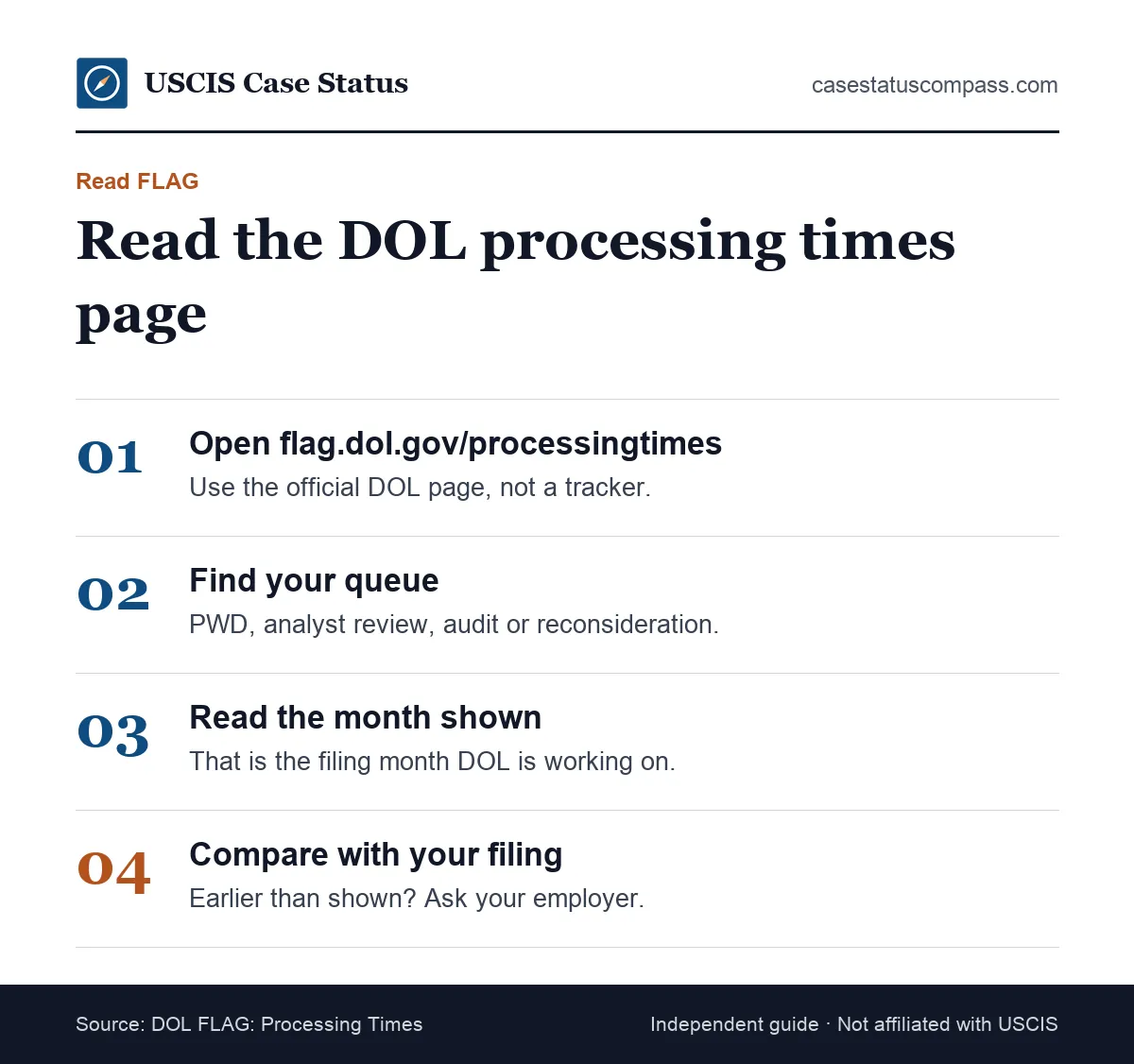
You read DOL processing times by opening flag.dol.gov/processingtimes, finding the queue that matches your case, and noting the month DOL is working on. Compare that month with your own filing month.
If your month is earlier than DOL's, your case should be in review or decided.
Find the right queue
Match your stage to the queue: a PWD request goes in the prevailing wage line, a filed ETA-9089 in analyst review, an audited case in audit review, and a denial being reconsidered in the reconsideration line.
Compare months, not just days
An average number of days describes recently decided cases, not yours. The queue month is more useful, because you can compare it directly with your filing month.
If the average days and the queue month seem to disagree, base your own estimate on the queue month.
What Does "PERM Timeline Is Under Maintenance" Mean?
A message that the PERM timeline is under maintenance usually means the page or tool you are using cannot show data right now. DOL schedules maintenance windows for FLAG, and third-party trackers also pause when their data source is down.
What to do when you see it
Wait and try again later. Check the FLAG home page for a maintenance notice. If you were using a third-party tracker, go straight to flag.dol.gov/processingtimes instead.
A maintenance message does not mean DOL lost the case, so the employer should not refile the ETA-9089 because of it.
Does FLAG Maintenance Delay a PERM Case?
Short FLAG maintenance windows can pause filing or status features, but there is no official sign that they change your place in line. The queue month DOL posts keeps its meaning after the page returns, so compare it with your filing month as usual.
Confirming actions taken during an outage
If the employer was trying to file or answer DOL during an outage, ask them to confirm the action went through afterward. A missed audit reply deadline costs far more than a short outage.
How Many PERM Cases Are Pending at DOL?
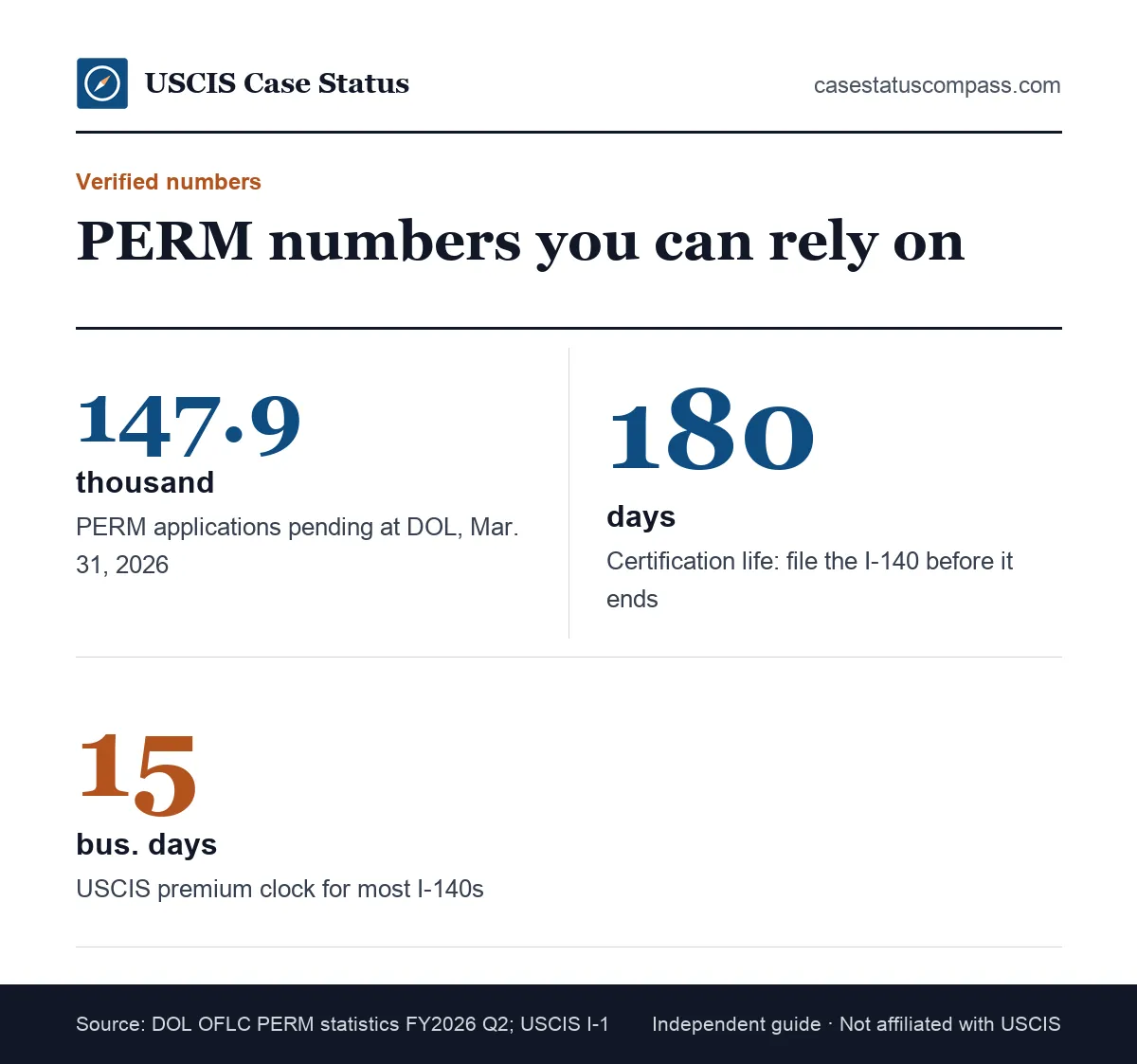
DOL reported 147,884 PERM applications pending at DOL (Mar. 31, 2026), in its PERM selected statistics for the second quarter of fiscal year 2026. A large pending count means new filings join a long line.
Check the next quarter's figure for trends.
Why the pending count matters
The pending count is a rough guide to pressure on DOL's queue. If filings outpace decisions, the queue month on FLAG moves slowly; if not, it speeds up.
A rising pending count while the queue month stalls is an early sign that your wait will run longer.
Where to find the statistics
DOL's Office of Foreign Labor Certification posts selected PERM statistics each quarter on dol.gov. They show counts of applications received, certified, denied and pending.
Compare quarters to see the trend.
PERM Timeline Estimator: Plot Your Own Milestones
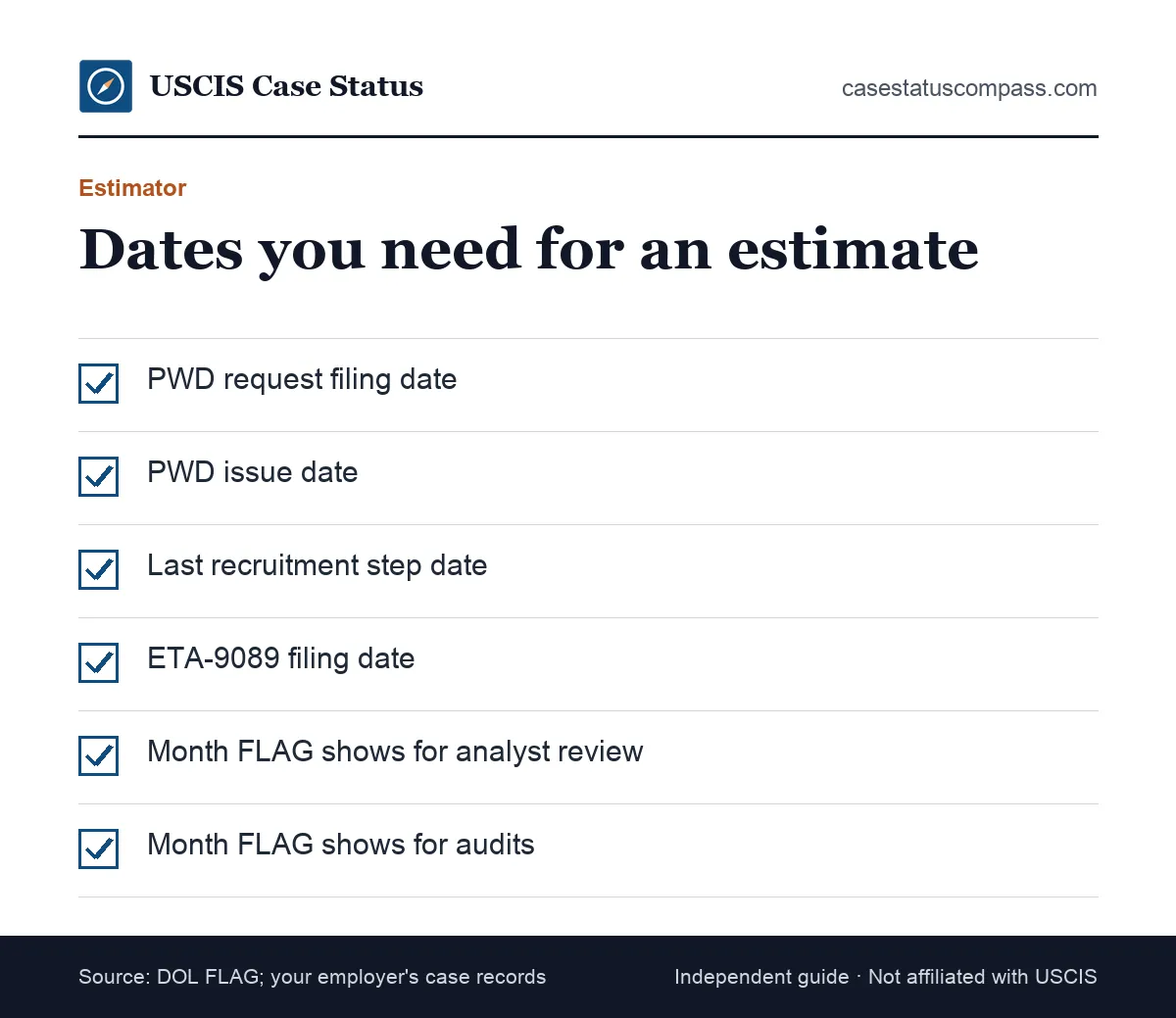
You can estimate your own PERM milestones by starting with your employer's dates and adding DOL's current queue lengths from FLAG. Fill in the worksheet below.
Ask HR for the real dates first; an estimate built on guesses for your own filing dates is less useful than none.
PERM milestone worksheet
Fill each row with your employer's real date and DOL's current queue month, then add the gap shown.
| Milestone | How to estimate it | Your date |
|---|---|---|
| PWD issued | PWD filing date + current PWD queue gap on FLAG | ________ |
| Recruitment finished | PWD issue date + employer's recruitment plan | ________ |
| ETA-9089 filed (priority date) | Ask your employer for the planned or actual date | ________ |
| Analyst review reached | Filing date + current analyst review queue gap | ________ |
| Audit decision (if audited) | Audit reply date + current audit queue gap | ________ |
| Last day to file I-140 | Certification date + 180 days | ________ |
A worked example with placeholder dates
Say FLAG shows analyst review on filings from a month that is N months before today. If your ETA-9089 was filed in month F, expect review around F plus N months. If DOL audits the case, add the audit gap after the employer replies.
Updating your estimate
Rework the sheet each month after DOL updates FLAG, since the current perm processing timelines shift. If the queue gap grows, push the dates later.
Save each month's version of the sheet so you can see whether the gap is growing or shrinking.
LCA Processing Time for H-1B Workers
The LCA processing time is how long DOL takes to certify a Labor Condition Application, Form ETA-9035, which an employer needs before filing an H-1B petition. The LCA is a separate DOL case from PERM, with a much shorter review window set by DOL rules.
How the LCA fits the H-1B timeline
The employer files the LCA in FLAG, waits for certification, then files the H-1B petition with USCIS. See our h1b processing time page for the USCIS side.
The LCA is not part of PERM.
Does LCA Approval Time Affect Your PERM Wait?
No. LCA approval time has nothing to do with your green card queue. The LCA supports a temporary H-1B job, while PERM supports a permanent one. A fast LCA does not speed PERM, and a slow PERM does not affect an LCA.
Checking which program a quoted time covers
If someone quotes an "LCA H-1B processing time," confirm which program they mean before you plan around it. The two DOL cases sit in different queues on FLAG.
Ask for the source and its date.
PERM vs LCA vs PWD: Which Clock Are You Watching?
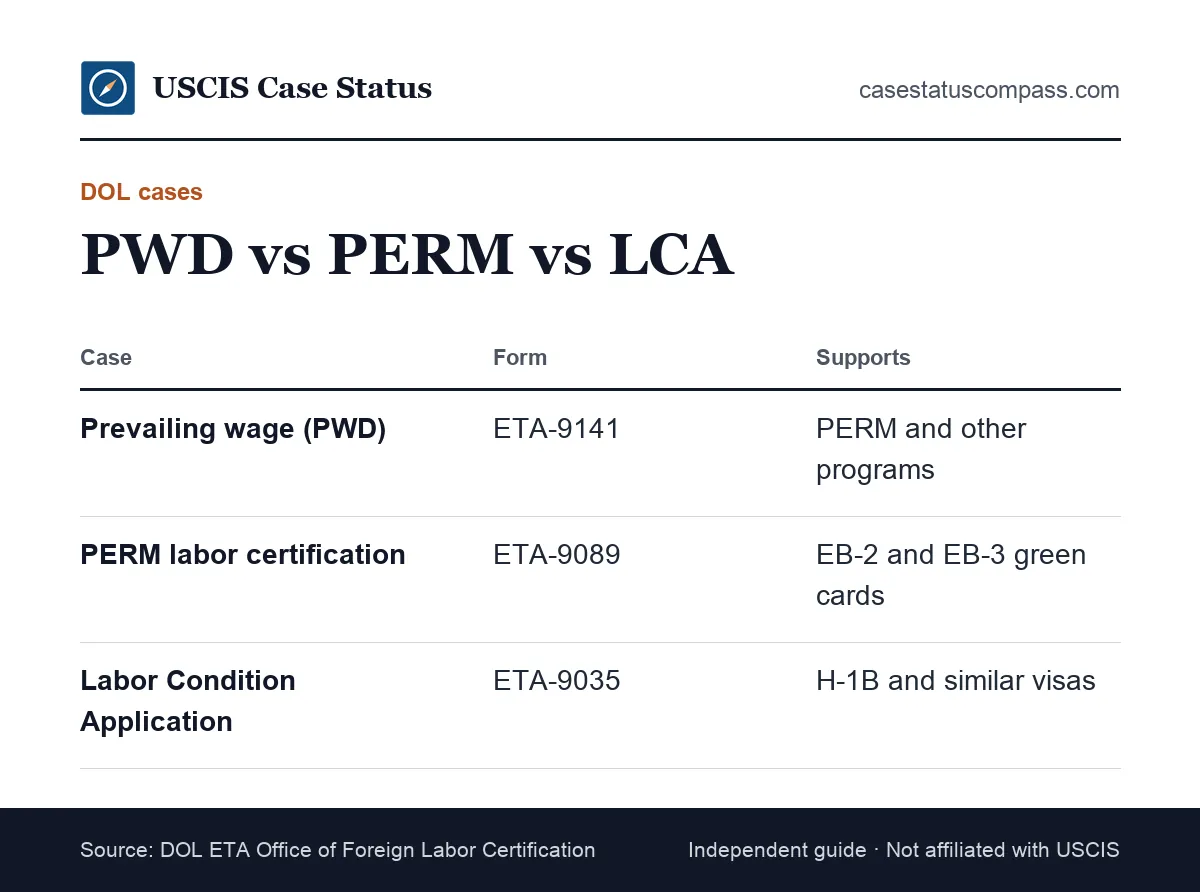
DOL runs three different cases that people confuse: the prevailing wage determination, PERM labor certification and the Labor Condition Application. Each has its own form, purpose and timing.
The table below separates them, so you can tell which clock your case is on.
Forms and purposes side by side
Each column covers one DOL case, with its form number, what it does and where DOL posts its timing.
| PWD | PERM | LCA | |
|---|---|---|---|
| Form | ETA-9141 | ETA-9089 | ETA-9035 |
| Purpose | Sets minimum wage | Tests the labor market for a permanent job | Wage and condition promises for a temporary worker |
| Supports | PERM and some temporary programs | EB-2 and EB-3 green cards | H-1B and similar temporary visas |
| Timing shown on FLAG | Yes, queue month | Yes, analyst and audit queues | Short fixed review window |
Which one is holding you up?
If you are waiting to start H-1B work, the LCA and the H-1B petition steps matter. If you are waiting for a green card, the PWD and PERM matter. Ask your employer which case is open before reading any DOL timing page.
Is There Premium Processing for PERM?
No. DOL does not offer premium processing for PERM labor certification or prevailing wage requests. Premium processing is a USCIS service. It can speed the I-140 that follows a certified PERM, but it cannot shorten the DOL stages before it.
What premium processing can do
After certification, the employer can pay USCIS to speed the I-140. 15 business days (I-129, most I-140); 30 (I-765 OPT, I-539 F/M/J); 45 (I-140 E13 managers and NIW). The fee is $2,965 (I-129 most classes, I-140); $1,780 (H-2B/R, I-765 OPT); $2,075 (I-539 to F/J/M), listed on the G-1055 fee schedule. See our premium processing guide for filing details.
Beware of offers to speed up DOL
Be careful with anyone who offers to make DOL move faster for a fee. DOL publishes no such service.
Treat such offers as a likely scam and report them; only the employer's attorney should contact DOL about the case.
What Happens After PERM Is Certified?
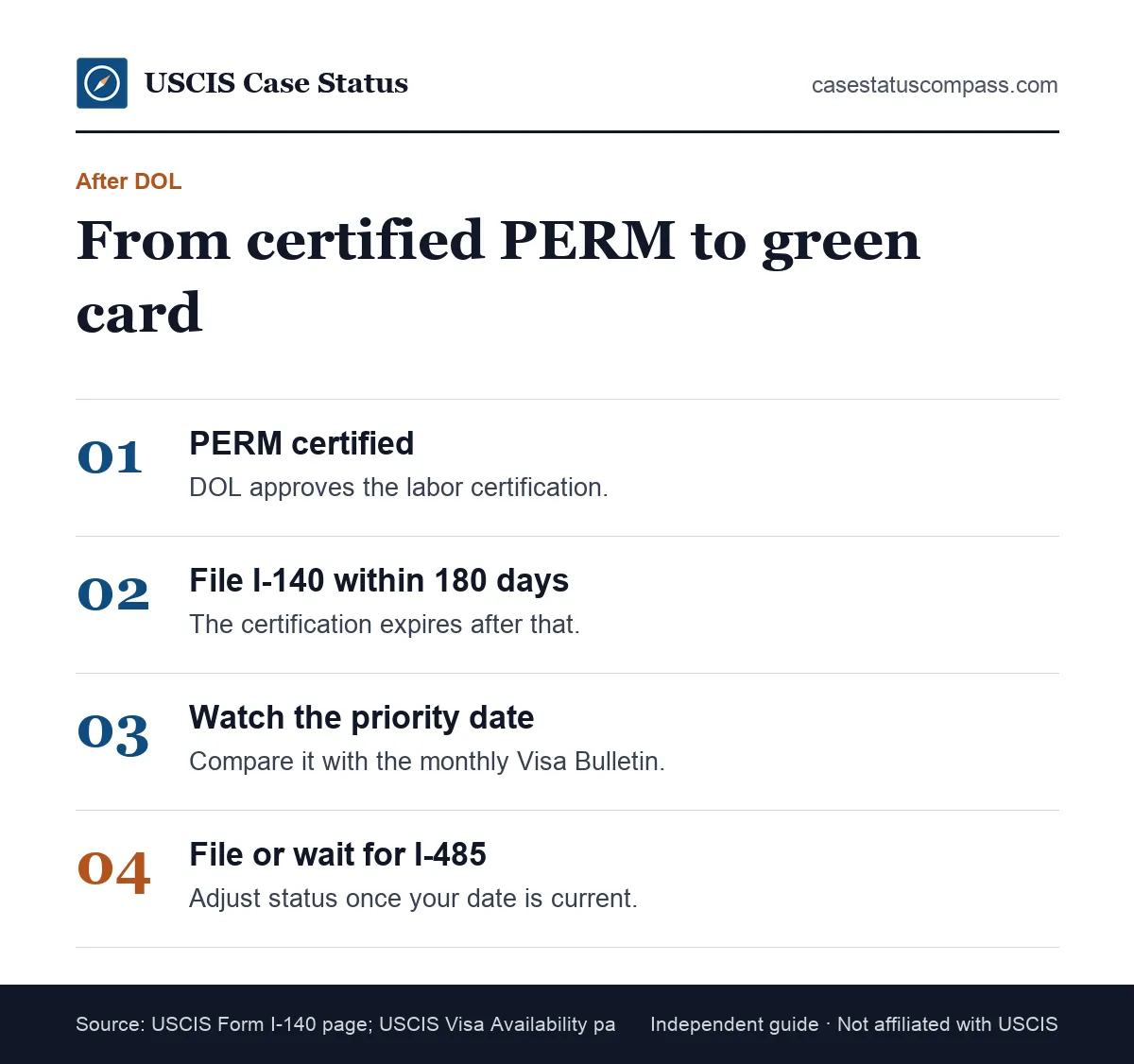
After DOL certifies the PERM, the employer must file Form I-140 with USCIS before the certification expires. A PERM labor certification expires 180 days after DOL certifies it. Missing that window means the employer may have to restart PERM from the beginning.
The 180-day window in practice
Certification starts a short, strict clock. Employers usually prepare the I-140 during PERM review so they can file soon after.
Ask HR when the I-140 is planned, and confirm it was filed before the certification expires.
What the worker should keep
Ask for a copy of the certified labor certification, the PERM case number and the priority date. You may need them for the I-140, a later job change or your own I-485.
Tracking the I-140 once it is filed
After the I-140 is filed, USCIS sends a receipt with a USCIS receipt number you can track. Keep it with your PERM papers.
Check it in Case Status Online or a USCIS online account.
How Long Does the I-140 Take After PERM?
The latest USCIS figure for the next step reads: I-140: median 3.9 months (USCIS data, Apr.-June 2026). With premium processing, USCIS commits to act within 15 business days for most categories. The I-140 is a USCIS petition, so its time appears in the USCIS tool, not on FLAG.
Regular vs premium for the I-140
Regular processing follows the USCIS queue for your category and office. Premium sets a fixed clock but does not move your priority date. An I-140 request for evidence pauses either clock. Our i 140 processing time page covers each category in detail.
Filing the petition
The employer files the I-140 with the certified labor certification. Our form i 140 guide explains who signs, what evidence goes with it and how to check its status after filing.
How Does PERM Affect Your Green Card Timeline?
PERM affects your green card timeline in two ways: its stages add time before the I-140, and its filing date usually becomes your priority date. That priority date decides when you can file or finish your I-485, based on the monthly Visa Bulletin.
Priority date and the Visa Bulletin
The State Department publishes the Visa Bulletin monthly: Final Action Dates vs Dates for Filing. Your priority date must be current under the chart USCIS accepts that month. Track it on our visa bulletin page, and see green card basics for what permanent residence gives you.
The I-485 stage
Once your date is current, you can adjust status on Form I-485. The USCIS median for employment-based I-485s was 6.0 months in April–June 2026.
Visa Bulletin dates decide when you can file.
Planning the steps after PERM
See the green card processing time page for the full green card wait, and how long does naturalization take for the step after that. Each stage has its own official source.
PERM Timing for H-1B Workers
H-1B workers need to plan PERM timing around their visa limits. H-1B: 3 years at first, up to 6 years in total. Ask your employer's attorney how your PERM dates relate to your H-1B end date.
Start early, ideally years before the six-year limit, because PERM and the I-140 must both finish in time.
Why starting early matters
A long PWD queue, recruitment and analyst review can use up much of the H-1B time left on an H-1B. Starting PERM early gives more room if DOL audits the case or the employer must recruit again.
Work permits while you wait
Some workers later get a work permit through a pending I-485. That comes only after PERM, the I-140 and a current priority date. See how long does it take to get a work permit for EAD timing and the EAD fee guide for costs.
Why Do PERM Timelines Change?
PERM timelines change because DOL's queues move with filing volume, staffing and system changes. A surge in filings slows the queue month on FLAG.
Form and system updates can also pause the queue for a while, so compare the FLAG month over several updates before drawing conclusions.
Filing volume and staffing
When more employers file than DOL can review, the perm labor certification processing time grows and the queue month falls further behind.
Check the trend over several months, not one update.
Staffing at the Office of Foreign Labor Certification
Staffing changes at DOL's Office of Foreign Labor Certification have the same effect. The pending count in DOL's quarterly statistics shows this pressure.
DOL rarely announces it directly.
Changes to forms and systems
When DOL revises a form or a FLAG feature, review can slow while staff and employers adjust. Watch DOL announcements on flag.dol.gov for any form or system change that affects your case.
Does USCIS Publish PERM Processing Times?
No. USCIS does not publish PERM processing times, because PERM is a Department of Labor process. Searches for "uscis perm processing times" lead to DOL's FLAG page for the labor certification and to the USCIS tool only for the I-140 and I-485 that follow.
Which agency publishes which time
DOL publishes the PWD and PERM queues on FLAG. USCIS publishes I-140 and I-485 times in its own tool and quarterly medians; see the USCIS processing times by form overview.
Where the Visa Bulletin fits
The State Department publishes the Visa Bulletin. It shows when a PERM-based priority date becomes current, which no DOL or USCIS figure can tell you.
Check it each month after it is published.
Why the confusion happens
Many people call the whole employment green card process "PERM." The labor certification is only the first part. When someone asks about green card PERM processing time, ask whether they mean the DOL step alone or the full path to a green card.
What Can You Do If Your PERM Is Taking Too Long?
If your PERM is taking longer than FLAG suggests, first confirm the filing month and the queue that applies. Then ask your employer whether DOL sent an audit letter or other notice. Only the employer and its attorney can contact DOL about the case.
Questions to ask your employer
Ask: what date was the ETA-9089 filed, is the case in analyst review or audit, has DOL sent any letter, and when was the last FLAG update?
Write down each answer.
Contacting DOL
DOL has help desks for FLAG users, and employers or attorneys can raise case questions through FLAG. Workers usually cannot.
So ask your employer's attorney to raise any question for you.
When the attorney should reach out
If the case is far past the queue month with no letter, the attorney can contact DOL directly. For later USCIS steps, see how to contact USCIS.
Ask the attorney to tell you the date of each contact and any reply DOL gives.
Can Changing Jobs Restart Your PERM Timeline?
Changing employers usually restarts the PERM timeline, because a labor certification belongs to a specific employer and job. A new employer generally needs a new PWD, new recruitment and a new ETA-9089.
Talk to an attorney before resigning or accepting a new offer.
When a priority date may carry over
In some cases, a worker can keep an earlier priority date after an I-140 approval. That depends on USCIS rules about the I-140, not on DOL. Ask an immigration attorney before you change jobs.
Changes within the same employer
A big change to the job duties, location or requirements can also force a new PERM with the same employer. Tell HR about planned promotions or moves while PERM is pending, so they can check the effect.
What Mistakes Add Months to a PERM Case?
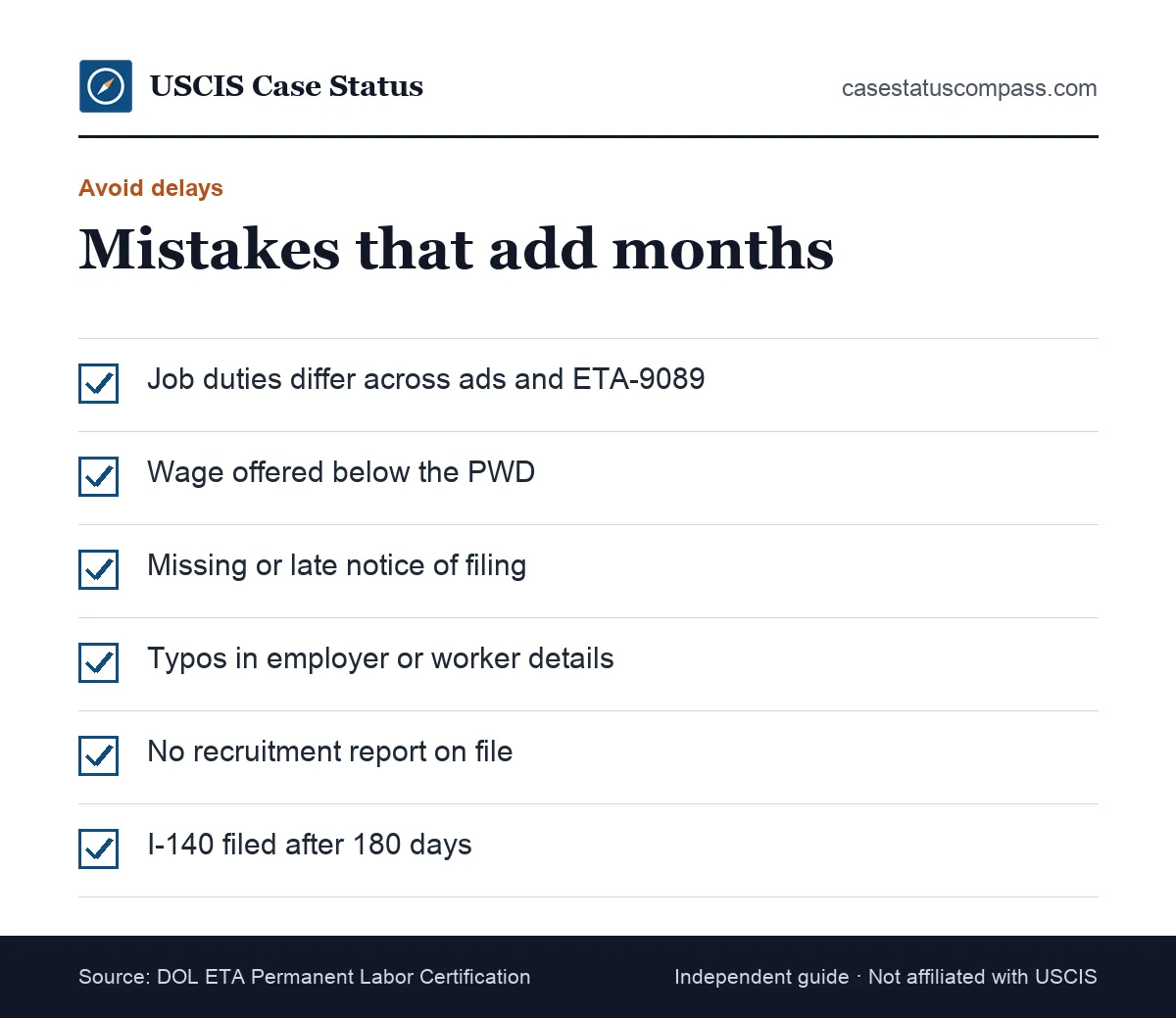
The mistakes that add the most time are mismatched job details, a wage below the prevailing wage, gaps in recruitment proof, simple typos, and filing the I-140 too late. Each can lead to an audit, a denial or a full restart of the process.
Mismatches between documents
The job duties and requirements must match across the PWD request, every ad and the ETA-9089. Ask your employer to have one person check all the documents side by side before filing.
Avoidable deadline errors
Missing a recruitment window or the 180-day I-140 window can force a fresh start. A shared calendar with each deadline, kept by HR and the attorney, prevents most of these errors.
Where Do You Find PERM Processing Times News Today?
For perm processing times news today, go first to flag.dol.gov, where DOL posts updated queues and announcements. Treat news sites and forums as secondary.
Many news posts simply restate the FLAG figures, so check the date on any report and confirm it against DOL's page.
Official channels to watch
Check the FLAG processing times page monthly and the FLAG announcements area for maintenance or form changes. DOL's quarterly PERM statistics show volume trends.
If the analyst review month has not moved across two updates, ask your employer whether DOL has sent any notice.
Watching the USCIS side
For the USCIS side, check the I-140 and I-485 times in the USCIS tool, and your uscis case status once a receipt arrives. USCIS figures never cover the DOL stage.
Reading unofficial reports
Forums and trackers post self-reported cases. They can show patterns but often lag or skew. If a report cites a number, check whether it matches FLAG today.
Never plan a job change or visa deadline around them.
Worked Examples: Three PERM Timelines
These examples show how the same DOL queues produce a different perm approval time for each case. They use no real numbers; instead, they show which queues each case passes through.
Compare each one with your own stage, and ask HR which path your case is on.
Example 1: A clean case
An engineer's employer files the PWD request, starts recruitment as soon as the wage is issued, and files the ETA-9089 right after the waiting period. The case moves through analyst review and is certified. Total time equals the PWD queue, recruitment and the analyst review queue.
Example 2: An audited case
A marketing manager's case goes to audit because a job requirement looks unusual. The employer replies within the deadline. The case waits in the audit queue before certification. Total time equals the clean path plus the audit queue and the reply time.
Example 3: A new wage determination
A research analyst's employer delays recruitment, and the PWD validity period passes. The employer files a new PWD request, which goes back into the wage queue. Total time includes two PWD waits.
Example 4: A denial and reconsideration
A data specialist's PERM is denied over a recruitment detail. The employer asks DOL to reconsider, and the request waits in the reconsideration queue. Total time adds that queue to the original path.
When Should You Ask an Immigration Attorney About PERM Timing?
Ask an immigration attorney about PERM timing if your temporary visa may end before PERM and the I-140 finish, if DOL audits or denies the case, if you plan to change jobs, or if your employer cannot explain a long delay. We do not give legal advice.
Questions to bring
Bring your visa end date, the PERM filing date, the current FLAG queue months and any DOL letters, so the attorney sees the full timeline.
Include your latest I-94 record too.
What to ask the attorney
Ask how long the remaining steps may take, what happens if PERM is denied, and how a job change would affect your priority date.
Also ask about backup options if timing runs short.
Who pays for PERM
Under DOL rules, the employer, not the worker, must pay PERM labor certification costs, including its own attorney fees. If anyone asks you to pay labor certification costs, ask the employer's attorney or your own lawyer to review it. Our perm case status guide covers who files and checks the case.
Frequently Asked Questions
How long does PERM processing take?
PERM takes the combined time of the prevailing wage queue, the employer's recruitment and DOL's analyst review of Form ETA-9089. An audit adds a separate queue. DOL posts the current queue months at flag.dol.gov/processingtimes.
What is the current PERM processing time?
The current PERM processing time is the month DOL shows for analyst review on flag.dol.gov, plus the average days it lists. DOL analyst review is on January 2026 filings and audit review on December 2025 filings; analyst review averaged 336 days in August 2026. Recheck it monthly.
Does the PWD time count toward PERM processing time?
The PWD is part of the full PERM process but has its own queue. DOL shows the prevailing wage queue separately from analyst review on FLAG.
Can a worker check PERM processing time for their own case?
The case itself sits in the employer's FLAG account, so workers usually rely on the employer or attorney for case details. Ask for the filing date and PERM case number to compare with DOL's queue month.
Does an audit mean my PERM will be denied?
No. An audit means DOL wants records before it decides. Many audited cases are certified. The audit adds time because the case waits in a separate audit queue after the employer replies.
Is my priority date the PERM filing date?
For most PERM-based cases, the priority date is the date DOL received the ETA-9089. That date carries into the I-140 and decides when you can file or finish the I-485. Keep a copy of the filing confirmation or certified labor certification.
Sources
- DOL FLAG: Processing Times. flag.dol.gov/processingtimes. Accessed Oct 27, 2026.
- DOL ETA: Permanent Labor Certification. www.dol.gov/agencies/eta/foreign-labor/programs/permanent. Accessed Oct 27, 2026.
- DOL OFLC: PERM Selected Statistics, FY2026 Q2. www.dol.gov/sites/dolgov/files/ETA/oflc/pdfs/PERM_Selected_Statistics_FY2026_Q2.pdf. Accessed Oct 27, 2026.
- USCIS: Form I-140, Immigrant Petition for Alien Workers. www.uscis.gov/i-140. Accessed Oct 27, 2026.
- USCIS: How Do I Request Premium Processing?. www.uscis.gov/forms/all-forms/how-do-i-request-premium-processing. Accessed Oct 27, 2026.
- USCIS Data Library: All Application and Petition Form Types, FY2026 Q3. www.uscis.gov/sites/default/files/document/data/quarterly_all_forms_fy2026_q3_v1.xlsx. Accessed Oct 27, 2026.
- USCIS: Visa Availability and Priority Dates. www.uscis.gov/green-card/green-card-processes-and-procedures/visa-availability-priority-dates. Accessed Oct 27, 2026.
- USCIS Form G-1055 Fee Schedule, Edition 10/16/26. www.uscis.gov/sites/default/files/document/forms/g-1055.pdf. Accessed Oct 27, 2026.
- USCIS: H-1B Specialty Occupations (updated 09/21/2026). www.uscis.gov/working-in-the-united-states/h-1b-specialty-occupations. Accessed Oct 27, 2026.
- 20 CFR 656.12(b) (govinfo, CFR 2025 edition). www.govinfo.gov/content/pkg/CFR-2025-title20-vol3/xml/CFR-2025-title20-vol3-sec656-12.xml. Accessed Oct 27, 2026.
casestatuscompass.com is an independent publication and is not affiliated with USCIS or any government agency. This page is general information, not legal advice. For denials, court or asylum matters, consult an immigration attorney or a DOJ-accredited representative.