Contents · 42 sections
- What Are H-1B Visa Fees in 2026?
- H-1B Filing Fees: The Full Table
- How Much Is the H-1B Registration Fee?
- What Is the I-129 Base Fee for an H-1B?
- Asylum Program Fee on H-1B Petitions
- What Is the ACWIA Training Fee?
- Fraud Prevention and Detection Fee
- Who Pays the $4,000 Public Law 114-113 Fee?
- Is the $100,000 H-1B Payment Being Collected Now?
- Who Pays H-1B Visa Fees: Employer or Employee?
- How Much Does It Cost to Sponsor an H-1B Worker?
- What Does an H-1B Extension Cost?
- How Much Does an H-1B Transfer Cost?
- What Is the Cost of an H-1B Amendment?
- How Much Is H-1B1?
- H-1B Visa Fee Impact on Small Employers and Nonprofits
- Premium Processing Fee for H-1B
- When Is H-1B Premium Processing Worth the Cost?
- Premium Processing for I-140 and EB Petitions
- What Do H-1B Legal Fees Cost?
- Visa Stamping Costs for H-1B Workers Abroad
- EAD and OPT Fees
- How Much Does a Work Permit Cost in the US?
- How Much Is a Work Permit With a Pending Green Card?
- How Much Does It Cost to Renew a Work Permit?
- OPT Application Fee and STEM OPT Costs
- What Is the Cost to Expedite an EAD or OPT?
- H-4 Dependent Costs: I-539 and H-4 EAD
- How Much Is the H-4 EAD Renewal Fee?
- EAD Fees for Asylum, TPS and Parolees Under H.R. 1
- L-1, O-1 and TN Visa Costs
- How Much Does an L-1 Visa Cost?
- How Much Do O-1 Visa Fees Cost?
- What Is the TN Visa Cost?
- How Much Does It Cost to Sponsor a Work Visa?
- EB-2 NIW Cost
- I-140 Filing Fee for Employer Green Cards
- Total-Cost Worksheet: Pick Your Forms
- How Have Work Visa Fees Changed Since 2024?
- H-1B Fee Mistakes to Avoid
- How Work Visa Fees Fit With Other USCIS Fees
- Frequently Asked Questions
The short answer
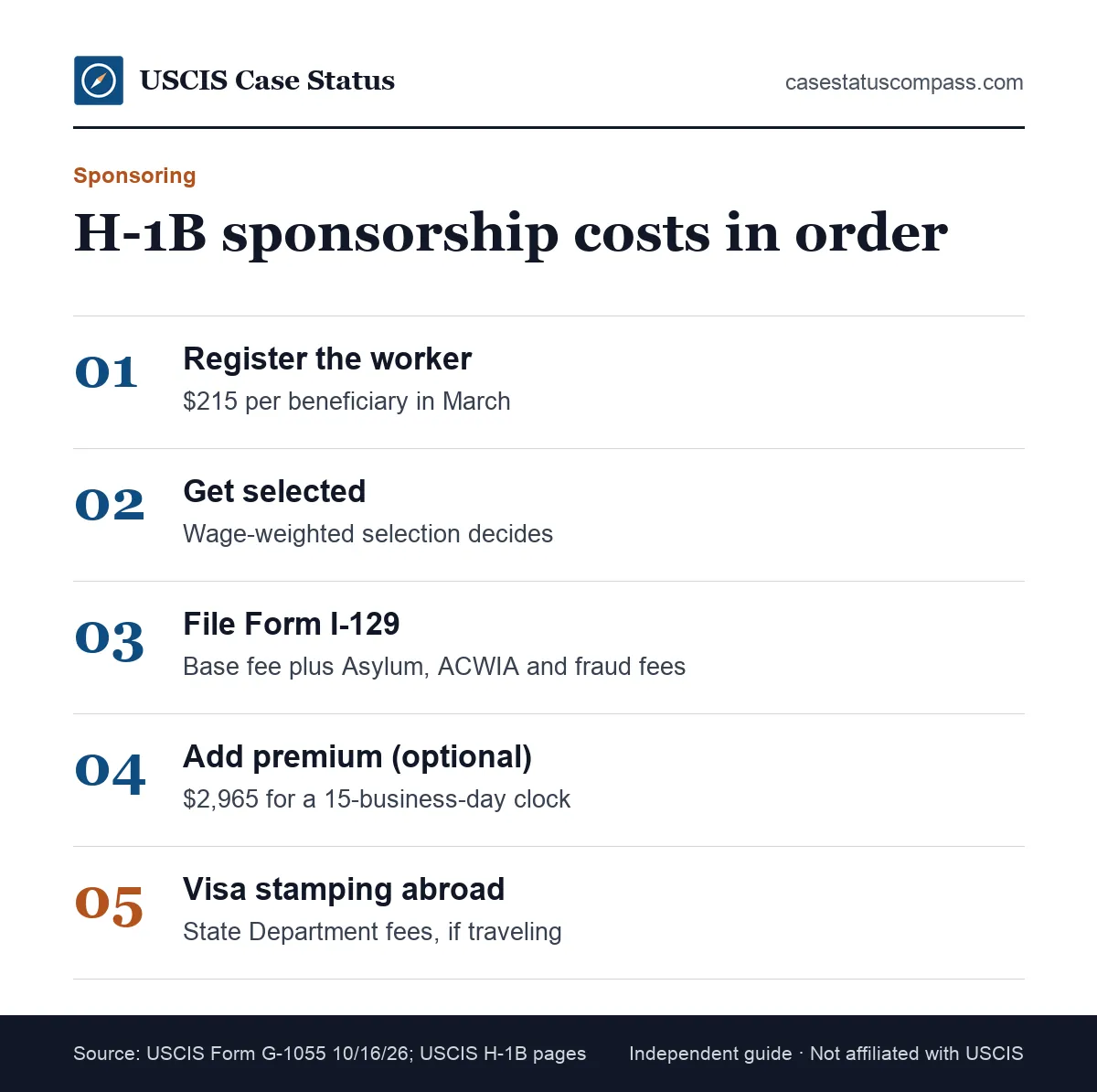
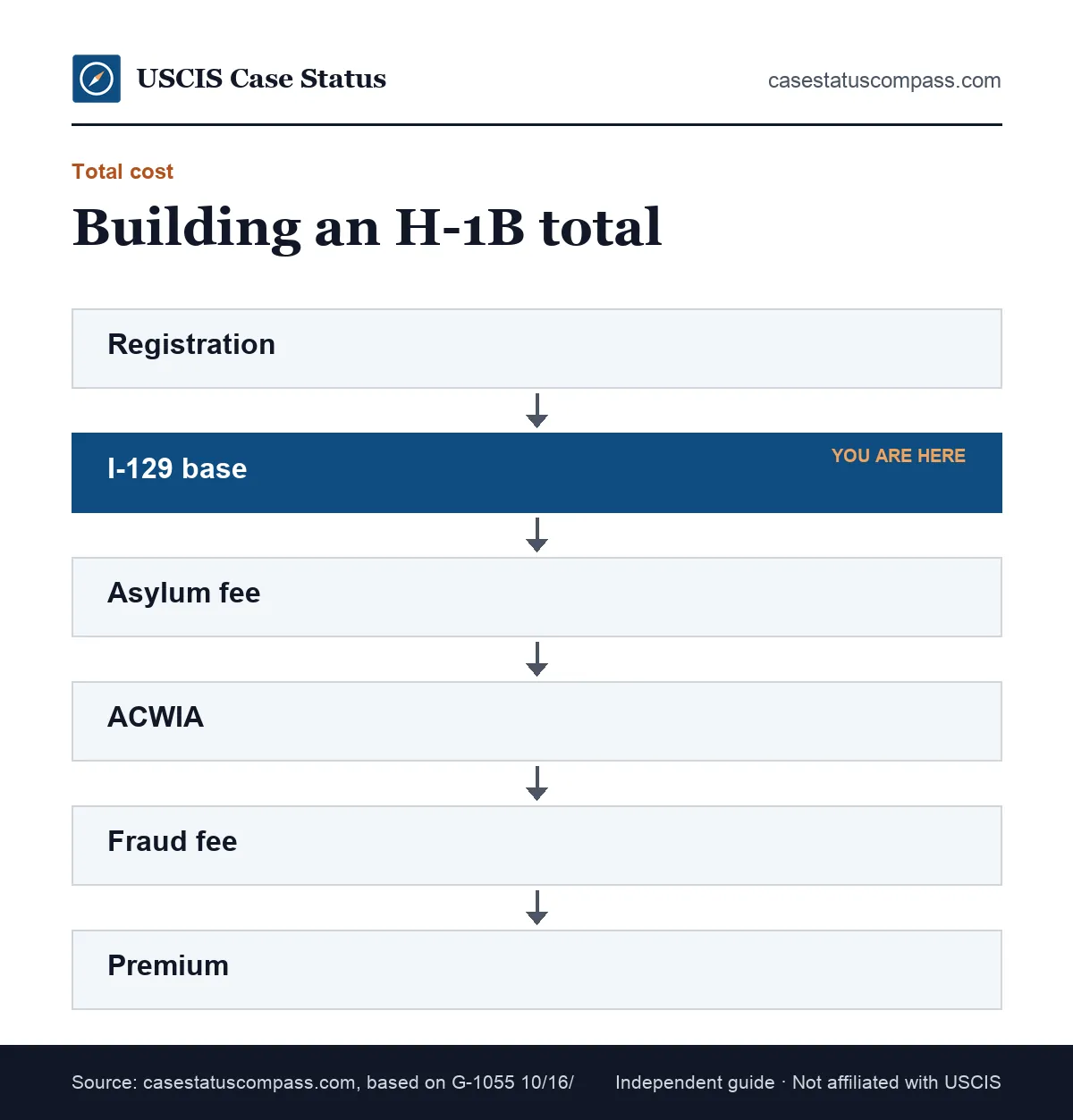
H-1B visa fees for a new worker start with a $215 registration and then a Form I-129 fee stack: Base $780 (paper) / $730 (online) ($460 small employer/nonprofit) + Asylum Program Fee $600/$300/$0 + Fraud fee $500 + ACWIA $1,500 or $750 (+ $4,000 Pub. L. 114-113 fee for some large H-1B-dependent employers). Premium processing adds $2,965. These amounts come from USCIS Form G-1055, edition 10/16/26, and the employer files them.
At a glance
| Registration | $215 per registration (per beneficiary) |
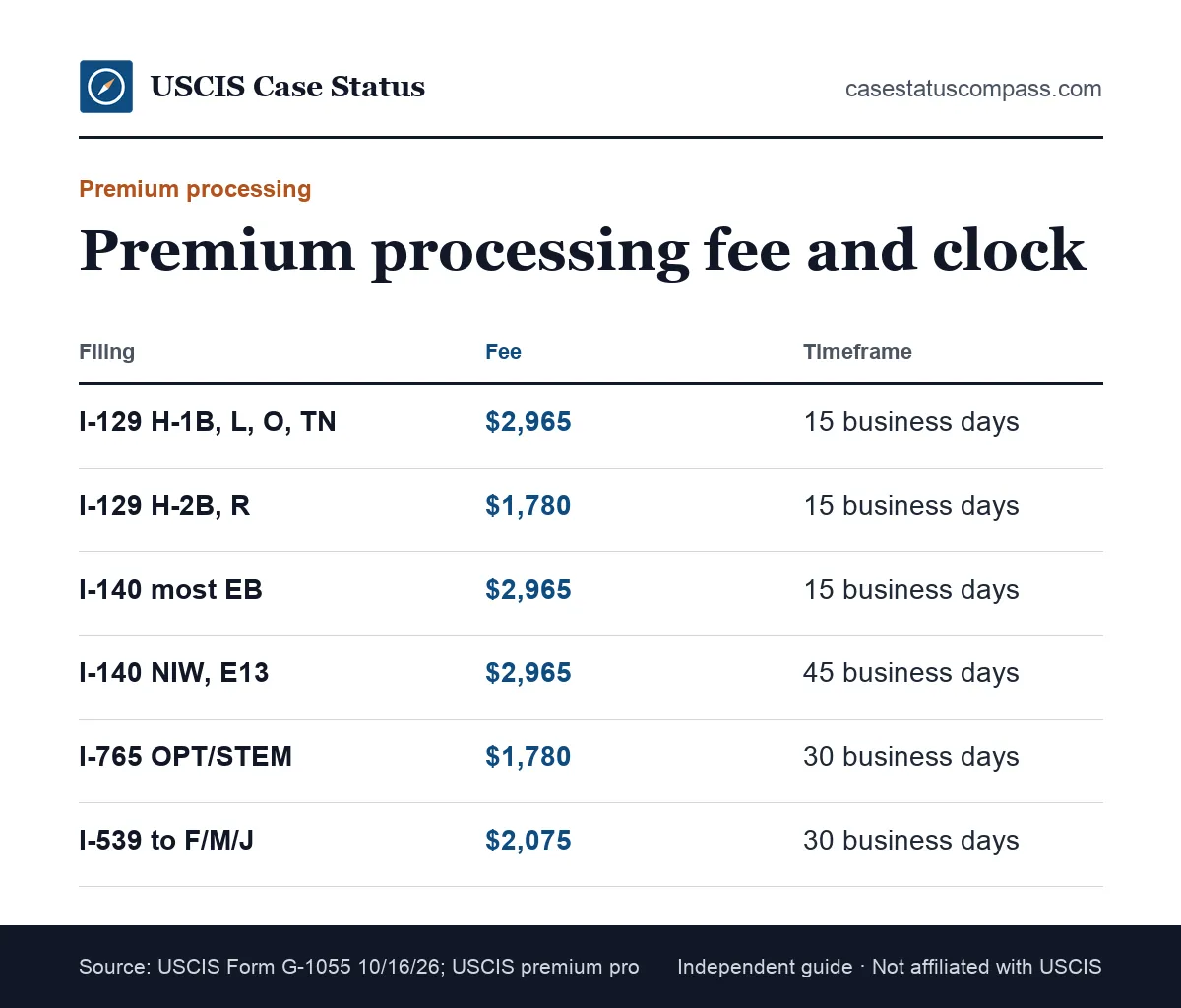
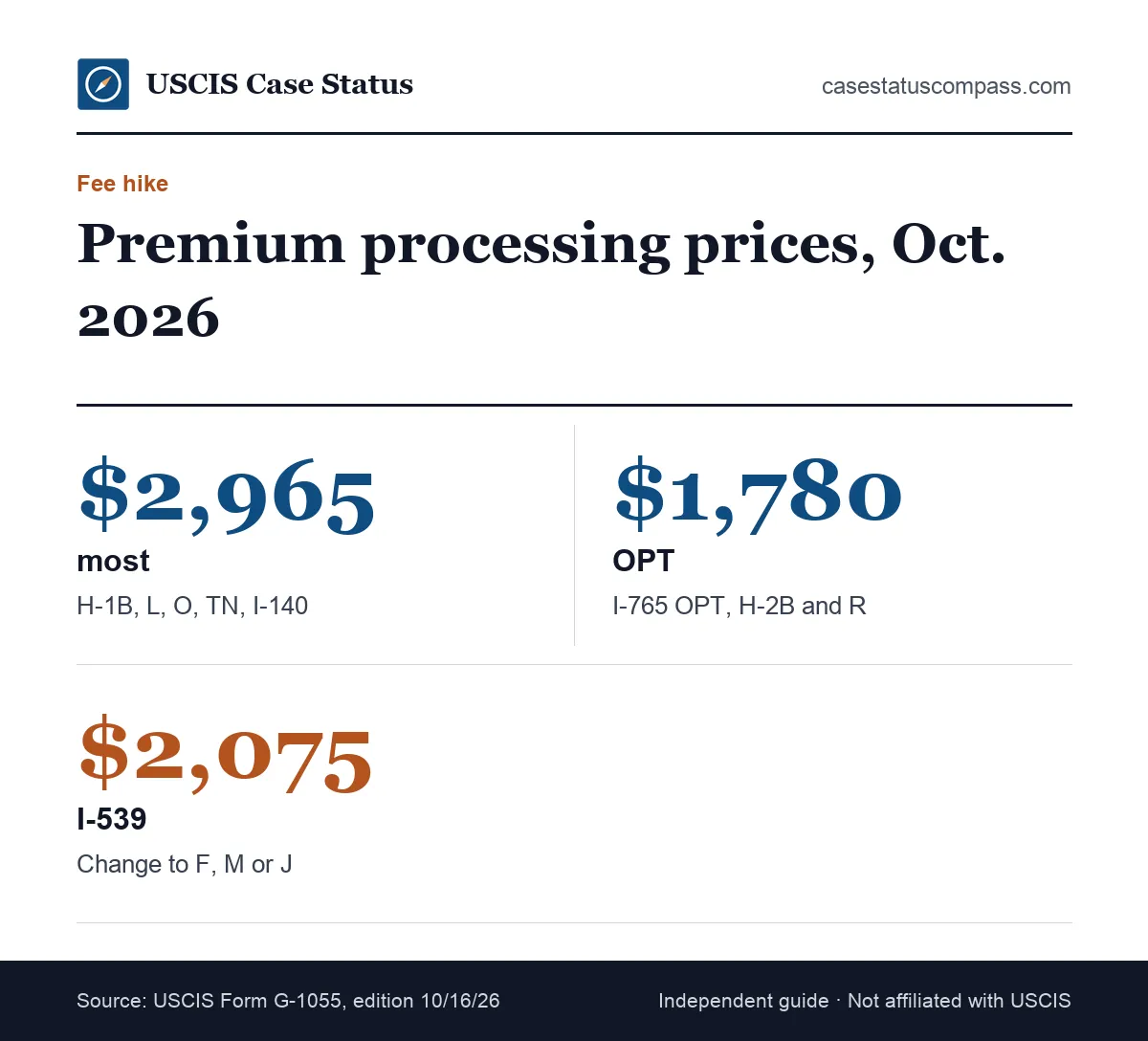
| Premium processing | $2,965 (I-129 most classes, I-140); $1,780 (H-2B/R, I-765 OPT); $2,075 (I-539 to F/J/M) |
| $100,000 payment | $100,000 H-1B payment: blocked by court order (vacated June 8, 2026; stay denied July 24, 2026) |
| Fee schedule | Form G-1055, Edition 10/16/26 |
What Are H-1B Visa Fees in 2026?
H-1B visa fees are the USCIS charges an employer pays to register and petition for a specialty-occupation worker. As of October 2026, a new hire involves up to six lines: registration, the I-129 base fee, the Asylum Program Fee, the ACWIA training fee, the fraud fee and, for some employers, a $4,000 fee.
The lines on a typical new petition
- Registration fee for the lottery entry.
- Form I-129 base fee, lower for small employers and nonprofits.
- Asylum Program Fee, in three tiers.
- ACWIA fee, by employer size, unless exempt.
- Fraud Prevention and Detection fee for initial and change-of-employer petitions.
Costs that sit outside USCIS
Attorney fees, consular visa fees for workers abroad and travel are not USCIS fees. For the status side, our h1b visa status guide explains how to track a petition after filing.
H-1B Filing Fees: The Full Table
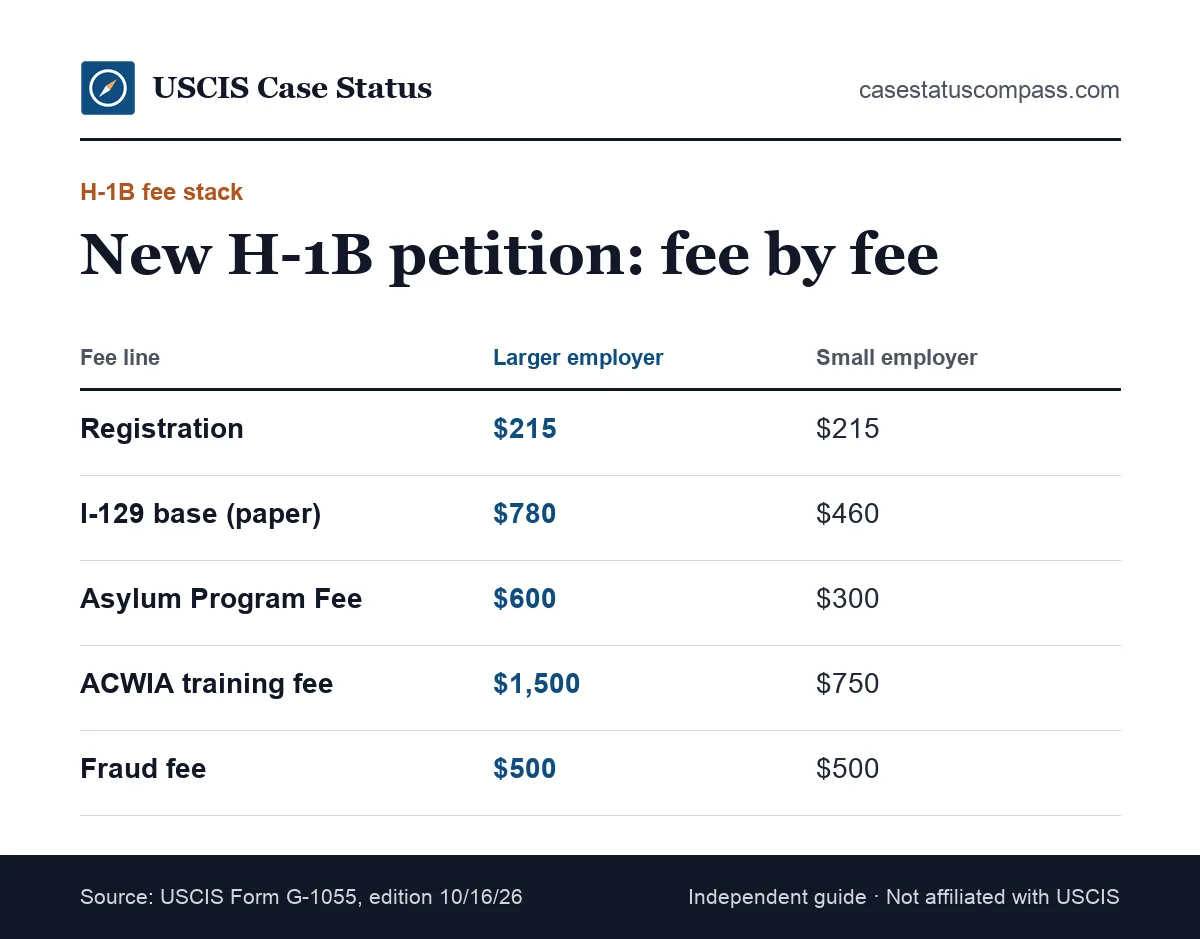
The table below lists every H-1B filing fee line in the current schedule. Amounts are from Form G-1055, Edition 10/16/26. The USCIS fees hub compares them with family and citizenship fees. Not every line applies to every petition: the fraud fee and the Public Law 114-113 fee depend on the case and the employer.
Every H-1B fee line and who owes it
Each row is one of the H-1B visa fees, with the amount and the employers who owe it.
| Fee line | Amount | Who owes it |
|---|---|---|
| Registration | $215 per registration (per beneficiary) | Cap-subject employers, per worker entered |
| I-129 base fee | $780 paper / $730 online; $460 small employer or nonprofit | Every H-1B petition |
| Asylum Program Fee | Asylum Program Fee (I-129, I-140): $600; $300 small employer (or I-140 self-petitioner); $0 nonprofit | Every I-129 petition |
| ACWIA training fee | ACWIA fee: $1,500 or $750 depending on employer size, unless exempt | Most H-1B petitions |
| Fraud fee | $500 Fraud Prevention and Detection fee (initial H-1B or change of employer) | Initial H-1B or new employer |
| Public Law 114-113 fee | $4,000 | 50+ U.S. employees, over half H-1B or L |
| Premium processing | $2,965 | Optional |
Reading the table for your company
Start with your headcount and nonprofit status, since both change the base fee, the Asylum Program Fee and the ACWIA amount. Then check whether the petition is a new hire, a transfer or an extension, because the fraud fee depends on that.
Separate payments, one package
Each fee line is its own amount, so H-1B visa fees are never one flat price. USCIS rejects a petition when any line is missing or wrong, and the whole package comes back.
How Much Is the H-1B Registration Fee?
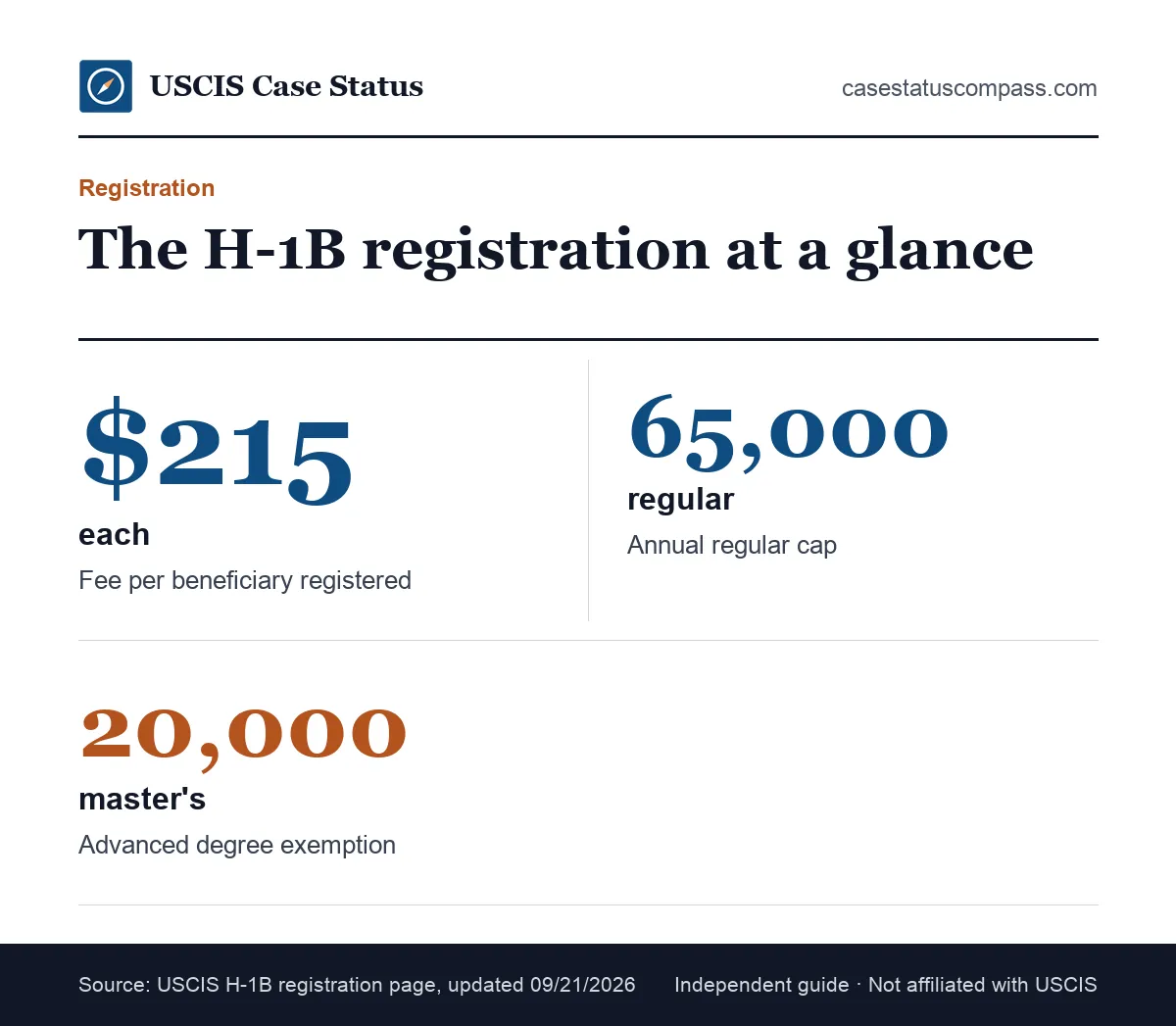
The H-1B registration fee is $215 per registration (per beneficiary). It is paid when the employer submits the electronic registration in March, before any petition is filed. The fee is non-refundable, even if the worker is not selected. It is paid per worker.
When registration happens
For the FY2027 season, registration ran March 4 to March 19, 2026. USCIS reports that the FY2027 regular and master's caps have been reached. Selected employers then file the full petition within the filing window shown in their account.
Wage-weighted selection and the cap
H-1B cap: 65,000 a year + 20,000 for U.S. master's degree or higher. For FY2027, selection was weighted by wage level rather than a pure random lottery. A higher fee does not improve the odds of wage-weighted selection; only the offered wage level matters.
What Is the I-129 Base Fee for an H-1B?
The I-129 base fee for an H-1B is $780 on paper or $730 online for most employers. Small employers and nonprofits pay $460. The petition is not complete without the Asylum Program, ACWIA and fraud fees that apply. Missing any one of those lines gets the whole petition rejected.
Paper vs online H-1B filing
USCIS has expanded online filing for more I-129 categories, including PDF-upload options added on October 7, 2026. Where online filing is open to you, the lower online price applies. The Form I-129 page on uscis.gov lists which classifications can be filed online today.
The small employer and nonprofit rate
The reduced $460 base fee applies to small employers and nonprofits. G-1055 does not define small employer itself; the 2024 fee rule uses 25 or fewer full-time-equivalent employees. Keep a record of how you counted full-time-equivalent staff in case USCIS questions the reduced fee.
Asylum Program Fee on H-1B Petitions
The Asylum Program Fee is added to every Form I-129, including H-1B petitions. Asylum Program Fee (I-129, I-140): $600; $300 small employer (or I-140 self-petitioner); $0 nonprofit. An H-1B petition missing this payment is rejected at intake. It cannot be waived.
The three tiers
- $600 for most employers.
- $300 for small employers.
- $0 for nonprofits.
Your tier depends on the employer, not the worker. A for-profit company with 25 or fewer full-time-equivalent employees pays the small-employer amount, and a qualifying nonprofit pays nothing. All other employers pay the full amount on each I-129.
Proving your tier
Employers claim the reduced or zero amount on the petition, and payroll records back it up. Keep nonprofit proof, such as an IRS determination letter. A wrong claim can lead to a rejection or a request for evidence.
What Is the ACWIA Training Fee?
The ACWIA fee, from the American Competitiveness and Workforce Improvement Act, funds U.S. worker training. ACWIA fee: $1,500 or $750 depending on employer size, unless exempt. Which amount applies is set in Section 2 of the H-1B Data Collection Supplement filed with Form I-129.
$1,500 vs $750
Larger employers pay $1,500 and smaller employers pay $750. The I-129 instructions use a 25-employee threshold. Count full-time-equivalent employees, including affiliates where the instructions require it. Get the count right before filing.
Who is exempt from ACWIA
Some employers can claim an ACWIA exemption in the H-1B Data Collection Supplement, which lists the qualifying categories. Exempt employers still pay the base fee, the Asylum Program Fee and any fraud fee.
Fraud Prevention and Detection Fee
The Fraud Prevention and Detection fee is $500 Fraud Prevention and Detection fee (initial H-1B or change of employer). It applies to the initial H-1B approval and to any petition for a new employer. It does not apply to H-1B1 petitions, and it cannot be waived.
When the fraud fee applies
- A first H-1B petition for the worker.
- A change of employer (an H-1B transfer).
- Cap-exempt initial petitions for a new worker.
In each case the employer pays it once per petition, alongside the other H-1B visa fees. Leaving it out of a transfer is a common reason for a rejected petition.
When it does not apply
An extension with the same employer does not pay the fraud fee. H-1B1 petitions for Chile and Singapore nationals also do not pay it. An amendment by the same employer skips it too.
Who Pays the $4,000 Public Law 114-113 Fee?
The $4,000 Public Law 114-113 fee applies to employers with 50 or more U.S. employees when more than half are in H-1B or L status. It covers initial petitions and changes of employer filed on or before September 30, 2027, on top of every other H-1B fee.
The 50-employee, 50-percent test
Both parts must be true, and this is the largest of the H-1B visa fees when it applies: at least 50 U.S. employees, and more than half of them in H-1B or L-1 status.
When the fee ends
The current statute sets the end date at September 30, 2027. Petitions filed after that date would not owe it unless Congress extends it. Recheck before filing after that date.
Is the $100,000 H-1B Payment Being Collected Now?
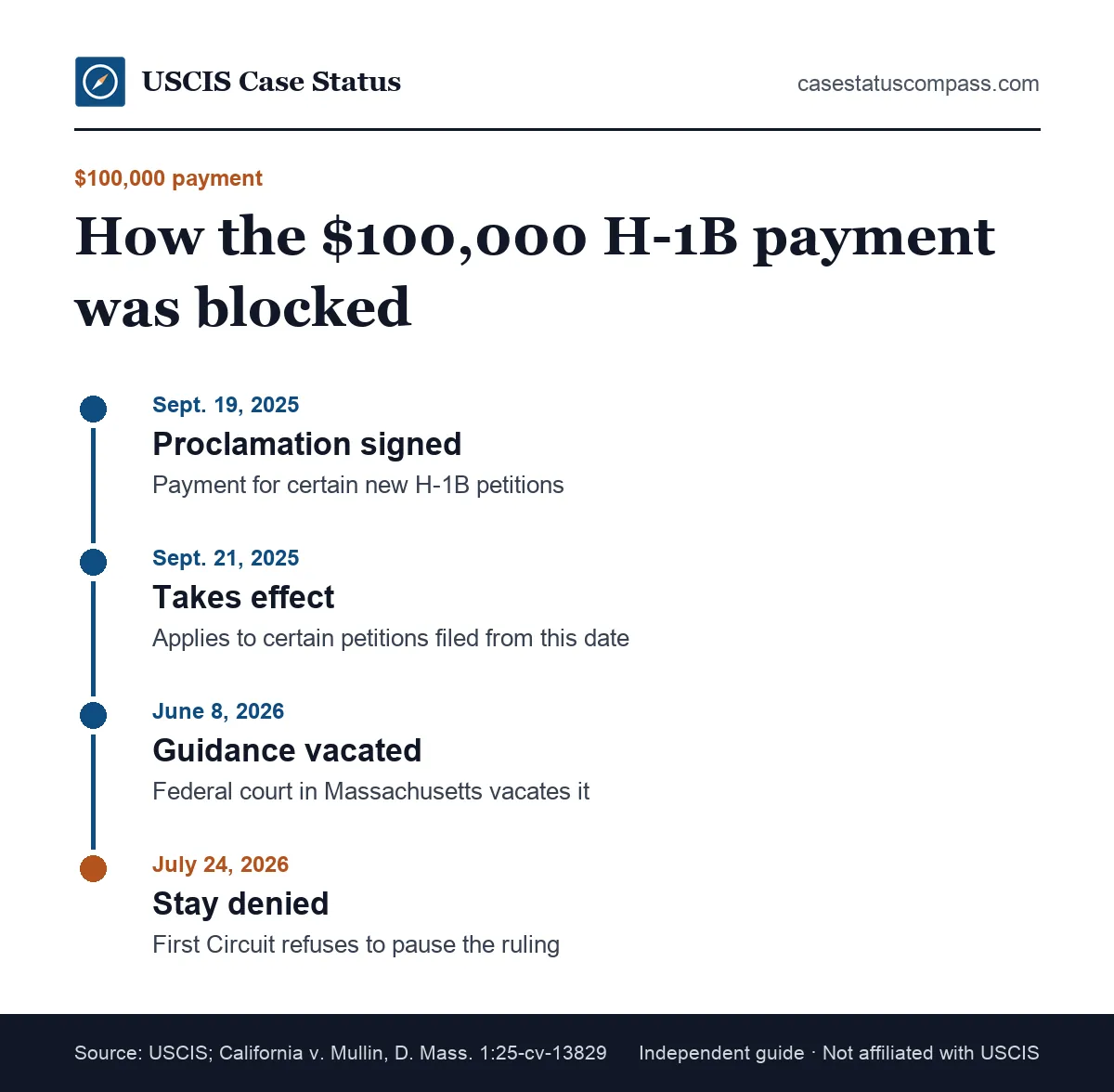
No. $100,000 H-1B payment: blocked by court order (vacated June 8, 2026; stay denied July 24, 2026). G-1055 still lists the payment, but the implementing guidance was vacated in a Massachusetts federal court case. DHS says it still intends to collect if the order is lifted.
Who the payment would have covered
The September 19, 2025 proclamation applied to certain new H-1B petitions filed on or after September 21, 2025. It was never a charge on every H-1B case. Extensions were not included.
What employers should do now
Do not pay the $100,000 unless USCIS announces collection has resumed. Watch the USCIS H-1B page and newsroom. Talk to counsel before filing for a worker outside the U.S. If collection resumes, USCIS would announce it on that page first.
Who Pays H-1B Visa Fees: Employer or Employee?
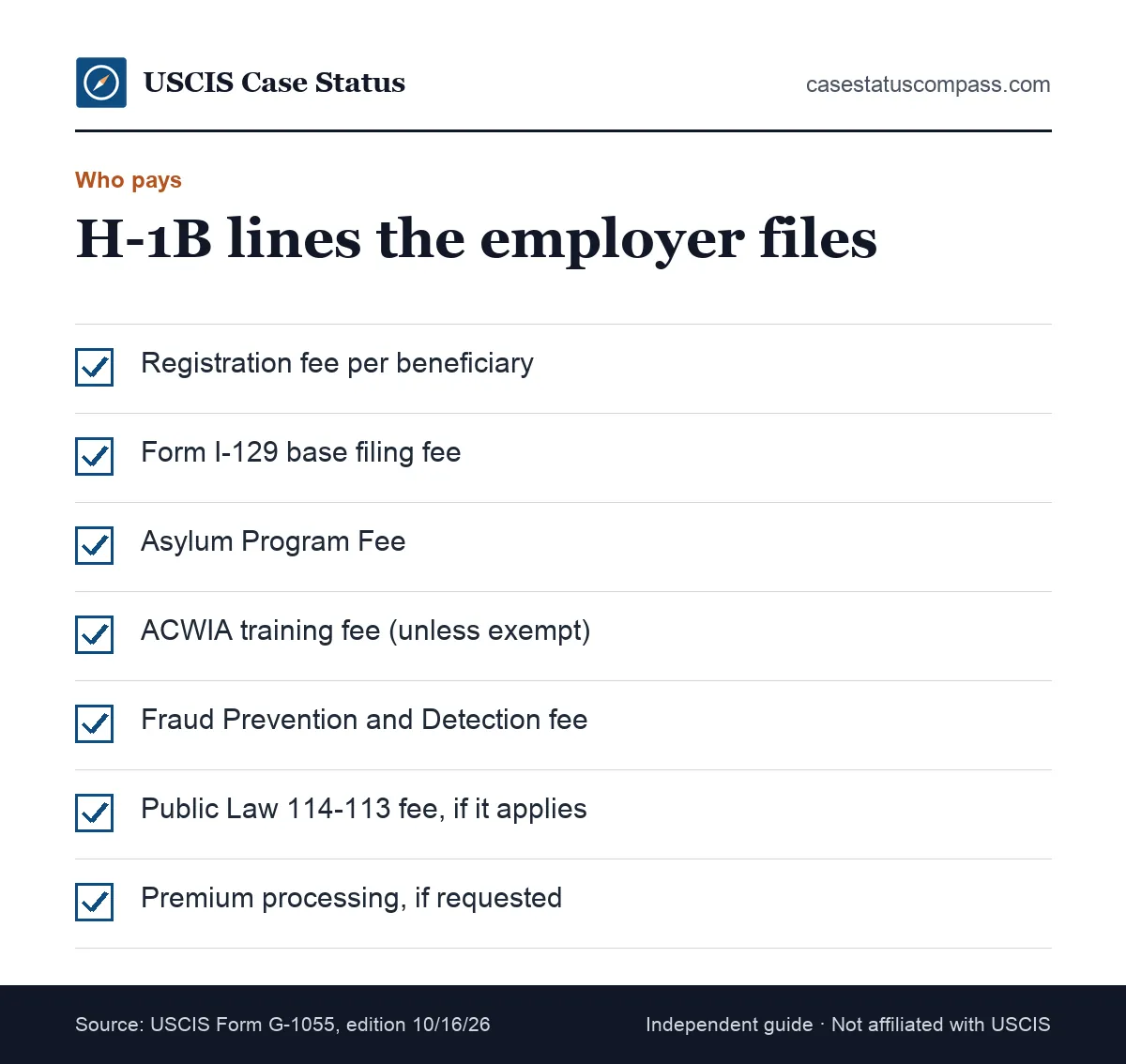
The employer files and pays the H-1B petition fees, because the employer is the petitioner on Form I-129. Which costs may legally be passed to the worker is governed by Department of Labor wage rules, so get legal advice before asking an employee to reimburse anything.
Who pays which fee
This table shows who usually pays each cost. The petition fees in the first row are the employer's to pay.
| Cost | Usually paid by |
|---|---|
| Registration, I-129, Asylum Program, ACWIA, fraud fees | Employer |
| Premium processing | Employer (ask counsel before a worker pays) |
| Legal fees for the petition | Employer |
| Visa stamping and travel | Varies by agreement |
| H-4 family forms | Usually the worker |
Can an employee pay H-1B fees?
Employees should not pay petition fees that are the employer's business expense. DOL's H-1B rules prevent costs from cutting the worker below the required wage. An employment attorney can tell you whether a cost a worker already paid must be refunded.
How Much Does It Cost to Sponsor an H-1B Worker?
H-1B sponsorship cost for a new cap-subject worker is the registration plus the full I-129 stack. A larger employer filing on paper pays $215, then $780, $600, $1,500 and $500, before premium processing or legal fees. Small employers and nonprofits pay lower base, ACWIA and Asylum Program amounts.
Cost of filing H-1B for a new hire
This table compares the H-1B visa fees for a new hire at a larger and a small employer. The base fee, the Asylum Program Fee and ACWIA are the rows that change.
| Line | Larger employer | Small employer |
|---|---|---|
| Registration | $215 | $215 |
| I-129 base (paper) | $780 | $460 |
| Asylum Program Fee | $600 | $300 |
| ACWIA | $1,500 | $750 |
| Fraud fee | $500 | $500 |
Cap-exempt employers
Universities, affiliated nonprofits and nonprofit research organizations skip registration and may be ACWIA-exempt. They often pay the $0 Asylum Program Fee and the reduced base fee. They still pay the fraud fee.
What Does an H-1B Extension Cost?
H-1B transfer, extension and amendment petitions are all filed on Form I-129, so each pays the base fee and the Asylum Program Fee. The fraud fee applies only to a transfer. ACWIA applies unless the employer is exempt. Premium processing is optional and adds $2,965 on top of these H-1B visa fees.
Extensions and the six-year limit
An extension skips the fraud fee because the employer does not change. It still needs the base fee, the Asylum Program Fee and any ACWIA amount. H-1B: 3 years at first, up to 6 years in total.
How Much Does an H-1B Transfer Cost?
An H-1B transfer is a petition by a new employer. The H-1B transfer cost is the base fee, the Asylum Program Fee, ACWIA if not exempt, and the $500 fraud fee. No new registration is needed. A worker already in H-1B status can often start once it is filed.
Adding premium processing to a transfer
Many new employers add premium processing at $2,965 to get a decision within 15 business days. It is optional and paid with the other petition fees. The worker usually does not pay it.
What Is the Cost of an H-1B Amendment?
An amendment, for example after a worksite change, is a new I-129 from the same employer. Budget for the base fee and Asylum Program Fee, then confirm ACWIA in the supplement. The fraud fee does not apply, and premium processing is optional.
How Much Is H-1B1?
H-1B1 is a separate classification for nationals of Chile and Singapore. It is filed on Form I-129 like an H-1B, but the fraud fee does not apply. H-1B1 workers can also apply directly at a U.S. consulate. In that case the worker pays the State Department visa fee and no USCIS petition fee.
Fees that change for H-1B1
The $500 Fraud Prevention and Detection fee does not apply to H-1B1. Check the I-129 instructions and G-1055 for the base fee and ACWIA treatment of H-1B1 petitions. A wrong amount on any line gets the H-1B1 petition rejected and returned.
H-1B1 and the cap
Part of the 65,000 regular cap is set aside each year for H-1B1 workers from Chile and Singapore. H-1B1 workers do not need the H-1B registration when they apply directly at a consulate.
H-1B Visa Fee Impact on Small Employers and Nonprofits
The H-1B visa fee impact is much lighter for small employers and nonprofits. Three lines drop: the base fee to $460, the Asylum Program Fee to $300 or $0, and ACWIA to $750 or nothing when exempt. The $215 registration and $500 fraud fee stay the same.
Small employer savings in practice
A small for-profit employer on paper pays $460, $300, $750 and $500 for a new H-1B. Premium processing still costs the full $2,965. Compared with a larger employer, the saving comes from three of the lines, while registration and the fraud fee do not change.
Nonprofits and universities
A qualifying nonprofit pays $0 for the Asylum Program Fee and can claim ACWIA exemption if it fits a listed category. Keep the IRS determination letter with the file. The letter is your proof if USCIS asks why the reduced amounts were paid.
Premium Processing Fee for H-1B
The h1 premium processing fee is $2,965 for H-1B and most other I-129 classes. Premium processing is requested with Form I-907, costs the same on paper and online, and is paid separately from the petition fees. You can't get a fee waiver for premium processing.
H-1B premium processing cost and timeframe
For $2,965, USCIS commits to act on an H-1B petition within 15 business days. "Act" can mean an evidence request, not only approval. The 15 business days start when USCIS receives Form I-907. See our premium processing guide.
What resets the premium clock
An RFE stops the premium clock; a new period starts when USCIS gets your response. Premium processing does not refund the fee when an evidence request is issued. Send a complete petition to protect the timeframe.
When Is H-1B Premium Processing Worth the Cost?
Premium processing is worth the $2,965 when timing matters more than money: a start date, travel, a tight transfer, or a status that expires soon. Normal processing is often months long; USCIS's median for all I-129 classes was I-129 (all classifications combined): median 9.5 months (USCIS data, Apr.-June 2026).
Good reasons to pay for speed
- The worker needs to travel and get a visa stamp soon.
- A cap-subject start date of October 1 is close.
- The worker's current status is about to end.
- A green card timeline depends on a quick approval.
When normal processing may be enough
Cap-gap workers, extensions filed well before expiry and transfers where the worker can start on filing often do fine without premium. Our h1b processing time page explains how to read the official tool.
Premium Processing for I-140 and EB Petitions
I-140 premium processing costs $2,965 for EB-1, EB-2 and EB-3 petitions. The timeframe is 15 business days for most categories and 45 business days for EB-1C managers (E13) and EB-2 national interest waivers. It is paid on top of the $715 (paper) / $665 (online) + Asylum Program Fee $600 ($300 small employer or self-petitioner; $0 nonprofit) I-140 fee.
I-140 premium cost vs timeframe
15 business days (I-129, most I-140); 30 (I-765 OPT, I-539 F/M/J); 45 (I-140 E13 managers and NIW). The longer 45-day clock for NIW and E13 still costs the same $2,965. An evidence request stops the clock in every category.
Filing an I-140 with premium processing
If you file Form I-140 with Form I-907 for premium processing, you must file by mail. The I-907 mailing addresses for premium I-140 filings changed in October 2026. Use the Form I-907 direct filing addresses page on uscis.gov, not an address from an older copy.
What Do H-1B Legal Fees Cost?
H-1B legal fees are set by each attorney or law firm and are not USCIS fees. We do not quote ranges because no official source publishes them. Our immigration lawyer cost guide explains common pricing models. Ask for a written quote that says whether the H-1B visa fees owed to USCIS are included.
Questions to ask before hiring counsel
- Is the price flat or hourly?
- Are RFE responses included or extra?
- Does the quote include the registration, LCA and petition?
- Who pays the fees: the company or the worker?
Why the employer usually pays legal fees
Legal work on the petition benefits the employer as petitioner. DOL rules can make it a problem to shift these costs to the worker. Ask counsel before any repayment agreement.
Visa Stamping Costs for H-1B Workers Abroad
Workers outside the U.S., or those who travel, need an H-1B visa stamp from a U.S. consulate after USCIS approval. The consulate charges a State Department fee, separate from USCIS fees: $205 for petition-based visas such as H-1B and L-1.
Who pays the visa stamp fee
The consular fee is paid by the person applying for the visa, usually before the interview. Whether the employer reimburses it depends on the job offer or company policy. Keep the payment receipt.
The visa integrity fee
H.R. 1 created a visa integrity fee on approved nonimmigrant visas; we state no amount. The State Department's Fees for Visa Services page did not list a visa integrity fee as of Oct. 27, 2026. Do not pay it to any third party.
EAD and OPT Fees
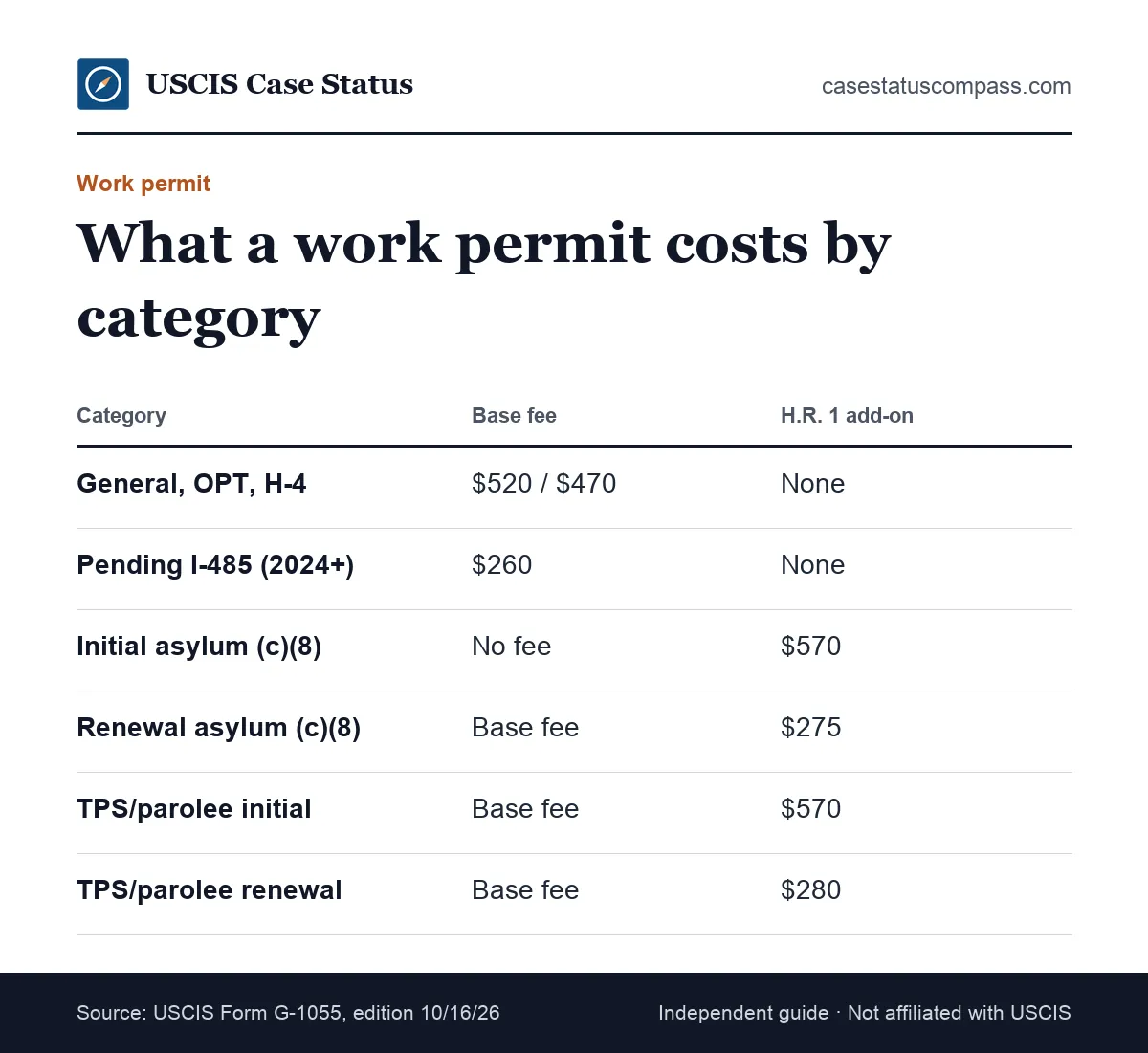
EAD and OPT fees are paid by individuals on Form I-765, the work permit application. The fee is $520 (paper) / $470 (online); $260 with a pending I-485 filed on or after Apr. 1, 2024. H.R. 1 add-ons: initial asylum-applicant (c)(8) EAD $0 + $570; initial TPS/parolee EAD base fee + $570; renewal TPS/parolee base fee + $280; renewal (c)(8) base fee + $275. The base fee applies to OPT and H-4 EADs.
EAD filing edition
USCIS accepts only one edition of Form I-765: 08/21/25 (the 09/15/26 edition is NOT accepted because of a Sept. 14, 2026 court order). A package on any other edition is rejected. Our work permit guide explains categories.
How Much Does a Work Permit Cost in the US?
A work permit cost in the US is $520 paper / $470 online for most categories as of October 2026. It falls to $260 with a pending I-485 filed on or after April 1, 2024. Asylum, TPS and parolee permits add H.R. 1 fees.
EAD card fee: paper vs online
The EAD card fee is $470 online versus $520 on paper. Fee waiver requests must usually be filed on paper. Where your category can be filed online, that route costs less, and the system always uses the current edition.
How Much Is a Work Permit With a Pending Green Card?
If your I-485 was filed on or after April 1, 2024 and is still pending, the I-765 costs $260, paper or online. That rate replaces the general EAD fee. The I-485 filing date on your receipt notice decides the rate. If you file the I-765 with the I-485, the lower rate applies from the start.
Renewals tied to an older I-485
If the I-485 was filed between July 30, 2007 and March 31, 2024 with the fee paid, work permit renewals are free while it stays pending. Keep the I-485 receipt notice.
How Much Does It Cost to Renew a Work Permit?
Renewing a work permit costs the same base fee as an initial one in most categories: $520 paper / $470 online. EAD renewal cost is different for TPS, parolee and asylum categories, which add H.R. 1 renewal fees of $280 or $275.
Work permit renewal fee and timing
Ended: renewals filed on or after Oct. 30, 2025 no longer get the up-to-540-day automatic extension (exceptions: TPS by law/Federal Register notice; STEM OPT 180 days). Also, the Oct. 14, 2026 final rule (91 FR 65306) made permanent the end of automatic EAD extensions for renewals filed from Oct. 30, 2025. Plan for the full fee early, because waiting can cause a gap in authorization even if you pay on time.
Renewal for H-4 and OPT
H-4 EAD renewals pay the base fee. OPT cannot be renewed; STEM OPT is a 24-month extension that uses the same I-765 base fee, with a 180-day automatic extension when filed on time.
OPT Application Fee and STEM OPT Costs
The OPT application fee is the I-765 base fee: $520 paper / $470 online. STEM OPT extensions pay the same fee. F-1 students can add premium processing for $1,780, with a 30-business-day timeframe. Premium processing is optional for both, and students pay these fees themselves.
Premium processing for STEM OPT cost
For $1,780, USCIS commits to act on an OPT or STEM OPT I-765 within 30 business days. The I-907 fee is not refunded after an evidence request. File it with the I-765.
What Is the Cost to Expedite an EAD or OPT?
The cost to expedite EAD OPT filings is the $1,780 premium processing fee, because premium processing is available for OPT. Other EAD categories can request an expedite for free. A free expedite is not guaranteed, and USCIS decides each request case by case, so build in time where you can.
Why OPT cannot use a free expedite
USCIS will not consider expedite requests for forms and categories where premium processing exists. OPT students who need speed pay for Form I-907 instead. That rule covers both initial OPT and STEM OPT filings.
Free expedite requests for other EADs
Expedite criteria: severe financial loss, emergency/humanitarian, nonprofit, government interest, clear USCIS error. Ask for an expedite through the USCIS Contact Center or your online account. Meeting a criterion does not guarantee approval. Our expedite request guide explains evidence.
H-4 Dependent Costs: I-539 and H-4 EAD
H-4 dependents of H-1B workers pay their own fees, separate from the H-1B visa fees. Extending or changing H-4 status uses Form I-539 at $470 (paper) / $420 (online). An H-4 EAD uses Form I-765 at the general base fee.
H-4 EAD fee
The H-4 EAD filing fee is $520 paper / $470 online. Each dependent who wants work authorization pays a separate I-765 fee, even when the family files together. Check whether your category can be filed online, which costs less.
Filing H-4 forms with the H-1B extension
Many families file the I-539 and I-765 together with the H-1B extension. They travel in one package but are paid separately from the employer's petition fees. Each form needs its own payment.
How Much Is the H-4 EAD Renewal Fee?
The H-4 EAD renewal fee is the same base amount as the first card: $520 paper / $470 online. Since October 30, 2025, H-4 EAD renewals no longer get the automatic extension, so file early to avoid a work gap.
EAD Fees for Asylum, TPS and Parolees Under H.R. 1
Asylum applicants, TPS holders and parolees pay H.R. 1 add-ons on their work permits. Initial asylum EADs pay no base fee, only $570. TPS and parolee initial EADs pay the base fee plus $570. These add-ons cannot be waived. Your EAD category code, such as (c)(8) for asylum applicants, decides which line applies.
Renewal add-ons
Renewal TPS and parolee EADs add $280 to the base fee. Renewal (c)(8) asylum-applicant EADs add $275. These are fiscal year 2027 amounts, effective October 16, 2026. H.R. 1 updates these add-ons every fiscal year, so check G-1055 again before a later renewal.
Who is exempt
Ms. L. settlement class: exempt from H.R. 1 parole, parolee-EAD and asylum fees since Feb. 5, 2026. Other exemptions are narrow. Our USCIS fees hub has the full H.R. 1 list.
L-1, O-1 and TN Visa Costs
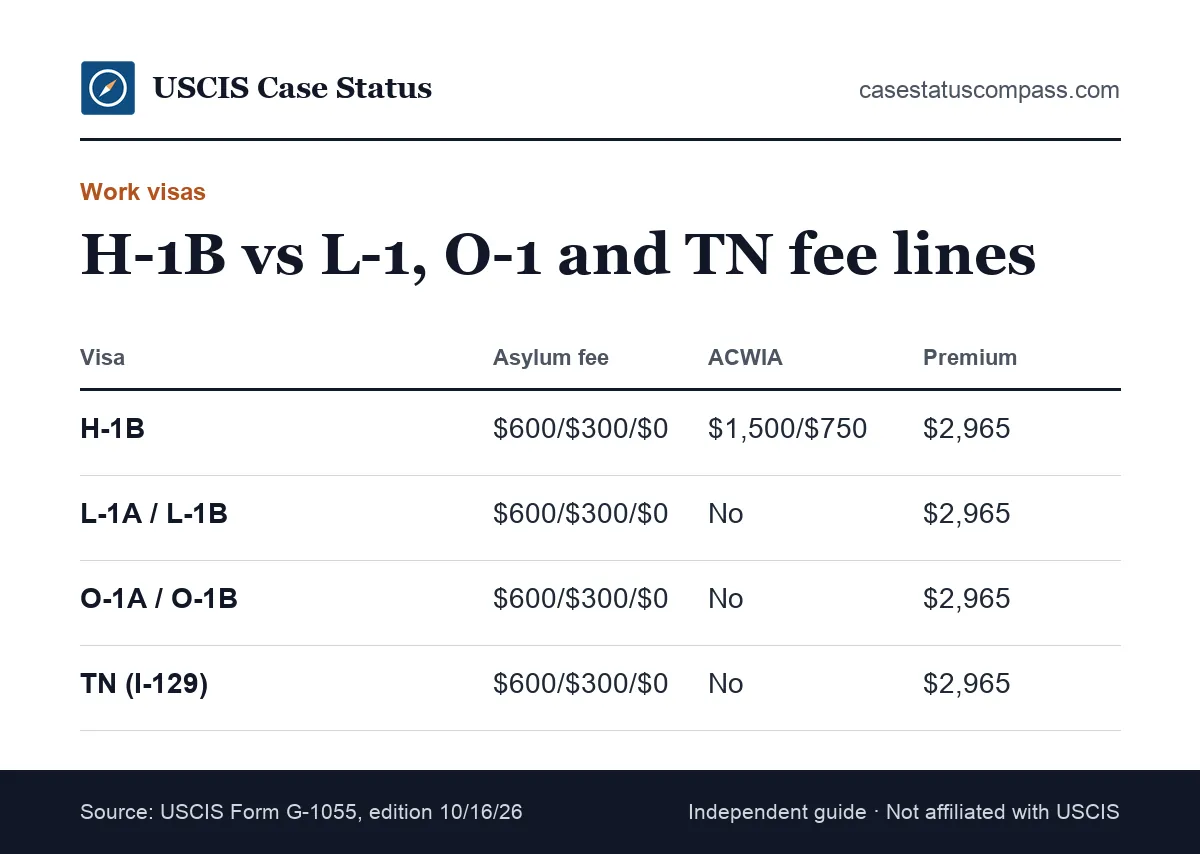
L-1, O-1 and TN petitions are filed on Form I-129, like H-1B. Each pays its own base fee plus the Asylum Program Fee: Asylum Program Fee (I-129, I-140): $600; $300 small employer (or I-140 self-petitioner); $0 nonprofit. Premium processing costs $2,965. Their I-129 base fees are not yet in our verified fact set.
What we verified and what to check
We verified the Asylum Program Fee and premium processing for L, O and TN petitions. Check G-1055 for each class's base fee. Look for the row for your visa class, and note both the paper and online amounts before adding the Asylum Program Fee.
Fees that are H-1B-only
The ACWIA training fee and the $4,000 Public Law 114-113 fee are H-1B items in our data. L-1 petitions have their own fee rules; confirm them in the I-129 instructions.
How Much Does an L-1 Visa Cost?
An L-1 visa cost includes the I-129 base fee for the L class, the Asylum Program Fee and optional premium processing at $2,965. The L-1 base fee is listed in G-1055 but not in our verified facts. Look up the L-1 row in the current G-1055 before you write the check.
L-1A vs L-1B visa fees
L-1A managers and L-1B specialized-knowledge workers file under the same L classification. The l1b visa fees and l1a visa fees match at USCIS level. Differences come from legal work and evidence.
Finding the L-1 base fee in G-1055
Open the current G-1055, find the Form I-129 section and read the L-1 row. Note the paper and online amounts before you total the petition. Also check the footnotes for any L-only charges.
How Much Do O-1 Visa Fees Cost?
O-1 visa fees at USCIS are the I-129 base fee for the O class plus the Asylum Program Fee. Premium processing adds $2,965 and is often used because O-1 cases are time-sensitive. Check the O-class row in G-1055 for the base fee, and budget separately for advisory opinions and legal work.
O-1A vs O-1B cost
O-1A (sciences, business, athletics) and O-1B (arts, film, TV) pay the same USCIS fees. The o1b visa cost differs mainly because of advisory opinions and legal work. Premium processing is the same.
What Is the TN Visa Cost?
The TN visa cost depends on where the worker applies. Canadians can apply at a port of entry, and Mexicans apply at a consulate, paying border or State Department fees. A TN extension or change of status inside the U.S. uses Form I-129 plus the Asylum Program Fee.
TN through USCIS
When an employer files Form I-129 for a TN worker, the Asylum Program Fee applies, and premium processing is available at $2,965. Check the current G-1055 for the TN base fee, since it is not in our verified figures, and add it to the total.
TN at the border or consulate
Border and consular TN applications are handled by CBP or the State Department, not USCIS. The consular tn visa fee is $185. We did not verify CBP's border fee; check cbp.gov.
How Much Does It Cost to Sponsor a Work Visa?
The cost to sponsor a work visa depends on the classification. H-1B carries the most USCIS lines: registration, base fee, Asylum Program Fee, ACWIA and fraud fee. L-1, O-1 and TN pay a base fee and the Asylum Program Fee.
Work visa cost comparison
This table lists the main USCIS fee lines for each work visa and the premium processing price.
| Visa | Main USCIS lines | Premium |
|---|---|---|
| H-1B | Registration, base, Asylum Program, ACWIA, fraud | $2,965 |
| L-1 | Base, Asylum Program | $2,965 |
| O-1 | Base, Asylum Program | $2,965 |
| TN (inside U.S.) | Base, Asylum Program | $2,965 |
| H-2B | Base, Asylum Program | $1,780 |
How much is a working visa for America overall
There is no single price for a working visa for America. The USCIS share depends on the class and employer size, and the visa stamp and legal work add more.
EB-2 NIW Cost
The EB-2 NIW cost at USCIS is the Form I-140 fee plus the reduced $300 Asylum Program Fee for self-petitioners. As of October 2026, the I-140 line reads $715 (paper) / $665 (online) + Asylum Program Fee $600 ($300 small employer or self-petitioner; $0 nonprofit). Premium processing adds $2,965 with a 45-business-day clock.
Why NIW self-petitioners pay less
National interest waiver applicants can file their own I-140 without an employer. Self-petitioners pay the reduced $300 Asylum Program Fee. No PERM labor certification is required. That skips the recruitment ads and attorney work a PERM case needs.
NIW fee with the green card stage
After I-140 approval and a current priority date, the worker files Form I-485 or processes abroad. Those fees are on our how much is a green card page. None of those green card fees are part of the I-140 amount.
I-140 Filing Fee for Employer Green Cards
The I-140 filing fee for an employer green card is $715 on paper or $665 online, plus the Asylum Program Fee. Most EB-2 and EB-3 cases also need PERM labor certification first, which DOL handles. Premium processing is optional for every category.
PERM costs before the I-140
DOL does not list a filing fee for Form ETA-9089. Under federal rules, the employer, not the worker, must pay PERM labor certification costs, including its own attorney fees. A PERM labor certification expires 180 days after DOL certifies it.
Who pays the I-140 fee
For an employer-sponsored I-140, the employer is the petitioner and files the form, with the fee and the Asylum Program Fee. NIW and EB-1A applicants can self-petition, so they pay their own I-140 fee.
Total-Cost Worksheet: Pick Your Forms
Use this worksheet as a total-cost calculator. Tick each form you will file, take the amount from the matching row, and add them up. Legal and consular costs are not included. Add each dependent's I-539 and I-765 separately. Then compare the total with the H-1B visa fees table above.
Work visa fees by form
Each row is one form or fee line. Where a row shows several amounts, pick the one for your filing method or employer size.
| Form or fee | Amount |
|---|---|
| H-1B registration | $215 |
| I-129 H-1B base | $780 paper / $730 online / $460 small |
| Asylum Program Fee | $600 / $300 / $0 |
| ACWIA | $1,500 / $750 |
| Fraud fee | $500 |
| Premium (I-907) | $2,965 |
| I-539 (H-4) | $470 paper / $420 online |
| I-765 (H-4 EAD or OPT) | $520 paper / $470 online |
Worked example: worker plus spouse
A large employer files a new H-1B on paper with premium processing: $215, $780, $600, $1,500, $500 and $2,965. The spouse then files Form I-539 and an H-4 EAD. The spouse's I-539 and I-765 fees come on top of the employer's total.
How Have Work Visa Fees Changed Since 2024?
The biggest h1b visa fee hike came on April 1, 2024, when USCIS raised I-129 fees and added the Asylum Program Fee. The October 16, 2026 schedule raised premium processing again. The $100,000 payment was announced in 2025 but is blocked by court order.
The 2024 fee rule
The 2024 fee rule split I-129 fees by visa class, created the small employer and nonprofit rates, and folded biometrics into most fees. It also introduced the lower online prices. Most of these amounts still apply today.
The 2025 and 2026 changes
H.R. 1 in 2025 added fees for asylum, parole and some EADs, updated yearly. Premium processing prices rose under the October 2026 schedule to $2,965, $2,075 and $1,780. Use the G-1055 edition dated 10/16/26; a payment based on an older edition can be rejected.
H-1B Fee Mistakes to Avoid
Most H-1B fee rejections come from a missing line, the wrong employer tier or the wrong schedule. USCIS returns the entire petition when any required fee is missing. A rejected cap petition can be costly if the filing window closes before you refile, so check every line of the H-1B visa fees against the current schedule first.
Common H-1B fee errors
- Leaving out the Asylum Program Fee.
- Claiming the small employer rate without counting correctly.
- Omitting the fraud fee on a transfer.
- Paying the $100,000 payment while it is blocked.
How to fix a rejected petition
Read the rejection notice, correct the payments and refile. A rejected H-1B has no receipt number, so it will not appear in case status tools. Refile quickly within the filing window.
How Work Visa Fees Fit With Other USCIS Fees
Work visa fees are one part of the USCIS fee system. Once an H-1B worker moves toward a green card, family and citizenship fees follow. Our green card renewal fee and how much does it cost to become a us citizen guides cover the later steps.
From H-1B to green card to citizenship
- H-1B petition fees, paid by the employer.
- PERM and I-140, then I-485 for the worker and family.
- Form I-90 renewal every 10 years.
- Form N-400 for citizenship.
Frequently Asked Questions
How much does an H-1B visa cost in total?
For a new cap-subject H-1B, a larger employer pays $215 to register, then $780, $600, $1,500 and $500 on paper, plus the $4,000 fee if it is H-1B-dependent. Premium processing adds $2,965.
Can an employee pay the H-1B fees?
The employer files Form I-129 and pays the petition fees, because it is the petitioner. Department of Labor wage rules limit passing business costs to the worker. If a worker is asked to repay a fee, ask an immigration attorney or the DOL Wage and Hour Division first.
How much is the H-1B premium processing fee?
H-1B premium processing costs $2,965 as of October 2026, paid on Form I-907. USCIS commits to act within 15 business days. An evidence request stops the clock.
Does an H-1B extension pay the $500 fraud fee?
No. The Fraud Prevention and Detection fee applies to an initial H-1B petition and to a change of employer. An extension with the same employer does not pay it, but still pays the base fee, the Asylum Program Fee and any ACWIA amount.
Is the $215 H-1B registration fee refundable?
No. The $215 registration fee is non-refundable, even if the worker is not selected. It is paid per beneficiary when the employer submits the March registration.
How much is it to apply for a work permit with OPT?
OPT uses Form I-765 at $520 paper / $470 online. Premium processing is available for $1,780 with a 30-business-day timeframe. OPT never uses the reduced $260 fee, which is only for people with a pending green card application.
How much does it cost to renew a work permit?
Most work permit renewals pay the same I-765 base fee as a first card, $520 paper / $470 online. TPS, parolee and asylum-applicant renewals add H.R. 1 fees on top.
What is the H-1B sponsorship cost for a small company?
A small employer pays the $215 registration, the reduced $460 base fee, the $300 Asylum Program Fee, $750 ACWIA and the fraud fee. Premium processing and legal fees are extra.
Is premium processing available for an L-1 or O-1 petition?
Yes. L-1 and O-1 petitions on Form I-129 can add Form I-907 at $2,965, the same price as H-1B. O-1 employers use it often because performance and project dates are fixed.
Do H-4 spouses pay their own fees?
Yes. H-4 dependents file Form I-539 for status at $470 paper / $420 online, and each spouse who wants work authorization files Form I-765 at the general base fee.
Sources
- USCIS: Form G-1055, Fee Schedule (edition 10/16/26). www.uscis.gov/g-1055. Accessed Oct 27, 2026.
- USCIS: H-1B Electronic Registration Process. www.uscis.gov/working-in-the-united-states/temporary-workers/h-1b-specialty-occupations/h-1b-electronic-registration-process. Accessed Oct 27, 2026.
- USCIS: H-1B Specialty Occupations. www.uscis.gov/working-in-the-united-states/h-1b-specialty-occupations. Accessed Oct 27, 2026.
- USCIS: How Do I Request Premium Processing?. www.uscis.gov/forms/all-forms/how-do-i-request-premium-processing. Accessed Oct 27, 2026.
- USCIS: Form I-765, Application for Employment Authorization. www.uscis.gov/i-765. Accessed Oct 27, 2026.
- USCIS: Form I-129, Petition for a Nonimmigrant Worker. www.uscis.gov/i-129. Accessed Oct 27, 2026.
- USCIS: H-1B Electronic Registration Process. www.uscis.gov/working-in-the-united-states/temporary-workers/h-1b-specialty-occupations-and-fashion-models/h-1b-electronic-registration-process. Accessed Oct 27, 2026.
- USCIS Form G-1055 Fee Schedule, Edition 10/16/26 (Appendix A). www.uscis.gov/sites/default/files/document/forms/g-1055.pdf. Accessed Oct 27, 2026.
- USCIS Data Library: All USCIS Application and Petition Form Types, FY2026 Q3 (Apr. 1-June 30, 2026; queried 7/2026). www.uscis.gov/sites/default/files/document/data/quarterly_all_forms_fy2026_q3_v1.xlsx. Accessed Oct 27, 2026.
- State Department: Fees for Visa Services. travel.state.gov/content/travel/en/us-visas/visa-information-resources/fees/fees-visa-services.html. Accessed Oct 27, 2026.
- USCIS: Automatic EAD Extension (updated 10/29/2025). www.uscis.gov/working-in-the-united-states/information-for-employers-and-employees/automatic-employment-authorization-document-ead-extension. Accessed Oct 27, 2026.
- Federal Register (govinfo), FR Doc. 2026-20955, 91 FR 65306-65368, RIN 1615-AD05. www.govinfo.gov/content/pkg/FR-2026-10-14/html/2026-20955.htm. Accessed Oct 27, 2026.
- USCIS: How to Make an Expedite Request (updated 09/08/2026). www.uscis.gov/forms/filing-guidance/how-to-make-an-expedite-request. Accessed Oct 27, 2026.
- 20 CFR 656.12(b) (govinfo, CFR 2025 edition). www.govinfo.gov/content/pkg/CFR-2025-title20-vol3/xml/CFR-2025-title20-vol3-sec656-12.xml. Accessed Oct 27, 2026.
- USCIS: Form I-140 page (updated 07/24/2026). www.uscis.gov/i-140. Accessed Oct 27, 2026.
casestatuscompass.com is an independent publication and is not affiliated with USCIS or any government agency. This page is general information, not legal advice. For denials, court or asylum matters, consult an immigration attorney or a DOJ-accredited representative.