Contents · 43 sections
- What Is Premium Processing?
- How Does the Form I-907 Upgrade Work Step by Step?
- Which Forms Are Eligible for Premium Processing?
- What Are the Premium Processing Timeframes by Category?
- Premium Service for Form I-129 and H-1B Petitions
- What Is the H-1B Transfer Premium Processing Time?
- How Long Is H-1B Extension Premium Processing?
- Should You Upgrade the I-140 Before an H-1B Extension?
- Other I-129 Categories: L-1, O-1, TN and E Visas
- What Is the I-140 Premium Processing Timeline?
- EB-1A Premium Processing Time
- Why Do EB-1A Filers Pay for Premium Processing?
- EB-1C Multinational Manager Petitions
- What Is the EB-2 NIW Timeline With Premium Processing?
- How Many Calendar Weeks Is the EB-2 NIW Premium Window?
- EB-1 Green Card Premium Processing Time: Petition vs Green Card
- Is There Premium Processing for OPT and STEM OPT?
- Form I-539 Change to F, M or J Status
- Can H-4 or L-2 Dependents Use Premium Processing?
- Can Family and Citizenship Forms Get Faster Processing?
- How Do You Request Premium Processing With Form I-907?
- Who Can Sign and File Form I-907?
- Where Do You Mail Form I-907 in 2026?
- Can You File Premium Processing Online?
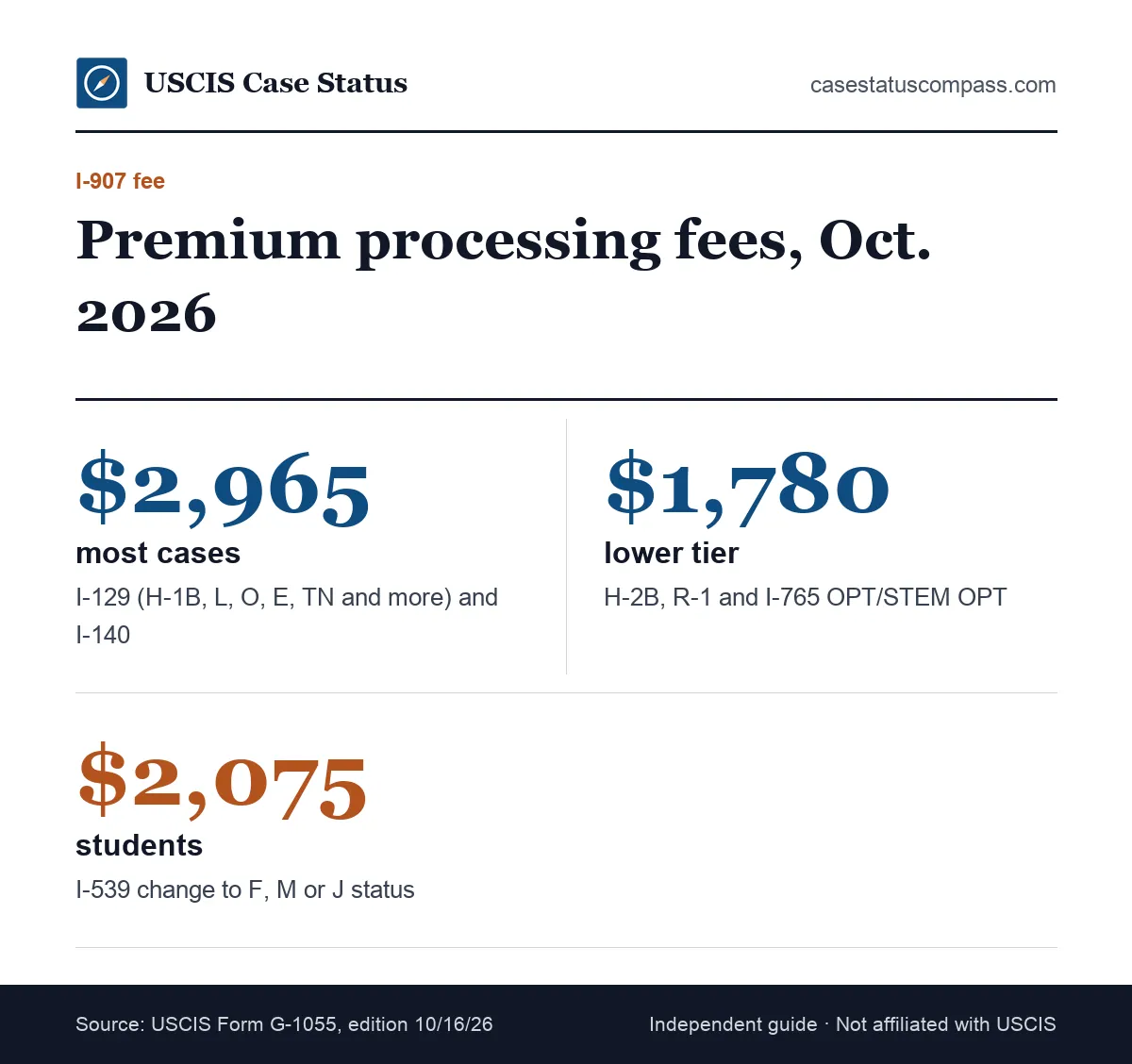
- How Much Does Premium Processing Cost?
- What Happens If You Pay the Wrong I-907 Fee?
- What Happens If USCIS Misses the Premium Deadline?
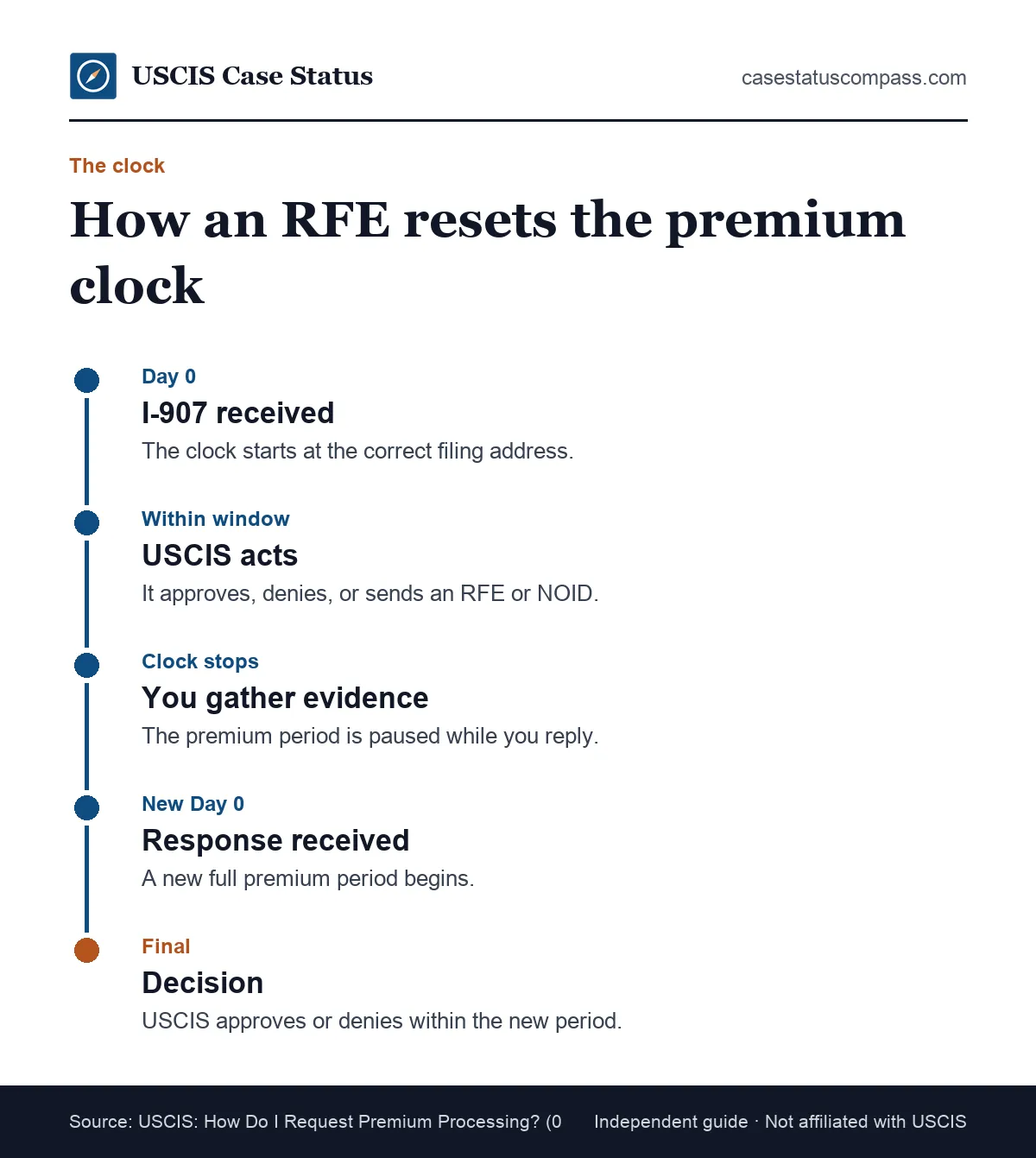
- How Does an RFE Affect Premium Processing?
- Business Days vs Calendar Days: Counting the Clock
- Premium Processing vs Regular Processing
- How Should You Read USCIS Median Processing Times?
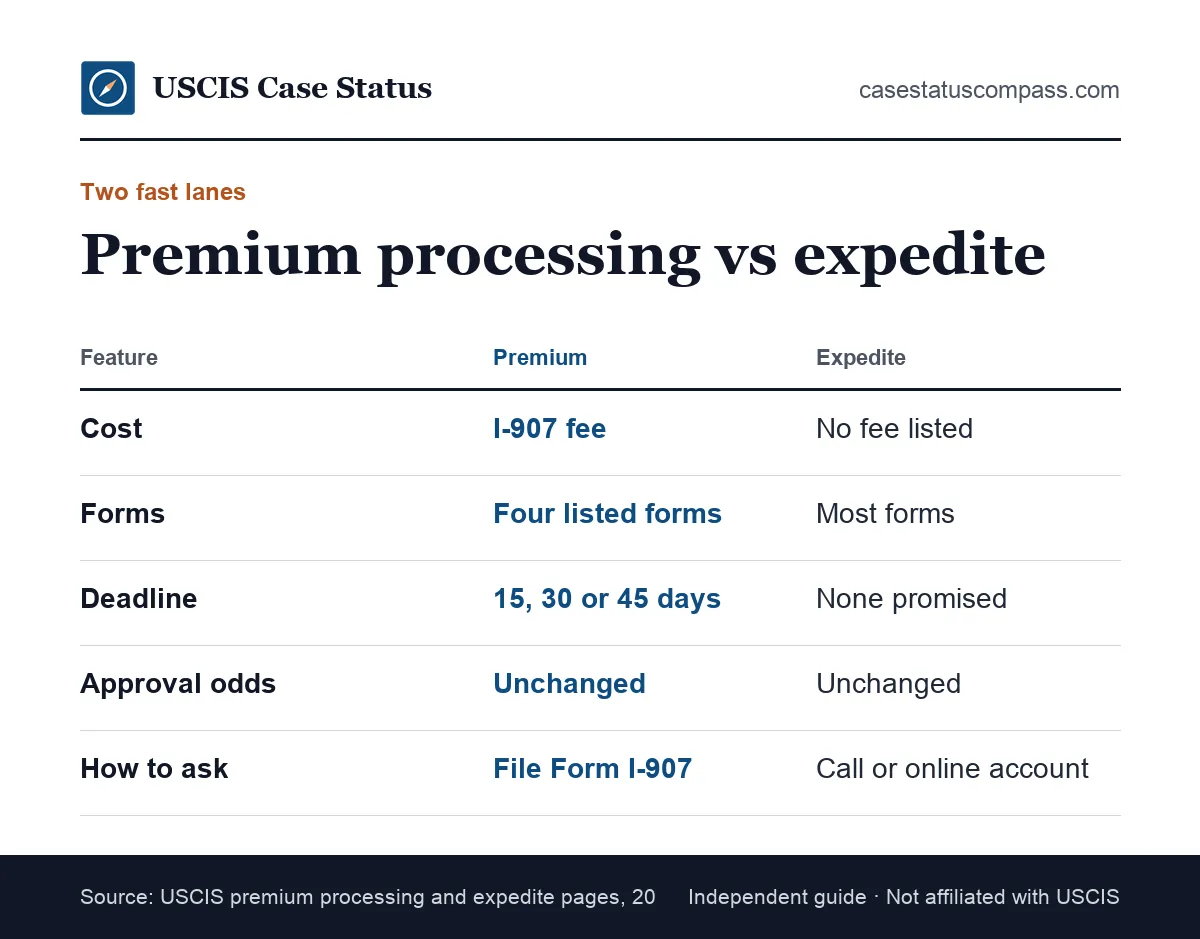
- Premium Processing vs an Expedite Request
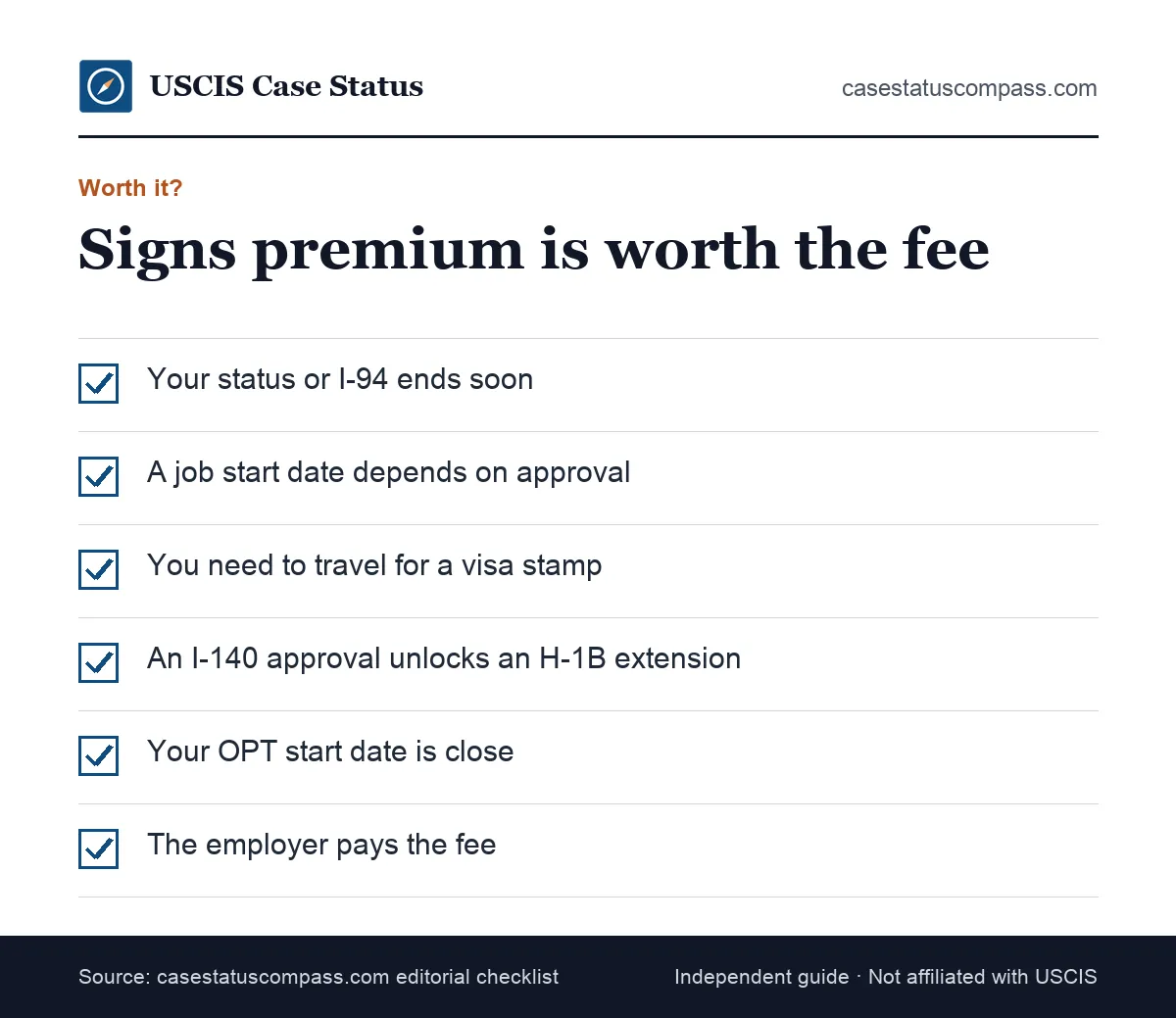
- Is Premium Processing Worth It?
- When Should You Upgrade a Pending Case?
- How to Track a Premium Case Status
- Why Does an Upgraded Case Have Two Receipt Numbers?
- Premium Request Checklist Before You File
- Which Mistakes Delay a Premium Request?
- Does Premium Processing Guarantee Approval?
- What Do "Premium Processing Visa" Searches Mean?
- How Do You Contact USCIS About a Premium Case?
- When Should You Get Professional Help?
- Frequently Asked Questions
The short answer
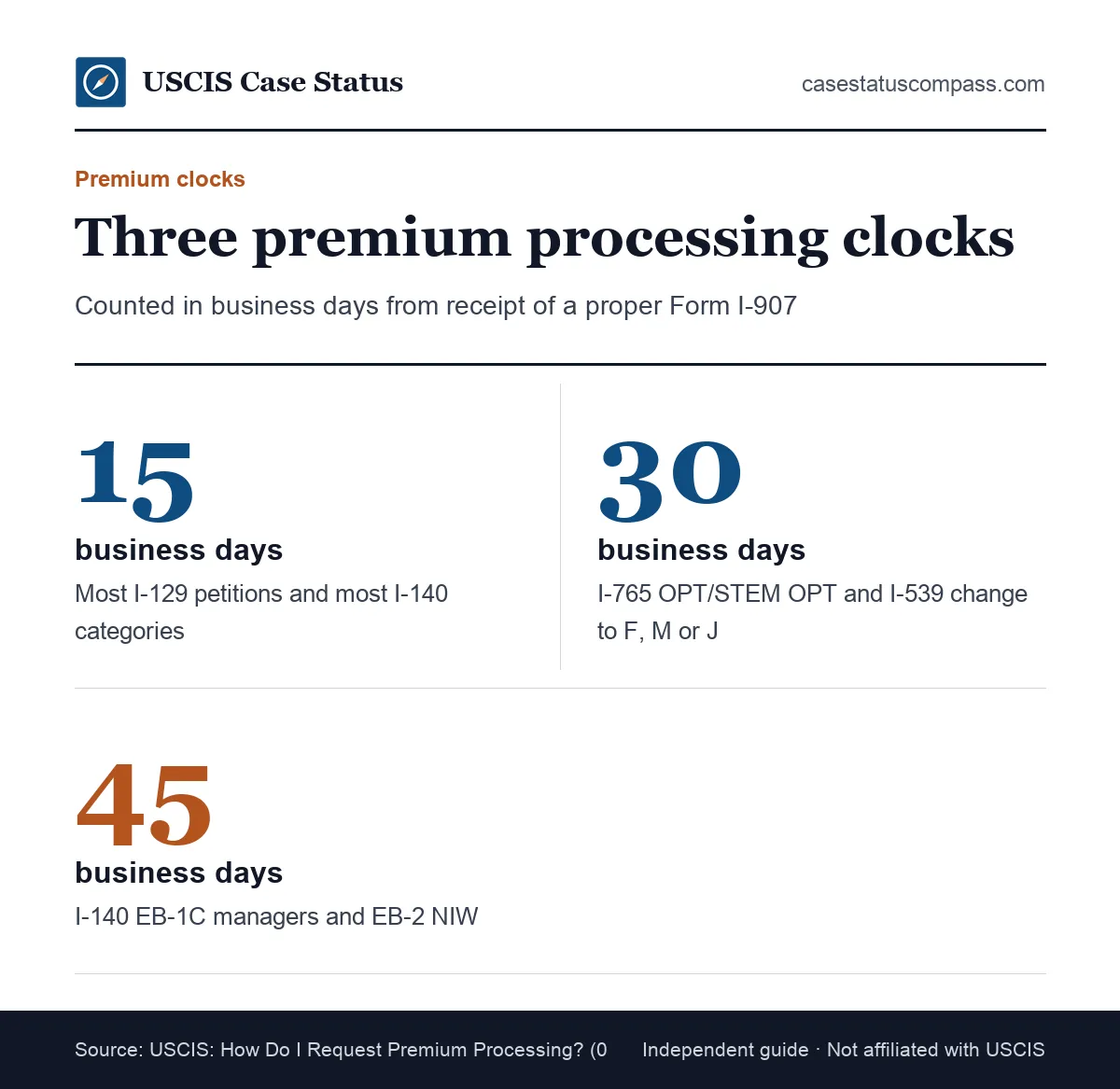
Premium processing is a paid USCIS service, requested on Form I-907, that guarantees action on certain petitions within a fixed window: 15 business days for most H-1B and I-140 cases, 30 for OPT and I-539 student changes, and 45 for EB-1C and EB-2 NIW petitions. It buys speed, not approval.
At a glance
| Form used | Form I-907, Request for Premium Processing Service |
| Who can use it | Some I-129, I-140, I-765 (OPT) and I-539 filers |
| Timeframes | 15, 30 or 45 business days, by category |
| Fee (Oct. 2026) | $1,780 to $2,965, paid on top of other fees |
| Fee waiver | Not available |
What Is Premium Processing?
It is an optional, fee-based service that makes USCIS act on an eligible petition within a set number of business days. You request it on Form I-907. USCIS promises an action, such as an approval, denial or evidence request, not a favorable result. More fixes live in our USCIS case help guides.
What the I-907 fee buys
The fee buys a deadline. Without it, a petition waits in the normal queue for months. With it, USCIS must take an adjudicative action inside the window or refund the fee.
What it does not buy
The upgrade does not lower the evidence standard, skip security checks or move a priority date. A weak petition is simply denied sooner, and later steps such as interviews keep their pace.
How Does the Form I-907 Upgrade Work Step by Step?
The service works in four stages: you file Form I-907 with the right fee, USCIS logs the receipt date, a business-day clock runs, and USCIS must act before it ends. If that action is a request for evidence, a fresh period starts after your reply.
The clock starts at receipt
USCIS says the clock starts when it receives a properly completed I-907 at the correct address. That means every required field, a valid signature and the correct fee. If anything is missing, USCIS rejects the request and no days are counted.
What counts as an "action"
Per the USCIS premium page (updated March 23, 2026), an action is an approval notice, a denial, a request for evidence (RFE), a notice of intent to deny (NOID), or opening a fraud or misrepresentation investigation.
Which Forms Are Eligible for Premium Processing?
As of October 2026, four forms qualify: Premium processing covers I-129 work visas, I-140 (EB-1/2/3), I-765 OPT/STEM OPT and I-539 to F/M/J. Each form qualifies only in the categories USCIS names, so check your exact classification code, not just the form number. Family-based forms, such as the I-130 and I-485, are never on the list.
Categories "designated as available"
USCIS marks some I-140 classes, such as EB-3 professionals and skilled workers, as eligible only if designated as available, and can open or close categories by notice. CNMI-only requests cannot use the service.
What Are the Premium Processing Timeframes by Category?
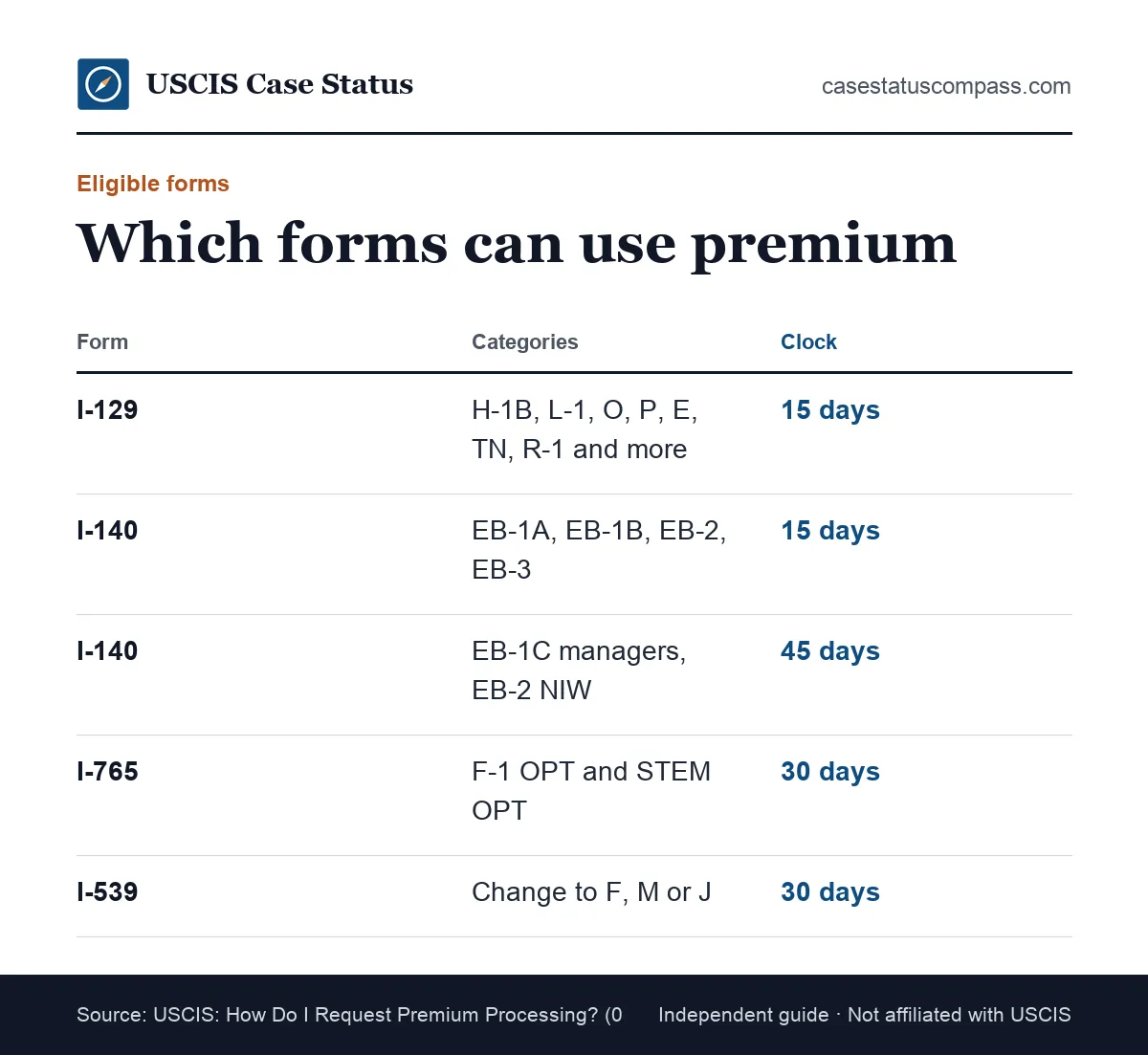
The premium timeframes by category are: 15 business days (I-129, most I-140); 30 (I-765 OPT, I-539 F/M/J); 45 (I-140 E13 managers and NIW). The window depends on your category, not the form alone, so two I-140 petitions can get different clocks. Match the code on your petition to the table below before you promise anyone a start date.
Eligible categories and their windows
Each row shows a form, the categories USCIS lists for it, and the business-day window that applies.
| Form | Eligible categories | Window |
|---|---|---|
| I-129 | E-1, E-2, E-3, H-1B, H-2B, H-3, L-1A, L-1B, O, P, Q-1, R-1, TN | 15 business days |
| I-140 | EB-1A (E11), EB-1B (E12), EB-2 non-NIW (E21), EB-3 (E31, E32, EW3) | 15 business days |
| I-140 | EB-1C managers (E13), EB-2 National Interest Waiver | 45 business days |
| I-765 | F-1 OPT and STEM OPT, (c)(3)(A), (B), (C) | 30 business days |
| I-539 | Change of status to F, M or J | 30 business days |
Most employment filers land in a 15-day row; NIW and EB-1C filers should plan for nine weeks or more.
Premium Service for Form I-129 and H-1B Petitions
Form I-129 is the most common premium filing. Every listed I-129 classification, including H-1B, gets 15 business days. Employers use it when a start date depends on a quick answer. Our H-1B visa status guide walks through the petition from registration to approval.
New cap-subject petitions
For a cap-subject H-1B, the employer can file the I-907 with the petition after selection. USCIS rejects and returns premium fees on unselected petitions or those filed after the final receipt date.
Amendments and new job sites
An H-1B amendment for a material change, such as a new worksite outside the original area, can also be upgraded. Employers often pay because the worker may need the approved amendment before moving.
What Is the H-1B Transfer Premium Processing Time?
The H-1B transfer premium processing time is 15 business days, as with any I-129 upgrade. A "transfer" is really a new I-129 filed by the new employer, so it gets its own receipt number and clock. The old employer's approval does not carry over, and the count never starts from an earlier filing.
Why job changers pay for speed
An approved transfer gives the worker a new I-797 approval notice naming the new employer. That notice matters for visa stamping abroad, and many workers want it before they resign.
Questions for the new employer
Ask who pays the premium fee, when the petition will be filed and whether you can start work while it is pending. Get the answers in writing from the employer's attorney.
How Long Is H-1B Extension Premium Processing?
H-1B extension premium processing takes up to 15 business days from receipt of the I-907, because the extension is still an employer-filed I-129. The stay rule is: H-1B: 3 years at first, up to 6 years in total. The I-907 fee for an H-1B is the $2,965 tier.
Upgrading an extension already pending
The upgrade can go in with the extension or later while it is pending. A later request needs a copy of the I-797 receipt, and its clock starts when USCIS receives the I-907.
File before your I-94 ends
File before the current I-94 record expires; paying for speed does not fix a late filing. Give the employer a deadline with room for a possible RFE. Timely filing, not speed, is what counts when the end date is close.
Should You Upgrade the I-140 Before an H-1B Extension?
Workers close to the six-year limit often need an approved I-140 to qualify for more H-1B time. In that case, speeding up the I-140 can matter more than speeding up the extension. Ask the employer's attorney which approval the extension actually depends on before paying for either upgrade.
Other I-129 Categories: L-1, O-1, TN and E Visas
Every listed I-129 class shares the 15-business-day window, including L-1A and L-1B transferees, O-1 extraordinary ability workers, P athletes and entertainers, TN professionals and E-1, E-2 and E-3 treaty workers. Only the fee tier varies, so confirm your class's tier in the fee section below before paying.
L-1 relocations
Companies relocating a manager or specialist often pair the L-1 petition with the upgrade to fix a moving date. An early answer lets everyone plan housing, travel and the first day.
O-1 and P event dates
For artists and athletes, a tour or competition date is a hard deadline, so O-1 and P petitions use the fixed window to leave time for consular appointments. File early, because an RFE restarts it.
H-2B and R-1 at the lower fee
H-2B and R-1 petitions get the same 15-business-day window but pay the lower $1,780 fee tier. Confirm the amount for your class, because a wrong fee keeps the clock from starting.
What Is the I-140 Premium Processing Timeline?
The I-140 premium processing timeline is 15 business days for EB-1A, EB-1B, EB-2 non-NIW and EB-3, and 45 business days for EB-1C managers and EB-2 National Interest Waiver petitions. See our Form I-140 guide for the petition itself. The category code on your petition decides which clock applies.
Why I-140 upgrades are popular
An approved I-140 can support H-1B extensions past six years, lock in a priority date and let a family plan the next step with a confirmed petition rather than a guess.
The 2026 address detail
I-140 wasn't in the Oct. 7, 2026 address change, but I-907 premium addresses were. A standalone I-140 may go to one address while its upgrade request goes to another. Check both USCIS address pages on the day you mail.
EB-1A Premium Processing Time
EB-1A premium processing time is 15 business days. EB-1A, code E11, is the extraordinary ability category and one of the few where the worker can file alone as a self-petitioner, who may sign Form I-907. No job offer or labor certification is needed in this class.
Self-petitioners and the I-907
USCIS lets a beneficiary sign the I-907 only when they are also the petitioner, as an EB-1A filer is. A worker sponsored by an employer can pay the fee but cannot sign it.
Why Do EB-1A Filers Pay for Premium Processing?
EB-1A evidence is judged against a high, partly subjective bar, and a fast answer shows within weeks whether the officer found it sufficient. If the answer is an evidence request, the filer replies and gets a second full window, so many use the fee to test their file.
EB-1C Multinational Manager Petitions
The EB-1C premium processing time is 45 business days, three times longer than most I-140 classes. EB-1C, code E13, covers executives and managers moved within a multinational company. The longer clock reflects a closer look at duties and corporate structure.
Documents for an E13 file
These petitions carry organizational charts, duty breakdowns and records for both the U.S. and foreign entity. Show managerial duties with time percentages, name the staff supervised and include the foreign chart.
Why the first EB-1C filing matters
An RFE restarts the 45-business-day window, so a thin first filing can roughly double the wait. Extra preparation before filing usually saves more time than the upgrade itself buys. Have counsel review the duty descriptions before you file.
What Is the EB-2 NIW Timeline With Premium Processing?
The EB-2 NIW timeline with premium processing is 45 business days from receipt of Form I-907. A National Interest Waiver asks USCIS to waive the job offer and labor certification, so the officer weighs the proposed work and its national importance in detail.
NIW without the upgrade
Without the fee, an NIW waits in the normal I-140 queue. USCIS data shows: I-140: median 3.9 months (USCIS data, Apr.-June 2026). That median covers every I-140 class. Our I-140 processing time page tracks current figures.
How Many Calendar Weeks Is the EB-2 NIW Premium Window?
Forty-five business days is roughly nine calendar weeks, more when federal holidays fall inside. If USCIS sends an RFE, add your response time plus a new 45-day window. For example, a request received in early November ends in early January, because Thanksgiving, Christmas and New Year's Day all fall inside. Count from the receipt date on your I-797C, not the day you mailed it.
EB-1 Green Card Premium Processing Time: Petition vs Green Card
EB-1 green card premium processing time applies only to the I-140 petition, decided in 15 or 45 business days. The I-485, or a consular immigrant visa, then follows its own regular timeline, because Form I-907 never covers those steps. Budget time for both stages separately.
Where the fast lane ends
Once USCIS acts on the I-140, the paid service is complete. A concurrent I-485 keeps moving at normal speed. Our Form I-485 guide explains the green card application and its status messages.
Planning around the regular clock
Because the green card stage runs at normal speed, plan work permit renewals, travel documents and job moves around that slower timeline, not around the few weeks the I-140 took.
Is There Premium Processing for OPT and STEM OPT?
Yes. F-1 students can upgrade Form I-765 in the OPT categories (c)(3)(A) and (c)(3)(B) and the STEM category (c)(3)(C). The 30-business-day window, USCIS says, runs once all prerequisites are met. The fee is the lower $1,780 tier. The upgrade buys speed only; the OPT eligibility rules stay the same.
OPT premium processing timeline
The OPT timeline with the upgrade is 30 business days, about six calendar weeks. The window counts from when the clock starts, not from when you first filed the I-765.
STEM OPT premium processing time
The STEM OPT window is also 30 business days. Students can upgrade a pending STEM extension online or through the lockbox USCIS names. Our Form I-765 guide covers the work permit and edition rules.
Form I-539 Change to F, M or J Status
Form I-539 qualifies only when the applicant asks to change to F, M or J status, such as a visitor becoming a student. The window is 30 business days and the fee is $2,075 as of October 2026. Ask the school's DSO about program start dates before choosing the upgrade.
Visitor extensions do not qualify
Other I-539 requests, such as a visitor extension or a change to any status other than F, M or J, stay in the regular queue. An I-907 filed for them is an ineligible request.
Can H-4 or L-2 Dependents Use Premium Processing?
USCIS says an I-539 filed by a dependent of an I-129 worker, such as an H-4 spouse, cannot be upgraded. When an H-4 or L-2 application is filed with the principal's upgraded I-129, USCIS generally decides them together, which often gives a similar result.
Can Family and Citizenship Forms Get Faster Processing?
Family petitions, green card applications and citizenship forms cannot use the paid service. That includes Form I-130, Form I-485, Form N-400 and Form I-751. For these forms, faster handling comes only through an expedite request or a case inquiry. None of these forms accepts Form I-907.
What "I-130 premium" searches mean
People searching for I-130 premium processing usually want a spouse or parent petition decided sooner. No paid option exists, and paying more on the I-130 itself does not move it up the queue. See our Form I-130 guide for the regular process.
Faster options for family cases
Use the official processing-times tool to find your case inquiry date; after it, you can submit an outside-normal-processing request. In a true emergency, an expedite is possible. Neither has a guaranteed window.
How Do You Request Premium Processing With Form I-907?
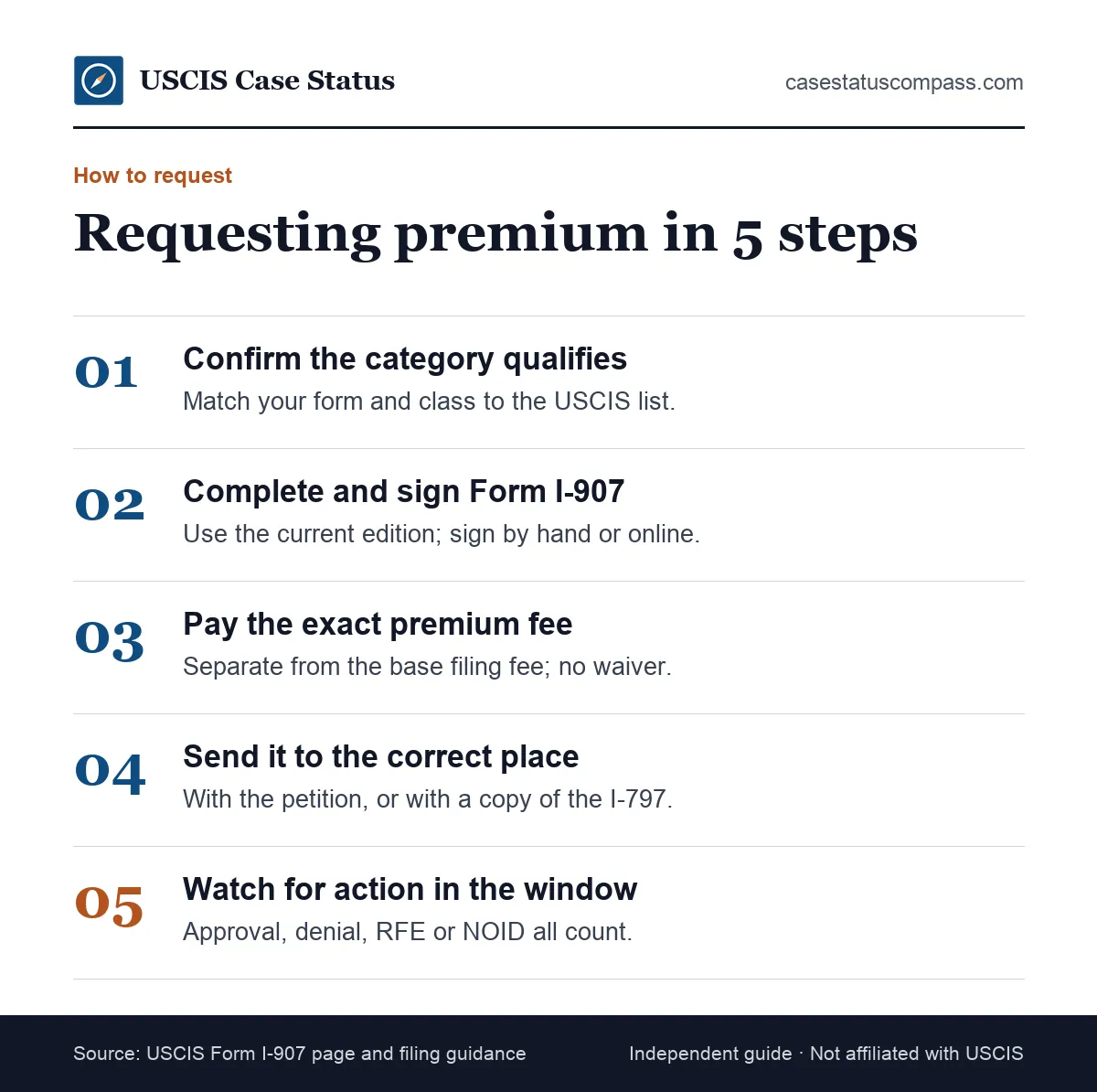
You request the service by filing Form I-907 with the exact fee, either with a new eligible petition or later as a standalone request with a copy of the I-797 receipt. Pick the route below that matches your case, because the address for an upgrade can differ from the original filing address.
Filing with a new petition
With a new I-129 or I-140, place the I-907 on top of the package; both go to the same address. Submit one I-907 per petition. USCIS warns that bundling unrelated requests slows processing.
Upgrading a pending I-129
For a pending I-129, send the I-907 to the I-129 direct filing address with a copy of the receipt, so USCIS can match the request to the petition it already holds.
Upgrading a pending I-140, OPT or I-539 case
For a pending I-140, send it to the service center holding the petition. OPT and I-539 upgrades follow the original filing channel. Include a copy of the I-797 receipt so USCIS can link the request to the right case, and check the I-907 address page first.
Who Can Sign and File Form I-907?
The petitioner or applicant signs and files Form I-907, or their attorney or accredited representative does so with Form G-28. A beneficiary sponsored by someone else cannot sign it. The exception is a self-petitioner, such as an EB-1A or NIW filer.
Petitioners and representatives
For work petitions, the employer is the petitioner, and its authorized signer completes the I-907 or lets its lawyer file it. USCIS says a representative must submit a new G-28 when requesting the upgrade online.
Beneficiaries can pay but not sign
A worker may pay the fee personally, for example to speed an I-140 the employer will not upgrade. The employer must still sign. Before paying, get written agreement from the employer.
Where Do You Mail Form I-907 in 2026?
Mail Form I-907 to the address USCIS lists for your form and situation, which changed on October 7, 2026 for many forms. New USCIS mailing addresses from Oct. 7, 2026; old addresses accepted if postmarked by Nov. 9, 2026. Check the I-907 address page on the day you mail.
I-907 destinations by filing situation
The table pairs each filing situation with its destination and what USCIS says happens if the request goes to the wrong place.
| Situation | Where it goes | If misdirected |
|---|---|---|
| New I-129 with I-907 | I-129 direct filing address | Both forms rejected |
| Pending I-129 upgrade | I-129 direct filing address, with I-797 copy | Rejected |
| New I-140 with I-907 | I-140 address for premium filings | Both forms rejected |
| Pending I-140 upgrade | Service center holding the I-140 | Forwarded; clock waits |
| OPT or I-539 upgrade | Online, or the lockbox USCIS names | Check the I-907 page |
A misdirected new filing costs the most, because both forms come back to you.
Keep proof of delivery
Use a trackable service and keep the delivery confirmation, which helps USCIS trace the package if no receipt arrives. Note the delivery date so you can count business days yourself.
Can You File Premium Processing Online?
Some upgrade requests can be filed online, most clearly OPT and STEM OPT upgrades and I-539 student changes filed online. Many I-129 and I-140 requests still go on paper with the petition. Check USCIS's "File Online" list first, then sign in to your account to see which forms it offers.
Benefits of filing online
An online request gives an instant receipt in your USCIS account and removes the risk of a lost package. The I-907 fee is the same on paper and online. You can track the request from the same account.
When paper applies
If the petition must be filed on paper, its I-907 usually goes on paper too, and a lawyer who prefers paper sends it with Form G-28 to the listed lockbox. Never file the same request in both channels.
How Much Does Premium Processing Cost?
As of October 16, 2026, the Form I-907 fee is $2,965 (I-129 most classes, I-140); $1,780 (H-2B/R, I-765 OPT); $2,075 (I-539 to F/J/M). You pay it in addition to the base filing fee and every other required fee. For the full cost of a work petition, see our H-1B visa fees guide.
No fee waiver
You can't get a fee waiver for premium processing. The fee schedule marks these amounts as adjusted periodically, so check the current G-1055 fee schedule before you pay. Budget the full amount alongside the base filing fee.
What Happens If You Pay the Wrong I-907 Fee?
An I-907 with the wrong fee is not properly completed, so the clock never starts. If one payment covers both the petition and the upgrade, a single error can reject the whole package, so many filers pay each fee separately.
What Happens If USCIS Misses the Premium Deadline?
If USCIS takes no adjudicative action within the window, it refunds the premium fee. The USCIS premium page (updated March 23, 2026) says so directly. The petition itself is still decided. A refund says nothing about the outcome; it only means USCIS missed its own promise.
How the refund works
The refund covers only the I-907 fee. Other fees stay with USCIS: USCIS fees are nonrefundable, even if your case is denied or withdrawn. Contact USCIS if your window has passed and neither a decision nor a refund notice has arrived.
How Does an RFE Affect Premium Processing?
A request for evidence stops the premium clock. An RFE stops the premium clock; a new period starts when USCIS gets your response. The RFE counts as USCIS's action, so the first window is satisfied. After you reply, USCIS has a full new window, not just the days left over.
Your response deadline
The date on your notice controls, within a legal cap: RFE deadline: up to 12 weeks (the exact date is on your RFE); no extensions. Student I-539 cases are shorter: RFEs for Form I-539 and Form I-601A allow at most 30 days (all other forms up to 84 days), plus 3 days if mailed. Our RFE meaning and response guide explains how to build a complete reply.
NOIDs in a premium case
A notice of intent to deny also counts as an action and stops the clock. Treat it as more serious than an RFE; our notice of intent to deny guide explains how to answer.
Business Days vs Calendar Days: Counting the Clock
USCIS counts every premium window in business days, meaning weekdays that are not federal holidays. Fifteen is about three calendar weeks, 30 about six and 45 about nine. Weekends and federal holidays never count, so the same window can end on different calendar dates depending on when your receipt arrives.
Premium windows converted to calendar weeks
The table converts each window into calendar time, using one sample receipt date to show the effect of holidays.
| Clock | Business days | Rough calendar time | Example: received Mon., Nov. 2, 2026 |
|---|---|---|---|
| Most I-129 and I-140 | 15 | About 3 weeks | Ends around Nov. 24 (Veterans Day skipped) |
| OPT, STEM OPT, I-539 | 30 | About 6 weeks | Ends mid-December |
| EB-1C and NIW | 45 | About 9 weeks | Ends in early January 2027 |
Redo the count from your own I-797C date; the example dates are illustrations only.
Federal holidays to skip
Holidays that often fall inside a window include Veterans Day, Thanksgiving, Christmas and New Year's Day. A late-November NIW filing can run past two calendar months. Add them before giving an employer a date.
Which date starts the count
Start from the receipt date on the I-797C, not your mailing date. For an upgrade, the petition's original receipt date does not matter. Our I-797C notice of action guide shows where the date appears.
Premium Processing vs Regular Processing
The paid service gives a fixed 15-, 30- or 45-business-day window, while regular processing has no deadline. USCIS's quarterly data shows how long the regular queue can run: I-129 (all classifications combined): median 9.5 months (USCIS data, Apr.-June 2026). The upgrade shrinks that wait to weeks.
Paid and regular queues side by side
Here both lanes are compared on what filers ask about most: deadline, cost, standards and what happens when USCIS runs late.
| Feature | With I-907 | Regular queue |
|---|---|---|
| Deadline | 15, 30 or 45 business days | None |
| Extra fee | $1,780 to $2,965 | None |
| Evidence standard | Same | Same |
| If USCIS is late | I-907 fee refunded | Inquiries only |
| I-140 timing | Weeks | Median 3.9 months (Apr.–June 2026) |
The fee changes only time; the officer applies the same law either way.
How Should You Read USCIS Median Processing Times?
A median means half of completed cases finished faster and half slower. USCIS's live tool uses a different measure, so use it for your case inquiry date and our processing times guides for context. Its measure: The USCIS tool shows how long it took to finish 80% of cases in the past 6 months.
Premium Processing vs an Expedite Request
The paid service has a guaranteed window but covers only listed categories. An expedite request is a free, discretionary ask that USCIS may grant or refuse, open to most forms. USCIS generally will not consider expedites where the paid option exists, except for certain nonprofits.
When an expedite is your only option
If your form is not on the list, such as an I-130 or I-485, an expedite is the main fast lane. Ask for an expedite through the USCIS Contact Center or your online account. Our expedite request guide lists the criteria and proof USCIS expects.
Nonprofit petitioners
IRS-designated nonprofit petitioners may choose between an expedite request and the paid upgrade. The free route saves the fee but gives up the guaranteed window and the refund promise. Check the expedite criteria page before choosing.
Is Premium Processing Worth It?
The fee is usually worth it when a deadline you cannot move depends on approval: an expiring status, a job start, a visa appointment, or an H-1B extension that needs an approved I-140. It rarely pays off when nothing changes until a later, slower step.
Decision table: if this, then that
Find the row that matches your situation; the last column gives the reasoning so you can test it against your own facts.
| If your situation is… | Then consider… | Why |
|---|---|---|
| H-1B worker changing jobs soon | Upgrade the new employer's I-129 | Approval before you resign |
| Status or I-94 ends within 2 months | Upgrade the extension | Ends the uncertainty |
| Near the H-1B six-year limit | Upgrade the I-140 first | May unlock more H-1B time |
| EB-2 NIW with no urgent deadline | Weigh the fee against the wait | Visa availability may be the bottleneck |
| Student with an OPT job offer | Upgrade the I-765 | Answer before the start date |
| Family petition or I-485 | Expedite, if you meet a criterion | No paid option exists |
| Weak or incomplete evidence | Fix the evidence first | A fast denial helps nobody |
If two rows fit, the one with the harder deadline usually decides.
When to skip it
Skip the fee when your priority date is years from current, because a fast I-140 will not move the green card line, or while you are still collecting key evidence.
When Should You Upgrade a Pending Case?
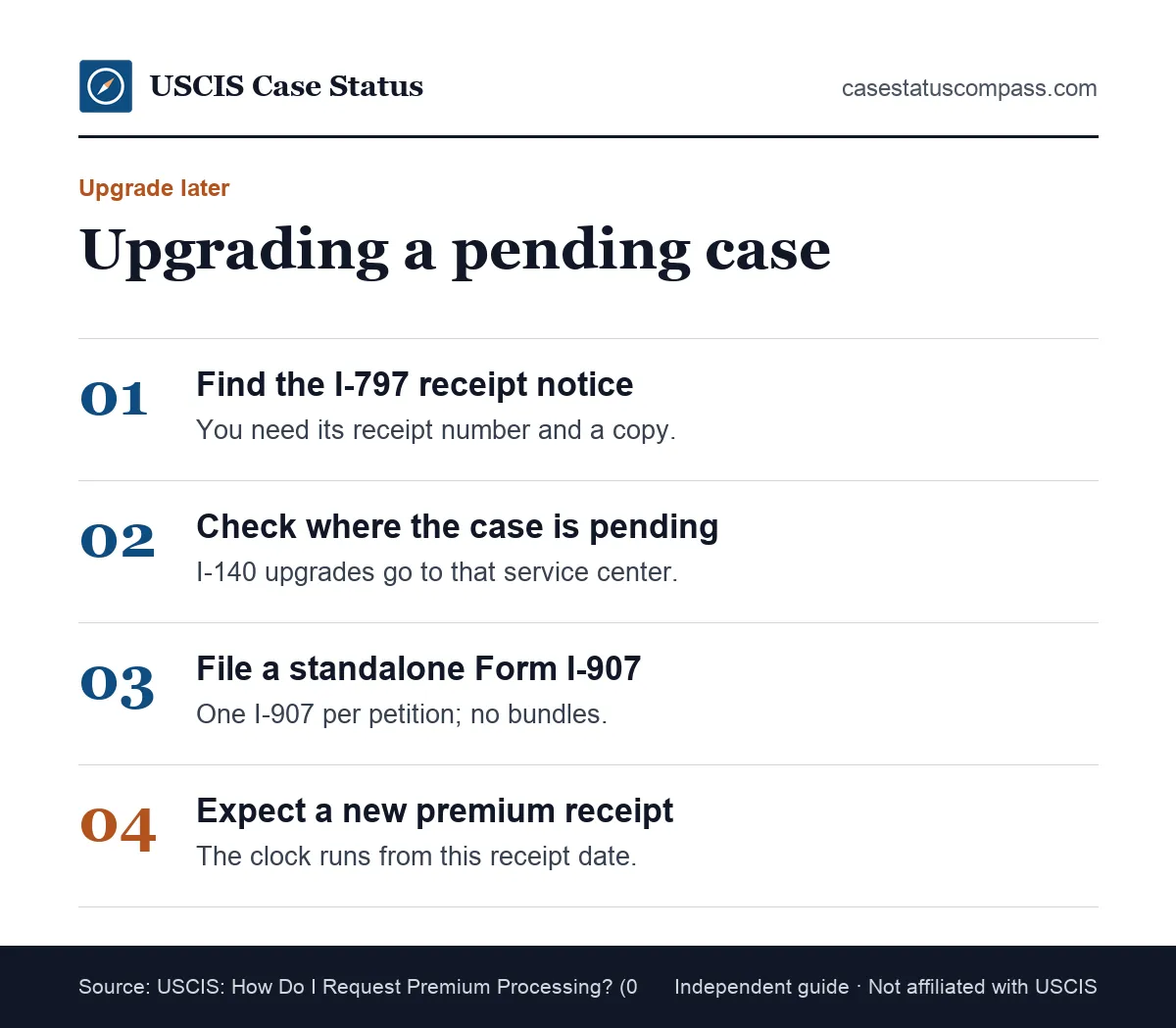
Upgrade a pending case when a new deadline appears, such as a job offer, a status expiry or travel. A standalone I-907 can be filed any time while the case is pending, but its clock starts only on receipt. Count the window forward from the day USCIS will likely receive it.
Good moments to upgrade
Good triggers include an approaching I-94 expiry, a job offer that needs an approved petition, or a regular wait that has passed your case inquiry date with no movement at all.
Bad moments to upgrade
A bad moment is the week after an RFE, because the clock will not run until your reply arrives. Respond first, then decide. Also check the latest status, so you never pay to upgrade a decided case.
How to Track a Premium Case Status
Track the case with its receipt number on Case Status Online or in your USCIS online account, as with any filing. The status messages are identical to regular processing; they simply change faster, often days apart near the end of the window.
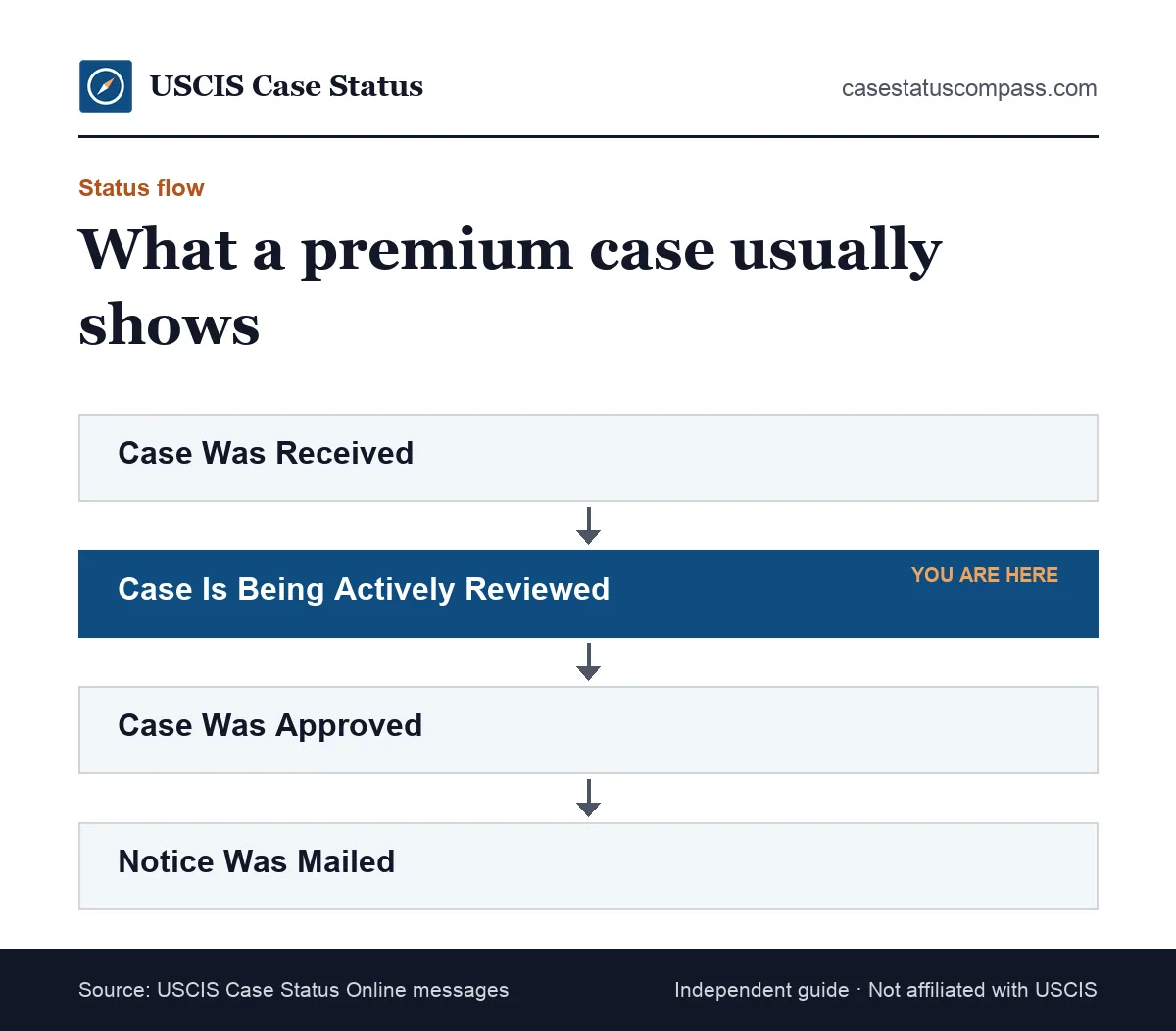
When it says "actively reviewed"
"Case Is Being Actively Reviewed" can appear for most of the window and does not signal a problem. Our explainer on the actively reviewed status covers what it means. Wait for the window to end before asking USCIS about it.
How often to check
Checking every few business days is enough. A notice dated inside the window satisfies USCIS's promise, so the online status, not the mail, is usually the first sign the officer acted.
Why Does an Upgraded Case Have Two Receipt Numbers?
An upgrade usually produces a separate receipt for the I-907 in addition to the petition's receipt. Use the petition's receipt number to check the result. Keep both notices together, because the upgrade receipt holds the date that starts your clock.
Premium Request Checklist Before You File
A short checklist prevents most rejections: confirm the category, use the current I-907 edition, sign it, pay the exact fee, check the address that day, add Form G-28 if a lawyer files, and attach the I-797 copy for an upgrade.
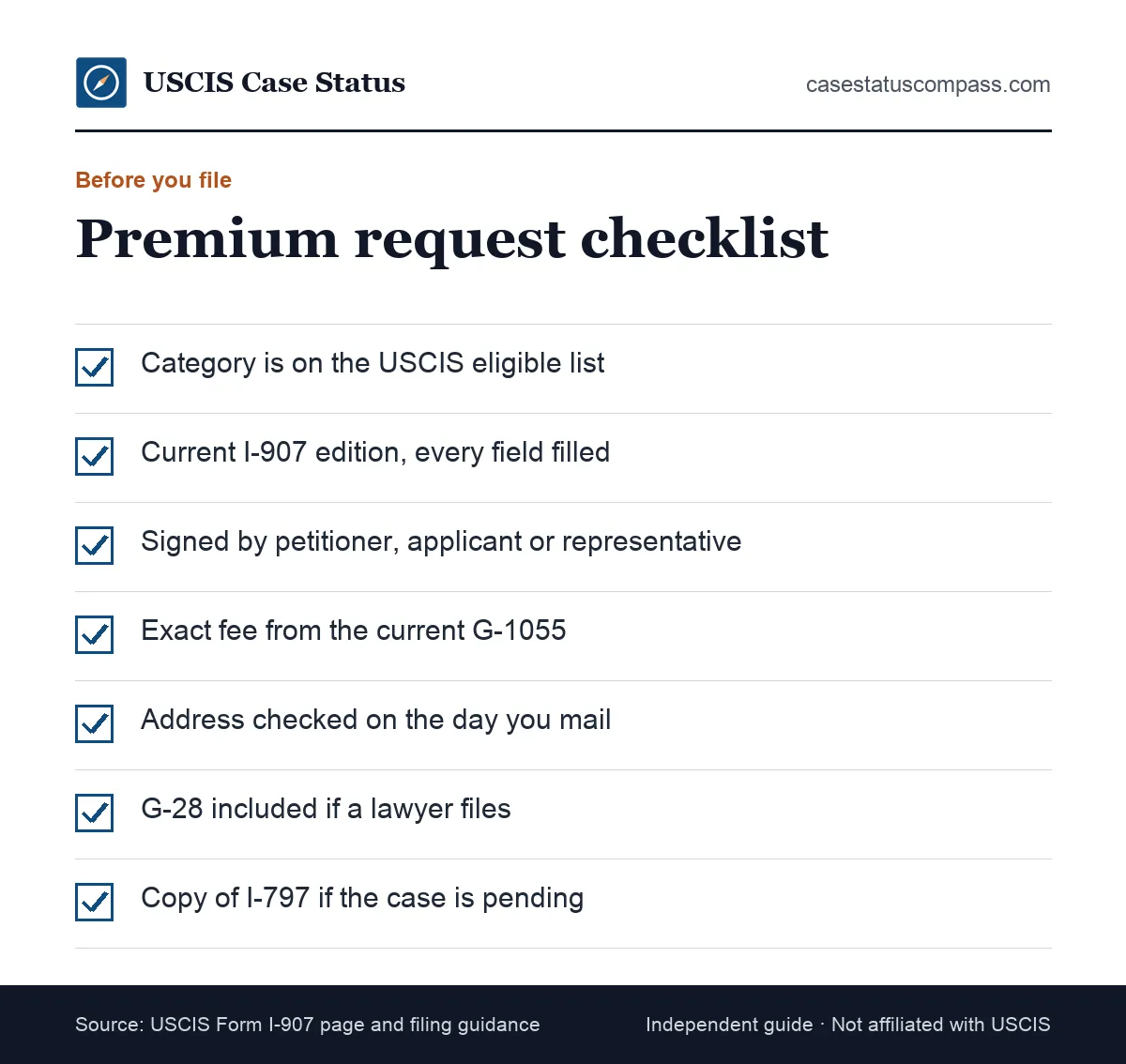
Copyable checklist
- Form and classification appear on the USCIS list today
- Current Form I-907 edition downloaded from uscis.gov
- Every required field completed, including the receipt number for upgrades
- Signed by the petitioner, applicant or representative
- Exact fee from the current G-1055, paid separately if possible
- Address checked the day you mail
- Form G-28 attached if a representative files
- Copy of the I-797 receipt for a pending case
Documents to keep afterward
Keep a copy of the I-907, the payment record, the courier receipt and the I-797C. If USCIS later misses the window, you need those records to ask for the refund.
Which Mistakes Delay a Premium Request?
The most common mistakes are filing for an ineligible category, using an old address, paying the wrong fee, letting a sponsored worker sign, and expecting the service to cover the green card stage. Each one either keeps the clock from starting or sets the wrong expectation.
Assuming every I-140 gets 15 days
Many filers expect 15 business days for an NIW or EB-1C petition, then meet the 45-day window. Check your category code before promising anyone a date. The E13 and NIW codes are the two exceptions on the I-140.
Using a pre-October 2026 address
Saved templates may show addresses from before October 7, 2026. USCIS accepts old addresses only if postmarked by November 9, 2026. After that, use only the current address page.
Letting the sponsored worker sign
A sponsored worker's signature makes the I-907 invalid, even when the worker paid. Route the form to the employer's signer, or its representative with Form G-28, before mailing.
Does Premium Processing Guarantee Approval?
No. The service guarantees only that USCIS acts within the window, and a denial, RFE or NOID counts as that action. Officers apply the same law and evidence standards; only the speed of the answer differs. Strong evidence is still the only path to a yes.
After an approval
The status usually changes to "Case Was Approved" and an approval notice is mailed. See our case approved explainer for what that status means on a petition. Keep the original notice with your immigration records.
After a fast denial
A quick denial leaves more time to choose the next step, such as refiling with stronger evidence or filing a motion. Our guides to a denied case and your options and to motions and appeals explain the routes.
What Do "Premium Processing Visa" Searches Mean?
A search for "premium processing visa" usually means a USCIS petition, not a visa. USCIS approves petitions; the State Department issues visas at consulates. The paid service ends at the USCIS decision and cannot speed a consular interview. Consular appointment wait times are published by the State Department, not USCIS.
Visa stamping after approval
After approval, the worker books a visa appointment at a consulate. Our guide to checking a U.S. visa status explains the consular side. Appointment waits vary by post, and the State Department, not USCIS, controls them.
The labor certification step
For EB-2 and EB-3 petitions, the PERM labor certification at the Department of Labor comes before the I-140 and has no paid upgrade. Our PERM guide explains that step. Build that wait into any timeline.
How Do You Contact USCIS About a Premium Case?
If your upgrade receipt lists a contact for these cases, use it first. For general questions, the USCIS Contact Center is at 800-375-5283. Contact USCIS only when the window has passed, a receipt never came, or your address changed. Calling before the window ends rarely helps.
What to have ready
Have the petition receipt number, the I-907 receipt number, the petitioner's name, the receipt date and your own count of business days. Our USCIS contact number guide lists every official channel.
If you move during the window
A missed RFE in a short window can lead to a denial, and a post office forwarding order does not update USCIS. Follow our USCIS change of address guide the week you move.
When Should You Get Professional Help?
Get help from an immigration attorney or a DOJ-accredited representative when your case involves a job change, the six-year H-1B limit, an RFE, a prior denial or a status gap. This guide is general information, not legal advice. One consultation before filing can prevent a costly RFE.
Questions for a consultation
Bring your I-94 and every notice received. Ask whether the upgrade fits your deadline, which category code applies and who pays. Our guide to immigration lawyer costs helps you budget.
Avoiding scams
USCIS never collects fees by phone, gift card or wire to a person. Pay official fees only through methods on uscis.gov. Anyone promising a guaranteed approval for an extra payment is not offering a USCIS service.
Frequently Asked Questions
Can I-130 be premium processed?
No. Form I-130 and every other family-based form are ineligible. USCIS limits Form I-907 to certain I-129, I-140, I-765 OPT and I-539 categories, so family cases rely on the normal queue, a case inquiry or an expedite.
How long does premium processing take for H-1B?
USCIS must act on an H-1B petition within 15 business days of receiving a proper Form I-907, about three calendar weeks. An evidence request starts a new 15-business-day window once USCIS receives your response.
Can I request premium processing after filing?
Yes. While an eligible case is pending, you can file a standalone Form I-907 with the fee and a copy of the I-797 receipt. The clock starts when USCIS receives the I-907, not on the original filing date.
Is the premium fee refundable?
USCIS refunds the I-907 fee only if it fails to take an adjudicative action within the window. It is not refunded because a case is denied or an RFE was issued on time.
Who pays the I-907 fee?
The petitioner usually pays, but a beneficiary may pay as long as the petitioner signs and files Form I-907. A self-petitioner, such as an EB-1A or NIW filer, pays and signs personally.
Can a premium request be rejected?
Yes. USCIS rejects requests that are unsigned, misdirected, paid incorrectly or filed for an ineligible category, and a rejected request never starts the clock. For cap-subject H-1B petitions that were not selected, the fee is returned.
Does the upgrade change my priority date?
No. Your priority date is set by the filing rules for your category, not by how fast USCIS decides the I-140. You simply learn the result sooner; when you can finish the green card still depends on the Visa Bulletin.
How do I know if my case was upgraded?
Your I-797 notices show the I-907 request, either on the petition receipt for a combined filing or as a separate receipt for an upgrade. If a lawyer filed for you, ask for a copy of that receipt.
Can premium processing be used for an I-485?
No. Form I-485 is not on the USCIS premium list. An adjustment applicant with an urgent, documented need can ask for an expedite instead, and a premium I-140 speeds up only the petition, not the green card application.
Is premium processing available for STEM OPT?
Yes. A STEM OPT extension filed on Form I-765 under category (c)(3)(C) can be upgraded for 30 business days at the lower fee tier, either with the application or later while it is pending.
Sources
- USCIS: How Do I Request Premium Processing? (updated 03/23/2026). www.uscis.gov/forms/all-forms/how-do-i-request-premium-processing. Accessed Oct 27, 2026.
- USCIS: Form I-907, Request for Premium Processing Service. www.uscis.gov/i-907. Accessed Oct 27, 2026.
- USCIS Form G-1055 Fee Schedule (Edition 10/16/26). www.uscis.gov/sites/default/files/document/forms/g-1055.pdf. Accessed Oct 27, 2026.
- USCIS: Filing Locations and Online Filing Options Updates. www.uscis.gov/forms/us-citizenship-and-immigration-services-filing-locations-and-online-filing-options-updates. Accessed Oct 27, 2026.
- USCIS: Direct Filing Addresses for Form I-140. www.uscis.gov/i-140-addresses. Accessed Oct 27, 2026.
- USCIS: How to Make an Expedite Request. www.uscis.gov/forms/filing-guidance/how-to-make-an-expedite-request. Accessed Oct 27, 2026.
- USCIS Data Library: All Form Types, FY2026 Q3. www.uscis.gov/sites/default/files/document/data/quarterly_all_forms_fy2026_q3_v1.xlsx. Accessed Oct 27, 2026.
- 8 CFR 103.2 (Cornell LII). www.law.cornell.edu/cfr/text/8/103.2. Accessed Oct 27, 2026.
- USCIS: H-1B Specialty Occupations (updated 09/21/2026). www.uscis.gov/working-in-the-united-states/h-1b-specialty-occupations. Accessed Oct 27, 2026.
- USCIS: Filing Fees (updated 02/12/2026). www.uscis.gov/forms/filing-fees. Accessed Oct 27, 2026.
- USCIS Policy Manual Vol. 1, Part E, Ch. 6 (current as of Oct. 23, 2026). www.uscis.gov/policy-manual/volume-1-part-e-chapter-6. Accessed Oct 27, 2026.
- CIS Ombudsman tip sheet: Check Your USCIS Case Inquiry Date (Aug. 2024). dhs.gov/sites/default/files/2024-11/24_0823_cisomb_case-inquiry-date-tip-sheet.pdf. Accessed Oct 27, 2026.
- USCIS Contact Center (uscis.gov). www.uscis.gov/contactcenter. Accessed Oct 27, 2026.
casestatuscompass.com is an independent publication and is not affiliated with USCIS or any government agency. This page is general information, not legal advice. For denials, court or asylum matters, consult an immigration attorney or a DOJ-accredited representative.