Contents · 40 sections
- What Is an I-797C?
- Who Sends Form I-797C, and When Does It Arrive?
- What Is an I-797C Notice of Action Used For?
- I-797 vs I-797C vs I-797B: What Is the Difference?
- What Is an I-797B Approval Notice?
- What Are I-797A, I-797D, I-797E and I-797F?
- How to Read Your I-797C, Box by Box
- Does an I-797C Deadline Count From the Notice Date?
- Who Is Named on the Notice?
- What Does the Notice Type Line Say?
- What Does the Body Text of an I-797C Tell You?
- Is an I-797C an Approval?
- Can You Use an I-797C as Proof of Status?
- How Do I-751 and I-90 Receipt Notices Extend a Green Card?
- Can You Work With an I-797C?
- Can You Travel With an I-797C?
- What Does an I-797C Look Like for Each Form?
- How Many I-797C Notices Will You Get?
- Using the I-797C Receipt Number to Check Your Case
- What Is the A-Number on an I-797 or I-797B?
- Biometrics Appointment Notices on Form I-797C
- Interview Notices on Form I-797C
- What Should You Do After an I-797C Rejection Notice?
- Which Form Edition Should You Use When Refiling?
- What Does an I-797C Transfer Notice Mean?
- Electronic vs Paper I-797C: Is There a Difference?
- How to Get a Copy of Your I-797
- Can You Replace a Lost I-797 Approval Notice?
- How Do You Request Old I-797 Notices Through FOIA?
- What If Your I-797C Never Arrived?
- What If Your I-797C Has a Mistake?
- How Can You Tell If an I-797C Is Fake?
- How Long Should You Keep an I-797C?
- What Happens After You Receive an I-797C?
- How Do I-797C Notices Match Online Status Messages?
- Common Mistakes People Make With Form I-797C
- If X, Do Y: An I-797C Decision Guide
- When Should You Get Legal Help About an I-797C?
- Other Names People Use for the I-797C
- Frequently Asked Questions
The short answer
What is an I-797C? It is Form I-797C, the Notice of Action that USCIS mails or posts to your online account to report a step in your case: a receipt, a rejection, a transfer, or a biometrics or interview appointment. It is not an approval, and USCIS prints on it that it grants no status or benefit by itself.
At a glance
| Official name | Form I-797C, Notice of Action |
| What it does | Reports receipts, rejections, transfers, appointments and re-opened cases |
| Is it an approval? | No. Approvals usually come on Form I-797, I-797A or I-797B. |
| Most useful field | The 13-character receipt number used to track your case |
| Lost it? | Download it from your USCIS online account or ask whoever filed for you |
What Is an I-797C?
An I-797C is the general-purpose letter USCIS uses to report a step in your case. It covers procedural steps, not decisions. After you file, the first I-797C notice of action is usually the receipt notice, which gives you your receipt number.
The definition USCIS uses
USCIS describes Form I-797C as the notice that "communicates receipt or rejection of applications or petitions, file transfers, fingerprint and interview appointments, additional actions and re-opened cases." In short, it is the agency's standard update letter while your case moves forward.
Why it carries a "does not grant status" warning
Every Form I-797C carries a printed line saying the notice does not grant any immigration status or benefit. The wording is there because many people mistake a receipt for an approval.
Who Sends Form I-797C, and When Does It Arrive?
USCIS sends Form I-797C after it accepts, rejects or schedules something in your case. Paper filers get it by mail; online filers see it in their account first. Timing depends on the intake office and season, so we do not quote a fixed number of days.
Paper filings
If you mailed your application, the receipt notice goes to the mailing address on the form. Keep your address current with USCIS so later notices reach you; our guide to the USCIS change of address explains how.
Online filings
When you file online, USCIS posts the I-797C to your account's documents section, and a paper copy usually follows. The receipt number on an online filing typically starts with IOE; see our page on IOE receipt numbers for what that prefix means.
What Is an I-797C Notice of Action Used For?
The I-797C notice of action has five jobs: confirming receipt, explaining a rejection, setting an appointment, reporting a transfer and announcing a re-opened case. The label in the center of the notice tells you which job yours is doing.
Receipt notices
A receipt notice confirms USCIS accepted your filing and fee. It lists the form, the date received and the receipt number. This is the notice most people mean when they search "i 797c receipt." On the online status tool, it usually matches the case was received update.
Rejection notices
A rejection notice says USCIS did not accept the filing. Common reasons are a missing signature, a wrong fee or an outdated form edition. A rejected case has no pending status. You fix the problem and file again.
Appointment notices
Appointment notices schedule biometrics (fingerprints, photo and signature) or an interview. They list the date, time and office address. Bring the notice itself to the appointment, along with photo ID.
Transfer and re-open notices
A transfer notice tells you another USCIS office now handles your file. A re-open notice says USCIS reopened a closed case, often after a motion or on its own review. Both keep the same receipt number, so your status checks still work.
I-797 vs I-797C vs I-797B: What Is the Difference?
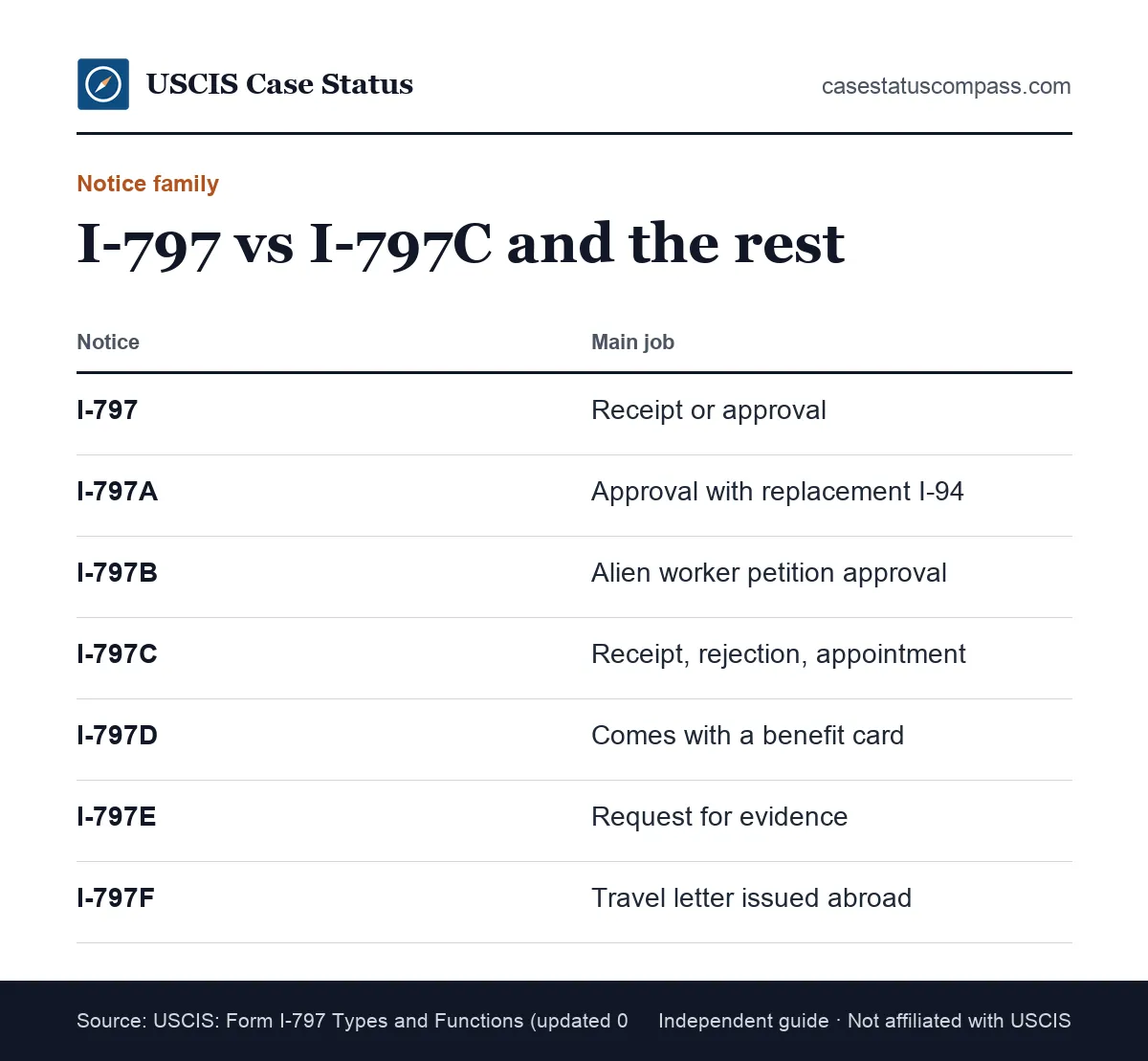
Form I-797 reports a receipt or an approval, Form I-797C reports procedural steps only, and Form I-797B approves an alien worker petition such as an H-1B. The letter after "797" tells you which notice you hold.
Check that letter before you rely on any notice as proof.
All seven I-797 versions at a glance
The table lists all seven versions of the form, what each reports and whether it is a decision.
| Notice | What it reports | Is it a decision? |
|---|---|---|
| I-797 | Receipt or approval of a form | Sometimes (approval) |
| I-797A | Approval with a replacement Form I-94 attached | Yes |
| I-797B | Approval of an alien worker petition | Yes |
| I-797C | Receipt, rejection, transfer, appointment, re-open | No |
| I-797D | Mailed together with a benefit card | Card already issued |
| I-797E | Request for evidence | No, a request |
| I-797F | Transportation letter issued abroad | Travel permission |
Approval notice
An approval notice usually prints on plain Form I-797 and says "Approval Notice" in the notice type box. The online tool shows a matching update; our page on the approval case decision rendered status explains what comes next.
Receipt notice
The I-797 receipt notice for most forms is printed on Form I-797C. It shows that your case exists and is waiting in line. Nothing on it changes your status, though some receipts for I-751 and I-90 extend your green card, as covered later.
Notice with I-94
A Form I-797A carries a new Form I-94 arrival-departure record at the bottom. It comes when USCIS approves a change or extension of status inside the U.S. Keep the I-94 portion with your passport, because it shows your authorized stay.
What Is an I-797B Approval Notice?
Form I-797B approves a petition an employer filed for a worker, often a worker who is outside the U.S. It usually has no I-94 attached. The worker generally uses it to apply for a visa at a U.S. consulate, so keep the original safe for the visa interview.
What Are I-797A, I-797D, I-797E and I-797F?
These are the other members of the I-797 immigration form family. I-797A is an approval with a replacement I-94, I-797D comes with a card, I-797E requests evidence, and I-797F is a travel letter issued overseas to a small group of people.
I-797A: replacement I-94
The I-797A shows the approved status and the new I-94 dates. Your stay is measured by the I-94, not the visa stamp. If the dates on the I-94 look wrong, contact USCIS promptly, since an error can affect your lawful stay.
I-797D: benefit card notice
The I-797D is the letter folded around a new green card or employment authorization document (EAD). It often repeats your card details. Keep it: if the card is ever lost, the notice helps you prove what was issued and when.
I-797E: request for evidence
An I-797E asks for more documents before USCIS decides. It lists what is missing and a response deadline. Answer it fully and on time. Our guide to a USCIS request for evidence explains how to build a strong reply.
How to Read Your I-797C, Box by Box
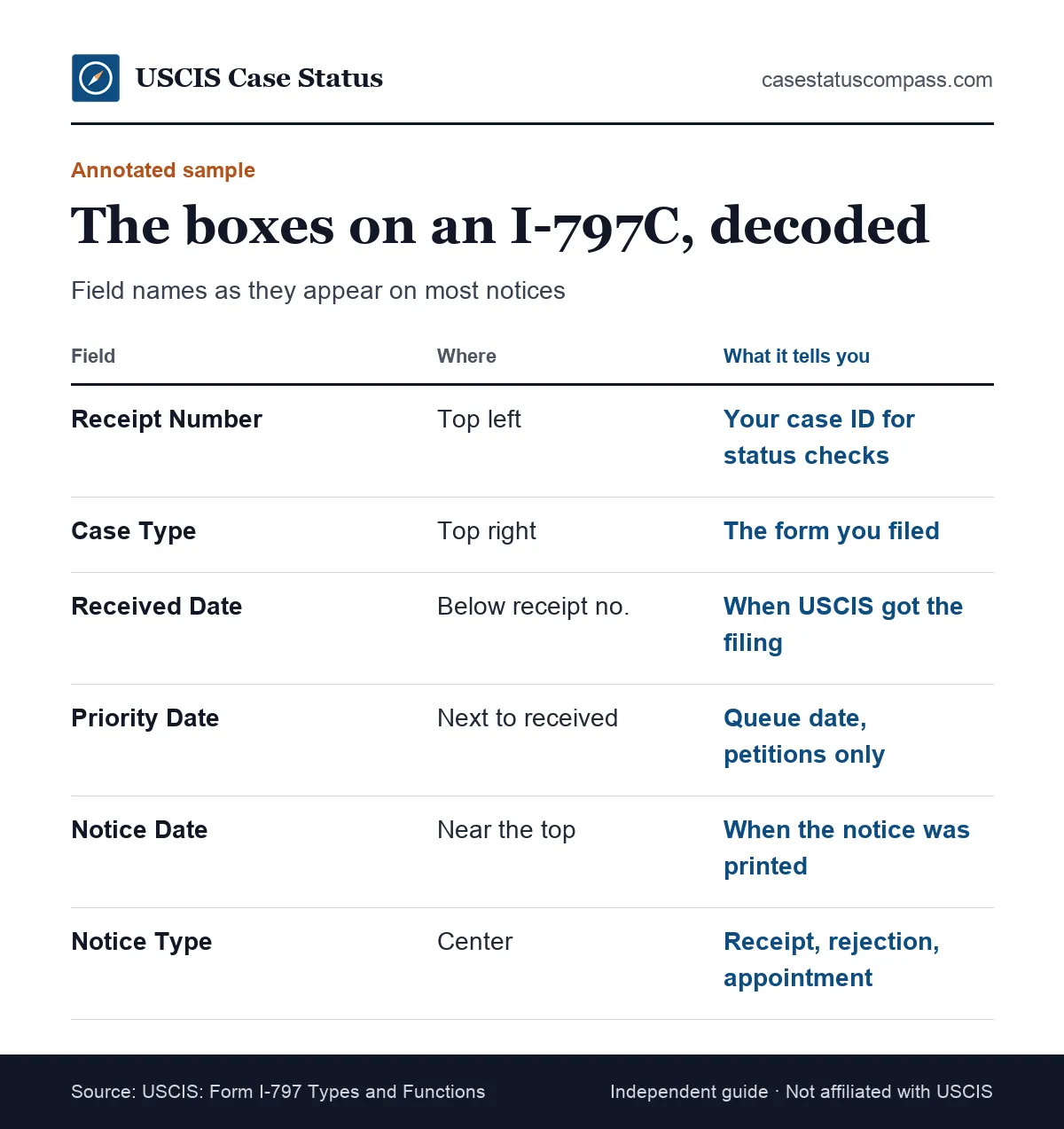
Reading an I-797C notice is easier once you know its layout. The top holds the case identifiers. The middle names the people involved. The bottom gives the instructions, which often matter most.
Read all three parts the day the notice arrives, and check every name and date against what you filed.
I-797C fields and what to do with each
Each row names a box on the notice, what it means and the one action it calls for.
| Box on the notice | What it means | What to do with it |
|---|---|---|
| Receipt Number | Unique ID for this filing | Use it for every status check and call |
| Case Type | The form number, such as I-485 | Confirm it matches what you filed |
| Received Date | Day USCIS got your filing | Proof you filed before a deadline |
| Priority Date | Your place in a visa queue (petitions) | Compare it with the Visa Bulletin |
| Notice Date | Day the notice was generated | Starts some response windows |
| Page | Page count, such as "1 of 1" | Make sure no page is missing |
Receipt number and received date
These boxes sit together near the top. The receipt number follows the pattern 3 letters + 10 digits (13 characters), e.g. EAC2512345678; leave out dashes. The received date proves when you filed.
Priority date on petitions
The priority date appears mainly on family and employment petitions, such as Form I-130 or I-140, and sets your place in line. Compare it with the Visa Bulletin each month.
Case type
The case type box names the form, for example "I-485, Application to Register Permanent Residence or Adjust Status." If you filed several forms, each gets its own I-797C with its own case type. A mismatch here is worth a call to USCIS.
Does an I-797C Deadline Count From the Notice Date?
Often, yes. The notice date is when USCIS generated the letter, not when you received it, and mail can add days. If a notice gives you a deadline, read whether it counts from the notice date and plan around the earlier date.
Who Is Named on the Notice?
An I-797C names the applicant or petitioner, and on petitions it also names the beneficiary, the person the petition is for. It shows the mailing address USCIS has on file and, when a G-28 was filed, the attorney or representative. Each name should match your filing.
Applicant, petitioner and beneficiary
On a Form I-130, the U.S. citizen or permanent resident is the petitioner and the relative is the beneficiary. On a Form I-485, you are the applicant. If a name is in the wrong field, ask USCIS to correct it.
Mailing address block
The address block shows where USCIS will send everything next. If it is wrong, update it right away; a wrong address is a top reason notices and cards go missing.
What Does the Notice Type Line Say?
The notice type line, printed in bold in the middle of the page, tells you what the notice i797c is for. The most common labels are "Receipt Notice," "Rejection Notice," "Appointment Notice" and "Transfer Notice." Read this line first.
It decides what you do next.
"Receipt Notice"
This label means your case is accepted and waiting. You do not need to act, except to keep the notice and track the case.
Note the received date for processing-time checks.
"Appointment Notice" or "Rejection Notice"
An appointment notice means you must attend something on a set date. A rejection notice means nothing is pending and you must refile. Both need action. Mark the date or refiling plan in your calendar the day the notice arrives.
What Does the Body Text of an I-797C Tell You?
The body text below the boxes explains what USCIS will do next and what you should do. It may list documents to bring, explain address updates or point you to online status checks. Read every paragraph, not just the headline.
The "does not grant status" sentence
This sentence appears on most I-797C notices. It confirms that the notice is a record, not a benefit. If you are ever asked for proof of status, the I-797C alone is usually not enough unless a specific rule says otherwise.
Is an I-797C an Approval?
No. An I-797C is never an approval notice. It reports receipts, rejections, appointments, transfers and re-opened cases. When USCIS approves a case, it uses a different version of the form, usually I-797, I-797A or I-797B, labeled "Approval Notice."
Read the notice type line to be sure.
Words that signal an approval
Look for "Approval Notice" in the notice type line and a validity period such as "Valid from... to...." If you see these, you hold a decision, not a receipt.
An I-797C has neither.
Can You Use an I-797C as Proof of Status?
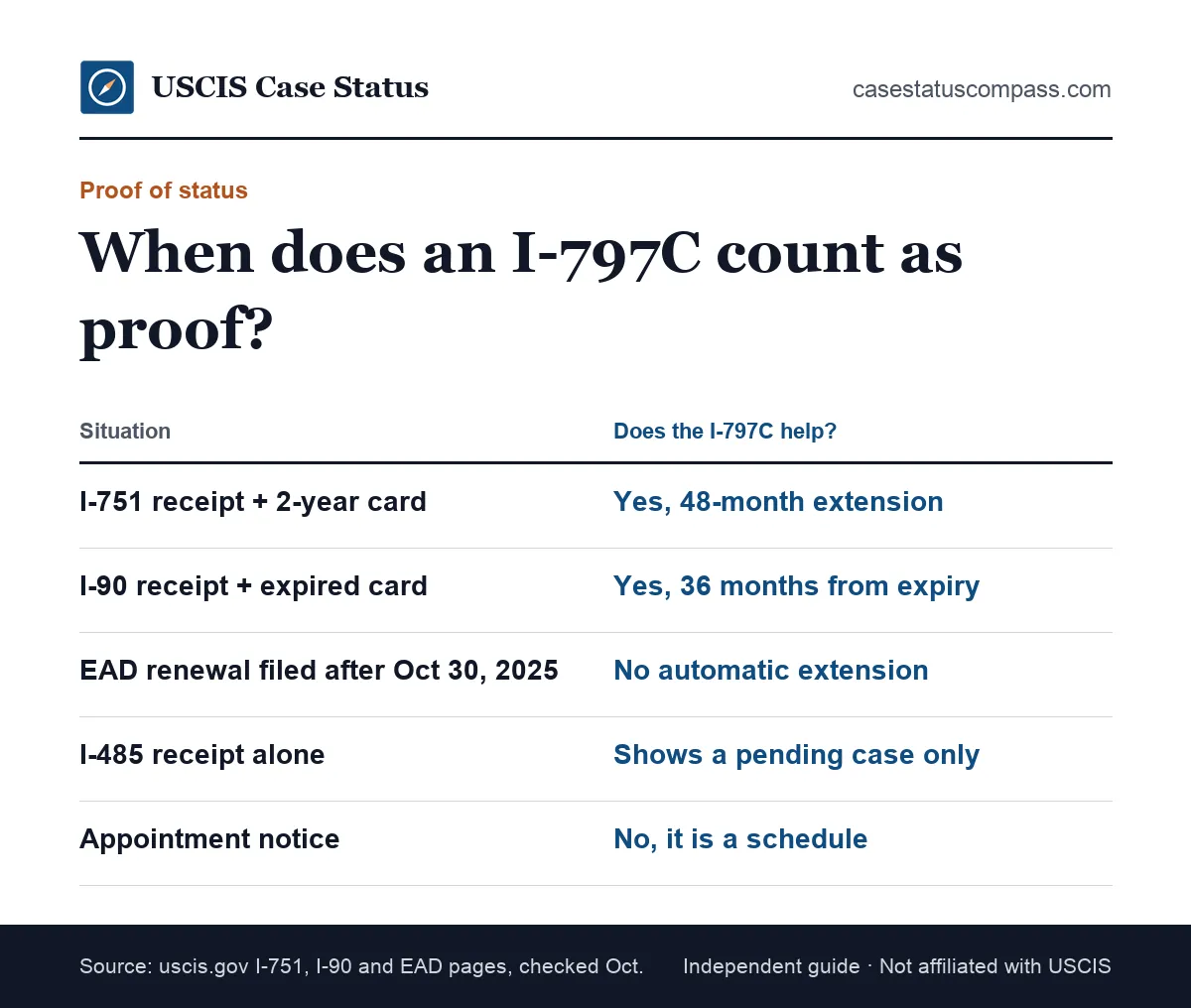
Usually not on its own. As of October 2026, the USCIS summary reads: I-797C = Notice of Action (receipt, rejection, transfer, appointment, re-open); not proof of status by itself. A few receipt notices, however, extend an existing green card when shown with that card. Proof of status depends on the form and who is asking.
When a receipt notice extends a card
Two receipts are special. A receipt for Form I-751 (removing conditions) and one for Form I-90 (replacing a green card) can extend your card for a set period. In both cases, carry the receipt notice together with the card itself.
How others should read a plain receipt
An employer or landlord should treat any other plain receipt as proof you filed, nothing more. It does not show that USCIS approved anything.
Offer the approval notice or card instead when they need proof of status.
How Do I-751 and I-90 Receipt Notices Extend a Green Card?
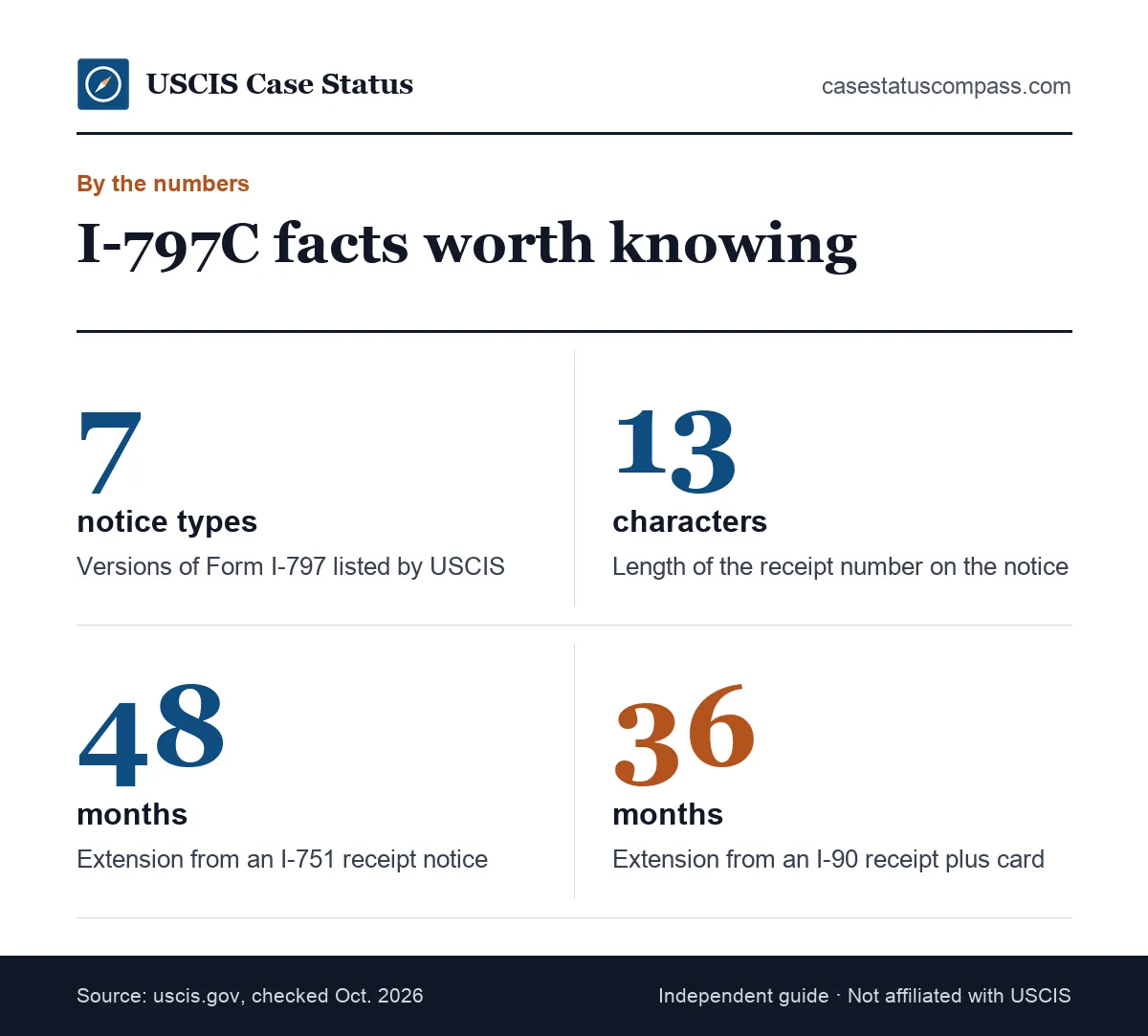
An I-751 or I-90 receipt notice works as an extension letter when kept with your card. USCIS says the I-751 receipt extends conditional status for 48 months, and an I-90 receipt plus an expired card serves as proof for 36 months. Keep both together.
The I-751 receipt notice
I-751 receipt notice extends conditional status and work authorization for 48 months. You present the receipt with your 2-year card. Our guide to Form I-751 explains when to file. Note the filing window: File in the 90 days before your 2-year card expires.
The I-90 receipt notice
I-90 receipt notice + expired card = proof of status for 36 months from the card's expiration date. This changed from 24 to 36 months in September 2024. Our Form I-90 guide covers renewals and replacements.
When you need stronger proof than a receipt
If you need stronger proof, ask about an ADIT stamp: I-551/ADIT stamp: temporary proof of green card status; request through the USCIS Contact Center (800-375-5283).
Book it through the Contact Center or your account.
Can You Work With an I-797C?
Only in limited cases. An I-797C for a work permit renewal used to extend many expiring EADs automatically. That rule ended: Ended: renewals filed on or after Oct. 30, 2025 no longer get the up-to-540-day automatic extension (exceptions: TPS by law/Federal Register notice; STEM OPT 180 days). A receipt alone now rarely keeps you working past your card's date.
EAD renewals filed before and after October 30, 2025
Renewals filed before October 30, 2025 may still carry the older extension language on the receipt. Renewals filed on or after that date generally do not. Check the exact wording on your notice and see our Form I-765 page for details.
Can You Travel With an I-797C?
An I-797C is not a travel document. People with a pending adjustment of status usually need an approved advance parole document. Permanent residents use their green card, plus an extension receipt when one applies.
Check which rule fits your case before you buy a ticket.
Pending green card applicants
If your Form I-485 is pending, leaving the U.S. without advance parole can cause USCIS to treat the application as abandoned. Talk to an attorney before booking any trip.
Exceptions exist for some visa holders.
Permanent residents with an extension receipt
If your card is extended by an I-751 or I-90 receipt, carry both the card and the receipt notice. Airline and border officers may ask for both.
Check that the receipt has not expired.
What Does an I-797C Look Like for Each Form?
The form 797C immigration notice looks the same across forms, but the case type and next steps differ. An I-485 receipt leads to biometrics, an I-130 receipt often shows a priority date, and an N-400 receipt leads to an interview.
I-797C differences by form type
Find the form you filed in the left column to see what its I-797C shows and which notice usually follows.
| Form filed | What the I-797C shows | Usual next notice |
|---|---|---|
| I-485 (green card) | Case type, received date, often a category | Biometrics appointment |
| I-765 (work permit) | Eligibility category, such as (c)(9) | Card or biometrics reuse |
| I-130 (family petition) | Petitioner, beneficiary, priority date | Approval or evidence request |
| N-400 (citizenship) | Received date, your A-Number | Biometrics, then interview |
| I-751 (remove conditions) | 48-month extension language | Biometrics |
| I-129 (H-1B and workers) | Employer as petitioner, beneficiary | Approval on I-797B or I-797A |
I-485 and I-765 receipts
An adjustment package often produces several notices at once: one for the Form I-485, one for the I-765 and one for the I-131. Each has its own receipt number. File them together in a folder by form.
I-130 receipts
The I-130 receipt matters for years, because its priority date sets your place in the family queue. Our Form I-130 page covers what happens after receipt. Keep a scan in more than one place.
N-400 receipts
An N-400 receipt lists the applicant and usually the A-Number. It leads to a biometrics notice and later an interview notice, both on Form I-797C. See our Form N-400 guide for the full path to citizenship.
Employer petition receipts
For H-1B and other worker petitions, the employer is the petitioner. The worker may receive only a copy. Ask your employer or its attorney for every notice; our H-1B petition guide explains the documents involved.
How Many I-797C Notices Will You Get?
You get at least one I-797C for each form you file, and often more as the case moves. A green card package can produce receipts for three forms, then biometrics and interview notices.
Keep every one, filed in date order by form.
One receipt per form
USCIS gives every form its own receipt number. If you file Forms I-485, I-765 and I-131 together, you get three separate receipt notices. Track all three, because they can move at different speeds.
Notices for families filing together
Families multiply this: each person files their own forms, so label every notice by person and form the day it arrives.
A child's notice can look identical to a parent's except for the name and receipt number.
Using the I-797C Receipt Number to Check Your Case
The I-797C receipt number is your key to the official status tool. Type it into Case Status Online: egov.uscis.gov without dashes or spaces. The tool shows the latest action.
Each receipt number shows only its own filing, so check every number on your notices separately.
Entering the number correctly
Copy the 3 letters and 10 digits exactly. Leave out dashes. If the notice shows asterisks, keep them. For a full walkthrough, our USCIS case status checker explains each step and what the results mean.
When the number does not work
A new receipt may take a few days to appear online. If it still fails after that, check each character, especially the letter O and the digit 0. If the status seems frozen, see our guide on why a USCIS case status is not updating.
What Is the A-Number on an I-797 or I-797B?
The A-Number (Alien Registration Number) is your permanent USCIS file number. It often appears on I-797 notices in a box labeled "A#" or "Alien Number." People search "a number on i797b" because worker approvals sometimes show it.
It stays the same on every notice.
Where it appears
On many notices, the A-Number sits near the beneficiary or applicant name. It starts with an "A" followed by digits. New applicants may not have one yet, so the box can be blank. On green cards, Your A-Number is the 'USCIS#' printed on the front of green cards issued after May 10, 2010.
Receipt number vs A-Number
The receipt number tracks one filing; the A-Number follows you for life. Our alien number guide explains how to find yours, and our green card number page covers the separate card number.
Biometrics Appointment Notices on Form I-797C
A biometrics appointment notice is an I-797C that schedules your fingerprints, photo and signature at an Application Support Center (ASC). It lists the date, time, address and the receipt number. Bring the notice and photo ID.
Arrive on time, since late arrivals may be turned away.
What to bring
- The original appointment notice
- A valid photo ID, such as a passport or driver's license
- Your green card or EAD, if you have one
Our guide to the biometrics appointment covers what happens at the center.
Rescheduling
The notice explains how to reschedule, usually through your online account or by phone. Missing biometrics without rescheduling can delay or harm your case.
Do it before the appointment date, not after.
Interview Notices on Form I-797C
An interview notice is an I-797C that sets the date, time and field office for your interview. It often lists documents to bring. Read it twice and arrive early. The matching status message is explained on our interview was scheduled page.
What the notice includes
The notice gives the office address, the time, and a checklist of documents. Follow every item on the list.
Bring the originals listed and copies of key documents, and keep the notice itself with you, since the office may ask to see it.
What Should You Do After an I-797C Rejection Notice?
Fix the problem and file again. A rejection notice means USCIS did not accept your filing, so nothing is pending. The notice usually lists the reason. Common causes are a missing signature, a wrong fee, or an old form edition. A rejection is not a denial.
Common reasons for rejection
- Unsigned form or signature in the wrong place
- Wrong fee amount or a declined payment
- An outdated form edition, such as an old I-485
- Missing required pages
Fix every item before refiling.
Checking the current fee before refiling
For current fees, check Form G-1055, Form G-1055, Edition 10/16/26. A wrong fee is a common rejection cause, so confirm it before every filing.
Fees changed with the October 2026 schedule.
Which Form Edition Should You Use When Refiling?
Use the current edition from uscis.gov, because an outdated edition is a common rejection reason. For example, USCIS now requires a specific I-485 edition: 09/18/26 (01/20/25 and 09/04/26 editions rejected on/after Sept. 18, 2026; no grace period). If a deadline is close, refile right away.
What Does an I-797C Transfer Notice Mean?
A transfer notice means USCIS moved your file to another office, often to balance workloads or for an interview. Transfers are routine and do not signal a problem. Our page on the case was transferred update explains the status message.
What changes and what stays
Your receipt number and priority date stay the same. The office handling your case changes, which can affect timing. Check the official processing times tool for the new office.
Your past notices remain valid.
Where to send later replies
Send any later replies to the address on the transfer notice, not the old one.
Use the receipt number on every page you send, and keep proof of mailing, so the new office can match your reply to the file.
Electronic vs Paper I-797C: Is There a Difference?
The electronic copy in your online account and the paper notice carry the same information. Both are official. The online copy often arrives first, which helps if mail is slow.
Either copy can be printed and used where a notice is needed.
Copies in your online account
If you filed online or linked your paper case, notices appear in the account's documents area. As of October 2026, USCIS lists these benefits: Free USCIS online account: case status updates, notices, link paper-filed cases. Our guide to the USCIS online account number explains how to sign in and link a case.
How to Get a Copy of Your I-797
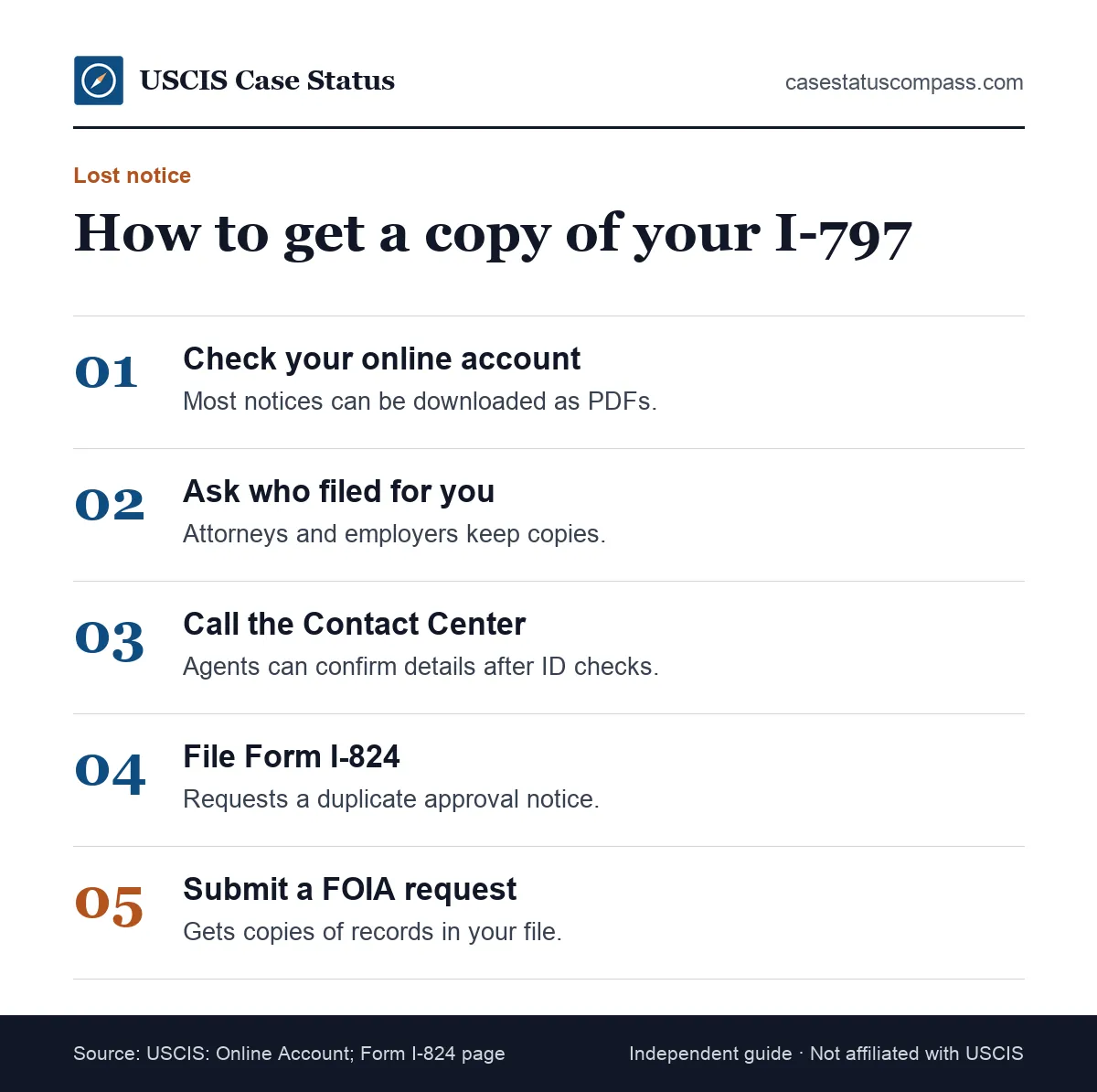
Start with the free, fast options: your USCIS online account, or the attorney or employer who filed for you. If those fail, use Form I-824 for a duplicate approval notice or a FOIA request for copies of your file.
Download from your online account
Sign in at myaccount.uscis.gov/create-account if you do not have an account yet. Online filings show notices automatically. Paper cases can be added with the online access code from your Account Access Notice. Then download the PDF.
Ask whoever filed for you
Attorneys and accredited representatives receive copies of notices for cases they filed. Employers keep worker petition notices. A quick email often gets you an i 797 copy the same day.
Call the USCIS Contact Center
Call 800-375-5283 (TTY: 800-767-1833). An agent can confirm your receipt number and case details after verifying your identity. Ask what options exist for a copy of the notice itself.
Keep notes of the call, with the date and the agent's reference.
Can You Replace a Lost I-797 Approval Notice?
Yes. USCIS uses Form I-824, Application for Action on an Approved Application or Petition, to request a duplicate approval notice. It works only after approval, not for pending or denied cases. For full records, use a Freedom of Information Act (FOIA) request.
Form I-824 for a duplicate approval
Form I-824 can also ask USCIS to notify a consulate. USCIS will not process it if the case is still pending or was denied. Check the fee in Form G-1055 and the edition on uscis.gov/i-824 before filing.
How Do You Request Old I-797 Notices Through FOIA?
A FOIA request asks USCIS for copies of documents in your file, including old notices that an I-824 cannot replace. USCIS explains the request process and any costs on its FOIA pages. Responses can take time, so start early if you need records for a future filing.
What If Your I-797C Never Arrived?
Check your online account and status first, then your address on file. If the online tool shows a notice was mailed but nothing came, wait a short time for mail delays, then contact USCIS.
Have your receipt number ready if you know it.
Check your address and mail
Look at the address on your filing. A missing apartment or unit number is a common cause. Ask household members and the building office, and ask your attorney or employer whether their copy arrived. Then update your address with USCIS if needed.
Ask USCIS for help
Call the Contact Center with your receipt number, or your name, birth date and A-Number. You can also request an appointment: Request an in-person appointment online at my.uscis.gov/en/appointment/v2 or call 800-375-5283.
What If Your I-797C Has a Mistake?
Contact USCIS to fix errors in names, birth dates or addresses as soon as you notice them. Small typos on a receipt can carry through to an approval or card.
Keep copies of the wrong notice and proof of the correct details.
Errors caused by USCIS
If USCIS made a typing error, the fix is usually free. Contact the Contact Center or send a message through your online account.
Send proof of the correct details, such as a passport page.
How Can You Tell If an I-797C Is Fake?
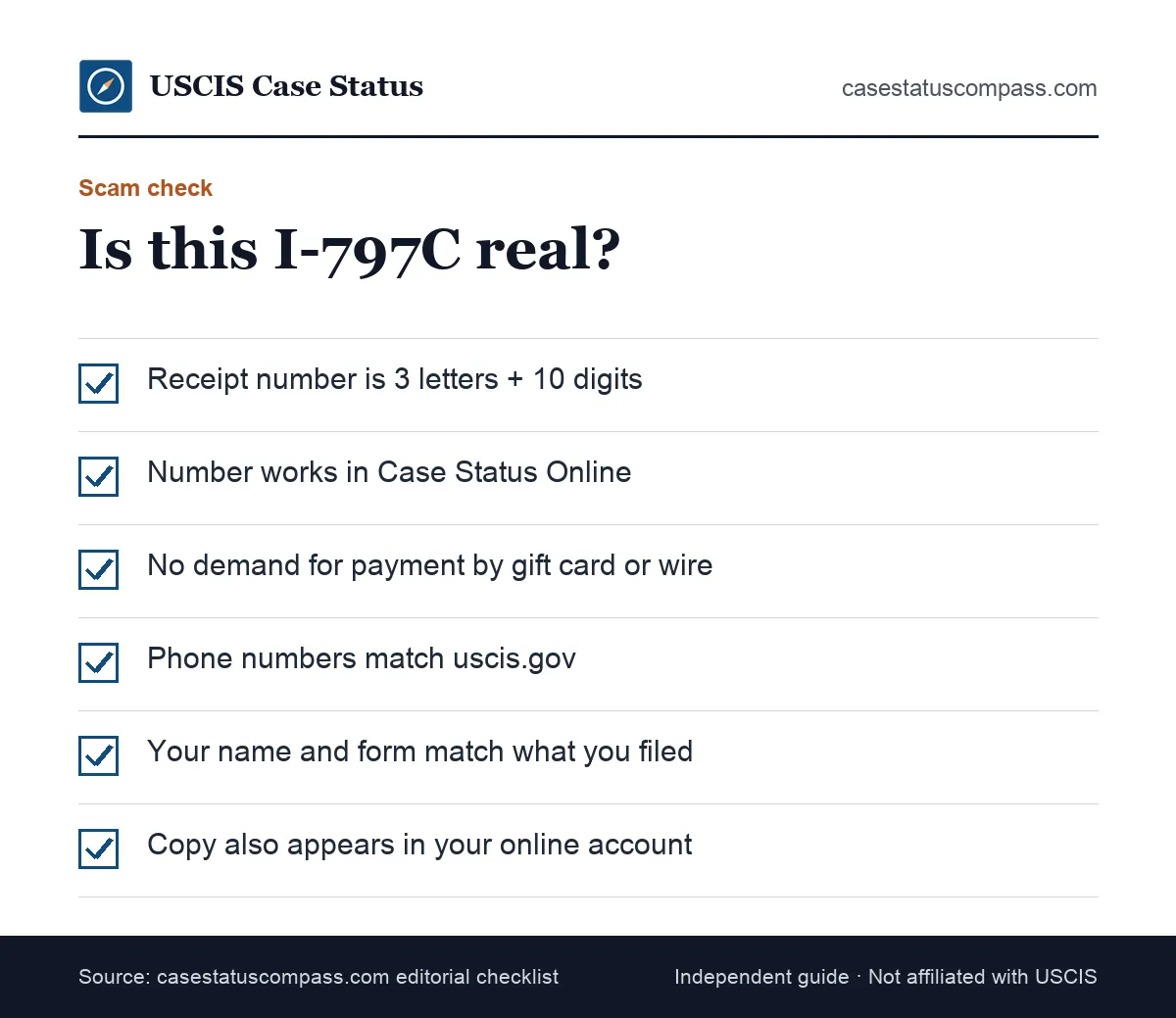
Check that the receipt number follows the official format and shows up in the official status tool. Real notices never ask you to pay by gift card, wire or crypto. Verify through USCIS channels, not the phone numbers on the letter.
Red flags
- Demands for urgent payment to avoid deportation
- Email or phone contact you did not expect
- Misspelled form names or odd fonts
- A receipt number that the official tool cannot find
How to verify a notice
Enter the receipt number at egov.uscis.gov. Call the official Contact Center number from uscis.gov. If in doubt, our guide to verifying a USCIS notice is genuine walks through each check.
How Long Should You Keep an I-797C?
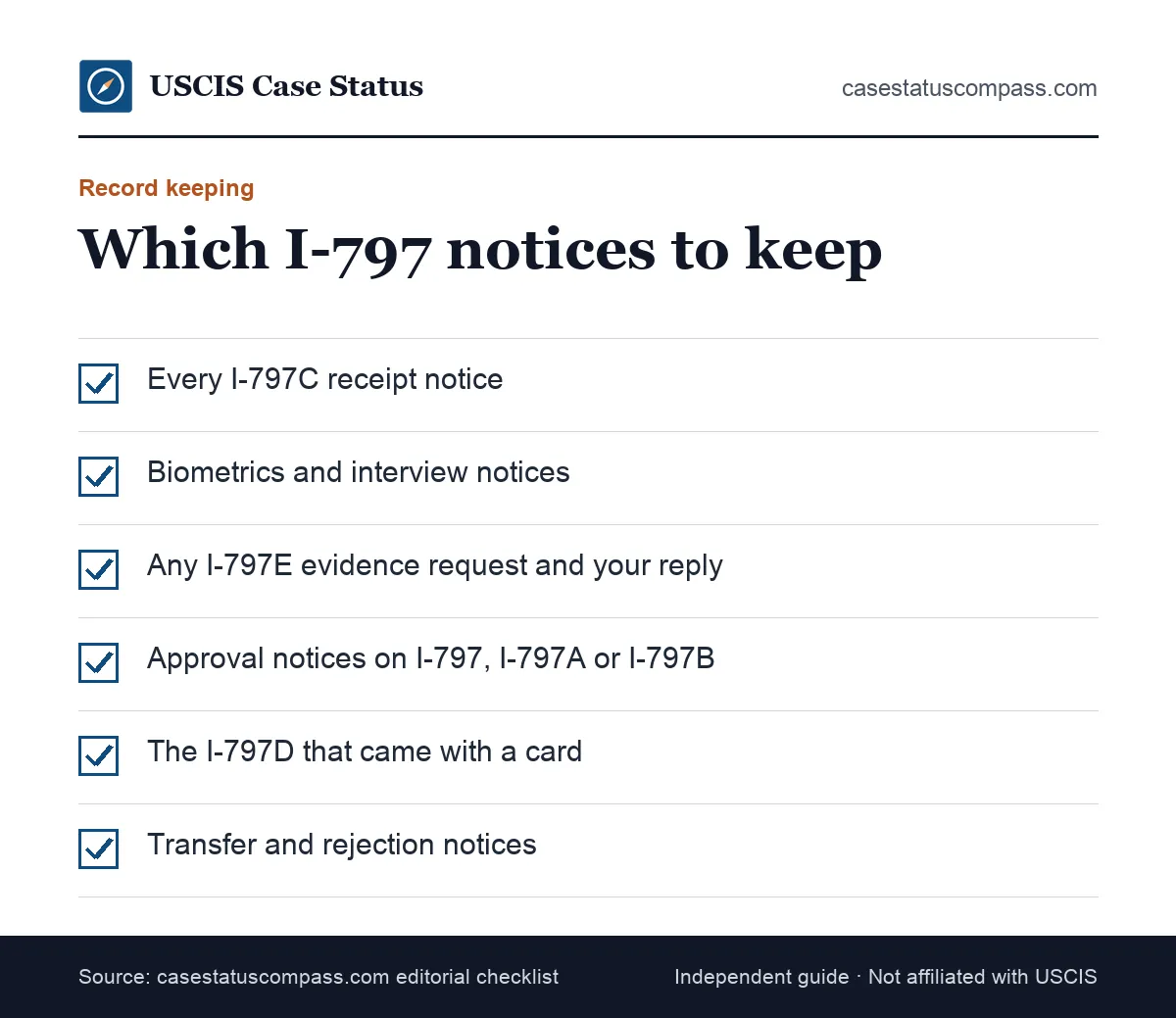
Keep every I-797C at least until your case ends, and keep receipts and approvals for your permanent records. Old notices help with later filings, such as naturalization. Store originals safely and keep digital scans.
Keep them even after approval, since later filings may ask about them.
What to copy before sending
Never mail an original I-797 unless USCIS asks for it. Send photocopies instead. Keep originals in a folder per person and form, back up scans in two places, and bring the originals plus a copy set to any interview.
What Happens After You Receive an I-797C?
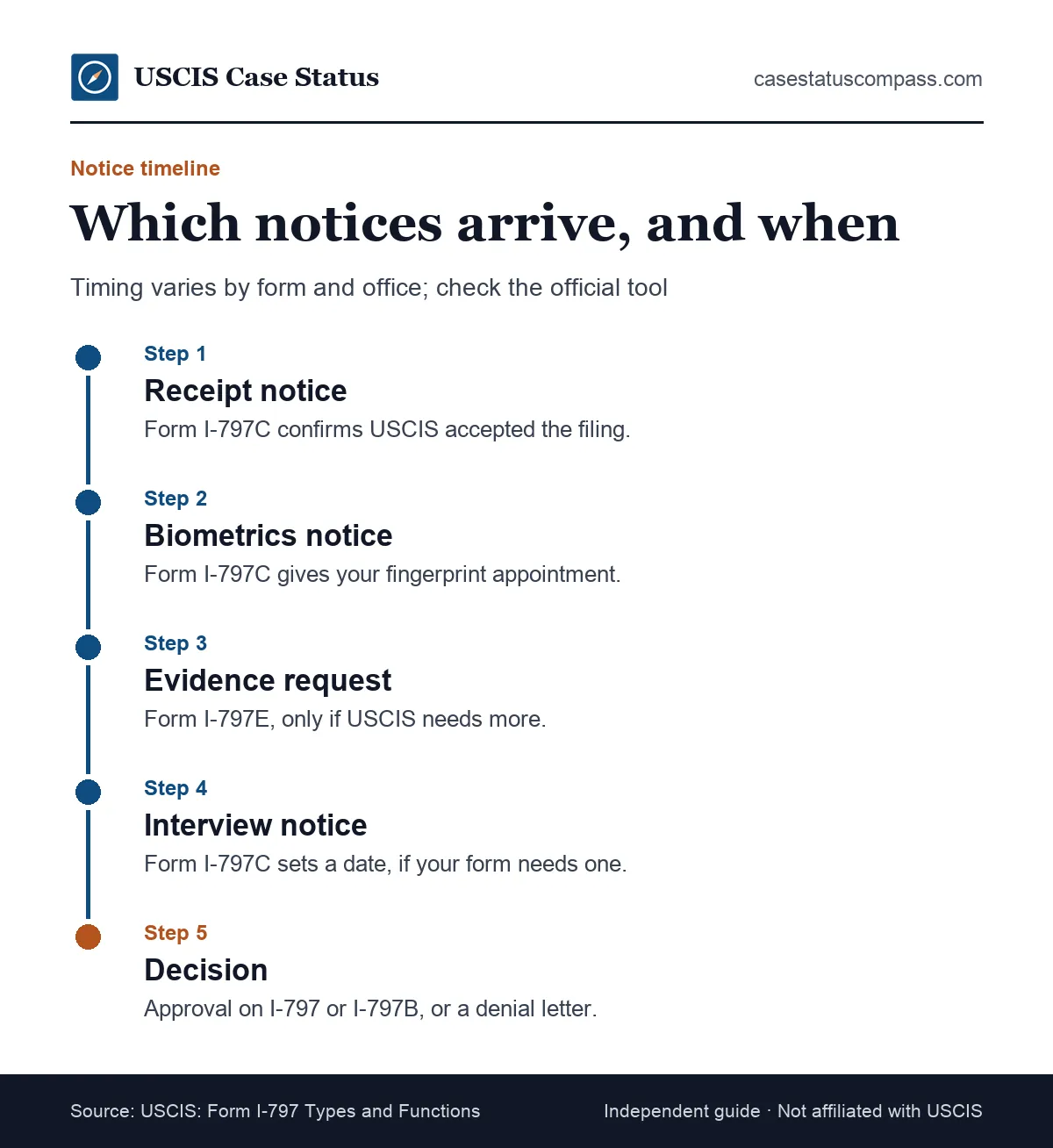
After a receipt notice, USCIS usually schedules biometrics if your form needs them, reviews the case, and may send a request for evidence or an interview notice. Each step can bring a new I-797C.
Not every case gets every step, so a skipped notice is not always a problem.
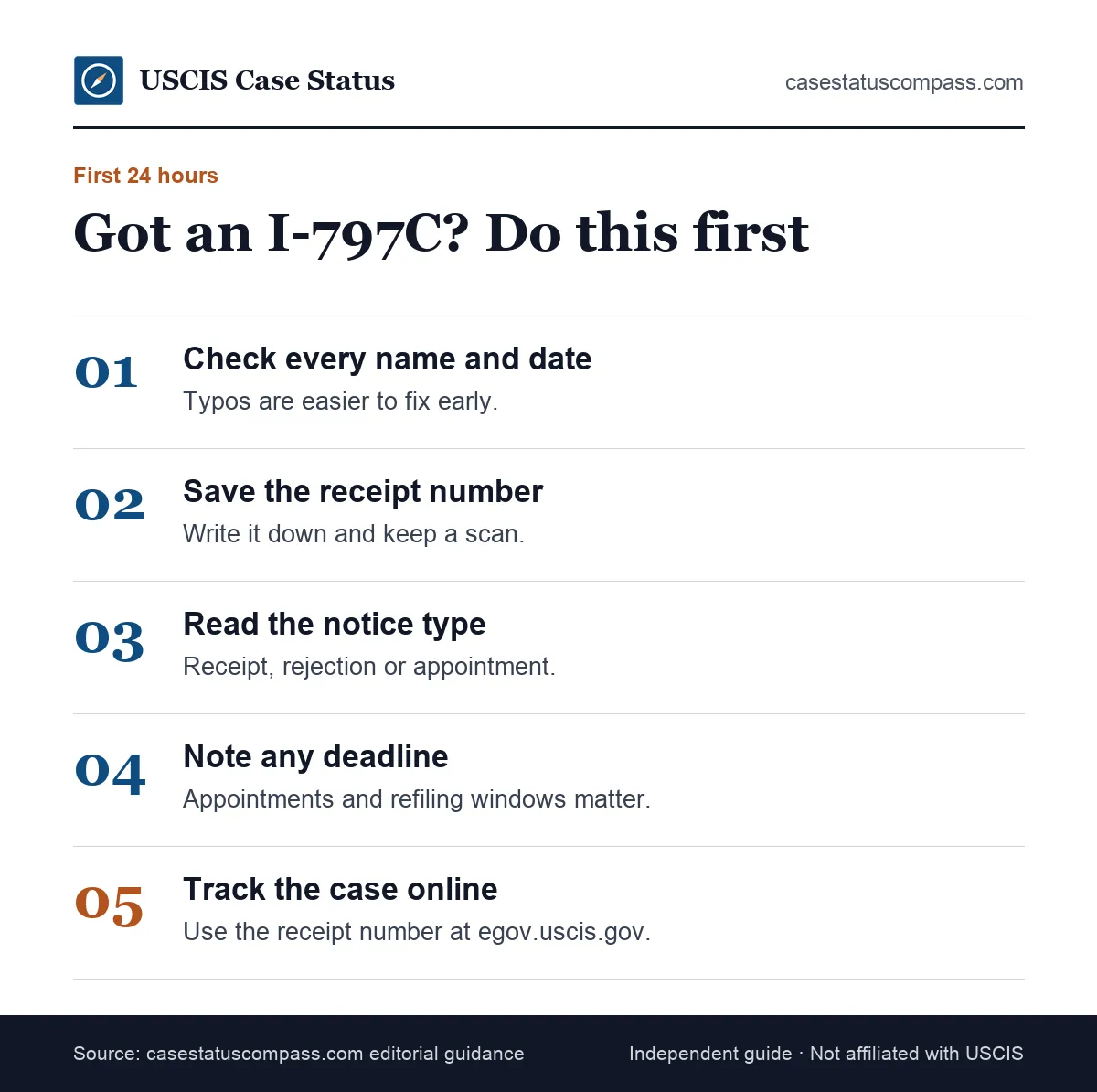
The usual order of notices
- Receipt notice (I-797C)
- Biometrics appointment notice (I-797C)
- Request for evidence (I-797E), if needed
- Interview notice (I-797C), if needed
- Decision notice (I-797, I-797A, I-797B or a denial letter)
Some cases skip steps 2 to 4.
How Do I-797C Notices Match Online Status Messages?
Each I-797C usually lines up with a status update on Case Status Online. A receipt matches "Case Was Received." An appointment notice matches a biometrics or interview update. An approval on I-797 matches "Case Was Approved." If they differ, trust the notice.
"Case Was Received"
This update appears when USCIS issues the receipt notice. It confirms your case is in line. The date in the update should match the received date on your notice; if it does not, keep both and mention the difference when you contact USCIS.
Decision updates
When USCIS approves a case, the status changes and an approval notice follows by mail. If the case is denied, USCIS sends a decision letter explaining why. Our case was denied page explains the next options.
Common Mistakes People Make With Form I-797C
The biggest mistakes are treating a receipt as an approval, losing the receipt number, ignoring the instructions paragraph and mailing original notices. A quick review when the notice arrives prevents most of them.
The two below are the most costly.
Treating a receipt as approval
People sometimes quit jobs, travel abroad or stop renewing documents because they think a receipt is an approval. It is not. Wait for the decision notice, read its exact wording, and only then change plans that depend on your status.
Missing an appointment notice
Appointment notices come by mail and to your online account. A missed biometrics or interview date can delay or hurt a case. If you move, update your address quickly, and check your account often in the weeks after filing.
If X, Do Y: An I-797C Decision Guide
Use this table to decide what to do with the notice in your hand. When the notice involves deadlines, travel or work, an immigration attorney or DOJ-accredited representative can confirm the right move.
Start with the notice type line, then read the instructions.
Decision table by notice type
Find what your notice says in the left column, then follow the action on the same row.
| If your notice says or shows... | Do this |
|---|---|
| "Receipt Notice" | Save it, note the receipt number, track online |
| "Rejection Notice" | Fix the stated problem and refile quickly |
| "Appointment Notice" | Calendar the date; bring the notice and ID |
| "Transfer Notice" | Keep it; send future replies to the new office |
| Wrong name or date | Contact USCIS to request a correction |
| I-751 or I-90 receipt | Keep it with your card as proof of status |
When the notice has a deadline
Count backward from the deadline and plan to act a week early. Mail delays and missing documents are common. If the notice affects work or travel, check the rule for your form. If you cannot meet a deadline, seek legal advice right away.
When Should You Get Legal Help About an I-797C?
Get help if you receive a rejection near a deadline, a notice you do not understand, a request for evidence on a complex case, or anything mentioning removal or court. An immigration attorney or DOJ-accredited representative can review your notice. This guide is not legal advice.
Situations that need an expert
- A rejection when your status is about to expire
- A notice that mentions immigration court
- An I-797E asking for evidence you do not have
- Travel plans while a case is pending
Other Names People Use for the I-797C
People who ask what is an I-797C often search for it under other names: "form 797c," "i797c notice of action," "I-797 notice of action form," and even "form 1-797c," where the letter I is mistaken for the number 1. All mean the same notice.
"Form 1-797C" and other typos
The form number starts with the letter I, not the number 1. The same mix-up happens with "form 1-797." If someone gives you a form with a different number, ask them to show it on uscis.gov.
Frequently Asked Questions
What is the "I-197" immigration form?
There is no common USCIS form called I-197. People who search for the "i 197 immigration form" or "i 197 form" are almost always looking for Form I-797, the Notice of Action. Check your notice: if it says I-797 or I-797C, the sections above explain what is an I-797C and how it differs from the plain I-797.
What is form I-797?
Form I-797 is the USCIS Notice of Action family. The plain I-797 version reports a receipt or an approval. Other versions, such as I-797A, I-797B, I-797C, I-797D, I-797E and I-797F, carry other messages.
Is an I-797C receipt the same as a receipt number?
No. The I-797C is the notice; the receipt number is the 13-character code printed on it. You use the number, not the paper, to check your case online.
How long after filing does the I-797C arrive?
It varies by form, lockbox and season. Online filers usually see the receipt in their account quickly. Paper filers wait longer for intake and mail.
Does the I-797C show my priority date?
On many family and employment petitions, yes. The receipt notice for Forms I-130 and I-140 often shows a priority date box.
What is an I 797 receipt notice used for?
It proves USCIS accepted your filing and gives you the receipt number for status checks. Keep it with your records; for I-751 and I-90 filings, it also works with your card as temporary proof of status.
Can I get an I-797C reissued if it shows the wrong address?
Update your address with USCIS first, then contact the Contact Center about the notice. Later notices go to the address on file, so fixing it quickly matters more than the old letter.
Is a photocopy of an I-797C valid?
A photocopy is fine for most mailings to USCIS. To prove status with an extension receipt, bring the original or a clear printout.
Sources
- USCIS: Form I-797 Types and Functions. www.uscis.gov/forms/filing-guidance/form-i-797-types-and-functions. Accessed Oct 27, 2026.
- USCIS: Form I-824, Application for Action on an Approved Application or Petition. www.uscis.gov/i-824. Accessed Oct 27, 2026.
- USCIS: Removing Conditions on Permanent Residence Based on Marriage. www.uscis.gov/green-card/after-we-grant-your-green-card/conditional-permanent-residence/removing-conditions-on-permanent-residence-based-on-marriage. Accessed Oct 27, 2026.
- USCIS: Replace Your Green Card. www.uscis.gov/green-card/after-we-grant-your-green-card/replace-your-green-card. Accessed Oct 27, 2026.
- USCIS: Checking Your Case Status Online. www.uscis.gov/tools/checking-your-case-status-online. Accessed Oct 27, 2026.
- USCIS: Benefits of a USCIS Online Account. www.uscis.gov/file-online/benefits-of-a-uscis-online-account. Accessed Oct 27, 2026.
- USCIS Contact Center. www.uscis.gov/contactcenter. Accessed Oct 27, 2026.
- USCIS Form G-1055, Fee Schedule. www.uscis.gov/g-1055. Accessed Oct 27, 2026.
- USCIS alert: Additional Mail Delivery Process for Receiving ADIT Stamp (Mar. 16, 2023; archived). www.uscis.gov/newsroom/alerts/uscis-announces-additional-mail-delivery-process-for-receiving-adit-stamp. Accessed Oct 27, 2026.
- USCIS: Automatic EAD Extension (updated 10/29/2025). www.uscis.gov/working-in-the-united-states/information-for-employers-and-employees/automatic-employment-authorization-document-ead-extension. Accessed Oct 27, 2026.
- USCIS Glossary: USCIS Number. www.uscis.gov/glossary-term/50674. Accessed Oct 27, 2026.
- USCIS: Form I-485 page (updated 10/07/2026). www.uscis.gov/i-485. Accessed Oct 27, 2026.
- USCIS: Online Account and Technical Support. www.uscis.gov/tools/uscis-tools-and-resources/online-account-and-technical-support. Accessed Oct 27, 2026.
casestatuscompass.com is an independent publication and is not affiliated with USCIS or any government agency. This page is general information, not legal advice. For denials, court or asylum matters, consult an immigration attorney or a DOJ-accredited representative.