Contents · 40 sections
- What Does "Case Was Received" Mean?
- What "Case Was Received and a Receipt Notice Was Sent" Means for Your Filing
- Does "Case Was Received" Mean Your Case Was Accepted?
- Is "Case Was Received" Good News?
- Before and After: The Status Flow Around Your Receipt
- When Does the Receipt Status Appear After Filing?
- Your Receipt Notice (Form I-797C)
- What Should You Check on the Receipt Notice?
- How Do You Read the Received Date and Priority Date?
- What Is the Priority Date on a Receipt Notice?
- What Does the Receipt Number Tell You?
- What Happens Next After Case Was Received?
- How Long After "Case Was Received" Is Biometrics Scheduled?
- What If You Cannot Attend Your Biometrics Appointment?
- What Else Could Come Next Besides Biometrics?
- How Long Does "Case Was Received" Last?
- The Receipt Stage on a Form I-485
- The Receipt Stage on a Form I-765
- The Receipt Stage on a Form I-130
- The Receipt Stage on a Form N-400
- The Receipt Stage on a Form I-751
- The Receipt Stage on a Form I-90
- The Receipt Stage on Employer and Humanitarian Filings
- Why Did You Get Several Receipt Updates at Once?
- Can "Case Was Received" Appear Again Later?
- What to Do If Your Receipt Notice Has Not Arrived
- Why Can't You Find Your Case Online Yet?
- Your Next Move: A Decision Table for New Receipts
- Received vs Rejected: Telling Them Apart
- Why Do Filings Get Rejected Instead of Receipted?
- Can You Travel or Work With Only a Receipt Notice?
- Can You Leave the U.S. While Your Case Is Pending?
- Mistakes to Avoid While You Wait for the Next Update
- Three Received-Status Situations, Explained
- How Can You Tell the Status and Notice Are Real?
- Do Case Tracking Apps Speed Up a Received Case?
- Building Your Case File From Day One
- Should You Contact USCIS at This Stage?
- When Is Legal Help Worth It This Early?
- Frequently Asked Questions
The short answer
Case was received means USCIS accepted your filing at intake, gave it a receipt number and mailed a Form I-797C receipt notice. It is not an approval or a review. Your case is now in line, and the usual next update is a biometrics notice or a move to an officer's queue.
At a glance
| Full wording | Case Was Received and A Receipt Notice Was Sent |
| Is it approval? | No. It confirms the filing exists and is pending |
| Notice you get | Form I-797C, Notice of Action (receipt) |
| Usual next status | Biometrics scheduled, or actively reviewed |
| Do you need to act? | Check the notice; keep your address current |
What Does "Case Was Received" Mean?
This status means USCIS has logged your package, matched it to a fee, created a receipt number and sent a receipt notice. Your filing now officially exists. Nobody has judged your eligibility yet; that happens during officer review.
Save the receipt notice the day it arrives.
The full message wording
Online, the title usually reads Case Was Received and A Receipt Notice Was Sent. The paragraph underneath names your form, the date USCIS received it and where the notice went: your first record of the filing date.
What USCIS has done at this point
By now USCIS has opened the package, checked basics such as fee and signature, entered your data and issued the receipt. Officers have not yet read your evidence, and background checks and biometrics are still ahead.
What "Case Was Received and a Receipt Notice Was Sent" Means for Your Filing
The full message means two things: the case is pending, and paper proof is on the way. Every later notice for this form carries the same receipt number, and its received date starts the processing-time clock.
Write that date down where you can find it.
Pending, not approved
Some first-time filers treat this update as a win. It is only the first step: a pending case can still lead to a request for evidence (RFE), an interview or a denial. Plan around an open case.
What the message does not tell you
The status does not show how strong your evidence is, how long review will take or which officer has the file. Each form in a package gets its own status line.
Does "Case Was Received" Mean Your Case Was Accepted?
Yes, in the intake sense. Your package passed the initial intake checks and was accepted for processing. Accepted is not approved. USCIS will still review the evidence and can request more documents or deny the case later.
Keep collecting evidence while you wait.
Acceptance at intake
Intake staff check the fee, a signature, the current form edition and required fields. Packages that fail are usually rejected rather than receipted. For example, USCIS now requires Form I-485 edition 09/18/26 (01/20/25 and 09/04/26 editions rejected on/after Sept. 18, 2026; no grace period).
When accepted cases still run into problems
Intake checks are basic. Missing evidence or eligibility questions usually surface during officer review, which is why an RFE can still arrive months after a clean receipt.
Keep copies of everything you sent.
Is "Case Was Received" Good News?
It is good news in a limited way. The status confirms your package arrived, cleared intake and is in line, but says nothing about the outcome. Treat it as a confirmation of filing and use the wait to prepare.
Check the notice for errors first.
Why it is still worth celebrating a little
Lost or rejected packages are a real risk with paper filing, and this message ends that worry. You now have a receipt number, a filing date on record and proof you filed on time.
What the status does not predict
The status gives no hint of your odds. Strong and weak cases show the same wording, whether they later end in approval, an RFE or an interview.
Ignore forum posts that read meaning into it.
Before and After: The Status Flow Around Your Receipt
The received status sits right after intake and before biometrics or review. What came before happened mostly out of sight, in the mailroom or online system. What comes after depends on your form, as the flow table shows.
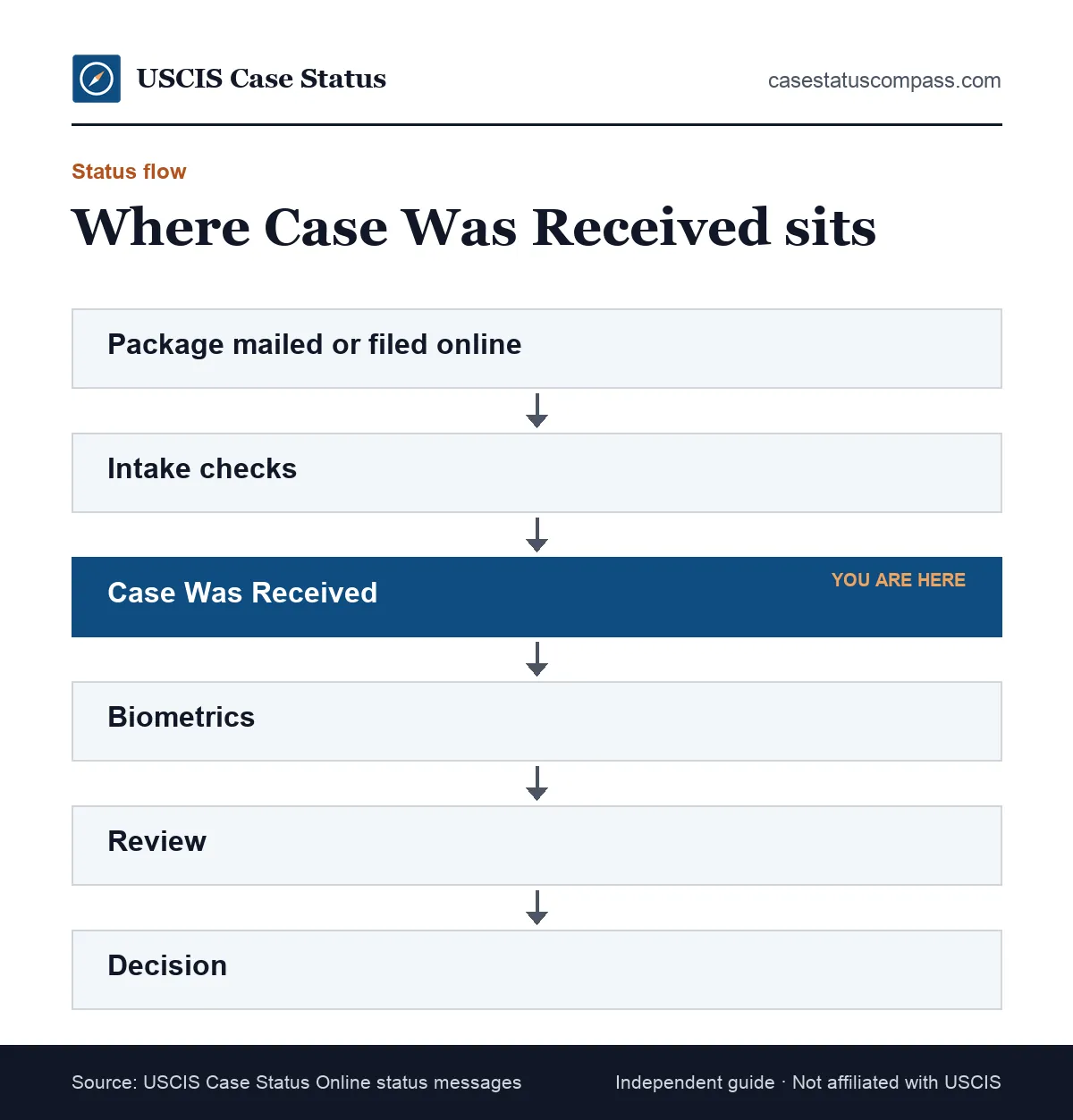
Find your row to see what to expect next.
What comes before it
Before the status appears, your package is delivered, opened, scanned and checked for fee and signature. Online filings skip the mailroom but pass system checks. A short gap with no status is normal for a brand-new filing.
Status flow with typical gaps
The table maps the step just behind your receipt to the status that usually follows it.
| Previous step | Likely next status | Typical gap |
|---|---|---|
| Package delivered or filed online | Fingerprint Fee Was Received | Days to a few weeks |
| Biometrics notice mailed | Fingerprints Were Taken | Varies by office |
| Receipt issued (no biometrics) | Case Is Being Actively Reviewed | Weeks to months |
| Receipt issued (work permit) | New Card Is Being Produced | Check official tool |
The main point: gaps vary by form and office, so a quiet few weeks after the receipt is normal and not a sign of trouble.
When Does the Receipt Status Appear After Filing?
The status appears after USCIS finishes intake, which for paper filings can take days to a few weeks after delivery and for online filings is usually much faster. USCIS publishes no fixed time, so reports online are anecdotes.
Rely on your own tracking instead.
Paper filings
A mailed package goes through a lockbox or service center mailroom: data entry and fee processing first, then the receipt. Peak periods, such as before a fee change, take longer. Delivery tracking shows when the clock started.
Online filings
Online filing usually produces a receipt almost at once, often with an IOE receipt number, and the notice appears in your account. Our page on IOE case status explains how these online receipt numbers behave.
Your Receipt Notice (Form I-797C)
Your receipt notice is a Form I-797C, Notice of Action, confirming USCIS received your filing. As USCIS describes it: I-797C = Notice of Action (receipt, rejection, transfer, appointment, re-open); not proof of status by itself. Keep it with your important documents; you will need its number and dates often.
What the receipt notice proves
The receipt notice proves you filed a specific form on a specific date. It does not grant status, work rights or travel rights on its own, apart from a few exceptions below. For a field-by-field walkthrough, see what is an I-797C.
Paper and digital copies
Paper filers get the notice by mail. Online filers see it in their account, and paper filers can link their case to see a copy there too. Your account offers Free USCIS online account: case status updates, notices, link paper-filed cases.
What Should You Check on the Receipt Notice?
Check every detail on the receipt notice the day it arrives: name, date of birth, form number, receipt number, dates and address. Errors here can carry through to approval notices and cards, so fix them early.
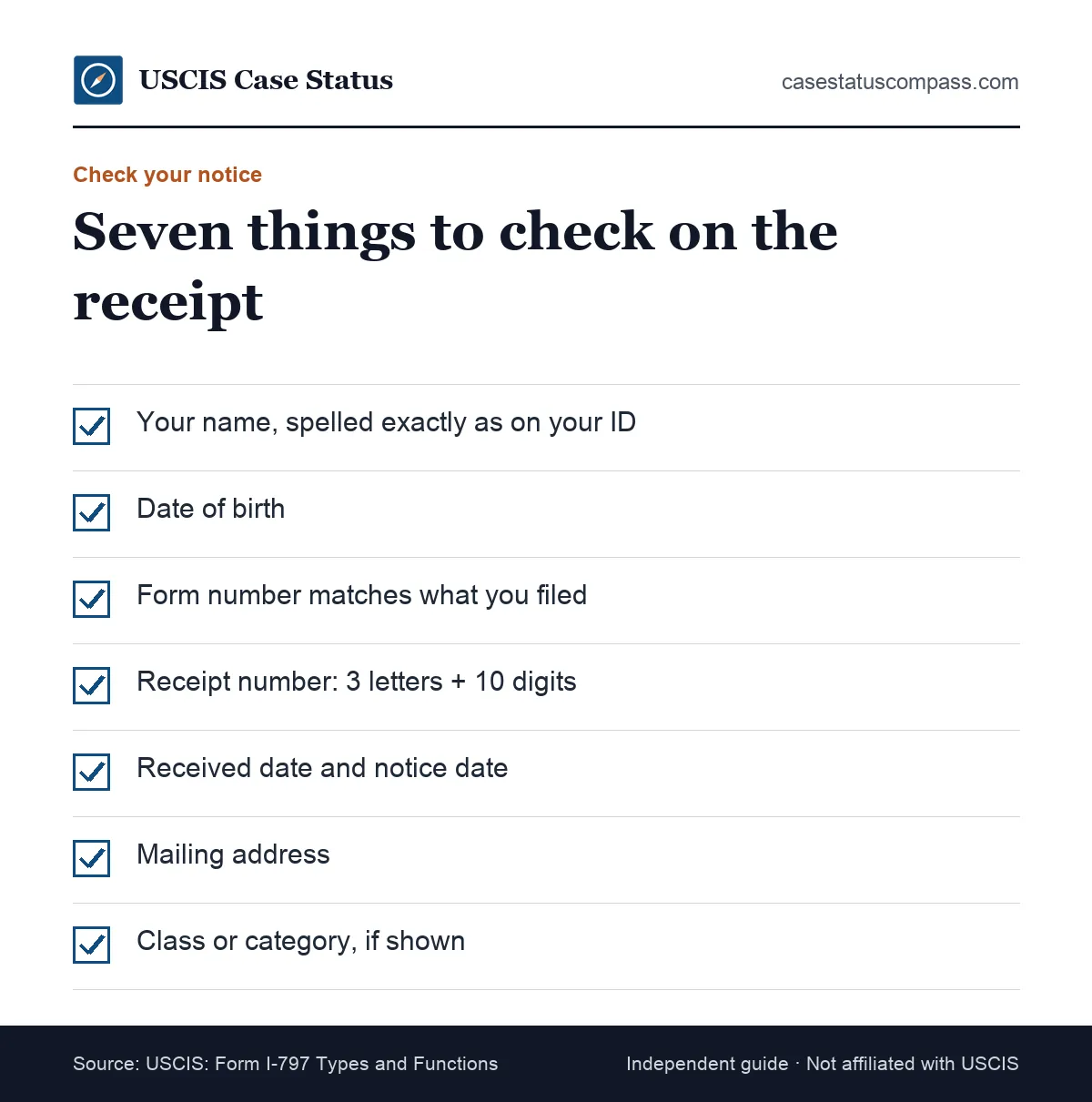
Compare each item against a copy of the form you filed.
What to check on the notice
- Name: spelled as on your passport
- Date of birth: day and month not swapped
- Form number: matches what you filed
- Receipt number: 13 characters
- Received date: near your delivery date
- Mailing address: current and complete
If something on the notice is wrong
Contact USCIS with your receipt number and explain the error, keeping a copy of your form to show what you wrote. If the mistake came from your own form, ask an attorney whether a correction letter is needed.
How Do You Read the Received Date and Priority Date?
The received date is when USCIS took in your filing and starts the processing-time clock. A priority date, shown on some petitions, sets your place in a visa queue. The two often match but serve different purposes.
Note both on your case log.
The received date
Use the received date when you compare your case with official processing times. It is the date USCIS counts as your filing, and it stays the same if the case moves offices.
The notice date
The notice date is when USCIS printed the letter, often a few days after the received date. Use it to judge mail delays, not processing time.
If the gap between the notice date and the day it arrived is long, check your address.
What Is the Priority Date on a Receipt Notice?
A priority date matters for family and employment petitions with annual limits. It decides when you can move to the green card step, and the receipt notice is where you first see it. Our visa bulletin guide explains how to read the monthly chart against your date.
What Does the Receipt Number Tell You?
The receipt number identifies this one filing. Every USCIS receipt follows the same pattern: 3 letters + 10 digits (13 characters), e.g. EAC2512345678; leave out dashes. The three letters show the office or channel that took in the case. Use it to check status and match later notices.
Format and how to enter it
Type the number without dashes or spaces when you check status online. Our uscis receipt number guide covers formats, prefixes and common entry errors in detail.
Copy it from the PDF notice if you can, to avoid typing errors.
Prefix and office
The prefix, such as LIN or IOE, shows where the case started, not where it will finish. USCIS can move a file without changing the number; see our page on a case was transferred update.
What Happens Next After Case Was Received?
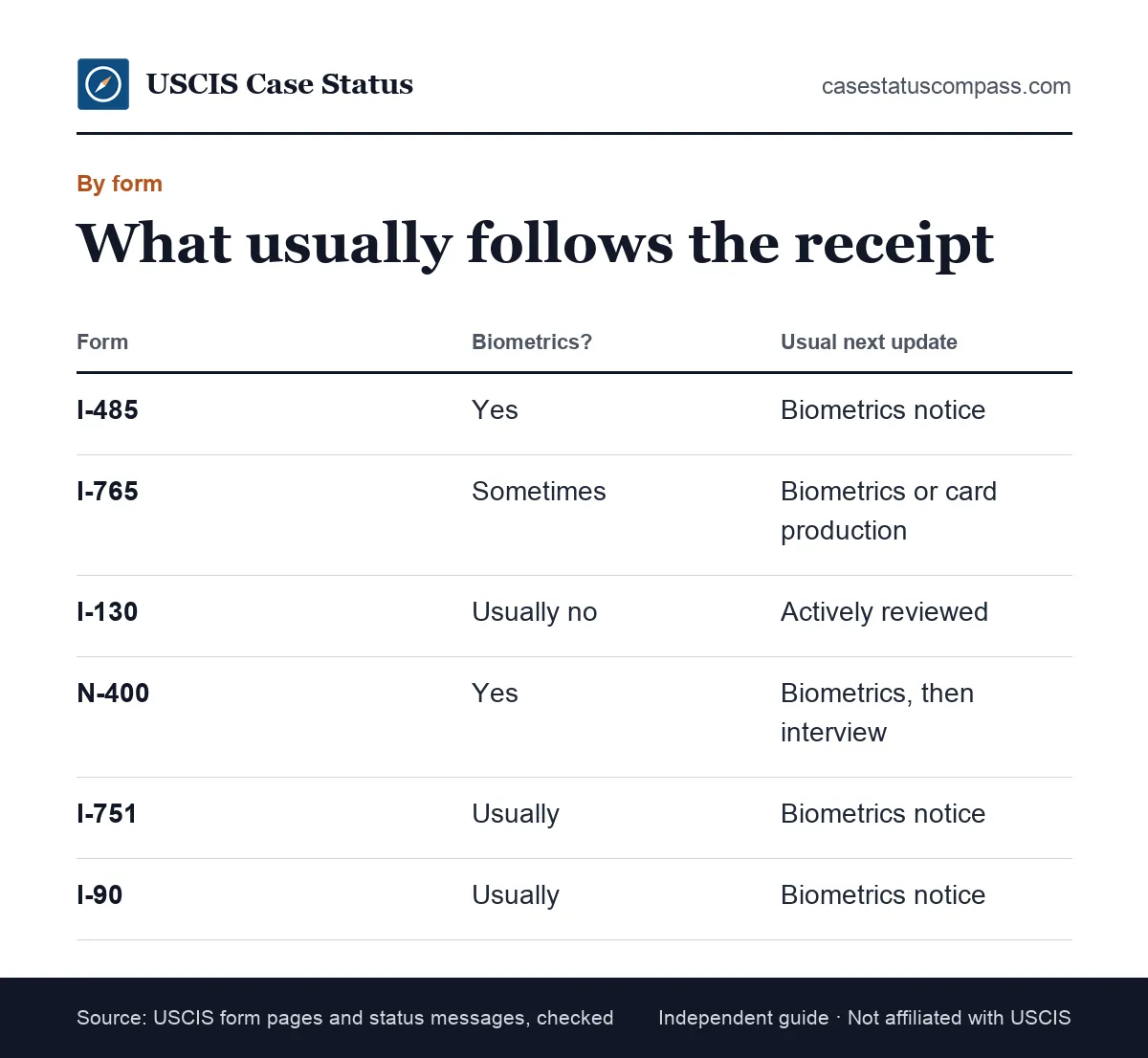
After the received status, most cases move to a biometrics appointment if the form needs fingerprints, then into an officer's queue. Some forms skip biometrics and go straight to review. The next update could take days or months.
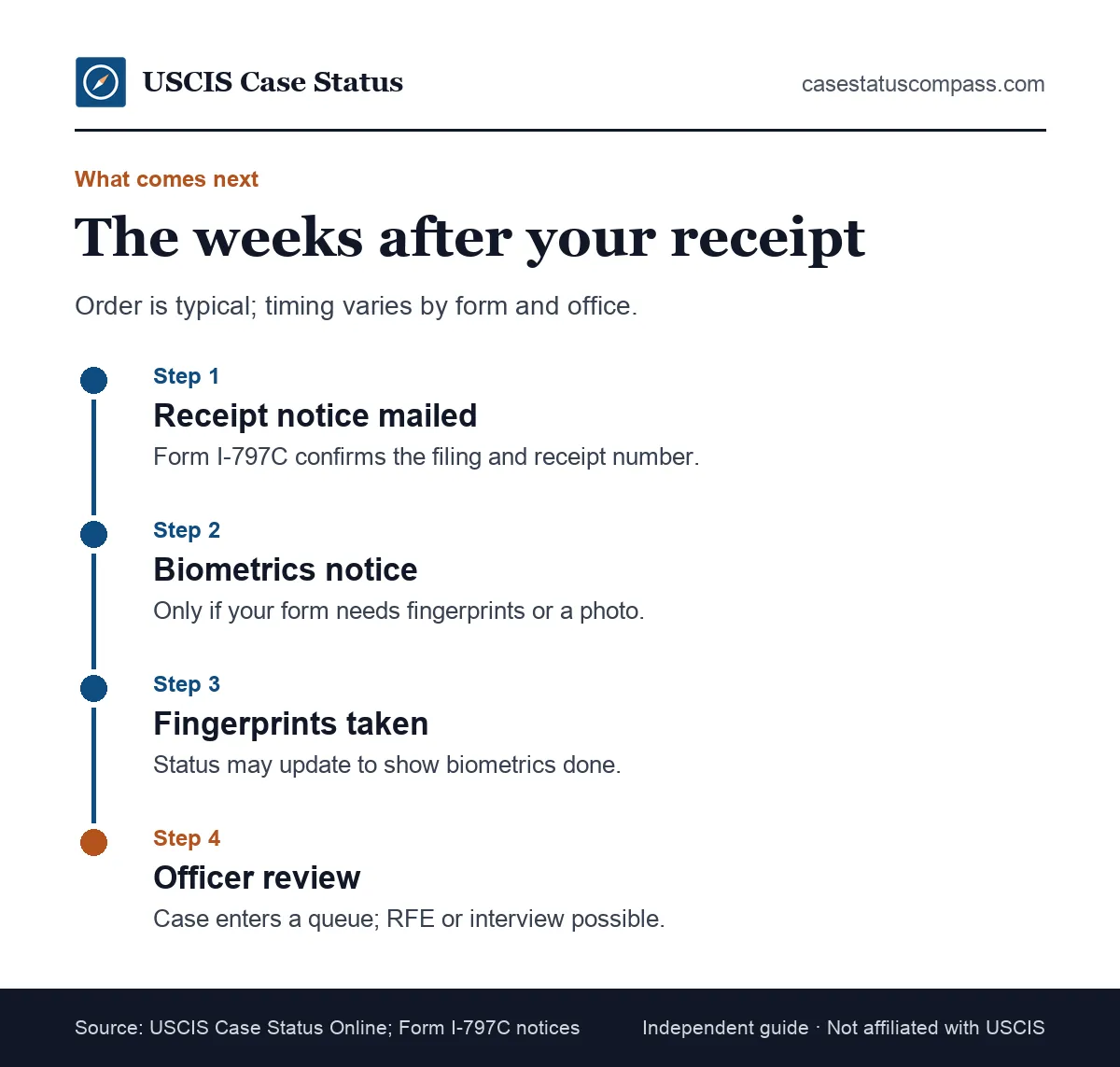
Watch your mail and online account for each step, since appointment notices can come with only a few weeks' warning.
Biometrics appointment
Forms such as I-485, N-400, I-751 and I-90 usually need fingerprints and a photo at an Application Support Center (ASC). Biometrics costs are covered by most filing fees: Biometrics included in most fees (separate $30 for TPS I-821 and some EOIR forms). Our biometrics appointment guide covers what to bring.
Initial review
After biometrics, the file waits for an officer. The status may show case is still being processed by USCIS during the wait, and later case is being actively reviewed by USCIS once an officer picks it up.
Interview notices
Forms such as the I-485 and N-400 often need an in-person interview once review starts. The notice comes by mail and often online, naming the field office, date and time.
How Long After "Case Was Received" Is Biometrics Scheduled?
USCIS publishes no fixed time from receipt to biometrics. Many applicants report a notice within weeks, while others wait months in busy periods. If nothing arrives after a long wait, check your account for a digital notice before contacting USCIS.
What affects the wait
The form type, the service center's workload and the appointment supply at your local Application Support Center all play a part. Cases filed together often get one combined appointment.
Checking for a digital appointment notice
The appointment notice often posts in your online account before the paper copy arrives. Download and print it, because the ASC asks you to bring the notice and photo ID.
What If You Cannot Attend Your Biometrics Appointment?
Follow the rescheduling instructions on the appointment notice and act before the date. Missing biometrics without rescheduling can lead USCIS to treat the case as abandoned, ending a case that was moving normally.
As of October 2026, USCIS says: Reschedule biometrics online at least 12 hours before, with good cause, or call the Contact Center. Keep proof of the request, such as a confirmation screen or the date and agent name from your call.
What Else Could Come Next Besides Biometrics?
Besides biometrics, the next update can be an early request for evidence, a transfer, a processing status or, for some work permits, card production. Rarely, a problem found after intake leads to a separate notice.
Each one comes with its own notice or status line, so read the exact wording before you react.
An early request for evidence
Sometimes an officer spots a missing document early, such as a medical exam, and sends an RFE soon after the receipt. Answer by the deadline. Our request for evidence guide explains how to respond.
A transfer soon after receipt
USCIS often moves new cases between offices to balance work. A transfer right after receipt is normal and does not change your receipt number or filing date.
Watch your mail for the transfer notice and keep it with your receipt.
Fast decisions for simple cases
Some simple filings move quickly from received to a decision; for card-based forms, the next status might be card production. If so, read what new card is being produced means.
How Long Does "Case Was Received" Last?
The received status lasts until the next recorded action: days for biometrics notices, months for forms with no biometrics. There is no standard length. Compare your case age with the time USCIS posts for your form and office at egov.uscis.gov/processing-times.
Typical wait by form
The table pairs each common form with its usual next step and an older official median for the whole case.
| Form | Next step after receipt | FY2023 national median for the whole case (USCIS, data as of Mar. 5, 2024) |
|---|---|---|
| I-485 (family) | Biometrics | 11.4 months |
| I-485 (employment) | Biometrics | 8.6 months |
| I-130 (immediate relative) | Review | 11.8 months |
| I-765 (pending I-485) | Biometrics or production | 5.5 months |
| N-400 | Biometrics | 6.1 months |
| I-90 | Biometrics | 9.16 months |
Read the medians as history only: they show the full case length in FY2023, not how long your case stays at Case Was Received.
Why some cases sit longer at this step
Cases with no biometrics, cases waiting for a file from another office and cases filed during a surge often show this status longer, which is not a warning sign by itself. Our uscis processing times hub explains how to read current posted times.
The Receipt Stage on a Form I-485
On a Form I-485, the received status means your adjustment of status application is pending, often alongside receipts for a work permit and travel document. A biometrics notice usually comes next, then a long review that may include an interview.
What the I-485 receipt can and cannot do
The I-485 receipt shows a pending application, which matters for lawful presence. It is not a work permit or a travel document, and leaving without advance parole can end the application. Our Form I-485 guide explains these risks.
The I-485 edition check
USCIS rejects outdated I-485 editions with no grace period. If your status says received, the edition passed. For anyone filing soon: 09/18/26 (01/20/25 and 09/04/26 editions rejected on/after Sept. 18, 2026; no grace period).
The Receipt Stage on a Form I-765
On a Form I-765, the received status means your work permit request is pending. The next update is a biometrics notice or, for many applicants, card production. For renewals, work authorization rules depend on the received date.
Check that the category on the notice matches the one you requested.
Renewal receipts and the extension change
Many people once relied on a renewal receipt to keep working. That changed: Ended: renewals filed on or after Oct. 30, 2025 no longer get the up-to-540-day automatic extension (exceptions: TPS by law/Federal Register notice; STEM OPT 180 days). Read our guide to the EAD automatic extension before relying on a receipt.
Initial work permit requests
For a first Employment Authorization Document (EAD), the receipt only shows the request is pending; it does not allow work. Our Form I-765 work permit guide covers eligibility categories and current editions.
The Receipt Stage on a Form I-130
On a Form I-130, the received status means the family petition is filed and, for preference categories, your priority date is set. The I-130 usually has no biometrics, so the next update is often review or a decision.
Keep the original notice safe.
What the I-130 receipt starts
The receipt date is the priority date for most family petitions. Keep the notice; the National Visa Center and consulates will ask for it. Our Form I-130 petition guide explains each step.
Spouses filing a package
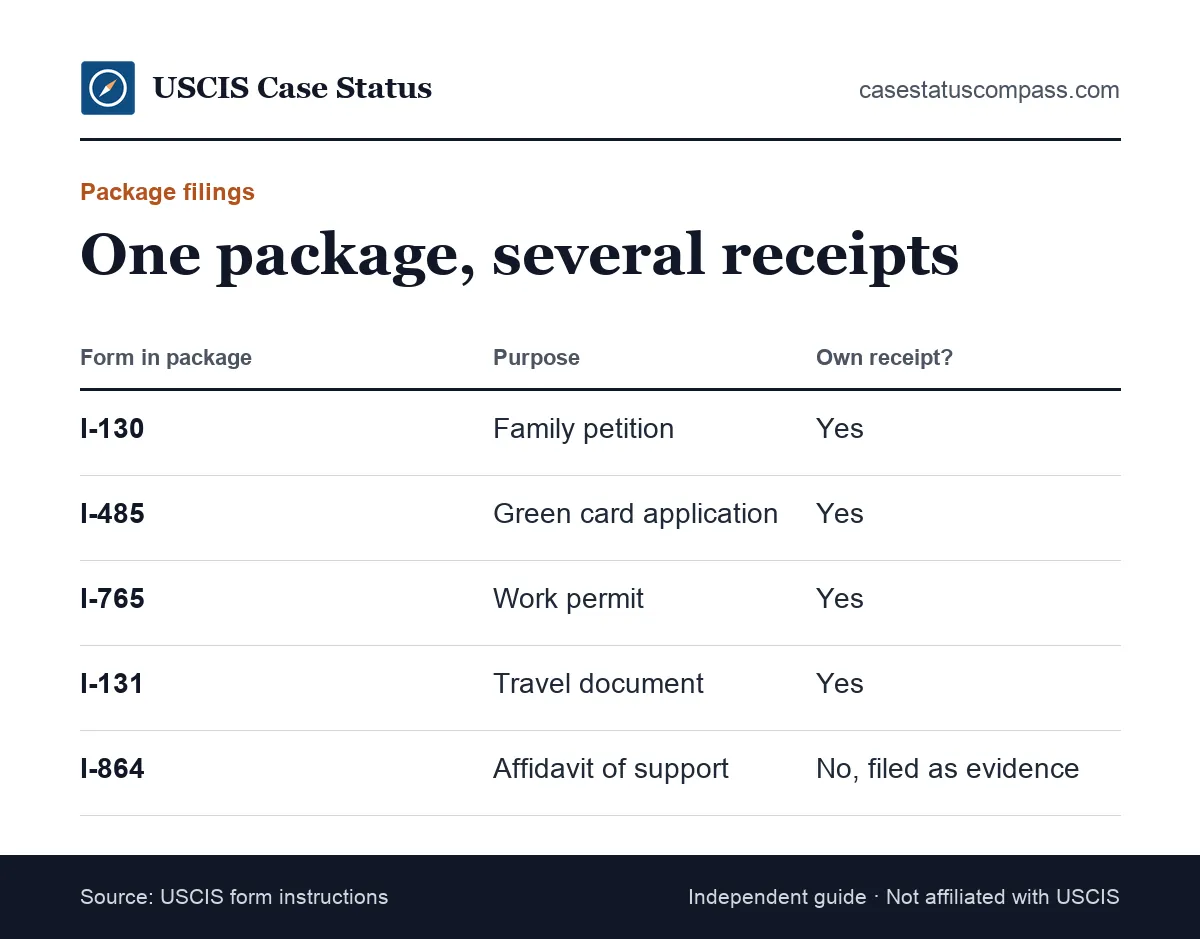
If you filed the I-130 together with an I-485, each form shows its own receipt update, and the petition and the green card application move on separate schedules.
Track each receipt number on its own.
The Receipt Stage on a Form N-400
On a Form N-400, the received status means your naturalization application is pending. The usual next steps are a biometrics notice, then an interview and civics test. The receipt also confirms you met any early filing window you used.
Timing your N-400 filing
USCIS lets some applicants file early: You can file the N-400 up to 90 days before you reach 5 years (or 3 years if married to a U.S. citizen) as a permanent resident. The received date on your notice shows when USCIS counts your filing. Our citizenship application guide covers the full path to the oath.
After the N-400 receipt
Most applicants get a biometrics notice next, then an interview notice naming the field office. Use the wait to study for the civics and English tests given at that interview.
The Receipt Stage on a Form I-751
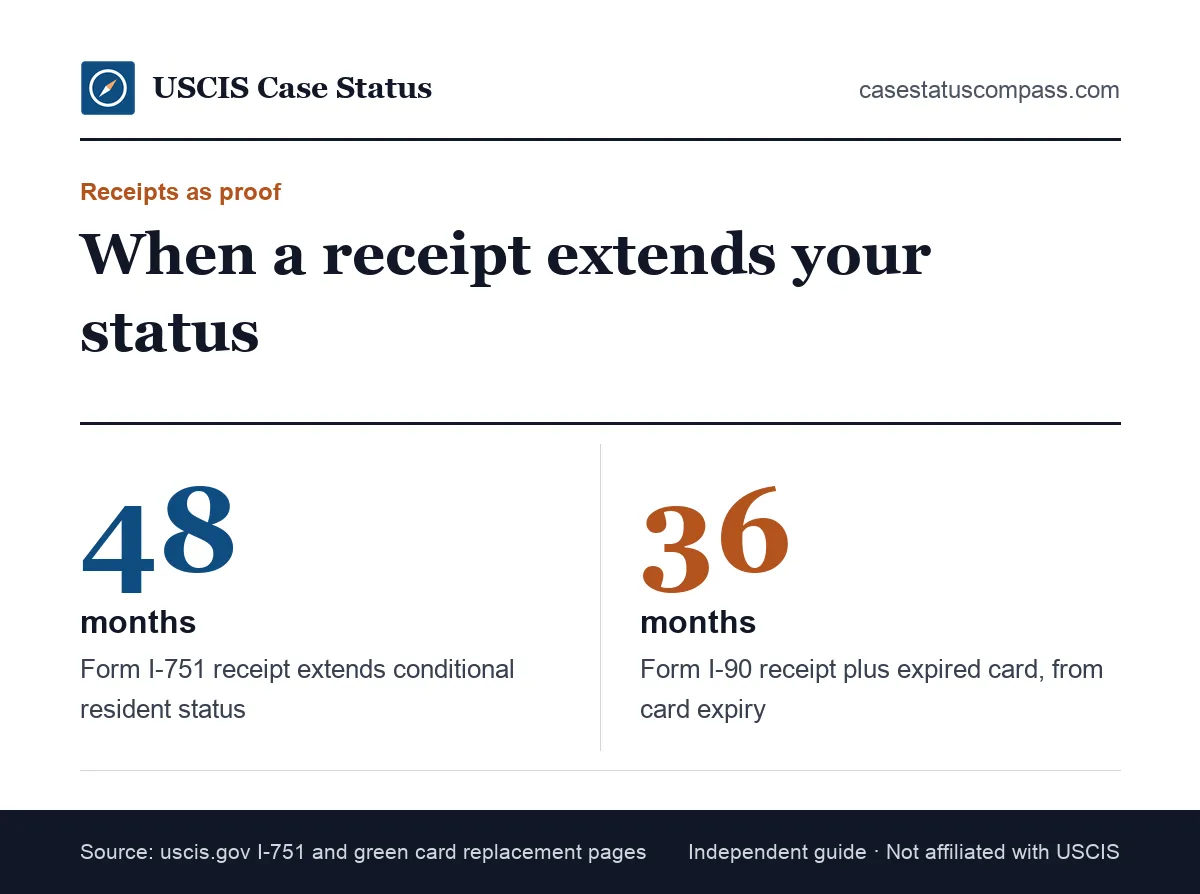
On a Form I-751, the received status means your petition to remove conditions is pending, and the receipt notice becomes important proof: shown with your expired 2-year card, it extends your conditional resident status during review.
Keep it with your card at all times.
The I-751 receipt extension
According to USCIS: I-751 receipt notice extends conditional status and work authorization for 48 months. Carry the notice with your card for work and travel. File inside the window: File in the 90 days before your 2-year card expires.
Next steps on an I-751
A biometrics notice usually follows, and some cases need an interview. Our I-751 removal of conditions guide explains evidence, waivers and interviews.
While it is pending, USCIS rules say to notify USCIS within 10 days of moving while your I-751 is pending, so a move does not cost you the biometrics notice.
The Receipt Stage on a Form I-90
On a Form I-90, the received status means your green card renewal or replacement is pending. Shown with your expired card, the receipt notice works as temporary proof of status. A biometrics notice usually comes next, then card production.
Using the I-90 receipt
USCIS states: I-90 receipt notice + expired card = proof of status for 36 months from the card's expiration date. Keep the notice with your card when you travel or start a new job. Our green card renewal guide covers the rest of the process.
The Receipt Stage on Employer and Humanitarian Filings
For employer petitions such as Form I-140 or an H-1B petition, the received status confirms the employer's filing. For humanitarian filings, such as asylum or TPS, it confirms the application is pending, usually before a biometrics notice.
The petitioner gets the notice, so the worker or applicant should ask for a copy and the receipt number right away.
Employer-filed petitions
The employer or its attorney usually gets the receipt notice and should share a copy with you. Ask for the receipt number so you can track the case yourself on the official site.
Premium processing receipts
Premium processing, where available, changes how fast review starts. The employer requests it on Form I-907, and a receipt notice or later update shows the request was logged.
Current premium timeframes as of October 2026: 15 business days (I-129, most I-140); 30 (I-765 OPT, I-539 F/M/J); 45 (I-140 E13 managers and NIW).
Asylum and TPS receipts
For asylum and TPS, the receipt notice matters for later steps such as work permit eligibility. Rules in these programs change often, so check our asylum status and TPS status guides for current details.
Why Did You Get Several Receipt Updates at Once?
You get several received updates when you file more than one form, because each form gets its own receipt number and status line. A family green card package can produce three or four receipts on the same day.
Log each one with its form number.
Matching receipts to forms
Write the form number next to each receipt number and check status for each. Supporting documents filed as evidence, such as an affidavit of support, do not get their own receipt.
Receipts for family members
Each person in a case gets separate receipts. A spouse and child filing with you have their own numbers, notices and status updates, even though their cases are linked.
Check each one separately, because a child's notice can arrive or update days after a parent's.
Can "Case Was Received" Appear Again Later?
Yes. The received wording can return when USCIS logs something new on an existing case, such as an RFE response. It confirms your new submission; it does not restart the case or cost your place in line.
Keep your proof of mailing for each reply.
After you send documents
When USCIS logs an RFE reply, the status often says the response or correspondence was received. That wording confirms arrival only; review resumes, and the original received date still counts.
After a new filing
If you file a new form, such as a renewal or a second application, it gets a fresh received status and a new receipt number, with its own processing clock.
What to Do If Your Receipt Notice Has Not Arrived
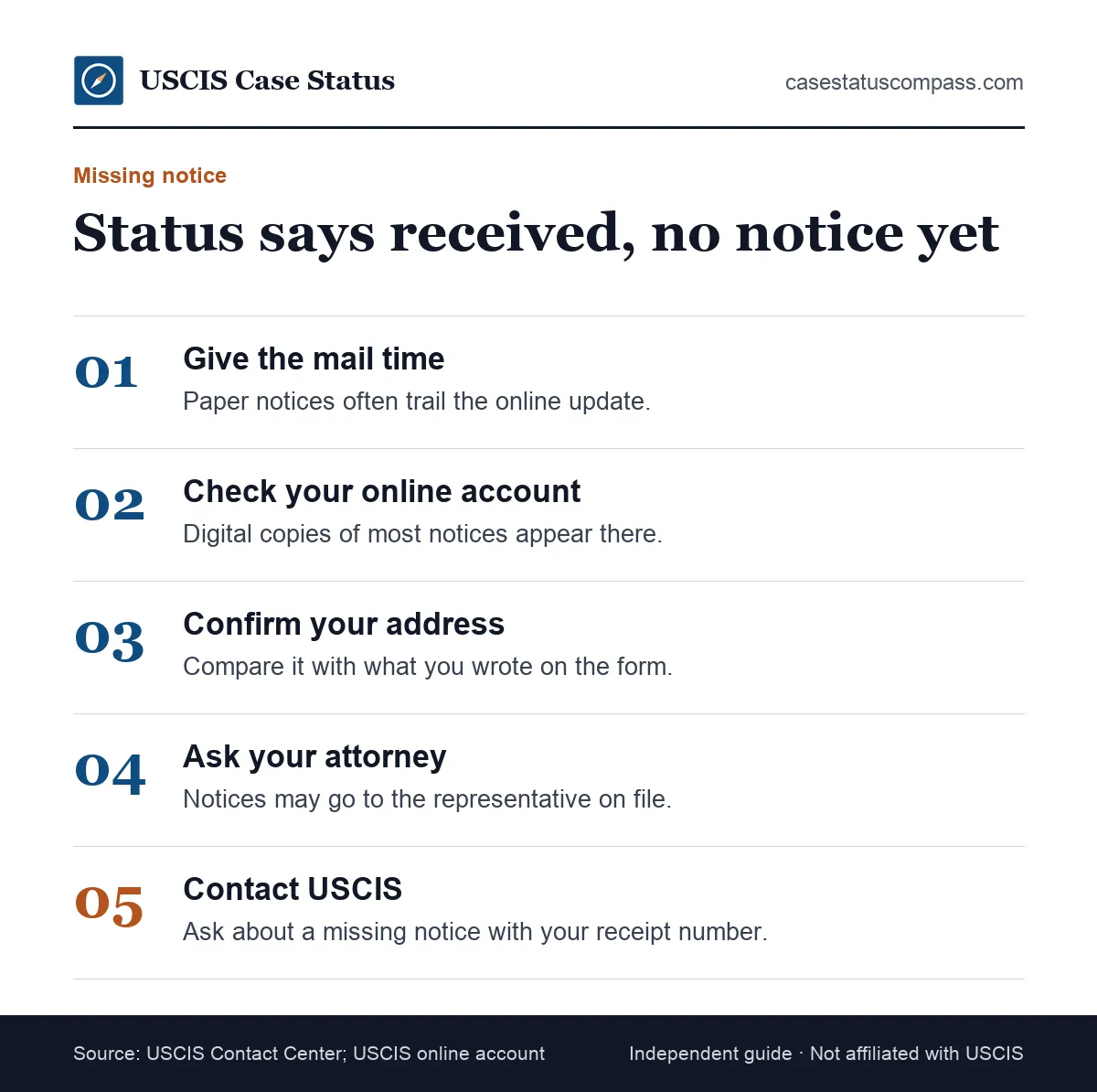
If the status says received but no notice came, allow time for the mail, check your online account for a digital copy, confirm your address and ask your attorney if one filed for you. Then contact USCIS.
Note each step you take in your case log.
How long to wait
Mail can lag behind online updates by days or weeks, and USCIS publishes no guaranteed delivery time for receipt notices. USPS Informed Delivery shows scans of incoming letters.
Check it before you call USCIS.
Check your online account
Your account often shows a digital copy. Paper filers can link their case using the online access code on a USCIS notice. Our guide to the uscis online account explains linking.
Ask USCIS for help
Call the Contact Center at 800-375-5283 with your receipt number, or use the online inquiry tools. Our contact USCIS guide explains the fastest options.
Ask for a copy of the notice and confirm your mailing address during the same call.
Why Can't You Find Your Case Online Yet?
Your case may not appear online yet because the receipt was just created, the number was mistyped or the system has a short delay. If the notice arrived and the number still fails after a few days, contact USCIS.
Wait a few days before retrying.
Typos in the receipt number
Most failed lookups come from a typing error: a zero for the letter O, a missing digit or an extra space. Enter all 13 characters exactly, with no dashes, before assuming a system problem.
No status at all after mailing
If weeks pass with no status, notice or returned package, check that delivery reached the right address and the fee cleared; a cashed check or card charge often signals intake has started. Our guide to a uscis case status not updating covers next steps.
The number works but shows another form
Each form in a package has its own number. If one receipt shows the wrong form, check that you are not mixing up two notices before contacting USCIS.
Lay the notices side by side.
Your Next Move: A Decision Table for New Receipts
Use this table to match your situation to a first action. Most rows end in waiting, because USCIS has the next move; the others involve errors, missing mail or a deadline you control.
Pick the row that fits today, not last week.
Situations and first actions
Each row pairs a common situation after a new receipt with the one action that keeps the case moving.
| Your situation right now | First action |
|---|---|
| Notice in hand, all correct | File it safely and wait |
| Typo in your name or birth date | Contact USCIS with proof |
| No notice after several weeks | Check your account, then ask USCIS |
| You moved after filing | Update your address right away |
| Biometrics notice arrived | Attend, or reschedule in advance |
| Package returned or rejected | Fix the problem and refile |
| Past the posted processing time | Submit a case inquiry |
Most new receipts land in the first row; the others need you to act, and the address and biometrics rows are the ones with real deadlines.
How to use the table
Start at the top row and move down until one matches. If two rows apply, handle the deadline first, then any error or missing mail.
Recheck the table after each new notice arrives.
Received vs Rejected: Telling Them Apart
A received case has a receipt number, a processed fee and a place in line. A rejected filing failed intake and is returned, usually with the fee. Both use Form I-797C, so the notice heading tells them apart.
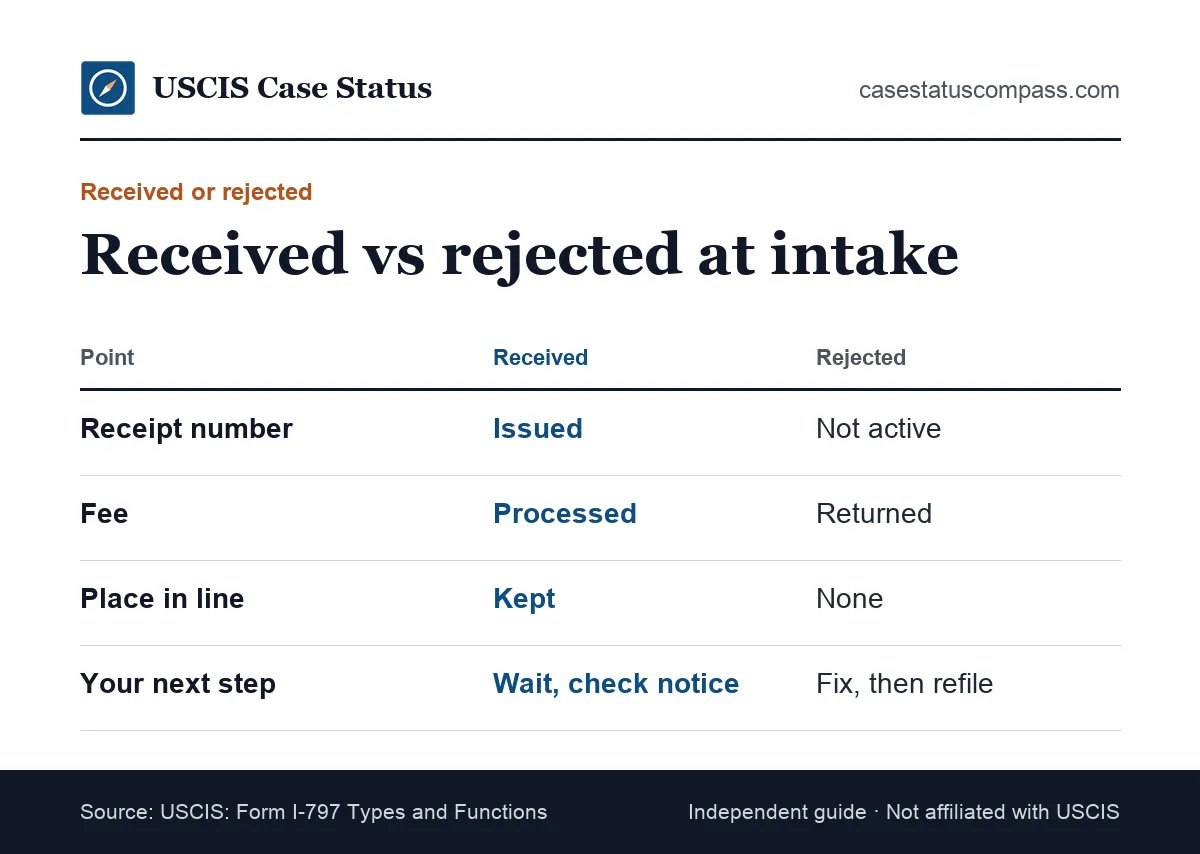
Read the heading before anything else; a rejection means you must refile, while a receipt means you wait.
How the two notices read
A receipt notice confirms the case was received and gives a number to track. A rejection notice states why the package came back; that reason is your fix list.
Keep both if you got both, since the rejection explains a gap in your filing history.
Why Do Filings Get Rejected Instead of Receipted?
A missing signature, wrong or missing fee, outdated form edition or blank required fields cause most rejections. If yours was rejected, fix the stated reason and send a fresh package. The new filing gets a new received date; the rejected one holds no place.
Can You Travel or Work With Only a Receipt Notice?
Usually not. For most forms, the receipt notice only proves a filing is pending; it does not grant permission to work or travel. The main exceptions are the I-751 and I-90 receipts, covered below.
Check before you rely on yours.
The I-751 and I-90 exceptions
Shown with your expired card, an I-751 or I-90 receipt serves as proof of permanent resident status for jobs and travel. Check the dates printed on the notice before each trip.
Work with a pending case
A receipt for a first work permit does not let you start working; wait for the card. For renewals, check the current extension rules described above before relying on the receipt.
Can You Leave the U.S. While Your Case Is Pending?
Sometimes, but it is risky: leaving the U.S. while some applications are pending can cause them to be treated as abandoned. Read our guide on travel with a pending I-485 and talk to an attorney before booking a trip.
As of October 2026, USCIS says: Traveling while your I-485 is pending abandons it unless you have advance parole (with H/L/V/K exceptions).
Mistakes to Avoid While You Wait for the Next Update
The most common mistakes at this stage are moving without telling USCIS, ignoring a typo on the notice, losing the notice, missing biometrics and filing the same form twice out of worry. Each can delay a normal case.
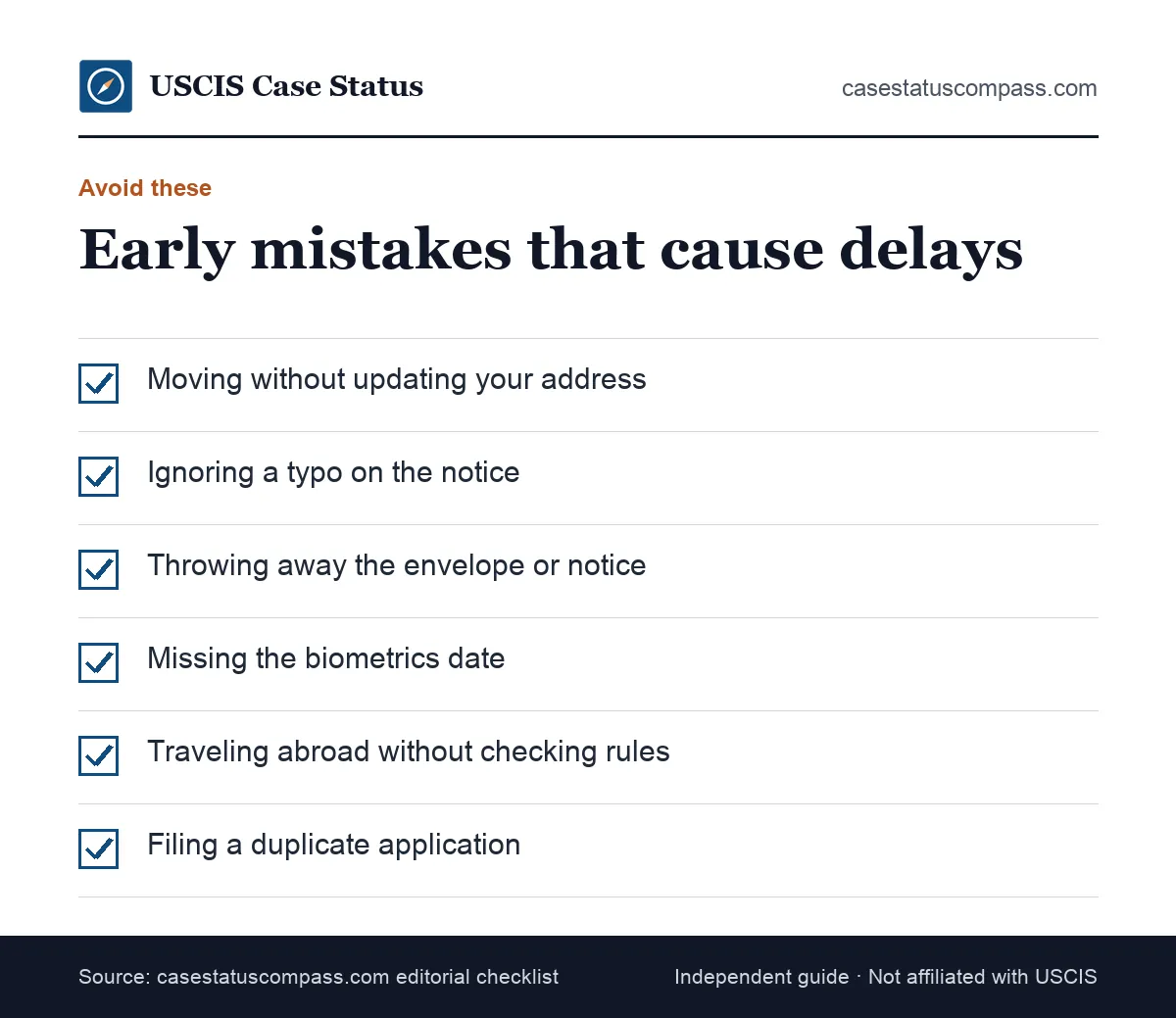
A five-minute check of the notice and your address on file prevents most of them.
Address and mail mistakes
Update your address with USCIS whenever you move, even briefly; mail forwarding does not always cover government mail. Our change of address guide explains how to update USCIS directly.
The law sets the timing: Report a new address to USCIS within 10 days of moving (INA 265).
Duplicate filings
Filing again because the status is quiet can create a second case, a second fee and confusion. Wait for the posted time, then make an inquiry about the original receipt.
Losing the receipt notice
The notice is proof you filed and, for some forms, proof of status. Scan it the day it arrives and store the original with your passport.
If it is lost, download it from your account.
Three Received-Status Situations, Explained
These situations show how the same received status plays out differently. Each starts with the same message, but the right response depends on the form, the notice and what happens next.
The names are fictional, but each pattern is common. Look for the one closest to yours and copy the order of steps.
A spouse's package with four receipts
Priya filed an I-130, I-485, I-765 and I-131 together and saw four received updates within a week. She logged each number with its form, attended one biometrics appointment and tracked the work permit separately.
A renewal with a name typo
Daniel's I-90 receipt misspelled his last name. He called USCIS with the receipt number and a copy of his form showing the correct spelling, so the new card printed correctly.
A work permit with no notice
Mei's status said received, but no letter came. Her online account showed the notice, addressed to an old apartment. She updated her address and downloaded it, avoiding a missed biometrics letter.
An N-400 filed in the early window
Ana filed her N-400 inside the early filing window. Her receipt showed a received date within it, and she kept it with her travel records in case the officer asked about residence dates.
How Can You Tell the Status and Notice Are Real?
A real status appears when you enter your receipt number on the official USCIS site at Case Status Online: egov.uscis.gov, and a real notice carries the same number and your details. Treat any status or notice you cannot confirm online with suspicion.
Warning signs of fake notices
Watch for requests to pay by gift card or wire, emails not ending in .gov, threats of arrest or deportation, and receipt numbers that fail on the official site. Learn how to verify a USCIS notice step by step.
Do Case Tracking Apps Speed Up a Received Case?
No. Third-party tracking apps only copy the public data you can see yourself, and they cannot move your case forward. Never give an app your USCIS account password, and confirm anything important on the official USCIS site.
Use the free official tools instead.
Building Your Case File From Day One
Your case file starts with the receipt notice. Keep the original, a scan, a copy of the package you filed, proof of delivery and proof of payment. A complete file makes an RFE reply or interview easier.
Start the folder the day the notice arrives.
What to store together
- Copy of every form and document you filed
- Delivery confirmation or online submission page
- Receipt notice for each form
- Proof of fee payment
- A log of each status change and date
Where to keep it
Keep paper originals in one folder and scans in secure storage.
Store the originals somewhere dry and private, with your passport. Back up the scans in a second secure place, such as an encrypted drive or cloud folder, so a lost phone or laptop does not cost you your records.
Should You Contact USCIS at This Stage?
Usually not. Contact USCIS only if the receipt notice has an error, never arrived after a reasonable wait, or shows an old address. Calling about progress soon after receipt will not speed up review.
Wait for a reason that matters, and keep your receipt number ready when you do call.
Good reasons to call
Typos on the notice, a missing notice, a wrong address and a missed or conflicting biometrics date are all worth a call, because each can stall the case.
Have the notice in front of you.
What to have ready before you call
Have your receipt number, notice date and a copy of your form ready. Live help is available: Live calls and chat: Monday to Friday, 8 a.m. to 8 p.m. Eastern. Note the date and agent name after each call.
Reasons that can wait
Questions about when an officer will review your case, or why another applicant moved faster, cannot be answered yet. Save them until your case passes the posted processing time.
Check the processing times tool for your form first.
When Is Legal Help Worth It This Early?
Legal help is worth it this early if the notice reveals a problem, such as a wrong category, a rejection, an early RFE you do not understand, or a travel or work question. An attorney or DOJ-accredited representative can step in before small issues grow.
Questions to bring
Bring the receipt notice, a copy of your filed package and a list of your questions. This page is general information, not legal advice.
Ask what could go wrong at the next step and what to watch for in the mail.
Where to find low-cost help
Nonprofits recognized by the Department of Justice often charge less than private firms. Check that a representative is on the official DOJ roster before sharing your documents.
Frequently Asked Questions
How long after "case was received" is biometrics scheduled?
USCIS publishes no fixed timeline. Many applicants report a biometrics notice within weeks, while busy offices can take months. If nothing arrives well after others who filed at the same time, contact USCIS with your receipt number.
What if my case was received but I have no receipt notice?
Allow time for mail, then check your online account for a digital copy. Confirm the address you used and ask your attorney whether the notice went to them. If none of that helps, contact USCIS.
Can USCIS deny a case that says "Case Was Received"?
Yes. The received status only confirms your filing passed intake. An officer still reviews the evidence and can approve, request more documents or deny, so respond completely to any request you get.
Does case was received mean an officer has my file?
Not yet. The file has passed intake and is waiting in line. An officer picks it up later, often after biometrics, and the status may then say the case is being actively reviewed.
What is the difference between Form I-797C and Form I-797?
Form I-797C is the notice of action USCIS uses for receipts, appointments and rejections. Form I-797 is the approval notice. A received status pairs with an I-797C.
Is the received date the same as my filing date?
For practical purposes, yes. The received date counts as your filing date for processing times and most deadlines. It can be a few days after you mailed the package, or the same day online.
Does a received status mean my fee was accepted?
Generally yes. USCIS processes the fee during intake, and a received status means it accepted the payment. If the payment later fails, USCIS can reject the filing or ask you to pay again, so watch your bank statement.
Can I check my status before the receipt notice arrives?
Yes, if you have the receipt number. Online filers see it right away in their account. Paper filers usually learn it only from the notice, or sometimes from a card statement or attorney.
What is an IOE receipt number?
An IOE receipt number begins with the letters IOE and is usually issued to cases filed online. Enter it without dashes on Case Status Online like any other receipt number.
Will the status change when my biometrics are scheduled?
Often, but not always. Some cases show a fingerprint fee or appointment update; others show nothing until fingerprints are taken. The appointment notice in your mail or account is the reliable signal.
Sources
- USCIS: Checking Your Case Status Online. www.uscis.gov/tools/checking-your-case-status-online. Accessed Oct 27, 2026.
- USCIS: Form I-797 Types and Functions. www.uscis.gov/forms/filing-guidance/form-i-797-types-and-functions. Accessed Oct 27, 2026.
- USCIS: Benefits of a USCIS Online Account. www.uscis.gov/file-online/benefits-of-a-uscis-online-account. Accessed Oct 27, 2026.
- USCIS: Check Case Processing Times. egov.uscis.gov/processing-times/. Accessed Oct 27, 2026.
- USCIS Form G-1055 Fee Schedule (Edition 10/16/26). www.uscis.gov/sites/default/files/document/forms/g-1055.pdf. Accessed Oct 27, 2026.
- USCIS: Removing Conditions on Permanent Residence Based on Marriage. www.uscis.gov/green-card/after-we-grant-your-green-card/conditional-permanent-residence/removing-conditions-on-permanent-residence-based-on-marriage. Accessed Oct 27, 2026.
- USCIS: Replace Your Green Card. www.uscis.gov/green-card/after-we-grant-your-green-card/replace-your-green-card. Accessed Oct 27, 2026.
- USCIS: Automatic EAD Extension. www.uscis.gov/working-in-the-united-states/information-for-employers-and-employees/automatic-employment-authorization-document-ead-extension. Accessed Oct 27, 2026.
- USCIS: Form I-485. www.uscis.gov/i-485. Accessed Oct 27, 2026.
- USCIS Contact Center. www.uscis.gov/contactcenter. Accessed Oct 27, 2026.
- USCIS: Preparing for Your Biometric Services Appointment (updated 04/30/2026). www.uscis.gov/forms/filing-guidance/preparing-for-your-biometric-services-appointment. Accessed Oct 27, 2026.
- USCIS: Form N-400 page. www.uscis.gov/n-400. Accessed Oct 27, 2026.
- Form I-751 Instructions, Edition 04/01/24. www.uscis.gov/sites/default/files/document/forms/i-751instr.pdf. Accessed Oct 27, 2026.
- USCIS: How Do I Request Premium Processing? (updated 03/23/2026). www.uscis.gov/forms/all-forms/how-do-i-request-premium-processing. Accessed Oct 27, 2026.
- Form I-485 Instructions, Edition 09/18/26. www.uscis.gov/sites/default/files/document/forms/i-485instr.pdf. Accessed Oct 27, 2026.
- USCIS: How to Change Your Address (updated 08/04/2026); 8 U.S.C. 1305(a) (LII). www.uscis.gov/addresschange. Accessed Oct 27, 2026.
casestatuscompass.com is an independent publication and is not affiliated with USCIS or any government agency. This page is general information, not legal advice. For denials, court or asylum matters, consult an immigration attorney or a DOJ-accredited representative.