Contents · 41 sections
- What Is a USCIS Change of Address?
- Who Must Report a Change of Address to USCIS?
- Do Green Card Holders Need to Report a Change of Address?
- What Is the 10-Day Deadline for Reporting a Move?
- How Do You File Form AR-11 Online?
- How Do You Mail a Paper Form AR-11?
- Online vs Paper: Which Method Should You Use?
- Updating the Address on a Pending Case
- How Long Does a USCIS Change of Address Take?
- Change of Address Not Showing / "No Submissions"
- How Do You Fix a Change of Address That Is Not Showing?
- Changing Address as an Asylum Applicant or Asylee
- Change Permanent Resident Card Address: Do You Need a New Card?
- Address Change for Green Card Holders Waiting for a Card
- Conditional Residents and Form I-751
- Naturalization Applicants (Form N-400) Who Move
- DACA, TPS and Work Permit Applicants
- H-1B Workers, Students and Other Visa Holders
- Petitioners, Beneficiaries and Sponsors
- How Do Sponsors Report a Move on Form I-865?
- Attorneys and Accredited Representatives
- VAWA, T and U Cases: Special Procedures
- Other Agencies: Immigration Court and NVC
- How Do You Change Your Address With the Immigration Court?
- Does a USPS Change of Address Update USCIS?
- What Happens If You Don't Report Your Address Change?
- What Are the Penalties for Not Reporting a Move?
- What If You Missed the 10-Day Deadline?
- What If You Move Abroad or Have No Fixed Address?
- How Do You Check That USCIS Has Your New Address?
- Which Address Should You Use: Physical or Mailing?
- Change of Address Decision Table: If X, Do Y
- Change of Address Examples: Three Common Moves
- Copyable Change of Address Checklist
- Common Change of Address Mistakes
- Mailing a New Application After You Move
- Moving While USCIS Has Asked You for Something
- When Should You Get Legal Help With an Address Problem?
- How Address Changes Fit Into Your Case
- What If Your Case Seems Stuck After a Move?
- Frequently Asked Questions
The short answer
A USCIS change of address tells U.S. Citizenship and Immigration Services that you moved. Most noncitizens must report a new address within 10 days, using the tool in a USCIS online account or a paper Form AR-11. Online updates also refresh each pending case when you enter its receipt number.
At a glance
| Deadline | Report a new address to USCIS within 10 days of moving (INA 265) |
| Best method | Update your address online in your USCIS account (E-COA); a mailed AR-11 also counts |
| Pending cases | Enter the receipt number of every pending case |
| USPS forwarding | Does not update USCIS records |
What Is a USCIS Change of Address?
A USCIS change of address is the formal notice you give USCIS when your home address changes. It keeps notices, cards and appointment letters reaching you, and it meets a legal duty most noncitizens have. You file it online or on paper with Form AR-11.
It is part of our uscis case help section.
What Form AR-11 is
Form AR-11, the Alien's Change of Address Card, is the paper notice. It records your name, old and new address, and A-Number. Mailing it meets the legal requirement, but USCIS says it does not automatically update pending cases.
What the online tool (E-COA) does
The Enterprise Change of Address (E-COA) tool sits inside your USCIS online account. It records the new address and attaches it to each pending case you list. USCIS says online changes are processed almost immediately.
Who Must Report a Change of Address to USCIS?
Almost every noncitizen in the United States must report a move. Federal law says: Report a new address to USCIS within 10 days of moving (INA 265). That covers green card holders, pending applicants, most visa holders and students. Each person reports separately, including children.
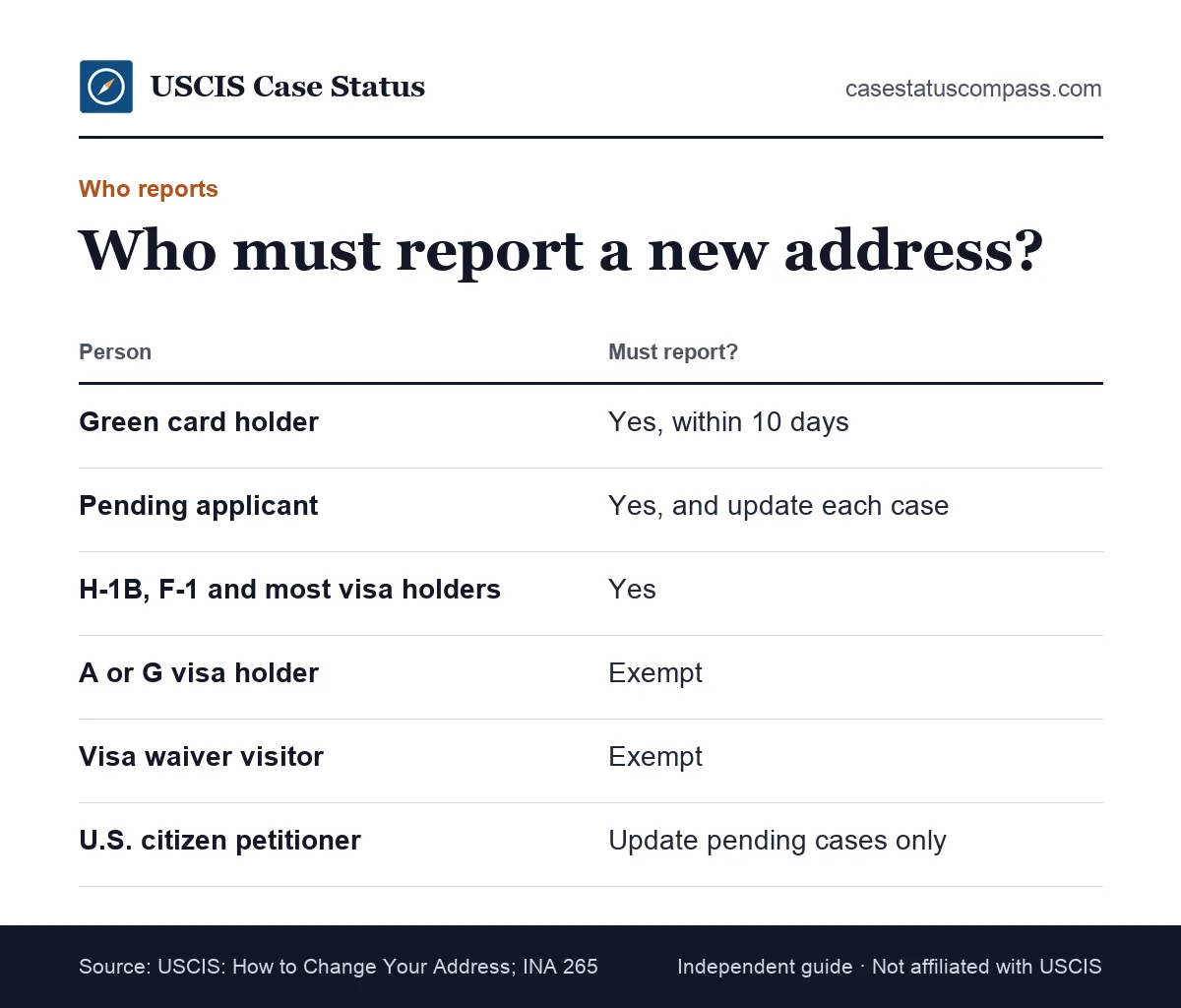
Who reports, at a glance
Find your situation in the left column to see whether you must report and whether pending cases also need the new address.
| Person | Report the move? | Update pending cases? |
|---|---|---|
| Green card holder | Yes | If any are pending |
| Pending applicant | Yes | Yes, every receipt |
| H-1B, F-1, J-1 and most visa holders | Yes | If any are pending |
| A or G visa holder | Exempt | If any are pending |
| Visa waiver visitor | Exempt | Not usually relevant |
| U.S. citizen petitioner | No personal duty | Yes, for the petition |
Who is exempt from reporting
Only a few groups are exempt: diplomats and other A visa holders, international organization staff on G visas, and visitors admitted under the Visa Waiver Program. Everyone else, including students and temporary workers, reports each move.
Applicants with pending cases
If you have any pending case, you must report the move and make sure each case record has the new address. Interview letters, biometrics notices and evidence requests go to the address in the case file.
Visa holders, workers and students
Nonimmigrants such as H-1B workers, L-1 transferees and F-1 or J-1 students must report too. Students also update their school's designated official, who keeps a separate record. The school update does not reach USCIS, so both are needed.
Do Green Card Holders Need to Report a Change of Address?
Yes. Green card holders must report every move within 10 days, even with nothing pending. The same statute covers permanent residents and other noncitizens. A green card holder update address filing takes minutes online and protects you if USCIS needs to reach you.
Permanent residents with no pending case
Many permanent residents think the duty ends once the card arrives. It does not. Use the online tool and leave the receipt fields empty. A clean record of reported moves also helps later with the address history on a citizenship application.
Does the duty ever end?
The duty lasts as long as you are a noncitizen living in the United States. It ends when you naturalize. Until then, report each move. After the oath, a citizen updates only a petition they filed for a relative.
What Is the 10-Day Deadline for Reporting a Move?
The 10-day deadline means you report your new address within 10 days after you move. It comes from INA section 265 (8 U.S.C. 1305(a)). Count from the day you start living at the new address, not the day you signed a lease.
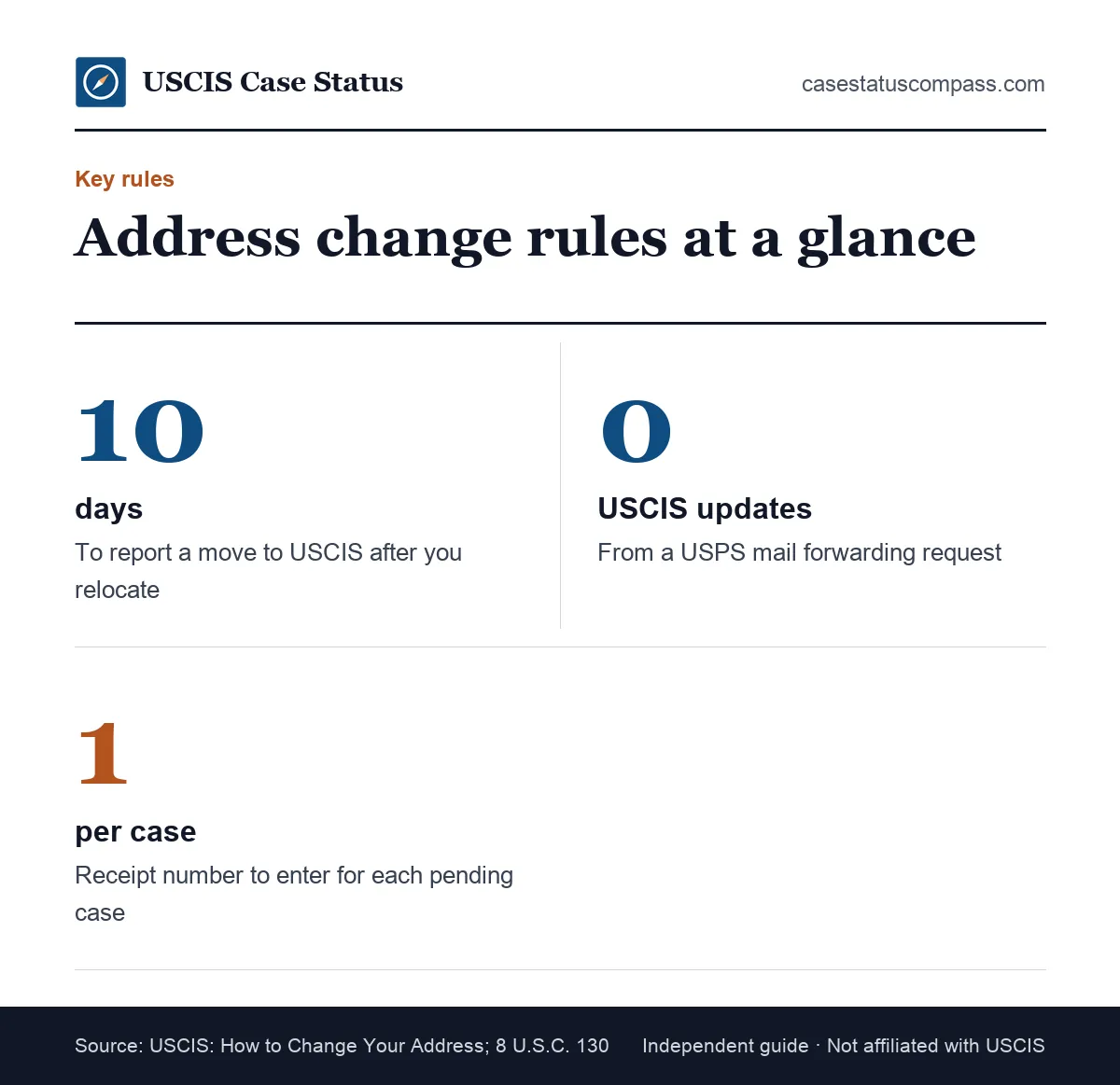
When the 10-day clock starts
The clock starts when the new place becomes where you live. A short trip, hotel stay or family visit is not a move. If you split time between homes, report the one where you live and reliably get mail.
Filing early in the window
Filing on day one or two is safer than waiting. Notices created after the update carry the new address. A notice printed before your update goes to the old address, so the sooner you file, the fewer letters are at risk.
How Do You File Form AR-11 Online?
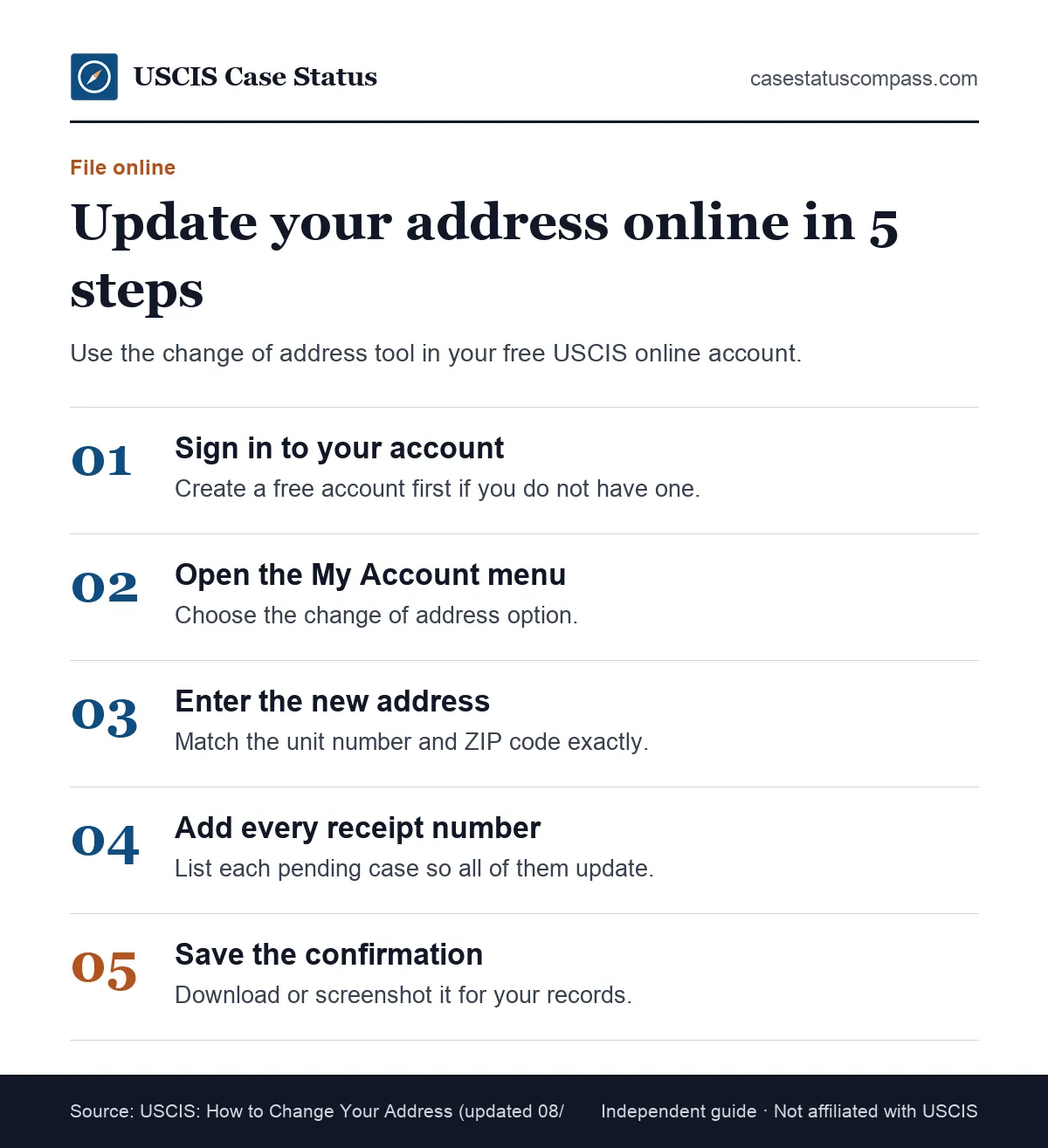
You file online through the E-COA tool in your USCIS online account. Sign in, open My Account, choose change of address, enter the new address and add every pending receipt number. The process takes a few minutes, and there is no fee to report a move.
Before you start
- Your new address, with unit number and ZIP code
- Your old address as USCIS has it
- Every receipt number for pending cases
- Your A-Number and the date you moved
Step-by-step in your online account
- Sign in, or create a free account at myaccount.uscis.gov/create-account.
- Open My Account and choose change of address.
- Enter the physical address and, if different, a mailing address.
- Add the receipt number of each pending case, then submit.
- Save the confirmation page as a PDF or screenshot.
How Do You Mail a Paper Form AR-11?
Download the current paper AR-11 from uscis.gov, fill it in, sign it and mail it to the address in the form instructions. A mailed AR-11 meets the legal duty, but it does not automatically update pending cases. Keep a copy and proof of mailing.
When paper filing makes sense
Paper suits people who cannot use an online account, such as those without email or internet. It also works as a backup. If you mail it, use a method with tracking and keep the receipt.
Why paper does not update pending cases
USCIS says the paper card "does not provide for an automated update." An open case may keep its old address. If you mail an AR-11 during a pending case, also call USCIS and ask that each case record be updated.
Online vs Paper: Which Method Should You Use?
Use the online tool whenever you can: it is faster, updates pending cases directly and gives instant proof. Use the paper AR-11 only without online access. Both meet the legal duty. With a pending case, online is the only method that updates each case record without an extra phone call.
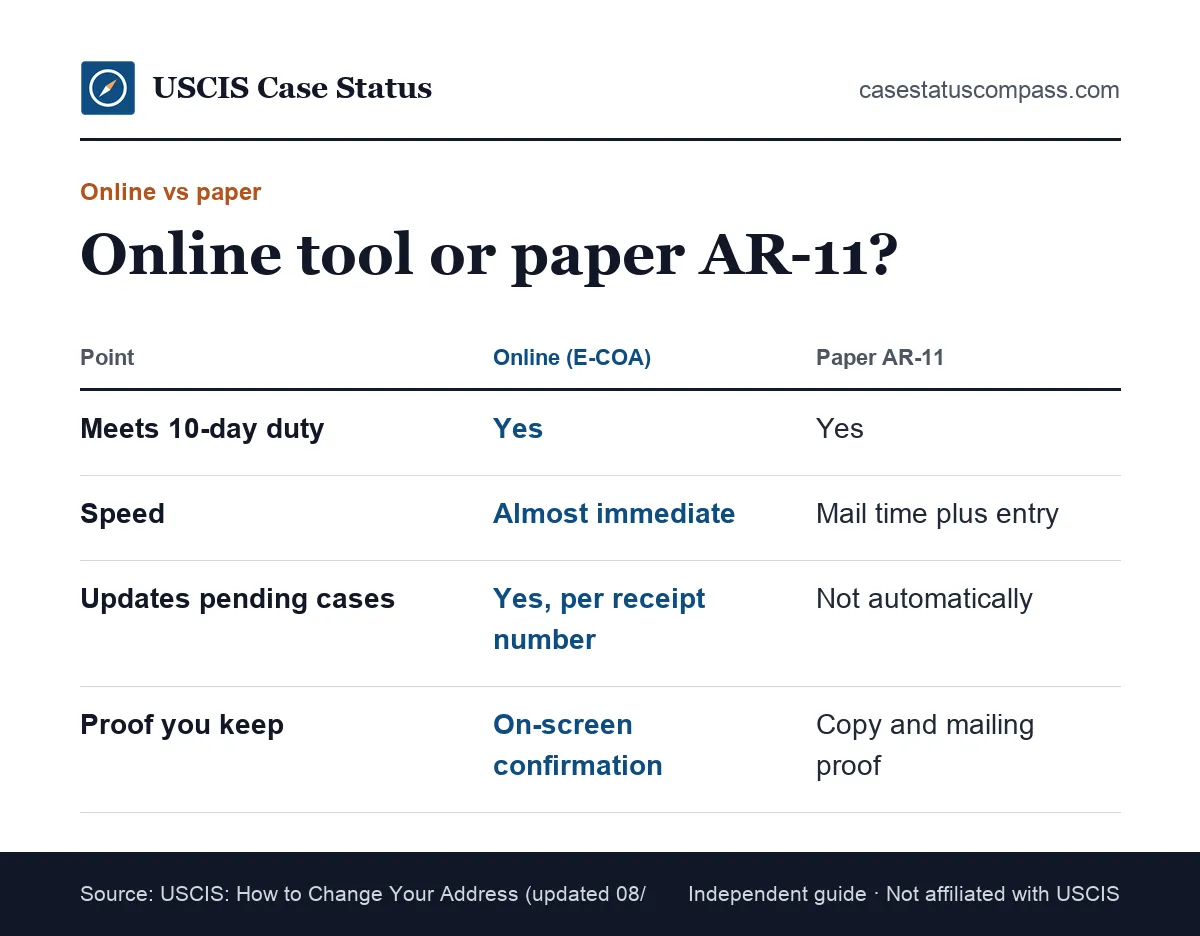
Side-by-side comparison
The table compares the two methods on what matters most: legal effect, case updates, speed and proof.
| Question | Online (E-COA) | Paper AR-11 |
|---|---|---|
| Meets the legal duty? | Yes | Yes |
| Updates pending cases? | Yes, per receipt number | Not automatically |
| Processing | Almost immediate | Mail plus data entry |
| Proof | Confirmation page | Copy plus mailing proof |
| Needs an account? | Yes | No |
Filing online and on paper together
Filing both is allowed if the address is spelled the same way on each. Some people mail an AR-11 as a backup after an online change; mismatched spellings, though, can create two conflicting records.
Updating the Address on a Pending Case
Updating a pending case means attaching the new address to each open receipt number. The online tool does this when you type every receipt number into the change. Skip one, and that case may keep the old address. Check each case's next notice to confirm.
Enter every receipt number
Families often have several receipts: an I-485, I-765 and I-131 for one person, plus a spouse's cases. Each is a separate record. Our uscis receipt number guide shows where each number appears.
Cases you filed on paper
The tool also works for paper-filed cases. USCIS says you can use your account for pending, approved or earlier cases even if you mailed them. Type the receipt number from your I-797C notice.
When an appointment is already scheduled
A move does not shift a scheduled biometrics or interview date. USCIS warns: Missing biometrics can lead to denial for abandonment. If the office is now too far, reschedule instead of skipping. Reschedule biometrics online at least 12 hours before, with good cause, or call the Contact Center.
How Long Does a USCIS Change of Address Take?
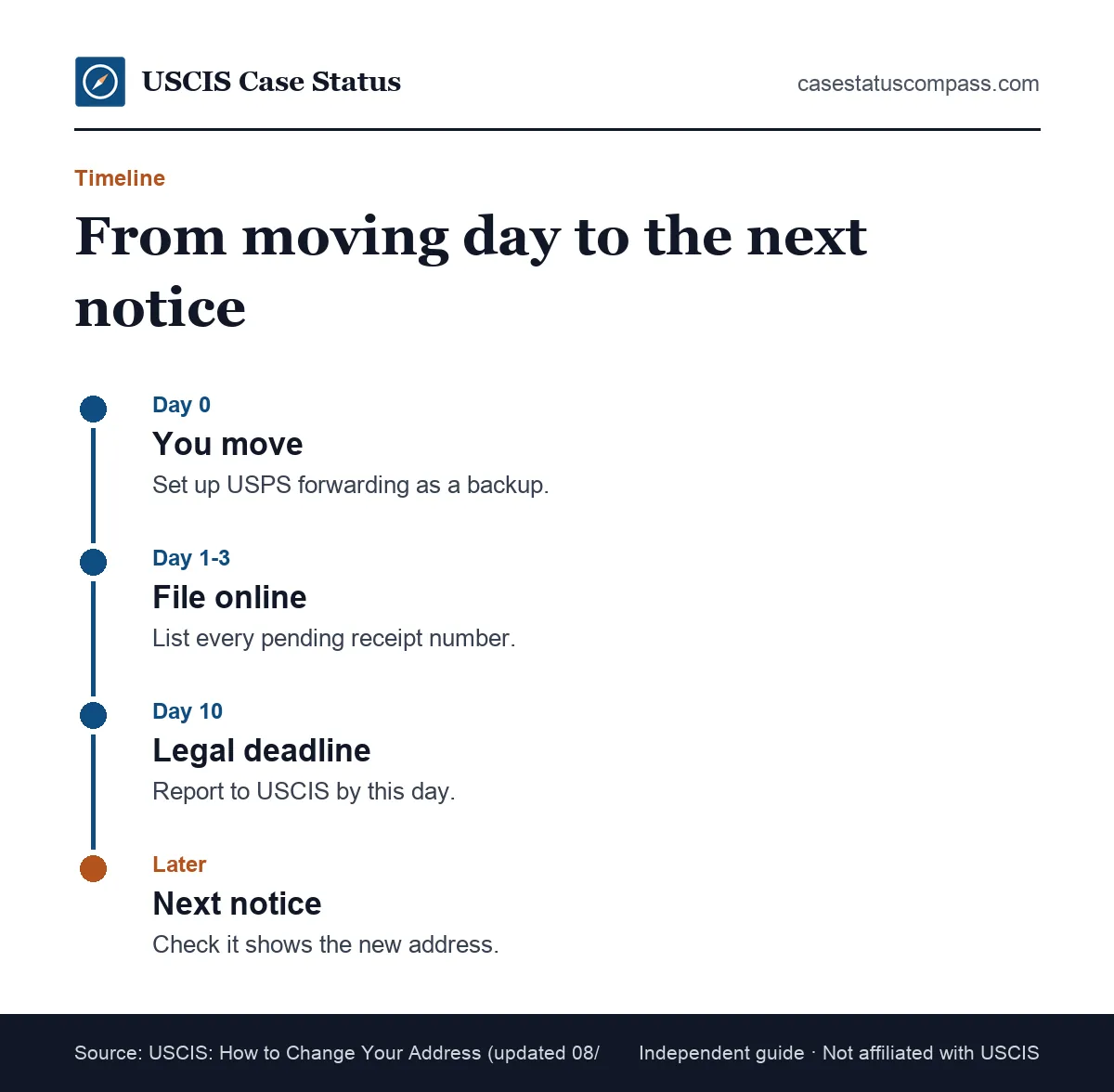
An online USCIS change of address is processed almost immediately, according to USCIS. A paper AR-11 takes longer because it travels by mail and is entered by hand. Either way, you report on the day you submit or mail the change; what varies is how fast your case records reflect it.
How long the online update takes
USCIS describes online changes as processed almost immediately, so the record usually updates the day you submit. Case Status Online will not show it, because the public tool shows only the latest case action, not contact details.
How long a paper AR-11 takes
USCIS publishes no processing time for the paper card. Allow for mail plus data entry. Open cases can take longer. Keep USPS forwarding on in the meantime, and call the Contact Center if a pending case still shows the old address.
Change of Address Not Showing / "No Submissions"
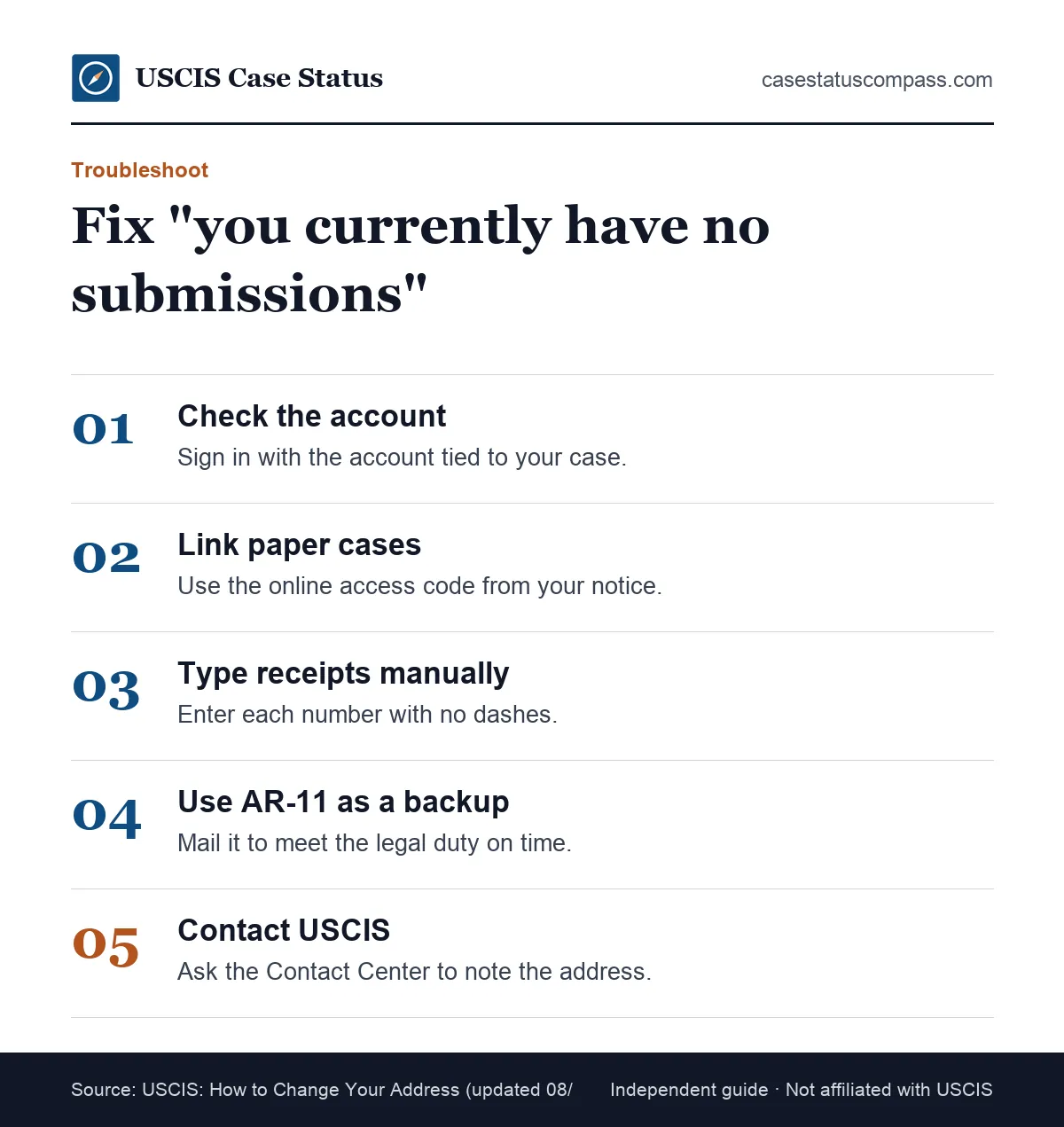
The message "you currently have no submissions" usually means the account you used has no linked cases. It does not mean the change failed. It is common for paper filers, people with two accounts and cases filed by an attorney.
What the message means
The tool lists cases linked to your login. An unlinked paper case or a case in your lawyer's account will not appear. You can usually still type the receipt number by hand.
How Do You Fix a Change of Address That Is Not Showing?
Most fixes take minutes. Check that you used the account that holds your cases, link any paper case, and type receipt numbers by hand. If none of that works before day 10, a paper AR-11 keeps you within the legal deadline.
Fixes to try, in order
- Confirm you signed in with the right account.
- Link paper cases with the online access code from your Account Access Notice.
- Type each receipt number with no dashes.
- If the tool still fails, mail an AR-11 before day 10.
When to contact USCIS
Call 800-375-5283 (TTY: 800-767-1833) if the tool rejects a valid receipt. Live calls and chat: Monday to Friday, 8 a.m. to 8 p.m. Eastern. Our uscis contact number guide explains how to reach a live agent.
Changing Address as an Asylum Applicant or Asylee
Changing address as an asylum applicant follows the same 10-day rule, but where you report depends on where the case sits. A case at a USCIS asylum office is updated with USCIS. A case before an immigration judge also needs a separate notice to the court.
Pending affirmative asylum (Form I-589)
For affirmative asylum at a USCIS asylum office, update online or with AR-11 and include your I-589 receipt number. Our asylum status guide covers the rest of the process. Keep the confirmation with your asylum papers.
Asylum case in immigration court
If an immigration judge has your case, telling USCIS is not enough. The court keeps its own address records and form. A hearing notice sent to an old address can lead to an order in your absence, so speak to an attorney promptly.
After asylum is granted
Asylees still report moves within 10 days, and so do asylees who later become permanent residents. Add any pending I-485 or travel document receipt numbers to the update. Keep the confirmation for later filings.
Change Permanent Resident Card Address: Do You Need a New Card?
No. The green card shows no address, so moving never requires a new card. To change permanent resident card address records, file the change online or on Form AR-11. Filing Form I-90 only because you moved would cost a fee for a card that looks exactly the same.
The card has no address field
Form I-551 shows your name, photo, A-Number, category and dates. People searching "update green card address" really need to update USCIS records, which the change of address tool does.
When you actually need Form I-90
A replacement is a separate filing. File I-90 if your card is lost, damaged, wrong, expiring within 6 months, or you turned 14. Our green card renewal guide explains Form I-90.
Address Change for Green Card Holders Waiting for a Card
An address change for green card holders whose card is being made is urgent. USCIS mails the card to the address in the case record. If you did not update the case, the card may go to your old home or come back as undeliverable.
If your card was mailed to the old address
Update USCIS at once and ask USPS whether forwarding applies. Our card was mailed to me guide explains tracking and what to do if nothing arrives. Ask the new occupants to hand back any USCIS envelope.
If the card goes back to USCIS
The status may read that the card was returned to uscis. As of October 2026: Returned green cards are held 60 business days (about 12 weeks), then re-mailed or destroyed. A late or wrong update can mean a new I-90 and fee.
Conditional Residents and Form I-751
Conditional residents with a two-year card follow the same duty. A pending Form I-751 needs the new address too, because its receipt notice is your proof of status and later notices must reach you. If your spouse moves with you, each of you reports the move.
Moving while Form I-751 is pending
The I-751 rule is to notify USCIS within 10 days of moving while your I-751 is pending. Add the I-751 receipt number in the tool. I-751 receipt notice extends conditional status and work authorization for 48 months. Biometrics, interview or evidence notices can arrive at any time. See our i 751 guide.
Moving after a separation
A move after a separation or divorce can change how you file, for example from joint petition to waiver. Update your address first, then get legal advice before filing anything new.
Naturalization Applicants (Form N-400) Who Move
N-400 applicants must report the move and update the pending naturalization case. A move can change which field office handles the interview and can affect the residence requirement. Include your N-400 receipt number in the online update. Report early so any transfer starts sooner.
Moving after you file Form N-400
Interview and oath notices go to the address on file. If you move after the interview is set, the case may transfer to a new field office, which can add time.
Moving to a new state or district
The N-400 residence requirement includes 3 months living in the state or USCIS district where you file, right before filing. Get advice before moving if your interview is close. An attorney can tell you whether to wait.
DACA, TPS and Work Permit Applicants
DACA recipients, TPS holders and work permit applicants report moves like everyone else. Each pending I-821D, I-821 or I-765 needs the new address. A card sent to the wrong place can leave a gap in work authorization. Add every receipt number in one update.
DACA requestors
As of October 2026: DACA: renewals processed; initial requests accepted but not processed. A renewal is a pending case, so add its receipt number. Our daca status guide covers the renewal window.
TPS holders
A pending TPS registration or re-registration on Form I-821 needs the new address, because approval notices and cards go to the case record. See our tps status guide for designations.
Work permit cards and the EAD extension
Work permit cards are mailed to the case address, so update any pending Form I-765. Timing matters more now: Ended: renewals filed on or after Oct. 30, 2025 no longer get the up-to-540-day automatic extension (exceptions: TPS by law/Federal Register notice; STEM OPT 180 days).
H-1B Workers, Students and Other Visa Holders
Nonimmigrant workers and students report moves within 10 days. For H-1B workers, a new worksite can create separate employer duties. Students must also update their school. Dependents in H-4, L-2 or F-2 status report their own moves as well, since each noncitizen has a separate record. A move alone does not change your status.
H-1B and other sponsored workers
Your personal move goes to USCIS by the tool or AR-11. A new worksite may require your employer to file an amended petition. Our h1b visa status guide explains when worksite changes matter.
F-1 and J-1 students
Students make two updates: one to USCIS and one to the school official. If an OPT work permit is pending, add that I-765 receipt to the USCIS update. The school update goes into SEVIS.
Petitioners, Beneficiaries and Sponsors
When a petitioner or beneficiary moves, the pending petition needs the new address. USCIS says that if the beneficiary moves, the petitioner should contact the Contact Center or the office handling the case. Sponsors have their own form. Each person updates their own record.
When the beneficiary moves
A beneficiary moving into or out of the United States may need to say whether the plan is adjustment or consular processing. See our i 130 guide for how petitions move.
When the petitioner moves
A petitioner who moves, including a U.S. citizen, should update the pending I-130 or other petition by entering its receipt number in the online tool. Approval notices and evidence requests go to the petitioner, so a stale address can stall the relative's case.
How Do Sponsors Report a Move on Form I-865?
Sponsors who signed Form I-864 report moves on Form I-865, the Sponsor's Notice of Change of Address. Check the USCIS address change page for its time limit. Our affidavit of support guide explains other sponsor duties. Keep a copy of each one you file.
Form I-865 vs Form AR-11 for sponsors
The two forms cover different roles. Form I-865 tracks the sponsor role. A sponsor who is a noncitizen, such as a green card holder, still owes the AR-11 report for their own record, while a citizen sponsor files only the I-865.
Attorneys and Accredited Representatives
Tell your attorney about a move right away and send them your confirmation. Your lawyer's address sits on Form G-28, but your own address still has to be reported. When the attorney's office moves, they update their G-28s.
When your attorney's office moves
USCIS says attorneys should update their online profile and submit a new G-28 for each earlier case. For unlinked cases, a letter on office stationery listing each case is another option.
When you move but keep the same lawyer
Your lawyer gets copies of notices, but USCIS also writes to you. Filing your own update keeps biometrics and interview letters from being missed by either of you. Send your lawyer the confirmation too.
VAWA, T and U Cases: Special Procedures
People with VAWA, T or U cases and I-751 abuse waivers follow special address procedures to protect safety and confidentiality. They generally do not use the standard tool. The USCIS address page links to the separate instructions. Ask your representative which procedure applies before filing anything.
Why these cases are separate
These programs protect survivors of abuse and trafficking. A notice sent to a shared home could put someone at risk, so USCIS routes changes through a dedicated process. Confidentiality rules also limit who can see the case.
Using a safe mailing address
Many applicants use a safe mailing address, such as an attorney's office or a trusted organization. A legal service provider can help set it up. Confirm the provider agrees before you list them.
Other Agencies: Immigration Court and NVC
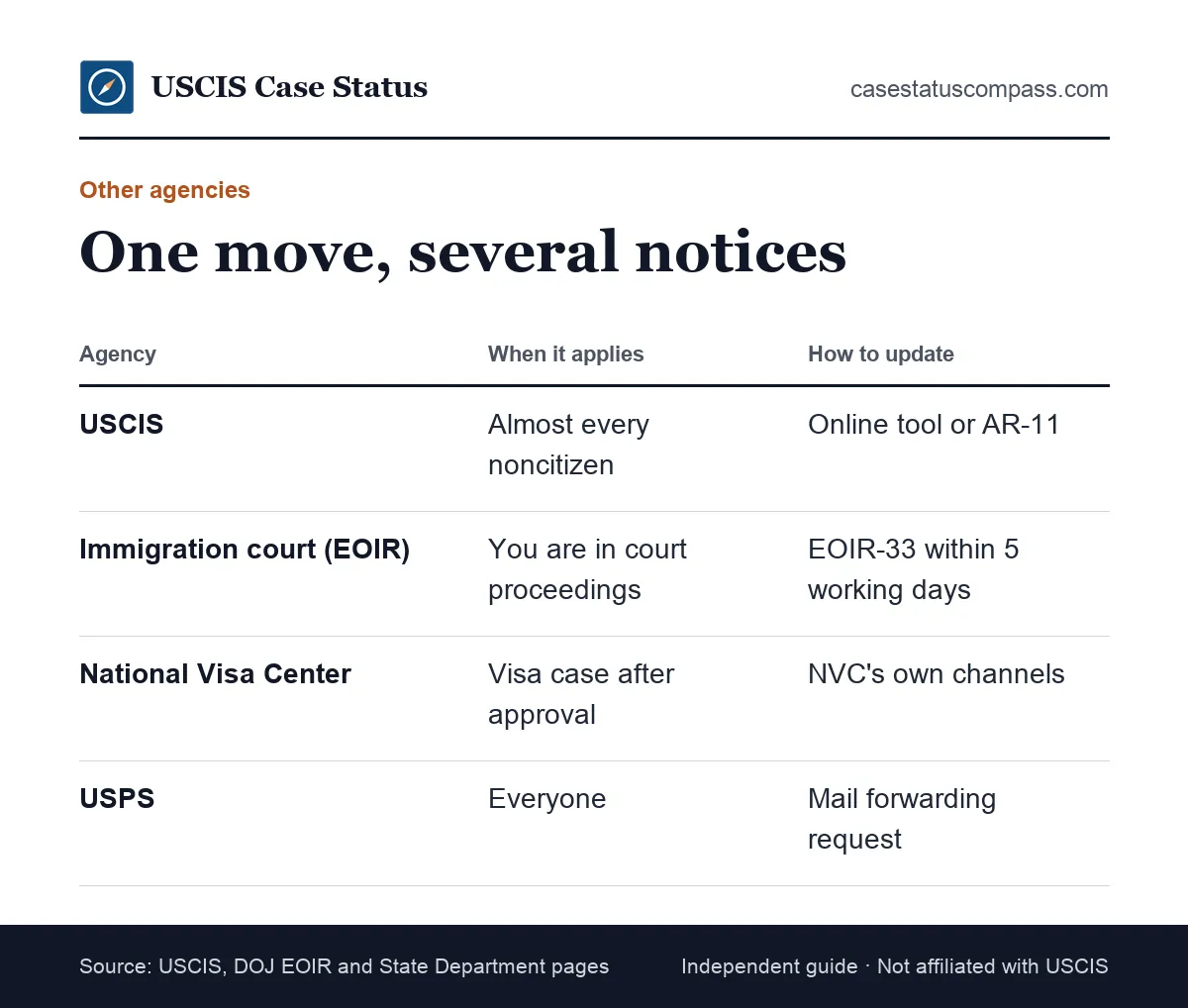
USCIS does not share your new address with immigration court or the National Visa Center. Update each separately if it has your case. Each agency keeps its own file, with its own form or portal and its own deadline. If your case has moved from USCIS to the court or the NVC, the agency that now holds it is the one that most needs your address.
National Visa Center (NVC)
After approval for an applicant abroad, the case may move to the State Department. NVC (State Department) collects visa fees and documents after USCIS approves the petition. USCIS says approved beneficiaries abroad should also contact the NVC; see our nvc case status guide.
How Do You Change Your Address With the Immigration Court?
The courts keep their own records, so tell the immigration court or BIA within five working days on Form EOIR-33, or online through Respondent Access. Check immigration court cases online at acis.eoir.justice.gov with your A-number. See our immigration court case status guide for how to look up your hearing.
Changing venue after a move
A new address does not move your hearing to a nearer court. Moving the case is a separate step: To move a court case: file a written motion to change venue with EOIR-33/IC; keep attending hearings until it's granted.
Does a USPS Change of Address Update USCIS?
No. A USPS change of address does not update USCIS, and USCIS says the Postal Service will not forward its mail. You need both: USPS forwarding for ordinary mail and a separate USCIS change of address. Do both on the same day.
What forwarding can and cannot do
Forwarding helps with ordinary mail from banks and friends. USCIS mail sent to an old address may return to USCIS instead of reaching you, delaying a card or appointment. Treat forwarding as a backup only.
Use the official address format
USCIS suggests the USPS ZIP Code lookup to format your address. Entering the address the way USPS standardizes it, including the ZIP+4 and unit designation, helps cards and notices arrive. Use the same format on every form you file.
What Happens If You Don't Report Your Address Change?
If you do not report a move, you risk missed notices, missed appointments and denied cases. Failing to report is also a violation of federal law for noncitizens. The risk is greatest when something is pending, because notices with deadlines go to the address in the file and the clock runs whether or not you read them.
Missed notices and denied cases
A request for evidence has a fixed window: RFE deadline: up to 12 weeks (the exact date is on your RFE); no extensions. I-539 and I-601A RFEs allow only 30 days. If it goes to an old address, the deadline still runs. Our rfe meaning guide explains how to answer one.
What Are the Penalties for Not Reporting a Move?
The duty is part of the Immigration and Nationality Act, which sets penalties for willful failure to report a change of address. In practice, most harm comes from missed deadlines. We cannot predict outcomes, so speak with an attorney or DOJ-accredited representative about past failures.
What If You Missed the 10-Day Deadline?
If you missed the deadline, report the move now. File online, add every pending receipt number and save the confirmation. Then look for notices that may have gone to the old address. A late report uses the same online tool and is better than none.
File now and recover missed mail
Check your online account for notices posted during the move. Ask the landlord or new residents to hold USCIS mail. If a deadline passed, contact USCIS and get legal advice quickly.
Never backdate a form
Sign with the real date. If anyone asks why the report was late, an honest timeline of when you moved and when you filed is your best answer. False dates create a bigger problem than lateness.
What If You Move Abroad or Have No Fixed Address?
If you move abroad or have no fixed address, you still need a reliable way for USCIS to reach you. Use a trusted mailing address, such as a relative or attorney. Moving abroad as a permanent resident also raises status questions.
Moving abroad as a green card holder
A long stay abroad affects more than mail. Long trips abroad can risk your green card; over 1 year is the general warning line. Read our green card holder travel rules guide before you go.
Between homes or in a shelter
Report a place where you can safely receive mail, such as a shelter, friend or legal aid office. Update again once you have a permanent address. Ask first whether they accept mail for you.
How Do You Check That USCIS Has Your New Address?
Check your online account profile and the address on the next notice you receive. The public case status tool does not show addresses. If something is wrong, report it to USCIS online or by phone. Check again a few weeks after any USCIS change of address.
Online account and new notices
The account profile shows the address you entered, and each new I-797 prints the mailing address. e-Request: report USCIS typos, missing notices or accommodation needs online. Use it if a notice prints your address with a USCIS typo.
Asking USCIS to confirm
A Contact Center agent can confirm the address on a specific case. Have your receipt number, A-Number and date of birth ready. For general questions, try Emma, USCIS's online virtual assistant (English and Spanish), on uscis.gov.
Which Address Should You Use: Physical or Mailing?
Use your physical address for where you live and a mailing address only if mail cannot reach you there. The online tool takes both. Never list a place where you do not live as your residence. Both must be addresses you can rely on.
Physical address
The physical address is where you sleep most nights. Include the street, unit number and ZIP code exactly as on your lease or utility bill. Officers may compare it with other records.
Mailing address and "in care of"
A mailing address can be a P.O. box, relative or attorney. Ask whoever receives it to flag USCIS envelopes the same day. Put that person's name on the "in care of" line so the carrier delivers USCIS mail to the right box.
Change of Address Decision Table: If X, Do Y
This decision table gives one next step for each common moving situation. If several rows apply, start with any court date or USCIS deadline, since those carry the most risk. The rows are general information, not legal advice; a court case or abuse-related filing calls for a representative's help.
Decision table
Match the left column to your situation; the right column gives the first action to take within the 10-day window.
| If this applies to you | Do this |
|---|---|
| Green card holder, no pending case | File online; leave receipt fields blank |
| One or more pending USCIS cases | File online; add every receipt number |
| Paper case not showing | Type receipts by hand or link with access code |
| No online access | Mail Form AR-11 and call USCIS about open cases |
| Case in immigration court | Update USCIS and the court separately |
| Visa case at the NVC | Update USCIS and contact the NVC |
| Card mailed to old address | Update now; follow returned-card steps |
| VAWA, T or U case | Use the special USCIS procedure |
Change of Address Examples: Three Common Moves
These fictional examples show how the same 10-day rule plays out for different people. The right steps depend on what is pending and which agency holds the case, so match your situation to the closest example. The names and details are invented.
A family with a pending I-485
"Maria" has a pending I-485, I-765 and I-131. She files one online change within a week of moving and adds all three receipt numbers, so each case record updates at once.
A green card holder with nothing pending
"Ahmed," a permanent resident with no open case, files online in minutes and leaves the receipt fields blank. He saves the confirmation for his future N-400 address history. That one USCIS change of address meets his 10-day reporting duty even with no case attached.
An asylum applicant with a court hearing
"Lin" has an asylum hearing before an immigration judge. She updates USCIS online and files the court's own address form, because neither agency shares the change. She keeps both confirmations for her lawyer.
Copyable Change of Address Checklist
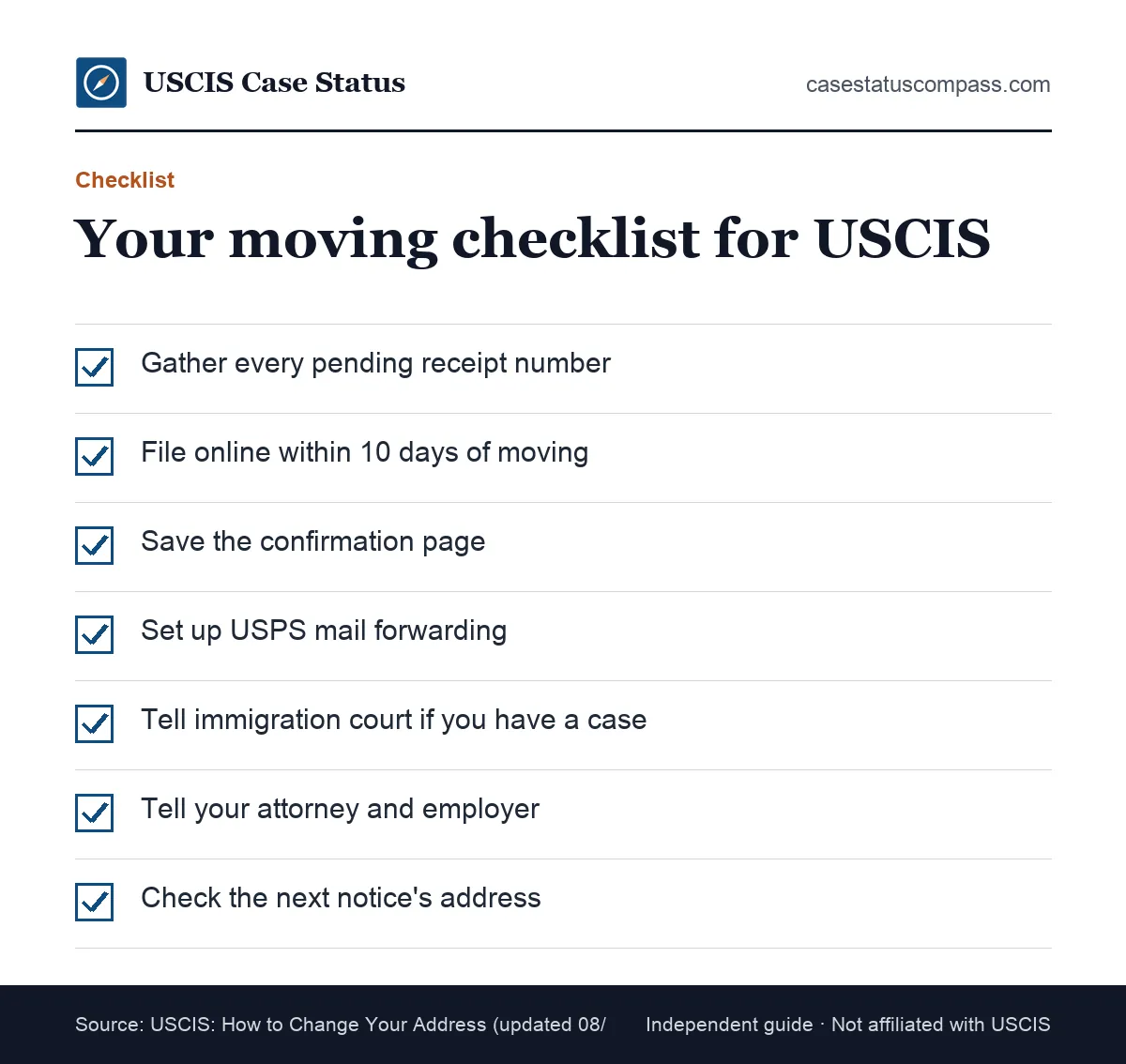
Copy this USCIS change of address checklist into your notes before you move. Keep it with your confirmation pages. Tick each item as you go, and keep a list for every family member who files. Most steps take minutes, but the 10-day deadline means doing them in the first week after you move.
Before you move
- List every pending receipt number for each family member
- Note A-Numbers and upcoming appointment dates
- Pick a mailing address if your new home's mail is unreliable
- Ask your lawyer which agencies hold your cases
Within 10 days of moving
- File online (or mail Form AR-11) with each receipt number
- Save the confirmation page
- Set up USPS forwarding
- Tell immigration court or the NVC if they have your case
- Update your school official if you are a student
After you file
- Send the confirmation to your attorney and employer
- Check the address on the next notice
- Watch for USCIS mail at the old address for a few weeks
- Keep every confirmation with your immigration papers
Common Change of Address Mistakes
The most common mistakes are telling only the Postal Service, forgetting a receipt number and typing the address wrong. Others include mailing only a paper AR-11 while a case is pending, using a mailing address nobody checks, and forgetting a spouse's or child's cases. Each one can send a notice or card to the wrong place.
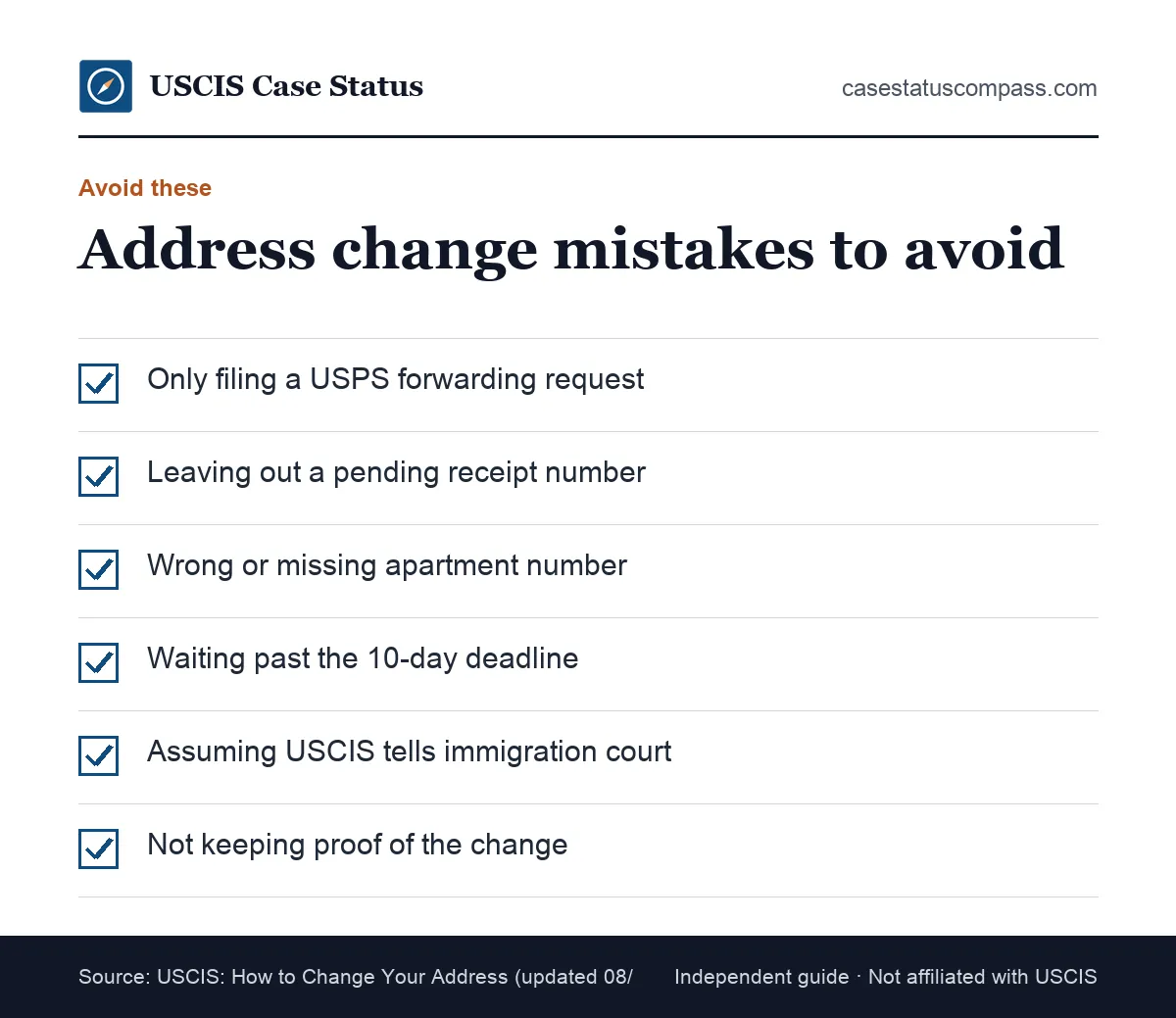
Only telling the Postal Service
This is the biggest error. USPS forwarding feels complete but never reaches USCIS records. Always file the immigration update separately. Immigration notices often go back to USCIS instead of following you to the new home.
Missing unit numbers and typos
A missing apartment number can send a green card back to USCIS. Compare the screen with your lease before submitting, and spell the street the same way every time. Check the ZIP code too.
Mailing a New Application After You Move
Put your new address in the applicant section of any new form and send it to the correct filing address. Filing addresses changed recently: New USCIS mailing addresses from Oct. 7, 2026; old addresses accepted if postmarked by Nov. 9, 2026. Check the form's own address page.
Where the package goes
The filing address depends on the form and category, not mainly on where you live. Our uscis service centers guide explains which offices handle which work. Check it each time you file.
Listing your address history
Many forms ask for address history. List the old address with correct dates and the new one as current, the same way on every form. Keep your confirmations to check the dates.
Moving While USCIS Has Asked You for Something
If USCIS has asked for documents or set an appointment, act on that first, then report the move. A deadline does not pause because you moved. Note your new address in the reply's cover letter as well. Keep proof of mailing.
A request for evidence is pending
Send the reply to the address on the request, mention your new address in the cover letter and file the online change too. Use a tracked mail service so you can prove the reply arrived before the deadline.
An interview is set near your old home
You can usually attend the scheduled office after moving. If travel is impossible, ask to reschedule early. Our interview was scheduled guide explains the notice. Bring the notice and ID it lists.
When Should You Get Legal Help With an Address Problem?
Get legal help if a missed notice led to a denial, a missed hearing or a lost card, or if you are in immigration court. An attorney or DOJ-accredited representative can check what was sent and which options remain. Bring every notice you have.
Missed hearings and court notices
A missed immigration court hearing is serious. Speak to a lawyer promptly about options and update your court address right away. Some orders issued in your absence can be challenged with a motion to reopen, especially when notice went to the wrong address, but the rules are strict.
Denials after a missed notice
Options depend on the facts; our i 485 denied guide explains choices after a denial. Bring your address change confirmation to any consultation. A motion to reopen on Form I-290B has a short deadline: Appeal or motion: file within 30 days (33 if the decision was mailed).
How Address Changes Fit Into Your Case
An address change is a small step that protects every other step. Receipts, biometrics letters, interview notices, cards and decisions all travel to the address on file. One accurate update in the first days after a move keeps all of them on track, while a stale address can quietly derail a case that was otherwise going well.
What depends on the address on file
- Appointment notices for biometrics and interviews
- Evidence requests and their deadlines
- Approval, denial and transfer notices
- Green cards, work permits and travel documents
- Oath ceremony notices for citizenship applicants
- Receipt notices for anything you file next
What If Your Case Seems Stuck After a Move?
First confirm the new address reached each case, then check whether a notice went to the old home. See our guide to a uscis case status not updating. If a call or letter about your address seems fake, read our uscis scam guide first.
Frequently Asked Questions
How long does a USCIS change of address take to process?
USCIS says online address changes are processed almost immediately. A paper Form AR-11 takes longer because it travels by mail and is entered by hand, and it does not update pending cases automatically. Keep USPS forwarding in place for notices already printed.
Is there a confirmation for an online address change?
Yes. After you submit the change in your USCIS online account, the tool shows a confirmation you can save as a PDF or screenshot. Keep it as proof that you reported on time.
Do I need a separate change of address for each case?
You file one change but enter the receipt number of each pending case in it. Each receipt number is a separate USCIS record. If you leave one out, that case may keep your old address and its notices may be misdirected.
Can I change my address by phone?
The legal duty is met online or with a paper Form AR-11. The Contact Center can help when the online tool rejects a case or when a beneficiary has moved, but you should still file the formal change.
Does changing my address delay my case?
A routine address change does not restart a case. A move can trigger a transfer to a different field office if you are waiting for an interview, which may add time. Not reporting is far more likely to cause delays.
Do U.S. citizens need to file Form AR-11?
No. U.S. citizens have no duty to file Form AR-11 for themselves. A citizen who filed a petition, such as Form I-130, should still update the address on that pending case so notices arrive.
Should I update my address before or after I move?
Report the move once you live at the new address, within 10 days. Filing too early can send notices to a home you have not moved into.
Do I report a move within the same building?
Yes. A new apartment or unit number is a new address, so report it within 10 days like any other move. A missing unit number is a common reason cards come back to USCIS.
Will USCIS send my green card to my new address?
Only if the case record has it. USCIS mails cards to the address on the pending case, so add the I-485 or I-90 receipt number when you file the change.
Does each family member file a separate change of address?
Each noncitizen has their own duty and record. Make sure every person's address is reported and every pending receipt number in the family is listed, including a spouse's and children's cases.
Sources
- USCIS: How to Change Your Address. www.uscis.gov/addresschange. Accessed Oct 27, 2026.
- 8 U.S.C. 1305 (INA 265): Notices of change of address. www.law.cornell.edu/uscode/text/8/1305. Accessed Oct 27, 2026.
- USCIS Contact Center. www.uscis.gov/contactcenter. Accessed Oct 27, 2026.
- USCIS Policy Manual Vol. 11, Part A, Ch. 3 (undeliverable cards). www.uscis.gov/policy-manual/volume-11-part-a-chapter-3. Accessed Oct 27, 2026.
- EOIR Immigration Court Practice Manual, Ch. 4.10. www.justice.gov/eoir/policy-manual-eoir/part-II/icpm/chapter-4-10. Accessed Oct 27, 2026.
- USCIS: Consular Processing. www.uscis.gov/green-card/green-card-processes-and-procedures/consular-processing. Accessed Oct 27, 2026.
- USCIS: Filing Locations and Online Filing Options Updates. www.uscis.gov/forms/us-citizenship-and-immigration-services-filing-locations-and-online-filing-options-updates. Accessed Oct 27, 2026.
- USCIS: Online Account and Technical Support. www.uscis.gov/tools/uscis-tools-and-resources/online-account-and-technical-support. Accessed Oct 27, 2026.
- USCIS: Preparing for Your Biometric Services Appointment (updated 04/30/2026). www.uscis.gov/forms/filing-guidance/preparing-for-your-biometric-services-appointment. Accessed Oct 27, 2026.
- Form I-90 Instructions, Edition 01/20/25. www.uscis.gov/sites/default/files/document/forms/i-90instr.pdf. Accessed Oct 27, 2026.
- Form I-751 Instructions, Edition 04/01/24. www.uscis.gov/sites/default/files/document/forms/i-751instr.pdf. Accessed Oct 27, 2026.
- USCIS: Removing Conditions on Permanent Residence Based on Marriage (updated 12/12/2023). www.uscis.gov/green-card/after-we-grant-your-green-card/conditional-permanent-residence/removing-conditions-on-permanent-residence-based-on-marriage. Accessed Oct 27, 2026.
- USCIS Policy Manual Vol. 12, Part D, Ch. 1 (current as of Oct. 23, 2026). www.uscis.gov/policy-manual/volume-12-part-d-chapter-1. Accessed Oct 27, 2026.
- USCIS: Form I-821D page (updated 06/01/2026) and uscis.gov/DACA (updated 01/24/2025). www.uscis.gov/i-821d. Accessed Oct 27, 2026.
- USCIS: Automatic EAD Extension (updated 10/29/2025). www.uscis.gov/working-in-the-united-states/information-for-employers-and-employees/automatic-employment-authorization-document-ead-extension. Accessed Oct 27, 2026.
- DOJ EOIR: Update Respondent or Alien Information (updated May 18, 2026). www.justice.gov/eoir/update-respondent-or-alien-information. Accessed Oct 27, 2026.
- DOJ EOIR: Immigration Court Information. www.justice.gov/eoir/immigration-court-information. Accessed Oct 27, 2026.
- 8 CFR 103.2(b)(8)(iv) (LII). www.law.cornell.edu/cfr/text/8/103.2. Accessed Oct 27, 2026.
- USCIS: International Travel as a Permanent Resident (updated 09/12/2025). www.uscis.gov/green-card/after-we-grant-your-green-card/international-travel-as-a-permanent-resident. Accessed Oct 27, 2026.
- USCIS: Form I-290B page (updated 10/26/2026). www.uscis.gov/i-290b. Accessed Oct 27, 2026.
casestatuscompass.com is an independent publication and is not affiliated with USCIS or any government agency. This page is general information, not legal advice. For denials, court or asylum matters, consult an immigration attorney or a DOJ-accredited representative.