Contents · 37 sections
- What Is a USCIS Scam?
- What Will USCIS Never Do?
- How Does USCIS Actually Accept Fees?
- What Are the Most Common USCIS Scams?
- How Do Government Impersonator Calls Work?
- Is USCIS Calling Me, or Is It a Scam?
- Email and Text Scams Pretending to Be USCIS
- Fake USCIS Websites and Social Media Pages
- What Is a Notario Scam?
- Who Is Allowed to Give Immigration Legal Advice?
- How Do You Check an Attorney or Accredited Representative?
- Can Anyone Pay to Jump the Line at USCIS?
- Visa Lottery and Diversity Visa Scams
- Job Offer and Employment Visa Scams
- TPS Re-registration Scams
- Humanitarian Program and Parole Scams
- Form I-9 Email Scams Aimed at Employers
- Deportation Threat and Court Scams
- How Can You Spot a USCIS Scam in Seconds?
- What Are the Warning Signs of an Immigration Scam?
- Real USCIS Contact vs Scam Contact: Side by Side
- How Do Real USCIS Letters and Emails Differ From Fakes?
- What Should You Do After a Suspicious Call or Message?
- What Should You Do If You Already Paid a Scammer?
- What If You Gave a Scammer Your Personal Information?
- How Do You Report a USCIS Scam?
- How Do You Report an Immigration Scam to the FTC?
- Reporting to Your State and Local Police
- How Do You Report a Fake USCIS Website or Email?
- When Should You Use the USCIS Tip Form?
- Human Trafficking and Labor Exploitation
- Will Reporting a Scam Affect My Immigration Case?
- How to Protect Yourself Before You File
- A USCIS Scam Call, Worked Example
- If X, Do Y: A USCIS Scam Decision Table
- When Should You Get Legal Help After a Scam?
- Frequently Asked Questions
The short answer
A USCIS scam is any call, message, website or person that pretends to act for U.S. Citizenship and Immigration Services, or sells fake shortcuts, to take your money, data or documents. USCIS never takes fees by phone, email or gift card. Hang up, check through official channels, and report it to the FTC.
At a glance
| Does USCIS call to demand payment? | No. USCIS does not take fees by phone or email |
| Payment methods USCIS refuses | Gift cards, Western Union, MoneyGram, PayPal, Venmo |
| Who can give immigration advice? | Licensed attorneys and DOJ-accredited representatives |
| Main place to report | FTC at ReportFraud.ftc.gov |
| Does reporting hurt your case? | No, according to USCIS |
This guide shows the patterns behind each USCIS scam, so you can spot new versions. To check your real case, start with our free USCIS case status check guide; to test one letter or email, see how to confirm a USCIS notice is real.
What Is a USCIS Scam?
A USCIS scam is a trick in which someone poses as the immigration agency, a government officer or an "expert" with special access. The goal is to make you pay, share personal information or hand over documents. Some scammers act alone by phone; others run storefront offices that look like real legal services.
Who scammers target
Scammers target people with something pending or something to lose: green card applicants, students, workers on visas, asylum seekers and families waiting on petitions. New arrivals and people with limited English are hit hardest, because scammers know they may not check an official source. Long waits make any promised shortcut sound tempting.
What scammers want
Nearly every scheme wants one of three things. Money is the most common, often in ways that cannot be traced. Personal data such as your Social Security number, A-Number or passport details comes next.
What Will USCIS Never Do?
USCIS publishes a short list of things it never does. It never contacts you through personal social media accounts, never asks you to transfer money to an individual, and never asks for fees by phone or email. Any contact that breaks one of these rules is a USCIS scam, however official it looks.
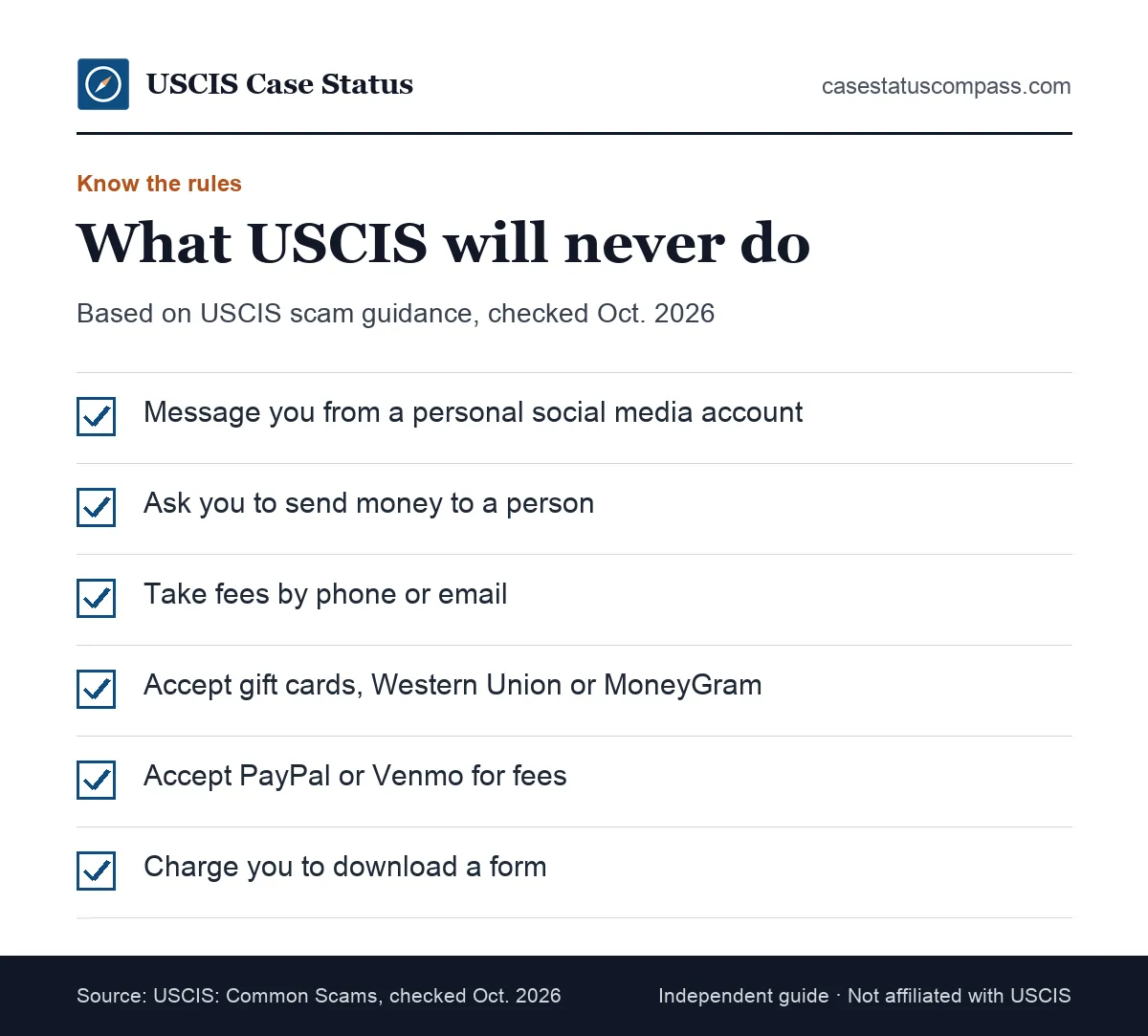
Rules from USCIS's own guidance
Each row pairs one thing USCIS says it will not do with the trick a scammer uses instead.
| USCIS will not | What a scammer does instead |
|---|---|
| Contact you from a personal social media account | Sends a direct message from a "USCIS officer" profile |
| Ask you to transfer money to a person | Gives you a name and account to send money to |
| Ask for fees by phone or email | Demands a card number during a call |
| Take fees outside your USCIS online account or official channels | Sends a payment link to a look-alike site |
| Routinely email to announce a visa or benefit approval | Emails a "congratulations" note with a fee to claim it |
The one exception people misread
USCIS notes that it may email in certain situations, such as prompting you to update your address. Such an email never asks for payment or passwords. If an email seems real, ignore its links and sign in to your account by typing the address yourself.
How Does USCIS Actually Accept Fees?
USCIS takes fees only through official channels: your USCIS online account, Pay.gov for some fees, or the payment you send with a paper filing as the form instructions describe. It does not accept Western Union, MoneyGram, PayPal, Venmo or gift cards. A payment request outside these routes is a scam.
Online account and Pay.gov
When you file online, you pay inside your account at the end of the filing. A USCIS online account is free to create at myaccount.uscis.gov/create-account. Some separate fees go through Pay.gov. Payment always happens on a page you reached yourself, never from a link someone sent you.
Payment methods USCIS refuses
USCIS says it does not accept Western Union, MoneyGram, PayPal, Venmo or gift cards. If anyone asks for these to pay an immigration fee, stop. For paper filings, the official routes are narrow: pay online through Pay.gov, or on paper with Form G-1450 (card) or Form G-1650 (bank account).
What Are the Most Common USCIS Scams?
USCIS lists more than a dozen recurring schemes. The most common are government impersonator calls, fake emails and websites, notario fraud, line-jumping offers, visa lottery wins, job offers, and scams tied to specific programs such as TPS or humanitarian parole.
Fourteen scam types at a glance
Use this table to match a message you received to a known scheme and the group it usually targets.
| Scam type | Typical hook | Who it targets |
|---|---|---|
| Government impersonators | "Your case has a problem" | Anyone with a case |
| Email, text and fake websites | "Pay here to process" | Applicants searching online |
| Social media offers | "Comment to get a work permit" | Social media users |
| Payments by phone or email | "Pay the officer directly" | Anyone with a case |
| Notarios públicos | "I can file for you" | Spanish speakers, new arrivals |
| Paying to jump the line | "I know someone inside" | Long-waiting applicants |
| Visa lottery wins | "You won the green card lottery" | People abroad |
| Job offers | "Pay for your visa sponsor" | Overseas workers |
| Students | "Your SEVIS record has a fine" | International students |
| TPS re-registration | "Register now before it closes" | TPS holders |
| Humanitarian parole | "Pay to speed your I-134A" | Supporters and beneficiaries |
| Misleading support offers | "I will find you a supporter" | Parole applicants |
| Personal information requests | "Confirm your details by email" | Afghan nationals and others |
| Form I-9 emails | "Send your I-9 forms" | Employers |
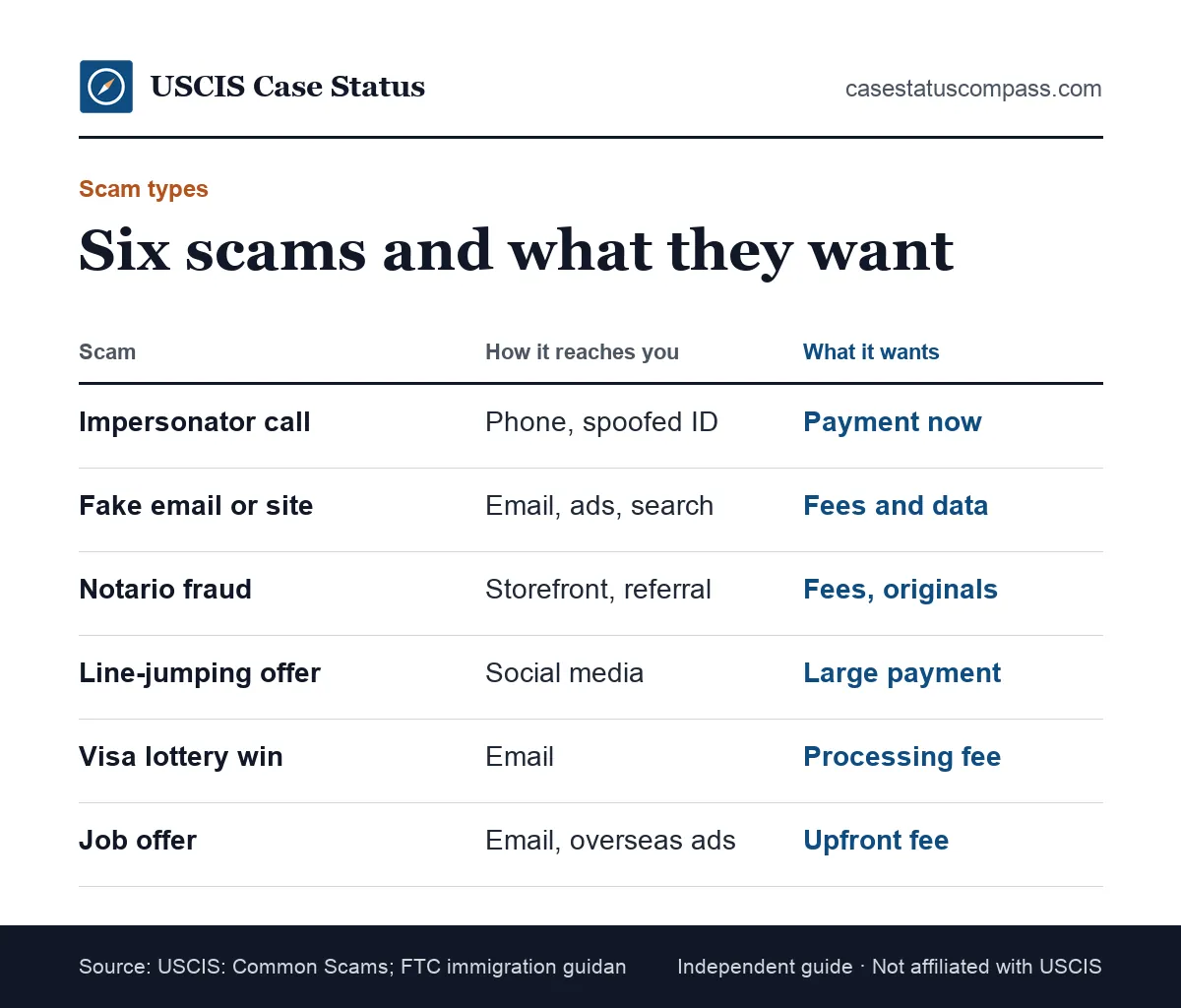
Which scams cost the most
Line-jumping and notario schemes often involve the largest payments, sometimes over many months. Impersonator calls are faster but can drain a bank account in one sitting. Fake filings by notarios can also cost you a case, which is harder to fix than money.
How Do Government Impersonator Calls Work?
A government impersonator call uses a spoofed caller ID that shows USCIS, DHS or another agency. The caller says your case has a problem, threatens arrest or deportation, and demands payment right away. The goal is to keep you on the line and scared, so you pay before you think to check.
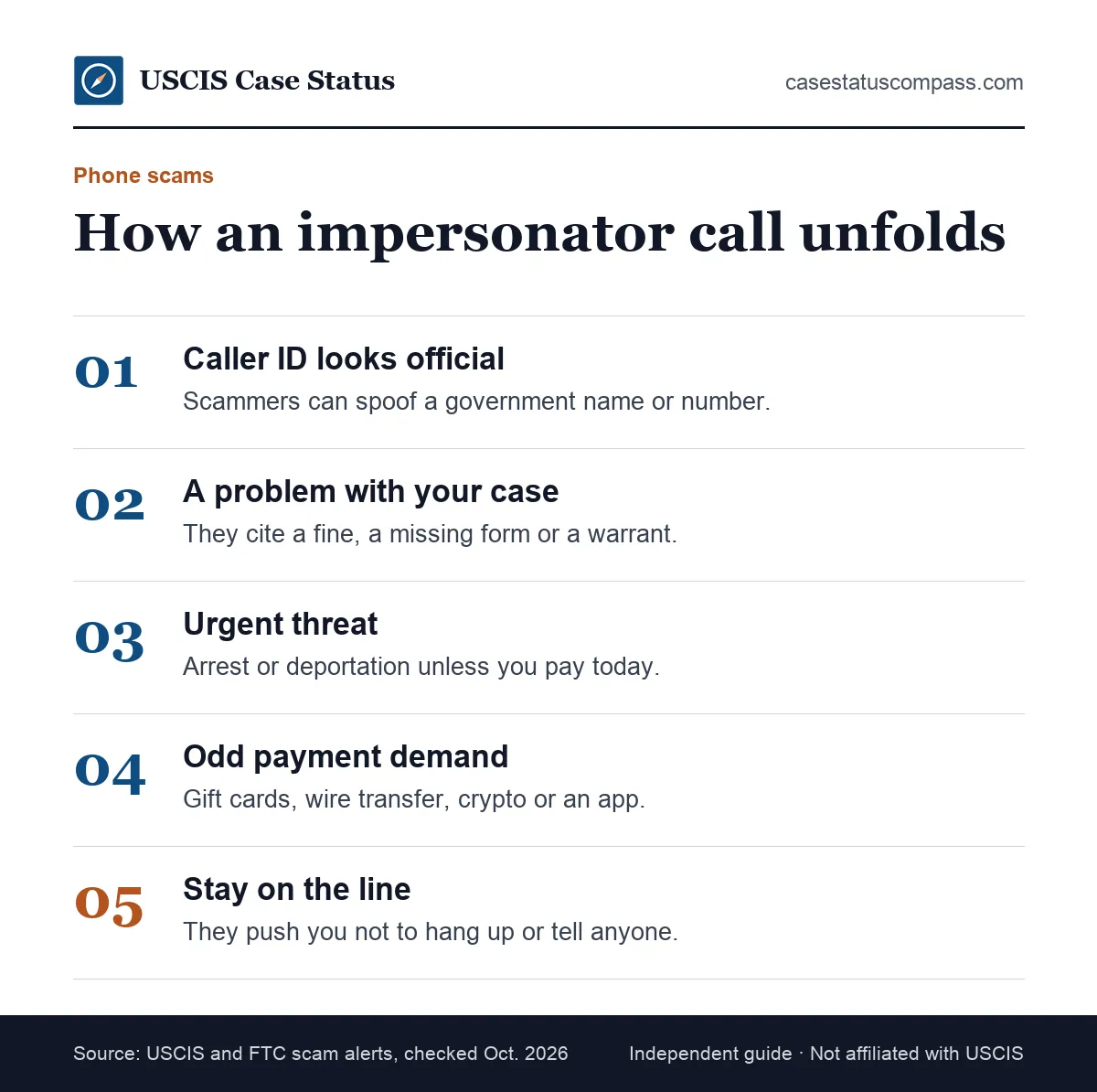
Spoofed caller ID
Caller ID can be faked, so a screen that reads "USCIS" proves nothing. Our USCIS contact number guide lists the real lines; hang up and dial one yourself. Never call back the number that called you.
The script they follow
Expect a polite opening, then bad news about your file, then a fine or fee, then pressure. Callers may know your name, address or even a receipt number. That data is often stolen or public, so it proves nothing.
Is USCIS Calling Me, or Is It a Scam?
USCIS sometimes calls applicants, for example to follow up on a case or to clarify information. But a real USCIS call never demands payment, never threatens immediate arrest and never asks you to buy gift cards. If a call does any of those things, it is a scam call.
When a call may be real
A real officer may call about your interview, a document or a scheduling issue. Even then, you can end the call and phone the USCIS Contact Center at 800-375-5283 to confirm. A real officer will not object.
What to do in the moment
Say you will call back, then hang up. Write down the number shown, the name used and what they asked for. Do not confirm any personal details, even your name. Then check your case yourself in your online account.
Email and Text Scams Pretending to Be USCIS
Scam emails and texts copy USCIS logos and wording, then send you to a look-alike website to pay or log in. Real USCIS email addresses end in .gov. A message from a free email service, a strange domain or a misspelled agency name is not from USCIS.
Fake sender addresses
Look at the full sender address, not just the display name. USCIS has warned about scam emails sent from addresses made to look official. A name like "USCIS Support" means nothing if the address behind it is not a .gov domain.
Links to look-alike domains
Scam links often use words like "uscis," "immigration" or "visa" inside a non-government domain, such as one ending in .org or .com. Do not click. Type uscis.gov into your browser and sign in from there.
Fake USCIS Websites and Social Media Pages
Fake websites look like USCIS, rank in search ads and charge for things that are free. Fake social media pages post "officer" contact details and offer help for a fee. The quickest test is the address: official U.S. government websites end in .gov.
Checking for .gov
Check the address bar before you type anything. "uscis.gov" is real. Variations that add words, dashes or a different ending are not. Our online account guide covers safe sign-in. Bookmark the real site once.
Paid form download sites
Every USCIS form is free on the uscis.gov All Forms page. Sites that charge to "download" or "prepare" a form may be legal businesses, but many mislead buyers into thinking they are paying USCIS.
What Is a Notario Scam?
A notario scam happens when someone called a "notario" or "notario público" offers immigration legal help they are not allowed to give. In the U.S., a notary public only witnesses signatures. Notarios may file wrong forms, invent claims or keep your money and documents.
Why the word confuses people
In many Latin American countries, a notario is a trained legal professional. A U.S. notary needs no legal training and cannot give immigration advice. The FTC warns that notarios are not licensed attorneys.
What a notario may do to your case
A dishonest notario may file a weak or false asylum claim, miss deadlines or submit forms you never saw. These filings can trigger a Notice to Appear in immigration court. Some keep original documents to force more payments. If a notario has filed for you, ask an attorney to review it.
Who Is Allowed to Give Immigration Legal Advice?
Only two kinds of people can give immigration legal advice in the U.S.: licensed attorneys in good standing and DOJ-accredited representatives who work for a recognized organization. Notarios, visa consultants and form preparers cannot. A preparer may type answers you give, but cannot tell you which form to file or what to claim.
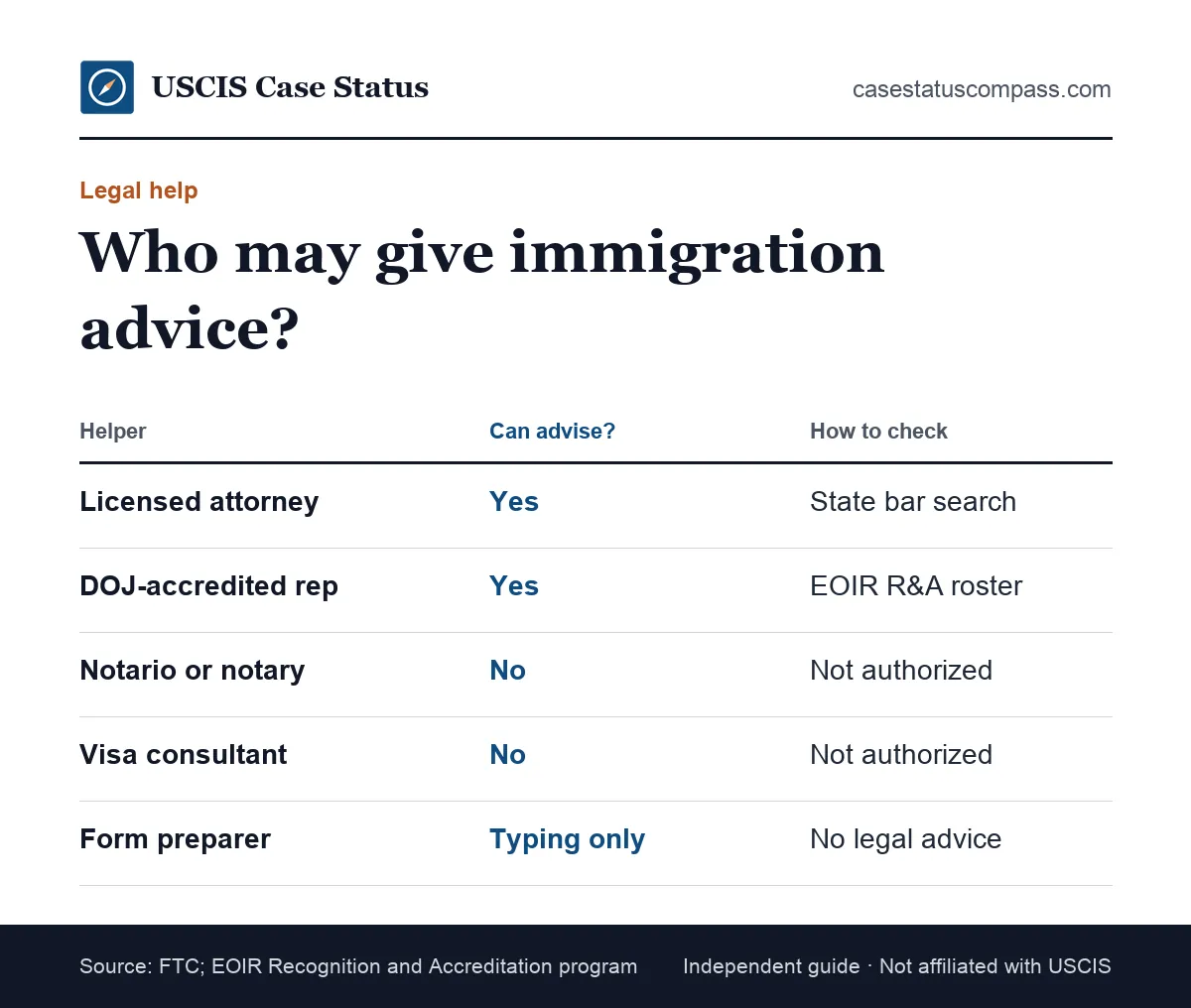
Licensed attorneys
An attorney must be a member in good standing of a state bar and not suspended. The attorney can be licensed in any U.S. state to handle federal immigration matters. Ask for the state and bar number in writing.
DOJ-accredited representatives
Accredited representatives are non-attorneys approved by the Department of Justice's Executive Office for Immigration Review (EOIR). They must work through a recognized organization, often a nonprofit. Some are accredited only for USCIS and DHS matters; others can also appear in immigration court.
How Do You Check an Attorney or Accredited Representative?
Check an attorney through the state bar that licensed them, and check an accredited representative on EOIR's Recognition and Accreditation roster. Both checks are free and take minutes. Do them before you pay or sign anything, and again if the person's name or office changes. Anyone who refuses to give you a bar number or accreditation details is a warning sign.
State bar search
Most state bars have an online lawyer search. Confirm the name, bar number and status, and look for any discipline record. Match the office address too, and be wary if the license is from a state the person never mentioned.
EOIR roster
EOIR publishes a roster of recognized organizations and their accredited representatives. The roster shows whether a person has full accreditation or is limited to DHS matters. If someone claims to be accredited but is not listed, treat it as a red flag.
Can Anyone Pay to Jump the Line at USCIS?
No. Nobody can pay a person to move a case ahead or guarantee approval. Offers of special connections inside USCIS are scams. The only official ways to ask for faster handling are an expedite request and, for eligible forms, premium processing with its published fee.
Real ways to move faster
An expedite request is free to ask for and goes through official channels: Ask for an expedite through the USCIS Contact Center or your online account. Our expedite request guide explains USCIS's published criteria. Premium processing covers only certain forms; see our premium processing guide.
Signs of a line-jumping scam
The seller claims a cousin, friend or officer "on the inside." They want cash or a transfer before doing anything. They often say the offer is secret, that it expires soon, and that you must not tell your lawyer. Real expedite requests cost nothing to ask.
Visa Lottery and Diversity Visa Scams
The Diversity Visa program is free to enter, and winners are not notified by email asking for money. A message that says you won the green card lottery and must pay a fee to claim it is a scam. The State Department runs the program, not USCIS, and it never asks for a payment to release results.
What a fake winner email looks like
Fake notices use flags, seals and official-sounding titles. They ask for a "processing" or "visa" fee by wire. If you entered, check your results only through the official State Department entrant status page, typed in yourself.
Paid entry services
Some websites charge to "submit" your lottery entry. Entry is free, and paying a service does not raise your odds of selection. Some services keep your confirmation number, leaving you unable to check results.
Job Offer and Employment Visa Scams
Job offer scams promise a U.S. job with visa sponsorship, then ask you to pay for the visa, a "work permit" or travel before you start. USCIS warns that overseas and email job offers, especially those that require payment, are a common scheme.
Upfront fees for sponsorship
Real employers pay most petition costs themselves. For example, some H-1B fees are the employer's responsibility under the law. A "recruiter" who asks you to wire thousands for a visa is likely a scammer. See our H-1B visa status guide for how the real process works.
Fake interview and contract letters
Scammers send contracts on stolen company letterhead and set up fake video interviews. Call the company's main number from its own website to confirm the offer. Real interviews do not require payment.
TPS Re-registration Scams
TPS re-registration scams tell holders to pay or file before the official period opens. USCIS says you should wait for the Federal Register notice that sets the dates for your country. Anyone who charges to "hold your place" before then is not telling the truth.
Where the real dates come from
Each TPS country gets its own notice with the registration window. USCIS posts the details at uscis.gov/humanitarian/temporary-protected-status. Our TPS status guide summarizes current designations. File only once the notice is out.
Real fees for TPS
TPS fees are set by Form G-1055: Initial: $520 + $30 biometrics; re-registration: $0 + $30 biometrics (the TPS EAD is a separate fee). Those fees go to USCIS with your filing, not to a helper's personal account. Ask for the USCIS receipt notice and check it in your own account.
Humanitarian Program and Parole Scams
Scammers target humanitarian programs by charging for steps that are free. USCIS notes that Form I-134A has no filing fee, and that supporters and beneficiaries do not owe each other payment. Anyone selling a place in a parole program is running a USCIS scam.
Fake supporter offers
Some people promise to connect beneficiaries with a U.S. supporter in exchange for fees or personal data. USCIS says beneficiaries are not obligated to repay or compensate supporters. Walk away from anyone who asks.
Phishing about parole cases
USCIS has warned about phishing emails that ask supporters to pay before a review and about fake denial letters with typos and other signs that they are not official. Any parole update you rely on should match what you see in your online account.
Form I-9 Email Scams Aimed at Employers
Employers get scam emails that ask them to send Form I-9 information to an email address. USCIS does not request Form I-9 by email. The emails may use USCIS and Inspector General labels and a download button that leads to a non-government site.
What the email asks for
The message may include the company's address, a deadline and a link to "submit" employee records. USCIS warns these emails come from addresses that only look like USCIS. Stolen I-9 data exposes your workers to identity theft.
What employers should do
Do not reply or click. Report the email to the FTC, and if you are unsure whether it is real, forward it to the USCIS webmaster. Warn HR staff and keep I-9s on file.
Deportation Threat and Court Scams
Some scammers claim to be from ICE or the immigration court and say there is a warrant or a missed hearing. They demand a "bond" or fine by phone. Real court information comes through official notices and EOIR's case portal, not by phone payment demands.
Checking a court case yourself
If you have a removal case, use EOIR's own tools. Check immigration court cases online at acis.eoir.justice.gov with your A-number. You can also use the EOIR case hotline: 1-800-898-7180 (24/7, automated). Our immigration court case status guide explains both. Neither tool charges a fee to look up a case, so anyone who demands payment for court status information is not EOIR.
What a real bond process looks like
Immigration bonds are handled through official processes with paperwork and receipts, never by gift card or a call from a stranger. If someone calls about a relative's bond, get the details, hang up and check with an attorney or the agency directly.
How Can You Spot a USCIS Scam in Seconds?
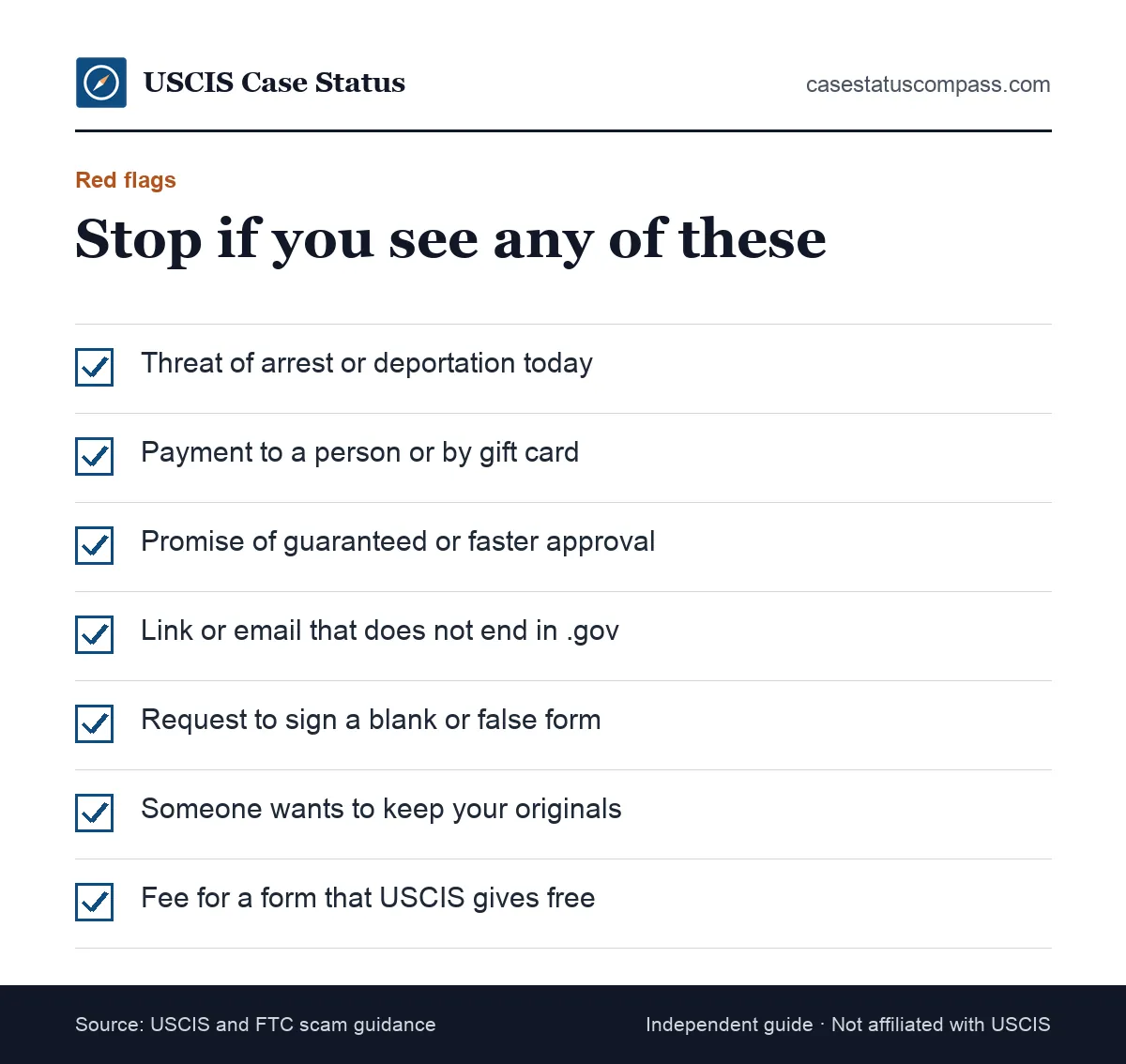
You can spot most scams with five quick questions about threat, rush, payment, source and promises. A "yes" to any of the first three, or a "no" to the source question, means stop and check through official channels before you do anything else.
The five-question test
- Threat: Are they warning of arrest, fines or deportation?
- Rush: Do they say you must act today?
- Payment: Do they want gift cards, wires, apps or crypto?
- Source: Does the email, link or website end in .gov?
- Promise: Are they guaranteeing approval or speed?
What Are the Warning Signs of an Immigration Scam?
Beyond threats and rush, immigration scams share habits that real officials never show. Scammers reach out first, ask for secrecy, want passwords or original documents, and charge for things that are free. Spotting even one of these signs is reason to pause and verify.
A copyable red-flag list
- They contact you first, out of nowhere.
- They want secrecy, such as "do not tell your lawyer."
- They ask for your USCIS password or two-step code.
- They want your original passport or green card.
- They charge for blank forms or for "registering" early.
- They will not give a full name, bar number or office.
Real USCIS Contact vs Scam Contact: Side by Side
Real USCIS contact is calm, specific and verifiable. Scam contact is urgent, vague about details you can check, and steers you toward untraceable payment methods. The two tables below compare the signals for calls and messages, then for mail, email and websites. If even one signal falls in the scam column, treat the contact as fake.
Phone and messaging
This table compares a real USCIS call or message with a scam one, signal by signal.
| Signal | Real USCIS | Scam |
|---|---|---|
| Caller ID | May show a government number | May show a spoofed government number |
| Tone | Neutral and patient | Urgent, threatening |
| Payment | Never asked on the call | Asked right away |
| Calling back | You can always hang up and call | They insist you stay on |
| Messaging apps | Not used for appointments | Common |
How Do Real USCIS Letters and Emails Differ From Fakes?
Real USCIS letters match what your online account and Case Status Online show, and real emails and websites use a .gov address. A fake USCIS email or site uses a look-alike domain, charges for free forms or sends you a payment link directly.
Mail, email and websites
This table compares real USCIS letters, emails and sites with fakes. If any row matches the fake column, treat the message as a likely USCIS scam and confirm your case through your own online account before you reply.
| Signal | Real USCIS | Scam |
|---|---|---|
| Web address | Ends in .gov | Look-alike domain |
| Sender email | .gov address | Free or odd domain |
| Mailed notice | Matches your online record | Not in Case Status Online |
| Forms | Free to download | Charged as a "service" |
| Payment link | Only in your own account or Pay.gov | Sent to you directly |
What Should You Do After a Suspicious Call or Message?
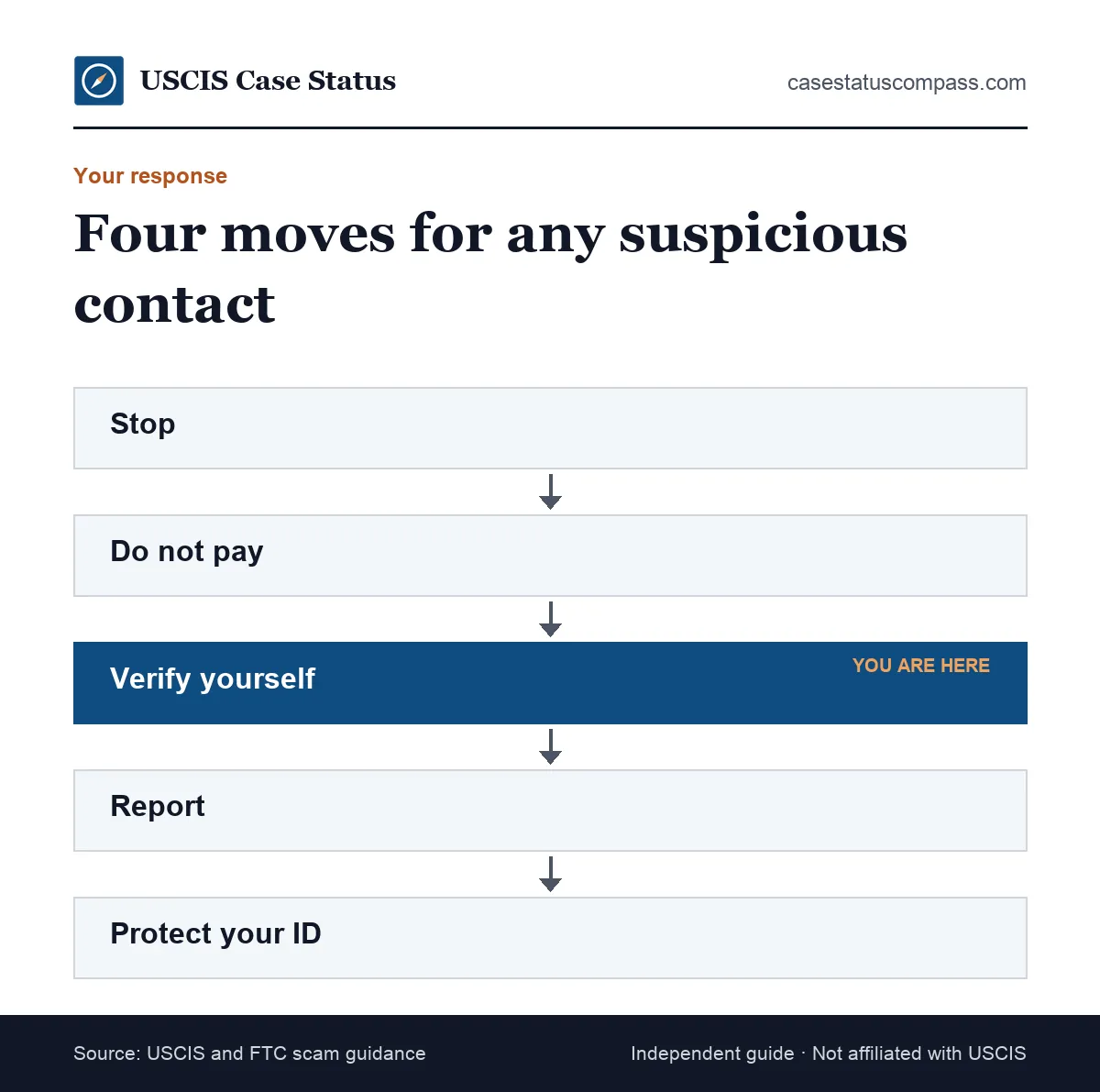
Stop, do not pay and do not share personal data. Then check the claim yourself through official channels: your USCIS online account, Case Status Online or the Contact Center at a number you look up yourself. Save evidence and report the contact.
Save the evidence
Take screenshots of messages, note phone numbers and times, and keep emails. These records make reports to the FTC and police more useful. Keep them even if you did not pay, since a repeat attempt is common.
Check the claim through an official channel
Call 800-375-5283 (Live calls and chat: Monday to Friday, 8 a.m. to 8 p.m. Eastern). Deaf and hard-of-hearing callers can use the TTY: 800-767-1833 line. If the message points to a specific notice, our guide on checking a notice step by step explains each check.
What Should You Do If You Already Paid a Scammer?
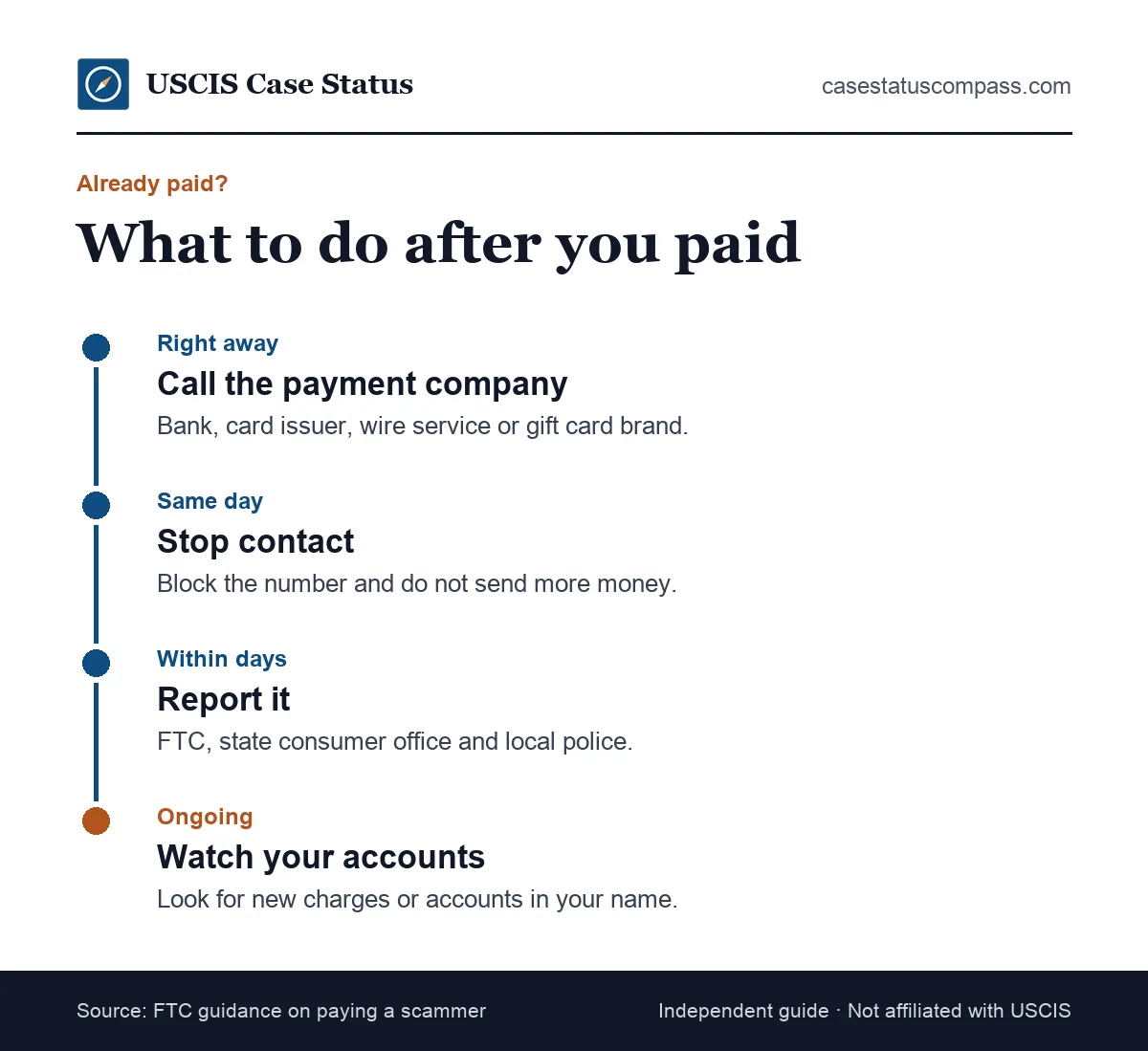
Act fast. Contact the company you used to pay, such as your bank, card issuer, wire service or gift card brand, and ask them to reverse or stop the payment. Then report the scam to the FTC and your local police, and stop all contact.
Card, bank and payment apps
Credit card charges can often be disputed. Bank transfers and payment apps are harder, but call right away and report fraud. Ask the bank to flag the account and change your login.
Gift cards, wires and crypto
Call the gift card company using the number on the back of the card, and keep the card and receipt. Contact the wire service's fraud department. For crypto, report the transaction to the exchange you used.
What If You Gave a Scammer Your Personal Information?
If you shared a Social Security number, A-Number, passport details or account passwords, treat it as possible identity theft. Change your USCIS online account password, review your two-step verification, watch your credit and use IdentityTheft.gov to make a recovery plan.
Your USCIS account and numbers
Sign in by typing the address yourself and change your password. Check that your address and contact details are yours. A stolen receipt number cannot change your case, but an account password can. Our A-Number guide explains why that number needs care.
Credit and benefits
Place a fraud alert or credit freeze with the credit bureaus. If your Social Security number was exposed, the Social Security Administration has its own fraud reporting at ssa.gov/fraud. Watch for new accounts opened in your name.
How Do You Report a USCIS Scam?
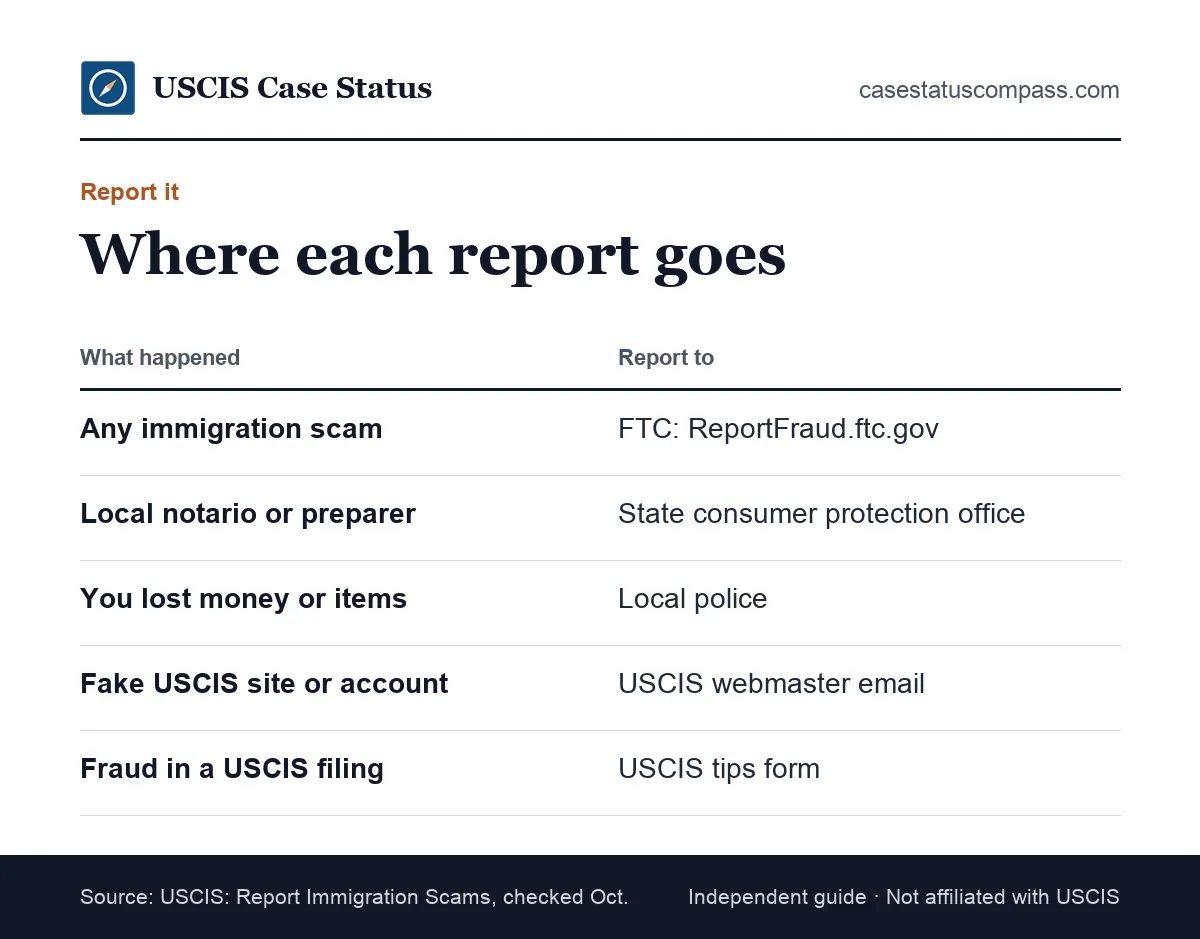
Report a USCIS scam to the Federal Trade Commission at ReportFraud.ftc.gov, and also to your state consumer protection office. Add a police report if you lost money or property. Report fake USCIS websites and social media accounts to the USCIS webmaster, and report fraud in filings through the USCIS tips form.
The reporting map
Find your situation in the first column; the table shows where to report it and why.
| Situation | Where to report | Why |
|---|---|---|
| Any immigration scam | FTC (ReportFraud.ftc.gov) | Shared with law enforcement nationwide |
| Local notario or fake consultant | State consumer protection office or attorney general | Can act against local businesses |
| You lost money or possessions | Local police | Creates a record for banks and insurers |
| Website or social account claiming USCIS ties | USCIS webmaster email (listed on uscis.gov) | Lets USCIS act on impersonation |
| Fraud in an immigration filing | USCIS tips at tips.uscis.gov | Fraud investigations |
| Possible human trafficking | National Human Trafficking Hotline | Specialized help |
What to include in any report
Give the date, the names and numbers used, the amount paid and how you paid. Attach screenshots and receipts, and keep each report's confirmation number. Use the same facts in every report.
How Do You Report an Immigration Scam to the FTC?
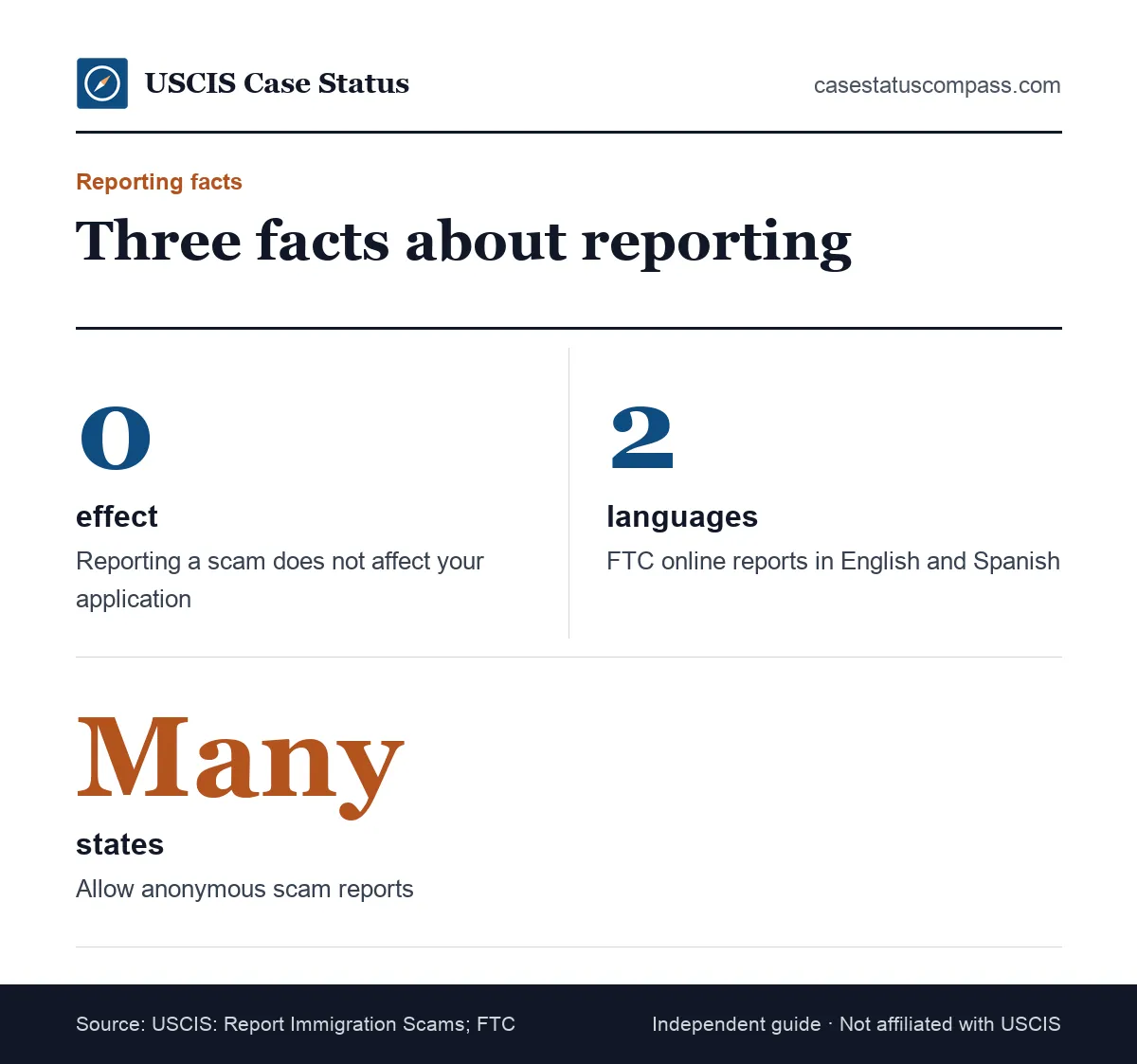
File online at ReportFraud.ftc.gov in English or ReporteFraude.ftc.gov in Spanish. The FTC shares reports with law enforcement partners and uses them to spot patterns. It does not resolve individual cases, but your report can help investigators stop a scammer and warn others. Describe the USCIS scam with the caller's name, phone number, website and how you paid, so investigators can match it to other reports.
The online report
The form asks what happened, how you were contacted, and how much you paid. You can report even if you did not lose money; reports of attempts help too. Save the report number.
Other languages and phone reports
The FTC also takes reports by phone, with help in other languages. Look up the current number on ftc.gov, not in messages or old flyers, since scammers also fake FTC contacts.
Reporting to Your State and Local Police
USCIS points scam victims to their state consumer protection office, often part of the state attorney general, and to local police when money or property was lost. USCIS notes that many states accept anonymous reports. File both if you can: the state office handles consumer complaints, while police can investigate theft.
State consumer protection offices
USCIS keeps a state-by-state table of these offices on its Report Immigration Scams page. Some states route immigration complaints to the state bar, others to a special unit. A state report matters most when the scammer has a storefront or office near you.
Local police
A police report helps with bank disputes and creates an official record of the loss, so bring screenshots, receipts and names. Ask for the report number and an officer's name, and give a copy to your bank.
How Do You Report a Fake USCIS Website or Email?
Forward fake emails to the USCIS webmaster and report websites or social accounts that claim to be USCIS. The webmaster address is listed on the uscis.gov Report Immigration Scams page. Also report the scam to the FTC and to the email or social media platform.
Forwarding a suspicious email
Forward the full email without clicking links or opening attachments. If you are unsure whether a message is real, USCIS suggests forwarding it to the webmaster for review. As of October 2026, the address is [email protected] (for reporting websites or social media accounts falsely claiming to be USCIS).
Reporting to the platform
Social media sites and email providers let you report impersonation and phishing. Use their built-in tools so the fake page comes down for everyone. Do not message the account or argue with it, since replies confirm your profile is active.
When Should You Use the USCIS Tip Form?
Use the USCIS tips form at tips.uscis.gov to report suspected fraud in immigration filings, such as fake marriages, document fraud, identity fraud or employment fraud. Use the FTC and state routes for scams aimed at you. The tips form does not answer you or recover money.
Scam vs fraud: the difference
A scam targets you: someone takes your money or data. Fraud in a filing means someone lies to USCIS, such as a sham marriage or fake documents. If a notario filed false information in your name, that touches both.
Program-specific fraud
USCIS also has pages for reporting H-1B, H-2B and EB-5 fraud and abuse. Workers who were charged illegal recruitment fees or misled about job terms can use these routes, alongside an attorney's advice.
Human Trafficking and Labor Exploitation
If someone is holding your passport, forcing you to work or threatening your family over immigration status, that may be human trafficking, not just a scam. USCIS points people to the National Human Trafficking Hotline. In an emergency, call 911. As of October 2026, the line is the National Human Trafficking Hotline at 1-888-373-7888 (24/7; text HELP or INFO to 233733).
Warning signs
Warning signs include an employer keeping your documents, debts that keep growing, restricted movement or threats about deportation. A trusted attorney or nonprofit can explain your options confidentially. Some victims may qualify for special protection.
Keep your documents with you
USCIS advises keeping your passport and identity documents with you. No legitimate employer or helper needs to hold your original passport. Give copies, never originals, unless an official process requires it.
Will Reporting a Scam Affect My Immigration Case?
No. USCIS states that reporting scams will not affect your immigration application or petition. Many states also accept anonymous reports if you are worried about sharing your name. Reporting a USCIS scam helps protect others too, and your case continues as normal.
Why people stay silent
Many victims fear that contacting any agency will draw attention to their status. Reporting helps investigators stop the same person from targeting your neighbors. You can report through the FTC without dealing with immigration officials.
If your case was touched by the scam
If a scammer filed something in your name, an attorney can help you tell USCIS what happened, ideally before you contact USCIS yourself. Gather any copies of what was filed and any receipts.
How to Protect Yourself Before You File
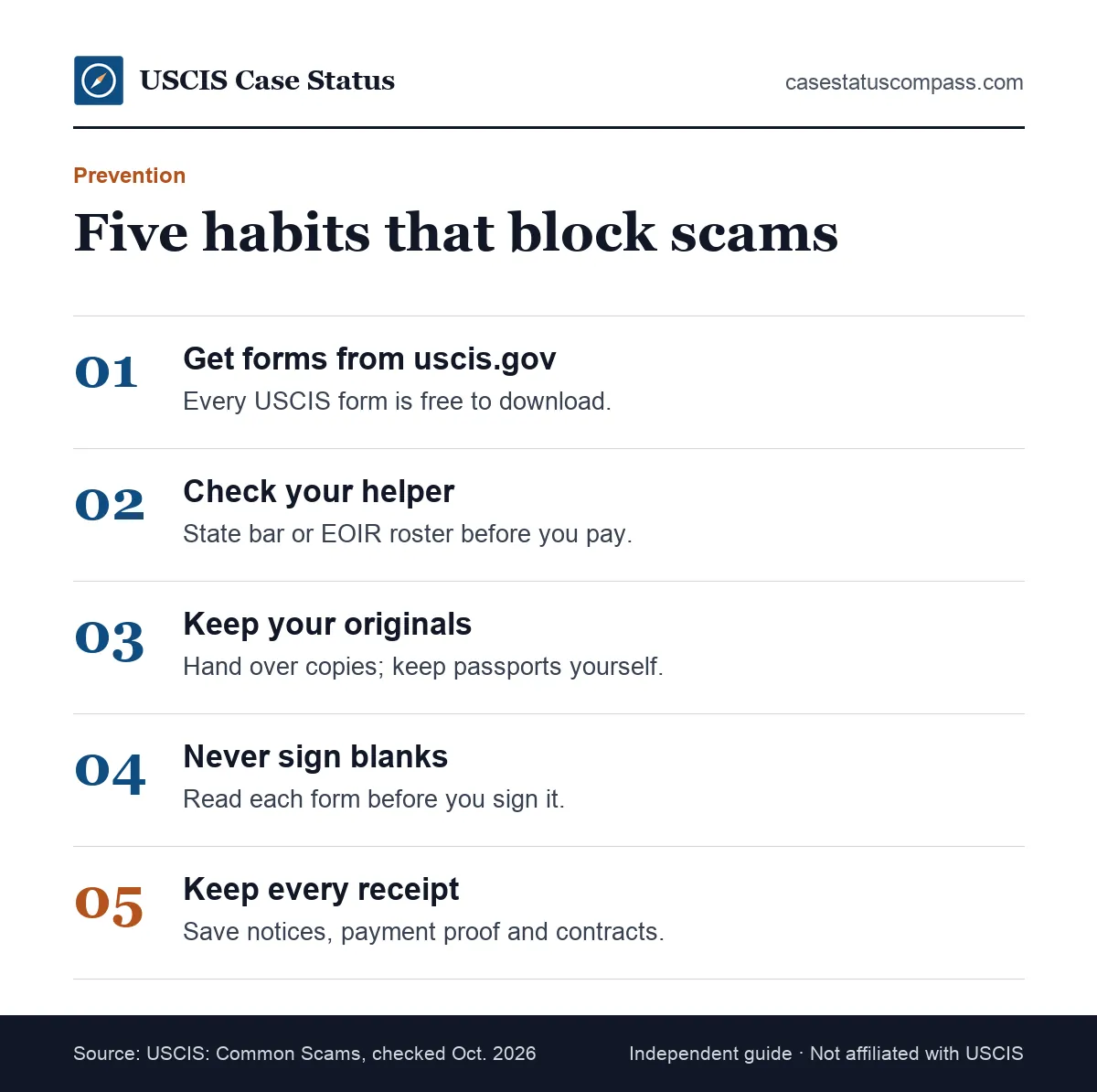
Download forms free from uscis.gov, check your helper's license or accreditation, keep originals, read before you sign and keep copies of everything. Pay fees only through your USCIS online account, Pay.gov or the method in the form instructions. Most USCIS scams fail against these simple habits. They take little time, and each one protects your money, your data or your case.
Before you hire help
Ask for a written contract that lists services and fees. Check the bar number or the EOIR roster. Ask for copies of every form filed for you and of every receipt notice USCIS sends.
Keep your own records
Keep receipts, contracts and copies of every notice. Create a free online account and link your paper cases so you can see notices yourself. Then you never depend on a helper to tell you what USCIS said.
Paying fees safely
Pay only inside your own USCIS online account, through Pay.gov, or as the form instructions describe. A helper should never ask you to send fee money to a personal account, a payment app or gift cards.
A USCIS Scam Call, Worked Example
This fictional example shows a typical impersonator call and the right response. The pattern matches warnings USCIS and the FTC have published: a spoofed number, a threat, an unusual payment and pressure to stay on the line. Read it as a model for what to do in the first few minutes.
The call
Maria, a fictional green card applicant, gets a call showing a government number. The caller says her fingerprints "failed," that a $900 fine is due today and that officers will arrive if she hangs up. He asks her to buy gift cards and read the numbers.
The right response
Maria says she will call back and hangs up. She signs in to her account and sees no new notice. She calls the Contact Center at the number listed on uscis.gov, which confirms no fine. She then files reports with the FTC and her state and blocks the number.
If X, Do Y: A USCIS Scam Decision Table
When you are not sure what to do next, most situations call for one of a few moves: hang up and call back, check your own account, call your bank, report, or see an attorney. The table lists common situations and the first move for each, before anything else.
Scam situations and the right response
Find the row that matches what happened, then take the step on the right as soon as you can.
| If this happens | Do this |
|---|---|
| A caller demands payment for your case | Hang up; call the Contact Center yourself |
| An email says you are approved and must pay | Check Case Status Online; forward the email to the USCIS webmaster |
| A helper offers to file but has no bar number | Check the EOIR roster; do not pay until verified |
| You paid by card or bank | Call your bank today; then report to the FTC |
| You paid with gift cards | Call the gift card company; keep the cards and receipts |
| Someone filed in your name without consent | Talk to an attorney before contacting USCIS |
| Someone holds your passport and controls your work | Contact the National Human Trafficking Hotline |
When the scam touches a deadline
If a scam caused you to miss a real deadline, such as an RFE response, act quickly. Our request for evidence guide explains how RFE deadlines work. An attorney can tell you whether a late filing or a motion may help.
When Should You Get Legal Help After a Scam?
Get help from a licensed attorney or DOJ-accredited representative if a scammer filed forms for you, kept your documents, gave you false advice that led to a denial or court case, or used your identity. Legal help is also wise if you are unsure whether a filing was ever made.
Free and low-cost options
Nonprofit organizations with accredited representatives often offer low-cost help. The EOIR roster lists recognized organizations by state. Some law schools run clinics. Our case help hub lists other official routes, such as the CIS Ombudsman.
Questions to ask a new helper
Ask what they can and cannot promise, how they charge, and whether they will give you copies of everything filed. A good attorney will never guarantee approval.
Frequently Asked Questions
Does USCIS ever call people?
Yes, USCIS may call applicants in some situations, such as follow-ups about a case or an appointment. But a real USCIS call never demands payment, never threatens immediate arrest and never asks for gift cards or wire transfers.
Can USCIS ask for payment by email?
No. USCIS says it does not ask for fees by phone or email, and it does not ask you to pay a person. Fees are paid through your USCIS online account, Pay.gov for some fees, or with your filing as the form instructions explain. An email with a payment link is a scam.
Is it safe to give my receipt number to someone?
A receipt number cannot change your case, but scammers use it to sound official and to look up your status. Share it only with people helping you, such as your attorney, accredited representative or employer. Never share your USCIS online account password or two-step code with anyone.
How do I know if an immigration website is real?
Official U.S. government websites end in .gov, and the USCIS site is uscis.gov. Look-alike sites may add words or dashes or use .com or .org. Type the address yourself or use a saved bookmark.
Are notarios legal in the United States?
Notaries public are legal, but in the U.S. they only witness signatures. They cannot give immigration legal advice, choose forms for you or represent you. A notario who offers to handle your case is acting outside the law.
What if a scammer has my A-Number?
Your A-Number alone does not let someone change your case, but combined with other details it can help identity theft. Secure your USCIS online account, watch for notices you did not expect and consider a credit freeze. Report the scam to the FTC and use IdentityTheft.gov if other data was also exposed.
Can I report a scam if I did not lose money?
Yes. The FTC and state offices want reports of attempts, not only losses. Include the phone number, email or website used, the date and what the person said.
How can I tell if a USCIS scam call is fake?
A USCIS scam call usually threatens arrest, demands payment today and asks for gift cards, wires or apps. Caller ID can be spoofed, so a government number proves nothing. Hang up, then call the Contact Center yourself using the number on uscis.gov.
Does USCIS charge for forms?
No. Every USCIS form is free to download from the All Forms page on uscis.gov. Filing fees are separate and go only through official channels.
Sources
- USCIS: Common Scams. www.uscis.gov/scams-fraud-and-misconduct/avoid-scams/common-scams. Accessed Oct 27, 2026.
- USCIS: Report Immigration Scams. www.uscis.gov/scams-fraud-and-misconduct/avoid-scams/report-immigration-scams. Accessed Oct 27, 2026.
- USCIS: Report Fraud (Tips). www.uscis.gov/scams-fraud-and-misconduct/report-fraud. Accessed Oct 27, 2026.
- FTC: Immigration-related scams. consumer.ftc.gov/immigration. Accessed Oct 27, 2026.
- FTC: ReportFraud.ftc.gov. reportfraud.ftc.gov/. Accessed Oct 27, 2026.
- EOIR: Recognition and Accreditation Roster. www.justice.gov/eoir/recognition-and-accreditation-roster-reports. Accessed Oct 27, 2026.
- USCIS Contact Center. www.uscis.gov/contactcenter. Accessed Oct 27, 2026.
- USCIS Form G-1055, Fee Schedule. www.uscis.gov/g-1055. Accessed Oct 27, 2026.
- USCIS: Online Account and Technical Support. www.uscis.gov/tools/uscis-tools-and-resources/online-account-and-technical-support. Accessed Oct 27, 2026.
- USCIS: Filing Fees (updated 02/12/2026). www.uscis.gov/forms/filing-fees. Accessed Oct 27, 2026.
- USCIS: How to Make an Expedite Request (updated 09/08/2026). www.uscis.gov/forms/filing-guidance/how-to-make-an-expedite-request. Accessed Oct 27, 2026.
- USCIS: Temporary Protected Status (updated 10/20/2026). www.uscis.gov/humanitarian/temporary-protected-status. Accessed Oct 27, 2026.
- USCIS Form G-1055 Fee Schedule, Edition 10/16/26. www.uscis.gov/sites/default/files/document/forms/g-1055.pdf. Accessed Oct 27, 2026.
- DOJ EOIR: Immigration Court Information. www.justice.gov/eoir/immigration-court-information. Accessed Oct 27, 2026.
- DOJ EOIR: Customer Service Initiatives (updated May 29, 2025). www.justice.gov/eoir/customer-service-initiatives. Accessed Oct 27, 2026.
- DHS Blue Campaign: Report Human Trafficking (updated 07/17/2026). www.dhs.gov/blue-campaign/report-human-trafficking. Accessed Oct 27, 2026.
casestatuscompass.com is an independent publication and is not affiliated with USCIS or any government agency. This page is general information, not legal advice. For denials, court or asylum matters, consult an immigration attorney or a DOJ-accredited representative.