Contents · 42 sections
- What Is Immigration Court Case Status?
- USCIS vs Immigration Court: Which Agency Has Your Case?
- How Do You Know If Your Case Is in Immigration Court?
- How to Check Your Immigration Court Case Status Online
- What Does the EOIR Automated Case Information Page Show?
- Why Does the Court Portal Say No Record Was Found?
- What Is the EOIR Case Status Number?
- How Does the Immigration Court Hotline Work?
- How Do You Spot a Fake EOIR Call?
- Can You Check Your Court Status in Spanish?
- How Do You Check Your Next Immigration Court Date?
- Master Calendar vs Individual Hearing: What Is the Difference?
- Can Your Immigration Court Date Change?
- What Happens If You Miss Your Immigration Court Hearing?
- How Do You File a Change of Address with Immigration Court?
- How Fast Must You Report a Move to the Court?
- Does Changing Your Address with USCIS Update the Court?
- What Is a Change of Venue in Immigration Court?
- How Do You Find Your Immigration Court?
- What Is EOIR Respondent Access?
- Immigration Court Records Search: Can You See Your Full File?
- Can Anyone Search Immigration Court Cases by Name?
- Are Third-Party Immigration Court Trackers Safe?
- What Does the Board of Immigration Appeals Do?
- How Do You Check a BIA Appeal Status?
- What Does "No Appeal Was Received" Mean on a BIA Case?
- Where Can You Find BIA Contact Details and Forms?
- How Do You File a BIA Notice of Appeal?
- How Long Do BIA Appeals and Motions Take?
- What Are the EOIR Filing Fees?
- What Is a Motion to Reopen in Immigration Court?
- How Do Immigration Court Cases Move from Start to Finish?
- How Do Asylum Cases Show in Immigration Court?
- How Do You Check Court Status for a Detained Person?
- How Do Bond Hearings Work in Immigration Court?
- Why Should You Get an Attorney or Accredited Representative?
- Who Can Represent You in Immigration Court?
- How Do You Find Free Legal Help for Immigration Court?
- What Should You Bring to Immigration Court?
- What Should You Do After Checking Your Court Status?
- How Does Immigration Court Fit with Other Immigration Tools?
- Frequently Asked Questions
The short answer
To check your immigration court case status, enter your 9-digit A-number and nationality at EOIR's Automated Case Information portal, or call the automated EOIR hotline at 1-800-898-7180. Both are free, run by the Justice Department, and show your next hearing, the judge's decision and any appeal. USCIS tools do not show court cases.
At a glance
| Who runs the courts | The Executive Office for Immigration Review (EOIR), U.S. Department of Justice |
| Online tool | Check immigration court cases online at acis.eoir.justice.gov with your A-number |
| Phone | EOIR case hotline: 1-800-898-7180 (24/7, automated) |
| Number you need | Your A-number, not a USCIS receipt number |
| About this site | An independent guide. We are not EOIR or USCIS and cannot see your case. |
What Is Immigration Court Case Status?
Your immigration court case status is the record EOIR keeps on a removal case: the court, the judge, the next hearing and any decision. The Executive Office for Immigration Review (EOIR) is part of the Justice Department and runs every United States immigration court.
What EOIR is and is not
Its immigration judges decide whether a person can stay in the country and whether relief such as asylum is granted. EOIR does not issue green cards, work permits or visas, and arrests are handled by ICE, part of DHS.
Who has a case in immigration court
You have a court case only if DHS filed a charging document, usually a Notice to Appear (Form I-862), with the court. Cases often follow an asylum referral, a denied USCIS application, a border encounter or an ICE arrest.
USCIS vs Immigration Court: Which Agency Has Your Case?
USCIS decides applications you file, such as Form I-485 or Form N-400. Immigration court hears removal cases that DHS files against you. They use different numbers, tools and decision makers, and one person can have both at once. For example, a person waiting on a USCIS application can still receive a Notice to Appear, so check both tools and tell your representative about every pending case.
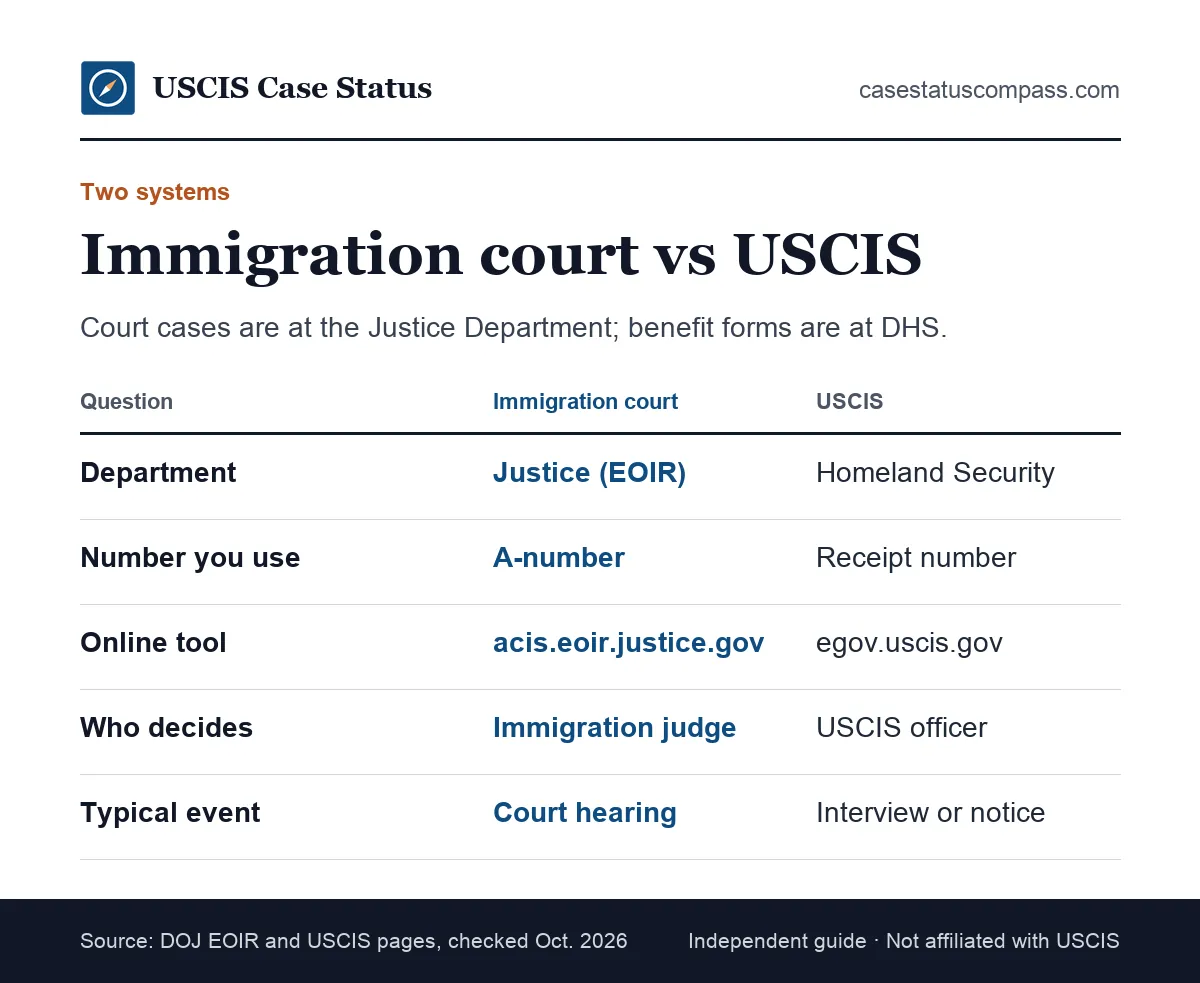
Side-by-side comparison
Match the number and notice you hold to the right column before you search, because each agency's tool rejects the other's numbers.
| Point | Immigration court (EOIR) | USCIS |
|---|---|---|
| Parent department | Department of Justice | Department of Homeland Security |
| Main number | A-number (Alien Registration Number) | 13-character receipt number |
| Online status tool | ACIS at acis.eoir.justice.gov | Case Status Online at egov.uscis.gov |
| Phone line | EOIR hotline, automated 24/7 | USCIS Contact Center |
| Who decides | Immigration judge | USCIS officer |
| Appeal body | Board of Immigration Appeals | Administrative Appeals Office (most forms) |
If your paper names an immigration judge or a court street address, the EOIR column is the one that applies to you.
Why "USCIS court" searches miss the mark
People search for "USCIS court" or "USCIS court hearing," but USCIS holds no court hearings. A notice naming an immigration judge came from EOIR; a field office interview notice came from USCIS. Our uscis case status guide explains the receipt-number check.
How Do You Know If Your Case Is in Immigration Court?
Your case is in immigration court if a Notice to Appear was filed with a court or you received a hearing notice from EOIR. The fastest check is the EOIR portal: if your A-number returns a court and hearing, the court has your case.
The Notice to Appear
The Notice to Appear (NTA) lists the charges DHS makes against you and your A-number, and it may not include a hearing date. The court case starts when DHS files the NTA with a court, which can happen weeks after you receive your copy.
Referral from an asylum office
If a USCIS asylum office did not grant your affirmative case, it may have referred it to court for a judge to decide. Our asylum status guide explains how the affirmative and court paths differ.
How to Check Your Immigration Court Case Status Online
To check EOIR case status online, open the official Automated Case Information portal, type your 9-digit A-number, select your nationality and submit. It is free and needs no login. Results appear right away and cover the most recent case tied to that number. If a lawyer represents you, compare the result with their file, since court notices also go to your representative of record.
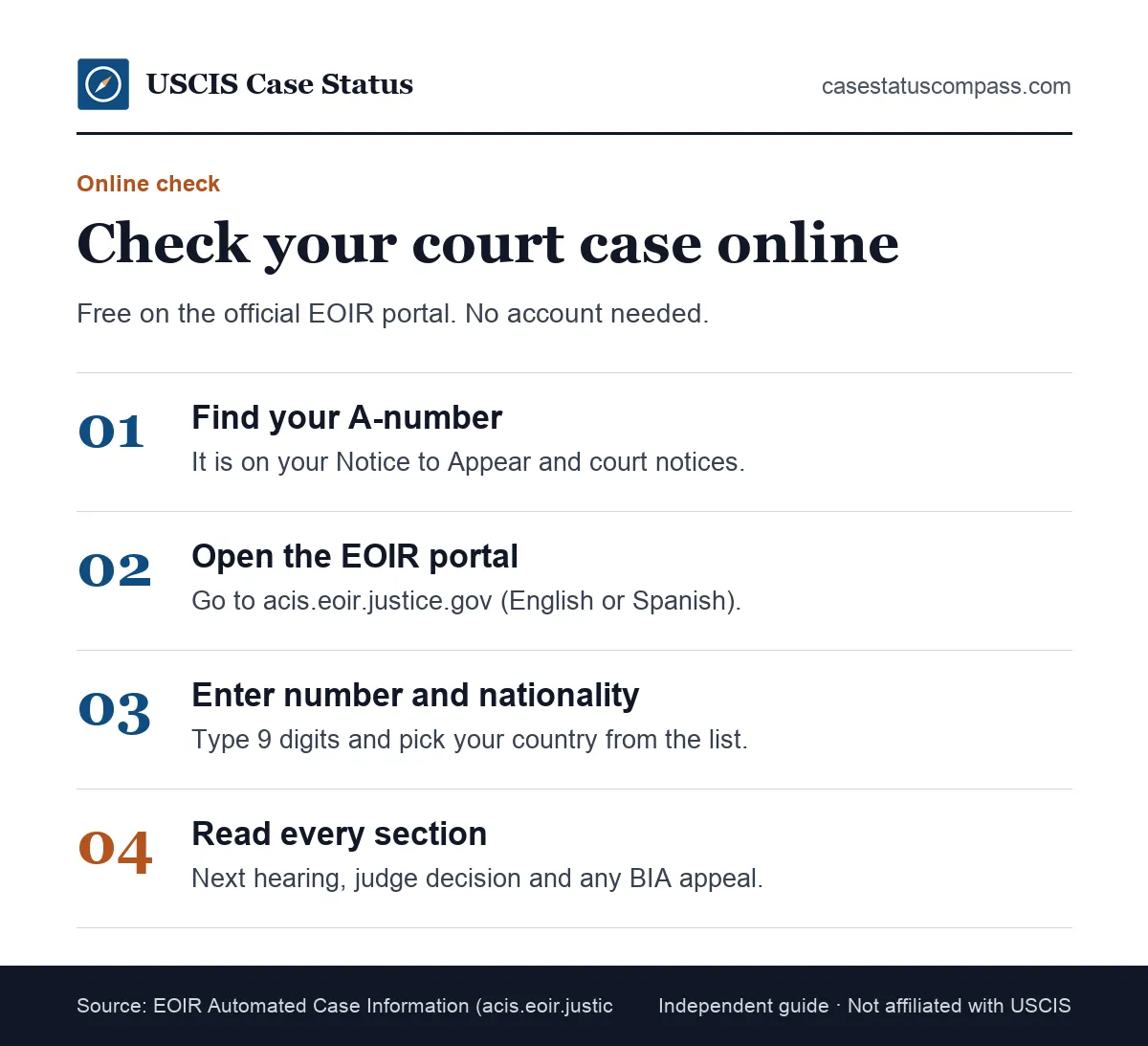
Step-by-step online check
- Find your A-number on your NTA, a hearing notice or a court decision.
- Open Check immigration court cases online at acis.eoir.justice.gov with your A-number.
- Choose English or Español at the top.
- Type the number without the letter A or dashes.
- Select your nationality and submit.
- Read every section, not just the hearing line.
What you need before you start
You need only your A-number and the nationality on your court papers: no receipt number, password or payment. The page is protected by hCaptcha, so you may see a short human check. If your papers are lost, many USCIS notices also print the A-number near the top.
What Does the EOIR Automated Case Information Page Show?
The EOIR automated case information page shows basic details for the most recent court case tied to your A-number: the next hearing, any judge's decision, the court address and Board activity. EOIR says the information is for convenience only. Treat it as a pointer to your paper record and confirm anything important with the court or your representative.
Next hearing details
The hearing section lists the date, time and type of your next hearing, the court and often the judge. It may say whether the hearing is in person or by video. Compare each detail with your latest paper notice.
Judge decision section
If a judge has ruled, ACIS shows the decision and its date, not the full order or reasons. EOIR says documents issued by the court or the Board are the only official determinations, so never plan your next step from the summary.
What ACIS will not show
- Bond hearing details: EOIR says to contact your local court
- Older cases when you have more than one: only the most recent appears
- Copies of documents filed by you or DHS
- Anything about a USCIS application
Why Does the Court Portal Say No Record Was Found?
A no-record result usually means a typing error, a wrong nationality, a different A-number, or a case DHS has not yet filed with the court. It does not prove you have no case, so recheck every detail and try again later.
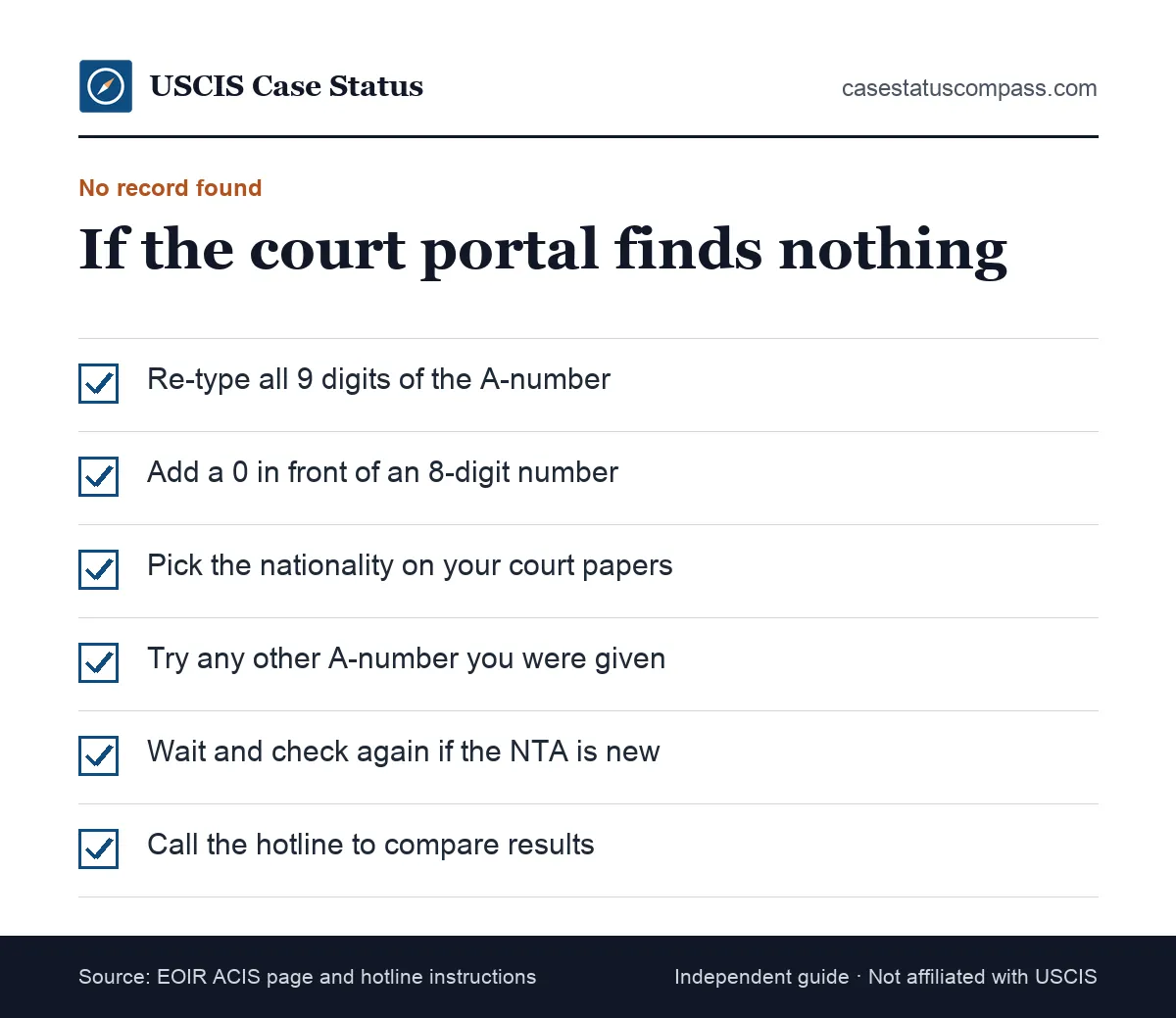
Typing and format problems
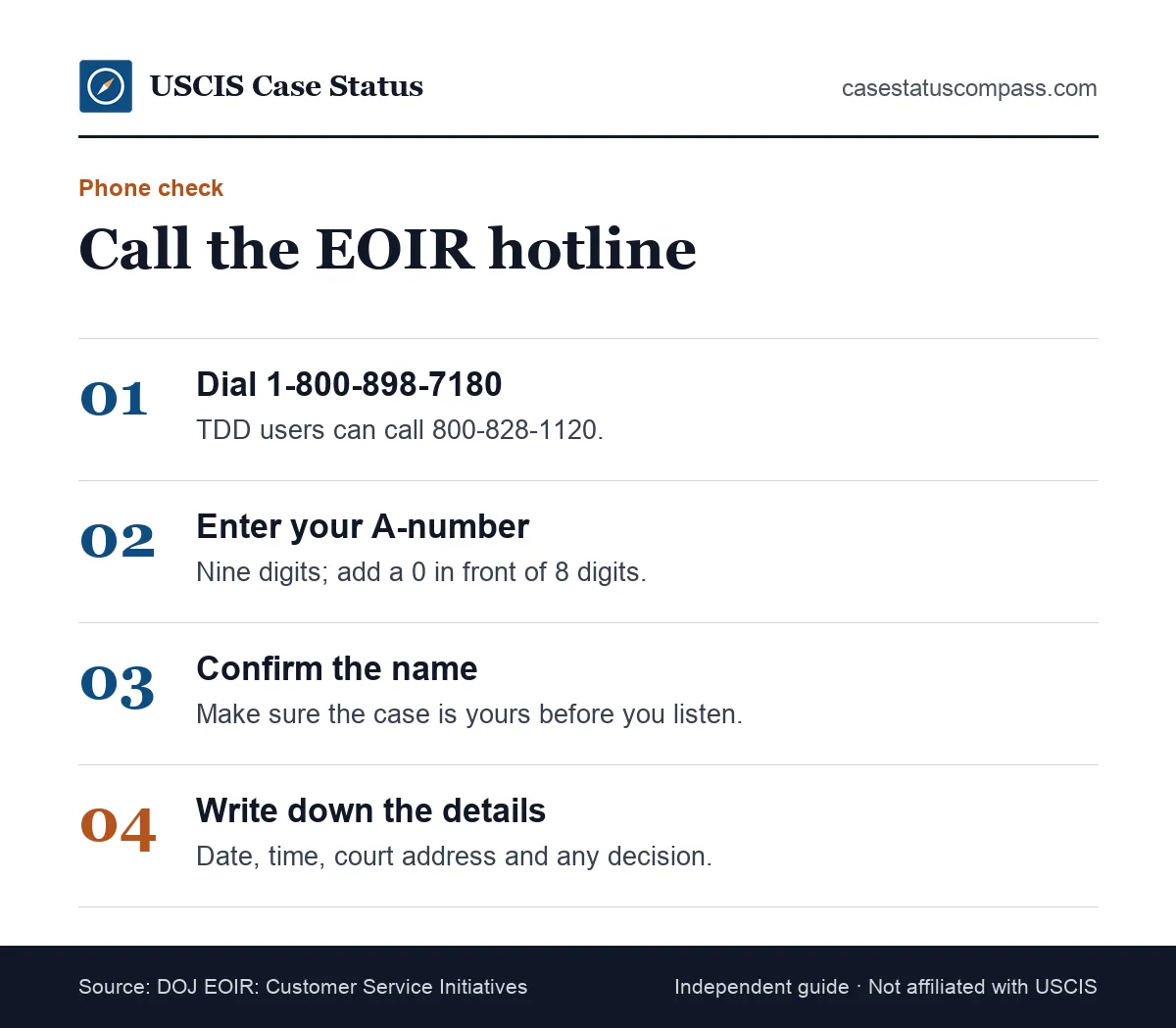
EOIR's hotline instructions say to enter the full 9-digit A-number, adding a leading zero if yours has 8 digits. Use the same rule online, without the letter A, spaces or dashes. Then check the nationality drop-down: it must match the country listed on your Notice to Appear, not your current passport if that changed.
A new Notice to Appear
If your NTA is recent, the court may not have it yet, so ACIS has nothing to find. Check about once a week and watch your mail. Some people hold two A-numbers by mistake; try each one.
What Is the EOIR Case Status Number?
The EOIR case status number is your A-number, the Alien Registration Number DHS uses across your file. Immigration court tracks cases by A-number only, so a USCIS receipt number such as IOE or MSC will not work in EOIR tools. Every family member in proceedings has a separate number, so write each one down.
Where to find your A-number
Look at the top of your Notice to Appear, any hearing notice or a judge's order; it may also appear on a work permit or green card. Your A-Number is the 'USCIS#' printed on the front of green cards issued after May 10, 2010. Our alien number guide shows each place it is printed.
A-number vs receipt number
People often enter the wrong number and get no result. This table shows which number each tool expects.
| Number | Looks like | Used for |
|---|---|---|
| A-number | 9 digits, sometimes with an A in front | Immigration court, BIA, your DHS file |
| USCIS receipt number | 3 letters plus 10 digits | One USCIS application or petition |
| Online Account Number | Shown in your USCIS account profile | Your USCIS online account only |
How Does the Immigration Court Hotline Work?
The immigration court hotline is an automated EOIR phone line that reads your case details aloud after you enter your A-number. As of October 2026: EOIR case hotline: 1-800-898-7180 (24/7, automated). It gives the same information as the online portal, which helps if you have no internet or are calling for a detained relative. Have the A-number and a pen ready before you dial, because the menu moves quickly.
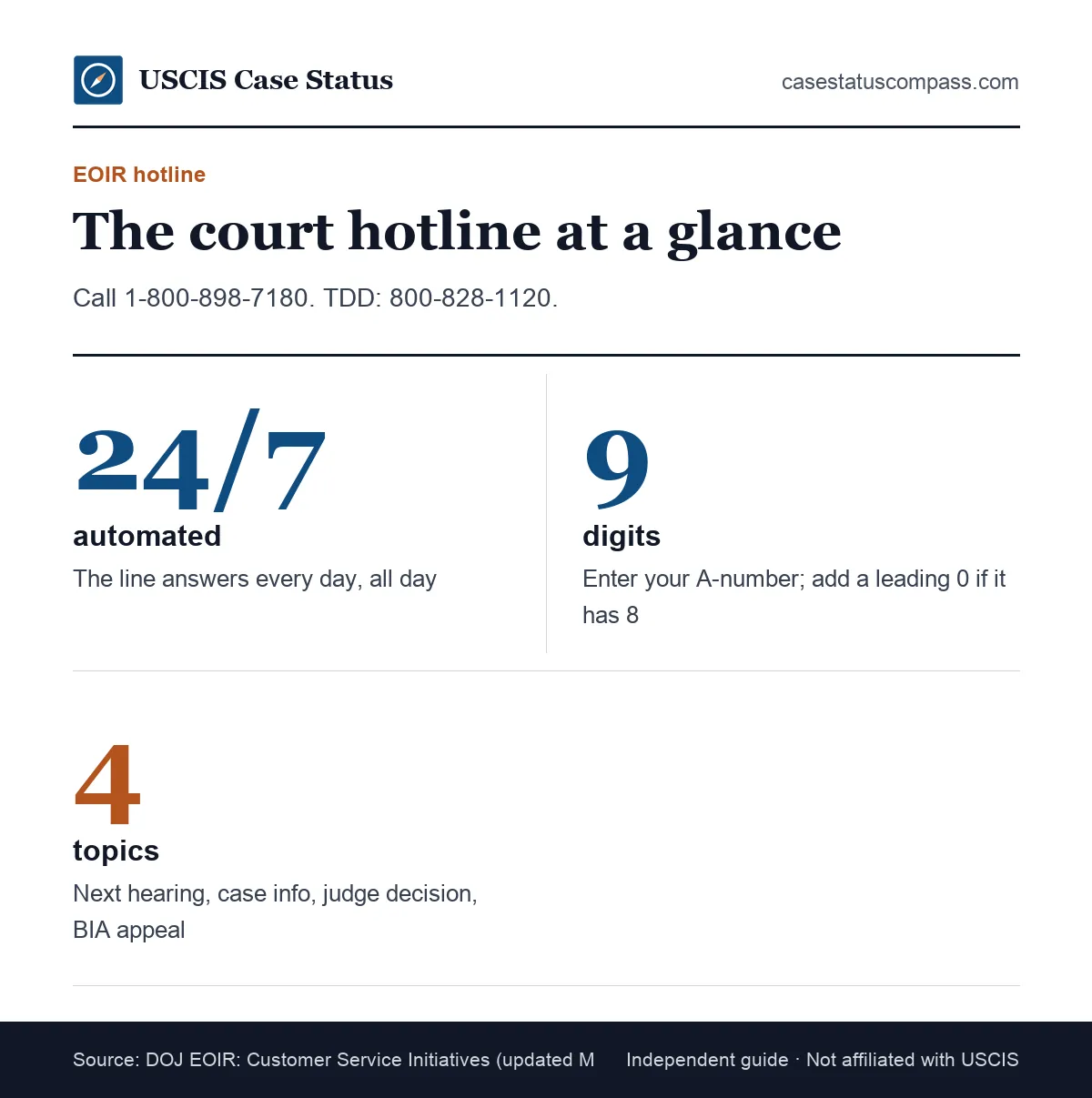
Calling the EOIR case status phone number
The EOIR case status phone number is 1-800-898-7180, and TDD users can call 800-828-1120. Because the line is automated, there is no wait for an agent. It also cannot answer questions or change anything, so call your local court clerk for filing questions.
What the recording tells you
The hotline covers four areas: your next hearing date, time and place; case processing information; the judge's decision; and Board of Immigration Appeals information. Choose each option in turn and replay anything you missed.
How Do You Spot a Fake EOIR Call?
EOIR warns that scammers spoof its number, so a familiar number on your screen proves nothing. If a caller demands payment to stop a deportation or fix a hearing, hang up and check the portal yourself. Our uscis scams guide lists warning signs that apply to court cases too.
Can You Check Your Court Status in Spanish?
Yes. The EOIR automated case information portal has an Español toggle, so Spanish speakers see the same details. Many people search for "EOIR fecha de corte," which means court date; the portal is the official place to confirm it. The hotline also offers a Spanish menu.
Using the Spanish portal
Open Check immigration court cases online at acis.eoir.justice.gov with your A-number and select Español. The fields stay the same, A-number and nationality, and the results use Spanish labels for the hearing, decision and appeal sections. Courts also provide interpreters at hearings, so tell the court which language you speak.
How Do You Check Your Next Immigration Court Date?
To check immigration court date details, use the EOIR portal or hotline and match the result to your latest hearing notice. Check again a few days before every hearing, because dates change and a missed date can mean a removal order.
Read your hearing notice first
Your immigration court date notice lists the date, time and the court's street address, sometimes with a courtroom. Courts mail notices to the address on file, so an old address means a missed notice.
Check before every hearing
Recheck your next hearing one week before and again the day before. Use the address on the notice, not a map search, and note that the time is local to the court. Bring a printout of the result.
Master Calendar vs Individual Hearing: What Is the Difference?
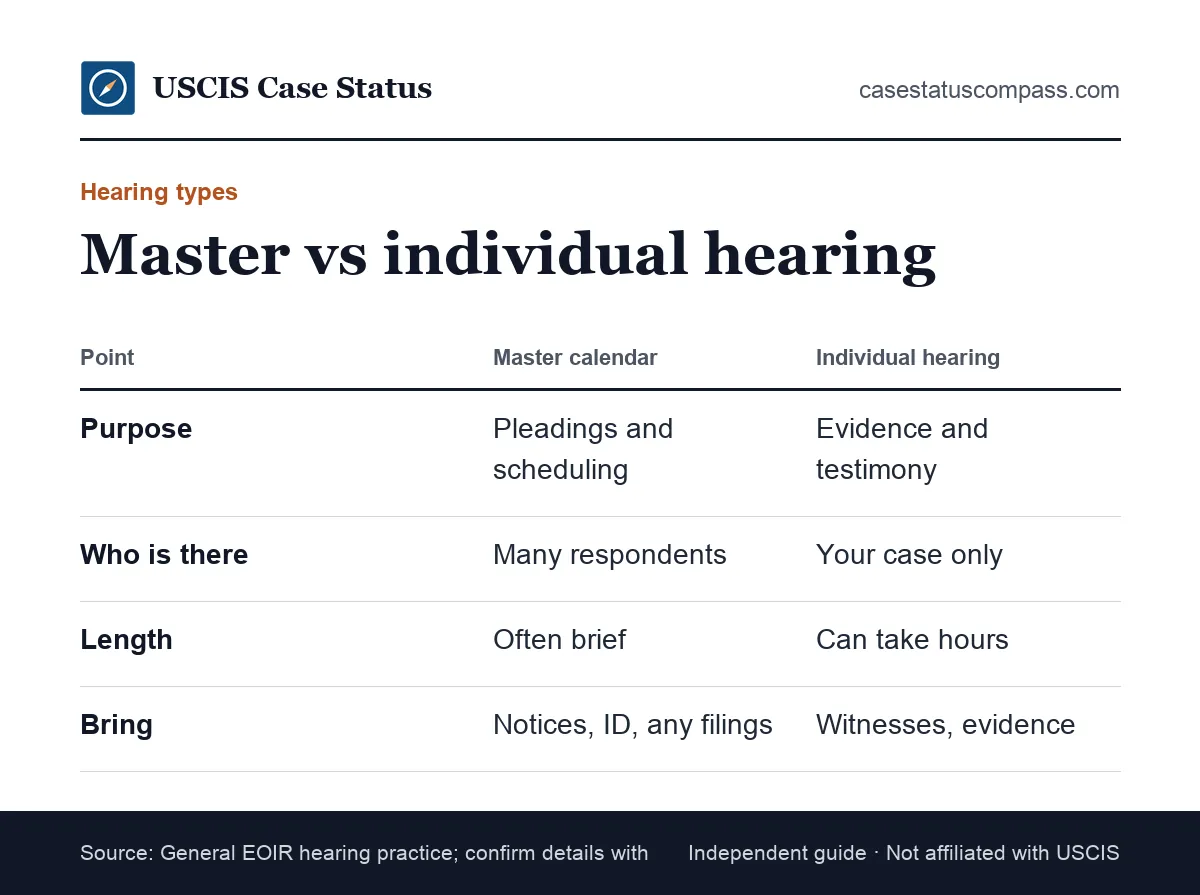
A master calendar hearing is a short group session where the judge handles pleadings and sets schedules. An individual hearing, often called a merits hearing, is where the judge hears evidence and testimony and usually decides. Your immigration court case status result names the hearing type, so you know which kind to prepare for.
Master calendar hearings
Many respondents wait in the same courtroom. The judge confirms your identity, the charges and whether you have a lawyer, and may set deadlines to file applications. Attend even if it seems routine.
Individual (merits) hearings
You, your witnesses and the DHS attorney present the case, which can last hours. The judge may rule at the end or later in writing. Prepare early, since evidence deadlines usually fall well before the hearing.
Can Your Immigration Court Date Change?
Yes. Courts reschedule when a judge's calendar changes, a court closes or a party asks for more time. The court then mails a new notice to your address on file, and the portal may show the change first, so check regularly.
Court closures and operational status
EOIR publishes an operational status page for closures, linked from ACIS. EOIR's court information page says a filing deadline that falls on a closure day moves to the next business day the court is open.
When the date conflicts with something else
Never skip a hearing for work, travel or a USCIS appointment; only the judge can move it, usually after a written motion. Our postponing an asylum hearing guide explains continuance requests in asylum cases.
What Happens If You Miss Your Immigration Court Hearing?
If you miss a hearing, the judge can order you removed in absentia, meaning in your absence, and that order is hard to undo. Check your status right away, gather proof of why you missed it, and contact an attorney or accredited representative immediately.
Check what the judge decided
Use the portal or hotline to see whether a decision was entered or a new date was set. Ask the court for a copy of any written order, and note the date you learned about it.
Options after a missed hearing
A motion to reopen immigration court proceedings may be possible in limited situations, such as lack of proper notice or exceptional circumstances. Deadlines are strict. Our motion to reopen page explains the USCIS version; get legal advice for court cases.
How Do You File a Change of Address with Immigration Court?
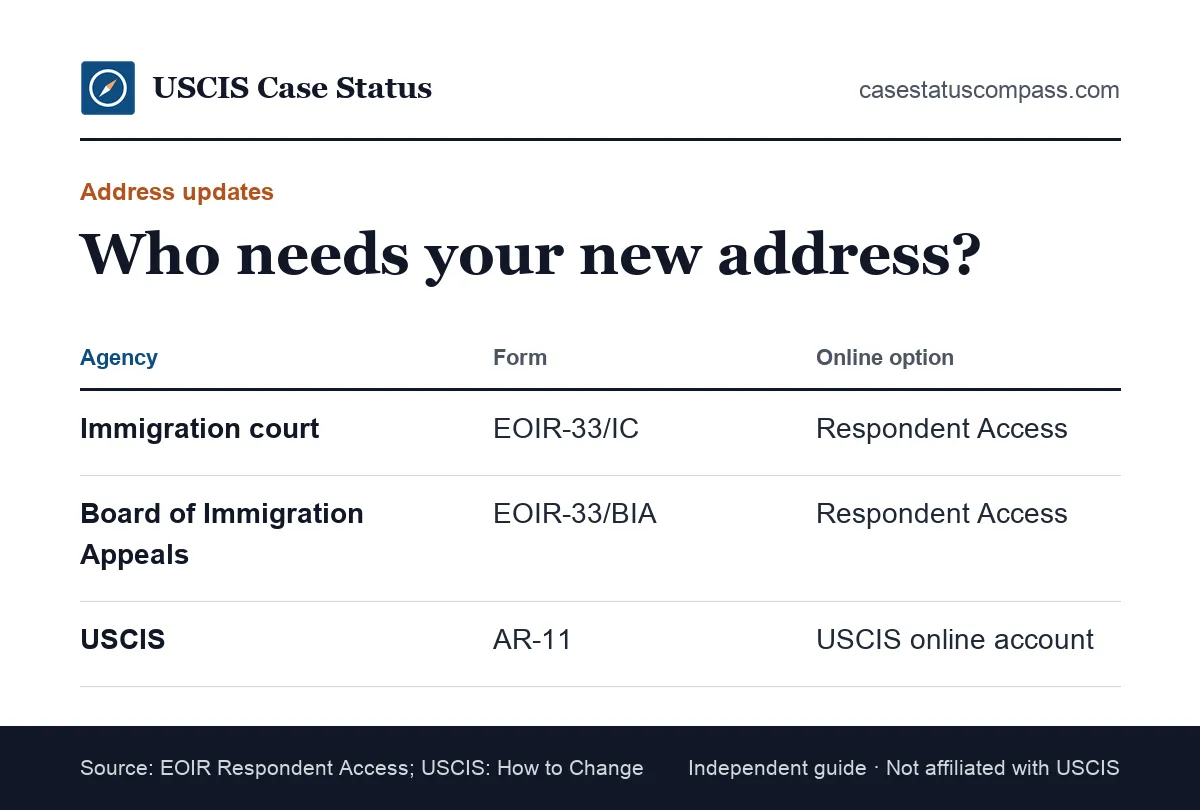
To file a change of address immigration court update, submit Form EOIR-33/IC to the court with your case, or use the change-of-contact tool in EOIR Respondent Access. Telling USCIS or the Post Office does not update the court. File the update even if you move again soon, because every notice goes to the last address the court has.
Form EOIR-33/IC
Form EOIR-33/IC is the immigration court's change of address and contact form. Send it to the court where your case is pending and keep a copy with proof of filing. If you have a lawyer, let them file it, since DHS may also need a copy.
Online through Respondent Access
EOIR's Respondent Access site has a "Change Contact Info" form that needs no login, and respondents can also file the EOIR-33 there. Save the confirmation page, because it shows when the court learned your new address.
How Fast Must You Report a Move to the Court?
Quickly. For a change of address EOIR update, the rule is that you must tell the immigration court or BIA within five working days on Form EOIR-33, or online through Respondent Access. Do not assume the USCIS rule applies; update the court as soon as you move. If you are staying somewhere temporary, give an address where mail will reliably reach you and update it again when you settle.
What happens if the court has an old address
The court mails hearing notices and orders to the address on file. If it is out of date, you can miss a new hearing date, and a missed hearing can lead to an order in your absence. Keep proof of every update.
If your case is at the Board
If your case is on appeal, use Form EOIR-33/BIA for the Board instead of the court form; some people need both. Ask your representative which body has your file now, then file the matching form.
Does Changing Your Address with USCIS Update the Court?
No. USCIS and immigration court keep separate address records, so you report a move to each. As of October 2026, USCIS says: Report a new address to USCIS within 10 days of moving (INA 265). A person with both a court case and a pending USCIS application should file both updates on the same day and keep proof of each, because the court deadline is shorter.
Updating USCIS as well
For USCIS, Update your address online in your USCIS account (E-COA); a mailed AR-11 also counts. That keeps USCIS notices flowing but never reaches the court. Our uscis change of address guide covers the USCIS side. Update each pending USCIS case, since one change may not reach every receipt number.
Two updates compared
This table lists each place that needs your new address and the form or tool that reaches it.
| Update | Covers | Form | Online |
|---|---|---|---|
| Immigration court | Hearing notices and orders | EOIR-33/IC | Respondent Access |
| Board of Immigration Appeals | Appeal notices and decisions | EOIR-33/BIA | Respondent Access |
| USCIS | Application notices and cards | AR-11 | USCIS online account |
The takeaway: an AR-11 never reaches the court, and an EOIR-33 never reaches USCIS.
What Is a Change of Venue in Immigration Court?
A change of venue moves your court case to a different immigration court, often after a long move. As of October 2026, EOIR's practice manual says: To move a court case: file a written motion to change venue with EOIR-33/IC; keep attending hearings until it's granted. The judge decides. Explain why the new court is more practical, such as where you now live, and attach proof of the new address. Do not travel or stop attending while you wait for the ruling.
Address change vs venue change
An address change tells the court where to mail notices; it does not move your case. After a cross-country move, your hearing stays at the old court unless a judge grants a venue change, so plan to travel back.
Keep attending hearings
While a venue motion is pending, every scheduled hearing still counts. Missing one because you "already asked to move" can lead to an order in your absence. A new court name in your status result confirms the move.
How Do You Find Your Immigration Court?
Your court's name and address appear on your hearing notice and in your immigration court case status result. EOIR also publishes a full list of courts. As of October 2026: List of immigration courts: justice.gov/eoir/eoir-immigration-court-listing. If the court on your notice and the court in the portal differ, trust neither until you call the court clerk to confirm.
Using the court listing
Find your court by state and city. Some cities have more than one location, so match the full street address on your notice before you travel, since the immigration court case status result names the court but not every building. The listing also shows each court's phone number and hours, which you need for bond or filing questions.
Checking a specific court, such as Orlando or Boston
Searches like "orlando immigration court case status" or "boston immigration court case status" lead to the same national tool; no city has its own status site. Use the EOIR portal, then call the local court for anything else.
What Is EOIR Respondent Access?
Respondent Access is EOIR's online service for people in court, especially those without a lawyer. EOIR says it lets you file forms with the court and the Board, upload files, view existing files and see detailed hearing information. The full portal needs a login.
What you can do there
- File certain forms with the immigration court or the Board
- Upload documents to your case
- View files already in your record
- See more hearing detail than ACIS shows
- Report new contact details without logging in
If a lawyer represents you, tell them before filing anything yourself.
Immigration Court Records Search: Can You See Your Full File?
An immigration court records search on ACIS shows only basic status, not your file. To see documents, use Respondent Access, ask your attorney, or request records from EOIR under the Freedom of Information Act (FOIA). The full file matters when you prepare for an individual hearing or an appeal.
Records from EOIR
EOIR handles its own FOIA requests, separate from USCIS. A request asks for your record of proceedings: notices, filings and orders. Lawyers often request it early. Follow the request instructions on EOIR's FOIA page and give your A-number so the right record is found.
Records from USCIS
Your USCIS file is requested from USCIS, not the court; our uscis foia request guide explains that side. Many people in court need both files to see their full history, for example a past USCIS denial that led to the Notice to Appear.
Can Anyone Search Immigration Court Cases by Name?
No. The official immigration court case search works only by A-number and nationality, and EOIR offers no public name search. Sites claiming to find immigration court cases by name are not EOIR tools. That limit protects people in proceedings, many of whom are asylum seekers whose details must stay private.
Searching for a family member
To check a relative's case, you need their A-number and nationality, so ask them or their attorney. Asylum cases carry extra confidentiality, so share numbers only with people helping the case. If a relative is detained and cannot tell you their number, a lawyer can often find it.
Are Third-Party Immigration Court Trackers Safe?
Third-party trackers are run by law firms, apps or data sites, not EOIR. Some copy EOIR data and may lag behind; others collect personal details for marketing. For your immigration court case status online, use the official portal or hotline. Both are free, so no one should charge you to read them.
Red flags to watch for
- A fee to "check" or "speed up" a court case
- Requests for your Social Security number or passport scan
- Promises to cancel a hearing or a removal order
- Government-looking pages on a .com address
Using official sources only
The real EOIR tools live on justice.gov and eoir.justice.gov addresses, so bookmark them. If an app looks helpful, still confirm every date on the official portal, because a wrong date can cost you your case.
What Does the Board of Immigration Appeals Do?
The Board of Immigration Appeals (BIA) is EOIR's appeals body. It reviews decisions by immigration judges and some DHS decisions. When either side appeals a judge's ruling, the case moves to the Board and the status tools show BIA case information.
What "BIA immigration" means
People searching "bia immigration meaning" often saw BIA on a court printout. It means the Board of Immigration Appeals, part of the Justice Department, not USCIS. The Board usually decides on the written record and briefs, without a new hearing.
How Do You Check a BIA Appeal Status?
You check a BIA appeal status with the same EOIR portal and hotline. After entering your A-number, read the Board section: it shows whether an appeal was received and whether the Board has ruled. Written Board decisions are the official record.
Reading BIA case information
The board of immigration appeals case status section may show a pending appeal, a briefing schedule or a decision. The BIA case information meaning depends on that exact wording, and Board motions can appear here too. Ask your representative about any unclear line.
What Does "No Appeal Was Received" Mean on a BIA Case?
The message "no appeal was received for this case" means the Board has no appeal on file for that A-number. Either no one appealed or the appeal is not logged yet. It does not tell you which, so confirm before any deadline passes.
If you did file an appeal
Contact your representative right away to confirm the appeal arrived on time. Keep the filing receipt or delivery proof, because the deadline counts when the Board receives the appeal, not when you sent it.
Where Can You Find BIA Contact Details and Forms?
The Board of Immigration Appeals phone number, mailing address and forms are on EOIR's official Board pages at justice.gov. We could not verify the current BIA phone number or mailing address for this page, so check there before you call or mail anything.
Board of Immigration Appeals forms
Common board of immigration appeals forms include the notice of appeal, the Board change of address form (EOIR-33/BIA) and representative appearance forms. Download forms only from EOIR's official forms page and check the version.
How Do You File a BIA Notice of Appeal?
To appeal an immigration judge's decision with a BIA notice of appeal, file a BIA appeal (Form EOIR-26) so it arrives within 30 calendar days of the judge's decision. A late appeal can be rejected. Read the judge's order for appeal instructions and talk to an attorney before the deadline, leaving time for delivery. If DHS appeals instead, you will receive notice, and the Board section of the portal will show the appeal. Keep living at your address on file and update the Board on Form EOIR-33/BIA if you move.
How Long Do BIA Appeals and Motions Take?
EOIR does not publish BIA processing times in a form we could verify. Appeals and motions can take months or longer, and the portal gives no estimate. While you wait, a judge's order is usually not carried out during a timely appeal, but ask your representative how that applies to you.
Board of Immigration Appeals processing times
Searches for board of immigration appeals processing times or bia motion to reopen processing time often lead to unofficial estimates, which we do not repeat. Check the portal regularly, keep your Board address current, and do not travel abroad without legal advice.
What Are the EOIR Filing Fees?
EOIR filing fees, such as the EOIR-42B filing fee or a BIA appeal fee, are set by EOIR and listed on its own fee pages. We could not verify those amounts for this page, so check EOIR's official fee information before you pay.
The separate USCIS biometrics fee
Some court applications also need fingerprints taken by USCIS. As of October 2026, the USCIS fee schedule lists a $30 biometric services fee, only where G-1055 lists it (e.g., TPS I-821, some EOIR forms). That fee goes to USCIS, not the court, so follow the court's pre-hearing instructions.
EOIR-42A and EOIR-42B fees and waivers
Forms EOIR-42A and EOIR-42B are applications for cancellation of removal. EOIR's instructions explain their fees, fee waiver options and the proof of payment the court expects. A representative can confirm current amounts.
What Is a Motion to Reopen in Immigration Court?
A motion to reopen asks the judge or the Board to reopen a closed case, usually because of new facts or a problem such as lack of notice. It is not an appeal: it asks the same body to look again. Get legal help before you file.
The motion to reopen deadline
Under EOIR rules, a motion to reopen generally must be filed within 90 days of the final removal order, and usually only one is allowed. Missing that window usually closes the option, so speak to a lawyer as soon as you learn of an order. Some situations, such as lack of notice, have different rules, which is another reason to get advice before you file.
Court motions vs USCIS motions
A USCIS motion on Form I-290B goes to USCIS. A motion in removal proceedings goes to the immigration court or the Board, depending on where the case last was. Filing in the wrong place wastes time you may not have.
How a reopened case shows in your status
If a judge grants a motion to reopen, a new hearing usually follows, and the portal shows the new date and court. Until then, the old order may still appear, so keep the motion and any decision with your papers.
How Do Immigration Court Cases Move from Start to Finish?
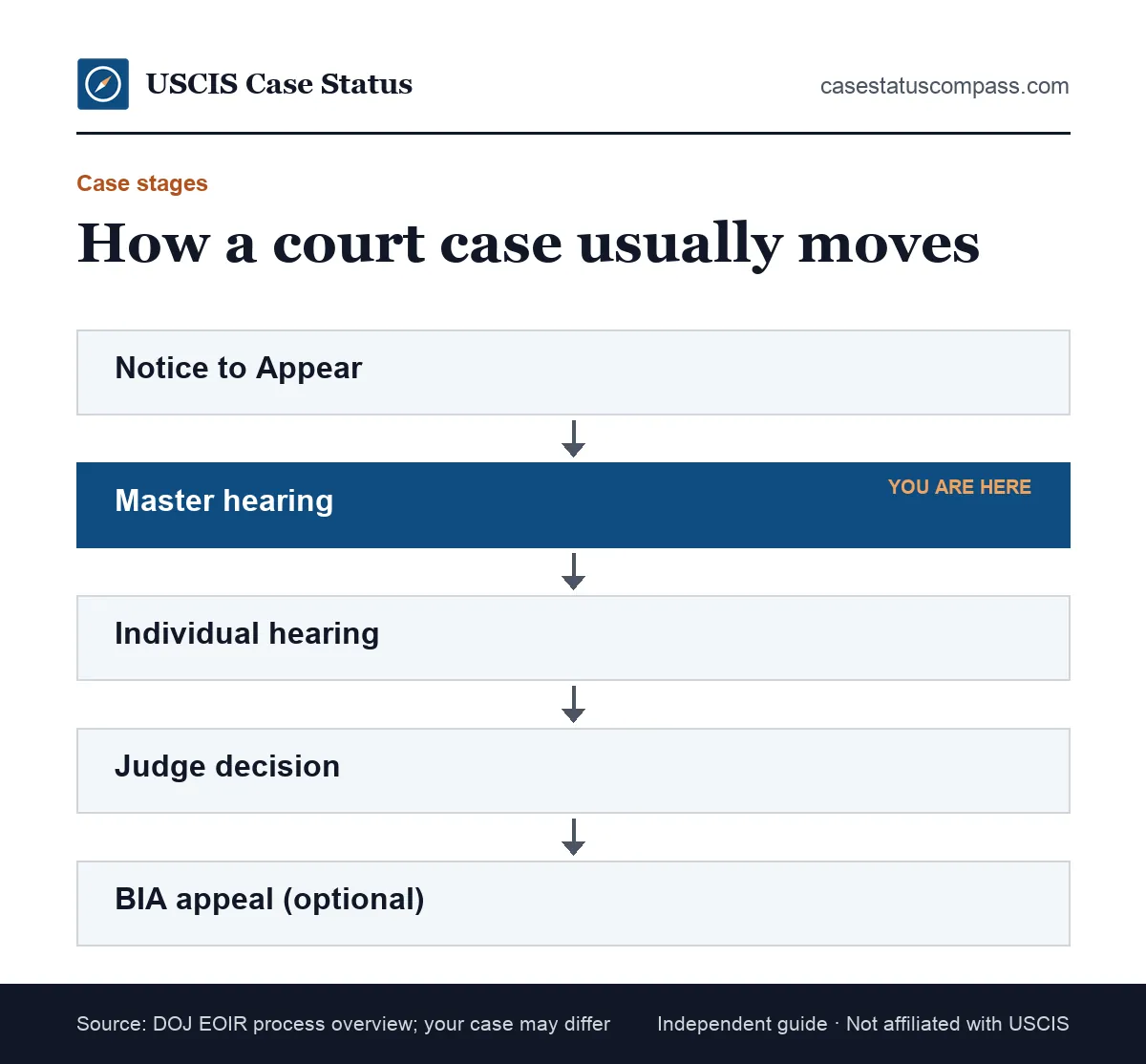
Most immigration court cases start with a Notice to Appear, move through master calendar hearings, reach an individual hearing and end with a judge's decision. Either side can then appeal to the Board. Not every case follows each step: some end early by agreement, and others pause for years while an application is decided.
Typical stages
- DHS files the Notice to Appear with the court.
- The court schedules a master calendar hearing.
- You state your position and file any applications.
- The court sets an individual hearing.
- The judge issues a decision.
- Either side may appeal to the BIA.
What you do at each stage
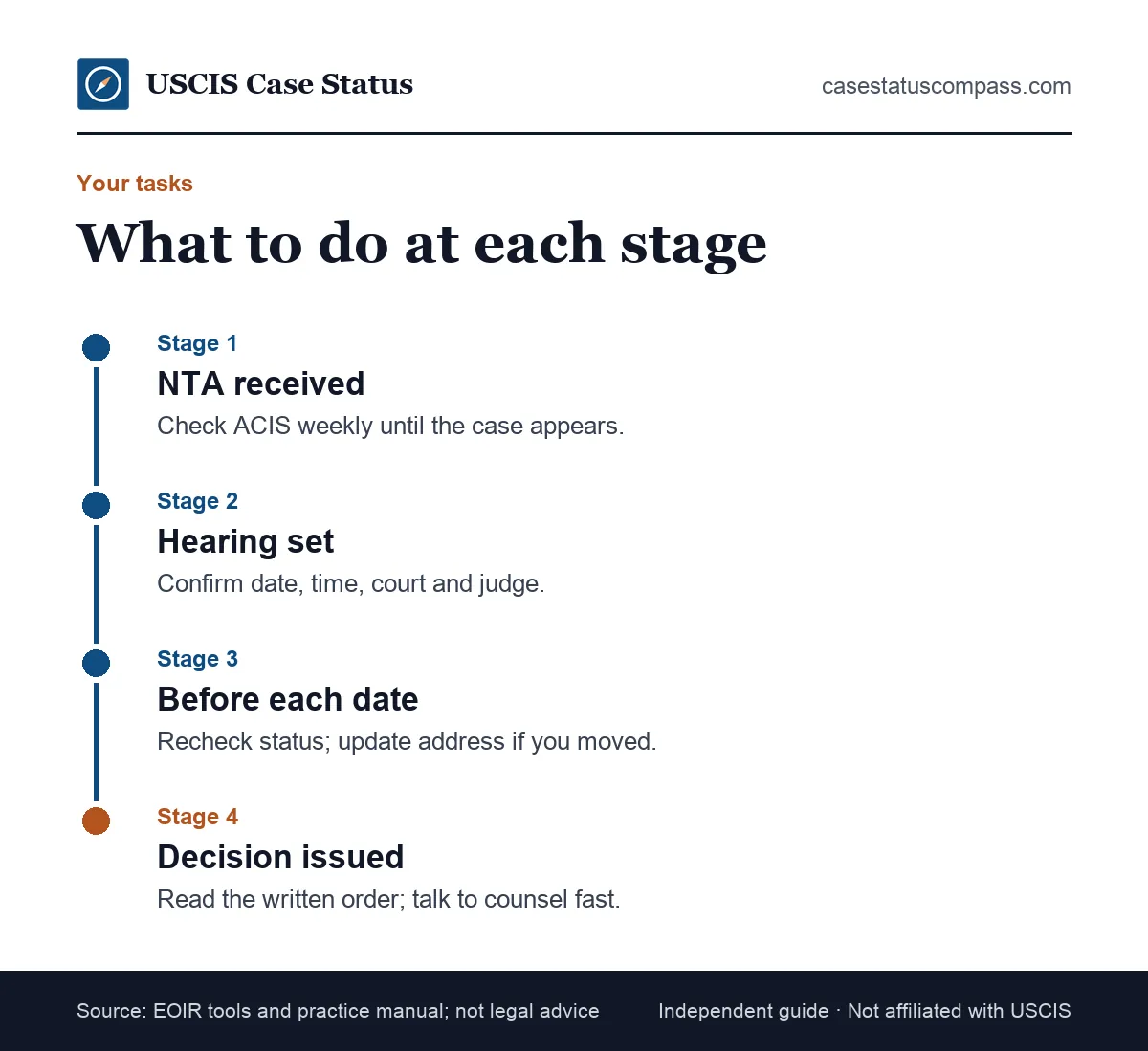
Your main jobs never change: keep your address current with the court, confirm each date in the portal, attend every hearing and meet every filing deadline. Save each notice and portal printout in date order, so a lawyer joining later can see the history at a glance.
How Do Asylum Cases Show in Immigration Court?
An asylum case in court is called defensive asylum. The judge decides your Form I-589 within removal proceedings. Your court status shows hearings and decisions, but not your USCIS work permit or asylum clock. Check the work permit through USCIS with its receipt number.
Referred affirmative cases
A case referred by a USCIS asylum office now sits with a judge, who sets a new schedule; check the EOIR portal for the first hearing. Keep USCIS work permit filings moving separately, and ask which agency receives which forms.
Asylum fees while in court
USCIS lists H.R. 1 asylum fees on its schedule. As of October 2026: $0 filing fee + $100 Asylum Application Fee (principal applicant); Annual Asylum Fee $105 (online, when USCIS sends a notice). Ask your representative how these apply before a judge, and watch for any USCIS fee notice, because an unpaid fee can affect the case.
How Do You Check Court Status for a Detained Person?
The EOIR portal and hotline work the same way for detained people: you need their A-number and nationality. EOIR's ACIS page says bond hearing information is not shown there, so contact the local court for bond questions. Detained cases often move faster than non-detained ones, so check the immigration court case status often and keep in touch with the person's lawyer.
Finding where a detained person is held
If the person is detained, ICE's online detainee locator shows where they are held. It is separate from EOIR: the locator shows the facility, while the court portal shows hearings and decisions. Use both, and recheck the locator after a transfer.
How Do Bond Hearings Work in Immigration Court?
A bond hearing decides whether a detained person can be released while the case continues. Because ACIS shows no bond details, contact the court handling the detained docket. An attorney can request a bond hearing and explain the evidence needed, such as proof of family ties and a fixed address. If bond is granted, ask how and where it is paid, and keep the receipt.
Why Should You Get an Attorney or Accredited Representative?
Immigration court is adversarial: a trained DHS attorney argues the government's side, and a removal order can have lasting effects. An immigration attorney or a DOJ-accredited representative at a recognized nonprofit can explain your options. A representative also tracks deadlines, files evidence correctly and receives the court's notices with you, which lowers the risk of a missed date. Ask for help as early as your first notice.
Who Can Represent You in Immigration Court?
Licensed attorneys and accredited representatives of DOJ-recognized organizations can appear for you in immigration court. Notarios and consultants cannot. Your representative files Form EOIR-28 to appear before the court; ask to see it so you know they are on record. You can check a lawyer's license with their state bar.
How Do You Find Free Legal Help for Immigration Court?
Free and low-cost help exists, but demand is high, so start early. EOIR lists pro bono providers and recognized organizations, and nonprofits with accredited representatives often charge less than private firms. Compare a few before you sign anything, and never pay anyone who promises a guaranteed result.
Finding free or low-cost help
EOIR publishes a list of pro bono legal service providers by court and a roster of recognized organizations with accredited representatives, both on justice.gov. Many have waiting lists. Our immigration lawyer cost guide explains fee arrangements.
Questions to ask a representative
- Are you a licensed attorney or DOJ-accredited representative?
- Will you file Form EOIR-28 for my case?
- What are my next deadlines, and who files what?
- How will you share court notices with me?
What Should You Bring to Immigration Court?
Bring your latest hearing notice, photo ID, your A-number, copies of everything you filed and any evidence your representative asked for. Arrive early, because you must pass security before reaching the courtroom. For a video hearing, follow the notice's instructions and test your connection first.
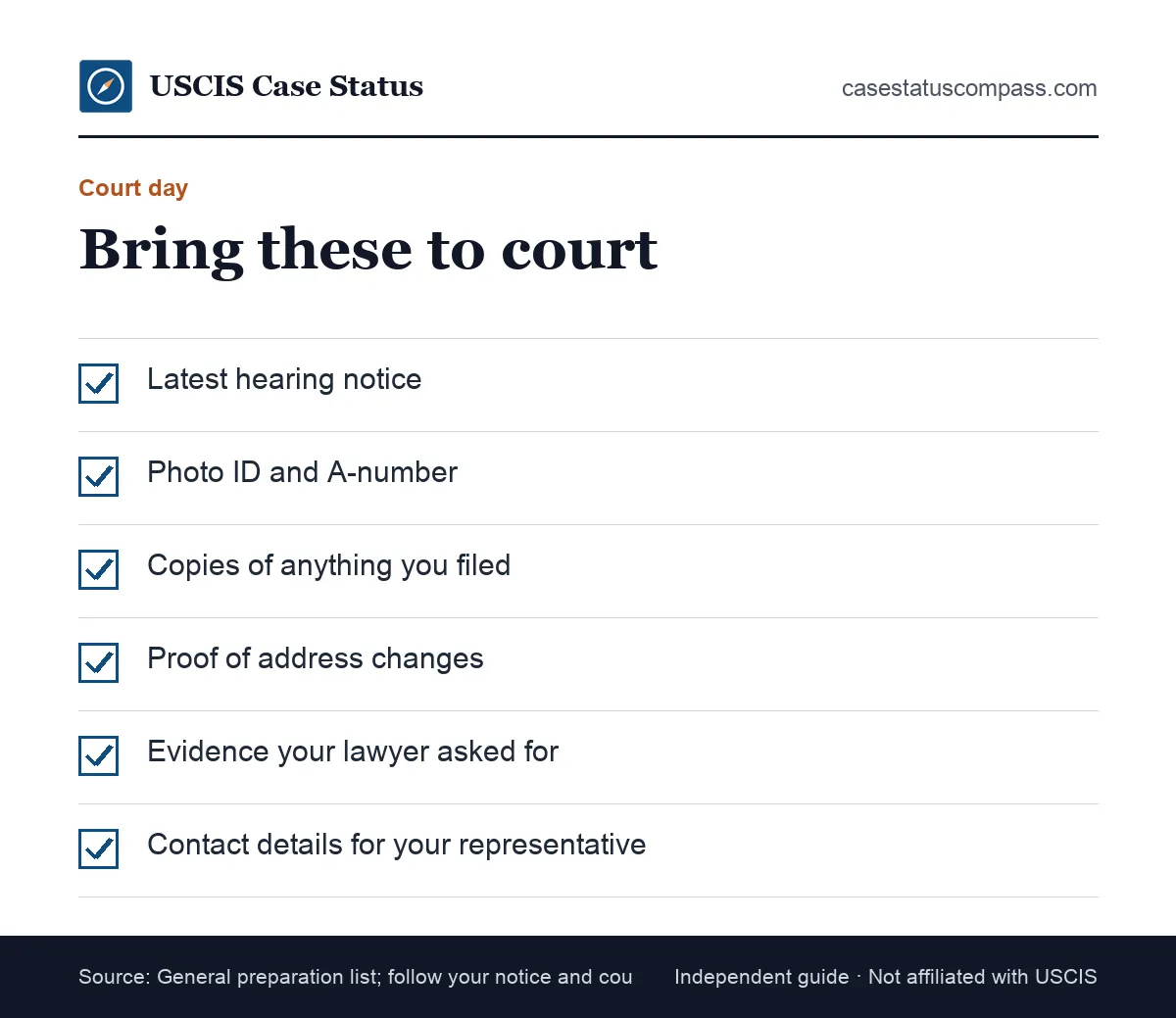
Keep a case folder
Keep a case folder with every notice in date order and a printout of each status check. Children with their own A-numbers have their own cases, so check each child separately.
What Should You Do After Checking Your Court Status?
Your next step depends on the result. A future hearing means prepare and attend. A decision means read the written order and talk to counsel quickly. No record means recheck your details and try again. An appeal listing means watch for Board mail and keep your address current. Write the date of each check in your case folder.
Status results and next steps
Find the line that matches your portal result, then read across to the usual next step.
| What you see | Likely meaning | Next step |
|---|---|---|
| A future hearing date | Case is scheduled | Confirm with your notice; prepare |
| Date differs from notice | Reset or data lag | Call the hotline and the court |
| Judge decision listed | The judge ruled | Get the written order; see a lawyer |
| BIA appeal pending | Board has the case | Keep your Board address current |
| No appeal was received | No appeal on file | Confirm with your representative |
| No record found | Typo or new NTA | Recheck; check weekly |
When to act the same day
Act right away if you see a removal order you did not know about, a hearing date that already passed, or a date earlier than expected. Call your representative or a legal service provider that day.
How Does Immigration Court Fit with Other Immigration Tools?
Immigration court is one of several agencies in the U.S. immigration system. USCIS handles benefit applications, the National Visa Center and consulates handle visas abroad, and the State Department publishes the visa bulletin. None of their tools shows court cases, and EOIR's tools show nothing about those agencies, so keep each check separate.
Visa and NVC tools
If a relative abroad is waiting for a visa, their case may be at the National Visa Center or a consulate. Our nvc case status and us visa status guides explain those tools.
Priority dates and green cards
Some court cases involve a green card that depends on a priority date in the State Department's visa bulletin. If a judge grants a green card, our permanent resident guide explains the rights and duties that follow.
Frequently Asked Questions
Is immigration court the same as USCIS?
No. Immigration court is run by EOIR, part of the Department of Justice. USCIS belongs to the Department of Homeland Security and decides applications such as green cards. Court cases use your A-number; USCIS cases use a receipt number.
How do I check my immigration court status online?
Go to the EOIR Automated Case Information portal at acis.eoir.justice.gov. Enter your 9-digit A-number, select your nationality and submit.
What is the immigration court hotline number?
The EOIR hotline is 1-800-898-7180, and TDD users can call 800-828-1120. It is automated and open 24 hours a day. Enter your 9-digit A-number, adding a zero in front if it has 8 digits.
Can I check my court date without an A-number?
No. EOIR's portal and hotline both require an A-number. It appears on your Notice to Appear, hearing notices, a judge's order, a work permit or a green card. An attorney or accredited representative can help you get your records.
What should I do if I moved and have a court date?
You must tell the immigration court or BIA within five working days on Form EOIR-33, or online through Respondent Access. Update USCIS separately. Moving does not change which court has your case; only a judge-granted change of venue does, so keep attending hearings at your current court.
Is information on the EOIR portal official?
No. EOIR says its automated case information is provided for convenience only. The notices and orders the immigration court or the Board issues to you or your representative are the only official determinations in your case.
Do I need a lawyer for immigration court?
You are not required to have one, but the stakes are high and the government has a trained attorney. A licensed immigration attorney or a DOJ-accredited representative at a recognized organization can explain your options.
Sources
- DOJ EOIR: Immigration Court Information. www.justice.gov/eoir/immigration-court-information. Accessed Oct 27, 2026.
- EOIR Automated Case Information (ACIS). acis.eoir.justice.gov/en/. Accessed Oct 27, 2026.
- DOJ EOIR: Customer Service Initiatives (hotline). www.justice.gov/eoir/customer-service-initiatives. Accessed Oct 27, 2026.
- EOIR Respondent Access. respondentaccess.eoir.justice.gov/en/. Accessed Oct 27, 2026.
- EOIR Immigration Court Practice Manual, Ch. 4.10 (change of venue). www.justice.gov/eoir/policy-manual-eoir/part-II/icpm/chapter-4-10. Accessed Oct 27, 2026.
- DOJ EOIR: Immigration Court Listing. www.justice.gov/eoir/eoir-immigration-court-listing. Accessed Oct 27, 2026.
- USCIS: How to Change Your Address. www.uscis.gov/addresschange. Accessed Oct 27, 2026.
- USCIS Form G-1055 Fee Schedule, Edition 10/16/26. www.uscis.gov/sites/default/files/document/forms/g-1055.pdf. Accessed Oct 27, 2026.
- USCIS Glossary: USCIS Number. www.uscis.gov/glossary-term/50674. Accessed Oct 27, 2026.
- DOJ EOIR: Update Respondent or Alien Information (updated May 18, 2026). www.justice.gov/eoir/update-respondent-or-alien-information. Accessed Oct 27, 2026.
- EOIR Policy Manual Part III, Ch. 3.5; 8 CFR 1003.38(b). www.justice.gov/eoir/policy-manual-eoir/part-III/bia/chapter-3-5. Accessed Oct 27, 2026.
- 8 CFR 1003.23(b)(1) and 1003.2(c)(2) (govinfo, CFR 2025 edition). www.govinfo.gov/content/pkg/CFR-2025-title8-vol1/xml/CFR-2025-title8-vol1-sec1003-23.xml. Accessed Oct 27, 2026.
casestatuscompass.com is an independent publication and is not affiliated with USCIS or any government agency. This page is general information, not legal advice. For denials, court or asylum matters, consult an immigration attorney or a DOJ-accredited representative.