Contents · 39 sections
- What Does Postponing an Asylum Hearing Mean?
- Who Decides Whether Your Hearing Moves?
- Asylum Hearing or Asylum Interview: Which One Do You Have?
- How Do You Confirm Your Next Hearing Date?
- Can You Postpone an Asylum Hearing at All?
- What Counts as Good Cause for a Continuance?
- Which Reasons Usually Do Not Work?
- Postponing an Asylum Hearing Due to Sickness
- What Should a Doctor's Note Say?
- What Is a Motion to Continue?
- What Goes Into a Motion to Continue?
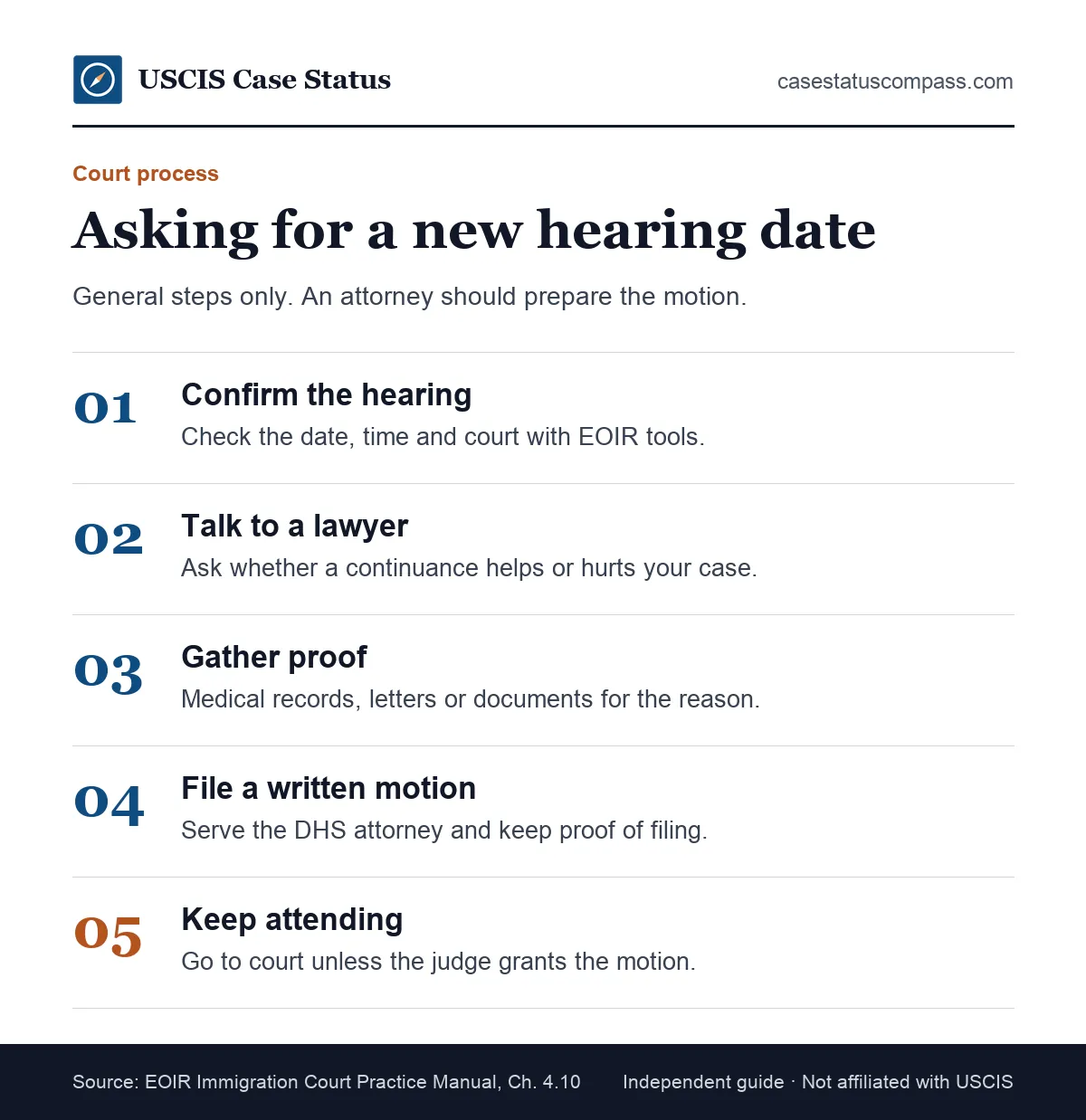
- How Do You File the Motion?
- Do You Have to Notify the DHS Attorney?
- Does DHS Have to Agree to a Continuance?
- When Should You File the Request?
- What Happens After You File?
- Do You Still Have to Go to Court If You Filed?
- What If a Hospital Stay Keeps You From Court?
- What If You Are Sick on the Day of the Hearing?
- What Happens If You Miss an Asylum Hearing?
- Can You Reopen a Case After Missing an Asylum Hearing?
- How Does a Postponement Affect Your Work Permit Clock?
- What Happens to Your Current Work Permit If the Hearing Moves?
- Can Postponing Hurt Your Asylum Case?
- Is It Ever Better Not to Postpone?
- Master Calendar vs Individual Hearing: Does It Matter?
- Changing Courts Instead of Changing Dates
- How Many Times Can You Postpone a Hearing?
- Postponing When Your Lawyer Is New or Leaves
- Rescheduling a USCIS Asylum Interview
- What If You Missed a USCIS Asylum Interview?
- Why Should You Get an Attorney Before Asking?
- Where Can You Find Free or Low-Cost Legal Help?
- Worked Example: A Hospital Stay Before an Individual Hearing
- Worked Example: A Parent's Surgery Abroad
- If X, Do Y: Postponement Decision Table
- Mistakes to Avoid When Asking for More Time
- What Records Should You Keep?
- Frequently Asked Questions
The short answer
Postponing an asylum hearing in immigration court means asking the immigration judge for a continuance, usually through a written motion that shows good cause, such as a documented serious illness. Filing does not move the date by itself: you must attend as scheduled until the judge grants the request. An immigration attorney should handle it.
At a glance
| Who decides? | The immigration judge (EOIR), not USCIS |
| How do you ask? | A written motion to continue with proof |
| Is illness a reason? | It can be, with detailed medical records |
| Can you skip court once you file? | No. Attend until the motion is granted |
| USCIS asylum interview instead? | Different rules: exceptional circumstances |
Postponing an asylum hearing is a court matter run by the Executive Office for Immigration Review (EOIR). A USCIS asylum interview follows different rules; our asylum status and Form I-589 guide explains both paths. Speak with an immigration attorney before filing anything.
What Does Postponing an Asylum Hearing Mean?
In court language, postponing an asylum hearing is called a continuance: a request that the immigration judge move a scheduled hearing to a later date. The judge can grant or deny it, and nothing changes until there is a written order or new notice.
Court hearing vs USCIS interview
People often say "hearing" when they mean a USCIS asylum interview. A hearing happens in immigration court before a judge, with a government attorney present. An interview is a non-adversarial meeting with an asylum officer.
What a continuance does not do
A continuance does not close your case, decide your asylum claim or excuse you from court while the request is pending. It only moves one hearing, and the judge sets the new date.
Who Decides Whether Your Hearing Moves?
Only the immigration judge assigned to your case can move a court hearing. Court staff cannot promise a new date by phone, and USCIS has no power over the court calendar.
Until the judge signs an order, plan to be in court on the date shown in the EOIR record.
The immigration judge
Federal rules at 8 CFR 1003.29 let a judge grant a continuance for good cause shown. That is a discretionary decision, and two judges in the same building may treat similar requests differently.
The DHS attorney's role
The government attorney may support, oppose or take no position. Lawyers usually contact the DHS office before filing and state its position in the motion.
A note that DHS does not oppose can help, but it never binds the judge.
Asylum Hearing or Asylum Interview: Which One Do You Have?
Look at the letterhead and the sender. A court notice comes from the Executive Office for Immigration Review and names an immigration court. An interview notice comes from USCIS and names an asylum office.
The sender decides which rules apply to you.
Hearing vs interview at a glance
| Clue | Immigration court hearing | USCIS asylum interview |
|---|---|---|
| Sender | EOIR, Department of Justice | USCIS, Department of Homeland Security |
| Starting document | Notice to Appear | Form I-589 receipt notice |
| Person deciding | Immigration judge | Asylum officer |
| Way to postpone | Motion to continue | Written reschedule request with proof |
| Online tracking | EOIR case information | USCIS online account |
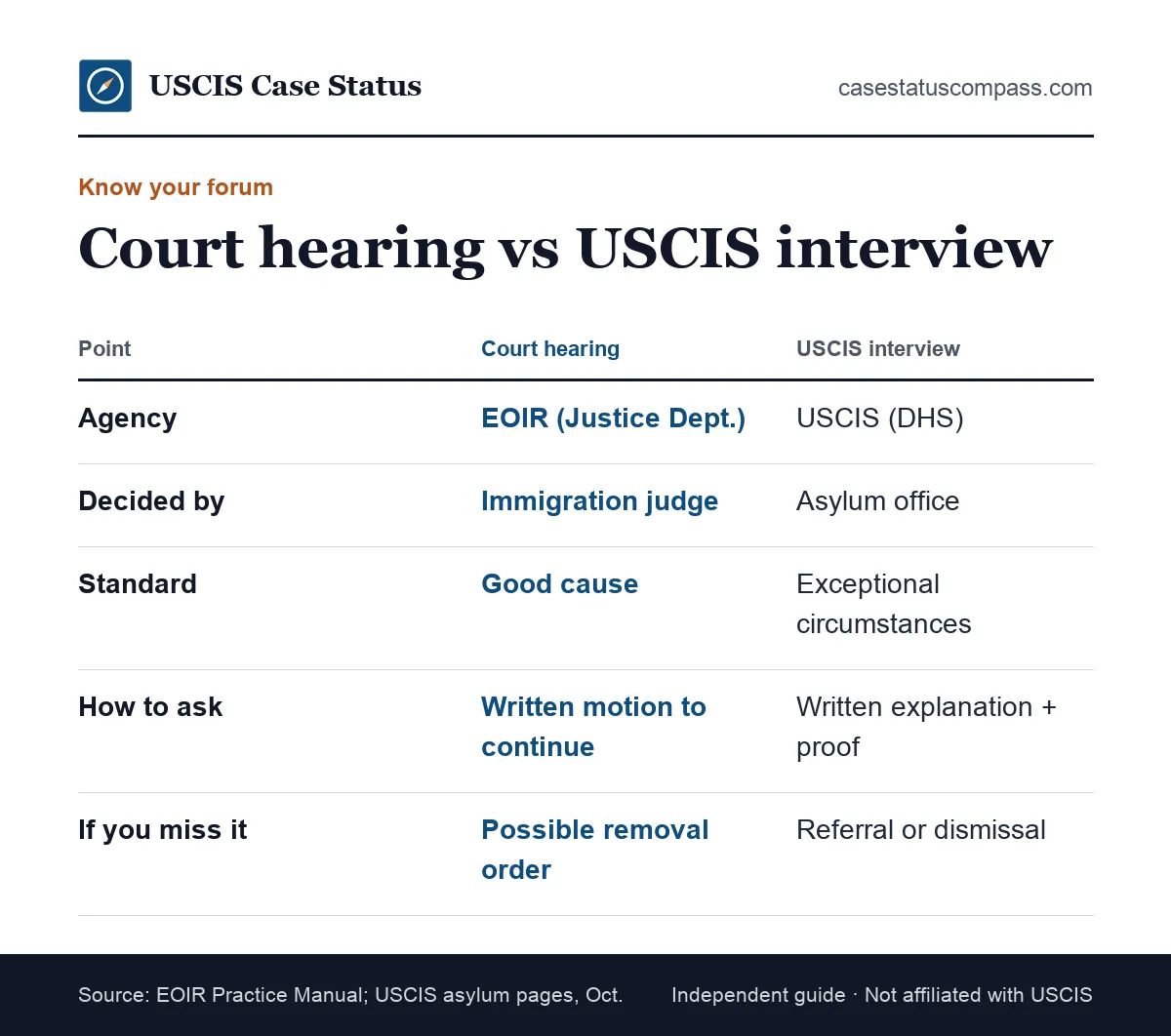
Match each clue to your notice. If most clues point to EOIR, you need a motion to the immigration judge, not a USCIS request.
Clues on your notice
A court notice usually shows your A-Number, the court address and a hearing type such as master or individual. A USCIS notice shows a receipt number. Our Alien Registration Number guide shows where that number appears.
If you have both
Some people had a USCIS case that was later referred to court. Once the court has the case, the court date controls, and an old USCIS notice no longer protects you. Follow the newest court notice.
How Do You Confirm Your Next Hearing Date?
Before asking for a new date, confirm the current one. EOIR runs official tools that show your next hearing using your A-Number. Notices can be lost in the mail, and courts sometimes move hearings themselves, so check the official record first.
EOIR online case information
Check immigration court cases online at acis.eoir.justice.gov with your A-number. The portal shows the next hearing date, time and court tied to your A-Number, and it is the record to trust over any letter or phone call.
EOIR hotline and spoofed calls
You can also call the EOIR case hotline: 1-800-898-7180 (24/7, automated). It gives the same hearing details. EOIR warns that scammers sometimes spoof its number, so never pay anyone who calls claiming to be the court.
Check before and after every filing
Check the date when a problem starts, after you file, and a few days before the original date. If the record still shows the old date, treat it as real. Our immigration court case status guide explains the results.
Can You Postpone an Asylum Hearing at All?
Yes, but a continuance is never automatic. The judge needs a reason that meets the good cause standard and proof to back it. A request that looks like simple delay is likely to fail.
Ask your lawyer early whether your reason is strong enough.
What "good cause" means in practice
Good cause has no single list. The judge asks why you need time, whether you acted quickly, how long a delay you want and whether you asked before. A documented, unexpected problem is the classic example.
Why it is not automatic
The Attorney General's decision in Matter of L-A-B-R- says the good cause requirement is a real limit, not a formality. A judge can deny a polite, timely request, so plan as if the hearing will go ahead.
What Counts as Good Cause for a Continuance?
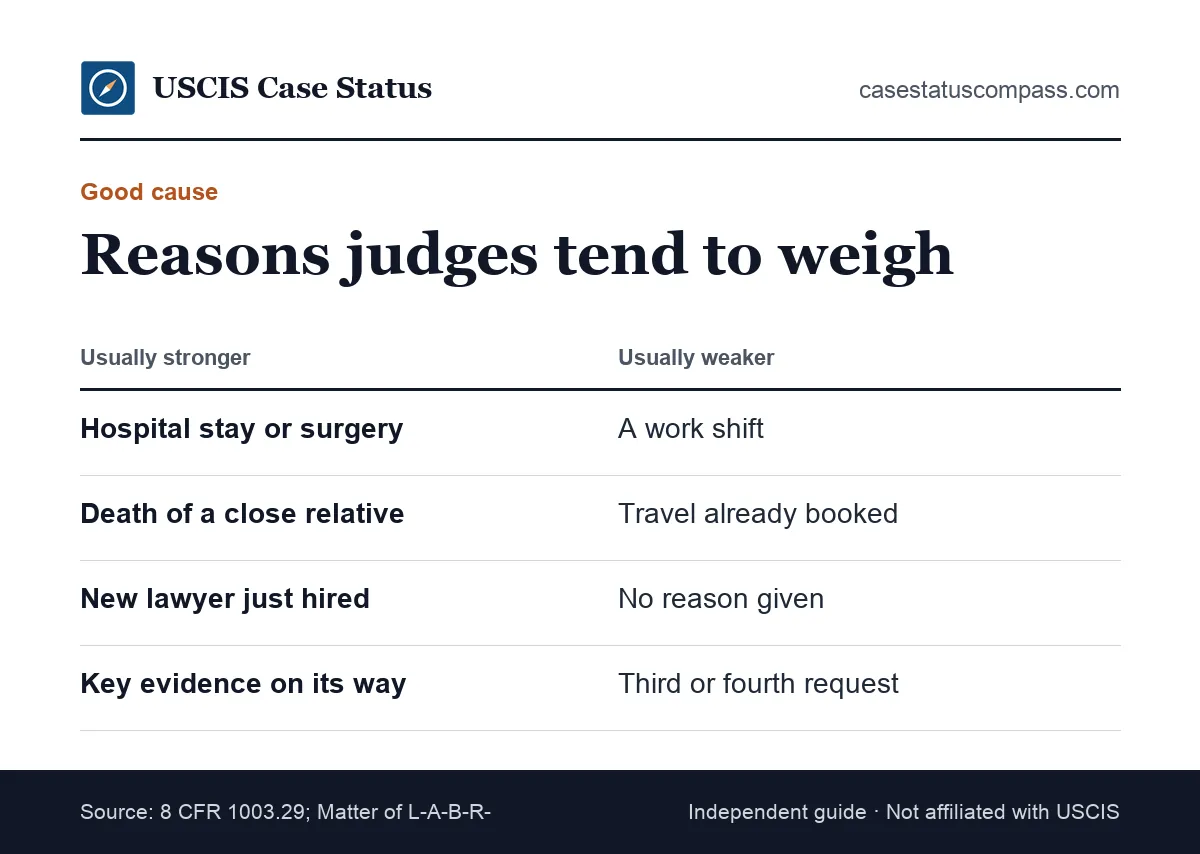
No list guarantees success, but some reasons often persuade judges: a serious medical emergency, a death in the immediate family, newly hired counsel, or key evidence already on its way. Each must be explained and supported with documents.
Medical and family emergencies
Hospitalization, surgery or a contagious illness
Late-stage pregnancy complications or recent childbirth
Death or grave illness of a spouse, child or parent
A sudden accident or injury that prevents travel to court
Each backed by dated records
Representation and related applications
A lawyer who was hired days ago, or who suddenly withdrew
A pending related application that could resolve the case
Evidence requested on a known date and expected soon
A judge's own scheduling change
Factors from Matter of L-A-B-R-
When you seek time to wait for another application, the judge weighs your diligence, the DHS position, administrative efficiency, the length of delay and the timing of the motion.
Which Reasons Usually Do Not Work?
Ordinary inconvenience rarely meets the standard. Judges often deny requests based on a work schedule, a vacation, childcare that could be arranged, or a vague wish for more time.
If your reason sounds ordinary, find a lawyer before filing.
Work and scheduling conflicts
A work shift is rarely good cause
Show your hearing notice to your employer early
Ask for leave in writing and keep the reply
Arrange childcare and transport weeks ahead
Wanting more time to prepare
If you had months and did not prepare, the judge may see a lack of diligence. A specific reason works better, such as a document from abroad requested on a known date and expected soon.
Postponing an Asylum Hearing Due to Sickness
Illness is a common reason to ask for a new date. Postponing an asylum hearing due to sickness works best when the illness is serious, recent and documented by a treating doctor. A cold rarely justifies moving long-scheduled testimony.
See a treating doctor as soon as symptoms start, so the letter you file describes an exam made before the hearing date.
When you are the one who is ill
Explain whether you cannot travel, cannot sit through hours of questioning, or cannot think clearly on medication. Testimony is central to most asylum cases, so a condition affecting memory, speech or concentration matters.
When a close family member is ill
Serious illness of a spouse, child or parent can also matter, especially if you are the only caregiver. A hospital letter naming you as caregiver beats a statement you write yourself.
What Should a Doctor's Note Say?
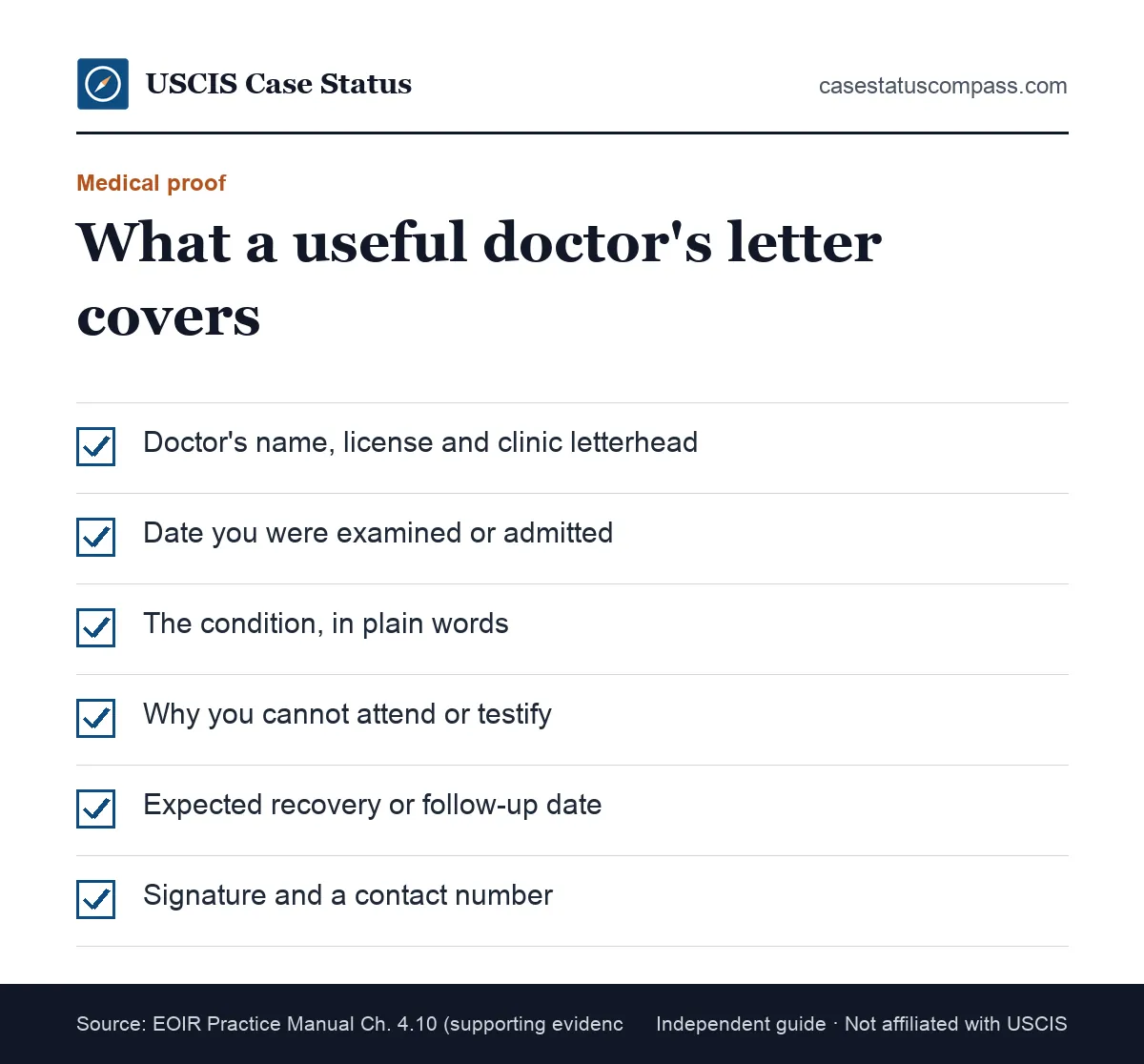
For a doctor postponing an asylum hearing request, the letter should come from the treating physician on letterhead and explain the condition, when you were seen, why you cannot attend or testify, and when you should recover. A one-line work excuse is too thin.
Strong vs weak medical letters
| Strong medical letter | Weak medical letter |
|---|---|
| Names the condition in plain words | Says only "patient is unwell" |
| States the exam or admission date | No date, or dated after the hearing |
| Explains why court is not possible | Says "excused from work" |
| Gives an expected recovery date | No time frame at all |
| Signed, with license and phone number | Unsigned or from an unknown clinic |
The table compares a letter that supports a continuance with one that does not. Show it to your doctor when you request the letter.
Items a useful letter covers
Ask the doctor to describe your functional limits, such as no travel for two weeks or medication that causes confusion, and a realistic recovery estimate rather than "indefinitely."
The letter should also give the doctor's name, practice address, phone number and signature so the court or DHS can confirm it.
Privacy and sensitive records
Medical records can reveal sensitive details about you. Your lawyer can explain how the court handles them and which facts the letter really needs to include.
Share only what the request needs, and ask your lawyer before filing full charts.
Notes that fall short
Letters from relatives, unsigned letters and notes that only repeat what you told the doctor are easy to doubt, as are notes dated after the hearing for an earlier illness. Request the letter early.
What Is a Motion to Continue?
A motion to continue is the written request asking the immigration judge to move a hearing. The EOIR practice manual says these requests should be in writing and that oral requests are discouraged. The court picks any new date.
Keep a copy of everything filed.
Written, not by phone
A phone call is not a substitute for a motion. Clerks can say what is on the calendar, but they cannot grant a continuance. An oral request in the courtroom is possible but discouraged.
Who files the motion
If you have a lawyer of record, the lawyer files and signs the motion. Without one, you file it yourself, following the same written format and service rules.
Both must serve DHS.
The cover page label
EOIR filings follow formatting rules, including a cover page naming the type of filing, here a motion to continue. Formatting mistakes can lead to a rejected filing.
Read the formatting chapter of the Immigration Court Practice Manual before you print, sign and serve the motion.
What Goes Into a Motion to Continue?
The practice manual says the motion should explain the reasons in detail, attach supporting evidence where appropriate, give the current hearing date and time, and list your available dates. A proposed order and proof of service are commonly added.
Core contents
- Your name and A-Number exactly as on court papers
- The current hearing date, time and type
- A detailed reason and when the problem began
- Available dates for a new hearing
- The DHS position, if known
- A signed proof of service
Evidence attachments
Attach a document behind every claim: medical letters, death certificates, a new attorney's appearance form, or receipts for a document request. Number and label each exhibit so the judge can match it to the motion.
The proposed order
Many filers add a one-page proposed order the judge can sign to grant or deny the motion. It names the case, the A-Number and a blank for the new hearing date.
How Do You File the Motion?
Filing depends on whether your case is in EOIR's electronic system and whether you have a lawyer. Represented cases are often filed electronically; some people without lawyers file paper at the court.
Either way, file with the court that has your case and keep proof of the filing date.
Electronic filing
Many attorneys file through EOIR's electronic case system, which records the filing time and can be faster than mail. If you are not represented, read the court's current instructions on the EOIR website first.
Paper filing at the court
Paper filings go to the immigration court handling your case, not to USCIS. Find the address on your notice or in the List of immigration courts: justice.gov/eoir/eoir-immigration-court-listing. Keep a stamped copy or mail tracking proof.
Do You Have to Notify the DHS Attorney?
Yes. Court filings generally must be served on the other party, which in removal proceedings is the DHS attorney's office. The motion should include a proof of service showing how and when the government got its copy.
Serve DHS the same day you file.
Proof of service
A short statement signed by the person who served it
The DHS office served, the date and the method
A matching copy kept in your own file
Attached to the motion you file
Does DHS Have to Agree to a Continuance?
No. Lawyers often ask the DHS attorney whether the government opposes the motion and report the answer, because "DHS does not oppose" can make the judge's decision easier. But the judge decides, and even an opposed motion can win with a strong documented reason.
When Should You File the Request?
File as soon as you know you need more time. A motion filed weeks ahead lets the judge rule and the court send a new notice. A last-minute motion may not be decided in time, so you would still have to appear.
Early is almost always better
Judges look at timing. If you knew about a scheduled surgery a month ago and filed the day before court, the delay itself can count against you. Explain any gap with dates.
True emergencies close to the date
Sudden emergencies happen, such as an accident two days before court. File what you can, have your lawyer contact the court, and gather records quickly and specifically.
Send the records as soon as you have them.
What Happens After You File?
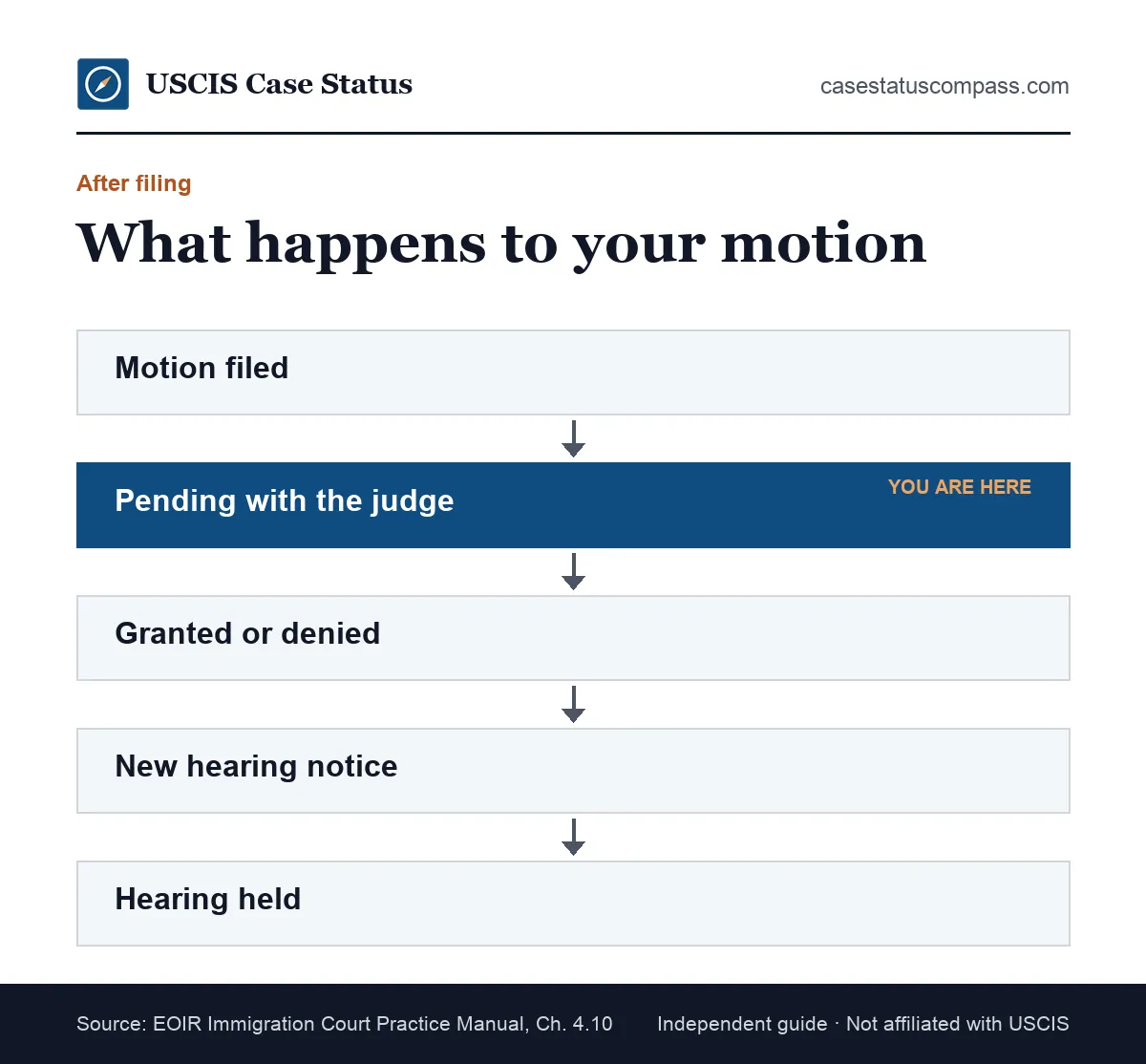
The judge rules on the motion, often without a hearing. If granted, the court issues an order and a new hearing notice. If denied, the original date stays. If no ruling arrives in time, assume the hearing goes forward.
If the motion is granted
Read the order and confirm the new date on the EOIR portal. The new date may be months away or longer, depending on the court. Use the time to gather evidence and keep watching for changes.
If it is denied or never ruled on
A denial means you must appear on the original date. If you still cannot testify, your lawyer may renew the request in person with new evidence. Do not stay home just because you filed.
Do You Still Have to Go to Court If You Filed?
Yes. The EOIR practice manual is direct: until the motion is granted, parties must appear at all hearings as originally scheduled. A pending motion protects nothing, and missing court while waiting is one of the most damaging mistakes possible.
Plan your day around the hearing.
The appearance rule
Treat the original notice as binding until you hold a written order or the official record shows a new date. Screenshots of the EOIR portal taken the day before court show what the record said.
Bring the motion with you
If you appear while the motion is pending, bring a copy of it, the proof of service and your evidence, so the judge has everything if they rule in court.
What If a Hospital Stay Keeps You From Court?
If a hospital stay makes attendance impossible, your lawyer should appear and explain, or inform the court the same morning, and make sure the court has the medical records. Your absence must be caused by the emergency itself, not by the pending motion.
What If You Are Sick on the Day of the Hearing?
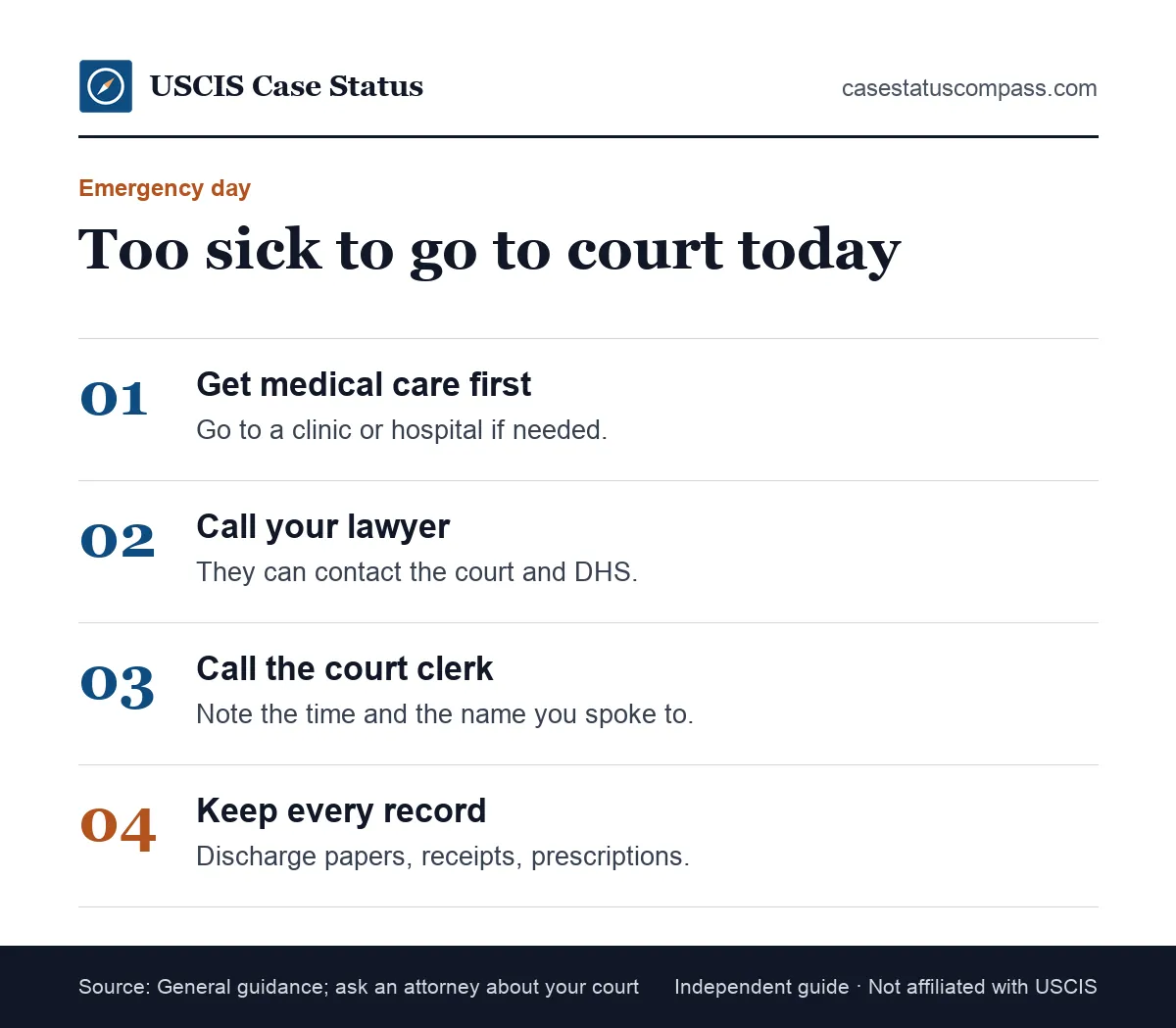
Get medical care first, then contact your lawyer and the court the same day. Ask the clinic for written records showing when you were seen. These same-day records make a later explanation believable if you could not be in court.
Calling your lawyer and the court
- Your lawyer may appear and ask the judge to reset the case
- Without a lawyer, call the court clerk and note the time and name
- Follow up in writing the same day
Documenting the same day
Emergency room or clinic papers
Prescriptions and pharmacy receipts
Discharge instructions with dates
A photo of a dated hospital wristband
Names of staff who treated you
Your own written timeline of the day
What Happens If You Miss an Asylum Hearing?
If you do not appear, the judge may order you removed in absentia, meaning in your absence, and the asylum claim may be treated as abandoned. Undoing that order depends on strict rules, so missing court should never be part of a plan.
The removal order risk
An in absentia order can take effect even if you have lived in the U.S. for years, and may bar certain relief for a period. A lawyer should review any missed hearing immediately, because time limits run from the order date.
Can You Reopen a Case After Missing an Asylum Hearing?
Sometimes. A motion to reopen may be possible if you show exceptional circumstances, lack of proper notice, or another legal ground. Deadlines are strict: a motion to reopen generally must be filed within 90 days of the final removal order, and usually only one is allowed, though some in absentia orders have exceptions. The USCIS motion in our USCIS appeals and motions guide follows different rules.
How Does a Postponement Affect Your Work Permit Clock?
A continuance you request usually counts as an applicant-caused delay. USCIS says delays you request or cause, at USCIS or in court, do not count toward the wait for an asylum-based work permit, so a postponement can push back eligibility.
How the asylum EAD clock works
The asylum EAD clock tracks how long your asylum application has been pending for work-permit purposes. Requesting a later hearing date generally stops it until the new hearing.
Ask your lawyer how it was coded.
Checking how the delay was coded
Ask your lawyer whether a medical reason might be coded differently in your court, and check the adjournment code after the judge rules, because it affects when you can apply.
What Happens to Your Current Work Permit If the Hearing Moves?
If you already have a (c)(8) work permit, a postponement may mean you need a renewal before your case ends. Note: Ended: renewals filed on or after Oct. 30, 2025 no longer get the up-to-540-day automatic extension (exceptions: TPS by law/Federal Register notice; STEM OPT 180 days). See our work permit guide for renewal timing and fees.
Can Postponing Hurt Your Asylum Case?
It can. Delay may let evidence go stale, witnesses move away or country conditions change in either direction. Repeated requests can also test a judge's patience. A continuance helps only when the reason is real and the time is used well.
Delay versus evidence
Can improve: expert reports, medical evaluations
Can weaken: witnesses who move, fading memories
Your lawyer should weigh both before filing
Ask what the extra time will actually produce
Decide before the motion is filed
Ongoing costs while the case is pending
A longer case can mean more fees and renewals. For asylum filed with USCIS, $0 filing fee + $100 Asylum Application Fee (principal applicant); Annual Asylum Fee $105 (online, when USCIS sends a notice). If your case is in court, ask your lawyer how annual fees apply to you.
Is It Ever Better Not to Postpone?
Yes. If you are ready, your witnesses are available and your evidence is complete, moving the date may add months or years of uncertainty. Family members' status may also depend on a timely decision.
Weigh this carefully with your lawyer.
When your witnesses are ready now
Witnesses who traveled, took leave or agreed to testify by phone may not be available later. If your case relies on them, a delay can weaken it.
Ask each witness in writing whether they could attend a later date before you decide to request one.
Children and time-sensitive situations
Children in a case may age into different rules over time, and some benefits depend on dates. A sooner decision may protect a child or a related petition, so get advice first.
Master Calendar vs Individual Hearing: Does It Matter?
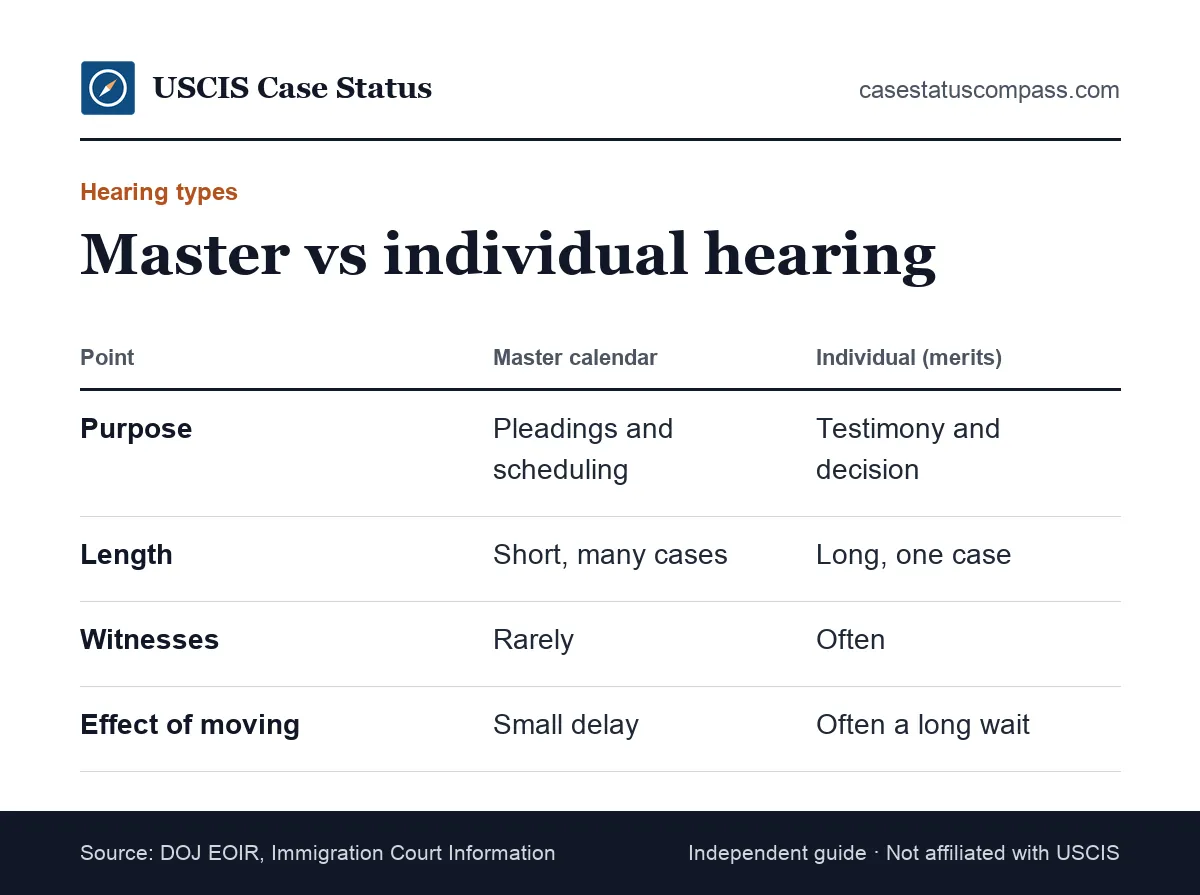
It does. A master calendar hearing is short and procedural, so moving it usually causes a modest delay. An individual hearing, where you testify, blocks hours of court time, so moving it often means a much longer wait.
Check your notice for the type.
Master calendar hearings
At a master hearing the judge takes pleadings, sets deadlines and schedules the merits hearing, with many cases in one session. Depending on the judge, a lawyer may sometimes appear for you.
Individual merits hearings
The merits hearing is where you testify, present witnesses and receive a decision. Judges may be stricter about moving it because it was scheduled long ago, so bring strong proof and available dates.
Changing Courts Instead of Changing Dates
If your problem is distance after a move, a change of venue may fit better than a continuance. To move a court case: file a written motion to change venue with EOIR-33/IC; keep attending hearings until it's granted. A request to transfer does not stop the current hearing date, and the judge decides whether to grant it.
Motion to change venue
The judge considers whether you have good cause, such as a permanent new home far from the current court. The motion needs your fixed street address, and moving the case can also cause delay.
Updating your address everywhere
Report a new address to USCIS within 10 days of moving (INA 265). For the court, you must also tell the immigration court or BIA within five working days on Form EOIR-33, or online through Respondent Access. Our change of address guide explains the USCIS side.
How Many Times Can You Postpone a Hearing?
No rule sets a fixed number, but each request faces more scrutiny than the last. A first request with clear proof is treated very differently from a third, and the judge may refuse further delay even for real problems.
File the first motion with every document you have, since a weak first try makes a later one harder to win.
No fixed limit, growing scrutiny
The judge can note earlier continuances and ask why more time is needed now. If an earlier request was for the same reason, explain what changed, or the judge may set a firm date.
Building a credible record
Keep each request honest and documented, and use every granted delay productively. A judge who sees evidence filed and a lawyer retained is more likely to believe a later emergency.
Postponing When Your Lawyer Is New or Leaves
Hiring a lawyer shortly before a hearing is a common reason to ask for time, and judges often let new counsel prepare. A lawyer's withdrawal or serious conflict can also justify a request, but the court still wants details and dates.
Newly hired representation
The new lawyer usually files an appearance form, then a motion explaining when they were hired and what they need to review. Waiting until the week of the hearing makes the delay look like your choice.
When your lawyer withdraws or is unavailable
If a lawyer leaves the case, ask for the file right away and look for new counsel. Our guide to immigration lawyer costs covers fees and how to compare options.
Rescheduling a USCIS Asylum Interview
If your case is still with USCIS, you are not asking a judge. USCIS says you must establish exceptional circumstances to reschedule an asylum interview, and its asylum page, updated 09/04/2026, explains how to submit the request.
Act as soon as the problem arises.
The exceptional circumstances standard
USCIS gives examples including battery or extreme cruelty, serious illness, and the death of a spouse, child or parent, and says less compelling circumstances will not qualify. Our asylum status guide covers the wider interview process.
Illness as an exceptional circumstance
USCIS names serious illness of you or your spouse, child or parent as an example. Ask the doctor for the same detailed letter a court would expect: condition, dates, limits and recovery.
How to submit the request
A detailed written explanation of what happened
Supporting records, such as medical or death certificates
Certified translations of non-English documents
Proof that you submitted it
Your receipt number on every page
A copy kept for your records
What If You Missed a USCIS Asylum Interview?
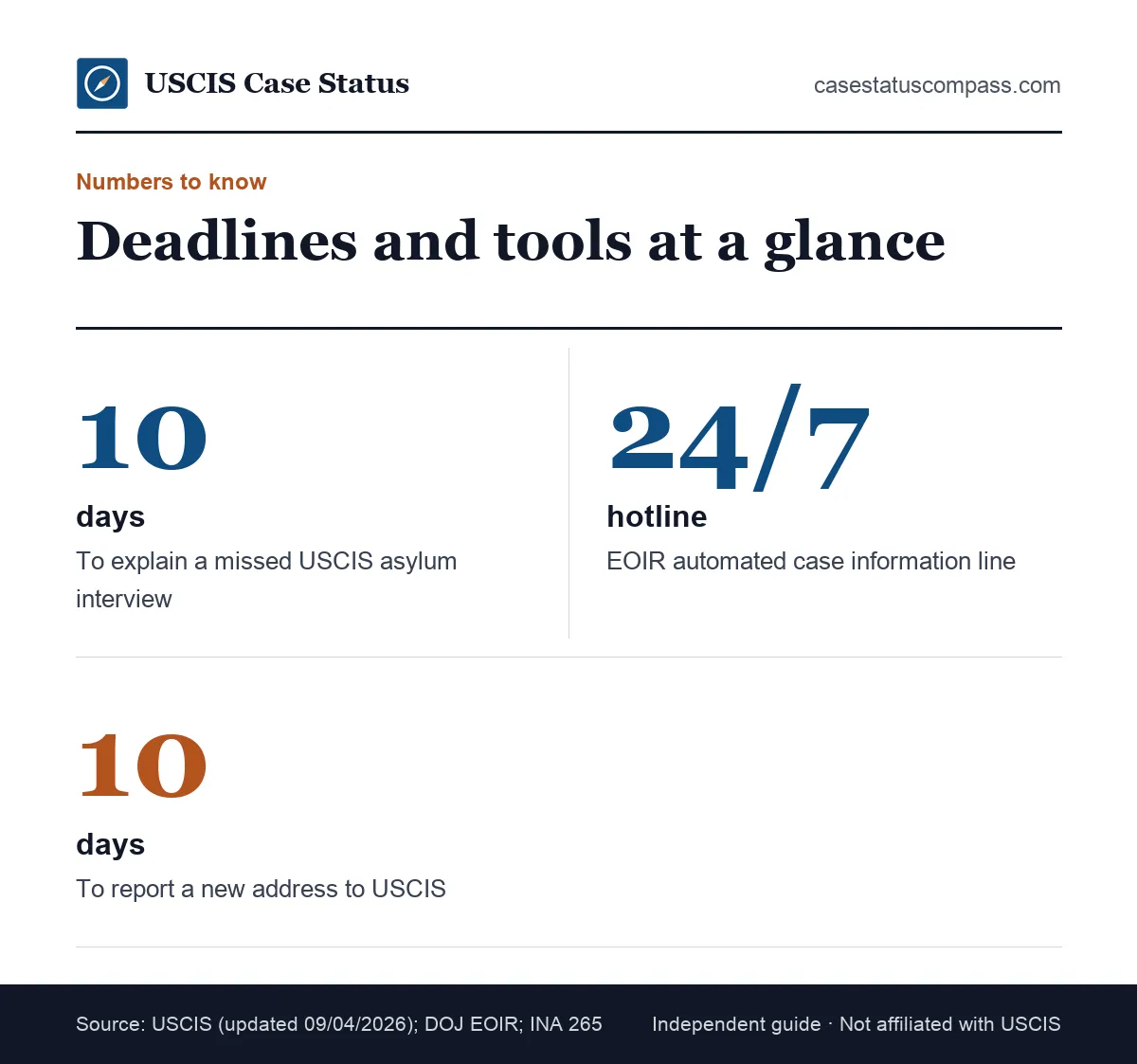
USCIS says a written explanation for a missed interview is due within 10 calendar days of the failure to appear. Without exceptional circumstances, the result depends on your status: dismissal, referral to an immigration judge, or a review of parole.
The 10-day window
Act immediately. Write the explanation, attach the records and send it following the USCIS asylum page instructions. A late or unsupported explanation may lead to consequences that are much harder to reverse.
Outcomes by status
Lawful basis to stay: the application may be dismissed
No lawful basis: likely referral to immigration court
Parolees: reviewed case by case
Work permit eligibility may be affected
Get legal help right away
Why Should You Get an Attorney Before Asking?
Because the stakes are high and the rules are technical. A weak motion can be rejected, delay can harm your case, and a missed hearing can lead to removal. An immigration attorney or DOJ-accredited representative knows your judge, DHS office and filing rules.
What a lawyer handles
Decides whether a continuance is wise for your case
Drafts, files and serves the motion correctly
Appears for you when the judge allows it
Protects deadlines for related applications
Tracks the ruling and the new notice
Questions to ask before hiring
Have you appeared before my immigration judge?
Will you ask the DHS attorney for a position?
How and when will you file and serve the motion?
What will this cost in total?
Who will appear at the hearing?
Where Can You Find Free or Low-Cost Legal Help?
EOIR keeps a list of pro bono legal service providers by state, and many nonprofits employ DOJ-accredited representatives who can appear in court. Law school clinics and bar referral services also help. Contact them early; waiting lists can be long.
Accredited representatives and nonprofits
An accredited representative works for a recognized nonprofit and is authorized by the Justice Department to represent people in immigration matters. Fees are often low or waived, but ask whether they take court cases.
Law school clinics and bar referrals
Some law schools run immigration clinics where supervised students may take court cases at no cost. State and local bar referral services can connect you with a licensed attorney.
Call both early, because capacity is limited.
Avoiding notario and scam help
In the U.S. a notary public cannot give legal advice. Never pay someone who promises a guaranteed continuance. Our USCIS scams guide explains common warning signs and how to report fraud.
Worked Example: A Hospital Stay Before an Individual Hearing
This fictional example shows how a strong medical request is built. "Amara," an asylum applicant, needs emergency surgery 12 days before her merits hearing. Her lawyer files a motion with hospital records within four days.
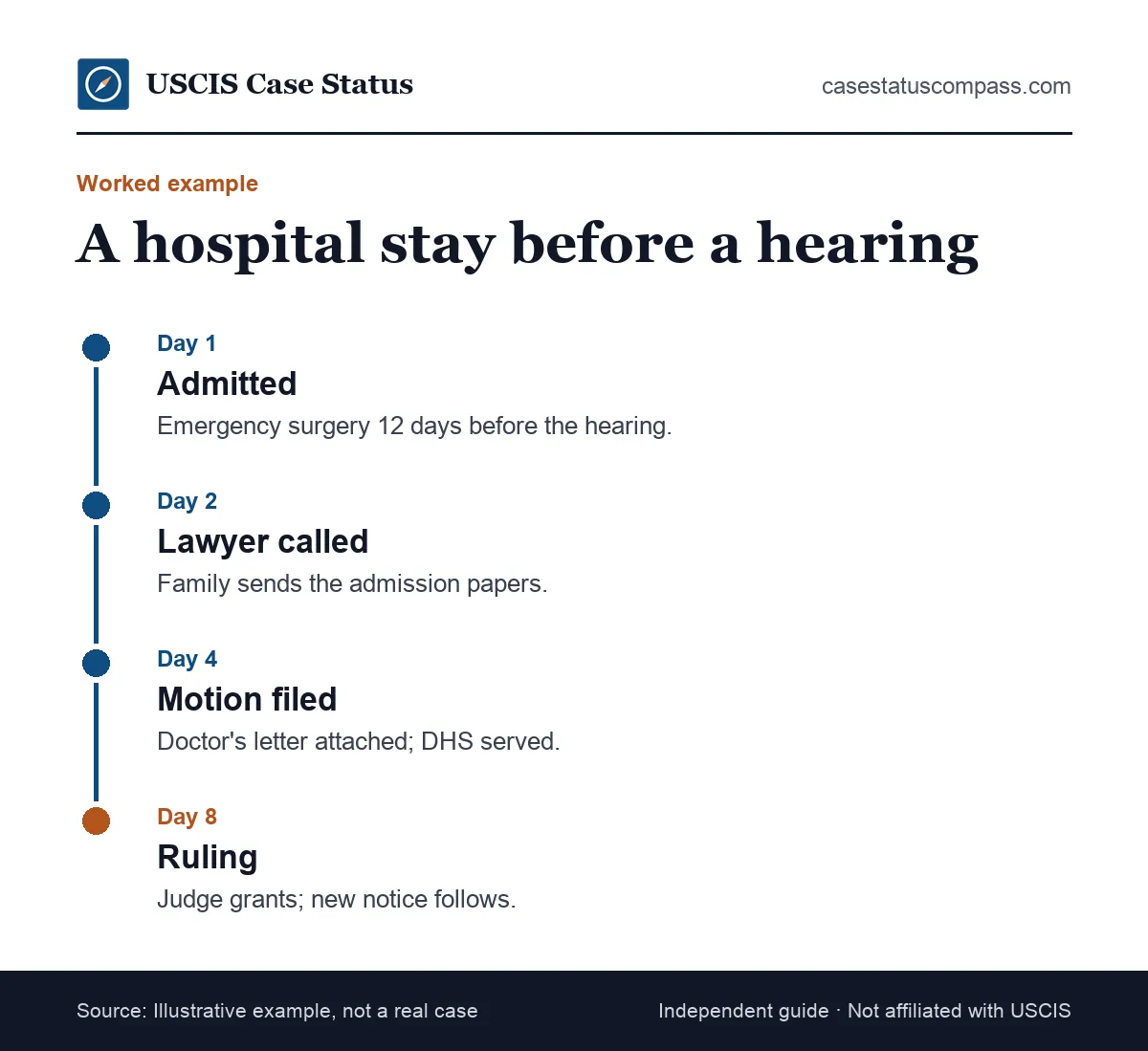
The names and details are invented.
Days 1 to 3: gathering the records
Day 1: Amara is admitted. Day 2: her sister sends the admission papers to the lawyer. Day 3: the surgeon writes a letter on hospital letterhead.
The letter states the surgery date, her functional limits and a recovery estimate.
Days 4 to 8: filing and the ruling
Day 4: the lawyer files the motion, serves DHS and reports no opposition. Day 8: the judge grants the motion and the court issues a new notice.
Amara checks the EOIR portal for the new date.
What made the request clear
The letter named the surgery, gave a four-week recovery period and explained that pain medication would affect testimony. The motion listed available dates after recovery, and every claim had a document behind it.
Worked Example: A Parent's Surgery Abroad
In this second fictional example, "Daniel" learns that his mother abroad needs major surgery and wants to postpone his hearing to be with her. Leaving the U.S. could seriously harm his case, so his lawyer looks at the options first.
The problem
Leaving the country during removal proceedings can have severe consequences, possibly including being treated as having left under an order. Daniel's lawyer explains that travel is not a safe solution.
Why the outcome was uncertain
A relative's illness abroad is serious, but the judge may ask why Daniel's presence changes anything if he cannot travel. The lawyer files only after confirming a concrete reason.
If X, Do Y: Postponement Decision Table
Use this table to start a conversation with your lawyer, not as a decision by itself. Each row pairs a common situation with a sensible first step. Your facts and judge can change the answer.
If no row fits, describe your situation to your lawyer before postponing an asylum hearing on your own.
Common situations and first steps
| If this happens | Do this first |
|---|---|
| You are hospitalized before the hearing | Get records, call your lawyer, file a medical motion quickly |
| You get sick on the hearing day | Seek care, call lawyer and court, keep same-day records |
| You just hired a lawyer | Ask them to file an appearance and a motion with reasons |
| Your interview is with USCIS, not court | Follow the USCIS exceptional circumstances process |
| You missed the hearing | Contact a lawyer the same day about a motion to reopen |
Find the row that matches your situation and take the first step listed. Then call your lawyer about what comes next.
Mistakes to Avoid When Asking for More Time
The worst mistake is staying home because you filed a motion. Others include vague reasons, missing proof, failing to serve DHS, unexplained last-minute filing, and relying on someone who is not a lawyer or accredited representative.
Each one can sink a request.
Filing mistakes
Wrong A-Number or misspelled name
No supporting documents
No proof of service on DHS
Missing hearing date or available dates
Filing with USCIS instead of the court
Forgetting to sign the motion
Follow-up mistakes
Not checking for a ruling, ignoring a denial, losing the new notice, and forgetting to update an address all cause trouble. Check notices only through official EOIR tools or your lawyer, never unofficial websites.
What Records Should You Keep?
Keep one folder, paper or digital, with everything tied to the request: the motion, proof of filing and service, medical evidence, the judge's order, the new notice and screenshots of the EOIR record.
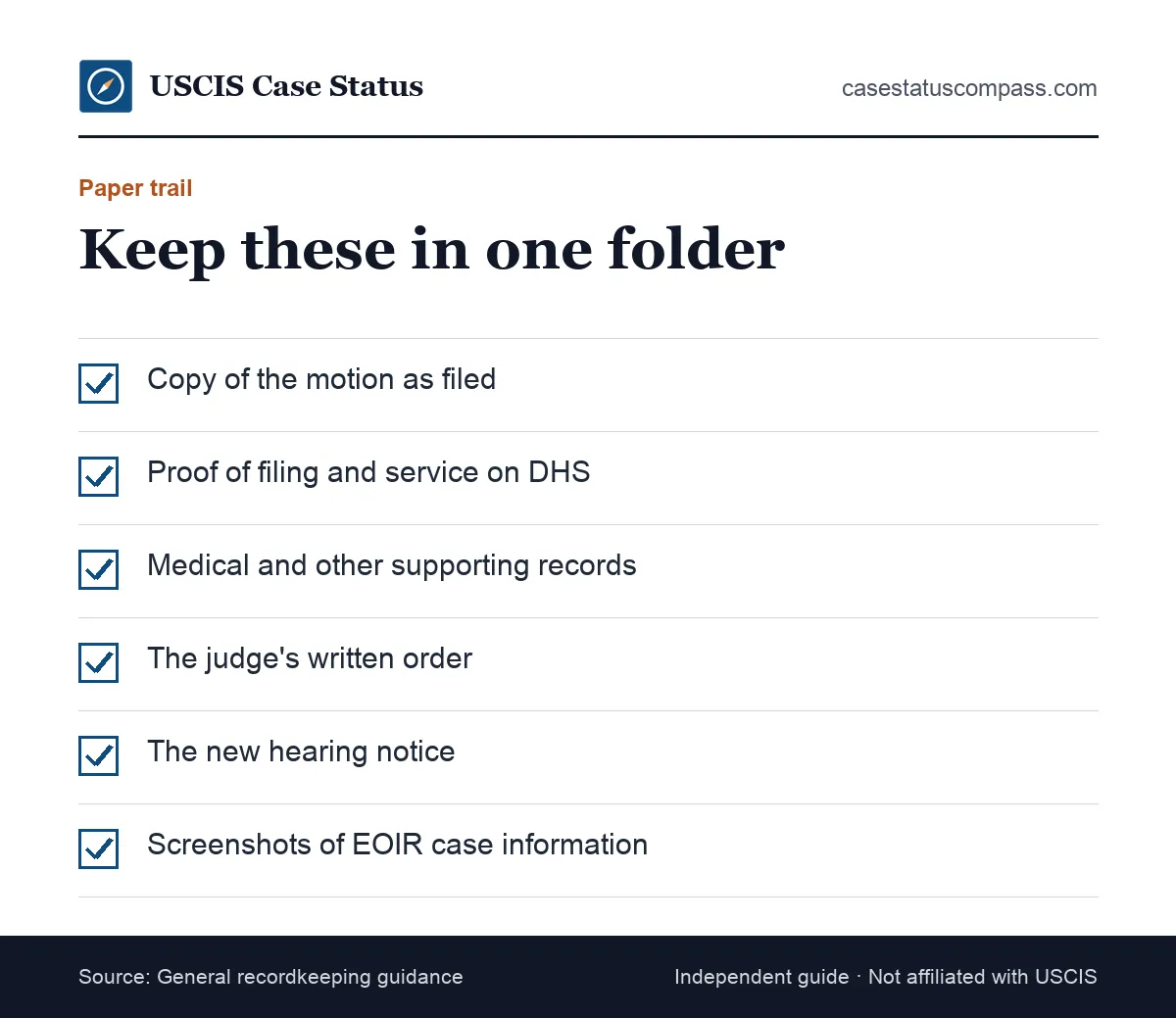
Keep it until the case ends.
The core folder
A printed folder plus a secure backup
Every document labeled with its date
The full folder passed to any new lawyer
Copies of every filing and receipt
A log of calls to the court and lawyer
Notices and address history
Keep every envelope and notice, plus proof of each address change. If you later need to show you never got a notice, that history helps. Our guide on how to verify a USCIS notice explains checking suspicious letters.
Frequently Asked Questions
Can I postpone my asylum hearing by calling the court?
No. A phone call to the clerk cannot move a hearing. The court expects a written motion to continue, filed with the court and served on the DHS attorney, and only the immigration judge can grant it.
Is a doctor's note enough to postpone an asylum hearing?
Sometimes, if it is detailed. A strong note comes from the treating doctor on letterhead, explains the condition, why you cannot attend or testify, and when you should recover. A short "excused from work" slip is often too thin.
What if the judge has not ruled by my hearing date?
Go to court. The EOIR practice manual says parties must attend all hearings as originally scheduled until a motion is granted. Missing the hearing could lead to a removal order in absentia.
Does postponing my hearing stop my work permit clock?
Usually, yes. USCIS treats delays you request or cause, including in immigration court, as applicant-caused delays that do not count toward work permit eligibility.
Can I postpone a USCIS asylum interview the same way?
No. USCIS asks you to establish exceptional circumstances, such as serious illness, through a written explanation with proof. If you miss the interview, the explanation is due within 10 calendar days.
How long will a postponed asylum hearing take to be rescheduled?
There is no standard wait. The new date depends on the court's calendar, the hearing type and the judge, and an individual hearing may be reset much further out than a master calendar hearing.
Can my lawyer go to the hearing if I am in the hospital?
Often your lawyer can appear, explain the emergency and ask the judge to reset the case, especially with medical records in hand. Whether the hearing can proceed without you depends on its type and the judge.
Can I ask the court for an earlier hearing date instead?
Yes, through a motion to advance, which asks the judge to move a hearing earlier. Like a continuance, it needs a clear, documented reason, and only the immigration judge decides.
Can the court move my hearing without a request from me?
Yes. Courts sometimes reset hearings on their own, for example when a judge's calendar changes. Check the EOIR portal regularly and follow the newest notice, even if you never asked for a change.
Do I need a lawyer to file a motion to continue?
No rule requires one, and some people without lawyers file paper motions at the court. Because a weak or late motion can fail and a missed hearing can lead to removal, an attorney or accredited representative should handle it if possible.
Sources
- EOIR Policy Manual, Immigration Court Practice Manual Ch. 4.10 (Motions to Continue and Change Venue). www.justice.gov/eoir/policy-manual-eoir/part-II/icpm/chapter-4-10. Accessed Oct 27, 2026.
- 8 CFR 1003.29: Continuances (eCFR). www.ecfr.gov/current/title-8/chapter-V/subchapter-A/part-1003/subpart-C/section-1003.29. Accessed Oct 27, 2026.
- DOJ EOIR: Immigration Court Information. www.justice.gov/eoir/immigration-court-information. Accessed Oct 27, 2026.
- DOJ EOIR: Customer Service Initiatives (case hotline). www.justice.gov/eoir/customer-service-initiatives. Accessed Oct 27, 2026.
- USCIS: Establishing Exceptional Circumstances for Rescheduling Affirmative Asylum Interviews (updated 09/04/2026). www.uscis.gov/humanitarian/refugees-asylum/asylum/establishing-good-cause-or-exceptional-circumstances. Accessed Oct 27, 2026.
- USCIS: Affirmative Asylum Interview Scheduling. www.uscis.gov/humanitarian/refugees-and-asylum/asylum/affirmative-asylum-interview-scheduling. Accessed Oct 27, 2026.
- USCIS: Applicant-Caused Delays in Asylum Adjudications and Employment Authorization. www.uscis.gov/sites/default/files/document/notices/Applicant-Caused-Delays-in-Adjudications-of-Asylum-Applications-and-Impact-on-Employment-Authorization.pdf. Accessed Oct 27, 2026.
- USCIS: How to Change Your Address. www.uscis.gov/addresschange. Accessed Oct 27, 2026.
- USCIS Form G-1055 Fee Schedule. www.uscis.gov/g-1055. Accessed Oct 27, 2026.
- 8 CFR 1003.23(b)(1) and 1003.2(c)(2) (govinfo, CFR 2025 edition). www.govinfo.gov/content/pkg/CFR-2025-title8-vol1/xml/CFR-2025-title8-vol1-sec1003-23.xml. Accessed Oct 27, 2026.
- USCIS: Automatic EAD Extension (updated 10/29/2025). www.uscis.gov/working-in-the-united-states/information-for-employers-and-employees/automatic-employment-authorization-document-ead-extension. Accessed Oct 27, 2026.
- USCIS Form G-1055 Fee Schedule, Edition 10/16/26. www.uscis.gov/sites/default/files/document/forms/g-1055.pdf. Accessed Oct 27, 2026.
- DOJ EOIR: Update Respondent or Alien Information (updated May 18, 2026). www.justice.gov/eoir/update-respondent-or-alien-information. Accessed Oct 27, 2026.
casestatuscompass.com is an independent publication and is not affiliated with USCIS or any government agency. This page is general information, not legal advice. For denials, court or asylum matters, consult an immigration attorney or a DOJ-accredited representative.