Contents · 41 sections
- How Much Does an Immigration Lawyer Cost?
- Attorney Fees vs USCIS Filing Fees: What Is the Difference?
- How Do Immigration Attorneys Charge?
- Flat Fee Agreements: What Is Usually Included?
- Hourly Billing and Retainer Deposits
- What Happens to Unused Retainer Money?
- What Is Limited-Scope Immigration Help?
- Can You Hire a Lawyer Only for the USCIS Interview?
- Do Immigration Lawyers Charge for a Consultation?
- Do Immigration Lawyers Work on Contingency?
- Can You Pay Immigration Attorney Fees in Installments?
- What Drives Immigration Attorney Fees Up or Down?
- Does Your Criminal or Immigration History Change the Cost?
- Why Do Immigration Court Cases Cost More?
- Immigration Lawyer Cost by Case Type
- How Much Are Attorney Fees for Form I-485?
- What Are Attorney Fees for US Citizenship?
- What Is a Typical I-751 Lawyer Fee?
- How Do Family and Marriage Petitions Affect Legal Fees?
- Who Pays the Lawyer in Employment-Based Cases?
- How Much Is an Immigration Attorney for Asylum?
- Why Does the One-Year Asylum Deadline Affect Legal Costs?
- Are There Free Immigration Lawyers?
- What Is the EOIR List of Pro Bono Legal Service Providers?
- What Are DOJ-Recognized Organizations and Accredited Representatives?
- Accredited Representative vs Attorney: Which Do You Need?
- How Do You Find an Immigration Lawyer Referral?
- How Do You Find a Real Immigration Lawyer Phone Number?
- How Do You Verify an Immigration Lawyer?
- What Is Form G-28 and Why Does It Matter?
- Who Cannot Give Immigration Legal Advice?
- What Should You Ask Before Signing a Fee Agreement?
- What Should a Written Fee Agreement Include?
- How Do You Compare Two Immigration Lawyer Quotes?
- Worked Example: Building a Marriage Green Card Budget
- Is an Immigration Lawyer Worth the Cost?
- What Happens to Costs If You Get an RFE or Denial?
- Can You Change Immigration Lawyers Mid-Case?
- How Can You Lower Your Immigration Attorney Costs?
- How Immigration Lawyer Cost Fits Into Your Total Budget
- Frequently Asked Questions
The short answer
Immigration lawyer cost has no official price: each attorney sets their own fee, so quotes for the same case can differ widely. What you pay depends on the fee structure, the case type, its complexity and your location. Government filing fees are a separate bill, and low-cost help exists through DOJ-recognized nonprofits.
At a glance
| Official price list? | None. Attorneys set their own fees; USCIS sets only filing fees. |
| Billing models | Flat fee, hourly, limited scope, pro bono |
| Lower-cost options | DOJ-recognized nonprofits, accredited representatives, law school clinics |
| Check before paying | State bar license, EOIR discipline list, written agreement |
This guide sits under our complete guide to USCIS filing fees, which lists what the government charges. Here we cover what a representative charges.
How Much Does an Immigration Lawyer Cost?
The immigration lawyer cost for your case is whatever the attorney quotes in a written agreement. No agency publishes or caps private legal fees, so we do not print immigration attorney prices.
Get written quotes from two or three representatives for the same scope.
Why no single price exists
Two people filing the same form can need very different work. A clean record is mostly paperwork; a past overstay or prior denial calls for legal analysis and possibly a waiver.
Why online price ranges mislead
Online ranges come from marketplaces, blogs or small surveys that rarely say where lawyers practice or what was included. A "green card" figure may cover one form or a family package, so published immigration lawyer prices can make a fair quote look wrong.
Attorney Fees vs USCIS Filing Fees: What Is the Difference?
Attorney fees pay for legal work and go to your representative. USCIS filing fees pay the government and come from Form G-1055, edition 10/16/26 as of October 2026. Most lawyer quotes exclude government fees.
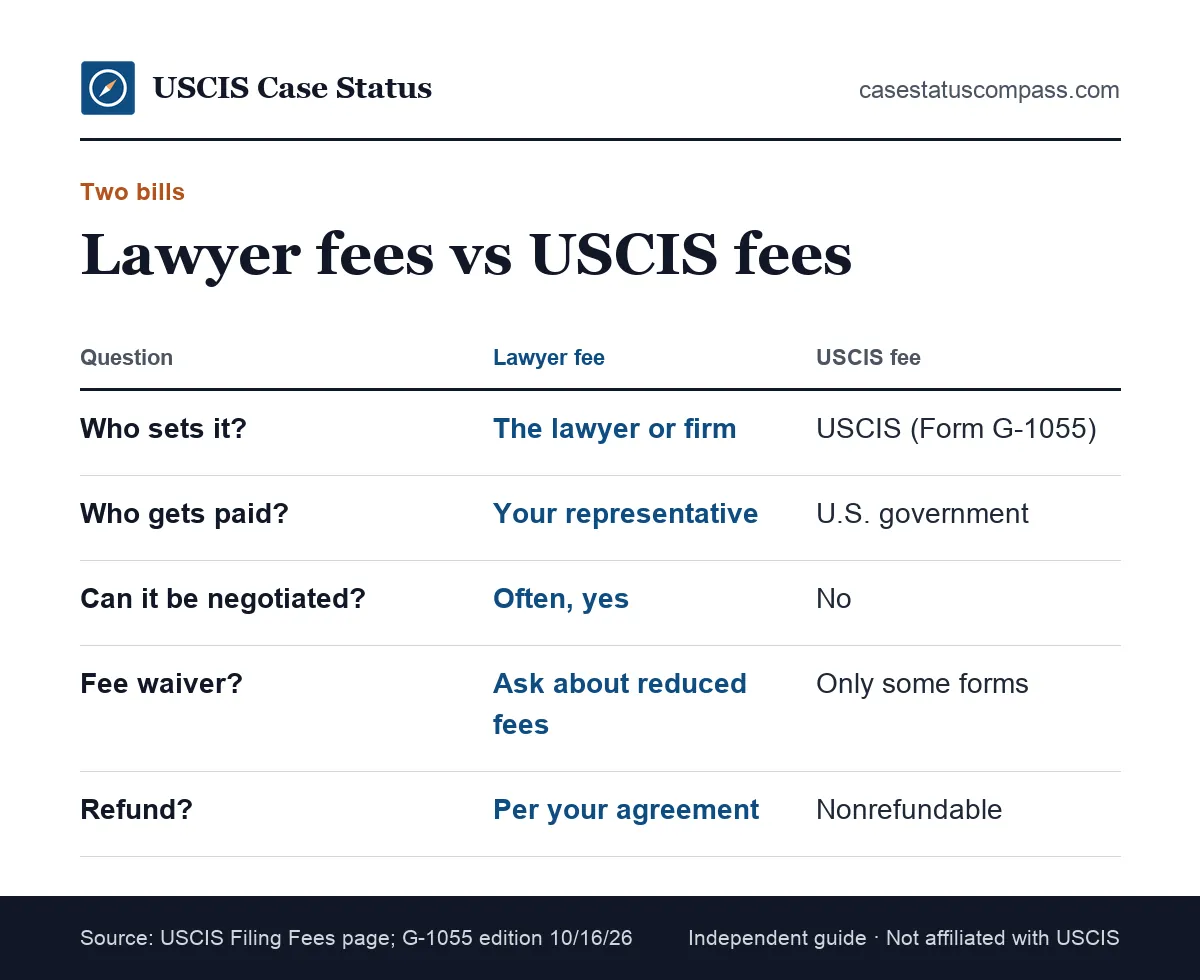
Look for "plus filing fees" in each quote to see which bill is still coming.
Who sets each fee
Your lawyer sets legal fees. USCIS sets filing fees, the same for everyone using the same form and method. Our Form G-1055 fee schedule walkthrough explains the official list.
Ask for the legal fee on its own line.
Which fees can be waived or refunded
On the government side, USCIS fees are nonrefundable, even if your case is denied or withdrawn. Some forms qualify for a fee waiver, and the request costs $0 (no fee to request a fee waiver). Refunds of unearned legal fees depend on your agreement and state lawyer rules.
How Do Immigration Attorneys Charge?
Immigration attorneys usually charge a flat fee for a defined task, hourly billing for time spent, or a limited-scope fee for one piece of the work. The billing model shapes the final bill as much as the headline number.
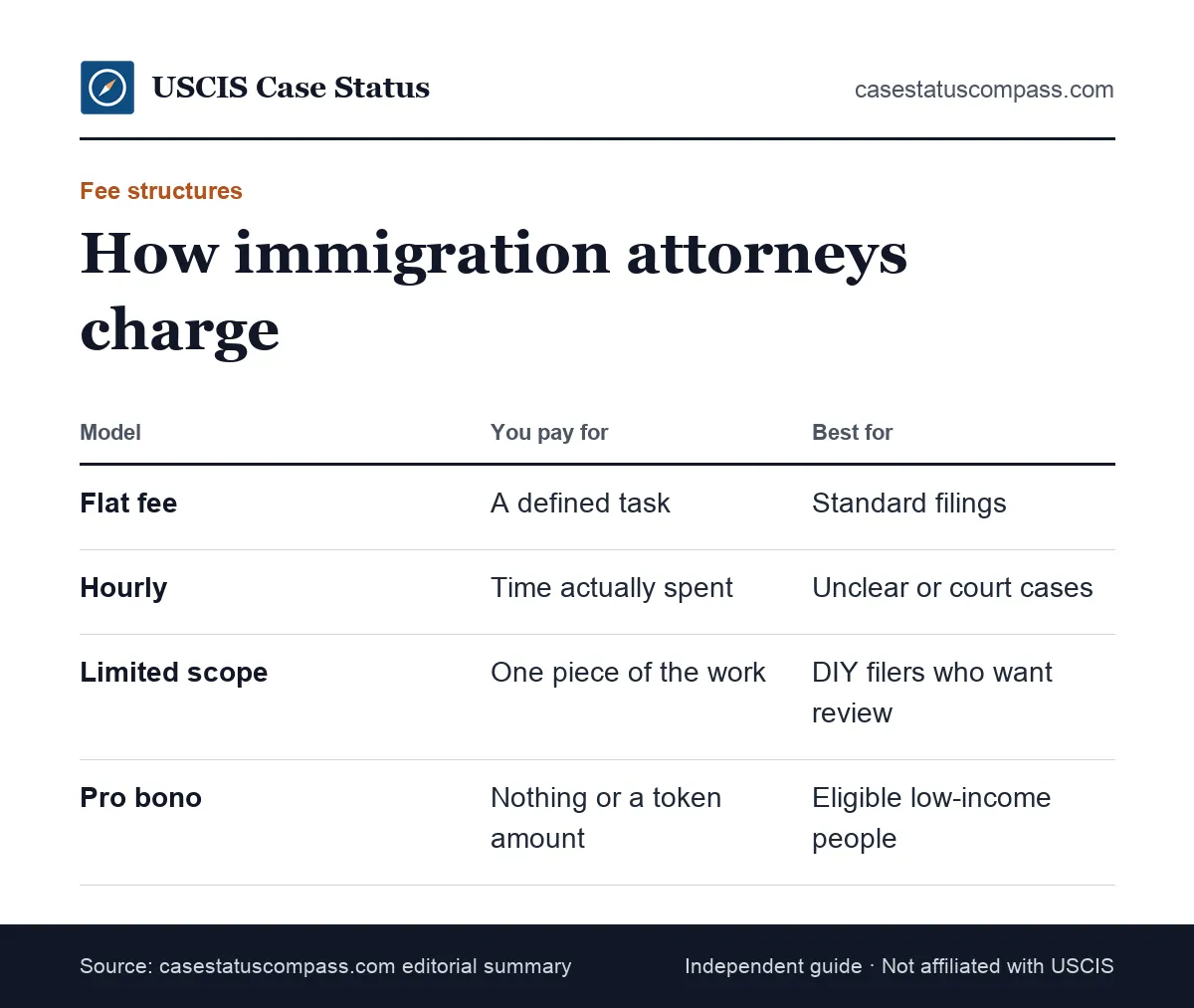
Ask which model applies to each stage.
Flat fees for predictable filings
Many lawyers quote one price for a routine filing, such as a naturalization application. You know the total in advance. The catch is scope: unlisted tasks may cost extra.
Check the agreement's scope list before you sign.
Hourly rates for open-ended work
Immigration attorney rates billed by the hour are common for court cases, appeals and files with unclear facts. The total depends on time spent, so ask for an estimate of hours first.
Flat Fee Agreements: What Is Usually Included?
A flat fee agreement usually covers preparing forms, reviewing evidence and filing the package. Interview attendance, evidence requests, extra family members and appeals may or may not be included. Confirm each item in writing.
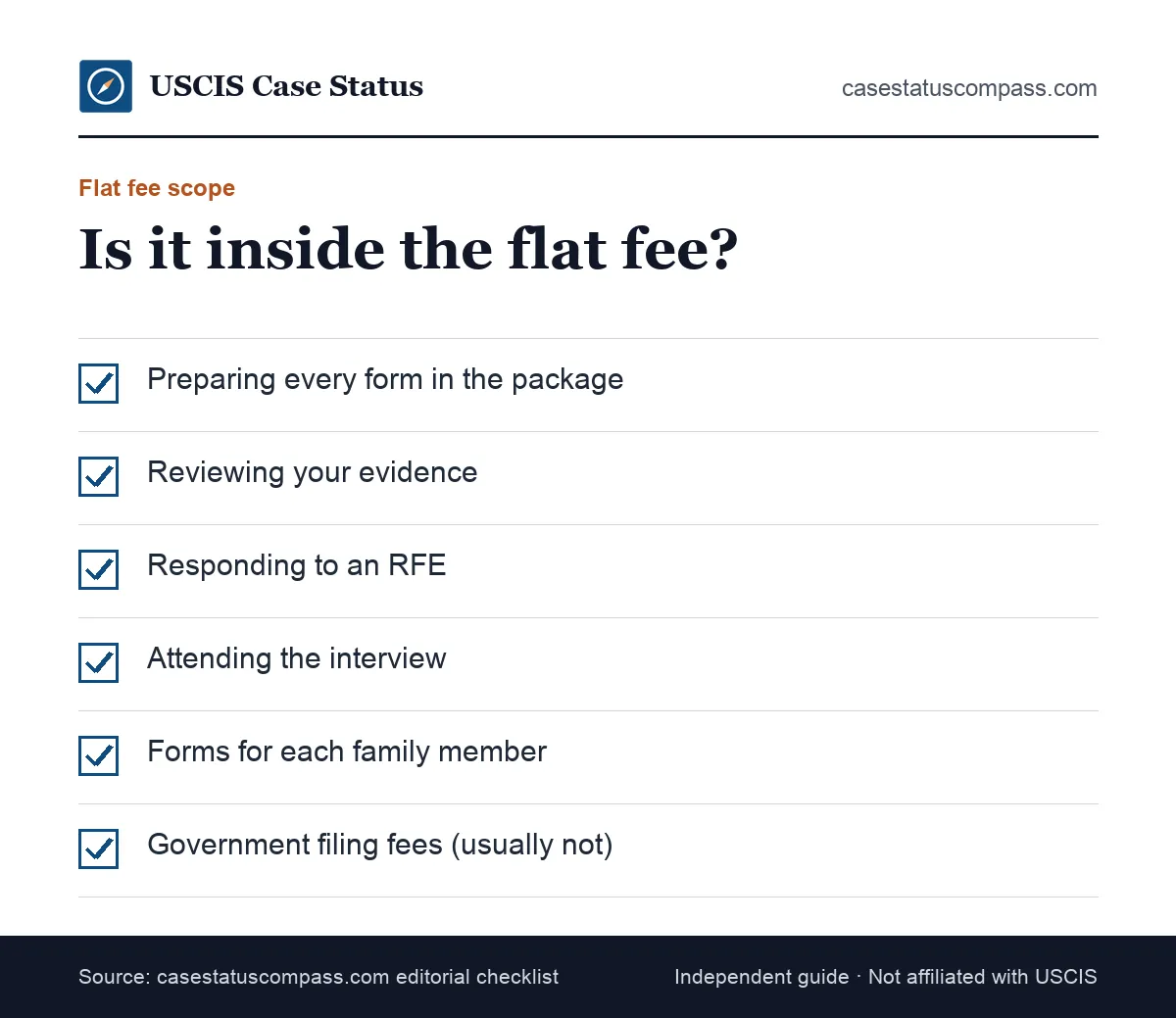
If the agreement is silent on a task, assume it is extra.
Tasks commonly inside a flat fee
- An intake meeting to collect facts and documents
- Preparing each form named in the agreement
- Organizing evidence and writing a cover letter
- Filing the package and tracking the receipt notice
Tasks often billed separately
Answering a Request for Evidence (RFE), attending the interview, preparing a waiver, filing an appeal and adding a spouse or child are frequent extras.
Ask for a price on each extra up front.
Hourly Billing and Retainer Deposits
With hourly billing, you pay for recorded time, usually against an up-front deposit called a retainer. The lawyer draws from the deposit as work is done; ask for itemized invoices.
Ask whether work pauses when the deposit runs low, since that can hit a USCIS deadline.
How time is recorded
Firms often bill in fractions of an hour, so short emails still appear. Ask which increment applies, whether paralegal time costs less, and whether travel or court waiting time counts.
Monthly invoices and billing caps
Monthly invoices let you spot surprises early. Some lawyers agree to a cap, or to call you before work passes a set number of hours. Put it in writing.
Review each invoice the week it arrives.
What Happens to Unused Retainer Money?
A retainer is generally held for you until it is earned. Ask what happens to any balance if the case ends early or you change lawyers, and get the answer in writing.
Unearned money generally stays yours, often held in a trust account.
What Is Limited-Scope Immigration Help?
Limited-scope representation, also called unbundled help, means paying a lawyer for one defined task while you handle the rest. It usually costs less, but the lawyer is not responsible for the parts you do alone.
Get the covered task named in the agreement.
Document review before you file
A review of your completed forms can catch wrong editions, missing signatures or mismatched dates. It fits simple filings such as a card renewal.
Bring the exact final package you plan to mail.
Strategy sessions
A one-time strategy session gives you a lawyer's view of your options and risks without ongoing representation. It suits people deciding whether to file at all.
Bring written questions to the session.
Can You Hire a Lawyer Only for the USCIS Interview?
Yes. Some applicants file alone and hire a lawyer only to prepare for the interview or attend it. Ask whether the lawyer will file a Form G-28 for that role, since USCIS then sends notices to the lawyer too.
Ask for the interview-only fee in writing.
Do Immigration Lawyers Charge for a Consultation?
Some immigration lawyers offer a free first meeting; others charge a consultation fee that may be credited toward the full fee if you hire them. Ask before booking whether it is paid and what you receive.
Note whether you spoke with a paralegal.
Free versus paid consultations
A free call is often a short screening. A paid consultation usually includes a real document review and a recommendation. Leave with clear options and a written quote.
If you hear only a sales pitch, keep looking.
How to prepare for a consultation
Bring passports, I-94 records, every notice and any arrest records, plus a timeline of entries and exits. A prepared client gets more advice per hour, lowering the immigration lawyer fees you pay.
Do Immigration Lawyers Work on Contingency?
Immigration lawyers rarely work on contingency, because most immigration cases produce no money award to take a percentage from. They use flat fees, hourly billing or payment plans instead.
Treat a percentage fee offer on a green card or citizenship case as a reason to walk away.
Why contingency fees rarely fit
Contingency works in injury cases because a settlement funds the fee. A green card or citizenship approval has no cash award, so a percentage fee has nothing to draw from.
Beware of pay-after-approval promises
USCIS decides every case, so no lawyer can promise approval. An offer to charge nothing until approval is a warning sign like those in the scam list below.
Ask for a fixed scope and price instead.
Can You Pay Immigration Attorney Fees in Installments?
Often, yes. Many firms split a flat fee into installments, typically a deposit before work starts and the rest before filing. Ask whether filing waits for the final payment and what happens if you miss one.
Get the payment schedule for the immigration lawyer cost in the agreement.
What Drives Immigration Attorney Fees Up or Down?
Immigration attorney fees rise with complexity, risk and time. Criminal history, past violations, court proceedings, waivers, tight deadlines and several family members all add work. A clean single-applicant case usually costs less.
Disclose your full history at the first meeting, so the immigration lawyer cost you are quoted reflects the real work.
Cost drivers and questions to ask
| Cost driver | Why it adds work | Ask the lawyer |
|---|---|---|
| Criminal record | Each arrest needs legal analysis | Will you need certified court records? |
| Past overstay or removal | May trigger bars or waivers | Is a waiver needed, and is it extra? |
| Immigration court case | Hearings, briefs and deadlines | Is each hearing billed separately? |
| Several family members | More forms and evidence | Is each person a separate fee? |
| Urgent deadline | Work must be rushed | Is there a rush charge? |
Each row pairs a fee factor with a question to ask. Bring the questions column to every consultation.
Complexity and risk
The more legal questions a file raises, the more research and writing it needs. Form filling and a case needing a legal brief are different products.
Ask the lawyer which legal issues they see in your file.
Location, experience and firm size
Lawyers in high-cost cities often charge more than those in smaller markets. A newer solo practitioner may suit a simple filing.
Immigration law is federal, so you can hire a lawyer outside your own city.
Does Your Criminal or Immigration History Change the Cost?
Yes. Any arrest, conviction, past overstay, unlawful entry, removal order or earlier denial usually increases the work and the fee. Hiding them can lead to denial or worse.
Tell the lawyer everything at the start, even sealed or expunged matters, so the quote covers the real work.
Arrests and convictions
Even a dismissed charge may need certified court records. Some offenses carry immigration consequences that differ from their criminal labels. Bring every police and court document you have.
Ask whether the fee covers obtaining records.
Past overstays, entries and removals
Unlawful presence, entry without inspection and prior removal orders can bar a green card. Some need waivers or special rules, which our INA 245(i) explainer covers for one group.
Bring every I-94 and passport stamp.
Why Do Immigration Court Cases Cost More?
Immigration court cases usually cost more than USCIS filings because they involve hearings, briefs, evidence deadlines and sometimes appeals. Many lawyers bill court work hourly or by stage.
Ask whether the price is per stage, since hearings can be months apart and a judge may reset your hearing.
Hearings and preparation time
A master calendar hearing is short, but an individual hearing can need weeks of preparation. Ask whether the fee covers every hearing, including continuances. Our guide to postponing an asylum hearing explains that process.
Appeals to the Board of Immigration Appeals
An appeal after a judge's decision is a separate stage with its own written brief. Ask whether the quote ends at the ruling or covers an appeal to the Board of Immigration Appeals.
Tracking your court case yourself
You can follow a court case for free. Check immigration court cases online at acis.eoir.justice.gov with your A-number. The EOIR case hotline is EOIR case hotline: 1-800-898-7180 (24/7, automated). Our immigration court case status guide explains the results.
Immigration Lawyer Cost by Case Type
Immigration lawyer cost by case type varies because each case needs different work. The table shows the work involved and what raises the price. Use it to build questions for your quotes.
The immigration lawyer cost itself is not listed, because no official source publishes it.
Legal work and price drivers for N-400, I-485, I-130, I-751, I-589 and I-290B
| Case type | Typical legal work | What raises the price |
|---|---|---|
| Naturalization (N-400) | Eligibility review, form, interview prep | Arrests, long trips, tax issues |
| Adjustment of status (I-485) | Package, evidence, interview | Past violations, waivers |
| Family petition (I-130) | Petition and relationship proof | Prior marriages, missing records |
| Remove conditions (I-751) | Joint petition or waiver | Divorce or abuse waiver |
| Asylum (I-589) | Declaration, evidence, interview or hearing | Court case, deadline issues |
| Appeal or motion (I-290B) | Legal brief and evidence | Complex law, new evidence |
Find your form in the first column, then read across to see its price drivers.
How to use this table
Copy the last column for your case type into your notes. Ask each lawyer how those issues change the quote. Then add the USCIS fee for each form.
That gives you a full cost estimate.
Cases with several family members
When a spouse and children file together, each usually needs separate forms. Ask whether the lawyer charges per person, offers a family package or charges less per derivative. USCIS also charges per applicant.
How Much Are Attorney Fees for Form I-485?
Attorney fees for Form I-485 depend on your green card category, your history and the size of the package. A clean family case usually needs less work than one with status gaps. The government fee is separate: $1,440 (paper) / $1,390 (online); $950 / $900 if under 14 and filing with a parent.
What the lawyer does on an adjustment case
Expect help choosing forms, building evidence, checking sponsor papers and preparing for the interview. Our Form I-485 guide explains the adjustment package. Ask whether work permit and travel forms cost extra.
Government costs to add to the quote
Add the I-485 fee, any I-765 or I-131 fees, translations and the civil surgeon's exam. Our page on green card costs by path totals the government side; our I-693 medical exam cost guide covers the doctor's bill.
What Are Attorney Fees for US Citizenship?
Attorney fees for US citizenship, including the attorney fee for a citizenship application, are often among the lower legal fees, because many N-400 cases are routine. They rise with arrests, long trips or tax problems. The USCIS fee is $760 (paper) / $710 (online); reduced fee $380 (paper only) if household income is at or below 400% of the Federal Poverty Guidelines.
Simple versus complicated N-400 cases
A resident with no arrests, few trips and clean taxes may need only form review. An old conviction or a trip over six months needs real analysis. Ask what drives the N-400 attorney fees quoted.
Lowering the government side
The citizenship fee has a reduced option: Reduced N-400 fee: request it in Part 10 of the paper N-400 (income at or below 400% of poverty). Our guide to the cost of applying for citizenship explains each option, and our N-400 application guide covers the form.
What Is a Typical I-751 Lawyer Fee?
An I-751 lawyer fee depends mostly on whether you file jointly with your spouse or ask for a waiver. A strong joint petition is often simple. A waiver after divorce, abuse or a spouse's death needs more evidence and usually costs more.
When legal help matters most
Divorce or separation during the conditional period is when most people hire help. Our Form I-751 guide explains the timing rule: File in the 90 days before your 2-year card expires. Missing it is costly to fix.
Interview and evidence follow-up
USCIS may schedule an interview or send an RFE. Ask whether the I-751 attorney fee covers both. The USCIS fee, $750 (paper) / $700 (online), is not part of the lawyer's price.
How Do Family and Marriage Petitions Affect Legal Fees?
Family petitions vary in legal cost with the relationship, prior marriages and whether the relative is in the U.S. or abroad. A spouse petition plus adjustment is a bigger package than a petition alone, and fiancé cases add consular steps.
Petition alone or concurrent filing
Filing only Form I-130 is one task; filing it with an I-485, I-765 and I-131 is a full package. Our marriage green card guide and Form I-130 petition guide show each path.
Fiancé visa cases
A K-1 case moves from USCIS to the National Visa Center and a consulate, then back to USCIS after the wedding. Ask whether the quote covers every stage. Our K-1 fiancé visa guide lists them.
Who Pays the Lawyer in Employment-Based Cases?
In many employment cases the employer hires and pays the attorney, especially for H-1B petitions, PERM labor certification and Form I-140. That lawyer may represent the employer, not you. Ask who the client is.
If your interests differ, consider a separate consultation.
PERM, I-140 and the employer's lawyer
Department of Labor rules generally make the employer responsible for labor certification costs. Our PERM labor certification guide and Form I-140 guide explain each stage.
In short, the employer, not the worker, must pay PERM labor certification costs, including its own attorney fees.
H-1B petitions
The employer files the H-1B petition and pays several government fees, as our H-1B visa guide explains. A status problem may call for your own lawyer.
Ask the company's attorney which questions they can answer for you personally.
How Much Is an Immigration Attorney for Asylum?
The cost of an immigration attorney for asylum depends on whether the case is affirmative, filed with USCIS, or defensive, in immigration court. Court cases usually cost more. Many asylum seekers qualify for free nonprofit help.
Ask whether the quote covers the declaration.
Affirmative versus defensive asylum
An affirmative case involves Form I-589, a declaration, evidence and an asylum office interview. A defensive case adds hearings and possible appeals. The government side is $0 filing fee + $100 Asylum Application Fee (principal applicant); Annual Asylum Fee $105 (online, when USCIS sends a notice). Our asylum application guide explains both.
Why Does the One-Year Asylum Deadline Affect Legal Costs?
A missed deadline can end the case before any fee matters: File for asylum within 1 year of your last arrival in the U.S. (limited exceptions). If the deadline is close, contact a nonprofit or attorney now. Waiting to save money on asylum legal help can cost you the chance to apply at all.
Are There Free Immigration Lawyers?
Yes, but free help is limited. Pro bono attorneys, DOJ-recognized nonprofits and law school clinics serve many people at no cost or a reduced fee, usually based on income or case type. Contact several providers early.
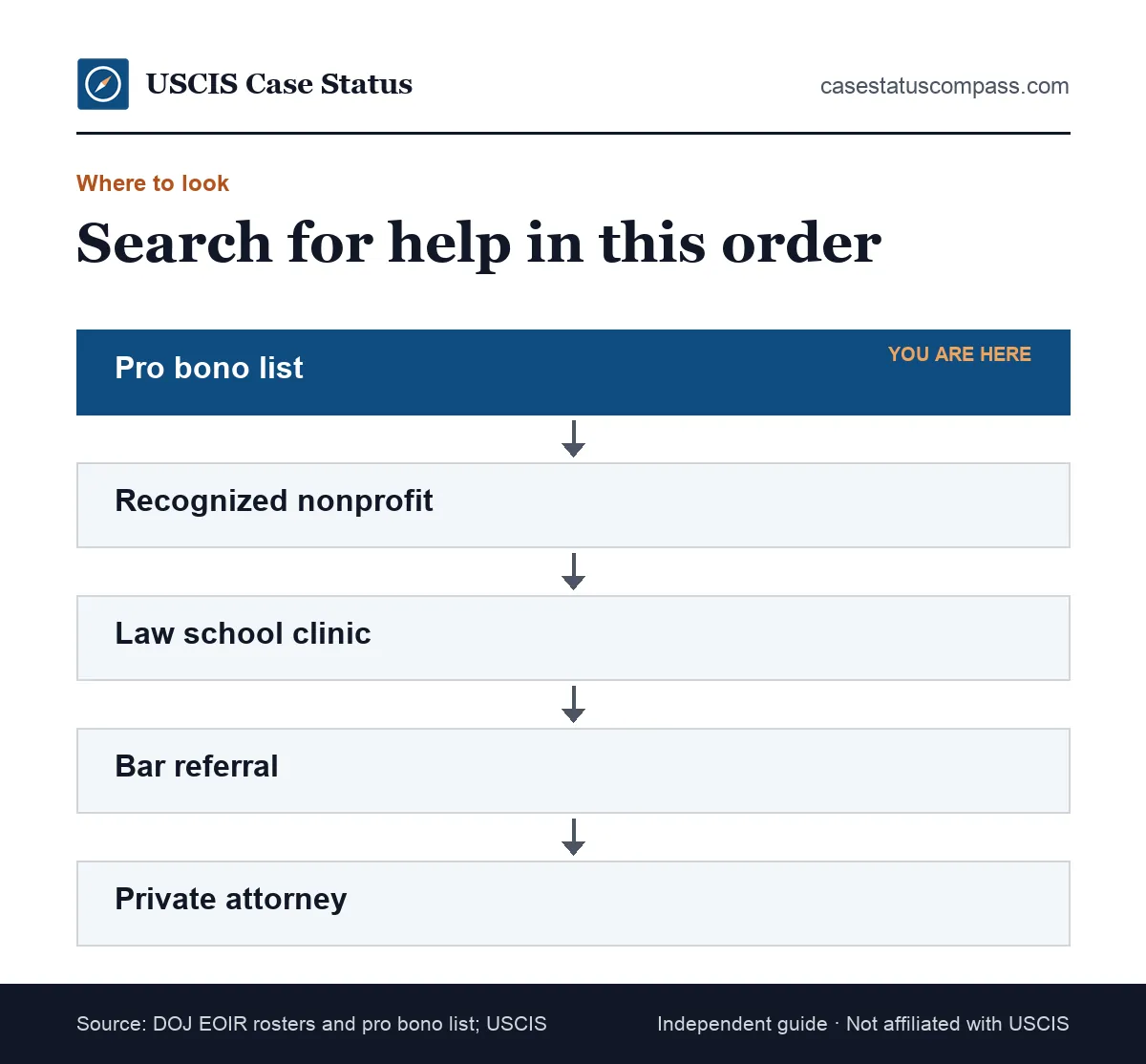
Ask each provider about income limits first.
Law school immigration clinics
Many law schools run clinics where supervised students handle real cases for free. Clinics choose cases that fit their teaching calendar, so call early in the semester.
Before a clinic accepts you, staff review your notices and any court dates to see whether the case fits their schedule, so bring both to the first call.
Reduced fees at nonprofits
Nonprofits that charge something often base the fee on household income or case type. Ask what proof of income they need and whether a waitlist applies before counting on that help.
What Is the EOIR List of Pro Bono Legal Service Providers?
The Justice Department's List of Pro Bono Legal Service Providers names nonprofits and attorneys who commit to free representation at specific immigration courts. EOIR updates it quarterly, making it the official starting point for free court help.
If a listed provider accepts your case, the immigration lawyer cost for court representation drops to zero.
Using the list for your court
Find the entries for your immigration court and call more than one, because capacity changes. EOIR does not endorse the providers, so verify each one as you would any representative.
What Are DOJ-Recognized Organizations and Accredited Representatives?
A recognized organization is a nonprofit, federally tax-exempt group approved by the Justice Department to provide immigration legal services. An accredited representative is a non-attorney staff member authorized to represent clients through that organization, often at lower cost.
Ask for the organization's written fee schedule so you can compare it with a private firm's immigration lawyer cost quote.
Partial versus full accreditation
A partially accredited representative may appear before DHS, which includes USCIS. A fully accredited one may also appear in immigration court and before the Board of Immigration Appeals.
Ask which level your representative holds.
Finding a recognized organization
The Justice Department publishes state rosters of recognized organizations and accredited representatives. An accredited representative works only through their organization.
Call the organization to confirm the representative's name and their accreditation level.
Accredited Representative vs Attorney: Which Do You Need?
An accredited representative suits many USCIS filings and, with full accreditation, court cases. A licensed attorney may be needed for federal court, complex criminal issues or when no nonprofit has capacity. Both can give legal advice and file Form G-28.
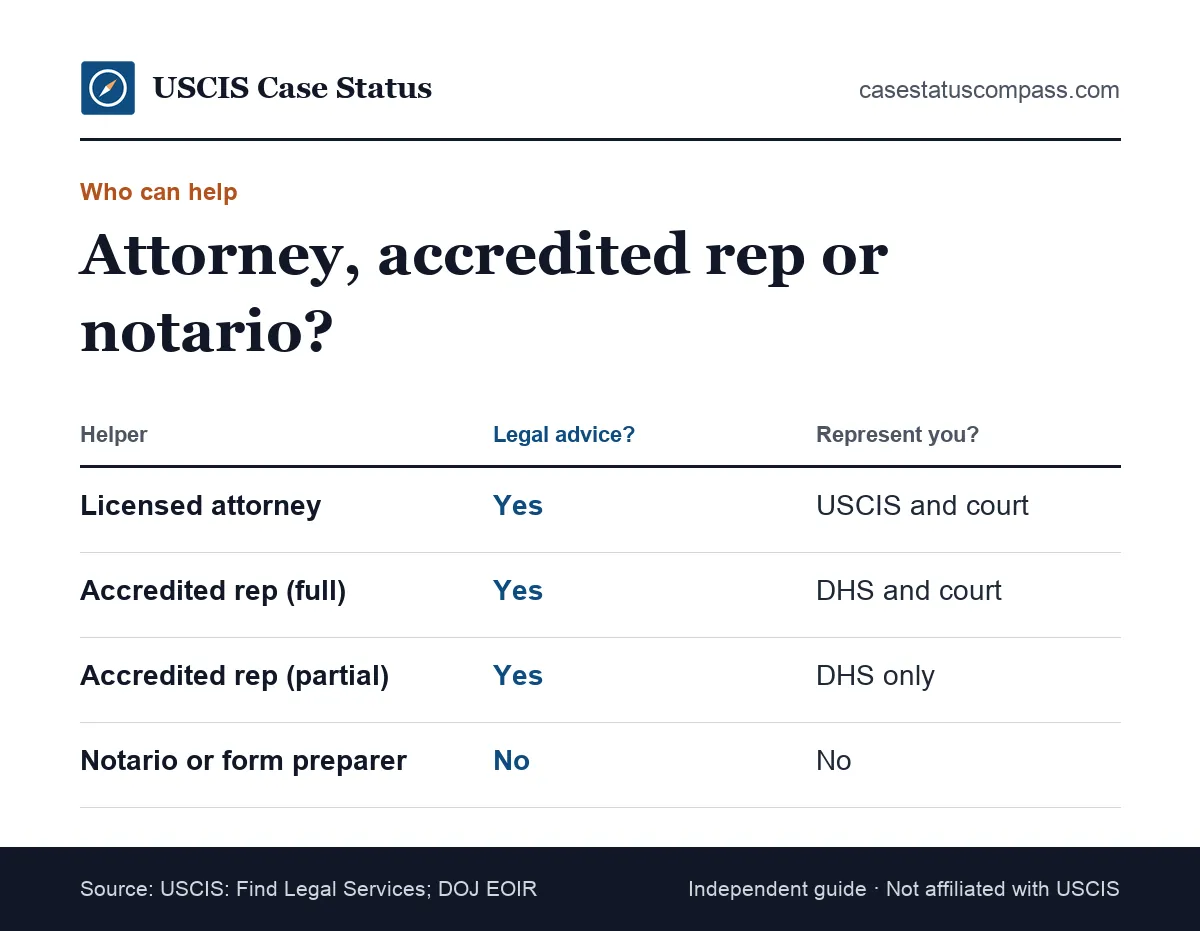
Side-by-side: licensed attorney and accredited representative
| Question | Licensed attorney | Accredited representative |
|---|---|---|
| Authorized by | A U.S. state, territory or D.C. bar | DOJ, through a recognized nonprofit |
| USCIS filings | Yes | Yes |
| Immigration court | Yes | Only with full accreditation |
| Federal court | Yes, if admitted | No |
| Typical cost | Private market rates | Often reduced or free |
The table compares what each representative may do and usually costs; the key difference is court work.
When an attorney fits better
Choose an attorney when a case could go to federal court, when convictions need coordination with a defense lawyer, or when nonprofits have waitlists.
A private attorney also helps when you need representation quickly.
When a nonprofit fits better
For routine naturalization, family petitions, renewals and many humanitarian filings, a recognized organization is often the most affordable path. Our DACA renewal guide covers one filing nonprofits commonly handle.
Ask about waitlists before you count on a date.
How Do You Find an Immigration Lawyer Referral?
An immigration lawyer referral can come from a bar association referral service, a professional directory, a recognized nonprofit or people you trust. Verify the license yourself anyway.
Ask what kind of case the lawyer handled for whoever referred you, since case-type fit matters.
Bar association referral services
Most state and many county bar associations run referral services. You describe your issue, and they match you with a licensed immigration lawyer. Ask whether the first meeting has a set fee.
Directories and personal referrals
The American Immigration Lawyers Association, a private professional group, offers a public lawyer search. A referral is a starting point, not a license check.
Confirm the lawyer handles your case type.
How Do You Find a Real Immigration Lawyer Phone Number?
Searching for an immigration lawyer phone number often leads to lead-generation sites. Call the number on the lawyer's state bar listing instead, and ask for the attorney's name and bar number on the first call.
If a caller demands payment before naming an attorney or giving a bar number, end the call and check the state bar directory yourself.
How Do You Verify an Immigration Lawyer?
Ask for the lawyer's state and bar number, confirm active good standing on that state bar website, and check the Justice Department's List of Currently Disciplined Practitioners. For an accredited representative, confirm they appear on the DOJ roster with their organization.
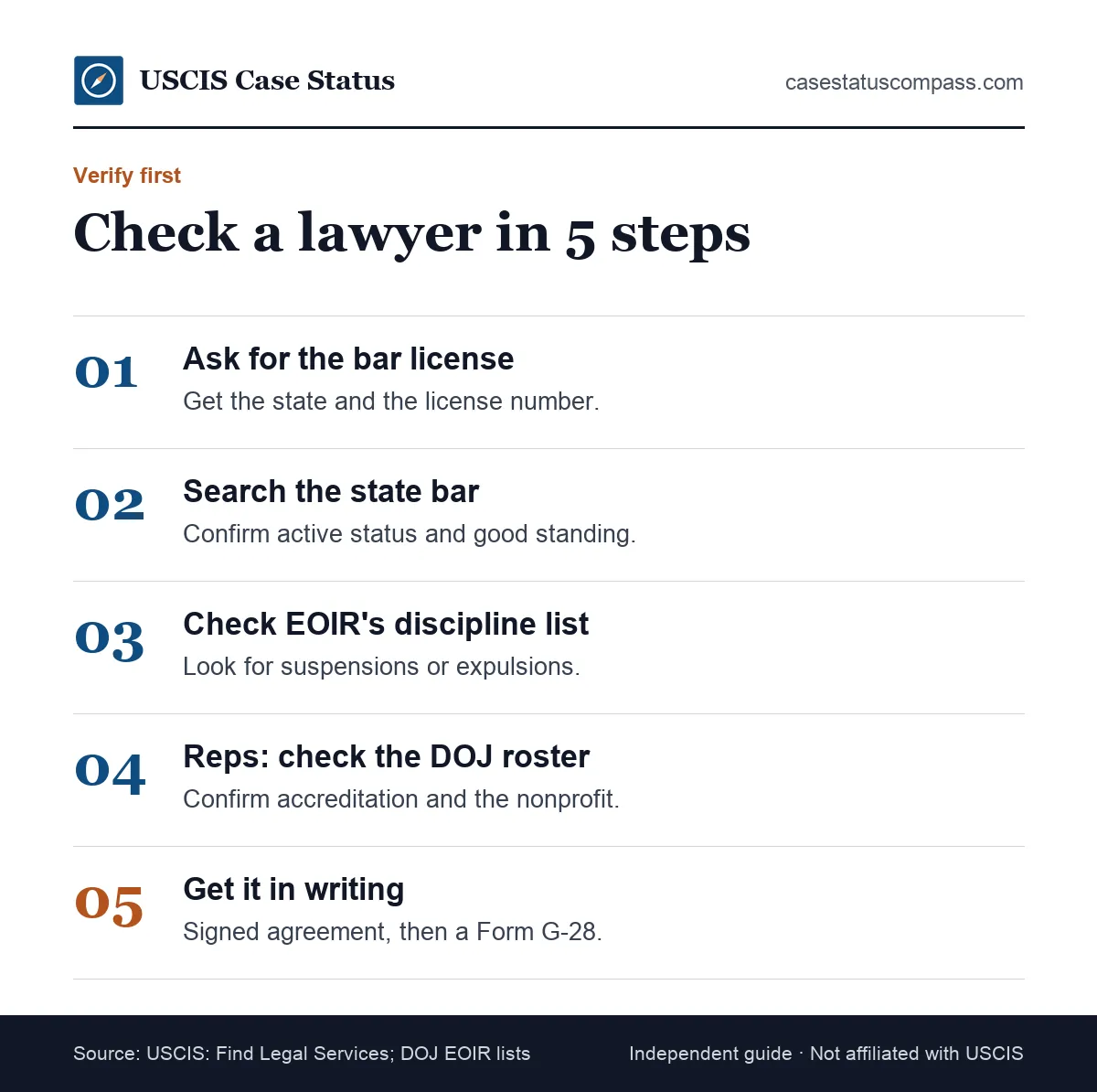
Check the state bar license
Every United States immigration attorney must be in good standing with at least one U.S. state, territory or D.C. bar. Immigration is federal law, so a lawyer licensed in another state can handle your USCIS case.
Check EOIR's discipline list
EOIR lists practitioners barred or suspended from practice before immigration courts, the Board and DHS. It does not replace the state bar check.
Search the name, and former names, before you pay anything.
Verifying an accredited representative
Find the name on the Justice Department's roster and confirm the listed organization matches the office you visit. Because accredited representatives work only through their organization, a mismatch is a reason to stop.
What Is Form G-28 and Why Does It Matter?
Form G-28, the Notice of Entry of Appearance as Attorney or Accredited Representative, tells USCIS who represents you. Your representative files it, and you sign it to consent. A notario cannot file one.
Ask for a signed copy for your records.
What the form shows you
The G-28 lists the representative's name, license or accreditation details and contact information. If a helper refuses to sign one, ask why; unlicensed preparers often avoid it.
Check that the bar number matches the state bar website.
If your representative never filed one
Without a G-28, USCIS will not discuss your case with the helper. Paying for "representation" with no G-28 on file is a warning sign.
Ask for a signed G-28 before paying more.
Who Cannot Give Immigration Legal Advice?
Notarios, notaries public, visa consultants and form preparers cannot give legal advice or represent you before USCIS. A U.S. notary is not a lawyer. Their mistakes can cost far more than a lawyer's fee.
Check the license or DOJ roster first.
Warning signs of an immigration scam
- A promised approval or "special connection" at USCIS
- Asking you to sign blank or false forms
- Keeping your original documents
- No written contract or receipt
- Charging for blank forms, which are free on uscis.gov
Where to get help after a scam
Our guide to spotting and reporting USCIS scams lists reporting steps. Then ask a licensed attorney or recognized organization to review what was filed in your name.
Keep receipts and messages as evidence.
What Should You Ask Before Signing a Fee Agreement?
Ask what exactly is covered, who will do the work, how and when you pay, and what happens if USCIS wants more evidence. Ask for every answer in the written agreement.
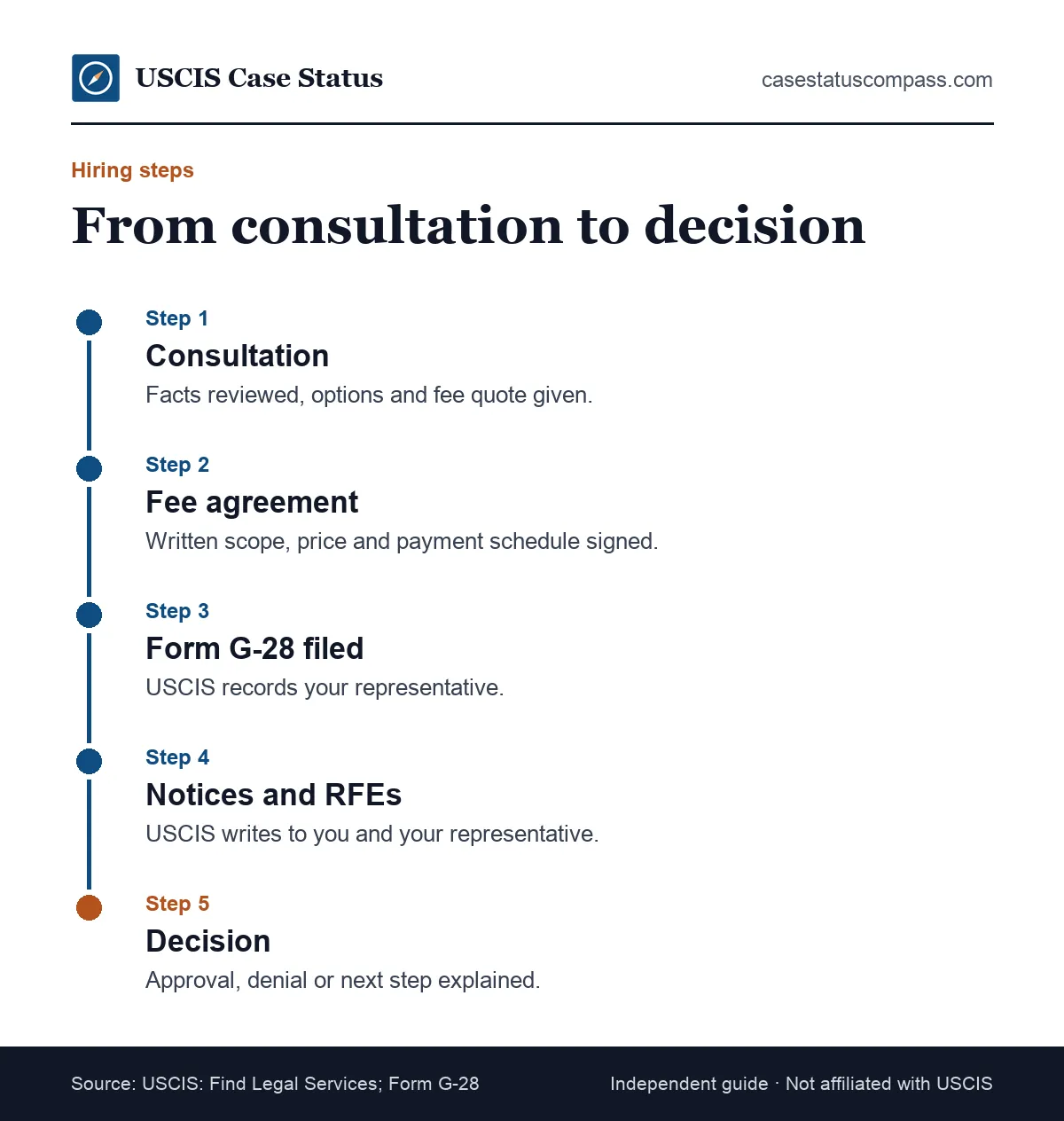
Ask every lawyer the same questions so the answers compare easily.
Questions about the work
- Which forms and family members does the fee cover?
- Will you or a paralegal prepare my forms?
- Are the interview and any RFE response included?
- What are the biggest risks in my file?
Questions about the money
- Is this flat, hourly or limited scope?
- When is each payment due?
- Are USCIS fees and translations included?
- What happens to my money if I end the case early?
Write the answers next to each quote.
What Should a Written Fee Agreement Include?
A written fee agreement should state the scope of work, the price and billing method, the payment schedule, separate expenses, refund terms and who handles your case. Do not pay a large sum without one.
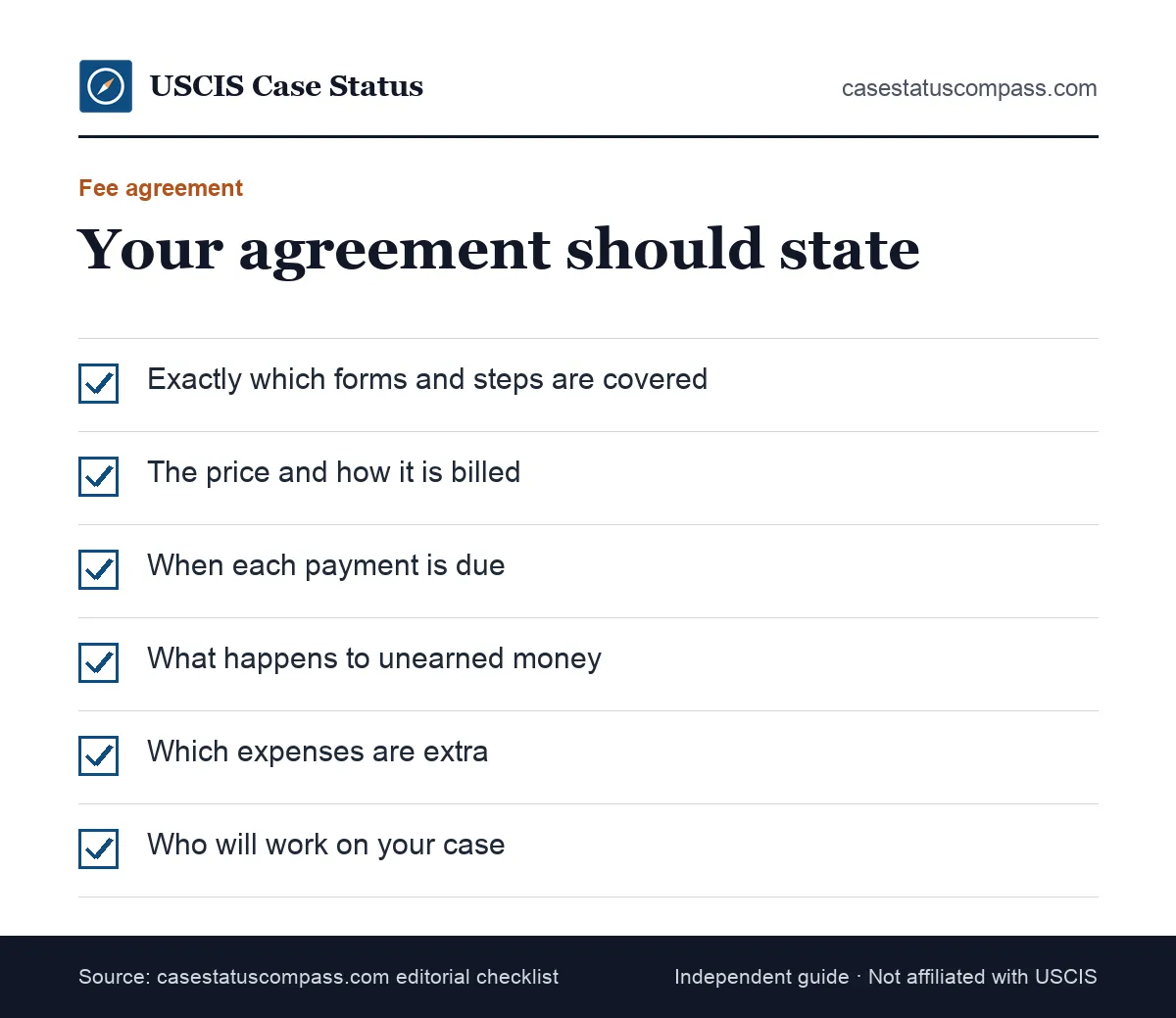
Ask for a signed copy of it.
Terms to look for
The agreement should name every form, person and stage it covers, such as filing, interview and RFE. It should say whether government fees are included and how either side can end the relationship.
Red flags in an agreement
- No list of tasks
- A "guaranteed approval"
- Full payment due before any work starts
- No refund language
- No attorney name or bar number
If you see any of these, ask for a revised agreement before paying, or keep looking.
How Do You Compare Two Immigration Lawyer Quotes?
Compare quotes by matching scope line by line, not by comparing totals. A lower flat fee that excludes the interview and RFE responses can cost more in the end than a higher fee that includes them.
Ask each firm to fill in the same worksheet.
Quote-comparison worksheet
| Line item | Quote A | Quote B |
|---|---|---|
| Billing model | ||
| Forms and family members covered | ||
| Interview attendance included? | ||
| RFE or NOID response included? | ||
| Government fees included? | ||
| Payment schedule and refund terms | ||
| Bar license verified? |
Fill in one column per lawyer; blank cells show where you still need an answer before you compare totals.
Normalize the scope first
Where one quote includes an item and the other charges extra, ask the second lawyer what that extra costs. Only then compare totals, so a quote does not look cheap simply because it covers less.
Worked Example: Building a Marriage Green Card Budget
This fictional example builds a budget for a spouse adjusting status in the U.S. Government fees come from G-1055, edition 10/16/26. The legal fee line stays blank, because only your own written quote can fill it.
Swap in your own forms and your own immigration lawyer cost quote.
Sample budget: I-130, I-485, I-864 and I-693
| Item | Paid to | Amount |
|---|---|---|
| Form I-130 petition | USCIS | $675 (paper) / $625 (online) |
| Form I-485 adjustment | USCIS | $1,440 (paper) / $1,390 (online); $950 / $900 if under 14 and filing with a parent |
| Form I-864 affidavit of support | USCIS | $0 at USCIS |
| Form I-693 medical exam | Civil surgeon | $0 USCIS fee; the civil surgeon sets the exam price |
| Legal fee | Your representative | From your written quote |
Only the legal fee line depends on your representative; every other line comes from an official schedule.
Step 1: Total the government fees
Add each USCIS line, choosing the paper or online price. Include work permit or travel document fees if you file them. Our G-1055 fee overview lists each amount.
Check each amount against the current Form G-1055 on the day you pay, because USCIS can change fees between your quote and your filing.
Step 2: Add outside costs and the quote
Get a written price from the civil surgeon and translation quotes, then add the lawyer's quote. Keep a cushion for an RFE, since some agreements bill responses separately.
That combined figure, the immigration lawyer cost plus every filing and outside fee, is the number to compare across quotes.
Is an Immigration Lawyer Worth the Cost?
A lawyer is usually worth the cost when your case carries legal risk: arrests, past violations, prior denials, court proceedings, waivers or asylum. For a simple, documented filing, careful self-filing or limited-scope review may be enough.
Weigh the immigration lawyer cost against the cost of a denial.
How much legal help to buy: an if-then guide
| If your situation is… | Consider |
|---|---|
| Simple renewal, clean record | Self-filing or a nonprofit review |
| First green card, no history issues | Limited-scope review or full service |
| Any arrest or conviction | Attorney consultation first |
| Past overstay, removal or unlawful entry | Attorney or fully accredited representative |
| Immigration court case or a NOID | Prompt legal help |
Find the row for your situation; if two rows apply, follow the one recommending more help.
When filing on your own may be reasonable
USCIS does not require a representative, and many people renew cards or file routine forms alone. If you do, read every instruction page and confirm the current form edition first.
When skipping legal help is risky
Any "yes" answer in a form's criminal or immigration history section is a reason to get advice first, and so is an earlier denial. A short paid consultation is cheaper than fixing a wrong filing.
What Happens to Costs If You Get an RFE or Denial?
An RFE, a Notice of Intent to Deny (NOID) or a denial usually adds legal work, and many agreements bill it separately. Know your agreement's terms before a notice arrives.

Send each notice to your lawyer the same day and ask for a response price.
RFE and NOID deadlines
For an RFE, RFE deadline: up to 12 weeks (the exact date is on your RFE); no extensions. For a NOID, NOID deadline: up to 30 days; no extensions. Our guides to answering a Request for Evidence and responding to a Notice of Intent to Deny explain each notice.
Appeals and motions after a denial
Appeal or motion: file within 30 days (33 if the decision was mailed). The filing fee is $800 (some humanitarian categories $0; fee waiver possible). Appeals need a written argument, so legal fees usually rise. See our options after a denied case and motion to reopen or appeal guide.
Can You Change Immigration Lawyers Mid-Case?
Yes, at any time. The new representative files a new Form G-28, and you should ask the old one for your complete file. What you owe or get back depends on your fee agreement and the work already done.
Tell USCIS of the change.
Getting your file
Ask in writing for copies of every filing and notice, plus your original documents. Your USCIS online account also shows notices for linked cases.
Keep your own copy of every receipt notice.
Unearned fees
If a flat fee or retainer covered unfinished work, ask how the unearned amount is calculated. If you cannot settle it, your state bar can explain local fee dispute programs.
How Can You Lower Your Immigration Attorney Costs?
You can lower your immigration attorney cost by organizing documents before the consultation, choosing limited-scope help for simple tasks, using nonprofits when eligible, comparing written quotes and cutting government fees with waivers where allowed.
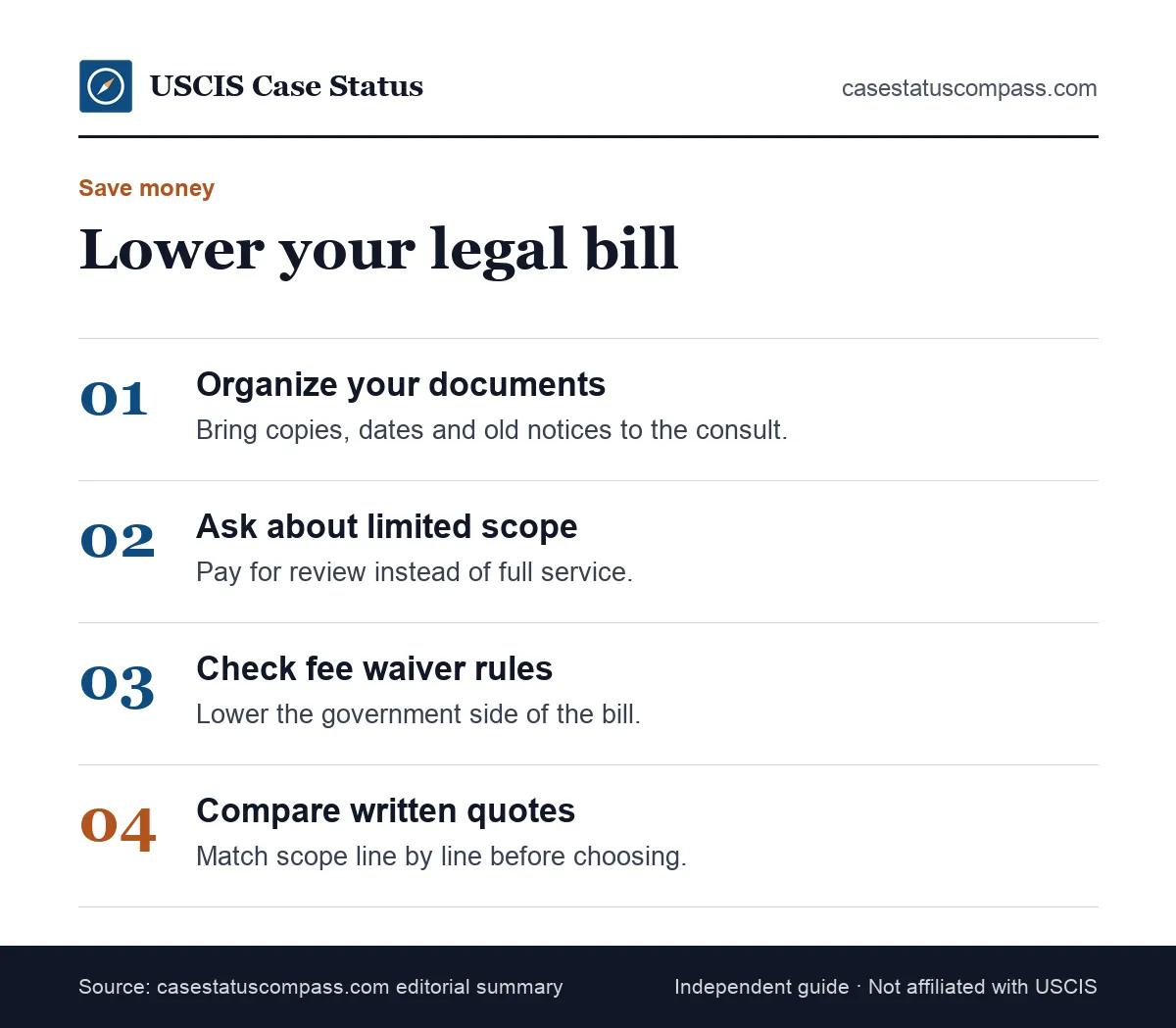
Never cut costs by skipping disclosure.
Do the gathering yourself
Collect passports, I-94 records, civil documents and old notices. Order certified records early and copy them in the order your lawyer asks.
Label each document so the paralegal does not bill time sorting papers.
Reply quickly and in one batch
On hourly billing, every back-and-forth costs money. Answer your lawyer promptly, send documents together rather than one at a time, and keep one list of questions for each call.
Fewer emails mean a smaller bill.
Reduce the government side
Check whether your forms qualify for a waiver: Fee waiver: means-tested benefit, income at or below 150% of poverty guidelines, or financial hardship. Our USCIS fee waiver guide explains how to apply. Online filing also costs less than paper for many forms.
How Immigration Lawyer Cost Fits Into Your Total Budget
Your budget has three parts: the immigration lawyer cost from your written quote, USCIS filing fees from G-1055, and outside costs such as the medical exam, translations and travel. Plan all three before filing.
Leave a cushion for RFEs and travel.
Start with the fixed government fees
Government fees are fixed, so list them first. Add outside costs from local quotes, then the representative's fee.
Check each amount against the current Form G-1055 edition, since USCIS can change fees.
If the total is too high
Look first at free legal help from nonprofits and clinics, then at limited-scope options that cover only the riskiest part of your case.
Frequently Asked Questions
How much does it cost for an immigration lawyer?
There is no official figure for how much immigration attorneys charge. Each lawyer sets their own fee, and quotes vary with case type, complexity, experience and city. USCIS filing fees are separate.
How much are immigration attorneys per hour?
No official hourly rate exists. Rates vary with experience, city and firm size, and paralegal time is often billed lower. Ask for the hourly rate, the billing increment and an estimate of total hours in writing.
Is a free immigration consultation worth it?
A free consultation helps you decide whether you need a lawyer, though it is often short. Bring your notices and a written timeline, ask for a written quote afterward, and verify the license before paying.
Do immigration lawyers charge per family member?
Many do, because each family member usually needs separate forms and evidence. Some offer a family package or a lower price per extra person. Ask how the fee is calculated; USCIS charges each applicant too.
Can I get my money back if my case is denied?
USCIS filing fees are nonrefundable, even after a denial. Whether any legal fee comes back depends on your written agreement and the work already done. Most lawyers charge for the work, not the result.
Can I hire an immigration lawyer licensed in another state?
Yes. Immigration is federal law, so a lawyer in good standing with any U.S. state, territory or D.C. bar can handle a USCIS case. Check that bar's website.
What is the cheapest way to get immigration legal help?
Start with DOJ-recognized nonprofits, the EOIR pro bono list and law school clinics, which may charge little or nothing. If they cannot take your case, limited-scope help usually costs less than full representation.
Can a notary help with my immigration forms?
In the United States, a notary public is not a lawyer and cannot give immigration legal advice or represent you before USCIS. If someone promises results or keeps your original documents, contact a licensed attorney or accredited representative.
Does USCIS require me to have a lawyer?
No. USCIS does not require a representative and does not pay for one. Legal help is strongly advisable if you have an arrest, a past violation, a prior denial or a court case.
Sources
- USCIS: Find Legal Services. www.uscis.gov/scams-fraud-and-misconduct/avoid-scams/find-legal-services. Accessed Oct 27, 2026.
- USCIS: Avoid Scams. www.uscis.gov/scams-fraud-and-misconduct/avoid-scams. Accessed Oct 27, 2026.
- USCIS: Form G-28, Notice of Entry of Appearance as Attorney or Accredited Representative. www.uscis.gov/g-28. Accessed Oct 27, 2026.
- DOJ EOIR: Recognition and Accreditation Program. www.justice.gov/eoir/recognition-and-accreditation-program. Accessed Oct 27, 2026.
- DOJ EOIR: Recognition and Accreditation Roster Reports. www.justice.gov/eoir/recognition-accreditation-roster-reports. Accessed Oct 27, 2026.
- DOJ EOIR: List of Pro Bono Legal Service Providers. www.justice.gov/eoir/list-pro-bono-legal-service-providers. Accessed Oct 27, 2026.
- DOJ EOIR: List of Currently Disciplined Practitioners. www.justice.gov/eoir/list-of-currently-disciplined-practitioners. Accessed Oct 27, 2026.
- USCIS Form G-1055 Fee Schedule (edition 10/16/26). www.uscis.gov/sites/default/files/document/forms/g-1055.pdf. Accessed Oct 27, 2026.
- USCIS: Filing Fees (updated 02/12/2026). www.uscis.gov/forms/filing-fees. Accessed Oct 27, 2026.
- DOJ EOIR: Immigration Court Information. www.justice.gov/eoir/immigration-court-information. Accessed Oct 27, 2026.
- DOJ EOIR: Customer Service Initiatives (updated May 29, 2025). www.justice.gov/eoir/customer-service-initiatives. Accessed Oct 27, 2026.
- Form N-400 Instructions, Edition 01/20/25. www.uscis.gov/sites/default/files/document/forms/n-400instr.pdf. Accessed Oct 27, 2026.
- USCIS: Removing Conditions on Permanent Residence Based on Marriage. www.uscis.gov/green-card/after-we-grant-your-green-card/conditional-permanent-residence/removing-conditions-on-permanent-residence-based-on-marriage. Accessed Oct 27, 2026.
- 20 CFR 656.12(b) (govinfo, CFR 2025 edition). www.govinfo.gov/content/pkg/CFR-2025-title20-vol3/xml/CFR-2025-title20-vol3-sec656-12.xml. Accessed Oct 27, 2026.
- USCIS: Form I-589 page. www.uscis.gov/i-589. Accessed Oct 27, 2026.
- USCIS: Form I-693 page (updated 07/24/2026) and G-1055. www.uscis.gov/i-693. Accessed Oct 27, 2026.
- 8 CFR 103.2(b)(8)(iv) (LII). www.law.cornell.edu/cfr/text/8/103.2. Accessed Oct 27, 2026.
- USCIS: Form I-290B page (updated 10/26/2026). www.uscis.gov/i-290b. Accessed Oct 27, 2026.
- Form I-912 Instructions, Edition 07/22/25. www.uscis.gov/sites/default/files/document/forms/i-912instr.pdf. Accessed Oct 27, 2026.
casestatuscompass.com is an independent publication and is not affiliated with USCIS or any government agency. This page is general information, not legal advice. For denials, court or asylum matters, consult an immigration attorney or a DOJ-accredited representative.