Contents · 42 sections
- What Is INA Section 245(i)?
- Why Does 245(i) Immigration Matter Today?
- How Does 245(i) Differ From Regular Adjustment Under 245(a)?
- Which Adjustment Bars Can 245(i) Overcome?
- What Does INA Section 245(i) Not Fix?
- Does Leaving the U.S. Trigger Bars That 245(i) Cannot Cure?
- What Are the 245(i) Filing Deadlines?
- What Does "Grandfathered" Mean Under 245(i)?
- Do You Have to Adjust Through the Petition That Grandfathered You?
- Which Petitions and Applications Qualify for 245(i)?
- What Does "Properly Filed" Mean for 245(i)?
- What Does "Approvable When Filed" Mean?
- Who Must Prove Physical Presence on December 21, 2000?
- What Evidence Proves Physical Presence for 245(i)?
- Can a Spouse or Child Use the Grandfathering?
- What If the Marriage or Child Came After April 30, 2001?
- Can a Spouse or Child File After the Principal Becomes a Permanent Resident?
- What Else Must Be True to Adjust Under 245(i)?
- Does Your Priority Date Have to Be Current for 245(i)?
- How Do You File I-485 Supplement A?
- What Does 245(i) Cost?
- Who Should Not File Supplement A?
- Supplement A Evidence Checklist
- How Does 245(i) Work in Family-Based Cases?
- How Does 245(i) Work in Employment-Based Cases?
- Can Diversity Visa Winners Use 245(i)?
- How Is 245(i) Handled in Immigration Court?
- Can You Travel While a 245(i) Case Is Pending?
- How Does the 2026 Advance Parole Change Affect 245(i) Applicants?
- Can You Work While a 245(i) Case Is Pending?
- INA Section 245(i) Eligibility Decision Table
- Worked Examples: 245(i) in Practice
- What Are Common Myths About 245(i)?
- How Do You Find Old Records From Before 2001?
- Can a FOIA Request Recover Your Pre-2001 Petition Records?
- How Are 245(i) Cases Processed and Decided?
- What If USCIS Denies the 245(i) Claim?
- How Long Do You Have to Challenge a 245(i) Denial?
- Why Should You Talk to an Attorney Before Filing?
- Key 245(i) Terms in Plain English
- How Does 245(i) Fit Into the Wider Green Card Process?
- Frequently Asked Questions
The short answer
INA section 245(i) lets certain people who entered without inspection, fell out of status or worked without permission still get a green card inside the U.S. You qualify only if a family petition, employer petition or labor certification was filed for you, or for your parent or spouse, by April 30, 2001.
At a glance
| Key deadline | 245(i): petition or labor certification filed by Apr. 30, 2001 (and in the U.S. Dec. 21, 2000 if filed after Jan. 14, 1998) |
| Form to file | Form I-485 plus Supplement A (edition 09/18/26) |
| Extra fee | Supplement A: $1,000 (Form G-1055) |
| What it does not fix | Grounds of inadmissibility, such as some criminal or prior-removal issues |
| Best first step | Have an immigration attorney review your records |
This explainer supports our Form I-485 green card application guide and covers only 245(i) immigration rules. These cases can carry removal risk, so get legal advice before you file.
What Is INA Section 245(i)?
INA section 245(i) is a provision of the Immigration and Nationality Act that lets some people adjust status despite bars that normally block them, such as entering without inspection. It applies only to people "grandfathered" by a petition or labor certification filed by April 30, 2001.
The short legal idea
Normal adjustment under INA 245(a) requires a lawful entry and, for most people, lawful status. Section 245(i) carves out an exception: a grandfathered beneficiary can use Supplement A to adjust despite certain past violations.
Where it sits in the law
The Immigration and Nationality Act (INA) section 245(i) is codified at 8 U.S.C. 1255(i), with USCIS rules at 8 CFR 245.10. USCIS applies it through Form I-485 and the Supplement A instructions, edition 09/18/26.
Why Does 245(i) Immigration Matter Today?
245(i) immigration still matters because many long-term U.S. residents were grandfathered decades ago and only now have a visa available. An old sibling petition or labor certification can still unlock adjustment today.
If a relative or employer once filed for you or your parent, find that old paperwork before assuming you have no path.
Who still uses it
Typical users entered in the 1990s, had a relative or employer file before the deadline, and stayed. Many later married a U.S. citizen or found a new employer, and use the old filing for grandfathering only.
Why the eligible group keeps shrinking
No new person can become grandfathered, because the deadline passed in 2001. Each year, more grandfathered people adjust, leave or pass away, and old records get harder to find.
Gather your proof now.
How Does 245(i) Differ From Regular Adjustment Under 245(a)?
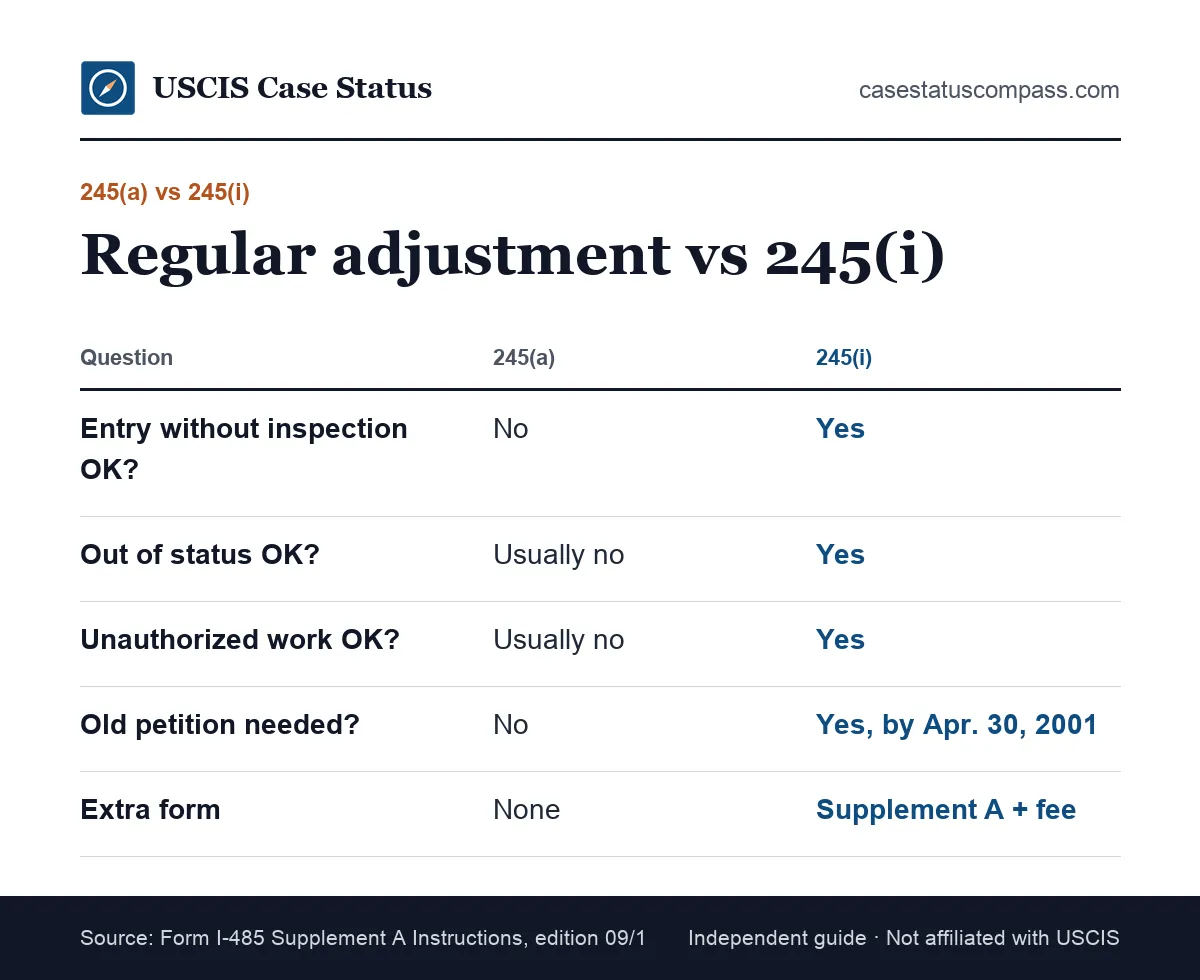
Regular adjustment under INA 245(a) requires inspection and admission or parole, and most applicants must have kept lawful status. Section 245(i) lets grandfathered people adjust despite many of those bars, if they file Supplement A and pay the extra fee.
The 245(a) baseline
Most applicants inside the U.S. use 245(a): they were inspected at entry and usually kept status. Immediate relatives of U.S. citizens get leeway for some status problems, but entry without inspection still blocks 245(a).
What 245(i) adds
Section 245(i) adds a second door into the same process. The immigrant category, the I-485 form and the interview stay the same; only certain adjustment bars are removed.
You also pay one extra fee.
Which Adjustment Bars Can 245(i) Overcome?
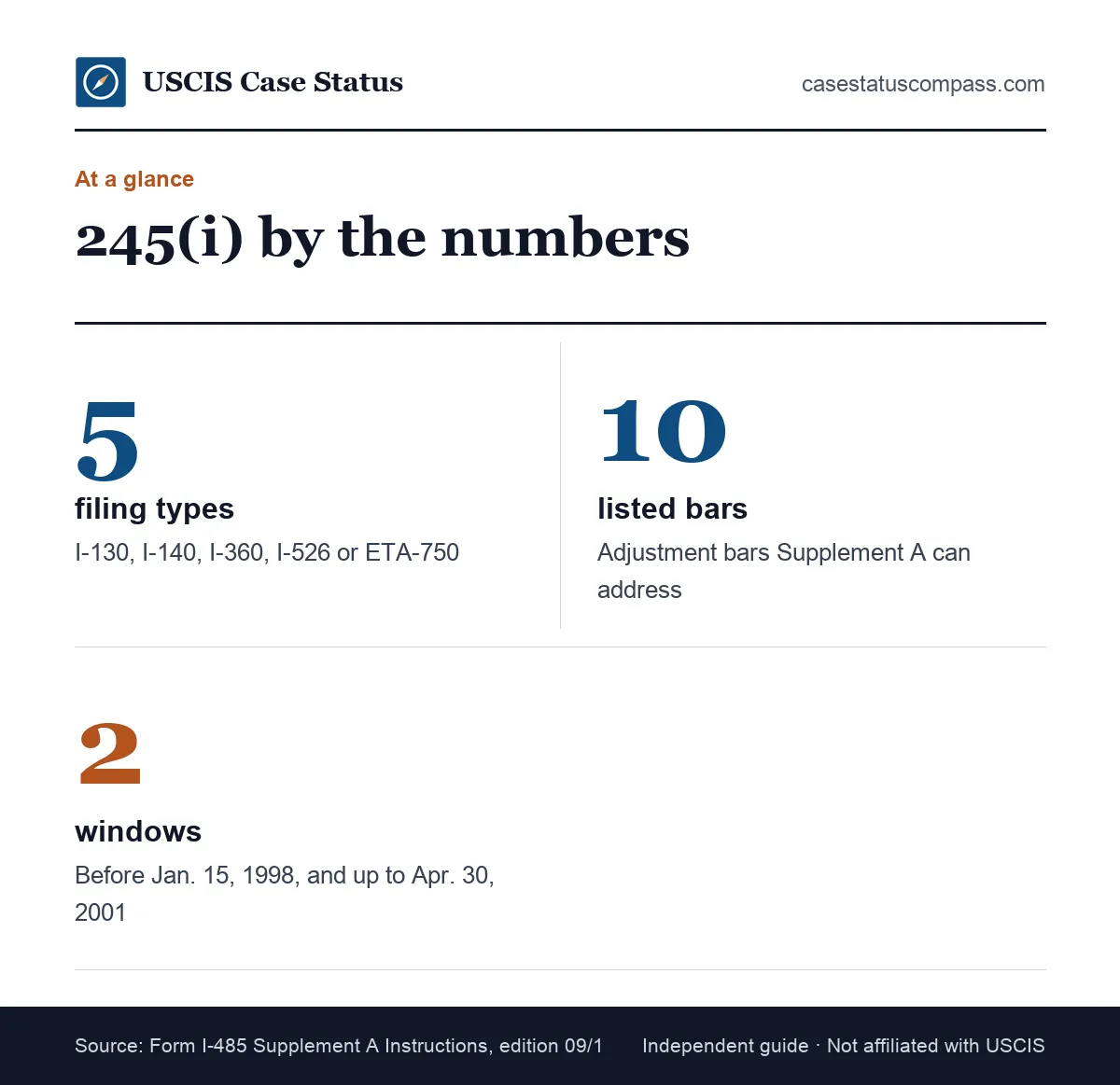
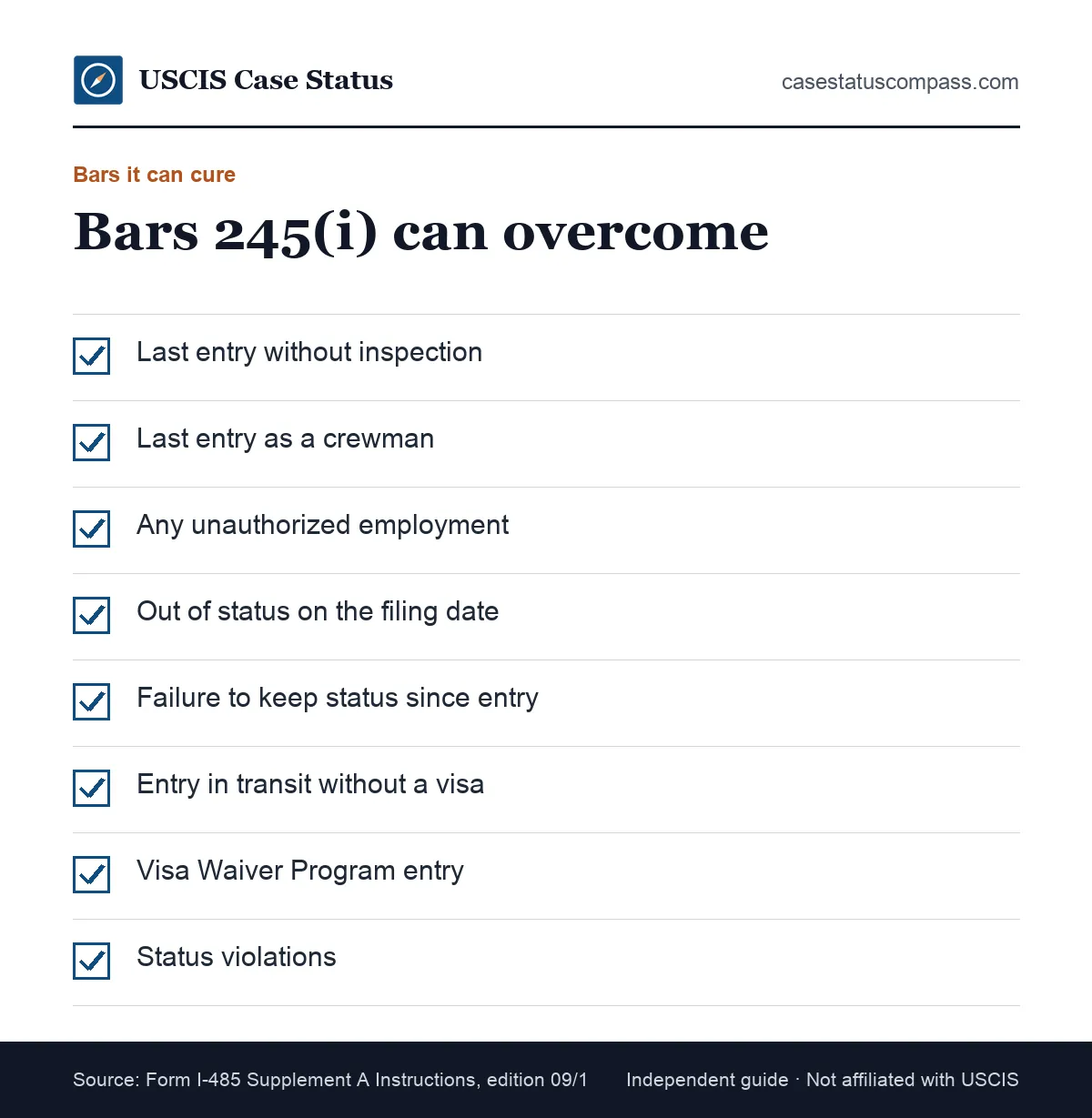
The Supplement A instructions list ten adjustment bars that 245(i) can address. They include last entering without inspection or as a crewman, any unauthorized employment, being out of status on the filing date, past status violations and entry under the Visa Waiver Program.
Entry-related bars
These cover a last entry without inspection, entry as a nonimmigrant crewman, admission in transit without a visa, and admission under the Visa Waiver Program or the Guam and Northern Mariana Islands program (unless Canadian).
Status and work bars
These cover unauthorized employment, being out of status when you file, failing to keep lawful status since entry, and violating the terms of a nonimmigrant status, including for employment-based applicants.
What Does INA Section 245(i) Not Fix?
INA section 245(i) does not waive grounds of inadmissibility under INA 212(a). Criminal history, fraud findings, prior removal orders and some unlawful-presence issues remain. These need a separate waiver, such as Form I-601 or I-212, where one exists.
Ask an attorney which apply.
Grounds of inadmissibility
The instructions say an inadmissible applicant cannot adjust unless a waiver or other relief is granted. That covers health, criminal, security, fraud and immigration-violation grounds, and some have no waiver at all.
Does Leaving the U.S. Trigger Bars That 245(i) Cannot Cure?
It can. The 3-year and 10-year bars are triggered by leaving after unlawful presence, and Supplement A does not remove them. Under a 2026 change, even a trip on advance parole can count as that kind of departure, as the advance parole section below explains. Re-entering without inspection after long unlawful presence or removal can trigger a permanent bar as well.
What Are the 245(i) Filing Deadlines?
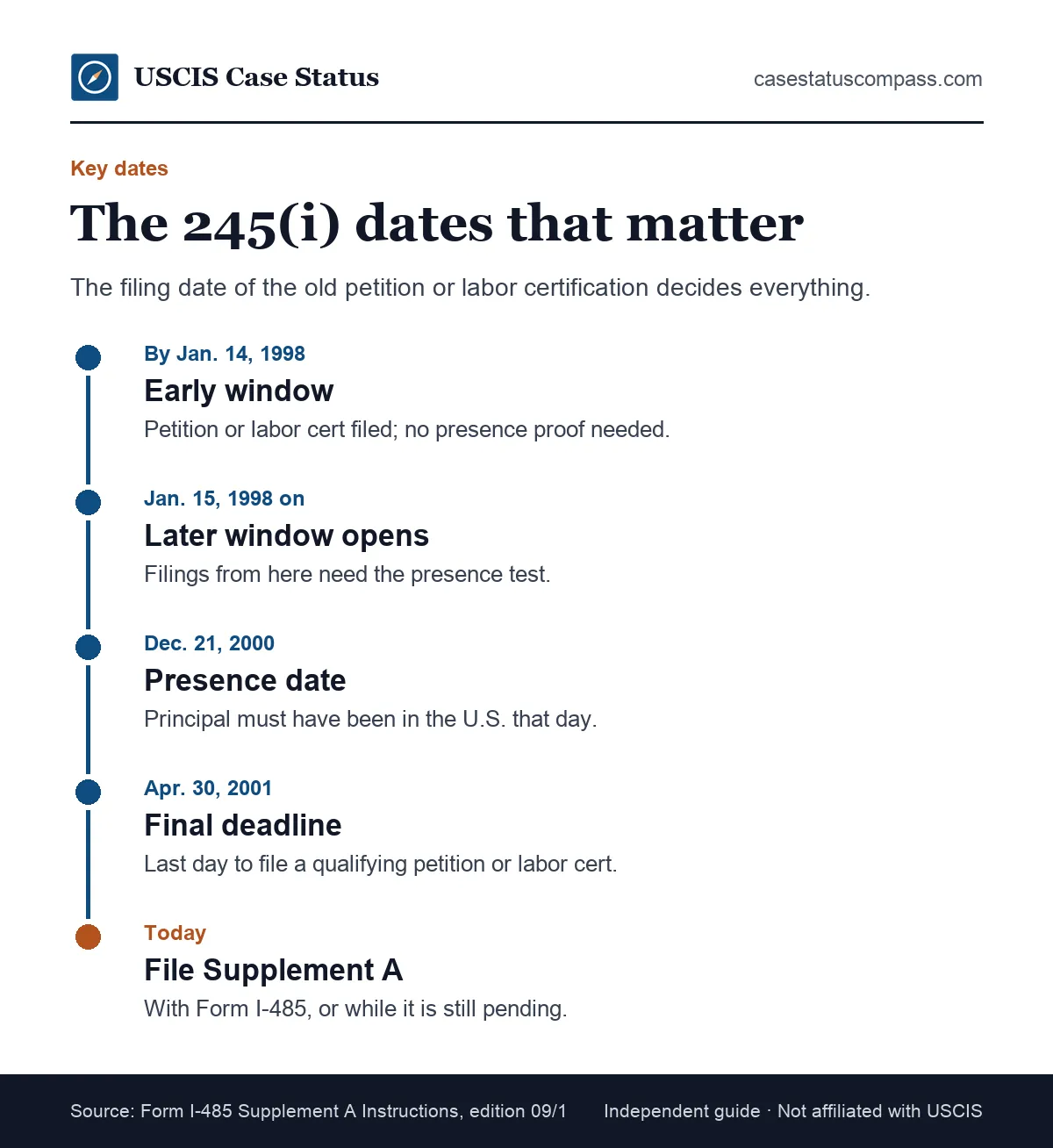
There are two windows. A qualifying petition or labor certification filed on or before January 14, 1998 needs no presence proof. One filed from January 15, 1998 through April 30, 2001 also requires proof the principal beneficiary was in the U.S. on December 21, 2000.
Filed on or before January 14, 1998
For this early window, you prove only that the filing was properly filed and approvable when filed. USCIS states that no evidence of physical presence is needed.
Lead with the I-797 receipt.
Filed January 15, 1998 to April 30, 2001
For this later window, you must also prove the principal was physically present in the U.S. on December 21, 2000, the day the LIFE Act amendments became law. 245(i): petition or labor certification filed by Apr. 30, 2001 (and in the U.S. Dec. 21, 2000 if filed after Jan. 14, 1998).
What Does "Grandfathered" Mean Under 245(i)?
Being grandfathered means you were the principal or derivative beneficiary of a qualifying filing made by the deadline, so you keep the right to use 245(i) later. The protection follows you, even if the old petition was later denied for reasons that arose after filing.
Grandfathering follows the person
Grandfathering attaches to you, not the petition. If a 1999 labor certification failed because the business closed, you may still qualify, if the filing was approvable when filed and any presence test is met.
Do You Have to Adjust Through the Petition That Grandfathered You?
No. The instructions let you use the old petition for the visa itself, or a newer petition or a Diversity Visa selection instead. Many are grandfathered by a sibling petition but adjust through a later marriage.
Use whichever visa basis is current first.
Which Petitions and Applications Qualify for 245(i)?
Five filings can grandfather you if properly filed and approvable by April 30, 2001: Form I-130 family petitions, Form I-140 employer petitions, Form I-360 special immigrant petitions (including VAWA), Form I-526 investor petitions and Form ETA-750 labor certifications.
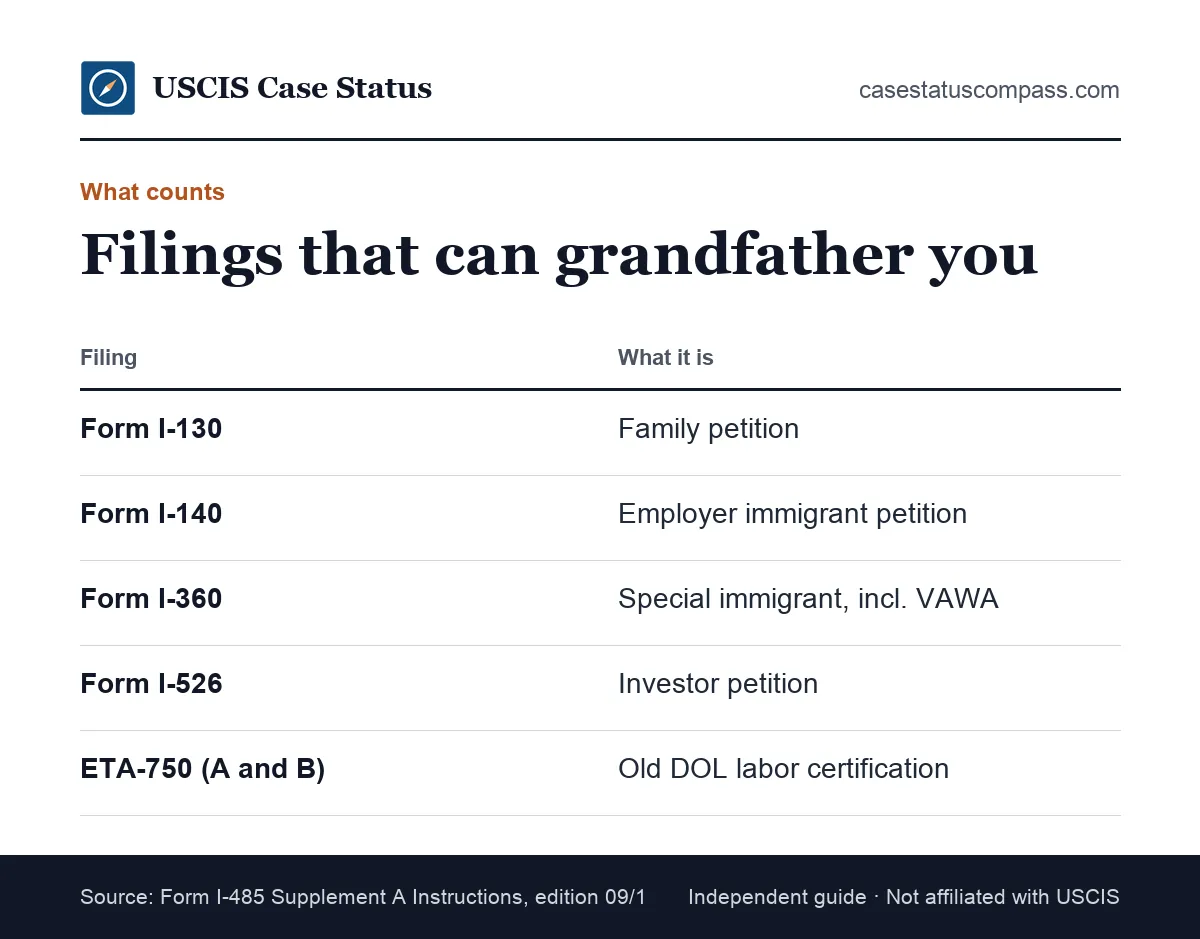
Other filings do not count.
Family and special immigrant petitions
A Form I-130 from a citizen or permanent resident relative is the most common basis, and Form I-360 VAWA self-petitions count too. Our Form I-130 family petition guide explains today's process.
Employment petitions and old labor certifications
A Form I-140, an I-526 or a Form ETA-750 filed with the Department of Labor (DOL) or a state workforce agency qualifies. PERM replaced ETA-750; see our PERM labor certification guide.
What Does "Properly Filed" Mean for 245(i)?
A petition was properly filed if the petitioner signed it, paid the correct fee and it reached the then-INS by April 30, 2001, or was postmarked by that date. A labor certification was properly filed if DOL or a state workforce agency accepted it by then.
Petitions
The best proof is a Form I-797 receipt or approval showing a qualifying filing date and the principal's name. Our I-797C notice of action guide explains these notices and what each date means.
Labor certifications
For an ETA-750, provide the form with a state workforce agency date stamp, an agency letter or another document showing the receipt date. Ask the employer for a copy early.
What Does "Approvable When Filed" Mean?
A filing was approvable when filed if it was properly filed, meritorious in fact and not frivolous. USCIS judges this by the facts at the time of filing. An approval notice usually proves it.
Without one, USCIS looks at the original filing and its supporting papers.
The three-part test
All three must be true: the filing was proper, the relationship or job was real, and it was not "patently without substance." A sham marriage petition fails even if filed in time.
Petitions later denied or withdrawn
A filing later withdrawn, denied or revoked because of later events, such as a petitioner's death or an employer closing, can still grandfather you if it was sound when filed.
Who Must Prove Physical Presence on December 21, 2000?
Only the principal beneficiary of a filing made from January 15, 1998 through April 30, 2001 must have been physically present in the U.S. on December 21, 2000. Derivatives rely on the principal's presence, not their own.
Earlier filings skip this test.
Who carries the burden
If you are the principal, you prove your own presence. If you are a derivative spouse or child, you prove the principal was present. Start gathering this presence evidence early.
Why one date matters so much
A single day decides the question. Records dated close to December 21, 2000, both before and after, help show you were in the U.S. on that exact day.
Look for dated pay stubs.
What Evidence Proves Physical Presence for 245(i)?
USCIS gives the most weight to government-issued documents, such as Form I-94, a Notice to Appear or agency letters. Tax, school, medical, lease, utility, pay and bank records also help. A personal affidavit must be backed by other documents.
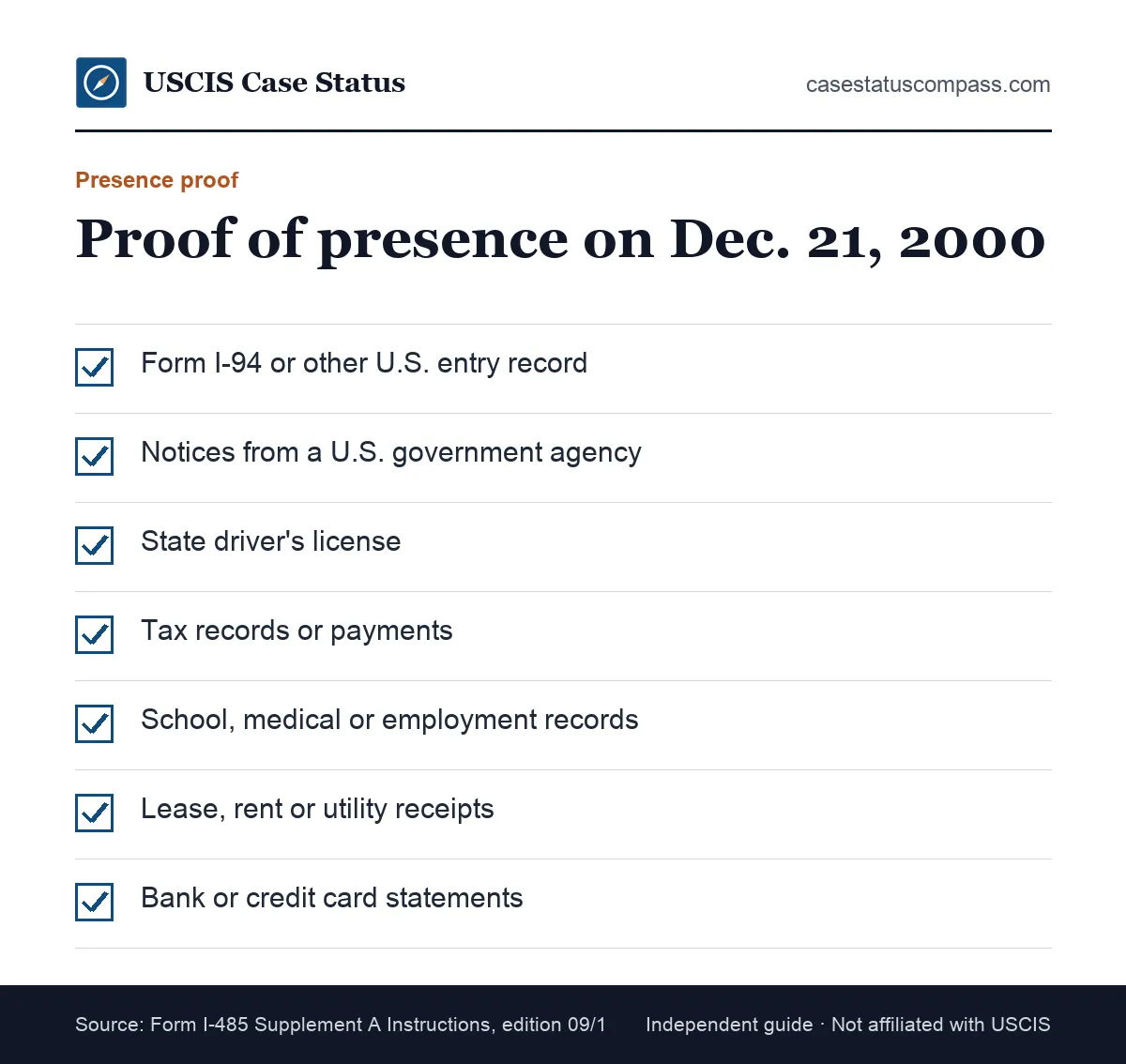
Presence evidence ranked by weight
| Evidence type | Examples | Weight |
|---|---|---|
| U.S. government records | Form I-94, I-512L, Notice to Appear, agency letters | Highest |
| State records | Driver's license | High |
| Financial records | Tax returns, pay stubs, bank statements | Medium to high |
| Daily life records | Lease, utility bills, school or medical records | Medium |
| Personal affidavit | Sworn statement | Only with other proof |
The table ranks presence evidence from strongest to weakest. Lead your packet with the highest-weight records you have.
The strongest documents
One document can sometimes prove presence, but often several are needed. Prefer records with your name and a date near December 21, 2000; government notices and tax records are hard to dispute.
Affidavits need support
USCIS says a presence affidavit needs other supporting documents, so use it only to fill a gap. Our USCIS FOIA request guide explains how to request your old immigration records.
Can a Spouse or Child Use the Grandfathering?
Yes, in two ways. A spouse or child under 21 who was a derivative beneficiary when the qualifying filing was made is grandfathered too. A current spouse or child who joined the family later can adjust only alongside a grandfathered principal.
Derivatives at the time of filing
If you were the principal's spouse or unmarried child under 21 when the petition was filed, you are grandfathered in your own right. You prove the relationship existed then, not that it still exists.
Current spouses and children
A current spouse or unmarried child under 21 may "accompany or follow to join" a 245(i) principal, filing with the principal, while the principal's case is pending, or after approval.
What If the Marriage or Child Came After April 30, 2001?
A spouse married or child born after the deadline is not grandfathered on their own. These after-acquired family members can adjust only as current dependents of a grandfathered principal, and lose that path if they cannot file alongside the principal.
Timing matters for after-acquired dependents
The dependent must still be the principal's spouse or child under 21 when filing. If the child turns 21 or marries first, the derivative path may close.
File together when possible.
Can a Spouse or Child File After the Principal Becomes a Permanent Resident?
Yes, within limits. A current spouse or child may file after the principal gets the green card, but only while the principal is still a permanent resident and only if the relationship existed at approval. A divorce changes that answer.
What Else Must Be True to Adjust Under 245(i)?
Grandfathering is only step one. You must also be physically present in the U.S., have a current visa basis (a petition, Diversity Visa selection or derivative status), have a visa immediately available, be admissible or get a waiver, and pay the fees.
A current visa basis
Supplement A gives you no visa category. You need a live family or employment petition, a current-year Diversity Visa selection or derivative status, from the old filing or a newer one.
Being in the U.S. when you file
Section 245(i) is part of adjustment of status, so it works only for people filing Form I-485 inside the United States. It does not help at an immigrant visa interview abroad.
Does Your Priority Date Have to Be Current for 245(i)?
Yes, in preference categories. Supplement A does not move you ahead in line: your priority date must be current under the chart USCIS uses that month. November 2026: USCIS accepts I-485s using the Dates for Filing chart (family and employment). Our Visa Bulletin guide explains how to read the charts.
Immediate relatives skip the queue
Spouses, unmarried children under 21 and parents of adult U.S. citizens are immediate relatives. No annual limit applies to them, so they wait for no visa number.
Their only wait is processing.
How Do You File I-485 Supplement A?
File Supplement A together with Form I-485, or later while your I-485 is still pending. It cannot be filed alone. Use the current edition, sign it in ink, attach the evidence and pay the fees on Form G-1055, or USCIS rejects it.
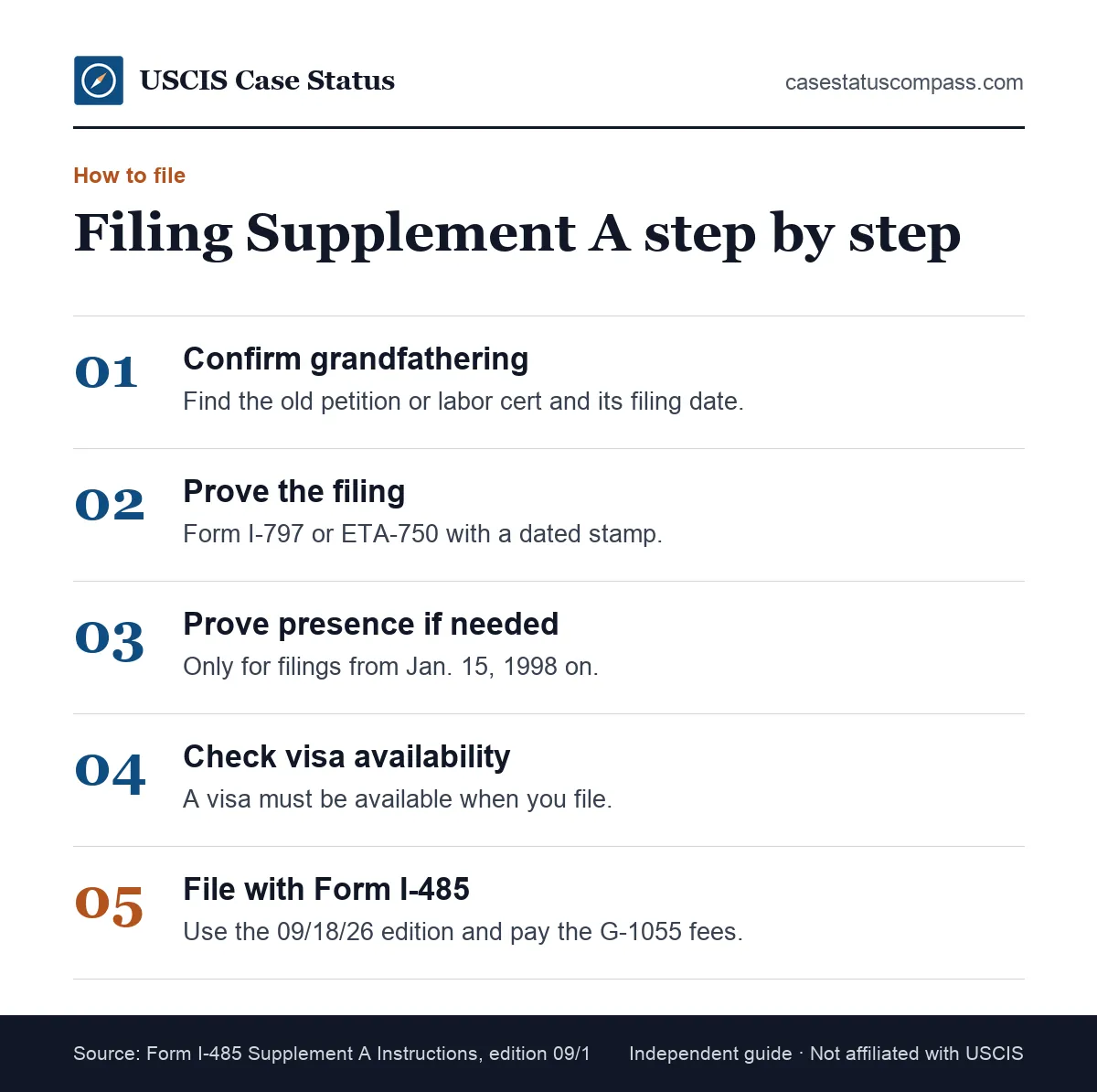
Filing Supplement A with a new I-485
Most people file both forms in one packet, with the grandfathering evidence right behind Supplement A. The required I-485 edition is 09/18/26 (01/20/25 and 09/04/26 editions rejected on/after Sept. 18, 2026; no grace period).
Adding Supplement A to a pending I-485
If you already filed Form I-485 and later learn you need 245(i), you can add Supplement A while the case is pending, with the fee, the evidence and your I-485 receipt number.
Signing and preparers
Sign by hand; a typed or stamped name is rejected. A parent or guardian may sign for a child under 14. Anyone who helped completes the preparer section, and interpreters complete theirs.
What Does 245(i) Cost?
A 245(i) case costs the normal Form I-485 fee plus a separate Supplement A fee listed on Form G-1055. As of October 2026, the I-485 fee is $1,440 paper / $1,390 online, and Supplement A adds $1,000.
Both are paid together.
The I-485 fee
The I-485 fee is set by Form G-1055, Edition 10/16/26. USCIS fees are nonrefundable, even if your case is denied or withdrawn. Our green card fee guide breaks down each form's cost.
The Supplement A fee amount
The statute calls for an extra sum for 245(i) adjustment. Form G-1055 (edition 10/16/26) lists it at $1,000, paper or online, paid on top of the I-485 fee.
Pay it with the I-485.
Who is exempt from the Supplement A fee
Two exemptions apply: unmarried children under 17, and certain Family Unity (Form I-817) spouses or children of legalized aliens. Everyone else pays the full amount, even when filing with a grandfathered parent.
Who Should Not File Supplement A?
Do not file Supplement A if none of the adjustment bars apply to you, or if you are exempt from them; USCIS tells you to skip it. Filing it anyway costs an extra fee and adds nothing under 245(a).
Ask first if unsure.
When regular adjustment already works
If you entered with inspection and kept status, you likely use regular adjustment. Immediate relatives of U.S. citizens who entered lawfully often qualify under 245(a) even after an overstay.
When you are not grandfathered
Without a qualifying filing by the deadline, Supplement A cannot help. Ask an attorney about other options, such as consular processing with a provisional waiver, before taking any step.
Supplement A Evidence Checklist
A complete 245(i) packet proves four things: the qualifying filing existed, it was properly filed, it was approvable when filed, and, if needed, the principal was present on December 21, 2000. Derivatives add relationship proof. This checklist is our own summary.
What each document must prove
| What to prove | Main evidence | Who needs it |
|---|---|---|
| Qualifying filing existed | I-797 or ETA-750 naming the principal | Everyone |
| Properly filed | I-797 filing date or dated agency stamp | Everyone |
| Approvable when filed | Approval notice or other evidence | Everyone |
| Presence on Dec. 21, 2000 | Government, tax, lease or pay records | Filings from Jan. 15, 1998 on |
| Relationship at filing | Marriage or birth certificate | Derivatives at filing |
| Current relationship | Marriage or birth certificate | Current spouse or child |
Each row pairs a fact you must prove with the main evidence for it. The last column shows who needs that proof.
Proof of the qualifying filing
Lead with the old receipt or approval notice. If it is lost, ask the petitioner, the employer or a former lawyer for copies. Supplement A asks for the old receipt number if you have it.
Relationship and presence proof
Derivatives need a marriage or birth certificate dated before the filing, with certified English translations. Put presence evidence in date order so the officer sees December 2000 clearly.
Label each record by date.
How Does 245(i) Work in Family-Based Cases?
In family cases, 245(i) often joins an old petition with a new relationship. A grandfathered person who later marries a U.S. citizen can adjust through the new I-130, using the old filing only for grandfathering.
Bring both sets of petition records.
A new petition from a spouse
A U.S. citizen spouse files a new I-130, and the applicant files Form I-485 with Supplement A as an immediate relative. Our marriage green card guide covers the spouse path.
Long preference waits
A sibling or adult-child petition from 2000 may only now be current, and many beneficiaries fell out of status meanwhile. 245(i) lets them adjust instead of leaving and risking a re-entry bar.
How Does 245(i) Work in Employment-Based Cases?
In employment cases, an old ETA-750 or I-140 grandfathers the worker, and a newer PERM labor certification and I-140 usually provide the visa basis. Section 245(i) then overcomes unauthorized work or status gaps that would otherwise block adjustment.
Keep both filings' records.
An old labor certification
Many workers had an employer file an ETA-750 before April 2001. Even if that job ended, the filing may grandfather them if it was approvable when filed; employer records are key evidence.
A new PERM and I-140
The new employer files a PERM application, then an I-140; our Form I-140 immigrant worker petition guide explains that step. A PERM labor certification expires 180 days after DOL certifies it, so timing matters.
Can Diversity Visa Winners Use 245(i)?
Yes, if they are grandfathered. The instructions allow a 245(i) applicant to base the visa on selection in the Diversity Visa program for the current fiscal year. The DV case must still be completed before the fiscal year ends.
Start early.
Timing a DV case
DV selections expire at the end of the fiscal year, and USCIS must decide the case by then. File early, with your old grandfathering records already gathered.
Late filers risk losing it.
How Is 245(i) Handled in Immigration Court?
If you are in removal proceedings, an immigration judge usually decides adjustment, not USCIS. You file Form I-485 and Supplement A with the Immigration Court and send a copy to USCIS.
Ask your lawyer about court deadlines before filing anything, because the judge sets the schedule.
Filing with the court
File with the court that has your case and follow the DHS attorney's pre-order instructions. Check your case at Check immigration court cases online at acis.eoir.justice.gov with your A-number. Our immigration court case status guide explains the system.
Address changes in court cases
You must tell the immigration court or BIA within five working days on Form EOIR-33, or online through Respondent Access, separately from USCIS. Missing court mail can lead to a removal order.
Can You Travel While a 245(i) Case Is Pending?
Travel is risky for 245(i) applicants. Traveling while your I-485 is pending abandons it unless you have advance parole (with H/L/V/K exceptions). Many 245(i) applicants also have unlawful presence, so a departure can trigger re-entry bars that Supplement A cannot cure.
How Does the 2026 Advance Parole Change Affect 245(i) Applicants?
It makes advance parole far riskier. Since Aug. 13, 2026, travel on advance parole counts as a departure: over 180 days of unlawful presence can trigger the 3/10-year bar. That matters to many 245(i) applicants, who often have years of unlawful presence. See our Form I-131 travel document guide and travel with a pending I-485 guide.
Can You Work While a 245(i) Case Is Pending?
Yes, most 245(i) applicants can request a work permit (EAD) by filing Form I-765 based on the pending I-485. The work permit does not cure past unauthorized work; Supplement A handles that bar.
Request it with your I-485 to avoid delays.
Requesting the work permit
File Form I-765 with your I-485 or later. Fees depend on your I-485 filing date; our Form I-765 work permit guide explains the categories and fees.
Keep the I-797C receipt for your employer.
Past unauthorized work
Section 245(i) can overcome the bar for past unauthorized employment. Be honest about work history, because false answers can lead to a fraud finding, which 245(i) does not fix.
INA Section 245(i) Eligibility Decision Table
This decision table sorts common situations into likely outcomes under INA section 245(i). It is our original summary of the Supplement A instructions, not legal advice. Use it to prepare for an attorney meeting.
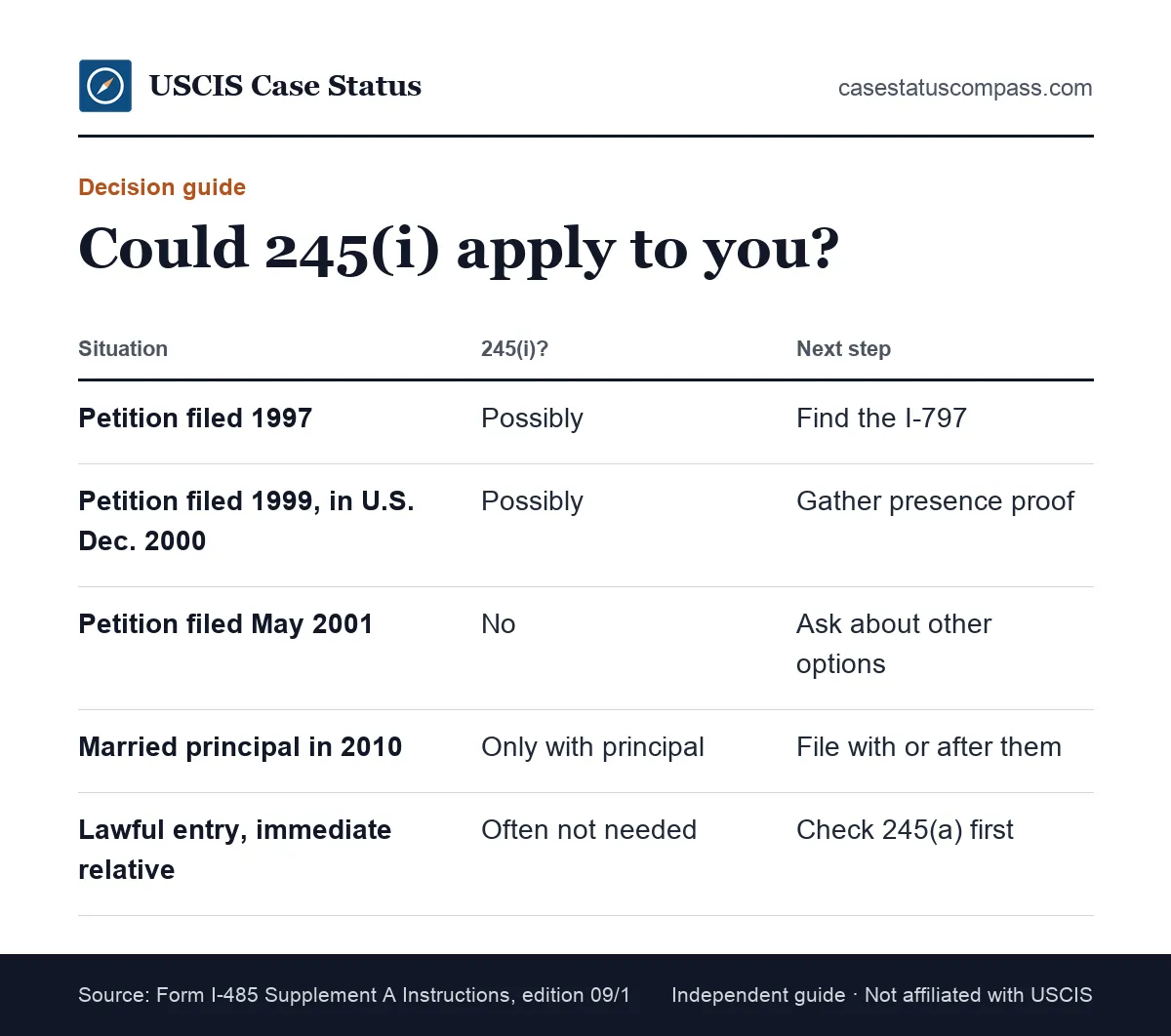
Bring it to your meeting.
Common 245(i) situations and next steps
| If your situation is… | 245(i) may apply? | Next step |
|---|---|---|
| Relative filed I-130 for you in 1996 | Possibly | Find the I-797 receipt |
| Employer filed ETA-750 in 2000 and you were in the U.S. in Dec. 2000 | Possibly | Gather presence proof |
| Petition filed in June 2001 | No | Ask about other options |
| You married a grandfathered person in 2012 | Only with them | File with or after the principal |
| You entered lawfully and your spouse is a U.S. citizen | Often not needed | Check regular adjustment |
| You have a prior removal order | Unclear | See an attorney before any filing |
Each row pairs a common situation with whether 245(i) may apply. The next step column tells you what to do first.
How to use the table
Find the row closest to your facts and note the next step; several may apply. A "possibly" or "unclear" answer depends on records and legal analysis an attorney should do.
Worked Examples: 245(i) in Practice
These worked examples use fictional people to show how the grandfathering, presence and dependent rules combine. They are illustrations, not predictions for any real case.
Each one shows a different rule: an early filing, the presence test, a later spouse, a missed deadline and a child named on an old petition.
Example 1: An early sibling petition
Marco, fictional, entered without inspection in 1995. His citizen sister filed an I-130 for him in 1997, and he never left. In 2024 he married a U.S. citizen, who filed a new I-130. Marco may adjust with Supplement A, using the 1997 filing for grandfathering.
Example 2: A 2000 labor certification
Aisha, fictional, overstayed a visa. An employer filed an ETA-750 for her in 2000, the later window, so she must prove she was in the U.S. on December 21, 2000. Her late-2000 pay stubs and lease help.
Example 3: An after-acquired spouse
Lin, fictional, married Aisha in 2010. Lin is not grandfathered alone but can adjust as Aisha's current spouse by filing with her or while her case is pending. A divorce first closes that path.
Example 4: A filing one month too late
Pedro, fictional, had an I-130 filed for him in May 2001, after the April 30, 2001 deadline, so he is not grandfathered. Supplement A cannot help him.
He should ask an attorney.
Example 5: A child named on a 1999 petition
Sofia, fictional, was 12 when a 1999 I-130 named her father, so she was a derivative at filing. Now an adult, she is still grandfathered and needs her birth certificate plus her father's December 2000 presence proof.
What Are Common Myths About 245(i)?
The biggest myth is that 245(i) is a general amnesty. It is not. It only lifts certain adjustment bars for people grandfathered by 2001. Nor does it waive every problem or accept recent petitions.
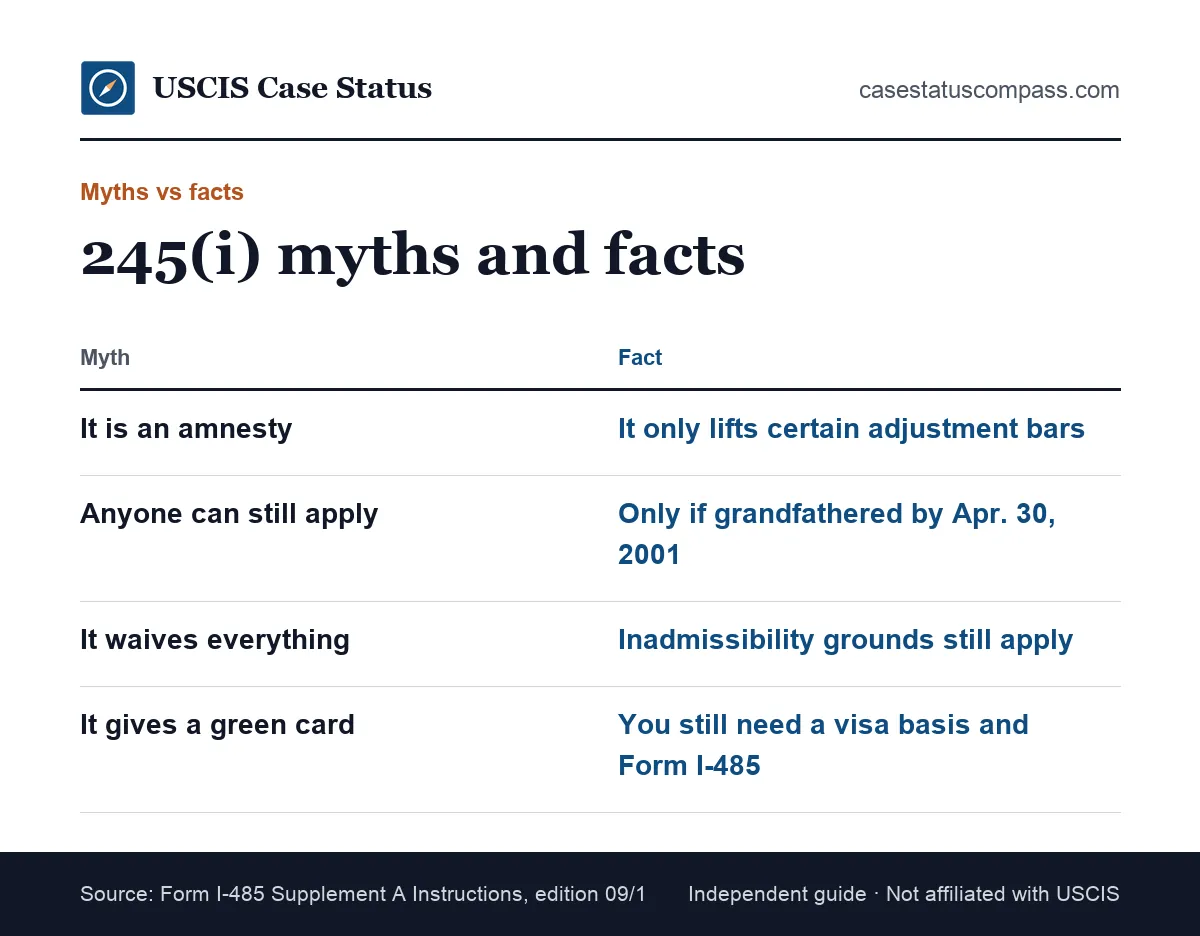
Check claims against the instructions.
"It is still open to new applicants"
The deadline passed on April 30, 2001, and no later filing grandfathers anyone. Be wary of anyone who charges to "file 245(i)" for a recent arrival; our USCIS scams guide explains common tricks.
"It cures every problem"
245(i) does not cure inadmissibility. Fraud, certain crimes and prior removals remain obstacles that need a separate waiver, if one exists, and some have no waiver at all.
Ask an attorney first.
How Do You Find Old Records From Before 2001?
Start with your own files, then ask the petitioner, the employer or any former lawyer for copies. If those fail, file a Freedom of Information Act (FOIA) request with USCIS for your A-file.
Ask for any old receipt notice first.
Asking the petitioner or employer
Relatives often kept the original I-797 in family papers, and employers or their former law firms may hold ETA-750 copies. Ask for anything with a filing date and the beneficiary's name.
Can a FOIA Request Recover Your Pre-2001 Petition Records?
Often, yes. A FOIA request to USCIS can produce copies of old receipts and approvals kept in your A-file. Use your A-Number if you have one; our A-Number guide shows where to find it. Request early, because responses take time.
How Are 245(i) Cases Processed and Decided?
A 245(i) case follows the normal I-485 process: receipt notice, biometrics, review and usually an interview. Officers look closely at the grandfathering evidence and your history. A request for evidence (RFE) is common when records are thin.
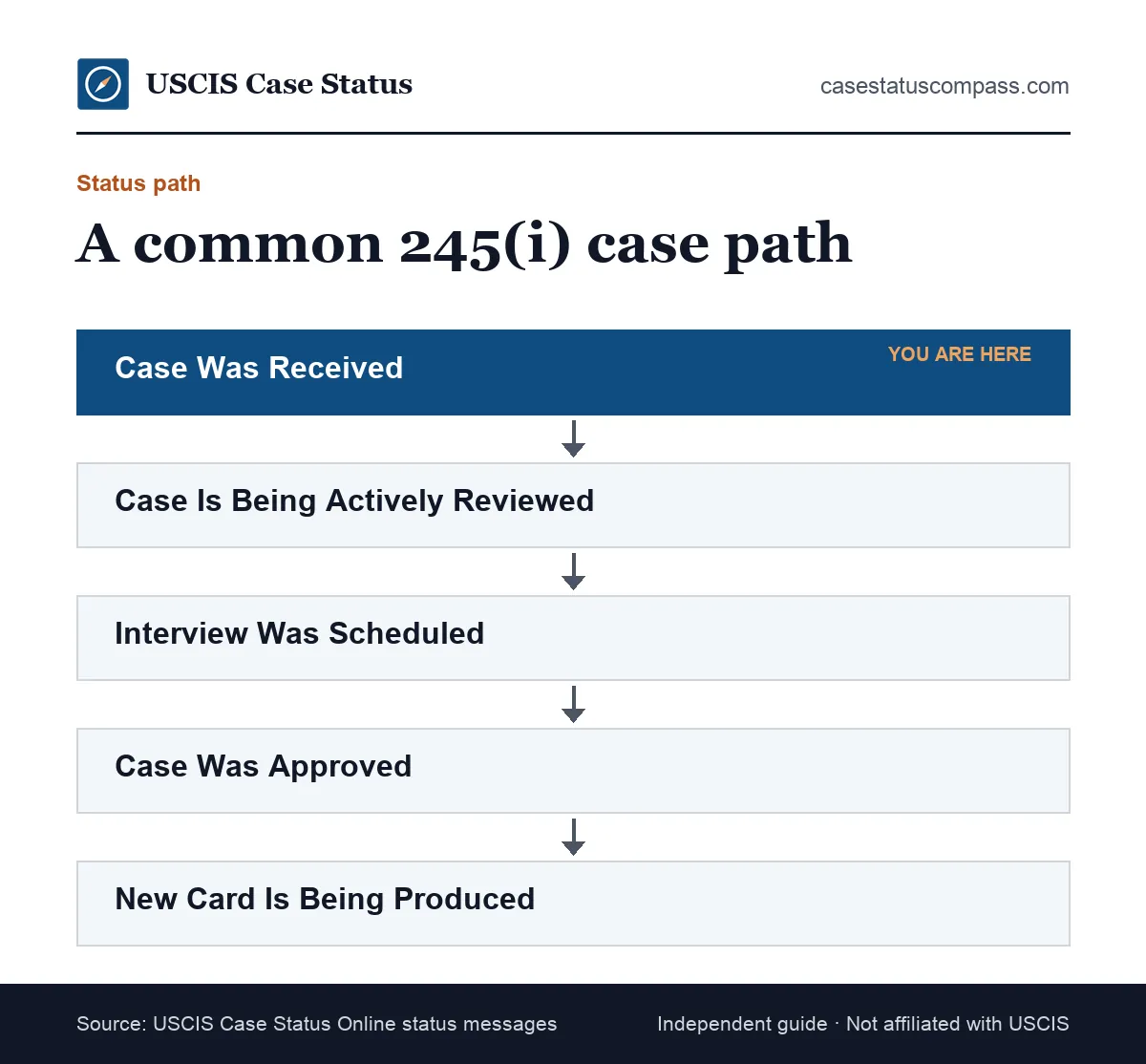
Have your original documents ready.
Receipt notices and biometrics
Your I-485 and any I-765 or I-131 each get an I-797C receipt notice. A biometrics appointment follows, where USCIS takes fingerprints and a photo for background checks.
Keep each notice safe.
The interview
Bring originals of the old notices and presence records, and expect questions on entries, departures and work. See our green card interview guide; USCIS's family-based median was I-485 (family): median 7.0 months (USCIS data, Apr.-June 2026).
Requests for evidence
RFE deadline: up to 12 weeks (the exact date is on your RFE); no extensions. Answer every item and include a cover sheet; our request for evidence guide explains how. Track updates at Case Status Online: egov.uscis.gov.
What If USCIS Denies the 245(i) Claim?
Read the denial notice to see whether USCIS found you not grandfathered, inadmissible or missing evidence. Options may include a motion to reopen or reconsider, refiling with better evidence, or defense in immigration court. Get legal advice quickly.
Note the deadline.
Read the reasons first
A denial for missing evidence differs from one finding you not eligible. Our case denied guide explains how to read a denial and the risks that follow.
Then call an attorney.
How Long Do You Have to Challenge a 245(i) Denial?
Very little time. Appeal or motion: file within 30 days (33 if the decision was mailed). Our motion to reopen and appeal guide explains each option. Never let the deadline pass while you are still searching for old records.
Act within days.
Why Should You Talk to an Attorney Before Filing?
A 245(i) application tells USCIS about past unlawful entry or status, which can expose you to removal proceedings if the claim fails. An immigration attorney or DOJ-accredited representative can check grandfathering, inadmissibility and the evidence before you file.
That review can prevent a costly mistake.
What an attorney checks
They review the old filing date, whether it was approvable, presence evidence, every entry and departure, criminal records and prior orders, and spot permanent bars that make filing dangerous.
Bring every old notice.
Finding affordable help
Nonprofits with DOJ-accredited representatives often charge less. Our immigration lawyer cost guide explains typical fee structures. Avoid "notarios," who cannot give legal advice.
Ask whether the representative has handled Supplement A cases before.
Key 245(i) Terms in Plain English
These terms appear in the Supplement A instructions and in attorney advice. Knowing them helps you read notices and follow a lawyer's advice on which evidence each part of the test needs.
When a notice uses a term you do not recognize, check it here first.
245(i) glossary table
| Term | Plain-English meaning |
|---|---|
| Grandfathered | Protected by a qualifying filing made by Apr. 30, 2001 |
| Principal beneficiary | The person the old petition was filed for |
| Derivative beneficiary | That person's spouse or child under 21 at filing |
| Properly filed | Signed, paid and received or postmarked in time |
| Approvable when filed | Proper, real and not frivolous at filing |
| Supplement A | The I-485 add-on form used to claim 245(i) |
| Adjustment bar | A rule in INA 245(a) or (c) that blocks adjustment |
The table translates the legal terms used in Supplement A into plain English. Check it whenever a notice uses one.
Why the vocabulary matters
Officers and attorneys use these words precisely. A "derivative" at filing and a "current spouse" are treated differently, and mixing them up can mean sending the wrong evidence.
Use the table to check.
How Does 245(i) Fit Into the Wider Green Card Process?
Section 245(i) is one add-on within the Form I-485 process. You still need a visa basis, a complete I-485 packet, a medical exam, biometrics and usually an interview. Supplement A only addresses certain bars.
Plan the whole packet together, with the grandfathering proof on top.
The rest of the packet
Send the sealed I-693 with your I-485 (required since Dec. 2, 2024). Family cases also need Form I-864. A clear I-485 cover letter helps the officer find the Supplement A evidence quickly.
Tracking the case
Use the receipt numbers on your I-797C notices with our USCIS case status check. For wait times, see our green card processing time guide.
Frequently Asked Questions
Is 245(i) still available in 2026?
Yes, but only for people grandfathered by a qualifying petition or labor certification filed by April 30, 2001. No new person can become grandfathered. If you qualify and have a current visa basis, you can still file Supplement A with Form I-485.
Does 245(i) waive the 10-year bar?
No. Section 245(i) lifts certain adjustment bars but does not waive inadmissibility grounds such as the unlawful presence bars. Those are generally triggered by leaving the U.S., which is why many 245(i) applicants avoid travel.
Can I use 245(i) if my old petition was denied?
Possibly. A petition properly filed and approvable when filed can still grandfather you even if later denied, withdrawn or revoked because of later events. One that was never valid, such as a sham marriage petition, does not qualify.
Do I need the original approval notice?
Not necessarily the original, but you need official proof: a copy of the I-797 receipt or approval, or an ETA-750 with a dated agency stamp. If you lost it, ask the petitioner or employer, or use FOIA.
Is the Supplement A fee required for children?
Usually yes. Form G-1055 lists the fee at $1,000, but an unmarried child under 17 pays $0, as do certain spouses and children with a Family Unity (Form I-817) receipt or approval.
Does 245(i) give me a green card by itself?
No. Supplement A only lets you use adjustment despite certain bars. You still need a family, employment, special immigrant or Diversity Visa basis, an available visa, a complete Form I-485 and admissibility.
What is 8 CFR 245.10?
It is the federal regulation that sets out how USCIS applies INA section 245(i). It defines who is grandfathered, what "properly filed" and "approvable when filed" mean, and how the December 21, 2000 presence rule works.
Does an ETA-750 have to be approved to grandfather me?
No. A labor certification grandfathers you if it was properly filed by April 30, 2001 and approvable when filed, even if it was later denied or abandoned. You still need dated proof of the filing.
Do derivatives need their own December 21, 2000 presence proof?
No. Only the principal beneficiary of a filing made from January 15, 1998 through April 30, 2001 must have been in the U.S. that day. A derivative proves the principal's presence and the relationship at filing.
Can a VAWA self-petition grandfather me under 245(i)?
Yes, if it was filed by April 30, 2001. Form I-360 special immigrant petitions, including VAWA self-petitions, are among the five qualifying filings, and the same properly filed and approvable-when-filed tests apply.
Sources
- USCIS: Form I-485 Supplement A Instructions (edition 09/18/26). www.uscis.gov/sites/default/files/document/forms/i-485supainstr.pdf. Accessed Oct 27, 2026.
- USCIS: I-485 Supplement A, Adjustment of Status Under Section 245(i). www.uscis.gov/i-485supa. Accessed Oct 27, 2026.
- USCIS: Form I-485 Instructions (edition 09/18/26). www.uscis.gov/sites/default/files/document/forms/i-485instr.pdf. Accessed Oct 27, 2026.
- USCIS: Form G-1055 Fee Schedule (edition 10/16/26). www.uscis.gov/sites/default/files/document/forms/g-1055.pdf. Accessed Oct 27, 2026.
- eCFR: 8 CFR 245.10, Adjustment of status upon payment of additional sum under section 245(i). www.ecfr.gov/current/title-8/chapter-I/subchapter-B/part-245/section-245.10. Accessed Oct 27, 2026.
- U.S. Code: 8 U.S.C. 1255 (INA section 245). uscode.house.gov/view.xhtml?req=granuleid:USC-prelim-title8-section1255&num=0&edition=prelim. Accessed Oct 27, 2026.
- USCIS: Adjustment of Status Filing Charts from the Visa Bulletin (updated 10/05/2026). www.uscis.gov/green-card/green-card-processes-and-procedures/visa-availability-priority-dates/adjustment-of-status-filing-charts-from-the-visa-bulletin. Accessed Oct 27, 2026.
- USCIS: Form I-485 page (updated 10/07/2026). www.uscis.gov/i-485. Accessed Oct 27, 2026.
- USCIS Fee Schedule (Form G-1055). www.uscis.gov/g-1055. Accessed Oct 27, 2026.
- USCIS: Filing Fees (updated 02/12/2026). www.uscis.gov/forms/filing-fees. Accessed Oct 27, 2026.
- USCIS: Form I-140 page (updated 07/24/2026). www.uscis.gov/i-140. Accessed Oct 27, 2026.
- DOJ EOIR: Immigration Court Information. www.justice.gov/eoir/immigration-court-information. Accessed Oct 27, 2026.
- DOJ EOIR: Update Respondent or Alien Information (updated May 18, 2026). www.justice.gov/eoir/update-respondent-or-alien-information. Accessed Oct 27, 2026.
- USCIS: Form I-131 page alert (updated 10/07/2026). www.uscis.gov/i-131. Accessed Oct 27, 2026.
- USCIS Data Library: All USCIS Application and Petition Form Types, FY2026 Q3 (Apr. 1-June 30, 2026; queried 7/2026). www.uscis.gov/sites/default/files/document/data/quarterly_all_forms_fy2026_q3_v1.xlsx. Accessed Oct 27, 2026.
- 8 CFR 103.2(b)(8)(iv) (LII). www.law.cornell.edu/cfr/text/8/103.2. Accessed Oct 27, 2026.
- USCIS: Checking Your Case Status Online. www.uscis.gov/tools/checking-your-case-status-online. Accessed Oct 27, 2026.
- USCIS: Form I-290B page (updated 10/26/2026). www.uscis.gov/i-290b. Accessed Oct 27, 2026.
- USCIS: Form I-693 page (updated 07/24/2026); I-485 Instructions 09/18/26. www.uscis.gov/i-693. Accessed Oct 27, 2026.
casestatuscompass.com is an independent publication and is not affiliated with USCIS or any government agency. This page is general information, not legal advice. For denials, court or asylum matters, consult an immigration attorney or a DOJ-accredited representative.