Contents · 37 sections
- What Is a USCIS FOIA Request?
- Who Can File a FOIA Request With USCIS?
- Why Do People Request Their Immigration File?
- When Is a FOIA Request the Wrong Tool?
- How Do You Submit a USCIS FOIA Request Online?
- Is a Paper FOIA Request Still Accepted?
- What If You Cannot Use the FIRST Online System?
- What Information Should Your FOIA Request Include?
- How Do You Write a Narrow FOIA Request That Moves Faster?
- Sample USCIS FOIA Request Descriptions
- What Records Can You Get From Your A-File?
- Why Are Some Pages Withheld or Redacted?
- How Much Does a USCIS FOIA Request Cost?
- How Long Does a USCIS FOIA Request Take?
- Can You Expedite a FOIA Request for Immigration Court?
- How Do You Check Your FOIA Request Status?
- What Happens When the FOIA Response Arrives?
- How Do You Appeal a FOIA Decision?
- Which Agency Holds Which Immigration Record?
- Freedom of Information Act Request to the FBI: How It Works
- FBI FOIA vs Identity History Summary: Which Do You Need?
- How Do You Get CBP Entry and I-94 Records?
- How Do You Get ICE and State Department Records?
- How Do You Get Immigration Court Records From EOIR?
- Public Information Request vs FOIA: What Is the Difference?
- How Does a FOIA Request Fit With the Ombudsman or Congress?
- Using FOIA Records After a Denial
- Using FOIA Records Before Naturalization or a Green Card Filing
- Worked Example: A FOIA Request Before Filing an N-400
- Requesting Records for a Family Member
- Common Mistakes That Delay a USCIS FOIA Request
- What If USCIS Says No Records Were Found?
- Decision Table: Which Request Should You File?
- Printable USCIS FOIA Request Checklist
- How Should You Store and Protect Your FOIA Records?
- Key Facts About USCIS FOIA Requests
- Frequently Asked Questions
The short answer
A USCIS FOIA request is a free online request, filed through USCIS's FIRST system, for copies of records USCIS holds, most often your A-file. USCIS says requests should be submitted online since Jan. 22, 2026. Ask for specific documents, give accurate identifiers and keep your control number to track the request.
At a glance
| Where to file | Online at first.uscis.gov, signed in to a USCIS account |
| Cost to file | No initial fee for a federal FOIA request (FOIA.gov) |
| What you can get | Your A-file, or another person's with their written permission |
| Faster option | Ask for named documents instead of the whole file |
| Who runs this site | An independent guide. We are not USCIS and cannot file for you. |
What Is a USCIS FOIA Request?
A USCIS FOIA request asks U.S. Citizenship and Immigration Services for copies of records under the Freedom of Information Act (FOIA). Most people use it to get their own immigration file. It is a records tool, not a way to push a case, so it sits alongside the escalation routes in our guide to the Ombudsman and congressional inquiries.
FOIA and the Privacy Act
USCIS handles FOIA and Privacy Act requests through the same online system. FOIA lets any person ask a federal agency for records. The Privacy Act gives U.S. citizens and permanent residents rights over records about themselves. For most applicants, the practical steps are the same.
What the A-file is
The A-file (Alien File) is the main record of your immigration history, labelled with your A-Number. It can hold forms, notices, photos and interview notes. Our A-Number guide explains how the number links to that file.
Who Can File a FOIA Request With USCIS?
Generally any person, U.S. citizen or not, can make a FOIA request, according to FOIA.gov. You can ask for your own records at any time. To get someone else's immigration records, USCIS requires that person's written permission, and each person needs a separate request.
Requests for your own records
You are the "subject of record" when the file is about you. Give your full name, any other names used, date of birth and A-Number if you have one. No consent form is needed, but USCIS must be able to confirm you are the person named, so the account details should match your records.
Requests for another person's records
For a spouse, parent or adult child, you need their signed consent. As of October 2026, requesting someone else's records generally needs their signed consent, under penalty of perjury or notarized. File one request per family member, each with its own consent, and upload it with the request rather than sending it later.
Attorneys and representatives
An immigration attorney or accredited representative can file for you with your consent. Many lawyers request the A-file before taking on a complex case. Ask your representative to share the full response, not only a summary.
Why Do People Request Their Immigration File?
Most people request their A-file to fill gaps before a new filing, to understand a denial, or to replace lost copies of notices and documents. A FOIA response shows what the government already has, so you can answer new forms consistently and spot errors early.
Before a new application
Before filing for citizenship or a green card, you may not remember old entry dates, prior applications or past addresses. Your file can confirm them. Consistent answers matter, because officers compare new forms with the record.
After a denial or a problem case
A denial notice explains the reasons, but the file shows the evidence behind them. Our guide on options after a case is denied explains the next steps and deadlines. Do not wait for FOIA records before meeting a lawyer if a deadline is running.
Lost notices and documents
If you lost an approval notice or receipt, the file may hold a copy. Our page on the Form I-797C notice of action explains other ways to replace a notice. A FOIA copy is useful as proof of what was issued, but it is not a new original.
When Is a FOIA Request the Wrong Tool?
A FOIA request is the wrong tool for checking a pending case, replacing an official document or getting very old records. USCIS's FOIA program says it cannot answer questions about pending applications or petitions. Those go to the Contact Center or other forms instead.
Questions about a pending case
For status questions, call the USCIS Contact Center at 800-375-5283 (TTY: 800-767-1833). You can also use Case Status Online: egov.uscis.gov. If your status has not moved for a long time, see our page on a case status not updating.
Replacing an official document
A FOIA copy is not a replacement document. A lost green card needs Form I-90 ($465 (paper) / $415 (online)). A lost certificate needs Form N-565 ($555 (paper) / $505 (online)). A duplicate approval notice uses Form I-824 ($590). Those forms produce a new official document; FOIA only shows you copies of what is already in the file.
Records more than 100 years old
USCIS sends requests for records more than 100 years old to its Genealogy Program, not the FOIA office. Family historians researching ancestors should start there rather than in FIRST. The Genealogy Program has its own request steps and fees, which are set out on its USCIS page.
How Do You Submit a USCIS FOIA Request Online?
You submit a USCIS FOIA request online at first.uscis.gov after signing in to a USCIS account. You choose the type of records, describe what you need, add consent if the file belongs to someone else, and submit. USCIS then gives you a FOIA control number for tracking.
Step-by-step filing
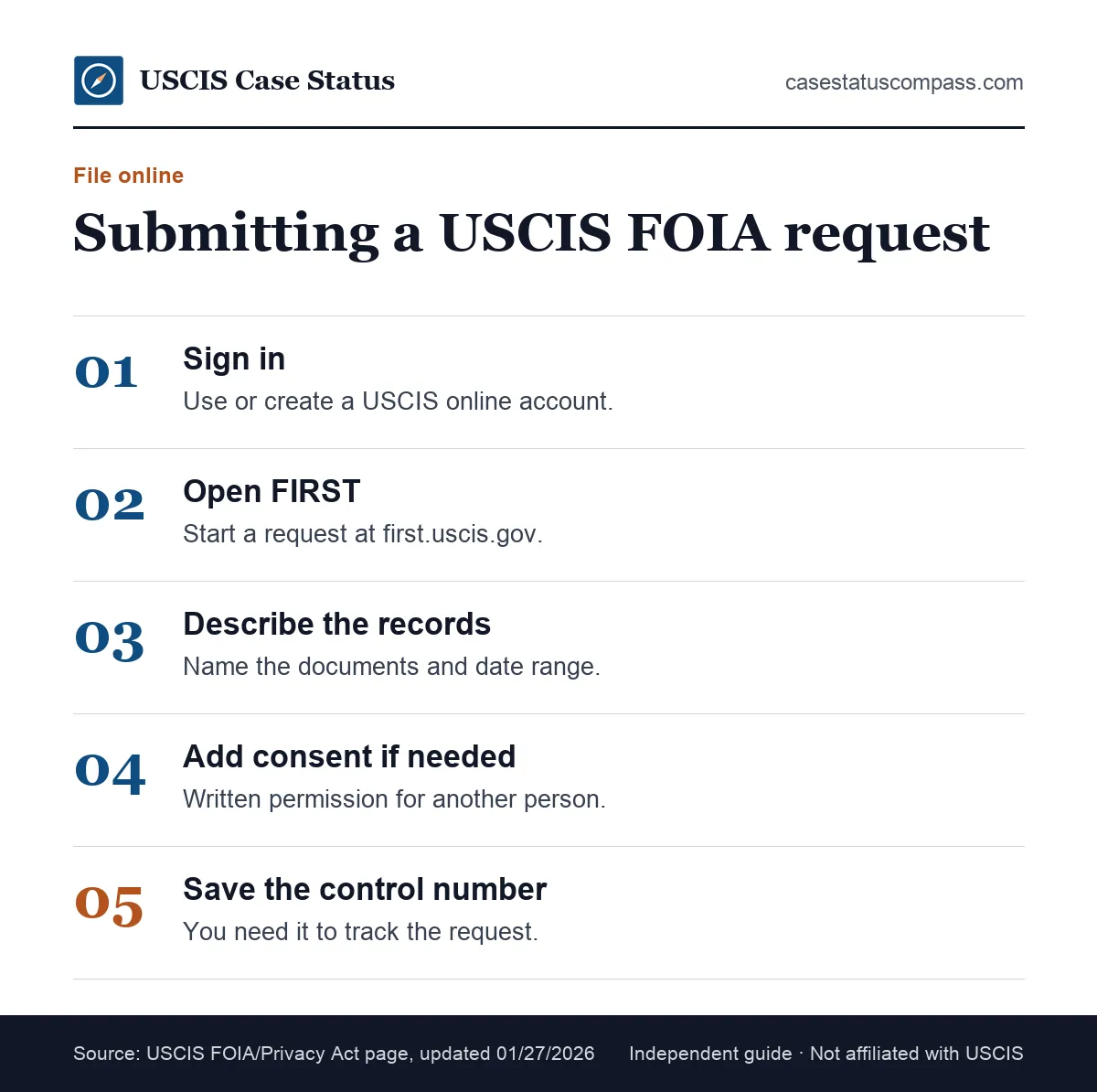
- Sign in to a USCIS online account, or create one at myaccount.uscis.gov/create-account. Our USCIS online account guide explains account types.
- Open FIRST (the FOIA Immigration Records System) and start a new request.
- Choose the request type: your own record, another person's record, or agency records.
- Describe the records by name and date range.
- Upload consent if the record belongs to someone else.
- Submit and save the FOIA control number.
Is a Paper FOIA Request Still Accepted?
Generally not. USCIS's FOIA page, updated Jan. 27, 2026, says that effective Jan. 22, 2026, all FOIA and Privacy Act requests should be submitted online, and that online submission is generally the only acceptable method. Older guides that mention mailing Form G-639 are out of date.
What changed in 2026
Before 2026, many people mailed a paper form; USCIS now directs requesters to FIRST. If you find an old instruction sheet or a preparer who insists on mailing, check the current USCIS FOIA page before sending anything.
What If You Cannot Use the FIRST Online System?
USCIS lists an email channel for Section 508 accessibility needs, with the subject line "FOIA Disability Accommodations." Use it if a disability makes the online system hard to use, and explain what help you need. Because online submission is now generally the only acceptable method, ask for an accommodation rather than mailing a paper request.
What Information Should Your FOIA Request Include?
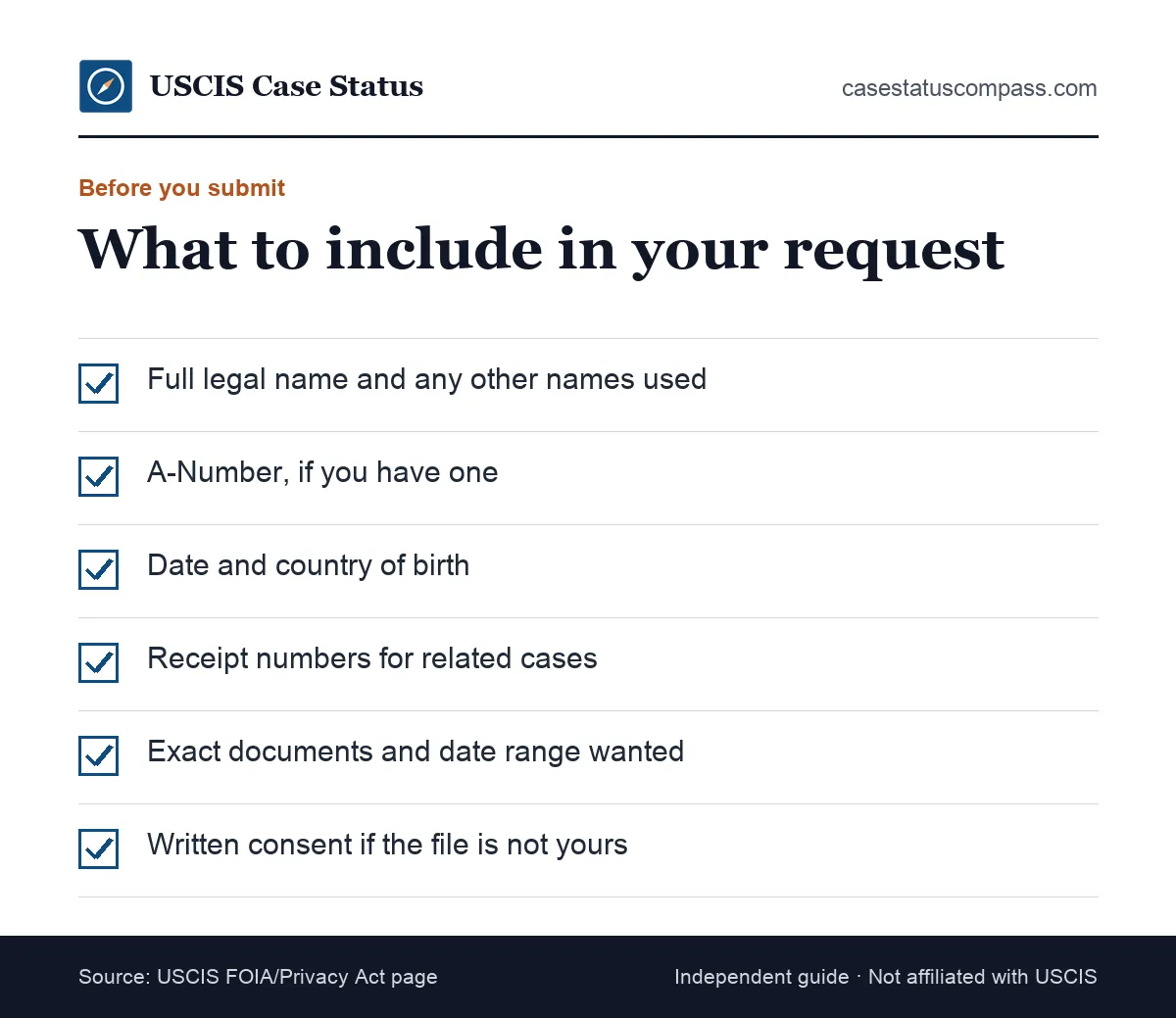
Include your full legal name, other names used, date and country of birth, A-Number and any receipt numbers, plus a clear description of the documents you want. If the record belongs to someone else, include their signed permission. Missing details are the main reason a search returns the wrong file or nothing at all, so check each one against your notices before you submit.
Identifiers that find the right file
Your A-Number is the 'USCIS#' printed on the front of green cards issued after May 10, 2010. Your receipt numbers, found on each I-797 notice, help USCIS find specific cases. Our USCIS receipt number guide shows where they appear. Enter only details you are sure of; a wrong date can send the search to the wrong file.
A clear description of the records
FOIA.gov says a request must "reasonably describe" the records. Name the documents, such as an approval notice or an interview record, and give a date range. "Everything about me" is legal to ask for but slower.
One person per request
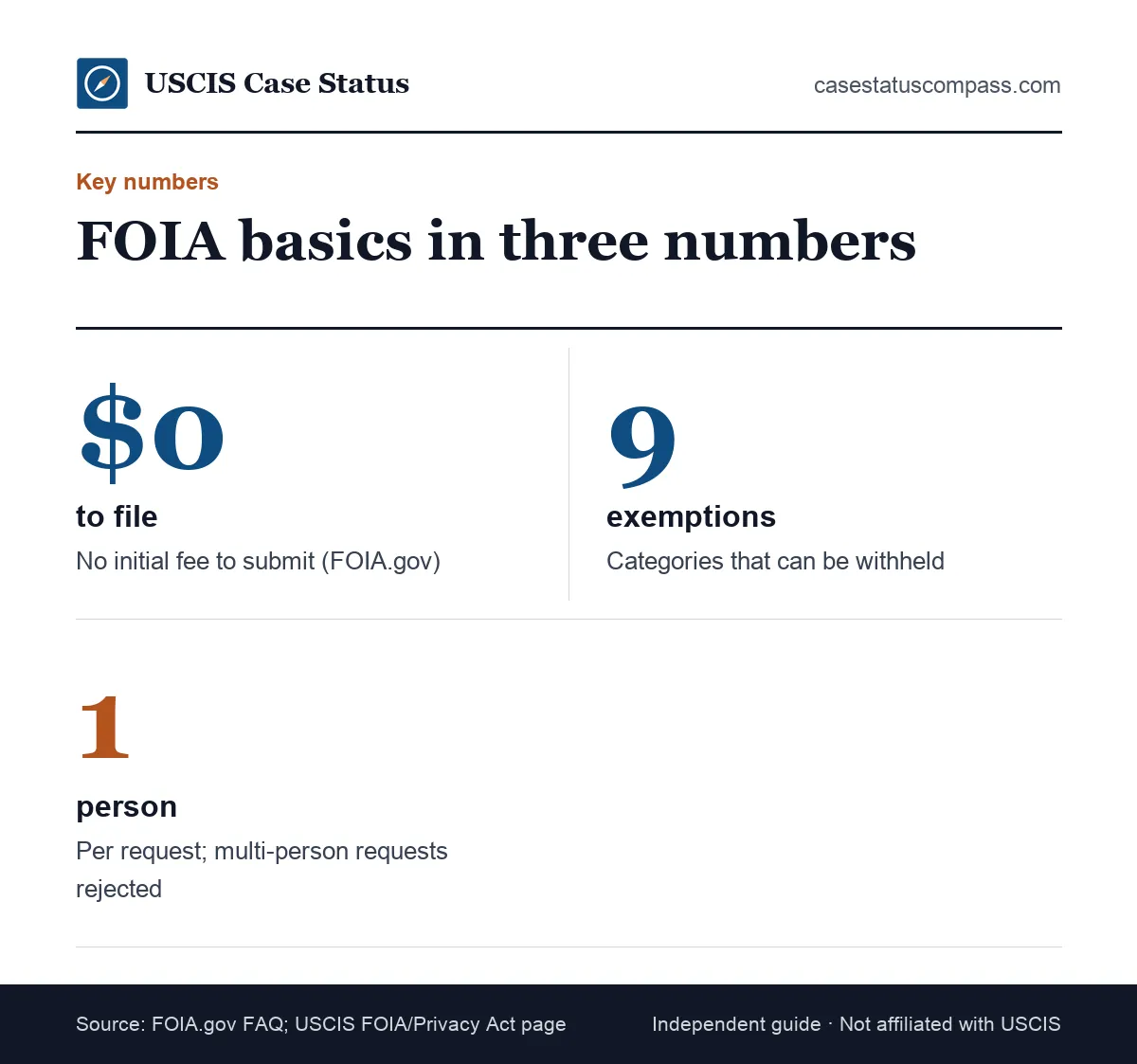
USCIS rejects requests that cover more than one person. Parents asking for their children's files, or spouses asking together, must file separately. Each request gets its own control number. Keep a short list matching each child or spouse to their number, because responses can arrive weeks apart.
How Do You Write a Narrow FOIA Request That Moves Faster?
Ask for named documents over a set period instead of the entire file. USCIS says requests for specific documents are processed faster than requests for large parts of an A-file. A good description names the form or document, the event it relates to and a date range, and nothing more. You can always ask again later if the first response raises new questions.
Specific documents vs the whole file
If you need one approval date, ask for that notice. If you need to know why a case was denied, ask for the decision and the evidence list. Request the whole file only when a lawyer needs a complete review.
Sample USCIS FOIA Request Descriptions
These sample descriptions are examples only, using fictional details. Adapt them to your own case and check the current FIRST instructions before submitting. Each one names the record, the form or event and a date range, which is the pattern that keeps a request narrow.
Example 1: a missing approval notice
"Copy of the Form I-485 approval notice and any card production notice for the applicant, filed 2018 to 2019." This works when you only need proof of the approval date for a later filing.
Example 2: entry and status history
"All Form I-94 records and admission stamps held in my A-file, 2010 to 2015." USCIS may refer some entry records to CBP, which holds most arrival data. If travel dates are the real goal, a parallel CBP request is often quicker.
Example 3: a full file for legal review
"Complete A-file, including interview notes and decisions." Use this only when an attorney needs every page, such as before a removal defense or a complex naturalization case. It takes the longest, so start several months before any filing date.
What Records Can You Get From Your A-File?
An A-file can include copies of forms you filed, notices, photos, identity documents, officer notes and decisions, and records shared by other agencies. Some pages may be withheld or sent to the agency that created them. What you receive depends on how long your history is: a single approved petition yields a thin file, while years of filings can run to hundreds of pages.
Common contents of a response
- Applications and petitions filed for you
- Receipt, appointment and decision notices
- Photos and copies of identity documents
- Interview notes and officer worksheets
- Correspondence and evidence you submitted
Officer notes are often the most useful part, because they show what the officer focused on. They can be hard to read, so ask a representative to review anything unclear.
Why Are Some Pages Withheld or Redacted?
Some pages are withheld or blacked out because federal law allows agencies to protect certain information. FOIA.gov says Congress set nine exemptions from disclosure, such as personal privacy and law enforcement records. Pages created by another agency may also be referred to that agency for review.
FOIA exemptions in plain terms
Exemptions protect information like other people's personal data, internal deliberations and sensitive law enforcement methods. The letter should cite the exemption used for each withholding. That citation is what you would challenge in an appeal.
Referred pages
If a page came from CBP, ICE or the State Department, USCIS may refer it to that agency. You then receive those pages, or a decision on them, from the other agency. Keep track of each referral letter and its own reference number.
How Much Does a USCIS FOIA Request Cost?
FOIA.gov says there is no initial fee to submit a FOIA request. Agencies may charge for search time and copies in some cases, but most requests for your own records cost nothing. As of October 2026, USCIS says USCIS FOIA requests are usually free; you agree to pay up to $25 and USCIS contacts you before charging, so you will not be billed without warning.
When fees can apply
Fees depend on the requester type and the size of the search. If a fee might apply, the agency normally tells you first. You can narrow the request to lower or avoid charges. In practice, USCIS sets a small agreed limit and asks first before any larger charge.
Paid FOIA "services"
Some websites charge to "file your FOIA request," but filing in FIRST is free. Our guide to USCIS scams explains other paid shortcuts that do not exist. A lawyer may charge for reviewing your records, which is a different and legitimate service.
How Long Does a USCIS FOIA Request Take?
USCIS does not promise a fixed date, and we could not verify a current official processing time. Response time depends on how complex the request is and the size of the backlog. USCIS says requests for specific documents move faster than requests for large portions of an A-file.
Simple vs complex requests
A DHS privacy assessment of the FIRST system describes separate processing tracks: simple requests, complex requests and priority requests for people with scheduled immigration court dates. A full A-file usually counts as complex. Check FIRST for the current status of your request.
Why whole-file requests take longer
A full file can run to hundreds of pages, and staff must review every page for exemptions and referrals. If you need records by a date, ask early and ask narrowly. Pages from other agencies add more time, because they must be referred and reviewed again.
Can You Expedite a FOIA Request for Immigration Court?
Yes, if you have a scheduled hearing before an immigration judge and need your A-file for it. USCIS prioritizes these requests when you include a qualifying notice. A federal court deadline alone is not enough. Other expedite grounds under FOIA are narrow.
Notices that qualify for priority
USCIS lists four documents that support priority processing for a hearing:
- Form I-862, Notice to Appear
- Form I-122, Order to Show Cause
- Form I-863, Notice of Referral to Immigration Judge
- A written notice of a continued future hearing
Upload a copy with the request. You can check your court date through Check immigration court cases online at acis.eoir.justice.gov with your A-number.
Other expedite grounds
FOIA.gov says expedited processing is available only for a threat to someone's life or physical safety, or an urgent need to inform the public by a person primarily engaged in sharing information. A pending USCIS application deadline usually does not qualify.
How Do You Check Your FOIA Request Status?
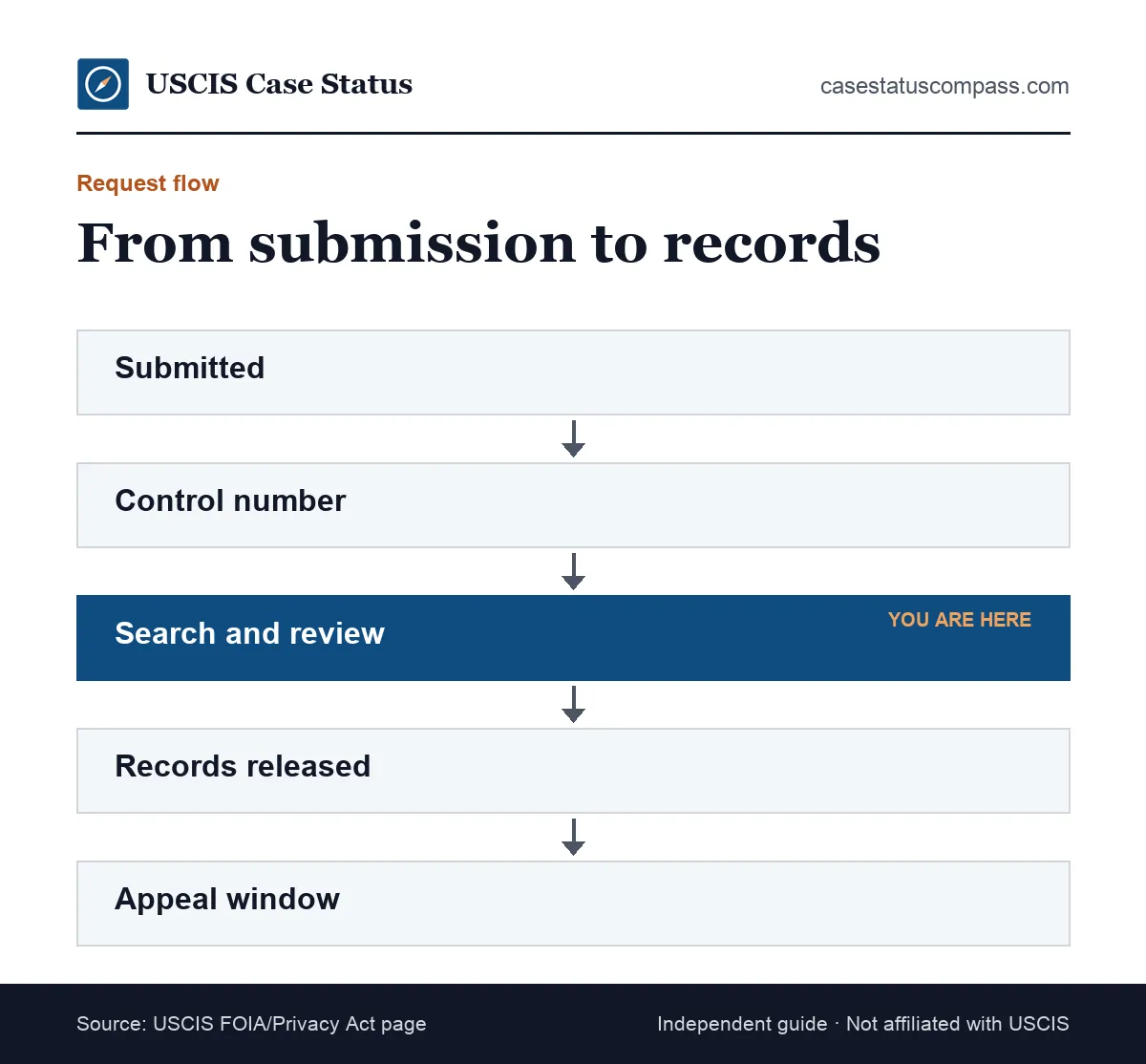
Check status online at first.uscis.gov using the FOIA control number from your receipt message. USCIS emails you when the files are ready to download. The FOIA office answers only questions about FOIA requests, not about pending immigration cases. Each request in FIRST shows its current stage, so check there before you write to the FOIA office.
Your control number
The control number is the key to every status check and appeal. Save the receipt email and write the number in your case notes. If you file for several family members, label each number with the person's name.
Downloading the response
When records are ready, sign in, download them and save copies in two places, such as an encrypted drive and a printed set. Download promptly and check that every file opens, since a large response may come as several parts.
What Happens When the FOIA Response Arrives?
You receive a final determination letter and, if records were found, the released pages. The letter explains how many pages were found, released in full, released in part or withheld, and which exemptions apply. It also gives the appeal instructions and deadline.
Reading the determination letter
Check the page counts first. Large numbers of withheld pages may be worth an appeal. Note any referrals, then read the appeal section, where the deadline is printed. Mark that date on your calendar the day the letter arrives.
Reviewing the records
Compare the records with your own filings. Look for wrong dates, misspelled names or events you did not know were recorded, since a file error can affect a future application. Note each problem with its page number so a lawyer can find it quickly.
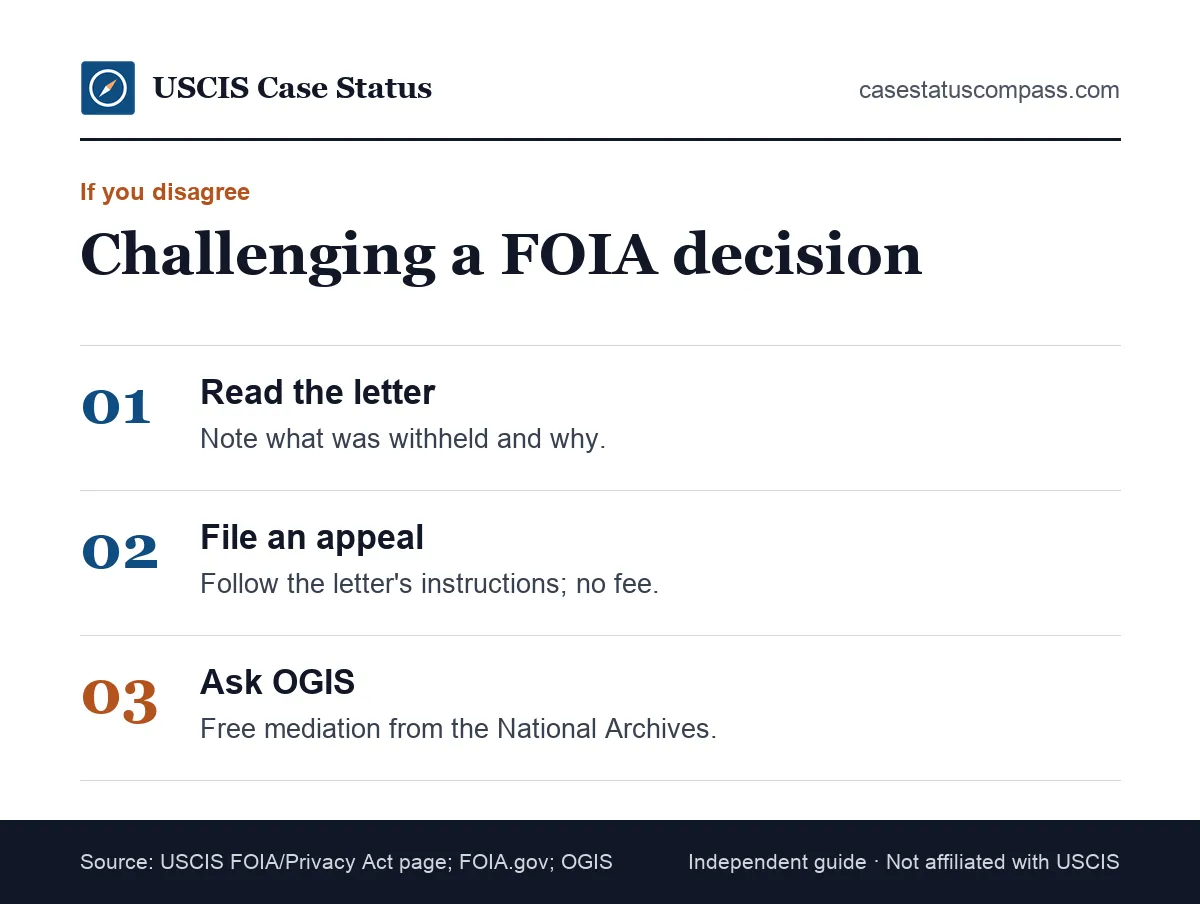
How Do You Appeal a FOIA Decision?
Follow the appeal instructions in your final determination letter. FOIA.gov says an administrative appeal is typically a letter or email to the agency's appeal authority and costs nothing. You can also ask the Office of Government Information Services (OGIS) to mediate. As of October 2026, you can appeal a FOIA decision within 90 days of the response letter, following its instructions.
Filing the appeal
State what you are appealing: withheld pages, an inadequate search, a "no records" answer or a fee decision. Explain why, briefly and factually. Include the control number and file before the deadline in your letter.
OGIS mediation
OGIS, part of the National Archives, offers free mediation between requesters and agencies as an alternative to court. It cannot order USCIS to release records, but it can help resolve misunderstandings about scope or delays.
Which Agency Holds Which Immigration Record?
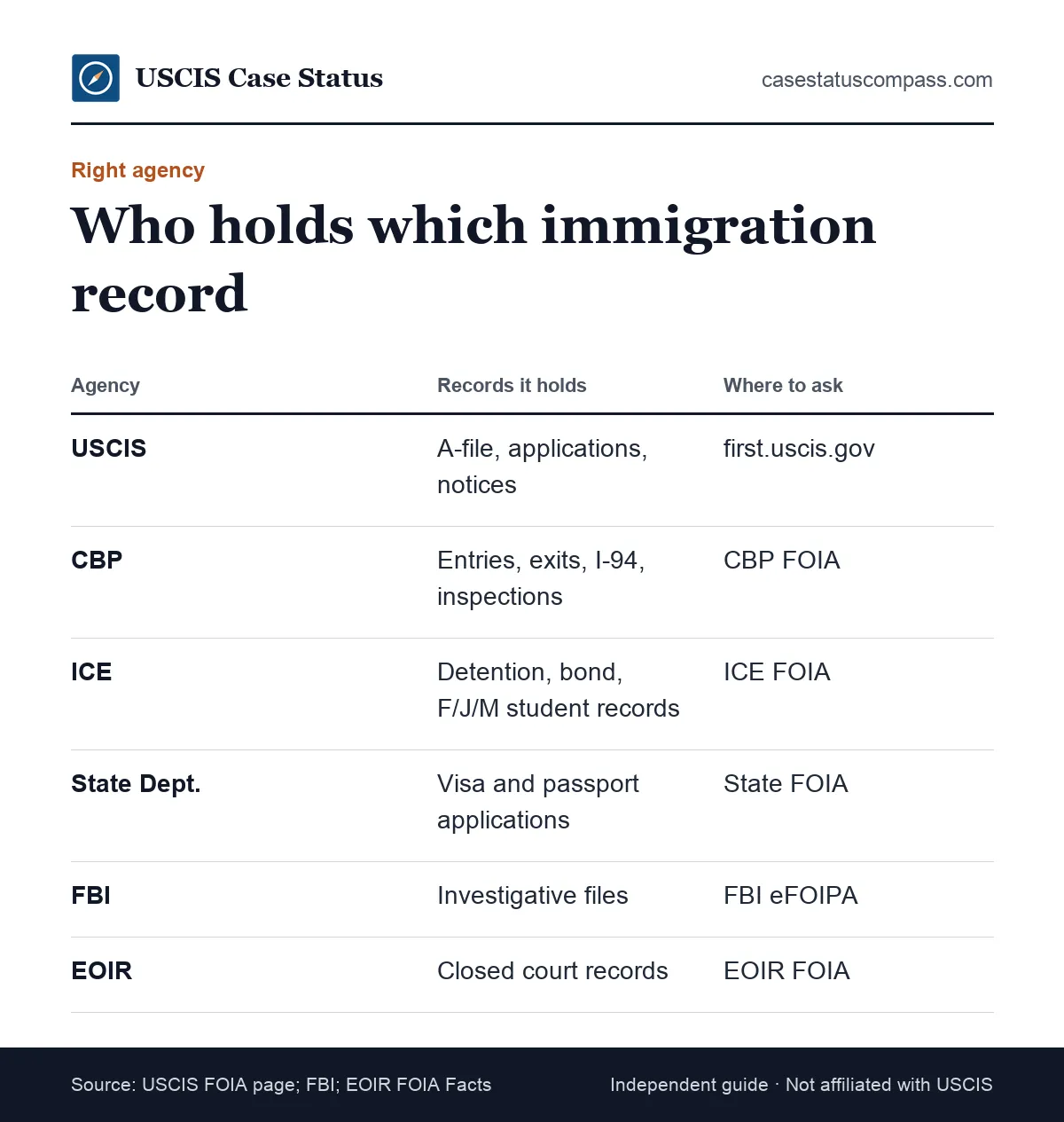
Immigration records are split across several agencies. USCIS holds benefit files. CBP holds most entry and exit records. ICE holds detention and student visa records. The State Department holds visa and passport applications. The FBI and the immigration courts keep their own files. Each needs its own request.
Agency routing table
Find the record you want in the first column, then send the request to the agency shown beside it.
| Record you want | Agency that holds it | How to ask |
|---|---|---|
| A-file, applications, notices | USCIS | FOIA request in FIRST |
| Entries, exits, I-94, inspections, expedited removal | CBP | CBP FOIA request |
| Detention medical records, bond, F/J/M student records | ICE | ICE FOIA request |
| Visa applications and passport records | State Department | State Department FOIA |
| FBI investigative files | FBI | eFOIPA portal |
| Closed immigration court records | EOIR | EOIR FOIA request |
| Your arrest record (fingerprint-based) | FBI CJIS | Identity History Summary request |
If your goal spans two rows, such as a USCIS decision and travel dates, file both requests at once.
Why one request rarely covers everything
USCIS may refer pages it holds from other agencies, but it cannot search those agencies' systems for you. If you need your full history, file with each agency at the same time. The DHS public portal at foiarequest.dhs.gov serves several DHS components.
Freedom of Information Act Request to the FBI: How It Works
A freedom of information act request to the FBI goes through the FBI's own eFOIPA portal, not through USCIS. The FBI sends a confirmation email with an electronic tracking number, then assigns a FOIPA request number used to check status. FBI files are separate from your USCIS A-file.
Using eFOIPA
The FBI says eFOIPA accepts all types of requests, including requests about yourself. It also suggests searching the FBI's online FOIA library, the Vault, first. Status checks use the FOIPA request number, not the first tracking number.
What an FBI FOIA file is not
An FBI FOIA response is not a list of your arrests. The FBI says its fingerprint-based record is "not the same as material in an investigative FBI file." If an immigration officer asks about an arrest, the Identity History Summary is usually the record you need.
FBI FOIA vs Identity History Summary: Which Do You Need?
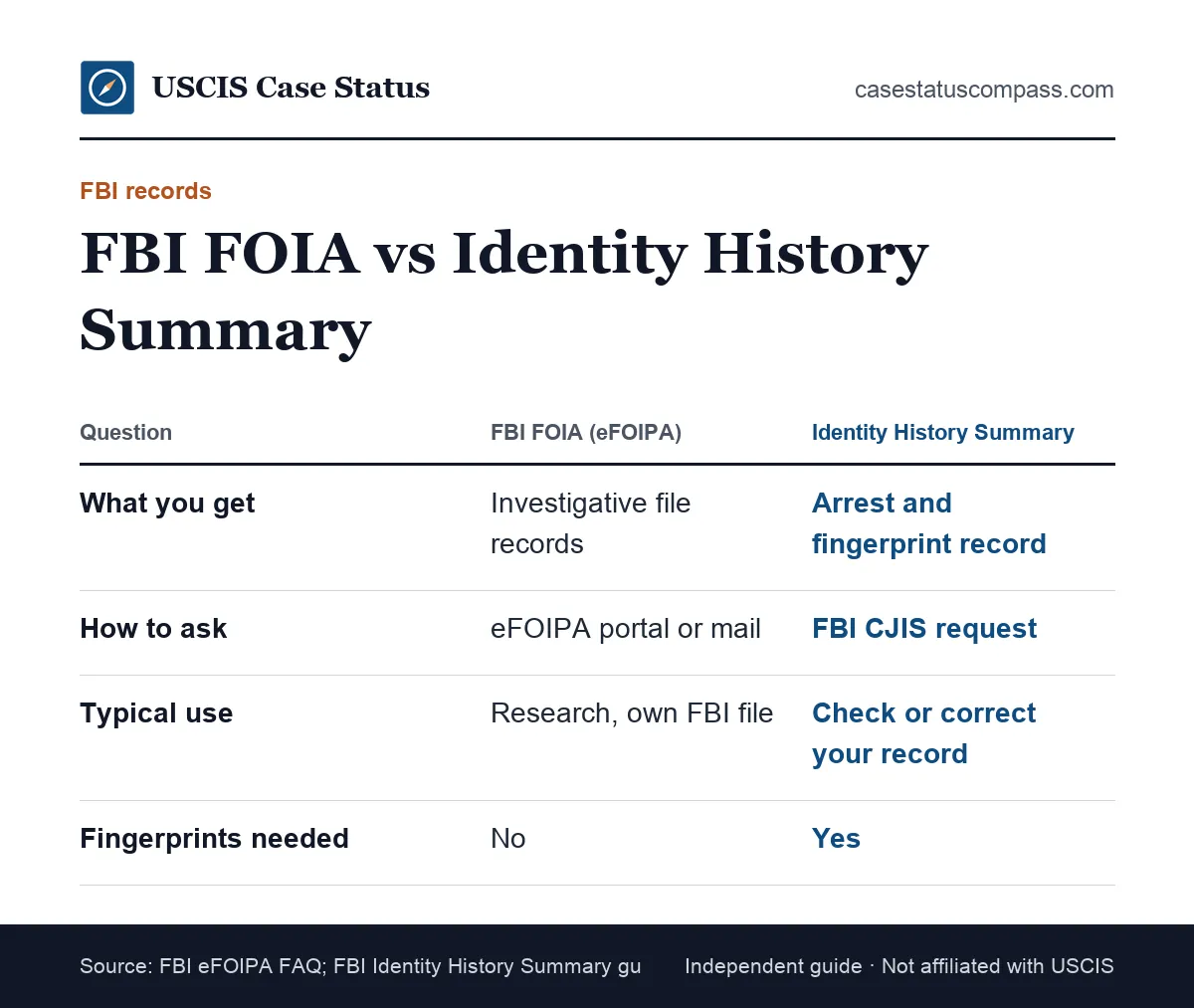
Most immigration applicants who want to know what their FBI record shows need the Identity History Summary, not a FOIA file. The summary is the fingerprint-based arrest record that background checks rely on. A FOIA request reaches investigative files, which few applicants have.
Side-by-side comparison
This table compares the two FBI requests by what each shows, how to ask and when it helps an immigration case.
| Point | FBI FOIA (eFOIPA) | Identity History Summary |
|---|---|---|
| What it shows | Investigative file records | Arrests and fingerprint submissions |
| How to ask | eFOIPA portal or mail | Request to FBI CJIS with fingerprints |
| Good for | Research, your own FBI file | Checking or correcting your record |
| Used by immigration checks | Rarely relevant | Yes, fingerprint-based checks |
When the summary helps an immigration case
Before an interview, knowing what your record shows lets you gather court records. Our biometrics appointment guide explains how fingerprints feed these checks. Talk with an immigration attorney if anything unexpected appears.
How Do You Get CBP Entry and I-94 Records?
CBP, not USCIS, holds most records of arrivals, departures, inspections and Form I-94 data. USCIS's FOIA page lists these as CBP records. Send a separate FOIA request to CBP if you need your full travel history or an inspection record. For a recent admission, the CBP I-94 website may give you the record faster.
What CBP holds
USCIS lists CBP as the holder of apprehension, detention, deportation, entry, exit, expedited removal, inspection and I-94 records, plus passenger name records and voluntary return records. Ask CBP directly for these, using the names and passport numbers you traveled with.
Using CBP records in a USCIS case
Travel history matters for naturalization residence rules. Naturalization: a trip over 6 months is presumed to break residence; 1 year or more breaks it. If you are unsure of trip dates for your citizenship application, CBP records can confirm them. Compare them with passport stamps and airline records, and list the trips exactly as the records show.
How Do You Get ICE and State Department Records?
ICE holds detention medical records, bond records and student and exchange visitor records for F, J and M status. The State Department holds visa applications and passport applications. Each agency runs its own FOIA office, so a USCIS request will not reach these files. File with each agency that matches the record, and expect separate timelines and letters.
ICE records
If you were detained, ICE holds the detention medical records and bond paperwork. International students and exchange visitors can ask ICE for F, J or M program records. A USCIS request will not return them.
State Department records
Visa applications filed at a consulate and U.S. passport applications belong to the State Department. NVC (State Department) collects visa fees and documents after USCIS approves the petition. Our US visa status guide explains the State Department's own tools. A request for an old visa refusal goes to the State Department's FOIA office.
How Do You Get Immigration Court Records From EOIR?
The immigration courts, run by EOIR (the Executive Office for Immigration Review), keep their own records. EOIR says parties to an active case do not need FOIA to see the record of proceedings. For a closed case, or if you are not a party, you file a FOIA request with EOIR.
Active vs closed cases
If your case is open, you or your lawyer can review the record through the court; a closed case needs a FOIA request. EOIR asks for the A-Number, or the full name with the charging document date, country and hearing location.
Checking a court case
For hearing dates and case status, use the EOIR tools, not FOIA. EOIR case hotline: 1-800-898-7180 (24/7, automated). Our immigration court case status guide walks through both. Use FOIA only when you need documents the court holds.
Public Information Request vs FOIA: What Is the Difference?
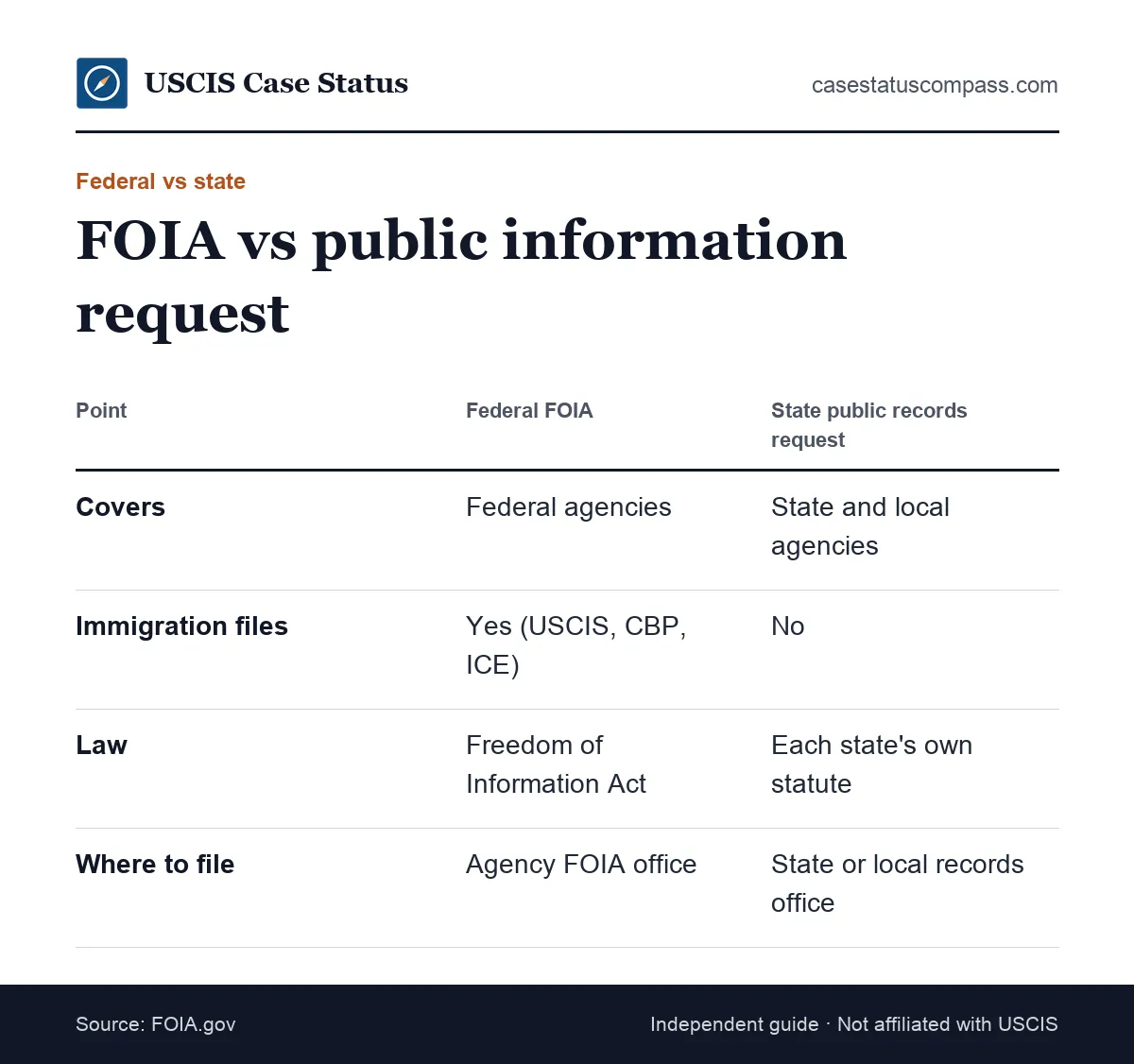
A "public information request" usually means a request under a state's public records law, which covers state and local agencies. Immigration records are federal, so you need a federal FOIA request. FOIA.gov describes FOIA as a right to request records from any federal agency.
State public records laws
Each state has its own public records statute, deadlines and fees. These laws reach police departments, courts and city offices, but not USCIS. A state request may help you get local arrest or court records for your immigration case.
Federal FOIA for immigration files
Use FOIA for USCIS, CBP, ICE, the State Department, the FBI and EOIR. If you need both local court papers and your A-file, file one request with each office. Federal requests go through each agency's FOIA portal; state requests go to the local clerk or agency.
How Does a FOIA Request Fit With the Ombudsman or Congress?
A FOIA request gets you records. The CIS Ombudsman and congressional inquiries are for cases that are stuck or mishandled. You can file a FOIA request while also escalating a delayed case, but each follows its own rules. Records can help you explain a stuck case, but you do not need them to ask for help.
The CIS Ombudsman
CIS Ombudsman: DHS Form 7001, Request for Case Assistance (online). Use the Ombudsman only after contacting USCIS within 90 days and waiting at least 60 days. The Ombudsman helps with case problems, not with getting copies of your file. Use it when a USCIS case is stuck well past normal times; a slow FOIA request has its own appeal and OGIS routes.
Your member of Congress
Your member of Congress can ask USCIS about your case after you sign a privacy release. A congressional office can ask about a long-delayed FOIA request, but it cannot make USCIS skip the review process. Give the office your control number and the date you filed.
Using FOIA Records After a Denial
FOIA records can show what evidence an officer relied on, but your appeal or motion deadline does not pause while you wait. Appeal or motion: file within 30 days (33 if the decision was mailed). File any needed motion on time with your attorney and use the records to support a later filing if needed.
Deadlines come first
Reopen = new facts and evidence; reconsider = the decision got the law or policy wrong. Our guide on a motion to reopen or appeal explains each option. If records arrive later, you or your lawyer can still use them in a new filing. The case was denied status page explains what the status means.
Using FOIA Records Before Naturalization or a Green Card Filing
Requesting records before a new filing helps you answer history questions consistently. Applicants with old entries, past denials, prior marriages or arrests benefit most. Start months ahead, because a full file can take a long time. If the response shows something unexpected, such as an old denial, talk with an attorney before you file.
Before a citizenship application
The N-400 asks about trips, addresses and past immigration history. A FOIA response can confirm dates you no longer remember. Our citizenship interview guide explains how officers review your answers. Pay attention to past addresses and trip dates.
Before adjustment or renewal
For a Form I-485 green card application, a file review can surface prior visa refusals or entries. If your card is lost, our lost green card guide explains the replacement route; FOIA cannot replace it.
Worked Example: A FOIA Request Before Filing an N-400
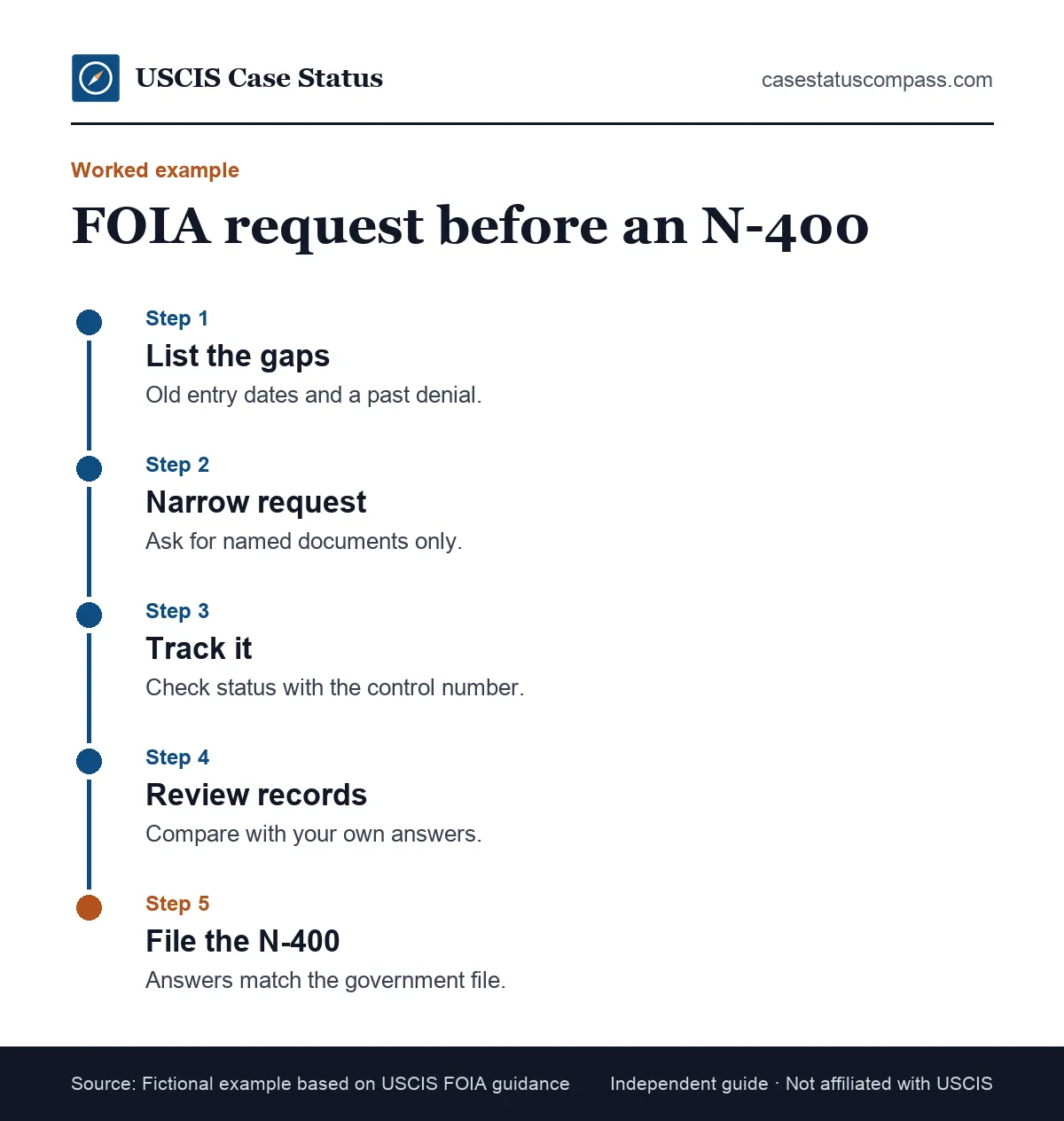
This worked example uses a fictional applicant to show how a narrow request saves time. "Ana" became a permanent resident years ago, had an earlier visa denied and does not remember her exact entry dates. She plans her citizenship filing around the records.
What Ana requests
Ana asks USCIS for the decision on her earlier application and her admission records, with a date range, leaving uncertain fields blank rather than guessing. She files a separate request with CBP for her travel history. Each request has its own control number.
How she uses the result
When the records arrive, Ana compares them with her notes and corrects two trip dates before filing. Her N-400 answers now match the government record, which avoids questions at the interview. She keeps the records in her case folder and brings key pages to the interview.
Requesting Records for a Family Member
To request a relative's immigration records, you need that person's written permission, and you must file a separate request for each person. Records of a deceased relative may follow different rules, so check the FIRST instructions. Before you file, confirm the person's A-Number, date of birth and other names, and keep a copy of their consent. If they live abroad, a scanned signature is usually easier than mail.
Getting valid consent
Ask the relative to sign a clear statement allowing release to you. USCIS may also contact the subject of the record to confirm consent. Make sure their contact details are current so the request does not stall.
Common Mistakes That Delay a USCIS FOIA Request
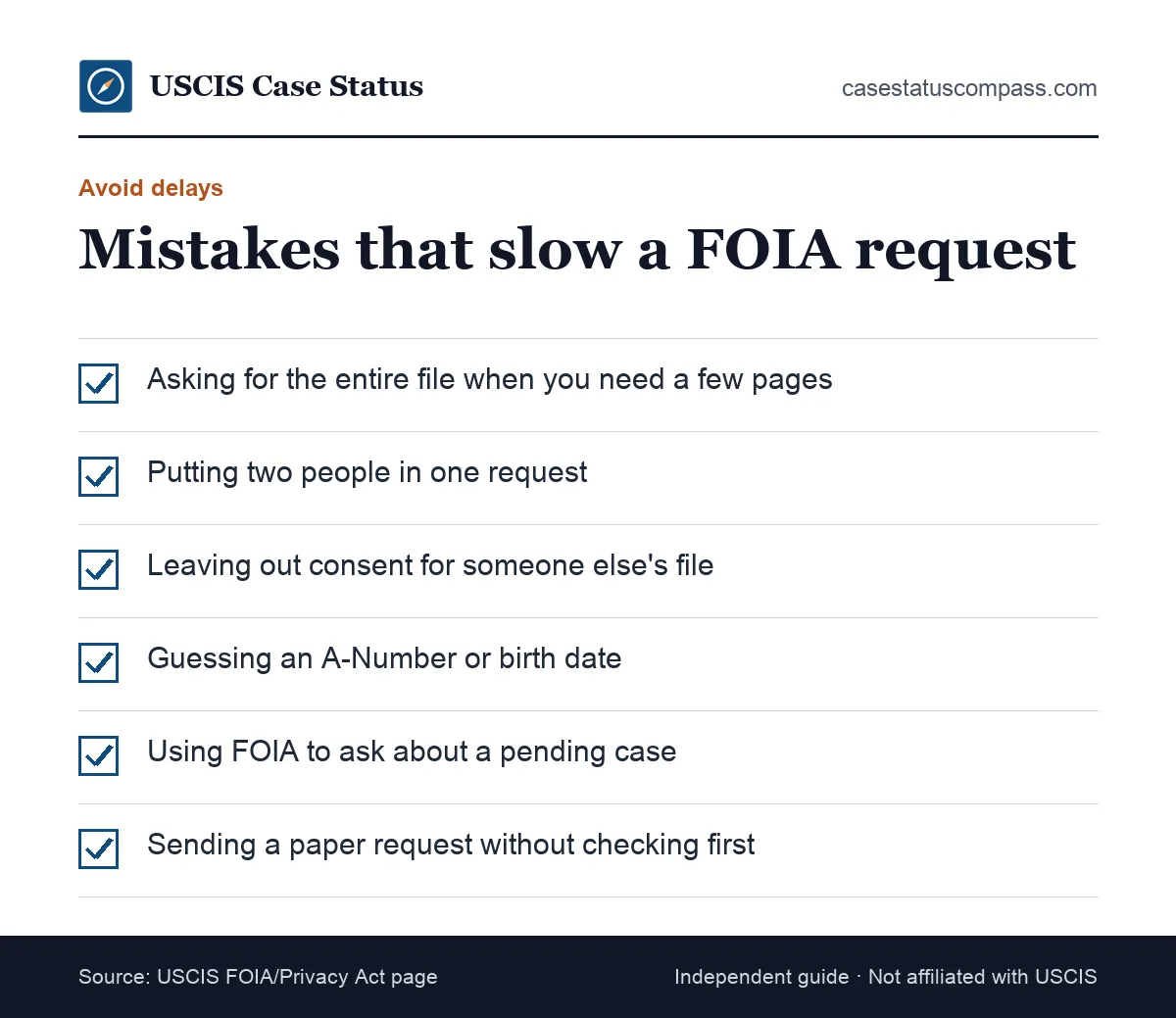
The most common delays come from vague requests, wrong identifiers, multi-person requests, missing consent and using FOIA for case status. Each one either slows the search or ends the request, and most are easy to avoid with ten minutes of checking. Another mistake is waiting until a deadline is close before filing. The sections below show what to fix.
Vague or oversized requests
"Everything" requests go to the slower queue. If you need a few pages, say which ones. You can always file a second request later for more. Narrow requests can be read and acted on quickly.
Wrong identifiers and missing consent
A misspelled name, a guessed date or a missing A-Number can send the search to the wrong file. Requests for a relative stall without their signed consent, and combined family requests are rejected. Check each detail against your documents before you submit.
What If USCIS Says No Records Were Found?
A "no records" response means USCIS did not find records matching your description and identifiers. It may mean the records are held by another agency, the identifiers did not match, or the request was too narrow. You can appeal the adequacy of the search or file a corrected request.
Check your identifiers
Compare the names, dates and numbers you gave with your documents. Name spellings and other names used are common causes. A corrected request with better details often succeeds. Include each prior name and the A-Number if you have one.
Appealing an inadequate search
If your identifiers were right, you can appeal the adequacy of the search by following the instructions in the determination letter and citing your control number. If the records may belong to CBP, ICE or another agency, file with that agency instead.
Decision Table: Which Request Should You File?
This decision table matches common goals with the right request. It helps you avoid a FOIA request when another form or tool is faster, and it points you to the right agency when USCIS does not hold the record you need.
If X, do Y
Read down the left column to find your goal, then follow the request or form on the right.
| If you want to | Do this |
|---|---|
| Know where your pending case stands | Use case status tools or the Contact Center |
| Get copies of your USCIS file | File a FOIA request in FIRST |
| Replace a lost green card | File Form I-90 |
| Get a duplicate approval notice | File Form I-824 or request the file |
| See your arrest record | Request an FBI Identity History Summary |
| Get your travel history | File a FOIA request with CBP |
| Get closed court records | File a FOIA request with EOIR |
When to get legal help
If your file may contain arrests, removal orders or fraud findings, talk with an immigration attorney or a DOJ-accredited representative before you act on the records. They can read officer notes in context.
Printable USCIS FOIA Request Checklist
Use this checklist before and after you submit a USCIS FOIA request. It covers the details to gather, the steps in FIRST and what to do once records arrive. Print it or copy it into your notes, and tick each item as you go. Most delays trace back to one unchecked item.
Before you submit
- Decide exactly which documents you need.
- Gather your A-Number and receipt numbers.
- List other names and spellings you have used.
- Get signed consent if the file is someone else's.
- Gather any immigration court notice for priority.
After you submit
- Save the control number with the person's name.
- Check status in FIRST every few weeks.
- Download and back up the records.
- Read the determination letter and appeal deadline.
- Note any pages referred to other agencies.
How Should You Store and Protect Your FOIA Records?
Your FOIA response contains sensitive personal data, so store it securely and share it only with people who need it, such as your attorney. Never send the file to anyone who contacts you claiming to be USCIS, and never post pages online.
Safe storage
Save the download on an encrypted device or a secure cloud folder, print the key pages for your case folder, and shred old copies. The file can hold your A-Number, birth date, photos and family details, which are valuable to identity thieves.
Spotting fake contacts
USCIS will not call you to ask for payment for records. If a message claims to come from USCIS, check it with our guide on how to verify a USCIS notice.
Key Facts About USCIS FOIA Requests
File online at first.uscis.gov, one person per request, with accurate identifiers and a narrow description. There is no initial fee. Use your control number to track and appeal. Send FBI, CBP, ICE, State Department and court record requests to those agencies.
The short version
A USCIS FOIA request is for records, not case status or replacement documents. For more help with a stuck case, visit our USCIS case help hub. To check any case, start at the USCIS case status homepage.
Frequently Asked Questions
Can I use a FOIA request to check my USCIS case status?
No. USCIS's FOIA office answers only questions about FOIA and Privacy Act requests. It cannot help with pending applications or petitions. For case status, use Case Status Online, your USCIS online account or the USCIS Contact Center.
Do I need a lawyer to file a USCIS FOIA request?
No. You can file your own request online in FIRST in a few minutes. A lawyer helps most when the file may contain arrests, removal orders or denials, because they can read officer notes in context and decide what to do next.
Can I request my spouse's or parent's immigration file?
Yes, with their written permission. USCIS requires consent from the person the records are about, and each person needs a separate request. Make sure the relative can answer if USCIS contacts them to confirm consent.
Will a FOIA request affect my pending application?
No. A FOIA request is handled by the FOIA program, separately from benefit processing. It does not pause, speed up or flag your pending case. You can request your records at any time, including while an application is waiting for an interview or decision.
What is the difference between FOIA and a Privacy Act request?
FOIA lets any person request federal agency records. The Privacy Act gives U.S. citizens and permanent residents rights over records about themselves, including asking to correct them. USCIS takes both kinds of request through the same online system, so for most applicants the filing steps look the same.
Can I get interview notes or recordings through FOIA?
You can ask for them. Interview notes and officer worksheets are often part of the A-file, though some content may be withheld under a FOIA exemption. Name the interview and its approximate date in your request so staff can find the right pages faster.
Where do I find my FOIA control number?
USCIS gives you a FOIA control number when you submit in FIRST, and it appears in your receipt message. Save that email, note the number with the person's name, and use it for every status check, question and appeal about the request.
Can FOIA records show why my case was denied?
Often, yes. The denial notice gives the reasons, but the A-file can show the evidence and officer notes behind them, though some pages may be withheld. Do not let a pending FOIA request delay a motion or appeal, because those deadlines keep running.
Is there an official form for a USCIS FOIA request?
USCIS now directs requesters to the online FIRST system rather than a paper form. FOIA.gov notes that federal law does not require any specific form, but each agency sets its own submission method. For USCIS, follow the online steps on its FOIA page.
Sources
- USCIS: Request Records through the Freedom of Information Act or Privacy Act (updated 01/27/2026). www.uscis.gov/records/request-records-through-the-freedom-of-information-act-or-privacy-act. Accessed Oct 27, 2026.
- USCIS FOIA Immigration Records System (FIRST). first.uscis.gov/. Accessed Oct 27, 2026.
- FOIA.gov: How to Make a FOIA Request. www.foia.gov/how-to.html. Accessed Oct 27, 2026.
- FOIA.gov: Frequently Asked Questions. www.foia.gov/faq.html. Accessed Oct 27, 2026.
- FBI: Requesting FBI Records (eFOIPA). www.fbi.gov/how-we-can-help-you/more-fbi-services-and-information/freedom-of-information-privacy-act/requesting-fbi-records. Accessed Oct 27, 2026.
- EOIR: FOIA Facts. www.justice.gov/eoir/foia-facts. Accessed Oct 27, 2026.
- DHS: Privacy Impact Assessment for the FOIA Immigration Records System (FIRST). www.dhs.gov/sites/default/files/publications/privacy-pia-uscis-first-march2019.pdf_0.pdf. Accessed Oct 27, 2026.
- National Archives: Office of Government Information Services (OGIS). www.archives.gov/ogis. Accessed Oct 27, 2026.
- USCIS Contact Center. www.uscis.gov/contactcenter. Accessed Oct 27, 2026.
- Form G-639, Edition 12/12/24. www.uscis.gov/sites/default/files/document/forms/g-639.pdf. Accessed Oct 27, 2026.
- USCIS: Checking Your Case Status Online. www.uscis.gov/tools/checking-your-case-status-online. Accessed Oct 27, 2026.
- USCIS Form G-1055 Fee Schedule, Edition 10/16/26. www.uscis.gov/sites/default/files/document/forms/g-1055.pdf. Accessed Oct 27, 2026.
- USCIS: Online Account and Technical Support. www.uscis.gov/tools/uscis-tools-and-resources/online-account-and-technical-support. Accessed Oct 27, 2026.
- USCIS Glossary: USCIS Number. www.uscis.gov/glossary-term/50674. Accessed Oct 27, 2026.
- DOJ EOIR: Immigration Court Information. www.justice.gov/eoir/immigration-court-information. Accessed Oct 27, 2026.
- DHS: How to Make FOIA Requests (updated 01/07/2026); USCIS FOIA page. www.dhs.gov/dhs-foia-handbook. Accessed Oct 27, 2026.
- USCIS Policy Manual Vol. 12, Part D, Ch. 3. www.uscis.gov/policy-manual/volume-12-part-d-chapter-3. Accessed Oct 27, 2026.
- USCIS: Consular Processing (updated 07/20/2023). www.uscis.gov/green-card/green-card-processes-and-procedures/consular-processing. Accessed Oct 27, 2026.
- DOJ EOIR: Customer Service Initiatives (updated May 29, 2025). www.justice.gov/eoir/customer-service-initiatives. Accessed Oct 27, 2026.
- DHS CIS Ombudsman: How to Submit a Case Assistance Request (updated 04/13/2026). www.dhs.gov/case-assistance. Accessed Oct 27, 2026.
- USCIS OLA New Member Outreach FAQs (Jan. 2021). www.uscis.gov/sites/default/files/document/questions-and-answers/5%20117%20-%20New%20Member%20Outreach%20FAQs%2001042021.pdf. Accessed Oct 27, 2026.
- USCIS: Form I-290B page (updated 10/26/2026). www.uscis.gov/i-290b. Accessed Oct 27, 2026.
- 8 CFR 103.5(a) (LII). www.law.cornell.edu/cfr/text/8/103.5. Accessed Oct 27, 2026.
casestatuscompass.com is an independent publication and is not affiliated with USCIS or any government agency. This page is general information, not legal advice. For denials, court or asylum matters, consult an immigration attorney or a DOJ-accredited representative.