Contents · 40 sections
- What Is a Motion to Reopen?
- Reopen, Reconsider or Appeal: How the Three Routes Differ
- Can You File a Motion to Reopen and Reconsider Together?
- What Is Form I-290B?
- Which USCIS Decisions Can Be Appealed?
- Decisions That Do Not Use Form I-290B
- What Is the Deadline for a Motion to Reopen?
- How Do You Count the 30-Day Deadline?
- How Much Is the Motion to Reopen Filing Fee?
- Can You Get a Fee Waiver for Form I-290B?
- Motion to Reopen Payment: How to Pay and What Is Nonrefundable
- How Long Does a Motion to Reopen Take?
- Where Do You File Form I-290B?
- What Evidence Supports a Motion to Reopen?
- Can You Use Evidence You Already Had Before the Denial?
- How to Write the Brief or Statement
- Common Reasons People File a Motion to Reopen
- What If You Missed an RFE Because of a Wrong Address?
- Motion to Reconsider: Showing a Legal or Policy Error
- What Is the Administrative Appeals Office?
- Should You File an Appeal or a Motion First?
- Immigration Appeal Process Step by Step
- What Is the Board of Immigration Appeals?
- Is There an Immigration Appeals Court?
- Can You Take a USCIS Denial to Federal Court?
- Motion to Reopen in Immigration Court vs With USCIS
- What Does "No Appeal Was Received for This Case" Mean?
- Does Filing a Motion Stop a Denial From Taking Effect?
- Motion vs Refiling a New Application
- Decision Table: Which Route Fits Your Situation?
- Motion to Reopen After an I-485 Denial
- Appeals for I-140 and Employment Petitions
- Sileiri Doe Class: Fee-Free Reopening
- How to Track an I-290B Case
- Copyable I-290B Filing Checklist
- Why Should You Talk to an Attorney or Accredited Representative?
- Getting Procedural Help From USCIS
- Can the CIS Ombudsman Help With a Denied Case?
- What Happens After USCIS Decides Your Motion or Appeal?
- Frequently Asked Questions
The short answer
A motion to reopen asks the USCIS office that denied your case to look again because of new facts backed by affidavits or documents. You file it on Form I-290B within 30 days of the decision (33 if mailed). A motion to reconsider argues a legal error instead, and an appeal goes to a higher office.
At a glance
| Form | Form I-290B, Notice of Appeal or Motion |
| Deadline | 30 days from the decision; 33 if mailed |
| Fee (Oct. 2026) | $800 (some humanitarian categories $0; fee waiver possible) |
| Who decides a motion | The office that made the latest decision |
| Who decides an appeal | The Administrative Appeals Office (AAO) |
| Best first step | Talk to an attorney or accredited representative |
This guide is not legal advice. We strongly recommend an immigration attorney or a DOJ-accredited representative before you file.
What Is a Motion to Reopen?
This motion is a formal request asking the USCIS office that decided your case to look again based on new facts. Under federal rules, those facts must be supported by affidavits or other documents. If the office grants the motion, it reopens the case and issues a new decision.
For other ways to fix a stuck or refused case, see our USCIS case help center.
New facts, not new arguments
The key word is new. A fact can be new because it did not exist before, such as a birth certificate issued after the denial, or because you could not reasonably present it, such as a notice you never received.
What reopening does
When USCIS grants the motion, the earlier denial is set aside and the case returns to an open state. The office may approve it, ask for more evidence or deny it again.
Reopen, Reconsider or Appeal: How the Three Routes Differ
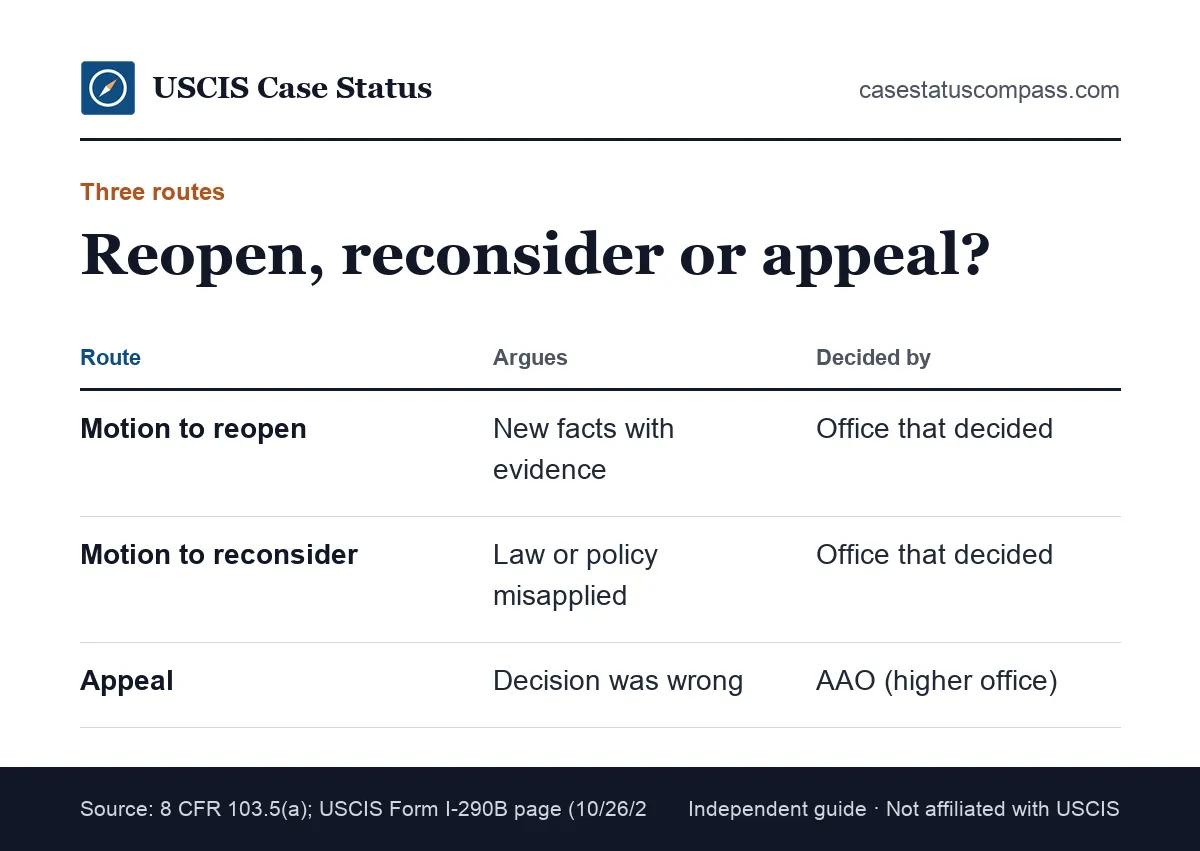
All three use Form I-290B, but each asks a different question. Reopen = new facts and evidence; reconsider = the decision got the law or policy wrong. An appeal asks a higher office, usually the Administrative Appeals Office, to review the whole decision.
The three routes side by side
The table lines up the five features that decide the route: argument, evidence, record, decision-maker and deadline.
| Feature | Motion to reopen | Motion to reconsider | Appeal |
|---|---|---|---|
| Core argument | New facts exist | The decision misapplied law or policy | The decision was wrong |
| New evidence | Required | Not the basis | Depends on the case |
| Record reviewed | Old record plus new facts | Record at the time of decision | Full record |
| Who decides | Office that made the decision | Office that made the decision | AAO (or BIA for some forms) |
| Deadline | 30 days (33 if mailed) | 30 days (33 if mailed) | 30 days (33 if mailed) |
When reconsideration fits
A motion to reconsider fits when the officer had everything needed but got the rule wrong, for example by applying the wrong income test. You must cite the law, regulation or precedent decision that shows the error. No new evidence is needed.
When an appeal fits
An appeal fits when you believe the decision was wrong and the form allows one. A different body reviews it. Check the last page of the denial notice: it says whether an appeal is available and where the file goes after the first review.
Can You File a Motion to Reopen and Reconsider Together?
Yes. Form I-290B lets you file a combined motion to reopen and reconsider when your case has both new facts and a legal error. You still check only one box in Part 2, choosing the combined option. One fee covers the combined filing.
How a combined motion works
In a combined filing, the brief should split cleanly into two parts: the new facts with their evidence, and the legal errors with citations. Each part must meet its own standard.
What Is Form I-290B?
Form I-290B, Notice of Appeal or Motion, is the USCIS form for appeals to the Administrative Appeals Office and for motions to reopen or reconsider. The current edition is dated 05/31/24. Download it from the USCIS I-290B page and check the edition date at the bottom of each page before you file.
Who can file it
Generally only the applicant or petitioner can file. A beneficiary usually cannot, with one exception the USCIS page lists: the beneficiary of a revoked Form I-140 may file if USCIS said an appeal or motion is available.
Three filing rules that prevent rejection
USCIS lists three simple rules: file a separate I-290B for each decision, check only one box in Part 2, and sign the form. An unsigned I-290B is rejected, and a rejection does not stop the deadline clock.
Which USCIS Decisions Can Be Appealed?
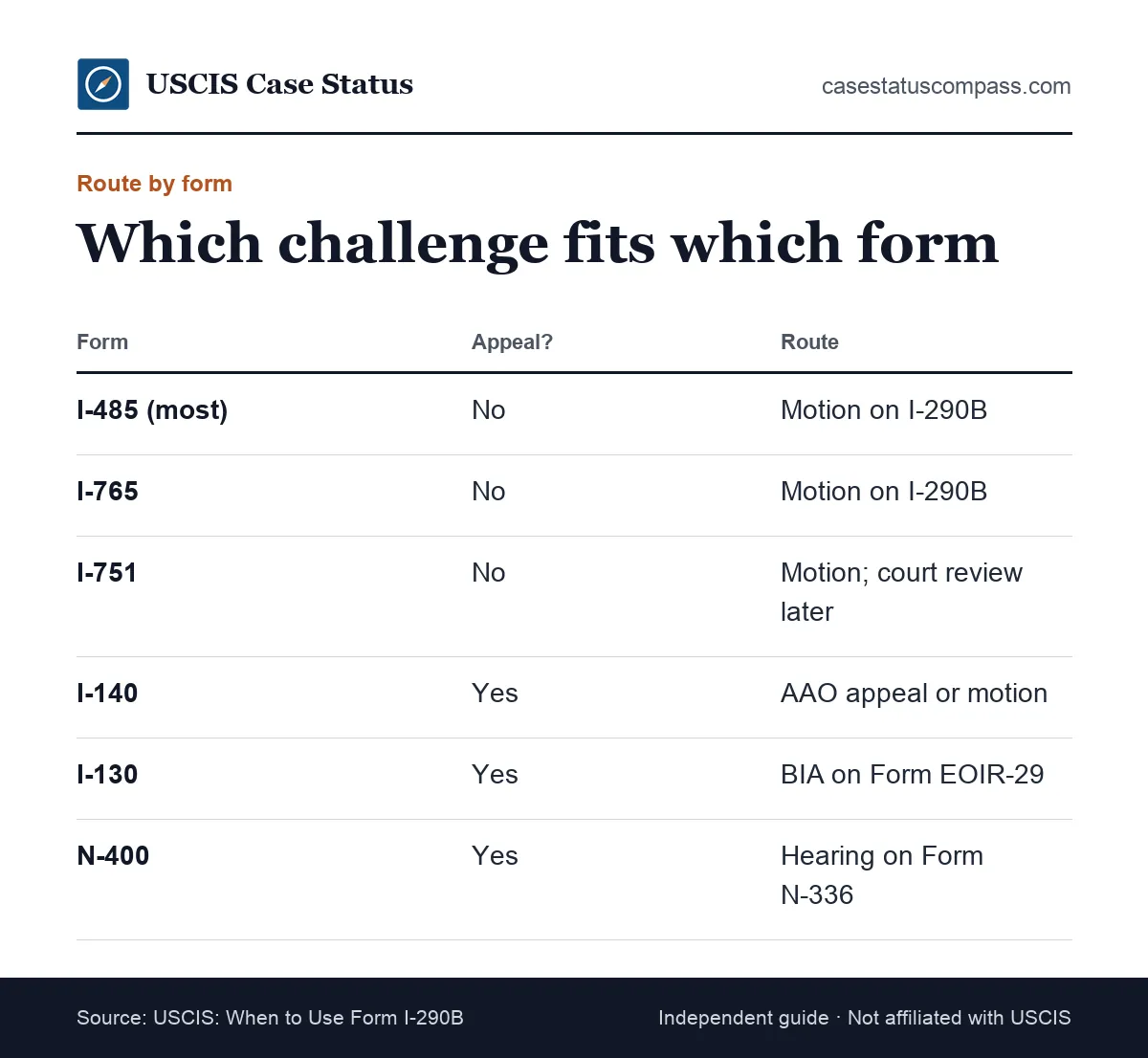
Whether you can appeal depends on the form. USCIS's "When to Use Form I-290B" page lists forms with appeal rights, such as I-140, I-129F, I-601 and N-600, and forms that allow only a motion, such as most I-485, I-765, I-539, I-90 and I-751 denials.
Appeal and motion rights by form
Find your form in the left column to see whether an appeal, a motion or another route applies to its denial.
| Form | Appeal? | Motion? | Notes |
|---|---|---|---|
| I-485 (most categories) | No | Yes | Reopen or reconsider only |
| I-765 work permit | No | Yes | Motion only |
| I-751 conditions removal | No | Yes | Judge review possible in removal proceedings |
| I-140 worker petition | Yes, to AAO | Yes | Revoked-I-140 beneficiaries may file in some cases |
| I-130 relative petition | Yes, to BIA | Yes | Appeal uses Form EOIR-29, not I-290B |
| N-400 naturalization | Yes | No I-290B | Hearing request on Form N-336 |
Appeal-eligible forms
Forms with an AAO appeal include many employment and adoption petitions and several waivers. Our Form I-140 guide covers the most common employment petition. The denial notice confirms whether yours is one of them.
Motion-only forms
For motion-only forms, the office that denied you is the only USCIS body that will look again. No higher office will review it, so new evidence must be strong. Gather every missing document before filing, since the officer decides only on what the motion contains.
Decisions That Do Not Use Form I-290B
Some denials follow other paths entirely. Form I-130 appeals go to the Board of Immigration Appeals on Form EOIR-29. Naturalization denials use a hearing request on Form N-336. Consular visa refusals belong to the State Department. Each has its own form and deadline.
Family petitions and the BIA
An I-130 denial is appealed to the Board of Immigration Appeals, part of the Department of Justice, not to the AAO. Our Form I-130 guide explains the petition. The notice gives the deadline and filing place.
Citizenship and consular refusals
An N-400 denial is challenged through an administrative hearing, explained in our N-400 guide. A visa refusal at a consulate is not a USCIS decision at all; our guide to U.S. visa status covers the State Department side.
What Is the Deadline for a Motion to Reopen?
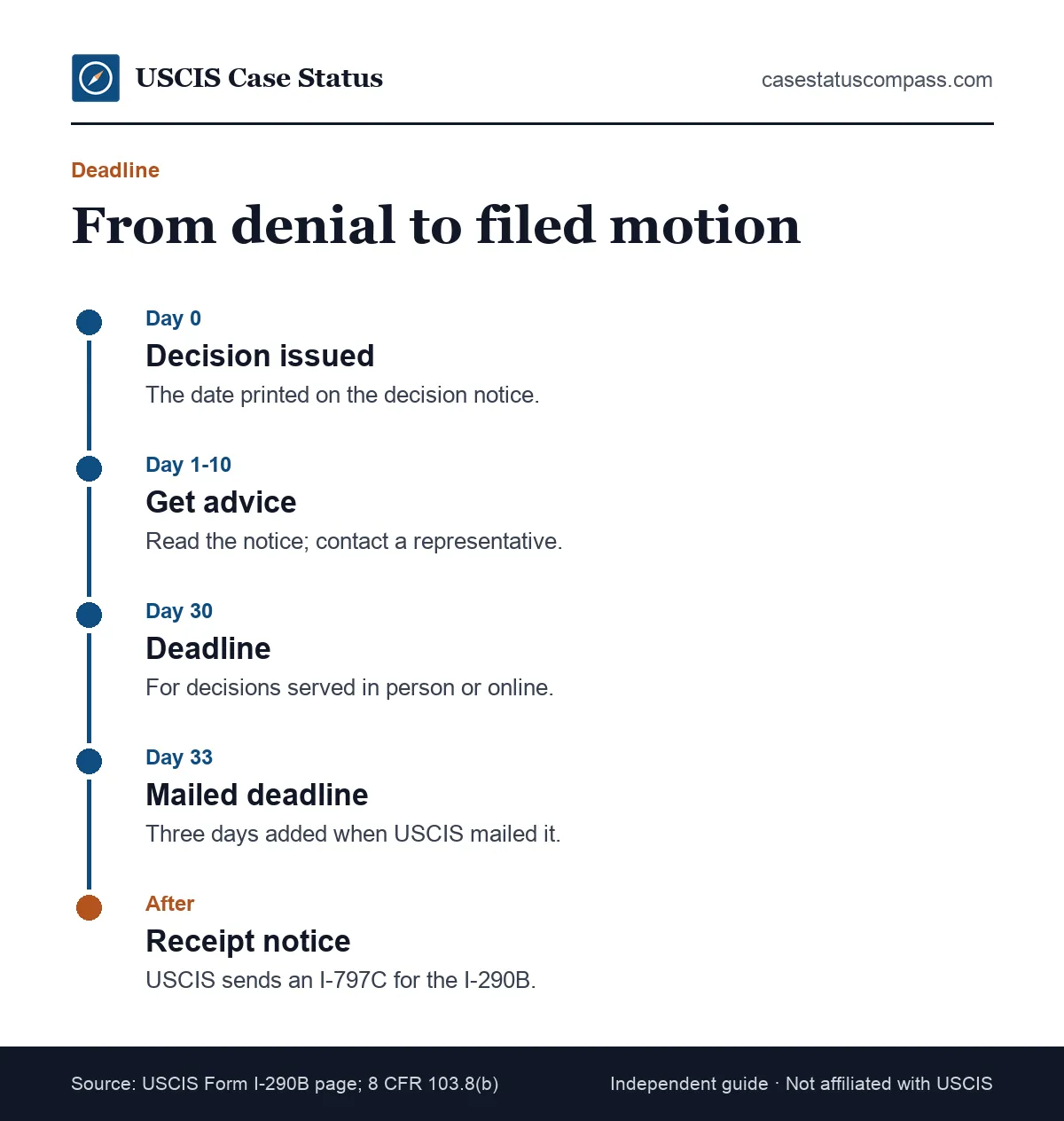
The general deadline is 30 calendar days from the decision. Appeal or motion: file within 30 days (33 if the decision was mailed). A late appeal is rejected unless the office treats it as a motion. A late motion is usually denied.
30 days vs 33 days
Federal rules say service by mail is complete when USCIS mails the notice: If USCIS mailed the notice, add 3 days to the deadline. So a mailed decision gives you 33 days in total. A decision served in person or through your online account gets the plain 30 days.
Late motions to reopen
USCIS may excuse a late reopening motion if the delay was reasonable and beyond your control. Document why you were late and file as soon as possible. Keep proof such as hospital records or mail tracking.
How Do You Count the 30-Day Deadline?
Count calendar days, including weekends, starting the day after the date printed on the decision. Add three days if USCIS mailed the decision. Aim for USCIS to receive the I-290B by the last day, not merely to have it postmarked.
Deadline examples with real dates
Each row starts from a decision date, adds 30 or 33 calendar days and shows the last day the I-290B should arrive.
| Decision date | Served how | Count | Last day to arrive |
|---|---|---|---|
| Thu., Oct. 1, 2026 | Online account | 30 days | Sat., Oct. 31, 2026 |
| Thu., Oct. 1, 2026 | 33 days | Tue., Nov. 3, 2026 | |
| Mon., Oct. 19, 2026 | 33 days | Sat., Nov. 21, 2026 |
Use the decision date
The date that counts is the decision date on the notice, not when it reached you. A notice that sat in a mailbox for a week has already used a week.
Build in a safety margin
Plan to deliver at least a week early. A missing signature can force a refile. Because a rejected filing does not pause the deadline, a margin gives you time to fix it.
How Much Is the Motion to Reopen Filing Fee?
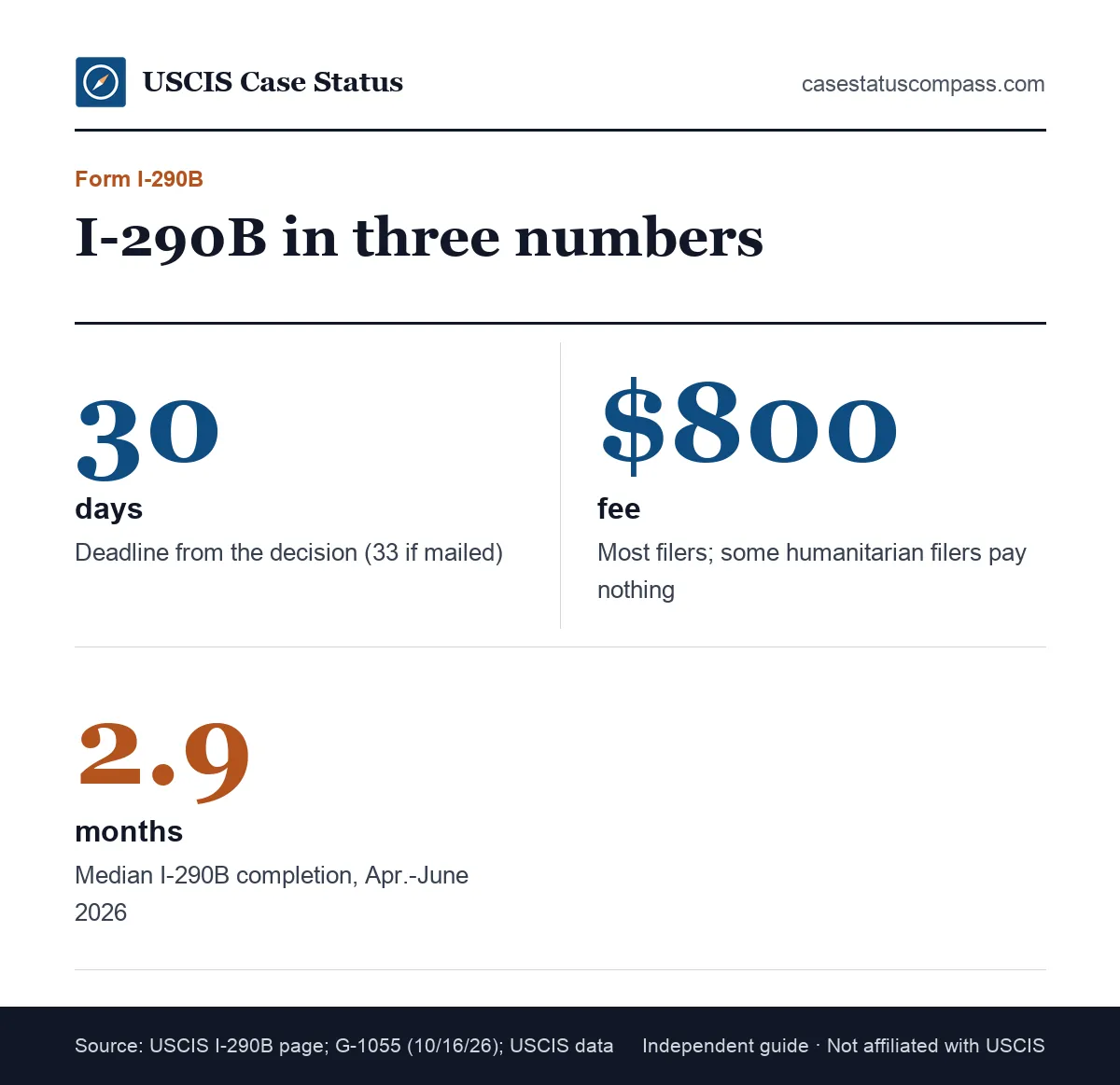
As of October 16, 2026, the Form I-290B fee is $800 (some humanitarian categories $0; fee waiver possible). The same fee applies whether you file an appeal, either motion or a combined motion. It is paid per I-290B, so two decisions mean two fees.
Who pays no fee
The motion to reopen fee drops to zero for some filers, including certain Special Immigrant Juvenile, T, U and VAWA cases, Afghan and Iraqi special immigrant visa cases, and battered-spouse I-751 waiver filers.
Can You Get a Fee Waiver for Form I-290B?
Form I-290B is on the list of forms that can be waived. Waivers rest on a means-tested benefit, low household income or financial hardship, and Form I-912 itself costs $0 (no fee to request a fee waiver). Our fee waiver guide explains the evidence.
Motion to Reopen Payment: How to Pay and What Is Nonrefundable
Pay the exact I-290B fee with an accepted method, and treat the money as spent. Per USCIS, pay online through Pay.gov, or on paper with Form G-1450 (card) or Form G-1650 (bank account). A paper filing carries Form G-1450 or G-1650 with the package.
Paying correctly
A wrong amount gets the filing rejected, and a rejection does not stop the 30-day clock. Use the current G-1055 edition, not the fee printed in older instructions. If you owe no fee, say why in the filing.
Fees are nonrefundable
USCIS fees are nonrefundable, even if your case is denied or withdrawn. A denied motion does not return the fee, and neither does withdrawing it. Budget for it before you decide to file.
How Long Does a Motion to Reopen Take?
On motion to reopen processing time, USCIS data shows: I-290B: median 2.9 months (USCIS data, Apr.-June 2026). That median covers all I-290B filings completed in the quarter, appeals and motions combined, so your case may take less or much longer.
Median vs your case
A median means half of completed I-290B cases took longer. USCIS's live processing-times tool uses a different measure; check our processing times overview for how to read it. Use the case inquiry date to judge delays.
What lengthens the wait
Appeals often take longer than motions, because the deciding office may first review the file before sending it on. Complex legal questions, a missing document or a transfer between offices can also add months.
Where Do You File Form I-290B?
You file Form I-290B at the address on USCIS's I-290B Direct Filing Addresses page, which depends on the form and on whether you are appealing or filing a motion. Never send it straight to the AAO. New USCIS mailing addresses from Oct. 7, 2026; old addresses accepted if postmarked by Nov. 9, 2026.
Why the AAO address is wrong
The I-290B page warns against filing directly with the AAO. Appeals start at a USCIS intake location, and the office that decided the case reviews the file first. A package mailed to the AAO can miss the deadline.
What Evidence Supports a Motion to Reopen?
A reopening request needs new facts supported by affidavits or documents that answer each reason in the denial. Strong evidence is specific and dated. Match each document to one denial reason, and give anything in a foreign language a full English translation with the translator's certification. Label exhibits so the officer can find them.
Affidavits and documents
A sworn affidavit should explain who you are, what new fact you know and how you know it. Attach records that back it up, such as medical records, tax transcripts, school records or delivery tracking.
Can You Use Evidence You Already Had Before the Denial?
If the evidence existed before the decision, explain why it was not submitted. A credible reason, such as a missing notice, may support reopening. If you simply forgot, the motion is much weaker, and a new filing may be the better route.
How to Write the Brief or Statement
The brief is a short written argument that walks the officer from each denial reason to your answer. Quote each reason, state the new fact or legal error, and point to the exhibit that proves it. Keep it short and factual.
A simple structure
Start with a one-paragraph summary. Then add one numbered section per denial reason, each with the fact, the exhibit number and the request. End by stating exactly what you want: reopening and approval, or reconsideration and a new decision.
Common Reasons People File a Motion to Reopen
People most often file because they missed a notice, missed an appointment for a good reason, or now have evidence that did not exist before. Denials for abandonment, such as a missed biometrics appointment or interview, are frequent candidates.
Missed appointments
If you missed biometrics or an interview, show why: a notice mailed to an old address, a hospital stay or a documented emergency. Our page on a case denied after USCIS action explains abandonment denials.
Missed evidence requests
If USCIS denied the case after an unanswered request, the RFE cap matters: RFE deadline: up to 12 weeks (the exact date is on your RFE); no extensions. I-539 and I-601A RFEs allow only 30 days. Our guide to an RFE meaning and how to answer explains what a full response should have contained.
What If You Missed an RFE Because of a Wrong Address?
If an RFE or notice went to the wrong address, a reopening motion can show you never had a fair chance to respond. Prove the address problem and include the complete response you would have sent. Do this within the 30-day window.
Proving non-receipt
Collect your address-change confirmation, lease or mail-forwarding records and any returned mail. If you updated your address on time, that is strong proof. The rule is: Report a new address to USCIS within 10 days of moving (INA 265).
Fixing the address first
Before filing the motion, confirm USCIS has your current address so the decision reaches you. Our USCIS change of address guide shows how to update every pending case. Use the same address on the I-290B.
Motion to Reconsider: Showing a Legal or Policy Error
A motion to reconsider must show the decision was incorrect under the law or USCIS policy based on the record when it was made. You cite statutes, regulations, policy manual sections or precedent decisions. New evidence is not the basis.
Citing the right authority
Quote the exact rule the officer misapplied, then show how the facts already in the record meet it. Precedent decisions from the AAO or BIA can carry weight. Give the full citation for each one.
The record at the time
Reconsideration looks only at what was in the file when the decision was made. If your argument depends on a document the officer never saw, you need a reopening motion instead, or a combined one.
What Is the Administrative Appeals Office?
The Administrative Appeals Office (AAO) is the USCIS office that decides appeals of many USCIS denials, such as I-140 and I-129F petitions. It is part of USCIS, not a court, and you reach it only through Form I-290B. Its decisions are published online.
How an AAO appeal starts
After you file, the office that denied the case reviews the appeal first. If it does not resolve the issue, it sends the file to the AAO. That first office can also grant the appeal itself.
Should You File an Appeal or a Motion First?
A motion goes back to the same officer's office, which may act faster. An appeal brings a fresh reviewer but a longer wait. The right choice depends on whether you have new facts or a disagreement with the reasoning, so ask a representative.
Immigration Appeal Process Step by Step
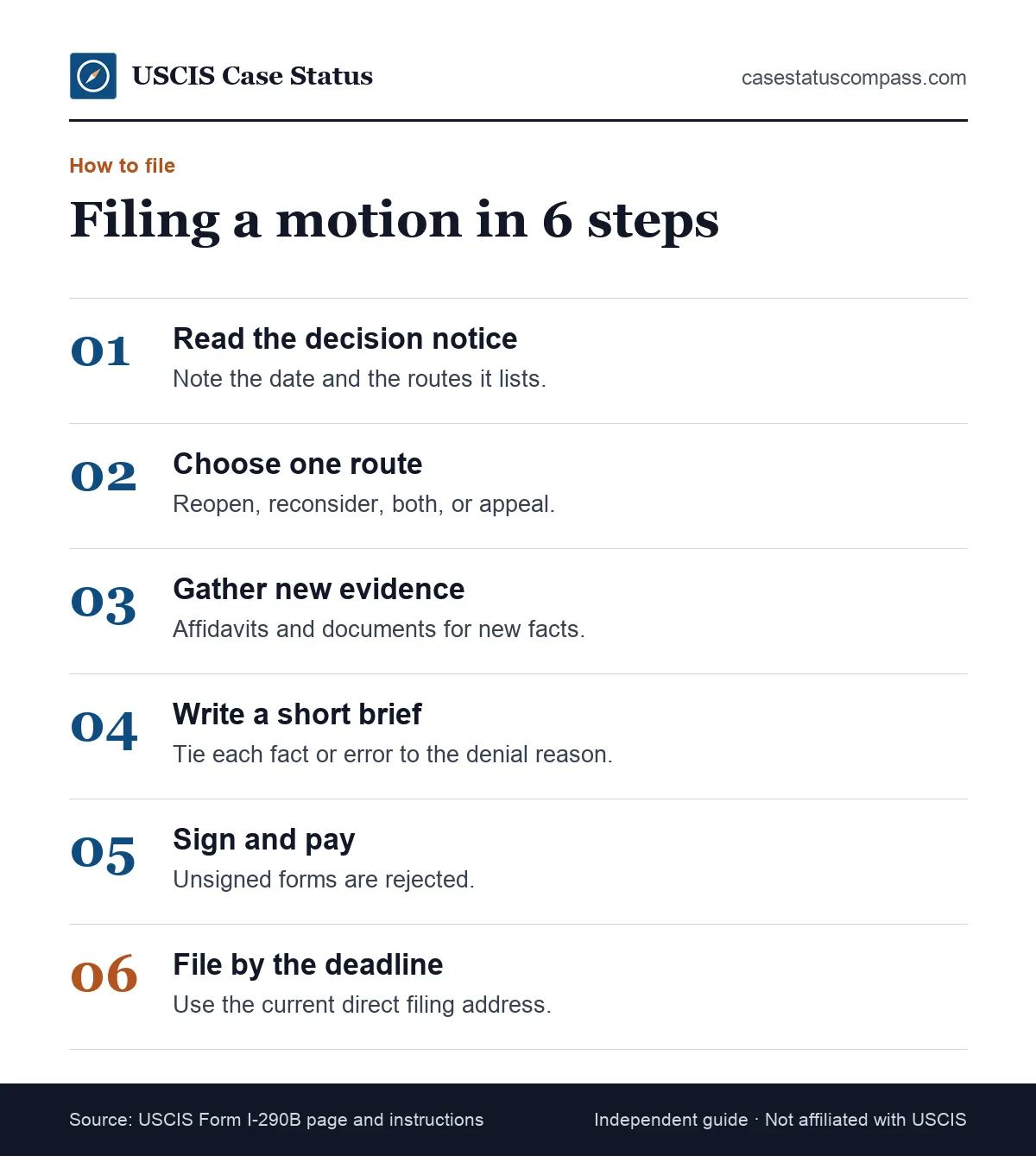
The immigration appeal process for a USCIS decision follows six steps: read the decision, confirm the route, collect evidence or legal authority, write the brief, pay and sign, then file before the deadline. After filing, you get a receipt and wait for a decision on the motion or appeal.
Before you file
Read the whole decision notice, including the last page, which usually explains appeal or motion rights. Write down the decision date and deadline. Then pick the route and gather proof.
After you file
USCIS sends an I-797C receipt for the I-290B with its own receipt number. Our I-797C notice guide shows how to read the receipt and check its dates. Keep it with the denial notice.
What Is the Board of Immigration Appeals?
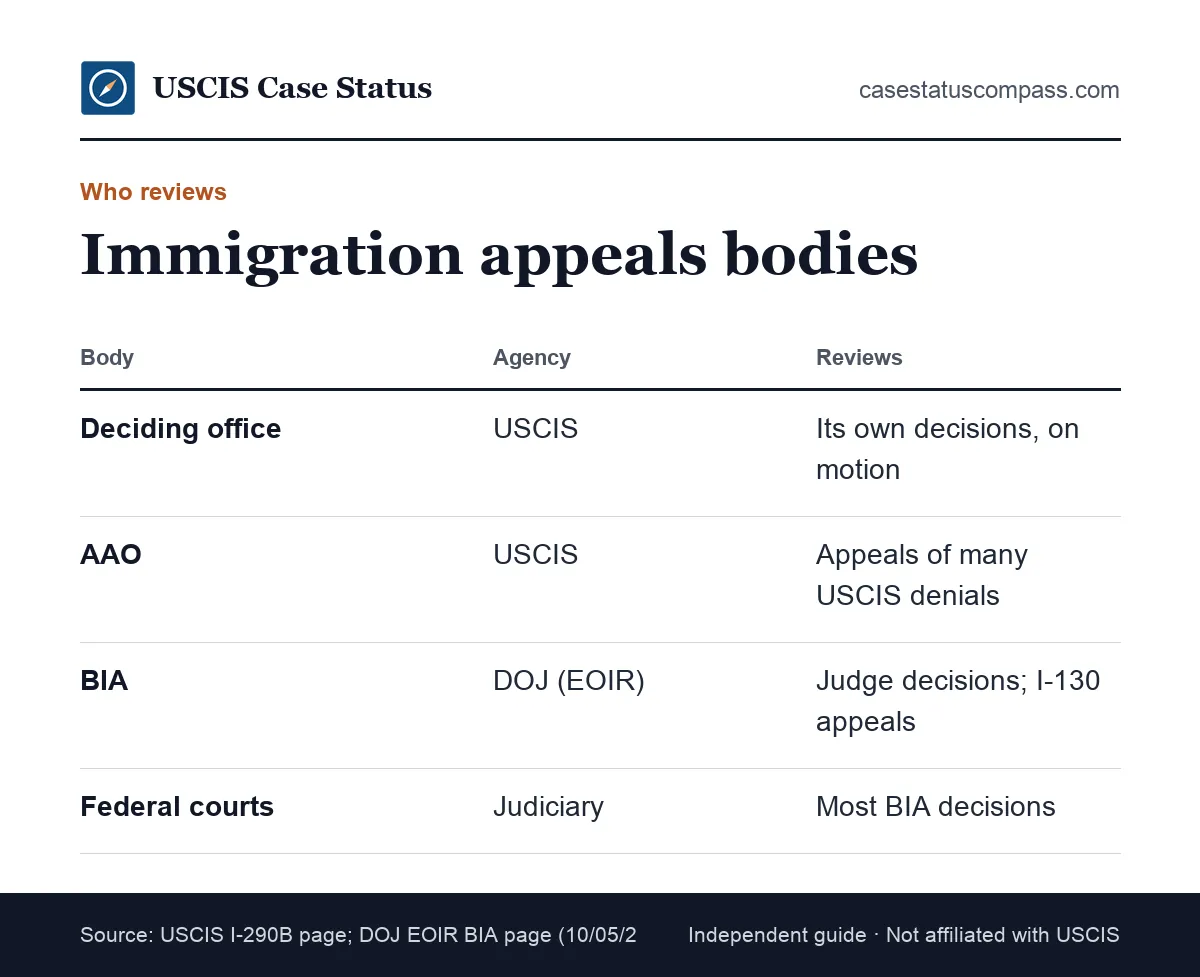
The Board of Immigration Appeals (BIA) is the Department of Justice's appellate body for immigration cases, which DOJ calls the highest administrative body for interpreting immigration law. It sits in Falls Church, Virginia, within the Executive Office for Immigration Review (EOIR).
What the BIA reviews
The BIA mostly reviews immigration judge decisions, such as removal orders and denials of relief. It also hears some DHS decisions, including family-based relative petition appeals. Those appeals use EOIR forms.
BIA filings differ from USCIS
BIA filings use EOIR forms and deadlines, not Form I-290B: file a BIA appeal (Form EOIR-26) so it arrives within 30 calendar days of the judge's decision. We could not verify current BIA fees on an official page, so check EOIR's Board Practice Manual and the decision itself.
Is There an Immigration Appeals Court?
There is no single "immigration appeals court." Searchers usually mean the Board of Immigration Appeals, the immigration appeals board inside the Department of Justice. Above it, DOJ says most BIA decisions can be reviewed in the federal courts. USCIS denials are usually challenged first through motions or the AAO.
Immigration courts vs the BIA
Immigration courts hold hearings and issue the first decision in removal cases. The BIA reviews those decisions on appeal. Both belong to EOIR, a separate agency from USCIS, so USCIS staff cannot see or change their records.
Can You Take a USCIS Denial to Federal Court?
Review in a federal court is a lawsuit with strict rules and deadlines, and courts often expect you to use available administrative remedies first. Anyone considering it should hire an immigration attorney admitted to practice in that court. Ask early, because time limits apply.
Motion to Reopen in Immigration Court vs With USCIS
A USCIS motion asks a USCIS office to revisit a benefit decision. A court motion asks an immigration judge or the BIA to revisit a court order, under EOIR rules and deadlines that differ from USCIS rules. Know which agency made your decision.
Different agencies, different rules
USCIS motions use Form I-290B. Court motions follow the Immigration Court Practice Manual and are filed with the court or the BIA. EOIR deadlines are tight: a motion to reopen generally must be filed within 90 days of the final removal order, and usually only one is allowed. Get legal help first.
Checking a court case
To check a court or BIA case, use EOIR's online system: Check immigration court cases online at acis.eoir.justice.gov with your A-number. Our immigration court case status guide explains the portal and the hotline.
What Does "No Appeal Was Received for This Case" Mean?
"No appeal was received for this case" is a message EOIR's case information system can show in the BIA section. It means EOIR has no record of a BIA appeal for that A-number. It does not mean a USCIS motion or AAO appeal is missing, because those are tracked by USCIS.
When you filed a BIA appeal
If you filed a BIA appeal and still see this message, check that the A-number is correct and allow time for processing. The automated hotline also gives BIA appeal information: EOIR case hotline: 1-800-898-7180 (24/7, automated).
When you filed with USCIS
A motion or AAO appeal on Form I-290B will never appear in EOIR's system. Check it on USCIS Case Status Online with the I-290B receipt number instead. Its status uses USCIS wording.
Does Filing a Motion Stop a Denial From Taking Effect?
USCIS's Form I-290B pages do not say that filing a motion or appeal pauses the original decision. Treat the denial as in force while you wait. That can affect your status, work permit or travel, so ask an attorney how the denial affects you before relying on a pending motion.
Status and work permits
A denied I-485 can end benefits that depended on it, such as a related work permit. A pending I-290B may not restore them. See our Form I-765 guide for work-permit basics.
Removal risk
In some cases a denial can lead to a Notice to Appear in immigration court. If that happens, the court process runs separately from your USCIS motion. Tell your lawyer right away if you get one.
Motion vs Refiling a New Application
Sometimes refiling a new application is faster and stronger than a motion. Refiling makes sense when you now qualify but did not before, when the denial reason is easy to fix, or when the deadline has passed. A motion makes sense when the original filing date matters.
Motion vs new application at a glance
The table compares the two routes on deadline, cost, filing date and the situations where each works best.
| Factor | Motion to reopen | New application |
|---|---|---|
| Deadline | 30 days (33 if mailed) | None, if still eligible |
| Fee | I-290B fee | Full fee for the form |
| Keeps original filing date | Can, if granted | No |
| Best when | Notice missed; new fact proves past eligibility | Eligibility arose later; deadline passed |
When refiling is faster
If the problem was a missing document you now have, a fresh, complete filing may be decided without the motion step. Check whether the original filing date matters, for example for age-out or priority rules, before choosing.
Risks of refiling
A new filing starts the review from scratch, and the earlier denial stays in your file. If the denial raised a fraud, criminal or status problem, refiling without advice can make things worse.
Decision Table: Which Route Fits Your Situation?
Use this table to match common situations to likely routes, then confirm with a representative. Your notice and your form control, and the table is not legal advice. Find the row that matches what went wrong, then read across to the route and the first step. If two rows apply, the earliest deadline comes first.
Situation-to-route table
Each row links one common denial situation to the route that usually fits and the first practical step.
| If this happened… | Likely route | First step |
|---|---|---|
| Missed an RFE sent to an old address | Motion to reopen | Proof of the address problem plus the full RFE answer |
| Officer applied the wrong legal standard | Motion to reconsider | Find the rule or precedent that shows the error |
| New fact plus a legal error | Combined motion | Split the brief into facts and law |
| I-140 denied; you dispute the reasoning | AAO appeal or motion | Read the notice for appeal rights |
| I-130 denied | BIA appeal on EOIR-29, or motion | Follow the notice's BIA instructions |
| N-400 denied | Hearing request on Form N-336 | Read the denial notice and get advice |
| Deadline passed, still eligible | New application | Confirm eligibility and refile |
| Removal order from a judge | Court motion or BIA appeal | Contact an attorney immediately |
Reading the table
Start with the denial notice. If it lists only a motion, the appeal rows do not apply. If it names Form EOIR-29 or Form N-336, follow that instruction. Then count the filing deadline from the date printed on the notice, not the day it reached you.
When nothing fits
Some decisions, such as an I-601A denial, have no appeal or motion listed. Others raise issues no table can cover. In those cases a representative can explain whether refiling or another route exists.
Motion to Reopen After an I-485 Denial
Most I-485 denials can be challenged only by a motion, not an appeal. A green card applicant whose I-485 was denied usually files a motion with new evidence or legal argument, or refiles. Act quickly, because status and work authorization may be affected.
Typical I-485 grounds
Common grounds include a missed interview with a documented reason or an RFE that never arrived. Our I-485 denied options guide covers the wider choices, and our Form I-485 guide explains the application.
Family members on the same case
Each denied family member needs a separate I-290B. A spouse or child whose case depended on the principal's should check whether their denial will be fixed by the principal's motion or needs its own filing.
Appeals for I-140 and Employment Petitions
Employment petitions, such as Form I-140, can usually be appealed to the AAO or reopened by motion. The petitioning employer files, not the worker, except in self-petition categories or when USCIS tells a revoked-I-140 beneficiary that an appeal is available.
Employer control
The employer decides whether to file and pays the fee. If the employer will not act, the worker may need a new petition instead. Ask the employer in writing what it plans to do.
Speed after a challenge
If the employer refiles instead, premium service may be available for a new I-140. Our premium processing guide explains when paying for speed makes sense. Form I-290B itself is not on the premium list.
Sileiri Doe Class: Fee-Free Reopening
USCIS's I-290B page (updated October 26, 2026) describes a special process for Sileiri Doe class members, people paroled through CBP One whose parole was terminated in April 2025. Members can ask for reopening or reconsideration of certain adverse decisions with no fee and no deadline.
Who is covered
The process covers adverse decisions issued April 1, 2025 to April 21, 2026, after a September 28, 2026 federal court order. Some requests are excluded, including parole-based work permits, asylum applications and immigration judge or BIA decisions.
How to file
USCIS says to write "Sileiri Doe" at the top of Form I-290B, attach the CBP email about the parole termination and check a single motion box in Part 2, never "Appeal."
How to Track an I-290B Case
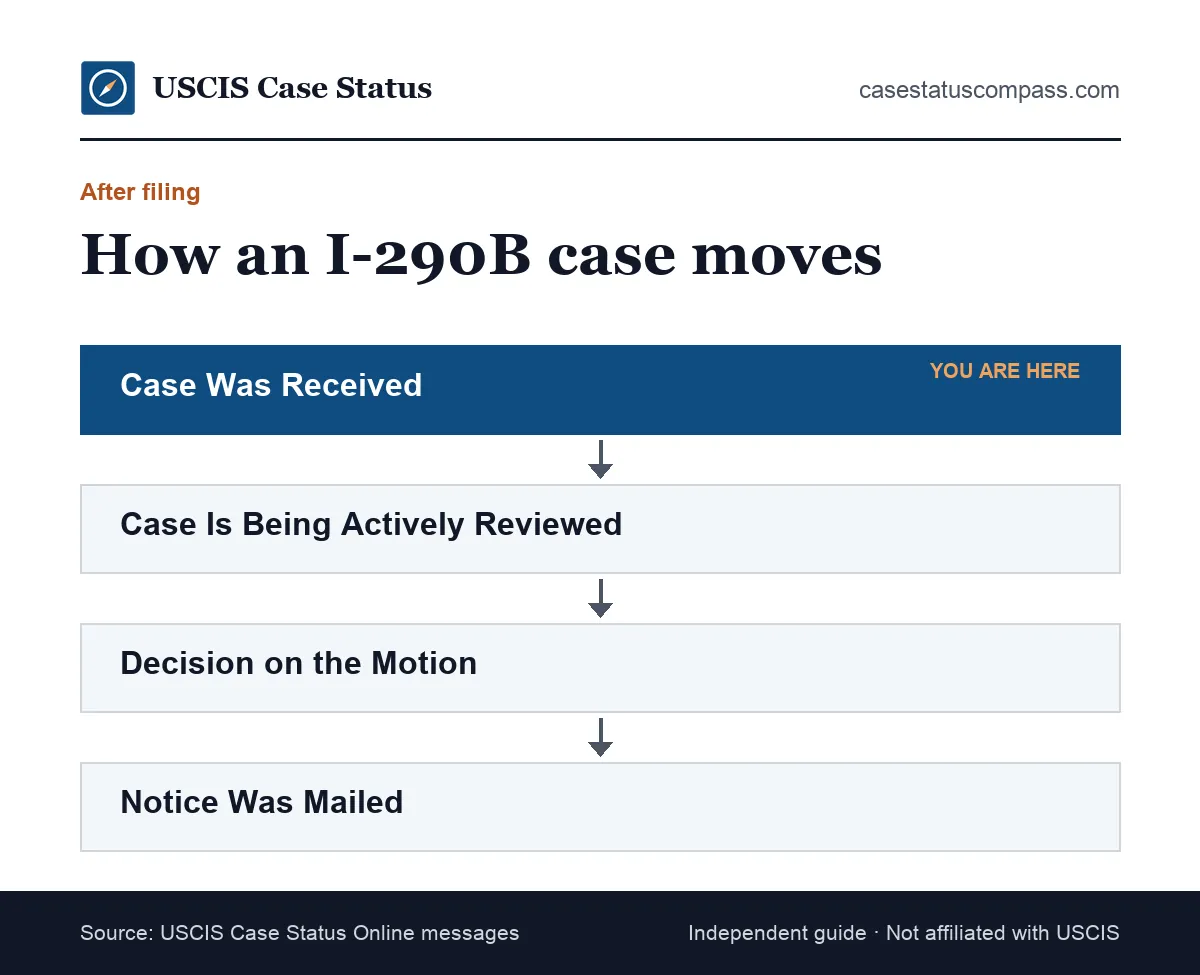
Track an I-290B on USCIS Case Status Online using its own receipt number, not the receipt number of the denied form. The status messages are the same ones other forms use. A decision on the motion arrives by mail or in your online account.
Two receipt numbers
Keep the denied case's receipt number and the I-290B receipt side by side. The denied case may still show "Case Was Denied" while the motion is pending; that is normal. Our Case Was Denied explainer covers that message.
Copyable I-290B Filing Checklist
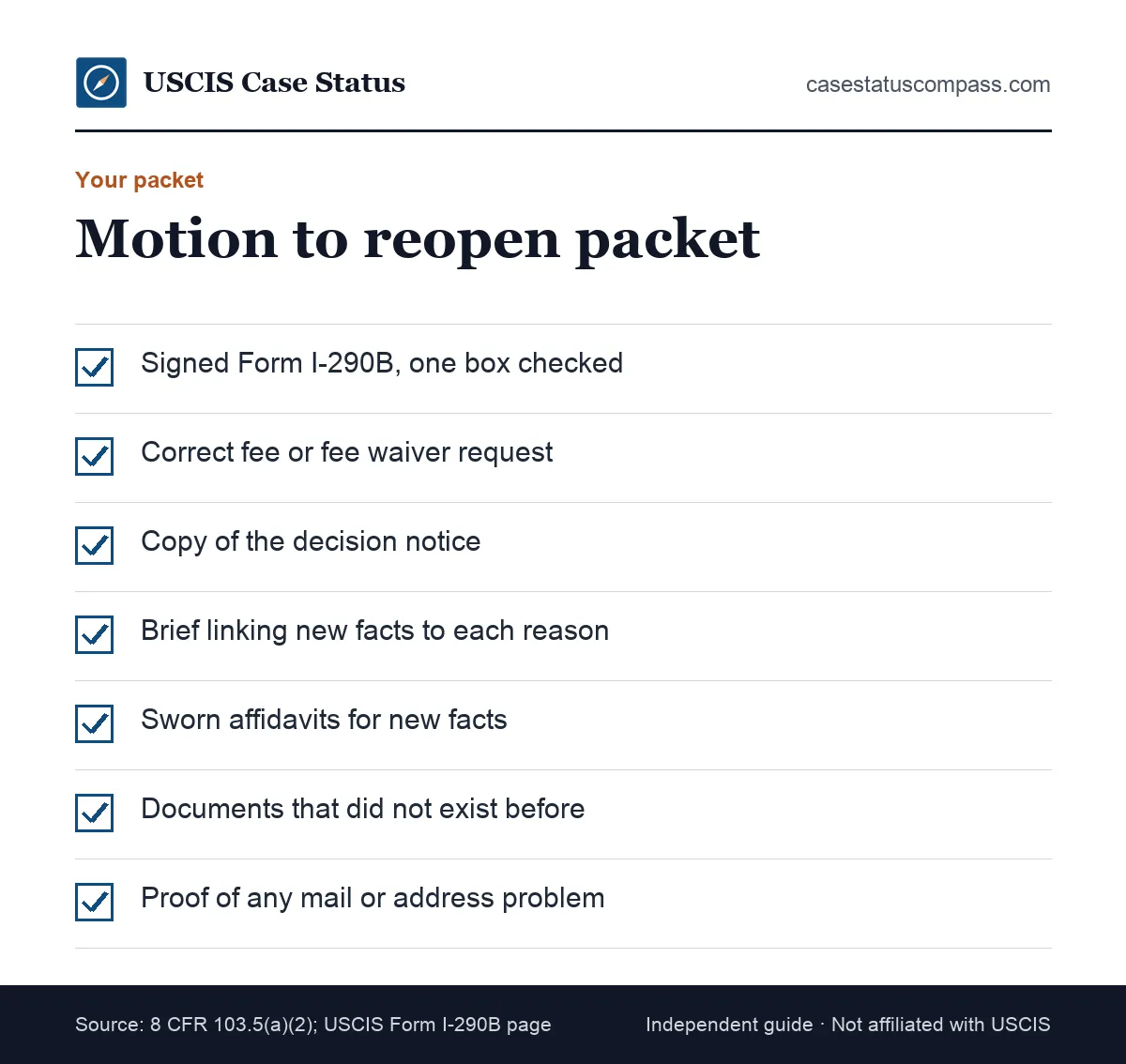
Before you file, confirm the route, the deadline, the fee, the signature, the address and the evidence. Tick each item the day you send the package. Work through it from top to bottom, since the route decides which evidence and address you need. If any box stays empty, fix it before the deadline rather than mailing an incomplete package.
The checklist
- Route confirmed against the denial notice and the USCIS eligibility page
- Deadline written down (30 days, or 33 if mailed)
- Current Form I-290B edition, one box checked in Part 2, signed
- Fee from the current G-1055, or Form I-912 with proof
- Copy of the decision notice attached
- Brief with numbered sections per denial reason
- Affidavits and new documents, translated where needed
- Form G-28 if a representative files
- Address checked on the direct filing page the day you mail
After you send it
Save the tracking number and delivery date. Watch for the receipt notice. If nothing arrives within a few weeks, contact USCIS with your proof of delivery. Keep copies of everything.
Why Should You Talk to an Attorney or Accredited Representative?
Motions and appeals are legal filings with strict deadlines and one-chance rules, so we strongly recommend help from an immigration attorney or a DOJ-accredited representative. They can read the full record, choose the right route and spot risks, such as removal, that a general guide cannot see.
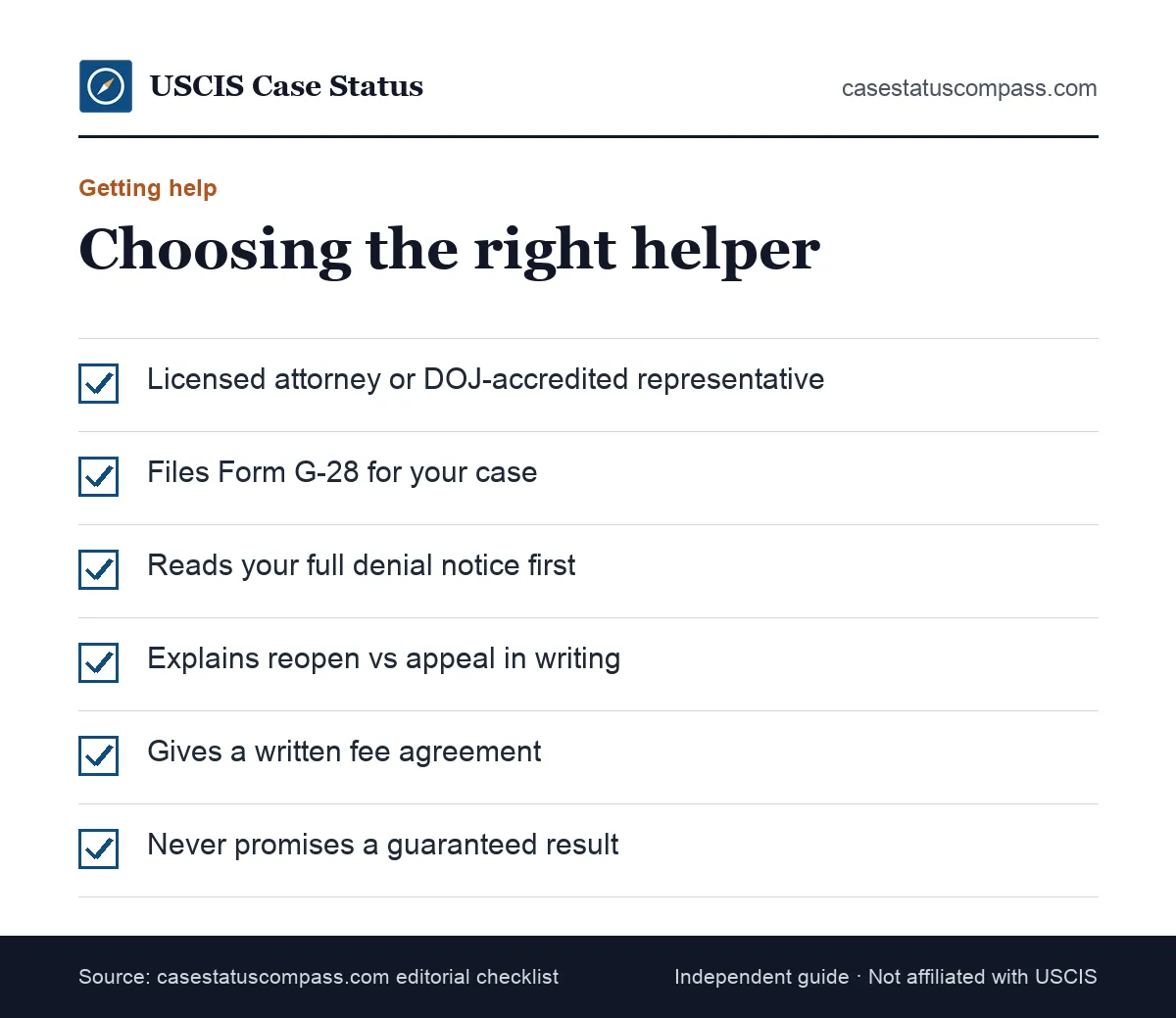
Finding qualified help
Only licensed attorneys and accredited representatives working for DOJ-recognized organizations may give legal advice on immigration cases. EOIR publishes the list of recognized organizations. Notarios and "immigration consultants" cannot represent you. Our immigration lawyer cost guide helps you plan.
What to bring
Bring the denial notice, the original application, every USCIS notice, proof of address changes and any new evidence. Ask which route the representative recommends, why, and what it will cost in writing.
Getting Procedural Help From USCIS
USCIS can answer procedural questions, such as whether your I-290B was received, but it cannot advise which route to choose. The CIS Ombudsman helps with stuck cases, yet it cannot replace an appeal or motion. For route choices, see a representative.
Contacting USCIS
The USCIS Contact Center is at 800-375-5283. Have both receipt numbers ready. Our USCIS contact number guide lists the other official channels. Live calls and chat: Monday to Friday, 8 a.m. to 8 p.m. Eastern.
Can the CIS Ombudsman Help With a Denied Case?
The Ombudsman requires prior contact with USCIS: Use the Ombudsman only after contacting USCIS within 90 days and waiting at least 60 days. It cannot give legal advice or act in place of an I-290B. Our Ombudsman and congressional inquiry guide explains when it helps.
What Happens After USCIS Decides Your Motion or Appeal?
If USCIS grants a motion, the case reopens and the office issues a new decision, which may be an approval or another request. If it denies the motion, the original denial stands and you may have further options. The new decision notice usually states which filing, if any, is still available and by when.
If it is granted
A granted motion may lead straight to approval, or to an RFE, interview or new biometrics. Answer any new request by its deadline, because a reopened case can still be denied.
If it is denied
A denial of the motion or appeal comes with its own notice, which may list further routes. Some people file another motion or refile.
Frequently Asked Questions
How long does a motion to reopen take?
There is no fixed time. USCIS's quarterly data showed a median of 2.9 months for all I-290B filings completed in April to June 2026, but half took longer, and appeals usually take longer than motions. Use the receipt number to track the case and the official tool's case inquiry date before asking about a delay.
Can I submit new evidence with an appeal?
You can usually include a brief and supporting documents with an AAO appeal, but an appeal argues the decision was wrong. If your main point is a new fact proving eligibility, a reopening motion is usually the better fit.
Can I file Form I-290B online?
The USCIS I-290B page we checked in October 2026 did not confirm online filing for every route. Check the USCIS "File Online" list and the I-290B Direct Filing Addresses page before you file. If only paper is available for your case, use a trackable delivery service and file early.
What if my denial notice says no appeal is available?
If the notice lists no appeal, you can usually still file a motion with the same office, unless it lists no motion either. Some forms, such as the I-601A, have neither. In that case, ask a representative whether refiling is possible and when.
Can I work or travel while my motion is pending?
A pending motion does not automatically restore the status or benefits lost through the denial. Work permits and travel documents tied to a denied I-485 may no longer be valid. Before working or traveling, ask an attorney how your specific denial affects you, because a mistake can be hard to undo.
Can I withdraw a motion or appeal?
You can ask USCIS to withdraw a motion or appeal in writing, but the fee is not refunded. A withdrawal can end your chance to challenge the decision if the deadline has passed. Talk to your representative before withdrawing, especially if you plan to refile.
Do I need a lawyer for a motion to reopen?
You are not required to have one, and many people file alone. Still, a motion is often a one-time chance with strict standards, so we strongly recommend an immigration attorney or DOJ-accredited representative. Free and low-cost legal aid groups are listed on EOIR's recognized organizations page.
Is a motion to reopen the same as reapplying?
No. A motion asks the office to revisit its decision on the existing case and can preserve the original filing date. Reapplying starts a brand-new case with a new fee and a new review. Choose based on deadlines, eligibility and whether the original date matters.
Who decides a motion to reopen?
The same USCIS office that made the decision, such as a field office or service center, decides a motion to reopen or reconsider. Appeals differ: after the deciding office's first look, most go to the AAO.
Is the immigration appeals board part of USCIS?
No. The Board of Immigration Appeals belongs to the Department of Justice, within EOIR. USCIS appeals go to the AAO instead, so the two bodies keep separate records and separate rules.
Sources
- USCIS: Form I-290B, Notice of Appeal or Motion (updated 10/26/2026). www.uscis.gov/i-290b. Accessed Oct 27, 2026.
- USCIS: When to Use Form I-290B. www.uscis.gov/i-290b/eligibility. Accessed Oct 27, 2026.
- USCIS Form G-1055 Fee Schedule (Edition 10/16/26). www.uscis.gov/sites/default/files/document/forms/g-1055.pdf. Accessed Oct 27, 2026.
- 8 CFR 103.5, Reopening or reconsideration (Cornell LII). www.law.cornell.edu/cfr/text/8/103.5. Accessed Oct 27, 2026.
- 8 CFR 103.8, Service of decisions (Cornell LII). www.law.cornell.edu/cfr/text/8/103.8. Accessed Oct 27, 2026.
- USCIS: Filing Locations and Online Filing Options Updates. www.uscis.gov/forms/us-citizenship-and-immigration-services-filing-locations-and-online-filing-options-updates. Accessed Oct 27, 2026.
- DOJ EOIR: Board of Immigration Appeals (updated 10/05/2026). www.justice.gov/eoir/board-of-immigration-appeals. Accessed Oct 27, 2026.
- USCIS Data Library: All Form Types, FY2026 Q3. www.uscis.gov/sites/default/files/document/data/quarterly_all_forms_fy2026_q3_v1.xlsx. Accessed Oct 27, 2026.
- USCIS: Form I-912, Request for Fee Waiver. www.uscis.gov/i-912. Accessed Oct 27, 2026.
- USCIS: Filing Fees (updated 02/12/2026). www.uscis.gov/forms/filing-fees. Accessed Oct 27, 2026.
- 8 CFR 103.2(b)(8)(iv) (LII). www.law.cornell.edu/cfr/text/8/103.2. Accessed Oct 27, 2026.
- USCIS: How to Change Your Address (updated 08/04/2026); 8 U.S.C. 1305(a) (LII). www.uscis.gov/addresschange. Accessed Oct 27, 2026.
- EOIR Policy Manual Part III, Ch. 3.5; 8 CFR 1003.38(b). www.justice.gov/eoir/policy-manual-eoir/part-III/bia/chapter-3-5. Accessed Oct 27, 2026.
- 8 CFR 1003.23(b)(1) and 1003.2(c)(2) (govinfo, CFR 2025 edition). www.govinfo.gov/content/pkg/CFR-2025-title8-vol1/xml/CFR-2025-title8-vol1-sec1003-23.xml. Accessed Oct 27, 2026.
- DOJ EOIR: Immigration Court Information. www.justice.gov/eoir/immigration-court-information. Accessed Oct 27, 2026.
- DOJ EOIR: Customer Service Initiatives (updated May 29, 2025). www.justice.gov/eoir/customer-service-initiatives. Accessed Oct 27, 2026.
- USCIS Contact Center (uscis.gov). www.uscis.gov/contactcenter. Accessed Oct 27, 2026.
- DHS CIS Ombudsman: How to Submit a Case Assistance Request (updated 04/13/2026). www.dhs.gov/case-assistance. Accessed Oct 27, 2026.
casestatuscompass.com is an independent publication and is not affiliated with USCIS or any government agency. This page is general information, not legal advice. For denials, court or asylum matters, consult an immigration attorney or a DOJ-accredited representative.