Contents · 38 sections
- What Is the USCIS Ombudsman?
- When Should You Escalate Your Case?
- What Should You Try Before Escalating?
- How Do You Find Your Case Inquiry Date?
- CIS Ombudsman Case Assistance: Who Qualifies?
- What Problems Can the CIS Ombudsman Help With?
- What Can't the Ombudsman Office at USCIS Handle?
- What Is the Ombudsman's 45-Day Congressional Rule?
- How Do You Submit an Ombudsman Request About a USCIS Case?
- What Do T, U, VAWA and Asylum Filers Need for Form 7001?
- What Information Does DHS Form 7001 Ask For?
- Who Can File an Ombudsman Request for You?
- What Happens After You Submit an Ombudsman Request?
- How Long Does a USCIS Ombudsman Request Take?
- What Is a Congressional Inquiry?
- Who Can Request a Congressional Inquiry?
- How Do You Ask Your Member of Congress for Help?
- What Goes in a Congressional Privacy Release?
- Does a Congressional Inquiry Speed Up a Case?
- Ombudsman vs Congressional Inquiry: Which Should You Use?
- Which Escalation Route Fits Your Problem?
- Copyable Templates for Your Escalation
- What Is a Congressional Complaint About Immigration?
- Filing a Complaint About USCIS: Where Does It Go?
- How Do You Report USCIS Employee Misconduct?
- How Do You Report Discrimination by USCIS?
- Which Immigration Complaints Belong to Other Agencies?
- How Do You Escalate a Missing USCIS Notice?
- How Do You Escalate a Stalled Expedite?
- How Do You Escalate a Case Past Normal Processing Time?
- How Do You Escalate a Typo or Card Problem?
- Can the CIS Ombudsman Help After a Denial?
- Can the Ombudsman Help With a Request for Evidence?
- Should You Hire an Attorney to Escalate?
- What Mistakes Slow Down an Escalation?
- How Do Service Centers and Field Offices Fit In?
- Key Facts About Escalating a USCIS Case
- Frequently Asked Questions
The short answer
The USCIS Ombudsman (officially the CIS Ombudsman) is an independent office inside the Department of Homeland Security that asks USCIS to fix stuck or mishandled cases. You file DHS Form 7001 online after contacting USCIS yourself. A congressional inquiry works similarly: your member of Congress asks USCIS about your case after you sign a privacy release.
At a glance
| Ombudsman form | DHS Form 7001, filed online |
| Before you file | Contact USCIS within 90 days, then wait 60 |
| Congressional route | Your member's office, with a signed privacy release |
| Cost | Free for both routes |
| Can they approve a case? | No. Only USCIS decides. |
What Is the USCIS Ombudsman?
The USCIS Ombudsman is the common name for the Office of the Citizenship and Immigration Services Ombudsman, part of DHS. It helps people and employers resolve problems with USCIS cases and recommends fixes to wider problems. It is free and cannot approve or deny anything.
Part of DHS, not USCIS
The office reports to the Department of Homeland Security, not to USCIS. That independence lets staff raise your case from the outside. DHS accepts requests in English only, so prepare your description and any translated documents in English before you start.
A go-between, not a decision maker
Staff read your request, confirm it qualifies, then ask the right USCIS office to act or explain. They also track patterns across many cases, report to Congress each year, and recommend systemic fixes that can change how USCIS handles similar files.
When Should You Escalate Your Case?
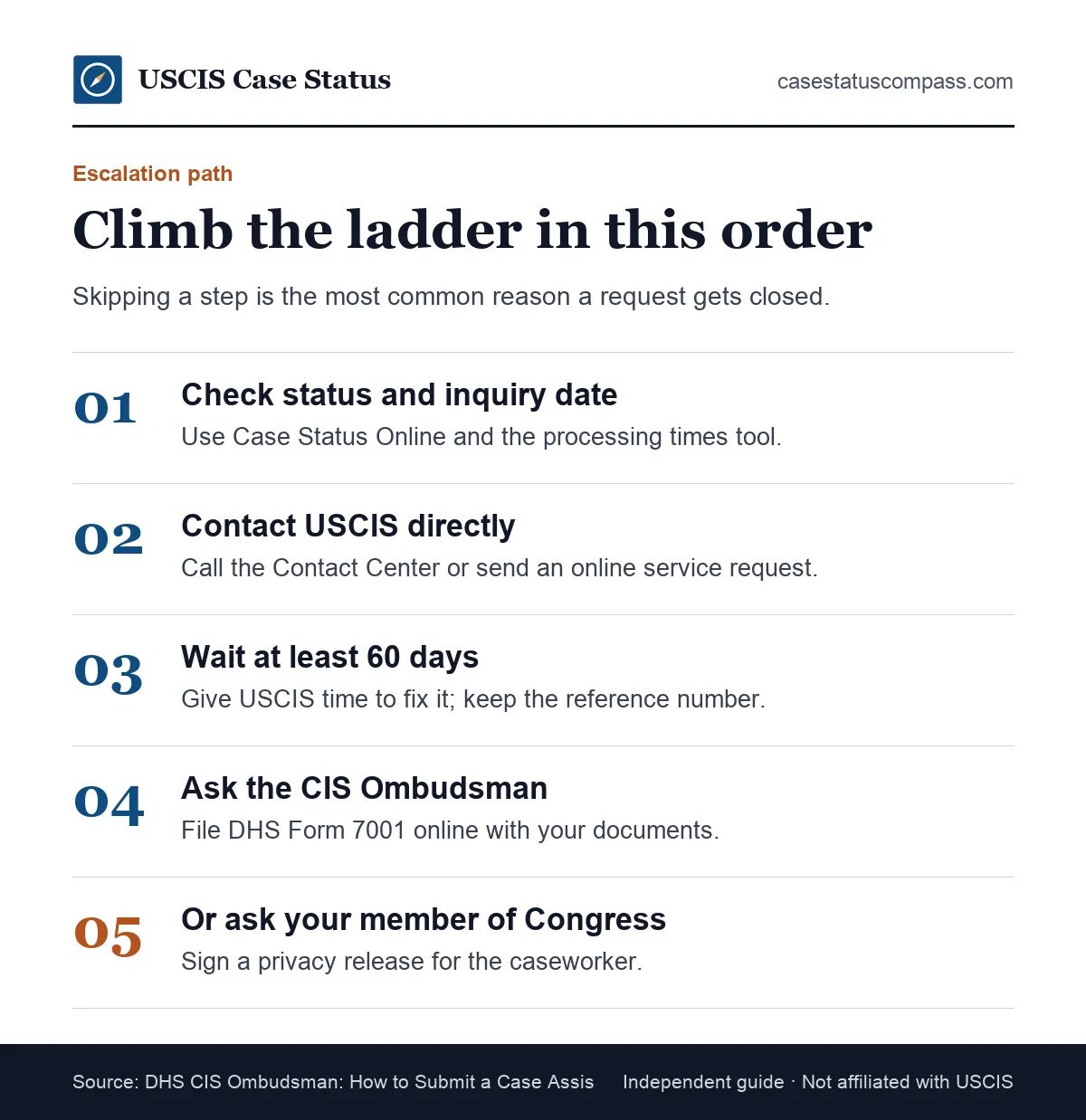
Escalate when USCIS has had a fair chance and failed: your case is past its case inquiry date, you contacted USCIS without a fix, or a notice or card went missing. For most problems, the USCIS Ombudsman requires recent USCIS contact and a 60-day wait.
Signs a case really is stuck
- The processing times tool says you can now submit an inquiry.
- Your service request got a generic reply or none.
- USCIS says it mailed a notice you never got.
- A USCIS typo on a card was not fixed.
- An approved expedite has produced no action.
Signs you should wait instead
Inside normal processing time, outside offices usually cannot help. A status that has not changed for weeks is often normal; our guide to a uscis case status not updating explains common quiet periods and what they mean.
What Should You Try Before Escalating?
Use every free USCIS channel first and record each contact. Check your status, confirm your case inquiry date, call or chat with the Contact Center, and submit an online service request. That written record is what makes an outside request succeed later.
Check status and your online account
Look up the latest step on Case Status Online: egov.uscis.gov, then sign in to your USCIS online account for notices. If you cannot find your number, our uscis receipt number guide shows where it appears on each notice type.
Call USCIS and log every contact
Call 800-375-5283. Live calls and chat: Monday to Friday, 8 a.m. to 8 p.m. Eastern. Note the date and any reference number. Our uscis contact number guide covers menu options and reaching a live agent, including through the Emma virtual assistant.
Use e-Request for narrow errors
USCIS has a tool for specific problems: e-Request: report USCIS typos, missing notices or accommodation needs online. Keep the confirmation, because the USCIS Ombudsman will want proof you tried this route before asking it to step in.
How Do You Find Your Case Inquiry Date?
Your case inquiry date comes from the USCIS processing times tool: choose your form, category and office, then enter your receipt date. The CIS Ombudsman describes it as: Case inquiry date: the earliest date USCIS will accept a question about your pending case; it can change. Delay-only help usually starts after that date.
Using the processing times tool
Open egov.uscis.gov/processing-times and match the form, category and office on your notice. The USCIS tool shows how long it took to finish 80% of cases in the past 6 months. Our uscis processing times hub explains each field in plain terms.
When your form is not listed
Some forms have no published time. The Ombudsman tip sheet says you can ask USCIS once they have been pending more than 6 months. The Ombudsman then needs that inquiry on record before it takes the case.
CIS Ombudsman Case Assistance: Who Qualifies?
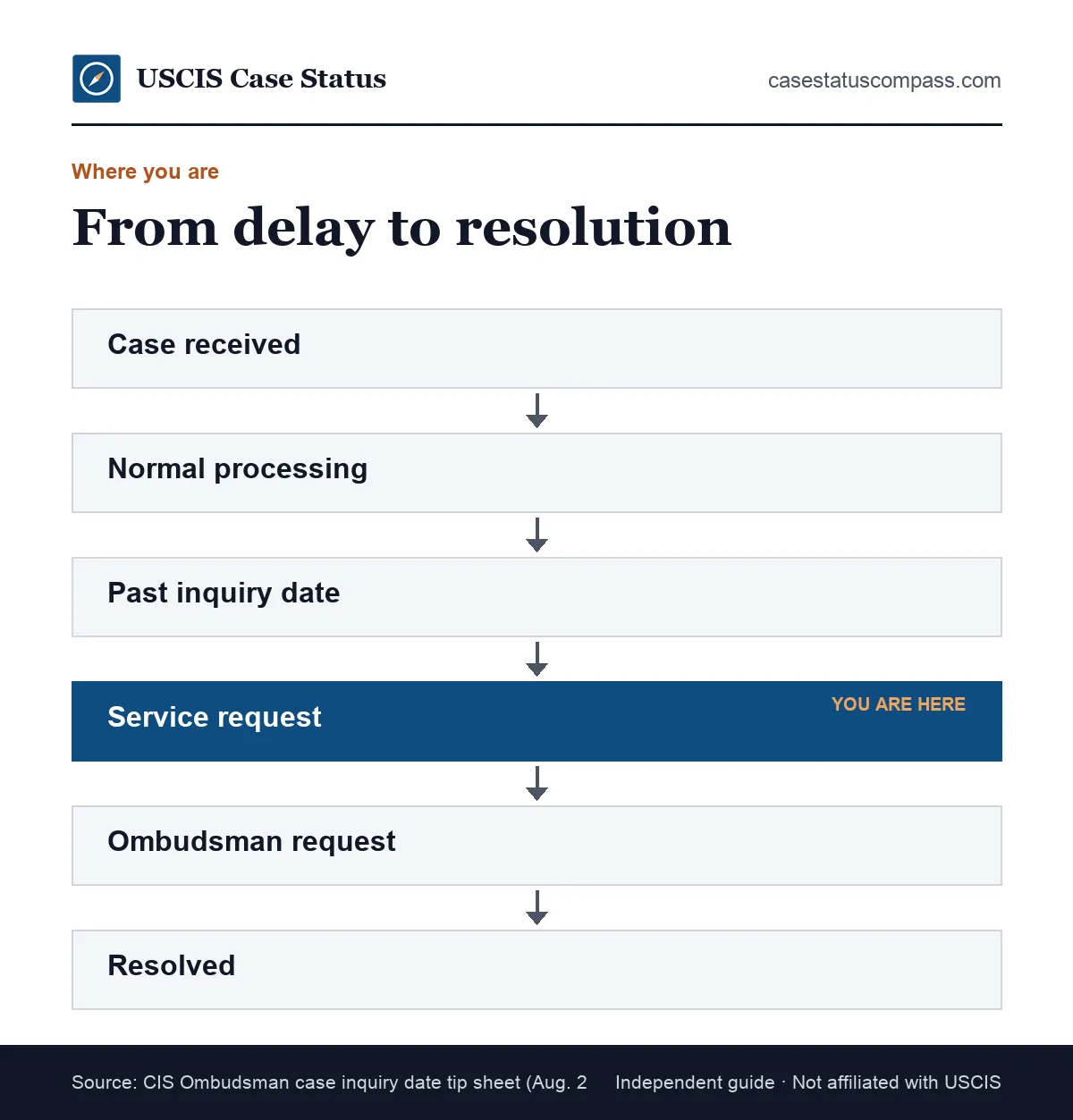
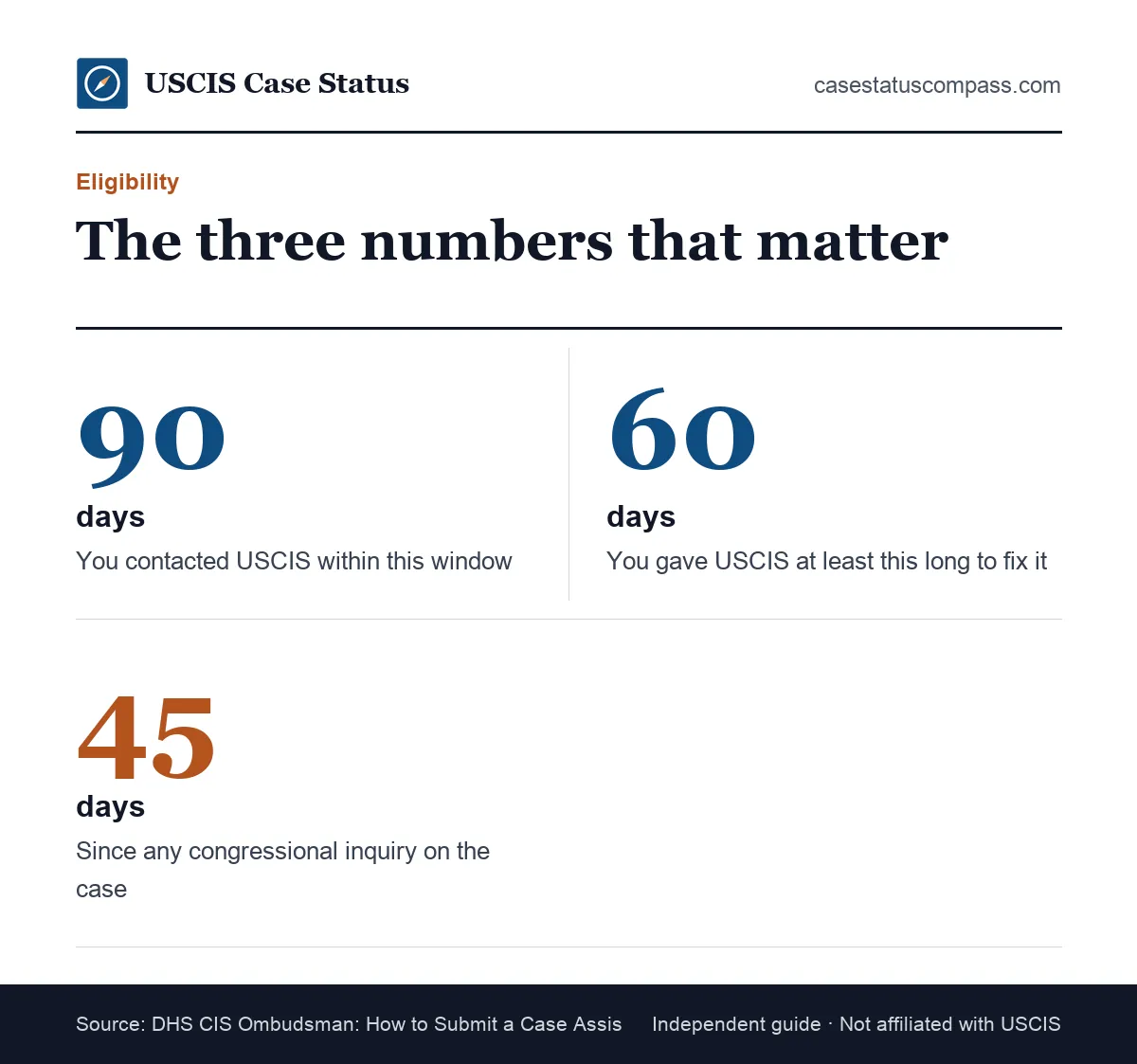
CIS Ombudsman case assistance is open to applicants, petitioners, employers and their representatives who already tried USCIS. As of DHS guidance updated April 13, 2026: Use the Ombudsman only after contacting USCIS within 90 days and waiting at least 60 days. Delay cases also need no approved expedite pending.
The 90-day and 60-day rule
You must have contacted USCIS within the last 90 days and given it at least 60 days to respond. A contact from last year does not count, and filing the day after a call is too soon. Plan around both windows.
Exceptions for processing delays
DHS lists narrow exceptions to the inquiry-date rule, such as cases with a processing deadline set by statute or regulation. Everyone else should wait for the date, send a service request, and then allow the 60 days.
What Problems Can the CIS Ombudsman Help With?
As of April 2026, DHS lists missing notices, cards returned by the Postal Service, improper rejections, USCIS typos, age-out risks, some military family cases, urgent situations meeting expedite criteria, and approved petitions never sent to the State Department. Name the category your problem fits in the first line of your request so staff can route it without guessing.
Missing notices and USCIS errors
These are the most common wins. If USCIS systems show a notice was issued but it never arrived, staff can ask for a reissue. They can also push to fix a wrongly rejected filing or a typographical error on a green card or EAD.
Urgent, age-out and military cases
The office also takes cases where waiting causes real harm: a child who may age out, certain military members and families, and emergencies. Attach proof of the deadline so staff can show USCIS why it matters.
What Can't the Ombudsman Office at USCIS Handle?
The ombudsman office for USCIS cases cannot give legal advice, force a decision, replace an appeal or motion, or extend any deadline. It also declines cases before the inquiry date, recently denied expedites, non-USCIS issues and cases with a recent congressional inquiry.
The official "cannot help" list
The left column lists what DHS says the office cannot do; the right column names the route that does fit each situation.
| The Ombudsman cannot… | Do this instead |
|---|---|
| Give legal advice | See an attorney or accredited representative |
| Make USCIS approve or act | Keep records; wait for the decision |
| Replace an appeal or motion | File the correct one on time |
| Help before the inquiry date | Wait, then send a service request |
| Revisit a recently denied expedite | Ask USCIS again with stronger proof |
| Fix a third party's bad advice | Ask that person or a new advisor |
If your problem sits in the left column, filing Form 7001 only delays the step that can actually help you.
What Is the Ombudsman's 45-Day Congressional Rule?
The USCIS Ombudsman will not open a case if a member of Congress asked USCIS about it fewer than 45 calendar days ago. Two offices asking the same question wastes time, so wait for that answer first. If a caseworker already helped you, ask them for the date of their last contact with USCIS before you file.
How Do You Submit an Ombudsman Request About a USCIS Case?
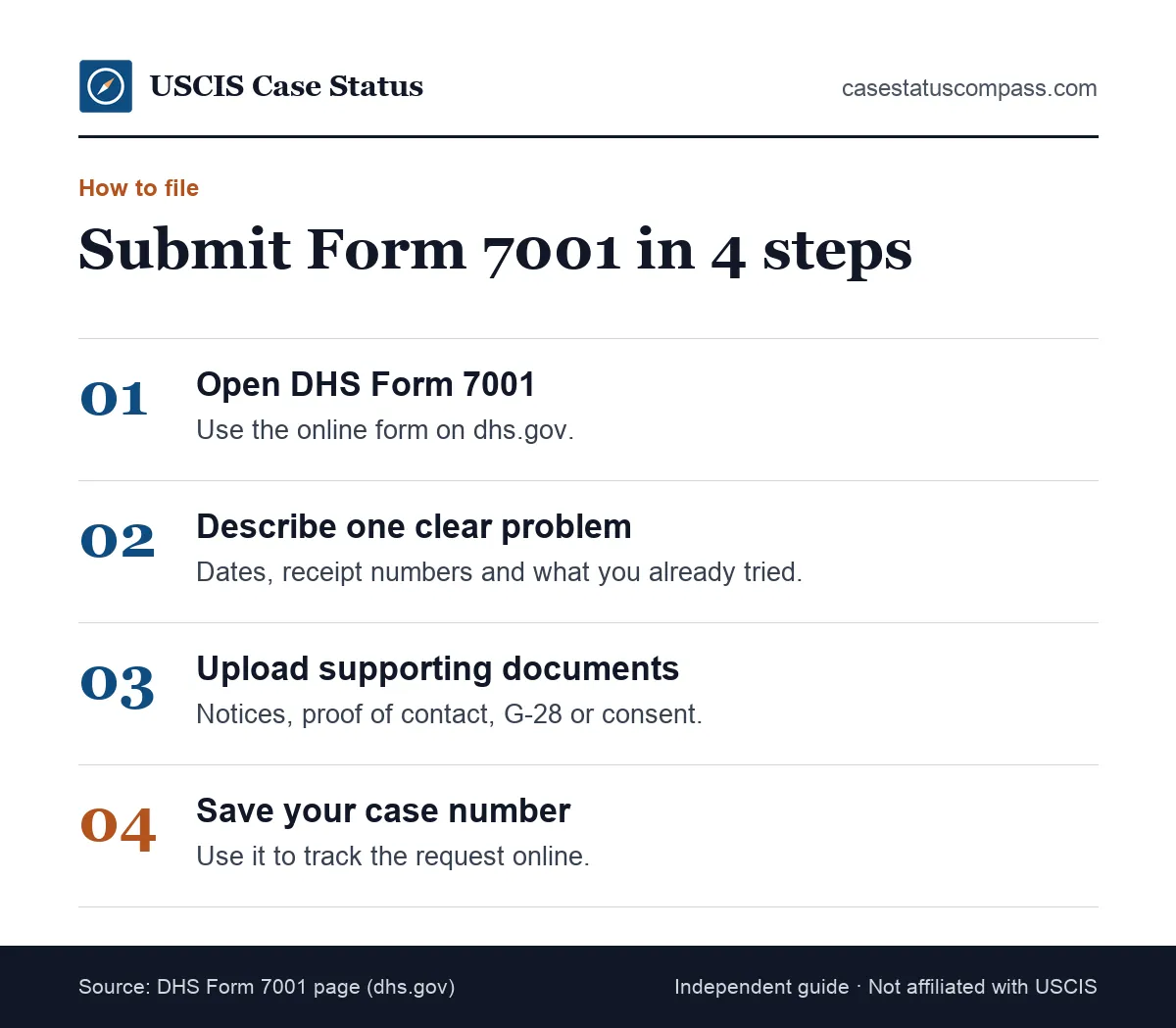
Complete DHS Form 7001, Request for Case Assistance, online at dhs.gov and upload your documents. The system assigns a case number and emails a confirmation. There is no fee, and you do not need a lawyer to file. Keep the confirmation email, because it proves your filing date.
Filing Form 7001 online
The form asks who you are, which case is affected, what went wrong and what you tried. Describe one problem per request. If uploads fail, DHS says to submit first and add files through the "Upload Requested Documents" tab.
What Do T, U, VAWA and Asylum Filers Need for Form 7001?
T, U, VAWA, asylee and refugee filers must upload a wet-ink signature on section 9. Without a lawyer, DHS contacts them only by mail, so the address must match USCIS records. Our uscis change of address guide shows how to update it.
What Information Does DHS Form 7001 Ask For?
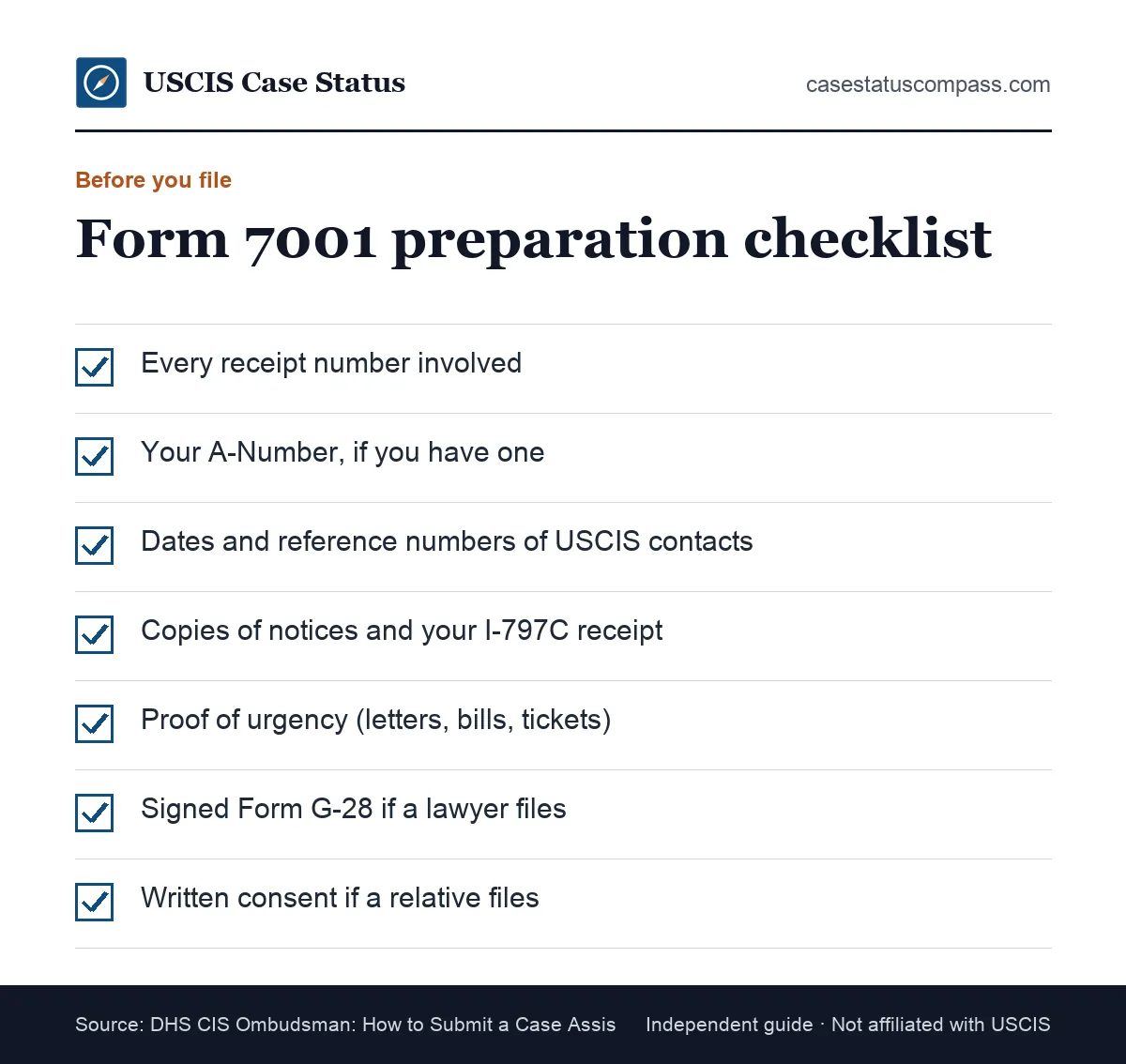
DHS Form 7001 asks for the requester's details, the applicant or petitioner's details, every receipt number involved, a description of the problem, the steps already taken with USCIS, and supporting documents. A precise, dated account works best. Draft the description in a separate document first, then check every date against your notices before pasting it in.
The field people get wrong
Section 5 must name the applicant or petitioner, not the beneficiary or lawyer; DHS warns a wrong name may lead to rejection. Add your A-Number if you have one. Our alien registration number guide shows where to find it.
Documents worth uploading
- Form I-797C receipt and later notices
- Dated screenshots of your case status
- Service request confirmations
- Proof of urgency, such as medical letters
- Proof of the correct data for a USCIS error
Who Can File an Ombudsman Request for You?
Applicants, petitioners, employers, attorneys, accredited representatives and others may file. Lawyers must include a signed Form G-28. Relatives, congressional staff and school officials need the applicant or petitioner's written consent for that specific form and issue. Unsure who the petitioner is? Check the name on your I-797 notice.
Attorneys and accredited representatives
A lawyer's request needs section 10 and a signed Form G-28 for that form. DHS says it will close the request if the email looks like a representative's but the G-28 is missing.
Family members and other helpers
A spouse or adult child can help, but the Ombudsman will not discuss your case without your written consent naming the form and issue. Sign it yourself and make sure the helper uploads it with the request.
What Happens After You Submit an Ombudsman Request?
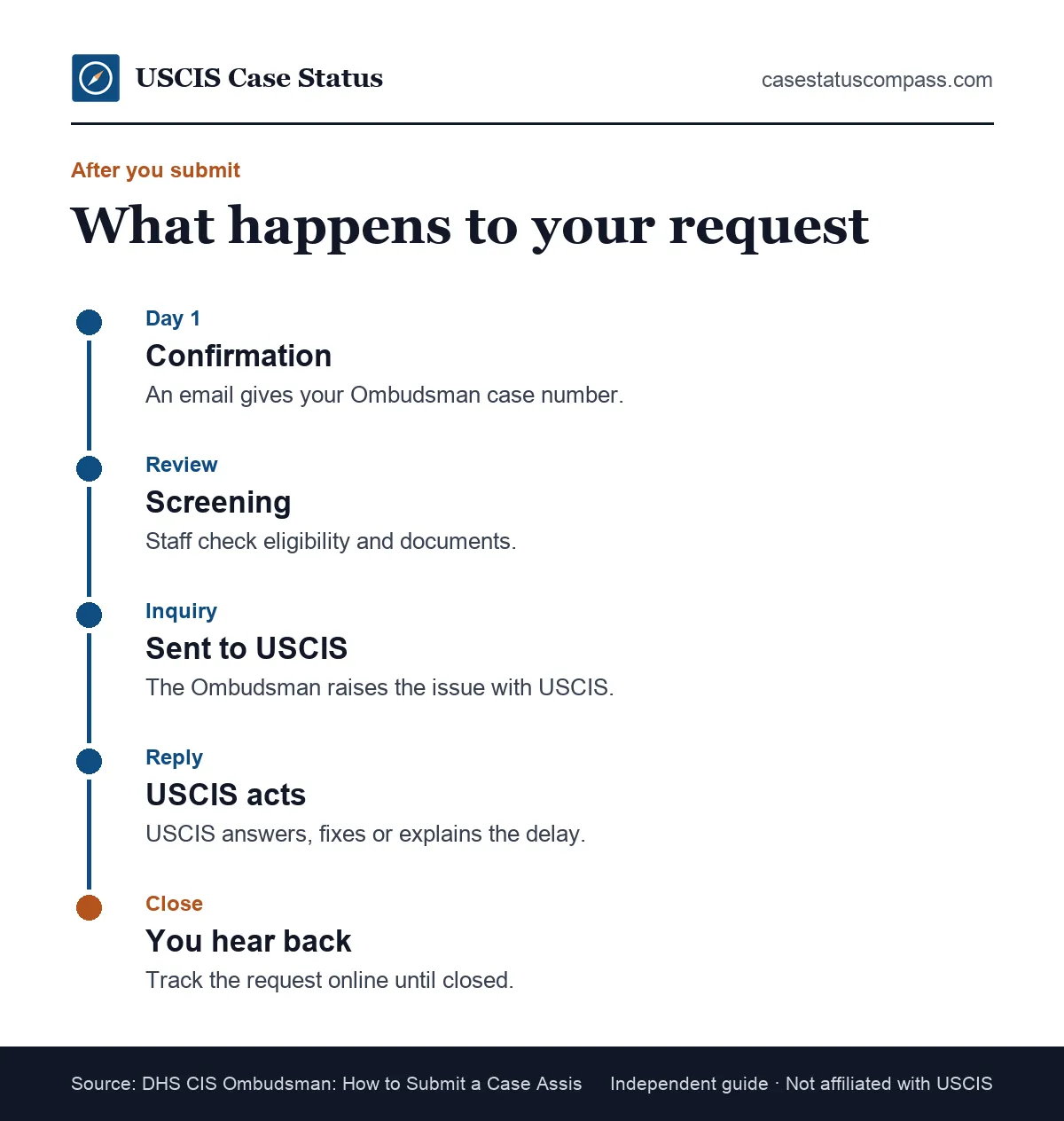
You get an email with your USCIS Ombudsman case number. Staff check eligibility, ask for anything missing, and raise the problem with USCIS. USCIS replies to the Ombudsman, and you are told the result. You can track the request online throughout.
Screening and contact with USCIS
Staff first confirm the 90-day and 60-day rule and, for delays, the inquiry date. Once accepted, they send the issue to the USCIS office holding your file and ask it to act or explain the hold-up.
Your deadlines keep running
Filing does not extend any USCIS deadline. Keep answering notices on time while you wait. Save the Ombudsman case number next to your receipt number so you can check status quickly.
How Long Does a USCIS Ombudsman Request Take?
DHS does not publish a standard response time for case assistance requests, and we could not confirm one on an official page as of October 2026. Timing depends on the problem, how complete your request is and how fast USCIS replies.
Why we give no number
A reissued notice can be quick; a lost file takes longer. Any single figure would mislead you. The best predictor is a complete request: one problem, every receipt number and proof of prior contact.
When to follow up
If the online status has not moved in several weeks, reply through the channel the Ombudsman used. Do not file a duplicate request; add new facts, such as a new deadline, to the existing one.
What Is a Congressional Inquiry?
A congressional inquiry is a request from your U.S. representative's or senator's office asking USCIS about your case. Caseworkers send it through USCIS's congressional liaison channels, and USCIS replies to the office. It is free and needs no lawyer.
Caseworkers and constituent services
Each member of Congress has constituent services staff who handle federal agency problems, from immigration to veterans' benefits. They know the right contacts and format, so their questions reach people who can see your file.
How USCIS answers Congress
USCIS's Office of Legislative Affairs supports congressional offices through dedicated channels, not the public phone line. USCIS answers the office, and the caseworker passes the answer to you. You never contact liaison staff yourself.
Who Can Request a Congressional Inquiry?
Anyone who lives in a member's district or state can ask that office for help, citizen or not. You have one U.S. representative and two senators. Employers can contact the member who represents their business location. Your home address, not your immigration status, decides which offices can take your case.
Finding your members' offices
Look up your House member on house.gov and your senators on senate.gov using your home address. Each website has a casework page. Ask one office at a time to avoid duplicate inquiries.
You do not need to be a citizen
Green card holders, visa holders and people with pending cases can all ask. A petitioner in another district can contact their own member, but the privacy release must still come from the person the case is about.
How Do You Ask Your Member of Congress for Help?
Contact the member's local office, explain the problem briefly, and complete the office's privacy release form. Attach copies of notices and your record of USCIS contacts. The caseworker then sends a written inquiry to USCIS on your behalf.
Step-by-step request
- Open the casework page on the member's website.
- Complete the privacy release.
- Summarize form, receipt number, filing date and problem.
- Attach your receipt notice and proof of USCIS contact.
What caseworkers find most useful
A one-page timeline beats a long letter. Give dates, receipt numbers and the exact help you need, such as "reissue the interview notice." Put any urgent deadline at the top with proof attached.
What Goes in a Congressional Privacy Release?
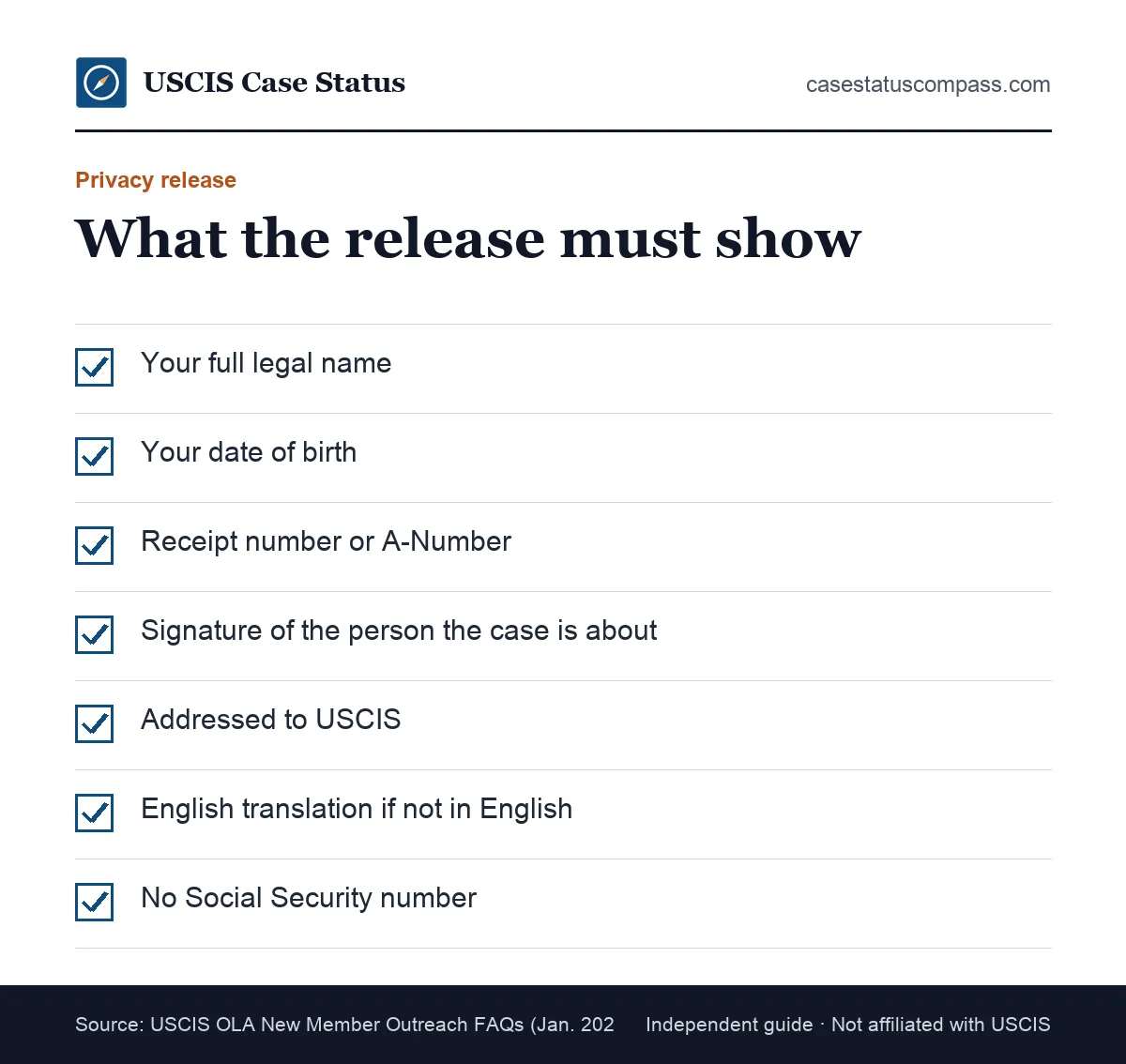
A privacy release is your written permission for USCIS to share case details with a member's office. Per USCIS legislative affairs FAQs (January 2021), it generally needs your name, date of birth and receipt number or A-Number, and no Social Security number.
Signatures and translations
The person the inquiry is about must sign, and the release is addressed to USCIS; a parent signs for a minor. Add a certified English translation if needed. Most offices supply a form that already meets these rules.
Mistakes that stall a release
These errors send a release back to you before USCIS ever sees the question:
- Petitioner signs for an adult beneficiary
- No receipt number or A-Number
- A Social Security number included
- A blurry photo instead of a clear scan
Does a Congressional Inquiry Speed Up a Case?
A congressional inquiry usually does not formally speed up a USCIS case. It makes USCIS look at the file and give a status answer, which can expose a lost notice or stalled step. Real acceleration still requires meeting the USCIS expedite criteria.
What an inquiry can change
If a file stalled because a step was missed, such as an interview never scheduled after background checks, a fresh look can restart it. An inquiry can also ask USCIS to review an expedite request you already sent.
What it cannot change
Congress cannot make USCIS approve a case, skip the line or reverse a denial. The expedite criteria are: Expedite criteria: severe financial loss, emergency/humanitarian, nonprofit, government interest, clear USCIS error. Our uscis expedite request guide explains how to ask USCIS directly.
Ombudsman vs Congressional Inquiry: Which Should You Use?
Use the USCIS Ombudsman for clear USCIS errors and documented delays that meet its 90-day, 60-day and inquiry-date rules. Use a congressional inquiry for local, personal follow-up or when the Ombudsman cannot take the case. Never use both at once.
Side-by-side comparison
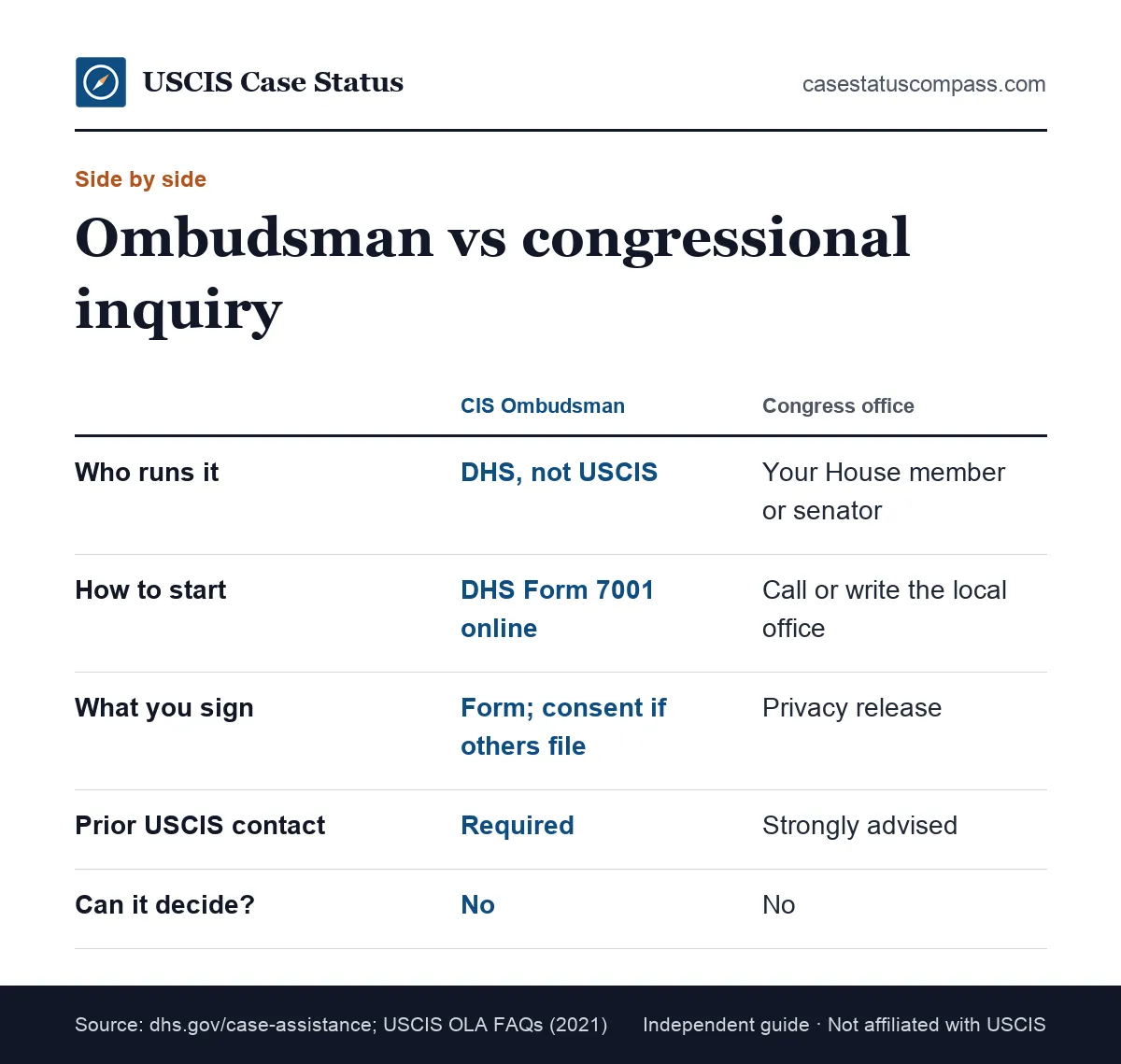
Both routes are free and neither can force a decision. The real differences are who runs each one and what permission it needs.
| Feature | CIS Ombudsman | Congressional inquiry |
|---|---|---|
| Who runs it | DHS, independent of USCIS | Your House member or senator |
| How to start | DHS Form 7001 online | Office's casework form |
| Permission | G-28 or consent if others file | Privacy release you sign |
| Prior USCIS contact | Required | Strongly recommended |
| Systemic fixes | Formal recommendations | Indirect, through oversight |
Choose the Ombudsman for documented USCIS errors, and Congress when you want a local caseworker following your file.
Timing the second route
If the first route fails, wait for its answer before trying the other. Because of the 45-day rule, space them out and tell the second office what the first one learned.
Which Escalation Route Fits Your Problem?
Match your problem to the first step below. The table assumes you already checked your status online. It is planning help, not legal advice; for a denial, court notice or criminal record, speak with an immigration attorney before acting. Start at the row closest to your situation.
If this happened, try this first
Each row pairs a common problem with the cheapest first move and the backup if USCIS does not fix it.
| If this happened | First step | If that fails |
|---|---|---|
| Past inquiry date, no answer | USCIS service request | Ombudsman after 60 days |
| Notice "mailed," never arrived | e-Request | Ombudsman |
| Typo on green card or EAD | e-Request | Ombudsman |
| Emergency with a deadline | Expedite request | Congress or Ombudsman |
| Approved, never sent to NVC | Contact Center | Ombudsman |
| Case denied | Read notice; see attorney | Appeal or motion |
Notice that the USCIS ombudsman is almost always the second step, never the first.
When escalation is the wrong tool
Escalation fixes service problems, not decisions you disagree with. If USCIS sent a notice of intent to deny, the response deadline matters most; our notice of intent to deny guide explains how to respond.
Copyable Templates for Your Escalation
These two templates help you write a clear Form 7001 description and a short email to a congressional caseworker. Replace everything in brackets with true facts and attach your notices. They are examples only; adapt them to your case.
Template: Form 7001 problem description
"My [form], receipt [number], was filed [date]. Its case inquiry date of [date] has passed. I sent a service request on [date], reference [number], with no substantive answer. I ask USCIS to [specific action]."
Template: email to a congressional caseworker
"I live in [city, ZIP]. Form [number], receipt [number], filed [date]. Problem: [one sentence]. I contacted USCIS on [dates] without a fix. Deadline: [if any]. My signed privacy release and notices are attached."
What Is a Congressional Complaint About Immigration?
A congressional complaint is a constituent's report to a member of Congress about how an agency treated them or handled a case. For immigration it usually becomes casework on one file. Complaints about a policy or law go to the member's legislative staff instead.
Casework versus policy
For help with your own file, ask for casework and sign a release. To object to a rule, such as a fee, send a policy comment. Caseworkers can share patterns they see, but they cannot change rules.
What happens next
Casework complaints become inquiries to USCIS. Policy complaints are logged and may shape letters to DHS or legislation. Keep either message short and factual, and leave out personal data the office does not need.
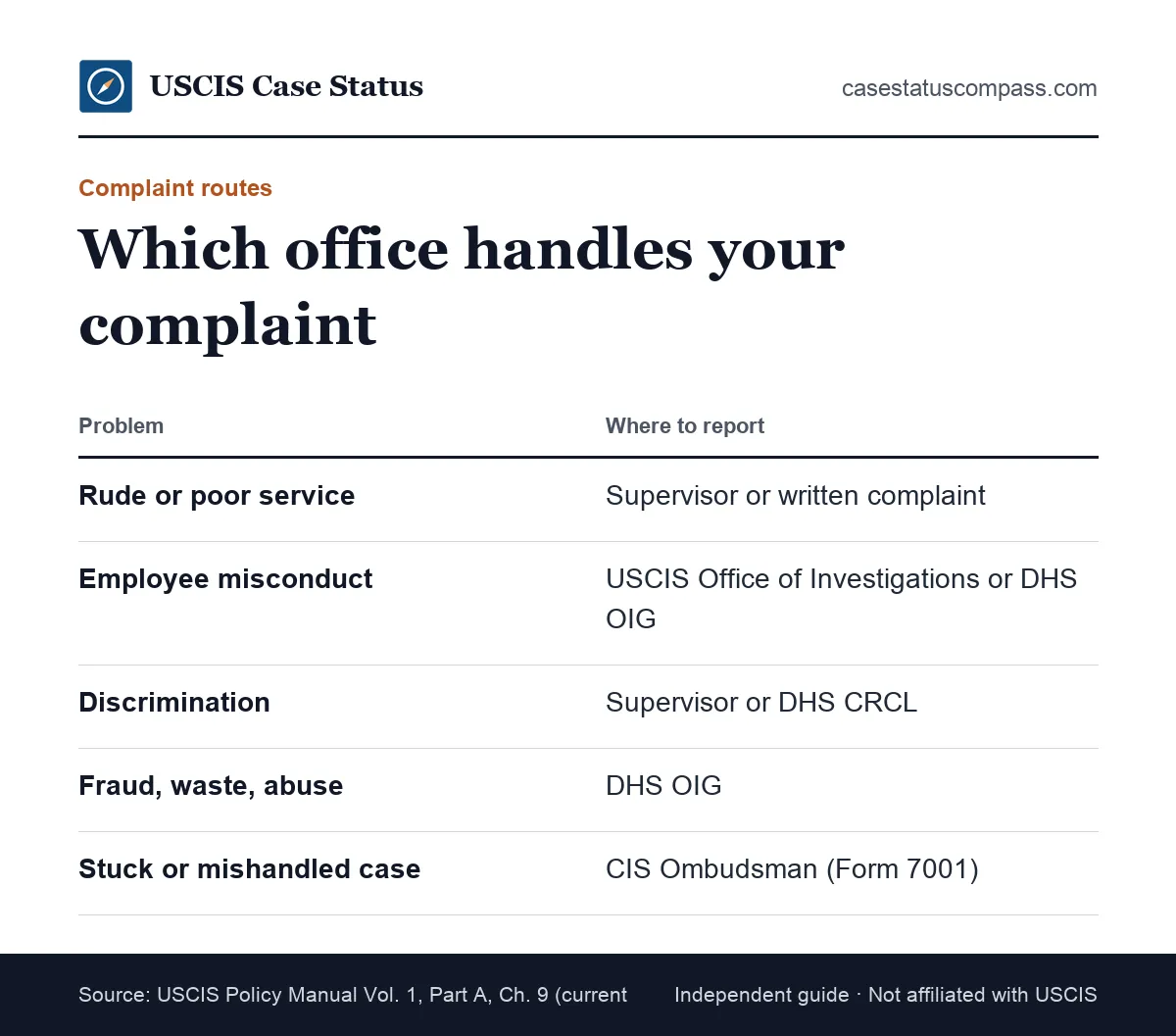
Filing a Complaint About USCIS: Where Does It Go?
You can complain about USCIS service to a supervisor, in writing to USCIS, or to DHS oversight offices. The USCIS Policy Manual (current as of October 23, 2026) says complaints may be letters, emails or faxes and must be forwarded if misdirected.
Asking for a supervisor
At an appointment, interview or Contact Center call, ask for a supervisor. The Policy Manual says supervisors should take your details and try to resolve the issue before you leave. Note their name and the time.
Written complaints to USCIS
Describe what happened, when, where and who was involved. USCIS also offers optional surveys after calls and on its website. The Policy Manual says a complaint must never be dismissed or disregarded for using the wrong process.
How Do You Report USCIS Employee Misconduct?
Report suspected misconduct by a USCIS employee or contractor promptly to a USCIS supervisor, the USCIS Office of Investigations, or the DHS Office of Inspector General (OIG). Misconduct includes bribe requests, threats and falsified records. It is separate from case assistance.
USCIS Office of Investigations
The Office of Investigations, within the Office of Security and Integrity, may investigate, order a management inquiry or refer the matter to OIG. The Policy Manual notes it generally does not share the outcome with the reporter.
DHS Office of Inspector General
DHS OIG is the department-wide watchdog for fraud, waste, abuse and misconduct, with an online hotline at oig.dhs.gov. Never pay someone who claims inside contacts; our guide to uscis scams shows common tricks.
How Do You Report Discrimination by USCIS?
Report discrimination based on race, religion, sex, disability or another protected trait to a USCIS supervisor or the DHS Office for Civil Rights and Civil Liberties (CRCL). You may also report to the Office of Investigations or DHS OIG. Keep a copy of everything you send.
The civil rights office
CRCL handles civil rights complaints across DHS. A useful complaint gives your contact details, what happened, the date and place, witnesses and copies of related documents, plus steps you already took.
Protection from retaliation
The Policy Manual says retaliation against anyone who reports discrimination or joins an inquiry is prohibited and subject to discipline. If your case seems treated worse after a complaint, document the timeline and tell CRCL or OIG.
Which Immigration Complaints Belong to Other Agencies?
Many immigration complaints are not about USCIS. Immigration court belongs to EOIR at the Justice Department, visas abroad belong to the State Department, and border or detention issues belong to CBP or ICE. The USCIS Ombudsman handles only USCIS matters.
Immigration court and EOIR
If an immigration judge has your case, neither USCIS nor the Ombudsman can change it. Contact the court or your attorney. Our immigration court case status guide explains hearing lookups by A-Number.
Visas, NVC and consulates
After a petition is approved, the National Visa Center and consulates take over. Visa fees, document review and interviews go to the State Department. See our nvc case status guide for the hand-off from USCIS.
How Do You Escalate a Missing USCIS Notice?
Confirm your address on file is current, then request a copy through e-Request or the Contact Center. If USCIS does not resend it within 60 days of your contact, the CIS Ombudsman can ask for a reissue on your behalf.
Fix your address first
Many "lost" notices went to an old address. Report a new address to USCIS within 10 days of moving (INA 265). A Postal Service forwarding order does not update USCIS, so correct the address before you ask for a reissue.
Notices with hidden deadlines
A missing RFE may carry a response date you do not know about. Tell the Ombudsman. RFE deadline: up to 12 weeks (the exact date is on your RFE); no extensions. I-539 and I-601A RFEs allow only 30 days. Our rfe meaning guide explains how evidence requests work.
How Do You Escalate a Stalled Expedite?
If USCIS approved your expedite but nothing has moved, or your emergency fits the criteria and USCIS has not answered, you can escalate. DHS accepts expedites USCIS approved more than two months ago, but not expedites it recently denied. Put the expedite decision date in your request.
After an expedite approval
An approved expedite still needs someone to act. If weeks pass with no interview, decision or card, send a service request quoting the approval date, then go to the Ombudsman.
After an expedite denial
A recent denial blocks an Ombudsman request. Gather stronger proof, such as a doctor's letter, and ask USCIS again: Ask for an expedite through the USCIS Contact Center or your online account. A caseworker can help present the new evidence.
How Do You Escalate a Case Past Normal Processing Time?
Wait for the case inquiry date, submit an "outside normal processing time" service request, then wait at least 60 days. If USCIS still does not resolve it, file with the Ombudsman or ask your member of Congress for a congressional inquiry.
The outside-normal-processing request
You can submit an 'outside normal processing time' request only after your case inquiry date. Save the reference number. That one number becomes your proof of prior USCIS contact for both the Ombudsman and a caseworker.
Reading a long wait in context
At the end of June 2026, USCIS reported 12.8 million cases pending at USCIS (end of June 2026). Long waits are not always errors; our page on case is still being processed by uscis explains when a quiet status is routine.
How Do You Escalate a Typo or Card Problem?
For a USCIS typo on a card or notice, use e-Request first and keep the confirmation. If USCIS does not correct it, the USCIS Ombudsman can ask for a fix. For a card returned by the Postal Service, update your address and ask for a resend.
USCIS typos versus your own mistakes
If USCIS printed something different from what you filed, it is a USCIS error, usually fixed free. A mistake on your own form may need a new filing; our green card renewal guide covers replacements.
Cards sent back to USCIS
A wrong apartment number can bounce a card back. Our guide to a card was returned to uscis explains how long USCIS holds returned cards and how to get one resent.
Can the CIS Ombudsman Help After a Denial?
The CIS Ombudsman cannot reverse a denial, replace an appeal or motion, or change the filing deadline. Read the notice for your options and act within the stated time. As of October 2026, USCIS lists: Appeal or motion: file within 30 days (33 if the decision was mailed).
Why deadlines beat escalation
Waiting for an Ombudsman reply can cost you the appeal window. File any motion or appeal first. Our guide to options after an I-485 or other denial explains next steps by form.
Motions and appeals explained elsewhere
A motion to reopen asks the same office to look again with new facts; an appeal goes higher. Our motion to reopen guide covers Form I-290B and timing. The Ombudsman cannot file either one for you.
Can the Ombudsman Help With a Request for Evidence?
The USCIS Ombudsman cannot answer an RFE for you or extend its deadline. It can help when an RFE was never delivered or when USCIS ignored a response you sent on time. Always answer by the date on the notice, then escalate any service problem.
Proving you responded on time
Keep the tracking number or upload confirmation for every RFE response. If USCIS later denies for "no response," that proof is exactly what the Ombudsman needs to raise the error.
When the RFE seems unreasonable
Disagreeing with what an officer asked for is not a service problem. Answer as fully as you can. If the case is denied, your attorney can use that record in a motion or appeal.
Should You Hire an Attorney to Escalate?
You do not need an attorney to contact the USCIS Ombudsman or Congress. Hire one when your case involves a denial, a court notice, criminal history, a past removal order or a tight deadline. A lawyer can also file Form 7001 with a G-28.
When legal help is worth it
Escalation fixes service problems; a lawyer spots legal ones, such as a missed waiver or a status gap. Our guide to immigration lawyer cost explains typical fee structures. Ask for a written fee quote before you sign.
Accredited representatives
DOJ-accredited representatives at recognized nonprofits can represent you before USCIS, often at low cost. Check the Justice Department roster, and avoid "notarios" who promise speed through contacts in Congress. Confirm the name on the roster before paying anything.
What Mistakes Slow Down an Escalation?
The mistakes that slow escalations most are filing too early, skipping USCIS contact, naming the wrong person in Form 7001, leaving out a G-28 or consent, and sending duplicate requests to several offices at once. Each one is easy to avoid with a contact log and a calendar.
Filing before the rules allow
A request filed before the inquiry date, or within 60 days of contacting USCIS, is usually turned away. Mark both dates on a calendar; one well-timed request beats three early requests.
Asking everyone at once
Writing to the Ombudsman, two senators and your House member on one day creates parallel inquiries and triggers the 45-day block. Choose one route and keep a log of who you contacted.
How Do Service Centers and Field Offices Fit In?
USCIS processes most files at service centers and interviews people at local field offices. The Ombudsman and caseworkers direct questions to whichever office holds your file. As of 2026, USCIS has Five USCIS service centers: California, Nebraska, Potomac, Texas and Vermont.
Finding which office has your file
Your receipt prefix shows where a case started, but files move. A transfer notice shows the current office. Our uscis service centers guide explains each center and transfers. Quote the office on your newest notice when you describe the problem.
Local office appointments
Some problems need an in-person visit. Request an in-person appointment online at my.uscis.gov/en/appointment/v2 or call 800-375-5283. If the problem remains, cite the appointment date as proof of contact. Bring your notices and photo ID to the visit.
Key Facts About Escalating a USCIS Case
These facts were checked on official pages in October 2026. Use them to plan your timing, and check each source again before filing, because forms and rules can change. Sources are listed at the end of this page. The USCIS ombudsman timing rules below decide most rejections.
Facts you can rely on
The table repeats the three official rules this page relies on, worded as DHS and USCIS state them.
| Item | Detail |
|---|---|
| Ombudsman form | CIS Ombudsman: DHS Form 7001, Request for Case Assistance (online) |
| Ombudsman timing | Use the Ombudsman only after contacting USCIS within 90 days and waiting at least 60 days |
| Congress | Your member of Congress can ask USCIS about your case after you sign a privacy release |
If an office tells you something different, ask which current guidance it is applying.
What we could not confirm
We found no official response time for Ombudsman requests or congressional replies. To get your full file, see our uscis foia request guide. For other problems, start at our uscis case help hub.
Frequently Asked Questions
Is the USCIS Ombudsman the same as USCIS?
No. The CIS Ombudsman is an independent office within the Department of Homeland Security. It cannot approve, deny or decide cases. It contacts USCIS about your problem, asks for action or an explanation, and recommends wider fixes. People call it the USCIS Ombudsman because it works only on USCIS matters.
How do I contact the CIS Ombudsman?
Submit DHS Form 7001, Request for Case Assistance, online on dhs.gov. There is no fee. You must have contacted USCIS within the last 90 days and waited at least 60 days for a fix. Delay-only cases must also be past the case inquiry date.
Can I contact both my senator and the Ombudsman?
Yes, but not at the same time. The Ombudsman will not accept a case a congressional office asked USCIS about in the last 45 calendar days. Pick one route, wait for its answer, then try the other if needed.
Will asking for help hurt my immigration case?
No official source says a polite, factual inquiry harms a case; both channels exist so people can ask. The real risk is relying on escalation instead of meeting a deadline, such as an RFE response or appeal window, which keep running.
Can my employer ask the Ombudsman about my H-1B petition?
Yes. Employers, as petitioners, can file Form 7001 about their own petitions, with a signed Form G-28 if their attorney files it. As the worker, share your concerns with the employer so the request comes from the petitioner.
Is a congressional inquiry the same as a congressional complaint?
No. A congressional inquiry is casework: a member's office asks USCIS about your own file after you sign a privacy release. A complaint about immigration policy asks Congress to change a rule or oversee the agency, and it does not move an individual case.
Can a family member file an Ombudsman request for me?
A spouse or adult child can help, but the Ombudsman needs your own signed written consent naming the form and the issue. Without it, the office will not discuss your case with the helper, even a close relative.
Do I need a lawyer to contact the Ombudsman or Congress?
No. Both routes are free and built for individuals. A lawyer is worth it when the problem is legal rather than a service delay, such as a denial, a missed waiver or a deadline you are unsure how to meet.
What if the Ombudsman cannot help me?
Read the closing message, which usually explains why. Common fixes are waiting for the inquiry date, contacting USCIS again or adding missing consent. If the problem is a decision, ask an immigration attorney about a motion, appeal or new filing.
Sources
- DHS CIS Ombudsman: How to Submit a Case Assistance Request. www.dhs.gov/case-assistance. Accessed Oct 27, 2026.
- DHS Form 7001, Request for Case Assistance. www.dhs.gov/topic/cis-ombudsman/forms/7001. Accessed Oct 27, 2026.
- CIS Ombudsman tip sheet: Check Your USCIS Case Inquiry Date (Aug. 2024). dhs.gov/sites/default/files/2024-11/24_0823_cisomb_case-inquiry-date-tip-sheet.pdf. Accessed Oct 27, 2026.
- USCIS Office of Legislative Affairs: New Member Outreach FAQs (Jan. 2021). www.uscis.gov/sites/default/files/document/questions-and-answers/5%20117%20-%20New%20Member%20Outreach%20FAQs%2001042021.pdf. Accessed Oct 27, 2026.
- USCIS Policy Manual Vol. 1, Part A, Ch. 9: Feedback, Complaints, Misconduct, and Discrimination. www.uscis.gov/policy-manual/volume-1-part-a-chapter-9. Accessed Oct 27, 2026.
- USCIS Contact Center. www.uscis.gov/contactcenter. Accessed Oct 27, 2026.
- USCIS: How to Make an Expedite Request. www.uscis.gov/forms/filing-guidance/how-to-make-an-expedite-request. Accessed Oct 27, 2026.
- USCIS Check Case Processing Times. egov.uscis.gov/processing-times/. Accessed Oct 27, 2026.
- USCIS: Checking Your Case Status Online. www.uscis.gov/tools/checking-your-case-status-online. Accessed Oct 27, 2026.
- USCIS: How to Change Your Address (updated 08/04/2026); 8 U.S.C. 1305(a) (LII). www.uscis.gov/addresschange. Accessed Oct 27, 2026.
- 8 CFR 103.2(b)(8)(iv) (LII). www.law.cornell.edu/cfr/text/8/103.2. Accessed Oct 27, 2026.
- USCIS Data Library: All USCIS Application and Petition Form Types, FY2026 Q3 (Apr. 1-June 30, 2026; queried 7/2026). www.uscis.gov/sites/default/files/document/data/quarterly_all_forms_fy2026_q3_v1.xlsx. Accessed Oct 27, 2026.
- USCIS: Form I-290B page (updated 10/26/2026). www.uscis.gov/i-290b. Accessed Oct 27, 2026.
- USCIS Service Center Operations Directorate (updated 07/17/2026). www.uscis.gov/about-us/organization/directorates-and-program-offices/service-center-operations-directorate. Accessed Oct 27, 2026.
casestatuscompass.com is an independent publication and is not affiliated with USCIS or any government agency. This page is general information, not legal advice. For denials, court or asylum matters, consult an immigration attorney or a DOJ-accredited representative.