Contents · 42 sections
- What Is the Visa Bulletin?
- Latest Visa Bulletin: November 2026
- Is the Visa Bulletin a USCIS Document?
- How Is the Visa Bulletin Different From USCIS Case Status?
- What Is a Priority Date?
- Where Do You Find Your Priority Date?
- What If You Lost the Notice Showing Your Priority Date?
- Final Action Dates vs Dates for Filing
- Which Chart Should You Use for Adjustment of Status?
- Which Chart Applies If You Are Abroad?
- How to Read the Visa Bulletin Step by Step
- What Do "C" and "U" Mean in the Visa Bulletin?
- Is Your Priority Date Current?
- What Is the Current Priority Date for a Green Card?
- Family-Sponsored Visa Bulletin Categories
- Who Is Not in the Visa Bulletin?
- Employment-Based Visa Bulletin Categories
- How Many Green Cards Are Available Each Year?
- What Is Chargeability and Why Does Your Country Matter?
- What Is Cross-Chargeability in the Visa Bulletin?
- Why Are India and China Priority Dates So Far Behind?
- What Is Visa Retrogression?
- What Happens to a Pending I-485 During Retrogression?
- Visa Bulletin Predictions: Can Anyone Forecast Dates?
- Is There an Official Visa Bulletin Forecast?
- The October Visa Bulletin and the New Fiscal Year
- How the Visa Bulletin Fits Into a Family Green Card Case
- How the Visa Bulletin Fits Into an Employment Green Card Case
- Can You File Form I-485 Together With Form I-140?
- What Can You Do While Your Priority Date Is Not Current?
- What Happens When Your Priority Date Becomes Current?
- Can a Child Age Out While Waiting?
- Is There a Green Card Priority Date Calculator?
- A Priority Date Tracking Log You Can Copy
- How Long Does It Take After Your Date Becomes Current?
- What If USCIS Finishes Review Before Your Date Is Current?
- Common Visa Bulletin Reading Mistakes
- Real-World Visa Bulletin Scenarios
- If X, Do Y: Visa Bulletin Decision Table
- Other Agencies and Trackers You May Need
- When Should You Get Legal Help With Priority Dates?
- Frequently Asked Questions
At a glance
| Who publishes it | The U.S. Department of State, every month |
| Which chart USCIS uses now | November 2026: USCIS accepts I-485s using the Dates for Filing chart (family and employment) |
| What you compare | Your priority date vs the cutoff for your category and country |
| Who is not in it | Immediate relatives of U.S. citizens (no yearly cap) |
| This month's cutoffs | All four November 2026 charts are below; they change monthly |
What Is the Visa Bulletin?
The visa bulletin is a monthly report from the U.S. Department of State that shows when preference green card applicants can take their next step. It lists cutoff dates by category and country. Anyone whose priority date falls before the cutoff can move ahead that month.
Who publishes it and why
The State Department tracks how many visa numbers remain each year. The State Department publishes the Visa Bulletin monthly: Final Action Dates vs Dates for Filing. USCIS (U.S. Citizenship and Immigration Services) then names the chart it accepts. The bulletin exists because Congress caps most preference green cards each year, so a line forms when demand is higher than the supply.
Latest Visa Bulletin: November 2026
The latest visa bulletin is the November 2026 issue, released by the State Department in October 2026. For adjustment of status, USCIS has named its chart: November 2026: USCIS accepts I-485s using the Dates for Filing chart (family and employment). If you plan to file in December, wait for the next issue and the matching USCIS chart notice, because both can change. The cutoff for your own line is in the charts further down this page.
Which chart counts this month
Dates for Filing is the chart for Form I-485 filings in November 2026. USCIS adds one exception: if a category's Final Action Date is "current" or later than its Date for Filing that month, you may use the Final Action chart for that category instead.
Where this page's cutoff dates come from
The four charts on this page copy the November 2026 bulletin from the State Department's Visa Bulletin page. The oversubscribed chargeability areas are mainland China, India, Mexico and the Philippines, so each has its own column. A new bulletin replaces these dates every month.
Is the Visa Bulletin a USCIS Document?
No. People often search for a "USCIS visa bulletin", but the bulletin belongs to the State Department. USCIS only decides, each month, whether green card applicants inside the U.S. use the Final Action chart or the Dates for Filing chart. That choice appears on the USCIS website, usually soon after each bulletin is released.
The State Department's job
The State Department controls the supply of immigrant visa numbers. It sets the cutoff dates, publishes the bulletin and issues visas at U.S. embassies and consulates. Its National Visa Center (NVC) collects fees and documents for people processing abroad; see our NVC case status guide for that stage.
How Is the Visa Bulletin Different From USCIS Case Status?
The visa bulletin tells you whether a visa number is available for your category, while USCIS case status tells you what happened to one specific filing. You often need both. For example, an F2A spouse might have an approved I-130 in the USCIS tool and still wait for the bulletin before filing anything else.
Two tools, two questions
This table shows what each tool answers, so you know which one to open for each question you have.
| Question | Visa Bulletin | USCIS case status |
|---|---|---|
| Who runs it | U.S. Department of State | USCIS |
| What you look up | Category, country and priority date | Your 13-character receipt number |
| What it tells you | Whether your place in line is reached | The latest action on one form |
| How often it changes | Once a month | Whenever USCIS acts on your case |
| Covers immediate relatives | No, they have no cutoff | Yes |
| Where to check | travel.state.gov | egov.uscis.gov or your online account |
Where each tool fits
- Before filing: the bulletin says whether you may file.
- After filing: our USCIS case status guide explains each update.
- Approved petition: go back to the bulletin to see your place in line.
What Is a Priority Date?
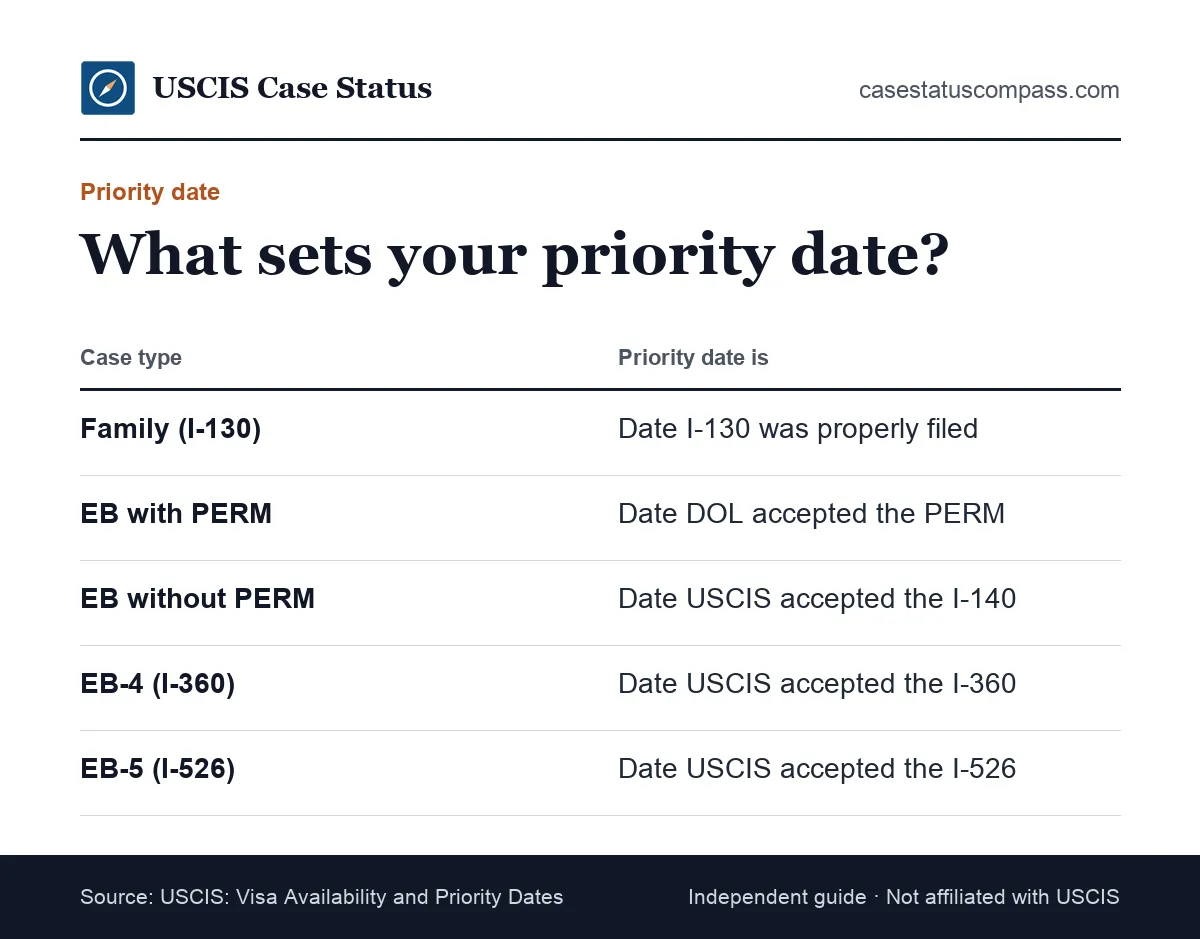
A priority date is your place in line for a preference green card. It is usually the date your petition, or for many job-based cases your labor certification, was filed. The earlier your date, the sooner it becomes current. It stays with the approved petition, even if the wait lasts years.
Priority dates in family cases
For family-sponsored cases, the priority date is the day USCIS properly received the Form I-130. Our guide to Form I-130 explains who can file and which relatives fall into each category. The date is printed on the I-797 receipt notice.
Priority dates in employment cases
When a PERM labor certification is required, the priority date is the day the Department of Labor (DOL) accepted that application. When no labor certification is needed, as in EB-1 or a National Interest Waiver, it is the day USCIS accepted Form I-140. EB-4 uses the Form I-360 date and EB-5 uses the Form I-526 date.
Where Do You Find Your Priority Date?
Your priority date is printed on the Form I-797 notice for the petition filed for you, in a box labeled "Priority Date". The receipt notice and the approval notice usually show it. If a PERM came first, the date on the I-140 approval should match the DOL filing date.
What If You Lost the Notice Showing Your Priority Date?
Ask the person or employer who filed the petition, or their attorney, for a copy. Petitions filed online appear in the petitioner's USCIS online account. The USCIS Contact Center can also help after verifying identity. Keep a copy once you have it, since you will compare it with every bulletin.
Final Action Dates vs Dates for Filing
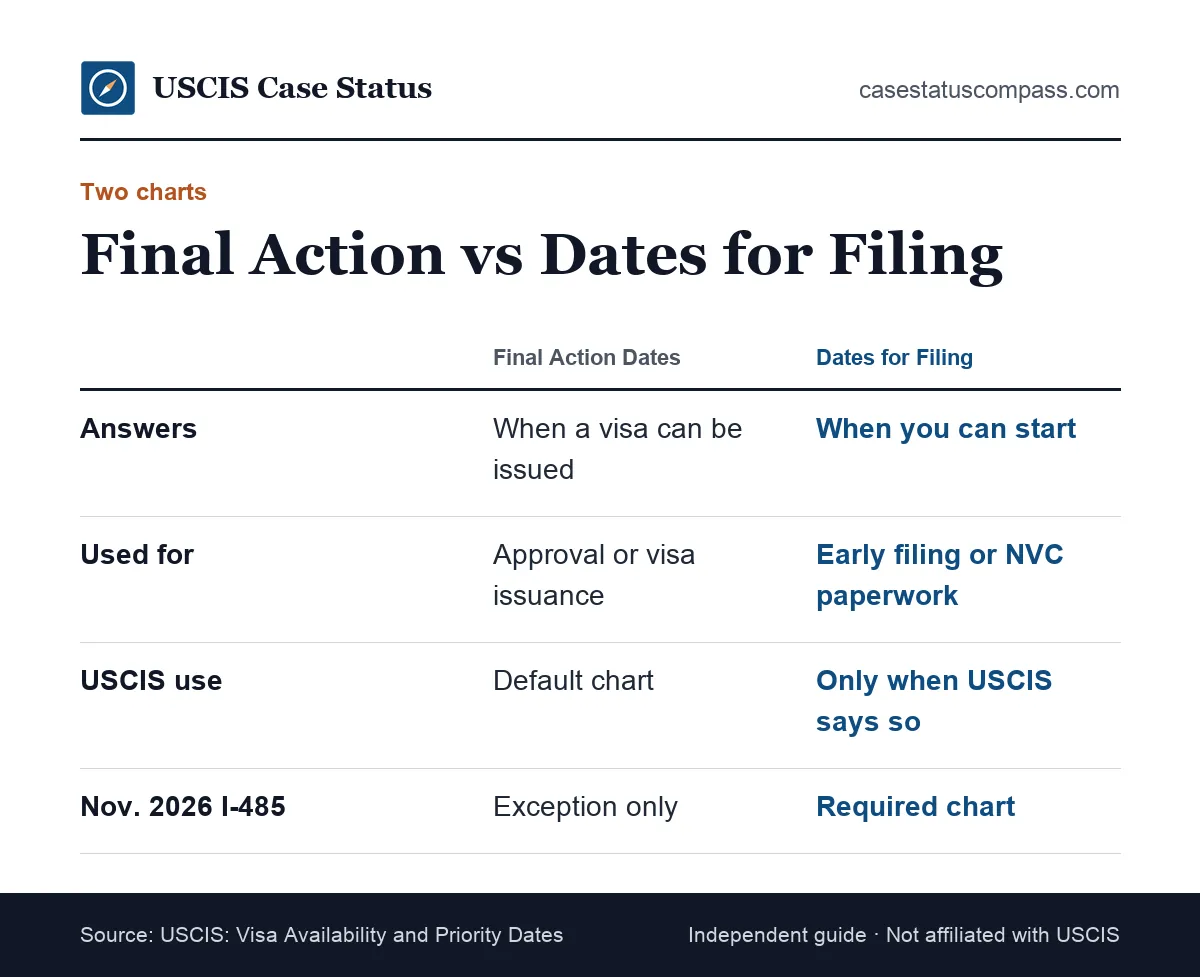
Final Action Dates show when a visa can actually be issued or a green card approved. Dates for Filing show when you can start: file Form I-485 if USCIS allows it, or begin NVC paperwork. Dates for Filing are usually later, so more people qualify to start than to finish.
What a Final Action Date means
A Final Action Date is the cutoff for a visa number to be allocated. USCIS cannot approve an I-485 in a preference category, and a consulate cannot issue the visa, until your priority date is earlier than this date. USCIS treats this chart as the default.
What a Date for Filing means
A Date for Filing lets you get in the door early. USCIS allows it only when it finds that more visas are available than known applicants. Filing early can unlock a work permit and travel document while you wait, but the final decision still waits for the Final Action chart.
Which Chart Should You Use for Adjustment of Status?
Use the chart USCIS names on its "Adjustment of Status Filing Charts" page for the month you file. For November 2026, both family and employment categories use Dates for Filing, with the Final Action exception described above. Filing under the wrong chart can lead to a rejected I-485 and a lost fee, so confirm the chart before you mail anything.
Read the USCIS page every month
USCIS can switch charts from one month to the next, and it decides separately for family and employment cases. Always pair the bulletin for the month you file with the USCIS chart page for that same month. The exception matters now: EB-1 for most countries shows Current on the November 2026 Final Action chart.
Which Chart Applies If You Are Abroad?
If you are getting your green card through a U.S. consulate, the State Department uses the bulletin directly. The Dates for Filing chart tells you when you can generally start sending NVC documents. The Final Action chart controls when the consulate can schedule the interview and issue the immigrant visa.
NVC stage
The NVC collects your immigrant visa fee, Form DS-260 and civil documents. Starting early means your file is ready when the final action date arrives. NVC usually invites documents once the Dates for Filing chart reaches your date.
Interview and visa
A consulate schedules interviews only for applicants whose priority dates are current under the Final Action chart. To follow a case at the embassy stage, see our US visa status guide. Interviews are set by each embassy, so timing varies by post.
How to Read the Visa Bulletin Step by Step
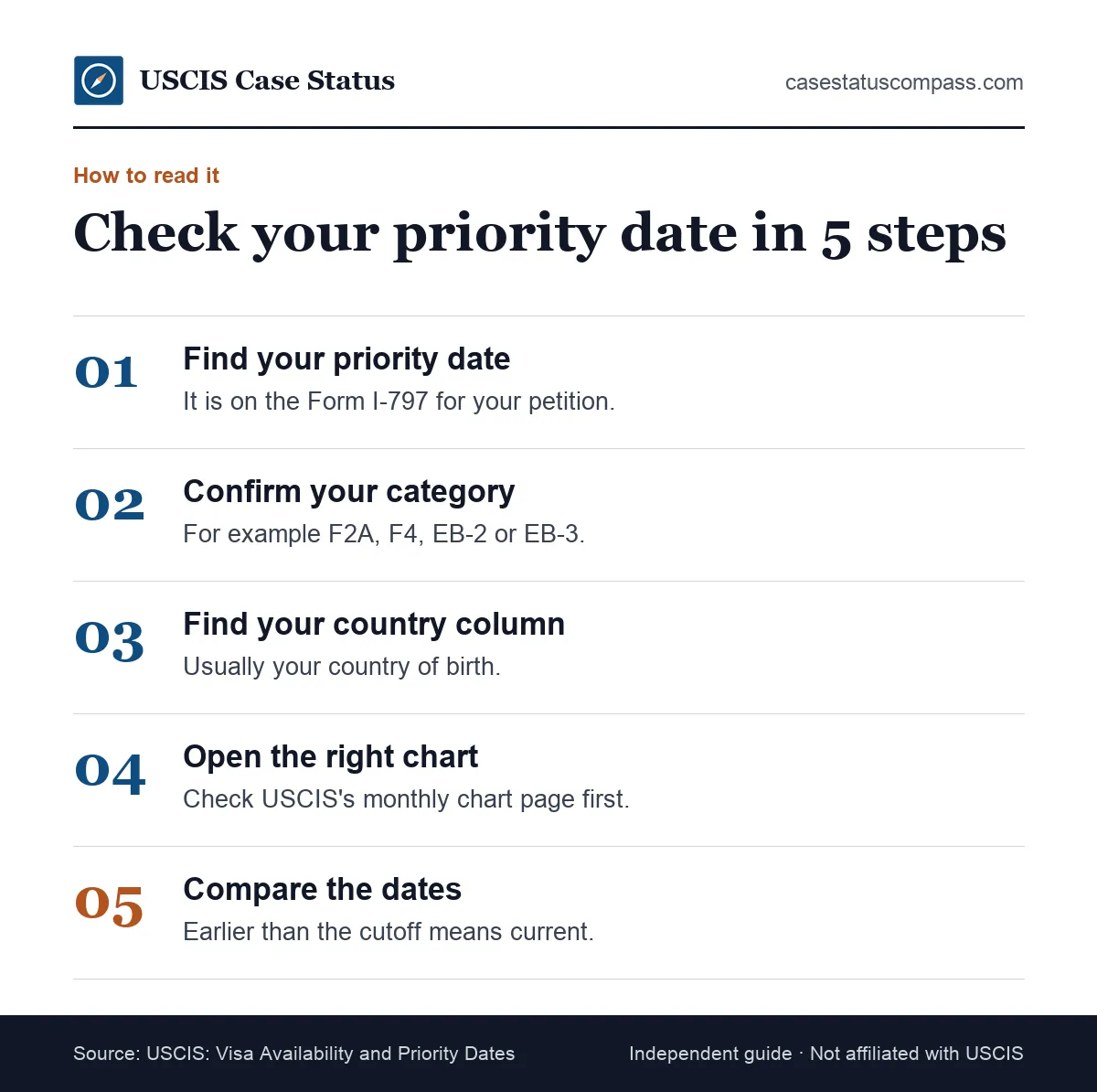
To read the visa bulletin, find your priority date, your category and your chargeability country, then open the chart USCIS or the State Department says applies to you. Find the cell where your category row meets your country column. If your date is earlier than that cell's date, you are current.
Step 1: Gather three facts
- Your priority date from the I-797
- Your category, such as F3 or EB-2, from the petition
- Your chargeability area, usually your country of birth
All three appear on, or follow from, the petition's I-797 notice. Write them down before you open any chart, so you do not mix them up.
Step 2: Pick the right month and chart
Open the bulletin for the month you plan to act, then check the USCIS chart page if you will file an I-485. Abroad, the State Department's own instructions decide. Use the family chart for I-130 categories and the employment chart for I-140, I-360 or I-526 categories.
Step 3: Compare the dates
Bulletin dates are written like 01JAN20 (day, month, year). Your priority date must be earlier than the listed date. A date equal to the cutoff is not current. So 15MAR21 means March 15, 2021, and a priority date of March 14, 2021, qualifies that month.
What Do "C" and "U" Mean in the Visa Bulletin?
In the bulletin, "C" means current: visa numbers are available to everyone in that category and country, whatever the priority date. "U" means unavailable: no numbers can be used that month. A listed date means only applicants with an earlier priority date can move forward.
Current ("C")
If your category shows "C" on the chart USCIS accepts, you may file an I-485 that month, as long as you meet every other requirement. A "C" can change to a date the next month, so file while it lasts.
Unavailable ("U")
"U" means the category or country has no numbers to give for now, so nobody in that cell can receive final action. This often happens late in a fiscal year once a yearly limit has been used up.
Quick key to the cells
- C: current, any priority date may proceed
- U: unavailable this month
- A date: only earlier priority dates proceed
The same key applies to both charts and to every category row and country column.
Is Your Priority Date Current?
Your priority date is current when it is earlier than the cutoff date shown for your category and country on the chart that applies to you, or when that cell shows "C". If your date is the same as or later than the cutoff, you must wait for a later bulletin.
A worked example (made-up dates)
These dates are invented for teaching only. They are not real cutoffs. Each row tests one priority date against one cell.
| Your priority date | Example cutoff in your cell | Result |
|---|---|---|
| March 3, 2019 | 01JAN20 | Current, because 2019 is earlier |
| January 1, 2020 | 01JAN20 | Not current; it must be earlier |
| June 9, 2021 | 01JAN20 | Not current; keep waiting |
| Any date | C | Current |
| Any date | U | Not current; no numbers |
Current to file vs current to approve
You can be current on Dates for Filing but not yet on Final Action Dates. In that case you may file, but approval waits. Note both results each month. If you are current on both, the case can be approved once USCIS finishes its review.
What Is the Current Priority Date for a Green Card?
There is no single current priority date for a green card. Each family and employment category, and many countries, has its own cutoff, and each one changes monthly. The only reliable answer for your case is the cell for your category and country in the latest bulletin.
Where to check today
The November 2026 charts in the family and employment sections below show every cell. Find your row and column, then confirm on travel.state.gov and, if you are in the U.S., the USCIS adjustment charts page.
Family-Sponsored Visa Bulletin Categories
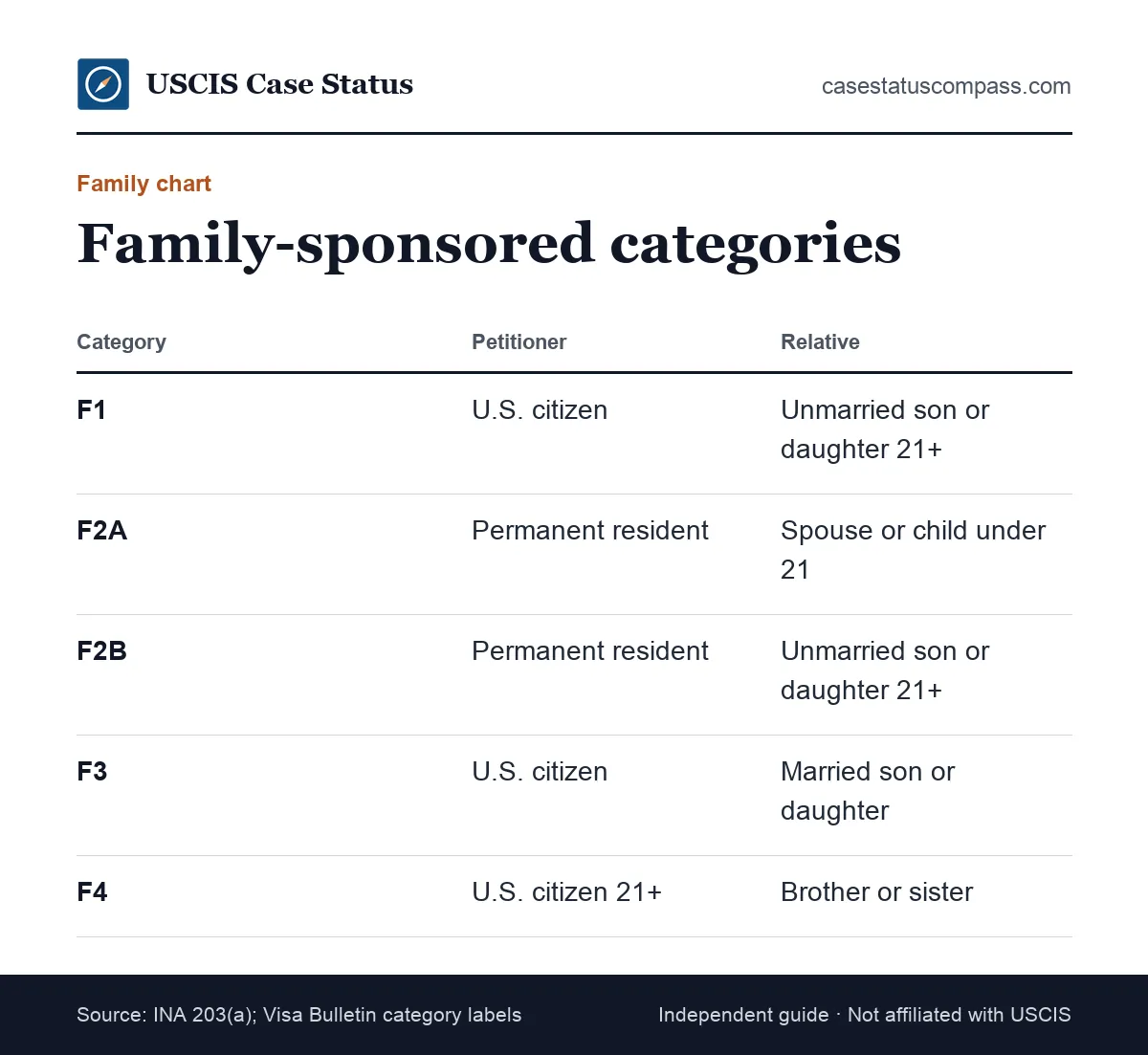
The family chart lists four family preference categories set by law, with F2 split into F2A and F2B. F1-F4 family and EB-1 to EB-5 employment categories (INA 203). Spouses, minor children and parents of U.S. citizens are not on this chart because they are immediate relatives. The category is fixed by the relationship and the petitioner's status, so it can change if either one changes.
F1: adult unmarried children of citizens
F1 covers unmarried sons and daughters, age 21 or older, of U.S. citizens. If the beneficiary marries, the case generally moves to F3, which often has a longer wait. If the citizen parent filed while the child was under 21, the case started as an immediate relative case instead.
F2A and F2B: relatives of permanent residents
The F2A line covers spouses and children under 21 of green card holders. The visa bulletin for F2A shows Current on the November 2026 Dates for Filing chart. F2B covers their unmarried sons and daughters 21 or older.
F3 and F4: married children and siblings
F3 covers married sons and daughters of U.S. citizens. F4 covers brothers and sisters of U.S. citizens who are at least 21. These categories often carry long waits, and the I-130 alone can take years: USCIS's median for "all other relative" I-130s was I-130 (all other relatives): median 43.3 months (USCIS data, Apr.-June 2026). Country matters too: the November 2026 F4 Final Action Date is Oct. 22, 2012 for most countries but Dec. 15, 2006 for people born in India.
Family-sponsored Final Action Dates chart
This chart shows the November 2026 cutoff for final approval or visa issuance in each family category. Find your row, then your birth-country column.
| Category | All areas | China (mainland-born) | India | Mexico | Philippines |
|---|---|---|---|---|---|
| F1 | Jan. 22, 2021 | Jan. 22, 2021 | Jan. 22, 2021 | Sept. 22, 2008 | Nov. 1, 2013 |
| F2A | Oct. 22, 2026 | Oct. 22, 2026 | Oct. 22, 2026 | Apr. 22, 2026 | Oct. 22, 2026 |
| F2B | Aug. 22, 2020 | Aug. 22, 2020 | Aug. 22, 2020 | May 15, 2010 | Oct. 1, 2013 |
| F3 | Oct. 22, 2015 | Oct. 22, 2015 | Oct. 22, 2015 | July 15, 2001 | July 22, 2006 |
| F4 | Oct. 22, 2012 | Oct. 22, 2012 | Dec. 15, 2006 | Apr. 22, 2001 | May 15, 2008 |
Family-sponsored Dates for Filing chart
This chart shows when family applicants may start, by filing an I-485 or sending NVC documents, in November 2026.
| Category | All areas | China (mainland-born) | India | Mexico | Philippines |
|---|---|---|---|---|---|
| F1 | Feb. 1, 2021 | Feb. 1, 2021 | Feb. 1, 2021 | Dec. 1, 2008 | Apr. 22, 2015 |
| F2A | Current | Current | Current | Current | Current |
| F2B | Sept. 1, 2020 | Sept. 1, 2020 | Sept. 1, 2020 | Mar. 22, 2011 | Oct. 1, 2014 |
| F3 | Nov. 1, 2015 | Nov. 1, 2015 | Nov. 1, 2015 | Dec. 1, 2002 | Oct. 22, 2006 |
| F4 | Nov. 1, 2012 | Nov. 1, 2012 | Feb. 1, 2007 | Apr. 30, 2001 | Mar. 22, 2009 |
Who Is Not in the Visa Bulletin?
Immediate relatives of U.S. citizens are not in the bulletin. USCIS says their immigrant visas are unlimited, so they are always available. That group includes spouses, unmarried children under 21 and parents of citizens who are at least 21, plus certain widows and widowers.
What that means in practice
An immediate relative can file Form I-130 and Form I-485 together, if otherwise eligible, without checking any cutoff. The wait is processing time, not a visa queue. Spouses abroad follow the CR1 or IR1 route in our marriage green card guide.
When a family member moves into the queue
If a child of a citizen turns 21, the case can move from immediate relative to F1. Watch birthdays and marriages while a case is pending. A citizen's child who marries moves to F3, and an F2B case can convert to F1 if the petitioning parent naturalizes. Each change can move the case to a different row.
Employment-Based Visa Bulletin Categories
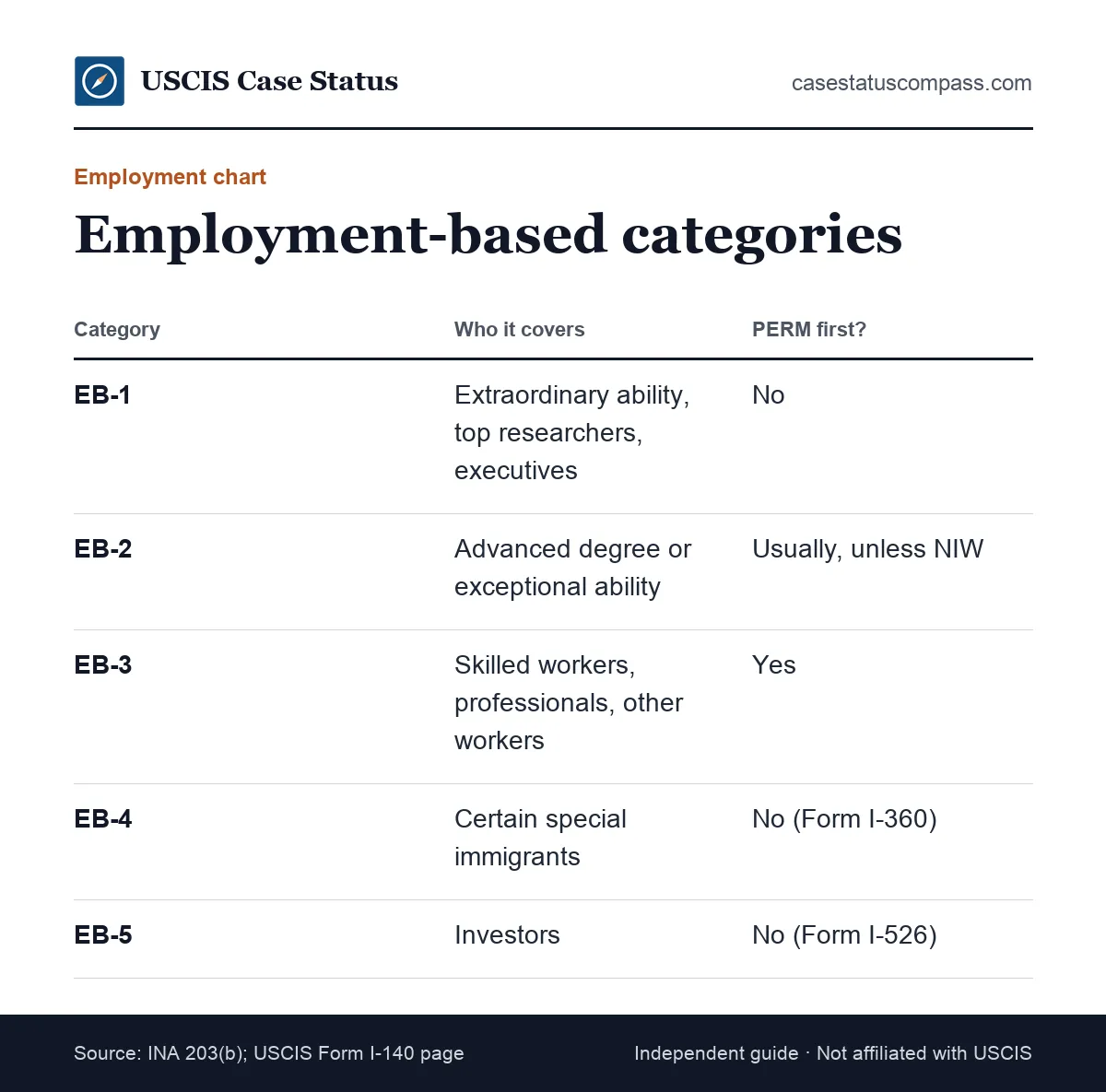
The employment chart lists five preference levels, EB-1 through EB-5, with some sub-lines such as "other workers" under EB-3. Your category on the I-140 approval tells you which row to read. Employment rows often differ sharply by country, so check the India, China, Mexico and Philippines columns if you were born there.
EB-1 and EB-1A priority dates
EB-1 covers people of extraordinary ability (often called EB-1A; an EB1A priority date works the same way), outstanding professors and researchers, and multinational executives and managers. No PERM is required, so the EB-1 priority date is the I-140 filing date. EB-1 usually moves faster than other lines, but India and China often have their own cutoffs: EB-1 India is Feb. 1, 2023 on the November 2026 Final Action chart.
EB-2 priority dates
EB-2 covers advanced degree holders and people of exceptional ability. Most EB-2 cases need PERM, so the EB2 visa priority date is the DOL filing date. A National Interest Waiver skips PERM, so its date is the I-140 date. Our Form I-140 guide explains each EB category.
EB-3 priority dates
EB-3 covers skilled workers, professionals and other workers, and it always starts with PERM. The EB3 visa priority date is the DOL acceptance date. "Other workers" can have a separate cutoff from skilled workers.
EB-4 and EB-5
EB-4 covers certain special immigrants, such as religious workers, and uses Form I-360. EB-5 covers investors and uses Form I-526; its chart includes set-aside lines. Both categories can have country-specific cutoffs. EB-5 investors should read the line that matches their project type.
Employment-based Final Action Dates chart
This chart shows the November 2026 cutoff for final approval in each employment line. Your I-140 or I-526 category decides the row.
| Category | All areas | China (mainland-born) | India | Mexico | Philippines |
|---|---|---|---|---|---|
| EB-1 | Current | Aug. 1, 2023 | Feb. 1, 2023 | Current | Current |
| EB-2 | Apr. 1, 2025 | Oct. 1, 2021 | Nov. 1, 2013 | Apr. 1, 2025 | Apr. 1, 2025 |
| EB-3 | June 15, 2024 | Jan. 22, 2022 | Jan. 22, 2014 | June 15, 2024 | Aug. 15, 2023 |
| EB-3 Other Workers | June 1, 2022 | Oct. 1, 2019 | Jan. 22, 2014 | June 1, 2022 | Jan. 1, 2022 |
| EB-4 | Dec. 15, 2022 | Dec. 15, 2022 | Dec. 15, 2022 | Dec. 15, 2022 | Dec. 15, 2022 |
| Certain Religious Workers | Dec. 15, 2022 | Dec. 15, 2022 | Dec. 15, 2022 | Dec. 15, 2022 | Dec. 15, 2022 |
| EB-5 Unreserved | Current | Dec. 1, 2016 | Dec. 1, 2023 | Current | Current |
| EB-5 Rural (20%) | Current | Current | Current | Current | Current |
| EB-5 High Unemployment (10%) | Current | Current | Current | Current | Current |
| EB-5 Infrastructure (2%) | Current | Current | Current | Current | Current |
Employment-based Dates for Filing chart
This chart shows when workers may file Form I-485 or begin consular steps in November 2026, if allowed.
| Category | All areas | China (mainland-born) | India | Mexico | Philippines |
|---|---|---|---|---|---|
| EB-1 | Current | July 1, 2024 | July 1, 2024 | Current | Current |
| EB-2 | Mar. 15, 2026 | Jan. 1, 2023 | Jan. 15, 2015 | Mar. 15, 2026 | Mar. 15, 2026 |
| EB-3 | Aug. 1, 2024 | Apr. 1, 2024 | Jan. 15, 2015 | Aug. 1, 2024 | Jan. 1, 2024 |
| EB-3 Other Workers | July 1, 2022 | Oct. 1, 2020 | Jan. 15, 2015 | July 1, 2022 | June 1, 2022 |
| EB-4 | Jan. 1, 2025 | Jan. 1, 2025 | Jan. 1, 2025 | Jan. 1, 2025 | Jan. 1, 2025 |
| Certain Religious Workers | Jan. 1, 2025 | Jan. 1, 2025 | Jan. 1, 2025 | Jan. 1, 2025 | Jan. 1, 2025 |
| EB-5 Unreserved | Current | Mar. 1, 2021 | May 1, 2024 | Current | Current |
| EB-5 Rural (20%) | Current | Current | Current | Current | Current |
| EB-5 High Unemployment (10%) | Current | Current | Current | Current | Current |
| EB-5 Infrastructure (2%) | Current | Current | Current | Current | Current |
How Many Green Cards Are Available Each Year?
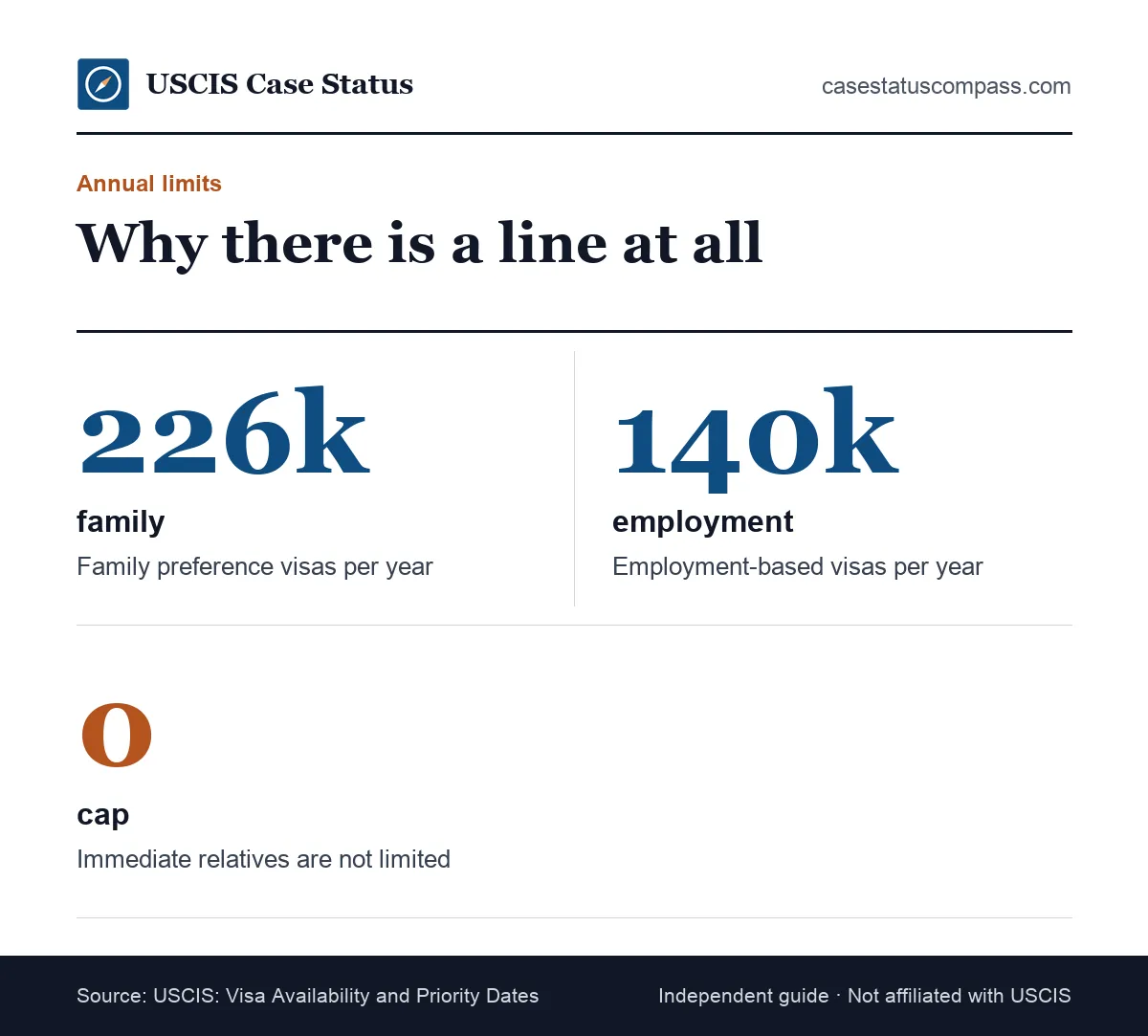
Preference green cards are capped by law each year. Yearly limits: 226,000 family preference visas; 140,000 employment-based. When more people qualify than numbers exist, the bulletin sets cutoff dates to ration them. Immediate relatives do not count against these limits. Unused family numbers can, under the law's formula, add to the next year's employment total, which is one reason yearly movement varies.
Limits by category and country
The yearly totals are split among the preference categories. The per-country limit is 7% of the yearly family and employment preference limits, or 25,620 visas. When demand from one country is greater than its share, that country gets its own cutoff, which is why four countries have separate columns.
What Is Chargeability and Why Does Your Country Matter?
Chargeability is the country your visa number counts against. It is usually your country of birth, not your citizenship or where you live. Because of per-country caps, people born in high-demand countries often face later cutoffs than the "All Chargeability Areas" column shows.
Country of birth, not passport
A person born in India who later became a Canadian citizen usually reads the India column. Someone born in Canada who lives in India reads the general column. If your I-797 shows a different country than you expect, ask your attorney before you file.
What Is Cross-Chargeability in the Visa Bulletin?
In some cases you may be charged to your spouse's country of birth if it has a better cutoff. This is called cross-chargeability. It can shorten the wait for someone born in a high-demand country, but it has conditions, so ask an attorney or accredited representative before relying on it.
Why Are India and China Priority Dates So Far Behind?
India and China have very high demand in several employment categories, especially EB-2 and EB-3, and per-country caps hold them back. That is why searches for "EB-2 green card India priority date" or "EB1 green card priority date India" turn up later cutoffs than the general column.
What it means for workers born in India
On the November 2026 Final Action chart, EB-2 India is Nov. 1, 2013, against Apr. 1, 2025 for most countries, and EB-3 China is Jan. 22, 2022. An Indian-born worker may wait years. Our green card processing time guide explains how this wait adds to USCIS processing.
What Is Visa Retrogression?
Retrogression happens when a cutoff date moves backward, or when a category that was current gets a cutoff again. USCIS says it generally happens when the yearly limit for a category or country has been used up. Dates often recover when the new fiscal year starts on October 1, though not always.
What Happens to a Pending I-485 During Retrogression?
If your date retrogresses after you file, the I-485 usually stays pending. USCIS cannot approve it until the date is current again on the Final Action chart. You can usually keep using any work permit or travel document you already have, as long as it is valid.
Signs a line may retrogress
- Warnings in the bulletin's closing notes
- A category that jumped far ahead in recent months
- Late fiscal-year months, July to September
If you see these signs and your date is current, file promptly rather than waiting.
Visa Bulletin Predictions: Can Anyone Forecast Dates?
No one can reliably forecast exact cutoffs. Visa bulletin predictions from blogs and law firms are educated guesses. The most useful forecasts come from the State Department itself, which sometimes adds notes about expected movement at the end of a bulletin.
Third-party forecasts and trackers
Private trackers and "predictions" pages can help you see past trends. They cannot see how many people are waiting in each line. Treat any forecast as one opinion, and never pay for a "guaranteed" date.
Is There an Official Visa Bulletin Forecast?
Not a formal one, but the State Department's own notes come closest. Read the full bulletin, not just the tables. The closing sections sometimes describe expected movement, warn of retrogression or explain unusual changes. These notes are the closest thing to an official visa bulletin forecast.
The October Visa Bulletin and the New Fiscal Year
The October visa bulletin starts the federal fiscal year, when a new set of yearly visa numbers becomes available. Lines that stalled or went "U" in late summer often reopen or advance in October. For fiscal year 2027, USCIS chose the Dates for Filing chart in both October and November 2026.
Why October matters
Because the yearly caps reset, October can bring large moves in either direction, though some lines hold still while the State Department measures new demand. Read the October notes carefully and check the USCIS chart page, since the choice of chart can change at the same time.
How the Visa Bulletin Fits Into a Family Green Card Case
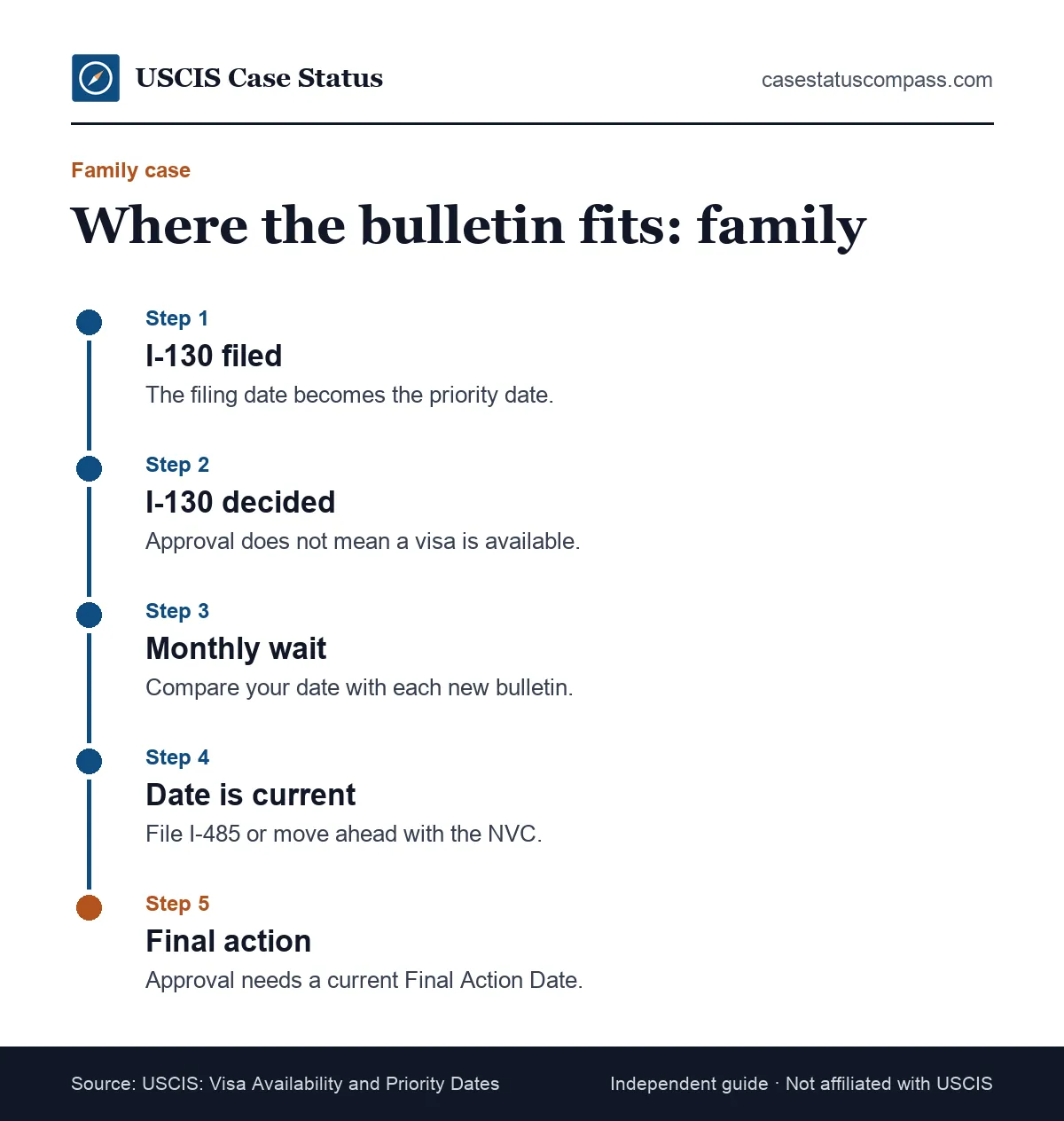
In a family preference case, the bulletin controls the gap between I-130 approval and the green card step. The relative files the I-130, waits for a decision, then waits again until the priority date is current. Only then can the relative file Form I-485 or go to NVC.
The petition stage
USCIS decides the I-130 first. For immediate relatives, USCIS's median was I-130 (immediate relative): median 13.0 months (USCIS data, Apr.-June 2026). Preference petitions often take longer. Our I-130 processing time page explains how to read the official tool. The petition and the queue often overlap.
The queue stage
After approval, nothing visible happens in your case status while you wait for a current date. That silence is normal; the bulletin tells you when the wait ends. Keep checking your cell each month and keep your address current with USCIS.
How the Visa Bulletin Fits Into an Employment Green Card Case
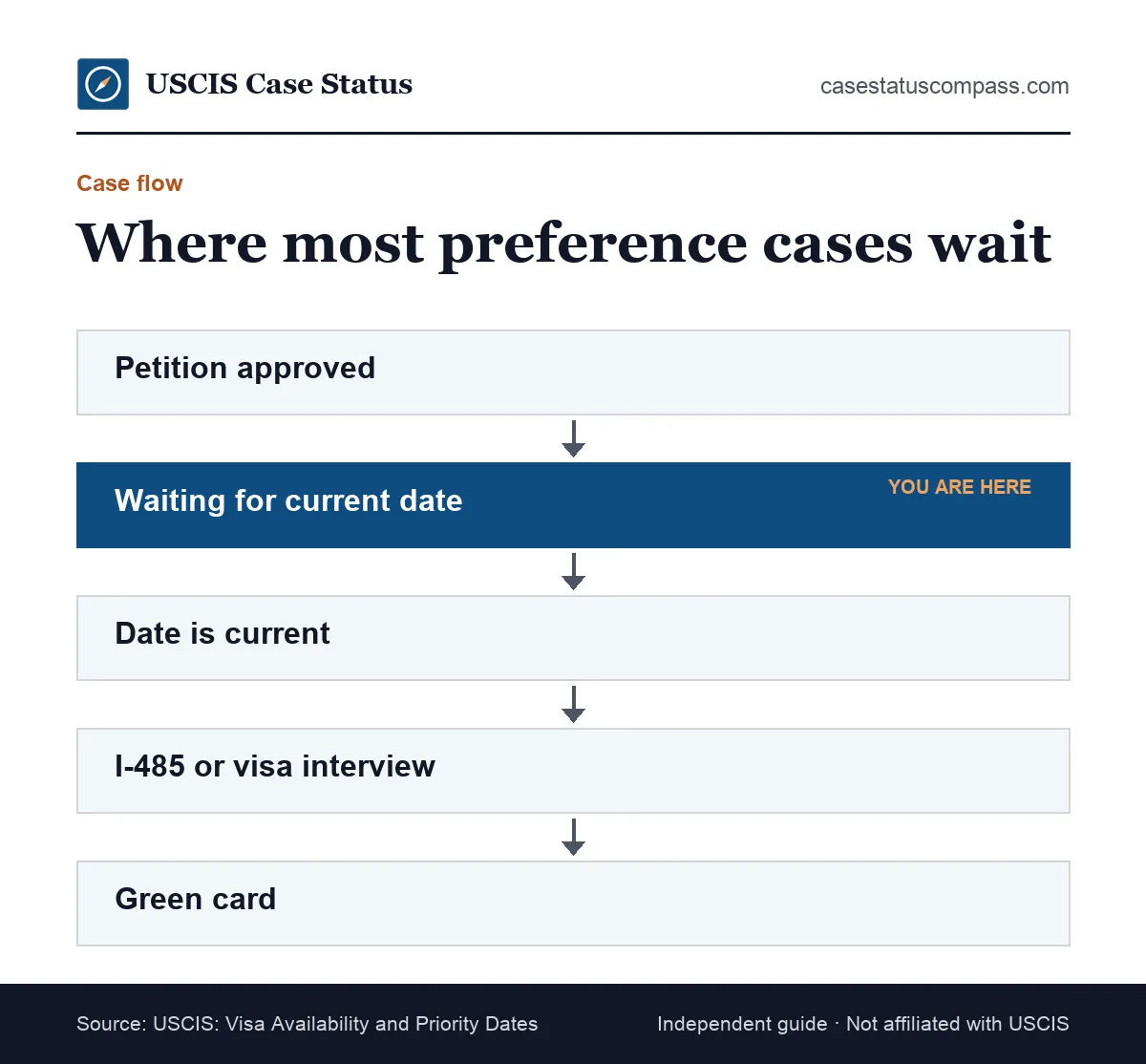
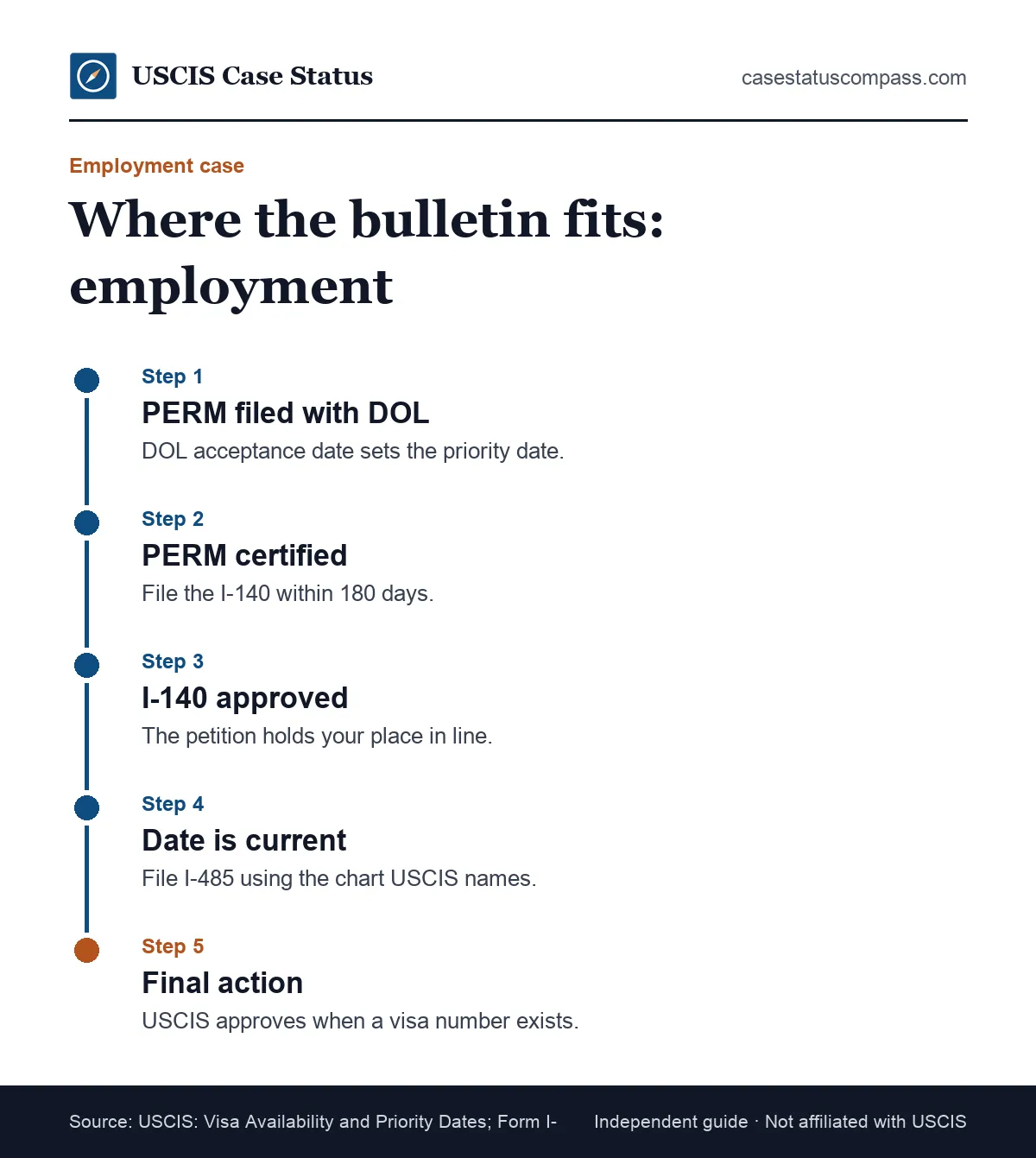
In most job-based cases, the bulletin comes into play after PERM and Form I-140. The employer files PERM with DOL, which sets the priority date. Then the I-140 must be filed in time, and the worker waits for a current date before filing the I-485 or going through a consulate.
From PERM to I-140
A PERM labor certification expires 180 days after DOL certifies it. The employer should file the I-140 well before then, or the priority date can be lost. Our PERM case status guide covers the DOL stage. Once the I-140 is approved, the priority date usually stays with the worker.
Can You File Form I-485 Together With Form I-140?
If your date is already current when the I-140 is filed, you can usually file the I-485 at the same time, which is called concurrent filing. USCIS's median for I-140 decisions was I-140: median 3.9 months (USCIS data, Apr.-June 2026), so a current date can make the whole case much shorter.
What Can You Do While Your Priority Date Is Not Current?
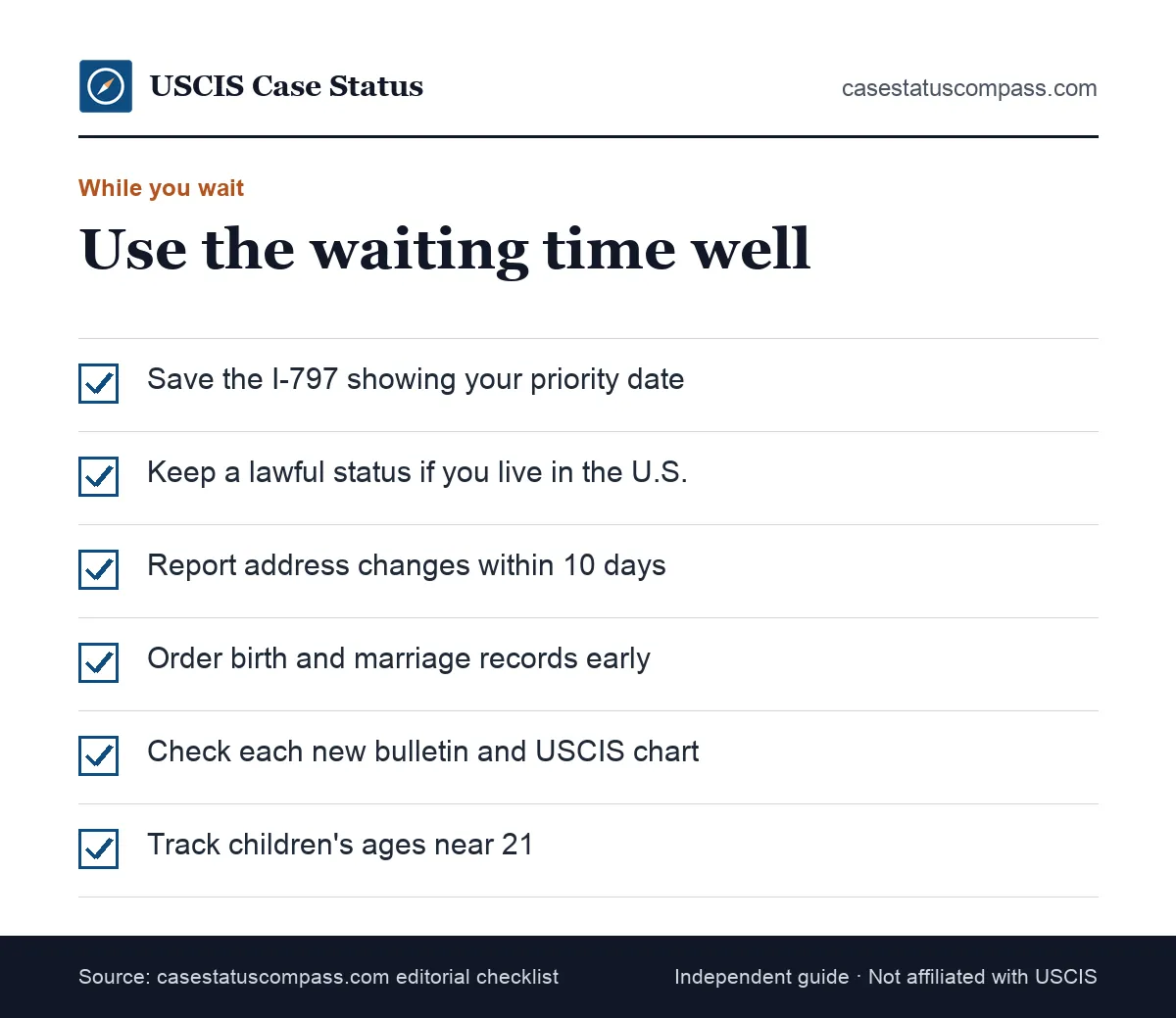
While you wait, keep the case ready and your record clean. Save the I-797 with your priority date, keep a lawful status if you live in the U.S., update your address with USCIS and gather civil documents. People in the U.S. should keep a valid nonimmigrant status, because a gap can block adjustment later. Use the time to fix any errors in names or dates across your records.
Keep your address current
Report a new address to USCIS within 10 days of moving (INA 265). Petitioners and beneficiaries should both keep USCIS updated, because notices go to the address on file. Our change of address guide explains how. A missed notice can cost you months.
Prepare documents early
Order birth certificates, marriage certificates and police records ahead of time. For family cases, the petitioner can start lining up an affidavit of support and income records. Some records expire or take months to arrive.
What Happens When Your Priority Date Becomes Current?
When your date becomes current, you can take the next step. Inside the U.S., you may file Form I-485 if you are otherwise eligible. Abroad, the NVC moves your case toward an interview. Either way, approval waits until your date is current under the Final Action chart.
If you are in the U.S.
File promptly, using the correct edition and the chart USCIS names. The I-485 fee as of October 2026 is $1,440 (paper) / $1,390 (online); $950 / $900 if under 14 and filing with a parent. Do not leave the country while it is pending without the right travel document; see our guide to advance parole.
If you are abroad
Pay the immigrant visa fee and submit documents when NVC asks. The State Department fee is Immigrant visa fee: $325 family; $345 employment; $205 other (per person). Then follow your embassy's interview and medical exam instructions, and check our NVC case status guide for the document review stage.
Can a Child Age Out While Waiting?
Yes. Many categories cover children only while they are under 21 and unmarried. A long wait can push a child past 21, which may move them to another category or out of the case. A federal law, the Child Status Protection Act, can protect some children.
Why age matters in the bulletin
F2A covers children under 21, and derivative children in most categories must also be under 21. A child who ages out may need a new petition with a new, later priority date.
Get advice early
Age-out math depends on filing dates, approval dates and when the visa became available. Ask an immigration attorney or accredited representative well before a child's 21st birthday. Note each child's birth date in your log.
Is There a Green Card Priority Date Calculator?
No official green card priority date calculator exists. Private tools that estimate a date use past movement, which may not repeat. A better approach is to track how far your line has moved over the past year and treat any estimate as a rough range, not a date.
A safer way to estimate
Write down the cutoff for your cell in each bulletin for 12 months, divide the movement by 12 for a monthly average, and compare that with the gap to your date. A line that moved six months in a year and sits three years from your date suggests a long wait, but movement is rarely steady.
A Priority Date Tracking Log You Can Copy
A simple log turns twelve separate bulletins into a clear trend. Record the month, the chart USCIS named, your cell's date on both charts and the action you took. The table below is a template; fill it in yourself from the official sources.
Template
Copy this layout into a spreadsheet or notebook, then add one row each time a new bulletin appears.
| Bulletin month | Chart USCIS named | Final Action date in your cell | Date for Filing in your cell | Current for you? | Action taken |
|---|---|---|---|---|---|
| November 2026 | Dates for Filing | (copy from bulletin) | (copy from bulletin) | Yes / No | |
| December 2026 | (check USCIS page) | ||||
| January 2027 | (check USCIS page) |
What to add to the log
Add your category, chargeability country and priority date at the top. Note any State Department comments about your line. Add a column for the date you checked, and record any notice you receive, such as an NVC invitation.
How Long Does It Take After Your Date Becomes Current?
Once your date is current and you file, normal USCIS or consular processing begins. USCIS's medians for April to June 2026 were I-485 (family): median 7.0 months (USCIS data, Apr.-June 2026) and I-485 (employment): median 6.0 months (USCIS data, Apr.-June 2026). These are medians, not promises, and the live tool measures a different figure. For consular cases, the embassy's schedule decides how fast the interview follows.
The live tool
The USCIS tool shows how long it took to finish 80% of cases in the past 6 months. Right now, family and employment I-485 cases take 8.5 to 42.5 months, depending on category and office (USCIS data retrieved Oct 27, 2026). Check the official tool for your field office, because times vary by location and form category. If your case is older than the time shown, you may submit a case inquiry.
What If USCIS Finishes Review Before Your Date Is Current?
If you filed under Dates for Filing, USCIS may finish its review before your date is current for final action. Your case then waits until a visa number is available, and the case status may not change during that time. Our I-140 processing time page explains the petition side.
Common Visa Bulletin Reading Mistakes
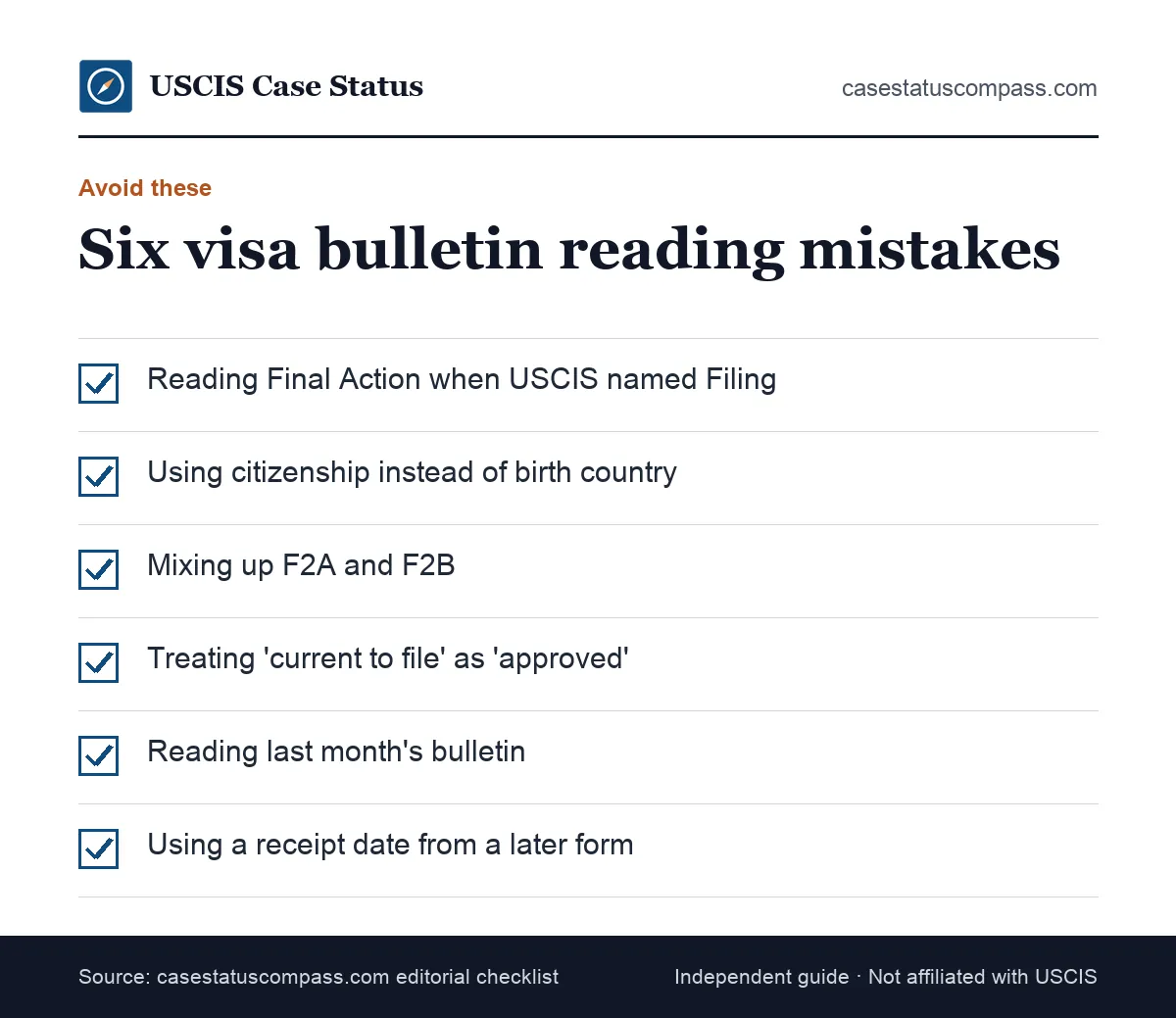
Most reading errors come from the wrong chart, the wrong country column or the wrong category row. Other mistakes include reading an old month, using a receipt date from a later form, or treating "current to file" as "approved". Each of these can lead to a rejected filing or a missed chance.
Wrong chart
People often read Final Action Dates when USCIS named Dates for Filing, or the other way round. Confirm the chart on the USCIS page for that same month before you file.
Wrong priority date
Your priority date comes from the first filing in the case, not the I-485 or work permit receipt. In PERM cases it is the DOL date, not the I-140 date.
Wrong row or column
F2A and F2B sit next to each other but are different categories. The country column is usually your birth country. A one-row slip can give the wrong answer by years. Check the chart title, category row and country column.
Real-World Visa Bulletin Scenarios
These scenarios use fictional people to show how the rules apply; your own case may differ. Each shows a different category, so look for the one closest to yours. Each starts the same way: find the priority date, then the right row and column.
Ana, F2A spouse of a green card holder
Ana's husband, a permanent resident, filed an I-130 for her while she lives abroad. Her priority date is the I-130 filing date. Each month she checks the F2A row and her birth country. When NVC invites documents, she submits them early.
Raj, EB-2 worker born in India
Raj's employer filed PERM, then an approved I-140, so Raj reads the EB-2 row in the India column. His date is not yet current, so he keeps his H-1B status and logs the cutoff monthly.
Lena, F1 daughter planning a wedding
Lena, the unmarried adult daughter of a citizen, is in F1. Marrying would move her to F3, so she talks to an attorney before setting a date. She also checks how the F3 cutoff compares with F1 for her birth country.
If X, Do Y: Visa Bulletin Decision Table
Use this table to match your situation with a next step. It is general information, not legal advice. Each row assumes you already know your category, chargeability country and priority date. When in doubt, check the official pages first.
Situations and next steps
Find the line closest to your situation, then follow the step in the right column.
| If this is true | Then do this |
|---|---|
| Your date is earlier than the cutoff on the chart USCIS names | Prepare and file Form I-485 if you are otherwise eligible |
| You are abroad and NVC invites documents | Pay fees and submit documents promptly |
| Your category shows "C" | You are current this month; act before it changes |
| Your category shows "U" | Wait; no numbers are available this month |
| Your date retrogressed after you filed | Keep the I-485 pending and keep your documents valid |
| You are an immediate relative | Ignore the bulletin; file when otherwise eligible |
| A child is close to 21 | Get legal advice about age-out protection now |
Other Agencies and Trackers You May Need
The bulletin is only one part of the green card path. USCIS tracks your petitions, the NVC and consulates handle visa cases abroad, and immigration court handles removal cases. Each has its own tool and number, and none of them shows the bulletin. Keep a list of which agency holds each part of your case.
If you have a court case
People in removal proceedings deal with the Executive Office for Immigration Review (EOIR), not USCIS. Our immigration court case status guide explains that system. A judge may handle the green card request in court.
After your green card arrives
Once approved, you become a lawful permanent resident with new rights and duties. That guide covers travel limits, card replacement and the path to citizenship. Keep your I-797 notices too.
When Should You Get Legal Help With Priority Dates?
Get legal help when your category may change, a child is near 21, a petition was revoked or withdrawn, you are thinking of switching EB categories, or you have any past immigration violation. These issues can cost you your place in line. Choose a licensed attorney or DOJ-accredited representative.
Warning signs of a scam
No one can buy, sell or speed up a priority date, whatever a paid "faster line" offer claims. Official cutoffs come only from the State Department and USCIS pages.
Frequently Asked Questions
What is a priority date?
A priority date is your place in line for a family or employment preference green card. For family cases it is the date USCIS received Form I-130. For job-based cases it is usually the PERM or I-140 date. It appears on your I-797 notice.
Does the visa bulletin apply to spouses of U.S. citizens?
No. Spouses, unmarried children under 21 and parents of adult U.S. citizens are immediate relatives. Their visas are not capped, so they never wait for a cutoff date. They still wait for normal USCIS or consular processing.
Which visa bulletin chart does USCIS accept in November 2026?
For November 2026, USCIS says applicants in all family and employment preference categories must use the Dates for Filing chart for Form I-485, with a narrow Final Action exception.
Can I check my priority date on the USCIS case status tool?
Not directly. The USCIS tool shows actions on one filing, such as an approval, but it does not tell you whether a visa number is available. Find your priority date on your I-797 notice, then compare it with the monthly bulletin from the State Department.
Why did my priority date move backward?
Cutoffs move backward, called retrogression, when demand in a category or country uses up the yearly numbers. A pending I-485 usually stays pending until the date is current again.
Is the I-140 priority date the same as the PERM date?
Usually, yes. When PERM labor certification is required, the priority date is the day DOL accepted the PERM application. When no PERM is needed, as in EB-1, it is the day USCIS accepted the I-140.
What does it mean when a priority date is current?
It means your date is earlier than the cutoff for your category and country on the chart that applies, or the cell shows "C". You may take the next step that month, but approval still waits for the Final Action chart.
Does my priority date change if I file a new form?
Usually no. The priority date comes from the original petition or labor certification, and filing an I-485, a work permit or a travel document does not create a new one. A new petition in a different case may get its own date unless an earlier one can be kept.
Sources
- U.S. Department of State: Visa Bulletin. travel.state.gov/content/travel/en/legal/visa-law0/visa-bulletin.html. Accessed Oct 27, 2026.
- USCIS: Adjustment of Status Filing Charts from the Visa Bulletin (updated 10/05/2026). www.uscis.gov/green-card/green-card-processes-and-procedures/visa-availability-priority-dates/adjustment-of-status-filing-charts-from-the-visa-bulletin. Accessed Oct 27, 2026.
- USCIS: Visa Availability and Priority Dates. www.uscis.gov/green-card/green-card-processes-and-procedures/visa-availability-priority-dates. Accessed Oct 27, 2026.
- INA 203 / 8 U.S.C. 1153: Allocation of Immigrant Visas. www.law.cornell.edu/uscode/text/8/1153. Accessed Oct 27, 2026.
- USCIS: Form I-140 page. www.uscis.gov/i-140. Accessed Oct 27, 2026.
- USCIS Data Library: All Forms, FY2026 Q3. www.uscis.gov/sites/default/files/document/data/quarterly_all_forms_fy2026_q3_v1.xlsx. Accessed Oct 27, 2026.
- USCIS Form G-1055 Fee Schedule, Edition 10/16/26. www.uscis.gov/sites/default/files/document/forms/g-1055.pdf. Accessed Oct 27, 2026.
- USCIS processing times. egov.uscis.gov/processing-times/. Accessed Oct 27, 2026.
- USCIS: How to Change Your Address (updated 08/04/2026); 8 U.S.C. 1305(a) (LII). www.uscis.gov/addresschange. Accessed Oct 27, 2026.
- 22 CFR 22.1 Schedule of Fees for Consular Services (LII). www.law.cornell.edu/cfr/text/22/22.1. Accessed Oct 27, 2026.
- CIS Ombudsman tip sheet: Check Your USCIS Case Inquiry Date (Aug. 2024). dhs.gov/sites/default/files/2024-11/24_0823_cisomb_case-inquiry-date-tip-sheet.pdf. Accessed Oct 27, 2026.
casestatuscompass.com is an independent publication and is not affiliated with USCIS or any government agency. This page is general information, not legal advice. For denials, court or asylum matters, consult an immigration attorney or a DOJ-accredited representative.