Contents · 40 sections
- What Is the Current I-140 Processing Time?
- How Long Does It Take for I-140 Approval?
- Median vs 80% Figure: Two Ways USCIS Measures Time
- Is the I-140 Getting Faster or Slower?
- How Do You Check the I-140 Current Processing Date?
- I-140 Processing Timeline: Stage by Stage
- I-140 Timeline Estimator: From Filing Date to Milestones
- NIW Processing Time
- What Is the NIW Waiting Time Without Premium?
- How Long Does a National Interest Waiver Take With Premium?
- EB-1 Processing Time
- How Long Does an EB-1A Petition Take?
- What Is the EB-1 Wait Time After I-140 Approval?
- What Is the Total EB1 GC Processing Time?
- EB-2 Visa Timeline: From PERM to Green Card
- How Long Does an EB-3 I-140 Take?
- Regular vs Premium Processing
- How Long Does I-140 Take With Premium Processing?
- How Much Does Premium Processing Cost for an I-140?
- Can You Upgrade a Pending I-140 to Premium?
- Did the October 2026 Address Change Affect I-907 Upgrades?
- Wait Times by Country
- What Are EB-1 Wait Times in the USA for Indian Applicants?
- EB-2 NIW Processing Time by Country
- What Makes an I-140 Take Longer?
- How Does an RFE Change the I-140 Timeline?
- Does Concurrent Filing Change I-140 Processing Time?
- Which USCIS Office Handles Your I-140?
- How Do You Know If Your I-140 Is Outside Normal Processing Time?
- What Should You Do If Your I-140 Is Delayed?
- Can You Expedite an I-140?
- When Is an I-140 Delay Worth an Ombudsman or Congressional Request?
- How Long After I-140 Approval Do You Get a Green Card?
- How the PERM Wait Fits Before the I-140
- I-140 Case Status Messages and What They Mean for Timing
- Planning Your Employment Green Card Around the I-140 Clock
- I-140 Processing Time Mistakes to Avoid
- I-140 Processing Time Quick Reference
- What This Page Can and Cannot Tell You
- Frequently Asked Questions
At a glance
| Latest official median | I-140: median 3.9 months (USCIS data, Apr.-June 2026) |
| A year earlier | 6.4 months (July–Sept. 2025, USCIS data) |
| Live tool figure | 3 to 32.5 months, depending on category and office (USCIS data retrieved Oct 27, 2026) |
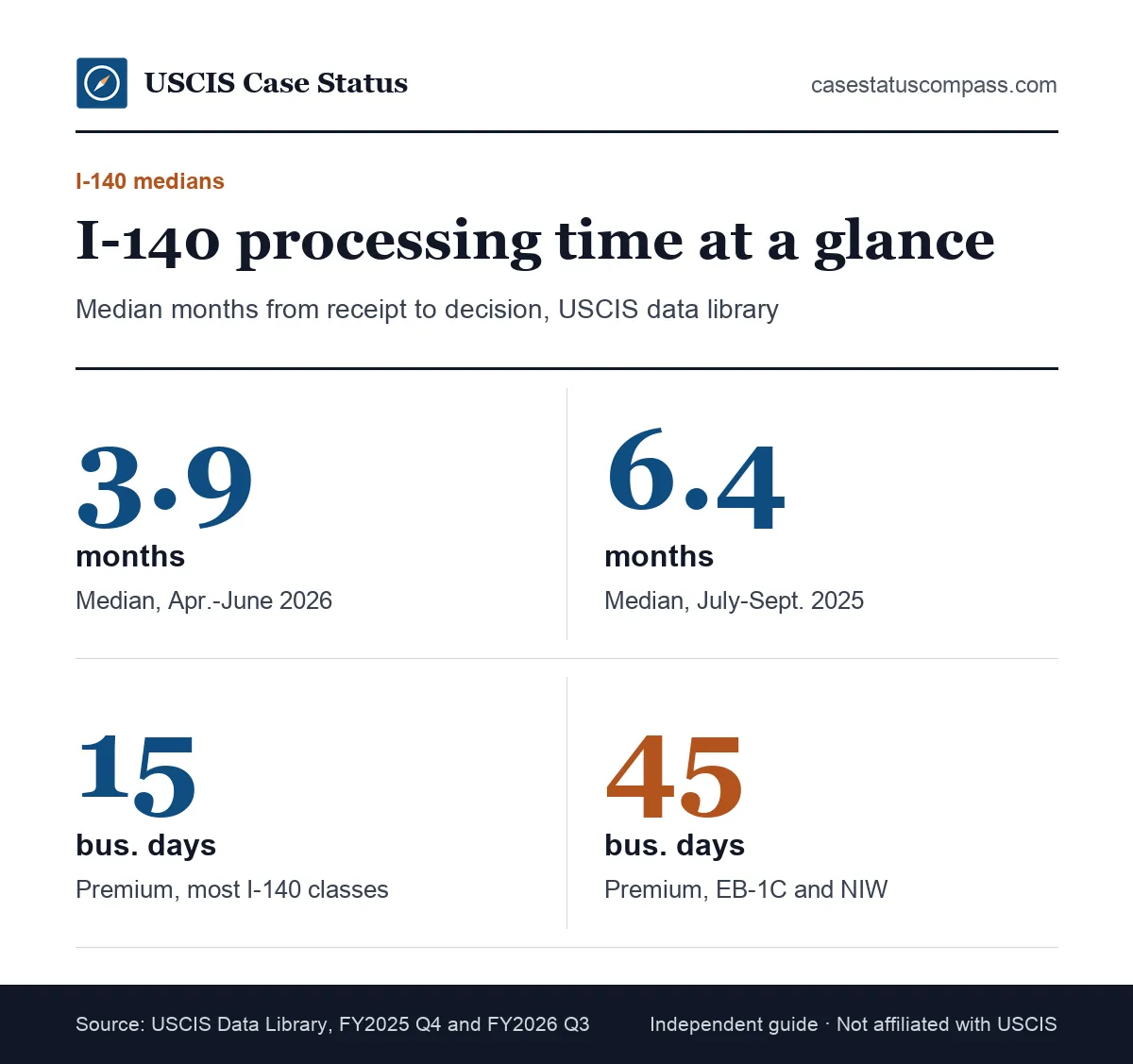
| Premium processing | 15 business days (most); 45 (EB-1C, NIW) |
| Premium fee (Oct. 2026) | $2,965 for EB-1, EB-2 and EB-3 petitions |
What Is the Current I-140 Processing Time?
The current I-140 processing time, measured by USCIS's latest quarterly data, is a median of 3.9 months for petitions completed from April 1 to June 30, 2026. Right now, most I-140 cases take 3 to 32.5 months, depending on category and office (USCIS data retrieved Oct 27, 2026).
The latest official median
For Form I-140, Immigrant Petition for Alien Workers, the FY2026 Q3 line reads I-140: median 3.9 months (USCIS data, Apr.-June 2026). That number covers every I-140 category combined, not EB-1 or NIW alone.
What the median does not cover
The median stops at the I-140 decision. It leaves out the PERM step before filing, any Visa Bulletin wait after approval and the final I-485 or immigrant visa stage. Add those separately.
The live tool table
The table shows the tool's figures by category and office. If you see a fallback sentence, open the tool and pick the line matching your receipt notice.
| Category | Office | 80% of cases completed within |
|---|---|---|
| Advanced degree or exceptional ability (E21) | Service Center Operations (SCOPS) | 3 months |
| Advanced degree or exceptional ability requesting a National Interest Waiver (NIW) | Service Center Operations (SCOPS) | 30 months |
| Extraordinary ability (E11) | Service Center Operations (SCOPS) | 32.5 months |
| Multinational executive or manager (E13) | Service Center Operations (SCOPS) | 27.5 months |
| Outstanding professor or researcher (E12) | Service Center Operations (SCOPS) | 15 months |
| Schedule A Nurses | Service Center Operations (SCOPS) | 25.5 months |
| Skilled worker or professional (E31; E32) | Service Center Operations (SCOPS) | 4 months |
| Unskilled worker (EW3) | Service Center Operations (SCOPS) | 9 months |
How Long Does It Take for I-140 Approval?
For a regular petition, I-140 approval usually takes a few months: USCIS finished half of the petitions it decided in April to June 2026 within 3.9 months of receipt. The rest took longer, depending on category, office and any RFE.
What "half within 3.9 months" means
If 1,000 petitions were decided in the quarter, about 500 took 3.9 months or less and about 500 took more. The median says nothing about how much longer the slower half took, so a petition at month five is not necessarily late.
I-140 approval time with an RFE
An RFE usually moves a petition into the slower half. You get up to 12 weeks to reply, and review resumes only after USCIS receives your answer, so plan in months.
Median vs 80% Figure: Two Ways USCIS Measures Time
USCIS reports two numbers. The data library gives the median, the time to finish 50% of cases completed in a quarter. The online tool shows how long it took to finish 80% of cases in the past six months. The 80% figure is usually longer.
How the median is defined
USCIS counts from receipt to completion, for cases finished in the quarter only. The data is released quarterly and runs about three to four months behind, so a median always describes the past.
How the tool figure is defined
The live tool works differently: The USCIS tool shows how long it took to finish 80% of cases in the past 6 months. USCIS also says that figure does not predict when your specific case will be decided.
The three USCIS timing numbers compared
Each row names one official number, where you find it and the question it answers.
| Measure | Where it appears | What it counts | Best use |
|---|---|---|---|
| Median | USCIS data library (quarterly) | 50% of cases completed in a quarter | Trend over time |
| 80% figure | egov.uscis.gov processing times tool | 80% of cases in the past 6 months | Is my wait normal? |
| Case inquiry date | Same tool, "When can I ask?" box | Earliest date to ask about a case | When to contact USCIS |
Only the case inquiry date decides when USCIS will take your question.
Is the I-140 Getting Faster or Slower?
The I-140 got faster over the past year. USCIS's median fell from 6.4 months in July–September 2025 to 3.9 months in April–June 2026. Many other forms slowed in that period. That makes the I-140 an outlier, but the drop is national and may not hold at your office.
Year-over-year comparison
The table sets the I-140 median beside other forms for the same two quarters.
| Form | July–Sept. 2025 median | Apr.–June 2026 median | Direction |
|---|---|---|---|
| I-140 | 6.4 months | 3.9 months | Faster |
| I-485 (employment) | 7.5 months | 6.0 months | Faster |
| I-129 (all classes) | 3.6 months | 9.5 months | Slower |
| N-400 | 5.7 months | 9.5 months | Slower |
Takeaway: the I-140 fell by 2.5 months while most other lines rose.
Why a shorter median is not a promise
A falling median does not lock in that speed. Staffing and filing surges can push times back up. A median also hides how the slower half fared, so recheck the next quarterly release before you count on a short I-140 processing time.
Reading the trend with the live tool
Check whether your office's tool line has also fallen. A national median can drop while one office stays slow, so the office figure is the safer guide for one petition.
How Do You Check the I-140 Current Processing Date?
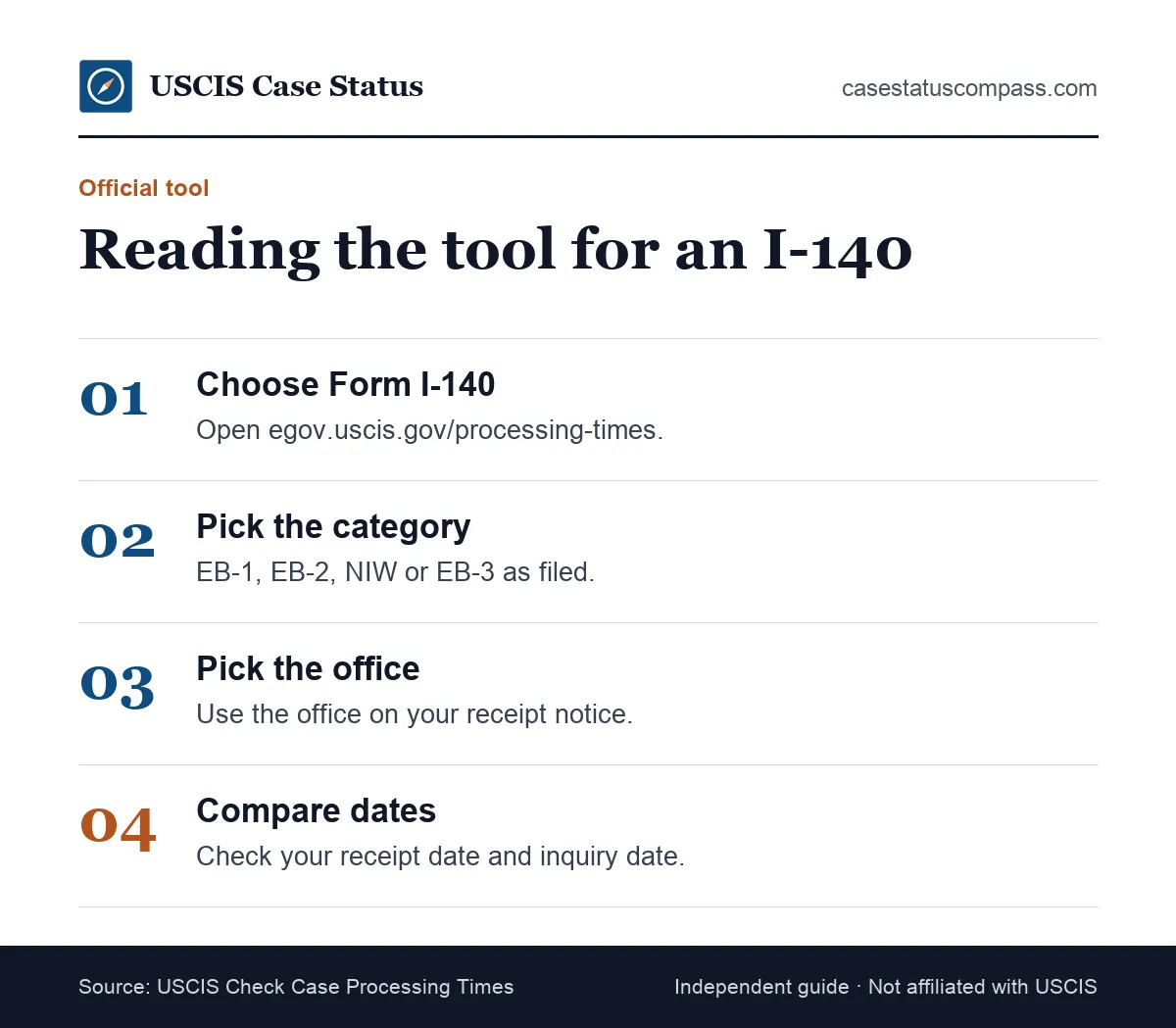
Check the I-140 current processing date in the official tool at egov.uscis.gov/processing-times. Select Form I-140, then your category, then the office on your receipt notice. The tool returns a time range and a case inquiry date for your receipt date.
Step by step in the tool
- Find your receipt notice and note the receipt date and office.
- Open the tool and choose "I-140" from the form list.
- Pick the classification that matches your filing.
- Pick the office, then enter your receipt date if asked.
- Read the time shown and the "When can I ask about my case?" date.
Matching the right category
The tool splits I-140 into separate lines by classification. Choosing "EB-2" when you filed an NIW, or "EB-1" when you filed EB-1C, gives a misleading answer. Your category code is on the receipt notice.
Matching the right office
Use the office named on your most recent notice, since a transferred petition follows the new office's queue. If no office is listed for your category, the tool may group I-140s under one national line.
I-140 Processing Timeline: Stage by Stage
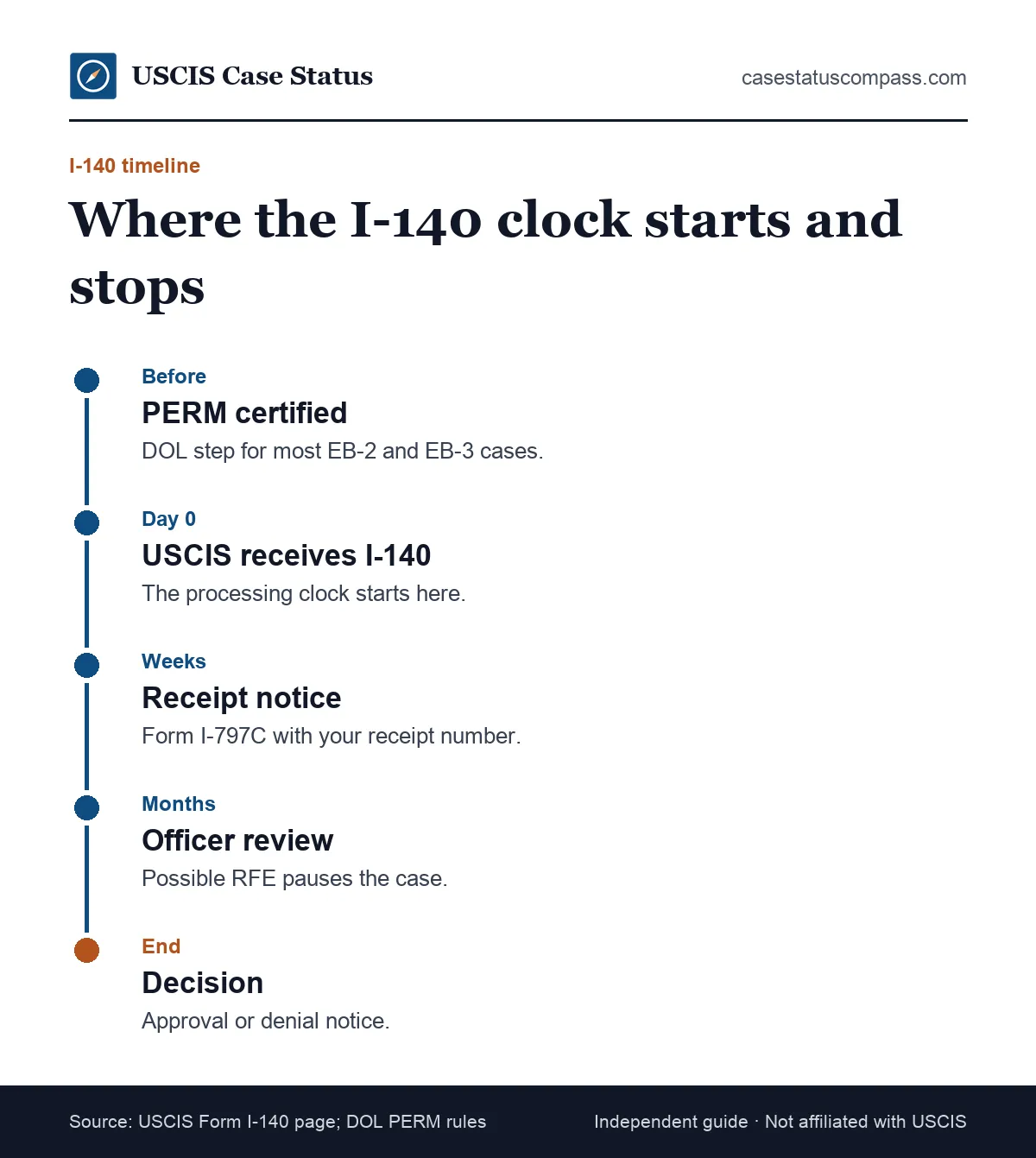
The i140 processing timeline runs in four steps: receipt, receipt notice, officer review and decision, with a pause for any RFE. For most EB-2 and EB-3 cases, a PERM labor certification comes first. EB-1 and NIW filings skip it entirely.
Before the clock starts
Most EB-2 and EB-3 petitions need a certified PERM from the Department of Labor (DOL). See our PERM processing time guide for that stage; the I-140 clock starts only when USCIS receives the petition.
From receipt to decision
The rows follow one petition from the day USCIS receives it to the decision notice.
| Stage | What happens | Typical timing |
|---|---|---|
| Filing | Petition mailed or filed online | Day 0 |
| Receipt notice | Form I-797C with a receipt number | Usually within weeks |
| Review | Officer checks eligibility and evidence | Most of the wait |
| RFE (if any) | You get up to 12 weeks to reply | Adds weeks to months |
| Decision | Approval or denial notice mailed | Median 3.9 months overall |
The officer review row is where most of the months go.
I-140 Timeline Estimator: From Filing Date to Milestones
You can estimate your own milestones by adding known periods to your receipt date: the 3.9-month median, 15 or 45 business days for premium, and up to 12 weeks for an RFE reply. The results are planning dates only.
How to use the estimator
Start with the receipt date on your I-797C receipt notice, not the mailing day, and add the period for your path. If USCIS sends an RFE, restart the estimate from the day USCIS receives your response.
Milestone estimator table
Pick the row for your path and add the period shown to your own receipt date.
| Your path | Add to receipt date | Example: receipt Jan. 12, 2026 |
|---|---|---|
| Regular, median case | About 3.9 months (about 17 weeks) | Around early May 2026 |
| Premium, 15 business days | About 3 calendar weeks | Around Feb. 3, 2026 |
| Premium, 45 business days (EB-1C, NIW) | About 9 calendar weeks | Around mid-March 2026 |
| RFE issued | Up to 12 weeks to reply, then a new review | Push all dates back |
Treat every result as a planning date, not a decision date.
Worked example: EB-2 NIW, regular processing
Priya's NIW petition has a receipt date of March 2, 2026. Adding the overall median of about 3.9 months points to late June 2026. If her NIW line in the tool shows a longer time, she plans around that figure instead.
Worked example: EB-1A with premium
Marco files EB-1A with Form I-907; USCIS receives both on April 6, 2026. Fifteen business days later, around April 27, he should have an approval, denial, RFE or notice of intent to deny. An RFE stops that clock.
NIW Processing Time
The NIW processing time has no separate official median; USCIS reports one combined I-140 figure of 3.9 months for April–June 2026. Check the NIW line in the live tool for your office. Because NIW files are judgment-heavy, the NIW line may run longer than the combined median.
What makes the NIW different
An EB-2 National Interest Waiver skips PERM and the job offer, so you file the petition yourself. The officer must weigh the merit and national importance of your work. Detailed, judgment-heavy petitions tend to draw more RFEs.
Filing an NIW without an employer
Because the waiver removes the job-offer requirement, the foreign national can sign as petitioner. The self-petitioner then controls both the evidence and when the petition is filed. No PERM wait applies.
What Is the NIW Waiting Time Without Premium?
Your NIW waiting time on regular processing is best read from the tool's NIW line, since the published median mixes all categories. If your I-140 processing time passes the tool's figure, use the case inquiry steps further down this page rather than refiling.
How Long Does a National Interest Waiver Take With Premium?
Premium processing is open to NIW petitions, with a 45-business-day clock, roughly nine calendar weeks. The fee is the same as other I-140 premium requests. Our premium processing guide covers the I-907 timeline. An RFE stops that clock, so a complete NIW file matters most.
EB-1 Processing Time
The EB-1 processing time at USCIS is not published separately; the April–June 2026 median of 3.9 months covers all I-140 categories. Under premium processing, EB-1A and EB-1B petitions get a 15-business-day clock and EB-1C managers get 45 business days. Check your line.
How Long Does an EB-1A Petition Take?
EB-1A, for extraordinary ability, is a self-petition with no PERM. A strong EB-1A file can be decided quickly, especially with premium processing. A thin file invites an RFE, which is the biggest single delay. Evidence quality drives the I-140 processing time most.
EB-1B: outstanding researchers
An employer files EB-1B for a professor or researcher. It also skips PERM and uses the 15-business-day premium clock. The employer must offer a qualifying permanent research or teaching role, so the job offer letter is key evidence.
EB-1C: multinational managers
EB-1C petitions use the longer 45-business-day premium window. Officers review the foreign and U.S. roles, the corporate relationship and managerial duties, so company-structure evidence matters most. Clear organization charts help.
What Is the EB-1 Wait Time After I-140 Approval?
The EB-1 wait time after approval depends on the Visa Bulletin, not on USCIS. If your priority date is current, you move to the green card step right away; if not, you wait for the monthly bulletin to reach it.
USCIS time vs visa number time
USCIS decides the petition, then a visa number must be available for your priority date, which for EB-1 is usually the I-140 filing date. A fast I-140 approval does not shorten the second wait.
What Is the Total EB1 GC Processing Time?
The full EB1 GC processing time is the I-140 decision, any wait for a current priority date, and then the last step. In the U.S., the employment-based I-485 median was 6.0 months in April–June 2026. Our green card processing time page covers that last step.
EB-2 Visa Timeline: From PERM to Green Card
The EB-2 visa timeline usually has three waits in a row: DOL's PERM certification, USCIS's I-140 decision (median 3.9 months for April–June 2026), and the green card step once the priority date is current. NIW cases skip the PERM wait but face the same last two waits.
Where the time adds up
Each row is one agency's step, in the order an EB-2 case meets them.
| Stage | Agency | Official timing source |
|---|---|---|
| PERM labor certification | DOL | 336 days (DOL data retrieved Oct 27, 2026) |
| I-140 petition | USCIS | Median 3.9 months (Apr.–June 2026) |
| Priority date becomes current | State Department | Monthly Visa Bulletin |
| I-485 or immigrant visa | USCIS or State Department | I-485 employment median 6.0 months |
The USCIS step is often the shortest of the three.
Keeping the PERM certification valid
A PERM labor certification expires 180 days after DOL certifies it. Missing that window means starting PERM again, which adds far more time than any I-140 delay. Calendar the expiry date.
How Long Does an EB-3 I-140 Take?
An EB-3 I-140 follows the same regular clock as other categories: USCIS's combined median was 3.9 months for April–June 2026. With premium processing, EB-3 petitions for skilled workers, professionals and other workers use the 15-business-day clock. Most EB-3 cases need a certified PERM first.
Skilled workers and professionals
EB-3 skilled worker and professional petitions turn on the job offer, the PERM job requirements and proof the worker meets them. Evidence that matches the PERM wording keeps the review short.
Other workers (EW3)
The "other workers" group (code EW3) is also listed for premium processing. Its I-140 clock is the same, but its visa wait can differ. Check the EW3 row in the bulletin.
Regular vs Premium Processing
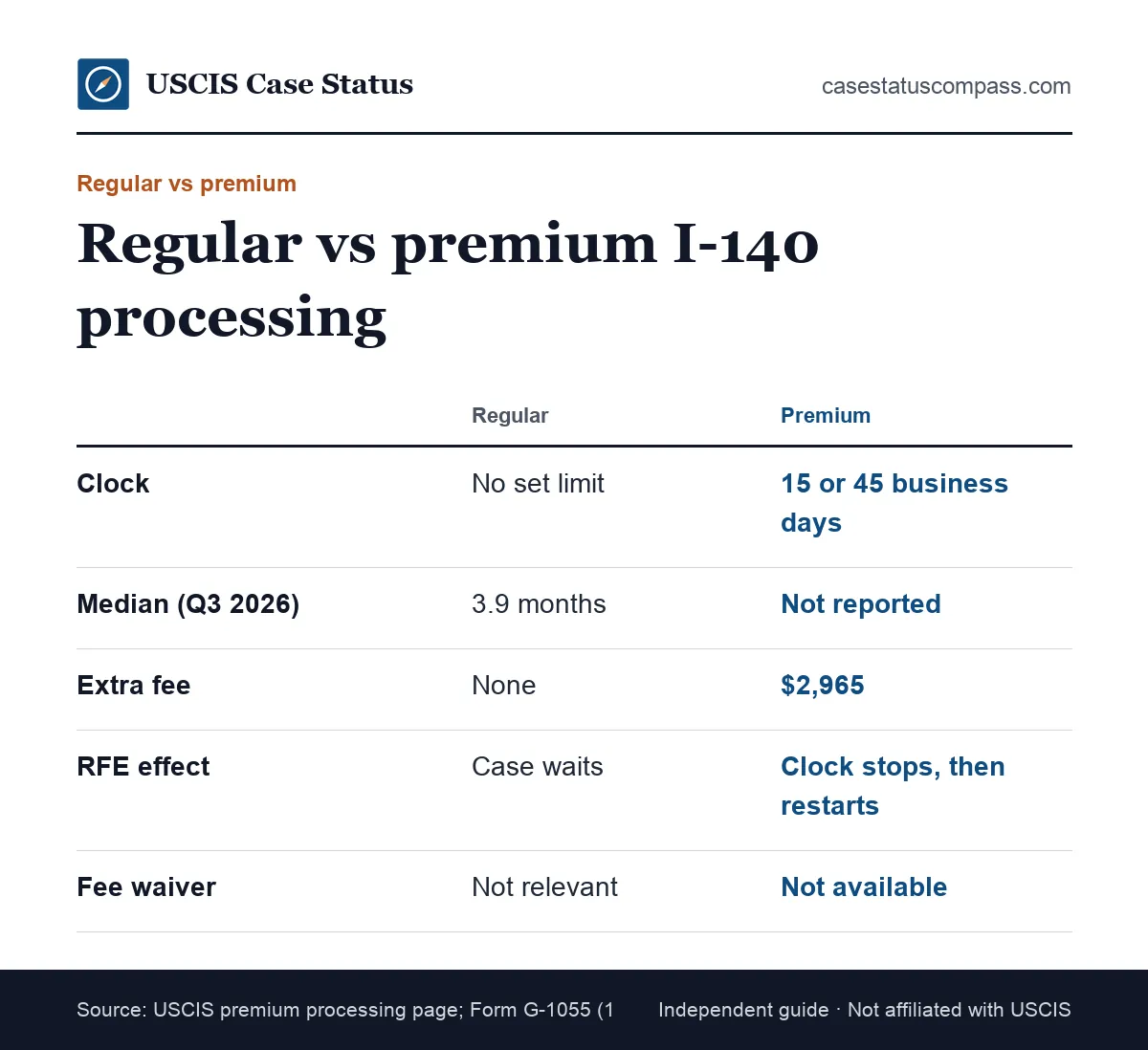
Regular processing has no fixed deadline and followed a 3.9-month median in April–June 2026. Premium processing, requested on Form I-907, guarantees USCIS will act within 15 or 45 business days for an extra fee. Premium changes speed only; the evidence standard and the approval odds stay the same.
Regular and premium I-140 processing compared
The table compares both options on deadline, cost and what USCIS promises.
| Feature | Regular processing | Premium processing |
|---|---|---|
| Time limit | None; check the tool | 15 business days, or 45 for EB-1C and NIW |
| Extra fee (Oct. 2026) | None | $2,965 per I-140 |
| Fee waiver | Not applicable | Not available |
| If an RFE is issued | Case waits for your reply | Clock stops, new period after reply |
Premium buys a deadline, never a better chance of approval.
What premium processing guarantees
USCIS commits to act inside the window with an approval, a denial, an RFE or a notice of intent to deny. If it misses the window, USCIS refunds the premium fee and keeps processing the petition.
What premium processing does not change
Premium does not speed up PERM, the Visa Bulletin or the I-485, so a quick approval helps most when your priority date is already current, or when you need an approved I-140 for another reason, such as a job move.
How Long Does I-140 Take With Premium Processing?
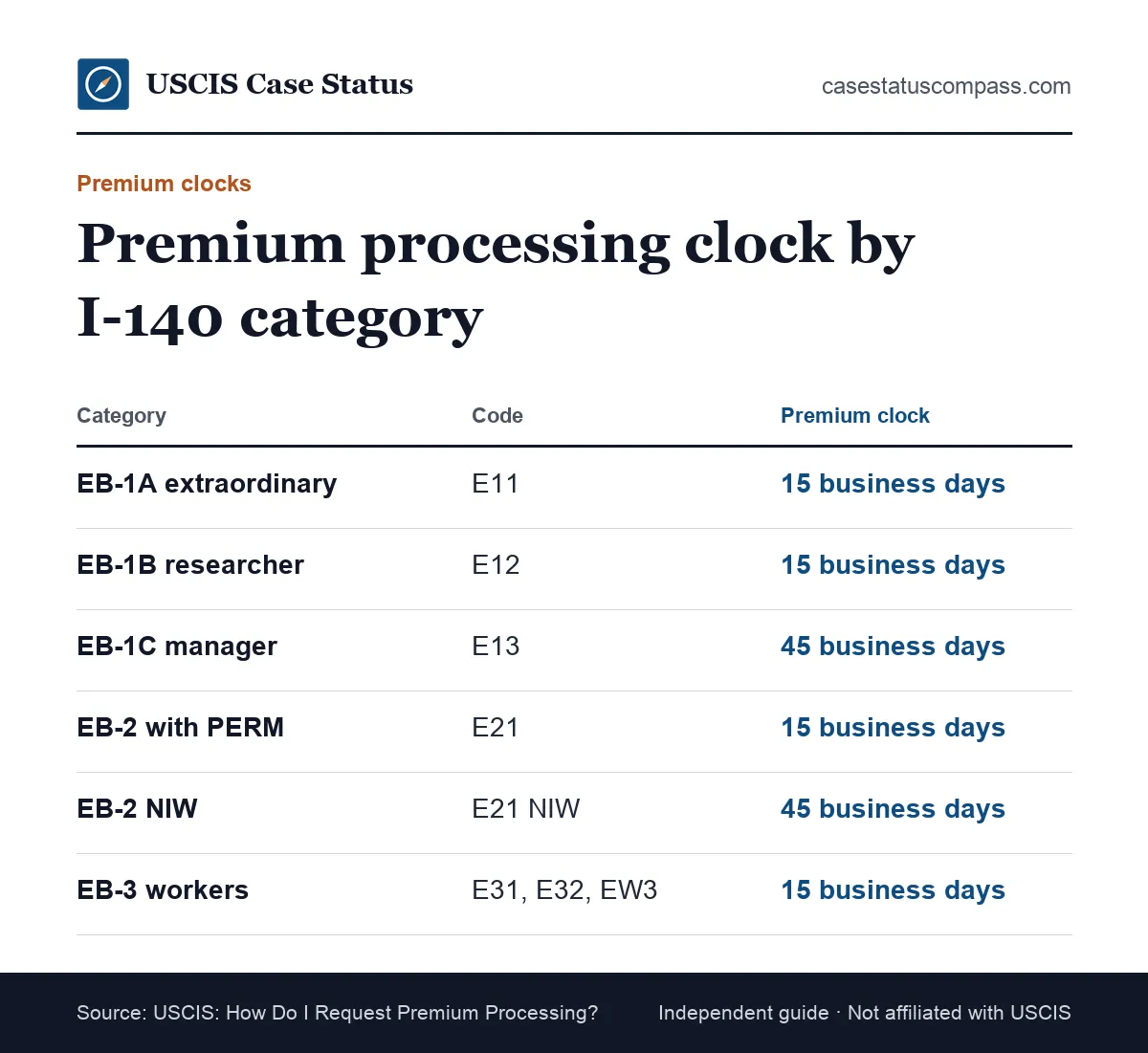
With premium processing, an I-140 takes 15 business days for EB-1A, EB-1B, EB-2 with PERM and EB-3, and 45 business days for EB-1C managers and EB-2 NIW. The clock starts when USCIS receives a correct Form I-907 at the right address.
The 15-business-day group
The 15-day group covers the E11, E12, E21 (non-NIW), E31, E32 and EW3 codes. For those I-140 codes, 15 business days equals about three calendar weeks. Federal holidays add days.
The 45-business-day group
EB-1C manager petitions and EB-2 NIW petitions get 45 business days, roughly nine calendar weeks. That clock also starts only when USCIS receives a correct Form I-907. Holidays extend it.
When the premium clock stops
An RFE stops the premium clock; a new period starts when USCIS gets your response. A late or incomplete reply delays the restart. Our request for evidence guide explains the response rules.
How Much Does Premium Processing Cost for an I-140?
Premium processing for an I-140 costs $2,965, according to Form G-1055, edition 10/16/26. You pay it on top of the regular USCIS filing fees, and you cannot get a fee waiver. The petitioner files Form I-907; the worker cannot file it alone in an employer case.
The I-907 fee table
Form G-1055 lists: $2,965 (I-129 most classes, I-140); $1,780 (H-2B/R, I-765 OPT); $2,075 (I-539 to F/J/M). The I-140 line is $2,965; the base filing fee ($715 paper / $665 online) is paid separately.
No waiver, no partial payment
You can't get a fee waiver for premium processing. Also, USCIS fees are nonrefundable, even if your case is denied or withdrawn. Pay the exact I-907 fee in one payment.
Can You Upgrade a Pending I-140 to Premium?
Yes. You can usually add premium processing to a pending I-140 by filing Form I-907 with the receipt number. The 15- or 45-business-day clock then starts when USCIS receives the I-907. This is common when a regular petition has passed the median or a job change is coming.
When an upgrade pays off
Upgrading makes the most sense when your priority date is already current, or when an approval is needed soon. If the visa wait is years long, a faster approval may not move your green card date at all.
What the upgrade does not change
The petition keeps its original receipt date and priority date. Only the response window changes, and an RFE still stops the premium clock until USCIS has your reply. Your visa wait stays the same.
Did the October 2026 Address Change Affect I-907 Upgrades?
USCIS changed the I-907 premium addresses in October 2026, while the I-140 addresses stayed the same. Before you mail an upgrade request, check the current premium filing address page; a wrong address delays the start of the clock. Recheck it the day you mail.
Wait Times by Country
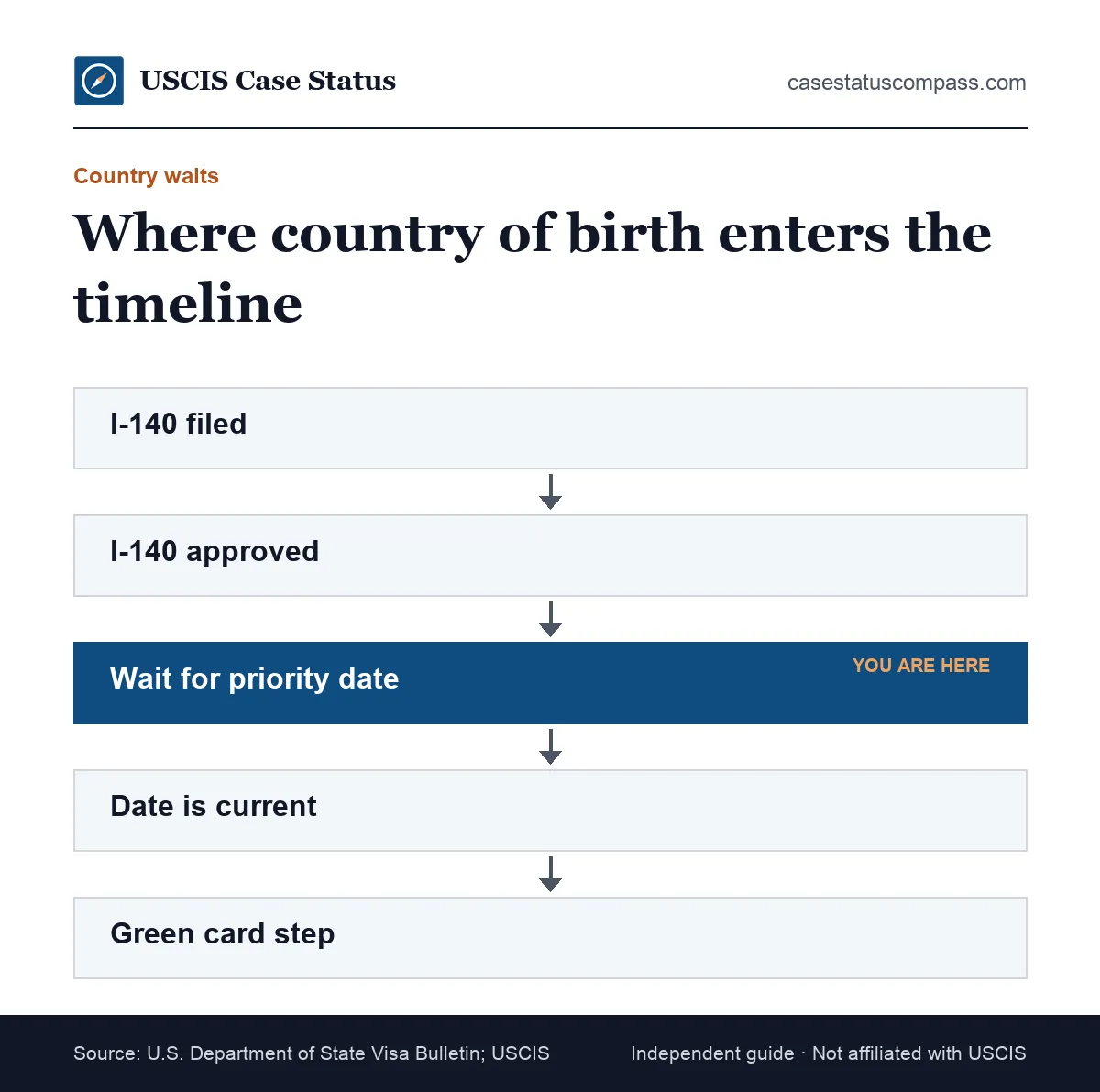
Your country of birth does not change the I-140 processing time at USCIS. Country matters after approval, when the Visa Bulletin decides whether a visa number is available for your category and country. So two petitions approved on the same day can lead to green cards years apart.
Why country of birth matters
Employment visas are limited each year: Yearly limits: 226,000 family preference visas; 140,000 employment-based. The per-country limit is 7% of the yearly family and employment preference limits, or 25,620 visas. The visa bulletin lists separate cutoff columns for high-demand countries. When demand from one country exceeds its share, its dates move more slowly.
How to read your country's line
Find your category row (EB-1, EB-2 or EB-3) and country column. If your priority date is earlier than the date shown, you are current. The November 2026 Final Action chart is below; the State Department replaces it every month.
Current employment Final Action chart
Find your category row, then read across to your country of birth.
| Category | All areas | China (mainland-born) | India | Mexico | Philippines |
|---|---|---|---|---|---|
| EB-1 | Current | Aug. 1, 2023 | Feb. 1, 2023 | Current | Current |
| EB-2 | Apr. 1, 2025 | Oct. 1, 2021 | Nov. 1, 2013 | Apr. 1, 2025 | Apr. 1, 2025 |
| EB-3 | June 15, 2024 | Jan. 22, 2022 | Jan. 22, 2014 | June 15, 2024 | Aug. 15, 2023 |
| EB-3 Other Workers | June 1, 2022 | Oct. 1, 2019 | Jan. 22, 2014 | June 1, 2022 | Jan. 1, 2022 |
| EB-4 | Dec. 15, 2022 | Dec. 15, 2022 | Dec. 15, 2022 | Dec. 15, 2022 | Dec. 15, 2022 |
| Certain Religious Workers | Dec. 15, 2022 | Dec. 15, 2022 | Dec. 15, 2022 | Dec. 15, 2022 | Dec. 15, 2022 |
| EB-5 Unreserved | Current | Dec. 1, 2016 | Dec. 1, 2023 | Current | Current |
| EB-5 Rural (20%) | Current | Current | Current | Current | Current |
| EB-5 High Unemployment (10%) | Current | Current | Current | Current | Current |
| EB-5 Infrastructure (2%) | Current | Current | Current | Current | Current |
If the date shown is earlier than your priority date, you are still waiting; "C" means current.
What Are EB-1 Wait Times in the USA for Indian Applicants?
For applicants born in India, EB-1 wait times at USCIS are the same as everyone else's: the I-140 joins one national queue, with a 3.9-month median in April–June 2026. The difference comes later, because India often has its own Visa Bulletin column with a later cutoff date.
The USCIS step is equal
An Indian EB-1A filer with premium processing still gets the 15-business-day clock. USCIS does not sort I-140s by nationality, and the regular queue follows the receipt date. Country of birth matters only once the petition is approved.
The visa stage is where waits differ
When India's column shows a cutoff date earlier than your priority date, you wait. In November 2026, EB-1 India is Feb. 1, 2023, while most countries show Current. Your I-140 stays valid during the wait.
EB-2 NIW Processing Time by Country
The EB-2 NIW processing time by country is the same at the petition stage: USCIS does not run separate NIW queues by nationality. Your country affects only the later visa wait. An Indian and a Brazilian NIW filed the same week join one queue, so the petition step should take about the same time.
Country affects only the green card step
F1-F4 family and EB-1 to EB-5 employment categories (INA 203). The EB-2 row of the bulletin decides when an approved NIW filer can file Form I-485 or move to the visa stage. In November 2026, its Final Action Date is Nov. 1, 2013 for India and Oct. 1, 2021 for China.
Reading your EB-2 column
Compare your NIW priority date with the EB-2 cell for your country of birth. If the cell shows an earlier date than yours, you wait; a "C" means the category is current.
What Makes an I-140 Take Longer?
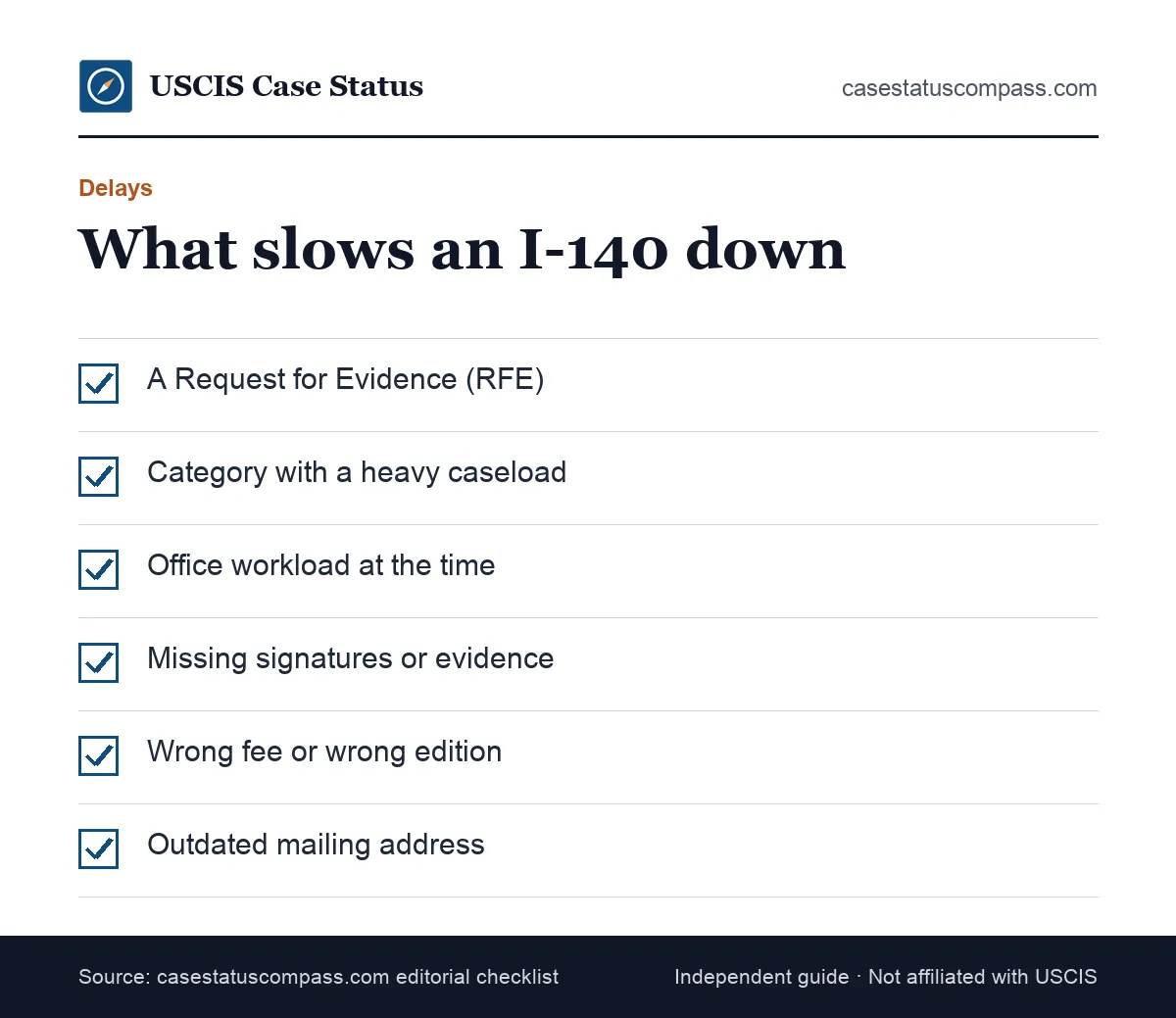
The main causes of a longer I-140 wait are a Request for Evidence, a category with heavier review such as NIW, office workload, and filing errors that lead to a rejection. Most are within your control at filing. Fix them first.
RFEs and weak evidence
An RFE is the most common delay. Clear evidence that matches the category's legal test is the best way to avoid one. Label every exhibit and tie it to a criterion.
Filing errors and rejections
A rejected petition gets no place in line. Common causes include the wrong fee, a missing signature and an outdated form edition. The current I-140 edition is 06/07/24; our Form I-140 filing guide lists the full package.
Office workload
Each office works through its own caseload. Two identical petitions filed on the same day can finish weeks apart if they land at different offices. You cannot pick the office.
How Does an RFE Change the I-140 Timeline?
An RFE pauses an I-140 until USCIS receives your full response. Under regular processing, it simply waits. Under premium processing, the clock stops and a new 15- or 45-business-day period starts when USCIS gets your reply. Answering early can shorten the delay.
The response window
RFE deadline: up to 12 weeks (the exact date is on your RFE); no extensions. That window is shorter only for two other forms: RFEs for Form I-539 and Form I-601A allow at most 30 days (all other forms up to 84 days), plus 3 days if mailed. Policy also says to send every requested item in one response; a partial reply is treated as a request for a decision on the record.
Answering under premium processing
With premium, a complete reply starts a fresh 15- or 45-business-day window. A fast, full answer keeps the case moving; a partial one risks a decision on the record. Send everything together.
Does Concurrent Filing Change I-140 Processing Time?
Filing the I-140 together with Form I-485 does not make USCIS decide the I-140 faster. The petition keeps its own clock. Concurrent filing helps only by starting the green card application early, which is possible when your priority date is current at filing.
What concurrent filing means
Each form gets its own receipt number and moves on its own timeline. Our Form I-485 guide explains the green card application itself. Track both receipt numbers separately, one for each form.
The November 2026 chart
November 2026: USCIS accepts I-485s using the Dates for Filing chart (family and employment). It decides whether you can file Form I-485 now; recheck it monthly. The chart can change.
Which USCIS Office Handles Your I-140?
Your I-140 office is printed on your receipt notice; our USCIS service centers guide describes each one. The receipt number's first three letters show the office that issued it. Use that office's line in the processing times tool.
Reading the receipt prefix
A LIN prefix, for example, points to the Nebraska Service Center, and SRC to the Texas Service Center. Our receipt number guide explains the format. IOE means the petition was filed online.
When a petition is transferred
A case transfer notice names the new office; a move does not restart your wait. Switch to the new office's line in the tool, then recheck your case inquiry date, which may shift with that office's speed.
How Do You Know If Your I-140 Is Outside Normal Processing Time?
Your I-140 is outside normal processing time when today's date is past the case inquiry date the tool shows for your receipt date. After that date, you can submit a service request. Before it, USCIS treats the case as normal, even past the median.
The case inquiry date
Case inquiry date: the earliest date USCIS will accept a question about your pending case; it can change. Enter your receipt date in the tool to see it. If your form or category is not listed, you can generally ask once the case has been pending more than six months.
Before the inquiry date
Until that date passes, USCIS will not accept a delay request. Use the time to check your online account for missed notices and to confirm your address on file. Keep notes.
What Should You Do If Your I-140 Is Delayed?
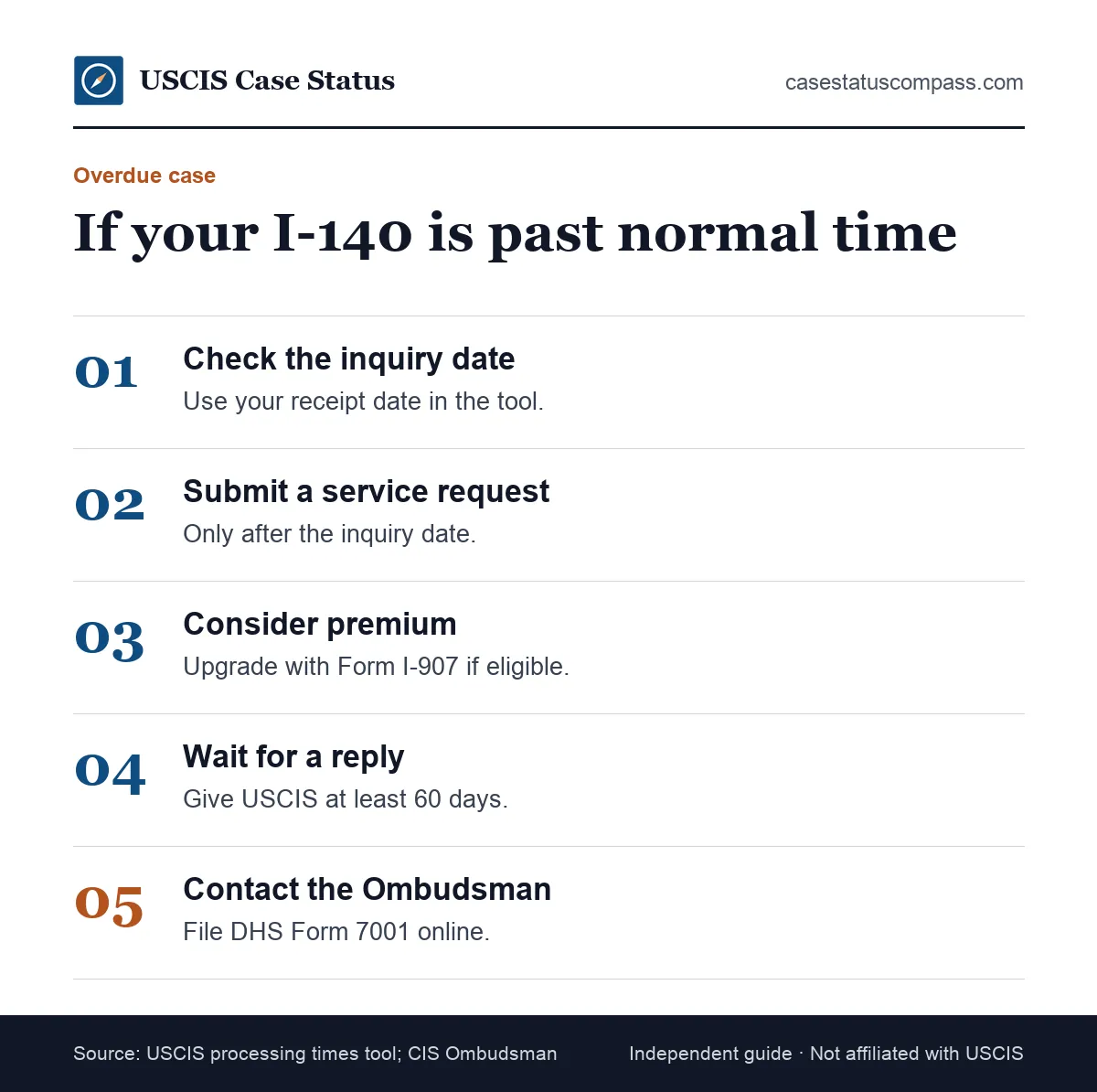
If your I-140 is past its case inquiry date, submit an outside-normal-processing-time service request, then wait for USCIS's reply. Escalate to the CIS Ombudsman only after you have given USCIS time to respond. A premium upgrade is often faster.
The order of steps
- Confirm the inquiry date in the tool with your receipt date.
- Submit a service request online or through the Contact Center at 800-375-5283.
- Consider a Form I-907 premium upgrade.
- Keep copies of every request and reply.
- After 60 days with no fix, contact the CIS Ombudsman.
When the problem is a missing notice
e-Request: report USCIS typos, missing notices or accommodation needs online. Our contact USCIS guide lists every option. Use e-Request when a receipt or approval notice never arrived, not for a slow case; a delay goes through the service request route instead.
Can You Expedite an I-140?
Usually no. USCIS generally does not consider expedite requests for forms that offer premium processing, and every I-140 category offers it. The exception is a petition filed by an IRS-designated nonprofit. For everyone else, premium processing is the speed option.
The premium rule
So USCIS directs most petitioners to Form I-907 instead. See the USCIS expedite request page for the full criteria. Even urgent reasons, such as a job start date, are handled through the premium clock.
The nonprofit exception
A petition from an IRS-designated nonprofit can still ask for an expedite. The request must meet one of USCIS's listed criteria and include proof, because approval stays discretionary. Act early.
When Is an I-140 Delay Worth an Ombudsman or Congressional Request?
Contact the CIS Ombudsman or your member of Congress only after USCIS has failed to fix a delay through normal channels. A congressional office needs a signed privacy release. Both are free. Neither can force an approval, but either can ask USCIS to look at a stalled file. Keep your service request number ready.
The Ombudsman's rules
Use the Ombudsman only after contacting USCIS within 90 days and waiting at least 60 days. Requests go in on CIS Ombudsman: DHS Form 7001, Request for Case Assistance (online). The Ombudsman is part of DHS, not USCIS.
A congressional inquiry
A congressional office can ask USCIS about your case once you sign a privacy release. Our ombudsman and congressional inquiry guide explains both routes. Do not run both at once in the first 45 days.
How Long After I-140 Approval Do You Get a Green Card?
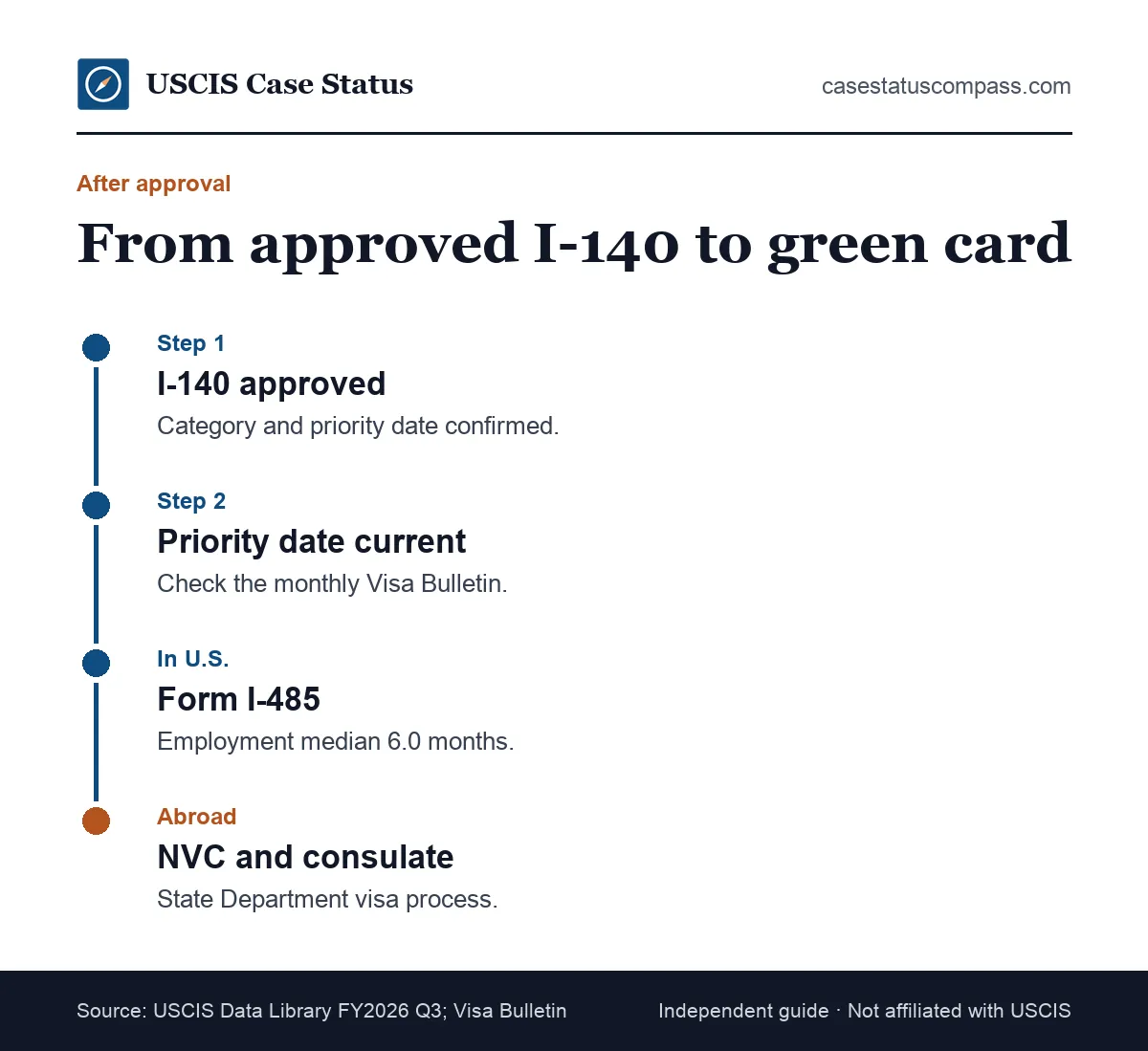
After I-140 approval, the green card can follow within months if your priority date is current, or years if it is not. In the U.S., the employment-based I-485 had a median of 6.0 months in April–June 2026. Abroad, the State Department handles the visa.
Inside the United States
When your date is current, you file Form I-485 or it is already pending. USCIS reports I-485 (employment): median 6.0 months (USCIS data, Apr.-June 2026). That clock is separate from the I-140 clock.
Outside the United States
If you live abroad, USCIS sends the approved petition onward and the State Department's National Visa Center (NVC) takes over. That stage runs on State Department timing. Track it with NVC.
How the PERM Wait Fits Before the I-140
For EB-2 and most EB-3 cases, the PERM labor certification at DOL comes before the I-140 and can take longer. USCIS's I-140 clock does not start until the petition arrives. So the PERM certification date, not the job offer date, sets the earliest filing day.
PERM backlog in numbers
For the DOL step itself, see our PERM labor certification guide. DOL reported 147,884 PERM applications pending at DOL (Mar. 31, 2026). DOL's own processing dates are posted on its FLAG site. Currently, DOL analyst review is working on PERM cases filed in January 2026 (as of Oct. 5, 2026).
PERM and I-140 on one calendar
Add the DOL wait, the 180-day window after certification and the I-140 time to see when a petition can be filed and decided. Premium shortens only the last of the three.
I-140 Case Status Messages and What They Mean for Timing
Your online case status shows where the I-140 sits in the queue. "Case Was Received" means the clock has started. "Case Is Being Actively Reviewed" means an officer has it. "Case Was Approved" ends the USCIS step. None of these messages gives a decision date.
Reading the messages
Many I-140s show no change for weeks after receipt, which is normal. A status update usually appears when USCIS issues a notice, such as an RFE or a transfer. Check monthly.
Approval and what follows
Case Was Approved ends the USCIS step, not the green card process. The next status to watch is on your I-485 or at NVC, depending on where you live. Save the approval notice.
Planning Your Employment Green Card Around the I-140 Clock
Good planning uses the right number at each stage: the tool's figure for your I-140 line, the Visa Bulletin for your priority date, and the I-485 median for the last step. Build in time for an RFE. Never schedule a job change or move around the median alone.
For employers
Track the PERM expiry date, file early and decide on premium before filing. HR teams often set a reminder for the case inquiry date. Share it with the worker.
For self-petitioners
EB-1A and NIW filers control the evidence. Gather letters, citations and impact evidence before filing, because a complete first filing avoids an RFE. Organize exhibits by criterion, with an index up front.
I-140 Processing Time Mistakes to Avoid
The costliest mistakes are letting PERM certification expire, filing an old form edition, using the wrong premium address, and missing an RFE deadline. Each one adds weeks or months, or forces you to start over. Most are preventable with a careful review.
Mistakes before filing
- Waiting too long after PERM certification.
- Using an outdated I-140 edition.
- Paying the wrong fee or missing the Asylum Program Fee.
- Choosing the wrong classification box on the petition.
- Leaving out proof of the employer's ability to pay.
Mistakes after filing
- Sending a premium request to an old address.
- Answering an RFE in pieces instead of all at once.
- Reading the wrong category line in the tool.
- Missing a notice after moving.
I-140 Processing Time Quick Reference
This quick reference gathers the key I-140 processing time facts, from the 3.9-month median to the premium clocks, with the source and date for each so you know where to check each number. Verify any figure again before you rely on it.
Key I-140 timing figures
Each row gives one figure, its source and the date we checked it.
| Item | Figure | Source and date |
|---|---|---|
| Regular median | 3.9 months | USCIS data, Apr.–June 2026 |
| Previous year's median | 6.4 months | USCIS data, July–Sept. 2025 |
| Premium, most categories | 15 business days | USCIS premium processing page |
| Premium, EB-1C and NIW | 45 business days | USCIS premium processing page |
| Premium fee | $2,965 | Form G-1055, edition 10/16/26 |
| RFE reply window | Up to 12 weeks | Date printed on your RFE |
Recheck the tool and the bulletin monthly; both change.
What This Page Can and Cannot Tell You
This page cannot predict your decision date, and it is not legal advice. For eligibility questions, RFEs or denials, talk to an immigration attorney or a DOJ-accredited representative. It explains the official figures, what drives them and the steps open to you when a case runs late.
Independent, not USCIS
USCIS Case Status is an independent guide that never sees your case. Our USCIS processing times hub links to every form, and our guide on how long naturalization takes covers the later citizenship step.
Frequently Asked Questions
What is the I-140 current processing date?
It is not one date. The official tool shows a processing time and a case inquiry date for your category, office and receipt date. Check it monthly, because both move.
How long does an I-140 take without premium processing?
USCIS's median for regular I-140 petitions was 3.9 months for cases completed between April and June 2026. The live tool's 80% figure for your category and office is the better guide to whether your wait is normal.
Is the I-140 approval time the same for every category?
No. USCIS publishes one combined median, but categories differ in review time. NIW and EB-1C petitions involve more judgment and often take longer than EB-3 petitions backed by a certified PERM. Check your category's line in the tool.
Does my country of birth affect the I-140 processing time?
No. USCIS decides I-140 petitions in one queue regardless of nationality. Country of birth matters only after approval, when the Visa Bulletin decides whether a visa number is available. Applicants from high-demand countries such as India may wait longer at that stage.
Can I check my I-140 status while it is pending?
Yes. Enter the 13-character receipt number from your I-797C notice in USCIS Case Status Online. It shows broad stages but no decision date.
Why did my I-140 take longer than the median?
The median is a midpoint, so half of all petitions take longer. Common reasons include an RFE, a busy office or a transfer. Your case is only outside normal processing time once it passes the case inquiry date in the tool.
Does an approved I-140 mean I have a green card?
No. An approved I-140 confirms your category and priority date. You still need a current priority date and then either Form I-485 in the U.S. or an immigrant visa abroad.
How long does an EB-2 NIW take in total?
The petition stage follows the combined 3.9-month median, or 45 business days with premium. The green card step then waits for a current EB-2 date for your country, followed by the I-485 or visa stage.
How long does EB-1B take?
No separate median exists; the combined I-140 median was 3.9 months in April–June 2026. With premium processing, EB-1B petitions use the 15-business-day clock.
Does premium processing guarantee I-140 approval?
No. Premium guarantees only that USCIS acts within 15 or 45 business days. That action can be an approval, a denial, an RFE or a notice of intent to deny.
Sources
- USCIS Check Case Processing Times. egov.uscis.gov/processing-times/. Accessed Oct 27, 2026.
- USCIS Immigration and Citizenship Data (quarterly processing times). www.uscis.gov/tools/reports-and-studies/immigration-and-citizenship-data. Accessed Oct 27, 2026.
- USCIS: I-140, Immigrant Petition for Alien Workers. www.uscis.gov/i-140. Accessed Oct 27, 2026.
- USCIS: How Do I Request Premium Processing?. www.uscis.gov/forms/all-forms/how-do-i-request-premium-processing. Accessed Oct 27, 2026.
- USCIS Form G-1055 Fee Schedule. www.uscis.gov/g-1055. Accessed Oct 27, 2026.
- USCIS: Expedite Requests. www.uscis.gov/forms/filing-guidance/how-to-make-an-expedite-request. Accessed Oct 27, 2026.
- CIS Ombudsman: Submit a Case Assistance Request. www.dhs.gov/topic/cis-ombudsman/7001. Accessed Oct 27, 2026.
- U.S. Department of State: Visa Bulletin. travel.state.gov/content/travel/en/legal/visa-law0/visa-bulletin.html. Accessed Oct 27, 2026.
- DOL processing times. flag.dol.gov/processingtimes. Accessed Oct 27, 2026.
- USCIS Data Library: All USCIS Application and Petition Form Types, FY2026 Q3 (Apr. 1-June 30, 2026; queried 7/2026). www.uscis.gov/sites/default/files/document/data/quarterly_all_forms_fy2026_q3_v1.xlsx. Accessed Oct 27, 2026.
- USCIS Form G-1055 Fee Schedule, Edition 10/16/26. www.uscis.gov/sites/default/files/document/forms/g-1055.pdf. Accessed Oct 27, 2026.
- CIS Ombudsman tip sheet: Check Your USCIS Case Inquiry Date (Aug. 2024). dhs.gov/sites/default/files/2024-11/24_0823_cisomb_case-inquiry-date-tip-sheet.pdf. Accessed Oct 27, 2026.
- USCIS: Filing Fees (updated 02/12/2026). www.uscis.gov/forms/filing-fees. Accessed Oct 27, 2026.
- USCIS: Visa Availability and Priority Dates (updated 01/24/2025). www.uscis.gov/green-card/green-card-processes-and-procedures/visa-availability-priority-dates. Accessed Oct 27, 2026.
- INA 203 / 8 U.S.C. 1153 (LII). www.law.cornell.edu/uscode/text/8/1153. Accessed Oct 27, 2026.
- 8 CFR 103.2(b)(8)(iv) (LII). www.law.cornell.edu/cfr/text/8/103.2. Accessed Oct 27, 2026.
- USCIS Policy Manual Vol. 1, Part E, Ch. 6 (current as of Oct. 23, 2026). www.uscis.gov/policy-manual/volume-1-part-e-chapter-6. Accessed Oct 27, 2026.
- USCIS: Adjustment of Status Filing Charts from the Visa Bulletin (updated 10/05/2026). www.uscis.gov/green-card/green-card-processes-and-procedures/visa-availability-priority-dates/adjustment-of-status-filing-charts-from-the-visa-bulletin. Accessed Oct 27, 2026.
- USCIS Contact Center (uscis.gov). www.uscis.gov/contactcenter. Accessed Oct 27, 2026.
- DHS CIS Ombudsman: How to Submit a Case Assistance Request (updated 04/13/2026). www.dhs.gov/case-assistance. Accessed Oct 27, 2026.
- DOL OFLC PERM Selected Statistics, FY2026 Q2. www.dol.gov/sites/dolgov/files/ETA/oflc/pdfs/PERM_Selected_Statistics_FY2026_Q2.pdf. Accessed Oct 27, 2026.
casestatuscompass.com is an independent publication and is not affiliated with USCIS or any government agency. This page is general information, not legal advice. For denials, court or asylum matters, consult an immigration attorney or a DOJ-accredited representative.