Contents · 41 sections
- What Is Form G-1055?
- Who Publishes the USCIS Fee Schedule?
- Where Can You Get the Form G-1055 PDF?
- What Changed in the 10/16/26 Edition of Form G-1055?
- What Are H.R. 1 Fees on the USCIS Fee Schedule?
- How Do You Read the G-1055 Fee Schedule?
- G-1055 Fee Table: Family and Green Card Forms
- G-1055 Fee Table: Citizenship and Replacement Documents
- G-1055 Fee Table: Work Permits and Travel Documents
- G-1055 Fee Table: Employer Petitions and H-1B Fees
- G-1055 Fee Table: Asylum, TPS and Humanitarian Forms
- How Do You Pay the USCIS Immigrant Fee?
- Is Paper or Online Filing Cheaper on the Fee Schedule?
- Are Biometrics Fees Still Listed Separately?
- Using the USCIS Fee Calculator
- Build Your Own Total: A Fee Worksheet
- How Do You Pay USCIS Fees in 2026?
- Paying Online Through Pay.gov
- Credit Card Payments With Form G-1450
- Bank Account (ACH) Payments With Form G-1650
- Can You Still Pay With a Money Order for Homeland Security?
- Who Do You Make a USCIS Check Payable To?
- Is There a Department of Homeland Security Address for Money Orders?
- What About a Western Union Money Order Sample?
- How Should You Pay When Filing Several Forms Together?
- Why Does USCIS Reject Filings for the Wrong Fee?
- Common Payment Mistakes
- What Happens After USCIS Rejects Your Payment?
- Can You Get a Refund of a USCIS Fee?
- What Happens If You Overpay a USCIS Fee?
- Which G-1055 Fees Can Be Waived?
- Premium Processing Fees on the Fee Schedule
- How Often Does the USCIS Fee Schedule Change?
- Which Fee Applies: Postmark Date or Signing Date?
- Form G-1055 and Form Editions: Two Separate Checks
- Processing Fees vs Filing Fees: What People Mean
- Does USCIS Ever Charge a Processing Fee by Phone?
- How the Fee Guides Fit Together
- Checklist Before You Pay a USCIS Fee
- When Should You Get Help With USCIS Fees?
- Frequently Asked Questions
The short answer
Form G-1055 is the official USCIS fee schedule: the master list of filing fees for every USCIS form. The current version is Form G-1055, Edition 10/16/26, effective Oct. 16, 2026. It shows paper and online prices, fee-free lines and extra charges such as H.R. 1 add-ons. Send the exact amount, or USCIS rejects the filing.
At a glance
| Current edition | 10/16/26, for requests postmarked on or after Oct. 16, 2026 |
| How you pay | Pay.gov online; Form G-1450 (card) or G-1650 (bank) by mail |
| Checks and money orders | Only with an approved exemption (Form G-1651) |
| Refunds | Accepted fees are nonrefundable |
What Is Form G-1055?
Form G-1055 is the USCIS document titled "Fee Schedule." It lists the fee for each benefit request by category, filing method and extra charge. The edition in force on your postmark date decides what you owe.
For costs grouped by goal, see our uscis fees hub.
Who Publishes the USCIS Fee Schedule?
U.S. Citizenship and Immigration Services (USCIS) publishes Form G-1055 because it runs mostly on the fees applicants pay, not on yearly funding from Congress. Amounts come from regulations and, for some lines, from statutes such as H.R. 1, so USCIS reissues the schedule when either changes.
The G-series of USCIS forms
USCIS uses G-numbers for general documents that cut across benefit types. On this page you will also meet G-1450 (card authorization), G-1650 (bank authorization) and G-1651 (electronic payment exemption). Each supports the payment step.
Where Can You Get the Form G-1055 PDF?
You get the G-1055 PDF free from the USCIS fee schedule page at uscis.gov/g-1055. Download the PDF on the day you file, because a copy saved weeks ago may be out of date. No account or sign-in is needed. Anyone selling a "fee schedule kit" is charging for a free document.
Use the official page only
The edition date sits in the footer of every PDF page. If it differs from the web page, trust the web page. Open the PDF from uscis.gov, and make sure the address ends in .gov before you save it.
Why reposted copies cause trouble
Universities, law firms and document-sharing sites often repost the fee schedule PDF. A stale copy is the most common reason people mail the wrong amount. Treat any copy without a date as out of date.
What Changed in the 10/16/26 Edition of Form G-1055?
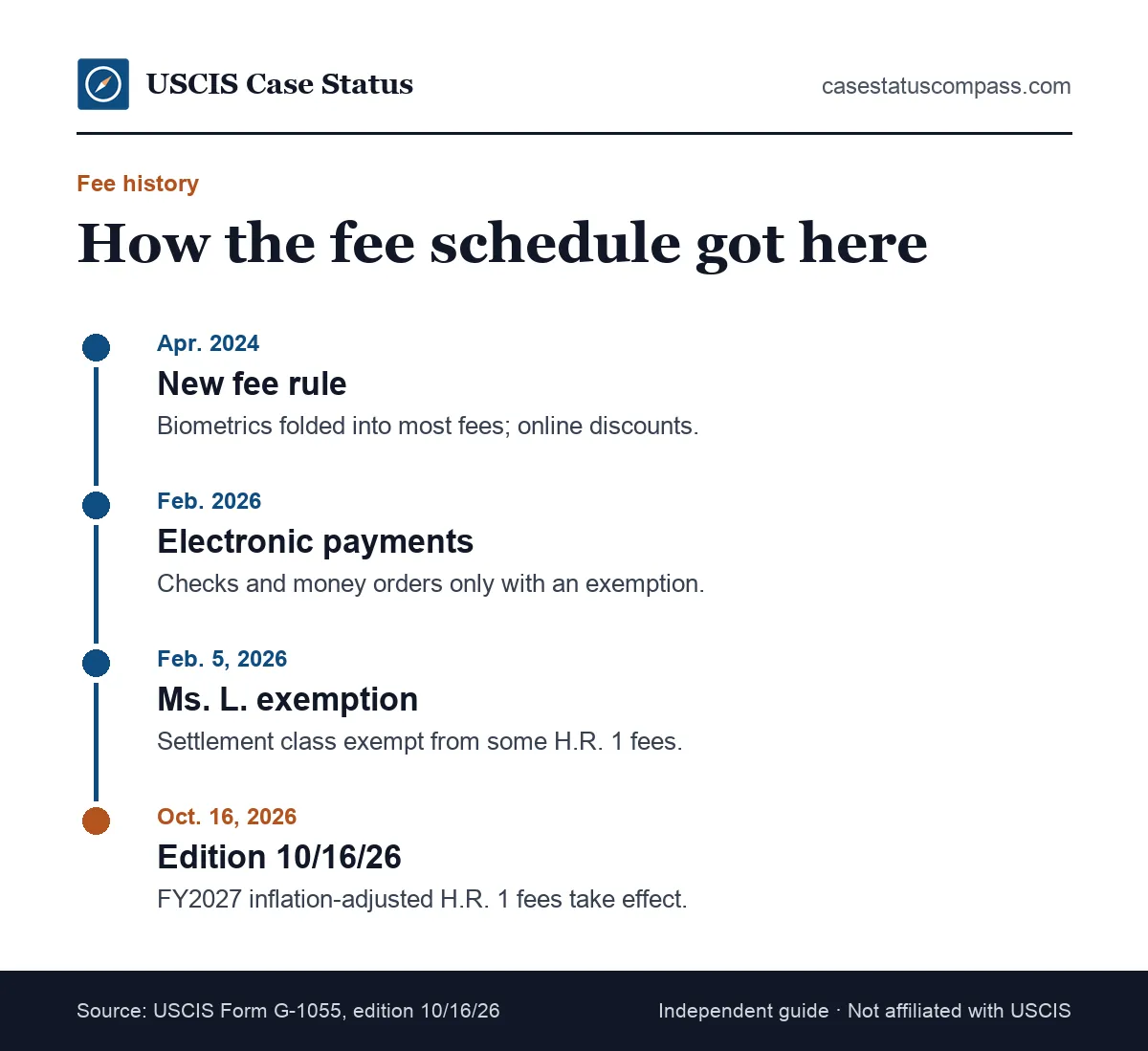
The 10/16/26 edition of Form G-1055 added fiscal year 2027 inflation-adjusted fees under Pub. L. 119-21, known as H.R. 1, for Forms I-131, I-589, I-765, I-821 and I-941. The base fees for most other forms did not move. Packages postmarked on or after Oct. 16, 2026 must match the new edition.
New FY2027 amounts
H.R. 1 set floor amounts for several humanitarian and parole fees and ties them to inflation. The appendix shows the Immigration Parole Fee rising from $1,000 in FY2025 to $1,020 in FY2026 and $1,050 now.
What stayed the same
Most family, citizenship and employer fees stayed at the levels set by the April 2024 fee rule. The change matters most for asylum seekers, TPS applicants and parolees. The online discount for forms filed through a USCIS account also stayed.
What Are H.R. 1 Fees on the USCIS Fee Schedule?
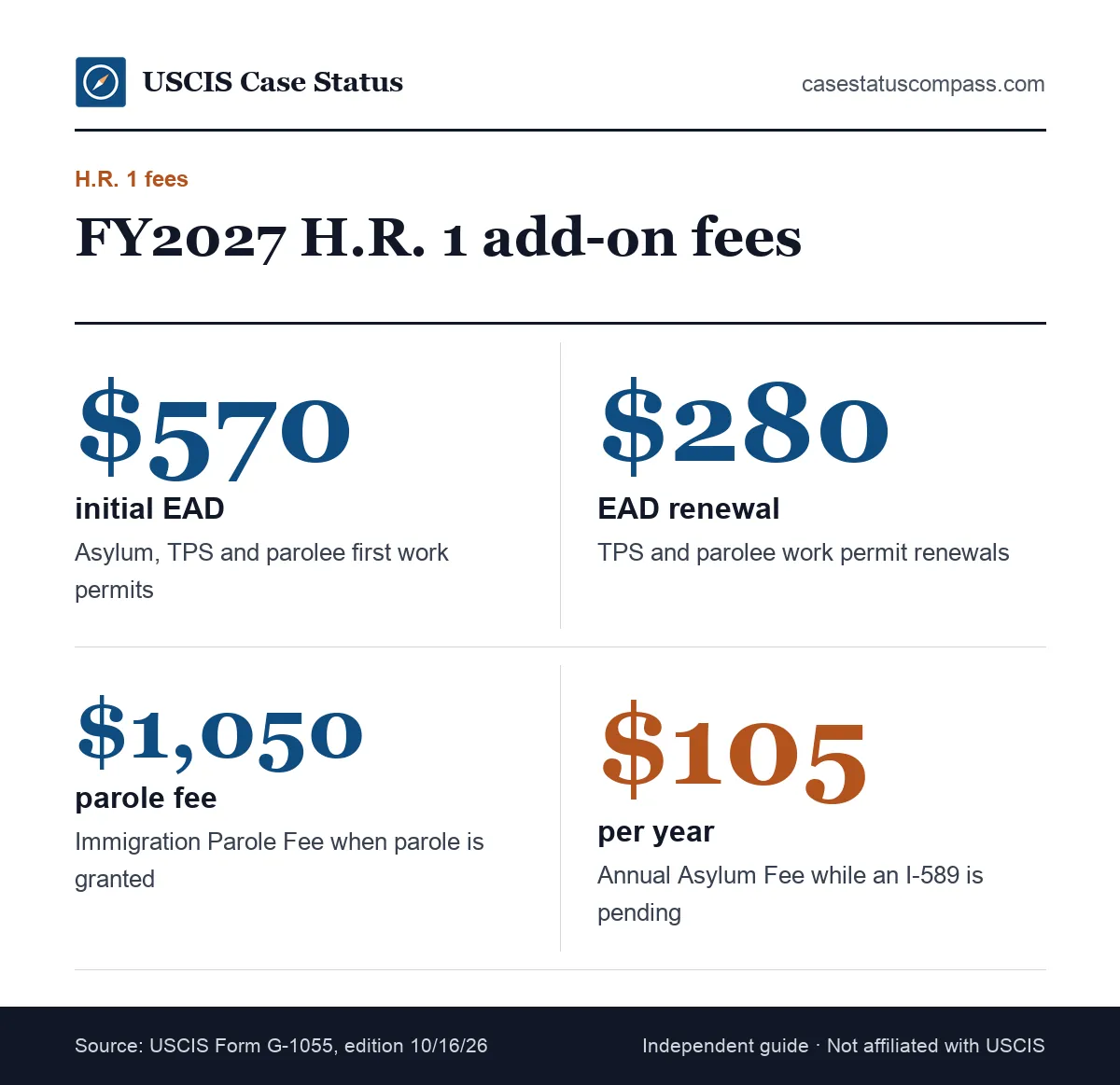
H.R. 1 fees are statutory charges created by Pub. L. 119-21 and printed beside the regular filing fees. H.R. 1 fees can't be waived and must be paid separately. They apply even when the base fee is zero, and they change every fiscal year.
A separate payment
USCIS treats each H.R. 1 fee as its own payment. An initial asylum-based work permit has no base fee, yet the $570 add-on is still due. Do not fold it into the base fee; list it as its own amount when you total the package.
Asylum and parole charges
The asylum line reads $0 filing fee + $100 Asylum Application Fee (principal applicant); Annual Asylum Fee $105 (online, when USCIS sends a notice). The parole fee in Appendix B applies if parole is granted. How it affects advance parole for pending adjustment applicants is complex; read our advance parole guide and ask an attorney before you travel.
The Ms. L. settlement exemption
Ms. L. settlement class: exempt from H.R. 1 parole, parolee-EAD and asylum fees since Feb. 5, 2026. Class members file the I-589 on paper only. If you think you are in the class, ask a lawyer to confirm it before you skip any H.R. 1 fee.
How Do You Read the G-1055 Fee Schedule?
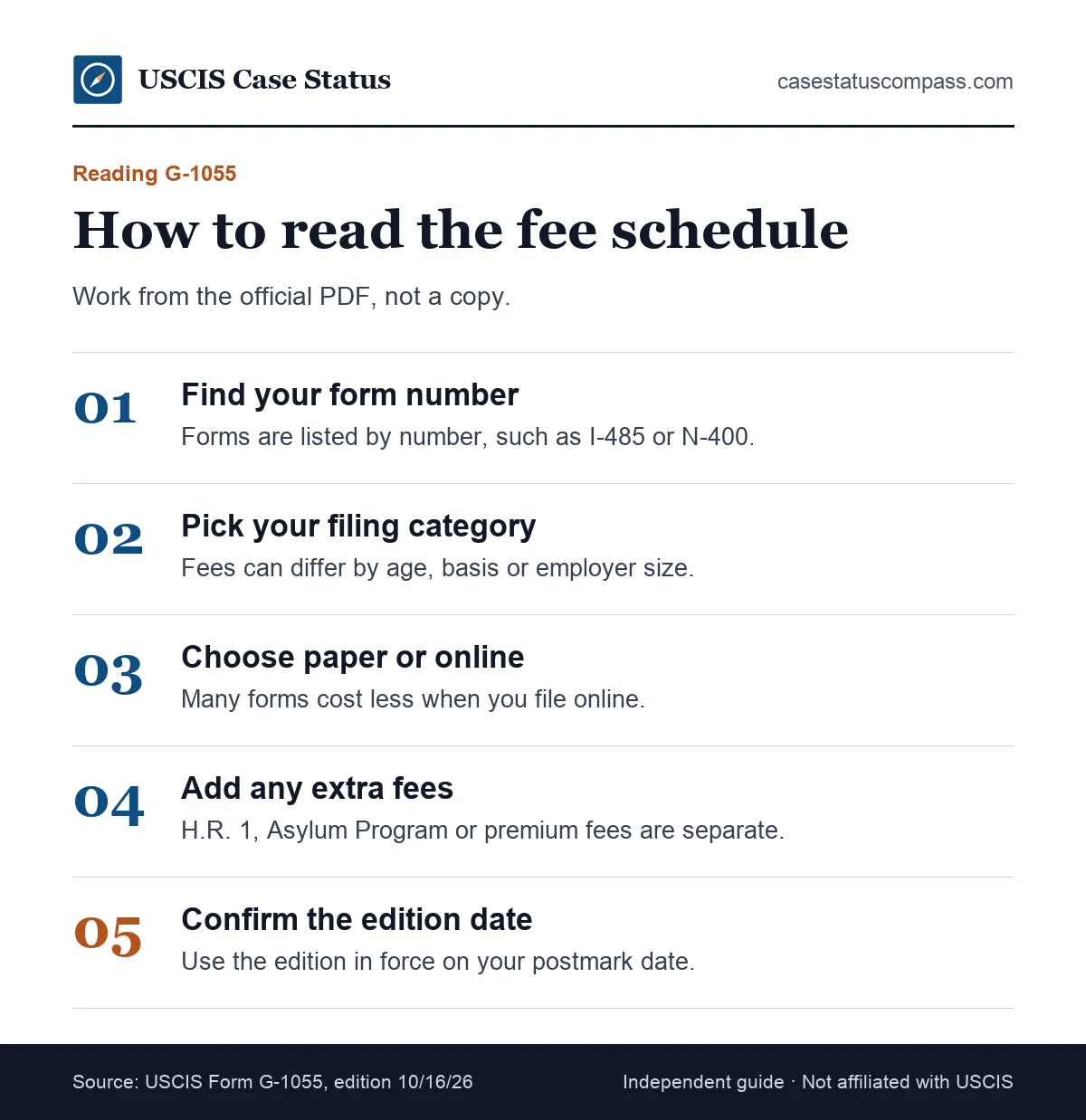
You read the G-1055 fee schedule in five moves: find your form number, pick the row for your category, choose the paper or online column, add any extra fee for that line, and confirm the edition covers the day you mail or submit.
Rows, categories and columns
One form can have several rows. Form I-485 has a standard row and a lower row for children under 14 filing with a parent. Form I-129 splits by visa class and employer size.
Fee-free lines and footnotes
A zero fee means the category is fee-exempt, not that you are eligible. You do not need Form I-912 to claim it. Read the footnote beside a zero, because it often names the exact group that qualifies. If you are outside that group, the standard row applies.
Asterisks and appendixes
An asterisk marks fees that USCIS adjusts periodically, such as premium processing. Appendix A holds the I-129 fee stack, Appendix B the I-131 travel documents and Appendix C the I-765 categories.
G-1055 Fee Table: Family and Green Card Forms
The family and green card lines of Form G-1055 cover petitions, adjustment of status and support forms. Find your row here, then confirm it on the official schedule before you pay. Each amount shows the paper and online price where both exist. Companion forms, such as the work permit, are listed in a later table.
Family and green card fees by form
This table lists the five family-based forms most people meet, with the fee each carries on the current edition.
| Form | Purpose | Fee on G-1055 (10/16/26) |
|---|---|---|
| I-130 | Petition for a relative | $675 (paper) / $625 (online) |
| I-485 | Adjustment of status | $1,440 (paper) / $1,390 (online); $950 / $900 if under 14 and filing with a parent |
| I-751 | Remove conditions | $750 (paper) / $700 (online) |
| I-129F | Fiancé(e) petition | $675 |
| I-864 | Affidavit of Support | $0 at USCIS |
What the I-485 line leaves out
The I-485 fee does not cover a work permit or travel document; those are separate rows. For the whole green card budget, see how much is a green card, and for filing steps our Form I-485 guide.
Fiancé(e) petitions and consular fees
The I-129F row is the only USCIS charge in a fiancé(e) case. The State Department visa fee never appears on the G-1055. The k1 visa cost page adds the consular charges to the USCIS line.
G-1055 Fee Table: Citizenship and Replacement Documents
The citizenship and document lines list naturalization, citizenship certificates and replacement cards. Several have no-fee rows for military applicants or USCIS errors. Online filing is cheaper on most of these rows. The N-400 also has a reduced fee for lower household incomes. Check the footnotes on each row before you assume the standard amount applies to you.
Naturalization and replacement document fees
These four rows cover citizenship and replacement documents. The amounts show paper and online prices where USCIS offers both.
| Form | Purpose | Fee on G-1055 (10/16/26) |
|---|---|---|
| N-400 | Naturalization | $760 (paper) / $710 (online); reduced fee $380 (paper only) if household income is at or below 400% of the Federal Poverty Guidelines |
| N-600 | Certificate of citizenship | $1,385 (paper) / $1,335 (online) |
| N-565 | Replacement certificate | $555 (paper) / $505 (online) |
| I-90 | Renew or replace a green card | $465 (paper) / $415 (online) |
The reduced naturalization fee
The reduced N-400 fee is now requested in Part 10 of the paper form; Form I-942 is archived and has no line in this edition. For the full naturalization budget, see how much does it cost to become a us citizen.
No-fee card renewal cases
The I-90 row has no-fee cases, such as a card USCIS never delivered or one with a USCIS error. Our green card renewal fee page walks through each case. Most renewals pay the full fee.
G-1055 Fee Table: Work Permits and Travel Documents
The work and travel lines hold Form I-765 and Form I-131. They changed most in the 10/16/26 edition because H.R. 1 add-ons apply to several categories. Your basis for filing decides which amount you pay. Read the full line, not only the first number.
Work permit, parole and DACA fee rows
The table gives the full fee line for each form. Look for your category in each line before adding any amount to your total.
| Form | Category | Fee on G-1055 (10/16/26) |
|---|---|---|
| I-765 | Work permit | $520 (paper) / $470 (online); $260 with a pending I-485 filed on or after Apr. 1, 2024. H.R. 1 add-ons: initial asylum-applicant (c)(8) EAD $0 + $570; initial TPS/parolee EAD base fee + $570; renewal TPS/parolee base fee + $280; renewal (c)(8) base fee + $275 |
| I-131 | Advance parole | $630 (paper) / $580 (online); $0 if your I-485 was filed before Apr. 1, 2024 with the fee. H.R. 1 Immigration Parole Fee $1,050 when parole is granted (some exceptions) |
| I-821D + I-765 | DACA renewal | I-821D $85 + I-765 $520 (paper) / $470 (online) = $605 paper / $555 online |
Category codes set the I-765 fee
The I-765 eligibility category, such as (c)(8) or (c)(9), picks your row in Appendix C. Our work permit form guide explains the accepted edition and codes. Copy the code from your notice or current card.
DACA renewals
The DACA total combines two rows. The daca renewal fee page covers the renewal window and why the DACA work permit fee cannot be waived. Both the I-821D and the I-765 must be paid together.
G-1055 Fee Table: Employer Petitions and H-1B Fees
The employer lines are the most layered part of the schedule. One H-1B petition can carry a base fee, the Asylum Program Fee, a fraud fee and an ACWIA training fee at once. Appendix A explains each. Add every line that applies to reach the total.
Employer petition fee lines
This table summarizes the employer fee lines. Each amount bundles several charges, so read Appendix A for the split.
| Fee | Applies to | Amount on G-1055 (10/16/26) |
|---|---|---|
| I-129 H-1B stack | H-1B petitions | Base $780 (paper) / $730 (online) ($460 small employer/nonprofit) + Asylum Program Fee $600/$300/$0 + Fraud fee $500 + ACWIA $1,500 or $750 (+ $4,000 Pub. L. 114-113 fee for some large H-1B-dependent employers) |
| H-1B registration | Cap selection entry | $215 per registration (per beneficiary) |
| I-140 | Immigrant worker petition | $715 (paper) / $665 (online) + Asylum Program Fee $600 ($300 small employer or self-petitioner; $0 nonprofit) |
Who pays employer fees
Employers pay these petition charges, and the ACWIA amount turns on employer size. For the employer and worker split, see h1b visa fees and our H-1B status guide. H-1B workers should not be billed.
The $100,000 H-1B line
The PDF still lists a $100,000 H-1B payment, but $100,000 H-1B payment: blocked by court order (vacated June 8, 2026; stay denied July 24, 2026). Do not add it to a total today.
G-1055 Fee Table: Asylum, TPS and Humanitarian Forms
The humanitarian lines have the most fee-free base lines and the most H.R. 1 add-ons. Asylum, TPS and many victim-based categories pay no base fee, yet statutory charges and the $30 TPS biometrics fee may still apply. Look up your exact category, because add-ons differ for initial and renewal filings.
TPS, fee waiver and appeal fee rows
This table covers TPS, the fee waiver request and appeals. The I-912 row shows that asking for a waiver costs nothing.
| Form | Purpose | Fee on G-1055 (10/16/26) |
|---|---|---|
| I-821 | Temporary Protected Status | Initial: $520 + $30 biometrics; re-registration: $0 + $30 biometrics (the TPS EAD is a separate fee) |
| I-912 | Fee waiver request | $0 (no fee to request a fee waiver) |
| I-290B | Appeal or motion | $800 (some humanitarian categories $0; fee waiver possible) |
Where the process is explained
Our asylum case guide covers the one-year rule and the annual fee notice. The TPS status guide shows when the separate TPS work permit fee applies. Both pages explain the fee lines in context.
How Do You Pay the USCIS Immigrant Fee?
You pay the immigrant fee online to USCIS after the State Department issues your immigrant visa, ideally before you travel. The G-1055 lists it at $235. You pay it on the USCIS Immigrant Fee page, by card or U.S. bank account, using the A-Number and DOS case ID from your visa packet. Each immigrant pays separately. It is not paid through the NVC.
Who owes the immigrant fee
Most new arrivals on an immigrant visa owe it, including spouses and parents of U.S. citizens. USCIS does not produce the green card until the fee is paid. It is paid once per person.
Exempt groups and consular fees
Adoptees, Iraqi and Afghan special immigrants, returning residents (SB-1) and K nonimmigrants are exempt. Visa fees go to the State Department instead; see our us visa status guide. Exempt people should not pay it.
Is Paper or Online Filing Cheaper on the Fee Schedule?
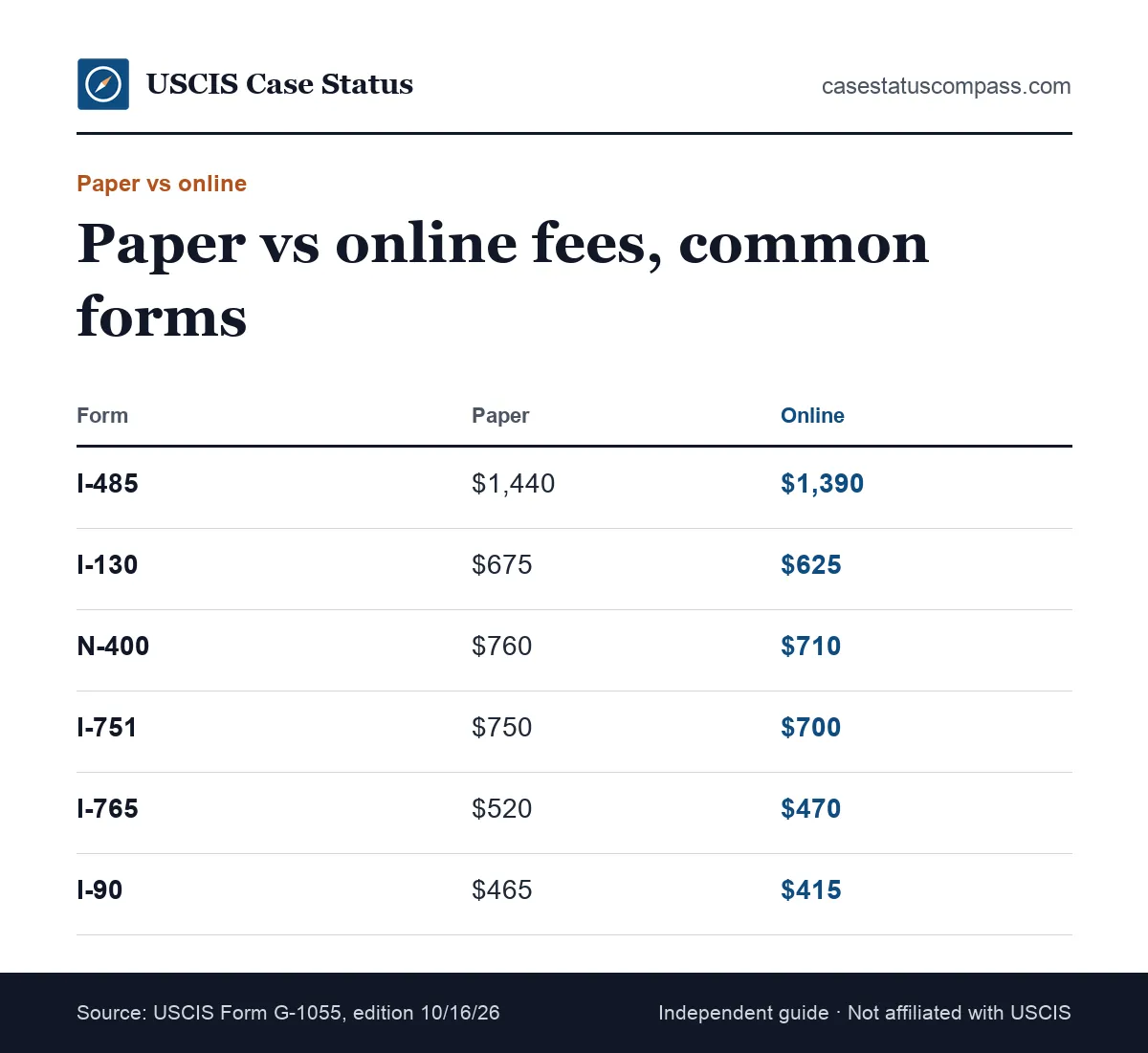
Online filing is cheaper for most forms USCIS accepts online. The 10/16/26 schedule usually shows a lower online price, such as $710 instead of $760 for the N-400, with the same gap on the I-130, I-485 and I-90. A fee waiver request is the main reason to choose paper.
When the paper column applies
You file on paper when a form has no online option, when you ask for a fee waiver or the reduced N-400 fee, or when you are a Ms. L. class asylum applicant.
What the online discount covers
The lower price applies only to forms submitted through a USCIS online account. Form I-485 can now be filed online at the cheaper row. Paper filings of the same form pay the higher row, even if you later link the case to an online account.
Are Biometrics Fees Still Listed Separately?
For most forms, no. Biometrics included in most fees (separate $30 for TPS I-821 and some EOIR forms). Most filers send one amount that already covers fingerprints and photos. Adding a separate biometrics payment where none is listed can get a package rejected for the wrong amount. Check your row before including one.
Why older guides still add it
Before April 2024, many forms carried their own biometrics charge. Since the April 1, 2024 rule, most forms bundle it into the base fee. If a checklist shows a separate biometrics line for your form, compare it with the current G-1055 before paying.
The remaining biometrics lines
The schedule keeps $30 biometric services fee, only where G-1055 lists it (e.g., TPS I-821, some EOIR forms). If your form is one of them, include it. Our biometrics appointment guide explains the visit itself.
Using the USCIS Fee Calculator
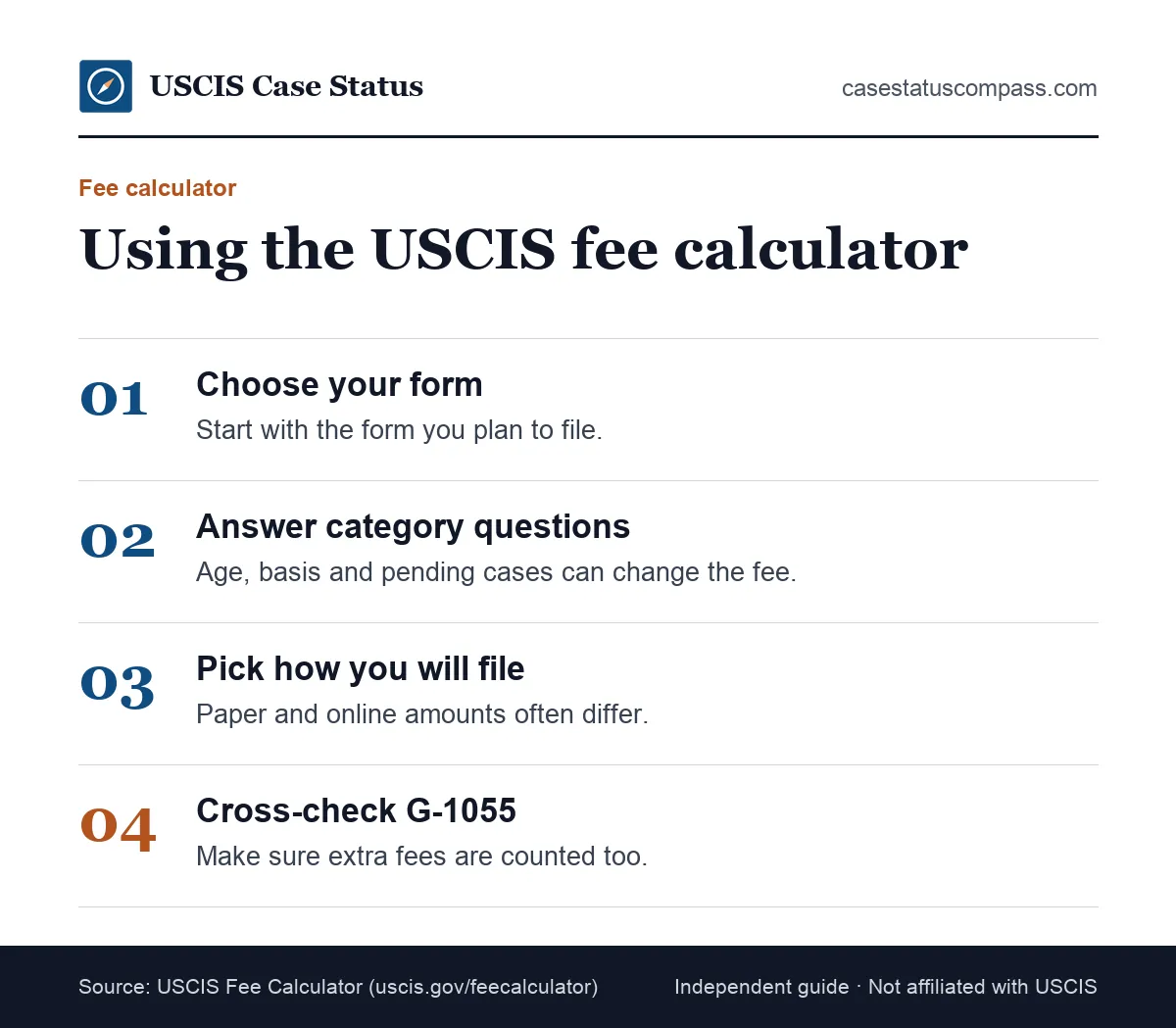
The USCIS fee calculator at uscis.gov/feecalculator is the official filing fee calculator. It asks about your form and situation and returns the amount due, using the same rules as Form G-1055. It is free and needs no account. Use it alongside the schedule, not instead of it.
What the calculator asks
Expect questions about your category, age, any pending case and whether you file on paper or online. Each answer picks a row on the schedule. One wrong answer, such as your I-485 filing date, can change an I-765 fee by hundreds of dollars.
If the two tools disagree
The published G-1055 edition is the legal fee list. Call the Contact Center at 800-375-5283 before you pay. See our contact USCIS guide. Write down both amounts and the date you checked, so you can explain the difference.
Build Your Own Total: A Fee Worksheet
You build a total filing cost by listing each form in your package, finding its row on Form G-1055 and adding the separate charges. Our worksheet turns that into four lines. Fill it in once for each person who is filing.
Four-line fee worksheet
Fill in each line in order. Lines 1 to 3 are usually required, and line 4 is optional.
| Line | What to write | Where to find it |
|---|---|---|
| 1. Main form | Base fee for your category and method | Main table |
| 2. Companion forms | Work permit, travel document, supplements | Appendixes B and C |
| 3. Add-ons | H.R. 1, Asylum Program, $30 biometric services fee, only where G-1055 lists it (e.g., TPS I-821, some EOIR forms) biometrics | Footnotes, appendixes |
| 4. Optional | Premium processing (I-907) | Premium line |
Example: a family adjustment package
A paper filer writes the I-485 line, the I-765 row for applicants with a pending I-485 filed on or after Apr. 1, 2024, and the I-131 advance parole row. Each is a separate payment; the package total is the sum of the three rows.
Example: first asylum work permit
An initial (c)(8) applicant writes zero for the base I-765 fee, then adds the $570 initial EAD H.R. 1 add-on. Because H.R. 1 fees cannot be waived, only a recognized exemption brings this total to zero.
How Do You Pay USCIS Fees in 2026?
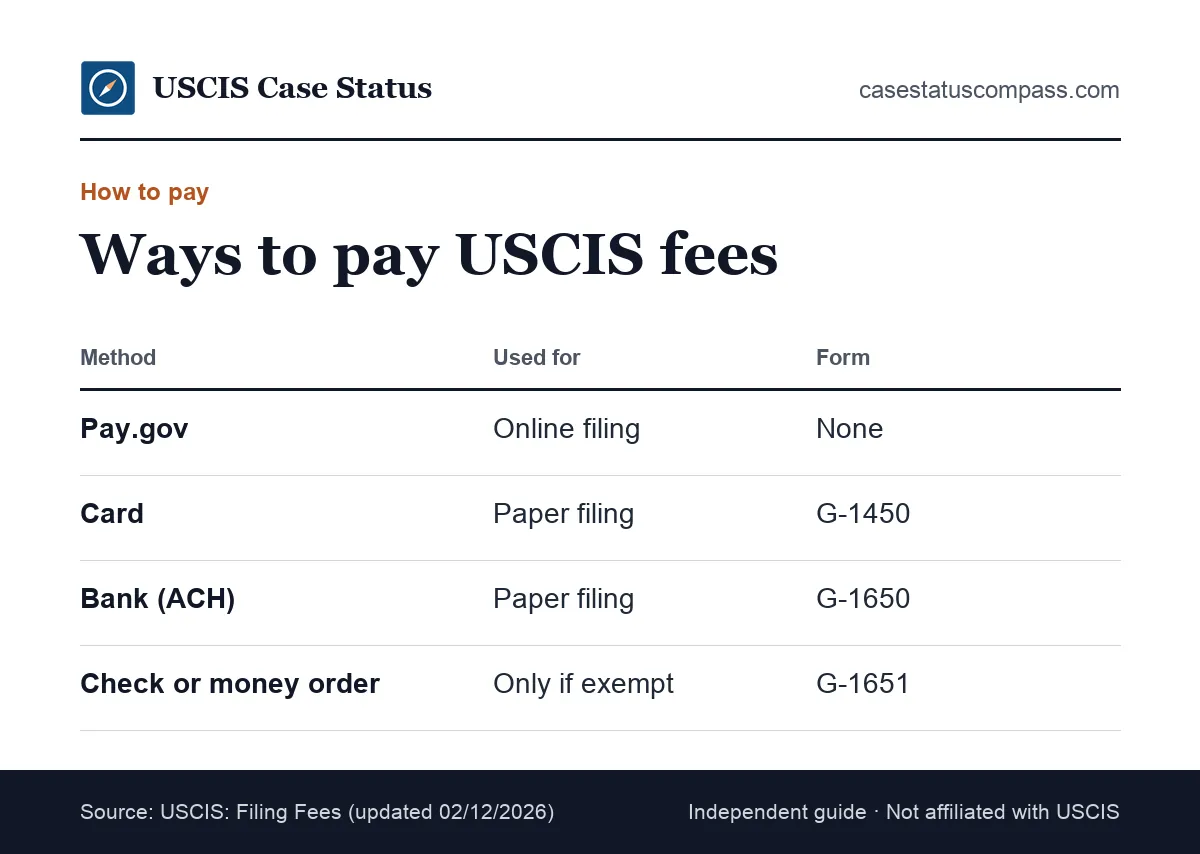
In 2026 you pay USCIS fees electronically: pay online through Pay.gov, or on paper with Form G-1450 (card) or Form G-1650 (bank account). Under the current rules, checks, money orders and cashier's checks are accepted only with an approved Form G-1651 exemption.
Payment methods at a glance
Each row shows a way to file and the payment form that goes with it. Only exempt filers may use paper checks.
| How you file | Method | Form to include |
|---|---|---|
| Online | Card or bank withdrawal on Pay.gov | None |
| Paper | Credit, debit or prepaid card | G-1450 |
| Paper | U.S. bank account (ACH) | G-1650 |
| Paper, exempt | Check, money order or cashier's check | G-1651 |
| In person at an office | Pay.gov card or ACH | G-1650 for ACH |
Where the rule comes from
USCIS's Filing Fees page (updated Feb. 12, 2026) sets these rules. Cash is never accepted for filing or biometric fees, even in person. Check that page again before each filing, since payment rules can change.
Paying Online Through Pay.gov
When you file online, USCIS collects the fee through Pay.gov, the U.S. Treasury payment site, at the end of submission. You can use a card or a bank withdrawal, and the online price applies automatically. No payment form is needed.
Check the web address
Scammers copy USCIS branding on fake payment pages. USCIS never asks for fees by phone, gift card, wire transfer or payment app. Real payment pages end in pay.gov and open only from inside your USCIS account, never from a link sent by text or email.
Your online payment record
After you submit, your USCIS online account shows the filing and its receipt notice. Save the Pay.gov confirmation too. Your bank or card statement will also show the charge. Keep all three records until the case is decided.
Credit Card Payments With Form G-1450
Form G-1450, Authorization for Credit Card Transactions, lets you pay a paper filing by card. Sign it and place it on top of the package. Visa, Mastercard, American Express, Discover and prepaid cards on those networks are accepted if a U.S. bank issued them.
Filling it out correctly
- Write the exact G-1055 amount in U.S. dollars.
- Match the cardholder name and billing address to the bank's records.
- Sign and date it; an unsigned G-1450 is not a valid authorization.
- Use one G-1450 per benefit request. Gift cards are not supported.
If the card is declined
USCIS charges the card when it processes the package. A declined card counts as a missing fee, so the filing is rejected and returned. Raise the limit or switch to Form G-1650, then refile with a new authorization.
Bank Account (ACH) Payments With Form G-1650
Form G-1650, Authorization for ACH Transactions, lets USCIS withdraw the fee from a U.S. checking or savings account. It works for paper filings and in-person payments, and it avoids card limits on large totals. Sign and date it before mailing.
What to enter on Form G-1650
Mark personal or business and checking or savings, then add the 9-digit routing number and the account number. One wrong digit makes the withdrawal fail. Copy the numbers from a check or your bank's app, and sign and date the form.
Declined ACH payments
USCIS retries once if a withdrawal fails for insufficient funds. Other failures, such as a closed account or a debit block, are not retried, and the filing may be rejected.
Can You Still Pay With a Money Order for Homeland Security?
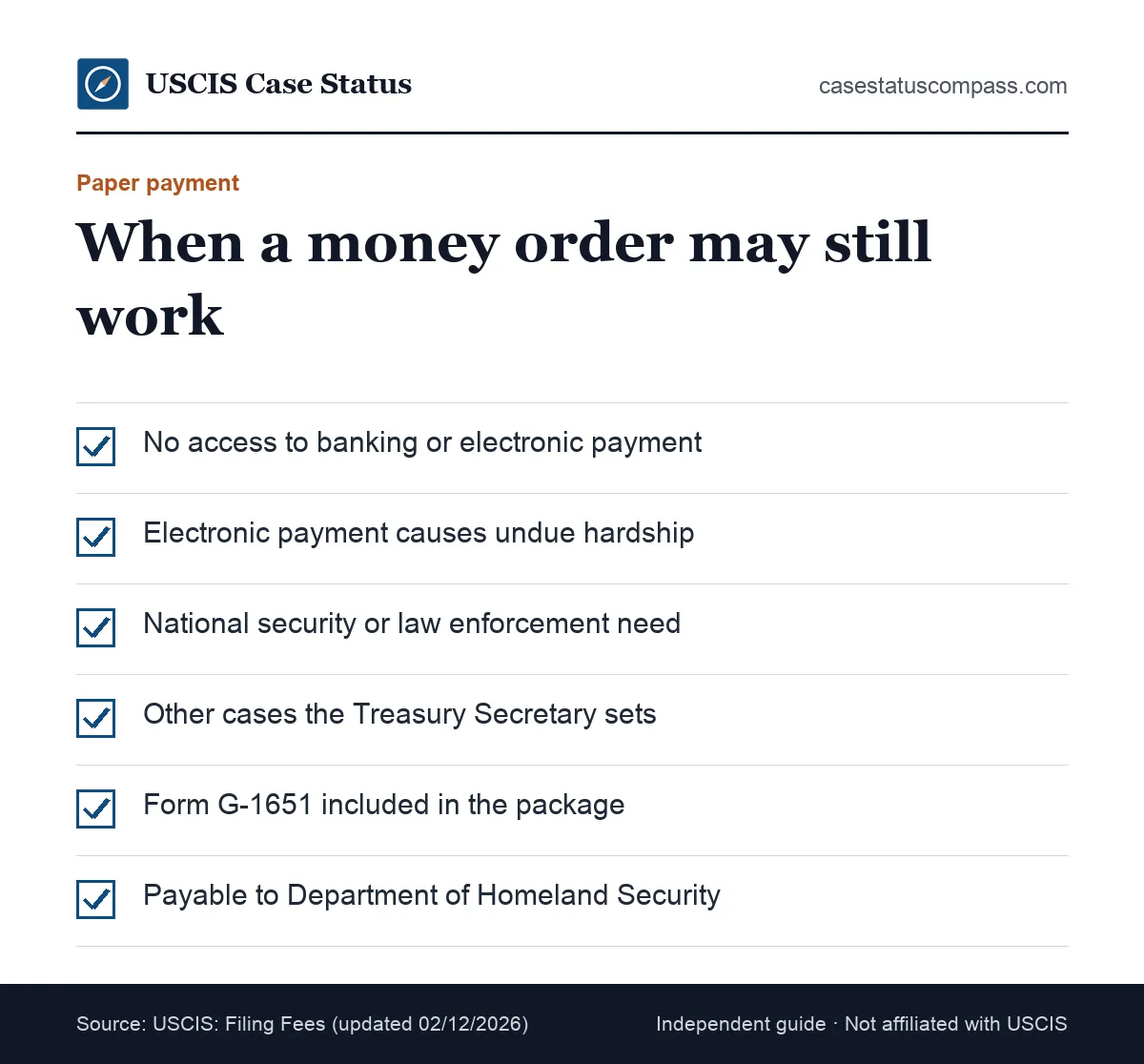
Only with an exemption. USCIS no longer accepts a money order for Homeland Security, a check or a cashier's check for paper filings unless you include Form G-1651 and meet an exemption ground. Without it, the package is rejected.
Exemption grounds on Form G-1651
You may qualify if you lack access to banking or electronic payment, if electronic payment would cause undue hardship, or for national security or law enforcement reasons. Put the G-1651 in the same package as the payment.
Rules for an exempt paper payment
An exempt immigration money order or check must be drawn on a U.S. institution, payable in U.S. funds and dated within the past year. It cannot be combined with a card or ACH payment in the same package.
Who Do You Make a USCIS Check Payable To?
For an exempt check or money order, make paper payments payable to the U.S. Department of Homeland Security (not 'DHS' or 'USDHS'). Write U.S. Department of Homeland Security in full, never "USCIS." Abbreviations such as "DHS" or "USDHS" are not accepted. This applies only to exempt paper payments filed with an approved Form G-1651.
Is There a Department of Homeland Security Address for Money Orders?
No. People search for a Department of Homeland Security address for money orders, but there is no separate payment address. The payment travels inside your package to the address on your form's "Where to File" page. USCIS changed many mailing addresses on Oct. 7, 2026, so check that page again.
What About a Western Union Money Order Sample?
A Western Union money order sample for USCIS shows where the payee and purchaser names go. It cannot make a money order acceptable. A money order works only with an approved G-1651 exemption. Without that exemption, pay by card or bank account.
Why samples mislead
Many sample images predate the electronic payment change and show old amounts or "USCIS" as payee. If you truly cannot pay electronically, read the G-1651 instructions, buy the money order for the exact 10/16/26 amount and keep the purchaser receipt.
How Should You Pay When Filing Several Forms Together?
USCIS recommends paying each filing fee separately for each benefit request, even in one envelope. Also, use one payment method per form; USCIS won't take a mix of payment types for one form. Fill in one payment form per request.
Why separate payments protect you
With one combined payment, an error on one form can cause USCIS to reject everything. With separate payments, correct forms are accepted and receipted while you refile only the one that failed.
One method per request
You cannot split one fee across two cards or pay part by card and part by ACH. If your card limit is too low for every fee, pay some forms by card and others by ACH, one method per form.
Why Does USCIS Reject Filings for the Wrong Fee?
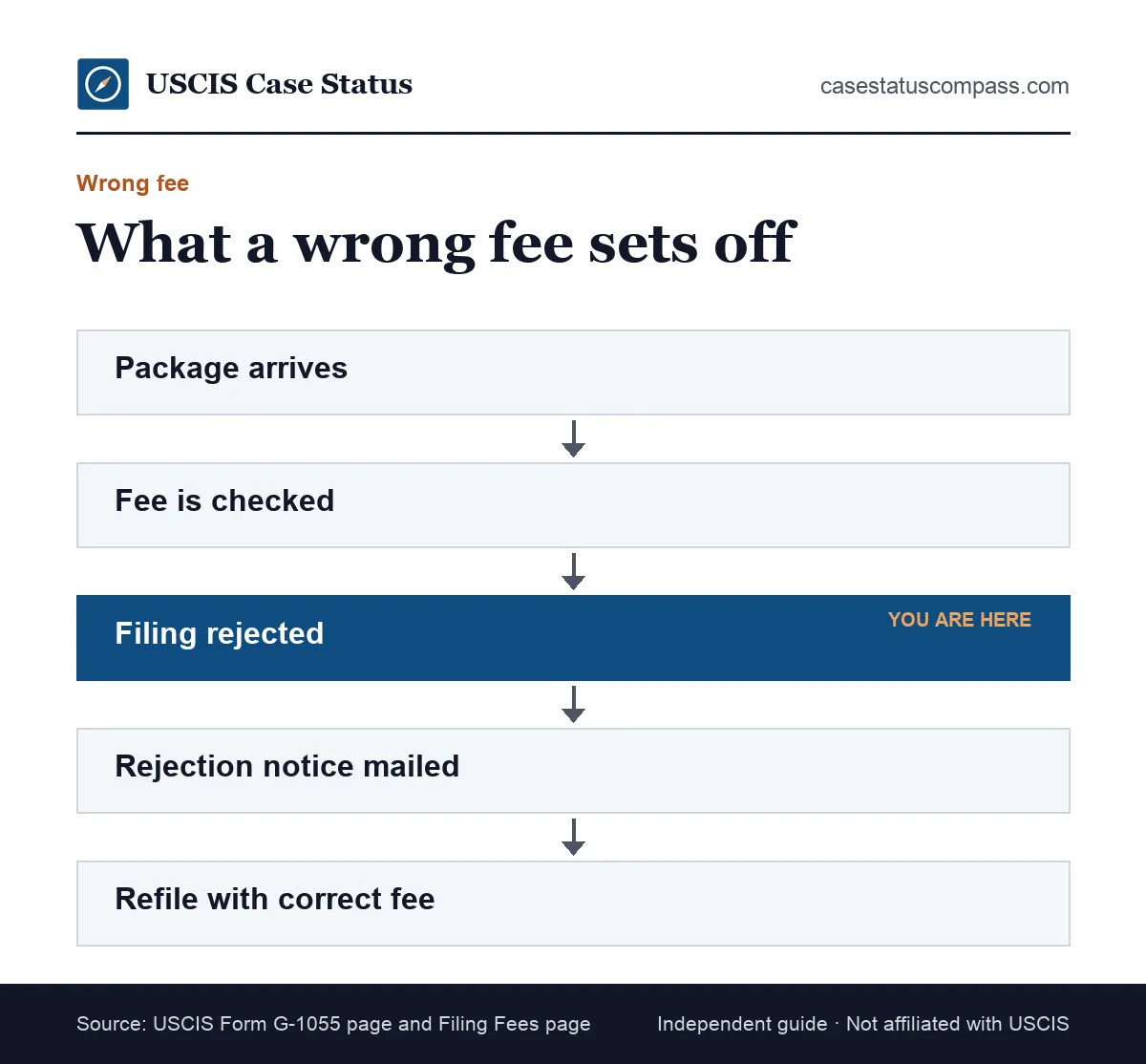
USCIS rejects a request without the correct fee because fees are fixed by regulation and statute, so the agency cannot accept less or more. The G-1055 page says requests postmarked on or after Oct. 16, 2026 without the proper fee are rejected.
Rejection vs denial
A rejection means USCIS never accepted the filing, so no receipt number exists. A denial is an officer's decision on a filed case. A denial has other options, explained in our case denied guide.
What a rejection notice looks like
The notice names the problem, such as an incorrect fee or a missing signature on the payment form. It comes with the returned package and has no receipt number. Read the reason, fix only that problem, and refile with a new payment form.
Common Payment Mistakes
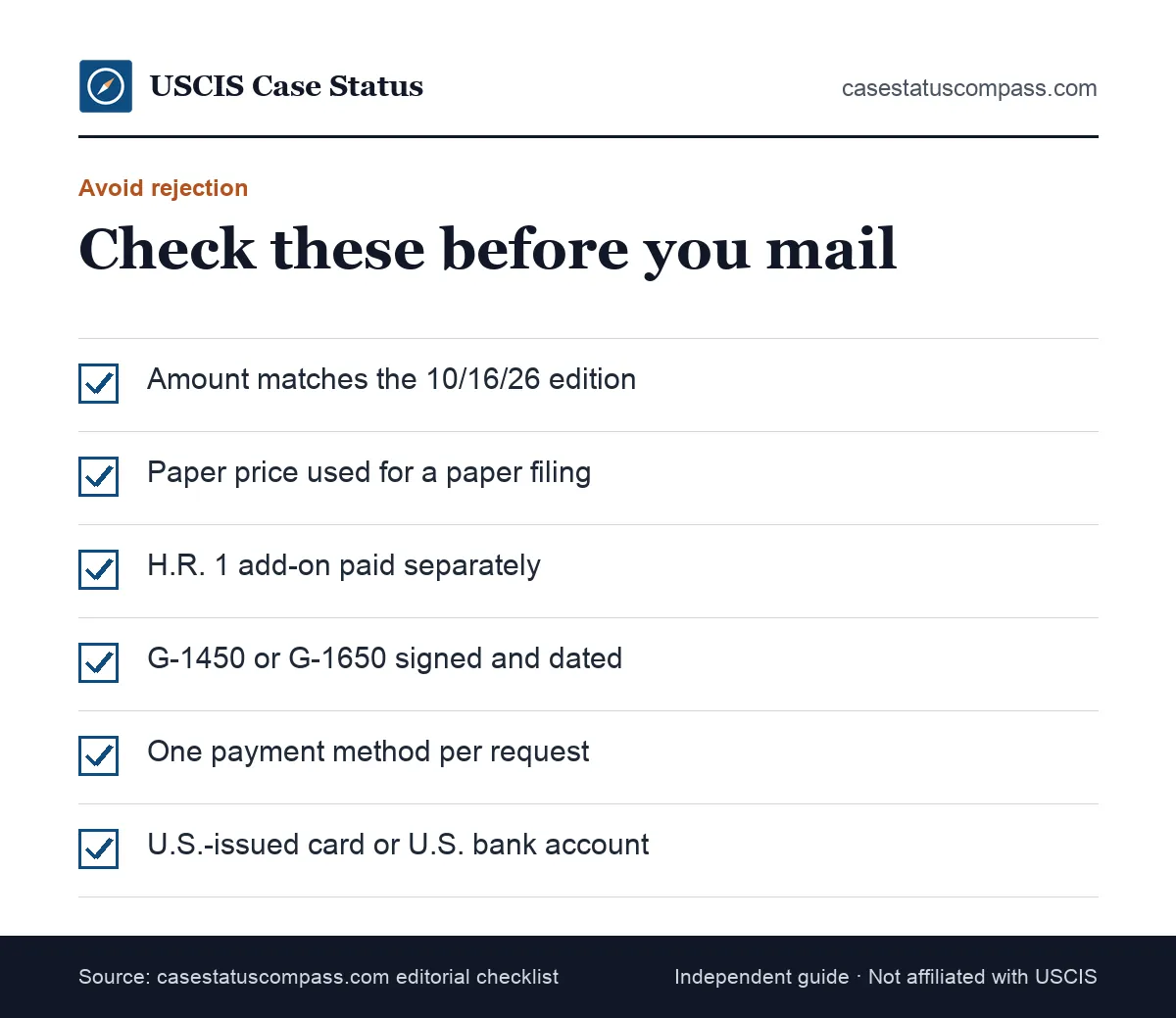
The most common USCIS payment mistakes are an old fee amount, the online price on a paper filing, a missing add-on, an unsigned card form and mixed methods. Each one gets a filing rejected, and each is easy to catch by comparing your payment with the current G-1055 row before you mail the package.
Old amounts and the wrong column
Amounts from 2025 editions fail where a line changed. The online price on a paper form leaves you short. Check the current G-1055 fee row the day you sign. Paper filers use the paper column; online filers use the online one.
Missing add-ons
The Asylum Program Fee on employer petitions and the H.R. 1 add-ons on work permits are the usual misses. Both sit beside the base fee, not inside it. Add each add-on as its own amount.
Card and bank errors
A declined card, a non-U.S. card, a routing number typo or a missing signature all count as a missing fee. Check the card limit, card issuer and signature before mailing, and copy bank numbers directly from a check.
What Happens After USCIS Rejects Your Payment?
USCIS returns the package or mails a rejection notice with the reason. You fix the fee and refile as a new submission. The filing date becomes the day USCIS accepts the corrected package, not your first mailing date. Any deadline that passes before the corrected package arrives is missed.
Steps to refile
- Read the notice for the exact reason.
- Recheck the G-1055 row and the fee calculator.
- Prepare a new signed G-1450 or G-1650.
- Confirm the form edition and mailing address.
- Mail again and keep tracking proof.
When a date is at stake
For deadline filings, such as an I-751 inside its window, a rejection can push you past the date. File early enough to allow one correction, or speak with an attorney.
Can You Get a Refund of a USCIS Fee?
Almost never. USCIS fees are nonrefundable, even if your case is denied or withdrawn. That covers filing and biometric fees, whatever action USCIS takes. A rejected filing differs: USCIS never accepted it, so the fee is not charged or is returned with the package.
Charged twice for one filing
If a card or bank account was charged twice for one filing, that is a processing error, not a fee. Contact USCIS with both transaction records and the receipt number so the duplicate can be traced.
Check eligibility first
Because an accepted fee is gone even if the case is denied, confirm you qualify before paying. Our forms hub links to each form's eligibility and evidence rules. A DOJ-accredited representative can review eligibility, often at low cost.
What Happens If You Overpay a USCIS Fee?
Paying a rounded "safe" amount is a mistake. An overpaid filing can be rejected because it does not match the schedule, the same as an underpayment. Write the exact G-1055 amount for your row and method, and never round up to cover a possible price change.
Which G-1055 Fees Can Be Waived?
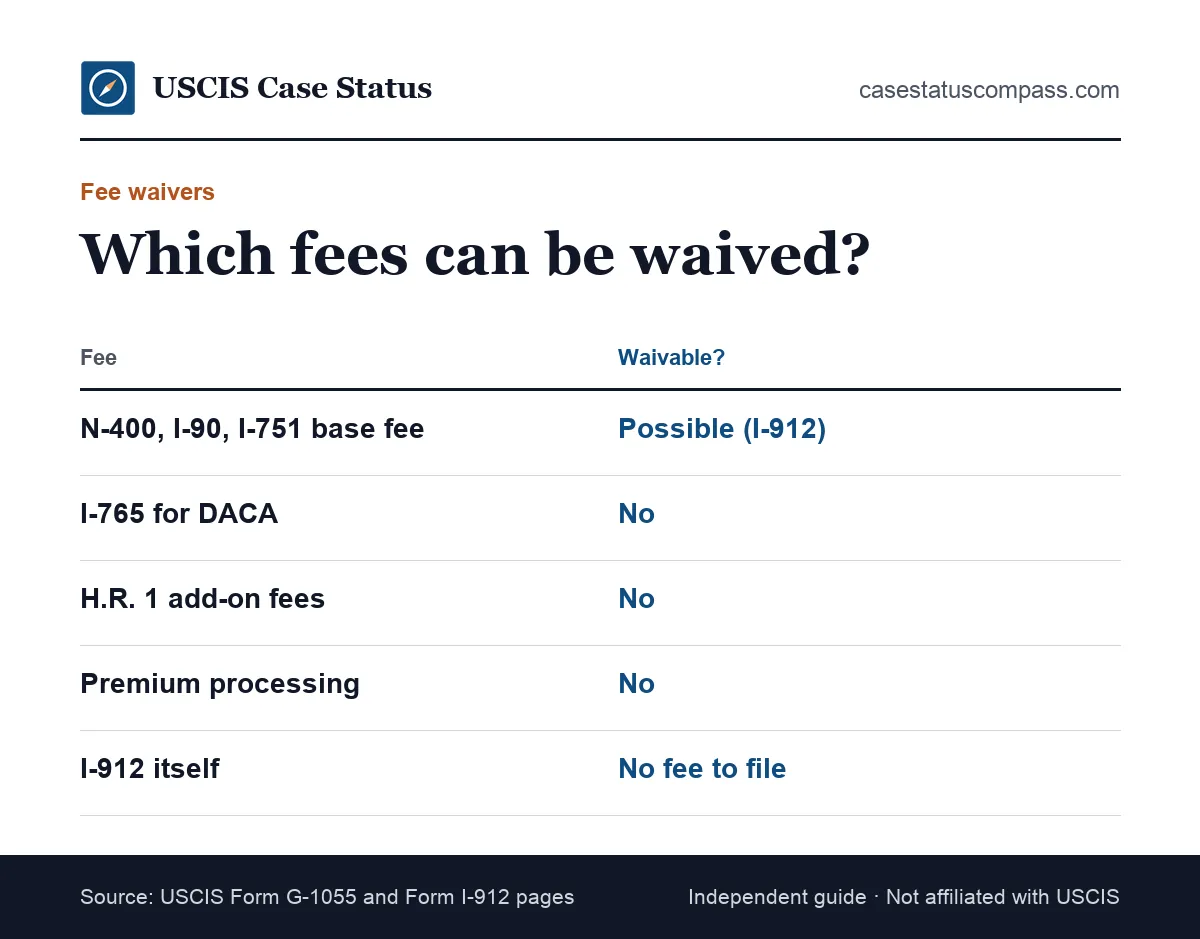
Some base fees can be waived with Form I-912, but H.R. 1 fees, premium processing and several others cannot. Fee waivers are possible for forms like I-90, I-751, I-765 (not DACA), N-400, N-565 and N-600. Filing the I-912 costs nothing.
Who qualifies
USCIS lists three grounds: Fee waiver: means-tested benefit, income at or below 150% of poverty guidelines, or financial hardship. Evidence rules and denial reasons are on our uscis fee waiver page.
Fees that are never waived
- H.R. 1 fees, including EAD add-ons and asylum fees
- Premium processing: You can't get a fee waiver for premium processing
- The I-765 for DACA
- Employer charges such as the fraud fee
Premium Processing Fees on the Fee Schedule
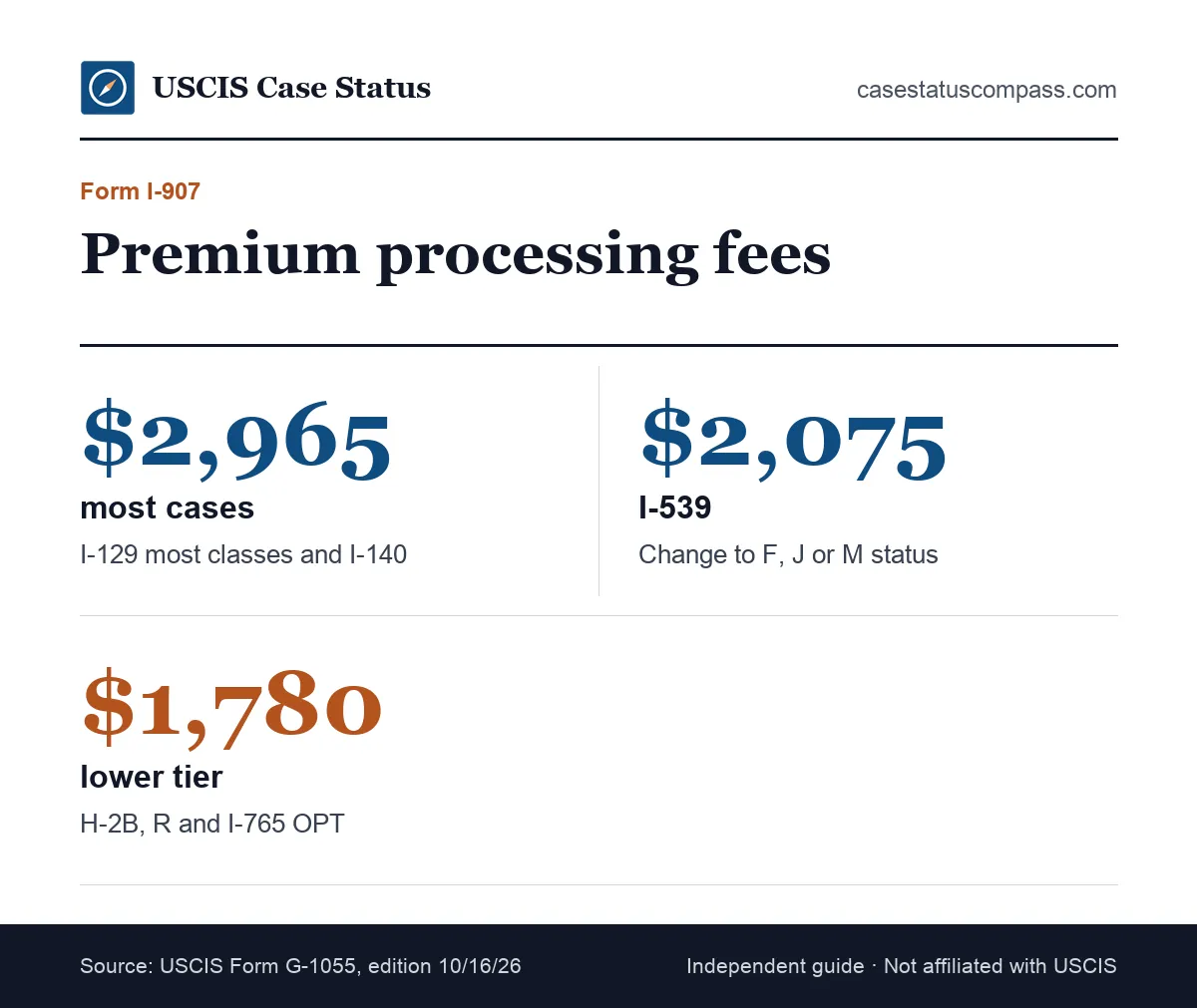
Premium processing is an optional faster review requested on Form I-907, with its own G-1055 line. As of October 2026 it costs $2,965 (I-129 most classes, I-140); $1,780 (H-2B/R, I-765 OPT); $2,075 (I-539 to F/J/M). It is paid on top of the base fee.
What it buys
USCIS commits to act within 15 business days (I-129, most I-140); 30 (I-765 OPT, I-539 F/M/J); 45 (I-140 E13 managers and NIW). Acting can mean an approval, denial or request for evidence. Our premium processing guide explains which forms qualify and when the clock resets.
How Often Does the USCIS Fee Schedule Change?
The USCIS fee schedule changes with each new fee rule and, since H.R. 1, at least once a year for the inflation-adjusted lines. The 10/16/26 edition is the FY2027 update. A new edition can appear at any time a rule or statute takes effect, so check the edition date before each filing.
Which Fee Applies: Postmark Date or Signing Date?
The postmark date decides for paper filings. A package postmarked Oct. 15, 2026 used the old fees; one postmarked Oct. 16 needs the new ones, even if you signed earlier. Keep your mailing or courier receipt as proof of the date.
Online filings use the submission date
For an online filing, the fee in force on the day you press submit applies, not the day you started the draft. If a new edition takes effect while your draft is open, the account charges the new amount.
How to stay current
Bookmark uscis.gov/g-1055, not the PDF link, because the page shows the current edition at the top. Recheck on the day you sign the payment form. The edition date is the quickest check.
Form G-1055 and Form Editions: Two Separate Checks
Form G-1055 tells you how much to pay; each form's edition date tells you which version to file. A perfect payment attached to an outdated edition is still rejected, so check both on the same day. G-1055 has its own page on uscis.gov; editions appear on each form's page.
Editions that matter now
- Form I-485: 09/18/26 (01/20/25 and 09/04/26 editions rejected on/after Sept. 18, 2026; no grace period)
- Form I-765: 08/21/25 (the 09/15/26 edition is NOT accepted because of a Sept. 14, 2026 court order)
- Form N-400: 01/20/25
Where to find the edition date
The edition date prints at the bottom of every page of a USCIS form and on its uscis.gov page under "Edition Date." Compare it with the date shown on the form's page. If they differ, download the form again before you fill it in.
Processing Fees vs Filing Fees: What People Mean
People often say processing fees when they mean filing fees. The G-1055 uses "filing fee," "biometric services fee" and named statutory fees. The only optional charge for faster handling is premium processing. If someone quotes a "processing fee" not on the schedule, ask which G-1055 line it is.
Fees that arrive later by notice
A few real fees come after filing: the Annual Asylum Fee, the Immigration Parole Fee when parole is granted, and the USCIS Immigrant Fee. Each has its own G-1055 line.
Does USCIS Ever Charge a Processing Fee by Phone?
No. USCIS does not charge to move a case forward, check status or book an interview, and Case Status Online is free. A call or text demanding a "processing fee" to avoid deportation is a scam. Real fees are paid only through Pay.gov or the official payment forms.
How the Fee Guides Fit Together
This G-1055 guide explains the schedule and how to pay. Each topic guide takes one goal and totals its costs. Check single numbers here, and plan a whole case on the topic page. Use the table to find your page.
Fee guides by goal
Pick your goal in the left column. The right column links to the page that adds up every cost for it.
| Your goal | Where to plan the cost |
|---|---|
| Become a citizen | Naturalization fees |
| Get a green card | Green card costs |
| Renew a card | I-90 renewal fees |
| Work permit or work visa | Work visa and EAD fees |
| Renew DACA | DACA renewal costs |
| Bring a fiancé(e) | K-1 fees |
| Ask for a waiver | Fee waiver guide |
Checklist Before You Pay a USCIS Fee
Before you pay a USCIS fee, confirm the edition, your category row, the paper or online column, every add-on and a valid payment form. Run through these five checks on the day you sign the payment form, then keep the records listed below. Most rejections come from skipping one step.
Five-point check
- The schedule shows Form G-1055, Edition 10/16/26 or newer.
- Your row matches your form answers.
- Paper price for paper, online price for online.
- Add-ons listed as their own lines.
- G-1450 or G-1650 signed, dated and exact.
What to keep
Keep the payment form, the statement line and the Form I-797C receipt, which confirms USCIS accepted the payment. Our I-797C notice guide shows where the receipt number appears. Keep them until the case is decided, in case USCIS questions the payment.
When Should You Get Help With USCIS Fees?
Get help when your category is unclear, when a parole or H.R. 1 fee may apply, when you face the H-1B fee stack, or when a deadline leaves no room for a rejection. An immigration attorney or DOJ-accredited representative can check your fee lines.
Free and low-cost fee help
Nonprofits with DOJ-accredited representatives often review fee lines at low or no cost. Confirm the person is an attorney or accredited representative, and be wary of anyone who asks you to pay USCIS fees through them.
What this guide can and cannot do
We explain the published fee schedule and payment rules. We are not USCIS, cannot see your case and cannot take payments.
Frequently Asked Questions
Is Form G-1055 something I have to file?
No. Form G-1055 is a reference document, not an application. You never sign or mail it. You read it to find the correct fee, then pay through Pay.gov online or with Form G-1450 or G-1650 on paper.
Can I pay one fee for my whole family?
USCIS recommends a separate payment for each benefit request, each using one payment method. If you file I-485 applications for a spouse and two children, prepare a separate card or bank authorization for each.
Does USCIS accept credit cards from other countries?
No. Cards used with Form G-1450 must be issued by a U.S. bank. Visa, Mastercard, American Express, Discover and prepaid cards on those networks qualify, but gift cards do not. Without a U.S. card, a U.S. relative or employer can pay, or you can use Form G-1650.
Can I use two cards to split a large fee?
No. Each benefit request must be paid with one method, so you cannot split a fee across two cards or mix card and bank payments. If a card limit is too low, pay that form by ACH with Form G-1650.
Are G-1055 fees the same at every USCIS office?
Yes. Form G-1055 sets one national fee list for USCIS, so the amount does not depend on your state or service center. Only the mailing address differs by form and location.
Does the State Department use Form G-1055?
No. G-1055 covers USCIS fees only. Visa application fees and the consular Affidavit of Support review fee follow the State Department's own schedule. The one overlap is the USCIS Immigrant Fee, which new immigrants pay to USCIS online after the State Department issues their immigrant visa.
Is the USCIS fee calculator always right?
It uses the same rules as Form G-1055, but the published schedule is the legal fee list. If the two disagree, save both results with the date and call the Contact Center before you pay.
When do I pay the USCIS Immigrant Fee?
Pay it online after the State Department issues your immigrant visa, ideally before you travel. USCIS does not produce your green card until the fee is paid. Some groups, such as adoptees and returning residents, are exempt.
Can I pay a USCIS fee in cash at a field office?
No. USCIS never accepts cash for filing or biometric fees, even in person. At an office you pay by card or bank account through Pay.gov, or by ACH with Form G-1650.
Does Form G-1055 list premium processing prices?
Yes. Premium processing has its own Form I-907 line on the schedule, with prices that vary by form and category. It is optional, paid on top of the filing fee and never waived.
Sources
- USCIS: Fee Schedule (Form G-1055). www.uscis.gov/g-1055. Accessed Oct 27, 2026.
- USCIS Form G-1055 PDF, Edition 10/16/26. www.uscis.gov/sites/default/files/document/forms/g-1055.pdf. Accessed Oct 27, 2026.
- USCIS: Filing Fees (updated 02/12/2026). www.uscis.gov/forms/filing-fees. Accessed Oct 27, 2026.
- USCIS Fee Calculator. www.uscis.gov/feecalculator. Accessed Oct 27, 2026.
- USCIS: Form I-912, Request for Fee Waiver. www.uscis.gov/i-912. Accessed Oct 27, 2026.
- USCIS: How Do I Request Premium Processing?. www.uscis.gov/forms/all-forms/how-do-i-request-premium-processing. Accessed Oct 27, 2026.
- USCIS: Filing Locations and Online Filing Options Updates. www.uscis.gov/forms/us-citizenship-and-immigration-services-filing-locations-and-online-filing-options-updates. Accessed Oct 27, 2026.
- USCIS: H-1B Electronic Registration Process. www.uscis.gov/working-in-the-united-states/temporary-workers/h-1b-specialty-occupations-and-fashion-models/h-1b-electronic-registration-process. Accessed Oct 27, 2026.
- USCIS: H-1B Specialty Occupations (updated 09/21/2026). www.uscis.gov/working-in-the-united-states/h-1b-specialty-occupations. Accessed Oct 27, 2026.
- USCIS Contact Center (uscis.gov). www.uscis.gov/contactcenter. Accessed Oct 27, 2026.
- Form I-912 Instructions, Edition 07/22/25. www.uscis.gov/sites/default/files/document/forms/i-912instr.pdf. Accessed Oct 27, 2026.
- USCIS: Form I-485 page (updated 10/07/2026). www.uscis.gov/i-485. Accessed Oct 27, 2026.
- USCIS: Form I-765 page (updated 10/07/2026). www.uscis.gov/i-765. Accessed Oct 27, 2026.
- USCIS: Form N-400 page (updated 06/16/2026). www.uscis.gov/n-400. Accessed Oct 27, 2026.
casestatuscompass.com is an independent publication and is not affiliated with USCIS or any government agency. This page is general information, not legal advice. For denials, court or asylum matters, consult an immigration attorney or a DOJ-accredited representative.