Contents · 44 sections
- How Much Does It Cost to Become a US Citizen in 2026?
- What Is the N-400 Citizenship Application Fee?
- Online vs Paper Filing: Which Costs Less?
- When Must You File the N-400 on Paper?
- Do Application for Naturalization Fees Include Biometrics?
- How Much Is the Reduced Citizenship Fee?
- Reduced Fee and Fee Waiver: How Do They Compare?
- How Does the N-400 Fee Waiver (Form I-912) Work?
- Why Was Form I-942 Retired?
- What If You Already Filled Out Form I-942?
- Do Military Applicants Pay to Naturalize?
- How Much Does It Cost to Become a US Citizen as a Green Card Holder?
- Citizenship Cost Worksheet: Add Up Your Own Total
- What Do Sample Citizenship Budgets Look Like?
- What Is the N-600 Certificate of Citizenship Fee?
- N-400 or N-600: Which Fee Applies to You?
- How Much Does the N-600K Cost for Children Abroad?
- What Is the Certificate of Citizenship Replacement Cost?
- Does Each Family Member Pay a Separate Citizenship Fee?
- Do Children Pay a Citizenship Fee When a Parent Naturalizes?
- Other Costs: Photos, Translations, Travel and Time
- How Much Does an Immigration Lawyer Cost for Citizenship?
- What Does the Medical Disability Exception Cost?
- Is the Citizenship Test Free?
- What Does a U.S. Passport Cost After You Naturalize?
- What Does It Cost If Your Citizenship Case Is Denied?
- Can You Get a Refund on the Citizenship Fee?
- How Do You Pay the Citizenship Application Fee?
- What Payment Mistakes Get an N-400 Rejected?
- Do H.R. 1 Add-On Fees Apply to Naturalization?
- How Have Naturalization Fees Changed?
- Will Citizenship Fees Go Up?
- Should You File Early to Avoid a Fee Increase?
- Which Fee Schedule Edition Applies to Your Filing?
- How Much Is the Citizenship Application on the USCIS Fee Calculator?
- Is US Citizenship Worth the Cost?
- Naturalization vs Staying a Permanent Resident: What Is the Cost Difference?
- How Can You Lower the Cost of Becoming a Citizen?
- How Do You Avoid Citizenship Fee Scams?
- If X, Do Y: Which Citizenship Fee Path Fits You?
- How Do Citizenship Costs Compare With Other Immigration Fees?
- How Does Processing Time Affect Your Real Cost?
- Can You Pay Extra to Speed Up Citizenship?
- Frequently Asked Questions
The short answer
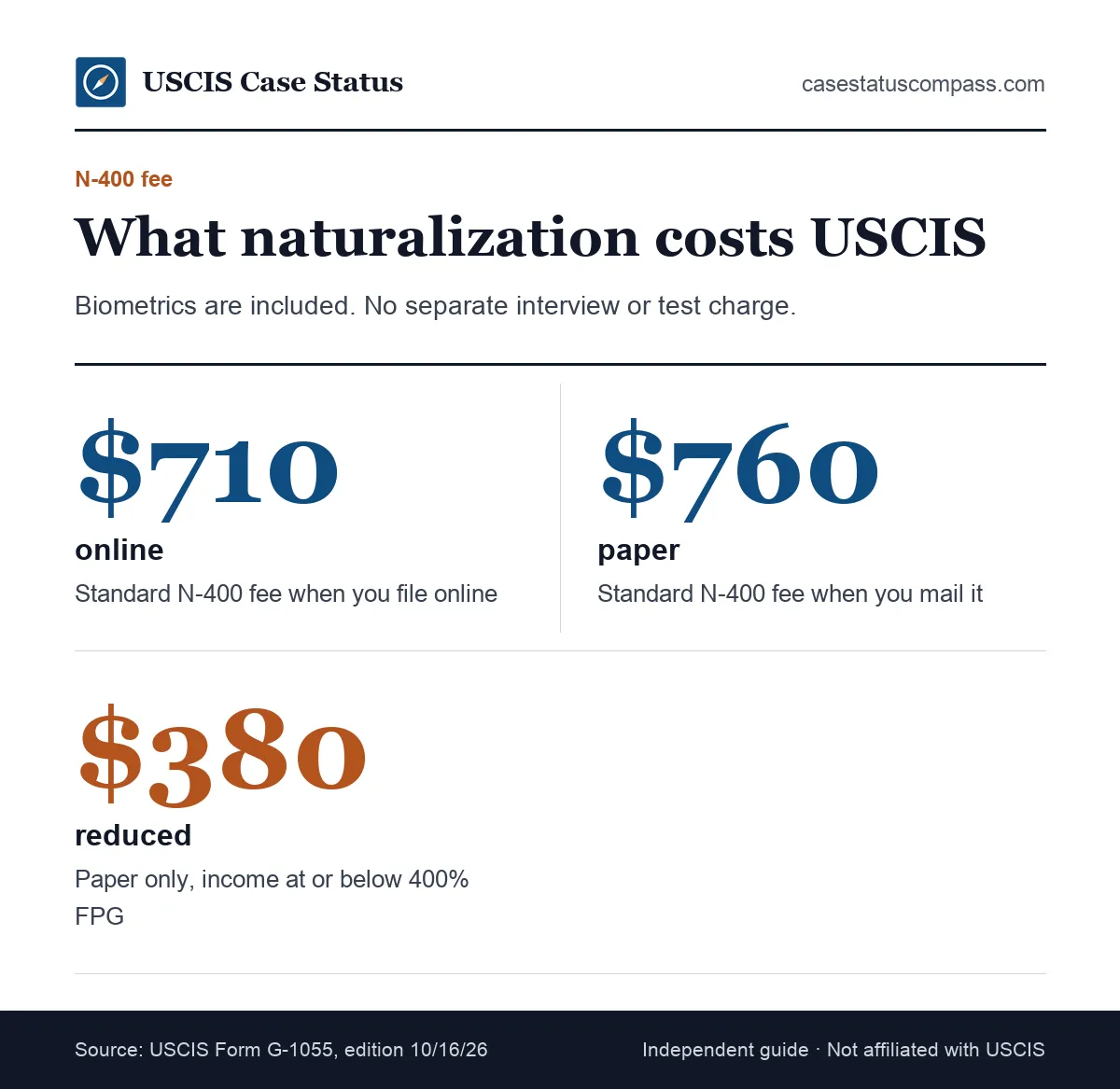
How much does it cost to become a US citizen? As of October 2026, the Form N-400 fee is $760 (paper) / $710 (online); reduced fee $380 (paper only) if household income is at or below 400% of the Federal Poverty Guidelines. Biometrics are included, and the interview and civics test carry no extra charge. Your real total grows with translations, travel and any legal help you choose.
At a glance
| N-400 fee | $760 (paper) / $710 (online); reduced fee $380 (paper only) if household income is at or below 400% of the Federal Poverty Guidelines |
| Fee schedule | Form G-1055, Edition 10/16/26 |
| Certificate of citizenship (N-600) | $1,385 (paper) / $1,335 (online) |
| Refunds | None, even if the case is denied or withdrawn |
How Much Does It Cost to Become a US Citizen in 2026?
The government price to naturalize is the Form N-400 filing fee; USCIS requires nothing else for a standard case. Under the October 2026 schedule, filing online is the cheapest full-price option, mailing costs a little more, and moderate-income applicants on paper can pay a reduced fee.
How much is it to become a US citizen?
As of October 2026, USCIS lists the naturalization fee as $760 (paper) / $710 (online); reduced fee $380 (paper only) if household income is at or below 400% of the Federal Poverty Guidelines. That one payment covers intake, background checks, fingerprints, the interview and the tests.
What Is the N-400 Citizenship Application Fee?
The citizenship application fee is what USCIS charges to accept and decide Form N-400, the Application for Naturalization. It is set in Form G-1055, the official fee schedule, and depends on whether you file online or on paper and on household income.
How much is the citizenship application fee?
USCIS publishes every price in Form G-1055, Edition 10/16/26. If anyone quotes a different US naturalization price, the edition in force on your filing date wins. Our form g 1055 explainer shows how to read it.
Online vs Paper Filing: Which Costs Less?
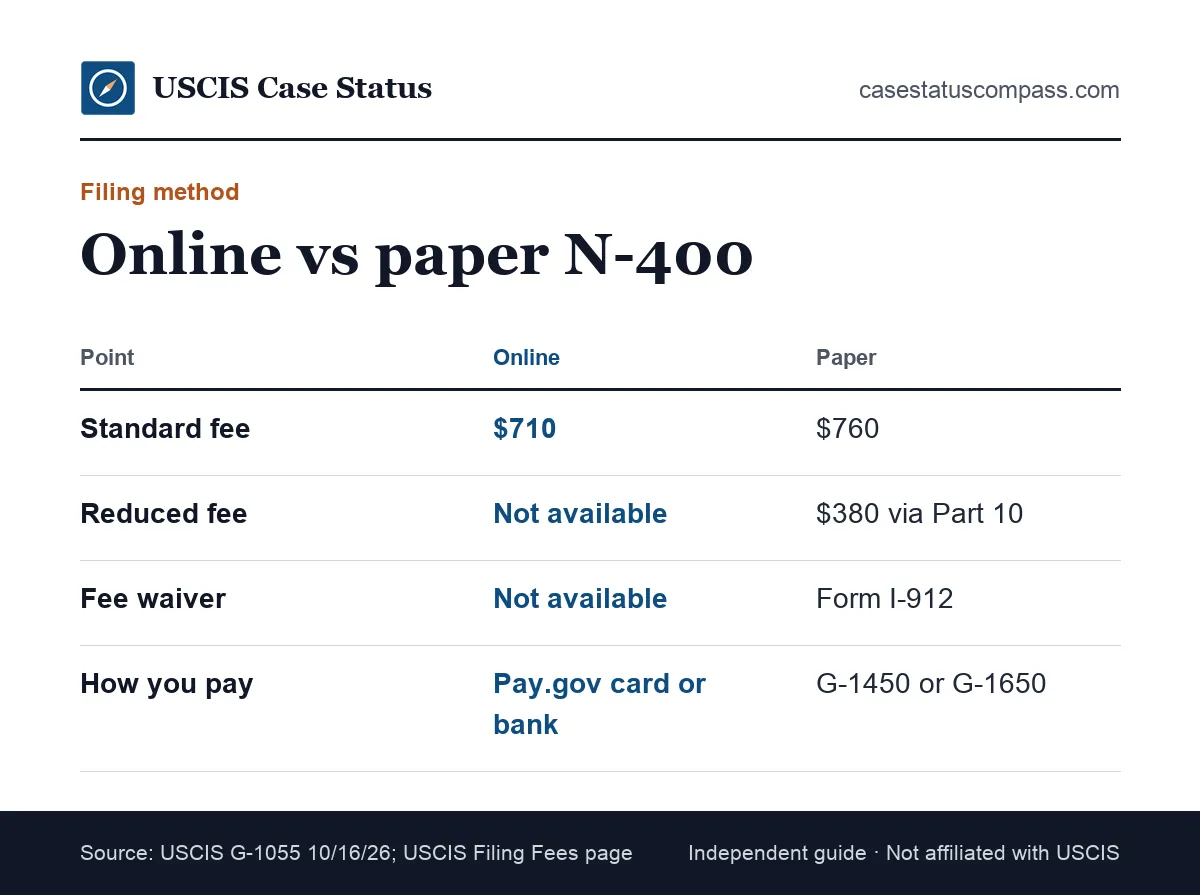
Filing the N-400 online costs less than mailing a paper form; the online discount came with the 2024 fee rule. The trade-off: you cannot request a reduced fee or a fee waiver online, so lower-income applicants usually file on paper.
How much does it cost to apply for citizenship online?
If you will pay full price anyway, online filing saves money and confirms receipt instantly. Our citizenship application guide walks through the online account setup. Online, you pay $710 instead of $760.
When Must You File the N-400 on Paper?
Paper filing is required when you ask for the reduced fee or a fee waiver, according to the N-400 instructions; neither request exists in the online form. Budget for the higher paper price unless you qualify for a reduction.
Filing method fee comparison table
This table shows how the way you file decides which N-400 prices and fee relief options are open to you.
| Filing choice | Standard price | Reduced fee possible? | Fee waiver possible? |
|---|---|---|---|
| Online N-400 | Lower online amount in Form G-1055, Edition 10/16/26 | No | No |
| Paper N-400 | Higher paper amount in the same schedule | Yes, in Part 10 | Yes, with Form I-912 |
| Paper N-400, military (INA 328/329) | No fee | Not needed | Not needed |
Do Application for Naturalization Fees Include Biometrics?
No separate charge applies. Since the April 1, 2024 fee rule, the N-400 price includes biometrics, the fingerprints, photo and signature taken at an Application Support Center. USCIS states: Biometrics included in most fees (separate $30 for TPS I-821 and some EOIR forms).
Forms that still carry a separate charge
A stand-alone biometric charge survives on a few lines only. As of October 2026 the schedule shows $30 biometric services fee, only where G-1055 lists it (e.g., TPS I-821, some EOIR forms). None of those forms is part of naturalizing.
How Much Is the Reduced Citizenship Fee?
The reduced N-400 fee is a lower, paper-only price for applicants whose household income is at or below 400% of the Federal Poverty Guidelines. It is printed on the N-400 line of Form G-1055, and you claim it inside the paper application.
Who qualifies for the reduced fee
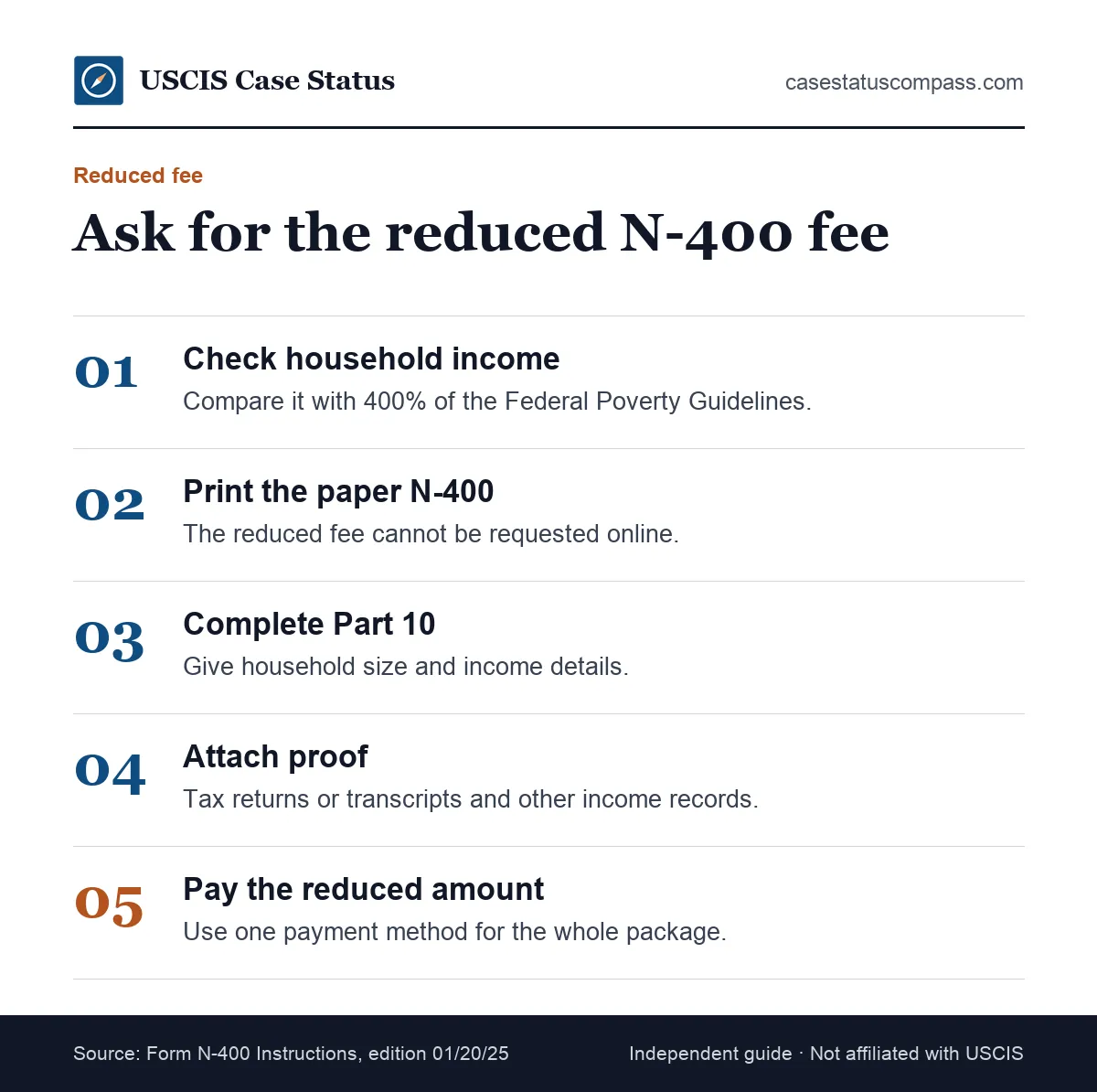
Count yourself, your spouse and dependents living with you, then compare total income with 400% of the poverty guidelines for that household size. At or below 150%, check the full waiver instead.
How to request it in Part 10
USCIS says: Reduced N-400 fee: request it in Part 10 of the paper N-400 (income at or below 400% of poverty). A missing number or unsigned section can get the whole package rejected.
Evidence USCIS expects
Send proof that matches what you wrote:
- Recent federal tax returns or IRS transcripts
- Pay stubs or an employer letter if income changed
- Proof of household members you counted, such as birth or marriage certificates
Reduced Fee and Fee Waiver: How Do They Compare?
A reduced fee lowers the N-400 price for moderate incomes, while a fee waiver removes it for very low income, means-tested benefits or hardship. Both require paper filing, and both end in a rejected package if USCIS says no. The reduced price is $380, while an approved waiver brings the N-400 cost to zero.
Reduced fee vs fee waiver table
Read across each row to see how the two requests differ in paperwork, income limits and the price you end up paying.
| Point | Reduced N-400 fee | Full fee waiver |
|---|---|---|
| How you ask | Part 10 of the paper N-400 | Form I-912 with the paper N-400 |
| Income rule | At or below 400% of poverty guidelines | Benefit, at or below 150%, or hardship |
| What you pay | Reduced amount in G-1055 | Nothing for the N-400 if approved |
| If USCIS says no | Package is rejected; refile with the right fee | Package is rejected; refile with the right fee |
Which option to pick
Meet a waiver route? Ask for the waiver. Income between the two limits? The reduced fee is realistic. Near a limit, gather extra proof, because a denial means a rejected package.
How Does the N-400 Fee Waiver (Form I-912) Work?
USCIS lists three routes to a waiver: Fee waiver: means-tested benefit, income at or below 150% of poverty guidelines, or financial hardship. You ask with Form I-912, which is itself free: $0 (no fee to request a fee waiver). Attach it and your proof to a paper N-400. For evidence lists and denial tips, read our uscis fee waiver guide.
Why Was Form I-942 Retired?
Form I-942 was the old stand-alone request for a reduced naturalization fee. USCIS now marks its page as archived, and the October 2026 schedule has no I-942 line. The request moved into Part 10 of Form N-400. Old copies still circulate online, so check the edition before you print anything.
What changed for applicants
You complete one fewer form. The income questions sit inside the N-400, so use the current N-400 edition, 01/20/25, which contains Part 10. Your income proof now goes in with the application itself.
What If You Already Filled Out Form I-942?
Do not mail it. Move the same income details into Part 10 of the current N-400, attach your evidence, and pay the reduced amount shown in the current schedule. An archived form can only slow intake. If an I-942 came back rejected, refile with Part 10 completed.
Do Military Applicants Pay to Naturalize?
Service members who naturalize under INA 328 or 329 pay no N-400 fee under the October 2026 schedule. They still file the N-400 plus a certification of service, which is also free: $0. Your installation's legal office can usually help at no charge.
Proving military service
USCIS explains the paperwork this way: Military applicants: Form N-426 (certified for current service members); veterans use a DD-214. Ask your unit for the certification early, because an uncertified N-426 from a current member can delay the case.
How Much Does It Cost to Become a US Citizen as a Green Card Holder?
For most green card holders, the full cost is the N-400 fee plus a few private expenses. A self-prepared online filing costs little beyond the fee; a lawyer, many translations or long trips can multiply the total. The worksheet below helps you price your own case line by line.
How much does it cost for citizenship in government fees?
Only the N-400 fee is mandatory, unless you qualify for a reduction, waiver or military exemption. The citizenship interview, English test, civics test and oath ceremony cost nothing extra.
How much is the cost to become a US citizen with private extras?
A simple case may need nothing extra. Arrests, long trips abroad or tax issues often justify paid legal review, and foreign-language records need translations. Ask each provider for a written quote before you commit, and add it to line E or F.
Citizenship Cost Worksheet: Add Up Your Own Total
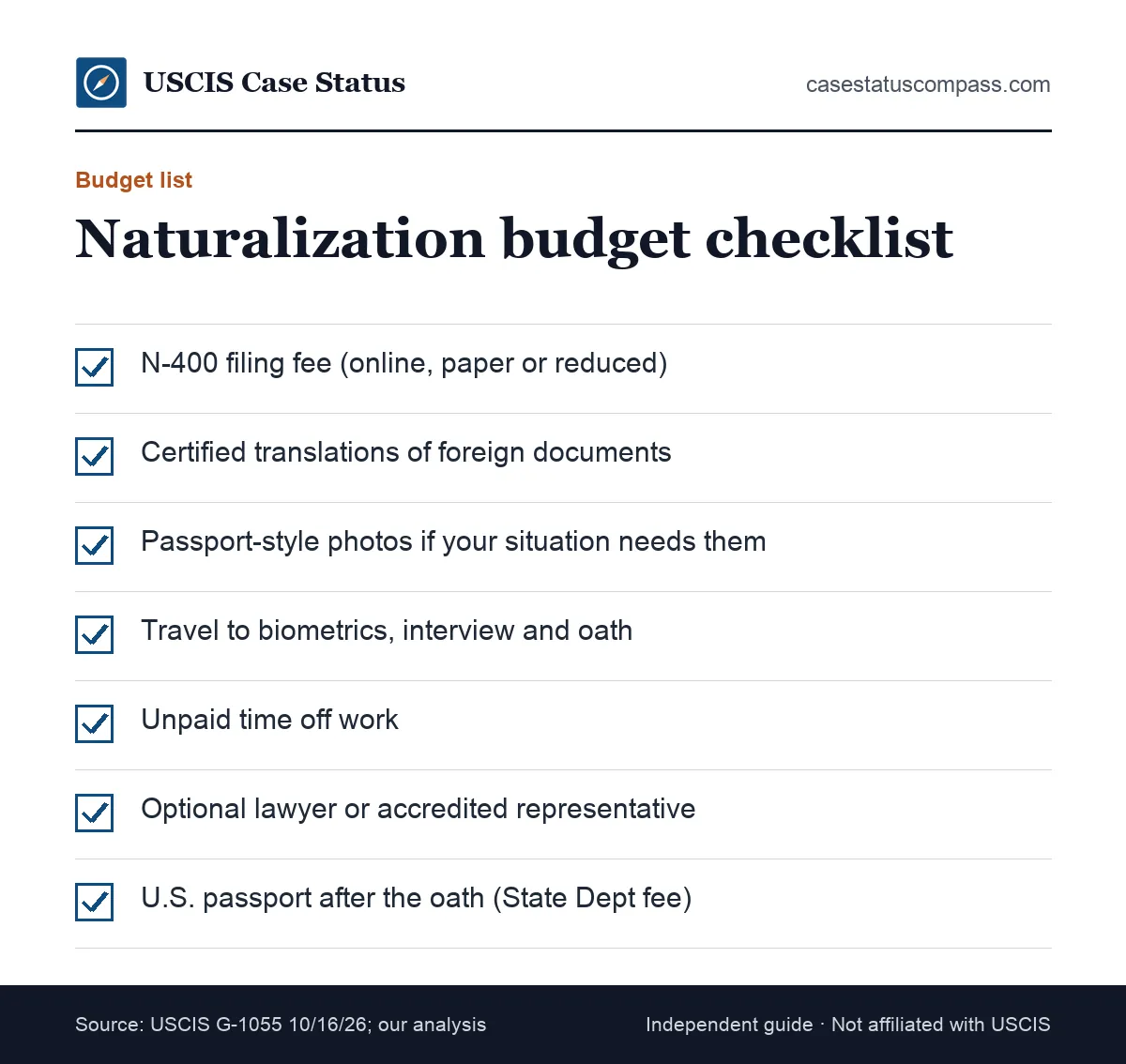
Pick the lines that apply, copy the amount from the official schedule, and add them. It keeps every number tied to Form G-1055, Edition 10/16/26. Leave private lines blank until you have real quotes, and redo the sum if USCIS publishes a new edition before you file.
The citizenship cost worksheet table
Each lettered line below is one possible cost; tick the lines that apply to you and enter the matching amount.
| Line | Applies to you? | Amount to enter |
|---|---|---|
| A. N-400 fee | Everyone except INA 328/329 military | $760 (paper) / $710 (online); reduced fee $380 (paper only) if household income is at or below 400% of the Federal Poverty Guidelines |
| B. Certificate of citizenship (instead of A, only if already a citizen by law) | Derived citizens | $1,385 (paper) / $1,335 (online) |
| C. Replacement certificate later | Only if lost or damaged | $555 (paper) / $505 (online) |
| D. Medical disability exception | Only if needed | $0 USCIS fee (the doctor may charge) |
| E. Translations, photos, copies | Most applicants | Your vendor quotes |
| F. Lawyer or accredited representative | Optional | Your written quote |
| G. Travel and time off | Everyone | Your own estimate |
Step 1: choose your core fee
Most readers use line A: the online, paper or reduced amount. If a fee waiver is approved, line A becomes zero. Online filers enter $710, paper filers $760, and reduced-fee filers $380.
Step 2: price your private costs in writing
Skip lines that do not apply. Get written quotes from translators and lawyers, and note the distance to your Application Support Center for line G. Hourly workers should also write down unpaid hours for each visit.
What Do Sample Citizenship Budgets Look Like?
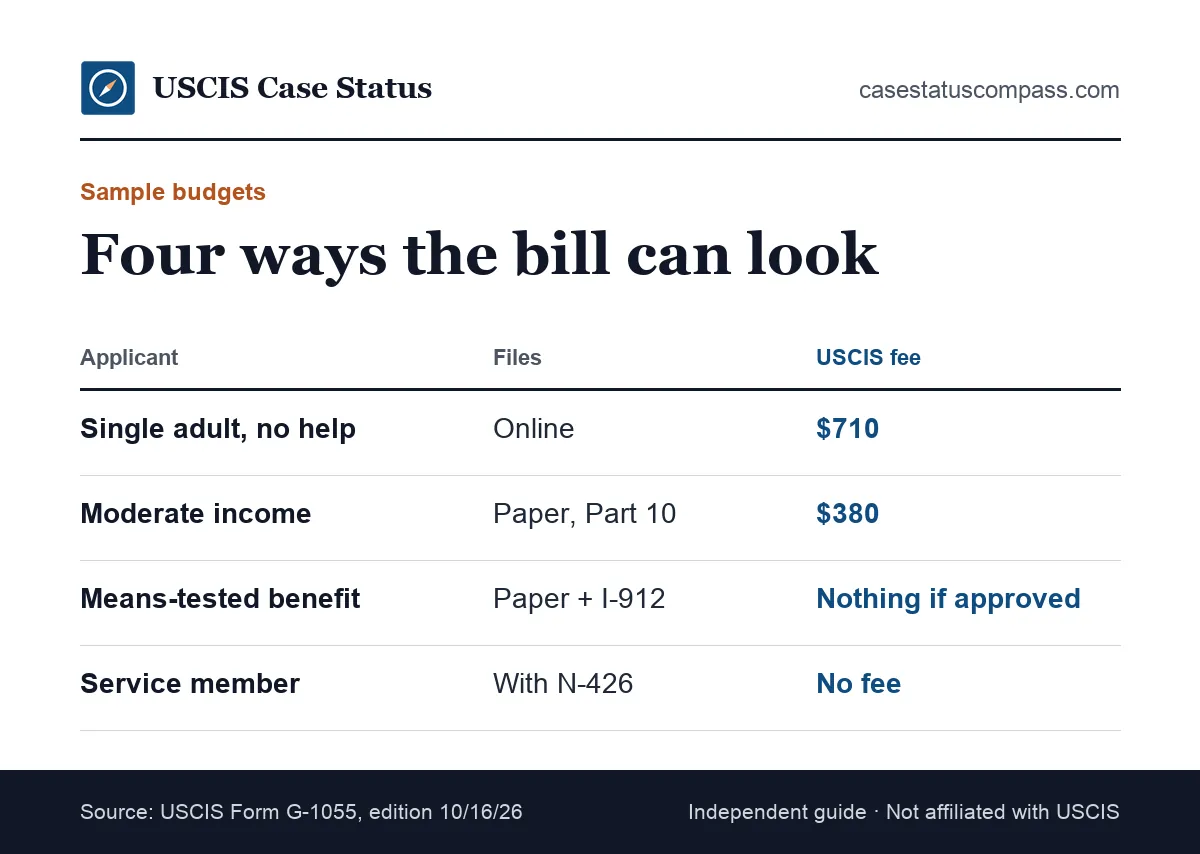
Four typical applicants show how the citizenship cost changes with income, help and service. The examples use only USCIS fees from the current schedule; private costs vary by city and provider, so you fill those in. None of the four cases includes lawyer fees.
Example 1: single adult filing online
Maria, a permanent resident for six years with a steady salary and clean record, files online and pays the online N-400 amount. Her only extra cost is bus fare to appointments.
Example 2: moderate-income family filer on paper
Ahmed supports a household of four on a wage under the 400% line. He files on paper, completes Part 10, attaches tax transcripts and pays the reduced amount.
Example 3: low-income filer asking for a waiver
Lin receives a means-tested benefit. She mails a paper N-400 with Form I-912 and her benefit letter. If the waiver is approved she pays nothing; if denied, she refiles with payment.
Example 4: service member under INA 329
Sam serves on active duty. He files the N-400 with a certified Form N-426 and pays no USCIS fee. He pays only for copies and time off. If he files after leaving the service, his DD-214 replaces the certified form.
What Is the N-600 Certificate of Citizenship Fee?
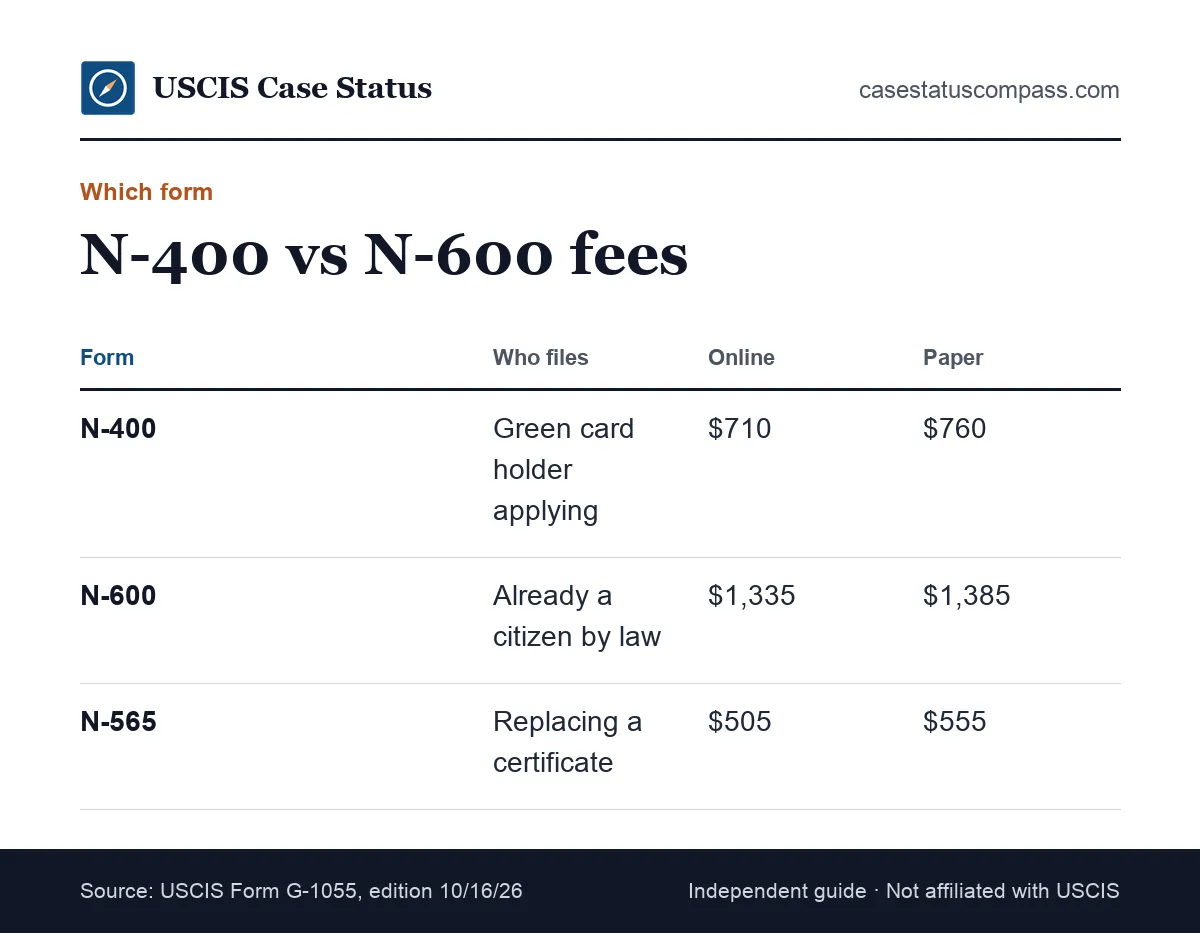
The N-600 fee is the price to request a Certificate of Citizenship if you are already a U.S. citizen through a parent. As of October 2026, USCIS lists it as $1,385 (paper) / $1,335 (online). Filing online costs $1,335, the cheaper of the two.
Who pays the N-600 fee
People who derived or acquired citizenship through a U.S. citizen parent file the N-600 for proof. The rules for derived citizenship: INA 320: child under 18, green card holder, living in the U.S. in a citizen parent's custody. If they were met, you do not pay the N-400 fee.
Military filers and the N-600
Current or former U.S. armed forces members filing for themselves pay no N-600 fee. The exemption covers the member's own application, so a parent filing for a child pays the normal amount. Our n600 form guide explains evidence and the interview.
N-400 or N-600: Which Fee Applies to You?
The N-400 is for permanent residents who want to become citizens; the N-600 is for people who already are citizens by law and need a certificate. Paying for the wrong one wastes money, because fees are nonrefundable. If you are unsure, check the date your parent became a citizen first.
Signs you belong on the N-400
You were born abroad, no parent was a U.S. citizen while you lived with them under 18, and you hold a green card. You meet residence rules yourself, so the naturalization fee applies.
Signs you belong on the N-600
A parent was or became a U.S. citizen before you turned 18, you held a green card and lived with that parent. You may already be a citizen, so an N-400 would be the wrong request.
How Much Does the N-600K Cost for Children Abroad?
Form N-600K is for children who live outside the United States and qualify through a citizen parent or grandparent. The October 2026 schedule lists it at the same paper amount as the N-600. That means $1,385 per child, so a family with two children abroad pays it twice.
When the N-600K fits
It suits children abroad who do not meet the residence rules for automatic citizenship. The child usually travels to the U.S. for an interview and oath, so budget airfare and lodging.
Children of military and government staff
Some children of service members stationed abroad can use the N-600 instead: Since Mar. 26, 2020, children of military and government staff stationed abroad can meet INA 320's residence rule.
What Is the Certificate of Citizenship Replacement Cost?
A replacement Certificate of Citizenship or Certificate of Naturalization uses Form N-565. As of October 2026 the fee is $555 (paper) / $505 (online). USCIS charges nothing when the certificate is wrong because of a USCIS error. Filing online costs $505 instead of the paper price.
When you pay the N-565 fee
You pay for a lost, stolen or damaged certificate, or a legal name or gender change, but not for a USCIS typo. Our naturalization certificate guide covers the steps. Low-income filers can ask for a waiver with Form I-912.
Cheaper alternatives to a replacement
A U.S. passport often serves as proof of citizenship for travel or work. Ask the agency requesting proof whether a passport will do before paying for an N-565. A passport also costs money, so compare both prices first.
Does Each Family Member Pay a Separate Citizenship Fee?
Yes. Every adult who naturalizes files their own N-400 and pays their own fee. The current schedule has no family discount or joint filing, so a married couple who both apply pays two fees unless one qualifies for a reduction or waiver.
Do Children Pay a Citizenship Fee When a Parent Naturalizes?
Often not. A green card holder child under 18 who lives with a parent who naturalizes may become a citizen automatically, with no N-400 and no naturalization fee. The family pays only if it wants a certificate as proof through the N-600, or chooses a U.S. passport instead.
Other Costs: Photos, Translations, Travel and Time
Beyond the fee, most applicants pay for some mix of certified translations, copies, postage, travel and time off work. None of it goes to USCIS. Use worksheet lines E and G to keep them visible, and ask for prices before ordering any service.
Photos
USCIS takes your photo at the biometrics appointment. Some filers, such as applicants abroad, may need passport-style photos; check the N-400 instructions first. Do not buy photos for the biometrics visit itself.
Certified translations
Foreign-language documents need a full English translation with the translator's certification. Translators usually charge per page, so send only what the instructions ask for. Bring the original and a copy to the interview.
Copies and postage
Paper filers pay for photocopies of the green card and supporting records, plus tracked mail to the lockbox. Online filers skip postage but may pay to scan documents. Keep a full copy of everything you send for your own file.
Travel to appointments
Plan for up to three trips: biometrics, the interview and the oath ceremony. A same-day oath after the interview saves a trip. Parking, tolls and childcare count too, so note them on line G.
Time off work
Each appointment can take most of a day once waiting and travel are counted. Hourly workers should price lost wages into line G of the worksheet. Ask your employer early whether paid leave covers these visits.
How Much Does an Immigration Lawyer Cost for Citizenship?
Lawyer fees for the N-400 are private and vary by city, complexity and interview attendance; USCIS does not set them. Get a written fee agreement that says what is included, such as preparing the N-400, answering a request for evidence and attending the interview.
What drives the price
Lawyers often quote a flat fee for a simple N-400 and charge more for criminal history, prior denials or interview attendance. Our immigration lawyer cost guide explains billing models.
Free and low-cost help
Nonprofits with DOJ-accredited representatives often help free or at low cost. Never pay a "notario" who is not a lawyer or accredited representative; they cannot give immigration advice. Check the representative on the Justice Department's accredited roster before sharing documents.
What Does the Medical Disability Exception Cost?
Form N-648 lets a licensed doctor certify that a disability prevents you from meeting the English or civics requirement. USCIS charges nothing for it: $0 USCIS fee (the doctor may charge). The real cost is the doctor's time. It is not a fee waiver for the N-400 itself.
What the form does
USCIS describes it this way: Form N-648: a doctor certifies a disability that exempts you from the English and/or civics test. It can be filed with the N-400 or later. A vague N-648 often causes interview problems.
Doctor's fees for the N-648
The doctor sets their own charge for exams and paperwork. Ask the price up front and choose a doctor who knows your history. Some community health centers charge on a sliding scale, so ask about that too.
Is the Citizenship Test Free?
Yes. The English and civics tests are part of the N-400 and carry no separate USCIS charge. If you fail one part, you get a retest without paying again. USCIS rules state: Two chances to pass; retest of the failed part 60-90 days after the interview.
Which civics test you take
The version depends on your filing date: Filed N-400 on or after Oct. 20, 2025: 2025 test; before that: 2008 test. For the newer version, USCIS says 2025 civics test: 20 questions from 128; pass with 12 correct. Our citizenship test guide has study tips.
Paid classes are optional
USCIS offers flash cards, audio and practice tests free, and many libraries run free classes. Pay for a course only if you learn better with a teacher, and confirm it teaches the test version that matches your filing date.
What Does a U.S. Passport Cost After You Naturalize?
A passport is optional and is issued by the U.S. Department of State, not USCIS. We could not confirm current passport fees on a fetchable official page, so check travel.state.gov before you apply. Apply after the oath, using your Certificate of Naturalization as proof of citizenship.
Why many new citizens get one
Your Certificate of Naturalization proves citizenship but is not a travel document. A passport lets you travel and re-enter as a citizen. It is also safer to carry than the certificate, which is best stored at home.
Passport book vs passport card
The book works for all international travel. The card covers only land and sea crossings with Canada, Mexico, the Caribbean and Bermuda, so frequent flyers need the book. Check the current price of each on travel.state.gov.
What Does It Cost If Your Citizenship Case Is Denied?
A denial does not return your money: USCIS fees are final once the filing is accepted. Refiling later means paying the N-400 fee again. A hearing request on a denial is a separate filing with its own fee in Form G-1055.
Refiling vs requesting a hearing
If waiting fixes the problem, such as too little residence time, refiling is simpler. If the officer made a legal mistake, a hearing request may fit; see options after a denial.
Avoiding a paid second attempt
Many denials trace back to filing too early, missing documents or unresolved records. Fix those first so your first fee is your only fee. Count your trips abroad and confirm the early filing window before you pay.
Can You Get a Refund on the Citizenship Fee?
Generally no. USCIS keeps the N-400 fee whether the case is approved, denied or withdrawn. Treat it as final the day you file. USCIS states the rule plainly: USCIS fees are nonrefundable, even if your case is denied or withdrawn. A package rejected at intake is handled differently, as explained below.
When a payment is returned
If your package is rejected at intake, for a wrong fee or missing signature, USCIS does not accept the filing. Fix the problem in the rejection notice before refiling.
Fees charged in error
If your card was charged twice or for the wrong amount, keep the bank statement and receipt notice, then contact USCIS. Disputing the charge with your bank first can complicate the case.
How Do You Pay the Citizenship Application Fee?
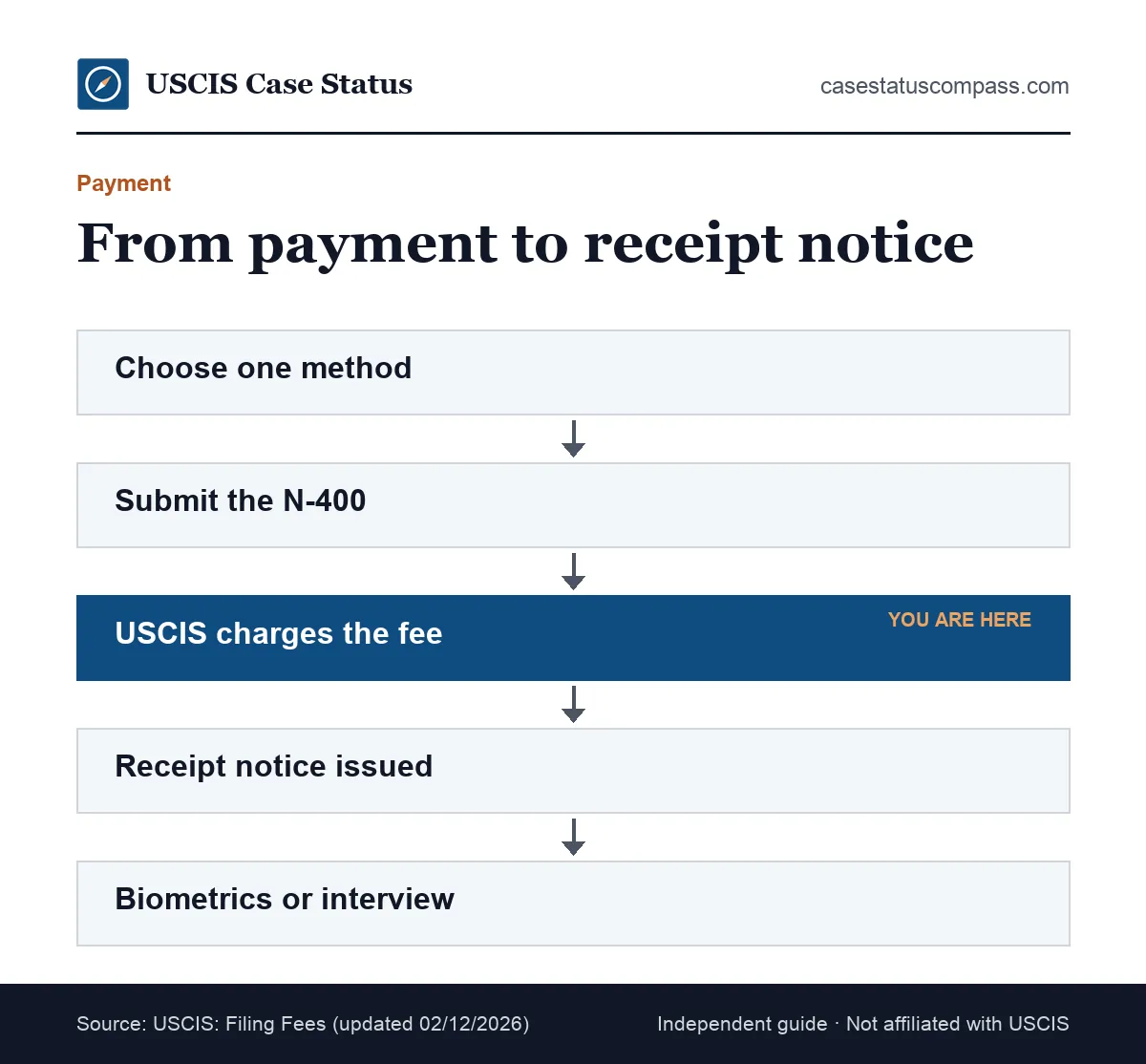
As of October 2026, USCIS says you pay online through Pay.gov, or on paper with Form G-1450 (card) or Form G-1650 (bank account). Online, Pay.gov takes a credit, debit or prepaid card, or a bank withdrawal. You must also use one payment method per form; USCIS won't take a mix of payment types for one form.
Paying online
The online account adds the fee at the end of the N-400. Make sure your card limit covers the full amount. If Pay.gov declines the card, the application is not submitted, so fix the payment and try again.
Paying by mail
Place the signed payment form on top of your paper N-400. Under current USCIS rules, checks, money orders and cashier's checks are accepted only with an approved Form G-1651 exemption.
G-1450 or G-1650: which form to use
Use Form G-1450 to pay by credit, debit or prepaid card, and Form G-1650 to pay by bank account debit. Fill in only one, since USCIS takes one method per form.
What Payment Mistakes Get an N-400 Rejected?
Most payment rejections come from three errors: the wrong amount, a declined card or a missing payment form. Double-check the amount against Form G-1055, Edition 10/16/26 on filing day. Each one sends the whole package back with no filing date.
Wrong amount
Using an old fee from a blog is common. Mailed requests postmarked on or after October 16, 2026 without the correct fee are rejected. Paper filers pay $760 or the reduced amount, never the online price.
Declined card or bank debit
If the charge fails, the package is rejected. Tell your bank to expect a government charge and keep enough money in the account. A debit card with a low daily limit is a frequent cause.
Missing or unsigned payment form
A paper filing without a signed G-1450 or G-1650 has no way to pay. Sign it and place it on top of the stack. Make the card or account details match the payer's name exactly.
Do H.R. 1 Add-On Fees Apply to Naturalization?
No H.R. 1 add-on appears on the N-400 line. The October 2026 G-1055 lists those fees for certain parole, asylum and work permit requests, and they cannot be waived. They matter only if you also file one of those forms.
Where H.R. 1 fees show up
The schedule applies them to forms such as the I-131, I-589, I-765, I-821 and I-941, which a citizenship applicant normally files none of. For employment cases, see our h1b visa fees guide.
How Have Naturalization Fees Changed?
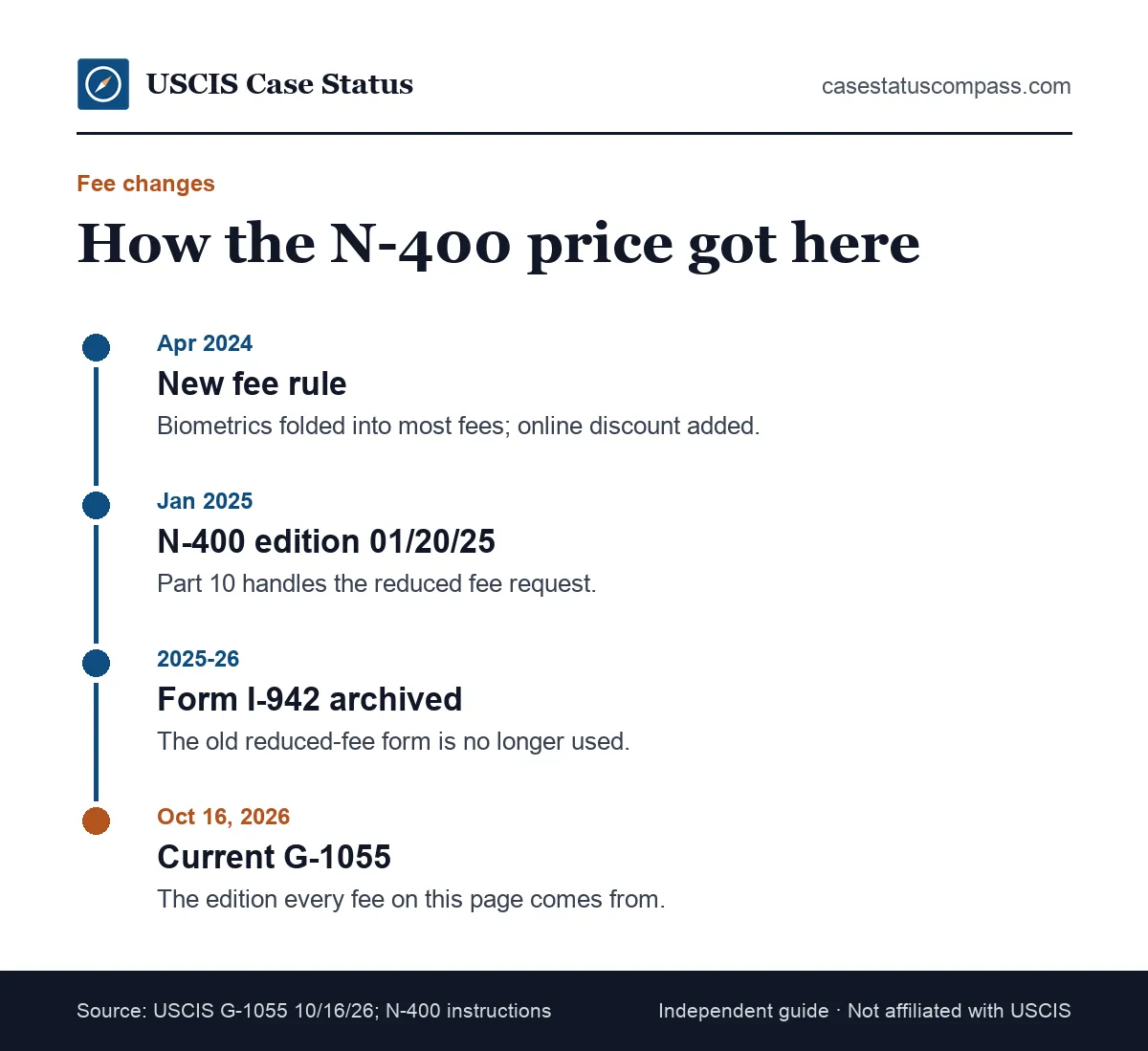
Citizenship fees changed most recently with the April 1, 2024 fee rule, which folded biometrics into the N-400 and created the online discount. Current numbers come from the October 16, 2026 edition of Form G-1055, so older articles may show different totals.
What the April 2024 rule changed
Besides ending the separate biometrics charge, the rule set lower online prices and moved the reduced-fee request into the N-400 itself, which is why Form I-942 was retired. Any guide quoting a separate biometrics charge predates that change.
The October 2026 schedule
The 10/16/26 edition adds inflation-adjusted H.R. 1 fees to other forms. The N-400 line is as stated above. Match your payment to the edition in force on your filing date.
Will Citizenship Fees Go Up?
Fees change only when DHS finishes a rulemaking and USCIS publishes a new G-1055 edition. A proposed rule in the news does not change what you pay today; the current schedule does. Check the G-1055 edition date on filing day to see which prices apply to you.
How to tell a proposal from a final rule
A proposal invites public comment and changes nothing. A final rule names an effective date, and USCIS then updates its schedule, form pages and fee calculator. The Federal Register notice shows which stage a rule has reached.
Should You File Early to Avoid a Fee Increase?
Only if you are already eligible. USCIS lets you file within this window: You can file the N-400 up to 90 days before you reach 5 years (or 3 years if married to a U.S. citizen) as a permanent resident. Filing earlier than that can lead to a denial, and the fee would be lost, which costs far more than any increase you hoped to avoid.
Which Fee Schedule Edition Applies to Your Filing?
The fee schedule edition in force when USCIS receives your filing controls the amount; for mailed filings, the schedule also mentions postmark dates. As of October 2026, the governing edition is dated October 16, 2026, and every amount here comes from it.
How much to apply for citizenship: reading the G-1055 line
Find "N-400" in the schedule to see the paper and online prices plus notes on reductions, and read any footnote for your filing method. Our uscis fees hub explains how the schedule is organized.
How Much Is the Citizenship Application on the USCIS Fee Calculator?
The USCIS fee calculator asks for your form and filing category, then shows the exact amount for the N-400. If its result differs from the published schedule, call the USCIS Contact Center before paying anything. Save the calculator result with the date you checked it.
Is US Citizenship Worth the Cost?
For most permanent residents, yes. Naturalization is a one-time cost, while keeping a green card means paying to renew it every ten years. Over a few decades, two renewals alone cost more than one online N-400, before counting the rights you gain.
What you stop paying
After naturalizing you never file Form I-90 again; that renewal costs $465 (paper) / $415 (online) each time. Our green card renewal fee guide adds those payments up. Long trips no longer require a reentry permit, which costs $630.
Rights you gain beyond money
Citizens can sponsor more relatives, vote in federal elections and hold jobs that require citizenship, including many federal positions and some security-cleared roles. They can also serve on juries and run for most elected offices.
Travel without status risk
Long trips abroad no longer threaten your status, because a citizen has no green card to abandon. You also stop renewing an expiring card. For permanent residents, by contrast: Long trips abroad can risk your green card; over 1 year is the general warning line.
Naturalization vs Staying a Permanent Resident: What Is the Cost Difference?
Staying a permanent resident costs a renewal fee each decade, while naturalizing costs one N-400 fee. Most green cards last ten years: Most green cards are valid for 10 years; conditional green cards for 2 years. Renewal fees recur; the N-400 fee does not.
Lifetime cost table: renewal vs citizenship
This table lists what each path costs in USCIS fees and how often you pay, so the long-term difference is easy to see.
| Path | USCIS cost | How often | Notes |
|---|---|---|---|
| Stay a permanent resident | $465 (paper) / $415 (online) | About every 10 years | Plus travel to biometrics each time |
| Become a citizen | N-400 fee (online, paper or reduced) | Once | Optional passport afterward (State Dept) |
| Derived citizen, proof only | $1,385 (paper) / $1,335 (online) | Once | Only if you want a certificate |
When renewing still makes sense
If you are not yet eligible to naturalize, renew your card on time. An expired card does not end your status, but it complicates travel and work checks. You can file once the card is within six months of expiring.
How Can You Lower the Cost of Becoming a Citizen?
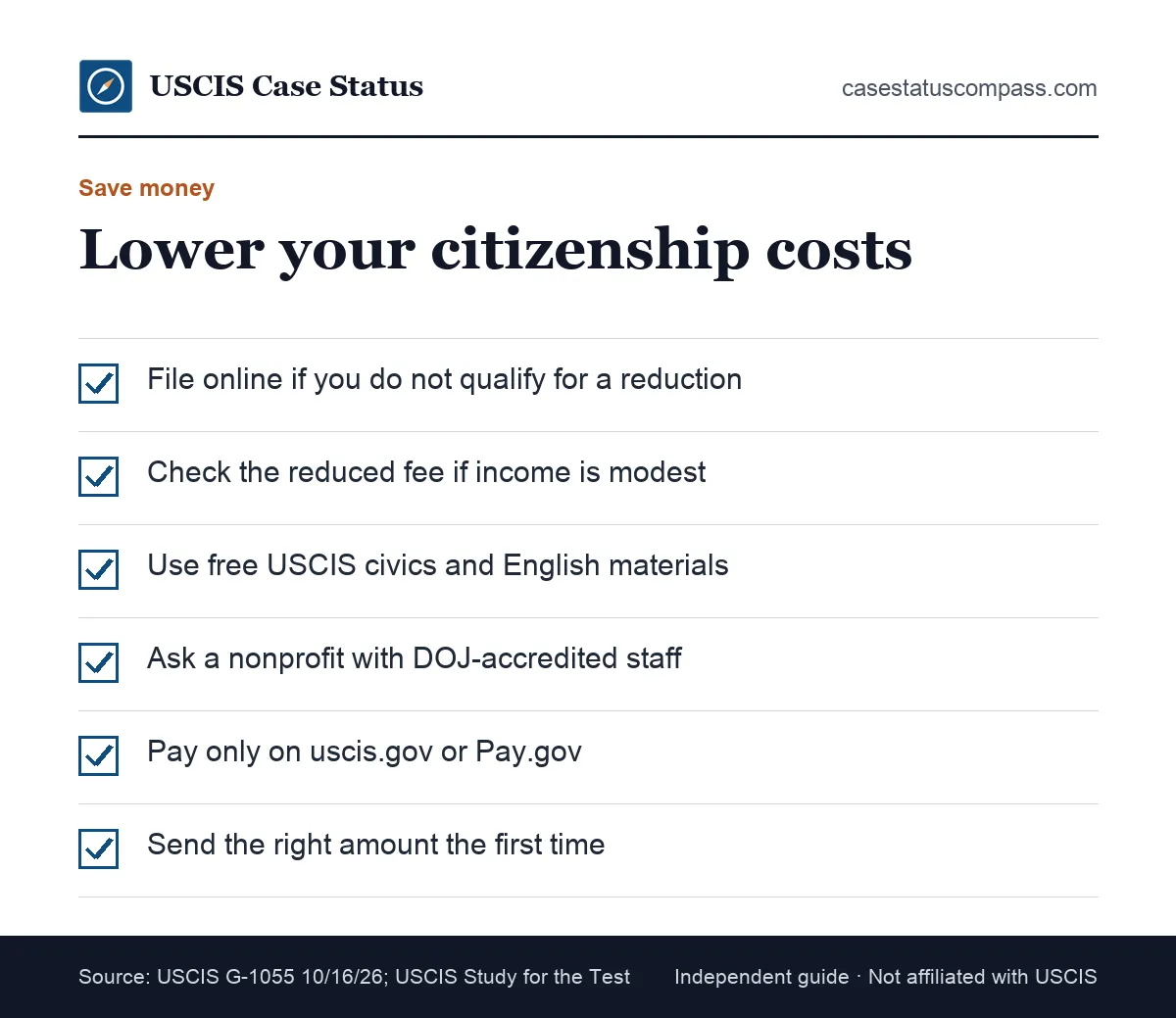
The cheapest path is to file the N-400 online yourself and keep private costs small. Lower-income applicants should check the reduced fee and the waiver before paying full price. Small savings add up: compare translators, use free practice materials and combine trips when you can.
How much is the citizenship fee for your income tier?
Compare household income with the limits before picking a filing method. Paying full price online when you qualify for the reduced fee on paper wastes money. Use the current HHS poverty guidelines for your household size.
Use free help first
Free workshops, library classes and nonprofit legal clinics can review your N-400 for errors before you pay a lawyer. Many clinics run N-400 workshops where volunteers and an accredited representative check answers in one session.
Skip paid form-filling services
The N-400 PDF and the online account are free on uscis.gov. Services that only type your answers add cost without legal review. If you need more than typing, pay for real advice from a lawyer or accredited representative instead.
How Do You Avoid Citizenship Fee Scams?
Pay USCIS only through your online account, Pay.gov or the payment forms attached to a paper filing. USCIS never asks for fees by phone, gift card, wire transfer or cryptocurrency. The real amount comes from the schedule, not from a caller.
Warning signs
- Someone calls saying you owe a fee to avoid deportation
- A site charges for the N-400 PDF, which is free on uscis.gov
- A notario promises approval for a fee
- Payment requests by gift card, wire or crypto
What to do if you were targeted
Stop contact, keep records and report it. Our uscis scam guide lists where to report fraud. You can file a report at ReportFraud.ftc.gov, the FTC's scam reporting site. If money already left your account, call your bank or card issuer right away to try to stop or reverse it.
If X, Do Y: Which Citizenship Fee Path Fits You?
Match your situation to a fee path with this table. It covers common cases; unusual histories, such as past removal proceedings, call for legal advice before you pay. Find the first row that matches you, then confirm the amount in the schedule before paying.
Fee path decision table
Each row pairs a common situation with the form to file and the fee you should budget for.
| If this describes you | Then do this | Fee to plan for |
|---|---|---|
| Full-time income, simple case | File the N-400 online | Online N-400 amount |
| Household income at or below 400% of poverty | Paper N-400 with Part 10 and proof | Reduced paper amount |
| Means-tested benefit or very low income | Paper N-400 with Form I-912 | Nothing if the waiver is approved |
| Serving or served under INA 328/329 | N-400 with Form N-426 | No fee |
| Already a citizen through a parent | File the N-600 instead | $1,385 (paper) / $1,335 (online) |
| Lost your certificate after naturalizing | File the N-565 | $555 (paper) / $505 (online) |
When to get legal advice first
See an immigration attorney or DOJ-accredited representative first if you have any arrest, a long trip abroad, unpaid taxes or a past violation. Advice can cost less than a failed filing.
How Do Citizenship Costs Compare With Other Immigration Fees?
Naturalization is one of the cheaper steps in a typical immigration journey. The green card itself usually costs far more. A family-based case often involves several USCIS forms before the card arrives, while naturalizing needs only the N-400. If you plan to sponsor relatives after naturalizing, budget for their fees too.
The green card step
Family-based green cards start with Form I-130, which costs $675 (paper) / $625 (online), then the I-485 or a consular visa. Our how much is a green card guide adds those up.
How Does Processing Time Affect Your Real Cost?
Waiting adds no USCIS fee, but delays can raise private costs, such as renewing an expiring green card. USCIS data put the median at N-400: median 9.5 months (USCIS data, Apr.-June 2026); the live tool uses a different measure.
Budget for the wait
If your card expires mid-process, you may need to renew it while the N-400 is pending; renewal costs $465 (paper) / $415 (online), so add it to your worksheet if expiry is near. Our how long does naturalization take page explains the official tool.
Can You Pay Extra to Speed Up Citizenship?
No. Premium processing does not cover the N-400, and USCIS sells no faster lane for naturalization. Anyone selling "faster citizenship" for an extra fee is not acting for USCIS. An expedite request with proof is the only official way to ask for speed.
Frequently Asked Questions
Is there a citizenship fee waiver?
Yes. A full N-400 fee waiver is possible if you receive a means-tested benefit, have household income at or below 150% of the poverty guidelines, or face financial hardship. Request it on paper with Form I-912 and evidence.
How much does it cost to become an American citizen for a married couple?
Each spouse files a separate N-400 and pays a separate American citizenship fee; the schedule has no joint rate. If the household qualifies for the reduced fee, each spouse requests it on their own paper N-400.
Does American citizenship cost the same in every state?
Yes. USCIS sets one national fee schedule, Form G-1055, and the N-400 price does not change by state or field office. Only private costs, such as lawyers and travel, differ by location.
Can I pay the citizenship fee in installments?
No. USCIS collects the full N-400 fee at filing with one payment method, and there is no installment plan. If the amount is a hardship, check the reduced fee or a fee waiver.
Do I pay anything at the oath ceremony?
No. The oath ceremony is covered by the N-400 fee. You bring the Form N-445 notice and your green card, hand in the card and receive your Certificate of Naturalization.
Do I pay again if I miss my interview?
Not directly, but USCIS may treat the case as abandoned and deny it, and refiling costs a new fee. If you cannot attend, ask to reschedule before the date and keep proof.
Can someone else pay my N-400 fee?
Yes. A relative, friend or employer can pay with their own card or bank account. On paper, the cardholder signs the G-1450 or G-1650; online, they enter the card on Pay.gov.
How much is the n600 fee for an adult?
The N-600 price does not change with age: adults and children pay the same amount in Form G-1055. Current or former U.S. armed forces members filing for themselves pay nothing.
How much is the citizenship certificate?
It depends on which one. Your first Certificate of Naturalization is free, handed over at the oath. A Certificate of Citizenship costs $1,385 (paper) / $1,335 (online), and a replacement of either costs $555 (paper) / $505 (online).
Is there a senior discount on the naturalization fee?
No. Form G-1055 sets the N-400 price by filing method and household income, not age. Older applicants on a fixed income should check whether they qualify for the reduced fee or a waiver.
Sources
- USCIS Form G-1055 Fee Schedule, Edition 10/16/26. www.uscis.gov/sites/default/files/document/forms/g-1055.pdf. Accessed Oct 27, 2026.
- USCIS: Form N-400, Application for Naturalization. www.uscis.gov/n-400. Accessed Oct 27, 2026.
- Form N-400 Instructions (Edition 01/20/25). www.uscis.gov/sites/default/files/document/forms/n-400instr.pdf. Accessed Oct 27, 2026.
- USCIS: Form N-600, Application for Certificate of Citizenship. www.uscis.gov/n-600. Accessed Oct 27, 2026.
- USCIS: Form I-912, Request for Fee Waiver. www.uscis.gov/i-912. Accessed Oct 27, 2026.
- USCIS: Filing Fees (updated 02/12/2026). www.uscis.gov/forms/filing-fees. Accessed Oct 27, 2026.
- USCIS: Study for the Test. www.uscis.gov/citizenship/find-study-materials-and-resources/study-for-the-test. Accessed Oct 27, 2026.
- USCIS: Naturalization Ceremonies. www.uscis.gov/citizenship/learn-about-citizenship/naturalization-ceremonies. Accessed Oct 27, 2026.
- USCIS Fee Schedule (Form G-1055). www.uscis.gov/g-1055. Accessed Oct 27, 2026.
- Form I-912 Instructions, Edition 07/22/25. www.uscis.gov/sites/default/files/document/forms/i-912instr.pdf. Accessed Oct 27, 2026.
- USCIS: Form N-426 page (updated 06/05/2026). www.uscis.gov/n-426. Accessed Oct 27, 2026.
- USCIS Policy Manual Vol. 12, Part H, Ch. 4; Form N-600 Instructions 01/20/25. www.uscis.gov/policy-manual/volume-12-part-h-chapter-4. Accessed Oct 27, 2026.
- USCIS: Form N-648 page (updated 06/05/2026). www.uscis.gov/n-648. Accessed Oct 27, 2026.
- USCIS: The Naturalization Interview and Test (updated 10/31/2025). www.uscis.gov/citizenship/learn-about-citizenship/the-naturalization-interview-and-test. Accessed Oct 27, 2026.
- USCIS: International Travel as a Permanent Resident (updated 09/12/2025). www.uscis.gov/green-card/after-we-grant-your-green-card/international-travel-as-a-permanent-resident. Accessed Oct 27, 2026.
- USCIS Glossary: Green Card. www.uscis.gov/tools/glossary. Accessed Oct 27, 2026.
- FTC: How To Avoid Immigration Scams and Get Real Help (Nov. 2023); USCIS Report Immigration Scams page. consumer.ftc.gov/articles/how-avoid-immigration-scams-and-get-real-help. Accessed Oct 27, 2026.
- USCIS Data Library: All USCIS Application and Petition Form Types, FY2026 Q3 (Apr. 1-June 30, 2026; queried 7/2026). www.uscis.gov/sites/default/files/document/data/quarterly_all_forms_fy2026_q3_v1.xlsx. Accessed Oct 27, 2026.
casestatuscompass.com is an independent publication and is not affiliated with USCIS or any government agency. This page is general information, not legal advice. For denials, court or asylum matters, consult an immigration attorney or a DOJ-accredited representative.