Contents · 42 sections
- What Is the US Citizenship Test?
- Can You Take the United States Citizenship Test Online?
- How Does the Citizenship Test Work?
- What Does the Citizenship Test Consist Of?
- What Is Not on the Citizenship Test?
- Which Civics Test Version Do You Take?
- 2025 Civics Test vs 2008 Civics Test: What Changed?
- How Many Questions Are on the Citizenship Test?
- How Is the Civics Test Scored?
- How Long Is the Citizenship Test?
- What Topics Do the 128 Civics Questions Cover?
- Where Do You Get the Official Civics Questions and Answers?
- Sample Citizenship Test Questions and Answers
- Which Civics Answers Change Over Time?
- Free Citizenship Practice Test
- How Should You Score Your Practice Test?
- How Does the English Reading Test Work?
- How Does the English Writing Test Work?
- How Is English Speaking Tested?
- What Is on the Reading and Writing Vocabulary Lists?
- Who Is Exempt From the English Test?
- What Is the 65/20 Special Consideration?
- Can a Disability Exempt You From the Test? (Form N-648)
- Can You Take the Citizenship Test in Spanish or Another Language?
- Is There a Spanish Requirement for the Citizenship Test?
- What Happens If You Fail the Citizenship Test?
- Does Failing the Citizenship Test Affect Your Green Card?
- How Does the Citizenship Retest Work?
- What If You Fail the Citizenship Retest?
- How Much Does It Cost to Refile After a Failed Retest?
- Is the Citizenship Test Hard?
- What Are the Best Study Tips for the Citizenship Test?
- A Study Plan for the Citizenship Test
- Official Study Materials and Citizenship Test Apps
- How Do You Choose a Citizenship Test App?
- What Mistakes Do People Make on the Citizenship Test?
- What Happens on Test Day?
- Is There a Green Card Test?
- When Do Green Card Holders Take the Citizenship Test?
- How Does the Test Work for Military Applicants?
- Before You Take the Test: Biometrics and the Interview Notice
- Frequently Asked Questions
The short answer
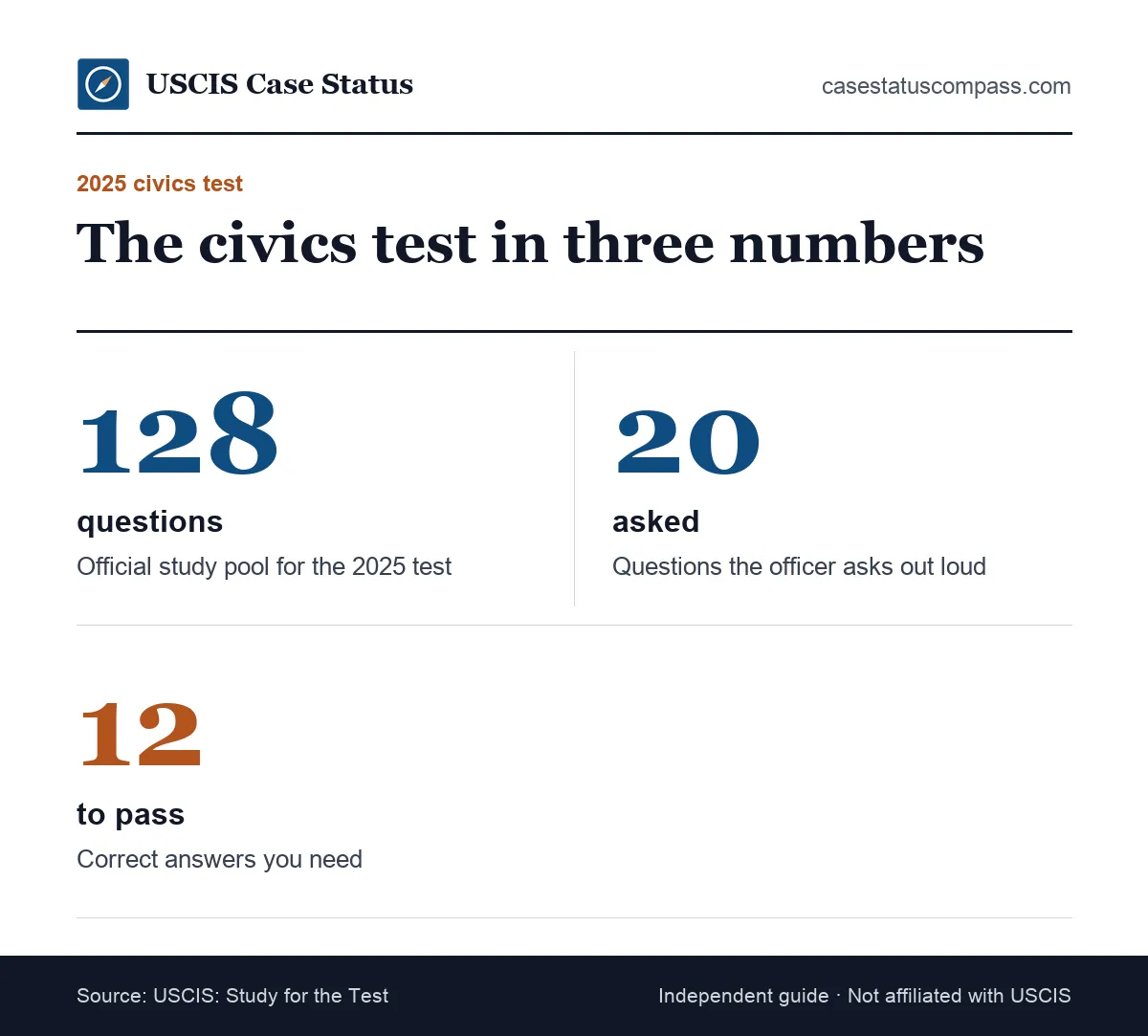
The US citizenship test has two parts given at your Form N-400 interview: an English test (speaking, reading and writing) and an oral civics test. If you filed on or after Oct. 20, 2025, the officer asks 20 of 128 civics questions and you need 12 correct. You get two chances to pass each part.
At a glance
| Civics version | Filed N-400 on or after Oct. 20, 2025: 2025 test; before that: 2008 test |
| 2025 civics test | 2025 civics test: 20 questions from 128; pass with 12 correct |
| English test | English test: read 1 of 3 sentences and write 1 of 3 sentences correctly |
| If you fail | Two chances to pass; retest of the failed part 60-90 days after the interview |
| Official question list | USCIS "Study for the Test" page (linked in Sources) |
What Is the US Citizenship Test?
The United States citizenship test, also called the USA naturalization test, checks that you can speak, read and write basic English and that you know U.S. government and history. A USCIS officer gives it during your naturalization interview. Passing it, unless you are exempt, is required to become a citizen.
Where the test fits in your case
You take the test after filing your citizenship application and attending biometrics. It happens in the same meeting as the interview, not on a separate day. Our uscis interview hub shows every in-person step in order.
Can You Take the United States Citizenship Test Online?
No. One USCIS officer runs the whole interview, including both test parts, so you cannot take the United States citizenship test online. There is no computer, no written civics exam and no multiple choice. The officer reads civics questions aloud and you answer aloud. Online quizzes are for practice only.
How Does the Citizenship Test Work?
The civics and English test works as part of a conversation. As the officer reviews your N-400 under oath, they judge your spoken English. Then they ask you to read one sentence, write one sentence and answer civics questions out loud. Each part is scored pass or fail on its own.
Civics test
The civics test (often searched as the "civic exam test") is oral. The officer picks questions from the official list for your version and asks them one by one. For the 2025 version, USCIS says: 2025 civics test: 20 questions from 128; pass with 12 correct. Any answer on the official list counts, and you can answer in your own words.
English reading and writing test
The English reading test and writing test are short. USCIS says: English test: read 1 of 3 sentences and write 1 of 3 sentences correctly. The sentences use words from the official vocabulary lists, which focus on civics and history topics.
What Does the Citizenship Test Consist Of?
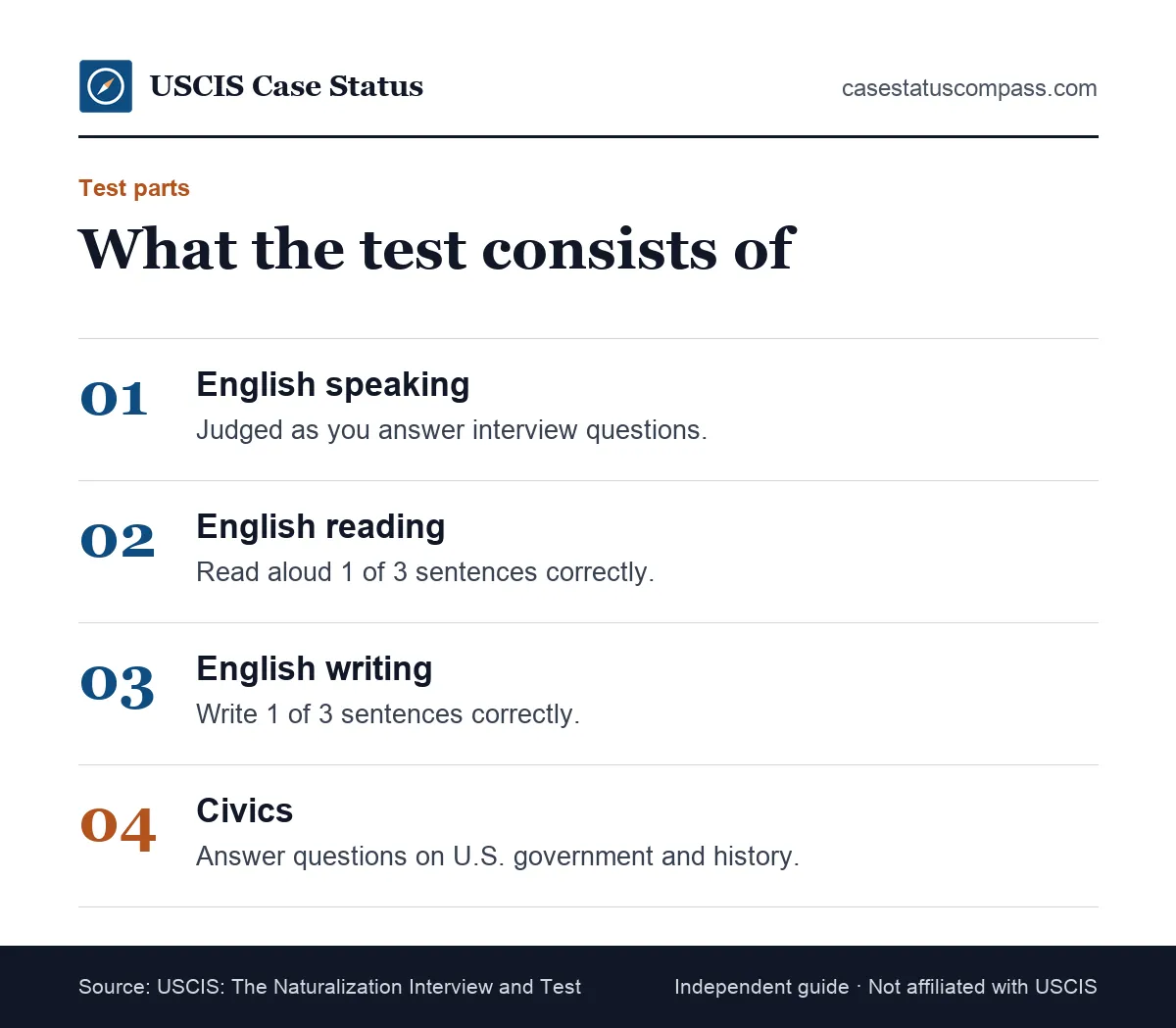
The naturalization test consists of four scored skills: English speaking, English reading, English writing and civics knowledge. Speaking is judged throughout the interview. Reading, writing and civics are short, separate tasks. Your results for each part are recorded on Form N-652 at the end.
The four parts at a glance
Each part is scored separately, so a weak result in one area does not cancel a pass in another.
| Part | How it is given | What passing means |
|---|---|---|
| Speaking | Your answers to interview questions | You understand and respond in English |
| Reading | Read sentences aloud | 1 of 3 read correctly |
| Writing | Write sentences the officer reads | 1 of 3 written correctly |
| Civics | Oral questions and answers | 12 of 20 correct (2025 version) |
If you fail any part, only that part is retested at a later appointment.
What Is Not on the Citizenship Test?
There is no essay, no math and no test of your knowledge of your own home country. The officer will not ask trick questions. The civics questions come only from the official list for your version, and the English sentences come from the official vocabulary lists, so anything beyond those is extra reading.
Which Civics Test Version Do You Take?
Your civics test version depends on the date USCIS received your Form N-400. As of October 2026, USCIS says: Filed N-400 on or after Oct. 20, 2025: 2025 test; before that: 2008 test. The version stays the same even if your interview is rescheduled or your test is retaken later.
Find your filing date
Look at the receipt notice, Form I-797C, for the "received date." That date, not your interview date, sets the version. If you filed online, the date also shows in your USCIS online account.
Why the version matters
Studying the wrong list wastes weeks. The 2008 and 2025 lists share many topics, but the wording, numbering and number of questions differ.
Check your filing date before you buy a book or download an app.
2025 Civics Test vs 2008 Civics Test: What Changed?
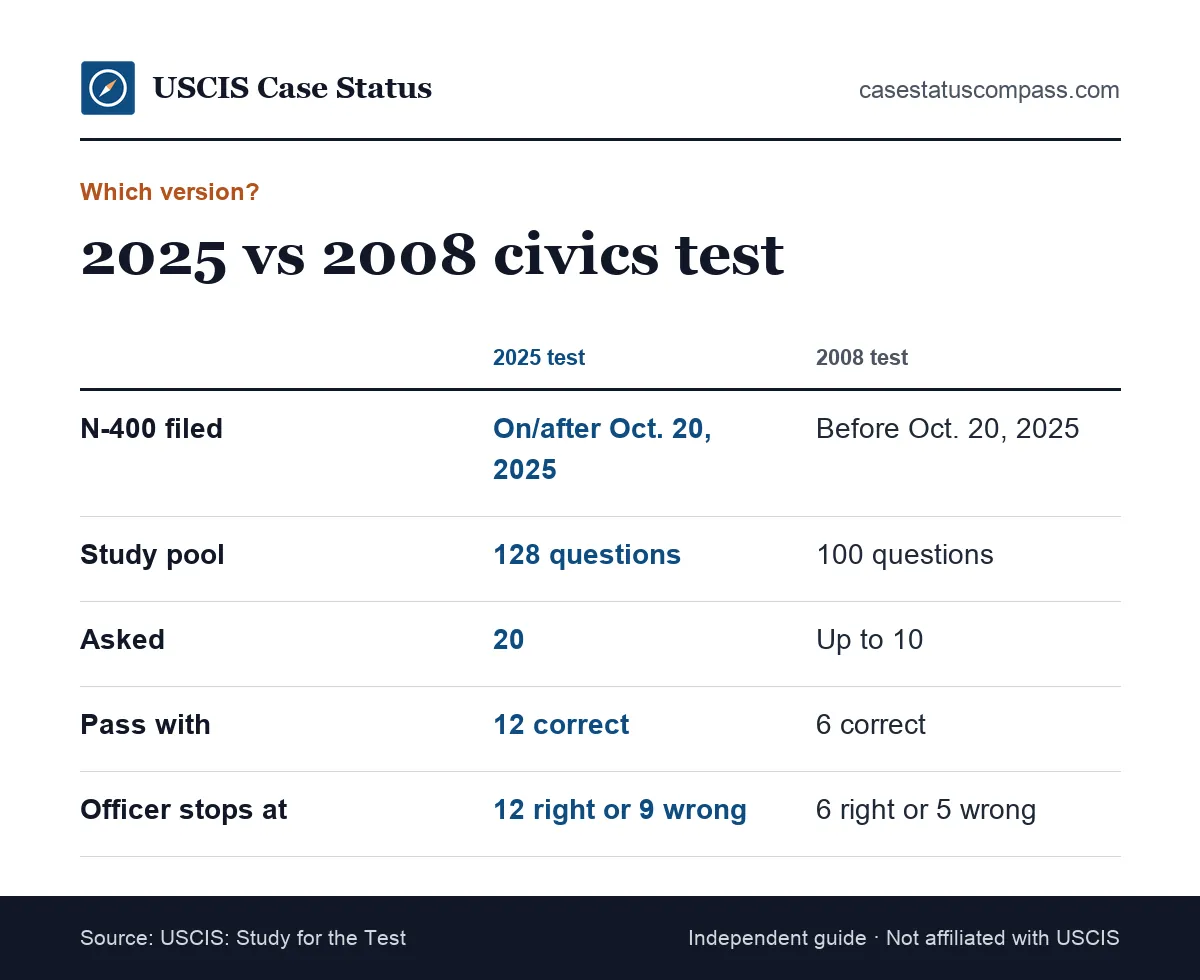
The 2025 civics test uses a larger pool and asks more questions than the 2008 version. USCIS says the 2025 test is based on the 2020 test with some changes to how it is given. Both tests are oral, and both stop early once your result is clear.
Side-by-side rules
The table puts the two versions next to each other so you can confirm which rules and study list apply to you.
| Feature | 2025 test | 2008 test |
|---|---|---|
| Who takes it | N-400 filed on or after Oct. 20, 2025 | N-400 filed before Oct. 20, 2025 |
| Rules | 2025 civics test: 20 questions from 128; pass with 12 correct | 2008 civics test: up to 10 questions from 100; pass with 6 correct |
| Study list | 128 Civics Questions and Answers | 100 Civics Questions and Answers |
| Format | Oral | Oral |
The biggest practical change is the larger 2025 list and the higher number of questions you may be asked.
What stayed the same
The English test did not change between versions. Exemptions, the medical exception, the retest rule and the 65/20 special consideration apply to both. The "100 citizenship questions" you may see online belong to the 2008 version.
How Many Questions Are on the Citizenship Test?
On the 2025 civics test, the officer asks up to 20 questions from a list of 128, and you pass with 12 correct. On the 2008 version, the officer asks up to 10 questions from 100, and you pass with 6.
How many you might actually answer
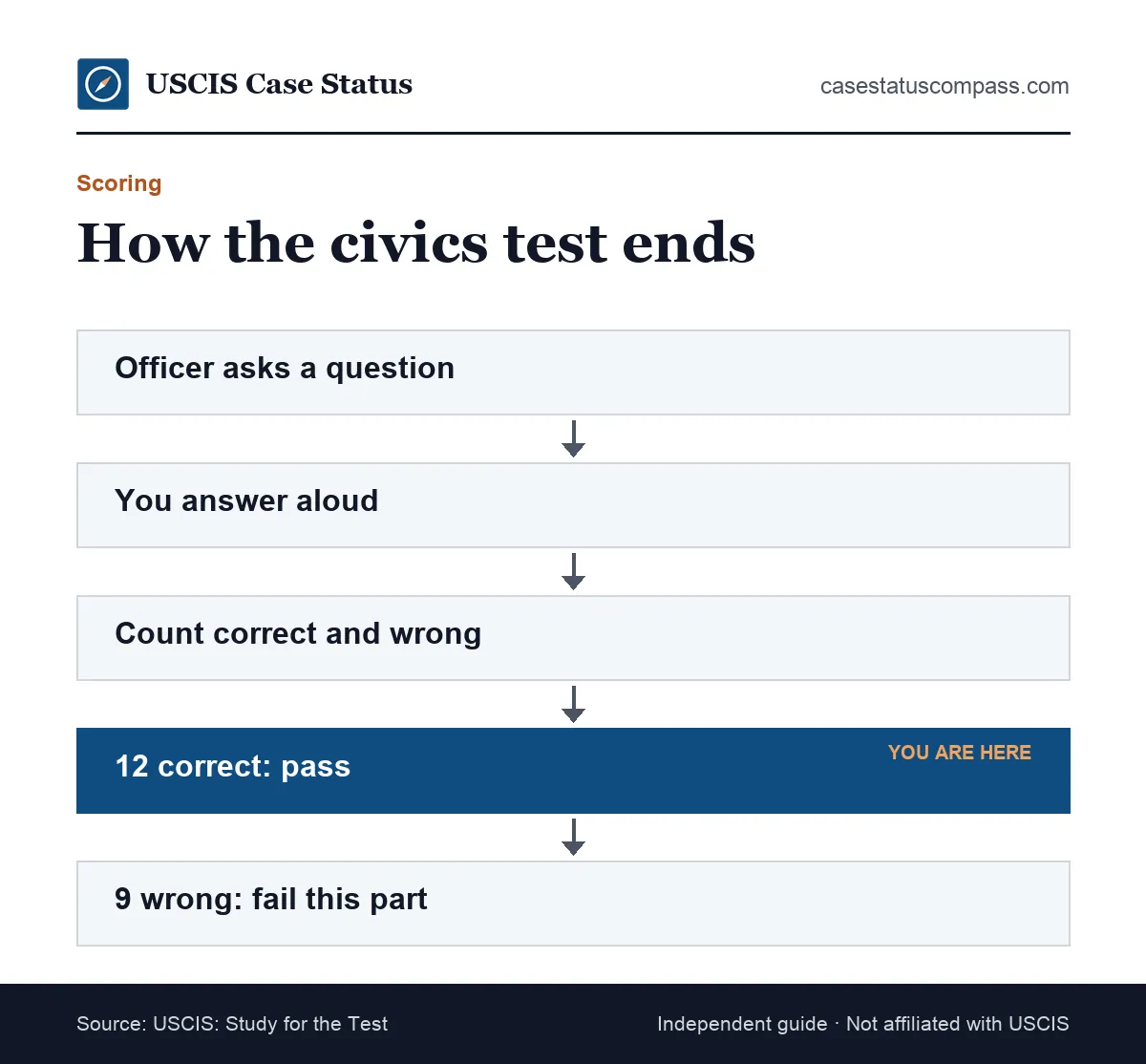
You may answer fewer than 20. The officer stops at 12 correct, so a strong applicant could finish after 12 questions. The test also stops at 9 wrong answers, which means that part is failed.
Questions for the 65/20 group
Older long-term residents get a shorter list and a lower bar. As of October 2026, 65/20 applicants are asked 10 questions from a 20-question list and pass with 6 correct. Those questions are marked with an asterisk on the official list.
How Is the Civics Test Scored?
The civics test is scored by counting correct and incorrect answers as you go. On the 2025 version, the officer stops when you reach 12 correct, which is a pass, or 9 incorrect, which is a fail. There are no partial points, but any listed answer counts.
What counts as a correct answer
USCIS lists accepted answers under each question. It also says there may be other correct answers, but it encourages you to use the listed ones. Some questions ask for two or three items, such as "Name three national U.S. holidays," and you must give that many.
Answers that depend on today
Some answers change with elections. The official list tells you to give the name of the official serving at the time of your interview. Those names are on the USCIS test updates page.
How Long Is the Citizenship Test?
The naturalization test has no fixed time limit and is not timed. It takes place within your naturalization interview, so its length depends on how quickly you reach 12 correct civics answers and pass reading and writing.
Plan for the whole interview, not just the test.
What affects test length
- How fast you answer each civics question
- Whether you pass reading and writing on the first sentence
- Whether the officer needs to repeat questions
- Whether an interpreter is translating (for exempt applicants)
How long the naturalization process takes
The test is only one day. For cases completed April to June 2026: N-400: median 9.5 months (USCIS data, Apr.-June 2026). Our n-400 processing time guide explains how to read the live tool.
What Topics Do the 128 Civics Questions Cover?
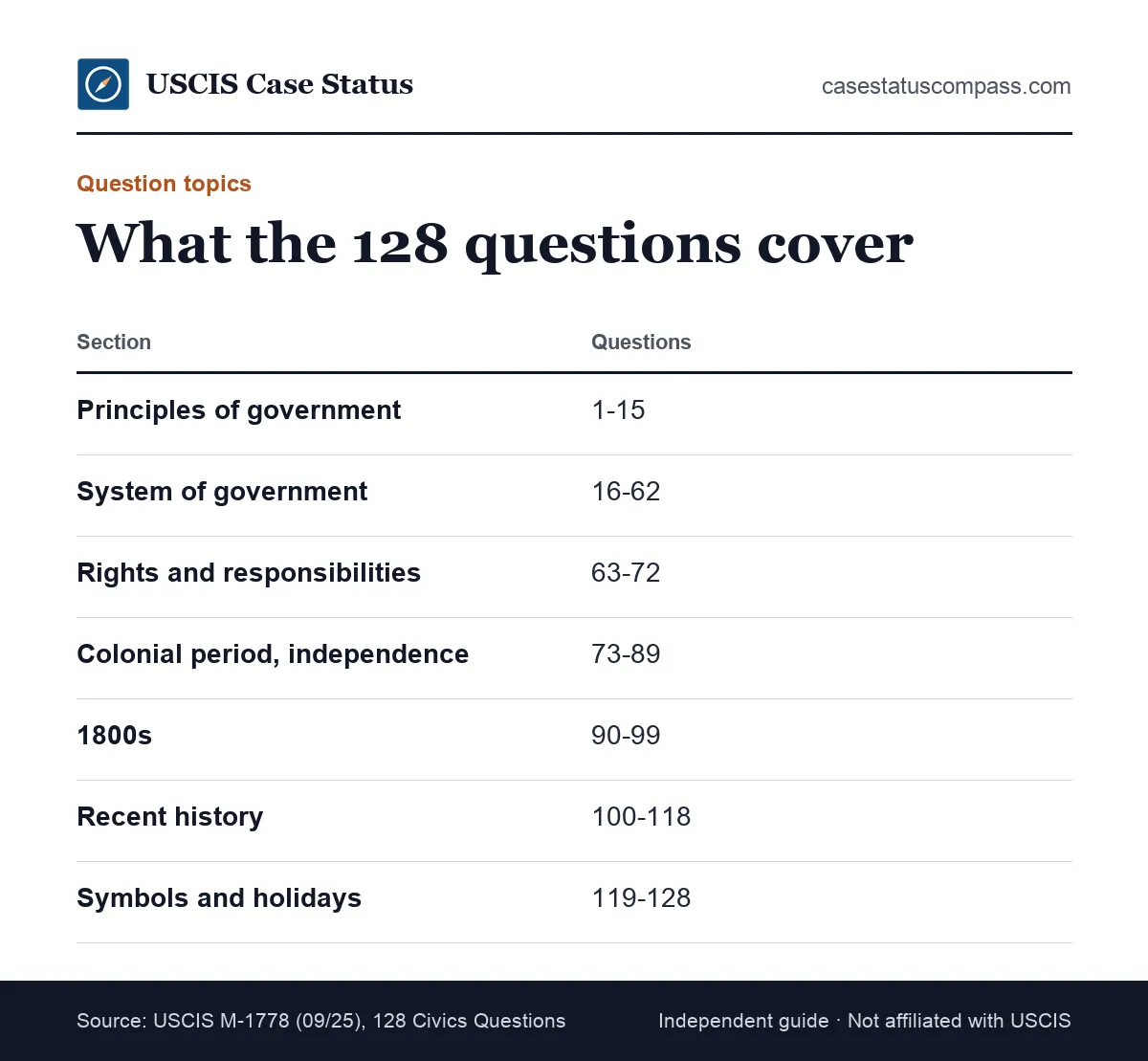
The 128 civics questions cover three areas: American government (questions 1 to 72), American history (73 to 118), and symbols and holidays (119 to 128). Each area is split into smaller sections on the official USCIS list.
Government is the largest share, with 72 of the 128 questions, so it deserves most of your study time.
Section breakdown
Use these section ranges to split your study into manageable blocks and to spot which areas need the most time.
| Area | Section | Question numbers |
|---|---|---|
| American Government | Principles of American Government | 1-15 |
| American Government | System of Government | 16-62 |
| American Government | Rights and Responsibilities | 63-72 |
| American History | Colonial Period and Independence | 73-89 |
| American History | 1800s | 90-99 |
| American History | Recent American History | 100-118 |
| Symbols and Holidays | Symbols; Holidays | 119-128 |
Why the sections help you study
Grouping questions by section lets you learn related facts together, such as all the questions about Congress. It also makes a study plan simple: one section at a time, then mixed review.
Where Do You Get the Official Civics Questions and Answers?
Get the official civics questions and answers free from the USCIS "Study for the Test" page. It links the 128-question PDF for the 2025 test, the 100-question PDF for the 2008 test, study guides, vocabulary lists and audio.
Download only the PDF for your own version, because the 2008 and 2025 lists number and word their questions differently.
Official downloads to look for
- 128 Civics Questions and Answers (2025 version), USCIS M-1778
- "One Nation, One People" 2025 Civics Test Study Guide
- 100 Civics Questions and Answers (2008 version), including large print and translations
- Reading and writing vocabulary lists
- The civics test textbook
Why we do not reprint all 128
USCIS updates answers when officials change. A copied list on another website can be out of date. The USCIS PDF and its "check for test updates" page are the only versions you should rely on.
Sample Citizenship Test Questions and Answers
These sample citizenship test questions come from the official 2025 list, with one accepted answer each. They show the style of the test: short questions, short answers. Study the complete USCIS PDF for your version.
Answers about current officeholders, such as the President or your senators, can change after an election, so check them on the official USCIS page close to your interview.
Sample government questions for the USA citizenship test
These government questions are drawn from the largest area of the list, so they are a good place to begin.
| No. | Question | One accepted answer |
|---|---|---|
| 2 | What is the supreme law of the land? | The Constitution |
| 16 | Name the three branches of government. | Legislative, executive, and judicial |
| 21 | How many U.S. senators are there? | One hundred (100) |
| 22 | How long is a term for a U.S. senator? | Six (6) years |
| 24 | How many voting members are in the House of Representatives? | 435 |
| 36 | The President is elected for how many years? | Four (4) years |
| 53 | How many seats are on the Supreme Court? | Nine (9) |
Sample history and symbols questions
These three questions show the shorter history and symbols areas, where answers rarely change over time.
| No. | Question | One accepted answer |
|---|---|---|
| 90 | What territory did the U.S. buy from France in 1803? | Louisiana Territory |
| 96 | What U.S. war ended slavery? | The Civil War |
| 123 | What is the name of the national anthem? | The Star-Spangled Banner |
How to use the samples
Cover the right column and answer aloud. If you miss any, open the official PDF and read every accepted answer for that question. Many questions have several, and you only need one.
Which Civics Answers Change Over Time?
A handful of civics answers change after elections or appointments. On the 2025 list these include the President, Vice President, Speaker of the House and Chief Justice, plus your own senators, representative and governor. Always check the USCIS test updates page before your interview.
Questions with national answers that change
USCIS flags 2025 questions 30 (Speaker of the House), 38 (President), 39 (Vice President) and 57 (Chief Justice). The official list sends you to the test updates page for the current names instead of printing them.
Questions with local answers
Questions 23 (one of your U.S. senators), 29 (your U.S. representative), 61 (your governor) and 62 (your state capital) depend on where you live. Residents of D.C. and U.S. territories have special answers, such as having no U.S. senators.
Free Citizenship Practice Test
Use this free civics practice test to check your progress. It has ten questions from the official 2025 list, different from the samples above. Answer each one aloud before you check the key below. Retake it after each study week.
Practice questions on government (1–5)
- How many amendments does the U.S. Constitution have?
- What are the two parts of the U.S. Congress?
- How long is a term for a member of the House of Representatives?
- If the president can no longer serve, who becomes president?
- Who vetoes bills?
Practice questions on history and symbols (6–10)
- What founding document said the American colonies were free from Britain?
- Who lived in America before the Europeans arrived?
- Why does the flag have 13 stripes?
- The Nation's first motto was "E Pluribus Unum." What does that mean?
- What is Independence Day?
Answer key
Check your answers only after you finish all ten questions, and mark each one you missed for review tomorrow.
| No. | One accepted answer |
|---|---|
| 1 | Twenty-seven (27) |
| 2 | The Senate and House of Representatives |
| 3 | Two (2) years |
| 4 | The Vice President |
| 5 | The President |
| 6 | Declaration of Independence |
| 7 | American Indians or Native Americans |
| 8 | Because there were 13 original colonies |
| 9 | Out of many, one |
| 10 | A holiday to celebrate U.S. independence from Britain |
How Should You Score Your Practice Test?
Score this practice civics exam like the real one: count only clear, complete answers. Eight or more correct out of ten suggests you are on track, but the real test draws from all 128 questions. Track your score each week and focus on the sections where you miss most.
Track your progress
Record your score each week to see whether the sections you review are improving before your interview.
| Week | Score out of 10 | Sections to review |
|---|---|---|
| 1 | ___ | ___ |
| 2 | ___ | ___ |
| 3 | ___ | ___ |
| 4 | ___ | ___ |
Build your own mixed tests
Write each official question on a card. Shuffle the deck and draw 20. Ask a friend to read them aloud, because the real naturalization test questions are spoken, not shown on paper.
How Does the English Reading Test Work?
In the English reading test, the officer shows you sentences and asks you to read them aloud. You pass by reading one of three sentences correctly. Small pronunciation differences are fine if the meaning is clear. The words come from the official USCIS reading vocabulary list.
What "correctly" means
You should read without long pauses or skipped words that change the meaning. An accent is not a problem. If you stumble on the first sentence, the officer gives you another, up to three.
Practicing reading
Read the vocabulary list aloud every day. Then make short sentences from it, such as questions about presidents or holidays, and read them to a friend.
Repeat any word you stumble on.
How Does the English Writing Test Work?
In the English writing test, the officer reads a sentence aloud and you write it down. You pass by writing one of three sentences correctly. Minor spelling or grammar slips are often accepted if the meaning is clear. The words come from the USCIS writing vocabulary list.
Writing tips
- Learn to spell every word on the writing vocabulary list.
- Capitalize names of people, places, months and holidays.
- End each sentence with a period.
- Write clearly; the officer must be able to read it.
Practicing writing
Have someone dictate short sentences built from the vocabulary list. Write them by hand, not on a phone.
Check your spelling, capital letters and punctuation against the original after each sentence, and rewrite any sentence you got wrong.
How Is English Speaking Tested?
English speaking is tested throughout your naturalization interview. The officer judges whether you understand and can answer questions about your N-400 in English. There is no separate speaking task. If you understand the interview questions and answer them, you are showing the skill being tested.
What helps
Practice answering the yes/no questions from your N-400 aloud. Learn key words like "residence," "trip" and "employer."
Short, honest answers are better than long ones you are unsure of, so pause before you reply.
What does not count against you
An accent, slow speech or simple grammar does not fail you. Failing to understand most questions does. Our citizenship interview guide lists the kinds of questions officers ask.
Ask the officer to repeat a question if needed.
What Is on the Reading and Writing Vocabulary Lists?
The vocabulary lists contain the words used in reading and writing sentences. They focus on civics and history: people such as presidents, places, months, holidays, government words and common verbs. USCIS publishes them on the Study for the Test page, including text-only versions.
How to study vocabulary
Learn the meaning, spelling and sound of each word. Many search "definitions citizenship test write" for help; a simple dictionary and the civics textbook explain each word in context.
Say each word aloud, then write it from memory, because the test checks both reading and writing.
Linking vocabulary to civics
Many vocabulary words are also civics answers, such as "Congress," "Senate" or "Independence Day." Studying them together saves time.
Write a short sentence for each one, such as "Congress meets in Washington, D.C.", and read it aloud.
Who Is Exempt From the English Test?
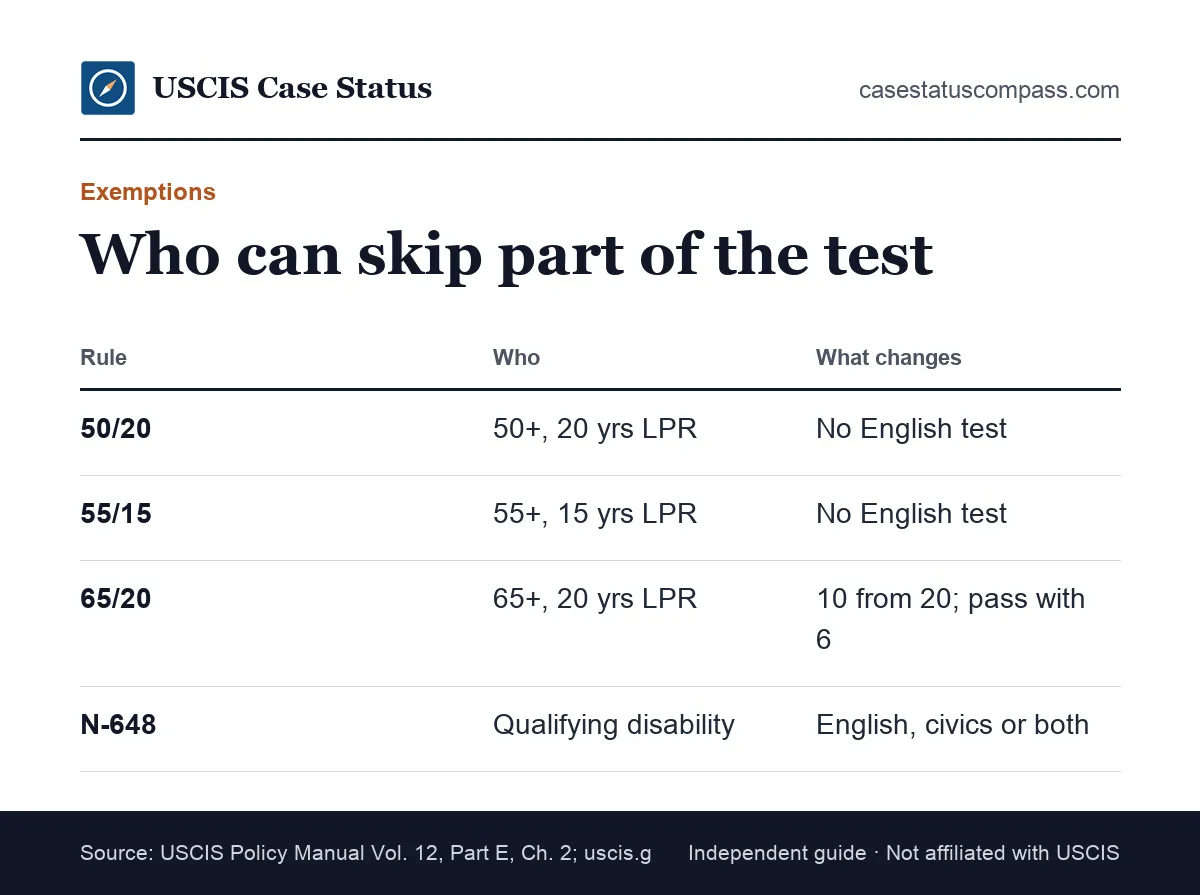
Some older long-term permanent residents are exempt from the English test. USCIS lists two rules: 50/20: age 50+ with 20 years as a green card holder: no English test and 55/15: age 55+ with 15 years as a green card holder: no English test. Age and years are counted as of your N-400 filing date. Exempt applicants still take the civics test.
Bringing an interpreter
If you are exempt from English, you may take the civics test in your language. You must bring your own interpreter who is fluent in both English and your language. USCIS does not supply one for this purpose.
Checking your eligibility
Count your years from the date on your green card ("resident since") to the day you file. Our Form N-400 guide explains filing timing, including early filing.
Bring your interpreter if you qualify.
What Is the 65/20 Special Consideration?
The 65/20 special consideration helps applicants who are 65 or older and have been permanent residents for 20 or more years when they file. As of October 2026, USCIS says: 65/20: age 65+ with 20 years: 10 questions from a 20-question list, in your language. The asterisked questions are marked on the official list.
Which questions to study
On the 2025 list, look for questions marked with an asterisk. Examples include "What is the supreme law of the land?" and "Name three national U.S. holidays." Study only those 20 if you qualify.
Language and interpreter
You may take the civics test in your chosen language. Bring an interpreter fluent in English and that language, as with the other exemptions.
Study the 20 designated questions only.
Can a Disability Exempt You From the Test? (Form N-648)
Yes. A qualifying physical or developmental disability or mental impairment can exempt you from the English test, the civics test or both through Form N-648. USCIS says: Form N-648: a doctor certifies a disability that exempts you from the English and/or civics test. The USCIS fee is $0 USCIS fee (the doctor may charge).
How the N-648 works
A licensed medical professional completes the form and explains how the condition prevents you from learning or showing the knowledge. You file it with your N-400 or bring it later. The officer reviews it at the interview.
Accommodations are different
If you can take the test but need help, ask for an accommodation instead, such as a sign language interpreter or extra time. Request it as soon as you get your interview notice.
Can You Take the Citizenship Test in Spanish or Another Language?
Most applicants must take every part of the test in English. You can take the civics part in Spanish or another language only if you qualify for an English exemption (50/20, 55/15 or 65/20) or a medical exception. In that case, you bring an interpreter.
Is There a Spanish Requirement for the Citizenship Test?
No. There is no requirement to know Spanish, and no Spanish-only version of the test for non-exempt applicants. Some USCIS study materials are translated, which helps learning, but the test itself is in English unless you are exempt. Pages that mention a citizenship test Spanish requirement usually mix up the exemption rules above.
Translated study materials
USCIS offers translated versions of some 2008 study materials, including Arabic and Haitian Creole. Check the Study for the Test page for 2025 translations.
Bring an interpreter to your interview.
What Happens If You Fail the Citizenship Test?
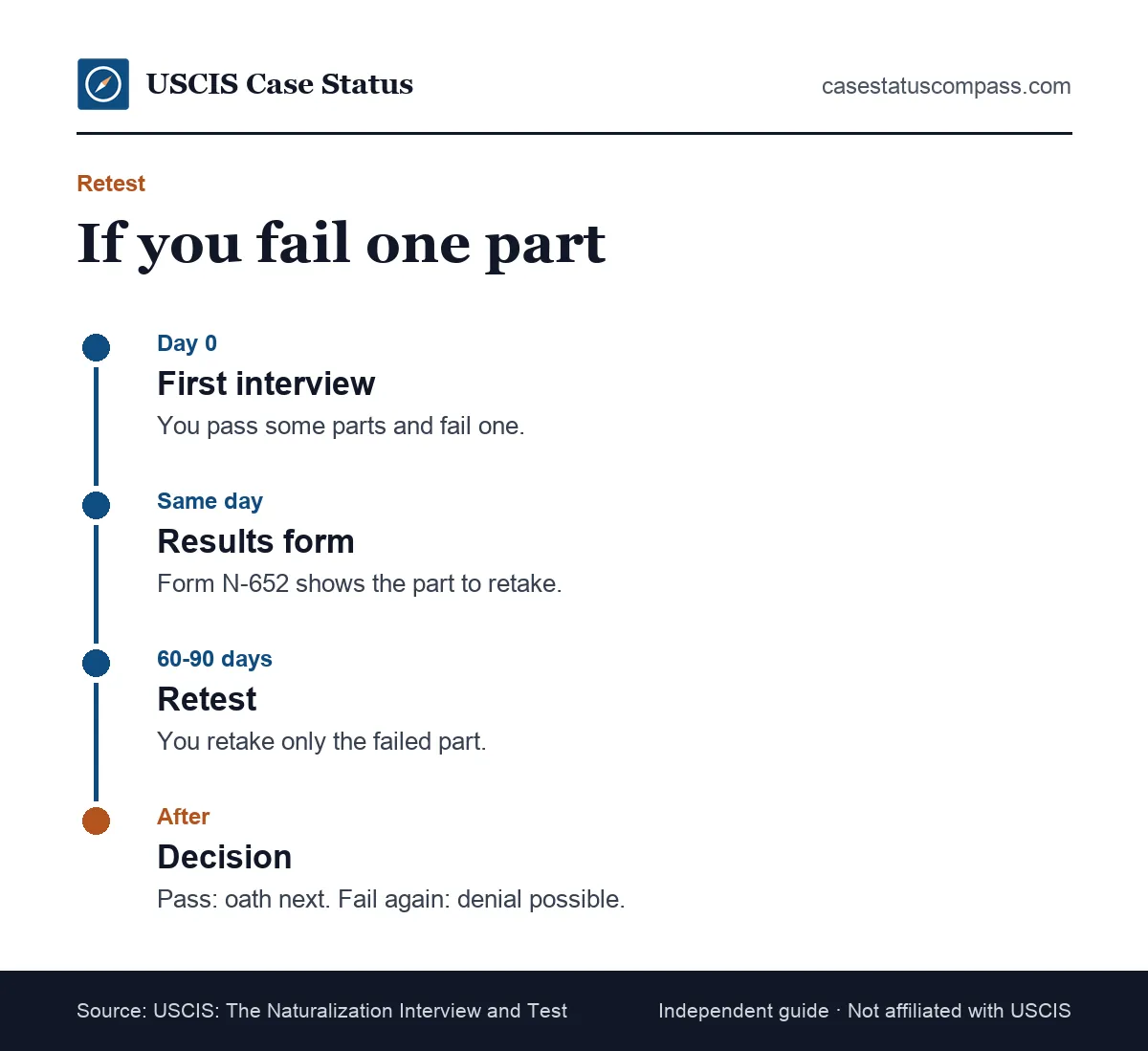
If you fail any part of the US naturalization test, you get one more try. As of October 2026, USCIS says: Two chances to pass; retest of the failed part 60-90 days after the interview. You keep credit for the parts you passed. The failed part is noted on Form N-652, Naturalization Interview Results.
What the N-652 shows
The N-652 lists each part (speaking, reading, writing, civics) and whether you passed. It also shows whether the case is continued for a retest. Keep it with your notices and bring it to the retest.
Does Failing the Citizenship Test Affect Your Green Card?
No. Failing a test part does not take away your permanent resident status. You remain a green card holder while the case continues and after any denial. If your card expires during a long continued case, renew it on time, and keep meeting the usual duties of a resident.
How Does the Citizenship Retest Work?
The citizenship retest is a second interview, scheduled by USCIS, where you retake only the part you failed. It happens 60 to 90 days after the first interview. You do not file a new form; USCIS sends the retest notice. The same pass rules apply.
Getting ready for the retest
Study the failed part only. If you failed civics, practice with mixed sets of 20 questions. If you failed writing, practice dictation every day.
Bring your Form N-652 to the retest.
If you cannot attend the retest
Follow the reschedule instructions on your notice, or contact USCIS at 800-375-5283. Missing the retest without acting can lead to denial.
Ask early and keep a copy of your request and any reply.
What If You Fail the Citizenship Retest?
If you fail the same part a second time, USCIS can deny your naturalization application. You keep your green card. You can generally file a new N-400 later and pay the fee again. A new filing date may also change which civics version you take.
Options after a denial
Read the denial notice carefully. It explains any review rights. Our case denied guide explains the choices. An immigration attorney or DOJ-accredited representative can advise you.
Note any deadline on the notice.
How Much Does It Cost to Refile After a Failed Retest?
As of October 2026, the N-400 fee is $760 (paper) / $710 (online); reduced fee $380 (paper only) if household income is at or below 400% of the Federal Poverty Guidelines. Our citizenship fee page explains the reduced fee and waivers. A refiled N-400 usually means new biometrics and a new interview, so plan for the time as well as the money.
Is the Citizenship Test Hard?
For most applicants, the civics and English exam is very manageable with steady study. The civics answers are short and published in advance, and the English tasks are simple. The hardest parts are usually remembering local answers and staying calm.
What makes it easier
- Every question and answer is public.
- You need only 12 of 20 correct on the 2025 version.
- One correct sentence is enough for reading and for writing.
- You get a second chance at any failed part.
What makes it harder
Nervousness, a strong reliance on written study without speaking practice, and outdated lists from unofficial sites cause most problems. Practice aloud with another person.
Short daily sessions work better than cramming.
What Are the Best Study Tips for the Citizenship Test?
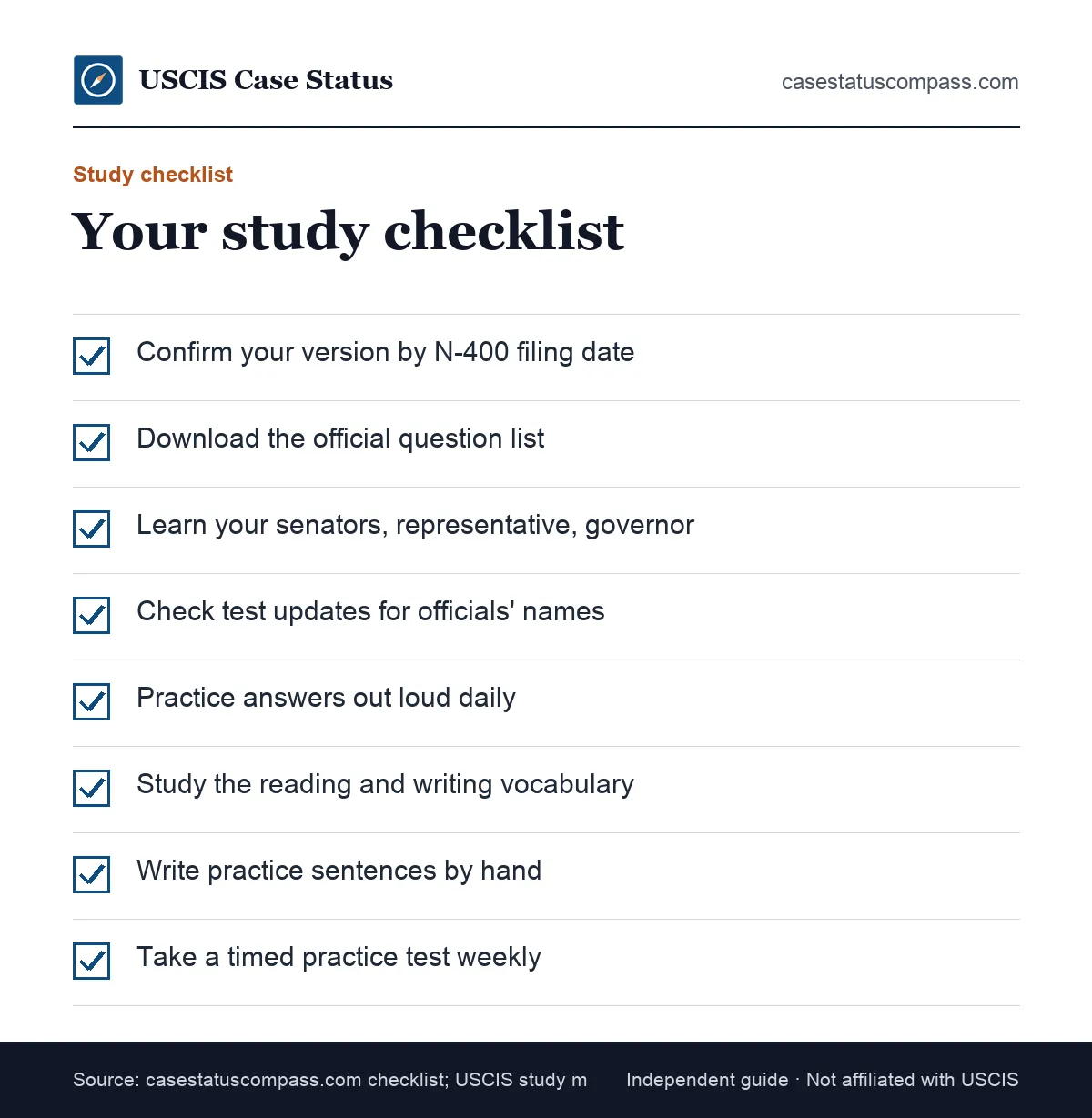
The best study tips are to learn from the official list, study a little every day, practice aloud and use spaced review. Learn your local answers early. Take a full mixed practice test weekly so that random order feels normal.
Methods that work
- Flash cards: question on the front, answer on the back.
- Audio: listen to USCIS civics audio during commutes.
- Teach-back: explain an answer to a friend in your own words.
- Spaced review: revisit missed questions after one, three and seven days.
Methods that waste time
Memorizing every accepted answer for every question, studying from unofficial lists, and only reading silently. You need one correct answer per question, said aloud.
Study the questions in short daily blocks instead.
A Study Plan for the Citizenship Test
A simple study plan splits the 128 questions over about eight weeks, with English practice built in. Spend 15 to 30 minutes a day. Finish with full practice tests in the final week. Adjust the pace if your interview comes sooner.
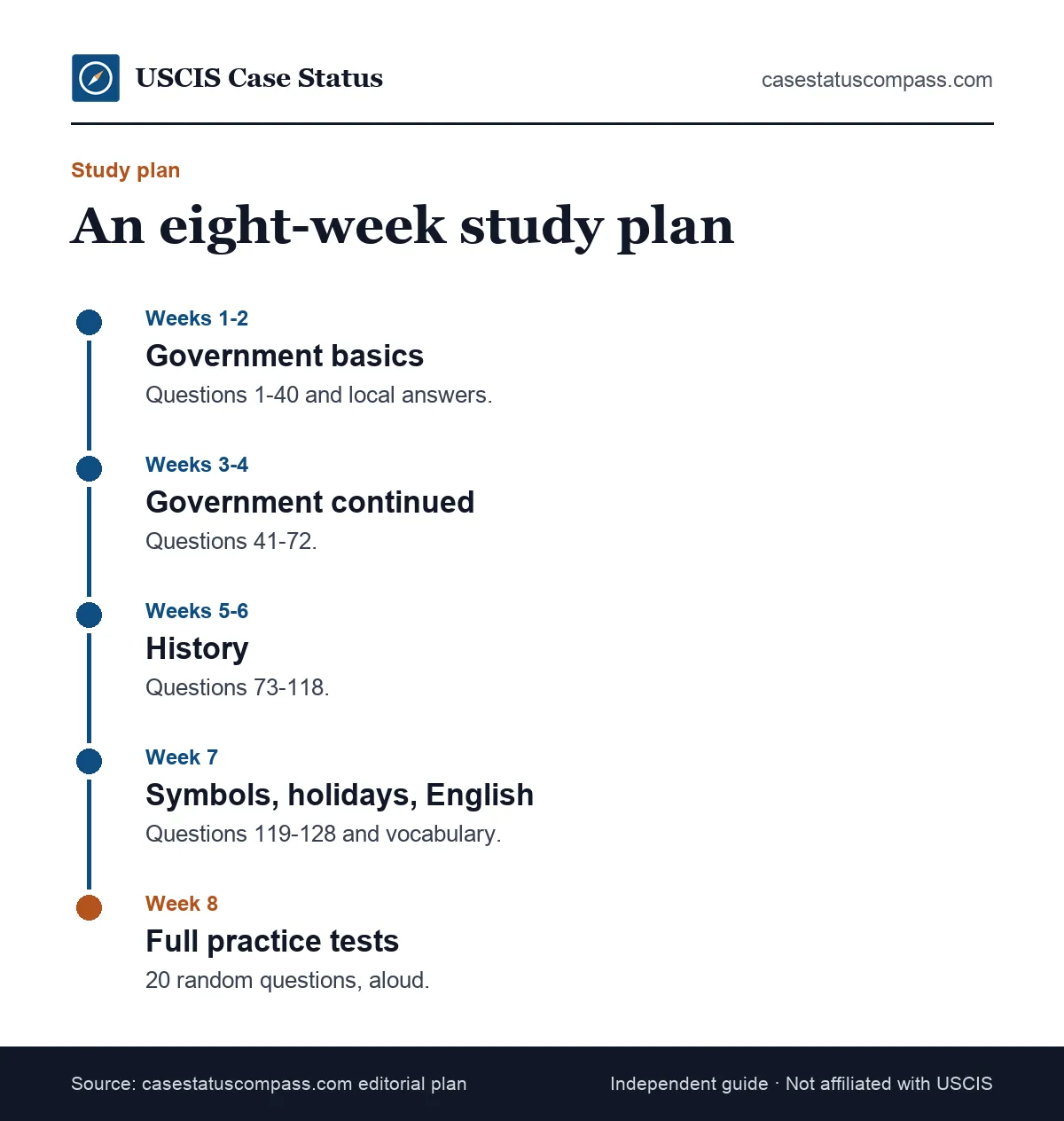
Daily routine
- Review yesterday's missed questions.
- Learn five to eight new questions.
- Read three vocabulary sentences aloud.
- Write one dictated sentence.
Finish with a short spoken quiz of ten mixed questions, and note any you missed for the next day's review.
If your interview is soon
Focus first on the asterisked questions and the government section, since it is the largest. Then add history and symbols. Keep daily speaking practice.
Check current officeholders too, such as your senators.
Official Study Materials and Citizenship Test Apps
USCIS offers free study materials: the question PDFs, study guides, flash cards, audio, videos and practice tests on its Study for the Test page. Many citizenship test apps exist, but only USCIS materials are official. Check any app's question list against the current USCIS version.
PDF and print study guides
The citizenship practice test questions and answers PDF you need is the official USCIS file. The 2008 version's study guide is still useful for older filers. Printed copies are sold by the U.S. Government Bookstore.
How Do You Choose a Citizenship Test App?
Many apps reuse old lists or skip updates after elections. Ask four questions before you download any study app:
- Does it say whether it uses the 2025 or 2008 list?
- Does it show the date it was last updated?
- Does it link to USCIS test updates for officials' names?
- Is it free, without asking for your receipt number or A-Number?
What Mistakes Do People Make on the Citizenship Test?
The most common citizenship test mistakes are studying the wrong version, giving an outdated official's name, not knowing local answers, and guessing instead of asking the officer to repeat. In English, rushing the writing sentence causes avoidable errors. All of these are easy to prevent.
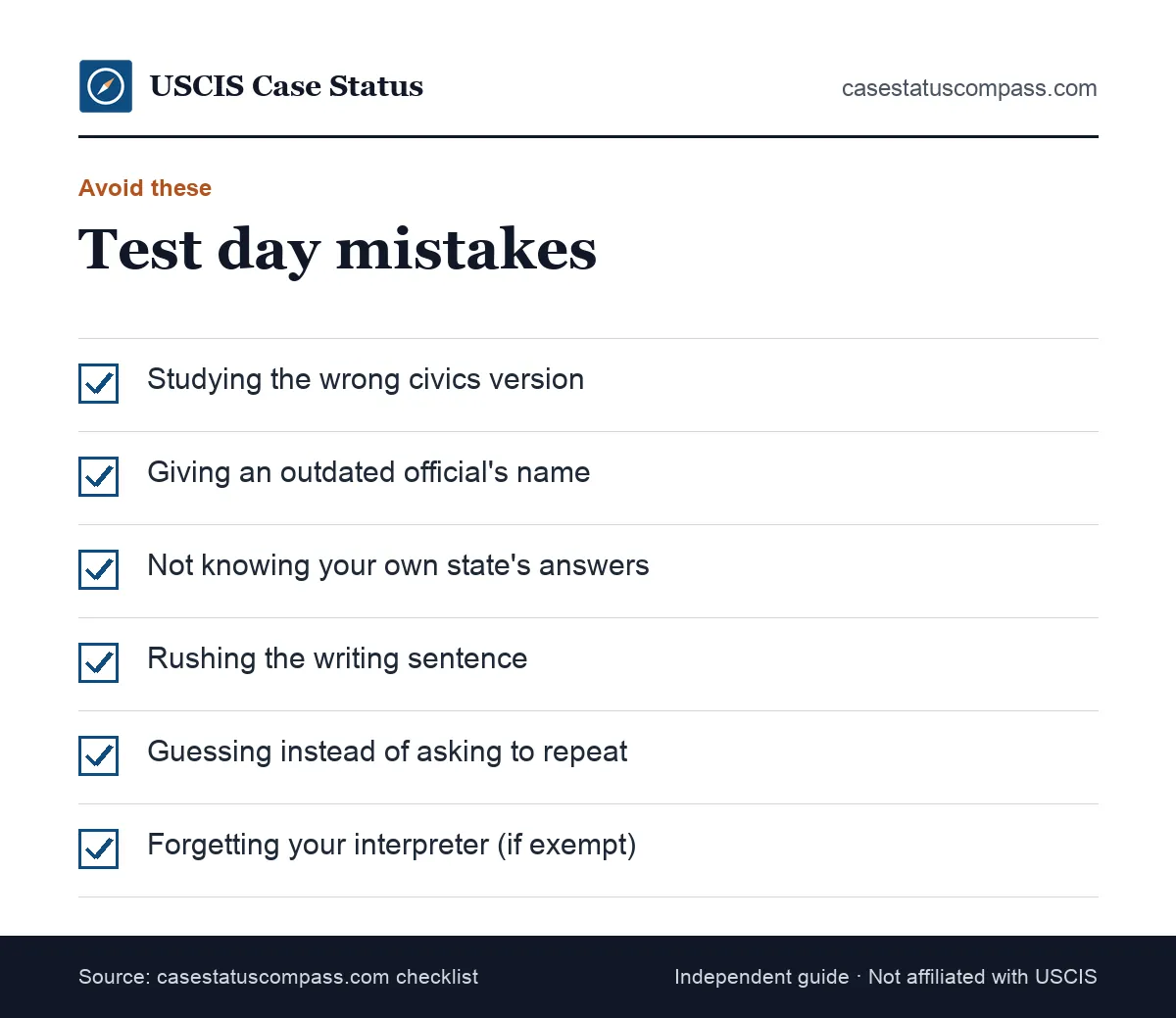
Civics mistakes
Giving only one answer when the question asks for two or three. Confusing the Declaration of Independence with the Constitution. Naming a former officeholder.
Read each question carefully and listen for how many answers it wants.
English mistakes
Skipping small words when reading. Forgetting capital letters on names and holidays. Writing too fast to be legible.
Slow down, read every word aloud, and check each written sentence once before handing it back to the officer.
What Happens on Test Day?
On test day, you check in for your naturalization interview, take an oath to tell the truth, and review your N-400 with the officer. The reading, writing and civics tests happen in the same meeting, usually after or during the review. You leave with Form N-652.
What to bring
Bring your interview notice, green card, ID and any documents your notice lists. Exempt applicants bring their interpreter. The interview guide covers the full document list.
Plan to arrive early, because you pass through security screening before you can check in.
After you pass
If USCIS approves you, the final step is the oath ceremony, sometimes on the same day. You may be able to take the oath the same day as your interview.
Is There a Green Card Test?
No. There is no civics or English green card test for permanent residence. Green card applicants attend an interview about their eligibility, not a knowledge test. The citizenship test applies only when a permanent resident applies to naturalize on Form N-400.
What green card applicants do instead
Green card interviews focus on your I-485 answers and, for family cases, your relationship. Our page on green card interview questions covers that meeting.
No civics questions are asked there.
When Do Green Card Holders Take the Citizenship Test?
Most permanent residents can apply for citizenship after five years, or three if married to a U.S. citizen. You can file the N-400 up to 90 days before you reach 5 years (or 3 years if married to a U.S. citizen) as a permanent resident. That is when the test becomes relevant.
How Does the Test Work for Military Applicants?
Members and veterans of the U.S. armed forces take the same naturalization test as other applicants, with the same English and civics rules. Their filing differs: current service members submit a certified Form N-426. USCIS often holds interviews and ceremonies on military installations.
Military filing
Military applicants: Form N-426 (certified for current service members); veterans use a DD-214. The USCIS fee for Form N-426 is $0.
Ask your unit's legal office about timing before a deployment.
Study resources
The same official study materials apply. Base education offices often help service members prepare.
Practice with the same free USCIS lists and audio as other applicants, and ask your unit if a study group meets on base.
Before You Take the Test: Biometrics and the Interview Notice
Before the naturalization exam, USCIS usually schedules a biometrics appointment for fingerprints and a photo. Then it sends your interview notice on Form I-797C, with the date and office.
Keep both notices together, and check your online account for updates in case a notice is delayed in the mail.
Reading your notice
Check the date, time, office and the list of documents. The notice does not say which civics version you take; your filing date does.
Bring the original notice with you on the day.
When the notice comes late
Track your case through your online account. If your interview is soon, focus on the asterisked questions and English vocabulary first.
Frequently Asked Questions
How many questions are on the citizenship test?
On the 2025 civics test, the USCIS officer asks up to 20 questions from a pool of 128, and you need 12 correct to pass. On the 2008 version, for N-400s filed before Oct. 20, 2025, the officer asks up to 10 of 100, and you need 6. The English test adds reading and writing sentences.
Is the citizenship test multiple choice?
No. The civics test is oral. The officer reads each question aloud and you answer aloud in your own words. There are no answer options to choose from. The reading test asks you to read a sentence aloud, and the writing test asks you to write a sentence the officer says.
Can I bring notes or study sheets into the test?
No. You cannot use notes, phones or study materials during the test. You can bring them to the building to review while you wait, but put them away before you enter the interview room. The officer may ask you to leave bags outside the desk area.
Do I have to answer exactly as the official list says?
Not word for word. USCIS lists accepted answers and says there may be others, but it encourages you to use the listed answers. Saying the same meaning in simple words is usually fine. For questions about officials, give the name of the person serving at the time of your interview.
What if the officer asks a question I did not study?
The officer can ask only questions from the official list for your version. If you studied the full list, every question will be familiar. If you do not understand a question, ask the officer to repeat it. You can miss up to 8 questions on the 2025 version and still pass.
Can I reschedule the citizenship test?
The test is part of your interview, so you reschedule the interview itself. Follow the instructions on your notice or contact USCIS before the date. Moving a date can add delay, so only reschedule for a real reason, such as illness or an emergency.
Can I ask the officer to repeat a civics question?
Yes. Asking the officer to repeat or rephrase a question is normal and does not count against you. Listen for the key words, then answer briefly. If you still do not know, say so and move on; on the 2025 version you need 12 of 20 correct.
When do I get my citizenship test results?
Before you leave the interview. The officer gives you Form N-652, which shows each part you passed and whether the case is approved, continued for a retest or not yet decided. Keep it with your notices; you will need it for any retest.
Do children take the citizenship test?
Children who become citizens through their parents, rather than by filing their own N-400, do not take the test. They may apply for proof of citizenship on Form N-600 instead. Our Form N-600 guide explains who qualifies and how that application works.
Sources
- USCIS: Study for the Test. www.uscis.gov/citizenship/find-study-materials-and-resources/study-for-the-test. Accessed Oct 27, 2026.
- USCIS: 128 Civics Questions and Answers (2025 version), M-1778 (09/25). www.uscis.gov/sites/default/files/document/questions-and-answers/2025-Civics-Test-128-Questions-and-Answers.pdf. Accessed Oct 27, 2026.
- USCIS: Check for Test Updates. www.uscis.gov/citizenship/find-study-materials-and-resources/check-for-test-updates. Accessed Oct 27, 2026.
- USCIS: The Naturalization Interview and Test. www.uscis.gov/citizenship/learn-about-citizenship/the-naturalization-interview-and-test. Accessed Oct 27, 2026.
- USCIS: Exceptions and Accommodations. www.uscis.gov/citizenship/exceptions-and-accommodations. Accessed Oct 27, 2026.
- USCIS Policy Manual Vol. 12, Part E, Ch. 2. www.uscis.gov/policy-manual/volume-12-part-e-chapter-2. Accessed Oct 27, 2026.
- USCIS: Form N-648. www.uscis.gov/n-648. Accessed Oct 27, 2026.
- USCIS Form G-1055 Fee Schedule (10/16/26). www.uscis.gov/sites/default/files/document/forms/g-1055.pdf. Accessed Oct 27, 2026.
- USCIS Data Library: All USCIS Application and Petition Form Types, FY2026 Q3 (Apr. 1-June 30, 2026; queried 7/2026). www.uscis.gov/sites/default/files/document/data/quarterly_all_forms_fy2026_q3_v1.xlsx. Accessed Oct 27, 2026.
- USCIS Contact Center (uscis.gov). www.uscis.gov/contactcenter. Accessed Oct 27, 2026.
- USCIS: Naturalization Ceremonies (updated 02/12/2026). www.uscis.gov/citizenship/learn-about-citizenship/naturalization-ceremonies. Accessed Oct 27, 2026.
- USCIS: Form N-400 page. www.uscis.gov/n-400. Accessed Oct 27, 2026.
- USCIS: Form N-426 page (updated 06/05/2026). www.uscis.gov/n-426. Accessed Oct 27, 2026.
casestatuscompass.com is an independent publication and is not affiliated with USCIS or any government agency. This page is general information, not legal advice. For denials, court or asylum matters, consult an immigration attorney or a DOJ-accredited representative.