Contents · 41 sections
- What Happens at a Green Card Interview?
- Who Has to Attend the Green Card Interview?
- How Are Green Card Interview Questions Chosen?
- Is There an Official List of Green Card Interview Questions?
- Common Green Card Interview Questions About Your Background
- What Are Typical I-485 Interview Questions?
- What Do Officers Ask in a Green Card Marriage Interview?
- Marriage Interview Questions About Money and Family
- What Is a Separate Marriage Interview?
- What Do Officers Ask in Parent Green Card Interviews?
- K-1 Visa Interview Questions vs the Later Green Card Interview
- Employment-Based Green Card Interview Questions
- Immigration Interview Questions About Arrests and Security
- How Should You Answer Questions You Do Not Understand?
- Green Card Interview Questions by Case Type: Summary Table
- What Does the I-485 Interview Letter Tell You?
- What Documents Should You Bring to the Green Card Interview?
- What Marriage Evidence Should You Bring?
- Printable Green Card Interview Checklist
- What Should You Wear to an Immigration Interview?
- How Long Does an Immigration Interview Take?
- Can You Bring an Interpreter to the Interview?
- Green Card Interview Waived: When Does It Happen?
- Is a Marriage-Based Green Card Interview Ever Waived?
- Is It Bad to Reschedule an Interview?
- How Do You Reschedule a Green Card Interview?
- What Happens If You Miss Your Green Card Interview?
- What Happens at the End of the Interview?
- What If the Officer Asks for More Evidence at the Interview?
- What Happens After the Green Card Interview?
- How Long After the I-485 Interview for a Decision?
- How Long After the Interview to Get the Green Card?
- How Do You Prove Status Before the Green Card Arrives?
- No Word for Weeks After Your Interview?
- What Can Cause a Denial After the Interview?
- Mistakes to Avoid at the Green Card Interview
- Green Card Interview Timeline From Notice to Card
- If X, Do Y: Interview Decision Table
- Green Card Interview vs Citizenship Interview: What Changes?
- When Should You Get Legal Help Before the Interview?
- Frequently Asked Questions
The short answer
Green card interview questions mostly check the answers on your Form I-485 and your eligibility: identity, address, work, travel, immigration history and any arrests. Marriage cases add questions about your relationship and shared life. The officer works from your own file, so the best preparation is knowing your forms and telling the truth.
At a glance
| Who holds it | A USCIS officer at your local field office |
| Is it required? | Green card interviews are required unless waived; the family petitioner usually attends too |
| What it checks | Your I-485 answers, eligibility and, in marriage cases, a real relationship |
| What to bring | The list printed on your I-797C interview notice, plus originals |
| Can it be waived? | USCIS can waive the green card interview case by case |
What Happens at a Green Card Interview?
At a green card interview, a USCIS officer places you under oath, goes through your Form I-485 with you, and asks questions to confirm you qualify. The officer can correct missing or outdated answers. In family cases the officer also looks at the relationship behind the petition.
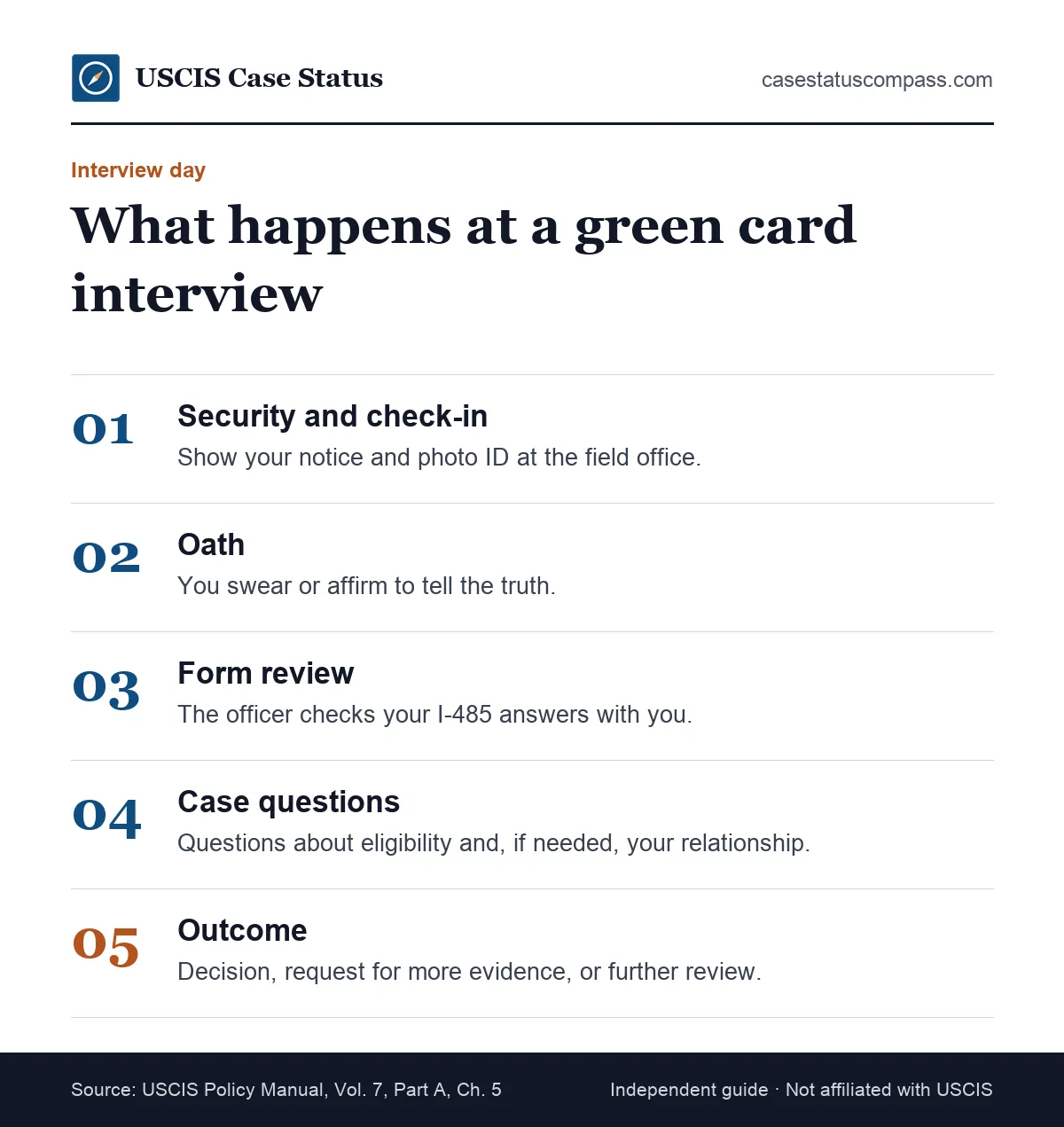
Check-in and security screening
You arrive at the USCIS field office named on your notice, pass security and check in at the front desk. Then you wait to be called. Arrive early and leave weapons at home.
Oath and the form review
The officer usually asks you to swear or affirm that you will tell the truth. Then comes the form review. The USCIS Policy Manual says officers confirm you understood each question and let you correct answers that were wrong or have changed since filing.
Who Has to Attend the Green Card Interview?
The principal applicant must attend unless USCIS waives the interview. Green card interviews are required unless waived; the family petitioner usually attends too. Derivative family members who filed their own I-485 also appear. Your notice names everyone who must come.
Applicant, petitioner and derivatives
The petitioner is the U.S. citizen or green card holder who filed Form I-130. In marriage cases, both spouses sit with the officer. Children who are derivatives usually come too, even if the officer asks them only a few simple questions.
Bringing a lawyer or accredited representative
You may bring an immigration attorney or a DOJ-accredited representative with a Form G-28 on file. A representative can clarify questions and protect the record, but cannot answer for you.
How Are Green Card Interview Questions Chosen?
Officers build green card interview questions from your own file: the I-485, the I-130 or other petition, your evidence and background-check results. There is no public script, so two applicants in the same category can face very different questions.
Your own file is the best study guide.
Your forms are the question bank
Expect questions taken straight from your Form I-485: names, addresses, jobs, trips and the "Have you ever" section. Anything unclear, outdated or blank will likely come up. Read your filed copy before the interview.
Is There an Official List of Green Card Interview Questions?
No. Every sample question below is a generic example we wrote from public guidance and common reports. It is not an official USCIS list, and your officer may ask none of them. Use the samples to practice recalling true facts, never to rehearse answers that differ from your real life.
Common Green Card Interview Questions About Your Background
Background questions open most interviews. They confirm identity and match your answers to your forms. Review your records first, since nerves make people stumble on dates.
Expect questions on your full name, other names used, date and place of birth, parents, current address and job. Bring your passport and a copy of the forms you filed so you can check a date instead of guessing.
Identity and biographic questions
- What is your full legal name? Have you used other names?
- What is your date and place of birth?
- What is your current address, and how long have you lived there?
- What are your parents' names?
- What is your phone number and email address?
- Which passport do you hold, and when does it expire?
Address, work and school history
- Where have you lived in the last five years?
- Who is your employer, and what is your job title?
- When did you start this job, and what did you do before?
- Did you study in the U.S.? Where and when?
- Have you worked in the U.S. without permission?
What Are Typical I-485 Interview Questions?
Typical I-485 interview questions follow the eligibility parts of the form: how you entered the U.S., whether you kept lawful status, and your "Have you ever" answers. Any "yes" answer draws follow-up questions and a request for records.
Bring proof of your entry, such as your I-94.
Entry and immigration history questions
- When and how did you last enter the United States?
- What visa or status did you have when you entered?
- Have you ever overstayed a visa?
- Have you left the U.S. since filing your I-485?
- Have you ever been in removal proceedings?
- Have you ever been refused a visa or entry?
The "Have you ever" eligibility questions
The I-485 lists yes/no questions on crimes, security and immigration violations. Officers often read several aloud:
- Have you ever been arrested, cited or detained?
- Have you ever lied to get an immigration benefit?
- Have you ever belonged to a group named on the form?
For the form itself, see our guide to Form I-485, the adjustment of status application.
What Do Officers Ask in a Green Card Marriage Interview?
In a green card marriage interview, the officer checks whether the marriage is real, not only legal. Questions cover how you met, the wedding, your home and your routine. Both spouses usually attend, and the officer compares your answers with each other and with your evidence.
How you met and the wedding
These are generic marriage interview examples, not an official list:
- How, where and when did you first meet?
- When did you decide to marry?
- Who proposed, and how?
- Where was the wedding, and who attended?
- Did either of you marry before? How did it end?
Daily life and your home
- What time does your spouse leave for work?
- Who does the cooking and grocery shopping?
- How many bedrooms does your home have?
- What did you do together last weekend?
- Which side of the bed does each of you sleep on?
A spouse coming from abroad has a consular interview instead; our CR1 visa and marriage green card guide covers that route.
Marriage Interview Questions About Money and Family
Officers often ask about shared finances and relatives because real couples combine parts of their lives. You do not need joint everything, but you should be able to describe how money and family ties work in your marriage.
If you do not know an answer, such as a relative's birthday, say so rather than guess; a guess that conflicts with your spouse's answer causes more trouble than an honest gap.
Finances and bills
- Do you have a joint bank account? At which bank?
- Who pays the rent or mortgage, and how much is it?
- Did you file taxes jointly last year?
- Whose name is on the car insurance and utility bills?
If you keep separate finances
If you keep separate accounts for a real reason, say so plainly and explain how you share costs. Officers see many genuine couples who split bills by transfer rather than through a joint account.
Families and future plans
- Have you met each other's parents?
- What are your spouse's siblings' names?
- Do you have or plan to have children together?
- How did you celebrate your spouse's last birthday?
Answer from memory; it is fine if you do not know everything.
What Is a Separate Marriage Interview?
Some couples are interviewed separately when an officer still has doubts after the joint interview. Each spouse answers the same detailed questions alone, and the officer compares the answers. Applicants often call it a "second interview"; USCIS uses no single public name for it.
Why an officer may separate you
A separate interview often follows inconsistent answers, thin joint evidence, or a prior marriage that ended shortly before this one. None of these proves fraud.
Answer separately and honestly, and do not try to coordinate stories.
How to handle it honestly
Answer only what you know, and say "I don't know" instead of guessing. Small mismatches happen in real marriages. What hurts a case is invented detail or coordinated stories that clash with records. Talk with an immigration attorney before a separate interview.
What Do Officers Ask in Parent Green Card Interviews?
Parent green card interview questions focus on identity and the parent-child link, since the U.S. citizen petitioner must be the son or daughter. Officers check birth records and name differences. USCIS may waive these interviews, but many parents are still called in.
Questions for the parent
- What is your son's or daughter's full name and birth date?
- Where was your child born?
- Who lives with you in the U.S. now?
- How will you be supported here?
Questions for the citizen son or daughter
- Are you the person on this birth certificate?
- Why is the name spelled differently on these records?
- Can you support your parent at the required income level?
Bring your Form I-864 papers and recent tax returns to answer the income question.
The sponsor's income test in parent cases
The sponsor's Form I-864 has an income test: Sponsors need income of at least 125% of the poverty guidelines (100% for active-duty military sponsoring spouse/child). See our Form I-864 affidavit of support guide.
K-1 Visa Interview Questions vs the Later Green Card Interview
K-1 visa interview questions come twice for many couples: first at a U.S. consulate before the fiancé(e) travels, then at the USCIS green card interview after the wedding. The first asks about the engagement; the second about the marriage.
The wedding must happen within a short, fixed window after the fiancé(e) enters the U.S., and the USCIS section below explains how the officer checks it.
At the consulate abroad
The State Department, not USCIS, runs this interview. Examples:
- How did you meet, and when did you last see each other?
- When and where will the wedding take place?
- What does your fiancé(e) do for work?
The full process is on our K-1 fiancé visa page.
At the USCIS interview after marriage
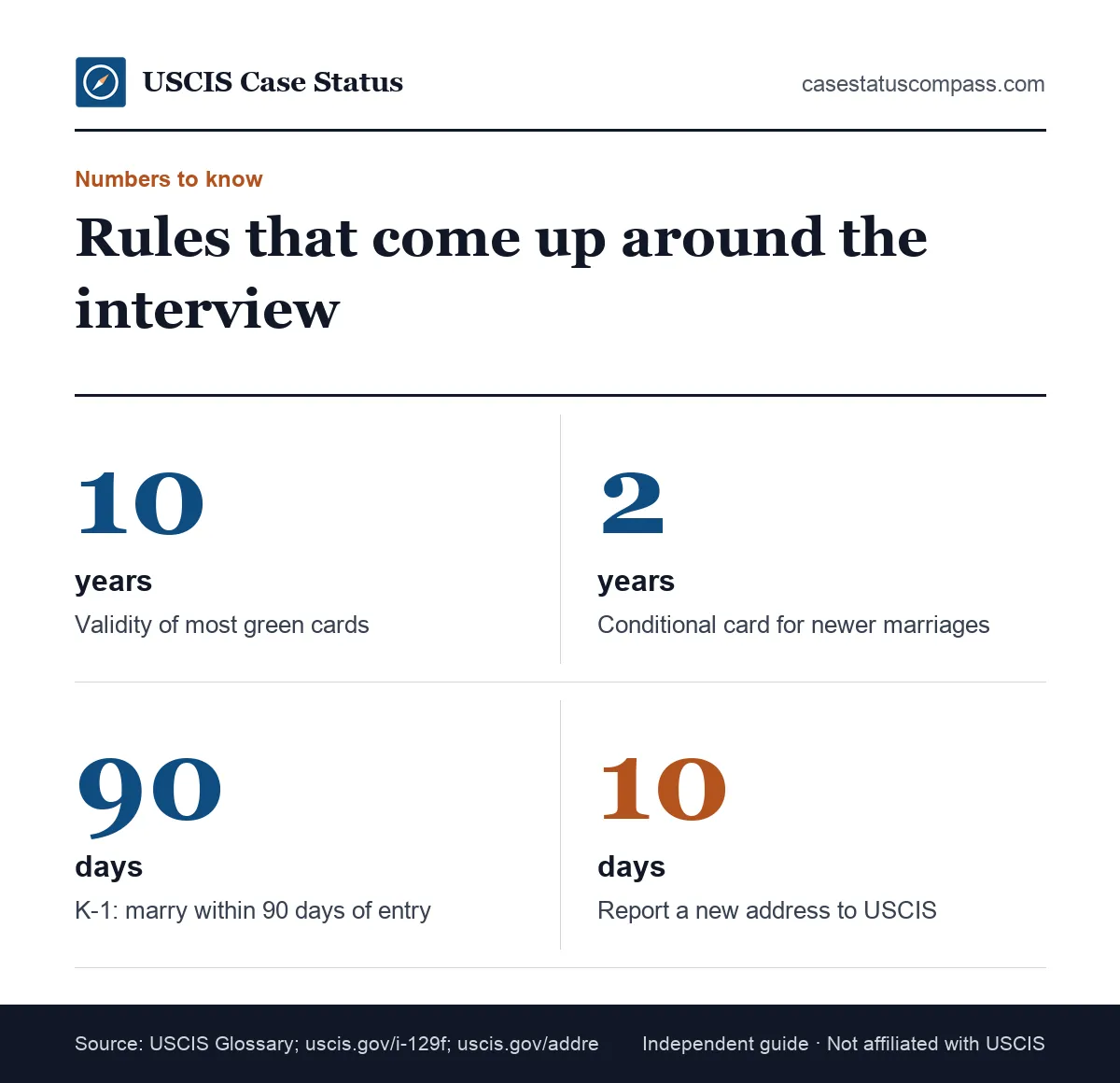
After the wedding the foreign spouse files Form I-485, and the officer checks the timing. K-1: marry within 90 days of entering the U.S.. Examples:
- On what date did you enter on the K-1 visa?
- When and where did you marry?
- Where have you lived together since?
Employment-Based Green Card Interview Questions
Many employment-based I-485 cases are decided without an interview, but some are called in. Questions then focus on the job offer, your qualifications and whether you kept lawful status while waiting.
Bring a current employer letter and recent pay stubs, and be ready to describe your duties in your own words.
Job offer and duties questions
- Who is your sponsoring employer, and what is your title?
- What are your main daily duties?
- Do you still intend to take this job?
- What degree or experience qualifies you?
Status and employer change questions
- Have you always kept a valid status in the U.S.?
- Have you changed employers since filing?
If your job changed, bring proof and ask a lawyer whether it affects your case.
Immigration Interview Questions About Arrests and Security
Immigration interview questions about crime come up in every category. The officer wants to know about any arrest, citation, charge or conviction anywhere in the world, even if it was dismissed, sealed or expunged.
Bring certified court dispositions for every case.
What counts and what to bring
- Have you ever been arrested or charged, even if dismissed?
- Have you had a ticket involving alcohol or drugs?
- Have you ever been on probation or paid a court fine?
Bring certified court dispositions for every incident. A police report alone is usually not enough.
Why full disclosure matters
USCIS runs fingerprint and name checks, so old records usually surface anyway. Leaving one out can look like misrepresentation, a far bigger problem than the incident itself. Talk to an attorney first.
How Should You Answer Questions You Do Not Understand?
If you do not understand a question, ask the officer to repeat or rephrase it, as often as you need. Never guess. A clear "I don't understand" or "I don't remember" protects the record, while a guess can create a contradiction you never intended.
Ask for repetition or an interpreter
You can say, "Could you repeat that, please?" Answer only the question asked, and keep answers short and factual. If English is hard for you, bring a qualified interpreter.
Your interpreter must show identification and sign an oath form at the interview; the interpreter section below covers the rules.
"I don't know" is an honest answer
Spouses do not know every detail about each other. If you do not know your spouse's exact salary, say so. An honest "I don't know" is safer than a confident guess your spouse contradicts.
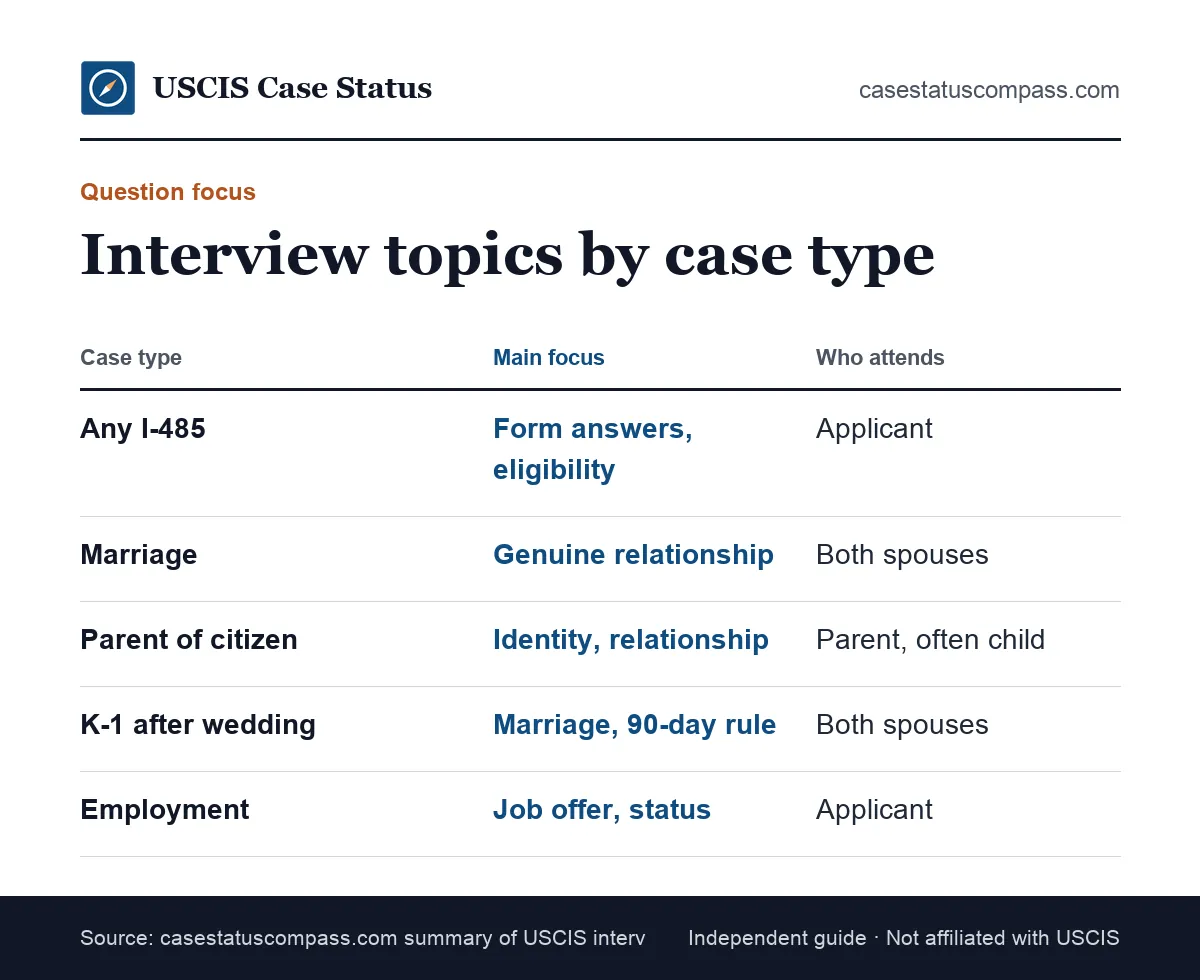
Green Card Interview Questions by Case Type: Summary Table
This table sums up how green card interview questions shift by case type and which evidence officers often ask to see. Use it to decide which practice questions and records matter most for your own category.
Start with the row for your category, then use the practice sections below for that case type.
Question focus and evidence by case type
Read across your row to see the likely topics and the records worth bringing.
| Case type | Main question topics | Evidence often requested |
|---|---|---|
| Any I-485 | Identity, entry, status, "Have you ever" answers | Passport, I-94, civil records |
| Marriage-based | Meeting, wedding, home life, money | Joint lease, bank and tax records, photos |
| Parent of U.S. citizen | Parent-child link, support | Birth records, I-864 papers |
| K-1 after wedding | Entry date, marriage date, shared home | Marriage certificate, I-94 |
| Employment-based | Job offer, duties, status history | Employer letter, pay stubs |
| Any case with an arrest | Charges, outcome, sentence | Certified court dispositions |
Mixed cases, such as a marriage case with an arrest, combine rows.
What Does the I-485 Interview Letter Tell You?
The I-485 interview letter is a Form I-797C. I-797C = Notice of Action (receipt, rejection, transfer, appointment, re-open); not proof of status by itself. It lists the date, time, office and any case-specific items, such as tax transcripts or divorce records. Read it the day it arrives, so you have time to order records.
What Documents Should You Bring to the Green Card Interview?
Bring everything listed on your I-797C interview notice, plus photo ID, passport and the originals of civil documents you sent as copies. As of October 2026 we found no single official uscis.gov checklist; USCIS prints the list on each notice, so your notice is the authority.
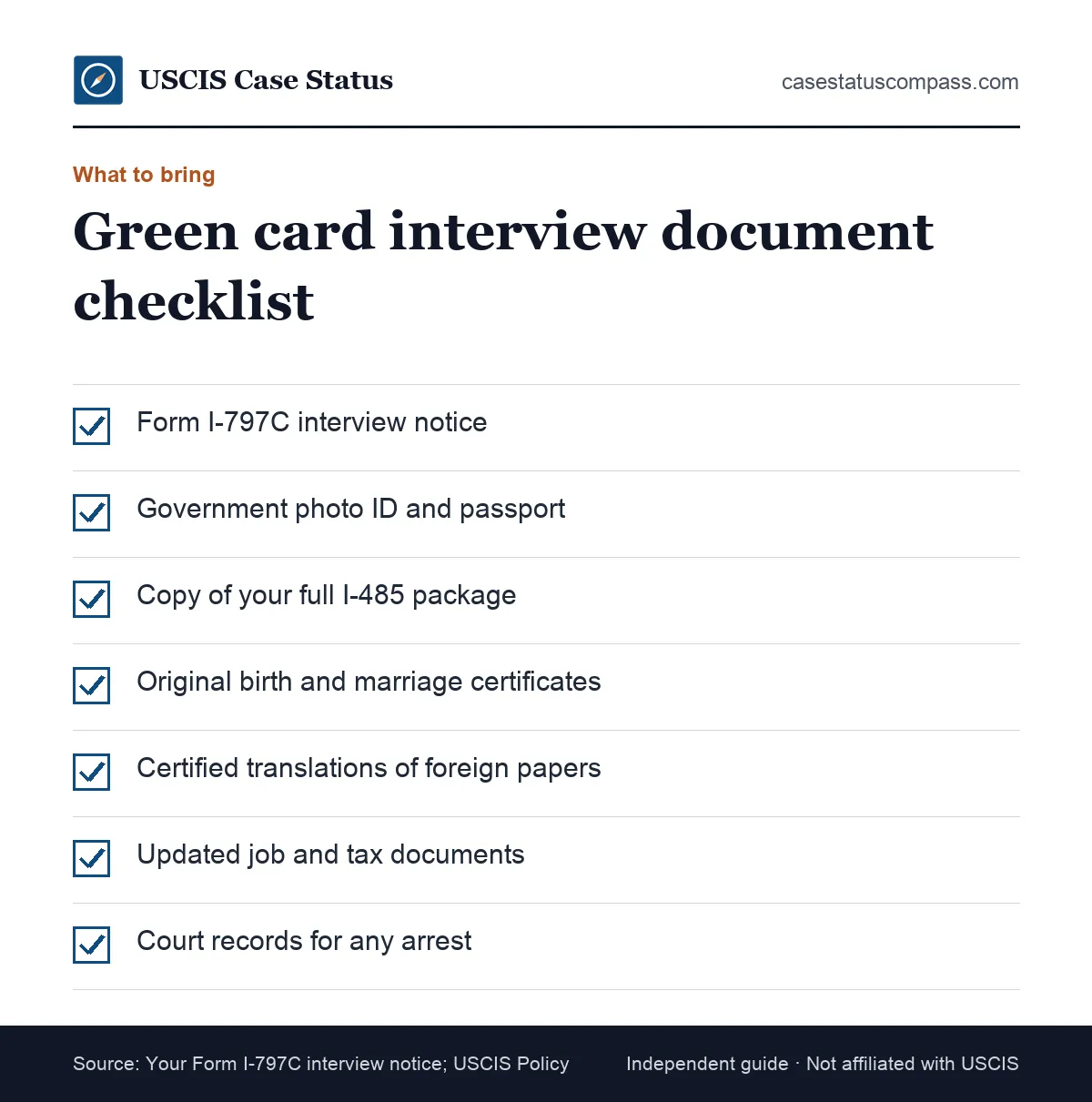
Core documents most applicants bring
Most notices list items like these, but the list printed on your own I-797C always comes first.
| Document | Why it matters |
|---|---|
| Interview notice (I-797C) | Building entry and your appointment |
| Passport and photo ID | Identity and entry history |
| Original birth, marriage, divorce records | Eligibility and relationship |
| Certified English translations | Officers must read foreign records |
| Copy of your filed I-485 package | Answering questions about your forms |
| Recent tax returns and pay stubs | Support and employment |
Bring originals plus one set of copies.
What Marriage Evidence Should You Bring?
For a marriage-based green card interview, bring recent proof of a shared life: joint housing, joint finances and records that connect you over time.
Bring evidence dated after you filed, since the officer wants to see that the relationship continued. Organize it by type and date in a folder so you can find a lease or a bank statement quickly when the officer asks.
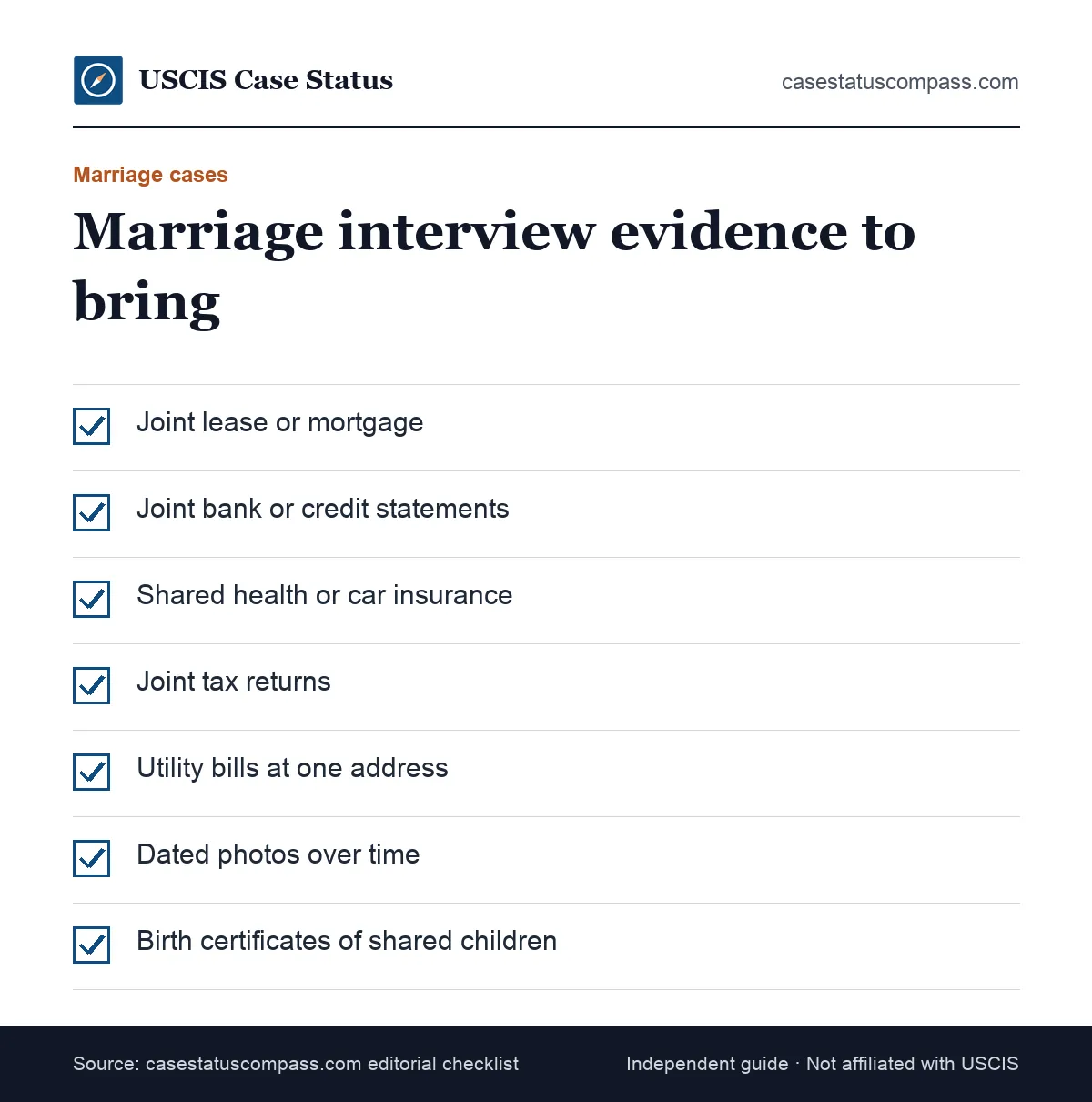
Joint records that carry weight
The strongest evidence shows shared responsibility: a lease or deed in both names, joint bank statements with real activity, shared insurance and joint tax returns. Statements dated after filing show the marriage continuing.
Photos and other proof
Dated photos from different times and places help, as do travel records and your children's birth certificates. A small, organized set works better than hundreds of selfies, and photos all taken on one day can raise questions.
Printable Green Card Interview Checklist
This printable checklist turns the advice on this page into tasks for the week before and the morning of your interview.
Print it, tick each box and keep it in your document folder. Review the green card interview questions on this page the night before, using your own forms as the answer key.
The week before
- Reread your filed I-485, I-130 and any I-864.
- List what has changed: job, address, travel, arrests, children.
- Gather originals and certified translations.
- Order certified court records for any arrest.
- Confirm your interpreter, if needed.
- Plan your route and arrival time.
The night before and morning of
- Put the notice, ID and passport in one folder.
- Pack evidence by category, with copies.
- Expect to keep your phone off inside.
- Go to the field office, not the biometrics center.
What Should You Wear to an Immigration Interview?
Wear clean, neat business casual clothes. There is no official dress code, and the officer judges eligibility, not your outfit. Tidy clothes still show respect.
Choose clothes you can sit in comfortably for a long wait in a busy office.
Simple clothing guidelines
- Choose modest clothes you would wear to an office job.
- Skip slogans, political messages or offensive images.
- Wear shoes you can wait in for hours.
- Bring a light layer for a cold waiting room.
What to leave at home
Leave weapons behind: federal law bans weapons, including firearms, knives, pepper spray and ammunition, at every USCIS facility. Keep bags and electronics to a minimum.
Leave food and large bags at home if possible, so screening goes quickly.
How Long Does an Immigration Interview Take?
USCIS publishes no official length for an immigration interview. Simple cases can be brief, while marriage cases with follow-up questions take longer. Add waiting time and set aside at least half a day.
Plan for parking and security lines too.
What makes interviews longer
Length grows with complexity: prior marriages, arrests, status gaps, missing documents, an interpreter, or answers that do not match the file.
Bringing complete, organized originals is the simplest way to keep your own meeting short and focused.
Waiting room time
Offices often run behind your appointment time. Tell the front desk before you step out, or you may miss your name.
Bring water, a phone charger and something to read if the building allows them.
Can You Bring an Interpreter to the Interview?
Yes. If your English is limited, bring your own interpreter. Need an interpreter? Bring one with government ID; they sign an oath (Form G-1256). The officer can disqualify an interpreter who is not competent or who adds their own views.
Who makes a good interpreter
USCIS prefers a disinterested party with no stake in the case, though an officer may allow a friend or relative. Your spouse or petitioner generally should not interpret, since they are part of the case.
How the interpreter works
The interpreter translates word for word, without adding explanations or coaching you. If the officer speaks your language, you may not need one.
Pick someone fluent in both languages, since the officer can disqualify an interpreter who is not.
Green Card Interview Waived: When Does It Happen?
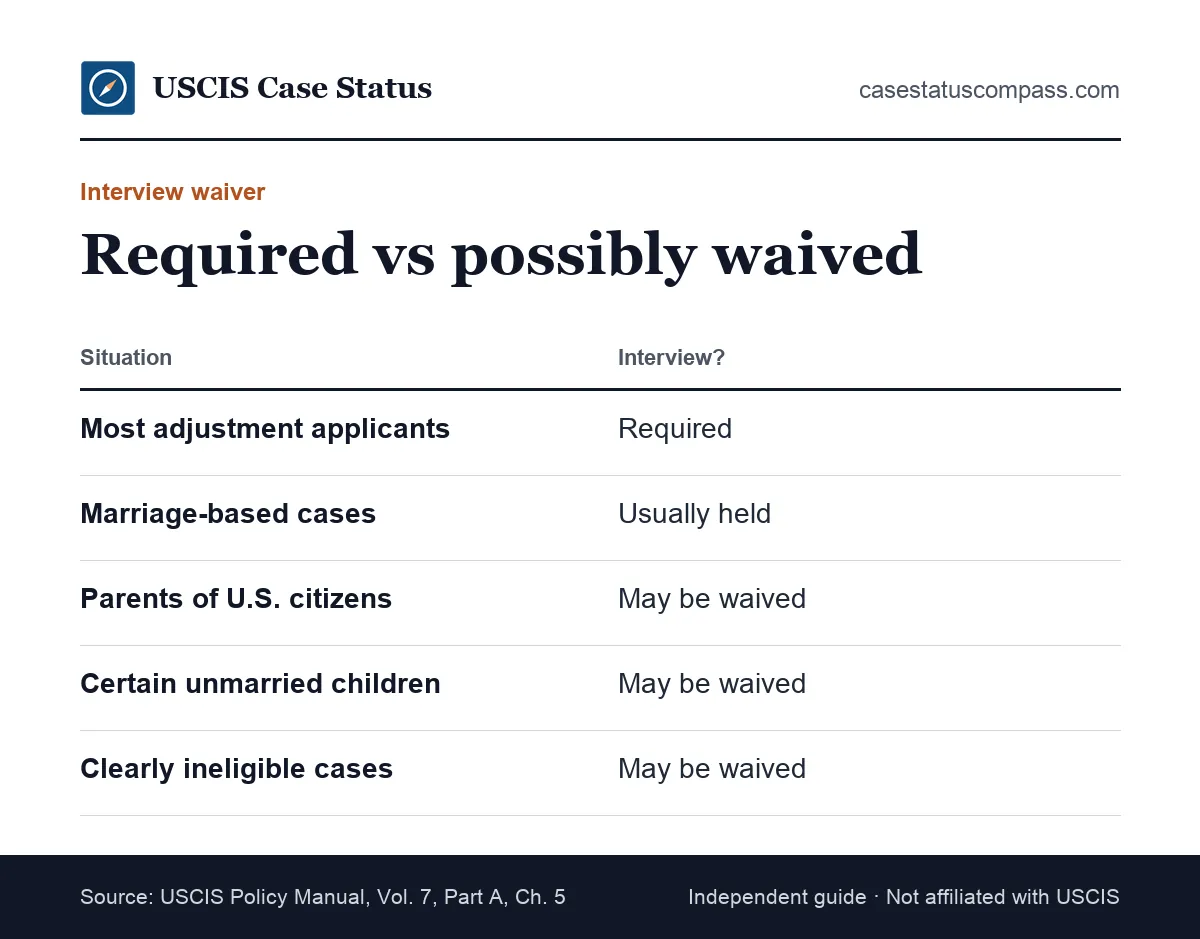
A green card interview waived decision means USCIS decides your I-485 without calling you in. USCIS can waive the green card interview case by case. You cannot demand a waiver, and USCIS can still schedule an interview later.
If an interview notice arrives after you hoped for a waiver, prepare as you would for any interview; the notice alone does not mean something is wrong.
Categories USCIS may consider
The Policy Manual lists clearly ineligible applicants, parents of U.S. citizens and certain unmarried children of citizens or green card holders. Waivers for illness or incapacity need supervisory approval.
Being in one of these groups does not guarantee a waiver.
How you know it was waived
There is no "interview waived" notice. Your status may move from review straight to approval, or you may get an evidence request instead. If approval comes without an interview notice, none was needed.
Is a Marriage-Based Green Card Interview Ever Waived?
A marriage-based green card interview waived outcome is possible but uncommon, because the officer must judge whether the marriage is genuine. Prepare as if you will be called.
A waiver is more likely when the file already shows strong joint evidence and the couple has been married for years, but USCIS gives no list. Keep evidence current while you wait.
Why marriage cases are usually interviewed
The petitioner generally must attend in family cases, and marriage is where relationship fraud concerns are highest. A strong file makes the interview smoother; it rarely lets you skip it.
If your case was approved without one
Check the card when it arrives. If your marriage was under two years old when you got residence, the card is conditional. Most green cards are valid for 10 years; conditional green cards for 2 years. Plan ahead for Form I-751, removing conditions.
Is It Bad to Reschedule an Interview?
Rescheduling a USCIS interview is not automatically bad, but it usually delays your case, sometimes by months, because open slots are limited. Reschedule only for real reasons such as illness, a birth or a death. Never simply skip the appointment.
When rescheduling makes sense
Strong reasons include a medical emergency, a hospital stay, a birth, a funeral or a court date. Keep proof, such as a doctor's note. Work conflicts are weaker, since employers can usually give you the day.
The real cost of a new date
Your case goes back into the queue, and the next date depends on your field office. Your work and travel documents keep their own expiry dates, so check them before asking to move the interview.
How Do You Reschedule a Green Card Interview?
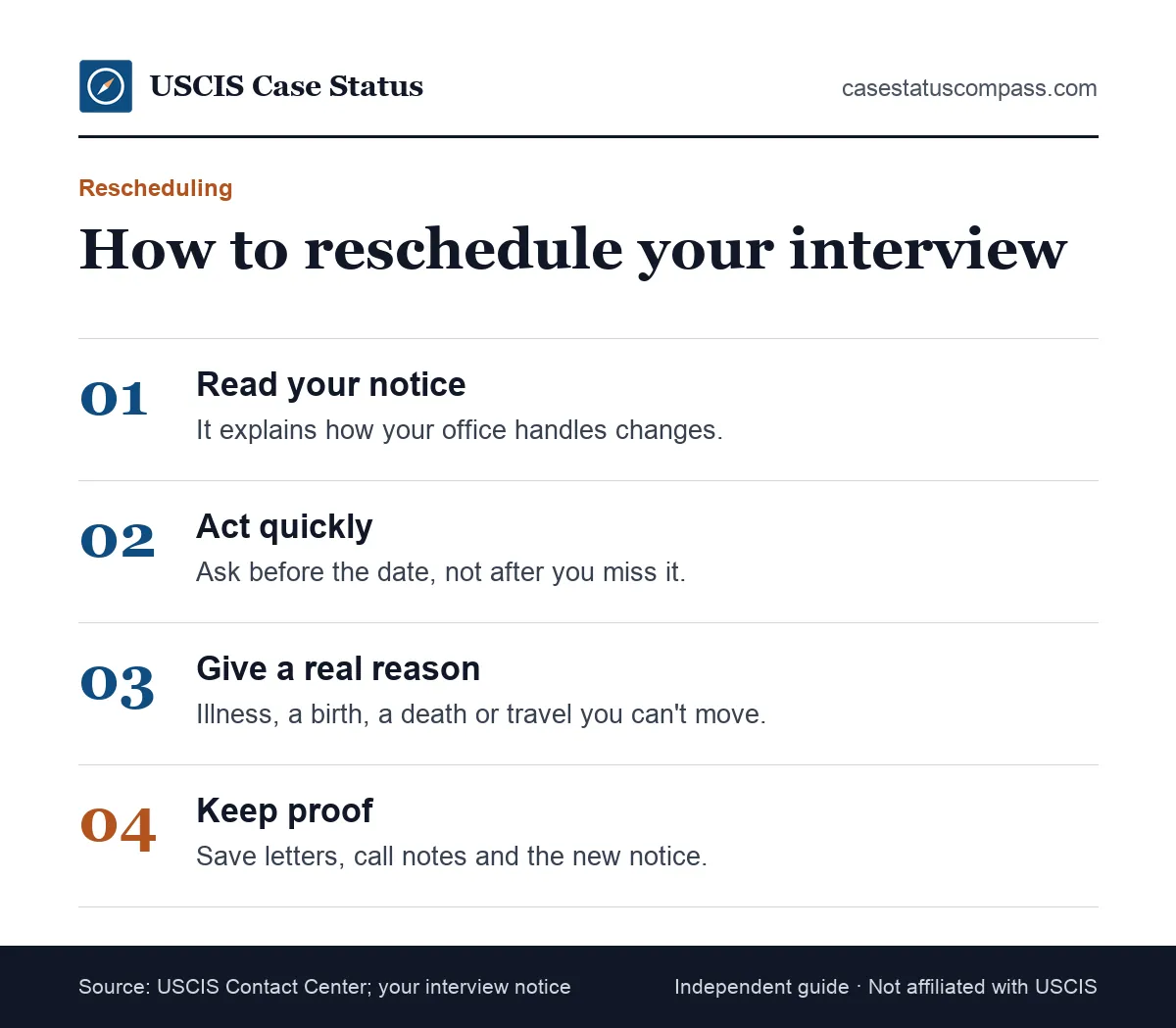
To reschedule a green card interview, follow the instructions on your I-797C notice and contact USCIS before the interview date. The USCIS Contact Center is at 800-375-5283.
Explain the reason briefly and keep proof, such as a medical note. Ask only for a serious conflict, because a new date may come months later, and check your online account for the updated notice.
Steps to request a new date
- Read the reschedule section of your notice.
- Contact USCIS before the date. Request an in-person appointment online at my.uscis.gov/en/appointment/v2 or call 800-375-5283.
- Give the reason briefly and offer proof.
- Note the date and any reference number of each contact.
- Wait for a new I-797C before assuming anything changed.
What Happens If You Miss Your Green Card Interview?
Missing the interview without a timely request can lead USCIS to treat the case as abandoned and deny it. If an emergency kept you away, contact USCIS at once and explain in writing, with proof such as a hospital record. An attorney can help with next steps.
What Happens at the End of the Interview?
At the end, the officer approves the case, asks for more evidence, or holds it for more review. The officer may tell you the result or say you will hear by mail. If answers changed, you may re-sign the I-485.
Possible outcomes before you leave
Before you leave, ask the officer which of these outcomes applies to your case.
| What the officer says | What it means | Your next step |
|---|---|---|
| "Your case is approved" | Decision made | Watch status and mail |
| "I need more documents" | Evidence request issued | Meet the deadline |
| "I need to review further" | Checks or supervisor review | Wait; watch status |
| "We will schedule another interview" | Officer has doubts | Talk to an attorney |
If the officer hands you a document list, note the deadline.
What If the Officer Asks for More Evidence at the Interview?
The officer may hand you a written list of missing items. Treat it like any RFE: RFE deadline: up to 12 weeks (the exact date is on your RFE); no extensions. If a relative has a pending I-601A waiver, its RFE allows only 30 days. Our guide to a request for evidence explains how to answer.
What Happens After the Green Card Interview?
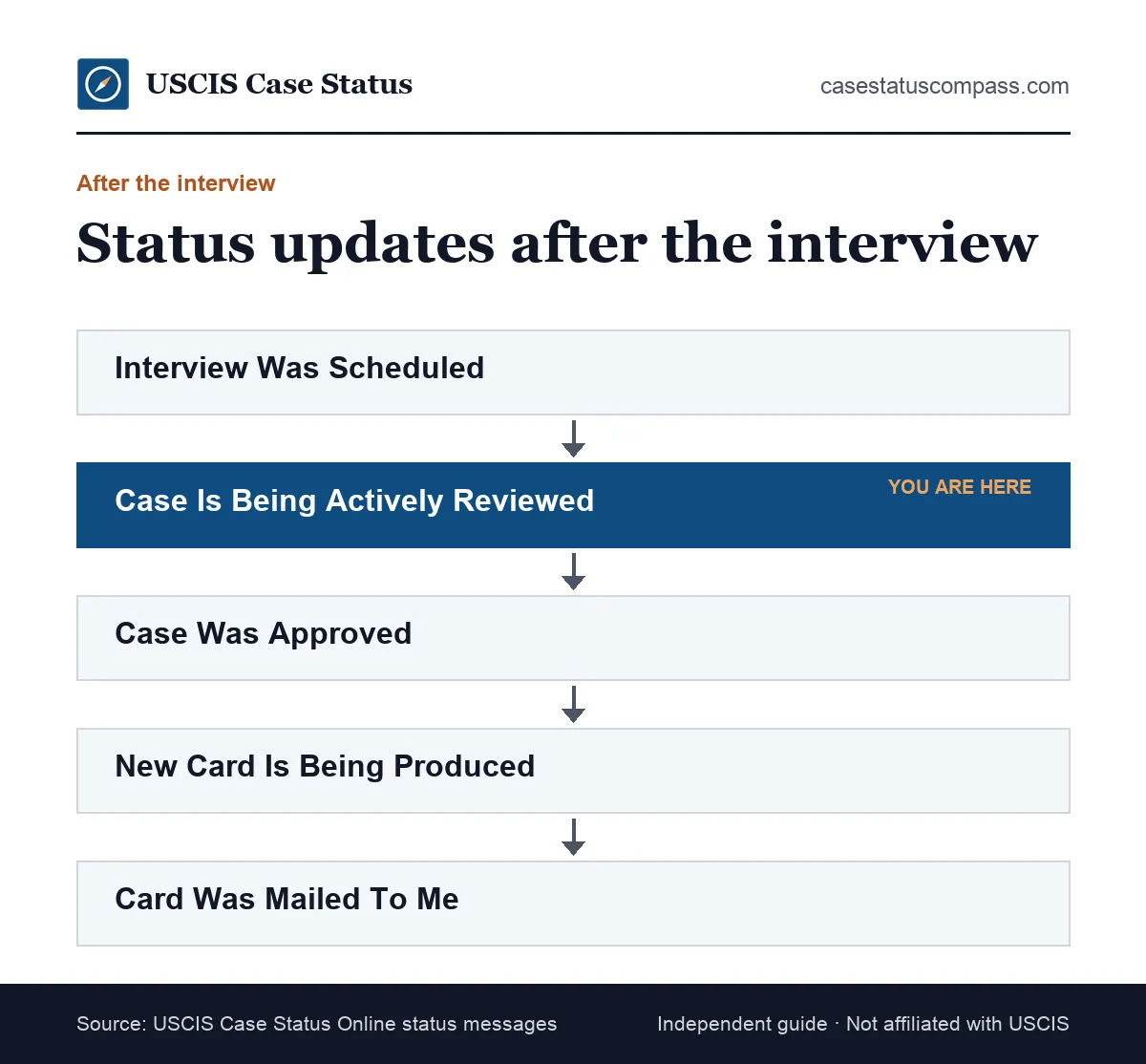
After the green card interview, your online status updates as the officer finishes the decision. A common path runs from review to "Case Was Approved," then card production and mailing. Some cases pause for background checks or a visa number.
Status updates to watch
Many cases show that the case is being actively reviewed by USCIS right after the interview, meaning an officer is still working on it. The next big change is usually approval or an evidence request.
From approval to card production
After approval you may see the new card is being produced status, then a mailing update. Keep your address current: Report a new address to USCIS within 10 days of moving (INA 265).
How Long After the I-485 Interview for a Decision?
There is no fixed wait for a decision after the I-485 interview. Some applicants are approved the same day; others wait weeks or months for checks, supervisor review or a visa number.
Check your online account for updates and keep your mailing address current.
Same-day approvals
A same-day approval can happen when the file is complete, checks are clear and a visa number is available. The officer may tell you at the desk, or your status changes within days. The notice still comes by mail.
What can hold a decision
Common reasons a decision waits after the interview include:
- Background or security checks still pending
- No visa number yet in your category
- Evidence the officer asked for
- Supervisor review of a complex issue
How Long After the Interview to Get the Green Card?
After approval, USCIS produces and mails the card; it publishes no fixed mailing time. For the whole I-485, USCIS reports quarterly medians, shown below with their dates. Right now, family and employment I-485 cases take 8.5 to 42.5 months, depending on category and office (USCIS data retrieved Oct 27, 2026).
The official numbers and what they mean
The USCIS data library shows medians: I-485 (family): median 7.0 months (USCIS data, Apr.-June 2026) and I-485 (employment): median 6.0 months (USCIS data, Apr.-June 2026). The live tool measures something else: The USCIS tool shows how long it took to finish 80% of cases in the past 6 months. Our green card processing time page compares them.
How Do You Prove Status Before the Green Card Arrives?
If you must travel or prove status before the card arrives, ask about a temporary stamp. I-551/ADIT stamp: temporary proof of green card status; request through the USCIS Contact Center (800-375-5283). See our Form I-551 stamp and green card page.
No Word for Weeks After Your Interview?
If your status has not changed for weeks, check the processing times tool for your case inquiry date. Case inquiry date: the earliest date USCIS will accept a question about your pending case; it can change. Before that date, waiting is usually right.
When to contact USCIS
You can submit an 'outside normal processing time' request only after your case inquiry date. Use your online account or the Contact Center; our page on how to contact USCIS about your case lists every channel.
What Can Cause a Denial After the Interview?
A green card can be denied after the interview for ineligibility, misrepresentation, missing evidence or a finding that a marriage is not genuine. Denials come with a written explanation, and you may still have options.
Read the notice closely for any deadline.
Credibility and inconsistency problems
Officers expect small differences between spouses. They look for contradictions on core facts: where you live, whether you live together, how the relationship began. Truthful answers backed by records are the best protection.
Evidence and admissibility problems
Other denials follow an unresolved arrest, an immigration violation adjustment cannot fix, or an unanswered evidence request. Read our guide to options after a case is denied and speak with an attorney quickly.
Mistakes to Avoid at the Green Card Interview
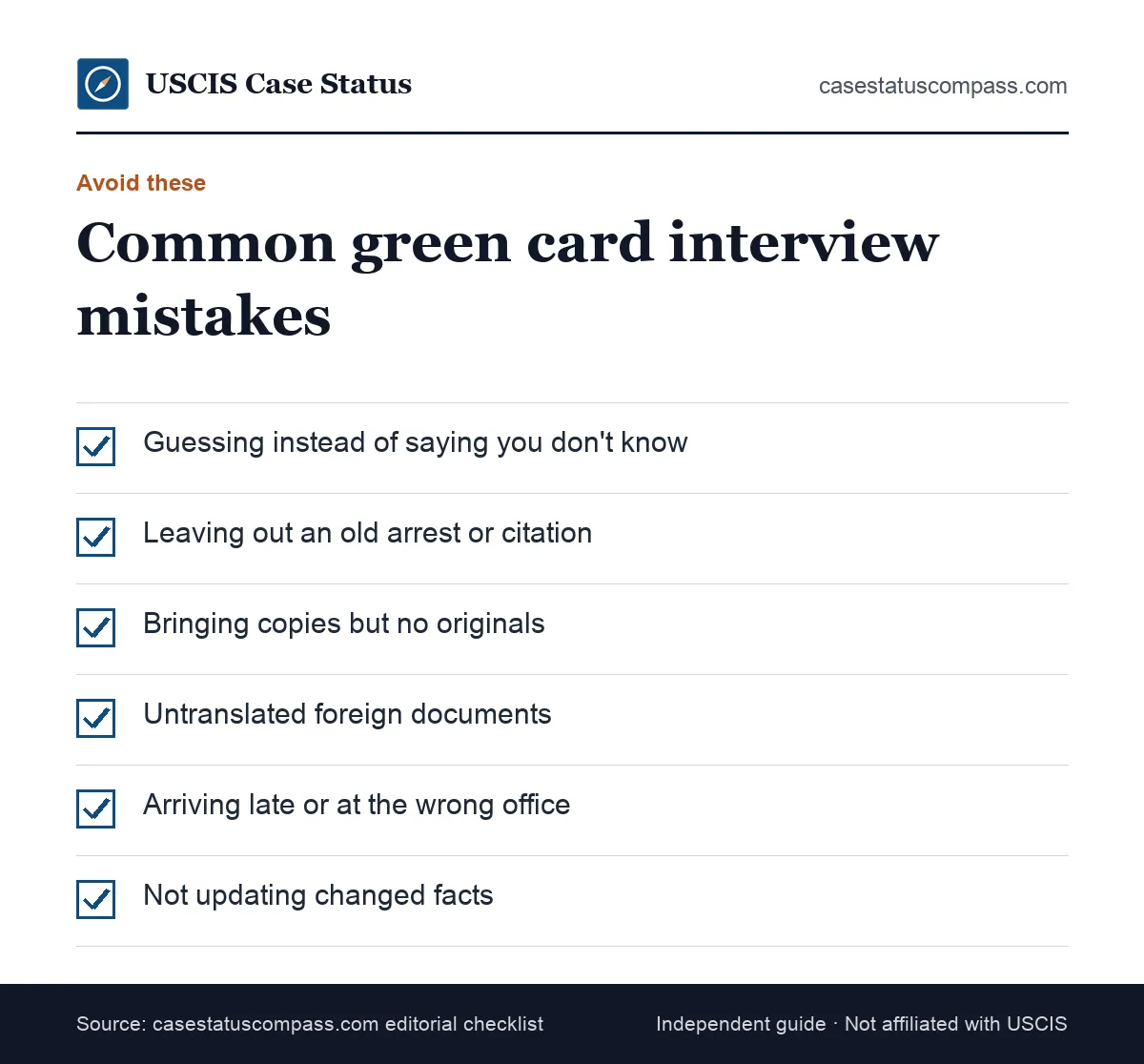
The biggest interview mistakes are guessing, hiding past problems, bringing copies without originals and arriving late.
Others include arguing with the officer, coaching a spouse during a separate interview, and failing to mention a change since filing, such as a new job, a move or an arrest. Most are avoidable with a calm review of your file.
Mistakes in what you say
- Memorizing "perfect" answers instead of recalling true facts
- Answering for your spouse or interrupting them
- Long stories when a short answer will do
- Denying an arrest because charges were dropped
Mistakes in what you bring and do
Forgetting original birth, marriage or divorce records
Foreign documents without certified translations
No proof of changes since filing, such as a new job
Arriving without the interview notice or photo ID
Leaving the U.S. before a decision
Leaving the country while the case is pending is the costliest mistake. Traveling while your I-485 is pending abandons it unless you have advance parole (with H/L/V/K exceptions). See travel with a pending I-485.
Green Card Interview Timeline From Notice to Card
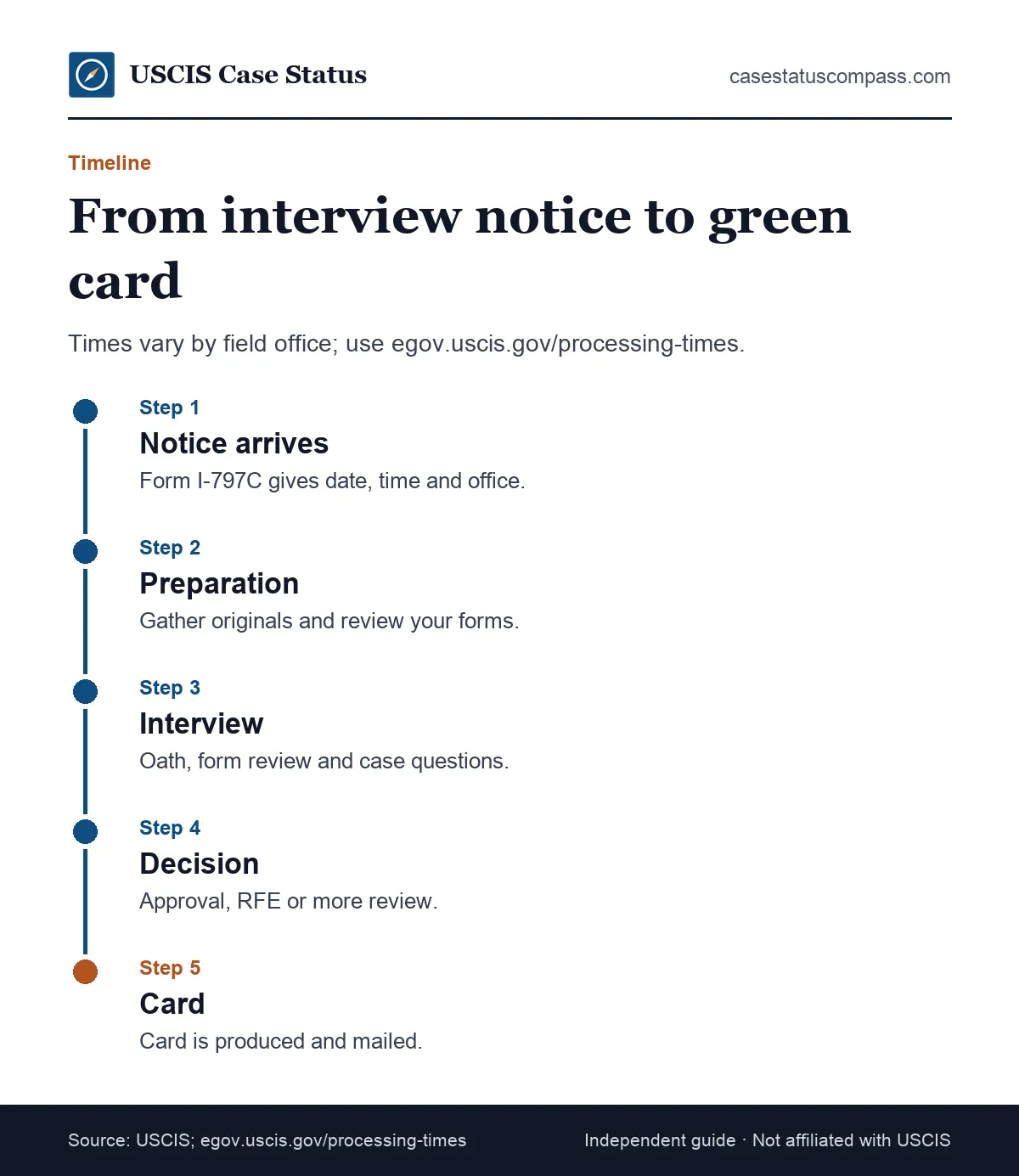
The green card interview timeline runs from the I-797C interview notice to the card in your mailbox. The table shows the order and your tasks, not official durations, which vary by field office.
Check each stage off as it happens.
Stage-by-stage table
Follow the stages in order; each one depends on the stage before it finishing, so nothing can be skipped.
| Stage | What happens | What you do |
|---|---|---|
| Biometrics done | Fingerprints and photo taken | Wait for the notice |
| Interview notice | I-797C names date and office | Gather originals |
| Interview day | Oath, review, questions | Answer truthfully |
| Decision | Approval, RFE or more review | Watch status and mail |
| Card mailed | Card produced and sent | Check details on arrival |
What comes before the interview
First comes your biometrics appointment at an Application Support Center. The gap between the two varies widely; our guide on how long after biometrics for an interview covers it.
Keep your I-797C notices together.
If X, Do Y: Interview Decision Table
Use these tables when something changes around your USCIS green card interview. For arrests, second interviews or denials, talk to an immigration attorney.
Start with the table that matches where you are now, and act early: most problems are easier to fix before the interview date than after it.
Before the interview
These common situations come up between the interview notice and the interview day itself, when you still have time to act.
| If… | Then… |
|---|---|
| You moved after filing | Update your address and confirm the office |
| You changed jobs | Bring a new job letter and pay stubs |
| You were ever arrested | Get court records and legal advice |
| You cannot attend | Ask to reschedule before the date |
After the interview
These situations come up once the interview is over but before a final written decision arrives.
| If… | Then… |
|---|---|
| You got a document list | Send everything before the deadline |
| Status unchanged for weeks | Check your case inquiry date |
| A second interview is set | See an attorney first |
| A denial notice arrived | Read the reasons; get legal help |
Green Card Interview vs Citizenship Interview: What Changes?
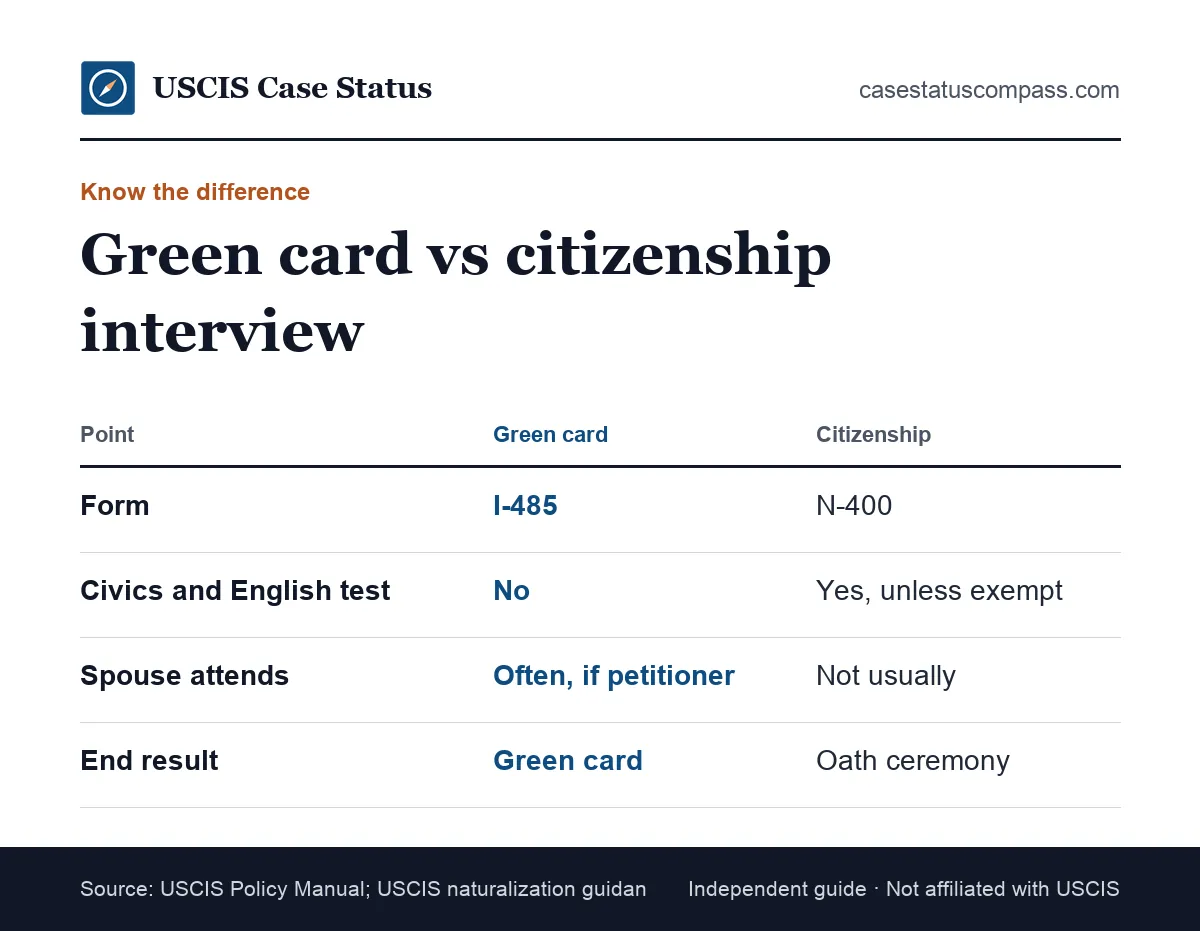
The green card interview reviews Form I-485 for permanent residence; the citizenship interview reviews Form N-400 for naturalization. Only the citizenship interview has English and civics tests, and only it leads to an oath ceremony.
The forms, fees and officers' goals are separate.
Different forms, different tests
The citizenship interview for Form N-400 checks residence, moral character and English, and includes the U.S. citizenship test on civics. None of that is part of the I-485 interview.
The I-485 meeting checks eligibility only.
Where each path ends
An approved green card interview ends with a card in the mail. An approved citizenship interview ends at the naturalization oath ceremony. For all USCIS appointments, see our USCIS interviews and biometrics hub.
When Should You Get Legal Help Before the Interview?
Get help from an immigration attorney or DOJ-accredited representative if you have any arrest, a past immigration violation, a prior removal order, a recent prior marriage or doubts about eligibility.
Do this well before the interview date, and bring the lawyer's advice and any court papers to your preparation sessions.
Red flags that call for advice
- Any "yes" in the I-485 "Have you ever" section
- A separate or second interview notice
- A past visa refusal or deportation
- Time out of status or unauthorized work
- A divorce or separation since filing
Finding legitimate help
Use a licensed attorney or a DOJ-accredited representative. Avoid "notarios" and anyone who promises approval or offers to coach false answers. Our guide to USCIS scams and fake helpers lists the warning signs.
Frequently Asked Questions
Can I bring my children to the green card interview?
Yes. Children who are derivative applicants usually must attend, and the notice names everyone required. If your children are not part of the case and you have no childcare, you can usually bring them, but pack quiet activities.
Do I need a lawyer for the green card interview?
No law requires a lawyer at a green card interview, and many applicants with simple, well-documented cases attend alone. A lawyer or DOJ-accredited representative is worth it if you have any arrest, a past immigration violation, a recently ended prior marriage, or a second interview notice.
Can the officer approve my green card on the spot?
Sometimes. If the file is complete, background checks are clear and a visa number is available, the officer can approve the case at the interview or within days. The written approval and the card still arrive by mail.
What if I forget a document at the interview?
Tell the officer right away. Often the officer gives you a written request to send the missing document by a deadline, which delays the decision but does not end the case.
What happens if I arrive late to my interview?
Arriving late can cause the office to treat you as a no-show, especially on a full schedule. If an emergency makes you late, call the USCIS Contact Center and still go to the office to explain at the front desk.
What if my spouse and I give slightly different answers?
Small differences are normal, and officers know memories differ. Problems arise when answers differ on core facts, such as where you live or when you met, or clash with your documents. Answer honestly, say "I don't know" when needed, and never coordinate made-up details.
Does an interview notice mean something is wrong with my case?
No. Interviews are routine: Green card interviews are required unless waived; the family petitioner usually attends too. The notice simply means an officer is ready to review your file in person. Prepare well, but do not read it as a warning sign.
Do spouses get interviewed together?
Usually yes. In a marriage case, both spouses sit with the officer at the same time. A separate interview happens only if the officer still has doubts after the joint one, as explained above.
Is it okay to reschedule an interview because of work?
It is allowed, but a work conflict is a weaker reason than illness or a family emergency, and the new date may be months away. If you truly cannot attend, ask USCIS for a new date before the interview.
Sources
- USCIS Policy Manual, Vol. 7, Part A, Ch. 5: Interview Guidelines. www.uscis.gov/policy-manual/volume-7-part-a-chapter-5. Accessed Oct 27, 2026.
- USCIS: Form I-485 Instructions (Edition 09/18/26). www.uscis.gov/sites/default/files/document/forms/i-485instr.pdf. Accessed Oct 27, 2026.
- USCIS: Form I-797 Types and Functions. www.uscis.gov/forms/filing-guidance/form-i-797-types-and-functions. Accessed Oct 27, 2026.
- USCIS Contact Center. www.uscis.gov/contactcenter. Accessed Oct 27, 2026.
- USCIS: Form I-693. www.uscis.gov/i-693. Accessed Oct 27, 2026.
- USCIS: Form I-129F. www.uscis.gov/i-129f. Accessed Oct 27, 2026.
- USCIS: How to Change Your Address. www.uscis.gov/addresschange. Accessed Oct 27, 2026.
- USCIS Check Case Processing Times. egov.uscis.gov/processing-times/. Accessed Oct 27, 2026.
- USCIS Data Library: All Forms, FY2026 Q3. www.uscis.gov/sites/default/files/document/data/quarterly_all_forms_fy2026_q3_v1.xlsx. Accessed Oct 27, 2026.
- Form I-864 Instructions, Edition 08/24/26. www.uscis.gov/sites/default/files/document/forms/i-864instr.pdf. Accessed Oct 27, 2026.
- USCIS: Preparing for Your Biometric Services Appointment (updated 04/30/2026). www.uscis.gov/forms/filing-guidance/preparing-for-your-biometric-services-appointment. Accessed Oct 27, 2026.
- USCIS Glossary: Green Card. www.uscis.gov/tools/glossary. Accessed Oct 27, 2026.
- 8 CFR 103.2(b)(8)(iv) (LII). www.law.cornell.edu/cfr/text/8/103.2. Accessed Oct 27, 2026.
- CIS Ombudsman tip sheet: Check Your USCIS Case Inquiry Date (Aug. 2024). dhs.gov/sites/default/files/2024-11/24_0823_cisomb_case-inquiry-date-tip-sheet.pdf. Accessed Oct 27, 2026.
- USCIS alert: Additional Mail Delivery Process for Receiving ADIT Stamp (Mar. 16, 2023; archived). www.uscis.gov/newsroom/alerts/uscis-announces-additional-mail-delivery-process-for-receiving-adit-stamp. Accessed Oct 27, 2026.
casestatuscompass.com is an independent publication and is not affiliated with USCIS or any government agency. This page is general information, not legal advice. For denials, court or asylum matters, consult an immigration attorney or a DOJ-accredited representative.