Contents · 41 sections
- How Long After Biometrics for Interview Notices Do Cases Usually Wait?
- Does USCIS Publish a Biometrics-to-Interview Time?
- What Do USCIS's April–June 2026 Medians Show?
- Are Waits After Biometrics Getting Longer Than Last Year?
- I-485 Processing Time After Biometrics
- Is an Interview Required After Green Card Biometrics?
- How Long After Biometrics Is the N-400 Interview?
- Does an I-751 Case Get an Interview After Biometrics?
- T Visa Processing Time After Biometrics
- Can T Visa Applicants Get a Work Permit Before a Decision?
- Which Forms Usually Skip the Interview After Biometrics?
- Where Does Biometrics Sit in the Whole Case Timeline?
- What Fills the Months Between Fingerprints and the Interview?
- Why Do Some Field Offices Take Longer?
- What Can Pause the Countdown to an Interview?
- Can Visa Bulletin Retrogression Hold Up Your Interview?
- Status Updates That Signal an Interview Is Coming
- How Long After "Ready to Be Scheduled" Does the Interview Come?
- How Will You Learn Your Interview Date?
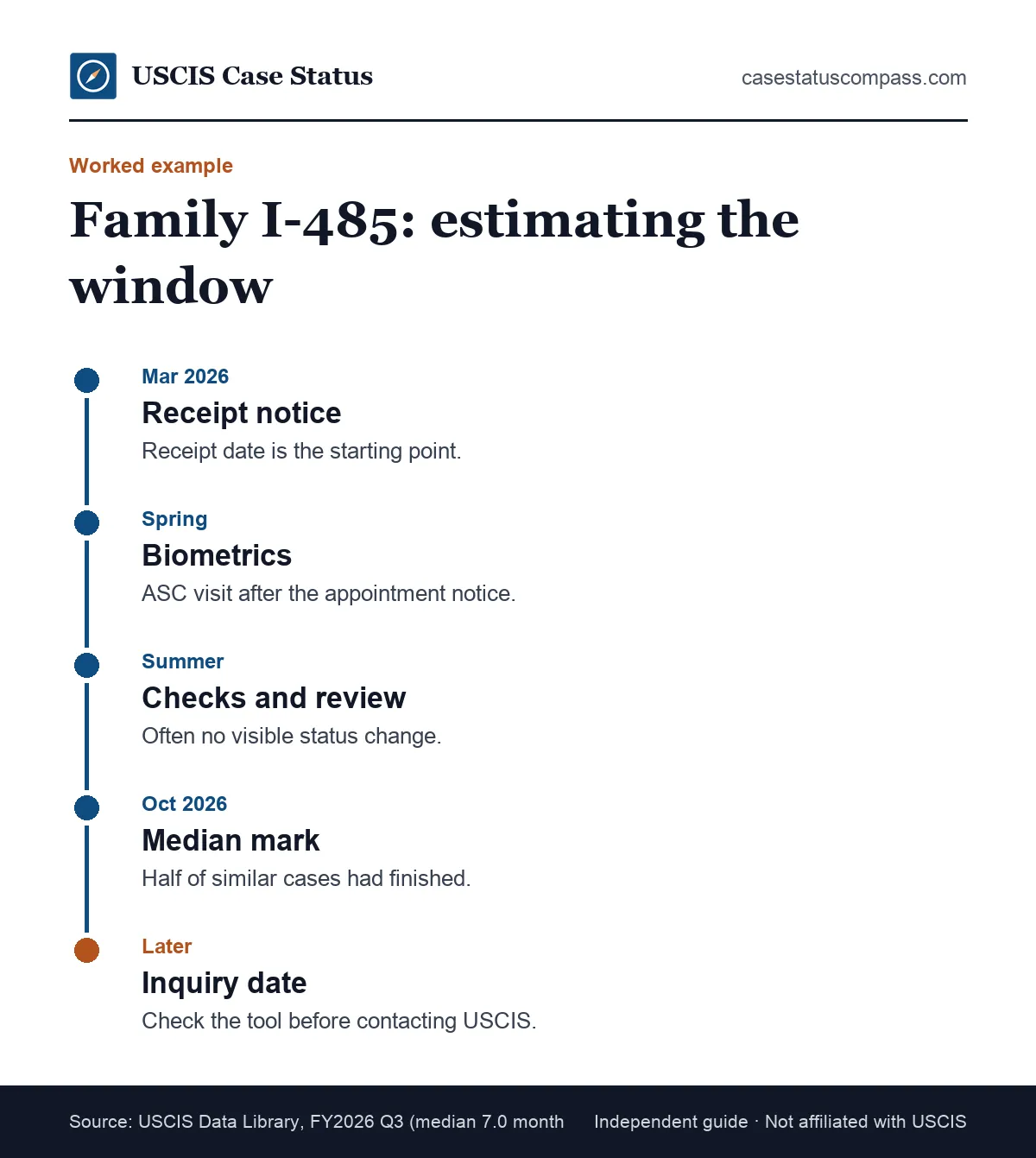
- Worked Example: Estimating a Family I-485 Interview Window
- Worked Example: An N-400 Filed in Spring 2026
- Your Personal Interview Wait Worksheet
- How Long After Biometrics for Interview Waits Become a Real Delay?
- What Should You Do If No Interview Notice Arrives?
- Can You Speed Up the Interview After Biometrics?
- When Should You Use the Ombudsman or Your Member of Congress?
- Can You Travel While Waiting for the Interview?
- What If You Move Before the Interview?
- Does Moving Change Which Office Interviews You?
- Can You Work While You Wait for the Interview?
- Will You Need Biometrics Again Before the Interview?
- How Should You Prepare During the Wait?
- Will You Need a New Medical Exam Before the Interview?
- What Mistakes Stretch the Wait After Biometrics?
- If X, Do Y: Decision Table After Biometrics
- How Do Forum Timelines Compare With Official Data?
- How Long After the Interview Does the Decision Come?
- Comparing the Waits: Receipt, Biometrics, Interview and Decision
- Printable Waiting-Period Checklist
- Key Takeaways on the Wait After Biometrics
- Frequently Asked Questions
The short answer
There is no fixed answer to how long after biometrics for interview scheduling takes. USCIS publishes whole-case times, not a biometrics-to-interview gap. For April–June 2026, the official median was 7.0 months for family green card cases and 9.5 months for citizenship, measured from receipt, so most of that wait falls after biometrics.
At a glance
| Green card (I-485) median | 7.0 months family, 6.0 months employment (April–June 2026, from receipt) | | Citizenship (N-400) median | 9.5 months (April–June 2026, from receipt) | | When to ask about a delay | After your case inquiry date in the official processing times tool | | Who runs this site | An independent guide. We are not USCIS and cannot see your case. |
How Long After Biometrics for Interview Notices Do Cases Usually Wait?
The honest answer to how long after biometrics for interview notices arrive is "it depends on the form and the field office." Our biometrics appointment guide covers the Application Support Center (ASC) visit itself. USCIS's own figures measure the whole case from the receipt date, so you estimate the interview gap from those.
Field offices book the interview
An interview is booked by your local field office, not the center that scheduled your fingerprints. Each office has its own staff, caseload and calendar. Your receipt notice does not name it; the office is set by your home address.
Background checks finish unevenly
Background checks also finish at different speeds. That is why two applicants who gave prints on the same day can be interviewed months apart. A common name or past travel can add a further name check to the queue.
What the official numbers can tell you
Official data shows how long whole cases took, from receipt to completion. Because biometrics usually happens in the first weeks, most of that time sits after the ASC visit.
Does USCIS Publish a Biometrics-to-Interview Time?
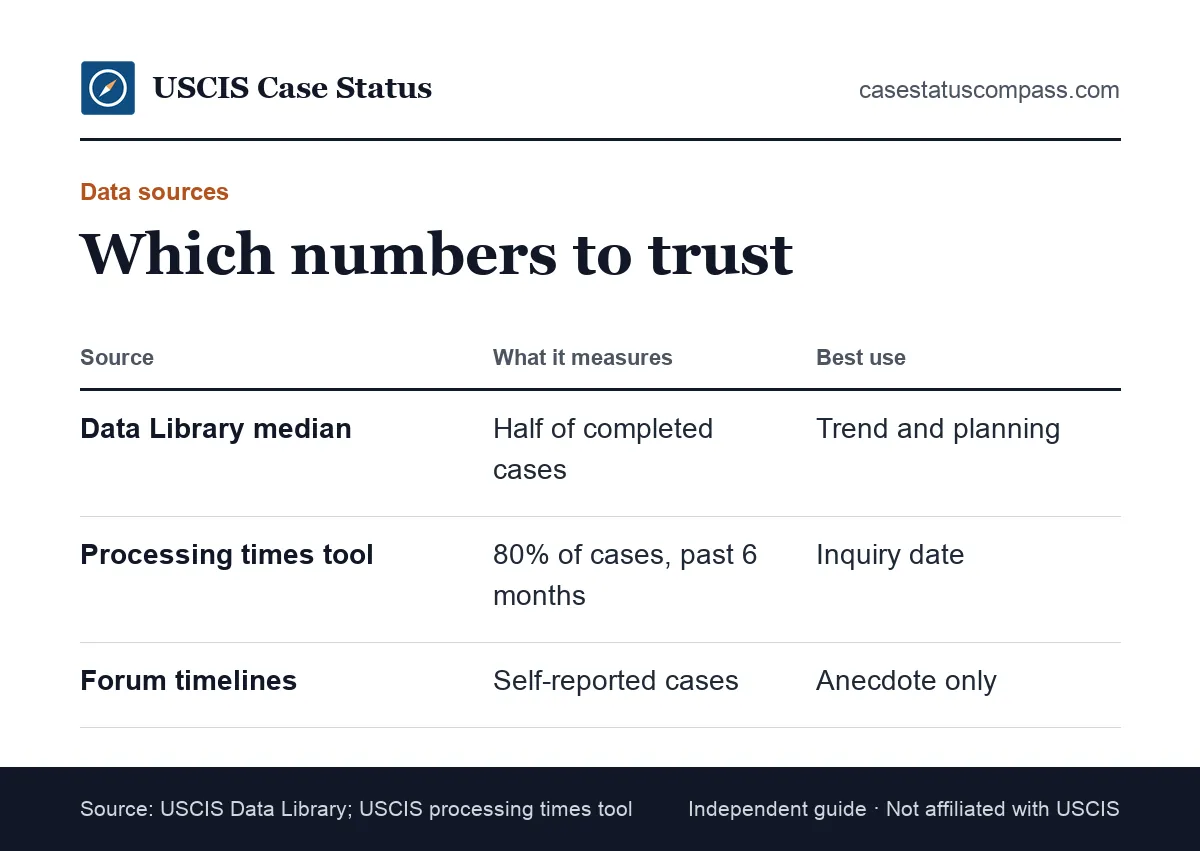
No. USCIS publishes no separate "after biometrics" or "biometrics to interview" figure for any form. It publishes two other measures: an 80% figure in the online processing times tool and quarterly medians in its data library. Both start the clock at the receipt date, not at fingerprints.
What the processing times tool measures
The USCIS tool shows how long it took to finish 80% of cases in the past 6 months. The tool lets you pick a form, a category and an office. Right now, the tool gives 8.5 to 42.5 months, depending on category and office (USCIS data retrieved Oct 27, 2026) for family and employment green card cases.
What a data library median measures
USCIS quarterly data reports the median: half of the cases completed that quarter took longer. It is published every quarter and runs a few months behind. Treat it as a trend line, not a countdown.
What Do USCIS's April–June 2026 Medians Show?
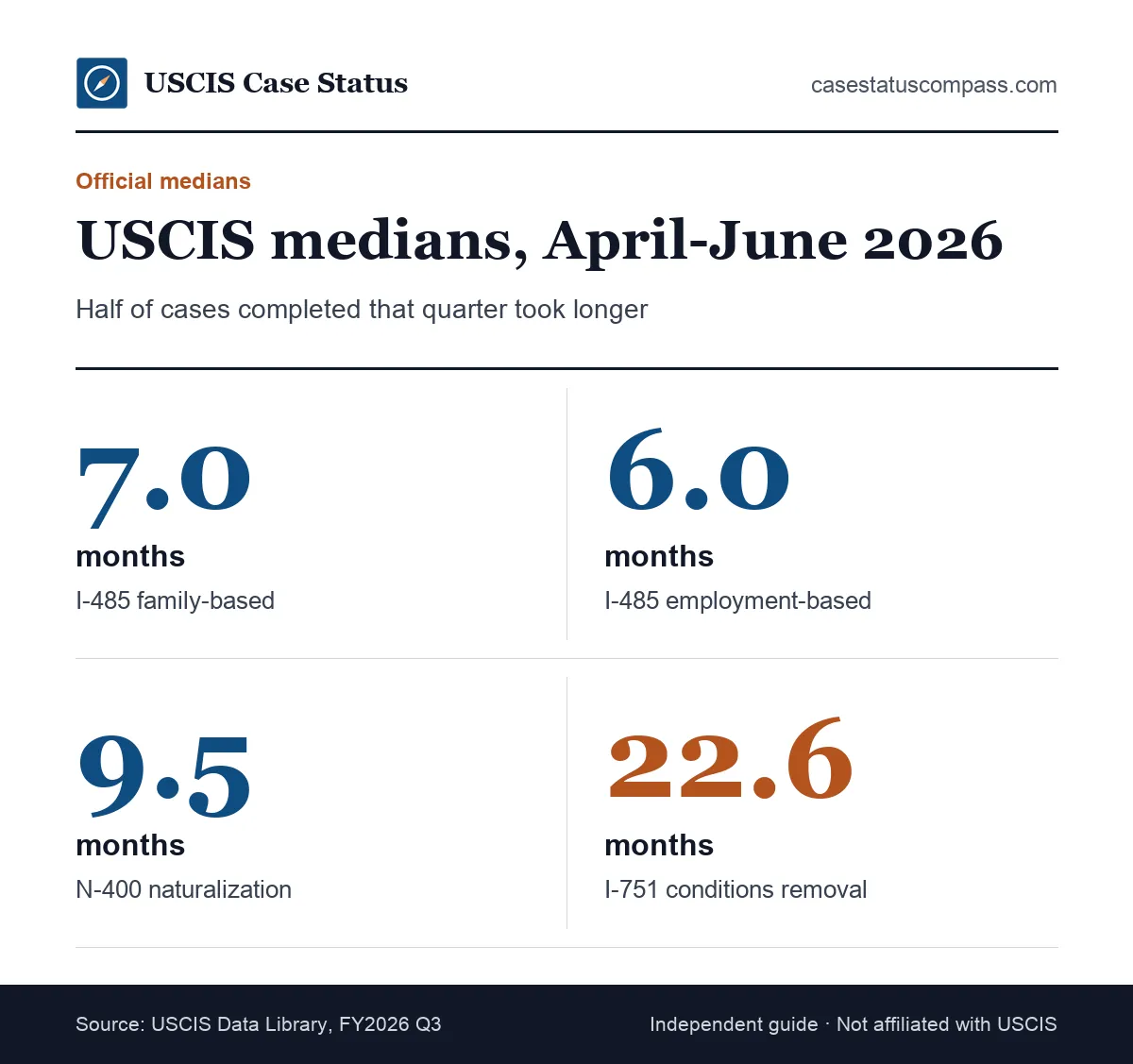
USCIS's data library gives whole-case medians for April–June 2026. Family-based green card cases had a median of 7.0 months, employment-based cases 6.0 months, citizenship 9.5 months and conditional residence removal 22.6 months, each counted from receipt. None of them answers how long after biometrics for interview scheduling takes, because no published figure isolates that stage.
Green card (I-485) medians
I-485 (family): median 7.0 months (USCIS data, Apr.-June 2026). I-485 (employment): median 6.0 months (USCIS data, Apr.-June 2026). Both run from the receipt date, so the part left after the ASC visit is a few weeks shorter.
Citizenship and conditional residence medians
These whole-case medians run from receipt to completion, so the interview falls somewhere inside each figure, not after it.
| Form | What it is | Median, April–June 2026 | Usually interviewed? |
|---|---|---|---|
| N-400 | Naturalization | 9.5 months | Yes, with English and civics tests |
| I-751 | Removing conditions on residence | 22.6 months | Sometimes |
| I-130 (immediate relative) | Family petition | 13.0 months | Usually not at this stage |
| I-485 (family) | Green card application | 7.0 months | Yes, unless waived |
Are Waits After Biometrics Getting Longer Than Last Year?
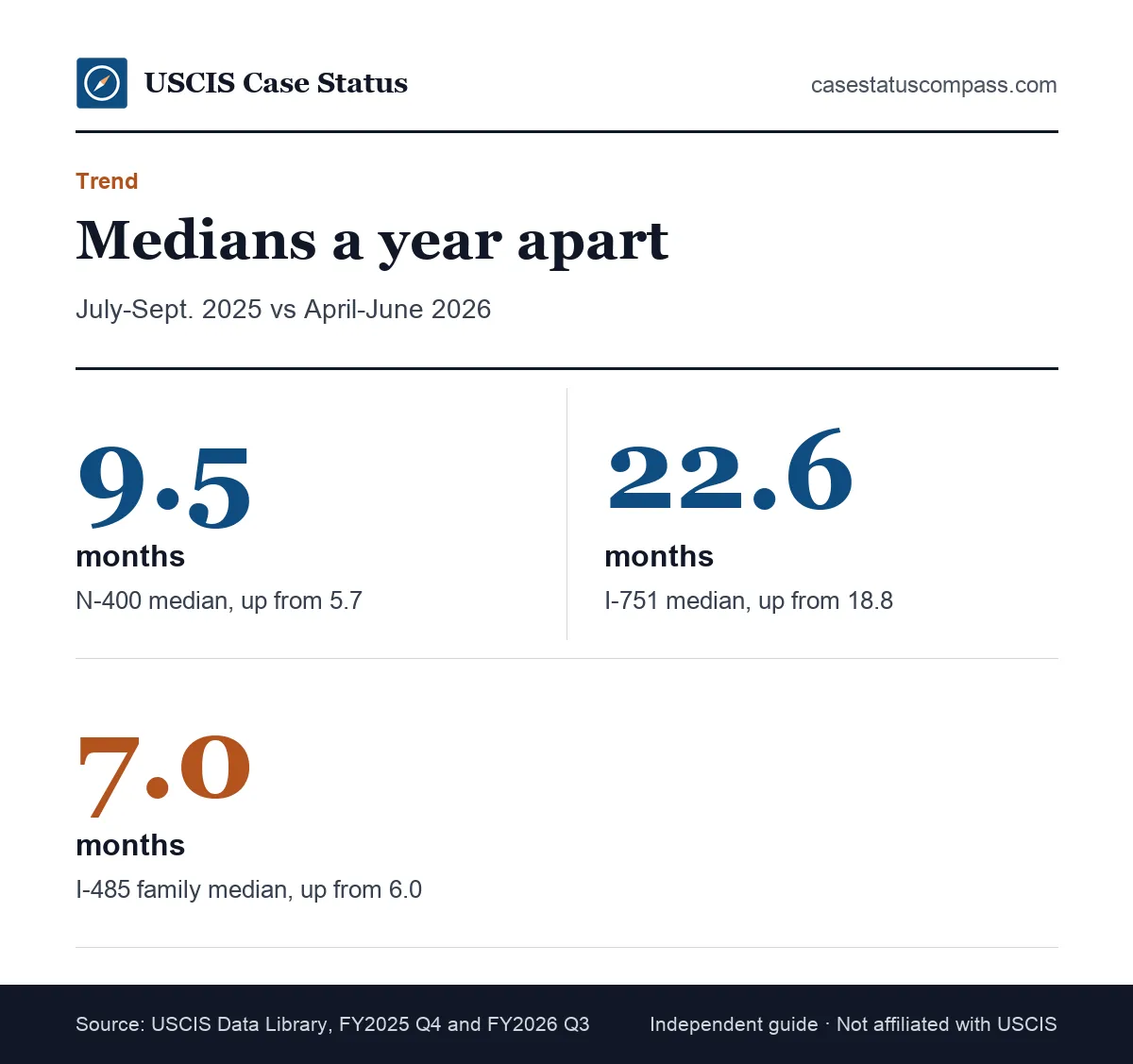
Yes, for several forms. Comparing USCIS's July–September 2025 medians with April–June 2026, the citizenship median rose from 5.7 to 9.5 months and the I-751 median from 18.8 to 22.6 months. The family I-485 median rose from 6.0 to 7.0 months.
The year-over-year comparison
A year earlier (July-Sept. 2025): N-400 5.7 mo; I-751 18.8 mo; I-130 IR 13.7 mo; I-485 family 6.0 mo. That growth mostly shows up as a longer quiet stretch after biometrics, while files wait for review and interview slots.
Plan around the newest median
If your case was filed recently, plan around the newer figure, not older forum posts. A rising median also moves your case inquiry date later. Recheck both each quarter, when USCIS posts new data.
Why the backlog is likely to persist
12.8 million cases pending at USCIS (end of June 2026), so heavy queues are likely to persist. Expect the stretch after biometrics to stay long. A large backlog means patience, not a problem with your file.
I-485 Processing Time After Biometrics
For Form I-485, the time after biometrics is most of the case. USCIS's April–June 2026 median was 7.0 months for family cases and 6.0 months for employment cases from receipt. Fingerprints usually come early, so the interview or decision tends to land in the later part of that window.
Family-based adjustment cases
Spouses, parents and children of U.S. citizens usually go through an interview at a field office after biometrics. The officer often meets both the applicant and the petitioner. Our Form I-485 guide explains the whole filing.
Employment-based adjustment cases
Employment cases had the shortest I-485 median in the quarter. Many are decided without an interview, so "after biometrics" often means a wait for approval rather than an appointment.
Asylum-based adjustment cases
The adjustment of status category matters most here: I-485 (asylum-based): median 25.6 months (USCIS data, Apr.-June 2026), so humanitarian applicants face a much longer gap after biometrics. Our asylum status page covers the earlier asylum stages.
Is an Interview Required After Green Card Biometrics?
Usually yes. Green card interviews are required unless waived; the family petitioner usually attends too. USCIS can waive the green card interview case by case. Most family-based applicants then wait for a notice; some employment cases get a decision with no appointment.
When the interview is waived
A waiver is a case-by-case choice by USCIS. If yours is waived, the next update may be an approval or a card production message. Our page on the green card interview questions explains when waivers tend to happen.
Who else must attend
Derivative family members also appear, and in family cases the petitioner usually comes too. If someone cannot attend, follow the rescheduling steps on the notice. Children named on the notice must come too.
How Long After Biometrics Is the N-400 Interview?
There is no official biometrics-to-interview figure for Form N-400. USCIS's April–June 2026 median for the whole naturalization case was 9.5 months from receipt. Biometrics comes early, the interview comes near the end, and the oath may follow the same day or later.
What the N-400 interview includes
The citizenship interview combines a review of your application with the English and civics tests. 2025 civics test: 20 questions from 128; pass with 12 correct. English test: read 1 of 3 sentences and write 1 of 3 sentences correctly. Our citizenship interview guide explains the day itself.
Using the N-400 median to plan
Because the interview sits close to the decision, the median completion mark is a fair outer guide for when you might be interviewed. Right now, most N-400 cases take 10 to 15 months, depending on category and office (USCIS data retrieved Oct 27, 2026). The naturalization processing time page breaks down each stage.
Does an I-751 Case Get an Interview After Biometrics?
Sometimes. After biometrics, a Form I-751 can be approved from the file, receive a request for evidence or be sent to a field office for an interview. USCIS's April–June 2026 median for the whole I-751 case was 22.6 months from receipt.
When USCIS decides from the file
Strong joint evidence of the marriage can lead to approval with no interview. I-751 receipt notice extends conditional status and work authorization for 48 months, which covers you during the long review.
If you are called in
An I-751 interview usually focuses on the marriage since you became a conditional resident. If you also filed for citizenship, USCIS must decide a pending I-751 before or at the same time as the N-400. Our Form I-751 guide covers evidence and waivers.
T Visa Processing Time After Biometrics
We could not find an official USCIS figure for T visa (Form I-914) processing after biometrics. For T visa applicants, the key milestone after biometrics is usually the bona fide determination, not an interview. That decision can bring a work permit and deferred action while the full case waits.
Where to check an official T visa time
Open the official processing times tool, choose Form I-914 and the office on your receipt. A DOJ-accredited representative or attorney can explain your case's stage. Many nonprofits help T visa applicants at low or no cost.
Can T Visa Applicants Get a Work Permit Before a Decision?
Yes. USCIS's T visa page says it uses a modified bona fide determination process for applications filed on or after Aug. 28, 2024. To receive it, principal applicants file Form I-765 under category (c)(40). USCIS strongly encourages filing the I-914 and I-765 together, because a later I-765 takes longer.
Which Forms Usually Skip the Interview After Biometrics?
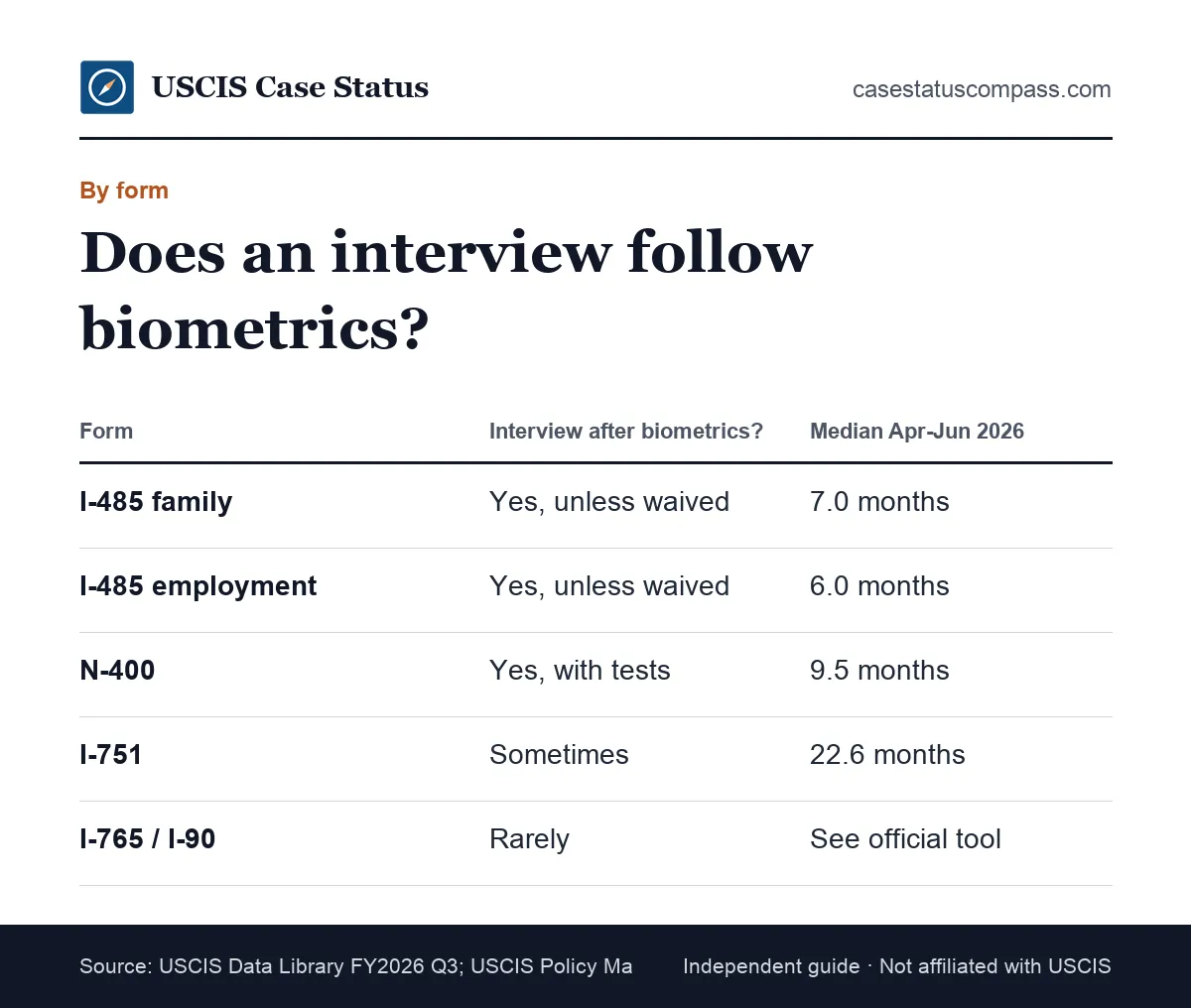
Work permits (Form I-765) and green card replacements (Form I-90) rarely lead to an interview. For these forms, biometrics mainly feed card production and checks, so the next step is usually approval, not an appointment. A card in the mail is the usual signal.
Work permit (I-765)
After biometrics, an EAD (Employment Authorization Document) application moves to review and card production. I-765 (based on pending I-485): median 6.4 months (USCIS data, Apr.-June 2026). I-765 (all other categories): median 3.3 months (USCIS data, Apr.-June 2026). The work permit processing time page covers each category.
Green card replacement (I-90)
I-90: median 5.5 months (USCIS data, Apr.-June 2026). An I-90 interview is unusual and usually means the officer needs to confirm identity or a record problem. If a notice arrives, treat it seriously and attend.
Where Does Biometrics Sit in the Whole Case Timeline?
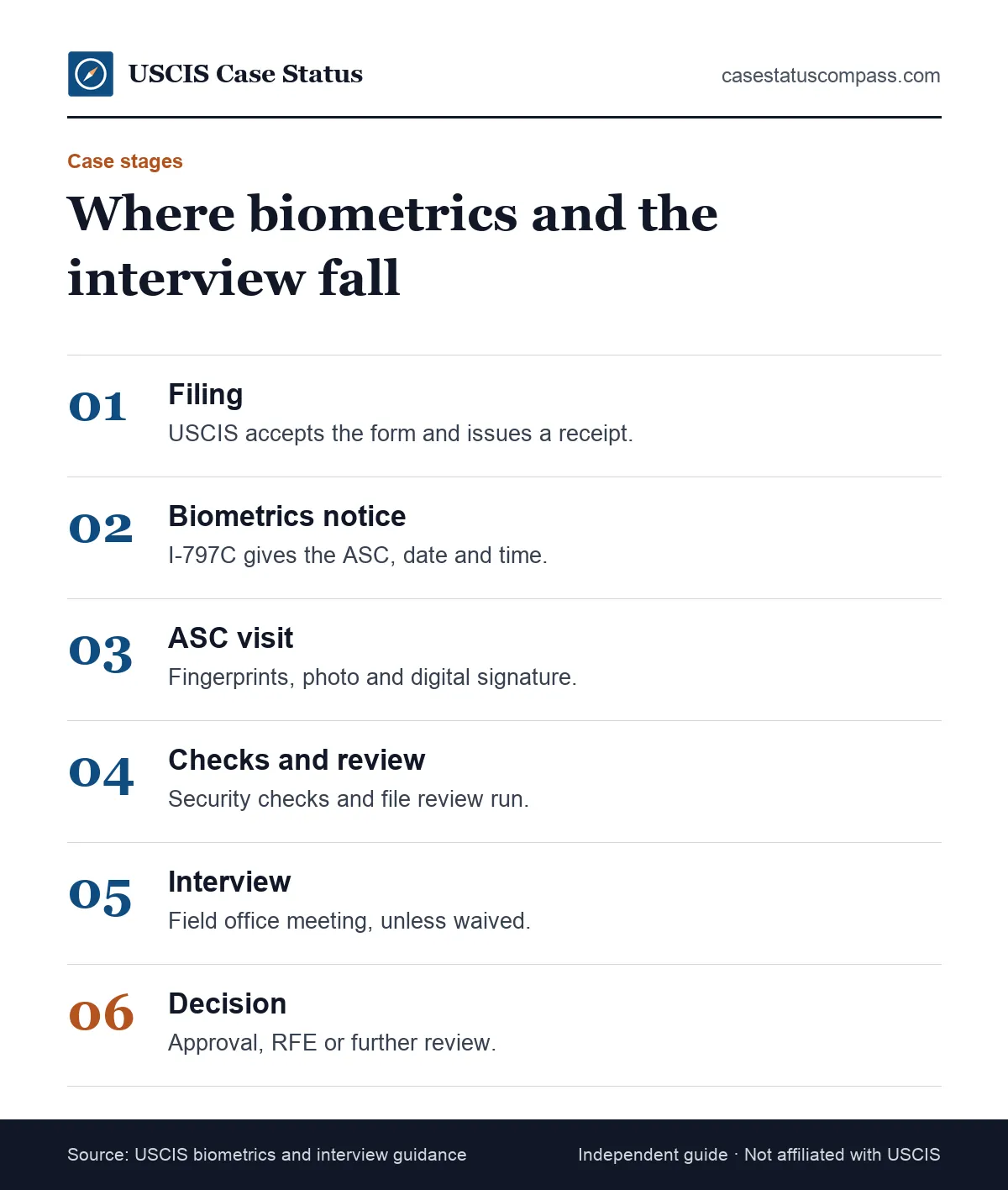
Biometrics is an early step, not the halfway point. It normally follows the receipt notice within weeks and precedes background checks, file review and any interview. For most green card and citizenship cases, more of the total wait lies after the fingerprint visit than before it, so the question of how long after biometrics for an interview usually has a longer answer than people expect.
Stage order for interview cases
- Receipt notice (Form I-797C) confirms filing.
- Biometrics appointment at an Application Support Center (ASC).
- Security checks and file review.
- Interview at a field office.
- Decision, request for evidence or further review.
Why biometrics feels like halfway
In reality, the background check results and officer review take longer. A short receipt-to-biometrics stretch tells you little about how long after biometrics for interview scheduling will take. Fast early steps simply mean the intake queue was moving.
What Fills the Months Between Fingerprints and the Interview?
Three things fill the gap: background and security checks, a review of your file, and assignment to a field office calendar. None usually produces a status update, so months can pass with no visible change. A lack of updates becomes worth raising with USCIS only once your receipt date is earlier than the case inquiry date in the tool.
Background and security checks
Your fingerprints go to the FBI and other agencies for criminal and security checks. Most results return quickly, but some name checks take longer. You are not told when they finish.
File review at your field office
After checks, your file goes to the field office that serves your address. An officer or staff member reviews the forms and evidence. Some cases are approved here without any interview at all.
An RFE before any interview is booked
If something is missing, USCIS may send a request for evidence before booking any interview. Review stops until your answer arrives. RFE deadline: up to 12 weeks (the exact date is on your RFE); no extensions.
Why Do Some Field Offices Take Longer?
Field office speed depends on staffing, local filing volume and the mix of interview types. Busy metro offices with many family and naturalization cases often have longer queues, and your address decides your office. You cannot choose a faster one.
Office workload and staffing
Offices that handle many naturalization interviews and green card interviews share the same officers. When one queue grows, the other can slow. Staff changes and local hiring also move the numbers from month to month.
Comparing offices in the official tool
The official tool lets you compare offices. Each office shows its own figure, so a friend's faster office says nothing about yours. Pick your form, category and office exactly as printed on your notice.
What Can Pause the Countdown to an Interview?
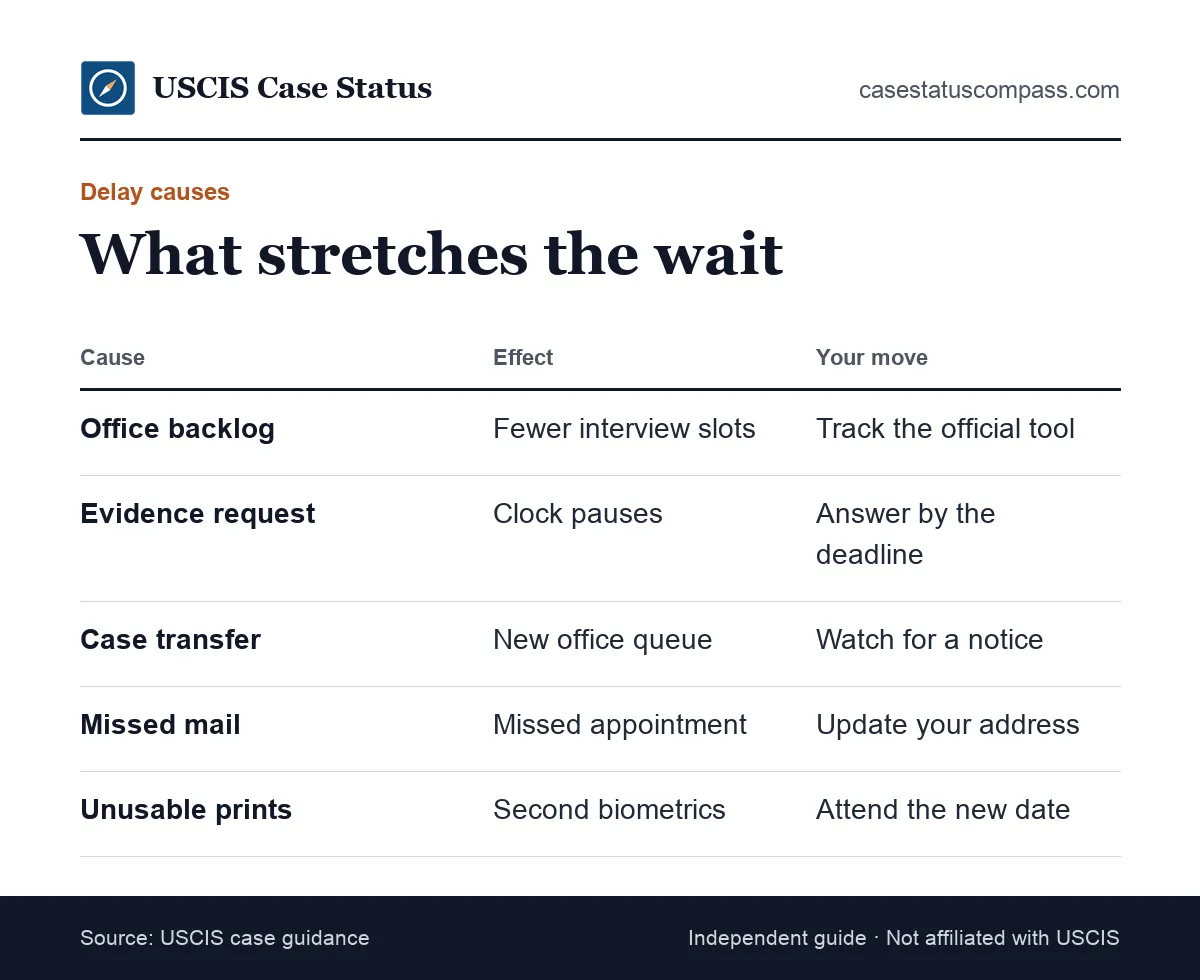
Several events can pause or reset progress after biometrics: a request for evidence, a transfer to another office, a move, a missed notice or a visa number that is not yet available. Some of these you control, such as a move or an RFE answer.
A request for evidence
An RFE (Request for Evidence) stops review until you answer. Answer completely and early; the file returns to the queue only after USCIS receives your response. Send it with tracking so you can prove when it arrived.
RFE response deadlines
RFE deadline: up to 12 weeks (the exact date is on your RFE); no extensions; however, RFEs for Form I-539 and Form I-601A allow at most 30 days (all other forms up to 84 days), plus 3 days if mailed. The exact date printed on your RFE is the one that counts.
A transfer to another office
USCIS sometimes moves files to balance workloads. Your status may show that the case was transferred. A transfer can help or hurt the timeline, depending on the new office's queue.
Can Visa Bulletin Retrogression Hold Up Your Interview?
It can hold up the decision more than the interview. Employment and many family preference cases need an available visa number before approval. The State Department publishes the Visa Bulletin monthly: Final Action Dates vs Dates for Filing. If your category retrogresses, an interview may still happen, but the decision can wait. See the Visa Bulletin guide for how dates move.
Status Updates That Signal an Interview Is Coming
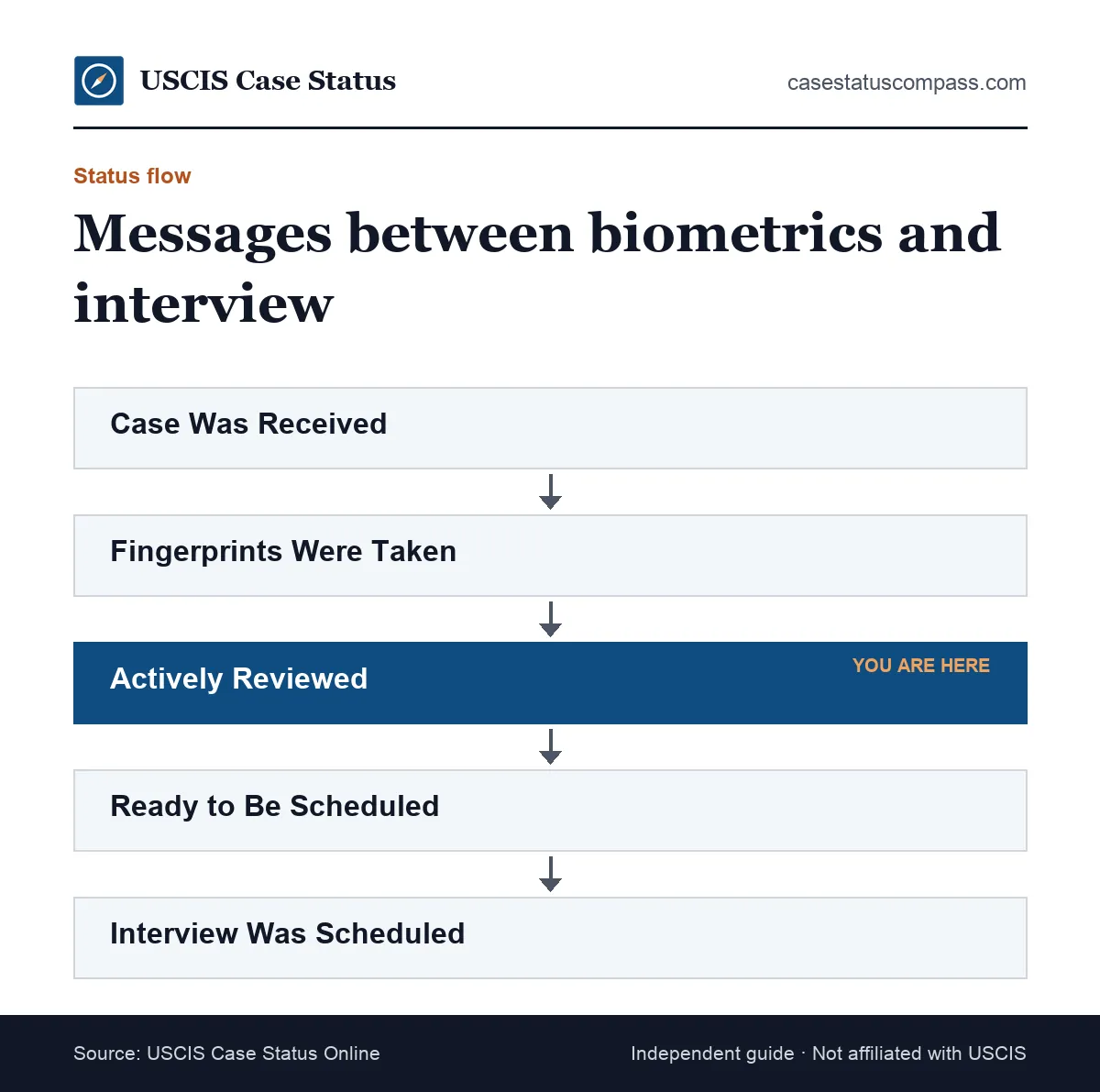
The clearest signs are two status messages: "Case Is Ready to Be Scheduled for an Interview" and "Interview Was Scheduled." Many cases show nothing at all until the appointment notice arrives, so silence is not a bad sign. Check your account weekly.
"Interview Was Scheduled"
This message means a date is set and a notice was sent. Our page on the interview was scheduled status explains what to check on the notice. Confirm the date, time and office the same day.
How Long After "Ready to Be Scheduled" Does the Interview Come?
There is no published figure. The "Ready to Be Scheduled for an Interview" update means the file passed earlier review and is waiting for a slot. It is a good sign, but it does not give a date. The wait after this message can still be weeks or months, depending on the office calendar.
When "actively reviewed" shows up first
Some files show the message that your case is being actively reviewed first; others jump straight to a notice. If nothing has changed for a long time, see our page on a case status not updating.
How Will You Learn Your Interview Date?
USCIS mails an appointment notice on Form I-797C to the address on file, and it usually appears in your online account as well. The notice lists the date, time, office and who must attend. It may arrive only a few weeks before the date, so open USCIS mail promptly.
The paper I-797C notice
I-797C = Notice of Action (receipt, rejection, transfer, appointment, re-open); not proof of status by itself. The interview version lists the field office address, the people who must attend and what to bring.
Which document list to follow
We could not find one official uscis.gov list of interview documents. The list printed on your own notice is the one to follow, so bring every item it names, plus originals.
Your online account and status tools
Free USCIS online account: case status updates, notices, link paper-filed cases. You can also check Case Status Online: egov.uscis.gov. If your account shows a notice you never received by mail, download it and confirm your mailing address.
Worked Example: Estimating a Family I-485 Interview Window
This worked example shows how to turn the official median into a personal planning window for a fictional family-based Form I-485 filed in March 2026. Use the same steps with your own receipt date and the median for your form and category, and treat the answer as a planning range, never a promise.
The inputs
- Applicant: "Maria," a fictional spouse of a U.S. citizen.
- Receipt date: March 2, 2026, printed on her I-797C.
- Biometrics: completed in spring 2026.
- Official median: 7.0 months from receipt (April–June 2026).
These four facts are all she needs, and each comes from her notice or USCIS data.
The calculation
Add 7.0 months to March 2, 2026. That lands near Oct. 2, 2026. In the quarter measured, half of completed family cases took longer than that. Her interview, if required, would come before the decision.
Where Maria's interview likely falls
Because the interview usually comes shortly before the decision, Maria's interview window most likely opens in the months around that October mark. She keeps checking her account and mail, and she uses the quiet weeks to gather updated joint evidence.
What the result does and does not mean
The October mark is not a deadline for USCIS. It simply tells her when she is "past halfway" compared with similar cases. Her real trigger for asking questions is the case inquiry date in the tool.
Worked Example: An N-400 Filed in Spring 2026
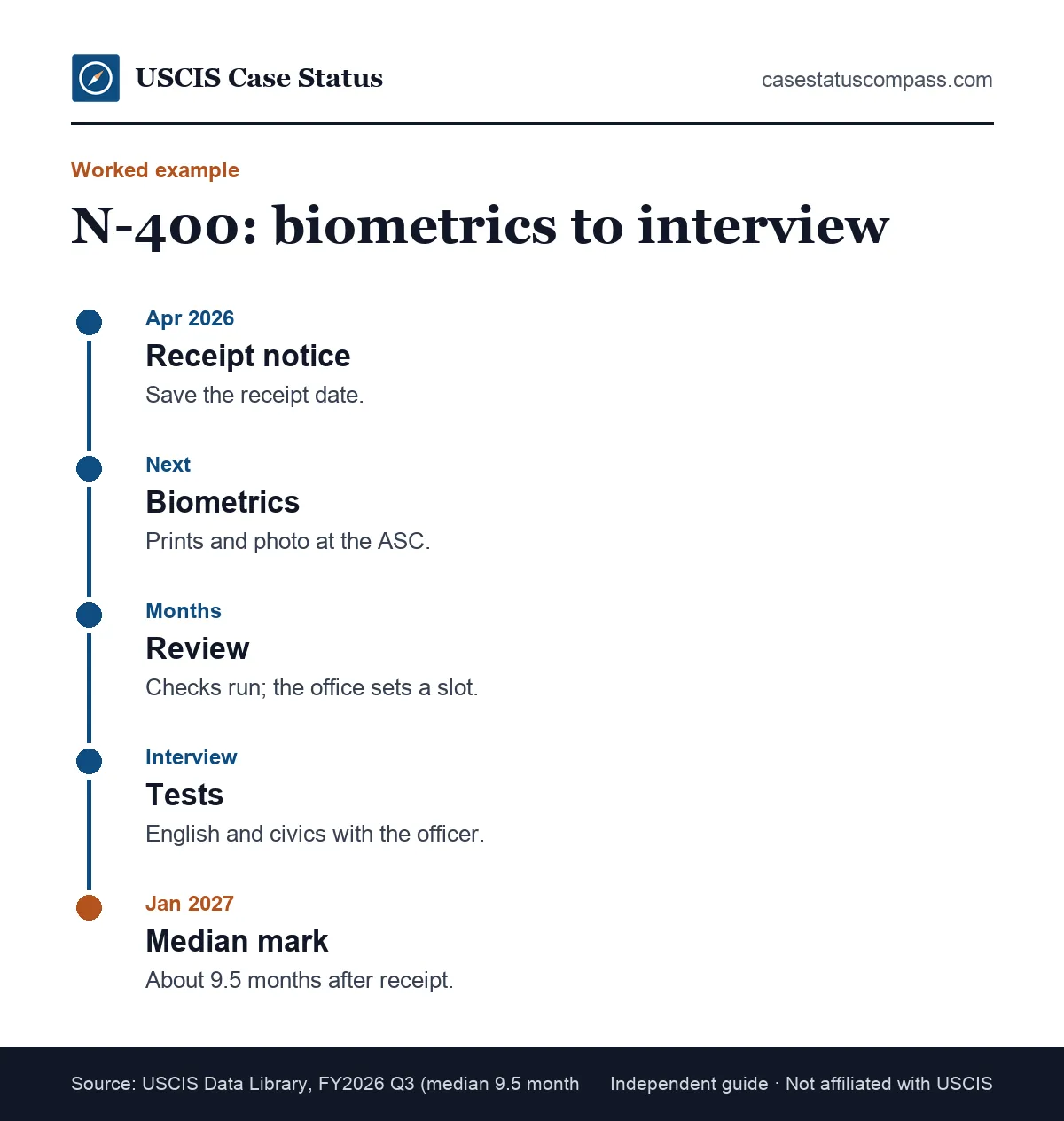
This second worked example uses a fictional naturalization applicant and USCIS's April–June 2026 N-400 median of 9.5 months. The planning mark lands around late January 2027, with the interview likely somewhat before it. The 2025 civics test applies to him.
The inputs and the math
"David," a fictional permanent resident, filed Form N-400 with an April 6, 2026 receipt date and attended biometrics soon after. Adding 9.5 months gives roughly Jan. 21, 2027. He treats that date as a planning mark, not a promise.
Start test practice early
David should start civics and English practice now, not when the notice arrives. The quiet months after biometrics are the best time to prepare. He should study the 2025 civics question list described in the interview section above.
If David's office is slower
If his office is slower, the interview may come later than January. If USCIS offers same-day oath, the decision and oath could follow right after the interview. He checks his office in the tool.
Your Personal Interview Wait Worksheet
You can build your own estimate in five lines: your form and category, your receipt date, the official median, the planning mark, and your case inquiry date. The first two never change; the last three can move each month or quarter, so keep the sheet and update it.
Fill-in worksheet
Fill one row at a time, starting from your own receipt notice, and keep it with your case papers.
| Line | What to enter | Where to find it |
|---|---|---|
| 1. Form and category | e.g., I-485 family-based | Your receipt notice |
| 2. Receipt date | Date printed on the I-797C | Receipt notice, top section |
| 3. Official median | Matching median, with its quarter | USCIS data library (shown above) |
| 4. Planning mark | Line 2 plus line 3 | Your own calculation |
| 5. Case inquiry date | Date from the tool for your office | Official processing times tool |
How to update it each month
Recheck line 5 each month, because the inquiry date moves as the tool updates. When USCIS publishes a new quarterly median, replace line 3 and recalculate line 4. Note the date of each update.
How Long After Biometrics for Interview Waits Become a Real Delay?
A wait becomes a delay you can act on when your case passes the case inquiry date shown in the official processing times tool. Before that date, USCIS treats your case as within normal processing time. After it, you can submit an inquiry and, later, escalate.
The case inquiry date
Case inquiry date: the earliest date USCIS will accept a question about your pending case; it can change. Find it in the official processing times tool by entering your form, category, office and receipt date. If your receipt date is earlier than the inquiry date shown, you can ask about your case.
The outside normal processing time request
You can submit an 'outside normal processing time' request only after your case inquiry date. You submit it online or by calling 800-375-5283. Keep the reference number. Our green card processing time page shows how to read your green card category in the tool.
What Should You Do If No Interview Notice Arrives?
If the status says an interview was scheduled but no notice came, check your online account first, then confirm your address, then contact USCIS. If nothing has changed but your case is still before the inquiry date, waiting is the correct step.
Check the account and your mail
Download any notice shown in your account. Ask your household and mail carrier about misdelivered mail. If you have an attorney, ask whether the notice went to their office instead.
Report a missing notice
e-Request: report USCIS typos, missing notices or accommodation needs online. You can also call 800-375-5283 during Live calls and chat: Monday to Friday, 8 a.m. to 8 p.m. Eastern. Our USCIS contact guide lists which channel fits each problem.
Can You Speed Up the Interview After Biometrics?
Sometimes. An expedite request can move a case forward, but only if you meet a USCIS criterion and can prove it. Expedite criteria: severe financial loss, emergency/humanitarian, nonprofit, government interest, clear USCIS error. A wish to travel or start a job sooner is usually not enough. Make one request, after the receipt notice arrives.
Expedite criteria
Expedite criteria: severe financial loss, emergency/humanitarian, nonprofit, government interest, clear USCIS error. Meeting a criterion does not guarantee approval of the request. You need documents that prove the urgency, such as a medical letter or a job offer deadline.
How to ask for an expedite
Ask for an expedite through the USCIS Contact Center or your online account. Our USCIS expedite request guide explains the evidence that works and how to follow up. Keep the reference number.
Why premium processing will not help
Premium processing does not cover green card or citizenship applications, so no extra fee can buy an earlier I-485 or N-400 interview. Anyone selling a faster slot is running a scam.
When Should You Use the Ombudsman or Your Member of Congress?
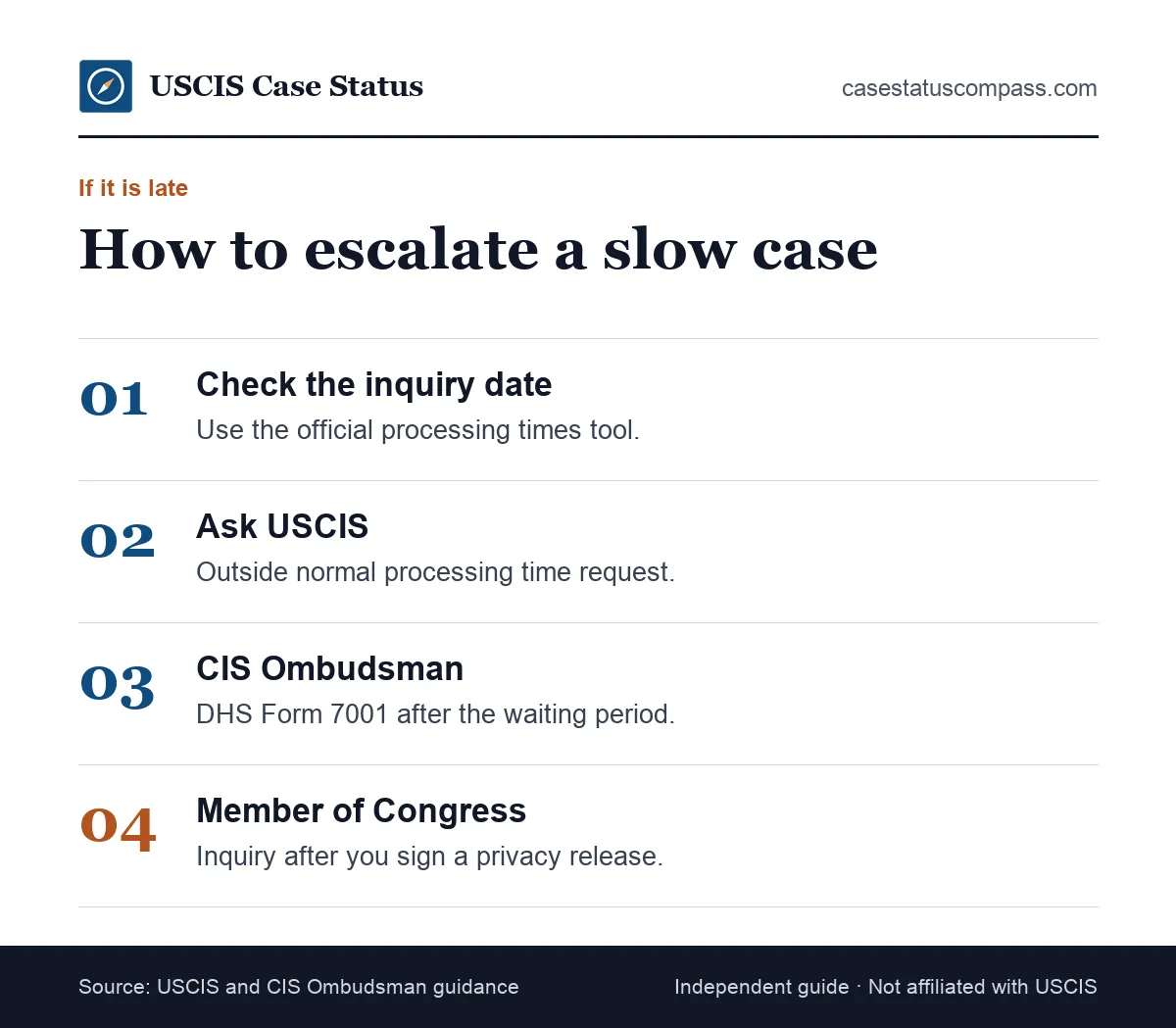
Use outside help only after you have asked USCIS directly and waited. The CIS Ombudsman, part of DHS (the Department of Homeland Security), and your member of Congress can both ask USCIS about a stuck case. Use the Ombudsman only after contacting USCIS within 90 days and waiting at least 60 days.
The CIS Ombudsman
Use the Ombudsman only after contacting USCIS within 90 days and waiting at least 60 days. CIS Ombudsman: DHS Form 7001, Request for Case Assistance (online). The Ombudsman cannot help before your inquiry date in most cases.
A congressional inquiry
Your member of Congress can ask USCIS about your case after you sign a privacy release. Our guide to the Ombudsman and congressional inquiries compares the two routes. Both are free.
Can You Travel While Waiting for the Interview?
Travel abroad during the wait is risky for green card applicants. Leaving the U.S. with a pending Form I-485 can abandon the application unless you hold advance parole or fit a narrow exception. Missing an interview because you are abroad can also stall the case.
Advance parole and abandonment
Traveling while your I-485 is pending abandons it unless you have advance parole (with H/L/V/K exceptions). Our guide on travel with a pending I-485 explains the exceptions and timing. Ask an attorney before you book.
The 2026 unlawful presence change
Since Aug. 13, 2026, travel on advance parole counts as a departure: over 180 days of unlawful presence can trigger the 3/10-year bar. Anyone with past unlawful presence should talk with an immigration attorney before any trip, even with a parole document in hand.
What If You Move Before the Interview?
Report every move to USCIS within 10 days. A move can also change which field office handles your interview, which can shorten or lengthen the wait. Reporting online is the quickest route, as the next section explains. Update every pending receipt, not just the I-485, and keep the confirmation.
How to report the move
Report a new address to USCIS within 10 days of moving (INA 265). Update your address online in your USCIS account (E-COA); a mailed AR-11 also counts. Our USCIS change of address guide shows the steps for each form.
Does Moving Change Which Office Interviews You?
Often, yes. If you move to a new area, USCIS may transfer your file to the field office that serves your new address. The new office has its own queue, so your interview wait can reset in practice. Keep proof of the date you reported the move.
Can You Work While You Wait for the Interview?
Yes, if you filed Form I-765 with your I-485 and it is approved. USCIS's April–June 2026 median for work permits based on a pending I-485 was 6.4 months from receipt, so the card may come only shortly before the interview.
The linked work permit
The same biometrics usually serve your I-485, I-765 and any I-131. Our Form I-765 work permit guide covers current edition rules and filing. A work permit can arrive long before the interview.
When the EAD expires before the interview
If your EAD is close to expiring and your interview has not happened, file the renewal early. The automatic extension rules changed in October 2025, so check the guide before relying on an old receipt.
Will You Need Biometrics Again Before the Interview?
Usually not. One biometrics appointment normally serves the forms filed together. A second appointment can happen if your fingerprints could not be read, if your file is reopened or if a long time has passed. Attend any new notice, since missing it risks denial.
Unreadable prints
Worn fingertips can produce prints that cannot be classified. USCIS then sends a new appointment notice. Missing biometrics can lead to denial for abandonment, so treat a second notice like the first.
Reopened or long-pending files
A reopened case, or one pending for a long time, can also bring a fresh appointment notice. Treat it exactly like the first one. Bring the new notice and photo ID.
How Should You Prepare During the Wait?
Use the months after biometrics to build your interview folder, collect updated evidence and fix any record problems. Preparation never speeds up scheduling, but it can speed up the decision. A complete folder can avoid a later RFE or a continued case.
Build the interview folder
Keep originals and copies of every form you filed, all I-797C notices, passports, civil documents and evidence. In marriage cases, add fresh proof of shared life, such as recent leases, joint bills and photos.
Will You Need a New Medical Exam Before the Interview?
Usually not, if you filed it correctly. Send the sealed I-693 with your I-485 (required since Dec. 2, 2024). An I-693 is generally valid only for the application it was filed with. Our immigration medical exam guide explains what happens if the officer asks for a new one.
What Mistakes Stretch the Wait After Biometrics?
The mistakes that add the most time are missing mail after a move, traveling without permission, answering an RFE late or incompletely, and filing duplicate inquiries before the inquiry date. Each one is avoidable with a little planning and a calendar reminder.
Mail and address mistakes
Not reporting a move is the most common avoidable error. A missed interview notice can lead to rescheduling at best and denial at worst. Report moves within 10 days, online.
Travel and RFE mistakes
Leaving the country without advance parole can abandon a pending I-485. A late or partial RFE answer keeps the file out of the queue. Answer RFEs early and in one package.
Inquiry and paperwork mistakes
Calling repeatedly before the inquiry date does not move your file. Sending unrequested documents by mail can create misfiled papers. Send evidence only when USCIS asks or bring it to the interview.
If X, Do Y: Decision Table After Biometrics
This decision table matches common situations after biometrics with the right next step, split at your case inquiry date. Before that date, most problems are yours to fix, such as a move or an RFE; after it, you can also ask USCIS to look at the file.
Before the case inquiry date
While you are inside normal processing time, the right moves are small and practical ones:
| If this happens | Do this |
|---|---|
| No status change for months | Keep waiting; check the tool monthly |
| You move | Report the address within 10 days |
| You get an RFE | Answer by the date on the notice |
| You must travel | Get advance parole first; ask an attorney |
After the case inquiry date
Once your receipt date is earlier than the inquiry date, you can escalate in steps:
| If this happens | Do this |
|---|---|
| Still no interview notice | Submit an outside normal processing request |
| No answer to the request | Contact the CIS Ombudsman after the waiting period |
| Urgent hardship | Request an expedite with proof |
| Status says scheduled, no notice | Check your account, then report a missing notice |
How Do Forum Timelines Compare With Official Data?
Forum timelines are self-reported, unverified and skewed toward people with unusual cases. Official medians measure every completed case the same way. Plan your dates with USCIS data and the processing times tool. Forum posts rarely say which office or category.
Why forum numbers mislead
People post most often when a case is very fast or very slow. Old posts reflect older queues. A single report of "interview 20 days after biometrics" says nothing about your file.
What forums are still good for
Forums can help with practical details about a specific office, such as parking or security lines. Treat any timeline posted there as one person's story, not a forecast. Never pay anyone for inside timeline information.
How Long After the Interview Does the Decision Come?
Many green card and citizenship cases get a decision on the day of the interview or within weeks, but some need more review or an RFE. USCIS publishes no official interview-to-decision figure. Ask the officer what comes next and keep any paper you get.
Green card cases
The officer may approve, ask for more evidence or hold the case for review. The USCIS interviews hub explains the paperwork you may receive afterward. If the case is approved, the green card is mailed to the address USCIS has on file, so a move after the interview needs an address update.
Citizenship cases
You may be able to take the oath the same day as your interview. Two chances to pass; retest of the failed part 60-90 days after the interview. If you pass, the oath ceremony is the final step.
Comparing the Waits: Receipt, Biometrics, Interview and Decision
The receipt-to-biometrics stretch is usually short, the biometrics-to-interview stretch the longest, and the interview-to-decision stretch varies. USCIS publishes only whole-case figures, so the gaps between stages are estimates, not official numbers. Use them to set expectations, then check your own case against the tool.
Stage-by-stage comparison
The table sets the four waits side by side and shows where each is checked.
| Stage | Typical length | Official figure? | Where to check |
|---|---|---|---|
| Receipt to biometrics | Usually short | No | Your appointment notice |
| Biometrics to interview | Usually the longest | No | Tool and status updates |
| Interview to decision | Same day to months | No | Interview results notice |
| Whole case | Varies by form | Yes, medians and tool | USCIS data library and tool |
Printable Waiting-Period Checklist
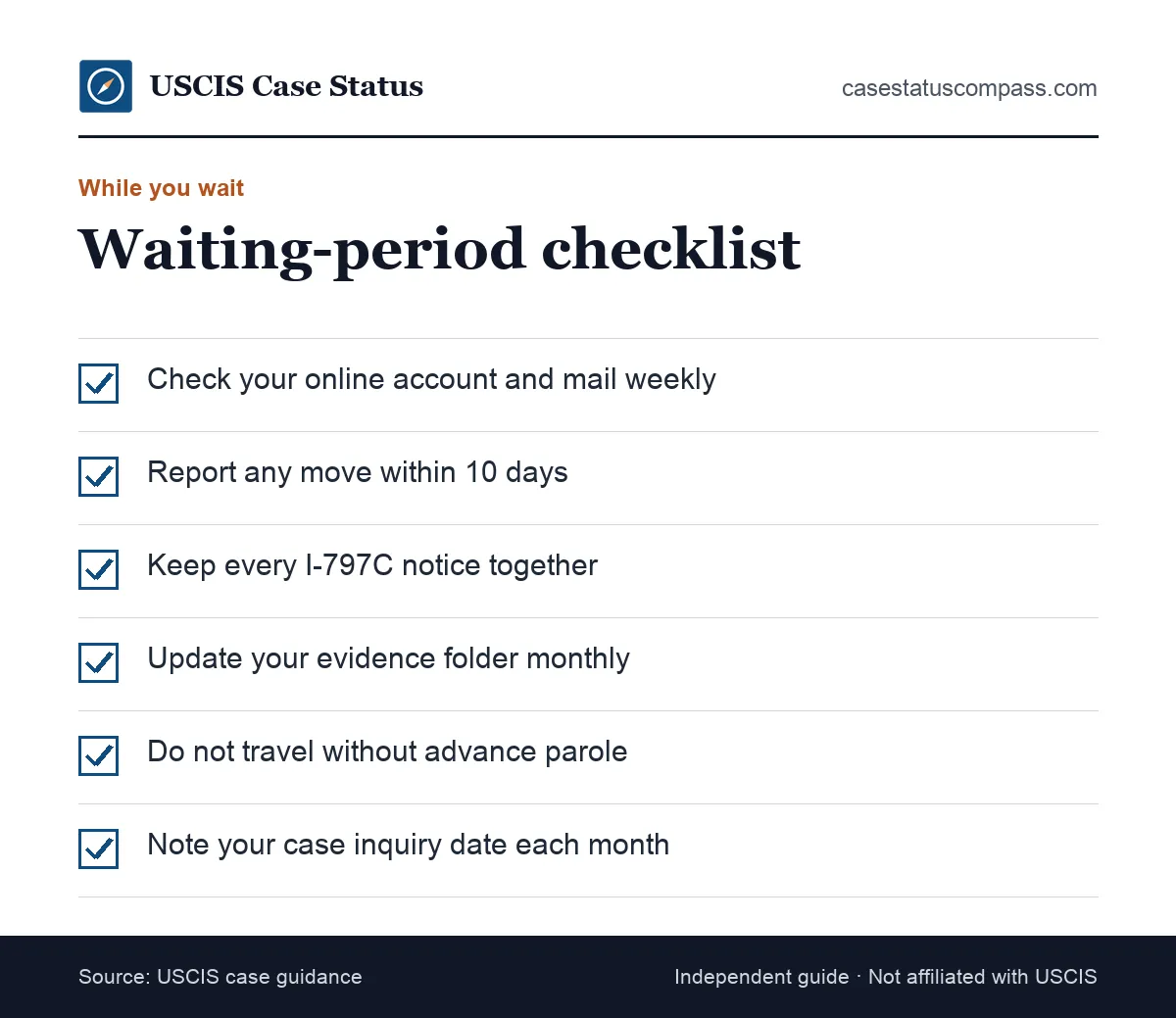
This checklist covers what to do each month after biometrics and what to do the day an interview notice arrives. Print it or copy it into your calendar. Small monthly checks catch a missed notice or an address problem early, while there is still time to fix it.
Every month
- Check your online account and mail.
- Check the case inquiry date in the tool.
- Add new evidence to your folder.
- Confirm your address is current with USCIS.
If one monthly check finds your receipt date earlier than the inquiry date, submit an outside normal processing time request that month instead of waiting for the next check.
The day the notice arrives
- Read the full notice, front and back.
- Confirm the office address and who must attend.
- Tell your attorney or representative.
- Block the date and plan travel time.
- Start the document list printed on the notice.
Key Takeaways on the Wait After Biometrics
USCIS publishes no fixed biometrics-to-interview gap. Use the April–June 2026 whole-case medians as a planning guide, check your case inquiry date monthly, keep your address current and act only when your case is outside normal processing time. Prepare for the interview while you wait.
The three numbers to know
Your receipt date, the official median for your form and category, and the case inquiry date for your office. Together they tell you whether your wait is normal or overdue.
Where to check other forms and cases
For the full picture of every form, visit the USCIS processing times overview. To check another case, start at the USCIS case status homepage.
Frequently Asked Questions
How long after biometrics is the green card interview?
USCIS does not publish a biometrics-to-interview figure. Its April–June 2026 median for family-based green card cases was 7.0 months from receipt to completion. Most family applicants are therefore interviewed in the later part of that window, depending on their field office.
Does completing biometrics mean my case is approved?
No. Biometrics only collects your fingerprints, photo and signature for background checks and card production. An officer still reviews your file, may interview you and then decides.
Can I get an interview without biometrics?
In most cases, no. USCIS needs your biometrics for the background checks that must finish before a decision. If you missed the appointment, USCIS may deny the case for abandonment.
Is there a USCIS phone number to ask for my interview date?
You can call the USCIS Contact Center at 800-375-5283, but agents cannot book or move your case ahead of others. If your case is past its inquiry date, they can take an outside normal processing time request.
Why did someone fingerprinted after me get interviewed first?
Interviews are booked by field offices, and each office has its own queue. A person at a different office, in a different category or with a simpler file may move faster.
Should I file an expedite request right after biometrics?
Only if you meet a USCIS expedite criterion, such as severe financial loss or an urgent humanitarian reason, and can prove it with documents. A long wait alone is not a reason.
Is the I-485 processing time after biometrics the same for every office?
No. Each field office has its own queue, so the stretch after biometrics differs by address. Check the official processing times tool for the office on your receipt notice.
Does a long silence after biometrics mean something is wrong?
Not usually. Checks, review and scheduling rarely post an update, so quiet months are common. Act once your receipt date is earlier than the case inquiry date in the official tool.
Sources
- USCIS Data Library: All Forms, FY2026 Q3 (Apr.-June 2026). www.uscis.gov/sites/default/files/document/data/quarterly_all_forms_fy2026_q3_v1.xlsx. Accessed Oct 27, 2026.
- USCIS Check Case Processing Times. egov.uscis.gov/processing-times/. Accessed Oct 27, 2026.
- USCIS: Preparing for Your Biometric Services Appointment. www.uscis.gov/forms/filing-guidance/preparing-for-your-biometric-services-appointment. Accessed Oct 27, 2026.
- USCIS Policy Manual, Vol. 7, Part A, Ch. 5: Interview Guidelines. www.uscis.gov/policy-manual/volume-7-part-a-chapter-5. Accessed Oct 27, 2026.
- USCIS: Victims of Human Trafficking: T Nonimmigrant Status. www.uscis.gov/humanitarian/victims-of-human-trafficking-and-other-crimes/victims-of-human-trafficking-t-nonimmigrant-status. Accessed Oct 27, 2026.
- CIS Ombudsman: Case Assistance. www.dhs.gov/case-assistance. Accessed Oct 27, 2026.
- USCIS Contact Center. www.uscis.gov/contactcenter. Accessed Oct 27, 2026.
- USCIS: Expedite Requests. www.uscis.gov/forms/filing-guidance/how-to-make-an-expedite-request. Accessed Oct 27, 2026.
- CIS Ombudsman tip sheet: Check Your USCIS Case Inquiry Date (Aug. 2024). dhs.gov/sites/default/files/2024-11/24_0823_cisomb_case-inquiry-date-tip-sheet.pdf. Accessed Oct 27, 2026.
- USCIS Data Library: All USCIS Application and Petition Form Types, FY2025 Q4 (July 1-Sept. 30, 2025). www.uscis.gov/sites/default/files/document/data/quarterly_all_forms_fy2025_q4_v1.xlsx. Accessed Oct 27, 2026.
- USCIS: Study for the Test. www.uscis.gov/citizenship/find-study-materials-and-resources/study-for-the-test. Accessed Oct 27, 2026.
- USCIS: Removing Conditions on Permanent Residence Based on Marriage (updated 12/12/2023). www.uscis.gov/green-card/after-we-grant-your-green-card/conditional-permanent-residence/removing-conditions-on-permanent-residence-based-on-marriage. Accessed Oct 27, 2026.
- USCIS Policy Manual Vol. 12, Part G, Ch. 5. www.uscis.gov/policy-manual/volume-12-part-g-chapter-5. Accessed Oct 27, 2026.
- 8 CFR 103.2(b)(8)(iv) (LII). www.law.cornell.edu/cfr/text/8/103.2. Accessed Oct 27, 2026.
- USCIS Policy Manual Vol. 1, Part E, Ch. 6 (current as of Oct. 23, 2026). www.uscis.gov/policy-manual/volume-1-part-e-chapter-6. Accessed Oct 27, 2026.
- USCIS: Visa Availability and Priority Dates (updated 01/24/2025). www.uscis.gov/green-card/green-card-processes-and-procedures/visa-availability-priority-dates. Accessed Oct 27, 2026.
- USCIS: Form I-797 Types and Functions (updated 01/24/2025). www.uscis.gov/forms/filing-guidance/form-i-797-types-and-functions. Accessed Oct 27, 2026.
- USCIS: Benefits of a USCIS Online Account. www.uscis.gov/file-online/benefits-of-a-uscis-online-account. Accessed Oct 27, 2026.
- USCIS: Checking Your Case Status Online. www.uscis.gov/tools/checking-your-case-status-online. Accessed Oct 27, 2026.
- USCIS OLA New Member Outreach FAQs (Jan. 2021). www.uscis.gov/sites/default/files/document/questions-and-answers/5%20117%20-%20New%20Member%20Outreach%20FAQs%2001042021.pdf. Accessed Oct 27, 2026.
- Form I-485 Instructions, Edition 09/18/26. www.uscis.gov/sites/default/files/document/forms/i-485instr.pdf. Accessed Oct 27, 2026.
- USCIS: Form I-131 page alert (updated 10/07/2026). www.uscis.gov/i-131. Accessed Oct 27, 2026.
- USCIS: How to Change Your Address (updated 08/04/2026); 8 U.S.C. 1305(a) (LII). www.uscis.gov/addresschange. Accessed Oct 27, 2026.
- USCIS: Form I-693 page (updated 07/24/2026); I-485 Instructions 09/18/26. www.uscis.gov/i-693. Accessed Oct 27, 2026.
- USCIS Policy Manual Vol. 8, Part B, Ch. 4. www.uscis.gov/policy-manual/volume-8-part-b-chapter-4. Accessed Oct 27, 2026.
- USCIS: Naturalization Ceremonies (updated 02/12/2026). www.uscis.gov/citizenship/learn-about-citizenship/naturalization-ceremonies. Accessed Oct 27, 2026.
- USCIS: The Naturalization Interview and Test (updated 10/31/2025). www.uscis.gov/citizenship/learn-about-citizenship/the-naturalization-interview-and-test. Accessed Oct 27, 2026.
casestatuscompass.com is an independent publication and is not affiliated with USCIS or any government agency. This page is general information, not legal advice. For denials, court or asylum matters, consult an immigration attorney or a DOJ-accredited representative.