Contents · 41 sections
- How Long Does It Take to Get a Work Permit in 2026?
- EAD Approval Time: Why Your Category Matters Most
- How Long Does It Take to Get a Work Permit With a Pending Green Card?
- Median vs 80% Figure for Form I-765
- Has the Work Permit Wait Changed Since 2025?
- How Do You Look Up the EAD Processing Time in the USCIS Tool?
- EAD Approval Timeline: From Filing to Card in Hand
- Work Permit Timeline Estimator: From Receipt Date to Card
- H-4 EAD Approval Time
- Does Filing Form I-539 Slow Down the H-4 EAD Approval Timeline?
- How Long Does H-4 EAD Processing Take With an H-1B Petition?
- What Affects the H-4 EAD Approval Timeline?
- OPT Approval Timeline
- When Does the OPT Timeline Start Counting?
- How Long Does OPT Approval Take?
- STEM OPT Extension: Timing and the 180-Day Rule
- EAD Renewal Timeline
- How Long Does It Take to Get a Work Permit Renewed?
- What Happened to the EAD Automatic Extension?
- Asylum-Based EAD Processing Time
- DACA Work Permit Processing Time
- TPS and Parolee Work Permits
- Speeding Up an EAD
- Can You Expedite an EAD Application?
- Does Premium Processing Work for Every EAD?
- What Slows Down a Work Permit?
- Which Form I-765 Edition Avoids a Rejection?
- How Does Biometrics Affect EAD Timing?
- Is Your EAD Case Outside Normal Processing Time?
- What to Do If Your Work Permit Is Taking Too Long
- Work Permit Case Status Messages and What They Mean for Timing
- How Long After Approval Does the EAD Card Arrive?
- Why Do EAD Processing Times Differ by Office?
- How Big Is the USCIS Backlog Behind Your EAD?
- Work Permit Processing Time in the USA Compared With Other Forms
- Can Green Card Applicants Get a Combo EAD and Advance Parole Card?
- Planning a Job Start Around EAD Processing Time
- Common Work Permit Timing Mistakes
- Work Permit Processing Time Quick Reference
- What This Guide Can and Cannot Tell You
- Frequently Asked Questions
At a glance
| Most categories | 3.3 months (USCIS median, Apr.–June 2026) |
| Pending green card (c)(9) | I-765 (based on pending I-485): median 6.4 months (USCIS data, Apr.-June 2026) |
| Live tool figure | 1 to 18.5 months, depending on category and office (USCIS data retrieved Oct 27, 2026) |
| Premium processing | OPT and STEM OPT only, 30 business days |
| Edition accepted | 08/21/25 (the 09/15/26 edition is NOT accepted because of a Sept. 14, 2026 court order) |
How Long Does It Take to Get a Work Permit in 2026?
It usually takes a few months to get a work permit. USCIS's quarterly data for April–June 2026 shows a 3.3-month median for most categories and 6.4 months for applicants with a pending Form I-485. The live tool shows a different figure: right now, (c)(9) cases based on a pending I-485 take 12 to 12.5 months, depending on category and office (USCIS data retrieved Oct 27, 2026).
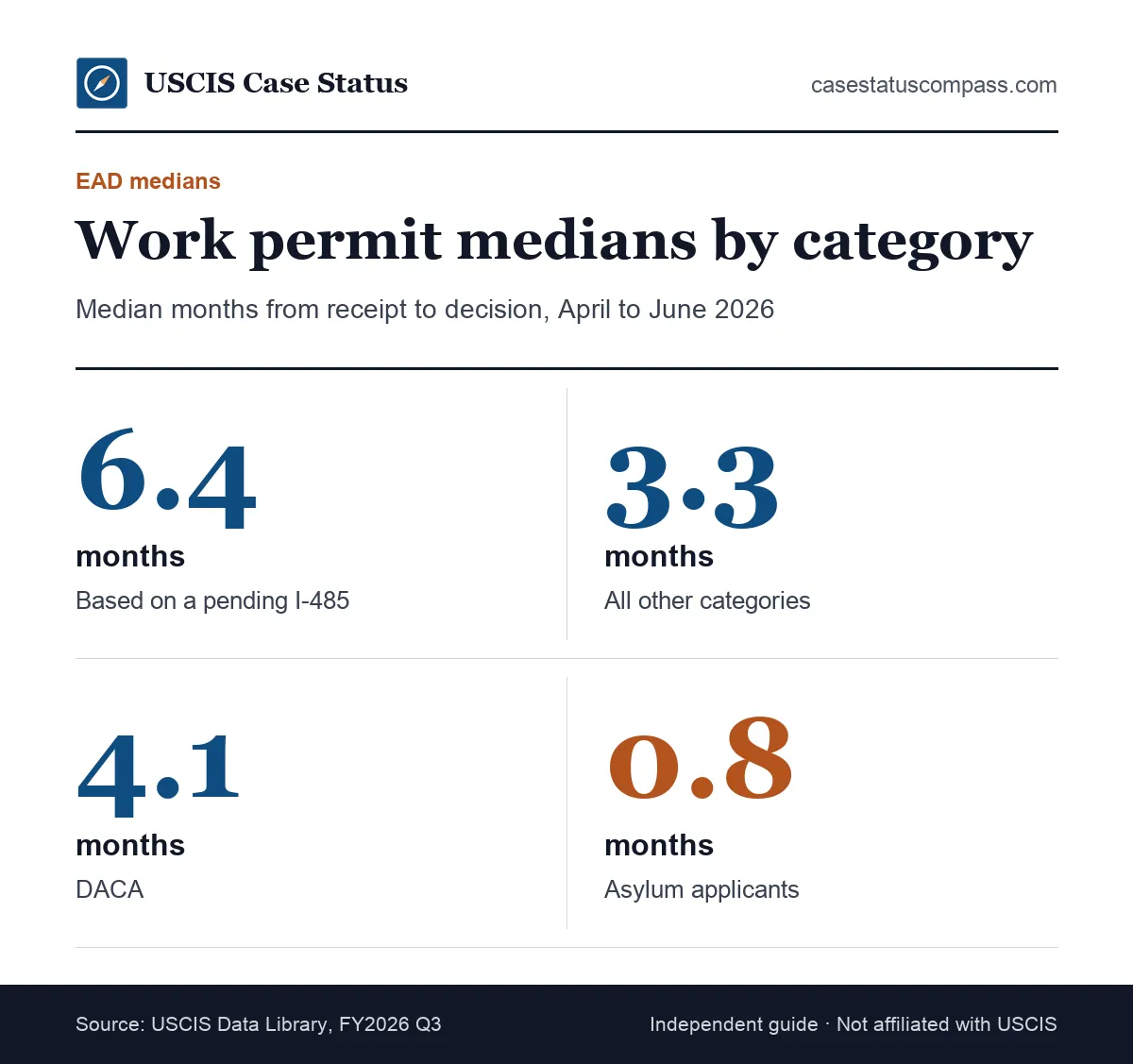
Official medians by category
| EAD basis | Median, Apr.–June 2026 | What it covers |
|---|---|---|
| Pending I-485 | 6.4 months | Category (c)(9) green card applicants |
| All other categories | 3.3 months | Most other work permits |
| DACA | 4.1 months | Category (c)(33) |
| Asylum applicant | 0.8 months | Pending asylum case |
The table lists USCIS's official medians for each work permit basis. The slowest line, pending I-485, took nearly twice the all-other median.
The live tool table
When live figures are loaded, the table below lists them by category and office. Otherwise it shows a short note pointing to the official tool.
Show all 16 I-765 processing times by category and office
| Category | Office | 80% of cases completed within |
|---|---|---|
| Alien with Final Order of Deportation Under an OSUP [(c)(18)] | National Benefits Center | 16.5 months |
| All other applications for employment authorization | National Benefits Center | 10.5 months |
| All other applications for employment authorization | Service Center Operations (SCOPS) | 16 months |
| Application for Suspension of Deportation/Sec.244/NACARA/Cancel of Removal [(c)(10)] | National Benefits Center | 10 months |
| Based on a pending asylum application [(c)(8)] -renewal/replacement | Service Center Operations (SCOPS) | 18.5 months |
| Based on a pending asylum application [(c)(8)] – Initial Application | Service Center Operations (SCOPS) | 1 month |
| Based on a pending I-485 adjustment application [(c)(9)] | National Benefits Center | 12 months |
| Based on a pending I-485 adjustment application [(c)(9)] | Service Center Operations (SCOPS) | 12.5 months |
| Based on a request by a qualified F-1 academic student [(c)(3)] | Service Center Operations (SCOPS) | 5 months |
| Based on an approved asylum application [(a)(5)] | Service Center Operations (SCOPS) | 2.5 months |
| Based on being admitted as a Refugee [(a)(3)] | Service Center Operations (SCOPS) | 18.5 months |
| Based on being an H-4 spouse of an H-1B nonimmigrant (filed with I-539 H4) [(c)(26)] | Service Center Operations (SCOPS) | 6.5 months |
| Based on being an H-4 spouse of an H-1B nonimmigrant (Standalone; not filed with I-539 H4) [(c)(26)] | Service Center Operations (SCOPS) | 17.5 months |
| Based on being an L-2 spouse of an L-1 nonimmigrant [(a)(18)] | Service Center Operations (SCOPS) | 18 months |
| Based on parole | National Benefits Center | 13.5 months |
| Based on TPS for El Salvador [(c)(19), (a)(12)] | Service Center Operations (SCOPS) | 18.5 months |
EAD Approval Time: Why Your Category Matters Most
The EAD approval time depends first on the category code you file under, because USCIS reports separate medians for pending green card, DACA, asylum and all other cases. In April–June 2026 those medians ranged from 0.8 months to 6.4 months, an eightfold difference.
Where H-4 and OPT fit
The quarterly report gives H-4 and OPT applications no line of their own. That means the 3.3-month "all other" median is the closest official figure, but your own wait should be read from the live tool.
The category code on your form
Your category code, such as (c)(9) or (c)(26), is entered on Form I-765. A wrong code can lead to an RFE or denial, which costs far more time than any queue. Our Form I-765 work permit guide lists common codes.
How Long Does It Take to Get a Work Permit With a Pending Green Card?
With a pending Form I-485, the work permit took a median of 6.4 months in April–June 2026, up from 2.3 months a year earlier. That makes the adjustment-based EAD one of the slower categories now, even though it was among the fastest in 2025.
The (c)(9) slowdown in numbers
USCIS reports I-765 (based on pending I-485): median 6.4 months (USCIS data, Apr.-June 2026). A year before, the same line was 2.3 months. The applicant pool did not change; the processing pace did.
Filing the EAD with your I-485
Many adjustment applicants file Form I-765 together with the I-485. The two cases still move separately. Our green card processing time page covers the I-485 side, which had a 6.0-month employment median and 7.0 months for family cases.
Median vs 80% Figure for Form I-765
USCIS publishes two different numbers. The data library reports the median, the point at which half of completed cases were done. The processing times tool reports how long it took to finish 80% of cases over the past six months. The tool figure is usually the longer one.
Reading the median
USCIS quarterly data reports the median: half of the cases completed that quarter took longer. The data is published each quarter, about three to four months after the quarter ends. It shows the trend, not your personal date.
Reading the tool figure
The tool works this way: The USCIS tool shows how long it took to finish 80% of cases in the past 6 months. USCIS says the figure does not tell you how soon your own case will be decided.
Has the Work Permit Wait Changed Since 2025?
Yes, for green card applicants. The (c)(9) EAD median rose from 2.3 months in July–September 2025 to 6.4 months in April–June 2026. The "all other categories" median stayed at 3.3 months in both quarters. Other USCIS forms, such as N-400 and I-751, also slowed.
EAD medians a year apart: 2025 vs 2026
| Category | July–Sept. 2025 | Apr.–June 2026 | Change |
|---|---|---|---|
| I-765, pending I-485 | 2.3 months | 6.4 months | Slower |
| I-765, all other | 3.3 months | 3.3 months | No change |
| I-485, family | 6.0 months | 7.0 months | Slower |
| N-400 | 5.7 months | 9.5 months | Slower |
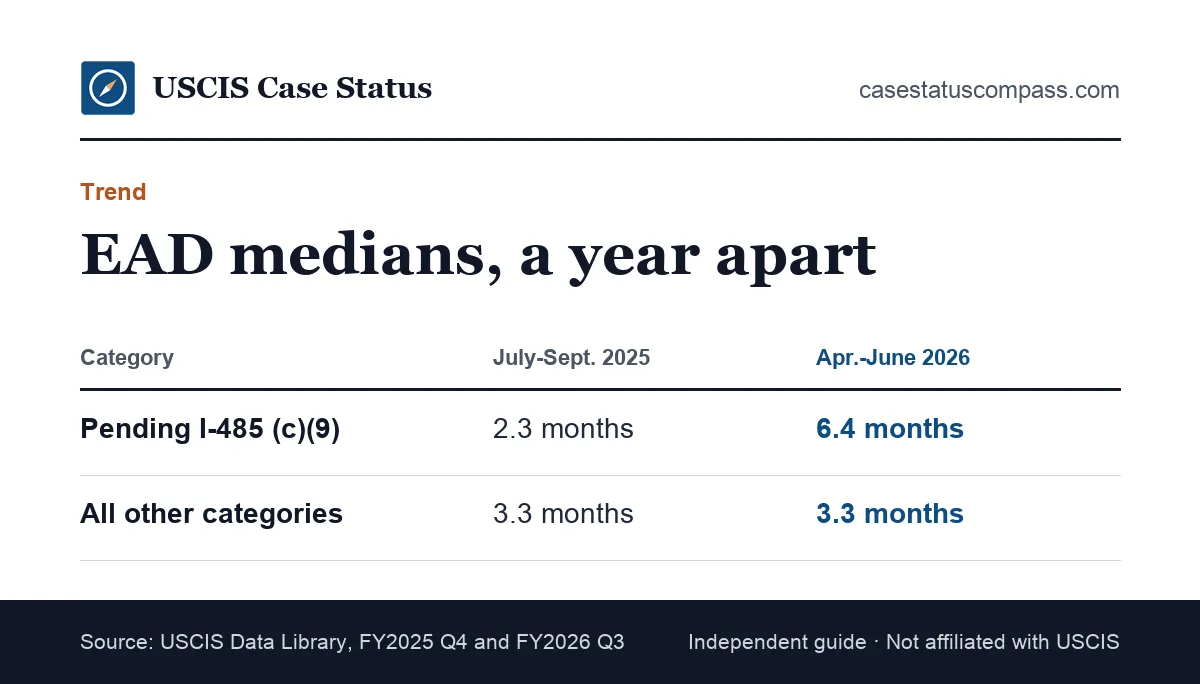
The table compares the same median lines one year apart. Only the all-other EAD line held steady; the (c)(9) line nearly tripled.
What the trend means for planning
If you filed a (c)(9) EAD expecting a two-month wait, plan for longer. Recheck the newest quarter and the live tool before you accept a job start date.
Build in a buffer of several weeks.
How Do You Look Up the EAD Processing Time in the USCIS Tool?
Open the official tool at egov.uscis.gov/processing-times, choose Form I-765, select your EAD category, then pick the office on your receipt notice. The tool shows a time range and a case inquiry date for your receipt date. Repeat the lookup every few weeks.
Step by step
- Find your I-797C receipt notice.
- Note the receipt date and office.
- Select "I-765" in the tool.
- Pick the category that matches your filing.
- Pick the office and read the result.
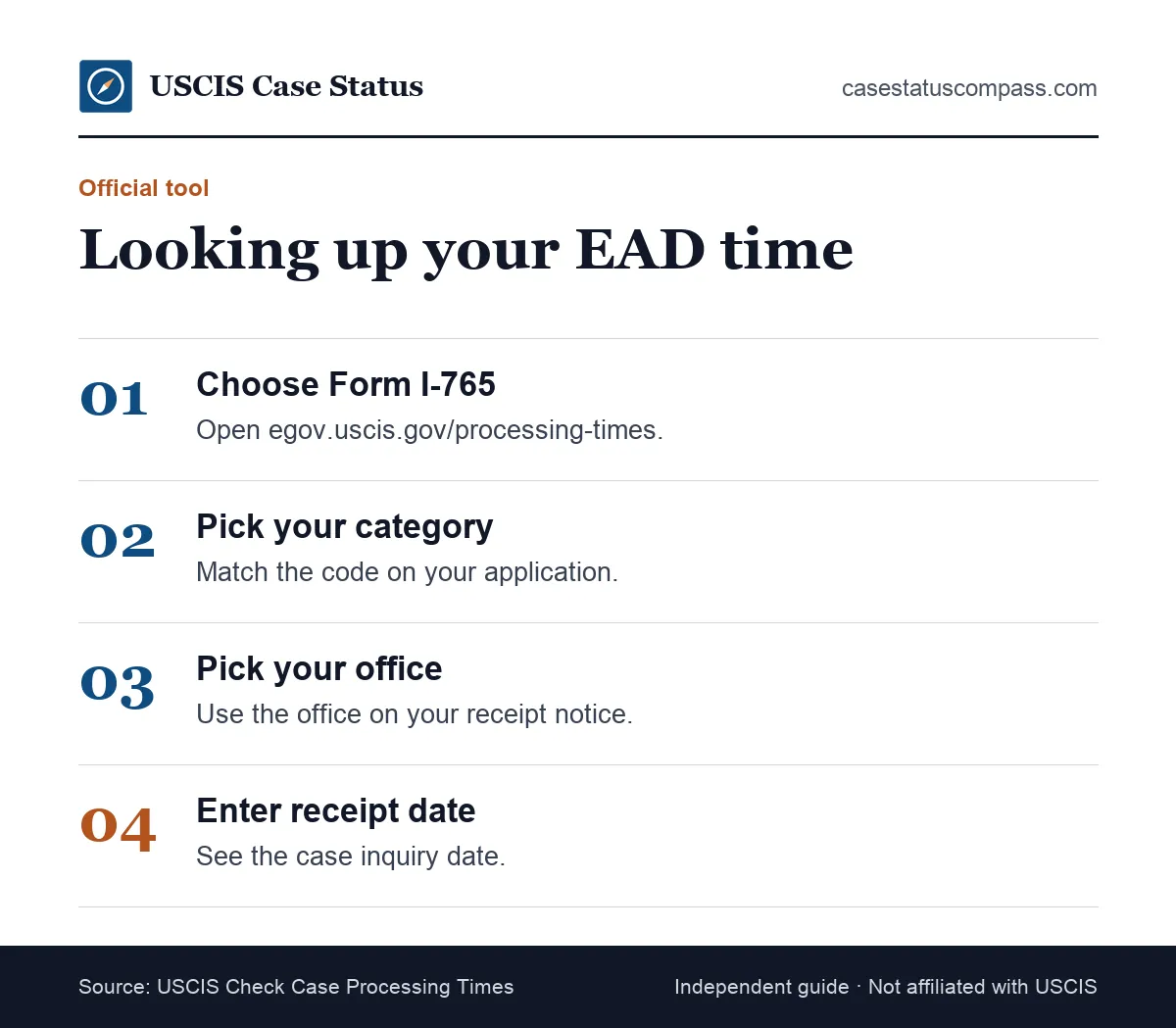
Choosing the right line
Pick the line that matches the basis of your application, not your visa type. An H-1B spouse picks the H-4 line if one appears; a green card applicant picks the pending adjustment line.
EAD Approval Timeline: From Filing to Card in Hand
The EAD approval timeline has five stages: USCIS receives Form I-765, sends a receipt notice, may schedule biometrics, makes a decision, and then produces and mails the card. The medians measure receipt to decision. Card production and mail add more days after approval.
Stage table
| Stage | What happens | What to watch |
|---|---|---|
| Filing | Form I-765 arrives at USCIS | Correct edition and fee |
| Receipt | Form I-797C with your receipt number | Check names and dates |
| Biometrics | Appointment at an Application Support Center | Attend on the first date |
| Decision | Approval, RFE or denial | Median 0.8–6.4 months |
| Card | Produced, then mailed | Keep your address current |
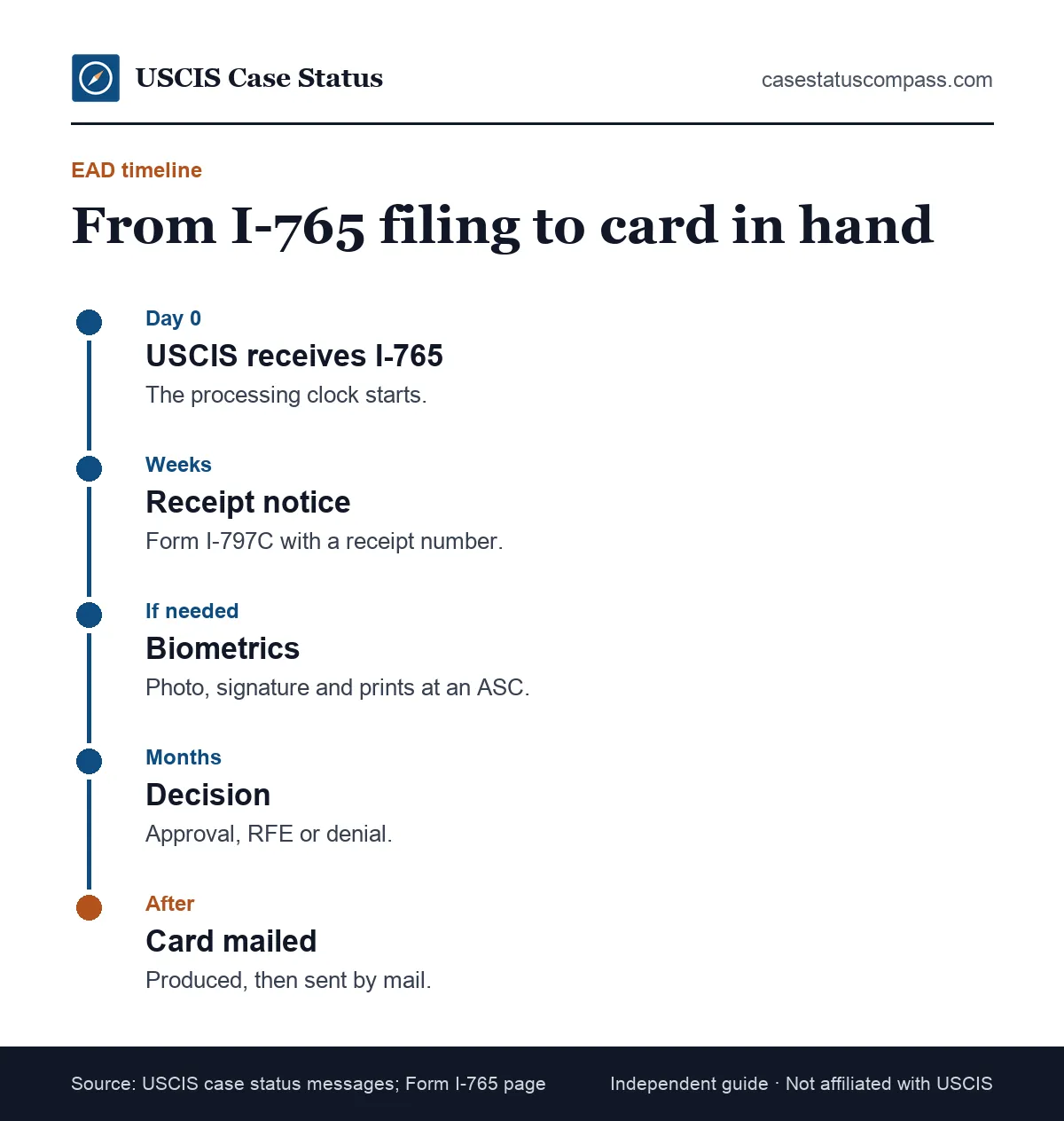
The table walks through each stage in order, with the item to check at each one. Most delays start at filing or receipt.
The part after approval
"Case Was Approved" ends the decision stage, but you cannot use a card you do not have. Watch for the new card is being produced update and then the mailing update.
Work Permit Timeline Estimator: From Receipt Date to Card
Estimate your milestones by adding the median for your category to your receipt date: about 6.4 months for (c)(9), 3.3 months for most others, 0.8 months for asylum applicants, or 30 business days with OPT premium. These are planning dates, not promises.
Estimator table
| Your category | Add to receipt date | Example: receipt Feb. 2, 2026 |
|---|---|---|
| Pending I-485 (c)(9) | About 6.4 months (about 28 weeks) | Around mid-August 2026 |
| All other categories | About 3.3 months (about 14 weeks) | Around mid-May 2026 |
| DACA (c)(33) | About 4.1 months | Around early June 2026 |
| Asylum applicant | About 0.8 months | Around late February 2026 |
Find your category, then add the median to your own receipt date. Remember that half of cases finish later than the estimated month.
Worked example: OPT with premium
Lin is an F-1 student whose OPT application and Form I-907 reach USCIS on March 2, 2026. Thirty business days later is about April 13, 2026. By then USCIS should approve, deny or send an RFE.
Worked example: (c)(9) applicant
Ana files Form I-765 with her I-485 and gets a receipt date of February 2, 2026. The 6.4-month median points to mid-August. She tells her employer to plan around September to leave room for card mailing.
H-4 EAD Approval Time
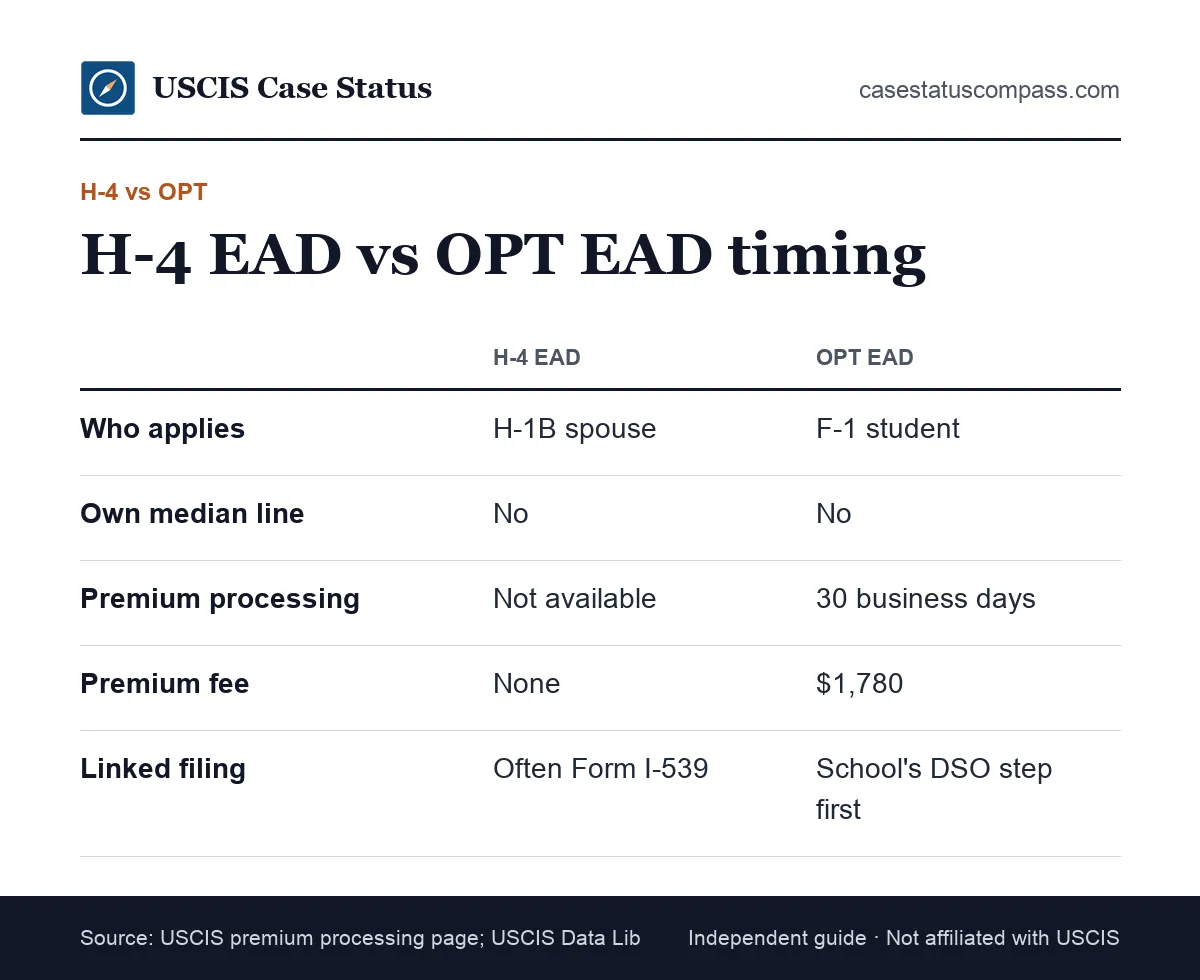
The H-4 EAD approval time has no separate official median. USCIS's April–June 2026 report places it outside the four named lines, so the 3.3-month "all other categories" median is the nearest official figure. Premium processing is not available for H-4 work permits.
Standalone H-4 EAD filings
A spouse who already has valid H-4 status can file the EAD alone. Then only the I-765 queue applies. Check the tool's line for your office; times there can differ from the national median.
Does Filing Form I-539 Slow Down the H-4 EAD Approval Timeline?
It can. Many H-4 spouses file Form I-765 alongside an I-539 to extend H-4 status, and the I-539 had its own median of 5.7 months in April–June 2026, longer than the 3.3-month "all other" EAD median. If USCIS decides both together, the slower case can set the pace.
How Long Does H-4 EAD Processing Take With an H-1B Petition?
When an H-4 EAD is filed together with the spouse's H-1B petition, it still follows its own Form I-765 timeline. Premium processing on the H-1B's Form I-129 speeds up only that petition. The time for H4 EAD processing remains tied to the I-765 and any I-539.
What premium on the H-1B does not cover
Premium processing covers I-129 work visas, I-140 (EB-1/2/3), I-765 OPT/STEM OPT and I-539 to F/M/J. H-4 EADs and H-4 I-539 extensions are not on that list. Paying premium for the H-1B does not move the spouse's work permit.
H-4 extension timing
The H-4 status extension is a separate filing with its own clock. See our H-1B processing time guide for I-129 and H-4 extension timing.
If both are pending, check the I-539 line in the tool as well as the I-765 line.
What Affects the H-4 EAD Approval Timeline?
Four things shape the H-4 EAD approval timeline: whether an I-539 is filed with it, the office handling the case, whether biometrics are needed, and whether USCIS sends an RFE. A complete filing with clear proof of the H-1B spouse's status avoids the most common delay.
Evidence that prevents an RFE
An H-4 EAD request needs proof of the qualifying H-1B basis. Missing approval notices or unclear relationship evidence lead to RFEs, which add weeks.
Include the spouse's I-797 approval, your marriage certificate and your I-94.
Office and biometrics
USCIS works H-4 cases at different offices, and each moves at its own pace. If you get a biometrics notice, attend on the first date. Missing biometrics can lead to denial for abandonment.
OPT Approval Timeline
The OPT approval timeline has two speeds. On regular processing, there is no OPT-specific median; the nearest official figure is the 3.3-month "all other" median for April–June 2026. With premium processing, USCIS must act within 30 business days, about six calendar weeks.
OPT wait times on regular processing
OPT wait times on regular processing vary by office. Read the tool's line for your office, and keep your mailing address current so the card reaches you.
The wait only starts once USCIS receives your request, so filing at the start of your OPT window leaves the most time before your job start date.
When Does the OPT Timeline Start Counting?
The OPT timeline starts only when USCIS receives Form I-765, not when you ask your school. An F-1 student first needs the school's Designated School Official (DSO) to recommend OPT, and that step happens before any USCIS clock runs. Check your school's and the form's filing window before sending the application.
How Long Does OPT Approval Take?
OPT approval takes up to 30 business days with premium processing. Without it, there is no published OPT median; USCIS's nearest official figure is the 3.3-month median for "all other" EAD categories in April–June 2026. The premium fee for OPT is $1,780.
Regular OPT approval time
The OPT approval time on regular processing depends on office workload and whether USCIS sends an RFE. Students who file early in their window have the most room if the case runs long.
Premium OPT approval time
Premium processing for OPT is requested on Form I-907. An RFE stops the premium clock; a new period starts when USCIS gets your response. Our premium processing guide covers the OPT premium steps in more detail.
STEM OPT Extension: Timing and the 180-Day Rule
STEM OPT extensions follow the same I-765 queue and can use premium processing within 30 business days. They also keep a special protection: a timely STEM OPT filing still gets an automatic extension of up to 180 days, one of the few exceptions left after October 30, 2025.
The 180-day exception
Ended: renewals filed on or after Oct. 30, 2025 no longer get the up-to-540-day automatic extension (exceptions: TPS by law/Federal Register notice; STEM OPT 180 days). That keeps STEM OPT workers on the job while USCIS decides.
What counts as timely
The STEM OPT application must be filed before the current OPT EAD expires. Check the I-765 instructions and your DSO for the exact rules.
A filing after expiry loses the 180-day protection.
EAD Renewal Timeline
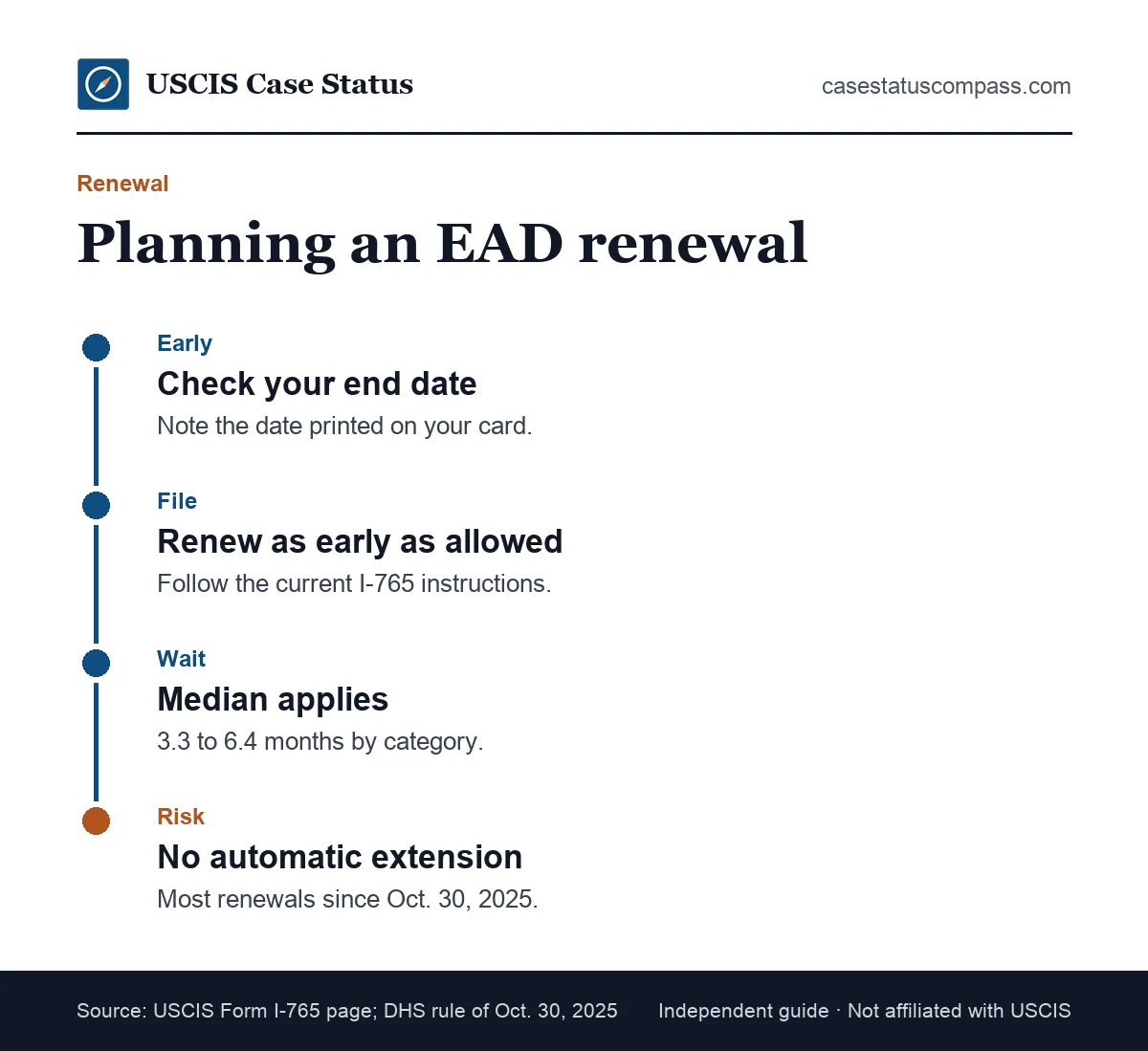
The EAD renewal timeline follows the same medians as first-time cards: 3.3 months for most categories and 6.4 months for (c)(9) in April–June 2026. Since most renewals filed on or after October 30, 2025 no longer get an automatic extension, filing early matters more than before.
Why renewals now carry gap risk
Before late 2025, many renewals got an automatic extension of up to 540 days. That ended for most categories. If your card expires before the renewal is approved, you may have to stop working.
When to start a renewal
USCIS sets the earliest filing date in the Form I-765 instructions. Mark that date when your card arrives. Filing on the first allowed day gives you the most room against the median.
How Long Does It Take to Get a Work Permit Renewed?
A work permit renewal usually takes as long as a first card in the same category: a 3.3-month median for most categories in April–June 2026, and 6.4 months for green card applicants. USCIS does not publish a separate renewal median.
Renewals in the official data
The quarterly report groups first-time and renewal applications by basis, not by initial or renewal. Your renewal follows your category line.
So a (c)(9) renewal uses the 6.4-month line, and most others use the 3.3-month line.
Avoiding a work gap
Start early, use the correct edition, and pay the exact fee. A rejected renewal does not hold your place in line, which can turn a short wait into a work gap.
What Happened to the EAD Automatic Extension?
DHS ended the automatic extension of up to 540 days for most EAD renewals filed on or after October 30, 2025. TPS EADs extended by law or Federal Register notice and STEM OPT's 180-day rule are exceptions. Extensions granted before that date are not affected.
The short version
As of October 2026, the Oct. 14, 2026 final rule (91 FR 65306) made permanent the end of automatic EAD extensions for renewals filed from Oct. 30, 2025. This page covers how long the card takes. The rules, exceptions and what employers can accept are in our EAD automatic extension guide.
What it means for timing
Without the extension, the renewal median is the length of your possible gap if you file late. File as early as the instructions allow.
Count back from your card's expiry date before you choose a filing date.
Asylum-Based EAD Processing Time
Work permits for pending asylum applicants had the fastest median of any EAD line, 0.8 months, in April–June 2026. That speed applies once you are eligible to file. Asylum-based EADs also carry H.R. 1 fees, which change each year and cannot be waived.
The 0.8-month median
USCIS reports I-765 (asylum applicant): median 0.8 months (USCIS data, Apr.-June 2026). That is under four weeks from receipt to decision for half of cases.
The other half took longer, so watch the live tool too.
Fees that can delay a filing
H.R. 1 fees can't be waived and must be paid separately. A missing add-on payment can lead to rejection. Our asylum status guide covers the asylum case itself.
Check G-1055 before paying.
DACA Work Permit Processing Time
The DACA work permit, category (c)(33), had a median of 4.1 months in April–June 2026, the same as the DACA request itself on Form I-821D. Because DACA renewals depend on timing, USCIS's recommended filing window is the key planning tool.
The DACA renewal window
File your DACA renewal 120-150 days before it expires. Filing in that window gives room for the 4.1-month median.
Filing late in the window, or after it, risks a gap between the old card and the new one.
DACA status and the EAD
The EAD follows the DACA decision. See our DACA status guide for how the request and the work permit move together.
If the DACA request is delayed, the work permit waits with it.
TPS and Parolee Work Permits
TPS and parolee EADs follow the "all other" processing line, with a 3.3-month median in April–June 2026, but they carry H.R. 1 add-on fees. TPS EADs are limited to one year or the TPS period, whichever is shorter, so renewal timing comes around faster.
Fees for TPS and parole EADs
Form G-1055 (edition 10/16/26) lists: $520 (paper) / $470 (online); $260 with a pending I-485 filed on or after Apr. 1, 2024. H.R. 1 add-ons: initial asylum-applicant (c)(8) EAD $0 + $570; initial TPS/parolee EAD base fee + $570; renewal TPS/parolee base fee + $280; renewal (c)(8) base fee + $275. Pay the add-on separately as instructed.
Shorter cards mean more renewals
A one-year card means you renew every year. Our TPS status guide covers the TPS designation and its dates.
Mark each renewal date the day the new card arrives, and watch for Federal Register notices about your country.
Speeding Up an EAD
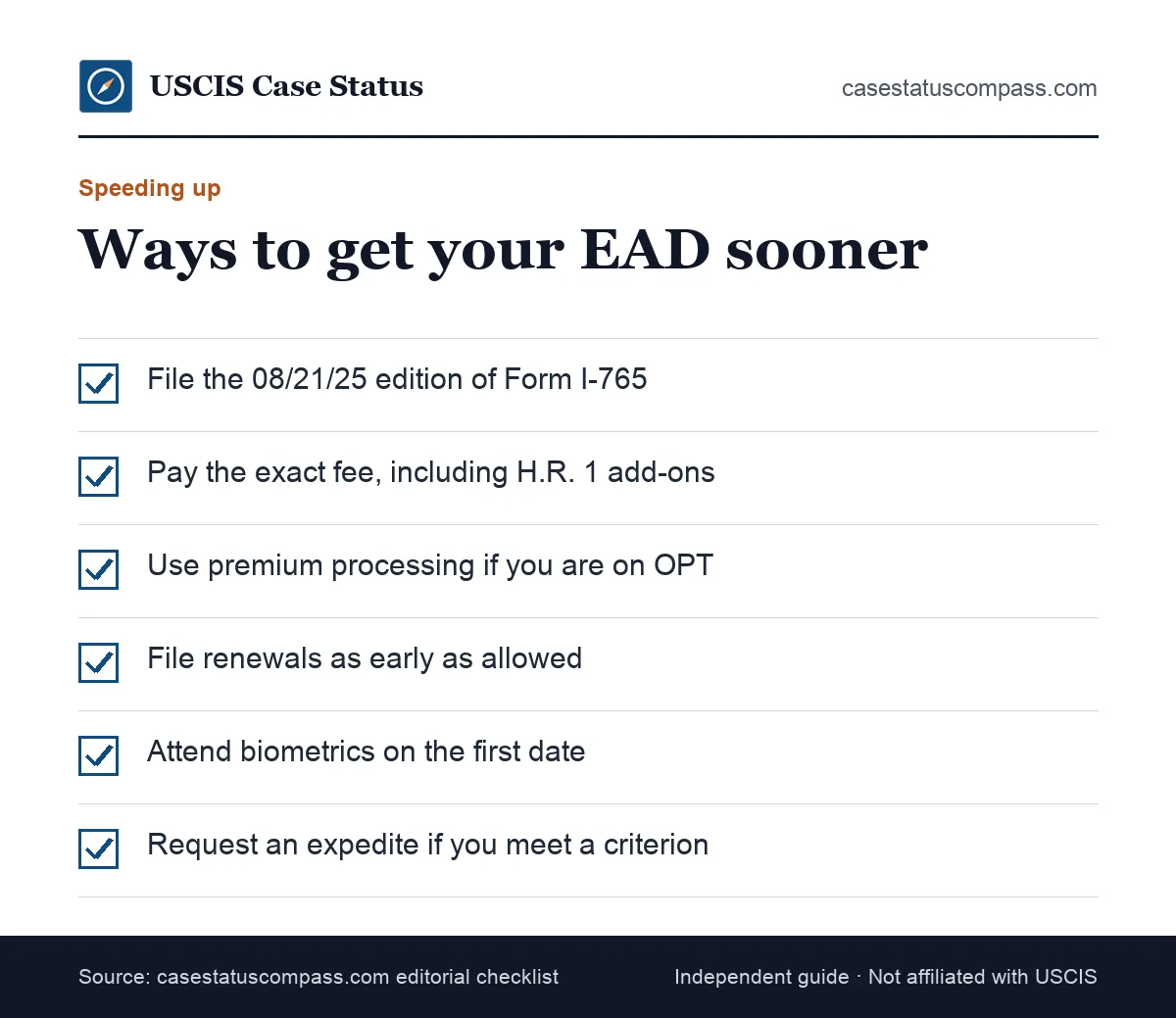
There are three legal ways to speed up an EAD: premium processing for OPT and STEM OPT, an expedite request if you meet a USCIS criterion, and a complete, correct first filing that avoids rejections and RFEs. No paid service can move your case ahead in line.
The filing itself
Use the accepted edition, the right category code, the exact fee and a current address. These four steps cut more time than any request after filing.
Check all four before you mail.
Beware of "fast-track" offers
No outside company can buy you priority at USCIS. Only USCIS's own premium and expedite processes change the order.
Anyone who charges to "speed up" your EAD outside those processes is likely running a scam.
Can You Expedite an EAD Application?
Yes, you can ask USCIS to expedite a work permit if you meet a listed criterion, such as severe financial loss or an urgent humanitarian situation. USCIS decides each request case by case. Meeting a criterion does not guarantee approval, and OPT applicants are usually pointed to premium processing instead.
The criteria
Expedite criteria: severe financial loss, emergency/humanitarian, nonprofit, government interest, clear USCIS error. Gather proof, such as a job offer letter with a start date, before you ask.
Without that proof, USCIS can deny the expedite request, and your work permit case simply continues in normal order.
How to ask
Ask for an expedite through the USCIS Contact Center or your online account. Our USCIS expedite request guide explains what evidence helps.
Have your receipt number and supporting evidence ready first.
Does Premium Processing Work for Every EAD?
No. Premium processing covers only OPT and STEM OPT work permits under Form I-765. Green card, H-4, DACA, asylum and TPS EADs cannot use it. For eligible OPT students, the fee is $1,780 and USCIS must act within 30 business days.
The fee and the clock
Form G-1055 (edition 10/16/26) lists premium fees as: $2,965 (I-129 most classes, I-140); $1,780 (H-2B/R, I-765 OPT); $2,075 (I-539 to F/J/M). You can't get a fee waiver for premium processing.
When premium is worth it
Premium helps most when a job start date is near. If your start date is months away, regular processing may finish in time.
Compare the live tool figure with your start date before paying the fee.
What Slows Down a Work Permit?
The most common delays are an RFE, a missed biometrics appointment, a rejection for the wrong edition or fee, and a card lost in the mail after an address change. Office workload adds time too. Most of these you can prevent before you file.
Rejections and RFEs
A rejection sends the packet back with no place in line. An RFE pauses the case. RFE deadline: up to 12 weeks (the exact date is on your RFE); no extensions. H-4 spouses should note one exception: RFEs for Form I-539 and Form I-601A allow at most 30 days (all other forms up to 84 days), plus 3 days if mailed.
Address problems
Report a new address to USCIS within 10 days of moving (INA 265). An outdated address can send your card to the wrong place. Our change of address guide shows how to update USCIS.
Which Form I-765 Edition Avoids a Rejection?
As of October 2026, USCIS accepts only the 08/21/25 edition of Form I-765. A newer 09/15/26 edition is not accepted because of a September 14, 2026 court order. Filing the wrong edition can lead to rejection, which restarts your wait from zero.
Checking your copy
08/21/25 (the 09/15/26 edition is NOT accepted because of a Sept. 14, 2026 court order). The edition date is printed at the bottom of each page.
Download a fresh copy from uscis.gov if unsure.
Why it matters for timing
A rejected application is returned without a receipt date. You lose the weeks it spent in the mailroom and must file again.
A new receipt date then starts the clock over.
How Does Biometrics Affect EAD Timing?
A biometrics appointment adds a step but rarely sets the pace. Missing it does: USCIS can deny an application as abandoned if you do not attend. Rescheduling is possible with good cause, but each new date pushes your case back.
Rescheduling rules
Reschedule biometrics online at least 12 hours before, with good cause, or call the Contact Center. Our biometrics appointment guide explains what to bring.
Ask before the appointment, not after.
What to bring
Bring your I-797C appointment notice and a valid photo ID to the ASC. Arriving without them can mean another appointment.
Bring your passport or another photo ID if you are unsure what counts.
Is Your EAD Case Outside Normal Processing Time?
Your EAD case is outside normal processing time once today's date passes the case inquiry date the tool shows for your receipt date. Before that date, USCIS treats the wait as normal. After it, you can submit an outside normal processing time service request.
The case inquiry date
Case inquiry date: the earliest date USCIS will accept a question about your pending case; it can change. Check it again each time the tool updates.
Compare it with the receipt date on your I-797C: if your receipt date is earlier than the inquiry date, you may ask about the case.
The service request rule
You can submit an 'outside normal processing time' request only after your case inquiry date. Asking earlier only brings a reply saying your case is within normal time.
Save the confirmation number from your service request; you will need it if you later escalate to the CIS Ombudsman.
What to Do If Your Work Permit Is Taking Too Long
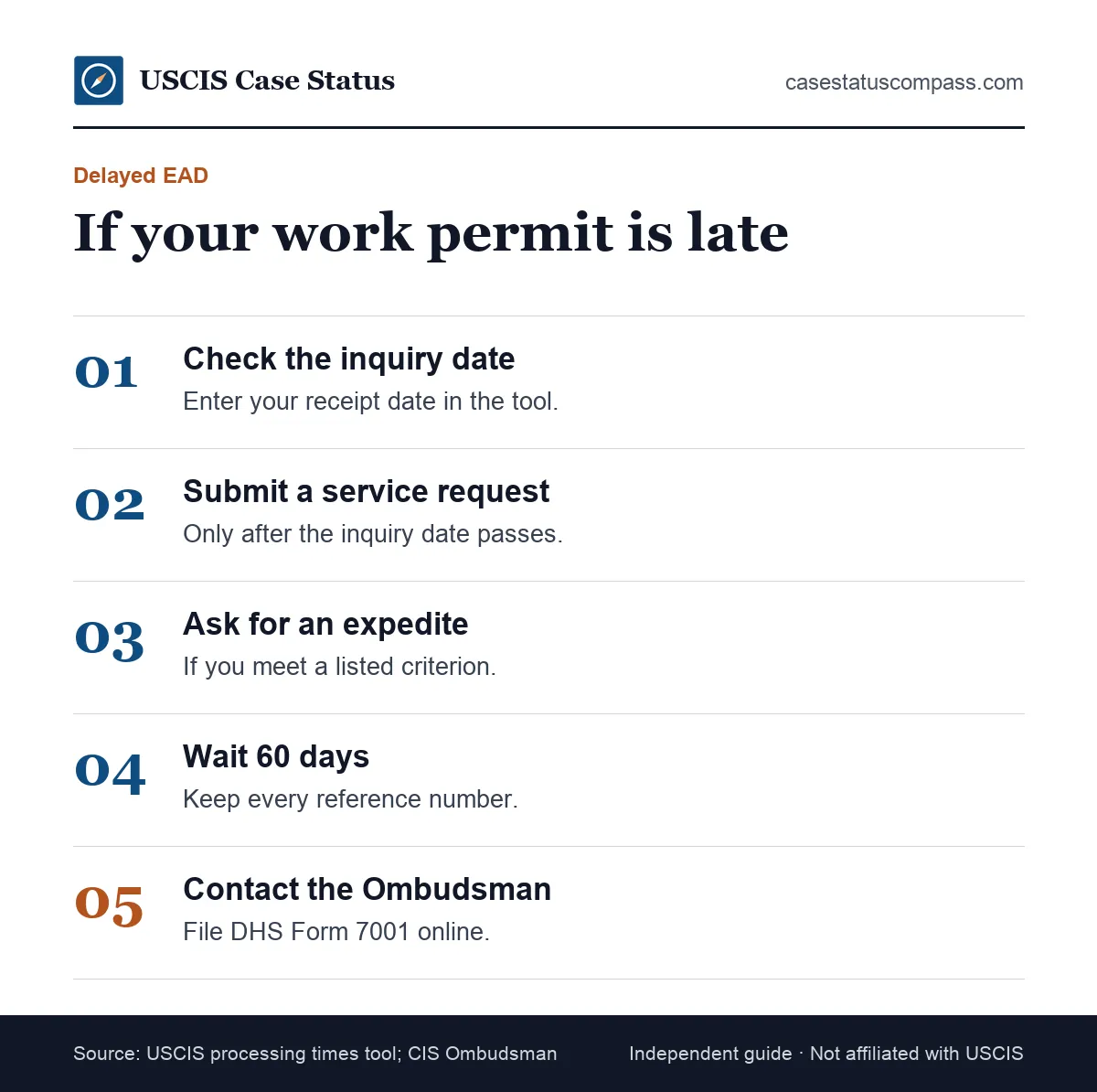
If your work permit is past its case inquiry date, submit a service request, ask for an expedite if you qualify, and keep records. If USCIS has not fixed the delay after 60 days, contact the CIS Ombudsman. A member of Congress can also ask about your case.
Steps in order
- Confirm the case inquiry date in the tool.
- Submit a service request online or call 800-375-5283.
- Request an expedite if you meet a criterion.
- Wait at least 60 days and keep reference numbers.
- Contact the Ombudsman.
The Ombudsman and Congress
Use the Ombudsman only after contacting USCIS within 90 days and waiting at least 60 days. See our CIS Ombudsman and congressional inquiry guide for both routes.
Write down the date of each USCIS contact, because the Ombudsman timing in the rule above is counted from those dates.
Work Permit Case Status Messages and What They Mean for Timing
Your case status shows the stage, not the date. "Case Was Received" starts the clock, "Case Was Approved" ends the decision stage, and "New Card Is Being Produced" and "Card Was Mailed To Me" cover the last step. Long gaps between updates are normal.
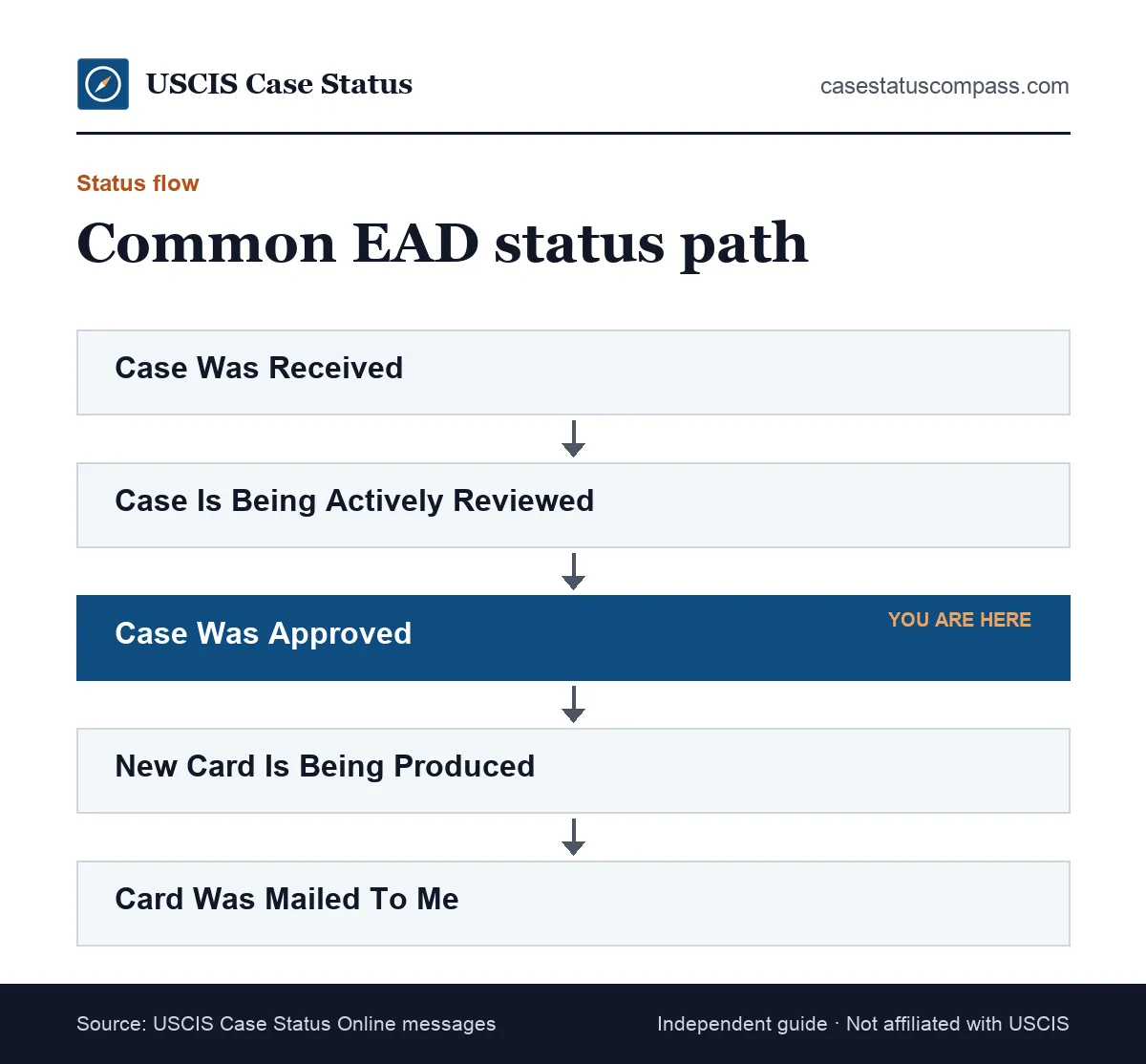
When nothing changes for weeks
Silence between updates is common for EAD cases. Our page on a case status that is not updating explains when to act.
Compare your receipt date with the tool before calling.
Reading the final updates
Once the card is mailed, the online status may show tracking details. Read our card was mailed status guide for what to do if it does not arrive.
If tracking shows delivery but no card reached you, ask your local post office before contacting USCIS.
How Long After Approval Does the EAD Card Arrive?
After approval, USCIS produces the card and mails it. The medians stop at the decision, so card production and delivery add extra days. A wrong or outdated mailing address is the biggest risk at this stage.
Update your address before approval if you move.
Production and mailing
The "New Card Is Being Produced" update means the card is being made. "Card Was Mailed To Me" means it is on its way.
Watch for each update, and check your mailbox daily once mailed.
If the card does not arrive
Check the address USCIS has on file. If the card was undeliverable, contact USCIS. e-Request: report USCIS typos, missing notices or accommodation needs online.
Ask the post office about held mail too.
Why Do EAD Processing Times Differ by Office?
EAD processing times differ by office because each USCIS office works through its own caseload with its own staff. Two identical Form I-765 filings can finish weeks apart. That is why the processing times tool asks you to pick the office on your receipt notice.
Reading your office
Your receipt notice names the office. Our USCIS service centers guide explains what each one handles.
Pick that office in the tool, even if you live elsewhere, because the case stays there unless USCIS moves it.
Transfers
USCIS can move a case to another office. If you get a transfer notice, use the new office's line in the tool.
Your receipt date stays the same after a transfer.
How Big Is the USCIS Backlog Behind Your EAD?
USCIS had 12.8 million cases pending at USCIS (end of June 2026), across all forms. Work permit applications compete for staff with green card, citizenship and other cases. A large backlog is one reason the (c)(9) EAD median rose from 2.3 to 6.4 months in a year.
What the backlog means for you
A backlog changes the pace for everyone in a line, not your place in it. Filing correctly the first time is still the best defense.
An accurate filing avoids an extra trip through the queue.
Watching for change
Check the newest quarter each time USCIS releases data. A falling median is a sign the backlog is easing.
A rising one means plan for a longer wait, and check the live tool before you set a job start date.
Work Permit Processing Time in the USA Compared With Other Forms
The work permit processing time in the USA is shorter than most green card steps. In April–June 2026, most EADs had a 3.3-month median, while the family I-485 took 7.0 months and advance parole on Form I-131 took 5.8 months. That is why many adjustment applicants get their EAD first.
I-765 vs I-131, I-485 and I-539 medians
| Form | What it is | Median, Apr.–June 2026 |
|---|---|---|
| I-765 (all other) | Work permit | 3.3 months |
| I-765 (pending I-485) | Work permit | 6.4 months |
| I-131 advance parole | Travel permission | 5.8 months |
| I-485 (family) | Green card | 7.0 months |
| I-539 | Status extension | 5.7 months |
The table compares work permit medians with related forms. An all-other EAD finished faster than every other line shown.
Can Green Card Applicants Get a Combo EAD and Advance Parole Card?
Yes, some adjustment applicants receive a combined EAD and advance parole card when USCIS approves both requests. The travel part matters as much as the work part: Traveling while your I-485 is pending abandons it unless you have advance parole (with H/L/V/K exceptions). Ask an attorney before you travel on a combo card.
Planning a Job Start Around EAD Processing Time
Plan a job start around the live tool figure for your category and office, not the median. Add time for card production and mail. Share your receipt notice with the employer early, and agree on a flexible start date if the card is late.
For employees
Tell your employer the receipt date and category. Do not start work in a role that needs the EAD until you have the card.
Keep your HR contact updated on each status change.
For employers
HR teams should track EAD expiration dates and remind staff to renew as early as allowed. Since most automatic extensions ended, a missed renewal now creates a real gap.
Set reminders well before each card expires.
Common Work Permit Timing Mistakes
The costliest work permit mistakes are filing an old edition, choosing the wrong category code, paying the wrong fee, missing biometrics and filing a renewal late. Each one can add months or cause a work gap. A checklist before mailing prevents most of them.
Filing mistakes that cause a rejection or RFE
Filing an edition other than 08/21/25.
Leaving out an H.R. 1 add-on fee.
Picking a category code that does not match your basis.
Sending an unsigned form or leaving out the required photos.
Timing mistakes that cause a work gap
Missing the first biometrics date.
Filing a renewal close to expiry.
Asking about a delay before the inquiry date.
Moving without updating your address.
Planning a start date around the median alone.
Work Permit Processing Time Quick Reference
This table gathers the key work permit timing facts in one place: the four USCIS medians for April–June 2026, the 2025 comparison, the 30-business-day OPT premium clock and the October 30, 2025 automatic extension change.
Each row names its period, so read the date before comparing a figure with what the live tool shows today.
EAD timing facts at a glance
| Item | Figure | Source and date |
|---|---|---|
| Most categories | 3.3 months | USCIS data, Apr.–June 2026 |
| Pending I-485 | 6.4 months (was 2.3) | USCIS data, 2025 vs 2026 |
| DACA | 4.1 months | USCIS data, Apr.–June 2026 |
| Asylum applicant | 0.8 months | USCIS data, Apr.–June 2026 |
| OPT premium | 30 business days, $1,780 | USCIS; G-1055 10/16/26 |
| Automatic extension | Ended Oct. 30, 2025 for most | DHS final rule, Oct. 14, 2026 |
The table lists each key timing fact with its source and date. Check the source column before relying on any figure.
Keeping it current
Medians change quarterly and the tool more often. Note the date you check each figure.
Recheck the live tool before any big decision, such as a job start or a trip.
What This Guide Can and Cannot Tell You
This guide explains official USCIS timing data for Form I-765 and how to read it. It cannot predict your card date and is not legal advice. For eligibility, denials or work gaps, talk to an immigration attorney or a DOJ-accredited representative.
Independent, not USCIS
USCIS Case Status is an independent guide. We never see your case. Our USCIS processing times hub covers every form, including PERM processing time for employment cases and how long naturalization takes for later steps.
Frequently Asked Questions
How long does it take to receive a work permit after approval?
After USCIS approves Form I-765, it produces the card and mails it. The official medians stop at the decision, so delivery adds extra days. Watch for "New Card Is Being Produced" and "Card Was Mailed To Me," and keep your mailing address current with USCIS.
Is OPT approval faster with premium processing?
With premium processing, USCIS must act on an OPT application within 30 business days for a $1,780 fee. Without premium, there is no OPT-specific median. The nearest official figure is the 3.3-month median for "all other" EAD categories in April to June 2026.
How long is the H-4 EAD approval time in 2026?
USCIS does not publish a separate H-4 EAD median. The nearest official figure is the 3.3-month "all other categories" median for April to June 2026. If you filed with Form I-539, the I-539's 5.7-month median may set the pace. Premium processing is not available.
Why is my work permit taking longer than the median?
The median is a midpoint, so half of cases take longer. Common reasons include an RFE, a busy office, a linked I-485 or I-539, or missed biometrics. Your case is outside normal processing time only after the case inquiry date shown in the official tool.
Can I work while my EAD renewal is pending?
For most renewals filed on or after October 30, 2025, there is no automatic extension, so you may have to stop working when your card expires. TPS and STEM OPT have exceptions. Our automatic extension guide covers the details; ask an attorney if you face a gap.
Is the EAD faster with a pending asylum case?
Yes. Pending asylum applicants had the fastest work permit median, 0.8 months, in April to June 2026. You only benefit from that speed after you become eligible to file. H.R. 1 fees also apply to asylum-based EADs and cannot be waived.
Does filing online make my work permit faster?
USCIS does not publish separate medians for online and paper Form I-765 filings. Online filing can avoid mail time and some errors, and the online fee is lower for many categories. The processing queue for your category and office still sets the main wait.
How long does it take to get a work permit for a green card applicant?
Green card applicants filing in category (c)(9) had a median of 6.4 months in April to June 2026, up from 2.3 months a year earlier. That is longer than most other EAD categories, so file Form I-765 early and plan any job start around the live tool figure.
How can I track my H-4 EAD?
Track an H-4 EAD with the receipt number on your Form I-797C in USCIS's Case Status Online tool, and compare your receipt date with the I-765 line for your office in the processing times tool. No outside H4 EAD tracker sees more than that.
Sources
- USCIS Check Case Processing Times. egov.uscis.gov/processing-times/. Accessed Oct 27, 2026.
- USCIS Immigration and Citizenship Data (quarterly processing times). www.uscis.gov/tools/reports-and-studies/immigration-and-citizenship-data. Accessed Oct 27, 2026.
- USCIS: I-765, Application for Employment Authorization. www.uscis.gov/i-765. Accessed Oct 27, 2026.
- USCIS: How Do I Request Premium Processing?. www.uscis.gov/forms/all-forms/how-do-i-request-premium-processing. Accessed Oct 27, 2026.
- USCIS Form G-1055 Fee Schedule. www.uscis.gov/g-1055. Accessed Oct 27, 2026.
- USCIS: Expedite Requests. www.uscis.gov/forms/filing-guidance/how-to-make-an-expedite-request. Accessed Oct 27, 2026.
- CIS Ombudsman: Submit a Case Assistance Request. www.dhs.gov/topic/cis-ombudsman/7001. Accessed Oct 27, 2026.
- USCIS Data Library: All USCIS Application and Petition Form Types, FY2026 Q3 (Apr. 1-June 30, 2026; queried 7/2026). www.uscis.gov/sites/default/files/document/data/quarterly_all_forms_fy2026_q3_v1.xlsx. Accessed Oct 27, 2026.
- CIS Ombudsman tip sheet: Check Your USCIS Case Inquiry Date (Aug. 2024). dhs.gov/sites/default/files/2024-11/24_0823_cisomb_case-inquiry-date-tip-sheet.pdf. Accessed Oct 27, 2026.
- USCIS: Preparing for Your Biometric Services Appointment (updated 04/30/2026). www.uscis.gov/forms/filing-guidance/preparing-for-your-biometric-services-appointment. Accessed Oct 27, 2026.
- USCIS Form G-1055 Fee Schedule, Edition 10/16/26. www.uscis.gov/sites/default/files/document/forms/g-1055.pdf. Accessed Oct 27, 2026.
- USCIS: Automatic EAD Extension (updated 10/29/2025). www.uscis.gov/working-in-the-united-states/information-for-employers-and-employees/automatic-employment-authorization-document-ead-extension. Accessed Oct 27, 2026.
- Federal Register (govinfo), FR Doc. 2026-20955, 91 FR 65306-65368, RIN 1615-AD05. www.govinfo.gov/content/pkg/FR-2026-10-14/html/2026-20955.htm. Accessed Oct 27, 2026.
- USCIS: DACA page (updated 01/24/2025). www.uscis.gov/DACA. Accessed Oct 27, 2026.
- 8 CFR 103.2(b)(8)(iv) (LII). www.law.cornell.edu/cfr/text/8/103.2. Accessed Oct 27, 2026.
- USCIS Policy Manual Vol. 1, Part E, Ch. 6 (current as of Oct. 23, 2026). www.uscis.gov/policy-manual/volume-1-part-e-chapter-6. Accessed Oct 27, 2026.
- USCIS: How to Change Your Address (updated 08/04/2026); 8 U.S.C. 1305(a) (LII). www.uscis.gov/addresschange. Accessed Oct 27, 2026.
- USCIS Contact Center (uscis.gov). www.uscis.gov/contactcenter. Accessed Oct 27, 2026.
- DHS CIS Ombudsman: How to Submit a Case Assistance Request (updated 04/13/2026). www.dhs.gov/case-assistance. Accessed Oct 27, 2026.
- Form I-485 Instructions, Edition 09/18/26. www.uscis.gov/sites/default/files/document/forms/i-485instr.pdf. Accessed Oct 27, 2026.
casestatuscompass.com is an independent publication and is not affiliated with USCIS or any government agency. This page is general information, not legal advice. For denials, court or asylum matters, consult an immigration attorney or a DOJ-accredited representative.