Contents · 38 sections
- Current I-751 Processing Time
- How Long Is the I-751 Processing Time in 2026?
- How Has the Removal of Conditions Wait Changed?
- How Many I-751 Petitions Are Pending?
- Median vs 80% Figure: Two Ways to Measure I-751 Processing Time
- How Do You Read the USCIS Tool for Form I-751?
- Processing by Office
- How Long Does I-751 Approval Take at Vermont or a Field Office Like Cleveland?
- What Does Your Receipt Prefix Say About Where Your Petition Sits?
- Removal of Conditions Green Card Timeline, Stage by Stage
- I-751 Timeline Estimator: Plot Your Own Milestones
- How Long After Biometrics Is the I-751 Decided?
- Does an Interview Make Removal of Conditions Take Longer?
- What Slows Down an I-751 Petition?
- Do Waiver Cases Take Longer Than Joint Petitions?
- What If Your Divorce Is Not Final When You File?
- How Does a Request for Evidence Change Your Wait?
- Your Status While Waiting (Receipt Notice Extension)
- What If Your I-751 Takes Longer Than 48 Months?
- Can You Work and Prove Status During the Wait?
- Can You Apply for Citizenship While the I-751 Is Pending?
- Is There Premium Processing for Form I-751?
- Can You Expedite a Removal of Conditions Petition?
- How Do You Know If Your I-751 Is Normal or Overdue?
- What to Do When Your I-751 Is Outside Normal Processing Time
- When Is It Time to Involve the Ombudsman or Your Representative?
- How Do You Track Your Removal of Conditions Case?
- What Do Long Gaps Between Status Updates Mean?
- Does Filing Online Make the I-751 Faster?
- How Does the I-751 Wait Compare With Other USCIS Forms?
- How Should You Plan Your Life Around a Two-Year Wait?
- Waiting Scenarios: Three Conditional Residents
- If X, Do Y: I-751 Wait Decision Table
- What Mistakes Make the Removal of Conditions Wait Longer?
- When Should You Get Legal Help During a Long Wait?
- How Long Until the 10-Year Card Arrives After Approval?
- What If Your 10-Year Card Comes Back to USCIS?
- Frequently Asked Questions
At a glance
| Latest official median | I-751: median 22.6 months (USCIS data, Apr.-June 2026) |
| Live estimate for your office | 36 months (USCIS data retrieved Oct 27, 2026) |
| Status while waiting | I-751 receipt notice extends conditional status and work authorization for 48 months |
| Premium processing | Not available for Form I-751 |
| Who runs this site | An independent guide. We are not USCIS and cannot see your case. |
This page covers only how long removal of conditions takes. For eligibility, evidence and filing steps, see our I-751 petition guide. For waits on every form, start at the USCIS processing times hub.
Current I-751 Processing Time
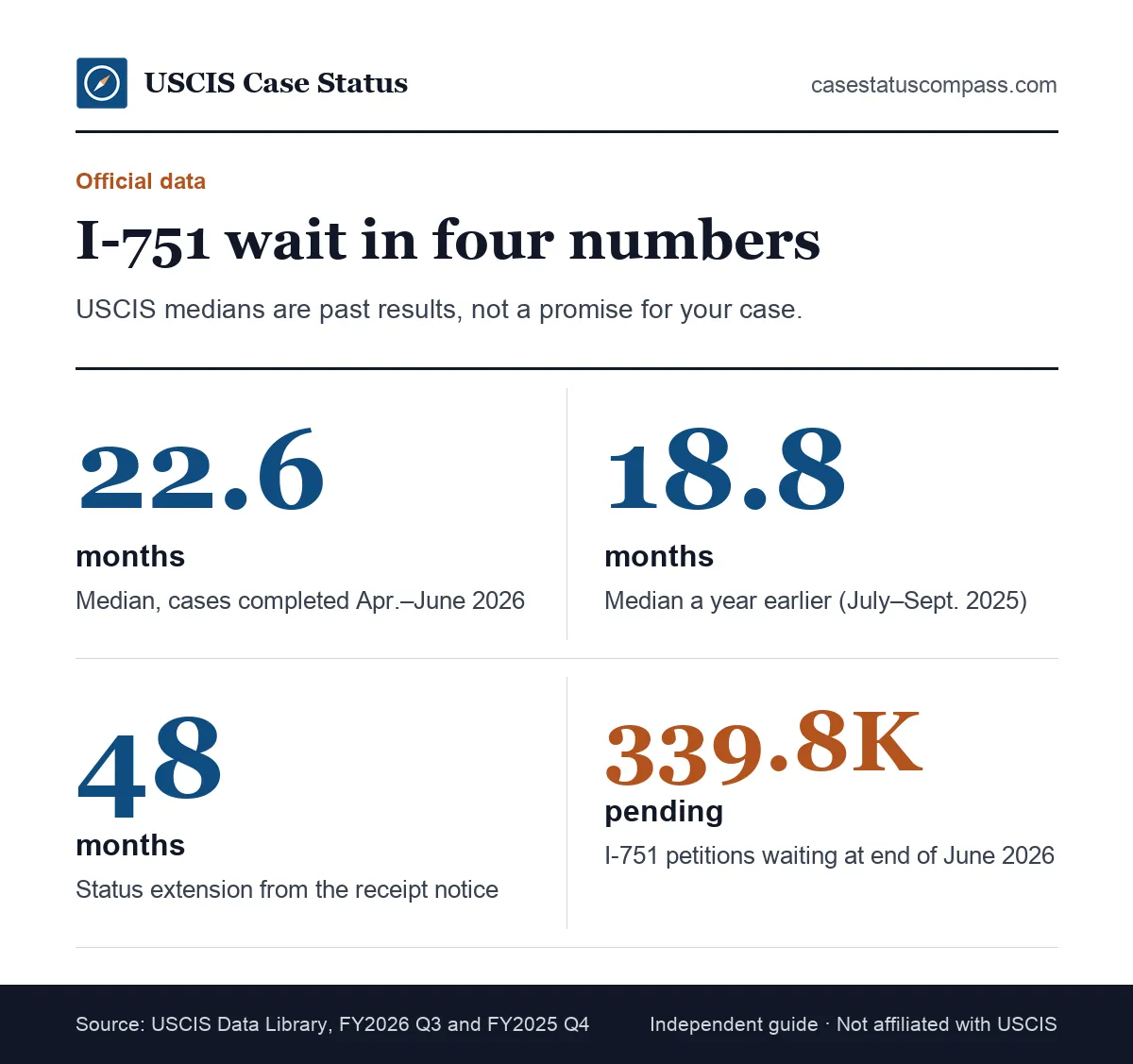
The current I-751 processing time, measured as the USCIS median, was 22.6 months for cases completed April 1 to June 30, 2026. Half of those petitions took longer. The live USCIS tool posts a separate office-level figure based on 80% of recent cases.
The official median for April–June 2026
USCIS publishes quarterly results in its Data Library. The latest line reads: I-751: median 22.6 months (USCIS data, Apr.-June 2026). It counts months from receipt to completion for every petition finished in that quarter. It looks back; it does not forecast a petition you filed last month.
What the live tool says for your office
The live tool is updated more often and split by office. Right now, the tool reports 36 months (USCIS data retrieved Oct 27, 2026). When it differs from the median, the cause is usually the different share of cases each one measures, not an error.
| Category | Office | 80% of cases completed within |
|---|---|---|
| Removal of lawful permanent resident conditions (spouses of U.S. citizens and lawful permanent residents) | All Field Offices | 36 months |
How Long Is the I-751 Processing Time in 2026?
In 2026, removal of conditions usually takes close to two years from filing to decision. USCIS's median for April–June 2026 was 22.6 months. Plan for about two years, and treat a wait well past that as a reason to check the case inquiry date.
The median versus your own case
A median is the middle result. If USCIS finished 10 petitions, the fifth or sixth marks the median. A clean joint petition often lands on the early side. A waiver, an evidence request or an interview usually pushes a case later.
Why half of the petitions took longer
USCIS quarterly data reports the median: half of the cases completed that quarter took longer. So "22.6 months" means many conditional residents waited longer. At month 20 with no decision, you are not unusual. You are in the slower half of a busy queue.
How Has the Removal of Conditions Wait Changed?
The I-751 processing time has grown. USCIS's median for July–September 2025 was 18.8 months. By April–June 2026 it reached 22.6 months, almost four months longer. A large pending backlog suggests the wait will not shrink quickly. Build that rise into your plans.
From 18.8 to 22.6 months in a year
USCIS's comparison line reads: A year earlier (July-Sept. 2025): N-400 5.7 mo; I-751 18.8 mo; I-130 IR 13.7 mo; I-485 family 6.0 mo. The rise matches a wider slowdown, since the N-400 median also climbed. If a friend filed in 2024 and finished fast, do not plan around their dates.
How Many I-751 Petitions Are Pending?
12.8 million cases pending at USCIS (end of June 2026). Of those, USCIS listed 339,830 I-751 petitions pending at the end of June 2026. In a queue that size, most offices work through older receipts first, so new filings join the back of the line. The live tool's figure for your office shows how that backlog affects your own wait.
Median vs 80% Figure: Two Ways to Measure I-751 Processing Time
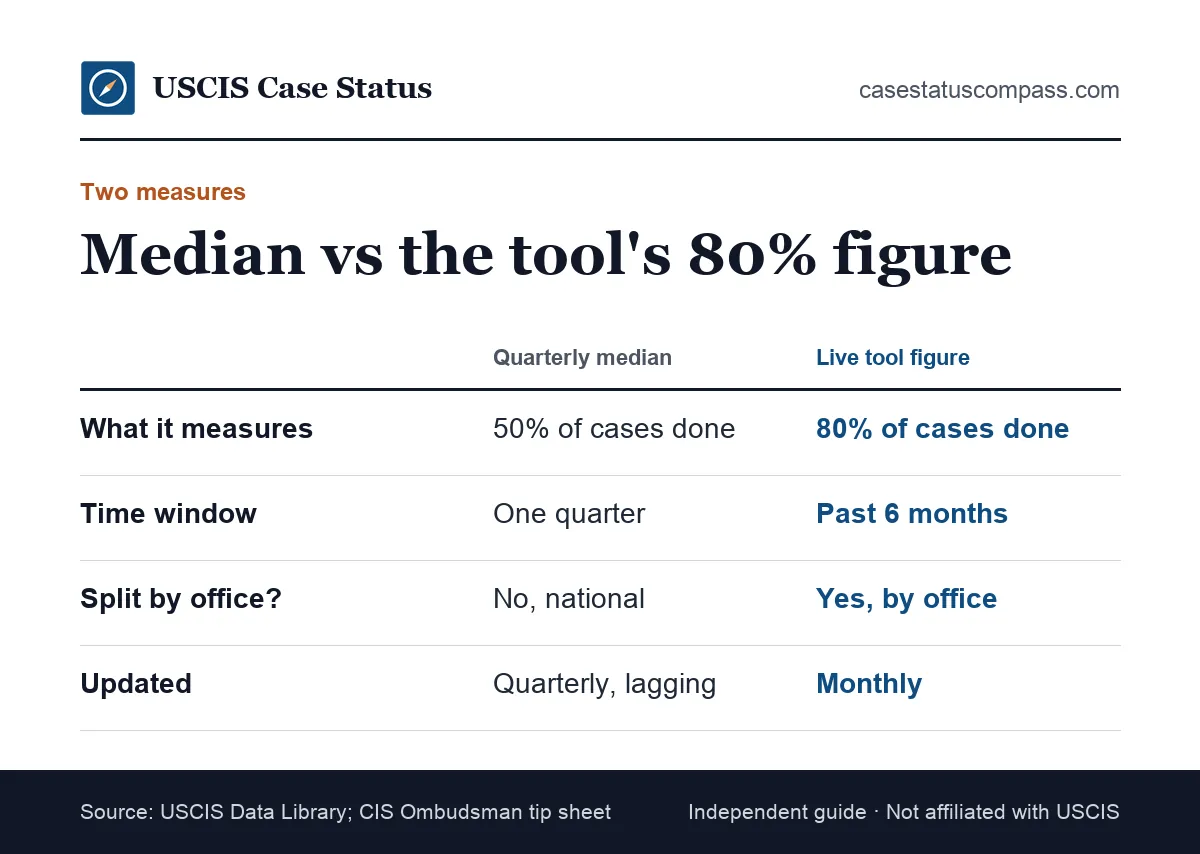
USCIS publishes two measures. The Data Library median shows when half of completed cases finished in one quarter. The live tool shows how long it took to finish 80% of cases over six months, by office. The tool figure is almost always longer.
What each number answers
Find your question in the first column; the second names the figure that answers it.
| Question you have | Use this number | Why |
|---|---|---|
| "What is a typical wait nationally?" | Data Library median | Middle case, all offices combined |
| "How long could my office take?" | Live tool figure | Office-specific; covers most cases |
| "Is my case overdue?" | Case inquiry date | The date USCIS uses for inquiries |
| "When will my case be decided?" | None of them | No figure predicts one case |
Only the inquiry date tells you when you may contact USCIS.
How the tool figure is built
The USCIS tool shows how long it took to finish 80% of cases in the past 6 months. USCIS adds that this figure does not show how soon it will act on your case. Use it to set expectations, and use the inquiry date to decide when to contact USCIS.
How Do You Read the USCIS Tool for Form I-751?
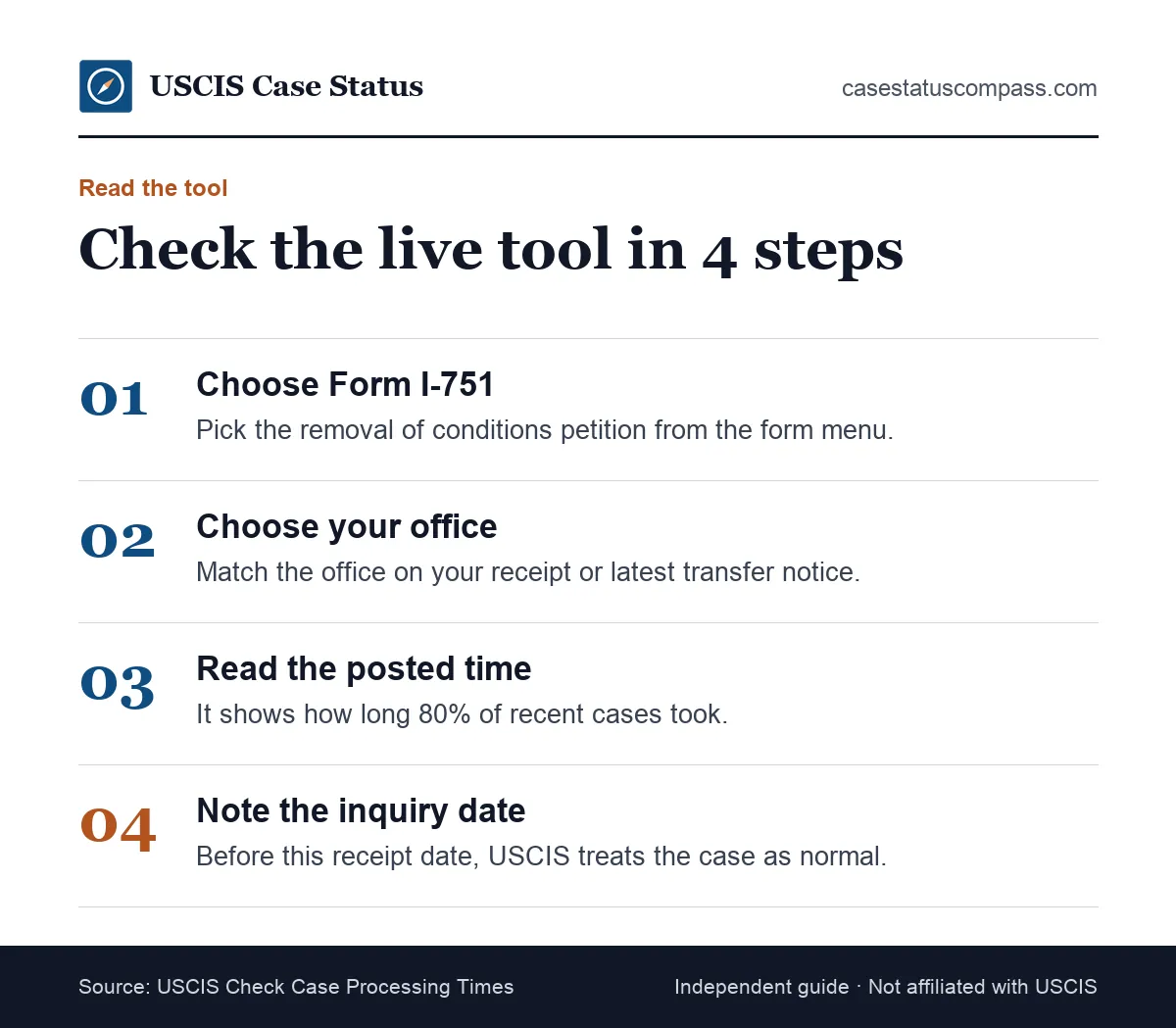
Open the official tool at egov.uscis.gov/processing-times, choose Form I-751, then choose the office handling your case. The page shows the posted time and a case inquiry date. Compare your receipt date with that inquiry date. The tool is free and needs no login.
Choosing the right office
Pick the office on your receipt notice or newest transfer notice, not one you guess from your address. If your case moved to a field office for an interview, select that office. The wrong office gives you a number that does not apply.
Reading the result page
The result shows the posted time and a "Receipt date for a case inquiry." If your receipt date is earlier, you may ask USCIS about the delay. If it is later, USCIS still treats your petition as normal.
Processing by Office
Form I-751 petitions are handled first by USCIS service-center operations, and some move to a local field office when an interview is needed. Each office has its own staffing and backlog, so posted times differ. Always check the office that holds your file today.
Service centers and field offices
USCIS names five service centers: Five USCIS service centers: California, Nebraska, Potomac, Texas and Vermont. Many petitions are decided on paper there. A field office is a local USCIS office that holds interviews for the area you live in.
Why two offices can differ by months
Offices get different volumes and gain or lose staff at different times. A transfer can add time because the receiving office queues your file behind its own older cases. Our USCIS service centers guide explains each center's role.
How Long Does I-751 Approval Take at Vermont or a Field Office Like Cleveland?
We have no verified office-level figure yet, so check the live tool for the Vermont Service Center or your field office, such as Cleveland. The national median was 22.6 months for April–June 2026. Field office cases often run longer because they add an interview.
How long to get I-751 approval at the Vermont Service Center
An EAC receipt prefix means the Vermont Service Center first received your petition, according to a USCIS legislative-affairs guide. That shows where the file started, not where it is now. Select the office on your newest notice in the tool.
How long to get I-751 approval at a field office such as Cleveland
A Case Was Transferred update or interview notice means a field office like Cleveland holds your case. Its time includes waiting for an interview slot. Our Case Was Transferred meaning page explains that update.
What Does Your Receipt Prefix Say About Where Your Petition Sits?
The three-letter prefix on your receipt number shows which office or channel first accepted the petition. EAC is Vermont, WAC is California, LIN is Nebraska, SRC is Texas, and IOE means you filed online. Later transfers can change where the work happens.
Why the prefix is not your current office
USCIS shifts work between centers to balance loads. An EAC petition can be reviewed elsewhere and then interviewed locally. So use the prefix as history and the newest notice as your current location.
Reading the rest of the number
The prefix is followed by 10 digits. Our receipt number guide shows how to read the full 13-character number and enter it without dashes in Case Status Online. Copy it exactly.
Removal of Conditions Green Card Timeline, Stage by Stage
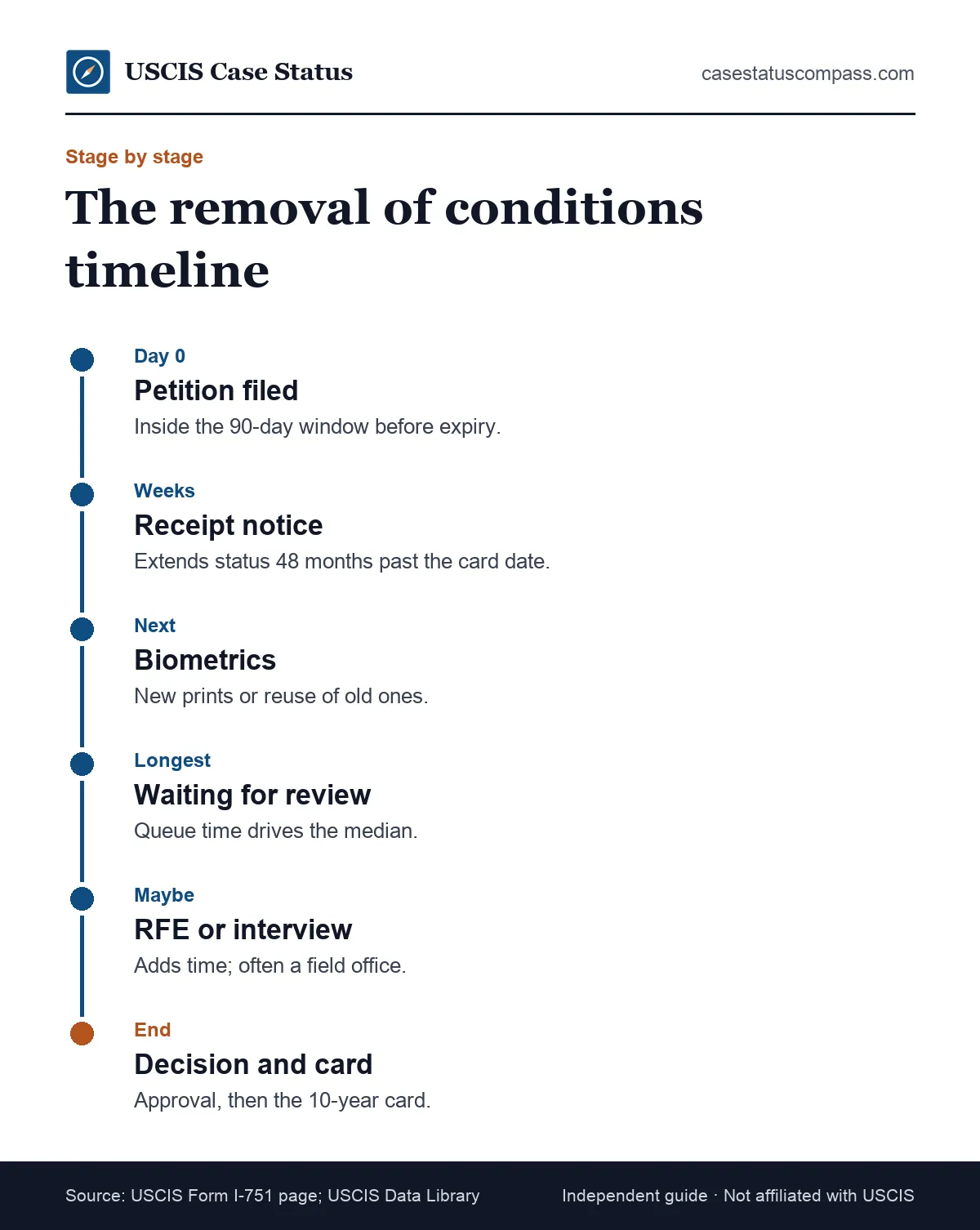
The removal of conditions green card timeline runs from filing, to the receipt notice, to biometrics, to a long wait for officer review, then a decision. An evidence request or interview adds a stage. The queue before review is the longest part.
Filing and the receipt notice
You file in the window: File in the 90 days before your 2-year card expires. USCIS then mails a Form I-797C. I-797C = Notice of Action (receipt, rejection, transfer, appointment, re-open); not proof of status by itself. Our I-797C notice guide shows each field.
Biometrics, review and decision
USCIS schedules fingerprints or reuses earlier ones. The file then waits for an officer, who approves, sends a Request for Evidence (RFE), or sends the case for an interview. After approval, USCIS mails the 10-year card.
Removal of conditions stages and time drivers
Read the rows in order; the last column shows what usually sets the pace at each stage.
| Stage | What happens | What controls the time |
|---|---|---|
| Filing | Petition reaches USCIS | Your date in the 90-day window |
| Receipt notice | I-797C mailed | Intake volume |
| Biometrics | Prints taken or reused | Appointment availability |
| Queue | File waits for an officer | Office backlog (longest stage) |
| RFE or interview | Extra proof or a meeting | Your reply speed; slot availability |
| Decision and card | Approval, production, mailing | Card production and mail |
The review queue is the stage that adds the most months.
I-751 Timeline Estimator: Plot Your Own Milestones
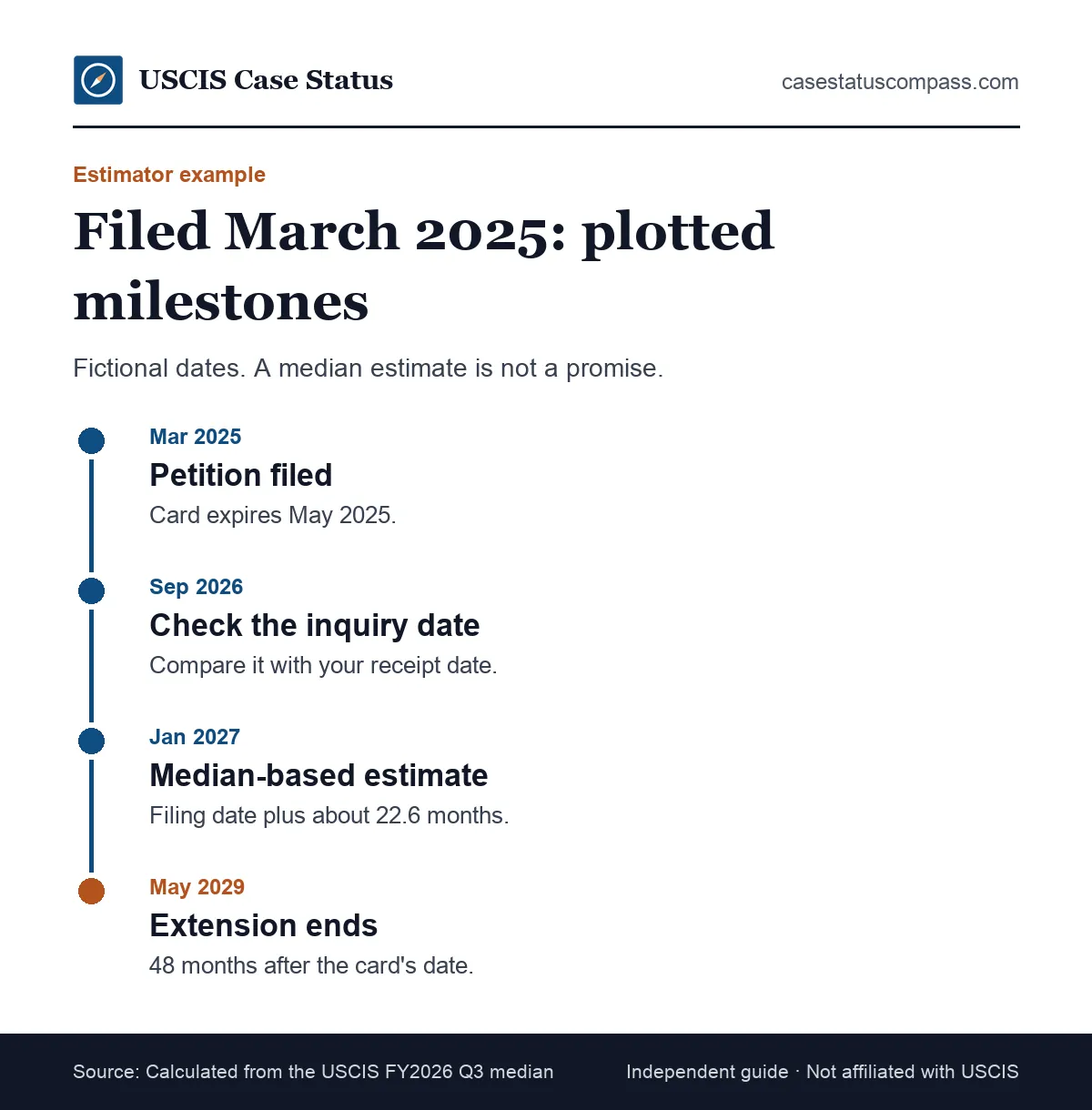
Estimate your milestones with three dates: your receipt date, your card's expiration date and the current median. Add the median to the receipt date for a rough decision month. Add 48 months to the card's date to find when your extension ends.
How to use the estimator
- Note the receipt date on your I-797C.
- Note the expiration date on your 2-year card.
- Add 22.6 months to the receipt date.
- Add 48 months to the card date.
- Check the tool's inquiry date each month.
A worked example with fictional dates
The table runs one invented couple's dates through the estimator, step by step.
| Milestone | How to calculate it | Ana's example |
|---|---|---|
| Receipt date | From your I-797C | Mar 1, 2025 |
| Median-based estimate | Receipt date + 22.6 months | About mid-Jan 2027 |
| Extension end | Card date (May 10, 2025) + 48 months | May 10, 2029 |
| Plan B date | 6 months before extension end | Nov 2028 |
Replace each fictional date with yours; the extension end date matters most.
How Long After Biometrics Is the I-751 Decided?
There is no fixed gap between biometrics and a decision. Biometrics usually happen early, and most of the I-751 processing time comes afterward while the file sits in the review queue. Many petitioners wait more than a year after fingerprints before any new update.
Biometrics reuse is not a speed signal
A biometrics reuse notice saves you a trip, but it does not move you up the line. Our biometrics appointment guide explains what happens at the Application Support Center. Bring your notice.
What the quiet months mean
Silence after fingerprints is normal; background checks and the queue run without public updates. Our guide on how long after biometrics for an interview covers typical gaps for interview-based forms.
Does an Interview Make Removal of Conditions Take Longer?
Yes, an interview usually adds time. USCIS decides many petitions on paper, but thin evidence, a waiver or conflicting facts can send a case to a field office. The file then waits for a local interview slot before a decision.
When USCIS waives the interview
USCIS may approve without meeting you when joint records are strong and consistent. A waived interview is the fastest path, but you cannot request it; the officer decides from the file.
When the case goes to a field office
USCIS transfers the case and mails a notice with the date and place. Both spouses usually attend a joint case. Our green card interview guide covers common questions. Bring originals.
What Slows Down an I-751 Petition?
The main causes of a slow removal of conditions case are office backlog, weak evidence, requests for evidence, interviews, waiver filings, address problems and background check holds. A complete, organized package removes the most common avoidable delays. Check it twice.
Factors you can control
- Complete evidence: joint leases, bank records, tax returns, children's birth certificates
- Clear organization: tabs and an index
- Current address: a missed notice can stall the case
- Fast replies: answer an RFE early
Factors you cannot control
Staffing, policy shifts and the national backlog are outside your hands. Background checks can also hold a case silently. For these delays, watch the inquiry date rather than refiling or sending repeat letters.
Do Waiver Cases Take Longer Than Joint Petitions?
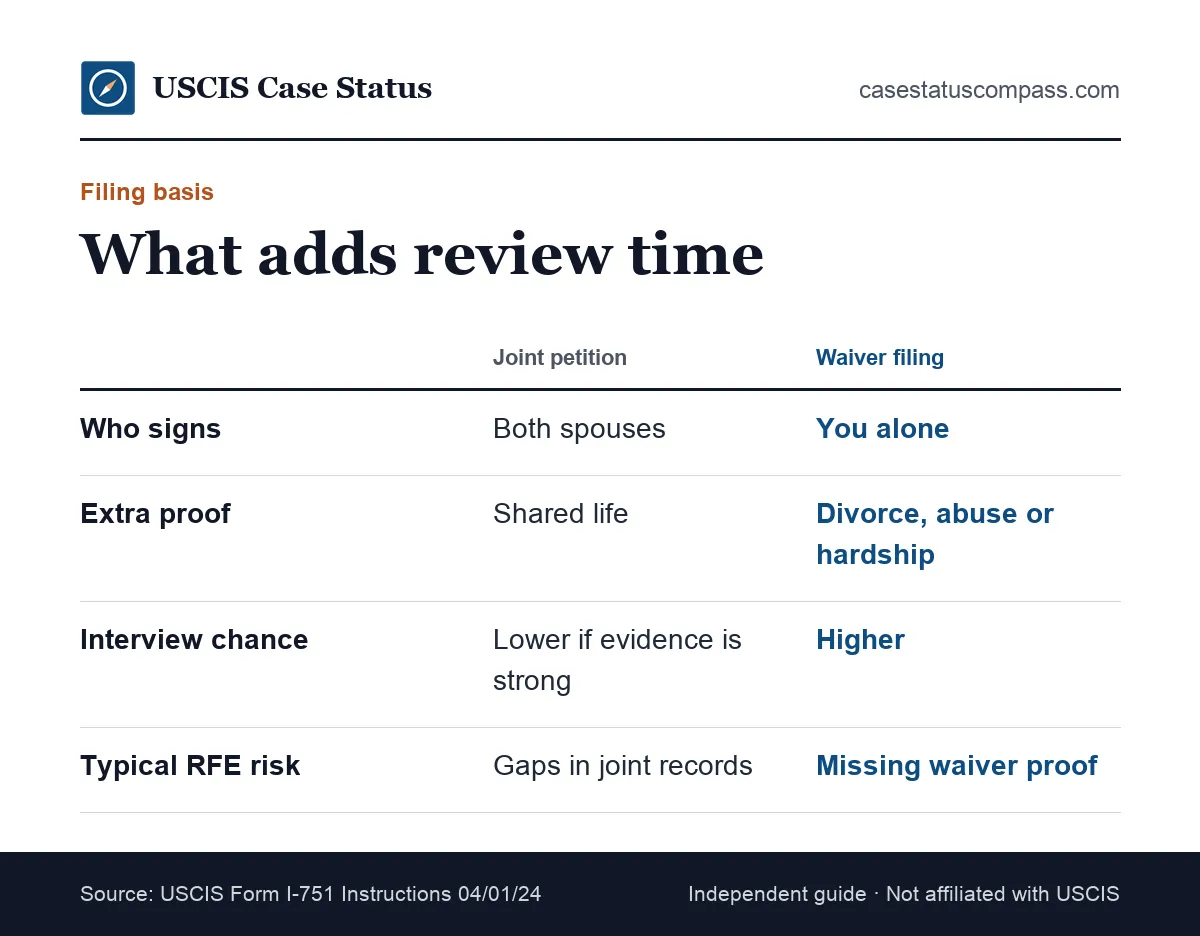
Waiver filings often take longer than joint petitions because the officer must judge more facts. The grounds are fixed: you can file I-751 alone if your spouse died, you divorced, you were abused, or removal would cause extreme hardship. Each needs proof of the waiver ground and of a good-faith marriage, which makes an interview or RFE more likely.
Why waivers need more review
In a joint petition, both spouses sign. In a waiver, you file alone and must prove why. The officer reviews court papers, declarations or hardship evidence, and missing pieces lead to an RFE.
What If Your Divorce Is Not Final When You File?
File on time anyway. If the divorce is not final when you file, USCIS may ask for the final decree, so expect the case to stay open until you can send it, which can add an RFE cycle to your I-751 processing time. Our I-751 cover letter and affidavit examples show how filers organize waiver evidence.
How Does a Request for Evidence Change Your Wait?
A Request for Evidence pauses your petition until USCIS receives your reply. The officer cannot finish the case before you answer. A quick, complete response limits the delay; a late or partial one risks denial. The notice lists every item needed.
The RFE deadline
RFE deadline: up to 12 weeks (the exact date is on your RFE); no extensions; the I-539 and I-601A 30-day limit does not apply here. If USCIS mailed the notice, add 3 days to the deadline. Our Request for Evidence guide explains how to answer in one package.
After you respond
The file returns to the officer, but not always at once. Some cases are decided within weeks; others re-enter a queue. Keep proof of delivery so you can show when USCIS received your reply.
Your Status While Waiting (Receipt Notice Extension)
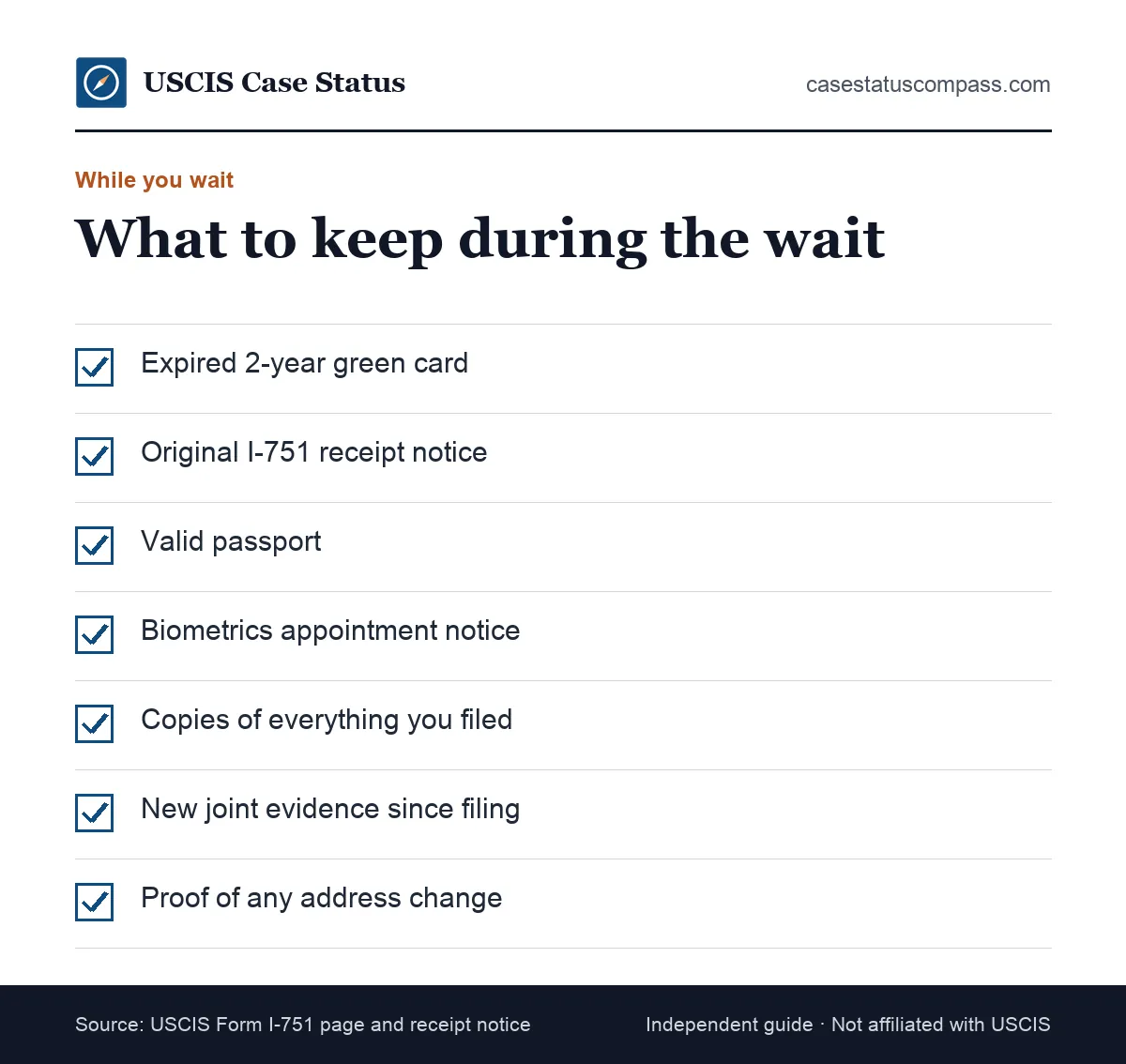
Your I-751 receipt notice extends your conditional resident status for 48 months past the date on your green card. You keep the same rights to live, work and travel. Carry the expired card and the receipt notice together as proof of status.
What the 48-month extension covers
As of October 2026, USCIS states: I-751 receipt notice extends conditional status and work authorization for 48 months. USCIS moved to 48 months in January 2023. Only a properly filed petition earns the extension; a rejected filing gives none.
Using both documents together
Show the expired card and receipt notice together to employers, airlines, border officers and the DMV. Neither paper proves status alone after the card date. Keep the original safe and carry a copy where one is accepted.
What If Your I-751 Takes Longer Than 48 Months?
If your petition is still pending as the extension nears its end, ask USCIS for new proof of status. A temporary I-551 stamp, also called an ADIT stamp, can serve as evidence. Ask early, since appointments take time. Keep the receipt handy.
Getting an I-551 stamp
I-551/ADIT stamp: temporary proof of green card status; request through the USCIS Contact Center (800-375-5283). Our I-551 stamp guide explains how long it lasts. Bring your receipt notice, passport and expired card.
Plan six months ahead
Set a reminder about six months before the extension ends. That leaves time to call, book and attend. Sort out proof of status before any trip, because an airline may refuse boarding without valid documents.
Can You Work and Prove Status During the Wait?
Yes. You can keep working while removal of conditions is pending. The expired conditional card plus the receipt notice is acceptable proof that your status continues, for Form I-9 reverification and for agencies like the DMV. Keep both documents together.
Employers and Form I-9
Show both documents when HR asks for Form I-9 proof. If HR is unsure, point to the extension wording printed on the notice. Do not accept an offer that requires a 10-year card you do not have yet.
Driver's licenses and other agencies
DMVs often tie license dates to immigration documents, so expect a license that ends with the extension. Banks, landlords and benefit offices may ask for the same pair. Keep spare copies.
Can You Apply for Citizenship While the I-751 Is Pending?
Yes. Many conditional residents file for naturalization before the I-751 is decided. USCIS decides a pending I-751 before or at the same time as the N-400. Filing early does not skip removal of conditions review, but both cases can be handled at once.
The N-400 timing rules
You can file the N-400 up to 90 days before you reach 5 years (or 3 years if married to a U.S. citizen) as a permanent resident. Conditional residence counts toward that period. USCIS must decide a pending I-751 before or at the same time as the N-400. For that wait, see how long does naturalization take.
What a combined decision looks like
The N-400 interview may also cover marriage evidence, so bring proof for both cases. If the I-751 is approved there, the N-400 can continue. If not, the N-400 cannot be approved.
Is There Premium Processing for Form I-751?
No. Premium processing is not available for Form I-751. USCIS offers it only for certain employment and student forms. To speed up removal of conditions, your options are an expedite request or a delay inquiry. Both options are free to use.
Which forms premium processing covers
Premium processing covers I-129 work visas, I-140 (EB-1/2/3), I-765 OPT/STEM OPT and I-539 to F/M/J. Our premium processing guide explains how the paid service works for eligible forms. Form I-751 is not one.
Why paying more cannot help
No fee moves an I-751 ahead in line. Be wary of anyone selling a "fast track" for your petition. Only USCIS sets order and speed, and expedite requests are free.
Can You Expedite a Removal of Conditions Petition?
You can ask USCIS to expedite an I-751, but approval is discretionary. USCIS considers urgent reasons such as severe financial loss, emergencies, humanitarian needs or a clear USCIS error, with proof. A long wait alone is not usually enough. Proof decides.
The expedite criteria
Expedite criteria: severe financial loss, emergency/humanitarian, nonprofit, government interest, clear USCIS error. A typical example is an urgent medical trip abroad when proof of status is about to lapse. Our USCIS expedite request guide covers the evidence officers expect.
How to ask
Ask for an expedite through the USCIS Contact Center or your online account. Explain the need briefly, attach proof, and include your receipt number. If USCIS refuses, you can still use the delay options below once eligible.
How Do You Know If Your I-751 Is Normal or Overdue?
Your I-751 is overdue only when your receipt date is earlier than the case inquiry date in the live tool for your office. Before that, USCIS treats the case as within normal processing, even if it feels slow. Check monthly, because the date moves.
The case inquiry date
Case inquiry date: the earliest date USCIS will accept a question about your pending case; it can change. Compare it with the receipt date on your I-797C, not your mailing date. One day matters.
What "outside normal processing time" means
You can submit an 'outside normal processing time' request only after your case inquiry date. Before that point, inquiries are usually closed with a note that your case is within normal time.
What to Do When Your I-751 Is Outside Normal Processing Time
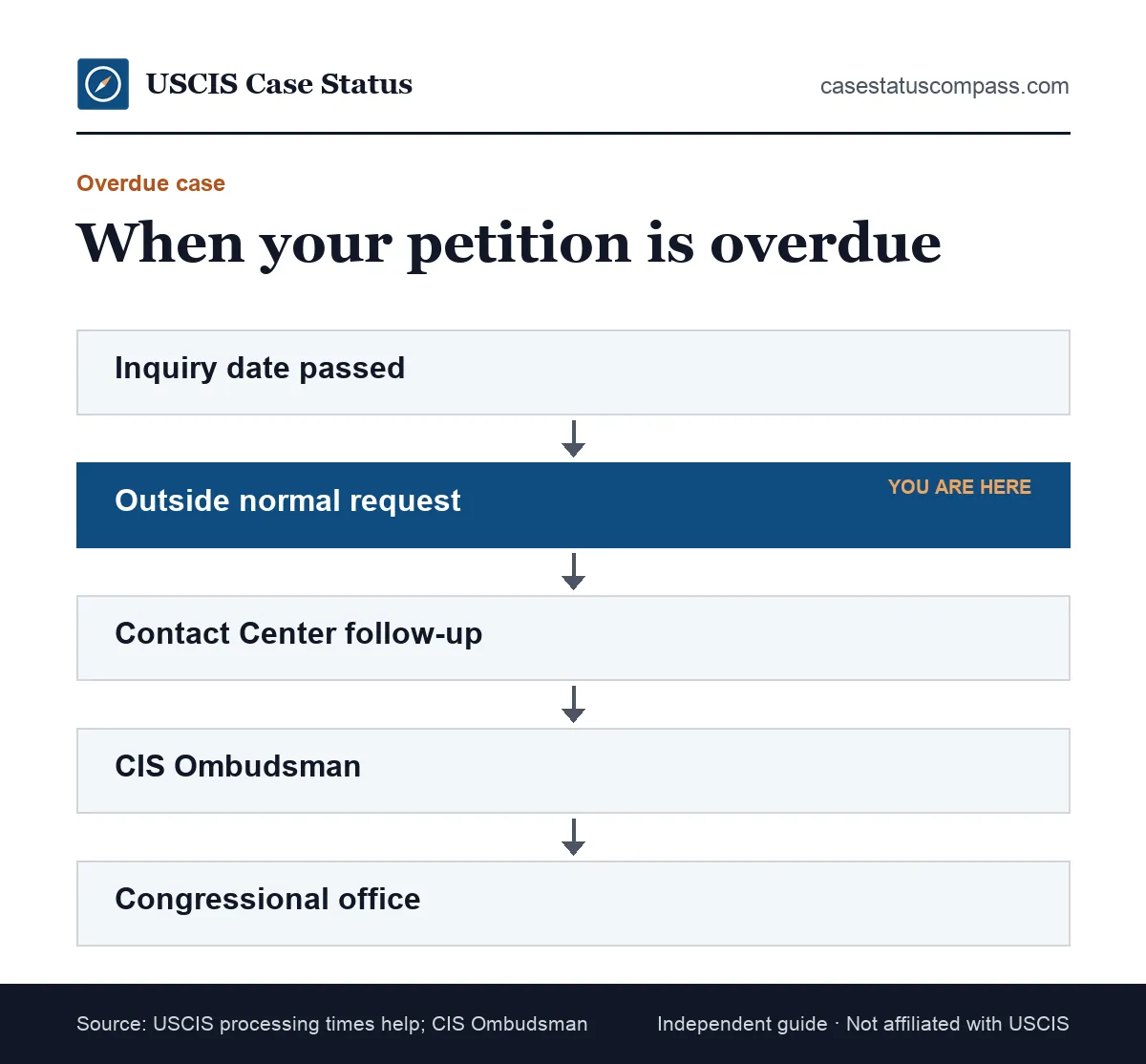
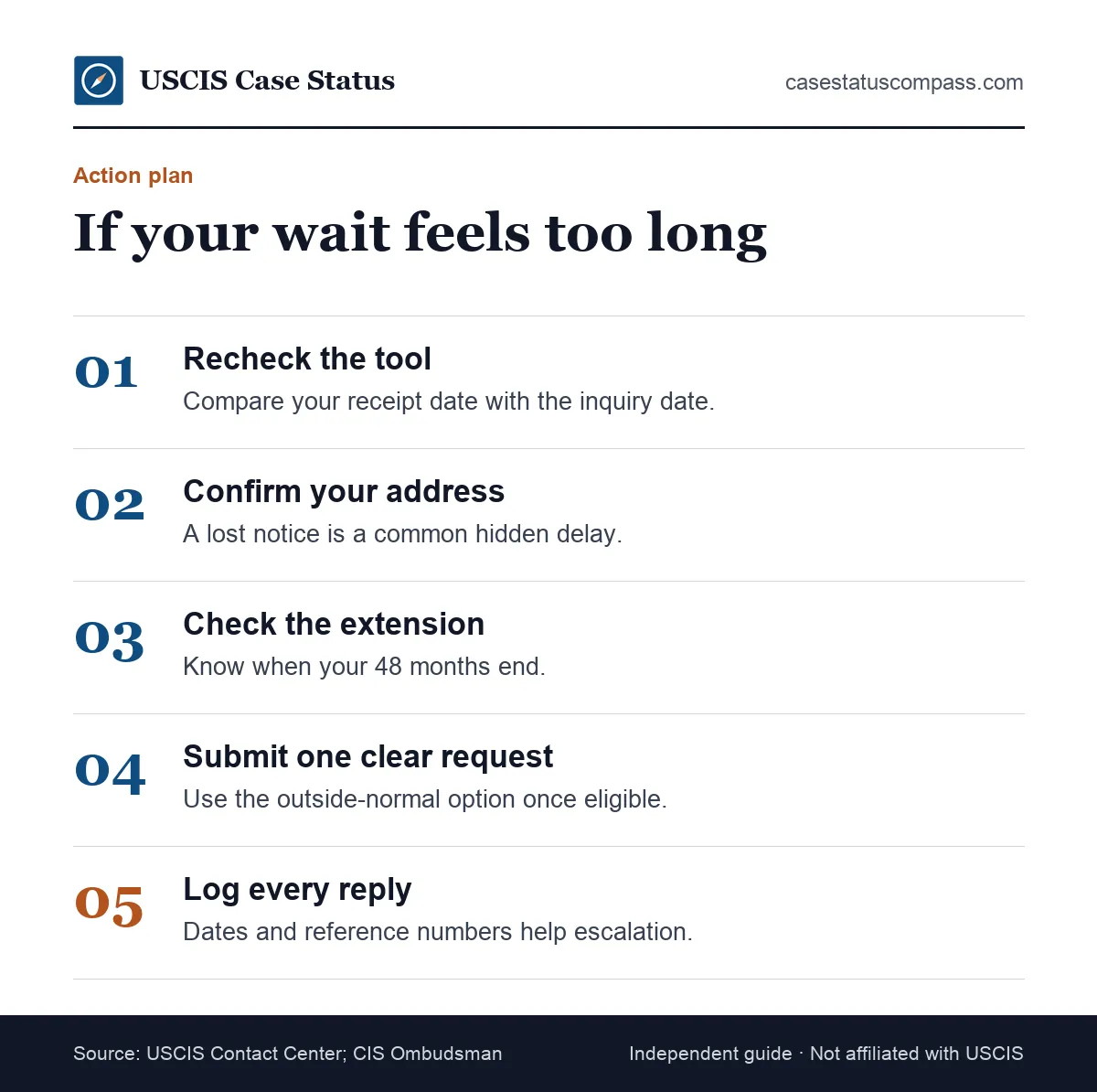
When your petition passes the inquiry date, submit an outside-normal-processing request online, then follow up with the Contact Center if no answer comes. Log every request. Escalate to the CIS Ombudsman or Congress only after USCIS has had time to respond.
Step-by-step
- Confirm your receipt date is before the inquiry date.
- Submit an outside normal processing time request.
- Save the confirmation and wait for a reply.
- If nothing arrives, call 800-375-5283.
- Record names, dates and reference numbers.
What an inquiry can and cannot do
An inquiry can prompt an officer to look at a stuck file or fix a lost transfer. It cannot force approval. See our case status not updating guide and our contact USCIS guide.
When Is It Time to Involve the Ombudsman or Your Representative?
Involve the CIS Ombudsman or your member of Congress only after USCIS has failed to resolve an overdue case. The Ombudsman requires that you contacted USCIS first and waited. A congressional office needs your signed privacy release. Both routes are free.
The CIS Ombudsman
CIS Ombudsman: DHS Form 7001, Request for Case Assistance (online). Use the Ombudsman only after contacting USCIS within 90 days and waiting at least 60 days. Attach your service request reference number.
Your congressional office
Your member of Congress can ask USCIS about your case after you sign a privacy release. Our Ombudsman and congressional inquiry guide compares both options. Use one route at a time.
How Do You Track Your Removal of Conditions Case?
Track your petition with Case Status Online or a free USCIS online account. Both show the latest action. Check every few weeks, not daily; I-751 statuses often stay the same for many months during the queue. Note each change.
Case Status Online and your account
Enter your receipt number at Case Status Online: egov.uscis.gov. An account adds notices and history: Free USCIS online account: case status updates, notices, link paper-filed cases. Link a paper filing with its account access code.
About myProgress estimates
myProgress: personalized estimates in your USCIS online account (I-130, I-485, I-765, I-131, I-821, N-400, I-90). Form I-751 was not on that list at the source date, so you may see no personal estimate. Use the tool and inquiry date instead.
What Do Long Gaps Between Status Updates Mean?
Long gaps are normal for removal of conditions. After biometrics, many cases show no change until an officer acts. A gap usually means the file is still in the queue, not lost. Check the inquiry date before you worry. Silence is common.
A status that has not changed in a year
A year without updates is common in this backlog. Confirm USCIS has your current address, then compare dates. If both check out, waiting is the right step. Keep evidence current.
Updates that signal movement
An RFE, interview notice or transfer usually means an officer opened your file. After approval, the card steps follow, ending with Card Was Mailed To Me. Watch your mail.
Does Filing Online Make the I-751 Faster?
No official data shows that online filing shortens the I-751 decision time. Filing online gives an instant receipt, fewer intake errors and a lower fee. The review queue is the same, so plan around the median either way. Pick what suits you.
What online filing does change
You get an immediate IOE receipt and can upload evidence and read notices online. The fee is lower: $750 (paper) / $700 (online). USCIS fees are nonrefundable, even if your case is denied or withdrawn.
What it does not change
The petition joins the same backlog, and officers review uploads the same way as paper. Avoiding a rejection is the main time saving you can count on. Upload clear scans.
How Does the I-751 Wait Compare With Other USCIS Forms?
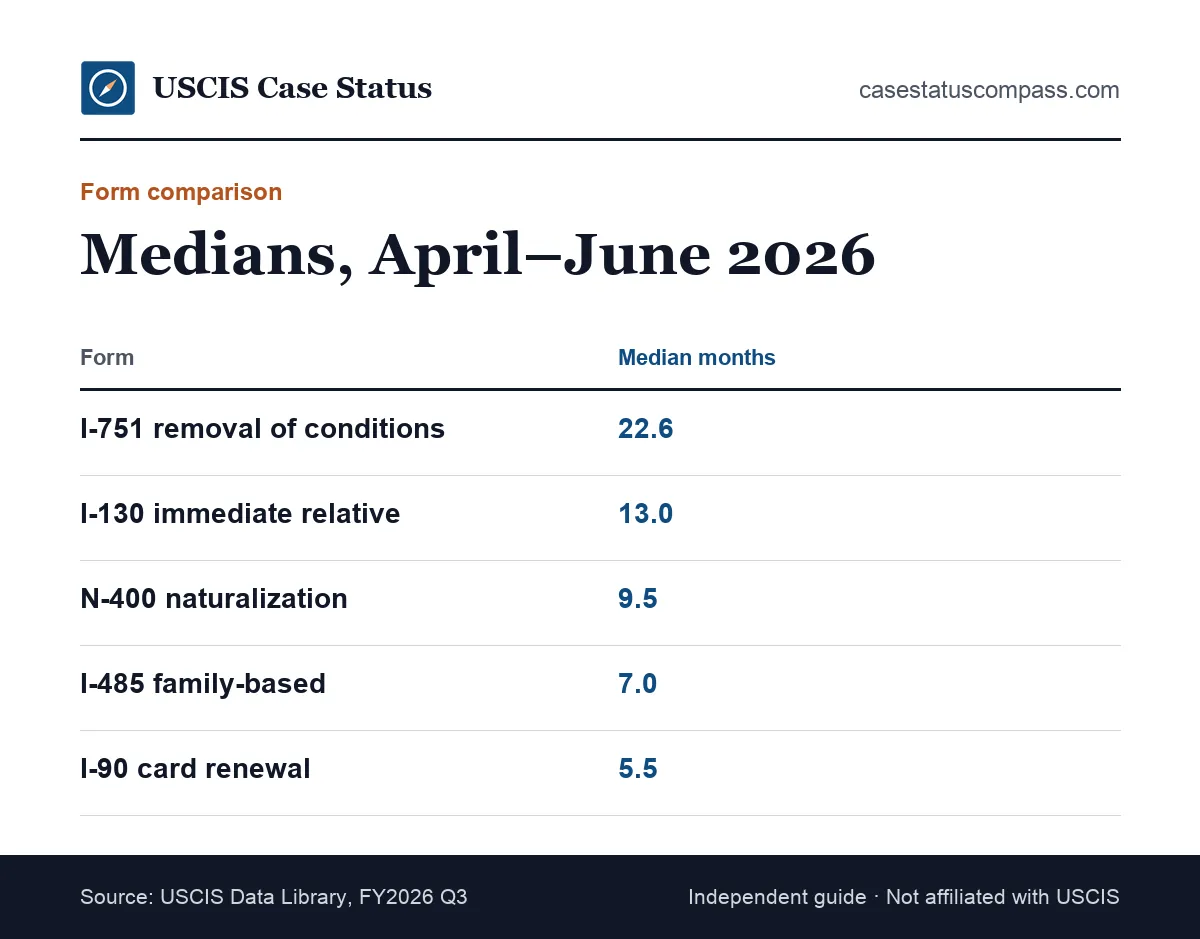
Removal of conditions is one of the longest common USCIS waits. Its April–June 2026 median of 22.6 months is longer than the medians for N-400 naturalization, immediate-relative I-130 petitions, family I-485 applications and I-90 renewals. Only a few lines run slower.
Medians side by side
The table lists April–June 2026 medians for the forms a married couple most often files.
| Form | Median, Apr.–June 2026 |
|---|---|
| I-751 removal of conditions | I-751: median 22.6 months (USCIS data, Apr.-June 2026) |
| I-130 immediate relative | I-130 (immediate relative): median 13.0 months (USCIS data, Apr.-June 2026) |
| N-400 naturalization | N-400: median 9.5 months (USCIS data, Apr.-June 2026) |
| I-485 family-based | I-485 (family): median 7.0 months (USCIS data, Apr.-June 2026) |
| I-90 renewal | I-90: median 5.5 months (USCIS data, Apr.-June 2026) |
The I-751 processing time tops every other form on that list.
Related waits in your journey
For earlier spouse-based steps, see our green card processing time and I-130 processing time pages. For a later employer path, see our PERM processing time page. Each form has its own queue.
How Should You Plan Your Life Around a Two-Year Wait?
Plan as if the decision will take about two years or more. Keep documents together, avoid long trips, update your address quickly and keep collecting joint evidence. These steps keep the case moving and protect your status. Set calendar reminders.
Moving and travel plans
Report a new address to USCIS within 10 days of moving (INA 265). Our change of address guide explains each method. For trips: Long trips abroad can risk your green card; over 1 year is the general warning line.
Keep building evidence
Save new joint records as they arrive: tax returns, leases, insurance and dated photos. Keep them in date order with an index, ready for an RFE or interview. USCIS does not ask for updates during a normal wait.
Waiting Scenarios: Three Conditional Residents
These fictional examples show how one petition type can take very different paths. A strong joint file may finish near the median. An evidence request, a move or a waiver can stretch the I-751 processing time. Each ends with the step the person took.
Priya: a clean joint petition
Priya and her husband filed jointly with thick financial records. After biometrics she heard nothing for about 19 months, then got an approval with no interview. She never needed to escalate.
Daniel: a move and a missed notice
Daniel moved without updating USCIS, and an RFE went to his old address. He spotted it online days before the deadline, replied and updated his address. His case finished months after the median.
Rosa: a divorce waiver
Rosa filed a waiver after her divorce, and her case went to a field office. Her wait passed two years, but the extension covered it. Six months before it ended, she booked an I-551 stamp appointment.
If X, Do Y: I-751 Wait Decision Table
Match your situation to the next step. Most I-751 delays need patience and records, not new filings. The right action depends mainly on whether your receipt date is before the inquiry date and how close your extension is to ending.
Decision table
Find the row that matches your case today and take the step beside it.
| If this is your situation | Do this |
|---|---|
| Receipt date is after the inquiry date | Wait; check the tool monthly |
| Receipt date is before the inquiry date | Submit an outside normal processing request |
| No reply 30+ days after the request | Call the Contact Center and log the call |
| USCIS contacted 60+ days ago, no fix | Consider the CIS Ombudsman |
| Extension ends within 6 months | Request an I-551 stamp appointment |
| You moved | Update your address online today |
| You received an RFE | Respond fully before the deadline |
| Urgent travel or financial harm | Request an expedite with proof |
Most rows point to waiting and record-keeping, not new filings.
When the table does not fit your case
A NOID, denial, arrest or separation turns timing into a legal question. Speak with an immigration attorney or accredited representative before you act. Bring every notice and your timeline log.
What Mistakes Make the Removal of Conditions Wait Longer?
The mistakes that add the most time are filing outside the window, sending thin evidence, missing an RFE deadline and not updating your address. Each creates a new step or a denial risk. Most are easy to prevent before you mail.
Paperwork mistakes
- Using an old edition (the current one is 04/01/24)
- A missing signature or wrong fee
- Hard-to-read copies
- Filing too early, which can lead to a rejection
- Missing certified English translations
Waiting-period mistakes
Calling before the inquiry date does not change the queue. Mailing unrequested evidence piecemeal can confuse the file. Long trips without a plan can raise questions. Keep one organized folder instead.
When Should You Get Legal Help During a Long Wait?
Get legal help after a NOID, a denial, a troubled interview, a waiver question or an arrest, or if your extension is ending with no decision. An immigration attorney or DOJ-accredited representative can review your timing and options. Act early.
Signs you should not wait alone
- A Notice of Intent to Deny (NOID): NOID deadline: up to 30 days; no extensions
- A separation or divorce during the wait
- Any arrest or criminal charge
- An interview that ended with open questions
Finding qualified help
Use a licensed attorney or a DOJ-accredited representative. Avoid "notarios" and preparers who promise faster processing; no one outside USCIS can guarantee a decision date. Check their credentials first.
How Long Until the 10-Year Card Arrives After Approval?
After approval, USCIS produces and mails the 10-year green card, a short step compared with review. Watch for New Card Is Being Produced, then Card Was Mailed To Me. If the card is returned to USCIS, act fast to get it resent.
Card production and mailing
Keep your address current until the card arrives. For the full after-approval steps, see the post-approval section of our Form I-751 guide linked at the top of this page. Watch status.
What If Your 10-Year Card Comes Back to USCIS?
Returned green cards are held 60 business days (about 12 weeks), then re-mailed or destroyed. Contact USCIS quickly with your correct address, and keep the old card and receipt notice until the new card arrives.
Frequently Asked Questions
How long does I-751 take in 2026?
The I-751 processing time median for petitions completed April–June 2026 was 22.6 months, so most people should plan for about two years. Your office may differ. Check the live USCIS tool for your office's figure and inquiry date, and use the 48-month receipt extension as proof of status meanwhile.
Can I travel while my I-751 is pending?
Yes. You can travel with your expired conditional green card, the I-751 receipt notice that extends it and your passport. Keep trips short and never miss biometrics or an interview. Long absences can raise questions about whether you still live in the U.S., so talk to an attorney before a long trip.
How long does I-751 approval take at the Vermont Service Center?
There is no verified Vermont-only number on this page. Open the USCIS processing times tool, choose Form I-751 and select the office on your newest notice. An EAC receipt means Vermont first received the case, but the file may have moved since then.
Why is my I-751 taking longer than the median?
Half of all completed petitions take longer than the median, by definition. Waivers, RFEs, interviews, background checks and address problems add time. If your receipt date is earlier than the tool's case inquiry date, submit an outside normal processing request to USCIS.
Does the 48-month extension start on the filing date?
No. USCIS describes the extension as running 48 months past the expiration date on your conditional green card. Check the wording on your receipt notice. If your case may run past that point, request an I-551 stamp before the extension ends.
Will USCIS deny my I-751 because it is taking so long?
No. A long wait alone does not lead to a denial. Denials come from problems such as missing evidence, unanswered requests for evidence or an ineligible filing. Keep your address current and answer every notice on time to protect your petition.
Can I check my I-751 processing time with my receipt number?
Yes. Case Status Online shows the latest status for your receipt number. For timing, enter the receipt date in the official tool with Form I-751 and your office to see the case inquiry date.
Sources
- USCIS Check Case Processing Times. egov.uscis.gov/processing-times/. Accessed Oct 27, 2026.
- USCIS Immigration and Citizenship Data (Data Library). www.uscis.gov/tools/reports-and-studies/immigration-and-citizenship-data. Accessed Oct 27, 2026.
- USCIS: I-751, Petition to Remove Conditions on Residence. www.uscis.gov/i-751. Accessed Oct 27, 2026.
- USCIS Newsroom: Receipt notice extension to 48 months for Form I-751 (Jan. 2023). www.uscis.gov/newsroom/alerts/uscis-extends-green-card-validity-extension-to-48-months-for-petitioners-filing-form-i-751. Accessed Oct 27, 2026.
- CIS Ombudsman: Tips for Submitting a Request for Case Assistance. www.dhs.gov/cisombudsman. Accessed Oct 27, 2026.
- USCIS: How to Make an Expedite Request. www.uscis.gov/forms/filing-guidance/how-to-make-an-expedite-request. Accessed Oct 27, 2026.
- USCIS Contact Center. www.uscis.gov/contactcenter. Accessed Oct 27, 2026.
- USCIS Data Library: All USCIS Application and Petition Form Types, FY2026 Q3 (Apr. 1-June 30, 2026; queried 7/2026). www.uscis.gov/sites/default/files/document/data/quarterly_all_forms_fy2026_q3_v1.xlsx. Accessed Oct 27, 2026.
- USCIS: Removing Conditions on Permanent Residence Based on Marriage (updated 12/12/2023). www.uscis.gov/green-card/after-we-grant-your-green-card/conditional-permanent-residence/removing-conditions-on-permanent-residence-based-on-marriage. Accessed Oct 27, 2026.
- USCIS Data Library: All USCIS Application and Petition Form Types, FY2025 Q4 (July 1-Sept. 30, 2025). www.uscis.gov/sites/default/files/document/data/quarterly_all_forms_fy2025_q4_v1.xlsx. Accessed Oct 27, 2026.
- CIS Ombudsman tip sheet: Check Your USCIS Case Inquiry Date (Aug. 2024). dhs.gov/sites/default/files/2024-11/24_0823_cisomb_case-inquiry-date-tip-sheet.pdf. Accessed Oct 27, 2026.
- USCIS Service Center Operations Directorate (updated 07/17/2026). www.uscis.gov/about-us/organization/directorates-and-program-offices/service-center-operations-directorate. Accessed Oct 27, 2026.
- USCIS: Form I-797 Types and Functions (updated 01/24/2025). www.uscis.gov/forms/filing-guidance/form-i-797-types-and-functions. Accessed Oct 27, 2026.
- Form I-751 Instructions, Edition 04/01/24. www.uscis.gov/sites/default/files/document/forms/i-751instr.pdf. Accessed Oct 27, 2026.
- 8 CFR 103.2(b)(8)(iv) (LII). www.law.cornell.edu/cfr/text/8/103.2. Accessed Oct 27, 2026.
- 8 CFR 103.8(b) (LII). www.law.cornell.edu/cfr/text/8/103.8. Accessed Oct 27, 2026.
- USCIS alert: Additional Mail Delivery Process for Receiving ADIT Stamp (Mar. 16, 2023; archived). www.uscis.gov/newsroom/alerts/uscis-announces-additional-mail-delivery-process-for-receiving-adit-stamp. Accessed Oct 27, 2026.
- USCIS: Form N-400 page. www.uscis.gov/n-400. Accessed Oct 27, 2026.
- USCIS Policy Manual Vol. 12, Part G, Ch. 5. www.uscis.gov/policy-manual/volume-12-part-g-chapter-5. Accessed Oct 27, 2026.
- USCIS: How Do I Request Premium Processing? (updated 03/23/2026). www.uscis.gov/forms/all-forms/how-do-i-request-premium-processing. Accessed Oct 27, 2026.
- DHS CIS Ombudsman: How to Submit a Case Assistance Request (updated 04/13/2026). www.dhs.gov/case-assistance. Accessed Oct 27, 2026.
- USCIS OLA New Member Outreach FAQs (Jan. 2021). www.uscis.gov/sites/default/files/document/questions-and-answers/5%20117%20-%20New%20Member%20Outreach%20FAQs%2001042021.pdf. Accessed Oct 27, 2026.
- USCIS: Checking Your Case Status Online. www.uscis.gov/tools/checking-your-case-status-online. Accessed Oct 27, 2026.
- USCIS: Benefits of a USCIS Online Account. www.uscis.gov/file-online/benefits-of-a-uscis-online-account. Accessed Oct 27, 2026.
- USCIS alert: USCIS Expands myProgress to Form I-485 and Form I-821 (Nov. 21, 2023). www.uscis.gov/newsroom/alerts/uscis-expands-myprogress-to-form-i-485-and-form-i-821. Accessed Oct 27, 2026.
- USCIS Form G-1055 Fee Schedule, Edition 10/16/26. www.uscis.gov/sites/default/files/document/forms/g-1055.pdf. Accessed Oct 27, 2026.
- USCIS: Filing Fees (updated 02/12/2026). www.uscis.gov/forms/filing-fees. Accessed Oct 27, 2026.
- USCIS: How to Change Your Address (updated 08/04/2026); 8 U.S.C. 1305(a) (LII). www.uscis.gov/addresschange. Accessed Oct 27, 2026.
- USCIS: International Travel as a Permanent Resident (updated 09/12/2025). www.uscis.gov/green-card/after-we-grant-your-green-card/international-travel-as-a-permanent-resident. Accessed Oct 27, 2026.
- USCIS Policy Manual Vol. 11, Part A, Ch. 3. www.uscis.gov/policy-manual/volume-11-part-a-chapter-3. Accessed Oct 27, 2026.
casestatuscompass.com is an independent publication and is not affiliated with USCIS or any government agency. This page is general information, not legal advice. For denials, court or asylum matters, consult an immigration attorney or a DOJ-accredited representative.