Contents · 41 sections
- How Long Does Naturalization Take in 2026?
- Current N-400 Processing Time From the Official Tool
- Why Is the Citizenship Application Waiting Time Longer Now?
- Does the 2025 Civics Test Change the Citizenship Processing Timeline?
- What Does the N-400 Median Actually Measure?
- How Long Does It Take to Get Citizenship After Filing?
- Citizenship Timeline Step by Step
- Stage 1: Filing and the Receipt Notice
- Step 2: How Long Until the Biometrics Appointment?
- Step 3: The Citizenship Interview Wait
- What Happens If You Fail Part of the Citizenship Test?
- Who Is Exempt From the English Test for Naturalization?
- How Long After the Citizenship Interview Is the Oath?
- Stage 4: The Oath Ceremony and Your Certificate
- What Can Delay Your Oath Ceremony?
- How Long Does It Take to Get the Naturalization Certificate?
- Green Card to Citizenship Timeline
- How Long After a Green Card Can You Apply for Citizenship?
- After Getting a Green Card, How Long for Citizenship Overall?
- How Long Does It Take to Apply for Citizenship?
- Does a Pending I-751 Slow Down Your N-400?
- Estimator: How Long Does Naturalization Take for You?
- Worked Examples: Estimating Your Own N-400 Dates
- Tracking Your Citizenship Application Progress
- Is There an Official Citizenship App Tracker?
- N-400 Status Messages and Your Place in the Timeline
- Fastest N-400 Processing Offices
- Can You Choose a Faster Field Office?
- N-400 Processing Time in Dallas, TX and Other Cities
- What Slows Down a Citizenship Application?
- RFEs and Continued N-400 Cases
- Can You Speed Up Naturalization?
- Military Naturalization Timeline
- Is My N-400 Outside Normal Processing Time?
- What to Do When Your Citizenship Application Is Delayed
- When Should You See an Attorney About a Delayed N-400?
- Travel and Moving While You Wait
- Mistakes That Add Time to Naturalization
- How Long Does Naturalization Take for Children?
- Other Processing Times Related to Citizenship
- Frequently Asked Questions
At a glance
| N-400 median | N-400: median 9.5 months (USCIS data, Apr.-June 2026) |
| A year earlier | 5.7 months (July–Sept. 2025) |
| What the live tool shows | The USCIS tool shows how long it took to finish 80% of cases in the past 6 months |
| Earliest filing | You can file the N-400 up to 90 days before you reach 5 years (or 3 years if married to a U.S. citizen) as a permanent resident |
How Long Does Naturalization Take in 2026?
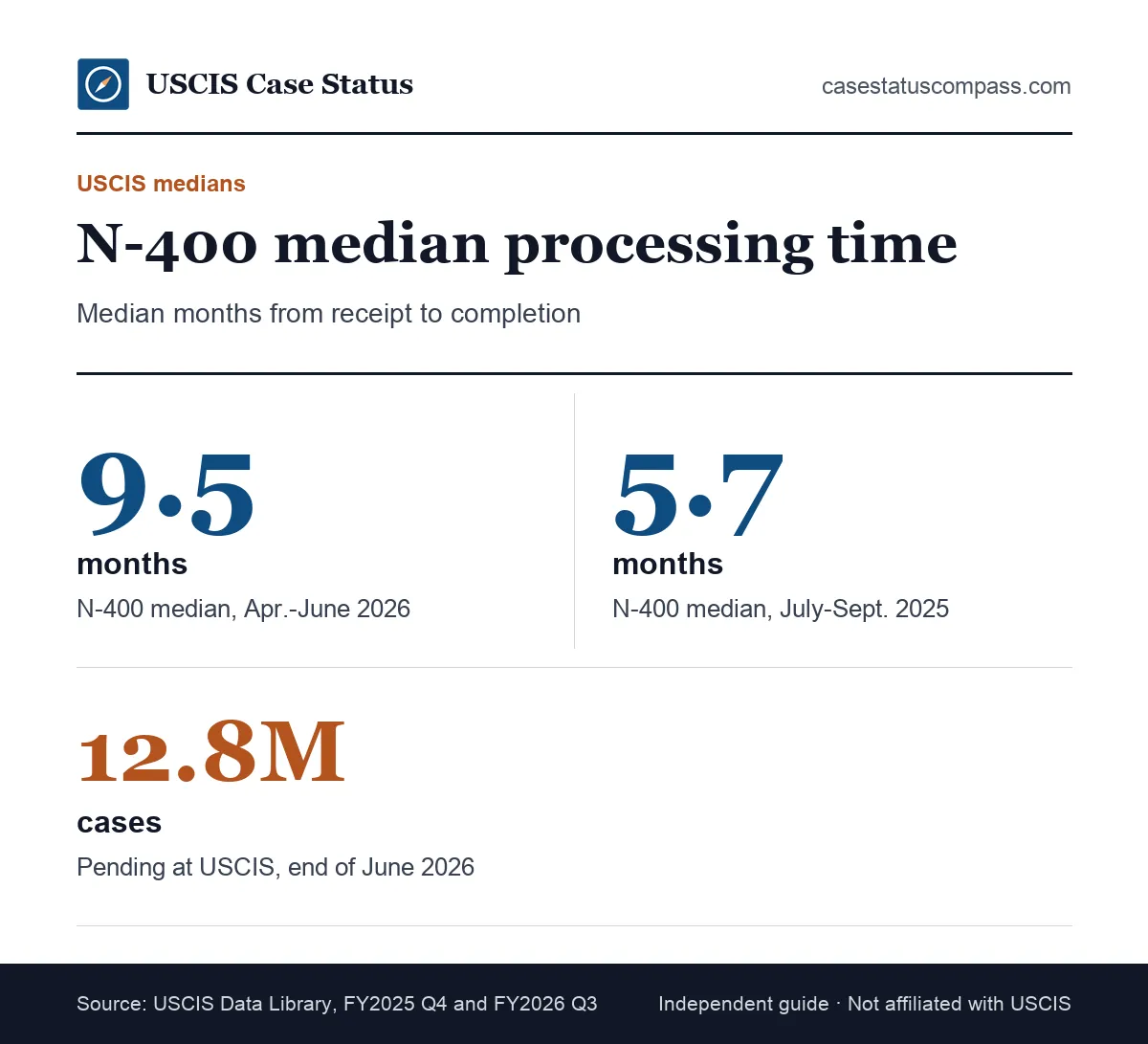
How long does naturalization take right now? The USCIS median for the N-400 was 9.5 months in April–June 2026, up from 5.7 months a year earlier. Half of the cases finished that quarter took longer than the median, so plan for a range, not a date.
The official N-400 medians
Each row is an official USCIS median for a different period, so you can see how the N-400 wait has shifted.
| Period | N-400 median | Source |
|---|---|---|
| Apr.–June 2026 (FY2026 Q3) | N-400: median 9.5 months (USCIS data, Apr.-June 2026) | USCIS Data Library |
| July–Sept. 2025 (FY2025 Q4) | 5.7 months | USCIS Data Library |
| FY2023 full year | 6.1 months | USCIS factsheet (data as of Mar. 5, 2024) |
How today's median compares with FY2023
The FY2023 full-year median of 6.1 months predates the current surge. Next to it and the 5.7 months of late 2025, today's 9.5-month figure is high by recent standards.
How long does it take to get citizenship from start to finish?
When people ask how long does naturalization take from filing to oath, most of the answer is the gap between biometrics and the citizenship interview. A 9.5-month median means a typical applicant who filed in early 2026 would have finished in late 2026, while slower offices ran past that.
Current N-400 Processing Time From the Official Tool
The official USCIS tool lists the N-400 processing time for each field office. Right now, naturalization cases take 10 to 15 months, depending on category and office (USCIS data retrieved Oct 27, 2026). Use the office on your notice, not the national median, for your own estimate.
Live N-400 times by field office
The table below comes from the official tool, with the date we last checked it. Find the row for the field office named on your own notices.
| Category | Office | 80% of cases completed within |
|---|---|---|
| Application for Naturalization | Agana GU | 13 months |
| Application for Naturalization | Albany NY | 10 months |
| Application for Naturalization | Albuquerque NM | 13 months |
| Application for Naturalization | Anchorage AK | 12.5 months |
| Application for Naturalization | Atlanta GA | 13.5 months |
| Application for Naturalization | Baltimore MD | 15 months |
| Application for Naturalization | Brooklyn NY | 11 months |
| Application for Naturalization | Buffalo NY | 14.5 months |
| Application for Naturalization | Chicago IL | 13 months |
| Application for Naturalization | Houston TX | 12 months |
| Application for Naturalization | Los Angeles CA | 10.5 months |
| Application for Naturalization | Los Angeles County CA | 10.5 months |
| Application for Naturalization | Miami FL | 10 months |
| Application for Naturalization | New York City NY | 10 months |
| Application for Naturalization | Queens NY | 10.5 months |
How to read your office's figure
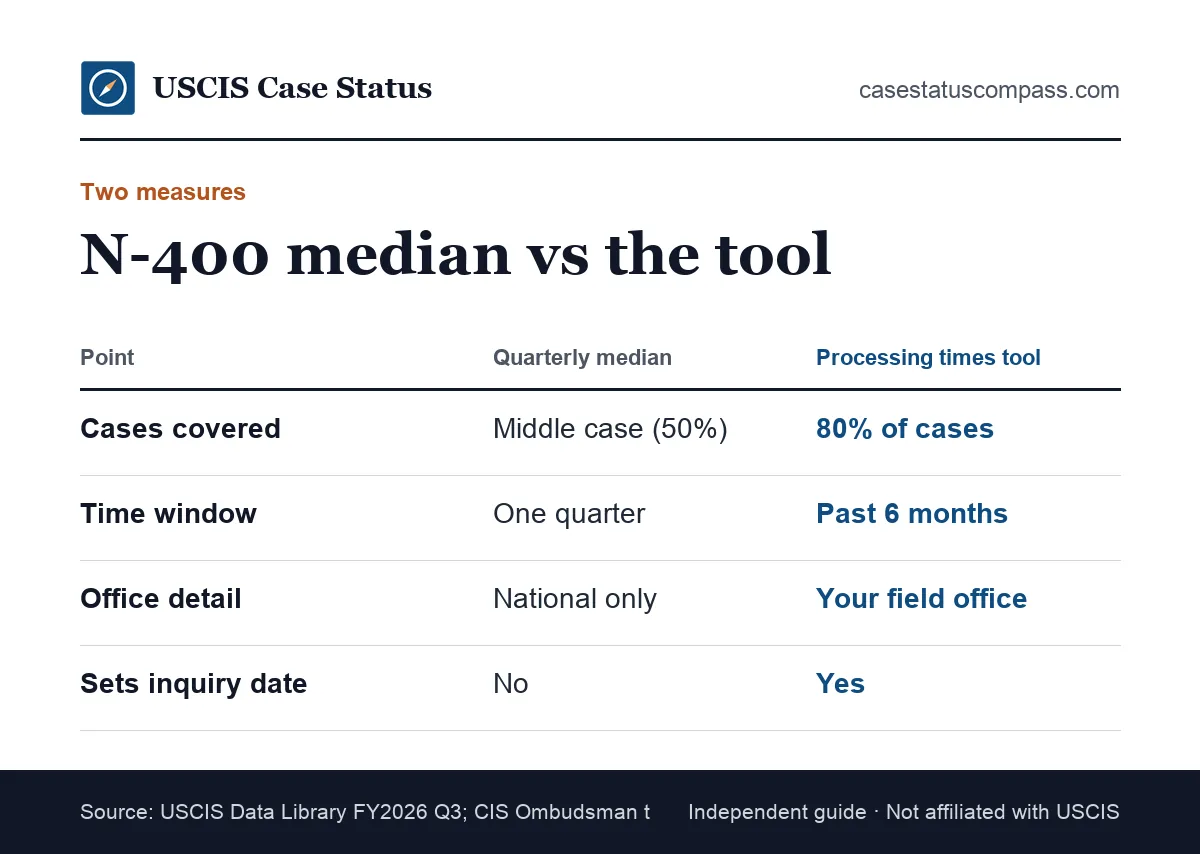
The USCIS tool shows how long it took to finish 80% of cases in the past 6 months. That 80% figure is usually longer than the median because it includes slower cases. It also sets your case inquiry date.
Why the tool and the median differ
The median covers one quarter and the whole country. The tool covers six months for a single field office. Both are official; neither is a promise about your own case.
Why Is the Citizenship Application Waiting Time Longer Now?
The citizenship application waiting time grew because USCIS is handling a very large caseload. The N-400 median climbed from 5.7 months in July–September 2025 to 9.5 months in April–June 2026, while 12.8 million cases were pending across USCIS.
Fewer interview slots per office mean longer queues.
The national backlog
USCIS reported 12.8 million cases pending at USCIS (end of June 2026). Field offices that interview citizenship applicants also interview green card applicants, so both lines compete for officer time.
Does the 2025 Civics Test Change the Citizenship Processing Timeline?
2025 civics test: 20 questions from 128; pass with 12 correct. A longer civics test and new procedures can lengthen interviews and reduce the number held each day. USCIS has not published a figure that isolates this effect on the citizenship processing timeline, so treat it as one factor among several.
Which civics test version applies to you
Filed N-400 on or after Oct. 20, 2025: 2025 test; before that: 2008 test. Study the version that matches your filing date; preparing for the wrong one is an easy way to end up with a retest.
What Does the N-400 Median Actually Measure?
The N-400 median is USCIS's measure of the time to process citizenship applications: receipt to completion for the middle case finished in a quarter. USCIS quarterly data reports the median: half of the cases completed that quarter took longer. It counts approvals and denials, and it covers the whole country, not your office.
Medians are backward-looking
The April–June 2026 median is backward-looking: it describes cases that finished then, many filed in 2025. The data runs about three to four months behind.
So a fresh filing may face a different queue.
What the median does not include
It does not include the time you spend preparing, any delay from a failed test, or the gap before a later oath ceremony. Add those yourself when you plan.
How Long Does It Take to Get Citizenship After Filing?
How long does it take to get citizenship after filing? Plan around the 9.5-month national median for April–June 2026, then adjust for your office. Your receipt date starts the clock; the Oath of Allegiance ends it. For filing steps, see the citizenship application guide.
How long does it take to get citizenship after applying online?
USCIS does not publish separate medians for online and paper N-400s. Online filers get a faster receipt and skip mail time at intake, but every case still needs biometrics where required, an interview and an oath.
How long for the N-400 process once the interview is scheduled?
Once the interview notice arrives, the end is close. Our interview was scheduled page explains that status. Many applicants learn the result the same day. If approved, the oath may be that day or at a later ceremony.
Citizenship Timeline Step by Step
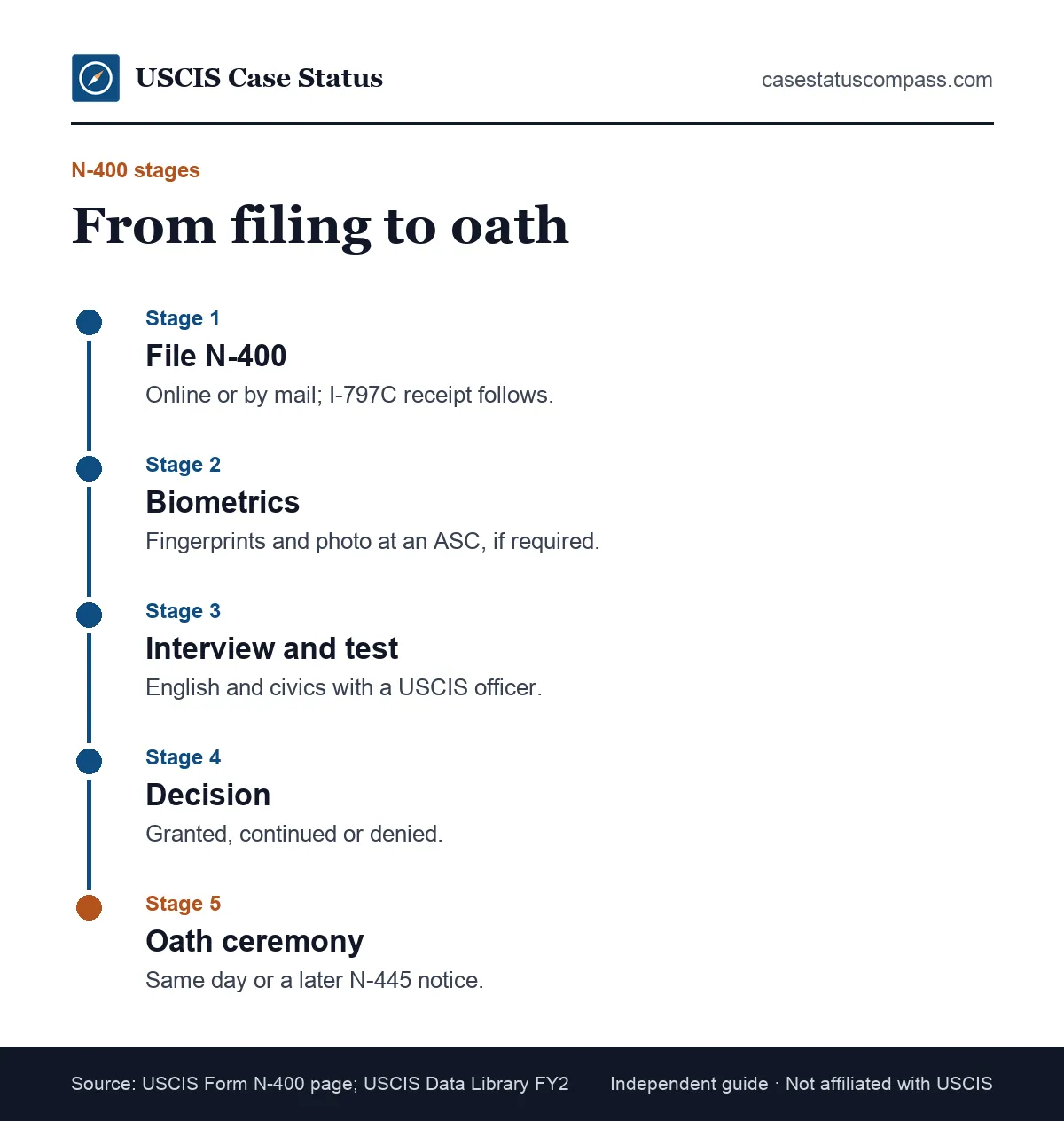
The citizenship processing timeline has five stages, shown in the table. USCIS publishes only the total median (9.5 months in April–June 2026), so your own notices mark the stages.
Write each date in a notebook as it arrives; that record becomes your personal timeline and helps if you later need an inquiry.
Stage-by-stage table
Read the rows in order: each stage normally finishes before the next begins, and a notice marks every step.
| Stage | What happens | How you learn the timing |
|---|---|---|
| 1. Filing and receipt | USCIS accepts the N-400 and sends Form I-797C | Receipt notice, often first |
| 2. Biometrics | Fingerprints and photo at an ASC, if required | Appointment notice |
| 3. Interview and test | English and civics with an officer | Interview notice |
| 4. Decision | Granted, continued or denied | Notice at or after the interview |
| 5. Oath ceremony | You take the Oath of Allegiance | Same day or Form N-445 notice |
How the stages add up
The receipt usually comes first. The interview wait is the longest stage and depends on your field office. The oath can add nothing (same day) or several weeks.
Biometrics are usually quick.
Stage 1: Filing and the Receipt Notice
Filing starts the clock. You file the citizenship application online or by mail, and USCIS sends a receipt notice (Form I-797C) with your uscis receipt number. That date is the one you enter in the processing times tool.
Save the notice as a PDF.
Online vs paper intake
Online filers see the receipt in their account right away; paper filers wait for mail. Either way, the received date on the notice, not the mailing date, starts your processing time.
N-400 fee and the paper-only reduced fee
$760 (paper) / $710 (online); reduced fee $380 (paper only) if household income is at or below 400% of the Federal Poverty Guidelines. Reduced N-400 fee: request it in Part 10 of the paper N-400 (income at or below 400% of poverty), so reduced-fee applicants must file on paper.
Check the receipt carefully
Make sure your name, birth date and A-Number are right. I-797C = Notice of Action (receipt, rejection, transfer, appointment, re-open); not proof of status by itself. Our what is an i 797c page explains each notice. Keep it with your green card until the oath.
Step 2: How Long Until the Biometrics Appointment?
USCIS does not publish a standard wait for N-400 biometrics. If your case needs them, you get an appointment notice with a date and Application Support Center (ASC).
Some applicants are told their earlier fingerprints will be reused, so no new visit is needed. Check your notice before assuming a missing appointment is a problem.
What to bring and why it matters
Bring your I-797C appointment notice and a valid photo ID to the ASC. Arriving without them can mean a new appointment and lost weeks. See our biometrics appointment page.
Bring the notice itself, too.
Rescheduling or missing the appointment
Reschedule biometrics online at least 12 hours before, with good cause, or call the Contact Center. Missing biometrics can lead to denial for abandonment. Reschedule only when you must, since every new date pushes the rest back.
Step 3: The Citizenship Interview Wait
The wait for the citizenship interview is usually the longest part of naturalization. It depends almost entirely on your field office's schedule. Once the interview notice arrives, the interview is typically a few weeks away.
Use the gap to study and gather documents.
Why the interview stage takes longest
Field officers handle interviews for citizenship and green card cases. An office with fewer officers or more applicants schedules further out. Check your office in the tool.
Background checks must also clear first.
What the officer reviews
The officer reviews your N-400 answers under oath and gives the English and civics test. Prepare with our citizenship interview guide and the citizenship test study page.
Bring updates on any changes since filing.
What Happens If You Fail Part of the Citizenship Test?
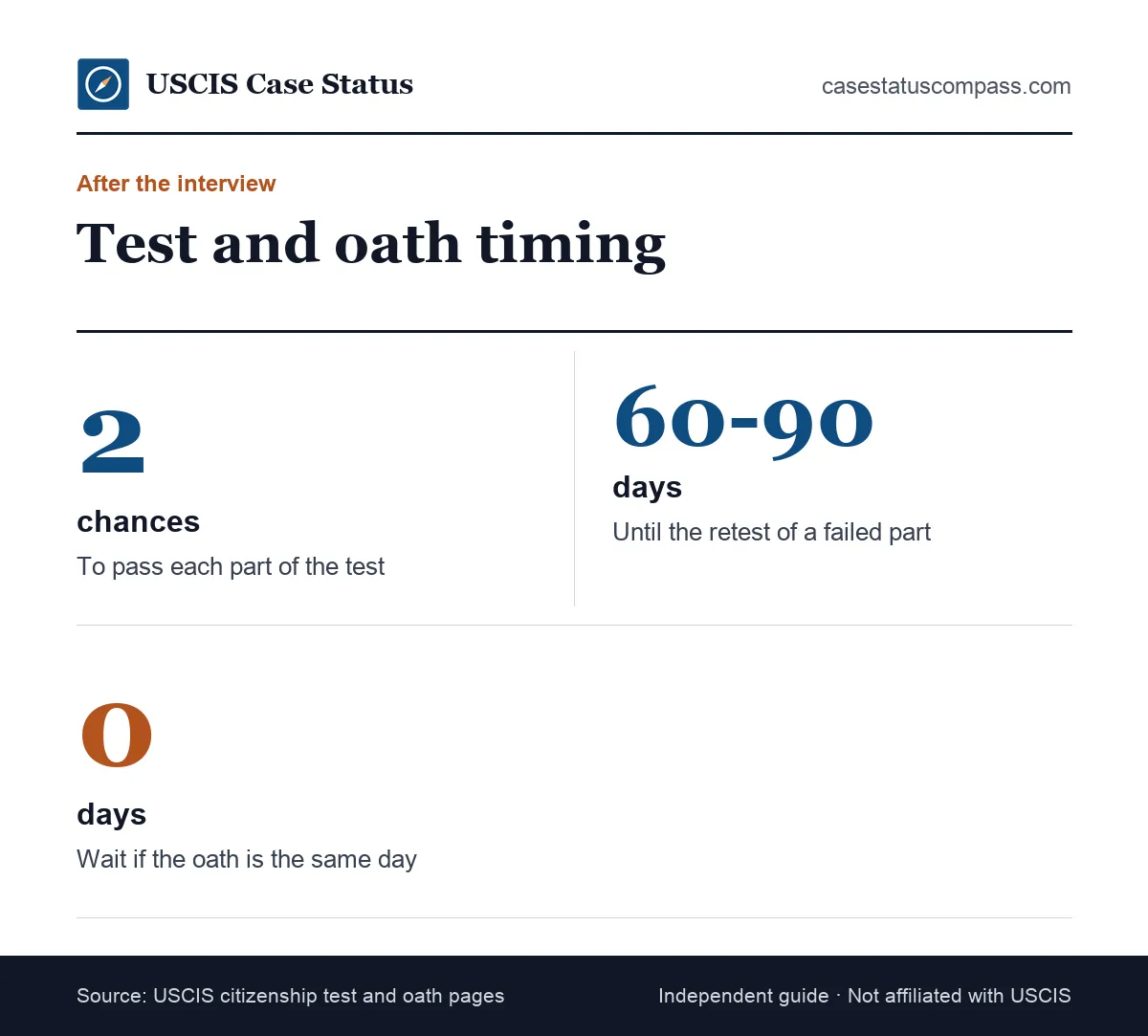
Failing part of the test adds a second interview, which lengthens your naturalization timeline. Two chances to pass; retest of the failed part 60-90 days after the interview. You only retake the part you failed.
Use the gap to study only the failed section.
How a retest changes your dates
If you fail civics at an interview, add the retest window and possibly a later oath. A second failure leads to denial, and you would need to file a new N-400.
Who Is Exempt From the English Test for Naturalization?
Older long-term residents can skip the English test, which shortens preparation rather than USCIS processing. 50/20: age 50+ with 20 years as a green card holder: no English test. 55/15: age 55+ with 15 years as a green card holder: no English test.
The 65/20 rule and medical exceptions
65/20: age 65+ with 20 years: 10 questions from a 20-question list, in your language. Form N-648: a doctor certifies a disability that exempts you from the English and/or civics test.
How Long After the Citizenship Interview Is the Oath?
The oath can come the same day or weeks later. You may be able to take the oath the same day as your interview. Otherwise, USCIS mails a notice with the date, time and place of your oath ceremony.
Same-day oath vs a scheduled ceremony
Same-day oaths happen at some field offices after approval. Other offices group new citizens into scheduled ceremonies, and some hold judicial ceremonies run by a court. Full details are on our oath ceremony page.
When the decision is "continued"
A continued case needs more evidence or a retest before approval. The oath waits until the officer approves, so reply to any request quickly.
Form N-14 lists what is needed.
Stage 4: The Oath Ceremony and Your Certificate
You become a U.S. citizen at the oath ceremony, not at the interview. At check-in an officer reviews your N-445 and takes your green card; after the oath, you receive your Certificate of Naturalization.
Bring your oath notice and photo ID.
What Can Delay Your Oath Ceremony?
Fill in the Form N-445 questionnaire before the ceremony; an officer reviews it at check-in. Changes since your interview, such as an arrest or a long trip, can delay the oath, because the officer must review them before you are sworn in.
Handing in your green card
Hand in your green card when you check in for the oath ceremony. Bring it with your oath notice; your Certificate of Naturalization takes its place once you take the oath.
Rescheduling the oath
Can't attend? Return the N-445 with a letter asking for a new date. A new date may be weeks away, so reschedule only for a strong reason, such as illness or a family emergency.
How Long Does It Take to Get the Naturalization Certificate?
Most new citizens receive the naturalization certificate at the oath ceremony itself, so there is no extra wait. If you lose it or need a correction, Form N-565 had a USCIS median of 7.6 months in April–June 2026.
Most never need that second wait.
Replacing a lost or damaged certificate
The replacement form is the Form N-565. N-565: median 7.6 months (USCIS data, Apr.-June 2026). Our how to get naturalization certificate guide explains the steps.
Make copies of your original early.
Check it before you leave
Read the certificate before you leave the ceremony. Fixing an error on the spot is faster than filing for a correction later.
Look at your name, birth date and country of birth, and tell the officer about any error.
Green Card to Citizenship Timeline
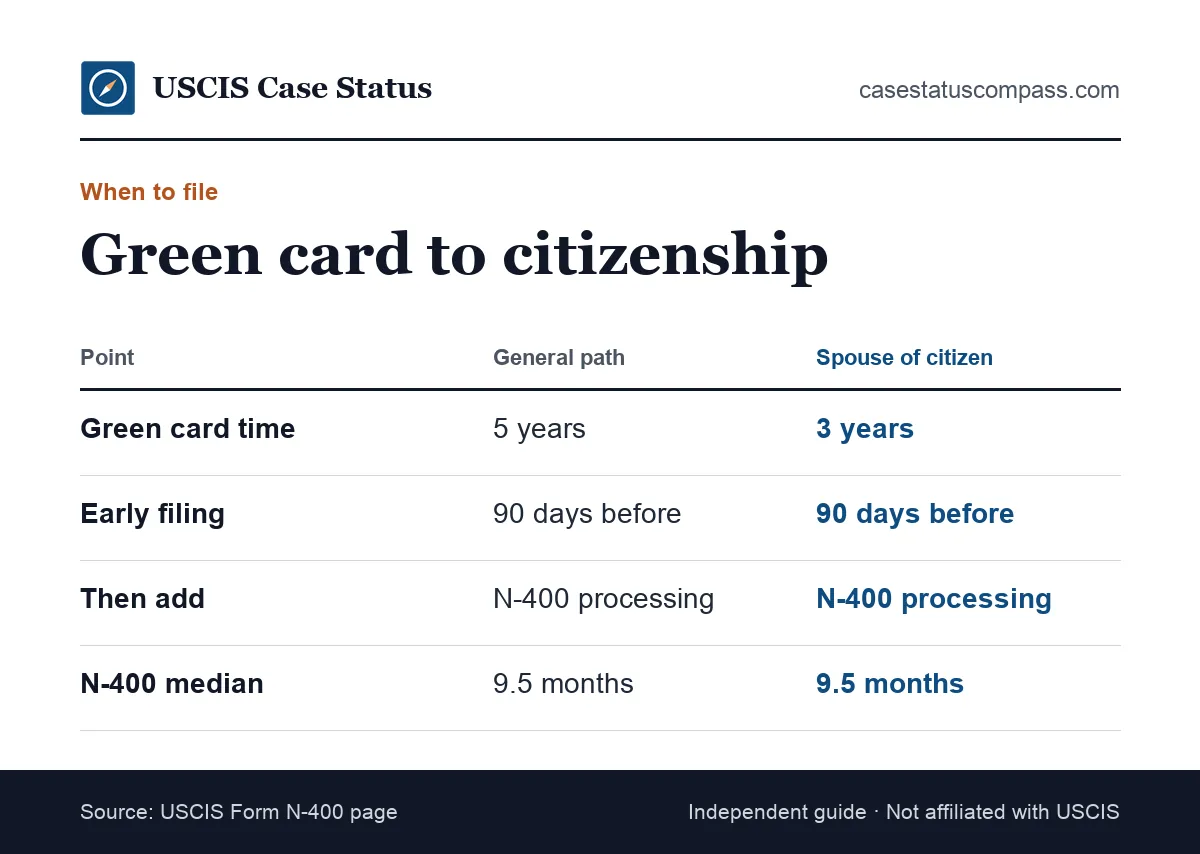
The green card to citizenship timeline is the time as a permanent resident before you may file, plus the N-400 processing time. Most residents wait 5 years; spouses of citizens can wait 3 years, and both may file 90 days early.
The five-year general path
Count 5 years from the "Resident Since" date on your green card, subtract 90 days, and that is your earliest filing date. Then add the N-400 processing time for your office.
Physical presence during the residence period
Trips count too: you need physical presence in the U.S. for at least 30 months of the 5 years (18 months of 3 years for spouses of U.S. citizens). Long absences can also break continuous residence, covered below.
The three-year path for spouses
If you have been married to and living with the same U.S. citizen for 3 years as a permanent resident, you may file at 3 years minus 90 days. Eligibility details are on our citizenship application guide.
How Long After a Green Card Can You Apply for Citizenship?
You can file the N-400 up to 90 days before you reach 5 years (or 3 years if married to a U.S. citizen) as a permanent resident. Filing too early can lead to denial, and USCIS fees are nonrefundable, even if your case is denied or withdrawn, so count carefully from the date on your card.
Trips abroad and the clock
Naturalization: a trip over 6 months is presumed to break residence; 1 year or more breaks it. A broken residence can reset your filing date. If you took long trips, see an attorney before you file.
After Getting a Green Card, How Long for Citizenship Overall?
Add the residence period, minus 90 days, to the processing time. With a 9.5-month median, a general-path resident can expect citizenship a little more than five years after receiving the card. On the three-year spouse path, the same math gives a little more than three years.
How Long Does It Take to Apply for Citizenship?
Preparing and filing the N-400 usually takes days to weeks, not months. You need your addresses, jobs, trips abroad and family details for the past five years (or three).
The longest part is usually finding old travel dates and addresses, so start that list before you open the form.
Gathering your history
Collect travel dates from your passport stamps, a list of addresses and employers, and marriage and divorce records. Missing information is a common cause of RFEs.
Your CBP travel history online can help.
How long to apply for citizenship online
The online form saves your work, so you can complete it over several sessions. You pay and submit at the end, and the receipt appears in your account right away.
Does a Pending I-751 Slow Down Your N-400?
It can. USCIS must decide a pending I-751 before or at the same time as the N-400. If your I-751 is still pending when your N-400 interview comes up, the officer may handle both at once or wait for the I-751 decision.
What the I-751 median means for you
The I-751 median was 22.6 months in April–June 2026, much longer than the N-400. Filing steps are in our i 751 guide. Conditional residents filing at 3 years should expect the I-751 to set the pace.
Where to read more
Our i 751 processing time page covers the removal of conditions wait. Bring marriage evidence to the N-400 interview in case the officer decides both cases.
It also lists the evidence that helps.
Estimator: How Long Does Naturalization Take for You?
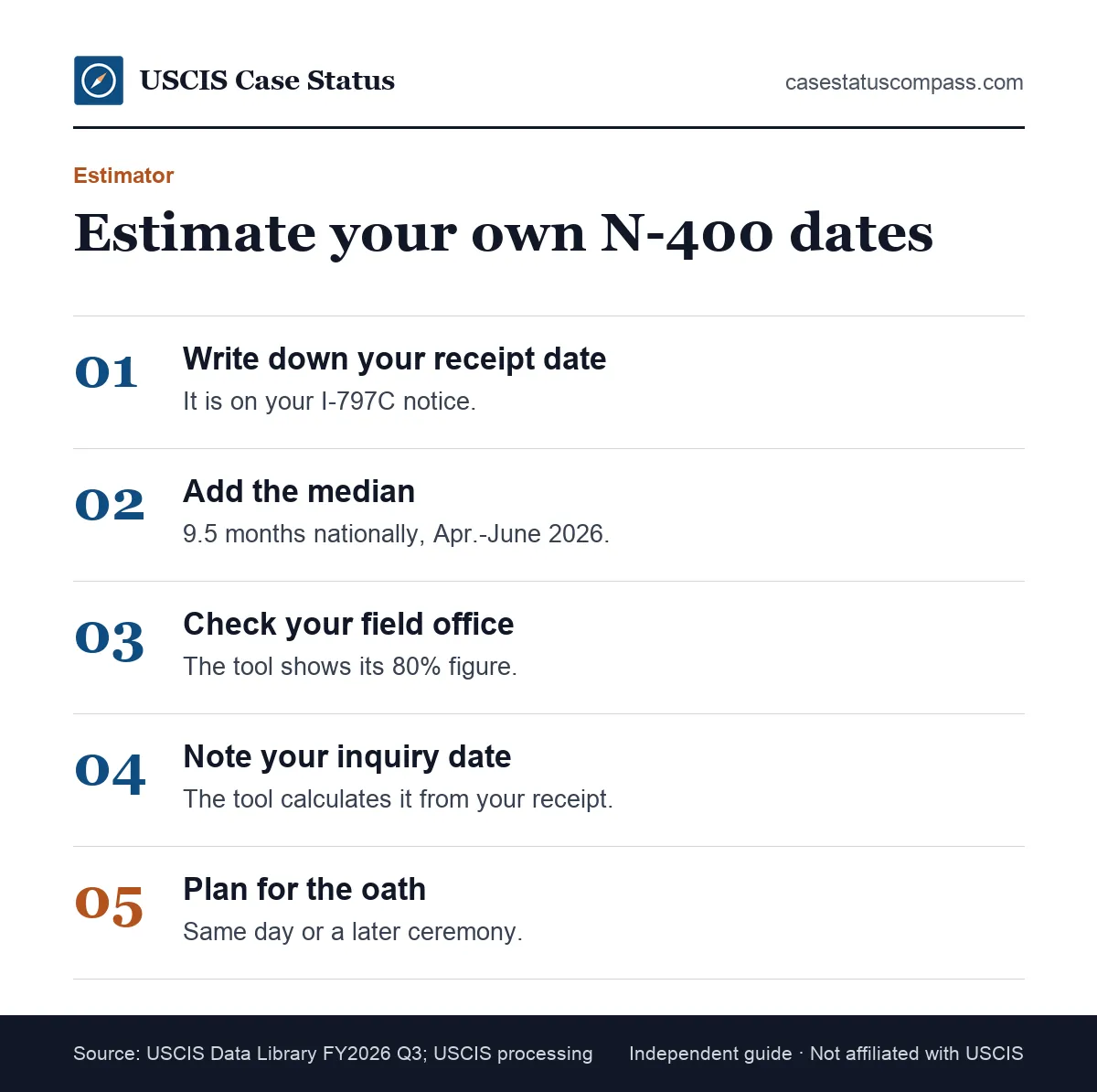
This estimator turns your filing date into a set of planning dates for biometrics, interview and oath. The stage splits are a guide; your notices replace them as they arrive.
Replace each estimate as soon as a real notice arrives.
Estimator table
Each row pairs a milestone with a way to estimate it and the notice that later replaces the estimate.
| Your milestone | How to estimate it | Replace with |
|---|---|---|
| Filing date | The day USCIS receives the N-400 | Date on your I-797C |
| Biometrics | Early in the case, if required | Date on your appointment notice |
| Interview | Most of the remaining wait | Date on your interview notice |
| Decision | At or soon after the interview | Your decision notice |
| Oath | Same day, or a later ceremony | Date on your N-445 notice |
| Total | Receipt date + 9.5 months (national median) | Your office's figure in the tool |
How to use the estimator
Write your receipt date at the top. Add 9.5 months for a national estimate, then compare with your office's figure. Remember that half of cases take longer than any median.
Worked Examples: Estimating Your Own N-400 Dates
These examples apply the estimator to three applicants. They use fictional names and the April–June 2026 median, and they are illustrations, not predictions.
Each one shows a different path: a standard five-year filer, a spouse of a citizen and an applicant who needs a retest. Find the one closest to you.
Example 1: Five-year resident
Daniel's card says "Resident Since" June 1, 2021. He files on March 3, 2026, inside the 90-day window. Adding 9.5 months gives a mid-December 2026 estimate, which he checks against his office.
Example 2: Spouse of a U.S. citizen
Leila has been married to a citizen and a resident for 3 years. Her I-751 was approved earlier, so nothing holds her N-400. Her interview notice arrives; she passes and takes the oath that afternoon.
Example 3: Retest after the civics section
Marco, a five-year resident, passes English but misses civics at his first interview. USCIS sets a retest 60 to 90 days later. He passes, so his oath lands about two to three months after the date the median suggested.
Tracking Your Citizenship Application Progress
You can follow your citizenship application progress in two official places: Case Status Online, using your receipt number, and your USCIS online account. Neither shows a countdown, but both show when your case moves to the next stage.
Checking weekly is enough; daily refreshes do not move the case.
Case Status Online
Case Status Online: egov.uscis.gov. Enter the 13-character receipt number from your I-797C. Status messages change at key steps such as fingerprints, interview scheduling and approval.
No account or login is needed.
Your USCIS online account
Free USCIS online account: case status updates, notices, link paper-filed cases. Our uscis online account page covers account setup and linking a paper case.
It can also show notices before mail arrives.
myProgress estimates for the N-400
myProgress: personalized estimates in your USCIS online account (I-130, I-485, I-765, I-131, I-821, N-400, I-90). Treat any estimate as a guide, not a deadline, because it reflects past cases like yours.
Is There an Official Citizenship App Tracker?
USCIS does not run a separate citizenship app tracker. The official ways to track an N-400 are Case Status Online and the USCIS online account, both of which work on a phone browser. Many private apps simply reuse the public status page.
Using private tracking apps safely
Never give an app your USCIS password. Look for clear "not affiliated with USCIS" wording, and confirm anything important on the official site.
Paid apps add no official data.
What no tracker can tell you
No app knows your interview date before USCIS sets it. Apps that "predict" dates use the same public figures you can check in the official tool.
Only your notices are official.
N-400 Status Messages and Your Place in the Timeline
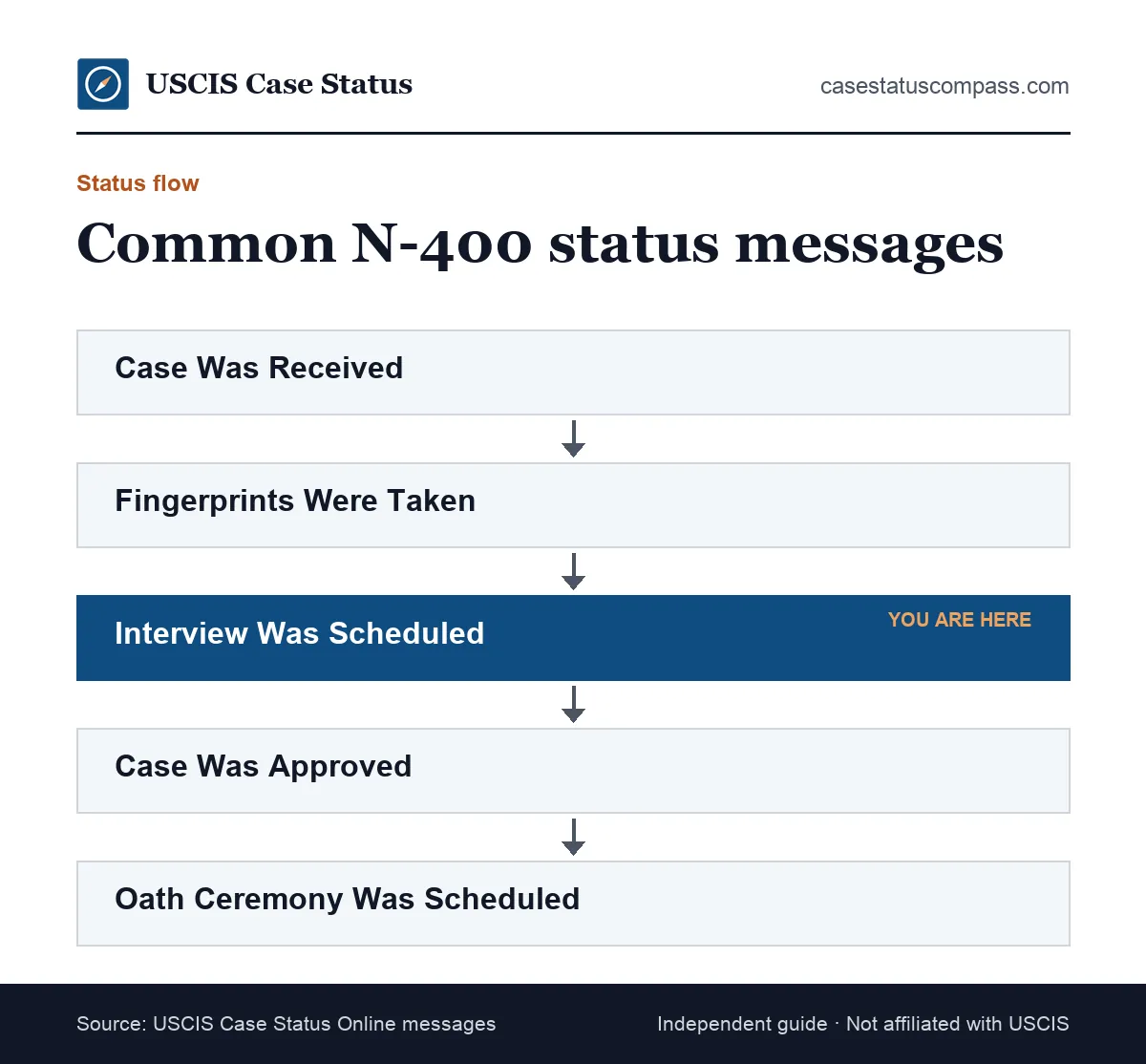
Each N-400 status message tells you which stage your case is in. Reading them correctly prevents false alarms, because a status can stay the same for months while the case waits for an interview slot.
Match the exact wording on your screen to the table below.
Common statuses and what comes next
Find your current status in the left column to see which stage you are in and what usually follows.
| Status message | Stage | Typical next step |
|---|---|---|
| Case Was Received | Filing | Biometrics notice, if required |
| Fingerprints Were Taken | Biometrics done | Wait for interview scheduling |
| Interview Was Scheduled | Interview set | Prepare documents and study |
| Case Was Approved | Decision | Oath notice or same-day oath |
| Oath Ceremony Was Scheduled | Final step | Attend with your green card |
When the status does not change
A status can sit unchanged for months between biometrics and interview. See uscis case status not updating before you worry.
An unchanged status alone is not a delay; the case inquiry date in the tool is the test that matters.
Fastest N-400 Processing Offices
There is no official list of the fastest N-400 processing offices, and office times change month to month. We cannot verify current office-level figures, so we do not rank offices. The tool lets you compare any field office's current time yourself.
How to compare field offices in the tool
- Select Form N-400.
- Select a field office.
- Note the time shown and the date.
- Repeat for other offices you are curious about.
Figures change, so note the date you checked.
Why comparing offices has limits
USCIS assigns your case to the office that serves your home address. A faster office elsewhere does not help unless you actually move there.
Office figures also shift each month.
Can You Choose a Faster Field Office?
Not directly. Your field office is the one that serves where you live. Moving only to change offices rarely helps, because a move can delay your case while the file transfers.
If you must move, report it within 10 days.
Moving during your N-400
Report a new address to USCIS within 10 days of moving (INA 265). A move can trigger a transfer and a new interview date; see case was transferred. See our uscis change of address page.
Residence rules if you move
The N-400 also asks how long you have lived in your state or district. A move shortly before filing can affect when you may apply, so check the instructions.
If you moved recently, count the months carefully or ask an attorney before filing.
N-400 Processing Time in Dallas, TX and Other Cities
To find the N-400 processing time in Dallas, TX, or any city, select Form N-400 and the Dallas field office in the official tool. The tool updates as cases finish, so check the date shown with the figure.
A figure for another city tells you nothing about your own queue.
Large-city offices
Large offices handle many applicants and may also host big oath ceremonies. Their posted times can be shorter or longer than small offices; only the tool can tell you which.
Smaller offices
Smaller offices may have fewer interview slots. If your notice names an office, use that office's figure, not one from a city you do not live in.
Check the tool before assuming.
What Slows Down a Citizenship Application?
A citizenship application slows down when USCIS needs more information, when the applicant misses or reschedules an appointment, or when the field office has a long interview queue.
Some causes you can fix yourself; others you can only wait out. The two lists below split them, so you know where your effort helps.
Causes you can control
- Filing at the right time and answering every question
- Attending biometrics and the interview as scheduled
- Reporting moves within 10 days
- Bringing the documents the interview notice lists
Each item avoids a reschedule.
Causes outside your control
Officer staffing, the national backlog and background check timing are outside your control. With 12.8 million cases pending in June 2026, a full field office queue is the most common cause.
RFEs and Continued N-400 Cases
A Request for Evidence (RFE) or a continued case pauses your naturalization until you respond. Neither is a denial. Both add time, so reply fast and in full.
Read the notice carefully, because it lists exactly what is missing and the date by which USCIS must receive it.
N-400 RFE deadlines
RFE deadline: up to 12 weeks (the exact date is on your RFE); no extensions. Only I-539 and I-601A requests get the shorter 30-day window. If USCIS mailed the notice, add 3 days to the deadline.
Sending a complete reply
Send everything at once, in the order the request lists, and keep a copy. USCIS decides on what you send, so a partial reply can lead to denial. See our rfe meaning guide.
Continued for a retest or documents
A case continued for a retest gets a new interview date. A case continued for documents waits for your reply, then moves to a decision.
Form N-14 lists the documents needed.
Can You Speed Up Naturalization?
You cannot pay to speed up an N-400; premium processing does not cover it. Premium processing covers I-129 work visas, I-140 (EB-1/2/3), I-765 OPT/STEM OPT and I-539 to F/M/J. You can ask USCIS to expedite a case for a listed reason.
Who qualifies for an N-400 expedite
Expedite criteria: severe financial loss, emergency/humanitarian, nonprofit, government interest, clear USCIS error. Travel plans or a wish to vote soon are not on that list, so they rarely succeed alone.
How to request an expedite
Ask for an expedite through the USCIS Contact Center or your online account. Include proof, such as a letter or medical record. See our uscis expedite request guide.
Make only one request.
Faster steps you control
File a complete application, attend every appointment, study early, and reply to RFEs quickly. These steps avoid delays rather than skipping the queue.
Each one keeps your place in line.
Military Naturalization Timeline
Service members and some veterans have a separate naturalization path with its own forms. Military applicants: Form N-426 (certified for current service members); veterans use a DD-214. The N-400 still goes through biometrics, an interview and the oath.
Your base legal office can help with the forms.
Current service members
The certified Form N-426 proves honorable service. Ask your installation's legal office about local help, and file early, since deployments can complicate scheduling.
Get the form certified before filing.
Veterans
Veterans use the DD-214 instead of a new N-426 certification. The same field office stages apply, so check the tool for the office near you.
Order a DD-214 copy early if needed.
Is My N-400 Outside Normal Processing Time?
Your N-400 is outside normal processing time when today's date is past your case inquiry date in the official tool. Case inquiry date: the earliest date USCIS will accept a question about your pending case; it can change.
Before that date, USCIS will usually answer an inquiry by saying the case is still within normal time, so wait and recheck the date each month.
Finding your inquiry date
Enter your receipt date in the tool's "When can I ask about my case?" box. If the posted time grows, your inquiry date moves later too.
Check again each month.
Submitting the request
You can submit an 'outside normal processing time' request only after your case inquiry date. Submit online or call 800-375-5283, and keep the referral number. Our uscis contact number page lists every option.
What to Do When Your Citizenship Application Is Delayed
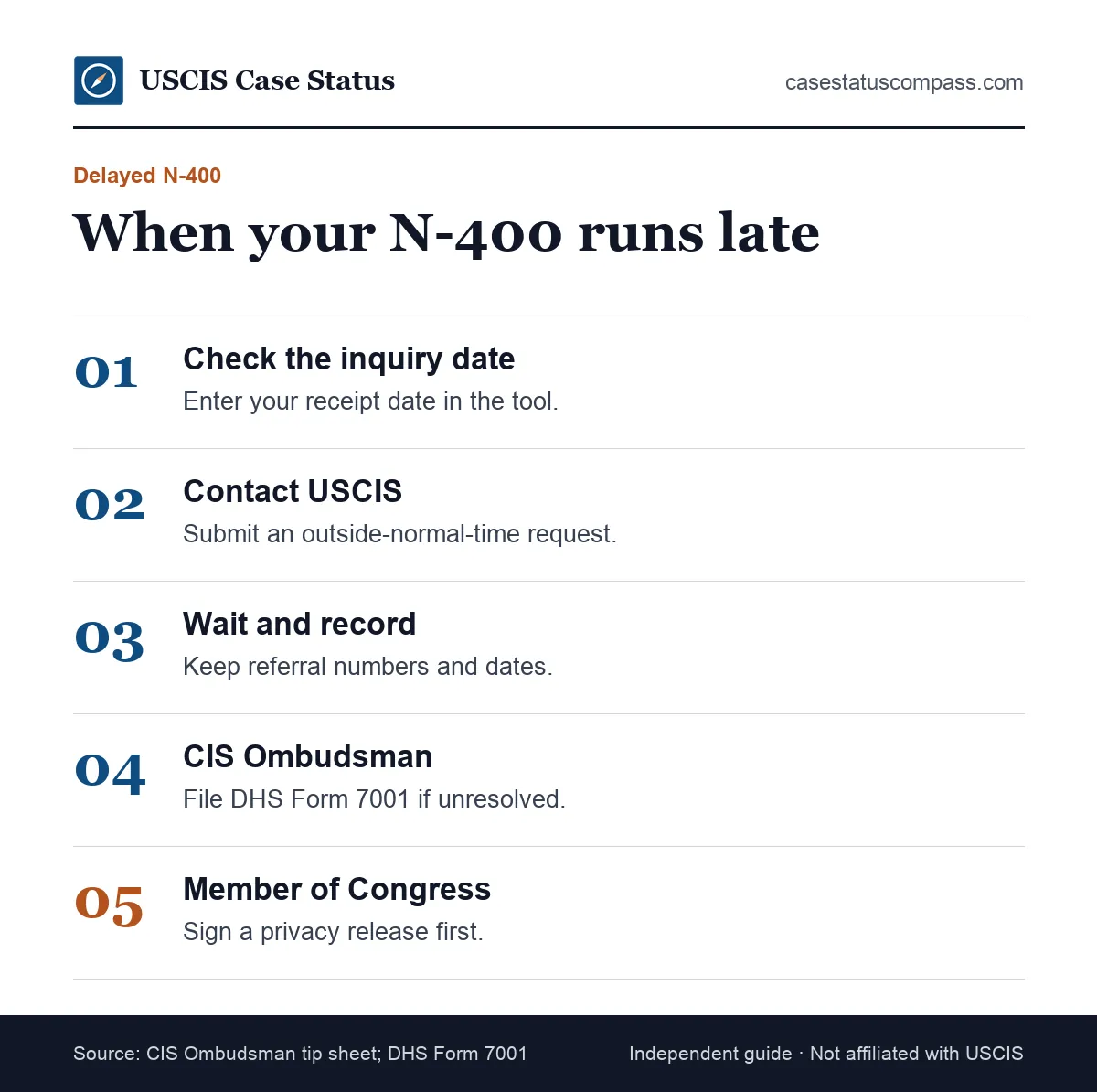
When an N-400 runs past its inquiry date, move up an escalation ladder: a USCIS service request, then the CIS Ombudsman, then your member of Congress. Keep dates, reference numbers and copies of every reply.
Give each step a few weeks to work before moving to the next, and do not file duplicate requests.
The escalation ladder
The table shows the three escalation steps in order, when each one applies and how to start it.
| Step | When | How |
|---|---|---|
| USCIS service request | After your inquiry date | Online or Contact Center |
| CIS Ombudsman | Use the Ombudsman only after contacting USCIS within 90 days and waiting at least 60 days | DHS Form 7001 |
| Congressional inquiry | USCIS has not resolved it | Your member of Congress can ask USCIS about your case after you sign a privacy release |
When Should You See an Attorney About a Delayed N-400?
See an immigration attorney or DOJ-accredited representative if you have an arrest record, long trips abroad, or a case continued without a clear reason. These issues can turn a routine interview into a long continuation, so get advice before the interview. Our uscis ombudsman guide explains outside help.
What to bring to the consultation
Bring a copy of your N-400, every USCIS notice, your travel dates and any court records, so the attorney can judge the risk quickly.
Notes from past calls help too.
Travel and Moving While You Wait
You can usually travel while your N-400 is pending, but long trips and missed notices can slow or end the case. Keep your mailing address current and plan trips around your appointments.
Before a long trip, ask someone to check your mail.
Trips abroad during the wait
Naturalization: a trip over 6 months is presumed to break residence; 1 year or more breaks it. Missing an interview because you were abroad means a reschedule and months of delay.
Address changes
Update your address with USCIS, not just the post office. Notices sent to an old address are a common cause of missed appointments.
Update the post office as well, as a backup.
Mistakes That Add Time to Naturalization
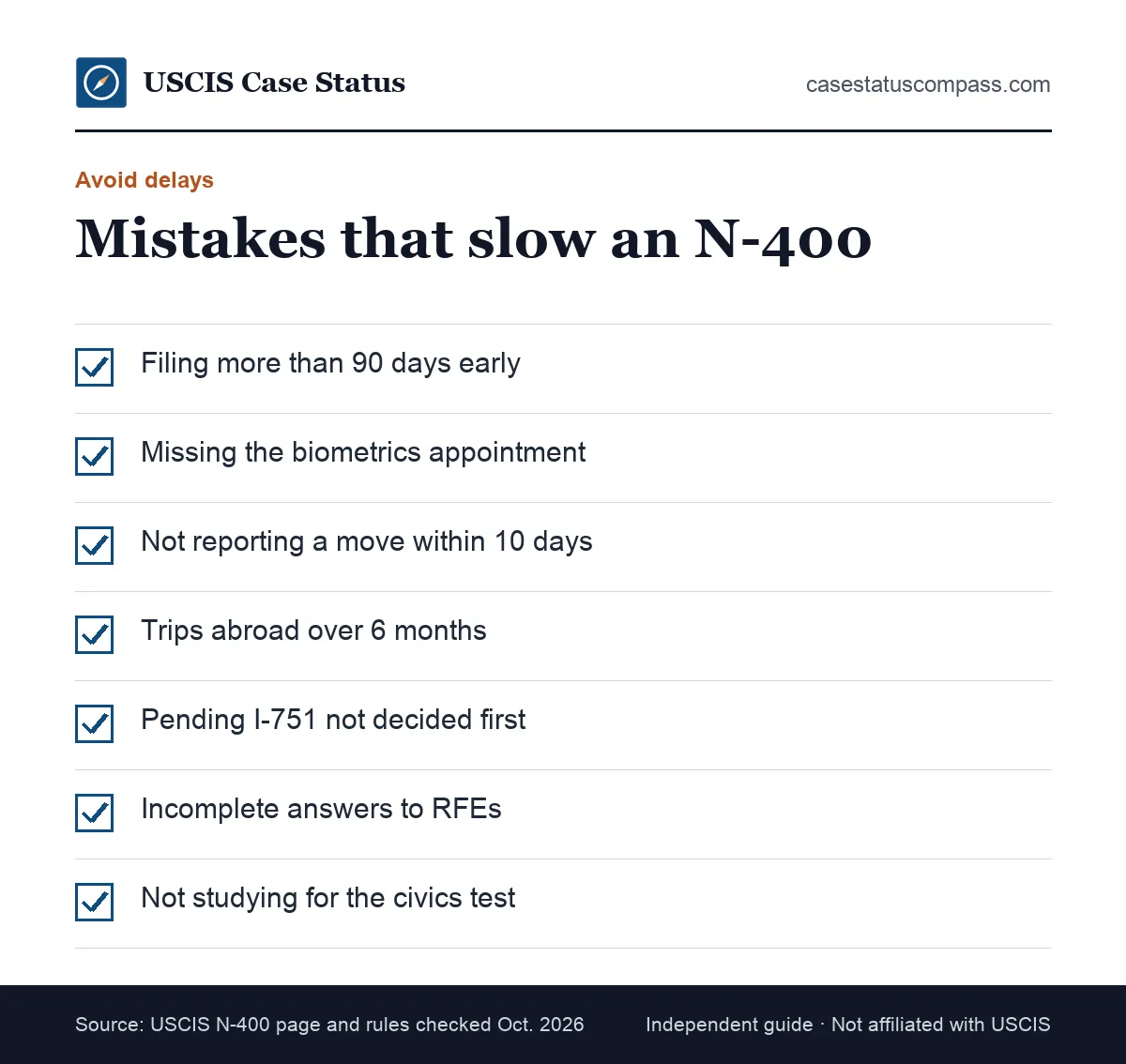
The mistakes that most often add time are filing too early, missing biometrics, not reporting a move, long trips abroad, and weak test preparation. Each one triggers a reschedule, an RFE, a second interview or a denial.
Most are easy to avoid with a calendar check and a document list made before you file.
Filing mistakes
Filing more than 90 days early leads to denial. An old form edition or missing fee leads to rejection. Fee help is on our uscis fee waiver page. Use the 01/20/25 edition of the form.
Interview-day mistakes
Bring the documents your notice lists, arrive early and bring your green card. Study the right civics version for your filing date to avoid a retest.
Bring originals, not only copies.
How Long Does Naturalization Take for Children?
Most children do not file an N-400. Many become citizens automatically through a citizen parent and prove it with Form N-600. N-600/N-600K: median 6.9 months (USCIS data, Apr.-June 2026).
That N-600 path is a separate application with its own wait, and it does not involve the civics test.
When a child gets citizenship automatically
INA 320: child under 18, green card holder, living in the U.S. in a citizen parent's custody. If a child meets these conditions, the N-600 is proof, not an application to become a citizen.
Where to learn more
See our n600 form guide for filing steps. Children who do not qualify may need to naturalize later themselves.
Ask an attorney if the parent's citizenship or custody facts are unclear, because they decide which path applies.
Other Processing Times Related to Citizenship
Naturalization sits at the end of a longer immigration journey. The earlier steps, from the green card to removing conditions, each have their own processing time and can affect when you may file the N-400.
If an earlier case is still open, its wait usually sets your N-400 date, so the links below cover each one.
The green card stage
If you are still waiting for permanent residence, start with our green card processing time page. Your naturalization clock starts only once you hold the card.
Use the date on that card.
Work-based and labor stages
Many residents reached the green card through an employer. For those earlier stages, see the perm processing time and i 140 processing time pages. All processing times are in our USCIS processing times hub.
Frequently Asked Questions
How long does it take to get American citizenship overall?
How long does naturalization take overall? Most permanent residents need 5 years as a green card holder (3 if married to a citizen), may file 90 days early, then wait for processing. USCIS's N-400 median was 9.5 months in April–June 2026.
How long does the naturalisation process take for a spouse of a U.S. citizen?
A spouse who has been married to and living with the same citizen for 3 years as a resident may file 90 days before the third anniversary. Processing then follows the usual field office queue, with a national median of 9.5 months in April–June 2026.
Do I become a citizen at the interview or the oath?
You become a citizen only when you take the Oath of Allegiance. Passing the interview means USCIS can approve your case, but you are still a permanent resident until the oath.
How long does a citizenship process take if I retake the test?
A retest adds a second interview. USCIS schedules the retest of the failed part 60 to 90 days after the first interview. If you pass, the oath can follow.
Does filing the N-400 online make naturalization faster?
USCIS does not publish separate processing times for online and paper N-400s. Online filing gives you an instant receipt and avoids mail delays at intake. After that, your case waits in the same field office queue as a paper filing.
How long does it take to get citizenship after applying if I move?
A move can trigger a file transfer to the field office that serves your new address, which may bring a new interview date. Report the move within 10 days, and check the new office's figure in the official tool.
How long does application for citizenship take if I have an I-751 pending?
It can take longer. The officer may decide both cases at the interview or wait for the I-751 decision, and the I-751 median was 22.6 months in April–June 2026.
How long to get citizenship in the US after the oath for a passport?
You are a citizen from the moment you take the oath. Your Certificate of Naturalization is usually handed to you at the ceremony. You can then apply for a U.S. passport with the State Department, which sets its own processing times.
Sources
- USCIS Data Library: All Application and Petition Form Types, FY2026 Q3. www.uscis.gov/sites/default/files/document/data/quarterly_all_forms_fy2026_q3_v1.xlsx. Accessed Oct 27, 2026.
- USCIS Data Library: All Application and Petition Form Types, FY2025 Q4. www.uscis.gov/sites/default/files/document/data/quarterly_all_forms_fy2025_q4_v1.xlsx. Accessed Oct 27, 2026.
- USCIS: Check Case Processing Times. egov.uscis.gov/processing-times/. Accessed Oct 27, 2026.
- USCIS: Form N-400, Application for Naturalization. www.uscis.gov/n-400. Accessed Oct 27, 2026.
- CIS Ombudsman: Check Your USCIS Case Inquiry Date (tip sheet). dhs.gov/sites/default/files/2024-11/24_0823_cisomb_case-inquiry-date-tip-sheet.pdf. Accessed Oct 27, 2026.
- USCIS: Citizenship Resource Center. www.uscis.gov/citizenship. Accessed Oct 27, 2026.
- USCIS: Study for the Test. www.uscis.gov/citizenship/find-study-materials-and-resources/study-for-the-test. Accessed Oct 27, 2026.
- USCIS Form G-1055 Fee Schedule, Edition 10/16/26. www.uscis.gov/sites/default/files/document/forms/g-1055.pdf. Accessed Oct 27, 2026.
- Form N-400 Instructions, Edition 01/20/25. www.uscis.gov/sites/default/files/document/forms/n-400instr.pdf. Accessed Oct 27, 2026.
- USCIS: Form I-797 Types and Functions (updated 01/24/2025). www.uscis.gov/forms/filing-guidance/form-i-797-types-and-functions. Accessed Oct 27, 2026.
- USCIS: Preparing for Your Biometric Services Appointment (updated 04/30/2026). www.uscis.gov/forms/filing-guidance/preparing-for-your-biometric-services-appointment. Accessed Oct 27, 2026.
- USCIS: The Naturalization Interview and Test (updated 10/31/2025). www.uscis.gov/citizenship/learn-about-citizenship/the-naturalization-interview-and-test. Accessed Oct 27, 2026.
- USCIS Policy Manual Vol. 12, Part E, Ch. 2. www.uscis.gov/policy-manual/volume-12-part-e-chapter-2. Accessed Oct 27, 2026.
- USCIS: Form N-648 page (updated 06/05/2026). www.uscis.gov/n-648. Accessed Oct 27, 2026.
- USCIS: Naturalization Ceremonies (updated 02/12/2026). www.uscis.gov/citizenship/learn-about-citizenship/naturalization-ceremonies. Accessed Oct 27, 2026.
- USCIS Policy Manual Vol. 12, Part D, Ch. 1; Part G, Ch. 1 (current as of Oct. 23, 2026). www.uscis.gov/policy-manual/volume-12-part-d-chapter-1. Accessed Oct 27, 2026.
- USCIS: Filing Fees (updated 02/12/2026). www.uscis.gov/forms/filing-fees. Accessed Oct 27, 2026.
- USCIS Policy Manual Vol. 12, Part D, Ch. 3. www.uscis.gov/policy-manual/volume-12-part-d-chapter-3. Accessed Oct 27, 2026.
- USCIS Policy Manual Vol. 12, Part G, Ch. 5. www.uscis.gov/policy-manual/volume-12-part-g-chapter-5. Accessed Oct 27, 2026.
- USCIS: Checking Your Case Status Online. www.uscis.gov/tools/checking-your-case-status-online. Accessed Oct 27, 2026.
- USCIS: Benefits of a USCIS Online Account. www.uscis.gov/file-online/benefits-of-a-uscis-online-account. Accessed Oct 27, 2026.
- USCIS alert: USCIS Expands myProgress to Form I-485 and Form I-821 (Nov. 21, 2023). www.uscis.gov/newsroom/alerts/uscis-expands-myprogress-to-form-i-485-and-form-i-821. Accessed Oct 27, 2026.
- USCIS: How to Change Your Address (updated 08/04/2026); 8 U.S.C. 1305(a) (LII). www.uscis.gov/addresschange. Accessed Oct 27, 2026.
- 8 CFR 103.2(b)(8)(iv) (LII). www.law.cornell.edu/cfr/text/8/103.2. Accessed Oct 27, 2026.
- 8 CFR 103.8(b) (LII). www.law.cornell.edu/cfr/text/8/103.8. Accessed Oct 27, 2026.
- USCIS: How Do I Request Premium Processing? (updated 03/23/2026). www.uscis.gov/forms/all-forms/how-do-i-request-premium-processing. Accessed Oct 27, 2026.
- USCIS: How to Make an Expedite Request (updated 09/08/2026). www.uscis.gov/forms/filing-guidance/how-to-make-an-expedite-request. Accessed Oct 27, 2026.
- USCIS: Form N-426 page (updated 06/05/2026). www.uscis.gov/n-426. Accessed Oct 27, 2026.
- USCIS Contact Center (uscis.gov). www.uscis.gov/contactcenter. Accessed Oct 27, 2026.
- DHS CIS Ombudsman: How to Submit a Case Assistance Request (updated 04/13/2026). www.dhs.gov/case-assistance. Accessed Oct 27, 2026.
- USCIS OLA New Member Outreach FAQs (Jan. 2021). www.uscis.gov/sites/default/files/document/questions-and-answers/5%20117%20-%20New%20Member%20Outreach%20FAQs%2001042021.pdf. Accessed Oct 27, 2026.
- USCIS Policy Manual Vol. 12, Part H, Ch. 4; Form N-600 Instructions 01/20/25. www.uscis.gov/policy-manual/volume-12-part-h-chapter-4. Accessed Oct 27, 2026.
casestatuscompass.com is an independent publication and is not affiliated with USCIS or any government agency. This page is general information, not legal advice. For denials, court or asylum matters, consult an immigration attorney or a DOJ-accredited representative.