Contents · 40 sections
- What Is the Citizenship Interview?
- Naturalization Interview Process, Step by Step
- What Happens When the Officer Places You Under Oath?
- Can You Bring a Lawyer or Interpreter to the Naturalization Interview?
- What Citizenship Interview Questions Will the Officer Ask?
- Interview Questions Naturalization Officers Ask About Your History
- What Will the Officer Ask About Trips Outside the U.S.?
- Questions About Marriage, Children and Support
- What Do Spouse-Basis Applicants Need at the Naturalization Interview?
- How Do Officers Ask About Good Moral Character?
- What If You Owe Taxes or Missed Selective Service Registration?
- Does the Interview Include the 100 Questions for Citizenship?
- How Is English Speaking Judged During the Interview?
- What If You Have a Disability or Need an Accommodation?
- What to Bring to the Citizenship Interview?
- Documents Required for the Naturalization Interview by Situation
- What to Take to the Citizenship Interview if You Have a Criminal Record
- Printable Naturalization Interview Checklist
- Do They Take Your Green Card at the Citizenship Interview?
- What to Wear to a Citizenship Interview (Dress Code)
- How Long Does the Citizenship Interview Take?
- How Long Does It Take for the Citizenship Interview After Fingerprints?
- Preparing for the Citizenship Interview: A Four-Week Plan
- How Should You Review Your N-400 Before the Interview?
- Can I Reschedule My Citizenship Interview?
- What Happens If You Miss the Naturalization Interview?
- Military Applicants at the Naturalization Interview
- Conditional Residents: Is Your I-751 Decided at the Interview?
- Naturalization Interview Results: What Form N-652 Means
- What Does a Continued Citizenship Case Mean?
- What If Your Case Is Denied at the Interview?
- Should You Request a Hearing or Refile After an N-400 Denial?
- What Happens After an Approved N-400 Interview?
- Case Status Updates After the N-400 Interview
- Citizenship Interview vs Green Card Interview: What Is Different?
- Common Naturalization Interview Mistakes to Avoid
- N-400 Interview Scenarios
- If X, Do Y: N-400 Interview Decision Table
- When Should You Get Legal Help Before the Naturalization Interview?
- Frequently Asked Questions
The short answer
The citizenship interview is your Form N-400 naturalization interview at a USCIS field office. An officer places you under oath, reviews your application, and gives the English and civics tests unless you are exempt. You bring your notice, green card and ID, and leave with written results on Form N-652.
At a glance
| Where | Your local USCIS field office, named on the interview notice |
| What happens | N-400 review under oath, plus English and civics tests |
| Civics test | 2025 civics test: 20 questions from 128; pass with 12 correct |
| If you fail a part | Two chances to pass; retest of the failed part 60-90 days after the interview |
| Your result | Form N-652, Naturalization Interview Results |
What Is the Citizenship Interview?
The citizenship interview is the in-person meeting where USCIS decides whether you qualify to naturalize. A USCIS officer reviews the Form N-400 you filed, checks your eligibility and gives the naturalization test. It is the main step between biometrics and the oath ceremony.
Who attends and where it happens
You attend alone unless you bring an attorney or, if eligible, an interpreter. It happens at the USCIS field office for your address. Our USCIS interviews hub shows how it fits with biometrics and the oath.
What the officer decides
The officer decides whether you meet the rules for your citizenship application: residence, physical presence, moral character, English, civics and attachment to the Constitution. Our Form N-400 guide explains them; the officer checks they are still true today.
Naturalization Interview Process, Step by Step
The naturalization interview process runs in one visit: security screening, check-in, a wait, then a private meeting with an officer. You take an oath to tell the truth, review your N-400, take the tests and receive Form N-652 with your result before you leave.
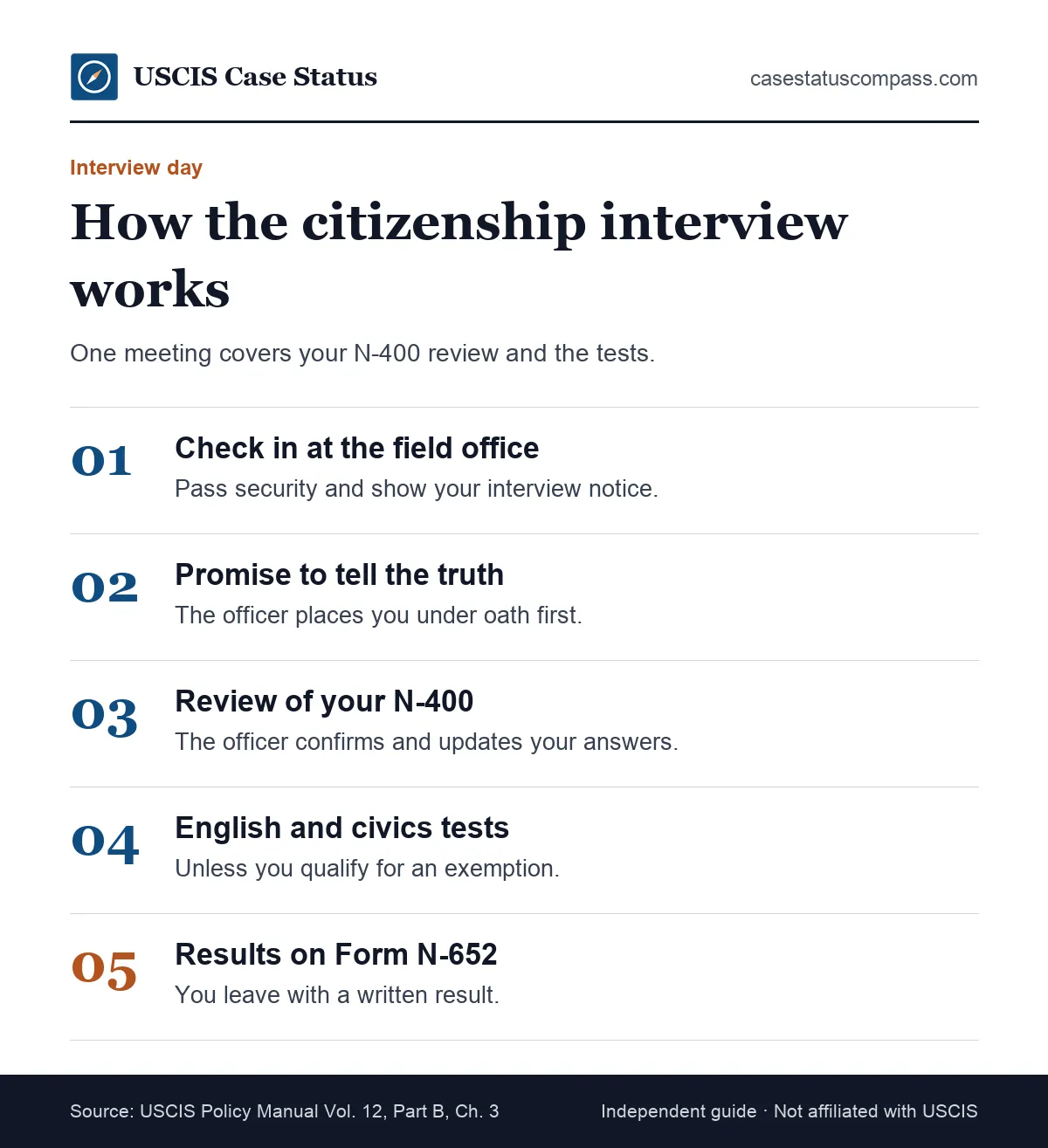
Check-in and the waiting room
Arrive early to clear security, check in with your interview notice and wait to be called. Waits vary by office, so keep documents in one folder.
Leave phones on silent and stay in the seating area so you hear your name.
Inside the interview room
The officer explains the purpose, places you under oath, confirms your identity and goes through your application. The tests come during or after the N-400 review, and the meeting ends with your written result.
What Happens When the Officer Places You Under Oath?
At the start of the united states citizenship interview, the officer asks you to raise your right hand and swear or affirm that you will tell the truth. Everything you say after that is testimony under oath, just as your signed N-400 answers were made under penalty of perjury.
Why the oath to tell the truth matters
False testimony can bar good moral character. If you do not remember a date, say so instead of guessing. Honest corrections are normal.
"I'm not sure" is a safe, truthful answer when you need to check a record.
Making corrections at the start
Officers often ask whether anything in your N-400 changed. Mention a new address, job, trip, marriage or citation then, with papers. You sign the N-400 again at the end to confirm the updates.
Can You Bring a Lawyer or Interpreter to the Naturalization Interview?
Yes, with conditions. You may bring an attorney or accredited representative, who must file Form G-28. You may bring an interpreter only if you qualify for an exception to the English requirement. The officer may also record the interview, at their discretion.
Attorneys and accredited representatives
A representative can advise you but should not answer for you. If your representative is absent and you want them there, the Policy Manual says the officer must reschedule.
Bring a signed Form G-28 copy if your representative attends.
Interpreters and recordings
If you qualify for an English exception, the N-400 instructions say you must bring your own interpreter, who takes an oath and shows ID. Officers may record the interview; records can be requested through FOIA.
What Citizenship Interview Questions Will the Officer Ask?
Most citizenship interview questions come straight from your N-400. The officer confirms your identity, addresses, employers, trips abroad, family members and the yes/no eligibility questions. Your answers also let the officer judge your spoken English. Expect follow-up questions where your answers or records raise doubts.
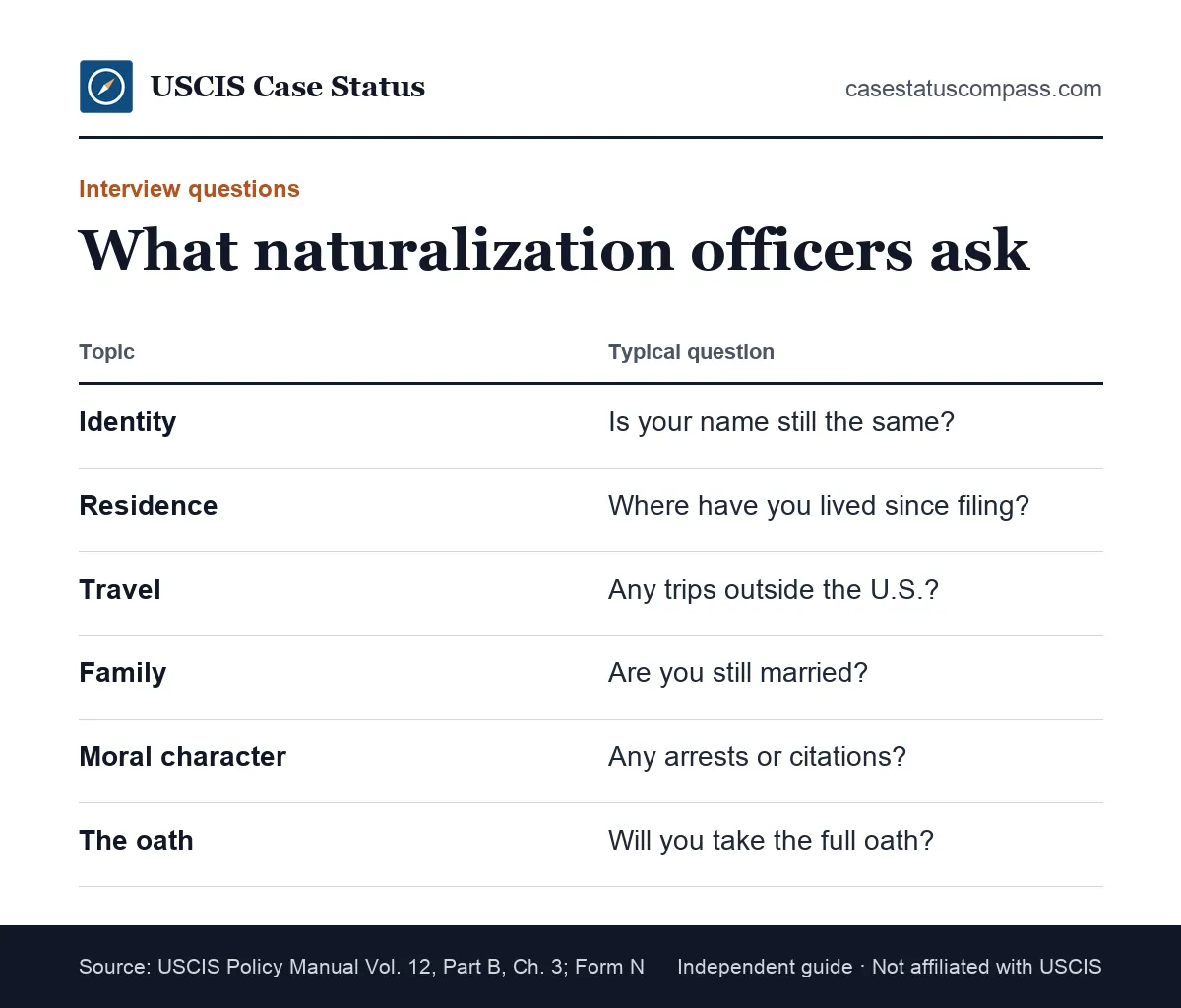
Questions drawn from your N-400
Typical examples: "What is your current address?", "Where do you work?", "Have you traveled since you filed?" and "Have you ever been arrested?" Officers may ask what words like oath or allegiance mean, and rephrase if you are lost.
Why the officer asks again what you already wrote
USCIS must confirm eligibility on the interview day, not just the filing date. Asking again under oath updates the record and tests your English in real conversation.
Short, consistent answers are the goal.
Interview Questions Naturalization Officers Ask About Your History
Interview questions naturalization officers ask about your history focus on the statutory period, usually the last 5 years, or 3 years for spouses of U.S. citizens. They check where you lived, where you worked and how long you were outside the United States, because each one affects eligibility.
Residence and employment
Expect the officer to walk through your addresses and jobs for the statutory period, usually five years or three for spouse-basis filers.
| Question area | What the officer is checking | What helps |
|---|---|---|
| Home addresses | Continuous residence and local residence | Leases, utility bills |
| Employers and schools | Your history matches the N-400 | Pay stubs, W-2s |
| Gaps in employment | How you supported yourself | Tax returns, benefit letters |
| Current household | Who lives with you | ID with current address |
Bring the supporting papers for any period that looks unusual on your N-400, such as a short-term lease or a gap between jobs.
What Will the Officer Ask About Trips Outside the U.S.?
The officer reviews each trip on your N-400 and your passport stamps. Long trips draw the most questions, because Naturalization: a trip over 6 months is presumed to break residence; 1 year or more breaks it. Bring every passport you used during the period, including expired ones, and proof of ties for any long trip.
Questions About Marriage, Children and Support
Officers ask about your marital history and children because the N-400 requires both and because some eligibility paths depend on marriage. If you filed on the 3-year spouse basis, expect detailed questions about your marriage and your spouse's citizenship.
If either of you was married before, bring the divorce decree, annulment or death certificate that ended each earlier marriage.
Children and financial support
Officers may ask whether you support children who live elsewhere. If a court ordered child support, bring proof of payments; missed payments raise moral character questions.
A short summary of who lives where helps you answer clearly.
What Do Spouse-Basis Applicants Need at the Naturalization Interview?
The shorter path rests on one rule: 5 years of continuous residence as a permanent resident right before filing (3 years if married to and living with a U.S. citizen). Bring your marriage certificate, proof of your spouse's citizenship and proof you live together. A separation or divorce before the oath can end the spouse basis, so be honest.
How Do Officers Ask About Good Moral Character?
Good moral character questions are the yes/no questions on your N-400 about crimes, taxes, immigration violations, voting, false claims to citizenship and more. The officer reads them aloud or asks you to confirm your answers. A "yes" needs an explanation and records, not panic.
Arrests, citations and court records
Disclose any arrest, citation or charge, even if dismissed or expunged, and bring certified court dispositions. Minor traffic tickets usually need only proof of payment.
When in doubt, disclose and bring the paperwork.
What If You Owe Taxes or Missed Selective Service Registration?
Bring IRS transcripts and any payment plan. Officers compare your tax answers on the N-400 with those transcripts, so bring them even if you owe nothing. Residents also have duties: Obey the law, file taxes, don't vote, and register for Selective Service (men 18-25). If you missed Selective Service registration, ask an attorney first.
Does the Interview Include the 100 Questions for Citizenship?
The interview includes a civics test, but not all the questions on the list. Which version you take depends on your filing date: Filed N-400 on or after Oct. 20, 2025: 2025 test; before that: 2008 test. The famous "100 questions for citizenship interview" list belongs to the 2008 test.
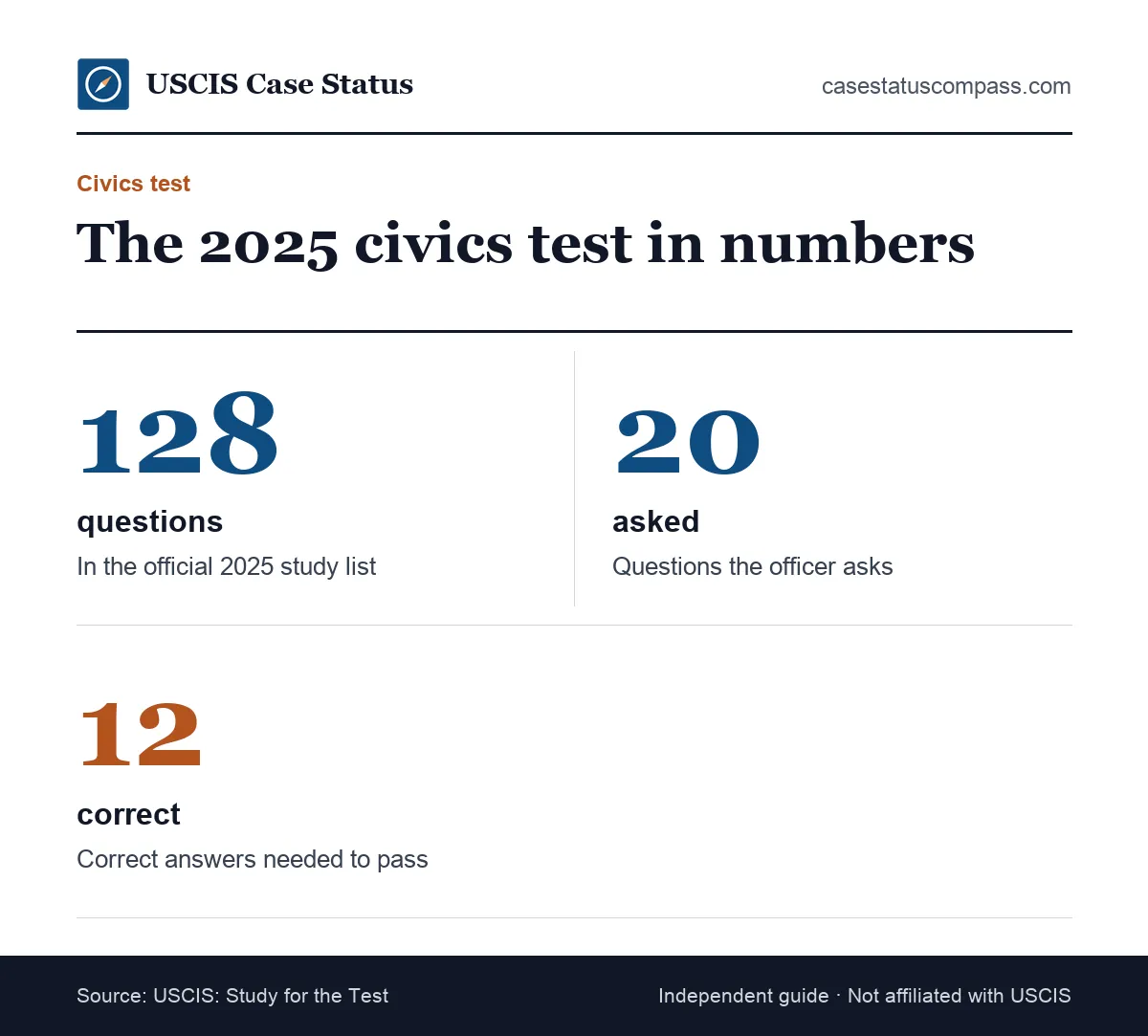
Which civics test applies to you
Your N-400 filing date, not the interview date, decides which version you take, as the table shows.
| Your N-400 filing date | Test version | Rule |
|---|---|---|
| On or after Oct. 20, 2025 | 2025 civics test | 2025 civics test: 20 questions from 128; pass with 12 correct |
| Before Oct. 20, 2025 | 2008 civics test | 2008 civics test: up to 10 questions from 100; pass with 6 correct |
If you are unsure of your filing date, check the received date on your receipt notice.
Where to study the questions
Our citizenship test guide has the scoring rules, sample questions and a free practice test. Check the filing date on your receipt notice before choosing a study list.
That date is the one that counts.
How Is English Speaking Judged During the Interview?
Your English speaking is judged during the whole conversation with the officer. USCIS states that speaking and comprehension are assessed during the eligibility interview. If you understand and answer the N-400 questions, you usually meet the speaking part without a separate test.
What counts and what does not
An accent, grammar mistakes and short answers are fine. What matters is understanding the question. If you are unsure, ask the officer to rephrase; answering the wrong question is worse.
Reading and writing in the same meeting
The reading and writing parts are short: English test: read 1 of 3 sentences and write 1 of 3 sentences correctly. Some long-time residents are exempt: 50/20: age 50+ with 20 years as a green card holder: no English test; 55/15: age 55+ with 15 years as a green card holder: no English test. The test guide covers vocabulary lists and practice.
What If You Have a Disability or Need an Accommodation?
You can ask for a disability exception or an accommodation. Form N-648: a doctor certifies a disability that exempts you from the English and/or civics test. An accommodation is different: it changes how the interview runs, such as wheelchair access, sign language or extra time, without waiving any requirement.
Exceptions with Form N-648
The N-648 is usually filed with the N-400 but can come later. Officers check that it links the condition to the inability to learn English or civics. Bring a copy.
Requesting an accommodation
Ask before your interview date so the office can prepare: e-Request: report USCIS typos, missing notices or accommodation needs online. Keep a copy of the request.
If nobody confirms it, call 800-375-5283 before the day.
What to Bring to the Citizenship Interview?
Bring your interview notice, green card, a government photo ID, all passports and travel documents used during the statutory period, and the originals of documents you sent as copies. Your notice may list more. Missing documents are a top reason a case is continued.
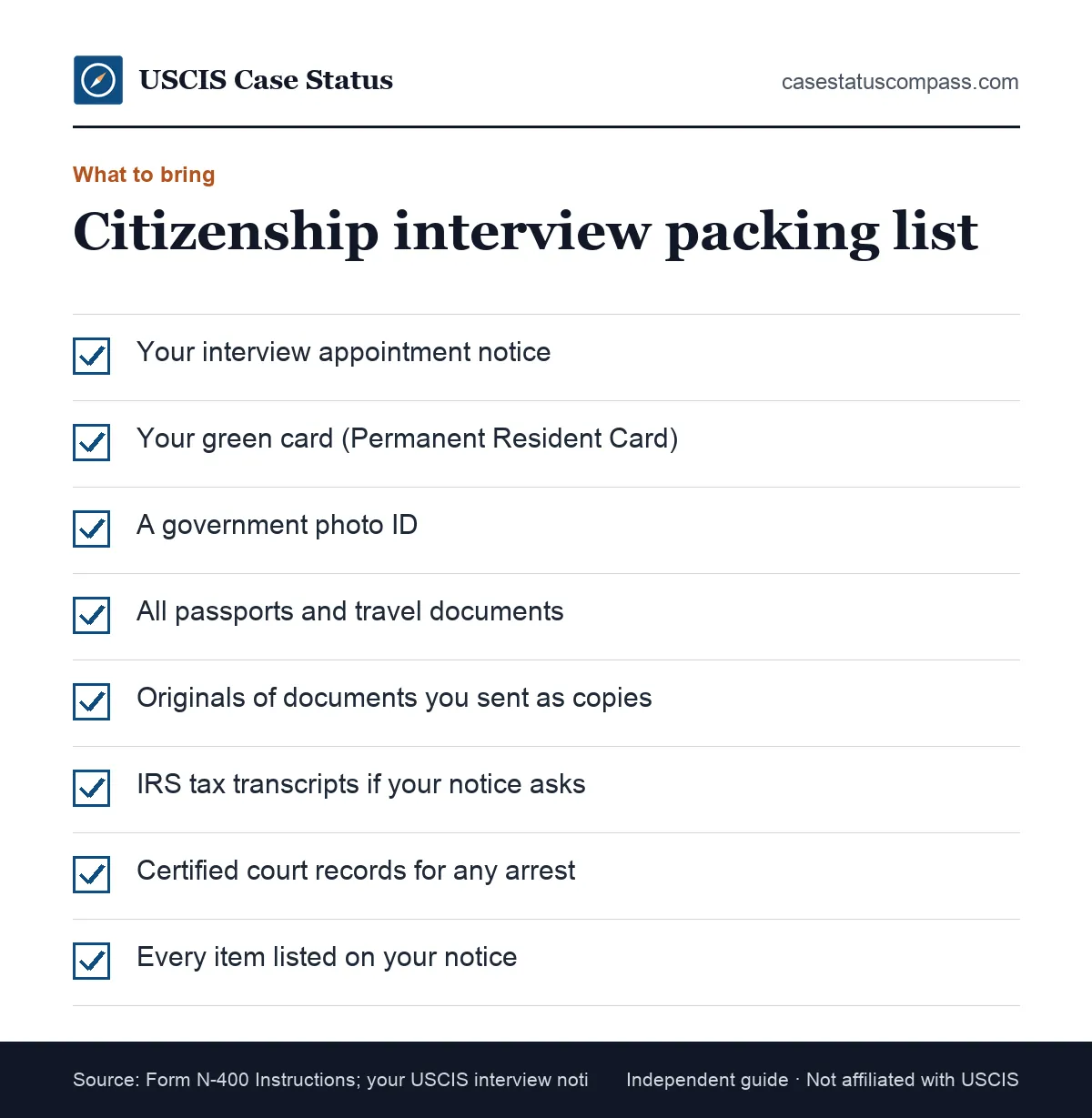
What to bring to the naturalization interview: the core items
- The appointment notice for your interview
- Your Permanent Resident Card
- A state ID or driver's license
- Every passport, valid or expired, used during the period
- Any reentry permit or refugee travel document
- Originals or court-certified copies of documents you filed
Do I need my passport?
Yes. Bring every passport used during the statutory period, including expired passports, because the officer compares stamps with your listed trips. If one was lost, bring the police report or replacement record.
Documents Required for the Naturalization Interview by Situation
The documents required for the naturalization interview depend on your case. The N-400 instructions say you may send photocopies with the application but must bring originals or court-certified copies to the interview. Extra records are needed for marriage, travel, arrests, name changes and military service.
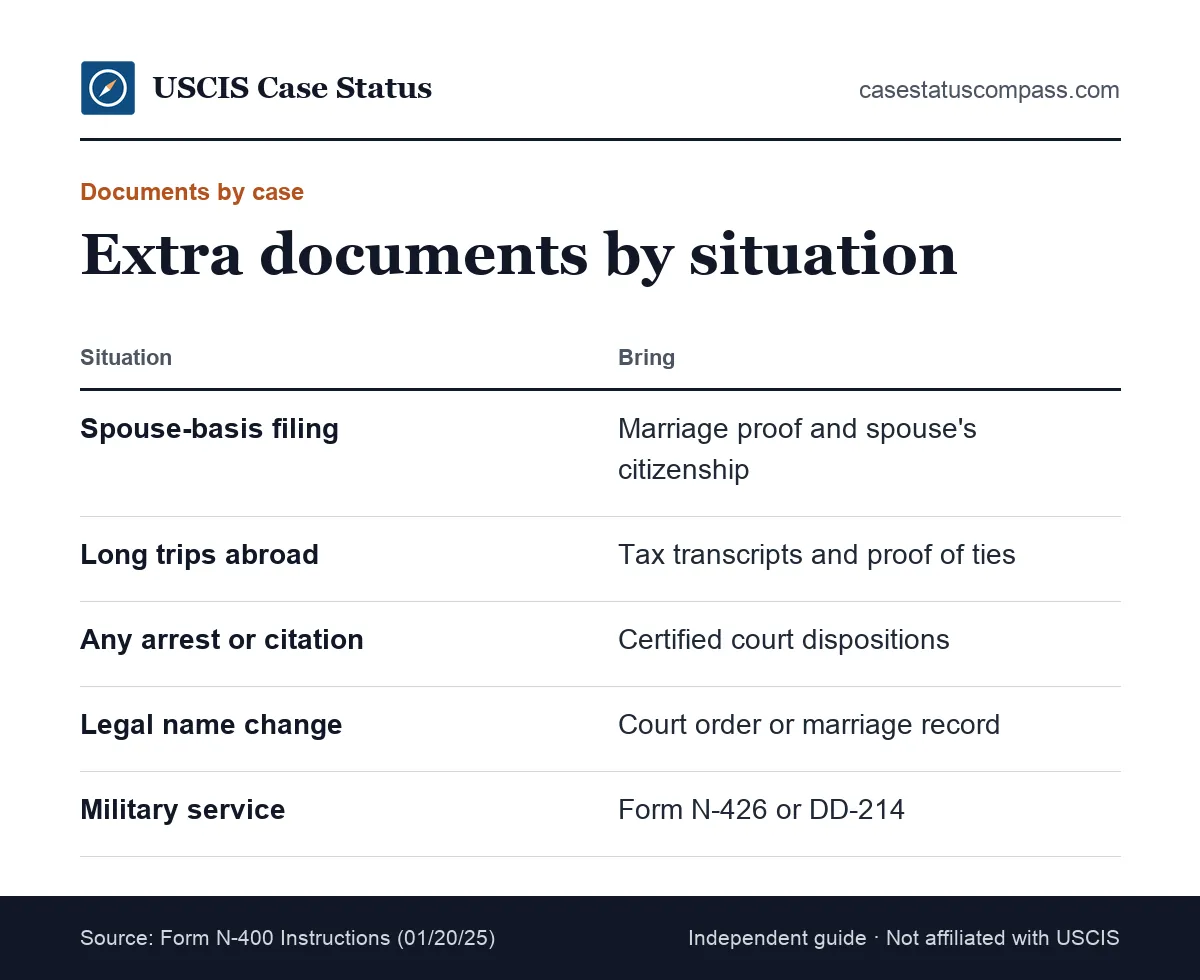
Documents by situation
Beyond the core items, the N-400 instructions add papers tied to specific facts in your case, listed below.
| Your situation | Documents needed for the naturalization interview |
|---|---|
| Filed as the spouse of a citizen | Marriage certificate, spouse's citizenship proof, joint records |
| Long trips abroad | IRS tax transcripts, lease or mortgage, employment letter |
| Any arrest, charge or citation | Certified court dispositions and police records |
| Name changed since your green card | Marriage record, divorce decree or court order |
| Owe taxes | Payment agreement with the IRS and recent statements |
| Current or former service member | Form N-426 (current) or DD-214 (veterans) |
If more than one row fits you, bring every document listed for each row.
Why tax transcripts come up so often
The N-400 instructions advise bringing IRS tax transcripts, especially after long trips abroad. They show you filed as a resident. Order them early.
A tax return transcript is free from the IRS.
What to Take to the Citizenship Interview if You Have a Criminal Record
If you have any arrest or citation, what to take to the citizenship interview includes certified court records for every incident, even dismissed or sealed ones. A record does not always bar citizenship, but missing paperwork usually means a continued case and sometimes a denial.
Certified dispositions
Ask each court clerk for a certified final disposition. If records were destroyed, get a court letter saying so.
Bring the original certified copy and keep a photocopy for yourself, since the officer may keep the copy you hand over.
Talk to an attorney first
Some offenses can make you ineligible or even removable. For any arrest beyond a minor ticket, see an immigration attorney first; a criminal lawyer alone may miss immigration effects.
Do this before the interview, not after.
Printable Naturalization Interview Checklist
Use this printable naturalization interview checklist in the final week, alongside the packing list above. Print it or keep it on your phone, and tick each box before you leave home so nothing is forgotten on the day.
Fold the finished checklist inside your interview notice so the two leave home together.
The week before
- Reread your N-400 and note every change since filing
- Collect originals and certified copies
- Gather all passports and travel documents
- Practice civics questions and reading aloud
- Confirm the office address, route and parking
- Arrange childcare and time off work
The morning of the interview
- Notice, green card, photo ID and passports in one folder
- Copies of your N-400 and any N-648
- Phone silenced; no prohibited items
- Leave early to clear security
- Interpreter or attorney confirmed, if needed
Do They Take Your Green Card at the Citizenship Interview?
Usually not. You keep your green card after the interview and hand it in at the oath ceremony. Hand in your green card when you check in for the oath ceremony. The officer may keep it at the interview only if you take the oath the same day.
Why you keep it until the oath
You remain a permanent resident until the oath, and your card still proves status for work and travel. Keep it safe for the ceremony.
If you lose it before the interview, report it and bring proof of the loss.
When the card is collected early
You may be able to take the oath the same day as your interview; then the card may be collected that visit. If it is lost, tell the officer and show proof you reported it, so USCIS can waive the return.
What to Wear to a Citizenship Interview (Dress Code)
There is no official citizenship interview dress code. Wear clean, neat, business-casual clothes, as you would for a job interview or court date. Your clothing will not decide your case, but looking prepared helps you feel confident.
Pick shoes and layers you can sit in comfortably through a long wait, since your citizenship interview day can run well past the meeting itself.
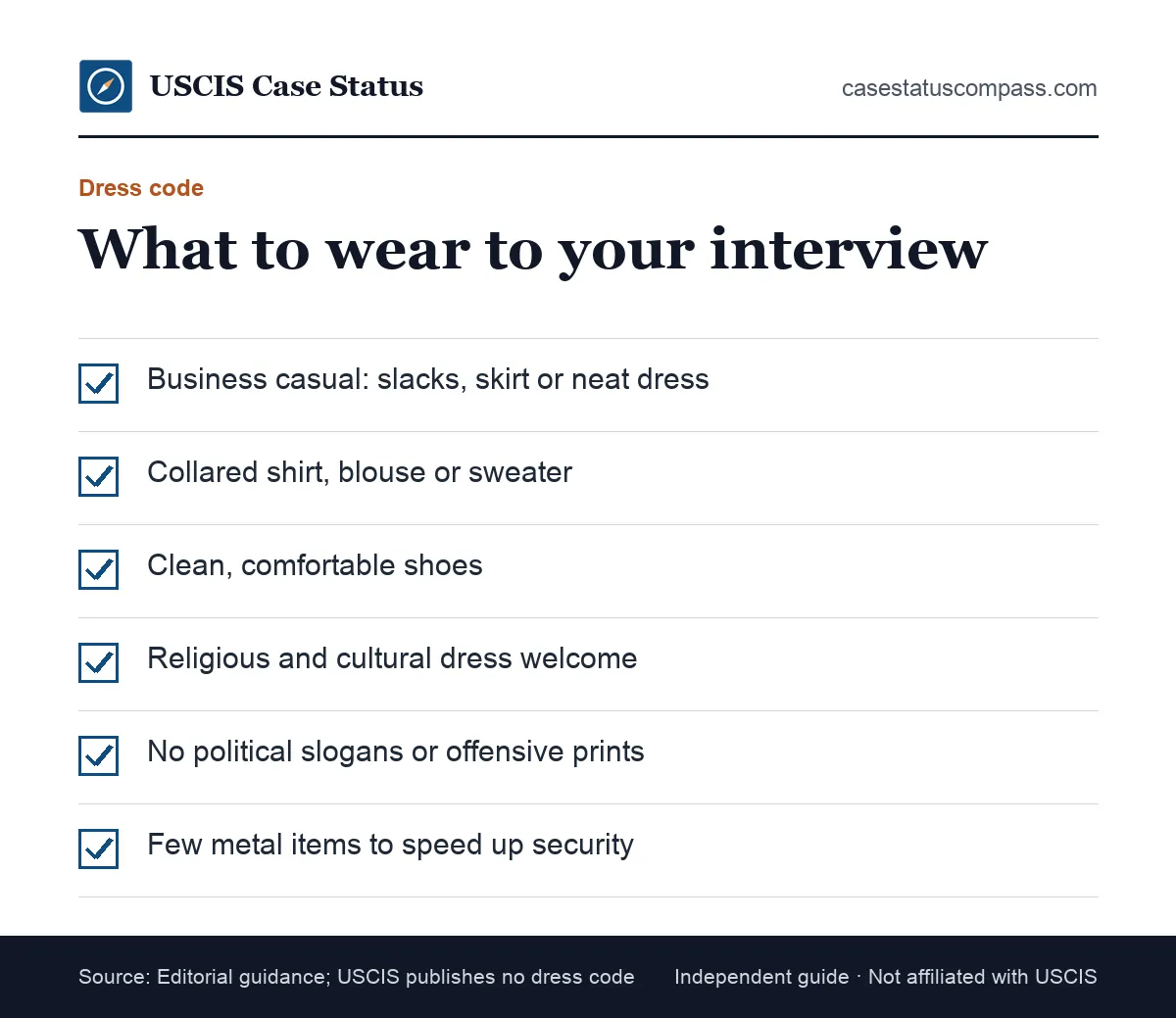
How to dress for the naturalization interview
Slacks or a skirt with a collared shirt, blouse or sweater work well, as does a simple dress or suit. Wear comfortable shoes. Religious and cultural clothing is always appropriate.
What to avoid
Avoid political slogans, offensive prints and beachwear. Skip heavy jewelry and belts that slow security.
Hats and sunglasses should come off in the interview room, and strong perfume can bother others in a small office. Keep phones silenced and out of sight while you speak with the officer.
How Long Does the Citizenship Interview Take?
USCIS does not publish a standard length for the N-400 interview. The meeting with the officer is usually the shorter part of the visit; security, check-in and waiting add more. Plan to spend several hours at the office, and longer if a same-day oath is possible.
How long is the naturalization interview itself?
It depends on your history. A simple case moves quickly. Long travel, a record, a spouse-basis filing, a pending I-751 or an interpreter add time.
Your security wait and check-in add time before you are called.
Planning your day
Take the full day off, especially if your office runs same-day oaths, and arrange childcare. Bring water and something to read if allowed.
Check traffic and parking the night before.
How Long Does It Take for the Citizenship Interview After Fingerprints?
The gap between fingerprints and the naturalization interview varies by field office and workload. USCIS publishes no set interval. As context, N-400: median 9.5 months (USCIS data, Apr.-June 2026). Right now, the official tool shows 10 to 15 months, depending on category and office (USCIS data retrieved Oct 27, 2026) for the whole N-400.
What affects the wait
Office backlogs, background checks, a change of address and evidence requests can all stretch the gap. Our biometrics appointment guide explains what happens at fingerprinting, and our article on how long after biometrics for an interview looks at the gap in detail.
When to ask about delays
Our page on how long does naturalization take explains how to read the processing-times tool and your case inquiry date. If your case passes that date, you can submit an inquiry instead of waiting.
Preparing for the Citizenship Interview: A Four-Week Plan
Preparing for the citizenship interview works best over several weeks. Start by rereading your N-400, then order records, then study and practice, and finish with packing and logistics. This plan keeps the final days calm.
Adjust it if your notice arrives late.
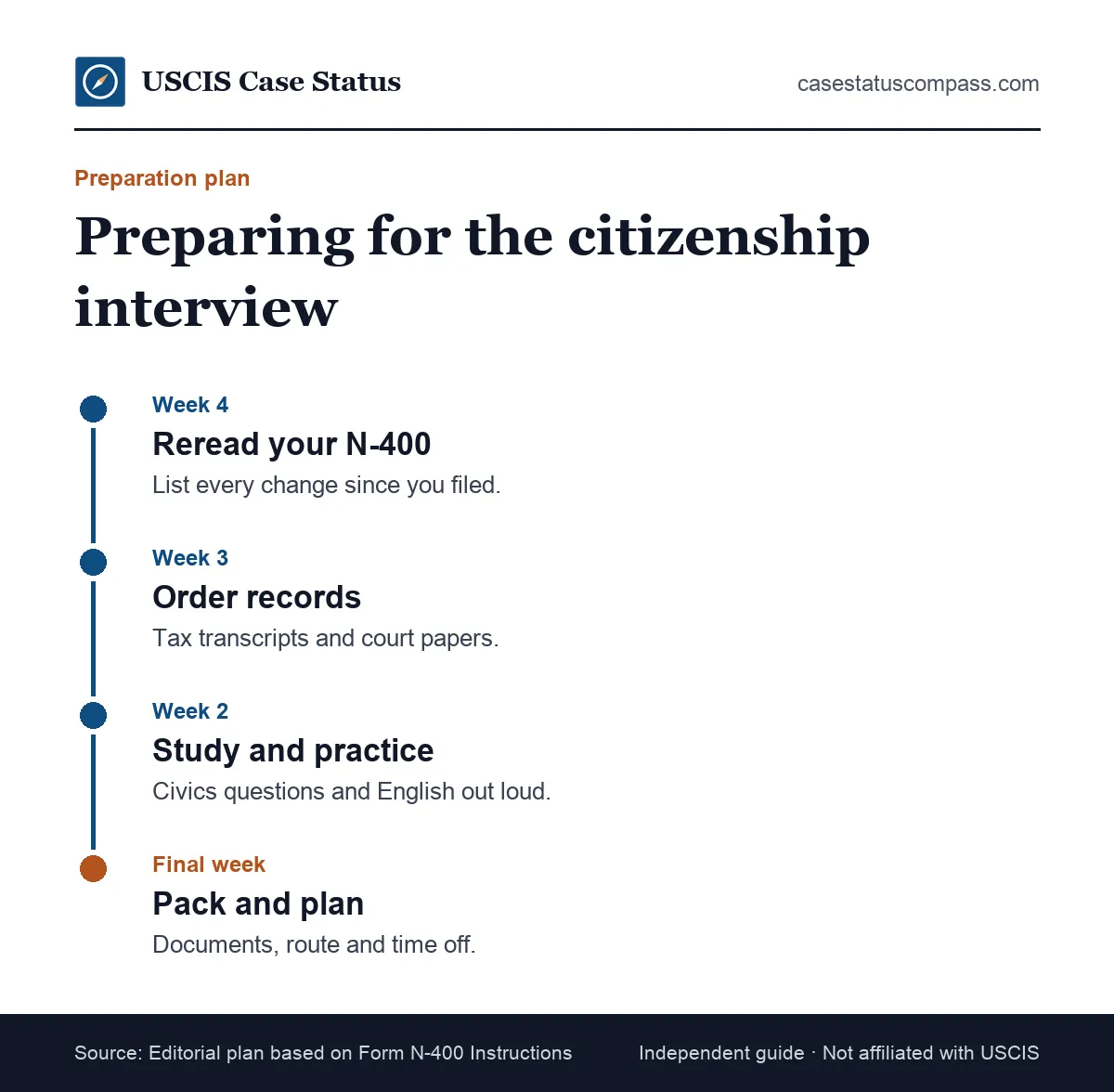
Weeks four to two
Reread your N-400 and list every change since filing. Order transcripts and court records early. Start daily civics study and read sentences aloud.
Practice answers aloud with a friend or family member.
The final week
Pack your folder with the checklist, do a timed civics practice run, and recheck the notice for a changed time.
Sleep well the night before and lay out your clothes and original documents so the morning is calm.
How Should You Review Your N-400 Before the Interview?
Review your N-400 as if you were the officer. Compare each answer with your records, find anything that changed, and prepare short explanations. Most interview problems come from answers the applicant no longer remembers giving.
Use your filed copy, not a draft.
Spot changes since filing
List each new address, job, trip, marriage, divorce, child, citation or arrest on one page with dates, and bring papers for each.
Hand the officer this list early in the meeting.
Handling mistakes you find
Tell the officer about errors at the start; honest corrections are routine. If a mistake involves a crime or a false claim, see an attorney first.
Bring proof that supports the right answer.
Can I Reschedule My Citizenship Interview?
Yes, you can ask to reschedule a citizenship interview, but do it only for a strong reason. Follow the instructions on your interview notice and contact USCIS before the date, for example through the Contact Center at 800-375-5283. A new date can add weeks or months.
How to ask
Read your notice first, because it says how your office handles requests. Give a brief reason, keep proof such as a medical note, and watch your online account for a new notice.
The cost of rescheduling
Slots are limited, so a new date may be far away. For a minor conflict, move the other commitment instead of your appointment for naturalization.
A reschedule also pushes back any same-day oath you might have had.
What Happens If You Miss the Naturalization Interview?
If you miss the naturalization interview without notice, USCIS may treat your case as abandoned and close or deny it. Contact USCIS as soon as you can, explain why you missed it and ask how to proceed. Keep proof of the reason.
Act quickly
Call the Contact Center, then write to the office on your notice. Show a good reason and act fast.
Missing the interview without notice can lead USCIS to treat the application as abandoned, so keep proof of the reason, such as a medical note.
If your case was closed or denied
The notice explains your options and deadlines. Our guide to motions and appeals covers ways to ask USCIS to look again.
Read the deadline closely; some responses are due within weeks.
Military Applicants at the Naturalization Interview
Military applicants follow the same interview steps with extra paperwork. Military applicants: Form N-426 (certified for current service members); veterans use a DD-214. Service members may have their interview at a field office or arrange special handling through their unit.
What to bring if you served
Bring your certified N-426 or DD-214, a current military ID and orders for any time abroad on duty.
Veterans should also bring discharge papers that show the character of service.
Where to get help
Unit legal offices help service members plan timing before a deployment. Many military naturalization filings carry no USCIS fee.
Ask your unit's legal office early, since a deployment can conflict with the interview date and certification can take time.
Conditional Residents: Is Your I-751 Decided at the Interview?
If you hold a 2-year conditional green card and filed Form I-751, your N-400 interview may also cover the I-751. USCIS must decide a pending I-751 before or at the same time as the N-400. Bring evidence for both cases, because the officer may decide them together.
Evidence to bring for both forms
Bring updated joint evidence such as tax returns, leases and bank statements, or a divorce decree. Our Form I-751 guide explains the rules.
Evidence should cover the time since you filed the I-751.
If the I-751 is still pending elsewhere
If the I-751 sits at a service center, the officer may request the file or continue the N-400. Bring your I-751 receipt and extension notice.
The N-400 cannot be approved ahead of the I-751, so expect the officer to resolve the I-751 first or decide both cases on the same day.
Naturalization Interview Results: What Form N-652 Means
At the end of the interview, the officer gives you Form N-652, Naturalization Interview Results, whatever the outcome. It shows whether you passed each test part and whether your case is approved, continued or denied. Keep it with your other notices.
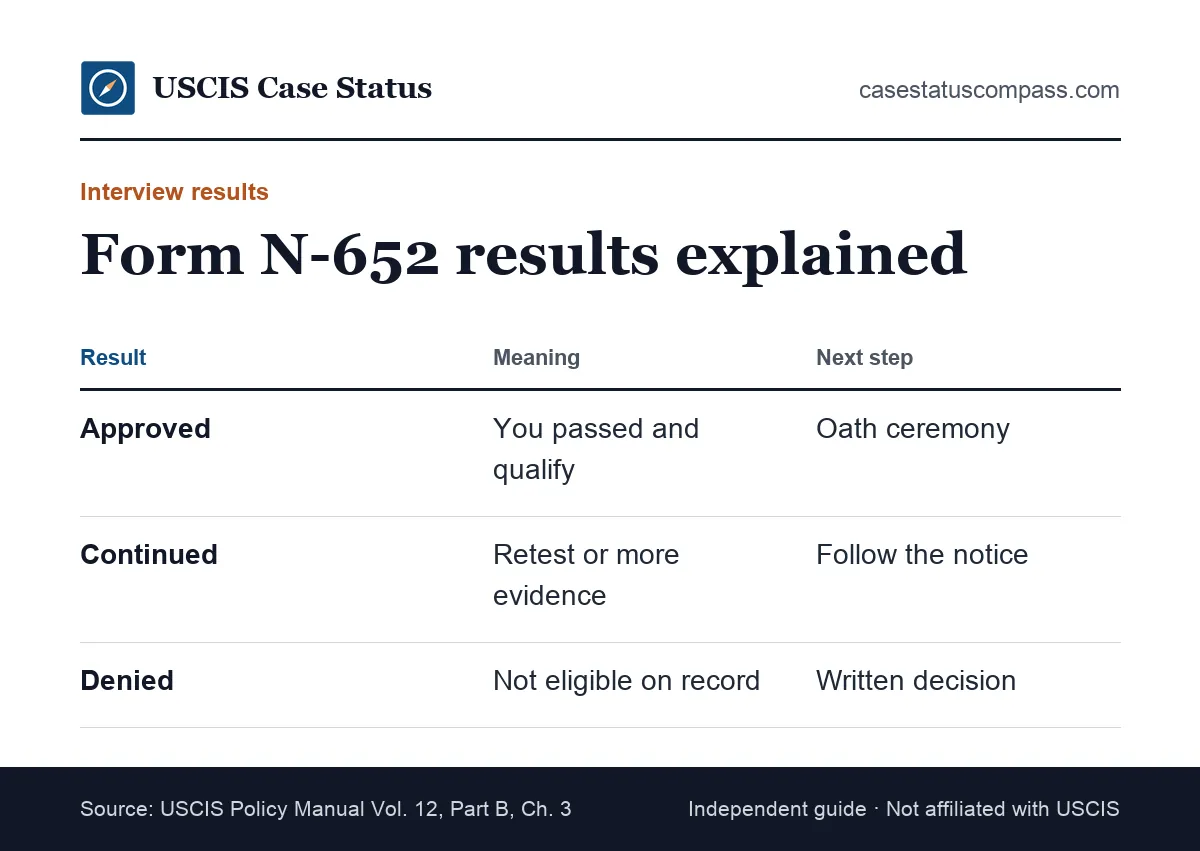
The three possible results
Your Form N-652 shows one of these three results; read it before you leave the office.
| Result on N-652 | What it means | What happens next |
|---|---|---|
| Recommended for approval | You passed the tests and the officer found you eligible | Oath ceremony, same day or by notice |
| Continued | A retest is needed or more evidence is requested | Retest or send evidence by the deadline |
| Denied | The officer found you not eligible | A written decision explains why |
Ask the officer to explain any box you do not understand.
Passed tests but a decision cannot yet be made
Sometimes you pass but the officer cannot decide yet, while checks finish or a supervisor review happens. The N-652 marks this; wait for the next notice.
Check your online account for updates.
What Does a Continued Citizenship Case Mean?
A continued case means the officer needs more before deciding. Usually you failed one test part or must send more documents. A failed part means one more try at a later appointment, covered in the next section. Requests for documents come with a list and a deadline.
Preparing for a retest
Only the failed part is retested. Restudy that part with official lists and bring your N-652.
Two chances to pass; retest of the failed part 60-90 days after the interview. Practice with someone who can time you and read questions aloud.
Responding to a document request
Send exactly what is asked by the deadline, with the request on top, and keep proof of delivery. Missing it can mean a decision on the existing record.
Write your receipt number on each page.
What If Your Case Is Denied at the Interview?
A denial at or after the naturalization interview comes with a written decision that explains the reasons and your options. You may be able to request a hearing with USCIS on Form N-336, or refile later once you fix the problem. Read the deadlines in the notice carefully.
Common reasons for denial
- Failing a test part twice
- Not meeting continuous residence or physical presence
- Good moral character problems, including false testimony
- Missing evidence after a continued case
Most of these can be prevented by preparing the right evidence and answering truthfully.
Should You Request a Hearing or Refile After an N-400 Denial?
A hearing request on Form N-336 asks another officer to review the decision. Refiling means a new N-400 and a new fee, currently $760 (paper) / $710 (online); reduced fee $380 (paper only) if household income is at or below 400% of the Federal Poverty Guidelines. Our denied case options guide and an immigration attorney can help you choose the route that fits the reason for denial.
Fixing the problem before you refile
If the denial was for failed tests, study before refiling. If it was for residence or travel, check whether enough time has passed for a new statutory period. A new N-400 is judged on the facts at its own filing date.
What Happens After an Approved N-400 Interview?
After approval, the next step is the oath ceremony. Some offices offer it the same day; otherwise USCIS mails Form N-445 with a date. You are not a citizen until you take the Oath of Allegiance, so keep your green card and avoid long trips abroad.
Same day or a mailed notice
If your office runs ceremonies often, you may be asked to stay. If not, watch your mail and online account for the N-445. Our oath ceremony guide covers the N-445 questionnaire, what to bring and what to expect.
What not to do while you wait
Do not register to vote, claim citizenship or take a long trip before the oath. Report any new arrest on the N-445.
Keep your address current so the N-445 reaches you.
Case Status Updates After the N-400 Interview
After the interview, your online case status usually changes within days or weeks. Common messages are "Interview Was Completed And My Case Must Be Reviewed," "Case Was Approved" and an oath scheduling update. Each tells you something different about what comes next.
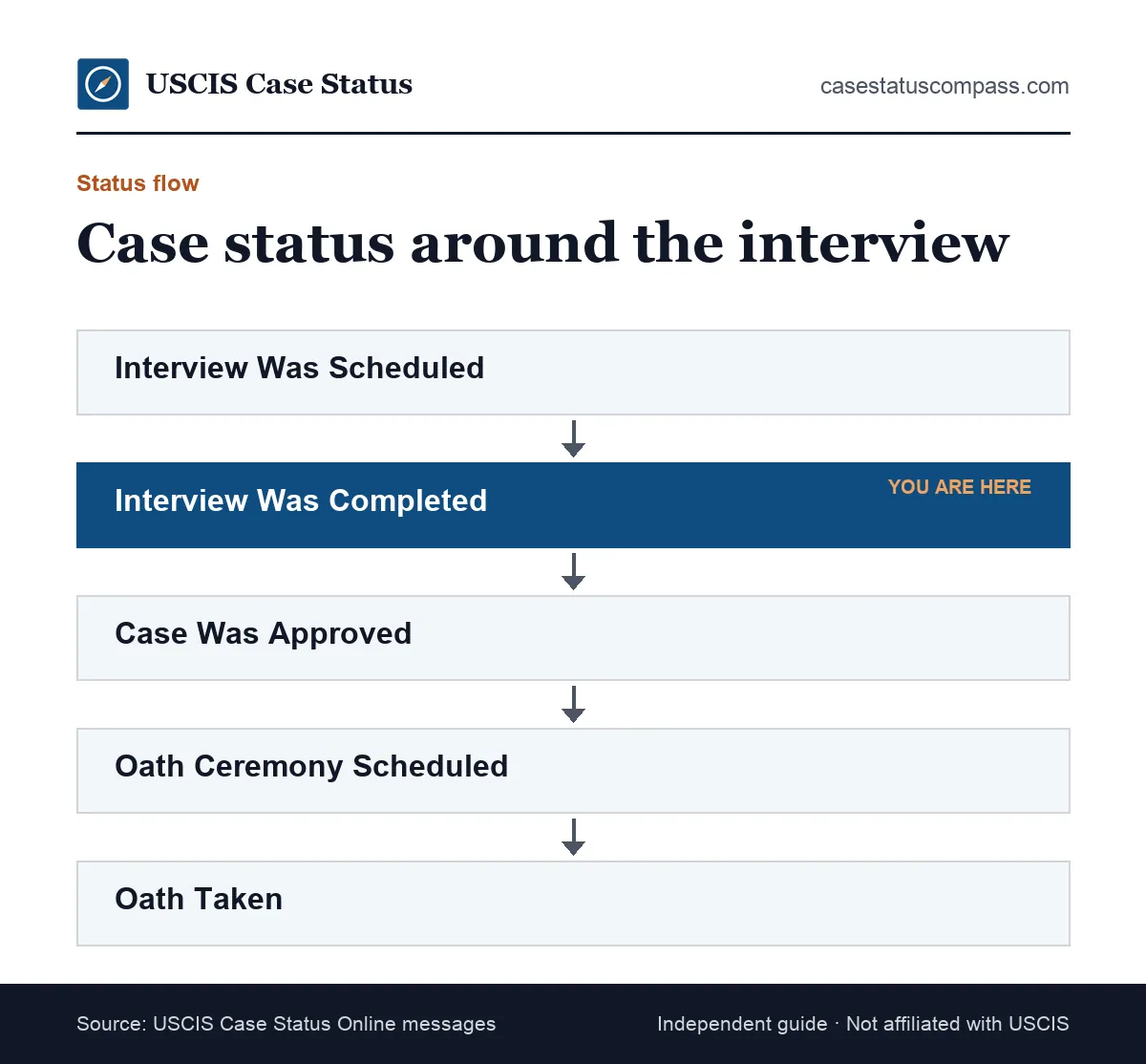
Reading common messages
"Interview Was Completed" often means a review or check is pending. A case was approved message means you qualify but still need the oath.
Your N-652 matters more than the online message.
If the status did not change
Statuses can stay on "interview was scheduled" for days after the meeting. Rely on your N-652 first; it is the official result of the interview itself.
Contact USCIS only after a reasonable wait.
Citizenship Interview vs Green Card Interview: What Is Different?
The N-400 interview reviews your naturalization application and includes English and civics tests. The green card interview reviews Form I-485, often includes the petitioner, and has no tests. Both happen at a field office under oath, but the questions, documents and outcomes differ.
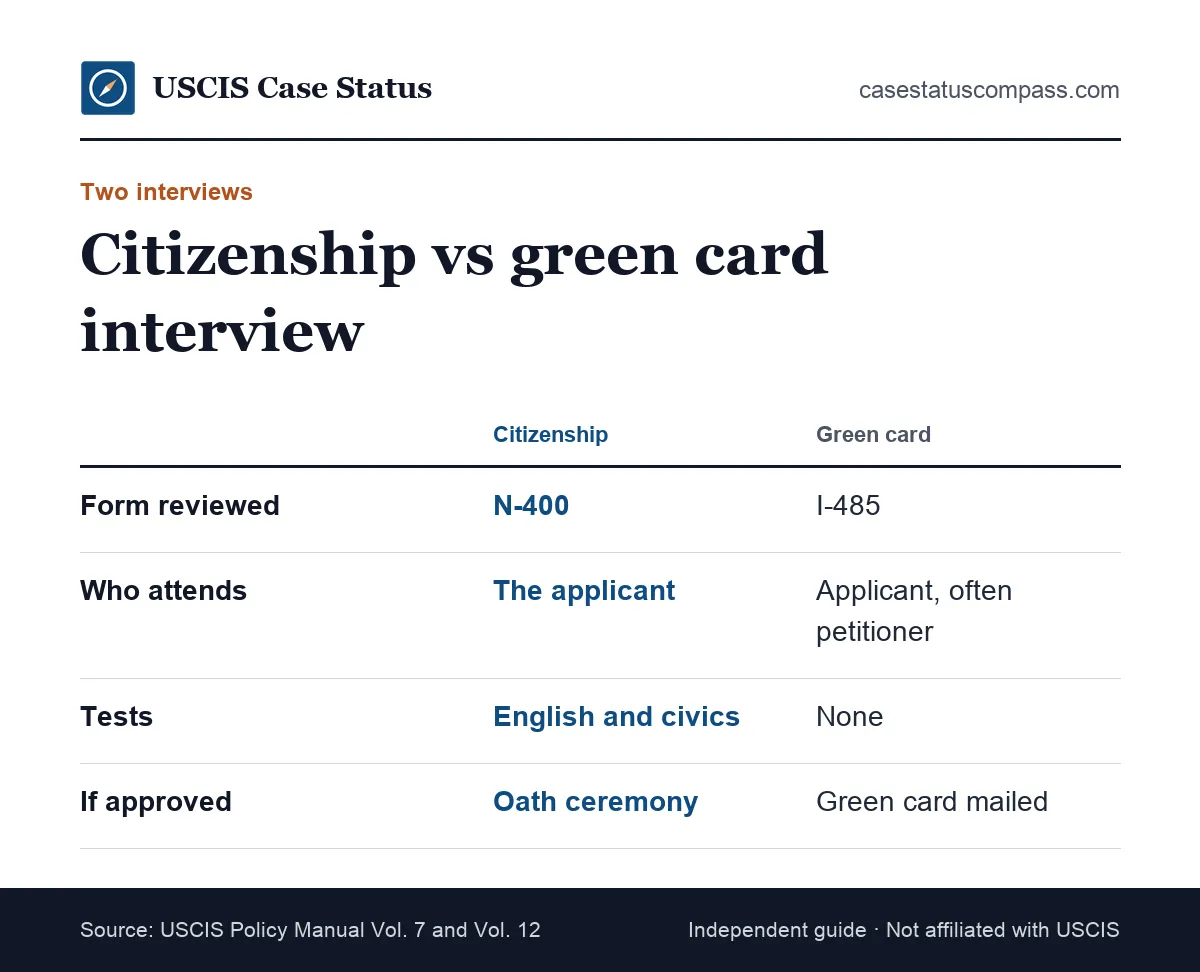
Key differences in one table
The two meetings share an oath and an officer, but almost everything else differs, as this comparison shows.
| Feature | N-400 interview | Green card interview |
|---|---|---|
| Form reviewed | N-400 | I-485 (and often I-130) |
| Main focus | Residence, moral character, tests | Eligibility and the family or job basis |
| Tests | English and civics | None |
| Result document | Form N-652 | Decision by mail or notice |
| If approved | Oath ceremony | Green card mailed |
The biggest gap: only the N-400 interview includes tests.
Where to read about the other interview
Our guide to green card interview questions covers the I-485 meeting, including marriage cases.
That guide explains the evidence, the petitioner's role and what happens when an officer interviews spouses separately. If you are a conditional resident, both processes may touch your file.
Common Naturalization Interview Mistakes to Avoid
Most problems at the N-400 interview come from inconsistent answers, missing originals, undisclosed records and poor logistics. Each one can lead to a continued case. A careful review of your N-400 and a complete folder prevent most of them.
The groups below split them into answer mistakes, made in front of the officer, and logistics mistakes, made before you arrive.
Answer mistakes
- Guessing at dates instead of saying you are unsure
- Answering "yes" without understanding the question
- Forgetting trips or citations listed in your records
- Giving answers that differ from your N-400 without explaining
Logistics mistakes
Arriving late or without the notice
Forgetting expired passports
Bringing copies instead of originals or certified copies
Bringing an interpreter when you do not qualify for an English exception
Not checking the notice for a changed time
N-400 Interview Scenarios
These fictional examples show how common situations play out at the officer's desk. They are planning examples, not legal advice. When your facts differ, follow your notice and ask USCIS or an attorney.
Use them as practice for your own interview.
Scenario 1: A forgotten trip
Lina forgot a two-week trip when she filed. At the interview she tells the officer, shows the passport stamp and corrects the N-400. The officer updates the form, and she passes the tests that day.
Scenario 2: Failing the reading part
Omar passes civics and writing but misreads all three sentences. His N-652 shows the case continued for a reading retest. He practices daily with the vocabulary list and passes at the retest.
If X, Do Y: N-400 Interview Decision Table
Use this decision table to find the first step for common problems around the N-400 interview. For any arrest, a long trip or a marriage change, talk to an immigration attorney or a DOJ-accredited representative before the interview date.
Book that consultation as soon as the notice arrives, because court or travel records can take time to obtain.
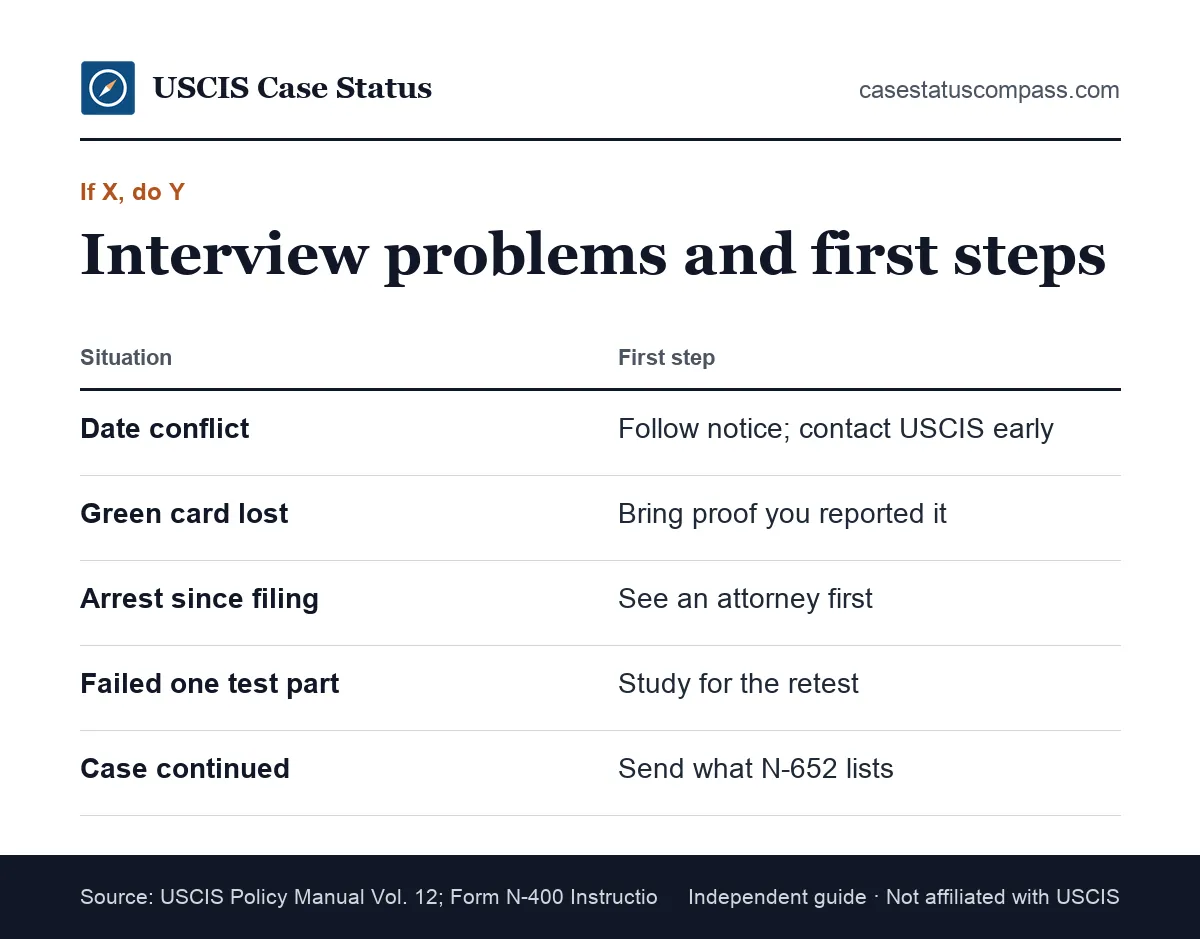
Decision table
Find your situation in the left column and take the matching first step before doing anything else.
| If this happens | Do this first |
|---|---|
| Your notice went to an old address | Update your address and contact USCIS |
| You cannot attend the date | Follow the notice and contact USCIS early |
| Your green card is lost | Report it and bring proof to the interview |
| You were arrested since filing | See an immigration attorney before the interview |
| You failed one test part | Study that part for the retest |
| The N-652 asks for documents | Send them by the deadline with the request |
Contacting USCIS the right way
Use the Contact Center or your online account first. Our contact USCIS guide lists phone numbers, hours and when to request an in-person appointment.
Request an in-person appointment online at my.uscis.gov/en/appointment/v2 or call 800-375-5283.
When Should You Get Legal Help Before the Naturalization Interview?
Get help from an immigration attorney or DOJ-accredited representative before the interview if you have any arrest, a long trip abroad, unpaid taxes, a false claim to citizenship, a past immigration violation or a spouse-basis filing with a marriage in trouble.
Red flags that need advice
- Any arrest, charge or conviction, even if expunged
- A trip abroad longer than six months during the period
- Unfiled taxes or unpaid tax debt
- Registering to vote or voting as a noncitizen
Finding trustworthy help
Use licensed attorneys or representatives at DOJ-recognized organizations, and avoid "notarios" who promise results.
Frequently Asked Questions
What are the most common questions at the N-400 interview?
The most common questions confirm your N-400 answers: your name, address, employer, marital status, children and trips abroad. The officer also asks the yes/no eligibility questions about arrests, taxes, voting and the oath. You then take the civics test and English reading and writing tests unless you are exempt.
How long does a naturalization interview take?
USCIS does not publish a standard length. The meeting with the officer is usually shorter than the time spent on security, check-in and waiting. Cases with long travel, a criminal record, an interpreter or a pending I-751 take longer. Plan for several hours at the office and keep the day free.
Can I bring my spouse or children to my naturalization appointment?
The interview is for the applicant, so family members usually wait outside or stay home. If your spouse is also applying, each person has a separate interview. Arrange childcare where you can, because waiting rooms can be crowded and the visit may take hours.
What happens if I fail part of the naturalization test?
If you fail an English or civics part, your case is continued for a retest of that part only. That second attempt is your last chance at the failed part, and the retest section above covers the timing. If you fail the retest, USCIS denies the application. Denials for other reasons come with a written decision explaining your options, such as a hearing request or refiling.
Can I bring my own interpreter to the interview?
Only if you qualify for an exception to the English requirement, such as the 50/20 or 55/15 rule or an approved Form N-648. In that case, the N-400 instructions say you must bring your own interpreter. Other applicants complete the interview in English.
Should I bring originals or copies to the citizenship interview?
Bring the originals of documents you sent as copies with your N-400, plus a spare copy of each. The officer reviews the originals and may keep a copy for your file. For any arrest or charge, bring certified court dispositions rather than printouts.
Can I take the oath the same day as my interview?
Sometimes. You may be able to take the oath the same day as your interview. If your office does not hold a same-day ceremony, USCIS mails Form N-445 with your date. Our oath ceremony guide explains what happens on the day.
Is the naturalization interview hard?
For most prepared applicants it is straightforward. The officer mainly confirms your N-400 answers and checks your English. Hard cases usually involve arrests, long trips, tax problems or answers that differ from records. Studying civics and rereading your N-400 help most.
Sources
- USCIS: The Naturalization Interview and Test (updated 10/31/2025). www.uscis.gov/citizenship/learn-about-citizenship/the-naturalization-interview-and-test. Accessed Oct 27, 2026.
- USCIS Policy Manual Vol. 12, Part B, Ch. 3: Naturalization Examination. www.uscis.gov/policy-manual/volume-12-part-b-chapter-3. Accessed Oct 27, 2026.
- USCIS: Form N-400 Instructions (edition 01/20/25). www.uscis.gov/sites/default/files/document/forms/n-400instr.pdf. Accessed Oct 27, 2026.
- USCIS: Study for the Test. www.uscis.gov/citizenship/find-study-materials-and-resources/study-for-the-test. Accessed Oct 27, 2026.
- USCIS: Naturalization Ceremonies (updated 02/12/2026). www.uscis.gov/citizenship/learn-about-citizenship/naturalization-ceremonies. Accessed Oct 27, 2026.
- USCIS: Form N-648, Medical Certification for Disability Exceptions. www.uscis.gov/n-648. Accessed Oct 27, 2026.
- USCIS: Form N-426, Request for Certification of Military or Naval Service. www.uscis.gov/n-426. Accessed Oct 27, 2026.
- USCIS Policy Manual Vol. 12, Part G, Ch. 5. www.uscis.gov/policy-manual/volume-12-part-g-chapter-5. Accessed Oct 27, 2026.
- USCIS Contact Center. www.uscis.gov/contactcenter. Accessed Oct 27, 2026.
- USCIS processing times. egov.uscis.gov/processing-times/. Accessed Oct 27, 2026.
- USCIS Policy Manual Vol. 12, Part D, Ch. 3. www.uscis.gov/policy-manual/volume-12-part-d-chapter-3. Accessed Oct 27, 2026.
- USCIS Policy Manual Vol. 12, Part D, Ch. 1 and Part G, Ch. 1 (current as of Oct. 23, 2026). www.uscis.gov/policy-manual/volume-12-part-d-chapter-1. Accessed Oct 27, 2026.
- USCIS: Rights and Responsibilities of a Green Card Holder (updated 09/12/2025). www.uscis.gov/green-card/after-we-grant-your-green-card/rights-and-responsibilities-of-a-green-card-holder-permanent-resident. Accessed Oct 27, 2026.
- USCIS Policy Manual Vol. 12, Part E, Ch. 2. www.uscis.gov/policy-manual/volume-12-part-e-chapter-2. Accessed Oct 27, 2026.
- USCIS Data Library: All USCIS Application and Petition Form Types, FY2026 Q3 (Apr. 1-June 30, 2026; queried 7/2026). www.uscis.gov/sites/default/files/document/data/quarterly_all_forms_fy2026_q3_v1.xlsx. Accessed Oct 27, 2026.
- USCIS Form G-1055 Fee Schedule, Edition 10/16/26. www.uscis.gov/sites/default/files/document/forms/g-1055.pdf. Accessed Oct 27, 2026.
casestatuscompass.com is an independent publication and is not affiliated with USCIS or any government agency. This page is general information, not legal advice. For denials, court or asylum matters, consult an immigration attorney or a DOJ-accredited representative.