Contents · 40 sections
- What Is Form N-400, the Citizenship Application?
- Who Is Eligible for Naturalization?
- What Is General Provision Eligibility for Naturalization?
- The Three-Year Path for Spouses of U.S. Citizens
- Military and Other Special Naturalization Paths
- Eligibility Checker: Are You Ready to File Your Citizenship Application?
- How Do You Work Out Your Earliest Filing Date?
- Continuous Residence and Trips Abroad
- Good Moral Character on the Citizenship Application
- English and Civics Requirements in Brief
- How Do You Apply for Citizenship in the United States?
- How Can I Apply for Citizenship Online?
- Online vs Paper Citizenship Application: Which Is Better?
- Is There an Official Citizenship App?
- Where Do You Mail Your Citizenship Application?
- Which Naturalization Form PDF and Edition Should You Use?
- What Documents Are Required for Naturalization?
- Child and Spousal Support Questions on the N-400
- Additional Evidence for the N-400
- Do You Need a Cover Letter for Form N-400?
- N-400 Yes/No Questions: What They Mean
- A Walkthrough of the N-400 Sections
- Citizenship Application Steps After Filing
- What Happens at the Naturalization Interview and Oath?
- What Does the Typical N-400 Case Status Sequence Look Like?
- Tracking Your Citizenship Application
- Where Is the Immigration and Naturalization Office Near Me?
- Immigration and Naturalization Service: Is INS Still Around?
- How Long Does the N-400 Take to Process?
- How Much Does the Citizenship Application Cost?
- Is There a Free Citizenship Application?
- Can You Get Help With Your Citizenship Application?
- Common Citizenship Application Mistakes
- What If USCIS Sends a Request for Evidence?
- Can You Travel Outside the U.S. While Your N-400 Is Pending?
- What If You Move While Your Citizenship Application Is Pending?
- What If Your Green Card Expires While the N-400 Is Pending?
- Can a Citizenship Application Be Denied?
- What Happens After You Become a Citizen?
- Frequently Asked Questions
The short answer
A citizenship application is Form N-400, the Application for Naturalization. You file it with USCIS once you have held a green card for 5 years, or 3 years if married to a U.S. citizen, and meet the other rules. File online or by mail, attend biometrics and an interview, then take the oath.
At a glance
| Form | N-400, Application for Naturalization (edition 01/20/25) |
| Who files | Green card holders who meet the residence and other rules |
| Earliest filing | You can file the N-400 up to 90 days before you reach 5 years (or 3 years if married to a U.S. citizen) as a permanent resident |
| How to file | Online through a USCIS account, or by mail on paper |
| Fee (Oct. 2026) | $760 (paper) / $710 (online); reduced fee $380 (paper only) if household income is at or below 400% of the Federal Poverty Guidelines |
What Is Form N-400, the Citizenship Application?
Form N-400 is the USCIS form a lawful permanent resident files to become a U.S. citizen through naturalization. It covers your identity, residence, travel, family, work and moral character. Filing starts a review that ends with an interview and, if approved, the Oath of Allegiance; until that oath you remain a permanent resident with every green card duty.
Who files Form N-400
Adults who hold a green card file the N-400 for themselves; spouses applying together each file one. Minor children usually do not, since many become citizens through a parent and prove it with the n600 form.
Naturalization vs citizenship by birth
People born in the U.S. are citizens at birth and never file this form. Birth naturalization is a search mix-up: naturalization is only for people who were not citizens at birth. Afterward you hold the same U.S. nationality.
Who Is Eligible for Naturalization?
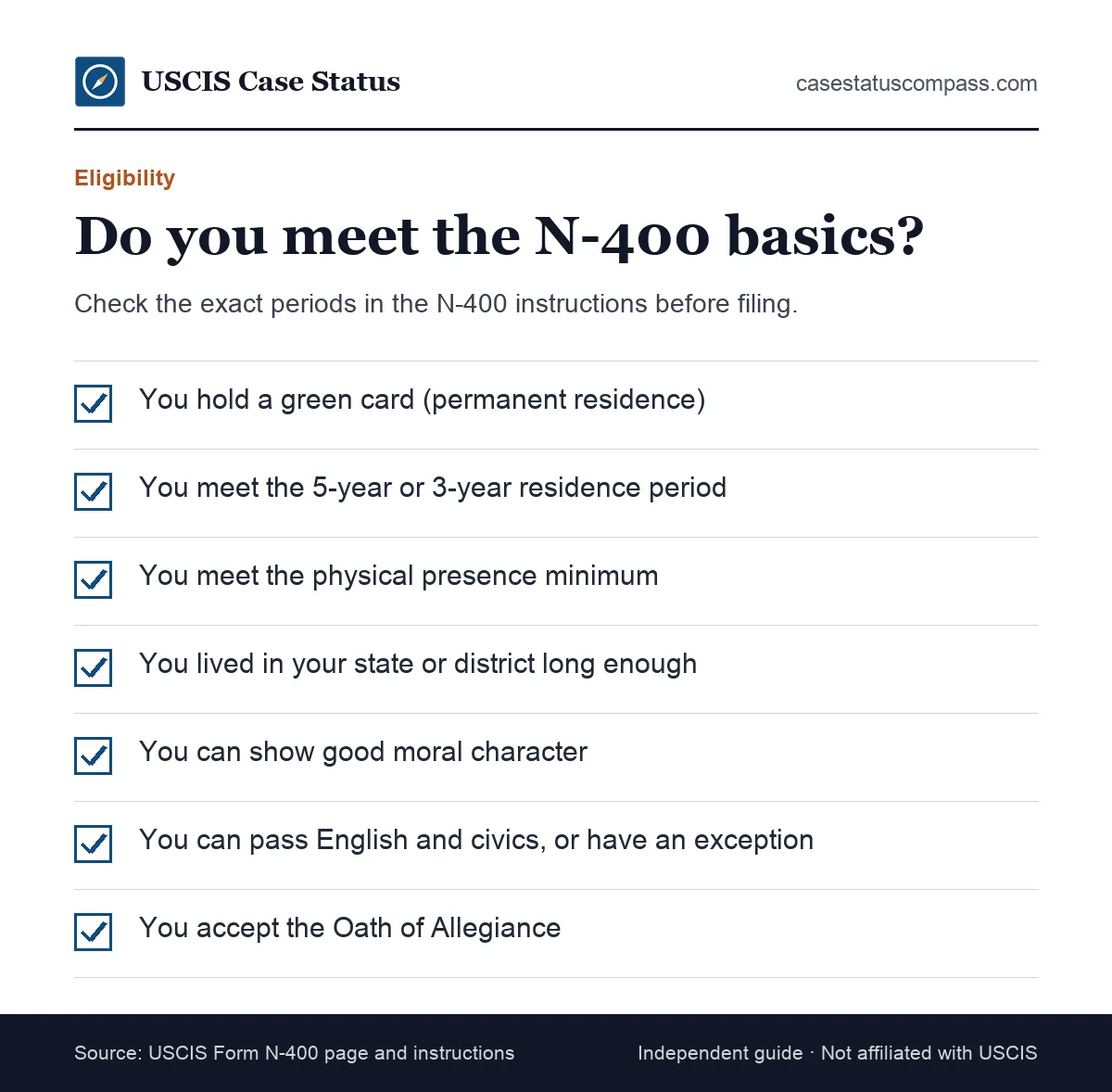
You are eligible for naturalization when you are a permanent resident who meets the residence period, physical presence and local residence minimums, good moral character, English and civics, and attachment to the Constitution, both at filing and at the interview.
Residence and presence requirements
USCIS lists these naturalization eligibility points for the general path:
- Meet the adult age rule in the N-400 instructions
- Hold permanent residence for the required period
- Show continuous residence and physical presence in the U.S. for at least 30 months of the 5 years (18 months of 3 years for spouses of U.S. citizens)
- State rule: 3 months living in the state or USCIS district where you file, right before filing
Character, knowledge and loyalty requirements
The remaining points concern your conduct, knowledge and loyalty. The officer tests them at the interview by comparing your answers with your records and giving the English and civics tests:
- Show good moral character
- Know basic English and civics
- Support the Constitution and accept the oath
Which is not a general requirement for naturalization?
Owning property, having a job, holding a degree or knowing a citizen are not requirements, and you need no sponsor. Quiz questions often list one of these as the odd answer.
What Is General Provision Eligibility for Naturalization?
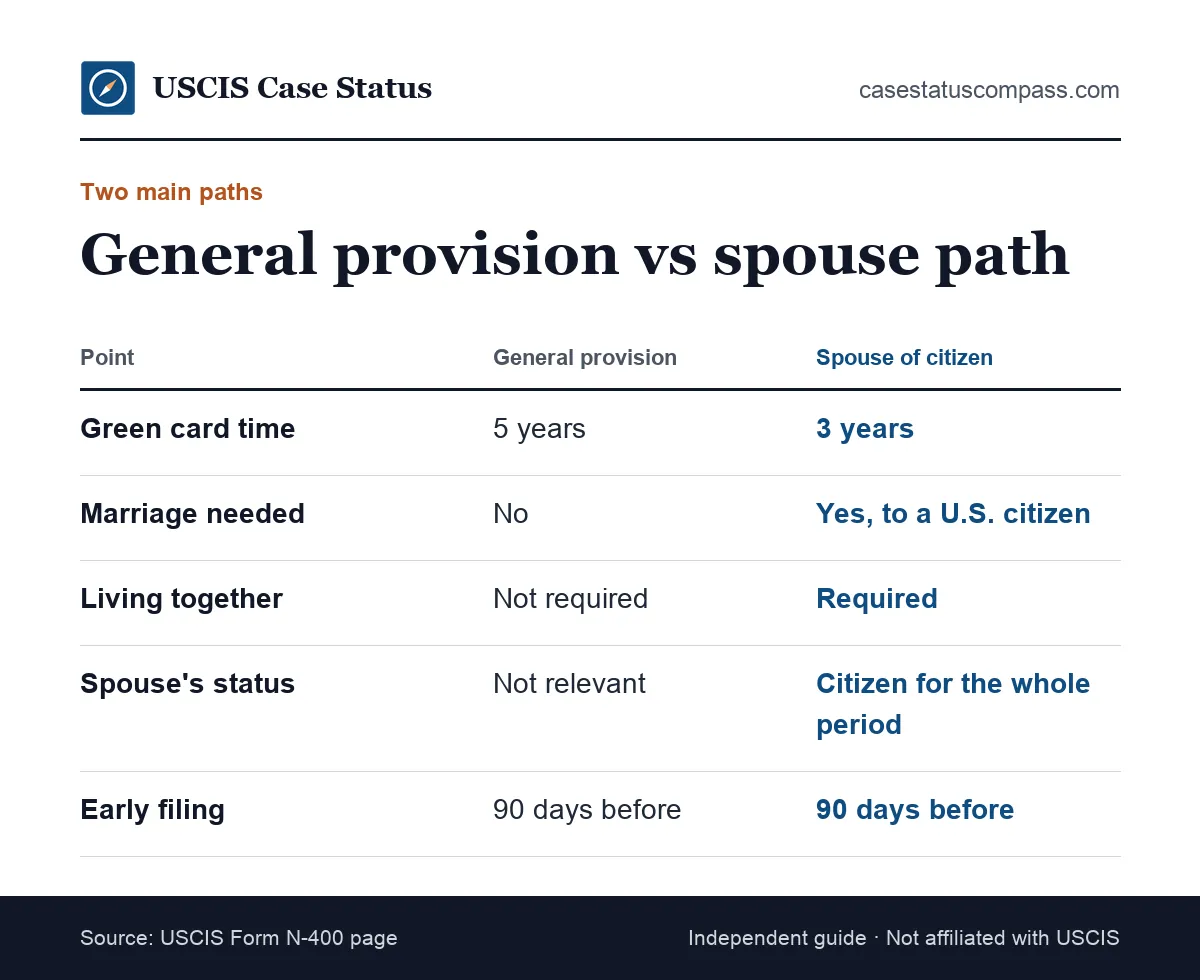
General provision eligibility is the standard N-400 basis for permanent residents who have held a green card for at least 5 years. It does not depend on marriage, military service or a job. Most applicants use it, and you select it in Part 1 of the form unless a special rule shortens your wait.
The five-year permanent resident path
The clock starts on the "Resident Since" date on your card. Time as a visitor, student or worker beforehand does not count. You may file in the 90-day window before the 5-year mark, never earlier.
General provision vs the spouse basis
If you are married to a citizen and already have 5 years, choose the general provision. It does not rely on the marriage, so a separation before your interview will not undo your basis.
The Three-Year Path for Spouses of U.S. Citizens
The spouse path lets you file after 3 years as a permanent resident if you have been married to and living with the same U.S. citizen for those 3 years. The marriage must last until your oath, and your spouse must have been a U.S. citizen for the whole 3-year period.
Living in marital union
USCIS calls this "living in marital union." Joint leases, a shared mortgage, joint tax returns and shared accounts are typical proof. Separated spouses usually fail the rule, even while still legally married.
When the spouse path stops working
If the marriage ends, your spouse loses citizenship, or you stop living together before the oath, the 3-year basis fails. Ask an attorney before filing if your marriage is under strain.
Military and Other Special Naturalization Paths
Special rules shorten or remove the residence period for current and former U.S. armed forces members, spouses of citizens employed abroad by certain organizations, and some abuse survivors under VAWA (the Violence Against Women Act). Each path has its own evidence list in the N-400 instructions, so confirm yours before you pay.
Service members and veterans
Military applicants file the same N-400 with Form N-426, which certifies honorable service, and USCIS lists no filing fee for them. Those abroad may complete some steps overseas; ask your legal assistance office.
VAWA and spouses working abroad
Abused spouses of citizens may apply even if the marriage has ended. Spouses of citizens working abroad for the U.S. government or certain employers may skip the residence period. Both groups still must meet the moral character, English and civics rules.
Eligibility Checker: Are You Ready to File Your Citizenship Application?
Use this checker to sort yourself into "eligible," "not yet" or "get advice first" before you pay. Any record issue means talking to a lawyer before you file. Work through the two tables in order: the first covers status and timing, the second your record.
Status and timing checks
Start here, because no other question matters until you hold a green card and your filing window has opened.
| Question | If yes | If no |
|---|---|---|
| Do you hold a green card now? | Next row | You cannot file an N-400 |
| Are you inside the 90-day window? | Go to the next table | Not yet: wait |
Record and readiness checks
Next, screen your record. These questions catch the issues that most often turn a routine N-400 into a denial.
| Question | If yes | If no |
|---|---|---|
| Any very long trip abroad? | Get advice first | Next row |
| Ever arrested, cited or charged? | Get advice first | Next row |
| Owe child support or back taxes? | Fix it or document a plan | Next row |
| Able to study English and civics? | Eligible: prepare to file | Ask about Form N-648 |
What "not yet" and "get advice" mean
"Not yet" is not a denial; your date has simply not arrived. "Get advice" flags an issue that can lead to denial or removal proceedings. A DOJ-accredited representative or attorney can review your records first.
How Do You Work Out Your Earliest Filing Date?
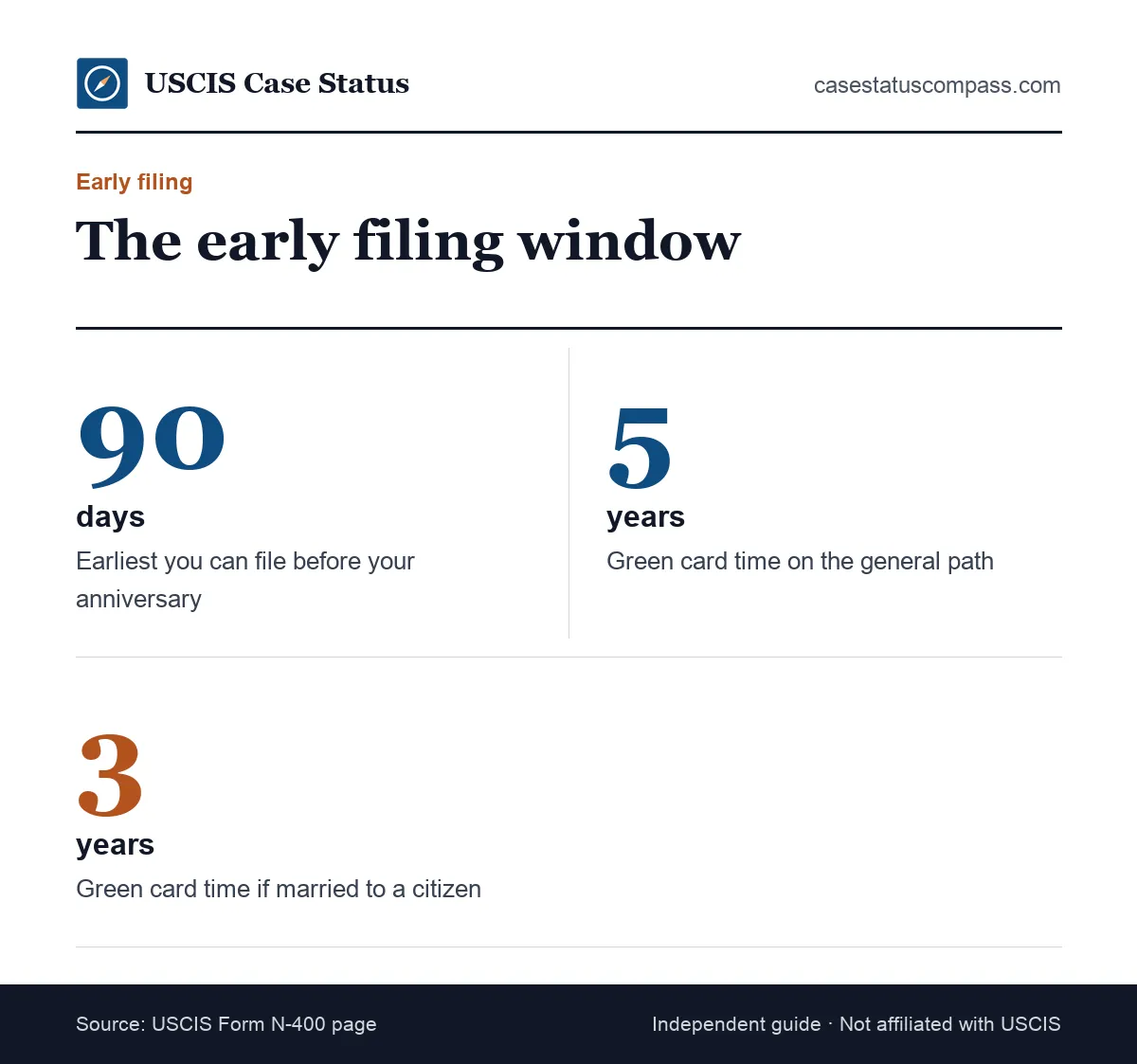
Your earliest filing date is 90 days before you complete the residence period. As of October 2026, USCIS states: You can file the N-400 up to 90 days before you reach 5 years (or 3 years if married to a U.S. citizen) as a permanent resident. Use the USCIS early filing calculator; a form filed one day early is not accepted.
Worked example: general provision
Your card says Resident Since March 1, 2022. Five years later is March 1, 2027. Counting back 90 days gives December 1, 2026 as your first filing day; November 30 is too early.
Worked example: spouse of a citizen
Your card says June 15, 2024, and you have lived with your citizen spouse since before then. Three years later is June 15, 2027, so March 17, 2027 is your first filing day.
Continuous Residence and Trips Abroad
Continuous residence means you kept your home in the U.S. throughout the required period. Short trips are normal, but long ones can break the residence clock, and the N-400 asks you to list them. This is separate from physical presence, which counts the actual days you spent in the country.
Long trips that raise questions
The instructions set two trip lengths: one that makes USCIS presume a break, and a longer one that generally breaks residence unless preserved in advance. Count days from passport stamps and travel records.
Evidence for long absences
Show the ties you kept: a U.S. job you returned to, resident tax returns, a lease or home you kept, and family who stayed. Include these with your filing. If an employer sent you abroad, add a letter that states the assignment's purpose and dates.
Good Moral Character on the Citizenship Application
Good moral character means you followed the law and met your duties during the look-back period. USCIS reviews arrests, taxes, support, voting and honesty on the citizenship application; lying is itself a bar. The look-back is usually your 5- or 3-year residence period, but older conduct can still count.
Records USCIS reviews
Expect checks against FBI fingerprint records and your immigration file. Disclose every arrest or citation, even sealed or expunged ones, with certified court dispositions. Traffic tickets matter mainly when alcohol, drugs or an arrest was involved.
Taxes, voting and false citizenship claims
Unfiled tax returns, voting in a U.S. election, and ticking a "citizen" box on a job form are the issues applicants most often overlook. Each needs a written explanation and records, such as IRS tax transcripts.
When to see an attorney before filing
See an immigration attorney first if you have a criminal record, a false citizenship claim, unfiled taxes or long periods abroad. Filing invites a fresh look at your green card case too.
English and Civics Requirements in Brief
Most applicants must read, write and speak basic English and pass a civics test at the interview. Our citizenship test guide covers the questions. Some older residents and people with qualifying disabilities get exceptions. Both tests happen at the same interview, and you get a second chance on any part you fail.
Age and residence exceptions
Certain older applicants with many years as permanent residents may take civics in their own language with an interpreter, and some get a shorter test. The exact combinations are in the N-400 instructions.
Disability exceptions with Form N-648
A licensed medical professional completes Form N-648, Medical Certification for Disability Exceptions, explaining why a physical or developmental disability or mental impairment prevents you from learning English or civics. File it with your N-400 if you can.
Why N-648 certifications get refused
Vague answers are a common reason an N-648 is refused. The form should name the diagnosis, explain how it limits learning, and come from a professional who actually examined you.
How Do You Apply for Citizenship in the United States?
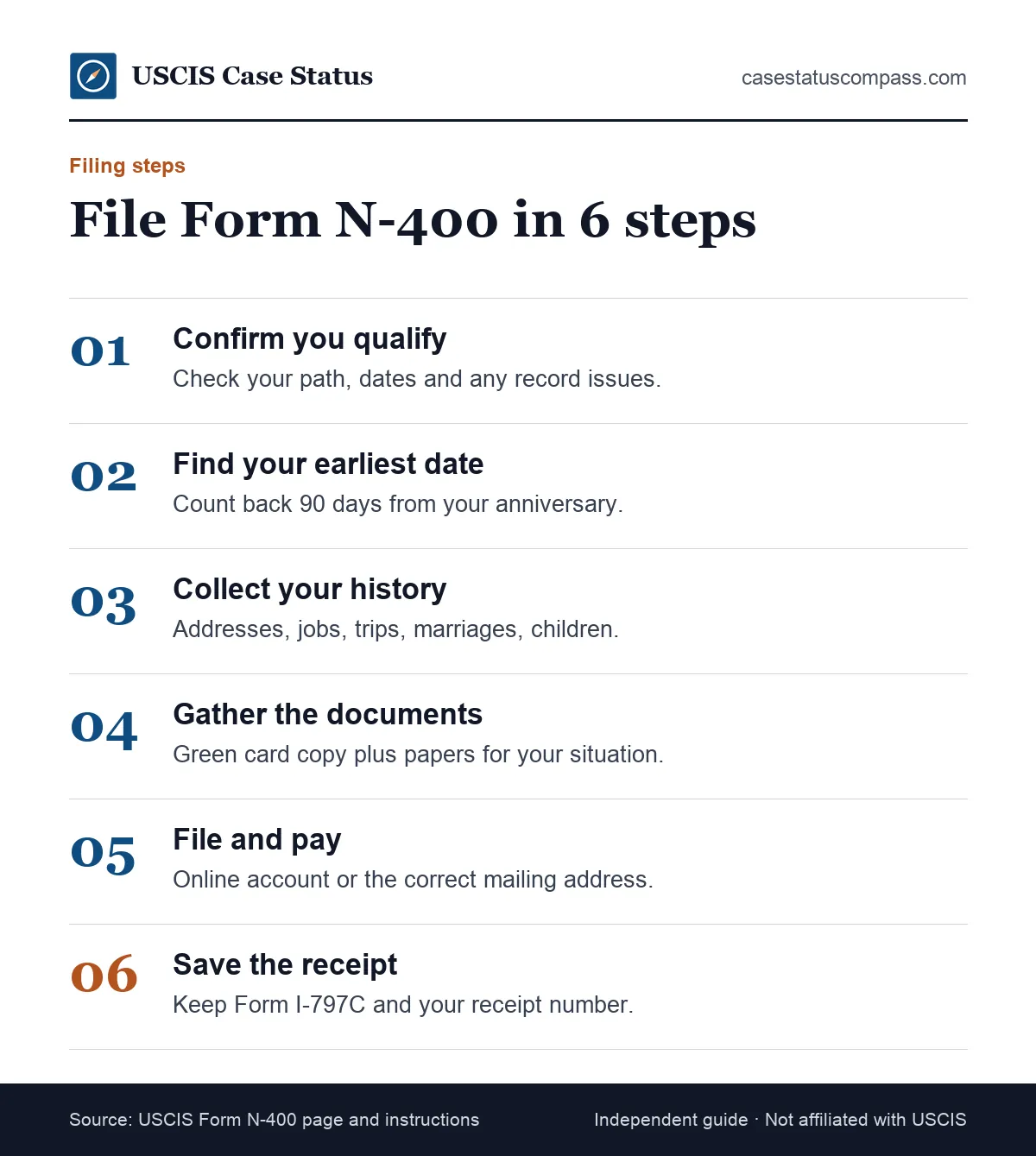
To apply for citizenship in the United States, confirm eligibility, find your earliest date, gather your history and documents, then file Form N-400 online or by mail with the fee. The six steps below take you from checking eligibility to holding a receipt number you can track.
The filing steps at a glance
- Confirm your eligibility basis.
- Calculate your earliest filing date.
- List addresses, jobs, trips, marriages and children.
- Collect copies of your documents.
- File online, or mail to the correct address with payment.
- Save your Form I-797C receipt notice.
Gather your history before you start
The form asks for homes and employers over the look-back period, trips abroad, all marriages and all children, including adult and stepchildren. Pull dates from leases, pay stubs and passport stamps; guesses cause most interview problems.
How Can I Apply for Citizenship Online?
You can apply for citizenship online by creating a free USCIS account at myaccount.uscis.gov/create-account, choosing Form N-400, answering each section, uploading scanned evidence and paying. Drafts save as you go. Before you pay, check every answer on the final review screen, because you cannot edit the form after you submit it.
Create a USCIS online account
Use an email you will keep for years and turn on two-step verification. The account later shows your notices and case history. If you filed online before, see our uscis online account number guide.
Who must file on paper
Online filing is not available if you request the reduced fee or a fee waiver; those go on paper. Some special categories may also need paper, so check the N-400 page for your basis.
Online vs Paper Citizenship Application: Which Is Better?
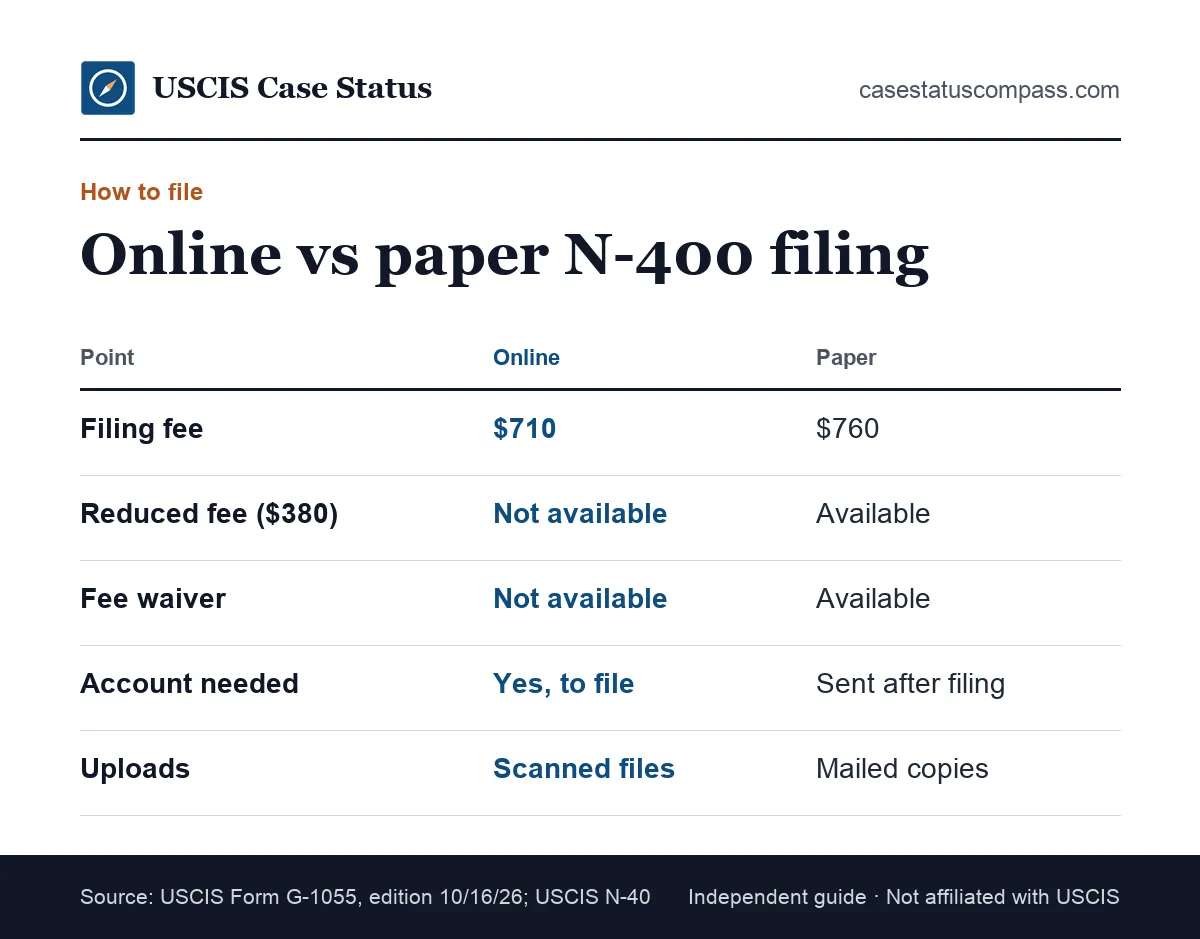
For most people the citizenship application online is better: it costs less, flags missing answers, gives an instant receipt and accepts later uploads. Paper is required for fee reductions. As of October 2026 the fee is $710 online versus $760 on paper.
Side-by-side comparison
The table lines up the practical differences you notice from the day you file until the receipt notice arrives.
| Point | Online N-400 | Paper N-400 |
|---|---|---|
| Fee, Oct. 2026 | Lower online rate | Higher paper rate |
| Reduced fee or waiver | Not allowed | Allowed |
| Missing-answer check | Built in | None |
| Receipt notice | In your account at once | Mailed after intake |
| Evidence | Uploaded scans | Paper copies |
Is There an Official Citizenship App?
USCIS has no separate mobile citizenship app for filing Form N-400. The online account works in a phone browser, but long answers and uploads are easier on a computer. To follow your case after filing, use the official tracking tools described later on this page rather than a third-party tracker.
Apps that ask for your USCIS password
Avoid apps that want your USCIS password or charge to "submit" for you. Sharing a login exposes your notices and personal data, and filing through your own account costs nothing beyond the form fee.
Where Do You Mail Your Citizenship Application?
You mail the naturalization application to the USCIS lockbox listed for your state on the "Direct Filing Addresses for Form N-400" page. It depends on where you live and on postal versus courier delivery. Only paper filers mail anything; online filers submit and upload everything in the account.
Use the direct filing addresses page
Follow the filing address link on the uscis.gov N-400 page on the day you mail. Lockbox assignments change, so an address from a friend or an old post may be wrong and delay your case.
Postal vs courier delivery
Lockboxes often list one address for USPS and another for FedEx, UPS and DHL. Use tracked delivery and keep the record. Never send an N-400 to a field office unless USCIS tells you to.
Which Naturalization Form PDF and Edition Should You Use?
Use the naturalization form PDF from uscis.gov/n-400. As of October 2026, USCIS accepts edition 01/20/25, printed at the bottom of every page. Mixing editions can get the package rejected. Download a fresh copy on filing day rather than reusing one saved months ago.
Application for naturalization instructions
The separate N-400 instructions PDF explains every question, the evidence for each basis and the definitions behind the yes/no questions. Read it before the form; it answers most "what does this mean" doubts.
What Documents Are Required for Naturalization?
The documents required for naturalization start with a copy of both sides of your green card. Then add the marriage, court, support and tax records that match your situation, sorted below. Send photocopies unless the instructions ask for an original, and bring the originals to your interview.
Marriage and name-change documents
Use this table if you file as the spouse of a citizen, were married before, or use a name that differs from your green card.
| Your situation | Documents to add |
|---|---|
| Spouse of a citizen | Marriage certificate, spouse's citizenship proof, proof you live together |
| Prior marriages | Divorce decrees, annulments or death certificates |
| Name change | Court order or marriage record |
Court, support and tax records
These records feed the good moral character review. Leave one out and the officer will usually ask for it at the interview.
| Your situation | Documents to add |
|---|---|
| Any arrest or citation | Certified court dispositions |
| Owe child support | Court order and payment records |
| Tax problems | IRS transcripts and payment plan |
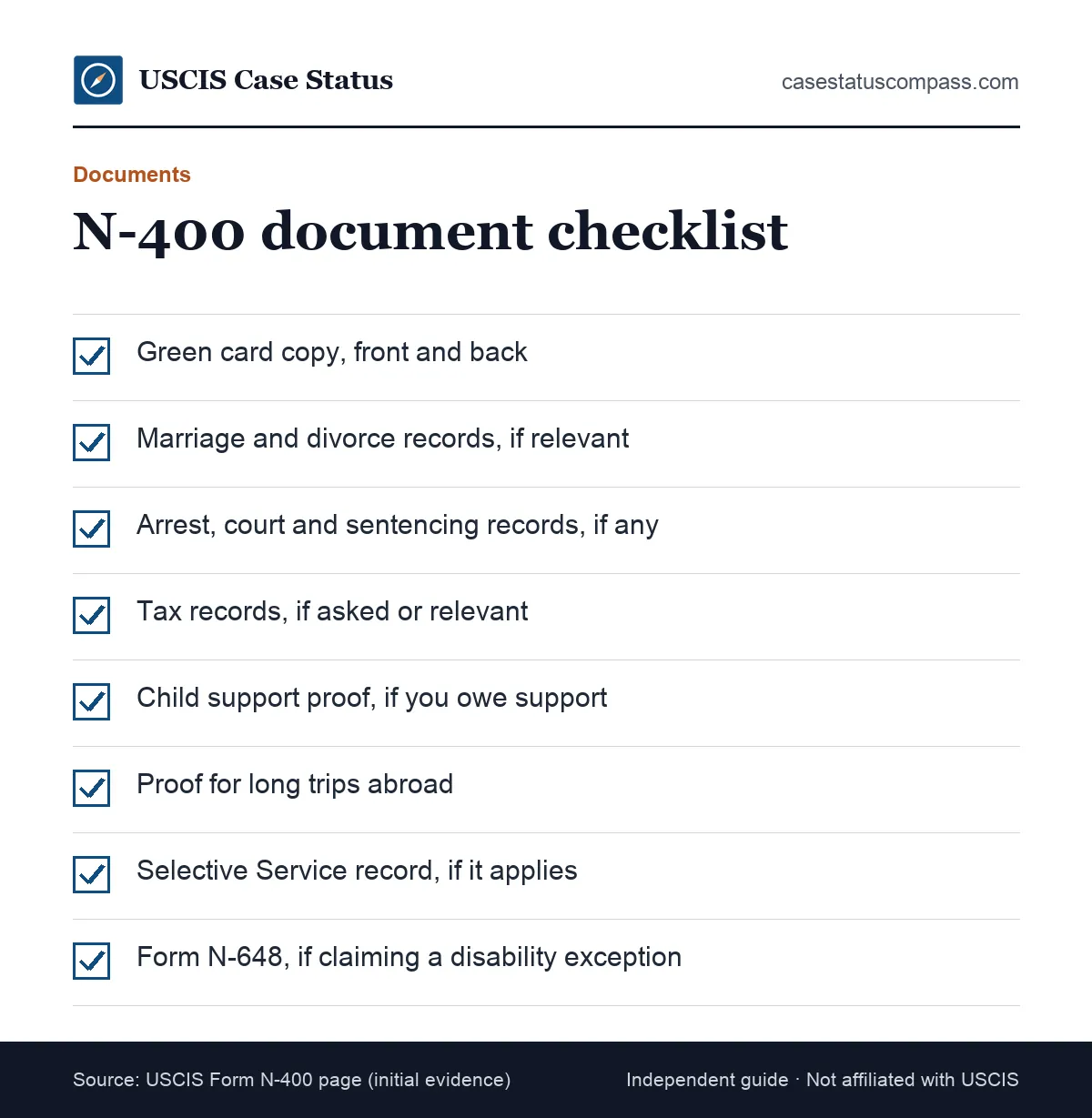
Form M-477 document checklist
Form M-477, the USCIS Document Checklist, is a free guide on uscis.gov that sorts these documents by situation. You do not file it; tick off each item and keep it with your interview copies.
Child and Spousal Support Questions on the N-400
The child and spousal support questions ask whether you have children who do not live with you, whether you support them, and whether you ever failed to pay court-ordered support. Unpaid support can hurt good moral character. Answer them carefully even if every payment was informal.
"Are you providing support for your son or daughter?"
Answer yes if you send money, pay school costs or cover living expenses for a child living elsewhere, even with no court order. List every biological, adopted and stepchild, including adult children.
N-400 child and spousal support evidence
Bring support orders, a payment history from your state child support agency, bank records or canceled checks, and a letter from the other parent if payments were informal. If you fell behind, add a payment plan.
Additional Evidence for the N-400
Additional evidence is anything beyond the required list that explains a specific answer, such as proof of a long trip's purpose or a name change. Unrelated papers slow the review. Send it only where it backs up an answer, such as a "yes" to a yes/no question.
Additional evidence you want to provide online
The online N-400 has an upload area for additional evidence. Label each file clearly, such as "2024 trip employer letter," and keep scans readable. The same account later handles any evidence request.
Translations of foreign documents
Every foreign-language document needs a full English translation certified by the translator as complete and accurate. A fluent friend may translate, but you cannot translate your own papers. Attach the signed translator certification to each translation, together with a copy of the original.
Do You Need a Cover Letter for Form N-400?
No, an N-400 cover letter is optional, but it helps on paper filings. A short letter lists your basis, the payment and each enclosed document so staff find items quickly. Online filers can skip it, since their evidence is uploaded to the account rather than mailed in a package.
What an N-400 cover letter includes
- Your full name, A-Number and mailing address
- "Form N-400, Application for Naturalization" and your basis
- The fee amount and payment method
- A numbered list of enclosed documents
- Your signature and date
N-400 Yes/No Questions: What They Mean
The N-400 yes/no questions cover criminal history, immigration violations, taxes, voting, military service, memberships and oath beliefs. A "yes" is not automatically a problem, but each needs an explanation and records. Read each one in the instructions before you answer, since several rely on legal definitions.
Answer every question truthfully
Officers compare your answers with FBI records, your file and your testimony. An honest "yes" with documents is often fine. A false "no" can lead to denial and a fraud finding that follows you.
Terms that confuse applicants
- "Ever" means at any time in your life, anywhere.
- Arrested or detained includes being held without charges.
- Claimed to be a citizen includes ticking a "citizen" box on a job or voter form.
- Terms like habitual drunkard are defined in the instructions.
A Walkthrough of the N-400 Sections
No official sample N-400 filled form exists, and copying someone else's answers is risky. This walkthrough shows what each group of sections asks so you can prepare. Draft your answers in a notes file or printed copy first, then enter clean answers in the final form.
Personal information sections
You enter your eligibility basis, legal name, other names, A-Number, birth date, residence date and contact details. Names must match your green card unless you explain a legal change or request a new name at the oath.
Residence, work, travel and family history
Later parts cover addresses, employers, time abroad, marriages and children, then the yes/no questions. If you only know a month, give month and year rather than a blank, and explain any gaps.
Signing the application
Your signature confirms every answer is true. An unsigned paper N-400 is rejected, and no preparer may sign for you. Interpreters and preparers complete their own sections; only you sign as applicant.
Citizenship Application Steps After Filing
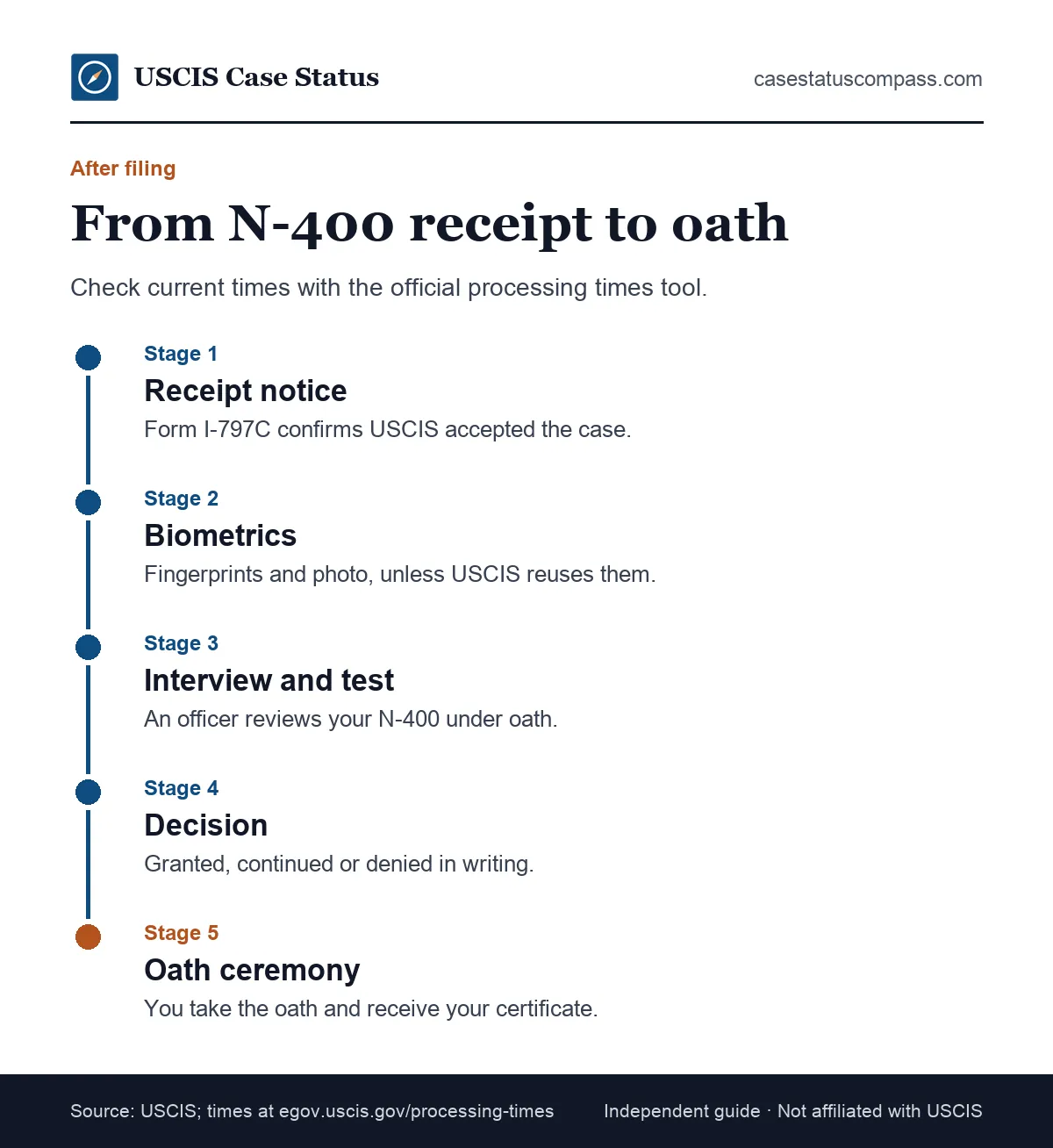
After filing, your citizenship application starts with a receipt notice and biometrics, then moves to the interview and oath. Each step brings its own notice, and a missed appointment can cause delay or denial. Online filers see each notice in the account, while paper filers get them by mail.
The receipt notice
USCIS sends Form I-797C after accepting your N-400. I-797C = Notice of Action (receipt, rejection, transfer, appointment, re-open); not proof of status by itself. Your receipt number (3 letters + 10 digits (13 characters), e.g. EAC2512345678; leave out dashes) unlocks every tracking tool. Paper filers also get an Account Acceptance Notice to link the case online.
Biometrics
USCIS may book fingerprints and a photo at an Application Support Center (ASC), or reuse prior biometrics. Bring the notice and a photo ID. Our biometrics appointment guide covers rescheduling.
What Happens at the Naturalization Interview and Oath?
The interview is where an officer decides most N-400 cases, and the oath is where citizenship actually begins. Each notice lists the date, place and what to bring. Some field offices hold the oath on the interview day, while others schedule a separate ceremony later.
Interview and test
An officer reviews your N-400 under oath and gives the English and civics tests; you may get a decision that day or a notice later. Our citizenship interview guide explains what to bring.
Oath ceremony
If approved, you attend an oath ceremony, return your green card, take the Oath of Allegiance and receive your certificate. You become a citizen at the oath, not at the approval notice.
What Does the Typical N-400 Case Status Sequence Look Like?
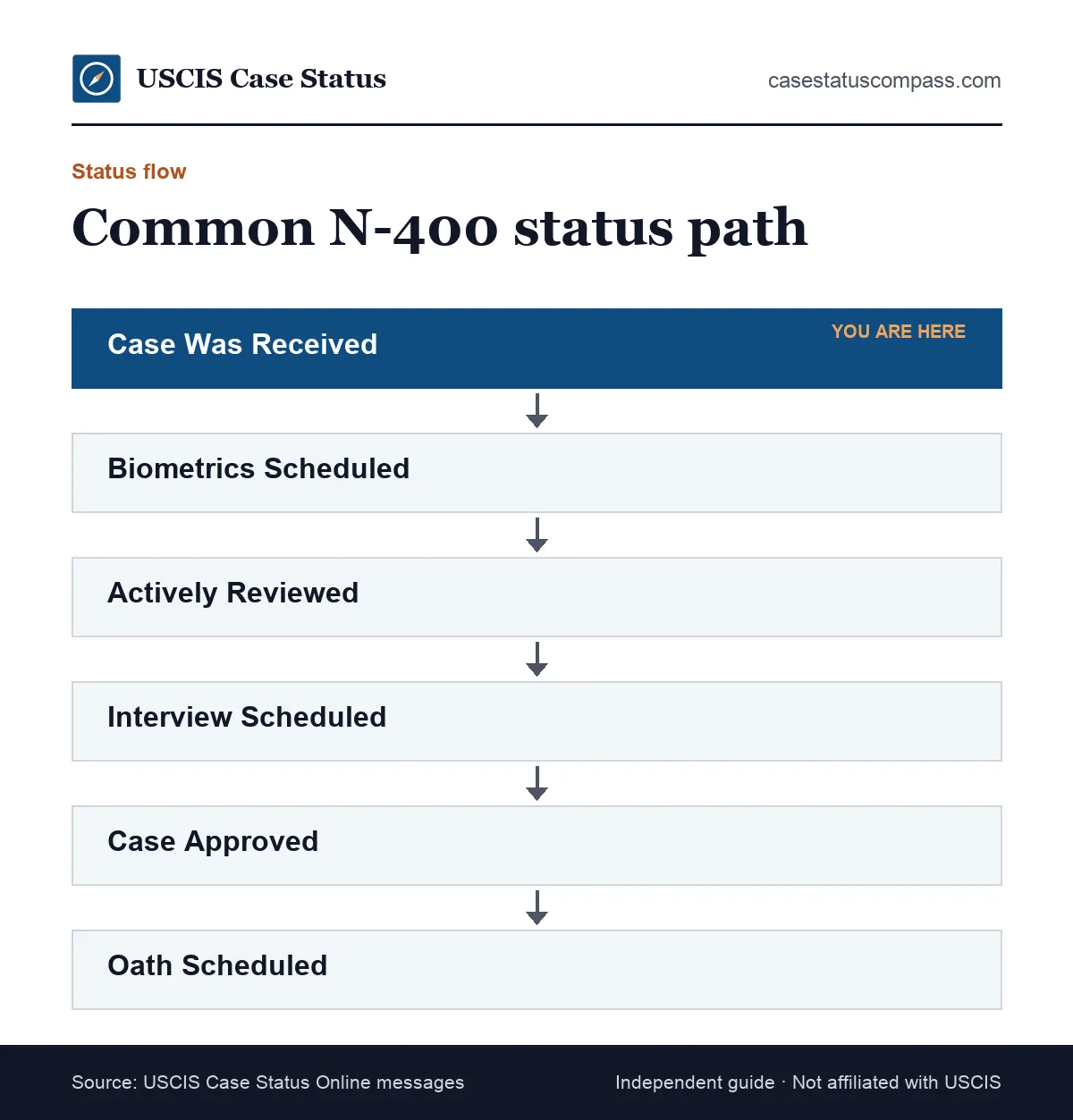
A typical N-400 moves from "Case Was Received" to a biometrics message, "Case Is Being Actively Reviewed," "Interview Was Scheduled," a decision and an oath notice. Steps can be skipped or added. The two tables below split the journey at the interview notice.
Statuses from receipt to review
These messages cover the stretch from intake to the point where an officer is reviewing your file.
| Status message | What it means for an N-400 | Your next step |
|---|---|---|
| Case was received | Intake accepted it | Save the I-797C |
| Biometrics message | ASC visit set or prints reused | Attend or wait |
| Case is being actively reviewed | Review in progress | Keep address current |
Statuses from interview to oath
Once a field office takes the case, the messages change more often and each one asks something specific of you.
| Status message | What it means for an N-400 | Your next step |
|---|---|---|
| Interview was scheduled | Field office set a date | Prepare documents |
| Decision or continued | Granted, continued or denied | Read the notice |
| Oath ceremony scheduled | Oath date set | Attend with green card |
Statuses that worry applicants
"Interview Was Completed And My Case Must Be Reviewed" often means a supervisor check or background update. A continued result usually means a missing document listed on Form N-14. A case was approved message still needs the oath.
Tracking Your Citizenship Application
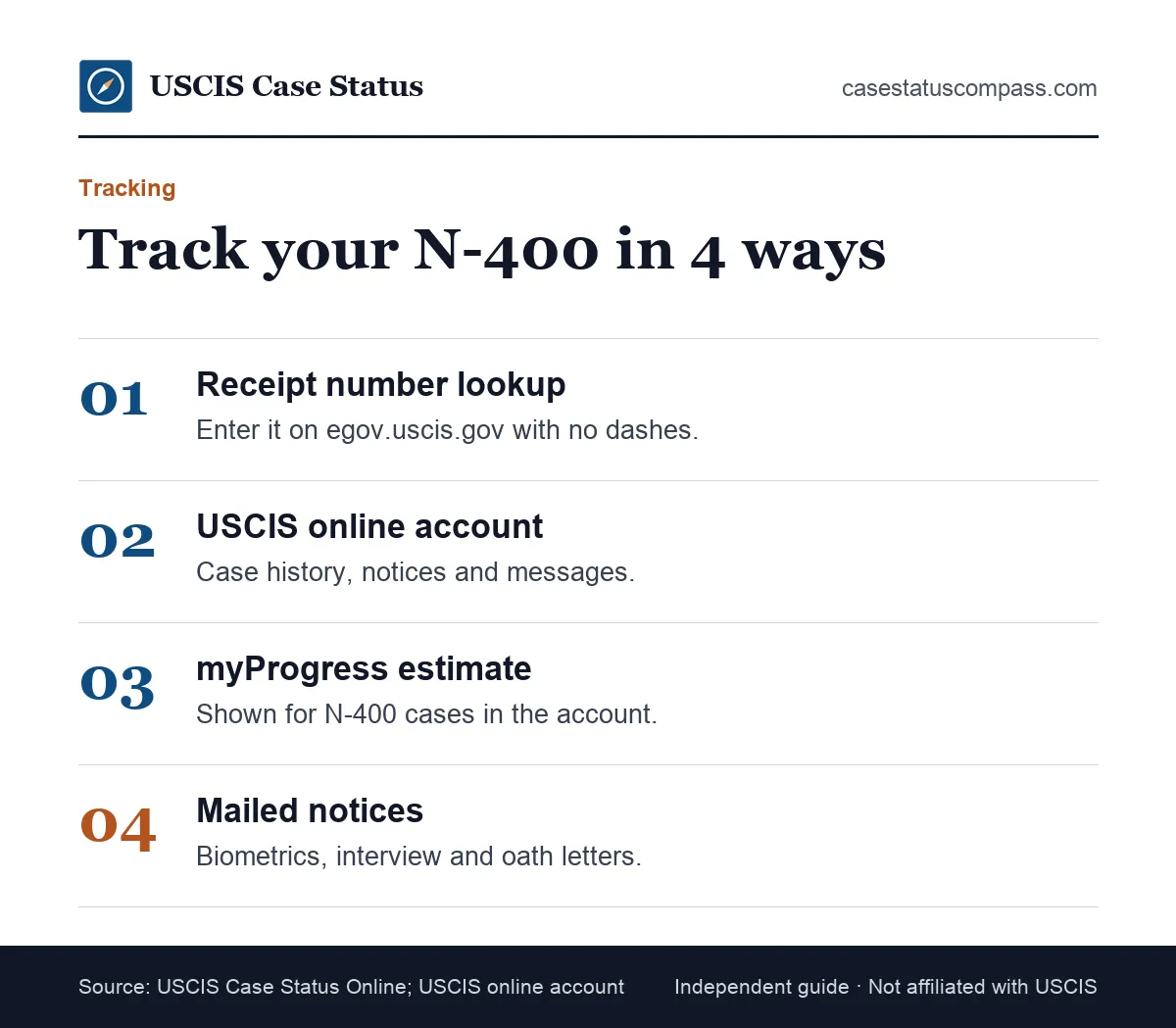
You track your citizenship application with your receipt number on Case Status Online: egov.uscis.gov or in your USCIS online account, which shows case history, notices and, for N-400 cases, a myProgress estimate. Checking about once a week is enough; daily checks rarely show anything new.
Case Status Online
Enter the receipt number with no dashes; the page shows only the latest action. Our USCIS case status check guide explains each official tool and what to do when an error message appears instead.
Online account and myProgress
Free USCIS online account: case status updates, notices, link paper-filed cases. USCIS describes myProgress: personalized estimates in your USCIS online account (I-130, I-485, I-765, I-131, I-821, N-400, I-90). Treat myProgress as an estimate, not a promise.
Where Is the Immigration and Naturalization Office Near Me?
The immigration naturalization office near me for an N-400 is your USCIS field office, which holds interviews and oaths. USCIS assigns it by your address; the field office locator shows yours. You never file the N-400 in person there; it goes online or to a lockbox.
Field offices and support centers
You do not choose your office; USCIS assigns the one covering your ZIP code and names it on your interview notice. If you need an in-person visit for another reason, Request an in-person appointment online at my.uscis.gov/en/appointment/v2 or call 800-375-5283.
Filing from a big city like New York
A citizenship application in NYC uses the same form, fee and rules as anywhere else. Big-city offices may have different waits, shown by office in the processing times tool, and many cities run free help through libraries.
Immigration and Naturalization Service: Is INS Still Around?
No. The Immigration and Naturalization Service (INS) no longer exists. Its benefits work, including naturalization, moved to USCIS in the Department of Homeland Security. Old INS papers remain valid records. When DHS was created in 2003, the old agency's enforcement work went to ICE and CBP.
INS vs USCIS today
People still search for "INS" or the naturalization service when they mean USCIS. For an N-400, every notice, fee and appointment comes from USCIS. Sites using the old name may charge for free forms.
How Long Does the N-400 Take to Process?
N-400 processing time depends on your field office, so check the official tool at egov.uscis.gov/processing-times, which posts N-400 times office by office. For current ranges, see how long does naturalization take. As a recent benchmark, USCIS data put the median at N-400: median 9.5 months (USCIS data, Apr.-June 2026).
The March 2024 factsheet median
A USCIS factsheet with data as of March 2024 gave a historical FY2023 median of about six months. That figure is dated, so treat it as background and rely on the official tool for your office.
How Much Does the Citizenship Application Cost?
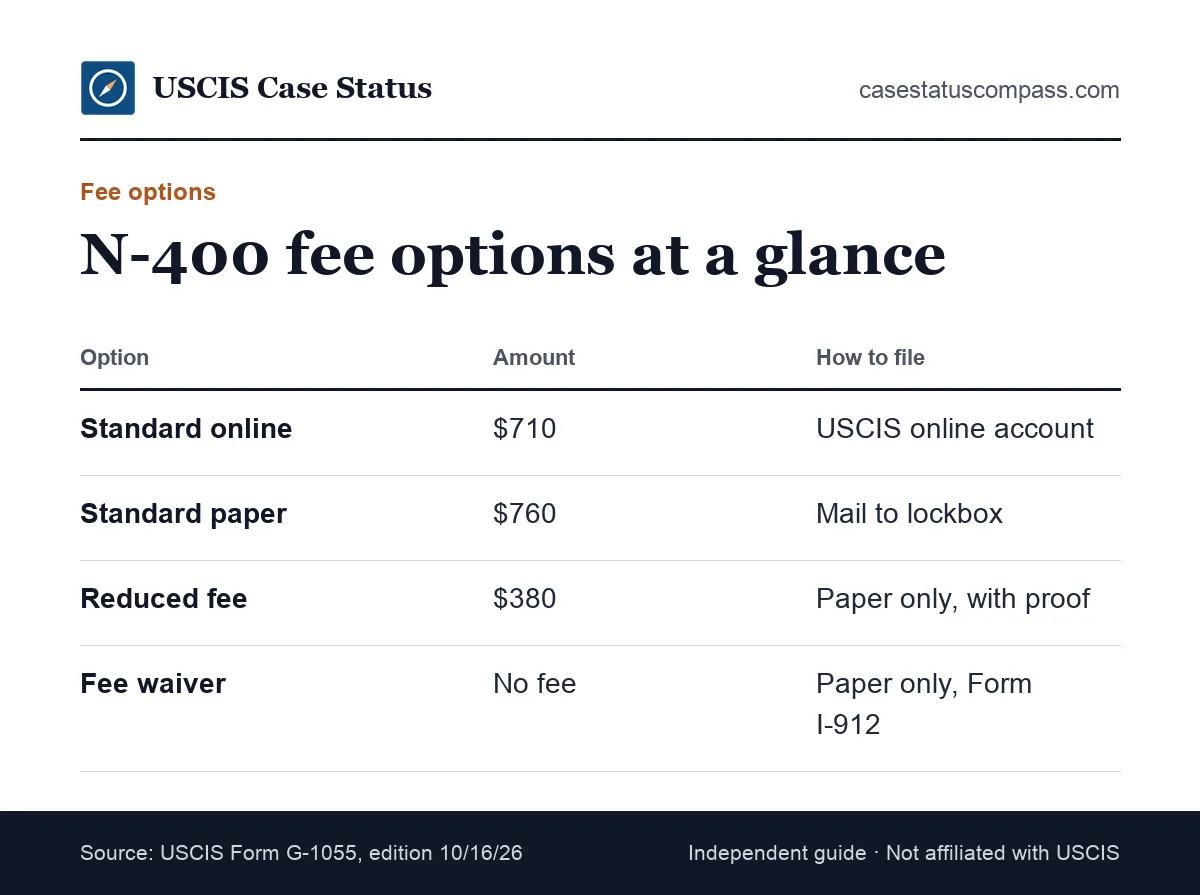
As of October 2026, the N-400 fee is $760 paper / $710 online. Under Form G-1055, Edition 10/16/26, filing online costs less than paper and biometrics are included. For the full breakdown, read how much does it cost to become a US citizen.
Checking the fee before you pay
Qualifying military applicants pay nothing. Fee rules change, so check the date on any amount you read; an old fee from a forum or a friend's papers can get the whole package rejected.
Is There a Free Citizenship Application?
Yes, a free citizenship application is possible with a USCIS fee waiver if you receive a means-tested benefit, have low income or face financial hardship. A reduced fee applies at moderate incomes. Both require paper filing, and your household size and income decide which one you qualify for.
Fee waiver with Form I-912
Use Form I-912, Request for Fee Waiver, with evidence such as a benefit award letter. If USCIS denies the waiver, it rejects the whole package. Our citizenship fee waiver page explains the options.
Reduced fee for moderate incomes
The reduced fee of $380 applies if household income is at or below 400% of the Federal Poverty Guidelines. You request it in Part 10 and cannot do so online.
Proving household income for the reduced fee
Send tax transcripts or other proof of household income and household size. Make sure the people you count match the income records you send, because a mismatch can get the request refused.
Can You Get Help With Your Citizenship Application?
Yes. Help with citizenship application forms comes from immigration attorneys, DOJ-accredited representatives at recognized nonprofits, and free workshops at libraries and community groups. Avoid "notarios," who cannot legally give advice. A preparer may fill in the form, but you remain responsible for every answer you sign.
Free and low-cost citizenship application assistance
Recognized nonprofits with accredited staff can prepare the form and screen for risks; the Department of Justice keeps the official list. Libraries often host citizenship application services on group filing days.
Warning signs of fraud
Be wary of anyone who promises approval, keeps your originals, asks you to sign a blank form or charges to "speed up" a case. Report notario fraud to your state attorney general.
Common Citizenship Application Mistakes
The most common citizenship application mistakes are filing too early, using the wrong edition or address, skipping the signature, leaving out arrests or trips, and paying an old fee. Each one can mean a rejected package, a lost filing date or hard questions at the interview.
Filing and payment mistakes
Check these before you seal the envelope or press submit:
- Filing before the 90-day window opens
- Mixing pages from different editions
- Paying an outdated fee amount
- Mailing to an old lockbox address
- Leaving the signature box blank
Answer and evidence mistakes
These slip into otherwise careful applications:
- Leaving out a trip the form asks about
- Forgetting a child who lives elsewhere
- Answering "no" to a dismissed arrest
- Sending originals you need back
- Skipping translations
What If USCIS Sends a Request for Evidence?
If USCIS needs more on your N-400, it may send a request for evidence (RFE) before the interview, or Form N-14 after it. Send exactly what is asked by the deadline; missing it can lead to a denial on the existing record.
Responding well
Put the notice's cover page on top, answer each item in order and label every document. Online filers upload through the account. Our request for evidence guide has a full checklist.
If you cannot get everything in time
Send what you have before the deadline with a short note on what is missing and why, rather than nothing. A silent missed deadline leaves the officer only the existing record.
Can You Travel Outside the U.S. While Your N-400 Is Pending?
Yes, you can travel while your N-400 is pending, but keep trips short and avoid dates near expected appointments. A missed biometrics or interview notice can delay the case or, if you never respond, lead to a denial. Ask someone you trust to watch your mail and account while you are away.
Reentering and protecting continuous residence
Carry your green card and N-400 receipt notice to reenter. Continuous residence must last until the oath, so a long absence after filing can still cause a denial even after you pass the interview.
What If You Move While Your Citizenship Application Is Pending?
You can move, but you must update your address online within the USCIS deadline for permanent residents so every notice reaches you. Our change of address page explains the steps. Use the online tool, which updates pending cases, and save the confirmation.
Moving to another state or field office area
A move to another state may transfer the case to a new field office and add time. Set up postal mail forwarding as a backup, since a notice may still go to your old address.
What If Your Green Card Expires While the N-400 Is Pending?
Your N-400 receipt notice extends your green card for the period printed on it, so carry both together for work and travel. You usually do not need green card renewal unless the card is lost or stolen. Read the exact extension wording on your own notice.
Conditional residents with a 2-year card
A conditional resident still needs to remove conditions with Form I-751. Filing the N-400 does not stop the I-751 deadline, and letting conditional status lapse can sink your N-400.
How USCIS handles a pending I-751 with the N-400
USCIS decides a pending I-751 before or at the same time as the N-400, often at the interview. Bring current evidence of your marriage, because the officer may ask about both cases.
Can a Citizenship Application Be Denied?
Yes, a citizenship application can be denied if you miss a requirement, fail a test twice, skip appointments or lack good moral character. You can usually request a hearing with Form N-336 or reapply later. A denial alone does not take away your permanent residence, though some cases are referred for removal.
Common denial reasons
Typical reasons are breaks in continuous residence, unpaid taxes or support, undisclosed arrests, failing English or civics twice, and false testimony. Many are preventable by screening your record with a professional first.
What to do after a denial
Read the decision for the reason and the N-336 deadline. Some denials raise removal risk, so get legal advice before acting. Our case denied guide lays out appeal and refiling options.
What Happens After You Become a Citizen?
After the oath you are a U.S. citizen. Your Certificate of Naturalization proves it, and you can apply for a U.S. passport, register to vote and sponsor relatives. You no longer renew a green card or count days abroad, and some children under 18 who hold green cards and live with you may become citizens automatically.
Your naturalization certificate
Check the certificate for errors before leaving the ceremony. If you lose it, our guide on how to get naturalization certificate copies and replacements explains Form N-565 and the proof you need.
Petitioning for relatives with Form I-130
Citizens can file an I-130 petition for parents, married sons and daughters, and siblings, and spouses become immediate relatives. A petition you filed as a permanent resident may also move to a faster category.
Signing an affidavit of support
You may also need to sign an affidavit of support for relatives you sponsor, a financial promise to the government.
Frequently Asked Questions
Can I apply for citizenship online?
Yes. Most applicants can file Form N-400 online through a free USCIS account, upload evidence and pay electronically at the lower online fee. You cannot file online if you request a reduced fee or fee waiver; those go on paper.
How do I get citizenship in the US as a green card holder?
Hold your green card for 5 years, or 3 years if married to and living with a U.S. citizen, then file Form N-400. You must also meet the other rules, pass the interview and take the oath.
What immigration and naturalization form is used to apply for citizenship?
Form N-400, Application for Naturalization, is the form permanent residents use. Children who are already citizens through a parent use Form N-600 instead, and a lost naturalization certificate is replaced with Form N-565.
What are naturalization papers?
"Naturalization papers" usually means the Certificate of Naturalization received at the oath ceremony. The certificate is your main proof of citizenship until you hold a U.S. passport.
Can I change my name when I naturalize?
Yes. The N-400 lets you ask for a legal name change. Where a court performs the oath, the judge can grant it at the ceremony and your certificate shows the new name.
Do I need a lawyer for the citizenship application?
No lawyer is required, and many people file alone. Get legal advice first if you have any arrest, long trips abroad, tax or support problems, a past false citizenship claim or a complicated history.
Is there a completed N-400 example I can follow?
USCIS does not publish a filled-in N-400 sample. Use the official instructions, which explain each question, and the online form's missing-answer checks. Samples on other sites may be built for an older edition.
Can I fill out the N-400 in another language?
No. You must answer Form N-400 in English. If someone translates the questions for you or prepares the form, they must complete and sign the interpreter or preparer section, and you still sign to confirm every answer is true.
Sources
- USCIS: Form N-400, Application for Naturalization. www.uscis.gov/n-400. Accessed Oct 27, 2026.
- USCIS: Form N-400 Instructions (PDF). www.uscis.gov/sites/default/files/document/forms/n-400instr.pdf. Accessed Oct 27, 2026.
- USCIS: Fee Schedule, Form G-1055. www.uscis.gov/g-1055. Accessed Oct 27, 2026.
- USCIS: Check Case Processing Times. egov.uscis.gov/processing-times/. Accessed Oct 27, 2026.
- USCIS: Benefits of a USCIS Online Account. www.uscis.gov/file-online/benefits-of-a-uscis-online-account. Accessed Oct 27, 2026.
- USCIS: Citizenship Resource Center. www.uscis.gov/citizenship. Accessed Oct 27, 2026.
- USCIS Form G-1055 Fee Schedule, Edition 10/16/26. www.uscis.gov/sites/default/files/document/forms/g-1055.pdf. Accessed Oct 27, 2026.
- USCIS Policy Manual Vol. 12, Part D, Ch. 1; Part G, Ch. 1 (current as of Oct. 23, 2026). www.uscis.gov/policy-manual/volume-12-part-d-chapter-1. Accessed Oct 27, 2026.
- USCIS: Online Account and Technical Support. www.uscis.gov/tools/uscis-tools-and-resources/online-account-and-technical-support. Accessed Oct 27, 2026.
- USCIS: Form I-797 Types and Functions (updated 01/24/2025). www.uscis.gov/forms/filing-guidance/form-i-797-types-and-functions. Accessed Oct 27, 2026.
- USCIS: Checking Your Case Status Online. www.uscis.gov/tools/checking-your-case-status-online. Accessed Oct 27, 2026.
- USCIS alert: USCIS Expands myProgress to Form I-485 and Form I-821 (Nov. 21, 2023). www.uscis.gov/newsroom/alerts/uscis-expands-myprogress-to-form-i-485-and-form-i-821. Accessed Oct 27, 2026.
- USCIS Contact Center (uscis.gov). www.uscis.gov/contactcenter. Accessed Oct 27, 2026.
- USCIS Data Library: All USCIS Application and Petition Form Types, FY2026 Q3 (Apr. 1-June 30, 2026; queried 7/2026). www.uscis.gov/sites/default/files/document/data/quarterly_all_forms_fy2026_q3_v1.xlsx. Accessed Oct 27, 2026.
casestatuscompass.com is an independent publication and is not affiliated with USCIS or any government agency. This page is general information, not legal advice. For denials, court or asylum matters, consult an immigration attorney or a DOJ-accredited representative.