Contents · 44 sections
- What Are USCIS Fees and Who Sets Them?
- USCIS Fee Table by Form
- Which Fee Schedule Edition Applies Today?
- Paper vs Online Filing: Why the Price Differs
- What Are the H.R. 1 Add-On Fees?
- Green Card Fees
- How Much Is the EB-1 Filing Fee?
- How Much Is the AOS Fee for Form I-485?
- Who Pays a Lower or Zero AOS Filing Fee?
- How Much Does It Cost to Immigrate to the US?
- How Much Is the Affidavit of Support Fee?
- What Is the USCIS Immigrant Fee?
- How Much to Renew a PR Card?
- What Does Form I-751 Cost Instead of an I-90?
- Citizenship Fees
- Work Permit and Work Visa Fees
- How Much Is Premium Processing for Work Petitions?
- How Much Does an Employment Authorization Document Cost?
- What Is the Asylum Program Fee?
- Asylum, TPS and Other Humanitarian Fees
- How Much Is the Annual Asylum Fee?
- TPS Filing Fee and Re-Registration
- DACA Renewal Fee: What Is the Deferred Action Price?
- How Much Is a Travel Document?
- How Much Is the Advance Parole Filing Fee?
- How Much Does a Reentry Permit Cost?
- Waiver Forms: I-601A, I-601 and I-192 Fees
- K-1 Fiancé Visa Fees
- Fees Paid to Other Agencies
- What Is the 42B Filing Fee for Cancellation of Removal?
- Which USCIS Forms Cost Nothing?
- How to Pay USCIS Fees
- Can You Pay Immigration Fees Online?
- Can You Get a USCIS Fee Refund?
- Does USCIS Keep Your Fee After a Rejection or Denial?
- What Happens If You Pay the Wrong Fee?
- Fee Waivers and Reduced Fees
- What Is a Waived Fee?
- Which USCIS Fees Can Never Be Waived?
- Sample Fee Stacks for Common Cases
- How Do Immigration Legal Fees Compare With Filing Fees?
- How USCIS Fees Fit Together
- How to Check USCIS Fees Before You File
- Frequently Asked Questions
The short answer
USCIS fees are the filing charges set in Form G-1055 (edition 10/16/26). As of October 2026, a green card application (Form I-485) costs $1,440 paper / $1,390 online, and citizenship (Form N-400) costs $760 paper / $710 online. Filing online is often cheaper, and some forms add H.R. 1 fees that can never be waived.
At a glance
| Official source | Form G-1055, Edition 10/16/26 |
| Green card renewal (I-90) | $465 (paper) / $415 (online) |
| Family petition (I-130) | $675 (paper) / $625 (online) |
| Refunds | USCIS fees are nonrefundable, even if your case is denied or withdrawn |
| Fee waiver request (I-912) | $0 (no fee to request a fee waiver) |
What Are USCIS Fees and Who Sets Them?
USCIS fees are what U.S. Citizenship and Immigration Services charges to process a form, and they fund most of its work. Every amount appears in Form G-1055, the official fee schedule, currently Form G-1055, Edition 10/16/26. USCIS fees come from a federal fee rule or, for H.R. 1 fees, from Congress, so no officer can lower them.
Why only the fee schedule counts
Old blogs show outdated prices, and USCIS rejects a mailed form whose payment does not match the schedule in force on the postmark date. Every amount here follows the October 16, 2026 edition.
How often USCIS fees change
Most base fees changed on April 1, 2024, when biometrics were folded into most filing fees. Congress created H.R. 1 fees in 2025 that rise with inflation yearly; the October 2026 schedule carries fiscal year 2027 amounts.
USCIS Fee Table by Form
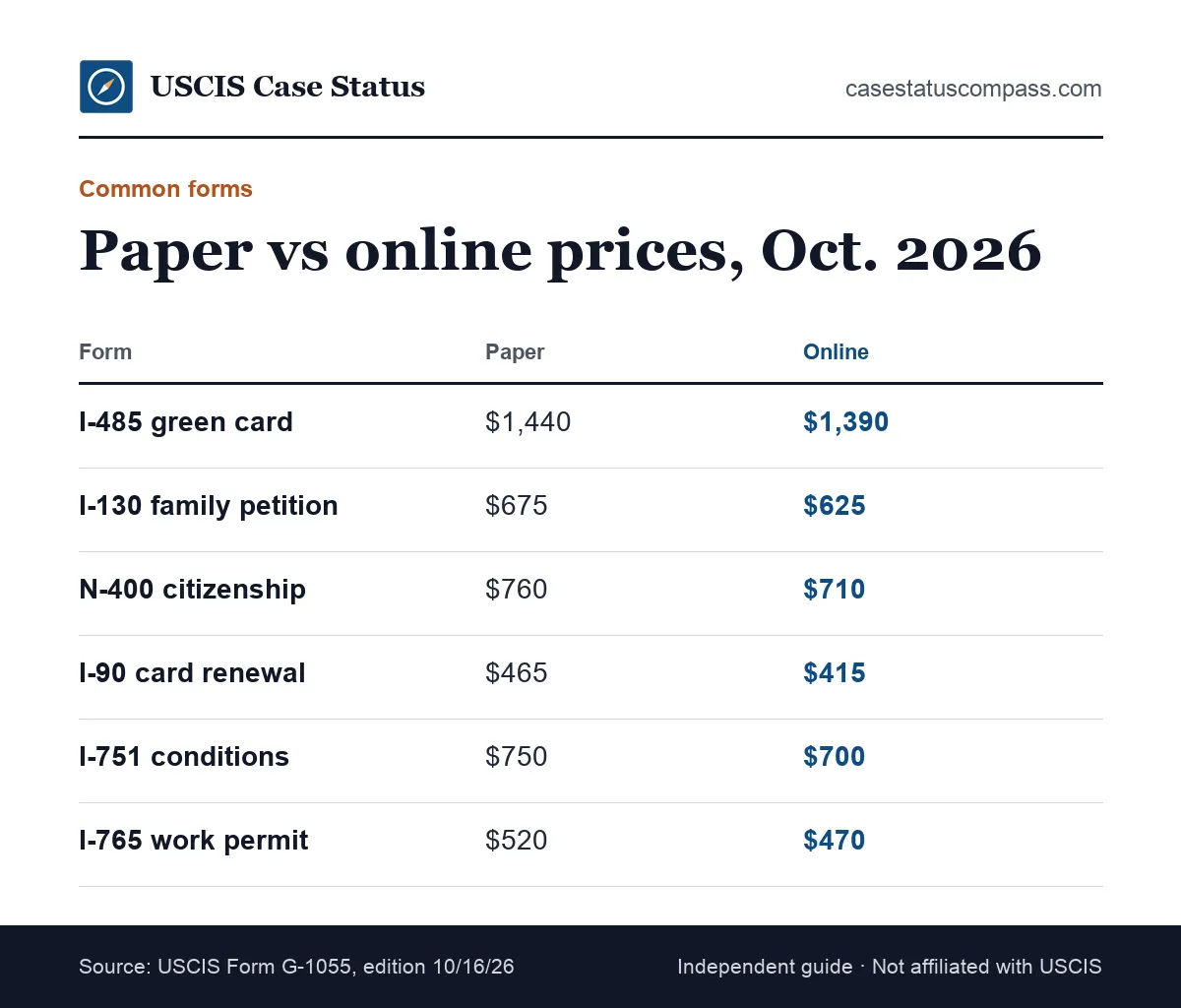
Here is the current USCIS filing fee for the most-searched forms; many cost less online. Rare forms and every category appear in our form g 1055 fee schedule guide. Where a row shows two amounts, they are the paper and online prices.
Current fees for 11 commonly filed forms
The table pairs each form with its purpose and the current fee printed in G-1055, so you can match your filing to one line.
| Form | What it is for | Current fee |
|---|---|---|
| I-485 | Green card from inside the U.S. | $1,440 (paper) / $1,390 (online); $950 / $900 if under 14 and filing with a parent |
| I-130 | Family petition | $675 (paper) / $625 (online) |
| I-90 | Renew or replace a green card | $465 (paper) / $415 (online) |
| I-751 | Remove conditions on residence | $750 (paper) / $700 (online) |
| N-400 | Citizenship | $760 (paper) / $710 (online); reduced fee $380 (paper only) if household income is at or below 400% of the Federal Poverty Guidelines |
| N-600 | Certificate of citizenship | $1,385 (paper) / $1,335 (online) |
| N-565 | Replacement citizenship document | $555 (paper) / $505 (online) |
| I-129F | Fiancé(e) petition | $675 |
| I-539 | Extend or change status | $470 (paper) / $420 (online) |
| I-824 | Action on an approved case | $590 |
| I-290B | Appeal or motion | $800 (some humanitarian categories $0; fee waiver possible) |
Forms priced in more than one line
Some forms add pieces. The work permit (Form I-765) is priced by category, the travel document (Form I-131) can trigger a parole fee, and employer petitions add an Asylum Program Fee.
How to read this table safely
Budget with the table, then confirm your exact line on the official G-1055 before paying. A category note, such as "under 14 and filing with a parent," can change the price.
Which Fee Schedule Edition Applies Today?
The edition in force on your filing or postmark date applies. Today that is Form G-1055, Edition 10/16/26, and mailed requests postmarked on or after October 16, 2026 without the correct fee are rejected. For an online filing, the date you submit plays the role of the postmark.
What changed on October 16, 2026
The new edition updated the inflation-adjusted H.R. 1 fees for Forms I-131, I-589, I-765, I-821 and I-941. Family and citizenship base fees stayed at 2024 levels, while premium processing rose.
Where the full breakdown lives
Our G-1055 fee schedule page walks through each appendix, explains the fee symbols and shows how to find an unusual form line. Use it when your form or category is missing from the table above.
Paper vs Online Filing: Why the Price Differs
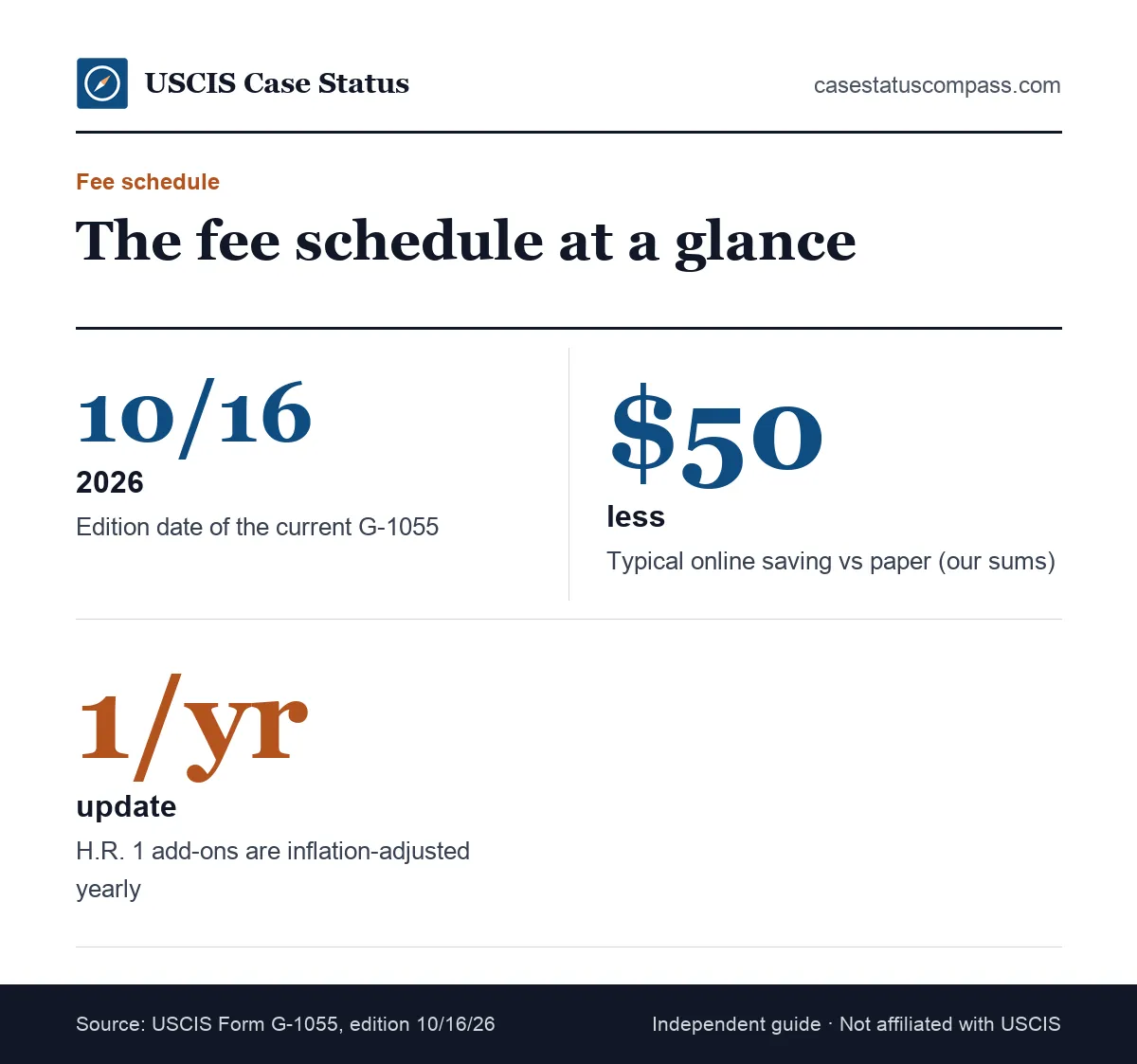
Filing online usually costs less than paper, because electronic cases are cheaper to take in. You file through a USCIS online account, and the discount applies only to forms accepted electronically. On common forms the gap is $50 per form, as the I-130, I-90 and N-400 lines show.
Popular forms with an online price
Forms I-485, I-130, I-90, I-751, I-765, N-400, N-600, N-565 and I-539 show a lower online amount. The I-485 can now be filed online, using the required edition 09/18/26 (01/20/25 and 09/04/26 editions rejected on/after Sept. 18, 2026; no grace period).
When you must file on paper
You lose the online discount when you request a fee waiver or reduced fee, since those generally need a paper filing. Reentry permits cannot be filed online either. Refugee travel documents are paper-only as well.
What Are the H.R. 1 Add-On Fees?
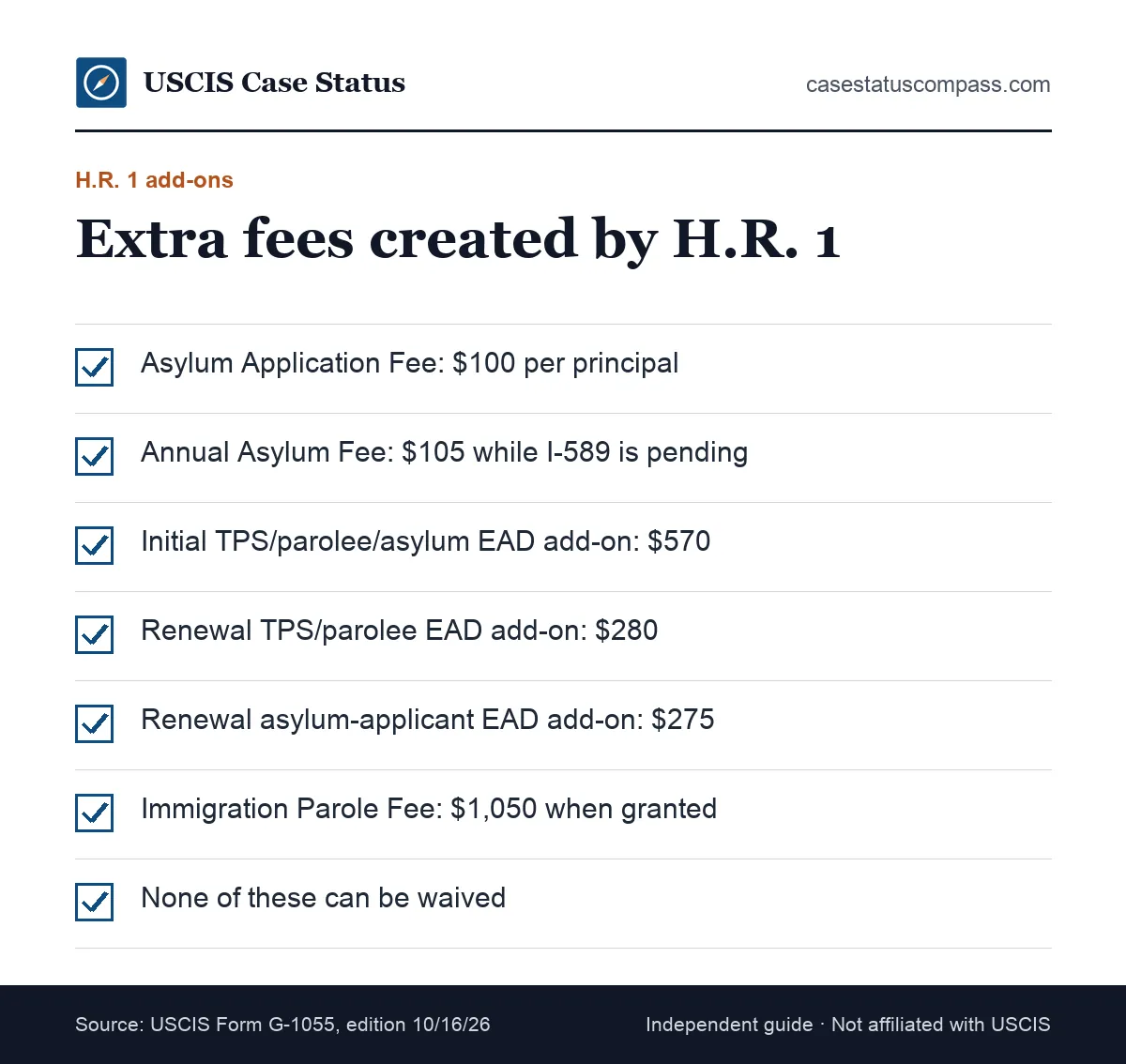
H.R. 1 fees are extra charges Congress created in Public Law 119-21. They apply to asylum, parole, temporary protected status (TPS) and some employment authorization documents (EADs). H.R. 1 fees can't be waived and must be paid separately. The amounts rise with inflation each fiscal year.
The H.R. 1 fees most people meet
- Asylum: a $100 Asylum Application Fee at filing and a $105 Annual Asylum Fee while pending.
- Work permits: $570 for initial asylum, TPS and parolee EADs; $280 or $275 for renewals.
- Parole: a $1,050 Immigration Parole Fee when parole is granted.
Who is exempt from some H.R. 1 fees
A court order created one notable exemption: Ms. L. settlement class: exempt from H.R. 1 parole, parolee-EAD and asylum fees since Feb. 5, 2026. Other exemptions vary by fee, so check the form instructions first.
Green Card Fees
Green card fees depend on where you apply. Inside the U.S., you file Form I-485. From abroad, you pay a petition fee, visa fees and the USCIS Immigrant Fee. Our how much is a green card guide totals each path.
The petition that starts most cases
Most family cases begin with Form I-130 at $675 (paper) / $625 (online). It proves the relationship but grants no status, so the relative later pays again, for Form I-485 or an immigrant visa.
How Much Is the EB-1 Filing Fee?
Employer cases usually start with Form I-140 at $715 (paper) / $665 (online) + Asylum Program Fee $600 ($300 small employer or self-petitioner; $0 nonprofit). The EB-1 filing fee is that same I-140 line, and EB-1A self-petitioners pay the reduced $300 Asylum Program Fee.
EB-2 and EB-3 need labor certification first
Many EB-2 and EB-3 cases need a Department of Labor PERM labor certification before the I-140. Timing matters: A PERM labor certification expires 180 days after DOL certifies it. An expired one cannot support the petition.
How Much Is the AOS Fee for Form I-485?
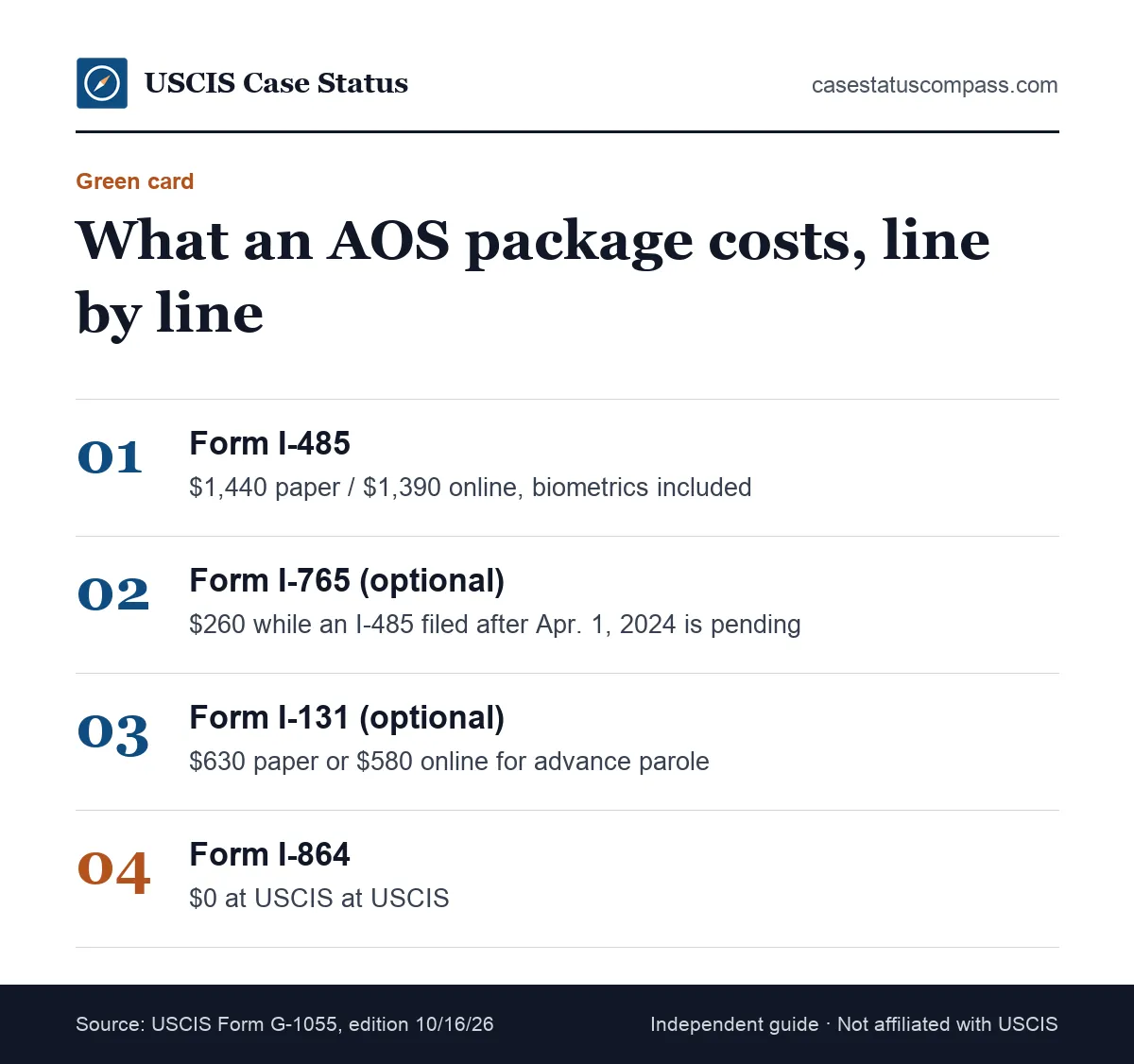
The adjustment of status (AOS fee) for Form I-485 is $1,440 paper / $1,390 online, with biometrics included. The work permit and travel document are no longer bundled, so each adds its own fee. Each family member who adjusts files a separate I-485 and pays their own fee.
What the AOS filing fee does not cover
The AOS filing fee pays for USCIS review, biometrics and interview scheduling. Civil surgeons price the medical exam; USCIS lists $0 USCIS fee; the civil surgeon sets the exam price.
Optional forms filed with the I-485
These are the forms most applicants add to an I-485 package, with the price each carries when filed together or while the I-485 is pending.
| Add-on form | Purpose | Fee with a pending I-485 |
|---|---|---|
| I-765 | Work permit while you wait | $260 if the I-485 was filed on or after Apr. 1, 2024 |
| I-131 | Advance parole for travel | $630 (paper) / $580 (online); $0 if your I-485 was filed before Apr. 1, 2024 with the fee. H.R. 1 Immigration Parole Fee $1,050 when parole is granted (some exceptions) |
| I-864 | Affidavit of support | $0 at USCIS |
Who Pays a Lower or Zero AOS Filing Fee?
Children under 14 filing with a parent pay $950 on paper or $900 online. Refugees, Special Immigrant Juveniles, VAWA self-petitioners and certain Afghan and Iraqi special immigrants pay no adjustment of status fee. The category must match the I-485 instructions exactly.
Section 245(i) and the Supplement A fee
Section 245(i) applicants add the $1,000 Supplement A fee (unmarried children under 17 are exempt). It requires 245(i): petition or labor certification filed by Apr. 30, 2001 (and in the U.S. Dec. 21, 2000 if filed after Jan. 14, 1998).
How Much Does It Cost to Immigrate to the US?
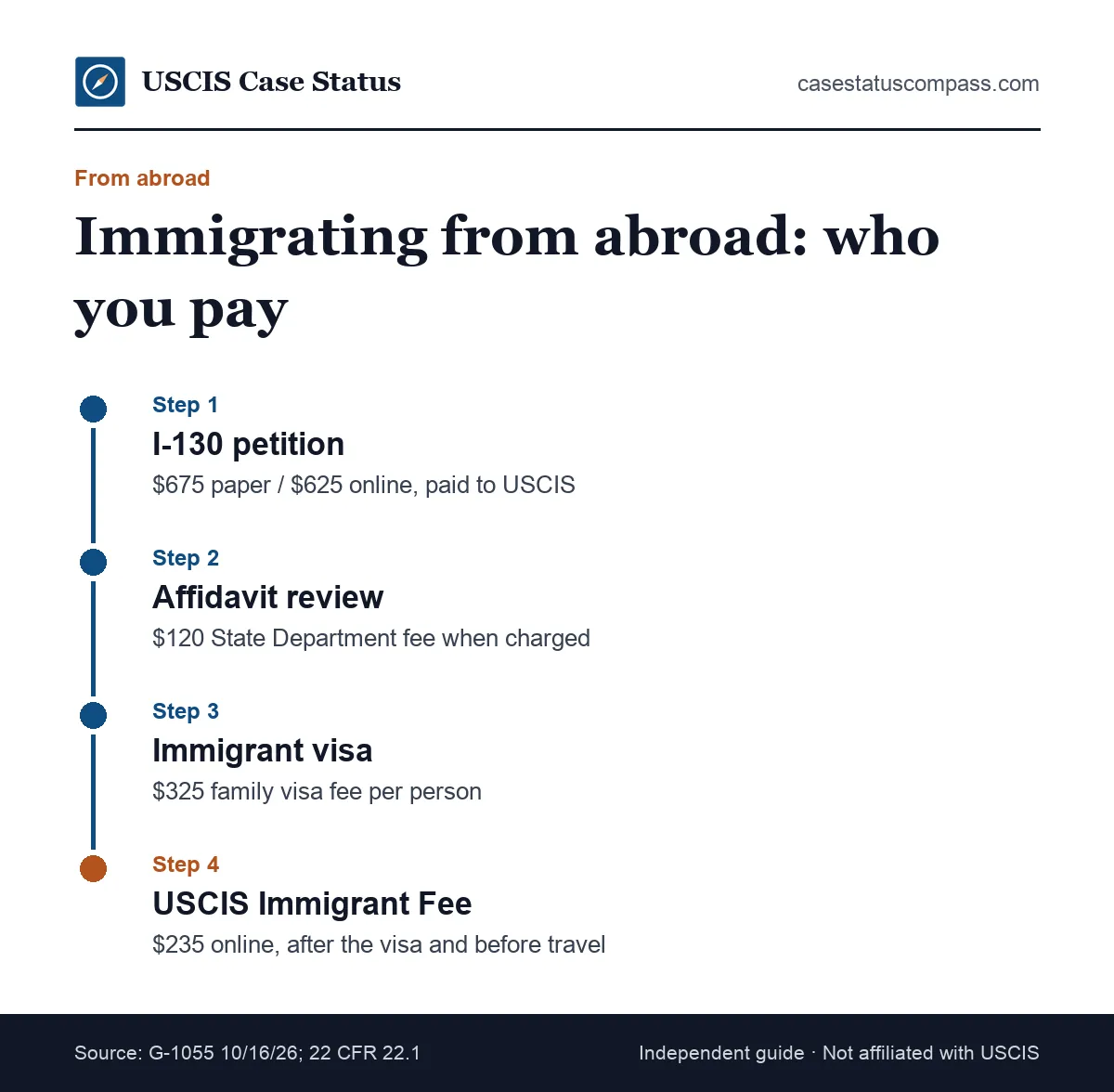
Immigrating combines USCIS and State Department fees. A family case from abroad pays $675 (paper) / $625 (online) for the I-130, then Immigrant visa fee: $325 family; $345 employment; $205 other (per person), then the $235 USCIS Immigrant Fee before travel.
Cost to immigrate to America through a relative
Spouses, parents and children of citizens follow one path: the citizen files Form I-130, the relative pays the visa fee, then the USCIS Immigrant Fee. The visa fee is paid at the National Visa Center stage.
Why there is no single total
The total depends on category, family size, and whether you adjust status or process abroad. Each person pays their own visa fee. Medical exams, translations, passports and travel add costs that no USCIS schedule lists.
How Much Is the Affidavit of Support Fee?
Form I-864, the affidavit of support, is $0 at USCIS. In consular cases, the State Department may charge a $120 Affidavit of Support review fee (State Department, when reviewed domestically). So the fee for an affidavit of support depends on the reviewing agency.
I-864A and I-864EZ
The household-member contract (Form I-864A) and the short I-864EZ also cost nothing at USCIS, though sponsors still need tax transcripts. Our Form I-864 guide explains the income rule and joint sponsors.
What Is the USCIS Immigrant Fee?
The USCIS Immigrant Fee is a $235 online payment by people issued an immigrant visa abroad. It pays for producing the green card, ideally before travel. Paying after arrival is allowed, but the physical card waits until the fee is paid.
Immigrant fee payment online
You pay the immigrant fee online on the USCIS Immigrant Fee page, using details from your visa packet. Each immigrant pays separately. You need the A-Number and DOS case ID from the visa packet.
Who does not pay it
Orphan and Hague adoptees, Iraqi and Afghan special immigrants, returning residents (SB-1) and K nonimmigrants are exempt. K-1 fiancés adjust status inside the U.S., so they pay through Form I-485.
How Much to Renew a PR Card?
Renewing or replacing a permanent resident card with Form I-90 costs $465 (paper) / $415 (online). That is the resident card renewal fee. Our green card renewal fee page covers every I-90 reason. Filing online saves $50 over paper, and you can file within six months of expiry.
Replacement for a lost or damaged card
Lost, stolen and damaged cards use the same I-90 line. A USCIS error on the card is free to fix, and so is turning 14 if the card expires after your 16th birthday.
Proof of status while the I-90 is pending
Paying the fee also buys time: I-90 receipt notice + expired card = proof of status for 36 months from the card's expiration date. Keep the I-797C receipt with your expired card.
What Does Form I-751 Cost Instead of an I-90?
A 2-year conditional card is not renewed with Form I-90. You remove conditions with Form I-751 at $750 (paper) / $700 (online); battered-spouse waiver filers pay nothing. Paying the I-90 fee by mistake does not extend a conditional card, and that money is not refunded.
When to pay for the I-751
File in the 90 days before your 2-year card expires. Once accepted, the I-751 receipt notice extends conditional status and work authorization for 48 months. A petition filed too early is returned.
Citizenship Fees
Citizenship fees center on Form N-400, priced at $760 (paper) / $710 (online); reduced fee $380 (paper only) if household income is at or below 400% of the Federal Poverty Guidelines. Our how much does it cost to become a us citizen guide covers each case.
The reduced N-400 fee
Reduced N-400 fee: request it in Part 10 of the paper N-400 (income at or below 400% of poverty). Form I-942 is archived. A full fee waiver on Form I-912 is separate.
Replacing a certificate
A lost, damaged or wrong certificate is replaced with Form N-565 at $555 (paper) / $505 (online). There is no fee when USCIS made the error, such as a misspelled name.
Military naturalization at no cost
Military applicants filing under INA 328 or 329 pay nothing for the N-400. The military service certification (Form N-426) is $0 too. The certification goes in with the N-400 to prove qualifying service; veterans may submit a DD Form 214 instead.
Work Permit and Work Visa Fees
Work fees cover the work permit (EAD, Form I-765) and employer petitions such as Form I-129. The h1b visa fees stack costs most; our H-1B, EAD and work visa fees guide itemizes it. The worker files the EAD, while Form I-129 and Form I-140 are filed by the employer.
Why work fees are hard to estimate
Employer petitions combine a base fee, the Asylum Program Fee, and for H-1B a training fee and a fraud fee. Employer size and nonprofit status change lines. Premium processing, if chosen, adds one more line.
The H-1B fee stack in brief
A new H-1B starts with a $215 per registration (per beneficiary) registration. The petition then costs Base $780 (paper) / $730 (online) ($460 small employer/nonprofit) + Asylum Program Fee $600/$300/$0 + Fraud fee $500 + ACWIA $1,500 or $750 (+ $4,000 Pub. L. 114-113 fee for some large H-1B-dependent employers). The proclamation H-1B payment is not owed: $100,000 H-1B payment: blocked by court order (vacated June 8, 2026; stay denied July 24, 2026).
How Much Is Premium Processing for Work Petitions?
Employers can buy faster decisions on Forms I-129 and I-140, as can OPT students. As of October 2026, it costs $2,965 (I-129 most classes, I-140); $1,780 (H-2B/R, I-765 OPT); $2,075 (I-539 to F/J/M). See our premium processing guide. It is optional and requested on Form I-907.
Forms eligible for premium processing
Premium processing covers I-129 work visas, I-140 (EB-1/2/3), I-765 OPT/STEM OPT and I-539 to F/M/J. Family forms are excluded, and You can't get a fee waiver for premium processing.
Premium processing time frames
USCIS promises action within set windows: 15 business days (I-129, most I-140); 30 (I-765 OPT, I-539 F/M/J); 45 (I-140 E13 managers and NIW). An RFE stops the premium clock; a new period starts when USCIS gets your response.
How Much Does an Employment Authorization Document Cost?
An employment authorization document costs $520 paper / $470 online in most categories, or $260 with a pending I-485 filed on or after April 1, 2024. Asylum, TPS and parolee EADs add H.R. 1 charges. The category code you enter on the form decides the price.
Employment authorization card fee by category
Find your eligibility category in the left column; the right column shows the base fee and any H.R. 1 add-on you owe on top.
| Applicant | What you pay |
|---|---|
| Most categories, including H-4 and OPT | Base fee (paper or online) |
| Pending I-485 filed on or after Apr. 1, 2024 | $260 |
| Pending I-485 filed July 30, 2007 to Mar. 31, 2024, fee paid | No fee |
| Initial asylum applicant (c)(8) | No base fee + $570 H.R. 1 fee |
| TPS or parolee | Base fee + $570 initial / $280 renewal |
| DACA (c)(33) | Base fee; no waiver |
Edition rules for Form I-765
USCIS only accepts I-765 edition 08/21/25 (the 09/15/26 edition is NOT accepted because of a Sept. 14, 2026 court order), and a wrong edition is rejected. Our work permit guide explains categories, photos and status tracking.
What Is the Asylum Program Fee?
The Asylum Program Fee is a charge on employer petitions that funds asylum processing. Asylum Program Fee (I-129, I-140): $600; $300 small employer (or I-140 self-petitioner); $0 nonprofit, on top of the base fee. Despite its name, asylum seekers do not pay it; only I-129 and I-140 petitioners do.
Who counts as a small employer
G-1055 does not define small employer on its face. The 2024 fee rule uses 25 or fewer full-time-equivalent employees, and the I-129 instructions explain how to count them. Nonprofit petitioners pay $0.
Asylum, TPS and Other Humanitarian Fees
Humanitarian forms often have low or no base fees, but H.R. 1 added asylum fees and raised related work permit costs. TPS (Form I-821) has its own fee. Asylum applicants, TPS filers and parolees now carry statutory charges regardless of income.
Asylum fee basics
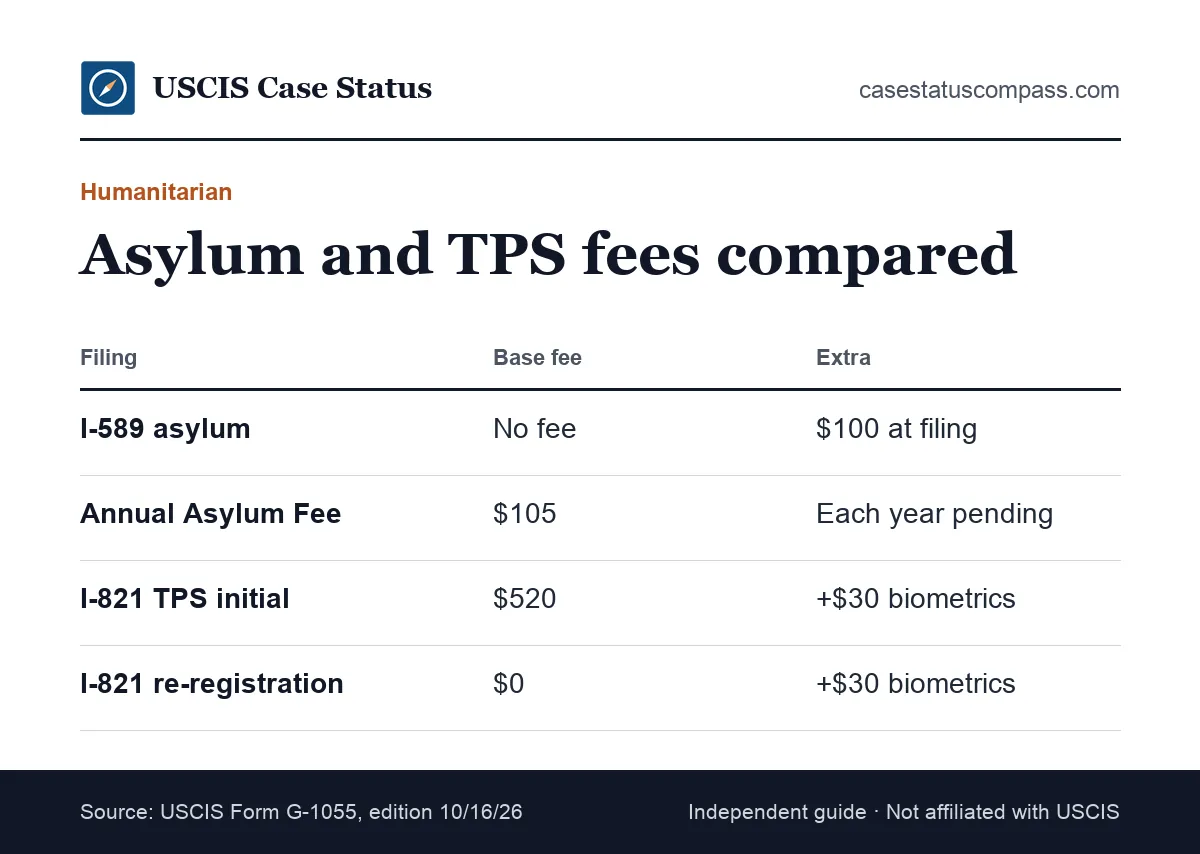
$0 filing fee + $100 Asylum Application Fee (principal applicant); Annual Asylum Fee $105 (online, when USCIS sends a notice). These statutory fees cannot be waived. Our asylum case guide explains the one-year deadline.
Refugees and asylees adjusting status
Refugees pay nothing for Form I-485, while asylees pay the regular fee. Both must meet this rule first: Refugees and asylees need 1 year of physical presence in the U.S. before filing I-485.
How Much Is the Annual Asylum Fee?
The annual asylum fee is $105 a year for each year an I-589 stays pending once USCIS sends a notice. It is due within 30 days, and an unpaid fee blocks approval. Pay the amount shown on your notice rather than a figure from a past year.
How to pay the annual asylum fee
Wait for the USCIS notice, then pay through the annual asylum fee page in your USCIS online account. Save the confirmation. Pay within the 30-day window and keep a copy with your asylum papers.
If you cannot afford it
No waiver exists for this H.R. 1 fee, though Ms. L. settlement class members are exempt. A nonprofit legal provider can review your options. Do not ignore the notice, because USCIS cannot approve the case while it is unpaid.
TPS Filing Fee and Re-Registration
The TPS filing fee is Initial: $520 + $30 biometrics; re-registration: $0 + $30 biometrics (the TPS EAD is a separate fee). As of October 27, 2026, USCIS lists these designated countries: El Salvador, Lebanon, Sudan, Ukraine. The list changes often.
TPS fees for the work permit
A TPS work permit on Form I-765 adds $570 for an initial EAD and $280 for a renewal, plus the base fee. Our TPS guide covers filing. Applicants who do not need to work can skip Form I-765.
TPS fee waiver limits
A fee waiver can cover the $30 biometric fee only. The initial I-821 fee and the EAD add-on cannot be waived. Ask for it on Form I-912 with proof of income or benefits, usually in a paper filing.
DACA Renewal Fee: What Is the Deferred Action Price?
The DACA renewal fee is I-821D $85 + I-765 $520 (paper) / $470 (online) = $605 paper / $555 online, covering Form I-821D and the (c)(33) work permit. No fee waivers exist for DACA. Our daca renewal fee guide explains each payment.
When to file the renewal
File your DACA renewal 120-150 days before it expires. Filing early does not speed the decision, and filing late risks a work authorization gap. Count back 150 days from your EAD's expiration date.
Paying for a first-time DACA request
Think twice before paying a deferred action application fee for an initial request: DACA: renewals processed; initial requests accepted but not processed, and fees are not refunded. Ask a legal aid provider before you pay.
How Much Is a Travel Document?
USCIS travel documents are filed on Form I-131, and the I-131 form fee depends on whether you need advance parole, a reentry permit or a refugee travel document. Each type has its own G-1055 line, and once you file online you cannot switch the application to a different type.
Refugee travel document cost
Refugees and asylees use a refugee travel document instead of a home-country passport. It costs $165 at 16 or older and $135 under 16; refugees pay nothing. See our Form I-131 guide.
Lost green card abroad: Form I-131A
A resident abroad whose card was lost, stolen or destroyed requests carrier documentation on Form I-131A for $575, which lets an airline board you home. You file it in person at a U.S. embassy or consulate after paying online.
How Much Is the Advance Parole Filing Fee?
Advance parole costs $630 on paper or $580 online. It is free if your I-485 was filed before April 1, 2024 with the fee; later I-485 filers pay the full advance parole filing fee. Without it, leaving while the I-485 is pending usually abandons the application.
The parole fee and travel risk
G-1055 also lists a $1,050 Immigration Parole Fee when parole is granted, but the parole fee does not apply to an INA 245 adjustment applicant returning from temporary travel abroad, if CBP agrees at the port of entry. Since August 13, 2026, such travel can trigger unlawful-presence bars.
How Much Does a Reentry Permit Cost?
Green card holders planning long trips use a reentry permit, filed on Form I-131 at $630. It is paper-only, and you must be in the U.S. to file and attend biometrics. Biometrics are included in that amount, so no separate appointment fee is due.
Travel document fee for 2 years of validity
The reentry permit cost buys time abroad: Reentry permit: generally valid 2 years (1 year if abroad more than 4 of the last 5 years). File before you leave. a reentry permit cannot be extended, so a longer stay means a new permit and a new fee.
Waiver Forms: I-601A, I-601 and I-192 Fees
The provisional unlawful presence waiver (Form I-601A), the inadmissibility waiver (Form I-601) and the nonimmigrant waiver (Form I-192) each have a G-1055 fee. We have not verified these lines, so we do not print the I-601A filing fee. Ask your attorney to confirm the current line before paying.
Where to confirm the I-601A and I-601 fee
Check the official fee schedule walkthrough or the USCIS pages for I-601A, I-601 and I-192, and match edition 10/16/26. Many applicants file these waivers with an attorney. A waiver filed with the wrong amount is rejected like any other form.
K-1 Fiancé Visa Fees
The K-1 process starts with Form I-129F at $675. The State Department then charges a $265 K (fiancé) visa application fee. Our k1 visa cost guide totals every step. Then come the panel physician's charge and, after the wedding, the I-485 fee; no USCIS Immigrant Fee is due.
K-1 cost steps in order
- Form I-129F petition to USCIS.
- K visa application fee to the State Department.
- Medical exam with a panel physician abroad.
- Form I-485 after marriage, plus optional I-765 and I-131 if you want to work or travel while it is pending.
When the green card fee comes due
The I-485 fee is not owed at entry. K-1: marry within 90 days of entering the U.S., and only then does the K-1 spouse pay the adjustment fee. Budget for it soon after arrival.
Fees Paid to Other Agencies
Not every immigration fee goes to USCIS. The State Department charges visa fees, the immigration courts (EOIR) charge for court filings, and the Department of Labor (DOL) runs labor certification. Each agency uses its own payment system, so a USCIS receipt never proves you paid a visa or court fee.
State Department and the integrity fee
Immigrant visa fees are paid per person to the State Department; visitor and student visas cost $185. We state no amount for the H.R. 1 visa integrity fee: The State Department's Fees for Visa Services page did not list a visa integrity fee as of Oct. 27, 2026.
Department of Labor
DOL lists no filing fee for Form ETA-9089, the PERM labor certification. Notably, the employer, not the worker, must pay PERM labor certification costs, including its own attorney fees.
What Is the 42B Filing Fee for Cancellation of Removal?
Cancellation of removal (Form EOIR-42B) is filed in immigration court, not with USCIS, so the 42B fee is not a G-1055 line. Biometrics included in most fees (separate $30 for TPS I-821 and some EOIR forms). Check the EOIR fee page for the application fee.
Which USCIS Forms Cost Nothing?
Several USCIS forms have no fee, including the affidavit of support, the fee waiver request and the medical disability exception. Zero at USCIS is not always zero cost, because doctors charge. A zero-fee form still needs the current edition and every signature.
Zero-fee forms you might file
These forms carry no USCIS fee at all, though outside costs such as the civil surgeon's exam may still apply.
| Form | Purpose | USCIS fee |
|---|---|---|
| I-864 / I-864A / I-864EZ | Affidavit of support | $0 at USCIS |
| I-912 | Fee waiver request | $0 (no fee to request a fee waiver) |
| I-693 | Medical exam record | $0 USCIS fee; the civil surgeon sets the exam price |
| N-648 | Medical disability exception | $0 USCIS fee (the doctor may charge) |
| N-426 | Military service certification | $0 |
Categories that pay nothing on paid forms
Some people pay nothing on paid forms: refugees on Form I-485, battered spouses on Form I-751, and service members filing Form N-600 for themselves. The exemption must match the instructions.
How to Pay USCIS Fees
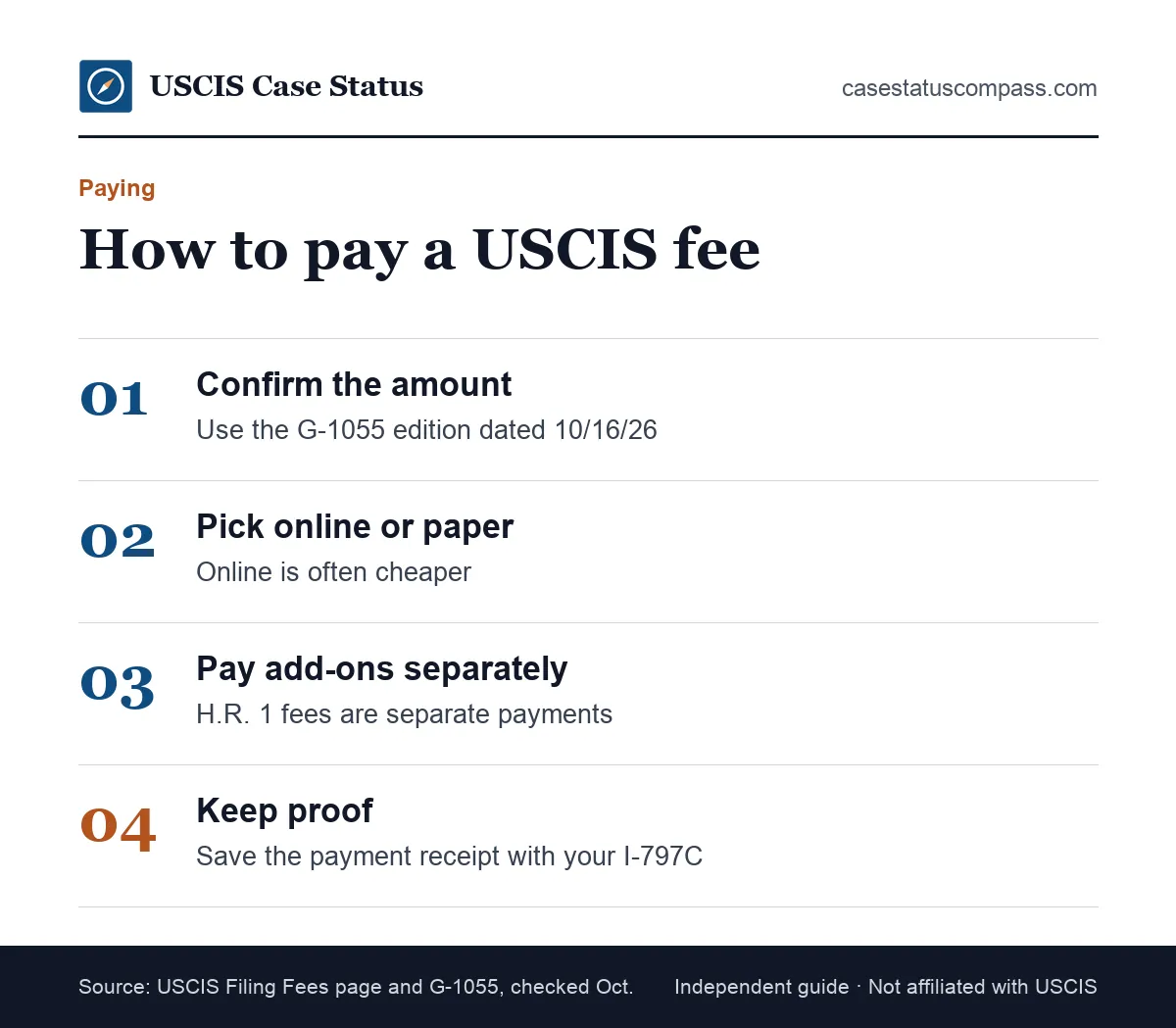
You pay USCIS fees inside your online account when you file online, or with the package when you mail a form. As of October 2026, checks, money orders and cashier's checks are accepted only with an approved Form G-1651 exemption.
Accepted payment methods for paper filings
You pay online through Pay.gov, or on paper with Form G-1450 (card) or Form G-1650 (bank account). Also use one payment method per form; USCIS won't take a mix of payment types for one form. A declined payment gets the form rejected.
Payee name and form details
When a payee is needed, make paper payments payable to the U.S. Department of Homeland Security (not 'DHS' or 'USDHS'). Our G-1055 payment walkthrough shows where it goes. Spelling it out in full avoids a rejection.
Paying H.R. 1 fees separately
H.R. 1 fees are their own payment, even when filed with a regular form. Rolling them into one combined amount can lead to rejection. On paper, attach a separate payment for the add-on as the form instructions describe.
Where to mail a paid paper filing
Check the address before mailing: New USCIS mailing addresses from Oct. 7, 2026; old addresses accepted if postmarked by Nov. 9, 2026. Use the address on your form's uscis.gov page.
Can You Pay Immigration Fees Online?
Yes. You can pay for immigration fees online when you file through your USCIS online account; payment is collected at submission. The Immigrant Fee and annual asylum fee are online too. Nothing is mailed with an online filing, and the receipt notice appears in your account.
What you need to pay online
You need a USCIS online account, a form open to online filing, and an accepted payment method. Our online account guide explains setup. Payment runs through Pay.gov, the federal payment system.
Can You Get a USCIS Fee Refund?
No. USCIS fees are nonrefundable, even if your case is denied or withdrawn. The rule covers filing and biometric fees. A rejected filing is returned unprocessed, so choose the right form first. Check eligibility before paying USCIS fees on expensive forms like the I-485.
Refunds for a USCIS error
USCIS fixes some of its own mistakes free, such as a misprinted card, but never refunds a withdrawn case or the wrong form. Report a double charge. Report a double charge through the USCIS Contact Center.
Does USCIS Keep Your Fee After a Rejection or Denial?
It depends on the stage. A rejection happens at intake, when a form is incomplete, unsigned, on the wrong edition or paid wrongly; USCIS does not keep the fee. A denial comes after review, and the fee is kept. Challenging a denial means paying a new Form I-290B fee.
What Happens If You Pay the Wrong Fee?
If you pay the wrong fee, USCIS rejects and returns the filing. You refile with the correct amount and a new postmark. The October 16, 2026 schedule changed several H.R. 1 amounts. A rejected filing gets no receipt number and no filing date, so refile quickly.
Common wrong-fee mistakes
- Paying the online price on a paper filing.
- Using last year's H.R. 1 amount for an EAD, parole or TPS form.
- Leaving out the Asylum Program Fee on an employer petition.
- Paying one combined amount instead of separate H.R. 1 payments.
Fixing a rejected filing
Read the rejection notice, correct the amount and refile. A uscis case status search will not show a rejected paper filing, because no case was created. The notice usually names the reason.
Fee Waivers and Reduced Fees
A fee waiver lets eligible people file certain forms without paying; you request it with Form I-912, which is $0 (no fee to request a fee waiver). A reduced fee is offered for the N-400. Our uscis fee waiver guide covers evidence.
Who qualifies for a fee waiver
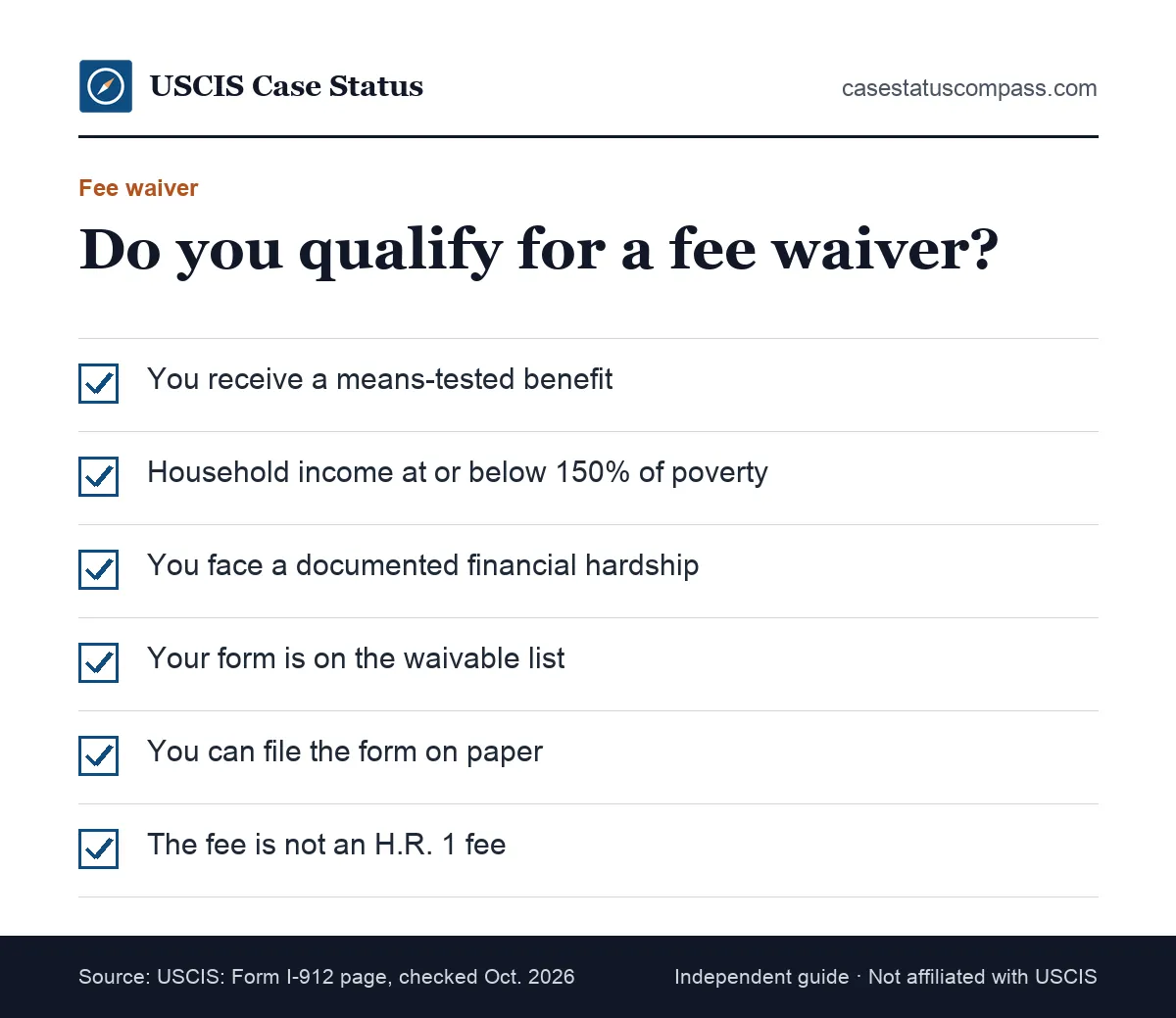
Fee waiver: means-tested benefit, income at or below 150% of poverty guidelines, or financial hardship. Medicare, unemployment and Social Security retirement do not count as means-tested benefits. Form I-912P lists the income figures.
Which forms can be waived
Fee waivers are possible for forms like I-90, I-751, I-765 (not DACA), N-400, N-565 and N-600. Waiver requests usually need a paper filing. Premium processing, DACA forms and H.R. 1 fees sit outside the waiver.
What Is a Waived Fee?
A waived fee is one you do not pay because USCIS approved your waiver request; the form is processed as if paid. If the waiver is denied, USCIS rejects the form and you refile with the full fee. Each request is decided on the evidence you send.
Waived vs reduced vs exempt
A waived fee is forgiven after you show need. A reduced fee is a lower price you request, such as the reduced N-400. An exempt fee costs nothing by rule for a category, with no request needed.
Which USCIS Fees Can Never Be Waived?
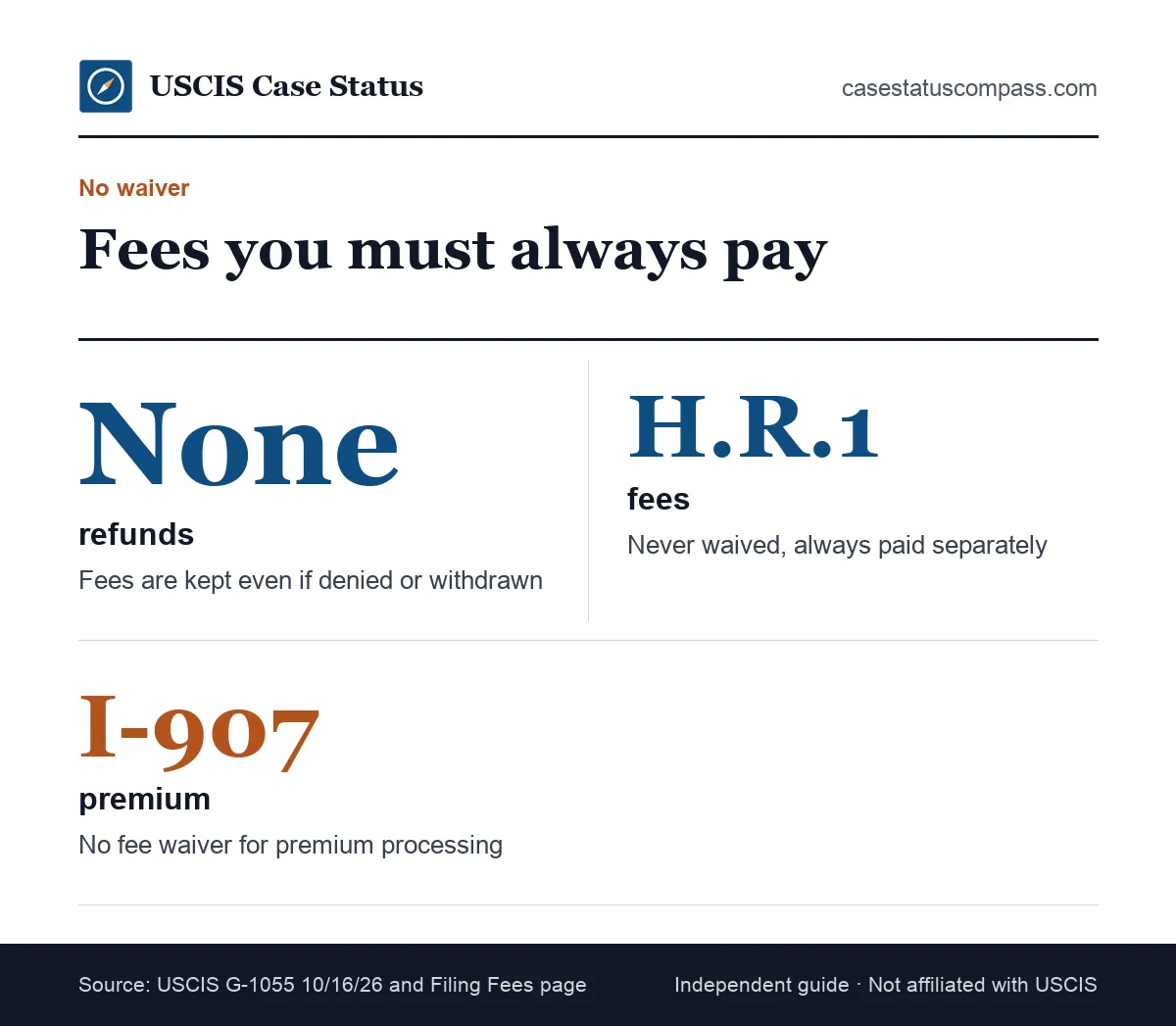
Three groups of USCIS fees can never be waived: H.R. 1 fees, premium processing and DACA fees. Budget for them in full, even if your base fee is waived. A waiver of the I-765 base fee, for example, still leaves the H.R. 1 add-on to pay in full.
Why a free case can still cost money
An asylum applicant with no filing fee still owes the asylum application fee. A TPS filer with a waived biometric fee still pays the EAD add-on. Plan for these charges before you file.
Sample Fee Stacks for Common Cases
These examples work like a simple fee calculator: find your situation, then add the lines shown. Amounts follow G-1055 edition 10/16/26 and update when the schedule changes. They show which lines to add, not a final price, because optional forms and extra family members change the total.
Fee lines for five common situations
Each row names a common case and the fee lines that usually combine for it; add one set per person who files.
| Situation | Fee lines to add |
|---|---|
| Spouse adjusting in the U.S. with work and travel | I-130 + I-485 + $260 I-765 + I-131 |
| Relative immigrating from abroad | I-130 + State Department visa fee + $235 Immigrant Fee |
| Resident renewing a 10-year card | I-90 at $465 (paper) / $415 (online) |
| Resident applying for citizenship | N-400 at $760 paper / $710 online |
| Employer hiring a new H-1B worker | $215 per registration (per beneficiary) + I-129 fee stack |
How to build your own total
List every form in your package. Check each for a paper or online price, an age-based price or an H.R. 1 add-on, then add medical and legal costs. Write the total down per person.
How Do Immigration Legal Fees Compare With Filing Fees?
Immigration legal fees are what an attorney or accredited representative charges for their work. They vary by case and region and are not set by USCIS. Our immigration lawyer cost guide explains pricing models. Filing fees go to the government whether or not you hire help.
Free and low-cost help
DOJ-accredited representatives at recognized nonprofits often charge reduced fees. Avoid notarios and unlicensed consultants; a rejected filing they prepare still costs you the fee. Find them on the EOIR roster of recognized organizations.
How USCIS Fees Fit Together
USCIS fees stack in layers: the base filing fee, any category price, H.R. 1 add-ons and the Asylum Program Fee, then optional premium processing. Fees for other agencies, like the State Department, sit outside USCIS. Knowing the layers helps you spot a missing line before USCIS does.
The fee layers in order
- Base fee for the form (paper or online).
- Category adjustment, such as under-14, reduced or exempt.
- Statutory add-ons: H.R. 1 fees, Asylum Program Fee, H-1B training and fraud fees.
- Optional speed: premium processing on eligible forms.
- Non-USCIS costs: visa, civil surgeon and legal fees.
How the fee pages connect
Each child page answers one cost question, from green card to DACA. Forms themselves live on our uscis forms hub. Start with the page for your goal, then use the G-1055 guide for any form it does not cover.
How to Check USCIS Fees Before You File
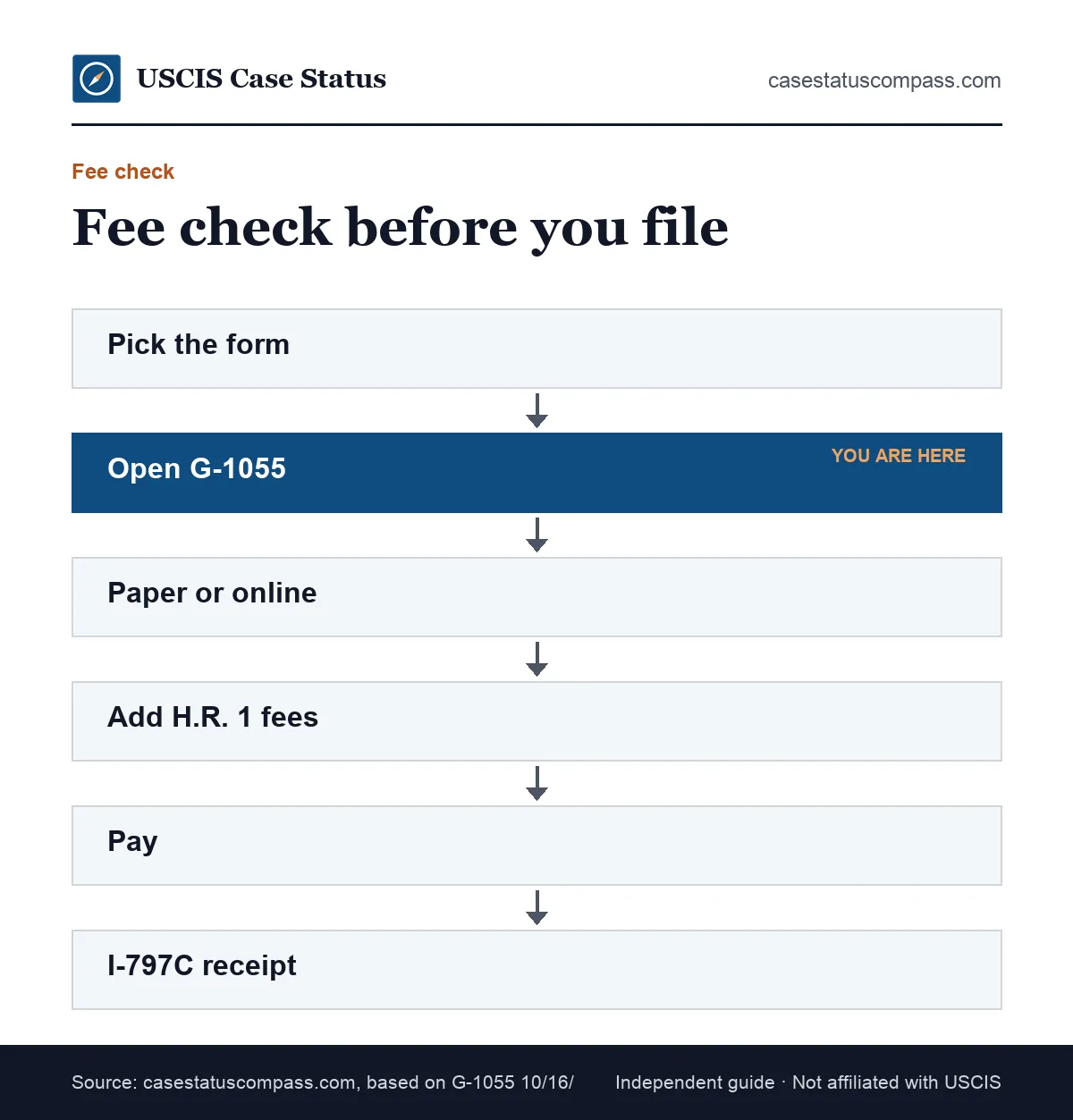
Open the official G-1055, find your form and category, and confirm the edition date 10/16/26. Then read the form's uscis.gov page. This check prevents most fee rejections. Recheck USCIS fees if you file weeks later, because H.R. 1 amounts change each fiscal year.
A quick fee-check routine
- Open Form G-1055 on uscis.gov.
- Find your form number and category.
- Note the paper and online prices.
- Add any H.R. 1 or Asylum Program Fee lines.
- Confirm payment rules on the Filing Fees page.
After you pay
USCIS sends Form I-797C as your receipt, confirming the fee was accepted. Keep the receipt number to track your case online.
Frequently Asked Questions
How much are USCIS fees in 2026?
As of October 2026, USCIS fees follow Form G-1055, edition 10/16/26. A green card application costs $1,440 paper / $1,390 online, and citizenship costs $760 paper / $710 online. Many forms are cheaper online.
How much does it cost to renew your resident card?
Renewing a 10-year green card with Form I-90 costs $465 (paper) / $415 (online), biometrics included. Conditional residents with a 2-year card file Form I-751 instead. A fee waiver is possible if you qualify.
Do I pay the biometrics fee separately?
For most forms, no. Biometrics have been included in most filing fees since April 1, 2024. A separate $30 biometric fee appears only on a few lines, such as TPS Form I-821.
Can a fee waiver cover the H.R. 1 fees?
No. H.R. 1 fees cannot be waived and must be paid separately, even when the base filing fee is waived or zero. That includes both asylum fees, the parole fee and EAD add-ons.
Does USCIS offer premium processing on a green card?
Not for Form I-485 or Form I-130. It is available for some employment forms, including Form I-140, at $2,965 (I-129 most classes, I-140); $1,780 (H-2B/R, I-765 OPT); $2,075 (I-539 to F/J/M). Family cases can only request an expedite.
What is the integrity fee I keep reading about?
The visa integrity fee is an H.R. 1 charge on approved nonimmigrant visas. The State Department's Fees for Visa Services page did not list a visa integrity fee as of Oct. 27, 2026, so we do not state an amount.
Does a relative abroad pay USCIS fees too?
Yes, twice. The U.S. petitioner pays the Form I-130 fee to USCIS. After visa issuance, the immigrant pays the $235 USCIS Immigrant Fee online. Visa fees go to the State Department.
Is there a VAWA application fee?
VAWA self-petitioners pay no USCIS fee for the green card step, because the I-485 is free for them. Related work permit and travel forms follow their own category rules, so check each G-1055 line before filing.
Can I pay a USCIS fee with a credit card?
Yes. Online filers pay by card at submission, and paper filers attach Form G-1450 for a card payment or Form G-1650 for a bank account debit. Use only one payment method per form.
Do children pay the same green card fee as adults?
Not always. A child under 14 who files Form I-485 together with a parent pays the lower child rate shown on G-1055. Children filing alone, or aged 14 and older, pay the adult I-485 fee.
Sources
- USCIS: Form G-1055, Fee Schedule (edition 10/16/26). www.uscis.gov/g-1055. Accessed Oct 27, 2026.
- USCIS: Filing Fees. www.uscis.gov/forms/filing-fees. Accessed Oct 27, 2026.
- USCIS: USCIS Immigrant Fee. www.uscis.gov/forms/filing-fees/uscis-immigrant-fee. Accessed Oct 27, 2026.
- USCIS: Form I-912, Request for Fee Waiver. www.uscis.gov/i-912. Accessed Oct 27, 2026.
- USCIS: Form I-589, Application for Asylum. www.uscis.gov/i-589. Accessed Oct 27, 2026.
- USCIS: How Do I Request Premium Processing?. www.uscis.gov/forms/all-forms/how-do-i-request-premium-processing. Accessed Oct 27, 2026.
- eCFR / LII: 22 CFR 22.1, Schedule of Fees for Consular Services. www.law.cornell.edu/cfr/text/22/22.1. Accessed Oct 27, 2026.
- USCIS Form G-1055 Fee Schedule, Edition 10/16/26. www.uscis.gov/sites/default/files/document/forms/g-1055.pdf. Accessed Oct 27, 2026.
- USCIS: Form I-485 page (updated 10/07/2026). www.uscis.gov/i-485. Accessed Oct 27, 2026.
- USCIS: Form I-140 page (updated 07/24/2026). www.uscis.gov/i-140. Accessed Oct 27, 2026.
- USCIS: Form I-693 page (updated 07/24/2026) and G-1055. www.uscis.gov/i-693. Accessed Oct 27, 2026.
- Form I-485 Supplement A Instructions, Edition 09/18/26. www.uscis.gov/sites/default/files/document/forms/i-485supainstr.pdf. Accessed Oct 27, 2026.
- USCIS: Replace Your Green Card (updated 09/12/2025). www.uscis.gov/green-card/after-we-grant-your-green-card/replace-your-green-card. Accessed Oct 27, 2026.
- USCIS: Removing Conditions on Permanent Residence Based on Marriage. www.uscis.gov/green-card/after-we-grant-your-green-card/conditional-permanent-residence/removing-conditions-on-permanent-residence-based-on-marriage. Accessed Oct 27, 2026.
- Form N-400 Instructions, Edition 01/20/25. www.uscis.gov/sites/default/files/document/forms/n-400instr.pdf. Accessed Oct 27, 2026.
- USCIS: H-1B Electronic Registration Process. www.uscis.gov/working-in-the-united-states/temporary-workers/h-1b-specialty-occupations-and-fashion-models/h-1b-electronic-registration-process. Accessed Oct 27, 2026.
- USCIS: H-1B Specialty Occupations (updated 09/21/2026). www.uscis.gov/working-in-the-united-states/h-1b-specialty-occupations. Accessed Oct 27, 2026.
- USCIS: Form I-765 page (updated 10/07/2026). www.uscis.gov/i-765. Accessed Oct 27, 2026.
- Form I-485 Instructions, Edition 09/18/26. www.uscis.gov/sites/default/files/document/forms/i-485instr.pdf. Accessed Oct 27, 2026.
- USCIS: Temporary Protected Status (updated 10/20/2026). www.uscis.gov/humanitarian/temporary-protected-status. Accessed Oct 27, 2026.
- USCIS: DACA page (updated 01/24/2025). www.uscis.gov/DACA. Accessed Oct 27, 2026.
- USCIS: Form I-821D page (updated 06/01/2026) and uscis.gov/DACA (updated 01/24/2025). www.uscis.gov/i-821d. Accessed Oct 27, 2026.
- DHS notice 'Immigration Parole Fee Required by HR-1 Reconciliation Bill', FR Doc. 2025-19564, 90 FR (Oct. 16, 2025); also G-1055 10/16/26 Appendix B. www.govinfo.gov/content/pkg/FR-2025-10-16/pdf/2025-19564.pdf. Accessed Oct 27, 2026.
- Form I-131 Instructions, Edition 01/20/25; 8 CFR 223.3(a)(1). www.uscis.gov/sites/default/files/document/forms/i-131instr.pdf. Accessed Oct 27, 2026.
- 8 CFR 223.3(c) (govinfo, CFR 2025 edition). www.govinfo.gov/content/pkg/CFR-2025-title8-vol1/xml/CFR-2025-title8-vol1-sec223-3.xml. Accessed Oct 27, 2026.
- USCIS: Form I-129F page. www.uscis.gov/i-129f. Accessed Oct 27, 2026.
- State Department: Fees for Visa Services. travel.state.gov/content/travel/en/us-visas/visa-information-resources/fees/fees-visa-services.html. Accessed Oct 27, 2026.
- 20 CFR 656.12(b) (govinfo, CFR 2025 edition). www.govinfo.gov/content/pkg/CFR-2025-title20-vol3/xml/CFR-2025-title20-vol3-sec656-12.xml. Accessed Oct 27, 2026.
- USCIS: Filing Locations and Online Filing Options Updates. www.uscis.gov/forms/us-citizenship-and-immigration-services-filing-locations-and-online-filing-options-updates. Accessed Oct 27, 2026.
- Form I-912 Instructions, Edition 07/22/25. www.uscis.gov/sites/default/files/document/forms/i-912instr.pdf. Accessed Oct 27, 2026.
casestatuscompass.com is an independent publication and is not affiliated with USCIS or any government agency. This page is general information, not legal advice. For denials, court or asylum matters, consult an immigration attorney or a DOJ-accredited representative.