Contents · 37 sections
- How Long Is the Green Card Processing Time in 2026?
- What Do USCIS Medians Mean, and How Do They Differ From the Tool?
- Is the Green Card Processing Time Getting Longer?
- How Much Time Does It Take to Get a Green Card Overall?
- Family-Based Green Card Processing Time
- How Long Does a Marriage-Based Green Card Take?
- Green Card for Parents Processing Time
- Sibling and Adult-Child Green Card Waits
- Employment-Based Green Card Processing Time
- How Long Does It Take to Go From H-1B to Green Card?
- L-1A to Green Card Processing Time
- Humanitarian Green Card Processing Times
- Green Card Timeline Step by Step
- How Long Does Each Stage of Adjustment of Status Take?
- Concurrent I-130 and I-485 Processing Time
- How Long Does I-485 Take After I-130 Approval?
- Green Card Waiting Time by Country
- How Does the Visa Bulletin Change Your Green Card Wait Time?
- Consular Processing Timeline: Waiting Abroad
- How Long After the Interview Do You Get a Green Card?
- How Long After I-485 Approval Do You Get the Green Card?
- How Long Does It Take for a Green Card to Arrive?
- Can You Prove Status Before the Card Arrives?
- How Long After an EAD Do You Get a Green Card?
- What Makes a Green Card Take Longer?
- Which Events Pause a Green Card Case?
- Why Would a Green Card Case Be Transferred to Another Office?
- Can You Speed Up Green Card Processing?
- How to Check Green Card Processing Dates and Updates
- Is My Green Card Case Outside Normal Processing Time?
- What to Do When Your Green Card Case Is Delayed
- Green Card Timeline Estimator by Category
- Worked Examples: Three Green Card Timelines
- Mistakes That Add Months to Your Green Card Wait
- What Happens After You Get Your Green Card?
- How the Forms Fit Together in a Green Card Case
- Frequently Asked Questions
At a glance
| Family I-485 median | 7.0 months (Apr.–June 2026) |
| Employment I-485 median | 6.0 months (Apr.–June 2026) |
| Immediate relative I-130 | 13.0 months (Apr.–June 2026) |
| What the live tool shows | The USCIS tool shows how long it took to finish 80% of cases in the past 6 months |
How Long Is the Green Card Processing Time in 2026?
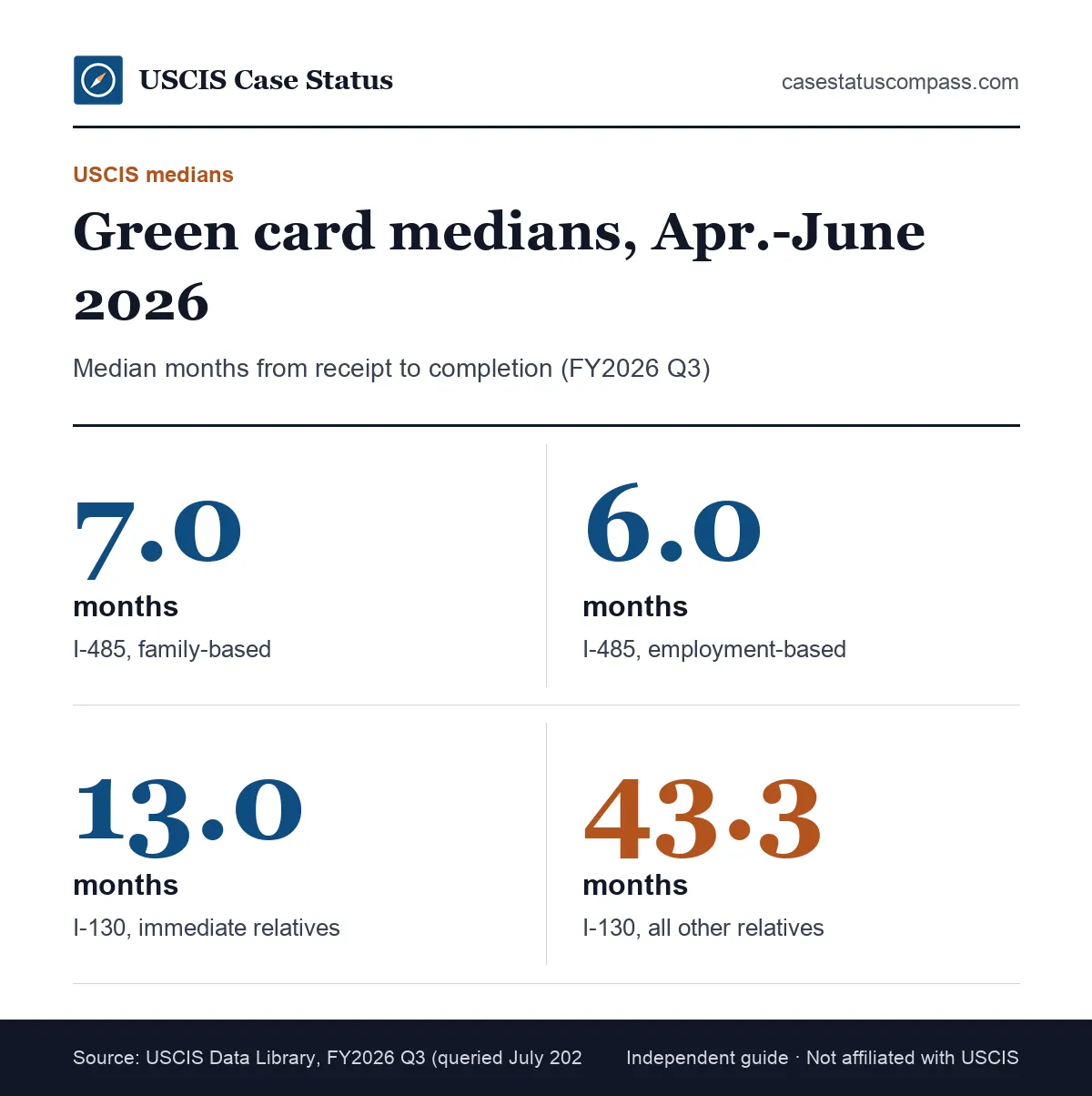
The green card processing time for Form I-485 had a USCIS median of 7.0 months for family cases and 6.0 months for employment cases in April–June 2026. That covers only the adjustment step, not the petition or visa wait.
Check the live tool for your office too.
Official medians by green card category
USCIS publishes quarterly median processing times in its Data Library. The newest report covers FY2026 Q3 (April 1 to June 30, 2026):
| Green card line | USCIS median, Apr.–June 2026 |
|---|---|
| I-485 family-based | I-485 (family): median 7.0 months (USCIS data, Apr.-June 2026) |
| I-485 employment-based | I-485 (employment): median 6.0 months (USCIS data, Apr.-June 2026) |
| I-485 asylum-based | I-485 (asylum-based): median 25.6 months (USCIS data, Apr.-June 2026) |
| I-485 refugee-based | I-485 (refugee-based): median 17.6 months (USCIS data, Apr.-June 2026) |
| I-130 immediate relatives | I-130 (immediate relative): median 13.0 months (USCIS data, Apr.-June 2026) |
| I-130 all other relatives | I-130 (all other relatives): median 43.3 months (USCIS data, Apr.-June 2026) |
| I-140 worker petition | I-140: median 3.9 months (USCIS data, Apr.-June 2026) |
Current figures from the official tool
The live tool breaks the Form I-485 down by category and office. Right now, family-based cases take 8.5 to 36 months, depending on category and office (USCIS data retrieved Oct 27, 2026), and employment-based cases take 9.5 to 42.5 months, depending on category and office (USCIS data retrieved Oct 27, 2026).
Show all 96 I-485 processing times by category and office
| Category | Office | 80% of cases completed within |
|---|---|---|
| Based on an approved T Visa | Service Center Operations (SCOPS) | 43.5 months |
| Based on an approved U Visa | Service Center Operations (SCOPS) | 25 months |
| Based on grant of asylum more than 1 year ago | All Field Offices | 34.5 months |
| Based on refugee admission more than 1 year ago | All Field Offices | 30 months |
| Employment-based adjustment applications | All Field Offices | 9.5 months |
| Employment-based adjustment applications | Service Center Operations (SCOPS) | 42.5 months |
| Family-based adjustment applications | Agana GU | 21.5 months |
| Family-based adjustment applications | Albany NY | 15 months |
| Family-based adjustment applications | Albuquerque NM | 13.5 months |
| Family-based adjustment applications | Anchorage AK | 9.5 months |
| Family-based adjustment applications | Atlanta GA | 16.5 months |
| Family-based adjustment applications | Baltimore MD | 19 months |
| Family-based adjustment applications | Boise ID | 18 months |
| Family-based adjustment applications | Boston MA | 13.5 months |
| Family-based adjustment applications | Brooklyn NY | 19 months |
| Family-based adjustment applications | Buffalo NY | 10 months |
| Family-based adjustment applications | Burlington VT | 8.5 months |
| Family-based adjustment applications | Charleston SC | 13.5 months |
| Family-based adjustment applications | Charlotte Amalie VI | 13.5 months |
| Family-based adjustment applications | Charlotte NC | 18 months |
| Family-based adjustment applications | Chicago IL | 18.5 months |
| Family-based adjustment applications | Christiansted VI | 18 months |
| Family-based adjustment applications | Cincinnati OH | 14 months |
| Family-based adjustment applications | Cleveland OH | 15.5 months |
| Family-based adjustment applications | Columbus OH | 14 months |
| Family-based adjustment applications | Cranbury NJ | 17 months |
| Family-based adjustment applications | Dallas TX | 13.5 months |
| Family-based adjustment applications | Denver CO | 22.5 months |
| Family-based adjustment applications | Des Moines IA | 14.5 months |
| Family-based adjustment applications | Detroit MI | 14.5 months |
| Family-based adjustment applications | El Paso TX | 12.5 months |
| Family-based adjustment applications | Fort Myers FL | 20 months |
| Family-based adjustment applications | Fort Smith AR | 15 months |
| Family-based adjustment applications | Fresno CA | 16 months |
| Family-based adjustment applications | Greer SC | 15 months |
| Family-based adjustment applications | Harlingen TX | 11 months |
| Family-based adjustment applications | Hartford CT | 14.5 months |
| Family-based adjustment applications | Helena MT | 9.5 months |
| Family-based adjustment applications | Hialeah FL | 14 months |
| Family-based adjustment applications | Honolulu HI | 18.5 months |
| Family-based adjustment applications | Houston TX | 18 months |
| Family-based adjustment applications | Imperial CA | 12.5 months |
| Family-based adjustment applications | Indianapolis IN | 22 months |
| Family-based adjustment applications | Jacksonville FL | 17 months |
| Family-based adjustment applications | Kansas City MO | 14 months |
| Family-based adjustment applications | Kendall FL | 14.5 months |
| Family-based adjustment applications | Las Vegas NV | 19 months |
| Family-based adjustment applications | Lawrence MA | 20.5 months |
| Family-based adjustment applications | Long Island NY | 16.5 months |
| Family-based adjustment applications | Los Angeles CA | 15 months |
| Family-based adjustment applications | Los Angeles County CA | 17.5 months |
| Family-based adjustment applications | Louisville KY | 12.5 months |
| Family-based adjustment applications | Manchester NH | 13 months |
| Family-based adjustment applications | Memphis TN | 22.5 months |
| Family-based adjustment applications | Miami FL | 21.5 months |
| Family-based adjustment applications | Milwaukee WI | 15.5 months |
| Family-based adjustment applications | Minneapolis-St. Paul MN | 16.5 months |
| Family-based adjustment applications | Montgomery AL | 13.5 months |
| Family-based adjustment applications | Mount Laurel NJ | 21.5 months |
| Family-based adjustment applications | Nashville TN | 13.5 months |
| Family-based adjustment applications | New Orleans LA | 21 months |
| Family-based adjustment applications | New York City NY | 14.5 months |
| Family-based adjustment applications | Newark NJ | 22 months |
| Family-based adjustment applications | Norfolk VA | 19.5 months |
| Family-based adjustment applications | Oakland Park FL | 22.5 months |
| Family-based adjustment applications | Oklahoma City OK | 20.5 months |
| Family-based adjustment applications | Omaha NE | 12 months |
| Family-based adjustment applications | Orlando FL | 18.5 months |
| Family-based adjustment applications | Philadelphia PA | 15 months |
| Family-based adjustment applications | Phoenix AZ | 14 months |
| Family-based adjustment applications | Pittsburgh PA | 14 months |
| Family-based adjustment applications | Portland ME | 22.5 months |
| Family-based adjustment applications | Portland OR | 16 months |
| Family-based adjustment applications | Providence RI | 12.5 months |
| Family-based adjustment applications | Queens NY | 21 months |
| Family-based adjustment applications | Raleigh NC | 24.5 months |
| Family-based adjustment applications | Reno NV | 18 months |
| Family-based adjustment applications | Sacramento CA | 18 months |
| Family-based adjustment applications | Saint Louis MO | 12 months |
| Family-based adjustment applications | Salt Lake City UT | 15 months |
| Family-based adjustment applications | San Antonio TX | 13 months |
| Family-based adjustment applications | San Bernardino CA | 19 months |
| Family-based adjustment applications | San Diego CA | 13 months |
| Family-based adjustment applications | San Fernando Valley CA | 13 months |
| Family-based adjustment applications | San Francisco CA | 18.5 months |
| Family-based adjustment applications | San Jose CA | 32.5 months |
| Family-based adjustment applications | San Juan PR | 14.5 months |
| Family-based adjustment applications | Santa Ana CA | 27.5 months |
| Family-based adjustment applications | Seattle WA | 36 months |
| Family-based adjustment applications | Spokane WA | 22 months |
| Family-based adjustment applications | Tampa FL | 17 months |
| Family-based adjustment applications | Tucson AZ | 8.5 months |
| Family-based adjustment applications | Washington DC | 18 months |
| Family-based adjustment applications | West Palm Beach FL | 16.5 months |
| Family-based adjustment applications | Wichita KS | 11.5 months |
| Family-based adjustment applications | Yakima WA | 21 months |
What Do USCIS Medians Mean, and How Do They Differ From the Tool?
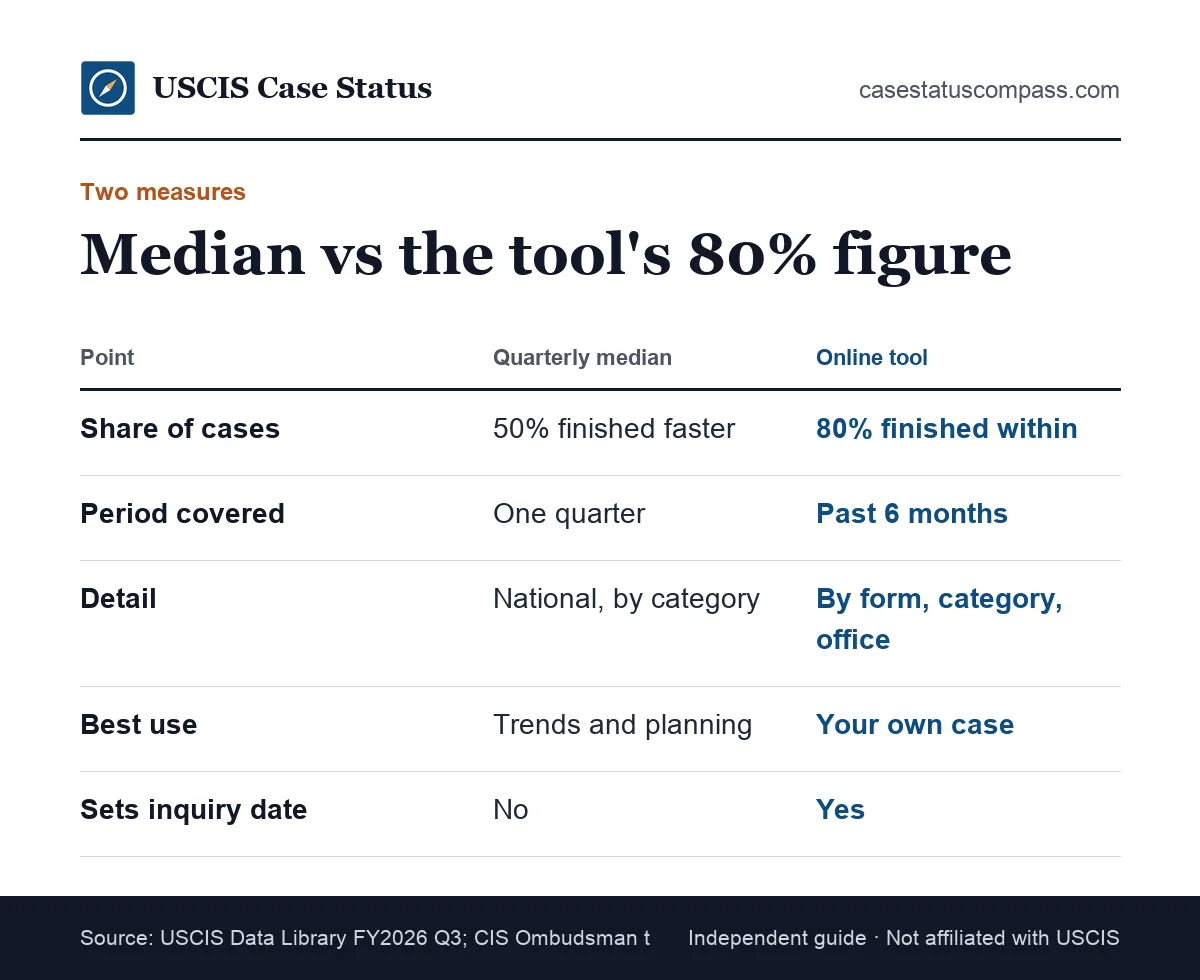
A USCIS median is the time it took to finish the middle case in a quarter: half closed faster, half slower. The online tool uses a different measure, the time it took to finish 80% of cases over six months.
Reading the quarterly median
USCIS quarterly data reports the median: half of the cases completed that quarter took longer. The data runs three to four months behind, so April–June 2026 was the newest set in October 2026. Use medians for planning and for spotting trends.
Reading the 80% figure
The tool's figure captures slower cases too, so it is usually longer than the median. It also sets your case inquiry date, which decides when you may ask USCIS about a late case.
Is the Green Card Processing Time Getting Longer?
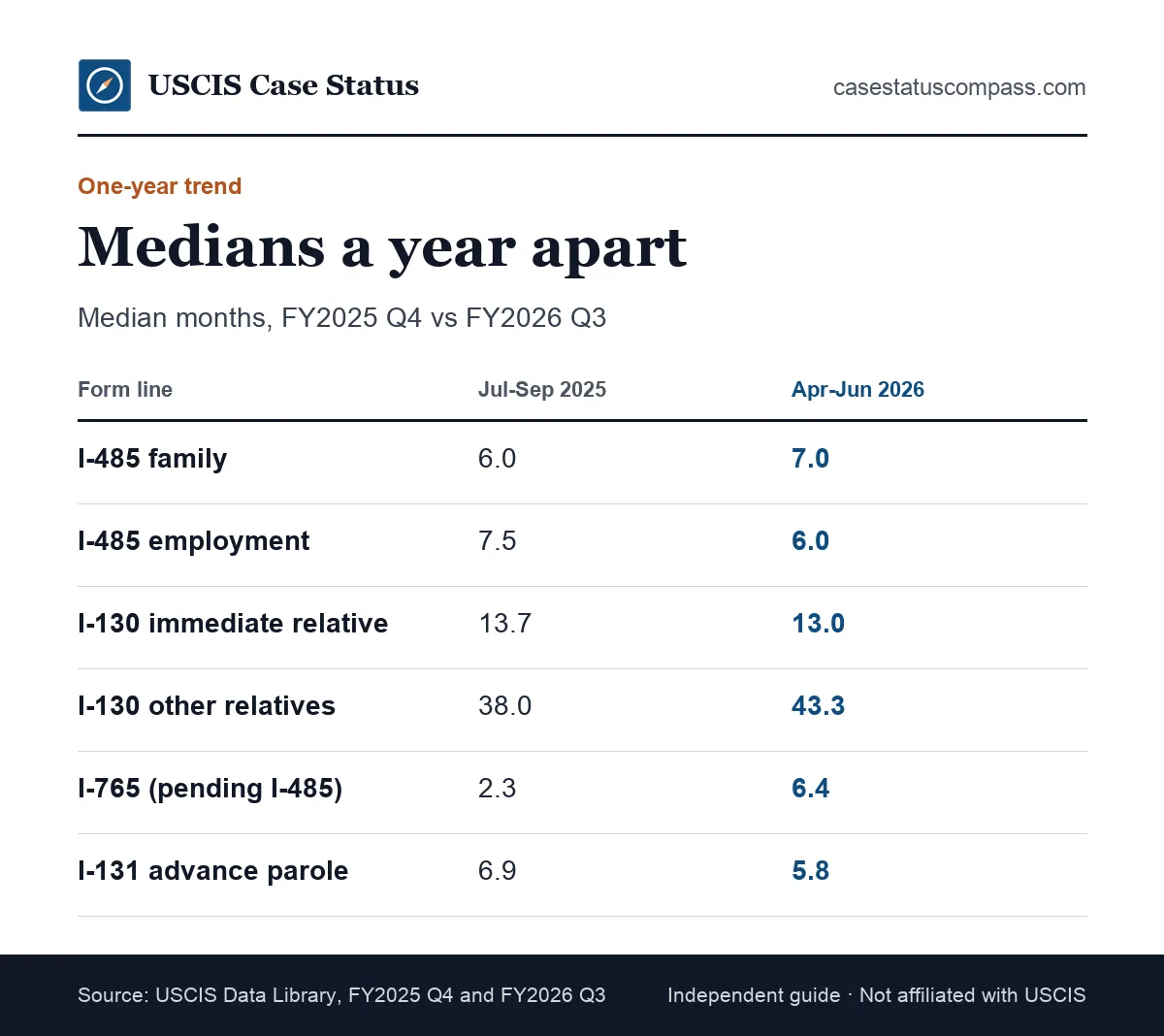
Some stages slowed and others sped up. From July–September 2025 to April–June 2026, the family I-485 median rose from 6.0 to 7.0 months, while the employment I-485 median fell from 7.5 to 6.0 months.
The direction depends on your category, so compare your own line in both quarters.
What changed between 2025 and 2026
| Form line | Jul–Sep 2025 | Apr–Jun 2026 | Direction |
|---|---|---|---|
| I-485 family | 6.0 months | 7.0 months | Slower |
| I-485 employment | 7.5 months | 6.0 months | Faster |
| I-130 immediate relative | 13.7 months | 13.0 months | Slightly faster |
| I-130 other relatives | 38.0 months | 43.3 months | Slower |
| I-765 (pending I-485) | 2.3 months | 6.4 months | Much slower |
| I-131 advance parole | 6.9 months | 5.8 months | Faster |
The table compares the same median lines one year apart. Family cases and the adjustment EAD slowed, while employment cases sped up.
The size of the backlog
USCIS reported 12.8 million cases pending at USCIS (end of June 2026). A large pending caseload spreads officer time thin, one reason the work permit line for adjustment applicants nearly tripled.
How Much Time Does It Take to Get a Green Card Overall?
The total is the sum of three stages: the petition, the wait for a visa number, and the final step (Form I-485 in the U.S. or a visa abroad).
Some paths skip a stage: immediate relatives have no visa wait, and asylees and refugees file no petition. Add only the stages that apply to you.
How long does a green card take from start to finish?
A green card takes as long as its slowest stage. Immediate relatives can often file the I-130 and I-485 together, so the stages overlap. Preference categories cannot: the I-485 waits until the priority date is current.
How long it will take to get your green card: three questions
- Who sponsors you? A citizen relative, a permanent resident relative, an employer, or a humanitarian basis.
- Is your category capped? Immediate relatives are not; preference categories are.
- Where will you finish? Inside the U.S. with USCIS, or abroad at a consulate.
Family-Based Green Card Processing Time
The family based green card processing time splits in two. Immediate relatives of citizens had an I-130 median of 13.0 months in April–June 2026, with no visa wait. Other relatives had a 43.3-month median plus a Visa Bulletin wait.
Then add the I-485 step.
Immediate relatives of U.S. citizens
Spouses, unmarried children under 21 and parents of adult citizens are immediate relatives. Visa numbers are always available to them, so the i 130 family petition and the adjustment step are the main waits.
Preference relatives
Adult children, married children, siblings and relatives of permanent residents fall in the F1 to F4 categories. Yearly limits: 226,000 family preference visas; 140,000 employment-based. The petition stage is tracked on our i 130 processing time page.
How Long Does a Marriage-Based Green Card Take?
For a spouse of a U.S. citizen in the U.S., the marriage based green card processing time is mainly the I-130 and I-485 running together: medians of 13.0 and 7.0 months in April–June 2026. Spouses of permanent residents also wait for an F2A number.
Green card processing time for a spouse of a U.S. citizen
A spouse of a U.S. citizen is an immediate relative. Filed together, both forms are often decided after one interview. See our marriage green card guide.
Use the 13.0-month I-130 median as the planning clock.
Green card processing time for a spouse of a green card holder
A spouse of a green card holder files in F2A. The I-130 falls in the "all other relatives" line (43.3-month median). The I-485 can be filed only when the F2A date in that month's chart reaches the priority date.
Green Card for Parents Processing Time
The green card for parents processing time follows the immediate relative path, since parents of adult citizens have no visa cap. The I-130 median was 13.0 months in April–June 2026. A parent in the U.S. can adjust; a parent abroad finishes at a consulate.
Parents already in the United States
A parent who entered lawfully can usually file the I-485 with the I-130. The family I-485 median was 7.0 months in April–June 2026. Check the sponsor age rule in the I-130 instructions first.
Parents living abroad
After I-130 approval, the case moves to the State Department. NVC (State Department) collects visa fees and documents after USCIS approves the petition. The embassy interview timing is set by the State Department, so USCIS medians do not cover it.
Sibling and Adult-Child Green Card Waits
The sibling green card processing time is the longest family wait because siblings fall in F4. The I-130 median for non-immediate relatives was 43.3 months in April–June 2026, and the F4 visa line often adds years, depending on country of birth.
Siblings of U.S. citizens (F4)
A sibling gets a priority date when the I-130 is filed. That date must reach the F4 cutoff in the Visa Bulletin. On the November 2026 Final Action chart, F4 is Oct. 22, 2012 for most countries but Dec. 15, 2006 for India, so siblings filed the same day can wait very different times.
Adult and married children (F1, F2B, F3)
Unmarried sons and daughters of citizens are F1, of permanent residents F2B. Married sons and daughters of citizens are F3. Each has its own cutoff, updated monthly; see our monthly cutoff charts.
Employment-Based Green Card Processing Time
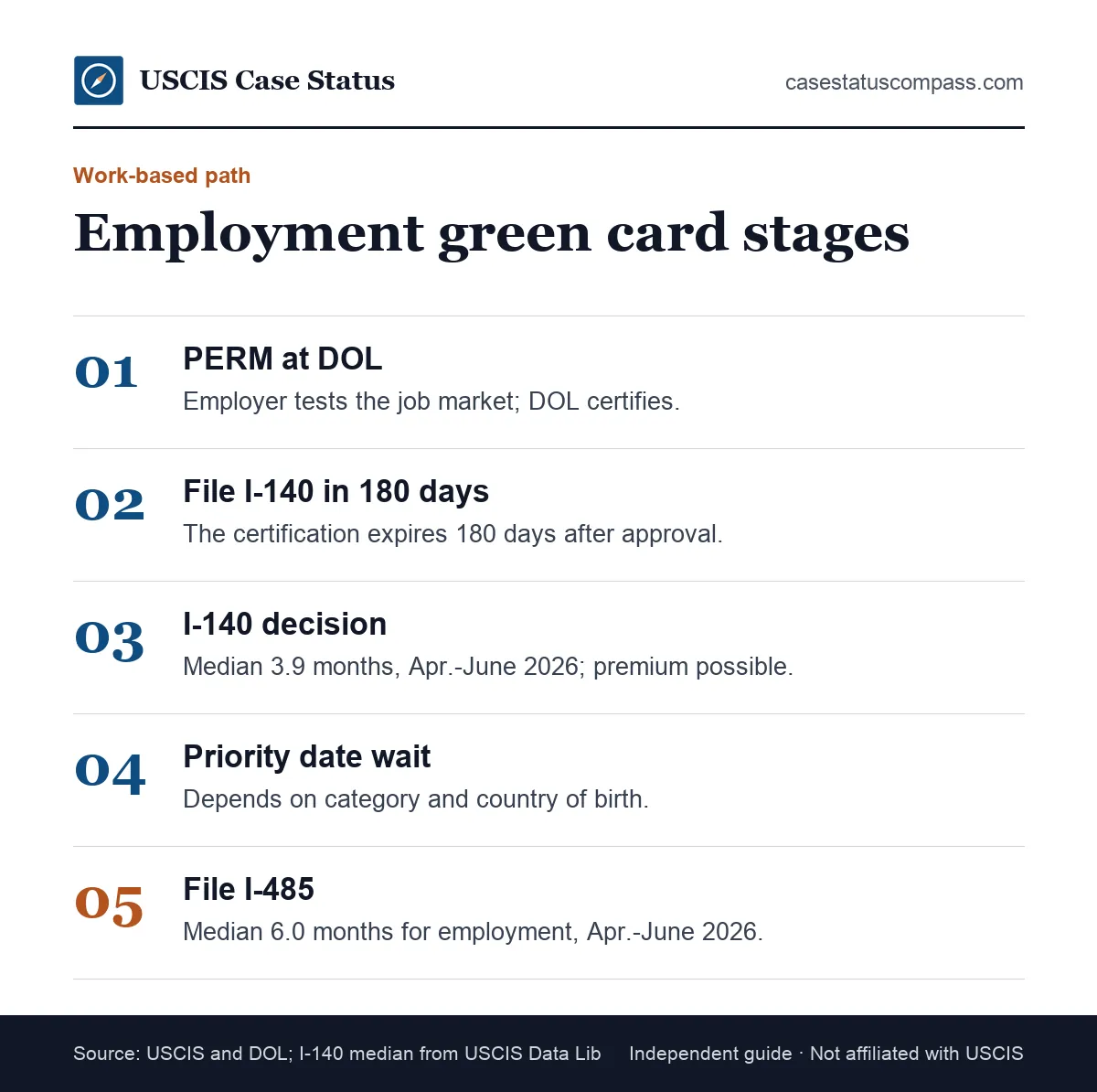
Most work-based cases pass through a PERM labor certification at the Department of Labor (DOL), the Form I-140 at USCIS, and Form I-485. In April–June 2026 the I-140 median was 3.9 months and the employment I-485 median 6.0 months.
If the Visa Bulletin shows your priority date is not current, add that visa wait on top of the USCIS medians.
The PERM stage
DOL's average PERM analyst review time is 336 days (DOL data retrieved Oct 27, 2026). DOL reported 147,884 PERM applications pending at DOL (Mar. 31, 2026). Our perm processing time page tracks this stage. A PERM labor certification expires 180 days after DOL certifies it.
The I-140 and I-485 stages
The i 140 processing time median fell from 6.4 to 3.9 months over the year. The employment I-485 then waits for a current priority date; when one exists, many workers file both together.
How Long Does It Take to Go From H-1B to Green Card?
Moving from H-1B to green card adds up PERM, the I-140 (3.9-month median in April–June 2026), any priority date wait, and the I-485 (6.0-month median). For workers born in high-demand countries, the visa wait is often longest.
Check your country's EB line monthly.
The stages for an H-1B worker
The employer files PERM, then the I-140. Once the priority date is current, the worker files the I-485 and can keep working on the H-1B meanwhile. Our h1b visa status guide covers the work visa itself.
Why the priority date matters most
For most H-1B workers, the priority date is the PERM filing date. If the EB-2 or EB-3 cutoff for your country is years behind, an approved I-140 waits. Track cutoffs in our visa bulletin guide.
L-1A to Green Card Processing Time
The L-1A to green card processing time is often shorter than the H-1B route because many multinational managers qualify for EB-1C, filed without PERM. The I-140 median was 3.9 months in April–June 2026, and premium processing is available.
Then add the I-485 step.
Skipping PERM in the manager category
The employer files the I-140 directly as a multinational manager or executive. Without the DOL stage, the L-1A green card timeline starts at USCIS, then checks the EB-1 line in the bulletin.
Premium processing for EB-1C
15 business days (I-129, most I-140); 30 (I-765 OPT, I-539 F/M/J); 45 (I-140 E13 managers and NIW). The fee is $2,965 (I-129 most classes, I-140); $1,780 (H-2B/R, I-765 OPT); $2,075 (I-539 to F/J/M). Premium speeds only the I-140 decision, not the I-485 or the visa wait.
Humanitarian Green Card Processing Times
Green cards based on asylum or refugee status have their own I-485 lines. In April–June 2026 USCIS's medians were 25.6 months for asylum-based and 17.6 months for refugee-based adjustment, far longer than family or employment cases.
If you are an asylee or refugee, plan travel and work permit renewals around these long medians.
Asylees
Refugees and asylees need 1 year of physical presence in the U.S. before filing I-485. The asylum-based I-485 is the slowest line on this page. For the asylum case itself, see our asylum status guide.
Refugees
Refugees apply after one year of physical presence in the U.S., using the same Form I-485. With a 17.6-month median, plan travel and later citizenship steps around the wait, and keep copies of every notice.
Green Card Timeline Step by Step
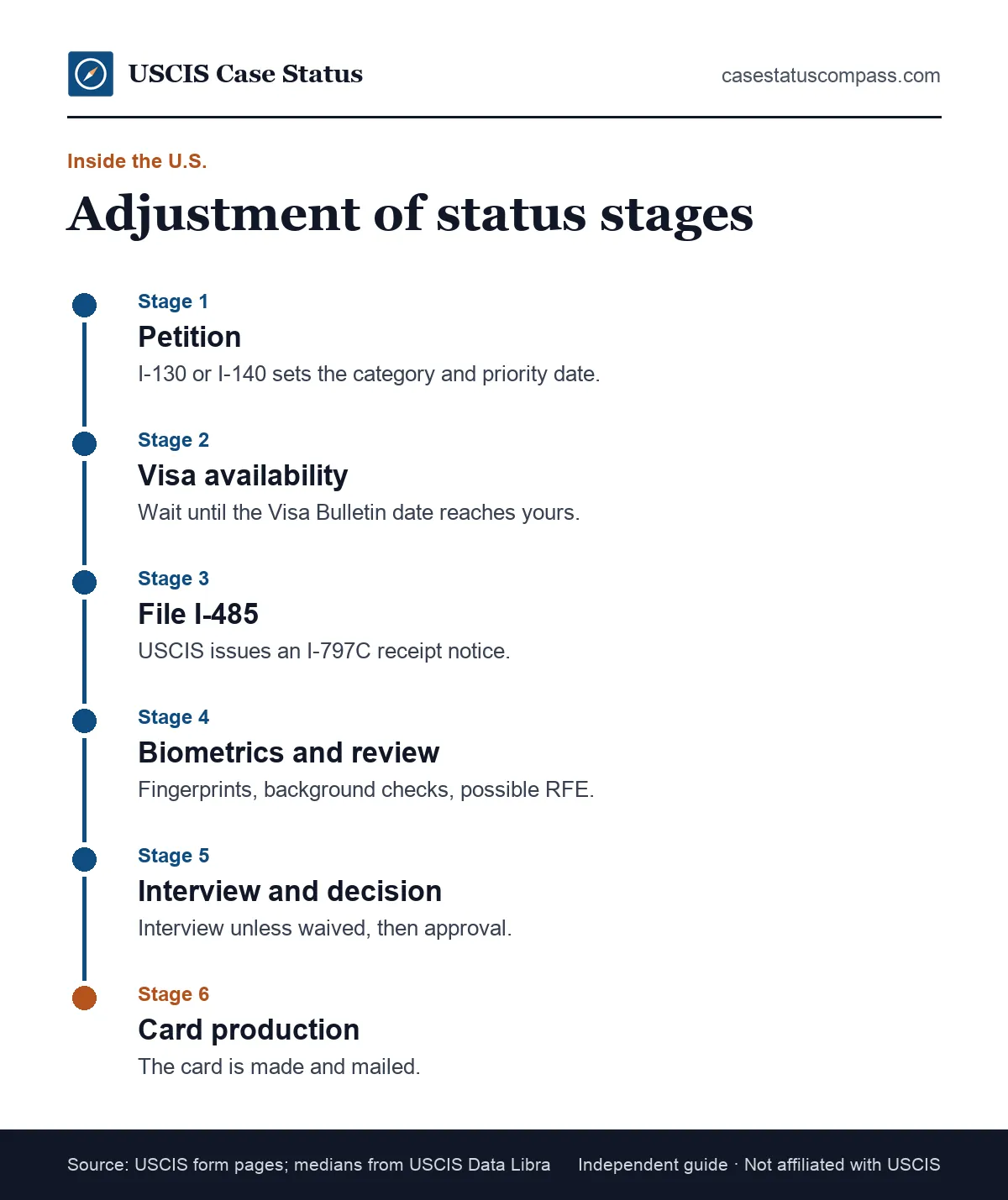
The green card timeline follows six stages for most applicants: petition, visa availability, filing, biometrics and review, interview and decision, then card production. The table lists who handles each stage and the time measure to check.
Steps 2 and 3 can overlap.
Adjustment of status timeline (inside the U.S.)
| Stage | Who handles it | Time measure |
|---|---|---|
| 1. Petition (I-130 or I-140) | USCIS (DOL first for PERM) | I-130 13.0 or 43.3 months; I-140 3.9 months |
| 2. Visa availability | State Department | Monthly cutoffs; none for immediate relatives |
| 3. File I-485, get I-797C | USCIS | Receipt notice arrives first |
| 4. Biometrics and checks | Application Support Center | Date on your notice |
| 5. Interview and decision | USCIS field office | I-485 7.0 (family) or 6.0 months (work) |
| 6. Card production | USCIS and USPS | Shown by status messages |
Read the table top to bottom in filing order. The time measure column tells you which figure to check at each stage.
Consular processing timeline (outside the U.S.)
Applicants abroad replace stages 3 to 5 with the National Visa Center (NVC) and an embassy interview. The green card process timeline abroad adds the USCIS Immigrant Fee of $235, paid before the card is mailed.
How Long Does Each Stage of Adjustment of Status Take?
USCIS publishes only the total time from receipt to decision, not a median for each stage of an AOS timeline. Your own notices mark the stages: the receipt date, the biometrics date and the interview date.
Save every notice with its date.
How long after submitting the I-485 before fingerprinting?
There is no published standard for the gap before biometrics. USCIS mails a notice with the date and center. Bring your I-797C appointment notice and a valid photo ID to the ASC. See our biometrics appointment page.
From biometrics to interview
This gap varies most by field office. USCIS can waive the green card interview case by case. For more on this stage, read how long after biometrics for an interview.
Concurrent I-130 and I-485 Processing Time
The I-130 and I-485 concurrent filing processing time is usually set by the slower I-130, because USCIS needs an approved petition first. With medians of 13.0 and 7.0 months in April–June 2026, the petition was the longer clock.
Plan around the I-130 clock.
What concurrent filing changes
Both forms move at once instead of one after the other. The I-485 receipt also lets you request a work permit and advance parole, and USCIS often approves both forms together.
Side applications and their medians
| Form filed with the I-485 | Purpose | Median, Apr.–June 2026 |
|---|---|---|
| I-765 | Work permit | 6.4 months |
| I-131 | Advance parole | 5.8 months |
| I-130 | Family petition | 13.0 months |
The table lists forms often filed with the I-485 and their medians. The work permit took nearly as long as the family I-485 itself.
How Long Does I-485 Take After I-130 Approval?
Once the I-130 is approved and you can adjust, the family I-485 median was 7.0 months in April–June 2026. The real question is when you may file: right away for immediate relatives, only with a current priority date for others.
How long after I-130 approval to file the I-485
An immediate relative in the U.S. may file any time, even before approval. Preference relatives check each bulletin. November 2026: USCIS accepts I-485s using the Dates for Filing chart (family and employment).
When the I-485 was already pending
If the I-485 was filed first, an I-130 approval often means a decision is close. Watch for an interview notice. The i 485 form guide covers each filing step.
If you move while waiting, file a change of address so the interview notice is not sent to your old home.
Green Card Waiting Time by Country
The green card waiting time by country differs because the Visa Bulletin limits preference visas for any one country. People born in high-demand countries can face later cutoffs in the same category.
Check your country's column each month, because the gap between countries can grow or shrink.
Why your country of birth matters
The bulletin uses your country of chargeability, normally your country of birth, not citizenship. The oversubscribed chargeability areas are mainland China, India, Mexico and the Philippines, so each gets its own column; everyone else shares "All Chargeability," which usually moves faster.
Reading the country columns
Find your category row (F1 to F4 or EB-1 to EB-5), then your country column. If your priority date is earlier than the cutoff, a visa is available; "C" means current. Here is the November 2026 employment chart, which the State Department replaces monthly:
| Category | All areas | China (mainland-born) | India | Mexico | Philippines |
|---|---|---|---|---|---|
| EB-1 | Current | Aug. 1, 2023 | Feb. 1, 2023 | Current | Current |
| EB-2 | Apr. 1, 2025 | Oct. 1, 2021 | Nov. 1, 2013 | Apr. 1, 2025 | Apr. 1, 2025 |
| EB-3 | June 15, 2024 | Jan. 22, 2022 | Jan. 22, 2014 | June 15, 2024 | Aug. 15, 2023 |
| EB-3 Other Workers | June 1, 2022 | Oct. 1, 2019 | Jan. 22, 2014 | June 1, 2022 | Jan. 1, 2022 |
| EB-4 | Dec. 15, 2022 | Dec. 15, 2022 | Dec. 15, 2022 | Dec. 15, 2022 | Dec. 15, 2022 |
| Certain Religious Workers | Dec. 15, 2022 | Dec. 15, 2022 | Dec. 15, 2022 | Dec. 15, 2022 | Dec. 15, 2022 |
| EB-5 Unreserved | Current | Dec. 1, 2016 | Dec. 1, 2023 | Current | Current |
| EB-5 Rural (20%) | Current | Current | Current | Current | Current |
| EB-5 High Unemployment (10%) | Current | Current | Current | Current | Current |
| EB-5 Infrastructure (2%) | Current | Current | Current | Current | Current |
How Does the Visa Bulletin Change Your Green Card Wait Time?
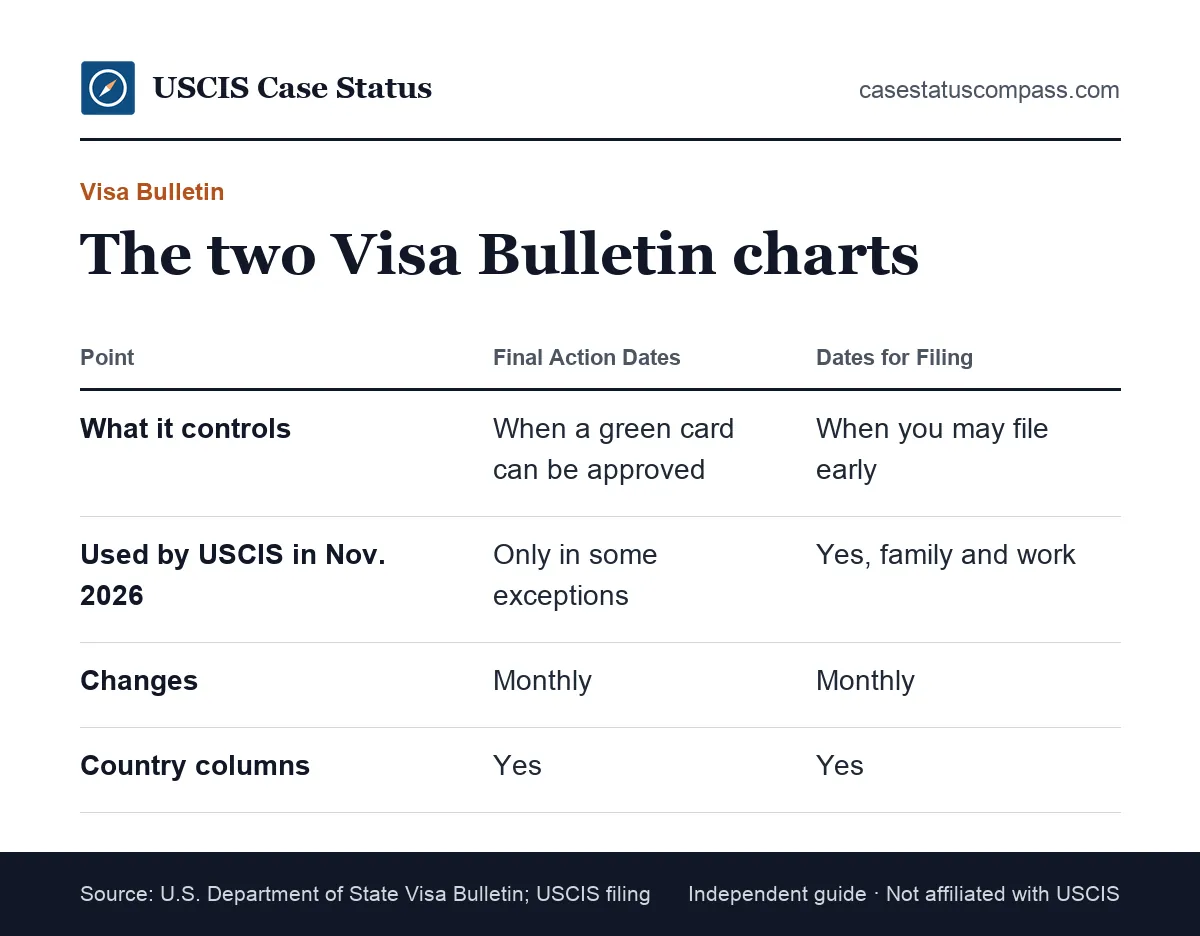
The Visa Bulletin controls the green card wait time for every preference category. The State Department publishes the Visa Bulletin monthly: Final Action Dates vs Dates for Filing. When dates jump, many people can file; when they stall or retreat, approvals stop.
Final Action Dates vs Dates for Filing
Final Action Dates show when a green card can be approved. Dates for Filing show when you may submit the I-485 early, which unlocks a work permit and travel document while you wait.
Retrogression
If a date moves backward ("retrogression"), a pending I-485 stays pending until it is current again. USCIS names the chart to use each month on its filing charts page.
Consular Processing Timeline: Waiting Abroad
Consular processing is the route for people outside the U.S. After USCIS approves the petition, the National Visa Center collects fees and documents, then a consulate interviews you. USCIS medians cover only the petition.
The State Department sets the rest of the timeline.
The NVC stage
The State Department charges an immigrant visa fee: Immigrant visa fee: $325 family; $345 employment; $205 other (per person). Our nvc case status page explains how to follow the case after USCIS hands it over.
Visa issued, entry and the card
After the visa is issued, pay the Immigrant Fee and enter the U.S. USCIS then produces the card and mails it to your U.S. address. It will not mail the card until the fee is paid.
How Long After the Interview Do You Get a Green Card?
Many applicants get a decision on the interview day or within weeks, but USCIS sets no deadline after the green card interview. If the officer needs evidence or more checks, the case can stay pending for months.
Watch your online status for changes.
How long to get a green card after the interview: the usual outcomes
The officer can approve, hold the case, or issue a Request for Evidence (RFE). RFE deadline: up to 12 weeks (the exact date is on your RFE); no extensions. A family member's I-539 or I-601A gets just 30 days. Prepare with our green card interview questions guide.
When the decision pauses
Common reasons are a retrogressed priority date, a pending security check, or a request for more marriage evidence. Ask USCIS only after your inquiry date, unless an expedite reason applies.
How Long After I-485 Approval Do You Get the Green Card?
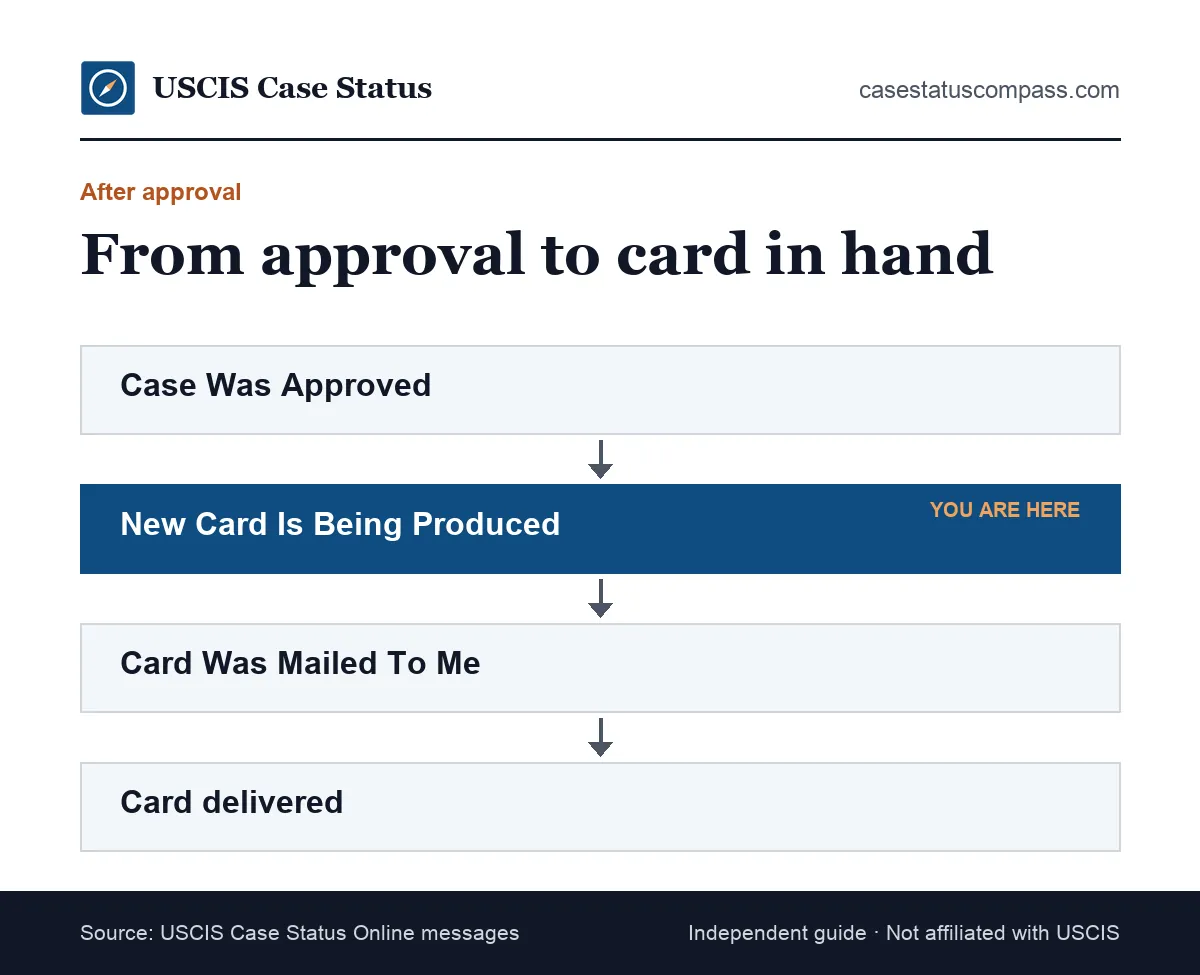
After approval, USCIS sends a notice and starts producing the card. It publishes no fixed production time. Your status changes to "New Card Is Being Produced," then "Card Was Mailed To Me."
Watch for each update, and make sure USCIS has your current mailing address before approval.
The approval notice
The approval notice lists your "Resident Since" date, which counts toward citizenship later. Check that your name and birth date are correct, and keep it with your passport. Our case was approved page explains the message.
Card production
This status means USCIS approved the case and is printing the card with your photo and data. Delays here often come from an address problem. Our new card is being produced page lists what to check.
How Long Does It Take for a Green Card to Arrive?
USCIS does not publish a set number of days to receive a green card after approval. It ships when the status changes to "Card Was Mailed To Me," and delivery then depends on the U.S. Postal Service.
Update your address quickly if you move.
How long do green cards take to arrive by mail?
Mailing time varies by postal route, and USCIS does not control it. The mailed status often includes a USPS tracking number. Our card was mailed to me guide shows how to read that message.
If the card comes back to USCIS
Returned green cards are held 60 business days (about 12 weeks), then re-mailed or destroyed. Report a new address to USCIS within 10 days of moving (INA 265). See card was returned to uscis for the fix.
Can You Prove Status Before the Card Arrives?
Yes. You can ask USCIS for a temporary I-551 stamp, also called an ADIT stamp, while you wait. I-551/ADIT stamp: temporary proof of green card status; request through the USCIS Contact Center (800-375-5283).
Ask for one if you need proof soon, such as for a new job or travel.
How long the stamp lasts
Temporary I-551 stamp: valid until its expiration date, or 1 year if no date is printed. If the card still has not arrived near that date, contact USCIS again. Our i 551 stamp guide explains when people need one.
When you might need temporary proof
Common reasons are a new job, international travel, a driver's license or a state ID appointment. Request an appointment through the Contact Center, then bring your approval notice and passport.
How Long After an EAD Do You Get a Green Card?
There is no fixed gap. A work permit, or Employment Authorization Document (EAD), is a side benefit of a pending I-485. In April–June 2026 its median for adjustment applicants was 6.4 months, close to the 7.0-month family I-485 median.
An EAD approval does not mean the I-485 is approved, and a slow EAD does not mean the green card is in trouble.
What the EAD median tells you
The adjustment EAD median rose from 2.3 to 6.4 months in a year, so some people get the green card first. See how long does it take to get a work permit.
An EAD is not a sign of approval
An EAD only means USCIS approved the I-765, not the I-485. Ended: renewals filed on or after Oct. 30, 2025 no longer get the up-to-540-day automatic extension (exceptions: TPS by law/Federal Register notice; STEM OPT 180 days).
What Makes a Green Card Take Longer?
The biggest factors are visa availability in your category, your field office's workload, a complete packet, background checks, and whether USCIS needs an interview or RFE. You control some of these, not all.
Focus on the factors you can control first.
Factors you can control
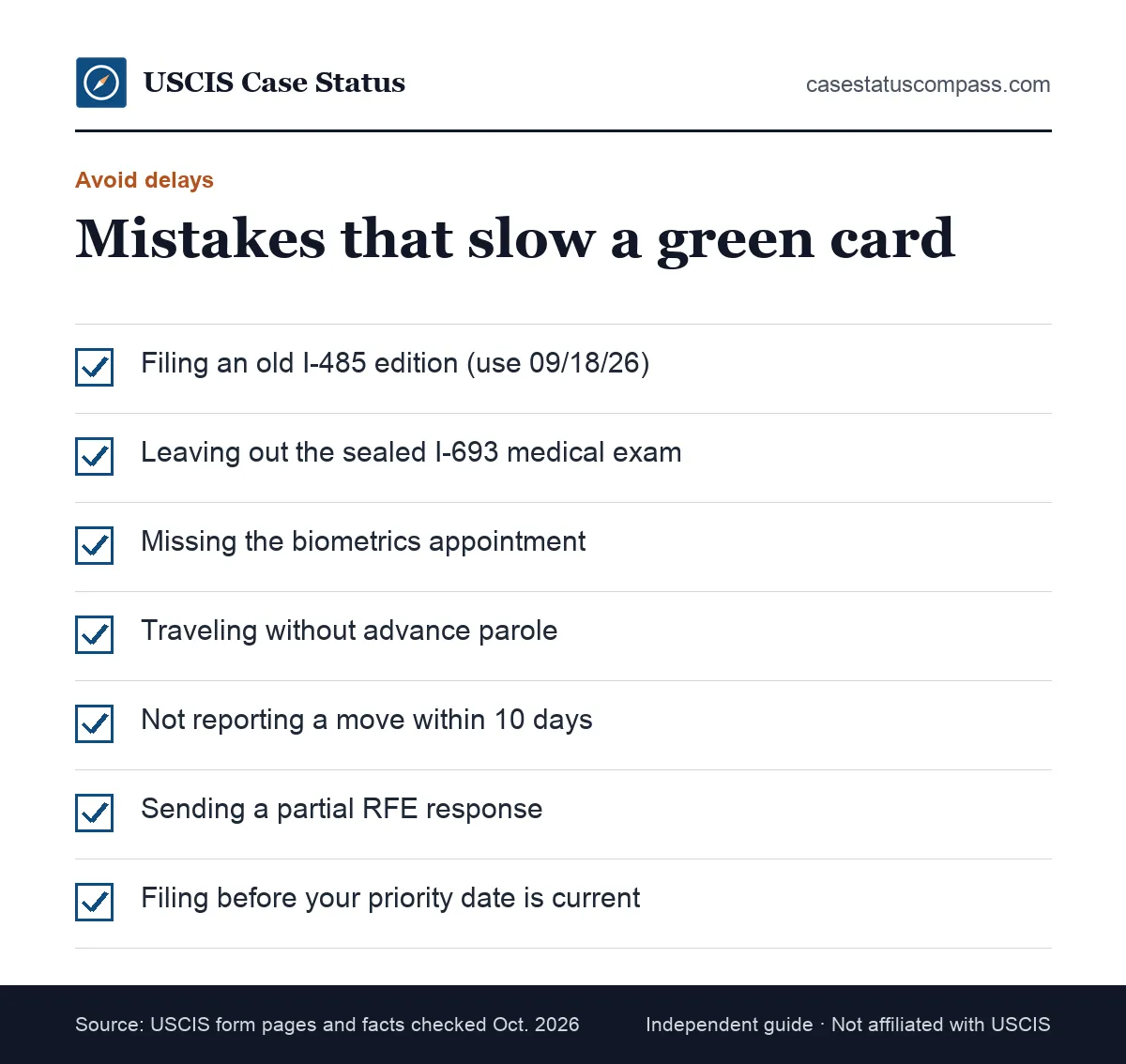
- Filing the correct edition: 09/18/26 (01/20/25 and 09/04/26 editions rejected on/after Sept. 18, 2026; no grace period)
- Send the sealed I-693 with your I-485 (required since Dec. 2, 2024)
- Attending biometrics: Missing biometrics can lead to denial for abandonment
- Answering every RFE item in one reply
Factors outside your control
Office staffing, security checks and visa retrogression are outside your control. With 12.8 million cases pending in June 2026, two applicants at different offices can wait very different times.
Check your office's line in the live tool.
Which Events Pause a Green Card Case?
Three events often pause a green card case: a Request for Evidence, a transfer, and an interview. None means denial, but each adds time, so a quick, complete response keeps the wait short.
Watch your mail and online account closely.
How an RFE affects your wait
Review stops until USCIS gets your reply. Send everything at once; a partial reply is treated as a request for a decision. If USCIS mailed the notice, add 3 days to the deadline. See our rfe meaning guide.
Why Would a Green Card Case Be Transferred to Another Office?
Usually to balance workloads or to place the interview at the field office near your home. A transfer is routine and not a denial, but your wait now follows the new office's time, so look it up in the tool. See case was transferred.
Can You Speed Up Green Card Processing?
You cannot pay to speed up Form I-485. Premium processing covers the I-140, not the green card application. You can ask to expedite a case if you meet a listed reason, such as severe financial loss.
Attach documents that prove the reason, such as a medical record or a lender's notice, when you ask.
Premium processing: what it covers
Premium processing covers I-129 work visas, I-140 (EB-1/2/3), I-765 OPT/STEM OPT and I-539 to F/M/J. An RFE stops the premium clock; a new period starts when USCIS gets your response. Our premium processing page explains Form I-907.
Expedite requests
Expedite criteria: severe financial loss, emergency/humanitarian, nonprofit, government interest, clear USCIS error. Ask for an expedite through the USCIS Contact Center or your online account. Our uscis expedite request guide shows strong evidence.
How to Check Green Card Processing Dates and Updates
Check green card processing dates in the official tool at egov.uscis.gov/processing-times. Pick the form, then the category, then the office on your receipt notice. The tool returns a time and an inquiry date.
Recheck it every few weeks, since the posted time can change.
Using the tool step by step
Choose Form I-485.
Choose your category, such as family-based adjustment.
Choose the office on your notice.
Enter your receipt date to see your inquiry date.
Note the date you checked.
Green card processing dates update
The figures change as USCIS completes cases, so recheck before planning. myProgress: personalized estimates in your USCIS online account (I-130, I-485, I-765, I-131, I-821, N-400, I-90). If your status is stuck, read uscis case status not updating.
Is My Green Card Case Outside Normal Processing Time?
Your case is outside normal processing time when today is past your case inquiry date in the official tool. Case inquiry date: the earliest date USCIS will accept a question about your pending case; it can change.
Before that date, USCIS treats the wait as normal and a service request is usually turned away.
Working out your case inquiry date
Enter your receipt date in the "When can I ask about my case?" box. If the posted time grows, your inquiry date moves later, so recheck it monthly.
Before that date, USCIS treats a service request as early and replies that the case is within normal time.
Submitting an outside normal processing time request
You can submit an 'outside normal processing time' request only after your case inquiry date. Submit online or call 800-375-5283. Keep the referral number and the date, because the next escalation steps ask for both.
What to Do When Your Green Card Case Is Delayed
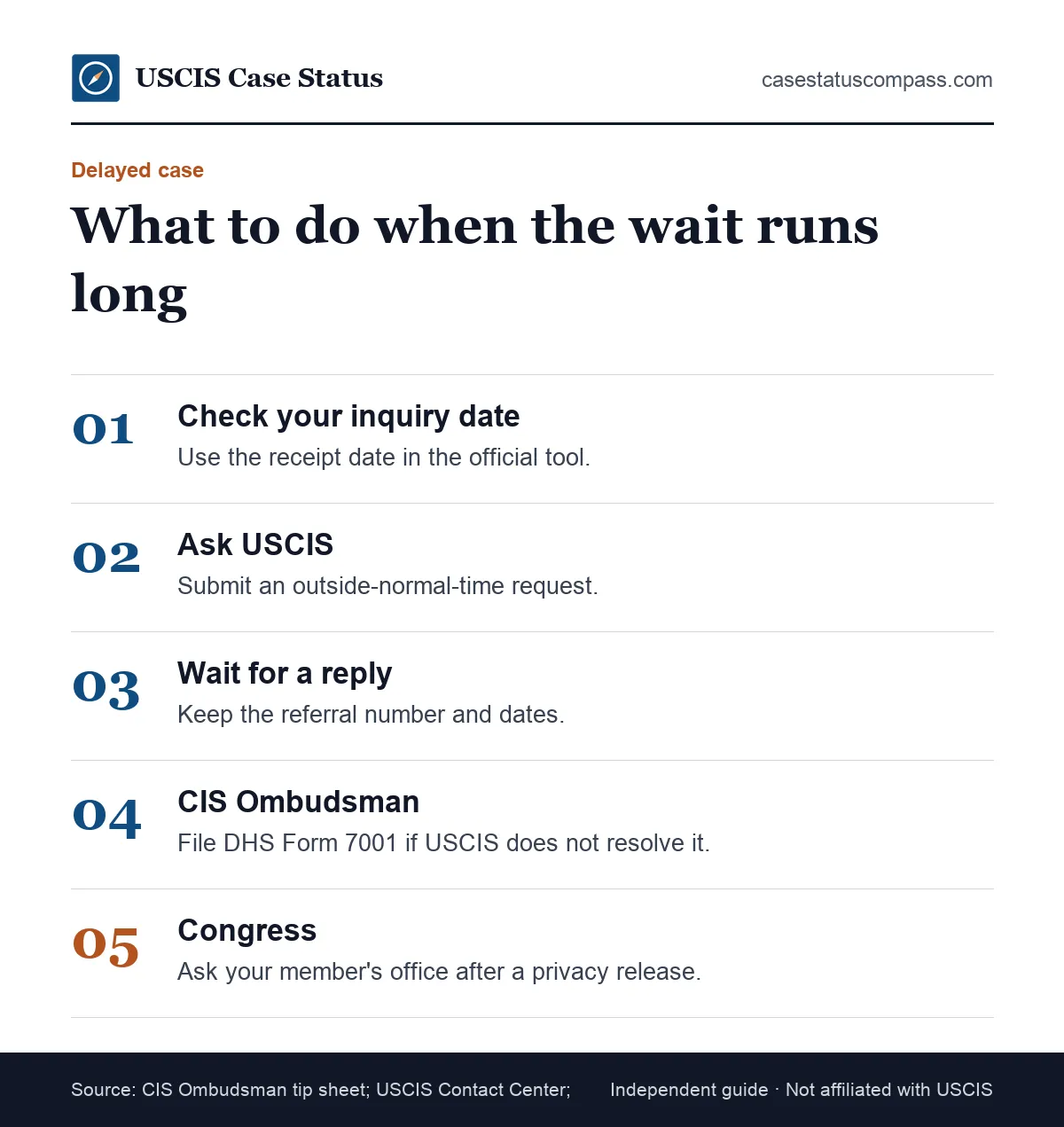
Past the inquiry date, follow an escalation ladder: a USCIS service request, then the CIS Ombudsman, then your member of Congress. Each step expects you to have tried the one before, so keep dates and reference numbers.
Skipping a step usually slows things.
The escalation ladder
| Step | When to use it | How |
|---|---|---|
| USCIS service request | After your inquiry date | Online or Contact Center |
| e-Request | Missing notice or typo | Online form |
| CIS Ombudsman | Use the Ombudsman only after contacting USCIS within 90 days and waiting at least 60 days | DHS Form 7001 |
| Congressional inquiry | USCIS has not resolved it | Privacy release, then the office asks |
Follow the table from top to bottom, one step at a time. Keep each reference number, since later steps ask for it.
When to see an attorney
See an immigration attorney or DOJ-accredited representative for a confusing RFE, a criminal or immigration history issue, or a long pause after the interview. Our uscis ombudsman guide covers outside help.
Green Card Timeline Estimator by Category
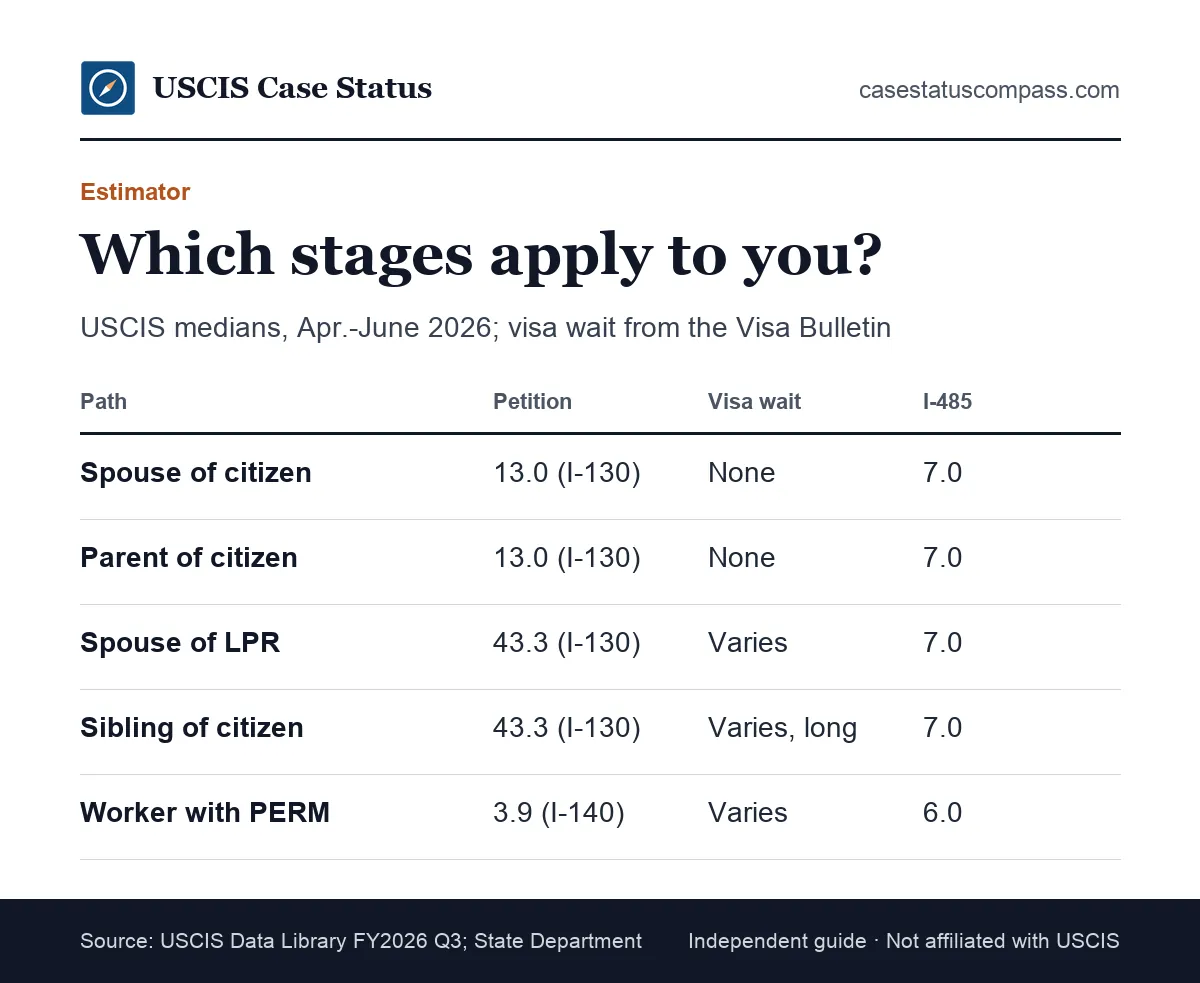
This estimator shows which stages apply to each common path, with USCIS medians for April–June 2026. Add the stages for your path. The visa wait for preference categories comes from the current bulletin.
Use it alongside the live tool for your office.
Estimator table
| Your path | Petition | Visa wait | I-485 | Overlap? |
|---|---|---|---|---|
| Spouse of citizen, in U.S. | 13.0 months | None | 7.0 months | Yes |
| Parent of adult citizen, in U.S. | 13.0 months | None | 7.0 months | Yes |
| Spouse of green card holder | 43.3 months | F2A cutoff | 7.0 months | If F2A is current |
| Sibling of citizen | 43.3 months | F4 cutoff | 7.0 months | Rarely |
| Worker with PERM | PERM plus 3.9 months | EB cutoff | 6.0 months | If current |
| Asylee | None | None | 25.6 months | Not applicable |
Find your path in the first column, then read across. Where the overlap column says yes, the longest stage sets your estimate.
How to use the estimator
If your path allows overlap, your estimate is roughly the longest stage. If not, add the stages. Half of cases take longer than a median, so build in a cushion and compare with the live tool.
Worked Examples: Three Green Card Timelines
These examples show how the stages add up, using April–June 2026 medians. They are illustrations with fictional names, not predictions; your office, category and country of birth can change the result.
Each one shows a different path: a spouse in the U.S., an employment case with a visa wait, and a parent who finishes abroad.
Example 1: A spouse of a citizen filing in the U.S.
Maria and her citizen husband file the I-130 and I-485 together. With 13.0- and 7.0-month medians running in parallel, a planning estimate is about 13 months, with one interview.
They check the live tool too.
Example 2: An H-1B engineer born in a high-demand country
Ravi's I-140 is approved quickly (3.9-month median), but his EB-2 priority date is behind his country's cutoff. Most of his wait is the visa line, not USCIS.
Ravi watches each month's Visa Bulletin, because his I-485 cannot be approved until his priority date is current.
Example 3: A parent living abroad
Ana's citizen son files an I-130 (13.0-month median). After approval, the NVC collects her documents and a consular interview follows, so she tracks the State Department stage next, not USCIS.
Mistakes That Add Months to Your Green Card Wait
The costliest mistakes are rejections (old editions, missing signatures or fees), avoidable RFEs, and actions that abandon the case, such as travel without advance parole. Each one restarts or pauses your clock.
Check every page before mailing, and never travel while the I-485 is pending without advance parole.
Filing mistakes
A rejected filing returns your packet and you lose your place. Send the sealed I-693 with your I-485 (required since Dec. 2, 2024). Also include, where required, the affidavit of support. The current fee is $1,440 (paper) / $1,390 (online); $950 / $900 if under 14 and filing with a parent.
Travel mistakes
Traveling while your I-485 is pending abandons it unless you have advance parole (with H/L/V/K exceptions). Since Aug. 13, 2026, travel on advance parole counts as a departure: over 180 days of unlawful presence can trigger the 3/10-year bar. Talk to an attorney before leaving if you ever overstayed.
What Happens After You Get Your Green Card?
Two later timelines may apply: removing conditions on a 2-year card, and applying for citizenship. Most green cards are valid for 10 years; conditional green cards for 2 years. Each has its own form and processing time.
Mark both dates on your calendar.
How long to remove conditions on a green card
File in the 90 days before your 2-year card expires. The Form I-751 median was 22.6 months in April–June 2026. Details are on our i 751 processing time page.
Missing the window without good cause ends conditional status automatically, so set a reminder before it opens.
The path to citizenship
You can file the N-400 up to 90 days before you reach 5 years (or 3 years if married to a U.S. citizen) as a permanent resident. The N-400 median was 9.5 months in April–June 2026. For each stage, see how long does naturalization take.
How the Forms Fit Together in a Green Card Case
Each form in a green card case has its own clock. The petition starts the case, the I-485 or immigrant visa finishes it, and work and travel forms run alongside.
Track each form's receipt number separately in your online account, since each one gets its own decision.
Which form starts your clock
| Path | Starting form | Priority date set by |
|---|---|---|
| Family | Form I-130 | I-130 filing date |
| Employer with PERM | Labor certification | PERM filing date |
| Employer without PERM | Form I-140 | I-140 filing date |
| Fiancé(e) | Form I-129F | Not applicable |
Find your path in the table to see the form that starts your case. The priority date column shows which filing date sets your place in line.
Where to read the process
This page covers "how long" only; filing steps are on the form guides. The I-129F median was 9.0 months in April–June 2026; see our k1 visa processing time page.
Frequently Asked Questions
How long after a green card can I apply for citizenship?
Most permanent residents can apply after 5 years, or 3 years if married to and living with a U.S. citizen, and may file up to 90 days early. The years count from the "Resident Since" date on the card. The N-400 had a USCIS median of 9.5 months in April–June 2026.
Why did someone who filed after me get their green card first?
Cases move at different speeds because of the field office, category, background checks and interview scheduling. Compare your case with the official tool for your own office, not with other people's timelines.
Does a green card interview mean the wait is almost over?
Usually it is the last stage, and many cases are approved at or soon after the interview. An officer can still hold the case for evidence, checks or an unavailable visa number.
Can I check my green card processing time with my receipt number?
Your receipt number checks your status in Case Status Online, not the processing time. For the time, use the official tool with your form, category, office and receipt date. It also shows your case inquiry date.
How long does a green card take for a K-1 fiancé(e)?
The I-129F had a median of 9.0 months in April–June 2026. After the visa, entry and marriage within 90 days, the spouse files Form I-485, where the family median was 7.0 months. Consular steps abroad add time between the two.
Is online I-485 filing faster than paper?
USCIS does not publish separate times for online and paper I-485 filings. Online filing can cut mailing delays at intake and avoid some paper rejections. After intake, the case follows the same process.
What does an AOS timeline mean?
AOS is short for adjustment of status, the Form I-485 route inside the United States. An AOS timeline is the order of receipt notice, biometrics, interview, decision and card mailing, as shown in our step-by-step section above.
Sources
- USCIS Data Library: All Application and Petition Form Types, FY2026 Q3. www.uscis.gov/sites/default/files/document/data/quarterly_all_forms_fy2026_q3_v1.xlsx. Accessed Oct 27, 2026.
- USCIS Data Library: All Application and Petition Form Types, FY2025 Q4. www.uscis.gov/sites/default/files/document/data/quarterly_all_forms_fy2025_q4_v1.xlsx. Accessed Oct 27, 2026.
- USCIS: Check Case Processing Times. egov.uscis.gov/processing-times/. Accessed Oct 27, 2026.
- CIS Ombudsman: Check Your USCIS Case Inquiry Date (tip sheet). dhs.gov/sites/default/files/2024-11/24_0823_cisomb_case-inquiry-date-tip-sheet.pdf. Accessed Oct 27, 2026.
- U.S. Department of State: Visa Bulletin. travel.state.gov/content/travel/en/legal/visa-law0/visa-bulletin.html. Accessed Oct 27, 2026.
- USCIS: Adjustment of Status Filing Charts from the Visa Bulletin. www.uscis.gov/green-card/green-card-processes-and-procedures/visa-availability-priority-dates/adjustment-of-status-filing-charts-from-the-visa-bulletin. Accessed Oct 27, 2026.
- DOL processing times. flag.dol.gov/processingtimes. Accessed Oct 27, 2026.
- USCIS: Visa Availability and Priority Dates (updated 01/24/2025). www.uscis.gov/green-card/green-card-processes-and-procedures/visa-availability-priority-dates. Accessed Oct 27, 2026.
- USCIS: Consular Processing (updated 07/20/2023). www.uscis.gov/green-card/green-card-processes-and-procedures/consular-processing. Accessed Oct 27, 2026.
- DOL OFLC PERM Selected Statistics, FY2026 Q2. www.dol.gov/sites/dolgov/files/ETA/oflc/pdfs/PERM_Selected_Statistics_FY2026_Q2.pdf. Accessed Oct 27, 2026.
- USCIS: Form I-140 page (updated 07/24/2026). www.uscis.gov/i-140. Accessed Oct 27, 2026.
- USCIS: How Do I Request Premium Processing? (updated 03/23/2026). www.uscis.gov/forms/all-forms/how-do-i-request-premium-processing. Accessed Oct 27, 2026.
- USCIS Form G-1055 Fee Schedule, Edition 10/16/26. www.uscis.gov/sites/default/files/document/forms/g-1055.pdf. Accessed Oct 27, 2026.
- Form I-485 Instructions, Edition 09/18/26. www.uscis.gov/sites/default/files/document/forms/i-485instr.pdf. Accessed Oct 27, 2026.
- USCIS: Preparing for Your Biometric Services Appointment (updated 04/30/2026). www.uscis.gov/forms/filing-guidance/preparing-for-your-biometric-services-appointment. Accessed Oct 27, 2026.
- USCIS Policy Manual Vol. 7, Part A, Ch. 5 (Interview Guidelines). www.uscis.gov/policy-manual/volume-7-part-a-chapter-5. Accessed Oct 27, 2026.
- 22 CFR 22.1 Schedule of Fees for Consular Services (LII). www.law.cornell.edu/cfr/text/22/22.1. Accessed Oct 27, 2026.
- 8 CFR 103.2(b)(8)(iv) (LII). www.law.cornell.edu/cfr/text/8/103.2. Accessed Oct 27, 2026.
- USCIS Policy Manual Vol. 11, Part A, Ch. 3. www.uscis.gov/policy-manual/volume-11-part-a-chapter-3. Accessed Oct 27, 2026.
- USCIS: How to Change Your Address (updated 08/04/2026); 8 U.S.C. 1305(a) (LII). www.uscis.gov/addresschange. Accessed Oct 27, 2026.
- USCIS alert: Additional Mail Delivery Process for Receiving ADIT Stamp (Mar. 16, 2023; archived). www.uscis.gov/newsroom/alerts/uscis-announces-additional-mail-delivery-process-for-receiving-adit-stamp. Accessed Oct 27, 2026.
- USCIS M-274 Handbook for Employers, 7.1 (updated 10/17/2023). www.uscis.gov/i-9-central/form-i-9-resources/handbook-for-employers-m-274/70-evidence-of-employment-authorization-for-certain-categories/71-lawful-permanent-residents-lpr. Accessed Oct 27, 2026.
- USCIS: Automatic EAD Extension (updated 10/29/2025). www.uscis.gov/working-in-the-united-states/information-for-employers-and-employees/automatic-employment-authorization-document-ead-extension. Accessed Oct 27, 2026.
- USCIS: Form I-485 page (updated 10/07/2026). www.uscis.gov/i-485. Accessed Oct 27, 2026.
- USCIS: Form I-693 page (updated 07/24/2026); I-485 Instructions 09/18/26. www.uscis.gov/i-693. Accessed Oct 27, 2026.
- 8 CFR 103.8(b) (LII). www.law.cornell.edu/cfr/text/8/103.8. Accessed Oct 27, 2026.
- USCIS: How to Make an Expedite Request (updated 09/08/2026). www.uscis.gov/forms/filing-guidance/how-to-make-an-expedite-request. Accessed Oct 27, 2026.
- USCIS alert: USCIS Expands myProgress to Form I-485 and Form I-821 (Nov. 21, 2023). www.uscis.gov/newsroom/alerts/uscis-expands-myprogress-to-form-i-485-and-form-i-821. Accessed Oct 27, 2026.
- USCIS Contact Center (uscis.gov). www.uscis.gov/contactcenter. Accessed Oct 27, 2026.
- DHS CIS Ombudsman: How to Submit a Case Assistance Request (updated 04/13/2026). www.dhs.gov/case-assistance. Accessed Oct 27, 2026.
- USCIS: Form I-131 page alert (updated 10/07/2026). www.uscis.gov/i-131. Accessed Oct 27, 2026.
- USCIS Glossary: Green Card. www.uscis.gov/tools/glossary. Accessed Oct 27, 2026.
- USCIS: Removing Conditions on Permanent Residence Based on Marriage. www.uscis.gov/green-card/after-we-grant-your-green-card/conditional-permanent-residence/removing-conditions-on-permanent-residence-based-on-marriage. Accessed Oct 27, 2026.
- USCIS: Form N-400 page. www.uscis.gov/n-400. Accessed Oct 27, 2026.
casestatuscompass.com is an independent publication and is not affiliated with USCIS or any government agency. This page is general information, not legal advice. For denials, court or asylum matters, consult an immigration attorney or a DOJ-accredited representative.