Contents · 43 sections
- How Long Does a K-1 Visa Take in 2026?
- K-1 Visa Processing Time: Official Figures
- What Does the K-1 Visa Processing Time Median Measure?
- Which Parts of the K-1 Wait Have Official Numbers?
- K-1 Timeline Step by Step
- Stage 1: How Long Until the I-129F Receipt Notice Arrives?
- Stage 2: How Long Is the K-1 Visa Approval Time at USCIS?
- What Does USCIS Check Before a K-1 Visa Approval?
- What Happens Right After the I-129F Is Approved?
- Stage 3: How Long Does NVC Take on a K-1 Case?
- Stage 4: How Long Does the Embassy Take to Schedule a K-1 Interview?
- Stage 5: How Long Do Forms and the Medical Exam Take Before the Interview?
- How Long Does the K-1 Medical Exam Take?
- Stage 6: How Long Does a Decision Take After the K-1 Interview?
- What If a K-1 Visa Is Held for Administrative Processing?
- Stage 7: How Long Do You Have to Travel After the Visa Is Issued?
- K-1 Timeline Estimator: Milestones From Your Filing Date
- How Long Does a Fiancé Visa Take From Start to Finish?
- How Long Does It Take for a Fiancé Visa to Process After USCIS Approval?
- What Are Typical K-1 Visa Wait Times by Stage?
- Common Delays in K-1 Processing
- Does a Request for Evidence Delay a K-1 Case?
- Can the K-1 Petition Expire Before the Interview?
- Does Your Fiancé(e)'s Country Change the K-1 Wait?
- Can a K-2 Child Change the K-1 Timeline?
- Can the Consulate Send the Petition Back to USCIS?
- Is Premium Processing Available for a K-1 Visa?
- Can You Expedite a K-1 Visa?
- How Do You Know If Your I-129F Is Taking Too Long?
- What to Do When the K-1 Petition Is Outside Normal Processing Time
- How Do You Track a K-1 Case Across Agencies?
- How Long Do You Have After Arriving on a K-1 Visa?
- When Does the 90-Day K-1 Marriage Clock Start?
- How Long Does the Green Card Take After a K-1 Marriage?
- How Long Does a Work Permit Take After a K-1 Wedding?
- K-1 to Green Card: The Full Timeline Picture
- K-1 vs Spouse Visa: Which Is Faster?
- Does the K-1 Route Take Longer to Reach a Green Card?
- How Does the K-1 Wait Compare With Other Immigration Timelines?
- When Should You File to Plan a Wedding Date?
- Timing Mistakes That Lengthen a K-1 Case
- What Should a K-1 Planning Checklist Include?
- Frequently Asked Questions
At a glance
| USCIS median (I-129F) | I-129F: median 9.0 months (USCIS data, Apr.-June 2026) |
| Live USCIS tool | Right now, the tool shows 13 months (USCIS data retrieved Oct 27, 2026) |
| NVC and embassy stages | Not published as a single figure; check the State Department |
| Premium processing | Not available for Form I-129F |
| After entry | K-1: marry within 90 days of entering the U.S. |
How Long Does a K-1 Visa Take in 2026?
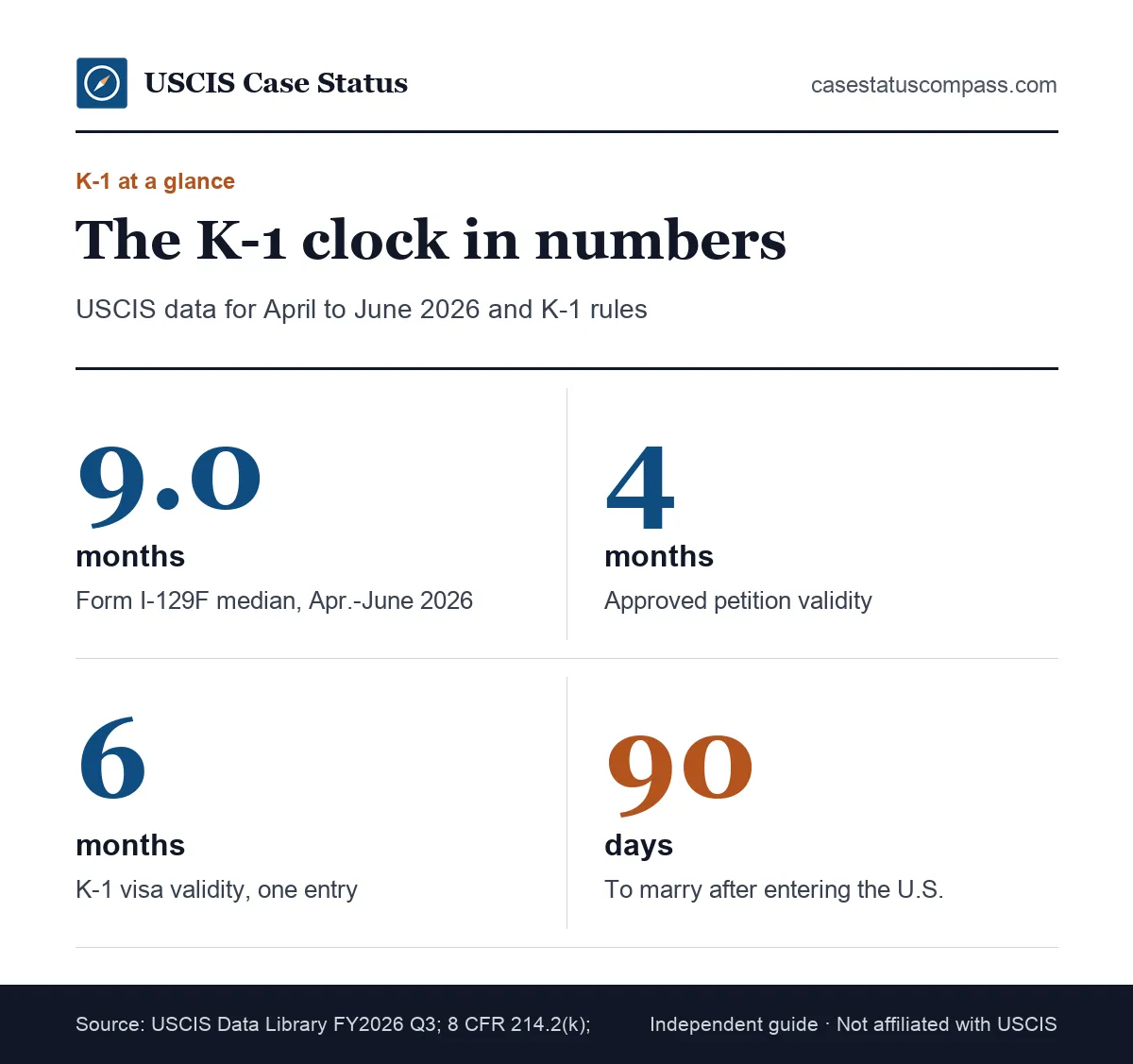
A K-1 fiancé visa takes at least as long as the USCIS petition stage, which had a 9.0-month median for Form I-129F cases completed April–June 2026. Consular stages, which depend on the embassy, come on top.
This page covers only the "how long" question. For eligibility and filing steps, see our k1 visa guide.
The USCIS share of the wait
The median is the middle case: half of I-129F petitions finished faster than 9.0 months and half took longer. Our USCIS processing times overview compares it with other forms.
It is a midpoint, not a promise: a complete petition can finish sooner.
What comes after USCIS
After approval, the petition goes to the National Visa Center (NVC), then to the embassy or consulate. Both are State Department offices whose times differ by country, so we point you to the official place to check each one.
K-1 Visa Processing Time: Official Figures
The only official, verified K-1 visa processing time figure is the USCIS median for Form I-129F: 9.0 months for April–June 2026. The live USCIS tool shows a separate 80% figure. The State Department stages have no single published number we could verify.
Range table with source and date checked
The table lists each K-1 stage, the official figure we found for it, and when we last checked its source.
| Stage | Official figure | Period | Source | Date checked |
|---|---|---|---|---|
| Form I-129F at USCIS (median) | 9.0 months | Apr. 1–June 30, 2026 | USCIS Data Library, FY2026 Q3 | Oct. 27, 2026 |
| Form I-129F at USCIS (80% of cases) | See official tool | Past 6 months | egov.uscis.gov/processing-times | Check on the day you look |
| NVC transfer | No verified figure | — | State Department | Oct. 27, 2026 |
| Embassy interview and visa | Varies by embassy | — | Embassy or consulate website | Oct. 27, 2026 |
The live USCIS tool for Form I-129F
Here is the current Form I-129F figure from the live tool, with the date we last checked it:
| Category | Office | 80% of cases completed within |
|---|---|---|
| K1/K2/K3/K4 - Fiance(e) or spouse and/or dependent children | Service Center Operations (SCOPS) | 13 months |
What Does the K-1 Visa Processing Time Median Measure?
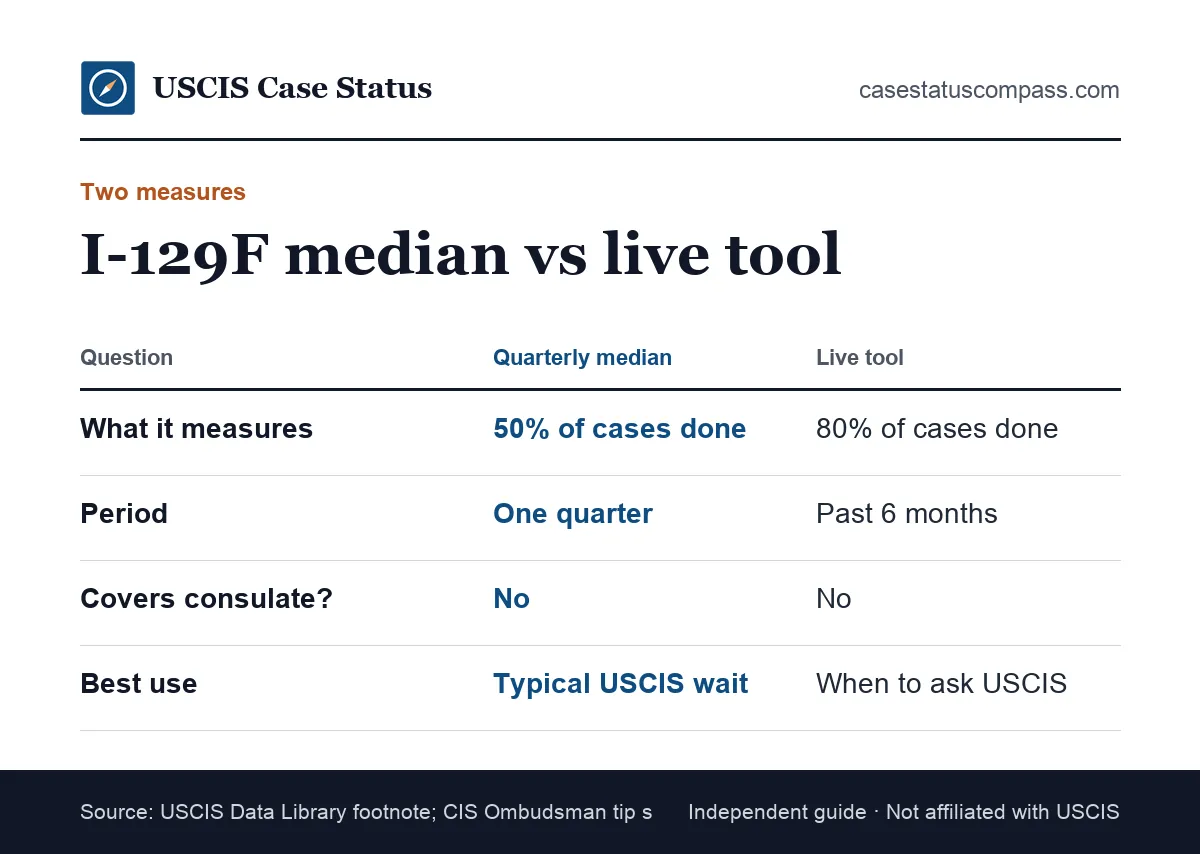
The I-129F median measures how long USCIS took to finish half of the fiancé petitions it completed in one quarter. It counts from receipt to decision at USCIS only. It says nothing about NVC, the embassy, or travel, and it is not a forecast for a single case.
Median vs the 80% tool figure
The USCIS tool shows how long it took to finish 80% of cases in the past 6 months. Because 80% is a higher bar, the tool number usually runs longer than the median.
Why the data lags
USCIS quarterly data reports the median: half of the cases completed that quarter took longer. A change in staffing or policy shows up in the median only a few months later.
Which Parts of the K-1 Wait Have Official Numbers?
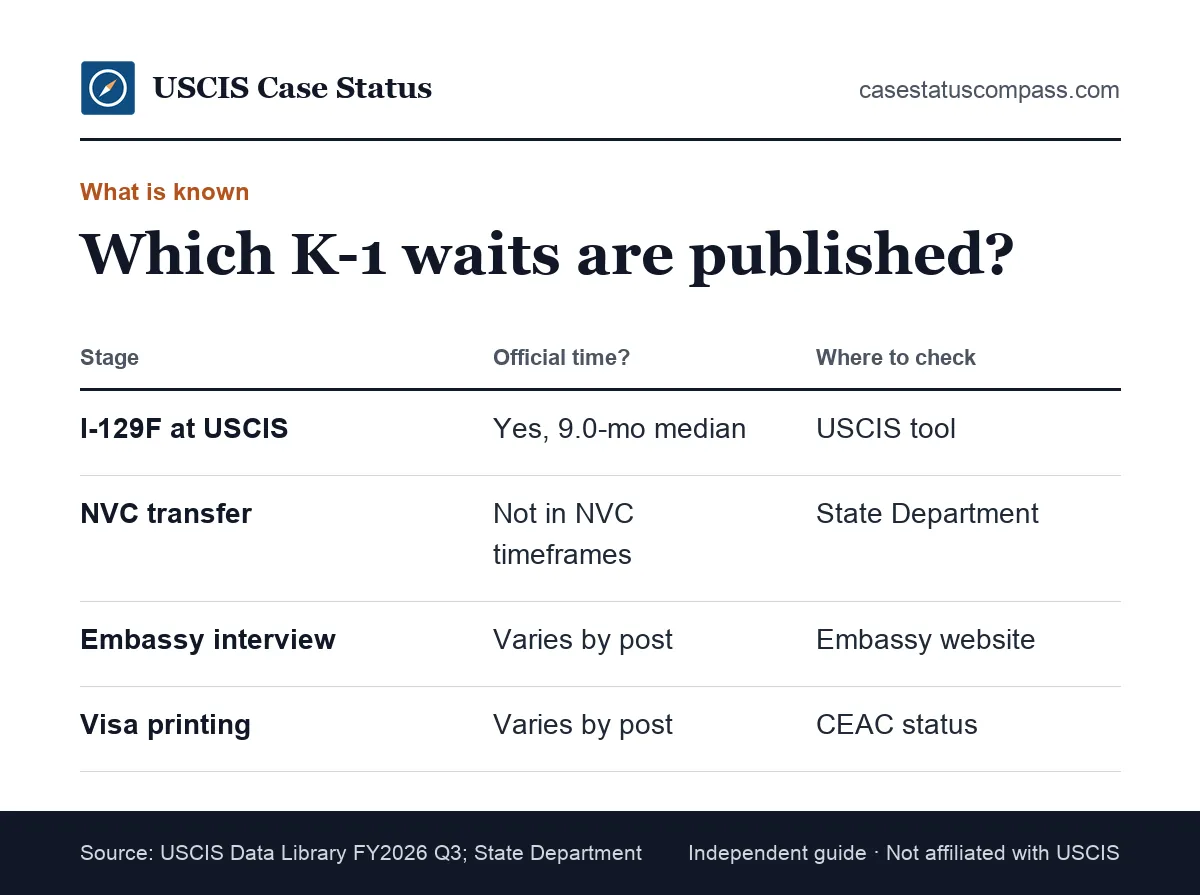
Only the USCIS petition stage of the K-1 visa processing time has an official median we could verify. The National Visa Center step, the embassy interview wait and visa printing are run by the State Department and vary by post. For those, check travel.state.gov and the embassy's own site.
Why we do not quote stage-by-stage estimates
Many sites list weeks for each consular step. We could not confirm those figures on an official page, and embassy workloads change often.
A forum number may describe another embassy or an older year, so it can mislead more than an honest "varies."
Where each official answer lives
Each K-1 timing question has a different owner, so match your question to the agency in the row below.
| Question | Who answers it | Where to look |
|---|---|---|
| Is my I-129F approved? | USCIS | Case Status Online or your USCIS account |
| Has NVC sent my case on? | National Visa Center | State Department pages and NVC contact options |
| When is the interview? | Embassy or consulate | Embassy website and appointment letter |
| Was the visa issued? | Embassy or consulate | CEAC visa status check |
K-1 Timeline Step by Step
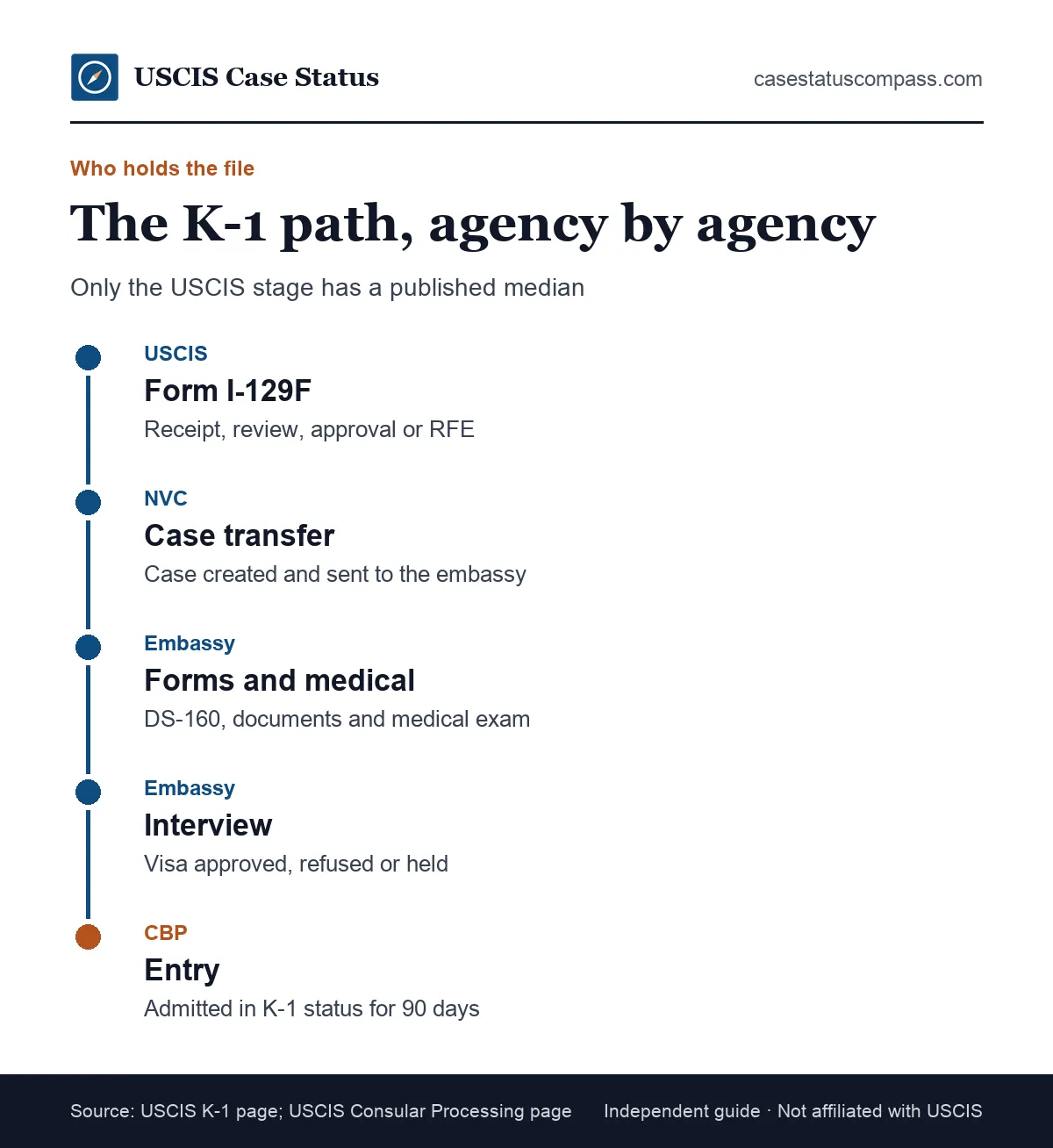
A K-1 timeline has seven stages across three agencies. USCIS controls the first three, the State Department the next four, and Customs and Border Protection (CBP) decides entry.
The tables below split the stages by agency, so you can see which office holds your case and what the 9.0-month median covers.
USCIS stages: filing to approval
Stages 1 to 3 happen at USCIS and are the only K-1 stages covered by a verified official median.
| Stage | Agency | What happens | Official time |
|---|---|---|---|
| 1. Filing and receipt | USCIS | Form I-797C issued | Starts the clock |
| 2. Review | USCIS | Officer checks the petition | Part of 9.0-month median |
| 3. Approval and transfer | USCIS | Approval notice, file sent to NVC | Part of median |
State Department and CBP stages
Stages 4 to 7 run through the State Department and then CBP at the border; none has one published time.
| Stage | Agency | What happens | Official time |
|---|---|---|---|
| 4. NVC handling | State Dept. | Case created, sent to post | Check State Dept. |
| 5. Embassy scheduling | State Dept. | Documents and medical exam | Varies by post |
| 6. Interview | State Dept. | Visa approved, refused or held | Varies |
| 7. Issuance and entry | State Dept., CBP | Visa printed, traveler admitted | Varies |
Why the hand-offs matter
Each hand-off between agencies can add quiet weeks, because the file must be created again in a new system.
For example, NVC must log the approved petition before the embassy can see it, so silent weeks after approval are normal.
Stage 1: How Long Until the I-129F Receipt Notice Arrives?
The I-129F receipt notice (Form I-797C) is the first milestone. USCIS sends it after accepting the petition, and its "received date" starts every processing-time count. A petition with the wrong fee, an old edition or a missing signature is rejected, and the clock never starts.
What to check on the receipt
Check the receipt number, the received date and both names. Report errors quickly: a misspelled name can carry into the approval notice and the visa. Our I-797C notice guide explains each field.
Getting the filing right the first time
Use edition 01/20/25 and pay $675. A rejection sends you back to the start, often the costliest delay a couple can suffer.
Also check the signature and payment before mailing; USCIS returns petitions missing either.
Stage 2: How Long Is the K-1 Visa Approval Time at USCIS?
The K-1 visa approval time at USCIS is the I-129F stage, with a median of 9.0 months for April–June 2026. Most of the wait passes with no status change while an officer reviews the file.
A status unchanged for months is normal during review.
When an RFE pauses the case
If evidence is missing, USCIS sends a request for evidence (RFE). RFE deadline: up to 12 weeks (the exact date is on your RFE); no extensions. The case waits for your full reply, so the clock effectively stops.
Why the 30-day RFE rule does not apply
The shorter 30-day rule covers only I-539 and I-601A, not the I-129F, so plan for the full window. See our guide to a request for evidence before you answer.
Mark the due date printed on your notice.
What Does USCIS Check Before a K-1 Visa Approval?
Before a k1 visa approval, the officer confirms that you are both free to marry and intend to marry within 90 days of entry. K-1: you must have met in person within the 2 years before filing (waivers possible). Proof of that meeting is a common weak spot, and the officer also reviews background records.
Proving you are both free to marry
Divorce decrees, annulment orders or death certificates show that earlier marriages ended. Unclear divorce records are a frequent RFE trigger, so send complete copies of each one with the petition.
What Happens Right After the I-129F Is Approved?
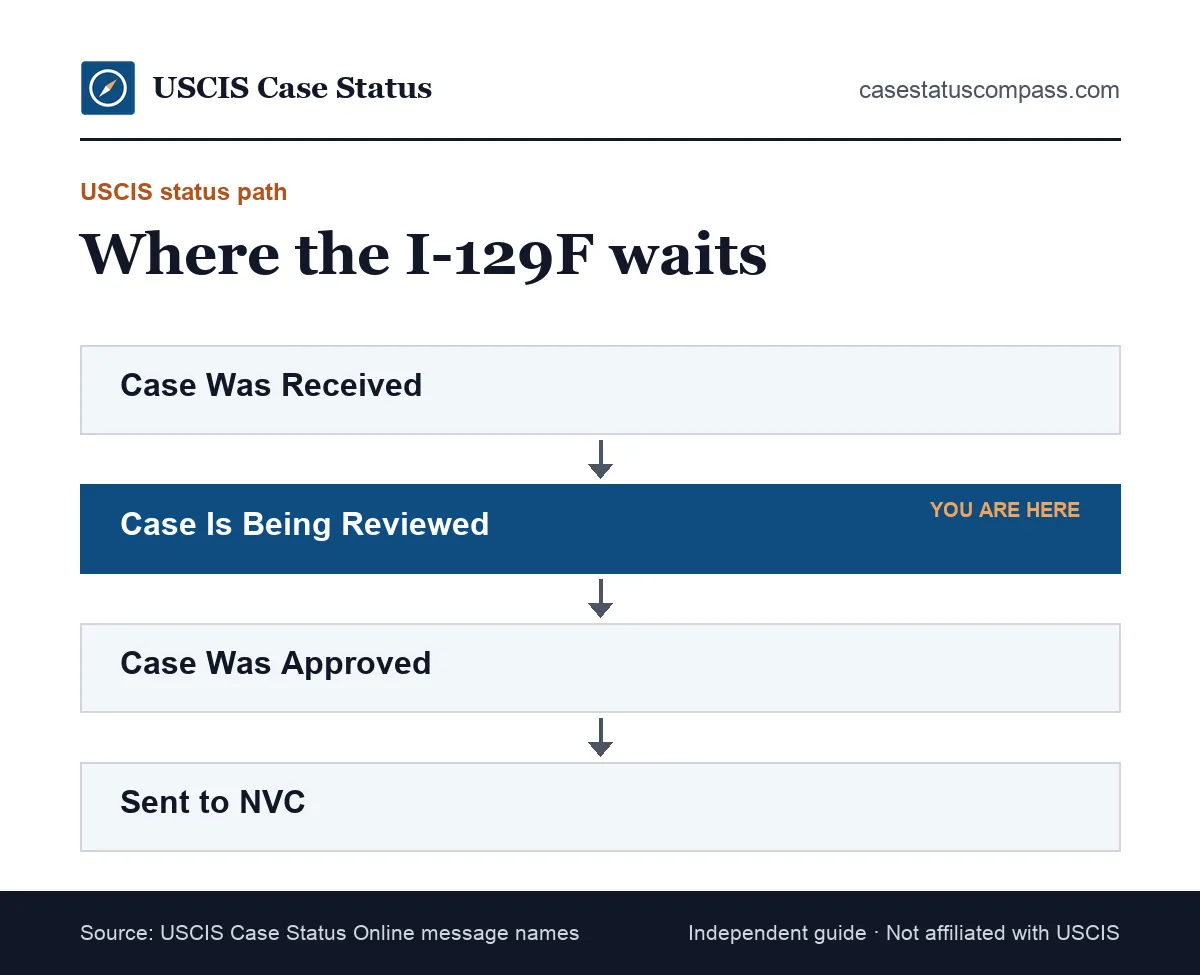
When USCIS approves Form I-129F, it issues an approval notice and sends the petition to the National Visa Center. Your USCIS case is then finished. Expect a quiet period while the State Department creates your case; that step is not part of the USCIS median.
Reading the approval
The online status shows "Case Was Approved." Read our page on what case was approved means for wording details.
Keep the paper approval notice safe: its date starts the petition validity period, and the embassy may want a copy.
The petition validity clock starts
An approved K-1 petition is valid for 4 months (can be revalidated). Approval starts a validity period, so a slow consular stage can bump into it. Embassies can revalidate a petition when the delay was not your fault.
Stage 3: How Long Does NVC Take on a K-1 Case?
The National Visa Center handles a K-1 case briefly compared with immigrant visa cases: it receives the approved petition, creates a State Department record and forwards the case to the embassy. No official NVC figure exists for the K-1 transfer, so watch for embassy contact instead.
Why NVC's weekly timeframes do not apply
NVC's published timeframes do not help K-1 couples: NVC timeframes cover immediate relative, family preference and employment preference cases, not diversity, special immigrant, K (fiancé) or adoption cases. Reading them as a K-1 forecast leads to false alarms.
What NVC does on a K-1
NVC (State Department) collects visa fees and documents after USCIS approves the petition. Most of the document review happens at the embassy itself.
It creates the record and forwards the file to the embassy named on the petition.
Checking your NVC case status
Use the State Department's official tools to look up your case once NVC has it. Our guide to nvc case status explains the tools and case numbers.
Once the embassy has the case, its messages matter most.
Stage 4: How Long Does the Embassy Take to Schedule a K-1 Interview?
The time to schedule a K-1 interview depends on the embassy or consulate, its staffing and its backlog. The State Department does not give one national figure for K-1 interviews that we could verify.
Posted interview waits change monthly and differ by visa type.
Why embassy waits vary
Each post sets its own calendar. A busy consulate may have a long queue, while a smaller one may move faster.
Holidays, staffing changes and surges in other visa types can make the same post faster one season and slower the next.
Where to check
Start with the K-1 page on travel.state.gov, then the website of the embassy listed on your approval notice. The embassy's instructions are the official word for that post.
Recheck both before setting travel dates.
Stage 5: How Long Do Forms and the Medical Exam Take Before the Interview?
Before the interview, the foreign fiancé(e) completes the State Department visa application, gathers civil documents and attends a medical exam with an embassy-approved physician. How long this takes depends mostly on how quickly you gather documents and book the exam. As of October 2026, the State Department's K visa application fee is $265.
Forms and civil documents
The embassy tells you which forms and documents to bring, such as birth certificates, police certificates and proof prior marriages ended.
Request police certificates early, because some countries take weeks to issue them.
How Long Does the K-1 Medical Exam Take?
The K-1 medical exam has no official set duration; it depends on physician availability and results. Book it as soon as the embassy instructions allow, because follow-up tests add time. Use the embassy's list of approved physicians; a U.S. civil surgeon is not used at this stage.
Stage 6: How Long Does a Decision Take After the K-1 Interview?
Many K-1 applicants learn the result at the K-1 interview itself. The officer may approve the visa, refuse it, or hold it for more documents or extra checks. If approved, printing the visa and returning the passport is the last step before travel.
If the officer approves
The embassy keeps the passport to print the visa, then returns it. Use the State Department's CEAC status tool to follow it. Our US visa status guide explains the messages.
What If a K-1 Visa Is Held for Administrative Processing?
A hold for administrative processing or missing papers means the embassy needs more before deciding. A hold can last weeks or longer, and the State Department does not publish a set time for it.
The online status may read "Refused" during a hold, which often means pending information, not a final denial.
What you can do during a hold
Send any documents the embassy requests in one complete reply, keep your contact details current, and follow the CEAC status tool. A hold is not a refusal, but it has no fixed end date.
Stage 7: How Long Do You Have to Travel After the Visa Is Issued?
After issuance, the clock runs the other way: the K-1 visa is valid for a limited time, so you must travel before it expires. K-1 visa: valid up to 6 months, one entry.
Check the expiration date printed on the visa foil before booking flights.
Entry at the border
A Customs and Border Protection officer decides whether to admit you. Admission starts the 90-day marriage window. Check your I-94 record online after you arrive.
Carry your passport and any documents the embassy told you to bring.
Children traveling as K-2
K-2: the fiancé(e)'s unmarried children under 21. K-2 children can travel with the K-1 parent or later, within their own visa's validity.
A child traveling later must use the child's own visa before it expires.
K-1 Timeline Estimator: Milestones From Your Filing Date
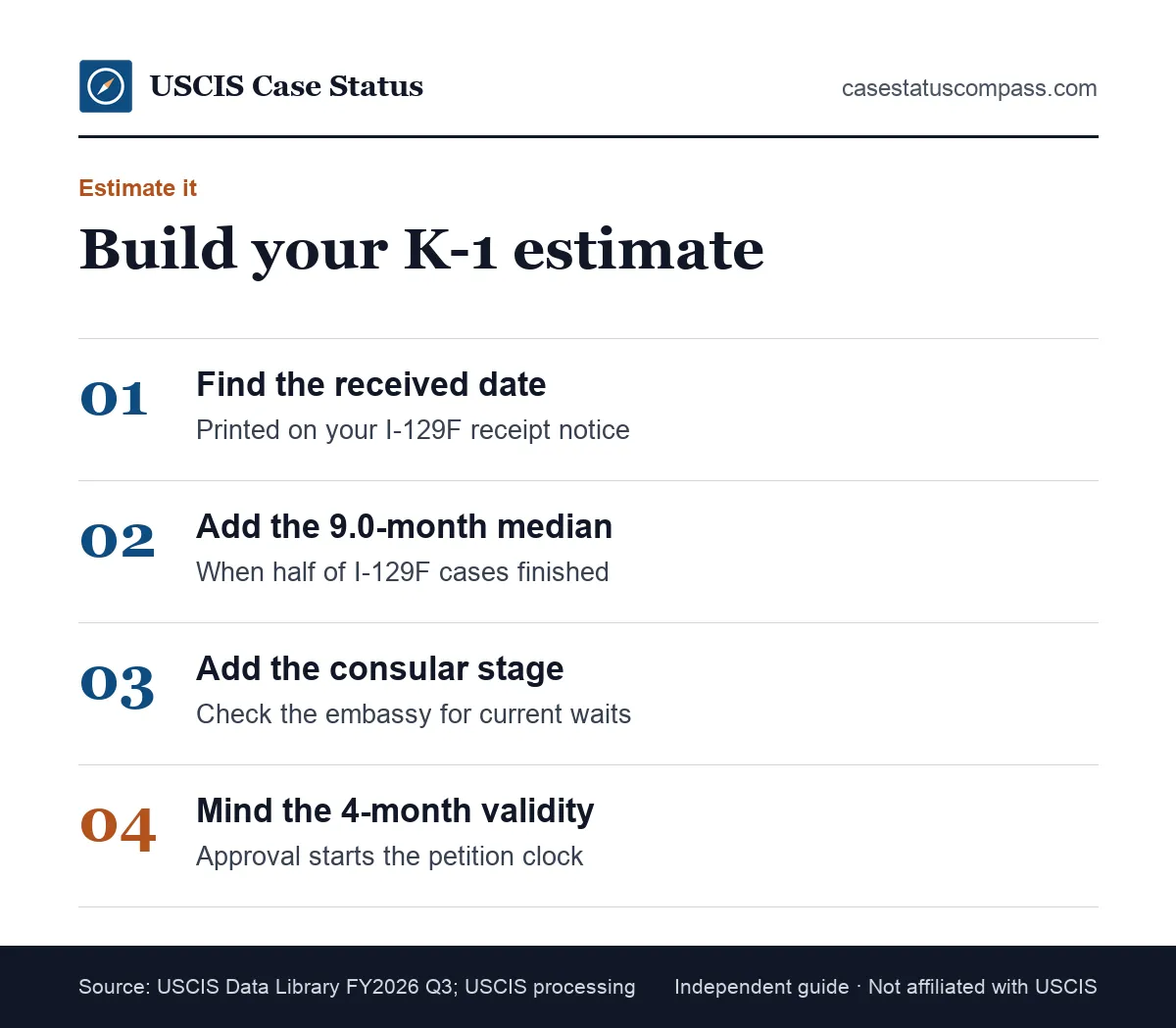
You can estimate the USCIS part of the K-1 timeline by adding the 9.0-month median to the received date on your I-129F receipt. The result shows when half of similar petitions finished in spring 2026. Add the consular stage separately, using your embassy's current information.
How to use the estimator
Find the row closest to your received date. The second column shows the USCIS median marker; the NVC and embassy stages follow it and must be checked with the State Department.
Estimator table
Each row adds 9.0 months to a sample received date; swap in the date on your own receipt.
| Received date on I-797C | USCIS median marker (+9.0 months) |
|---|---|
| Nov. 1, 2026 | About Aug. 1, 2027 |
| Dec. 1, 2026 | About Sept. 1, 2027 |
| Jan. 1, 2027 | About Oct. 1, 2027 |
| Feb. 1, 2027 | About Nov. 1, 2027 |
| Mar. 1, 2027 | About Dec. 1, 2027 |
Reading your estimate honestly
Passing the median marker without a decision is still normal, because half of cases take longer. The case inquiry date in the live tool is the real test of a delay.
How Long Does a Fiancé Visa Take From Start to Finish?
How long a fiancé visa takes from start to finish is the USCIS stage (9.0-month median for April–June 2026) plus the NVC and embassy stages, which vary by country. There is no verified single total.
Build your total from your own dates and your own embassy instead.
Building a realistic total
Add the USCIS median, then the embassy's current interview wait, then time for documents and the medical exam. Leave a buffer for an RFE or a hold.
Update it as notices arrive.
Why online totals disagree
Third-party totals mix different years, embassies and measures. Some count from filing, others from approval.
Many reflect only a few couples at one post. Before trusting a total, check its date, source and which stages it includes.
How Long Does It Take for a Fiancé Visa to Process After USCIS Approval?
After USCIS approval, fiancé visa processing moves to the State Department: NVC transfer, embassy scheduling, documents, the medical exam and the interview. We could not verify a current official figure for this part. The embassy handling your case is the best source for its current timing.
What you can control
Prepare documents early, book the medical exam promptly, and answer every embassy request in full.
Also keep your address current with USCIS and the embassy, and keep names identical across every form.
What you cannot control
Embassy capacity, security checks and holidays sit outside your control. If timing seems unusual, contact the embassy using the method on its website.
Slack in your wedding and travel dates is the best defense.
What Are Typical K-1 Visa Wait Times by Stage?
K-1 visa wait times by stage have one verified number: the 9.0-month USCIS median. The rest vary. The table shows what controls each wait, so you know which office to watch.
Find your current stage, then focus on its last column.
Wait drivers by stage
Each row names a stage, the main reason it can run long, and one step that helps.
| Stage | Main driver of the wait | What you can do |
|---|---|---|
| I-129F review | USCIS workload, evidence quality | File complete evidence the first time |
| NVC transfer | State Department processing | Watch for NVC or embassy contact |
| Embassy scheduling | Local post capacity | Follow the embassy's instructions |
| Medical exam | Physician availability, test results | Book early; finish follow-ups |
| Interview decision | Officer review, security checks | Bring every listed document |
Reading the table
Early stages reward careful paperwork, later ones quick replies. A complete file is the best way to keep your K-1 visa wait times near typical.
If you are stuck, check the row before yours.
Common Delays in K-1 Processing
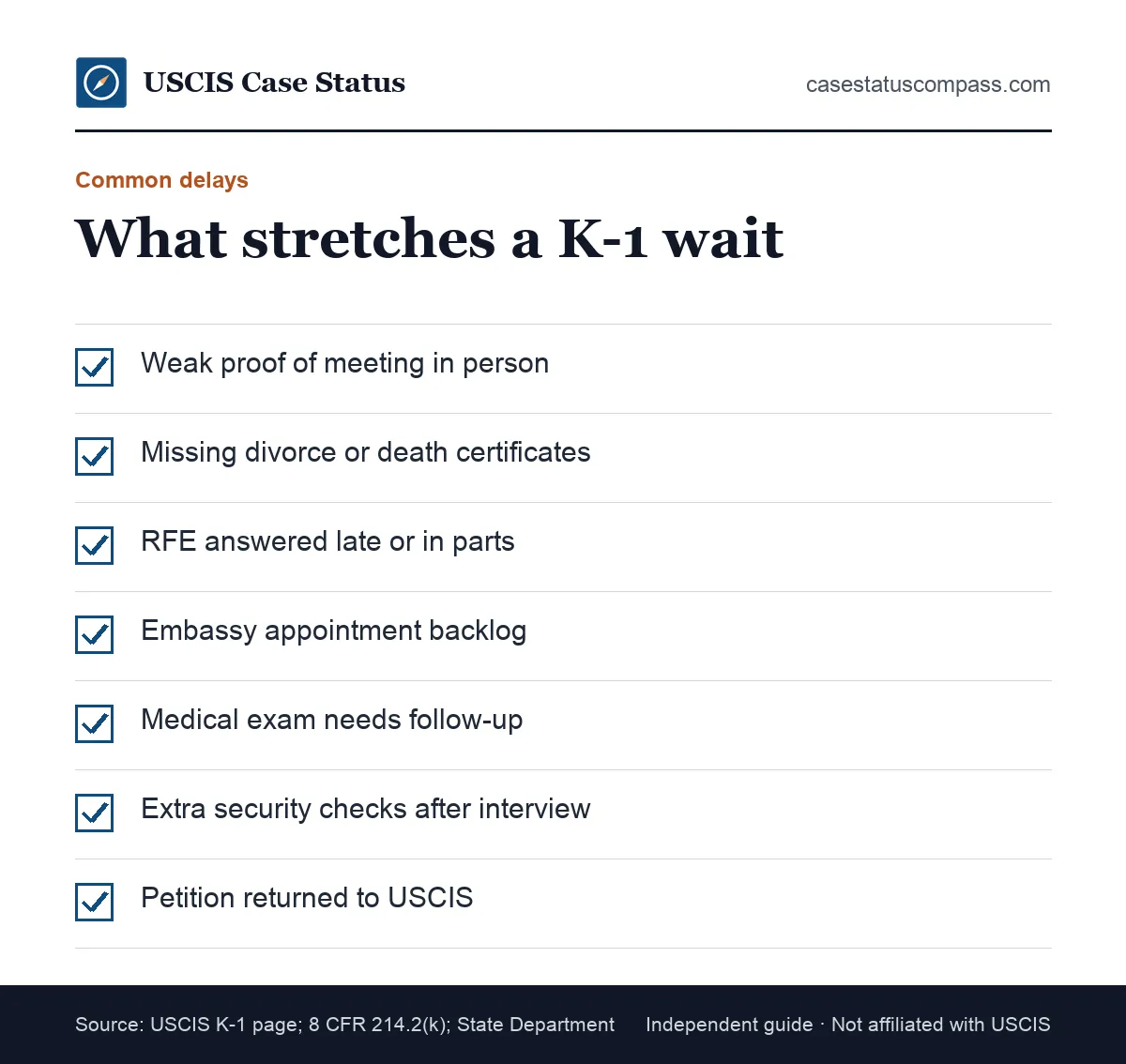
The most common delays that stretch K-1 visa processing time are relationship RFEs, missing divorce proof, embassy backlogs, medical follow-ups and security checks after the interview. A petition returned to USCIS is less common but slow.
Most can be prevented before filing or before the interview.
Delays on the USCIS side
Weak proof of meeting, unclear divorce records and name mismatches lead to RFEs. A missing signature or fee leads to rejection.
Compare every name and date across the petition, passports and civil records before filing.
Delays on the consular side
Missing police certificates, incomplete forms and medical follow-ups slow the interview. Security checks after the interview can take a long, unpredictable time.
Ask the embassy for its document list well before the interview date.
Does a Request for Evidence Delay a K-1 Case?
Yes. An RFE stops the USCIS decision until you reply, so it adds at least the time you take to answer, plus mail and review time. The reply deadline printed on your RFE is firm and cannot be extended, so plan around it. A full, well-organized reply is the fastest way back on track.
How to answer without extra delay
Send everything the RFE asks for in one package, in the order listed. If USCIS mailed the notice, add 3 days to the deadline.
Put the RFE notice on top and keep a full copy.
Common K-1 RFE topics
USCIS often asks for stronger proof of the in-person meeting, intent to marry, or the end of a prior marriage.
Helpful proof includes dated photos together, travel tickets and passport stamps, plus the final divorce decree.
Can the K-1 Petition Expire Before the Interview?
An approved petition has a 4-month validity period, and a slow consular stage can run past it. An approved K-1 petition is valid for 4 months (can be revalidated). Embassies can extend validity, so an expired date does not always mean starting over.
What revalidation means
Revalidation means the embassy confirms the petition is still good. Ask the embassy if your approval date is close to four months and no interview is set.
The embassy decides; you file nothing new.
When a new petition is needed
If the petition is not revalidated, or the relationship facts changed, you may need to file a new I-129F with a new fee. Talk to an immigration attorney first.
A new petition restarts the USCIS wait.
Does Your Fiancé(e)'s Country Change the K-1 Wait?
Yes. The embassy that handles the interview has the biggest effect on the State Department part of the wait. The USCIS median does not change by country, but the consular share of your K-1 visa processing time can.
Check your embassy's current K-1 notices before choosing travel or wedding dates.
Embassy workload and location
Large posts may handle many visa types and have longer calendars. Some countries route K-1 interviews to a regional embassy.
Your embassy's instructions name the post; if it is in another country, add travel time and costs.
Country-specific restrictions
Travel or visa restrictions for some nationalities can pause or limit visa issuance. These change, so check current State Department notices for your fiancé(e)'s country before planning dates.
An attorney can explain the current rules.
Can a K-2 Child Change the K-1 Timeline?
A K-2 child usually follows the K-1 parent's case and does not need a separate petition, so the USCIS part of the K-1 visa processing time stays the same. Extra documents, a separate medical exam and age rules can affect the consular stage.
Ask the embassy early what each child needs.
Age and timing
K-2: the fiancé(e)'s unmarried children under 21. If a child is close to 21 or plans to marry, ask an immigration attorney how timing could affect eligibility.
K-2 children must stay unmarried.
Paperwork for children
Each child needs birth records and a medical exam.
The embassy may ask for police certificates for older children and, if the other parent stays behind, proof the child may travel, such as a custody order. A missing item can hold one child's visa.
Can the Consulate Send the Petition Back to USCIS?
Yes. If a consular officer believes the petition should not have been approved, the embassy can return it to USCIS for review. This can add many months, because USCIS must reopen the file. Our K-1 fiancé visa guide covers the process side; here we focus on time.
What a return does to the timeline
A returned petition goes back into USCIS review. The original median no longer applies, and you may receive a notice asking for more evidence.
Watch Case Status Online for a change once USCIS has the file.
What to do
Answer any USCIS notice in full and keep the embassy informed. Because a return signals a serious concern, this is a good time to get advice from an immigration attorney.
Is Premium Processing Available for a K-1 Visa?
No. Premium processing does not cover Form I-129F. Premium processing covers I-129 work visas, I-140 (EB-1/2/3), I-765 OPT/STEM OPT and I-539 to F/M/J. Paying more cannot shorten the USCIS stage for a fiancé visa, and no consular equivalent exists for K-1 interviews.
Why the K-1 is not on the list
Premium processing is mostly for employment petitions with fixed decision windows. Family petitions are excluded. The premium processing guide lists which forms it covers.
Be wary of any service selling faster K-1 processing.
The real ways to save time
File a complete petition, answer RFEs fully, and prepare consular documents early. For true emergencies, ask for an expedite.
Expedites are granted only in limited, documented cases, as explained below.
Can You Expedite a K-1 Visa?
You can ask USCIS to expedite Form I-129F, but approval is discretionary. Expedite criteria: severe financial loss, emergency/humanitarian, nonprofit, government interest, clear USCIS error. A planned wedding date alone rarely qualifies.
Also, make only one expedite request, after you get your receipt notice.
Expedite at USCIS
Ask for an expedite through the USCIS Contact Center or your online account. Our expedite request guide explains what evidence helps.
Attach proof of the urgent reason, such as medical letters; without proof, requests usually fail.
Expedite at the embassy
Embassies decide interview expedites themselves. Follow the request process on the embassy website, and be ready to show the urgent need.
A USCIS expedite does not carry over, so ask each agency separately.
How Do You Know If Your I-129F Is Taking Too Long?
Your Form I-129F is officially outside normal time once today is past its case inquiry date in the USCIS processing times tool. Case inquiry date: the earliest date USCIS will accept a question about your pending case; it can change.
Normal vs overdue
Find the row that matches your situation today to see whether the wait is normal and what to do next.
| Your situation | Normal or overdue? | What to do |
|---|---|---|
| Before the 9.0-month median | Normal | Wait; watch mail and your account |
| Past the median, before inquiry date | Still normal | Confirm your address with USCIS |
| Past the case inquiry date | Outside normal processing | Submit an inquiry to USCIS |
| Inquiry answered, still stuck | Overdue | Congressional or Ombudsman help |
Finding the inquiry date
Open the official tool, choose Form I-129F and your office, and enter your received date. The tool tells you whether you can submit an inquiry yet.
Recheck it monthly; the date can move.
What to Do When the K-1 Petition Is Outside Normal Processing Time
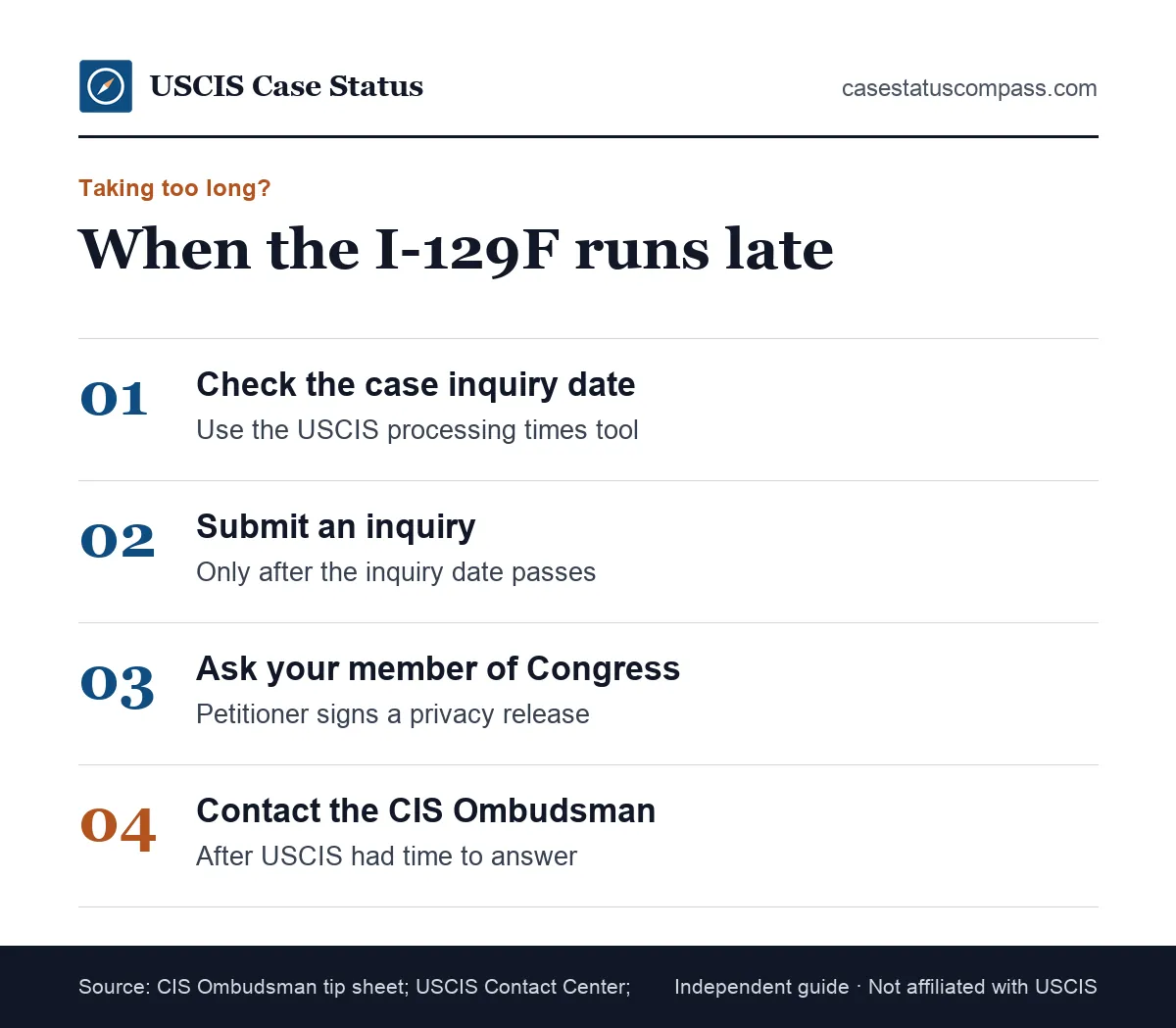
When the I-129F is past its case inquiry date, submit an outside normal processing time inquiry to USCIS. You can submit an 'outside normal processing time' request only after your case inquiry date. If that does not help, contact your member of Congress, then the CIS Ombudsman. This ladder applies only to the USCIS stage.
First steps: the USCIS inquiry
- Confirm the case inquiry date in the official tool.
- Submit the inquiry online or call 800-375-5283.
Give USCIS time to answer before you move up the ladder.
Have your receipt number ready.
Next steps: Congress and the CIS Ombudsman
- Your member of Congress can ask USCIS about your case after you sign a privacy release.
- Use the Ombudsman only after contacting USCIS within 90 days and waiting at least 60 days.
Keep a record
Log every call, reference number and reply date. Our Ombudsman and congressional inquiry guide explains when each option fits.
A clear log shows a congressional office exactly what you already tried, which speeds their help.
How Do You Track a K-1 Case Across Agencies?
Track a K-1 case with two systems: USCIS Case Status Online or your USCIS account for the I-129F, then State Department tools once NVC and the embassy hold the case. A USCIS approval does not appear at the State Department right away.
Tracking at USCIS
Use the receipt number at Case Status Online: egov.uscis.gov. Free USCIS online account: case status updates, notices, link paper-filed cases. Long gaps without updates are normal during review.
After approval, updates move to the State Department.
Tracking at the State Department
Once the embassy has your case, use the CEAC status tool and the embassy's messages. If your USCIS status stalls, read our guide to a case status that is not updating.
How Long Do You Have After Arriving on a K-1 Visa?
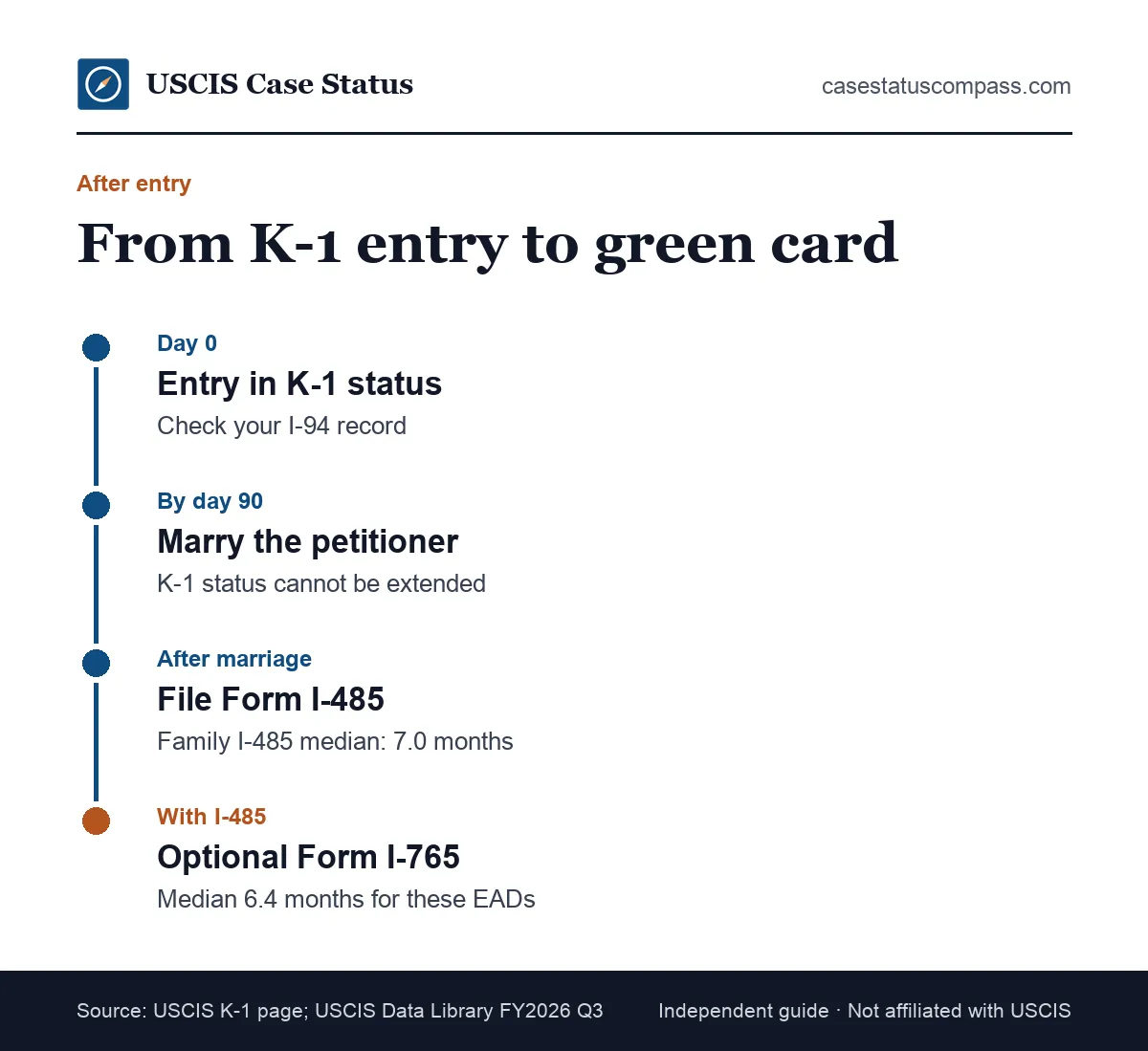
After entry, you have 90 days to marry the petitioner. K-1: marry within 90 days of entering the U.S.. Plan the wedding before you travel.
If you marry in time, you can apply for a green card from inside the U.S.; if not, you must leave. The window starts at entry, as explained next.
When Does the 90-Day K-1 Marriage Clock Start?
The 90 days count from the date of admission on your I-94 record, set by the CBP officer at entry, not from the visa issue date. Check that date online soon after arrival, and plan the wedding with a buffer for paperwork such as a marriage license.
If the wedding does not happen in time
K-1 status cannot be extended. Marrying someone else, or not marrying within the window, ends the path to a green card through this visa, so get legal advice early if plans change.
How Long Does the Green Card Take After a K-1 Marriage?
After the wedding, the K-1 entrant files Form I-485 to adjust status. USCIS's median for family-based I-485 cases was 7.0 months for April–June 2026, measured from receipt to decision.
File soon after the wedding with your marriage certificate, since that clock starts only on receipt.
The adjustment step
$1,440 (paper) / $1,390 (online); $950 / $900 if under 14 and filing with a parent. Our Form I-485 guide covers filing. For the full green card wait, see our green card processing time page.
How Long Does a Work Permit Take After a K-1 Wedding?
Many K-1 entrants file Form I-765 for a work permit together with the I-485, so they can work while the green card is pending. That request had a median of 6.4 months for April–June 2026. Our work permit processing time page explains the EAD wait.
K-1 to Green Card: The Full Timeline Picture
The full path from fiancé petition to green card links two USCIS cases and one consular stage. The table stacks the spring 2026 USCIS medians, with the consular stage in between and no official total.
Read it top to bottom.
Full path table
Each step must finish before the next starts, except the I-765, which runs alongside the I-485.
| Step | Agency | Official median (Apr.–June 2026) |
|---|---|---|
| Form I-129F petition | USCIS | 9.0 months |
| NVC and embassy | State Department | No verified figure; check the embassy |
| Entry and marriage | CBP, then you | Marry within 90 days |
| Form I-485 (family) | USCIS | 7.0 months |
| Form I-765 (with I-485) | USCIS | 6.4 months |
Why the total is not a single number
Each step has its own queue and can overlap or stall. The best plan stacks the medians, adds the embassy wait, and leaves room for one RFE.
Update the plan with each notice.
K-1 vs Spouse Visa: Which Is Faster?
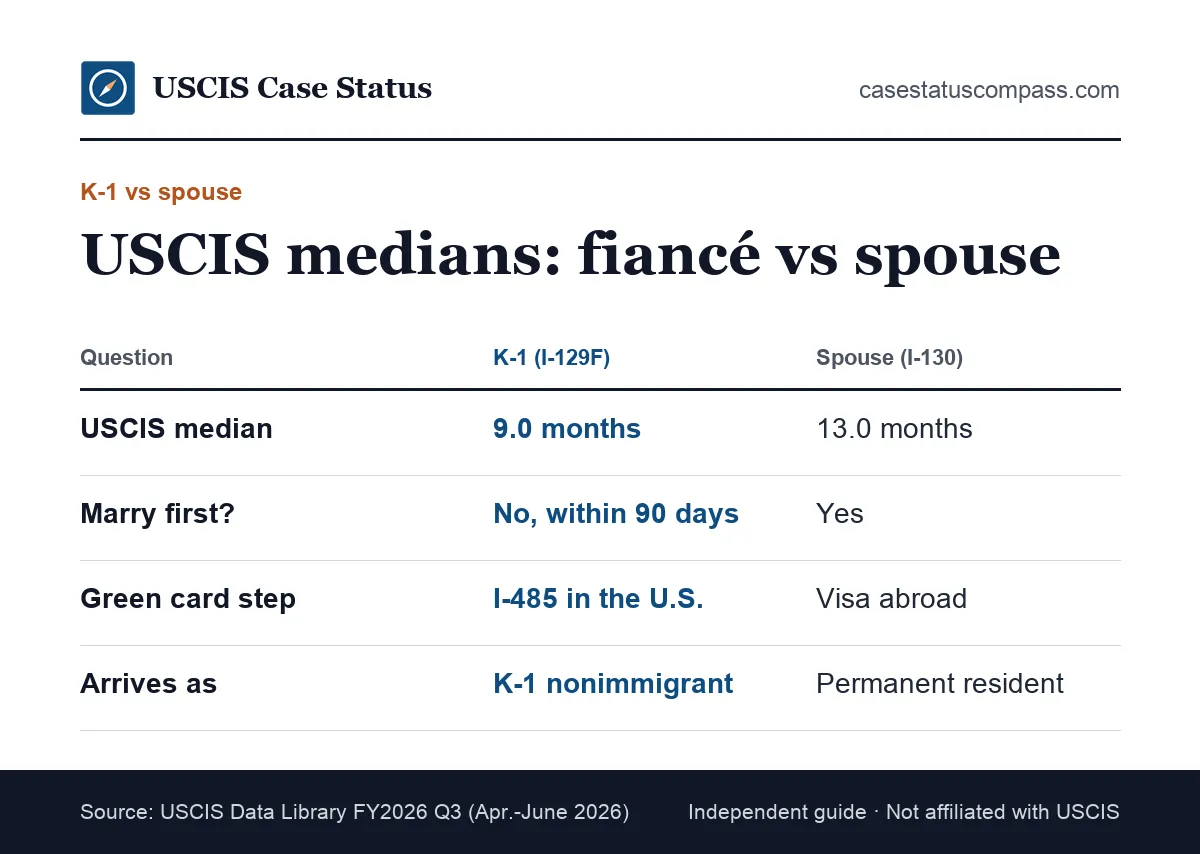
At USCIS, the K-1 petition had a shorter median (9.0 months) than the I-130 for immediate relatives (13.0 months) in April–June 2026. The spouse route then goes through NVC and an immigrant visa interview, while the K-1 route adds the I-485 after marriage.
Where the I-130 wait is explained
See our I-130 processing time page for the full spouse petition wait, including the NVC and immigrant visa steps.
It also explains the spouse route's separate consular wait abroad.
Does the K-1 Route Take Longer to Reach a Green Card?
Often not by much. A spouse visa makes the spouse a permanent resident on arrival; the K-1 does not, so add the 7.0-month family I-485 median before comparing totals. Our marriage green card guide compares both routes.
Compare stages, not headlines.
How Does the K-1 Wait Compare With Other Immigration Timelines?
Among USCIS forms, the I-129F median of 9.0 months sits between quicker forms like the I-140 (3.9 months) and longer ones like the I-130 for immediate relatives (13.0 months).
Each form has its own queue, so a fast I-140 says nothing about your K-1 visa processing time.
Median comparison
The table ranks related USCIS forms by their April–June 2026 medians, from fastest to slowest.
| Form | Purpose | Median, Apr.–June 2026 |
|---|---|---|
| I-140 | Employment petition | 3.9 months |
| I-485 (family) | Green card in the U.S. | 7.0 months |
| I-129F | Fiancé(e) petition | 9.0 months |
| N-400 | Citizenship | 9.5 months |
| I-130 (immediate relative) | Spouse, parent, child petition | 13.0 months |
Other timelines you may need later
Years later, you may apply for citizenship; see how long does naturalization take. Employment cases start at the Department of Labor (DOL); our PERM processing time page covers that wait.
When Should You File to Plan a Wedding Date?
File Form I-129F as early as your relationship evidence allows, and plan the wedding after the visa is issued. With a 9.0-month USCIS median plus a variable consular stage, fixed wedding dates set before filing often have to move.
Planning around the 90 days
Once you know the visa date, plan travel inside the visa's validity and the wedding inside the 90 days after entry.
Book the marriage license early, since some offices require a waiting period.
Building in a buffer
Allow room for one RFE, a medical follow-up and an interview reschedule.
In practice, avoid paying venue deposits or guests' flights until the visa is in hand, and leave spare weeks inside the 90 days.
Timing Mistakes That Lengthen a K-1 Case
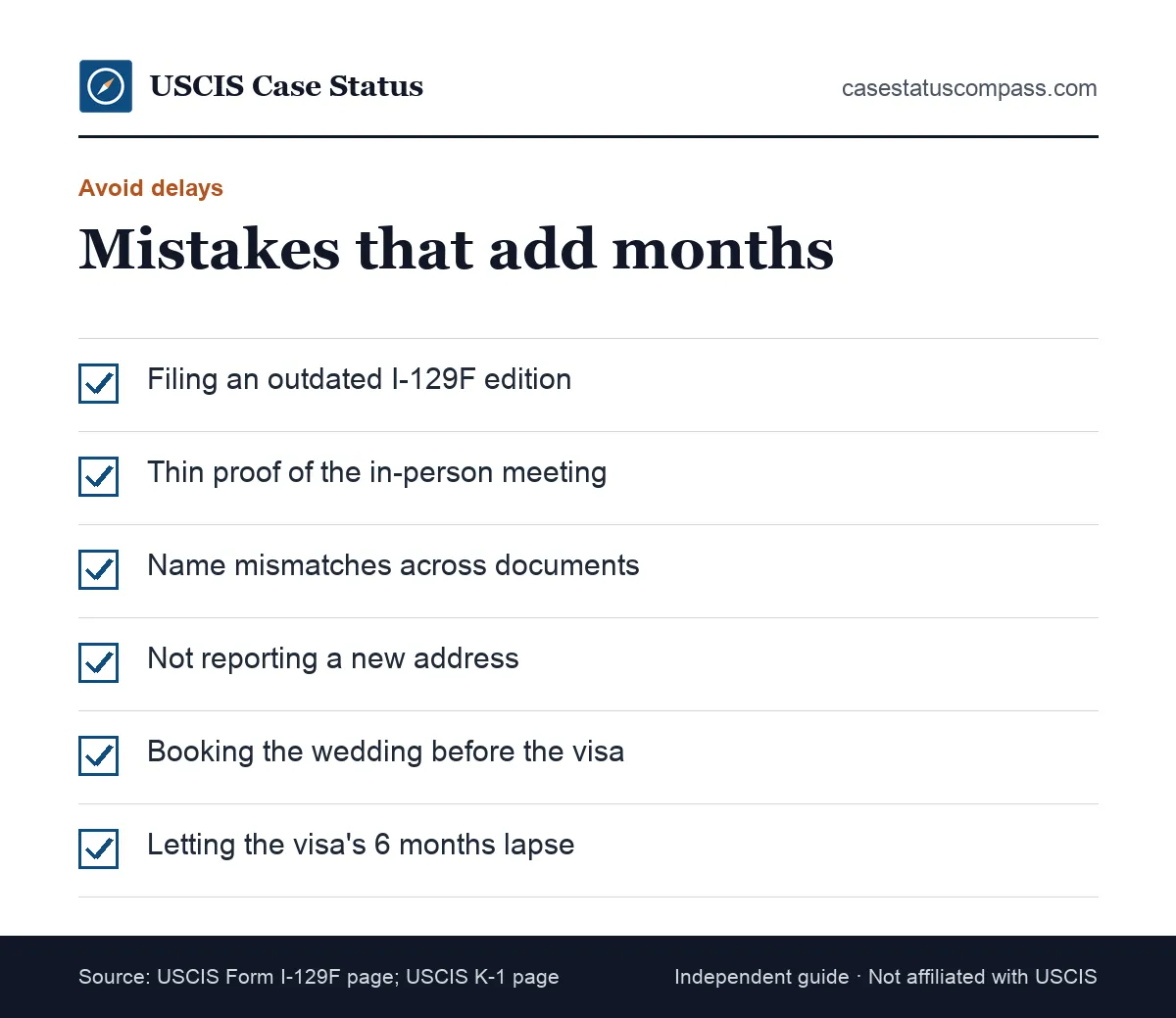
The most common timing mistakes are filing an old edition, sending thin proof of the in-person meeting, name mismatches across documents, not reporting a move, and booking travel before the visa is issued. Each one can add weeks or months.
Petition mistakes
Check the edition, sign the form and pay the right fee. Make names match passports and civil records.
Include proof you met in person within two years, and label each exhibit.
Follow-up mistakes
Update your address online in your USCIS account (E-COA); a mailed AR-11 also counts. Our change of address guide explains how to keep notices reaching you.
A missed notice can mean a missed deadline.
What Should a K-1 Planning Checklist Include?
A K-1 plan should track six checkpoints: filing, receipt, the median marker, approval, the embassy stage and entry. Each checkpoint tells you what to watch next and which agency to contact if something stalls.
Use the lists below as a tracker.
Checkpoints while USCIS has the petition
- Filing: current I-129F edition, fee and full evidence.
- Receipt: save the I-797C and note the received date.
- Median marker: at about 9 months, check the case inquiry date.
- Approval: note the date; the 4-month validity starts.
Checkpoints at the embassy and border
The last two checkpoints belong to the State Department and CBP:
- Embassy: follow the post's instructions and book the medical exam.
- Entry: check the I-94 and marry within 90 days.
What to keep together
Keep the receipt, approval notice, RFE replies, embassy letters and a call log in one folder.
Frequently Asked Questions
How long does it take for a fiancé visa to process?
The USCIS part, Form I-129F, had a median of 9.0 months for petitions completed April–June 2026. After that, the National Visa Center and the embassy add their own stages, which vary by country. We could not verify one official total, so check your embassy's website.
How long does a K-1 visa take after the interview?
If the officer approves the visa at the interview, the embassy prints it and returns the passport. If the case is held for documents or extra checks, it can take longer. Use the State Department's CEAC tool to follow the status.
Is the K-1 faster than the CR-1 spouse visa?
At USCIS, the I-129F median (9.0 months) beat the I-130 immediate relative median (13.0 months) for April–June 2026. But a K-1 entrant still files Form I-485 after marriage, while a CR-1 spouse arrives as a permanent resident, so totals can be similar.
Can I check K-1 processing times by service center?
Yes, the USCIS processing times tool lets you select Form I-129F and the office shown on your receipt notice. The quarterly median on this page is a national figure. The tool's office-level number uses the 80% measure and helps you find your case inquiry date.
Does the K-1 wait include the medical exam?
The USCIS median does not include the medical exam, because the exam happens during the State Department stage. Book it promptly; follow-up tests can delay the interview.
What happens if my K-1 visa expires before I travel?
A K-1 visa is valid for up to six months and for one entry. If it expires unused, you cannot use it to enter. Contact the embassy about your options, which may include a new application.
Does the K-1 wait start from the filing date or the receipt date?
Your K-1 visa processing time at USCIS counts from the received date printed on your Form I-797C receipt notice. Use that date, not the day you mailed the petition, for every comparison and for the case inquiry date.
How long does a fiancé visa take if USCIS sends an RFE?
An RFE adds at least the time you take to reply, plus mail and review time. Send every requested item in one organized package so USCIS reviews your answer only once.
Can my fiancé(e) visit the U.S. while the K-1 is pending?
A pending K-1 does not stop a visitor visa application, but the officer may doubt that the visit is temporary, since you plan to immigrate. Ask an immigration attorney before your fiancé(e) applies for a visitor visa during the K-1 process.
Sources
- USCIS Data Library: All Application and Petition Form Types, FY2026 Q3. www.uscis.gov/sites/default/files/document/data/quarterly_all_forms_fy2026_q3_v1.xlsx. Accessed Oct 27, 2026.
- USCIS Check Case Processing Times. egov.uscis.gov/processing-times/. Accessed Oct 27, 2026.
- USCIS: Visas for Fiancé(e)s of U.S. Citizens. www.uscis.gov/family/family-of-us-citizens/visas-for-fiancees-of-us-citizens. Accessed Oct 27, 2026.
- USCIS: Form I-129F, Petition for Alien Fiancé(e). www.uscis.gov/i-129f. Accessed Oct 27, 2026.
- 8 CFR 214.2(k), K nonimmigrant rules. www.law.cornell.edu/cfr/text/8/214.2. Accessed Oct 27, 2026.
- U.S. Department of State: Nonimmigrant Visa for a Fiancé(e) (K-1). travel.state.gov/content/travel/en/us-visas/immigrate/family-immigration/nonimmigrant-visa-for-a-fiance-k-1.html. Accessed Oct 27, 2026.
- U.S. Department of State: Visa Status Check (CEAC). ceac.state.gov/CEACStatTracker/Status.aspx. Accessed Oct 27, 2026.
- CIS Ombudsman: Check Your USCIS Case Inquiry Date (tip sheet). dhs.gov/sites/default/files/2024-11/24_0823_cisomb_case-inquiry-date-tip-sheet.pdf. Accessed Oct 27, 2026.
- USCIS: How to Make an Expedite Request. www.uscis.gov/forms/filing-guidance/how-to-make-an-expedite-request. Accessed Oct 27, 2026.
- USCIS Form G-1055 Fee Schedule, Edition 10/16/26. www.uscis.gov/sites/default/files/document/forms/g-1055.pdf. Accessed Oct 27, 2026.
- 8 CFR 103.2(b)(8)(iv) (LII). www.law.cornell.edu/cfr/text/8/103.2. Accessed Oct 27, 2026.
- Form I-129F Instructions, Edition 01/20/25. www.uscis.gov/sites/default/files/document/forms/i-129finstr.pdf. Accessed Oct 27, 2026.
- State Department: NVC Timeframes (as of 26-Oct-26). travel.state.gov/content/travel/en/us-visas/immigrate/nvc-timeframes.html. Accessed Oct 27, 2026.
- USCIS: Consular Processing (updated 07/20/2023). www.uscis.gov/green-card/green-card-processes-and-procedures/consular-processing. Accessed Oct 27, 2026.
- 22 CFR 22.1 Schedule of Fees for Consular Services (govinfo, CFR 2025 edition). www.govinfo.gov/content/pkg/CFR-2025-title22-vol1/xml/CFR-2025-title22-vol1-sec22-1.xml. Accessed Oct 27, 2026.
- 8 CFR 103.8(b) (LII). www.law.cornell.edu/cfr/text/8/103.8. Accessed Oct 27, 2026.
- USCIS: How Do I Request Premium Processing? (updated 03/23/2026). www.uscis.gov/forms/all-forms/how-do-i-request-premium-processing. Accessed Oct 27, 2026.
- USCIS Contact Center (uscis.gov). www.uscis.gov/contactcenter. Accessed Oct 27, 2026.
- USCIS OLA New Member Outreach FAQs (Jan. 2021). www.uscis.gov/sites/default/files/document/questions-and-answers/5%20117%20-%20New%20Member%20Outreach%20FAQs%2001042021.pdf. Accessed Oct 27, 2026.
- DHS CIS Ombudsman: How to Submit a Case Assistance Request (updated 04/13/2026). www.dhs.gov/case-assistance. Accessed Oct 27, 2026.
- USCIS: Checking Your Case Status Online. www.uscis.gov/tools/checking-your-case-status-online. Accessed Oct 27, 2026.
- USCIS: Benefits of a USCIS Online Account. www.uscis.gov/file-online/benefits-of-a-uscis-online-account. Accessed Oct 27, 2026.
- USCIS: How to Change Your Address (updated 08/04/2026). www.uscis.gov/addresschange. Accessed Oct 27, 2026.
casestatuscompass.com is an independent publication and is not affiliated with USCIS or any government agency. This page is general information, not legal advice. For denials, court or asylum matters, consult an immigration attorney or a DOJ-accredited representative.