Contents · 37 sections
- What Is US Visa Status and Who Tracks It?
- USCIS Case Status vs US Visa Status
- Can You Check Visa Status on the USCIS Website?
- How to Check Your US Visa Application Status
- What Do You Need for a US Visa Status Check?
- How Do You Check a Visitor Visa Status?
- How Do You Check an Immigrant Visa Status?
- How Do You Check a Diversity Visa Status?
- How Do You Check a Work or Student Visa Status?
- US Visa Status Meanings
- What Does "Issued" Mean in Visa Status?
- What Does "Refused" or 221(g) Mean?
- How Do You Respond to a 221(g) Refusal?
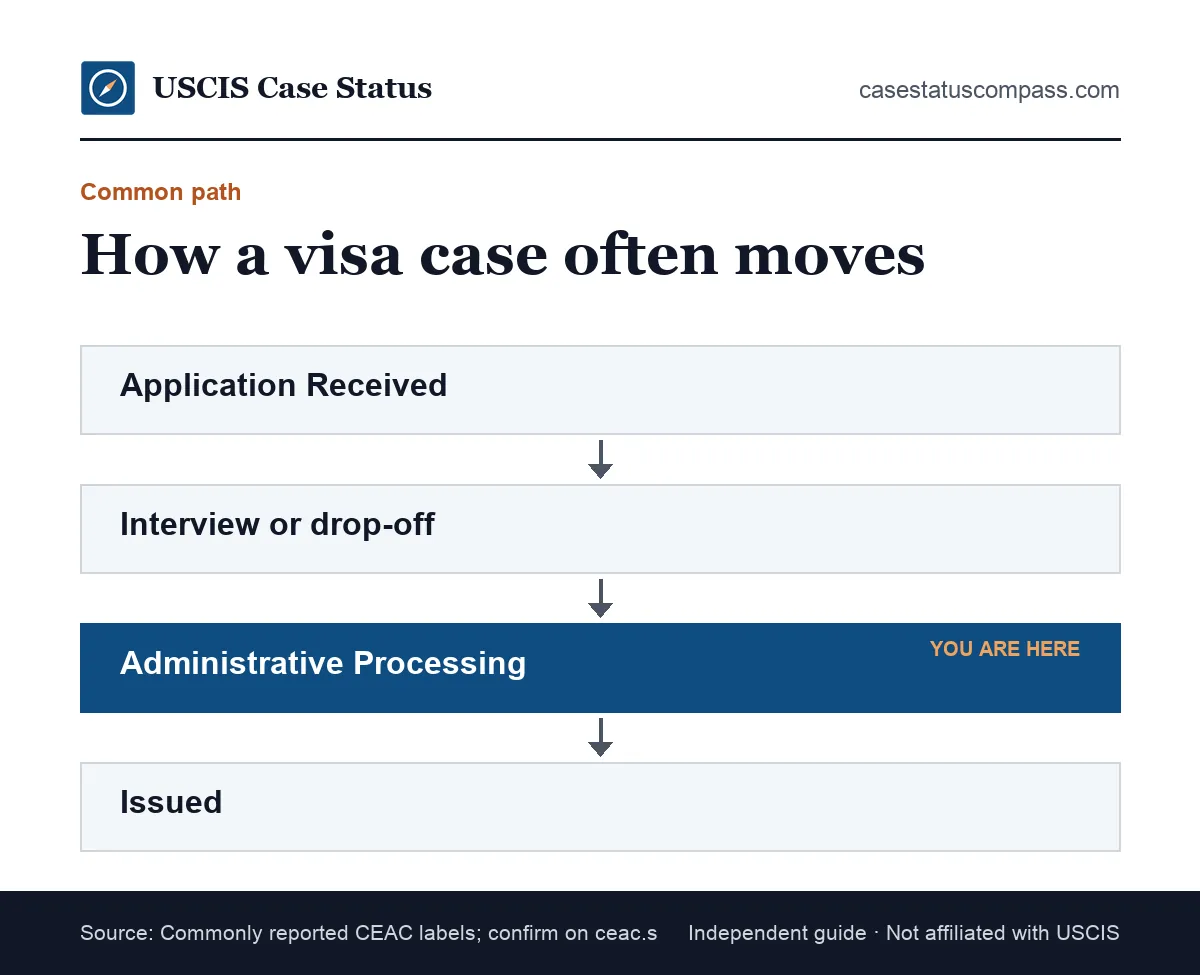
- What Does "Administrative Processing" Mean?
- What Do "Ready," "At NVC" and "In Transit" Mean?
- What If Your Visa Status Shows No Status or Case Not Found?
- What Is the Difference Between an Immigrant and a Nonimmigrant Visa?
- Where to Find Your Visa Number
- Where Is the Visa Number on an H-1B Visa Stamp?
- How Long Does It Take to Get a Visa?
- How Long After a Visa Interview Will You Get Your Visa?
- How Long Does a Work Visa Take?
- How Much Is a Visa?
- What Is the Visa Integrity Fee?
- How Do US Embassy Appointment Dates Work?
- Can You Reschedule or Move a US Visa Interview?
- What Is a US Visa Interview Waiver or Dropbox?
- What Is Visa Status Verification?
- How Can You Check Your Visa Status While in the USA?
- Do You Need a Visa or Can You Use the Visa Waiver Program?
- How Do You Spot a Fake US Visa Status Site?
- What Are the Most Common Mistakes When Checking Visa Status?
- What Happens After Your Visa Is Issued?
- How Does the Visa Bulletin Affect Immigrant Visa Status?
- When Should You Use Immigration Court Case Status Instead?
- What Should You Do Next for Each Visa Status?
- Frequently Asked Questions
The short answer
A US visa status check is done on the U.S. Department of State's free CEAC site (ceac.state.gov), not on the USCIS website. Choose nonimmigrant or immigrant visa, select your embassy or consulate, then enter your DS-160 application ID or immigrant visa case number. The page shows the latest label, such as Issued or Refused.
At a glance
| Who handles visas | The U.S. Department of State, through embassies and consulates |
| Official tracker | CEAC visa status check at ceac.state.gov (free) |
| What you enter | DS-160 ID or immigrant visa case number |
| Can USCIS show it? | No. USCIS Case Status Online tracks petitions, not visas |
| This site | Independent guide; no live visa data |
What Is US Visa Status and Who Tracks It?
Your US visa status is the stage your visa application has reached at a U.S. embassy or consulate. The U.S. Department of State owns that process and tracks it in the Consular Electronic Application Center (CEAC). Tourist, student, work and immigrant visas all show up there, though the number you enter differs by type.
The State Department decides every visa
A visa is a travel document a consular officer places in your passport. The only official source for your United States visa status is the State Department. USCIS may approve a petition first, but the officer abroad makes a separate decision under consular rules.
Embassies, consulates and CEAC
An embassy sits in a capital city; a consulate general serves a region. CEAC is the shared online system behind them. It stores the DS-160 and shows a short label for each case, whichever post you used.
USCIS Case Status vs US Visa Status
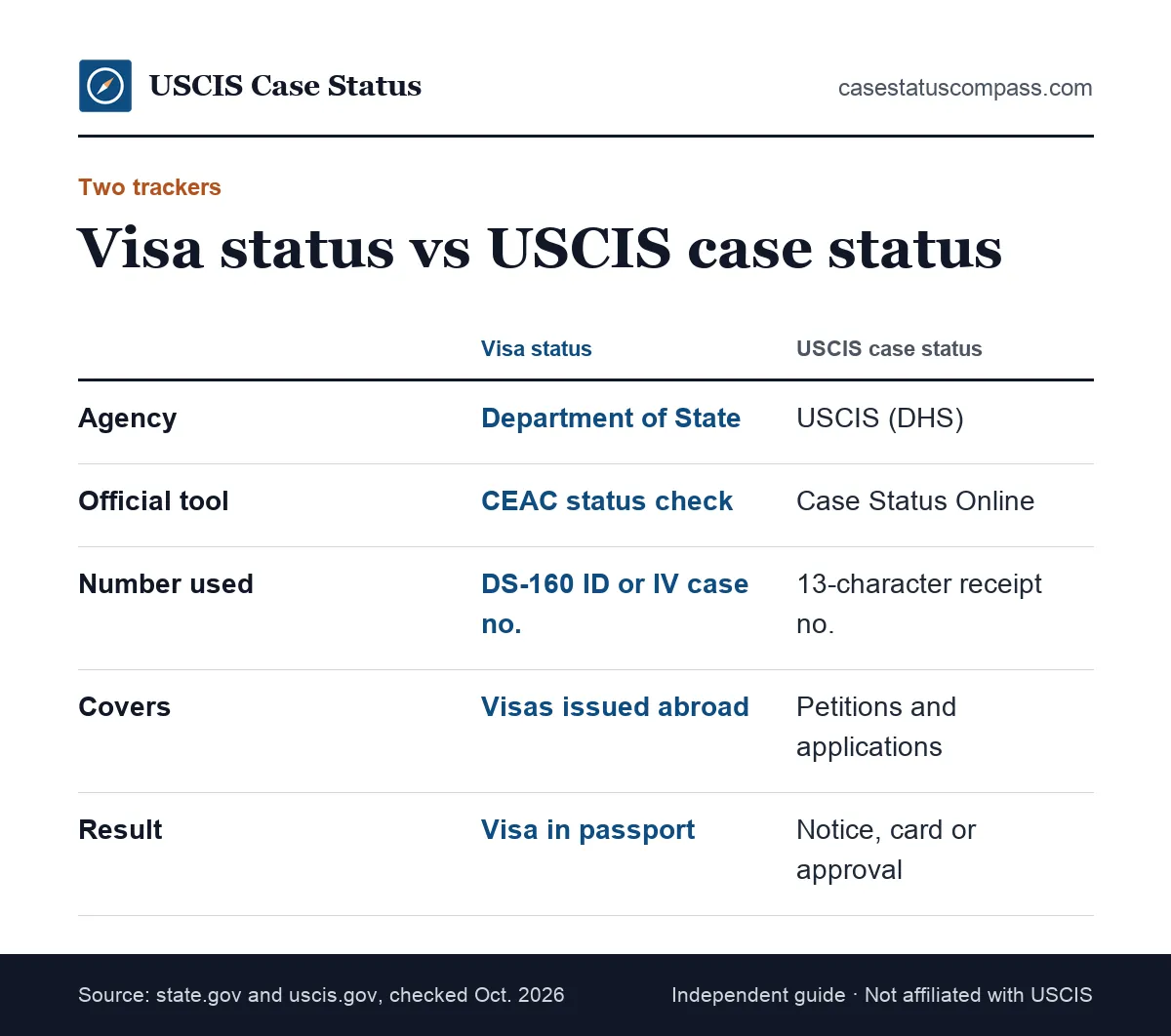
USCIS case status and US visa status are two records kept by two agencies: USCIS decides petitions, and the State Department decides visas abroad. Many applicants need both in turn. The petition comes first and the visa second, so the right tracker depends on which step you are at now. A new USCIS approval is the signal to start checking CEAC.
Side-by-side: State Department vs USCIS records
The table below shows who decides, which tool to use and which number each one asks for.
| Question | Visa status (State Department) | USCIS case status (DHS) |
|---|---|---|
| Who decides | Consular officer abroad | USCIS officer |
| Official tool | CEAC status check | Case Status Online |
| Number you enter | DS-160 ID or IV case number | Receipt number on Form I-797 |
| Typical forms | DS-160, DS-260 | I-130, I-129, I-129F, I-485 |
| Final product | Visa in your passport | Notice, card or certificate |
| Who can help | The embassy or consulate | USCIS Contact Center |
Why the USCIS tool cannot show a visa
Case Status Online at Case Status Online: egov.uscis.gov reads only USCIS receipt numbers. A DS-160 ID entered there returns an error. Our uscis case status guide covers the petition side. Likewise, CEAC rejects a USCIS receipt number.
Cases that use both trackers
A spouse abroad, a fiancé(e) or an H-1B worker first waits on a USCIS petition, then on the State Department. Track the petition with the receipt number, then switch to CEAC once the consulate or NVC has it.
Can You Check Visa Status on the USCIS Website?
No. The USCIS website cannot check a visa application, because USCIS does not issue visas. It shows only the petition that came first, such as Form I-130 or I-129. For the visa itself, use the State Department's CEAC page. Some USCIS pages explain visa categories, which adds to the confusion, but none of them tracks a visa application.
What USCIS shows after approval
Once USCIS approves a petition for someone abroad, its record usually stops at an approval message; see the approved case status page. That last message is normal and does not mean the file is lost. The case then moves to NVC or straight to the consulate, depending on the visa type.
When USCIS status still matters
USCIS stays in charge if you are in the U.S. and extend or change your stay, or adjust status with Form I-485. Those cases never produce a visa, so CEAC shows nothing.
How to Check Your US Visa Application Status
To check your US visa application status, open ceac.state.gov, choose the visa type, select your post and enter your application ID or case number. The free result shows a label and dates, with no login needed. Check after your interview or document submission, not before, since a new case may not appear right away. Once or twice a week is plenty.
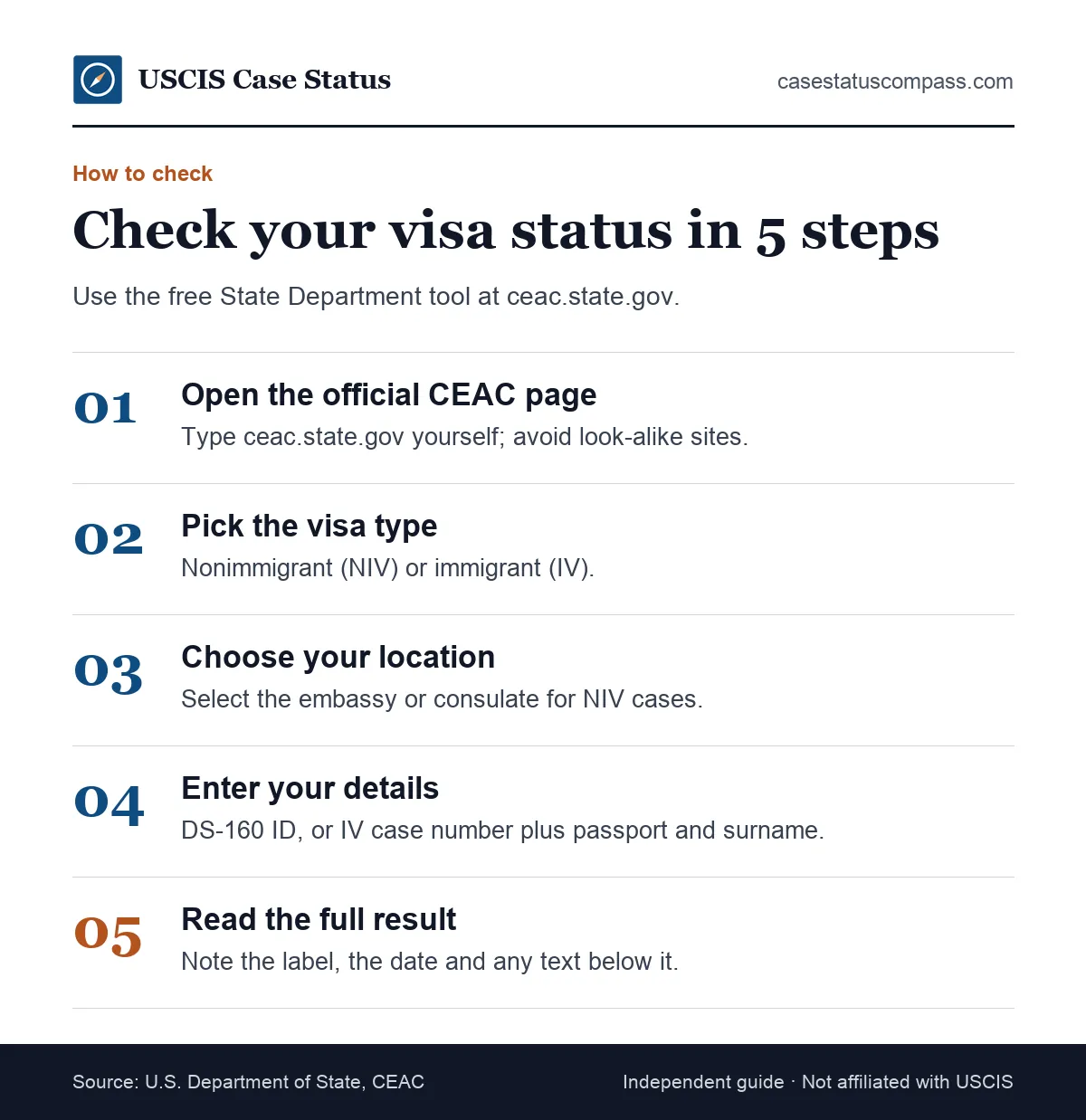
Step-by-step on CEAC
- Type ceac.state.gov into your browser yourself.
- Open the visa status check page.
- Choose NIV (nonimmigrant) or IV (immigrant visa).
- For NIV, pick the embassy or consulate where you applied.
- Enter your number and the security code, then submit.
What the result page shows
You see a status label, the date the case was created and the date of the last update. Read any text under the label in full. That text often says what to do next, such as sending a document or waiting for a letter.
What Do You Need for a US Visa Status Check?
You need one identifying number and the right case type. Nonimmigrant applicants use the application ID on the DS-160 confirmation page. Immigrant applicants use the case number from their NVC or consulate letters. Keep the case number in a safe note on your phone, so you can check from anywhere.
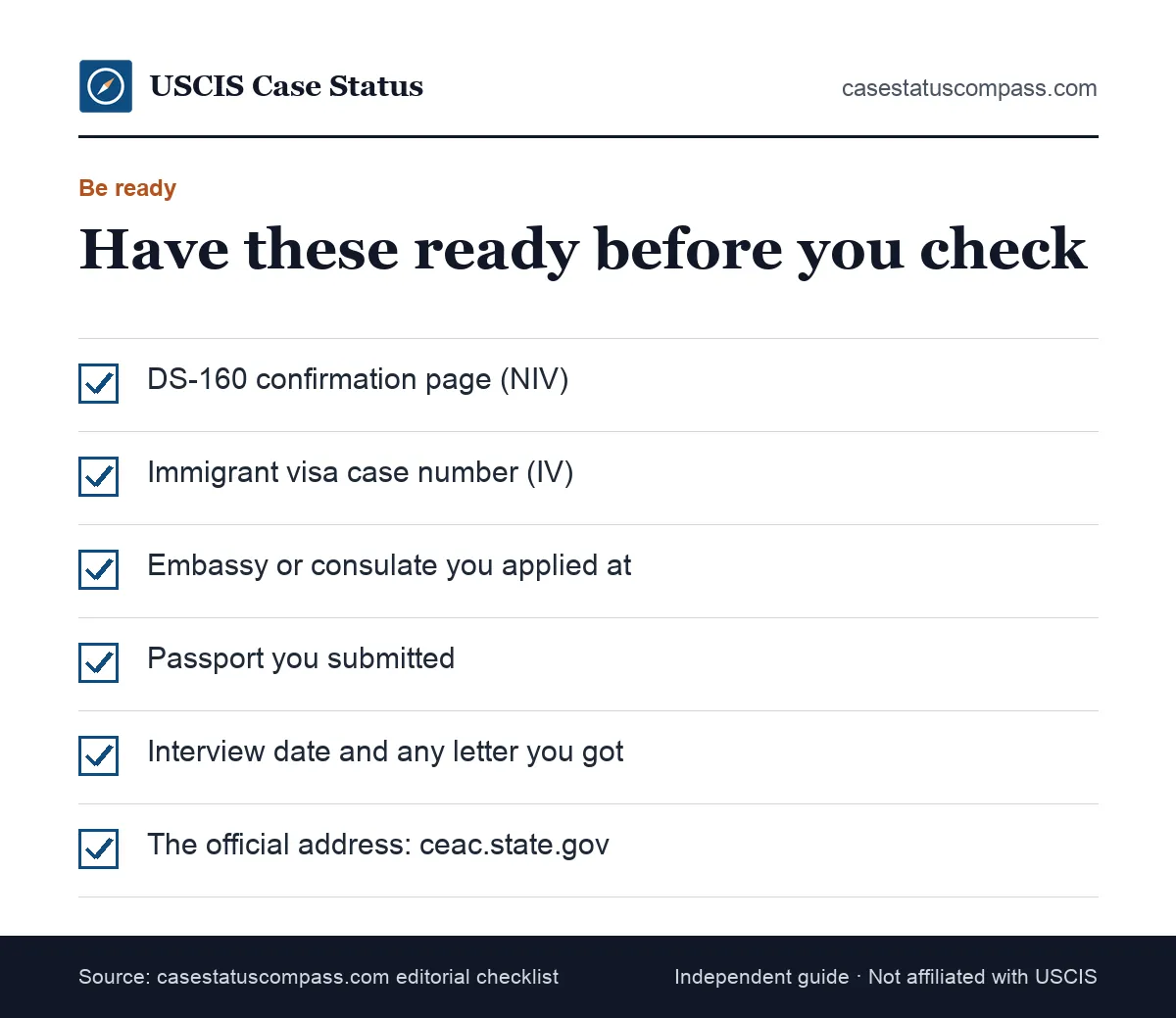
Nonimmigrant cases: the DS-160 ID
The DS-160 is the online nonimmigrant visa application. On submission, CEAC shows a confirmation page with a barcode and application ID; save it as a PDF, because that ID is what you enter for a visitor, student or work visa check.
Immigrant cases: the case number
Immigrant visa cases get a number when the National Visa Center opens the file. An immigrant visa case number looks like CEAC's example, MTL1999626025: three letters followed by ten digits. Our NVC case status guide covers where to find the number. It is printed on the Welcome Letter.
Entering an immigrant case on CEAC
The CEAC Visa Status Check asks for the visa application type, your case number, passport number, the first 5 letters of your surname and a security code. If you completed your forms before January 1, 2022, CEAC asks you to enter NA in the passport and surname fields. Choose IV first; the passport field refers to the applicant, not the petitioner. If the result says no record, recheck each character of the case number. Then try again a day later.
How Do You Check a Visitor Visa Status?
To check a visitor visa status, choose NIV on CEAC, pick the post where you interviewed and enter your DS-160 application ID. B-1/B-2 results usually update after the interview. If the officer approved you at the window, the label may lag for a few days before it changes. Keep your DS-160 confirmation page, since it holds the ID you need.
B-1/B-2 visitor visa after the interview
For a visitor visa USA case, the interview is often the decision point. Even after a verbal "approved," the label may show a review step for a while before it reaches Issued.
"USCIS tourist visa" is a mix-up
A USCIS tourist visa search usually means the State Department's B-2 visa. USCIS handles visitors only after entry, for example a request to extend a stay on Form I-539, which costs $470 (paper) / $420 (online).
How Do You Check an Immigrant Visa Status?
To check an immigrant visa status, choose IV on CEAC and enter the case number from your National Visa Center letters. Immigrant cases pass through NVC first and then the embassy, so the label changes as the file moves between them. Each family member applying may have their own record.
Immigrant visas after USCIS approval
Family and employment immigrant cases start with a petition such as Form I-130 or I-140. As of October 2026, USCIS states that NVC (State Department) collects visa fees and documents after USCIS approves the petition. Our Form I-130 guide covers the petition stage.
How Do You Check a Diversity Visa Status?
A diversity visa status check has two parts. The lottery result is checked on the State Department's Entrant Status Check with your entry confirmation number. If selected, the immigrant case later appears in CEAC, where you check it with the IV option like any other immigrant visa case.
How Do You Check a Work or Student Visa Status?
Work and student visas are nonimmigrant visas, checked on CEAC with the DS-160 application ID. Most work visas need an approved USCIS petition first. Students need a school's Form I-20 or DS-2019 before applying at the consulate. Check the visa type on your DS-160 matches the petition or school form.
H-1B and other work visa stamps
An H-1B worker abroad applies for the visa stamp after USCIS approves the employer's petition. CEAC then tracks the stamp, not the petition. For the petition, see our H-1B visa status guide.
F-1 and J-1 student visas
An applicant for a student visa for America attends the interview with the school's form and proof of funds, then watches CEAC for the result. The State Department sets how early a student visa can be issued before the program starts, so check your post's page before booking flights.
US Visa Status Meanings
The State Department does not publish official definitions of these labels that we could find. The readings below describe how US visa status labels are commonly displayed and understood. A label is a summary, not a decision letter. If your post gave you written instructions, they come first, and the label may simply catch up later.
Common CEAC status labels
The table lists labels applicants most often report seeing on CEAC, with the usual plain-English reading.
| Label commonly seen | Usual reading |
|---|---|
| Application Received | The post has your DS-160 or case |
| Administrative Processing | Extra review before a decision |
| Refused | Visa not issued at this time |
| Issued | Visa approved and printed |
| Ready | Immigrant case set up at the post |
| At NVC | Immigrant case still with NVC |
| In Transit | File moving between offices |
| No Status | No record matches what you entered |
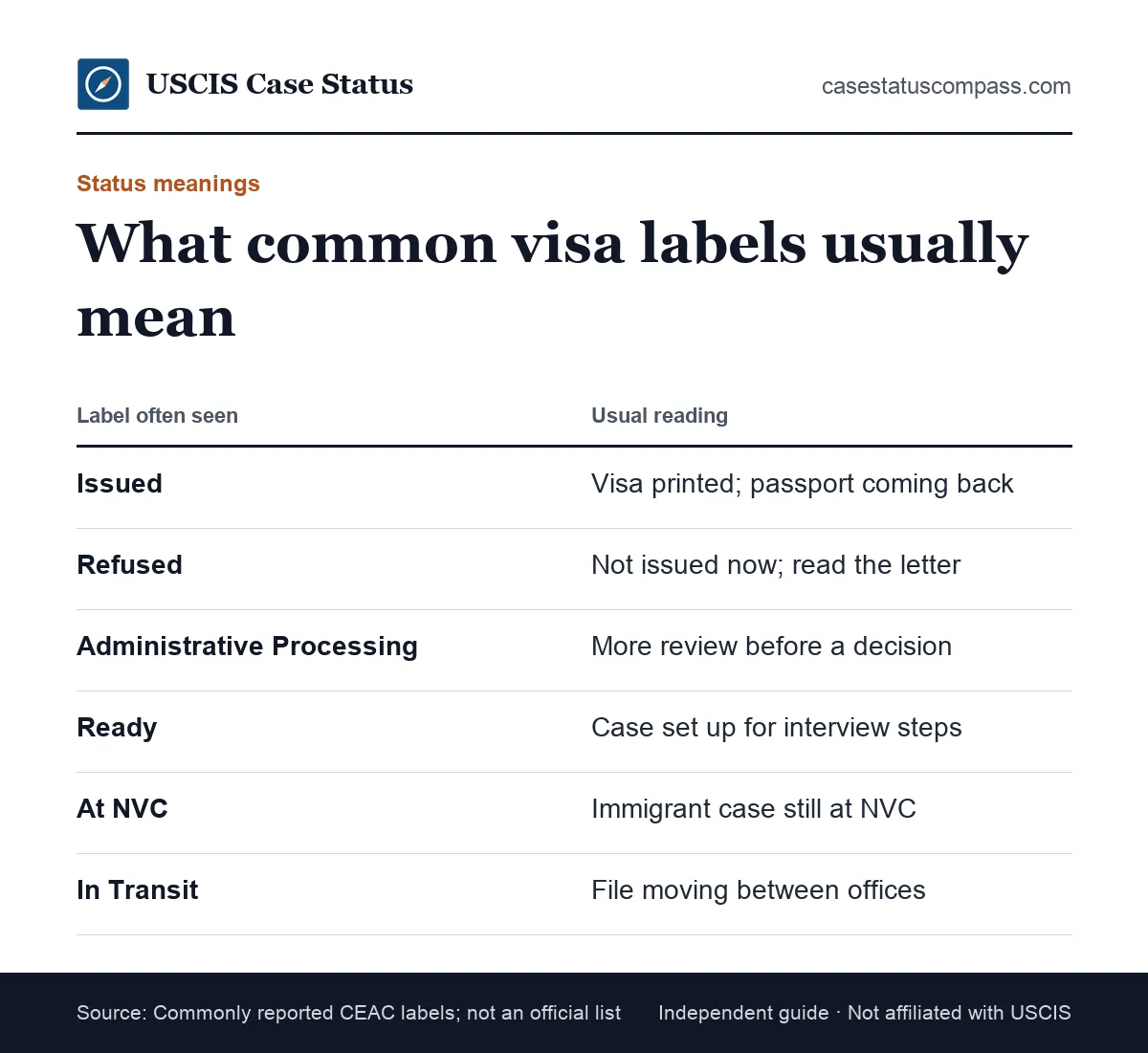
Why the wording varies
Labels differ by case type and can change without notice. When a label and a consular letter disagree, follow the letter. Immigrant and nonimmigrant cases also use different label sets, so do not compare yours with a friend's other case type.
How often the label changes
Many cases show only two or three labels, and one can stay put for weeks. The "last updated" date can change even when the label does not, which often means an officer touched the file.
What Does "Issued" Mean in Visa Status?
"Issued" usually means the consular officer approved the visa and it was printed into your passport. It does not guarantee entry; that decision belongs to U.S. Customs and Border Protection (CBP). Once you see Issued, the next step is getting your passport back and checking the visa.
Getting your passport back
Most posts return passports through a courier or pickup point named in your appointment account. Use that tracking, not CEAC, for this last step. Return times vary by post, so check your appointment account for the delivery status.
Checking the visa foil for errors
Check the visa foil for spelling errors as soon as it arrives. Compare the name, date of birth, visa type and expiration date with your passport, and contact the post through its website if anything is wrong.
Issued does not mean admitted
A visa lets you travel to a port of entry and ask to be admitted. A CBP officer decides and records your stay on the I-94. Bring the papers you showed the consulate.
What Does "Refused" or 221(g) Mean?
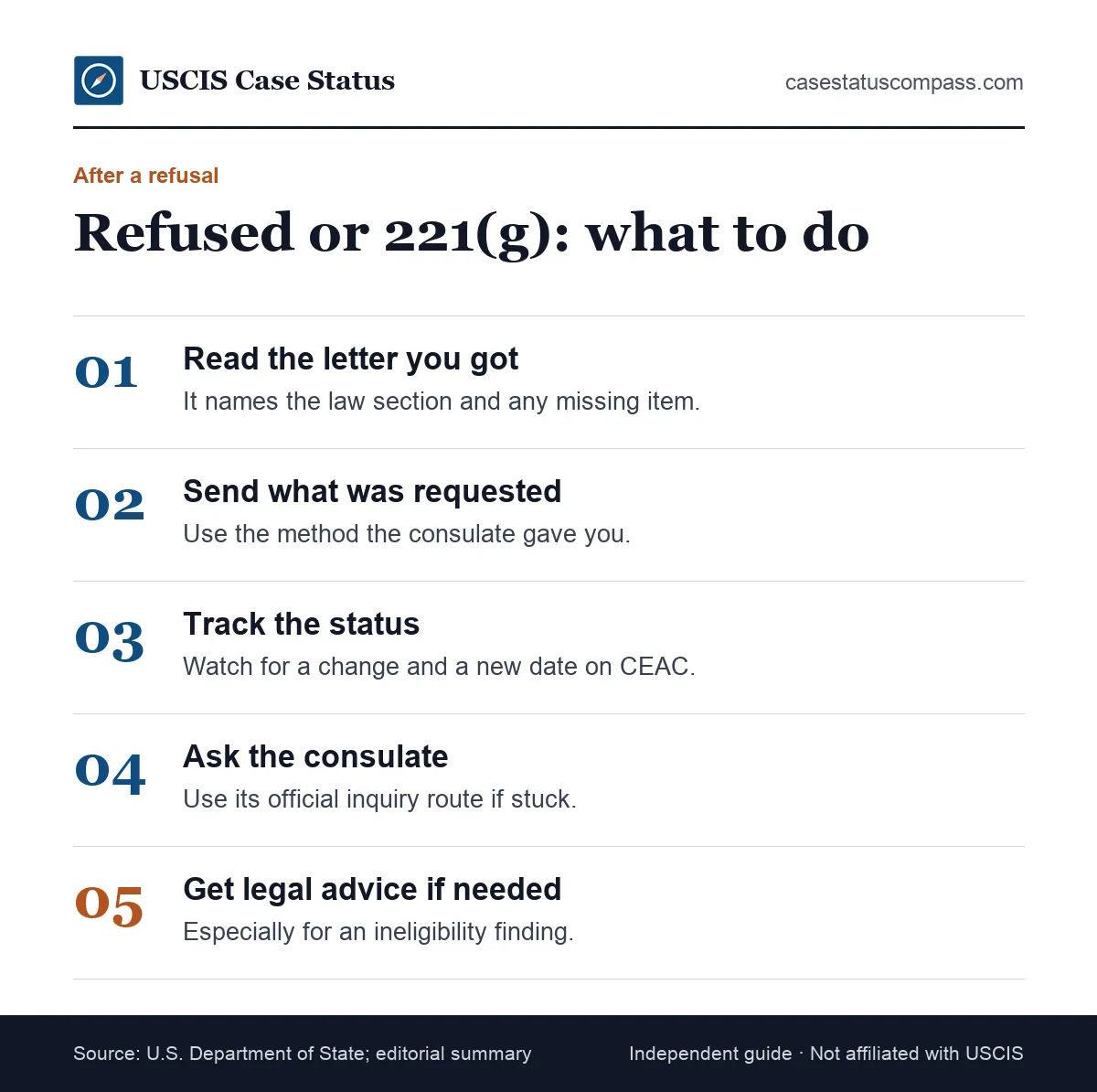
"Refused" means the consulate did not issue the visa at this time. Applicants often see it when the officer needs more documents, commonly called a 221(g) refusal. A refusal under another law section can be a firmer ineligibility finding. The letter names the section.
Temporary refusal vs ineligibility
A 221(g) refusal is often temporary: once the missing item arrives or review ends, the case can move to Issued. A refusal for weak ties to home usually means reapplying with a stronger case. Your letter tells you which you have.
How Do You Respond to a 221(g) Refusal?
Send only what the letter lists, by the route it gives, such as a courier drop-off or email. Include your name and application ID on every page. Then watch the "last updated" date on CEAC for a sign that it arrived. Keep a copy and proof of delivery.
What Does "Administrative Processing" Mean?
"Administrative Processing" usually means the case needs more review before an officer decides. It often appears right after an interview. It is not a denial, but it has no fixed end date. Many cases clear within weeks, while some take far longer, and the post rarely gives a date.
What happens during review
Reasons people report include security checks, document checks or a supervisor's review. If the officer handed you a form, it may explain the reason; otherwise, read the post's inquiry rules.
How to respond while you wait
Avoid non-refundable travel while this label shows. Reply fast to any request, and check CEAC about once a week. Do not send repeated inquiries; they do not speed review, and each post sets its own rules.
When the review drags on
If the wait grows very long, use the embassy's official inquiry route or ask an immigration attorney about options. Note the date the label first appeared, so any inquiry can say how long the case has been under review.
What Do "Ready," "At NVC" and "In Transit" Mean?
On immigrant visa cases, "At NVC" usually means the National Visa Center still holds the file. "In Transit" usually means the file is moving to the embassy. "Ready" usually means the case is set for the next consular step. These labels appear on immigrant cases.
"At NVC" on an immigrant case
While the label reads At NVC, the work is with NVC: fees, the DS-260 and civil documents. A preference case can also wait here until its priority date is current. Our NVC guide explains each step in that stage.
"In Transit" to the embassy
When NVC finishes and the embassy has room, the file moves on and the label usually reads In Transit. Nothing is needed from you at this step except keeping your contact details current.
"Ready" on an immigrant case
"Ready" is often read as the case being able to move toward an interview or waiting for a date. Watch your email and consular account for an interview letter, and follow the post's medical exam instructions.
What If Your Visa Status Shows No Status or Case Not Found?
A "No Status" or not-found result usually means your entry does not match a record. Common causes are the wrong case type, the wrong post or a mistyped number. A case created very recently may also need time to appear. Fix the entry before you assume anything is wrong with the case itself.
Common causes
- Choosing IV for a visitor or student visa, or NIV for an immigrant case
- Selecting a different post than the one you applied at
- Typing a USCIS receipt number instead of a DS-160 ID
- Mixing up the letter O and the number 0
What to try next
Copy the number from your confirmation or letter and retry after a day or two. If it still fails after your interview, contact the post through its website. USCIS cannot fix a CEAC lookup problem.
What Is the Difference Between an Immigrant and a Nonimmigrant Visa?
An American immigrant visa lets someone come to live permanently in the U.S. and leads to a green card. A nonimmigrant visa covers a temporary purpose, such as tourism, study or work. Each uses different forms, fees and lookups on CEAC. Picking the wrong option on the status page is the most common reason for a no-record result.
NIV vs IV at a glance
This table compares the two visa families by purpose, main form, lookup number and common examples.
| Feature | Nonimmigrant visa (NIV) | Immigrant visa (IV) |
|---|---|---|
| Purpose | Temporary visit, study or work | Permanent residence |
| Main form | DS-160 | DS-260 |
| CEAC lookup | DS-160 application ID | Case number |
| Goes through NVC | No (K visas are routed by NVC) | Yes, for most cases |
| Examples | B-1/B-2, F-1, H-1B, J-1 | IR1, CR1, F2A, EB-2, DV |
Immigrant visas lead to permanent residence
An immigrant visa holder becomes a lawful permanent resident on admission. As of October 2026, USCIS sums up the core benefit: Green card holders can live and work permanently in the U.S. and are protected by U.S. law. Our green card basics guide explains the duties that come with it.
Nonimmigrant visas have one purpose
A nonimmigrant visa is tied to one purpose, such as tourism or a named job. The visa's expiration date is about travel; your permitted stay is set by CBP on the I-94 record.
Where to Find Your Visa Number
Your US visa number is printed on the visa foil in your passport. Published guides describe it as a number in red ink, usually near the lower right of current foils. It is not the passport number or the visa control number.
Reading the visa foil
On the full-page sticker, find the number that stands apart in color and copy every character exactly. The two long lines at the bottom are the machine-readable zone, not the number. If you are unsure, compare with the visa number field on older forms you filed.
Visa number vs other numbers
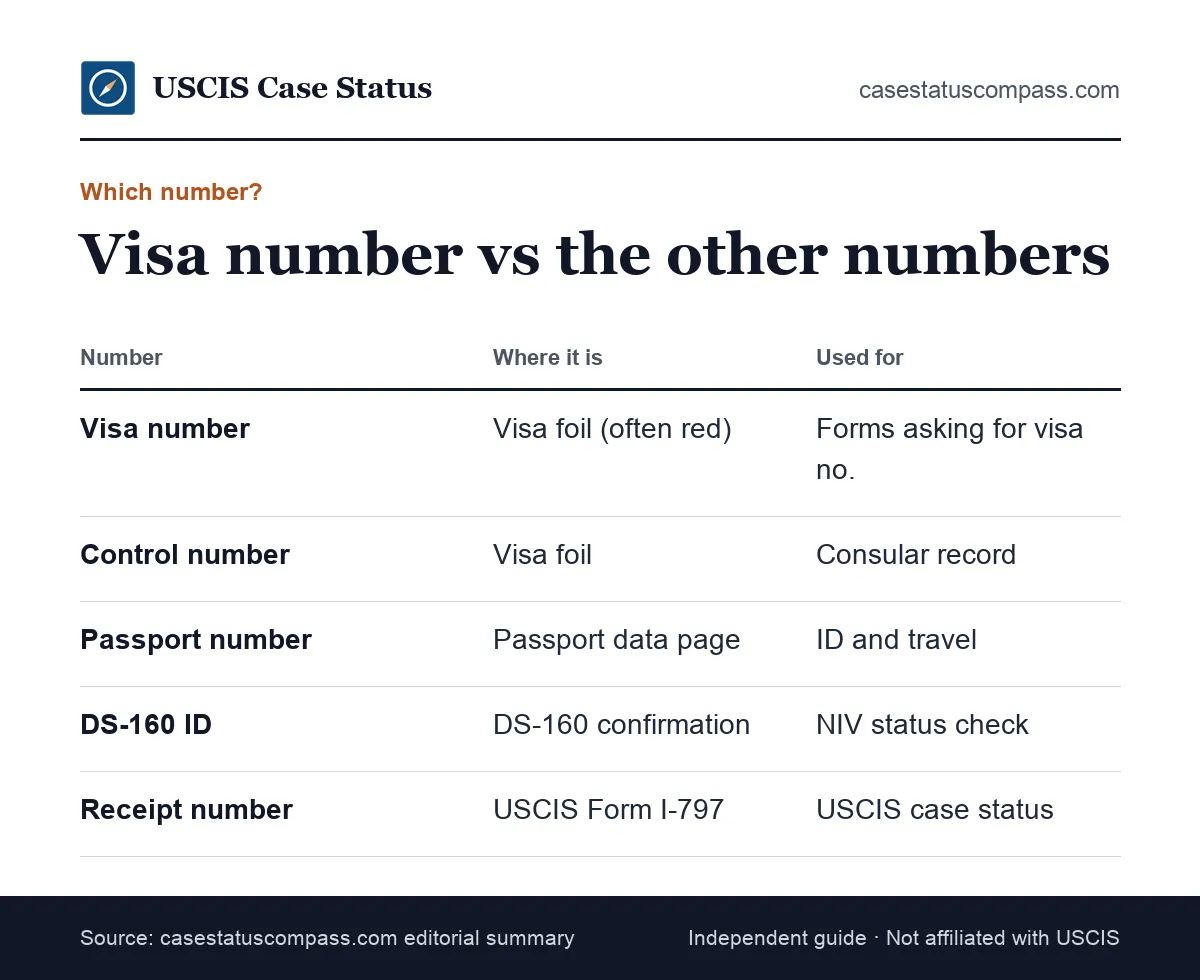
People often enter the wrong number on a form. The table shows where each number appears and what it is for.
| Number | Where it appears | What it is for |
|---|---|---|
| Visa number | Visa foil, usually in red | Forms asking for a "visa number" |
| Control number | Visa foil, printed field | Consular record of that visa |
| Passport number | Passport data page | Your country's travel ID |
| DS-160 application ID | DS-160 confirmation | Nonimmigrant status check |
| USCIS receipt number | USCIS Form I-797 | USCIS case status only |
Where Is the Visa Number on an H-1B Visa Stamp?
The visa number on an H-1B stamp sits where it does on other visas: the separately printed number on the foil, usually red, near the lower right. The Annotation field holds employer and petition details instead. Use the red number when a form asks for your visa number, and the passport number when it asks for a travel document.
What the H-1B stamp shows
The H-1B stamp lists your name, visa type, issuing post, dates and entries allowed. The annotation usually names your employer and the USCIS petition receipt number, which tracks the petition, not the visa.
What the number is used for
Later DS-160s and some USCIS forms ask for your most recent visa number, next to your I-94 number. If a form like the I-130 asks for a "travel document number," it usually means the passport, not the visa.
How Long Does It Take to Get a Visa?
How long it takes to get a visa depends on the type and the embassy; visitor and student visas often take weeks to months. Immigrant visas usually take longer: a USCIS petition, NVC work and sometimes a Visa Bulletin wait come first.
What drives a nonimmigrant wait
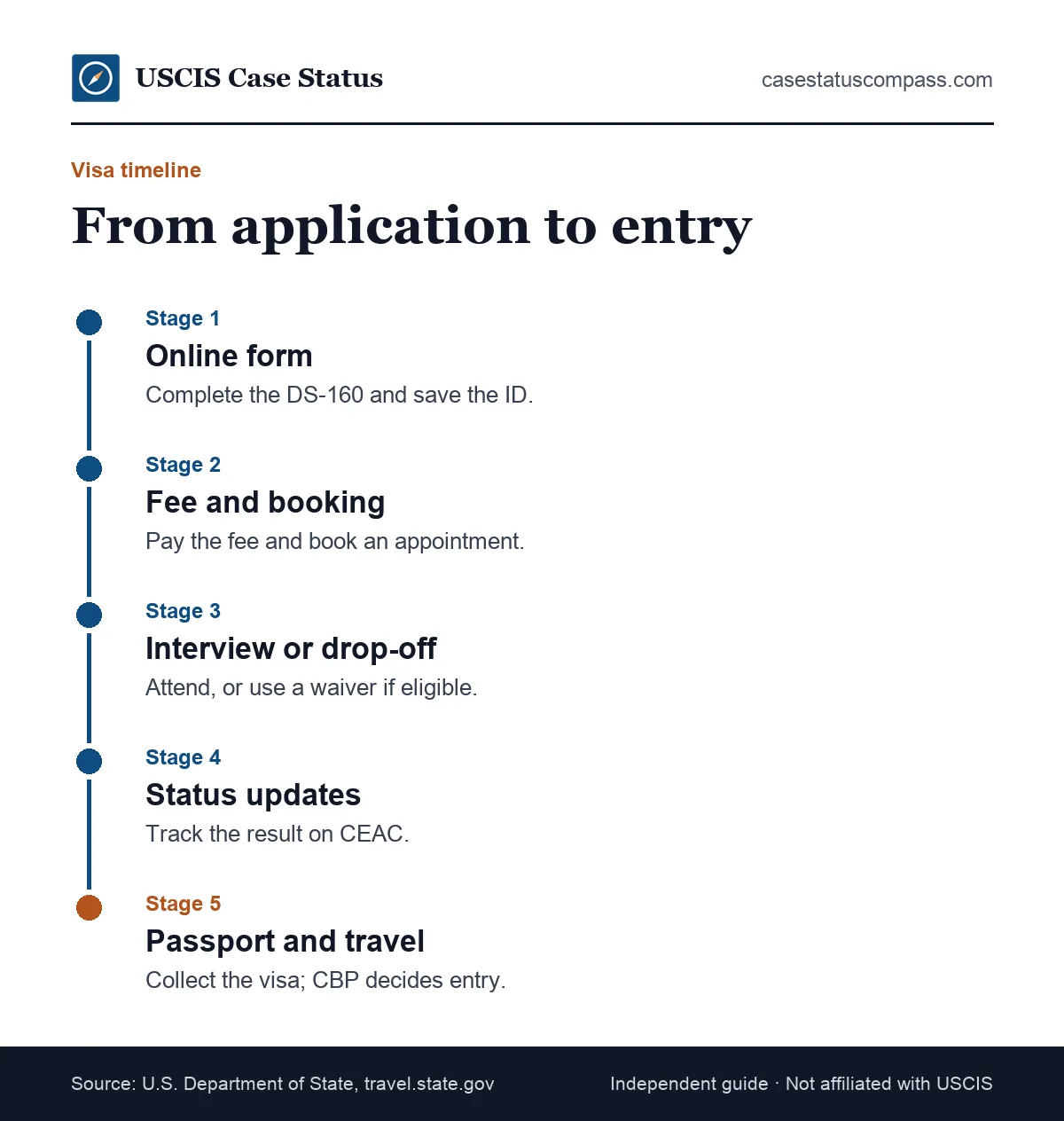
The biggest factor is usually the appointment wait at your post. The State Department updates its visa interview wait times monthly; the latest update was Oct. 21, 2026; see the global visa wait times page. Then come the interview, any extra review and passport return. Petition-based visas also wait for USCIS approval first.
Why immigrant visas take longer
An immigrant visa starts with a USCIS petition. USCIS's median for immediate-relative I-130s was I-130 (immediate relative): median 13.0 months (USCIS data, Apr.-June 2026). NVC document work, any bulletin wait and the embassy queue follow; our NVC processing time section covers the middle stage.
How Long After a Visa Interview Will You Get Your Visa?
Many approved nonimmigrant visas are printed and returned within days to a couple of weeks after the interview. Cases in administrative processing can take much longer. The post's courier or pickup method also affects how quickly you get the passport back. Wait until the visa is in hand before buying tickets.
If the officer approves at the window
The officer may keep your passport and say the visa is approved, but printing and the courier still need time. Do not book fixed travel until the visa is in your hand and the foil details are correct.
If the officer hands you a letter
A letter usually means the case is not finished: it may ask for documents or explain extra review. The CEAC label often reads Refused or Administrative Processing until it is resolved.
How Long Does a Work Visa Take?
A US work visa usually takes two steps: a USCIS petition, then a consular stamp. USCIS reported a median of I-129 (all classifications combined): median 9.5 months (USCIS data, Apr.-June 2026). The stamp step then depends on your post's appointment wait and any extra review. Workers already in the U.S. who change status skip the stamp until they travel.
The USCIS petition step
Most work visas, including H-1B, L-1 and O-1, need an approved Form I-129. Some employers pay for faster petition review; our H-1B processing time guide explains it. The petition must be approved before the visa interview.
The consular stamp step
After approval, the worker files a DS-160, books an appointment and attends an interview or a waiver drop-off. Bring the I-797 approval notice and the employer's documents. The wait at your post is shown on the State Department's wait-time page.
How Much Is a Visa?
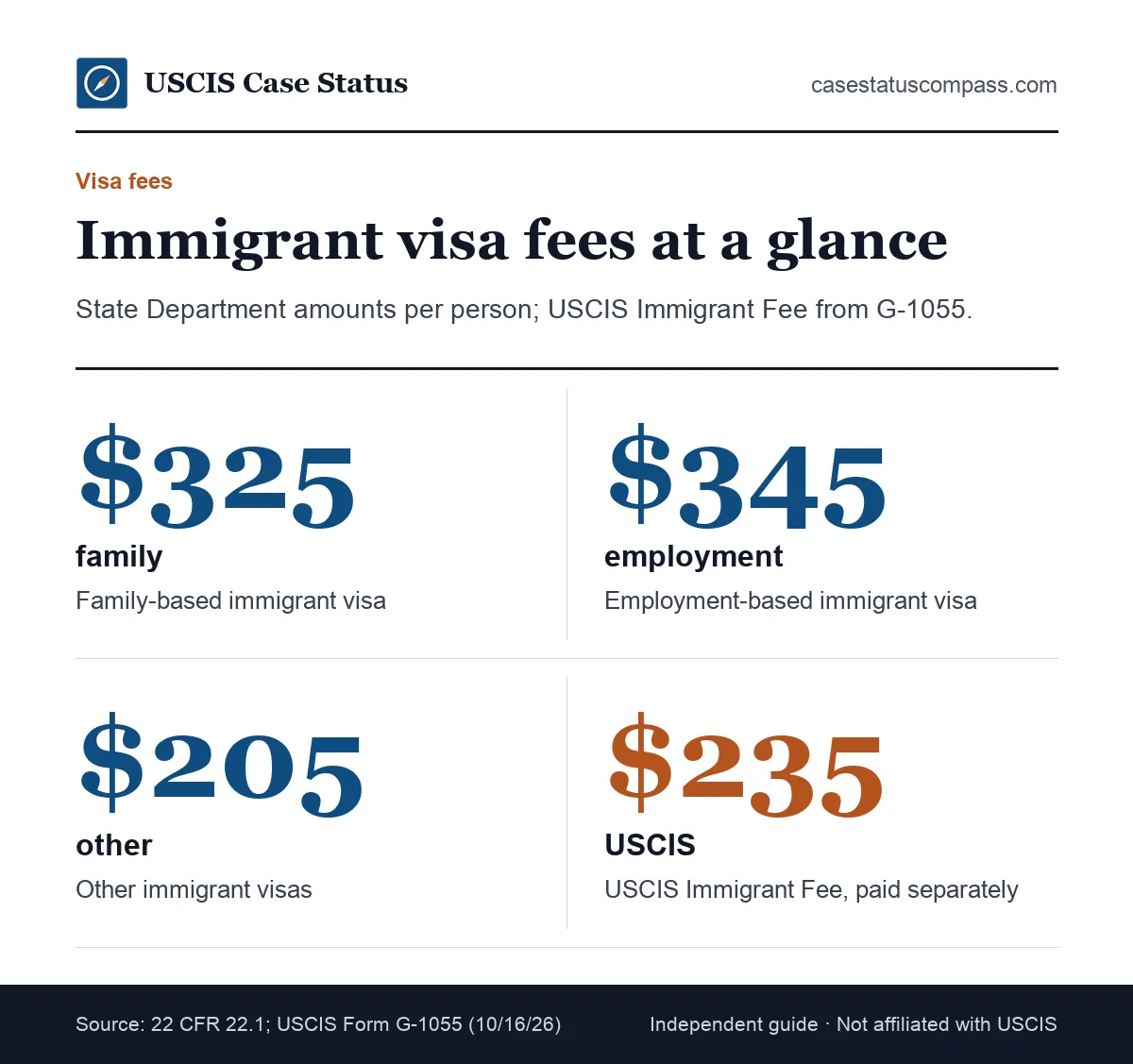
The US visa rate depends on the visa type. As of October 2026, the State Department's fee schedule (22 CFR 22.1) lists the immigrant visa fee as Immigrant visa fee: $325 family; $345 employment; $205 other (per person). Nonimmigrant fees depend on the category. Pay through your post's official payment route, and keep the receipt, because you need it to book an appointment.
Nonimmigrant visa fees by category
For nonimmigrant visas, the Fees for Visa Services page lists $185 for visitor, student and other non-petition visas, $205 for H, L, O, P, Q and R visas, and $315 for E visas.
Immigrant visa fees
The immigrant visa fee is charged per person. Some family cases also pay the State Department's $120 Affidavit of Support review fee (State Department, when reviewed domestically). After issuance, most new immigrants pay the USCIS Immigrant Fee of $235 so USCIS can mail the green card.
Fiancé(e) and visitor visa fees
The State Department lists a $265 K (fiancé) visa application fee, separate from the USCIS Form I-129F fee. See our K-1 visa fees page. Fees can change, so check the State Department's page before paying. Fiancé(e)s pay the State Department fee at the consulate stage.
What Is the Visa Integrity Fee?
The visa integrity fee is a charge on approved nonimmigrant visas created by the law known as H.R. 1. The State Department's Fees for Visa Services page did not list a visa integrity fee as of Oct. 27, 2026, and we have not confirmed whether or at what amount it is being collected. Check the Fees for Visa Services page and your embassy's site for current rules before you travel.
Why we list no amount
The law sets a base amount, but collection depends on agency rules and notices. We publish a fee only after confirming it on an official page. If the State Department begins collecting it, its fee page will say so.
Visa integrity fee scams
A site charging a "visa integrity fee" outside the State Department's payment system is a warning sign. Pay visa fees only through the payment route linked from your embassy's official site.
How Do US Embassy Appointment Dates Work?
US embassy appointment dates are set by each post, based on its staffing and demand. The State Department publishes estimated appointment wait times by post and visa category. You book through your post's scheduling system after paying the fee. Popular posts can be booked months ahead.
Checking wait times
The State Department's wait-time tool lists estimates for visitor, student and work visas at each post. Estimates change monthly, so we do not quote city figures. Choose your city and visa category, then read the estimate.
Booking safely
Most posts use an online scheduling account where you pay, enter your DS-160 number and pick a slot. For login or payment trouble, use the US visa scheduling customer care contact listed on that official site. Never hand your login to an agent.
India US visa appointments
An India US visa appointment works the same way: use only the system linked from the embassy's official site, including any US visa application centre visit for photos and fingerprints. For a US visa India wait time, pick the Indian post you will use in the wait-time tool.
Can You Reschedule or Move a US Visa Interview?
Yes, most posts let you reschedule in the same scheduling account, though some cap how often. Moving a nonimmigrant case to another country is sometimes possible. Rules differ by post, so read your embassy's appointment page. Your DS-160 may need updating if the post changes.
Rescheduling a visa appointment
Log in and use the reschedule option, booking the new slot before cancelling the old one if allowed. Too many changes can lock the account or trigger a new fee at some posts.
Changing the interview location
The country of application in the scheduling system must match where you want to interview. Changing it can mean a new payment or booking. Immigrant cases are assigned to a post and need a formal transfer request.
What Is a US Visa Interview Waiver or Dropbox?
A US visa interview waiver, often called "dropbox," lets some applicants submit documents without meeting an officer. It changes how you apply, not how you track: the case still appears on CEAC under your DS-160 application ID. Follow your post's document list.
Who may qualify for an interview waiver
Eligibility depends on the category, past visas and the post's current policy. Rules change, so check your embassy's page before booking a drop-off. Renewals in the same category are often the main group that qualifies, but the post decides.
Dropbox status updates
An administrative processing label after drop-off is common while the post reviews the file. The post will contact you if it decides an interview is needed after all, so watch your email.
What Is Visa Status Verification?
Visa status verification usually means confirming that a visa, or a person's stay, is valid. The visa shows dates and entries; your permission to stay after entry is on the CBP I-94 record. These two records answer different questions: whether you may travel here, and how long you may stay.
Your I-94 is the record of your stay
After entry, CBP creates an I-94 showing your class of admission and the date your stay ends. View it on the official I-94 website. A visa can expire while you remain lawfully in the U.S.; the I-94 date controls.
How others verify your status
Employers use Form I-9 and sometimes E-Verify; benefit agencies use federal systems. None of this needs a paid service. If an employer or landlord asks, you can show your own I-94 printout and passport. Never pay a website to "verify" your visa.
How Can You Check Your Visa Status While in the USA?
Inside the U.S., "visa status" usually means your immigration status, shown by your I-94 on the CBP website. Pending extensions or changes of status are tracked on USCIS Case Status Online. Neither CEAC nor the visa stamp shows those. Print your I-94 record after every entry.
Extensions and changes of status
A visitor asking to stay longer, or a student changing status, files with USCIS. Those cases appear on USCIS tools, never CEAC. Our receipt number guide explains the 13-character number you will use.
When you need a new stamp
A change of status inside the U.S. does not put a new visa in your passport. If you travel abroad, you usually need a visa in the new category to return, which is again a State Department case on CEAC.
Do You Need a Visa or Can You Use the Visa Waiver Program?
Citizens of Visa Waiver Program countries can make short tourism or business visits without a visa, after approval through ESTA. ESTA is run by CBP, not the State Department, so CEAC does not track it. Check an ESTA application on CBP's official ESTA site.
How ESTA differs from a visa
ESTA is an online travel authorization, not a visa. If ESTA is denied, you can still apply for a visitor visa. Apply only on the official CBP site, because paid look-alike ESTA sites are common.
When a visa is still required
Visa Waiver travelers still need a visa to study, work or stay longer. Past violations or certain travel history can also end ESTA eligibility. In that case, apply for a B visa through the State Department.
How Do You Spot a Fake US Visa Status Site?
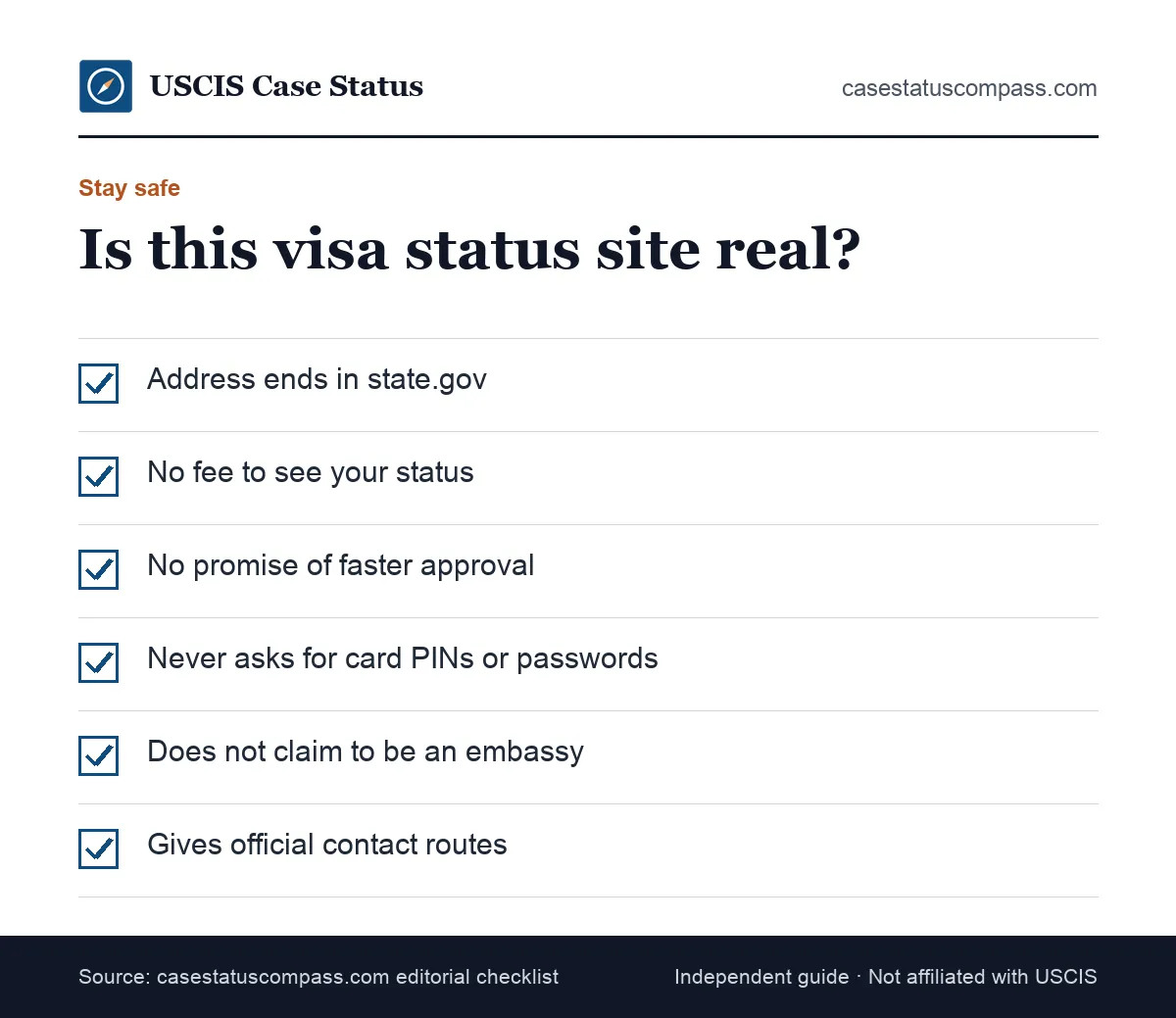
A fake US visa status site often charges a fee, asks for passwords or promises faster approval. The real check is free on a state.gov address, and agents cannot change or speed a consular decision. Check the address bar before you type any number.
Signs of a scam
- An address that does not end in state.gov (or your embassy's linked scheduling site)
- A fee "to check your status"
- Messages saying you won a visa you never applied for
- Pressure to pay by gift card or wire transfer
Where to report it
Report fraud to the embassy and, in the U.S., to the Federal Trade Commission. Our immigration scams guide covers common tricks. The FTC's site is ReportFraud.ftc.gov, the FTC's scam reporting site. Include the website address, any payment receipt and screenshots, and tell your bank if you paid by card.
What Are the Most Common Mistakes When Checking Visa Status?
The most common mistakes are using the wrong tool, number or case type. Others include trusting third-party sites, reading only the label and booking travel before the visa is in hand. Each one is easy to avoid with a short check before you search.
Using USCIS tools for a visa
If your case is at a consulate, use CEAC; if it is a USCIS petition, use Case Status Online. Knowing which agency has your file saves hours. Your most recent notice usually names the agency.
Treating a label as the final word
Labels can lag behind decisions; a 221(g) case may read Refused shortly before it is issued. Keep every consular letter, and ask the post when the label and letter do not match.
What Happens After Your Visa Is Issued?
After issuance, you collect the passport and travel to a U.S. port of entry, where CBP decides admission. Immigrant visa holders also pay the USCIS Immigrant Fee so USCIS can produce and mail the green card. Check your passport and visa details before you travel.
Entry as a nonimmigrant
At the airport, CBP checks your passport and visa and may ask questions. If admitted, your I-94 shows how long you may stay. Leave on time or file with USCIS before it ends.
Entry as an immigrant
An immigrant visa endorsed as temporary proof of residence works as evidence of status for a time. As of October 2026, USCIS's employer handbook says: Temporary I-551 stamp: valid until its expiration date, or 1 year if no date is printed. The card comes later; see our Form I-551 page.
How Does the Visa Bulletin Affect Immigrant Visa Status?
The Visa Bulletin decides when many immigrant visa cases can move forward. In family preference and employment cases, your priority date must be current before the visa can be issued. Immediate relatives of U.S. citizens do not wait for it. CEAC does not show your place in line, so check the monthly bulletin yourself.
Priority dates and yearly limits
As of October 2026, USCIS explains that The State Department publishes the Visa Bulletin monthly: Final Action Dates vs Dates for Filing. Congress caps the numbers: Yearly limits: 226,000 family preference visas; 140,000 employment-based. Our visa bulletin guide shows how to read the charts. Your category is on the approval notice.
What the bulletin means for your label
A preference case can sit at NVC while its priority date is not current, which is normal. Once the date is current, NVC and the embassy can move it toward an interview.
When Should You Use Immigration Court Case Status Instead?
Use immigration court case status when someone is in removal proceedings before the Executive Office for Immigration Review (EOIR), part of the Department of Justice. That process is separate from visas and USCIS. Someone abroad rarely has a court case, but a relative in the U.S. may, and only EOIR's tools show it.
Signs your case is in court
You received a Notice to Appear, a hearing notice or a court decision. Our guide to immigration court case status explains the EOIR tools. A court case uses your A-number.
Three agencies, three trackers
Court cases use EOIR's tools, visas use CEAC and USCIS petitions use Case Status Online. A removal case does not appear on either of the other two, so check the tool that matches the agency named on your notice.
What Should You Do Next for Each Visa Status?
What to do next depends on the label you see; if a consular letter says otherwise, follow the letter. For complex refusals, talk to an immigration attorney or DOJ-accredited representative. Most labels need only a small step from you, and some need nothing at all except waiting.
Next steps by visa status label
Find the label your US visa status shows, then follow the matching step before contacting anyone.
| If your US visa status shows… | Do this |
|---|---|
| Application Received | Attend your interview or drop-off as booked |
| Administrative Processing | Send anything requested; avoid fixed travel |
| Refused with a 221(g) letter | Send the listed items by the route given |
| Issued | Track the passport return; check the foil |
| At NVC or Ready | Finish NVC steps; watch for an interview letter |
| No Status | Recheck the number, type and post |
When to contact the embassy
Contact the post when its published timeframe has passed, a letter is unclear or you have an urgent travel need. Use the inquiry route on its official site, with your full name, date of birth and application ID.
When to get legal help
Get help if your visa was refused for an ineligibility reason, you have past immigration violations, or a family case needs a waiver. An immigration attorney or DOJ-accredited representative can explain options.
Frequently Asked Questions
Can I check my US visa status with my passport number?
Usually not. The CEAC check asks for a DS-160 application ID for nonimmigrant cases, or a case number plus passport and surname details for immigrant cases; a passport number alone is not enough. If you lost the DS-160 confirmation, search your email or scheduling account.
Does "Refused" mean I can never get a US visa?
Not necessarily. Many refusals, including 221(g) refusals, are temporary; others are ineligibility findings. Your letter names the law section; an immigration attorney can explain what it means for you.
Why does my visa status still say Administrative Processing?
Administrative processing has no fixed end date. Check CEAC about weekly, answer any request quickly, and use the embassy's official inquiry route if the wait passes the post's published guidance.
How much is the immigrant visa fee?
As of October 2026, the State Department's schedule in 22 CFR 22.1 lists Immigrant visa fee: $325 family; $345 employment; $205 other (per person). Most new immigrants also pay the USCIS Immigrant Fee of $235 after issuance.
Can I track my visa on a paid status website?
You do not need to. Paid "visa status" sites cannot see more than the free CEAC tool at ceac.state.gov, and some are scams that collect personal data.
Does a US visa status check show my green card status?
No. CEAC shows the immigrant visa only. After you enter, USCIS produces and mails the permanent resident card. Track it with USCIS, not on the State Department site.
How do I pay the immigrant visa fee?
Pay it only inside your official immigrant visa account after NVC bills the case. Never send visa fees to an agent's account or through a link in an unexpected message.
Can I change my visa status while in the U.S.?
Yes, in many cases, by filing with USCIS rather than the State Department. A visitor asking to stay longer files Form I-539, tracked on Case Status Online. A change of status does not put a new visa in your passport.
Sources
- U.S. Department of State: Consular Electronic Application Center (CEAC). ceac.state.gov/CEACStatTracker/Status.aspx. Accessed Oct 27, 2026.
- U.S. Department of State: U.S. Visas. travel.state.gov/content/travel/en/us-visas.html. Accessed Oct 27, 2026.
- U.S. Department of State: Fees for Visa Services. travel.state.gov/content/travel/en/us-visas/visa-information-resources/fees/fees-visa-services.html. Accessed Oct 27, 2026.
- 22 CFR 22.1: Schedule of Fees for Consular Services. www.ecfr.gov/current/title-22/chapter-I/subchapter-A/part-22/section-22.1. Accessed Oct 27, 2026.
- USCIS: Consular Processing. www.uscis.gov/green-card/green-card-processes-and-procedures/consular-processing. Accessed Oct 27, 2026.
- USCIS: Visa Availability and Priority Dates. www.uscis.gov/green-card/green-card-processes-and-procedures/visa-availability-priority-dates. Accessed Oct 27, 2026.
- USCIS Form G-1055, Fee Schedule (edition 10/16/26). www.uscis.gov/sites/default/files/document/forms/g-1055.pdf. Accessed Oct 27, 2026.
- CBP: I-94 Official Website. i94.cbp.dhs.gov/. Accessed Oct 27, 2026.
- USCIS: Checking Your Case Status Online. www.uscis.gov/tools/checking-your-case-status-online. Accessed Oct 27, 2026.
- USCIS: Rights and Responsibilities of a Green Card Holder (updated 09/12/2025). www.uscis.gov/green-card/after-we-grant-your-green-card/rights-and-responsibilities-of-a-green-card-holder-permanent-resident. Accessed Oct 27, 2026.
- State Department: Global Visa Wait Times (updated 21-Oct-2026). travel.state.gov/content/travel/en/us-visas/visa-information-resources/global-visa-wait-times.html. Accessed Oct 27, 2026.
- USCIS Data Library: All USCIS Application and Petition Form Types, FY2026 Q3 (Apr. 1-June 30, 2026; queried 7/2026). www.uscis.gov/sites/default/files/document/data/quarterly_all_forms_fy2026_q3_v1.xlsx. Accessed Oct 27, 2026.
- 22 CFR 22.1 Schedule of Fees for Consular Services (LII). www.law.cornell.edu/cfr/text/22/22.1. Accessed Oct 27, 2026.
- FTC: How To Avoid Immigration Scams and Get Real Help (Nov. 2023); USCIS Report Immigration Scams page. consumer.ftc.gov/articles/how-avoid-immigration-scams-and-get-real-help. Accessed Oct 27, 2026.
- USCIS M-274 Handbook for Employers, 7.1 (updated 10/17/2023). www.uscis.gov/i-9-central/form-i-9-resources/handbook-for-employers-m-274/70-evidence-of-employment-authorization-for-certain-categories/71-lawful-permanent-residents-lpr. Accessed Oct 27, 2026.
casestatuscompass.com is an independent publication and is not affiliated with USCIS or any government agency. This page is general information, not legal advice. For denials, court or asylum matters, consult an immigration attorney or a DOJ-accredited representative.